Questions as text
Q1 · What will increase the working capital and net assets and reserves of a company? 9706/11 May/June 2006
19 What will increase the working capital and net assets and reserves of a company? A a bonus issue of shares B a debenture issue C an issue of shares at a premium D an issue of shares at nominal value
1 marks
Answer: C
This question in 9706/11 May/June 2006
Q2 · The table shows an extract from a company’s final accounts: $ purchases 28 000 cost of… 9706/11 May/June 2006
23 The table shows an extract from a company’s final accounts: $ purchases 28 000 cost of sales 24 000 creditors 4 200 accruals 1 100 What is the creditors’ collection period for the year? A 55 days B 64 days C 69 days D 81 days
1 marks
Answer: A
This question in 9706/11 May/June 2006
Q3 · Acompany has the following gross profit and net profit ratios for two years 9706/11 May/June 2006
24 Acompany has the following gross profit and net profit ratios for two years.
Year 1 Year 2
gross profit % 26% 29%
net profit % 13% 10%
The company’s turnover has remained unchanged for both years.
What is a correct interpretation of these ratios?
cost of sales overheads
increased | decreased increased | decreased
008 >
x « &
\ \ x
\ x x
~ KOM
1 marks
Answer: D
This question in 9706/11 May/June 2006
Q4 · A firm has $10 000 in the bank and buys stocks for $6000 paying by cheque 9706/11 May/June 2006
25 A firm has $10 000 in the bank and buys stocks for $6000 paying by cheque. What will be the effect on its current ratio and quick (acid test) ratio? current ratio quick (acid test) ratio A no effect no effect B decreases increases C decreases no effect D no effect decreases
1 marks
Answer: D
This question in 9706/11 May/June 2006
Q5 · The following information is given for a business 9706/11 May/June 2006
26 The following information is given for a business. $ $ Sales 650 000 Less cost of sales Stock 1 January 19 000 Purchases 508 000 527 000 Stock 31 December 25 000 502 000 Gross Profit 148 000 Stock turnover 16 days Debtors 31 December $48 082 Creditors 31 December $44 537 What is the working capital cycle? A 11 days B 21 days C 43 days D 75 days
1 marks
Answer: A
This question in 9706/11 May/June 2006
Q6 · What is the calculation for capital employed? 9706/11 Oct/Nov 2006
7 What is the calculation for capital employed? A current assets – current liabilities B fixed assets + current assets – current liabilities C fixed assets + current assets + current liabilities D net assets – current liabilities
1 marks
Answer: B
This question in 9706/11 Oct/Nov 2006
Q7 · A business has a current ratio of 1.75 : 1 and a quick (acid test) ratio of 1 : 1 9706/11 Oct/Nov 2006
23 A business has a current ratio of 1.75 : 1 and a quick (acid test) ratio of 1 : 1. The business sells stock on credit at its usual mark-up. What is the effect of this on the current ratio and quick (acid test) ratio? current ratio quick (acid test) ratio A decrease decrease B decrease increase C increase decrease D increase increase
1 marks
Answer: D
This question in 9706/11 Oct/Nov 2006
Q8 · During the year ended 31 March 2006 a business made sales of $560 000 of which 25 % were… 9706/11 Oct/Nov 2006
24 During the year ended 31 March 2006 a business made sales of $560 000 of which 25 % were for cash. The trade debtors at 31 March 2005 were $52 000 and at 31 March 2006 they were $56 000. What is the debtors’ collection period based on average debtors? A 34 days B 35 days C 47 days D 49 days
1 marks
Answer: C
This question in 9706/11 Oct/Nov 2006
Q9 · The following data is available: this year last year $ $ credit sales 60 000 50 000… 9706/11 Oct/Nov 2006
25 The following data is available: this year last year $ $ credit sales 60 000 50 000 credit purchases 40 000 28 000 creditors (average) 10 000 16 000 debtors (average) 12 000 8 000 Which statement is correct? A Debtors’ and creditors’ turnover ratios have improved. B Debtors’ and creditors’ turnover ratios have worsened. C Debtors are paying faster, but creditors are being paid more slowly. D Debtors are paying more slowly, but creditors are being paid faster.
1 marks
Answer: D
This question in 9706/11 Oct/Nov 2006
Q10 · A company’s Profit and Loss Account showed a profit before interest of $128 000 9706/11 Oct/Nov 2006
26 A company’s Profit and Loss Account showed a profit before interest of $128 000. Interest paid was $8000. The table shows amounts included in the company’s Balance Sheet. $ fixed assets 485 000 net current assets 27 000 amounts falling due after one year: Debentures 80 000 How much is the return on the total capital employed? A 20.3 % B 21.6 % C 23.4 % D 25.0 %
1 marks
Answer: D
This question in 9706/11 Oct/Nov 2006
Q11 · The capital structure of a company is shown 9706/11 May/June 2007
19 The capital structure of a company is shown. $ 700 000 ordinary shares of $0.25 each 175 000 8 % loan stocks 160 000 During the year the company made profits before interest of $105 000. The directors wish to distribute as much of the profits as possible by way of dividend. What is the dividend per share? A $0.1317 B $0.15 C $0.5268 D $0.60
1 marks
Answer: A
This question in 9706/11 May/June 2007
Q12 · What does the ratio of current assets / current liabilities show? 9706/11 May/June 2007
20 What does the ratio of current assets / current liabilities show? A asset usage B liquidity C profitability D return on capital employed
1 marks
Answer: B
This question in 9706/11 May/June 2007
Q13 · A business turns over its stock 5 times a year 9706/11 May/June 2007
21 A business turns over its stock 5 times a year. Average stock is $54 000 and sales are made at a mark-up of one third. How much are the sales? A $240 000 B $270 000 C $320 000 D $360 000
1 marks
Answer: D
This question in 9706/11 May/June 2007
Q14 · A company has the following information in its balance sheet: $000 taxation due 40… 9706/11 May/June 2007
22 A company has the following information in its balance sheet: $000 taxation due 40 debtors 150 bank overdraft 90 stock 110 proposed dividend 70 creditors 80 What is the liquidity (acid test or quick) ratio? A 0.54 : 1 B 0.88 : 1 C 0.93 : 1 D 1.85 : 1
1 marks
Answer: A
This question in 9706/11 May/June 2007
Q15 · A business has cash sales of $69 030 and credit sales of $1 406 070 in a year (360 days) 9706/11 May/June 2007
23 A business has cash sales of $69 030 and credit sales of $1 406 070 in a year (360 days). The debtors’ collection period is 40 days. What is the closing debtors’ balance? A $35 152 B $36 878 C $156 230 D $163 900
1 marks
Answer: C
This question in 9706/11 May/June 2007
Q16 · A firm has calculated the following accounting ratios for the year ended 30 June: year… 9706/11 May/June 2007
24 A firm has calculated the following accounting ratios for the year ended 30 June: year ended 30 June 2005 30 June 2006 gross profit on sales 30 % 33 % net profit on sales 15 % 14 % What could explain the changes in the percentages? A A fall in interest payments was equal to an increase in administration costs. B An increase in raw material costs was covered by an increase in selling price. C An increase in the advertising budget has allowed the firm to increase the selling price. D An increase in the advertising budget has led to a rise in sales volume.
1 marks
Answer: C
This question in 9706/11 May/June 2007
Q17 · A company’s sales are made evenly over a year (360 days) 9706/11 May/June 2008
20 A company’s sales are made evenly over a year (360 days). 10 % of the sales are for cash. The debtor balance is $26 700 and the debtor collection period is 30 days. What are the total sales (cash and credit) for the year? A $320 400 B $356 000 C $801 000 D $890 000
1 marks
Answer: B
This question in 9706/11 May/June 2008
Q18 · A business has a gross profit to sales ratio of 40 %, and a net profit to sales ratio of… 9706/11 May/June 2008
21 A business has a gross profit to sales ratio of 40 %, and a net profit to sales ratio of 10 %. If the sales volume increases by 8 % which of the following will generally be true? gross profit to net profit to sales ratio sales ratio A increase decrease B increase increase C unchanged decrease D unchanged increase
1 marks
Answer: D
This question in 9706/11 May/June 2008
Q19 · Which of the following correctly shows the effect of a company increasing the value of… 9706/11 May/June 2008
22 Which of the following correctly shows the effect of a company increasing the value of its freehold property? asset use ratio gearing A decrease decrease B decrease increase C increase decrease D increase increase
1 marks
Answer: A
This question in 9706/11 May/June 2008
Q20 · What might cause working capital to fall? 9706/11 May/June 2008
23 What might cause working capital to fall? A an amount owing by a customer has turned out to be a bad debt B an old delivery van has been given in full exchange for a new computer C a payment of cash has been made to a trade creditor D new stock has been purchased on credit
1 marks
Answer: A
This question in 9706/11 May/June 2008
Q21 · The following information has been taken from a recent balance sheet of a business 9706/11 May/June 2008
24 The following information has been taken from a recent balance sheet of a business. $000 fixed assets 150 capital 170 current liabilities 5 What is the current ratio? A 3 : 1 B 4 : 1 C 5 : 1 D 6 : 1
1 marks
Answer: C
This question in 9706/11 May/June 2008
Q22 · Which ratio indicates how efficiently a company controls its overheads? 9706/11 Oct/Nov 2008
21 Which ratio indicates how efficiently a company controls its overheads? A current assets / current liabilities B gross profit / sales C net profit / sales D sales / capital employed
1 marks
Answer: C
This question in 9706/11 Oct/Nov 2008
Q23 · The following information has been taken from a recent balance sheet 9706/11 Oct/Nov 2008
22 The following information has been taken from a recent balance sheet. fixed assets $30 000 working capital ratio 5 : 1 capital $34 000 current liabilities $1000 What is the amount of the current assets? A $1000 B $5000 C $6000 D $20 000
1 marks
Answer: B
This question in 9706/11 Oct/Nov 2008
Q24 · The following data is available at the end of a financial year 9706/11 Oct/Nov 2008
23 The following data is available at the end of a financial year. opening stock $500 000 purchases $2 250 000 closing stock $750 000 gross profit margin 50 % debtors collection period 60 days Sales are all on credit and accrue evenly over a 360-day accounting period. What is the value of debtors at the year-end? A $333 333 B $375 000 C $500 000 D $666 667
1 marks
Answer: D
This question in 9706/11 Oct/Nov 2008
Q25 · The profit margins of a company over two years showed: 31 March 31 March year 1 year 2… 9706/11 Oct/Nov 2008
24 The profit margins of a company over two years showed: 31 March 31 March year 1 year 2 gross profit margin 37.2 % 39.1 % net profit margin 12.2 % 11.8 % What combination of factors could have caused these changes? A a change in the combination of goods sold leading to lower selling costs B a loss of trade discounts on purchases but an increase in cash discounts taken from suppliers C an advertising campaign to promote higher sales leading to higher selling prices D an increase in both production and selling costs
1 marks
Answer: C
This question in 9706/11 Oct/Nov 2008
Q26 · A company profit and loss account includes: $000 dividend 300 increase in stock 200… 9706/11 May/June 2009
19 A company profit and loss account includes: $000 dividend 300 increase in stock 200 overheads 400 purchases 800 If the net profit percentage is 20 %, what is the figure for sales? A $1 120 000 B $1 250 000 C $1 625 000 D $1 750 000
1 marks
Answer: B
This question in 9706/11 May/June 2009
Q27 · Assets and liabilities of a business at its year end include the following information 9706/11 May/June 2009
22 Assets and liabilities of a business at its year end include the following information. $ accruals 5 000 bank overdraft 6 800 cash 600 prepayments 4 500 proposed dividend 12 000 stock 51 800 trade creditors 20 100 trade debtors 24 200 What is the current ratio? A 0.67 : 1 B 1.85 : 1 C 2.19 : 1 D 2.54 : 1
1 marks
Answer: B
This question in 9706/11 May/June 2009
Q28 · Which actions would improve the liquidity (acid test) ratio of a business in the short… 9706/11 May/June 2009
23 Which actions would improve the liquidity (acid test) ratio of a business in the short term? 1 debtors paying their debts 2 delaying paying creditors 3 selling a number of surplus fixed assets 4 selling stock A 1 and 2 B 2 and 3 C 1 and 4 D 3 and 4
1 marks
Answer: D
This question in 9706/11 May/June 2009
Q29 · A business has a debtor turnover period of 40 days based on year end debtors 9706/11 May/June 2009
24 A business has a debtor turnover period of 40 days based on year end debtors. Annual sales are $180 000 of which 13 % are cash sales. What is the year end debtors figure based on a year of 360 days? A $2600 B $17 400 C $20 000 D $45 200
1 marks
Answer: B
This question in 9706/11 May/June 2009
Q30 · A company has an issued ordinary share capital of 240 000 ordinary shares of $0.50 each 9706/11 May/June 2009
25 A company has an issued ordinary share capital of 240 000 ordinary shares of $0.50 each. The company pays a total ordinary share dividend of $9600. The current market price of an ordinary share is $3.20. What is the current dividend yield? A 1.25 % B 2 % C 4 % D 8 %
1 marks
Answer: A
This question in 9706/11 May/June 2009
Q31 · What will result in a reduction of working capital? 9706/11 Oct/Nov 2009
20 What will result in a reduction of working capital? A decreasing the rate of stock turnover B reducing the debtor collection period by offering discounts C reducing the time taken to pay suppliers D selling some surplus fixed assets
1 marks
Answer: B
This question in 9706/11 Oct/Nov 2009
Q32 · A bank manager has reviewed the financial statements of a business 9706/11 Oct/Nov 2009
21 A bank manager has reviewed the financial statements of a business. He notes that the liquidity ratio has fallen but that the sales for the year have remained constant. What explains this fall in the liquidity ratio? A a decrease in stocks of finished goods B a decrease in the overdraft C an increase in cash D an increase in trade creditors
1 marks
Answer: D
This question in 9706/11 Oct/Nov 2009
Q33 · The following information relates to the final accounts of a business 9706/11 Oct/Nov 2009
22 The following information relates to the final accounts of a business. $000 opening stock 2 470 closing stock 2 156 cost of sales for year 12 500 sales for year 21 660 What was the stock turnover in days? A 68 B 72 C 126 D 144
1 marks
Answer: A
This question in 9706/11 Oct/Nov 2009
Q34 · A company has a share price that gives a dividend yield of 4 % 9706/11 Oct/Nov 2009
23 A company has a share price that gives a dividend yield of 4 %. Earnings per share are $0.32 and half the earnings are paid out as dividends. What is the share price? A $2.00 B $4.00 C $6.00 D $8.00
1 marks
Answer: B
This question in 9706/11 Oct/Nov 2009
Q35 · What will result in a reduction of working capital? 9706/12 Oct/Nov 2009
19 What will result in a reduction of working capital? A decreasing the rate of stock turnover B reducing the debtor collection period by offering discounts C reducing the time taken to pay suppliers D selling some surplus fixed assets
1 marks
Answer: B
This question in 9706/12 Oct/Nov 2009
Q36 · A bank manager has reviewed the financial statements of a business 9706/12 Oct/Nov 2009
20 A bank manager has reviewed the financial statements of a business. He notes that the liquidity ratio has fallen but that the sales for the year have remained constant. What explains this fall in the liquidity ratio? A a decrease in stocks of finished goods B a decrease in the overdraft C an increase in cash D an increase in trade creditors
1 marks
Answer: D
This question in 9706/12 Oct/Nov 2009
Q37 · The following information relates to the final accounts of a business 9706/12 Oct/Nov 2009
21 The following information relates to the final accounts of a business. $000 opening stock 2 470 closing stock 2 156 cost of sales for year 12 500 sales for year 21 660 What was the stock turnover in days? A 68 B 72 C 126 D 144
1 marks
Answer: A
This question in 9706/12 Oct/Nov 2009
Q38 · A company has a share price that gives a dividend yield of 4 % 9706/12 Oct/Nov 2009
22 A company has a share price that gives a dividend yield of 4 %. Earnings per share are $0.32 and half the earnings are paid out as dividends. What is the share price? A $2.00 B $4.00 C $6.00 D $8.00
1 marks
Answer: B
This question in 9706/12 Oct/Nov 2009
Q39 · A company buys and re-sells goods 9706/11 May/June 2010
21 A company buys and re-sells goods. It has a higher gross profit margin than its rivals. Which reason could explain this? A Rival companies pay less for goods than the company. B Rival companies spend less on advertising than the company. C The company charges a higher selling price than its rivals. D The company charges a lower price than its rivals.
1 marks
Answer: C
This question in 9706/11 May/June 2010
Q40 · A business has trade payables (creditors) of $8000 and a bank overdraft of $2000 9706/11 May/June 2010
22 A business has trade payables (creditors) of $8000 and a bank overdraft of $2000. Its current ratio is 2 : 1 and its quick (acid test) ratio is 1.5 : 1. What is the value of its inventory (stock)? A $4000 B $5000 C $28 000 D $35 000
1 marks
Answer: B
This question in 9706/11 May/June 2010
Q41 · A company’s sales during a 365 day year are shown in the table 9706/11 May/June 2010
23 A company’s sales during a 365 day year are shown in the table. $ cash sales 179 580 credit sales 927 100 total sales 1 106 680 The trade receivables (debtors) turnover ratio at the year end is 42 days. What is the end-of-year trade receivables (debtors) balance? A $22 074 B $98 460 C $106 680 D $127 344
1 marks
Answer: C
This question in 9706/11 May/June 2010
Q42 · The following information is given about four products 9706/11 May/June 2010
24 The following information is given about four products. Which product makes the most gross profit? inventory (stock) average inventory mark up on cost turnover (per annum) (stock) in units % A 8 times 1000 15 B 6 times 1000 30 C 7 times 1000 25 D 10 times 1000 20
1 marks
Answer: D
This question in 9706/11 May/June 2010
Q43 · A company buys and re-sells goods 9706/12 May/June 2010
20 A company buys and re-sells goods. It has a higher gross profit margin than its rivals. Which reason could explain this? A Rival companies pay less for goods than the company. B Rival companies spend less on advertising than the company. C The Company charges a higher selling price than its rivals. D The Company charges a lower price than its rivals.
1 marks
Answer: C
This question in 9706/12 May/June 2010
Q44 · A business has trade payables (creditors) of $8000 and a bank overdraft of $2000 9706/12 May/June 2010
21 A business has trade payables (creditors) of $8000 and a bank overdraft of $2000. Its current ratio is 2 : 1 and its quick (acid test) ratio is 1.5 : 1. What is the value of its inventory (stock)? A $4000 B $5000 C $28 000 D $35 000
1 marks
Answer: B
This question in 9706/12 May/June 2010
Q45 · A company’s sales during a 365 day year are shown in the table 9706/12 May/June 2010
22 A company’s sales during a 365 day year are shown in the table. $ cash sales 179 580 credit sales 927 100 total sales 1 106 680 The trade receivables (debtors) turnover ratio at the year end is 42 days. What is the end-of-year trade receivables (debtors) balance? A $22 074 B $98 460 C $106 680 D $127 344
1 marks
Answer: C
This question in 9706/12 May/June 2010
Q46 · The following information is given about four products 9706/12 May/June 2010
23 The following information is given about four products. Which product makes the most gross profit? inventory (stock) average inventory mark up on cost turnover (per annum) (stock) in units % A 8 times 1000 15 B 6 times 1000 30 C 7 times 1000 25 D 10 times 1000 20
1 marks
Answer: D
This question in 9706/12 May/June 2010
Q47 · A company buys and re-sells goods 9706/13 May/June 2010
19 A company buys and re-sells goods. It has a higher gross profit margin than its rivals. Which reason could explain this? A Rival companies pay less for goods than the company. B Rival companies spend less on advertising than the company. C The Company charges a higher selling price than its rivals. D The Company charges a lower price than its rivals.
1 marks
Answer: C
This question in 9706/13 May/June 2010
Q48 · A business has trade payables (creditors) of $8000 and a bank overdraft of $2000 9706/13 May/June 2010
20 A business has trade payables (creditors) of $8000 and a bank overdraft of $2000. Its current ratio is 2 : 1 and its quick (acid test) ratio is 1.5 : 1. What is the value of its inventory (stock)? A $4000 B $5000 C $28 000 D $35 000
1 marks
Answer: B
This question in 9706/13 May/June 2010
Q49 · A company’s sales during a 365 day year are shown in the table 9706/13 May/June 2010
21 A company’s sales during a 365 day year are shown in the table. $ cash sales 179 580 credit sales 927 100 total sales 1 106 680 The trade receivables (debtors) turnover ratio at the year end is 42 days. What is the end-of-year trade receivables (debtors) balance? A $22 074 B $98 460 C $106 680 D $127 344
1 marks
Answer: C
This question in 9706/13 May/June 2010
Q50 · The following information is given about four products 9706/13 May/June 2010
22 The following information is given about four products. Which product makes the most gross profit? inventory (stock) average inventory mark up on cost turnover (per annum) (stock) in units % A 8 times 1000 15 B 6 times 1000 30 C 7 times 1000 25 D 10 times 1000 20
1 marks
Answer: D
This question in 9706/13 May/June 2010
Q51 · A business has current liabilities of $4000 at its year end 9706/11 Oct/Nov 2010
21 A business has current liabilities of $4000 at its year end. The quick (acid test) ratio is 1.5 : 1 The current ratio is 2.25 : 1 What is the value of inventory (stock) held at the year end? A $3000 B $4000 C $9000 D $15 000
1 marks
Answer: A
This question in 9706/11 Oct/Nov 2010
Q52 · A company’s gross profit ratio for the year ended 31 December 2008 was 25 % 9706/11 Oct/Nov 2010
22 A company’s gross profit ratio for the year ended 31 December 2008 was 25 %. This increases to 28 % for the year ended 31 December 2009. What could have been responsible for the increase? A an increase in the cost of purchases during 2009 B an increase in the volume of sales during 2009 C an over-valuation of inventory (stock) as at 31 December 2009 D an under-valuation of inventory (stock) as at 31 December 2009
1 marks
Answer: C
This question in 9706/11 Oct/Nov 2010
Q53 · A business has the following assets and liabilities 9706/11 Oct/Nov 2010
23 A business has the following assets and liabilities. $000 $000 non current (fixed) assets 420 inventory (stocks) 120 trade receivables (debtors) 310 430 trade payables (creditors) (220) net current assets 210 total assets less current liabilities 630 long term loan (130) net assets 500 What is the business's quick (acid test) ratio? A 1.41 : 1 B 1.95 : 1 C 2.43 : 1 D 3.86 : 1
1 marks
Answer: A
This question in 9706/11 Oct/Nov 2010
Q54 · The table shows the year end information for three companies 9706/11 Oct/Nov 2010
24 The table shows the year end information for three companies. sales operating profit as % capital employed company $ of all sales $ X 500 000 15 100 000 Y 200 000 8 40 000 Z 400 000 10 80 000 How should the companies rank in order of return on the actual capital employed? return on capital employed highest lowest A X Z Y B Y Z X C Z X Y D Z Y X
1 marks
Answer: A
This question in 9706/11 Oct/Nov 2010
Q55 · A business has current liabilities of $4000 at its year end 9706/12 Oct/Nov 2010
21 A business has current liabilities of $4000 at its year end. The quick (acid test) ratio is 1.5 : 1 The current ratio is 2.25 : 1 What is the value of inventory (stock) held at the year end? A $3000 B $4000 C $9000 D $15 000
1 marks
Answer: A
This question in 9706/12 Oct/Nov 2010
Q56 · A company’s gross profit ratio for the year ended 31 December 2008 was 25 % 9706/12 Oct/Nov 2010
22 A company’s gross profit ratio for the year ended 31 December 2008 was 25 %. This increases to 28 % for the year ended 31 December 2009. What could have been responsible for the increase? A an increase in the cost of purchases during 2009 B an increase in the volume of sales during 2009 C an over-valuation of inventory (stock) as at 31 December 2009 D an under-valuation of inventory (stock) as at 31 December 2009
1 marks
Answer: C
This question in 9706/12 Oct/Nov 2010
Q57 · A business has the following assets and liabilities 9706/12 Oct/Nov 2010
23 A business has the following assets and liabilities. $000 $000 non current (fixed) assets 420 inventory (stocks) 120 trade receivables (debtors) 310 430 trade payables (creditors) (220) net current assets 210 total assets less current liabilities 630 long term loan (130) net assets 500 What is the business's quick (acid test) ratio? A 1.41 : 1 B 1.95 : 1 C 2.43 : 1 D 3.86 : 1
1 marks
Answer: A
This question in 9706/12 Oct/Nov 2010
Q58 · A business has current liabilities of $4000 at its year end 9706/13 Oct/Nov 2010
20 A business has current liabilities of $4000 at its year end. The quick (acid test) ratio is 1.5 : 1 The current ratio is 2.25 : 1 What is the value of inventory (stock) held at the year end? A $3000 B $4000 C $9000 D $15 000
1 marks
Answer: A
This question in 9706/13 Oct/Nov 2010
Q59 · A company’s gross profit ratio for the year ended 31 December 2008 was 25 % 9706/13 Oct/Nov 2010
21 A company’s gross profit ratio for the year ended 31 December 2008 was 25 %. This increases to 28 % for the year ended 31 December 2009. What could have been responsible for the increase? A an increase in the cost of purchases during 2009 B an increase in the volume of sales during 2009 C an over-valuation of inventory (stock) as at 31 December 2009 D an under-valuation of inventory (stock) as at 31 December 2009
1 marks
Answer: C
This question in 9706/13 Oct/Nov 2010
Q60 · A business has the following assets and liabilities 9706/13 Oct/Nov 2010
22 A business has the following assets and liabilities. $000 $000 non current (fixed) assets 420 inventory (stocks) 120 trade receivables (debtors) 310 430 trade payables (creditors) (220) net current assets 210 total assets less current liabilities 630 long term loan (130) net assets 500 What is the business's quick (acid test) ratio? A 1.41 : 1 B 1.95 : 1 C 2.43 : 1 D 3.86 : 1
1 marks
Answer: A
This question in 9706/13 Oct/Nov 2010
Q61 · The table shows the year end information for three companies 9706/13 Oct/Nov 2010
23 The table shows the year end information for three companies. sales operating profit as % capital employed company $ of all sales $ X 500 000 15 100 000 Y 200 000 8 40 000 Z 400 000 10 80 000 How should the companies rank in order of return on the actual capital employed? return on capital employed highest lowest A X Z Y B Y Z X C Z X Y D Z Y X
1 marks
Answer: A
This question in 9706/13 Oct/Nov 2010
Q62 · The following data is available at the end of a financial year 9706/11 May/June 2011
18 The following data is available at the end of a financial year. opening inventory $60 000 purchases $420 000 closing inventory $80 000 mark up 25 % trade receivables turnover 50 days Sales are all on credit and accrue evenly over the year. What is the amount of trade receivables at the end of the year (to the nearest $500)? A $55 000 B $57 500 C $68 500 D $72 000
1 marks
Answer: C
This question in 9706/11 May/June 2011
Q63 · The annual accounts of a business include the following 9706/11 May/June 2011
19 The annual accounts of a business include the following. $ revenue 160 000 opening inventory 10 000 closing inventory 14 000 Inventory turnover is 10 times. What is the gross profit? A $20 000 B $40 000 C $60 000 D $120 000
1 marks
Answer: B
This question in 9706/11 May/June 2011
Q64 · A company’s profit from operations was $128 000 9706/11 May/June 2011
20 A company’s profit from operations was $128 000. Interest payable was $8000. The following amounts were included in the company’s balance sheet. $ non-current assets 485 000 net current assets 27 000 non current liabilities 80 000 How much is the return on the total capital employed? A 20.3 % B 21.6 % C 23.4 % D 25.0 %
1 marks
Answer: D
This question in 9706/11 May/June 2011
Q65 · A business has $10 000 in the bank and buys inventory for $6000 paying by cheque 9706/11 May/June 2011
21 A business has $10 000 in the bank and buys inventory for $6000 paying by cheque. What is the effect of this on its current ratio and quick (acid test) ratio? current ratio quick (acid test) ratio A decreases increases B decreases no effect C no effect decreases D no effect no effect
1 marks
Answer: C
This question in 9706/11 May/June 2011
Q66 · A company’s sales are made evenly over a year (360 days) 9706/11 May/June 2011
22 A company’s sales are made evenly over a year (360 days). 10 % of the sales are for cash, debtors total $26 700 and the trade receivables turnover period is 30 days. What are the total sales (cash and credit) for the year? A $320 400 B $356 000 C $801 000 D $890 000
1 marks
Answer: B
This question in 9706/11 May/June 2011
Q67 · A business sells goods at a mark up of 33.3 % 9706/11 May/June 2011
23 A business sells goods at a mark up of 33.3 %. Information for a year is given. $ revenue 600 000 opening inventory 53 000 closing inventory 68 000 What are the total purchases for the year? A $415 000 B $435 000 C $450 000 D $465 000
1 marks
Answer: D
This question in 9706/11 May/June 2011
Q68 · What is the main use of a computerised age analysis of debtors? 9706/12 May/June 2011
14 What is the main use of a computerised age analysis of debtors? A aid debt collection procedures B match sales invoices against orders C reconcile sales ledger balances D show credit notes issued
1 marks
Answer: A
This question in 9706/12 May/June 2011
Q69 · The annual accounts of a business include the following 9706/12 May/June 2011
18 The annual accounts of a business include the following. $ revenue 160 000 opening inventory 10 000 closing inventory 14 000 Inventory turnover is 10 times. What is the gross profit? A $20 000 B $40 000 C $60 000 D $120 000
1 marks
Answer: B
This question in 9706/12 May/June 2011
Q70 · A company’s profit from operations was $128 000 9706/12 May/June 2011
19 A company’s profit from operations was $128 000. Interest payable was $8000. The following amounts were included in the company’s balance sheet. $ non-current assets 485 000 net current assets 27 000 non current liabilities 80 000 How much is the return on the total capital employed? A 20.3 % B 21.6 % C 23.4 % D 25.0 %
1 marks
Answer: D
This question in 9706/12 May/June 2011
Q71 · A business has $10 000 in the bank and buys inventory for $6000 paying by cheque 9706/12 May/June 2011
20 A business has $10 000 in the bank and buys inventory for $6000 paying by cheque. What is the effect of this on its current ratio and quick (acid test) ratio? current ratio quick (acid test) ratio A decreases increases B decreases no effect C no effect decreases D no effect no effect
1 marks
Answer: C
This question in 9706/12 May/June 2011
Q72 · The following data is available at the end of a financial year 9706/12 May/June 2011
21 The following data is available at the end of a financial year. opening inventory $60 000 purchases $420 000 closing inventory $80 000 mark up 25 % trade receivables turnover 50 days Sales are all on credit and accrue evenly over the year. What is the amount of trade receivables at the end of the year (to the nearest $500)? A $55 000 B $57 500 C $68 500 D $72 000
1 marks
Answer: C
This question in 9706/12 May/June 2011
Q73 · A company’s sales are made evenly over a year (360 days) 9706/12 May/June 2011
29 A company’s sales are made evenly over a year (360 days). 10 % of the sales are for cash, debtors total $26 700 and the trade receivables turnover period is 30 days. What are the total sales (cash and credit) for the year? A $320 400 B $356 000 C $801 000 D $890 000
1 marks
Answer: B
This question in 9706/12 May/June 2011
Q74 · What is the main use of a computerised age analysis of debtors? 9706/13 May/June 2011
10 What is the main use of a computerised age analysis of debtors? A aid debt collection procedures B match sales invoices against orders C reconcile sales ledger balances D show credit notes issued
1 marks
Answer: A
This question in 9706/13 May/June 2011
Q75 · The following data is available at the end of a financial year 9706/13 May/June 2011
19 The following data is available at the end of a financial year. opening inventory $60 000 purchases $420 000 closing inventory $80 000 mark up 25 % trade receivables turnover 50 days Sales are all on credit and accrue evenly over the year. What is the amount of trade receivables at the end of the year (to the nearest $500)? A $55 000 B $57 500 C $68 500 D $72 000
1 marks
Answer: C
This question in 9706/13 May/June 2011
Q76 · The annual accounts of a business include the following 9706/13 May/June 2011
20 The annual accounts of a business include the following. $ revenue 160 000 opening inventory 10 000 closing inventory 14 000 Inventory turnover is 10 times. What is the gross profit? A $20 000 B $40 000 C $60 000 D $120 000
1 marks
Answer: B
This question in 9706/13 May/June 2011
Q77 · A company’s profit from operations was $128 000 9706/13 May/June 2011
21 A company’s profit from operations was $128 000. Interest payable was $8000. The following amounts were included in the company’s balance sheet. $ non-current assets 485 000 net current assets 27 000 non current liabilities 80 000 How much is the return on the total capital employed? A 20.3 % B 21.6 % C 23.4 % D 25.0 %
1 marks
Answer: D
This question in 9706/13 May/June 2011
Q78 · A business has $10 000 in the bank and buys inventory for $6000 paying by cheque 9706/13 May/June 2011
22 A business has $10 000 in the bank and buys inventory for $6000 paying by cheque. What is the effect of this on its current ratio and quick (acid test) ratio? current ratio quick (acid test) ratio A decreases increases B decreases no effect C no effect decreases D no effect no effect
1 marks
Answer: C
This question in 9706/13 May/June 2011
Q79 · A company’s sales are made evenly over a year (360 days) 9706/13 May/June 2011
23 A company’s sales are made evenly over a year (360 days). 10 % of the sales are for cash, debtors total $26 700 and the trade receivables turnover period is 30 days. What are the total sales (cash and credit) for the year? A $320 400 B $356 000 C $801 000 D $890 000
1 marks
Answer: B
This question in 9706/13 May/June 2011
Q80 · A business sells goods at a mark up of 33.3 % 9706/13 May/June 2011
24 A business sells goods at a mark up of 33.3 %. Information for a year is given. $ revenue 600 000 opening inventory 53 000 closing inventory 68 000 What are the total purchases for the year? A $415 000 B $435 000 C $450 000 D $465 000
1 marks
Answer: D
This question in 9706/13 May/June 2011
Q81 · A business has a gross profit ratio of 40 %, and a net profit ratio of 10 % 9706/11 Oct/Nov 2011
19 A business has a gross profit ratio of 40 %, and a net profit ratio of 10 %. The business has significant fixed costs. If the sales volume increases by 8 %, which of the following will generally be correct? gross profit ratio net profit ratio A increase decrease B increase increase C unchanged decrease D unchanged increase
1 marks
Answer: D
This question in 9706/11 Oct/Nov 2011
Q82 · The following data is available for a business for the year ended 30 September 2010 9706/11 Oct/Nov 2011
20 The following data is available for a business for the year ended 30 September 2010. opening inventory $1 000 000 purchases for the year $2 500 000 closing inventory $1 500 000 mark up 50 % trade receivables collection period 60 days Sales are on credit and accrue evenly over a 360-day accounting period. What is the value of trade receivables at 30 September 2010? A $500 000 B $625 000 C $666 667 D $750 000
1 marks
Answer: A
This question in 9706/11 Oct/Nov 2011
Q83 · A company is operating in a very competitive market 9706/11 Oct/Nov 2011
21 A company is operating in a very competitive market. Which ratios represent the reaction to the competition? gross profit period of credit percentage allowed to customers A 20 % 30 days B 20 % 60 days C 25 % 30 days D 25 % 60 days
1 marks
Answer: B
This question in 9706/11 Oct/Nov 2011
Q84 · The balance sheet of a business at 30 June includes the following items: Year 1 Year 2… 9706/11 Oct/Nov 2011
22 The balance sheet of a business at 30 June includes the following items: Year 1 Year 2 trade receivables 47 000 63 000 other receivables 1 900 2 700 Total sales for Year 2 amounted to $450 000 of which $85 000 were cash sales. What is the average trade receivables collection period during the year ended 30 June Year 2? A 44 days B 51 days C 55 days D 63 days
1 marks
Answer: C
This question in 9706/11 Oct/Nov 2011
Q85 · The opening inventory of a business is $10 000 and the cost of goods sold is $200 000 9706/11 Oct/Nov 2011
23 The opening inventory of a business is $10 000 and the cost of goods sold is $200 000. Using the average figure of opening and closing inventory, what value of closing inventory is needed to give an inventory turnover of 10 times? A $10 000 B $20 000 C $30 000 D $40 000
1 marks
Answer: C
This question in 9706/11 Oct/Nov 2011
Q86 · When is working capital most likely to increase? 9706/12 Oct/Nov 2011
18 When is working capital most likely to increase? A when the business increases its selling prices B when the credit period allowed to customers is reduced C when the credit period taken from suppliers is increased D when the value of inventory decreases
1 marks
Answer: A
This question in 9706/12 Oct/Nov 2011
Q87 · A business has a rate of inventory turnover of 17 times a year 9706/12 Oct/Nov 2011
20 A business has a rate of inventory turnover of 17 times a year. What is the numerator in the calculation? A average inventory B closing inventory C cost of sales D credit sales
1 marks
Answer: C
This question in 9706/12 Oct/Nov 2011
Q88 · The following items appear on a balance sheet 9706/12 Oct/Nov 2011
21 The following items appear on a balance sheet. $ inventory 20 000 balance at bank 2 000 cash in hand 1 500 trade payables 11 000 provision for doubtful debts 500 The current ratio is 3 : 1. How much do the trade receivables owe? A $9 500 B $10 000 C $12 000 D $12 500
1 marks
Answer: B
This question in 9706/12 Oct/Nov 2011
Q89 · Which ratio measures a business’ average payment period? 9706/12 Oct/Nov 2011
22 Which ratio measures a business’ average payment period? A current ratio B liquid ratio C trade payables turnover D trade receivables turnover
1 marks
Answer: C
This question in 9706/12 Oct/Nov 2011
Q90 · A firm has calculated the following accounting ratios for the year ended 30 June: year… 9706/12 Oct/Nov 2011
23 A firm has calculated the following accounting ratios for the year ended 30 June: year ended 30 June 2010 30 June 2011 gross profit on sales 30 % 33 % net profit on sales 15 % 14 % What could explain the changes in the percentages? A A fall in interest payments was equal to an increase in administration costs. B An increase in raw material costs was covered by an increase in selling price. C An increase in the advertising budget has allowed the firm to increase the selling price. D An increase in the advertising budget has led to a rise in sales volume.
1 marks
Answer: C
This question in 9706/12 Oct/Nov 2011
Q91 · What is a limitation of the use of accounting information that is totally outside the… 9706/12 Oct/Nov 2011
24 What is a limitation of the use of accounting information that is totally outside the entity’s control? A changes in legal reporting requirements B changes in inventory valuation method C changes in total assets employed D changes in working capital
1 marks
Answer: A
This question in 9706/12 Oct/Nov 2011
Q92 · A balance sheet shows the following information 9706/13 Oct/Nov 2011
17 A balance sheet shows the following information. $ 100 000 ordinary shares of $0.50 each 50 000 50 000 5 % preference shares of $0.10 each 5 000 share premium 10 000 revaluation reserve 20 000 retained earnings 35 000 120 000 What is the balance sheet value of one ordinary share? A $0.50 B $1.00 C $1.15 D $1.20
1 marks
Answer: C
This question in 9706/13 Oct/Nov 2011
Q93 · A business has a gross profit ratio of 40 %, and a net profit ratio of 10 % 9706/13 Oct/Nov 2011
18 A business has a gross profit ratio of 40 %, and a net profit ratio of 10 %. The business has significant fixed costs. If the sales volume increases by 8 %, which of the following will generally be correct? gross profit ratio net profit ratio A increase decrease B increase increase C unchanged decrease D unchanged increase
1 marks
Answer: D
This question in 9706/13 Oct/Nov 2011
Q94 · The following data is available for a business for the year ended 30 September 2010 9706/13 Oct/Nov 2011
19 The following data is available for a business for the year ended 30 September 2010. opening inventory $1 000 000 purchases for the year $2 500 000 closing inventory $1 500 000 mark up 50 % trade receivables collection period 60 days Sales are on credit and accrue evenly over a 360-day accounting period. What is the value of trade receivables at 30 September 2010? A $500 000 B $625 000 C $666 667 D $750 000
1 marks
Answer: A
This question in 9706/13 Oct/Nov 2011
Q95 · A company is operating in a very competitive market 9706/13 Oct/Nov 2011
20 A company is operating in a very competitive market. Which ratios represent the reaction to the competition? gross profit period of credit percentage allowed to customers A 20 % 30 days B 20 % 60 days C 25 % 30 days D 25 % 60 days
1 marks
Answer: B
This question in 9706/13 Oct/Nov 2011
Q96 · The balance sheet of a business at 30 June includes the following items: Year 1 Year 2… 9706/13 Oct/Nov 2011
21 The balance sheet of a business at 30 June includes the following items: Year 1 Year 2 trade receivables 47 000 63 000 other receivables 1 900 2 700 Total sales for Year 2 amounted to $450 000 of which $85 000 were cash sales. What is the average trade receivables collection period during the year ended 30 June Year 2? A 44 days B 51 days C 55 days D 63 days
1 marks
Answer: C
This question in 9706/13 Oct/Nov 2011
Q97 · The opening inventory of a business is $10 000 and the cost of goods sold is $200 000 9706/13 Oct/Nov 2011
22 The opening inventory of a business is $10 000 and the cost of goods sold is $200 000. Using the average figure of opening and closing inventory, what value of closing inventory is needed to give an inventory turnover of 10 times? A $10 000 B $20 000 C $30 000 D $40 000
1 marks
Answer: C
This question in 9706/13 Oct/Nov 2011
Q98 · A company purchases a product that costs $120 9706/11 May/June 2012
12 A company purchases a product that costs $120. The company expects to make a gross profit margin of one-third. What is the company’s mark-up? A $40 B $60 C $160 D $180
1 marks
Answer: B
This question in 9706/11 May/June 2012
Q99 · A company raises finance by issuing debentures 9706/11 May/June 2012
15 A company raises finance by issuing debentures. What is the effect on net current assets and short term profits? net current profits assets A decrease decrease B decrease increase C increase decrease D increase increase
1 marks
Answer: C
This question in 9706/11 May/June 2012
Q100 · A business finds that it is unable to pay its trade payables because of a poor cash flow 9706/11 May/June 2012
16 A business finds that it is unable to pay its trade payables because of a poor cash flow. What should it do to improve its cash flow? A factor its trade receivables B increase its trade receivables C increase its inventory D repay its overdraft
1 marks
Answer: A
This question in 9706/11 May/June 2012
Q101 · Which accounting ratio is used to assess working capital management? 9706/11 May/June 2012
17 Which accounting ratio is used to assess working capital management? A gross profit ratio B net profit ratio C rate of inventory turnover D return on capital employed
1 marks
Answer: C
This question in 9706/11 May/June 2012
Q102 · The following are extracts from a company’s financial statements 9706/11 May/June 2012
18 The following are extracts from a company’s financial statements. $ profit for the year before finance charges 100 000 issued share capital 200 000 reserves 80 000 non-current liabilities 260 000 What is the company’s return on capital employed? A 18.5 % B 21.7 % C 35.7 % D 50.0 %
1 marks
Answer: A
This question in 9706/11 May/June 2012
Q103 · Owusu Limited has a constant level of annual sales and a constant gross margin 9706/11 May/June 2012
19 Owusu Limited has a constant level of annual sales and a constant gross margin. Each year the inventory increases. What effect does this have on inventory holding and inventory turnover? inventory holding inventory turnover (in days) (times) A decrease decrease B decrease increase C increase decrease D increase increase
1 marks
Answer: C
This question in 9706/11 May/June 2012
Q104 · Which item accounts for the difference between the current and liquid ratios? 9706/11 May/June 2012
20 Which item accounts for the difference between the current and liquid ratios? A cash and cash equivalents B inventory C trade payables D trade receivables
1 marks
Answer: B
This question in 9706/11 May/June 2012
Q105 · Arun wishes to invest in a business with a skilled workforce which will make a profit in… 9706/11 May/June 2012
21 Arun wishes to invest in a business with a skilled workforce which will make a profit in each of the next five years. Which aspect of financial statements helps Arun to decide where to invest? A Financial statements deal with past performance. B Historic cost is based on objective figures. C Non-monetary values are excluded. D Provisions can be based on estimates.
1 marks
Answer: B
This question in 9706/11 May/June 2012
Q106 · A company raises finance by issuing debentures 9706/12 May/June 2012
16 A company raises finance by issuing debentures. What is the effect on net current assets and short term profits? net current profits assets A decrease decrease B decrease increase C increase decrease D increase increase
1 marks
Answer: C
This question in 9706/12 May/June 2012
Q107 · A business finds that it is unable to pay its trade payables because of a poor cash flow 9706/12 May/June 2012
17 A business finds that it is unable to pay its trade payables because of a poor cash flow. What should it do to improve its cash flow? A factor its trade receivables B increase its trade receivables C increase its inventory D repay its overdraft
1 marks
Answer: A
This question in 9706/12 May/June 2012
Q108 · For some years a business has given 2 % cash discount to its customers and lost 3 % of… 9706/12 May/June 2012
18 For some years a business has given 2 % cash discount to its customers and lost 3 % of its inventory to pilferage by staff. On 1 January, the business changed the rate of cash discount to 5 % and introduced a new inventory control system that stopped the pilferage. Which effect do these changes have on the gross profit to sales ratio? change in new inventory cash discount control system A decrease no effect B increase no effect C no effect decrease D no effect increase
1 marks
Answer: D
This question in 9706/12 May/June 2012
Q109 · The table gives information about a company 9706/12 May/June 2012
19 The table gives information about a company. year 1 year 2 $ $ revenue 150 000 200 000 cost of sales 105 000 130 000 45 000 70 000 administration and distribution expenses 27 000 47 500 profit from operations 18 000 22 500 non-current assets 120 000 110 000 net current assets 30 000 40 000 non-current liabilities (50 000) (10 000) What happened to gross profit margin and return on capital employed in year 2? gross profit return on margin capital employed A decreased decreased B increased decreased C decreased increased D increased increased
1 marks
Answer: D
This question in 9706/12 May/June 2012
Q110 · A business turns over its inventory 5 times a year 9706/12 May/June 2012
20 A business turns over its inventory 5 times a year. Average inventory is $54 000 and sales are made at a mark-up of one-third. How much are the sales? A $202 500 B $270 000 C $360 000 D $405 000
1 marks
Answer: C
This question in 9706/12 May/June 2012
Q111 · What is not included in the calculation of the liquid ratio (acid test)? 9706/12 May/June 2012
21 What is not included in the calculation of the liquid ratio (acid test)? A accruals for rent B amounts prepaid for insurance C inventory of finished goods D trade payables
1 marks
Answer: C
This question in 9706/12 May/June 2012
Q112 · The owner of a business has to decide whether to sell a particular type of product 9706/12 May/June 2012
22 The owner of a business has to decide whether to sell a particular type of product. Which ratio is the most useful in making the decision? A current ratio B gross profit ratio C return on capital employed D trade receivables turnover
1 marks
Answer: B
This question in 9706/12 May/June 2012
Q113 · A company purchases a product that costs $120 9706/13 May/June 2012
13 A company purchases a product that costs $120. The company expects to make a gross profit margin of one-third. What is the company’s mark-up? A $40 B $60 C $160 D $180
1 marks
Answer: B
This question in 9706/13 May/June 2012
Q114 · A business has noticed a significant increase in its trade receivables collection period 9706/13 May/June 2012
17 A business has noticed a significant increase in its trade receivables collection period. What would be the most appropriate action to help the firm improve its liquidity position? A factoring B issue of shares C long-term bank loan D reducing sales
1 marks
Answer: A
This question in 9706/13 May/June 2012
Q115 · Which accounting ratio is used to assess working capital management? 9706/13 May/June 2012
18 Which accounting ratio is used to assess working capital management? A gross profit ratio B net profit ratio C rate of inventory turnover D return on capital employed
1 marks
Answer: C
This question in 9706/13 May/June 2012
Q116 · The following are extracts from a company’s financial statements 9706/13 May/June 2012
19 The following are extracts from a company’s financial statements. $ profit for the year before finance charges 100 000 issued share capital 200 000 reserves 80 000 non-current liabilities 260 000 What is the company’s return on capital employed? A 18.5 % B 21.7 % C 35.7 % D 50.0 %
1 marks
Answer: A
This question in 9706/13 May/June 2012
Q117 · Owusu Limited has a constant level of annual sales and a constant gross margin 9706/13 May/June 2012
20 Owusu Limited has a constant level of annual sales and a constant gross margin. Each year the inventory increases. What effect does this have on inventory holding and inventory turnover? inventory holding inventory turnover (in days) (times) A decrease decrease B decrease increase C increase decrease D increase increase
1 marks
Answer: C
This question in 9706/13 May/June 2012
Q118 · Which item accounts for the difference between the current and liquid ratios? 9706/13 May/June 2012
21 Which item accounts for the difference between the current and liquid ratios? A cash and cash equivalents B inventory C trade payables D trade receivables
1 marks
Answer: B
This question in 9706/13 May/June 2012
Q119 · What does the current ratio show? 9706/11 Oct/Nov 2012
21 What does the current ratio show? A if inventory is being used efficiently B the profit that has been made C whether a business is able to pay its debts D whether revenue is likely to increase or decrease
1 marks
Answer: C
This question in 9706/11 Oct/Nov 2012
Q120 · A company has the following year end information 9706/11 Oct/Nov 2012
22 A company has the following year end information. $000 credit purchases 320 credit sales 800 total purchases 440 total sales 900 trade payables 40 trade receivables 160 How long does the company take to pay its trade suppliers? A 34 days B 46 days C 65 days D 73 days
1 marks
Answer: B
This question in 9706/11 Oct/Nov 2012
Q121 · The following information is extracted from a company's financial statements 9706/11 Oct/Nov 2012
23 The following information is extracted from a company's financial statements. income statement $000 profit from operations 200 finance charges (20) 180 taxation (70) profit for the year 110 statement of financial position $000 net assets 1 000 non-current liabilities (100) 900 share capital and reserves 900 What is the return on total capital employed? A 12.2 % B 18 % C 20 % D 22.2 %
1 marks
Answer: C
This question in 9706/11 Oct/Nov 2012
Q122 · A company’s profit before finance charges has increased by 10 % in a year, whilst its… 9706/11 Oct/Nov 2012
24 A company’s profit before finance charges has increased by 10 % in a year, whilst its gross profit has only increased by 5 %. Which factors could explain this? 1 a decrease in finance charges 2 a decrease in selling and distribution expenses 3 an increase in rent received 4 an increase in selling prices A 1 and 2 B 1 and 4 C 2 and 3 D 3 and 4
1 marks
Answer: C
This question in 9706/11 Oct/Nov 2012
Q123 · A company has the following year end information 9706/12 Oct/Nov 2012
21 A company has the following year end information. $000 credit purchases 210 credit sales 630 total purchases 280 total sales 840 trade payables 30 trade receivables 80 How long do the company’s credit customers take to pay? A 35 days B 39 days C 47 days D 52 days
1 marks
Answer: C
This question in 9706/12 Oct/Nov 2012
Q124 · A company has a current ratio of 2:1 9706/12 Oct/Nov 2012
22 A company has a current ratio of 2:1. Which transactions would always increase the ratio? 1 buying goods on credit 2 debtors paying their account to us 3 converting an overdraft to a long-term bank loan 4 selling non-current assets for cash A 1 and 2 B 1 and 3 C 2 and 3 D 3 and 4
1 marks
Answer: D
This question in 9706/12 Oct/Nov 2012
Q125 · A company wants to increase its return on capital employed in the short-term 9706/12 Oct/Nov 2012
23 A company wants to increase its return on capital employed in the short-term. Which course of action will achieve this? A invest in new plant and machinery B reduce the level of dividends paid to investors C reduce the level of overhead expenses D revalue freehold land and buildings upwards
1 marks
Answer: C
This question in 9706/12 Oct/Nov 2012
Q126 · Beatrice calculates some ratios to help her understand her financial statements 9706/12 Oct/Nov 2012
24 Beatrice calculates some ratios to help her understand her financial statements. What helps her interpretation of the ratios? A availability of previous results B changes in the economic conditions C her employment of an inexperienced book keeper D the fact that Beatrice is a sole trader
1 marks
Answer: A
This question in 9706/12 Oct/Nov 2012
Q127 · A company published the financial statements for the year ending 31 December 2011, an… 9706/13 Oct/Nov 2012
21 A company published the financial statements for the year ending 31 December 2011, an extract of which is detailed below. $ retained earnings at 1 January 2011 90 000 profit for year 10 000 retained earnings at 31 December 2011 100 000 share capital 20 000 What is the return on capital employed based on average capital? A 8.70 % B 10.00 % C 11.11 % D 50.00 %
1 marks
Answer: A
This question in 9706/13 Oct/Nov 2012
Q128 · Which transactions would decrease short term liquidity, as measured by the liquid (acid… 9706/13 Oct/Nov 2012
22 Which transactions would decrease short term liquidity, as measured by the liquid (acid test) ratio? 1 buying non-current assets for cash 2 buying inventory for cash 3 paying creditors using the bank overdraft 4 selling goods on credit A 1 and 2 B 1 and 3 C 2 and 3 D 3 and 4
1 marks
Answer: A
This question in 9706/13 Oct/Nov 2012
Q129 · The following information relates to the financial statements of a business 9706/13 Oct/Nov 2012
23 The following information relates to the financial statements of a business. $000 opening inventory 2 470 closing inventory 2 156 cost of sales for year 12 500 revenue for year 21 660 What was the inventory turnover in days? A 39 B 63 C 68 D 72
1 marks
Answer: C
This question in 9706/13 Oct/Nov 2012
Q130 · Acompany has the following gross profit and net profit ratios for two years 9706/13 Oct/Nov 2012
24 Acompany has the following gross profit and net profit ratios for two years.
year 1 year 2
gross profit % 26 29
net profit % 13 10
The company’s turnover has remained unchanged for both years.
What is a correct interpretation of these ratios?
cost of sales overheads
increased | decreased increased | decreased
v x v x
00 DW >
~~ O®
\ x x
~*~ KOM
x
v
v
1 marks
Answer: D
This question in 9706/13 Oct/Nov 2012
Q131 · Peter is a sole trader whose business is profitable 9706/11 May/June 2013
22 Peter is a sole trader whose business is profitable. He is considering going into partnership with Axel, another sole trader, to improve his liquidity. Which figure from Axel’s financial statements is of particular interest to Peter? A capital B current assets C net current assets D non-current assets
1 marks
Answer: C
This question in 9706/11 May/June 2013
Q132 · The profit margins of a company over two years showed the following 9706/11 May/June 2013
23 The profit margins of a company over two years showed the following. 31 March 31 March year 1 year 2 gross profit margin 37.2% 39.1% net profit margin 12.2% 11.8% Which combination of factors could have caused these changes? A a change in the combination of goods sold leading to lower selling costs B a loss of trade discounts on purchases but an increase in cash discounts taken from suppliers C an advertising campaign to promote higher sales leading to higher selling prices D an increase in both production and selling costs
1 marks
Answer: C
This question in 9706/11 May/June 2013
Q133 · A company has the following items on its statement of financial position 9706/11 May/June 2013
25 A company has the following items on its statement of financial position. $000 ordinary shares 12 000 10% preference shares 5 000 retained earnings 7 000 The company had made a profit of $5 000 000 of which $2 000 000 is paid in dividends, including $500 000 paid to preference shareholders. What is the return on capital employed? A 12.5% B 18.75% C 20.83% D 26.32%
1 marks
Answer: C
This question in 9706/11 May/June 2013
Q134 · A business provides the following financial information 9706/11 May/June 2013
26 A business provides the following financial information. $ opening inventory 24 000 closing inventory 32 000 cost of sales 140 000 sales 220 000 What is the inventory turnover? A 47 days B 54 days C 73 days D 84 days
1 marks
Answer: C
This question in 9706/11 May/June 2013
Q135 · Who is most likely to use an age analysis of debtors? 9706/12 May/June 2013
9 Who is most likely to use an age analysis of debtors? A cashier B credit controller C sales ledger supervisor D sales manager
1 marks
Answer: B
This question in 9706/12 May/June 2013
Q136 · A company has ordinary shares of $1 each 9706/12 May/June 2013
19 A company has ordinary shares of $1 each. Each year it pays a dividend of 10% of the nominal value of the shares. It now wishes to raise a further $120 000 by an issue of shares. This would bring in additional profit of $10 000 and dividends paid would increase by $2500 a year. At which price should the company issue the new shares to maintain the percentage of dividend? A $1.00 B $1.20 C $1.60 D $4.80
1 marks
Answer: D
This question in 9706/12 May/June 2013
Q137 · A company had a trade receivables collection period of 80 days in 2011 and 100 days in… 9706/12 May/June 2013
21 A company had a trade receivables collection period of 80 days in 2011 and 100 days in 2012. Total revenue was the same for both years. Which statement explains the change? A Customers took advantage of cash discounts. B Profit margins have improved. C Several major customers suffered cash flow problems. D The company entered into a debt factoring arrangement.
1 marks
Answer: C
This question in 9706/12 May/June 2013
Q138 · A company’s financial statements show the following 9706/12 May/June 2013
22 A company’s financial statements show the following. $ profit from operations 160 000 finance charges 40 000 ordinary share capital 500 000 retained earnings 250 000 debentures 300 000 What is the return on capital employed? A 15.2% B 16% C 21.3% D 24%
1 marks
Answer: A
This question in 9706/12 May/June 2013
Q139 · The following information has been taken from a statement of financial position 9706/12 May/June 2013
23 The following information has been taken from a statement of financial position. $ non-current assets 150 000 capital and reserves 170 000 current liabilities 5 000 What is the current ratio? A 3 : 1 B 4 : 1 C 5 : 1 D 6 : 1
1 marks
Answer: C
This question in 9706/12 May/June 2013
Q140 · The following shows extracts from the statement of financial position of a company 9706/13 May/June 2013
22 The following shows extracts from the statement of financial position of a company. at 30 September $ non-current assets 120 000 inventory 35 000 trade receivables 23 000 cash at bank (debit balance) 12 000 trade payables 15 000 bank loan repayable within 12 months 40 000 What is the acid test (liquid) ratio? A 0.64 : 1 B 1.27 : 1 C 2.33 : 1 D 4.67 : 1
1 marks
Answer: A
This question in 9706/13 May/June 2013
Q141 · A company’s non-current asset turnover ratio decreases this year compared to last year 9706/13 May/June 2013
23 A company’s non-current asset turnover ratio decreases this year compared to last year. Which single factor could cause this to happen? A an increase in sales B an increase in the rate of depreciation charged C purchase of non-current assets D sale of non-current assets
1 marks
Answer: C
This question in 9706/13 May/June 2013
Q142 · A company’s financial statements show the following 9706/13 May/June 2013
24 A company’s financial statements show the following. $ issued share capital 300 000 profit from operations 160 000 profit after preference dividends 120 000 non-current liabilities 280 000 reserves 100 000 What is the company’s return on capital employed? A 23.5% B 30.0% C 40.0% D 53.3%
1 marks
Answer: A
This question in 9706/13 May/June 2013
Q143 · What would increase the current ratio of a business? 9706/13 May/June 2013
25 What would increase the current ratio of a business? A buying goods on credit for $2000 and selling immediately for $3000 cash B paying creditors $1000 cash C purchasing a non-current asset of $10 000 on credit D selling goods of $1000 at cost price on credit
1 marks
Answer: A
This question in 9706/13 May/June 2013
Q144 · The following information was extracted from the books of a trader 9706/11 Oct/Nov 2013
21 The following information was extracted from the books of a trader. $ revenue for the year 126 000 purchases for the year 87 000 opening inventory 9 000 closing inventory 12 000 What is the rate of inventory turnover? A 4 times B 6 times C 8 times D 12 times
1 marks
Answer: C
This question in 9706/11 Oct/Nov 2013
Q145 · A company wishes to improve its current ratio and its liquid (acid test) ratio 9706/11 Oct/Nov 2013
22 A company wishes to improve its current ratio and its liquid (acid test) ratio. How can this be done? A increasing discounts to trade receivables B increasing the provision for doubtful debts C purchasing additional inventory on credit D selling non-current assets
1 marks
Answer: D
This question in 9706/11 Oct/Nov 2013
Q146 · Which of the following measures a business’ average credit period? 9706/11 Oct/Nov 2013
23 Which of the following measures a business’ average credit period? A current ratio B inventory turnover C liquid (acid test) ratio D trade receivables turnover
1 marks
Answer: D
This question in 9706/11 Oct/Nov 2013
Q147 · A business is reviewing credit limits for its customers 9706/12 Oct/Nov 2013
21 A business is reviewing credit limits for its customers. What would result in a customer’s credit limit being reduced? A Cash discounts are always taken by the customer. B Sales have increased to that customer. C The customer always pays their debt on time. D The customer has lost a major contract.
1 marks
Answer: D
This question in 9706/12 Oct/Nov 2013
Q148 · The trade receivables turnover for a company was 100 days in 2011 9706/12 Oct/Nov 2013
23 The trade receivables turnover for a company was 100 days in 2011. This reduced to 90 days in 2012, with no change in the sales revenue. Which statement explains this change? A Credit customers are paying earlier. B Credit customers are paying later. C Credit suppliers are being paid earlier. D Credit suppliers are being paid later.
1 marks
Answer: A
This question in 9706/12 Oct/Nov 2013
Q149 · A company provides the following information 9706/12 Oct/Nov 2013
24 A company provides the following information. $ trade payables at start of year 38 000 trade payables at end of year 49 000 payments to credit suppliers 210 000 cost of sales 250 000 What was the trade payables turnover? A 72 days B 81 days C 86 days D 90 days
1 marks
Answer: B
This question in 9706/12 Oct/Nov 2013
Q150 · On 1 May, a trader lost all of his inventory in a fire 9706/13 Oct/Nov 2013
22 On 1 May, a trader lost all of his inventory in a fire. He has figures for sales and purchases and wishes to calculate the value of the inventory lost. Which ratio should he use? A gross profit percentage B net profit percentage C trade payables turnover D trade receivables turnover
1 marks
Answer: A
This question in 9706/13 Oct/Nov 2013
Q151 · The following information is available about two similar businesses 9706/13 Oct/Nov 2013
23 The following information is available about two similar businesses. X Y sales $30 000 $35 000 gross profit percentage 60% 62% net profit percentage 30% 8% Which business is better at controlling its costs? cost of sales expenses A X X B X Y C Y X D Y Y
1 marks
Answer: C
This question in 9706/13 Oct/Nov 2013
Q152 · A business has a non-current asset turnover of two times, based on non-current assets… 9706/13 Oct/Nov 2013
24 A business has a non-current asset turnover of two times, based on non-current assets valued at $250 000 at the end of 2011. The company uses the reducing balance method to depreciate its non-current assets at 25% per annum. In 2012 sales revenue increased by 20%. There were no purchases or disposals of non-current assets during the year. What is the non-current asset turnover for 2012? A 2.13 times B 2.40 times C 2.67 times D 3.20 times
1 marks
Answer: D
This question in 9706/13 Oct/Nov 2013
Q153 · Which basis should be used to calculate the amount of advertising to be charged to a… 9706/11 May/June 2014
13 Which basis should be used to calculate the amount of advertising to be charged to a store with two departments? A area of floor space B cost of non-current assets C number of sales staff D value of sales revenue
1 marks
Answer: D
This question in 9706/11 May/June 2014
Q154 · What is not considered a source of finance? 9706/11 May/June 2014
17 What is not considered a source of finance? A debentures B share capital C trade payables D trade receivables
1 marks
Answer: D
This question in 9706/11 May/June 2014
Q155 · The following financial information is available for a business 9706/11 May/June 2014
20 The following financial information is available for a business. All purchases and sales are made on credit. $ raw materials purchased 121 980 revenue 209 980 trade payables 45 448 trade receivables 28 765 What is the average collection period? A 50 days B 79 days C 86 days D 136 days
1 marks
Answer: A
This question in 9706/11 May/June 2014
Q156 · The following items appear on a statement of financial position 9706/11 May/June 2014
21 The following items appear on a statement of financial position. $ inventory 20 000 balance at bank 2 000 cash in hand 1 500 trade payables 11 000 provision for doubtful debts 500 The current ratio is 3 : 1. How much do the trade receivables owe? A $9500 B $10 000 C $12 000 D $12 500
1 marks
Answer: B
This question in 9706/11 May/June 2014
Q157 · A company’s financial statements show the following 9706/11 May/June 2014
22 A company’s financial statements show the following. $ profit before interest 125 378 profit for the year 120 426 200 000 shares $1 each 200 000 retained earnings 191 982 debentures 150 000 What is the return on capital employed (ROCE)? A 22.22% B 23.13% C 30.72% D 31.99%
1 marks
Answer: B
This question in 9706/11 May/June 2014
Q158 · The gross profit ratio of a business has increased 9706/11 May/June 2014
23 The gross profit ratio of a business has increased. Which statement is correct? A Inventories have decreased. B Purchases have been obtained at reduced cost. C Sales have increased. D Sales returns have decreased.
1 marks
Answer: B
This question in 9706/11 May/June 2014
Q159 · A company’s financial statements include the following 9706/12 May/June 2014
22 A company’s financial statements include the following. $ profit before interest 200 000 profit for the year 140 000 issued share capital 500 000 reserves 160 000 non-current liabilities 380 000 What is the return on capital employed? A 19.2% B 21.2% C 30.3% D 40.0%
1 marks
Answer: A
This question in 9706/12 May/June 2014
Q160 · A business sells a single product 9706/12 May/June 2014
23 A business sells a single product. This year the gross profit margin and net profit margin were both lower than last year. What is the reason for this change? A decrease in carriage out B decrease in sales returns C increase in carriage in D increase in purchases returns
1 marks
Answer: C
This question in 9706/12 May/June 2014
Q161 · The following information is given about four products 9706/12 May/June 2014
24 The following information is given about four products. Which product makes the most gross profit? inventory turnover average inventory mark up on cost (per annum) in units % A 8 times 1000 15 B 6 times 1000 30 C 7 times 1000 25 D 10 times 1000 20
1 marks
Answer: D
This question in 9706/12 May/June 2014
Q162 · A company’s non-current asset turnover figure rises from 3.4 times in Year 1 to 4 times… 9706/12 May/June 2014
25 A company’s non-current asset turnover figure rises from 3.4 times in Year 1 to 4 times in Year 2. Sales revenue has been constant. What explains the change? A The cost of repairs to non-current assets had decreased. B The cost of repairs to non-current assets had increased. C The depreciation charge for the year was higher than the cost of non-current assets purchased. D The depreciation charge for the year was lower than the cost of non-current assets purchased.
1 marks
Answer: C
This question in 9706/12 May/June 2014
Q163 · Gordon sells goods on credit to Sybil 9706/12 May/June 2014
26 Gordon sells goods on credit to Sybil. Which information from Sybil’s financial statements is of greatest interest to him? A current ratio B gross profit margin C mark up D return on capital employed
1 marks
Answer: A
This question in 9706/12 May/June 2014
Q164 · Which ratio would not assist in calculating the amount of stolen inventory? 9706/13 May/June 2014
12 Which ratio would not assist in calculating the amount of stolen inventory? A gross profit margin B mark up C rate of inventory turnover D return on capital employed
1 marks
Answer: D
This question in 9706/13 May/June 2014
Q165 · A business starts factoring its debts 9706/13 May/June 2014
21 A business starts factoring its debts. Which effect does this have on its current ratio and its short term cash flow? short term current ratio cash flow A decrease improve B decrease worsen C increase improve D increase worsen
1 marks
Answer: A
This question in 9706/13 May/June 2014
Q166 · A company provides the following information 9706/13 May/June 2014
22 A company provides the following information. profit for the year non-current $ asset turnover 2009 15 000 4 times 2010 16 000 3.5 times 2011 17 000 3 times Sales have remained constant throughout the three years. Which statement correctly describes the trend? A Profitability is decreasing and non-current assets are decreasing. B Profitability is decreasing and non-current assets are increasing. C Profitability is increasing and non-current assets are decreasing. D Profitability is increasing and non-current assets are increasing.
1 marks
Answer: D
This question in 9706/13 May/June 2014
Q167 · A business provided the following information 9706/13 May/June 2014
23 A business provided the following information. year 1: closing inventory $200 000; cost of goods sold $800 000. year 2: closing inventory is 25% higher than last year; cost of goods sold is 20% higher than last year. What is the inventory turnover in year 2? A 76 days B 86 days C 95 days D 103 days
1 marks
Answer: B
This question in 9706/13 May/June 2014
Q168 · The table shows extracts from the financial statements of a company: $ non-current assets… 9706/13 May/June 2014
24 The table shows extracts from the financial statements of a company: $ non-current assets at cost 750 000 non-current assets at net book value 610 000 profit for the year 190 000 revenue 1 380 000 What is the non-current asset turnover? A 0.31 times B 0.44 times C 1.84 times D 2.26 times
1 marks
Answer: D
This question in 9706/13 May/June 2014
Q169 · Radis Limited pays dividends on ordinary shares in the range of 8% to 12% each year 9706/11 Oct/Nov 2014
19 Radis Limited pays dividends on ordinary shares in the range of 8% to 12% each year. The current dividend is $20 000. The directors do not wish to increase this by more than 25% in the coming year. There are currently 400 000 ordinary shares of $0.50 each in issue. The company now wishes to issue more shares. What is the maximum number of shares it can issue while keeping its dividend in the usual range? A 8333 shares B 16 667 shares C 12 500 shares D 225 000 shares
1 marks
Answer: D
This question in 9706/11 Oct/Nov 2014
Q170 · A business has $10 000 in the bank and buys inventory for $6000 paying by cheque 9706/11 Oct/Nov 2014
21 A business has $10 000 in the bank and buys inventory for $6000 paying by cheque. What is the effect of this on its current ratio and quick (acid test) ratio? current ratio quick (acid test) ratio A decrease increase B decrease no effect C no effect decrease D no effect no effect
1 marks
Answer: C
This question in 9706/11 Oct/Nov 2014
Q171 · A supplier wishes to see the financial statements of a customer to help decide whether to… 9706/11 Oct/Nov 2014
22 A supplier wishes to see the financial statements of a customer to help decide whether to continue trading with him. Which figure would be most useful in making that decision? A closing inventory B inventory turnover C trade payables turnover D trade receivables turnover
1 marks
Answer: C
This question in 9706/11 Oct/Nov 2014
Q172 · A business increased its sales revenue by 50% in one year whilst its cost of sales has… 9706/11 Oct/Nov 2014
23 A business increased its sales revenue by 50% in one year whilst its cost of sales has increased by 60% over the same period. What is the explanation for the change in profit margin? A an increase in marketing expenses B an increase in sales price C an increase in sales volume D an increase in supplier price
1 marks
Answer: D
This question in 9706/11 Oct/Nov 2014
Q173 · A business has a year end of 31 December 9706/11 Oct/Nov 2014
24 A business has a year end of 31 December. It expects to achieve sales in 2014 of $450 000. On 31 December 2013 its non-current assets were $306 000. On 1 July 2014 it purchased new machinery at a cost of $180 000, in order to increase its sales by an extra $20 000 each month. What is the expected rate of non-current asset turnover in 2014? (Ignore depreciation.) A 1.17 times B 1.42 times C 1.44 times D 1.74 times
1 marks
Answer: A
This question in 9706/11 Oct/Nov 2014
Q174 · A business has the following information for the past two financial years 9706/12 Oct/Nov 2014
18 A business has the following information for the past two financial years. year 1: average inventory $100 000; revenue $800 000; gross margin 25%. year 2: average inventory $140 000; revenue $1 200 000; gross margin 30% What is the inventory turnover in year 2? A 37 days B 43 days C 52 days D 61 days
1 marks
Answer: D
This question in 9706/12 Oct/Nov 2014
Q175 · The draft accounts of a business for the year ended 30 June 2013 include the following: $… 9706/12 Oct/Nov 2014
19 The draft accounts of a business for the year ended 30 June 2013 include the following: $ revenue 280 000 gross profit 60 000 It was subsequently discovered that the closing inventory was understated by $10 000. What was the gross profit percentage after correcting this error? A 17.9% B 20.7% C 21.4% D 25.0%
1 marks
Answer: D
This question in 9706/12 Oct/Nov 2014
Q176 · The following financial information is available 9706/12 Oct/Nov 2014
20 The following financial information is available. $ trade payables 10 000 bank overdraft 4 400 trade receivables 20 000 other receivables 600 other payables 1 600 non-current liabilities 5 000 The business has a current ratio of 2.5 : 1. What is the value of inventory? A $15 900 B $16 900 C $19 400 D $31 900
1 marks
Answer: C
This question in 9706/12 Oct/Nov 2014
Q177 · Analysis of a business’s financial statements shows the following 9706/12 Oct/Nov 2014
21 Analysis of a business’s financial statements shows the following. net profit ratio inventory turnover (%) (days) 2011 21 62 2012 23 58 2013 26 53 Revenue has stayed the same over the three years. Which statement is correct? A Profitability is decreasing and inventory is decreasing. B Profitability is decreasing and inventory is increasing. C Profitability is increasing and inventory is decreasing. D Profitability is increasing and inventory is increasing.
1 marks
Answer: C
This question in 9706/12 Oct/Nov 2014
Q178 · X Limited and Y Limited both started trading on 1 January 2001 9706/12 Oct/Nov 2014
22 X Limited and Y Limited both started trading on 1 January 2001. Each year, both businesses had a profit from operations of $20 000. On 31 December 2013 retained earnings were as follows: $ X Limited 145 000 Y Limited 95 000 Which statement explains the difference? A X Limited has transferred higher amounts to general reserve. B X Limited pays a higher dividend per share. C Y Limited has fewer shares in issue. D Y Limited has a higher level of debt.
1 marks
Answer: D
This question in 9706/12 Oct/Nov 2014
Q179 · Who will be most interested in a business maximising its profitability? 9706/12 Oct/Nov 2014
23 Who will be most interested in a business maximising its profitability? A customers B general public C investors D suppliers
1 marks
Answer: C
This question in 9706/12 Oct/Nov 2014
Q180 · A company’s sales revenue has increased by 40% in a period, but its gross profit has only… 9706/12 Oct/Nov 2014
24 A company’s sales revenue has increased by 40% in a period, but its gross profit has only increased by 30%. Which factors could explain this? 1 a decrease in the cost of sales 2 a decrease in selling price per unit 3 an increase in administration expenses 4 an increase in purchase price per unit A 1 and 2 B 2 and 3 C 2 and 4 D 3 and 4
1 marks
Answer: C
This question in 9706/12 Oct/Nov 2014
Q181 · A company has the following assets and liabilities 9706/13 Oct/Nov 2014
23 A company has the following assets and liabilities. current assets $ current liabilities $ inventory 55 000 trade payables 62 000 trade receivables 60 000 other payables 38 000 bank 40 000 non-current liabilities 10% debenture (2025) 40 000 What is the liquid (acid test) ratio? A 0.714 : 1 B 0.967 : 1 C 1 : 1 D 1.55 : 1
1 marks
Answer: C
This question in 9706/13 Oct/Nov 2014
Q182 · A business has the following current assets and current liabilities 9706/13 Oct/Nov 2014
24 A business has the following current assets and current liabilities. $ trade receivables 6000 bank overdraft 1500 cash in hand 50 trade payables 5050 The only other item in the working capital is inventory. The current ratio is 2 : 1. What is the value of the inventory? A $2550 B $4050 C $5550 D $7050
1 marks
Answer: D
This question in 9706/13 Oct/Nov 2014
Q183 · The following information has been extracted from the financial statements of a sole… 9706/13 Oct/Nov 2014
25 The following information has been extracted from the financial statements of a sole trader for the year ended 31 March. $ $ revenue 198 200 opening inventory 22 200 purchases 86 900 purchase returns (2 600) carriage inwards 1 400 107 900 closing inventory (25 300) 82 600 gross profit 115 600 What is the inventory turnover for the year ended 31 March? A 100 days B 105 days C 107 days D 112 days
1 marks
Answer: B
This question in 9706/13 Oct/Nov 2014
Q184 · The following figures have been extracted from the financial statements of a business 9706/11 May/June 2015
9 The following figures have been extracted from the financial statements of a business. $ trade receivables 45 000 provision for doubtful debts 2 000 bad debts from previous year written off 1 000 The trade receivable days were 71.1 days. What was the figure of credit sales for the year to the nearest dollar? A $215 612 B $220 745 C $231 013 D $241 280
1 marks
Answer: C
This question in 9706/11 May/June 2015
Q185 · Why does a business have a higher gross profit margin than its rivals? 9706/11 May/June 2015
18 Why does a business have a higher gross profit margin than its rivals? A Its rivals pay less for goods. B Its rivals pay more for goods. C Its rivals spend less on advertising. D Its rivals spend more on advertising.
1 marks
Answer: B
This question in 9706/11 May/June 2015
Q186 · How is mark up calculated? 9706/11 May/June 2015
19 How is mark up calculated? A gross profit / cost of sales × 100 B gross profit / revenue × 100 C profit for the year / cost of sales × 100 D profit for the year / revenue × 100
1 marks
Answer: A
This question in 9706/11 May/June 2015
Q187 · A business has a gross profit ratio (margin) of 40%, and a net profit ratio (percentage)… 9706/11 May/June 2015
20 A business has a gross profit ratio (margin) of 40%, and a net profit ratio (percentage) of 10%. The business has significant fixed costs. Sales volume increases by 8%. How will the ratios be affected? gross profit ratio net profit ratio (margin) (percentage) A increase decrease B increase increase C unchanged decrease D unchanged increase
1 marks
Answer: D
This question in 9706/11 May/June 2015
Q188 · Petra supplies goods on credit to Ashy Limited 9706/11 May/June 2015
21 Petra supplies goods on credit to Ashy Limited. What is Petra’s main interest in considering Ashy Limited’s financial statements? A to discover its historic trend in profitability B to establish its level of liquidity C to examine its capital structure D to find out about its dividend payments
1 marks
Answer: B
This question in 9706/11 May/June 2015
Q189 · A company’s gross profit ratio (margin) for the year ended 31 December 2013 was 25% 9706/12 May/June 2015
20 A company’s gross profit ratio (margin) for the year ended 31 December 2013 was 25%. This increases to 28% for the year ended 31 December 2014. What could have been responsible for the increase? A an increase in the cost of purchases during 2014 B an increase in the volume of sales during 2014 C an over-valuation of inventory at 31 December 2014 D an under-valuation of inventory at 31 December 2014
1 marks
Answer: C
This question in 9706/12 May/June 2015
Q190 · Which ratio will give the best indication of short term liquidity? 9706/12 May/June 2015
21 Which ratio will give the best indication of short term liquidity? A current ratio B liquid (acid test) ratio C trade payables turnover (days) D trade receivables turnover (days)
1 marks
Answer: B
This question in 9706/12 May/June 2015
Q191 · An investor is looking at the financial statements of a company in which he may decide to… 9706/12 May/June 2015
22 An investor is looking at the financial statements of a company in which he may decide to invest. Which item helps him to rely on the financial statements? A consistency of accounting policies from one period to the next B estimation of accounting provisions relying on the opinion of managers C inflation in the currency in which the financial statements are prepared D lapse of time since the date of the statement of financial position
1 marks
Answer: A
This question in 9706/12 May/June 2015
Q192 · A business provides the following information 9706/13 May/June 2015
18 A business provides the following information. $ revenue 600 000 raw materials purchased 400 000 trade payables 40 000 trade receivables 50 000 90% of revenue is from credit sales. 80% of purchases are on credit terms. How long, to the nearest day, does the business take to pay suppliers who give it credit? A 31 days B 34 days C 37 days D 46 days
1 marks
Answer: D
This question in 9706/13 May/June 2015
Q193 · A trader provides the following information for the year 9706/13 May/June 2015
19 A trader provides the following information for the year. inventory 1 January $15 125 inventory 31 December $22 185 ordinary goods purchased $65 500 gross profit % on sales 25% What is the value of sales for the year? A $73 050 B $77 920 C $90 700 D $96 747
1 marks
Answer: B
This question in 9706/13 May/June 2015
Q194 · A business provides the following information 9706/13 May/June 2015
20 A business provides the following information. $ opening inventory 15 000 purchases 120 000 closing inventory (25 000) 110 000 What is the rate of inventory turnover? A 4.4 times B 4.8 times C 5.5 times D 6.0 times
1 marks
Answer: C
This question in 9706/13 May/June 2015
Q195 · A business provides the following information about its rate of inventory turnover 9706/13 May/June 2015
21 A business provides the following information about its rate of inventory turnover. year 1 10 times year 2 8 times The selling price per unit has remained constant. Which statements are correct? 1 Inventory of goods has decreased in relation to units sold. 2 Inventory of goods has increased in relation to units sold. 3 Profit margin on a constant level of sales has decreased. 4 Profit margin on a constant level of sales has increased. A 1 and 3 B 1 and 4 C 2 and 3 D 2 and 4
1 marks
Answer: D
This question in 9706/13 May/June 2015
Q196 · A decrease in which ratio indicates a better performance for a business? 9706/11 Oct/Nov 2015
25 A decrease in which ratio indicates a better performance for a business? A inventory turnover in days B non-current asset turnover C return on capital employed D trade payables turnover
1 marks
Answer: A
This question in 9706/11 Oct/Nov 2015
Q197 · When is working capital most likely to increase? 9706/12 Oct/Nov 2015
22 When is working capital most likely to increase? A when the business increases its selling prices B when the credit period allowed to customers is reduced C when the credit period taken from suppliers is increased D when the value of inventory decreases
1 marks
Answer: A
This question in 9706/12 Oct/Nov 2015
Q198 · John failed to write off a bad debt of $8000 9706/12 Oct/Nov 2015
23 John failed to write off a bad debt of $8000. What was the effect of this omission? A His trade payables turnover (in days) was overstated. B His trade payables turnover (in days) was understated. C His trade receivables turnover (in days) was overstated. D His trade receivables turnover (in days) was understated.
1 marks
Answer: C
This question in 9706/12 Oct/Nov 2015
Q199 · A company raises cash by issuing 8% debentures 9706/13 Oct/Nov 2015
19 A company raises cash by issuing 8% debentures. What is the effect on the company’s profits and equity in the year of issue? profits equity A decrease decrease B decrease no effect C increase decrease D increase no effect
1 marks
Answer: B
This question in 9706/13 Oct/Nov 2015
Q200 · A company has a current ratio of 2 : 1 9706/13 Oct/Nov 2015
21 A company has a current ratio of 2 : 1. Its bank balance is $80 000 debit and its current liabilities are $200 000. It then issues 50 000 new ordinary shares of $1 each at a premium of $0.10 per share. What is the new current ratio? A 2.25 : 1 B 2.28 : 1 C 2.67 : 1 D 2.76 : 1
1 marks
Answer: B
This question in 9706/13 Oct/Nov 2015
Q201 · During the year ended 31 March 2015, a business made sales of $560 000 of which 25% were… 9706/13 Oct/Nov 2015
22 During the year ended 31 March 2015, a business made sales of $560 000 of which 25% were for cash. The trade receivables at 31 March 2014 were $52 000 and at 31 March 2015 they were $56 000. What is the trade receivables turnover based on average trade receivables? A 34 days B 36 days C 47 days D 49 days
1 marks
Answer: C
This question in 9706/13 Oct/Nov 2015
Q202 · What is measured by the return on capital employed ratio? 9706/12 Feb/March 2016
19 What is measured by the return on capital employed ratio? A percentage of profit paid out as dividends only B percentage of profit paid out as dividends and interest C return earned on funds invested by business owners only D return earned on funds invested by business owners and long-term lenders
1 marks
Answer: D
This question in 9706/12 Feb/March 2016
Q203 · The following ratios have been calculated for two businesses, both with the same revenue… 9706/12 Feb/March 2016
20 The following ratios have been calculated for two businesses, both with the same revenue of $100 000. X Y gross margin 20% 25% profit margin 10% 10% How do the cost of sales and expenses of X compare with those of Y? cost of sales expenses A higher higher B higher lower C lower higher D lower lower
1 marks
Answer: B
This question in 9706/12 Feb/March 2016
Q204 · A business provides the following information 9706/12 Feb/March 2016
21 A business provides the following information. gross margin 20% $ sales 275 325 opening inventory 25 450 closing inventory 55 975 What are the purchases? A $189 735 B $220 260 C $250 785 D $259 963
1 marks
Answer: C
This question in 9706/12 Feb/March 2016
Q205 · A company provides the following information 9706/11 May/June 2016
21 A company provides the following information. $ ordinary share capital 50 000 retained earnings at the end of the year 11 000 8% debentures (2020-2022) 15 000 bank overdraft 8 000 profit from operations 17 700 profit for the year 16 500 What is the return on capital employed? A 21.07% B 21.71% C 23.29% D 27.05%
1 marks
Answer: C
This question in 9706/11 May/June 2016
Q206 · A business purchases inventory by cash 9706/11 May/June 2016
22 A business purchases inventory by cash. Which effects will this have on liquidity ratios? current ratio liquid (acid test) ratio A decrease decrease B decrease increase C no change decrease D no change increase
1 marks
Answer: C
This question in 9706/11 May/June 2016
Q207 · X supplies goods on credit 9706/11 May/June 2016
23 X supplies goods on credit. He looked at the financial statements of two other businesses to see if he wanted to trade with them. He found the following information. credit purchases trade payables business $ $ G 21 800 2320 H 49 500 5750 X only trades with businesses with a trade payables turnover of 42 days or less. With which business(es) did X decide to trade? A both G and H B G only C H only D neither G nor H
1 marks
Answer: B
This question in 9706/11 May/June 2016
Q208 · A company’s profit from operations has increased by 10% in a year, whilst its gross… 9706/12 May/June 2016
15 A company’s profit from operations has increased by 10% in a year, whilst its gross profit has only increased by 5%. Which factors could explain this? 1 a decrease in finance costs 2 a decrease in distribution costs 3 an increase in rent received 4 an increase in selling prices A 1 and 2 B 1 and 4 C 2 and 3 D 3 and 4
1 marks
Answer: C
This question in 9706/12 May/June 2016
Q209 · A company has 1 000 000 ordinary shares of $1 issued at $2.50 9706/12 May/June 2016
16 A company has 1 000 000 ordinary shares of $1 issued at $2.50. It also has a 5% debenture of $300 000. Profit from operations for the year was $465 000. The directors paid an 8% ordinary share dividend during the year. By which amount did the retained earnings increase during the year? A $250 000 B $370 000 C $385 000 D $400 000
1 marks
Answer: B
This question in 9706/12 May/June 2016
Q210 · A company wants to increase its return on capital employed in the short term 9706/12 May/June 2016
19 A company wants to increase its return on capital employed in the short term. Which course of action will achieve this? A invest in new plant and machinery B make a bonus issue of shares C reduce overhead expenses D reduce the dividends paid to investors
1 marks
Answer: C
This question in 9706/12 May/June 2016
Q211 · Which item is included in the current ratio but not the liquid (acid test) ratio? 9706/12 May/June 2016
20 Which item is included in the current ratio but not the liquid (acid test) ratio? A cash at bank B inventory C trade payables D trade receivables
1 marks
Answer: B
This question in 9706/12 May/June 2016
Q212 · A business has prepared the following information for the year ended 30 April 2015 9706/12 May/June 2016
21 A business has prepared the following information for the year ended 30 April 2015. $ $ revenue 220 000 opening inventory 25 000 purchases 120 000 closing inventory (31 000) cost of goods sold 114 000 gross profit 106 000 What was the inventory turnover? A 86 days B 90 days C 95 days D 100 days
1 marks
Answer: B
This question in 9706/12 May/June 2016
Q213 · A company provides the following information 9706/13 May/June 2016
21 A company provides the following information. $ ordinary share capital 50 000 retained earnings at the end of the year 11 000 8% debentures (2020-2022) 15 000 bank overdraft 8 000 profit from operations 17 700 profit for the year 16 500 What is the return on capital employed? A 21.07% B 21.71% C 23.29% D 27.05%
1 marks
Answer: C
This question in 9706/13 May/June 2016
Q214 · A business purchases inventory by cash 9706/13 May/June 2016
22 A business purchases inventory by cash. Which effects will this have on liquidity ratios? current ratio liquid (acid test) ratio A decrease decrease B decrease increase C no change decrease D no change increase
1 marks
Answer: C
This question in 9706/13 May/June 2016
Q215 · X supplies goods on credit 9706/13 May/June 2016
23 X supplies goods on credit. He looked at the financial statements of two other businesses to see if he wanted to trade with them. He found the following information. credit purchases trade payables business $ $ G 21 800 2320 H 49 500 5750 X only trades with businesses with a trade payables turnover of 42 days or less. With which business(es) did X decide to trade? A both G and H B G only C H only D neither G nor H
1 marks
Answer: B
This question in 9706/13 May/June 2016
Q216 · In 2014 a company was entirely financed by its equity and reserves which total $1 000 000 9706/11 Oct/Nov 2016
20 In 2014 a company was entirely financed by its equity and reserves which total $1 000 000. Its return on capital employed was 28%. On 1 January 2015 the company issued a 10% debenture of $300 000. During 2015 the profit from operations increased by 20%. No dividends were paid. What was the return on capital employed for 2015? A 19.1% B 20.9% C 23.4% D 25.8%
1 marks
Answer: D
This question in 9706/11 Oct/Nov 2016
Q217 · Which action will improve the current ratio? 9706/11 Oct/Nov 2016
21 Which action will improve the current ratio? A providing a cash discount to trade receivables B requesting a longer payment period from suppliers C selling non-current assets for cash D increasing a bank overdraft
1 marks
Answer: C
This question in 9706/11 Oct/Nov 2016
Q218 · Raj, a supplier of goods, has calculated the following ratios from the financial… 9706/11 Oct/Nov 2016
22 Raj, a supplier of goods, has calculated the following ratios from the financial statements of a possible new customer. 1 current ratio 2 non-current asset turnover 3 trade payables turnover 4 trade receivables turnover Which ratios would help Raj decide whether or not to supply goods? A 1 and 2 B 1 and 3 C 2 and 3 D 3 and 4
1 marks
Answer: B
This question in 9706/11 Oct/Nov 2016
Q219 · Which action leaves the value of working capital unchanged? 9706/12 Oct/Nov 2016
20 Which action leaves the value of working capital unchanged? A disposal of a non-current asset B issuing shares for cash C purchasing goods for resale on credit D writing off an irrecoverable debt
1 marks
Answer: C
This question in 9706/12 Oct/Nov 2016
Q220 · Owusu Limited has a constant level of annual sales and a constant gross margin 9706/12 Oct/Nov 2016
21 Owusu Limited has a constant level of annual sales and a constant gross margin. Each year the inventory increases. Which effects does this have on the inventory holding period and on inventory turnover? inventory holding inventory turnover (in days) (times) A decrease decrease B decrease increase C increase decrease D increase increase
1 marks
Answer: C
This question in 9706/12 Oct/Nov 2016
Q221 · A business has calculated inventory turnover ratio as 8 times 9706/13 Oct/Nov 2016
10 A business has calculated inventory turnover ratio as 8 times. Opening inventory was $25 000 and closing inventory was $28 000. What is the value of purchases? A $209 000 B $215 000 C $221 000 D $227 000
1 marks
Answer: B
This question in 9706/13 Oct/Nov 2016
Q222 · Which ratio indicates how efficiently a company controls its overheads? 9706/13 Oct/Nov 2016
20 Which ratio indicates how efficiently a company controls its overheads? A current ratio B gross margin C profit margin D trade receivables turnover
1 marks
Answer: C
This question in 9706/13 Oct/Nov 2016
Q223 · A company produces the following information 9706/13 Oct/Nov 2016
21 A company produces the following information. profit from operations 98 000 profit for the year 91 000 equity at the end of the year 500 000 long-term bank loan 150 000 What is the return on capital employed? A 14% B 15.08% C 18.2% D 19.6%
1 marks
Answer: B
This question in 9706/13 Oct/Nov 2016
Q224 · The table shows year end information for a company 9706/12 Feb/March 2017
17 The table shows year end information for a company. income statement $ statement of financial position $ profit from operations 14 000 5% debenture 2020 30 000 finance costs (1 500) ordinary share capital 70 000 loss on disposal of non-current asset (2 500) share premium account 15 000 profit for the year 10 000 retained earnings 35 000 What is the return on capital employed (ROCE)? A 6.7% B 8.3% C 9.3% D 11.7%
1 marks
Answer: C
This question in 9706/12 Feb/March 2017
Q225 · A company provided the following information 9706/12 Feb/March 2017
18 A company provided the following information. $ revenue for the year 390 000 year-end non-current assets at cost 260 000 year-end accumulated depreciation 65 000 What was the non-current asset turnover? A 0.5 times B 0.67 times C 1.5 times D 2 times
1 marks
Answer: D
This question in 9706/12 Feb/March 2017
Q226 · On 1 May, a trader lost all of his inventory in a fire 9706/11 May/June 2017
17 On 1 May, a trader lost all of his inventory in a fire. He has values for sales and purchases and wishes to calculate the value of the inventory lost. Which ratio should he use? A gross margin B profit margin C trade payables turnover D trade receivables turnover
1 marks
Answer: A
This question in 9706/11 May/June 2017
Q227 · The following information was available for a business 9706/11 May/June 2017
18 The following information was available for a business. $ equity 90 625 non-current liabilities 36 250 profit from operations 24 375 profit for the year 18 125 What was the return on capital employed? A 14.3% B 19.2% C 20% D 26.9%
1 marks
Answer: B
This question in 9706/11 May/June 2017
Q228 · A business provided the following information 9706/11 May/June 2017
19 A business provided the following information. $ non-current assets at cost 525 000 non-current assets at net book value 350 000 revenue 800 000 profit for the year 160 000 What was the non-current asset turnover? A 0.30 times B 0.46 times C 1.52 times D 2.29 times
1 marks
Answer: D
This question in 9706/11 May/June 2017
Q229 · A company’s sales during a 365-day year are shown 9706/11 May/June 2017
20 A company’s sales during a 365-day year are shown. $ cash sales 179 580 credit sales 927 100 total sales 1 106 680 The trade receivables turnover was 42 days. What was the value of trade receivables at the end of the year? A $20 664 B $22 074 C $106 680 D $127 344
1 marks
Answer: C
This question in 9706/11 May/June 2017
Q230 · Who are internal users of accounting information? 9706/12 May/June 2017
18 Who are internal users of accounting information? A customers B directors C lenders D shareholders
1 marks
Answer: B
This question in 9706/12 May/June 2017
Q231 · A company provides the following information 9706/12 May/June 2017
19 A company provides the following information. $ profit from operations 16 000 finance costs 4 000 ordinary share capital ($1 shares) 50 000 non-current liabilities 4 000 retained earnings 20 000 What is the return on capital employed? A 16.22% B 17.14% C 21.62% D 22.86%
1 marks
Answer: C
This question in 9706/12 May/June 2017
Q232 · The following financial information is available for a business 9706/12 May/June 2017
20 The following financial information is available for a business. All purchases and sales are made on credit. $ purchases 121 980 revenue 209 980 trade payables 45 448 trade receivables 28 765 What is the average collection period? A 50 days B 79 days C 86 days D 136 days
1 marks
Answer: A
This question in 9706/12 May/June 2017
Q233 · The following items appear on a statement of financial position 9706/13 May/June 2017
18 The following items appear on a statement of financial position. $ inventory 20 000 balance at bank 2 000 cash in hand 1 500 trade payables 11 000 provision for doubtful debts 500 The current ratio is 3 : 1. How much do the trade receivables owe? A $9500 B $10 000 C $12 000 D $12 500
1 marks
Answer: B
This question in 9706/13 May/June 2017
Q234 · A company’s financial statements show the following 9706/13 May/June 2017
19 A company’s financial statements show the following. $ sales 570 000 cost of goods sold 210 000 operating expenses 65 000 non-current assets 250 000 capital employed 310 000 What is the non-current asset turnover? A 1.18 times B 1.24 times C 1.44 times D 2.28 times
1 marks
Answer: D
This question in 9706/13 May/June 2017
Q235 · A company’s capital employed consists of ordinary shares of $1 each and retained earnings… 9706/11 Oct/Nov 2017
15 A company’s capital employed consists of ordinary shares of $1 each and retained earnings of $50 000. The following information is available for the year ended 31 December. $ profit from operations 47 000 finance costs 3 000 profit for the year 44 000 Return on capital employed was 10%. How many ordinary shares had been issued? A 390 000 B 420 000 C 440 000 D 470 000
1 marks
Answer: B
This question in 9706/11 Oct/Nov 2017
Q236 · Which action would increase a company’s current ratio? 9706/11 Oct/Nov 2017
19 Which action would increase a company’s current ratio? A paying rent in advance B receiving money from trade receivables C repaying a long-term loan D selling non-current assets
1 marks
Answer: D
This question in 9706/11 Oct/Nov 2017
Q237 · Calculation of which ratio does not include revenue? 9706/12 Oct/Nov 2017
20 Calculation of which ratio does not include revenue? A gross margin B mark-up C non-current asset turnover D profit margin
1 marks
Answer: B
This question in 9706/12 Oct/Nov 2017
Q238 · Bradshaw does not keep proper books of account 9706/12 Oct/Nov 2017
21 Bradshaw does not keep proper books of account. The following information is available for the year. cost of sales $750 000 mark-up 20% cash sales $300 000 trade receivables $46 000 What are total sales and trade receivables turnover? trade total sales receivables $ turnover (days) A 900 000 19 B 900 000 28 C 937 500 18 D 937 500 27
1 marks
Answer: B
This question in 9706/12 Oct/Nov 2017
Q239 · The financial statements of a company showed the following 9706/12 Oct/Nov 2017
22 The financial statements of a company showed the following. $ current liabilities 15 000 non-current liabilities 40 000 ordinary shares 120 000 general reserve 10 000 retained earnings 46 000 interest paid 11 000 Profit for the year was $23 000. What was the return on capital employed? A 10.65% B 13.07% C 15.74% D 19.32%
1 marks
Answer: C
This question in 9706/12 Oct/Nov 2017
Q240 · The opening inventory for a business was $60 000 9706/13 Oct/Nov 2017
18 The opening inventory for a business was $60 000. The closing inventory was $80 000. Inventory turnover for the year was 10 times. The gross margin was 30%. What were the sales for the year? A $300 000 B $700 000 C $720 000 D $1 000 000
1 marks
Answer: D
This question in 9706/13 Oct/Nov 2017
Q241 · Which statement about the limitations of comparing accounting ratios between similar… 9706/13 Oct/Nov 2017
20 Which statement about the limitations of comparing accounting ratios between similar businesses and over time is correct? A The ratios are best used when the businesses trade in different markets. B The ratios are only useful when the businesses have different accounting policies. C The ratios never explain the cause of difference between the results of the two businesses. D The ratios always take into account seasonal factors.
1 marks
Answer: C
This question in 9706/13 Oct/Nov 2017
Q242 · The following has been extracted from the financial statements of a business 9706/12 Feb/March 2018
16 The following has been extracted from the financial statements of a business. $ revenue 135 000 total capital employed 575 000 non-current assets 180 000 What is the non-current asset turnover? A 0.31 times B 0.75 times C 1.33 times D 3.19 times
1 marks
Answer: B
This question in 9706/12 Feb/March 2018
Q243 · The following has been extracted from the financial statements of a business 9706/11 May/June 2018
19 The following has been extracted from the financial statements of a business. statement of financial income statement $ $ position profit from operations 48 000 7% debenture 65 000 debenture interest (4 550) ordinary share capital 95 000 loss on disposal of non-current asset (3 250) share premium 7 500 profit for the year 40 200 retained earnings 35 000 What was the return on capital employed (ROCE)? A 19.9% B 23.7% C 29.2% D 34.9%
1 marks
Answer: B
This question in 9706/11 May/June 2018
Q244 · What would affect the current ratio of a business? 9706/11 May/June 2018
20 What would affect the current ratio of a business? A purchase of inventory by cash B purchase of new machinery by cheque C receipt of cash from a credit customer D revaluation of a non-current asset
1 marks
Answer: B
This question in 9706/11 May/June 2018
Q245 · The following is an extract from an income statement 9706/12 May/June 2018
18 The following is an extract from an income statement. $ revenue 180 000 costs of goods sold (75 000) distribution costs (8 000) administrative expenses (22 000) profit from operations 75 000 debenture interest (2 500) profit for the year 72 500 What was the operating expenses to revenue ratio? A 16.7% B 18.1% C 58.3% D 59.7%
1 marks
Answer: A
This question in 9706/12 May/June 2018
Q246 · The following information is available for the year ended 31 December 2017 9706/12 May/June 2018
19 The following information is available for the year ended 31 December 2017. $000 revenue 640 cost of sales 350 machinery at net book value 120 land and buildings at net book value 90 motor vehicles at net book value 20 current assets 50 equity 210 What was the non-current assets turnover? A 1.26 times B 2.29 times C 2.78 times D 3.05 times
1 marks
Answer: C
This question in 9706/12 May/June 2018
Q247 · A company raises finance by issuing debentures 9706/13 May/June 2018
17 A company raises finance by issuing debentures. What is the effect on net current assets and short-term profits? net current short-term assets profits A decrease decrease B decrease increase C increase decrease D increase increase
1 marks
Answer: C
This question in 9706/13 May/June 2018
Q248 · Why would employees be interested in their employer’s financial statements? 9706/13 May/June 2018
18 Why would employees be interested in their employer’s financial statements? A to assess whether the business can continue to trade in the foreseeable future B to compare their salaries with the employees of competitors C to put a value on the goodwill of the business D to understand the impact of the business on the economy
1 marks
Answer: A
This question in 9706/13 May/June 2018
Q249 · A business has provided the following information 9706/13 May/June 2018
19 A business has provided the following information. costs of sales $240 000 gross margin 25% profit for the year $16 000 What was the expenses to revenue ratio to the nearest whole percent? A 15% B 18% C 20% D 27%
1 marks
Answer: C
This question in 9706/13 May/June 2018
Q250 · A company provided the following information 9706/11 Oct/Nov 2018
17 A company provided the following information. $ total assets 160 000 non-current assets 124 000 equity 92 000 non-current liabilities 45 000 What was the amount of working capital? A $13 000 B $23 000 C $79 000 D $115 000
1 marks
Answer: A
This question in 9706/11 Oct/Nov 2018
Q251 · A business provides the following extract from its income statement 9706/11 Oct/Nov 2018
19 A business provides the following extract from its income statement. $ opening inventory 15 000 purchases 180 000 closing inventory (18 750) cost of sales 176 250 What is the rate of inventory turnover? A 9.4 times B 9.6 times C 10.4 times D 10.7 times
1 marks
Answer: C
This question in 9706/11 Oct/Nov 2018
Q252 · Which actions would, in general, improve the liquid (acid test) ratio of a business in… 9706/11 Oct/Nov 2018
20 Which actions would, in general, improve the liquid (acid test) ratio of a business in the short term? 1 delaying trade payables 2 selling inventory 3 selling surplus non-current assets 4 trade receivables paying their debts A 1 and 4 B 2 and 3 C 3 only D 4 only
1 marks
Answer: B
This question in 9706/11 Oct/Nov 2018
Q253 · Why is inventory excluded from the calculation of the quick ratio? 9706/11 Oct/Nov 2018
21 Why is inventory excluded from the calculation of the quick ratio? A Business can choose either FIFO and AVCO for inventory valuation. B Inventory can become obsolete easily. C Inventory is the slowest current asset to be converted into cash. D The value of inventory fluctuates.
1 marks
Answer: C
This question in 9706/11 Oct/Nov 2018
Q254 · The financial data relates to two businesses 9706/12 Oct/Nov 2018
18 The financial data relates to two businesses. X Y trade receivable turnover (days) 90 40 trade payable turnover (days) 50 70 liquid (acid test) ratio 3 : 1 1 : 1 current ratio 4.5 : 1 6.2 : 1 Which statement about the comparison of the two businesses’ performance is correct? A X has better credit control system. B X has higher profitability. C Y has better credit control system. D Y has higher profitability.
1 marks
Answer: C
This question in 9706/12 Oct/Nov 2018
Q255 · The following information is available for a business for the year 9706/13 Oct/Nov 2018
19 The following information is available for a business for the year. $ revenue 2 400 000 cost of sales 1 100 000 administration expenses 400 000 distribution costs 500 000 finance costs 25 000 profit for the year 375 000 What is the operating expenses to revenue ratio for the year? A 37.5% B 38.54% C 45.83% D 83.33%
1 marks
Answer: A
This question in 9706/13 Oct/Nov 2018
Q256 · A company’s financial statements include the following 9706/13 Oct/Nov 2018
20 A company’s financial statements include the following. $ profit before interest 200 000 profit for the year 140 000 issued share capital 500 000 reserves 160 000 non-current liabilities 380 000 What is the return on capital employed? A 19.2% B 21.2% C 30.3% D 40.0%
1 marks
Answer: A
This question in 9706/13 Oct/Nov 2018
Q257 · Which item would result in a decrease in the expenses to revenue ratio? 9706/12 Feb/March 2019
19 Which item would result in a decrease in the expenses to revenue ratio? A accrual for telephone B increase in provision for doubtful debts C prepayment for rent and rates D the return of goods sold
1 marks
Answer: C
This question in 9706/12 Feb/March 2019
Q258 · Which ratio calculates the average time a business takes to pay its credit suppliers? 9706/11 May/June 2019
18 Which ratio calculates the average time a business takes to pay its credit suppliers? A current ratio B liquid (acid test) ratio C trade payables turnover D trade receivables turnover
1 marks
Answer: C
This question in 9706/11 May/June 2019
Q259 · A business has prepared the following information for the year ended 30 April 2019 9706/11 May/June 2019
20 A business has prepared the following information for the year ended 30 April 2019. $ $ revenue 220 000 opening inventory 25 000 purchases 120 000 closing inventory (31 000) cost of goods sold 114 000 gross profit 106 000 What was the inventory turnover? A 86 days B 90 days C 95 days D 100 days
1 marks
Answer: B
This question in 9706/11 May/June 2019
Q260 · A trader wishes to set a selling price 9706/12 May/June 2019
18 A trader wishes to set a selling price. How does he use a mark-up? A by adding a percentage to the cost B by adding a percentage to the selling price C by deducting a percentage from the cost D by deducting a percentage from the selling price
1 marks
Answer: A
This question in 9706/12 May/June 2019
Q261 · Which accounting ratio could not be used to assess the ability of a business to pay its… 9706/13 May/June 2019
18 Which accounting ratio could not be used to assess the ability of a business to pay its trade payables? A current ratio B expenses to revenue ratio C liquid (acid test) ratio D trade receivables turnover
1 marks
Answer: B
This question in 9706/13 May/June 2019
Q262 · A sole trader has provided the following information 9706/13 May/June 2019
19 A sole trader has provided the following information. revenue for the year $240 000 average inventory $25 000 mark-up 50% What was the rate of inventory turnover? A 3.2 times B 4.8 times C 6.4 times D 9.6 times
1 marks
Answer: C
This question in 9706/13 May/June 2019
Q263 · A business provided the following information 9706/13 May/June 2019
20 A business provided the following information. gross margin 20% $ sales 275 325 opening inventory 25 450 closing inventory 55 975 What were the total purchases? A $189 735 B $220 260 C $250 785 D $259 963
1 marks
Answer: C
This question in 9706/13 May/June 2019
Q264 · A reduction in which item would improve a business’s profit margin? 9706/11 Oct/Nov 2019
18 A reduction in which item would improve a business’s profit margin? A depreciation charge B drawings C trade payables turnover (days) D trade receivables turnover (days)
1 marks
Answer: A
This question in 9706/11 Oct/Nov 2019
Q265 · A company’s financial statements showed the following 9706/11 Oct/Nov 2019
19 A company’s financial statements showed the following. $000 revenue 250 cost of sales (60) distribution costs (45) administrative expenses (10) income from investments 5 finance costs (20) What is the operating expenses to revenue ratio? A 22% B 28% C 30% D 46%
1 marks
Answer: A
This question in 9706/11 Oct/Nov 2019
Q266 · Which information would an investor gain by looking at the financial statements of a… 9706/12 Oct/Nov 2019
19 Which information would an investor gain by looking at the financial statements of a business? 1 identifying future trading prospects 2 identifying the amount of future dividends 3 identifying that the entity is a going concern A 1 and 2 B 1 only C 2 and 3 D 3 only
1 marks
Answer: D
This question in 9706/12 Oct/Nov 2019
Q267 · A company provides the following information for the year ended 31 May 2019 9706/13 Oct/Nov 2019
19 A company provides the following information for the year ended 31 May 2019. $ total purchases 175 000 cash purchases 35 000 inventory 1 June 2018 12 000 inventory 31 May 2019 15 000 What is the rate of inventory turnover (rounded to the nearest whole number)? A 11 times B 12 times C 13 times D 16 times
1 marks
Answer: C
This question in 9706/13 Oct/Nov 2019
Q268 · A business applied a mark-up of 25% 9706/12 Feb/March 2020
18 A business applied a mark-up of 25%. Which statement is correct? A Gross margin is 20%. B Gross margin is 25%. C Profit margin is 20%. D Profit margin is 25%.
1 marks
Answer: A
This question in 9706/12 Feb/March 2020
Q269 · A company’s results for a year showed credit sales of $500 000 9706/12 Feb/March 2020
19 A company’s results for a year showed credit sales of $500 000. The trade receivables collection period was 73 days. In the next year, credit sales were expected to be $550 000 and the collection period was not expected to change. What is the expected percentage change in trade receivables? A decrease of 10% B increase of 10% C decrease of 20% D increase of 20%
1 marks
Answer: B
This question in 9706/12 Feb/March 2020
Q270 · A business has the following current assets and current liabilities 9706/12 Feb/March 2020
20 A business has the following current assets and current liabilities. $ trade receivables 6000 bank overdraft 1500 cash in hand 50 trade payables 5050 The only other item in the working capital is inventory. The current ratio is 2 : 1. What is the value of the inventory? A $2550 B $4050 C $5550 D $7050
1 marks
Answer: D
This question in 9706/12 Feb/March 2020
Q271 · The rate of inventory turnover of a company has been calculated for two successive periods 9706/12 May/June 2020
18 The rate of inventory turnover of a company has been calculated for two successive periods. current period 5.6 times previous period 4.8 times The following statements have been made about the change. 1 Inventory is moving more slowly in the current period. 2 Inventory is moving more quickly in the current period. 3 Management of inventory has been more efficient in the current period. Which statements may explain the change? A 1 and 3 B 1 only C 2 and 3 D 2 only
1 marks
Answer: C
This question in 9706/12 May/June 2020
Q272 · The following items appear on a statement of financial position 9706/12 May/June 2020
19 The following items appear on a statement of financial position. $ inventory 20 000 cash and cash equivalents 3 500 trade payables 11 000 provision for doubtful debts 500 The current ratio is 3 : 1. How much do the trade receivables owe? A $9500 B $10 000 C $12 000 D $12 500
1 marks
Answer: B
This question in 9706/12 May/June 2020
Q273 · A trader has a current ratio of 2 : 1 9706/11 Oct/Nov 2020
18 A trader has a current ratio of 2 : 1. Which event would cause this ratio to increase? A buying goods for resale on credit B buying new machinery on credit C converting an overdraft to a long-term loan D credit customers paying their account
1 marks
Answer: C
This question in 9706/11 Oct/Nov 2020
Q274 · A company buys and sells all of its inventory on a credit basis 9706/11 Oct/Nov 2020
19 A company buys and sells all of its inventory on a credit basis. The following information is available. $ purchases 450 000 sales 500 000 trade payables 80 000 trade receivables 120 000 Which period of credit was taken by customers? A 59 days B 65 days C 88 days D 98 days
1 marks
Answer: C
This question in 9706/11 Oct/Nov 2020
Q275 · A company purchases a product that costs $120 9706/11 Oct/Nov 2020
20 A company purchases a product that costs $120. The company expects to make a gross margin of one-third. What is the company’s mark-up? A $40 B $60 C $160 D $180
1 marks
Answer: B
This question in 9706/11 Oct/Nov 2020
Q276 · The following information is available 9706/12 Oct/Nov 2020
19 The following information is available. $ $ revenue 600 000 opening inventory 46 000 purchases 244 000 290 000 closing inventory 50 000 240 000 gross profit 360 000 expenses 150 000 profit from operations 210 000 What was the rate of inventory turnover (in times)? A 4.8 B 5 C 12 D 12.5
1 marks
Answer: B
This question in 9706/12 Oct/Nov 2020
Q277 · At the end of his first year of trading, the trader lost all of his inventory in a fire 9706/12 Feb/March 2021
12 At the end of his first year of trading, the trader lost all of his inventory in a fire. He knows the values of sales and purchases and wishes to calculate the value of the inventory lost. Which ratio should he use? A gross margin B profit margin C trade payables turnover D trade receivables turnover
1 marks
Answer: A
This question in 9706/12 Feb/March 2021
Q278 · The trade receivables turnover ratio figures for two companies are shown 9706/12 May/June 2021
18 The trade receivables turnover ratio figures for two companies are shown. company turnover in days X 45 Y 55 What does this indicate about company Y? A It has higher levels of trade receivables than X. B It has higher liquidity than X. C It is less efficient in managing its receivables than X. D It offers less credit to its customers than X. $ 2 20 0 0
1 marks
Answer: C
This question in 9706/12 May/June 2021
Q279 · A trader has been making a provision for irrecoverable debts for some years 9706/13 May/June 2021
19 A trader has been making a provision for irrecoverable debts for some years. He is now considering reducing the percentage rate of the provision. Which ratios would be affected by this reduction? 1 current ratio 2 gross margin 3 profit margin A 1 and 2 B 1 and 3 C 2 and 3 D 3 only
1 marks
Answer: B
This question in 9706/13 May/June 2021
Q280 · The following information is available for a business for the year ended 31 December 2020 9706/13 May/June 2021
20 The following information is available for a business for the year ended 31 December 2020. rate of inventory turnover 20 times opening inventory $40 000 closing inventory $20 000 gross margin 25% What was the revenue for the year ended 31 December 2020? A $750 000 B $800 000 C $900 000 D $1 000 000
1 marks
Answer: B
This question in 9706/13 May/June 2021
Q281 · What are limitations of using accounting ratios for comparisons between firms in the same… 9706/11 Oct/Nov 2021
18 What are limitations of using accounting ratios for comparisons between firms in the same industry? 1 Different businesses may have different accounting policies. 2 Efficiencies of different businesses cannot be compared. 3 Liquidity of the businesses cannot be assessed. A 1 and 2 B 1 only C 2 and 3 D 3 only
1 marks
Answer: B
This question in 9706/11 Oct/Nov 2021
Q282 · Abdul is assessing the profitability and efficiency of his business and is using these… 9706/11 Oct/Nov 2021
19 Abdul is assessing the profitability and efficiency of his business and is using these figures from the financial statements. $ non-current assets at cost 70 000 net book value of assets 53 000 revenue 340 000 profit from operations 84 000 What is the non-current asset turnover? A 1.20 times B 1.58 times C 4.86 times D 6.42 times
1 marks
Answer: D
This question in 9706/11 Oct/Nov 2021
Q283 · The following information was available for a business for the year ended 31 December 9706/11 Oct/Nov 2021
20 The following information was available for a business for the year ended 31 December. annual sales $400 000 gross margin 20% rate of inventory turnover 4 times opening inventory $60 000 What was the value of closing inventory? A $70 000 B $80 000 C $100 000 D $140 000
1 marks
Answer: C
This question in 9706/11 Oct/Nov 2021
Q284 · A trader’s income statement recorded sales, $10 000, and cost of sales, $7070 9706/12 Oct/Nov 2021
11 A trader’s income statement recorded sales, $10 000, and cost of sales, $7070. The trader had taken goods for his own use during the year, cost $280, selling price $410, but had omitted to record this. What effect did the omission have on the gross margin? A 2.8% overstated B 2.8% understated C 4.1% overstated D 4.1% understated
1 marks
Answer: B
This question in 9706/12 Oct/Nov 2021
Q285 · The following information is available 9706/13 Oct/Nov 2021
19 The following information is available. sales $250 000 purchases $120 000 average inventory $20 000 mark-up 25% What is the rate of inventory turnover? A 6.0 times B 9.4 times C 10.0 times D 12.5 times
1 marks
Answer: C
This question in 9706/13 Oct/Nov 2021
Q286 · The trade receivables turnover of a business has been calculated for two years 9706/13 Oct/Nov 2021
20 The trade receivables turnover of a business has been calculated for two years. turnover in days this year 60 last year 50 What is a possible reason for the change? A increased levels of discounts received B increased profit margins C increased cash sales volume D customer liquidity problems
1 marks
Answer: D
This question in 9706/13 Oct/Nov 2021
Q287 · The following information is available for a business 9706/12 May/June 2022
20 The following information is available for a business. sales revenue $500 000 purchases $365 000 gross margin 25% mark-up 33 % 1 3 inventory at start of the period $20 000 What was the value of closing inventory? A $10 000 B $20 000 C $30 000 D $50 000
1 marks
Answer: A
This question in 9706/12 May/June 2022
Q288 · The following shows extracts from the statement of financial position of a company 9706/12 May/June 2022
21 The following shows extracts from the statement of financial position of a company. at 30 September $ non-current assets 120 000 inventory 35 000 trade receivables 23 000 cash at bank (debit balance) 12 000 trade payables 15 000 bank loan repayable within 12 months 40 000 What is the liquid (acid test) ratio? A 0.64 : 1 B 1.27 : 1 C 2.33 : 1 D 4.67 : 1
1 marks
Answer: A
This question in 9706/12 May/June 2022
Q289 · What would increase the current ratio of a business? 9706/13 May/June 2022
20 What would increase the current ratio of a business? A buying goods on credit for $2000 and selling immediately for $3000 cash B paying wages of $1000 in cash C purchasing a non-current asset of $10 000 on credit D selling goods of $1000 at cost price on credit
1 marks
Answer: A
This question in 9706/13 May/June 2022
Q290 · The following information is available for a business 9706/13 May/June 2022
21 The following information is available for a business. $ sales 36 000 purchases 21 000 inventory at 1 January 2021 3 500 inventory at 31 January 2021 2 800 What is the rate of inventory turnover for January? A 6.67 times B 6.89 times C 7.75 times D 11.43 times
1 marks
Answer: B
This question in 9706/13 May/June 2022
Q291 · What does return on capital employed measure for a business? 9706/11 Oct/Nov 2022
20 What does return on capital employed measure for a business? A efficiency to generate profit from its total assets B efficiency to generate profit from its total liabilities C efficiency to generate profit from its non-current assets D efficiency to generate profit from its shareholders’ equity and non-current liabilities
1 marks
Answer: D
This question in 9706/11 Oct/Nov 2022
Q292 · The following information was available for a business at the end of a financial year 9706/11 Oct/Nov 2022
21 The following information was available for a business at the end of a financial year. $ sales 300 000 opening inventory 33 000 closing inventory 27 000 The business applies a mark-up of 20% on all goods purchased. What was the inventory turnover in days? A 40 B 44 C 45 D 46
1 marks
Answer: B
This question in 9706/11 Oct/Nov 2022
Q293 · A business buys goods for resale, paying by cheque rather than buying on credit 9706/13 Oct/Nov 2022
20 A business buys goods for resale, paying by cheque rather than buying on credit. What effect will this have on the current ratio and the liquid (acid test) ratio? current ratio liquid (acid test) ratio A decrease decrease B increase decrease C no change decrease D no change increase
1 marks
Answer: C
This question in 9706/13 Oct/Nov 2022
Q294 · The following information is available 9706/13 Oct/Nov 2022
21 The following information is available. $ non-current assets at cost at 31 December 2021 400 000 provision for depreciation at 31 December 2021 280 000 sales revenue for the year 2021 980 000 cost of sales for the year 2021 410 000 What is the non-current asset turnover in times? A 1.03 B 2.45 C 3.42 D 8.17
1 marks
Answer: D
This question in 9706/13 Oct/Nov 2022
Q295 · A business has a rate of inventory turnover of 17 times 9706/12 Feb/March 2023
20 A business has a rate of inventory turnover of 17 times. What is the numerator in the calculation? A average inventory B closing inventory C cost of sales D credit sales
1 marks
Answer: C
This question in 9706/12 Feb/March 2023
Q296 · The year-end statement of financial position of X Limited at 31 December shows the… 9706/12 Feb/March 2023
21 The year-end statement of financial position of X Limited at 31 December shows the following: $000 non-current assets 1350 current assets 140 ordinary share capital 900 general reserve 150 long-term loan 200 current liabilities 90 retained earnings 150 The profit from operations for the year was $65 000 and finance costs were $20 000. What was the return on capital employed for the year? A 3.21% B 4.64% C 5.7% D 5.91%
1 marks
Answer: B
This question in 9706/12 Feb/March 2023
Q297 · Which statements describe the usefulness of cost–volume–profit analysis? 9706/12 Feb/March 2023
30 Which statements describe the usefulness of cost–volume–profit analysis? 1 to see the relationship between costs and revenue at different levels of activity 2 to set the selling price of a product to achieve targeted profit 3 to set the selling prices for a variety of products A 1, 2 and 3 B 1 and 2 only C 1 and 3 only D 2 and 3 only
1 marks
Answer: B
This question in 9706/12 Feb/March 2023
Q298 · Gordon sells goods on credit to Sybil 9706/11 May/June 2023
19 Gordon sells goods on credit to Sybil. Which information from Sybil’s financial statements is of greatest interest to Gordon? A current ratio B gross profit margin C mark-up D return on capital employed
1 marks
Answer: A
This question in 9706/11 May/June 2023
Q299 · Which actions would, in general, improve the acid test ratio of a business in the short… 9706/11 May/June 2023
20 Which actions would, in general, improve the acid test ratio of a business in the short term? 1 delaying trade payables 2 selling inventory 3 selling surplus non-current assets 4 trade receivables paying their debts A 1 and 4 B 2 and 3 C 3 only D 4 only
1 marks
Answer: B
This question in 9706/11 May/June 2023
Q300 · A business had current liabilities of $4000 at its year end 9706/11 May/June 2023
21 A business had current liabilities of $4000 at its year end. The acid test ratio was 1.5 : 1. The current ratio was 2.25 : 1. What was the value of inventory held at the year end? A $3000 B $4000 C $9000 D $15 000
1 marks
Answer: A
This question in 9706/11 May/June 2023
Q301 · The following information is available for a company for its year ended 31 December 9706/11 May/June 2023
22 The following information is available for a company for its year ended 31 December. $ non-current assets 472 000 current assets 60 000 current liabilities 45 000 interest paid 12 000 profit from operations 84 000 share capital 200 000 total reserves including the profit for the year 157 000 non-current liabilities 130 000 What is the return on capital employed? A 14.78% B 17.25% C 20.17% D 23.53%
1 marks
Answer: B
This question in 9706/11 May/June 2023
Q302 · Which three key users of financial statements will be most interested in the statement of… 9706/12 May/June 2023
19 Which three key users of financial statements will be most interested in the statement of profit or loss? A employees, environmental bodies, government B public, environmental bodies, suppliers C public, suppliers, potential investors D shareholders, government, potential investors
1 marks
Answer: D
This question in 9706/12 May/June 2023
Q303 · Raj, a supplier of goods, has calculated the following ratios from the financial… 9706/12 May/June 2023
20 Raj, a supplier of goods, has calculated the following ratios from the financial statements of a possible new customer. 1 current ratio 2 non-current asset turnover 3 trade payables turnover 4 trade receivables turnover Which ratios would help Raj decide whether or not to supply goods? A 1 and 2 B 1 and 3 C 2 and 3 D 3 and 4
1 marks
Answer: B
This question in 9706/12 May/June 2023
Q304 · The following information is available for a business for the year ended 31 December 9706/12 May/June 2023
21 The following information is available for a business for the year ended 31 December. $000 revenue 800 purchases 600 owing to credit suppliers 46 owed by credit customers 58 90% of revenue is from credit sales. 80% of purchases are on credit terms. What is the trade payables turnover? A 23 days B 28 days C 35 days D 45 days
1 marks
Answer: C
This question in 9706/12 May/June 2023
Q305 · The table shows information from a company’s financial statements 9706/12 May/June 2023
22 The table shows information from a company’s financial statements. $000 revenue 135 gross profit 34 profit from operations 11 profit for the year 8 non-current assets 59 current assets 50 non-current liabilities 12 current liabilities 40 What is the return on capital employed? A 8.1% B 11.3% C 14.0% D 15.9%
1 marks
Answer: D
This question in 9706/12 May/June 2023
Q306 · Which stakeholders use the financial statements to assess whether a company is a… 9706/13 May/June 2023
19 Which stakeholders use the financial statements to assess whether a company is a reasonable credit risk? A customers B employees C government D suppliers
1 marks
Answer: D
This question in 9706/13 May/June 2023
Q307 · Which statements describe the limitations of accounting information? 9706/13 May/June 2023
20 Which statements describe the limitations of accounting information? 1 Businesses in the same industry may use different accounting policies. 2 Non-monetary aspects of a business are excluded from financial statements. 3 Results of accounting ratios are based on the use of historic cost. A 1, 2 and 3 B 1 and 2 only C 1 and 3 only D 2 and 3 only
1 marks
Answer: A
This question in 9706/13 May/June 2023
Q308 · A company provided the following information at the end of its first year of trading 9706/13 May/June 2023
21 A company provided the following information at the end of its first year of trading. $ cash sales 9 000 credit sales 27 000 receipts from credit customers 24 000 trade receivables at year end 4 100 What was the trade receivables turnover? A 42 days B 46 days C 56 days D 63 days
1 marks
Answer: C
This question in 9706/13 May/June 2023
Q309 · A company’s profit from operations during a year was $128 000 9706/13 May/June 2023
22 A company’s profit from operations during a year was $128 000. Interest payable was $8000. The following amounts were included in the company’s statement of financial position at the year end. $ non-current assets 485 000 net current assets 27 000 non-current liabilities 80 000 What was the return on capital employed? A 20.3% B 21.6% C 23.4% D 25.0%
1 marks
Answer: D
This question in 9706/13 May/June 2023
Q310 · Why would employees be interested in their employer’s financial statements? 9706/11 Oct/Nov 2023
19 Why would employees be interested in their employer’s financial statements? A to assess whether the business can continue to trade in the foreseeable future B to compare their salaries with the employees of competitors C to put a value on the reputation of the business D to understand the impact of the business on the economy
1 marks
Answer: A
This question in 9706/11 Oct/Nov 2023
Q311 · A business received a five-year loan of $40 000 9706/11 Oct/Nov 2023
20 A business received a five-year loan of $40 000. The loan was paid into the bank current account. What was the effect of the loan? return on current ratio capital employed A decreased decreased B decreased increased C increased decreased D increased increased
1 marks
Answer: C
This question in 9706/11 Oct/Nov 2023
Q312 · The draft financial statements of a business for the year ended 30 June included the… 9706/11 Oct/Nov 2023
21 The draft financial statements of a business for the year ended 30 June included the following: $ revenue 280 000 gross profit 60 000 It was subsequently discovered that the closing inventory was understated by $10 000. What was the gross profit margin after correcting this error? A 17.9% B 20.7% C 21.4% D 25.0%
1 marks
Answer: D
This question in 9706/11 Oct/Nov 2023
Q313 · The following information is available for a company 9706/11 Oct/Nov 2023
22 The following information is available for a company. sales revenue for the year $1 600 000 debenture interest paid $60 000 gross profit margin 20% operating expenses to revenue ratio 12% return on capital employed 16% What is the company’s capital employed? A $256 000 B $425 000 C $800 000 D $2 000 000
1 marks
Answer: C
This question in 9706/11 Oct/Nov 2023
Q314 · A company has calculated inventory turnover periods for two successive years 9706/12 Oct/Nov 2023
21 A company has calculated inventory turnover periods for two successive years. inventory year turnover in days 1 90 2 120 Company directors have suggested the following reasons for the change. 1 Purchases have decreased. 2 Purchases have increased. 3 Sales have decreased. 4 Sales have increased. What are the possible reasons for the change? A 1 and 3 B 1 and 4 C 2 and 3 D 2 and 4
1 marks
Answer: C
This question in 9706/12 Oct/Nov 2023
Q315 · The following information is available for a business at the end of its financial year 9706/12 Oct/Nov 2023
22 The following information is available for a business at the end of its financial year. $ credit purchases 140 000 credit sales 220 000 total purchases 160 000 total sales 250 000 trade payables 15 000 trade receivables 16 000 What is the trade receivables turnover? A 24 days B 27 days C 35 days D 40 days
1 marks
Answer: B
This question in 9706/12 Oct/Nov 2023
Q316 · Which statement reflects how cost–volume–profit (CVP) analysis can help with management… 9706/12 Oct/Nov 2023
30 Which statement reflects how cost–volume–profit (CVP) analysis can help with management decision-making? A separating out fixed and variable elements of cost B setting short-term prices C understanding changes in the business environment D understanding changes in the product mix
1 marks
Answer: B
This question in 9706/12 Oct/Nov 2023
Q317 · Which is an internal stakeholder? 9706/13 Oct/Nov 2023
20 Which is an internal stakeholder? A bank B debenture holder C employee D potential investor
1 marks
Answer: C
This question in 9706/13 Oct/Nov 2023
Q318 · In the last financial year, R Limited had sales revenue of $190 000 and operating… 9706/13 Oct/Nov 2023
21 In the last financial year, R Limited had sales revenue of $190 000 and operating expenses of $108 000. In the current financial year, the directors think that if they increase spending on advertising by $5000, then sales would increase to $205 000. Operating expenses (excluding advertising) would increase by $7000. What would the operating expenses to revenue ratio be if the additional advertising took place? A 56.10% B 58.54% C 158.33% D 170.83%
1 marks
Answer: B
This question in 9706/13 Oct/Nov 2023
Q319 · The following information is available for a business 9706/13 Oct/Nov 2023
22 The following information is available for a business. $ total purchases 820 000 credit purchases 740 000 opening inventory 60 000 closing inventory 80 000 total sales (all on credit) 910 000 carriage inwards 20 000 returns outwards 40 000 What was the inventory turnover? A 29 days B 32 days C 33 days D 35 days
1 marks
Answer: C
This question in 9706/13 Oct/Nov 2023
Q320 · Jim is a manager in a limited company 9706/12 Feb/March 2024
20 Jim is a manager in a limited company. He also owns a few of its shares. Why has he been looking at its most recent financial statements? A to discover the profit made by his department as he might receive a bonus B to find out if the company made a profit, making his job more secure C to know if dividends will increase over the next five years, improving his income D to see if the company has a good reputation, increasing the value of his shares
1 marks
Answer: B
This question in 9706/12 Feb/March 2024
Q321 · H Limited’s cost of sales for the recent two years (Year 2 and Year 1) is as follows… 9706/12 Feb/March 2024
21 H Limited’s cost of sales for the recent two years (Year 2 and Year 1) is as follows: Year 2 Year 1 $ $ average inventory 100 000 65 000 credit purchases 910 000 760 000 cost of sales 850 000 750 000 Which statement regarding the efficiency of inventory turnover is correct? A Year 2 is better because the average inventory is higher. B Year 2 is better because the inventory turnover (in days) is higher. C Year 2 is worse because the cost of sales is higher. D Year 2 is worse because the inventory turnover (in days) is higher.
1 marks
Answer: D
This question in 9706/12 Feb/March 2024
Q322 · A business provided the information shown for a period 9706/11 May/June 2024
19 A business provided the information shown for a period. $ sales revenue 1 500 000 purchases 1 000 000 inventory at end of the period 50 000 The rate of inventory turnover for the period was 12 times and the business attained a gross profit margin of 40%. The business also made some purchases returns and incurred an amount for carriage inwards. What was the value of inventory at the beginning of the period? A $100 000 B $116 667 C $128 572 D $200 000
1 marks
Answer: A
This question in 9706/11 May/June 2024
Q323 · When comparing with the previous year, a trader finds that his gross profit margin has… 9706/11 May/June 2024
20 When comparing with the previous year, a trader finds that his gross profit margin has increased and his trade receivables turnover has decreased. Which statement would explain this? A He bought in bulk and passed the savings on to his customers who bought more. B He offered more trade discount and more customers paid in cash. C He raised his selling price and offered more cash discounts. D He reduced his selling price to increase the total value of sales.
1 marks
Answer: C
This question in 9706/11 May/June 2024
Q324 · B Limited had credit sales for the year of $3 285 000 and trade receivables at year end… 9706/11 May/June 2024
21 B Limited had credit sales for the year of $3 285 000 and trade receivables at year end of $405 000. The sales director believed that if cash discounts had been given, then trade receivables would have been $351 000. The allowance for irrecoverable debts would have been reduced by $9000. What difference would the discounts have made to the trade receivables turnover? A It would have been 5 days faster. B It would have been 5 days slower. C It would have been 6 days faster. D It would have been 6 days slower.
1 marks
Answer: C
This question in 9706/11 May/June 2024
Q325 · Who are internal users of accounting information? 9706/13 May/June 2024
20 Who are internal users of accounting information? A customers B directors C potential investors D providers of finance
1 marks
Answer: B
This question in 9706/13 May/June 2024
Q326 · Which actions will make the acid test ratio worse? 9706/13 May/June 2024
21 Which actions will make the acid test ratio worse? 1 owner taking goods for own use 2 paying trade payables 3 purchasing a non-current asset by cheque 4 repaying a non-current liability A 1 and 2 B 1 and 4 C 2 and 3 D 3 and 4
1 marks
Answer: D
This question in 9706/13 May/June 2024
Q327 · A business provided the following information relating to its most recent financial period 9706/13 May/June 2024
22 A business provided the following information relating to its most recent financial period. $ sales revenue 1 020 000 purchases 700 000 carriage inwards 80 000 carriage outwards 180 000 opening inventory 170 000 closing inventory 210 000 What is the rate of inventory turnover (times) for the period? A 3.47 B 3.89 C 4.84 D 5.37
1 marks
Answer: B
This question in 9706/13 May/June 2024
Q328 · Marcus bought a non-current asset 9706/11 Oct/Nov 2024
2 Marcus bought a non-current asset. Instead of paying in full he decided to pay in instalments over the next six months. What was the effect of his decision during the next six months? A bank overdraft was lower B current ratio was higher C liquidity was worse D non-current liabilities were greater
1 marks
Answer: A
This question in 9706/11 Oct/Nov 2024
Q329 · Which statement is a limitation of accounting ratios? 9706/11 Oct/Nov 2024
20 Which statement is a limitation of accounting ratios? A they do not aid comparison with the business’s past performance B they do not help with future decision making C they do not help with inter-firm comparisons D they do not take account of qualitative factors
1 marks
Answer: D
This question in 9706/11 Oct/Nov 2024
Q330 · A business provided the following information at the end of a financial period 9706/11 Oct/Nov 2024
21 A business provided the following information at the end of a financial period. $ total purchases for the period 700000 cash purchases during the period 200000 trade payables at the start of the period 80000 trade payables at the end of the period 60000 What is the trade payables turnover in days? A 32 B 37 C 44 D 52
1 marks
Answer: C
This question in 9706/11 Oct/Nov 2024
Q331 · Which ratio measures the efficiency of a business? 9706/12 Oct/Nov 2024
20 Which ratio measures the efficiency of a business? A acid test B mark-up C non-current asset turnover D return on capital employed
1 marks
Answer: C
This question in 9706/12 Oct/Nov 2024
Q332 · A sole trader’s cost of sales is $240 000 9706/12 Oct/Nov 2024
22 A sole trader’s cost of sales is $240 000. The gross profit margin is 20%. What are the sales for the year? A $280000 B $288000 C $300000 D $320000
1 marks
Answer: C
This question in 9706/12 Oct/Nov 2024
Q333 · The draft financial statements of a business showed values for trade receivables… 9706/13 Oct/Nov 2024
21 The draft financial statements of a business showed values for trade receivables, inventory, trade payables and bank overdraft. Which events would cause the acid test ratio to decrease? 1 recording a payment to a trade payable 2 creating an allowance for irrecoverable debts 3 writing off some obsolete inventory A 1 and 2 B 2 and 3 C 2 only D 3 only
1 marks
Answer: C
This question in 9706/13 Oct/Nov 2024
Q334 · The following information is available about Chi’s business 9706/13 Oct/Nov 2024
22 The following information is available about Chi’s business. $ opening inventory 18000 closing inventory 26000 cost of sales 442000 When calculating his rate of inventory turnover, Chi used closing inventory in error. What was the effect of this error on the rate of inventory turnover? A 3.09 times too high B 3.09 times too low C 7.55 times too high D 7.55 times too low
1 marks
Answer: B
This question in 9706/13 Oct/Nov 2024
Q335 · Which statements about ratios are correct? 9706/11 May/June 2025
21 Which statements about ratios are correct? 1 Ratios are affected by accounting policies. 2 Ratios can be compared with industry averages. 3 Ratios generally ignore inflation. 4 Ratios include non-monetary items. A 1, 2 and 3 B 1, 2 and 4 C 1, 3 and 4 D 2, 3 and 4
1 marks
Answer: A
This question in 9706/11 May/June 2025
Q336 · A company had the following balances at 31 December 9706/12 May/June 2025
21 A company had the following balances at 31 December. $ inventory 31000 trade receivables 88000 allowance for irrecoverable debts 2000 bank overdraft 9000 cash in hand 5000 The current ratio is 2.5:1. What was the value of trade payables at 31 December? A $38600 B $39800 C $40600 D $57800
1 marks
Answer: B
This question in 9706/12 May/June 2025
Q337 · Which statements about ratios are correct? 9706/13 May/June 2025
21 Which statements about ratios are correct? 1 Ratios are affected by accounting policies. 2 Ratios can be compared with industry averages. 3 Ratios generally ignore inflation. 4 Ratios include non-monetary items. A 1, 2 and 3 B 1, 2 and 4 C 1, 3 and 4 D 2, 3 and 4
1 marks
Answer: A
This question in 9706/13 May/June 2025
Q338 · Which stakeholders would focus mainly on the liquidity of a business? 9706/11 Oct/Nov 2025
20 Which stakeholders would focus mainly on the liquidity of a business? 1 government 2 lenders 3 public and environmental bodies 4 suppliers A 1 and 2 B 1 and 4 C 2 and 3 D 2 and 4
1 marks
Answer: D
This question in 9706/11 Oct/Nov 2025
Q339 · A company’s financial statements show the following information 9706/11 Oct/Nov 2025
21 A company’s financial statements show the following information. $ profit from operations 125000 profit for the year 116000 shareholders’ equity 423000 long-term loan 80000 current liabilities 45000 What is the return on capital employed? A 21.17% B 22.81% C 23.06% D 24.85%
1 marks
Answer: D
This question in 9706/11 Oct/Nov 2025
Q340 · The owner of a business has provided the following information 9706/11 Oct/Nov 2025
22 The owner of a business has provided the following information. average inventory $15000 rate of inventory turnover 8 times mark-up 25% What is the business’s revenue? A $144000 B $150000 C $160000 D $210000
1 marks
Answer: B
This question in 9706/11 Oct/Nov 2025
Q341 · Who are the internal users of financial information? 9706/12 Oct/Nov 2025
19 Who are the internal users of financial information? 1 bank 2 directors 3 employees 4 potential investors A 1 and 2 B 2 and 3 C 2 and 4 D 3 and 4
1 marks
Answer: B
This question in 9706/12 Oct/Nov 2025
Q342 · A trader calculates his trade receivables turnover as 89 days 9706/12 Oct/Nov 2025
20 A trader calculates his trade receivables turnover as 89 days. What was the denominator (bottom figure) in his calculation? A credit purchases B credit sales C trade payables D trade receivables
1 marks
Answer: B
This question in 9706/12 Oct/Nov 2025
Q343 · The following details have been extracted from the financial statements of a limited… 9706/12 Oct/Nov 2025
21 The following details have been extracted from the financial statements of a limited company. statement of profit or loss for the year $ profit from operations 59800 finance costs 12000 profit for the year 47800 statement of financial position at the year end $ equity ordinary share capital 700000 retained earnings 72500 total equity 772500 non-current liabilities 10% debentures 120000 What was the return on capital employed? A 5.36% B 6.19% C 6.70% D 7.74%
1 marks
Answer: C
This question in 9706/12 Oct/Nov 2025
Q344 · A trader calculates his rate of inventory turnover as eight times a year 9706/13 Oct/Nov 2025
22 A trader calculates his rate of inventory turnover as eight times a year. What was the numerator (top figure) in his calculation? A average inventory B closing inventory C cost of sales D credit purchases
1 marks
Answer: C
This question in 9706/13 Oct/Nov 2025

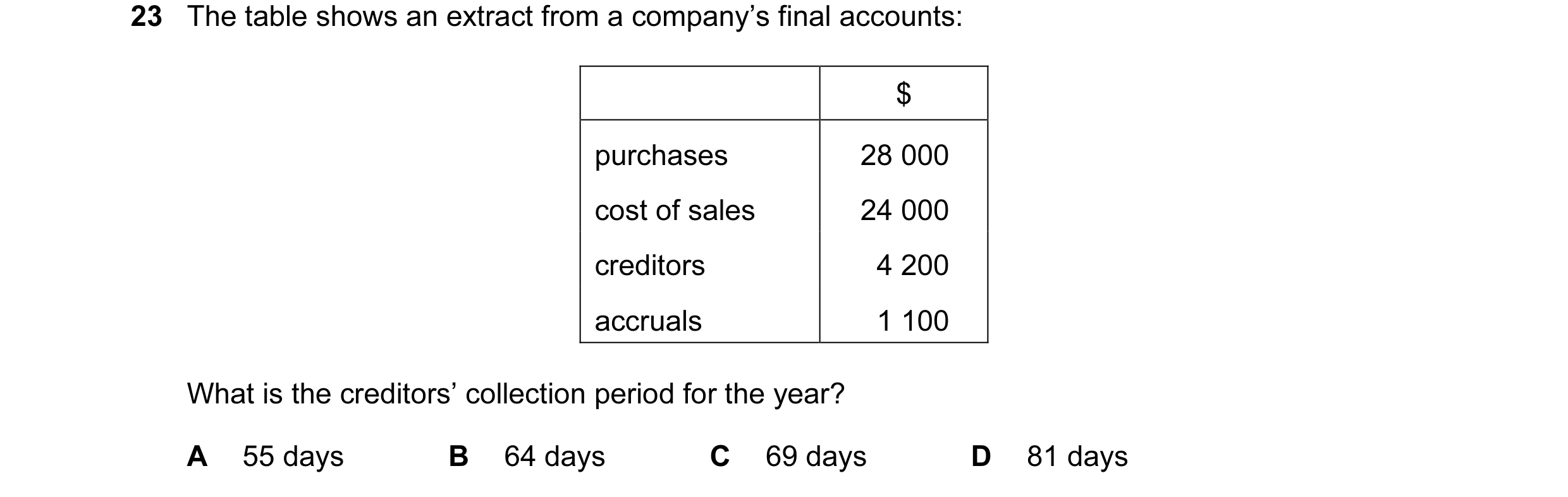
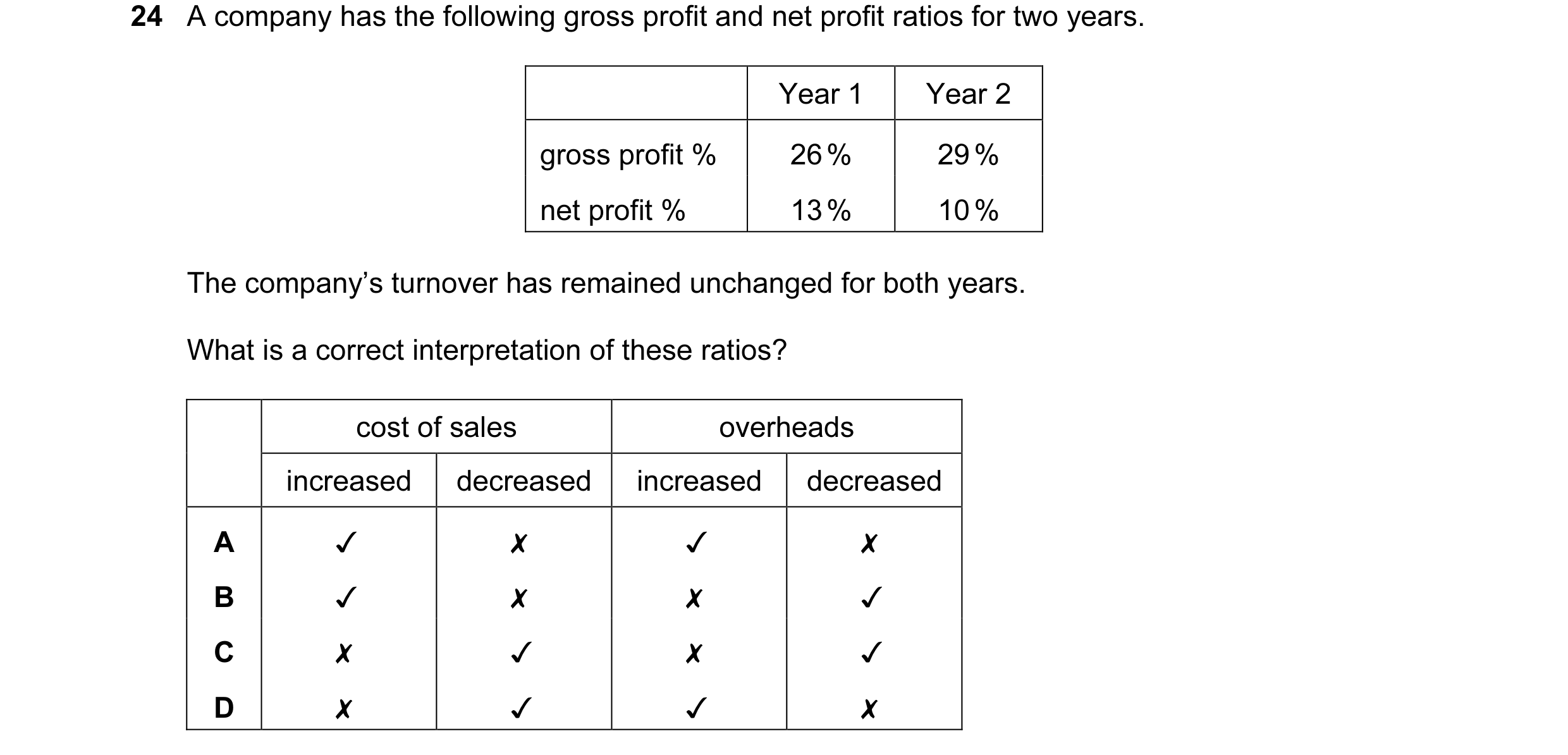
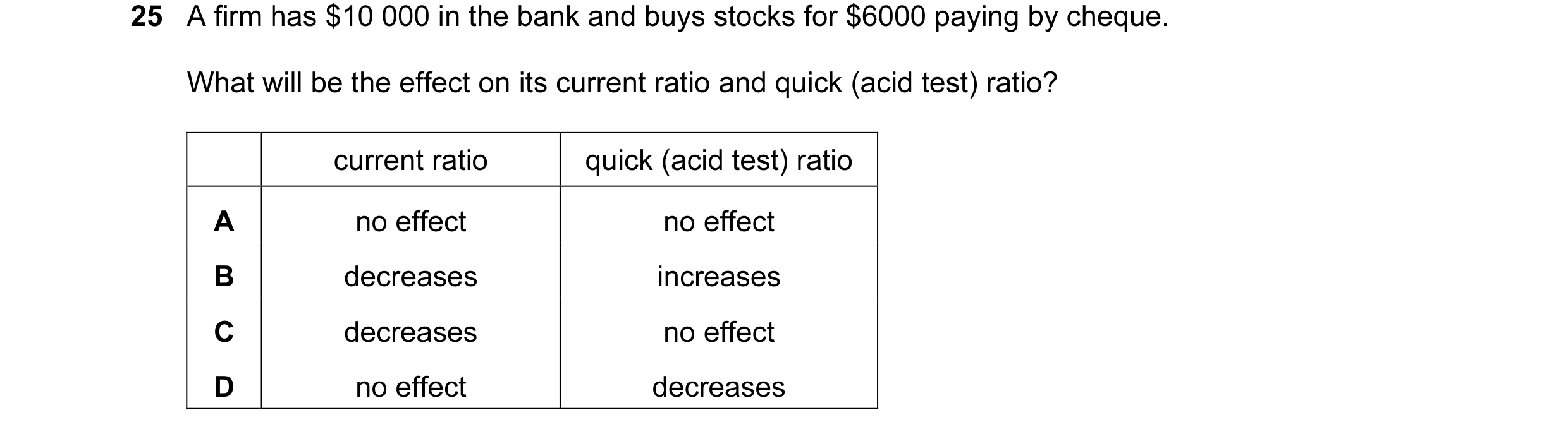 1 / 85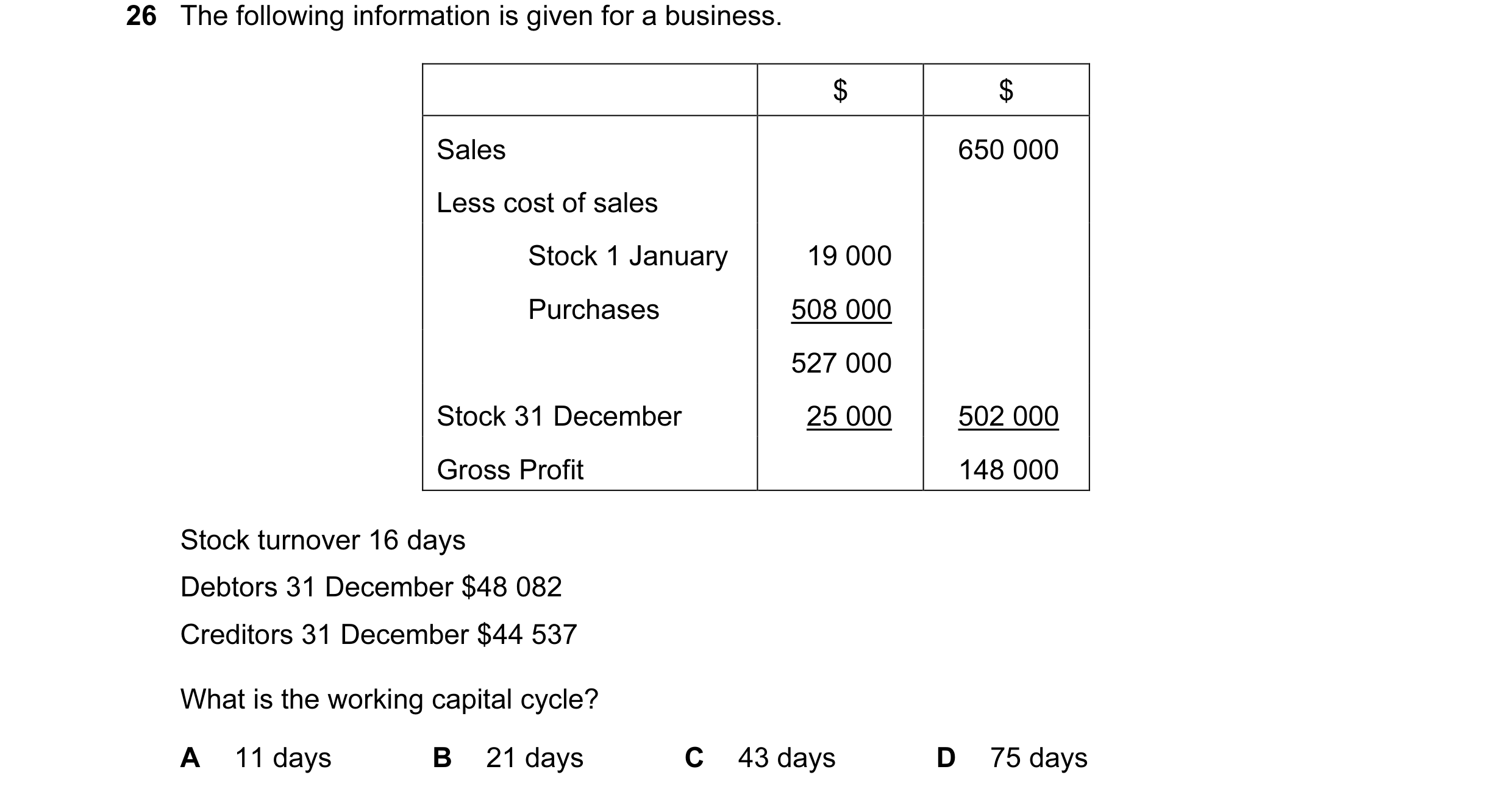

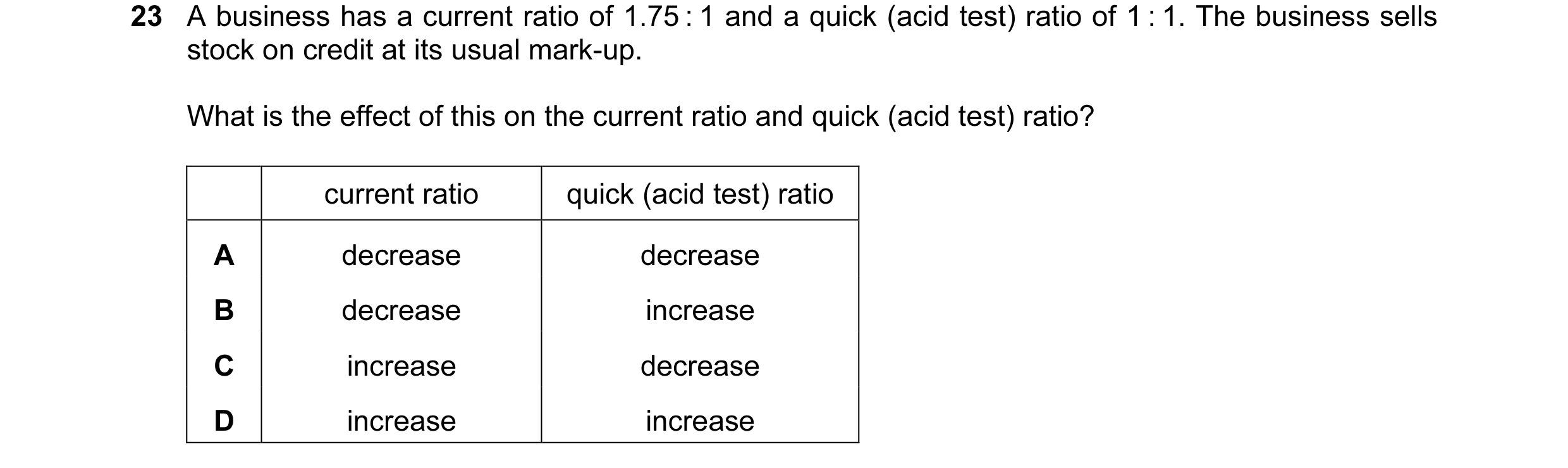
 2 / 85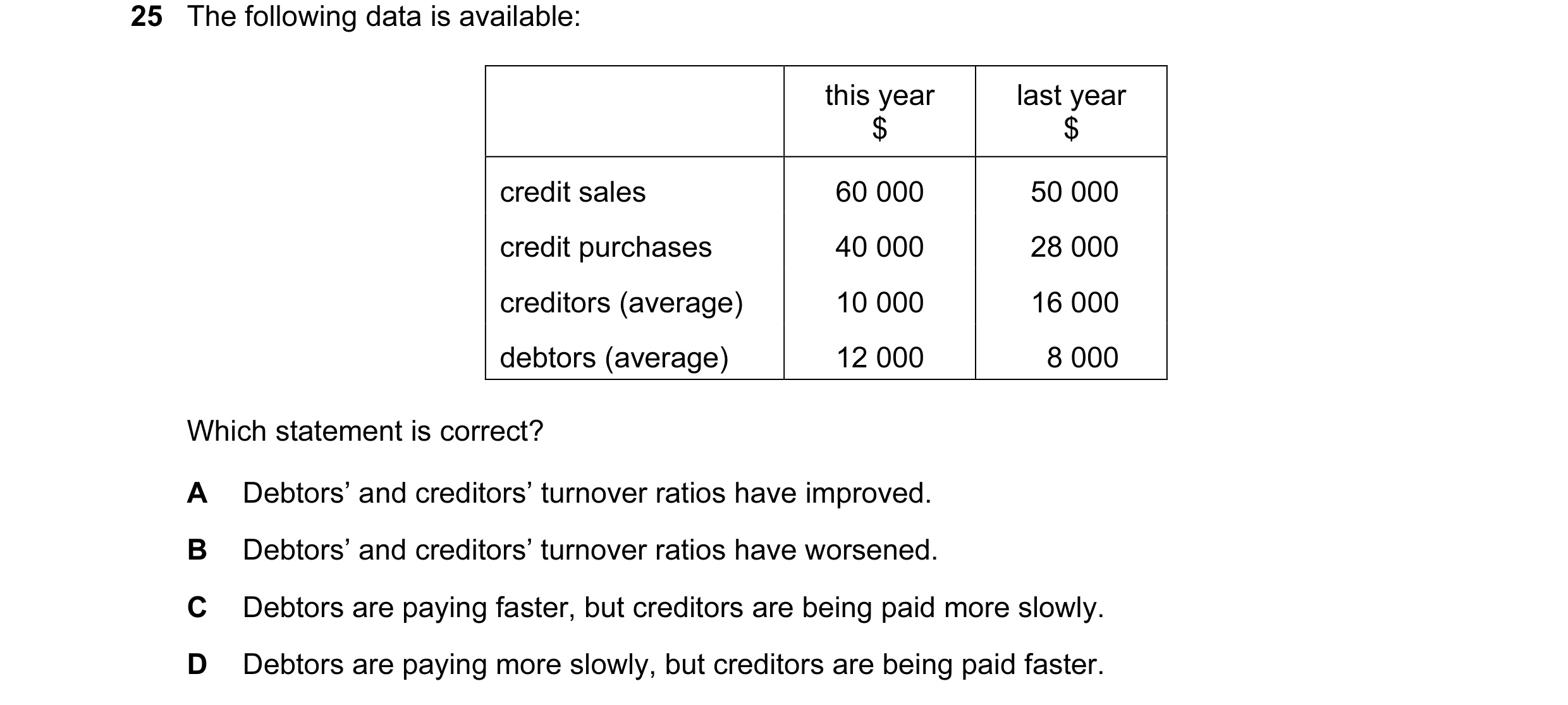
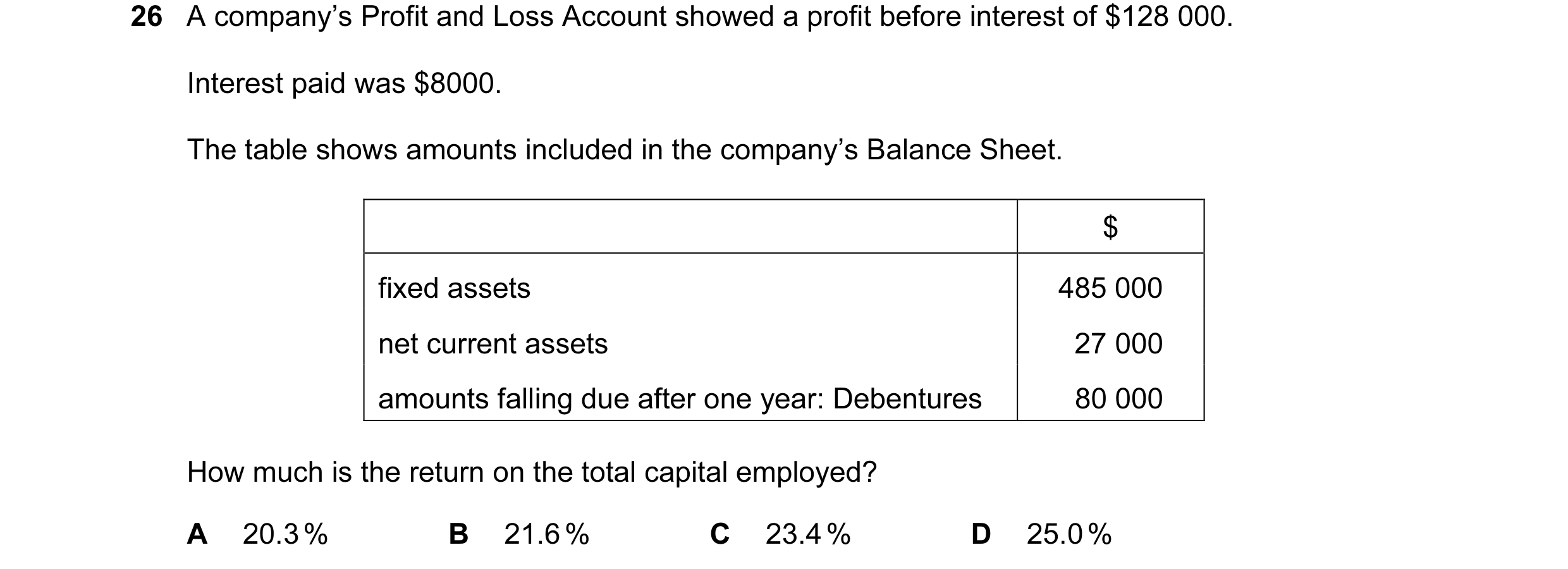
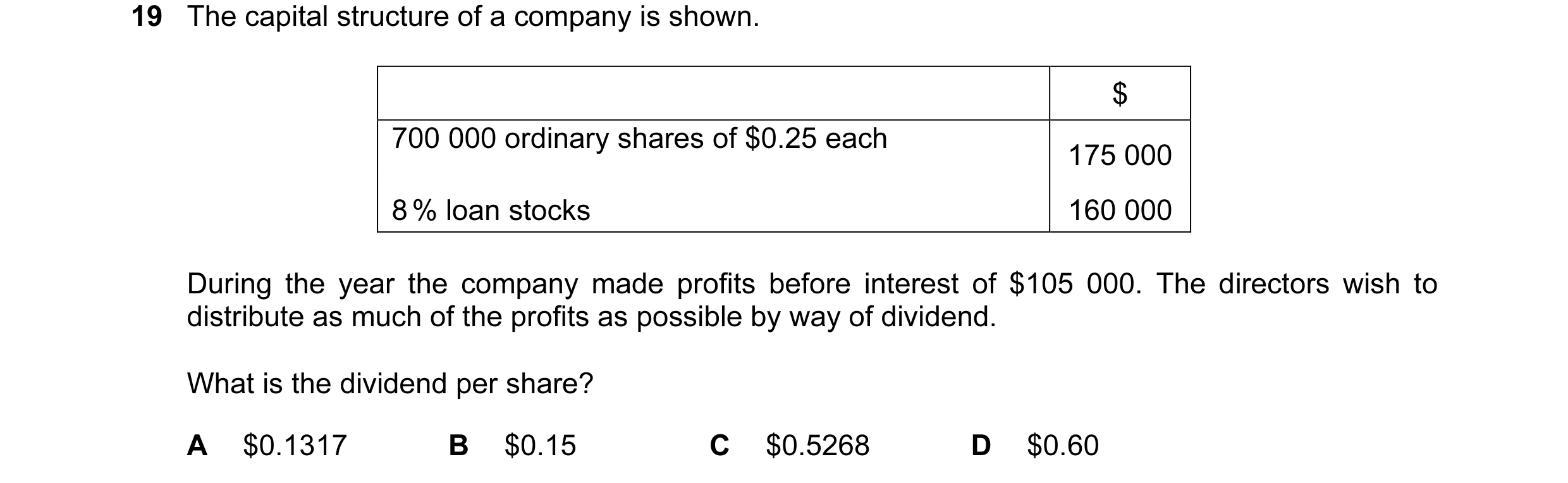
 3 / 85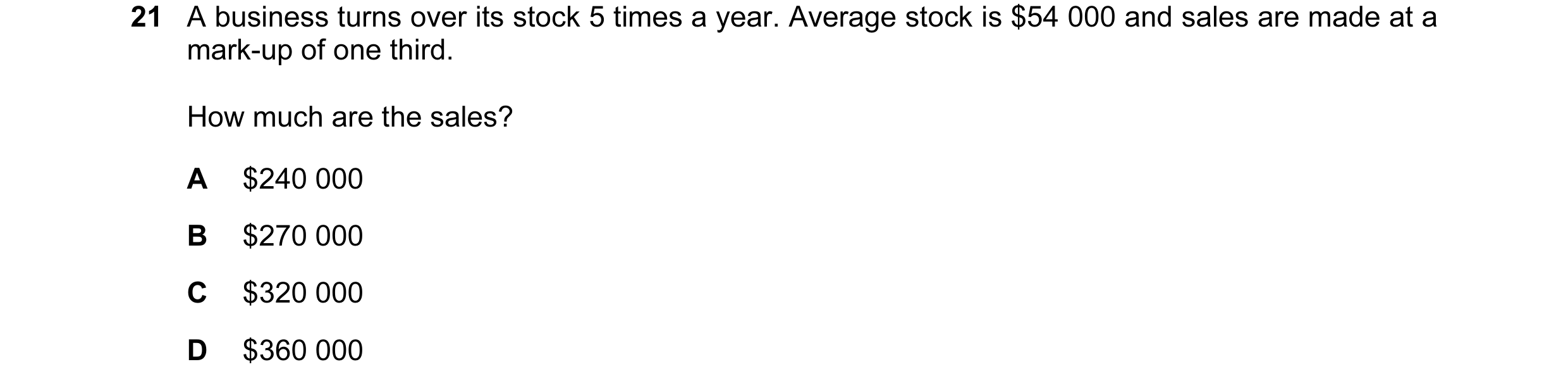
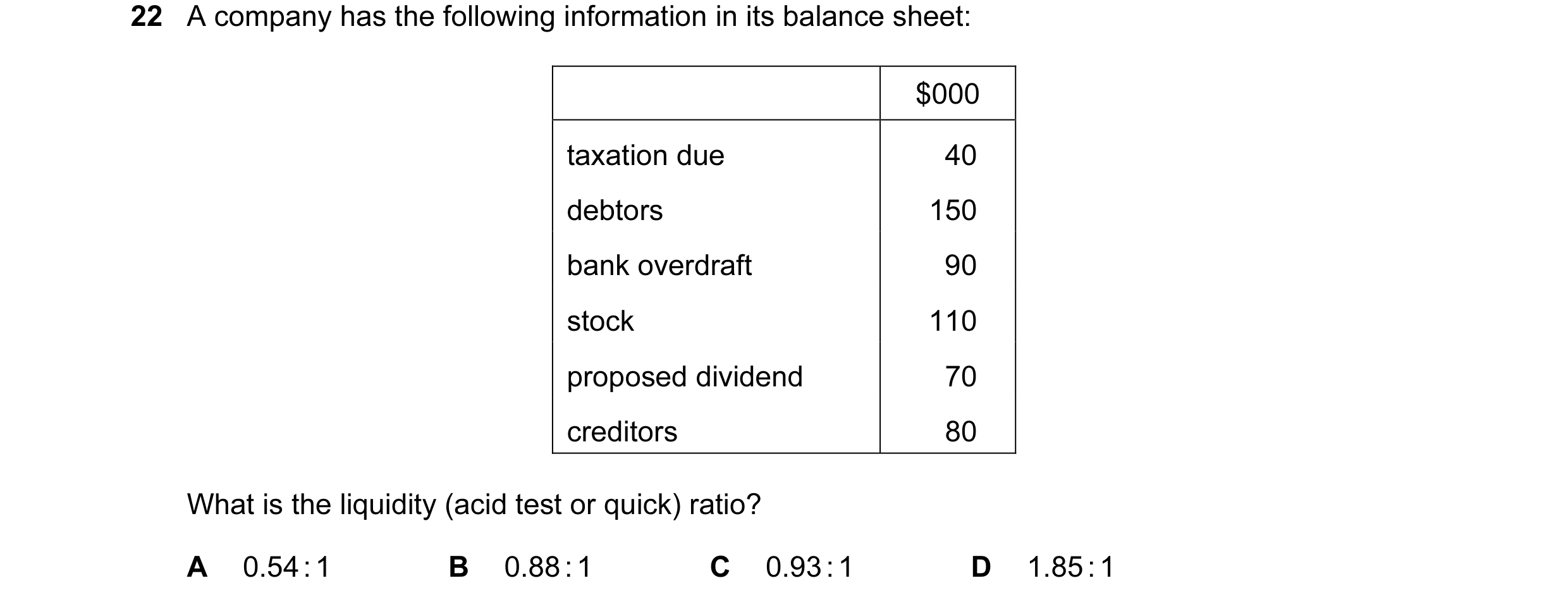

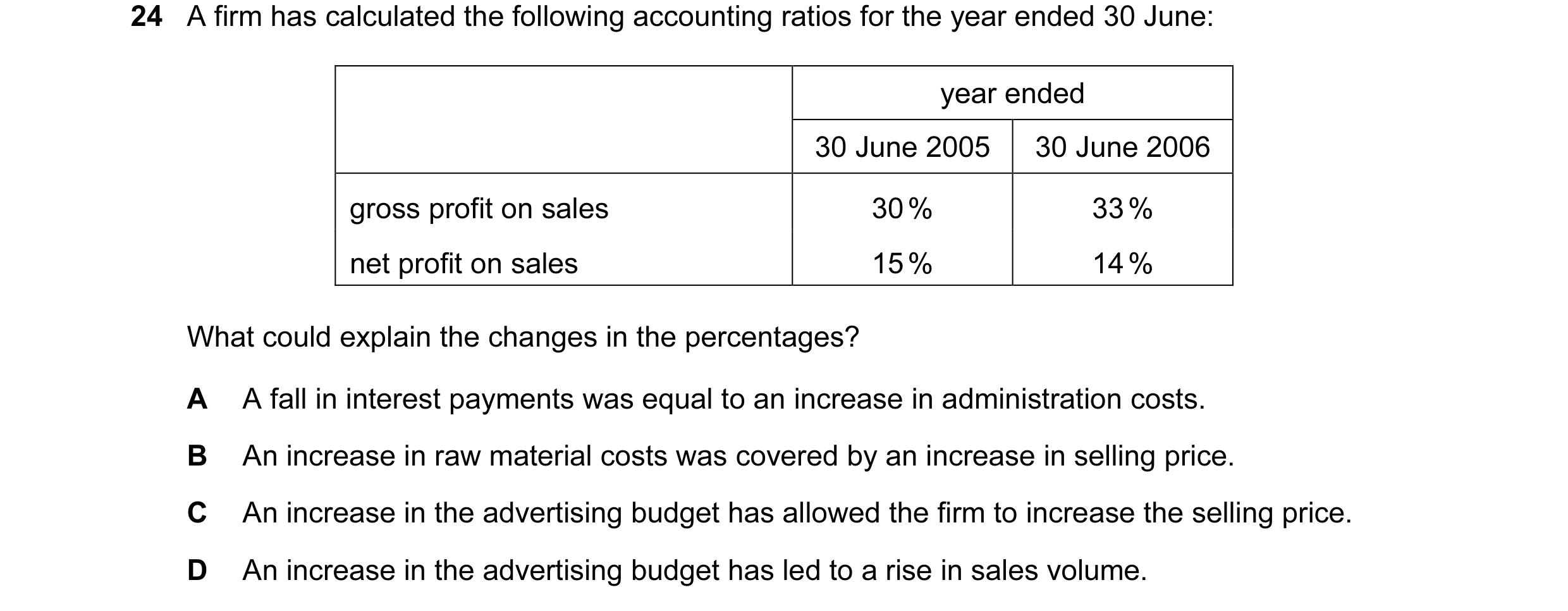
 4 / 85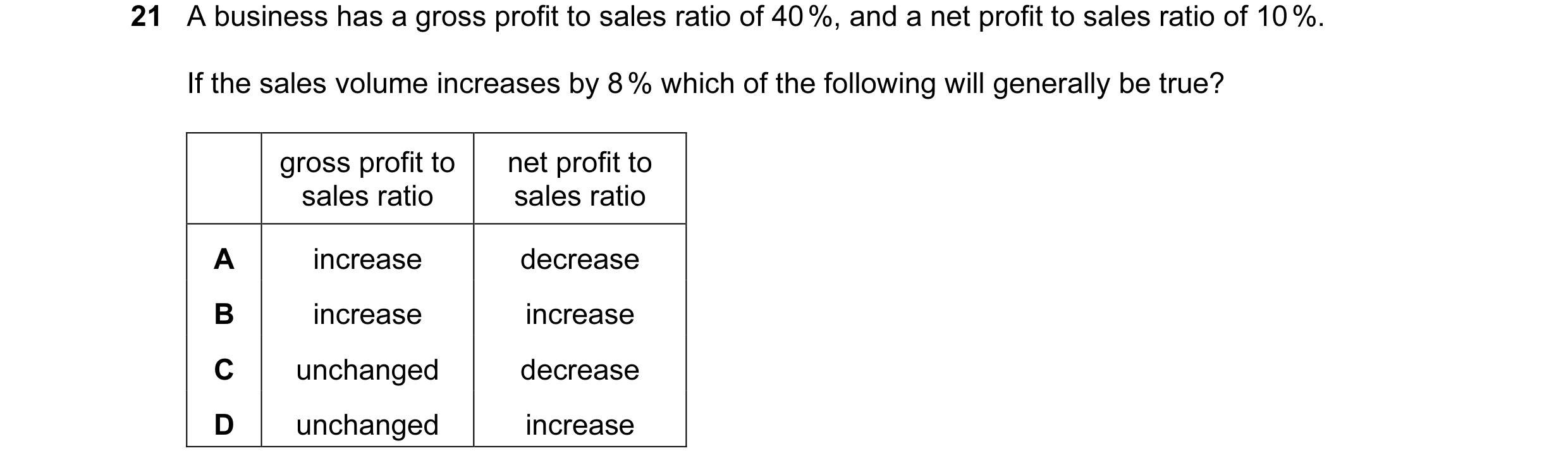
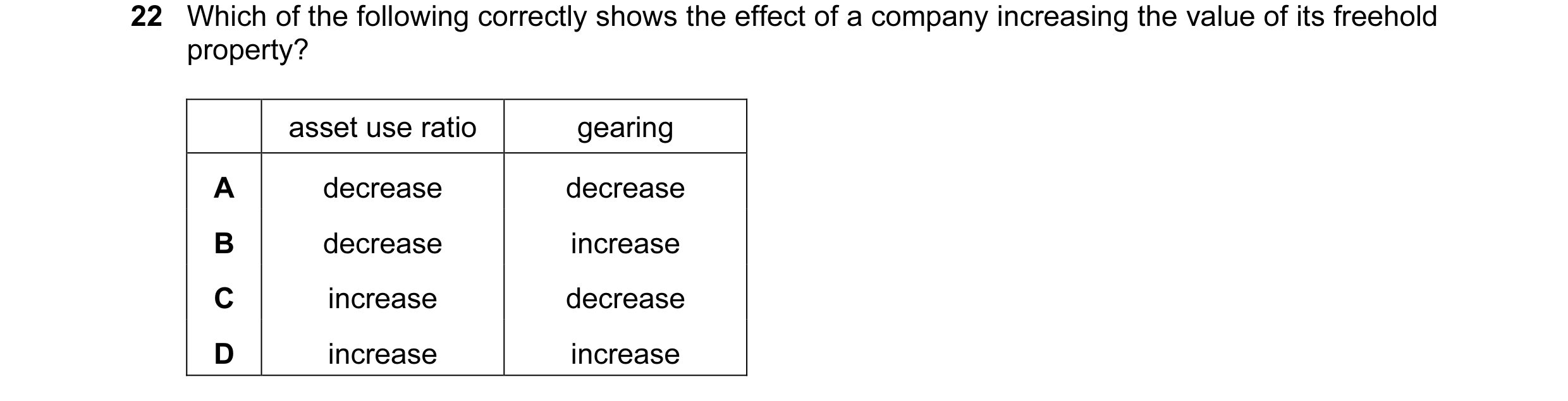

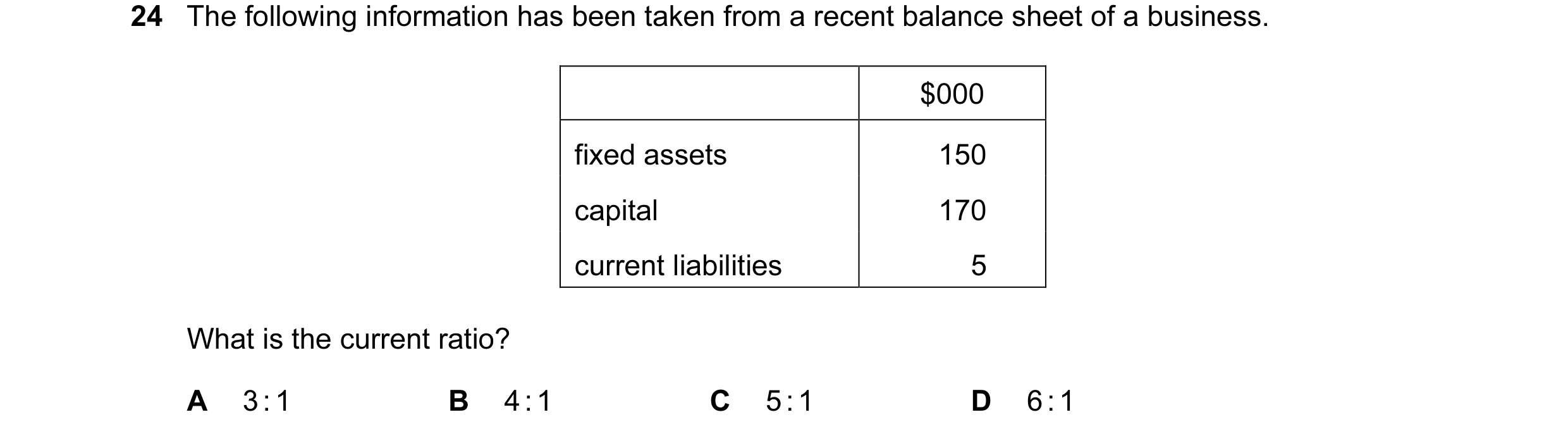
 5 / 85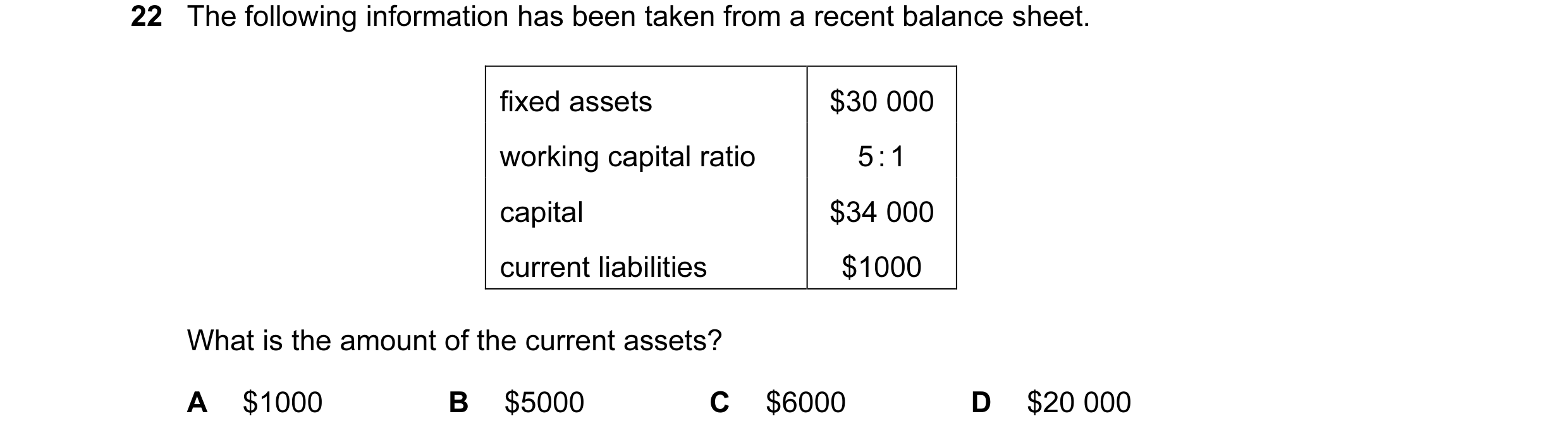
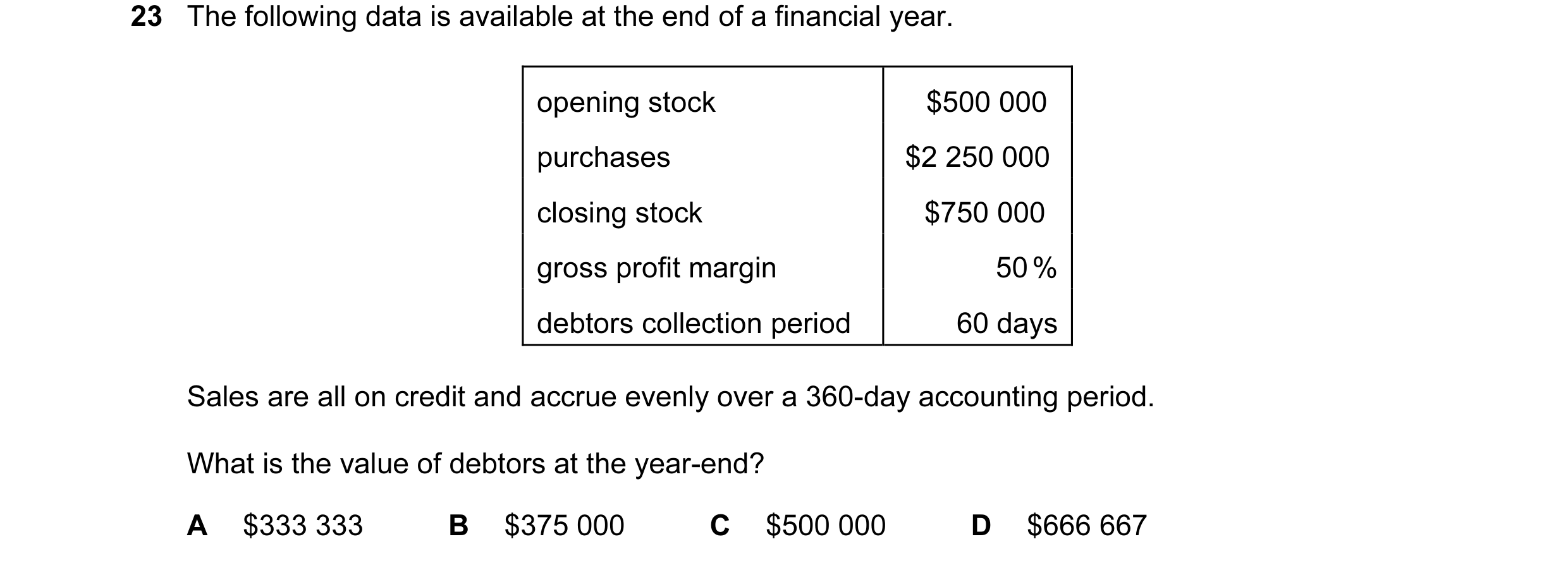
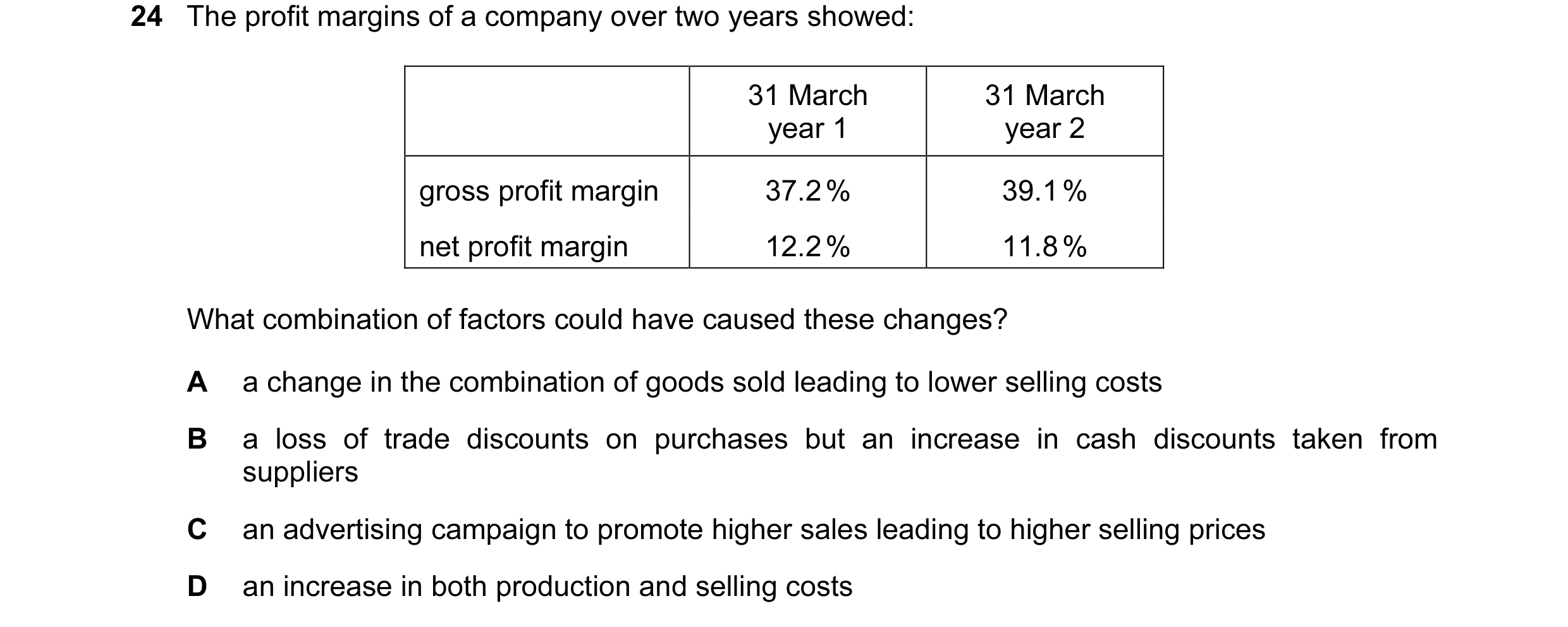 6 / 85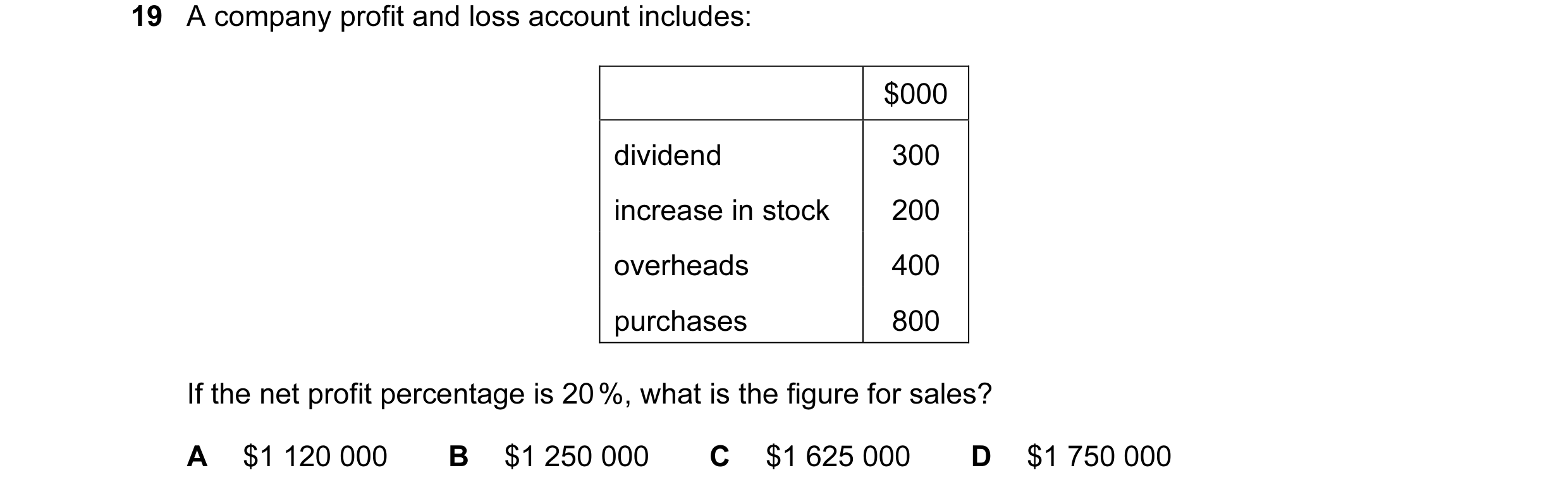
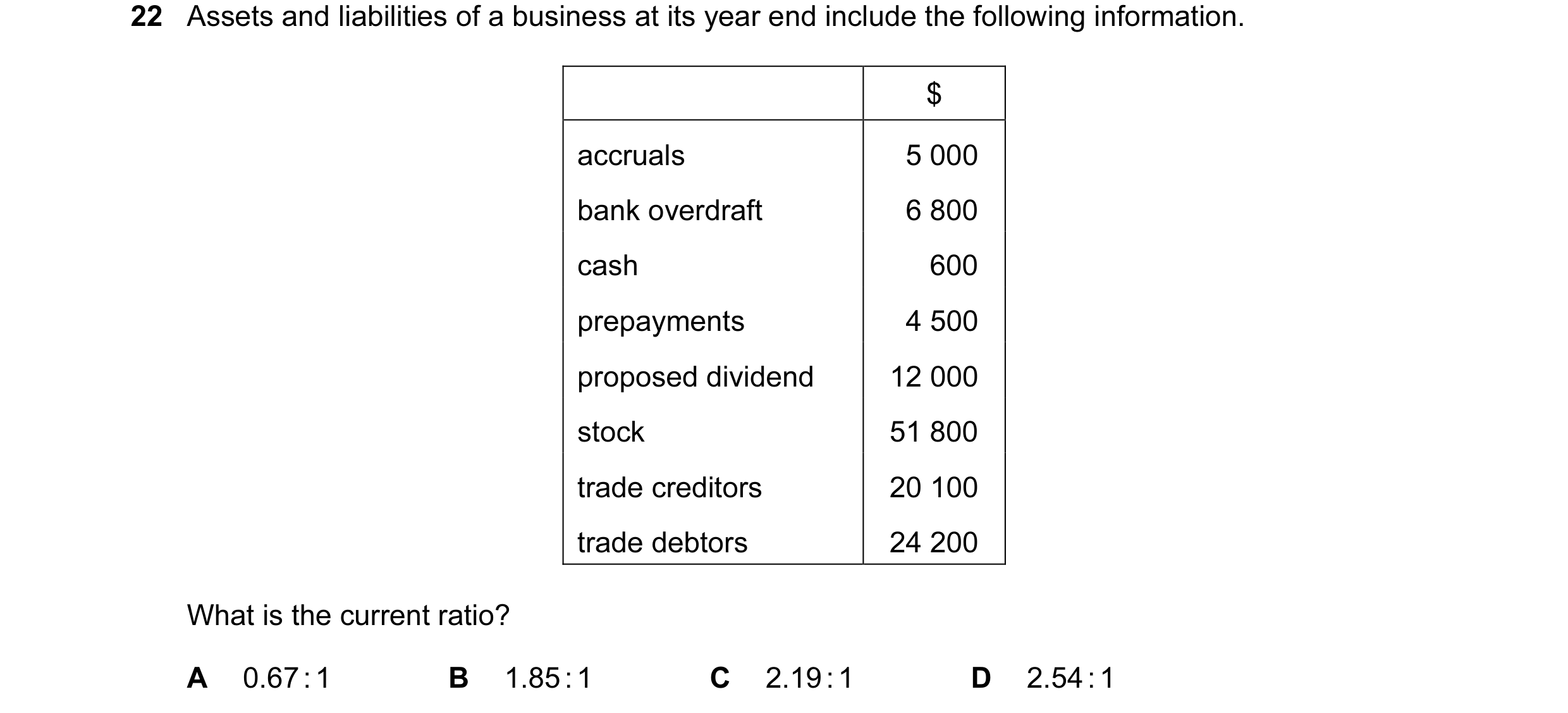
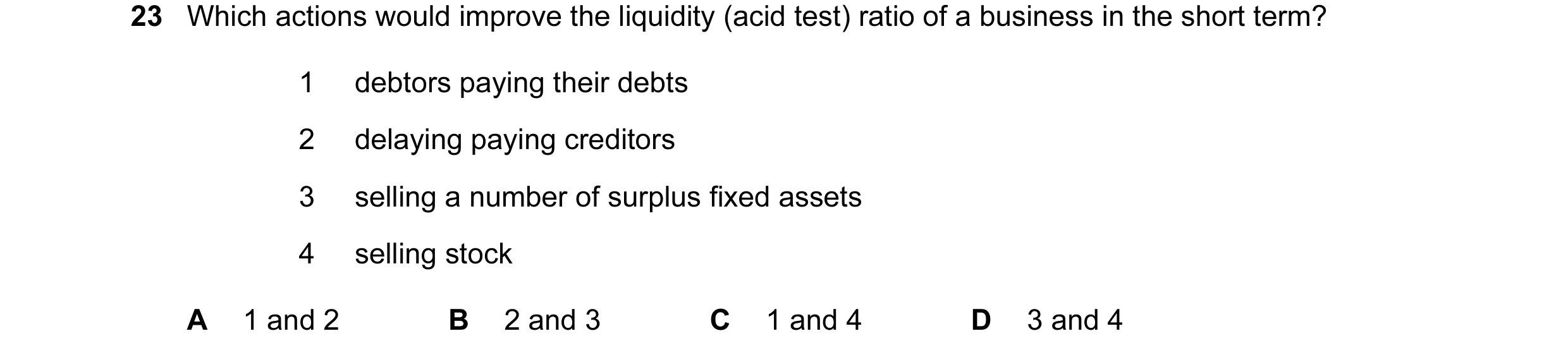
 7 / 85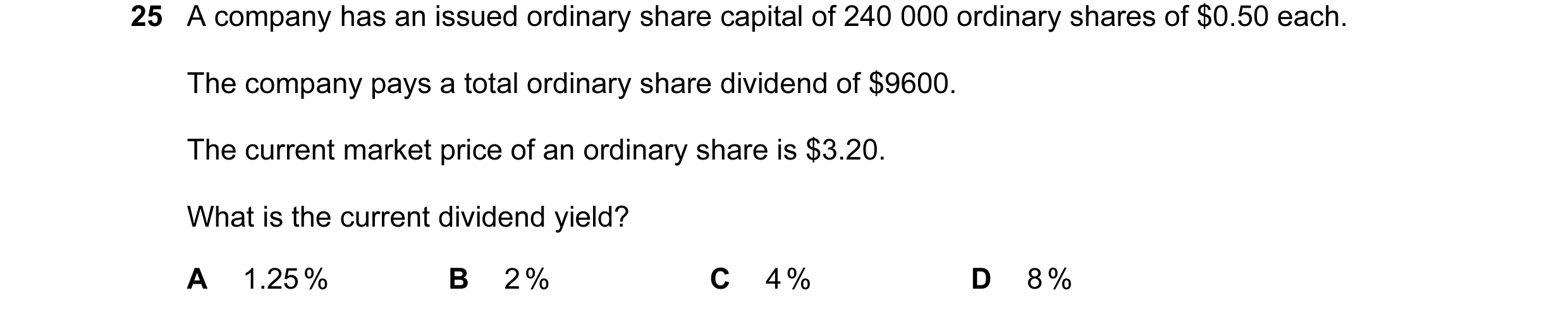

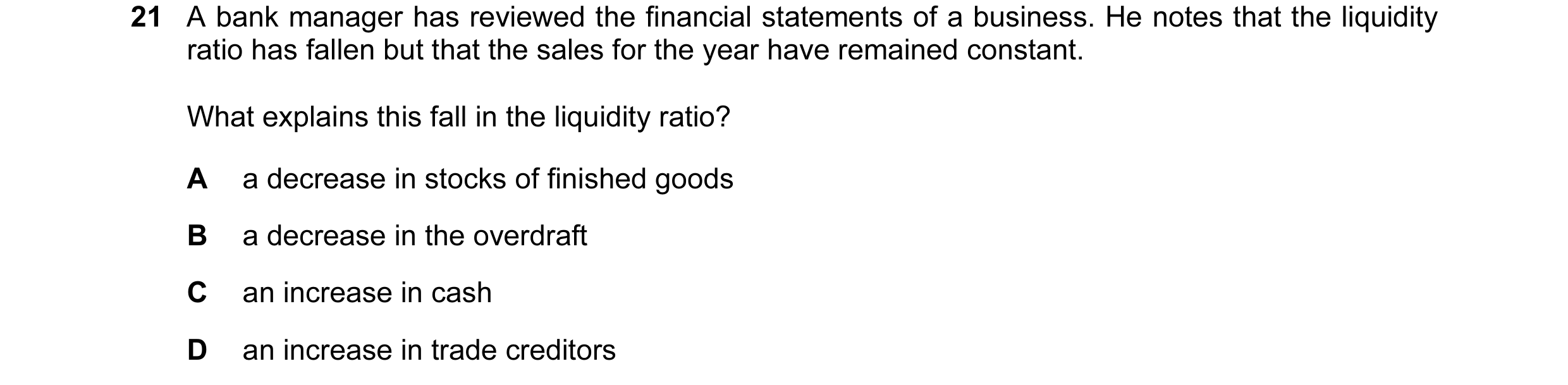
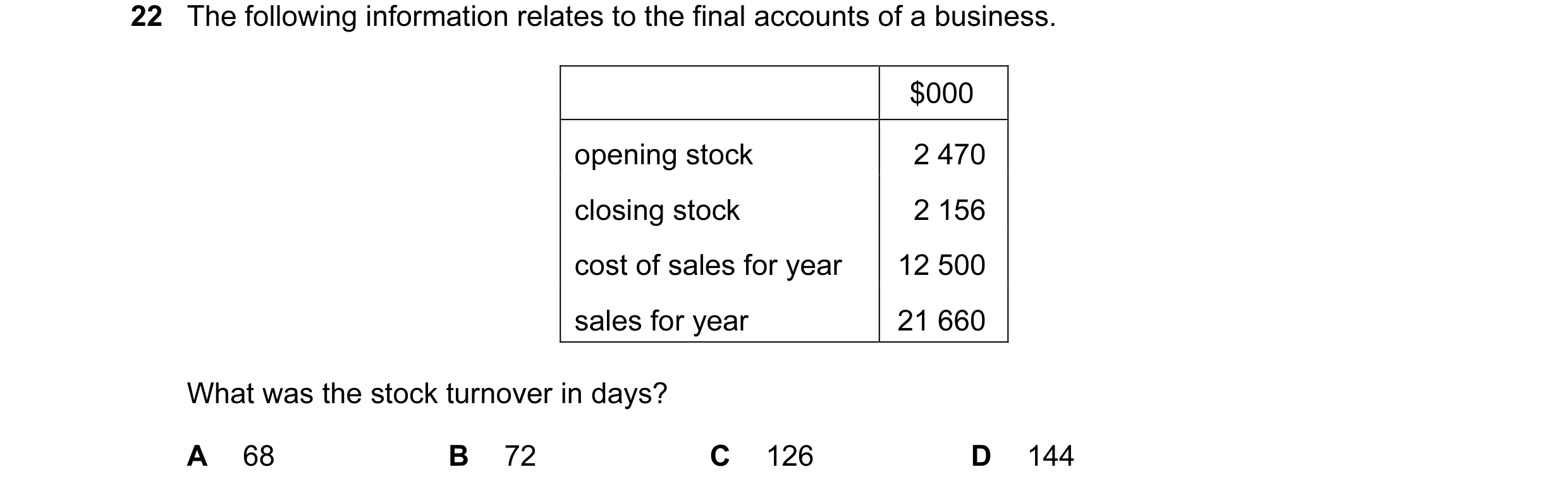

 8 / 85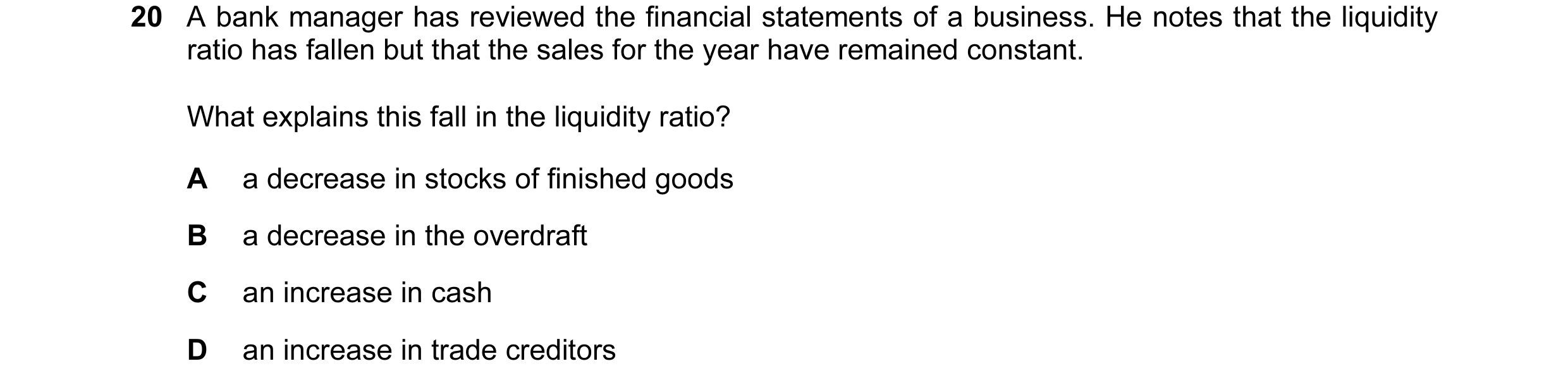
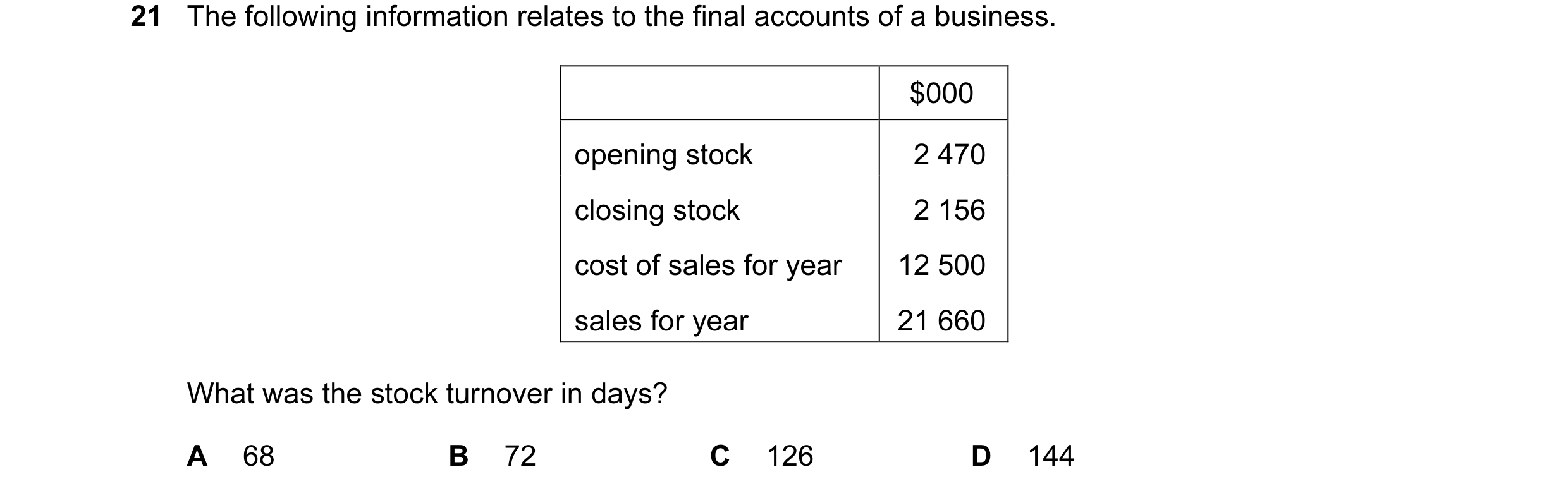

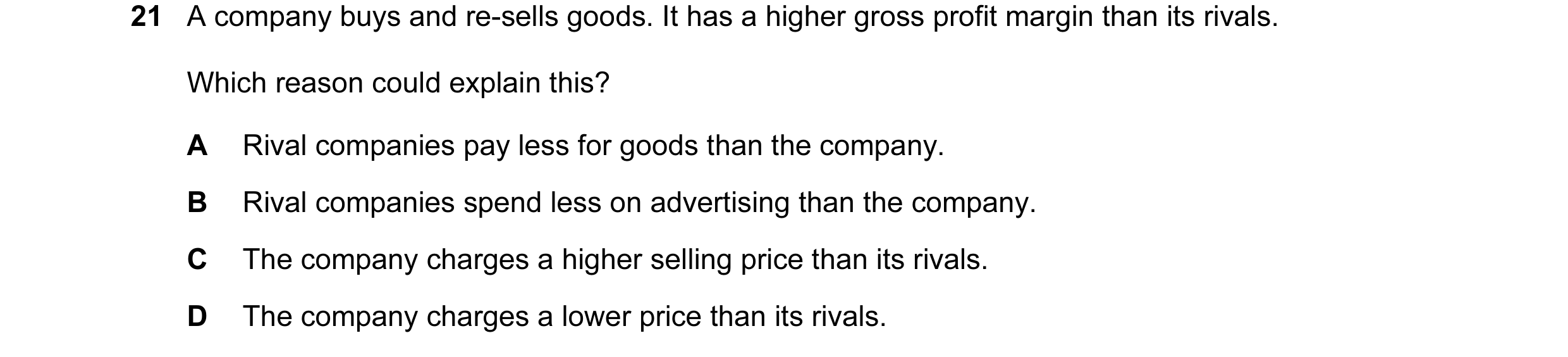
 9 / 85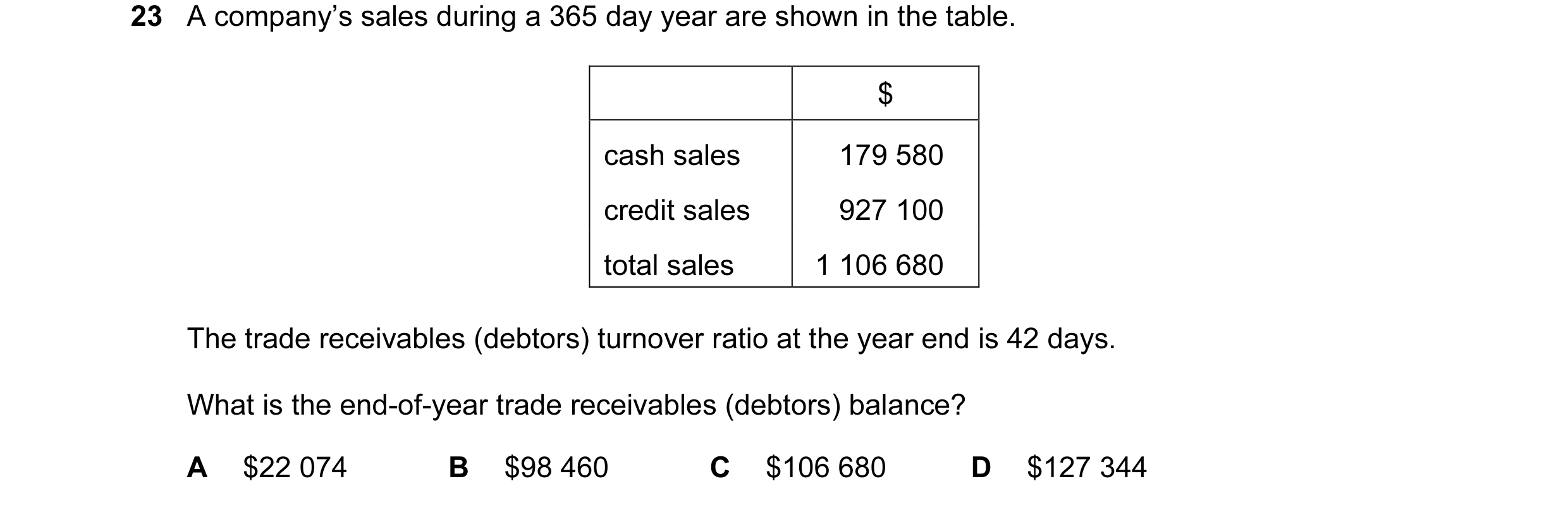
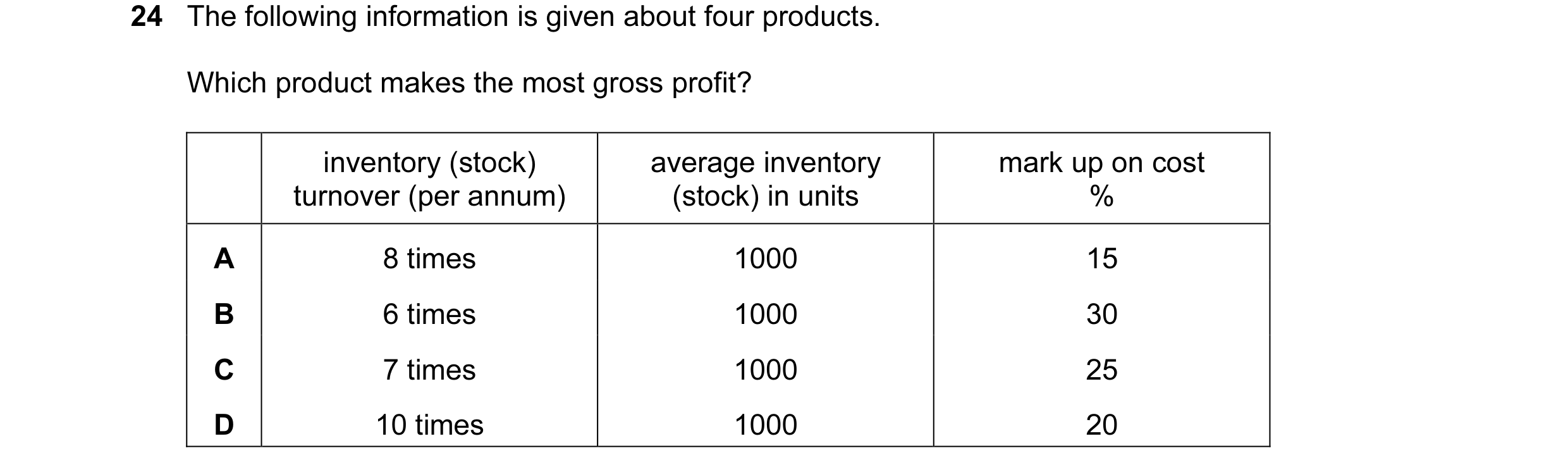
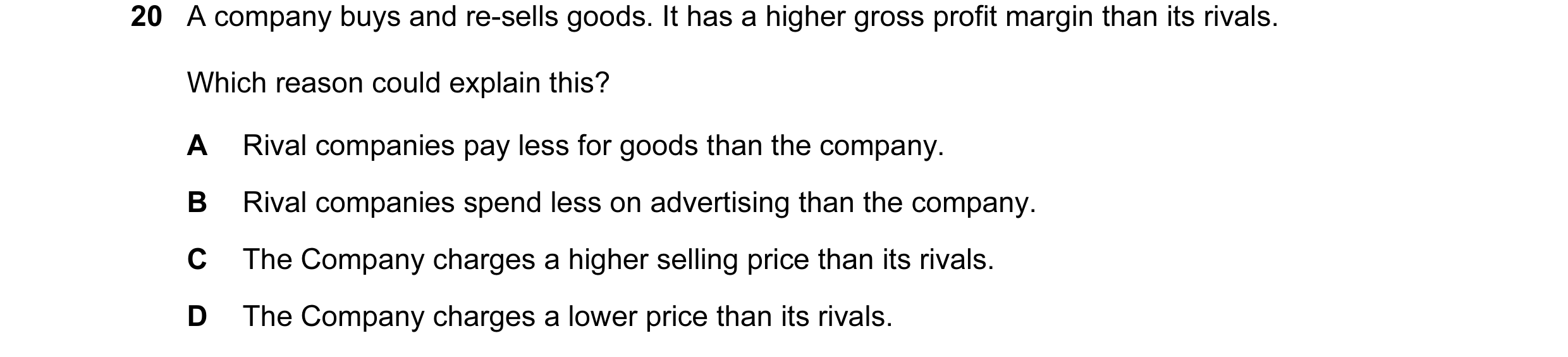

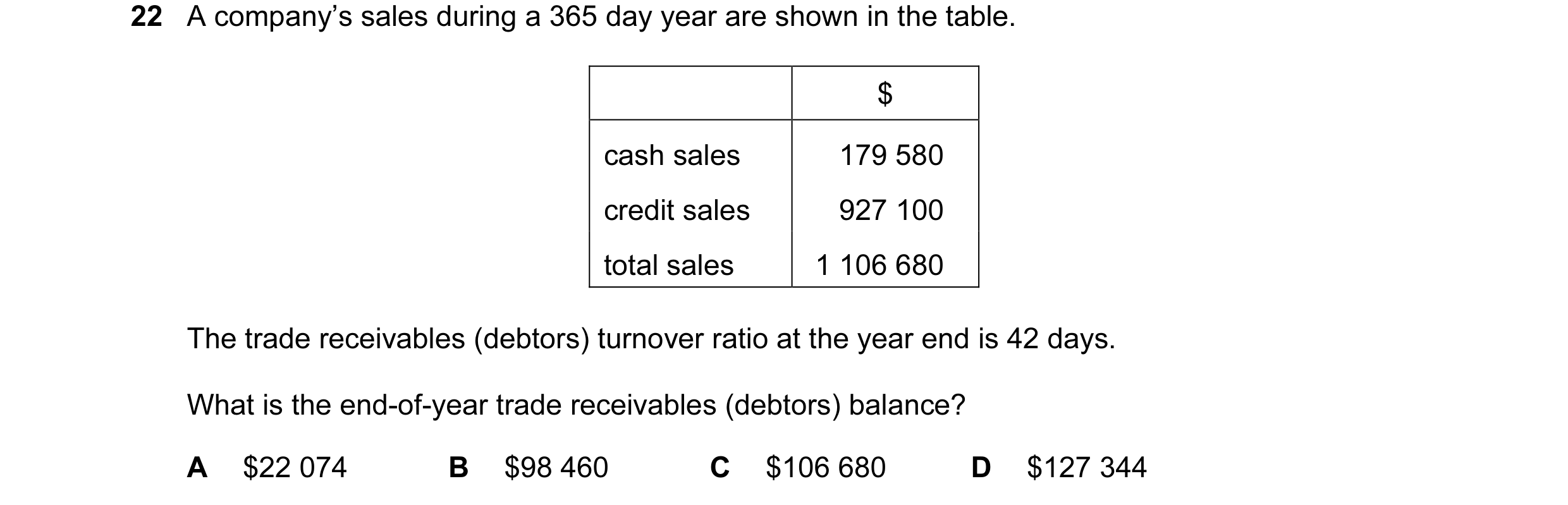 10 / 85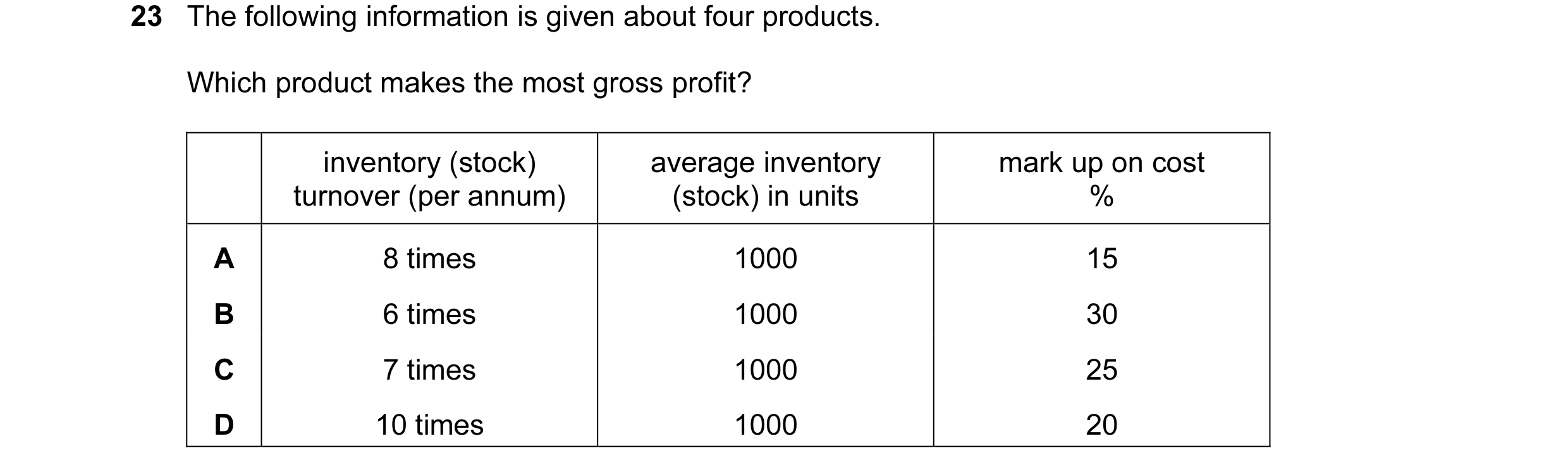
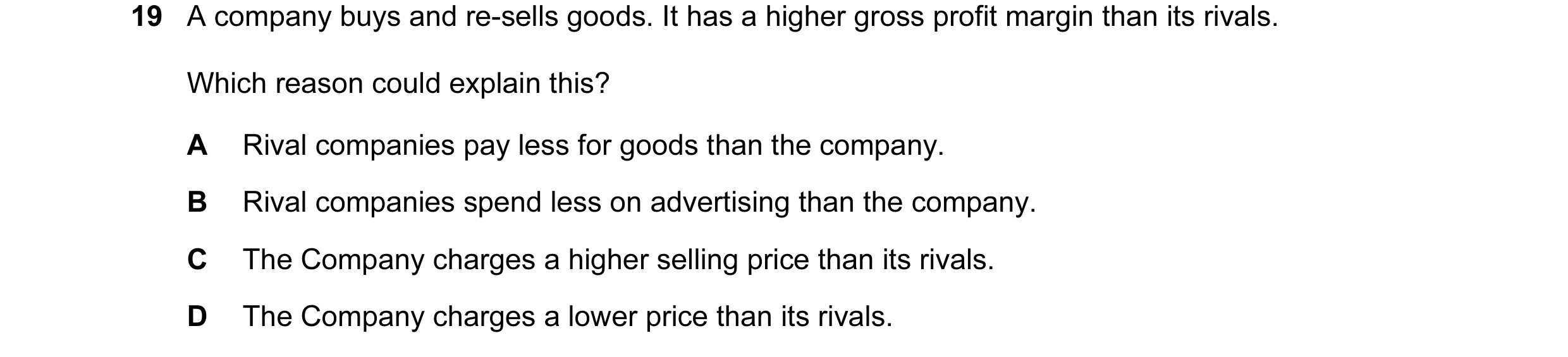

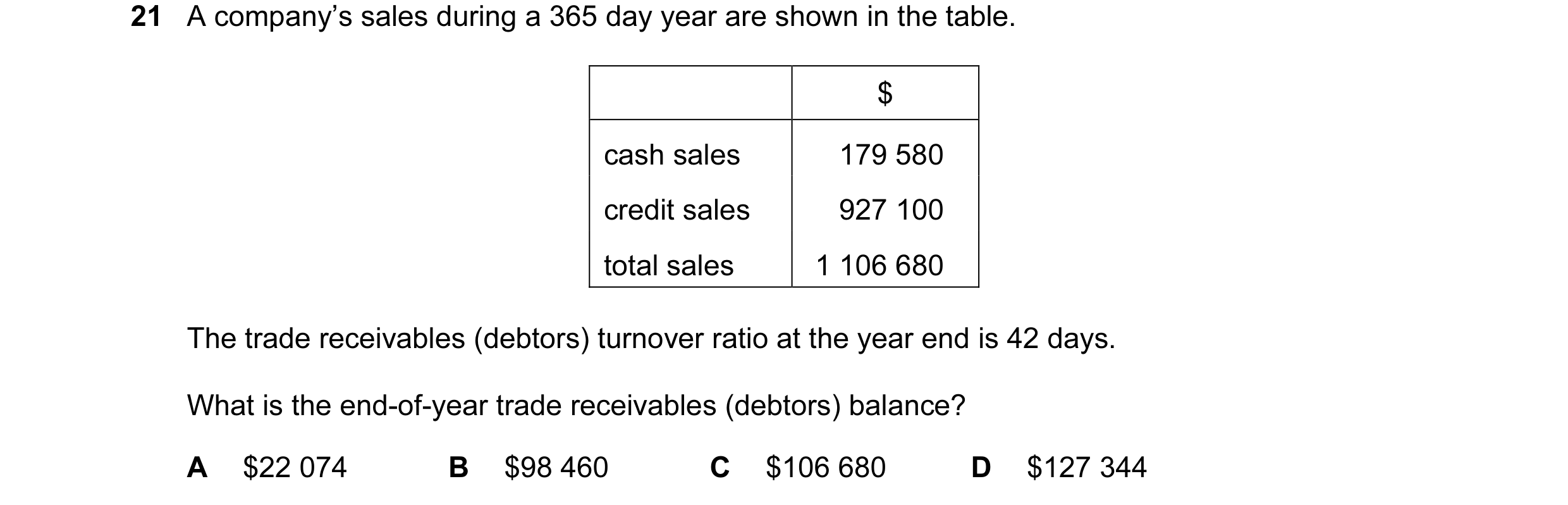
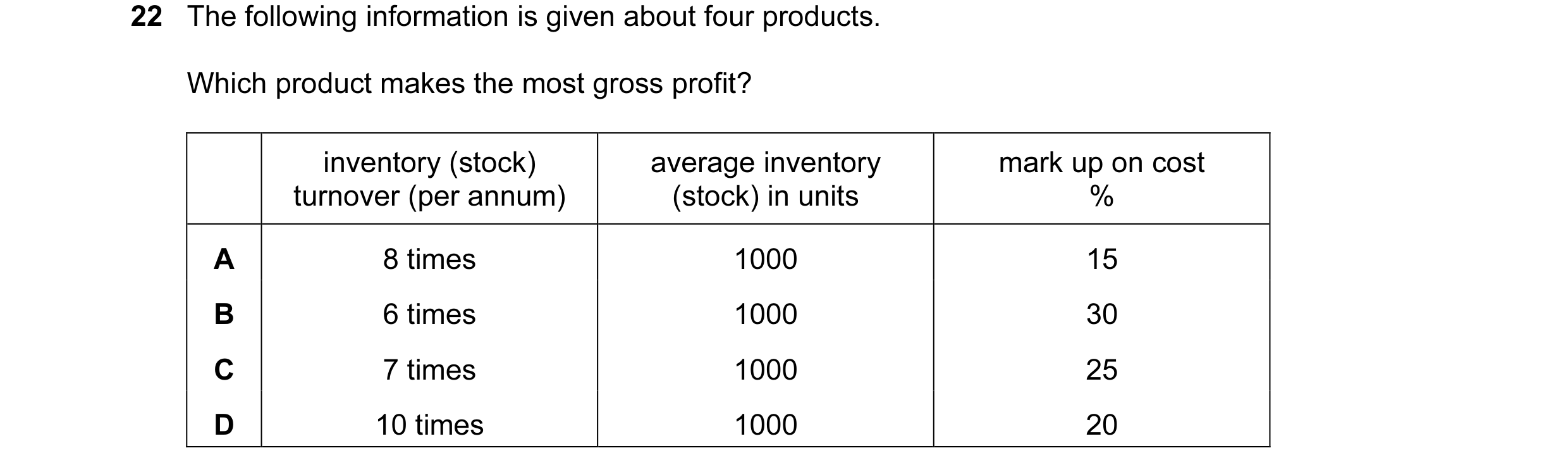 11 / 85
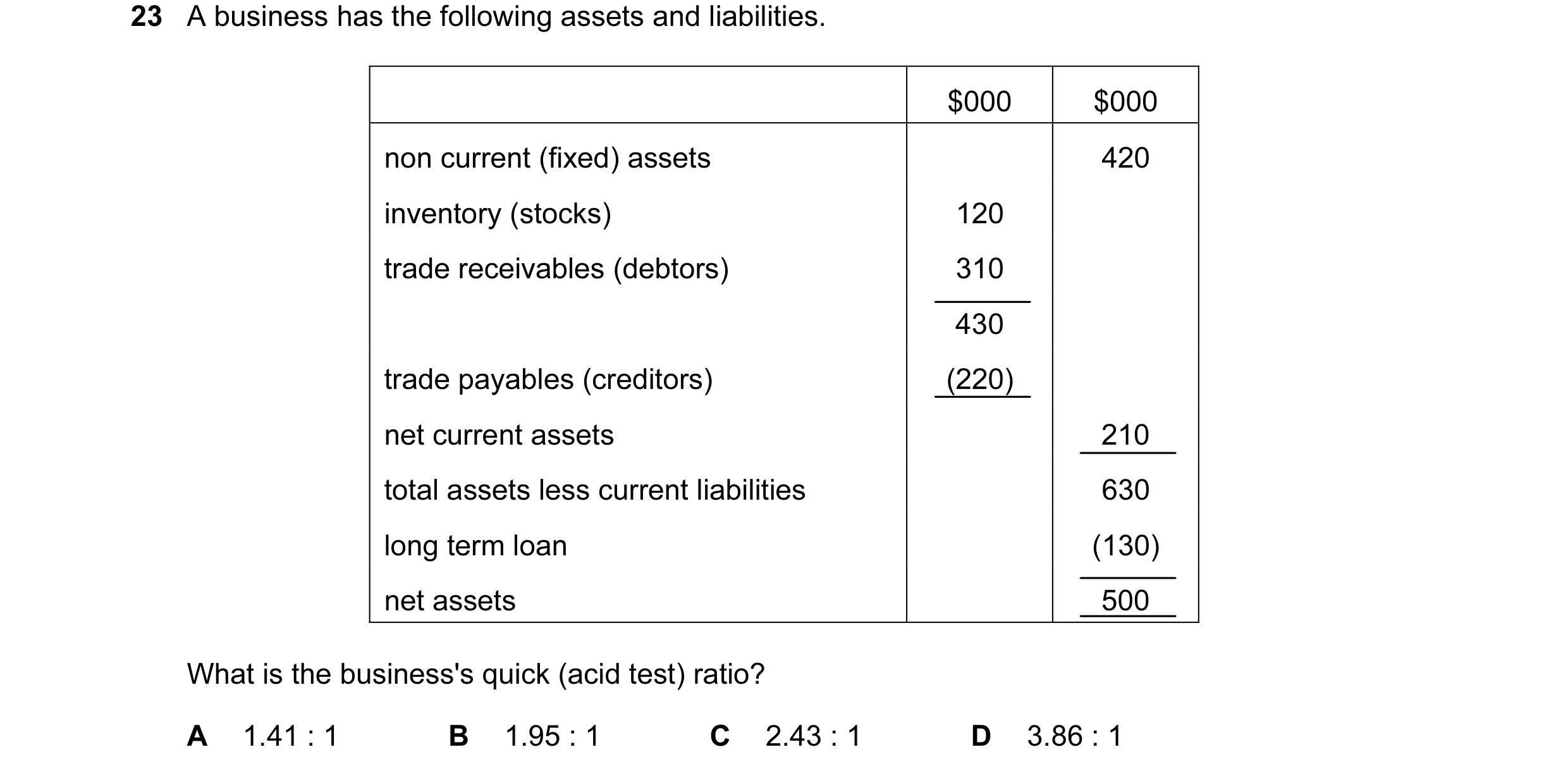 12 / 85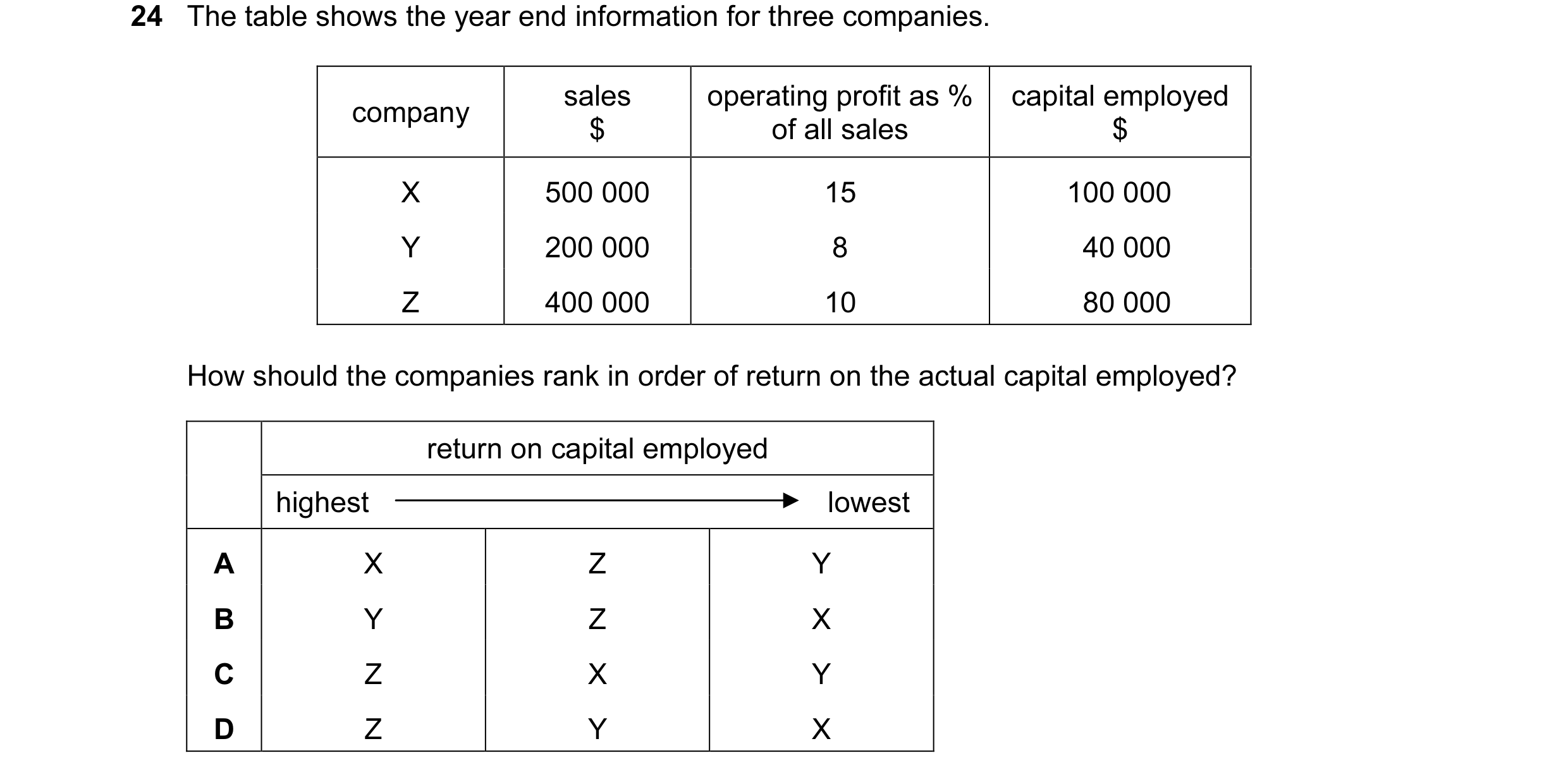

 13 / 85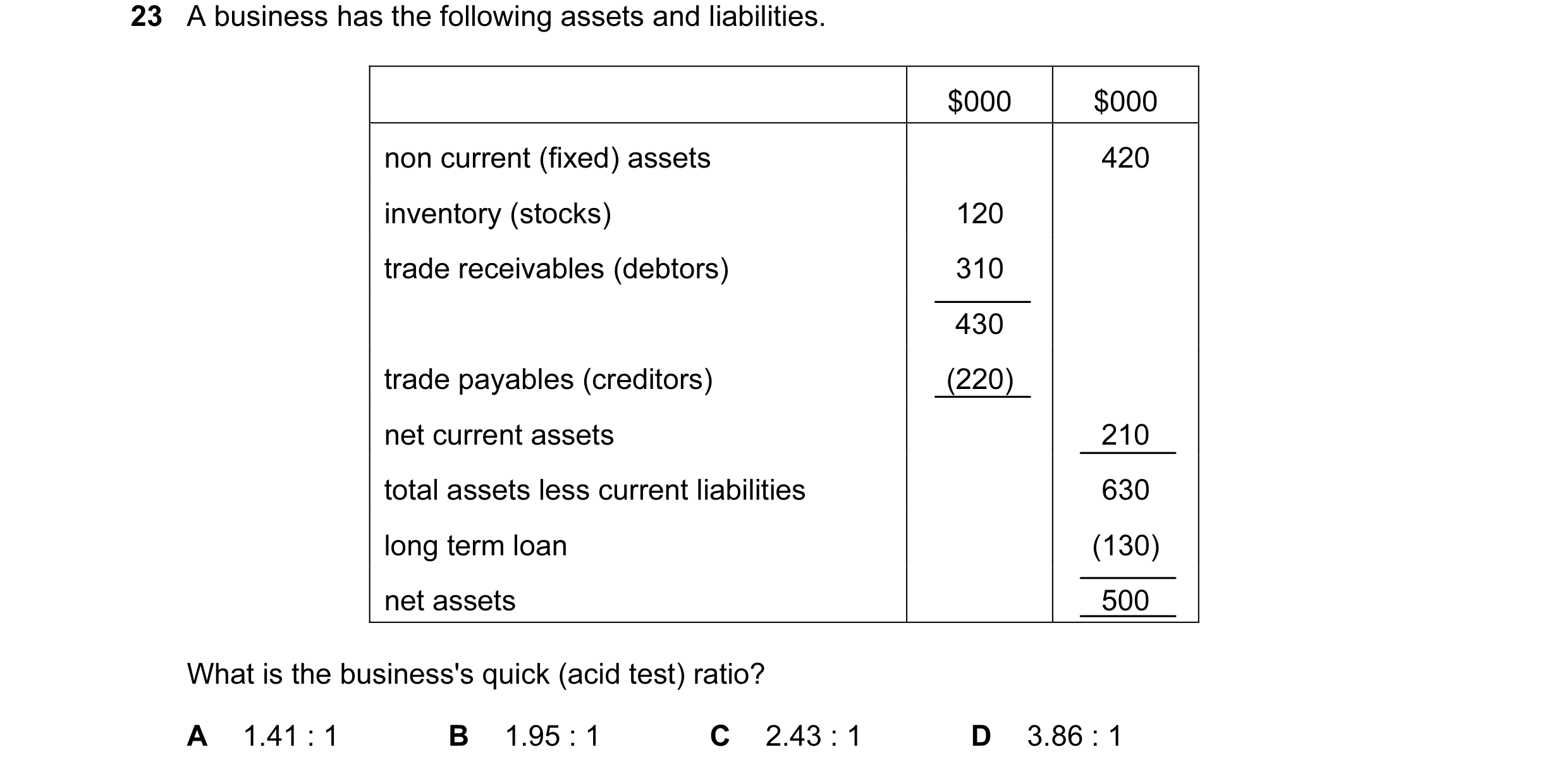

 14 / 85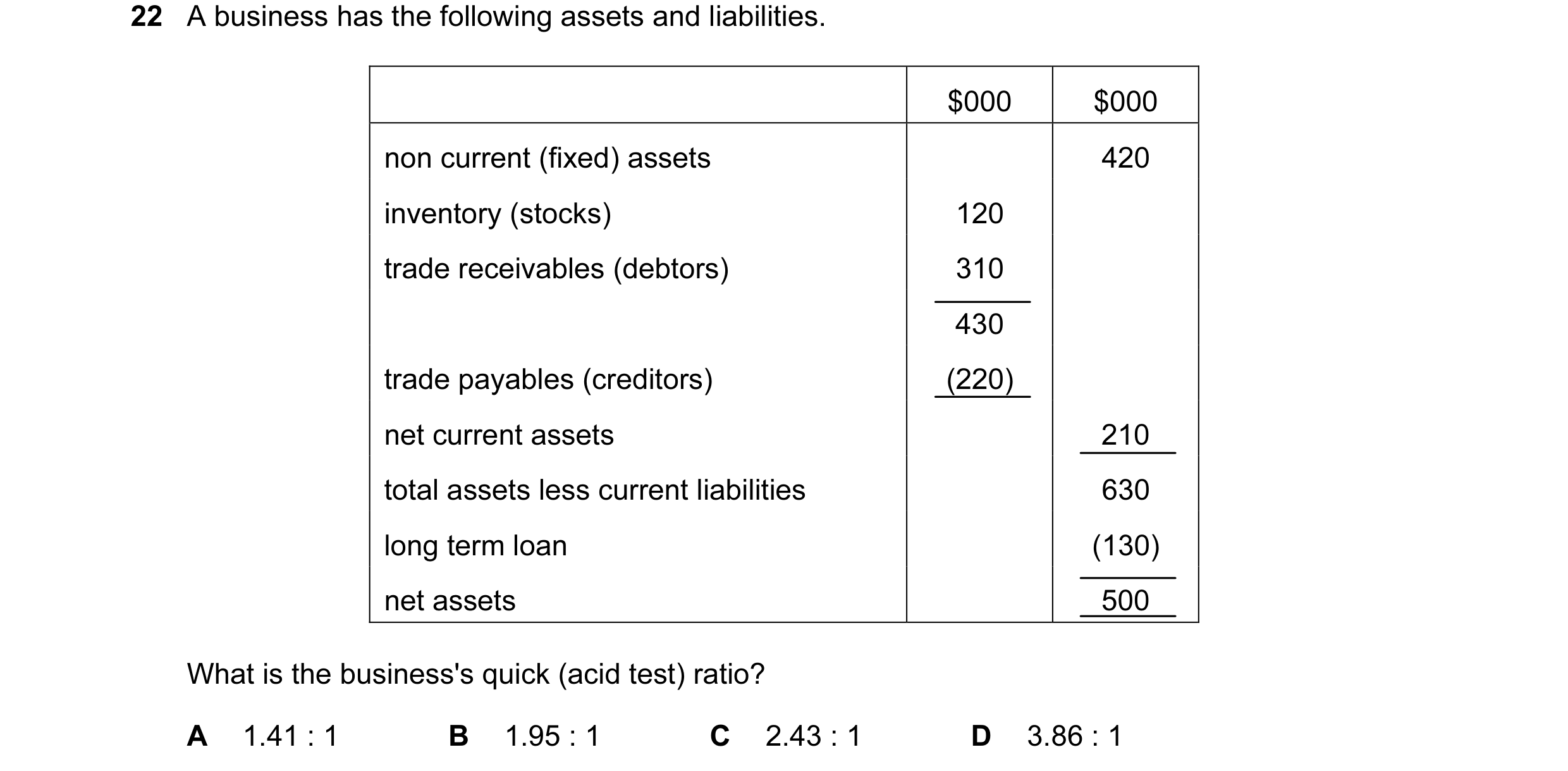
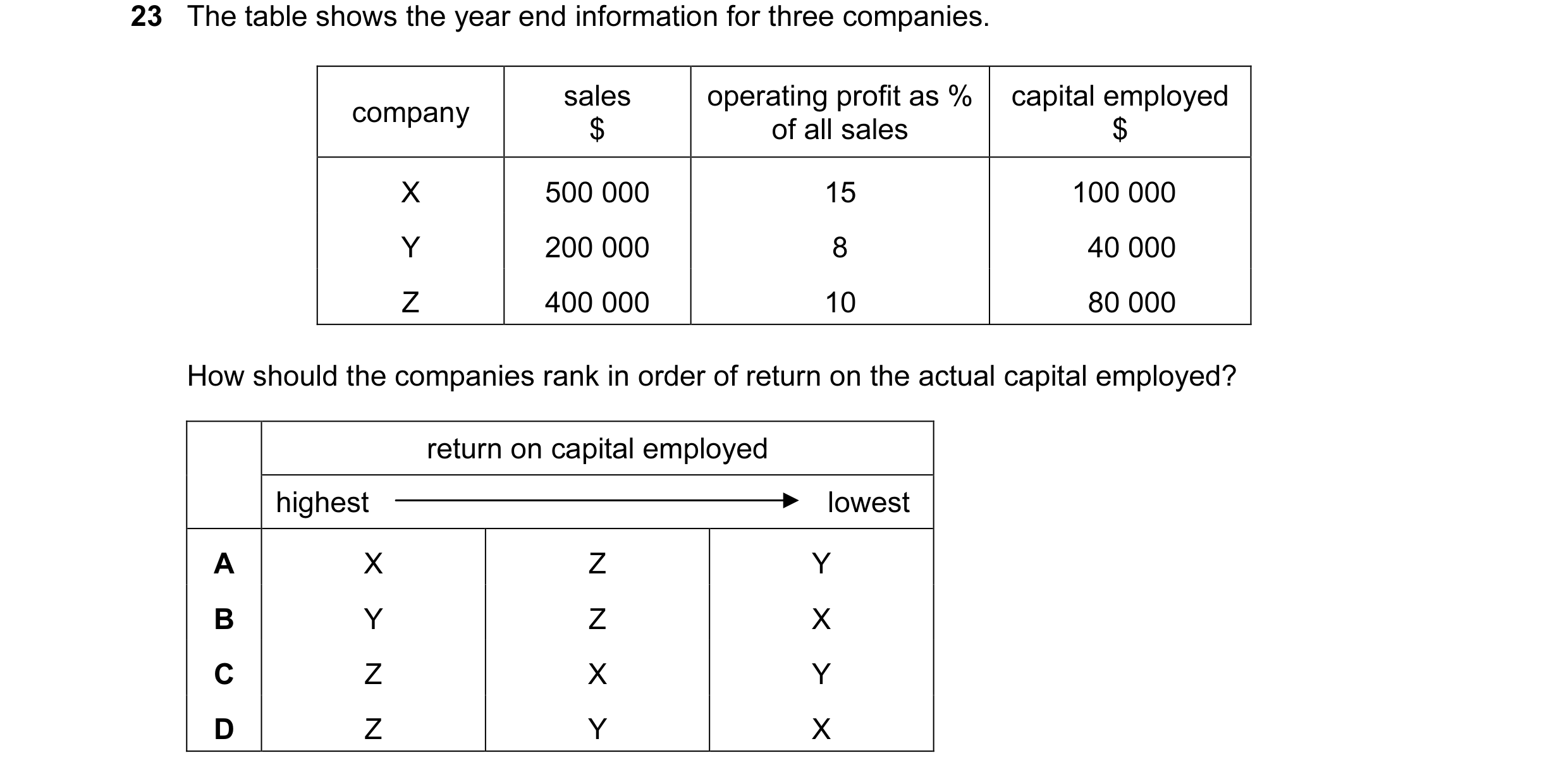
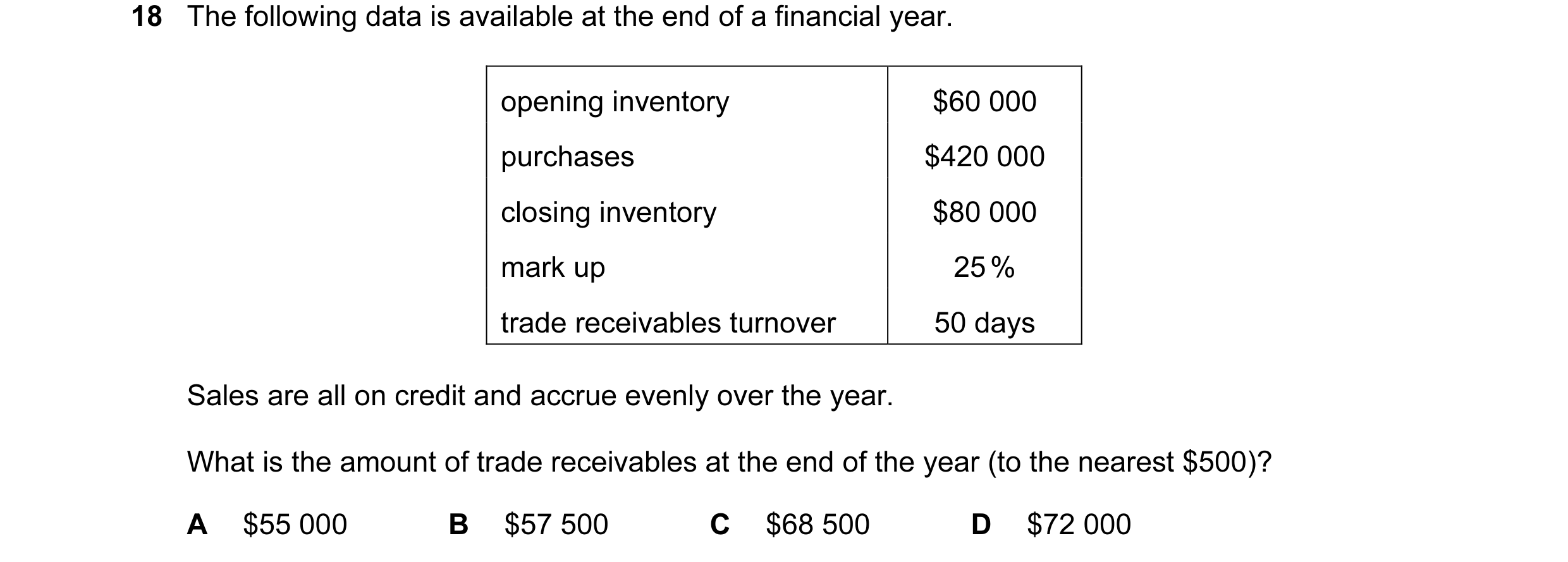 15 / 85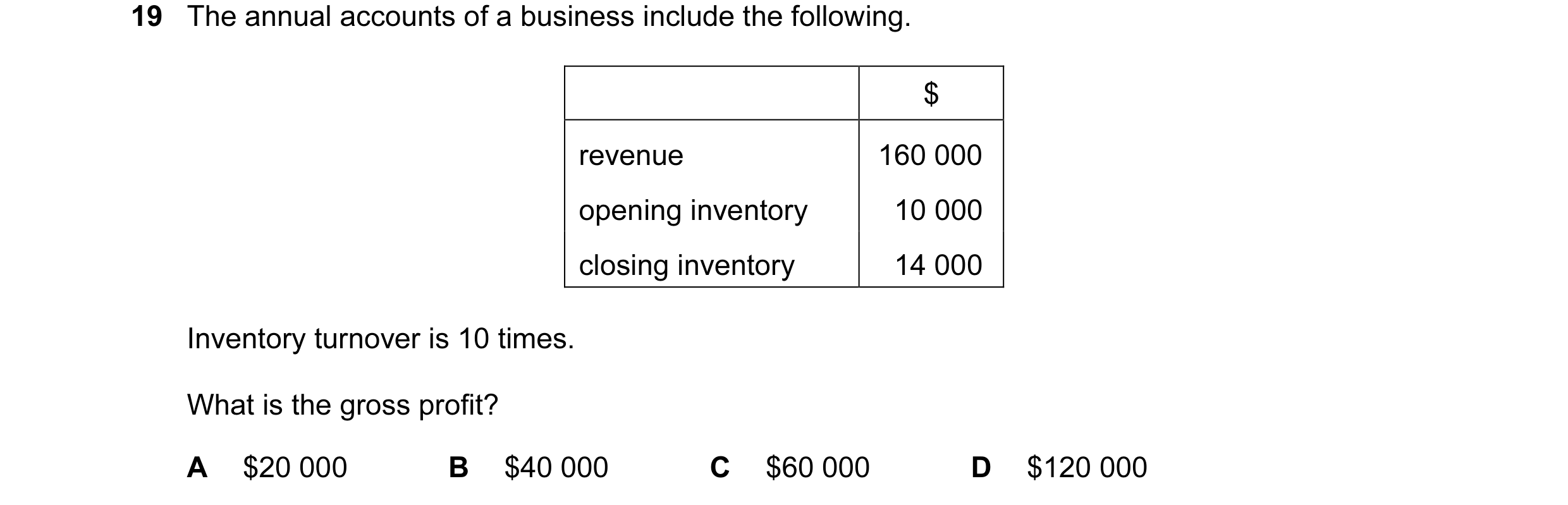
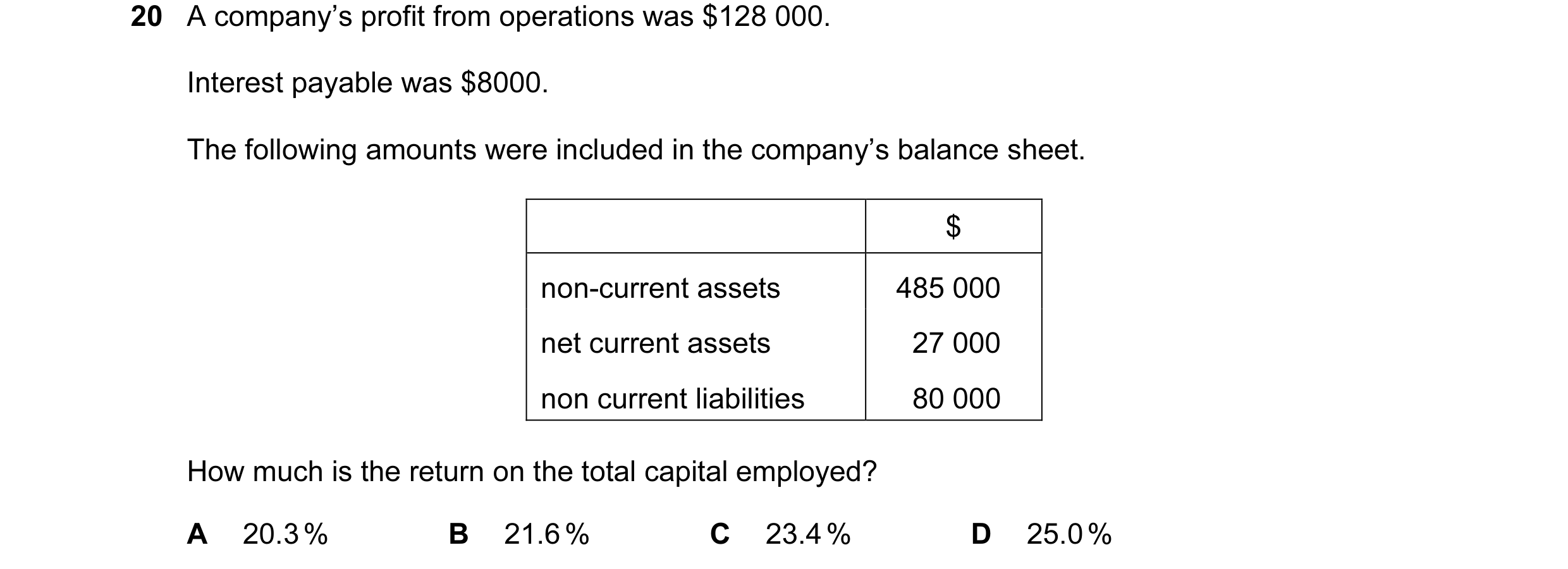
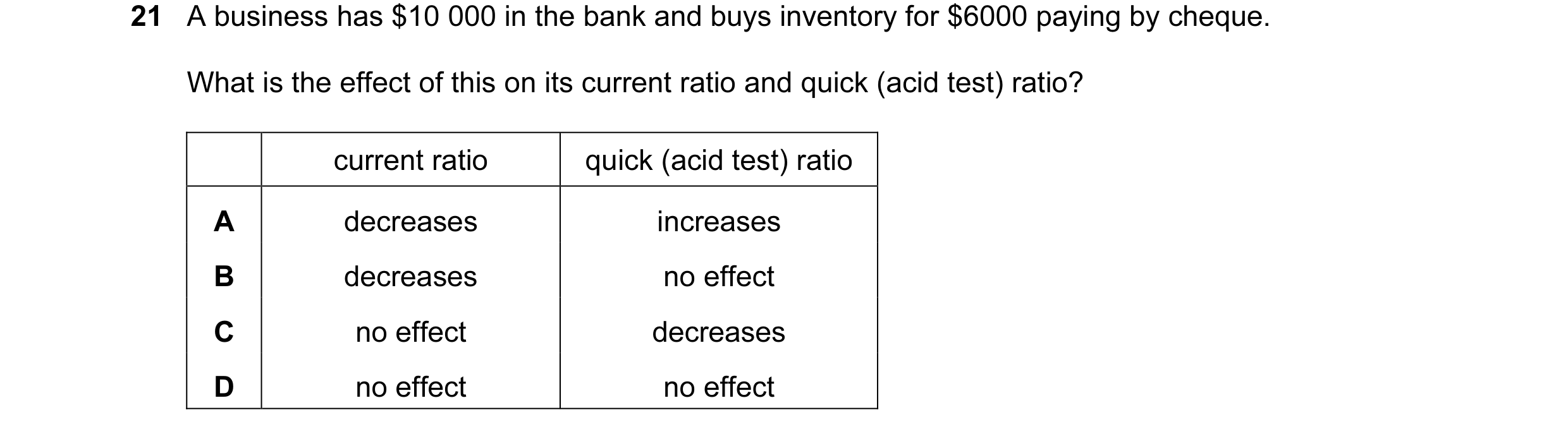
 16 / 85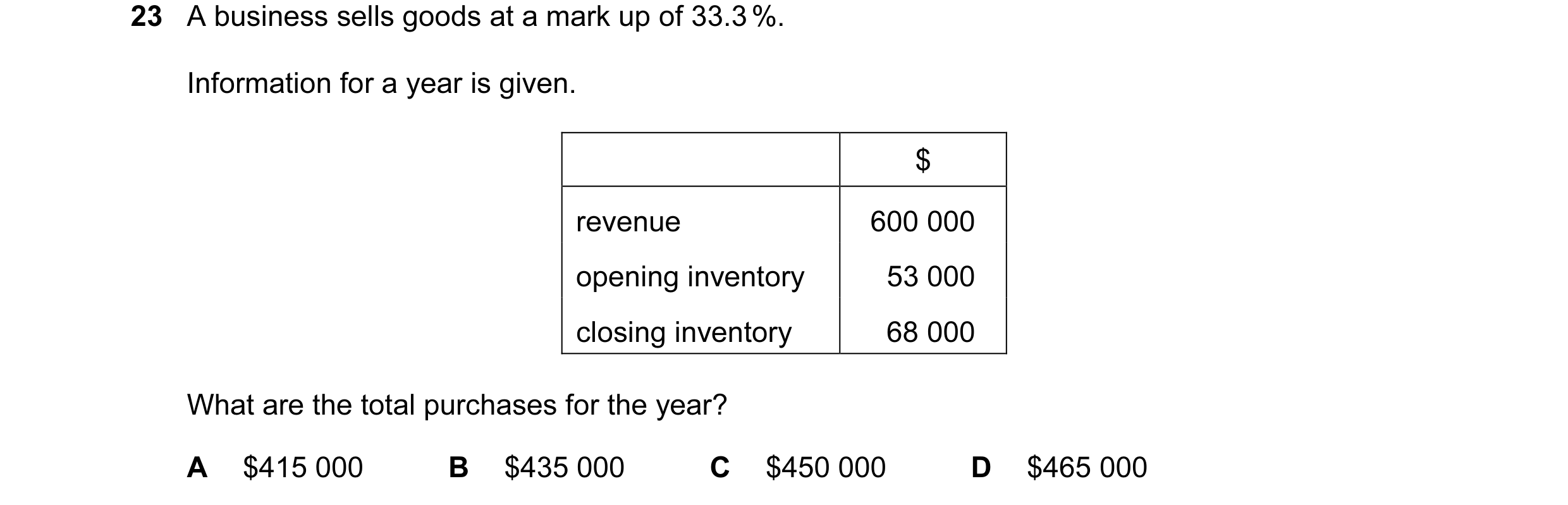

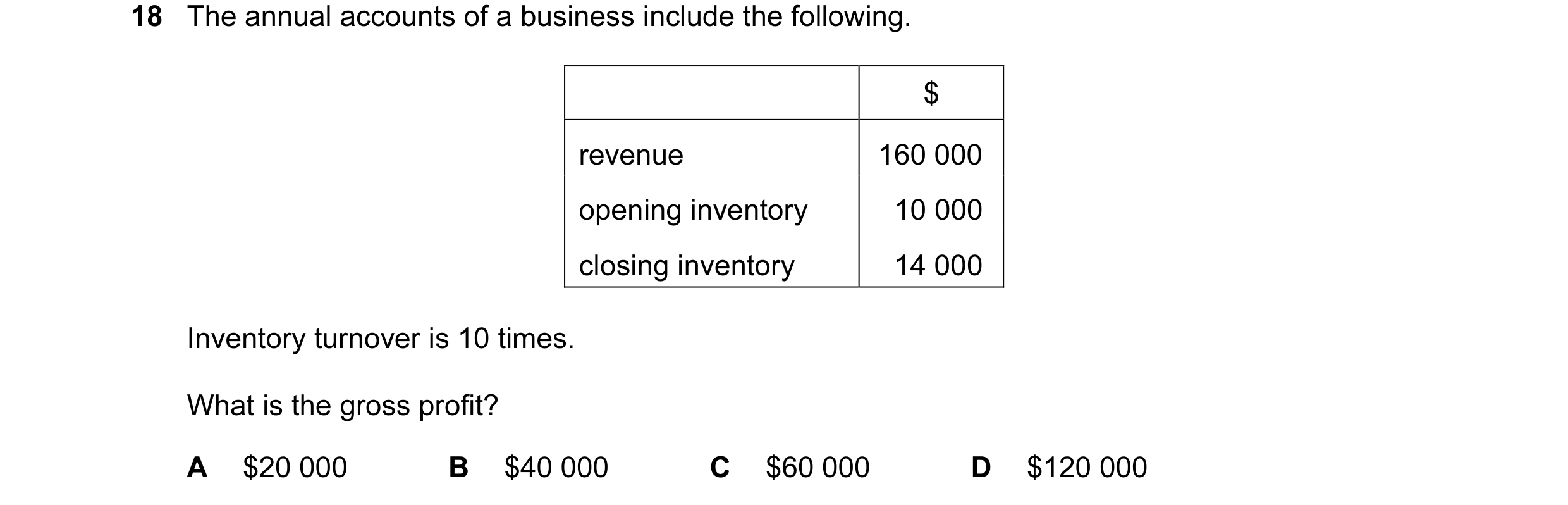
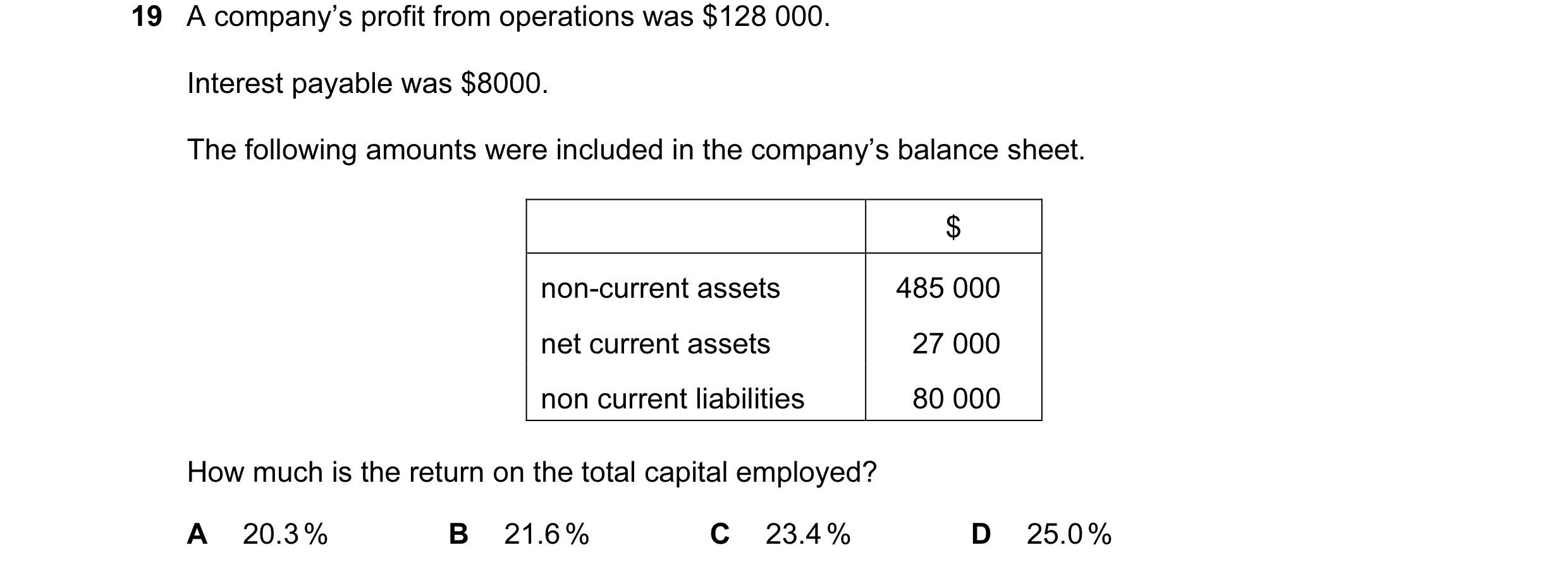 17 / 85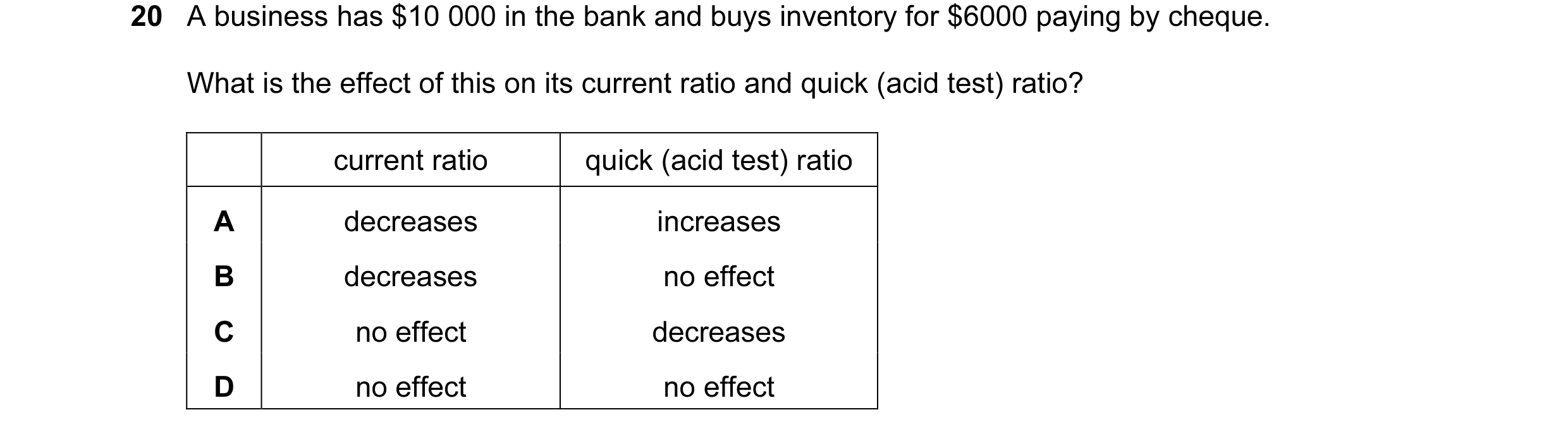
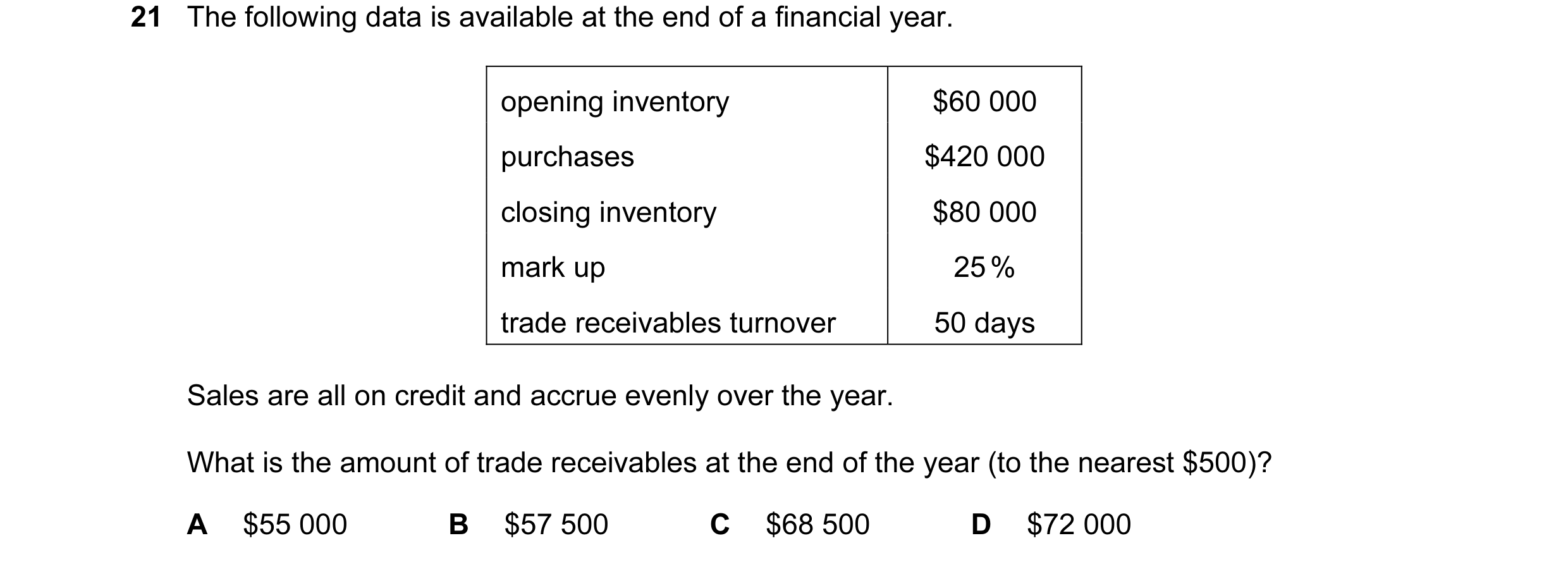


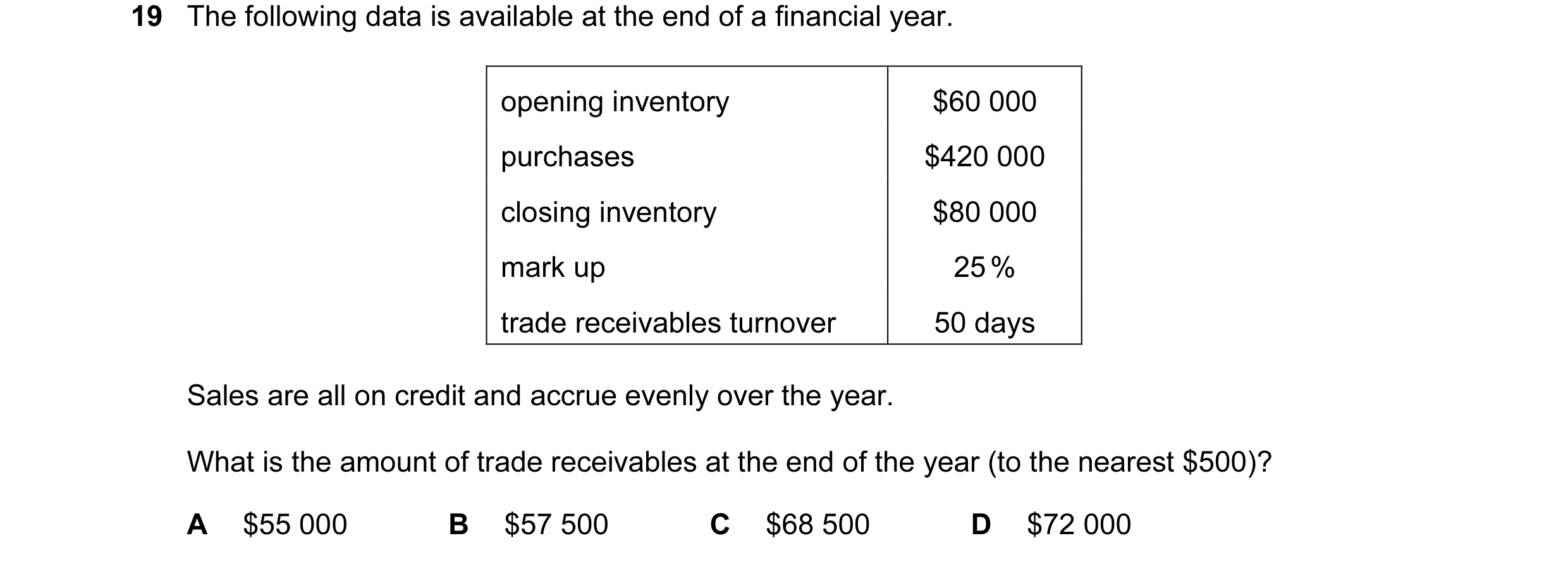 18 / 85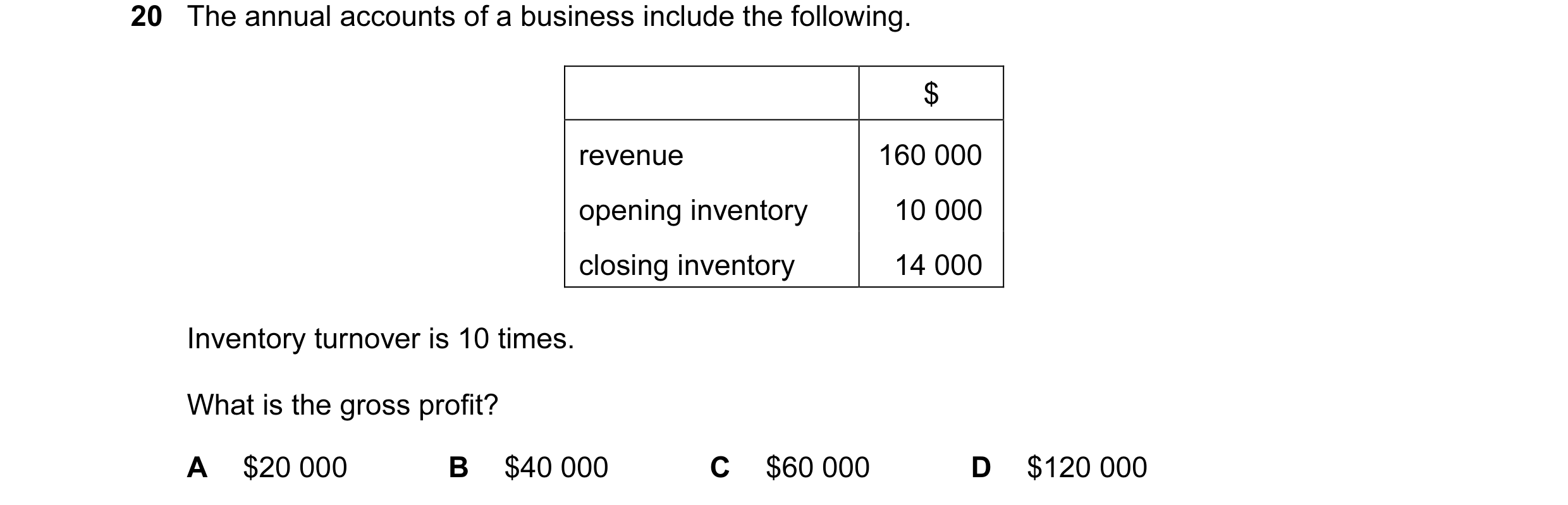
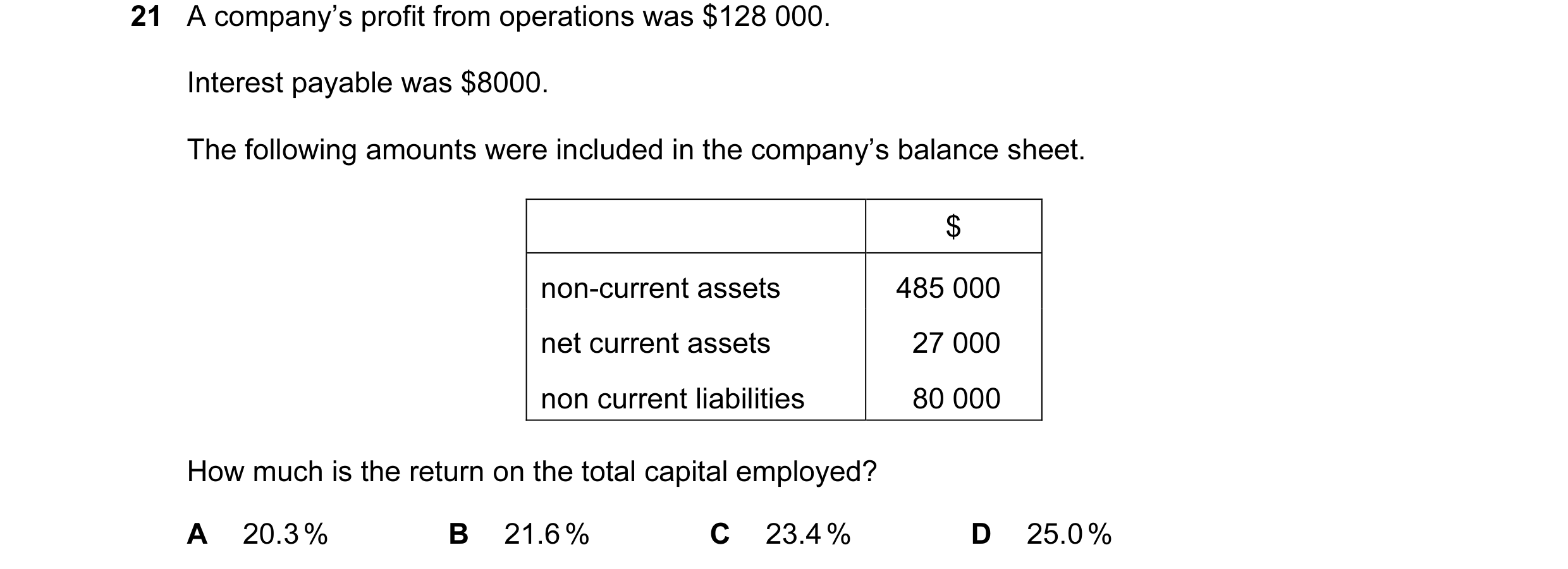
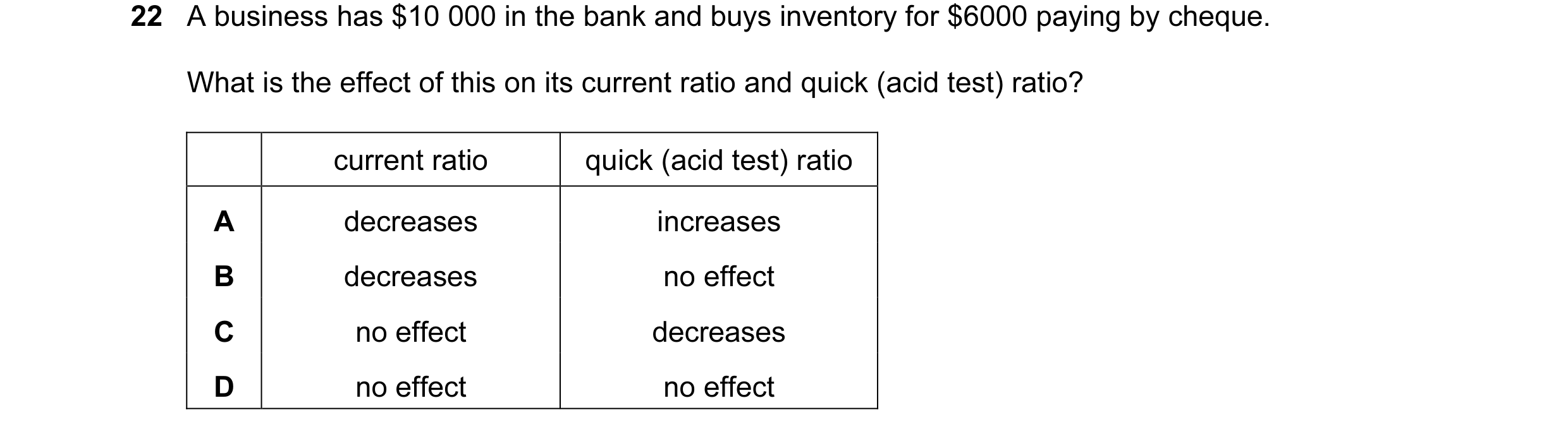
 19 / 85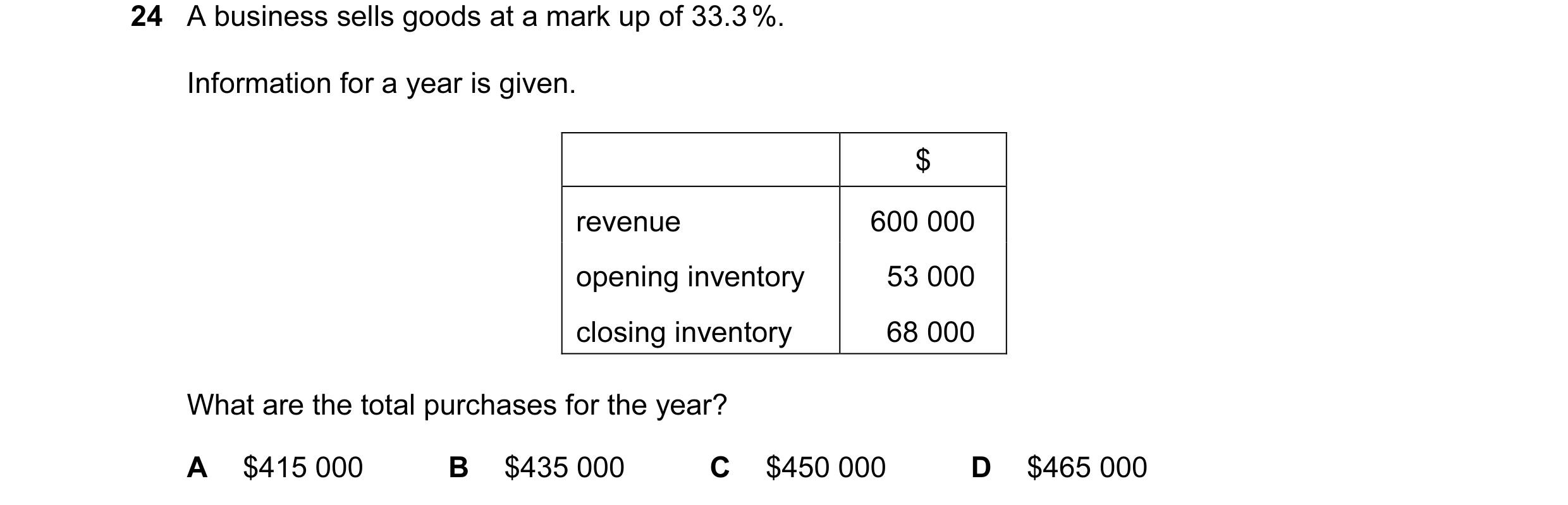
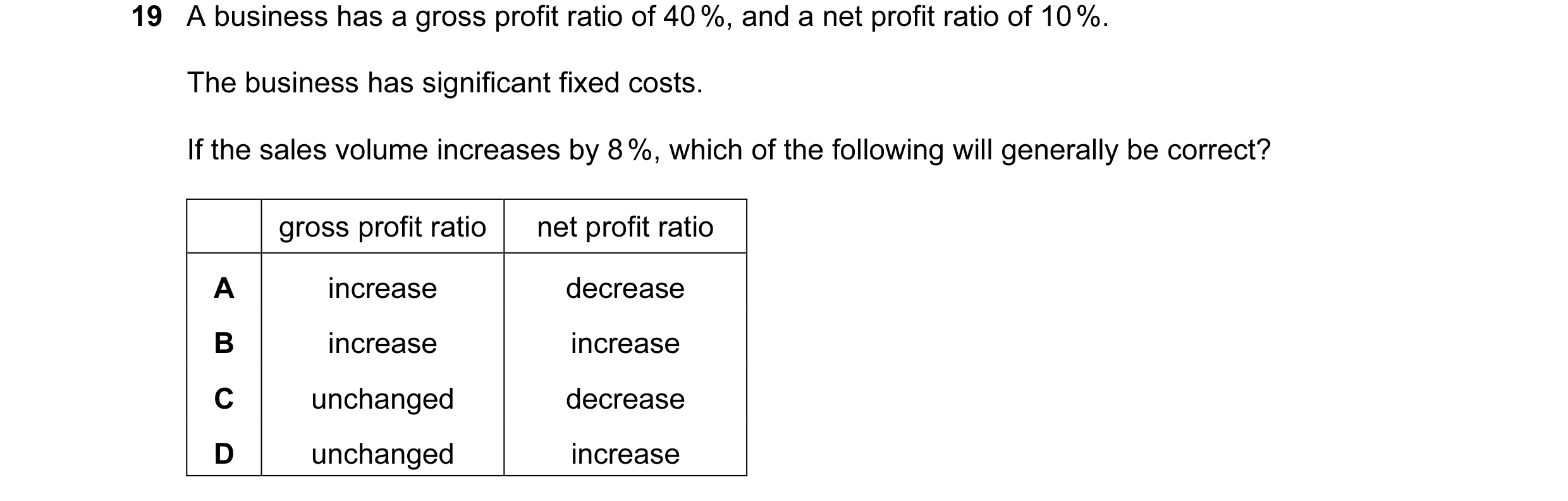
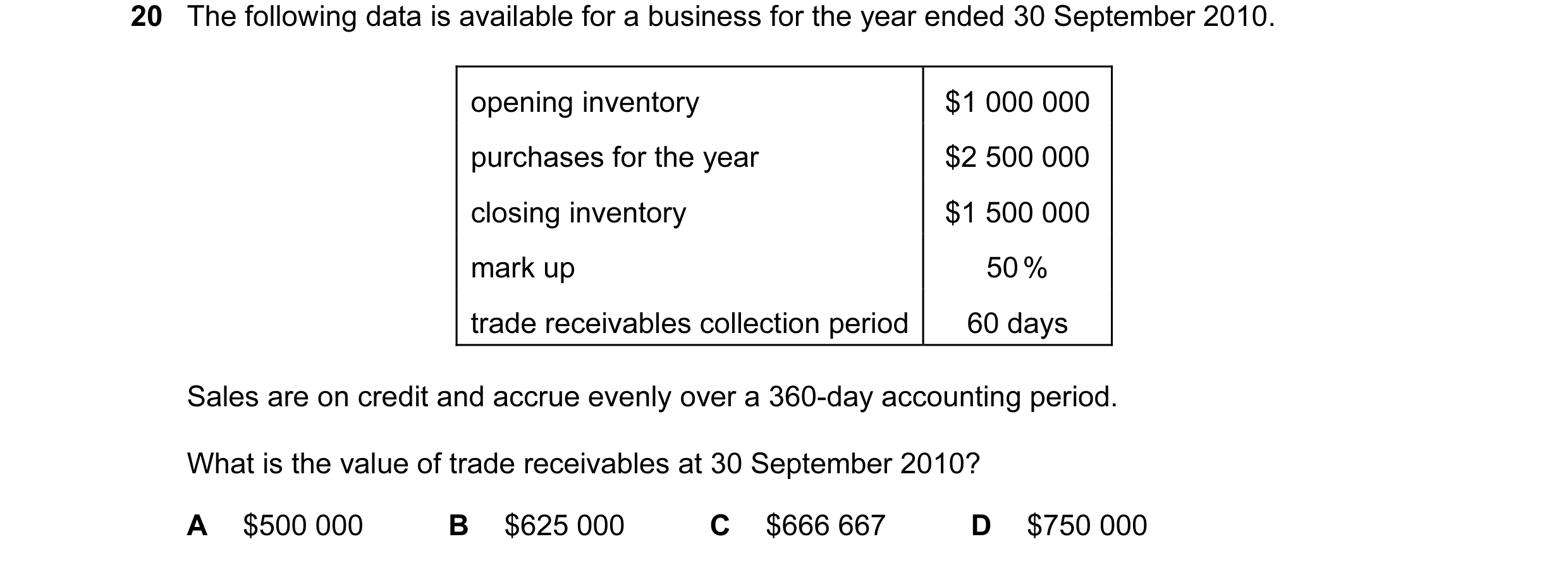
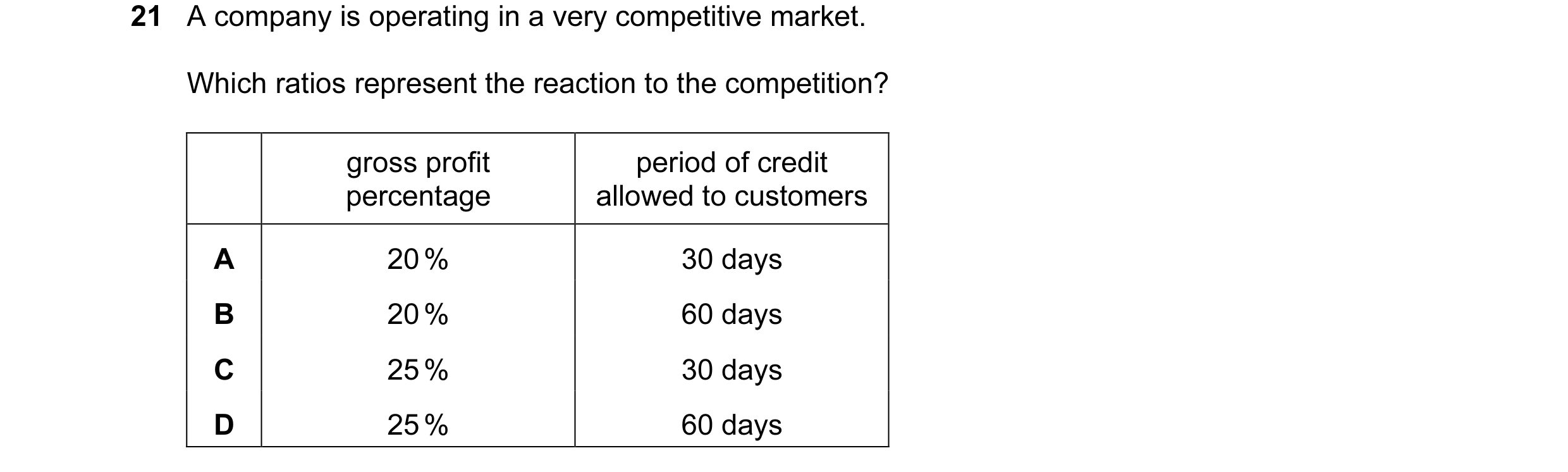 20 / 85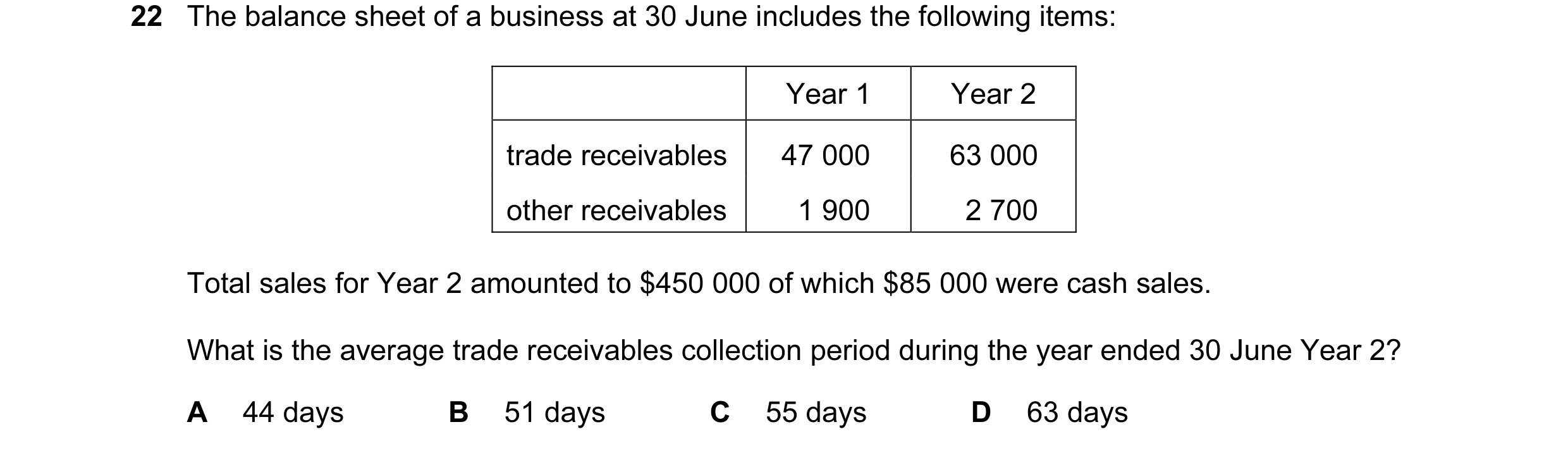


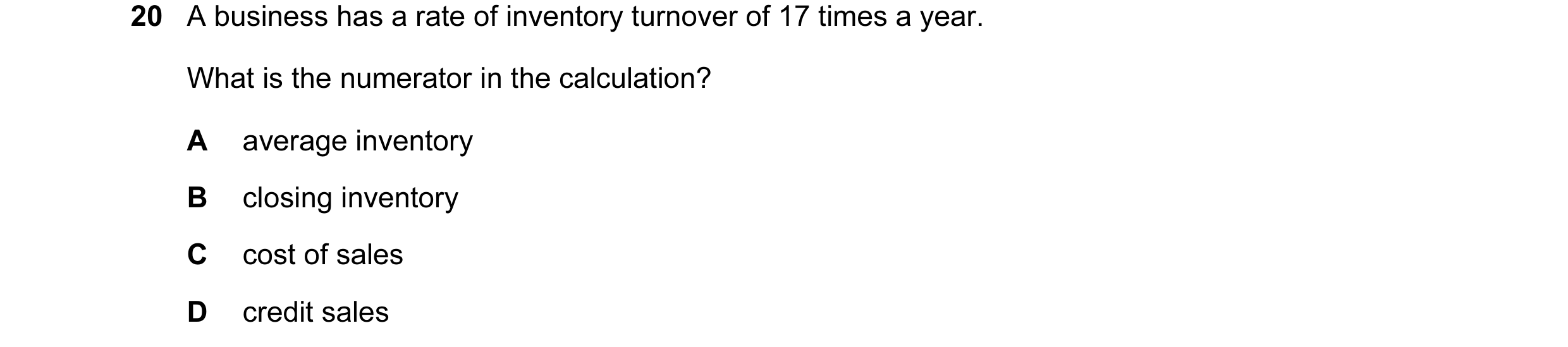
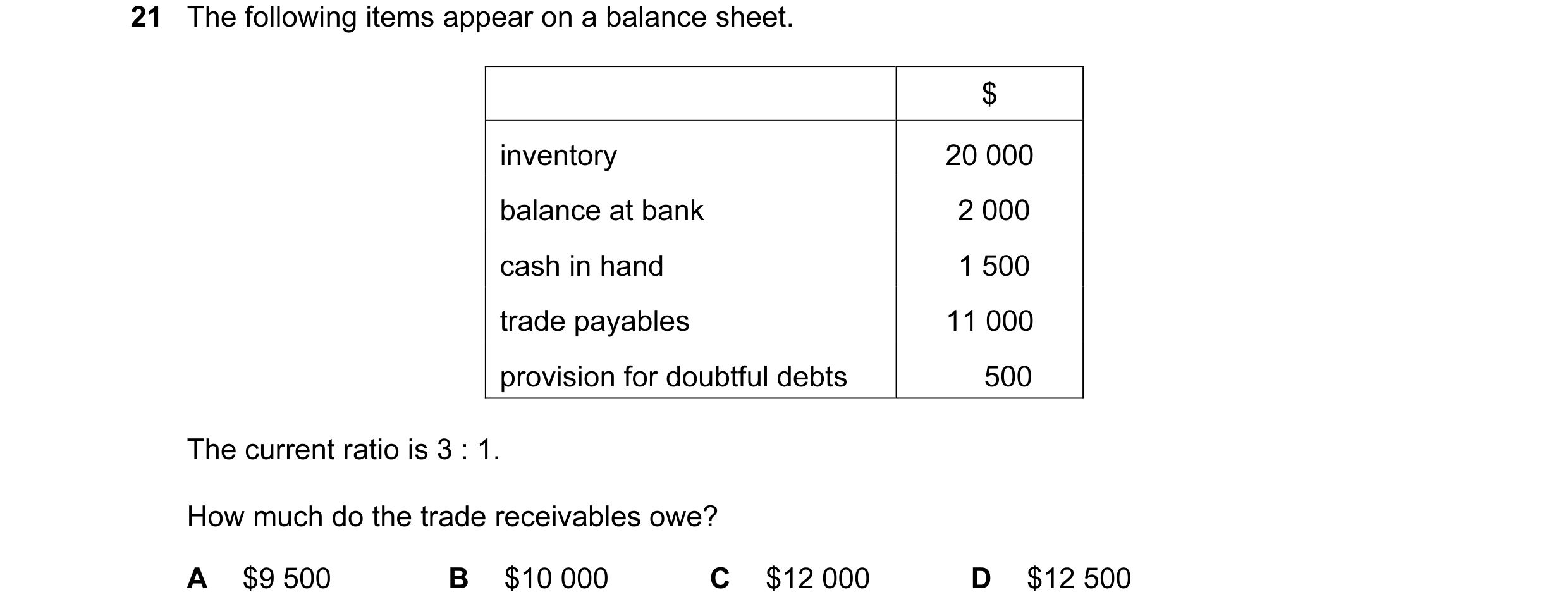 21 / 85
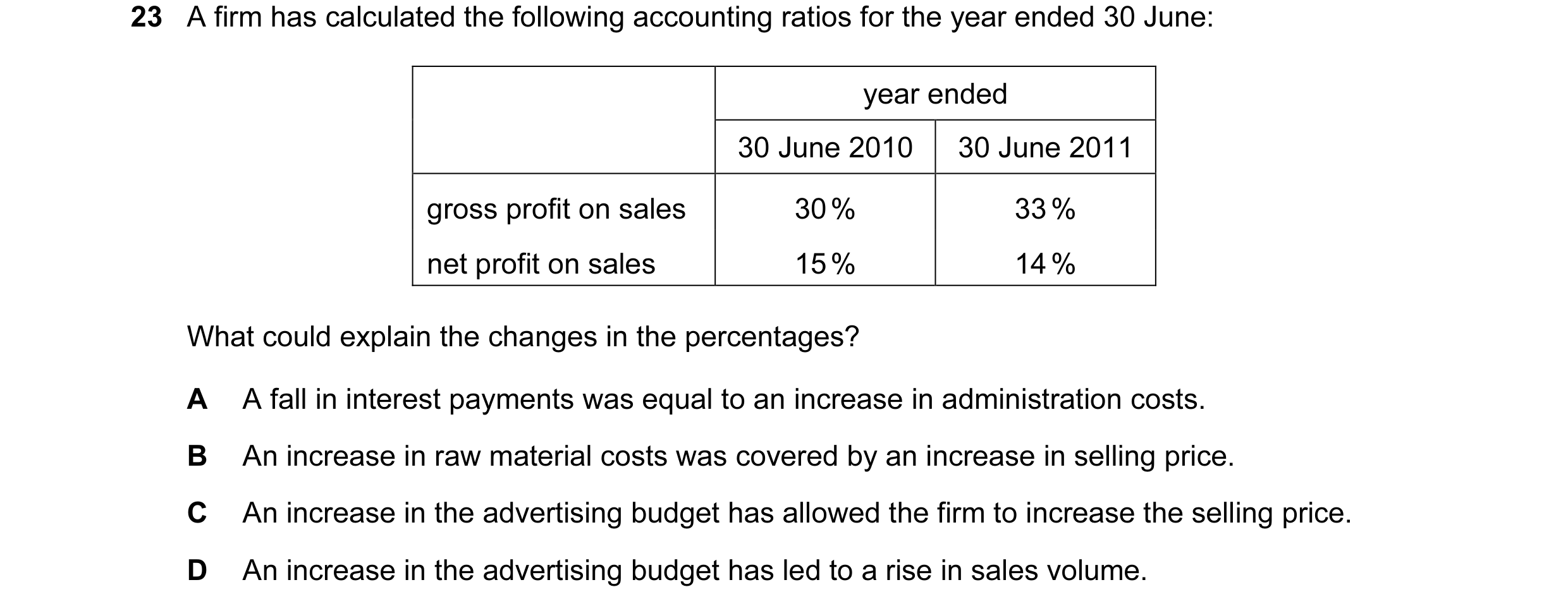

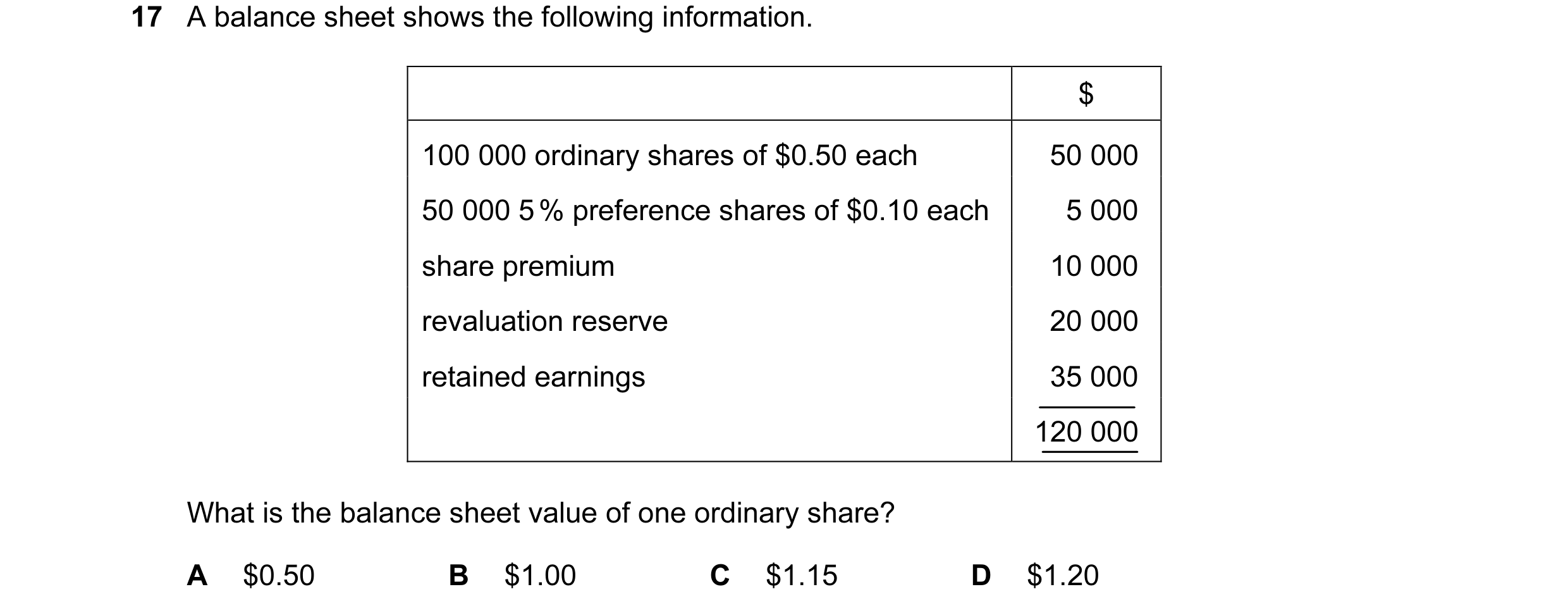 22 / 85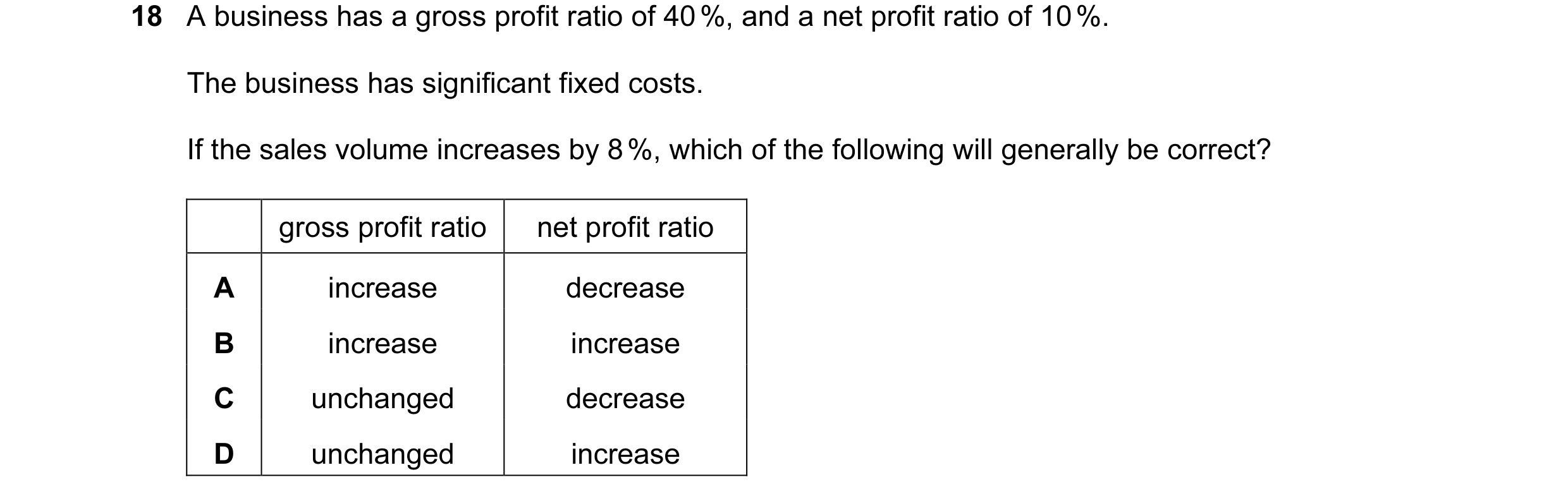
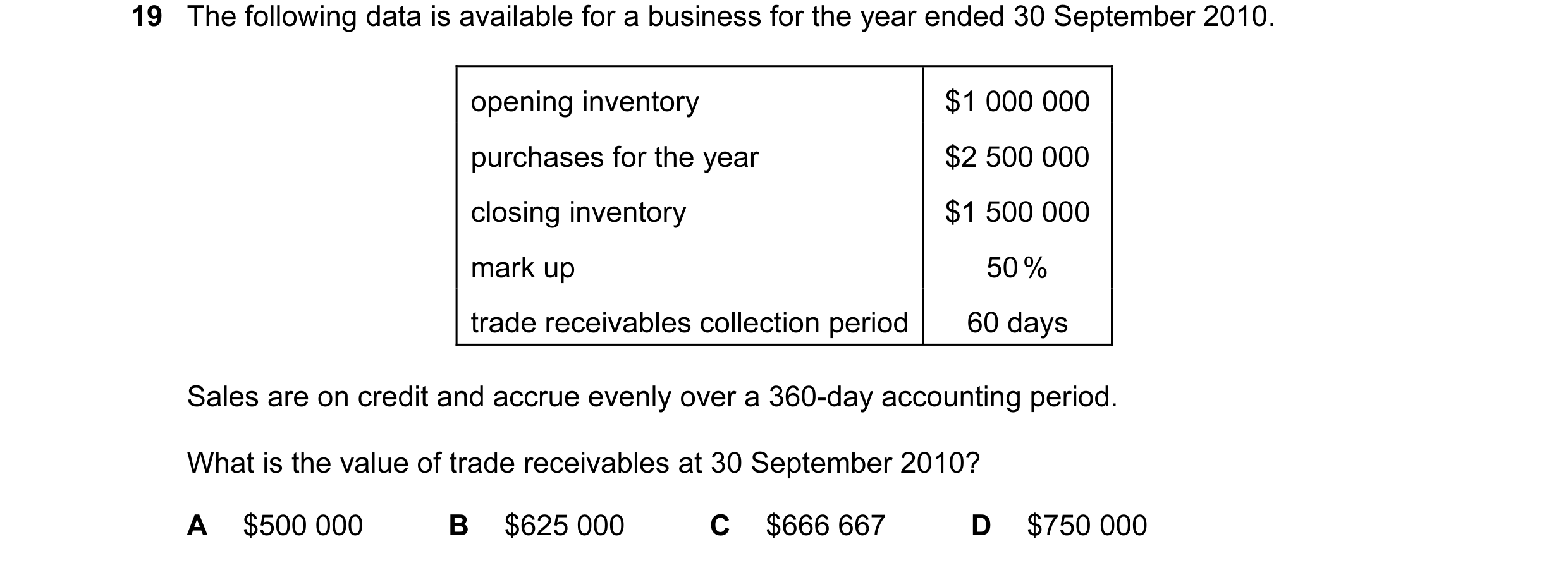
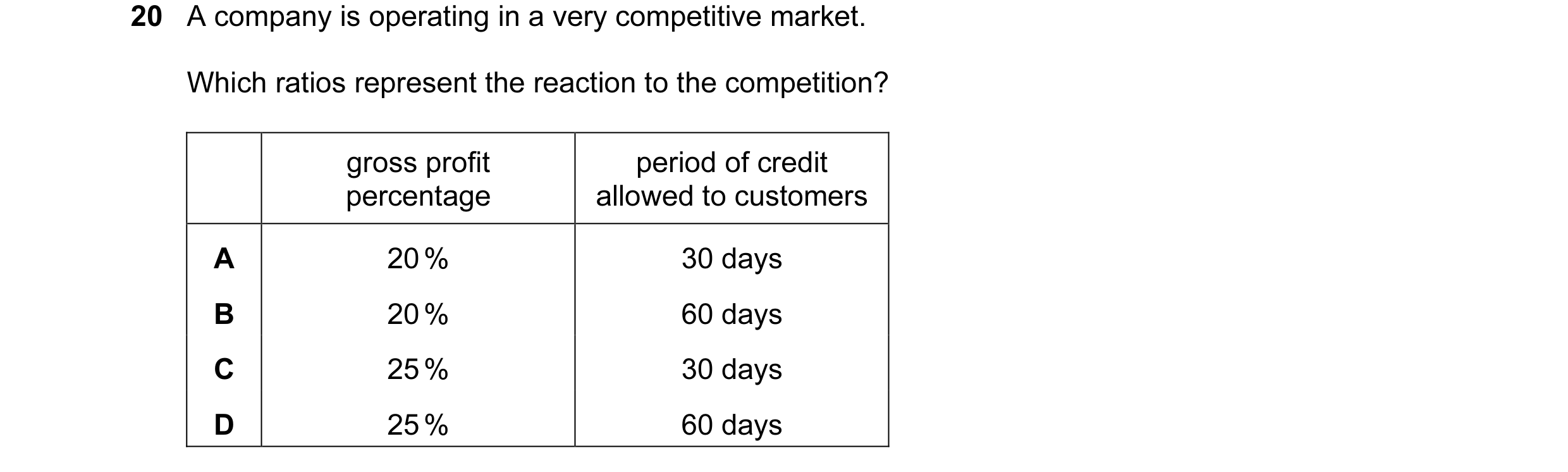
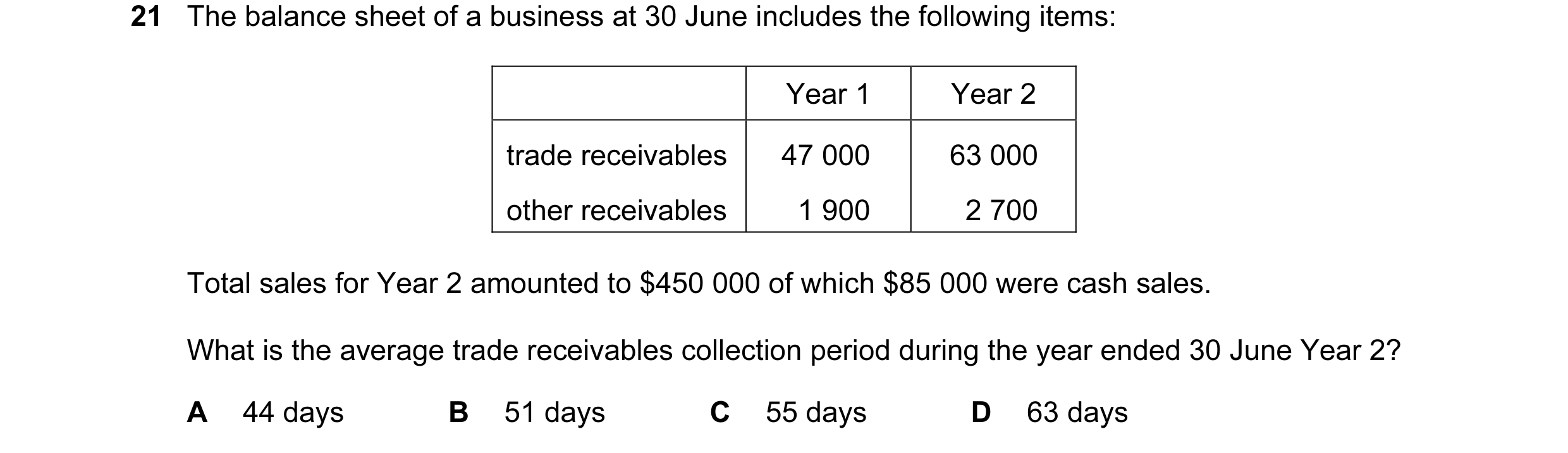 23 / 85

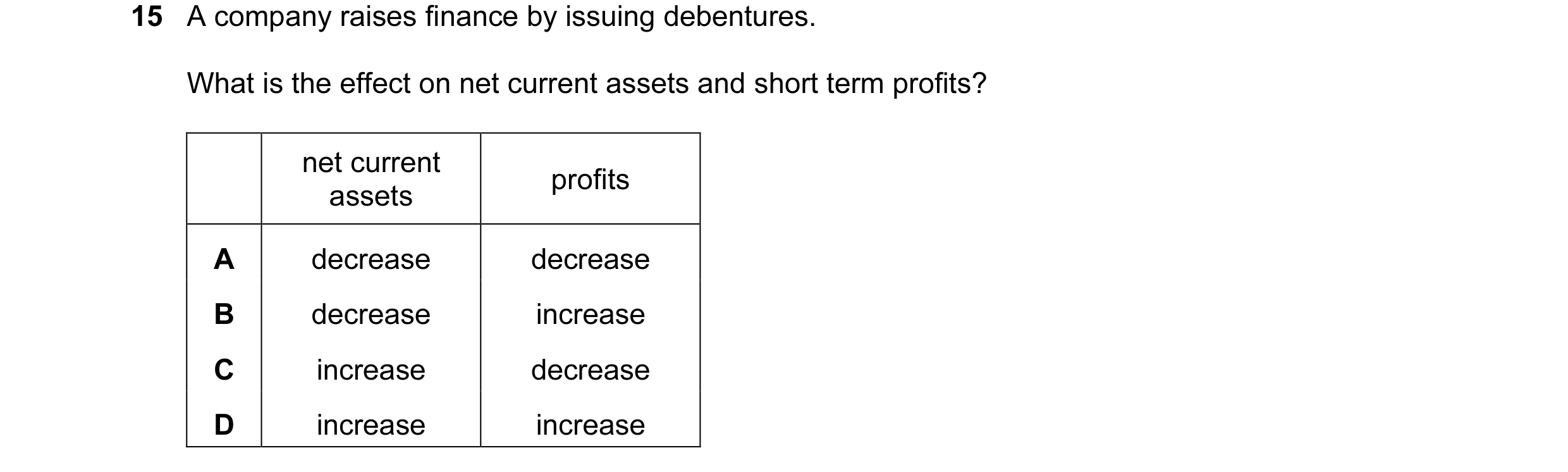
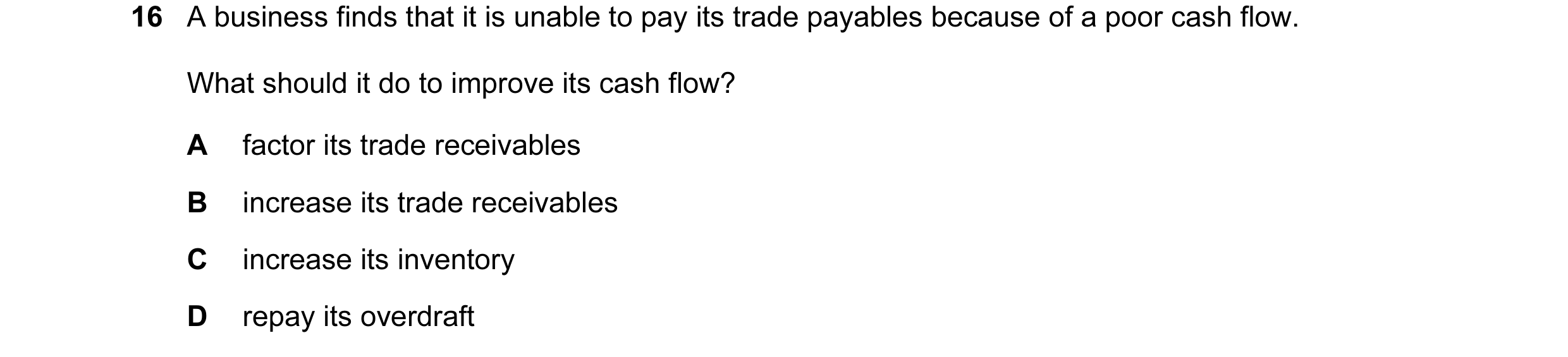
 24 / 85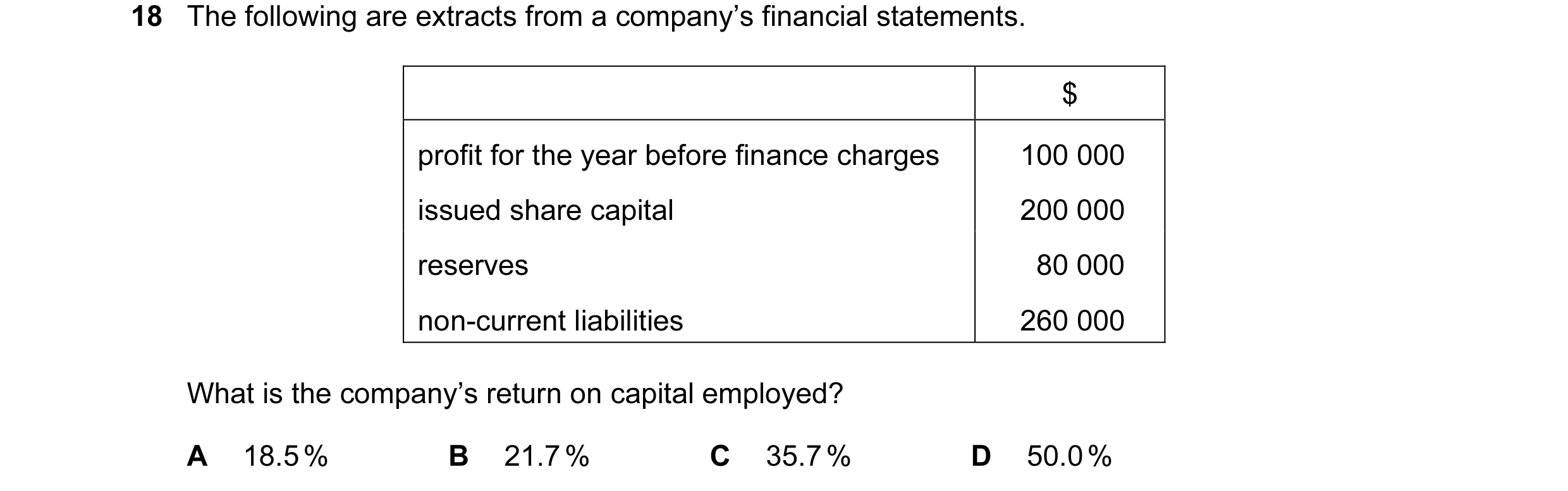
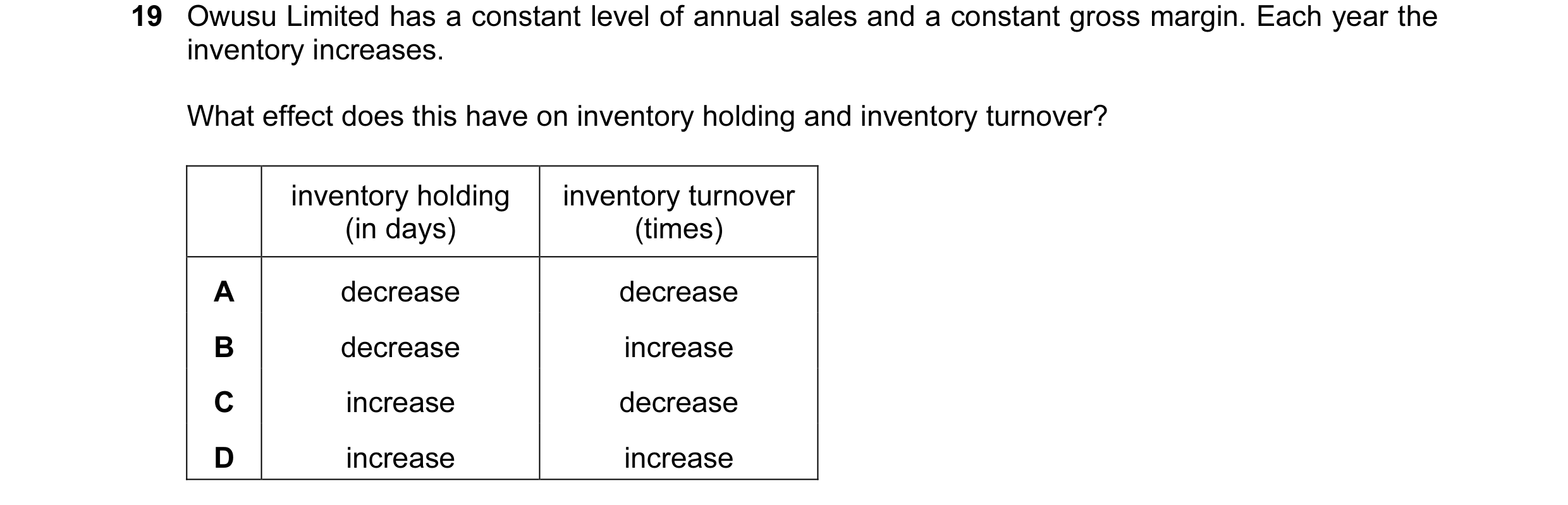

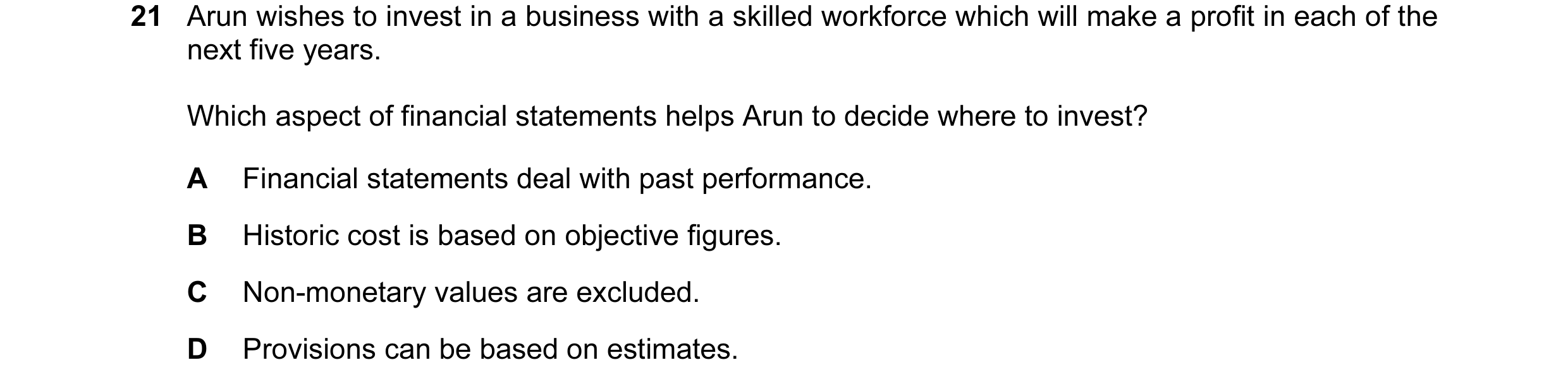 25 / 85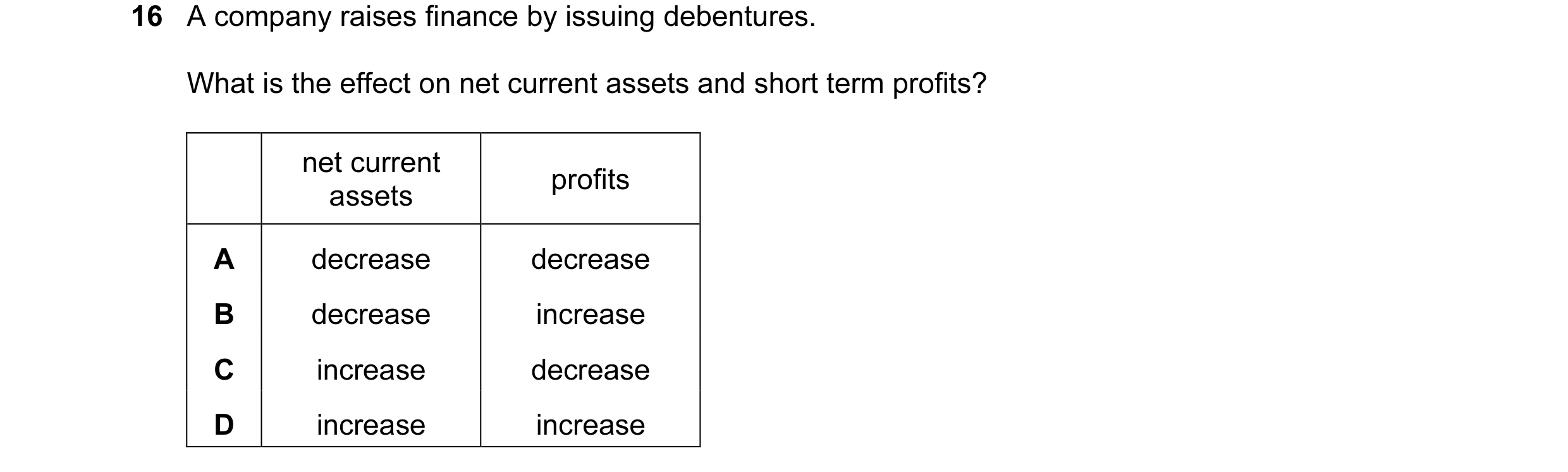
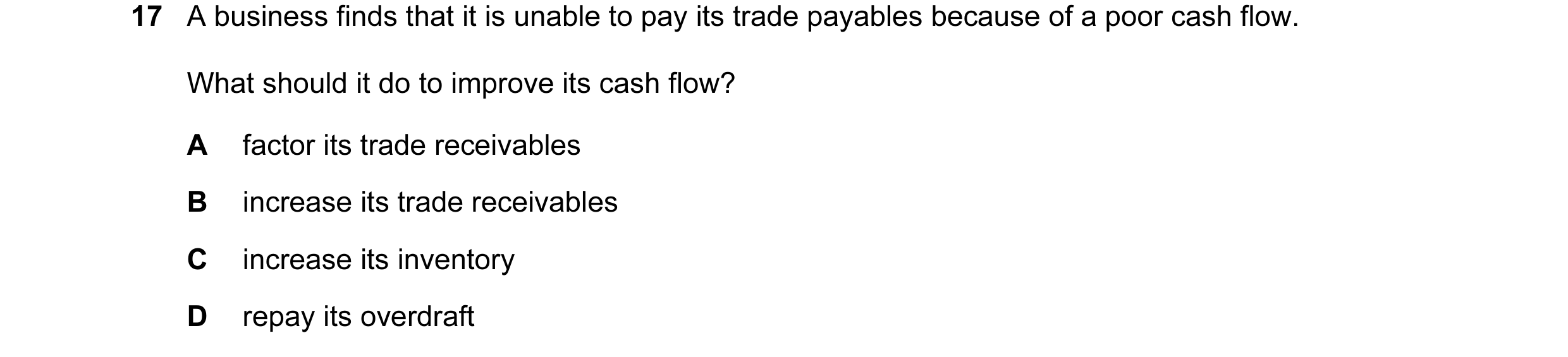
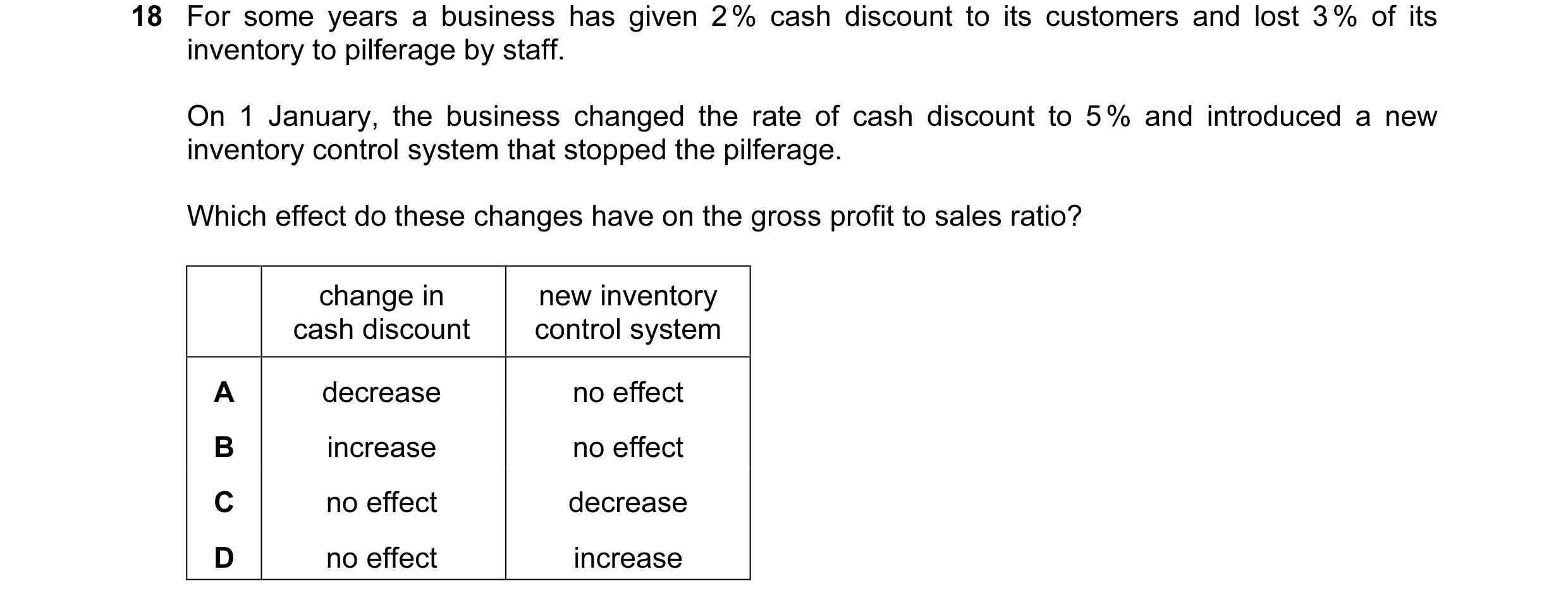 26 / 85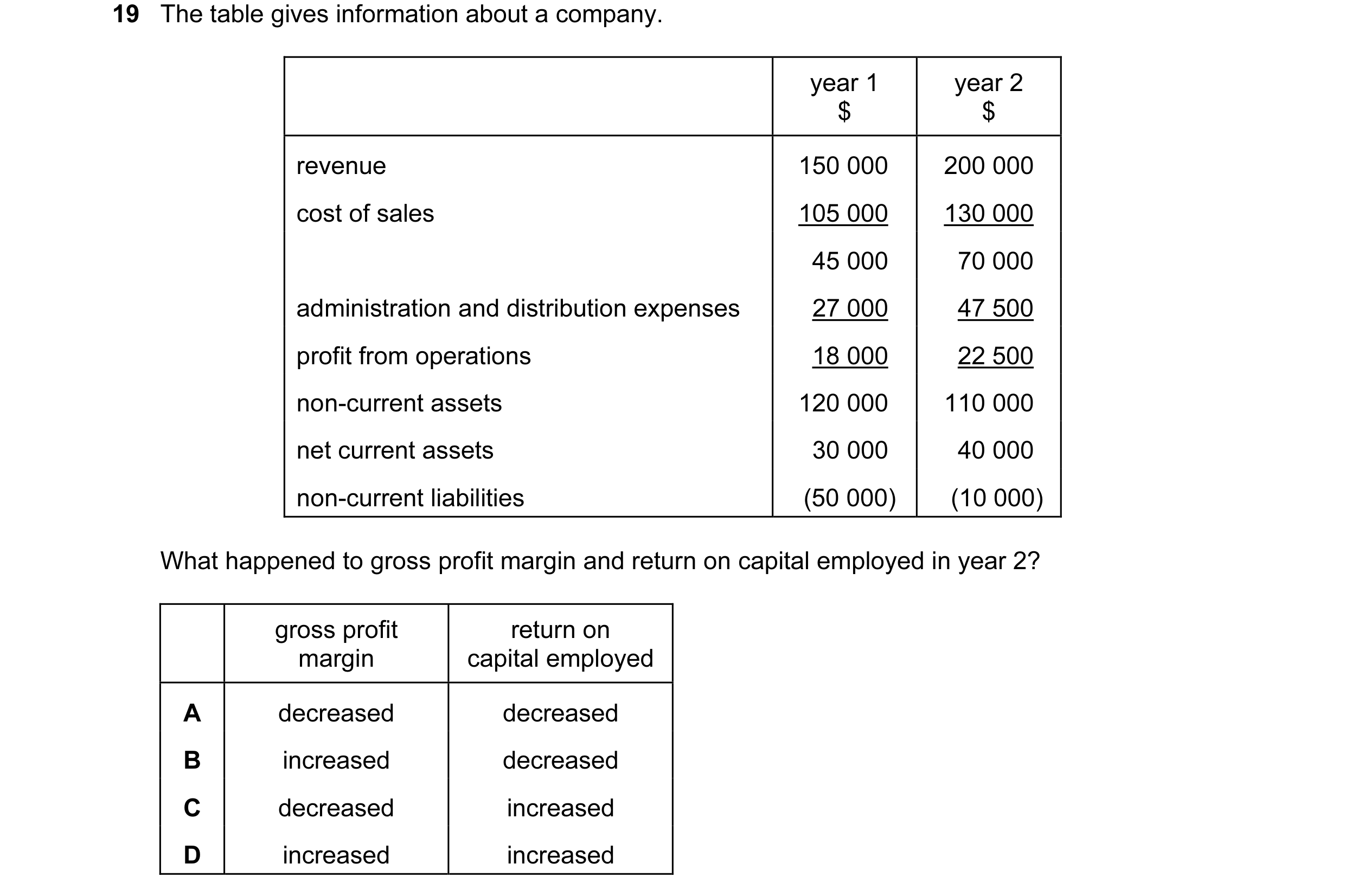


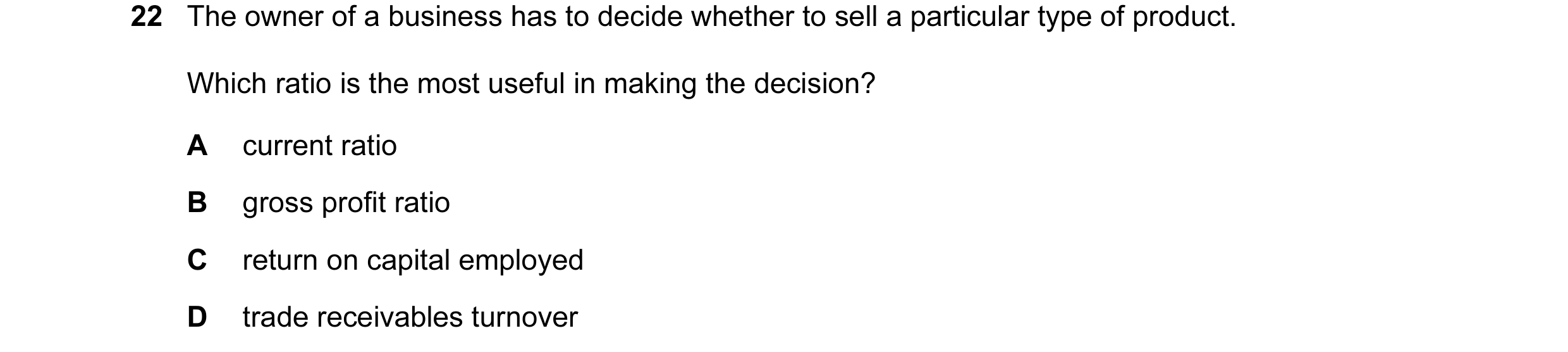 27 / 85
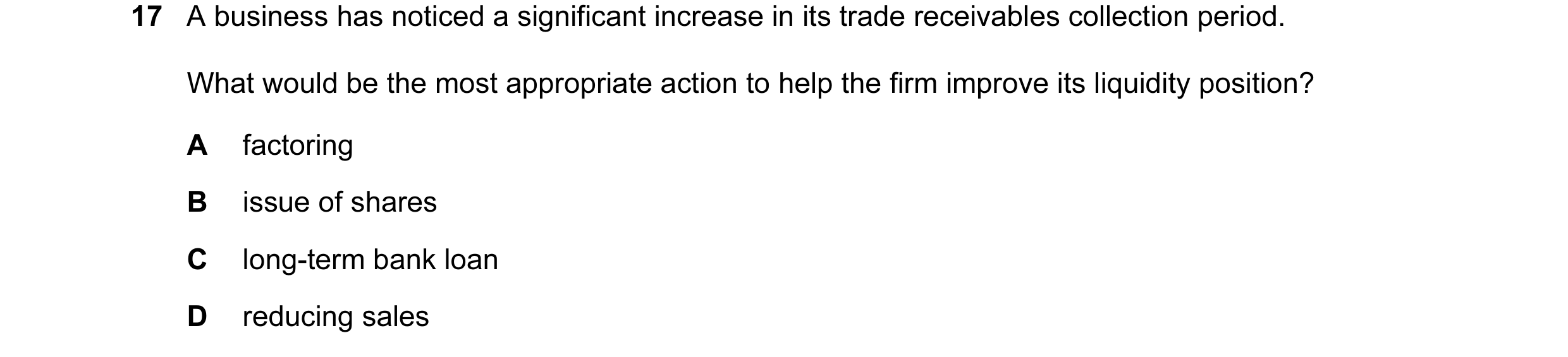

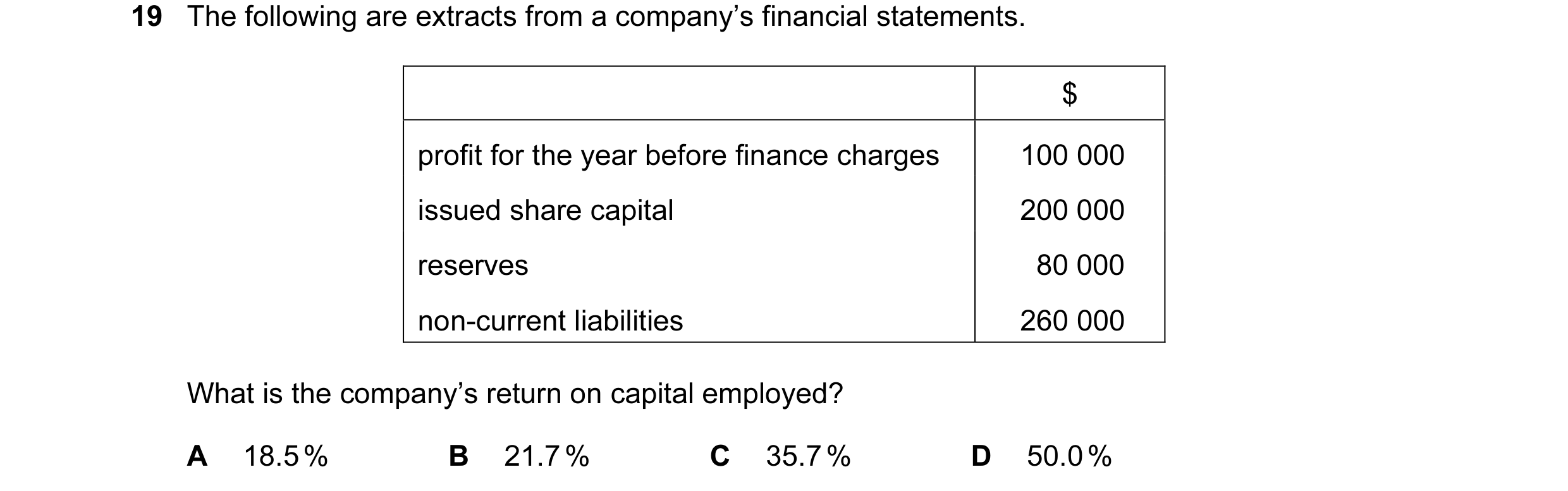
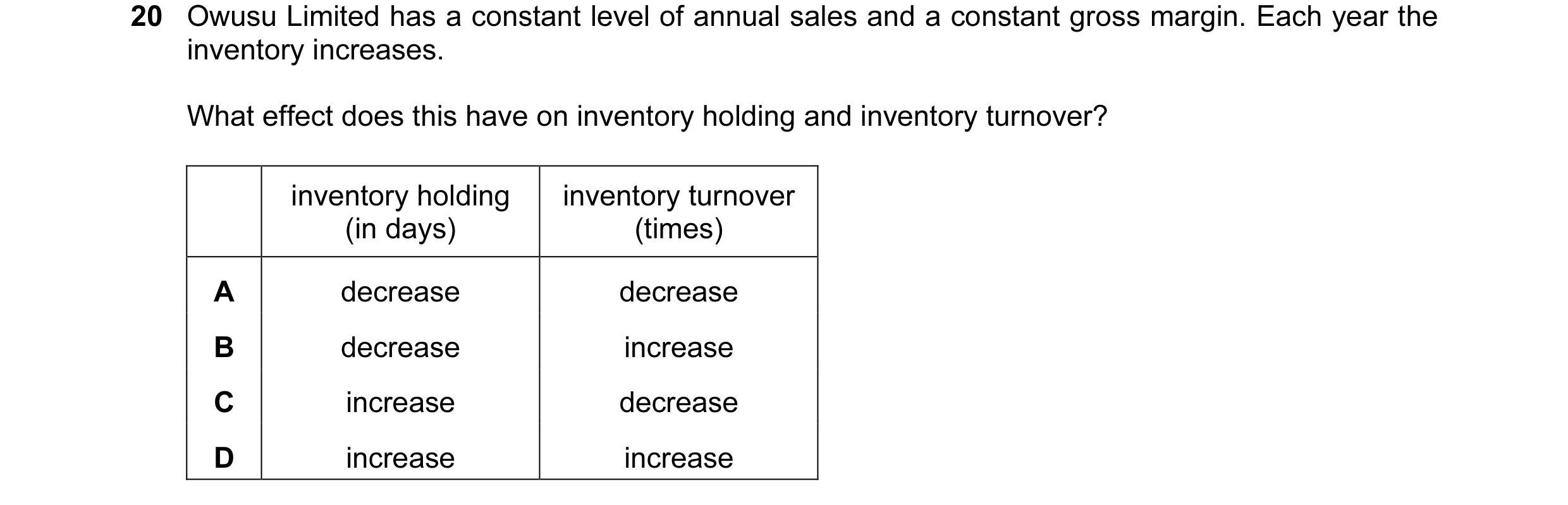 28 / 85

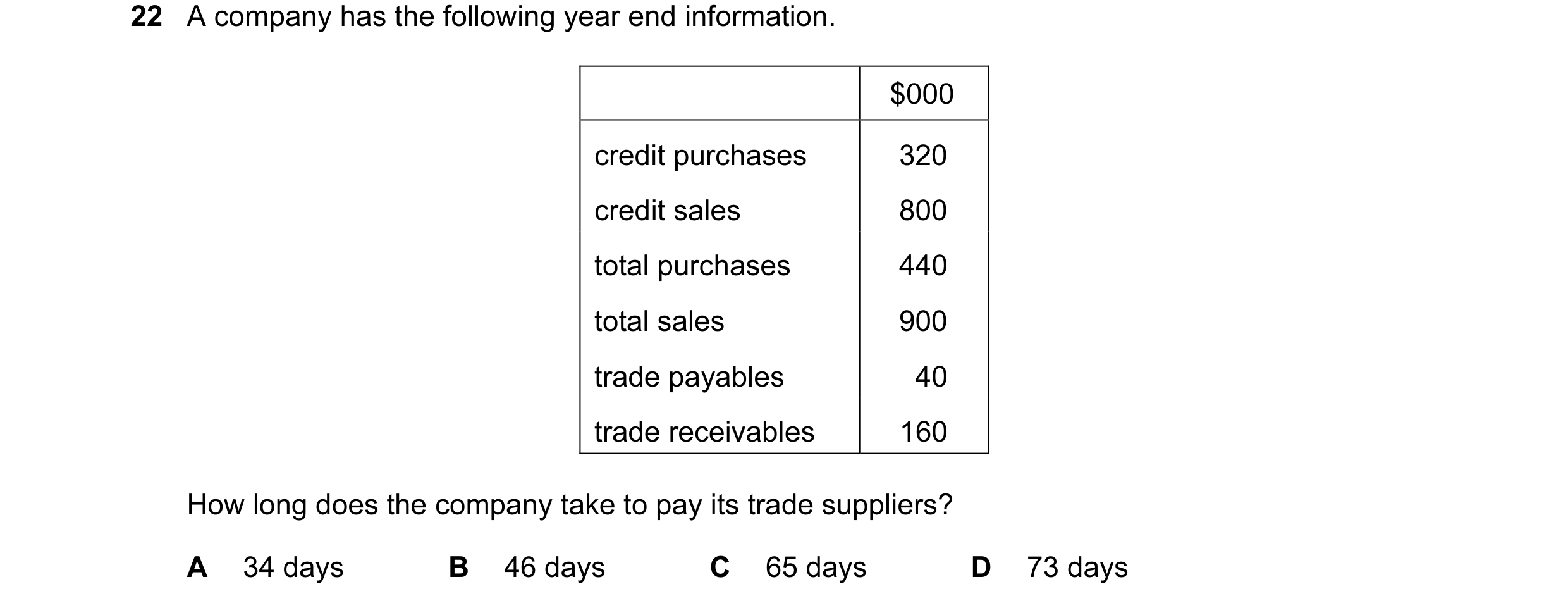
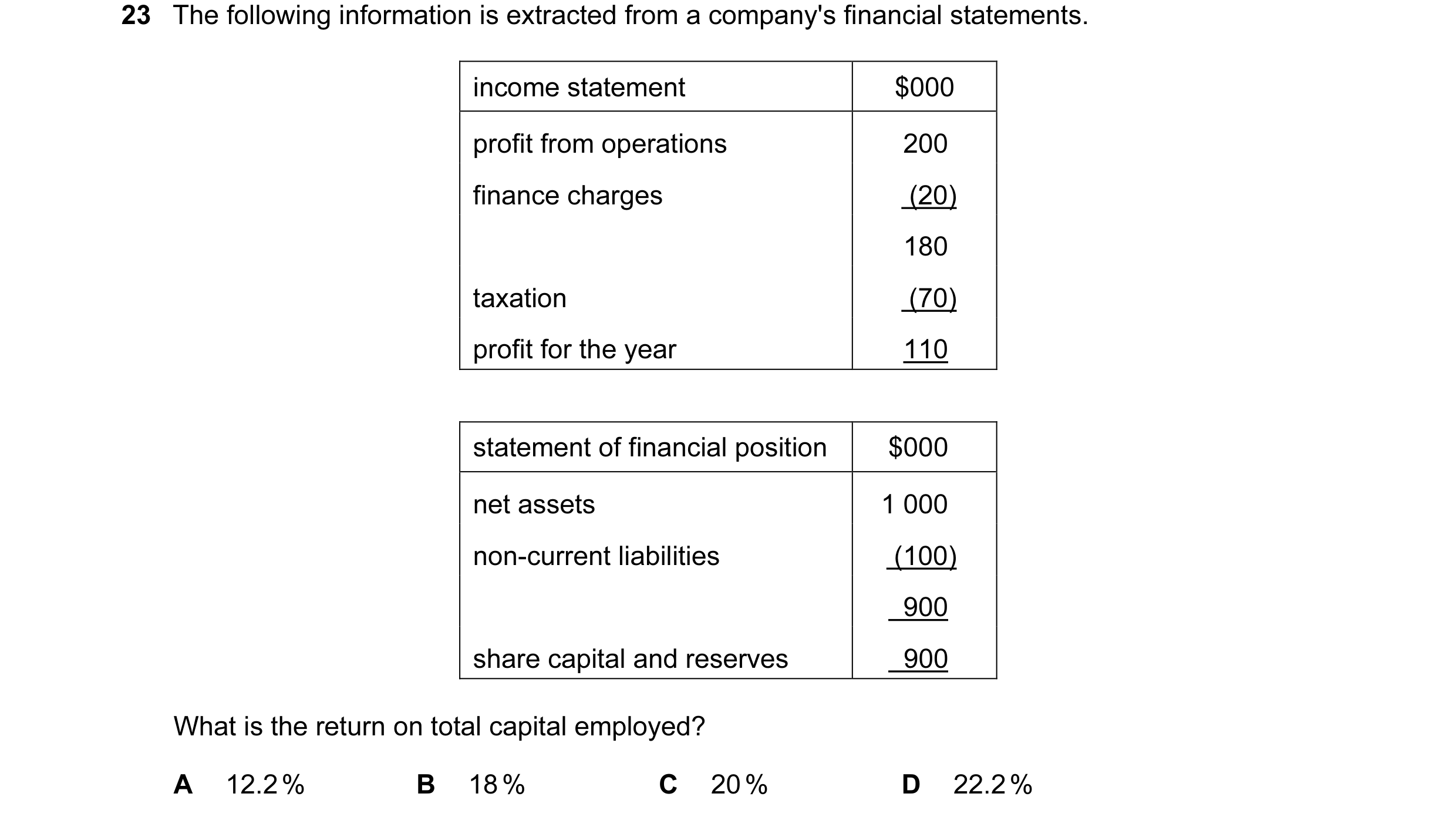 29 / 85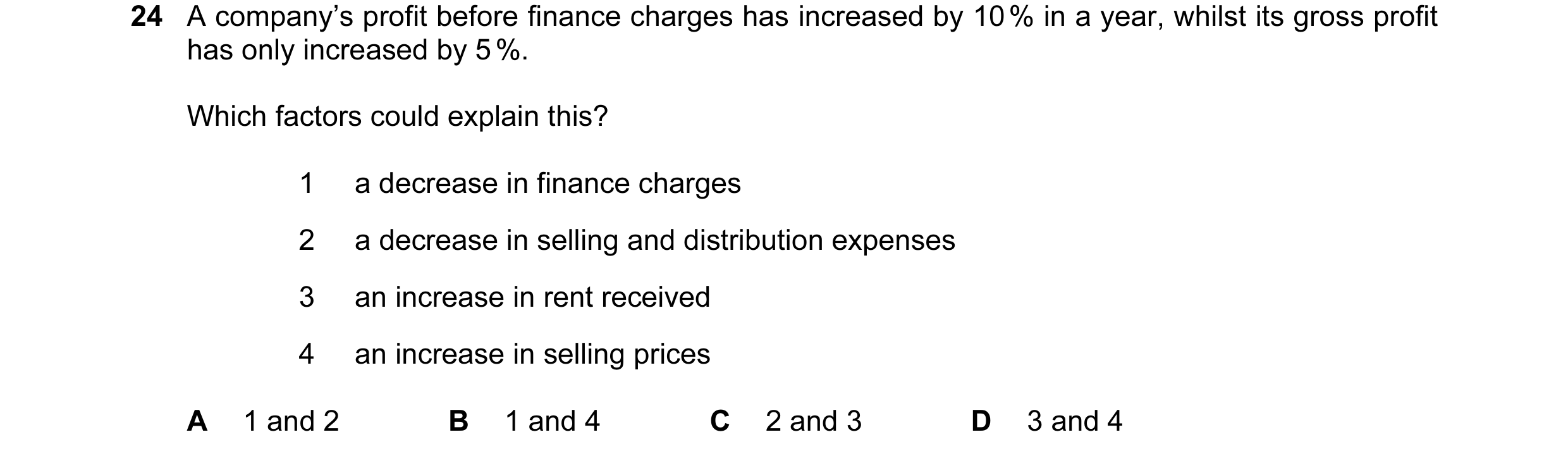
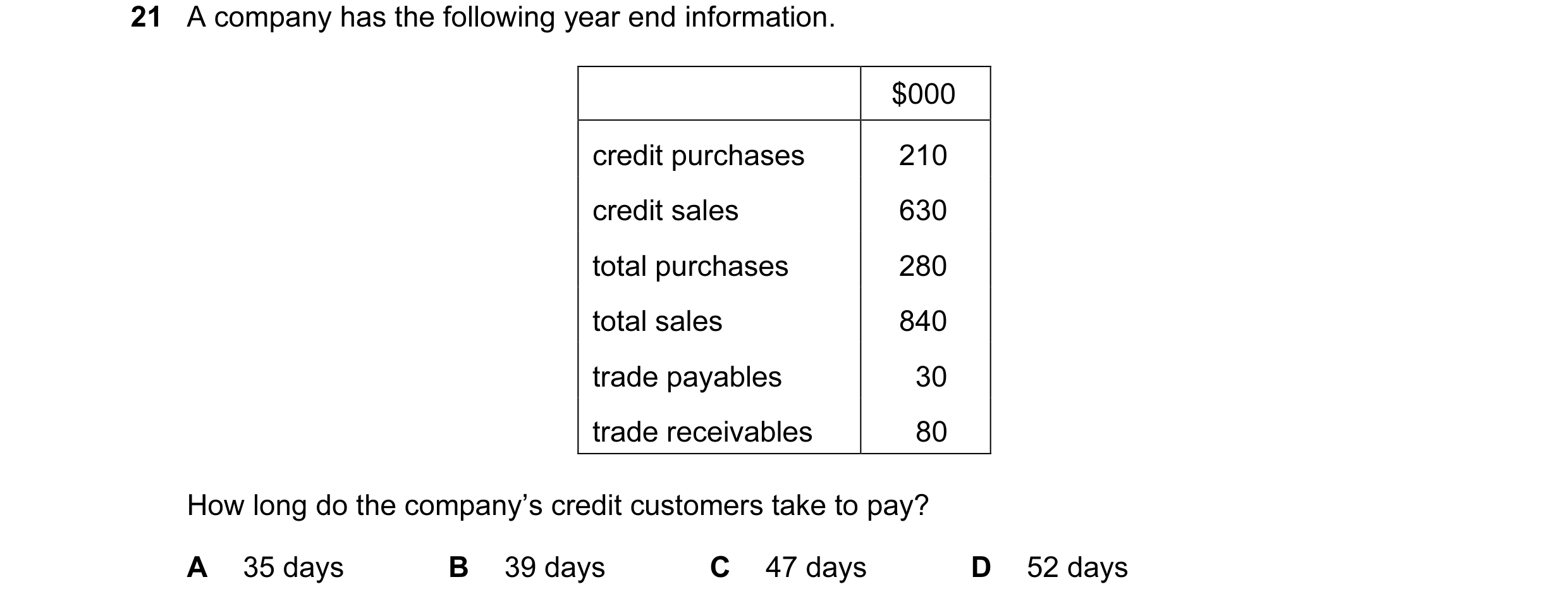
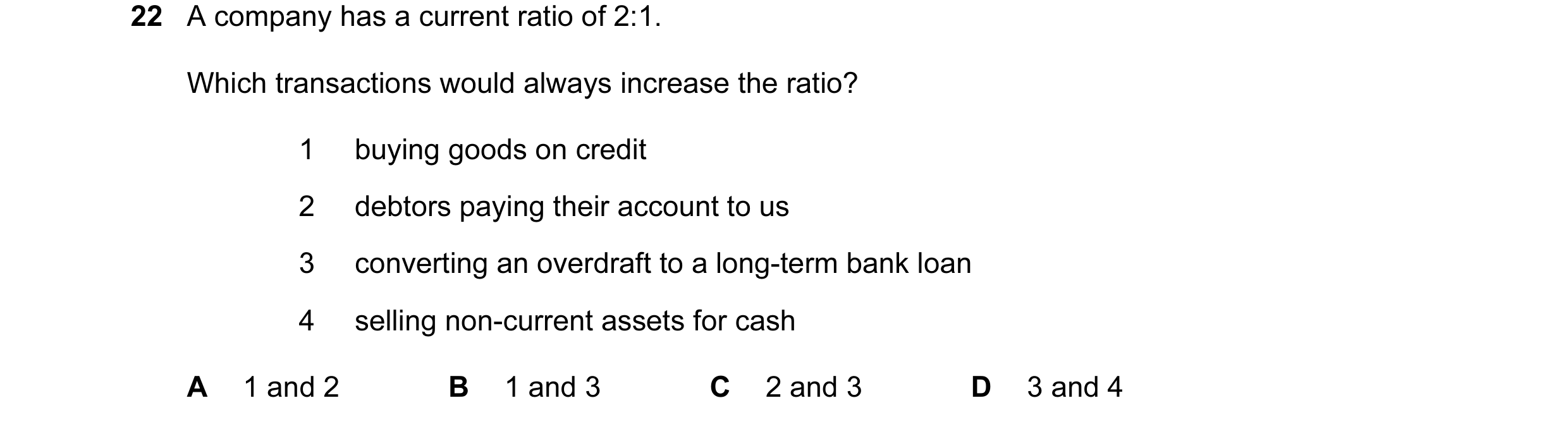
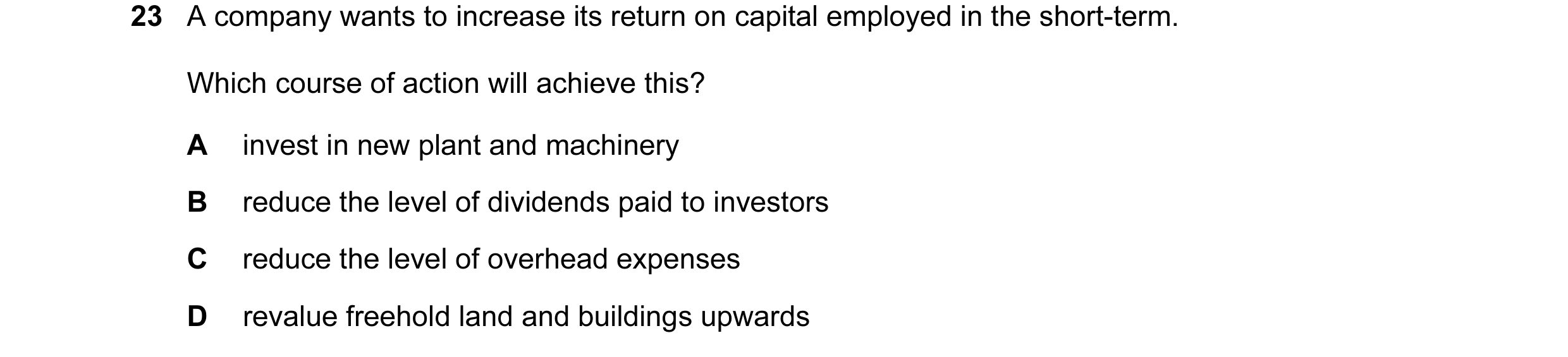 30 / 85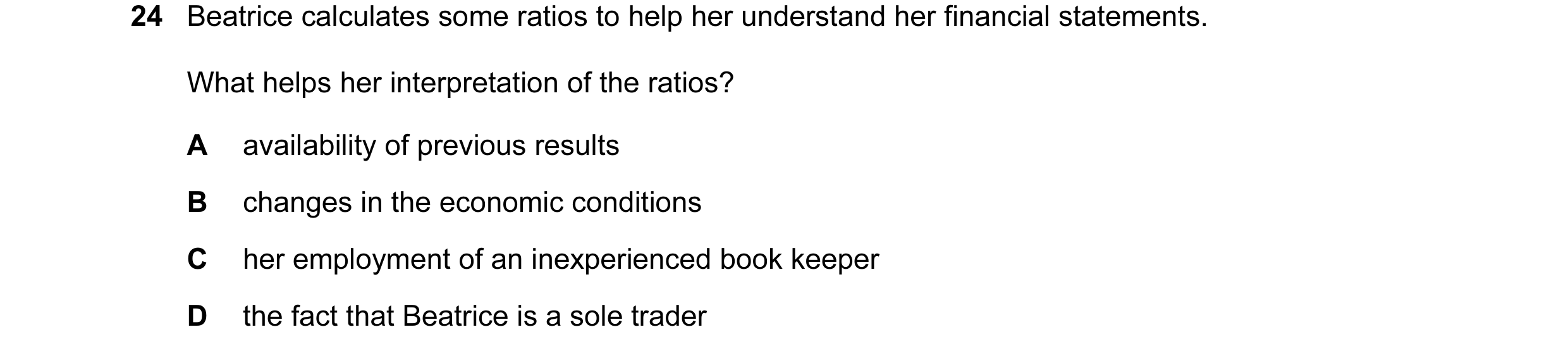
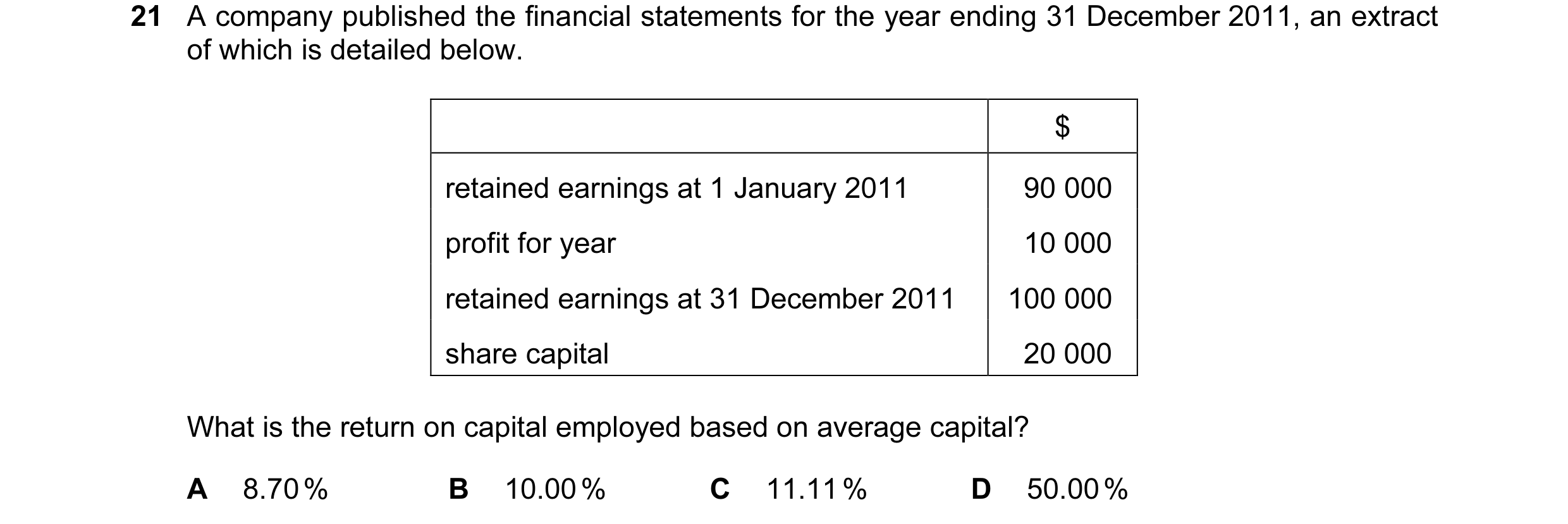
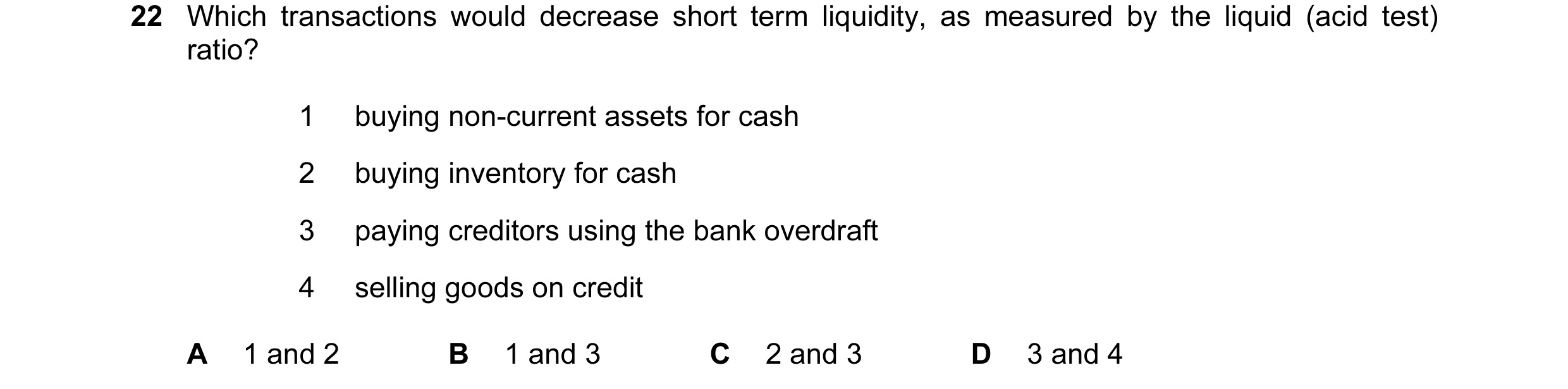
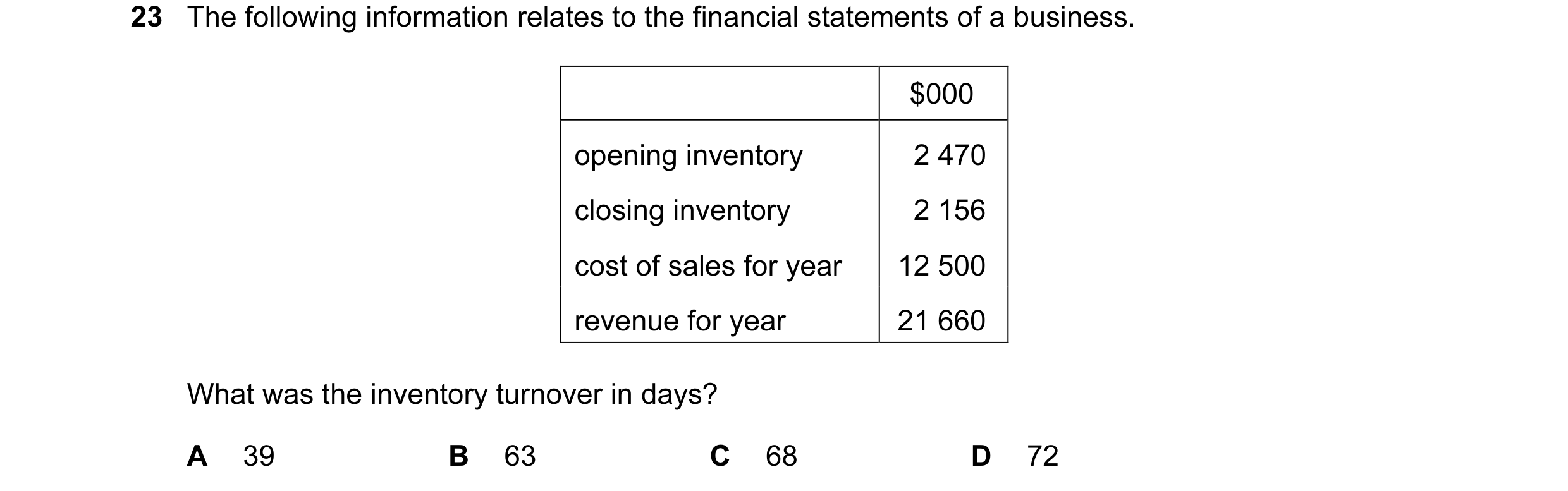 31 / 85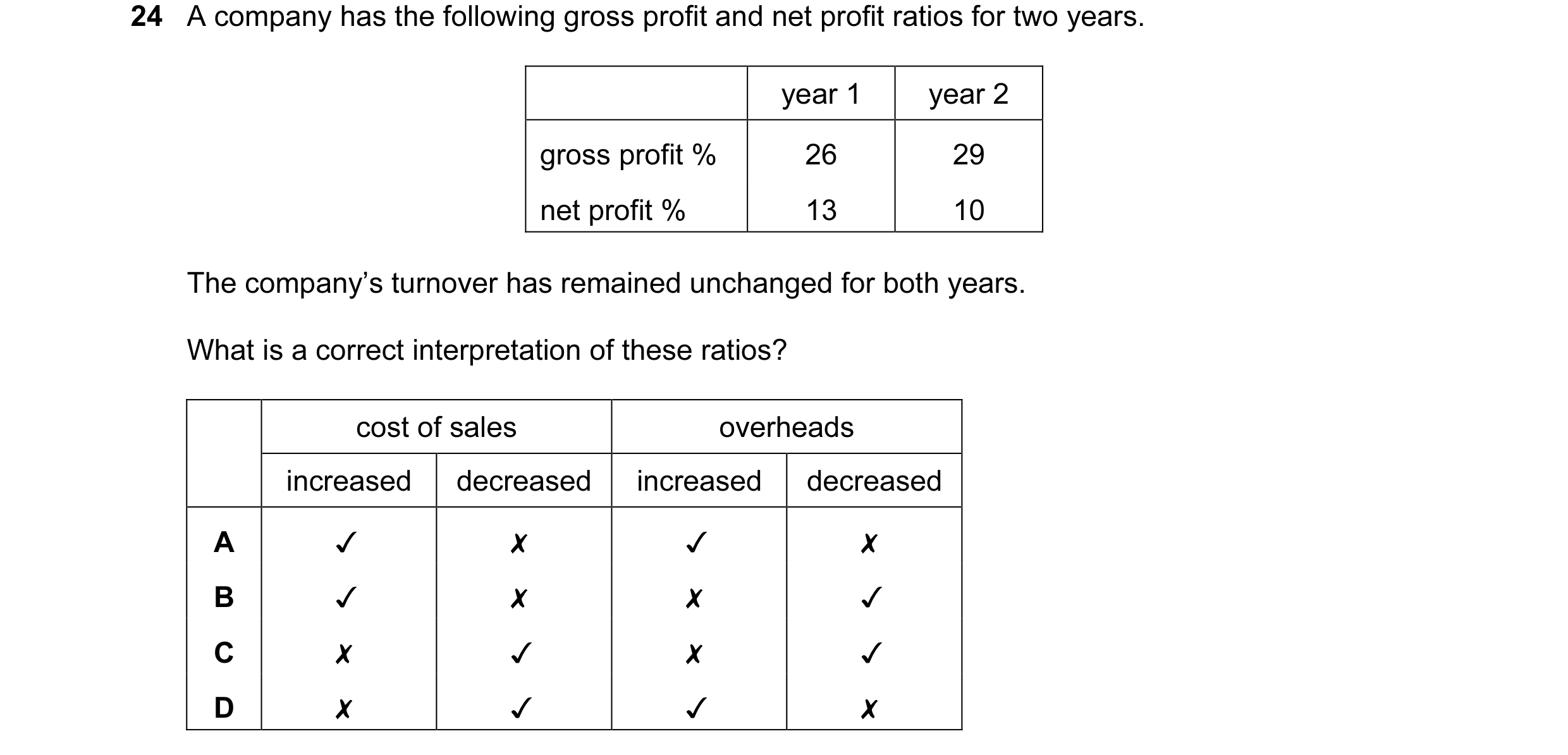
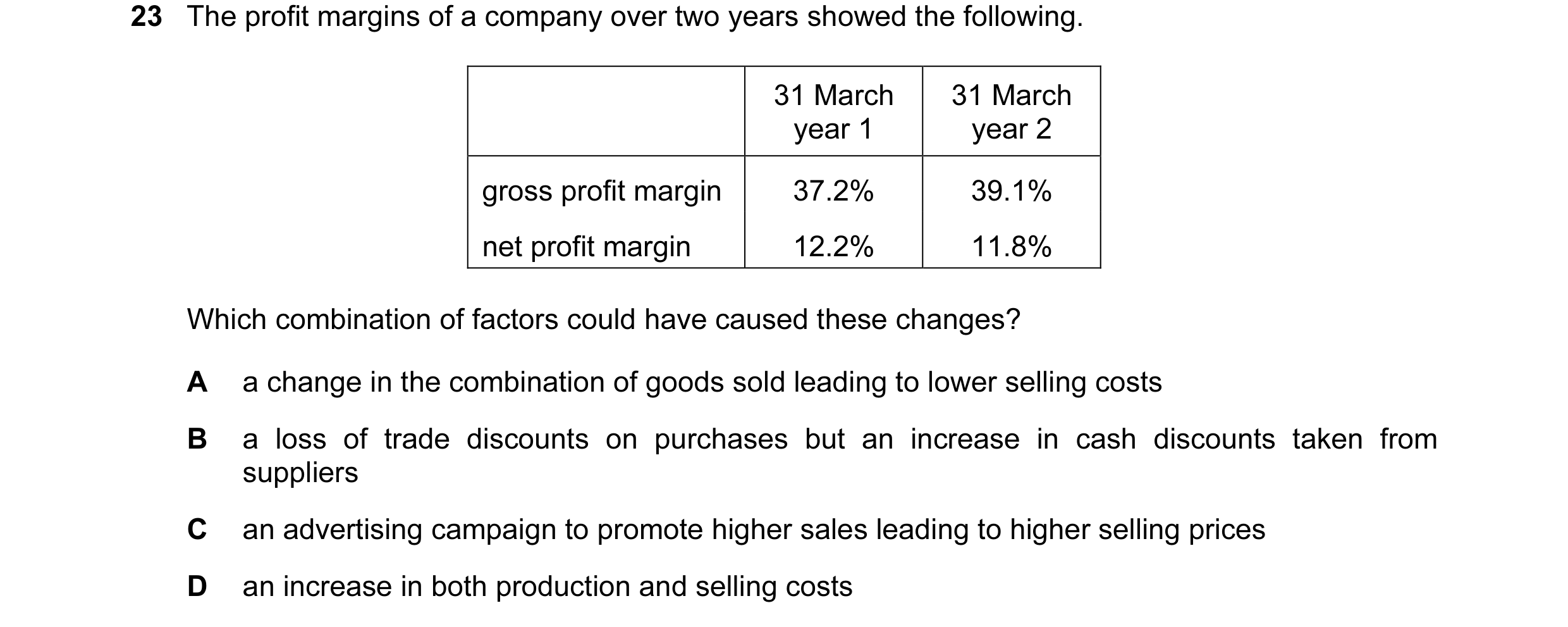 32 / 85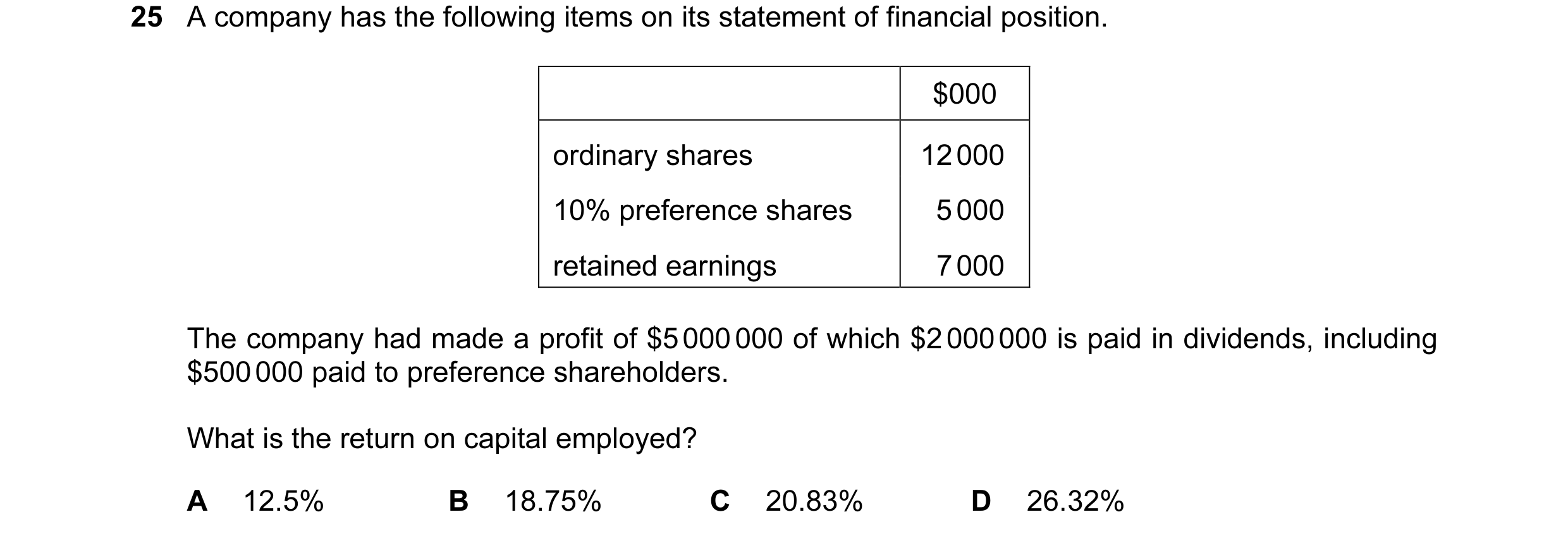
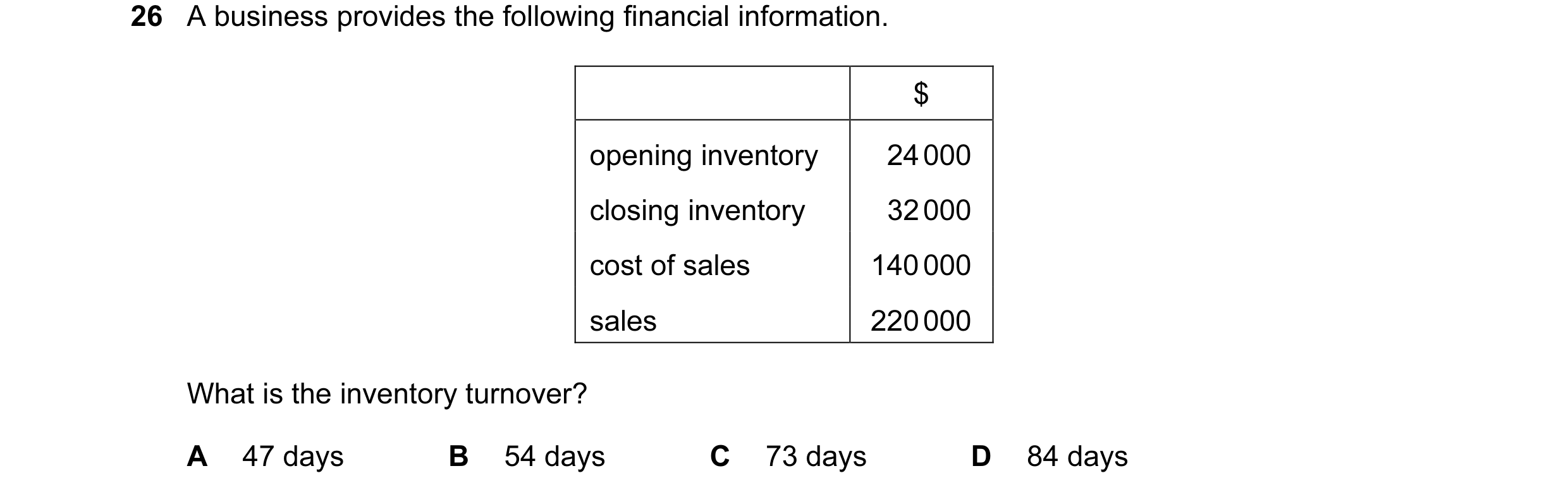

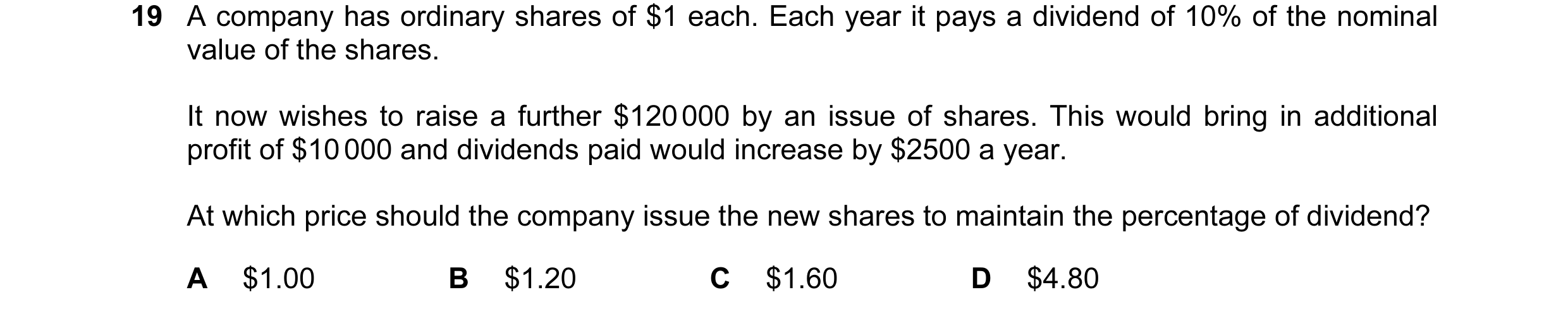
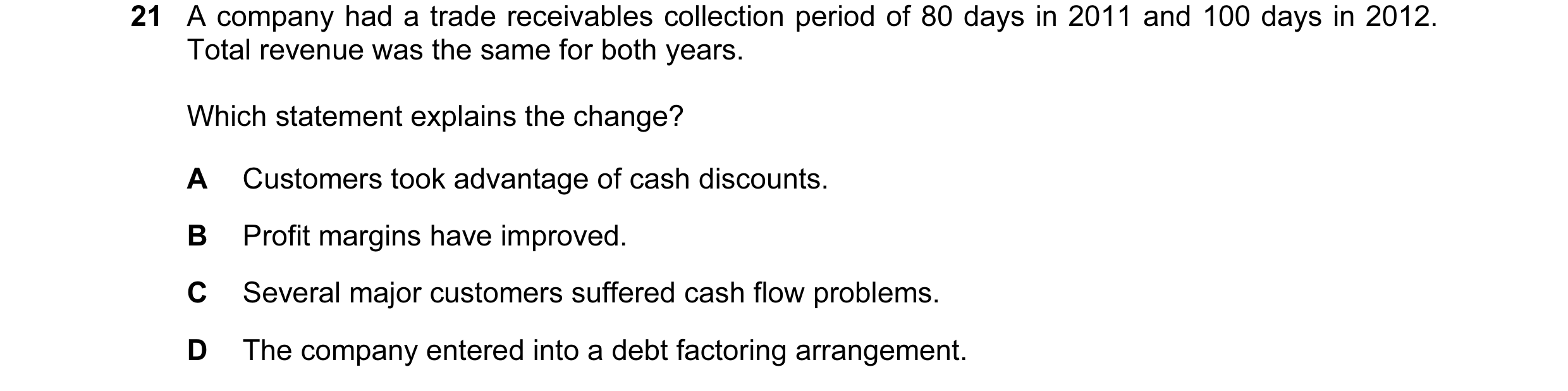 33 / 85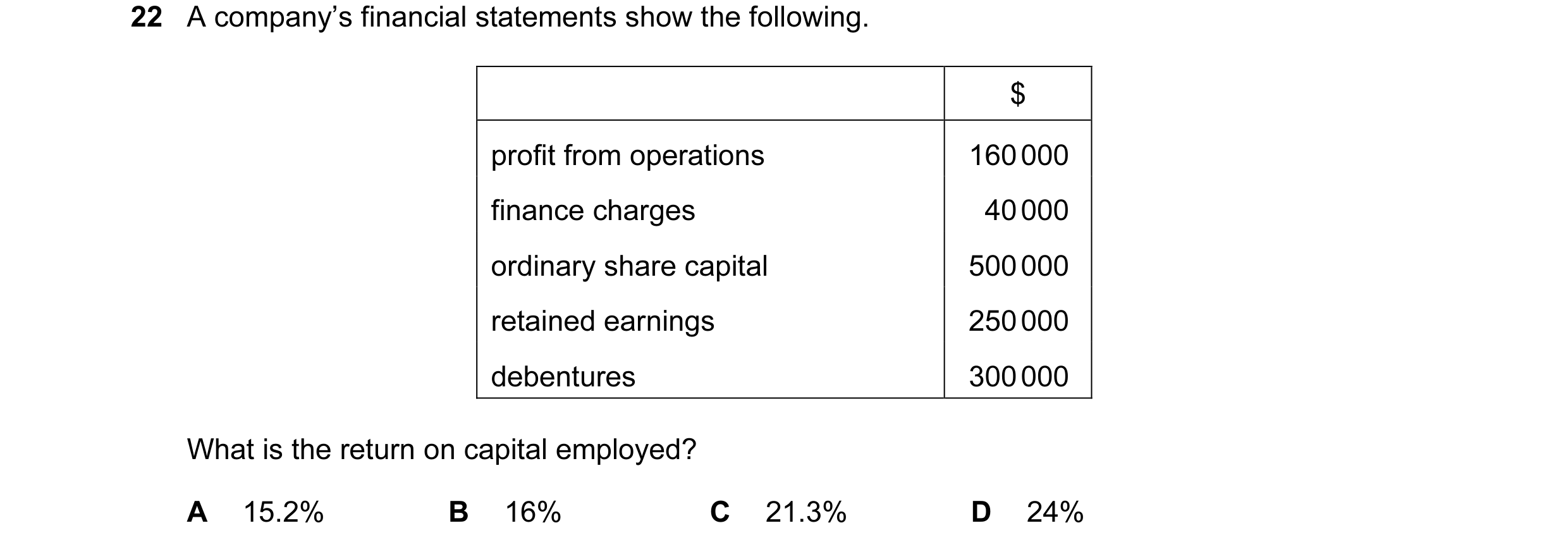
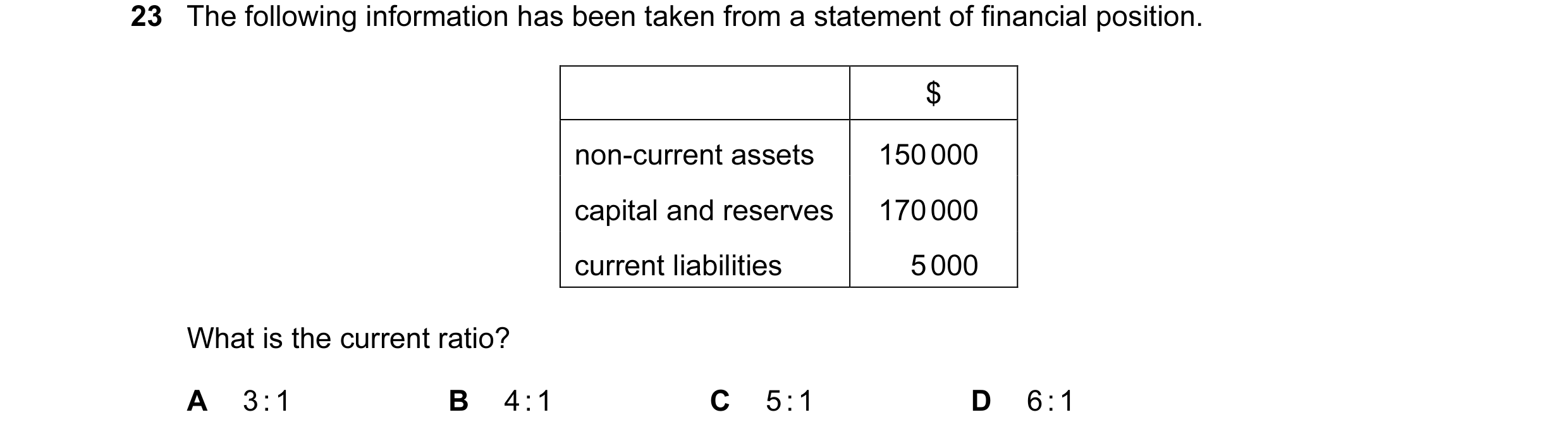
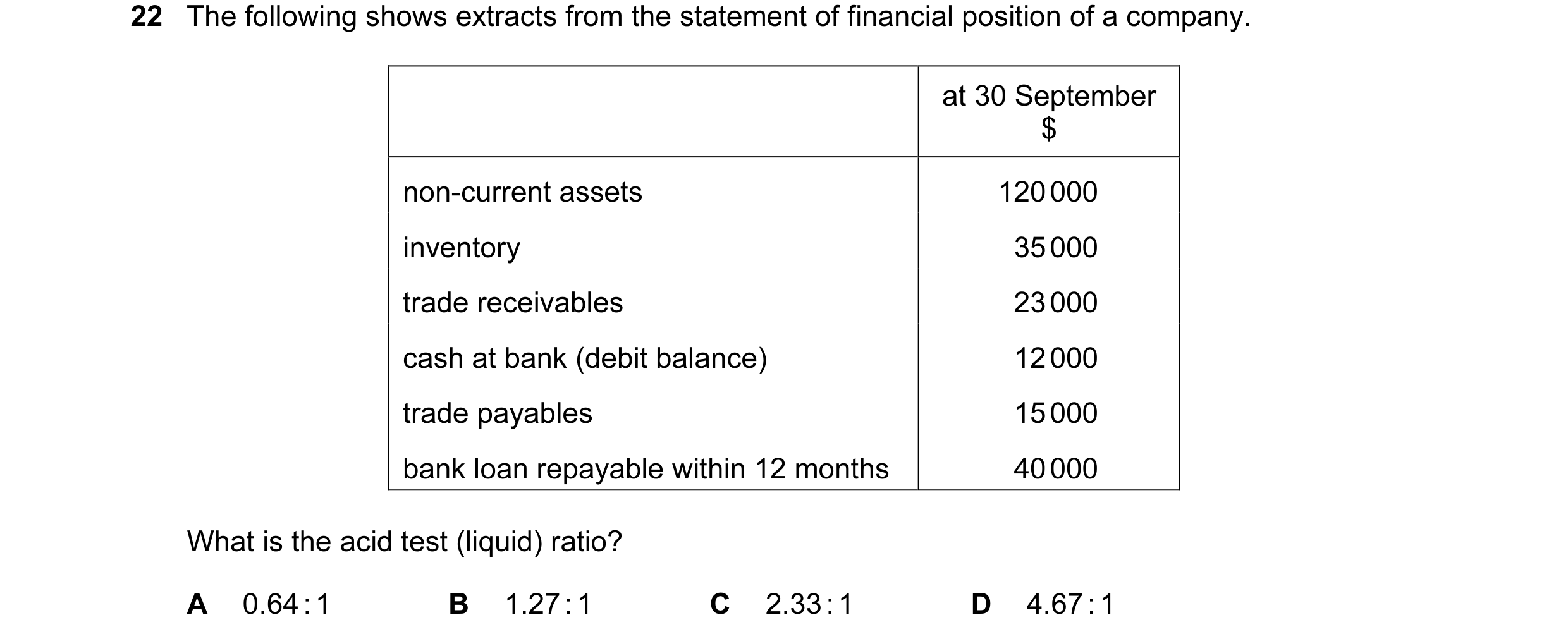
 34 / 85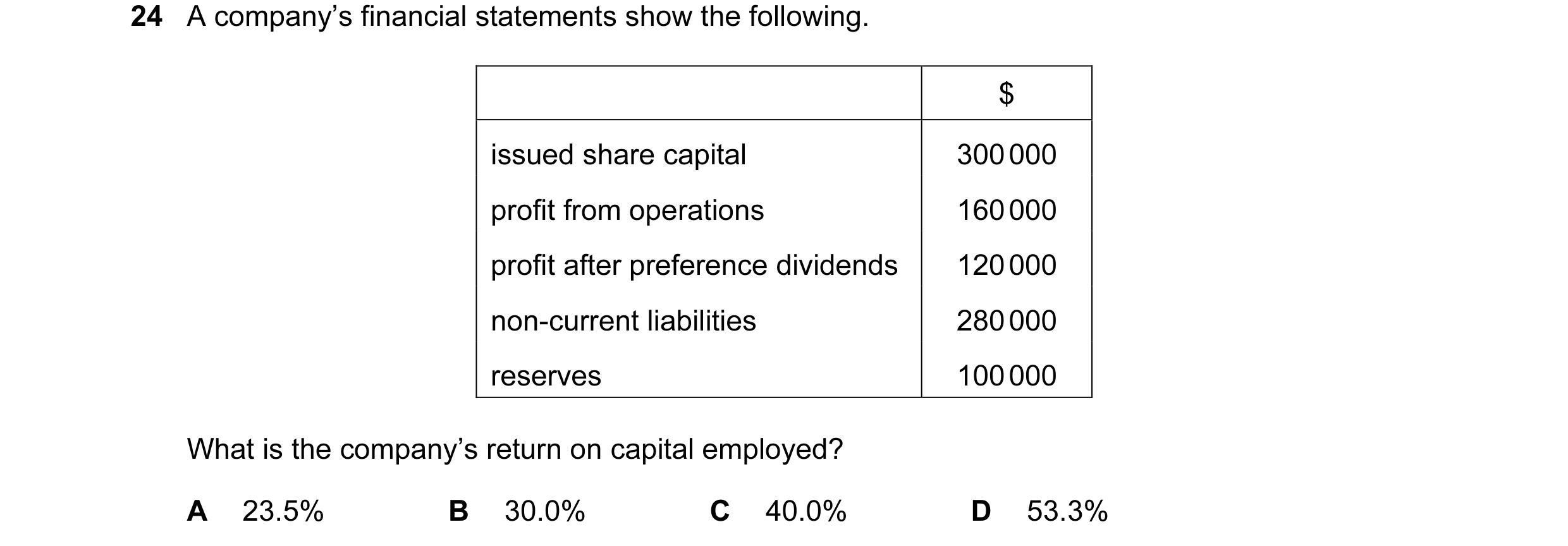

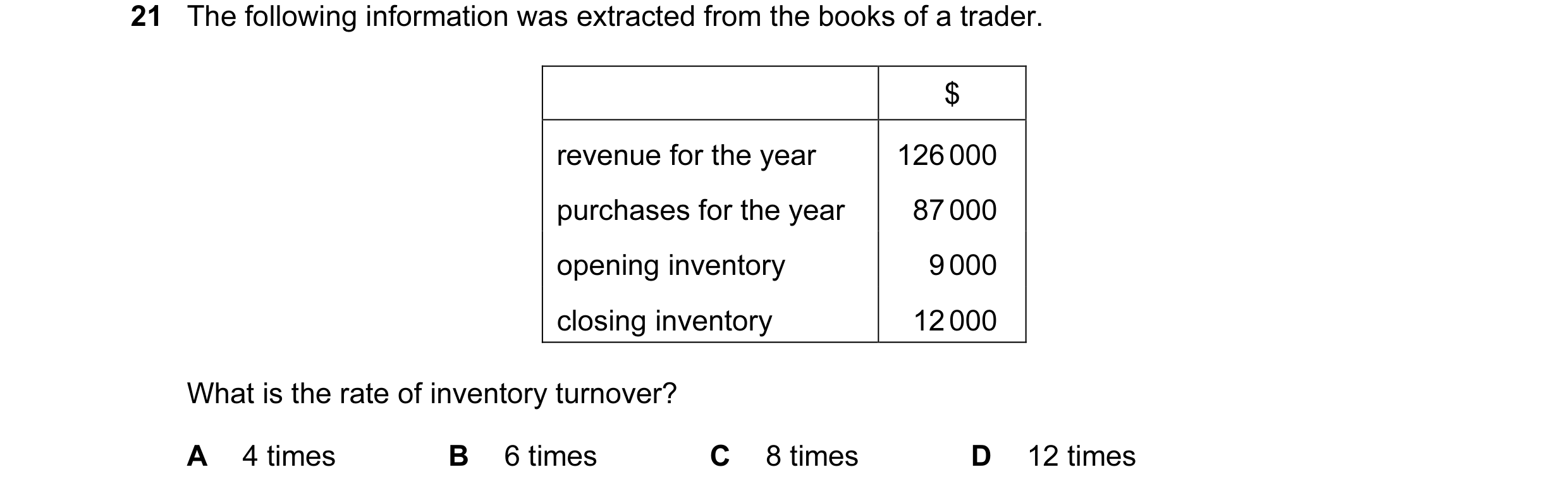
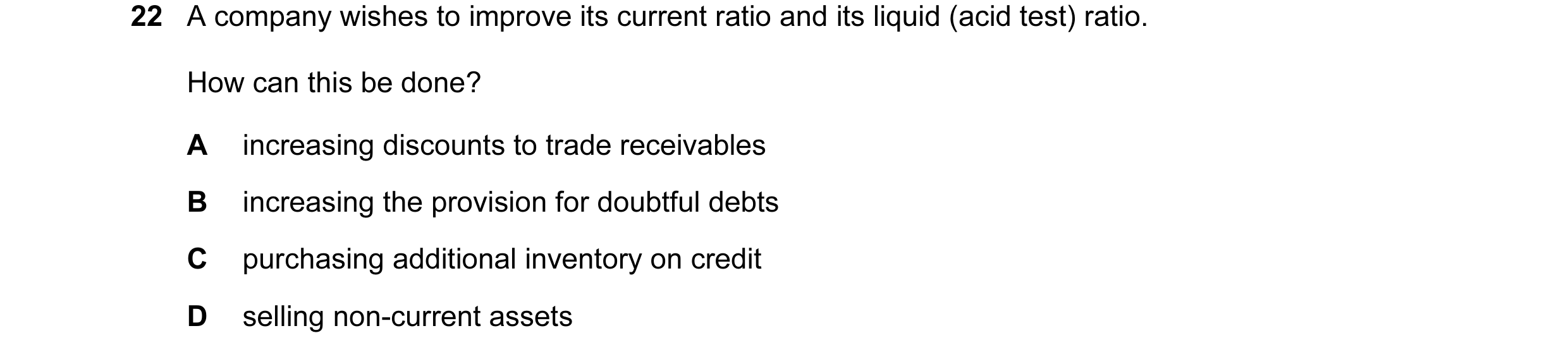
 35 / 85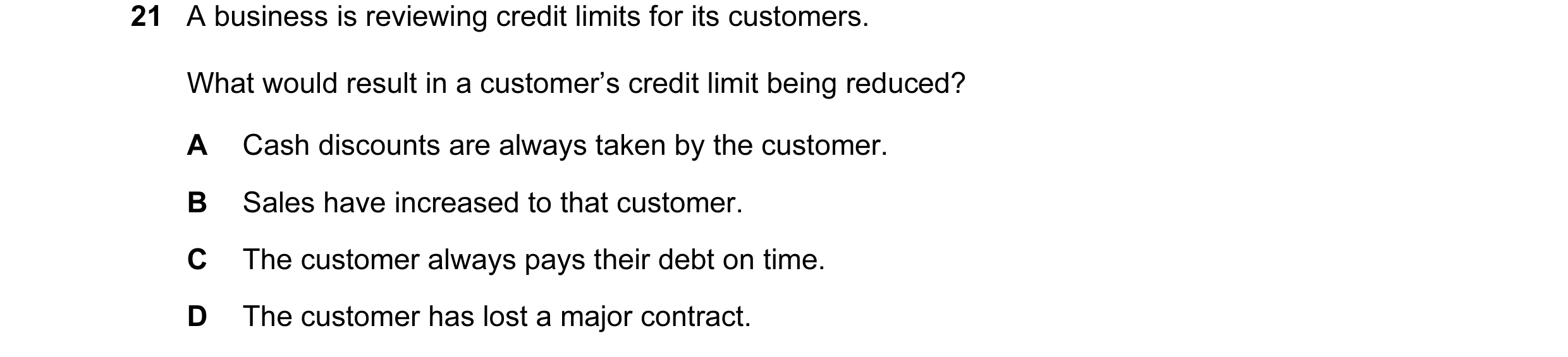
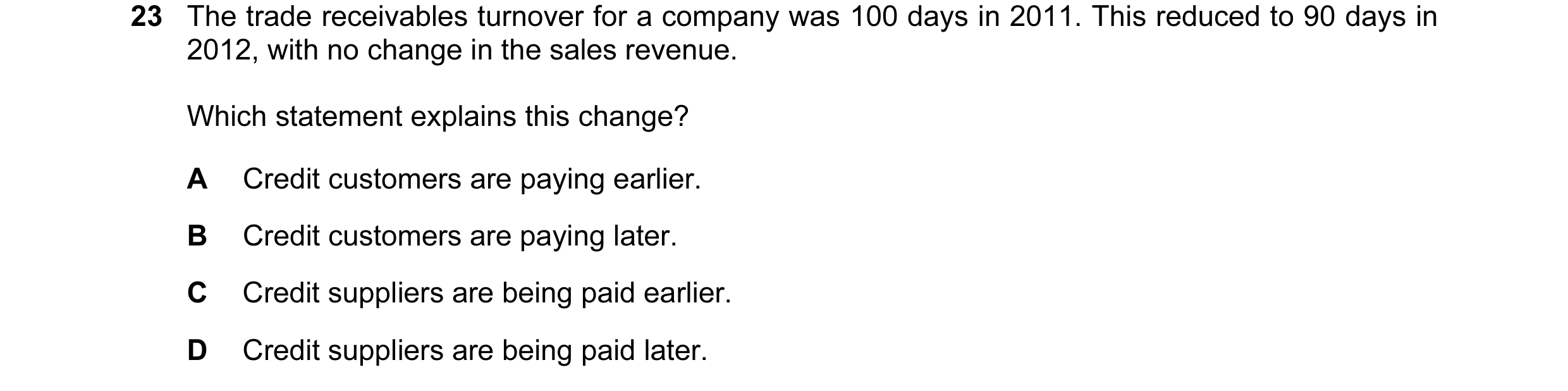
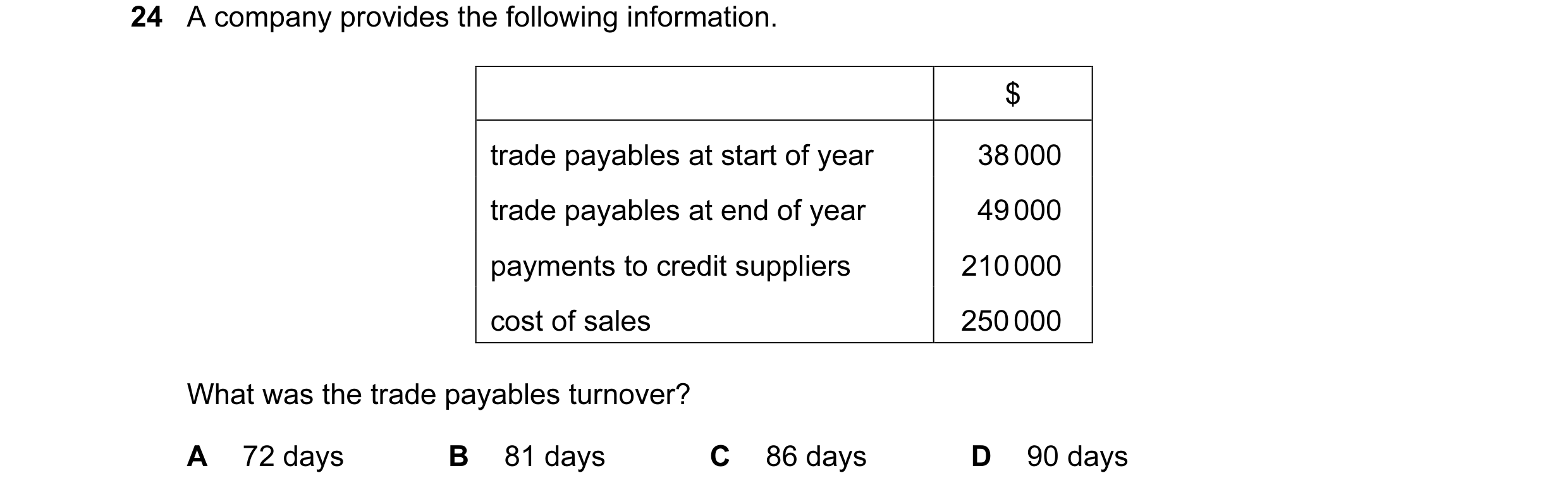
 36 / 85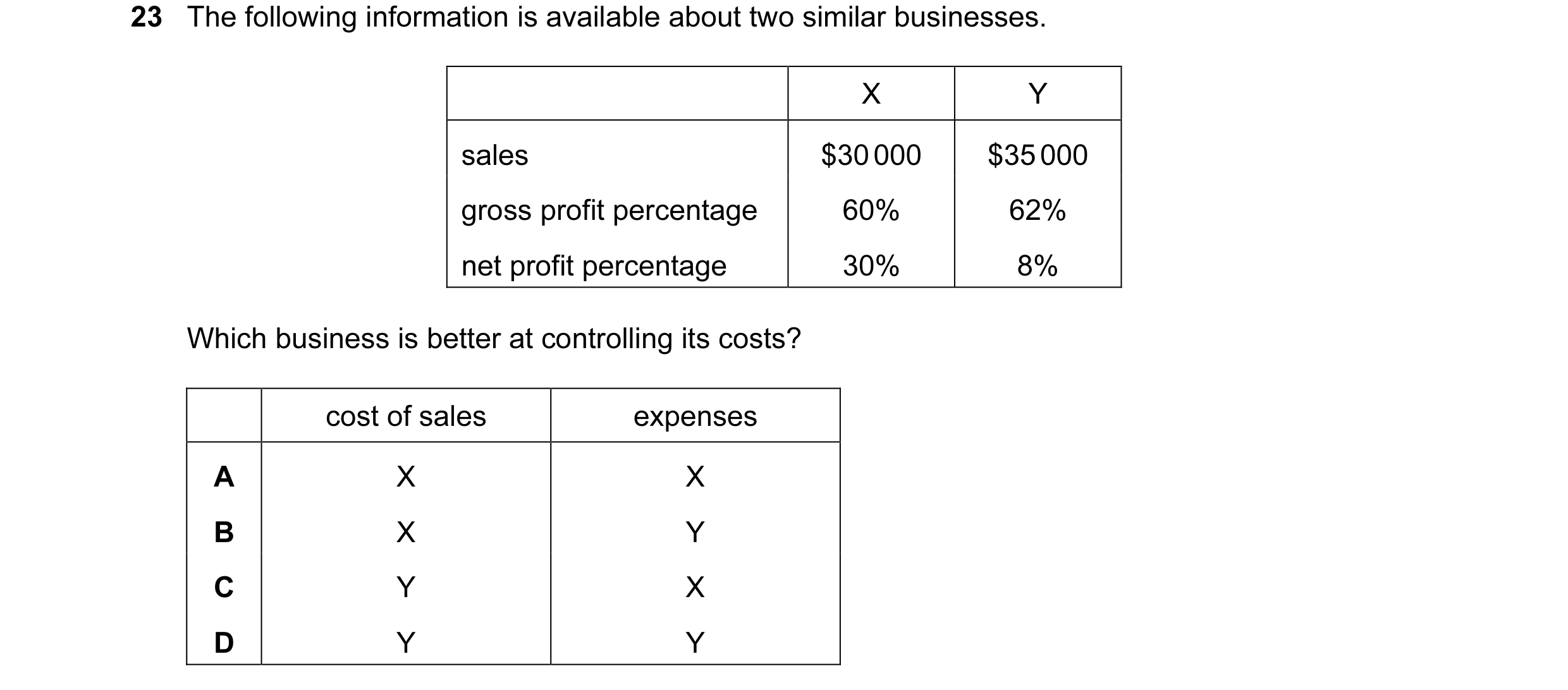
 37 / 85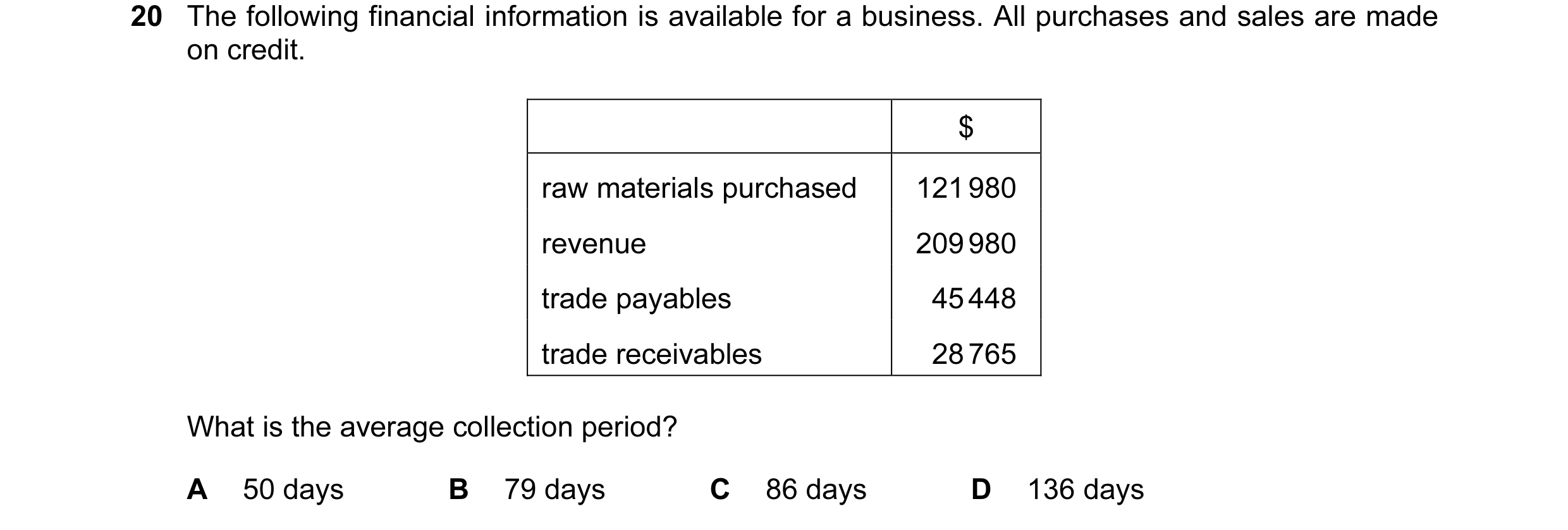
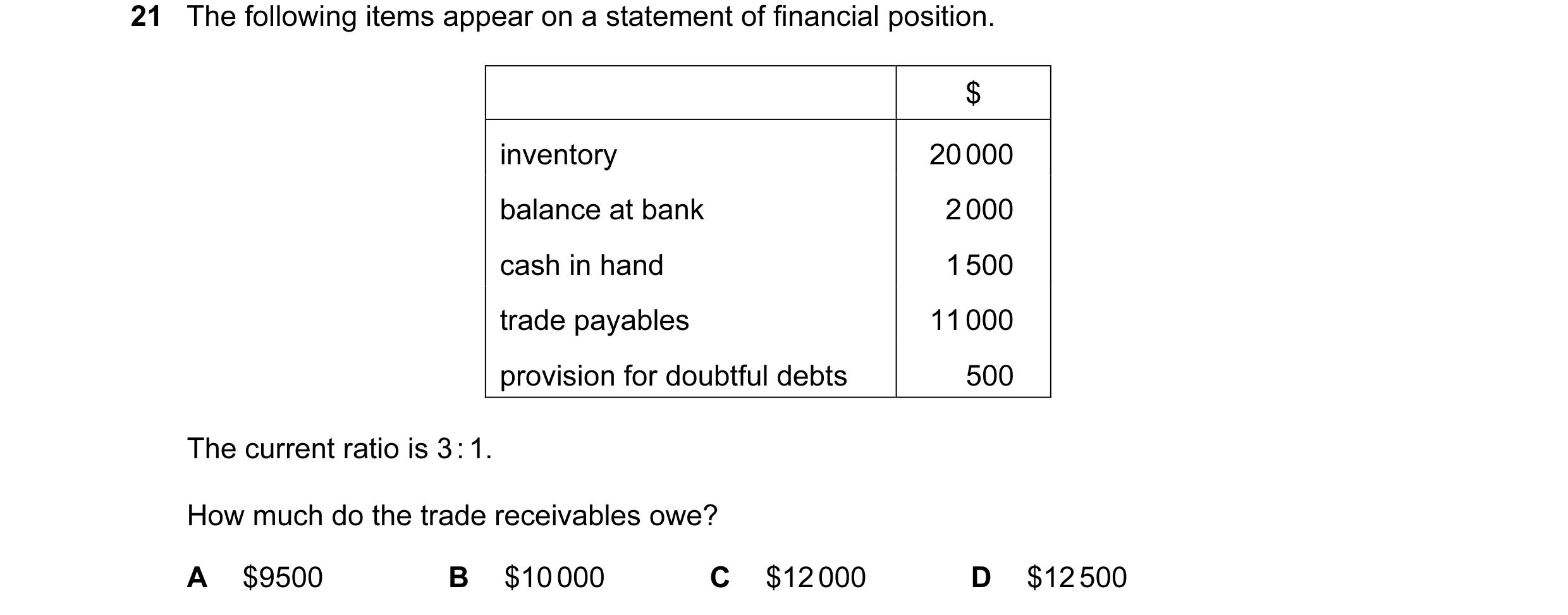
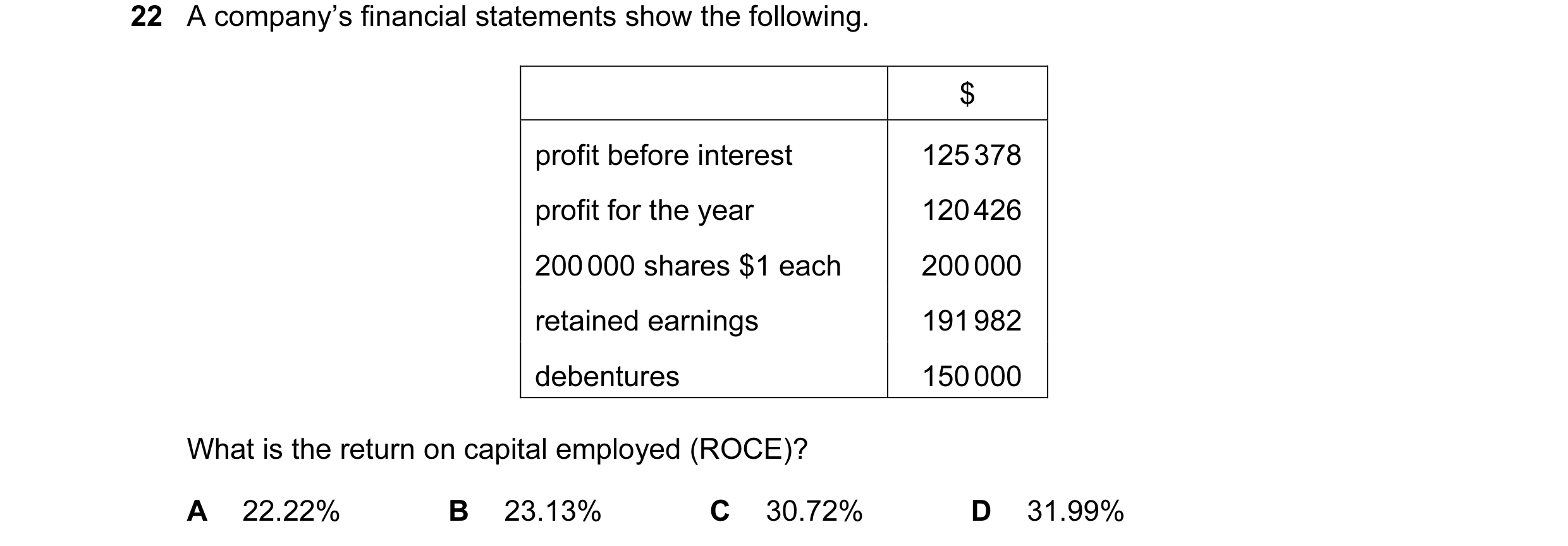
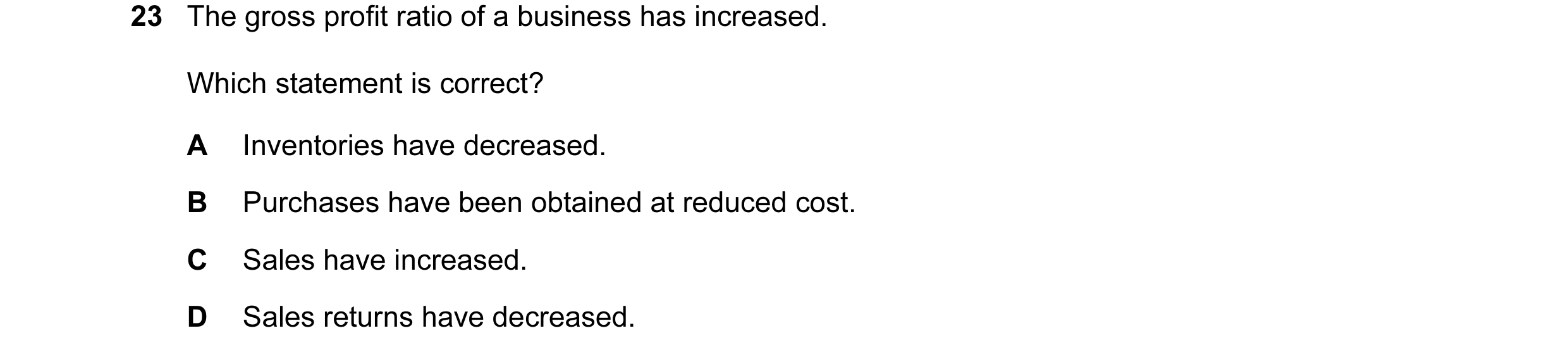 38 / 85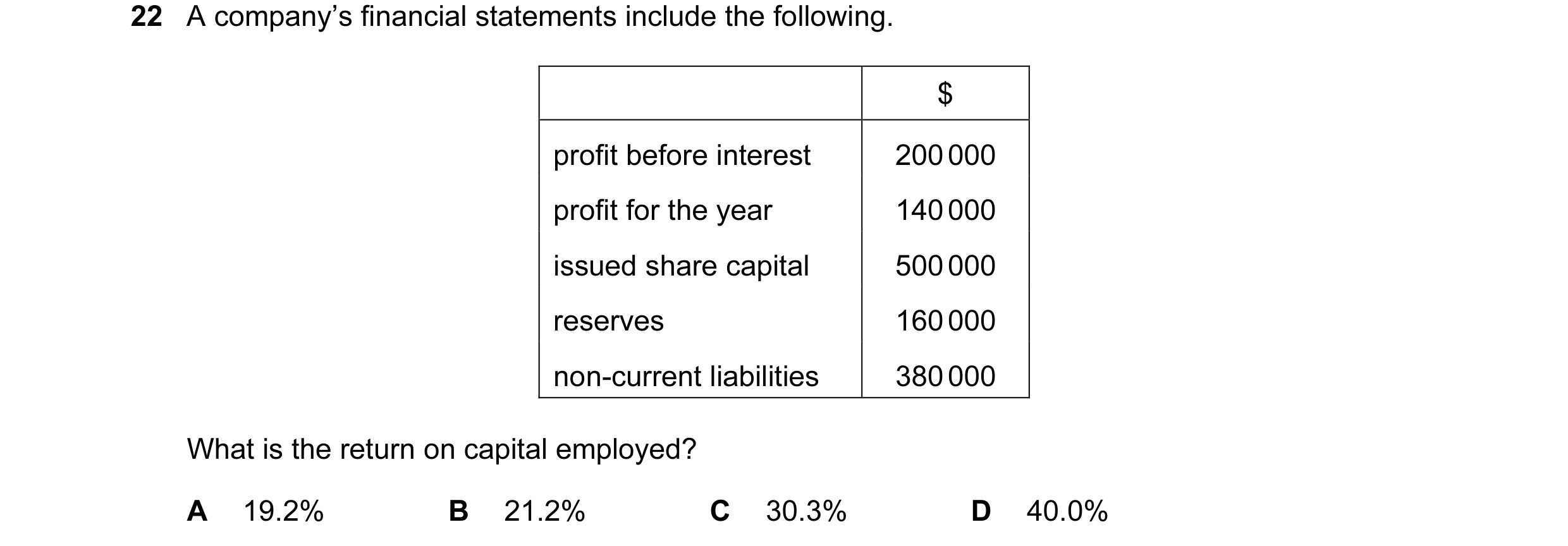
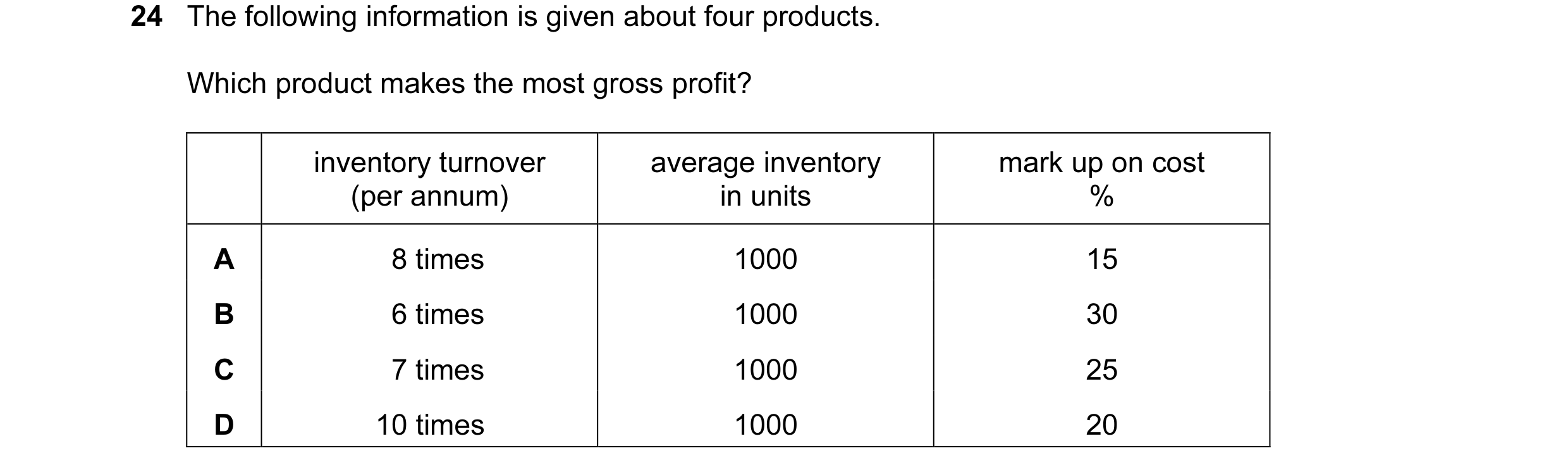
 39 / 85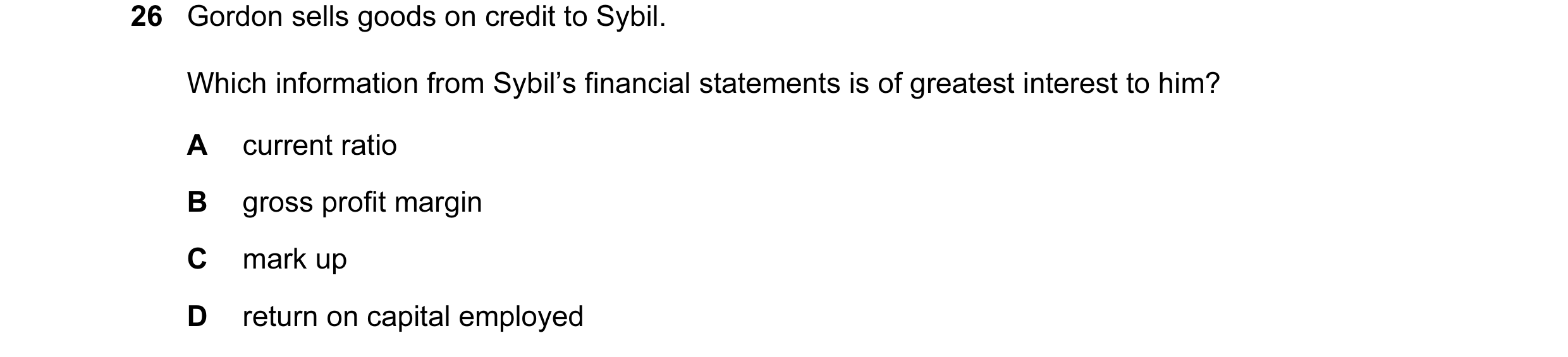

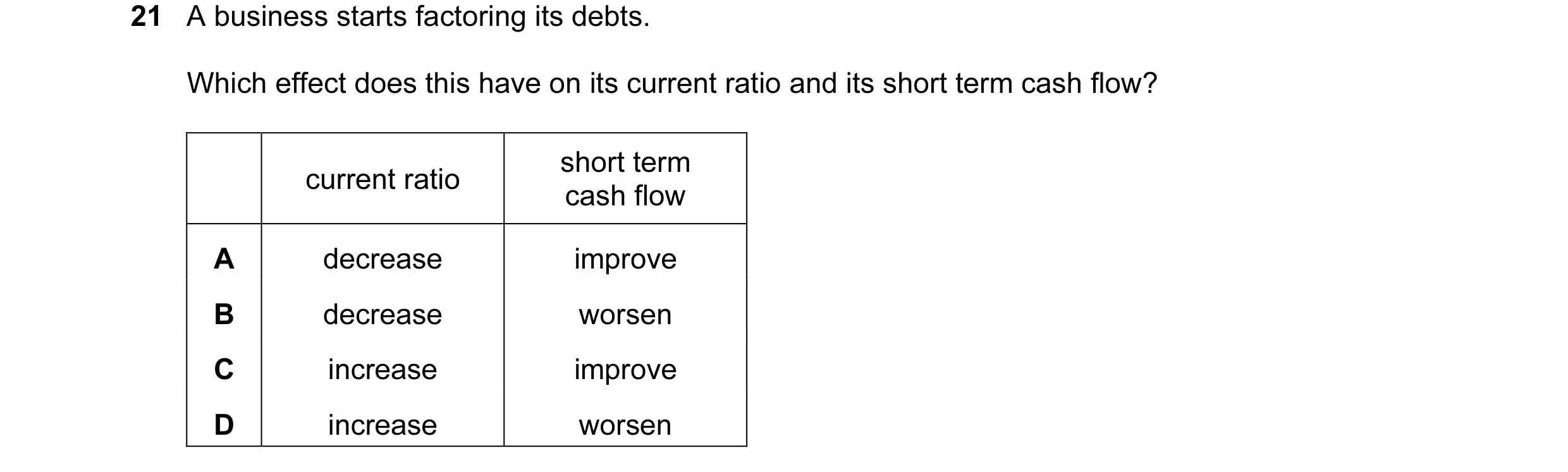
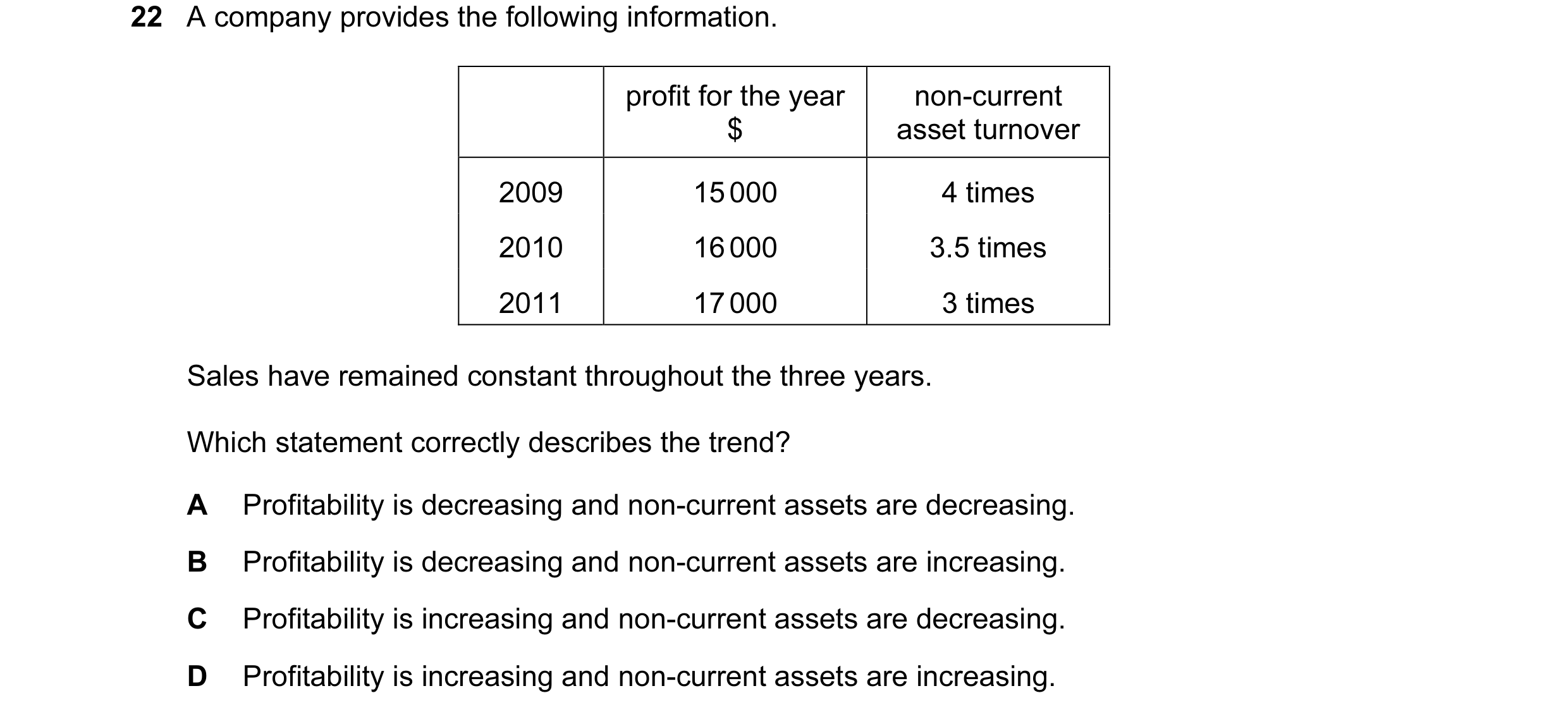 40 / 85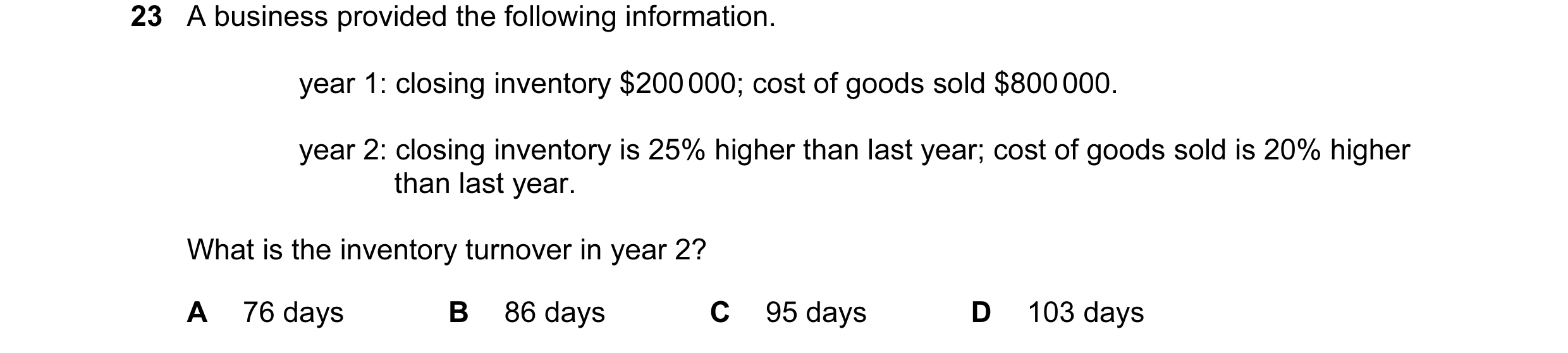
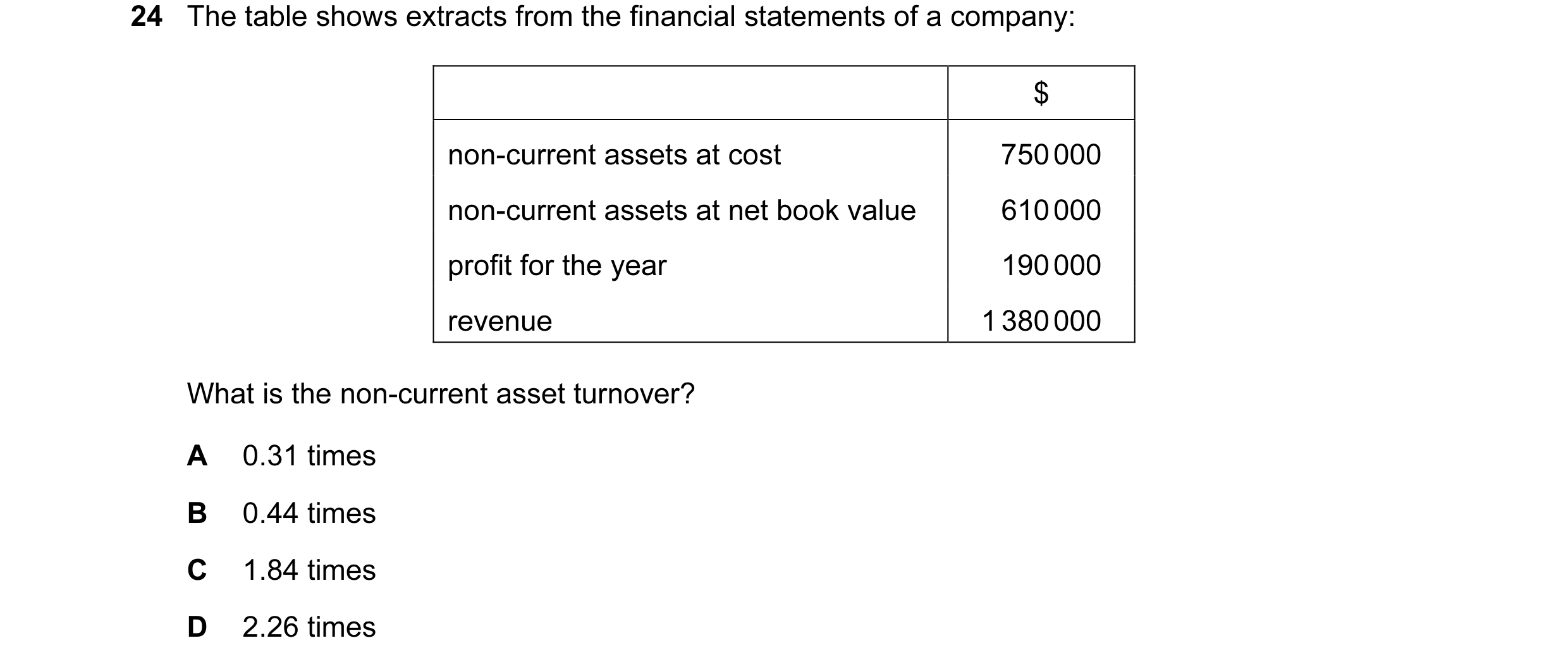
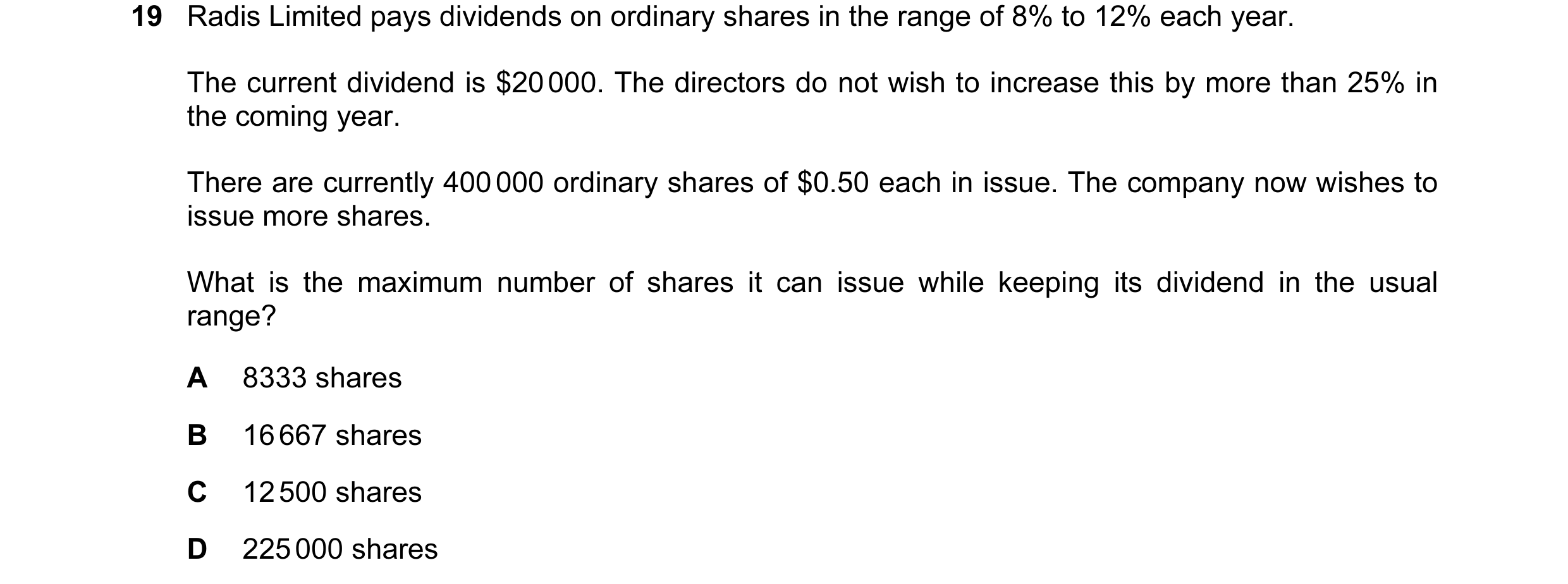
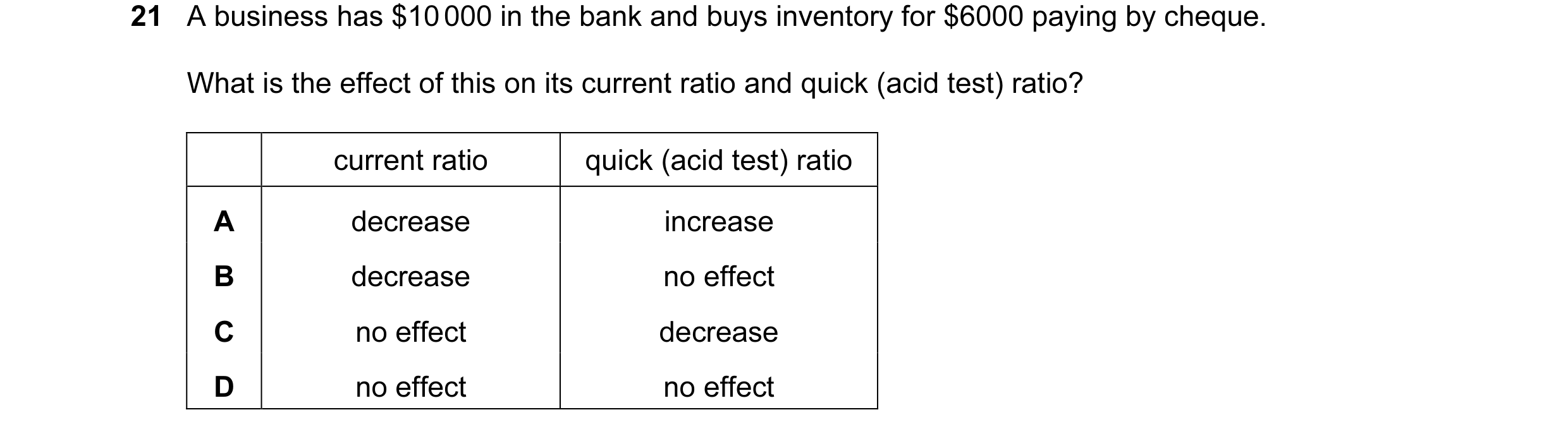 41 / 85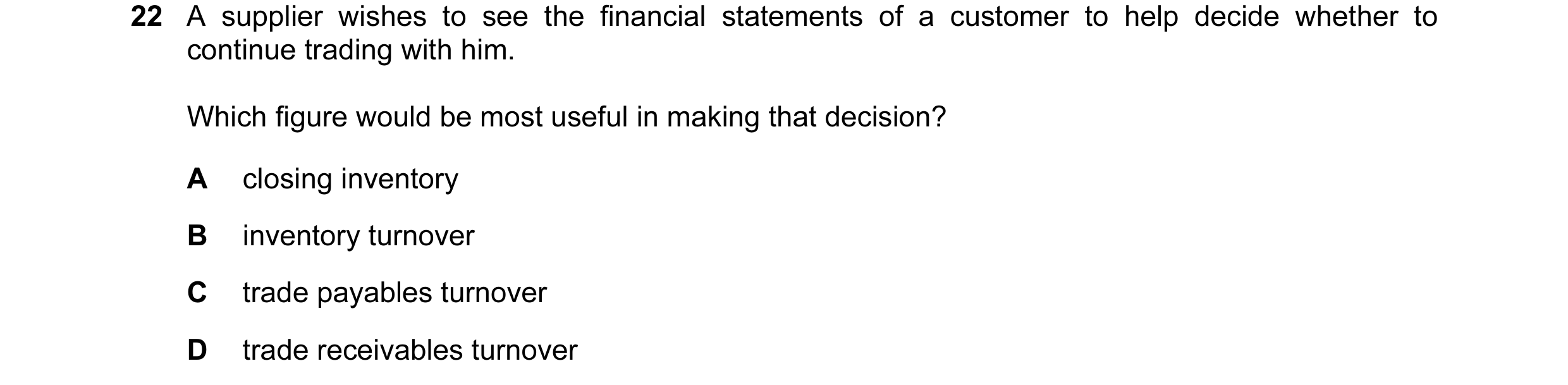
 42 / 85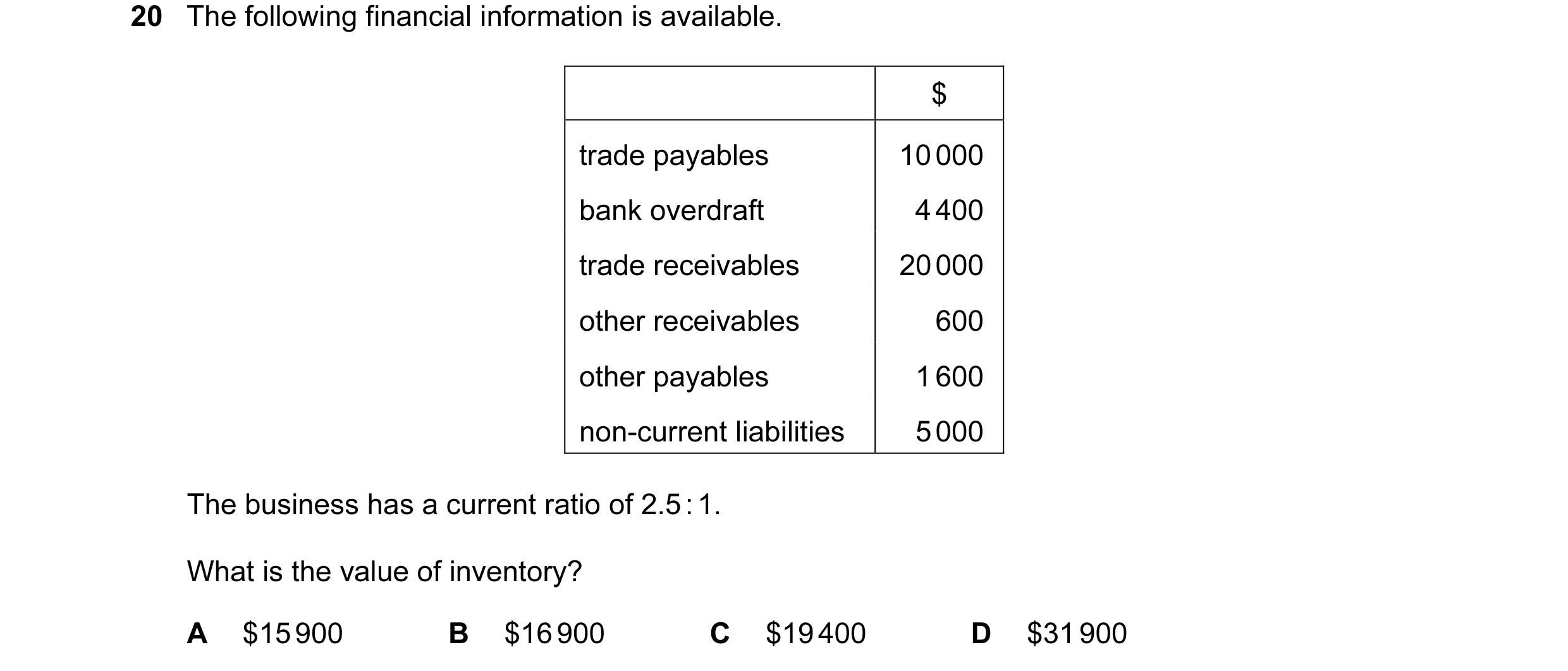
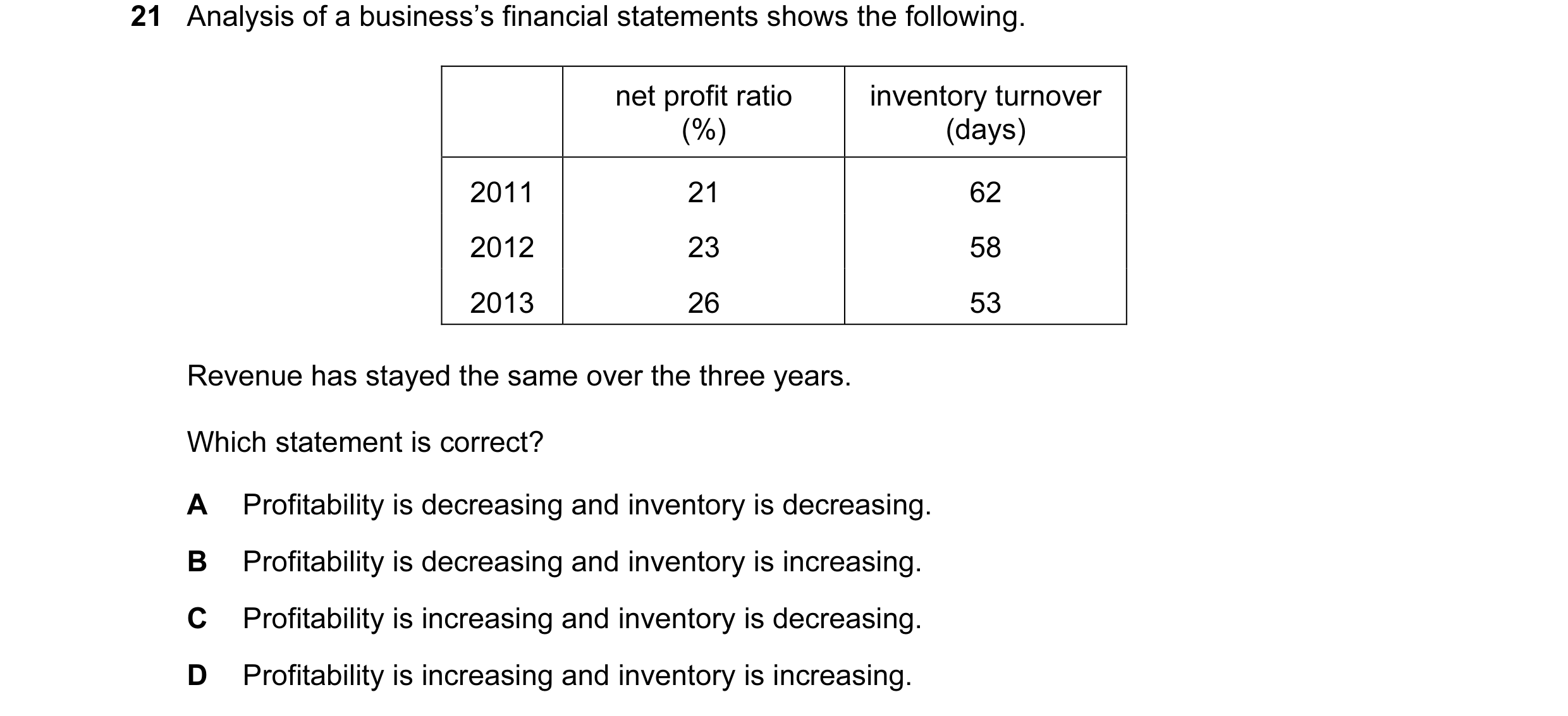
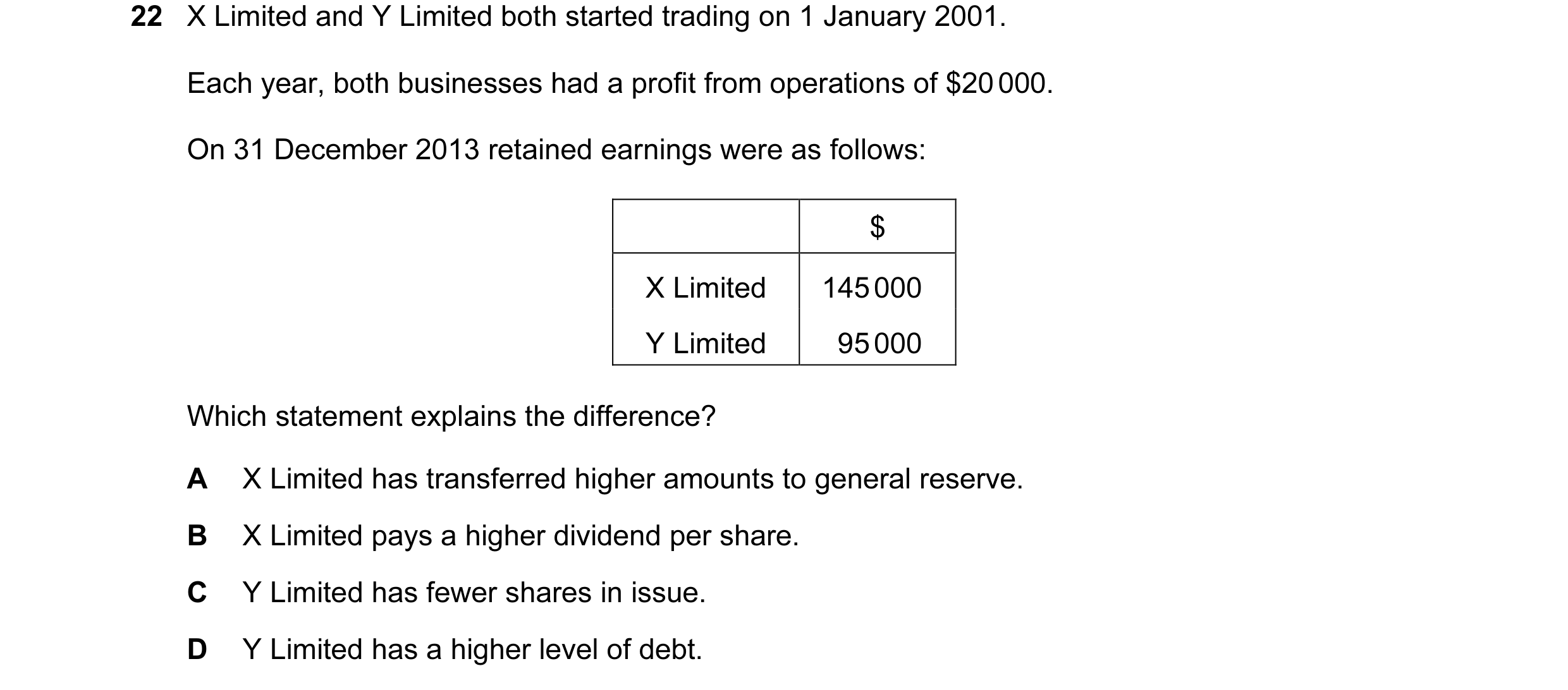 43 / 85
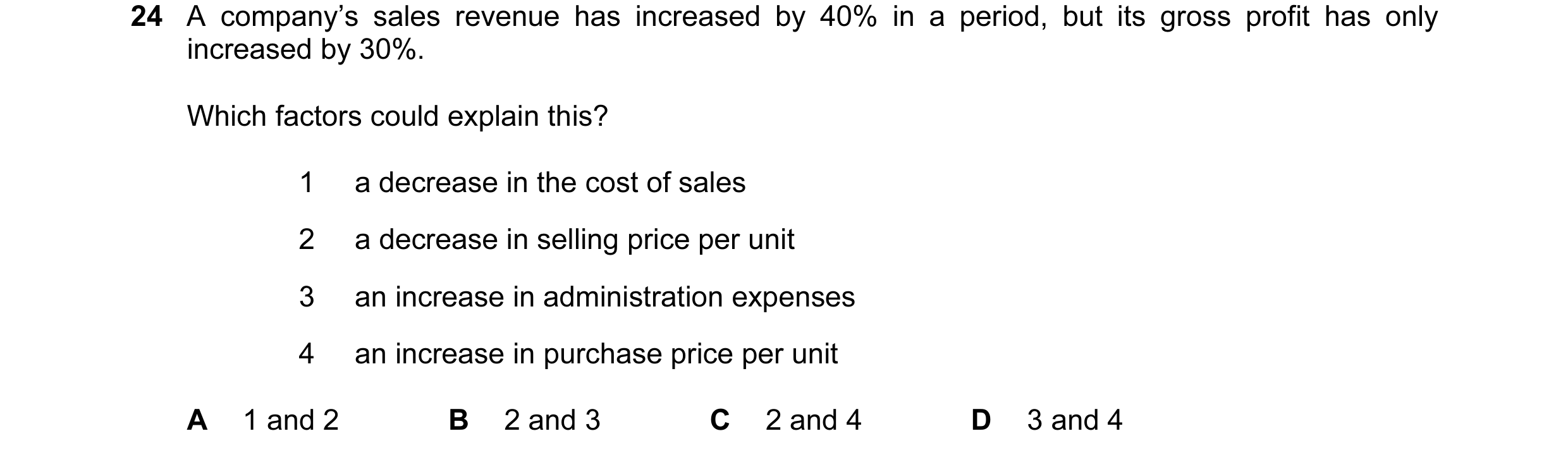
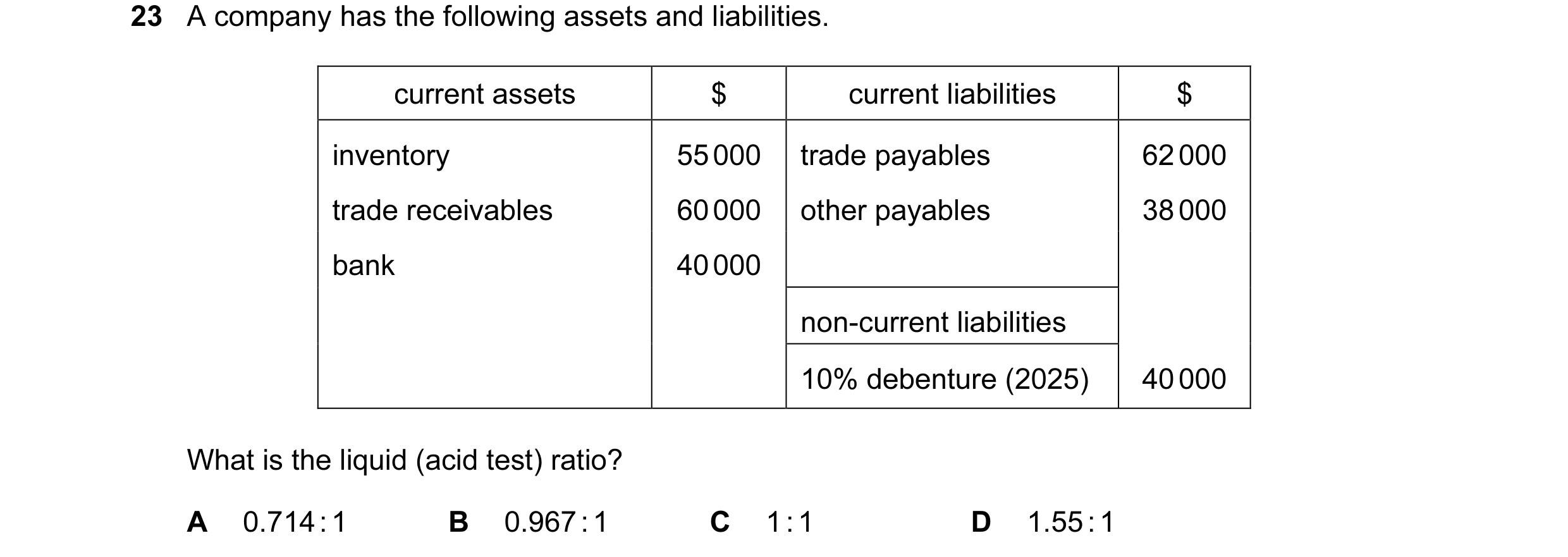
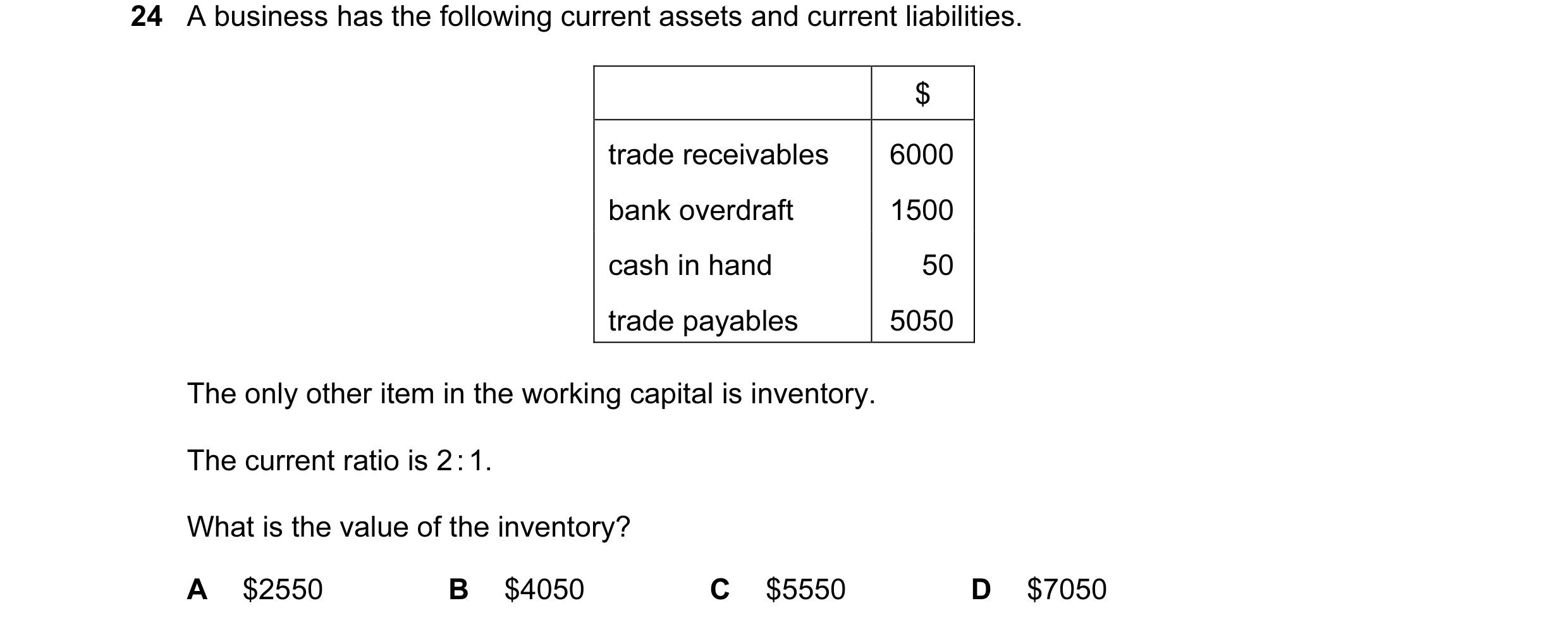 44 / 85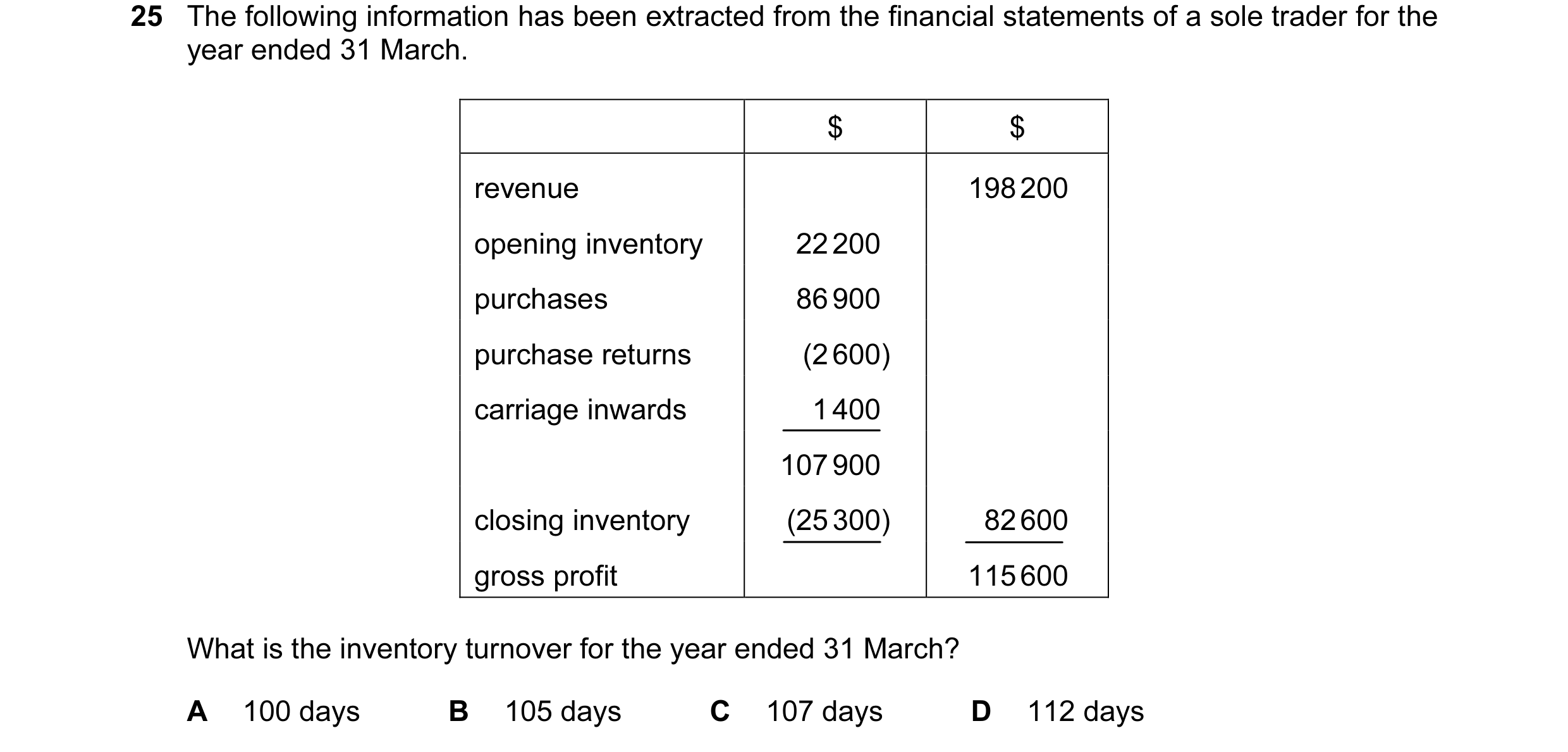
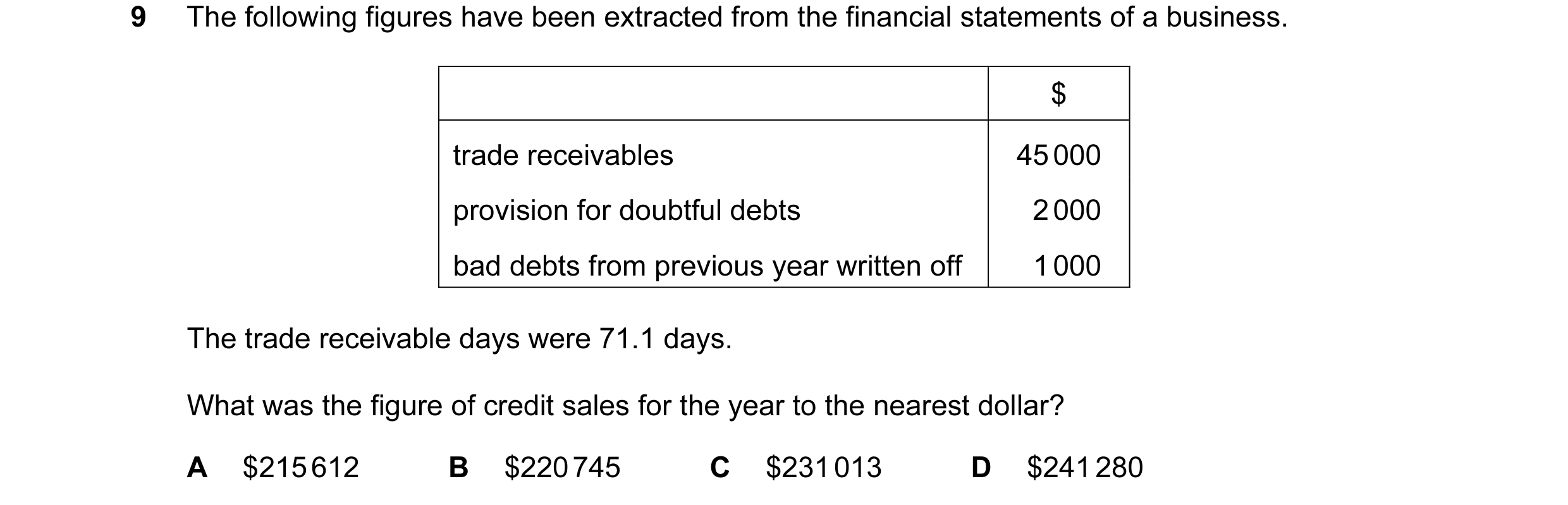

 45 / 85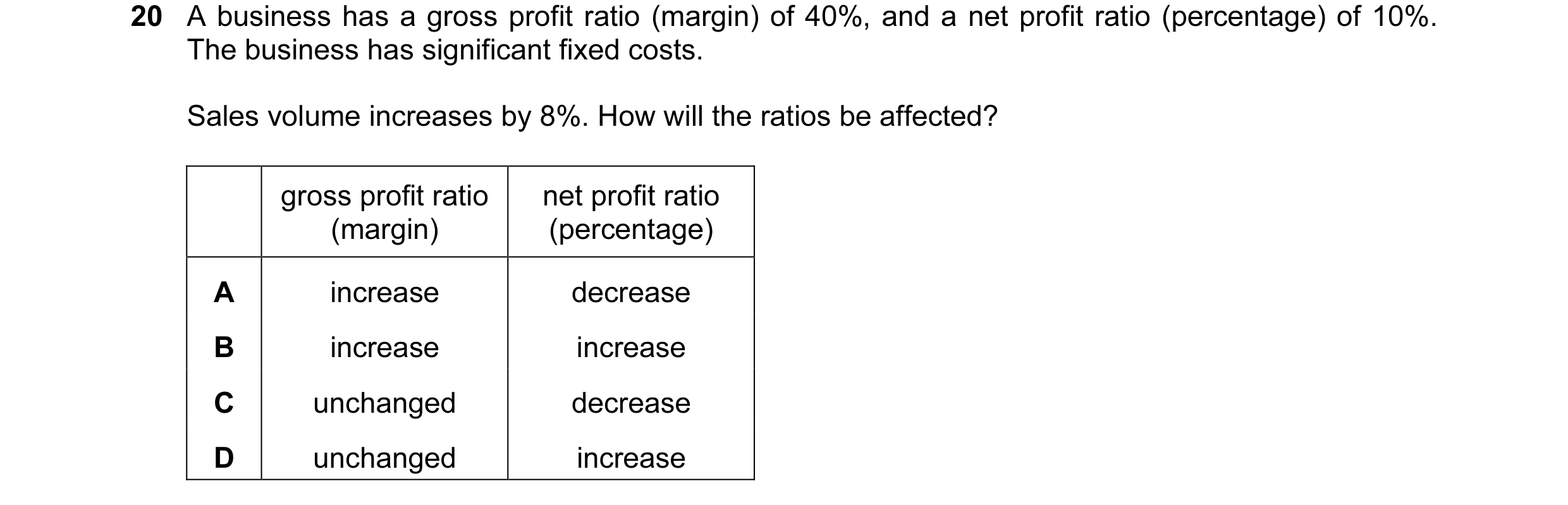

 46 / 85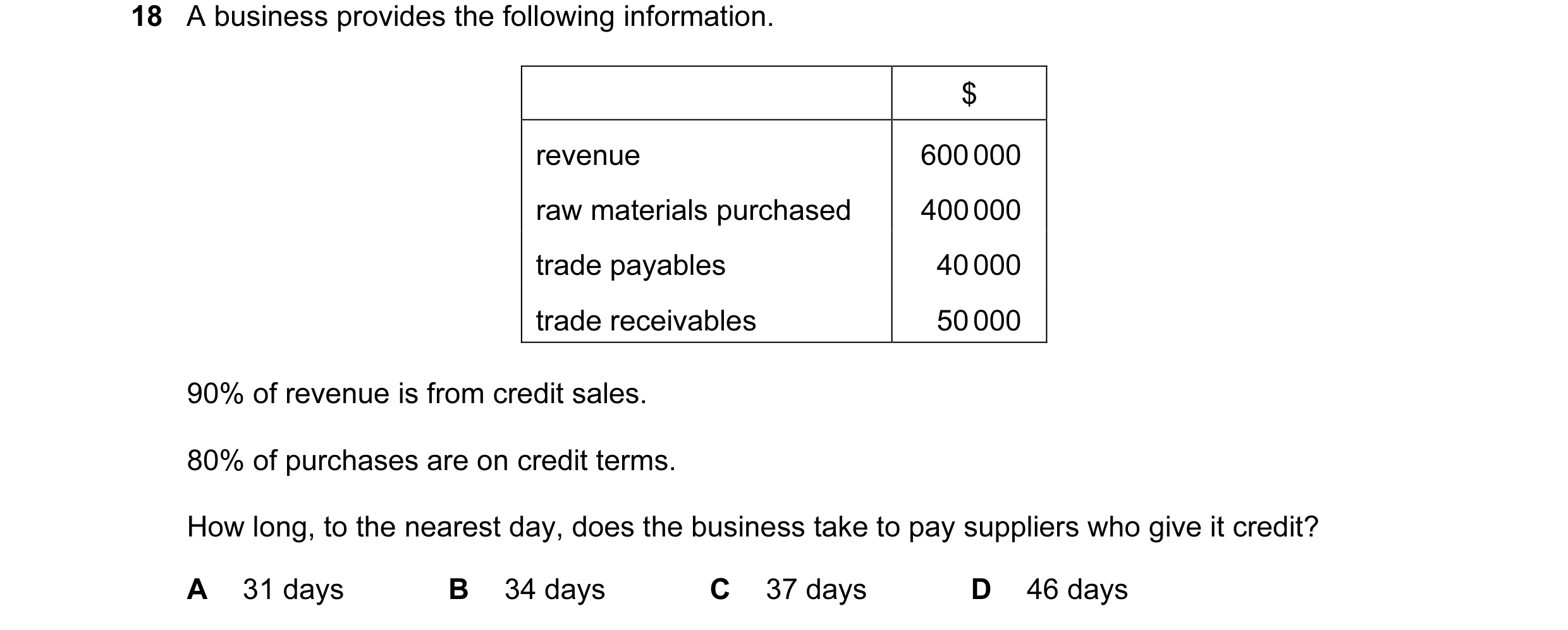
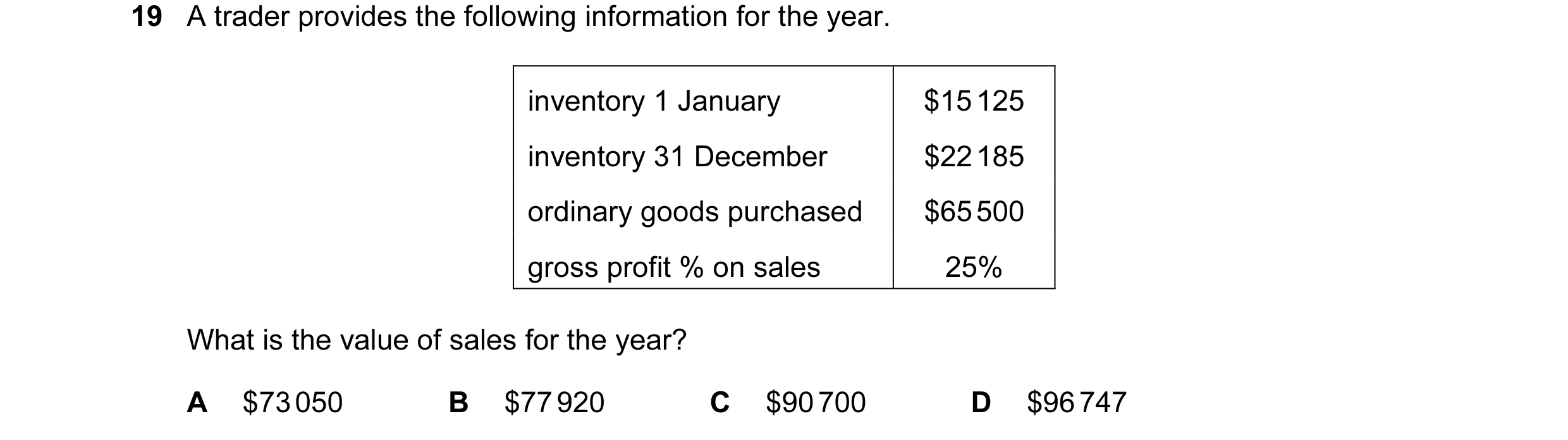
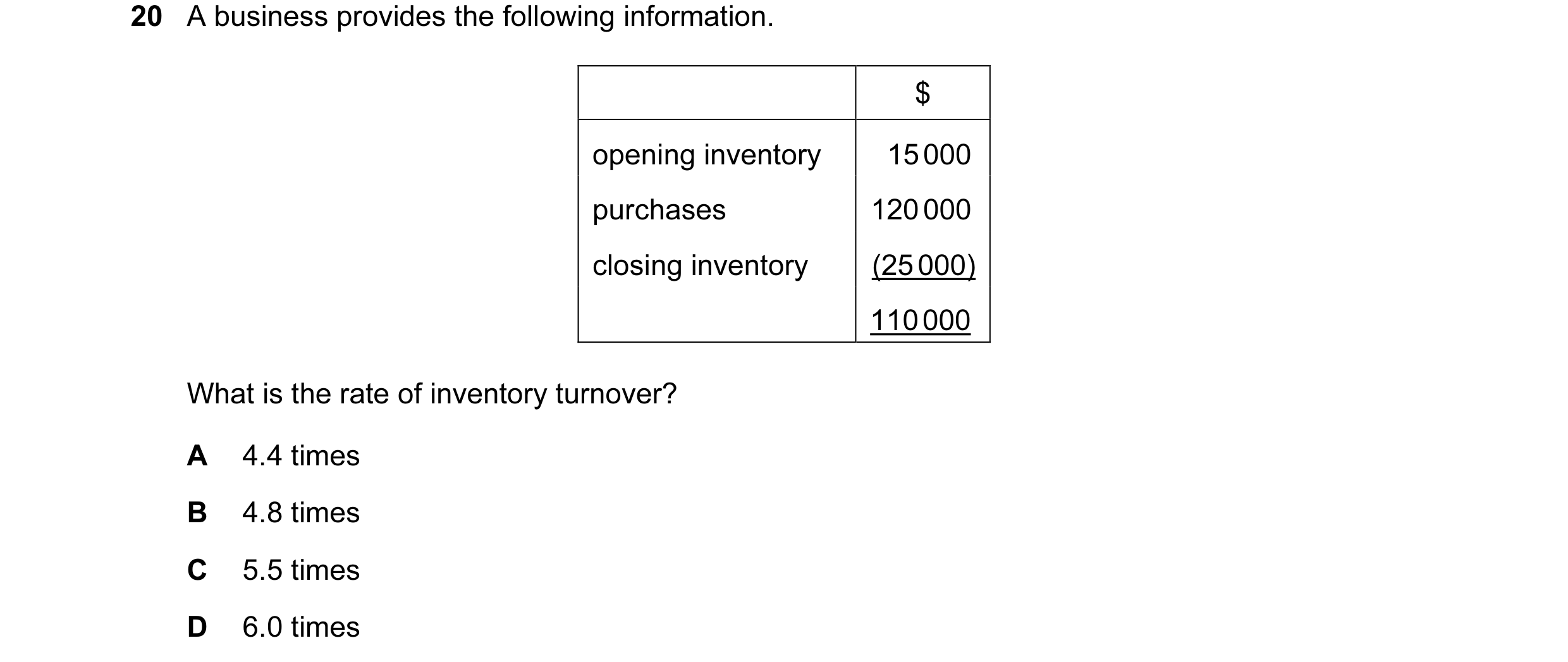 47 / 85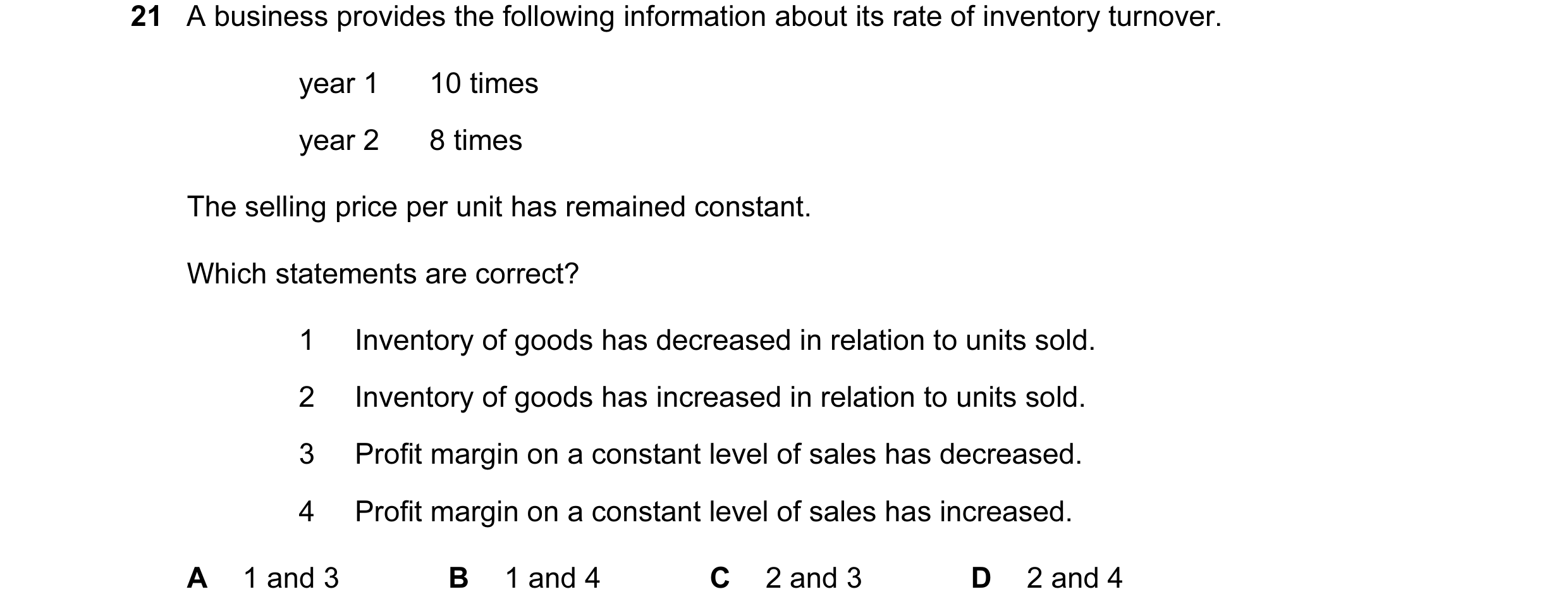


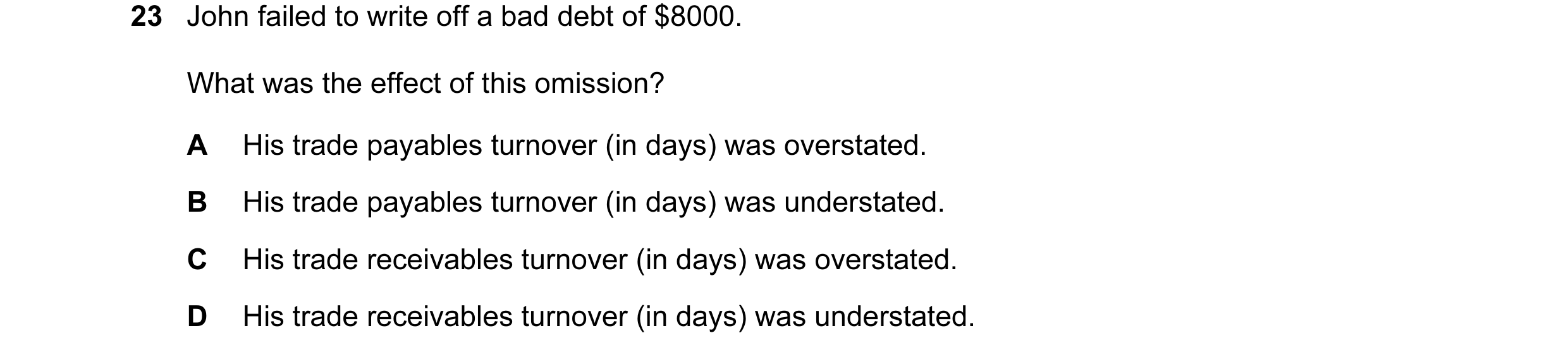
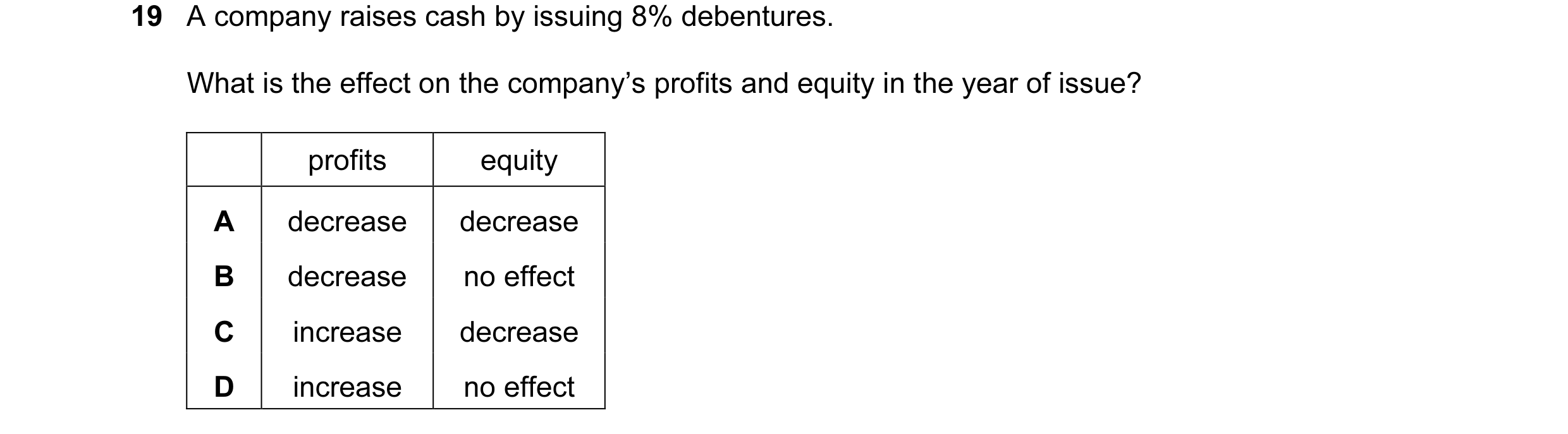 48 / 85


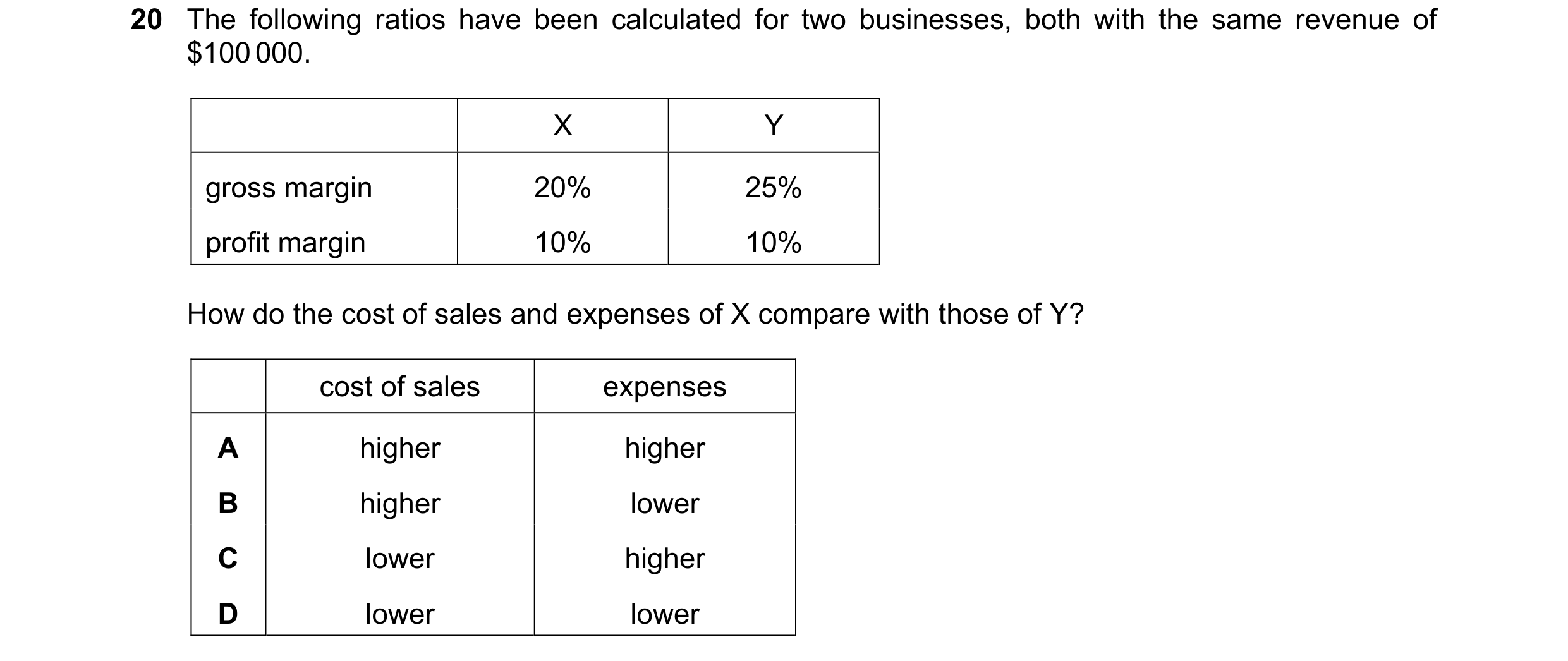
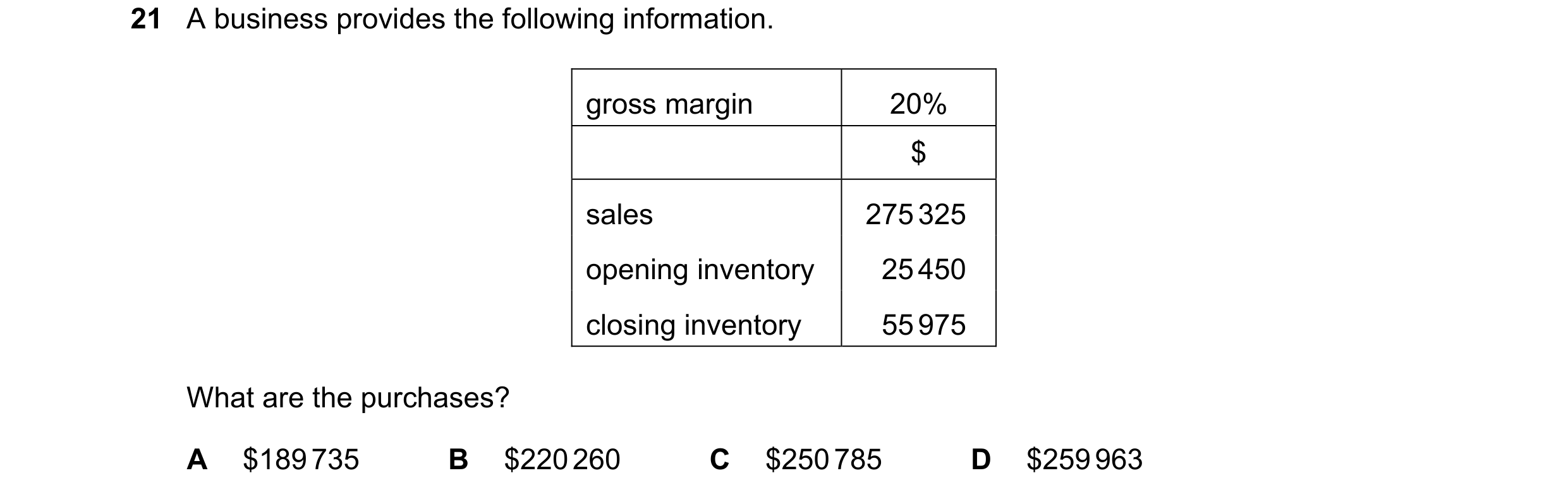 49 / 85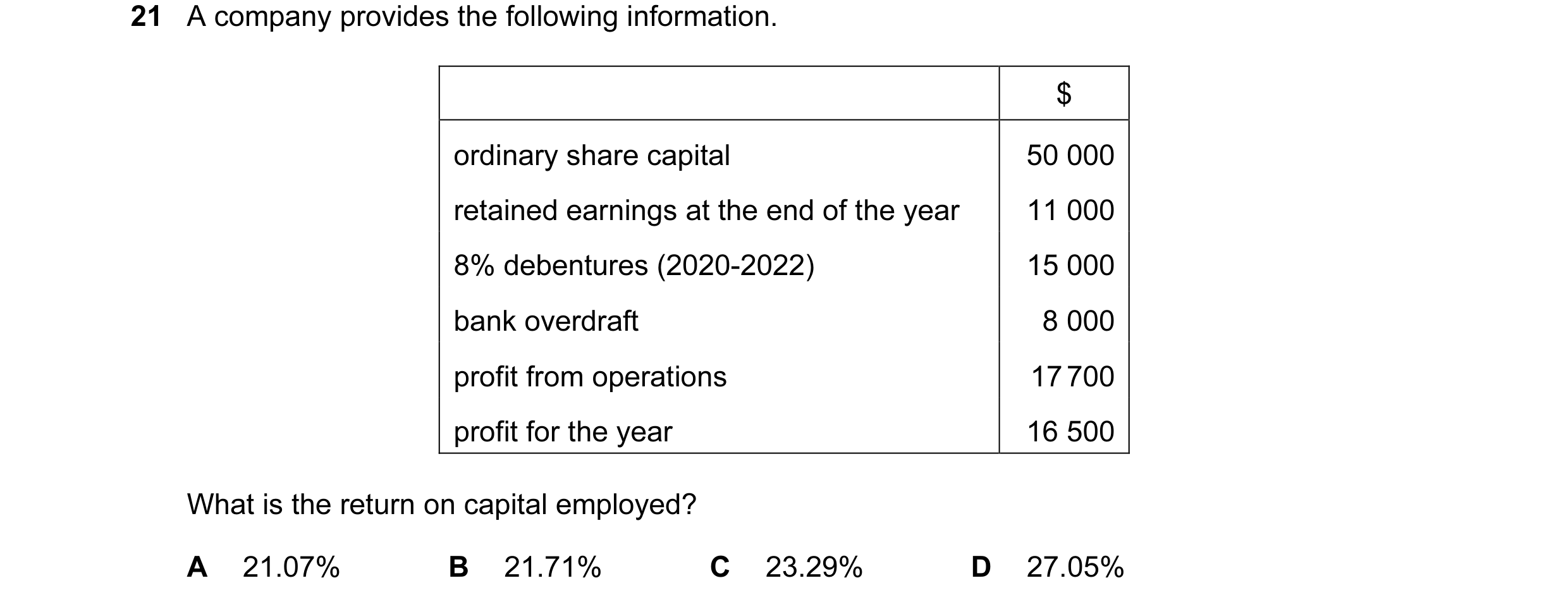
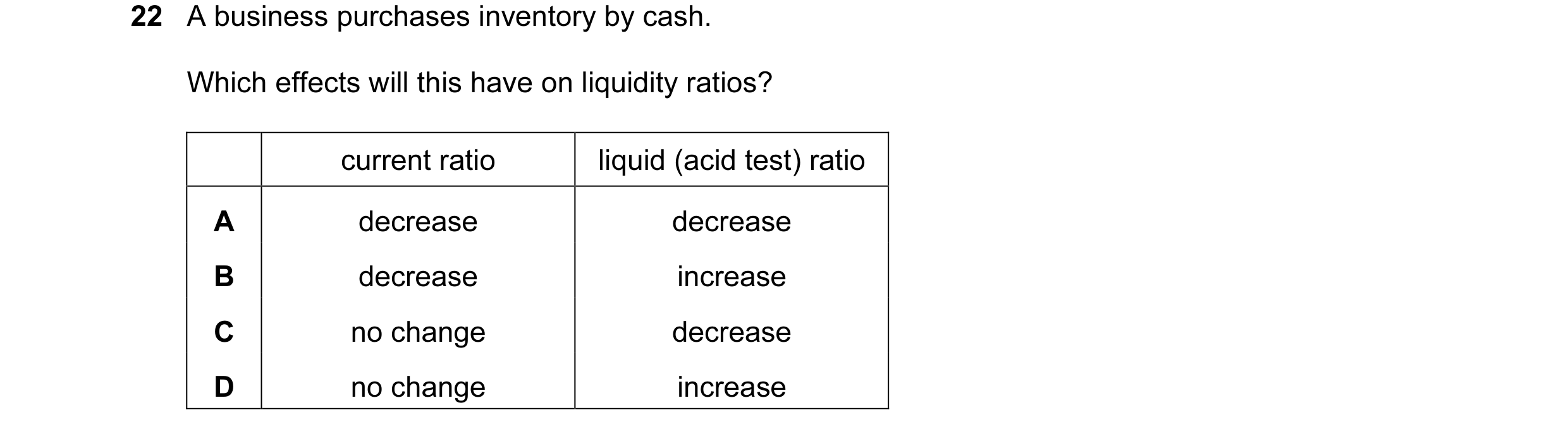
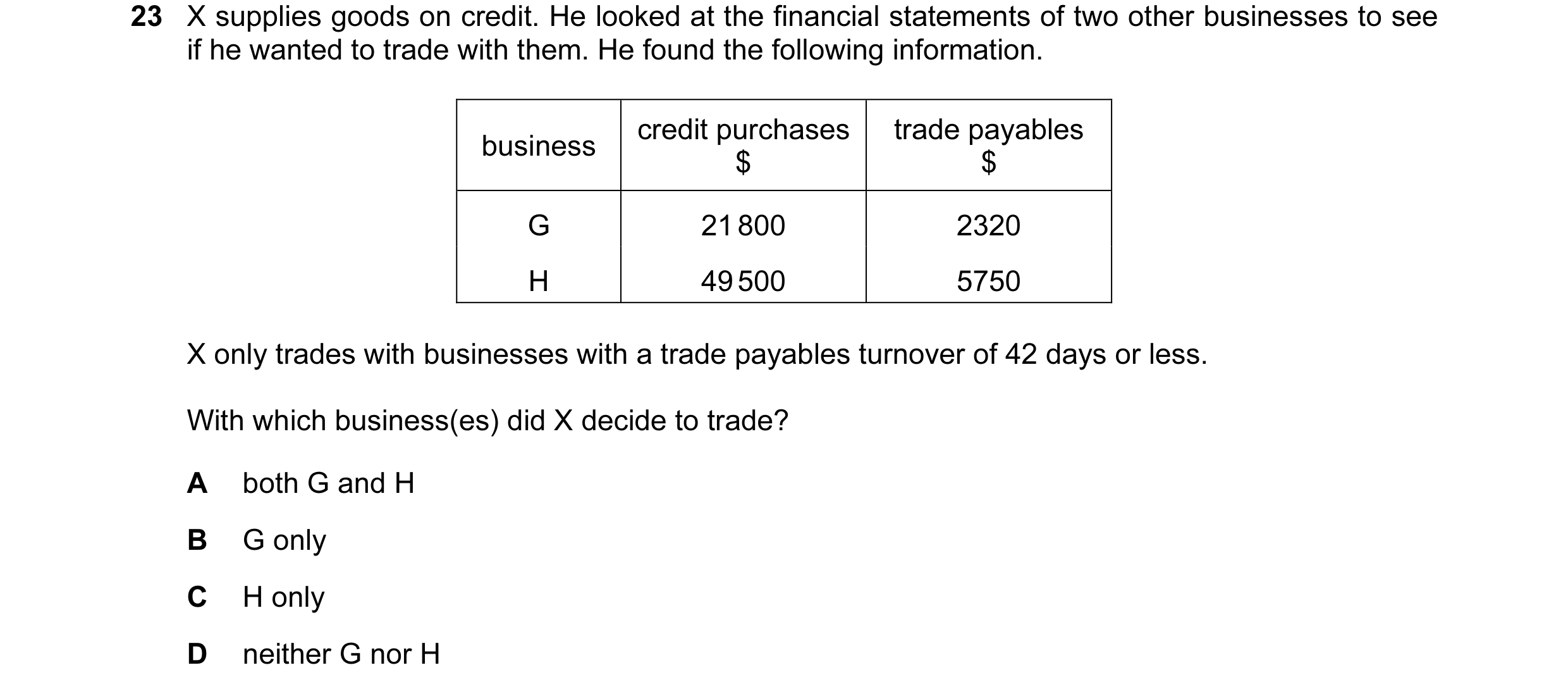 50 / 85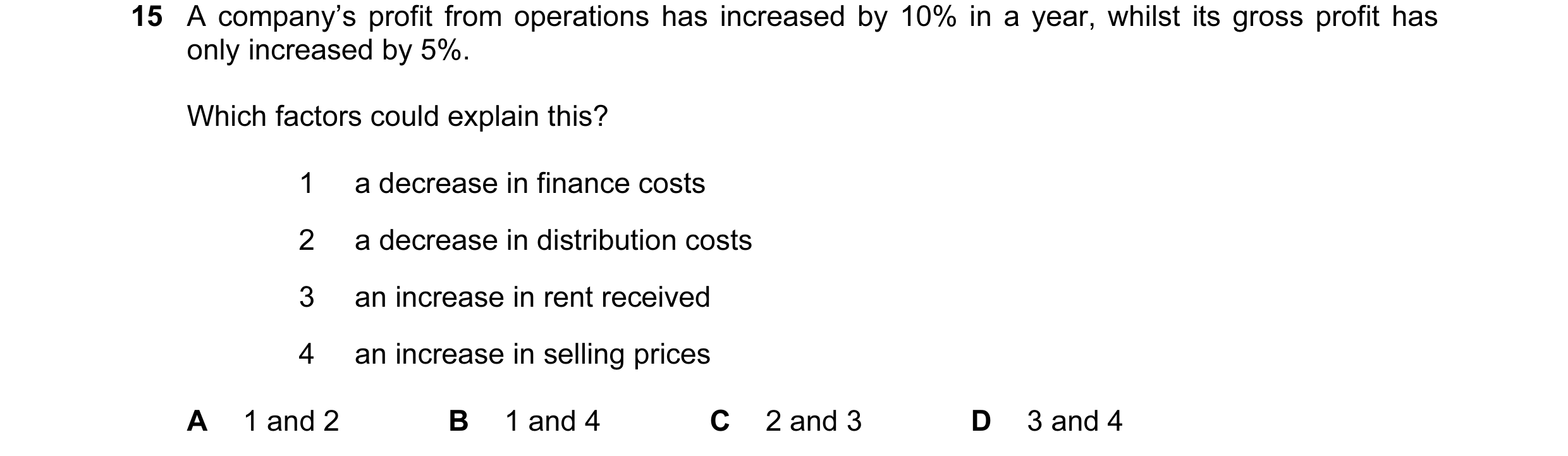
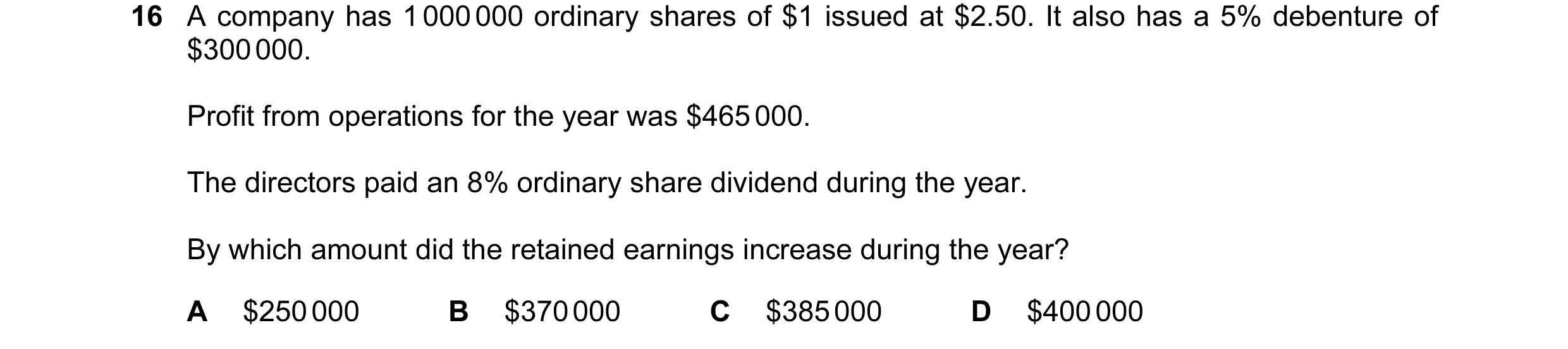
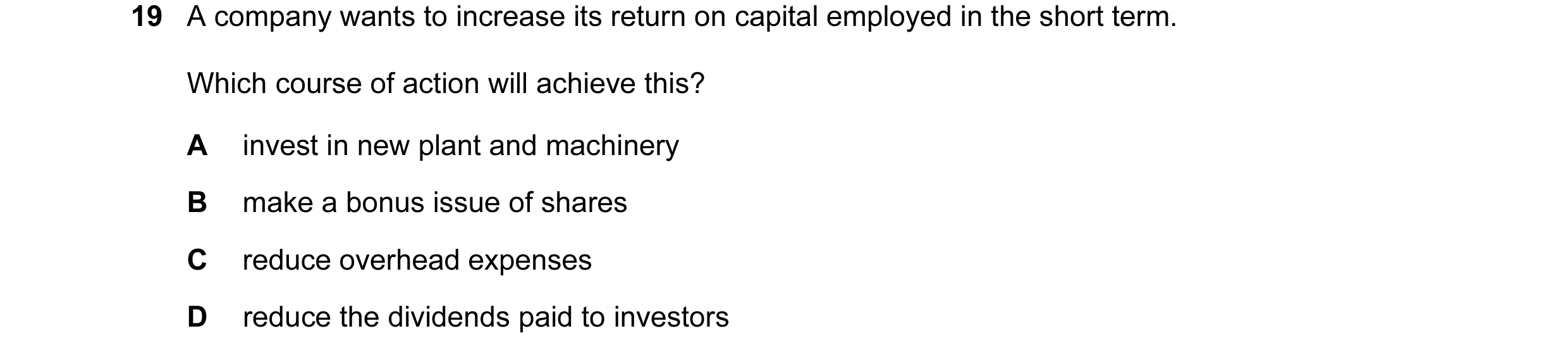
 51 / 85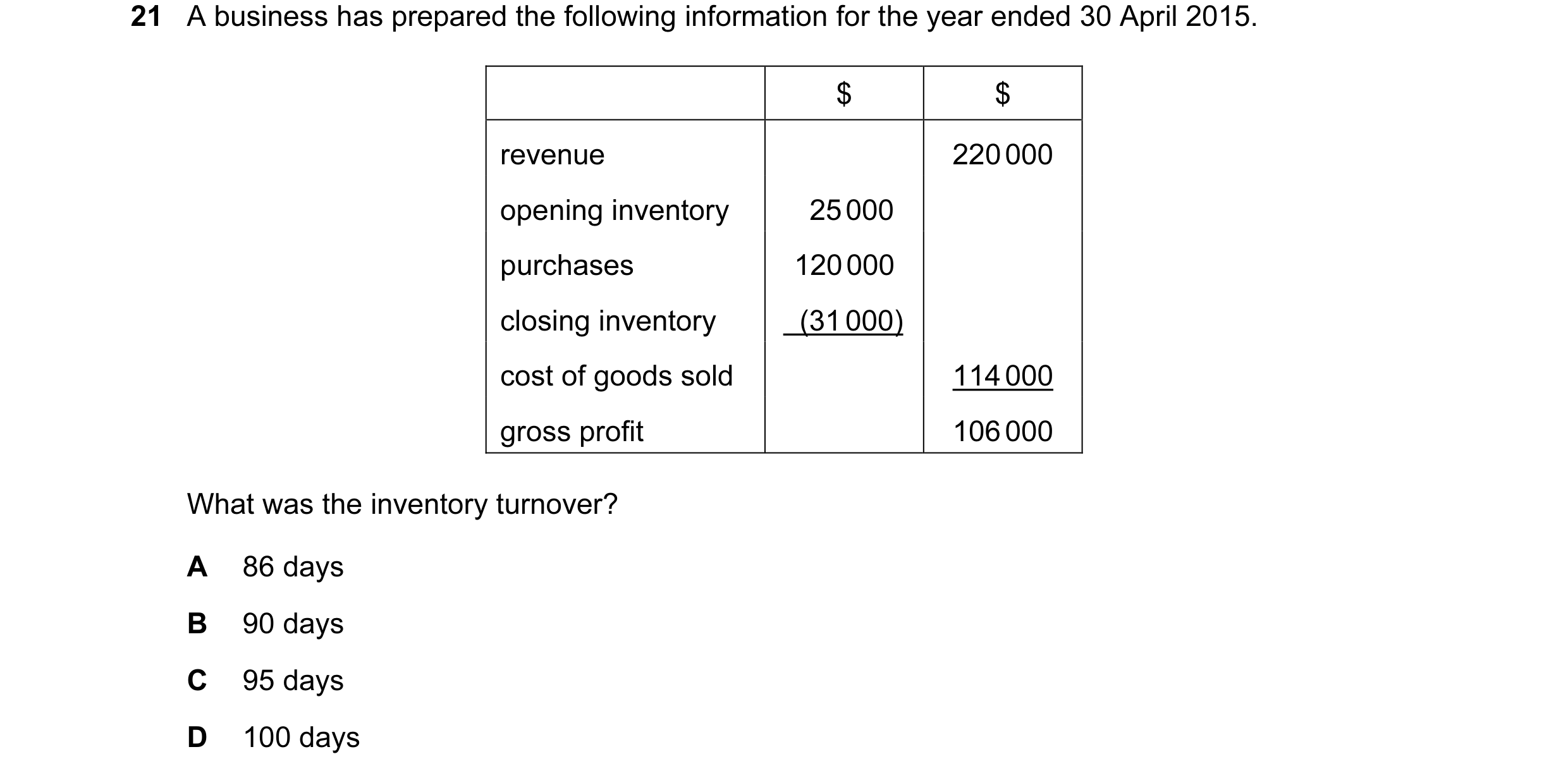
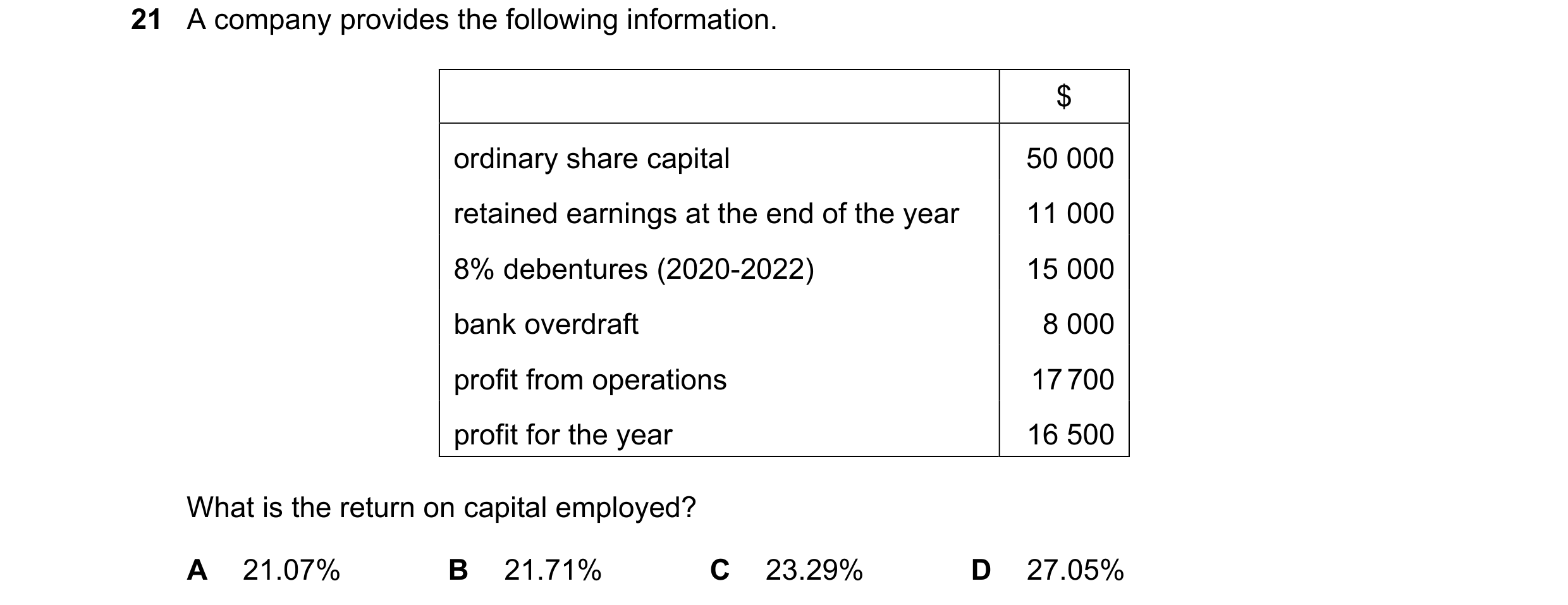
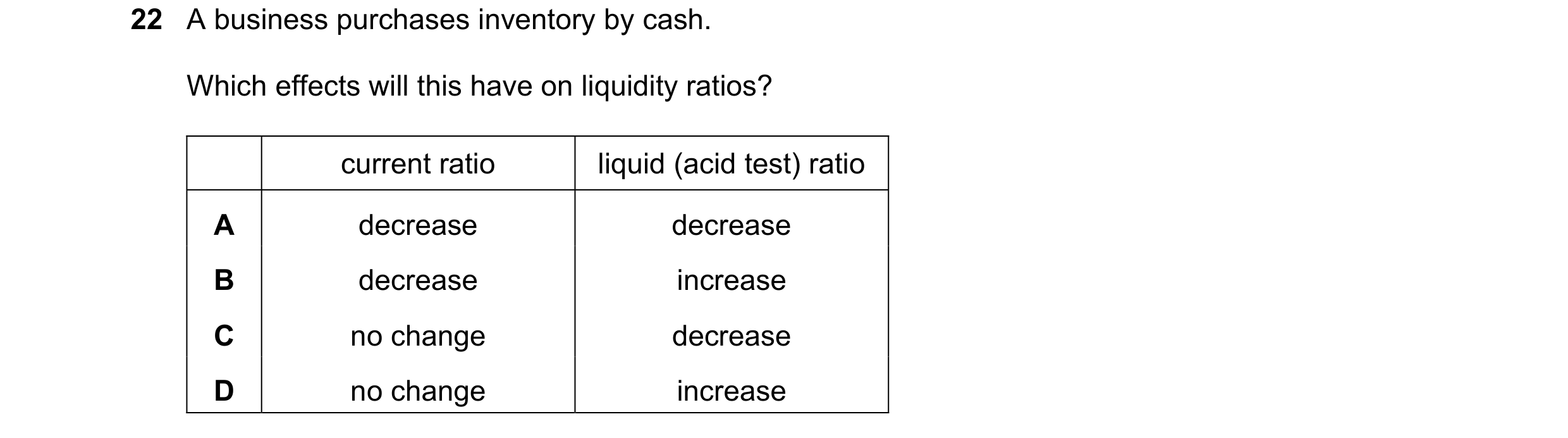 52 / 85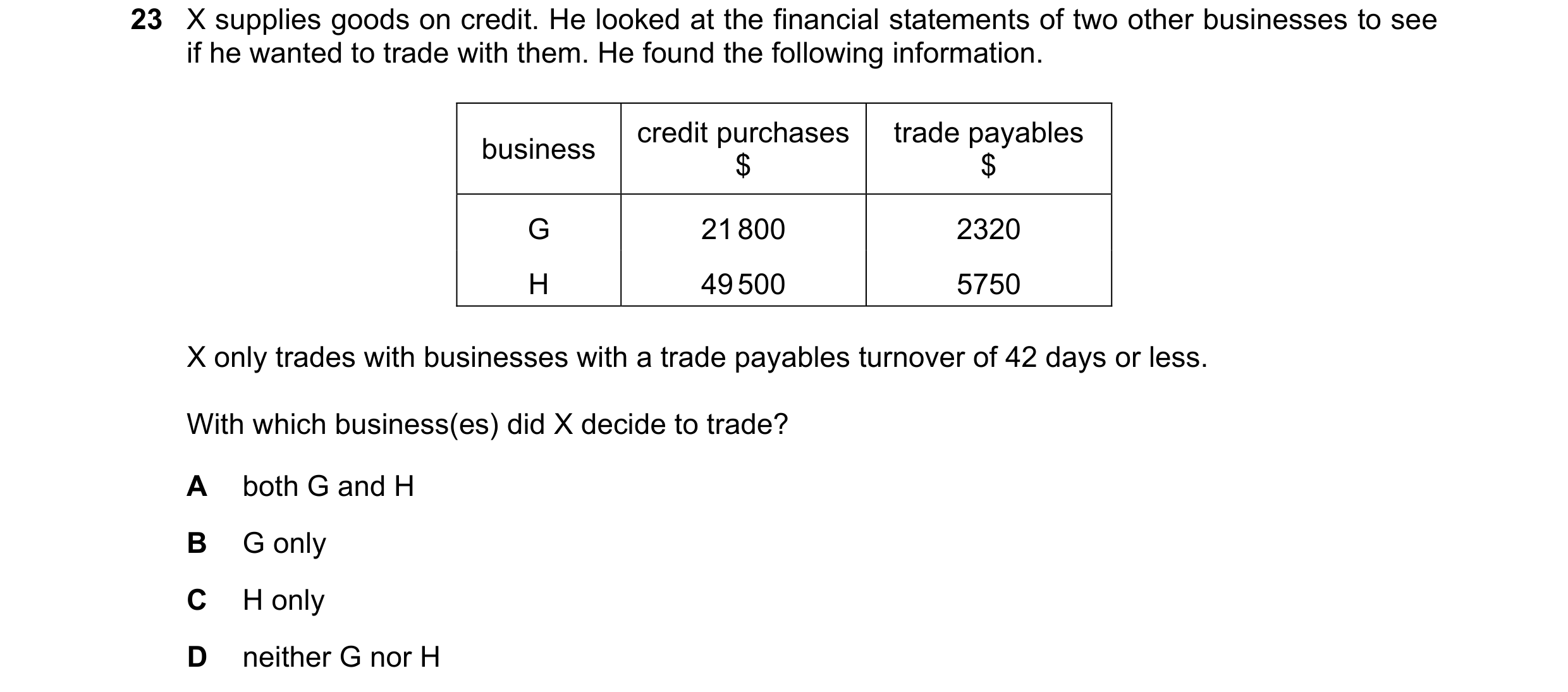
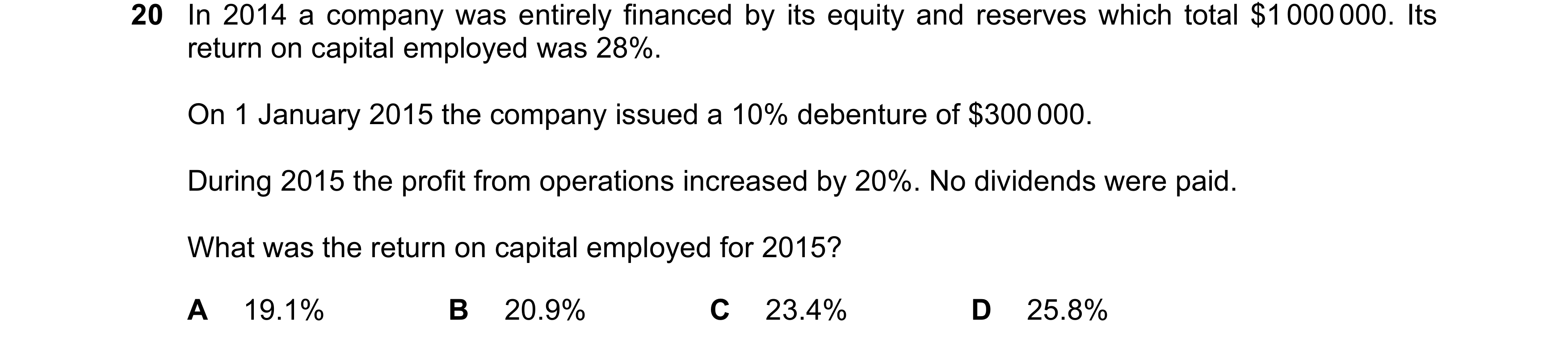

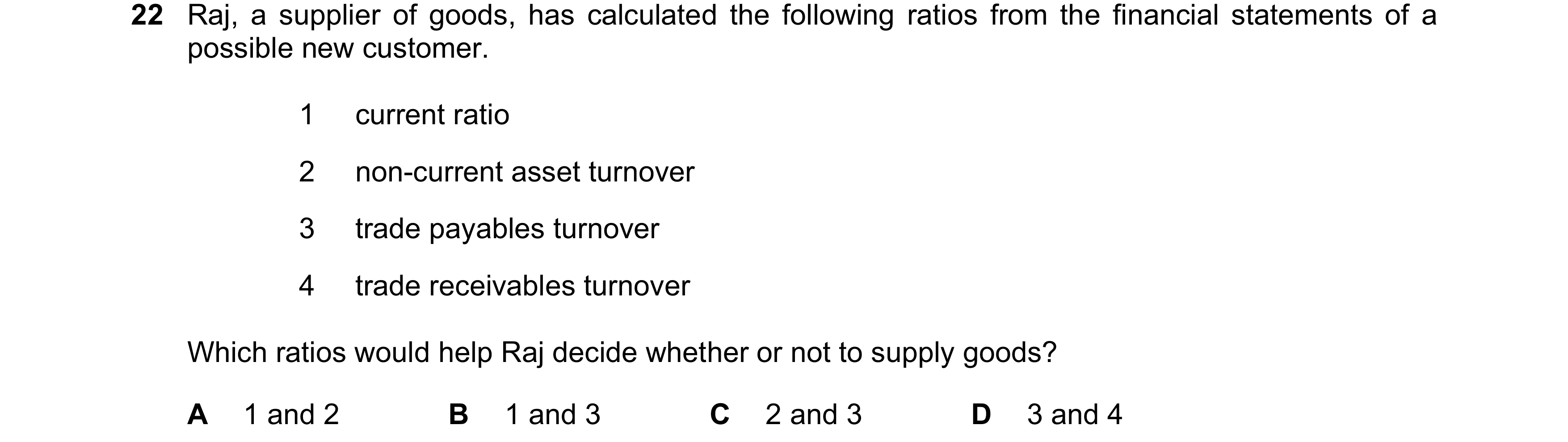
 53 / 85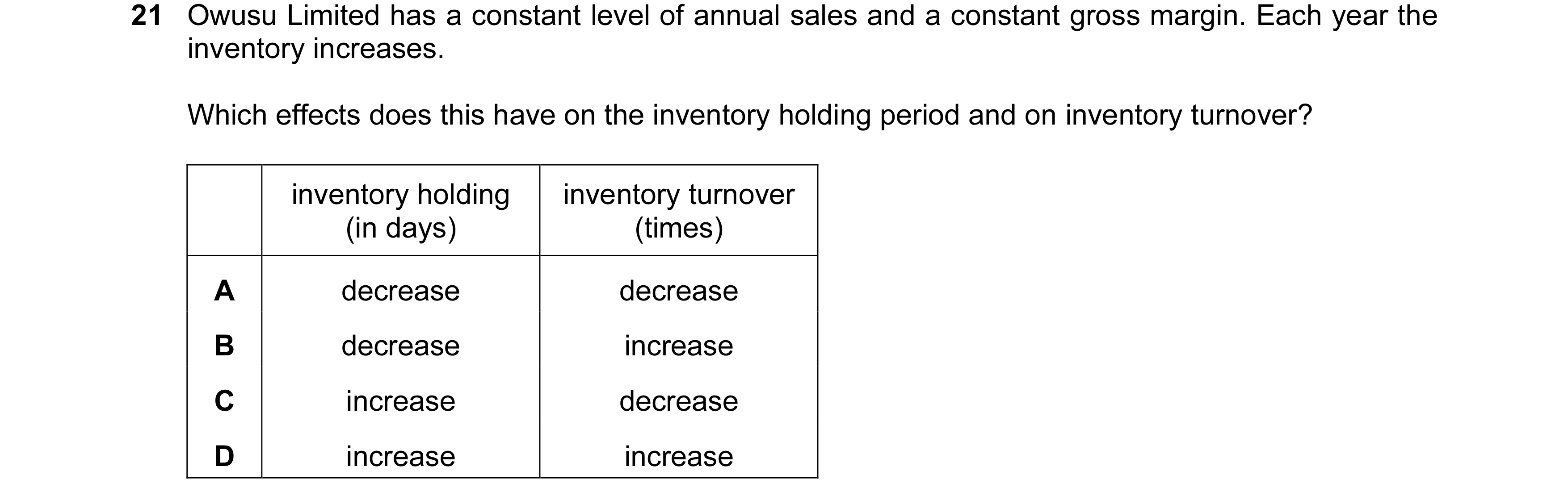


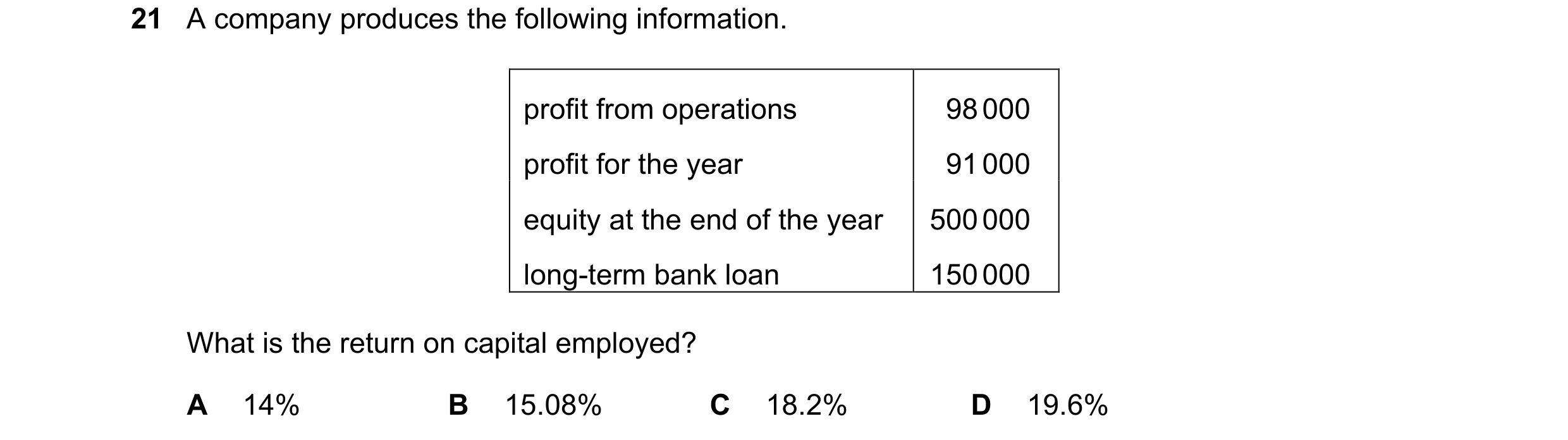
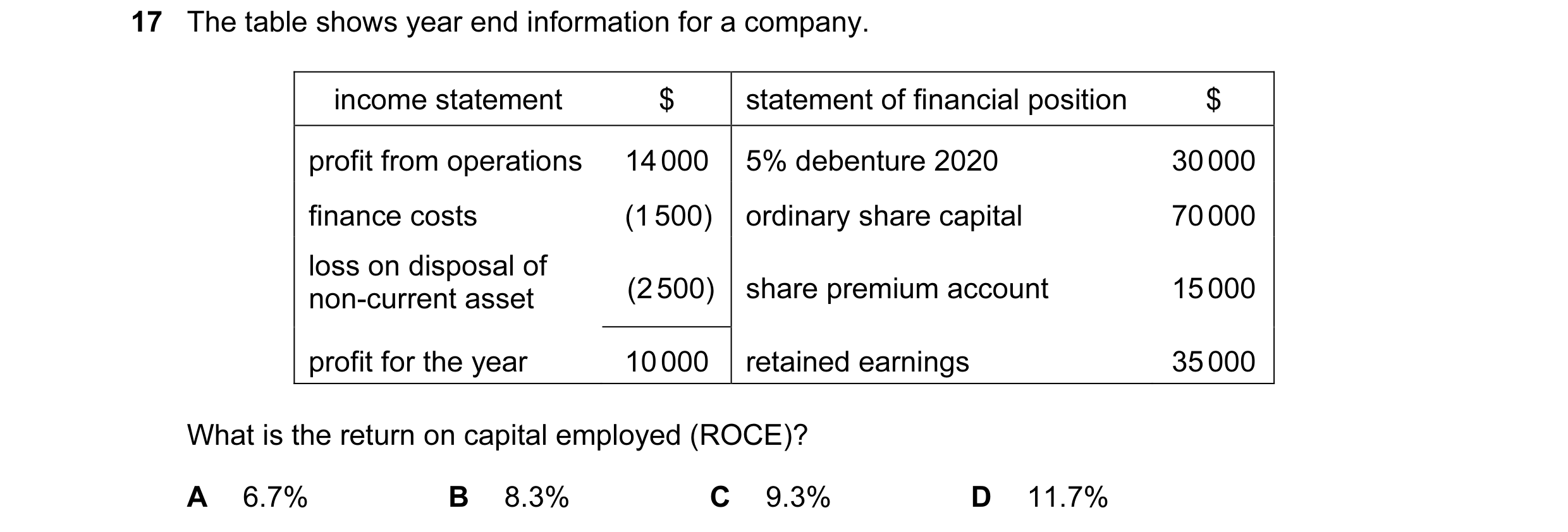 54 / 85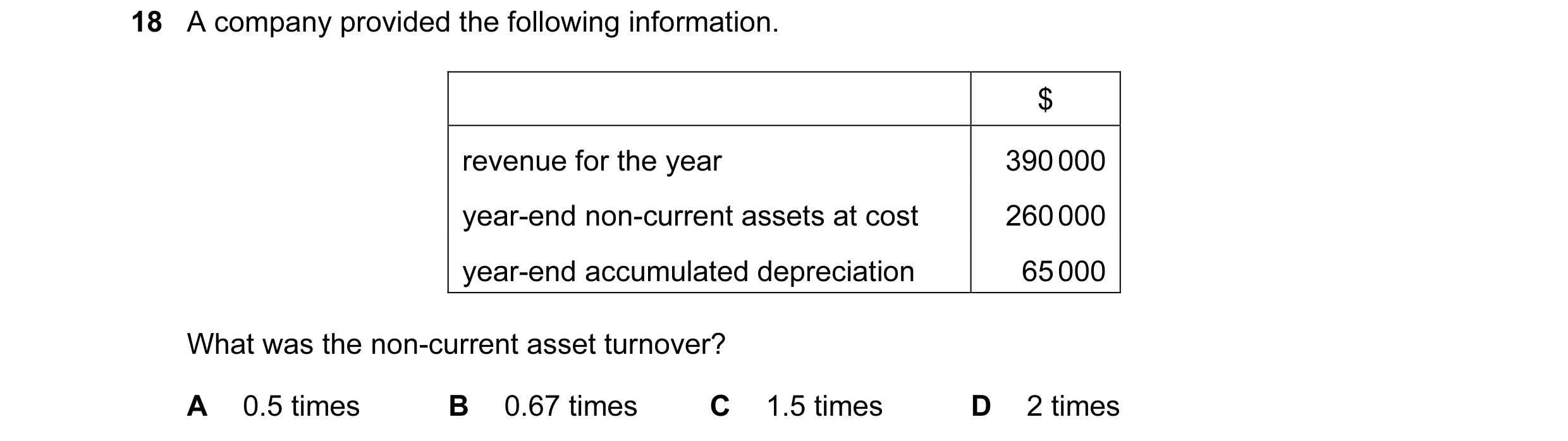
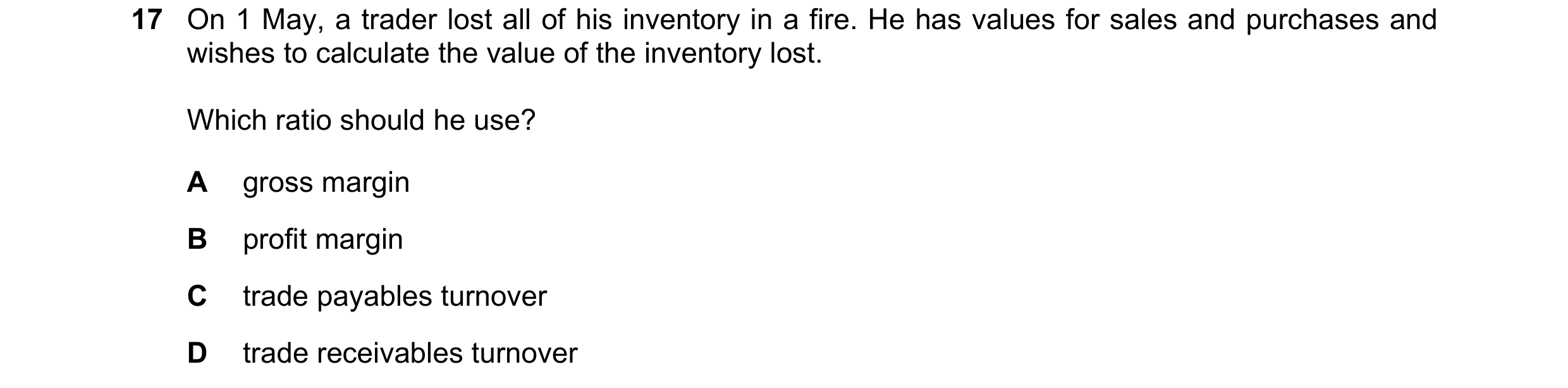
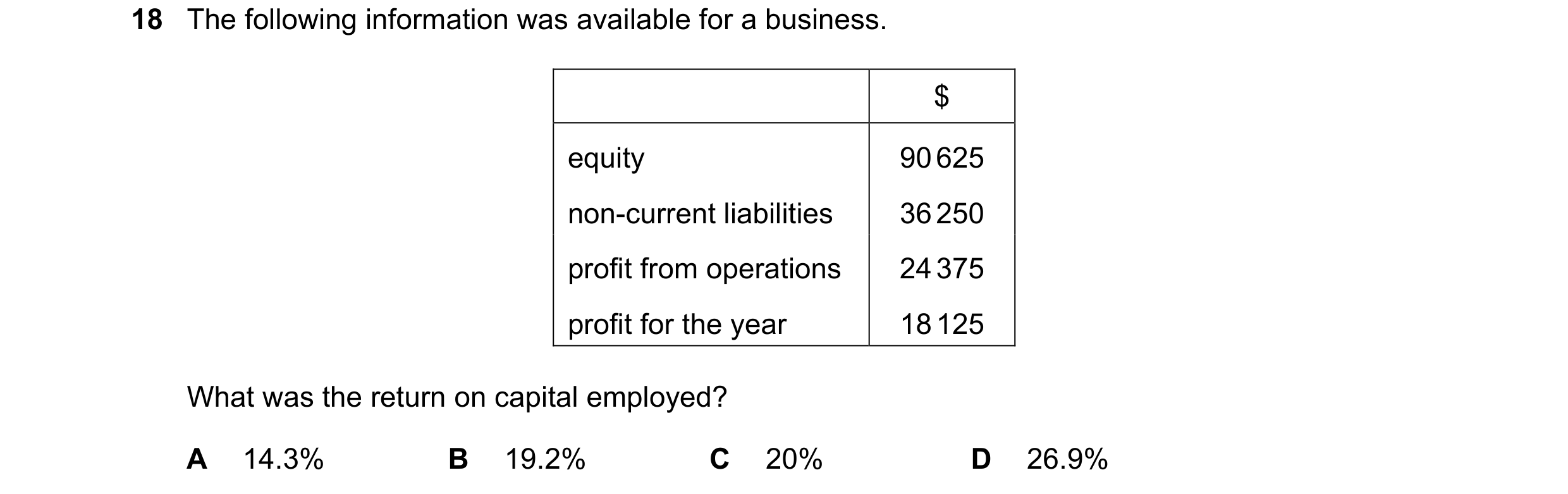
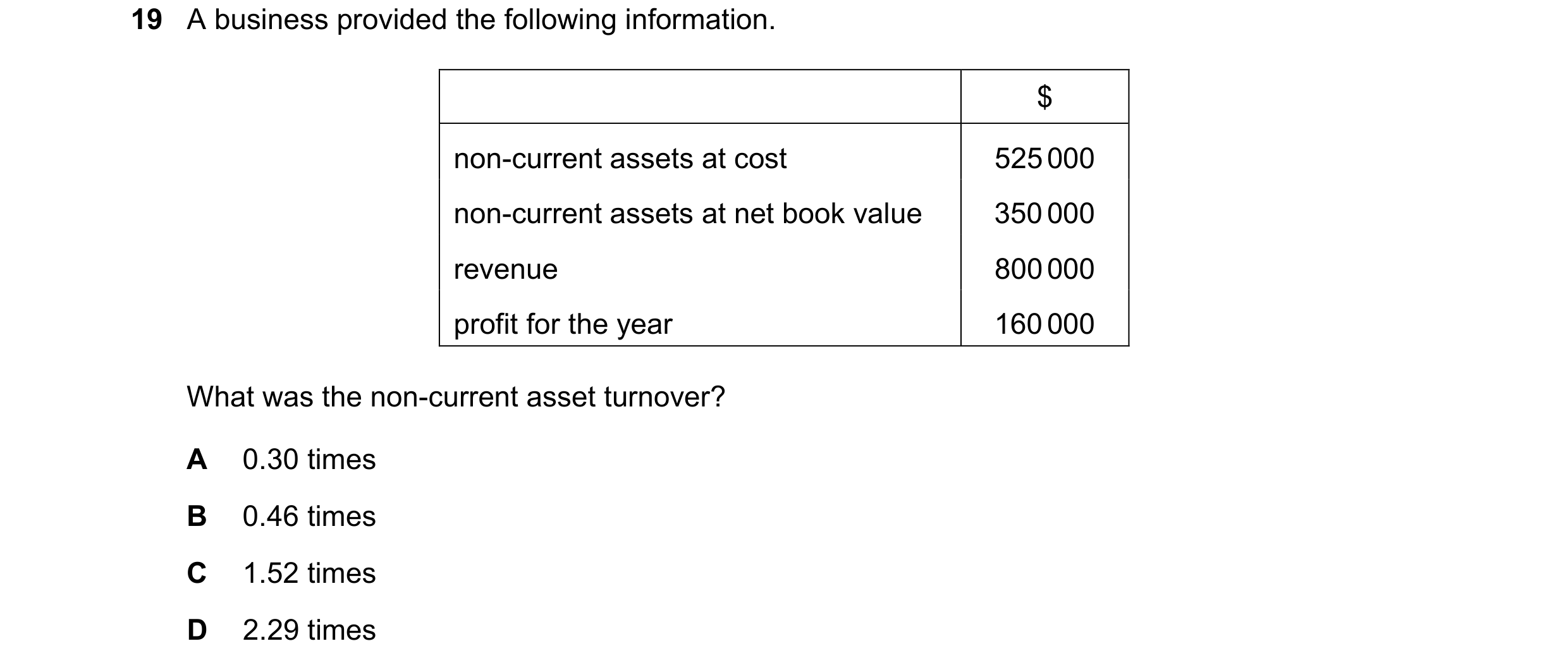 55 / 85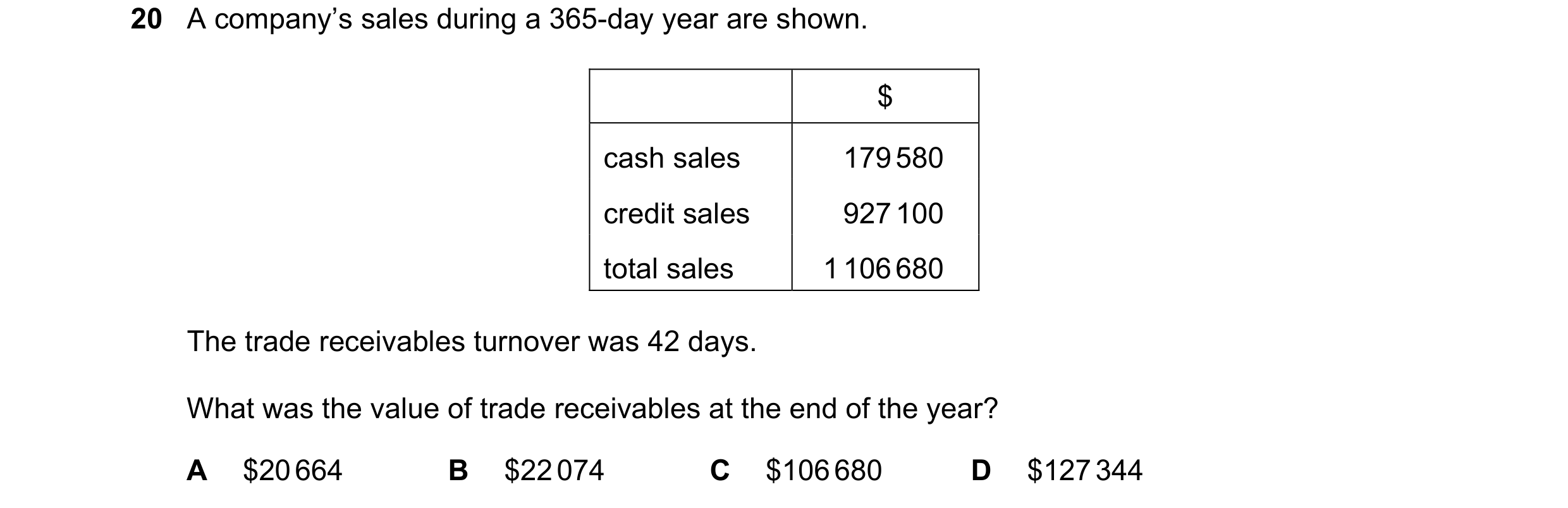

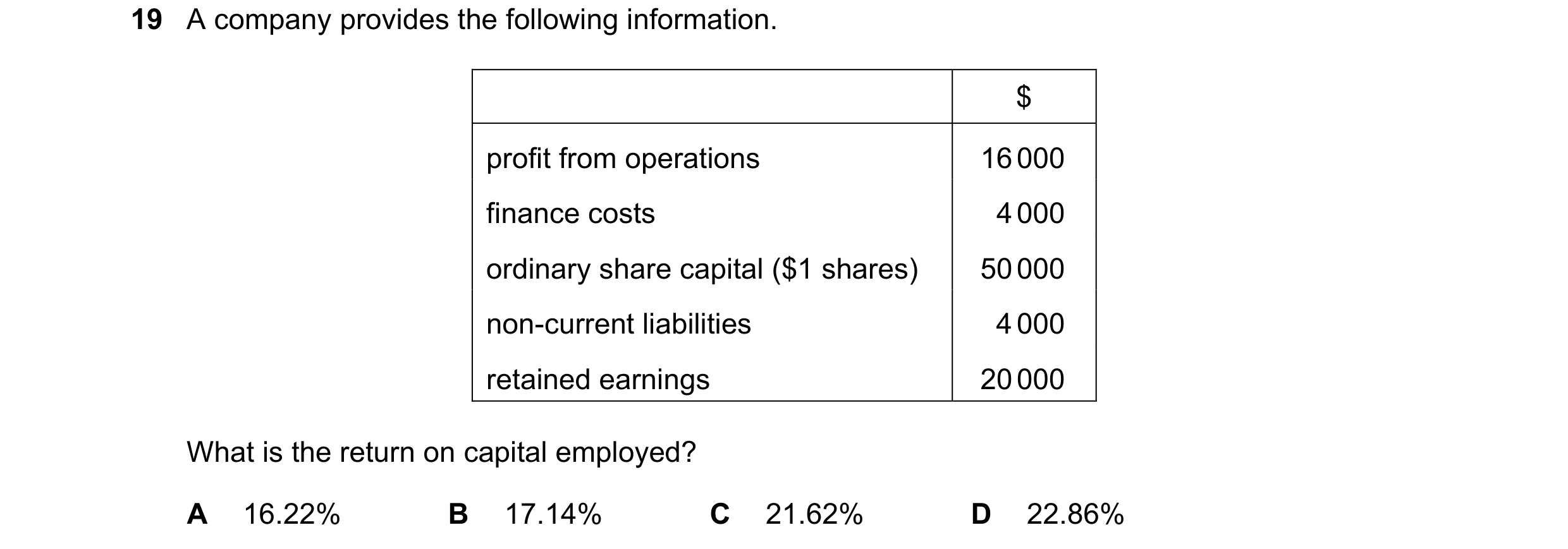
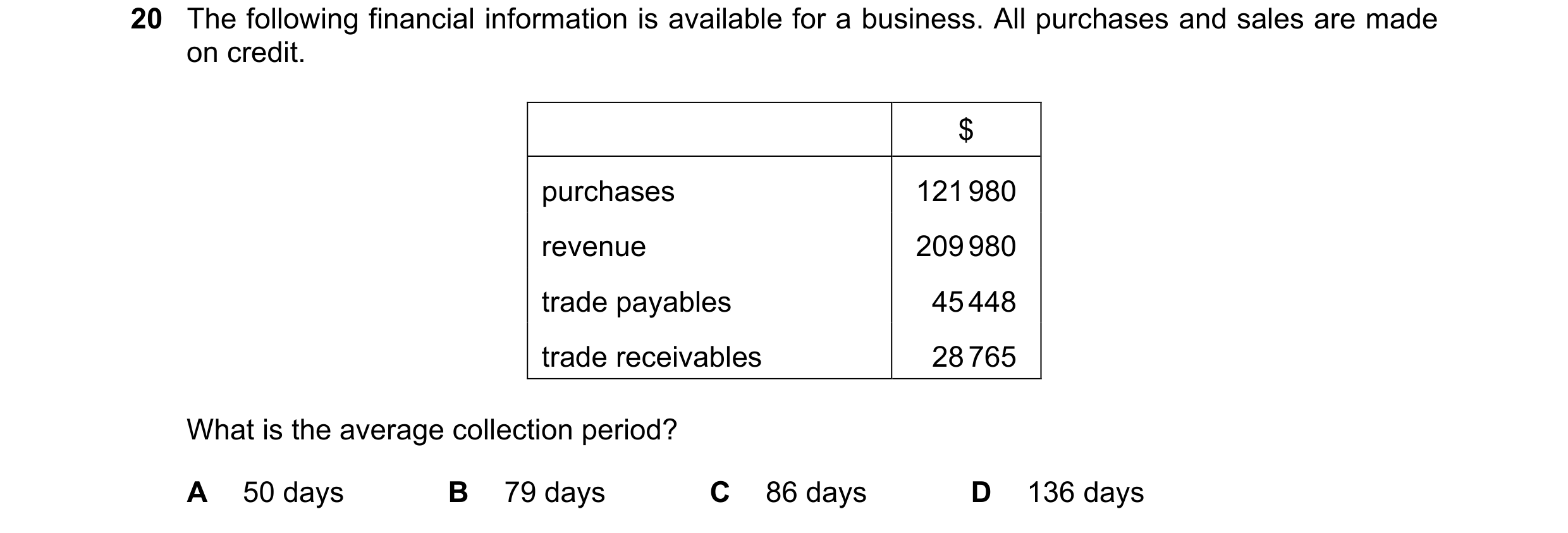 56 / 85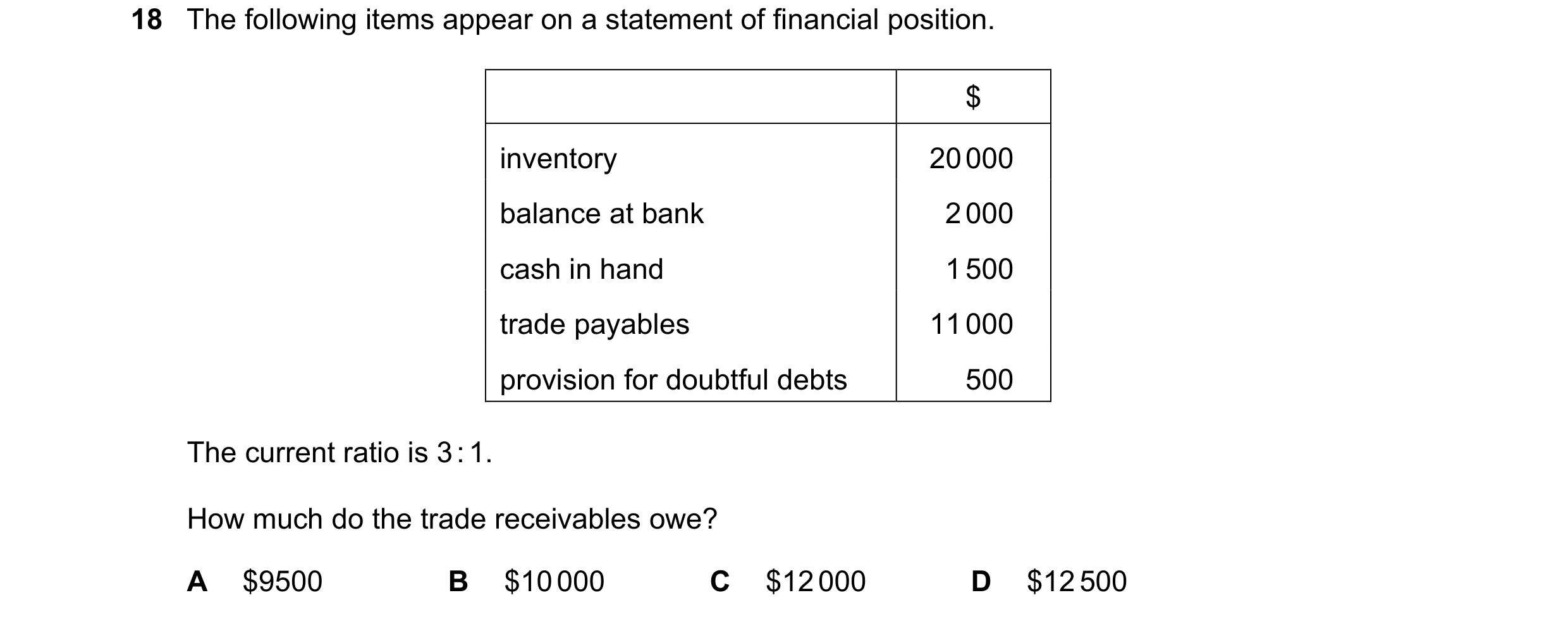
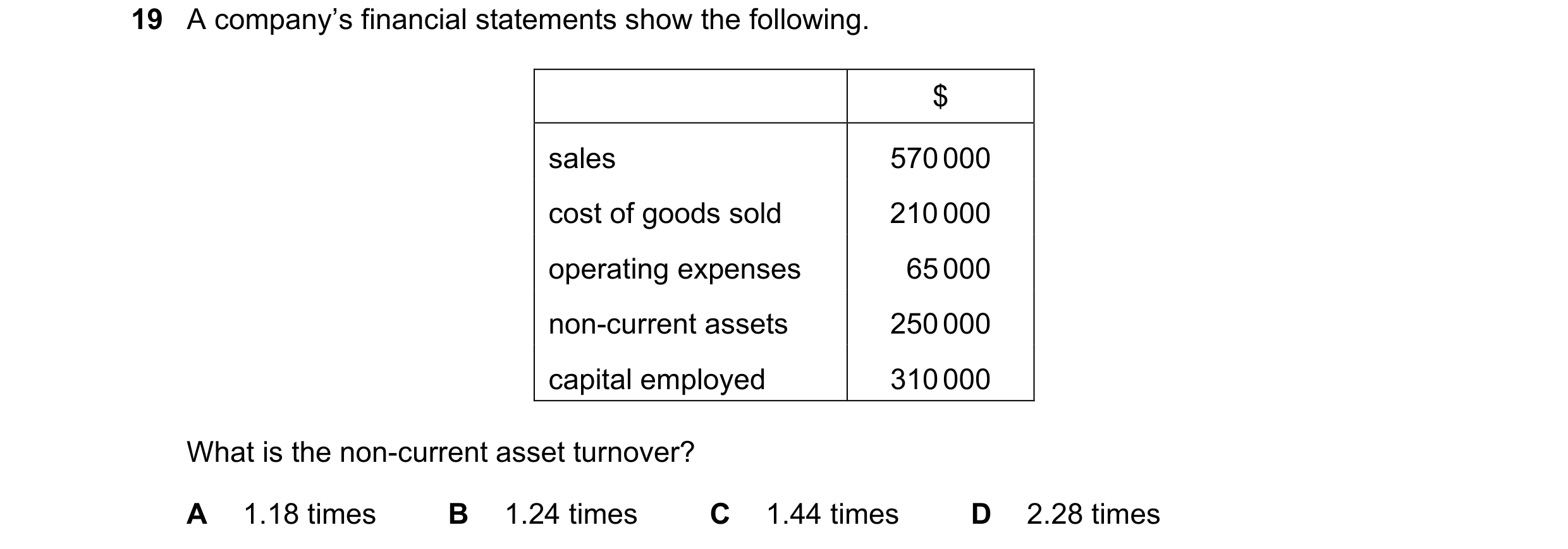
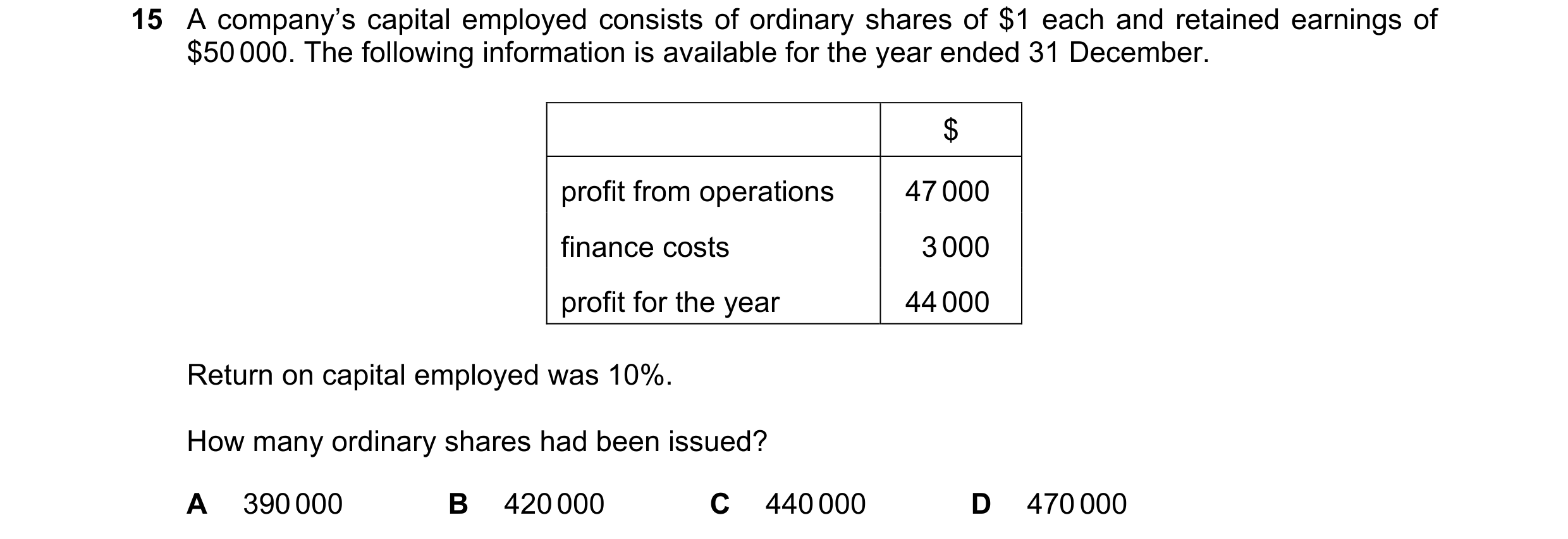
 57 / 85
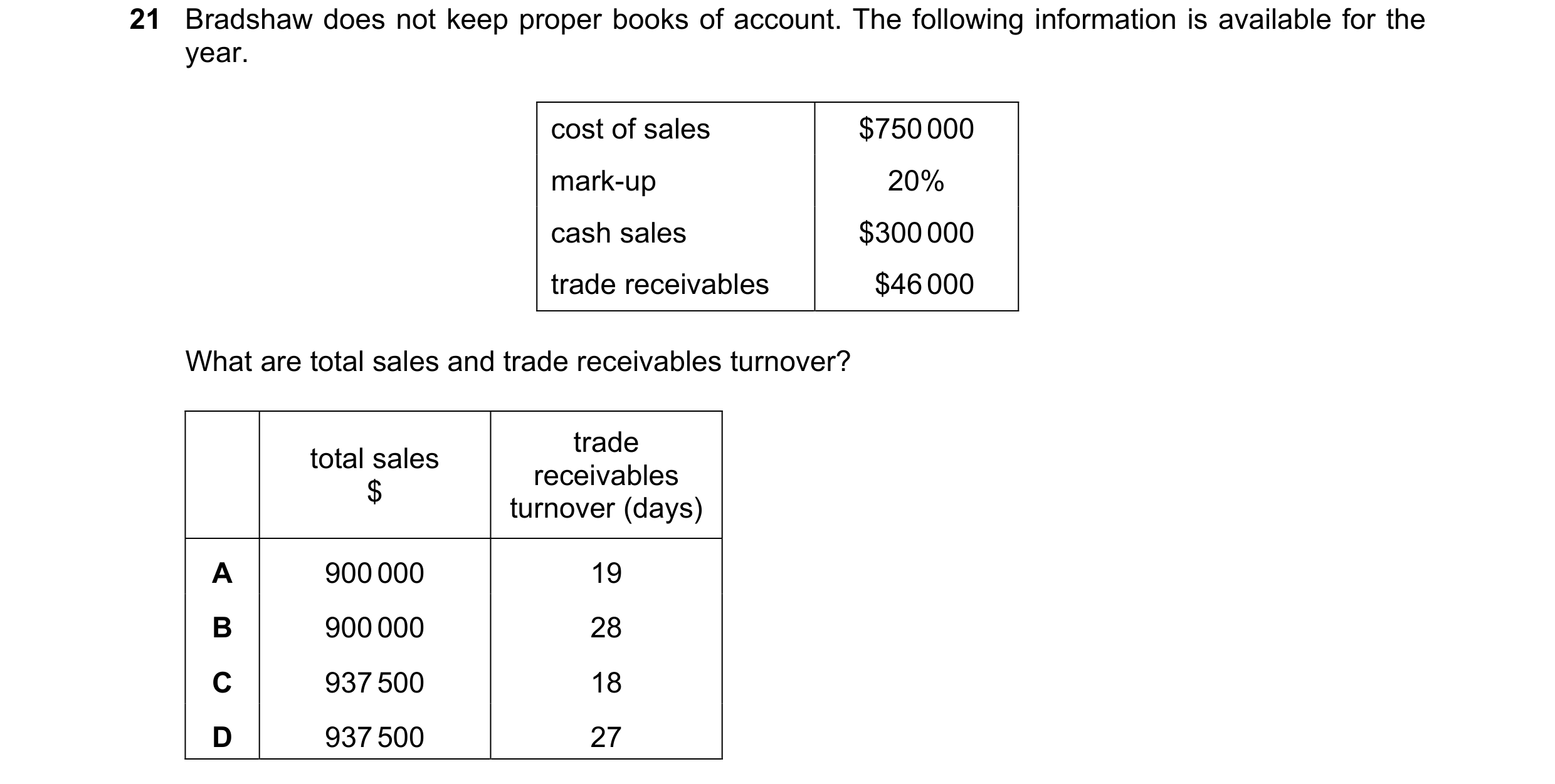
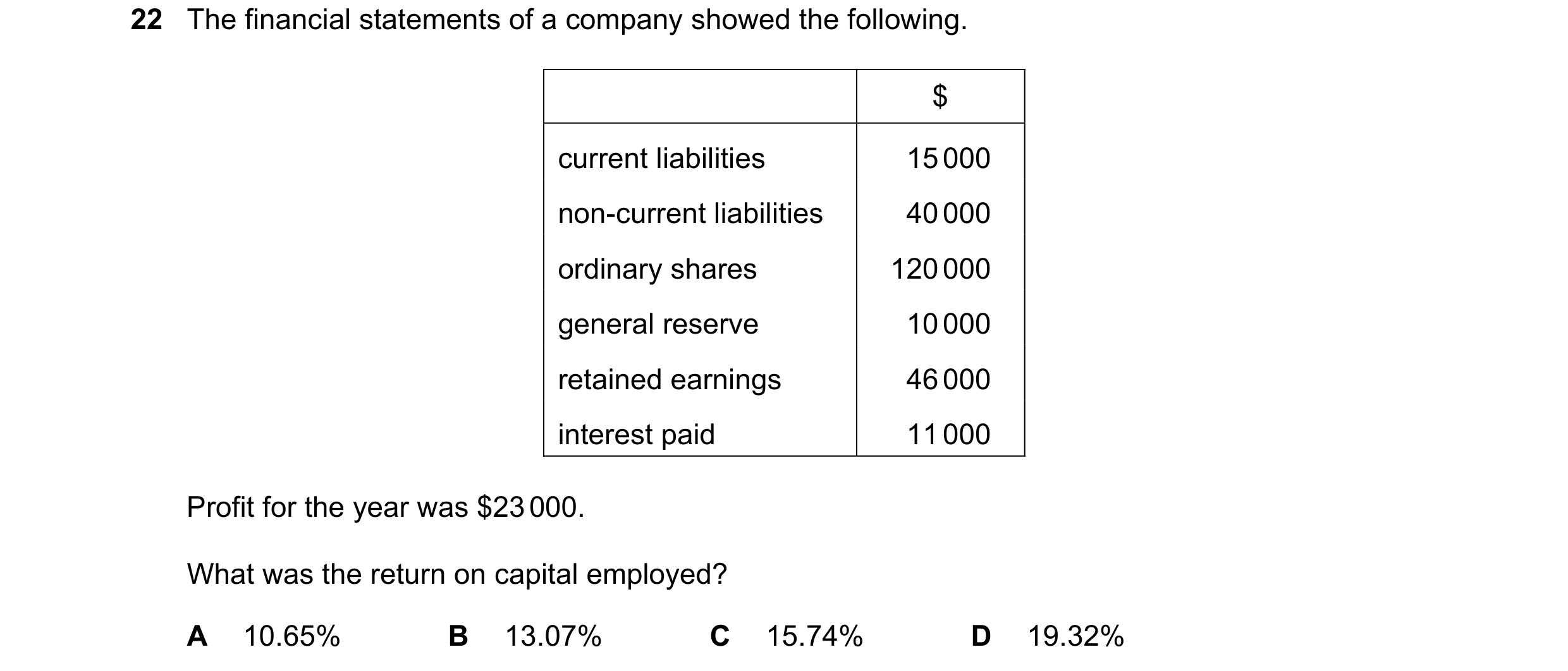
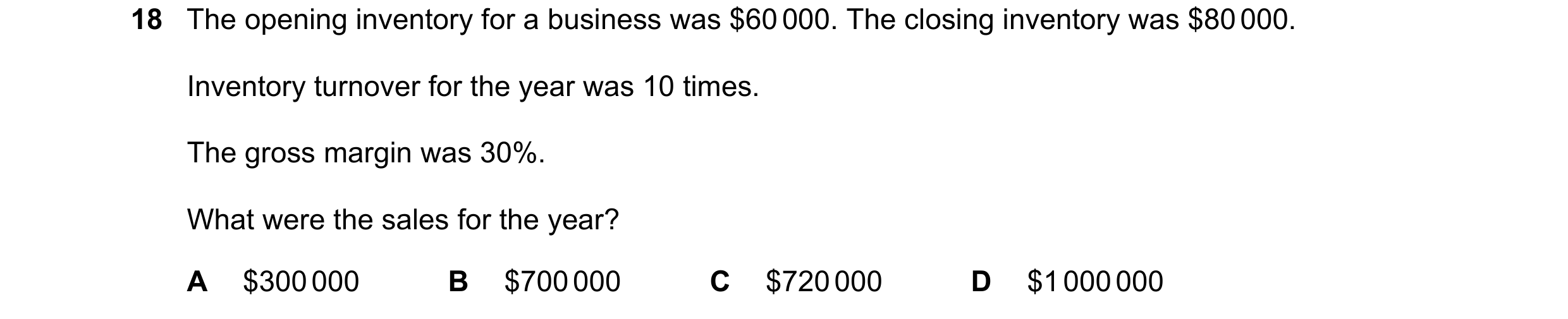 58 / 85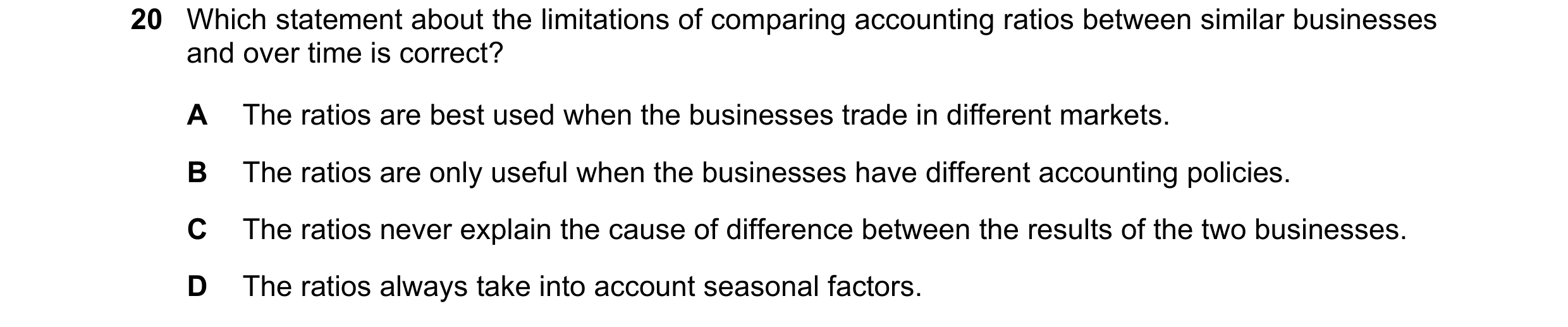
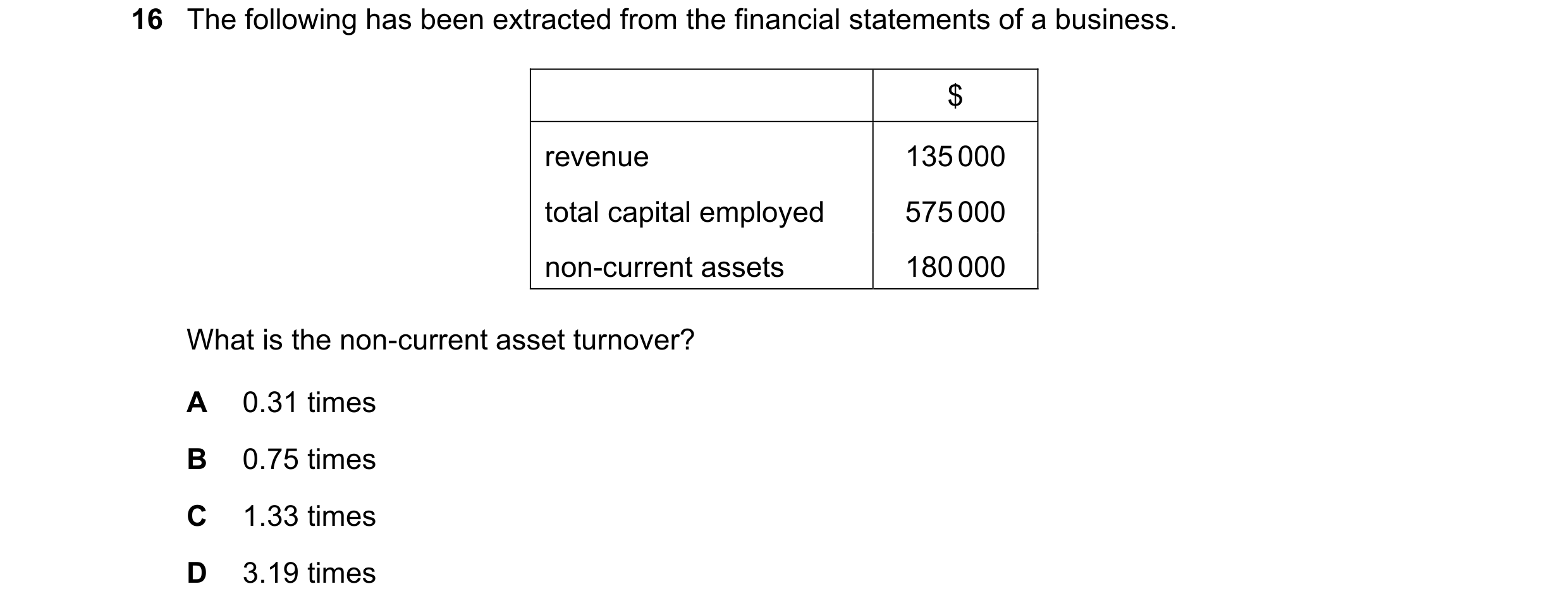
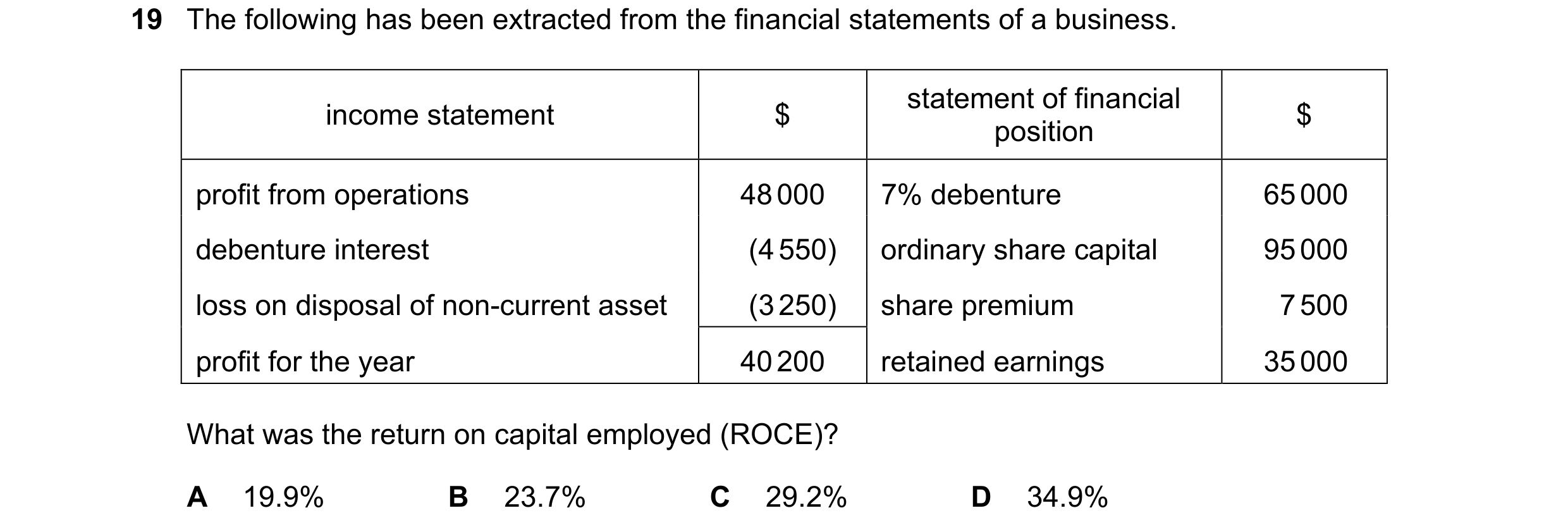
 59 / 85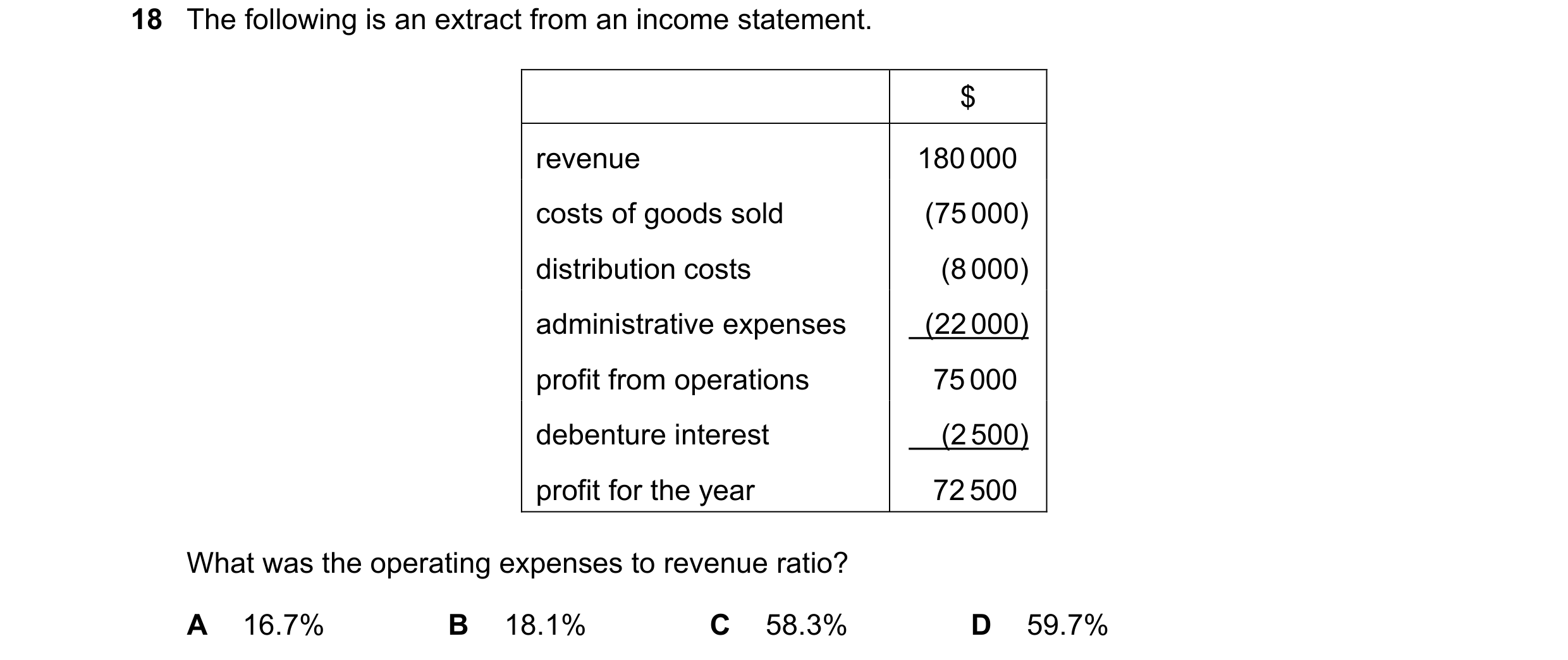
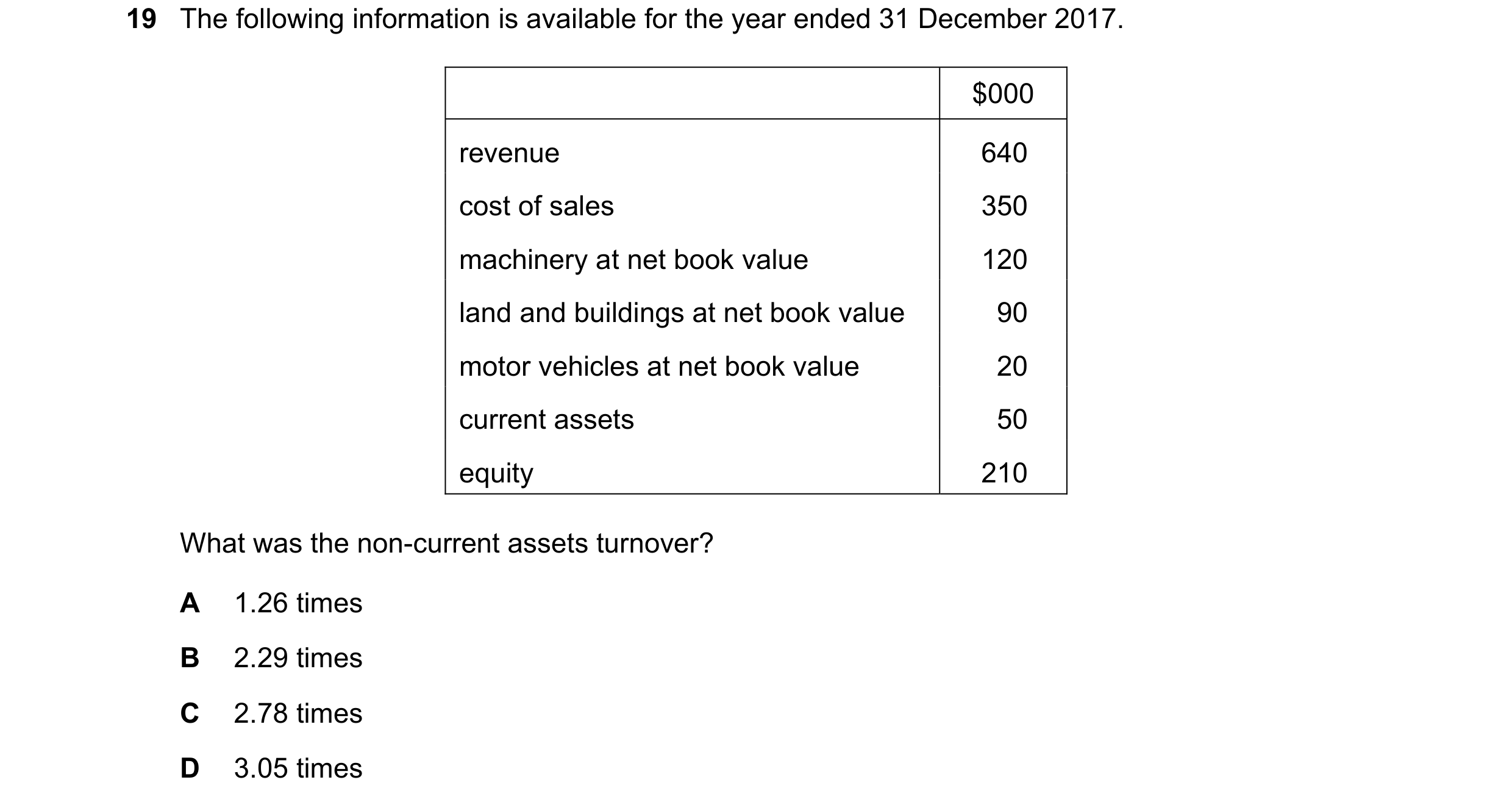
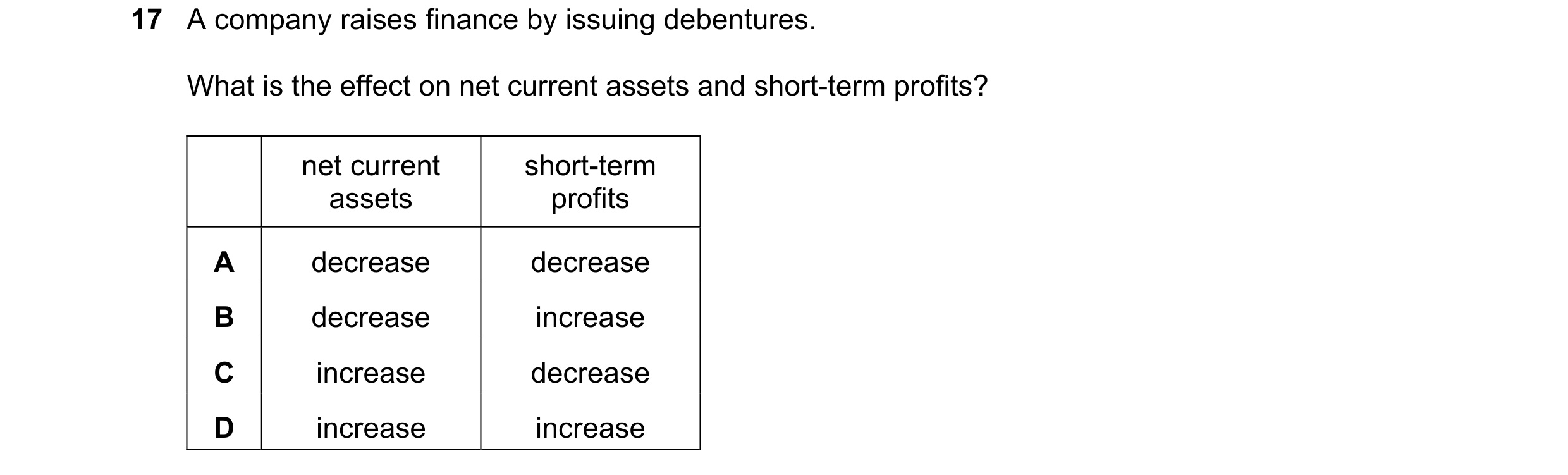 60 / 85
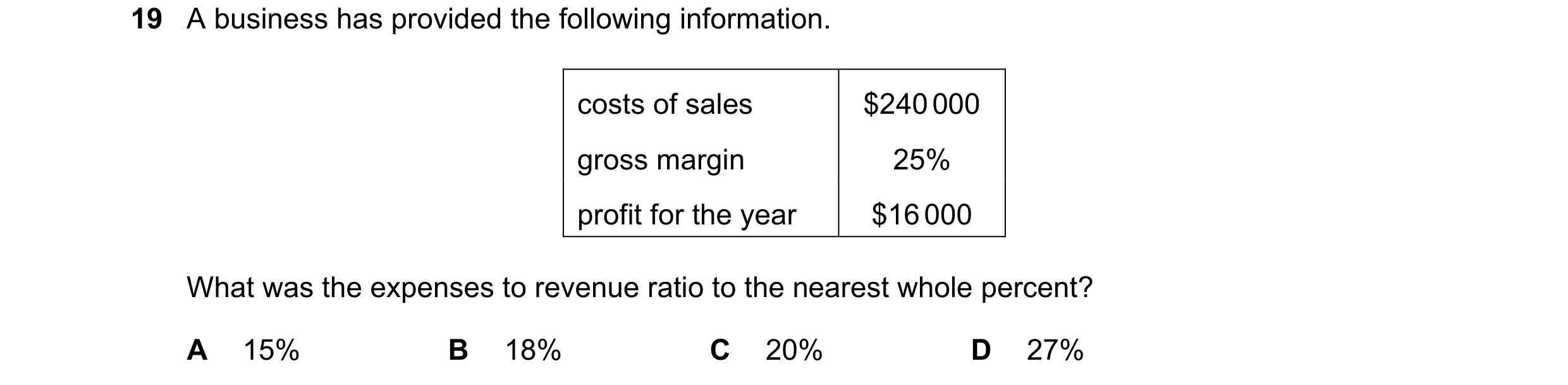
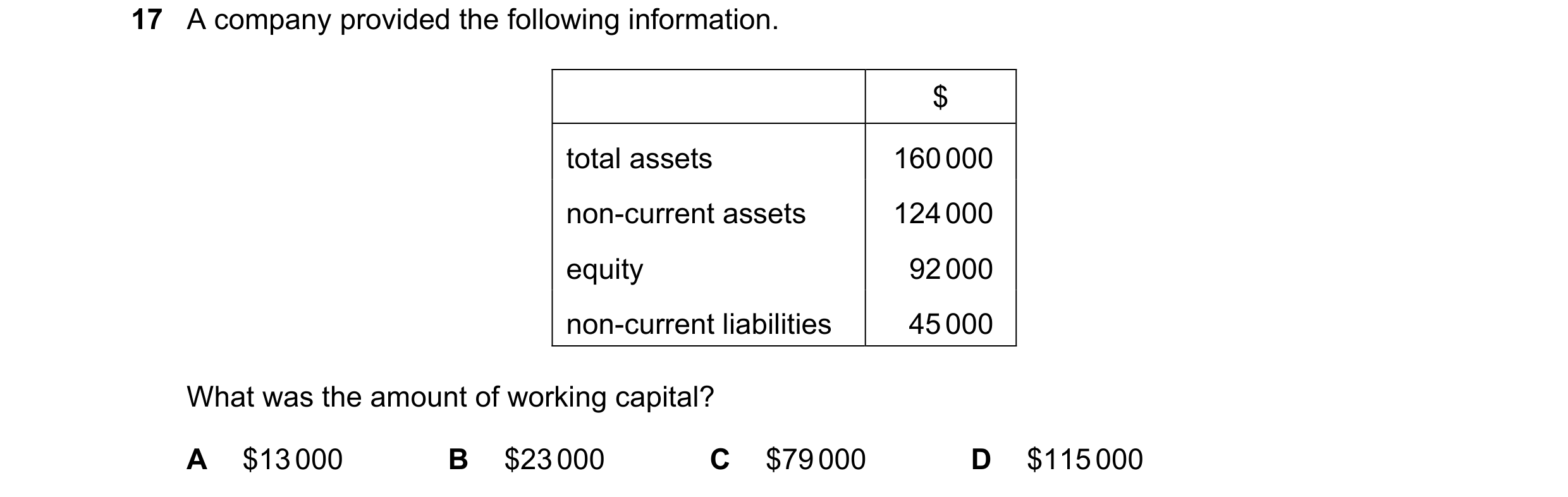
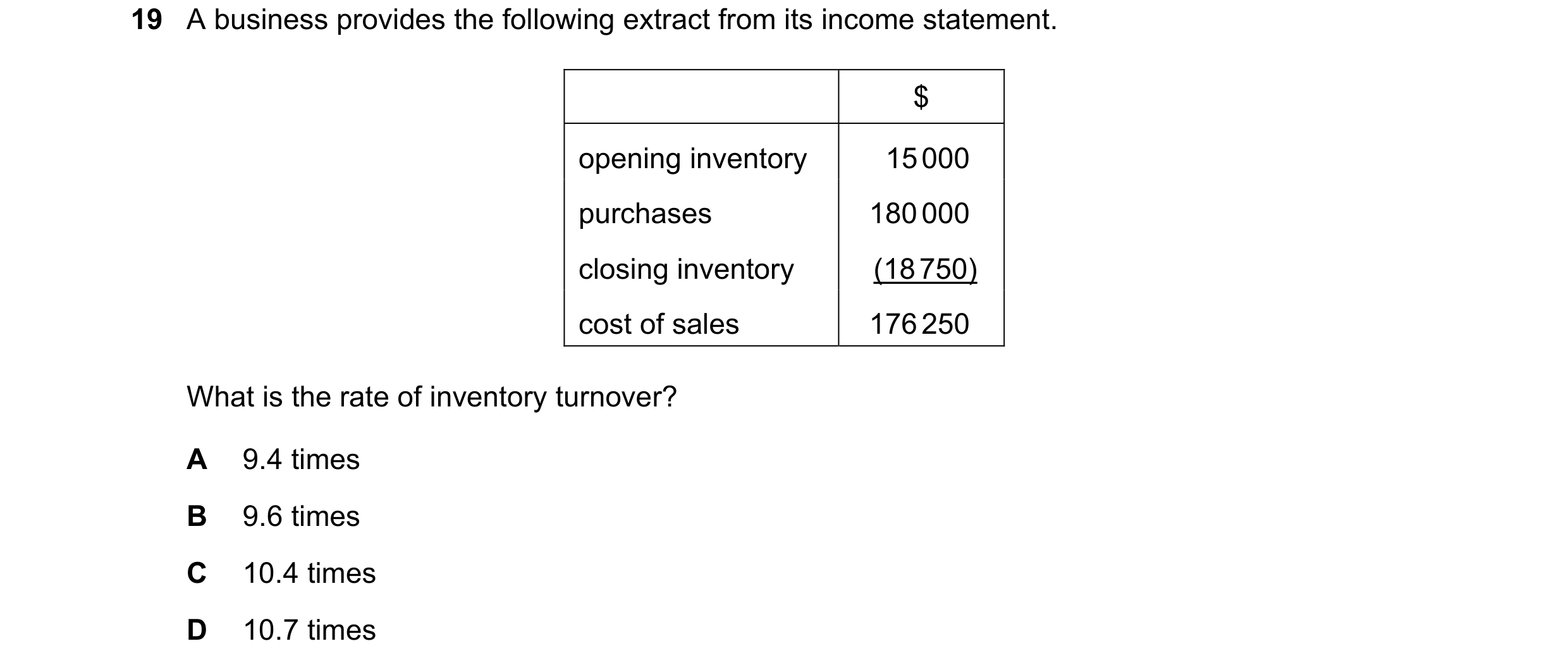 61 / 85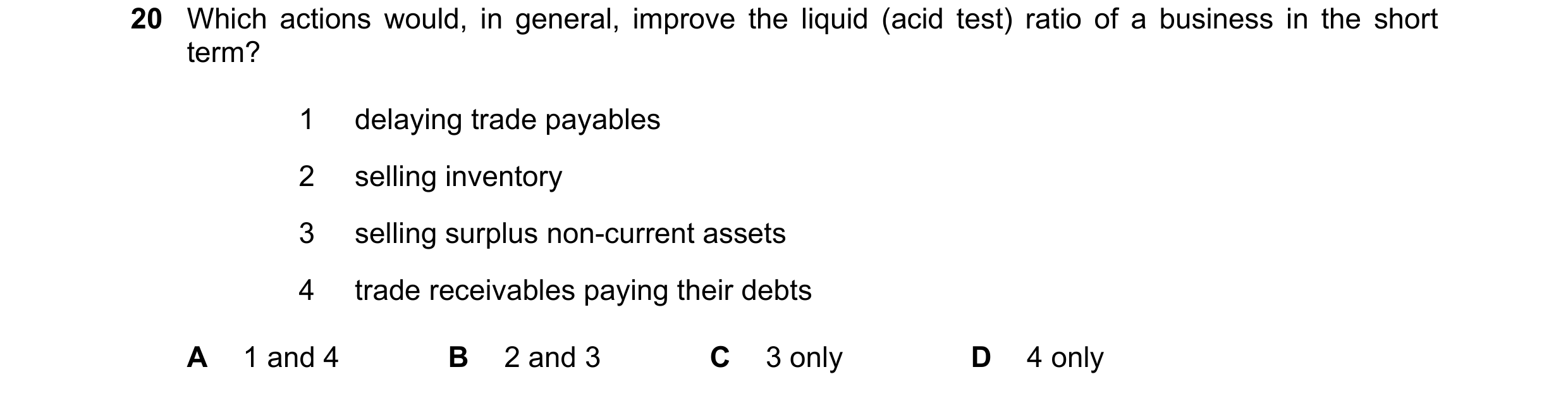

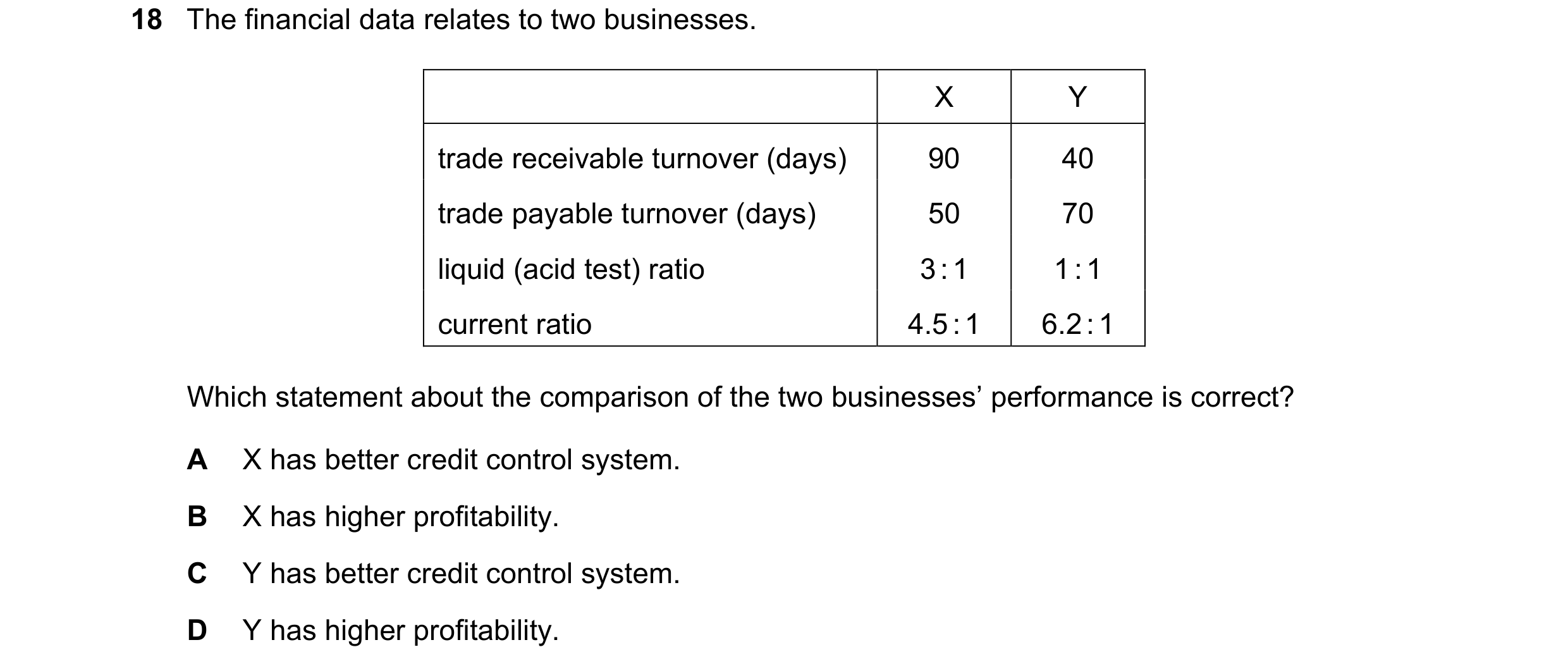
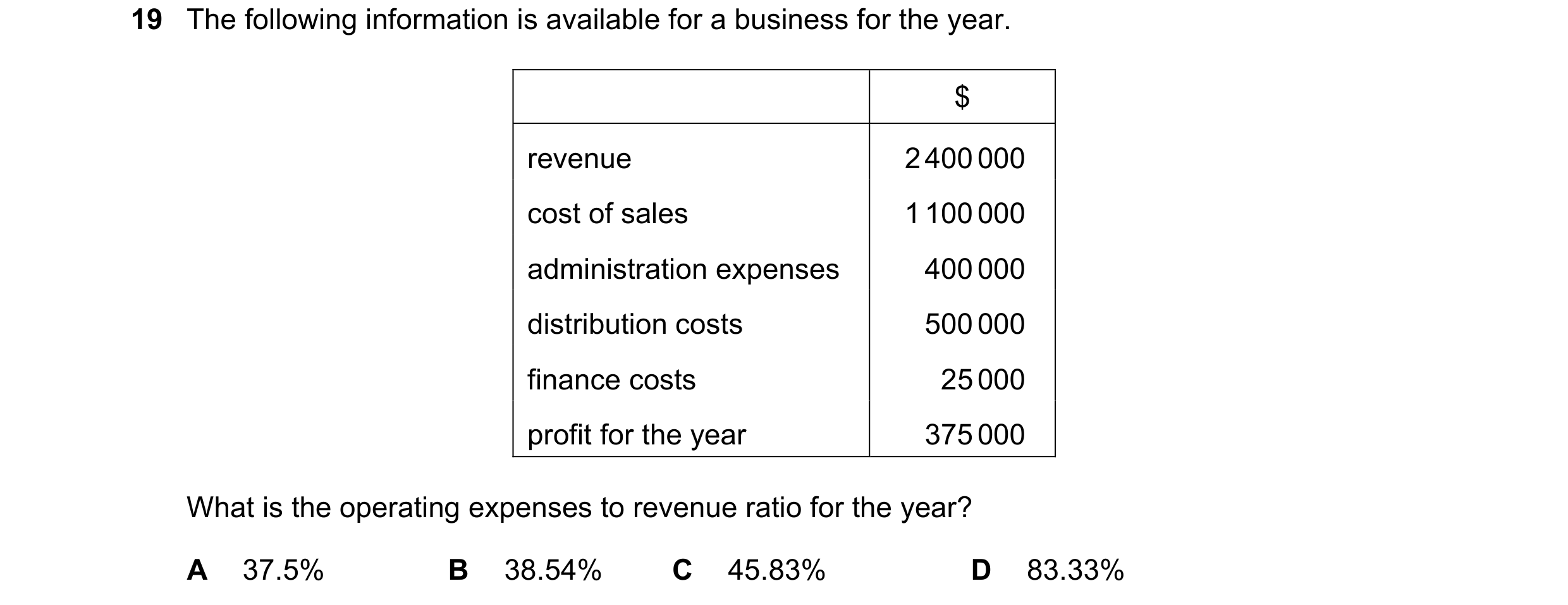 62 / 85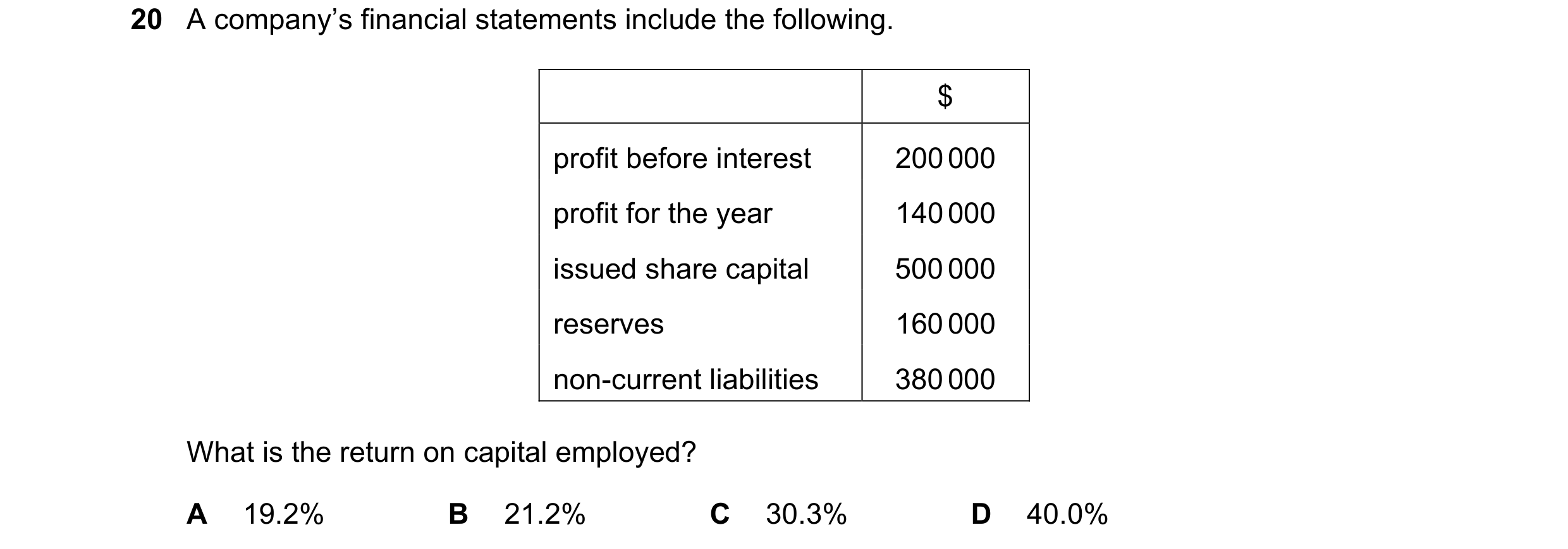


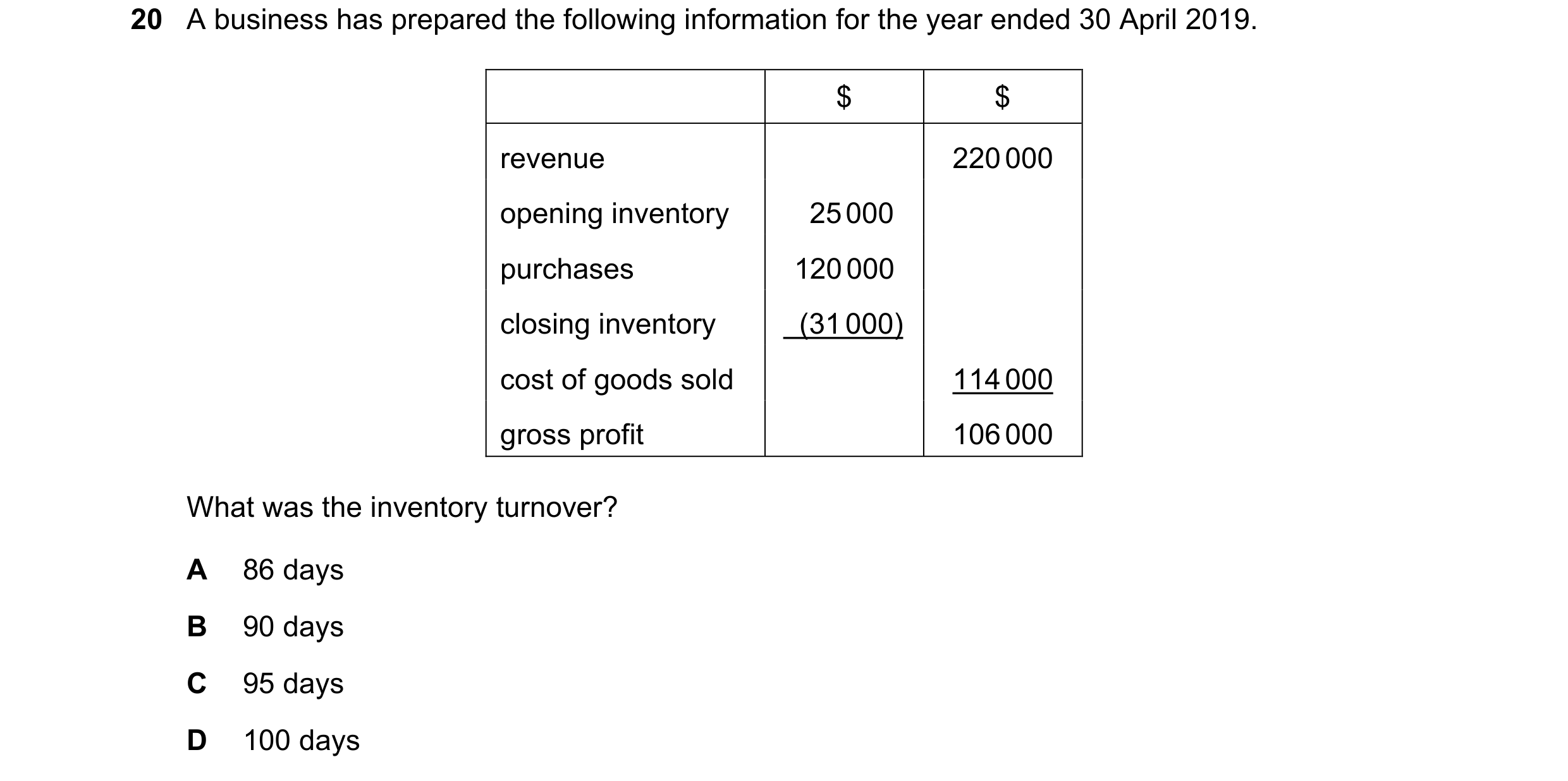 63 / 85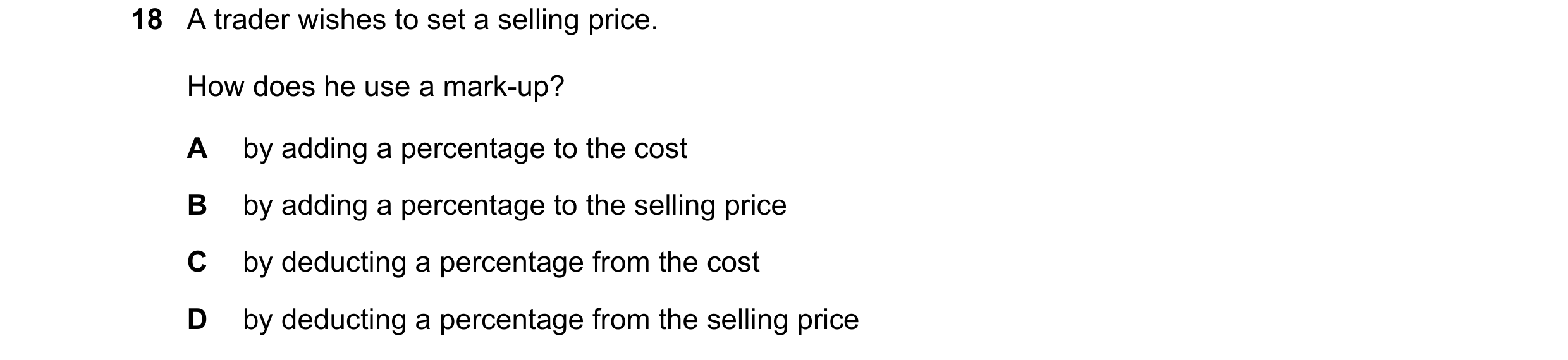
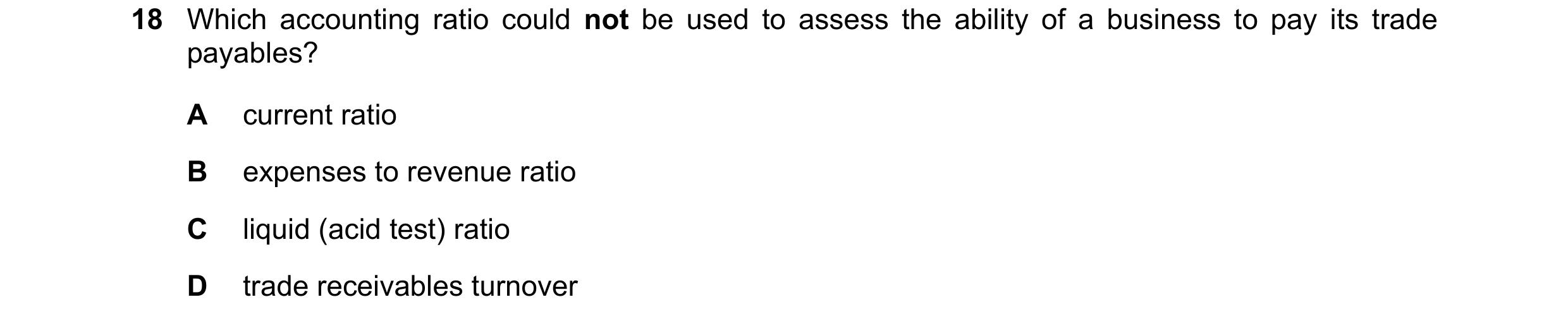
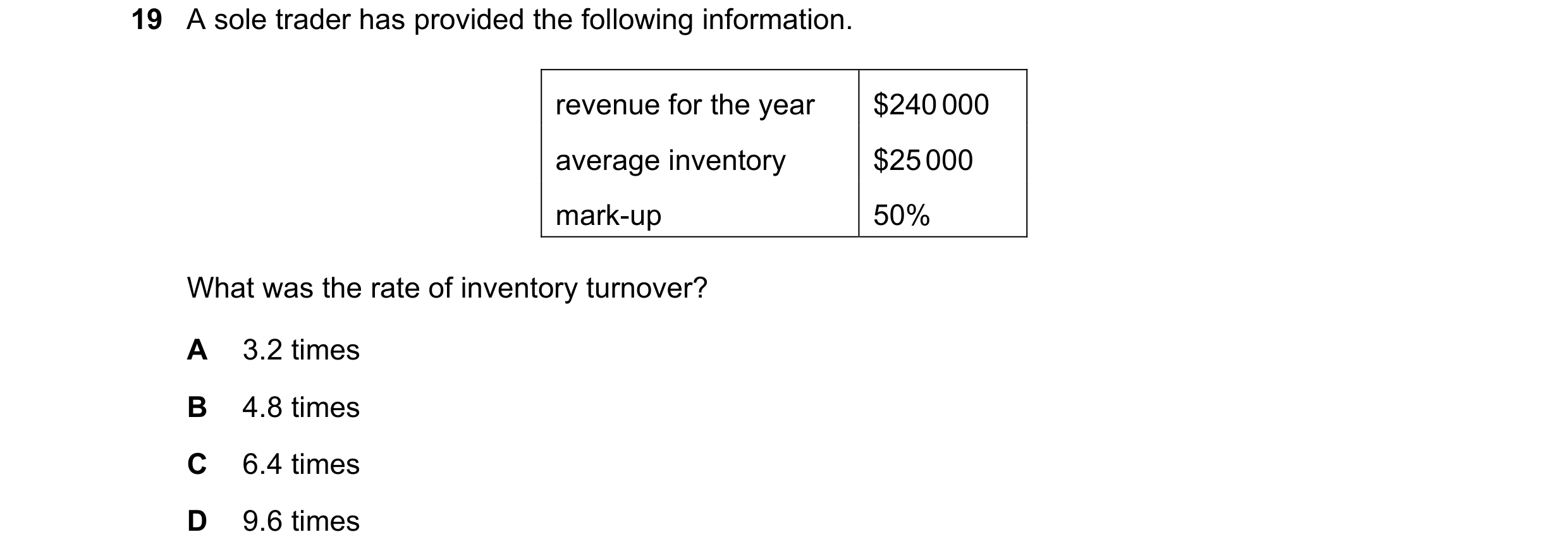
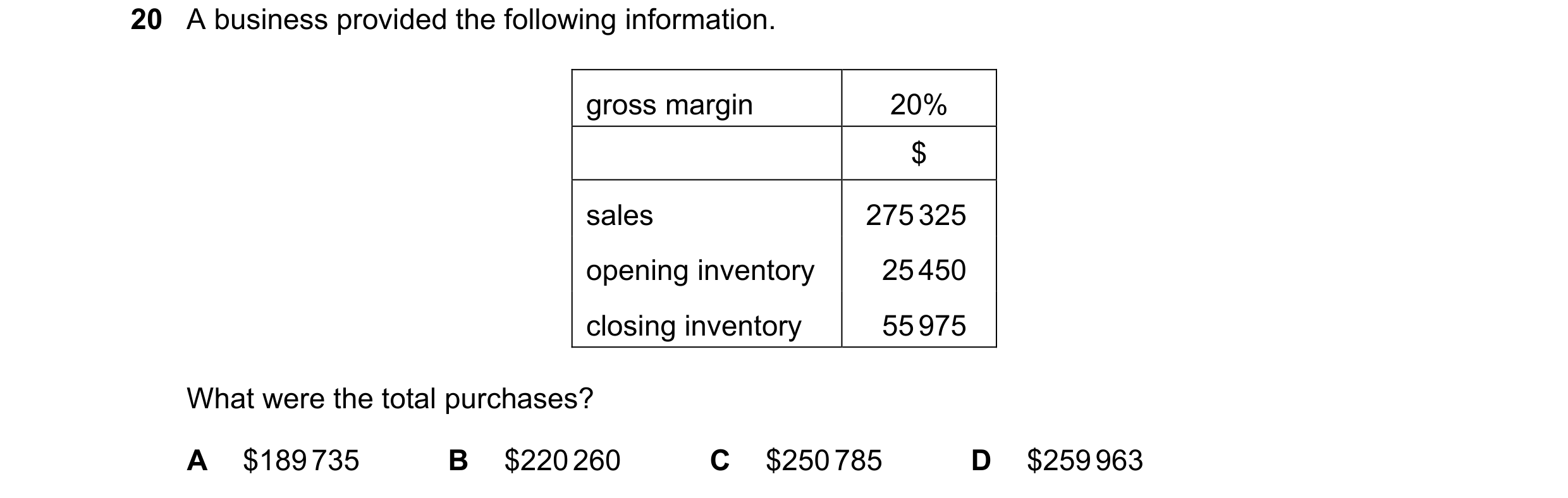
 64 / 85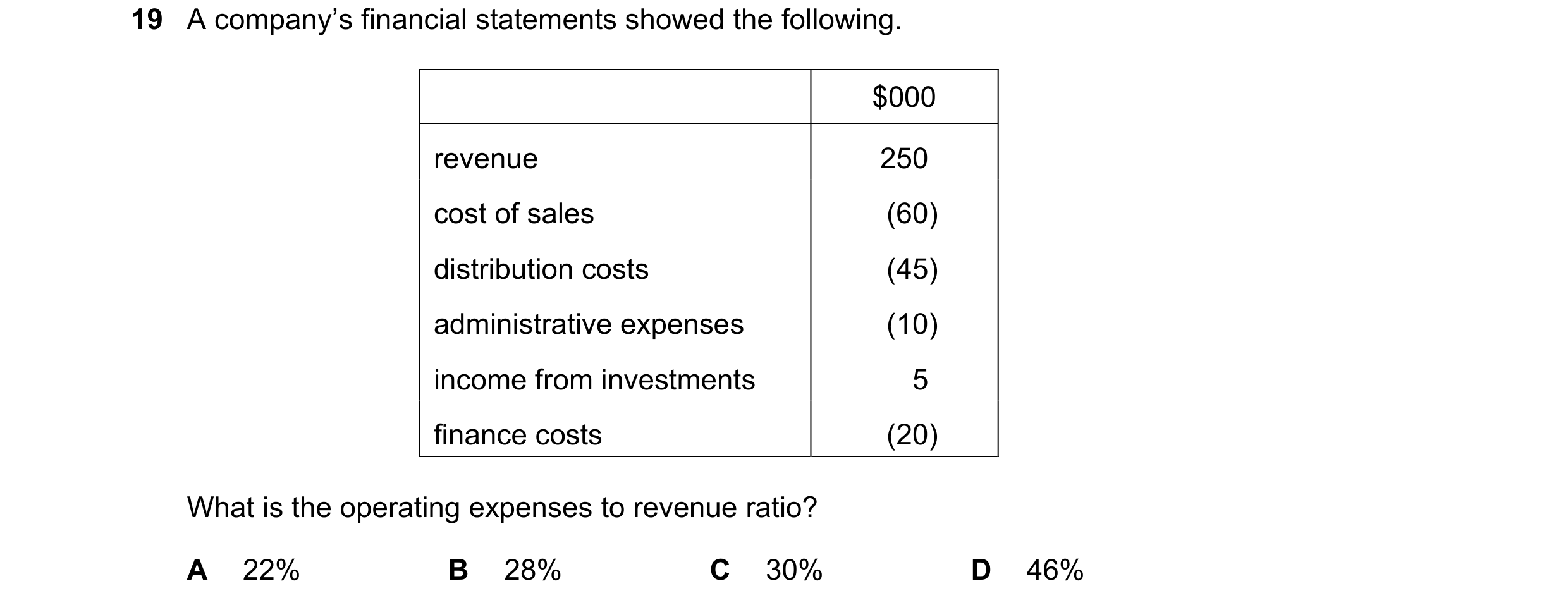

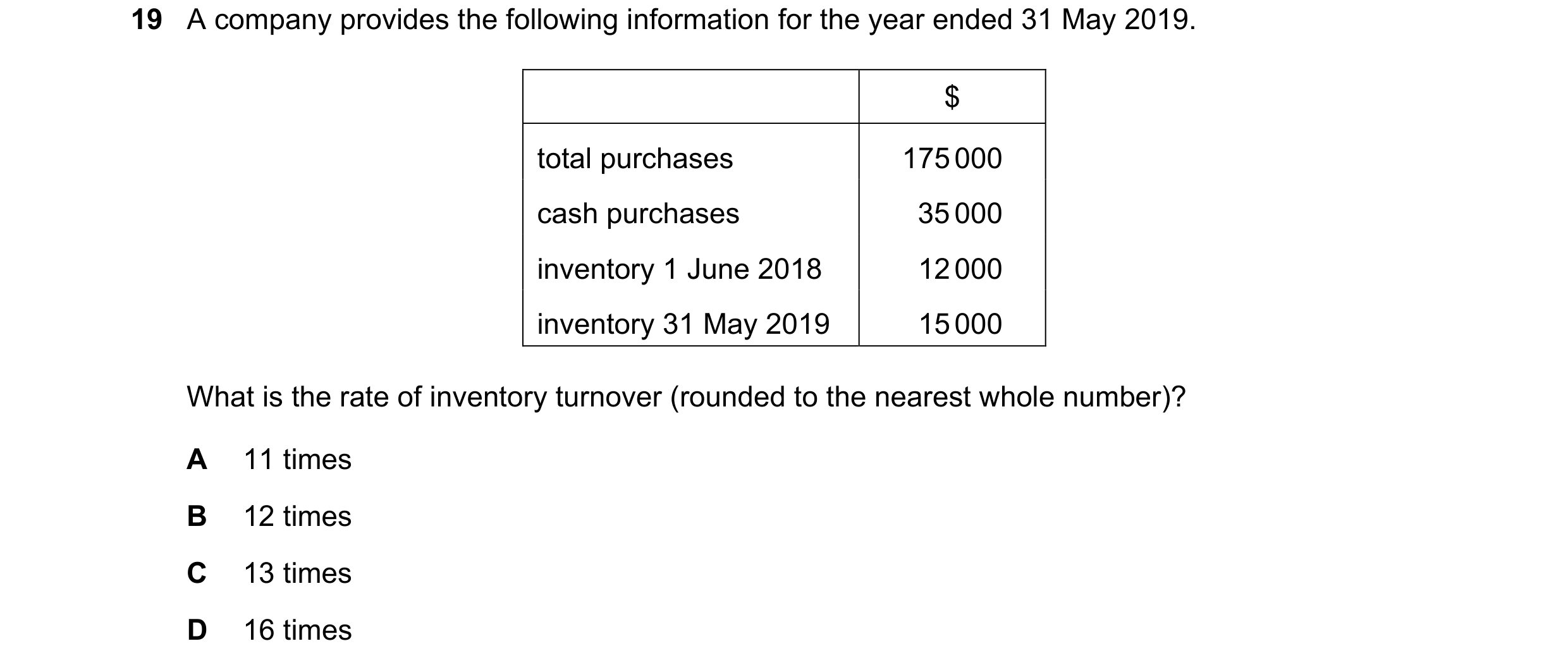
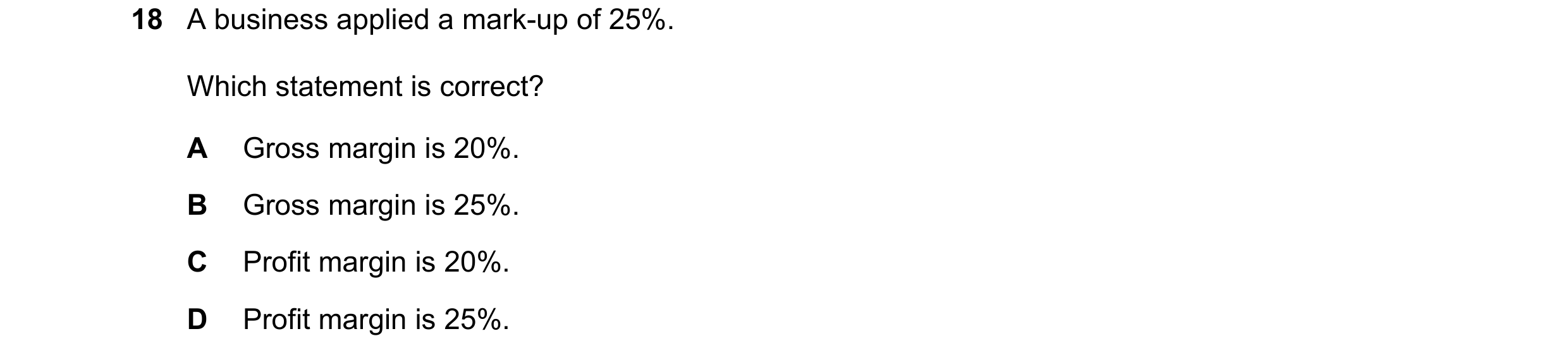 65 / 85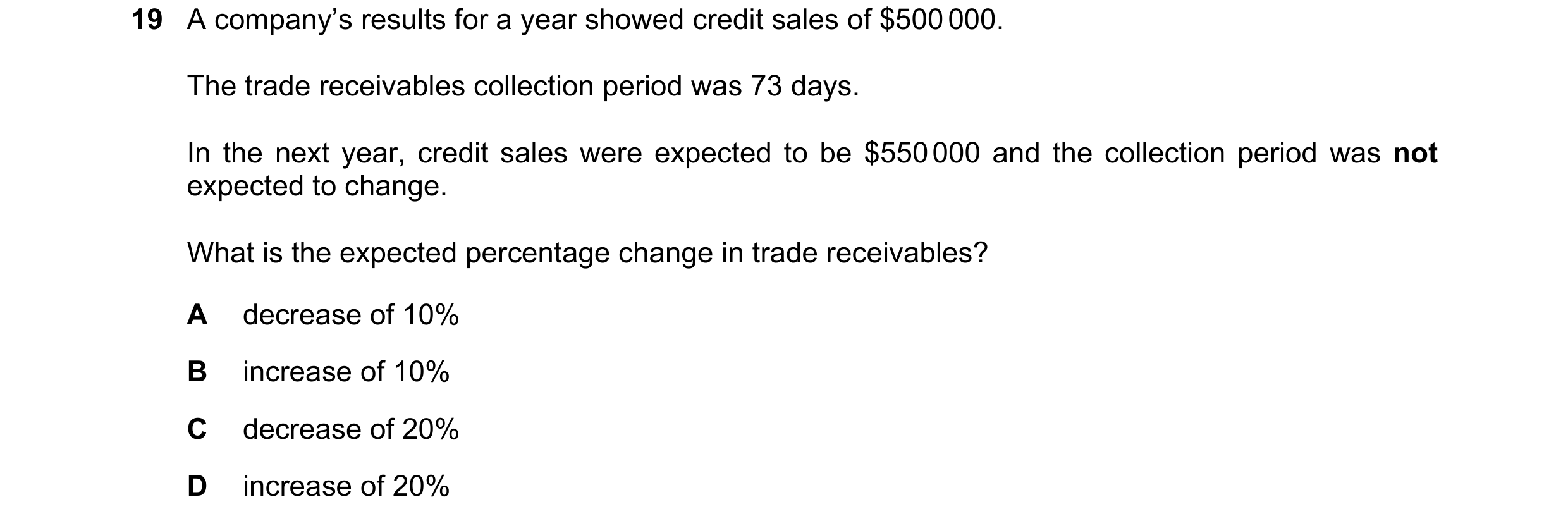
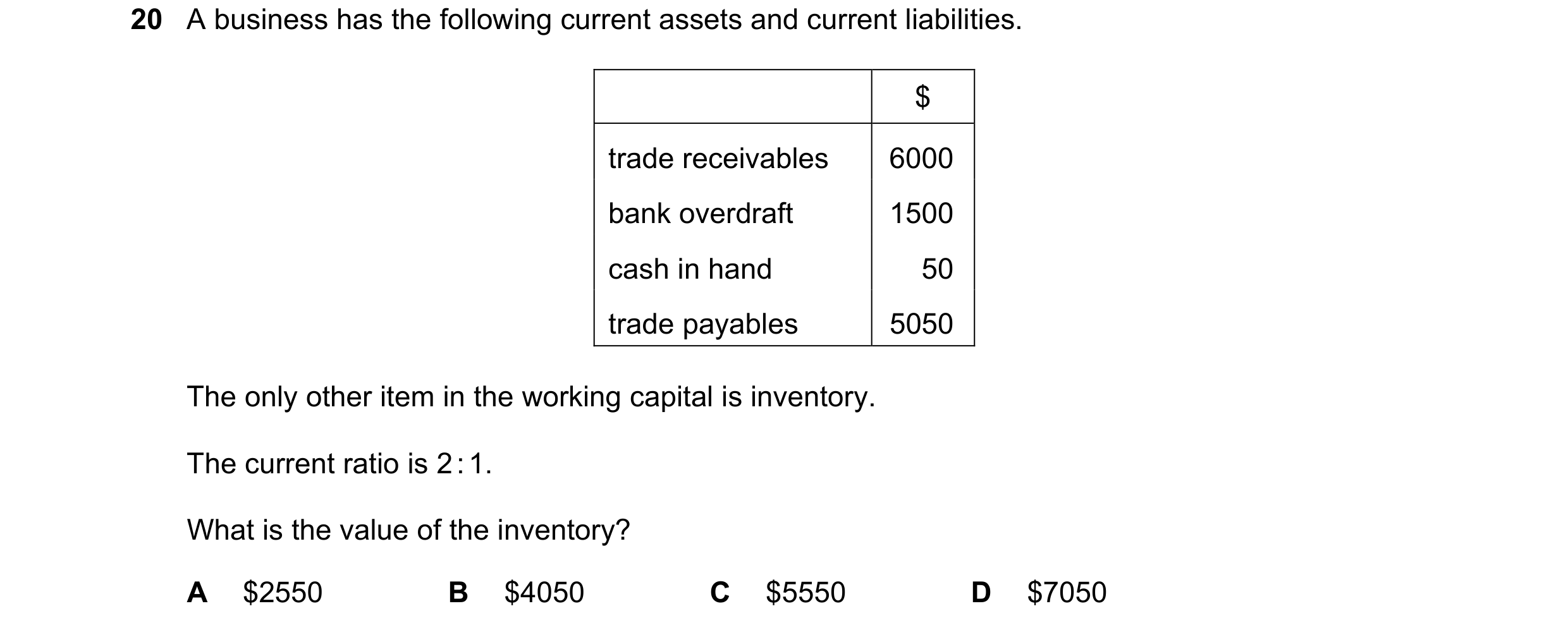
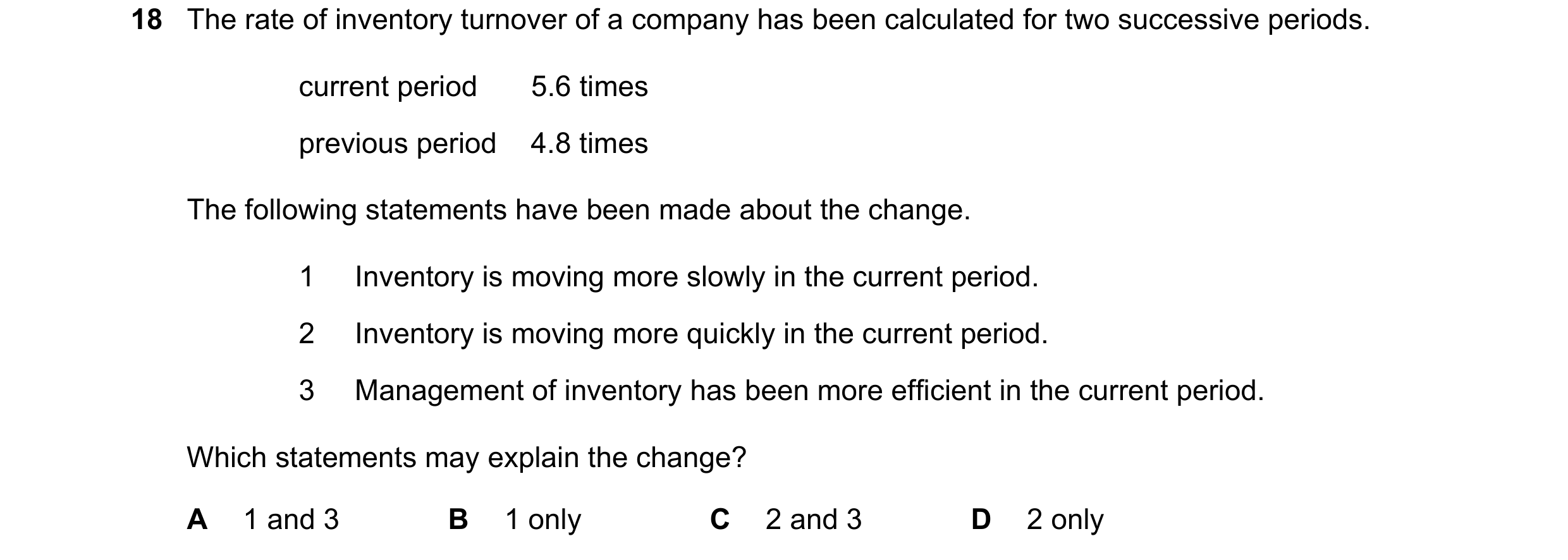 66 / 85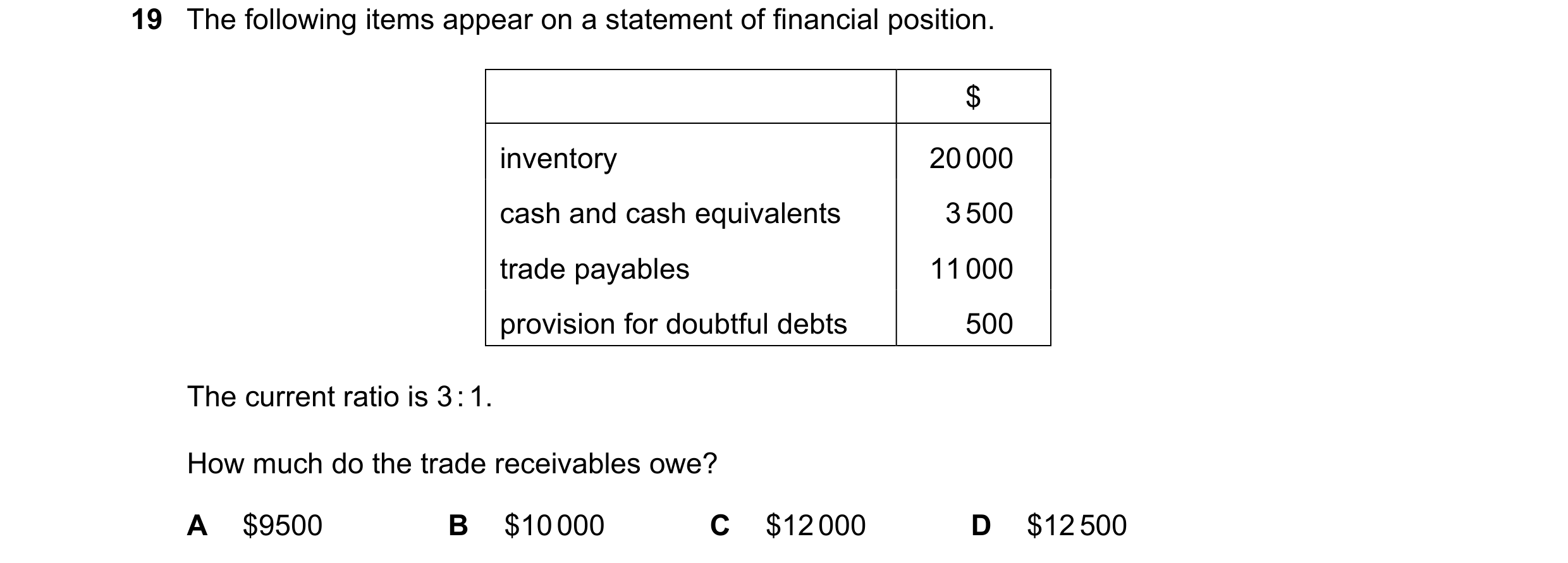
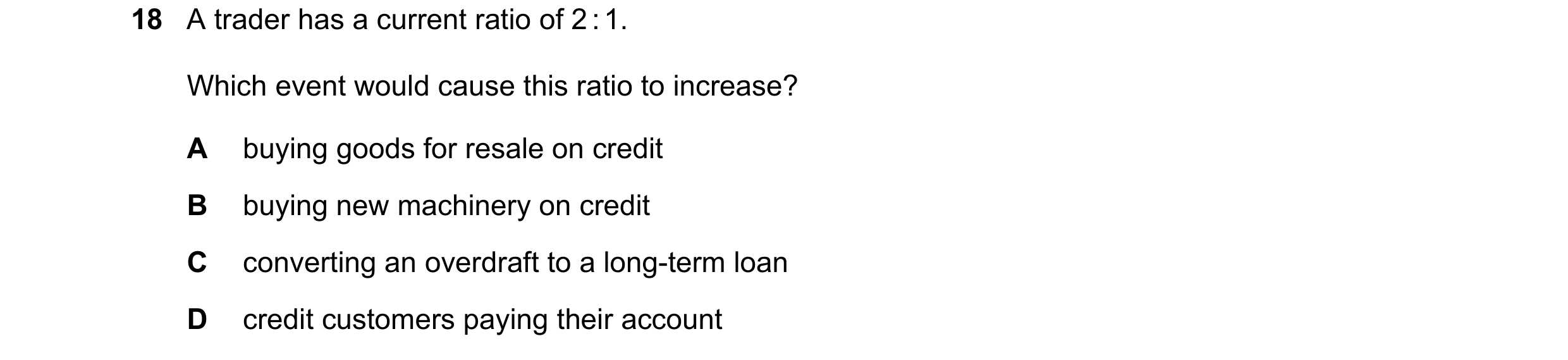
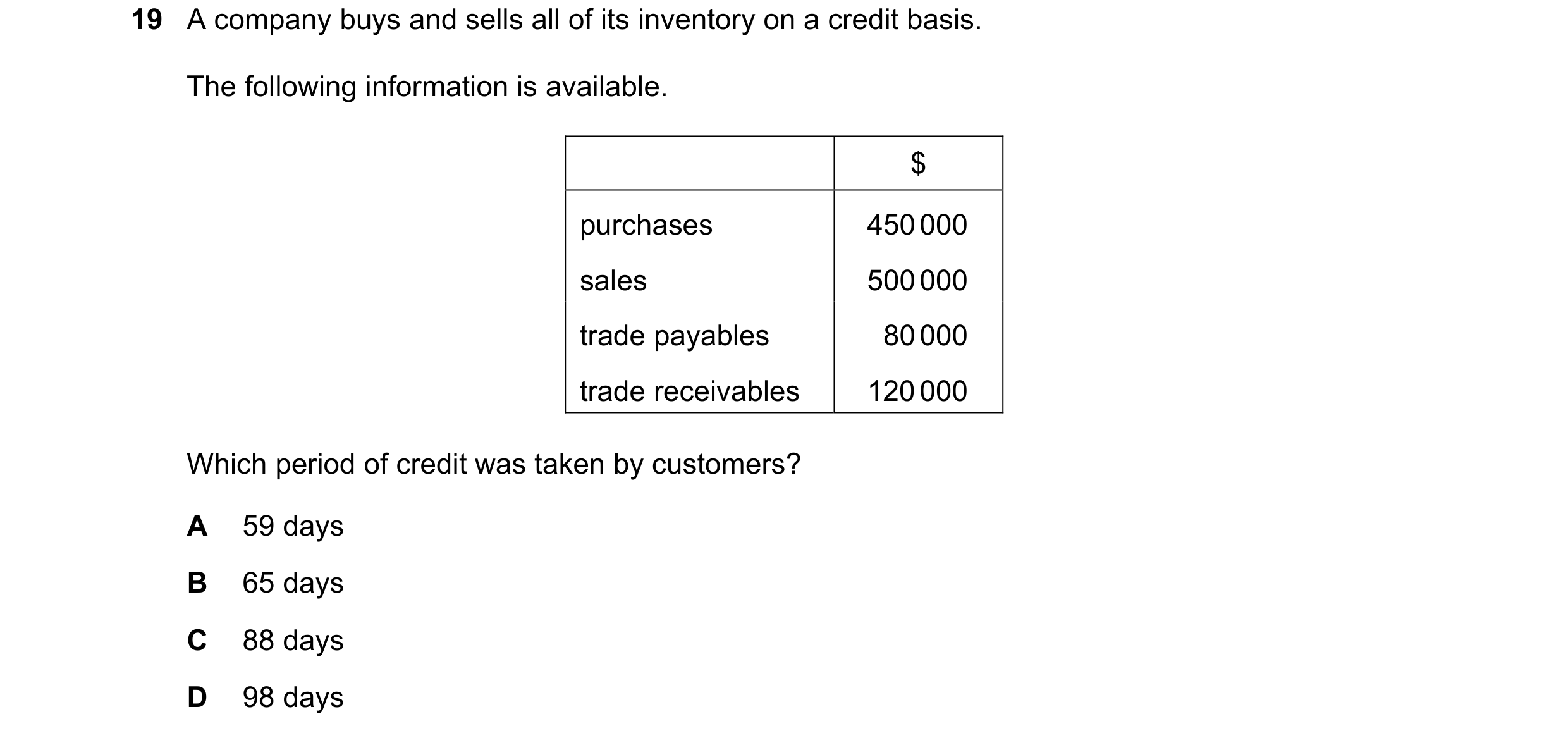
 67 / 85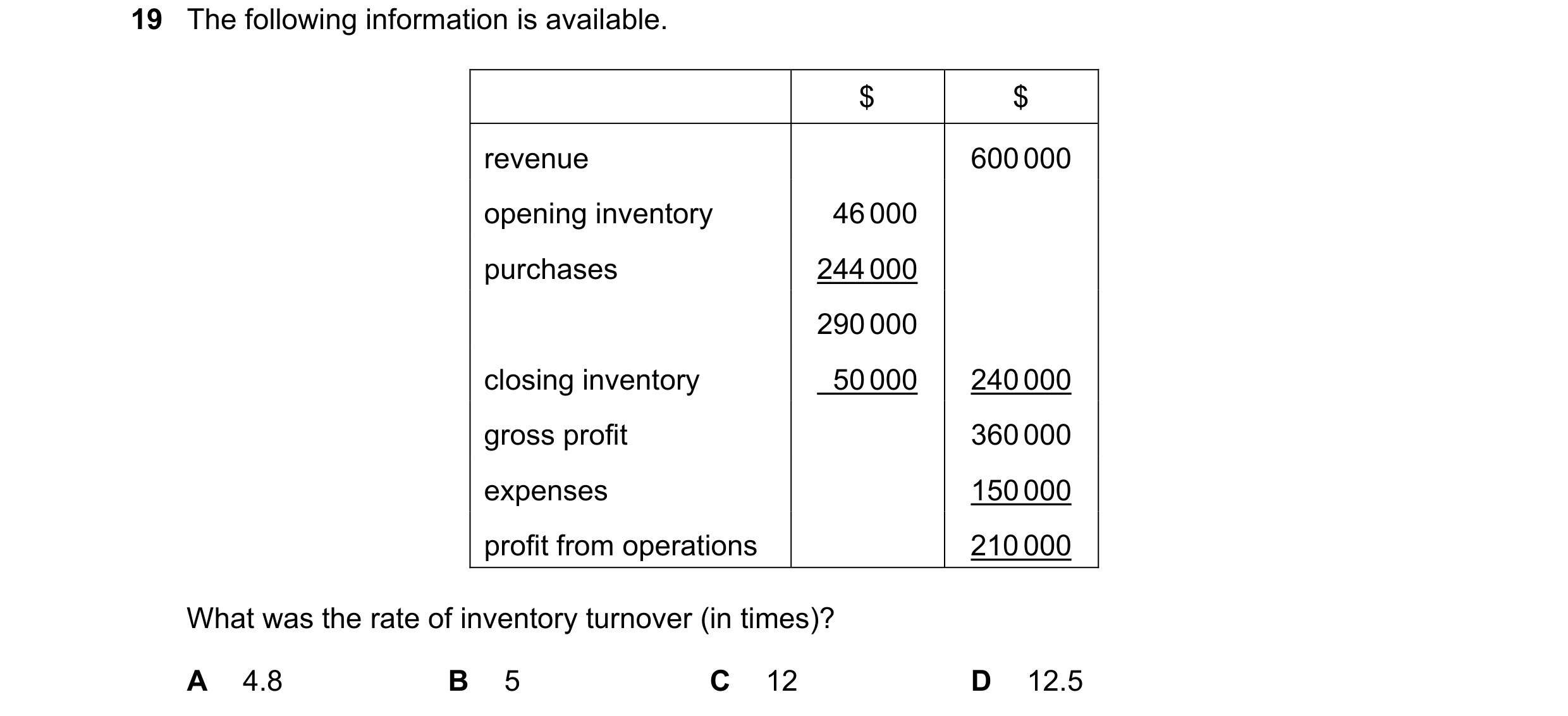
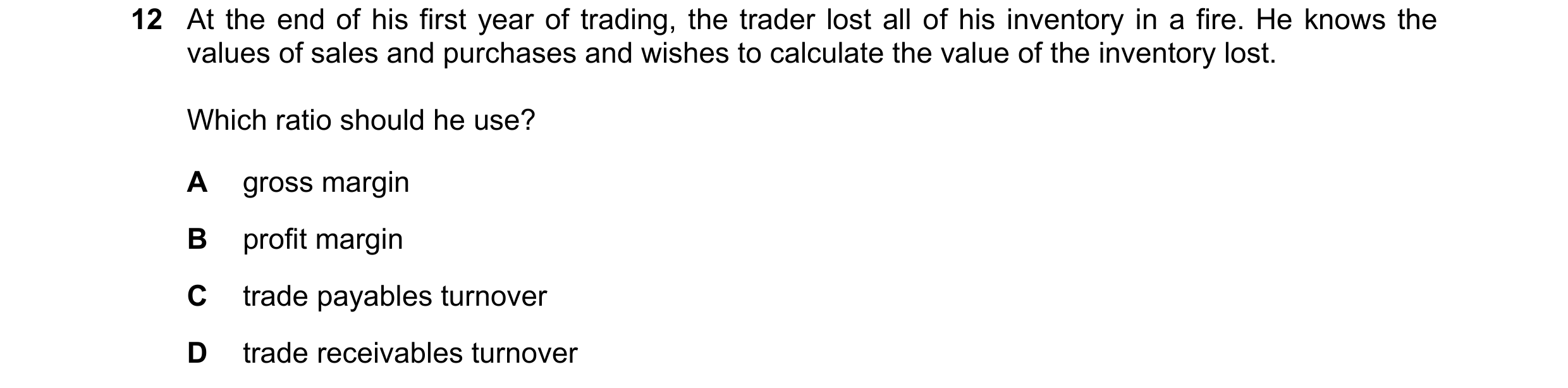
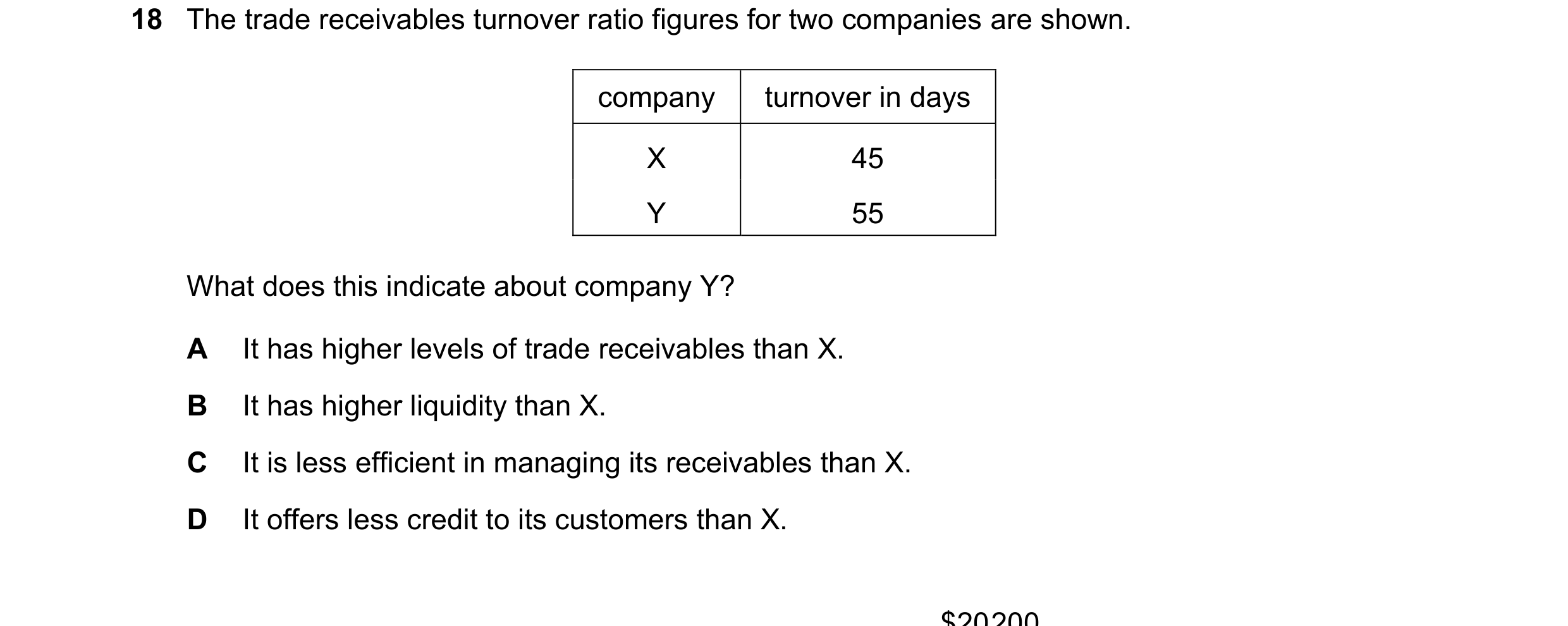 68 / 85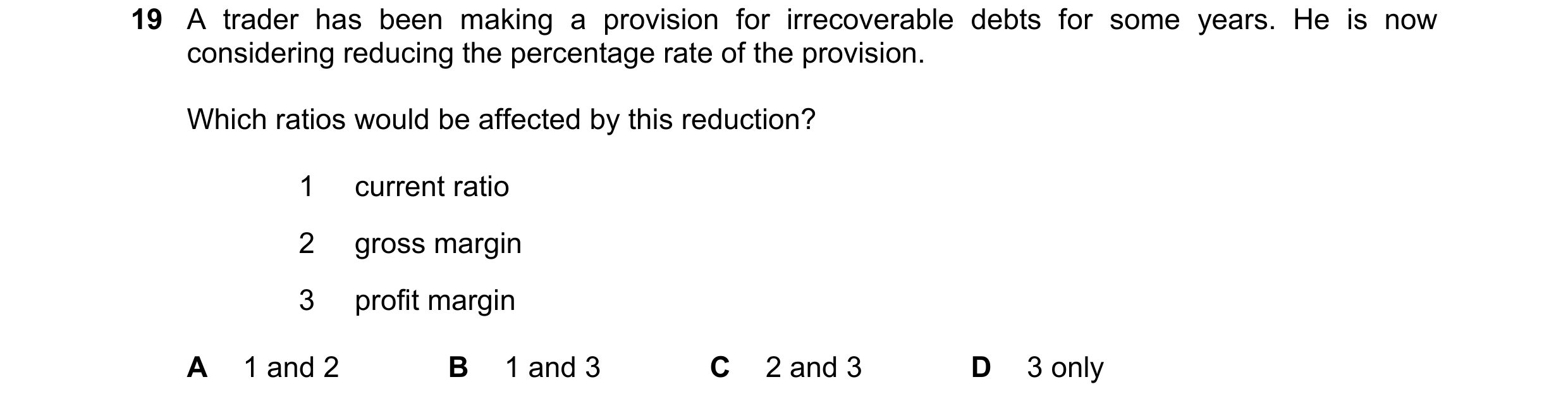
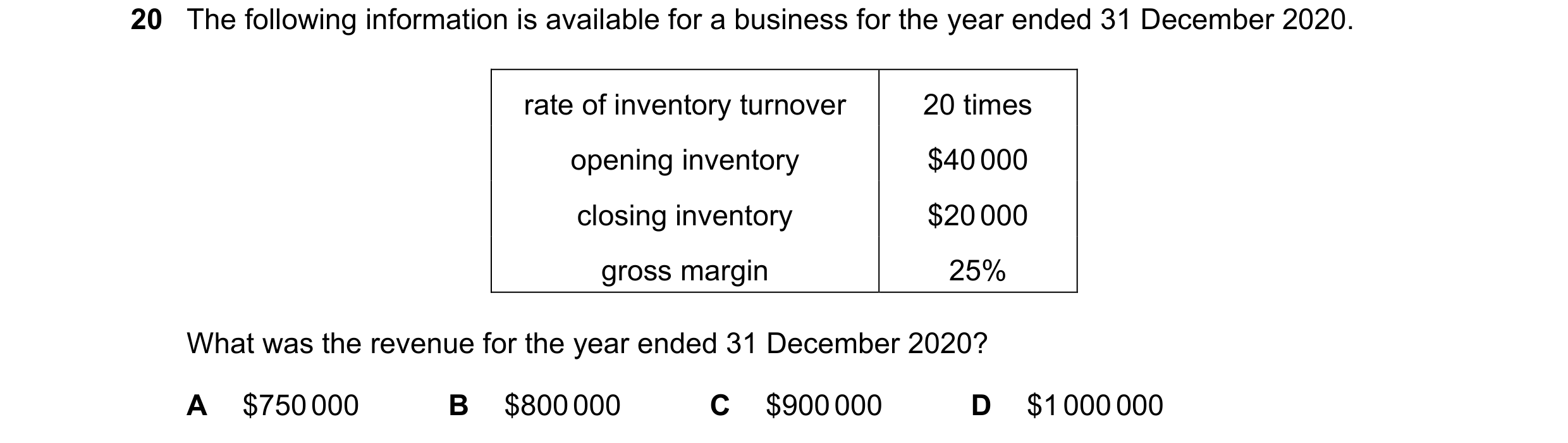
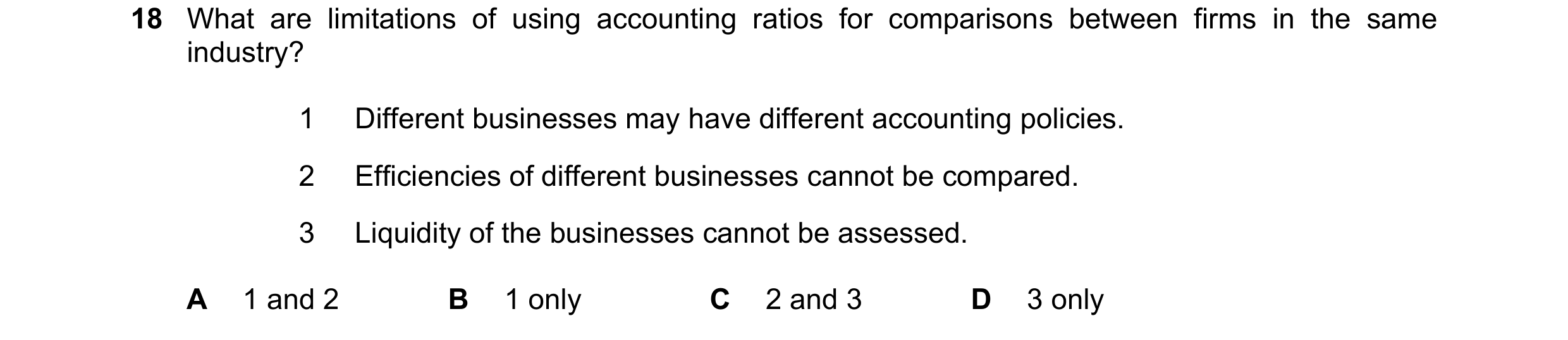
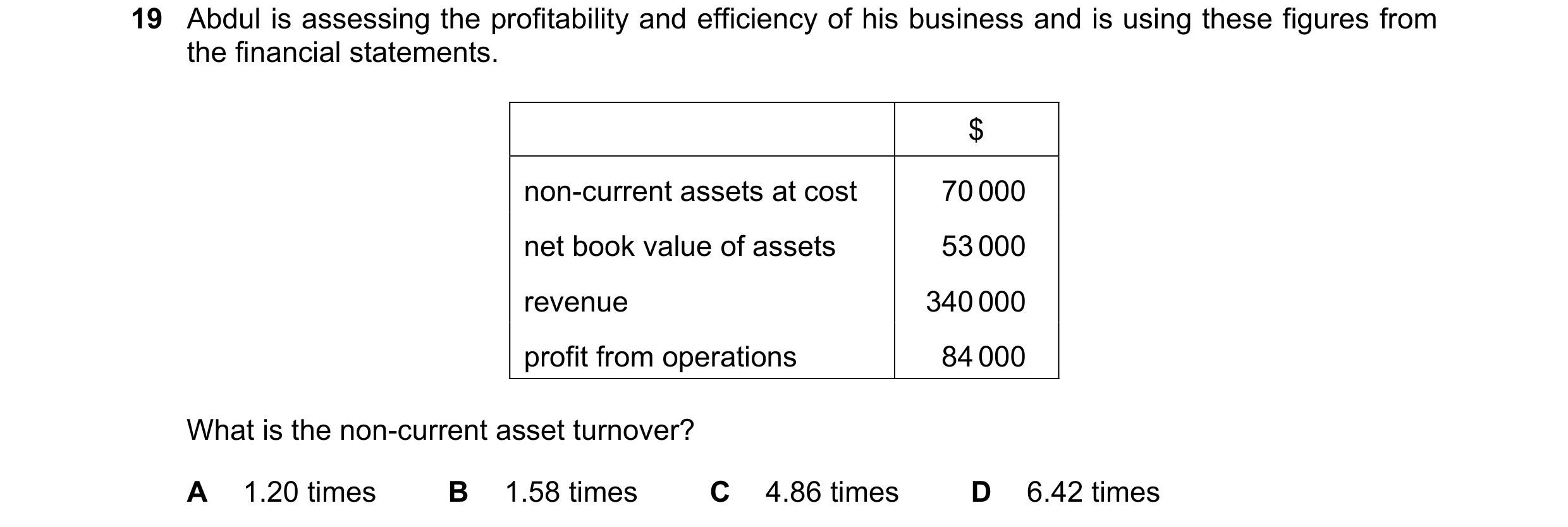 69 / 85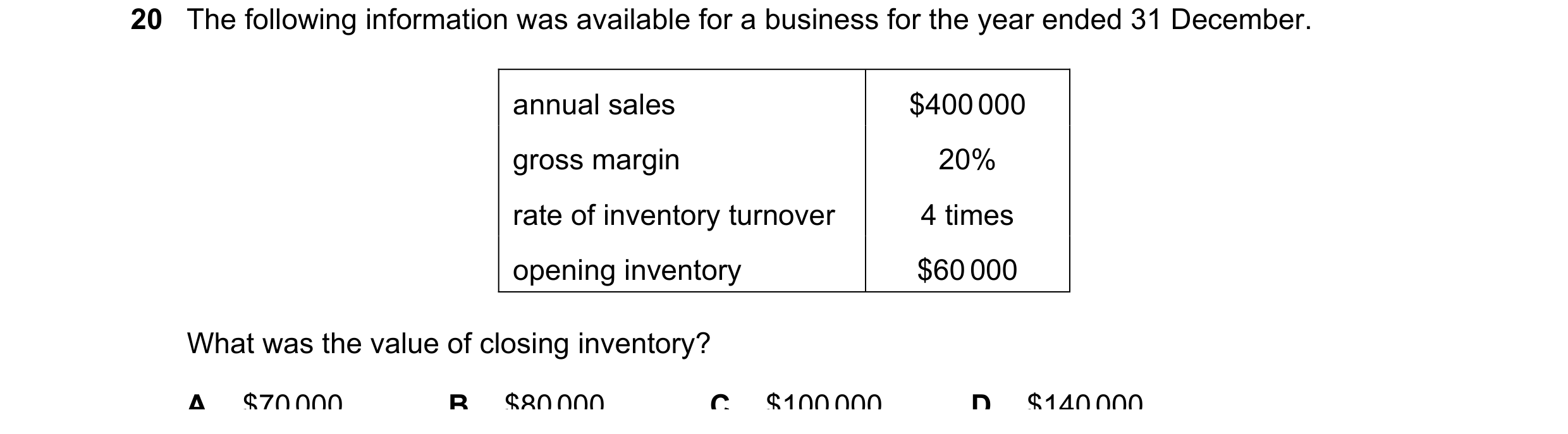
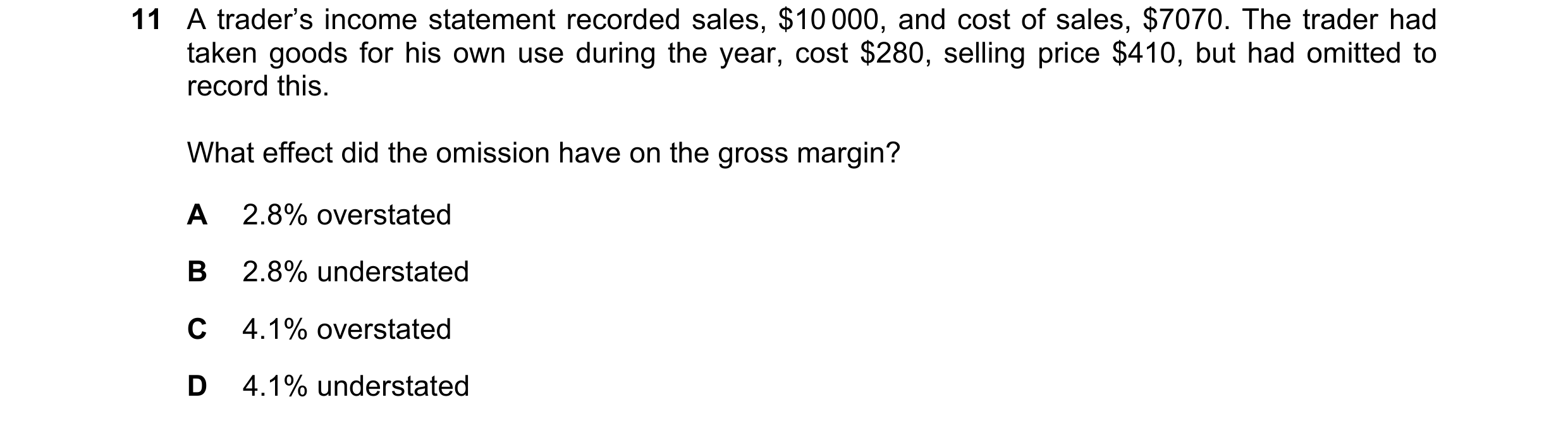
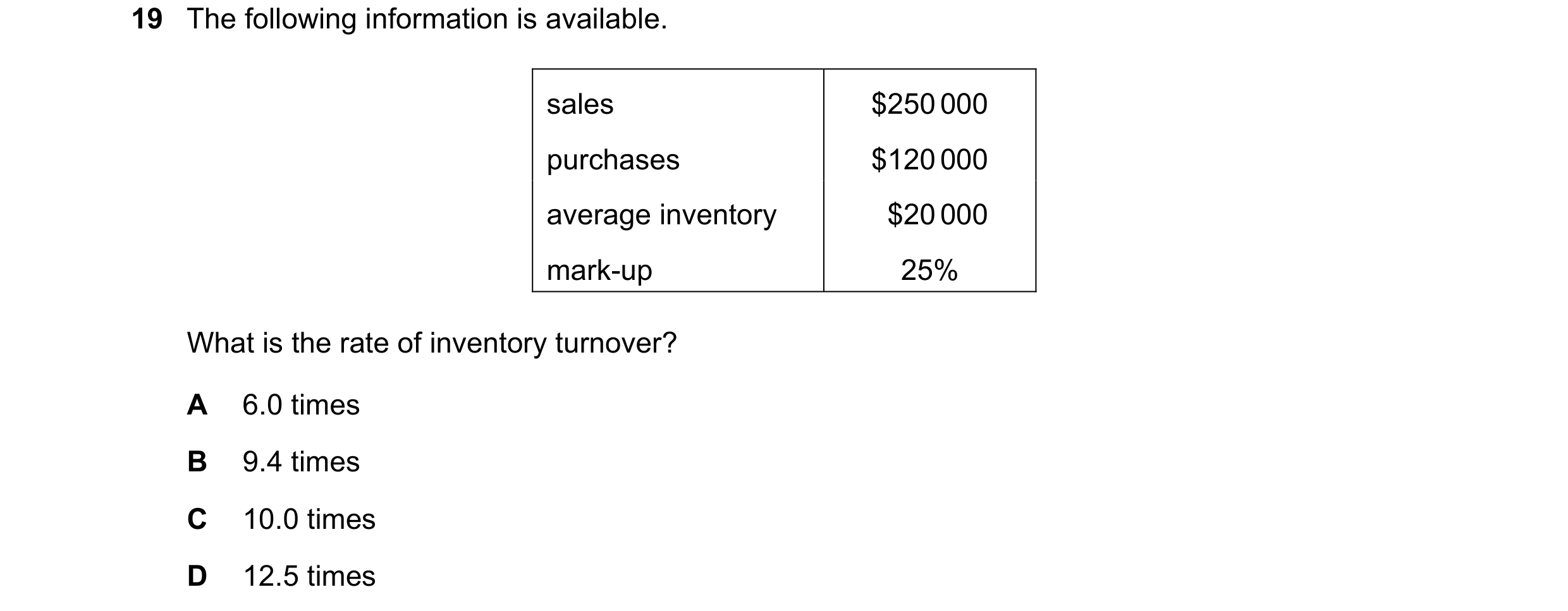
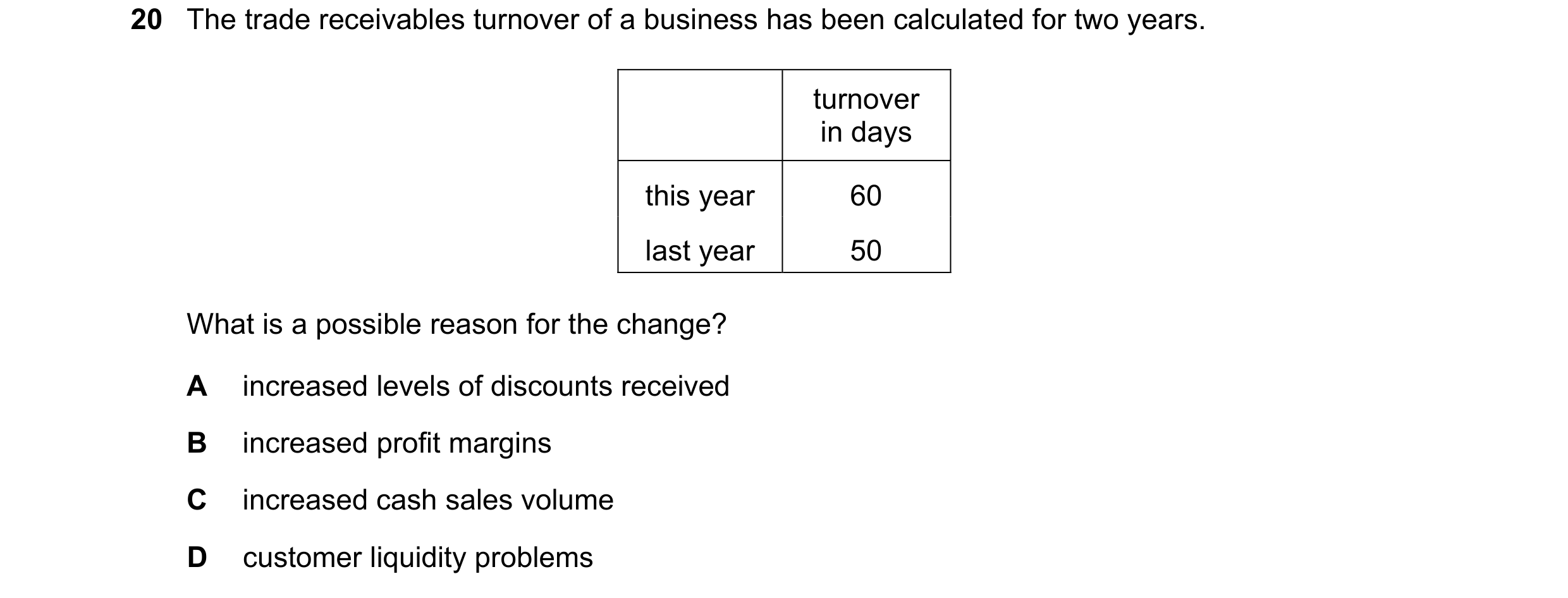 70 / 85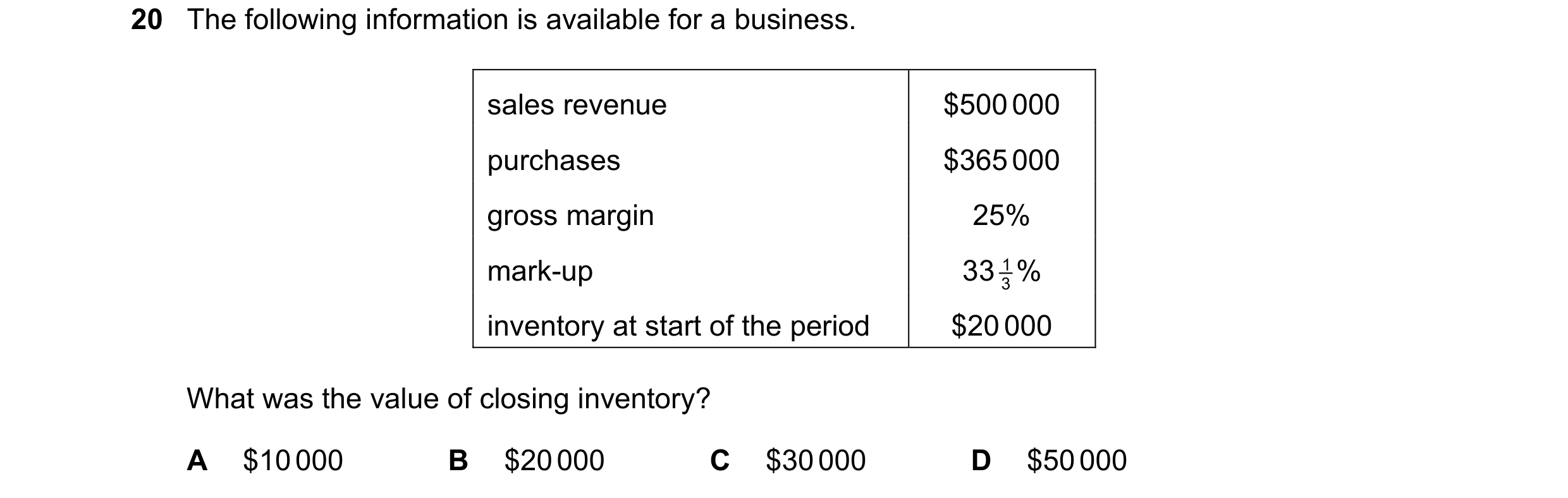
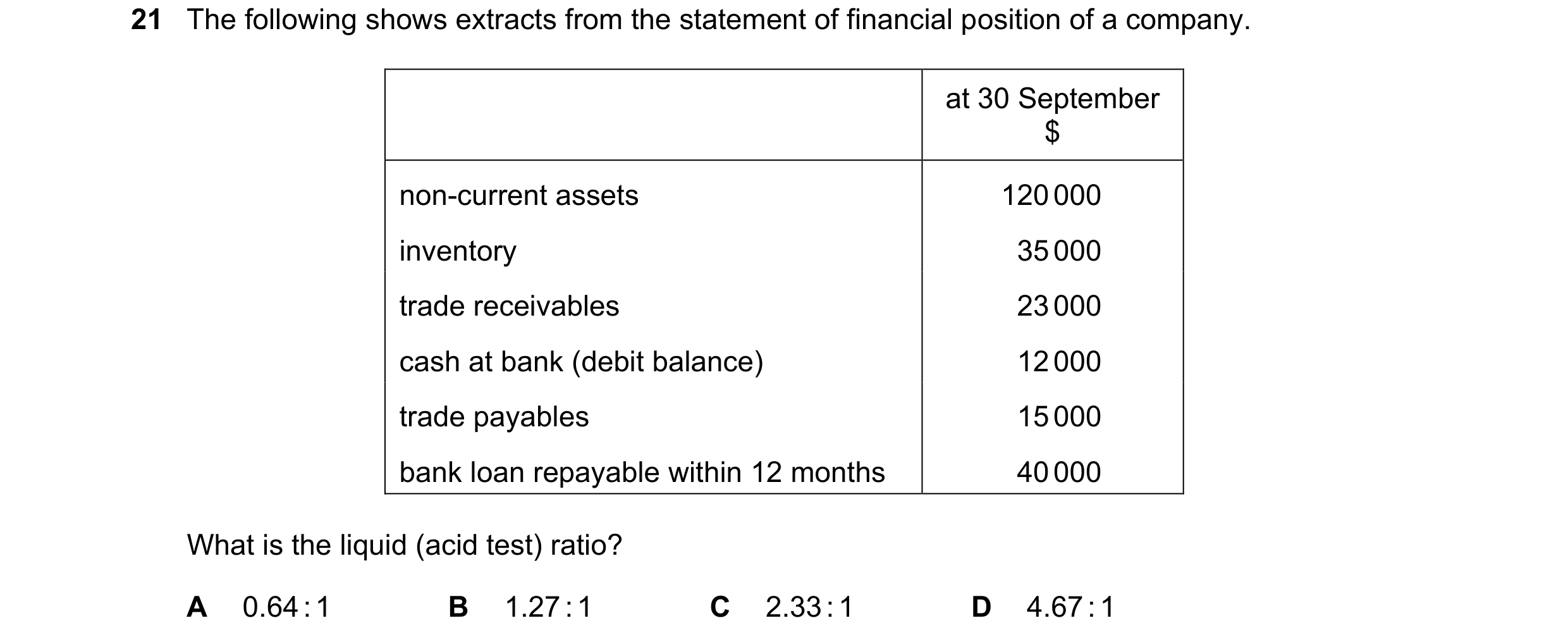

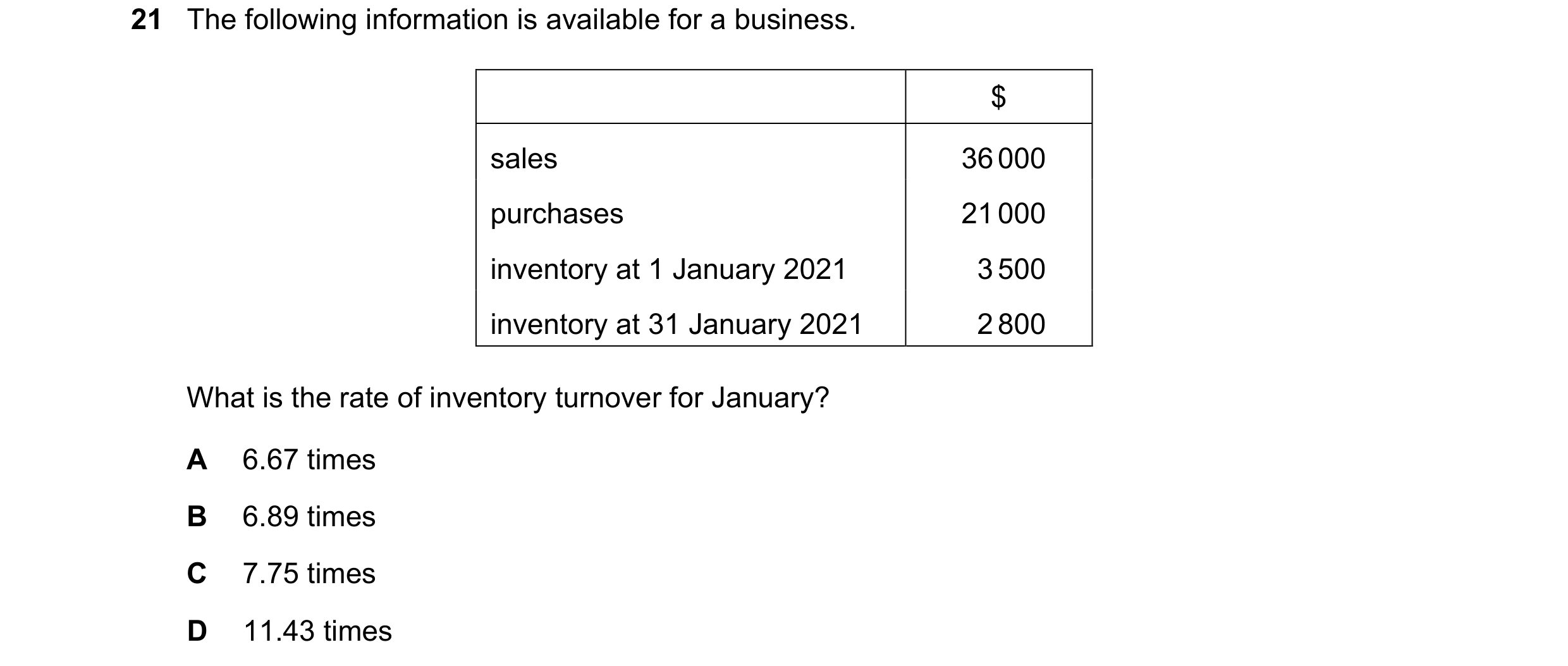 71 / 85
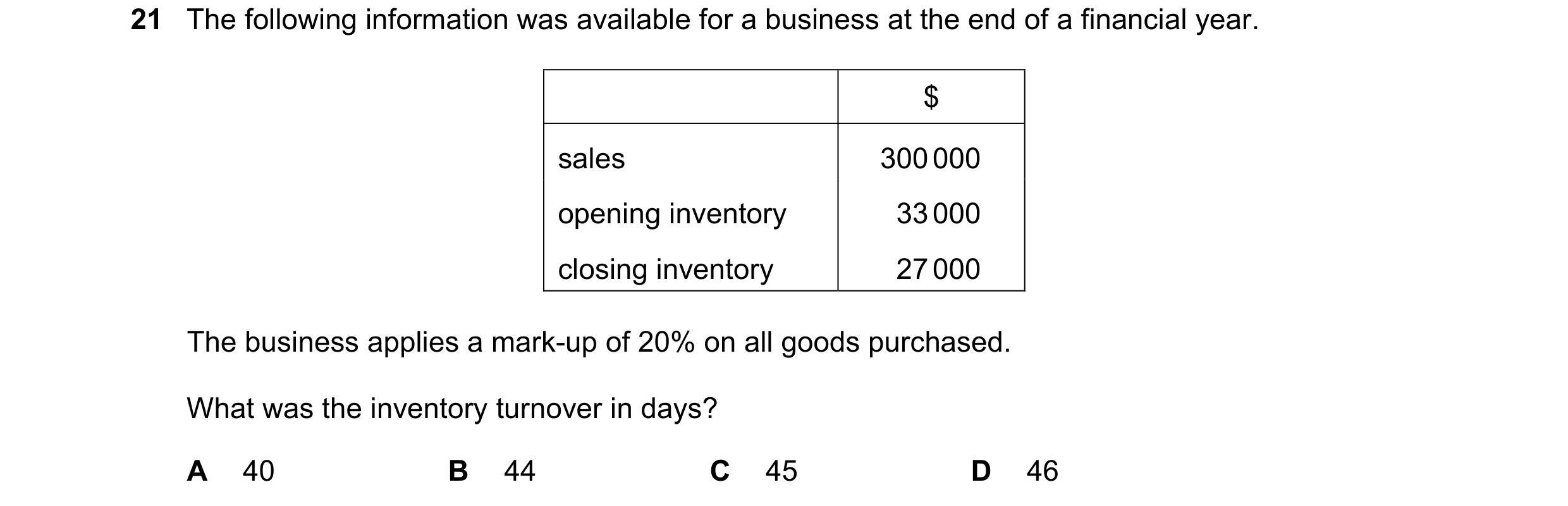
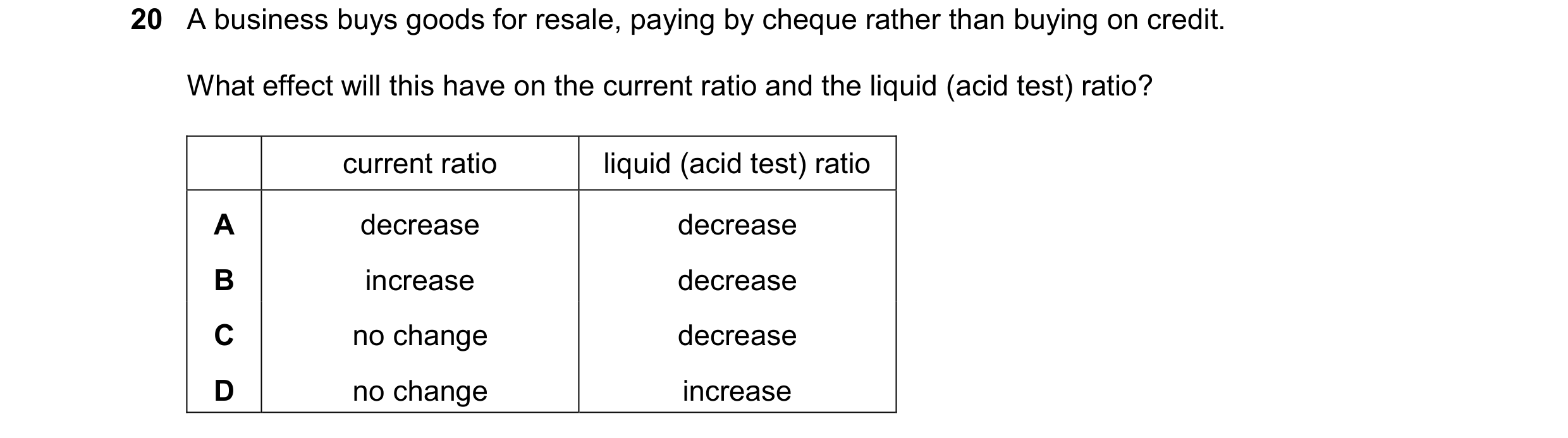
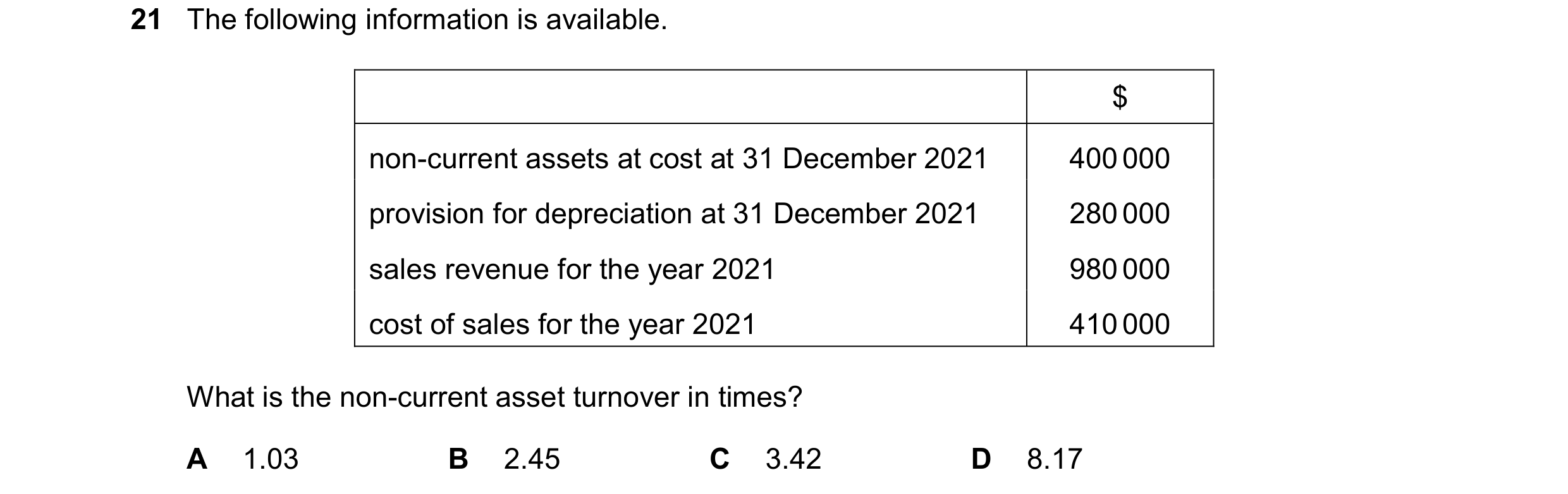 72 / 85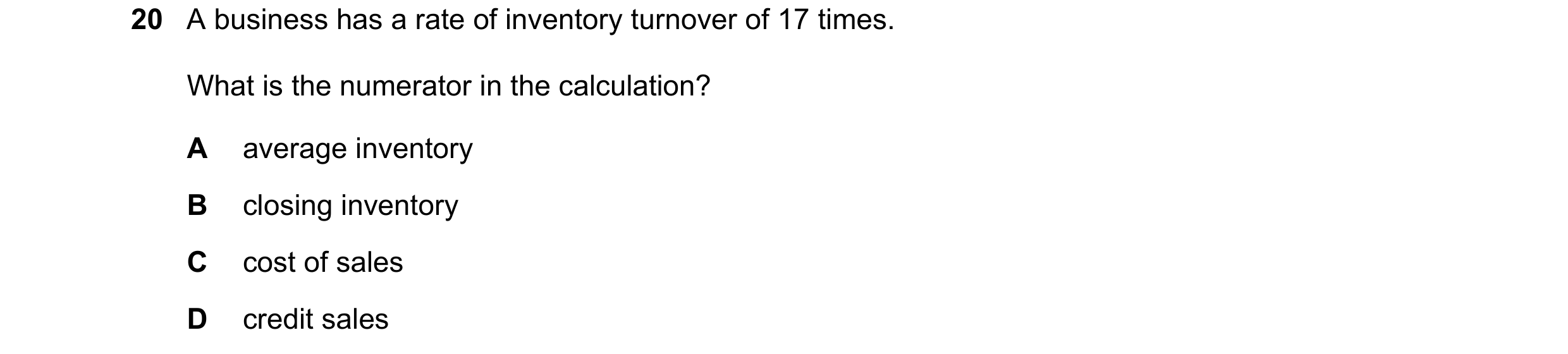
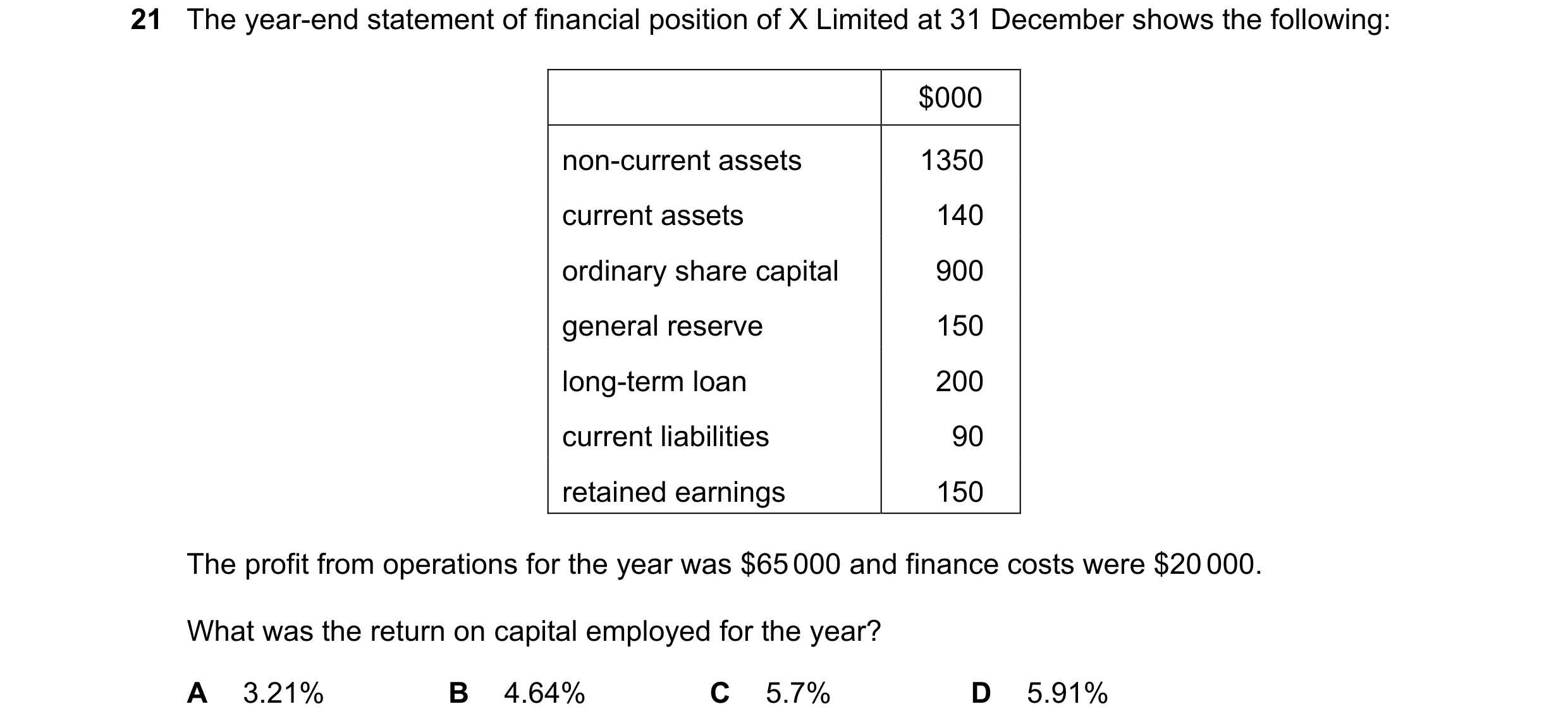

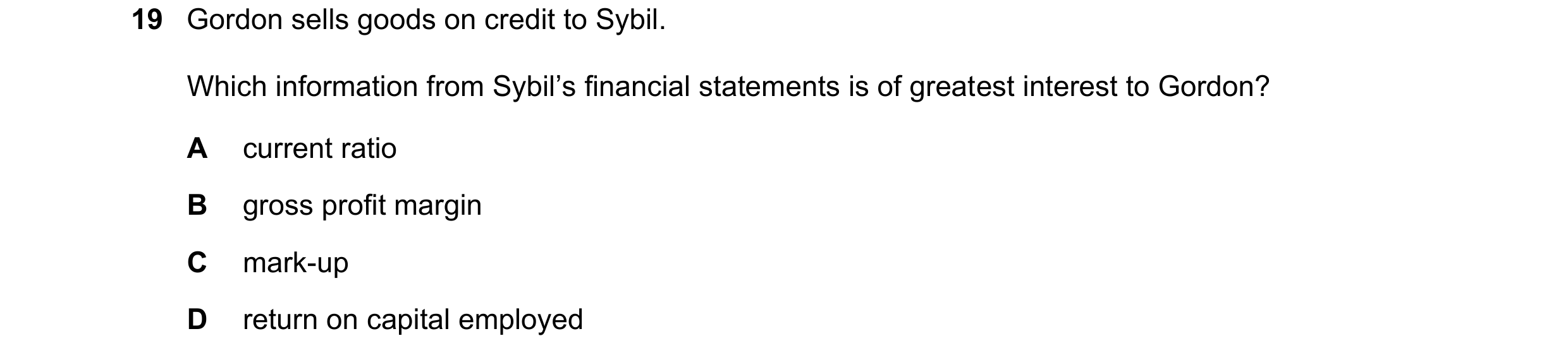 73 / 85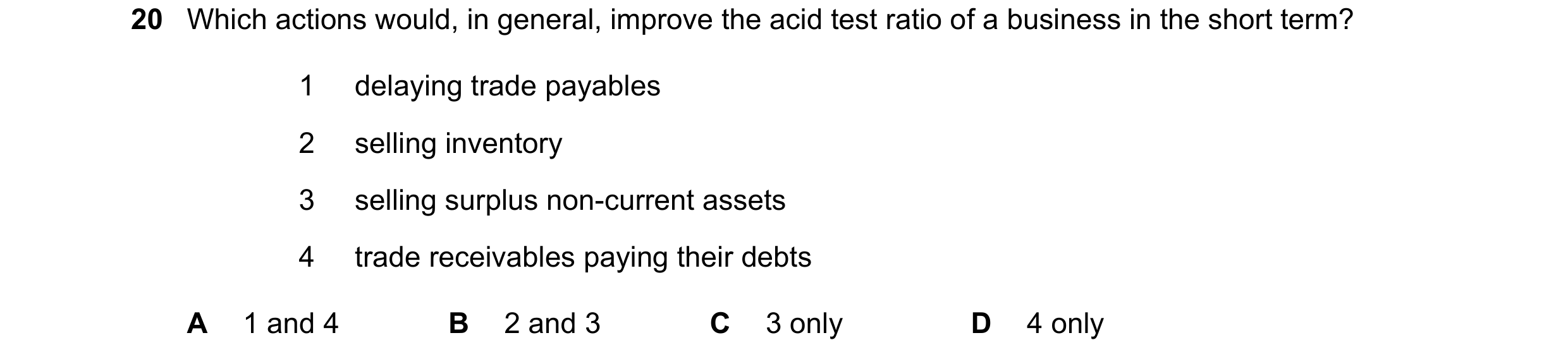

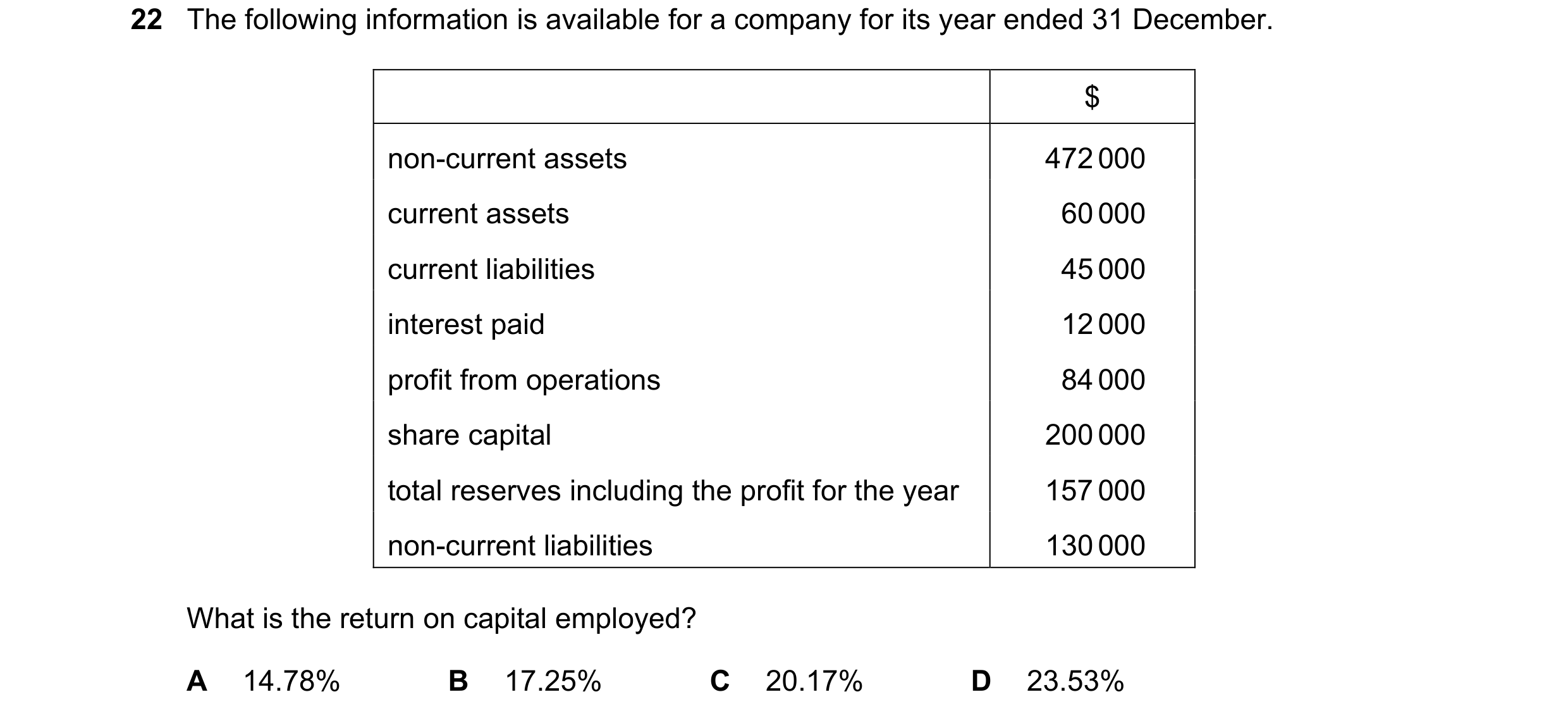
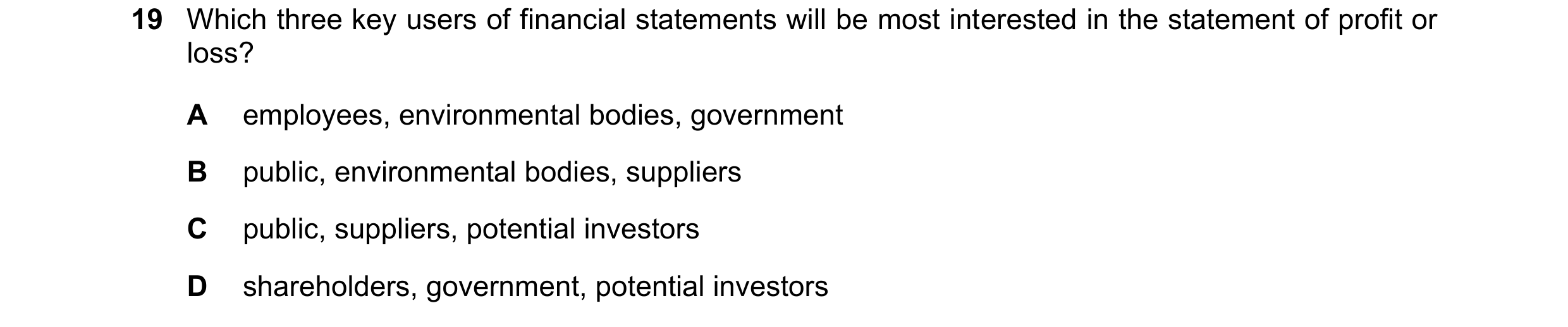 74 / 85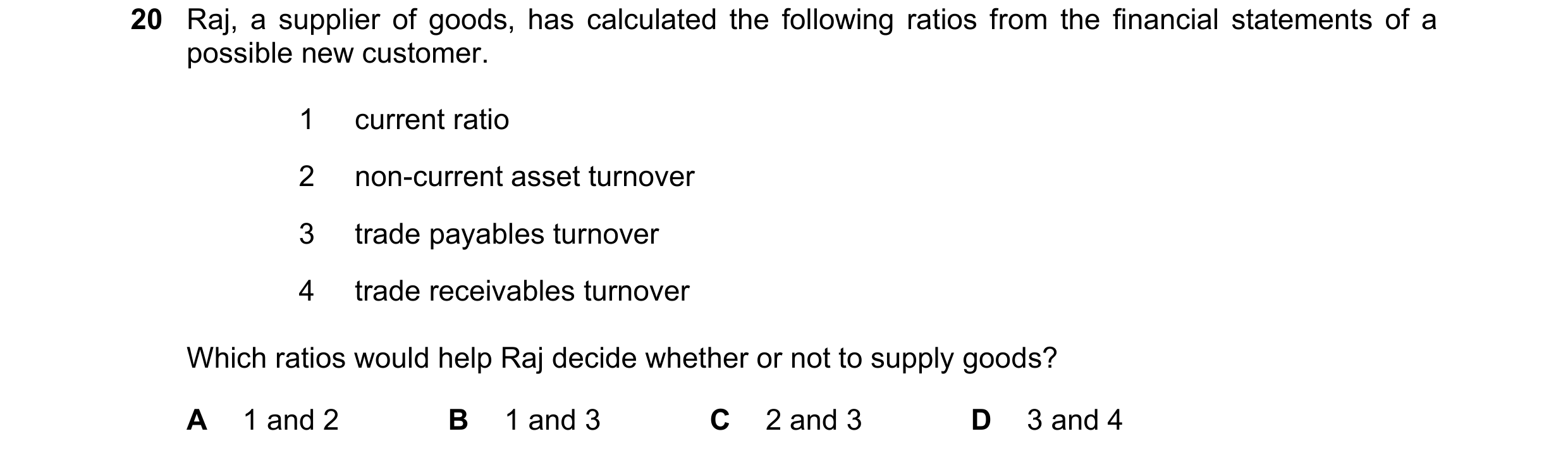
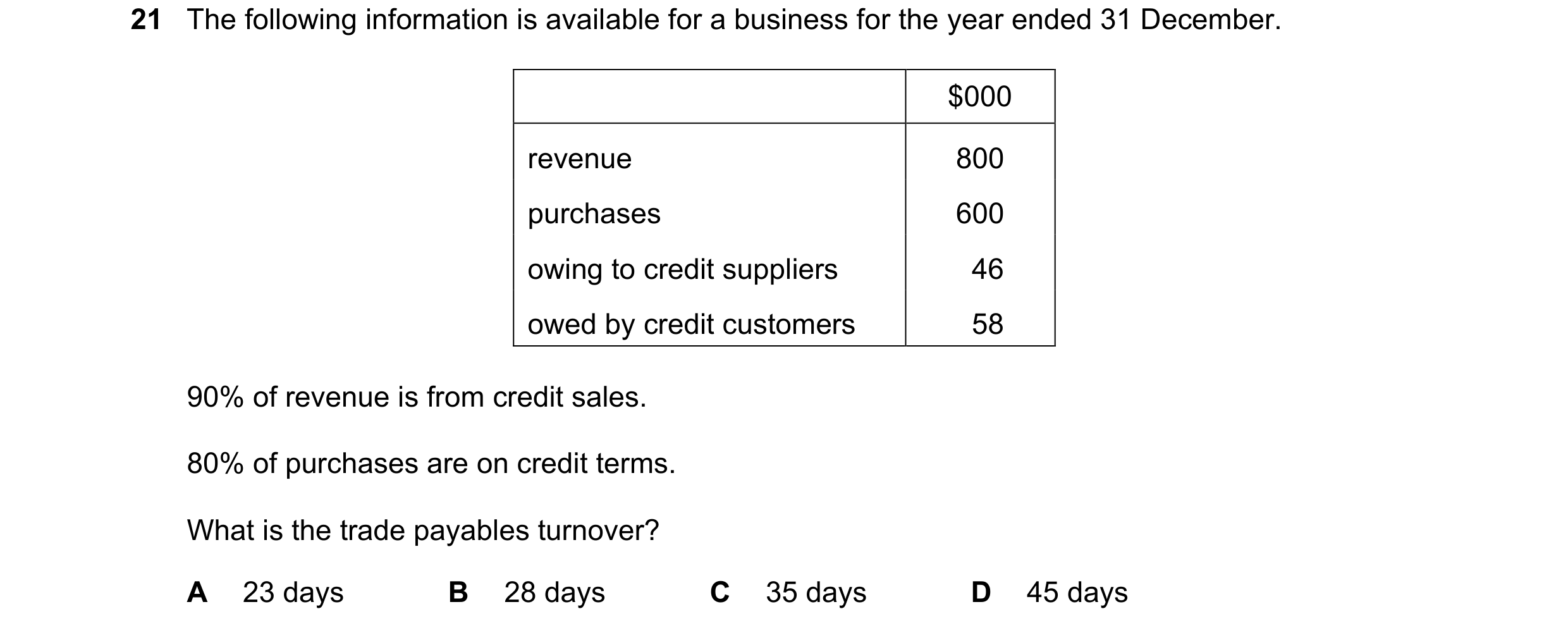
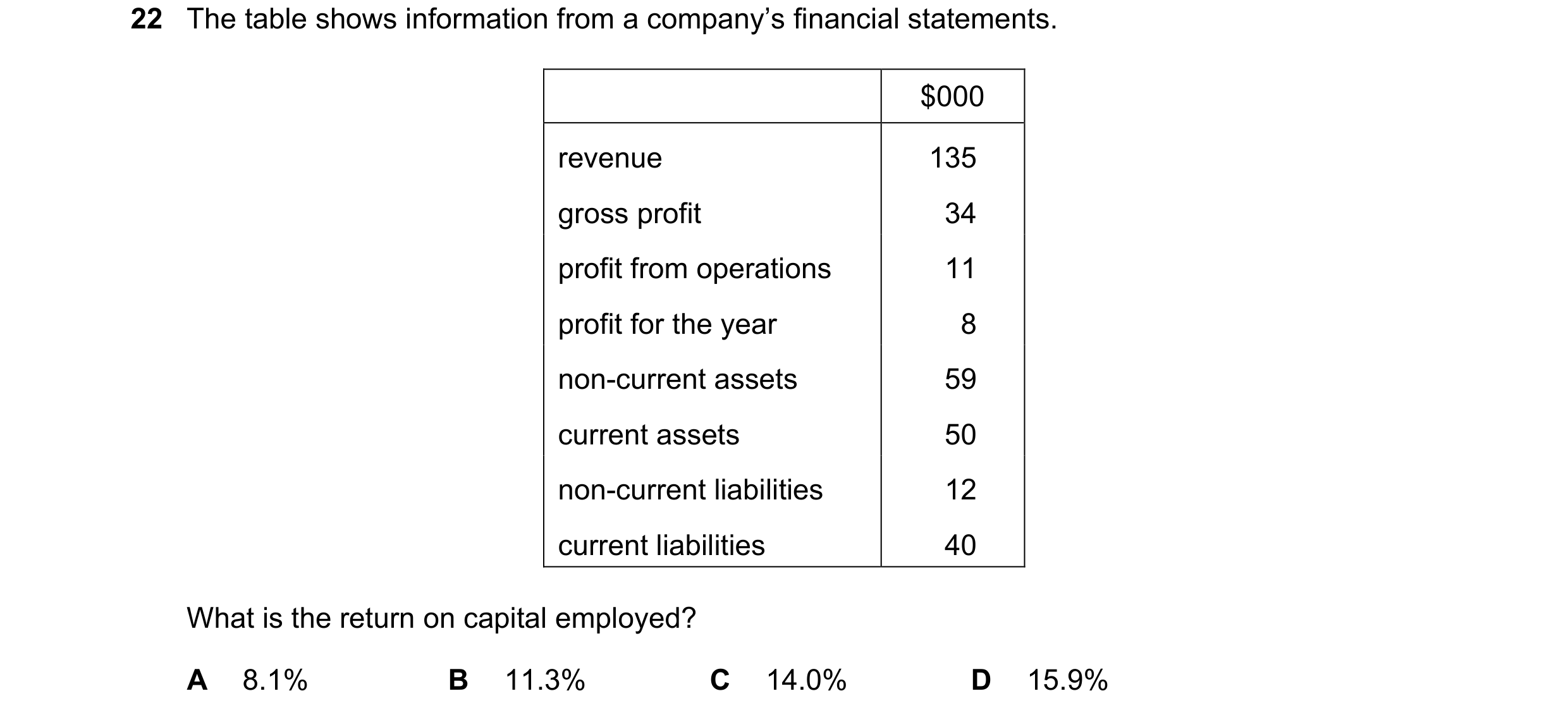 75 / 85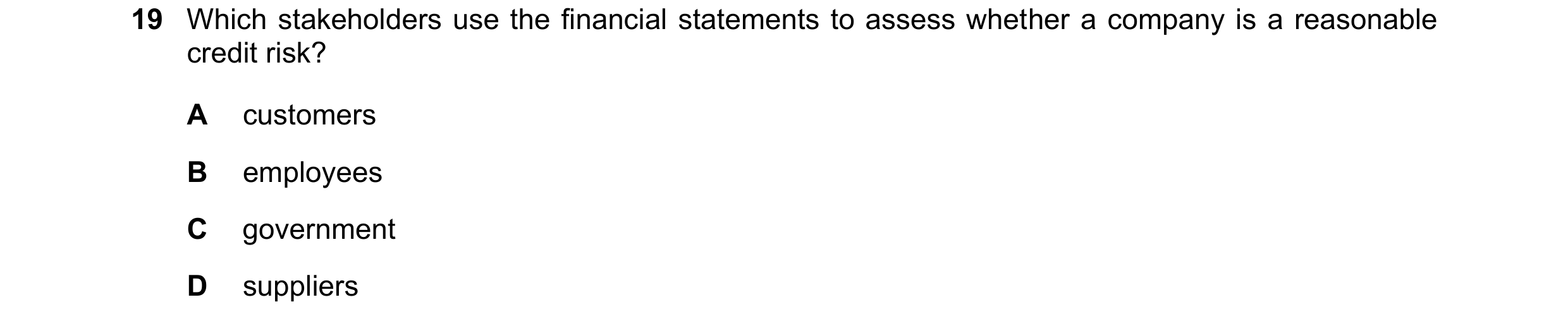

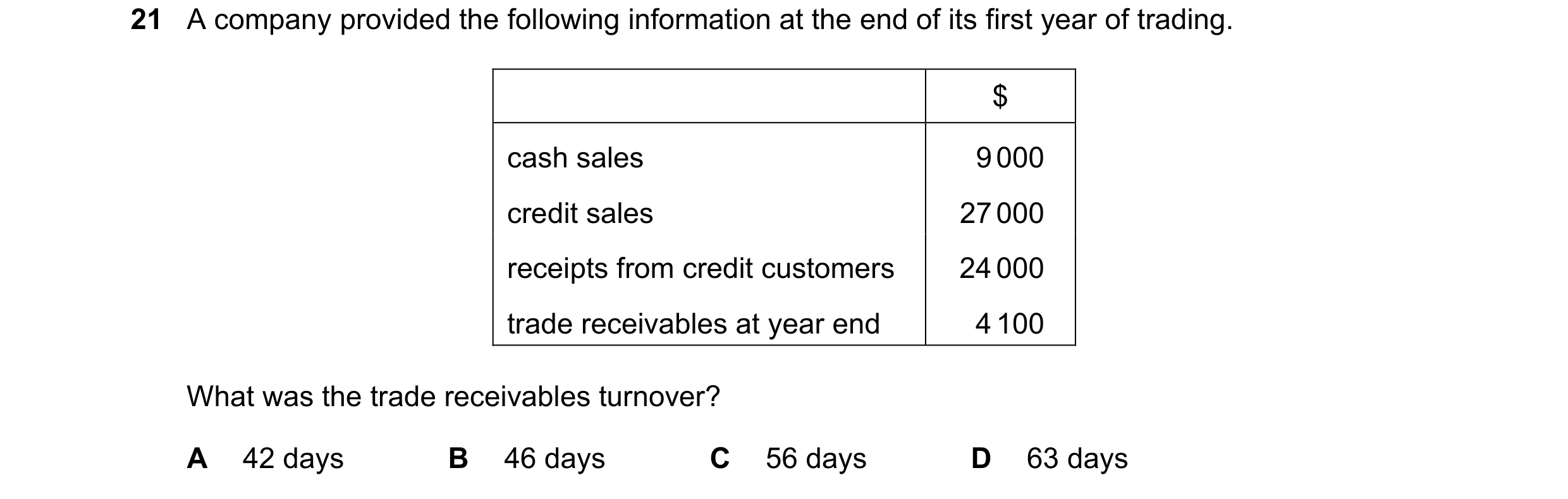
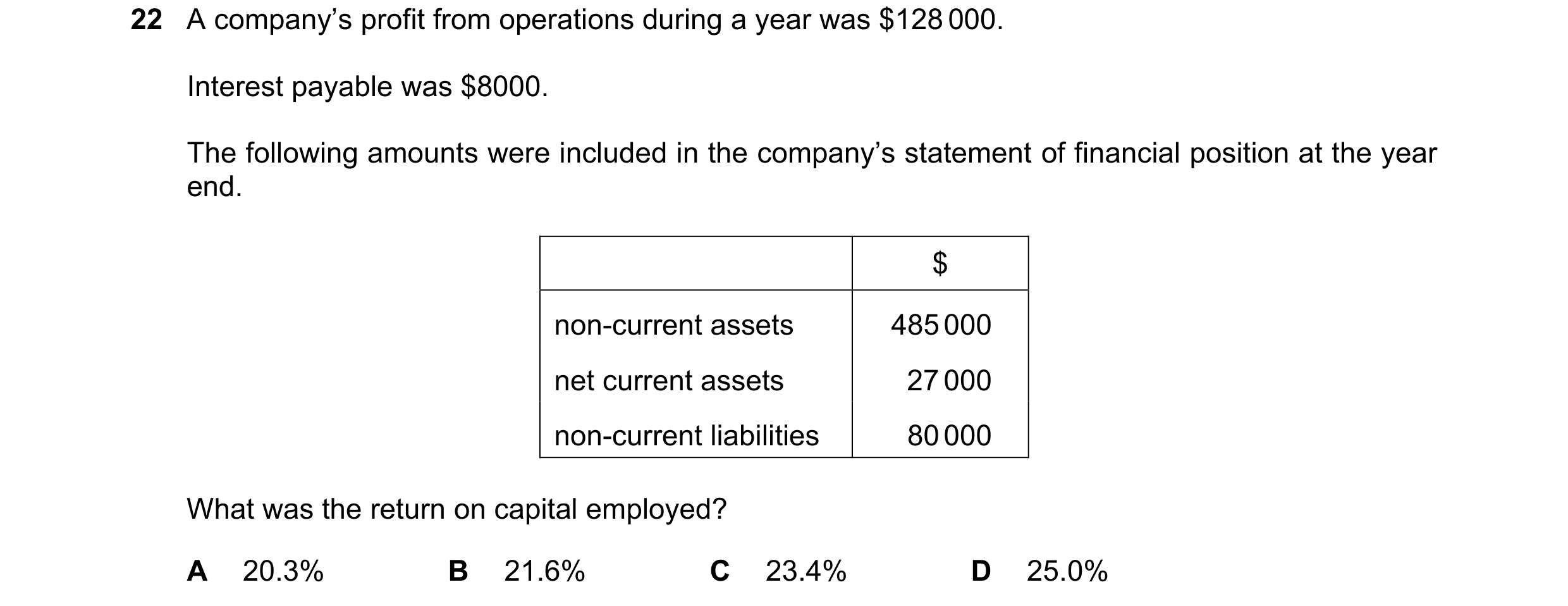
 76 / 85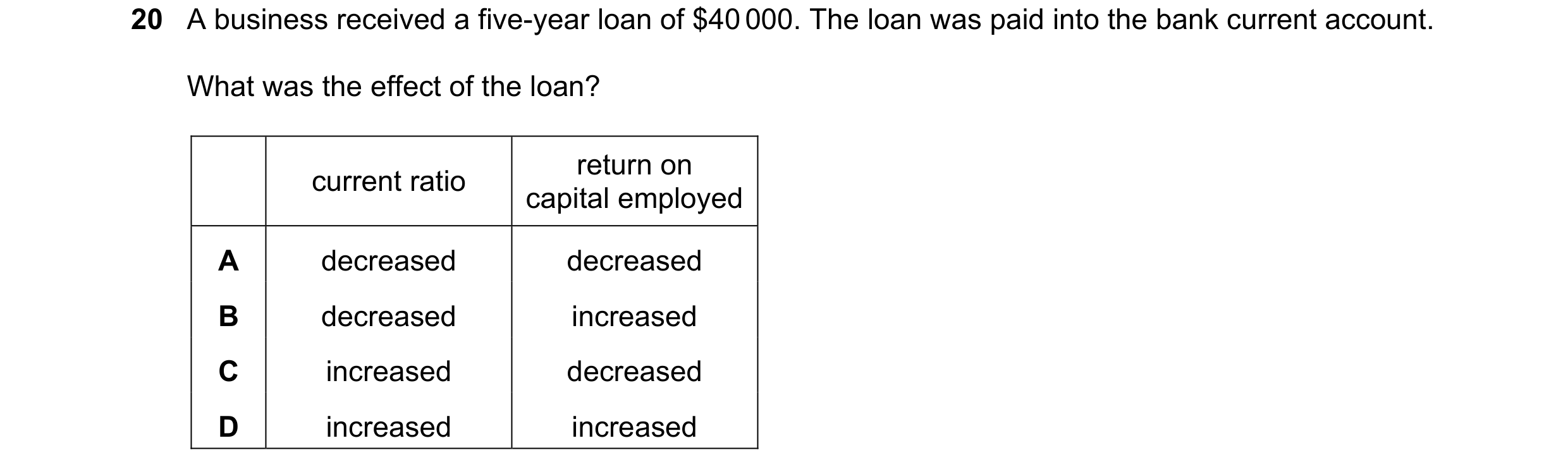
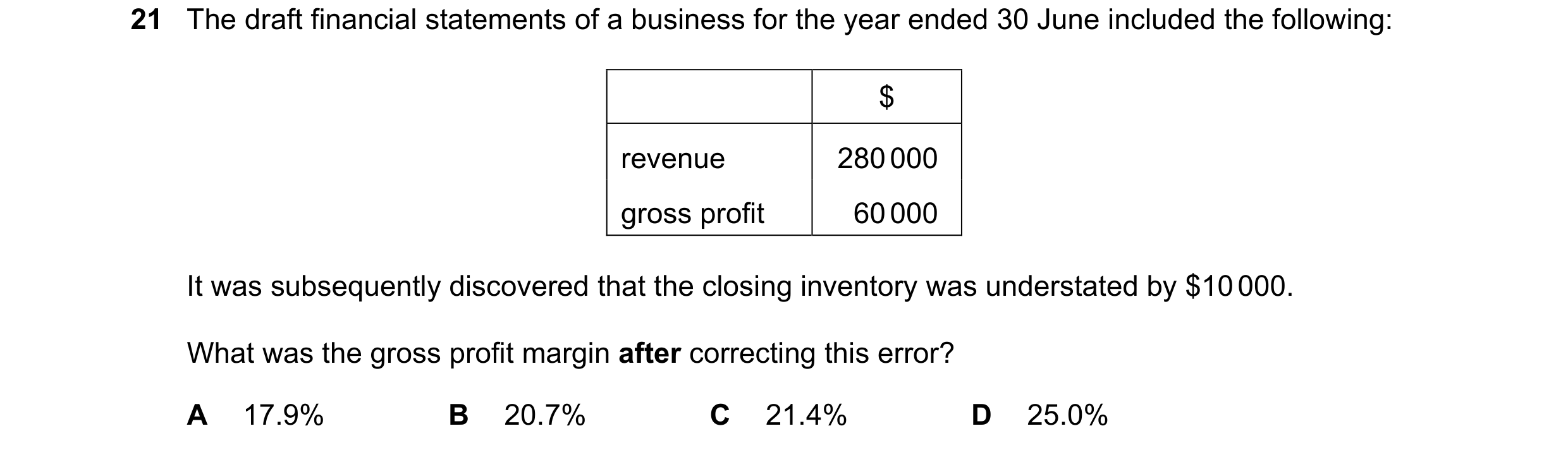
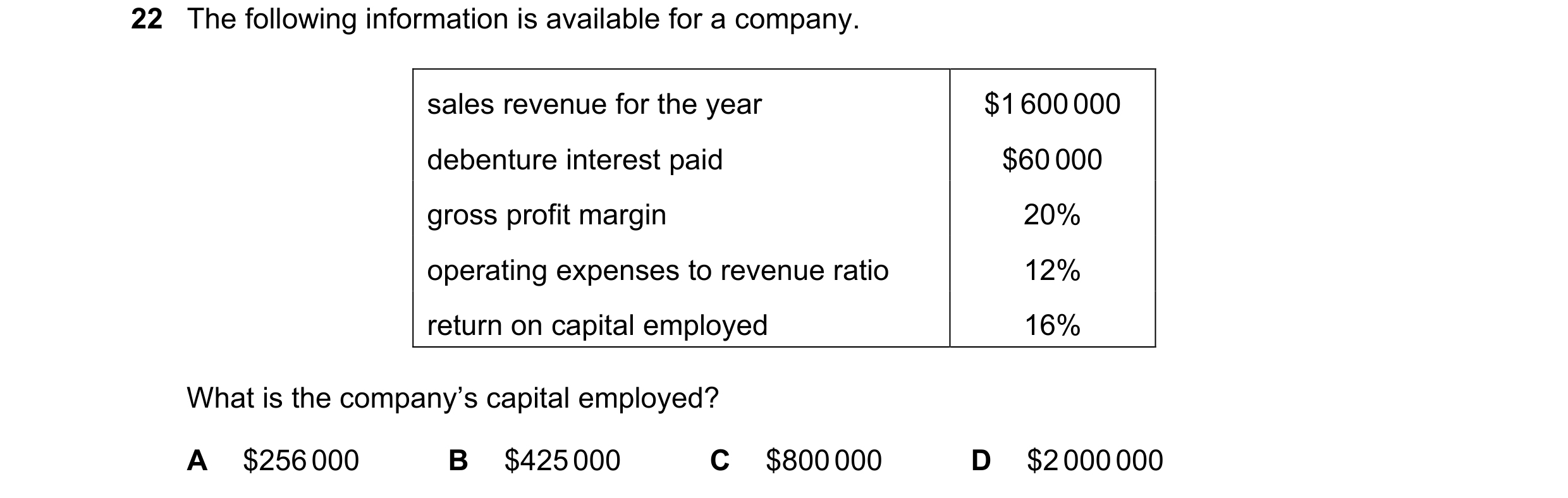 77 / 85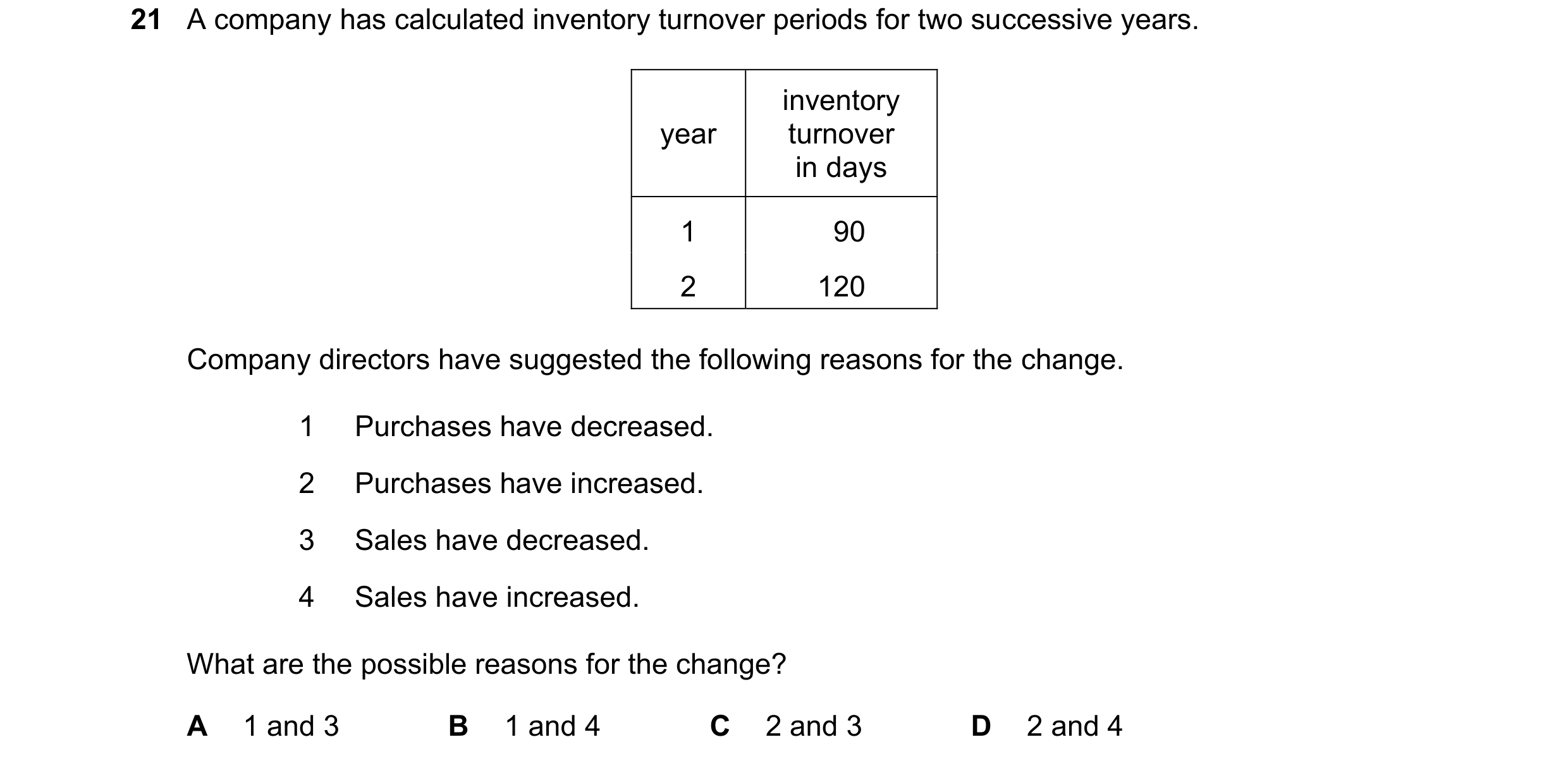
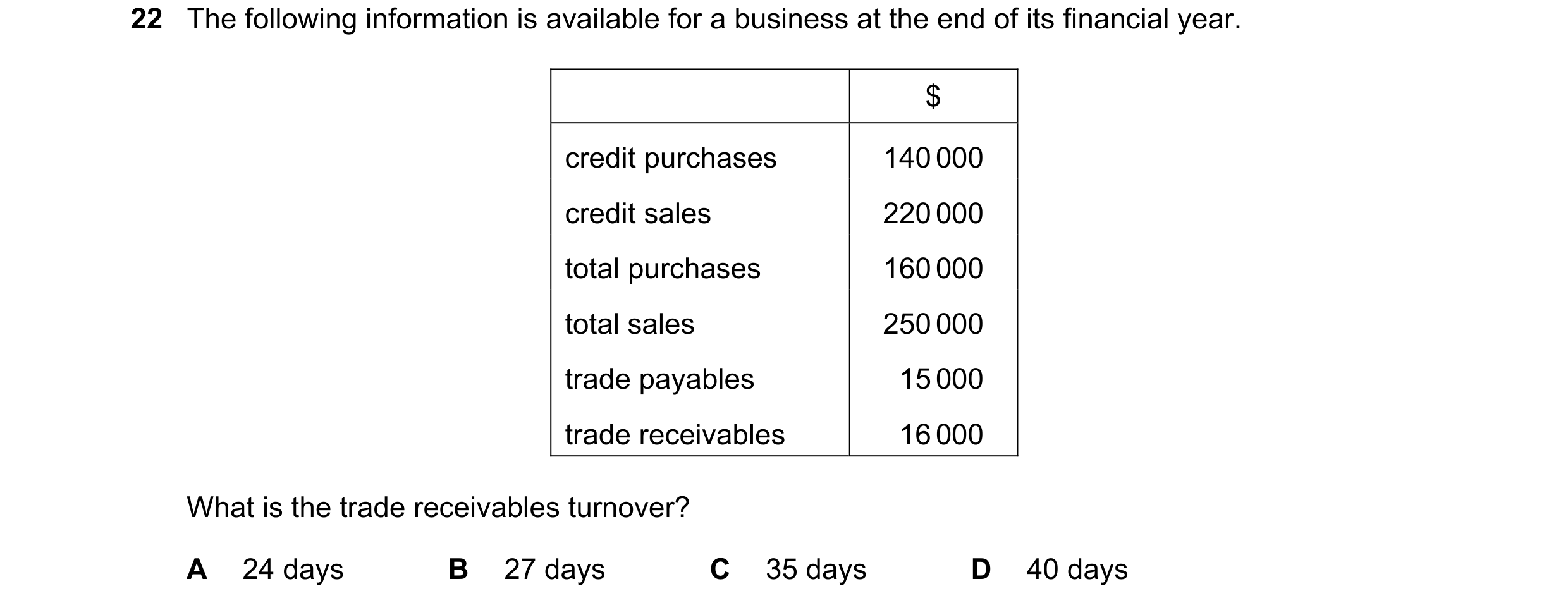
 78 / 85
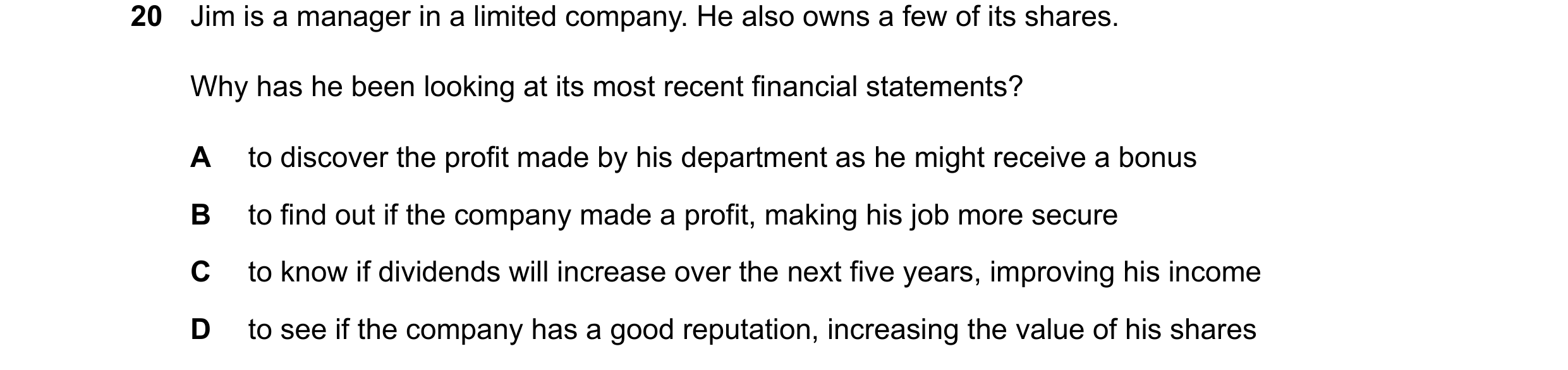
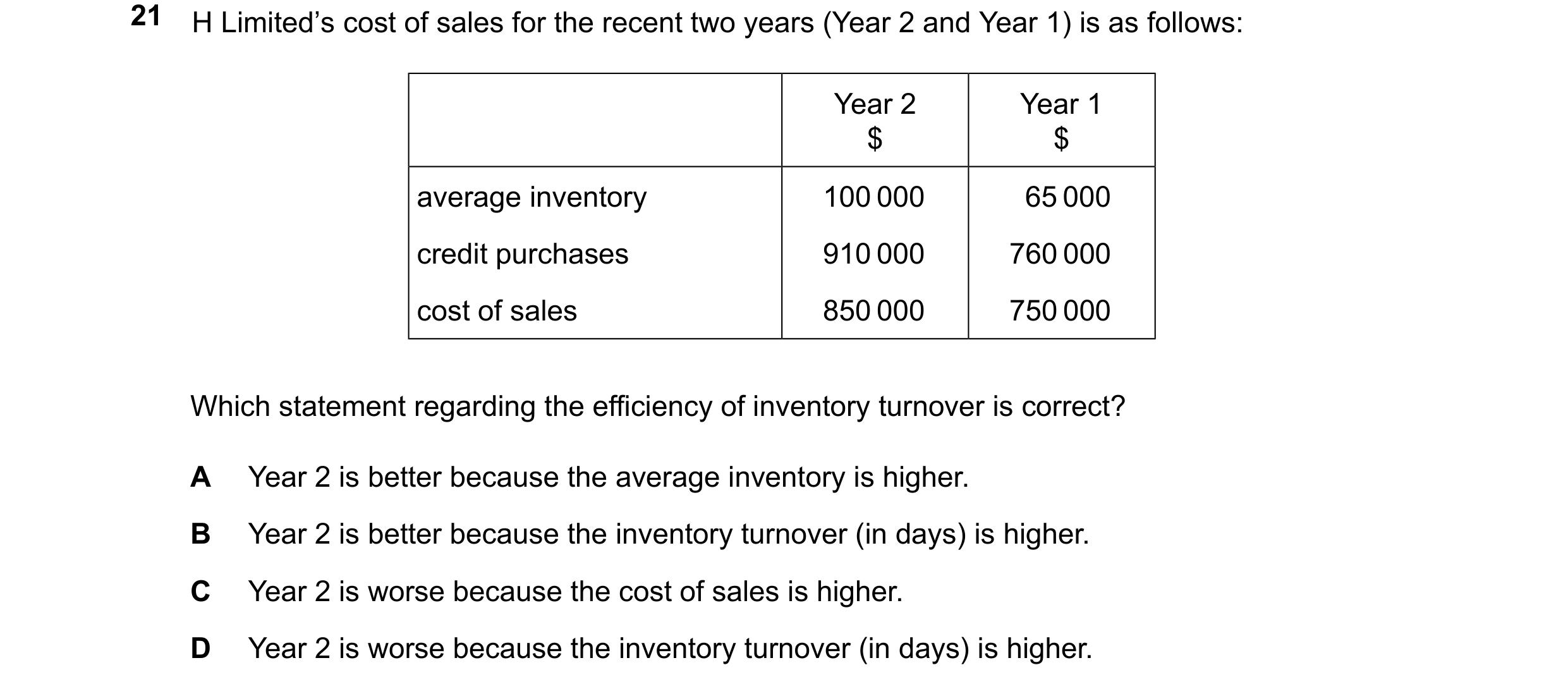 79 / 85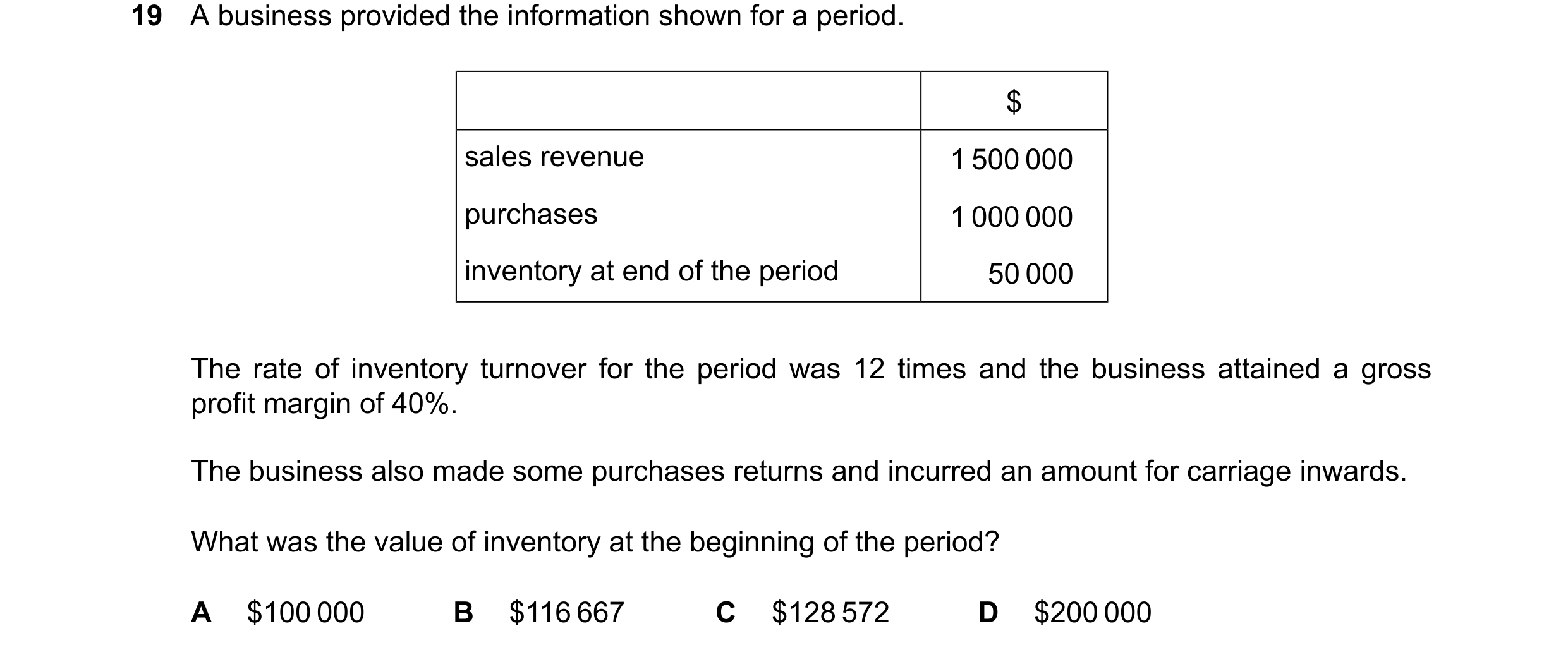
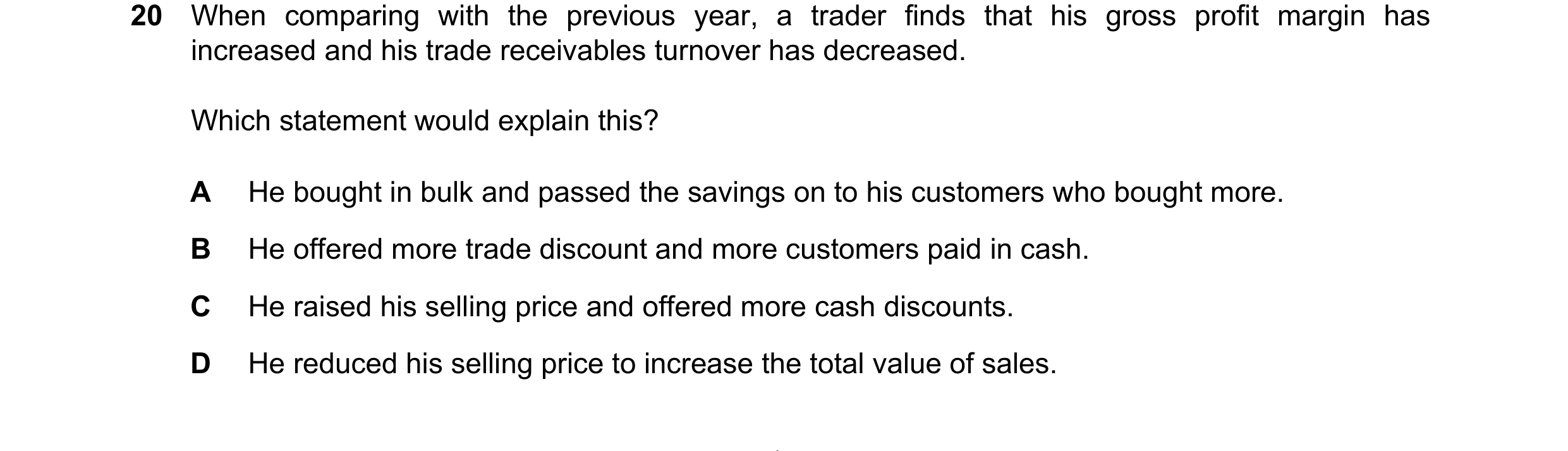
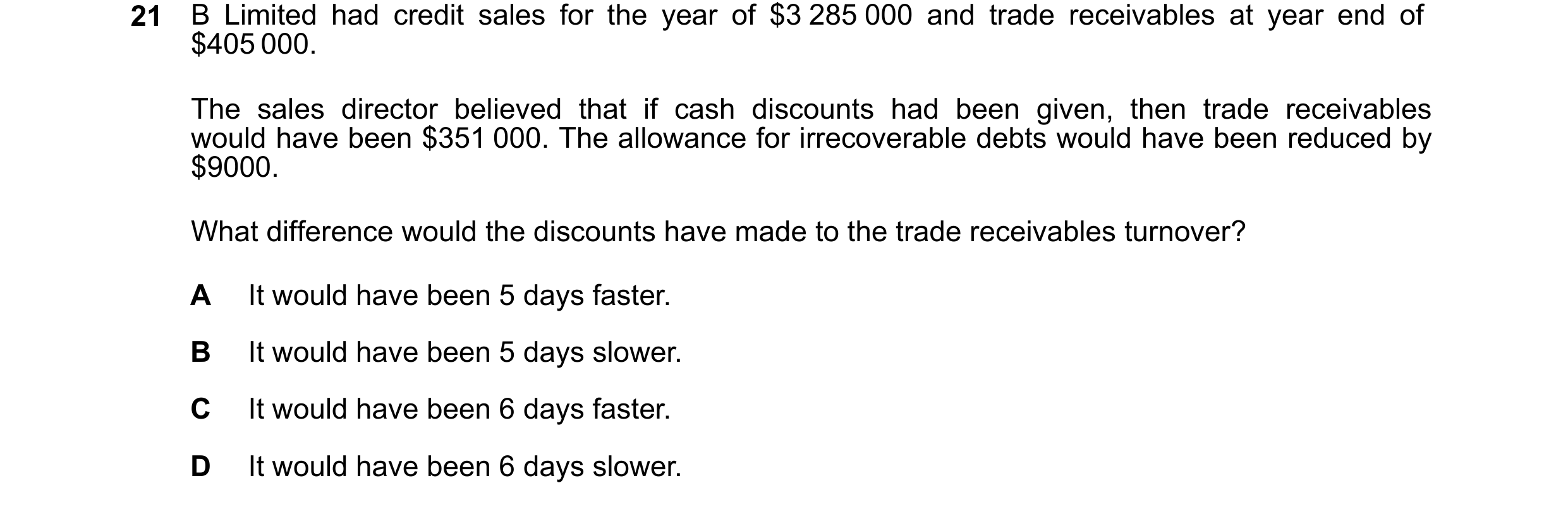
 80 / 85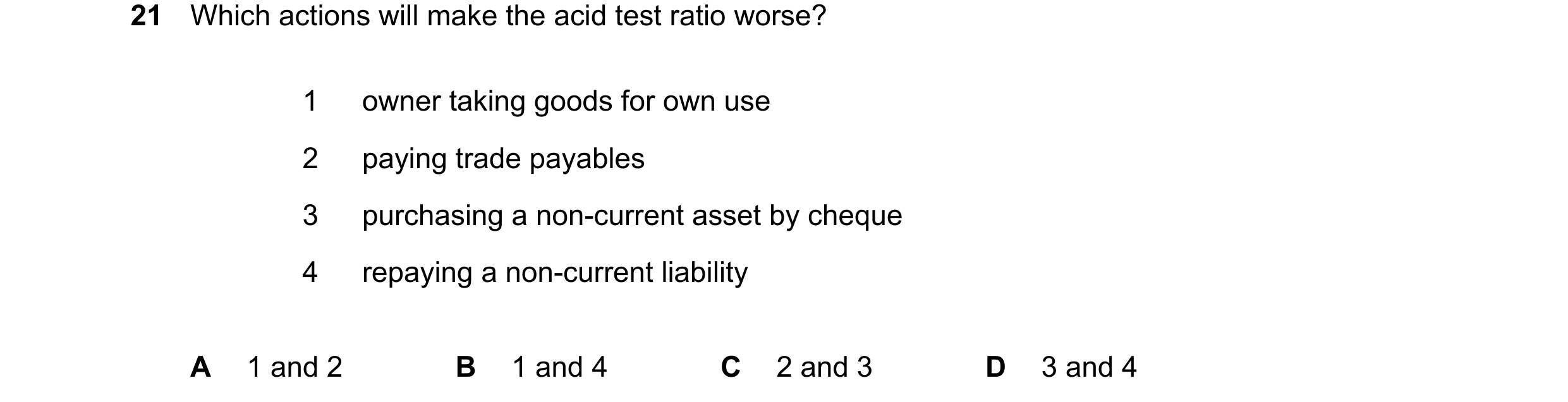
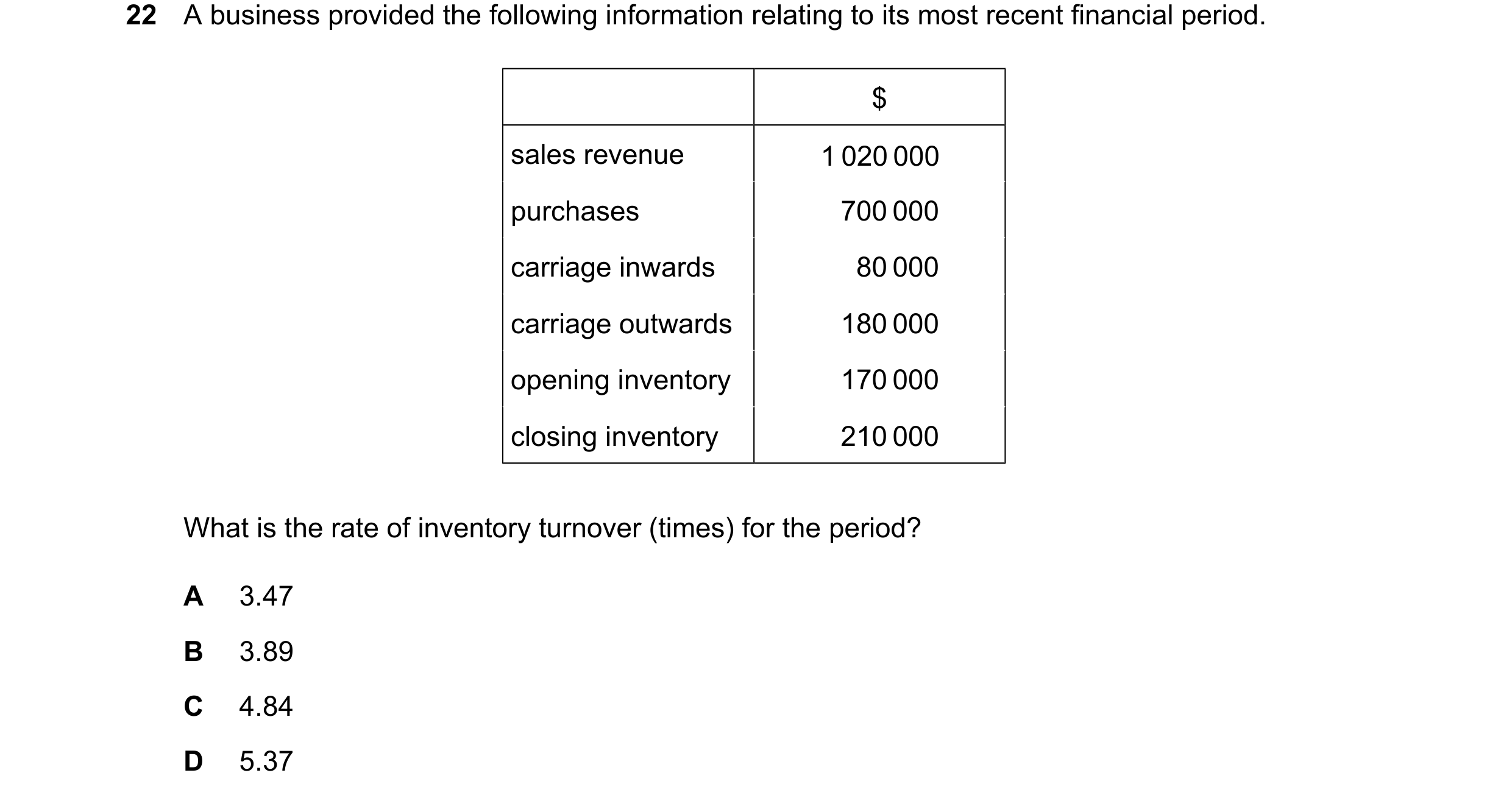
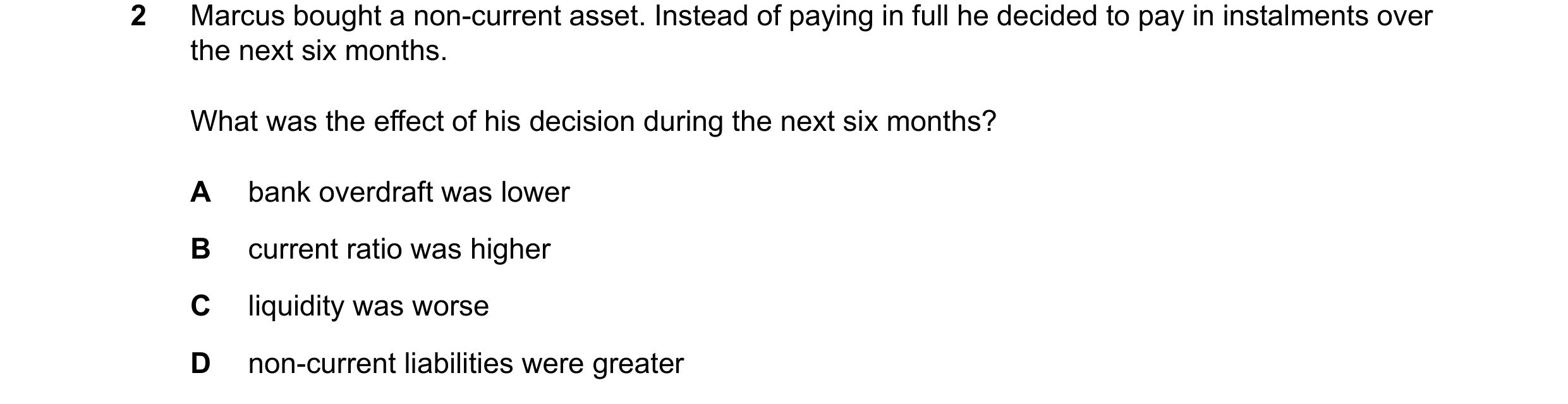
 81 / 85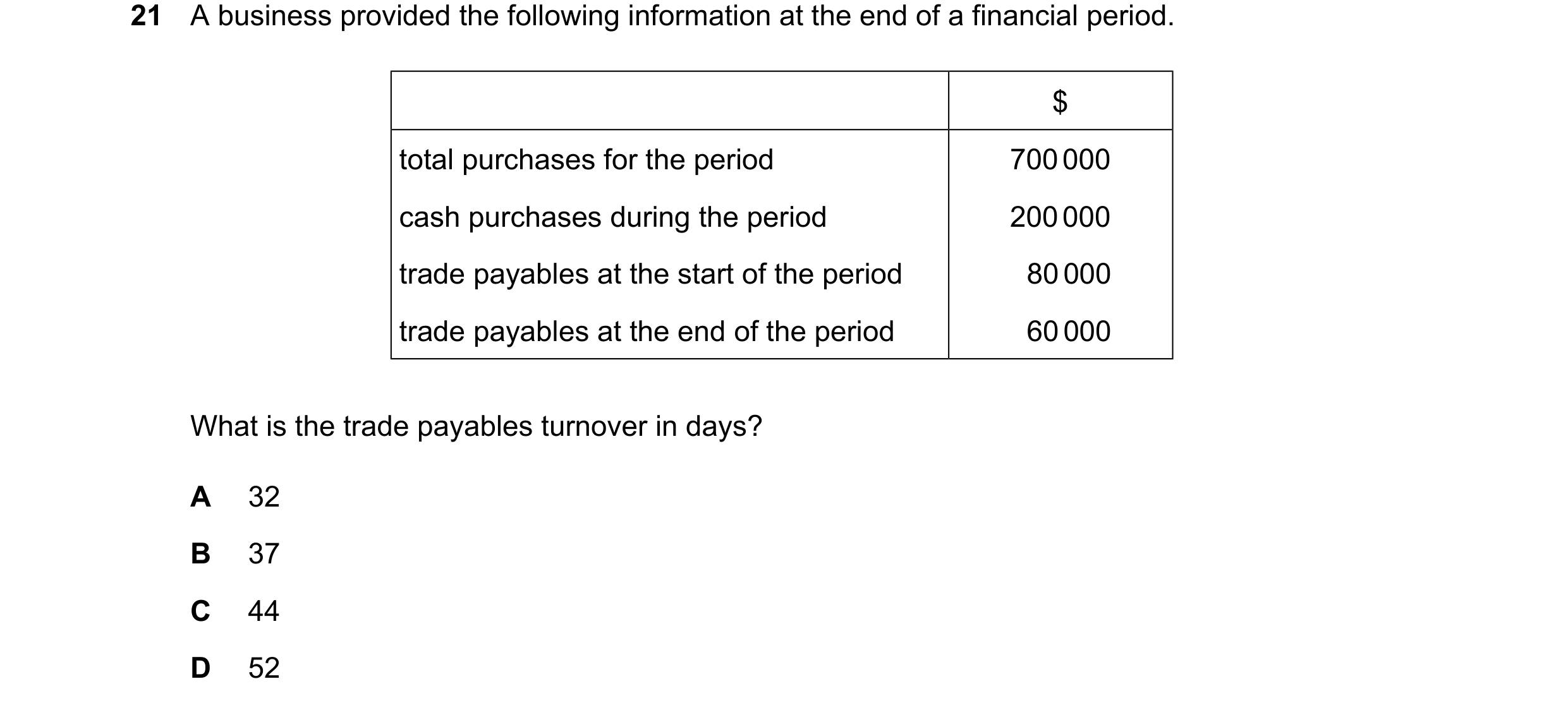


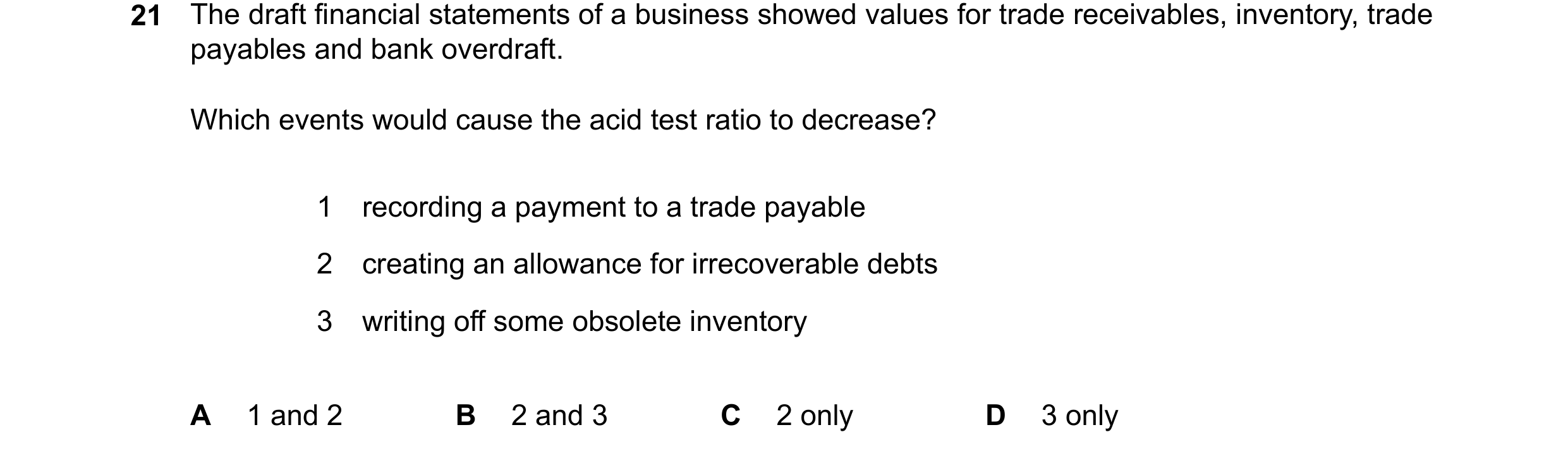 82 / 85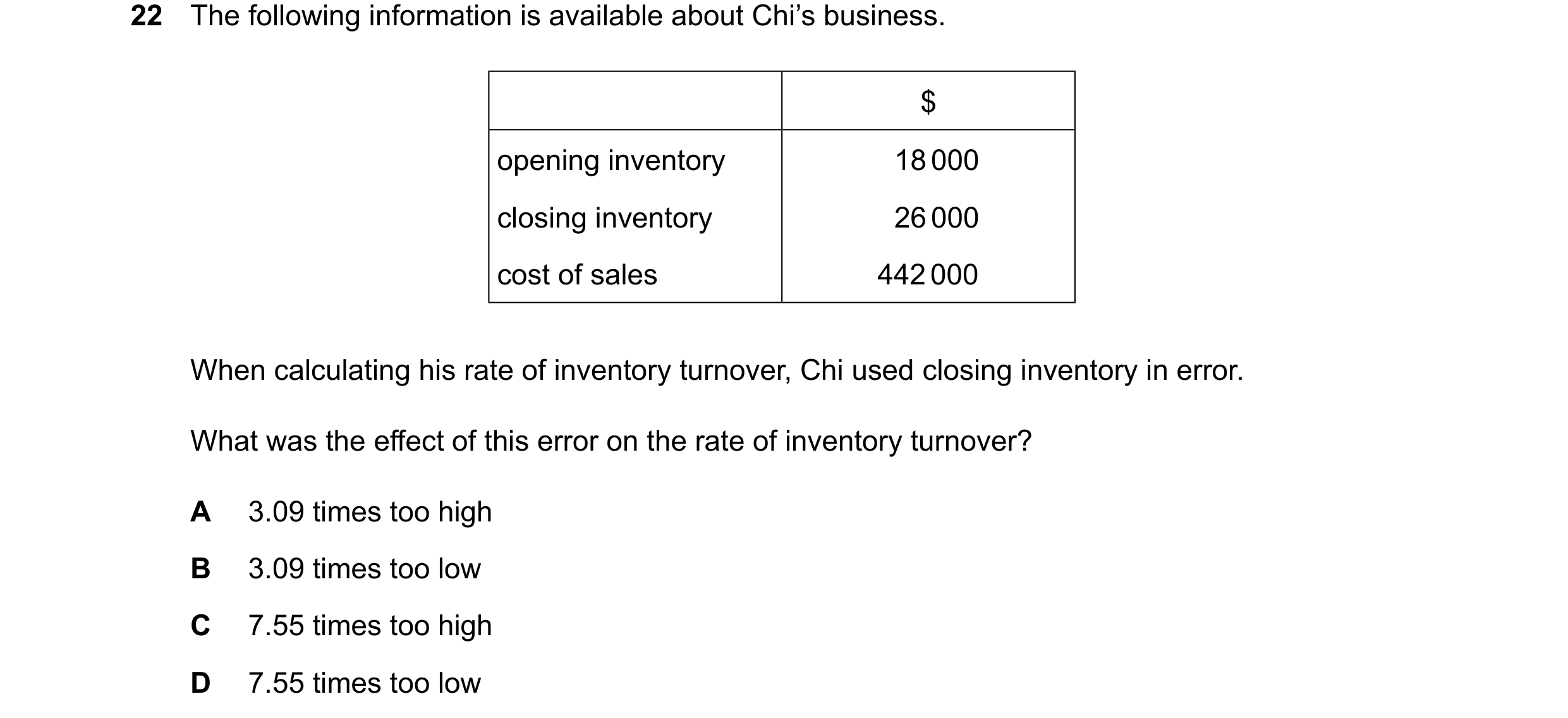
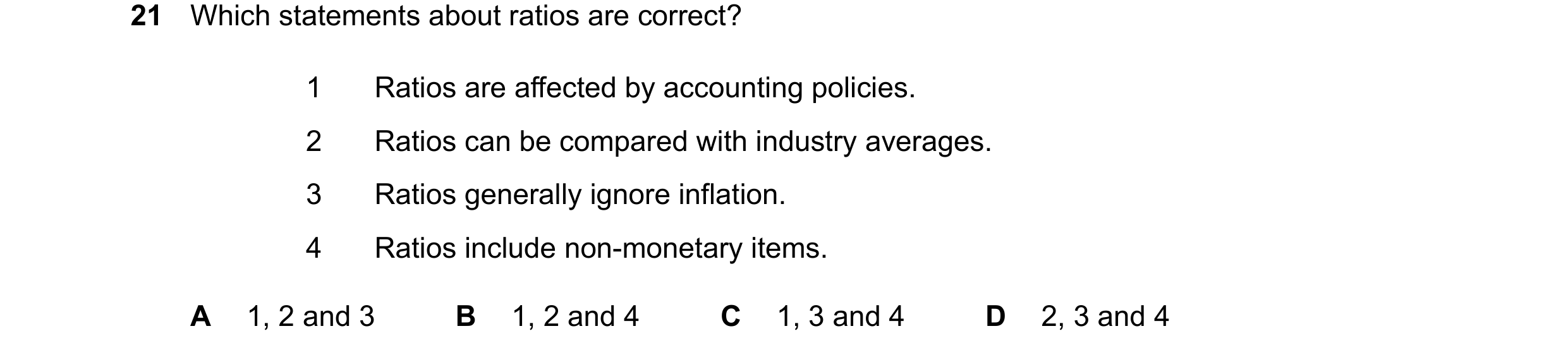
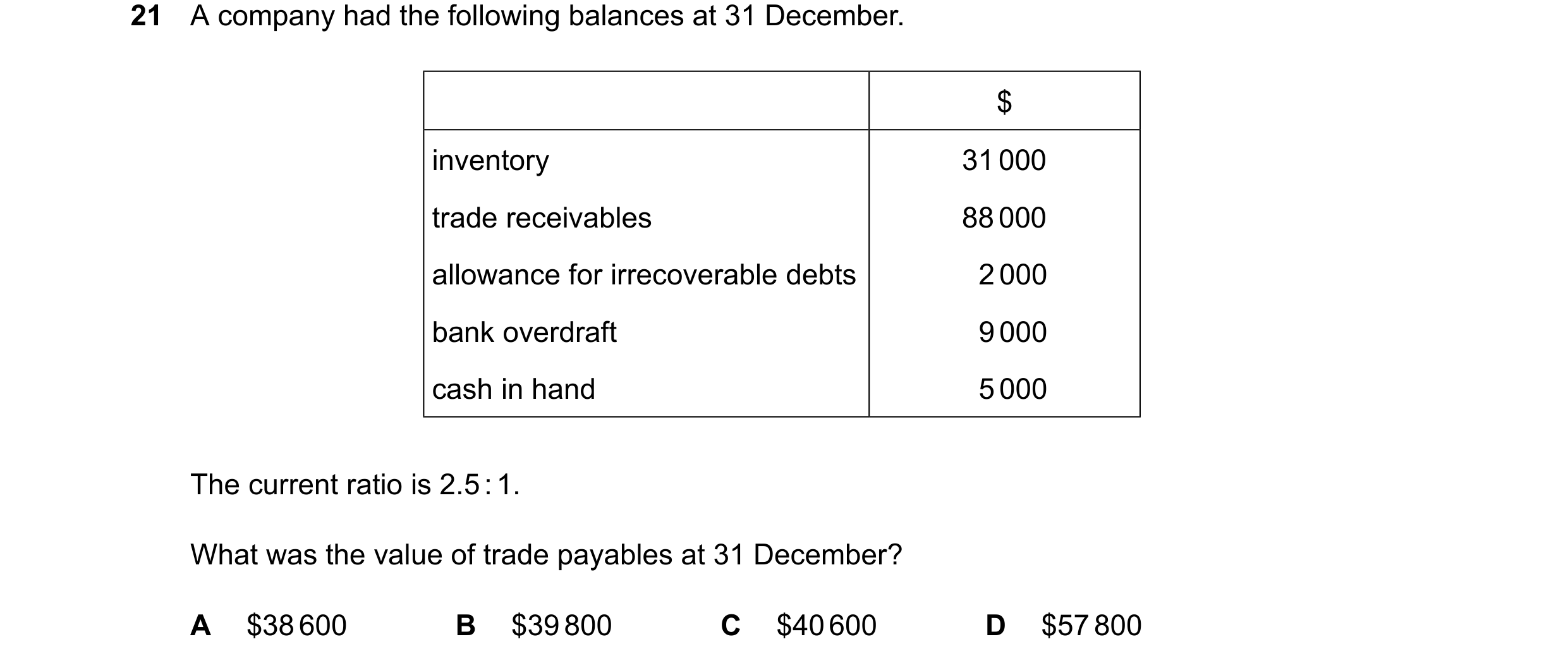
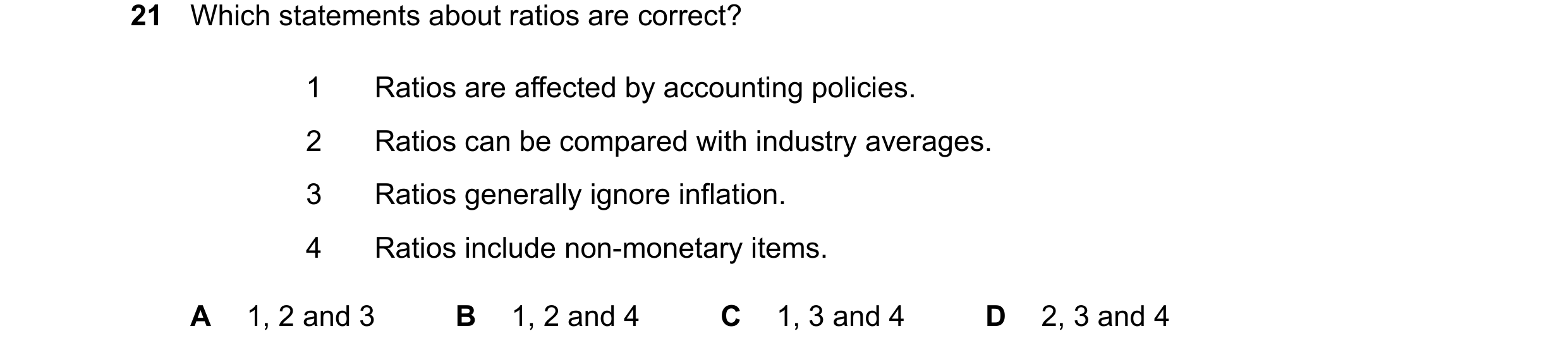 83 / 85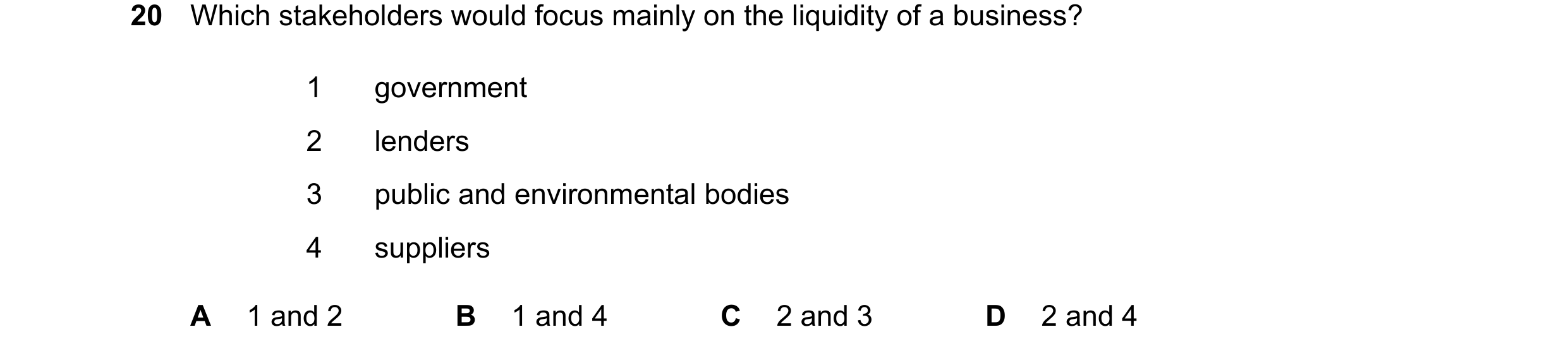
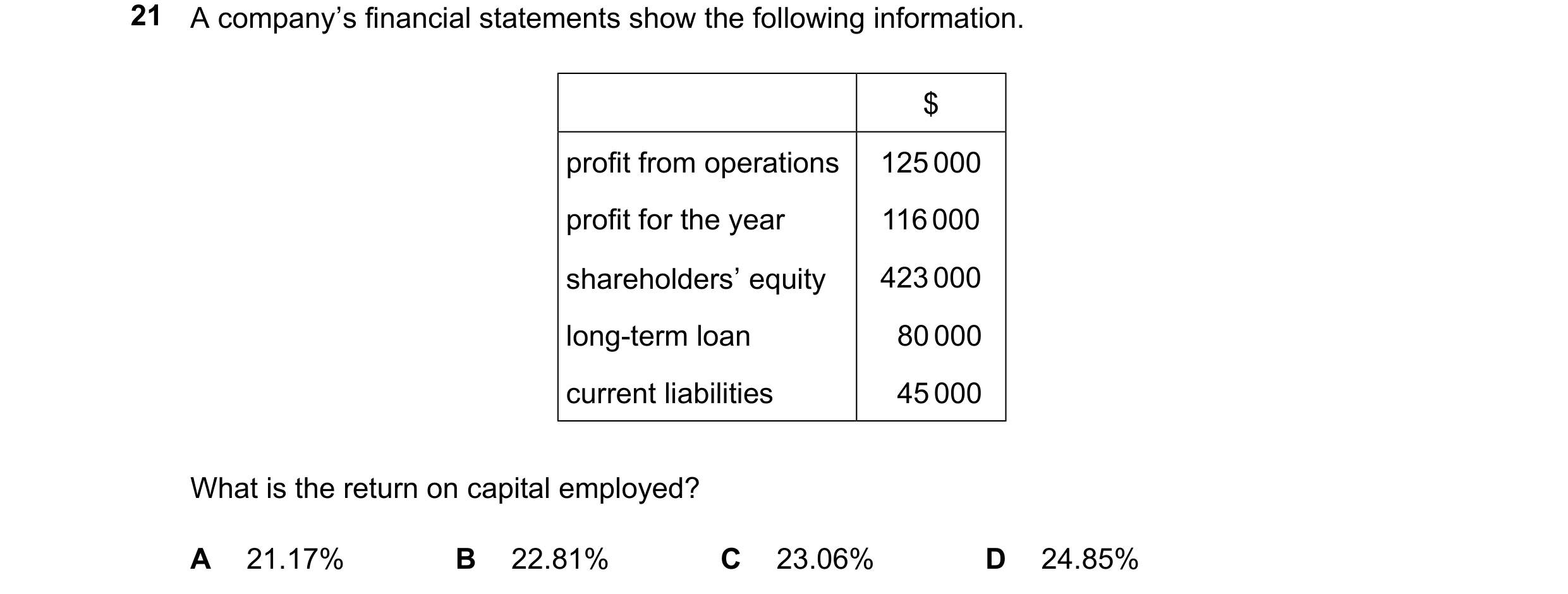
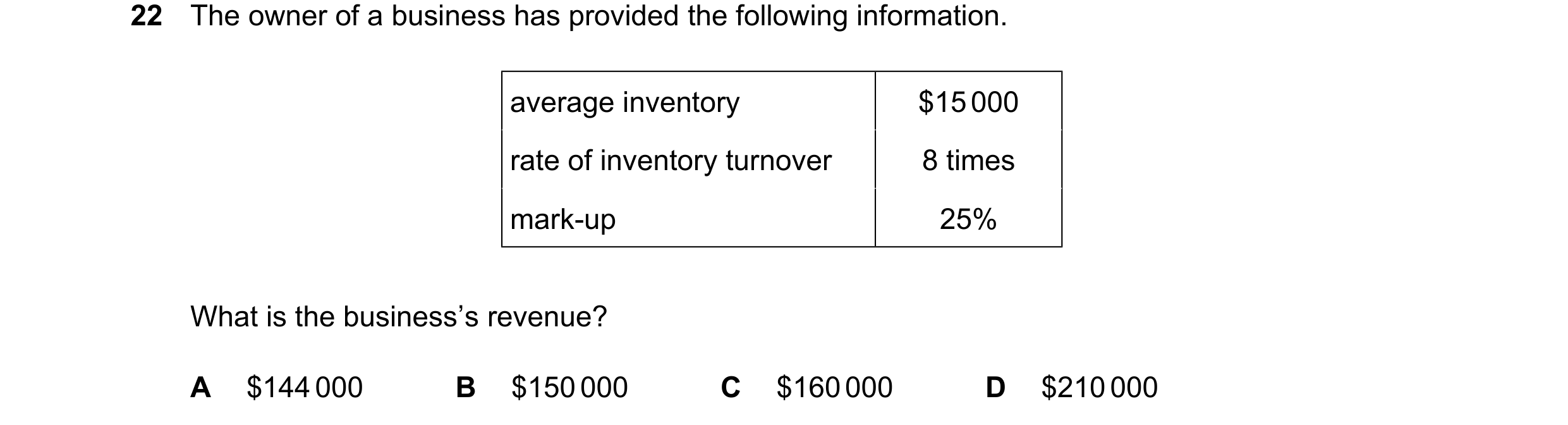
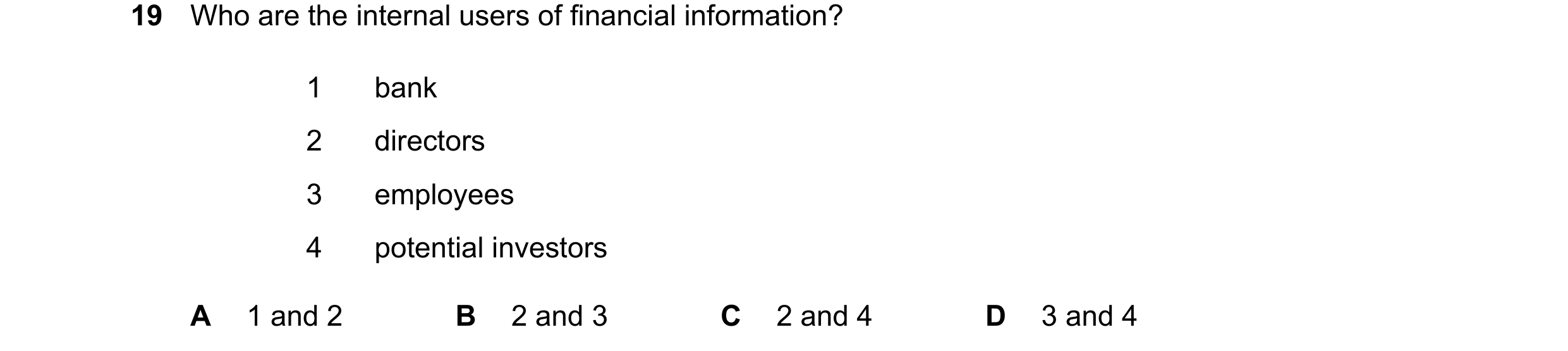 84 / 85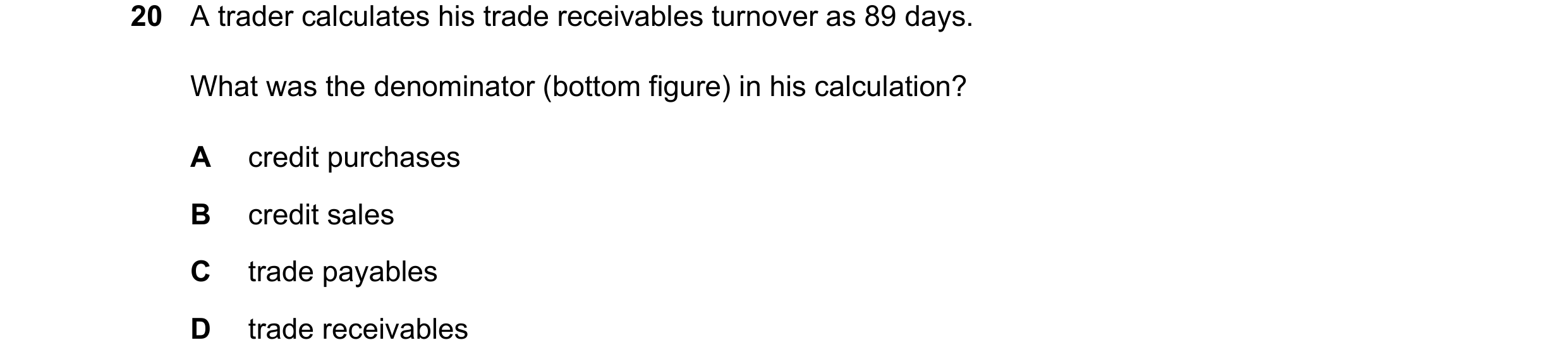
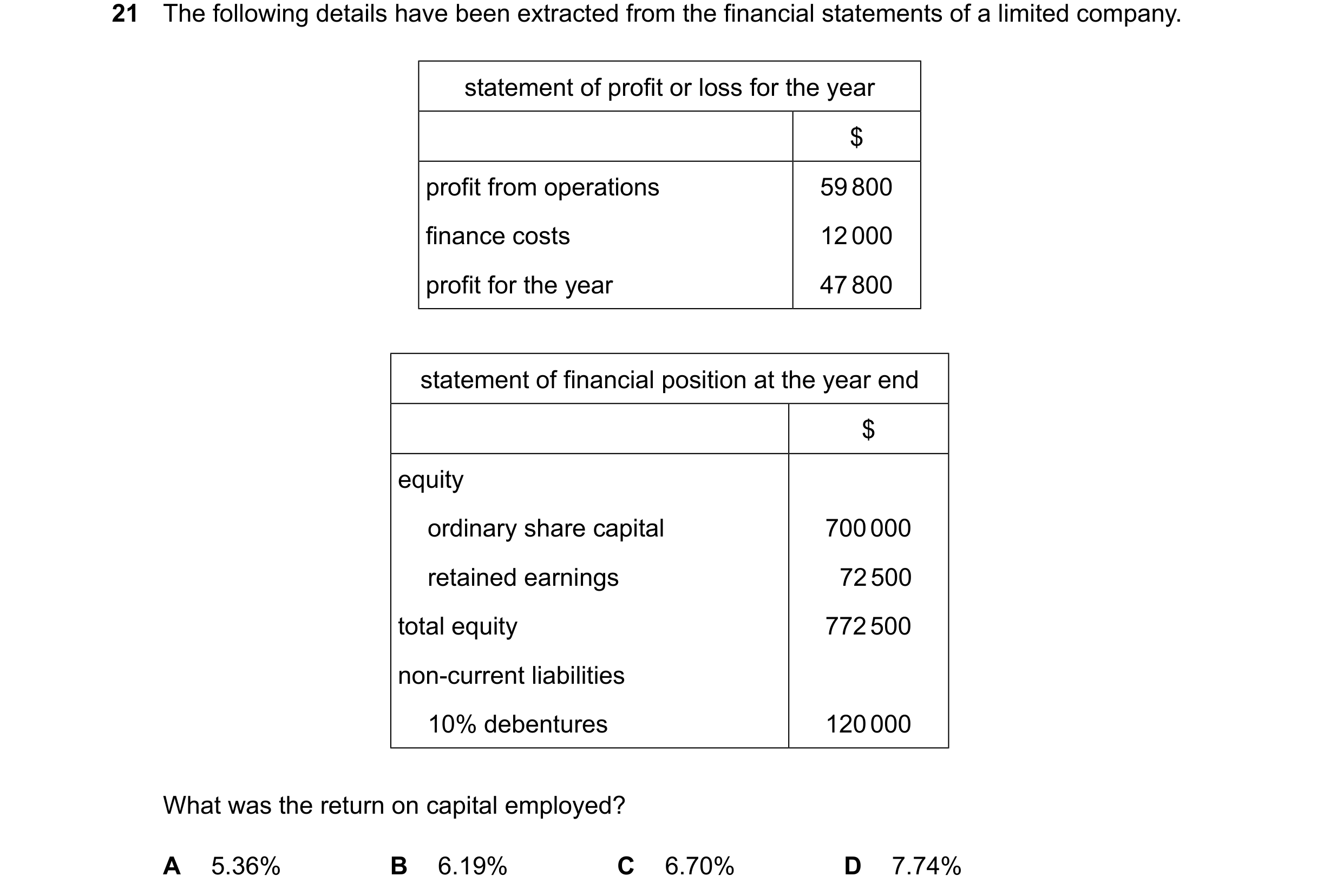
 85 / 85