Cambridge A Level Accounting 9706 — 2024 Oct/Nov Paper 1 · Variant 3
9706/13/O/N/24 · 30 questions · 30 marks · ≈34 min
The question paper and its mark scheme, free to read here and free to download. This is Cambridge’s own paper, exactly as it was sat.
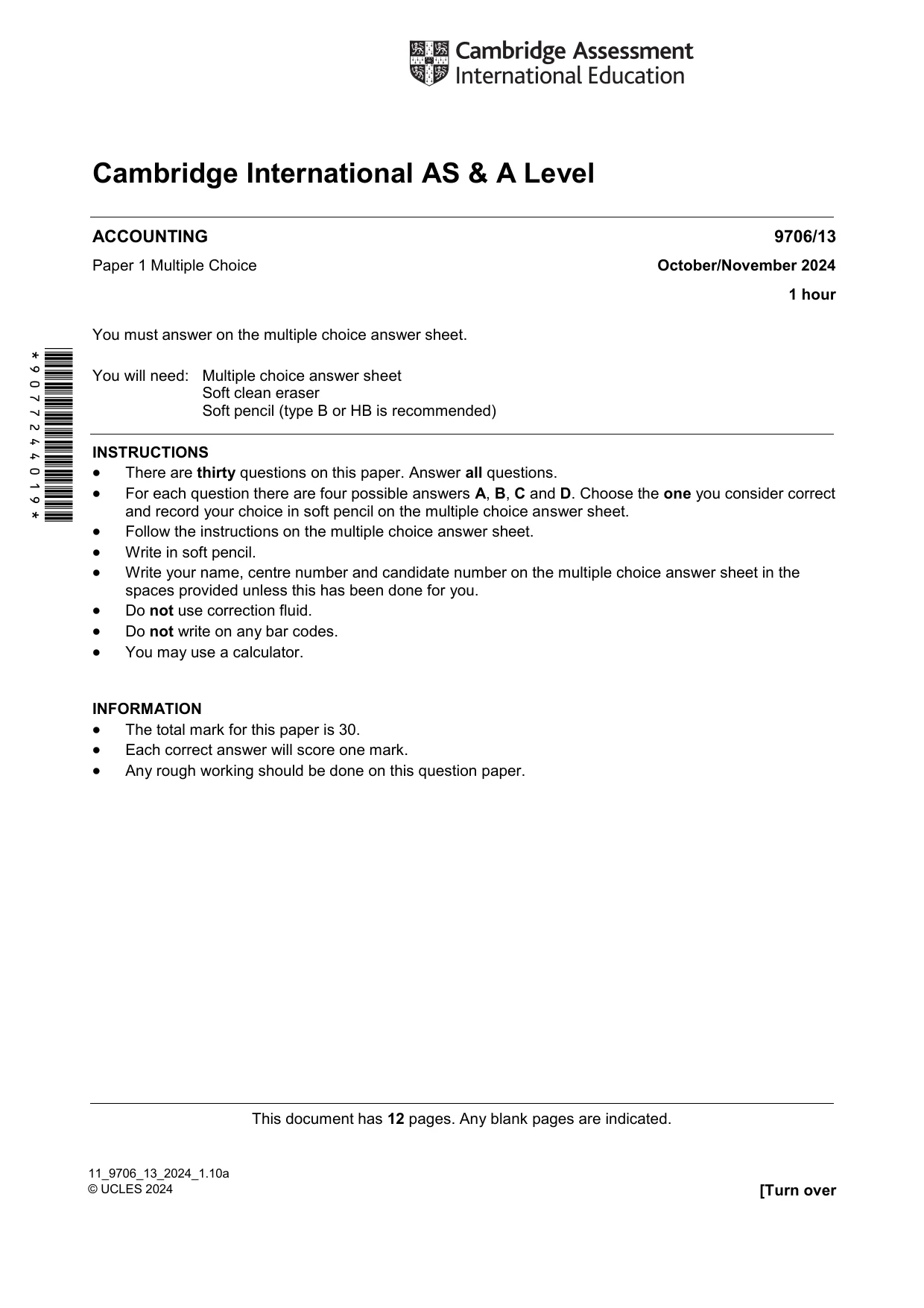
Question paper12 pages
Mark scheme3 pages
Answers below. Sit the paper first if you are practising.
Questions as text
Q1 · Which book of prime entry is used to record the sale of a non-current asset on credit?
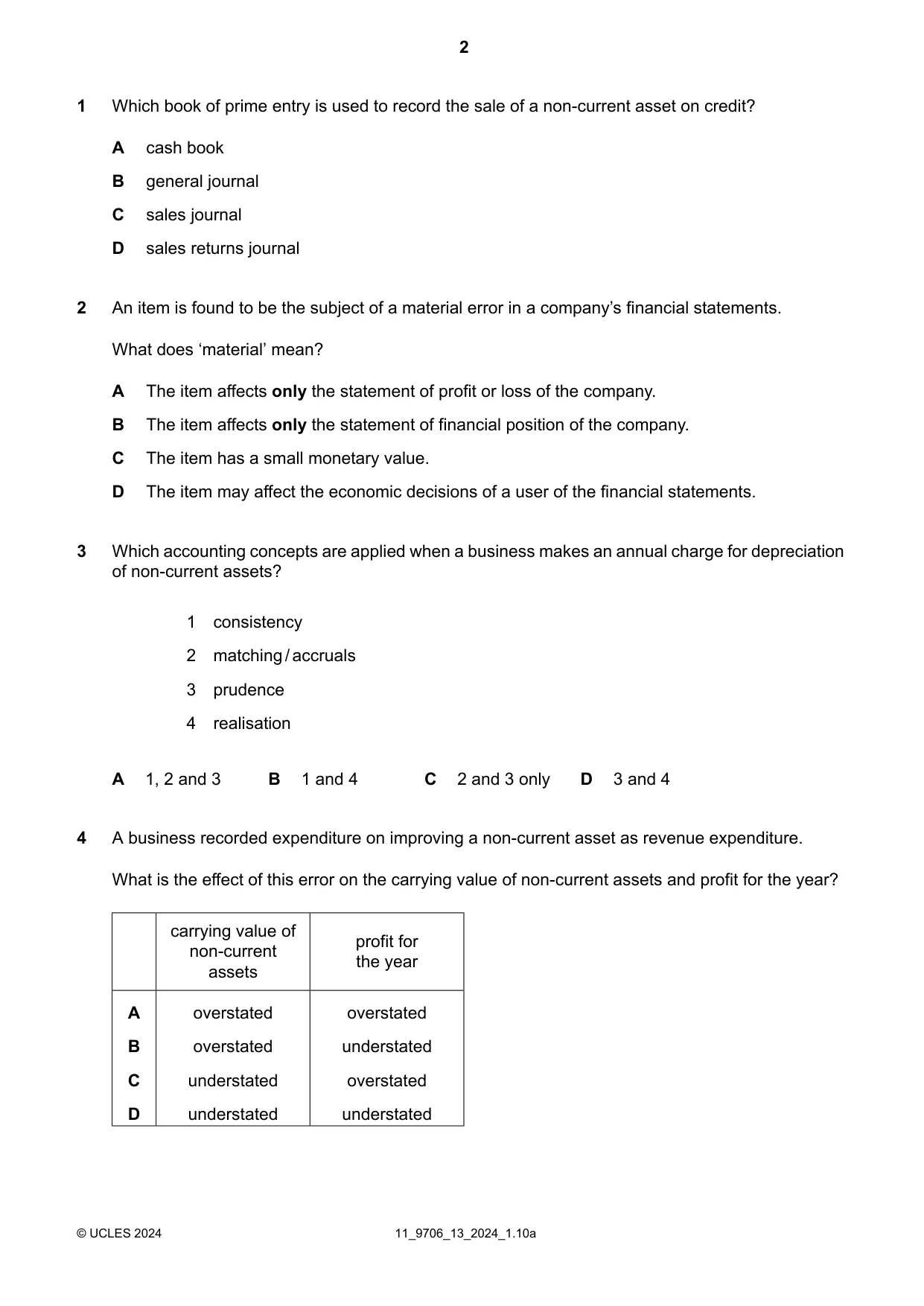
1 Which book of prime entry is used to record the sale of a non-current asset on credit? A cash book B general journal C sales journal D sales returns journal
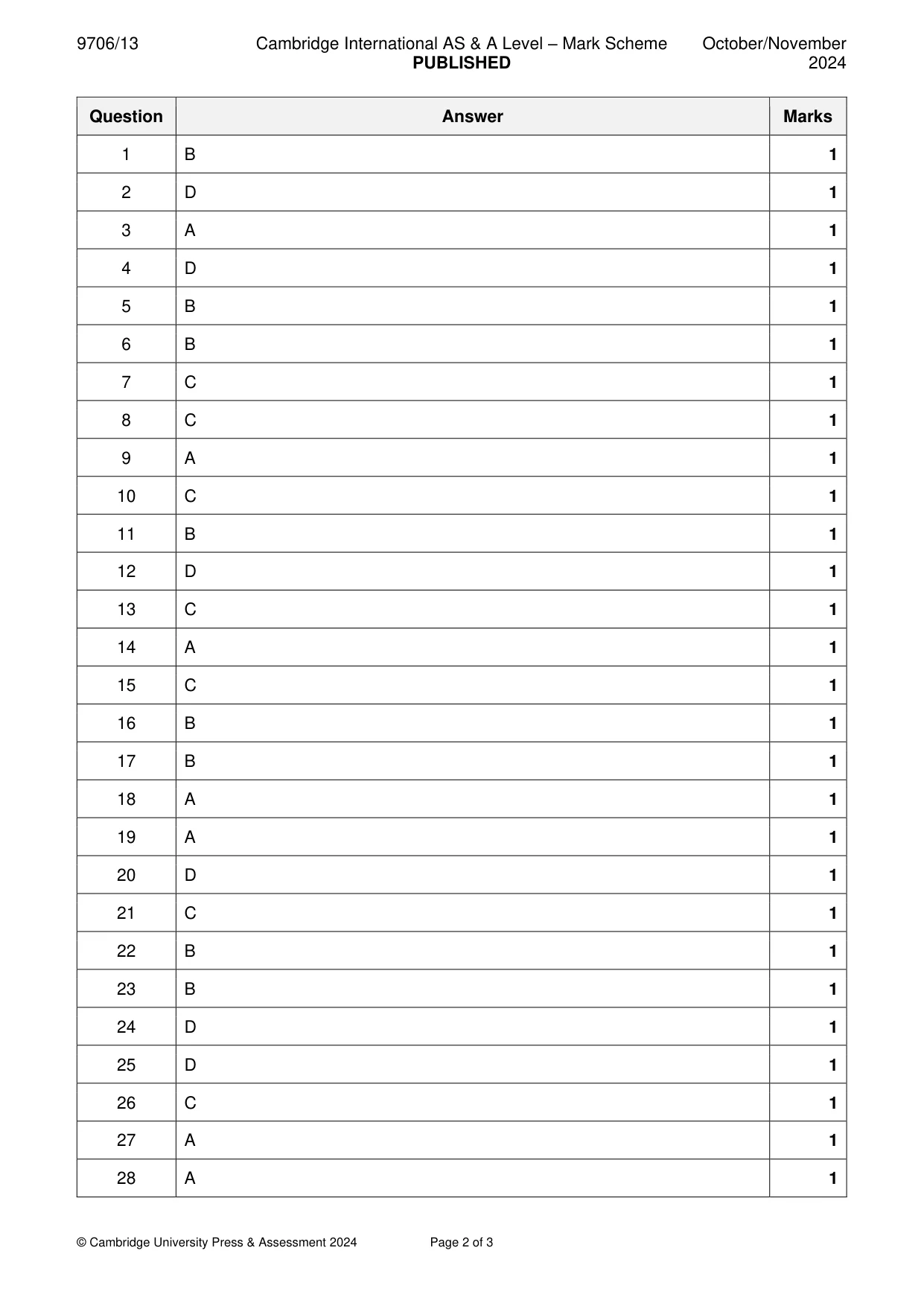
Mark scheme: B
Q2 · An item is found to be the subject of a material error in a company’s financial statements
2 An item is found to be the subject of a material error in a company’s financial statements. What does ‘material’ mean? A The item affects only the statement of profit or loss of the company. B The item affects only the statement of financial position of the company. C The item has a small monetary value. D The item may affect the economic decisions of a user of the financial statements.
Mark scheme: D
Q3 · Which accounting concepts are applied when a business makes an annual charge for…
3 Which accounting concepts are applied when a business makes an annual charge for depreciation of non-current assets? 1 consistency 2 matching/accruals 3 prudence 4 realisation A 1, 2 and 3 B 1 and 4 C 2 and 3 only D 3 and 4
Mark scheme: A
Q4 · A business recorded expenditure on improving a non-current asset as revenue expenditure
4 A business recorded expenditure on improving a non-current asset as revenue expenditure. What is the effect of this error on the carrying value of non-current assets and profit for the year? carrying value of profit for non-current the year assets A overstated overstated B overstated understated C understated overstated D understated understated
Mark scheme: D
Q5 · A car dealer and garage owner has the following vehicles at her premises
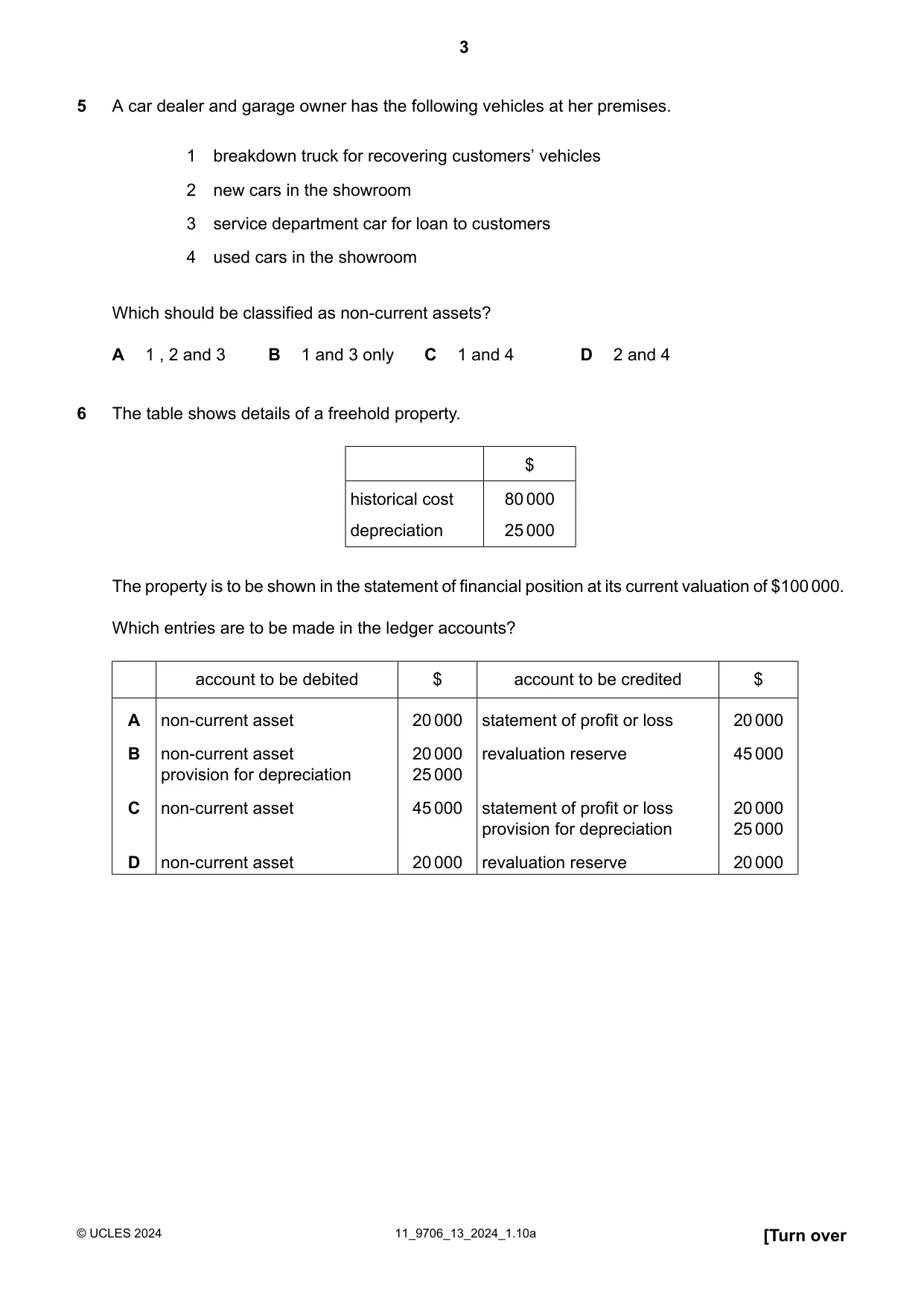
5 A car dealer and garage owner has the following vehicles at her premises. 1 breakdown truck for recovering customers’ vehicles 2 new cars in the showroom 3 service department car for loan to customers 4 used cars in the showroom Which should be classified as non-current assets? A 1 , 2 and 3 B 1 and 3 only C 1 and 4 D 2 and 4
Mark scheme: B
Q6 · The table shows details of a freehold property
6 The table shows details of a freehold property. $ historical cost 80000 depreciation 25000 The property is to be shown in the statement of financial position at its current valuation of $100000. Which entries are to be made in the ledger accounts? account to be debited $ account to be credited $ A non-current asset 20000 statement of profit or loss 20000 B non-current asset 20000 revaluation reserve 45000 provision for depreciation 25000 C non-current asset 45000 statement of profit or loss 20000 provision for depreciation 25000 D non-current asset 20000 revaluation reserve 20000
Mark scheme: B
Q7 · The following information relates to the motor vehicles of a business
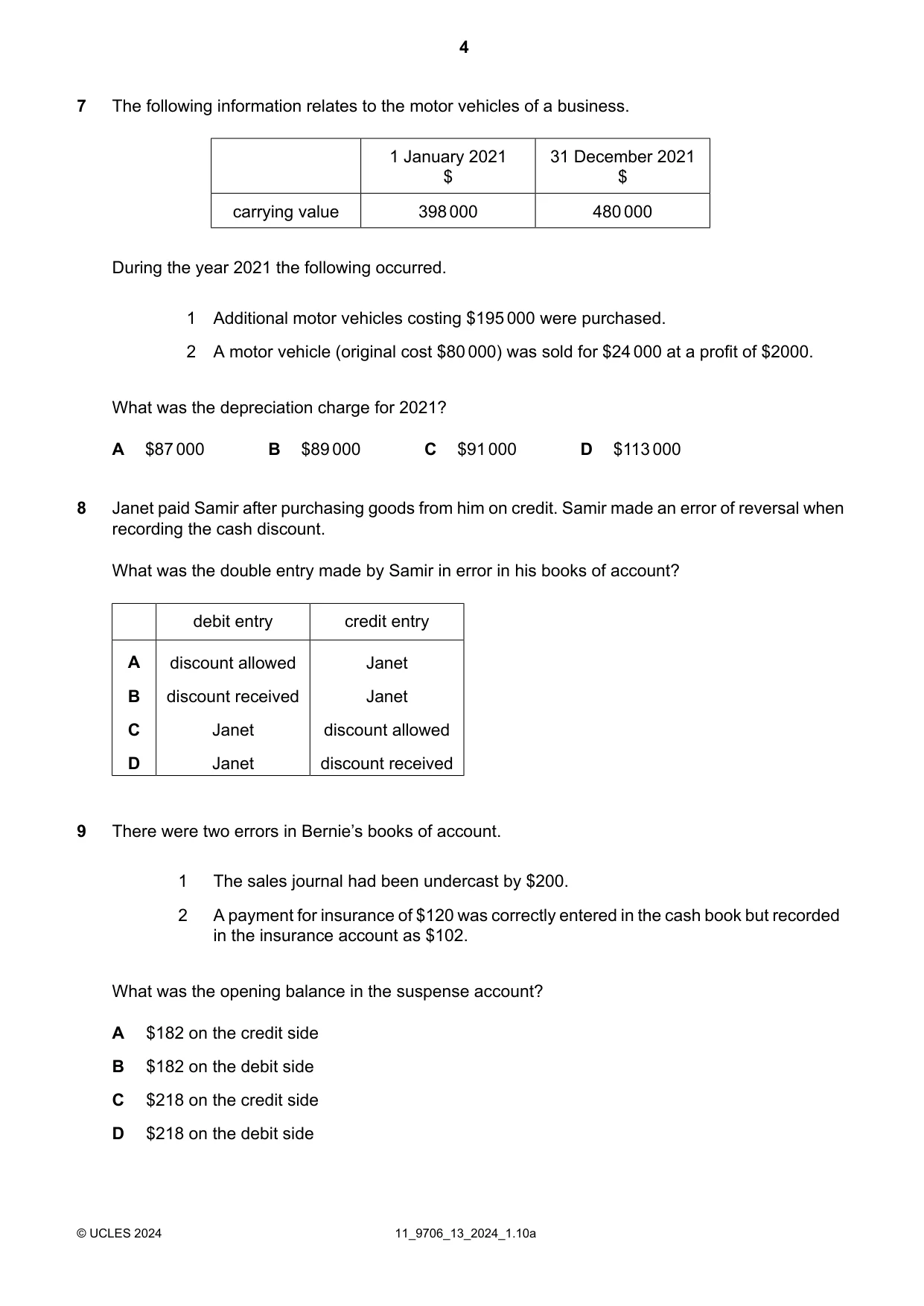
7 The following information relates to the motor vehicles of a business. 1 January 2021 31 December 2021 $ $ carrying value 398000 480000 During the year 2021 the following occurred. 1 Additional motor vehicles costing $195000 were purchased. 2 A motor vehicle (original cost $80000) was sold for $24000 at a profit of $2000. What was the depreciation charge for 2021? A $87000 B $89000 C $91000 D $113000
Mark scheme: C
Q8 · Janet paid Samir after purchasing goods from him on credit
8 Janet paid Samir after purchasing goods from him on credit. Samir made an error of reversal when recording the cash discount. What was the double entry made by Samir in error in his books of account? debit entry credit entry A discount allowed Janet B discount received Janet C Janet discount allowed D Janet discount received
Mark scheme: C
Q9 · There were two errors in Bernie’s books of account
9 There were two errors in Bernie’s books of account. 1 The sales journal had been undercast by $200. 2 A payment for insurance of $120 was correctly entered in the cash book but recorded in the insurance account as $102. What was the opening balance in the suspense account? A $182 on the credit side B $182 on the debit side C $218 on the credit side D $218 on the debit side
Mark scheme: A
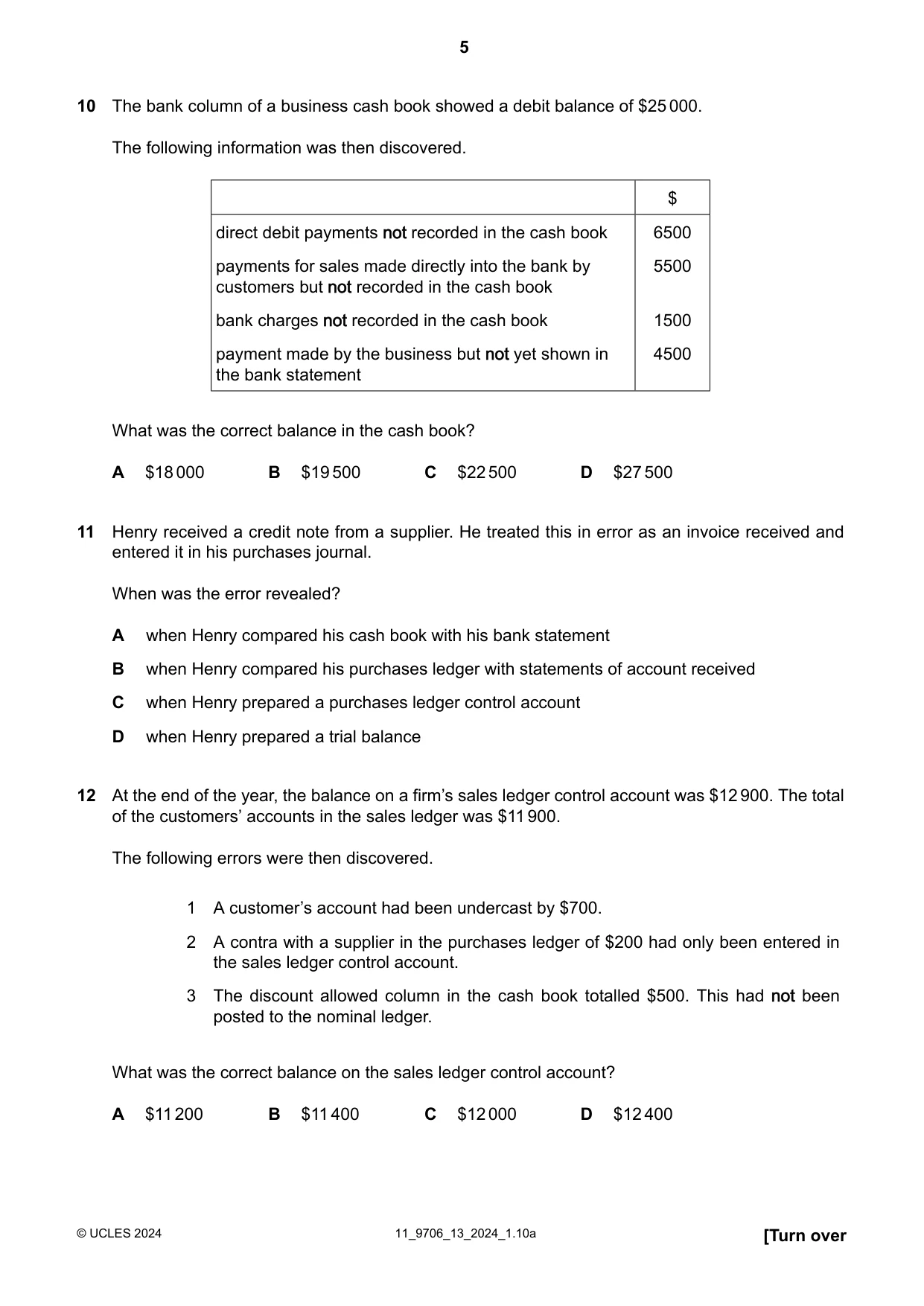
Q10 · The bank column of a business cash book showed a debit balance of $25000
10 The bank column of a business cash book showed a debit balance of $25000. The following information was then discovered. $ direct debit payments not recorded in the cash book 6500 payments for sales made directly into the bank by 5500 customers but not recorded in the cash book bank charges not recorded in the cash book 1500 payment made by the business but not yet shown in 4500 the bank statement What was the correct balance in the cash book? A $18000 B $19500 C $22500 D $27500
Mark scheme: C
Q11 · Henry received a credit note from a supplier
11 Henry received a credit note from a supplier. He treated this in error as an invoice received and entered it in his purchases journal. When was the error revealed? A when Henry compared his cash book with his bank statement B when Henry compared his purchases ledger with statements of account received C when Henry prepared a purchases ledger control account D when Henry prepared a trial balance
Mark scheme: B
Q12 · At the end of the year, the balance on a firm’s sales ledger control account was $12900
12 At the end of the year, the balance on a firm’s sales ledger control account was $12900. The total of the customers’ accounts in the sales ledger was $11900. The following errors were then discovered. 1 A customer’s account had been undercast by $700. 2 A contra with a supplier in the purchases ledger of $200 had only been entered in the sales ledger control account. 3 The discount allowed column in the cash book totalled $500. This had not been posted to the nominal ledger. What was the correct balance on the sales ledger control account? A $11200 B $11400 C $12000 D $12400
Mark scheme: D
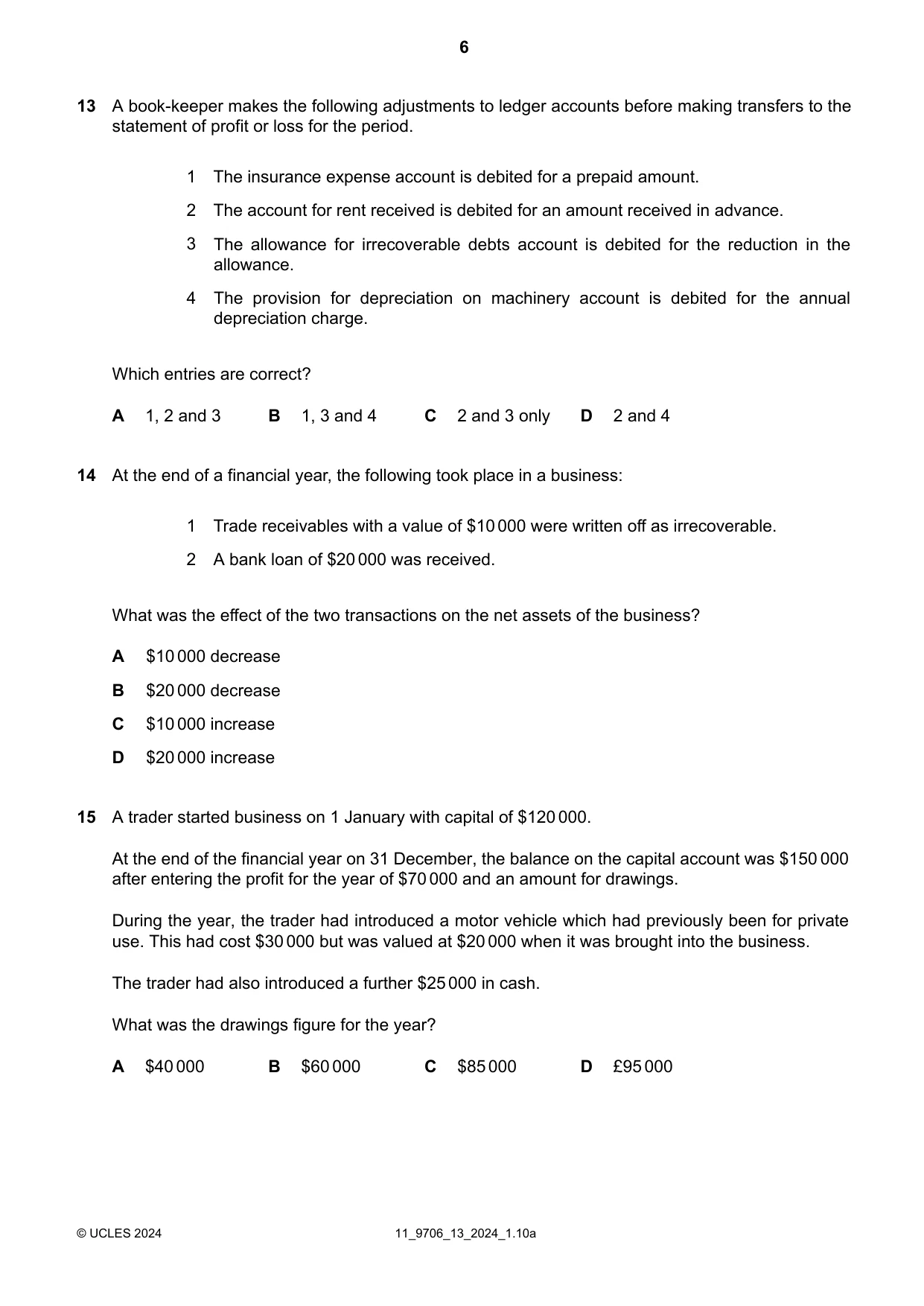
Q13 · A book-keeper makes the following adjustments to ledger accounts before making transfers…
13 A book-keeper makes the following adjustments to ledger accounts before making transfers to the statement of profit or loss for the period. 1 The insurance expense account is debited for a prepaid amount. 2 The account for rent received is debited for an amount received in advance. 3 The allowance for irrecoverable debts account is debited for the reduction in the allowance. 4 The provision for depreciation on machinery account is debited for the annual depreciation charge. Which entries are correct? A 1, 2 and 3 B 1, 3 and 4 C 2 and 3 only D 2 and 4
Mark scheme: C
Q14 · At the end of a financial year, the following took place in a business: 1 Trade…
14 At the end of a financial year, the following took place in a business: 1 Trade receivables with a value of $10000 were written off as irrecoverable. 2 A bank loan of $20000 was received. What was the effect of the two transactions on the net assets of the business? A $10000 decrease B $20000 decrease C $10000 increase D $20000 increase
Mark scheme: A
Q15 · A trader started business on 1 January with capital of $120 000
15 A trader started business on 1 January with capital of $120 000. At the end of the financial year on 31 December, the balance on the capital account was $150 000 after entering the profit for the year of $70 000 and an amount for drawings. During the year, the trader had introduced a motor vehicle which had previously been for private use. This had cost $30 000 but was valued at $20 000 when it was brought into the business. The trader had also introduced a further $25000 in cash. What was the drawings figure for the year? A $40000 B $60000 C $85000 D £95000
Mark scheme: C
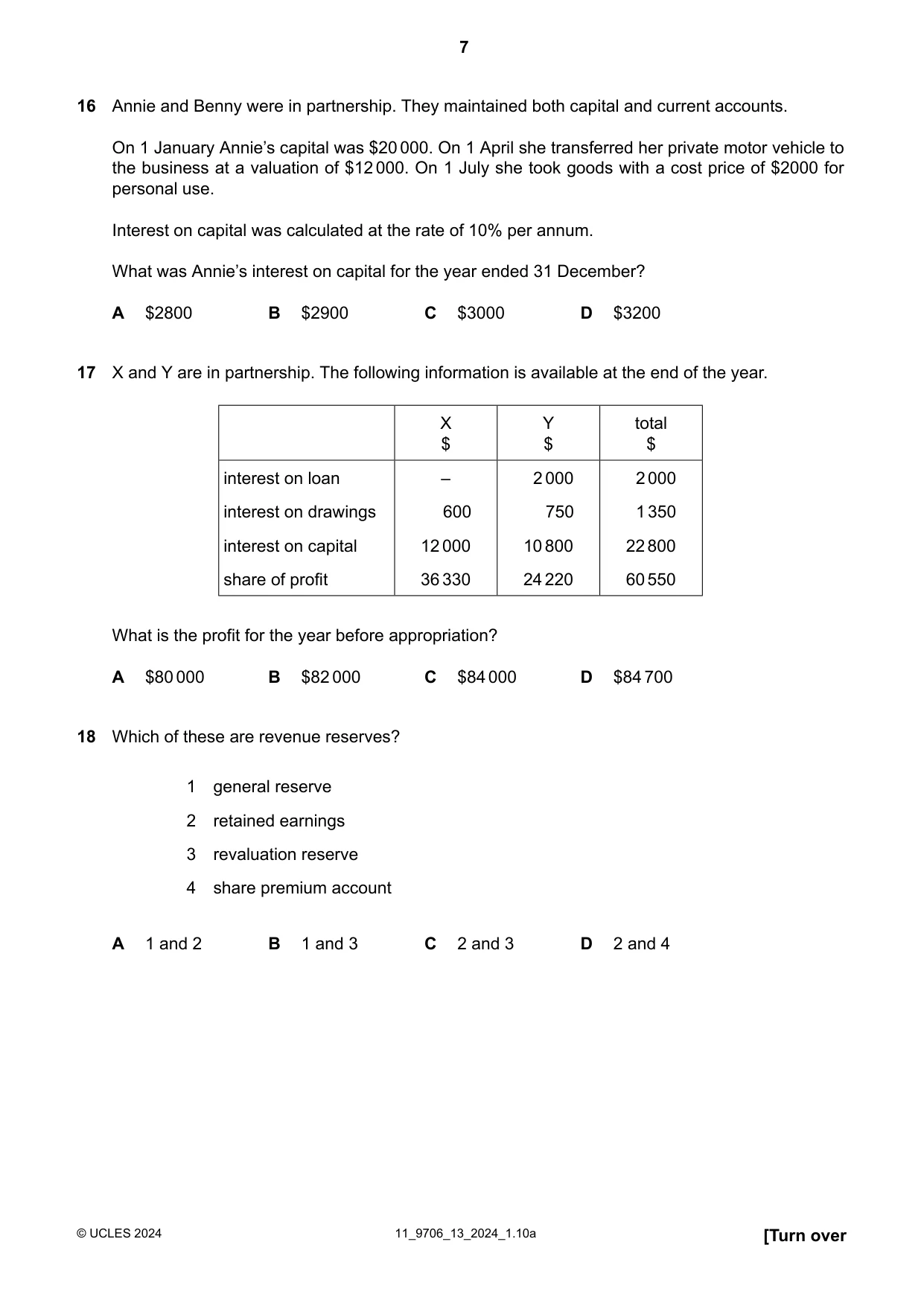
Q16 · Annie and Benny were in partnership
16 Annie and Benny were in partnership. They maintained both capital and current accounts. On 1 January Annie’s capital was $20000. On 1 April she transferred her private motor vehicle to the business at a valuation of $12000. On 1 July she took goods with a cost price of $2000 for personal use. Interest on capital was calculated at the rate of 10% per annum. What was Annie’s interest on capital for the year ended 31 December? A $2800 B $2900 C $3000 D $3200
Mark scheme: B
Q17 · X and Y are in partnership
17 X and Y are in partnership. The following information is available at the end of the year. X Y total $ $ $ interest on loan – 2000 2000 interest on drawings 600 750 1350 interest on capital 12000 10800 22800 share of profit 36330 24220 60550 What is the profit for the year before appropriation? A $80000 B $82000 C $84000 D $84700
Mark scheme: B
Q18 · Which of these are revenue reserves?
18 Which of these are revenue reserves? 1 general reserve 2 retained earnings 3 revaluation reserve 4 share premium account A 1 and 2 B 1 and 3 C 2 and 3 D 2 and 4
Mark scheme: A
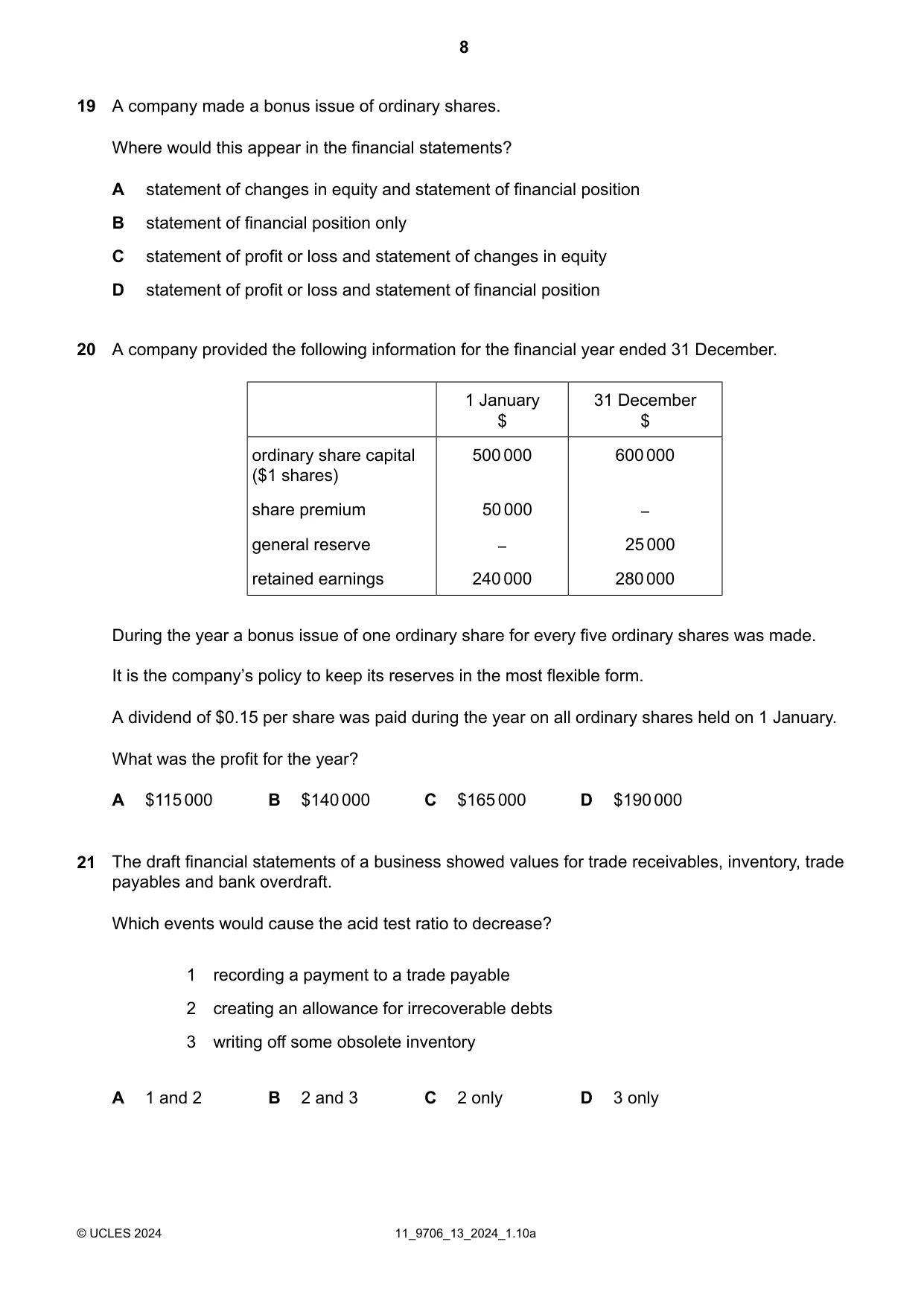
Q19 · A company made a bonus issue of ordinary shares
19 A company made a bonus issue of ordinary shares. Where would this appear in the financial statements? A statement of changes in equity and statement of financial position B statement of financial position only C statement of profit or loss and statement of changes in equity D statement of profit or loss and statement of financial position
Mark scheme: A
Q20 · A company provided the following information for the financial year ended 31 December
20 A company provided the following information for the financial year ended 31 December. 1 January 31 December $ $ ordinary share capital 500000 600000 ($1 shares) share premium 50000 − general reserve − 25000 retained earnings 240000 280000 During the year a bonus issue of one ordinary share for every five ordinary shares was made. It is the company’s policy to keep its reserves in the most flexible form. A dividend of $0.15 per share was paid during the year on all ordinary shares held on 1 January. What was the profit for the year? A $115 000 B $140 000 C $165 000 D $190 000
Mark scheme: D
Q21 · The draft financial statements of a business showed values for trade receivables…
21 The draft financial statements of a business showed values for trade receivables, inventory, trade payables and bank overdraft. Which events would cause the acid test ratio to decrease? 1 recording a payment to a trade payable 2 creating an allowance for irrecoverable debts 3 writing off some obsolete inventory A 1 and 2 B 2 and 3 C 2 only D 3 only
Mark scheme: C
More questions on Analysis and communication of accounting information
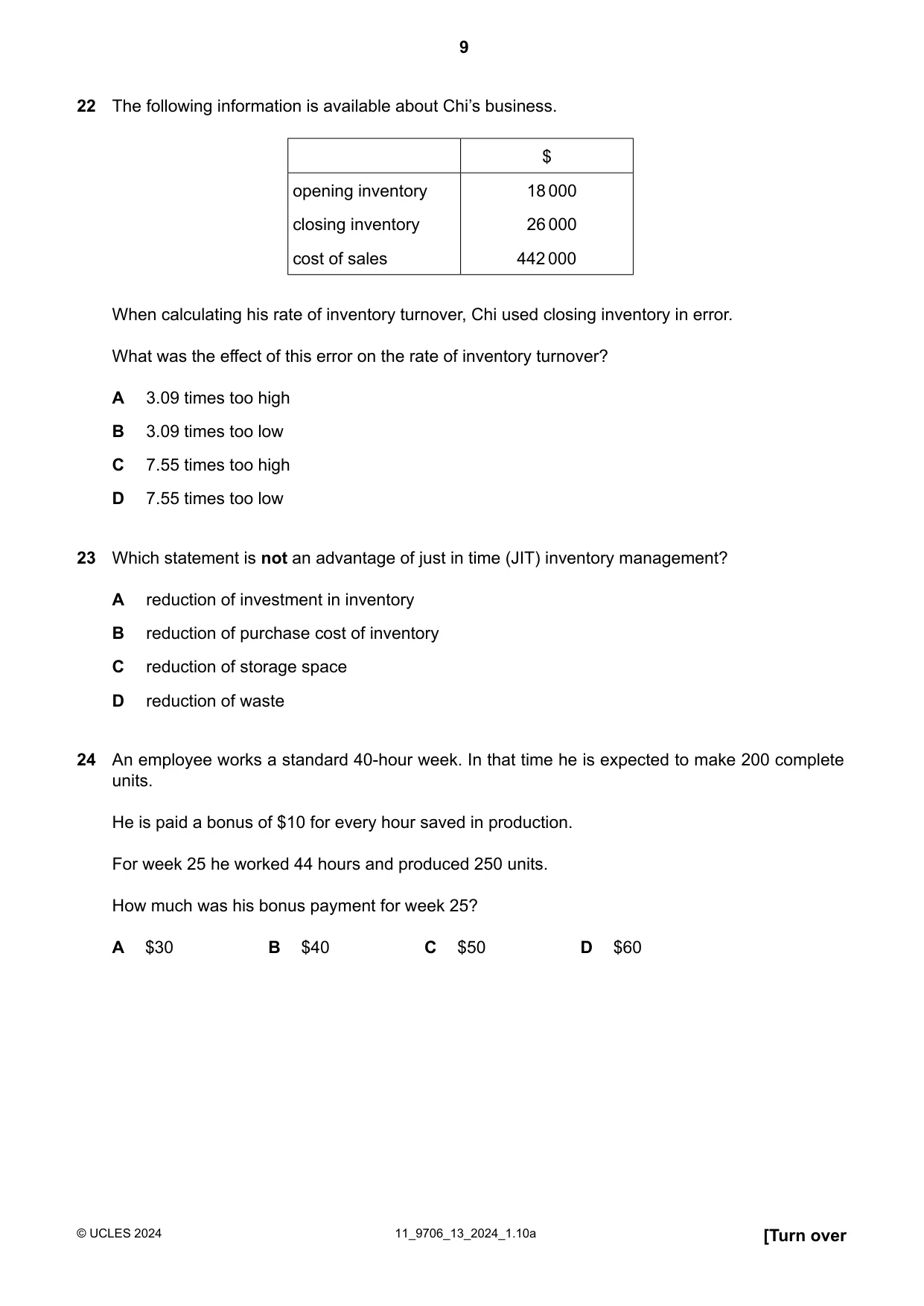
Q22 · The following information is available about Chi’s business
22 The following information is available about Chi’s business. $ opening inventory 18000 closing inventory 26000 cost of sales 442000 When calculating his rate of inventory turnover, Chi used closing inventory in error. What was the effect of this error on the rate of inventory turnover? A 3.09 times too high B 3.09 times too low C 7.55 times too high D 7.55 times too low
Mark scheme: B
More questions on Analysis and communication of accounting information
Q23 · Which statement is not an advantage of just in time (JIT) inventory management?
23 Which statement is not an advantage of just in time (JIT) inventory management? A reduction of investment in inventory B reduction of purchase cost of inventory C reduction of storage space D reduction of waste
Mark scheme: B
Q24 · An employee works a standard 40-hour week
24 An employee works a standard 40-hour week. In that time he is expected to make 200 complete units. He is paid a bonus of $10 for every hour saved in production. For week 25 he worked 44 hours and produced 250 units. How much was his bonus payment for week 25? A $30 B $40 C $50 D $60
Mark scheme: D
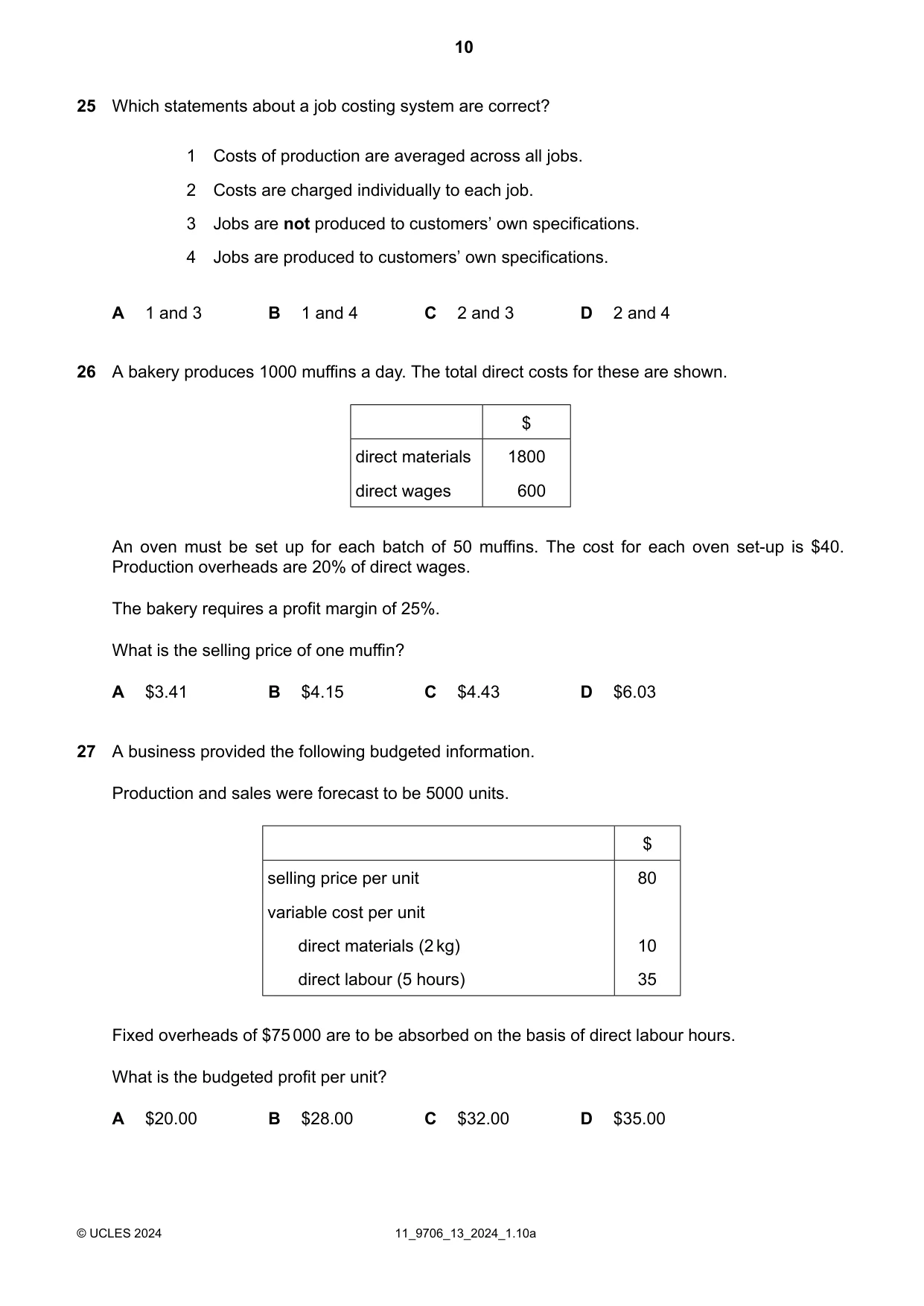
Q25 · Which statements about a job costing system are correct?
25 Which statements about a job costing system are correct? 1 Costs of production are averaged across all jobs. 2 Costs are charged individually to each job. 3 Jobs are not produced to customers’ own specifications. 4 Jobs are produced to customers’ own specifications. A 1 and 3 B 1 and 4 C 2 and 3 D 2 and 4
Mark scheme: D
Q26 · A bakery produces 1000 muffins a day
26 A bakery produces 1000 muffins a day. The total direct costs for these are shown. $ direct materials 1800 direct wages 600 An oven must be set up for each batch of 50 muffins. The cost for each oven set-up is $40. Production overheads are 20% of direct wages. The bakery requires a profit margin of 25%. What is the selling price of one muffin? A $3.41 B $4.15 C $4.43 D $6.03
Mark scheme: C
Q27 · A business provided the following budgeted information
27 A business provided the following budgeted information. Production and sales were forecast to be 5000 units. $ selling price per unit 80 variable cost per unit direct materials (2kg) 10 direct labour (5 hours) 35 Fixed overheads of $75000 are to be absorbed on the basis of direct labour hours. What is the budgeted profit per unit? A $20.00 B $28.00 C $32.00 D $35.00
Mark scheme: A
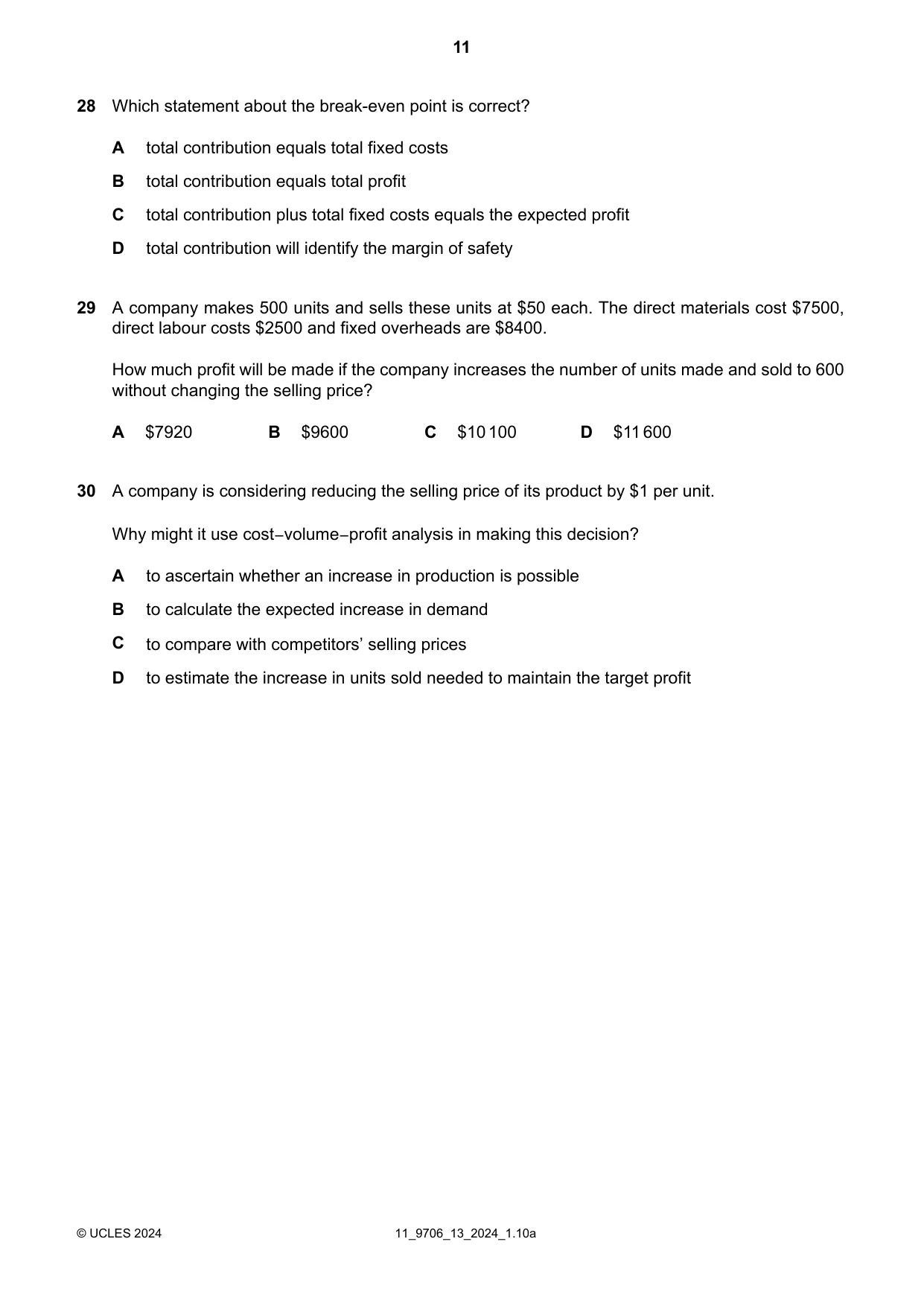
Q28 · Which statement about the break-even point is correct?
28 Which statement about the break-even point is correct? A total contribution equals total fixed costs B total contribution equals total profit C total contribution plus total fixed costs equals the expected profit D total contribution will identify the margin of safety
Mark scheme: A
Q29 · A company makes 500 units and sells these units at $50 each
29 A company makes 500 units and sells these units at $50 each. The direct materials cost $7500, direct labour costs $2500 and fixed overheads are $8400. How much profit will be made if the company increases the number of units made and sold to 600 without changing the selling price? A $7920 B $9600 C $10100 D $11600
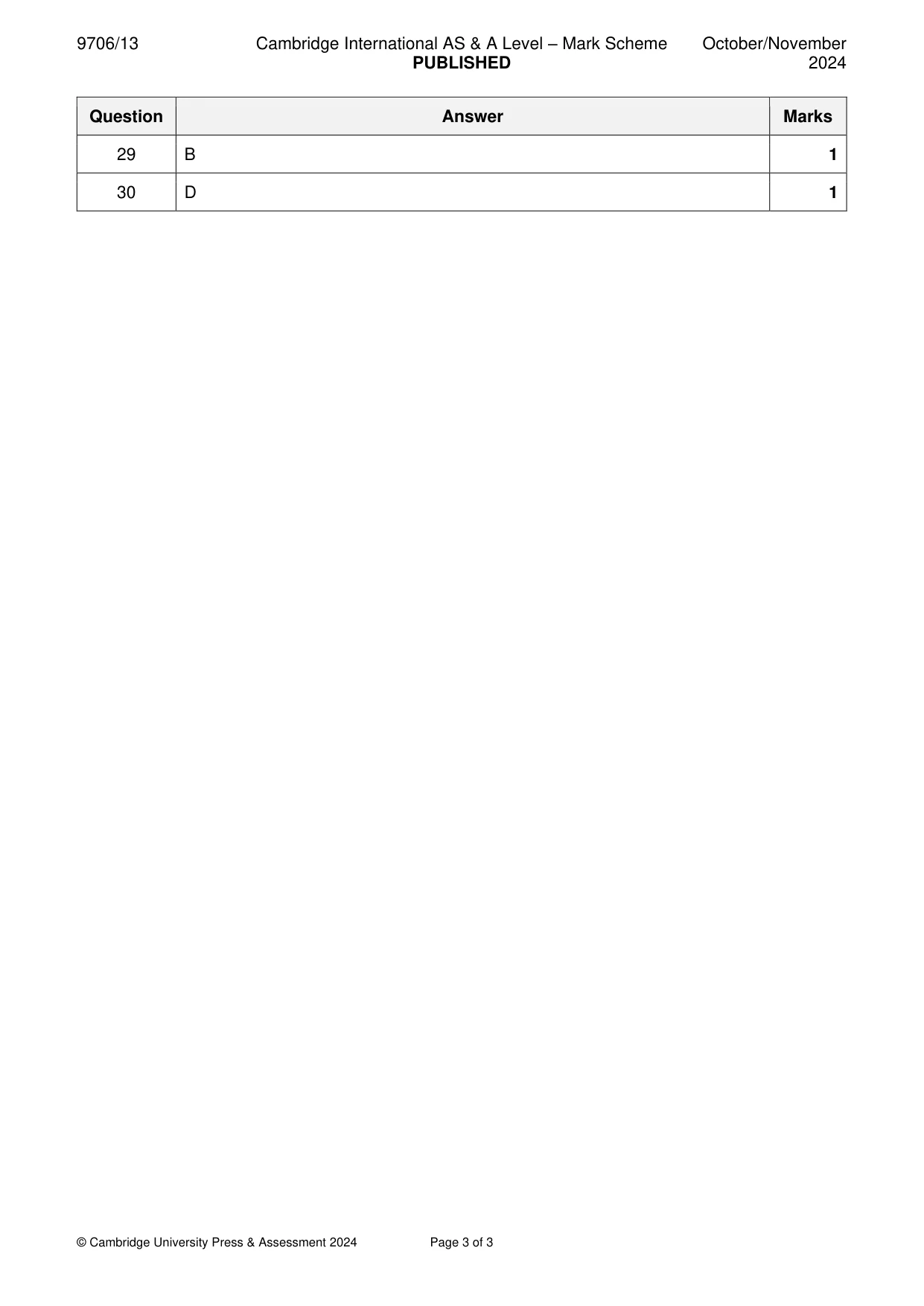
Mark scheme: B
Q30 · A company is considering reducing the selling price of its product by $1 per unit
30 A company is considering reducing the selling price of its product by $1 per unit. Why might it use cost−volume−profit analysis in making this decision? A to ascertain whether an increase in production is possible B to calculate the expected increase in demand C to compare with competitors’ selling prices D to estimate the increase in units sold needed to maintain the target profit
Mark scheme: D
What was in this paper
The subtopics covered by these 30 questions, and how many questions each got. Open one in a new tab to see every Cambridge question on it.
5Preparation of financial statements5Reconciliation and verification5Accounting for non-current assets4Preparation of financial statements3Traditional costing methods3Analysis and communication of accounting information2The accounting system2Regulatory and ethical considerations1What you needed in this session
Cambridge’s own grade thresholds for 2024 Oct/Nov, Paper 1 · Variant 3. A higher threshold means an easier paper — the bar moves with how the cohort did.