Cambridge A Level Accounting 9706 — 2021 May/June Paper 1 · Variant 3
9706/13/M/J/21 · 30 questions · 30 marks · ≈34 min
The question paper and its mark scheme, free to read here and free to download. This is Cambridge’s own paper, exactly as it was sat.
Question paper12 pages
Mark scheme3 pages
Answers below. Sit the paper first if you are practising.
Questions as text
Q1 · A business purchased a pocket calculator for the use of the book-keeper
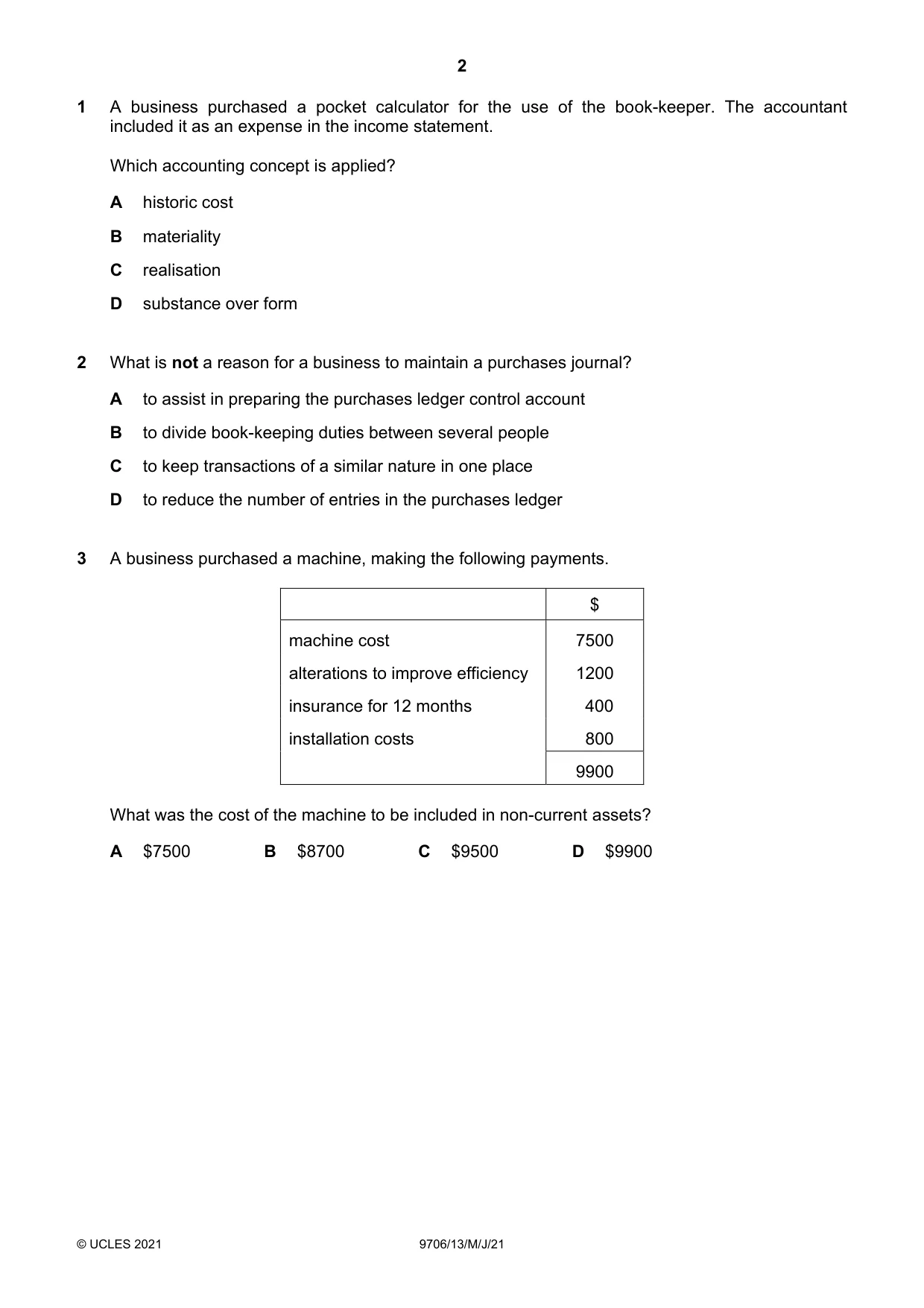
1 A business purchased a pocket calculator for the use of the book-keeper. The accountant included it as an expense in the income statement. Which accounting concept is applied? A historic cost B materiality C realisation D substance over form
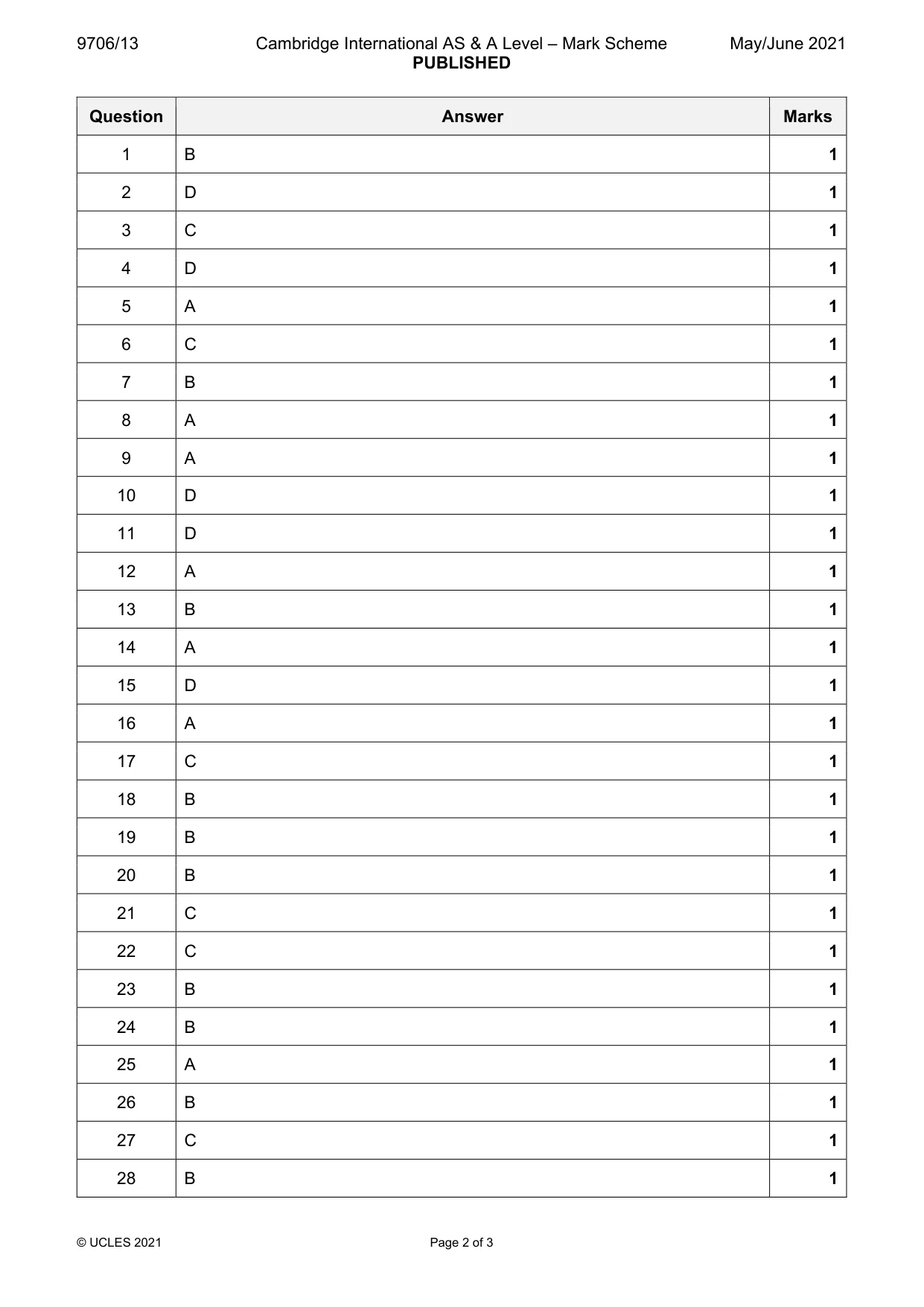
Mark scheme: B
Q2 · What is not a reason for a business to maintain a purchases journal?
2 What is not a reason for a business to maintain a purchases journal? A to assist in preparing the purchases ledger control account B to divide book-keeping duties between several people C to keep transactions of a similar nature in one place D to reduce the number of entries in the purchases ledger
Mark scheme: D
Q3 · A business purchased a machine, making the following payments
3 A business purchased a machine, making the following payments. $ machine cost 7500 alterations to improve efficiency 1200 insurance for 12 months 400 installation costs 800 9900 What was the cost of the machine to be included in non-current assets? A $7500 B $8700 C $9500 D $9900
Mark scheme: C
Q4 · A business had a financial year end of 31 December 2020
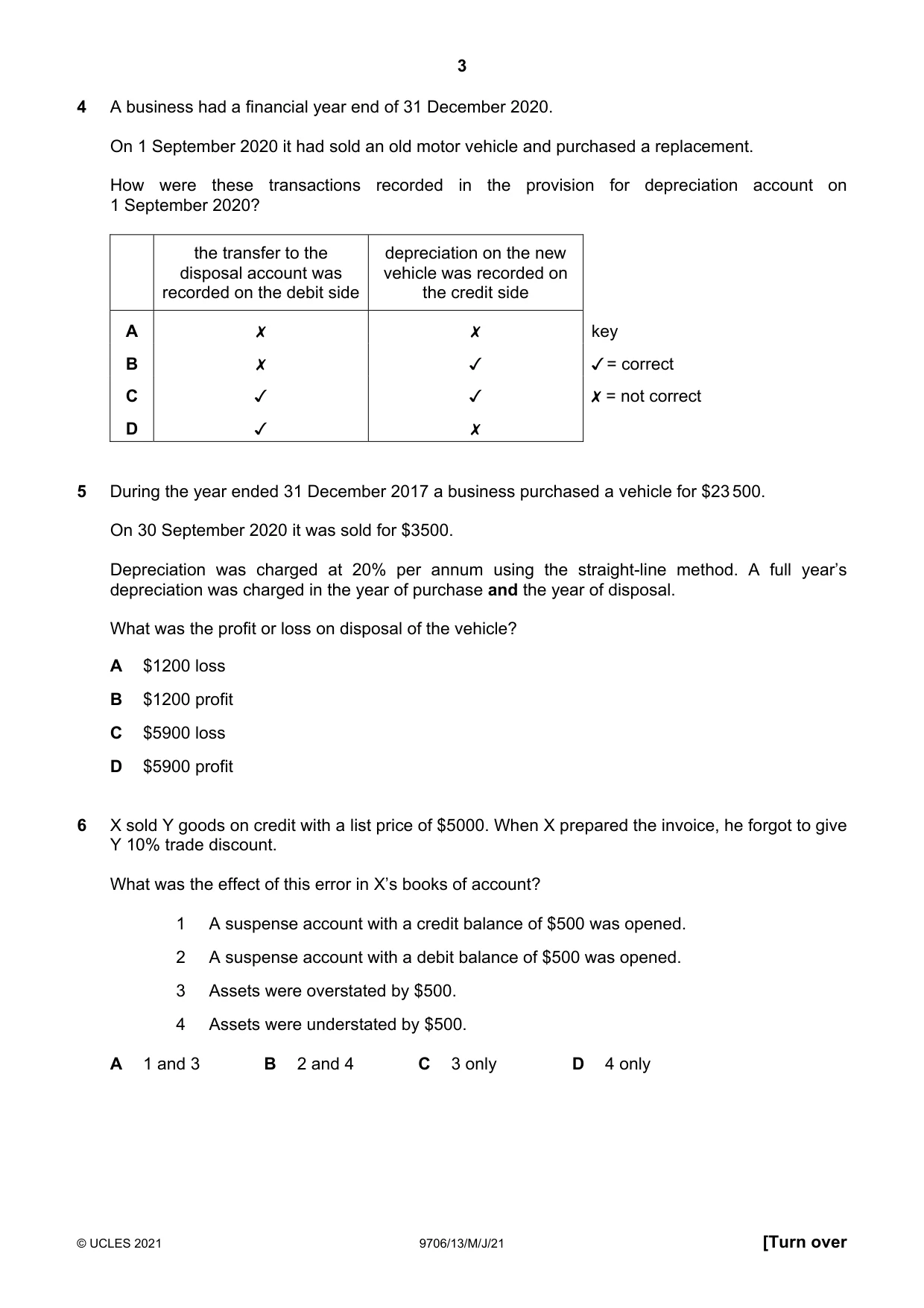
4 A business had a financial year end of 31 December 2020. On 1 September 2020 it had sold an old motor vehicle and purchased a replacement. How were these transactions recorded in the provision for depreciation account on 1 September 2020? the transfer to the depreciation on the new disposal account was vehicle was recorded on recorded on the debit side the credit side A x x key B x Jv / = correct Cc Jv v X = not correct D v x
Mark scheme: D
Q5 · During the year ended 31 December 2017 a business purchased a vehicle for $23 500
5 During the year ended 31 December 2017 a business purchased a vehicle for $23 500. On 30 September 2020 it was sold for $3500. Depreciation was charged at 20% per annum using the straight-line method. A full year’s depreciation was charged in the year of purchase and the year of disposal. What was the profit or loss on disposal of the vehicle? A $1200 loss B $1200 profit C $5900 loss D $5900 profit
Mark scheme: A
Q6 · X sold Y goods on credit with a list price of $5000
6 X sold Y goods on credit with a list price of $5000. When X prepared the invoice, he forgot to give Y 10% trade discount. What was the effect of this error in X’s books of account? 1 A suspense account with a credit balance of $500 was opened. 2 A suspense account with a debit balance of $500 was opened. 3 Assets were overstated by $500. 4 Assets were understated by $500. A 1 and 3 B 2 and 4 C 3 only D 4 only
Mark scheme: C
Q7 · At the end of a financial year, the debit balance on a trader’s sales ledger control…
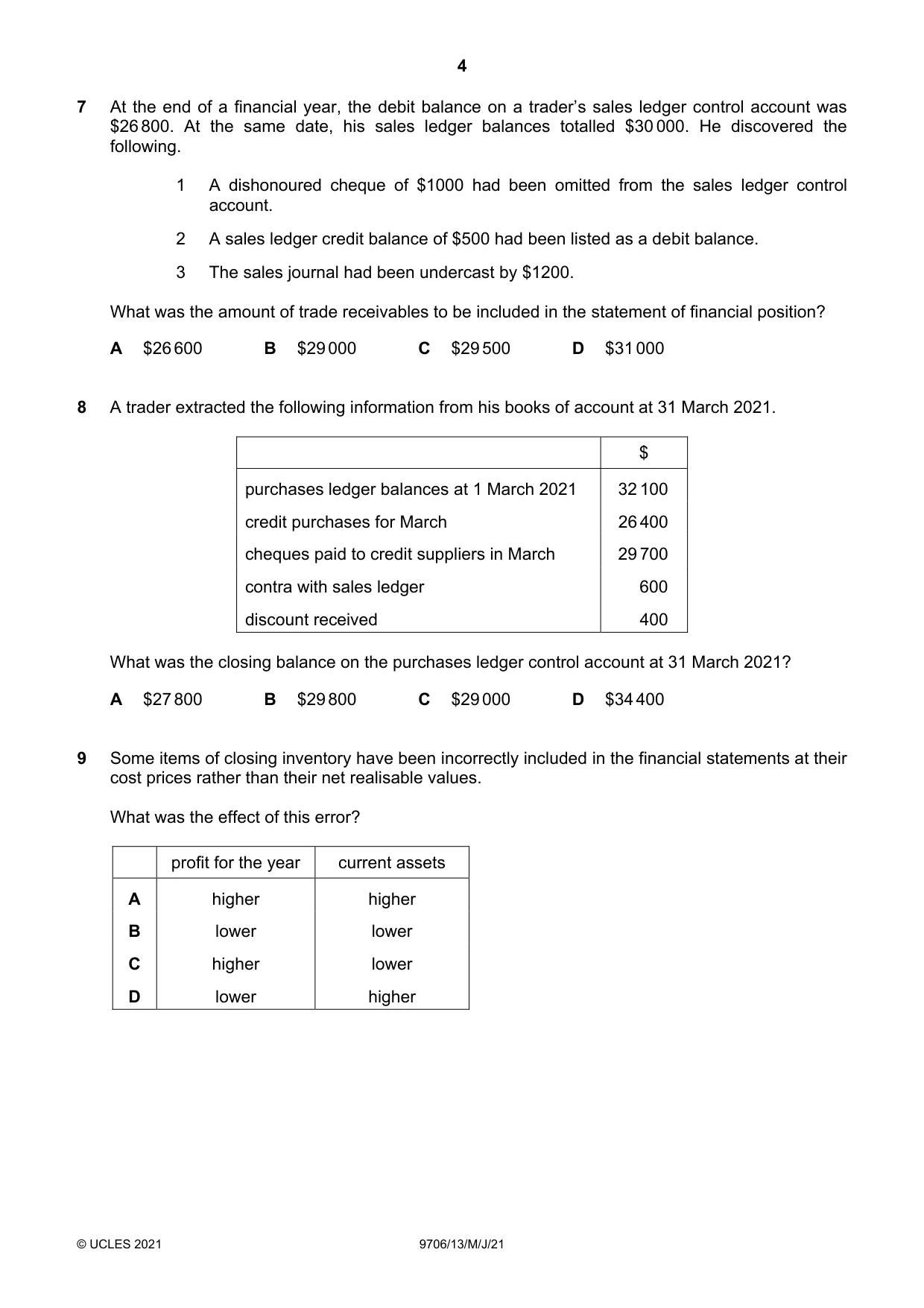
7 At the end of a financial year, the debit balance on a trader’s sales ledger control account was $26 800. At the same date, his sales ledger balances totalled $30 000. He discovered the following. 1 A dishonoured cheque of $1000 had been omitted from the sales ledger control account. 2 A sales ledger credit balance of $500 had been listed as a debit balance. 3 The sales journal had been undercast by $1200. What was the amount of trade receivables to be included in the statement of financial position? A $26 600 B $29 000 C $29 500 D $31 000
Mark scheme: B
Q8 · A trader extracted the following information from his books of account at 31 March 2021
8 A trader extracted the following information from his books of account at 31 March 2021. $ purchases ledger balances at 1 March 2021 32 100 credit purchases for March 26 400 cheques paid to credit suppliers in March 29 700 contra with sales ledger 600 discount received 400 What was the closing balance on the purchases ledger control account at 31 March 2021? A $27 800 B $29 800 C $29 000 D $34 400
Mark scheme: A
Q9 · Some items of closing inventory have been incorrectly included in the financial…
9 Some items of closing inventory have been incorrectly included in the financial statements at their cost prices rather than their net realisable values. What was the effect of this error? profit for the year current assets A higher higher B lower lower C higher lower D lower higher
Mark scheme: A
Q10 · Marianna rents part of her premises to Paul
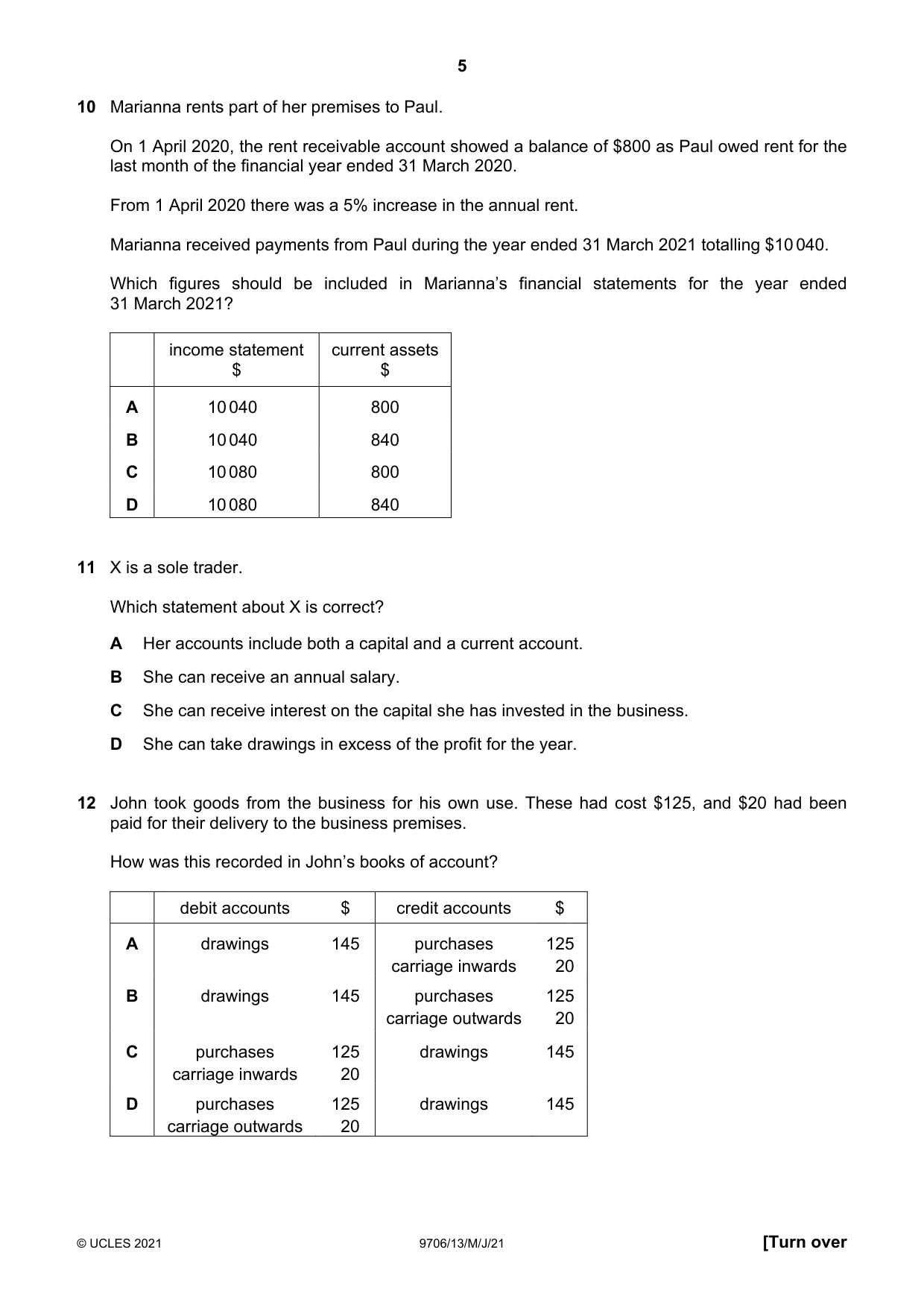
10 Marianna rents part of her premises to Paul. On 1 April 2020, the rent receivable account showed a balance of $800 as Paul owed rent for the last month of the financial year ended 31 March 2020. From 1 April 2020 there was a 5% increase in the annual rent. Marianna received payments from Paul during the year ended 31 March 2021 totalling $10 040. Which figures should be included in Marianna’s financial statements for the year ended 31 March 2021? income statement current assets $ $ A 10 040 800 B 10 040 840 C 10 080 800 D 10 080 840
Mark scheme: D
Q11 · X is a sole trader
11 X is a sole trader. Which statement about X is correct? A Her accounts include both a capital and a current account. B She can receive an annual salary. C She can receive interest on the capital she has invested in the business. D She can take drawings in excess of the profit for the year.
Mark scheme: D
Q12 · John took goods from the business for his own use
12 John took goods from the business for his own use. These had cost $125, and $20 had been paid for their delivery to the business premises. How was this recorded in John’s books of account? debit accounts $ credit accounts $ A drawings 145 purchases 125 carriage inwards 20 B drawings 145 purchases 125 carriage outwards 20 C purchases 125 drawings 145 carriage inwards 20 D purchases 125 drawings 145 carriage outwards 20
Mark scheme: A
Q13 · P and Q were in partnership, sharing profits and losses equally
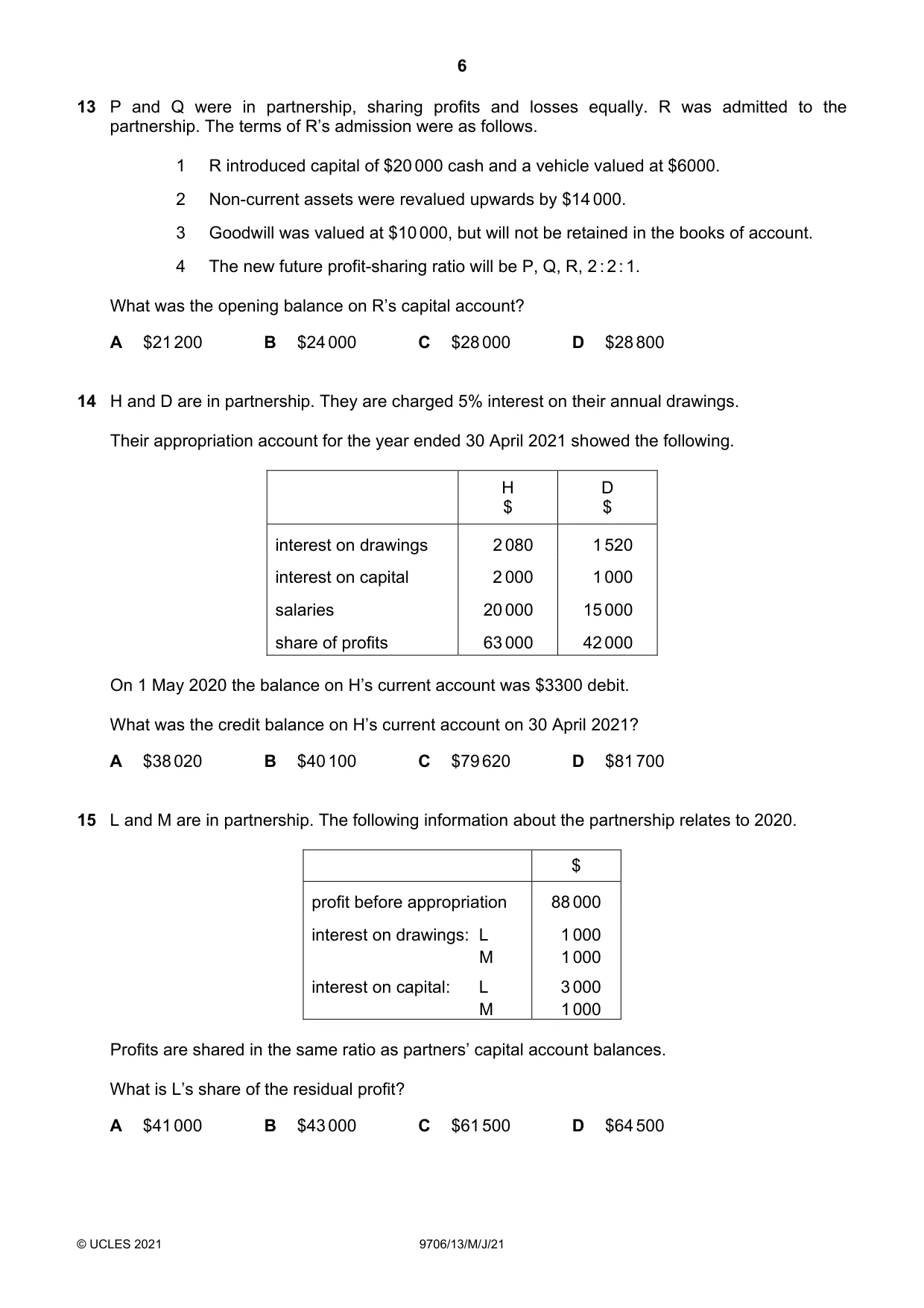
13 P and Q were in partnership, sharing profits and losses equally. R was admitted to the partnership. The terms of R’s admission were as follows. 1 R introduced capital of $20 000 cash and a vehicle valued at $6000. 2 Non-current assets were revalued upwards by $14 000. 3 Goodwill was valued at $10 000, but will not be retained in the books of account. 4 The new future profit-sharing ratio will be P, Q, R, 2 : 2 : 1. What was the opening balance on R’s capital account? A $21 200 B $24 000 C $28 000 D $28 800
Mark scheme: B
Q14 · H and D are in partnership
14 H and D are in partnership. They are charged 5% interest on their annual drawings. Their appropriation account for the year ended 30 April 2021 showed the following. H D $ $ interest on drawings 2 080 1 520 interest on capital 2 000 1 000 salaries 20 000 15 000 share of profits 63 000 42 000 On 1 May 2020 the balance on H’s current account was $3300 debit. What was the credit balance on H’s current account on 30 April 2021? A $38 020 B $40 100 C $79 620 D $81 700
Mark scheme: A
Q15 · L and M are in partnership
15 L and M are in partnership. The following information about the partnership relates to 2020. $ profit before appropriation 88 000 interest on drawings: L 1 000 M 1 000 interest on capital: L 3 000 M 1 000 Profits are shared in the same ratio as partners’ capital account balances. What is L’s share of the residual profit? A $41 000 B $43 000 C $61 500 D $64 500
Mark scheme: D
Q16 · A company’s statement of financial position shows the following balances
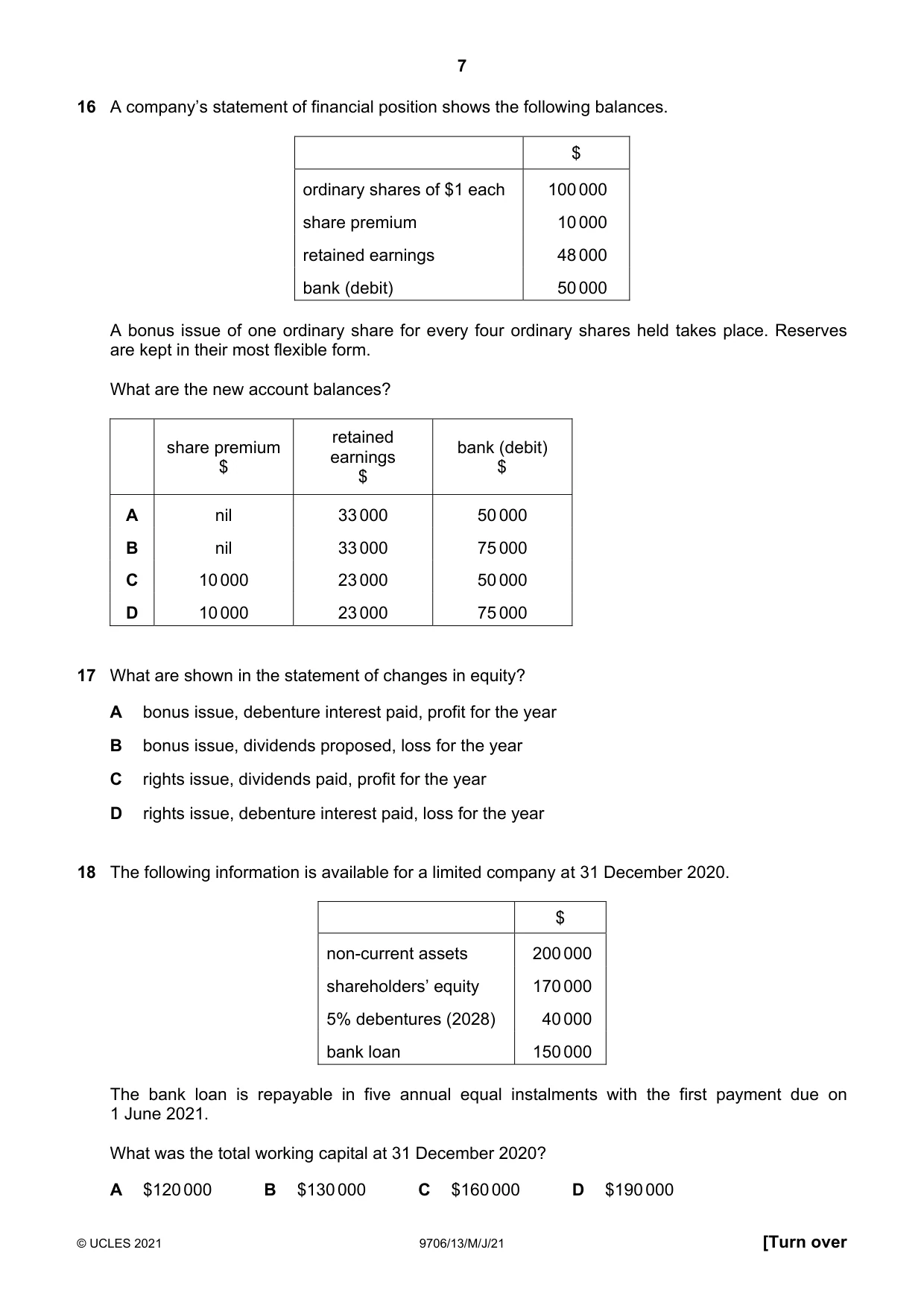
16 A company’s statement of financial position shows the following balances. $ ordinary shares of $1 each 100 000 share premium 10 000 retained earnings 48 000 bank (debit) 50 000 A bonus issue of one ordinary share for every four ordinary shares held takes place. Reserves are kept in their most flexible form. What are the new account balances? retained share premium bank (debit) earnings $ $ $ A nil 33 000 50 000 B nil 33 000 75 000 C 10 000 23 000 50 000 D 10 000 23 000 75 000
Mark scheme: A
Q17 · What are shown in the statement of changes in equity?
17 What are shown in the statement of changes in equity? A bonus issue, debenture interest paid, profit for the year B bonus issue, dividends proposed, loss for the year C rights issue, dividends paid, profit for the year D rights issue, debenture interest paid, loss for the year
Mark scheme: C
Q18 · The following information is available for a limited company at 31 December 2020
18 The following information is available for a limited company at 31 December 2020. $ non-current assets 200 000 shareholders’ equity 170 000 5% debentures (2028) 40 000 bank loan 150 000 The bank loan is repayable in five annual equal instalments with the first payment due on 1 June 2021. What was the total working capital at 31 December 2020? A $120 000 B $130 000 C $160 000 D $190 000
Mark scheme: B
Q19 · A trader has been making a provision for irrecoverable debts for some years
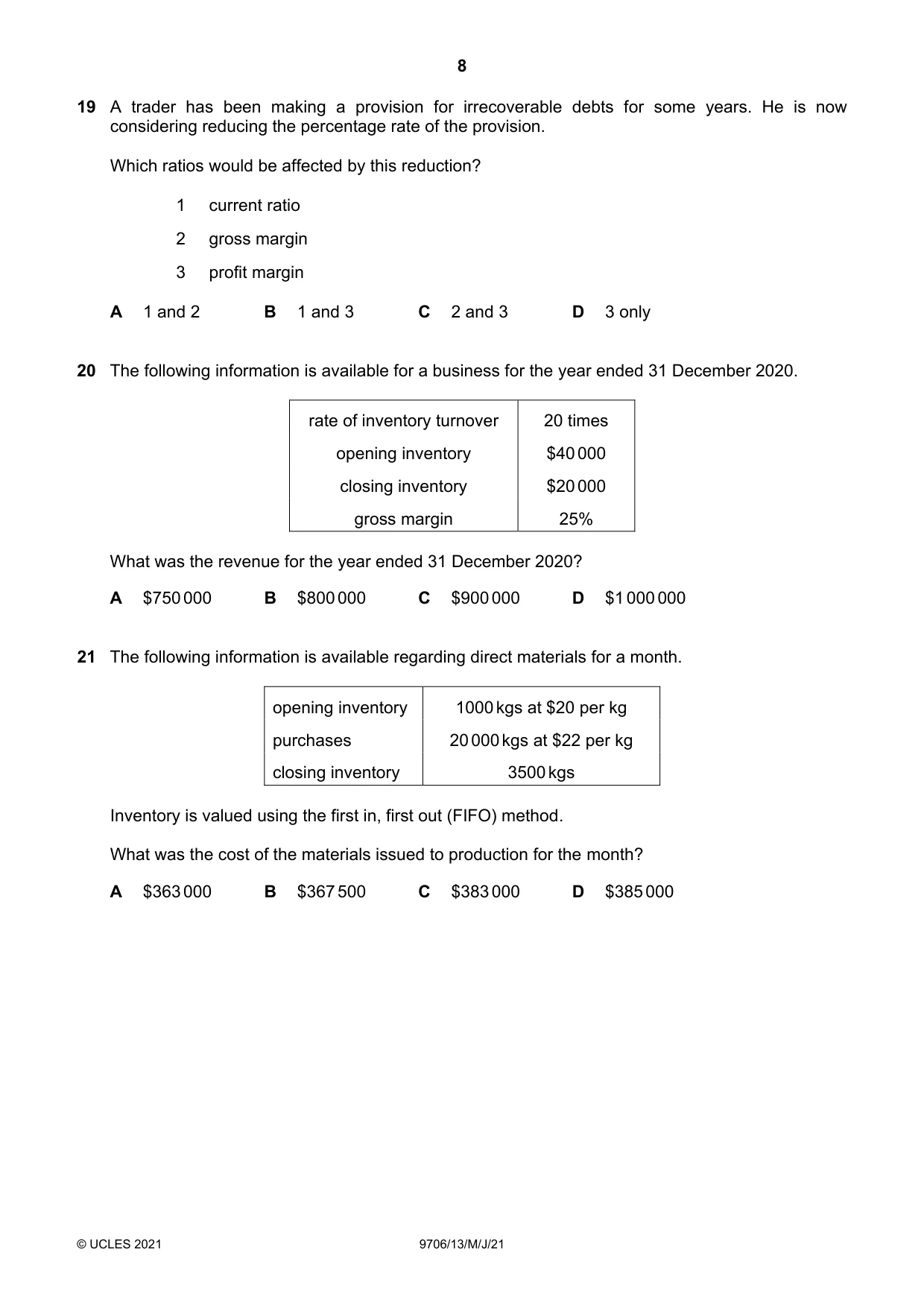
19 A trader has been making a provision for irrecoverable debts for some years. He is now considering reducing the percentage rate of the provision. Which ratios would be affected by this reduction? 1 current ratio 2 gross margin 3 profit margin A 1 and 2 B 1 and 3 C 2 and 3 D 3 only
Mark scheme: B
More questions on Analysis and communication of accounting information
Q20 · The following information is available for a business for the year ended 31 December 2020
20 The following information is available for a business for the year ended 31 December 2020. rate of inventory turnover 20 times opening inventory $40 000 closing inventory $20 000 gross margin 25% What was the revenue for the year ended 31 December 2020? A $750 000 B $800 000 C $900 000 D $1 000 000
Mark scheme: B
More questions on Analysis and communication of accounting information
Q21 · The following information is available regarding direct materials for a month
21 The following information is available regarding direct materials for a month. opening inventory 1000 kgs at $20 per kg purchases 20 000 kgs at $22 per kg closing inventory 3500 kgs Inventory is valued using the first in, first out (FIFO) method. What was the cost of the materials issued to production for the month? A $363 000 B $367 500 C $383 000 D $385 000
Mark scheme: C
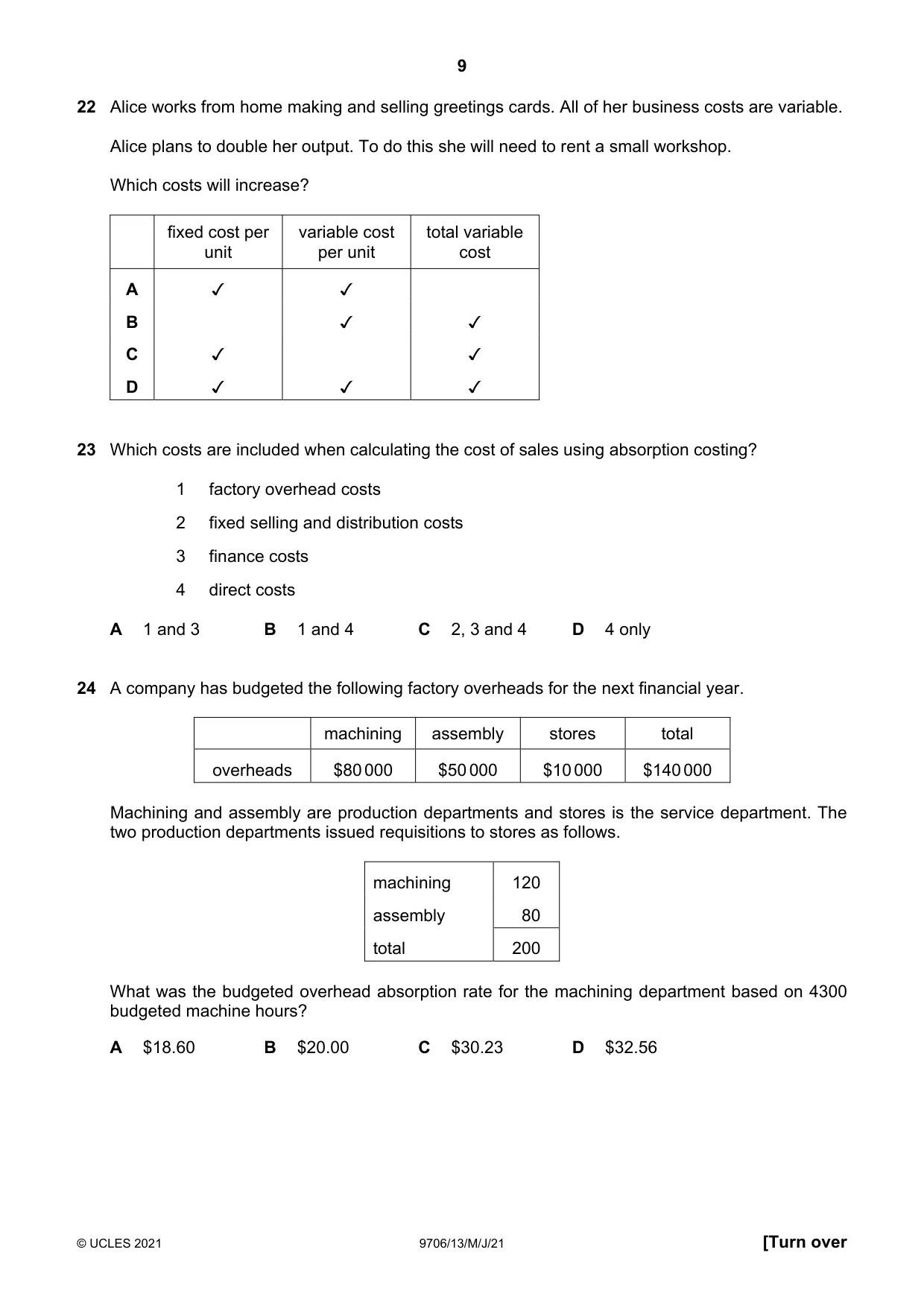
Q22 · Alice works from home making and selling greetings cards
22 Alice works from home making and selling greetings cards. All of her business costs are variable. Alice plans to double her output. To do this she will need to rent a small workshop. Which costs will increase? fixed cost per | variable cost | total variable unit per unit cost A J Jv B Jv J Cc J J D J Jv J
Mark scheme: C
Q23 · Which costs are included when calculating the cost of sales using absorption costing?
23 Which costs are included when calculating the cost of sales using absorption costing? 1 factory overhead costs 2 fixed selling and distribution costs 3 finance costs 4 direct costs A 1 and 3 B 1 and 4 C 2, 3 and 4 D 4 only
Mark scheme: B
Q24 · A company has budgeted the following factory overheads for the next financial year
24 A company has budgeted the following factory overheads for the next financial year. machining assembly stores total overheads $80 000 $50 000 $10 000 $140 000 Machining and assembly are production departments and stores is the service department. The two production departments issued requisitions to stores as follows. machining 120 assembly 80 total 200 What was the budgeted overhead absorption rate for the machining department based on 4300 budgeted machine hours? A $18.60 B $20.00 C $30.23 D $32.56
Mark scheme: B
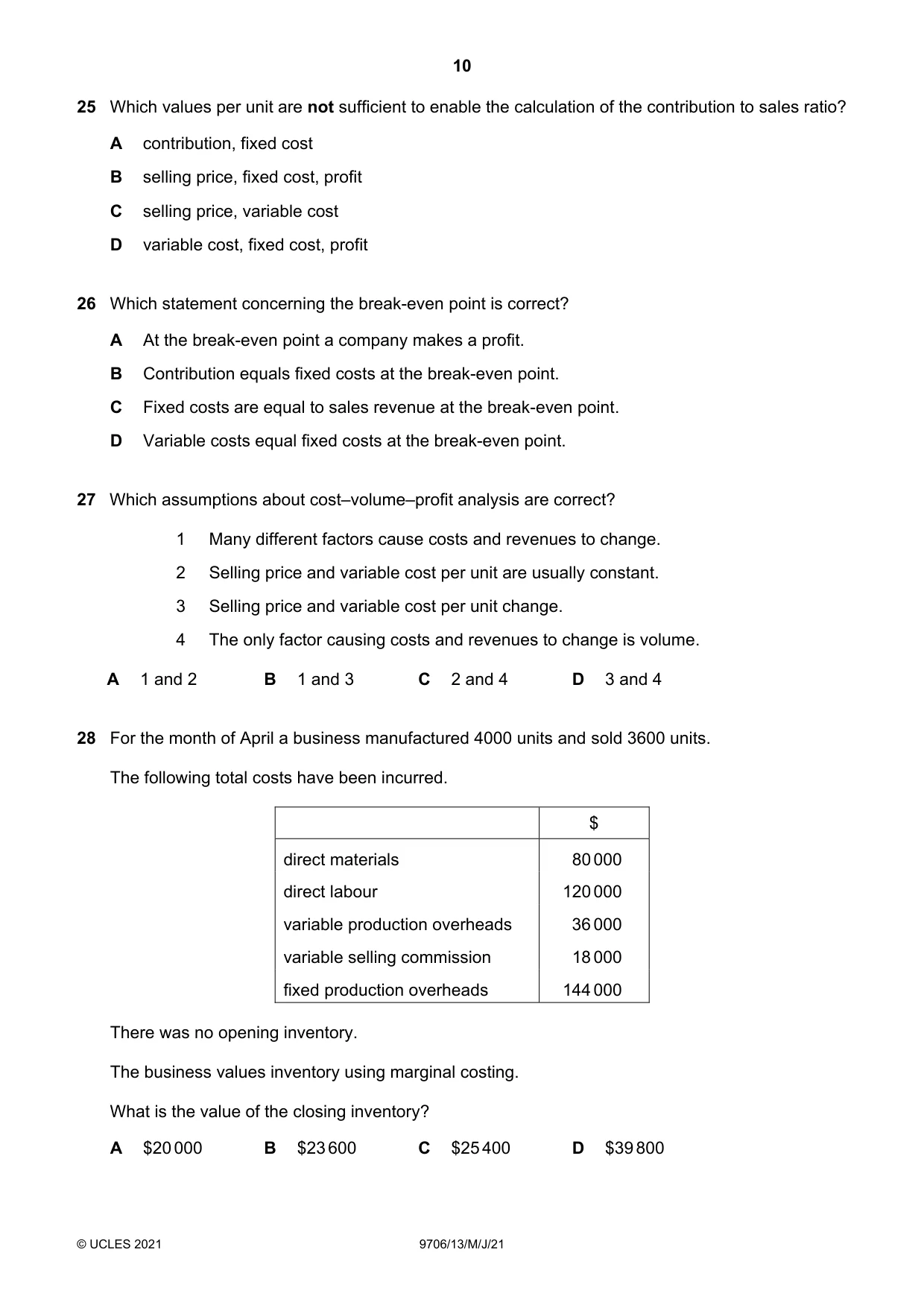
Q25 · Which values per unit are not sufficient to enable the calculation of the contribution to…
25 Which values per unit are not sufficient to enable the calculation of the contribution to sales ratio? A contribution, fixed cost B selling price, fixed cost, profit C selling price, variable cost D variable cost, fixed cost, profit
Mark scheme: A
Q26 · Which statement concerning the break-even point is correct?
26 Which statement concerning the break-even point is correct? A At the break-even point a company makes a profit. B Contribution equals fixed costs at the break-even point. C Fixed costs are equal to sales revenue at the break-even point. D Variable costs equal fixed costs at the break-even point.
Mark scheme: B
Q27 · Which assumptions about cost–volume–profit analysis are correct?
27 Which assumptions about cost–volume–profit analysis are correct? 1 Many different factors cause costs and revenues to change. 2 Selling price and variable cost per unit are usually constant. 3 Selling price and variable cost per unit change. 4 The only factor causing costs and revenues to change is volume. A 1 and 2 B 1 and 3 C 2 and 4 D 3 and 4
Mark scheme: C
Q28 · For the month of April a business manufactured 4000 units and sold 3600 units
28 For the month of April a business manufactured 4000 units and sold 3600 units. The following total costs have been incurred. $ direct materials 80 000 direct labour 120 000 variable production overheads 36 000 variable selling commission 18 000 fixed production overheads 144 000 There was no opening inventory. The business values inventory using marginal costing. What is the value of the closing inventory? A $20 000 B $23 600 C $25 400 D $39 800
Mark scheme: B
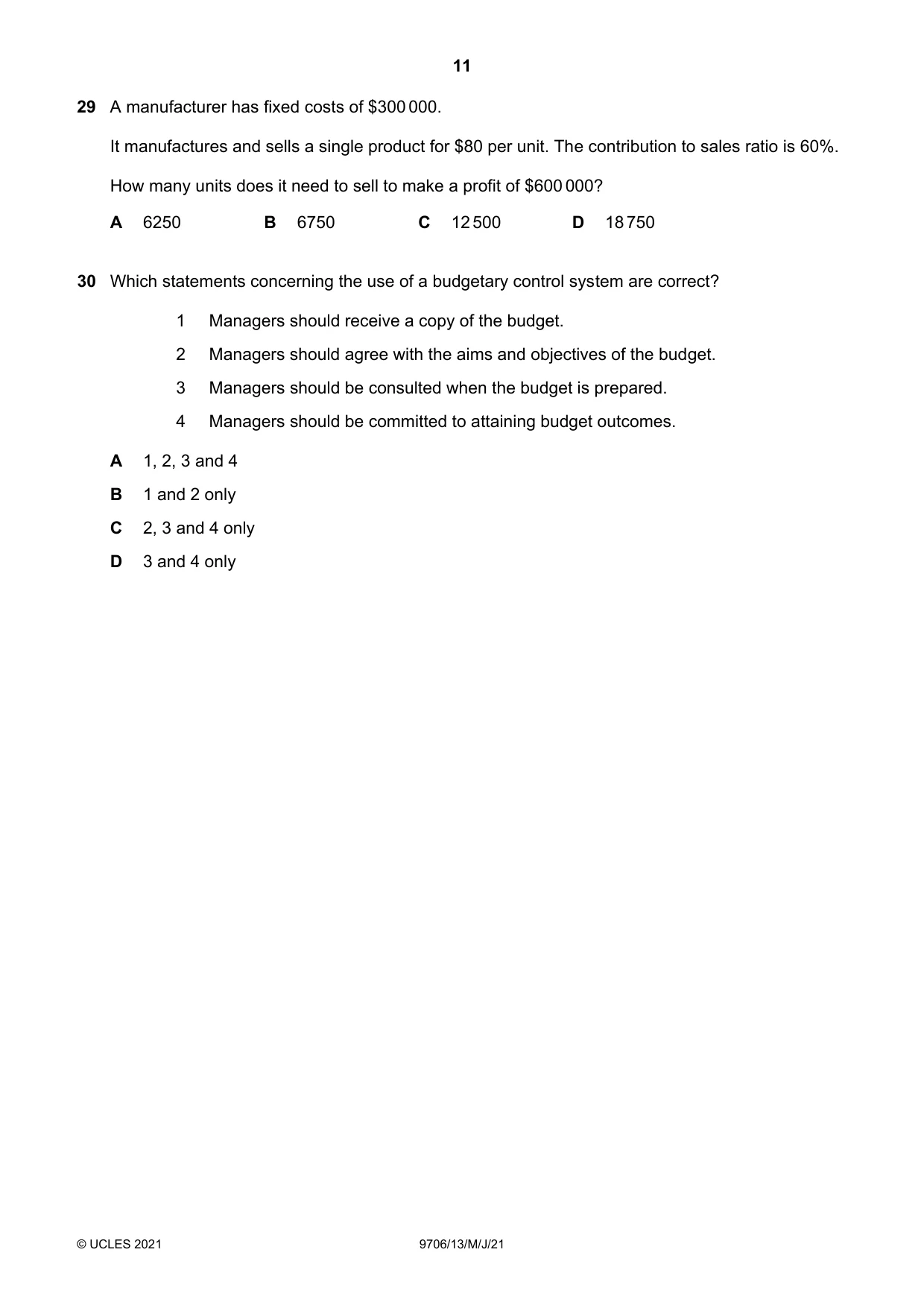
Q29 · A manufacturer has fixed costs of $300 000
29 A manufacturer has fixed costs of $300 000. It manufactures and sells a single product for $80 per unit. The contribution to sales ratio is 60%. How many units does it need to sell to make a profit of $600 000? A 6250 B 6750 C 12 500 D 18 750
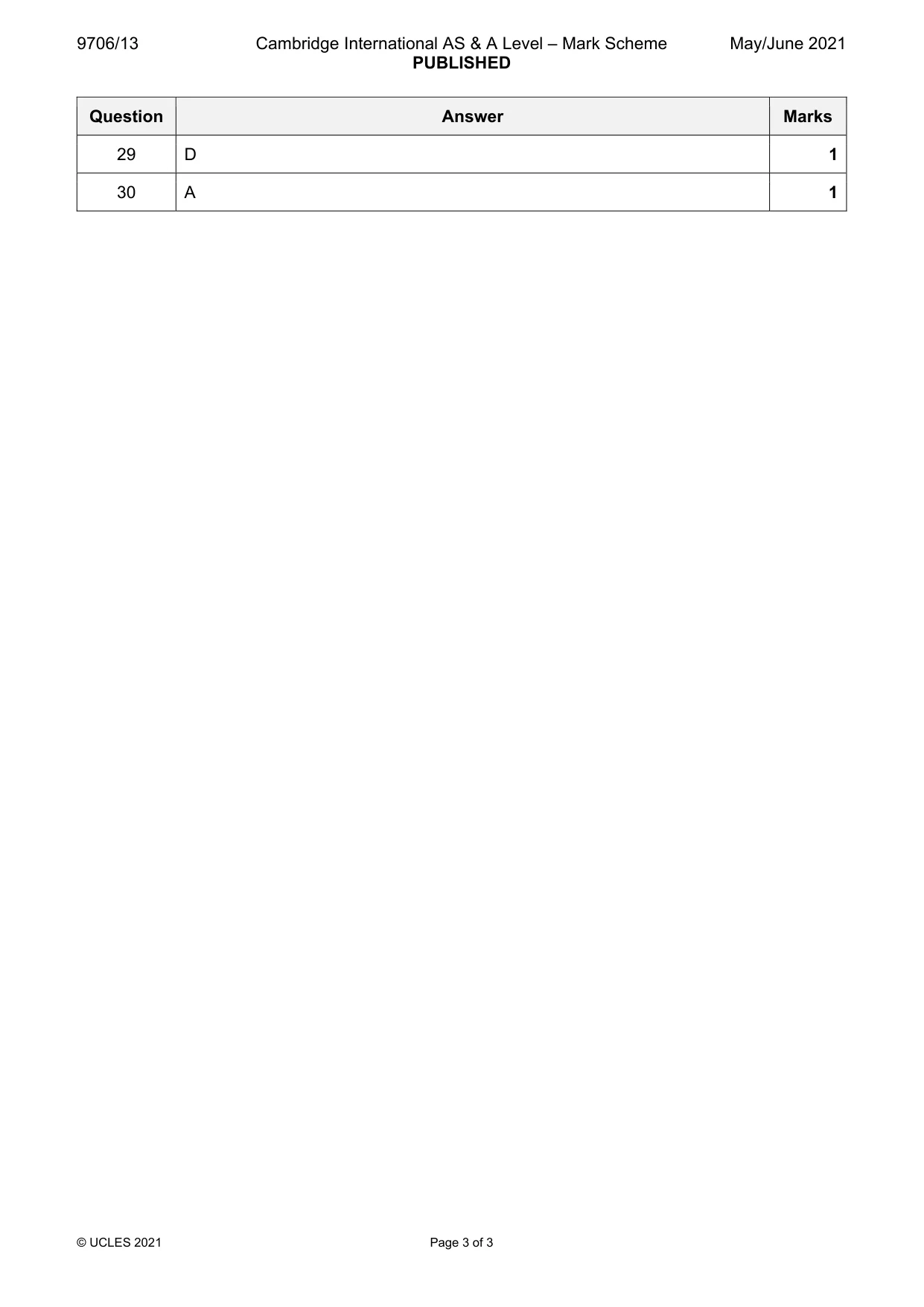
Mark scheme: D
Q30 · Which statements concerning the use of a budgetary control system are correct?
30 Which statements concerning the use of a budgetary control system are correct? 1 Managers should receive a copy of the budget. 2 Managers should agree with the aims and objectives of the budget. 3 Managers should be consulted when the budget is prepared. 4 Managers should be committed to attaining budget outcomes. A 1, 2, 3 and 4 B 1 and 2 only C 2, 3 and 4 only D 3 and 4 only
Mark scheme: A
What was in this paper
The subtopics covered by these 30 questions, and how many questions each got. Open one in a new tab to see every Cambridge question on it.
7Preparation of financial statements6Accounting for non-current assets3Reconciliation and verification3The accounting system3Analysis and communication of accounting information2Costs and cost behaviour2Preparation of financial statements2Budgeting and budgetary control1Types of business entity1What you needed in this session
Cambridge’s own grade thresholds for 2021 May/June, Paper 1 · Variant 3. A higher threshold means an easier paper — the bar moves with how the cohort did.