Cambridge A Level Accounting 9706 — 2017 May/June Paper 1 · Variant 3
9706/13/M/J/17 · 30 questions · 30 marks · ≈34 min
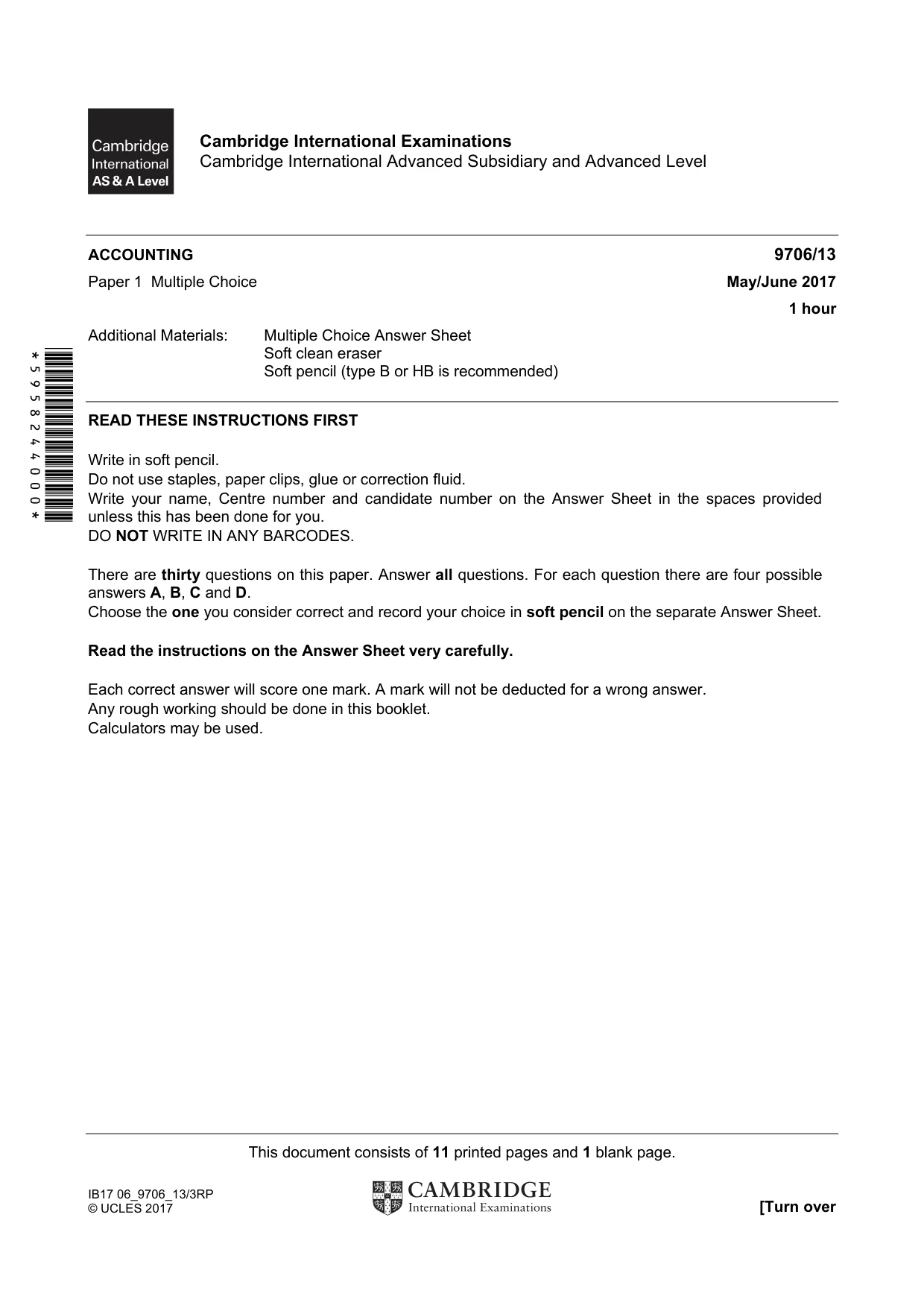
The question paper and its mark scheme, free to read here and free to download. This is Cambridge’s own paper, exactly as it was sat.
Question paper12 pages
Mark scheme3 pages
Answers below. Sit the paper first if you are practising.
Questions as text
Q1 · A company decided not to capitalise the purchase of a stapler for use in its office
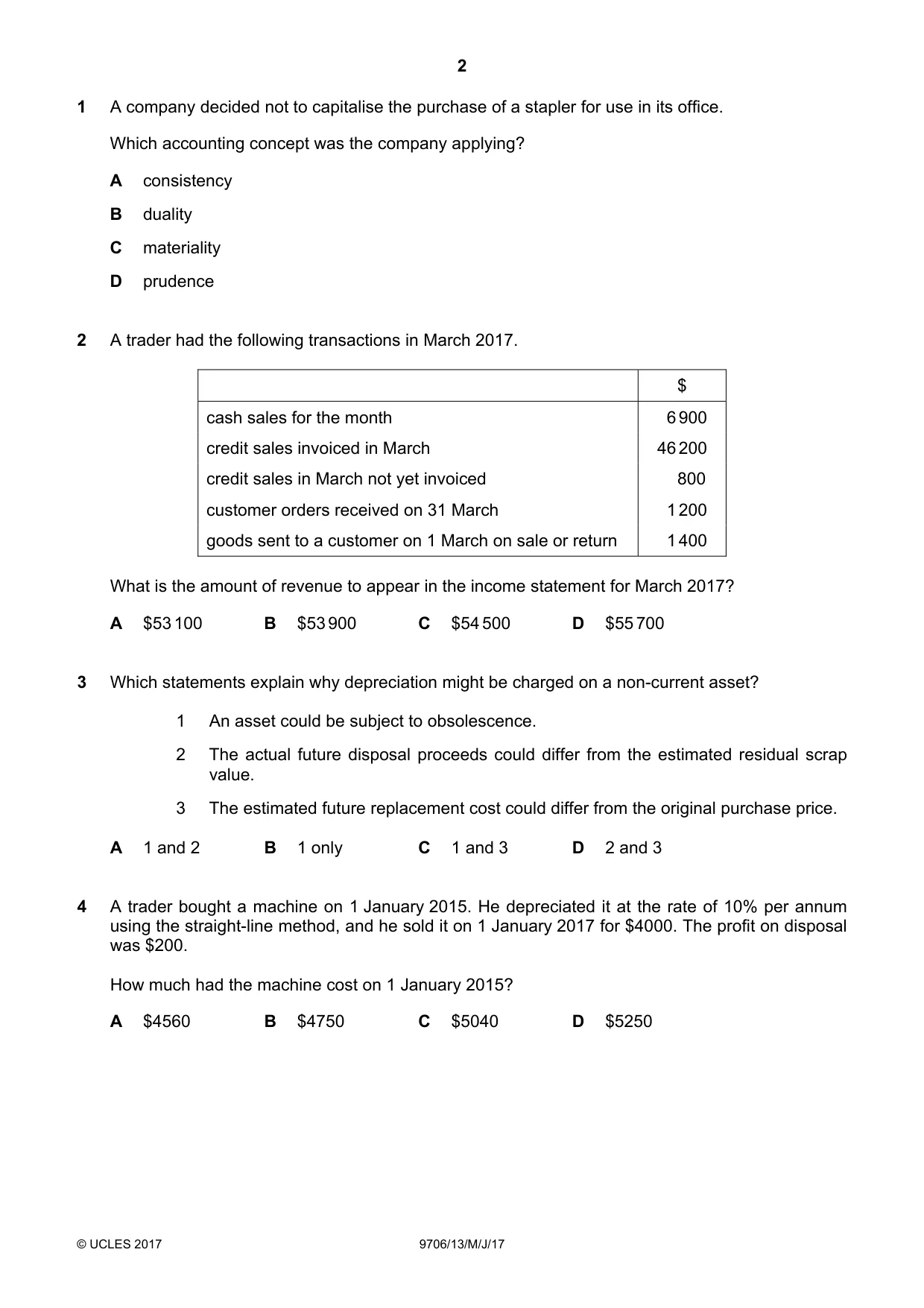
1 A company decided not to capitalise the purchase of a stapler for use in its office. Which accounting concept was the company applying? A consistency B duality C materiality D prudence
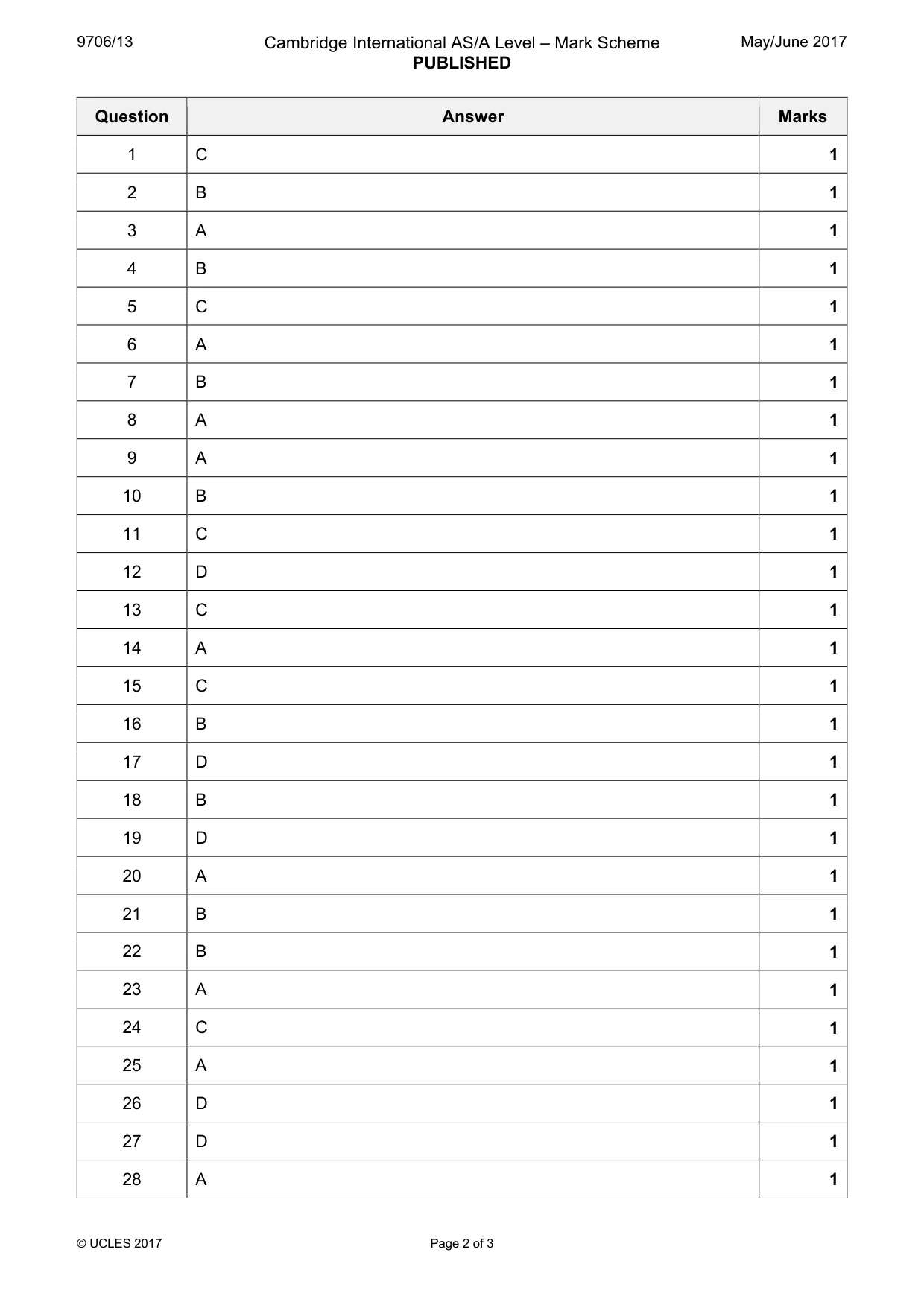
Mark scheme: C
Q2 · A trader had the following transactions in March 2017
2 A trader had the following transactions in March 2017. $ cash sales for the month 6 900 credit sales invoiced in March 46 200 credit sales in March not yet invoiced 800 customer orders received on 31 March 1 200 goods sent to a customer on 1 March on sale or return 1 400 What is the amount of revenue to appear in the income statement for March 2017? A $53 100 B $53 900 C $54 500 D $55 700
Mark scheme: B
Q3 · Which statements explain why depreciation might be charged on a non-current asset?
3 Which statements explain why depreciation might be charged on a non-current asset? 1 An asset could be subject to obsolescence. 2 The actual future disposal proceeds could differ from the estimated residual scrap value. 3 The estimated future replacement cost could differ from the original purchase price. A 1 and 2 B 1 only C 1 and 3 D 2 and 3
Mark scheme: A
Q4 · A trader bought a machine on 1 January 2015
4 A trader bought a machine on 1 January 2015. He depreciated it at the rate of 10% per annum using the straight-line method, and he sold it on 1 January 2017 for $4000. The profit on disposal was $200. How much had the machine cost on 1 January 2015? A $4560 B $4750 C $5040 D $5250
Mark scheme: B
Q5 · The following information relates to non-current assets
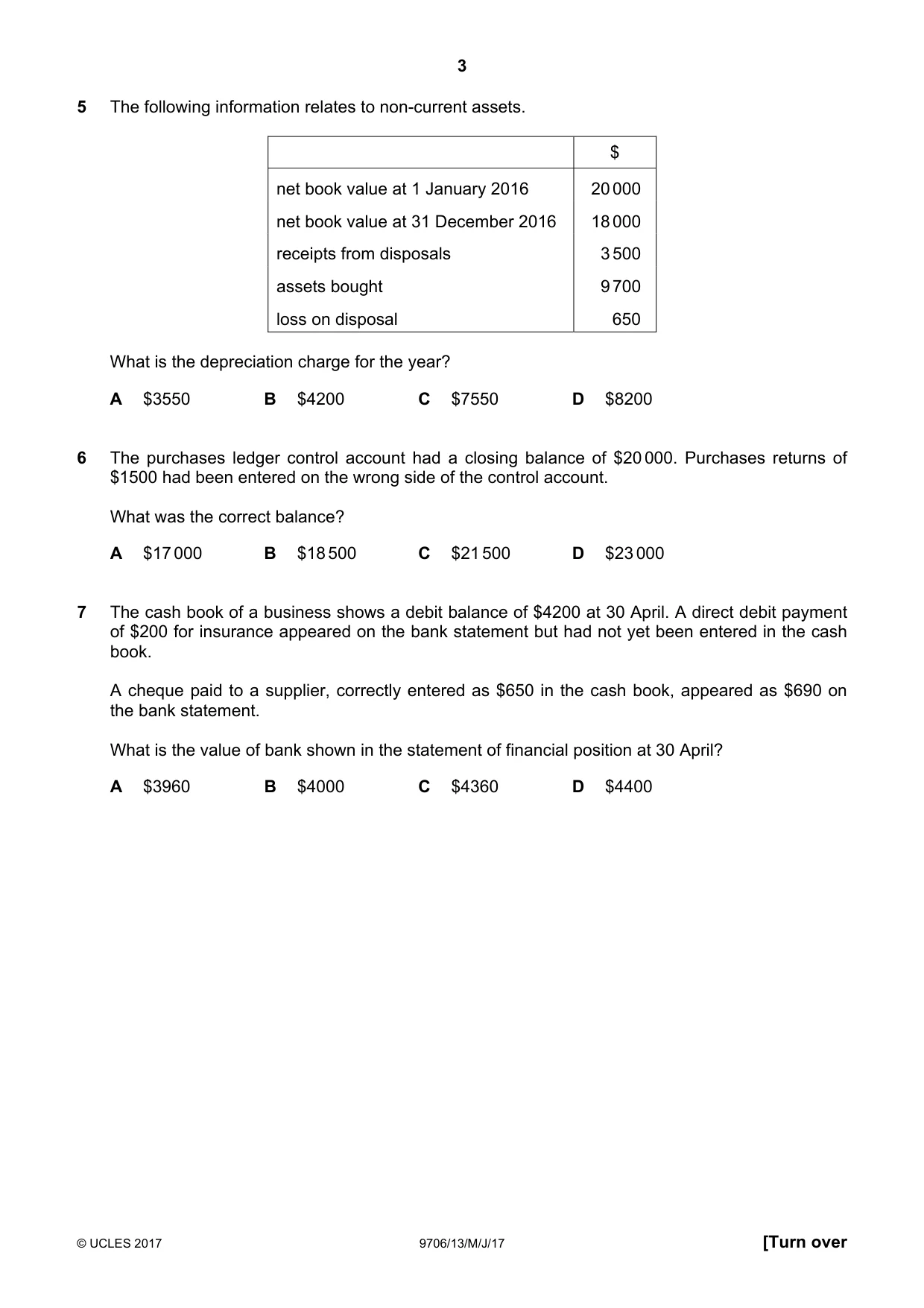
5 The following information relates to non-current assets. $ net book value at 1 January 2016 20 000 net book value at 31 December 2016 18 000 receipts from disposals 3 500 assets bought 9 700 loss on disposal 650 What is the depreciation charge for the year? A $3550 B $4200 C $7550 D $8200
Mark scheme: C
Q6 · The purchases ledger control account had a closing balance of $20 000
6 The purchases ledger control account had a closing balance of $20 000. Purchases returns of $1500 had been entered on the wrong side of the control account. What was the correct balance? A $17 000 B $18 500 C $21 500 D $23 000
Mark scheme: A
Q7 · The cash book of a business shows a debit balance of $4200 at 30 April
7 The cash book of a business shows a debit balance of $4200 at 30 April. A direct debit payment of $200 for insurance appeared on the bank statement but had not yet been entered in the cash book. A cheque paid to a supplier, correctly entered as $650 in the cash book, appeared as $690 on the bank statement. What is the value of bank shown in the statement of financial position at 30 April? A $3960 B $4000 C $4360 D $4400
Mark scheme: B
Q8 · A bookkeeper prepared a sales ledger control account
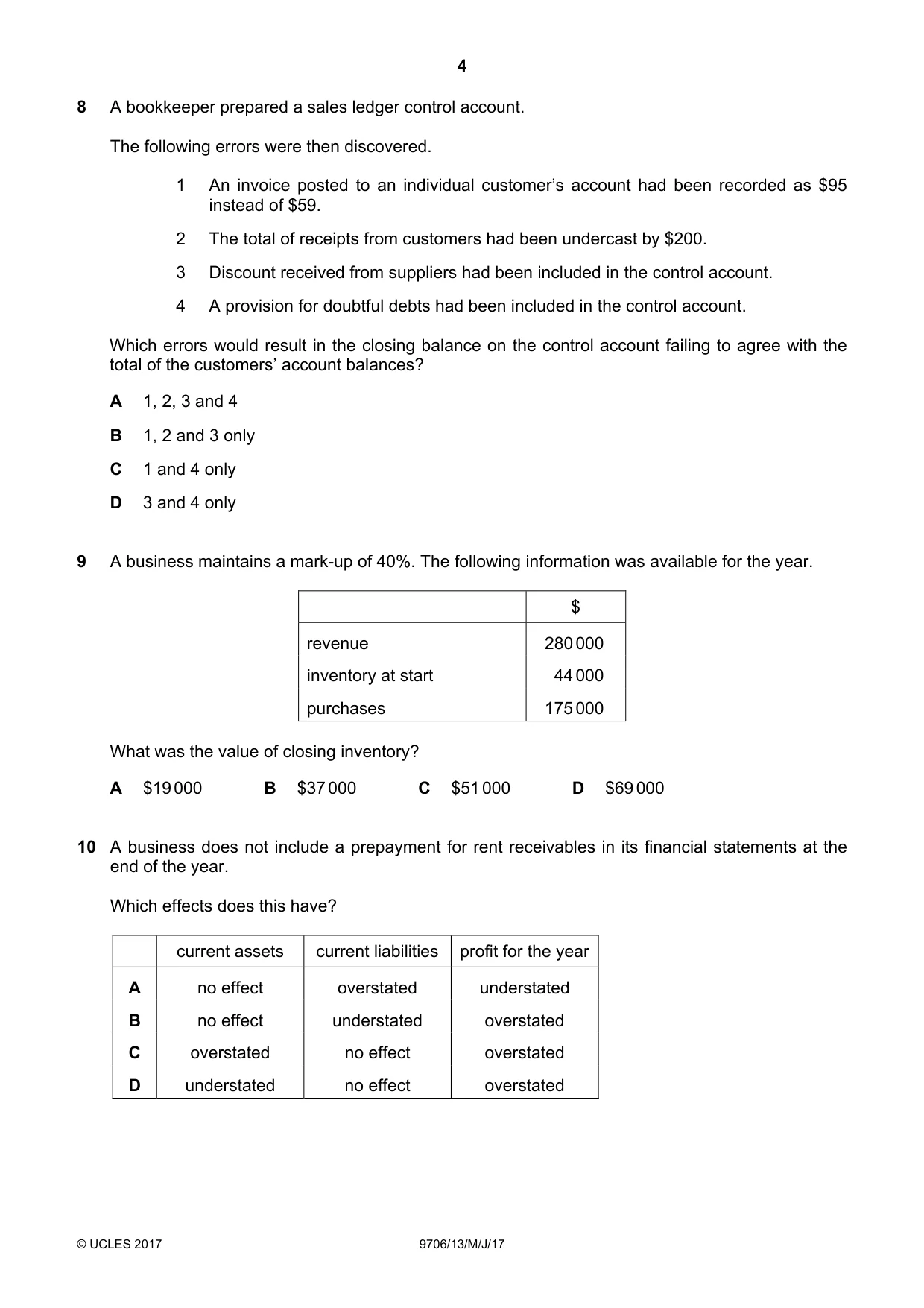
8 A bookkeeper prepared a sales ledger control account. The following errors were then discovered. 1 An invoice posted to an individual customer’s account had been recorded as $95 instead of $59. 2 The total of receipts from customers had been undercast by $200. 3 Discount received from suppliers had been included in the control account. 4 A provision for doubtful debts had been included in the control account. Which errors would result in the closing balance on the control account failing to agree with the total of the customers’ account balances? A 1, 2, 3 and 4 B 1, 2 and 3 only C 1 and 4 only D 3 and 4 only
Mark scheme: A
Q9 · A business maintains a mark-up of 40%
9 A business maintains a mark-up of 40%. The following information was available for the year. $ revenue 280 000 inventory at start 44 000 purchases 175 000 What was the value of closing inventory? A $19 000 B $37 000 C $51 000 D $69 000
Mark scheme: A
Q10 · A business does not include a prepayment for rent receivables in its financial statements…
10 A business does not include a prepayment for rent receivables in its financial statements at the end of the year. Which effects does this have? current assets current liabilities profit for the year A no effect overstated understated B no effect understated overstated C overstated no effect overstated D understated no effect overstated
Mark scheme: B
Q11 · The following is an extract from the trial balance of a business at 31 May 2017
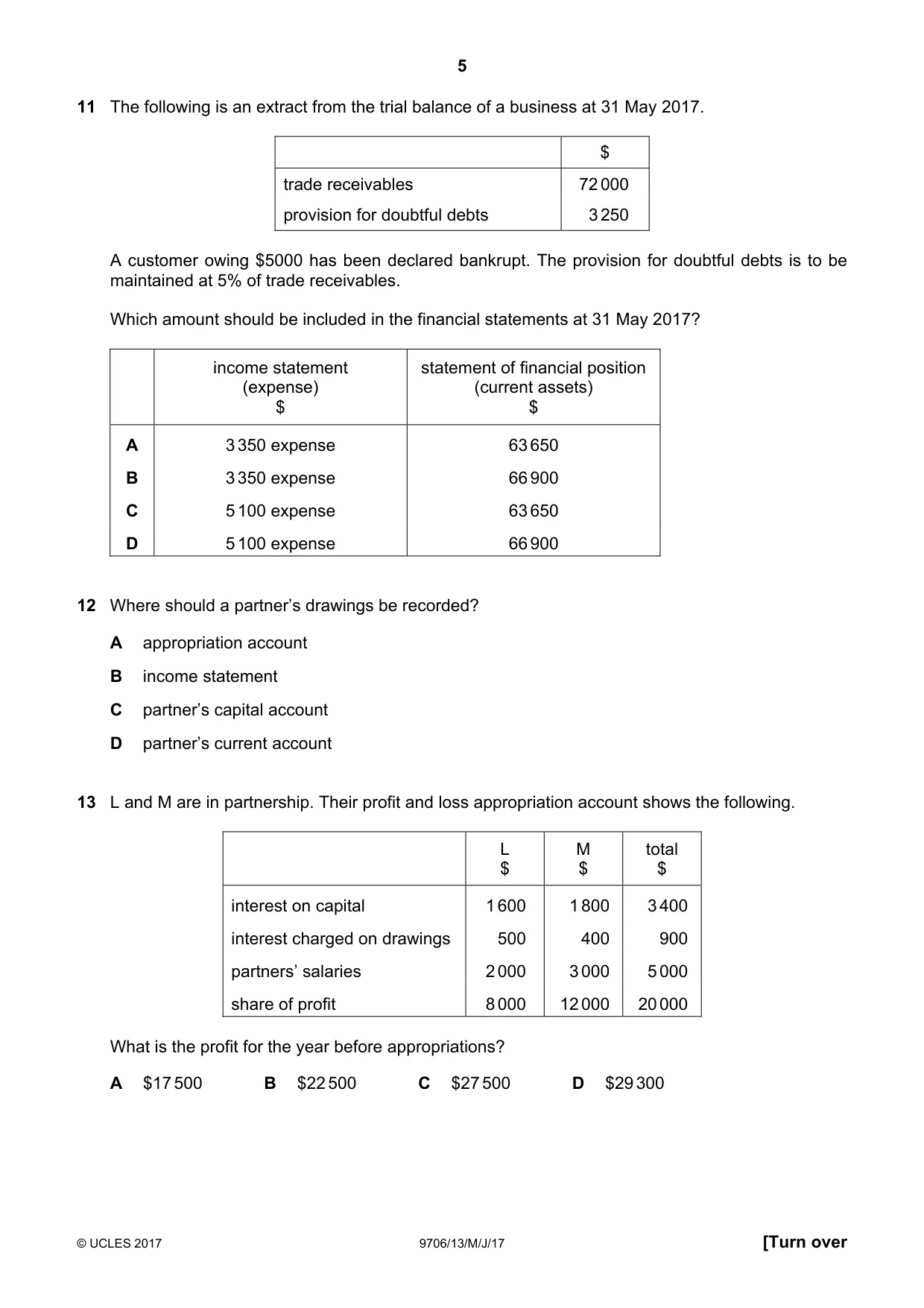
11 The following is an extract from the trial balance of a business at 31 May 2017. $ trade receivables 72 000 provision for doubtful debts 3 250 A customer owing $5000 has been declared bankrupt. The provision for doubtful debts is to be maintained at 5% of trade receivables. Which amount should be included in the financial statements at 31 May 2017? income statement statement of financial position (expense) (current assets) $ $ A 3 350 expense 63 650 B 3 350 expense 66 900 C 5 100 expense 63 650 D 5 100 expense 66 900
Mark scheme: C
Q12 · Where should a partner’s drawings be recorded?
12 Where should a partner’s drawings be recorded? A appropriation account B income statement C partner’s capital account D partner’s current account
Mark scheme: D
Q13 · L and M are in partnership
13 L and M are in partnership. Their profit and loss appropriation account shows the following. L M total $ $ $ interest on capital 1 600 1 800 3 400 interest charged on drawings 500 400 900 partners’ salaries 2 000 3 000 5 000 share of profit 8 000 12 000 20 000 What is the profit for the year before appropriations? A $17 500 B $22 500 C $27 500 D $29 300
Mark scheme: C
Q14 · X and Y were in partnership sharing profits equally
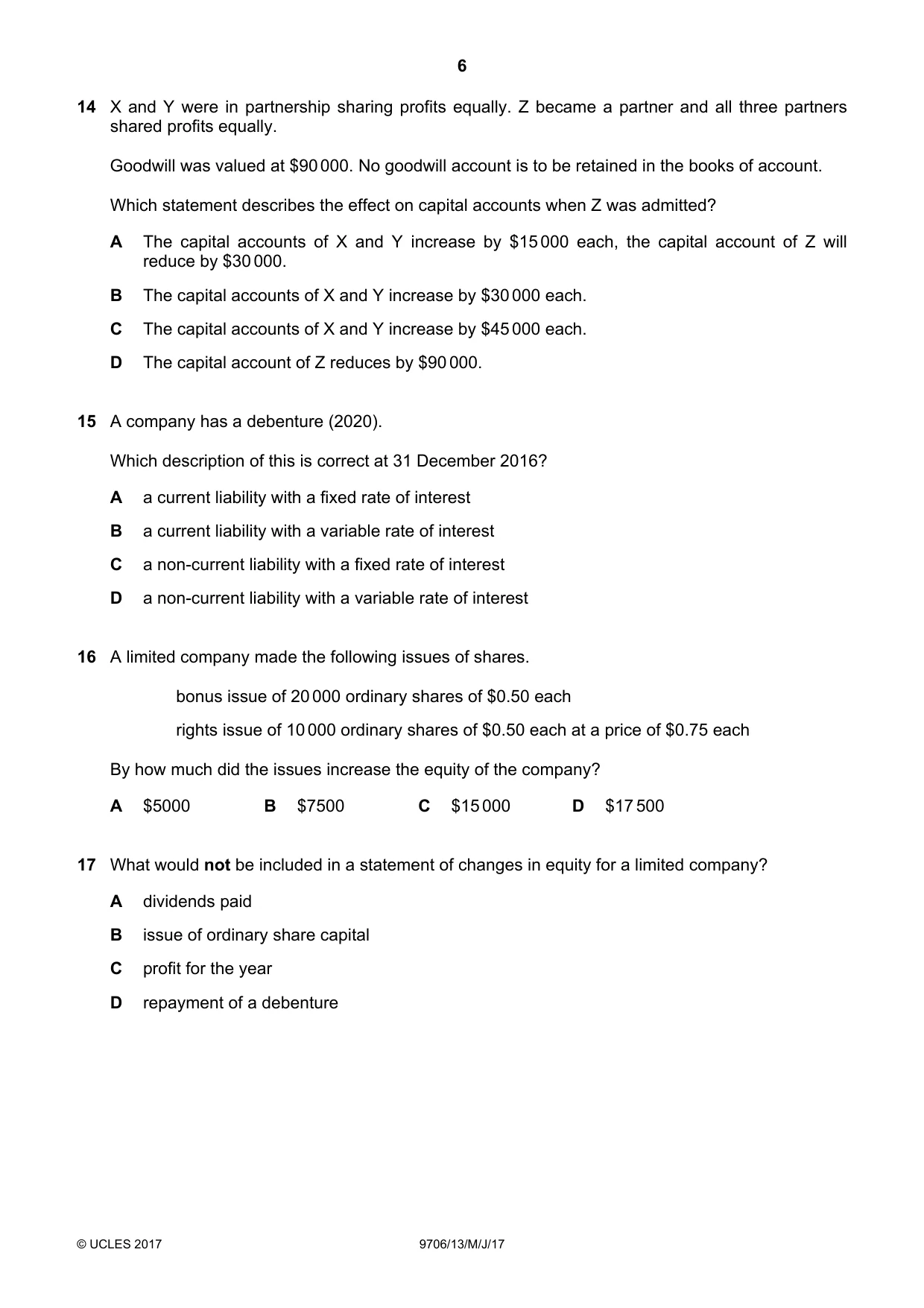
14 X and Y were in partnership sharing profits equally. Z became a partner and all three partners shared profits equally. Goodwill was valued at $90 000. No goodwill account is to be retained in the books of account. Which statement describes the effect on capital accounts when Z was admitted? A The capital accounts of X and Y increase by $15 000 each, the capital account of Z will reduce by $30 000. B The capital accounts of X and Y increase by $30 000 each. C The capital accounts of X and Y increase by $45 000 each. D The capital account of Z reduces by $90 000.
Mark scheme: A
Q15 · A company has a debenture (2020)
15 A company has a debenture (2020). Which description of this is correct at 31 December 2016? A a current liability with a fixed rate of interest B a current liability with a variable rate of interest C a non-current liability with a fixed rate of interest D a non-current liability with a variable rate of interest
Mark scheme: C
Q16 · A limited company made the following issues of shares
16 A limited company made the following issues of shares. bonus issue of 20 000 ordinary shares of $0.50 each rights issue of 10 000 ordinary shares of $0.50 each at a price of $0.75 each By how much did the issues increase the equity of the company? A $5000 B $7500 C $15 000 D $17 500
Mark scheme: B
Q17 · What would not be included in a statement of changes in equity for a limited company?
17 What would not be included in a statement of changes in equity for a limited company? A dividends paid B issue of ordinary share capital C profit for the year D repayment of a debenture
Mark scheme: D
Q18 · The following items appear on a statement of financial position
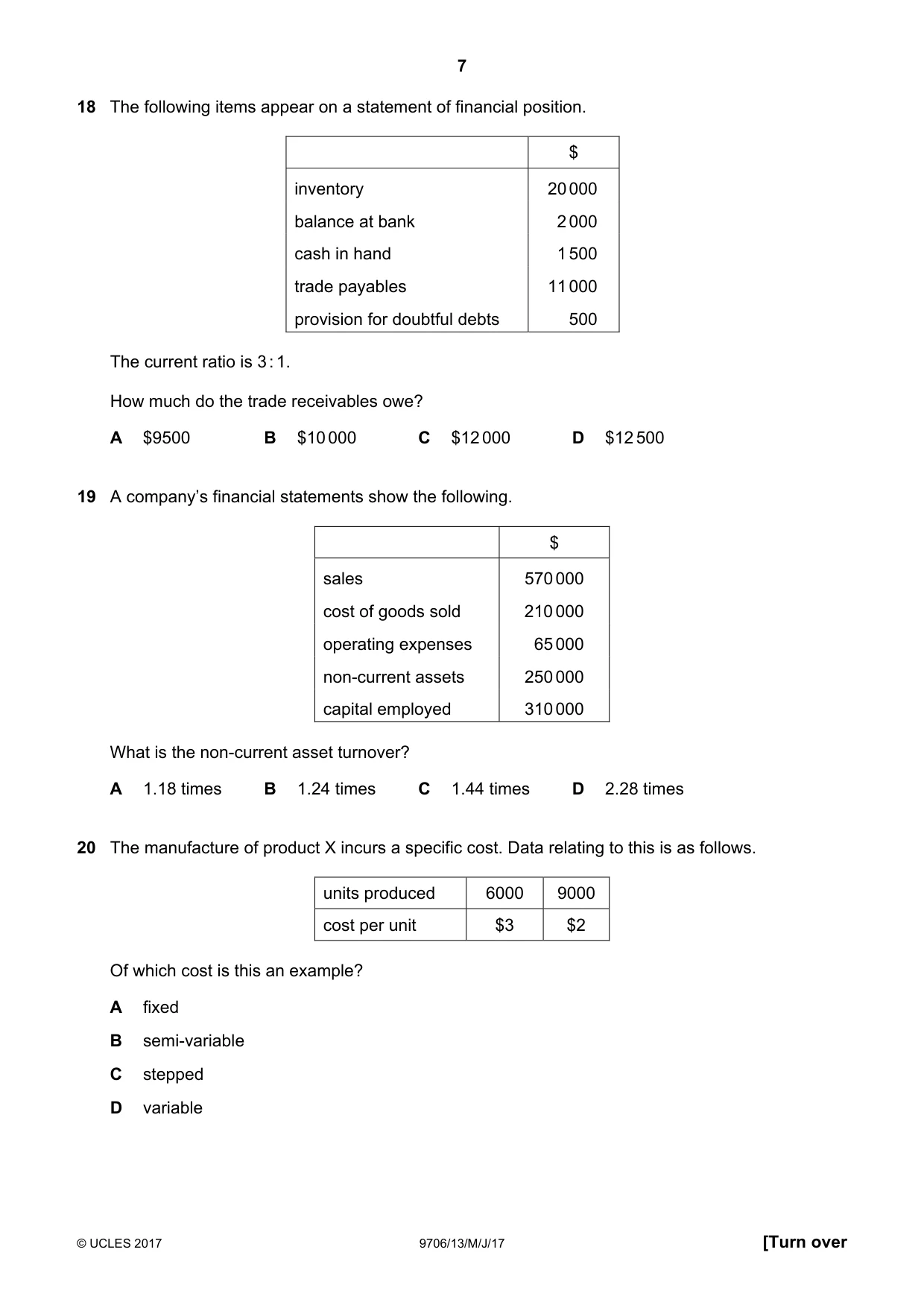
18 The following items appear on a statement of financial position. $ inventory 20 000 balance at bank 2 000 cash in hand 1 500 trade payables 11 000 provision for doubtful debts 500 The current ratio is 3 : 1. How much do the trade receivables owe? A $9500 B $10 000 C $12 000 D $12 500
Mark scheme: B
More questions on Analysis and communication of accounting information
Q19 · A company’s financial statements show the following
19 A company’s financial statements show the following. $ sales 570 000 cost of goods sold 210 000 operating expenses 65 000 non-current assets 250 000 capital employed 310 000 What is the non-current asset turnover? A 1.18 times B 1.24 times C 1.44 times D 2.28 times
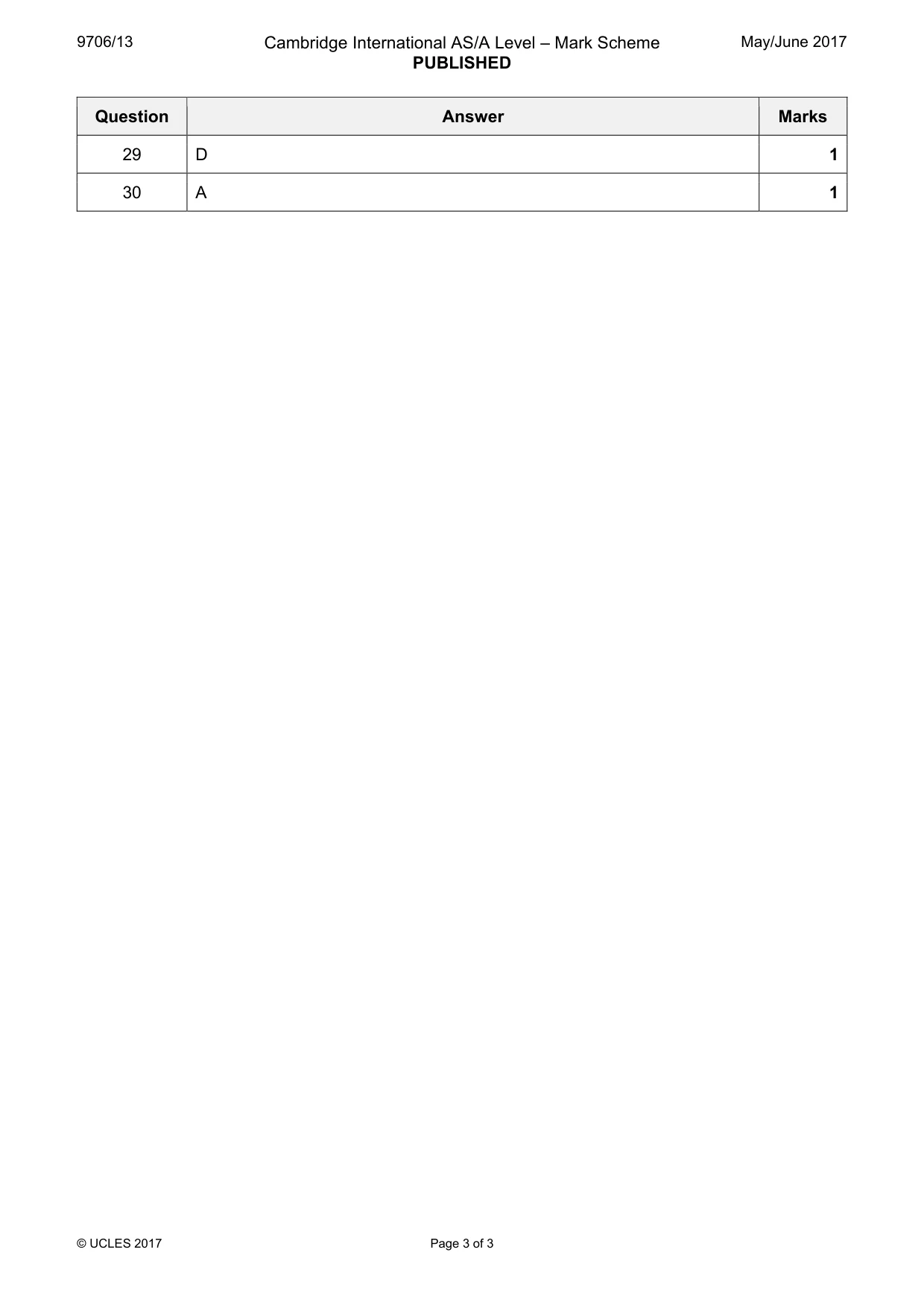
Mark scheme: D
More questions on Analysis and communication of accounting information
Q20 · The manufacture of product X incurs a specific cost
20 The manufacture of product X incurs a specific cost. Data relating to this is as follows. units produced 6000 9000 cost per unit $3 $2 Of which cost is this an example? A fixed B semi-variable C stepped D variable
Mark scheme: A
Q21 · A business values inventory using the AVCO method
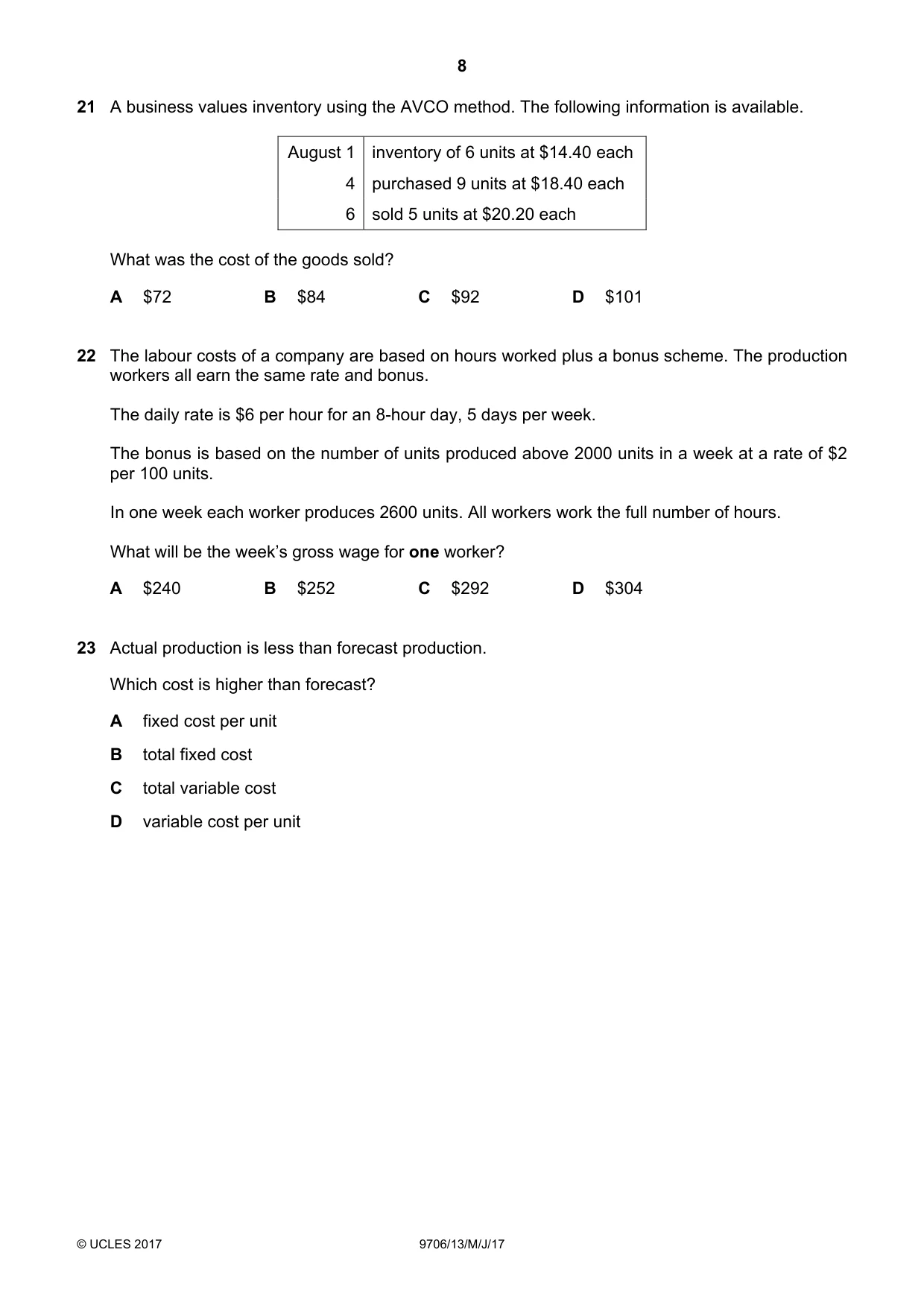
21 A business values inventory using the AVCO method. The following information is available. August 1 inventory of 6 units at $14.40 each 4 purchased 9 units at $18.40 each 6 sold 5 units at $20.20 each What was the cost of the goods sold? A $72 B $84 C $92 D $101
Mark scheme: B
Q22 · The labour costs of a company are based on hours worked plus a bonus scheme
22 The labour costs of a company are based on hours worked plus a bonus scheme. The production workers all earn the same rate and bonus. The daily rate is $6 per hour for an 8-hour day, 5 days per week. The bonus is based on the number of units produced above 2000 units in a week at a rate of $2 per 100 units. In one week each worker produces 2600 units. All workers work the full number of hours. What will be the week’s gross wage for one worker? A $240 B $252 C $292 D $304
Mark scheme: B
Q23 · Actual production is less than forecast production
23 Actual production is less than forecast production. Which cost is higher than forecast? A fixed cost per unit B total fixed cost C total variable cost D variable cost per unit
Mark scheme: A
Q24 · The following information is available for a business
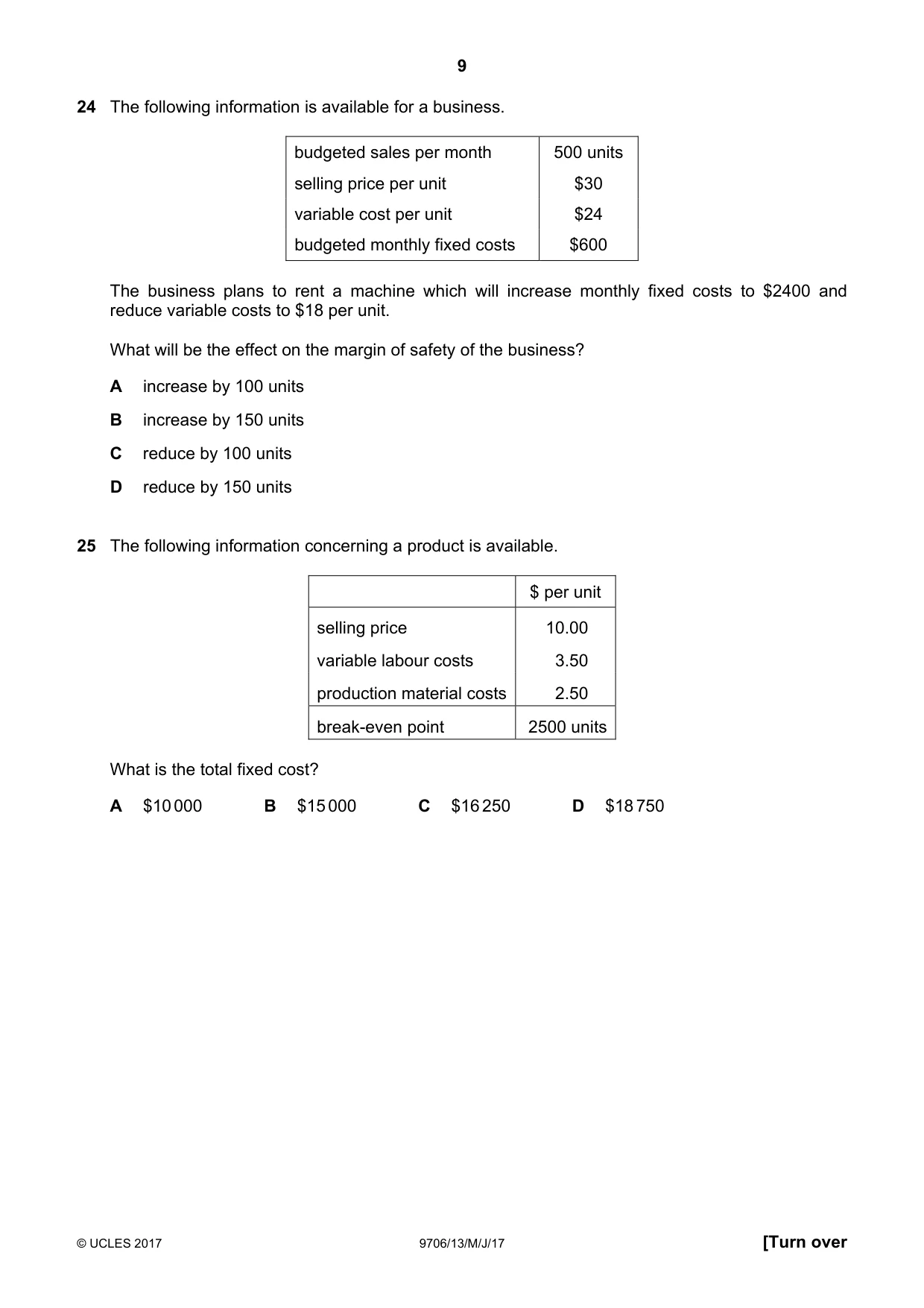
24 The following information is available for a business. budgeted sales per month 500 units selling price per unit $30 variable cost per unit $24 budgeted monthly fixed costs $600 The business plans to rent a machine which will increase monthly fixed costs to $2400 and reduce variable costs to $18 per unit. What will be the effect on the margin of safety of the business? A increase by 100 units B increase by 150 units C reduce by 100 units D reduce by 150 units
Mark scheme: C
Q25 · The following information concerning a product is available
25 The following information concerning a product is available. $ per unit selling price 10.00 variable labour costs 3.50 production material costs 2.50 break-even point 2500 units What is the total fixed cost? A $10 000 B $15 000 C $16 250 D $18 750
Mark scheme: A
Q26 · The data shows the budget of a small manufacturing company
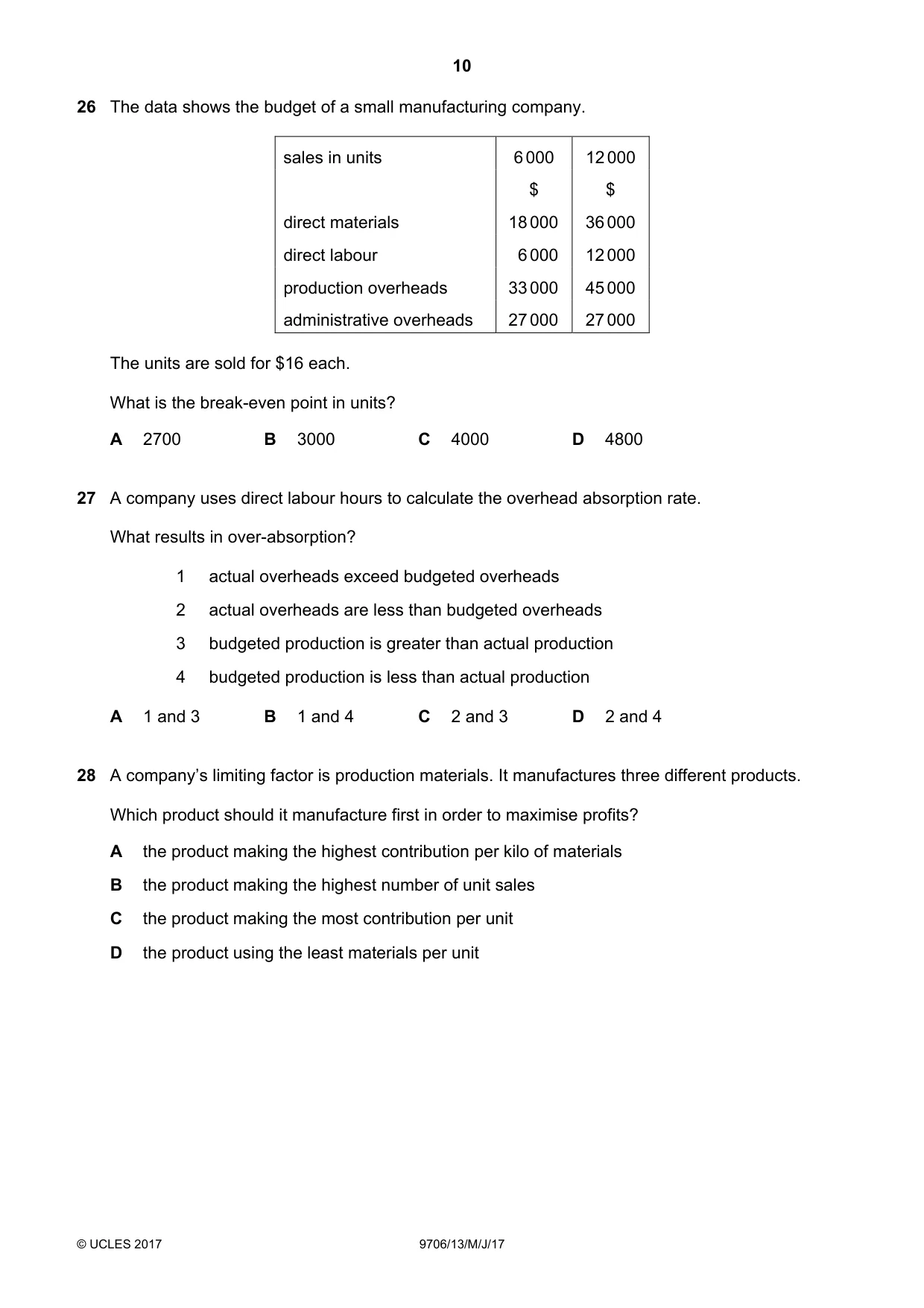
26 The data shows the budget of a small manufacturing company. sales in units 6 000 12 000 $ $ direct materials 18 000 36 000 direct labour 6 000 12 000 production overheads 33 000 45 000 administrative overheads 27 000 27 000 The units are sold for $16 each. What is the break-even point in units? A 2700 B 3000 C 4000 D 4800
Mark scheme: D
Q27 · A company uses direct labour hours to calculate the overhead absorption rate
27 A company uses direct labour hours to calculate the overhead absorption rate. What results in over-absorption? 1 actual overheads exceed budgeted overheads 2 actual overheads are less than budgeted overheads 3 budgeted production is greater than actual production 4 budgeted production is less than actual production A 1 and 3 B 1 and 4 C 2 and 3 D 2 and 4
Mark scheme: D
Q28 · A company’s limiting factor is production materials
28 A company’s limiting factor is production materials. It manufactures three different products. Which product should it manufacture first in order to maximise profits? A the product making the highest contribution per kilo of materials B the product making the highest number of unit sales C the product making the most contribution per unit D the product using the least materials per unit
Mark scheme: A
Q29 · The following information has been provided for the year
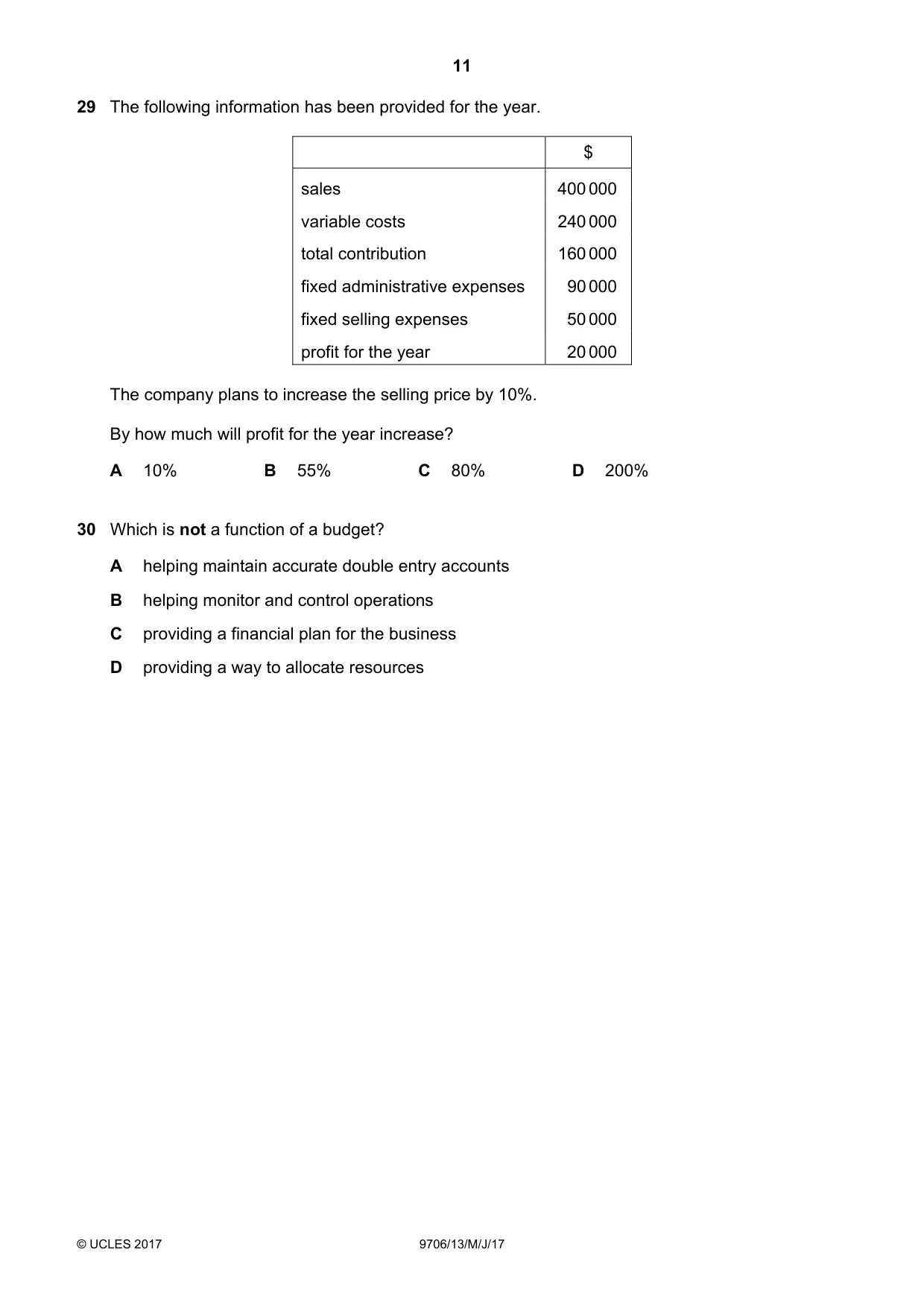
29 The following information has been provided for the year. $ sales 400 000 variable costs 240 000 total contribution 160 000 fixed administrative expenses 90 000 fixed selling expenses 50 000 profit for the year 20 000 The company plans to increase the selling price by 10%. By how much will profit for the year increase? A 10% B 55% C 80% D 200%
Mark scheme: D
Q30 · Which is not a function of a budget?
30 Which is not a function of a budget? A helping maintain accurate double entry accounts B helping monitor and control operations C providing a financial plan for the business D providing a way to allocate resources
Mark scheme: A
What was in this paper
The subtopics covered by these 30 questions, and how many questions each got. Open one in a new tab to see every Cambridge question on it.
What you needed in this session
Cambridge’s own grade thresholds for 2017 May/June, Paper 1 · Variant 3. A higher threshold means an easier paper — the bar moves with how the cohort did.