Questions as text
Q1 · The following investment information is available 9706/33 May/June 2010
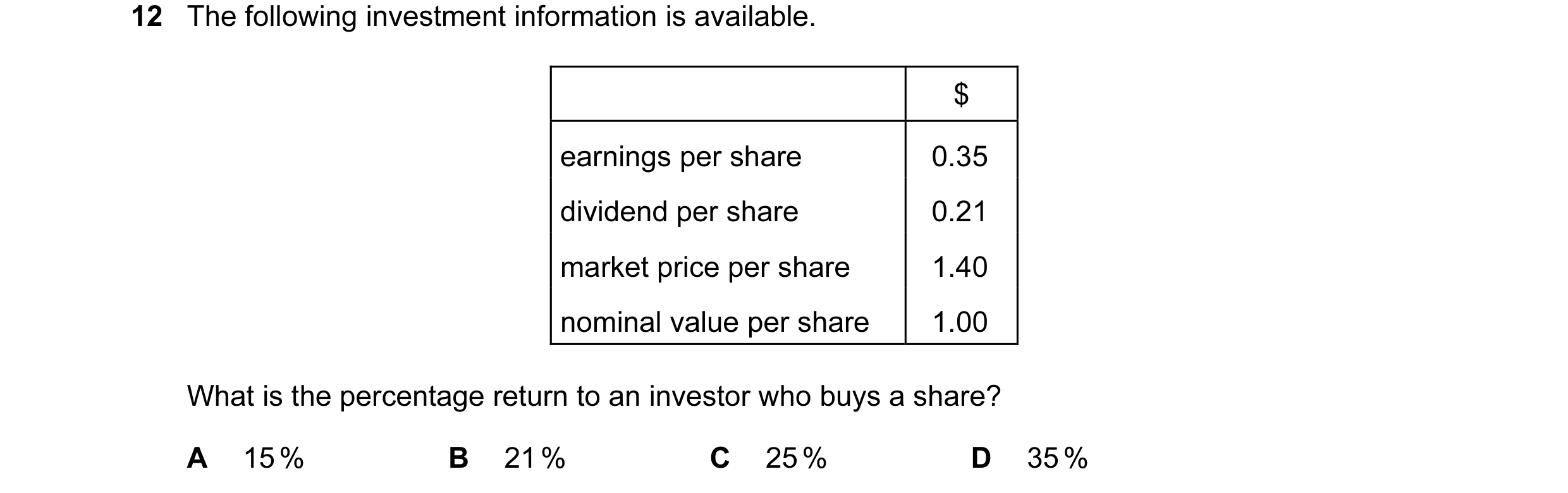
12 The following investment information is available. $ earnings per share 0.35 dividend per share 0.21 market price per share 1.40 nominal value per share 1.00 What is the percentage return to an investor who buys a share? A 15 % B 21 % C 25 % D 35 %
1 marks
Answer: A
This question in 9706/33 May/June 2010
Q2 · A business has a trade receivables (debtors) turnover period of 40 days and annual sales… 9706/31 Oct/Nov 2010
13 A business has a trade receivables (debtors) turnover period of 40 days and annual sales of $479 970. What is the year end trade receivables (debtors) figure? A $11 999 B $15 780 C $39 997 D $52 599
1 marks
Answer: D
This question in 9706/31 Oct/Nov 2010
Q3 · Which ratio measures the return on an investment in shares which continue to be held? 9706/31 Oct/Nov 2010
14 Which ratio measures the return on an investment in shares which continue to be held? A dividend cover B dividend yield C earnings per share D interest cover
1 marks
Answer: B
This question in 9706/31 Oct/Nov 2010
Q4 · A company’s authorised share capital is 1 million ordinary shares of $1 each 9706/31 Oct/Nov 2010
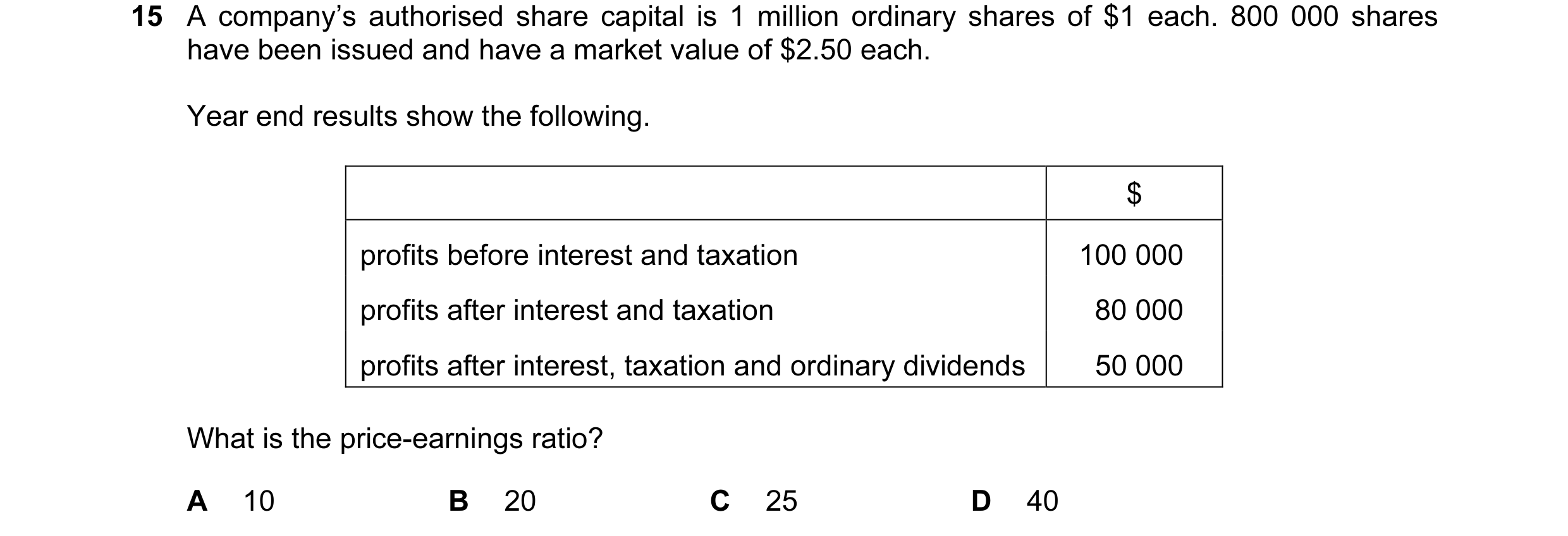
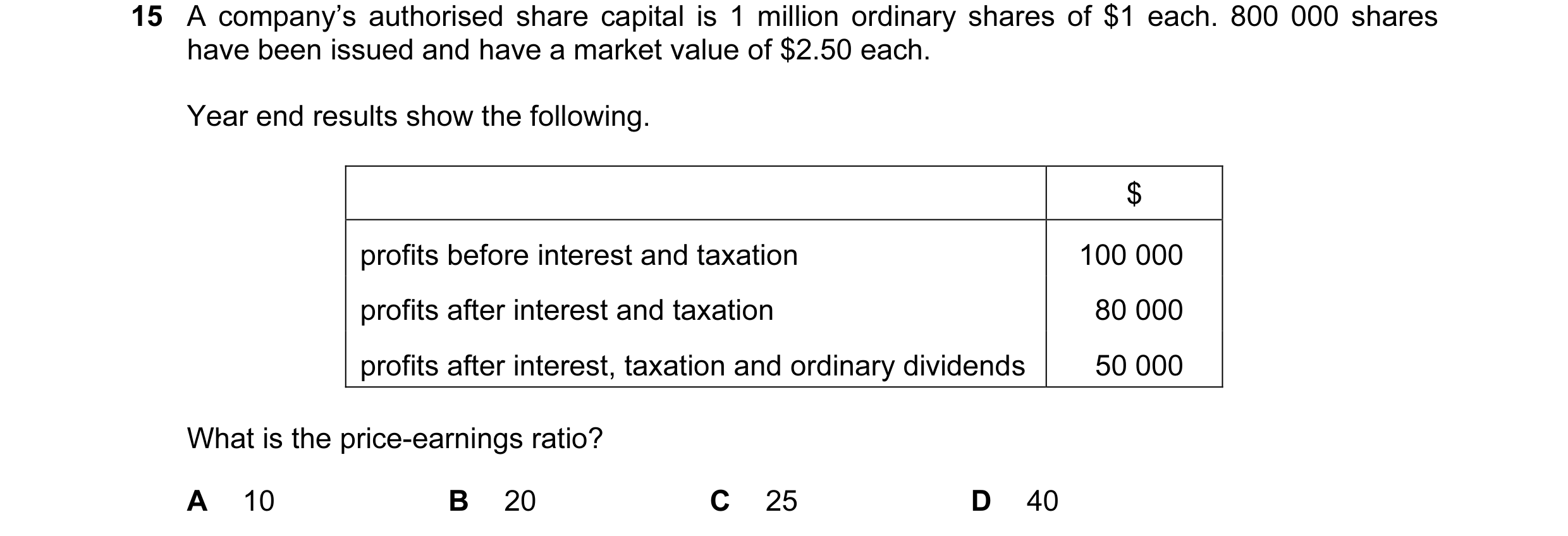
15 A company’s authorised share capital is 1 million ordinary shares of $1 each. 800 000 shares have been issued and have a market value of $2.50 each. Year end results show the following. $ profits before interest and taxation 100 000 profits after interest and taxation 80 000 profits after interest, taxation and ordinary dividends 50 000 What is the price-earnings ratio? A 10 B 20 C 25 D 40
1 marks
Answer: C
This question in 9706/31 Oct/Nov 2010
Q5 · The trade receivables (debtors) collection period of a business has reduced from 90 to 55… 9706/31 Oct/Nov 2010
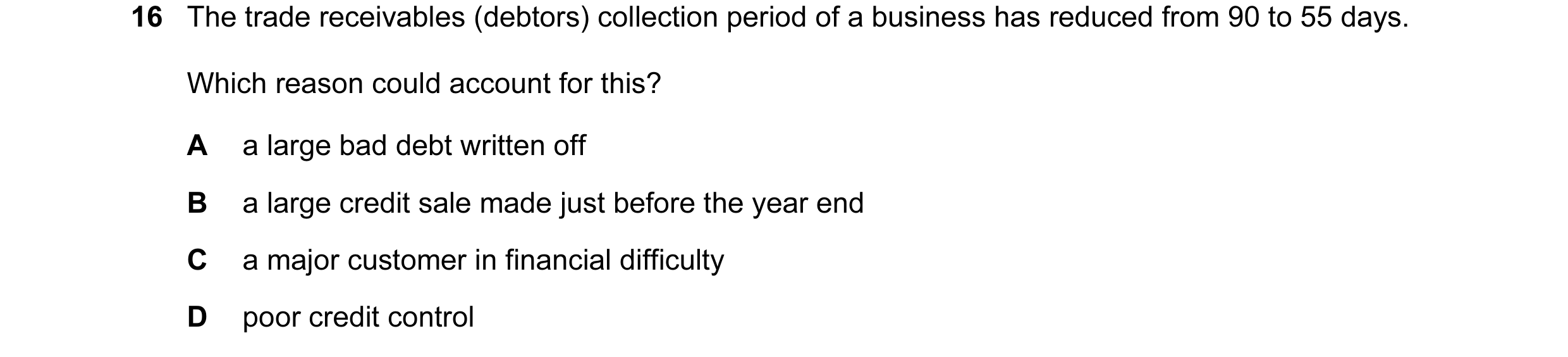
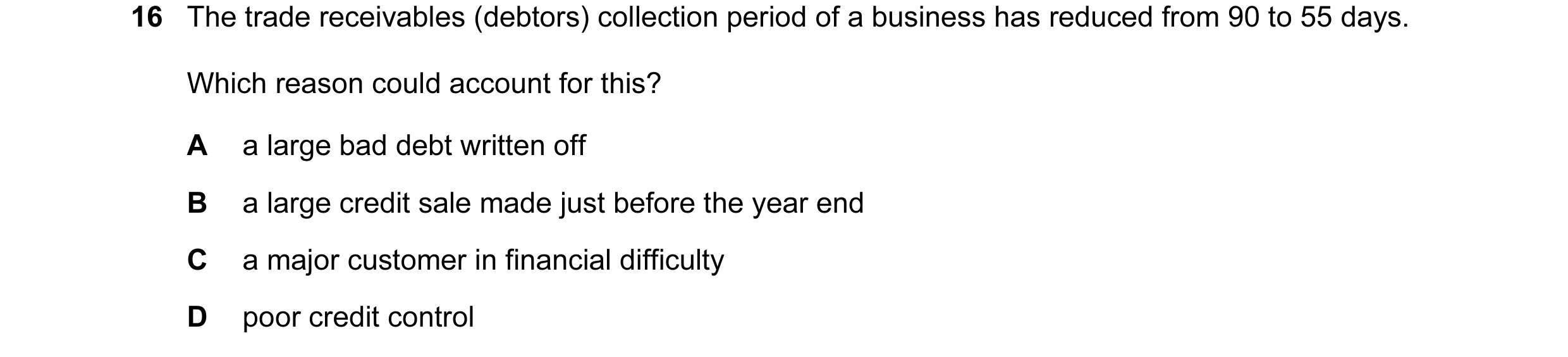
16 The trade receivables (debtors) collection period of a business has reduced from 90 to 55 days. Which reason could account for this? A a large bad debt written off B a large credit sale made just before the year end C a major customer in financial difficulty D poor credit control
1 marks
Answer: A
This question in 9706/31 Oct/Nov 2010
Q6 · A business has a trade receivables (debtors) turnover period of 40 days and annual sales… 9706/32 Oct/Nov 2010
13 A business has a trade receivables (debtors) turnover period of 40 days and annual sales of $479 970. What is the year end trade receivables (debtors) figure? A $11 999 B $15 780 C $39 997 D $52 599
1 marks
Answer: D
This question in 9706/32 Oct/Nov 2010
Q7 · Which ratio measures the return on an investment in shares which continue to be held? 9706/32 Oct/Nov 2010
14 Which ratio measures the return on an investment in shares which continue to be held? A dividend cover B dividend yield C earnings per share D interest cover
1 marks
Answer: B
This question in 9706/32 Oct/Nov 2010
Q8 · A company’s authorised share capital is 1 million ordinary shares of $1 each 9706/32 Oct/Nov 2010
15 A company’s authorised share capital is 1 million ordinary shares of $1 each. 800 000 shares have been issued and have a market value of $2.50 each. Year end results show the following. $ profits before interest and taxation 100 000 profits after interest and taxation 80 000 profits after interest, taxation and ordinary dividends 50 000 What is the price-earnings ratio? A 10 B 20 C 25 D 40
1 marks
Answer: C
This question in 9706/32 Oct/Nov 2010
Q9 · The trade receivables (debtors) collection period of a business has reduced from 90 to 55… 9706/32 Oct/Nov 2010
16 The trade receivables (debtors) collection period of a business has reduced from 90 to 55 days. Which reason could account for this? A a large bad debt written off B a large credit sale made just before the year end C a major customer in financial difficulty D poor credit control
1 marks
Answer: A
This question in 9706/32 Oct/Nov 2010
Q10 · A business has a trade receivables (debtors) turnover period of 40 days and annual sales… 9706/33 Oct/Nov 2010
12 A business has a trade receivables (debtors) turnover period of 40 days and annual sales of $479 970. What is the year end trade receivables (debtors) figure? A $11 999 B $15 780 C $39 997 D $52 599
1 marks
Answer: D
This question in 9706/33 Oct/Nov 2010
Q11 · Which ratio measures the return on an investment in shares which continue to be held? 9706/33 Oct/Nov 2010
13 Which ratio measures the return on an investment in shares which continue to be held? A dividend cover B dividend yield C earnings per share D interest cover
1 marks
Answer: B
This question in 9706/33 Oct/Nov 2010
Q12 · A company’s authorised share capital is 1 million ordinary shares of $1 each 9706/33 Oct/Nov 2010
14 A company’s authorised share capital is 1 million ordinary shares of $1 each. 800 000 shares have been issued and have a market value of $2.50 each. Year end results show the following. $ profits before interest and taxation 100 000 profits after interest and taxation 80 000 profits after interest, taxation and ordinary dividends 50 000 What is the price-earnings ratio? A 10 B 20 C 25 D 40
1 marks
Answer: C
This question in 9706/33 Oct/Nov 2010
Q13 · The trade receivables (debtors) collection period of a business has reduced from 90 to 55… 9706/33 Oct/Nov 2010
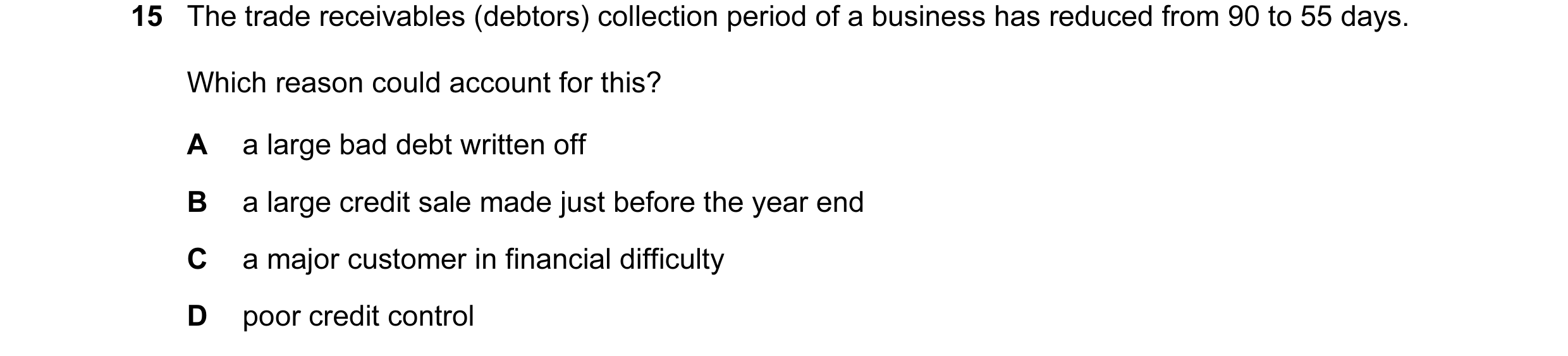
15 The trade receivables (debtors) collection period of a business has reduced from 90 to 55 days. Which reason could account for this? A a large bad debt written off B a large credit sale made just before the year end C a major customer in financial difficulty D poor credit control
1 marks
Answer: A
This question in 9706/33 Oct/Nov 2010
Q14 · The following data is available for the first year of trading for a business to 31… 9706/31 May/June 2011
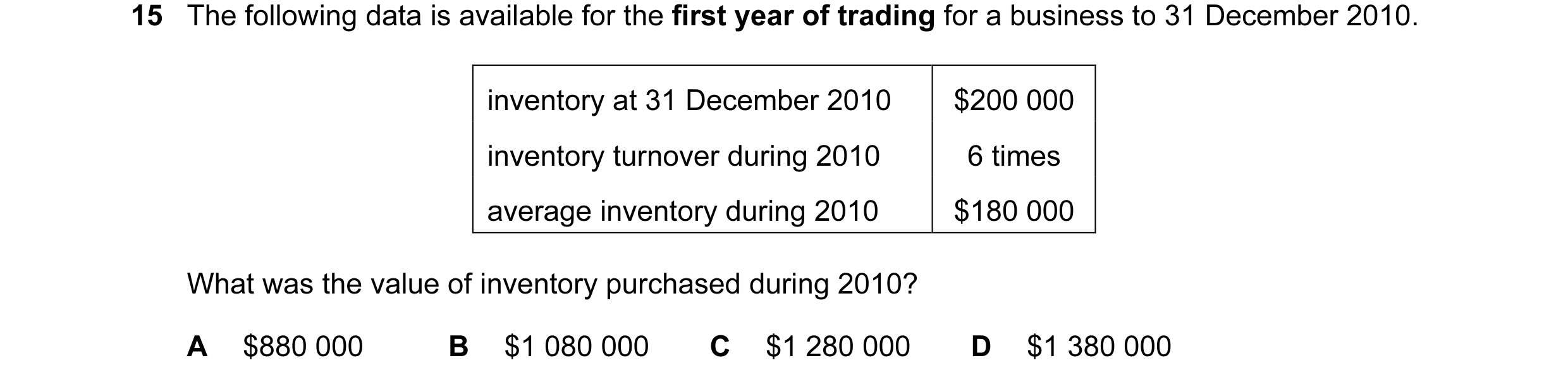
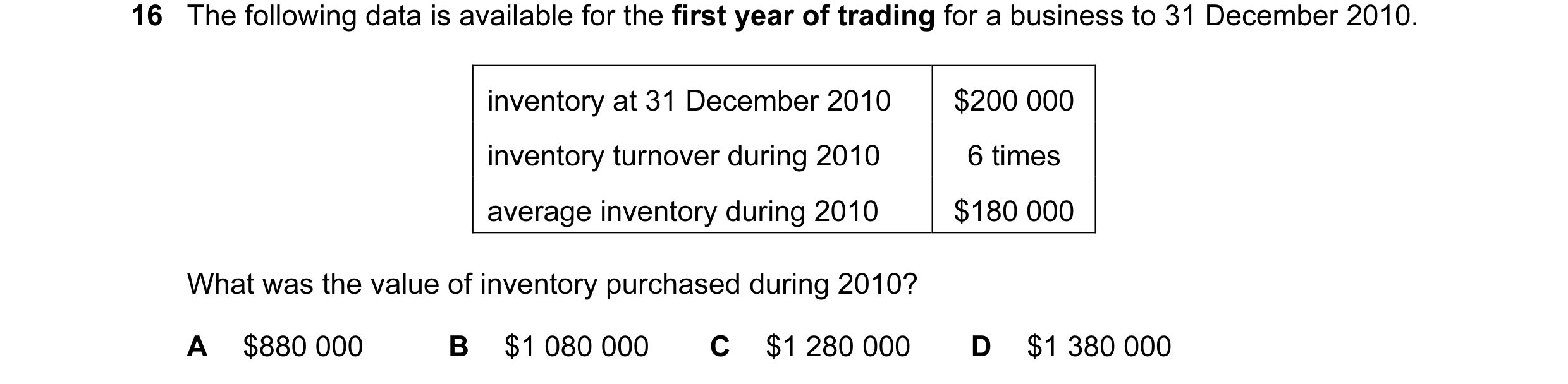
15 The following data is available for the first year of trading for a business to 31 December 2010. inventory at 31 December 2010 $200 000 inventory turnover during 2010 6 times average inventory during 2010 $180 000 What was the value of inventory purchased during 2010? A $880 000 B $1 080 000 C $1 280 000 D $1 380 000
1 marks
Answer: C
This question in 9706/31 May/June 2011
Q15 · A company has a return on capital employed of 20 % and an asset turnover of 2.5 times 9706/32 May/June 2011
14 A company has a return on capital employed of 20 % and an asset turnover of 2.5 times. What was the company’s net profit ratio? A 8 % B 16 % C 20 % D 50 %
1 marks
Answer: A
This question in 9706/32 May/June 2011
Q16 · The following data is available for the first year of trading for a business to 31… 9706/32 May/June 2011
16 The following data is available for the first year of trading for a business to 31 December 2010. inventory at 31 December 2010 $200 000 inventory turnover during 2010 6 times average inventory during 2010 $180 000 What was the value of inventory purchased during 2010? A $880 000 B $1 080 000 C $1 280 000 D $1 380 000
1 marks
Answer: C
This question in 9706/32 May/June 2011
Q17 · The following are extracts from a company’s income statement 9706/32 May/June 2011
17 The following are extracts from a company’s income statement. $ profit from operations 140 000 interest 40 000 profit before tax 100 000 tax 20 000 profit attributable to equity holders 80 000 What is the company’s interest cover? A 1.0 times B 2.0 times C 2.5 times D 3.5 times
1 marks
Answer: D
This question in 9706/32 May/June 2011
Q18 · A company has a return on capital employed of 20 % and an asset turnover of 2.5 times 9706/33 May/June 2011
12 A company has a return on capital employed of 20 % and an asset turnover of 2.5 times. What was the company’s net profit ratio? A 8 % B 16 % C 20 % D 50 %
1 marks
Answer: A
This question in 9706/33 May/June 2011
Q19 · The following data is available for the first year of trading for a business to 31… 9706/33 May/June 2011
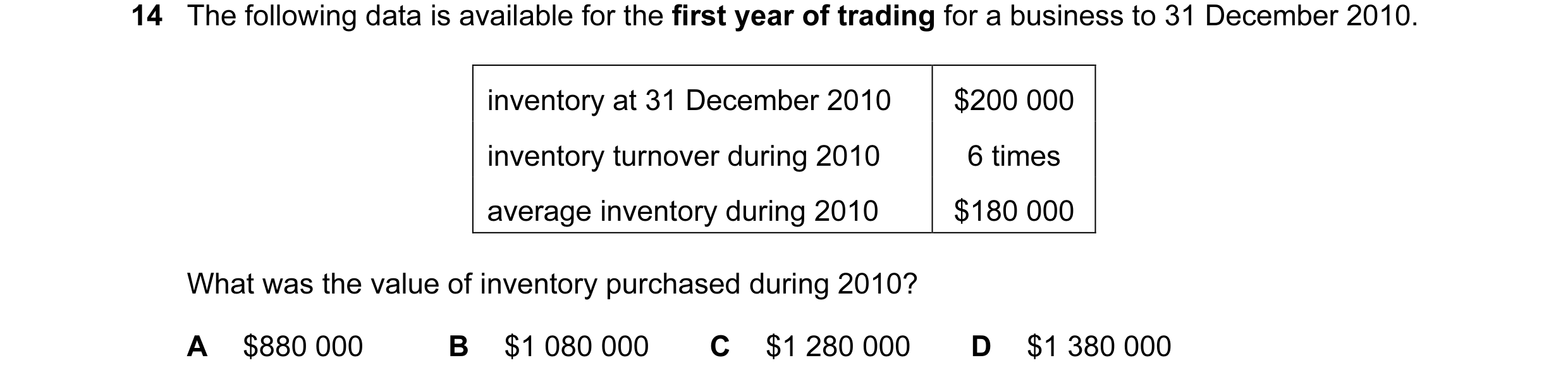
14 The following data is available for the first year of trading for a business to 31 December 2010. inventory at 31 December 2010 $200 000 inventory turnover during 2010 6 times average inventory during 2010 $180 000 What was the value of inventory purchased during 2010? A $880 000 B $1 080 000 C $1 280 000 D $1 380 000
1 marks
Answer: C
This question in 9706/33 May/June 2011
Q20 · PQR plc has the following accounting ratios for its financial years 2009 and 2010 9706/31 Oct/Nov 2011
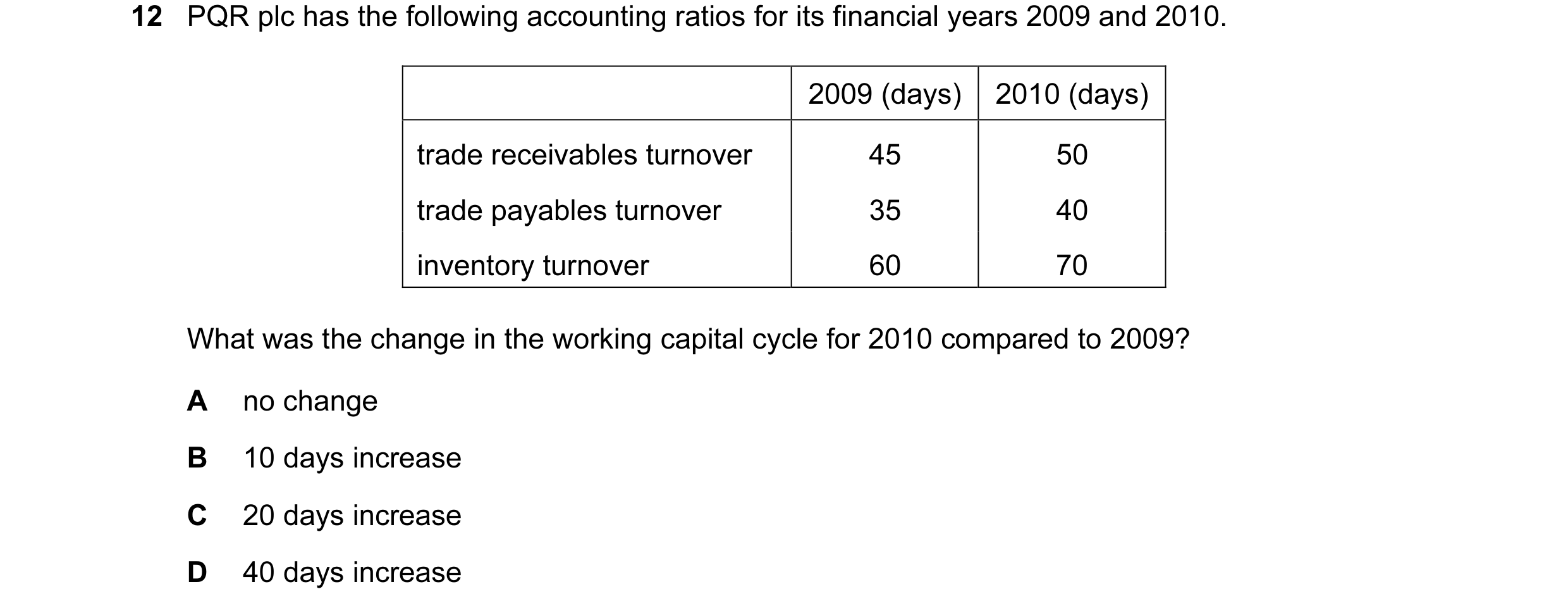
12 PQR plc has the following accounting ratios for its financial years 2009 and 2010. 2009 (days) 2010 (days) trade receivables turnover 45 50 trade payables turnover 35 40 inventory turnover 60 70 What was the change in the working capital cycle for 2010 compared to 2009? A no change B 10 days increase C 20 days increase D 40 days increase
1 marks
Answer: B
This question in 9706/31 Oct/Nov 2011
Q21 · A company has a bank overdraft and agrees with its bank that its current ratio will not… 9706/31 Oct/Nov 2011
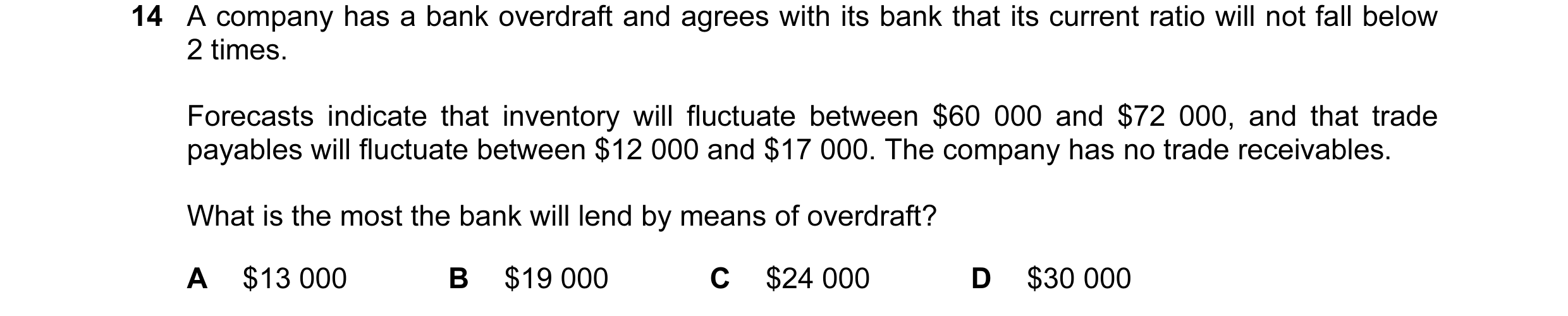
14 A company has a bank overdraft and agrees with its bank that its current ratio will not fall below 2 times. Forecasts indicate that inventory will fluctuate between $60 000 and $72 000, and that trade payables will fluctuate between $12 000 and $17 000. The company has no trade receivables. What is the most the bank will lend by means of overdraft? A $13 000 B $19 000 C $24 000 D $30 000
1 marks
Answer: A
This question in 9706/31 Oct/Nov 2011
Q22 · During the year a company issued one million ordinary shares at $1.20 per share 9706/32 Oct/Nov 2011
2 During the year a company issued one million ordinary shares at $1.20 per share. It repaid a debenture of $1 000 000 and assets costing $500 000 were purchased. How will these transactions be recorded in the different sections of the company’s statement of cash flow? financing investment $000 $000 A +200 –500 B –200 +500 C +1200 –1500 D –1200 +1500
1 marks
Answer: A
This question in 9706/32 Oct/Nov 2011
Q23 · Which action will improve a company’s quick ratio? 9706/32 Oct/Nov 2011
15 Which action will improve a company’s quick ratio? A collecting all outstanding debtors B using cash at the bank to buy equipment C using cash at the bank to pay creditors D using cash at the bank to repay a loan
1 marks
Answer: C
This question in 9706/32 Oct/Nov 2011
Q24 · Which two changes would result in a reduction in a company’s working capital cycle? 9706/32 Oct/Nov 2011
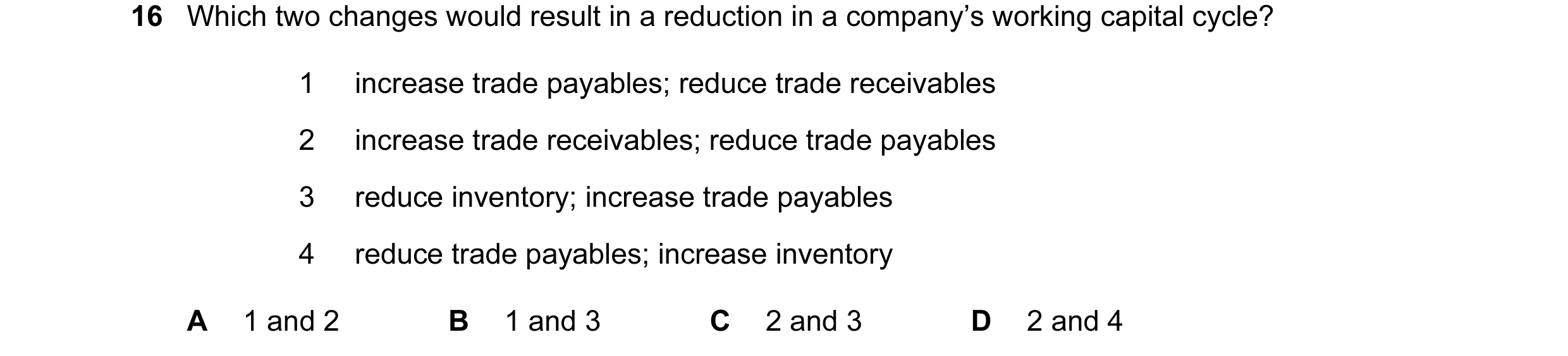
16 Which two changes would result in a reduction in a company’s working capital cycle? 1 increase trade payables; reduce trade receivables 2 increase trade receivables; reduce trade payables 3 reduce inventory; increase trade payables 4 reduce trade payables; increase inventory A 1 and 2 B 1 and 3 C 2 and 3 D 2 and 4
1 marks
Answer: B
This question in 9706/32 Oct/Nov 2011
Q25 · A company revalues its buildings upwards 9706/32 Oct/Nov 2011
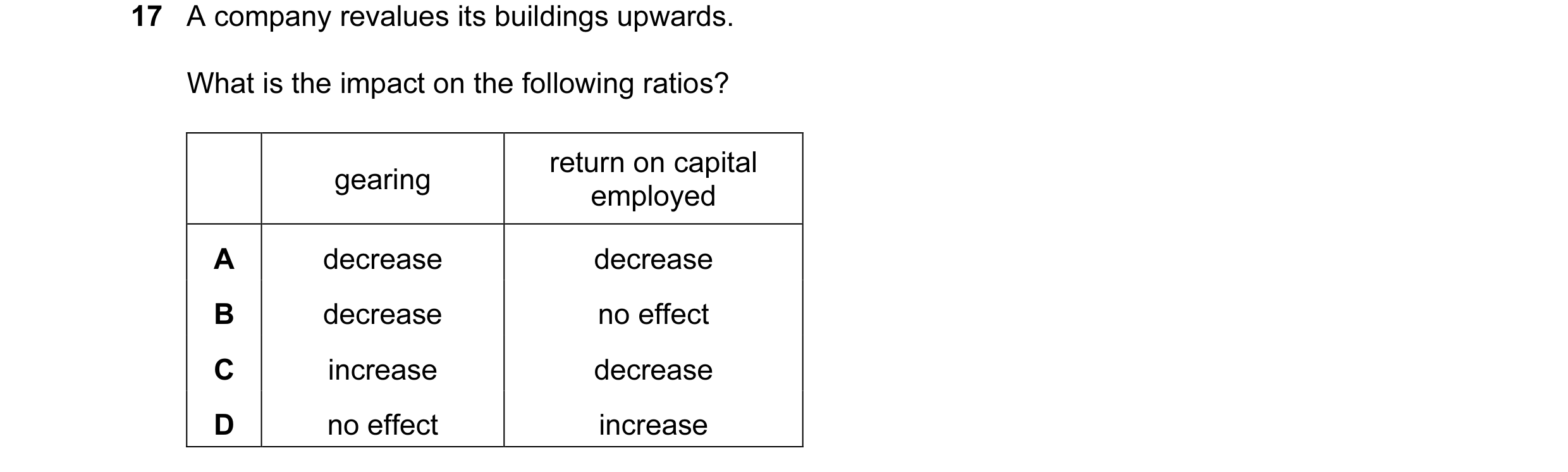
17 A company revalues its buildings upwards. What is the impact on the following ratios? return on capital gearing employed A decrease decrease B decrease no effect C increase decrease D no effect increase
1 marks
Answer: A
This question in 9706/32 Oct/Nov 2011
Q26 · A company revalues its non-current assets upwards 9706/33 Oct/Nov 2011
10 A company revalues its non-current assets upwards. Which of the following shows the effect of this? return on capital gearing employed A decrease decrease B decrease increase C increase decrease D increase increase
1 marks
Answer: A
This question in 9706/33 Oct/Nov 2011
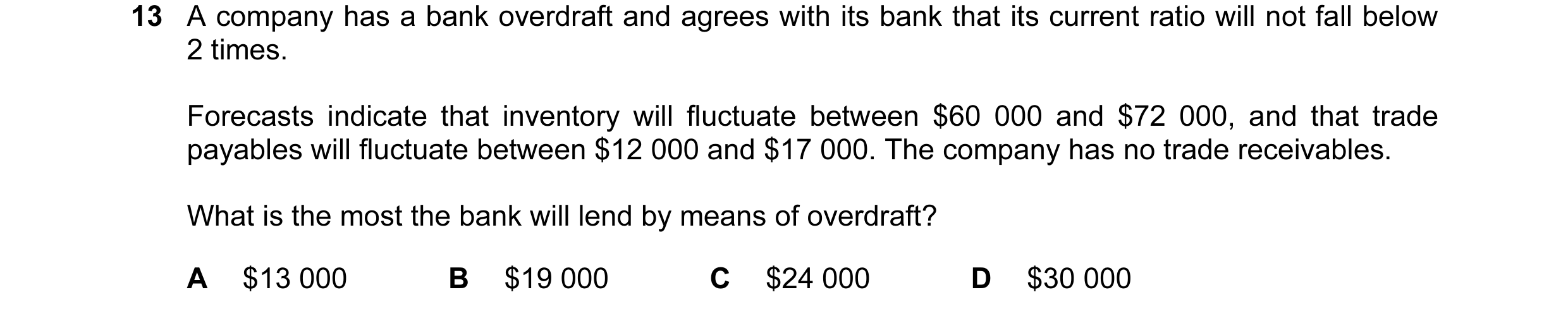
Q27 · A company has a bank overdraft and agrees with its bank that its current ratio will not… 9706/33 Oct/Nov 2011
13 A company has a bank overdraft and agrees with its bank that its current ratio will not fall below 2 times. Forecasts indicate that inventory will fluctuate between $60 000 and $72 000, and that trade payables will fluctuate between $12 000 and $17 000. The company has no trade receivables. What is the most the bank will lend by means of overdraft? A $13 000 B $19 000 C $24 000 D $30 000
1 marks
Answer: A
This question in 9706/33 Oct/Nov 2011
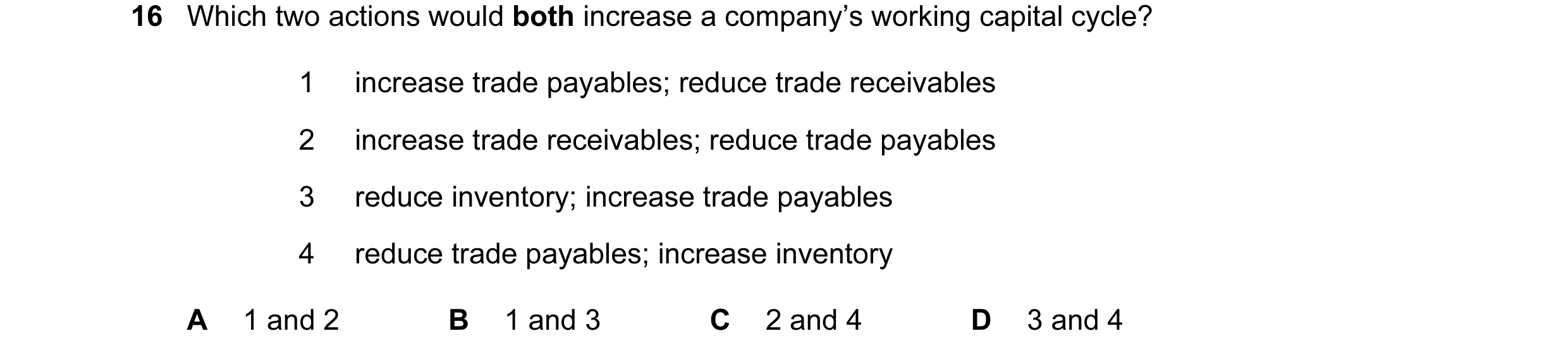
Q28 · Which two actions would both increase a company’s working capital cycle? 9706/32 May/June 2012
16 Which two actions would both increase a company’s working capital cycle? 1 increase trade payables; reduce trade receivables 2 increase trade receivables; reduce trade payables 3 reduce inventory; increase trade payables 4 reduce trade payables; increase inventory A 1 and 2 B 1 and 3 C 2 and 4 D 3 and 4
1 marks
Answer: C
This question in 9706/32 May/June 2012
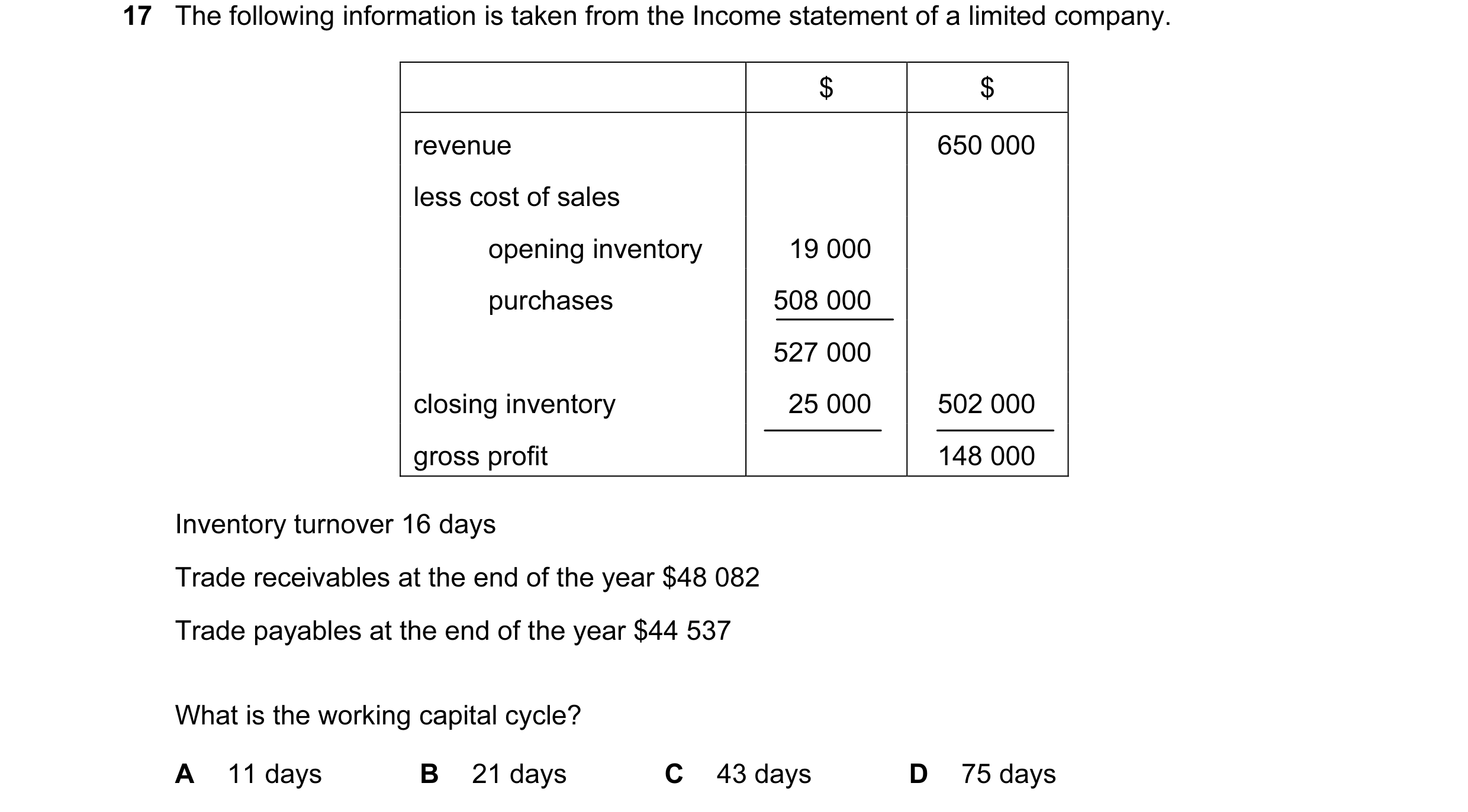
Q29 · The following information is taken from the Income statement of a limited company 9706/32 May/June 2012
17 The following information is taken from the Income statement of a limited company. $ $ revenue 650 000 less cost of sales opening inventory 19 000 purchases 508 000 527 000 closing inventory 25 000 502 000 gross profit 148 000 Inventory turnover 16 days Trade receivables at the end of the year $48 082 Trade payables at the end of the year $44 537 What is the working capital cycle? A 11 days B 21 days C 43 days D 75 days
1 marks
Answer: A
This question in 9706/32 May/June 2012
Q30 · A company reported a profit from operations of $15 000 for the year, after charging the… 9706/31 Oct/Nov 2012
13 A company reported a profit from operations of $15 000 for the year, after charging the following. $ depreciation 2500 loss on sale of assets 1000 During the year there was a decrease in working capital of $500. What was the net cash from operating activities? A $12 000 B $17 500 C $18 000 D $19 000
1 marks
Answer: D
This question in 9706/31 Oct/Nov 2012
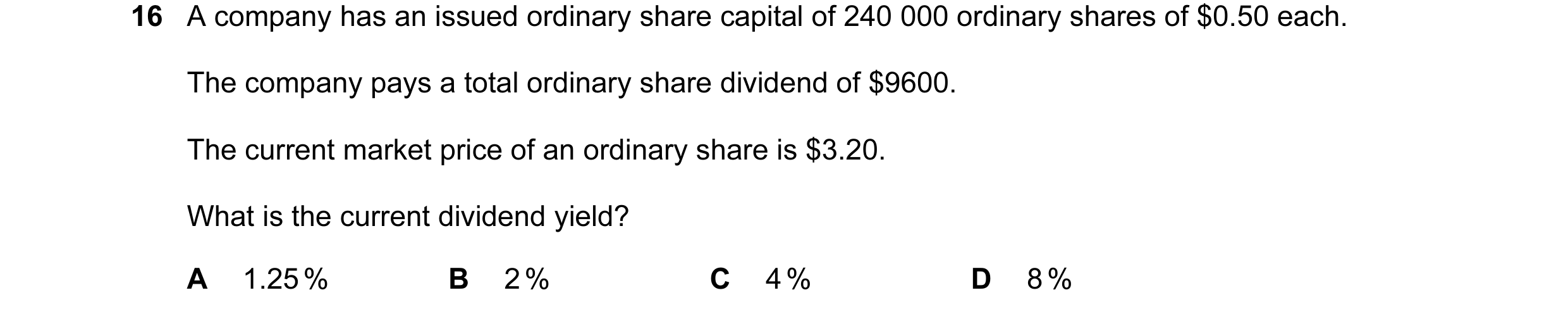
Q31 · A company has an issued ordinary share capital of 240 000 ordinary shares of $0.50 each 9706/31 Oct/Nov 2012
16 A company has an issued ordinary share capital of 240 000 ordinary shares of $0.50 each. The company pays a total ordinary share dividend of $9600. The current market price of an ordinary share is $3.20. What is the current dividend yield? A 1.25 % B 2 % C 4 % D 8 %
1 marks
Answer: A
This question in 9706/31 Oct/Nov 2012
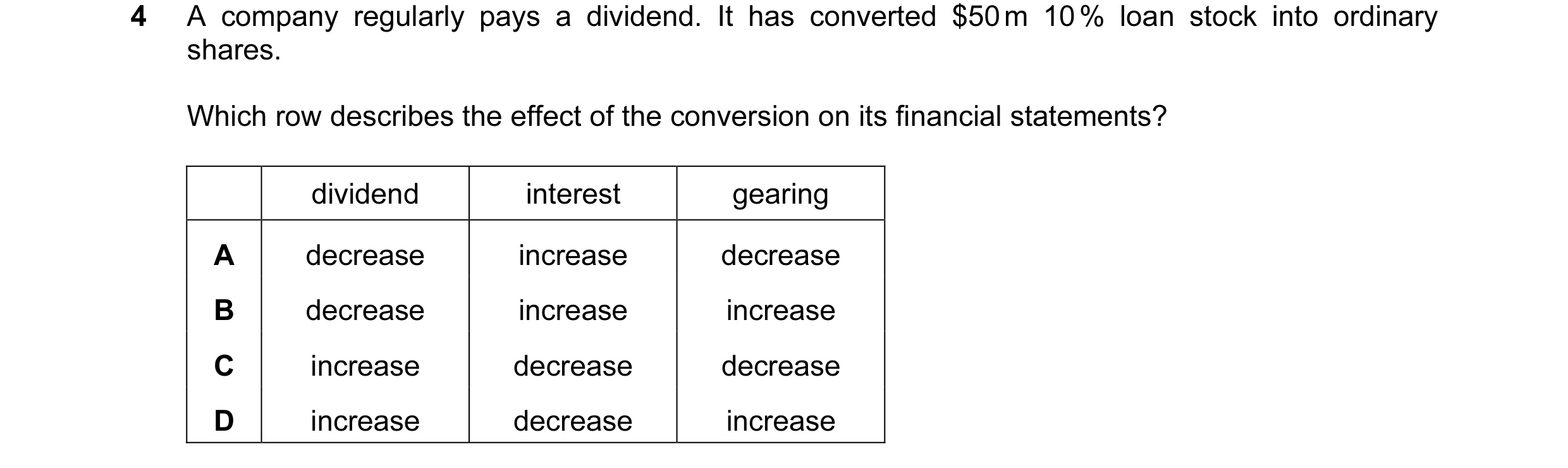
Q32 · A company regularly pays a dividend 9706/33 Oct/Nov 2012
4 A company regularly pays a dividend. It has converted $50 m 10 % loan stock into ordinary shares. Which row describes the effect of the conversion on its financial statements? dividend interest gearing A decrease increase decrease B decrease increase increase C increase decrease decrease D increase decrease increase
1 marks
Answer: C
This question in 9706/33 Oct/Nov 2012
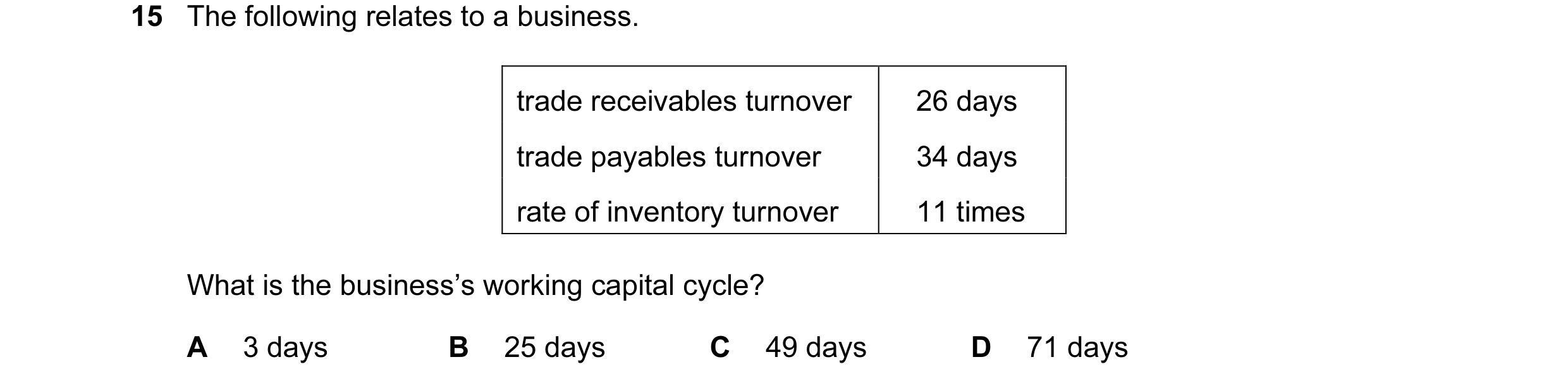
Q33 · The following relates to a business 9706/33 Oct/Nov 2012
15 The following relates to a business. trade receivables turnover 26 days trade payables turnover 34 days rate of inventory turnover 11 times What is the business’s working capital cycle? A 3 days B 25 days C 49 days D 71 days
1 marks
Answer: B
This question in 9706/33 Oct/Nov 2012
Q34 · An extract from the final accounts of a company shows: $000 $000 profit from operations… 9706/33 Oct/Nov 2012
16 An extract from the final accounts of a company shows: $000 $000 profit from operations 200 interest payable 40 profit before tax 160 taxation 35 profit attributable to equity holders 125 dividends paid - preference shares 25 - ordinary shares 50 75 retained earnings 50 What are the interest cover and the dividend cover? interest cover dividend cover A 4 2 B 4 2.5 C 5 2 D 5 2.5
1 marks
Answer: C
This question in 9706/33 Oct/Nov 2012
Q35 · The working capital cycle for a company was 55 days in 2011 9706/33 Oct/Nov 2012
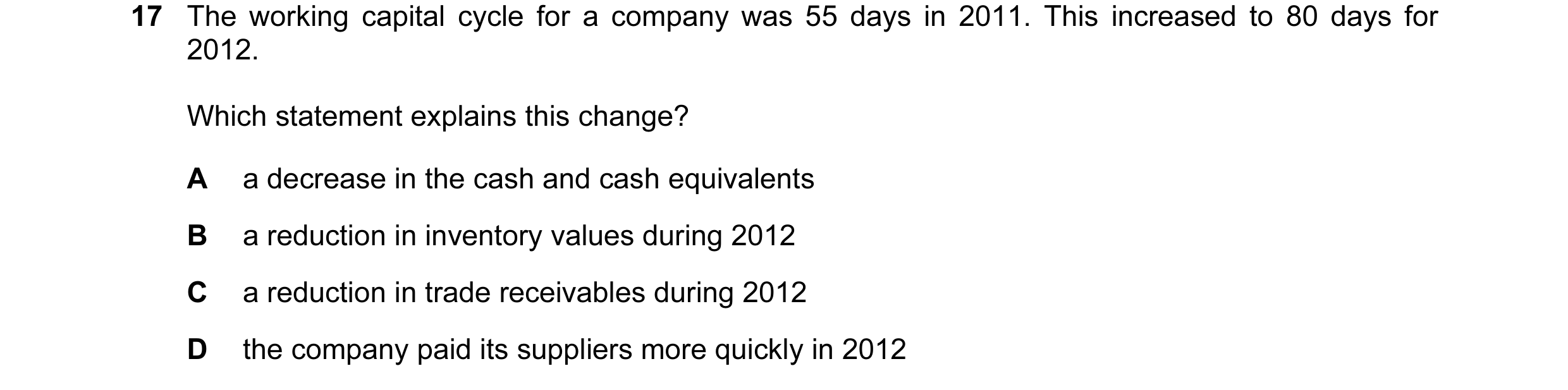
17 The working capital cycle for a company was 55 days in 2011. This increased to 80 days for 2012. Which statement explains this change? A a decrease in the cash and cash equivalents B a reduction in inventory values during 2012 C a reduction in trade receivables during 2012 D the company paid its suppliers more quickly in 2012
1 marks
Answer: D
This question in 9706/33 Oct/Nov 2012
Q36 · The capital structure of a company is shown below 9706/31 May/June 2013
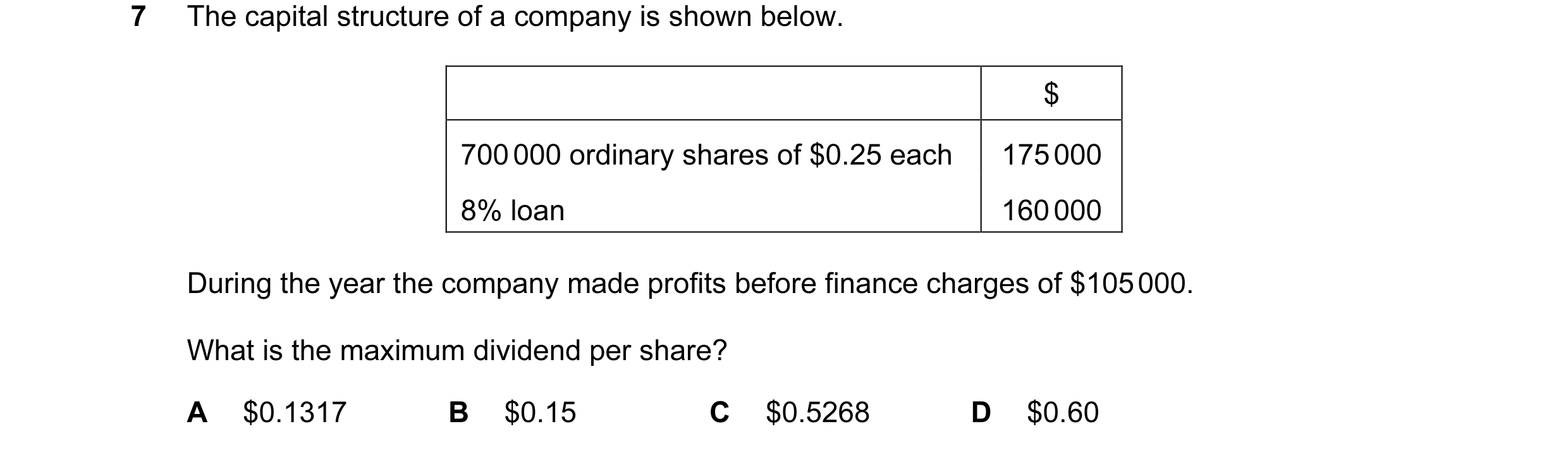
7 The capital structure of a company is shown below. $ 700 000 ordinary shares of $0.25 each 175 000 8% loan 160 000 During the year the company made profits before finance charges of $105 000. What is the maximum dividend per share? A $0.1317 B $0.15 C $0.5268 D $0.60
1 marks
Answer: A
This question in 9706/31 May/June 2013
Q37 · A company’s capital comprises 200 000 ordinary shares of $1 each 9706/31 May/June 2013
14 A company’s capital comprises 200 000 ordinary shares of $1 each. It also has a loan of $50 000. At the end of the year its current ratio is 1.5 : 1 and its current liabilities are $30 000. What is the value of the company’s non-current assets at the end of the year? A $135 000 B $185 000 C $205 000 D $235 000
1 marks
Answer: D
This question in 9706/31 May/June 2013
Q38 · A business is considering using a debt factoring service 9706/32 May/June 2013
5 A business is considering using a debt factoring service. What is the benefit to the business of this action? A There will be an improvement in cash flow. B There will be an increase in sales volume. C There will be an increase in trade receivables. D There will be an increase in working capital.
1 marks
Answer: A
This question in 9706/32 May/June 2013
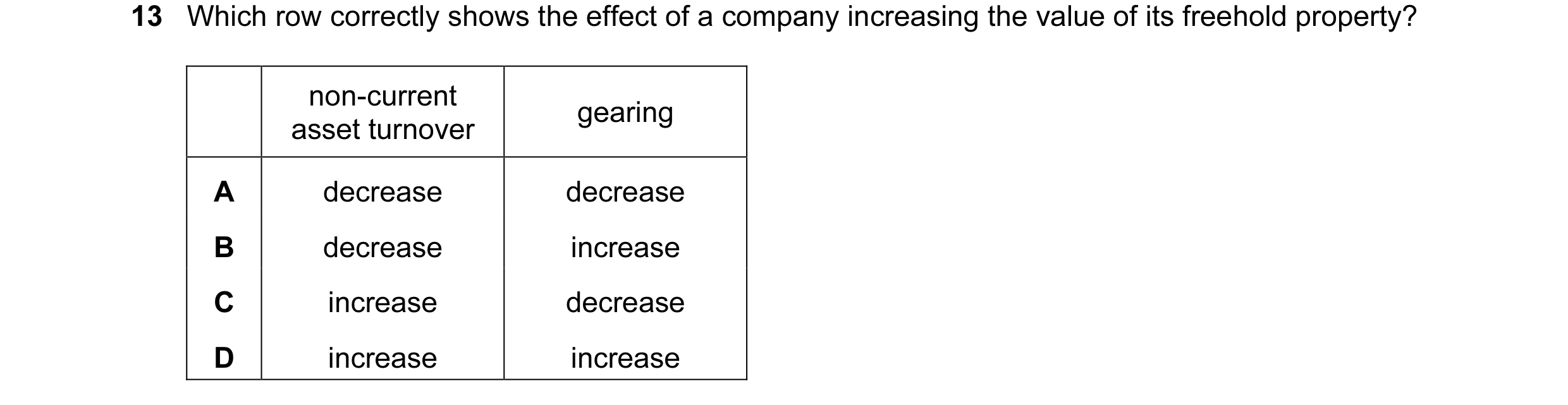
Q39 · Which row correctly shows the effect of a company increasing the value of its freehold… 9706/32 May/June 2013
13 Which row correctly shows the effect of a company increasing the value of its freehold property? non-current gearing asset turnover A decrease decrease B decrease increase C increase decrease D increase increase
1 marks
Answer: A
This question in 9706/32 May/June 2013
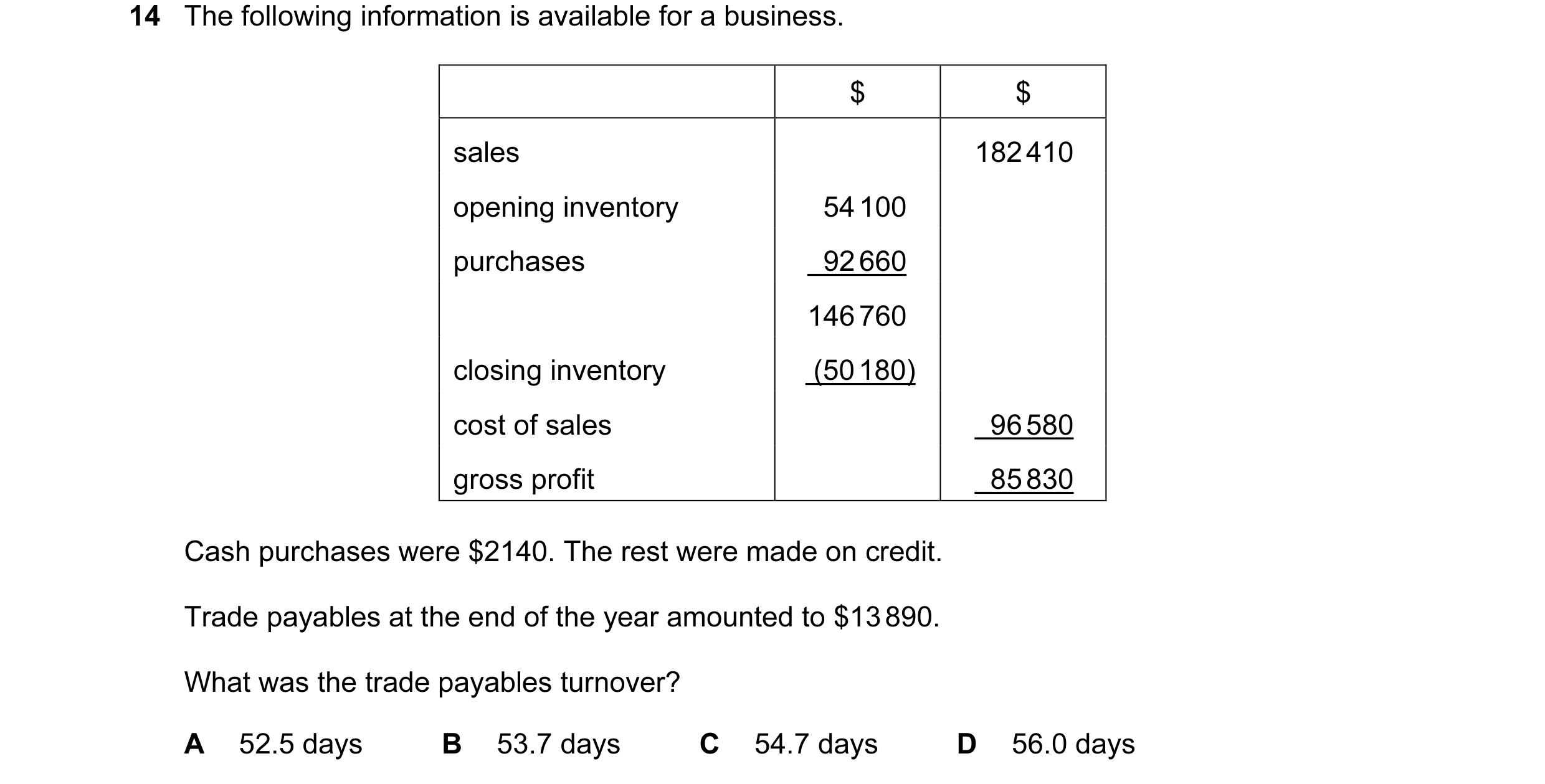
Q40 · The following information is available for a business 9706/32 May/June 2013
14 The following information is available for a business. $ $ sales 182 410 opening inventory 54 100 purchases 92 660 146 760 closing inventory (50 180) cost of sales 96 580 gross profit 85 830 Cash purchases were $2140. The rest were made on credit. Trade payables at the end of the year amounted to $13 890. What was the trade payables turnover? A 52.5 days B 53.7 days C 54.7 days D 56.0 days
1 marks
Answer: D
This question in 9706/32 May/June 2013
Q41 · The directors of a company carry out the following actions 9706/32 May/June 2013
18 The directors of a company carry out the following actions. 1 make an issue of ordinary shares of 50 000 ordinary shares of $1 each at par 2 make a bonus issue of 40 000 shares of $1 each at par 3 redeem a debenture of $60 000 at par Which row shows the effect of this? share capital gearing working capital A decrease decrease decrease B increase decrease decrease C increase increase increase D increase no effect increase
1 marks
Answer: B
This question in 9706/32 May/June 2013
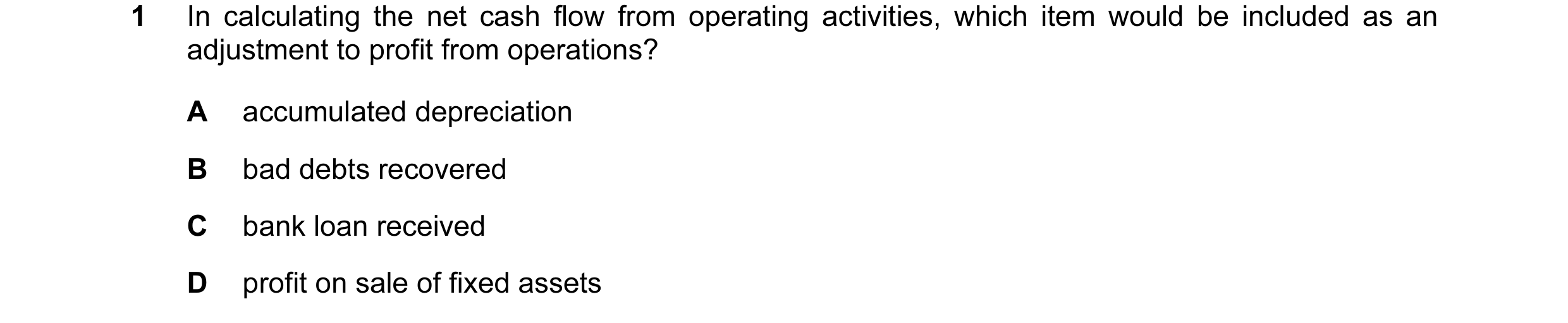
Q42 · In calculating the net cash flow from operating activities, which item would be included… 9706/33 May/June 2013
1 In calculating the net cash flow from operating activities, which item would be included as an adjustment to profit from operations? A accumulated depreciation B bad debts recovered C bank loan received D profit on sale of fixed assets
1 marks
Answer: D
This question in 9706/33 May/June 2013
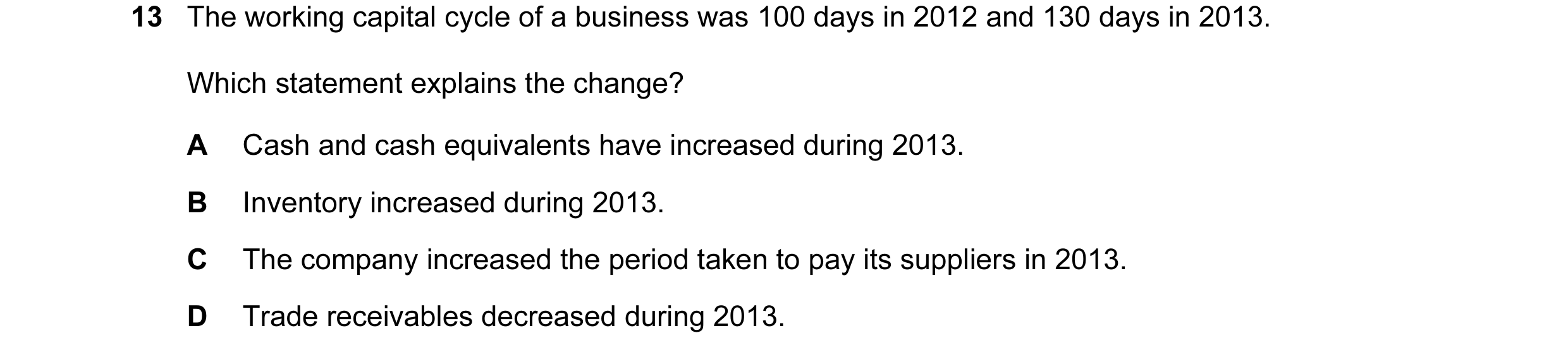
Q43 · The working capital cycle of a business was 100 days in 2012 and 130 days in 2013 9706/33 May/June 2013
13 The working capital cycle of a business was 100 days in 2012 and 130 days in 2013. Which statement explains the change? A Cash and cash equivalents have increased during 2013. B Inventory increased during 2013. C The company increased the period taken to pay its suppliers in 2013. D Trade receivables decreased during 2013.
1 marks
Answer: B
This question in 9706/33 May/June 2013
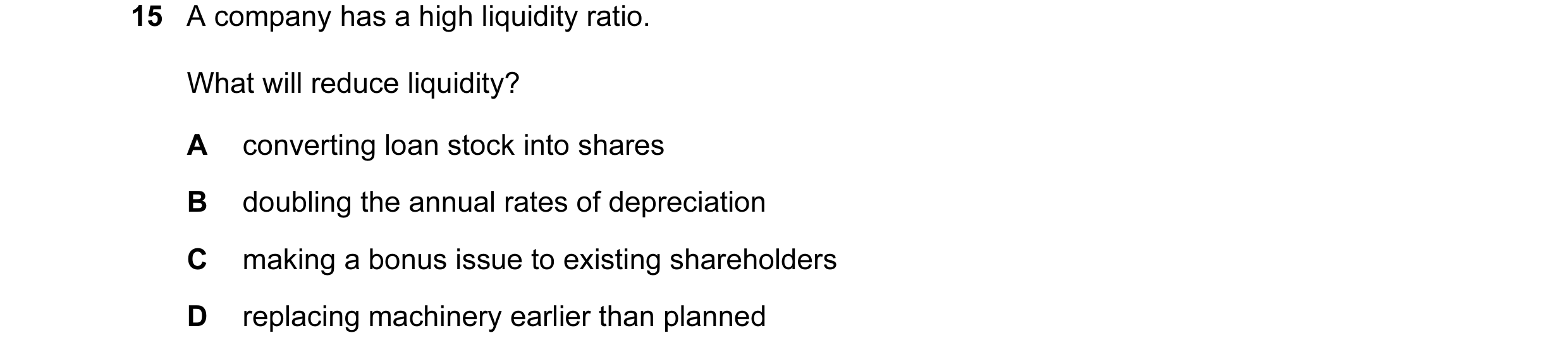
Q44 · A company has a high liquidity ratio 9706/33 May/June 2013
15 A company has a high liquidity ratio. What will reduce liquidity? A converting loan stock into shares B doubling the annual rates of depreciation C making a bonus issue to existing shareholders D replacing machinery earlier than planned
1 marks
Answer: D
This question in 9706/33 May/June 2013
Q45 · A limited company has the following capital at 31 December 9706/31 Oct/Nov 2013
13 A limited company has the following capital at 31 December. $000 ordinary shares of $1 each fully paid 5000 7.5% preference shares of $1 each fully paid 200 The market price of the company’s ordinary shares at 31 December is $1.45. Other financial information is as follows. $000 $000 profit after tax 470 preference dividend 15 ordinary dividend 52 67 retained profit for the year 403 What is the price earnings (P / E) ratio at 31 December? A 15.4 B 15.9 C 16.6 D 18.0
1 marks
Answer: B
This question in 9706/31 Oct/Nov 2013
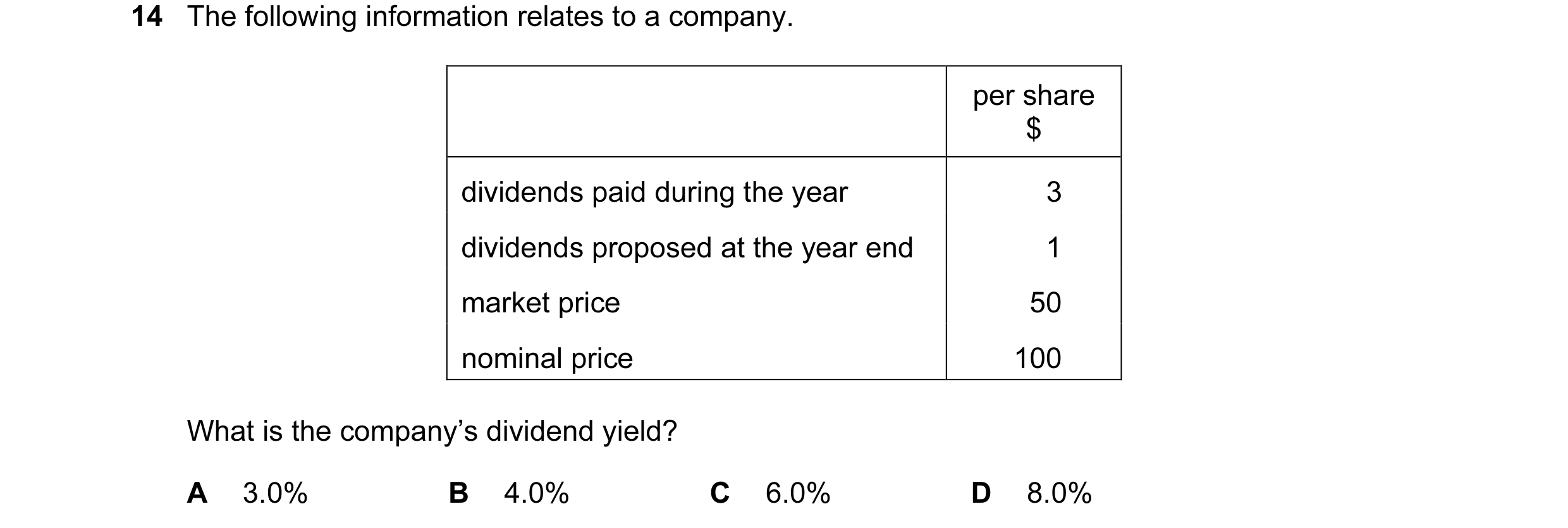
Q46 · The following information relates to a company 9706/31 Oct/Nov 2013
14 The following information relates to a company. per share $ dividends paid during the year 3 dividends proposed at the year end 1 market price 50 nominal price 100 What is the company’s dividend yield? A 3.0% B 4.0% C 6.0% D 8.0%
1 marks
Answer: D
This question in 9706/31 Oct/Nov 2013
Q47 · Which transaction will increase a company’s working capital? 9706/31 Oct/Nov 2013
15 Which transaction will increase a company’s working capital? A The bank overdraft is increased. B There is a bonus share issue. C There is a rights issue. D There is a transfer to the general reserves.
1 marks
Answer: C
This question in 9706/31 Oct/Nov 2013
Q48 · Which action will increase company profits in the short term? 9706/31 Oct/Nov 2013
16 Which action will increase company profits in the short term? A accepting deposits for customers’ orders B decreasing rates of depreciation C increasing the value of opening inventory D writing down the value of closing inventory
1 marks
Answer: B
This question in 9706/31 Oct/Nov 2013
Q49 · A company issues a debenture 9706/31 Oct/Nov 2013
18 A company issues a debenture. Which row shows the impact of this on the company’s financial statements? return on capital gearing working capital employed A decrease decrease no effect B increase decrease increase C increase no effect increase D no effect decrease decrease
1 marks
Answer: B
This question in 9706/31 Oct/Nov 2013
Q50 · How can a company increase its liquidity? 9706/33 Oct/Nov 2013
5 How can a company increase its liquidity? A by making a bonus issue B by making a rights issue C by transfers from the general reserve D by transfers from the share premium account
1 marks
Answer: B
This question in 9706/33 Oct/Nov 2013
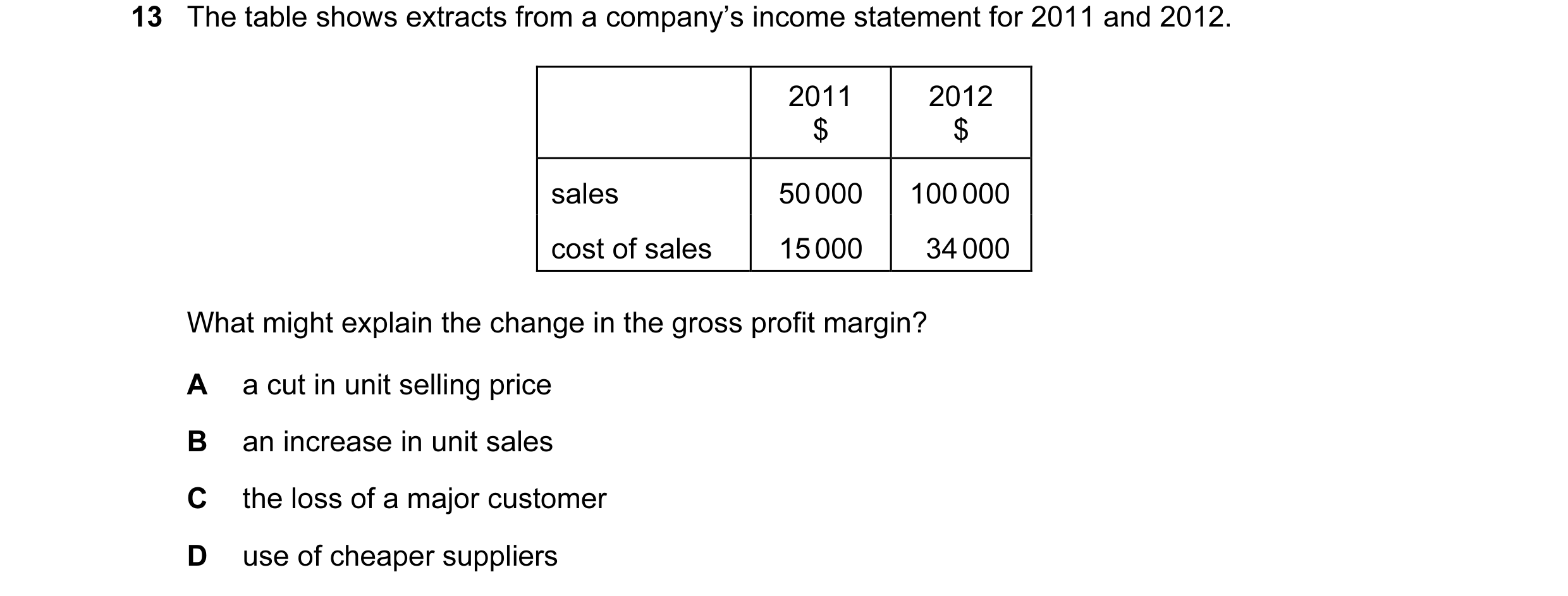
Q51 · The table shows extracts from a company’s income statement for 2011 and 2012 9706/33 Oct/Nov 2013
13 The table shows extracts from a company’s income statement for 2011 and 2012. 2011 2012 $ $ sales 50 000 100 000 cost of sales 15 000 34 000 What might explain the change in the gross profit margin? A a cut in unit selling price B an increase in unit sales C the loss of a major customer D use of cheaper suppliers
1 marks
Answer: A
This question in 9706/33 Oct/Nov 2013
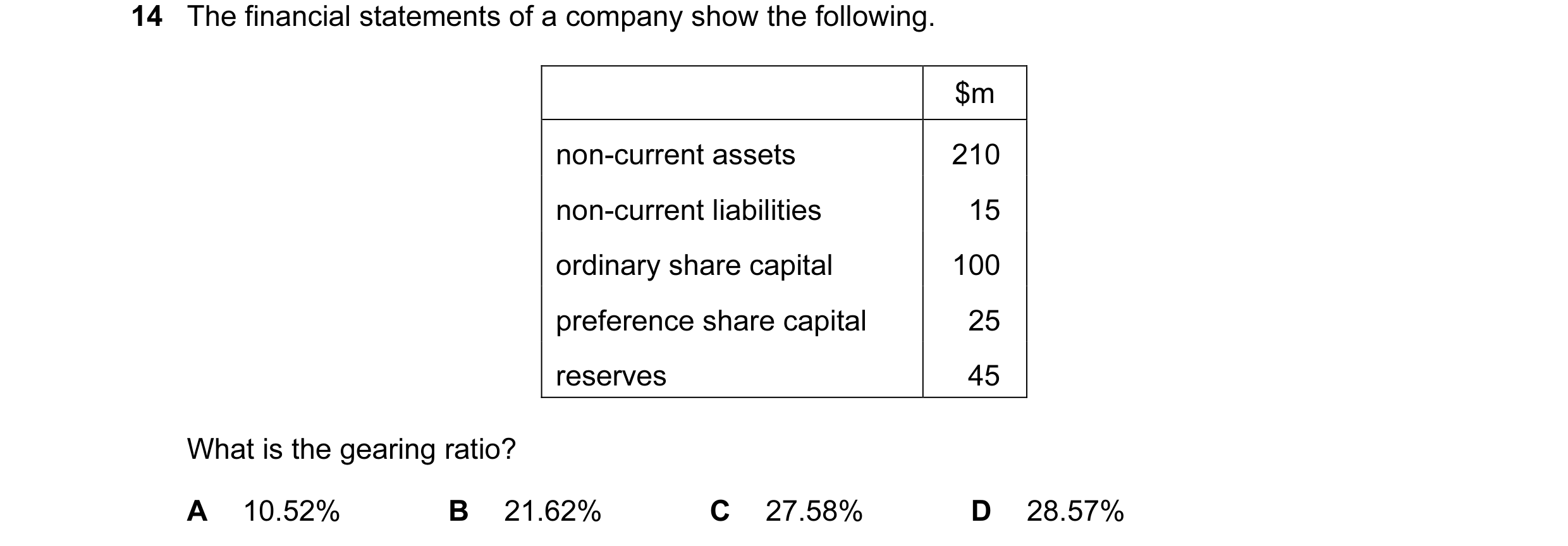
Q52 · The financial statements of a company show the following 9706/33 Oct/Nov 2013
14 The financial statements of a company show the following. $m non-current assets 210 non-current liabilities 15 ordinary share capital 100 preference share capital 25 reserves 45 What is the gearing ratio? A 10.52% B 21.62% C 27.58% D 28.57%
1 marks
Answer: B
This question in 9706/33 Oct/Nov 2013
Q53 · The following information is taken from the financial statements of a company 9706/33 Oct/Nov 2013
15 The following information is taken from the financial statements of a company. $ profit attributable to equity holders 2 000 000 ordinary share dividend paid 200 000 non-redeemable preference share dividend paid 100 000 10% non-redeemable preference share capital 1 000 000 ordinary shares of $1 each 5 000 000 What are the earnings per share for the year to the nearest cent? A $0.28 B $0.32 C $0.34 D $0.38
1 marks
Answer: D
This question in 9706/33 Oct/Nov 2013
Q54 · The issued share capital of a company is as follows 9706/33 May/June 2014
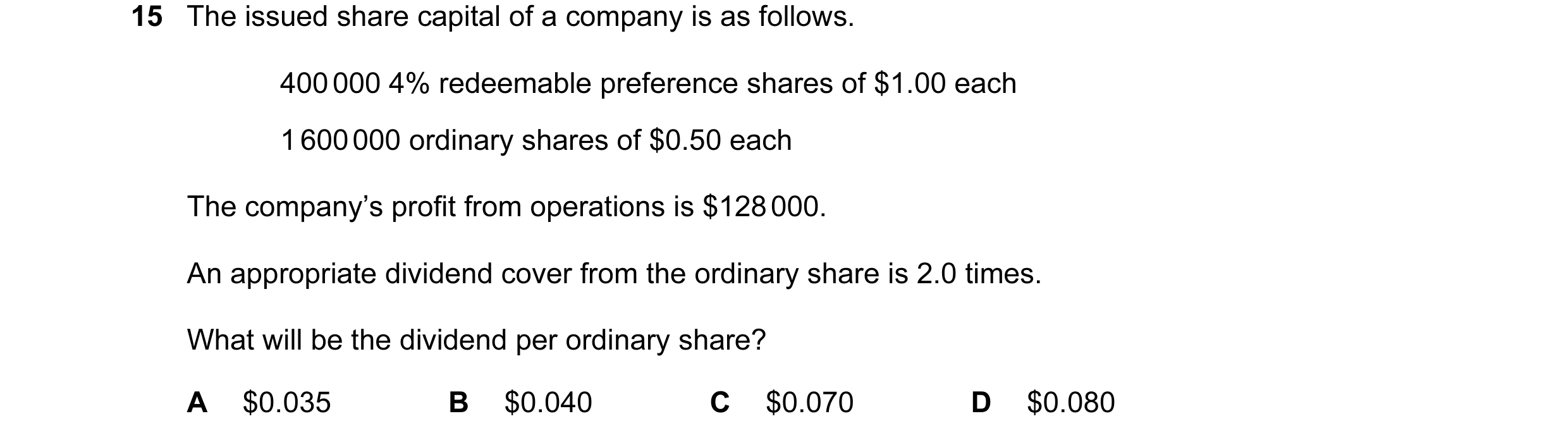
15 The issued share capital of a company is as follows. 400 000 4% redeemable preference shares of $1.00 each 1 600 000 ordinary shares of $0.50 each The company’s profit from operations is $128 000. An appropriate dividend cover from the ordinary share is 2.0 times. What will be the dividend per ordinary share? A $0.035 B $0.040 C $0.070 D $0.080
1 marks
Answer: A
This question in 9706/33 May/June 2014
Q55 · The following investment information is available 9706/33 May/June 2014
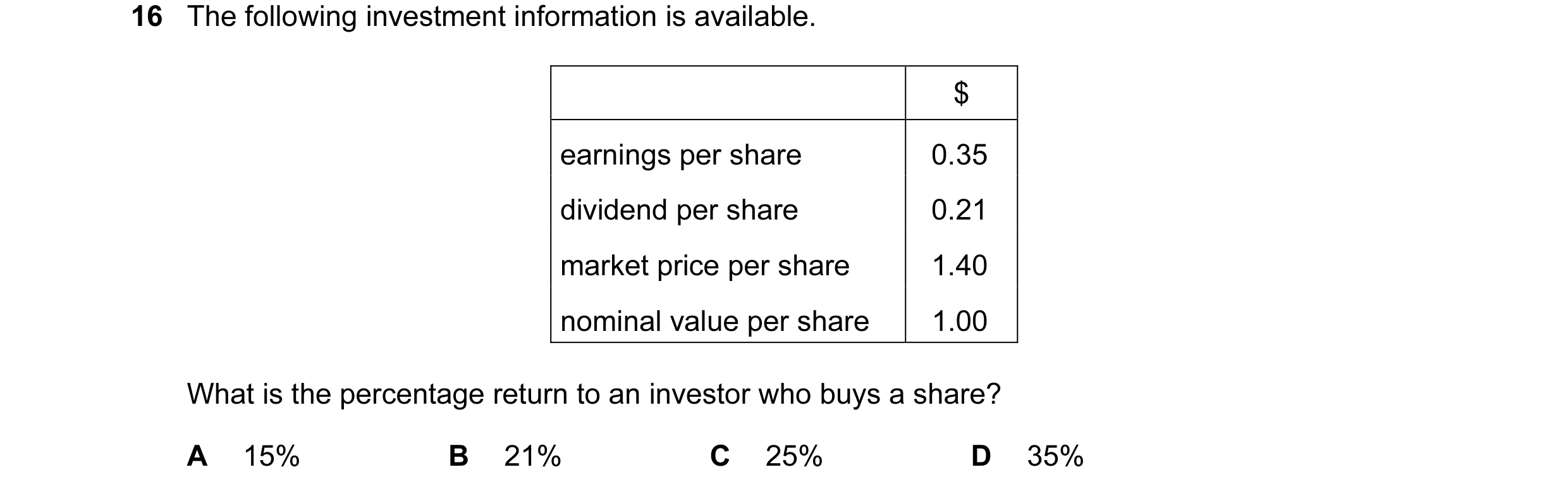
16 The following investment information is available. $ earnings per share 0.35 dividend per share 0.21 market price per share 1.40 nominal value per share 1.00 What is the percentage return to an investor who buys a share? A 15% B 21% C 25% D 35%
1 marks
Answer: A
This question in 9706/33 May/June 2014
Q56 · Which transaction would not affect the gearing ratio? 9706/33 May/June 2014
17 Which transaction would not affect the gearing ratio? A bonus issue of ordinary shares B issue of preference shares C redemption of ordinary shares at a premium D repayment of a debenture loan
1 marks
Answer: A
This question in 9706/33 May/June 2014
Q57 · A company had the following capital employed 9706/33 May/June 2014
18 A company had the following capital employed. $ $0.50 ordinary shares 5 000 000 10% $1 preference shares 1 000 000 total capital employed 6 000 000 The profit from operations for the year was $800 000. What was the earnings per share? A $0.07 B $0.08 C $0.09 D $0.12
1 marks
Answer: A
This question in 9706/33 May/June 2014
Q58 · A company has the following working capital information 9706/32 Oct/Nov 2015
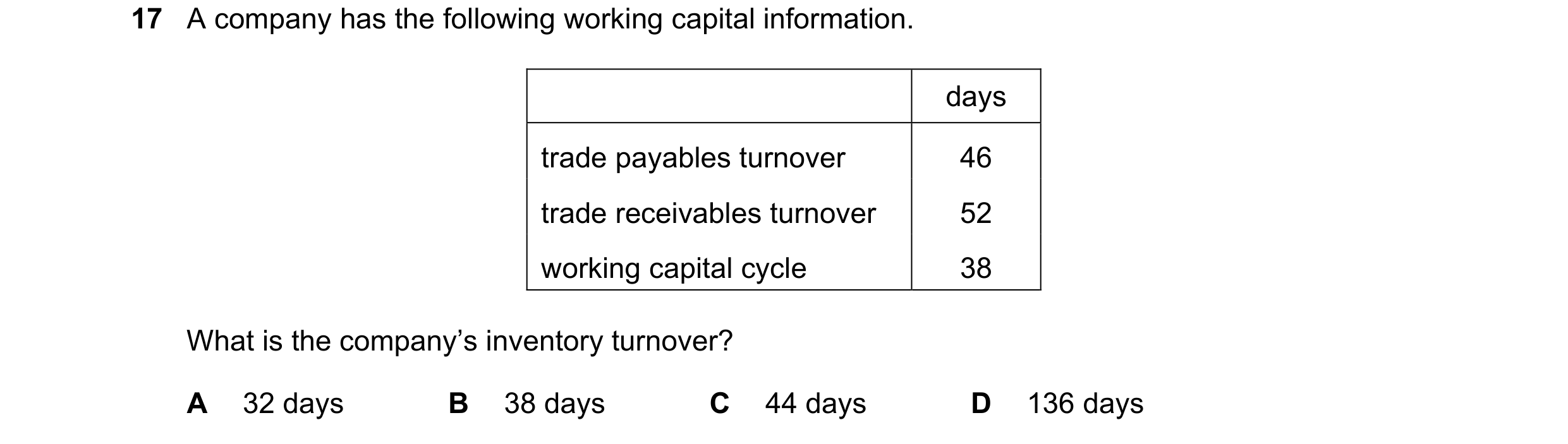
17 A company has the following working capital information. days trade payables turnover 46 trade receivables turnover 52 working capital cycle 38 What is the company’s inventory turnover? A 32 days B 38 days C 44 days D 136 days
1 marks
Answer: A
This question in 9706/32 Oct/Nov 2015


 1 / 14


 2 / 14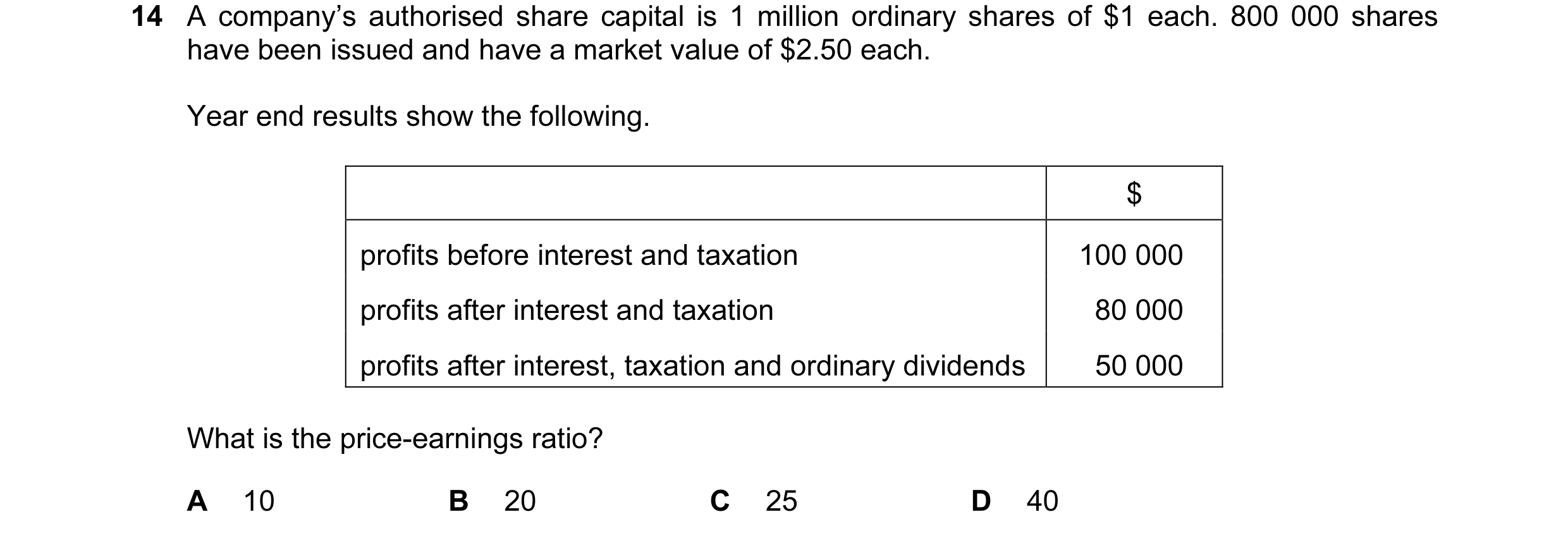

 3 / 14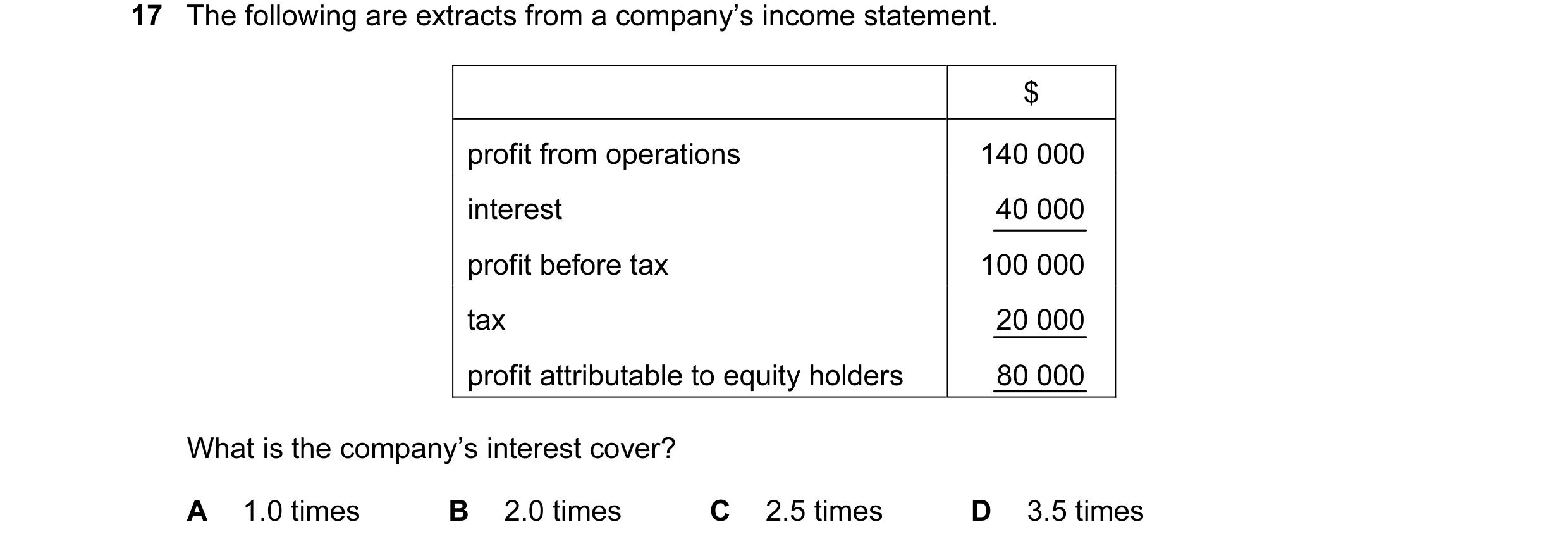

 4 / 14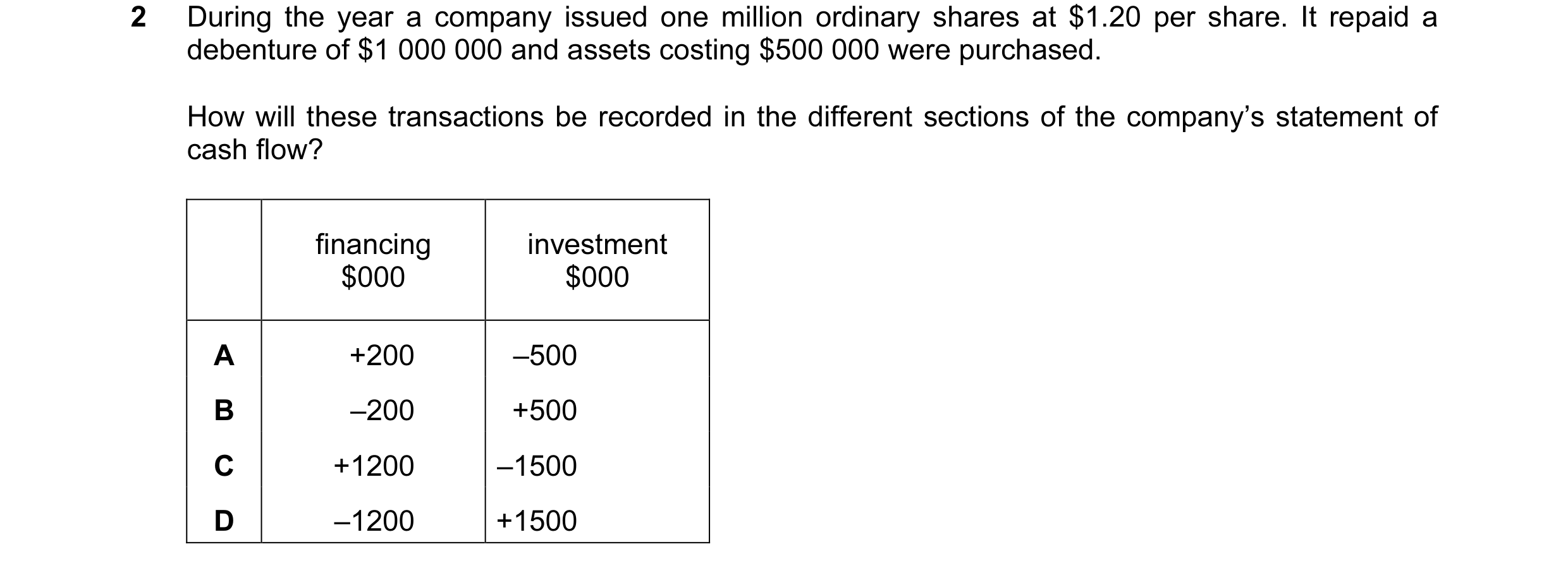

 5 / 14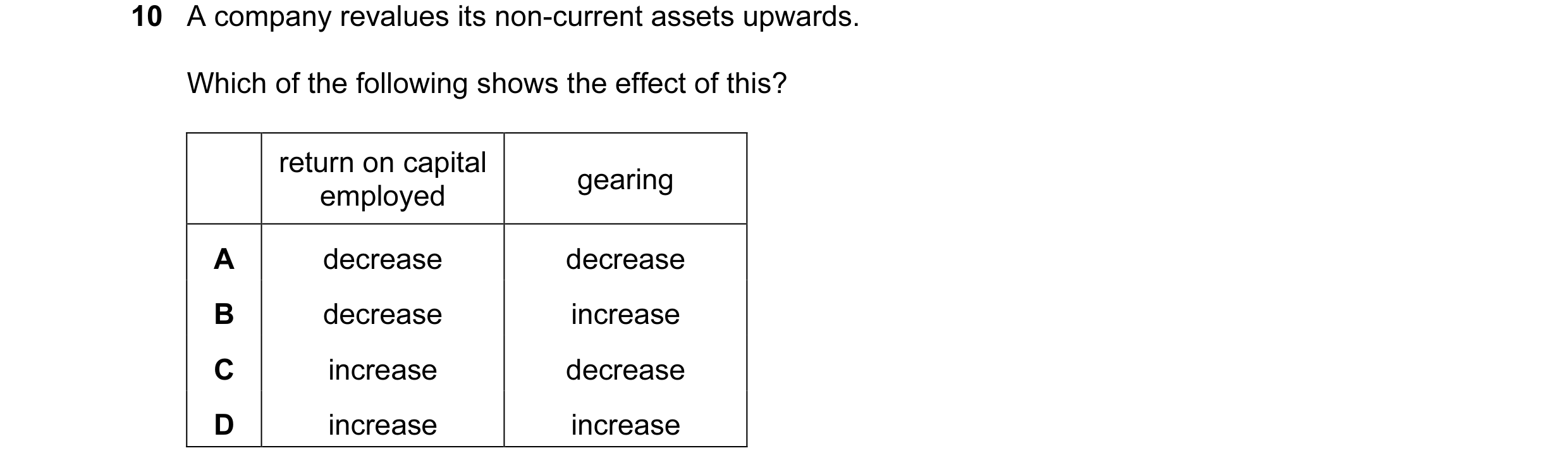
 6 / 14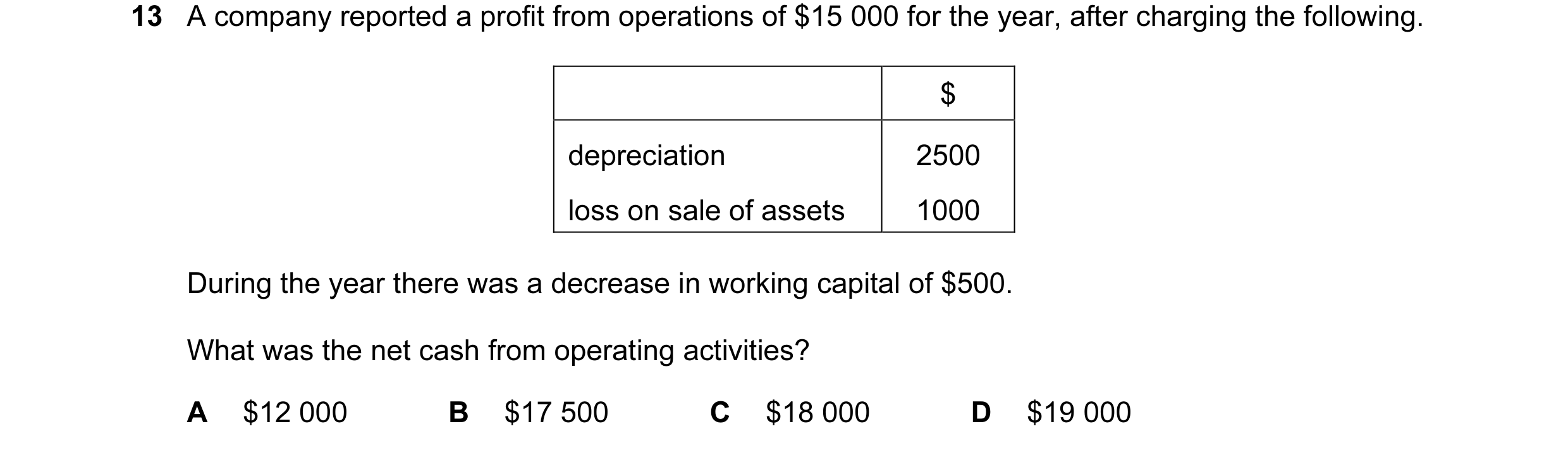
 7 / 14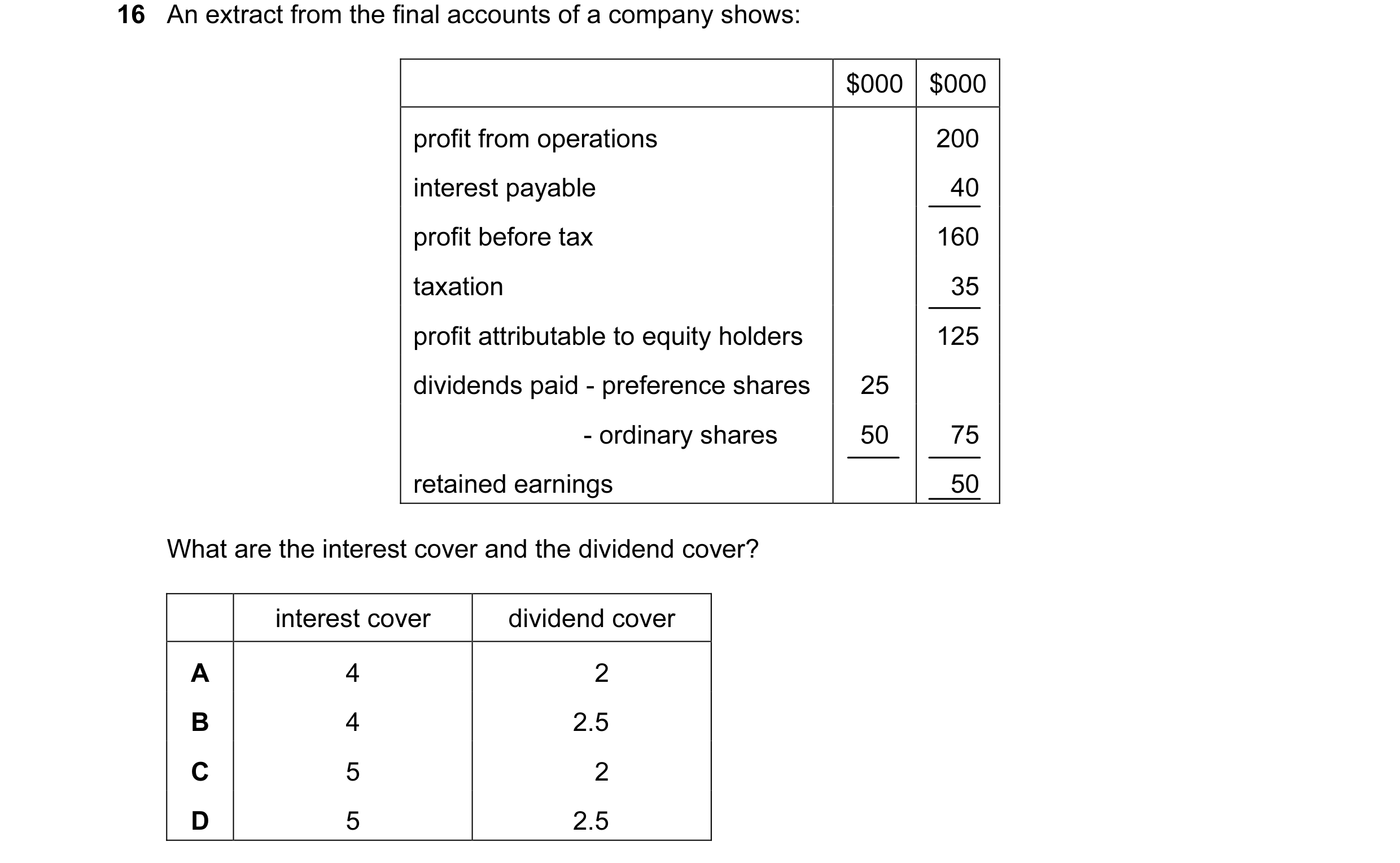
 8 / 14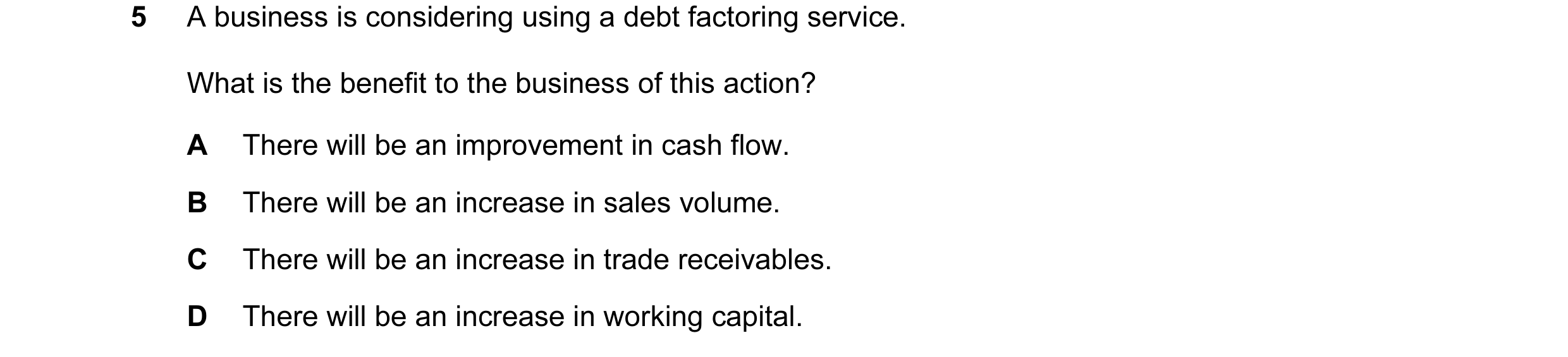
 9 / 14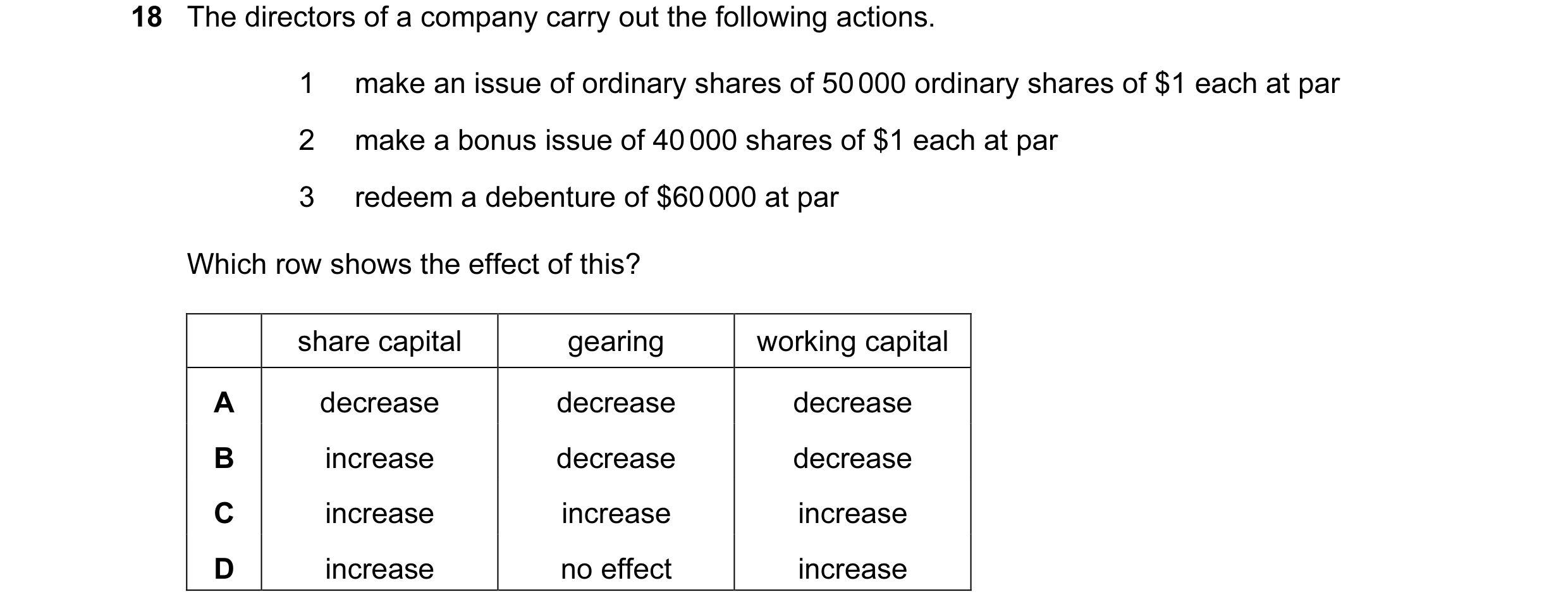
 10 / 14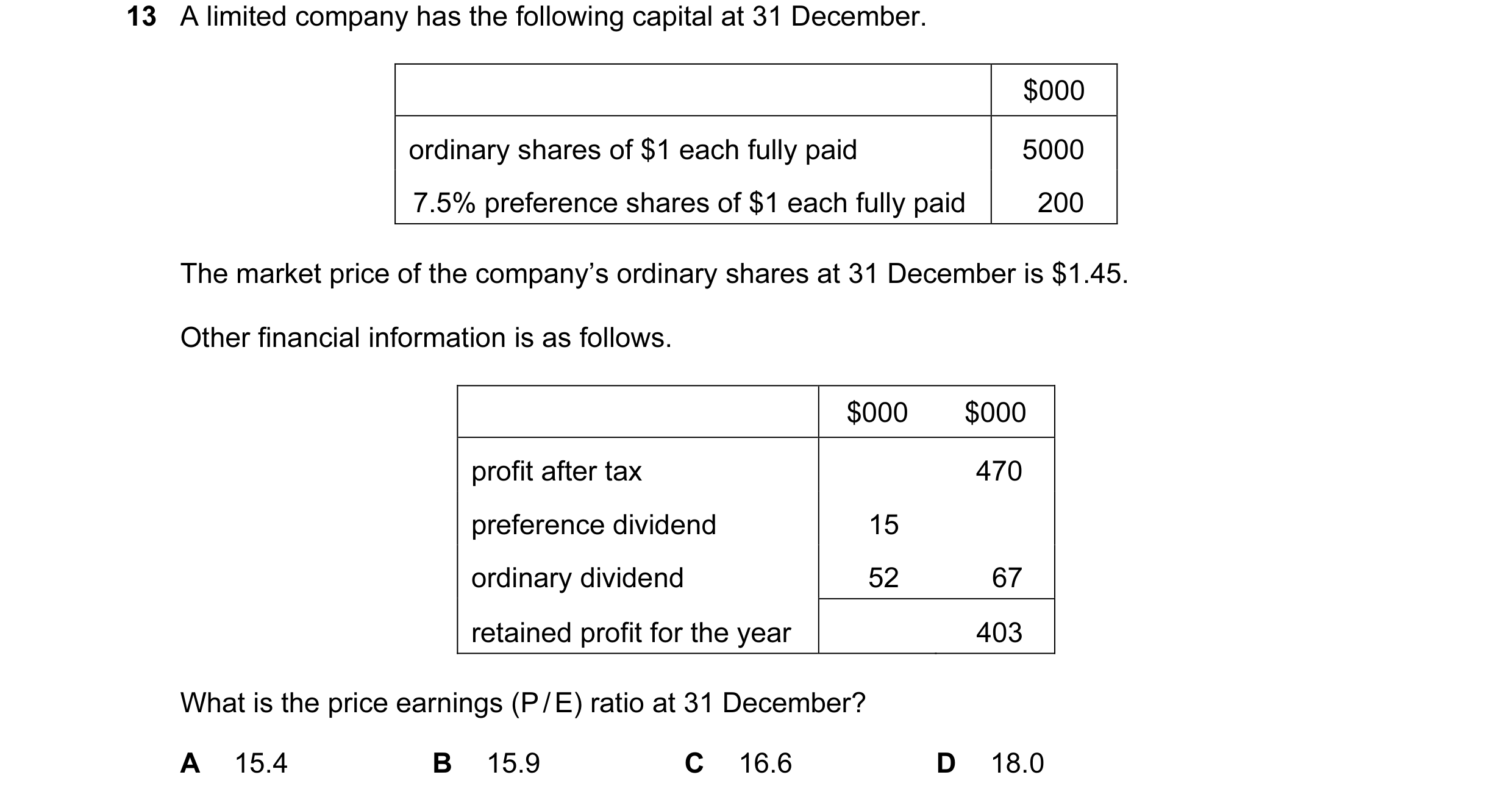

 11 / 14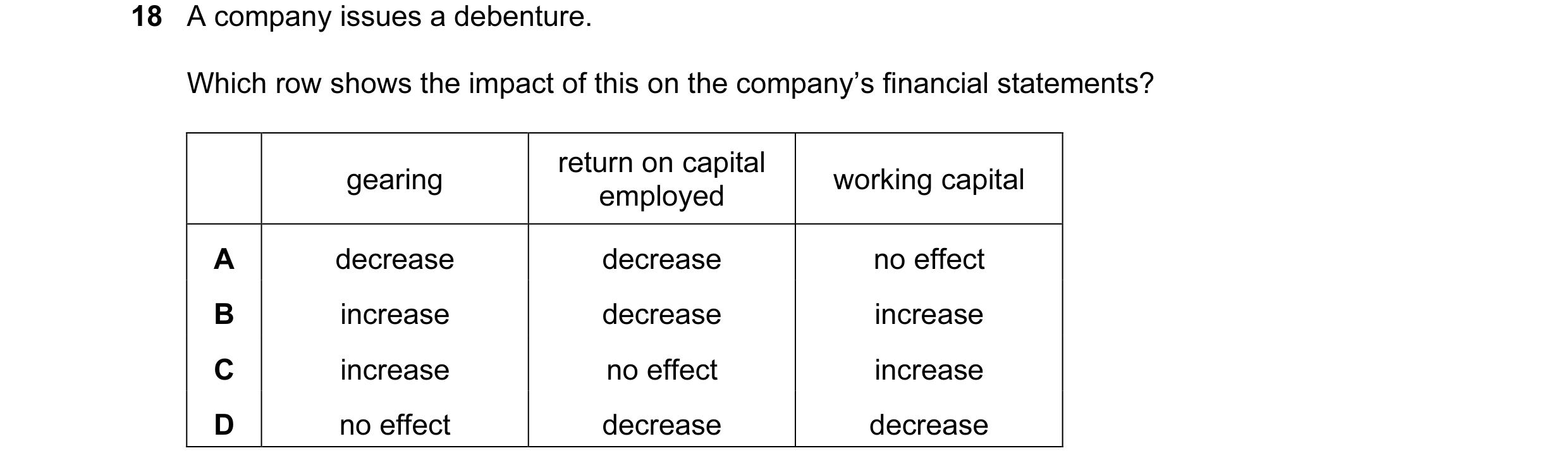

 12 / 14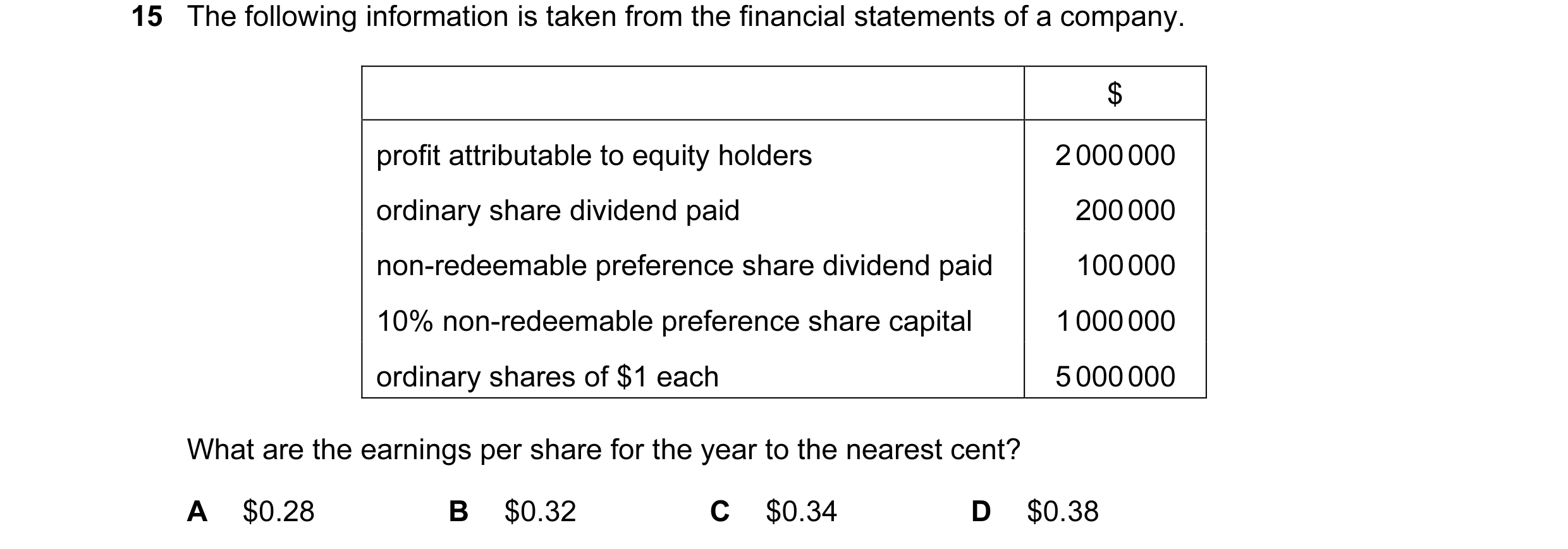
 13 / 14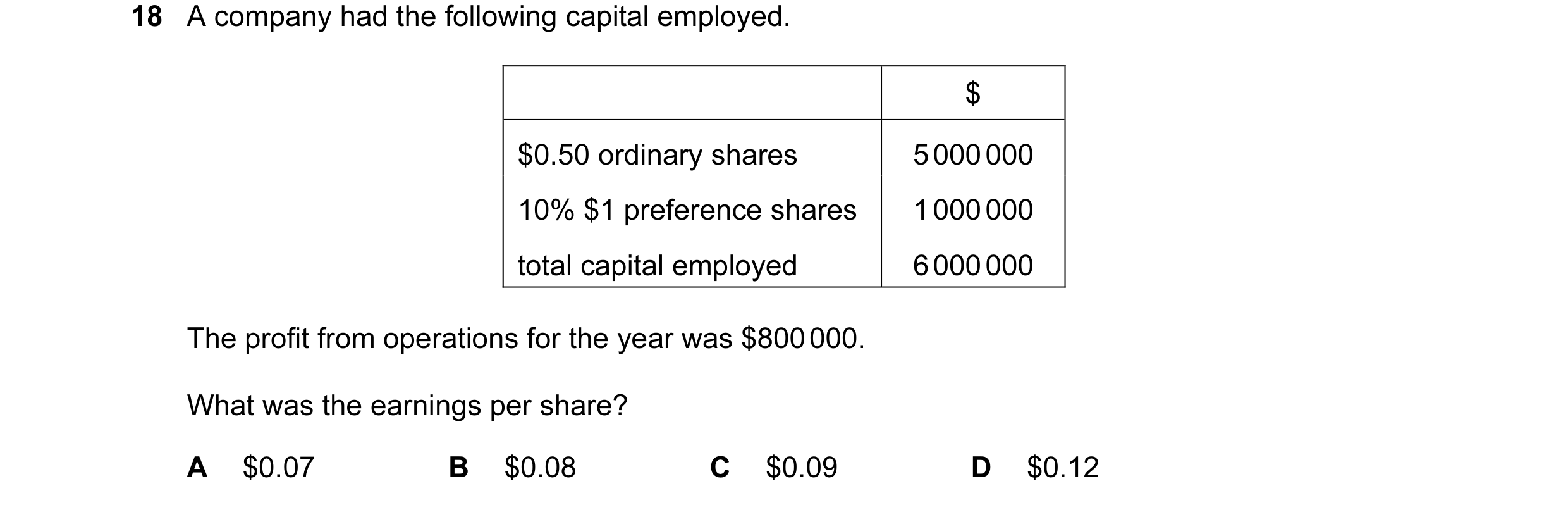
 14 / 14