Cambridge A Level Accounting 9706 — 2021 Oct/Nov Paper 1 · Variant 1
9706/11/O/N/21 · 30 questions · 30 marks · ≈34 min
The question paper and its mark scheme, free to read here and free to download. This is Cambridge’s own paper, exactly as it was sat.
Question paper12 pages

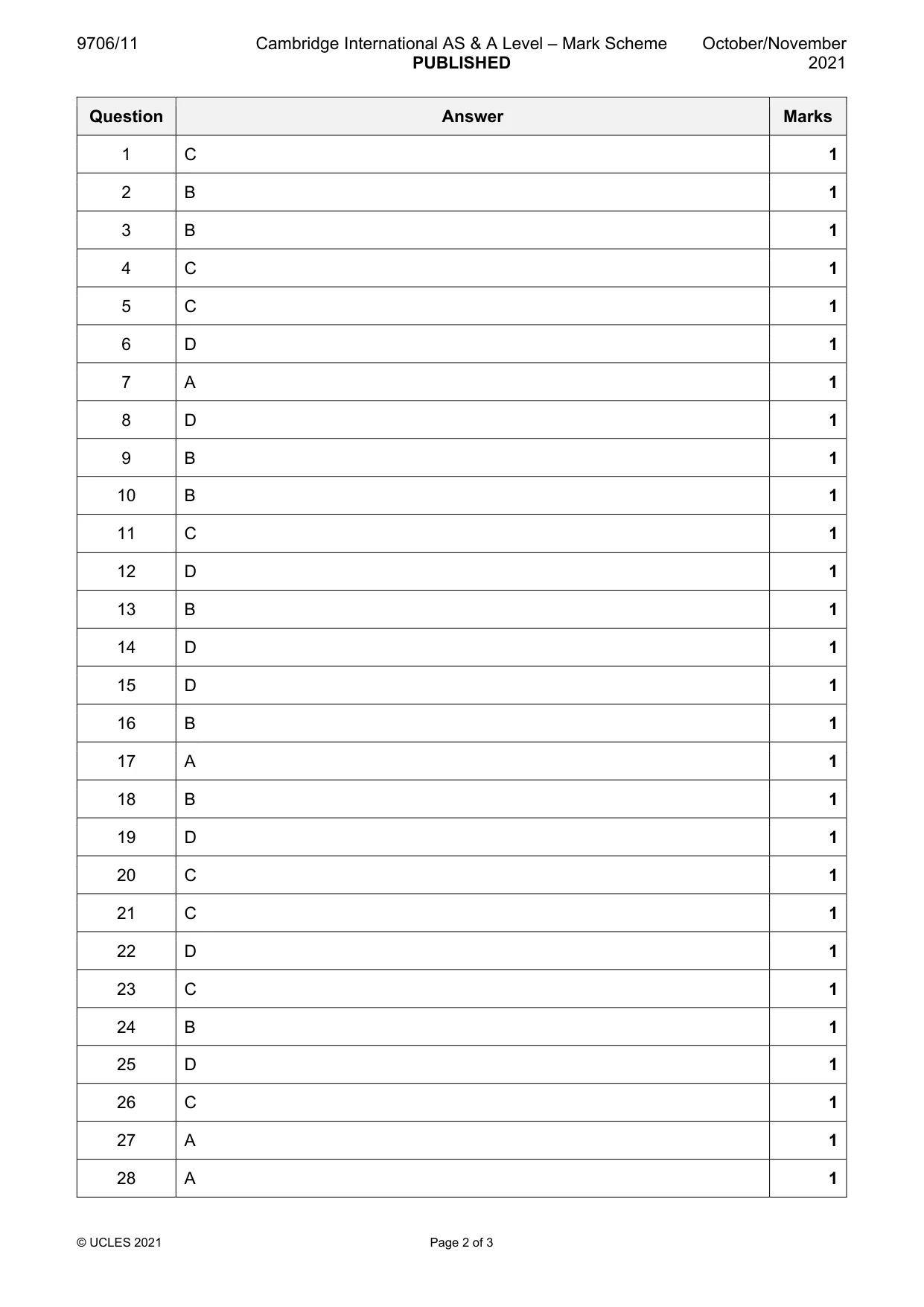
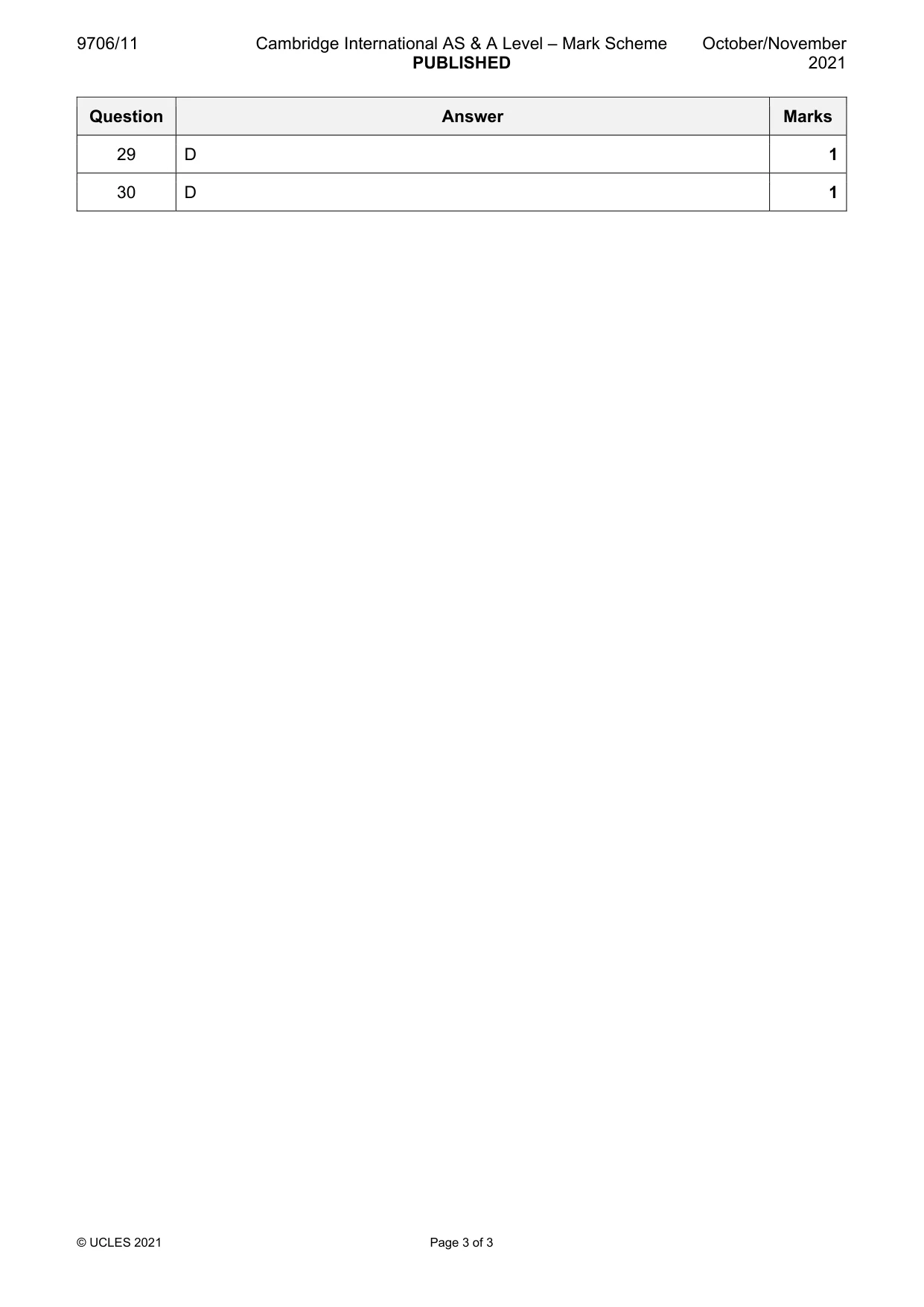
Mark scheme3 pages
Answers below. Sit the paper first if you are practising.
Questions as text
Q1 · A trader keeps a full set of accounting records
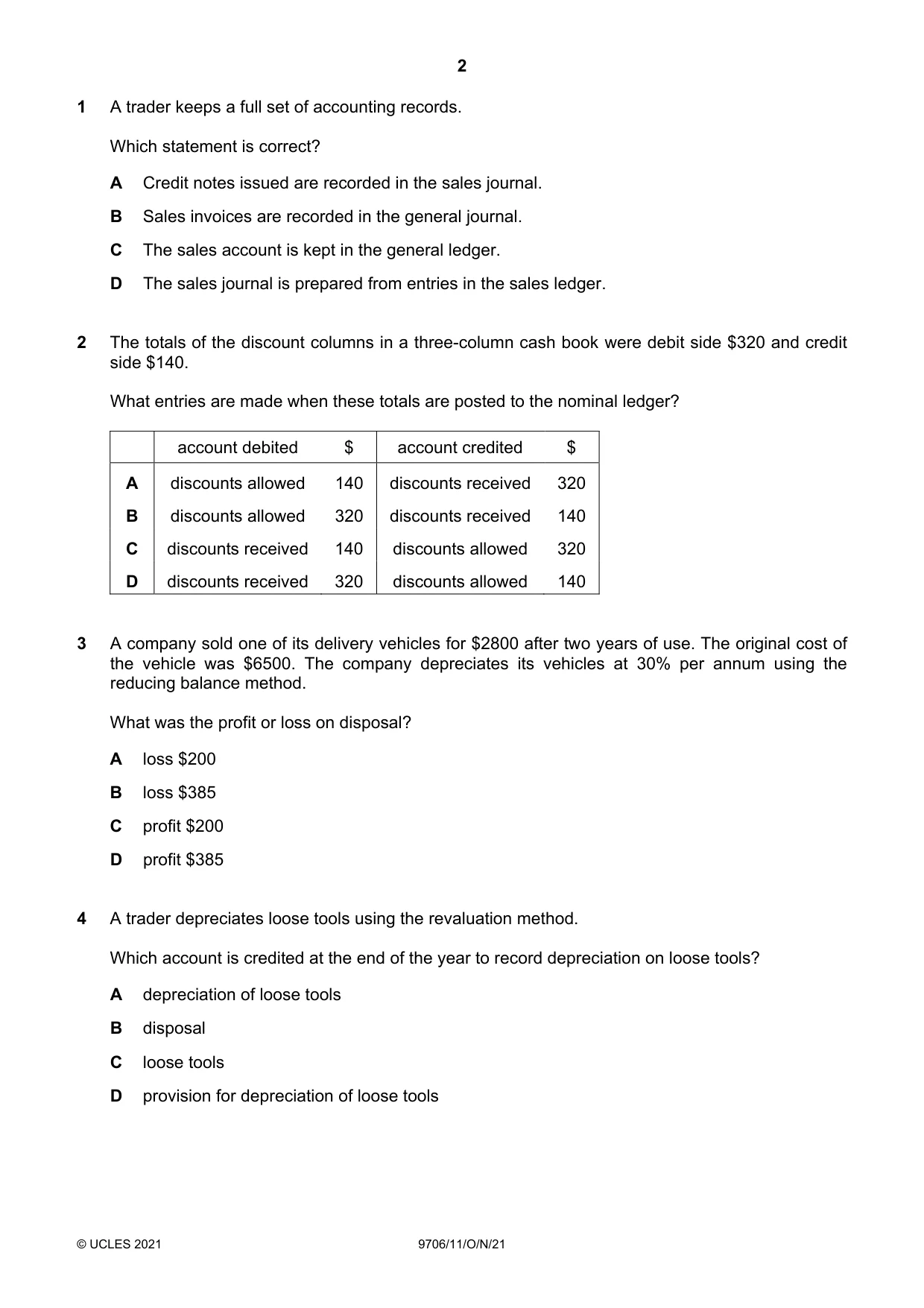
1 A trader keeps a full set of accounting records. Which statement is correct? A Credit notes issued are recorded in the sales journal. B Sales invoices are recorded in the general journal. C The sales account is kept in the general ledger. D The sales journal is prepared from entries in the sales ledger.
Mark scheme: C
Q2 · The totals of the discount columns in a three-column cash book were debit side $320 and…
2 The totals of the discount columns in a three-column cash book were debit side $320 and credit side $140. What entries are made when these totals are posted to the nominal ledger? account debited $ account credited $ A discounts allowed 140 discounts received 320 B discounts allowed 320 discounts received 140 C discounts received 140 discounts allowed 320 D discounts received 320 discounts allowed 140
Mark scheme: B
Q3 · A company sold one of its delivery vehicles for $2800 after two years of use
3 A company sold one of its delivery vehicles for $2800 after two years of use. The original cost of the vehicle was $6500. The company depreciates its vehicles at 30% per annum using the reducing balance method. What was the profit or loss on disposal? A loss $200 B loss $385 C profit $200 D profit $385
Mark scheme: B
Q4 · A trader depreciates loose tools using the revaluation method
4 A trader depreciates loose tools using the revaluation method. Which account is credited at the end of the year to record depreciation on loose tools? A depreciation of loose tools B disposal C loose tools D provision for depreciation of loose tools
Mark scheme: C
Q5 · A business sold one of its non-current assets
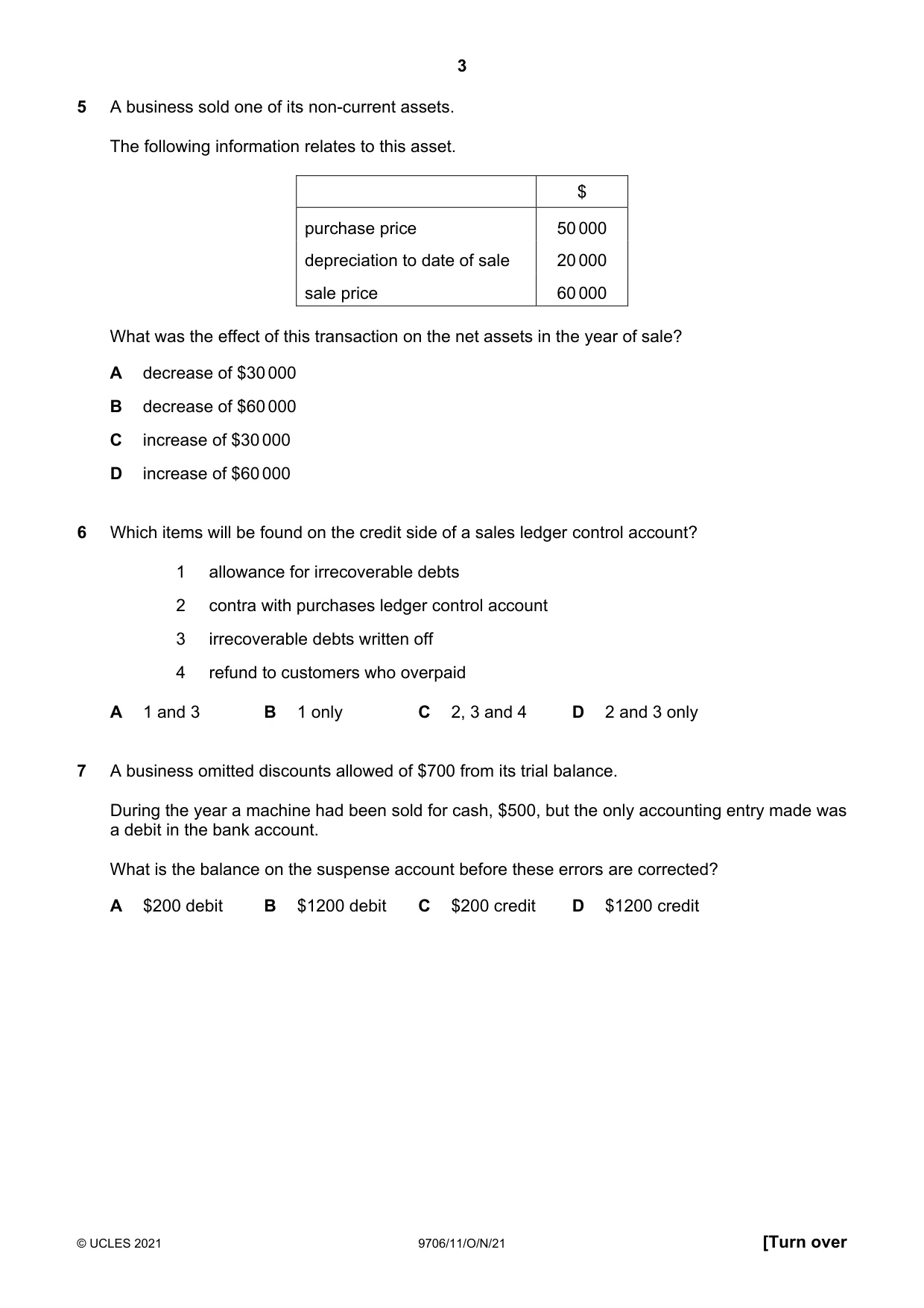
5 A business sold one of its non-current assets. The following information relates to this asset. $ purchase price 50 000 depreciation to date of sale 20 000 sale price 60 000 What was the effect of this transaction on the net assets in the year of sale? A decrease of $30 000 B decrease of $60 000 C increase of $30 000 D increase of $60 000
Mark scheme: C
Q6 · Which items will be found on the credit side of a sales ledger control account?
6 Which items will be found on the credit side of a sales ledger control account? 1 allowance for irrecoverable debts 2 contra with purchases ledger control account 3 irrecoverable debts written off 4 refund to customers who overpaid A 1 and 3 B 1 only C 2, 3 and 4 D 2 and 3 only
Mark scheme: D
Q7 · A business omitted discounts allowed of $700 from its trial balance
7 A business omitted discounts allowed of $700 from its trial balance. During the year a machine had been sold for cash, $500, but the only accounting entry made was a debit in the bank account. What is the balance on the suspense account before these errors are corrected? A $200 debit B $1200 debit C $200 credit D $1200 credit
Mark scheme: A
Q8 · Felix drew $200 out of his business bank account in order to top up his petty cash float
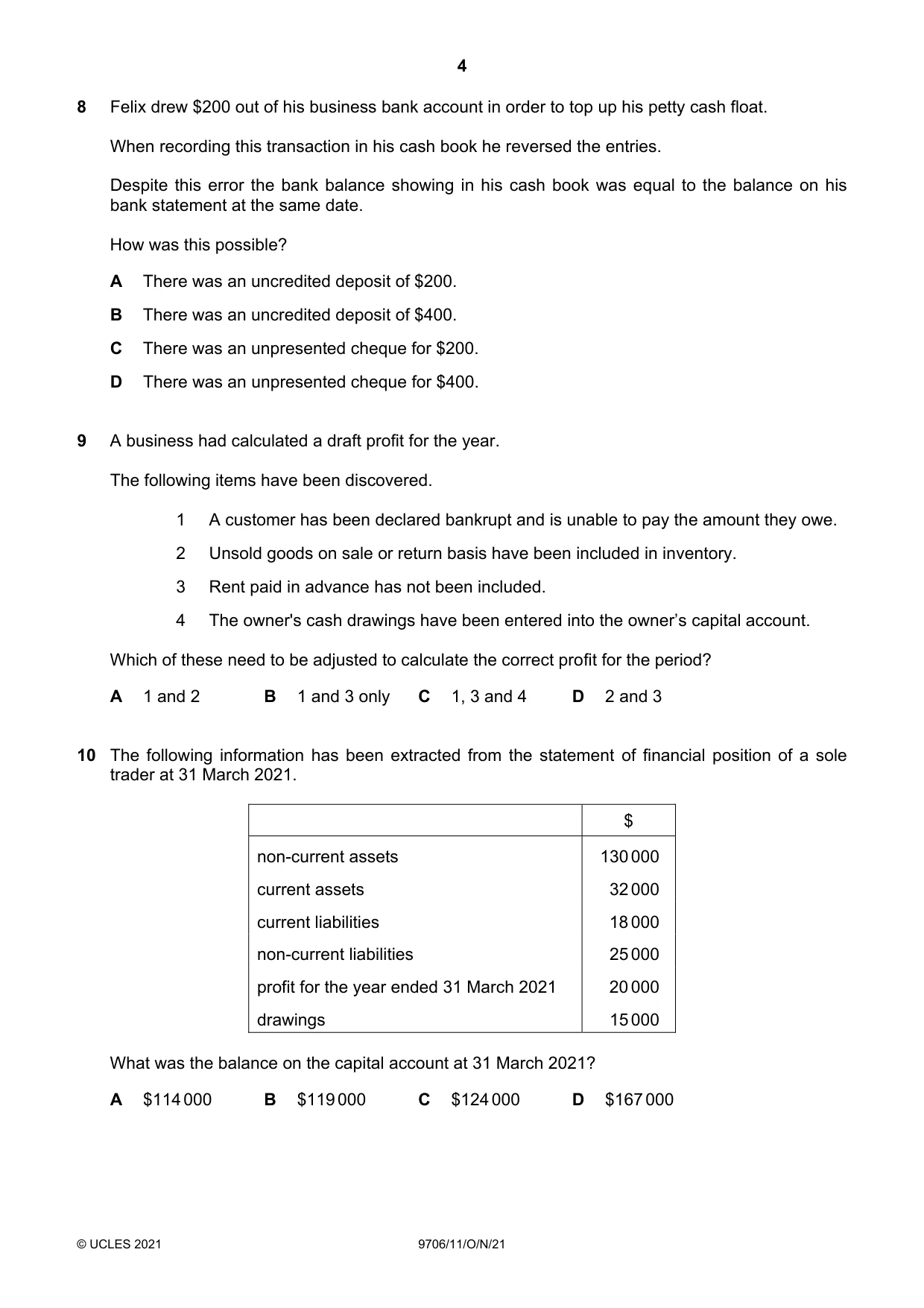
8 Felix drew $200 out of his business bank account in order to top up his petty cash float. When recording this transaction in his cash book he reversed the entries. Despite this error the bank balance showing in his cash book was equal to the balance on his bank statement at the same date. How was this possible? A There was an uncredited deposit of $200. B There was an uncredited deposit of $400. C There was an unpresented cheque for $200. D There was an unpresented cheque for $400.
Mark scheme: D
Q9 · A business had calculated a draft profit for the year
9 A business had calculated a draft profit for the year. The following items have been discovered. 1 A customer has been declared bankrupt and is unable to pay the amount they owe. 2 Unsold goods on sale or return basis have been included in inventory. 3 Rent paid in advance has not been included. 4 The owner's cash drawings have been entered into the owner’s capital account. Which of these need to be adjusted to calculate the correct profit for the period? A 1 and 2 B 1 and 3 only C 1, 3 and 4 D 2 and 3
Mark scheme: B
Q10 · The following information has been extracted from the statement of financial position of…
10 The following information has been extracted from the statement of financial position of a sole trader at 31 March 2021. $ non-current assets 130 000 current assets 32 000 current liabilities 18 000 non-current liabilities 25 000 profit for the year ended 31 March 2021 20 000 drawings 15 000 What was the balance on the capital account at 31 March 2021? A $114 000 B $119 000 C $124 000 D $167 000
Mark scheme: B
Q11 · At the start of the year the balance on a sole trader’s capital account was $183 000
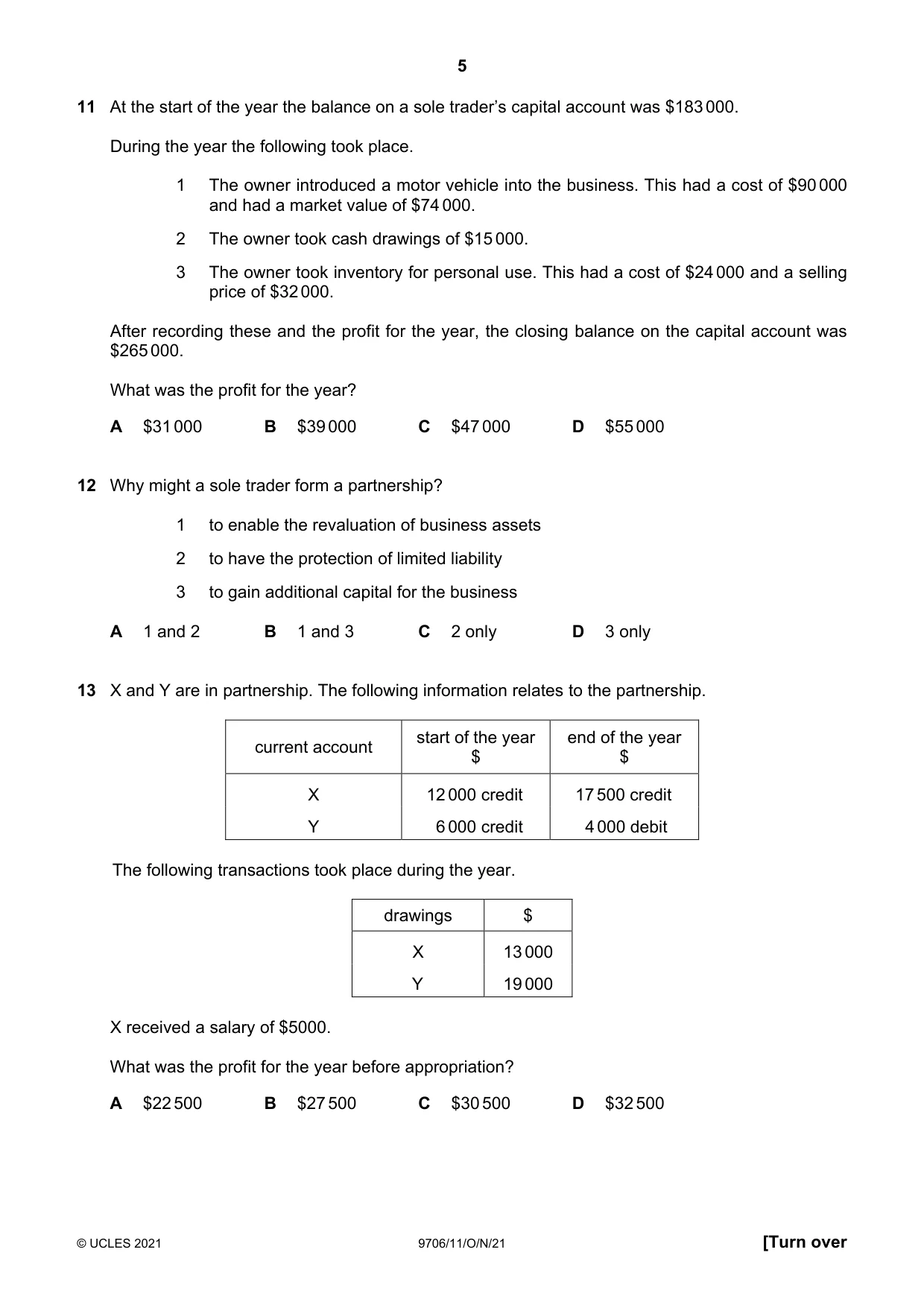
11 At the start of the year the balance on a sole trader’s capital account was $183 000. During the year the following took place. 1 The owner introduced a motor vehicle into the business. This had a cost of $90 000 and had a market value of $74 000. 2 The owner took cash drawings of $15 000. 3 The owner took inventory for personal use. This had a cost of $24 000 and a selling price of $32 000. After recording these and the profit for the year, the closing balance on the capital account was $265 000. What was the profit for the year? A $31 000 B $39 000 C $47 000 D $55 000
Mark scheme: C
Q12 · Why might a sole trader form a partnership?
12 Why might a sole trader form a partnership? 1 to enable the revaluation of business assets 2 to have the protection of limited liability 3 to gain additional capital for the business A 1 and 2 B 1 and 3 C 2 only D 3 only
Mark scheme: D
Q13 · X and Y are in partnership
13 X and Y are in partnership. The following information relates to the partnership. start of the year end of the year current account $ $ X 12 000 credit 17 500 credit Y 6 000 credit 4 000 debit The following transactions took place during the year. drawings $ X 13 000 Y 19 000 X received a salary of $5000. What was the profit for the year before appropriation? A $22 500 B $27 500 C $30 500 D $32 500
Mark scheme: B
Q14 · L, M and N were partners sharing profits and losses equally
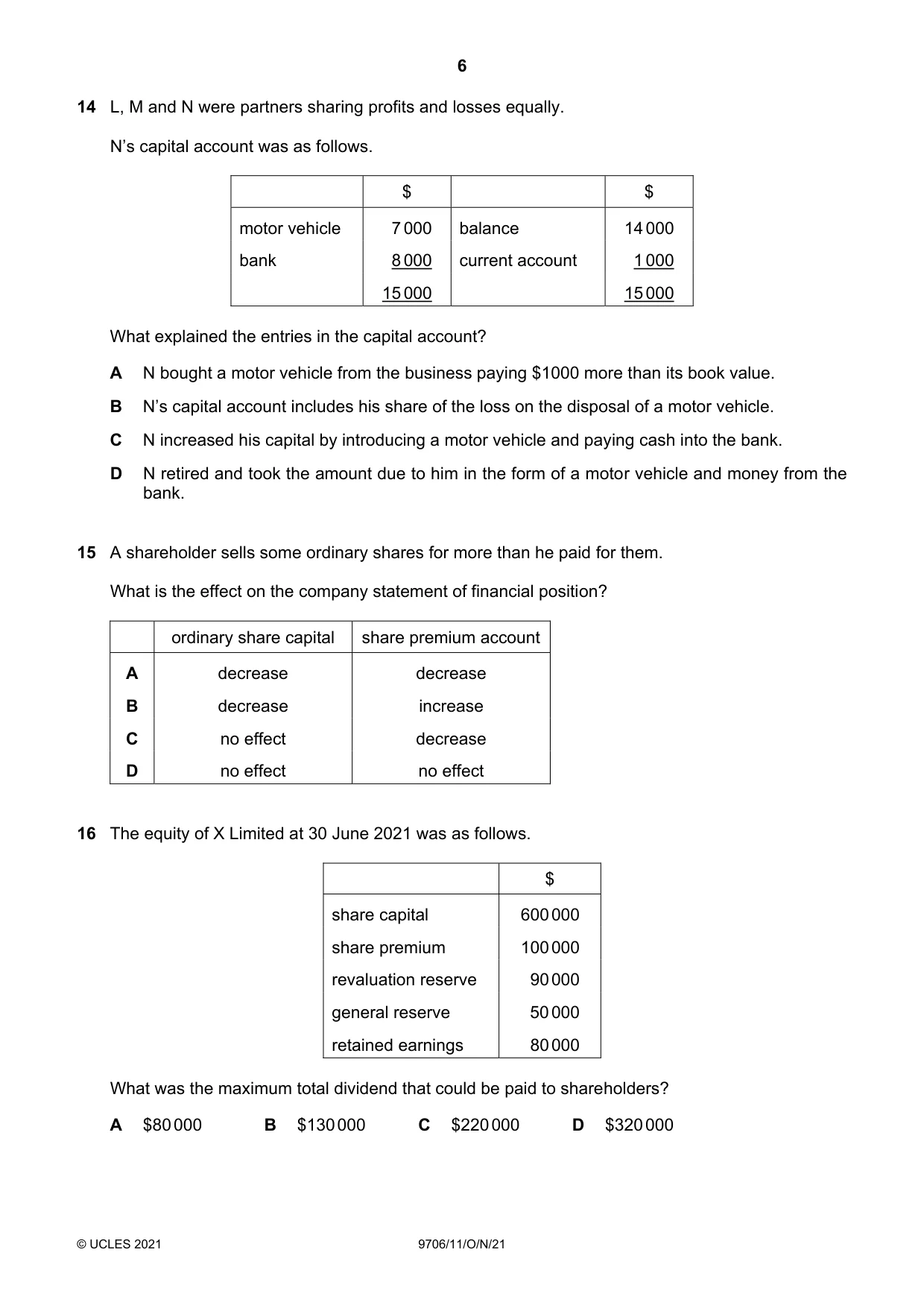
14 L, M and N were partners sharing profits and losses equally. N’s capital account was as follows. $ $ motor vehicle 7 000 balance 14 000 bank 8 000 current account 1 000 15 000 15 000 What explained the entries in the capital account? A N bought a motor vehicle from the business paying $1000 more than its book value. B N’s capital account includes his share of the loss on the disposal of a motor vehicle. C N increased his capital by introducing a motor vehicle and paying cash into the bank. D N retired and took the amount due to him in the form of a motor vehicle and money from the bank.
Mark scheme: D
Q15 · A shareholder sells some ordinary shares for more than he paid for them
15 A shareholder sells some ordinary shares for more than he paid for them. What is the effect on the company statement of financial position? ordinary share capital share premium account A decrease decrease B decrease increase C no effect decrease D no effect no effect
Mark scheme: D
Q16 · The equity of X Limited at 30 June 2021 was as follows
16 The equity of X Limited at 30 June 2021 was as follows. $ share capital 600 000 share premium 100 000 revaluation reserve 90 000 general reserve 50 000 retained earnings 80 000 What was the maximum total dividend that could be paid to shareholders? A $80 000 B $130 000 C $220 000 D $320 000
Mark scheme: B
Q17 · The value of inventory for a limited company at 31 May 2020 was overstated by $20 000
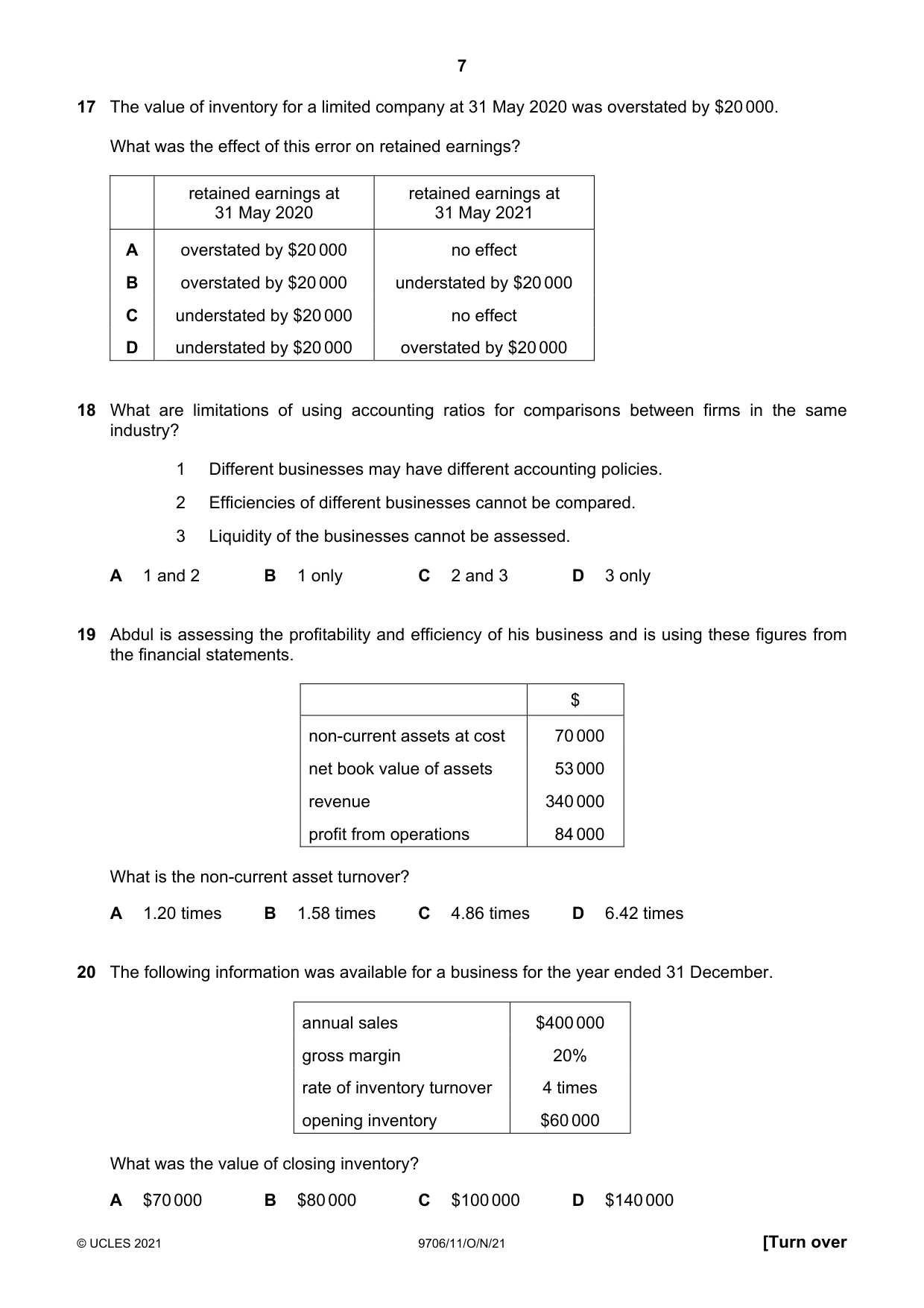
17 The value of inventory for a limited company at 31 May 2020 was overstated by $20 000. What was the effect of this error on retained earnings? retained earnings at retained earnings at 31 May 2020 31 May 2021 A overstated by $20 000 no effect B overstated by $20 000 understated by $20 000 C understated by $20 000 no effect D understated by $20 000 overstated by $20 000
Mark scheme: A
Q18 · What are limitations of using accounting ratios for comparisons between firms in the same…
18 What are limitations of using accounting ratios for comparisons between firms in the same industry? 1 Different businesses may have different accounting policies. 2 Efficiencies of different businesses cannot be compared. 3 Liquidity of the businesses cannot be assessed. A 1 and 2 B 1 only C 2 and 3 D 3 only
Mark scheme: B
More questions on Analysis and communication of accounting information
Q19 · Abdul is assessing the profitability and efficiency of his business and is using these…
19 Abdul is assessing the profitability and efficiency of his business and is using these figures from the financial statements. $ non-current assets at cost 70 000 net book value of assets 53 000 revenue 340 000 profit from operations 84 000 What is the non-current asset turnover? A 1.20 times B 1.58 times C 4.86 times D 6.42 times
Mark scheme: D
More questions on Analysis and communication of accounting information
Q20 · The following information was available for a business for the year ended 31 December
20 The following information was available for a business for the year ended 31 December. annual sales $400 000 gross margin 20% rate of inventory turnover 4 times opening inventory $60 000 What was the value of closing inventory? A $70 000 B $80 000 C $100 000 D $140 000
Mark scheme: C
More questions on Analysis and communication of accounting information
Q21 · A manufacturing business is currently operating at full capacity
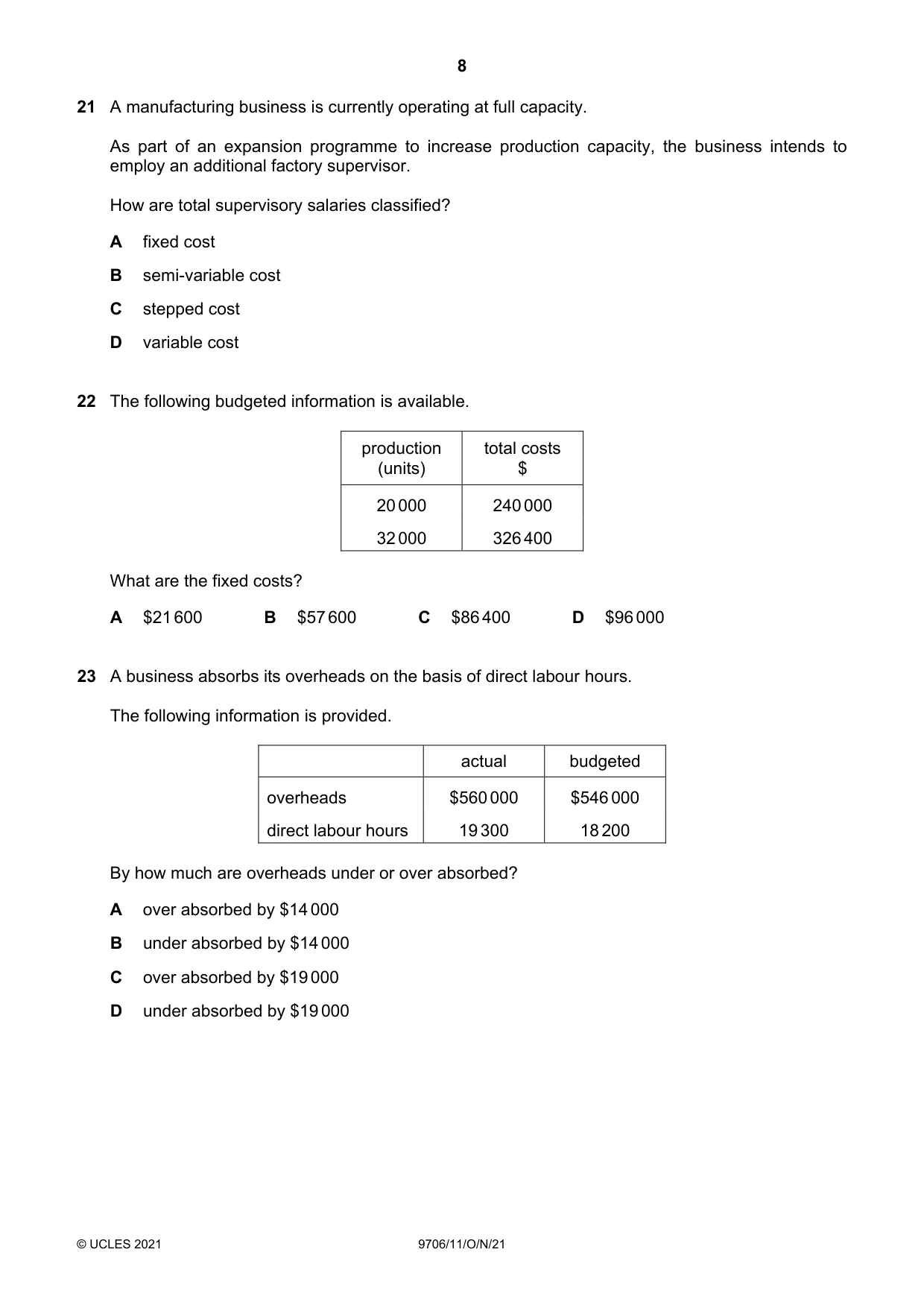
21 A manufacturing business is currently operating at full capacity. As part of an expansion programme to increase production capacity, the business intends to employ an additional factory supervisor. How are total supervisory salaries classified? A fixed cost B semi-variable cost C stepped cost D variable cost
Mark scheme: C
Q22 · The following budgeted information is available
22 The following budgeted information is available. production total costs (units) $ 20 000 240 000 32 000 326 400 What are the fixed costs? A $21 600 B $57 600 C $86 400 D $96 000
Mark scheme: D
Q23 · A business absorbs its overheads on the basis of direct labour hours
23 A business absorbs its overheads on the basis of direct labour hours. The following information is provided. actual budgeted overheads $560 000 $546 000 direct labour hours 19 300 18 200 By how much are overheads under or over absorbed? A over absorbed by $14 000 B under absorbed by $14 000 C over absorbed by $19 000 D under absorbed by $19 000
Mark scheme: C
Q24 · Which would be a suitable basis to apportion depreciation to production departments?
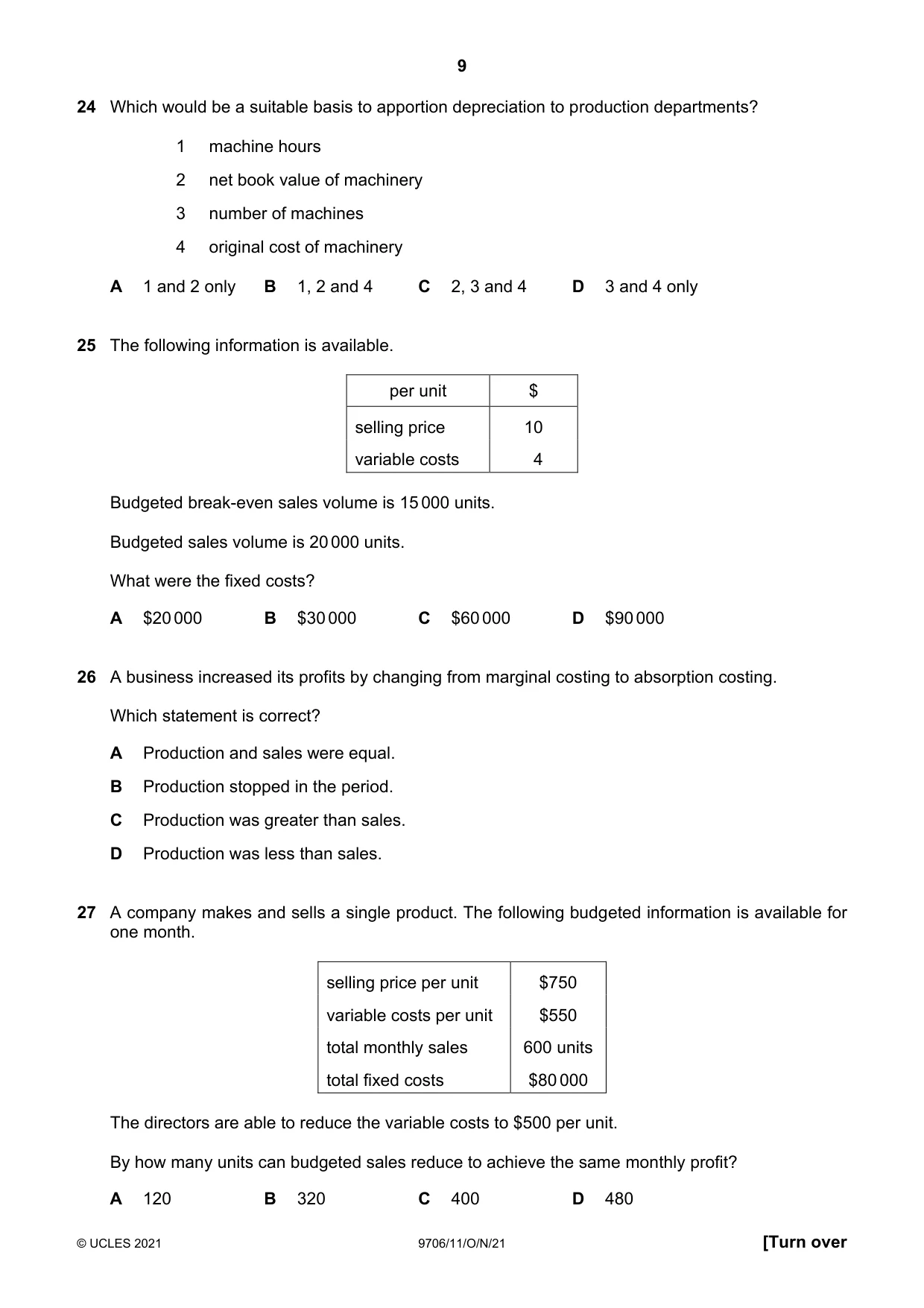
24 Which would be a suitable basis to apportion depreciation to production departments? 1 machine hours 2 net book value of machinery 3 number of machines 4 original cost of machinery A 1 and 2 only B 1, 2 and 4 C 2, 3 and 4 D 3 and 4 only
Mark scheme: B
Q25 · The following information is available
25 The following information is available. per unit $ selling price 10 variable costs 4 Budgeted break-even sales volume is 15 000 units. Budgeted sales volume is 20 000 units. What were the fixed costs? A $20 000 B $30 000 C $60 000 D $90 000
Mark scheme: D
Q26 · A business increased its profits by changing from marginal costing to absorption costing
26 A business increased its profits by changing from marginal costing to absorption costing. Which statement is correct? A Production and sales were equal. B Production stopped in the period. C Production was greater than sales. D Production was less than sales.
Mark scheme: C
Q27 · A company makes and sells a single product
27 A company makes and sells a single product. The following budgeted information is available for one month. selling price per unit $750 variable costs per unit $550 total monthly sales 600 units total fixed costs $80 000 The directors are able to reduce the variable costs to $500 per unit. By how many units can budgeted sales reduce to achieve the same monthly profit? A 120 B 320 C 400 D 480
Mark scheme: A
Q28 · Which assumption of cost–volume–profit analysis is not correct?
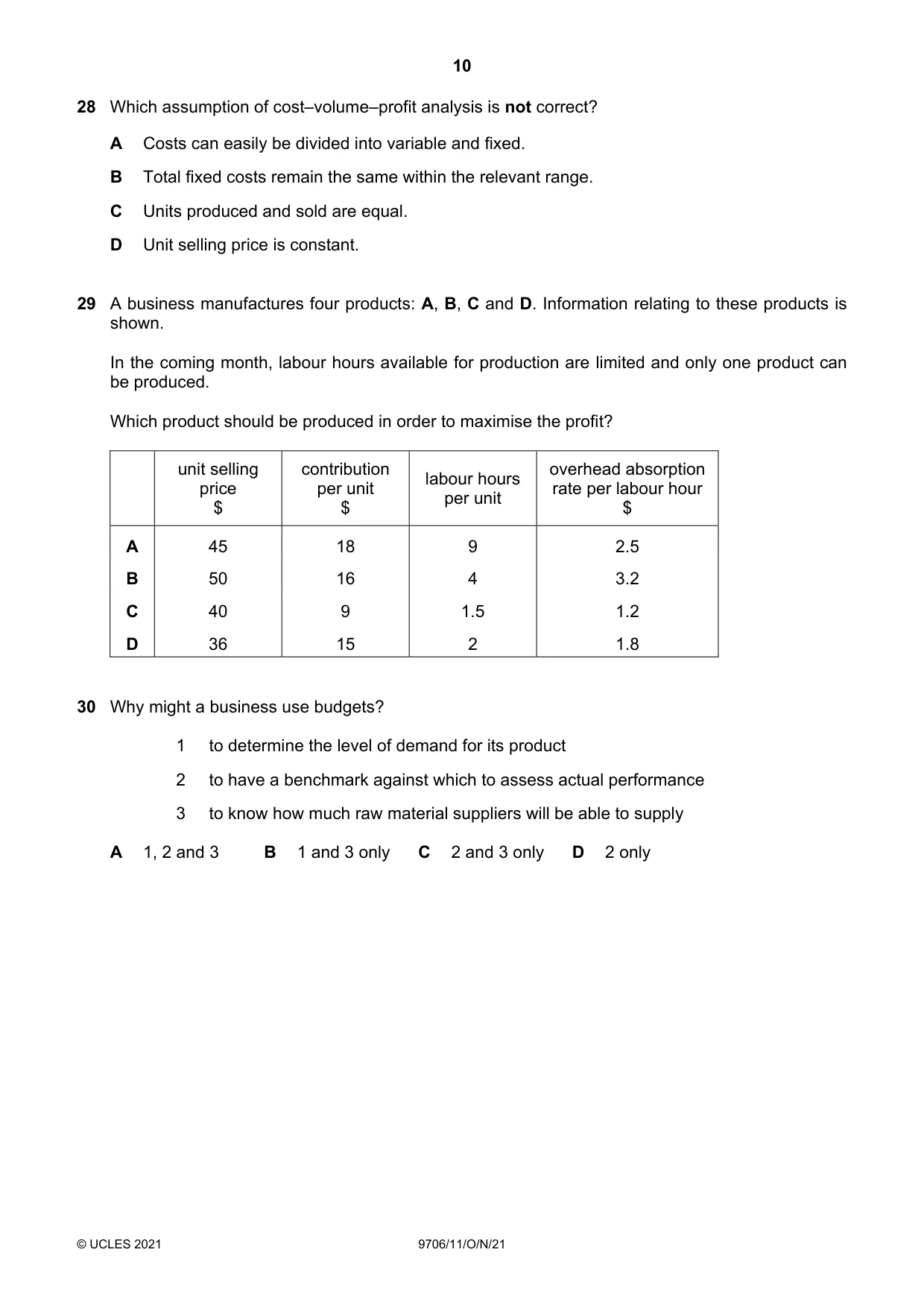
28 Which assumption of cost–volume–profit analysis is not correct? A Costs can easily be divided into variable and fixed. B Total fixed costs remain the same within the relevant range. C Units produced and sold are equal. D Unit selling price is constant.
Mark scheme: A
Q29 · A business manufactures four products: A, B, C and D
29 A business manufactures four products: A, B, C and D. Information relating to these products is shown. In the coming month, labour hours available for production are limited and only one product can be produced. Which product should be produced in order to maximise the profit? unit selling contribution overhead absorption labour hours price per unit rate per labour hour per unit $ $ $ A 45 18 9 2.5 B 50 16 4 3.2 C 40 9 1.5 1.2 D 36 15 2 1.8
Mark scheme: D
Q30 · Why might a business use budgets?
30 Why might a business use budgets? 1 to determine the level of demand for its product 2 to have a benchmark against which to assess actual performance 3 to know how much raw material suppliers will be able to supply A 1, 2 and 3 B 1 and 3 only C 2 and 3 only D 2 only
Mark scheme: D
What was in this paper
The subtopics covered by these 30 questions, and how many questions each got. Open one in a new tab to see every Cambridge question on it.
7Preparation of financial statements5Accounting for non-current assets3Analysis and communication of accounting information3Preparation of financial statements3Reconciliation and verification3Costs and cost behaviour2The accounting system2Budgeting and budgetary control1Types of business entity1What you needed in this session
Cambridge’s own grade thresholds for 2021 Oct/Nov, Paper 1 · Variant 1. A higher threshold means an easier paper — the bar moves with how the cohort did.