Cambridge A Level Accounting 9706 — 2017 Feb/March Paper 1 · Variant 2
9706/12/F/M/17 · 30 questions · 30 marks · ≈34 min
The question paper and its mark scheme, free to read here and free to download. This is Cambridge’s own paper, exactly as it was sat.
Question paper12 pages

Mark scheme3 pages
Answers below. Sit the paper first if you are practising.
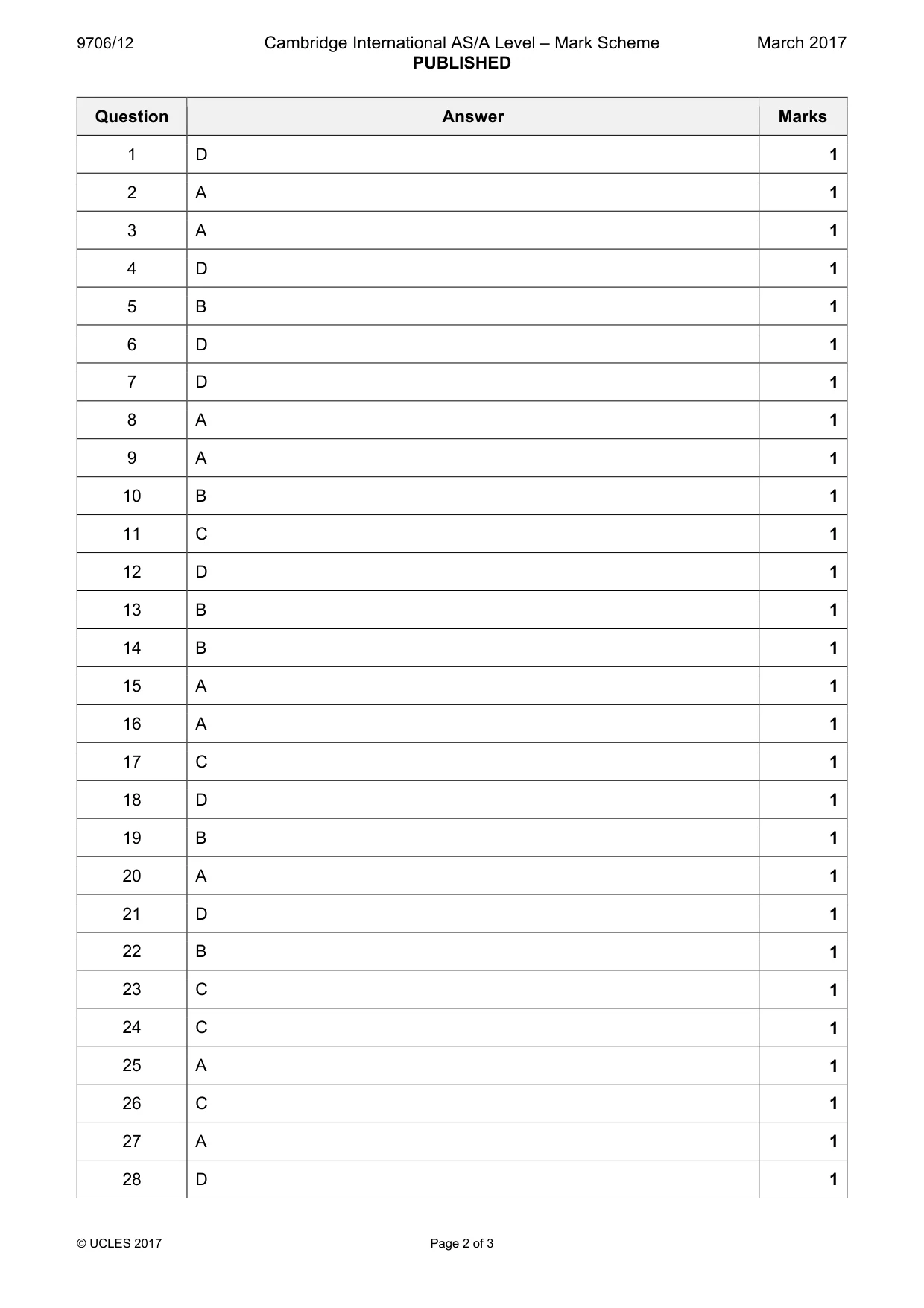
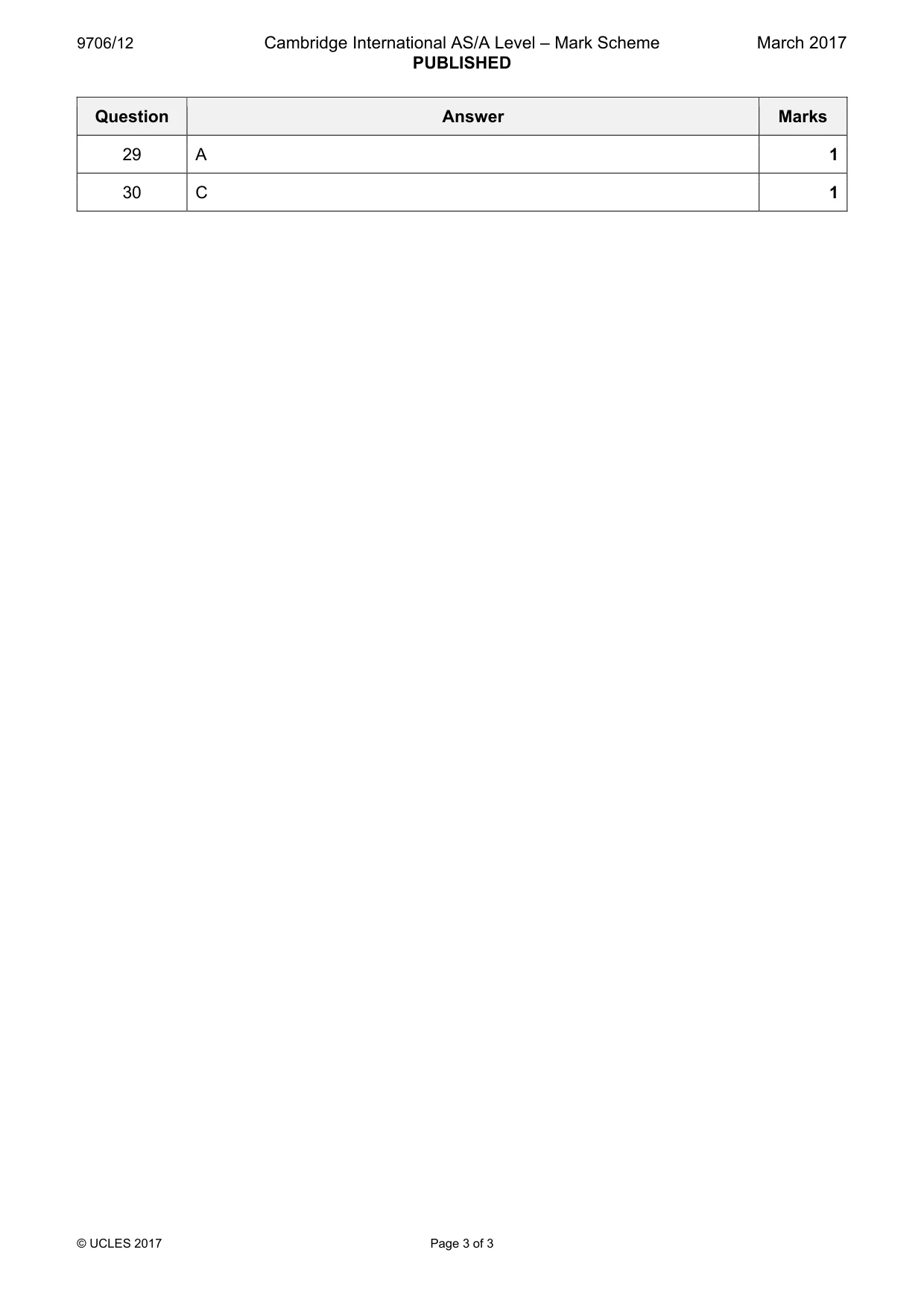
Questions as text
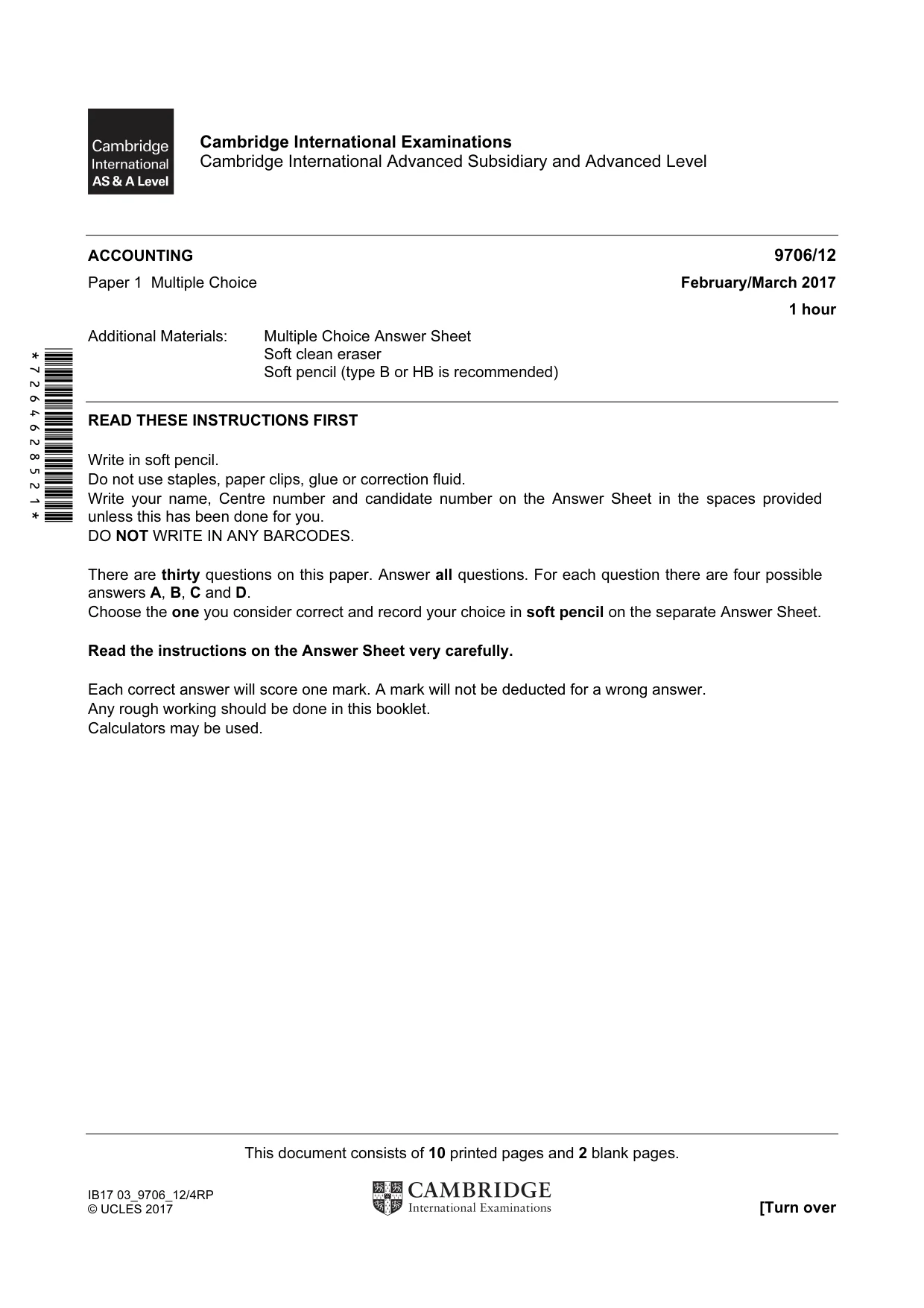
Q1 · Which accounting treatments illustrate the use of the matching concept?
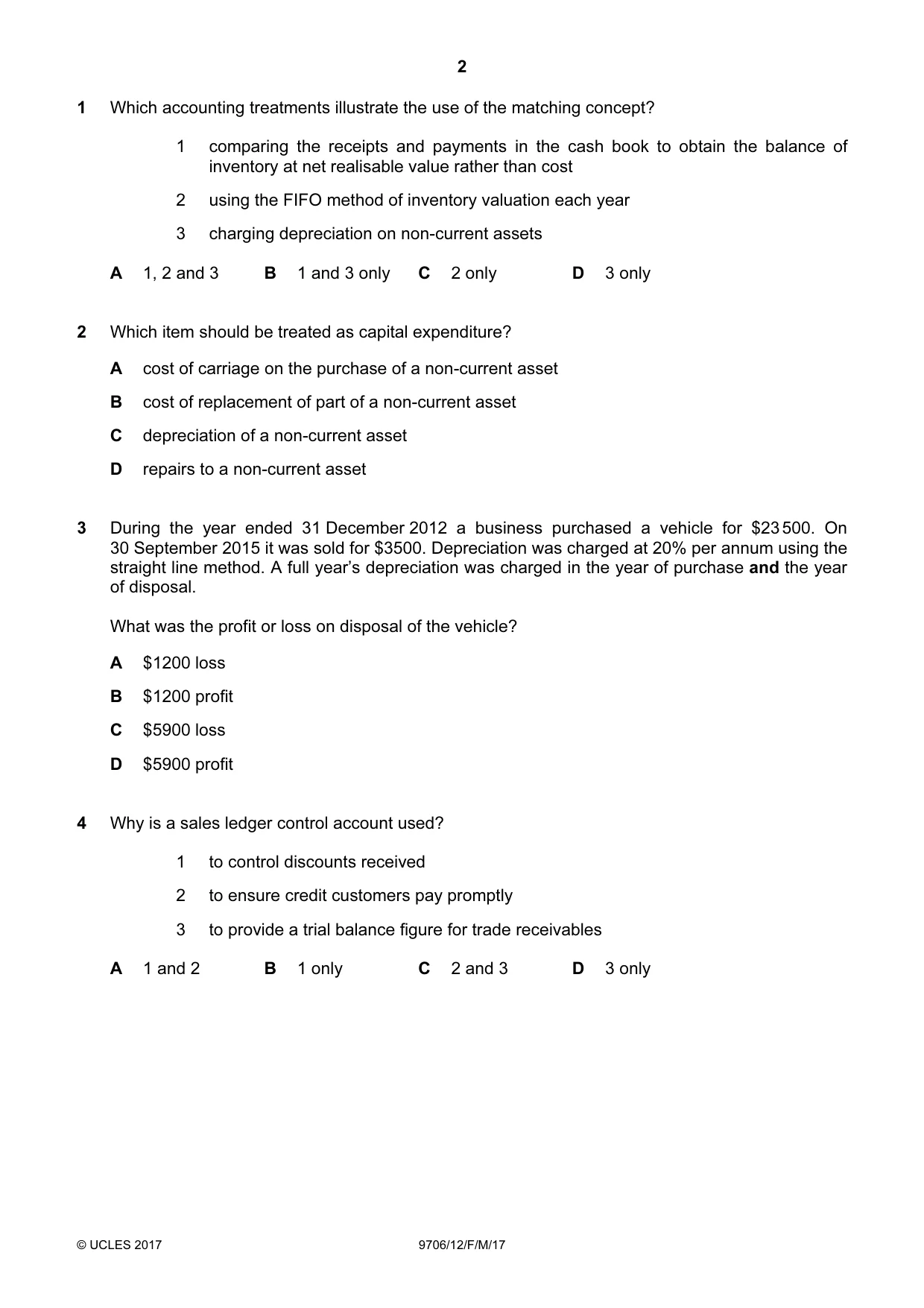
1 Which accounting treatments illustrate the use of the matching concept? 1 comparing the receipts and payments in the cash book to obtain the balance of inventory at net realisable value rather than cost 2 using the FIFO method of inventory valuation each year 3 charging depreciation on non-current assets A 1, 2 and 3 B 1 and 3 only C 2 only D 3 only
Mark scheme: D
Q2 · Which item should be treated as capital expenditure?
2 Which item should be treated as capital expenditure? A cost of carriage on the purchase of a non-current asset B cost of replacement of part of a non-current asset C depreciation of a non-current asset D repairs to a non-current asset
Mark scheme: A
Q3 · During the year ended 31 December 2012 a business purchased a vehicle for $23 500
3 During the year ended 31 December 2012 a business purchased a vehicle for $23 500. On 30 September 2015 it was sold for $3500. Depreciation was charged at 20% per annum using the straight line method. A full year’s depreciation was charged in the year of purchase and the year of disposal. What was the profit or loss on disposal of the vehicle? A $1200 loss B $1200 profit C $5900 loss D $5900 profit
Mark scheme: A
Q4 · Why is a sales ledger control account used?
4 Why is a sales ledger control account used? 1 to control discounts received 2 to ensure credit customers pay promptly 3 to provide a trial balance figure for trade receivables A 1 and 2 B 1 only C 2 and 3 D 3 only
Mark scheme: D
Q5 · A purchases ledger control account was prepared but contained a number of errors
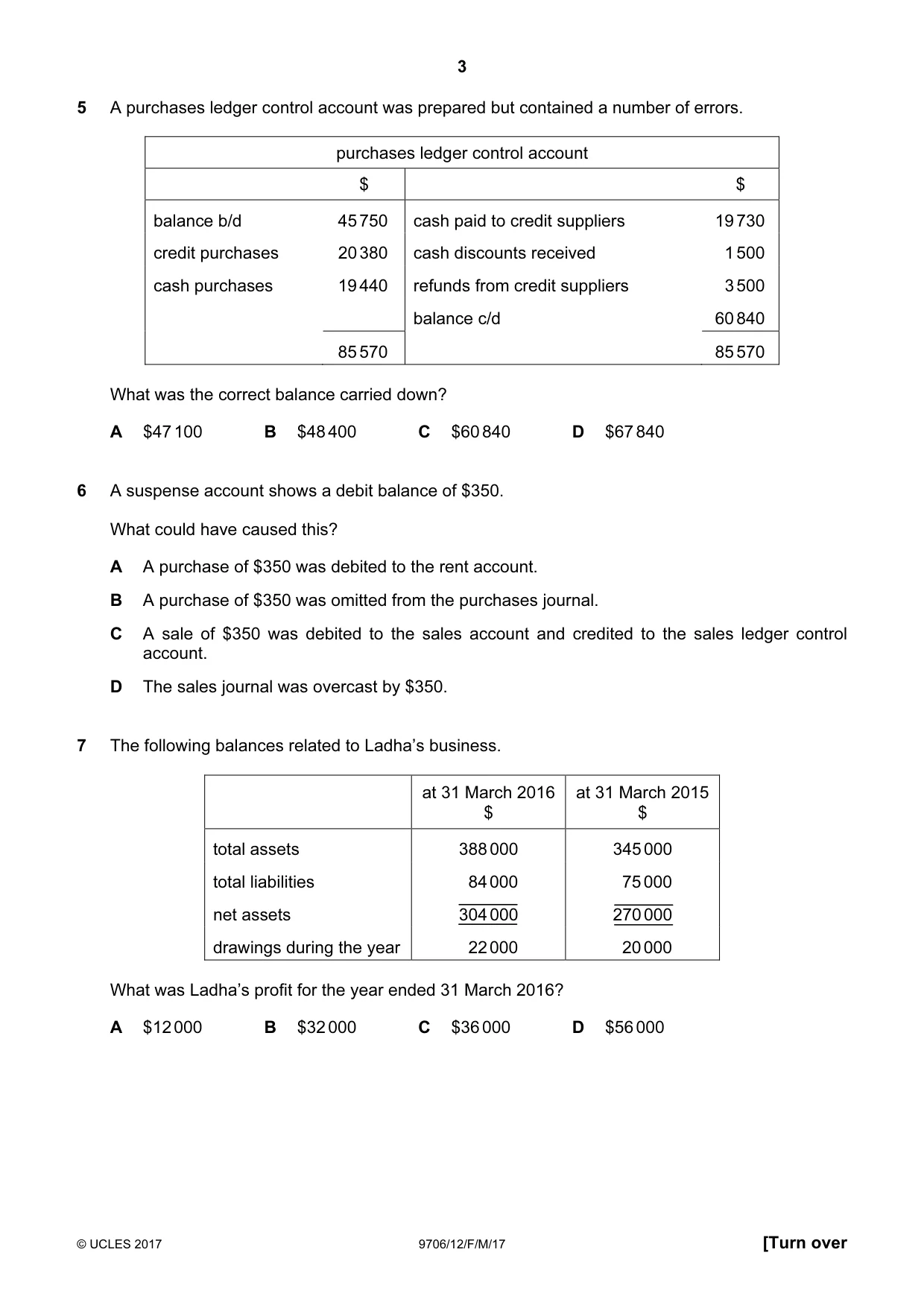
5 A purchases ledger control account was prepared but contained a number of errors. purchases ledger control account $ $ balance b/d 45 750 cash paid to credit suppliers 19 730 credit purchases 20 380 cash discounts received 1 500 cash purchases 19 440 refunds from credit suppliers 3 500 balance c/d 60 840 85 570 85 570 What was the correct balance carried down? A $47 100 B $48 400 C $60 840 D $67 840
Mark scheme: B
Q6 · A suspense account shows a debit balance of $350
6 A suspense account shows a debit balance of $350. What could have caused this? A A purchase of $350 was debited to the rent account. B A purchase of $350 was omitted from the purchases journal. C A sale of $350 was debited to the sales account and credited to the sales ledger control account. D The sales journal was overcast by $350.
Mark scheme: D
Q7 · The following balances related to Ladha’s business
7 The following balances related to Ladha’s business. at 31 March 2016 at 31 March 2015 $ $ total assets 388 000 345 000 total liabilities 84 000 75 000 net assets 304 000 270 000 drawings during the year 22 000 20 000 What was Ladha’s profit for the year ended 31 March 2016? A $12 000 B $32 000 C $36 000 D $56 000
Mark scheme: D
Q8 · A trial balance showed a provision for doubtful debts as $1350
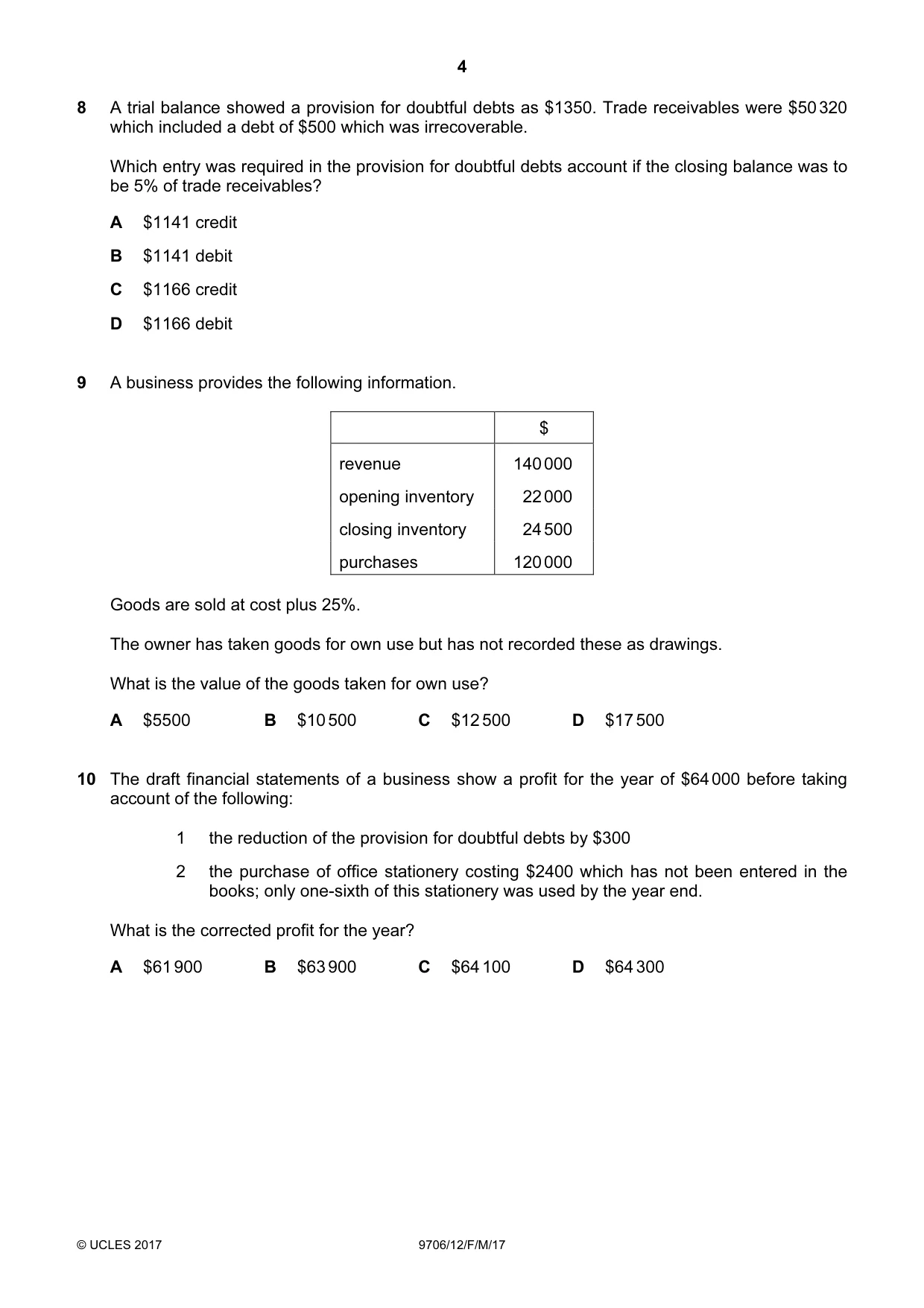
8 A trial balance showed a provision for doubtful debts as $1350. Trade receivables were $50 320 which included a debt of $500 which was irrecoverable. Which entry was required in the provision for doubtful debts account if the closing balance was to be 5% of trade receivables? A $1141 credit B $1141 debit C $1166 credit D $1166 debit
Mark scheme: A
Q9 · A business provides the following information
9 A business provides the following information. $ revenue 140 000 opening inventory 22 000 closing inventory 24 500 purchases 120 000 Goods are sold at cost plus 25%. The owner has taken goods for own use but has not recorded these as drawings. What is the value of the goods taken for own use? A $5500 B $10 500 C $12 500 D $17 500
Mark scheme: A
Q10 · The draft financial statements of a business show a profit for the year of $64 000 before…
10 The draft financial statements of a business show a profit for the year of $64 000 before taking account of the following: 1 the reduction of the provision for doubtful debts by $300 2 the purchase of office stationery costing $2400 which has not been entered in the books; only one-sixth of this stationery was used by the year end. What is the corrected profit for the year? A $61 900 B $63 900 C $64 100 D $64 300
Mark scheme: B
Q11 · The table shows transactions relating to a product during July
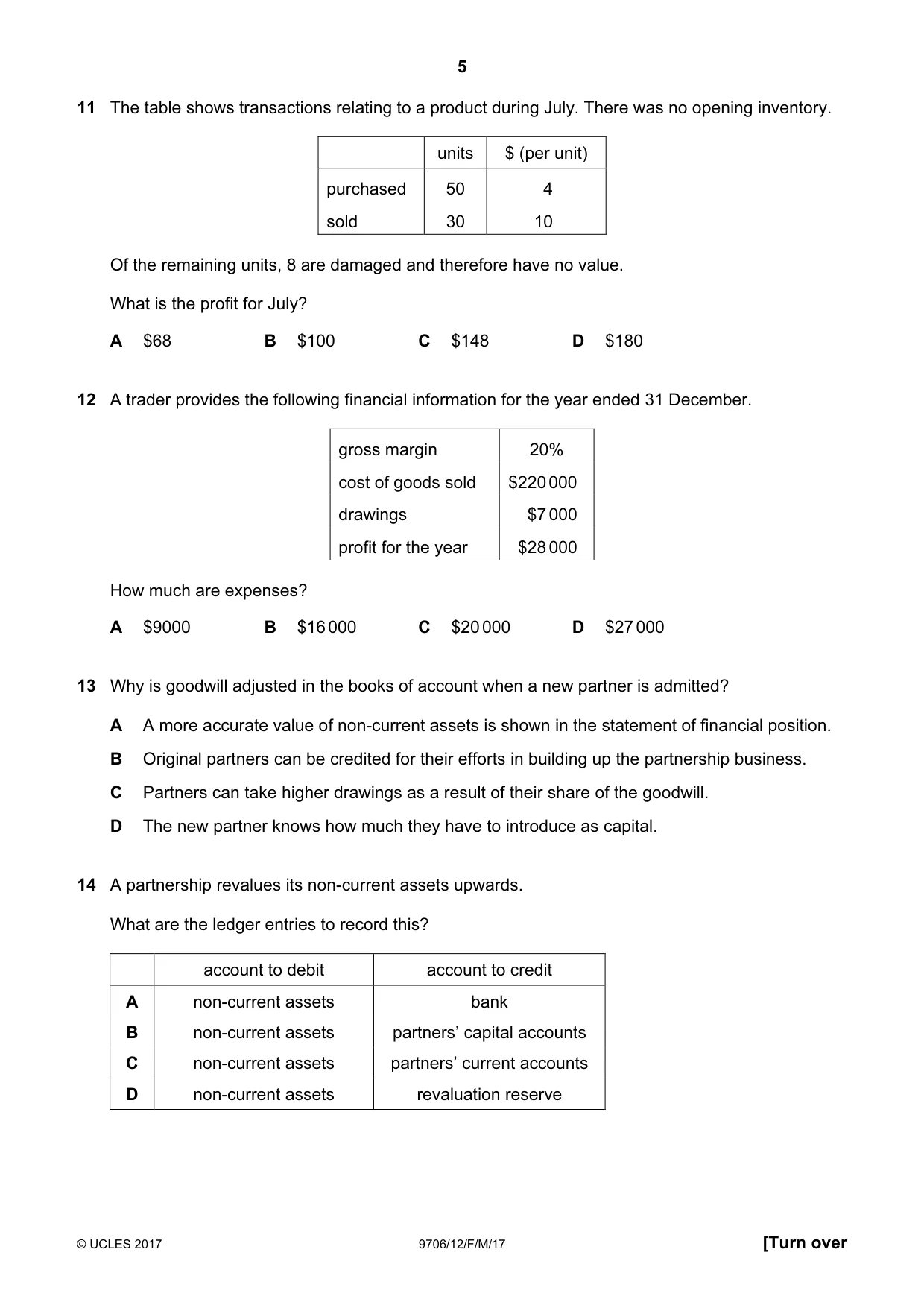
11 The table shows transactions relating to a product during July. There was no opening inventory. units $ (per unit) purchased 50 4 sold 30 10 Of the remaining units, 8 are damaged and therefore have no value. What is the profit for July? A $68 B $100 C $148 D $180
Mark scheme: C
Q12 · A trader provides the following financial information for the year ended 31 December
12 A trader provides the following financial information for the year ended 31 December. gross margin 20% cost of goods sold $220 000 drawings $7 000 profit for the year $28 000 How much are expenses? A $9000 B $16 000 C $20 000 D $27 000
Mark scheme: D
Q13 · Why is goodwill adjusted in the books of account when a new partner is admitted?
13 Why is goodwill adjusted in the books of account when a new partner is admitted? A A more accurate value of non-current assets is shown in the statement of financial position. B Original partners can be credited for their efforts in building up the partnership business. C Partners can take higher drawings as a result of their share of the goodwill. D The new partner knows how much they have to introduce as capital.
Mark scheme: B
Q14 · A partnership revalues its non-current assets upwards
14 A partnership revalues its non-current assets upwards. What are the ledger entries to record this? account to debit account to credit A non-current assets bank B non-current assets partners’ capital accounts C non-current assets partners’ current accounts D non-current assets revaluation reserve
Mark scheme: B
Q15 · X and Y are in partnership
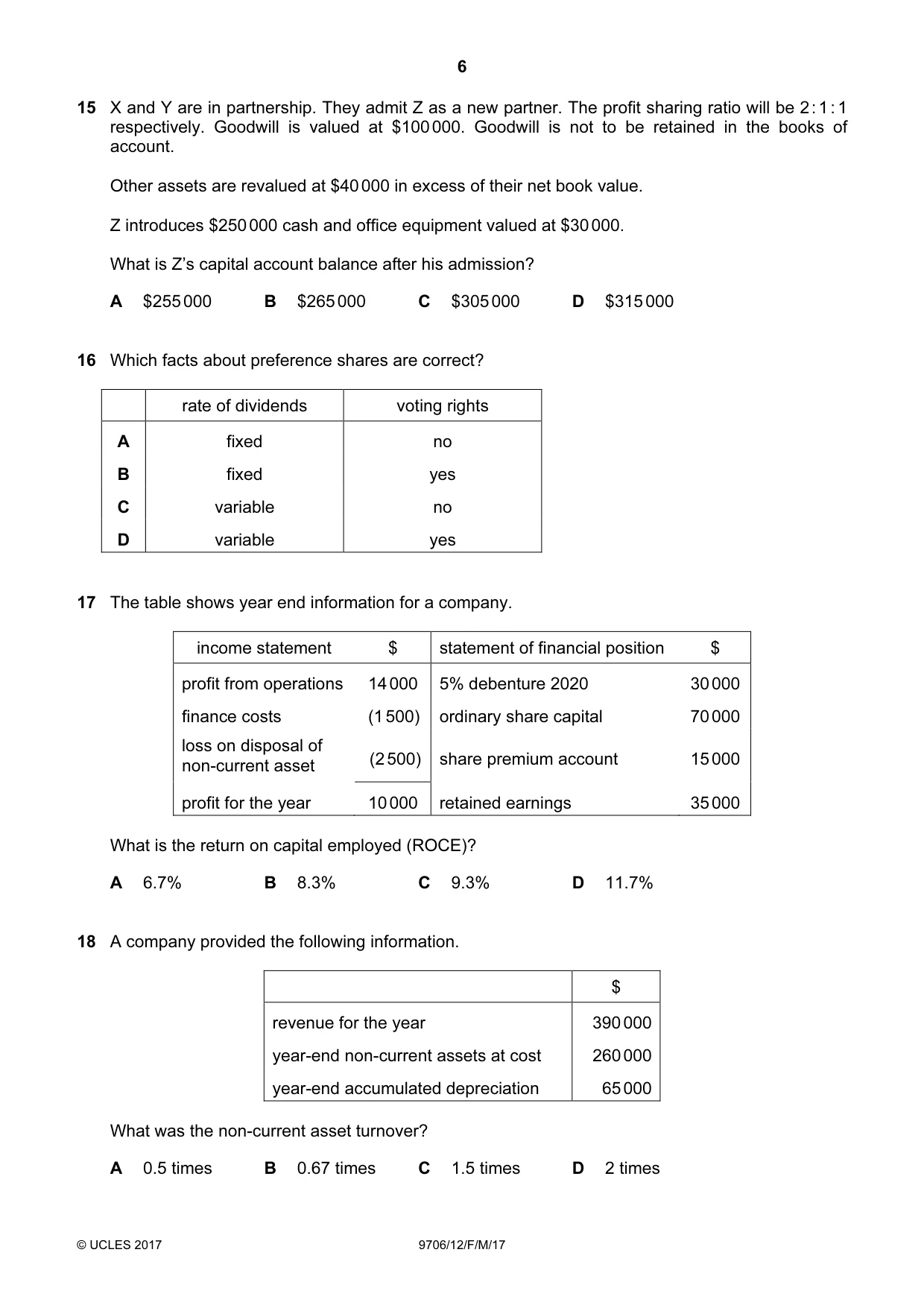
15 X and Y are in partnership. They admit Z as a new partner. The profit sharing ratio will be 2 : 1 : 1 respectively. Goodwill is valued at $100 000. Goodwill is not to be retained in the books of account. Other assets are revalued at $40 000 in excess of their net book value. Z introduces $250 000 cash and office equipment valued at $30 000. What is Z’s capital account balance after his admission? A $255 000 B $265 000 C $305 000 D $315 000
Mark scheme: A
Q16 · Which facts about preference shares are correct?
16 Which facts about preference shares are correct? rate of dividends voting rights A fixed no B fixed yes C variable no D variable yes
Mark scheme: A
Q17 · The table shows year end information for a company
17 The table shows year end information for a company. income statement $ statement of financial position $ profit from operations 14 000 5% debenture 2020 30 000 finance costs (1 500) ordinary share capital 70 000 loss on disposal of non-current asset (2 500) share premium account 15 000 profit for the year 10 000 retained earnings 35 000 What is the return on capital employed (ROCE)? A 6.7% B 8.3% C 9.3% D 11.7%
Mark scheme: C
More questions on Analysis and communication of accounting information
Q18 · A company provided the following information
18 A company provided the following information. $ revenue for the year 390 000 year-end non-current assets at cost 260 000 year-end accumulated depreciation 65 000 What was the non-current asset turnover? A 0.5 times B 0.67 times C 1.5 times D 2 times
Mark scheme: D
More questions on Analysis and communication of accounting information
Q19 · The following information is given in the financial statements of a limited company
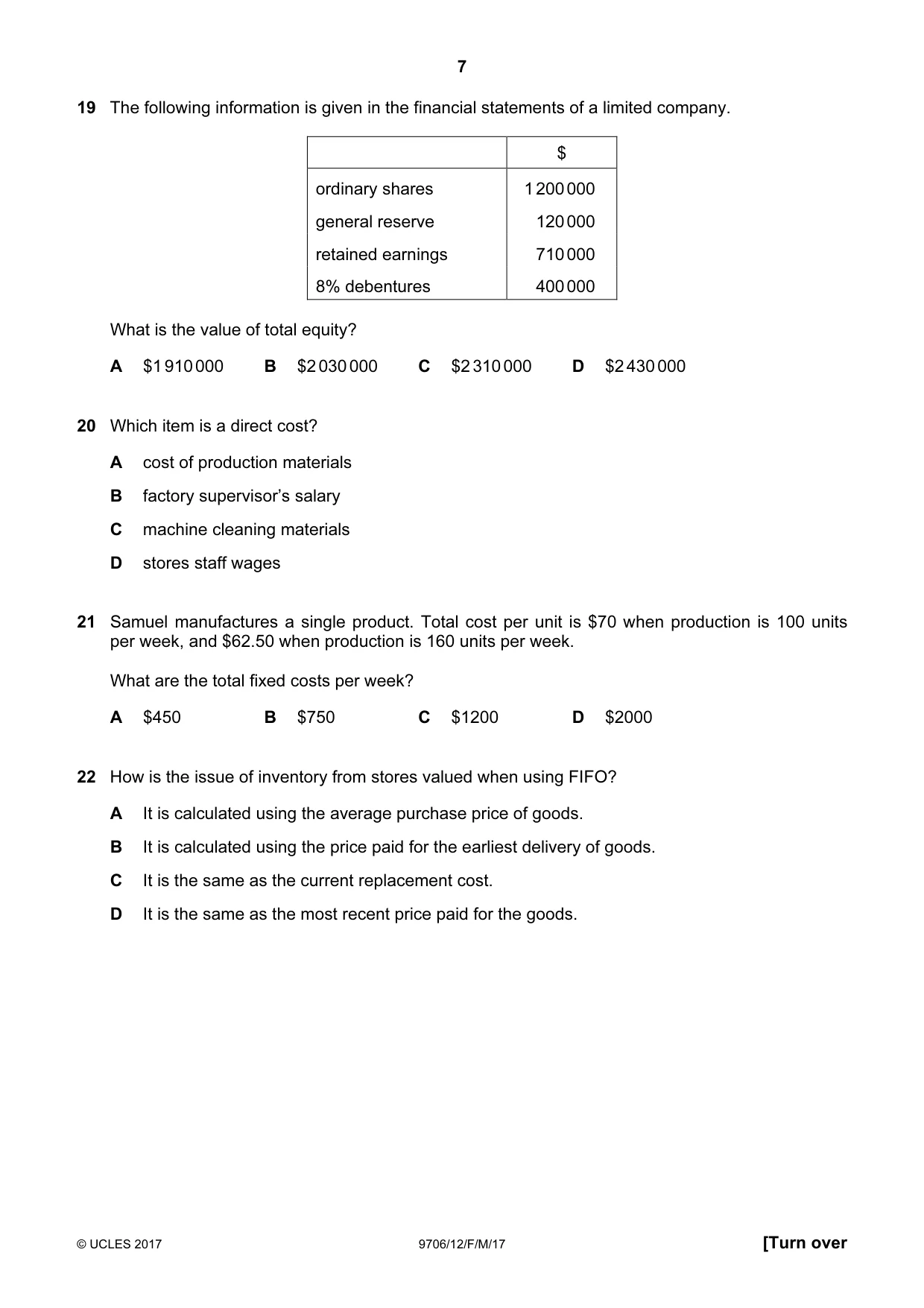
19 The following information is given in the financial statements of a limited company. $ ordinary shares 1 200 000 general reserve 120 000 retained earnings 710 000 8% debentures 400 000 What is the value of total equity? A $1 910 000 B $2 030 000 C $2 310 000 D $2 430 000
Mark scheme: B
Q20 · Which item is a direct cost?
20 Which item is a direct cost? A cost of production materials B factory supervisor’s salary C machine cleaning materials D stores staff wages
Mark scheme: A
Q21 · Samuel manufactures a single product
21 Samuel manufactures a single product. Total cost per unit is $70 when production is 100 units per week, and $62.50 when production is 160 units per week. What are the total fixed costs per week? A $450 B $750 C $1200 D $2000
Mark scheme: D
Q22 · How is the issue of inventory from stores valued when using FIFO?
22 How is the issue of inventory from stores valued when using FIFO? A It is calculated using the average purchase price of goods. B It is calculated using the price paid for the earliest delivery of goods. C It is the same as the current replacement cost. D It is the same as the most recent price paid for the goods.
Mark scheme: B
Q23 · A business absorbs overheads based on machine hours
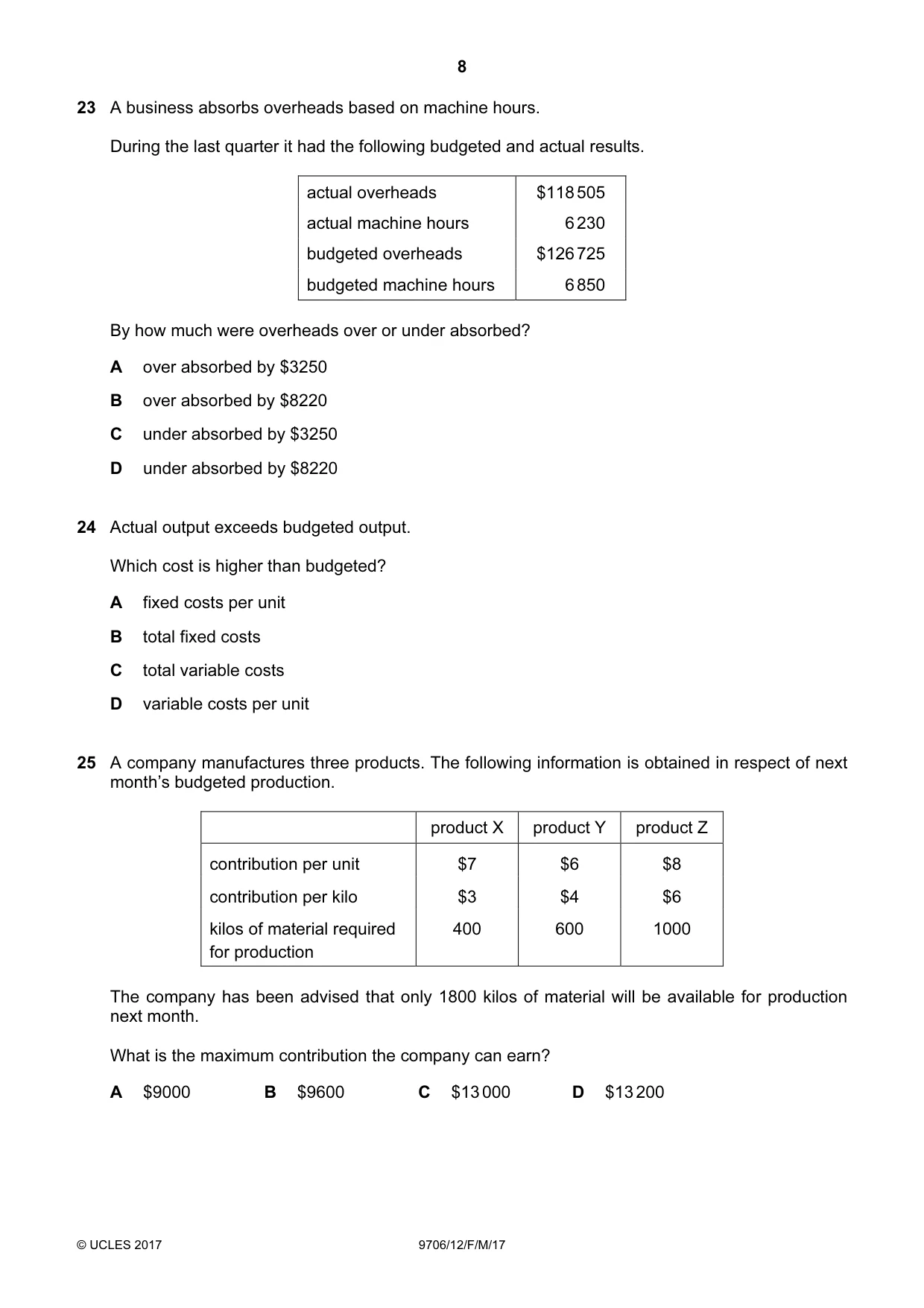
23 A business absorbs overheads based on machine hours. During the last quarter it had the following budgeted and actual results. actual overheads $118 505 actual machine hours 6 230 budgeted overheads $126 725 budgeted machine hours 6 850 By how much were overheads over or under absorbed? A over absorbed by $3250 B over absorbed by $8220 C under absorbed by $3250 D under absorbed by $8220
Mark scheme: C
Q24 · Actual output exceeds budgeted output
24 Actual output exceeds budgeted output. Which cost is higher than budgeted? A fixed costs per unit B total fixed costs C total variable costs D variable costs per unit
Mark scheme: C
Q25 · A company manufactures three products
25 A company manufactures three products. The following information is obtained in respect of next month’s budgeted production. product X product Y product Z contribution per unit $7 $6 $8 contribution per kilo $3 $4 $6 kilos of material required 400 600 1000 for production The company has been advised that only 1800 kilos of material will be available for production next month. What is the maximum contribution the company can earn? A $9000 B $9600 C $13 000 D $13 200
Mark scheme: A
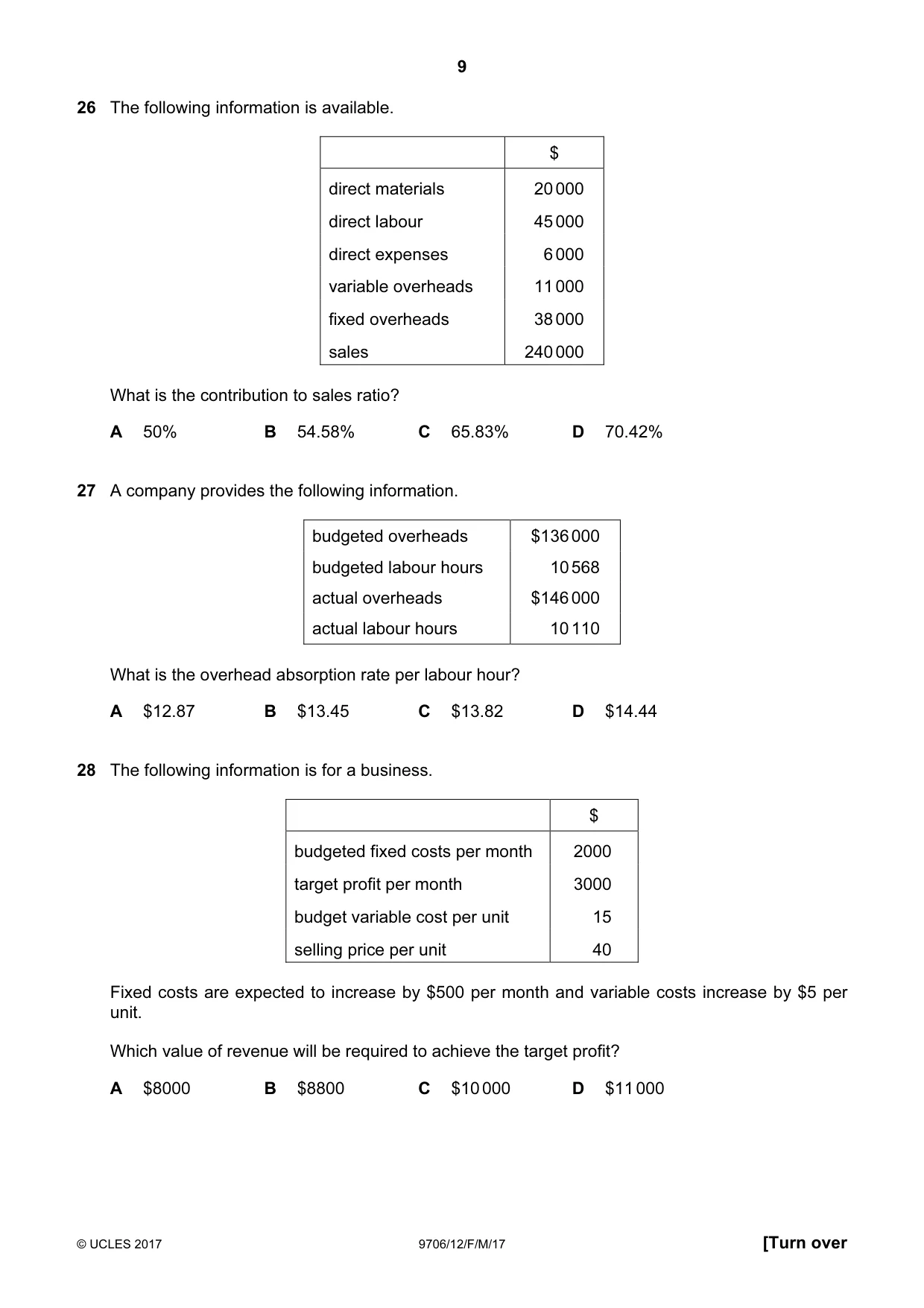
Q26 · The following information is available
26 The following information is available. $ direct materials 20 000 direct labour 45 000 direct expenses 6 000 variable overheads 11 000 fixed overheads 38 000 sales 240 000 What is the contribution to sales ratio? A 50% B 54.58% C 65.83% D 70.42%
Mark scheme: C
Q27 · A company provides the following information
27 A company provides the following information. budgeted overheads $136 000 budgeted labour hours 10 568 actual overheads $146 000 actual labour hours 10 110 What is the overhead absorption rate per labour hour? A $12.87 B $13.45 C $13.82 D $14.44
Mark scheme: A
Q28 · The following information is for a business
28 The following information is for a business. $ budgeted fixed costs per month 2000 target profit per month 3000 budget variable cost per unit 15 selling price per unit 40 Fixed costs are expected to increase by $500 per month and variable costs increase by $5 per unit. Which value of revenue will be required to achieve the target profit? A $8000 B $8800 C $10 000 D $11 000
Mark scheme: D
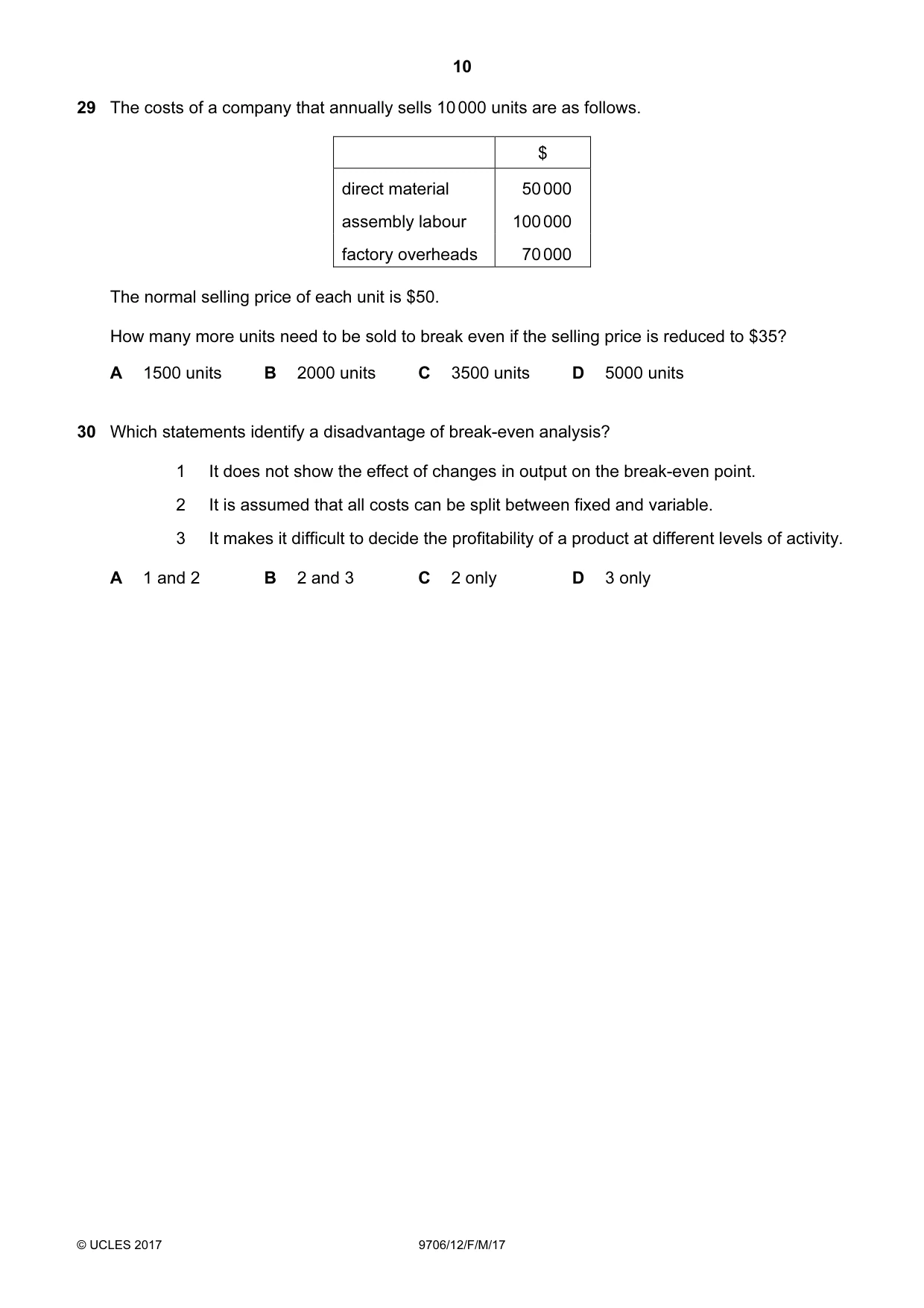
Q29 · The costs of a company that annually sells 10 000 units are as follows
29 The costs of a company that annually sells 10 000 units are as follows. $ direct material 50 000 assembly labour 100 000 factory overheads 70 000 The normal selling price of each unit is $50. How many more units need to be sold to break even if the selling price is reduced to $35? A 1500 units B 2000 units C 3500 units D 5000 units
Mark scheme: A
Q30 · Which statements identify a disadvantage of break-even analysis?
30 Which statements identify a disadvantage of break-even analysis? 1 It does not show the effect of changes in output on the break-even point. 2 It is assumed that all costs can be split between fixed and variable. 3 It makes it difficult to decide the profitability of a product at different levels of activity. A 1 and 2 B 2 and 3 C 2 only D 3 only
Mark scheme: C
What was in this paper
The subtopics covered by these 30 questions, and how many questions each got. Open one in a new tab to see every Cambridge question on it.
What you needed in this session
Cambridge’s own grade thresholds for 2017 Feb/March, Paper 1 · Variant 2. A higher threshold means an easier paper — the bar moves with how the cohort did.