Cambridge A Level Accounting 9706 — 2023 May/June Paper 1 · Variant 1
9706/11/M/J/23 · 30 questions · 30 marks · ≈34 min
The question paper and its mark scheme, free to read here and free to download. This is Cambridge’s own paper, exactly as it was sat.
Question paper12 pages

Mark scheme3 pages
Answers below. Sit the paper first if you are practising.
Questions as text
Q1 · Which statement describes the purpose of preparing a trial balance?
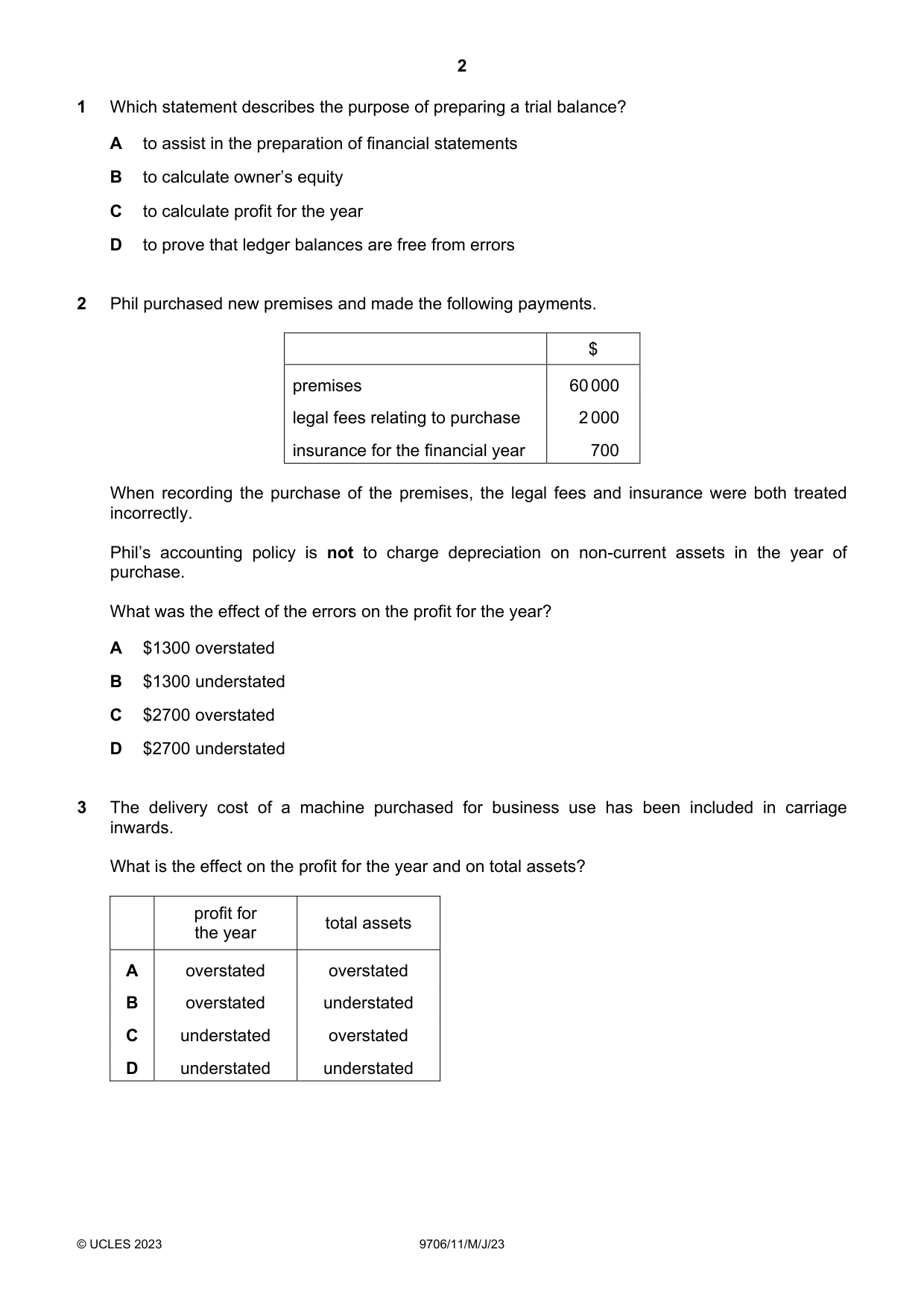
1 Which statement describes the purpose of preparing a trial balance? A to assist in the preparation of financial statements B to calculate owner’s equity C to calculate profit for the year D to prove that ledger balances are free from errors
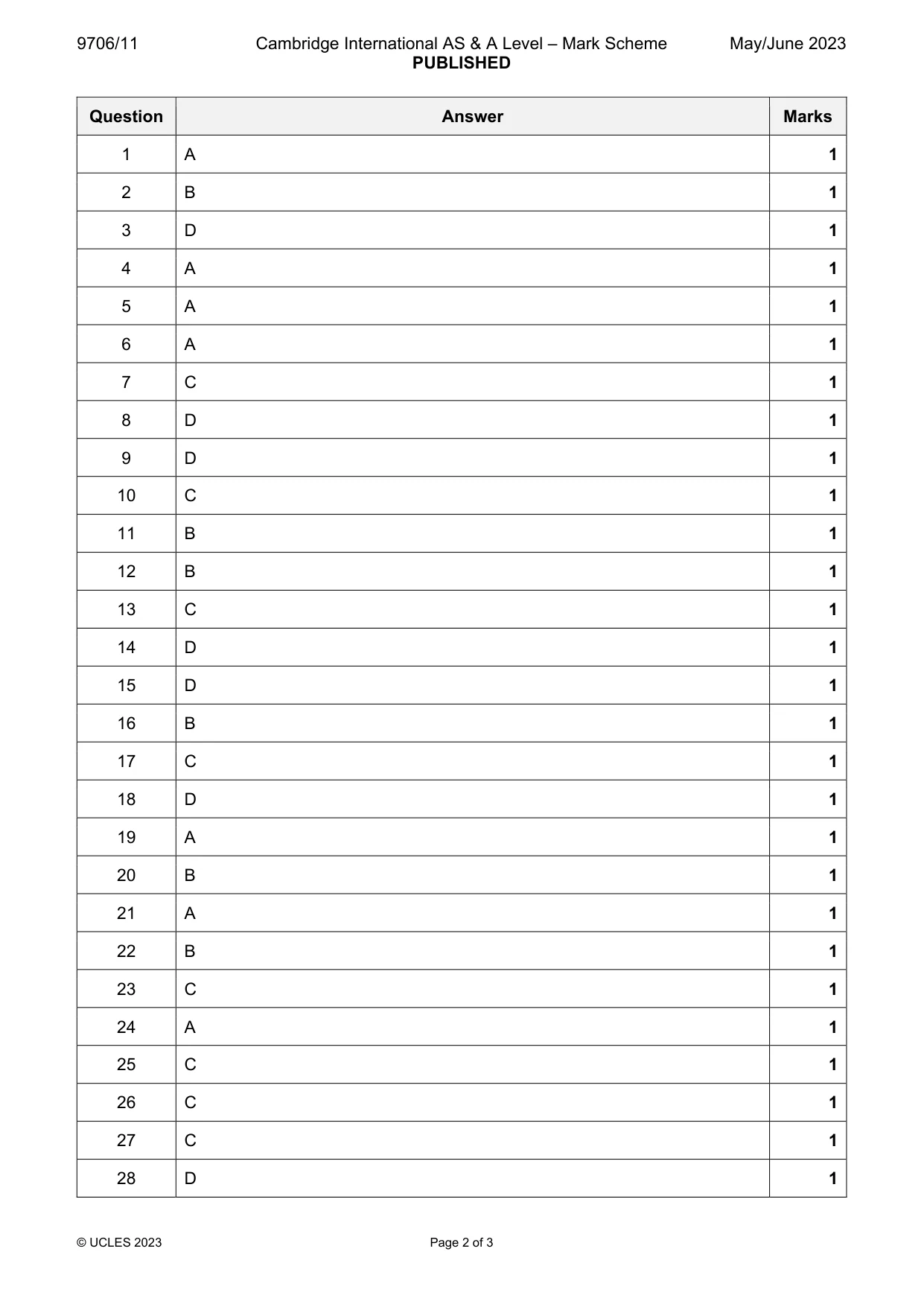
Mark scheme: A
Q2 · Phil purchased new premises and made the following payments
2 Phil purchased new premises and made the following payments. $ premises 60 000 legal fees relating to purchase 2 000 insurance for the financial year 700 When recording the purchase of the premises, the legal fees and insurance were both treated incorrectly. Phil’s accounting policy is not to charge depreciation on non-current assets in the year of purchase. What was the effect of the errors on the profit for the year? A $1300 overstated B $1300 understated C $2700 overstated D $2700 understated
Mark scheme: B
Q3 · The delivery cost of a machine purchased for business use has been included in carriage…
3 The delivery cost of a machine purchased for business use has been included in carriage inwards. What is the effect on the profit for the year and on total assets? profit for total assets the year A overstated overstated B overstated understated C understated overstated D understated understated
Mark scheme: D
Q4 · Which factors are considered when choosing the most appropriate method of calculating…
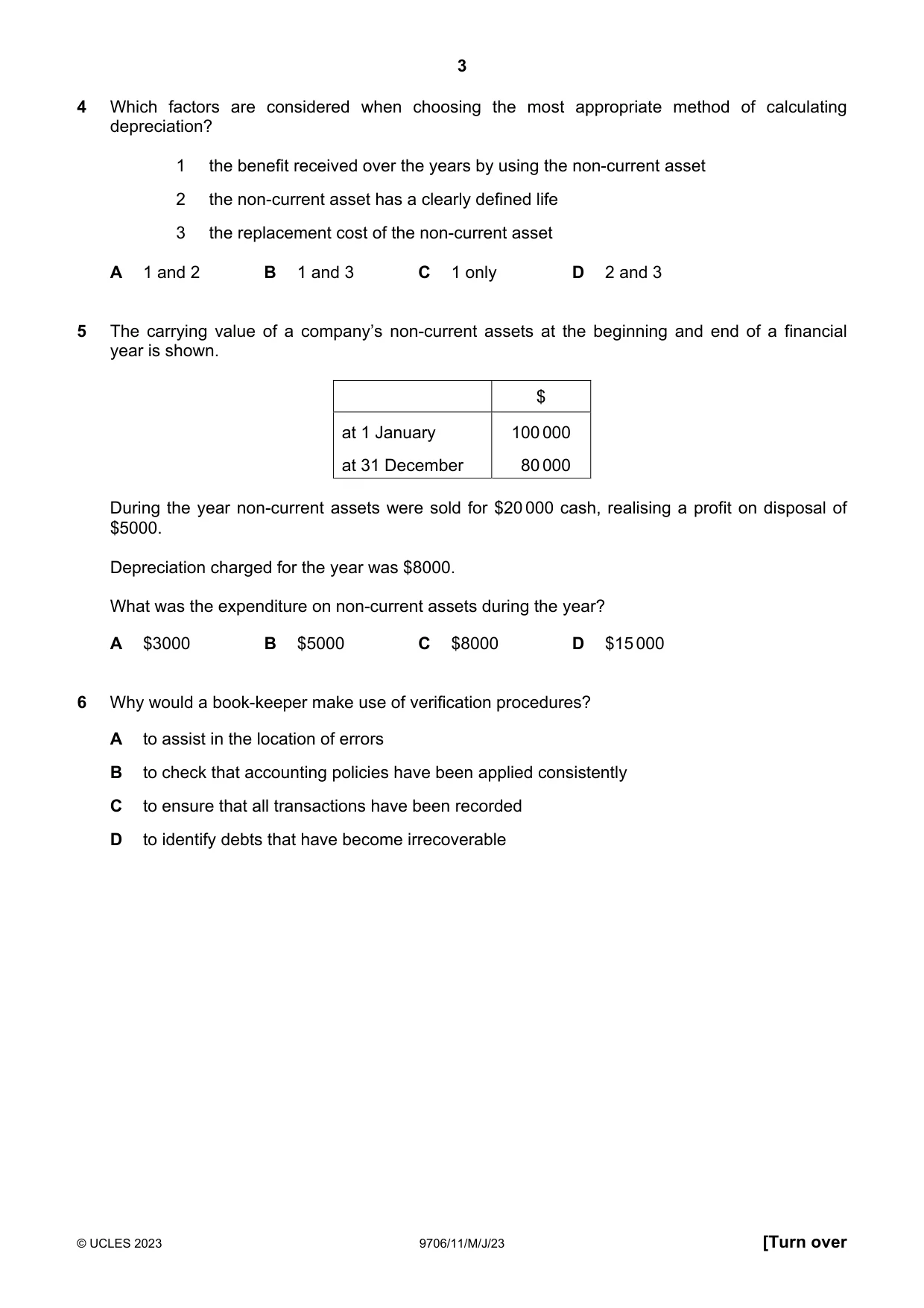
4 Which factors are considered when choosing the most appropriate method of calculating depreciation? 1 the benefit received over the years by using the non-current asset 2 the non-current asset has a clearly defined life 3 the replacement cost of the non-current asset A 1 and 2 B 1 and 3 C 1 only D 2 and 3
Mark scheme: A
Q5 · The carrying value of a company’s non-current assets at the beginning and end of a…
5 The carrying value of a company’s non-current assets at the beginning and end of a financial year is shown. $ at 1 January 100 000 at 31 December 80 000 During the year non-current assets were sold for $20 000 cash, realising a profit on disposal of $5000. Depreciation charged for the year was $8000. What was the expenditure on non-current assets during the year? A $3000 B $5000 C $8000 D $15 000
Mark scheme: A
Q6 · Why would a book-keeper make use of verification procedures?
6 Why would a book-keeper make use of verification procedures? A to assist in the location of errors B to check that accounting policies have been applied consistently C to ensure that all transactions have been recorded D to identify debts that have become irrecoverable
Mark scheme: A
Q7 · Douglas prepared a trial balance and found that the total of the debit column was $50…
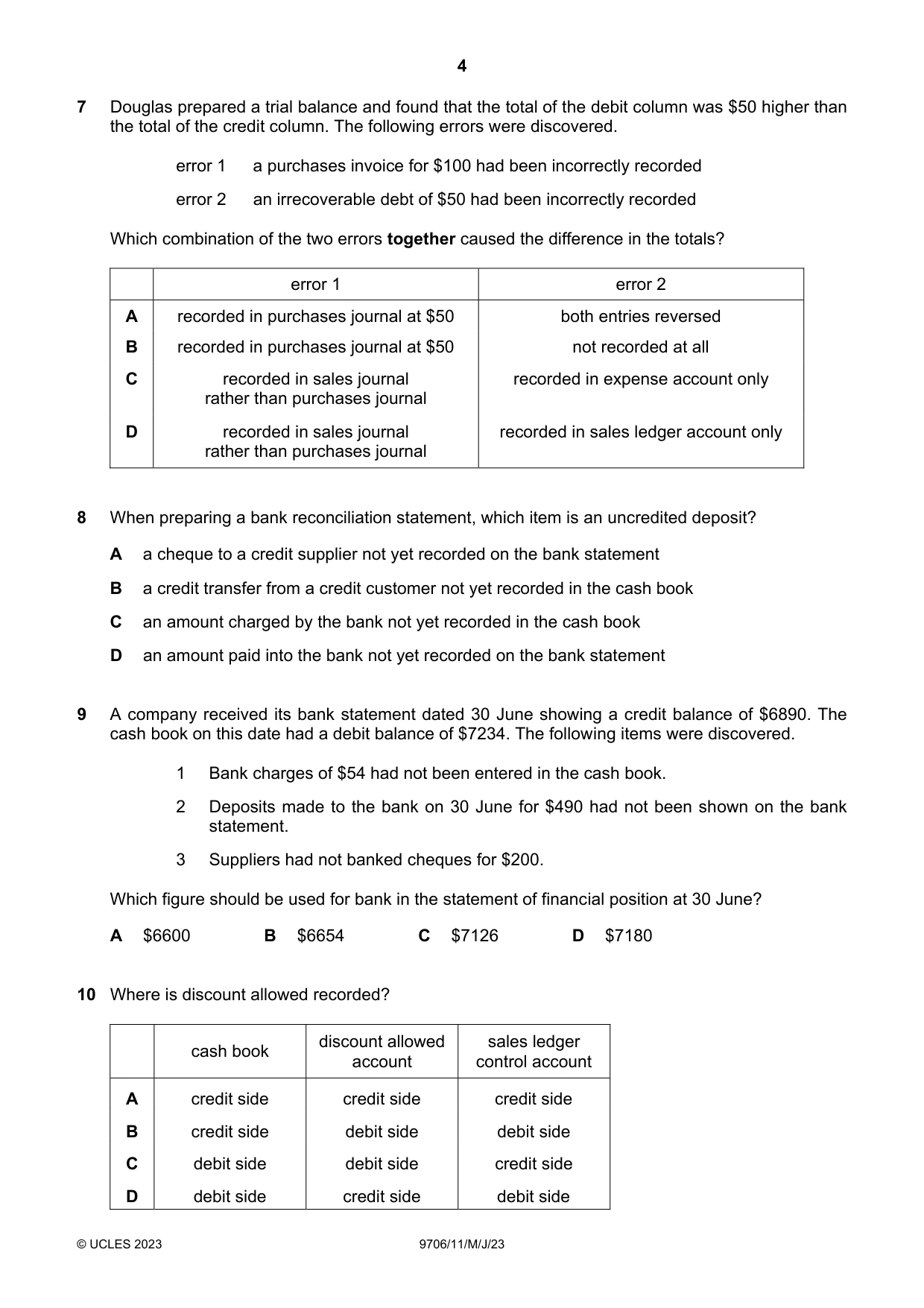
7 Douglas prepared a trial balance and found that the total of the debit column was $50 higher than the total of the credit column. The following errors were discovered. error 1 a purchases invoice for $100 had been incorrectly recorded error 2 an irrecoverable debt of $50 had been incorrectly recorded Which combination of the two errors together caused the difference in the totals? error 1 error 2 A recorded in purchases journal at $50 both entries reversed B recorded in purchases journal at $50 not recorded at all C recorded in sales journal recorded in expense account only rather than purchases journal D recorded in sales journal recorded in sales ledger account only rather than purchases journal
Mark scheme: C
Q8 · When preparing a bank reconciliation statement, which item is an uncredited deposit?
8 When preparing a bank reconciliation statement, which item is an uncredited deposit? A a cheque to a credit supplier not yet recorded on the bank statement B a credit transfer from a credit customer not yet recorded in the cash book C an amount charged by the bank not yet recorded in the cash book D an amount paid into the bank not yet recorded on the bank statement
Mark scheme: D
Q9 · A company received its bank statement dated 30 June showing a credit balance of $6890
9 A company received its bank statement dated 30 June showing a credit balance of $6890. The cash book on this date had a debit balance of $7234. The following items were discovered. 1 Bank charges of $54 had not been entered in the cash book. 2 Deposits made to the bank on 30 June for $490 had not been shown on the bank statement. 3 Suppliers had not banked cheques for $200. Which figure should be used for bank in the statement of financial position at 30 June? A $6600 B $6654 C $7126 D $7180
Mark scheme: D
Q10 · Where is discount allowed recorded?
10 Where is discount allowed recorded? discount allowed sales ledger cash book account control account A credit side credit side credit side B credit side debit side debit side C debit side debit side credit side D debit side credit side debit side
Mark scheme: C
Q11 · The closing balance on a sales ledger control account was $10 150
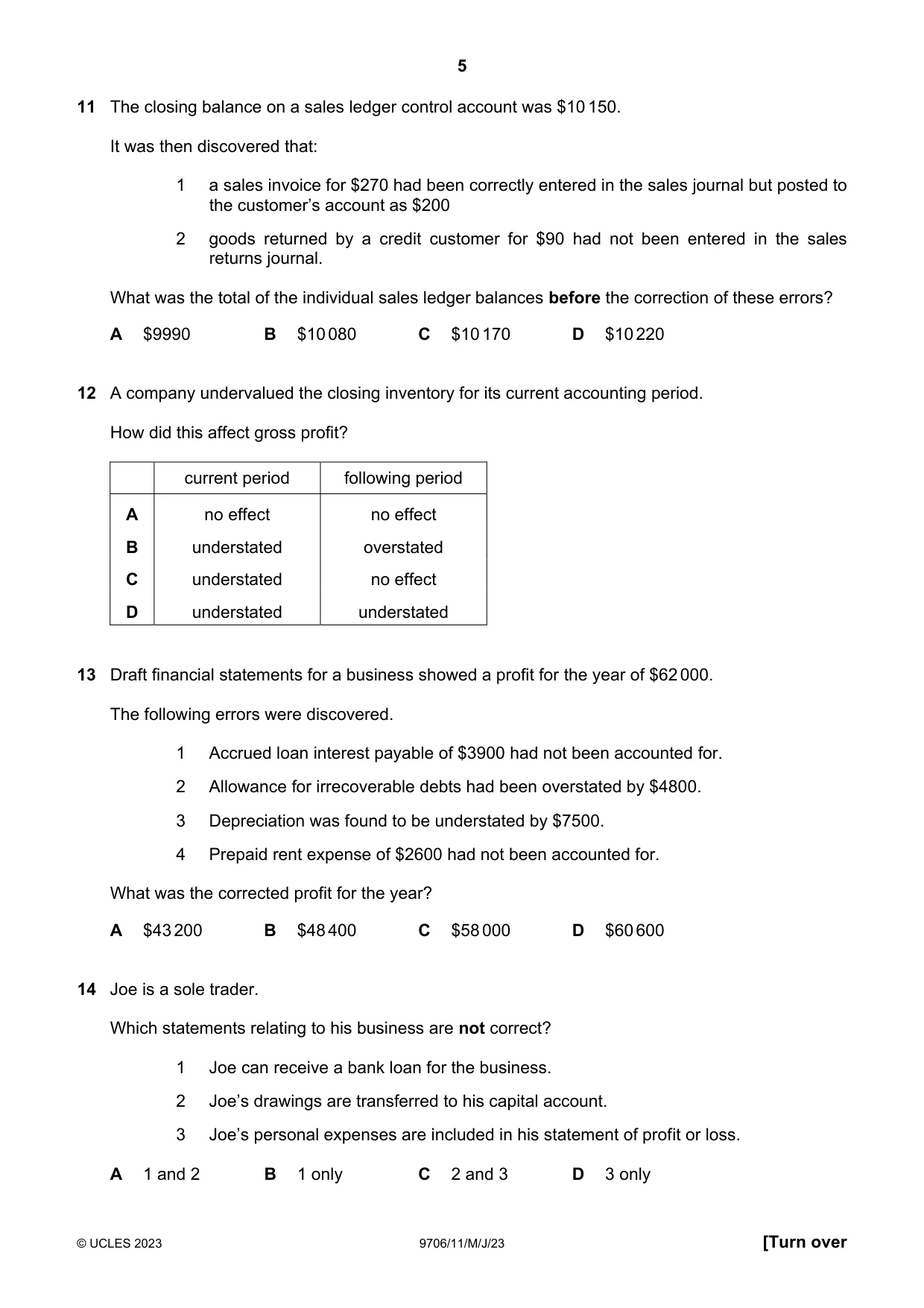
11 The closing balance on a sales ledger control account was $10 150. It was then discovered that: 1 a sales invoice for $270 had been correctly entered in the sales journal but posted to the customer’s account as $200 2 goods returned by a credit customer for $90 had not been entered in the sales returns journal. What was the total of the individual sales ledger balances before the correction of these errors? A $9990 B $10 080 C $10 170 D $10 220
Mark scheme: B
Q12 · A company undervalued the closing inventory for its current accounting period
12 A company undervalued the closing inventory for its current accounting period. How did this affect gross profit? current period following period A no effect no effect B understated overstated C understated no effect D understated understated
Mark scheme: B
Q13 · Draft financial statements for a business showed a profit for the year of $62 000
13 Draft financial statements for a business showed a profit for the year of $62 000. The following errors were discovered. 1 Accrued loan interest payable of $3900 had not been accounted for. 2 Allowance for irrecoverable debts had been overstated by $4800. 3 Depreciation was found to be understated by $7500. 4 Prepaid rent expense of $2600 had not been accounted for. What was the corrected profit for the year? A $43 200 B $48 400 C $58 000 D $60 600
Mark scheme: C
Q14 · Joe is a sole trader
14 Joe is a sole trader. Which statements relating to his business are not correct? 1 Joe can receive a bank loan for the business. 2 Joe’s drawings are transferred to his capital account. 3 Joe’s personal expenses are included in his statement of profit or loss. A 1 and 2 B 1 only C 2 and 3 D 3 only
Mark scheme: D
Q15 · The owner of a business does not keep a full set of accounting records for his business
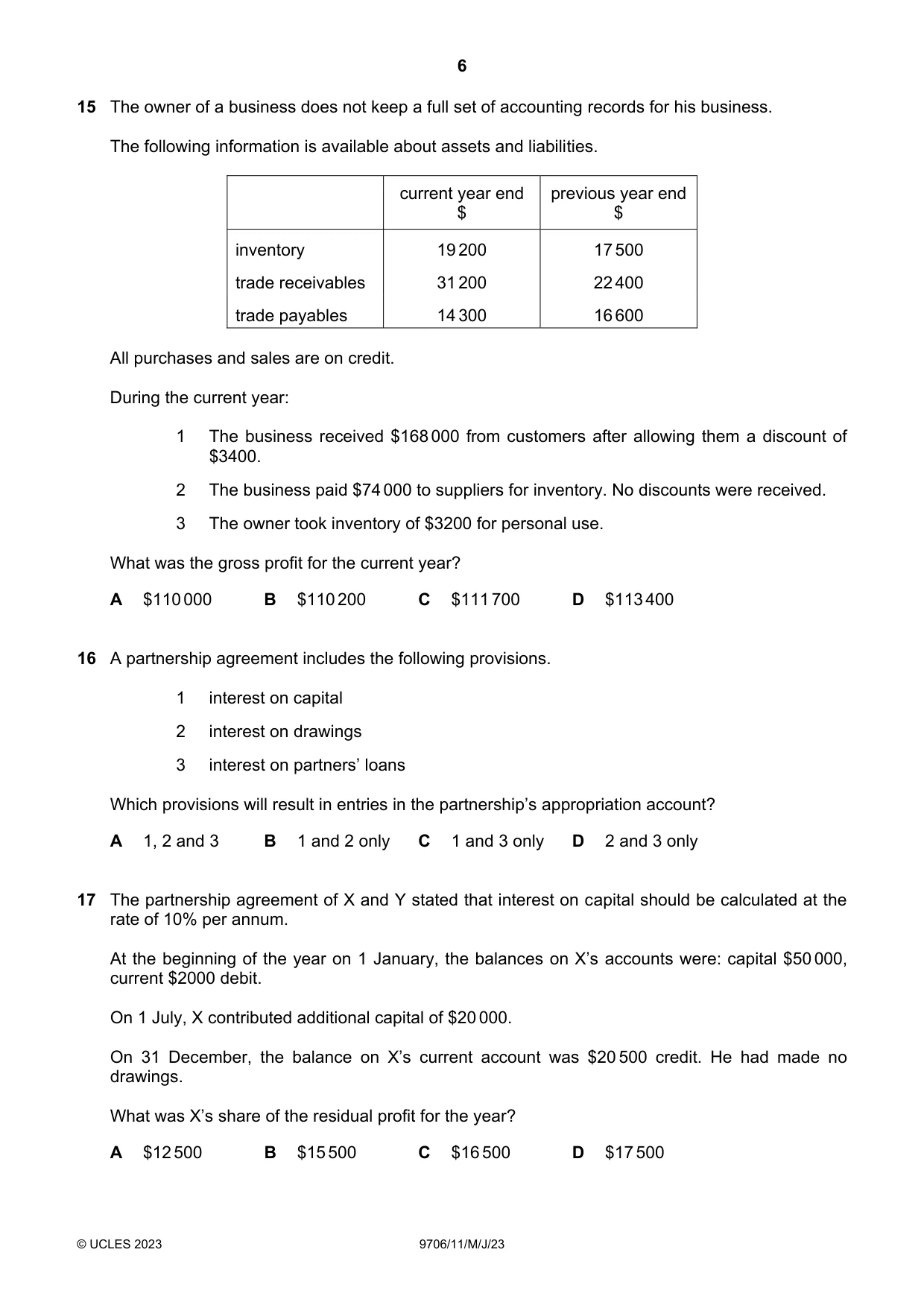
15 The owner of a business does not keep a full set of accounting records for his business. The following information is available about assets and liabilities. current year end previous year end $ $ inventory 19 200 17 500 trade receivables 31 200 22 400 trade payables 14 300 16 600 All purchases and sales are on credit. During the current year: 1 The business received $168 000 from customers after allowing them a discount of $3400. 2 The business paid $74 000 to suppliers for inventory. No discounts were received. 3 The owner took inventory of $3200 for personal use. What was the gross profit for the current year? A $110 000 B $110 200 C $111 700 D $113 400
Mark scheme: D
Q16 · A partnership agreement includes the following provisions
16 A partnership agreement includes the following provisions. 1 interest on capital 2 interest on drawings 3 interest on partners’ loans Which provisions will result in entries in the partnership’s appropriation account? A 1, 2 and 3 B 1 and 2 only C 1 and 3 only D 2 and 3 only
Mark scheme: B
Q17 · The partnership agreement of X and Y stated that interest on capital should be calculated…
17 The partnership agreement of X and Y stated that interest on capital should be calculated at the rate of 10% per annum. At the beginning of the year on 1 January, the balances on X’s accounts were: capital $50 000, current $2000 debit. On 1 July, X contributed additional capital of $20 000. On 31 December, the balance on X’s current account was $20 500 credit. He had made no drawings. What was X’s share of the residual profit for the year? A $12 500 B $15 500 C $16 500 D $17 500
Mark scheme: C
Q18 · The following actions took place in respect of a limited company
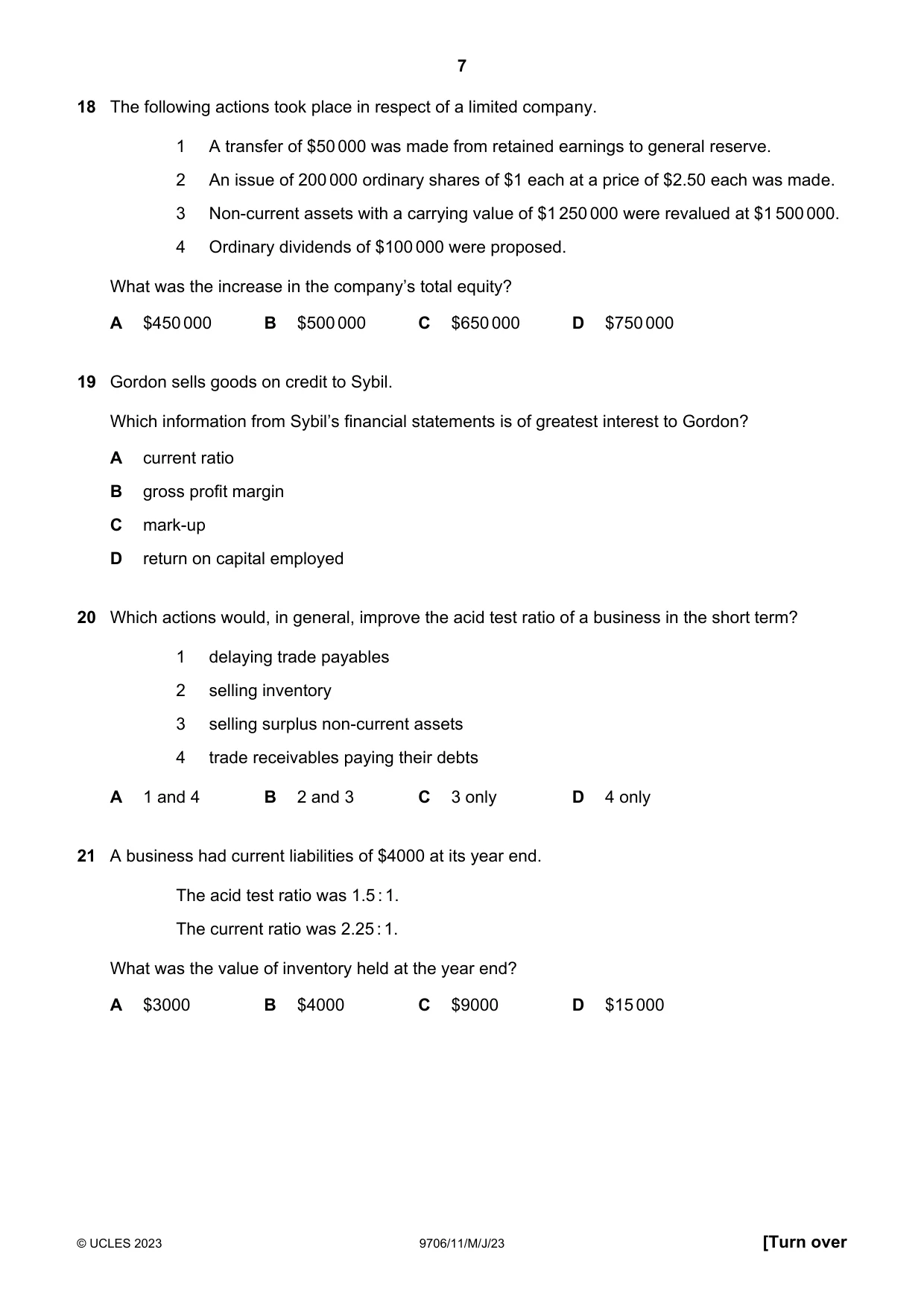
18 The following actions took place in respect of a limited company. 1 A transfer of $50 000 was made from retained earnings to general reserve. 2 An issue of 200 000 ordinary shares of $1 each at a price of $2.50 each was made. 3 Non-current assets with a carrying value of $1 250 000 were revalued at $1 500 000. 4 Ordinary dividends of $100 000 were proposed. What was the increase in the company’s total equity? A $450 000 B $500 000 C $650 000 D $750 000
Mark scheme: D
Q19 · Gordon sells goods on credit to Sybil
19 Gordon sells goods on credit to Sybil. Which information from Sybil’s financial statements is of greatest interest to Gordon? A current ratio B gross profit margin C mark-up D return on capital employed
Mark scheme: A
More questions on Analysis and communication of accounting information
Q20 · Which actions would, in general, improve the acid test ratio of a business in the short…
20 Which actions would, in general, improve the acid test ratio of a business in the short term? 1 delaying trade payables 2 selling inventory 3 selling surplus non-current assets 4 trade receivables paying their debts A 1 and 4 B 2 and 3 C 3 only D 4 only
Mark scheme: B
More questions on Analysis and communication of accounting information
Q21 · A business had current liabilities of $4000 at its year end
21 A business had current liabilities of $4000 at its year end. The acid test ratio was 1.5 : 1. The current ratio was 2.25 : 1. What was the value of inventory held at the year end? A $3000 B $4000 C $9000 D $15 000
Mark scheme: A
More questions on Analysis and communication of accounting information
Q22 · The following information is available for a company for its year ended 31 December
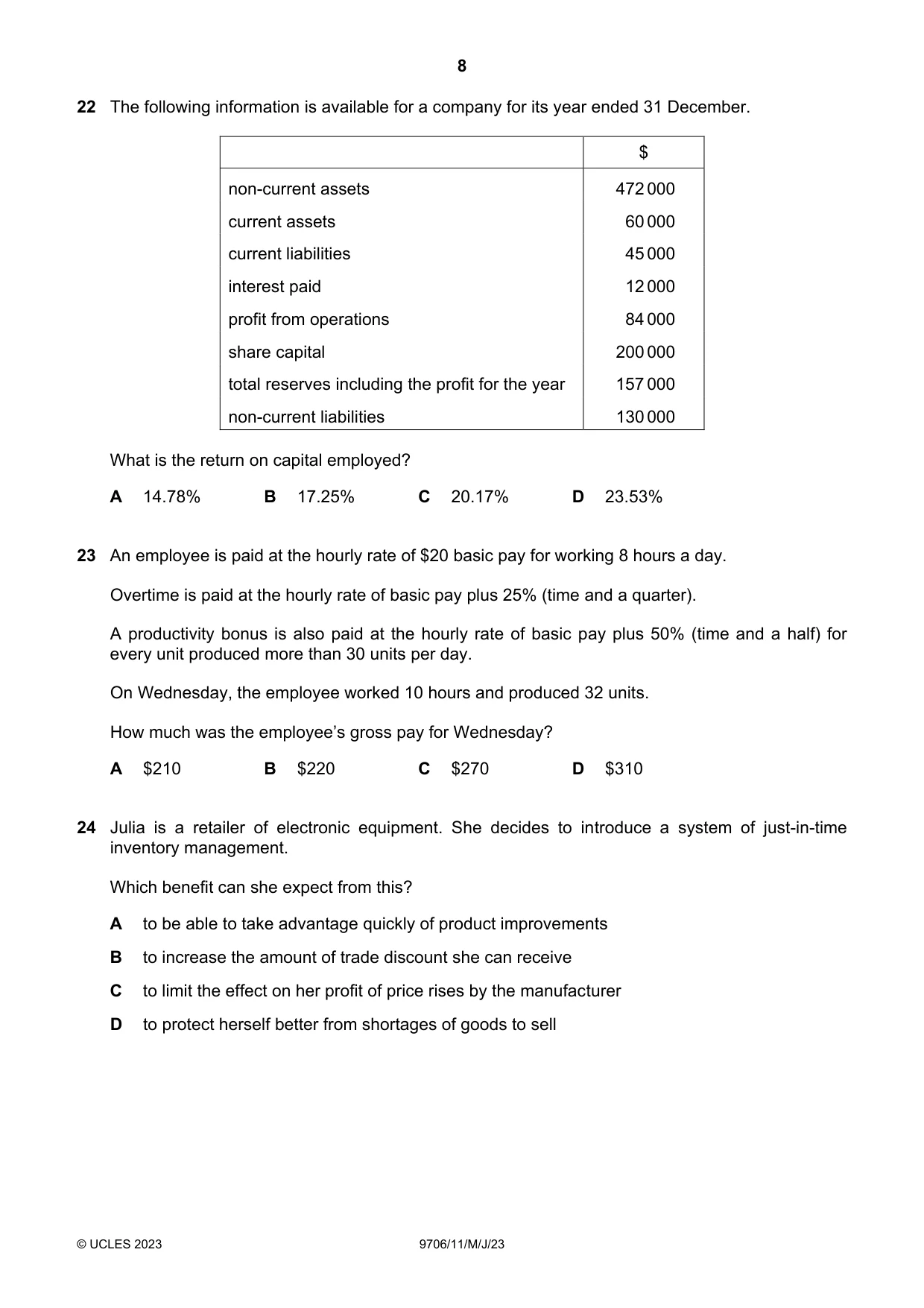
22 The following information is available for a company for its year ended 31 December. $ non-current assets 472 000 current assets 60 000 current liabilities 45 000 interest paid 12 000 profit from operations 84 000 share capital 200 000 total reserves including the profit for the year 157 000 non-current liabilities 130 000 What is the return on capital employed? A 14.78% B 17.25% C 20.17% D 23.53%
Mark scheme: B
More questions on Analysis and communication of accounting information
Q23 · An employee is paid at the hourly rate of $20 basic pay for working 8 hours a day
23 An employee is paid at the hourly rate of $20 basic pay for working 8 hours a day. Overtime is paid at the hourly rate of basic pay plus 25% (time and a quarter). A productivity bonus is also paid at the hourly rate of basic pay plus 50% (time and a half) for every unit produced more than 30 units per day. On Wednesday, the employee worked 10 hours and produced 32 units. How much was the employee’s gross pay for Wednesday? A $210 B $220 C $270 D $310
Mark scheme: C
Q24 · Julia is a retailer of electronic equipment
24 Julia is a retailer of electronic equipment. She decides to introduce a system of just-in-time inventory management. Which benefit can she expect from this? A to be able to take advantage quickly of product improvements B to increase the amount of trade discount she can receive C to limit the effect on her profit of price rises by the manufacturer D to protect herself better from shortages of goods to sell
Mark scheme: A
Q25 · Justine is an accountant and charges her clients a fee at an hourly rate plus overheads
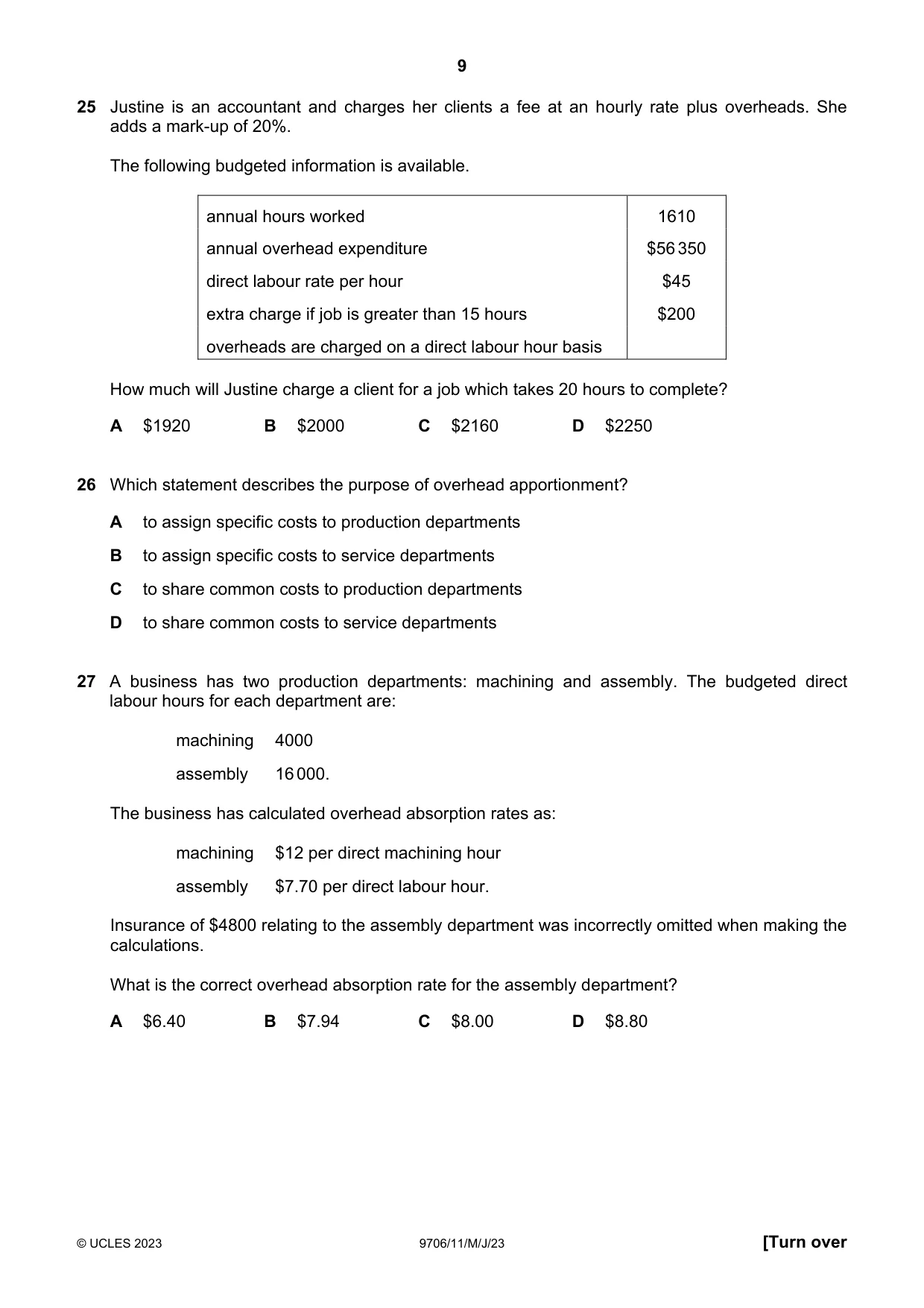
25 Justine is an accountant and charges her clients a fee at an hourly rate plus overheads. She adds a mark-up of 20%. The following budgeted information is available. annual hours worked 1610 annual overhead expenditure $56 350 direct labour rate per hour $45 extra charge if job is greater than 15 hours $200 overheads are charged on a direct labour hour basis How much will Justine charge a client for a job which takes 20 hours to complete? A $1920 B $2000 C $2160 D $2250
Mark scheme: C
Q26 · Which statement describes the purpose of overhead apportionment?
26 Which statement describes the purpose of overhead apportionment? A to assign specific costs to production departments B to assign specific costs to service departments C to share common costs to production departments D to share common costs to service departments
Mark scheme: C
Q27 · A business has two production departments: machining and assembly
27 A business has two production departments: machining and assembly. The budgeted direct labour hours for each department are: machining 4000 assembly 16 000. The business has calculated overhead absorption rates as: machining $12 per direct machining hour assembly $7.70 per direct labour hour. Insurance of $4800 relating to the assembly department was incorrectly omitted when making the calculations. What is the correct overhead absorption rate for the assembly department? A $6.40 B $7.94 C $8.00 D $8.80
Mark scheme: C
Q28 · Which statements about marginal costing are correct?
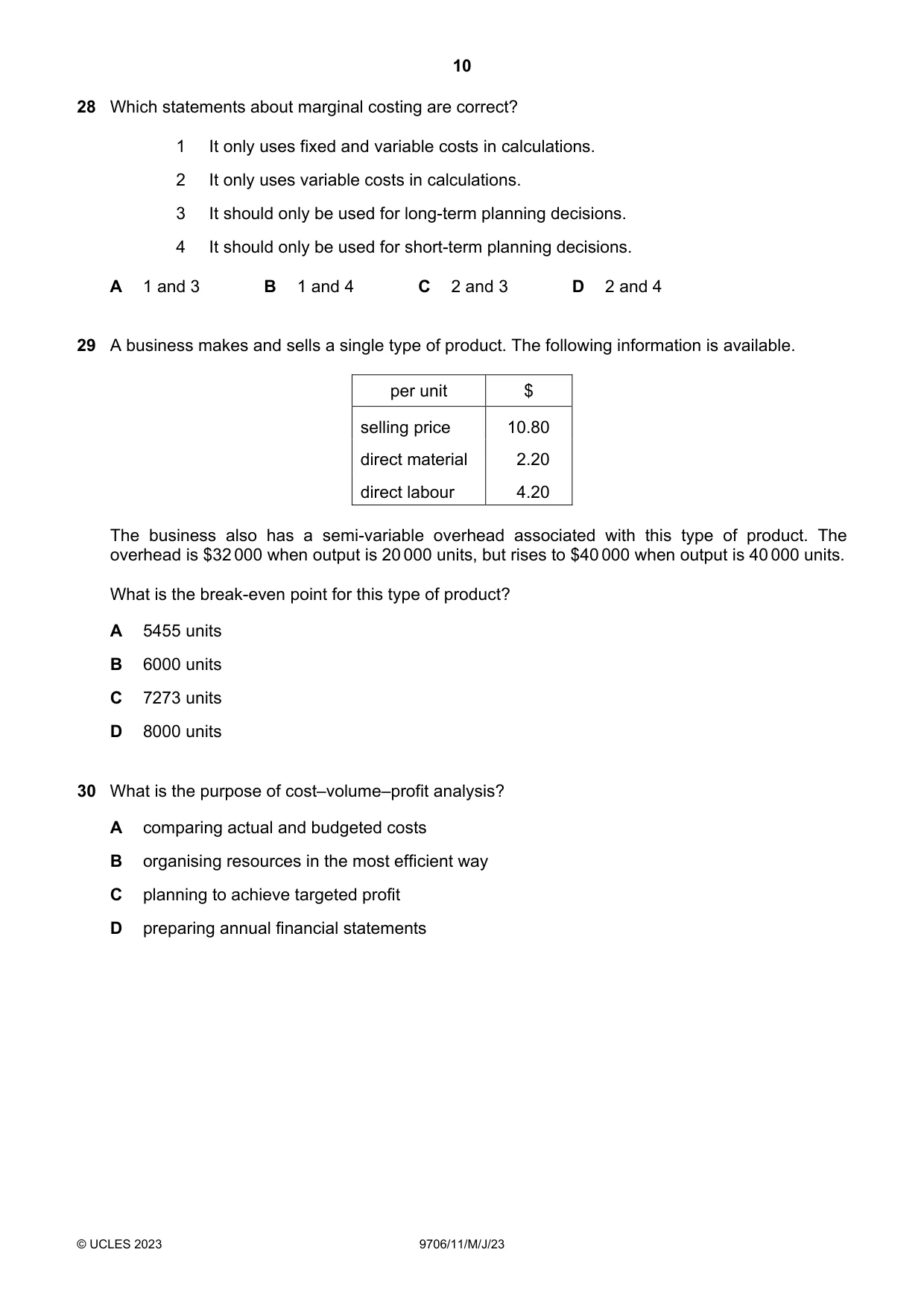
28 Which statements about marginal costing are correct? 1 It only uses fixed and variable costs in calculations. 2 It only uses variable costs in calculations. 3 It should only be used for long-term planning decisions. 4 It should only be used for short-term planning decisions. A 1 and 3 B 1 and 4 C 2 and 3 D 2 and 4
Mark scheme: D
Q29 · A business makes and sells a single type of product
29 A business makes and sells a single type of product. The following information is available. per unit $ selling price 10.80 direct material 2.20 direct labour 4.20 The business also has a semi-variable overhead associated with this type of product. The overhead is $32 000 when output is 20 000 units, but rises to $40 000 when output is 40 000 units. What is the break-even point for this type of product? A 5455 units B 6000 units C 7273 units D 8000 units
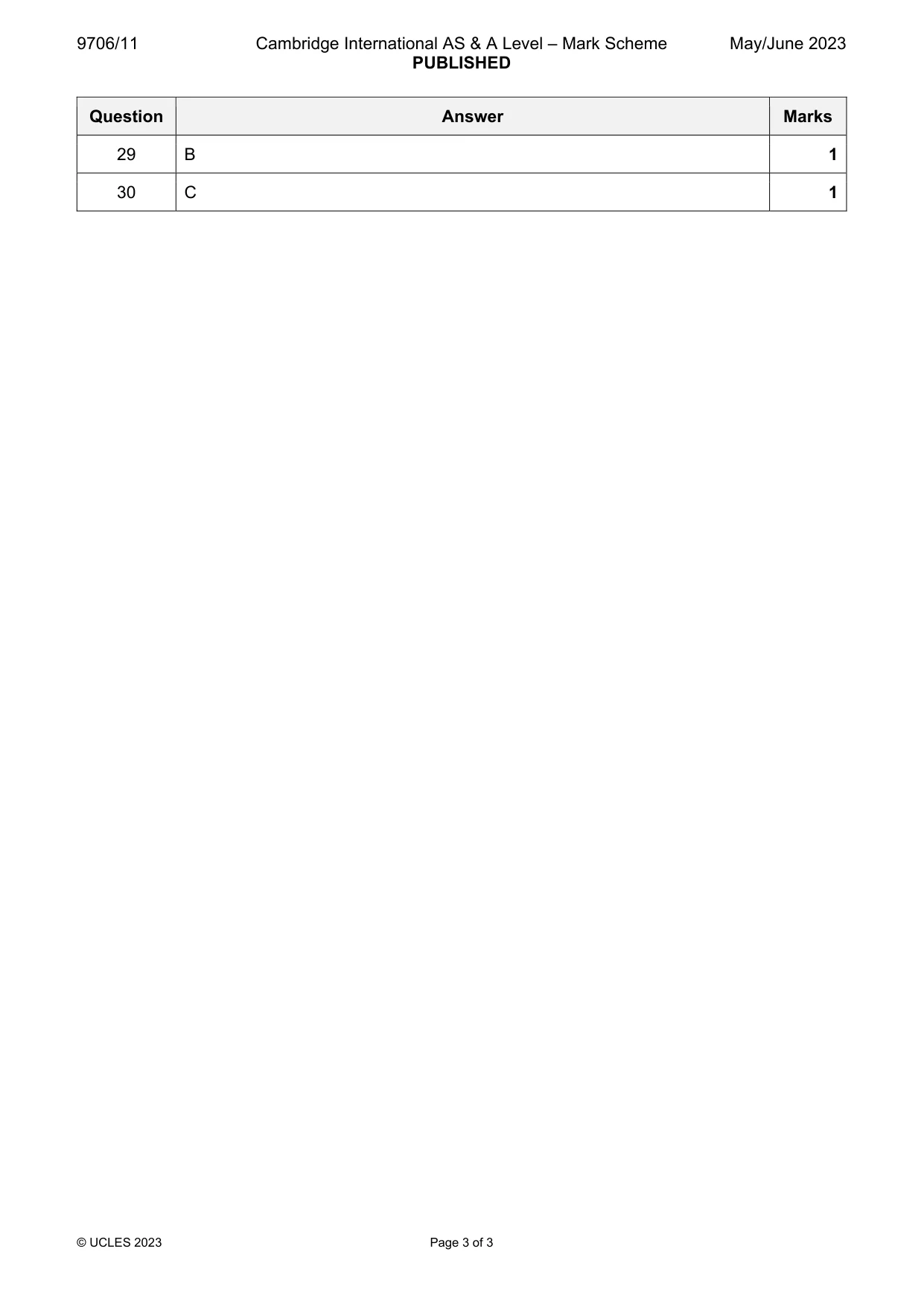
Mark scheme: B
Q30 · What is the purpose of cost–volume–profit analysis?
30 What is the purpose of cost–volume–profit analysis? A comparing actual and budgeted costs B organising resources in the most efficient way C planning to achieve targeted profit D preparing annual financial statements
Mark scheme: C
What was in this paper
The subtopics covered by these 30 questions, and how many questions each got. Open one in a new tab to see every Cambridge question on it.
What you needed in this session
Cambridge’s own grade thresholds for 2023 May/June, Paper 1 · Variant 1. A higher threshold means an easier paper — the bar moves with how the cohort did.