Cambridge A Level Accounting 9706 — 2016 May/June Paper 1 · Variant 1
9706/11/M/J/16 · 30 questions · 30 marks · ≈34 min
The question paper and its mark scheme, free to read here and free to download. This is Cambridge’s own paper, exactly as it was sat.
Question paper12 pages
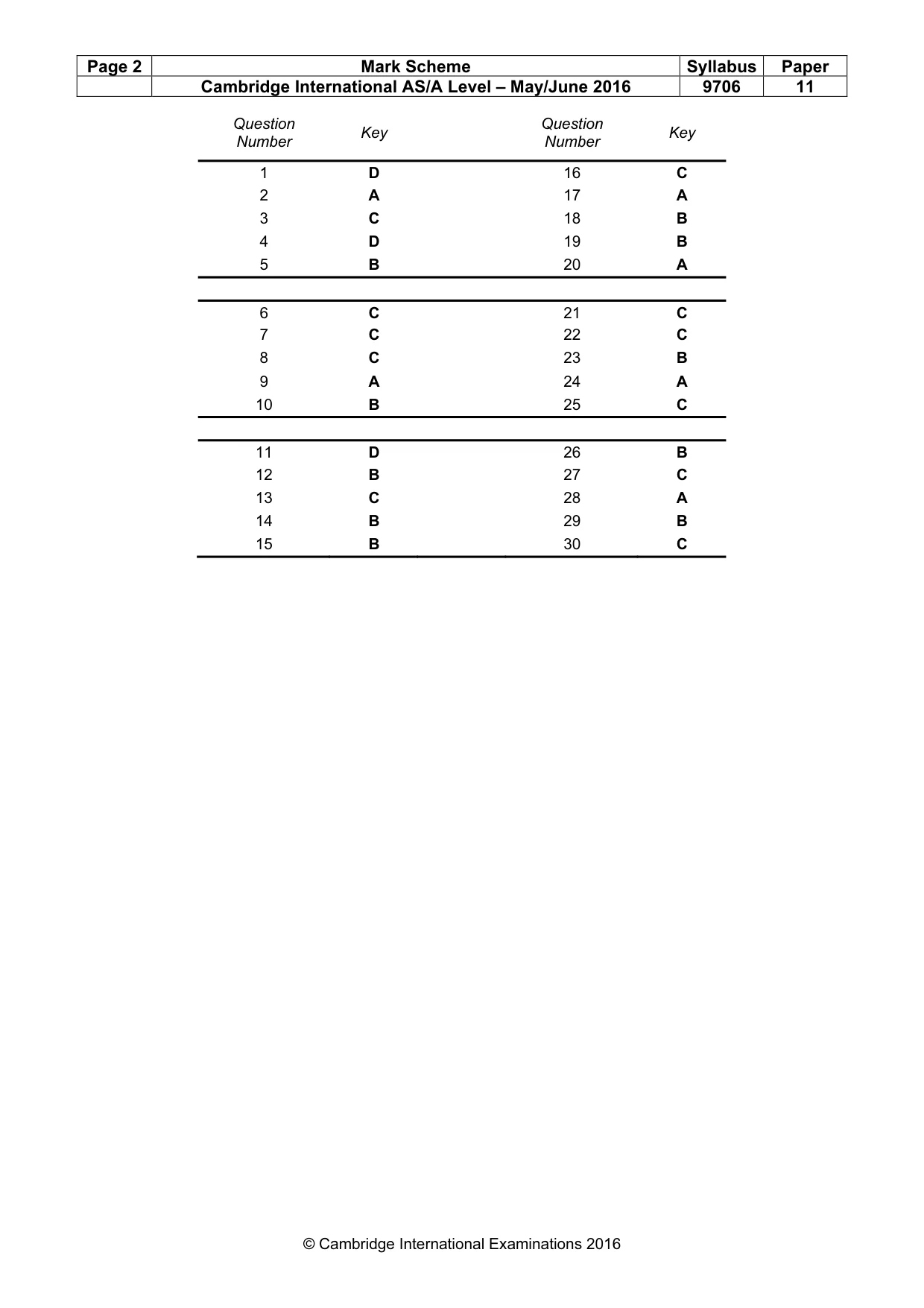
Mark scheme2 pages
Answers below. Sit the paper first if you are practising.
Questions as text
Q1 · Inventories are valued at the lower of cost and net realisable value in the statement of…
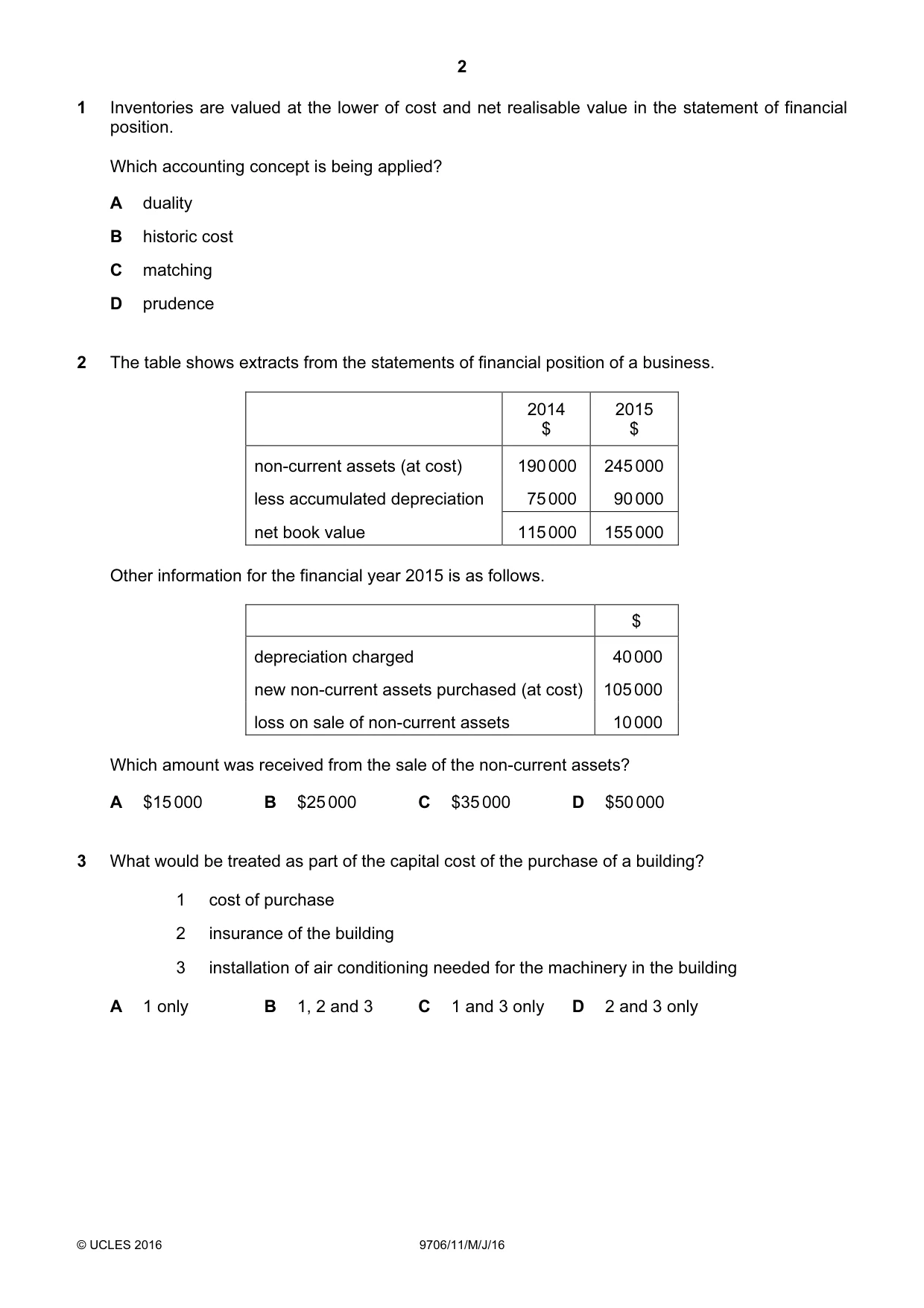
1 Inventories are valued at the lower of cost and net realisable value in the statement of financial position. Which accounting concept is being applied? A duality B historic cost C matching D prudence
Mark scheme: D
Q2 · The table shows extracts from the statements of financial position of a business
2 The table shows extracts from the statements of financial position of a business. 2014 2015 $ $ non-current assets (at cost) 190 000 245 000 less accumulated depreciation 75 000 90 000 net book value 115 000 155 000 Other information for the financial year 2015 is as follows. $ depreciation charged 40 000 new non-current assets purchased (at cost) 105 000 loss on sale of non-current assets 10 000 Which amount was received from the sale of the non-current assets? A $15 000 B $25 000 C $35 000 D $50 000
Mark scheme: A
Q3 · What would be treated as part of the capital cost of the purchase of a building?
3 What would be treated as part of the capital cost of the purchase of a building? 1 cost of purchase 2 insurance of the building 3 installation of air conditioning needed for the machinery in the building A 1 only B 1, 2 and 3 C 1 and 3 only D 2 and 3 only
Mark scheme: C
Q4 · The total of trade payables balances in Konrad’s purchases ledger was $57 400
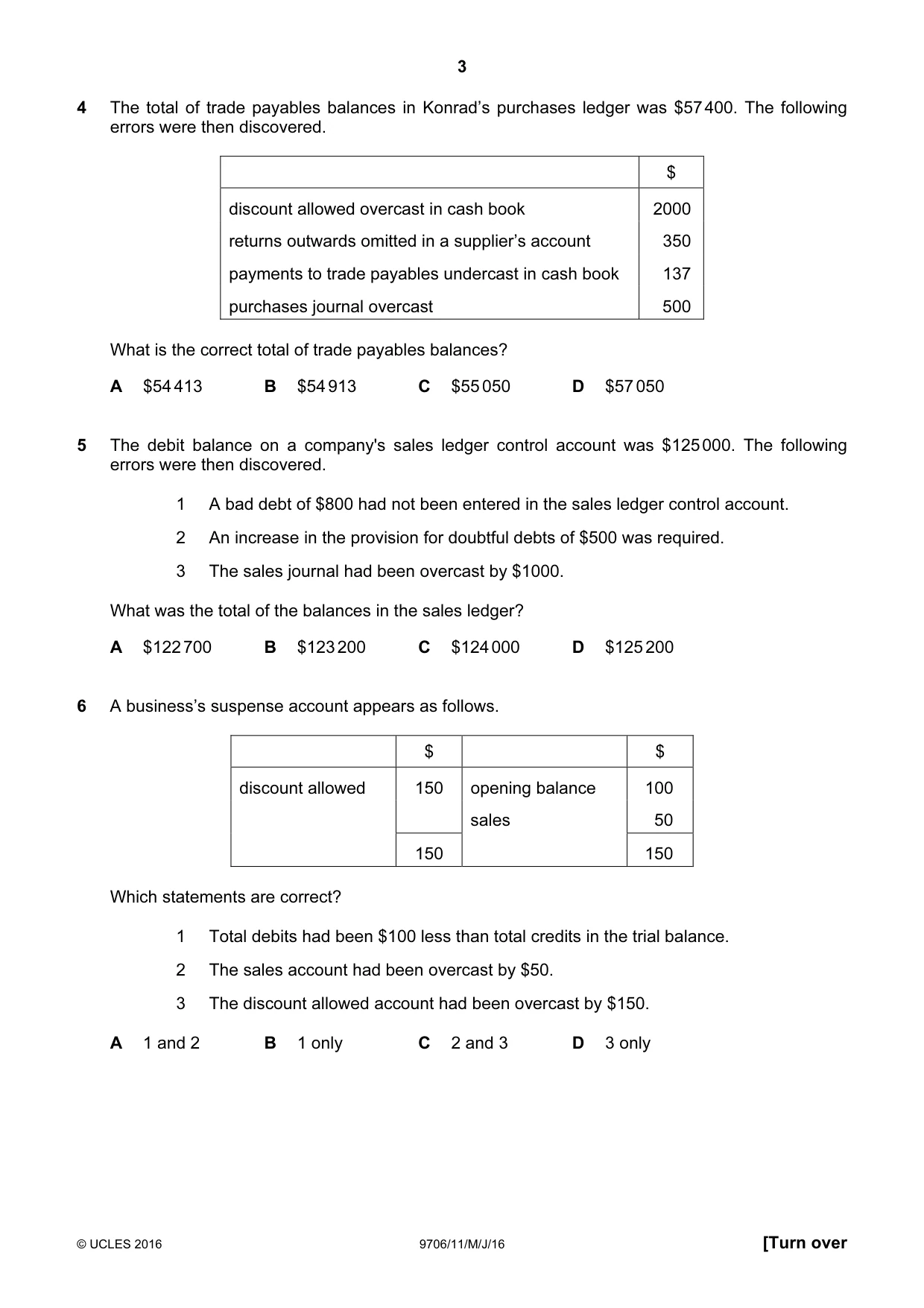
4 The total of trade payables balances in Konrad’s purchases ledger was $57 400. The following errors were then discovered. $ discount allowed overcast in cash book 2000 returns outwards omitted in a supplier’s account 350 payments to trade payables undercast in cash book 137 purchases journal overcast 500 What is the correct total of trade payables balances? A $54 413 B $54 913 C $55 050 D $57 050
Mark scheme: D
Q5 · The debit balance on a company's sales ledger control account was $125 000
5 The debit balance on a company's sales ledger control account was $125 000. The following errors were then discovered. 1 A bad debt of $800 had not been entered in the sales ledger control account. 2 An increase in the provision for doubtful debts of $500 was required. 3 The sales journal had been overcast by $1000. What was the total of the balances in the sales ledger? A $122 700 B $123 200 C $124 000 D $125 200
Mark scheme: B
Q6 · A business’s suspense account appears as follows
6 A business’s suspense account appears as follows. $ $ discount allowed 150 opening balance 100 sales 50 150 150 Which statements are correct? 1 Total debits had been $100 less than total credits in the trial balance. 2 The sales account had been overcast by $50. 3 The discount allowed account had been overcast by $150. A 1 and 2 B 1 only C 2 and 3 D 3 only
Mark scheme: C
Q7 · A bank statement shows a credit balance of $1500
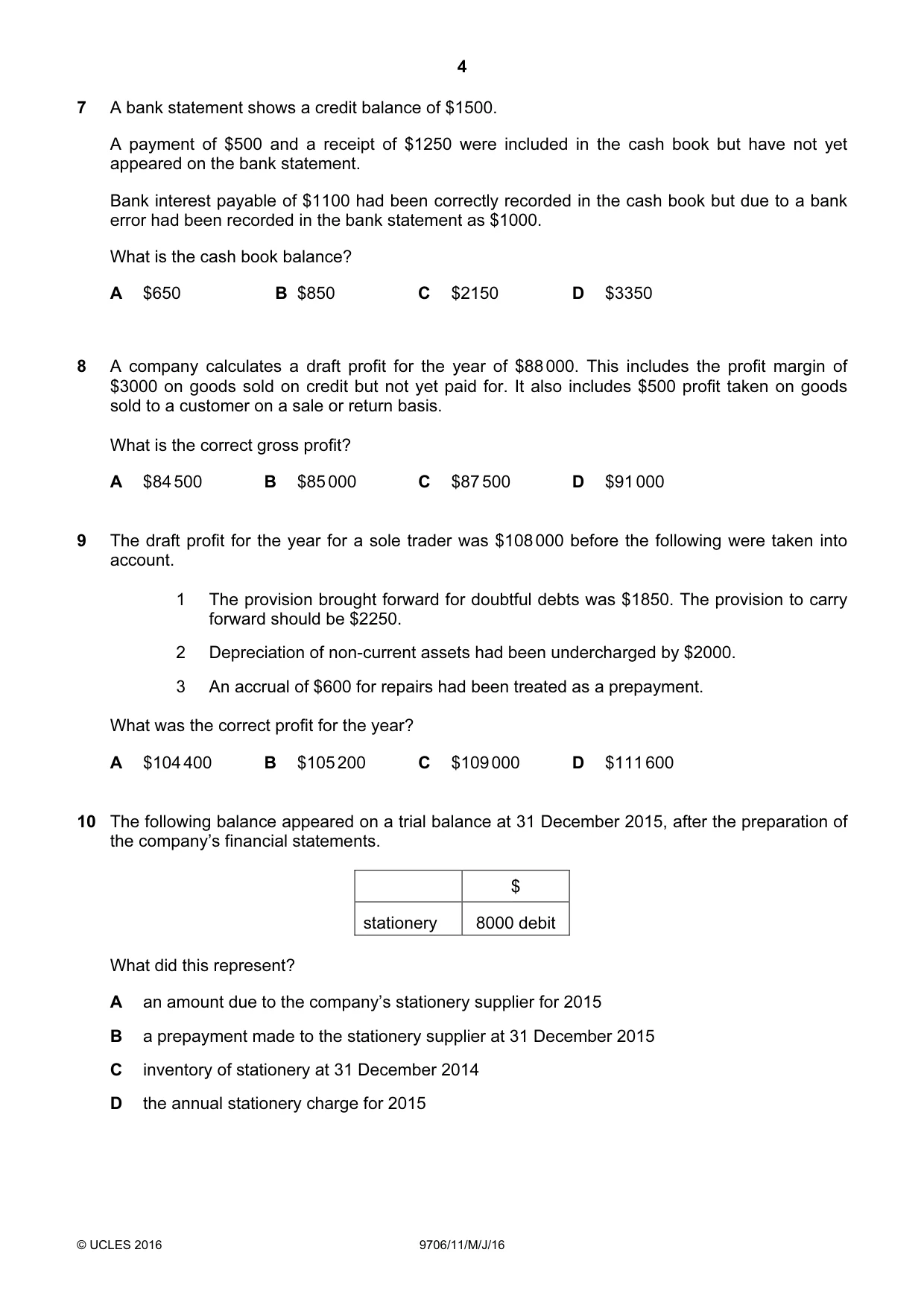
7 A bank statement shows a credit balance of $1500. A payment of $500 and a receipt of $1250 were included in the cash book but have not yet appeared on the bank statement. Bank interest payable of $1100 had been correctly recorded in the cash book but due to a bank error had been recorded in the bank statement as $1000. What is the cash book balance? A $650 B $850 C $2150 D $3350
Mark scheme: C
Q8 · A company calculates a draft profit for the year of $88 000
8 A company calculates a draft profit for the year of $88 000. This includes the profit margin of $3000 on goods sold on credit but not yet paid for. It also includes $500 profit taken on goods sold to a customer on a sale or return basis. What is the correct gross profit? A $84 500 B $85 000 C $87 500 D $91 000
Mark scheme: C
Q9 · The draft profit for the year for a sole trader was $108 000 before the following were…
9 The draft profit for the year for a sole trader was $108 000 before the following were taken into account. 1 The provision brought forward for doubtful debts was $1850. The provision to carry forward should be $2250. 2 Depreciation of non-current assets had been undercharged by $2000. 3 An accrual of $600 for repairs had been treated as a prepayment. What was the correct profit for the year? A $104 400 B $105 200 C $109 000 D $111 600
Mark scheme: A
Q10 · The following balance appeared on a trial balance at 31 December 2015, after the…
10 The following balance appeared on a trial balance at 31 December 2015, after the preparation of the company’s financial statements. $ stationery 8000 debit What did this represent? A an amount due to the company’s stationery supplier for 2015 B a prepayment made to the stationery supplier at 31 December 2015 C inventory of stationery at 31 December 2014 D the annual stationery charge for 2015
Mark scheme: B
Q11 · At 31 December the following information was available
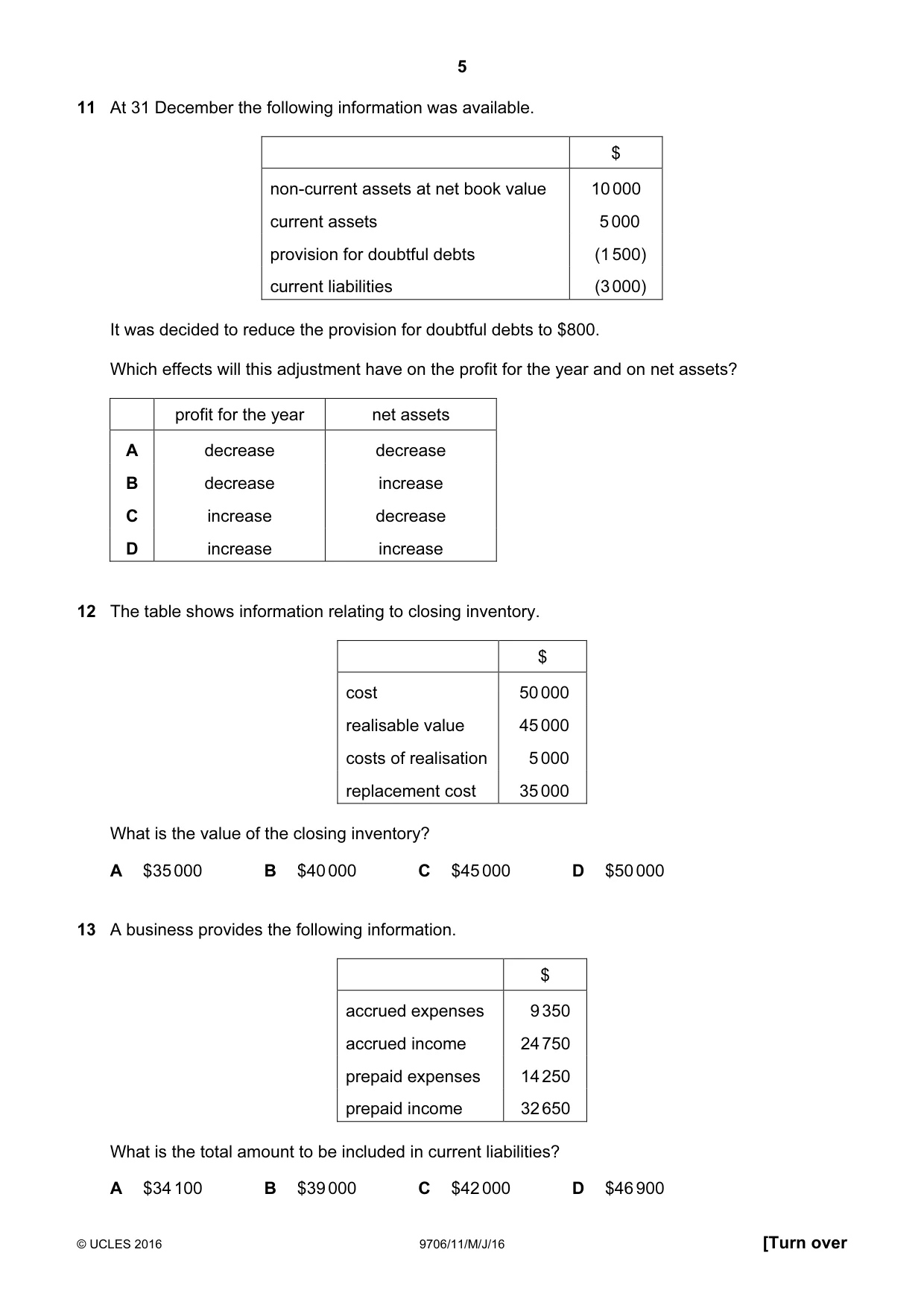
11 At 31 December the following information was available. $ non-current assets at net book value 10 000 current assets 5 000 provision for doubtful debts (1 500) current liabilities (3 000) It was decided to reduce the provision for doubtful debts to $800. Which effects will this adjustment have on the profit for the year and on net assets? profit for the year net assets A decrease decrease B decrease increase C increase decrease D increase increase
Mark scheme: D
Q12 · The table shows information relating to closing inventory
12 The table shows information relating to closing inventory. $ cost 50 000 realisable value 45 000 costs of realisation 5 000 replacement cost 35 000 What is the value of the closing inventory? A $35 000 B $40 000 C $45 000 D $50 000
Mark scheme: B
Q13 · A business provides the following information
13 A business provides the following information. $ accrued expenses 9 350 accrued income 24 750 prepaid expenses 14 250 prepaid income 32 650 What is the total amount to be included in current liabilities? A $34 100 B $39 000 C $42 000 D $46 900
Mark scheme: C
Q14 · The statement of financial position showed the following balances at 31 December 2015
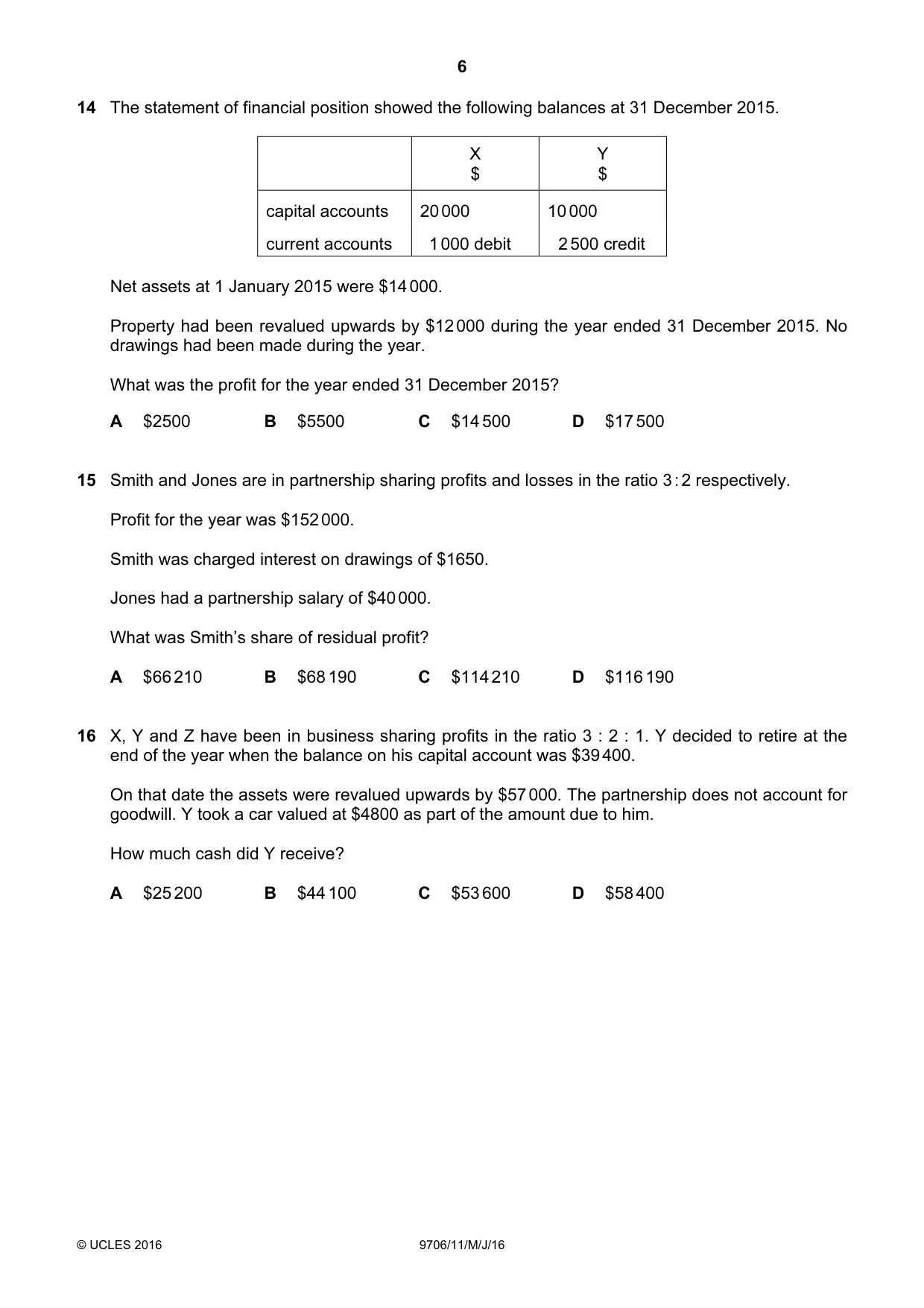
14 The statement of financial position showed the following balances at 31 December 2015. X Y $ $ capital accounts 20 000 10 000 current accounts 1 000 debit 2 500 credit Net assets at 1 January 2015 were $14 000. Property had been revalued upwards by $12 000 during the year ended 31 December 2015. No drawings had been made during the year. What was the profit for the year ended 31 December 2015? A $2500 B $5500 C $14 500 D $17 500
Mark scheme: B
Q15 · Smith and Jones are in partnership sharing profits and losses in the ratio 3 : 2…
15 Smith and Jones are in partnership sharing profits and losses in the ratio 3 : 2 respectively. Profit for the year was $152 000. Smith was charged interest on drawings of $1650. Jones had a partnership salary of $40 000. What was Smith’s share of residual profit? A $66 210 B $68 190 C $114 210 D $116 190
Mark scheme: B
Q16 · X, Y and Z have been in business sharing profits in the ratio 3 : 2 : 1
16 X, Y and Z have been in business sharing profits in the ratio 3 : 2 : 1. Y decided to retire at the end of the year when the balance on his capital account was $39 400. On that date the assets were revalued upwards by $57 000. The partnership does not account for goodwill. Y took a car valued at $4800 as part of the amount due to him. How much cash did Y receive? A $25 200 B $44 100 C $53 600 D $58 400
Mark scheme: C
Q17 · A company has a bank balance of $20 000
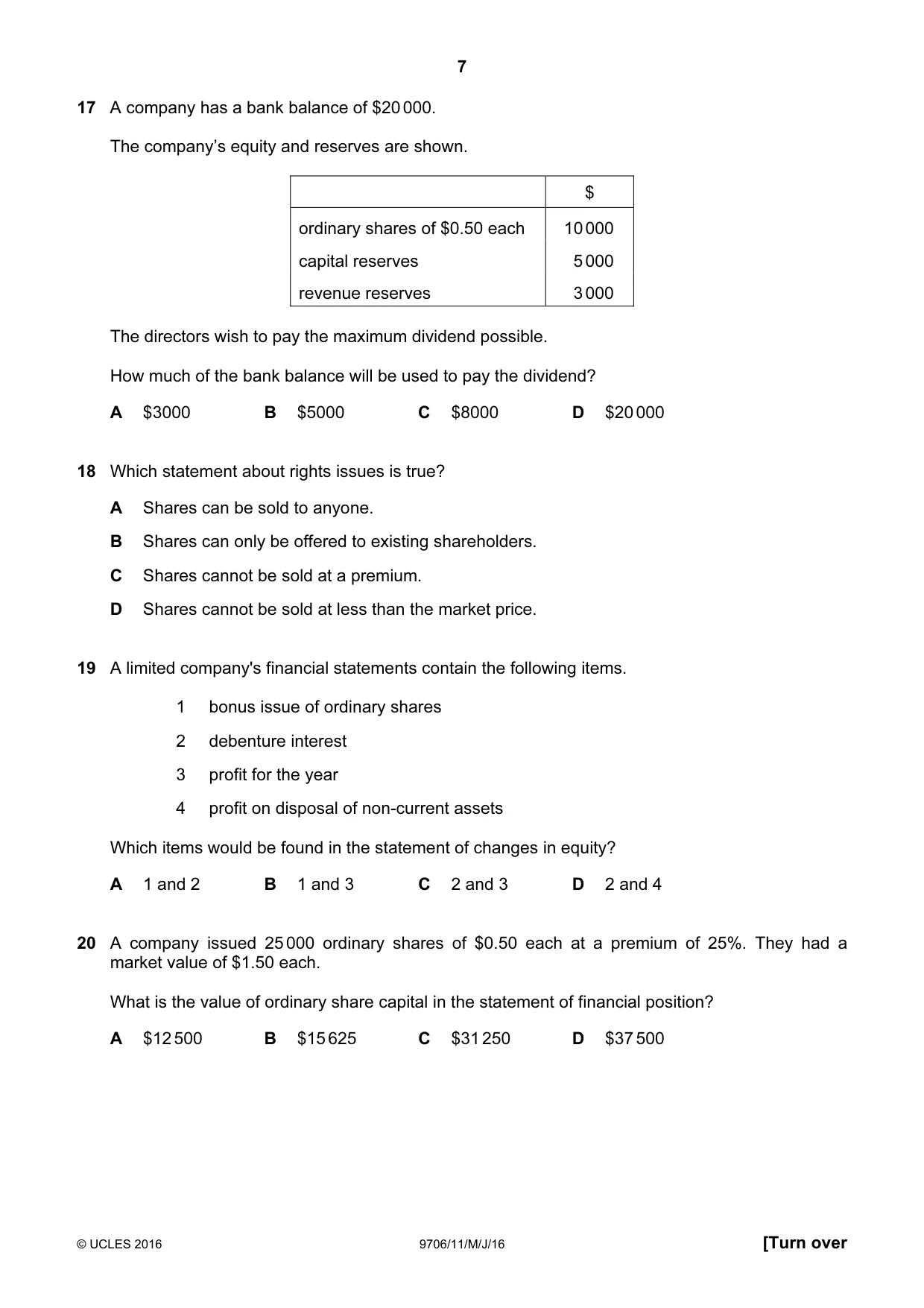
17 A company has a bank balance of $20 000. The company’s equity and reserves are shown. $ ordinary shares of $0.50 each 10 000 capital reserves 5 000 revenue reserves 3 000 The directors wish to pay the maximum dividend possible. How much of the bank balance will be used to pay the dividend? A $3000 B $5000 C $8000 D $20 000
Mark scheme: A
Q18 · Which statement about rights issues is true?
18 Which statement about rights issues is true? A Shares can be sold to anyone. B Shares can only be offered to existing shareholders. C Shares cannot be sold at a premium. D Shares cannot be sold at less than the market price.
Mark scheme: B
Q19 · A limited company's financial statements contain the following items
19 A limited company's financial statements contain the following items. 1 bonus issue of ordinary shares 2 debenture interest 3 profit for the year 4 profit on disposal of non-current assets Which items would be found in the statement of changes in equity? A 1 and 2 B 1 and 3 C 2 and 3 D 2 and 4
Mark scheme: B
Q20 · A company issued 25 000 ordinary shares of $0.50 each at a premium of 25%
20 A company issued 25 000 ordinary shares of $0.50 each at a premium of 25%. They had a market value of $1.50 each. What is the value of ordinary share capital in the statement of financial position? A $12 500 B $15 625 C $31 250 D $37 500
Mark scheme: A
Q21 · A company provides the following information
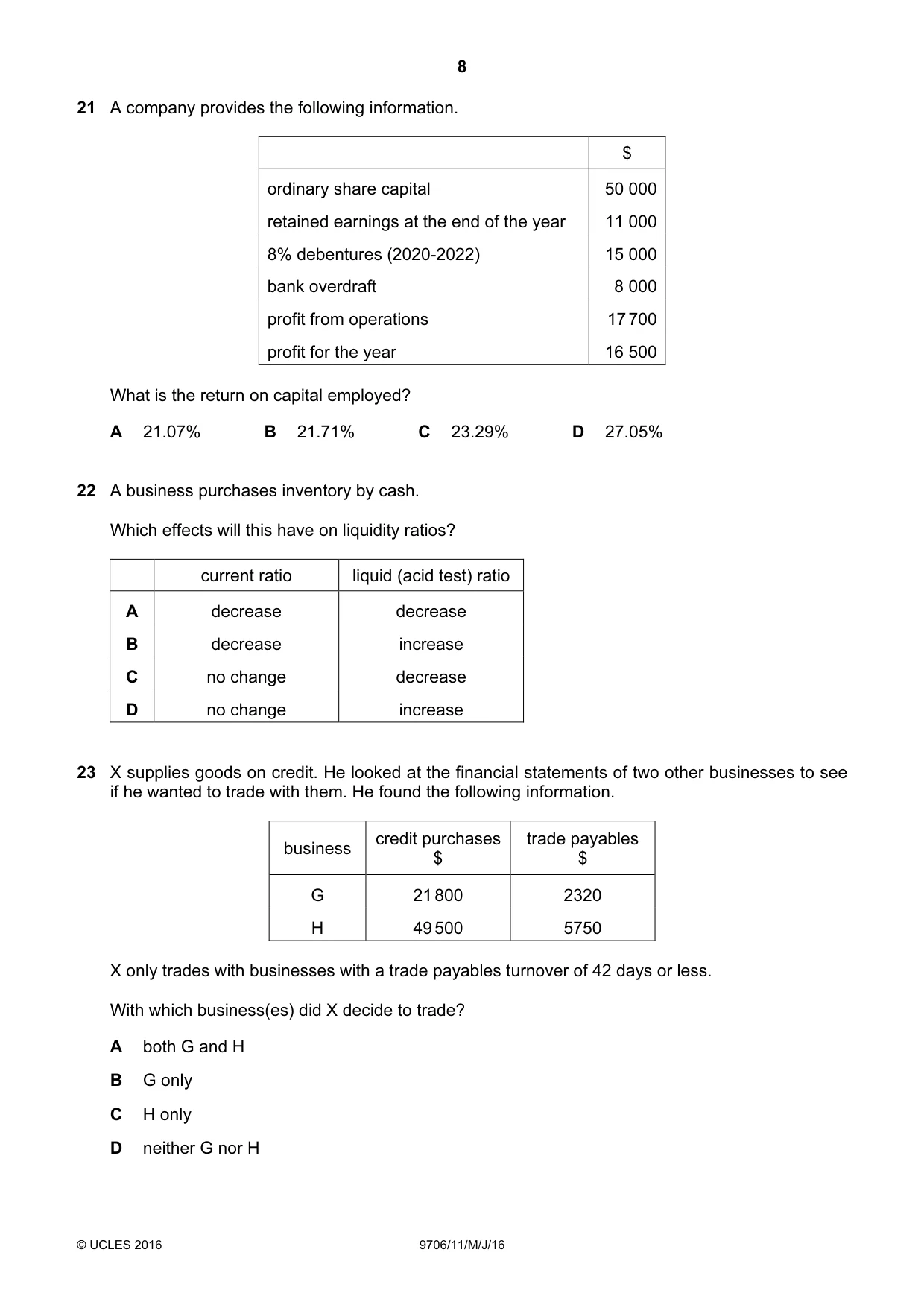
21 A company provides the following information. $ ordinary share capital 50 000 retained earnings at the end of the year 11 000 8% debentures (2020-2022) 15 000 bank overdraft 8 000 profit from operations 17 700 profit for the year 16 500 What is the return on capital employed? A 21.07% B 21.71% C 23.29% D 27.05%
Mark scheme: C
More questions on Analysis and communication of accounting information
Q22 · A business purchases inventory by cash
22 A business purchases inventory by cash. Which effects will this have on liquidity ratios? current ratio liquid (acid test) ratio A decrease decrease B decrease increase C no change decrease D no change increase
Mark scheme: C
More questions on Analysis and communication of accounting information
Q23 · X supplies goods on credit
23 X supplies goods on credit. He looked at the financial statements of two other businesses to see if he wanted to trade with them. He found the following information. credit purchases trade payables business $ $ G 21 800 2320 H 49 500 5750 X only trades with businesses with a trade payables turnover of 42 days or less. With which business(es) did X decide to trade? A both G and H B G only C H only D neither G nor H
Mark scheme: B
More questions on Analysis and communication of accounting information
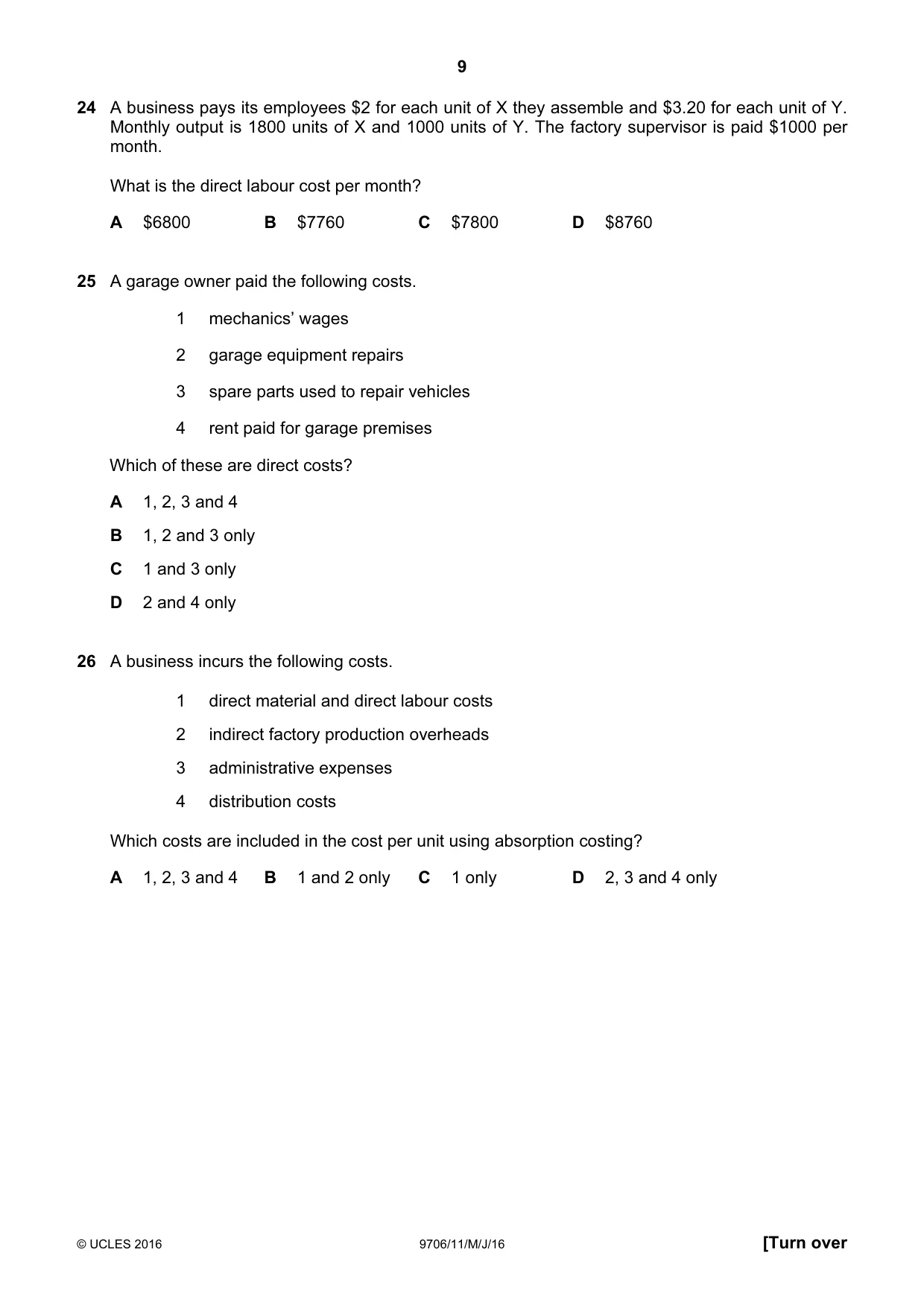
Q24 · A business pays its employees $2 for each unit of X they assemble and $3.20 for each unit…
24 A business pays its employees $2 for each unit of X they assemble and $3.20 for each unit of Y. Monthly output is 1800 units of X and 1000 units of Y. The factory supervisor is paid $1000 per month. What is the direct labour cost per month? A $6800 B $7760 C $7800 D $8760
Mark scheme: A
Q25 · A garage owner paid the following costs
25 A garage owner paid the following costs. 1 mechanics’ wages 2 garage equipment repairs 3 spare parts used to repair vehicles 4 rent paid for garage premises Which of these are direct costs? A 1, 2, 3 and 4 B 1, 2 and 3 only C 1 and 3 only D 2 and 4 only
Mark scheme: C
Q26 · A business incurs the following costs
26 A business incurs the following costs. 1 direct material and direct labour costs 2 indirect factory production overheads 3 administrative expenses 4 distribution costs Which costs are included in the cost per unit using absorption costing? A 1, 2, 3 and 4 B 1 and 2 only C 1 only D 2, 3 and 4 only
Mark scheme: B
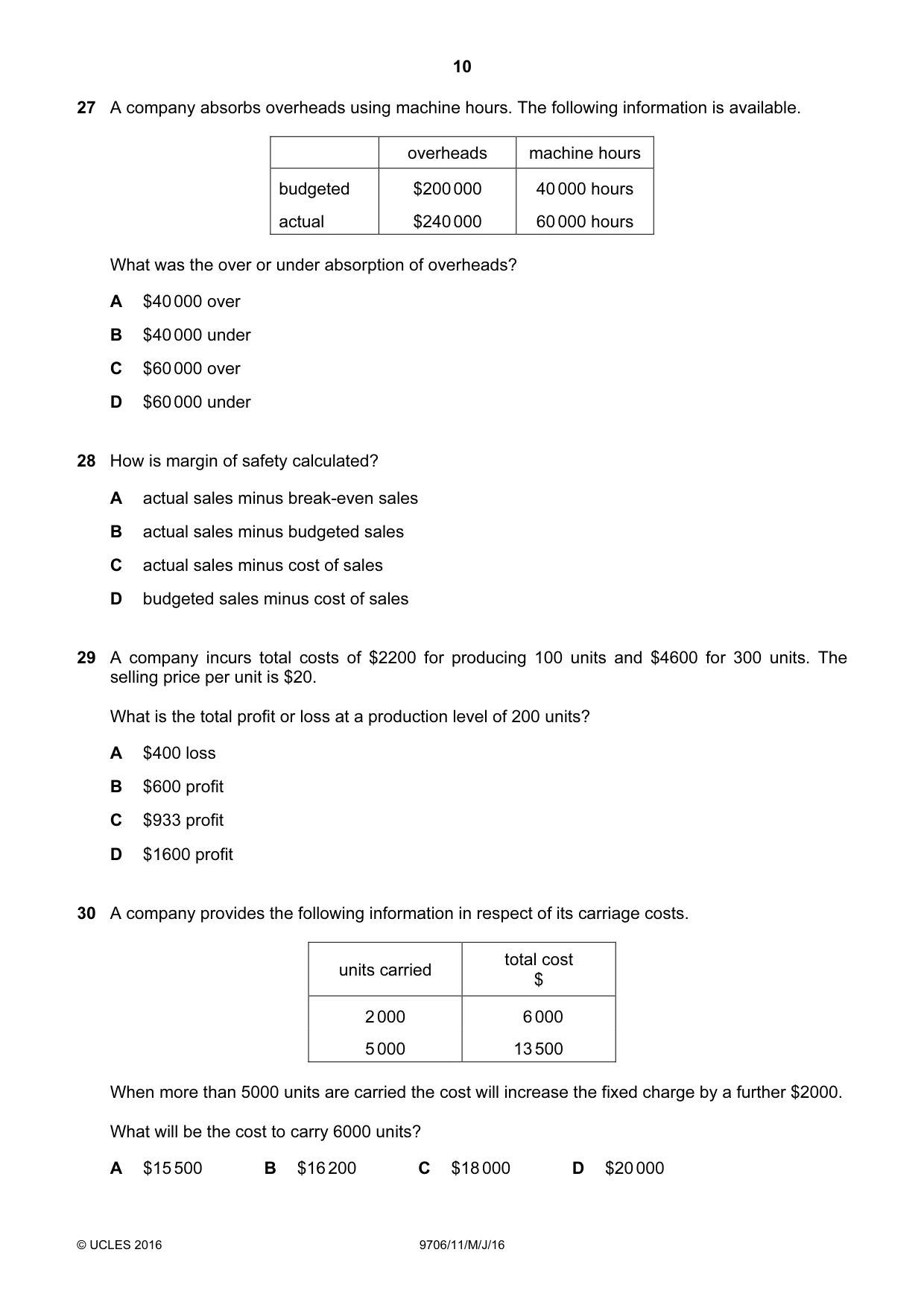
Q27 · A company absorbs overheads using machine hours
27 A company absorbs overheads using machine hours. The following information is available. overheads machine hours budgeted $200 000 40 000 hours actual $240 000 60 000 hours What was the over or under absorption of overheads? A $40 000 over B $40 000 under C $60 000 over D $60 000 under
Mark scheme: C
Q28 · How is margin of safety calculated?
28 How is margin of safety calculated? A actual sales minus break-even sales B actual sales minus budgeted sales C actual sales minus cost of sales D budgeted sales minus cost of sales
Mark scheme: A
Q29 · A company incurs total costs of $2200 for producing 100 units and $4600 for 300 units
29 A company incurs total costs of $2200 for producing 100 units and $4600 for 300 units. The selling price per unit is $20. What is the total profit or loss at a production level of 200 units? A $400 loss B $600 profit C $933 profit D $1600 profit
Mark scheme: B
Q30 · A company provides the following information in respect of its carriage costs
30 A company provides the following information in respect of its carriage costs. total cost units carried $ 2 000 6 000 5 000 13 500 When more than 5000 units are carried the cost will increase the fixed charge by a further $2000. What will be the cost to carry 6000 units? A $15 500 B $16 200 C $18 000 D $20 000
Mark scheme: C
What was in this paper
The subtopics covered by these 30 questions, and how many questions each got. Open one in a new tab to see every Cambridge question on it.
What you needed in this session
Cambridge’s own grade thresholds for 2016 May/June, Paper 1 · Variant 1. A higher threshold means an easier paper — the bar moves with how the cohort did.