Cambridge A Level Accounting 9706 — 2012 May/June Paper 1 · Variant 2
9706/12/M/J/12 · 30 questions · 30 marks · ≈34 min
The question paper and its mark scheme, free to read here and free to download. This is Cambridge’s own paper, exactly as it was sat.
Question paper12 pages
Mark scheme2 pages
Answers below. Sit the paper first if you are practising.
Questions as text
Q1 · Which statement is correct?
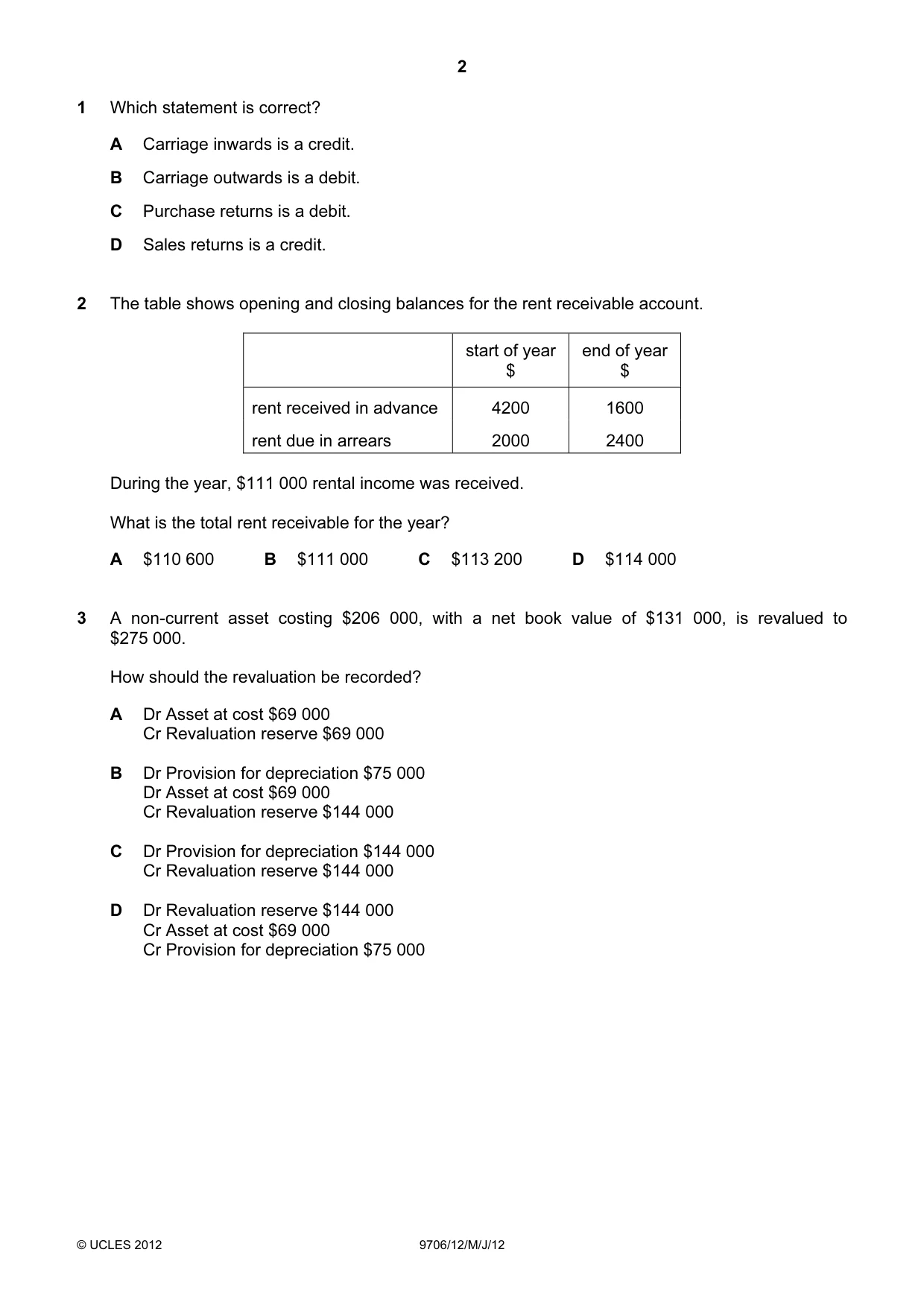
1 Which statement is correct? A Carriage inwards is a credit. B Carriage outwards is a debit. C Purchase returns is a debit. D Sales returns is a credit.
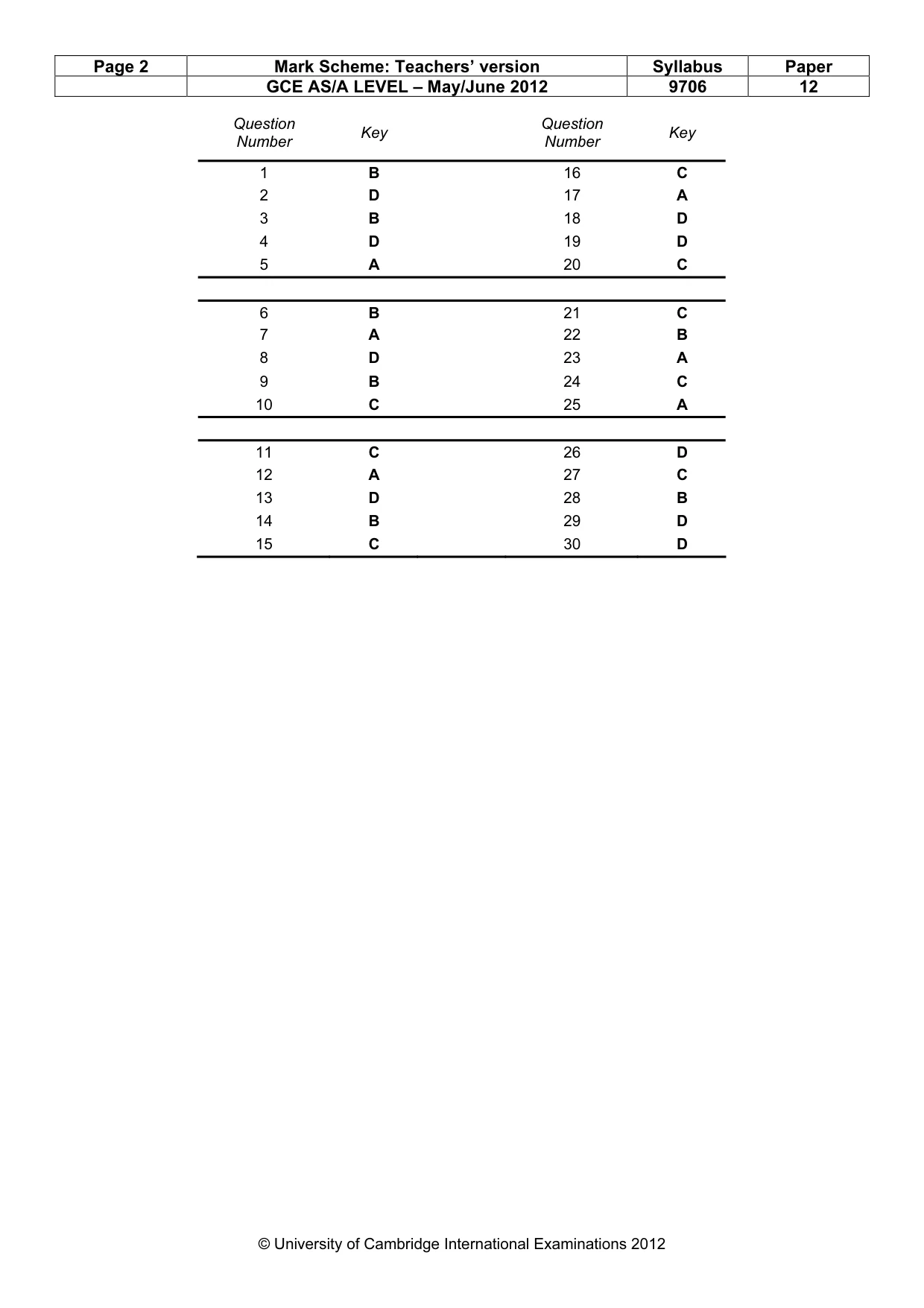
Mark scheme: B
Q2 · The table shows opening and closing balances for the rent receivable account
2 The table shows opening and closing balances for the rent receivable account. start of year end of year $ $ rent received in advance 4200 1600 rent due in arrears 2000 2400 During the year, $111 000 rental income was received. What is the total rent receivable for the year? A $110 600 B $111 000 C $113 200 D $114 000
Mark scheme: D
Q3 · A non-current asset costing $206 000, with a net book value of $131 000, is revalued to…
3 A non-current asset costing $206 000, with a net book value of $131 000, is revalued to $275 000. How should the revaluation be recorded? A Dr Asset at cost $69 000 Cr Revaluation reserve $69 000 B Dr Provision for depreciation $75 000 Dr Asset at cost $69 000 Cr Revaluation reserve $144 000 C Dr Provision for depreciation $144 000 Cr Revaluation reserve $144 000 D Dr Revaluation reserve $144 000 Cr Asset at cost $69 000 Cr Provision for depreciation $75 000
Mark scheme: B
Q4 · A business buys a machine on hire purchase for $50 000
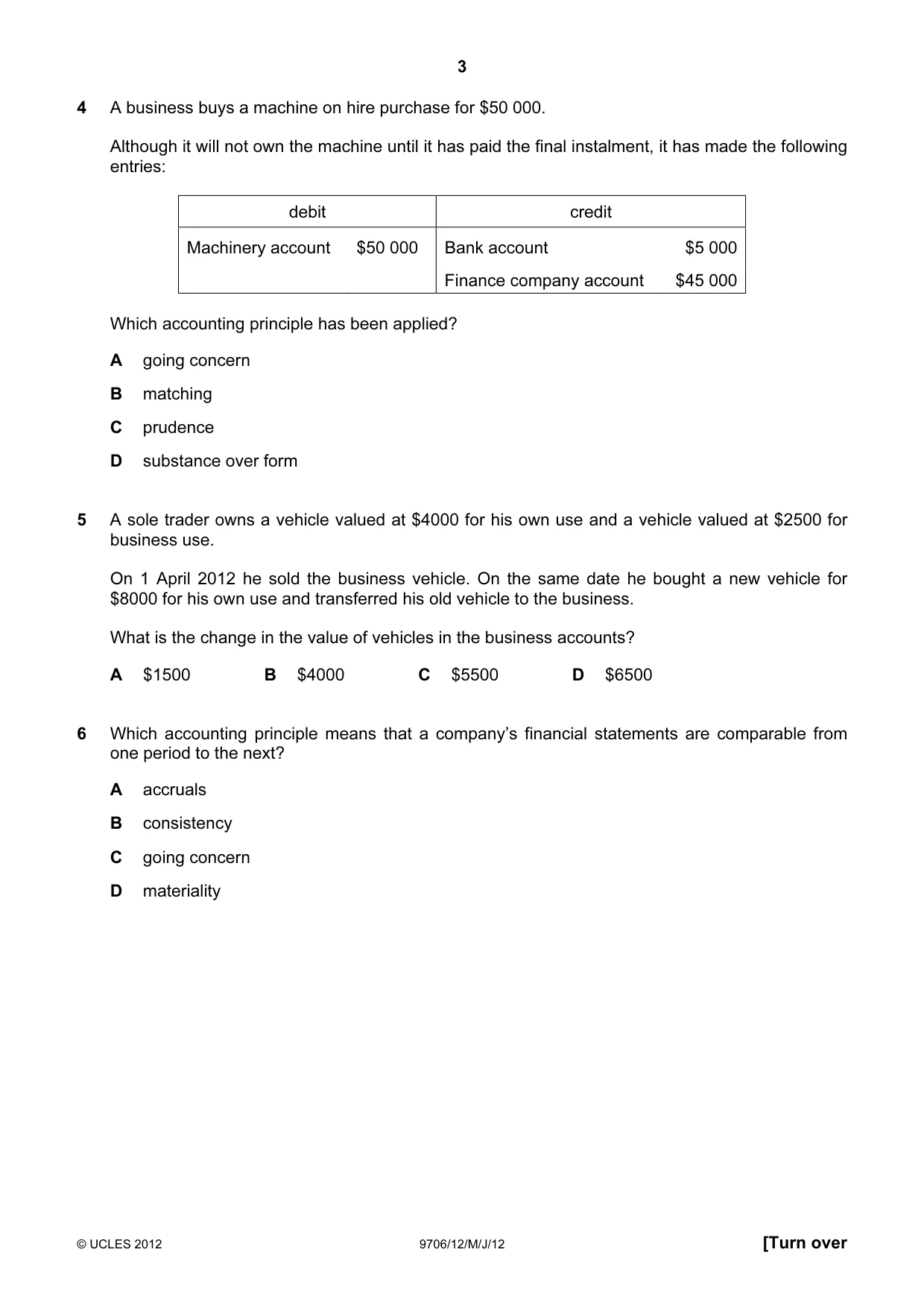
4 A business buys a machine on hire purchase for $50 000. Although it will not own the machine until it has paid the final instalment, it has made the following entries: debit credit Machinery account $50 000 Bank account $5 000 Finance company account $45 000 Which accounting principle has been applied? A going concern B matching C prudence D substance over form
Mark scheme: D
Q5 · A sole trader owns a vehicle valued at $4000 for his own use and a vehicle valued at…
5 A sole trader owns a vehicle valued at $4000 for his own use and a vehicle valued at $2500 for business use. On 1 April 2012 he sold the business vehicle. On the same date he bought a new vehicle for $8000 for his own use and transferred his old vehicle to the business. What is the change in the value of vehicles in the business accounts? A $1500 B $4000 C $5500 D $6500
Mark scheme: A
Q6 · Which accounting principle means that a company’s financial statements are comparable…
6 Which accounting principle means that a company’s financial statements are comparable from one period to the next? A accruals B consistency C going concern D materiality
Mark scheme: B
Q7 · The table shows details relating to a company’s banking transactions at 31 December
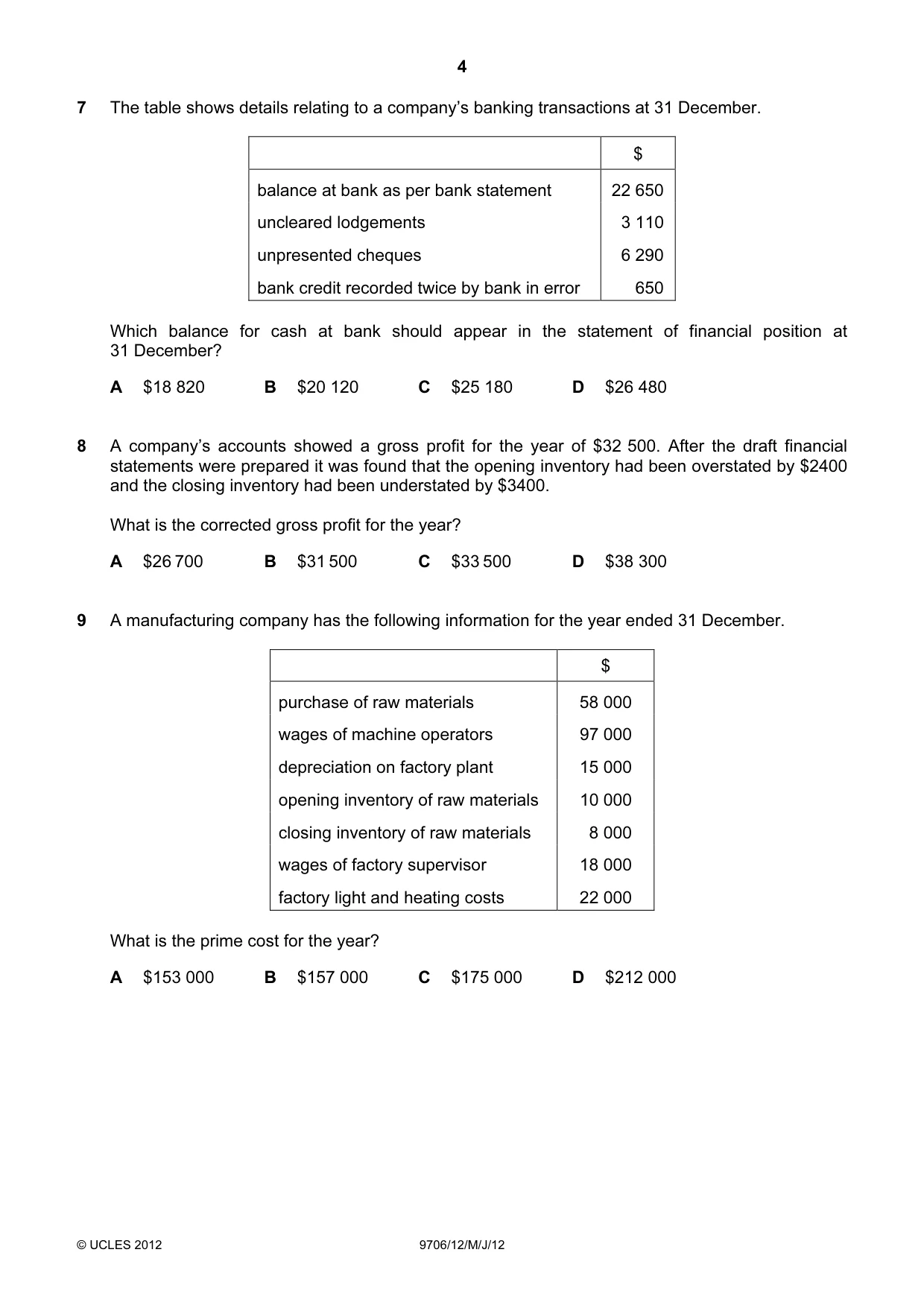
7 The table shows details relating to a company’s banking transactions at 31 December. $ balance at bank as per bank statement 22 650 uncleared lodgements 3 110 unpresented cheques 6 290 bank credit recorded twice by bank in error 650 Which balance for cash at bank should appear in the statement of financial position at 31 December? A $18 820 B $20 120 C $25 180 D $26 480
Mark scheme: A
Q8 · A company’s accounts showed a gross profit for the year of $32 500
8 A company’s accounts showed a gross profit for the year of $32 500. After the draft financial statements were prepared it was found that the opening inventory had been overstated by $2400 and the closing inventory had been understated by $3400. What is the corrected gross profit for the year? A $26 700 B $31 500 C $33 500 D $38 300
Mark scheme: D
Q9 · A manufacturing company has the following information for the year ended 31 December
9 A manufacturing company has the following information for the year ended 31 December. $ purchase of raw materials 58 000 wages of machine operators 97 000 depreciation on factory plant 15 000 opening inventory of raw materials 10 000 closing inventory of raw materials 8 000 wages of factory supervisor 18 000 factory light and heating costs 22 000 What is the prime cost for the year? A $153 000 B $157 000 C $175 000 D $212 000
Mark scheme: B
Q10 · The table shows information about four partners in a partnership
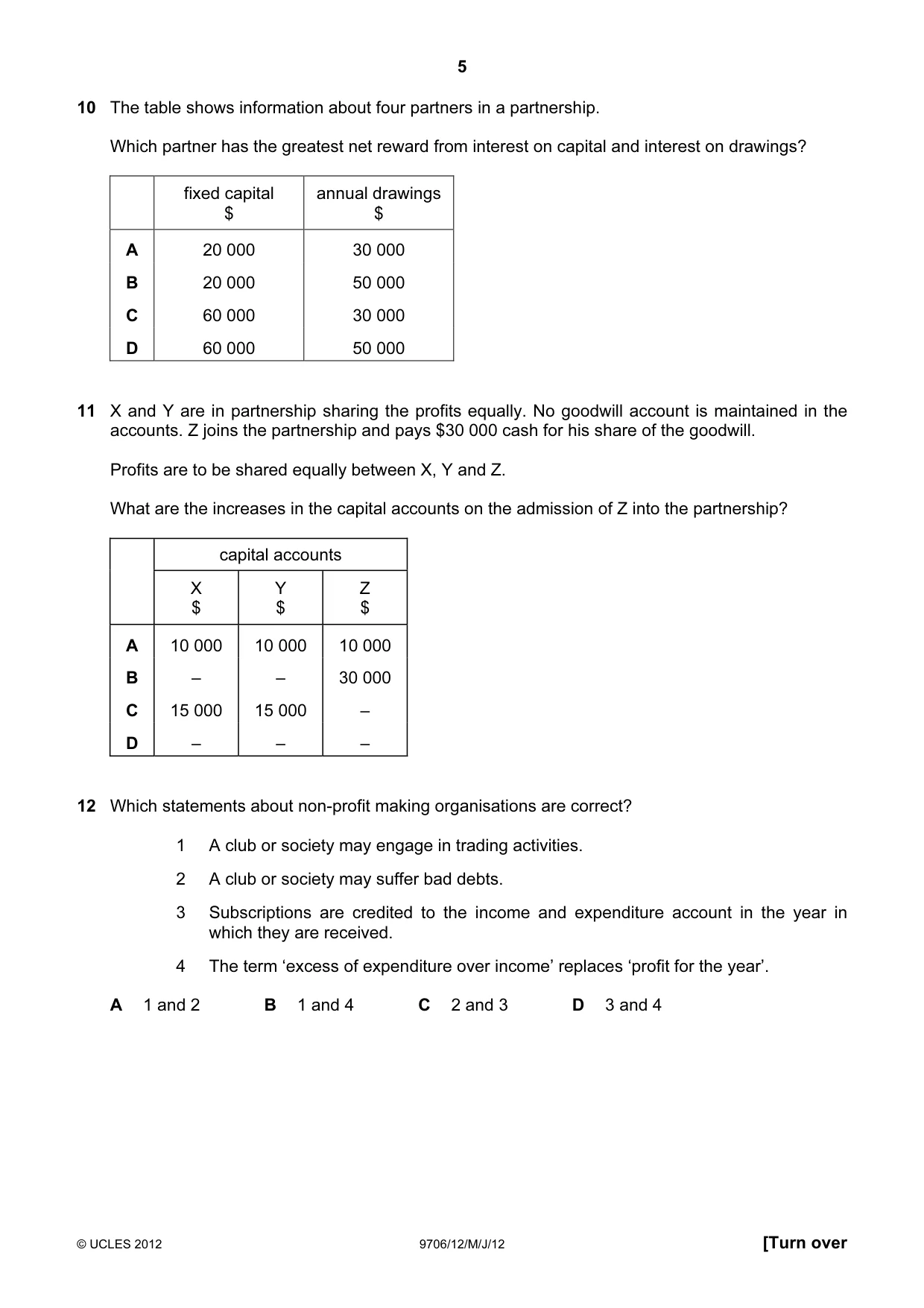
10 The table shows information about four partners in a partnership. Which partner has the greatest net reward from interest on capital and interest on drawings? fixed capital annual drawings $ $ A 20 000 30 000 B 20 000 50 000 C 60 000 30 000 D 60 000 50 000
Mark scheme: C
Q11 · X and Y are in partnership sharing the profits equally
11 X and Y are in partnership sharing the profits equally. No goodwill account is maintained in the accounts. Z joins the partnership and pays $30 000 cash for his share of the goodwill. Profits are to be shared equally between X, Y and Z. What are the increases in the capital accounts on the admission of Z into the partnership? capital accounts X Y Z $ $ $ A 10 000 10 000 10 000 B – – 30 000 C 15 000 15 000 – D – – –
Mark scheme: C
Q12 · Which statements about non-profit making organisations are correct?
12 Which statements about non-profit making organisations are correct? 1 A club or society may engage in trading activities. 2 A club or society may suffer bad debts. 3 Subscriptions are credited to the income and expenditure account in the year in which they are received. 4 The term ‘excess of expenditure over income’ replaces ‘profit for the year’. A 1 and 2 B 1 and 4 C 2 and 3 D 3 and 4
Mark scheme: A
Q13 · A business sells goods at cost plus 25 %
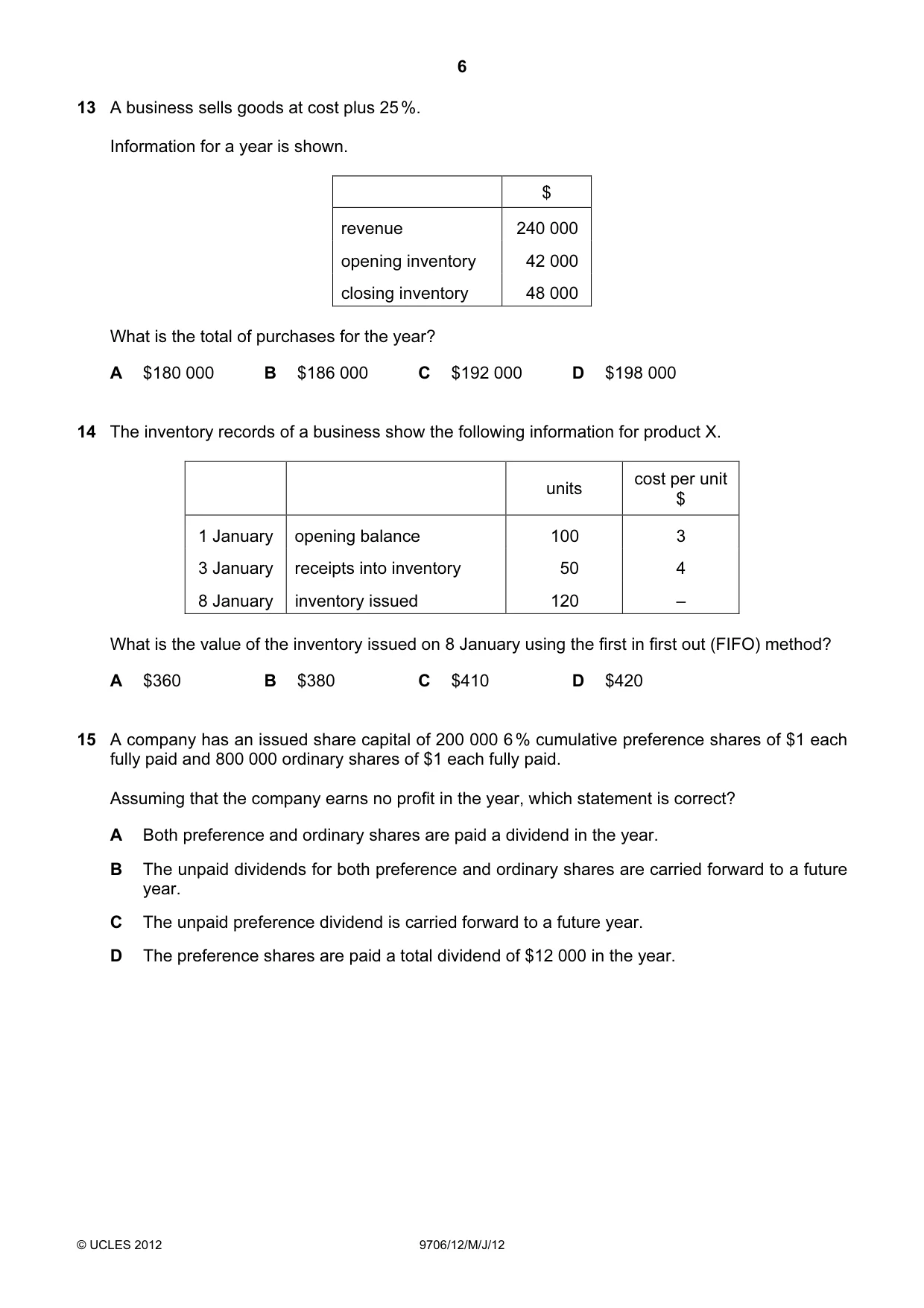
13 A business sells goods at cost plus 25 %. Information for a year is shown. $ revenue 240 000 opening inventory 42 000 closing inventory 48 000 What is the total of purchases for the year? A $180 000 B $186 000 C $192 000 D $198 000
Mark scheme: D
Q14 · The inventory records of a business show the following information for product X
14 The inventory records of a business show the following information for product X. cost per unit units $ 1 January opening balance 100 3 3 January receipts into inventory 50 4 8 January inventory issued 120 – What is the value of the inventory issued on 8 January using the first in first out (FIFO) method? A $360 B $380 C $410 D $420
Mark scheme: B
Q15 · A company has an issued share capital of 200 000 6 % cumulative preference shares of $1…
15 A company has an issued share capital of 200 000 6 % cumulative preference shares of $1 each fully paid and 800 000 ordinary shares of $1 each fully paid. Assuming that the company earns no profit in the year, which statement is correct? A Both preference and ordinary shares are paid a dividend in the year. B The unpaid dividends for both preference and ordinary shares are carried forward to a future year. C The unpaid preference dividend is carried forward to a future year. D The preference shares are paid a total dividend of $12 000 in the year.
Mark scheme: C
Q16 · A company raises finance by issuing debentures
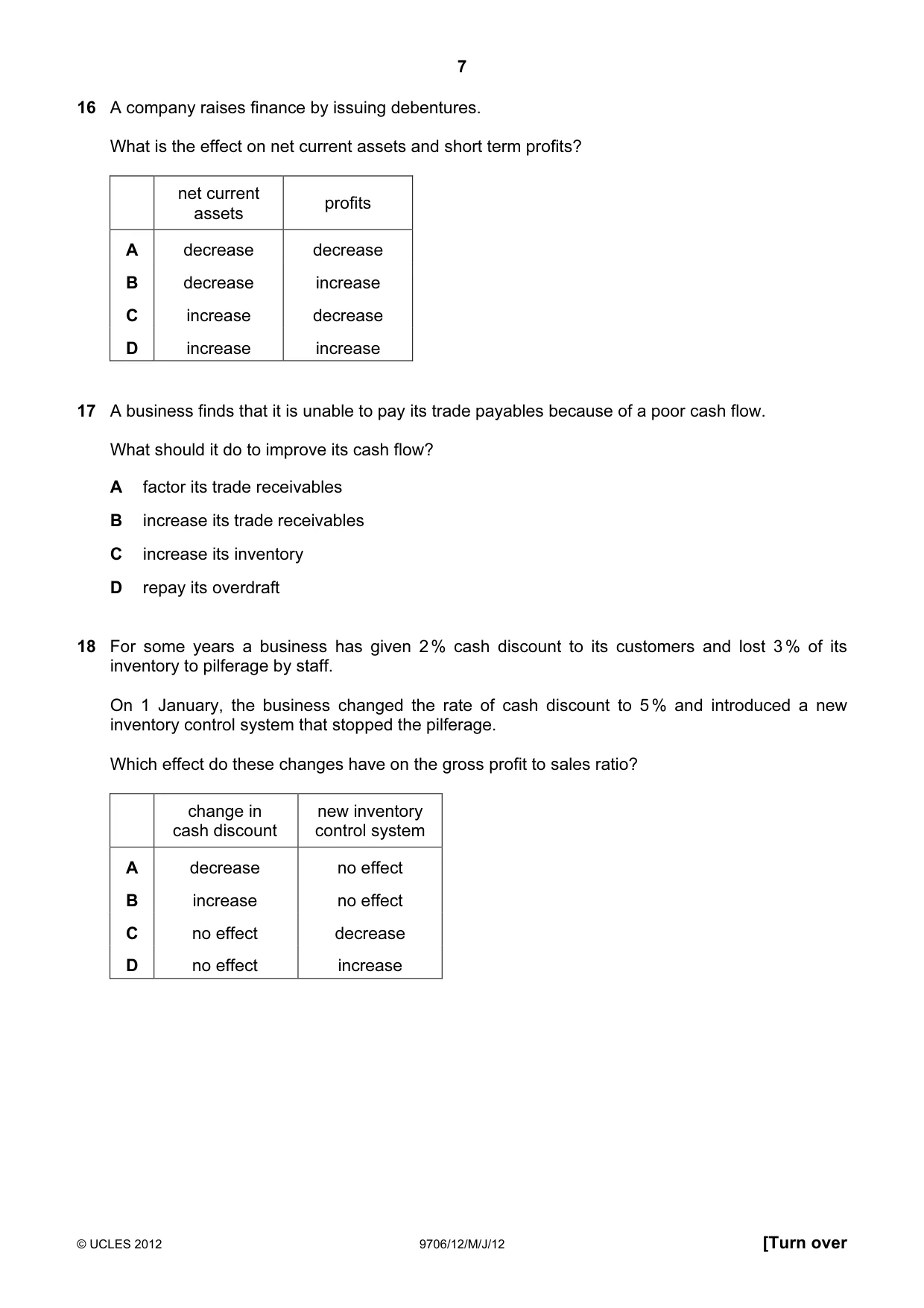
16 A company raises finance by issuing debentures. What is the effect on net current assets and short term profits? net current profits assets A decrease decrease B decrease increase C increase decrease D increase increase
Mark scheme: C
More questions on Analysis and communication of accounting information
Q17 · A business finds that it is unable to pay its trade payables because of a poor cash flow
17 A business finds that it is unable to pay its trade payables because of a poor cash flow. What should it do to improve its cash flow? A factor its trade receivables B increase its trade receivables C increase its inventory D repay its overdraft
Mark scheme: A
More questions on Analysis and communication of accounting information
Q18 · For some years a business has given 2 % cash discount to its customers and lost 3 % of…
18 For some years a business has given 2 % cash discount to its customers and lost 3 % of its inventory to pilferage by staff. On 1 January, the business changed the rate of cash discount to 5 % and introduced a new inventory control system that stopped the pilferage. Which effect do these changes have on the gross profit to sales ratio? change in new inventory cash discount control system A decrease no effect B increase no effect C no effect decrease D no effect increase
Mark scheme: D
More questions on Analysis and communication of accounting information
Q19 · The table gives information about a company
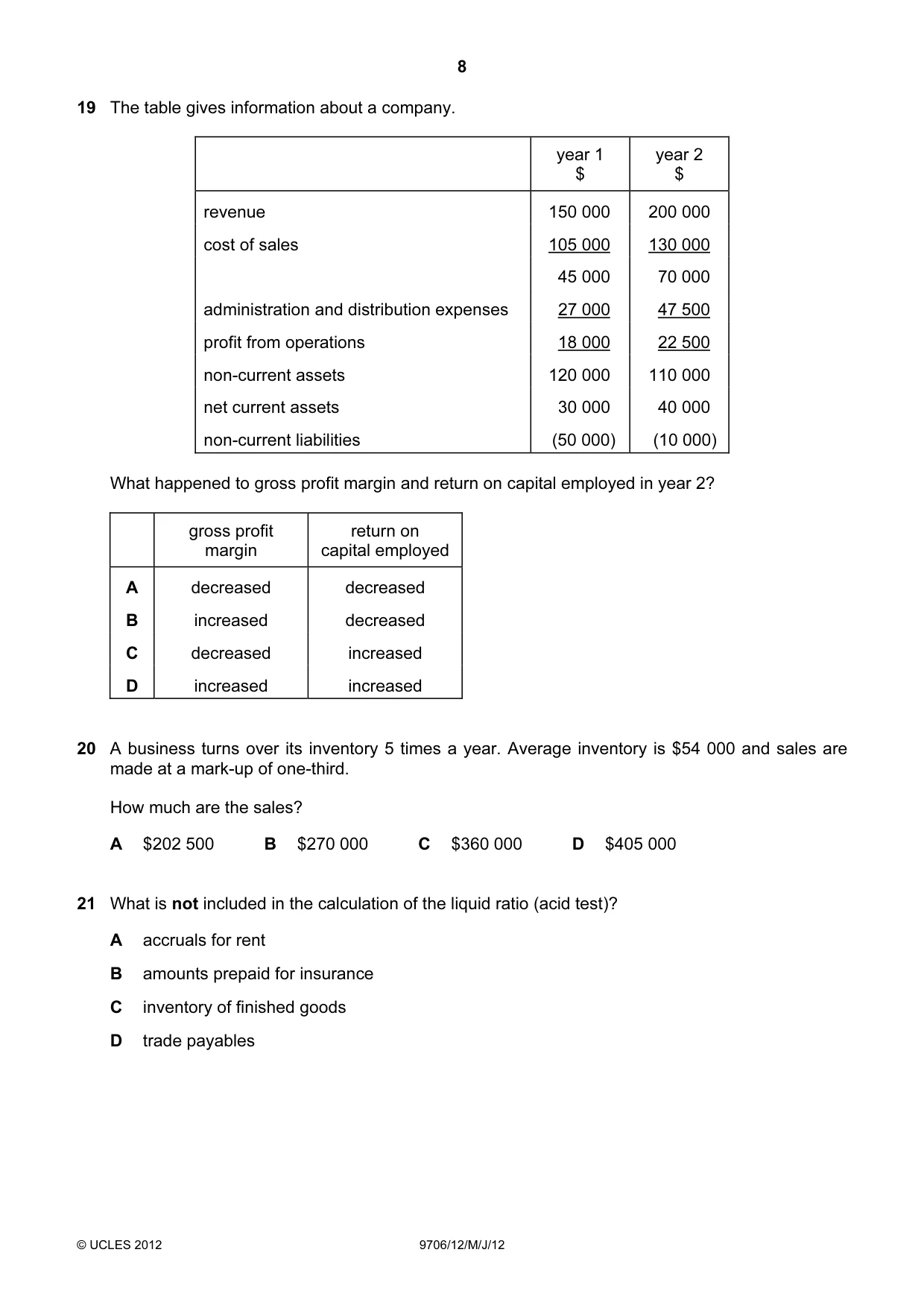
19 The table gives information about a company. year 1 year 2 $ $ revenue 150 000 200 000 cost of sales 105 000 130 000 45 000 70 000 administration and distribution expenses 27 000 47 500 profit from operations 18 000 22 500 non-current assets 120 000 110 000 net current assets 30 000 40 000 non-current liabilities (50 000) (10 000) What happened to gross profit margin and return on capital employed in year 2? gross profit return on margin capital employed A decreased decreased B increased decreased C decreased increased D increased increased
Mark scheme: D
More questions on Analysis and communication of accounting information
Q20 · A business turns over its inventory 5 times a year
20 A business turns over its inventory 5 times a year. Average inventory is $54 000 and sales are made at a mark-up of one-third. How much are the sales? A $202 500 B $270 000 C $360 000 D $405 000
Mark scheme: C
More questions on Analysis and communication of accounting information
Q21 · What is not included in the calculation of the liquid ratio (acid test)?
21 What is not included in the calculation of the liquid ratio (acid test)? A accruals for rent B amounts prepaid for insurance C inventory of finished goods D trade payables
Mark scheme: C
More questions on Analysis and communication of accounting information
Q22 · The owner of a business has to decide whether to sell a particular type of product
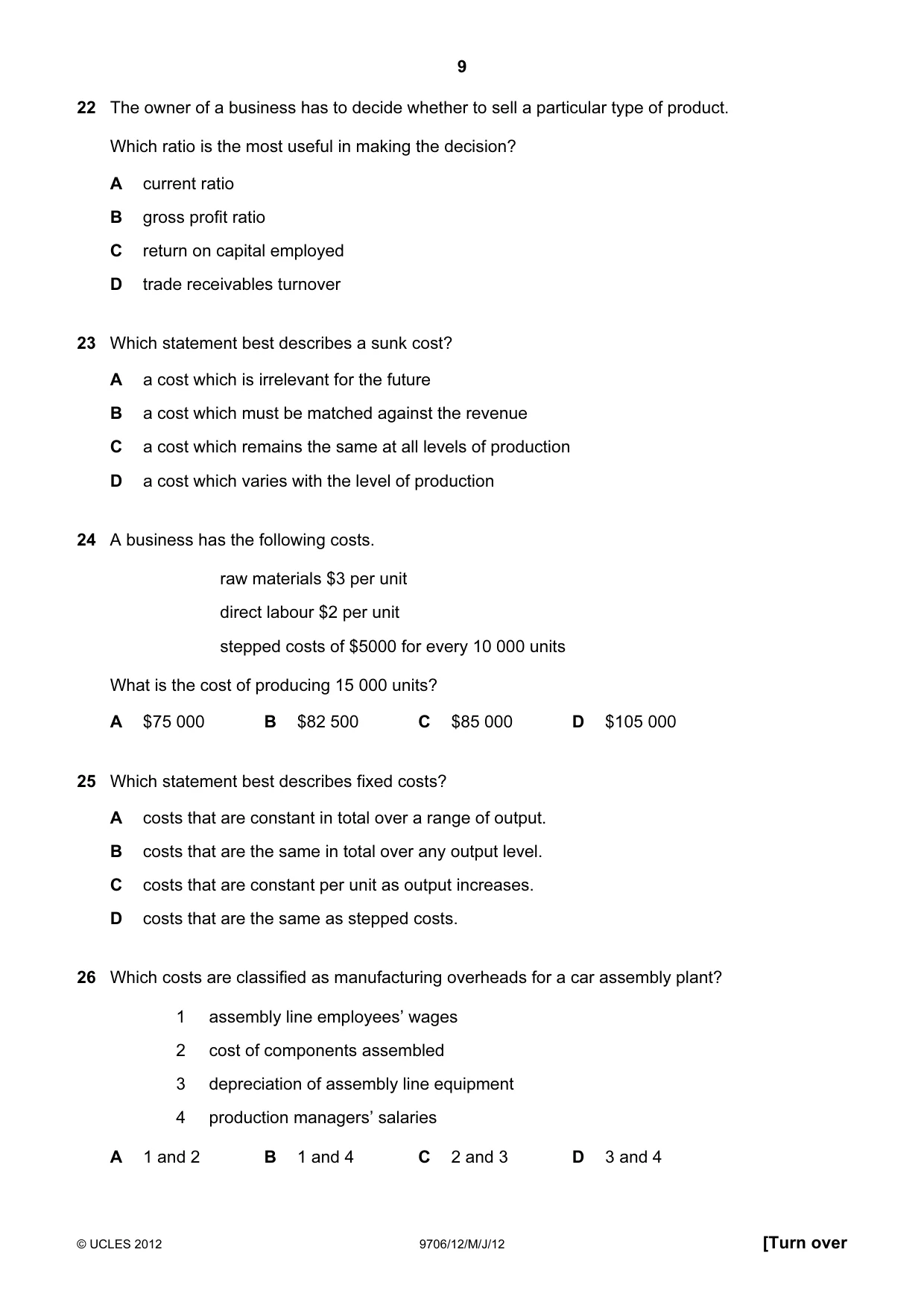
22 The owner of a business has to decide whether to sell a particular type of product. Which ratio is the most useful in making the decision? A current ratio B gross profit ratio C return on capital employed D trade receivables turnover
Mark scheme: B
More questions on Analysis and communication of accounting information
Q23 · Which statement best describes a sunk cost?
23 Which statement best describes a sunk cost? A a cost which is irrelevant for the future B a cost which must be matched against the revenue C a cost which remains the same at all levels of production D a cost which varies with the level of production
Mark scheme: A
Q24 · A business has the following costs
24 A business has the following costs. raw materials $3 per unit direct labour $2 per unit stepped costs of $5000 for every 10 000 units What is the cost of producing 15 000 units? A $75 000 B $82 500 C $85 000 D $105 000
Mark scheme: C
Q25 · Which statement best describes fixed costs?
25 Which statement best describes fixed costs? A costs that are constant in total over a range of output. B costs that are the same in total over any output level. C costs that are constant per unit as output increases. D costs that are the same as stepped costs.
Mark scheme: A
Q26 · Which costs are classified as manufacturing overheads for a car assembly plant?
26 Which costs are classified as manufacturing overheads for a car assembly plant? 1 assembly line employees’ wages 2 cost of components assembled 3 depreciation of assembly line equipment 4 production managers’ salaries A 1 and 2 B 1 and 4 C 2 and 3 D 3 and 4
Mark scheme: D
Q27 · A business has the following budget for April
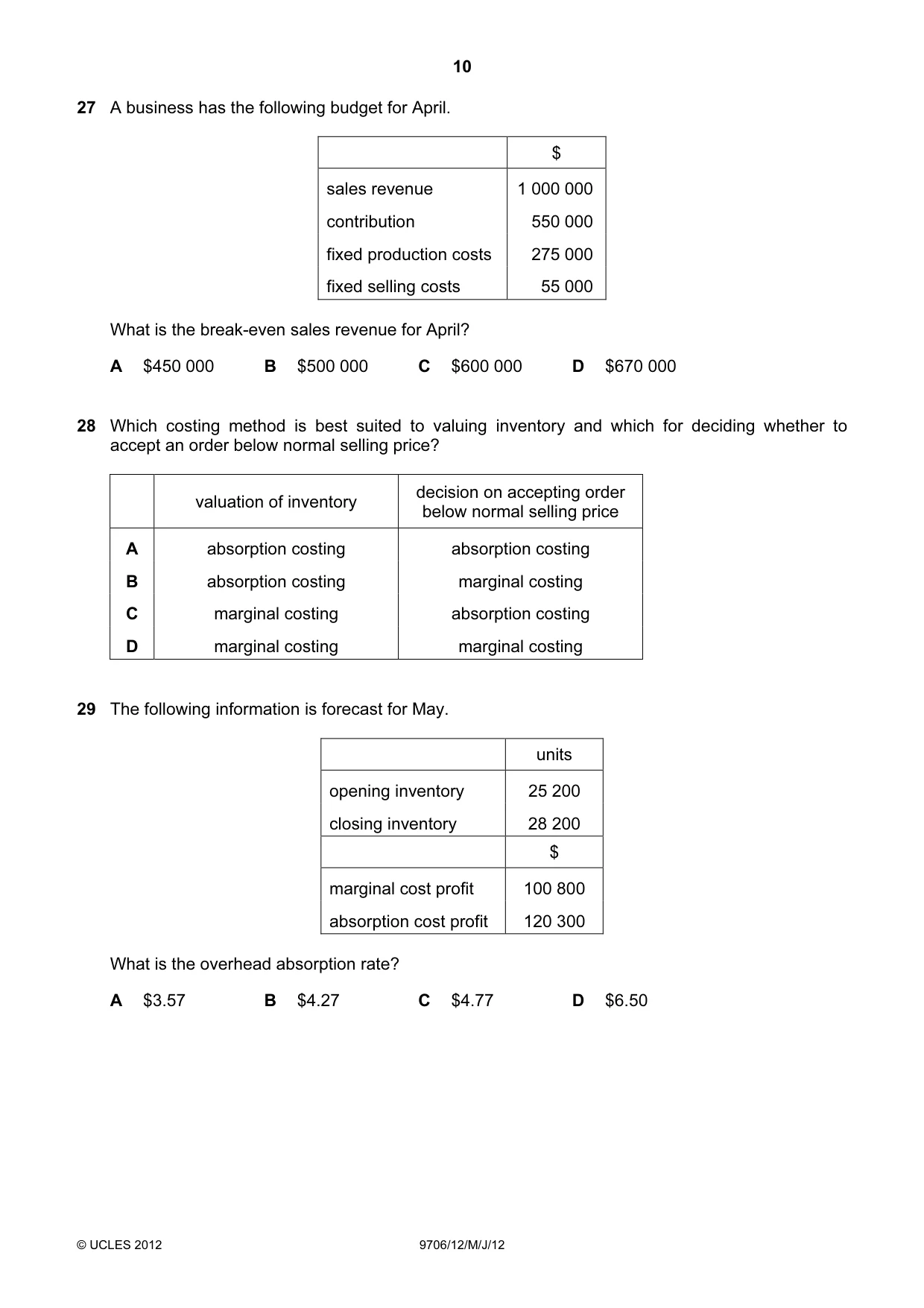
27 A business has the following budget for April. $ sales revenue 1 000 000 contribution 550 000 fixed production costs 275 000 fixed selling costs 55 000 What is the break-even sales revenue for April? A $450 000 B $500 000 C $600 000 D $670 000
Mark scheme: C
Q28 · Which costing method is best suited to valuing inventory and which for deciding whether…
28 Which costing method is best suited to valuing inventory and which for deciding whether to accept an order below normal selling price? decision on accepting order valuation of inventory below normal selling price A absorption costing absorption costing B absorption costing marginal costing C marginal costing absorption costing D marginal costing marginal costing
Mark scheme: B
Q29 · The following information is forecast for May
29 The following information is forecast for May. units opening inventory 25 200 closing inventory 28 200 $ marginal cost profit 100 800 absorption cost profit 120 300 What is the overhead absorption rate? A $3.57 B $4.27 C $4.77 D $6.50
Mark scheme: D
Q30 · What is the purpose of a job cost sheet?
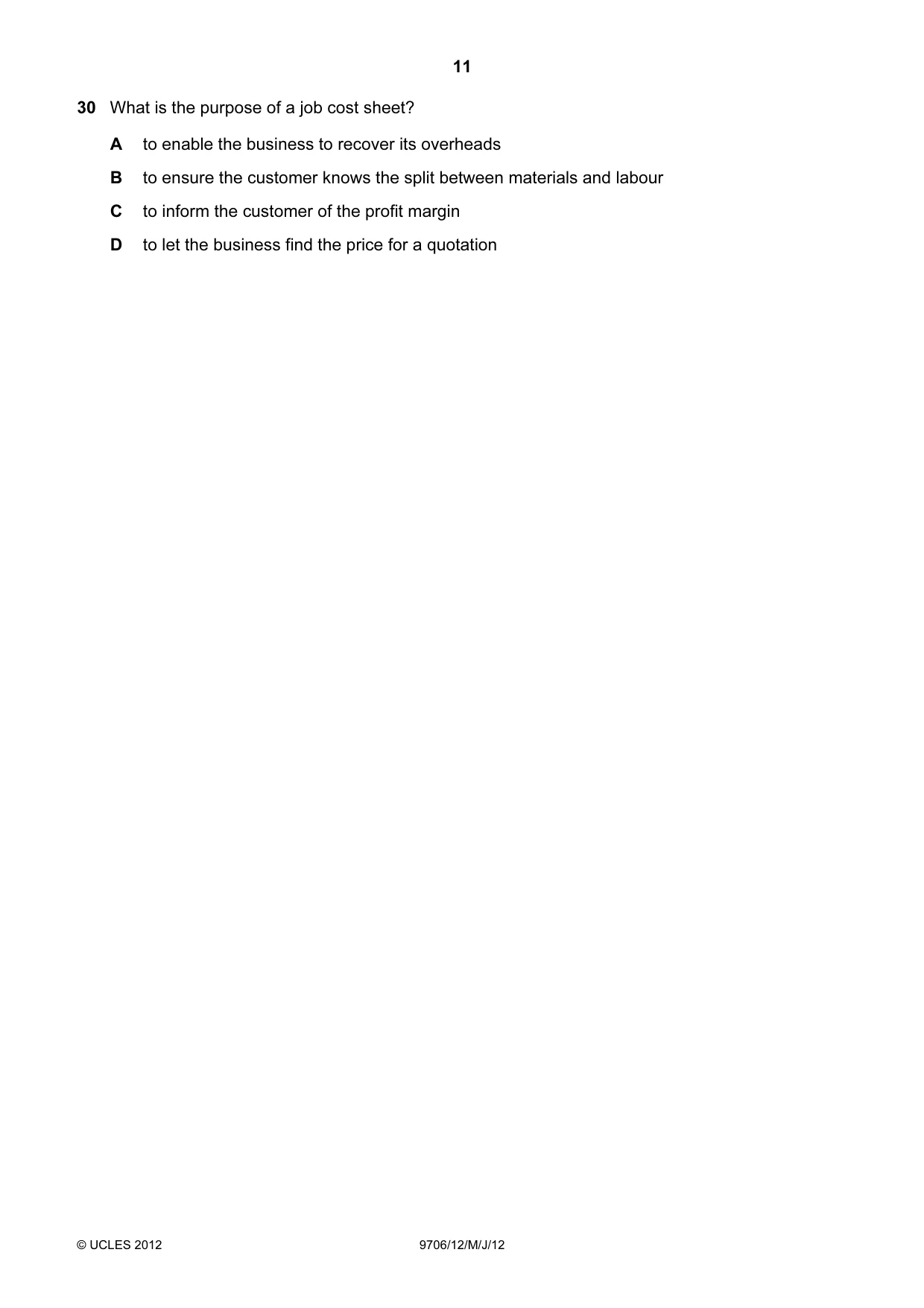
30 What is the purpose of a job cost sheet? A to enable the business to recover its overheads B to ensure the customer knows the split between materials and labour C to inform the customer of the profit margin D to let the business find the price for a quotation
Mark scheme: D
What was in this paper
The subtopics covered by these 30 questions, and how many questions each got. Open one in a new tab to see every Cambridge question on it.
What you needed in this session
Cambridge’s own grade thresholds for 2012 May/June, Paper 1 · Variant 2. A higher threshold means an easier paper — the bar moves with how the cohort did.