Cambridge A Level Accounting 9706 — 2006 Oct/Nov Paper 1 · Variant 1
9706/11/O/N/06 · 30 questions · 30 marks · ≈34 min
The question paper and its mark scheme, free to read here and free to download. This is Cambridge’s own paper, exactly as it was sat.
Question paper12 pages

Mark scheme2 pages
Answers below. Sit the paper first if you are practising.
Questions as text
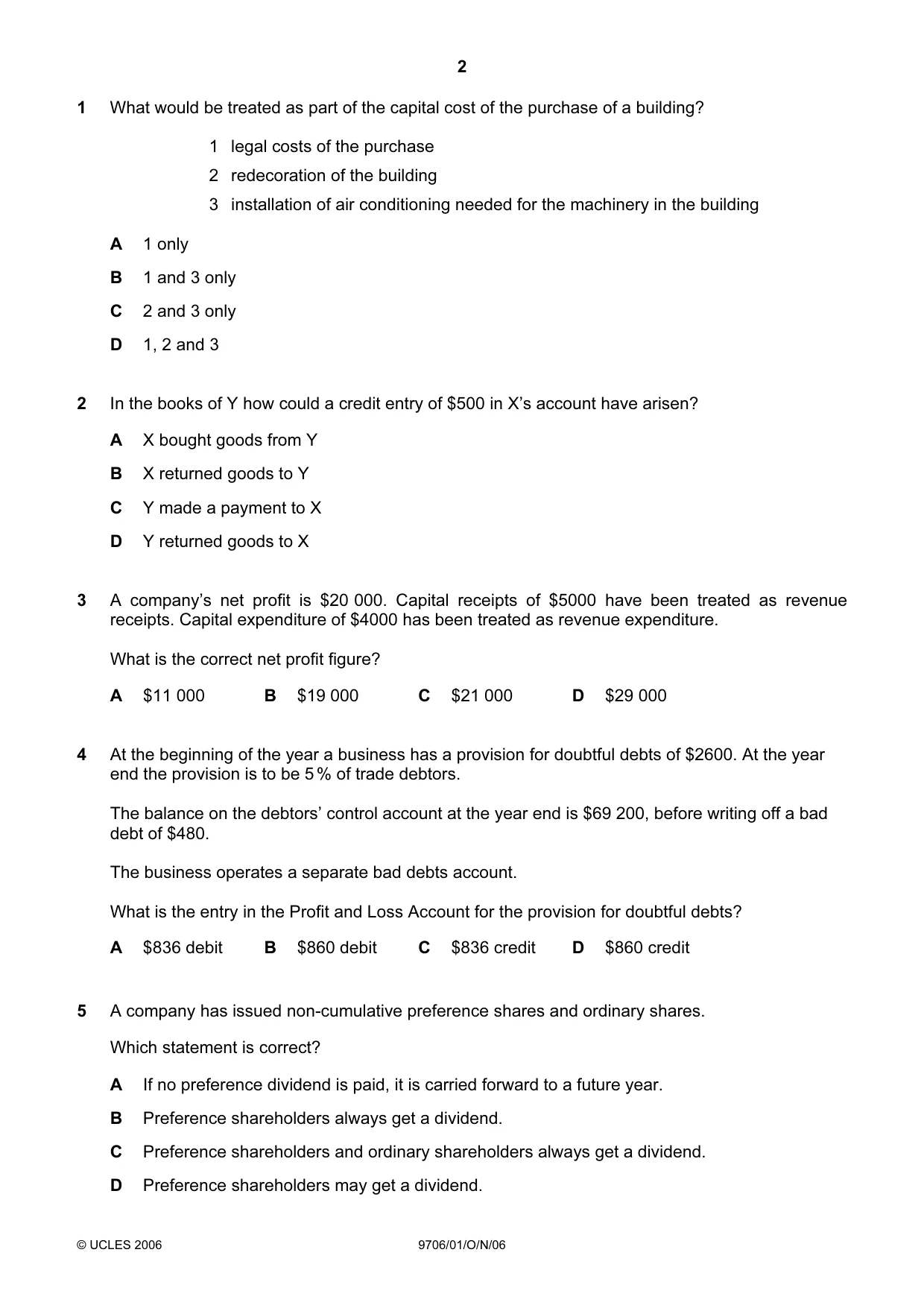
Q1 · What would be treated as part of the capital cost of the purchase of a building?
1 What would be treated as part of the capital cost of the purchase of a building? 1 legal costs of the purchase 2 redecoration of the building 3 installation of air conditioning needed for the machinery in the building A 1 only B 1 and 3 only C 2 and 3 only D 1, 2 and 3
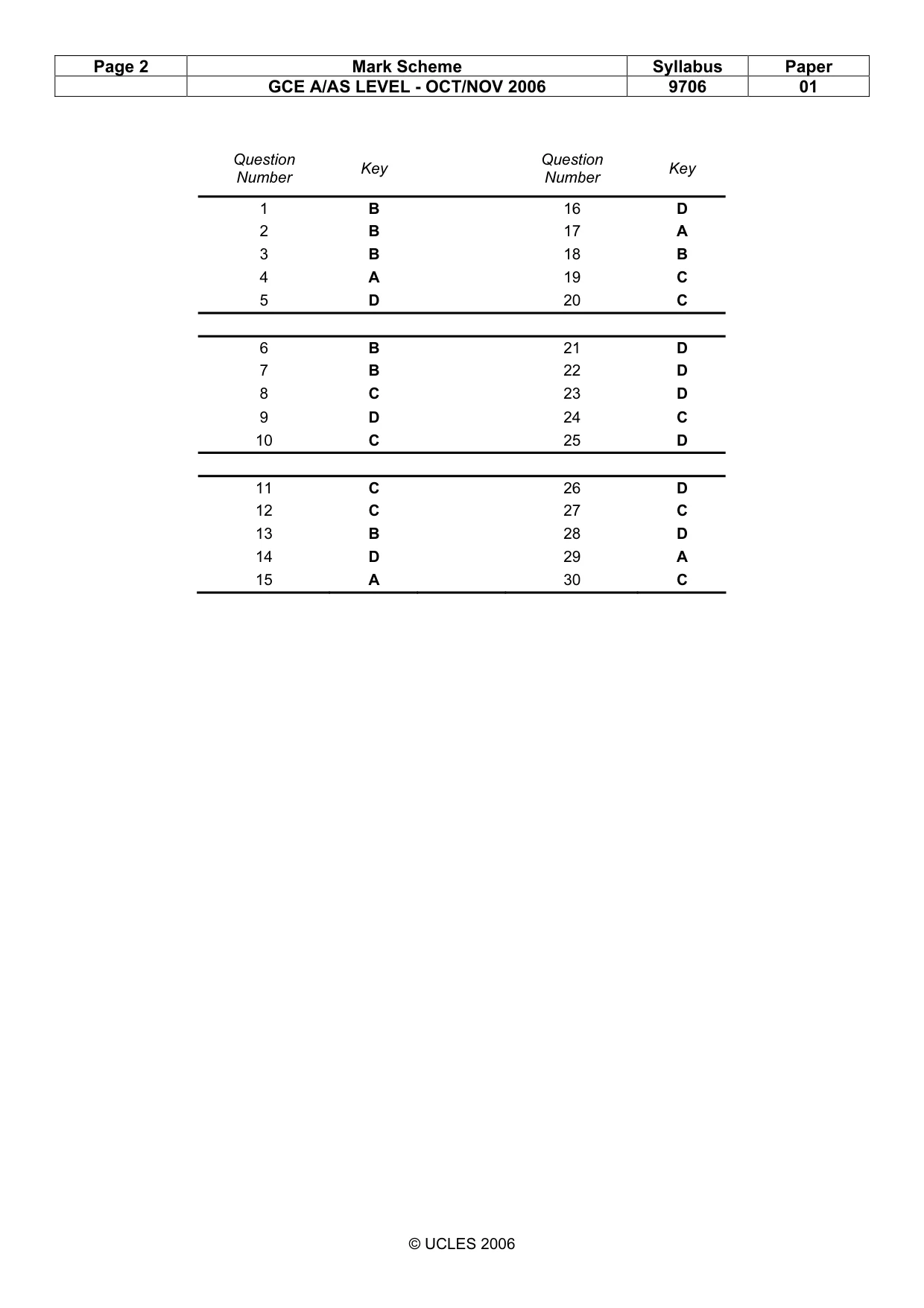
Mark scheme: B
Q2 · In the books of Y how could a credit entry of $500 in X’s account have arisen?
2 In the books of Y how could a credit entry of $500 in X’s account have arisen? A X bought goods from Y B X returned goods to Y C Y made a payment to X D Y returned goods to X
Mark scheme: B
Q3 · A company’s net profit is $20 000
3 A company’s net profit is $20 000. Capital receipts of $5000 have been treated as revenue receipts. Capital expenditure of $4000 has been treated as revenue expenditure. What is the correct net profit figure? A $11 000 B $19 000 C $21 000 D $29 000
Mark scheme: B
Q4 · At the beginning of the year a business has a provision for doubtful debts of $2600
4 At the beginning of the year a business has a provision for doubtful debts of $2600. At the year end the provision is to be 5 % of trade debtors. The balance on the debtors’ control account at the year end is $69 200, before writing off a bad debt of $480. The business operates a separate bad debts account. What is the entry in the Profit and Loss Account for the provision for doubtful debts? A $836 debit B $860 debit C $836 credit D $860 credit
Mark scheme: A
Q5 · A company has issued non-cumulative preference shares and ordinary shares
5 A company has issued non-cumulative preference shares and ordinary shares. Which statement is correct? A If no preference dividend is paid, it is carried forward to a future year. B Preference shareholders always get a dividend. C Preference shareholders and ordinary shareholders always get a dividend. D Preference shareholders may get a dividend.
Mark scheme: D
Q6 · The following information relates to a company’s fixed assets at 31 December: cost price…
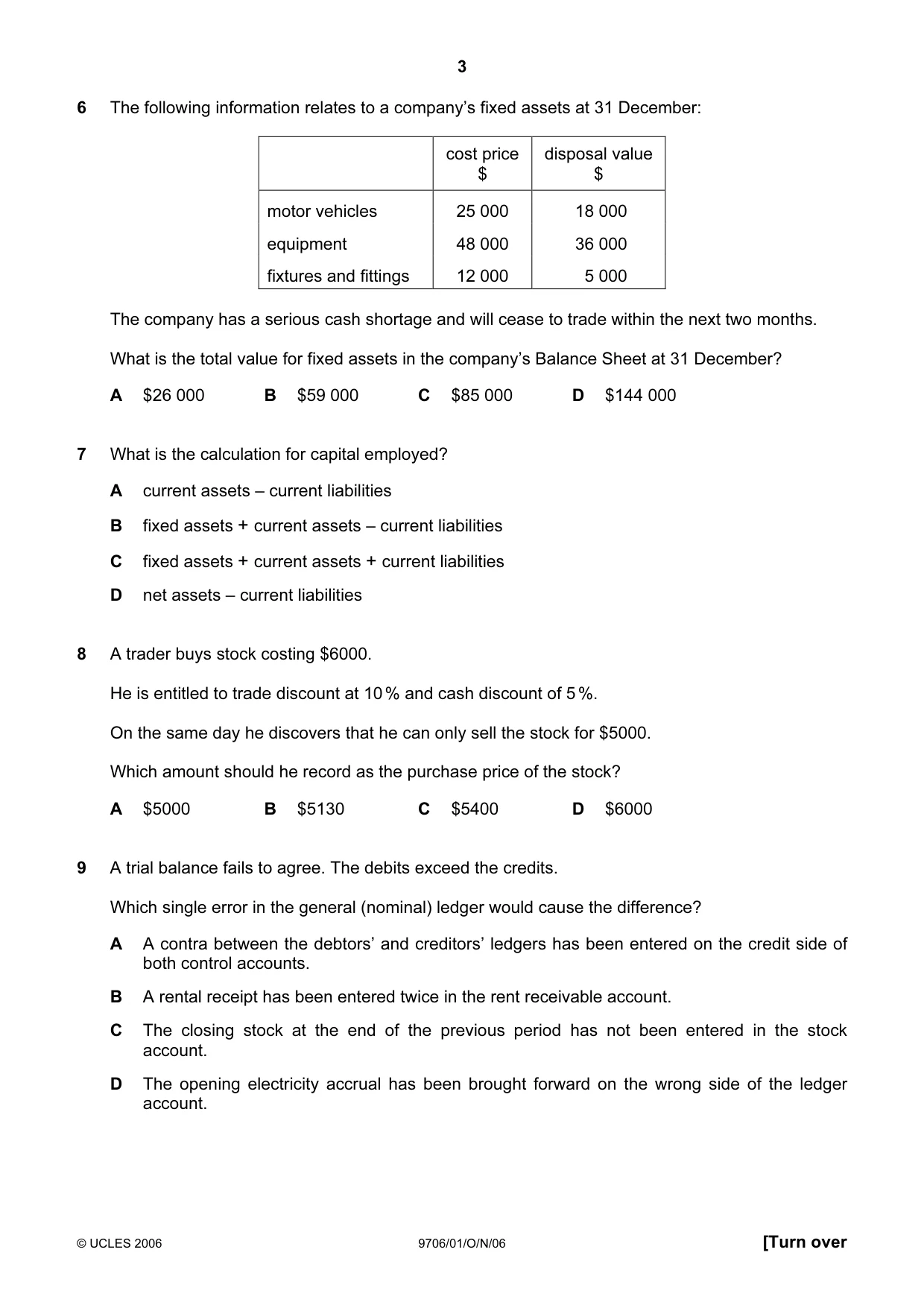
6 The following information relates to a company’s fixed assets at 31 December: cost price disposal value $ $ motor vehicles 25 000 18 000 equipment 48 000 36 000 fixtures and fittings 12 000 5 000 The company has a serious cash shortage and will cease to trade within the next two months. What is the total value for fixed assets in the company’s Balance Sheet at 31 December? A $26 000 B $59 000 C $85 000 D $144 000
Mark scheme: B
Q7 · What is the calculation for capital employed?
7 What is the calculation for capital employed? A current assets – current liabilities B fixed assets + current assets – current liabilities C fixed assets + current assets + current liabilities D net assets – current liabilities
Mark scheme: B
More questions on Analysis and communication of accounting information
Q8 · A trader buys stock costing $6000
8 A trader buys stock costing $6000. He is entitled to trade discount at 10 % and cash discount of 5 %. On the same day he discovers that he can only sell the stock for $5000. Which amount should he record as the purchase price of the stock? A $5000 B $5130 C $5400 D $6000
Mark scheme: C
Q9 · A trial balance fails to agree
9 A trial balance fails to agree. The debits exceed the credits. Which single error in the general (nominal) ledger would cause the difference? A A contra between the debtors’ and creditors’ ledgers has been entered on the credit side of both control accounts. B A rental receipt has been entered twice in the rent receivable account. C The closing stock at the end of the previous period has not been entered in the stock account. D The opening electricity accrual has been brought forward on the wrong side of the ledger account.
Mark scheme: D
Q10 · A cheque for payment of wages of $214 has been debited to the purchases account as $241
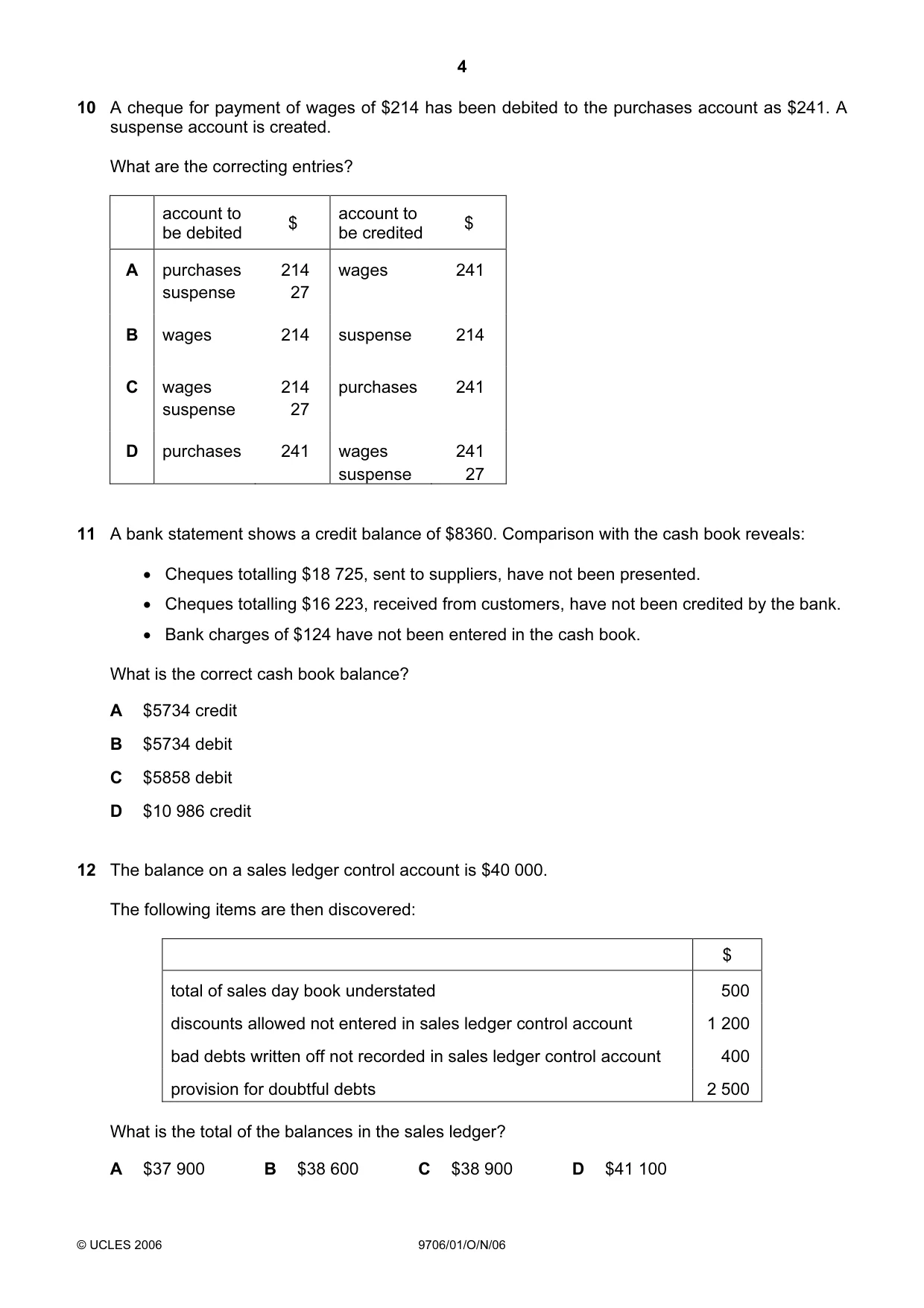
10 A cheque for payment of wages of $214 has been debited to the purchases account as $241. A suspense account is created. What are the correcting entries? account to account to $ $ be debited be credited A purchases 214 wages 241 suspense 27 B wages 214 suspense 214 C wages 214 purchases 241 suspense 27 D purchases 241 wages 241 suspense 27
Mark scheme: C
Q11 · A bank statement shows a credit balance of $8360
11 A bank statement shows a credit balance of $8360. Comparison with the cash book reveals: • Cheques totalling $18 725, sent to suppliers, have not been presented. • Cheques totalling $16 223, received from customers, have not been credited by the bank. • Bank charges of $124 have not been entered in the cash book. What is the correct cash book balance? A $5734 credit B $5734 debit C $5858 debit D $10 986 credit
Mark scheme: C
Q12 · The balance on a sales ledger control account is $40 000
12 The balance on a sales ledger control account is $40 000. The following items are then discovered: $ total of sales day book understated 500 discounts allowed not entered in sales ledger control account 1 200 bad debts written off not recorded in sales ledger control account 400 provision for doubtful debts 2 500 What is the total of the balances in the sales ledger? A $37 900 B $38 600 C $38 900 D $41 100
Mark scheme: C
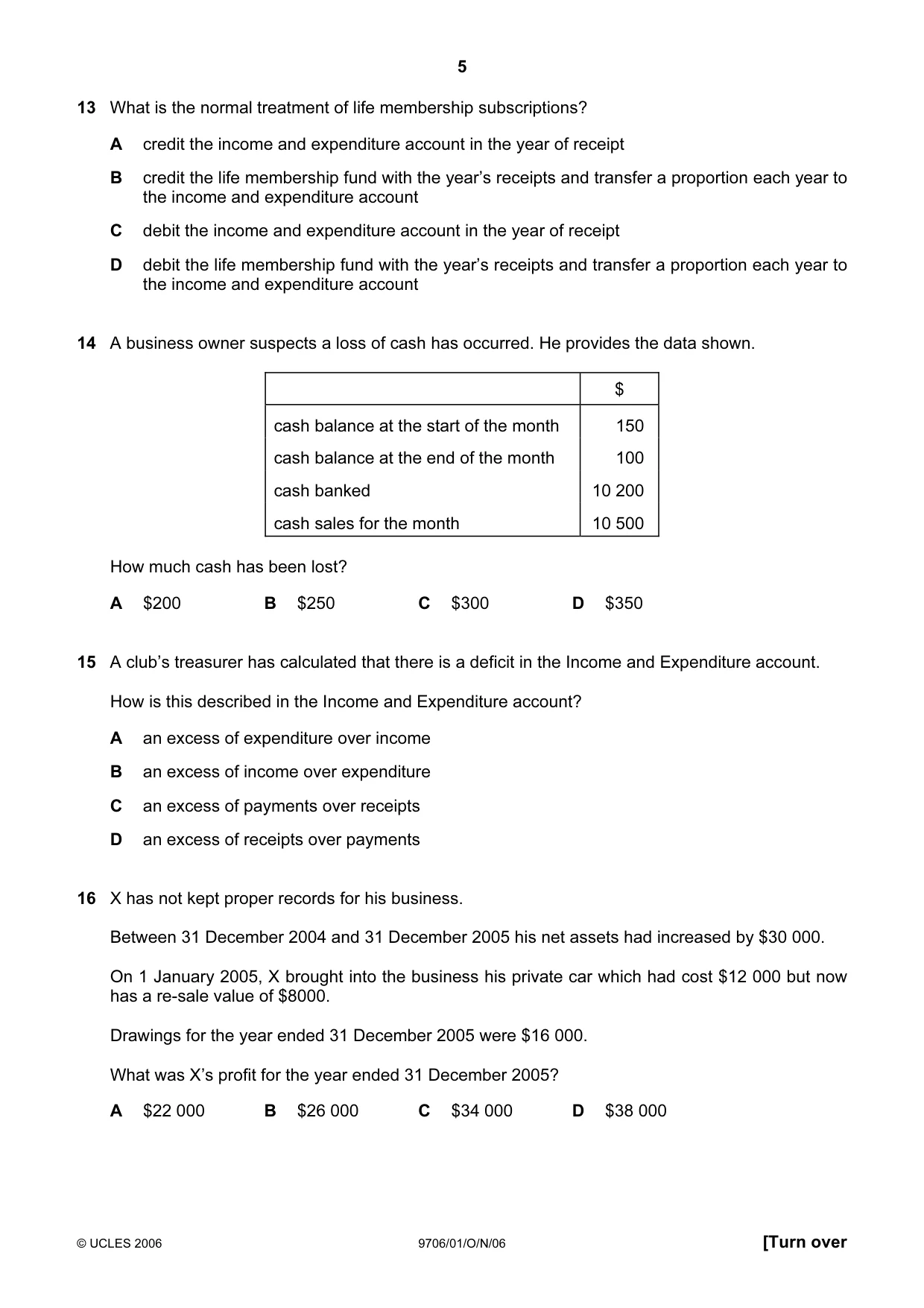
Q13 · What is the normal treatment of life membership subscriptions?
13 What is the normal treatment of life membership subscriptions? A credit the income and expenditure account in the year of receipt B credit the life membership fund with the year’s receipts and transfer a proportion each year to the income and expenditure account C debit the income and expenditure account in the year of receipt D debit the life membership fund with the year’s receipts and transfer a proportion each year to the income and expenditure account
Mark scheme: B
Q14 · A business owner suspects a loss of cash has occurred
14 A business owner suspects a loss of cash has occurred. He provides the data shown. $ cash balance at the start of the month 150 cash balance at the end of the month 100 cash banked 10 200 cash sales for the month 10 500 How much cash has been lost? A $200 B $250 C $300 D $350
Mark scheme: D
Q15 · A club’s treasurer has calculated that there is a deficit in the Income and Expenditure…
15 A club’s treasurer has calculated that there is a deficit in the Income and Expenditure account. How is this described in the Income and Expenditure account? A an excess of expenditure over income B an excess of income over expenditure C an excess of payments over receipts D an excess of receipts over payments
Mark scheme: A
Q16 · X has not kept proper records for his business
16 X has not kept proper records for his business. Between 31 December 2004 and 31 December 2005 his net assets had increased by $30 000. On 1 January 2005, X brought into the business his private car which had cost $12 000 but now has a re-sale value of $8000. Drawings for the year ended 31 December 2005 were $16 000. What was X’s profit for the year ended 31 December 2005? A $22 000 B $26 000 C $34 000 D $38 000
Mark scheme: D
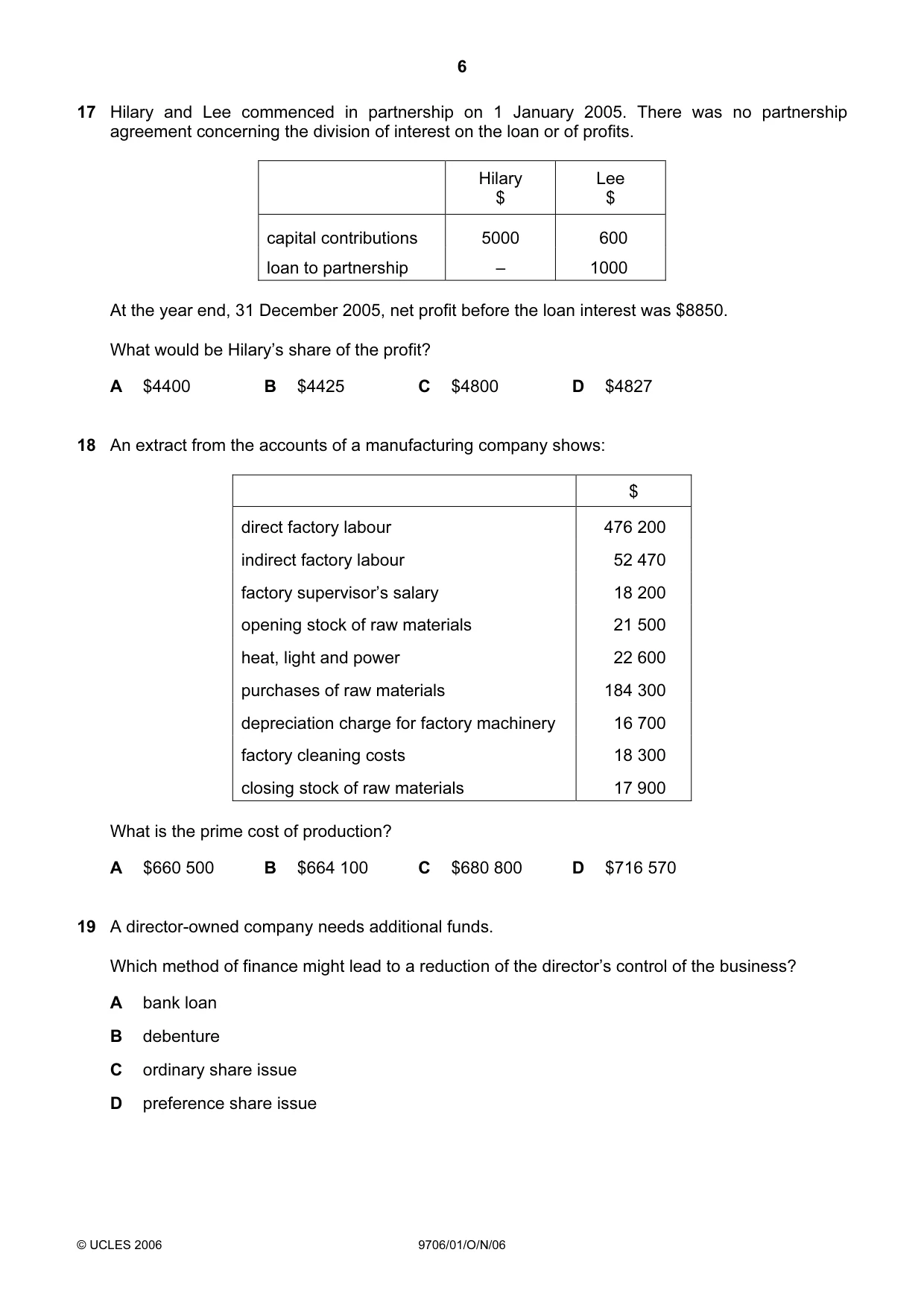
Q17 · Hilary and Lee commenced in partnership on 1 January 2005
17 Hilary and Lee commenced in partnership on 1 January 2005. There was no partnership agreement concerning the division of interest on the loan or of profits. Hilary Lee $ $ capital contributions 5000 600 loan to partnership – 1000 At the year end, 31 December 2005, net profit before the loan interest was $8850. What would be Hilary’s share of the profit? A $4400 B $4425 C $4800 D $4827
Mark scheme: A
Q18 · An extract from the accounts of a manufacturing company shows: $ direct factory labour…
18 An extract from the accounts of a manufacturing company shows: $ direct factory labour 476 200 indirect factory labour 52 470 factory supervisor’s salary 18 200 opening stock of raw materials 21 500 heat, light and power 22 600 purchases of raw materials 184 300 depreciation charge for factory machinery 16 700 factory cleaning costs 18 300 closing stock of raw materials 17 900 What is the prime cost of production? A $660 500 B $664 100 C $680 800 D $716 570
Mark scheme: B
Q19 · A director-owned company needs additional funds
19 A director-owned company needs additional funds. Which method of finance might lead to a reduction of the director’s control of the business? A bank loan B debenture C ordinary share issue D preference share issue
Mark scheme: C
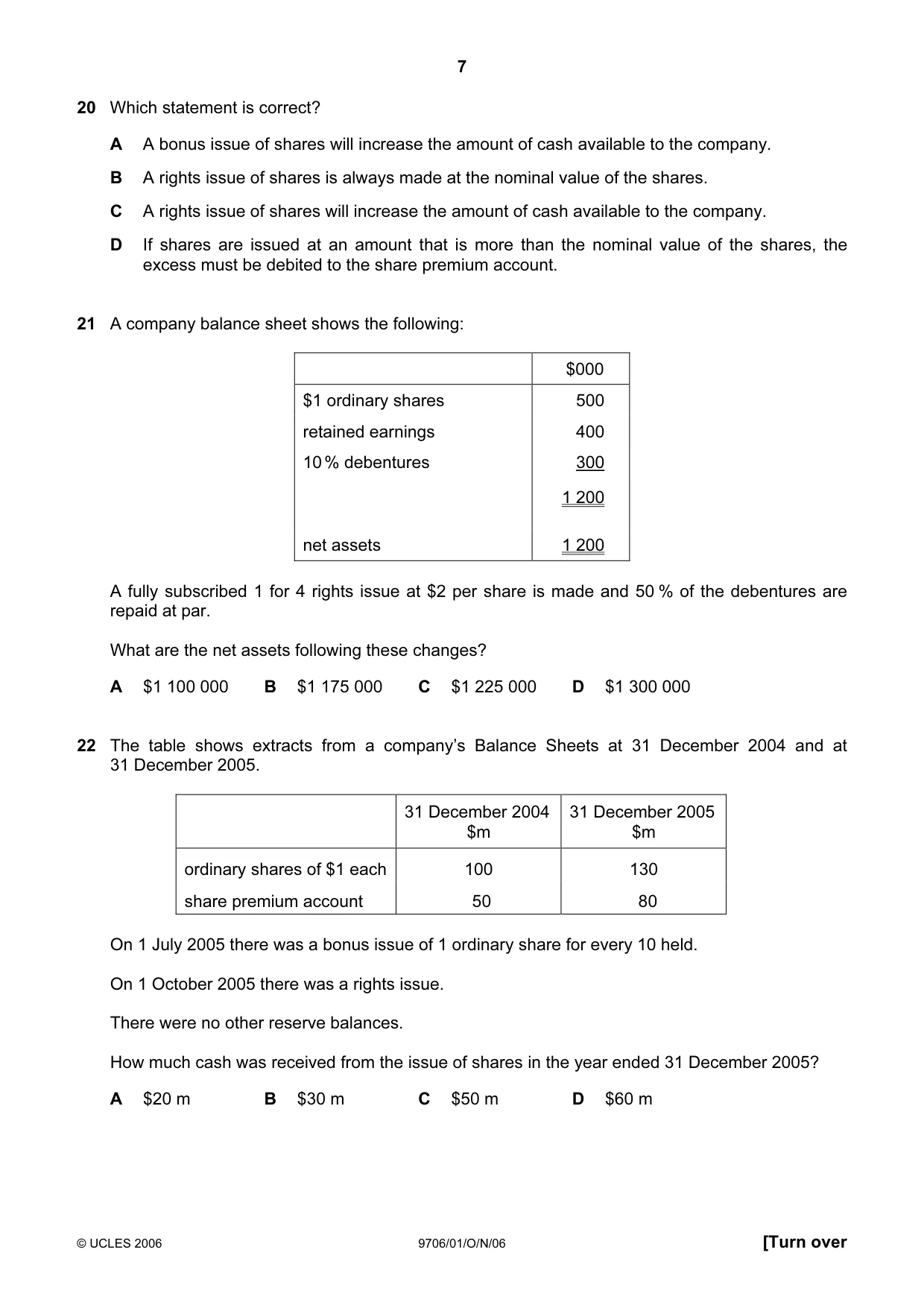
Q20 · Which statement is correct?
20 Which statement is correct? A A bonus issue of shares will increase the amount of cash available to the company. B A rights issue of shares is always made at the nominal value of the shares. C A rights issue of shares will increase the amount of cash available to the company. D If shares are issued at an amount that is more than the nominal value of the shares, the excess must be debited to the share premium account.
Mark scheme: C
Q21 · A company balance sheet shows the following: $000 $1 ordinary shares 500 retained…
21 A company balance sheet shows the following: $000 $1 ordinary shares 500 retained earnings 400 10 % debentures 300 1 200 net assets 1 200 A fully subscribed 1 for 4 rights issue at $2 per share is made and 50 % of the debentures are repaid at par. What are the net assets following these changes? A $1 100 000 B $1 175 000 C $1 225 000 D $1 300 000
Mark scheme: D
Q22 · The table shows extracts from a company’s Balance Sheets at 31 December 2004 and at 31…
22 The table shows extracts from a company’s Balance Sheets at 31 December 2004 and at 31 December 2005. 31 December 2004 31 December 2005 $m $m ordinary shares of $1 each 100 130 share premium account 50 80 On 1 July 2005 there was a bonus issue of 1 ordinary share for every 10 held. On 1 October 2005 there was a rights issue. There were no other reserve balances. How much cash was received from the issue of shares in the year ended 31 December 2005? A $20 m B $30 m C $50 m D $60 m
Mark scheme: D
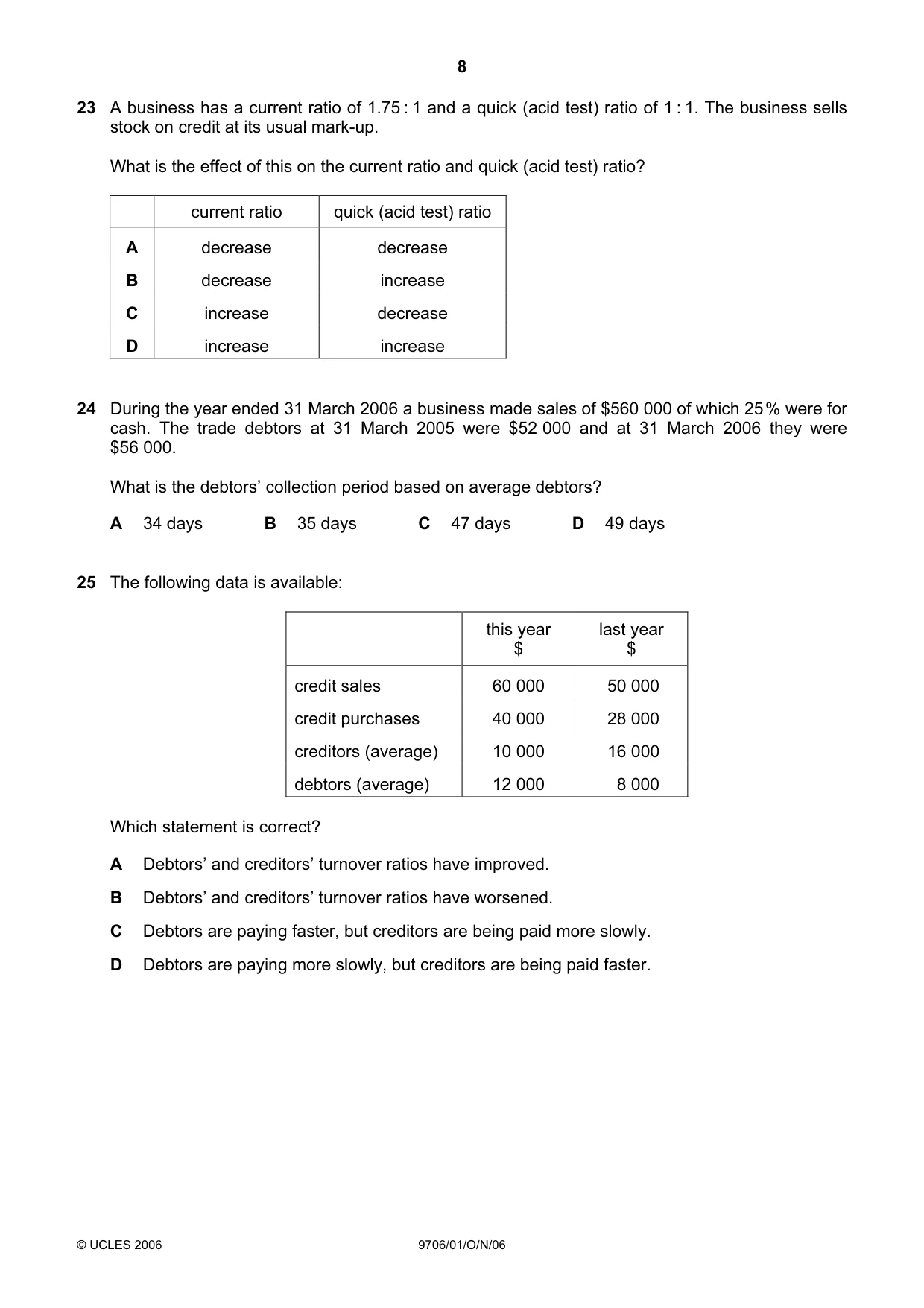
Q23 · A business has a current ratio of 1.75 : 1 and a quick (acid test) ratio of 1 : 1
23 A business has a current ratio of 1.75 : 1 and a quick (acid test) ratio of 1 : 1. The business sells stock on credit at its usual mark-up. What is the effect of this on the current ratio and quick (acid test) ratio? current ratio quick (acid test) ratio A decrease decrease B decrease increase C increase decrease D increase increase
Mark scheme: D
More questions on Analysis and communication of accounting information
Q24 · During the year ended 31 March 2006 a business made sales of $560 000 of which 25 % were…
24 During the year ended 31 March 2006 a business made sales of $560 000 of which 25 % were for cash. The trade debtors at 31 March 2005 were $52 000 and at 31 March 2006 they were $56 000. What is the debtors’ collection period based on average debtors? A 34 days B 35 days C 47 days D 49 days
Mark scheme: C
More questions on Analysis and communication of accounting information
Q25 · The following data is available: this year last year $ $ credit sales 60 000 50 000…
25 The following data is available: this year last year $ $ credit sales 60 000 50 000 credit purchases 40 000 28 000 creditors (average) 10 000 16 000 debtors (average) 12 000 8 000 Which statement is correct? A Debtors’ and creditors’ turnover ratios have improved. B Debtors’ and creditors’ turnover ratios have worsened. C Debtors are paying faster, but creditors are being paid more slowly. D Debtors are paying more slowly, but creditors are being paid faster.
Mark scheme: D
More questions on Analysis and communication of accounting information
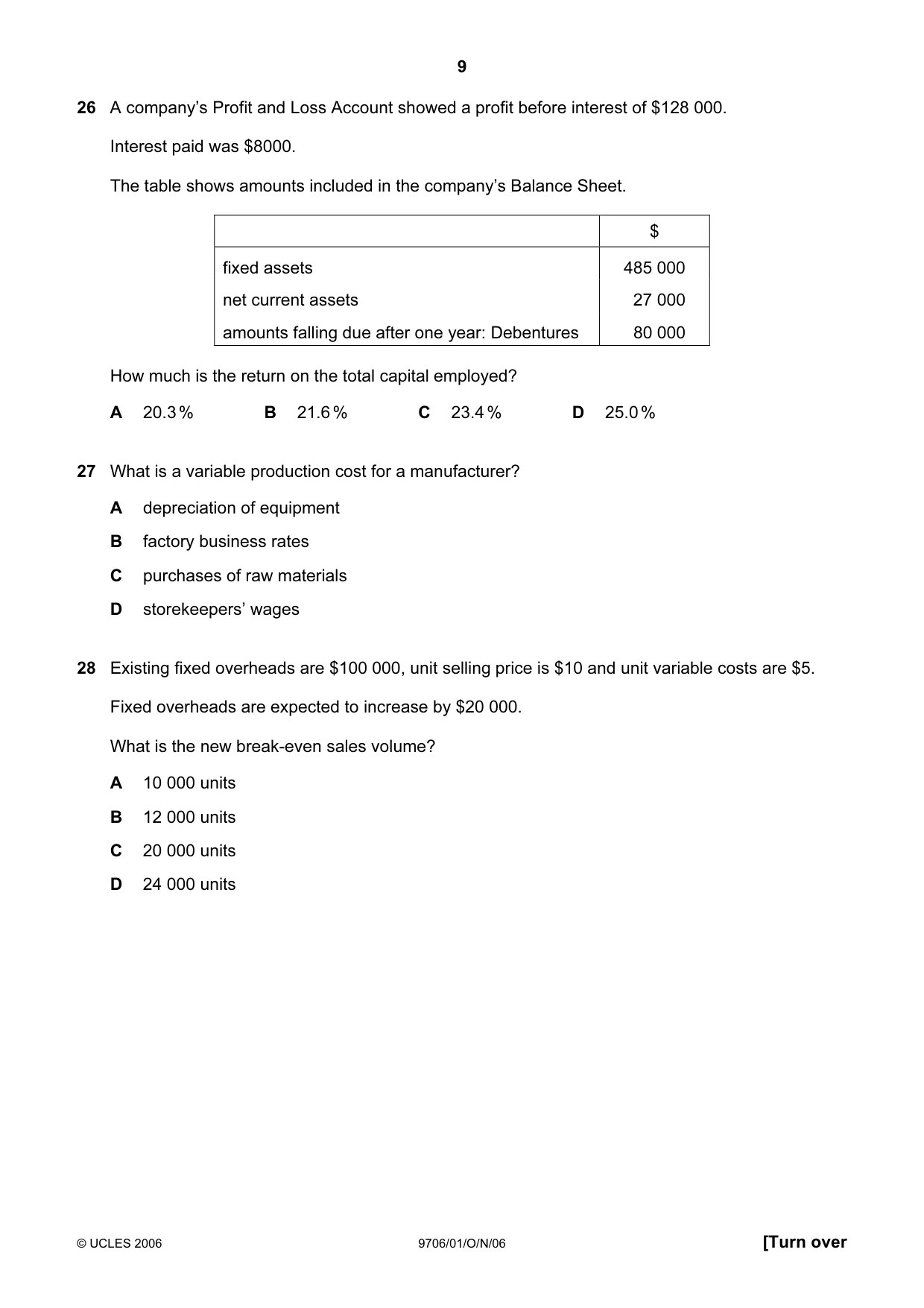
Q26 · A company’s Profit and Loss Account showed a profit before interest of $128 000
26 A company’s Profit and Loss Account showed a profit before interest of $128 000. Interest paid was $8000. The table shows amounts included in the company’s Balance Sheet. $ fixed assets 485 000 net current assets 27 000 amounts falling due after one year: Debentures 80 000 How much is the return on the total capital employed? A 20.3 % B 21.6 % C 23.4 % D 25.0 %
Mark scheme: D
More questions on Analysis and communication of accounting information
Q27 · What is a variable production cost for a manufacturer?
27 What is a variable production cost for a manufacturer? A depreciation of equipment B factory business rates C purchases of raw materials D storekeepers’ wages
Mark scheme: C
Q28 · Existing fixed overheads are $100 000, unit selling price is $10 and unit variable costs…
28 Existing fixed overheads are $100 000, unit selling price is $10 and unit variable costs are $5. Fixed overheads are expected to increase by $20 000. What is the new break-even sales volume? A 10 000 units B 12 000 units C 20 000 units D 24 000 units
Mark scheme: D
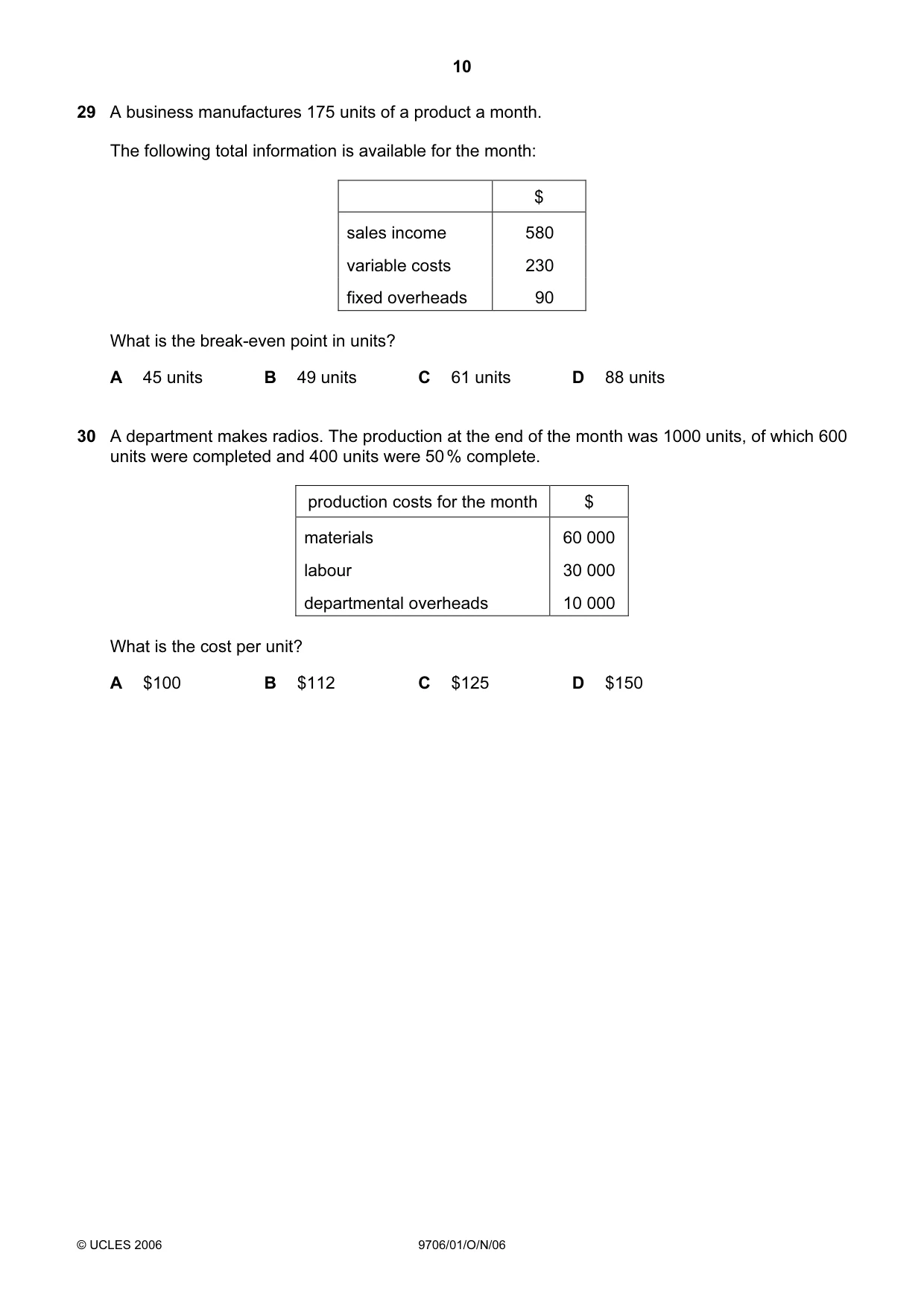
Q29 · A business manufactures 175 units of a product a month
29 A business manufactures 175 units of a product a month. The following total information is available for the month: $ sales income 580 variable costs 230 fixed overheads 90 What is the break-even point in units? A 45 units B 49 units C 61 units D 88 units
Mark scheme: A
Q30 · A department makes radios
30 A department makes radios. The production at the end of the month was 1000 units, of which 600 units were completed and 400 units were 50 % complete. production costs for the month $ materials 60 000 labour 30 000 departmental overheads 10 000 What is the cost per unit? A $100 B $112 C $125 D $150
Mark scheme: C
What was in this paper
The subtopics covered by these 30 questions, and how many questions each got. Open one in a new tab to see every Cambridge question on it.
What you needed in this session
Cambridge’s own grade thresholds for 2006 Oct/Nov, Paper 1 · Variant 1. A higher threshold means an easier paper — the bar moves with how the cohort did.