Cambridge A Level Accounting 9706 — 2025 Oct/Nov Paper 1 · Variant 1
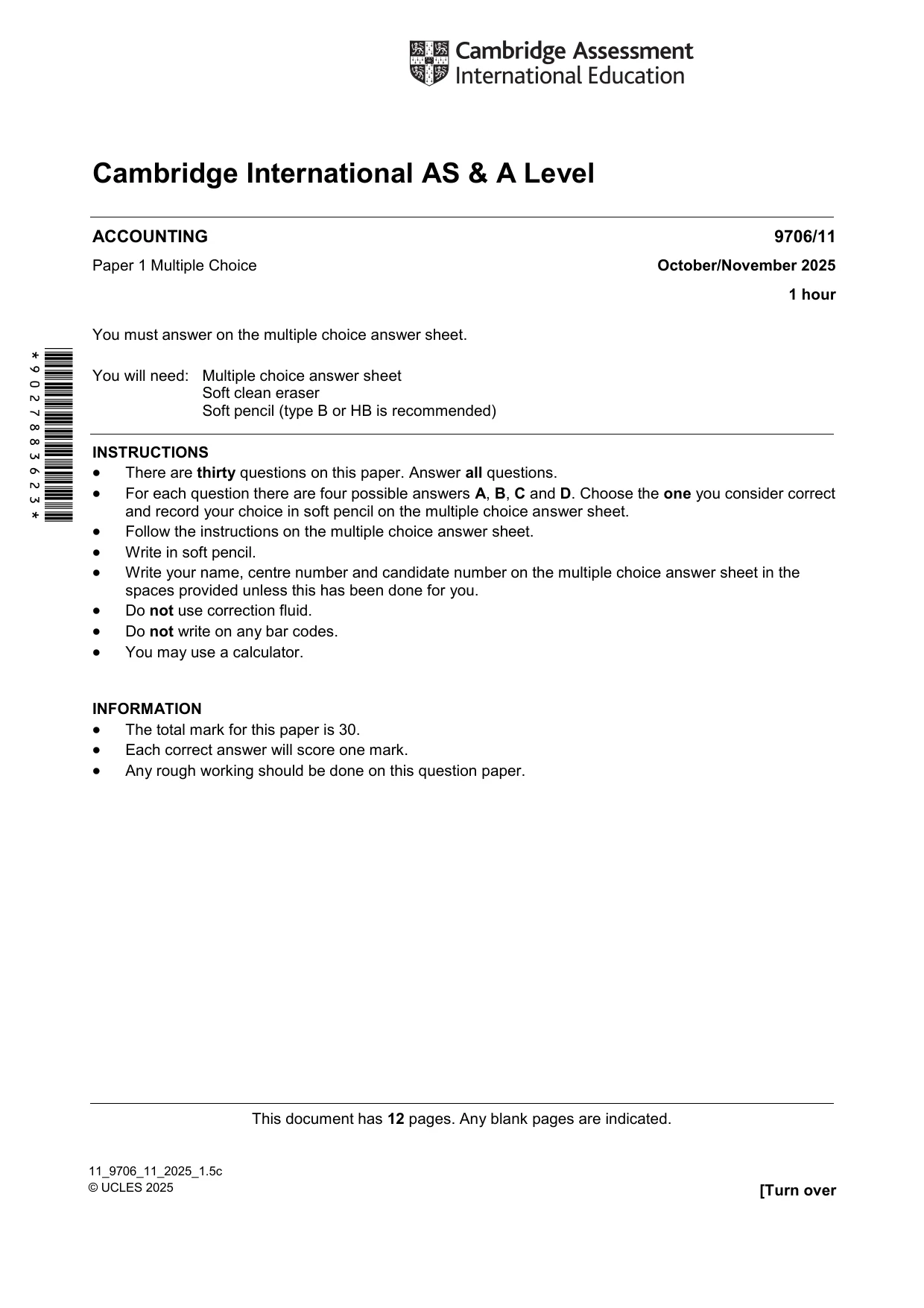
9706/11/O/N/25 · 30 questions · 30 marks · ≈34 min
The question paper and its mark scheme, free to read here and free to download. This is Cambridge’s own paper, exactly as it was sat.
Question paper12 pages
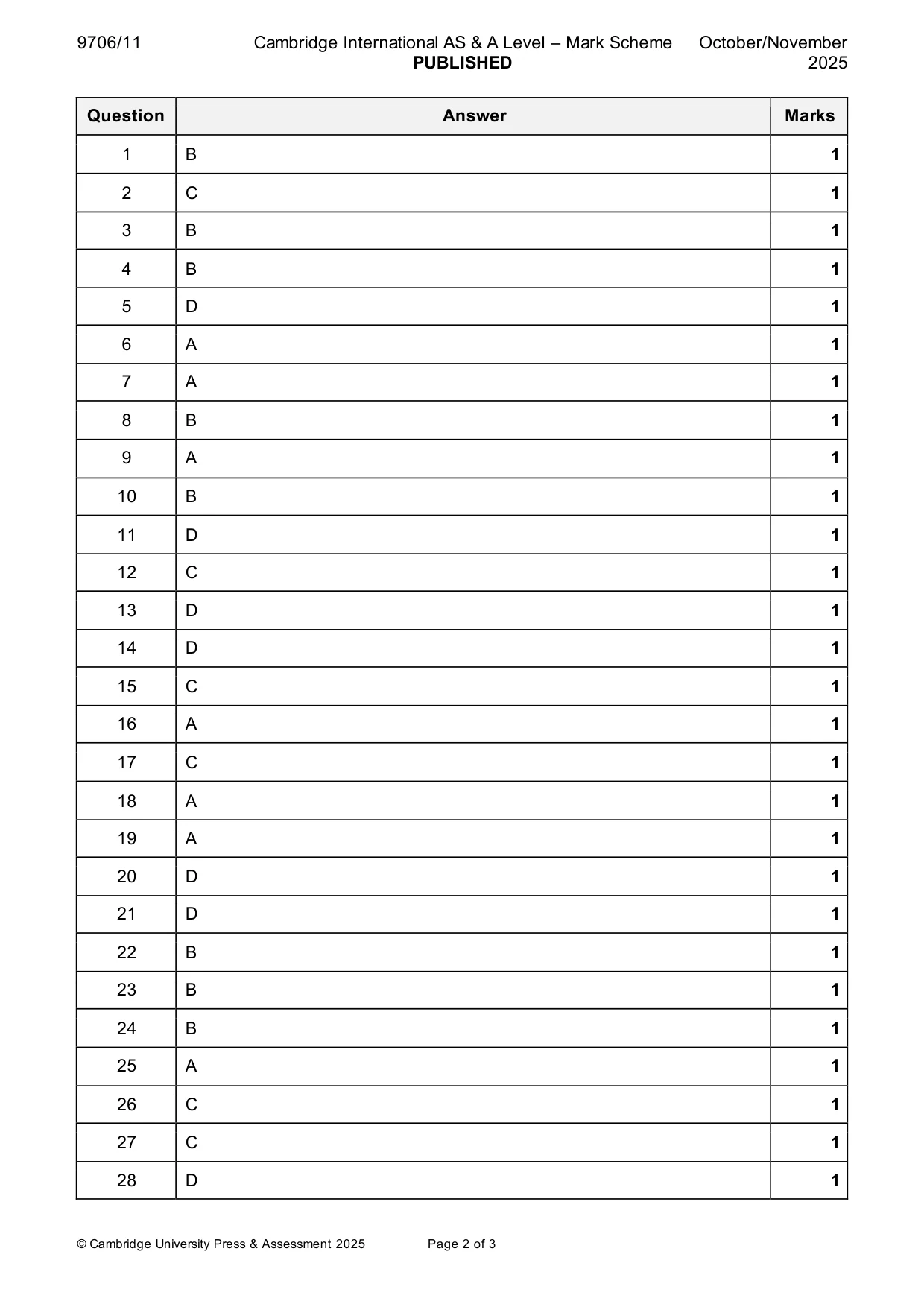
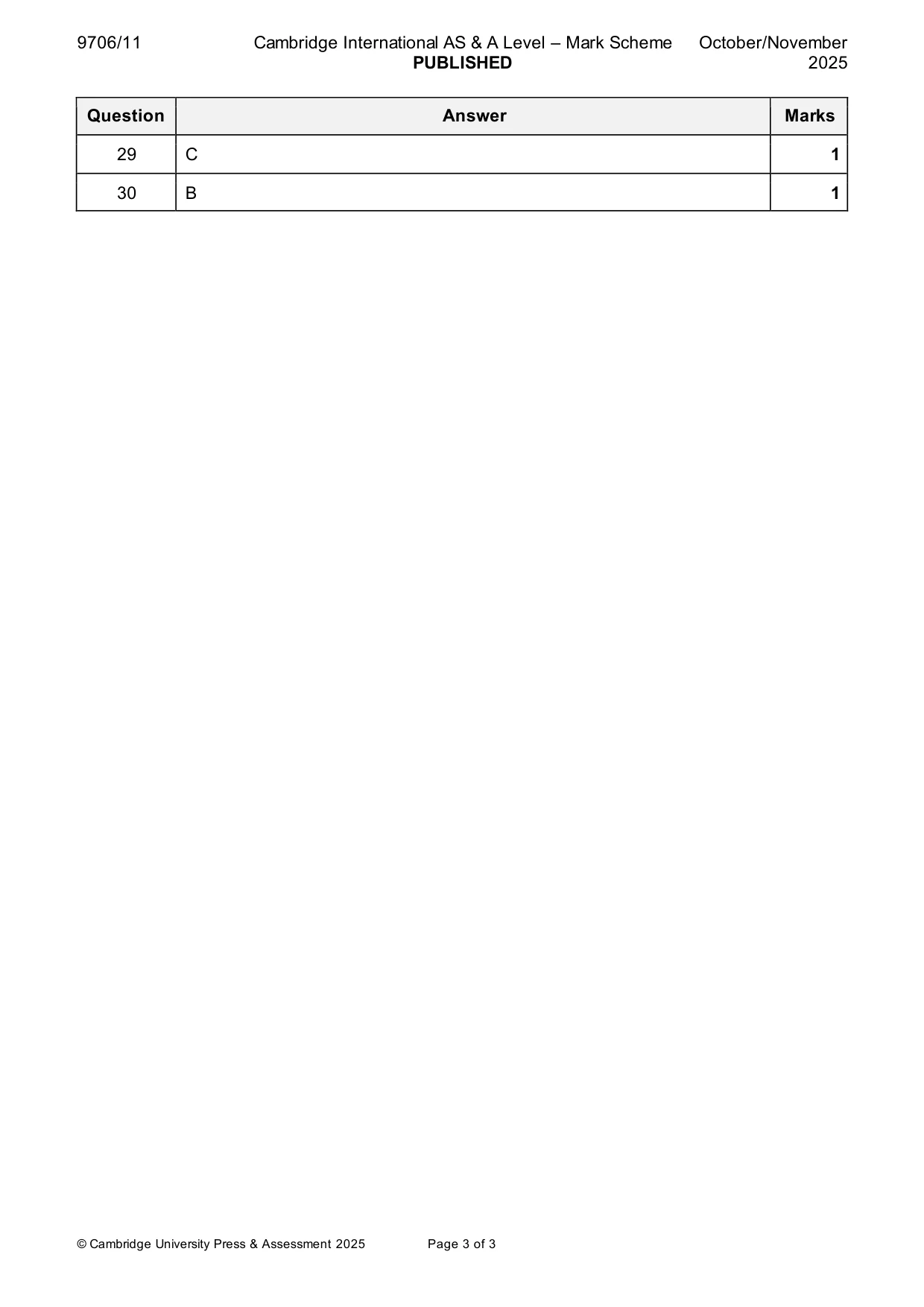
Mark scheme3 pages
Answers below. Sit the paper first if you are practising.
Questions as text
Q1 · Which row describes an advantage and a disadvantage of operating as a sole trader?
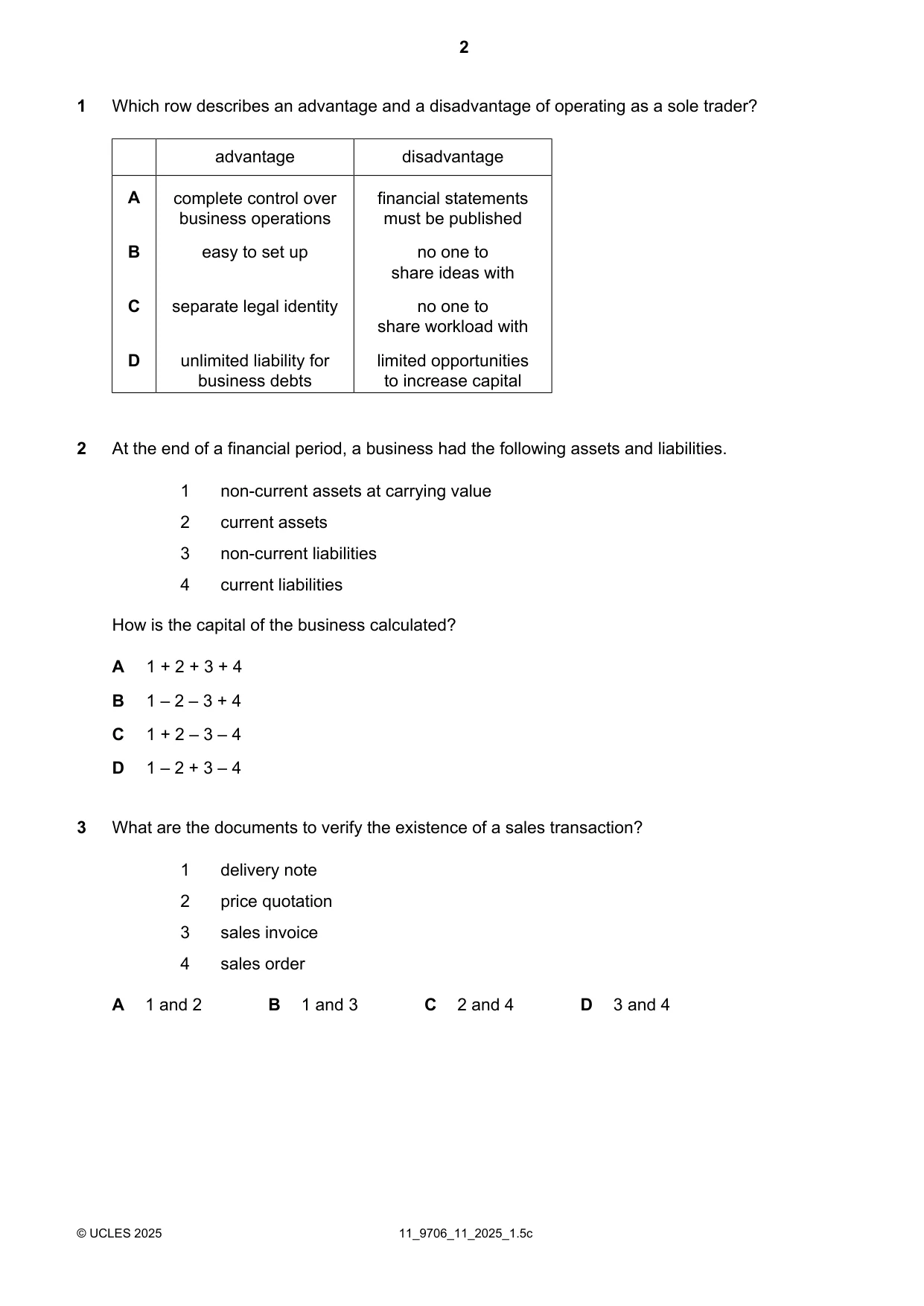
1 Which row describes an advantage and a disadvantage of operating as a sole trader? advantage disadvantage A complete control over financial statements business operations must be published B easy to set up no one to share ideas with C separate legal identity no one to share workload with D unlimited liability for limited opportunities business debts to increase capital
Mark scheme: B
Q2 · At the end of a financial period, a business had the following assets and liabilities
2 At the end of a financial period, a business had the following assets and liabilities. 1 non-current assets at carrying value 2 current assets 3 non-current liabilities 4 current liabilities How is the capital of the business calculated? A 1 + 2 + 3 + 4 B 1 – 2 – 3 + 4 C 1 + 2 – 3 – 4 D 1 – 2 + 3 – 4
Mark scheme: C
Q3 · What are the documents to verify the existence of a sales transaction?
3 What are the documents to verify the existence of a sales transaction? 1 delivery note 2 price quotation 3 sales invoice 4 sales order A 1 and 2 B 1 and 3 C 2 and 4 D 3 and 4
Mark scheme: B
Q4 · A business makes an allowance for irrecoverable debts at the year end
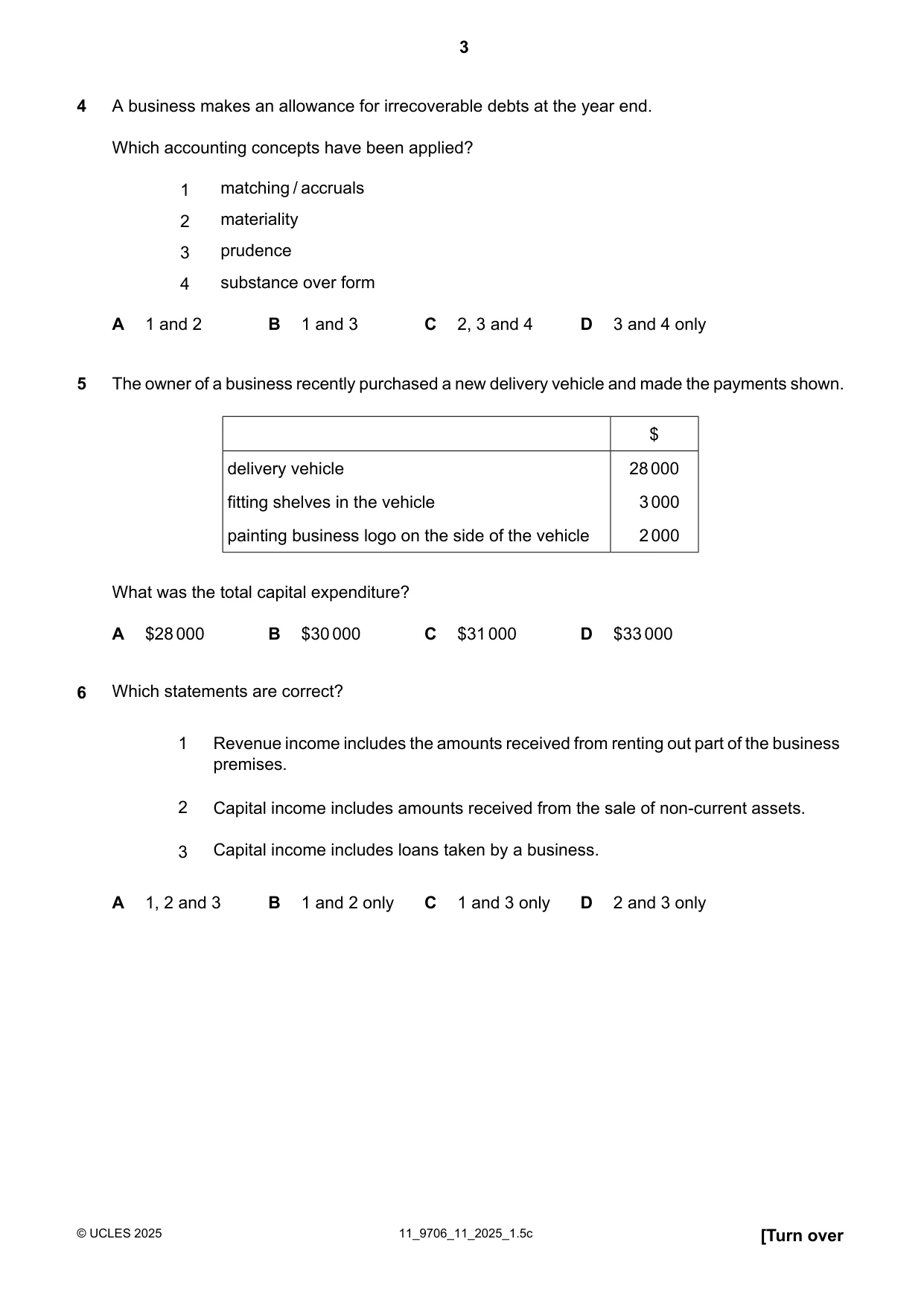
4 A business makes an allowance for irrecoverable debts at the year end. Which accounting concepts have been applied? 1 matching / accruals 2 materiality 3 prudence 4 substance over form A 1 and 2 B 1 and 3 C 2, 3 and 4 D 3 and 4 only
Mark scheme: B
Q5 · The owner of a business recently purchased a new delivery vehicle and made the payments…
5 The owner of a business recently purchased a new delivery vehicle and made the payments shown. $ delivery vehicle 28000 fitting shelves in the vehicle 3000 painting business logo on the side of the vehicle 2000 What was the total capital expenditure? A $28000 B $30000 C $31000 D $33000 Which statements are correct?
Mark scheme: D
Q6 · 1 Revenue income includes the amounts received from renting out part of the business…
6 1 Revenue income includes the amounts received from renting out part of the business premises. 2 Capital income includes amounts received from the sale of non-current assets. 3 Capital income includes loans taken by a business. A 1, 2 and 3 B 1 and 2 only C 1 and 3 only D 2 and 3 only
Mark scheme: A
Q7 · Motor vehicles purchased for $530000, at the start of the year, have been incorrectly…
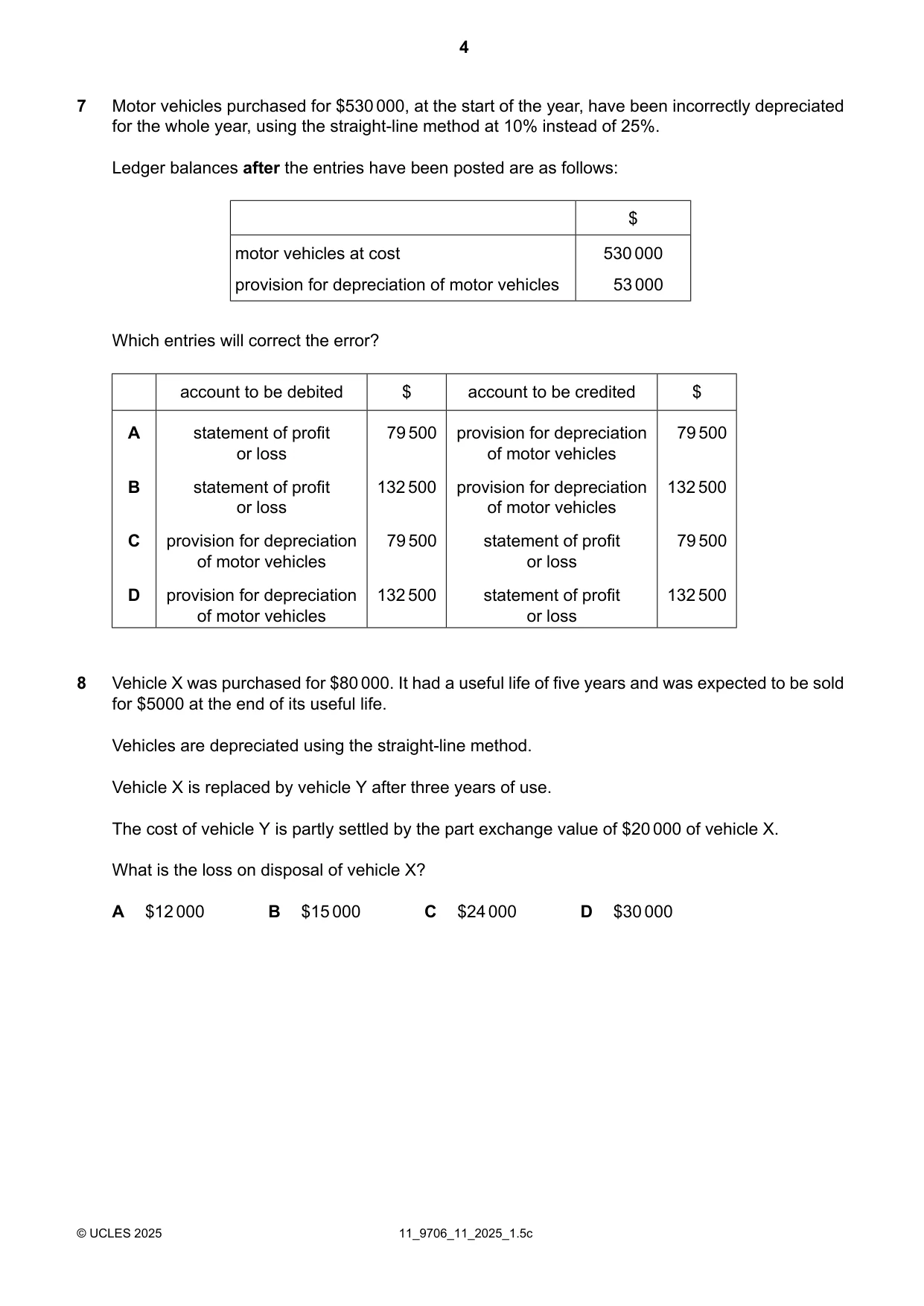
7 Motor vehicles purchased for $530000, at the start of the year, have been incorrectly depreciated for the whole year, using the straight-line method at 10% instead of 25%. Ledger balances after the entries have been posted are as follows: $ motor vehicles at cost 530000 provision for depreciation of motor vehicles 53000 Which entries will correct the error? account to be debited $ account to be credited $ A statement of profit 79500 provision for depreciation 79500 or loss of motor vehicles B statement of profit 132500 provision for depreciation 132500 or loss of motor vehicles C provision for depreciation 79500 statement of profit 79500 of motor vehicles or loss D provision for depreciation 132500 statement of profit 132500 of motor vehicles or loss
Mark scheme: A
Q8 · Vehicle X was purchased for $80000
8 Vehicle X was purchased for $80000. It had a useful life of five years and was expected to be sold for $5000 at the end of its useful life. Vehicles are depreciated using the straight-line method. Vehicle X is replaced by vehicle Y after three years of use. The cost of vehicle Y is partly settled by the part exchange value of $20000 of vehicle X. What is the loss on disposal of vehicle X? A $12000 B $15000 C $24000 D $30000
Mark scheme: B
Q9 · A trial balance does not balance and a suspense account is opened
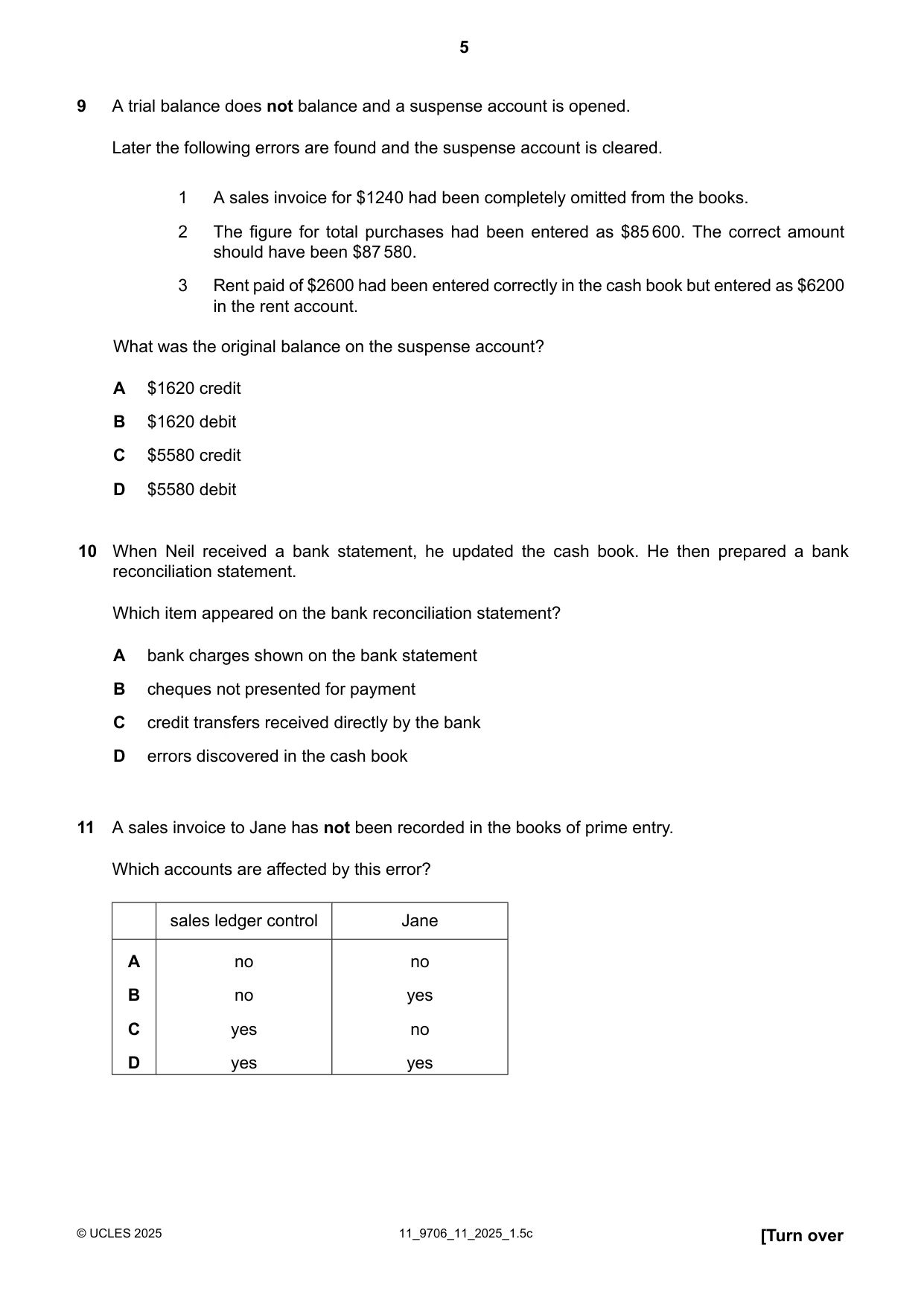
9 A trial balance does not balance and a suspense account is opened. Later the following errors are found and the suspense account is cleared. 1 A sales invoice for $1240 had been completely omitted from the books. 2 The figure for total purchases had been entered as $85 600. The correct amount should have been $87 580. 3 Rent paid of $2600 had been entered correctly in the cash book but entered as $6200 in the rent account. What was the original balance on the suspense account? A $1620 credit B $1620 debit C $5580 credit D $5580 debit
Mark scheme: A
Q10 · When Neil received a bank statement, he updated the cash book
10 When Neil received a bank statement, he updated the cash book. He then prepared a bank reconciliation statement. Which item appeared on the bank reconciliation statement? A bank charges shown on the bank statement B cheques not presented for payment C credit transfers received directly by the bank D errors discovered in the cash book
Mark scheme: B
Q11 · A sales invoice to Jane has not been recorded in the books of prime entry
11 A sales invoice to Jane has not been recorded in the books of prime entry. Which accounts are affected by this error? sales ledger control Jane A no no B no yes C yes no D yes yes
Mark scheme: D
Q12 · A business makes all sales on credit
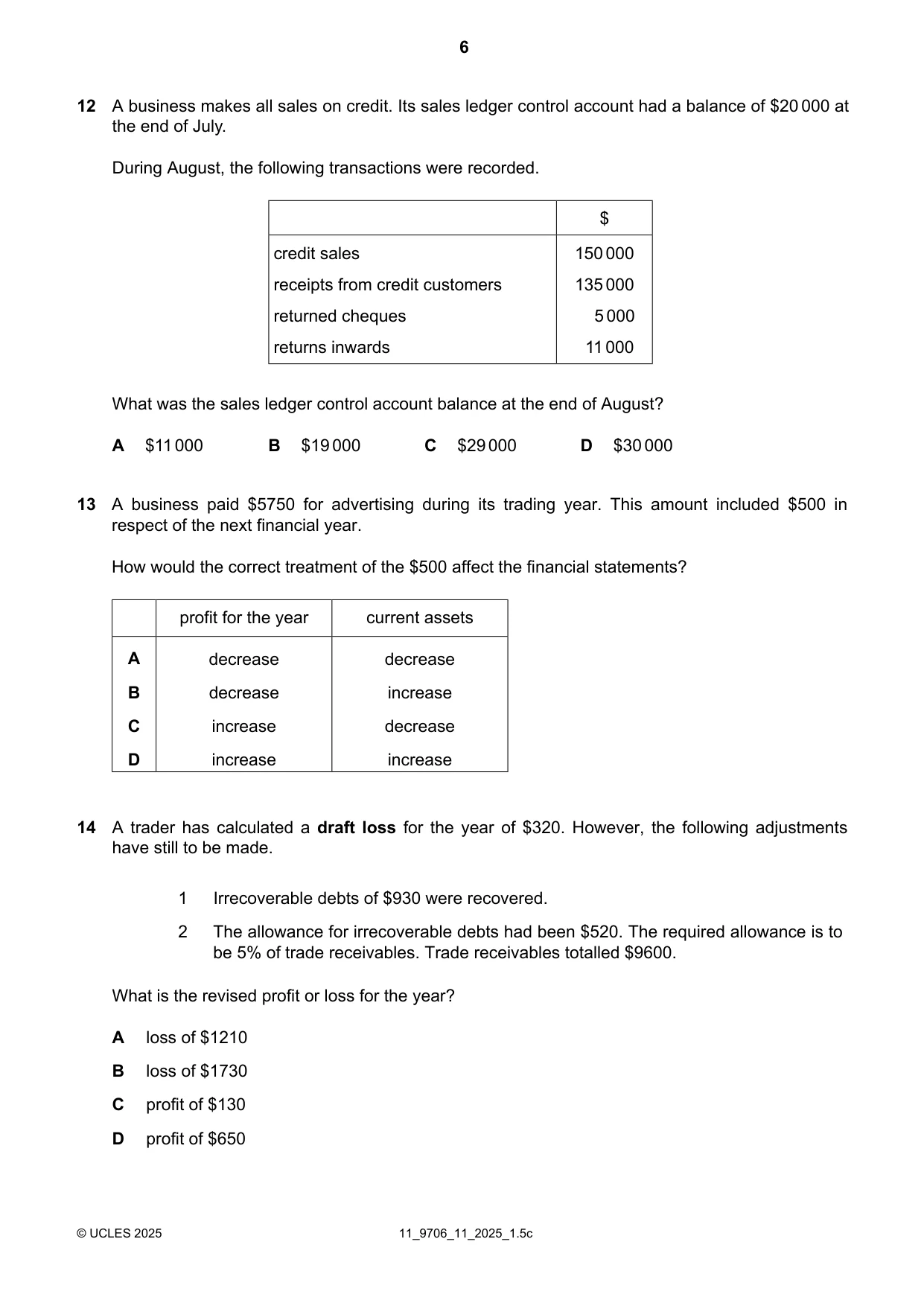
12 A business makes all sales on credit. Its sales ledger control account had a balance of $20 000 at the end of July. During August, the following transactions were recorded. $ credit sales 150000 receipts from credit customers 135000 returned cheques 5000 returns inwards 11000 What was the sales ledger control account balance at the end of August? A $11000 B $19000 C $29000 D $30000
Mark scheme: C
Q13 · A business paid $5750 for advertising during its trading year
13 A business paid $5750 for advertising during its trading year. This amount included $500 in respect of the next financial year. How would the correct treatment of the $500 affect the financial statements? profit for the year current assets A decrease decrease B decrease increase C increase decrease D increase increase
Mark scheme: D
Q14 · A trader has calculated a draft loss for the year of $320
14 A trader has calculated a draft loss for the year of $320. However, the following adjustments have still to be made. 1 Irrecoverable debts of $930 were recovered. 2 The allowance for irrecoverable debts had been $520. The required allowance is to be 5% of trade receivables. Trade receivables totalled $9600. What is the revised profit or loss for the year? A loss of $1210 B loss of $1730 C profit of $130 D profit of $650
Mark scheme: D
Q15 · Jaime provided the following information
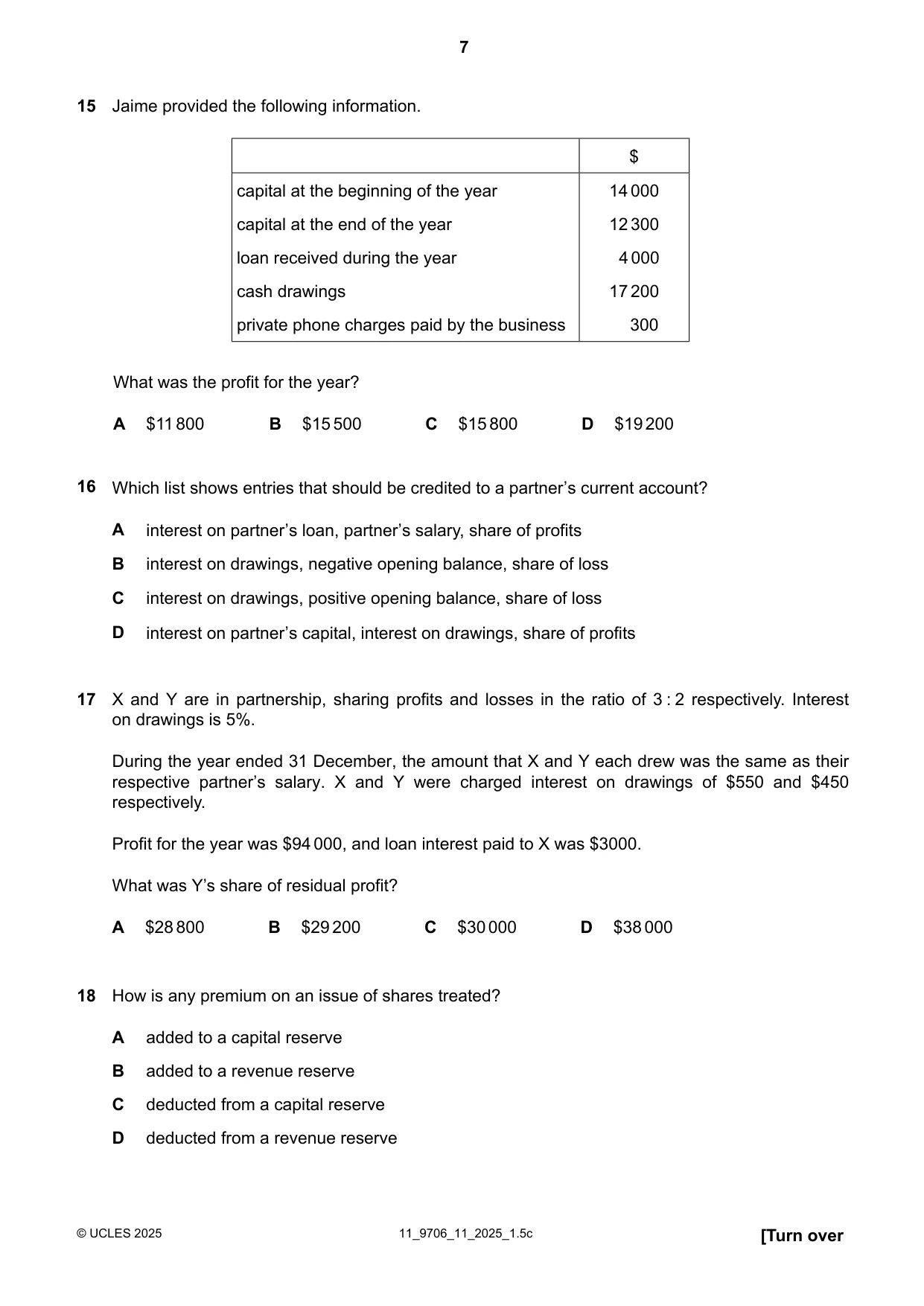
15 Jaime provided the following information. $ capital at the beginning of the year 14000 capital at the end of the year 12300 loan received during the year 4000 cash drawings 17200 private phone charges paid by the business 300 What was the profit for the year? A $11800 B $15500 C $15800 D $19200
Mark scheme: C
Q16 · Which list shows entries that should be credited to a partner’s current account?
16 Which list shows entries that should be credited to a partner’s current account? A interest on partner’s loan, partner’s salary, share of profits B interest on drawings, negative opening balance, share of loss C interest on drawings, positive opening balance, share of loss D interest on partner’s capital, interest on drawings, share of profits
Mark scheme: A
Q17 · X and Y are in partnership, sharing profits and losses in the ratio of 3 : 2 respectively
17 X and Y are in partnership, sharing profits and losses in the ratio of 3 : 2 respectively. Interest on drawings is 5%. During the year ended 31 December, the amount that X and Y each drew was the same as their respective partner’s salary. X and Y were charged interest on drawings of $550 and $450 respectively. Profit for the year was $94 000, and loan interest paid to X was $3000. What was Y’s share of residual profit? A $28800 B $29200 C $30000 D $38000
Mark scheme: C
Q18 · How is any premium on an issue of shares treated?
18 How is any premium on an issue of shares treated? A added to a capital reserve B added to a revenue reserve C deducted from a capital reserve D deducted from a revenue reserve
Mark scheme: A
Q19 · The table shows a company’s capital
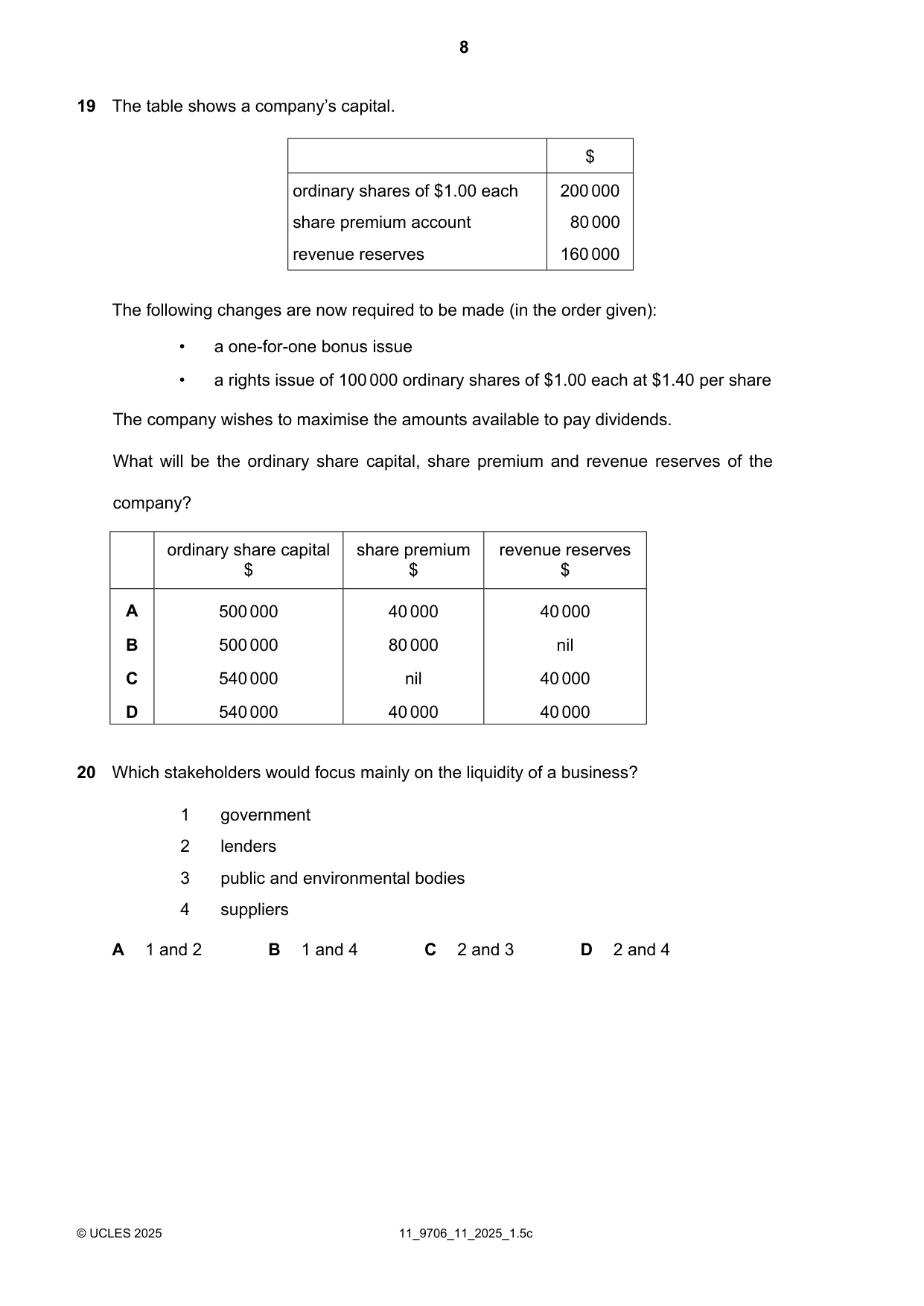
19 The table shows a company’s capital. $ ordinary shares of $1.00 each 200000 share premium account 80000 revenue reserves 160000 The following changes are now required to be made (in the order given): • a one-for-one bonus issue • a rights issue of 100 000 ordinary shares of $1.00 each at $1.40 per share The company wishes to maximise the amounts available to pay dividends. What will be the ordinary share capital, share premium and revenue reserves of the company? ordinary share capital share premium revenue reserves $ $ $ A 500000 40000 40000 B 500000 80000 nil C 540000 nil 40000 D 540000 40000 40000
Mark scheme: A
Q20 · Which stakeholders would focus mainly on the liquidity of a business?
20 Which stakeholders would focus mainly on the liquidity of a business? 1 government 2 lenders 3 public and environmental bodies 4 suppliers A 1 and 2 B 1 and 4 C 2 and 3 D 2 and 4
Mark scheme: D
More questions on Analysis and communication of accounting information
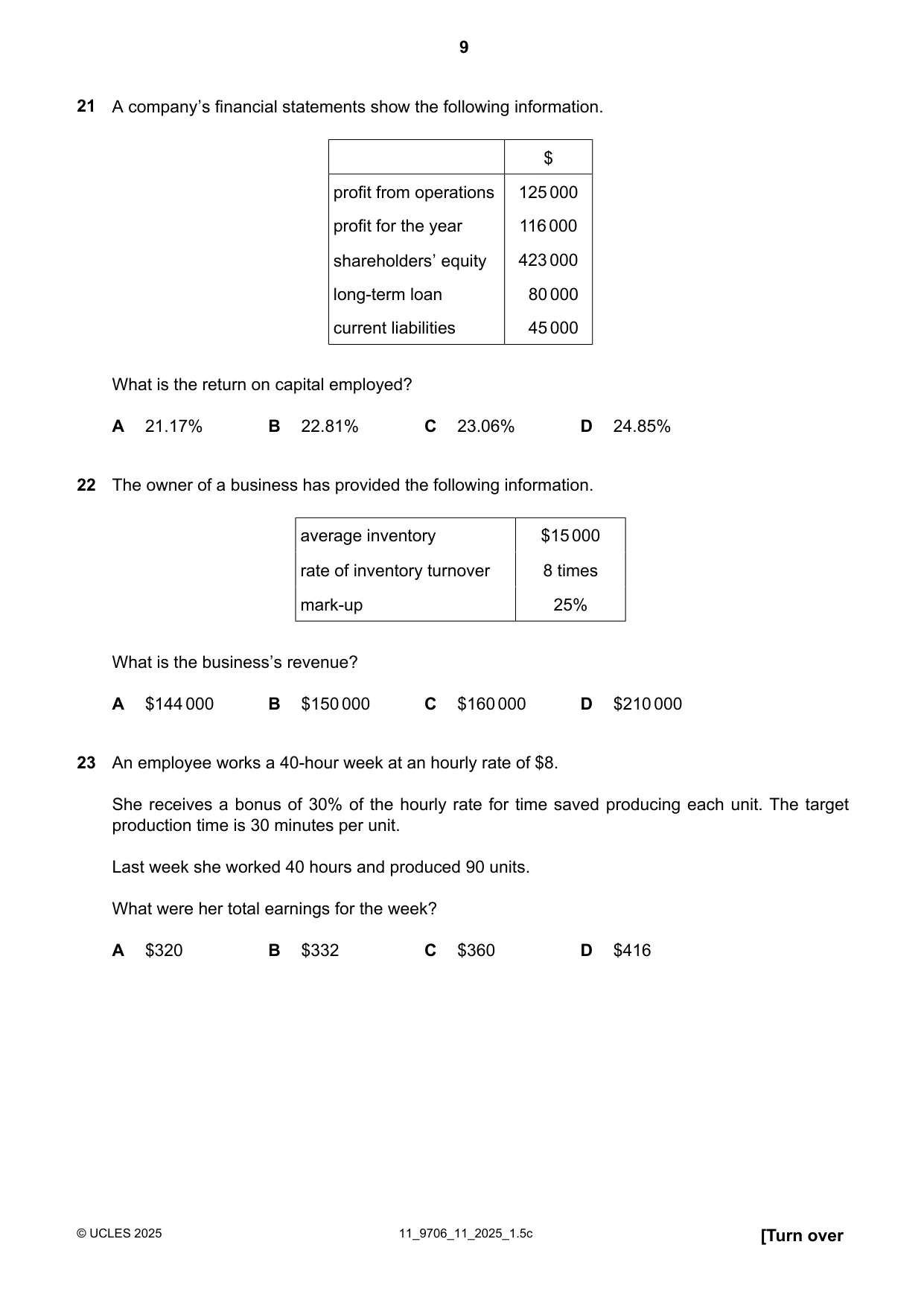
Q21 · A company’s financial statements show the following information
21 A company’s financial statements show the following information. $ profit from operations 125000 profit for the year 116000 shareholders’ equity 423000 long-term loan 80000 current liabilities 45000 What is the return on capital employed? A 21.17% B 22.81% C 23.06% D 24.85%
Mark scheme: D
More questions on Analysis and communication of accounting information
Q22 · The owner of a business has provided the following information
22 The owner of a business has provided the following information. average inventory $15000 rate of inventory turnover 8 times mark-up 25% What is the business’s revenue? A $144000 B $150000 C $160000 D $210000
Mark scheme: B
More questions on Analysis and communication of accounting information
Q23 · An employee works a 40-hour week at an hourly rate of $8
23 An employee works a 40-hour week at an hourly rate of $8. She receives a bonus of 30% of the hourly rate for time saved producing each unit. The target production time is 30 minutes per unit. Last week she worked 40 hours and produced 90 units. What were her total earnings for the week? A $320 B $332 C $360 D $416
Mark scheme: B
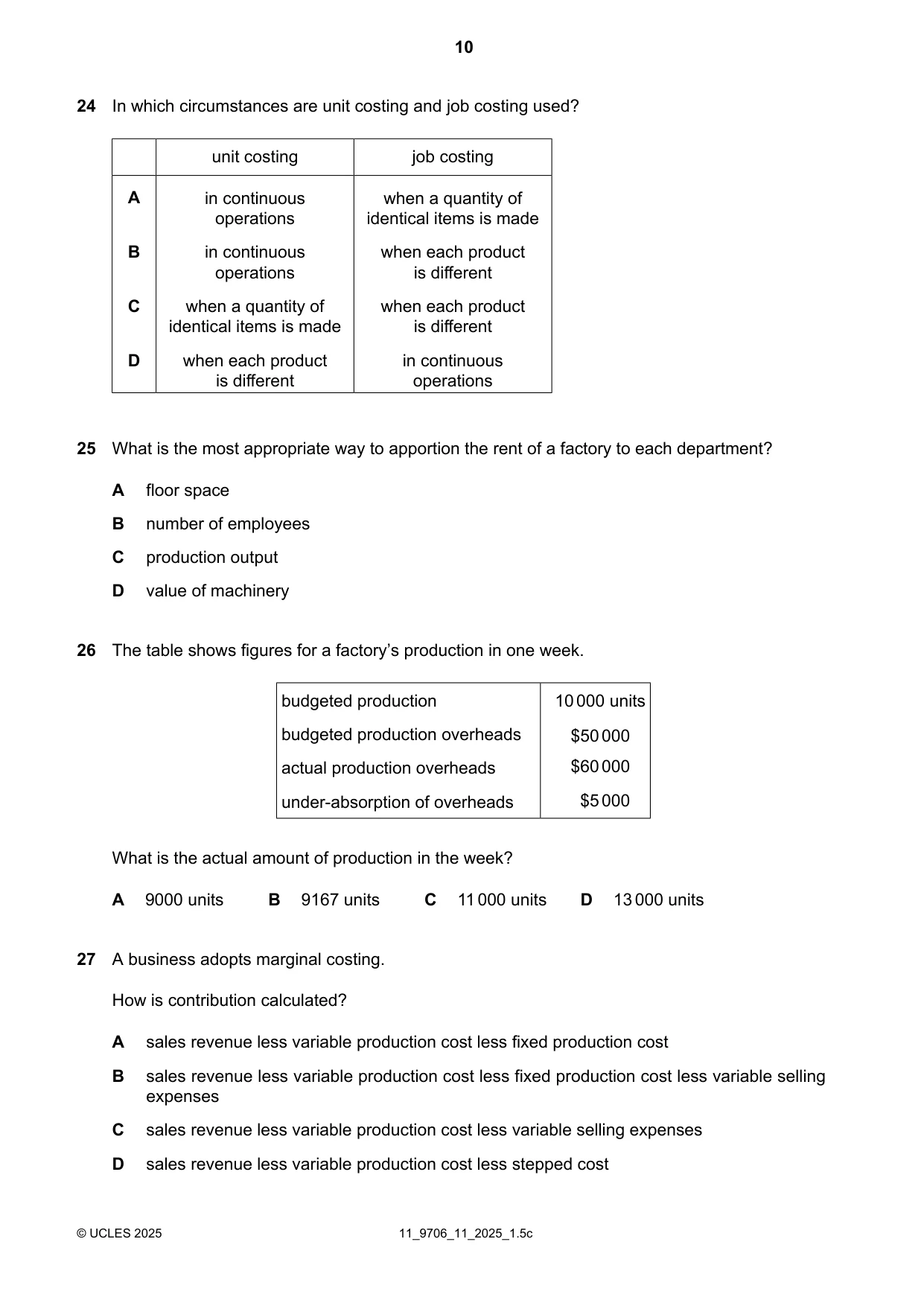
Q24 · In which circumstances are unit costing and job costing used?
24 In which circumstances are unit costing and job costing used? unit costing job costing A in continuous when a quantity of operations identical items is made B in continuous when each product operations is different C when a quantity of when each product identical items is made is different D when each product in continuous is different operations
Mark scheme: B
Q25 · What is the most appropriate way to apportion the rent of a factory to each department?
25 What is the most appropriate way to apportion the rent of a factory to each department? A floor space B number of employees C production output D value of machinery
Mark scheme: A
Q26 · The table shows figures for a factory’s production in one week
26 The table shows figures for a factory’s production in one week. budgeted production 10000 units budgeted production overheads $50 000 actual production overheads $60 000 under-absorption of overheads $5 000 What is the actual amount of production in the week? A 9000 units B 9167 units C 11000 units D 13000 units
Mark scheme: C
Q27 · A business adopts marginal costing
27 A business adopts marginal costing. How is contribution calculated? A sales revenue less variable production cost less fixed production cost B sales revenue less variable production cost less fixed production cost less variable selling expenses C sales revenue less variable production cost less variable selling expenses D sales revenue less variable production cost less stepped cost
Mark scheme: C
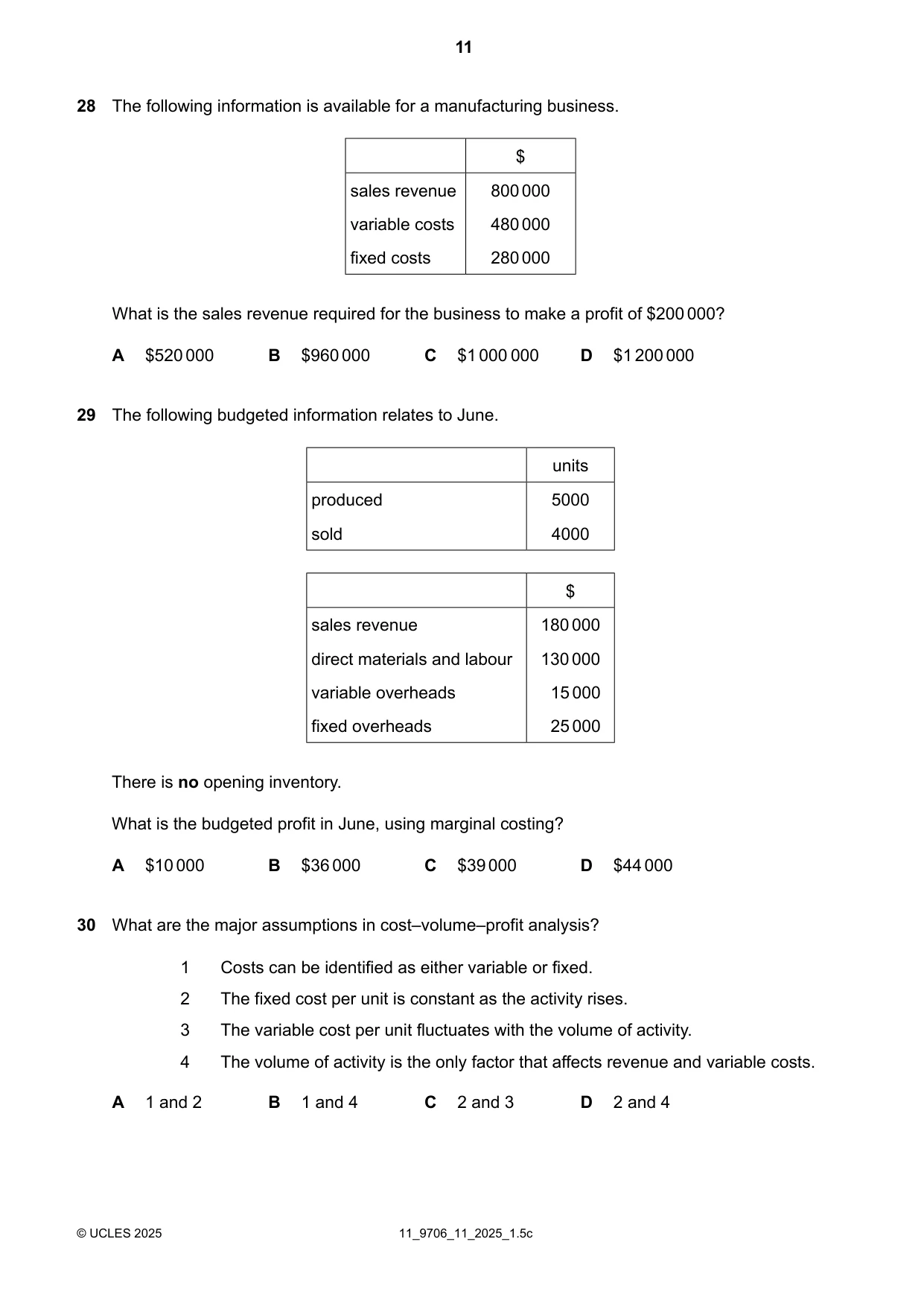
Q28 · The following information is available for a manufacturing business
28 The following information is available for a manufacturing business. $ sales revenue 800000 variable costs 480000 fixed costs 280000 What is the sales revenue required for the business to make a profit of $200000? A $520000 B $960000 C $1 000 000 D $1200000
Mark scheme: D
Q29 · The following budgeted information relates to June
29 The following budgeted information relates to June. units produced 5000 sold 4000 $ sales revenue 180000 direct materials and labour 130000 variable overheads 15000 fixed overheads 25000 There is no opening inventory. What is the budgeted profit in June, using marginal costing? A $10000 B $36000 C $39000 D $44000
Mark scheme: C
Q30 · What are the major assumptions in cost–volume–profit analysis?
30 What are the major assumptions in cost–volume–profit analysis? 1 Costs can be identified as either variable or fixed. 2 The fixed cost per unit is constant as the activity rises. 3 The variable cost per unit fluctuates with the volume of activity. 4 The volume of activity is the only factor that affects revenue and variable costs. A 1 and 2 B 1 and 4 C 2 and 3 D 2 and 4
Mark scheme: B
What was in this paper
The subtopics covered by these 30 questions, and how many questions each got. Open one in a new tab to see every Cambridge question on it.
What you needed in this session
Cambridge’s own grade thresholds for 2025 Oct/Nov, Paper 1 · Variant 1. A higher threshold means an easier paper — the bar moves with how the cohort did.