Cambridge A Level Accounting 9706 — 2017 May/June Paper 1 · Variant 2
9706/12/M/J/17 · 30 questions · 30 marks · ≈34 min
The question paper and its mark scheme, free to read here and free to download. This is Cambridge’s own paper, exactly as it was sat.
Question paper12 pages
Mark scheme3 pages
Answers below. Sit the paper first if you are practising.
Questions as text
Q1 · When a businessman introduces capital into his business, the transaction is debited in…
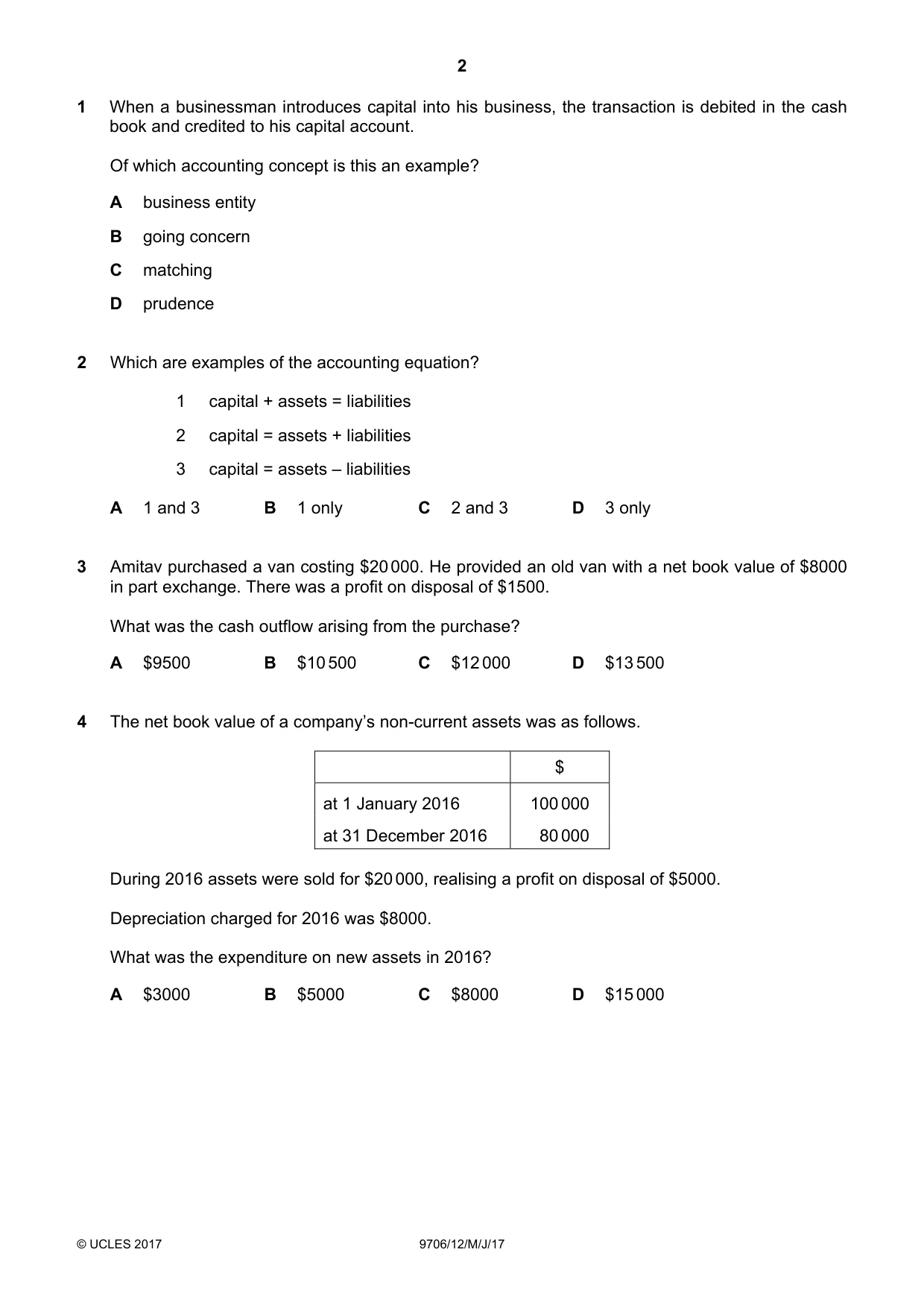
1 When a businessman introduces capital into his business, the transaction is debited in the cash book and credited to his capital account. Of which accounting concept is this an example? A business entity B going concern C matching D prudence
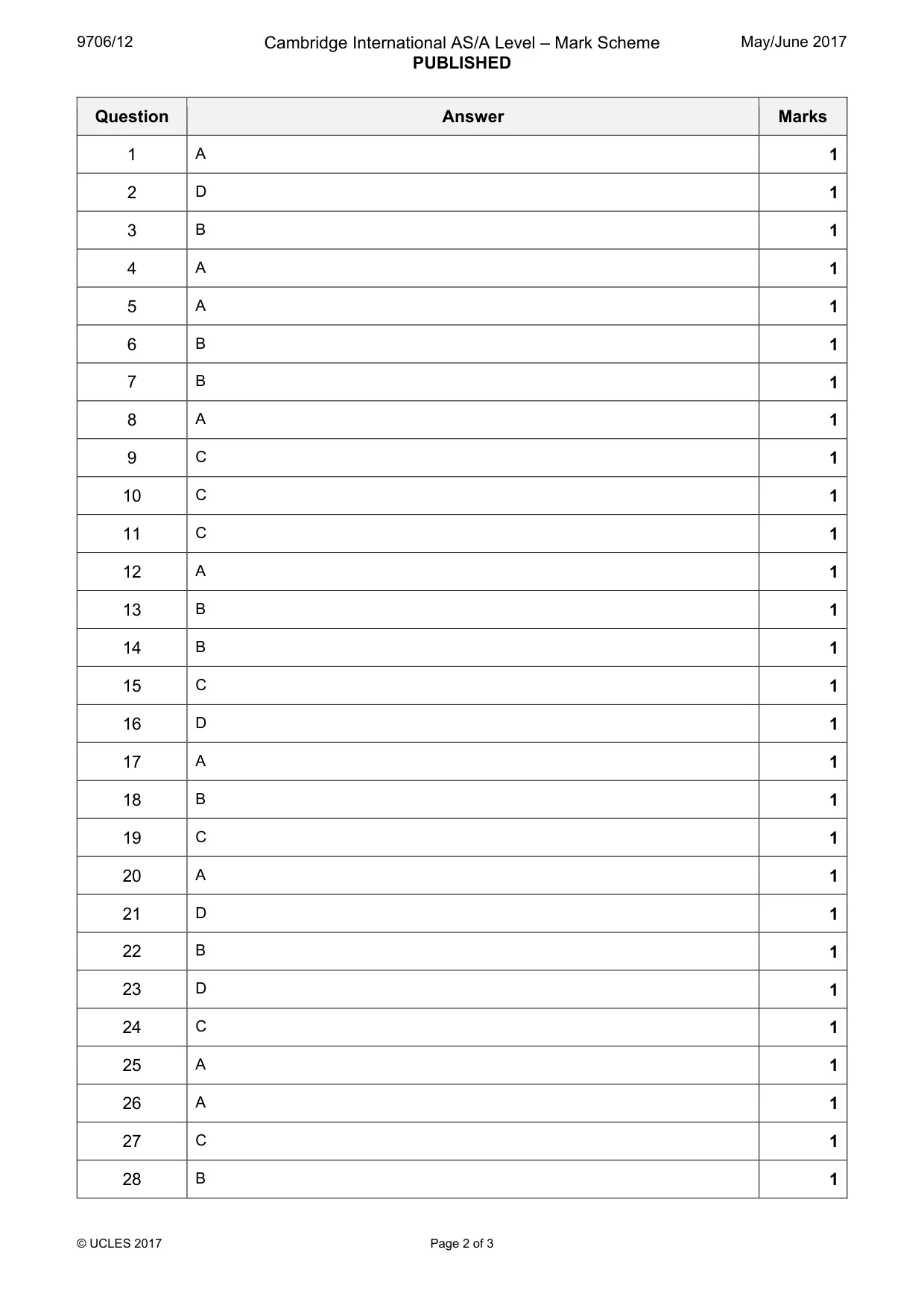
Mark scheme: A
Q2 · Which are examples of the accounting equation?
2 Which are examples of the accounting equation? 1 capital + assets = liabilities 2 capital = assets + liabilities 3 capital = assets – liabilities A 1 and 3 B 1 only C 2 and 3 D 3 only
Mark scheme: D
Q3 · Amitav purchased a van costing $20 000
3 Amitav purchased a van costing $20 000. He provided an old van with a net book value of $8000 in part exchange. There was a profit on disposal of $1500. What was the cash outflow arising from the purchase? A $9500 B $10 500 C $12 000 D $13 500
Mark scheme: B
Q4 · The net book value of a company’s non-current assets was as follows
4 The net book value of a company’s non-current assets was as follows. $ at 1 January 2016 100 000 at 31 December 2016 80 000 During 2016 assets were sold for $20 000, realising a profit on disposal of $5000. Depreciation charged for 2016 was $8000. What was the expenditure on new assets in 2016? A $3000 B $5000 C $8000 D $15 000
Mark scheme: A
Q5 · The following errors were found after a suspense account was opened
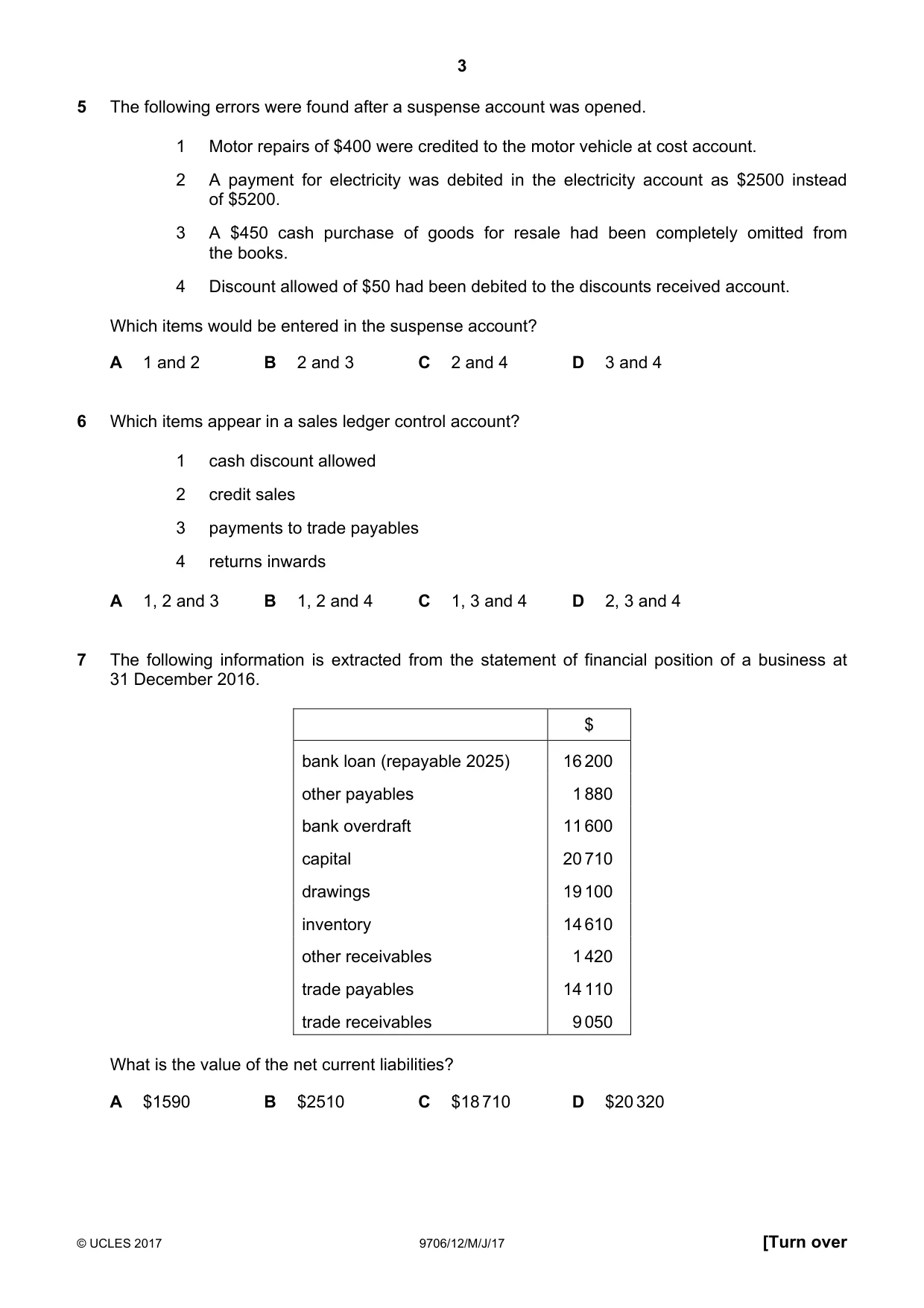
5 The following errors were found after a suspense account was opened. 1 Motor repairs of $400 were credited to the motor vehicle at cost account. 2 A payment for electricity was debited in the electricity account as $2500 instead of $5200. 3 A $450 cash purchase of goods for resale had been completely omitted from the books. 4 Discount allowed of $50 had been debited to the discounts received account. Which items would be entered in the suspense account? A 1 and 2 B 2 and 3 C 2 and 4 D 3 and 4
Mark scheme: A
Q6 · Which items appear in a sales ledger control account?
6 Which items appear in a sales ledger control account? 1 cash discount allowed 2 credit sales 3 payments to trade payables 4 returns inwards A 1, 2 and 3 B 1, 2 and 4 C 1, 3 and 4 D 2, 3 and 4
Mark scheme: B
Q7 · The following information is extracted from the statement of financial position of a…
7 The following information is extracted from the statement of financial position of a business at 31 December 2016. $ bank loan (repayable 2025) 16 200 other payables 1 880 bank overdraft 11 600 capital 20 710 drawings 19 100 inventory 14 610 other receivables 1 420 trade payables 14 110 trade receivables 9 050 What is the value of the net current liabilities? A $1590 B $2510 C $18 710 D $20 320
Mark scheme: B
Q8 · The following items are recorded in the cash book of a business but not yet recorded in…
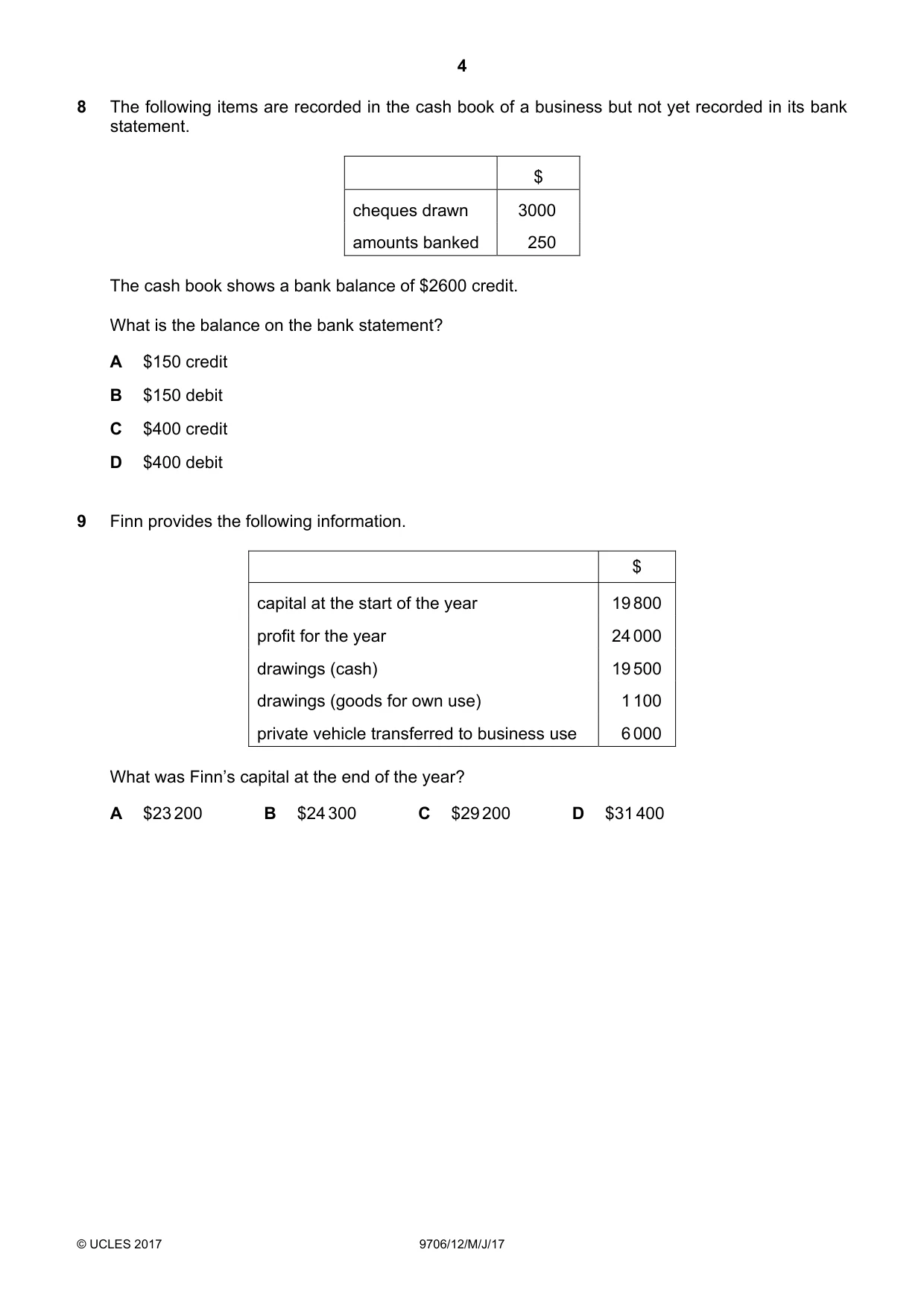
8 The following items are recorded in the cash book of a business but not yet recorded in its bank statement. $ cheques drawn 3000 amounts banked 250 The cash book shows a bank balance of $2600 credit. What is the balance on the bank statement? A $150 credit B $150 debit C $400 credit D $400 debit
Mark scheme: A
Q9 · Finn provides the following information
9 Finn provides the following information. $ capital at the start of the year 19 800 profit for the year 24 000 drawings (cash) 19 500 drawings (goods for own use) 1 100 private vehicle transferred to business use 6 000 What was Finn’s capital at the end of the year? A $23 200 B $24 300 C $29 200 D $31 400
Mark scheme: C
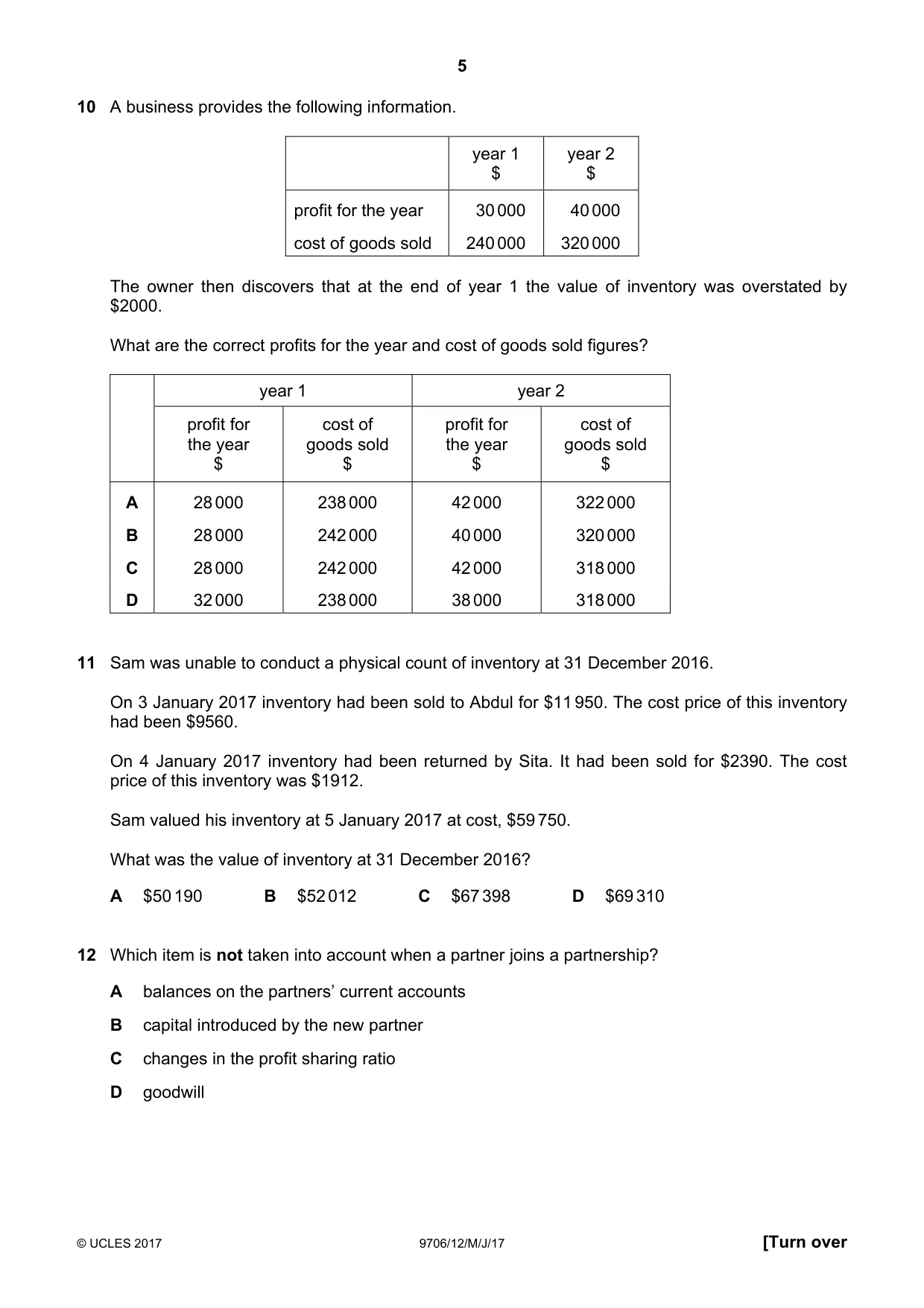
Q10 · A business provides the following information
10 A business provides the following information. year 1 year 2 $ $ profit for the year 30 000 40 000 cost of goods sold 240 000 320 000 The owner then discovers that at the end of year 1 the value of inventory was overstated by $2000. What are the correct profits for the year and cost of goods sold figures? year 1 year 2 profit for cost of profit for cost of the year goods sold the year goods sold $ $ $ $ A 28 000 238 000 42 000 322 000 B 28 000 242 000 40 000 320 000 C 28 000 242 000 42 000 318 000 D 32 000 238 000 38 000 318 000
Mark scheme: C
Q11 · Sam was unable to conduct a physical count of inventory at 31 December 2016
11 Sam was unable to conduct a physical count of inventory at 31 December 2016. On 3 January 2017 inventory had been sold to Abdul for $11 950. The cost price of this inventory had been $9560. On 4 January 2017 inventory had been returned by Sita. It had been sold for $2390. The cost price of this inventory was $1912. Sam valued his inventory at 5 January 2017 at cost, $59 750. What was the value of inventory at 31 December 2016? A $50 190 B $52 012 C $67 398 D $69 310
Mark scheme: C
Q12 · Which item is not taken into account when a partner joins a partnership?
12 Which item is not taken into account when a partner joins a partnership? A balances on the partners’ current accounts B capital introduced by the new partner C changes in the profit sharing ratio D goodwill
Mark scheme: A
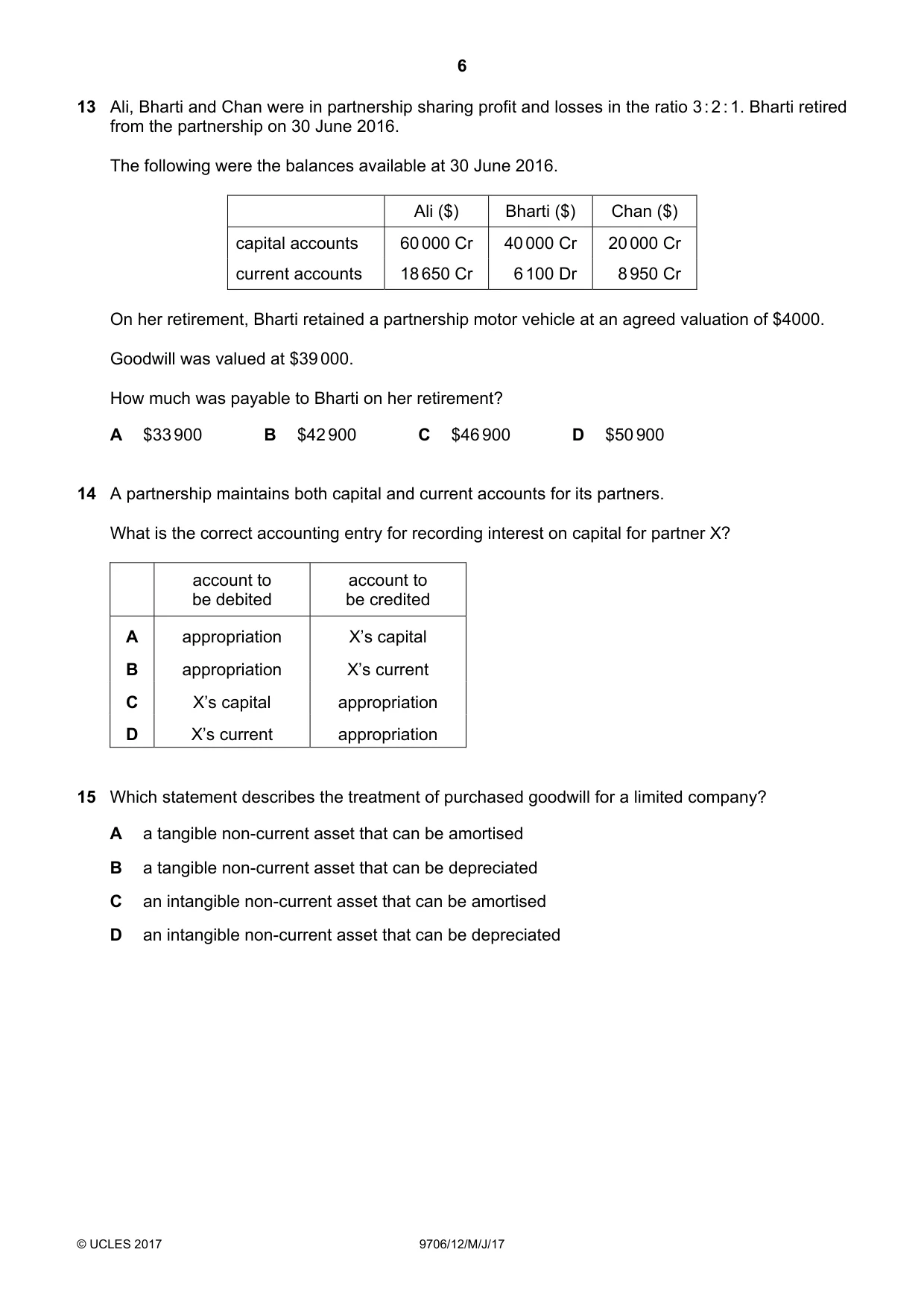
Q13 · Ali, Bharti and Chan were in partnership sharing profit and losses in the ratio 3 : 2 : 1
13 Ali, Bharti and Chan were in partnership sharing profit and losses in the ratio 3 : 2 : 1. Bharti retired from the partnership on 30 June 2016. The following were the balances available at 30 June 2016. Ali ($) Bharti ($) Chan ($) capital accounts 60 000 Cr 40 000 Cr 20 000 Cr current accounts 18 650 Cr 6 100 Dr 8 950 Cr On her retirement, Bharti retained a partnership motor vehicle at an agreed valuation of $4000. Goodwill was valued at $39 000. How much was payable to Bharti on her retirement? A $33 900 B $42 900 C $46 900 D $50 900
Mark scheme: B
Q14 · A partnership maintains both capital and current accounts for its partners
14 A partnership maintains both capital and current accounts for its partners. What is the correct accounting entry for recording interest on capital for partner X? account to account to be debited be credited A appropriation X’s capital B appropriation X’s current C X’s capital appropriation D X’s current appropriation
Mark scheme: B
Q15 · Which statement describes the treatment of purchased goodwill for a limited company?
15 Which statement describes the treatment of purchased goodwill for a limited company? A a tangible non-current asset that can be amortised B a tangible non-current asset that can be depreciated C an intangible non-current asset that can be amortised D an intangible non-current asset that can be depreciated
Mark scheme: C
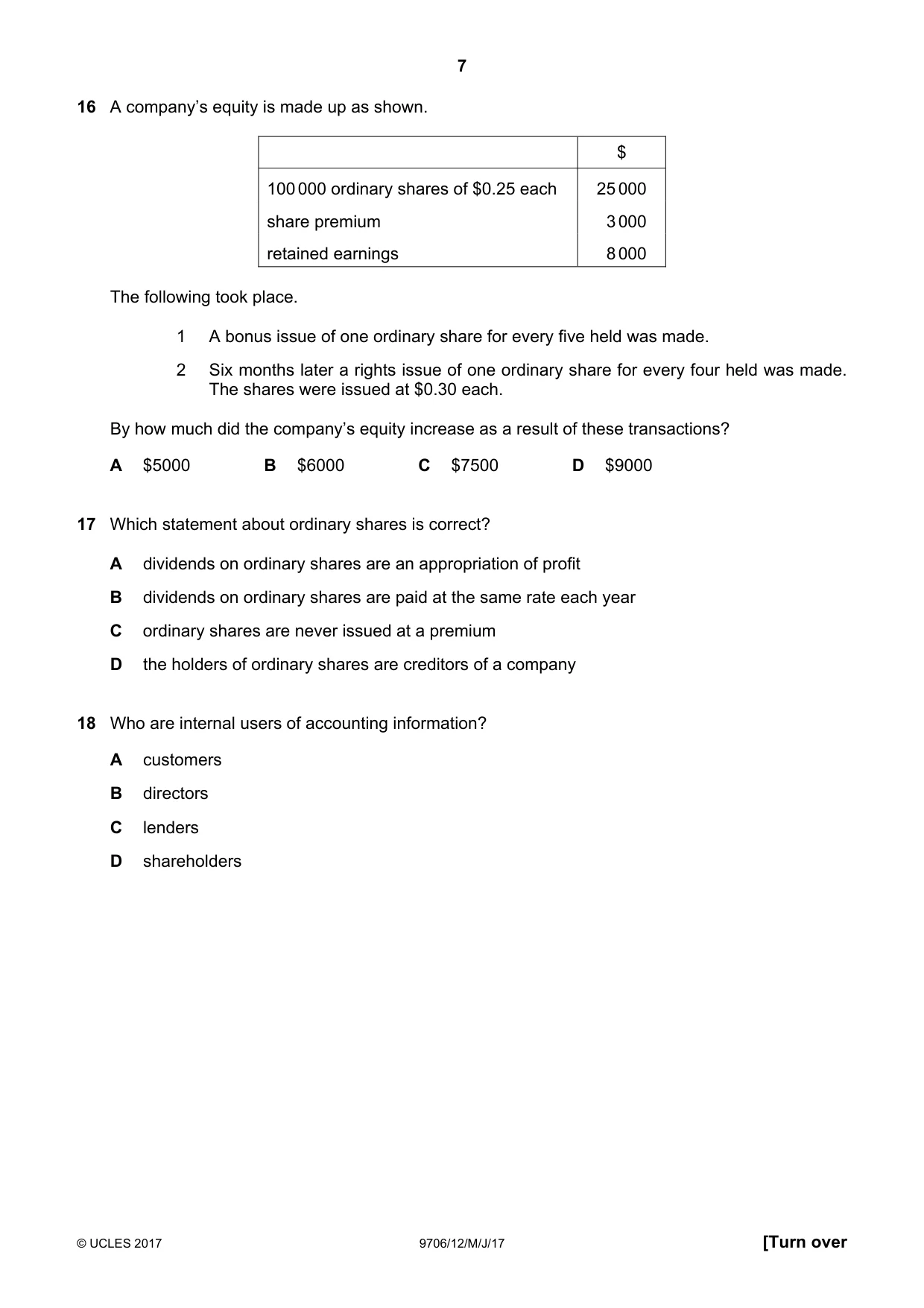
Q16 · A company’s equity is made up as shown
16 A company’s equity is made up as shown. $ 100 000 ordinary shares of $0.25 each 25 000 share premium 3 000 retained earnings 8 000 The following took place. 1 A bonus issue of one ordinary share for every five held was made. 2 Six months later a rights issue of one ordinary share for every four held was made. The shares were issued at $0.30 each. By how much did the company’s equity increase as a result of these transactions? A $5000 B $6000 C $7500 D $9000
Mark scheme: D
Q17 · Which statement about ordinary shares is correct?
17 Which statement about ordinary shares is correct? A dividends on ordinary shares are an appropriation of profit B dividends on ordinary shares are paid at the same rate each year C ordinary shares are never issued at a premium D the holders of ordinary shares are creditors of a company
Mark scheme: A
Q18 · Who are internal users of accounting information?
18 Who are internal users of accounting information? A customers B directors C lenders D shareholders
Mark scheme: B
More questions on Analysis and communication of accounting information
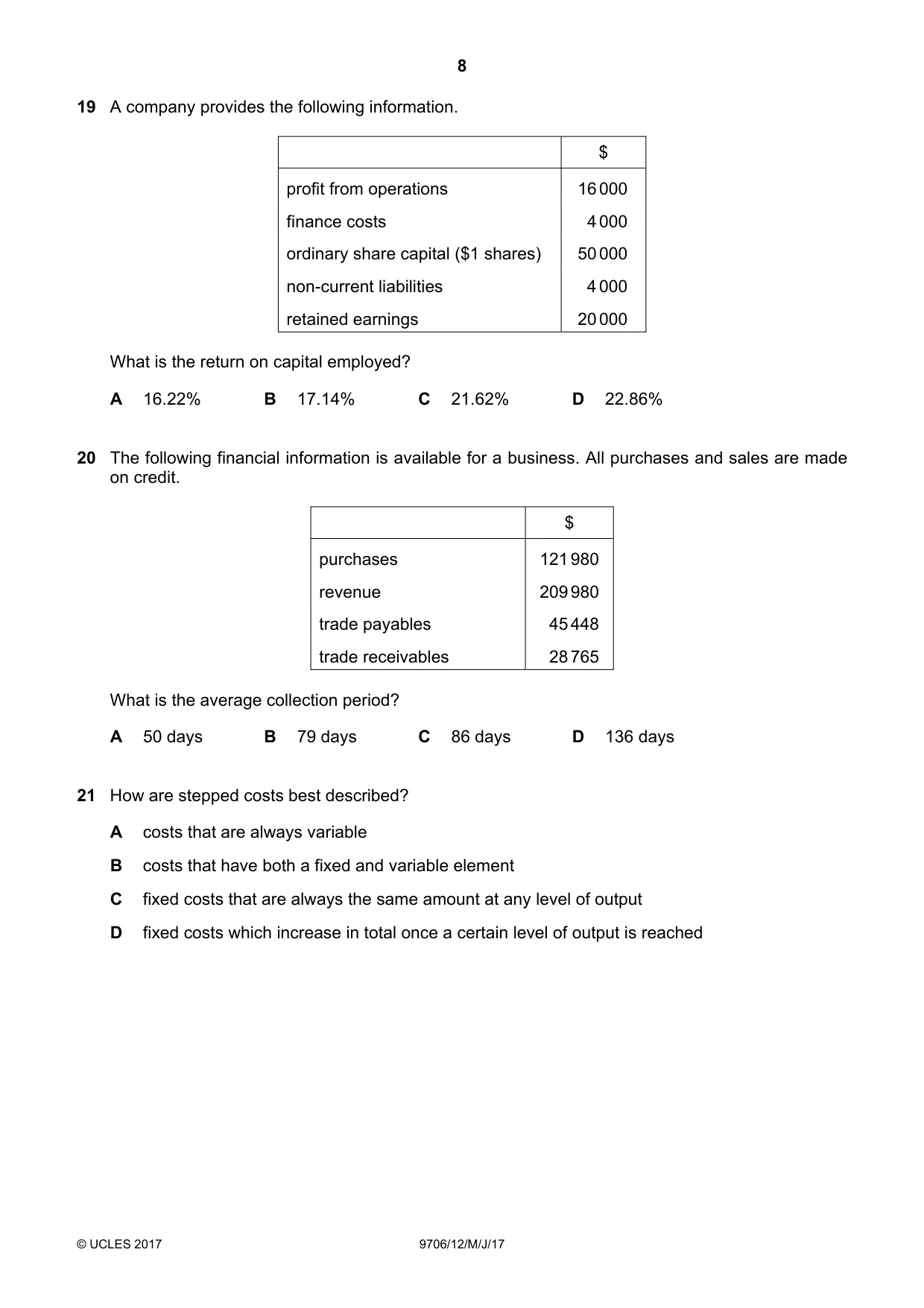
Q19 · A company provides the following information
19 A company provides the following information. $ profit from operations 16 000 finance costs 4 000 ordinary share capital ($1 shares) 50 000 non-current liabilities 4 000 retained earnings 20 000 What is the return on capital employed? A 16.22% B 17.14% C 21.62% D 22.86%
Mark scheme: C
More questions on Analysis and communication of accounting information
Q20 · The following financial information is available for a business
20 The following financial information is available for a business. All purchases and sales are made on credit. $ purchases 121 980 revenue 209 980 trade payables 45 448 trade receivables 28 765 What is the average collection period? A 50 days B 79 days C 86 days D 136 days
Mark scheme: A
More questions on Analysis and communication of accounting information
Q21 · How are stepped costs best described?
21 How are stepped costs best described? A costs that are always variable B costs that have both a fixed and variable element C fixed costs that are always the same amount at any level of output D fixed costs which increase in total once a certain level of output is reached
Mark scheme: D
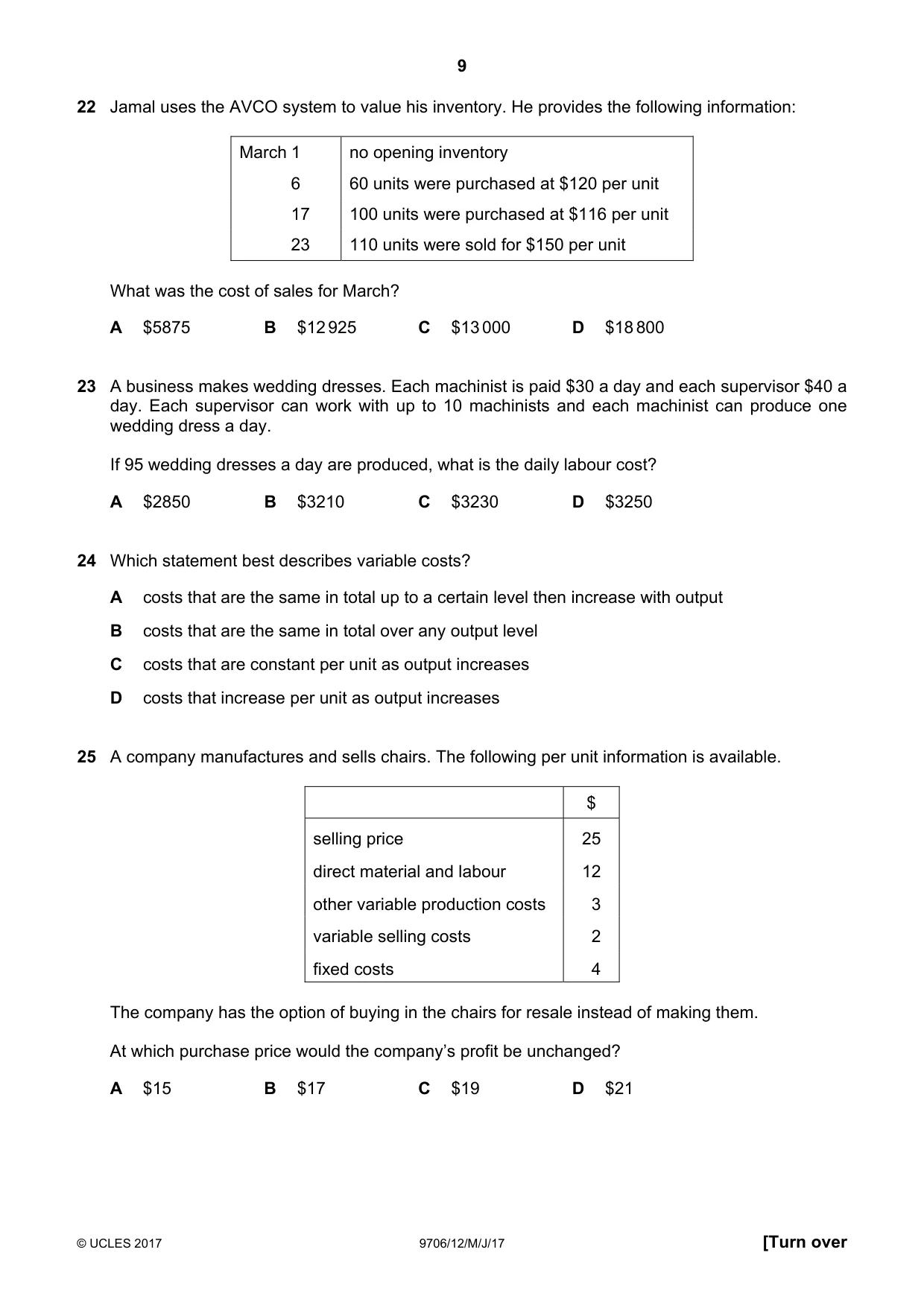
Q22 · Jamal uses the AVCO system to value his inventory
22 Jamal uses the AVCO system to value his inventory. He provides the following information: March 1 no opening inventory 6 60 units were purchased at $120 per unit 17 100 units were purchased at $116 per unit 23 110 units were sold for $150 per unit What was the cost of sales for March? A $5875 B $12 925 C $13 000 D $18 800
Mark scheme: B
Q23 · A business makes wedding dresses
23 A business makes wedding dresses. Each machinist is paid $30 a day and each supervisor $40 a day. Each supervisor can work with up to 10 machinists and each machinist can produce one wedding dress a day. If 95 wedding dresses a day are produced, what is the daily labour cost? A $2850 B $3210 C $3230 D $3250
Mark scheme: D
Q24 · Which statement best describes variable costs?
24 Which statement best describes variable costs? A costs that are the same in total up to a certain level then increase with output B costs that are the same in total over any output level C costs that are constant per unit as output increases D costs that increase per unit as output increases
Mark scheme: C
Q25 · A company manufactures and sells chairs
25 A company manufactures and sells chairs. The following per unit information is available. $ selling price 25 direct material and labour 12 other variable production costs 3 variable selling costs 2 fixed costs 4 The company has the option of buying in the chairs for resale instead of making them. At which purchase price would the company’s profit be unchanged? A $15 B $17 C $19 D $21
Mark scheme: A
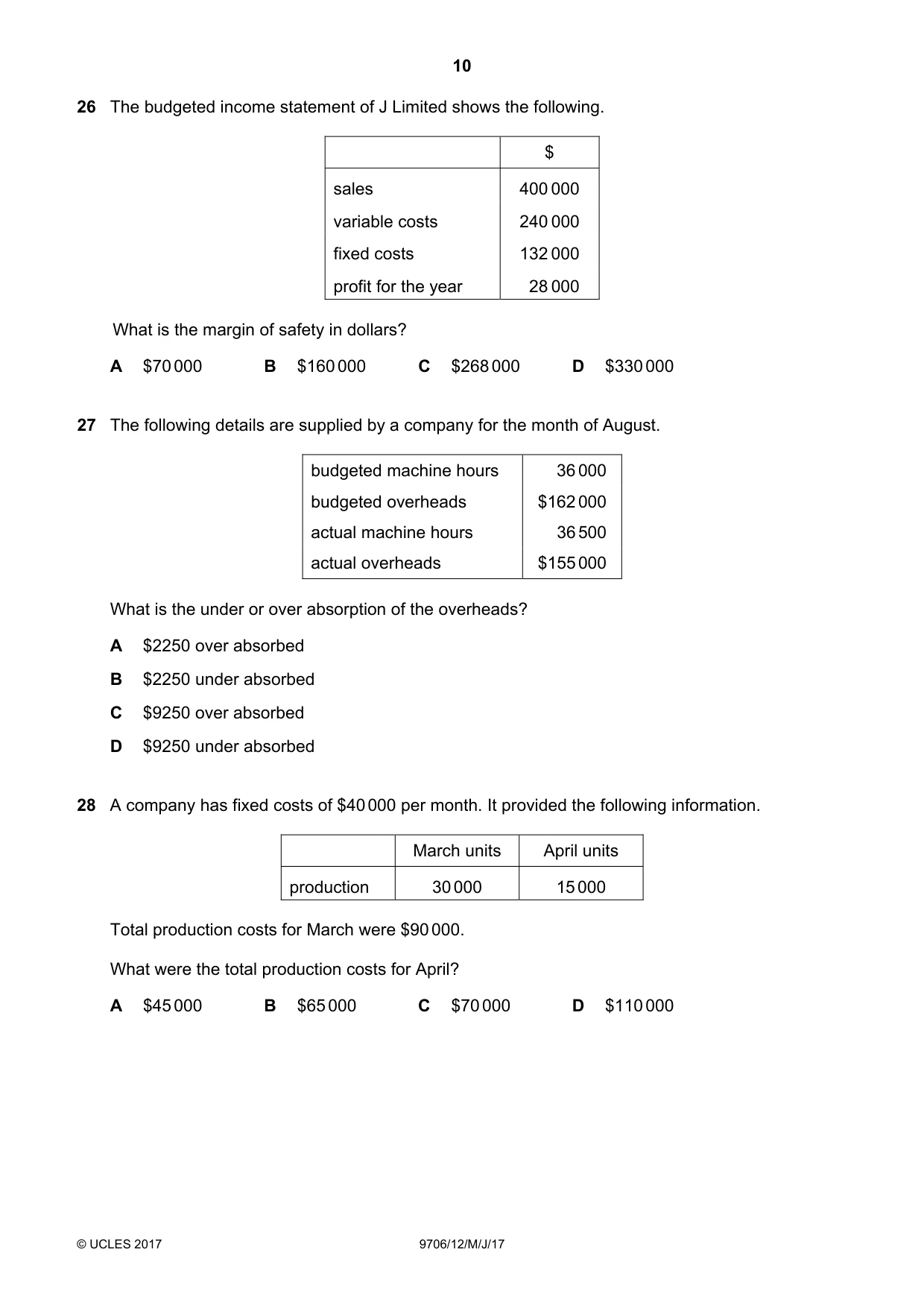
Q26 · The budgeted income statement of J Limited shows the following
26 The budgeted income statement of J Limited shows the following. $ sales 400 000 variable costs 240 000 fixed costs 132 000 profit for the year 28 000 What is the margin of safety in dollars? A $70 000 B $160 000 C $268 000 D $330 000
Mark scheme: A
Q27 · The following details are supplied by a company for the month of August
27 The following details are supplied by a company for the month of August. budgeted machine hours 36 000 budgeted overheads $162 000 actual machine hours 36 500 actual overheads $155 000 What is the under or over absorption of the overheads? A $2250 over absorbed B $2250 under absorbed C $9250 over absorbed D $9250 under absorbed
Mark scheme: C
Q28 · A company has fixed costs of $40 000 per month
28 A company has fixed costs of $40 000 per month. It provided the following information. March units April units production 30 000 15 000 Total production costs for March were $90 000. What were the total production costs for April? A $45 000 B $65 000 C $70 000 D $110 000
Mark scheme: B
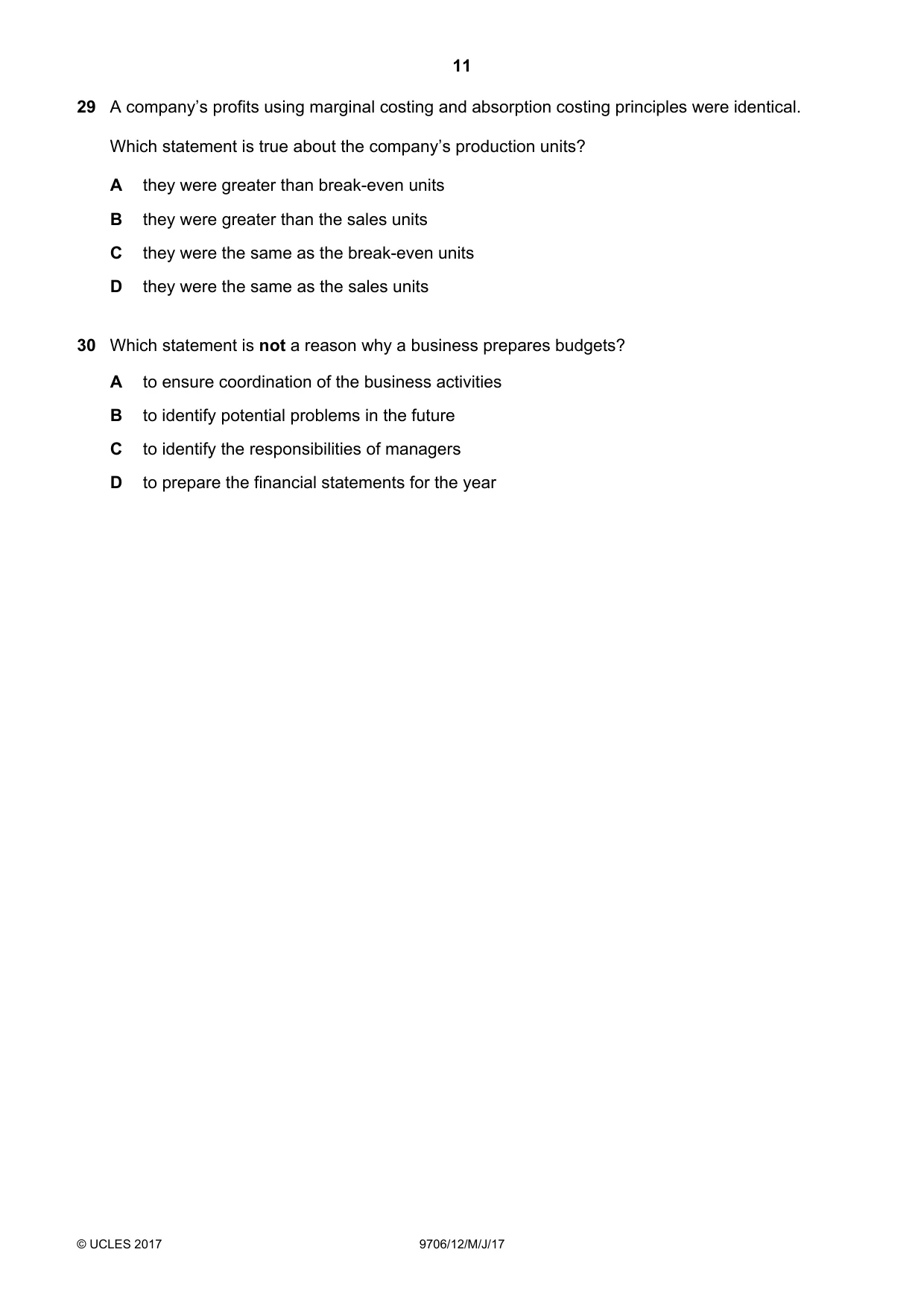
Q29 · A company’s profits using marginal costing and absorption costing principles were…
29 A company’s profits using marginal costing and absorption costing principles were identical. Which statement is true about the company’s production units? A they were greater than break-even units B they were greater than the sales units C they were the same as the break-even units D they were the same as the sales units
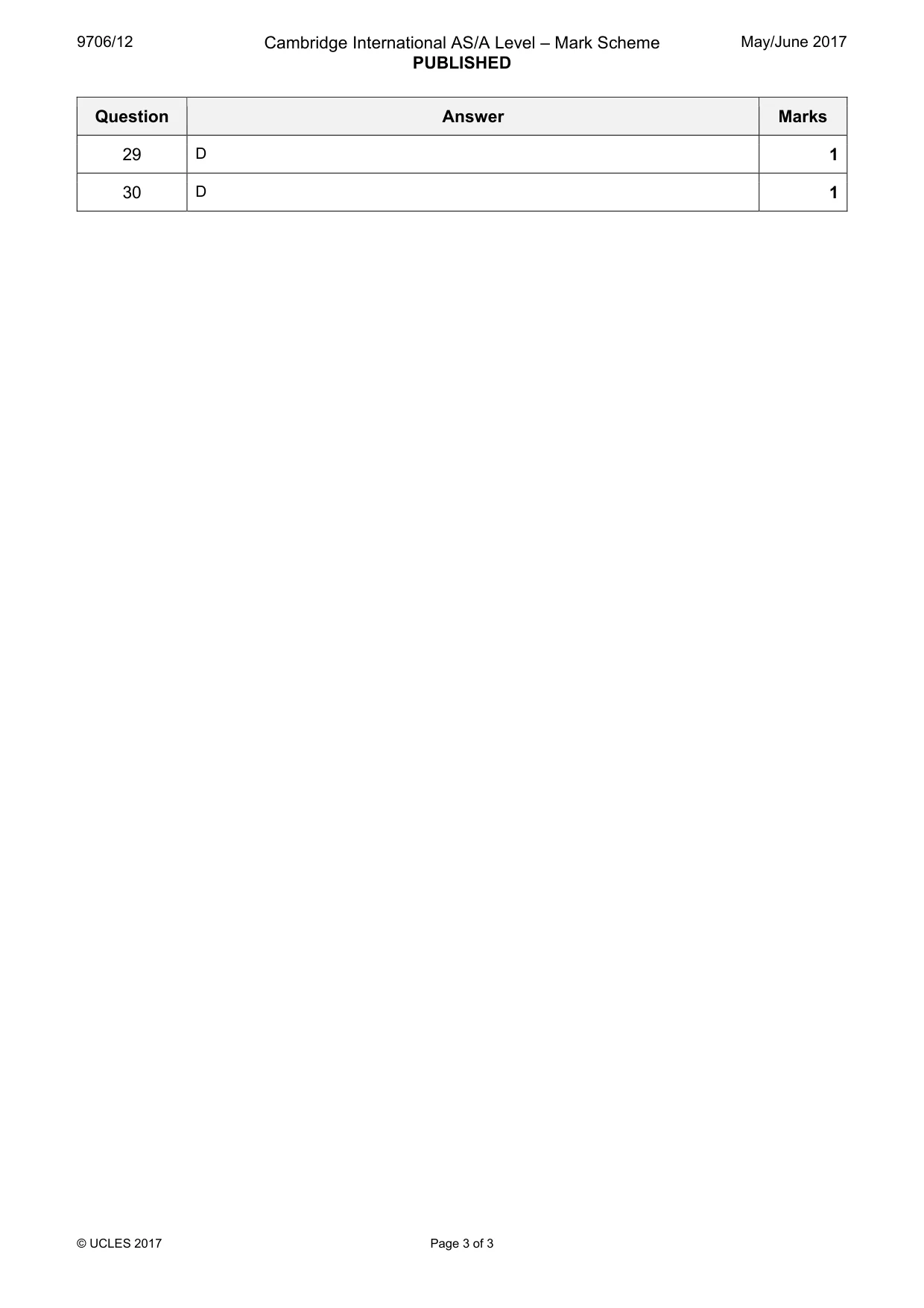
Mark scheme: D
Q30 · Which statement is not a reason why a business prepares budgets?
30 Which statement is not a reason why a business prepares budgets? A to ensure coordination of the business activities B to identify potential problems in the future C to identify the responsibilities of managers D to prepare the financial statements for the year
Mark scheme: D
What was in this paper
The subtopics covered by these 30 questions, and how many questions each got. Open one in a new tab to see every Cambridge question on it.
What you needed in this session
Cambridge’s own grade thresholds for 2017 May/June, Paper 1 · Variant 2. A higher threshold means an easier paper — the bar moves with how the cohort did.