Cambridge A Level Accounting 9706 — 2008 May/June Paper 1 · Variant 1
9706/11/M/J/08 · 30 questions · 30 marks · ≈34 min
The question paper and its mark scheme, free to read here and free to download. This is Cambridge’s own paper, exactly as it was sat.
Question paper12 pages
Mark scheme2 pages
Answers below. Sit the paper first if you are practising.
Questions as text
Q1 · When is it necessary to distinguish between revenue and capital expenditure?
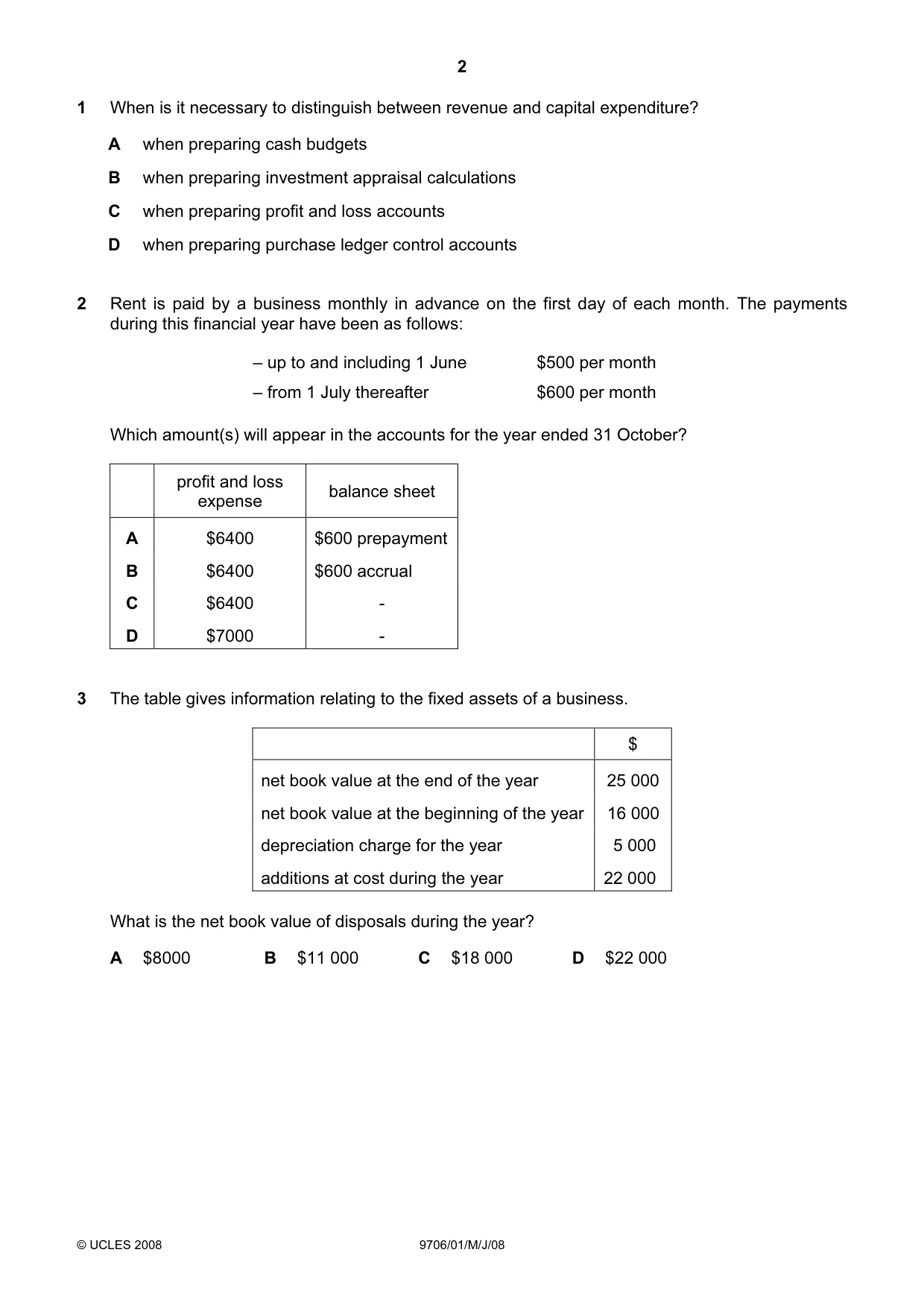
1 When is it necessary to distinguish between revenue and capital expenditure? A when preparing cash budgets B when preparing investment appraisal calculations C when preparing profit and loss accounts D when preparing purchase ledger control accounts
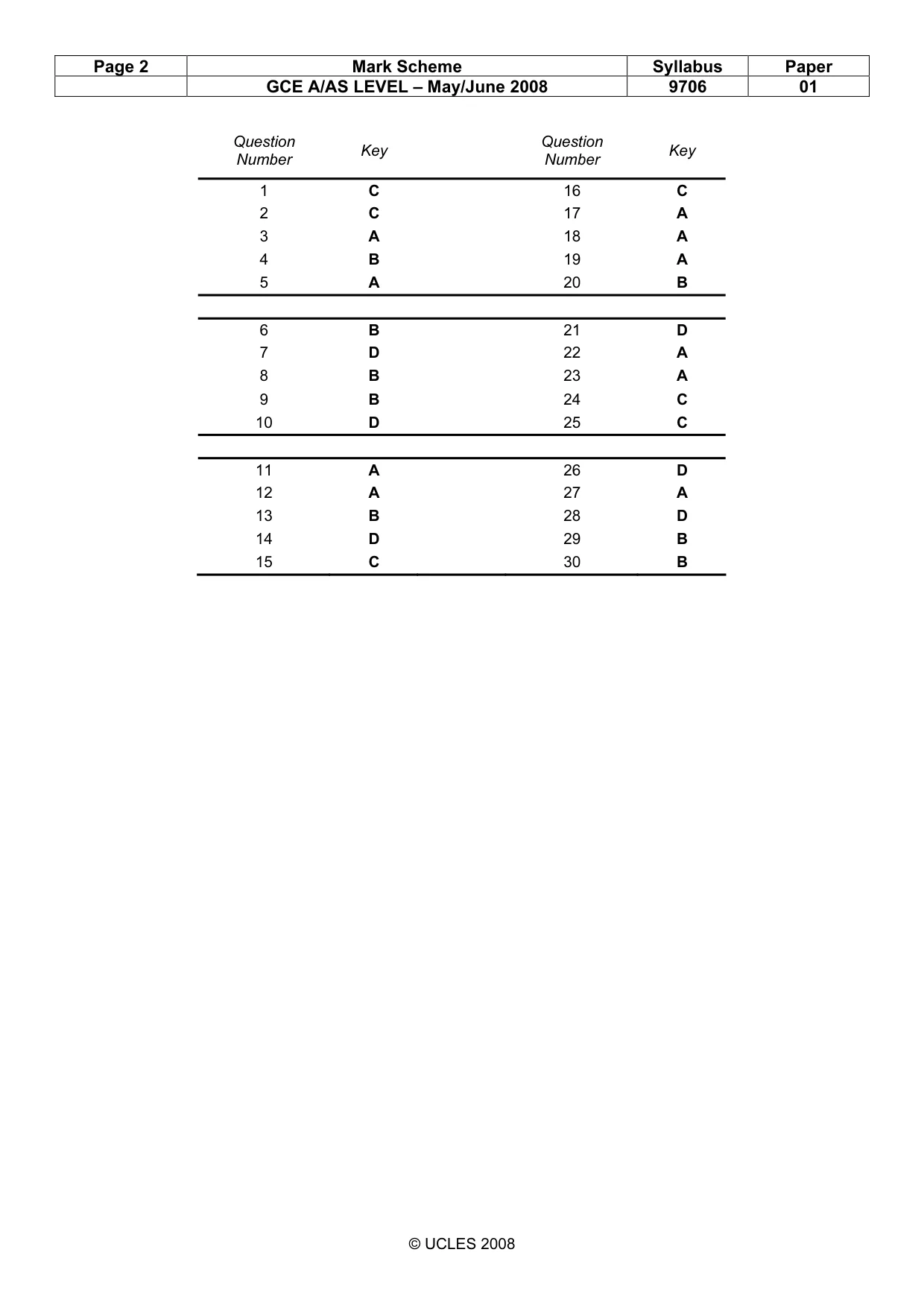
Mark scheme: C
Q2 · Rent is paid by a business monthly in advance on the first day of each month
2 Rent is paid by a business monthly in advance on the first day of each month. The payments during this financial year have been as follows: – up to and including 1 June $500 per month – from 1 July thereafter $600 per month Which amount(s) will appear in the accounts for the year ended 31 October? profit and loss balance sheet expense A $6400 $600 prepayment B $6400 $600 accrual C $6400 - D $7000 -
Mark scheme: C
Q3 · The table gives information relating to the fixed assets of a business
3 The table gives information relating to the fixed assets of a business. $ net book value at the end of the year 25 000 net book value at the beginning of the year 16 000 depreciation charge for the year 5 000 additions at cost during the year 22 000 What is the net book value of disposals during the year? A $8000 B $11 000 C $18 000 D $22 000
Mark scheme: A
Q4 · A trial balance at 30 June, before making end of year adjustments, showed: debit credit $…
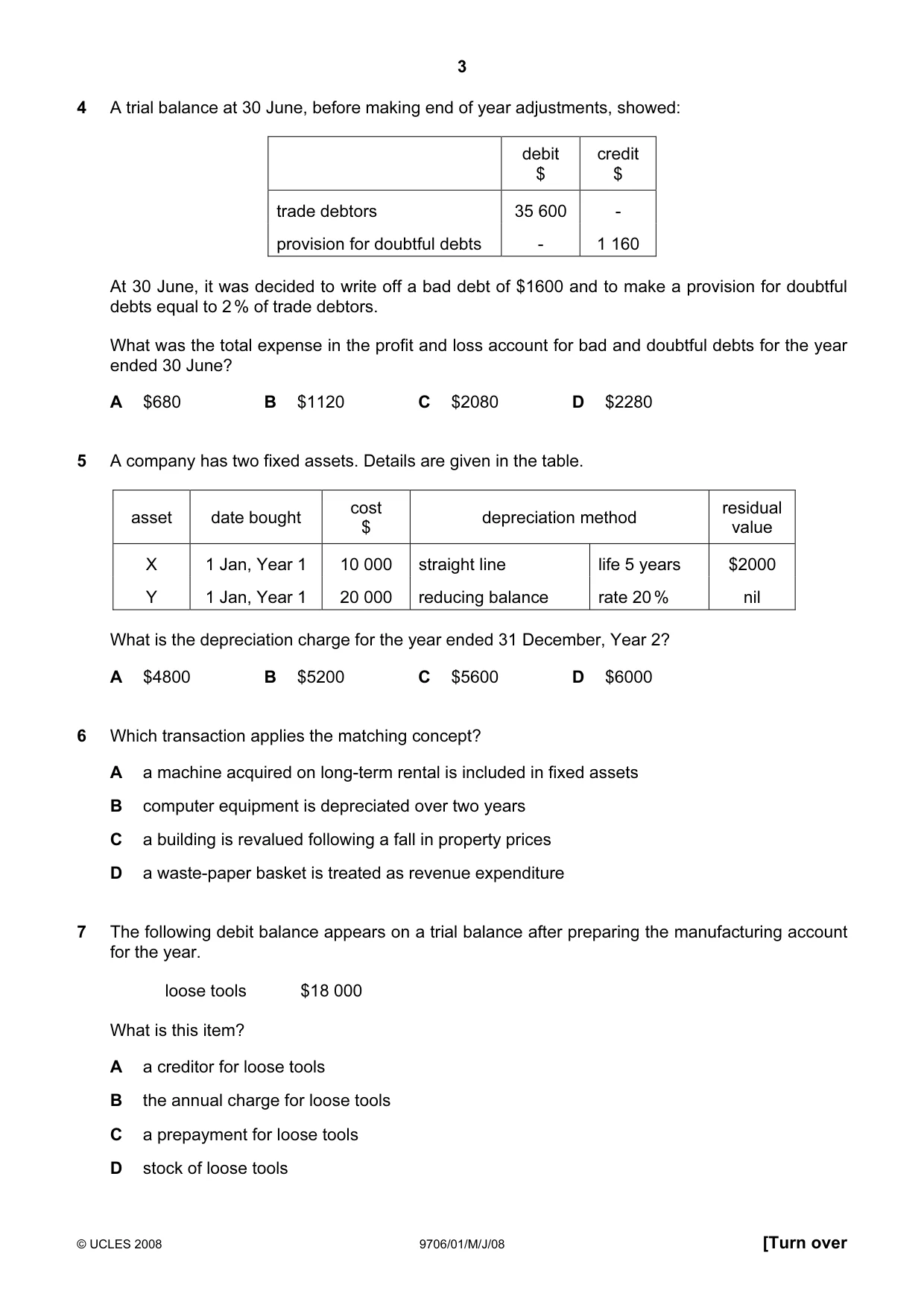
4 A trial balance at 30 June, before making end of year adjustments, showed: debit credit $ $ trade debtors 35 600 - provision for doubtful debts - 1 160 At 30 June, it was decided to write off a bad debt of $1600 and to make a provision for doubtful debts equal to 2 % of trade debtors. What was the total expense in the profit and loss account for bad and doubtful debts for the year ended 30 June? A $680 B $1120 C $2080 D $2280
Mark scheme: B
Q5 · A company has two fixed assets
5 A company has two fixed assets. Details are given in the table. cost residual asset date bought depreciation method $ value X 1 Jan, Year 1 10 000 straight line life 5 years $2000 Y 1 Jan, Year 1 20 000 reducing balance rate 20 % nil What is the depreciation charge for the year ended 31 December, Year 2? A $4800 B $5200 C $5600 D $6000
Mark scheme: A
Q6 · Which transaction applies the matching concept?
6 Which transaction applies the matching concept? A a machine acquired on long-term rental is included in fixed assets B computer equipment is depreciated over two years C a building is revalued following a fall in property prices D a waste-paper basket is treated as revenue expenditure
Mark scheme: B
Q7 · The following debit balance appears on a trial balance after preparing the manufacturing…
7 The following debit balance appears on a trial balance after preparing the manufacturing account for the year. loose tools $18 000 What is this item? A a creditor for loose tools B the annual charge for loose tools C a prepayment for loose tools D stock of loose tools
Mark scheme: D
Q8 · At the year-end a cash book shows a credit balance of $4800
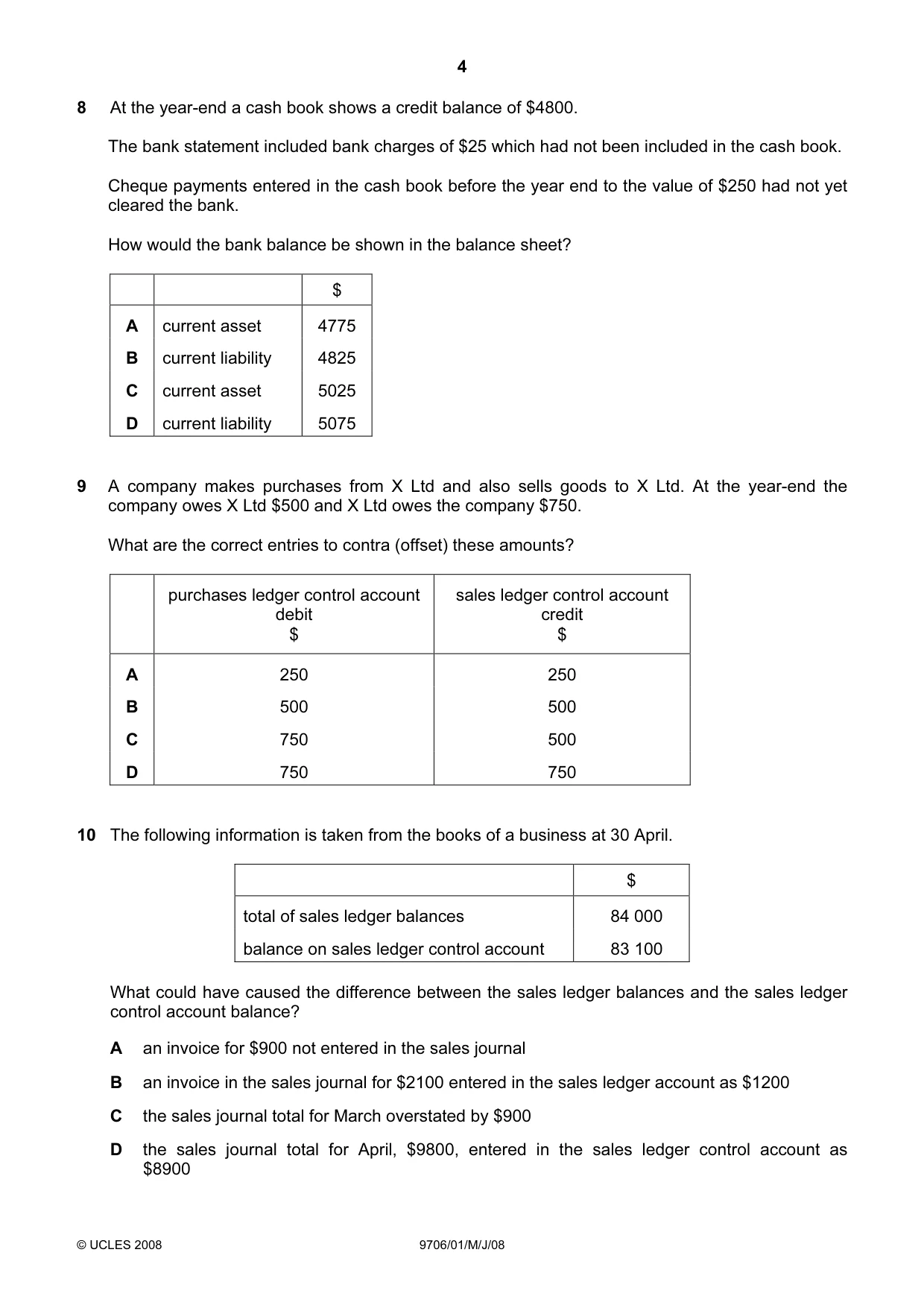
8 At the year-end a cash book shows a credit balance of $4800. The bank statement included bank charges of $25 which had not been included in the cash book. Cheque payments entered in the cash book before the year end to the value of $250 had not yet cleared the bank. How would the bank balance be shown in the balance sheet? $ A current asset 4775 B current liability 4825 C current asset 5025 D current liability 5075
Mark scheme: B
Q9 · A company makes purchases from X Ltd and also sells goods to X Ltd
9 A company makes purchases from X Ltd and also sells goods to X Ltd. At the year-end the company owes X Ltd $500 and X Ltd owes the company $750. What are the correct entries to contra (offset) these amounts? purchases ledger control account sales ledger control account debit credit $ $ A 250 250 B 500 500 C 750 500 D 750 750
Mark scheme: B
Q10 · The following information is taken from the books of a business at 30 April
10 The following information is taken from the books of a business at 30 April. $ total of sales ledger balances 84 000 balance on sales ledger control account 83 100 What could have caused the difference between the sales ledger balances and the sales ledger control account balance? A an invoice for $900 not entered in the sales journal B an invoice in the sales journal for $2100 entered in the sales ledger account as $1200 C the sales journal total for March overstated by $900 D the sales journal total for April, $9800, entered in the sales ledger control account as $8900
Mark scheme: D
Q11 · When valuing stocks of finished goods on an absorption cost basis, which costs should be…
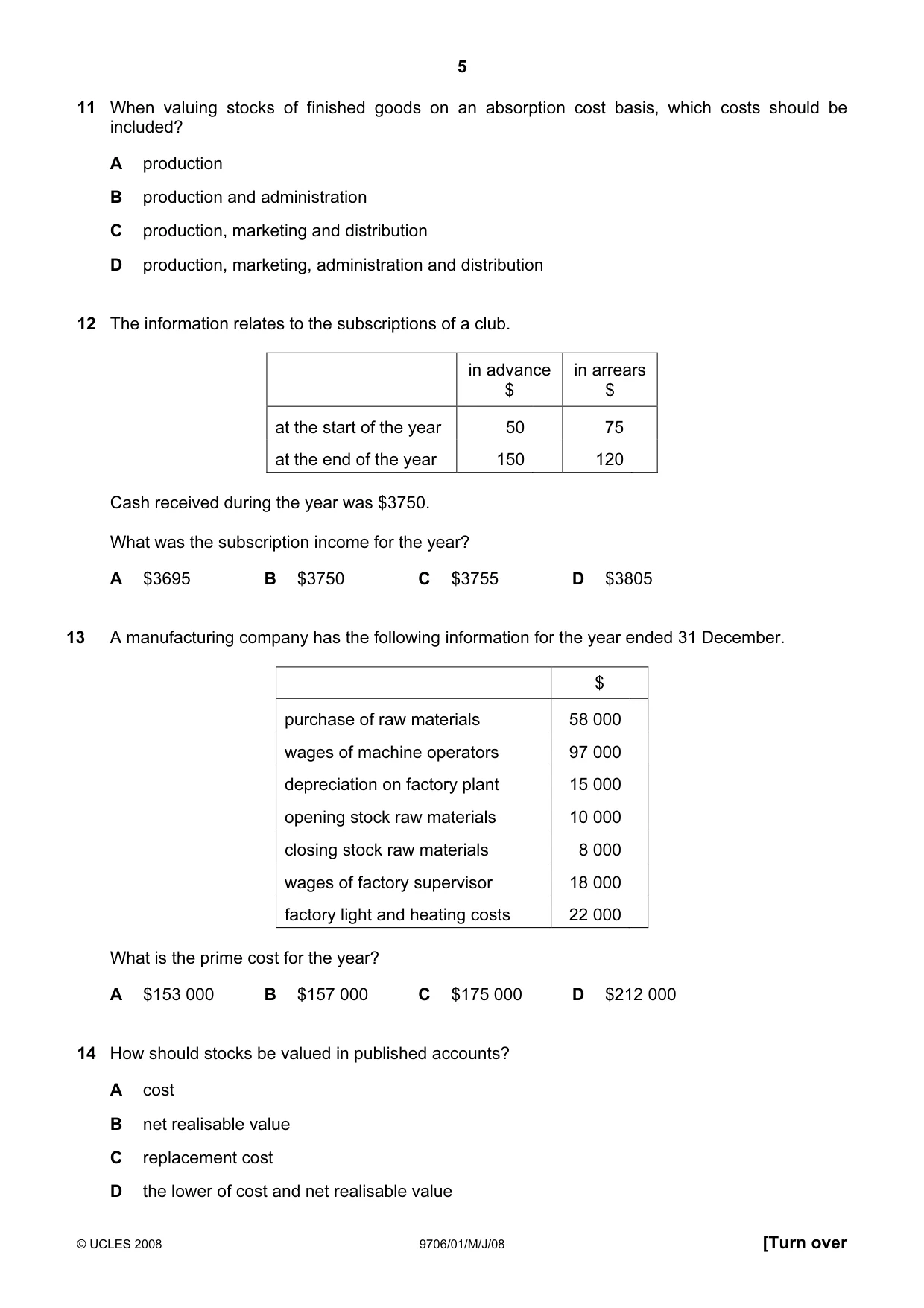
11 When valuing stocks of finished goods on an absorption cost basis, which costs should be included? A production B production and administration C production, marketing and distribution D production, marketing, administration and distribution
Mark scheme: A
Q12 · The information relates to the subscriptions of a club
12 The information relates to the subscriptions of a club. in advance in arrears $ $ at the start of the year 50 75 at the end of the year 150 120 Cash received during the year was $3750. What was the subscription income for the year? A $3695 B $3750 C $3755 D $3805
Mark scheme: A
Q13 · A manufacturing company has the following information for the year ended 31 December
13 A manufacturing company has the following information for the year ended 31 December. $ purchase of raw materials 58 000 wages of machine operators 97 000 depreciation on factory plant 15 000 opening stock raw materials 10 000 closing stock raw materials 8 000 wages of factory supervisor 18 000 factory light and heating costs 22 000 What is the prime cost for the year? A $153 000 B $157 000 C $175 000 D $212 000
Mark scheme: B
Q14 · How should stocks be valued in published accounts?
14 How should stocks be valued in published accounts? A cost B net realisable value C replacement cost D the lower of cost and net realisable value
Mark scheme: D
Q15 · Which item would not be found in the accounts of clubs and societies?
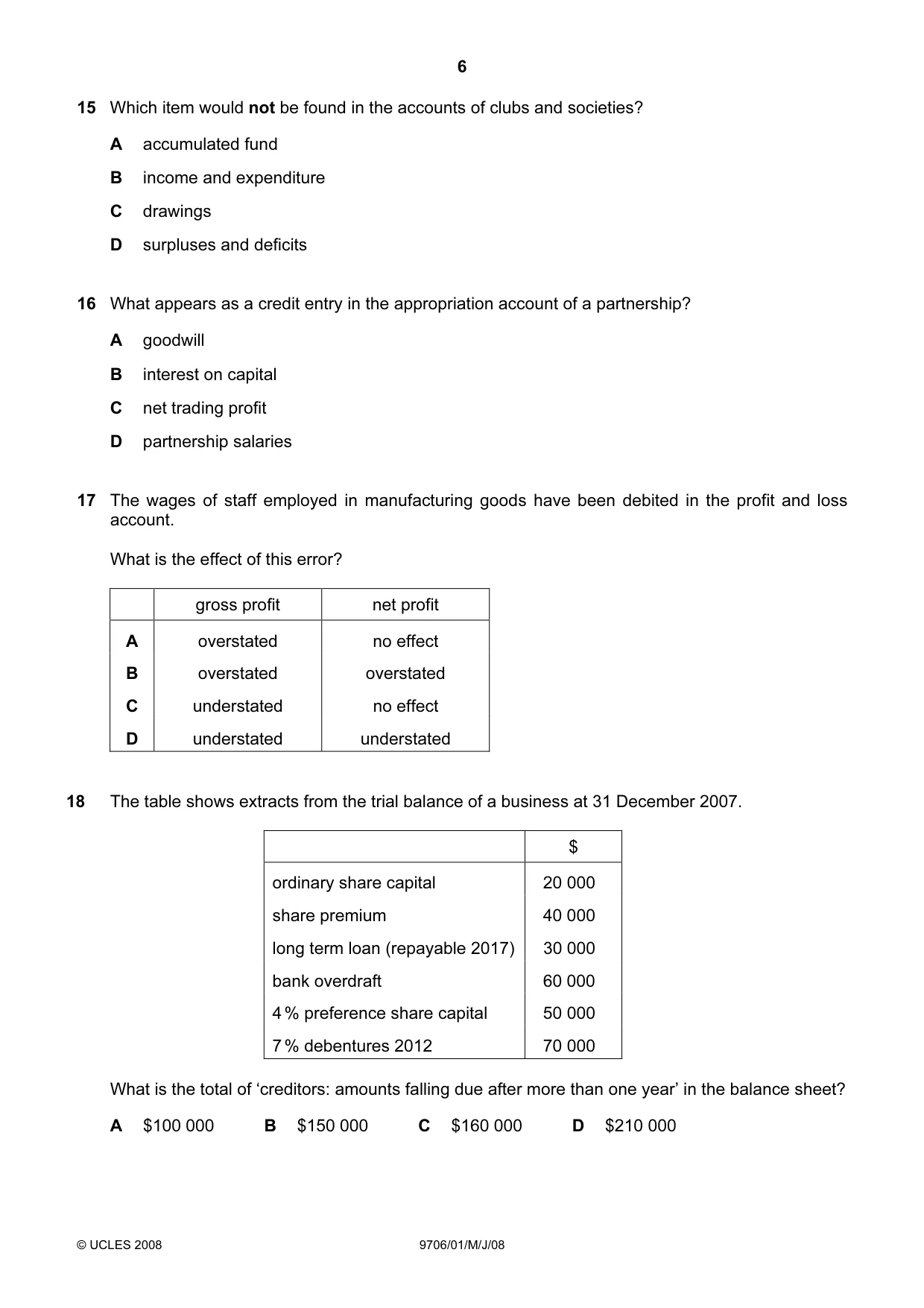
15 Which item would not be found in the accounts of clubs and societies? A accumulated fund B income and expenditure C drawings D surpluses and deficits
Mark scheme: C
Q16 · What appears as a credit entry in the appropriation account of a partnership?
16 What appears as a credit entry in the appropriation account of a partnership? A goodwill B interest on capital C net trading profit D partnership salaries
Mark scheme: C
Q17 · The wages of staff employed in manufacturing goods have been debited in the profit and…
17 The wages of staff employed in manufacturing goods have been debited in the profit and loss account. What is the effect of this error? gross profit net profit A overstated no effect B overstated overstated C understated no effect D understated understated
Mark scheme: A
Q18 · The table shows extracts from the trial balance of a business at 31 December 2007
18 The table shows extracts from the trial balance of a business at 31 December 2007. $ ordinary share capital 20 000 share premium 40 000 long term loan (repayable 2017) 30 000 bank overdraft 60 000 4 % preference share capital 50 000 7 % debentures 2012 70 000 What is the total of ‘creditors: amounts falling due after more than one year’ in the balance sheet? A $100 000 B $150 000 C $160 000 D $210 000
Mark scheme: A
Q19 · A company’s capital is $ ordinary shares of $1.00 each 200 000 share premium account 80…
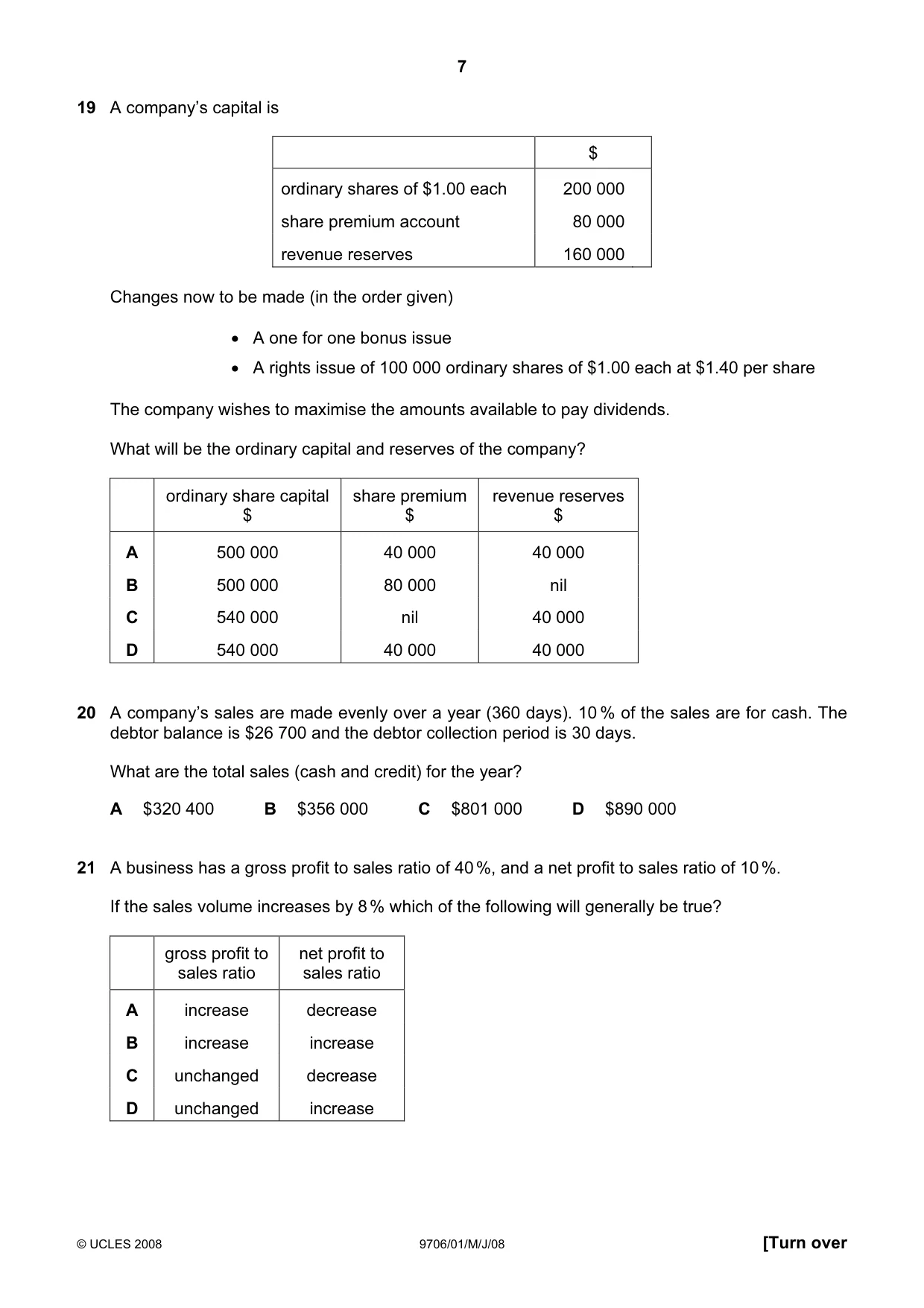
19 A company’s capital is $ ordinary shares of $1.00 each 200 000 share premium account 80 000 revenue reserves 160 000 Changes now to be made (in the order given) • A one for one bonus issue • A rights issue of 100 000 ordinary shares of $1.00 each at $1.40 per share The company wishes to maximise the amounts available to pay dividends. What will be the ordinary capital and reserves of the company? ordinary share capital share premium revenue reserves $ $ $ A 500 000 40 000 40 000 B 500 000 80 000 nil C 540 000 nil 40 000 D 540 000 40 000 40 000
Mark scheme: A
Q20 · A company’s sales are made evenly over a year (360 days)
20 A company’s sales are made evenly over a year (360 days). 10 % of the sales are for cash. The debtor balance is $26 700 and the debtor collection period is 30 days. What are the total sales (cash and credit) for the year? A $320 400 B $356 000 C $801 000 D $890 000
Mark scheme: B
More questions on Analysis and communication of accounting information
Q21 · A business has a gross profit to sales ratio of 40 %, and a net profit to sales ratio of…
21 A business has a gross profit to sales ratio of 40 %, and a net profit to sales ratio of 10 %. If the sales volume increases by 8 % which of the following will generally be true? gross profit to net profit to sales ratio sales ratio A increase decrease B increase increase C unchanged decrease D unchanged increase
Mark scheme: D
More questions on Analysis and communication of accounting information
Q22 · Which of the following correctly shows the effect of a company increasing the value of…
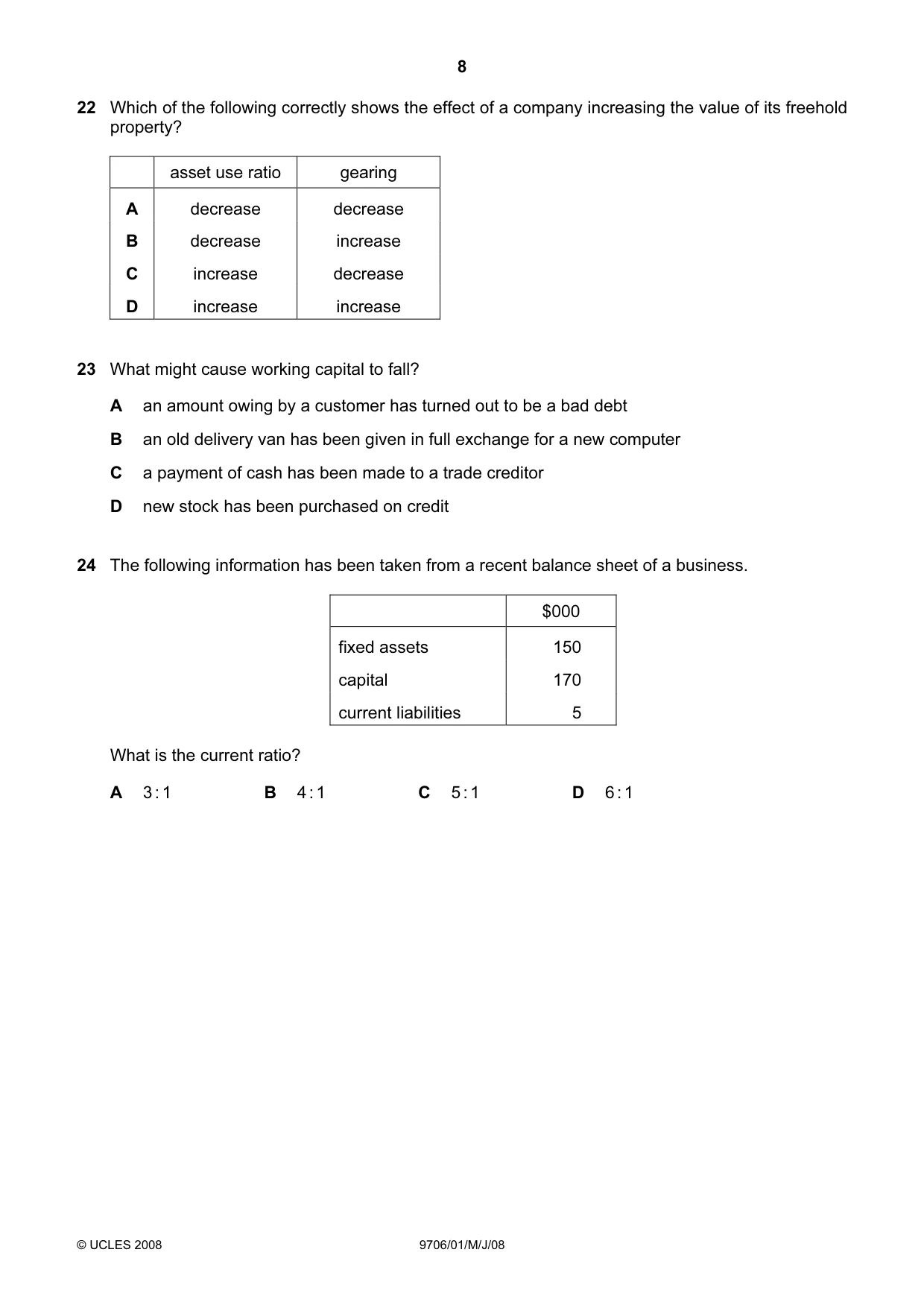
22 Which of the following correctly shows the effect of a company increasing the value of its freehold property? asset use ratio gearing A decrease decrease B decrease increase C increase decrease D increase increase
Mark scheme: A
More questions on Analysis and communication of accounting information
Q23 · What might cause working capital to fall?
23 What might cause working capital to fall? A an amount owing by a customer has turned out to be a bad debt B an old delivery van has been given in full exchange for a new computer C a payment of cash has been made to a trade creditor D new stock has been purchased on credit
Mark scheme: A
More questions on Analysis and communication of accounting information
Q24 · The following information has been taken from a recent balance sheet of a business
24 The following information has been taken from a recent balance sheet of a business. $000 fixed assets 150 capital 170 current liabilities 5 What is the current ratio? A 3 : 1 B 4 : 1 C 5 : 1 D 6 : 1
Mark scheme: C
More questions on Analysis and communication of accounting information
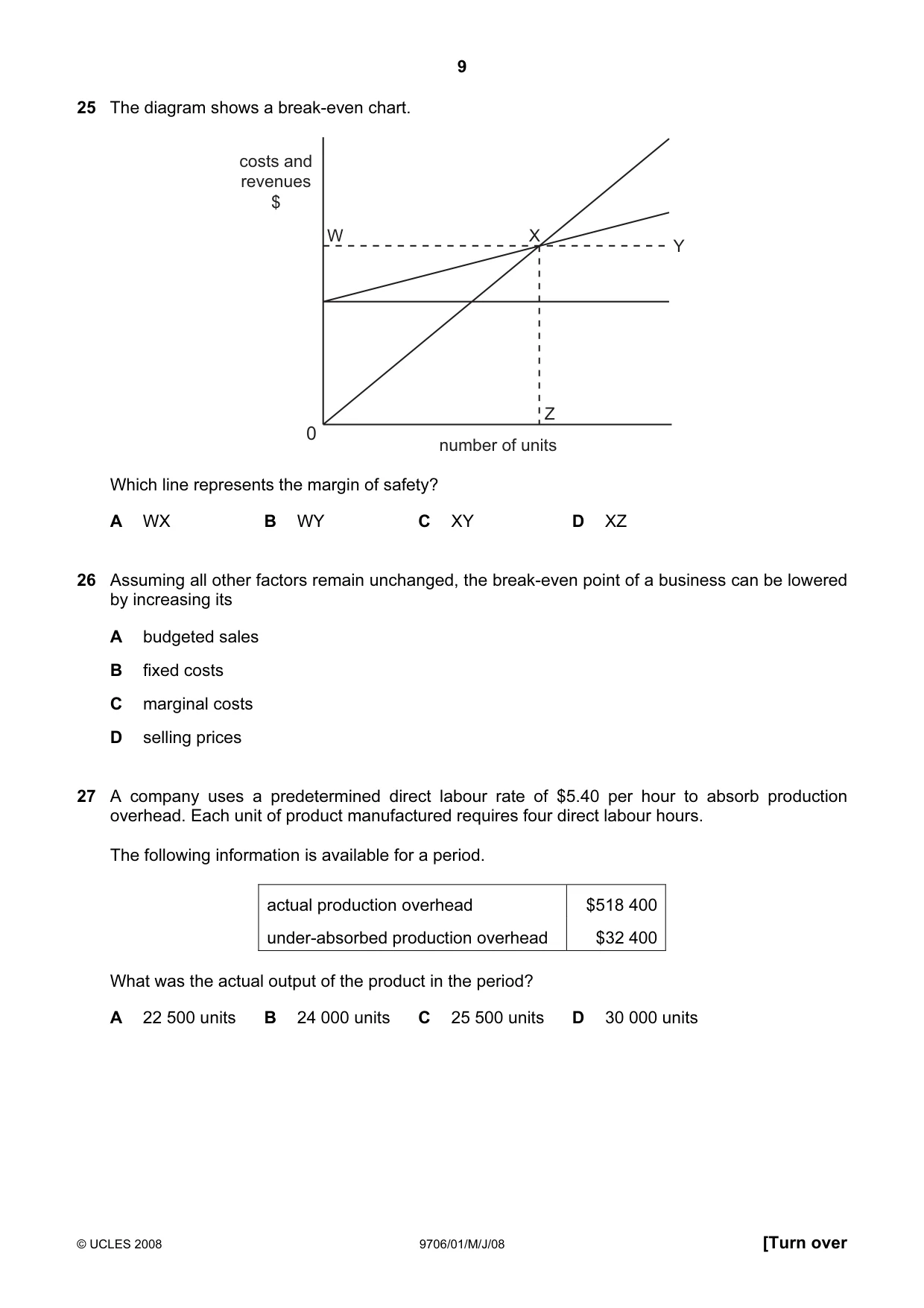
Q25 · The diagram shows a break-even chart
25 The diagram shows a break-even chart. costs and revenues $ W X Y Z 0 number of units Which line represents the margin of safety? A WX B WY C XY D XZ
Mark scheme: C
Q26 · Assuming all other factors remain unchanged, the break-even point of a business can be…
26 Assuming all other factors remain unchanged, the break-even point of a business can be lowered by increasing its A budgeted sales B fixed costs C marginal costs D selling prices
Mark scheme: D
Q27 · A company uses a predetermined direct labour rate of $5.40 per hour to absorb production…
27 A company uses a predetermined direct labour rate of $5.40 per hour to absorb production overhead. Each unit of product manufactured requires four direct labour hours. The following information is available for a period. actual production overhead $518 400 under-absorbed production overhead $32 400 What was the actual output of the product in the period? A 22 500 units B 24 000 units C 25 500 units D 30 000 units
Mark scheme: A
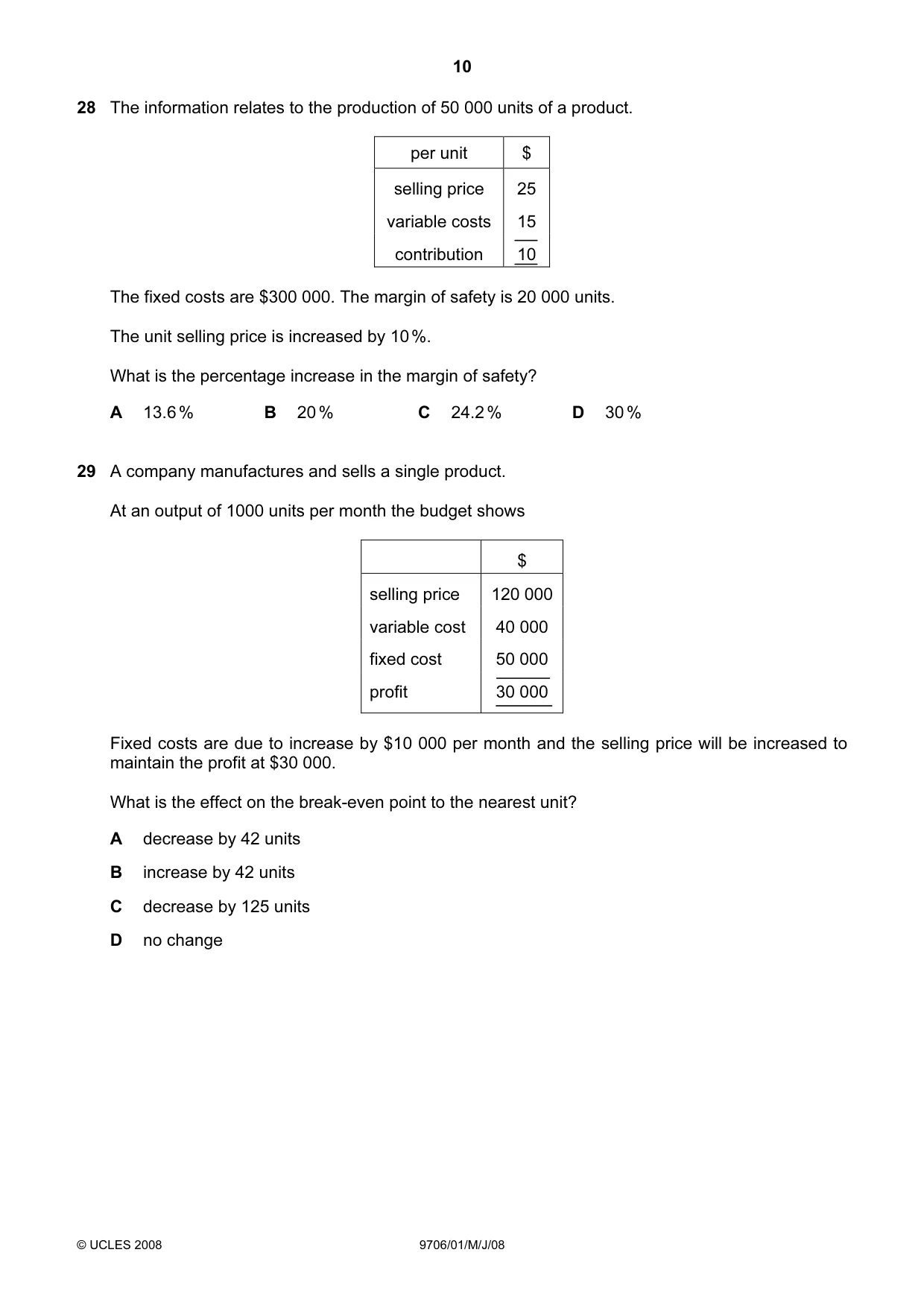
Q28 · The information relates to the production of 50 000 units of a product
28 The information relates to the production of 50 000 units of a product. per unit $ selling price 25 variable costs 15 contribution 10 The fixed costs are $300 000. The margin of safety is 20 000 units. The unit selling price is increased by 10 %. What is the percentage increase in the margin of safety? A 13.6 % B 20 % C 24.2 % D 30 %
Mark scheme: D
Q29 · A company manufactures and sells a single product
29 A company manufactures and sells a single product. At an output of 1000 units per month the budget shows $ selling price 120 000 variable cost 40 000 fixed cost 50 000 profit 30 000 Fixed costs are due to increase by $10 000 per month and the selling price will be increased to maintain the profit at $30 000. What is the effect on the break-even point to the nearest unit? A decrease by 42 units B increase by 42 units C decrease by 125 units D no change
Mark scheme: B
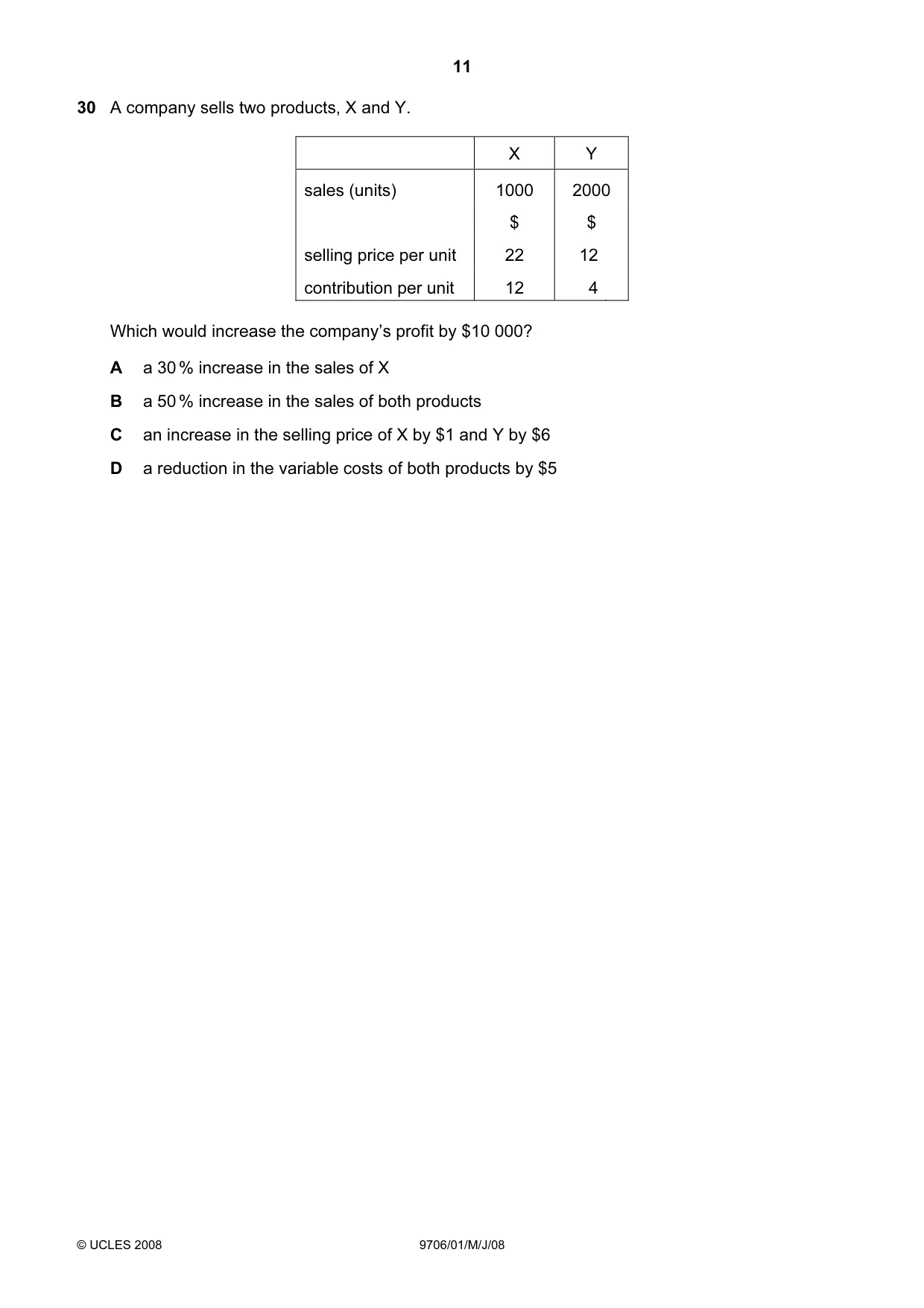
Q30 · A company sells two products, X and Y
30 A company sells two products, X and Y. X Y sales (units) 1000 2000 $ $ selling price per unit 22 12 contribution per unit 12 4 Which would increase the company’s profit by $10 000? A a 30 % increase in the sales of X B a 50 % increase in the sales of both products C an increase in the selling price of X by $1 and Y by $6 D a reduction in the variable costs of both products by $5
Mark scheme: B
What was in this paper
The subtopics covered by these 30 questions, and how many questions each got. Open one in a new tab to see every Cambridge question on it.
What you needed in this session
Cambridge’s own grade thresholds for 2008 May/June, Paper 1 · Variant 1. A higher threshold means an easier paper — the bar moves with how the cohort did.