Cambridge A Level Accounting 9706 — 2014 Oct/Nov Paper 1 · Variant 2
9706/12/O/N/14 · 30 questions · 30 marks · ≈34 min
The question paper and its mark scheme, free to read here and free to download. This is Cambridge’s own paper, exactly as it was sat.
Question paper12 pages

Mark scheme2 pages
Answers below. Sit the paper first if you are practising.
Questions as text
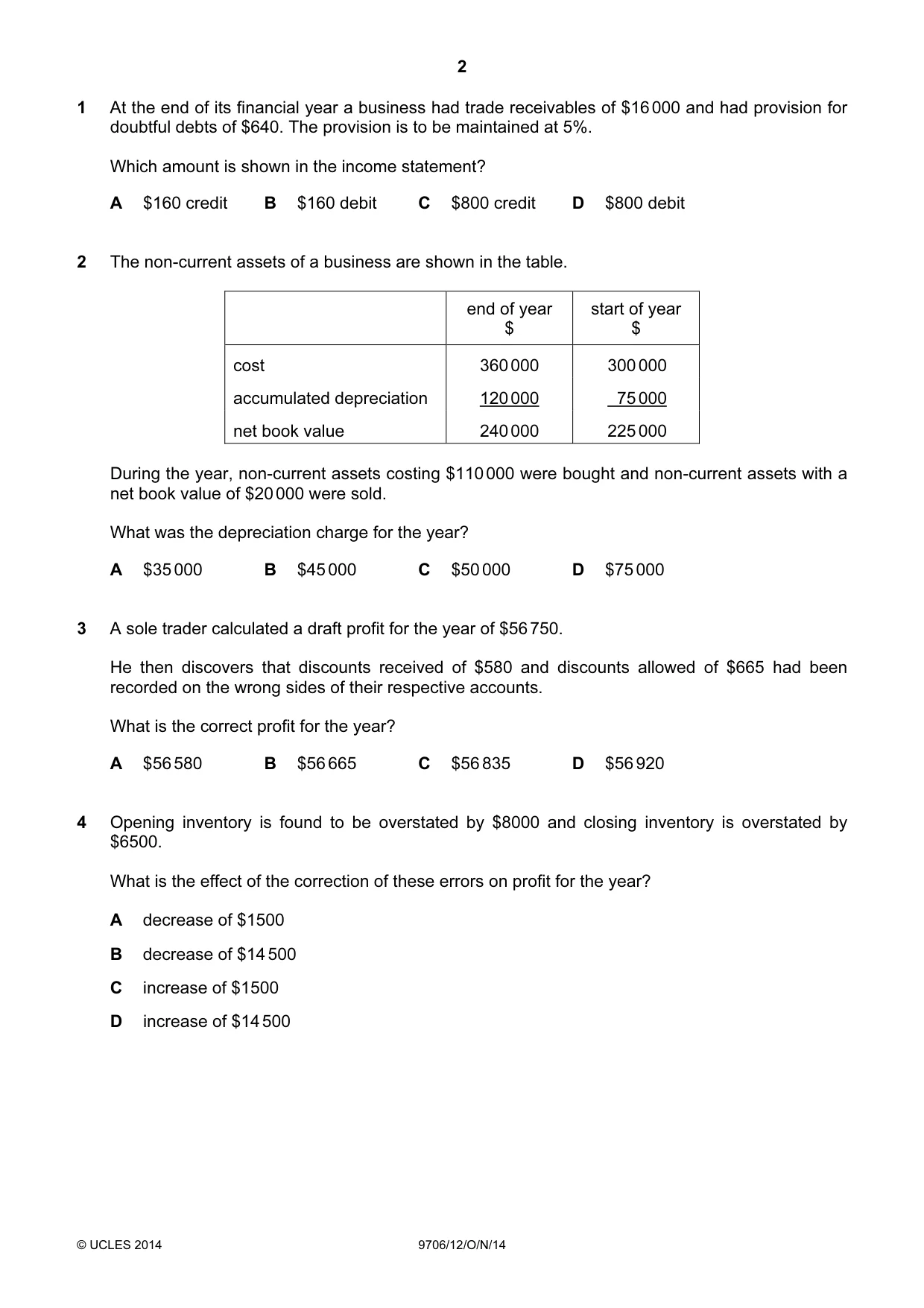
Q1 · At the end of its financial year a business had trade receivables of $16 000 and had…
1 At the end of its financial year a business had trade receivables of $16 000 and had provision for doubtful debts of $640. The provision is to be maintained at 5%. Which amount is shown in the income statement? A $160 credit B $160 debit C $800 credit D $800 debit
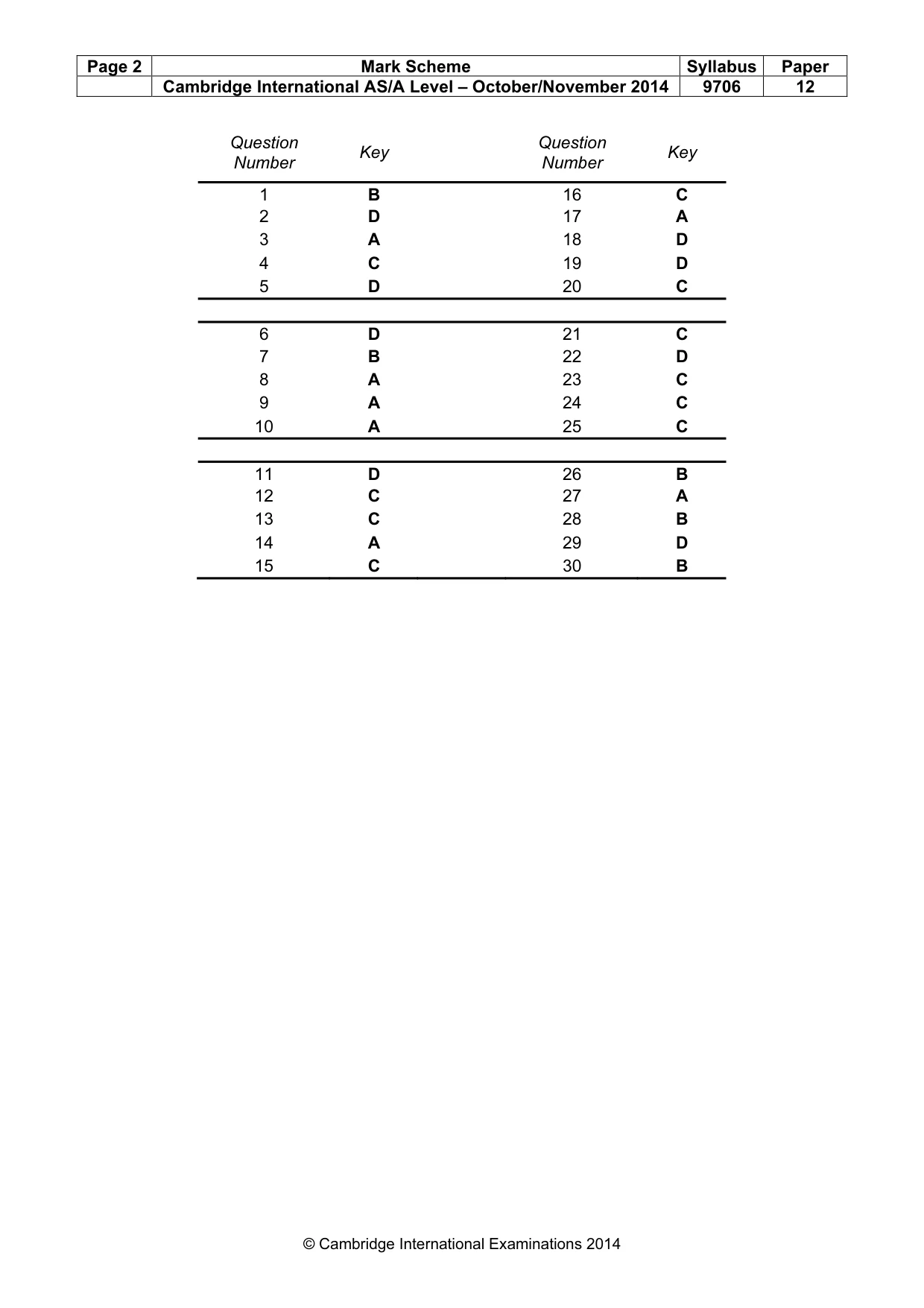
Mark scheme: B
Q2 · The non-current assets of a business are shown in the table
2 The non-current assets of a business are shown in the table. end of year start of year $ $ cost 360 000 300 000 accumulated depreciation 120 000 75 000 net book value 240 000 225 000 During the year, non-current assets costing $110 000 were bought and non-current assets with a net book value of $20 000 were sold. What was the depreciation charge for the year? A $35 000 B $45 000 C $50 000 D $75 000
Mark scheme: D
Q3 · A sole trader calculated a draft profit for the year of $56 750
3 A sole trader calculated a draft profit for the year of $56 750. He then discovers that discounts received of $580 and discounts allowed of $665 had been recorded on the wrong sides of their respective accounts. What is the correct profit for the year? A $56 580 B $56 665 C $56 835 D $56 920
Mark scheme: A
Q4 · Opening inventory is found to be overstated by $8000 and closing inventory is overstated…
4 Opening inventory is found to be overstated by $8000 and closing inventory is overstated by $6500. What is the effect of the correction of these errors on profit for the year? A decrease of $1500 B decrease of $14 500 C increase of $1500 D increase of $14 500
Mark scheme: C
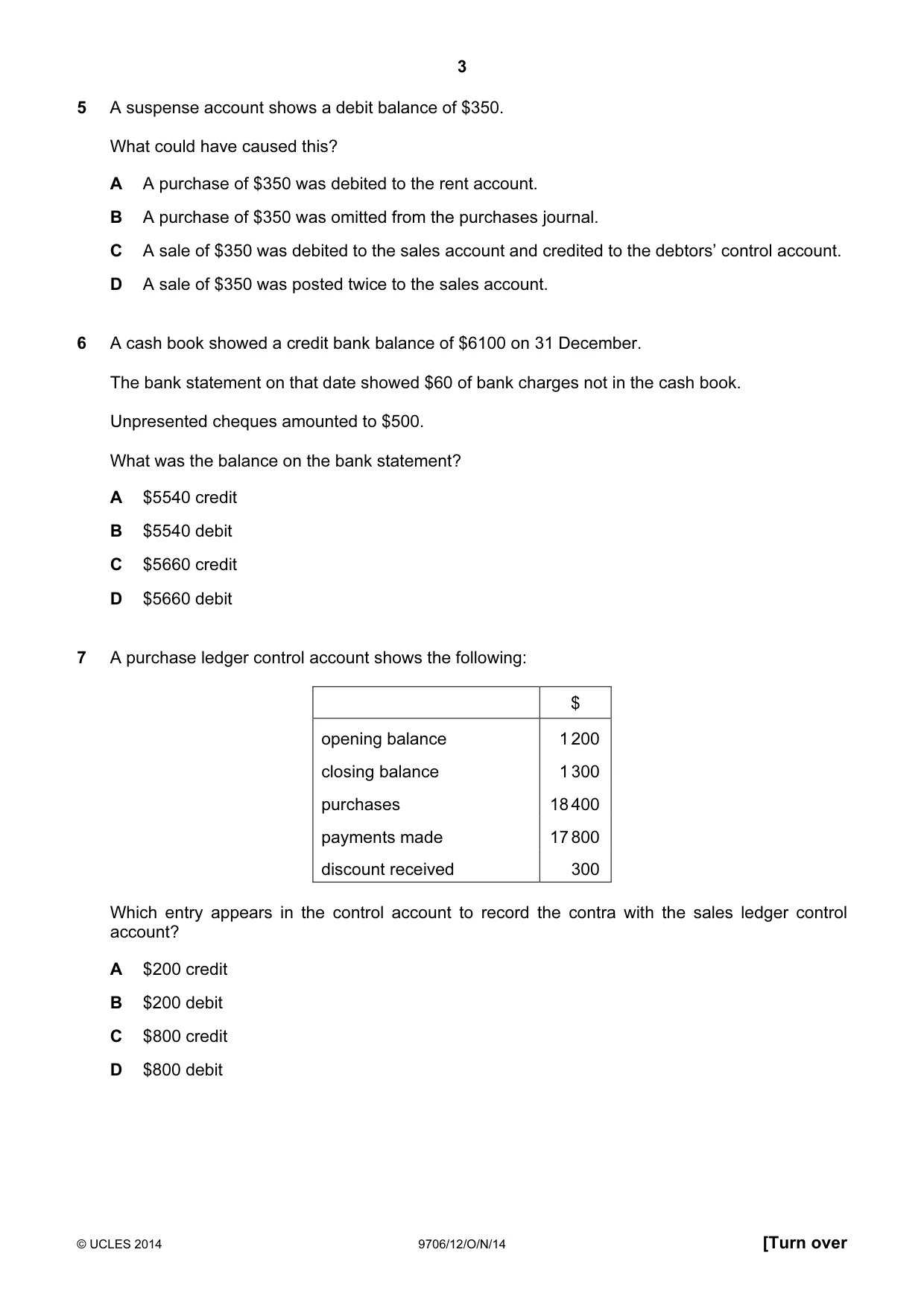
Q5 · A suspense account shows a debit balance of $350
5 A suspense account shows a debit balance of $350. What could have caused this? A A purchase of $350 was debited to the rent account. B A purchase of $350 was omitted from the purchases journal. C A sale of $350 was debited to the sales account and credited to the debtors’ control account. D A sale of $350 was posted twice to the sales account.
Mark scheme: D
Q6 · A cash book showed a credit bank balance of $6100 on 31 December
6 A cash book showed a credit bank balance of $6100 on 31 December. The bank statement on that date showed $60 of bank charges not in the cash book. Unpresented cheques amounted to $500. What was the balance on the bank statement? A $5540 credit B $5540 debit C $5660 credit D $5660 debit
Mark scheme: D
Q7 · A purchase ledger control account shows the following: $ opening balance 1 200 closing…
7 A purchase ledger control account shows the following: $ opening balance 1 200 closing balance 1 300 purchases 18 400 payments made 17 800 discount received 300 Which entry appears in the control account to record the contra with the sales ledger control account? A $200 credit B $200 debit C $800 credit D $800 debit
Mark scheme: B
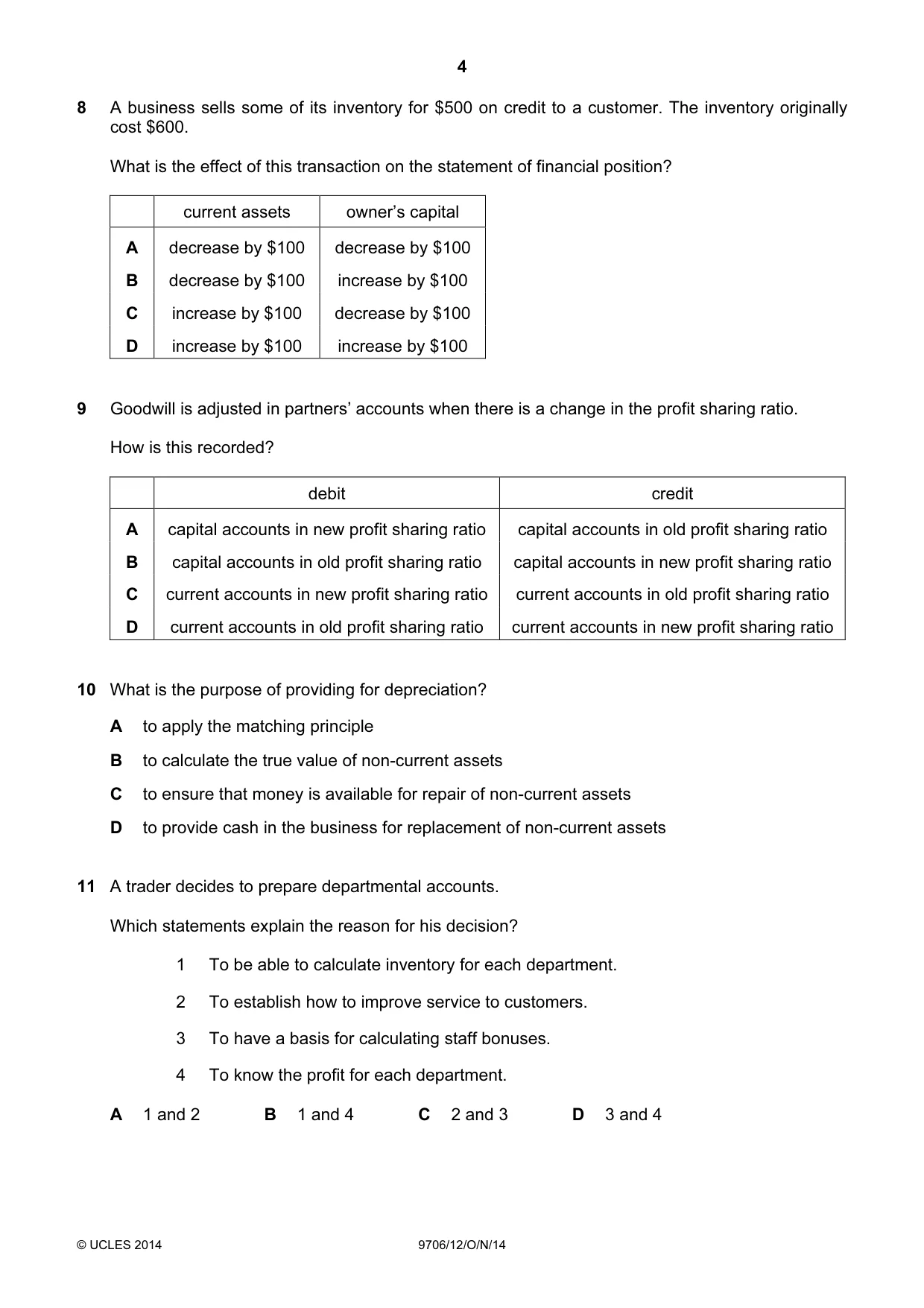
Q8 · A business sells some of its inventory for $500 on credit to a customer
8 A business sells some of its inventory for $500 on credit to a customer. The inventory originally cost $600. What is the effect of this transaction on the statement of financial position? current assets owner’s capital A decrease by $100 decrease by $100 B decrease by $100 increase by $100 C increase by $100 decrease by $100 D increase by $100 increase by $100
Mark scheme: A
Q9 · Goodwill is adjusted in partners’ accounts when there is a change in the profit sharing…
9 Goodwill is adjusted in partners’ accounts when there is a change in the profit sharing ratio. How is this recorded? debit credit A capital accounts in new profit sharing ratio capital accounts in old profit sharing ratio B capital accounts in old profit sharing ratio capital accounts in new profit sharing ratio C current accounts in new profit sharing ratio current accounts in old profit sharing ratio D current accounts in old profit sharing ratio current accounts in new profit sharing ratio
Mark scheme: A
Q10 · What is the purpose of providing for depreciation?
10 What is the purpose of providing for depreciation? A to apply the matching principle B to calculate the true value of non-current assets C to ensure that money is available for repair of non-current assets D to provide cash in the business for replacement of non-current assets
Mark scheme: A
Q11 · A trader decides to prepare departmental accounts
11 A trader decides to prepare departmental accounts. Which statements explain the reason for his decision? 1 To be able to calculate inventory for each department. 2 To establish how to improve service to customers. 3 To have a basis for calculating staff bonuses. 4 To know the profit for each department. A 1 and 2 B 1 and 4 C 2 and 3 D 3 and 4
Mark scheme: D
Q12 · A sports club provides the following information at the year end
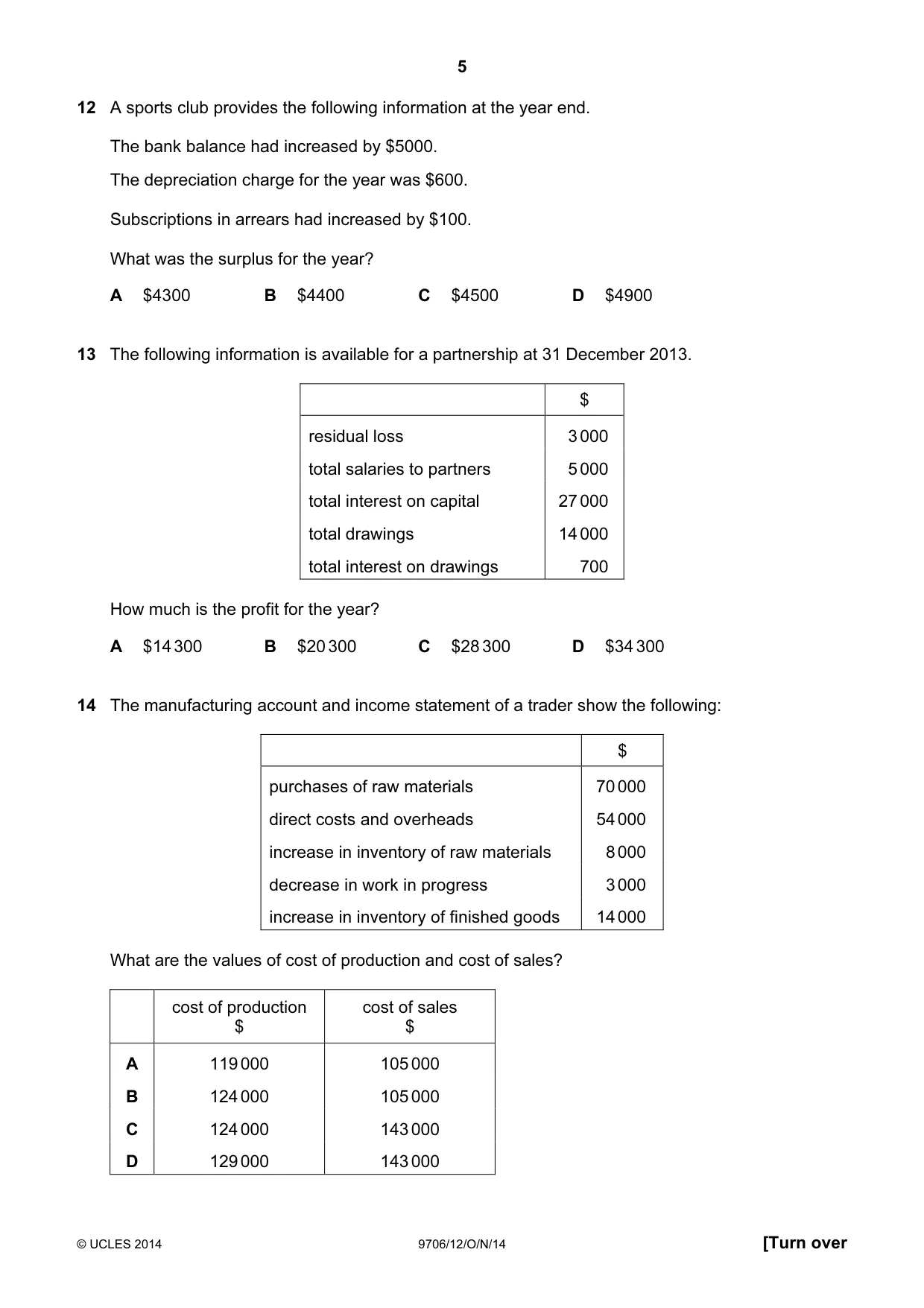
12 A sports club provides the following information at the year end. The bank balance had increased by $5000. The depreciation charge for the year was $600. Subscriptions in arrears had increased by $100. What was the surplus for the year? A $4300 B $4400 C $4500 D $4900
Mark scheme: C
Q13 · The following information is available for a partnership at 31 December 2013
13 The following information is available for a partnership at 31 December 2013. $ residual loss 3 000 total salaries to partners 5 000 total interest on capital 27 000 total drawings 14 000 total interest on drawings 700 How much is the profit for the year? A $14 300 B $20 300 C $28 300 D $34 300
Mark scheme: C
Q14 · The manufacturing account and income statement of a trader show the following: $…
14 The manufacturing account and income statement of a trader show the following: $ purchases of raw materials 70 000 direct costs and overheads 54 000 increase in inventory of raw materials 8 000 decrease in work in progress 3 000 increase in inventory of finished goods 14 000 What are the values of cost of production and cost of sales? cost of production cost of sales $ $ A 119 000 105 000 B 124 000 105 000 C 124 000 143 000 D 129 000 143 000
Mark scheme: A
Q15 · The following balances are extracted from the books of Juno Limited
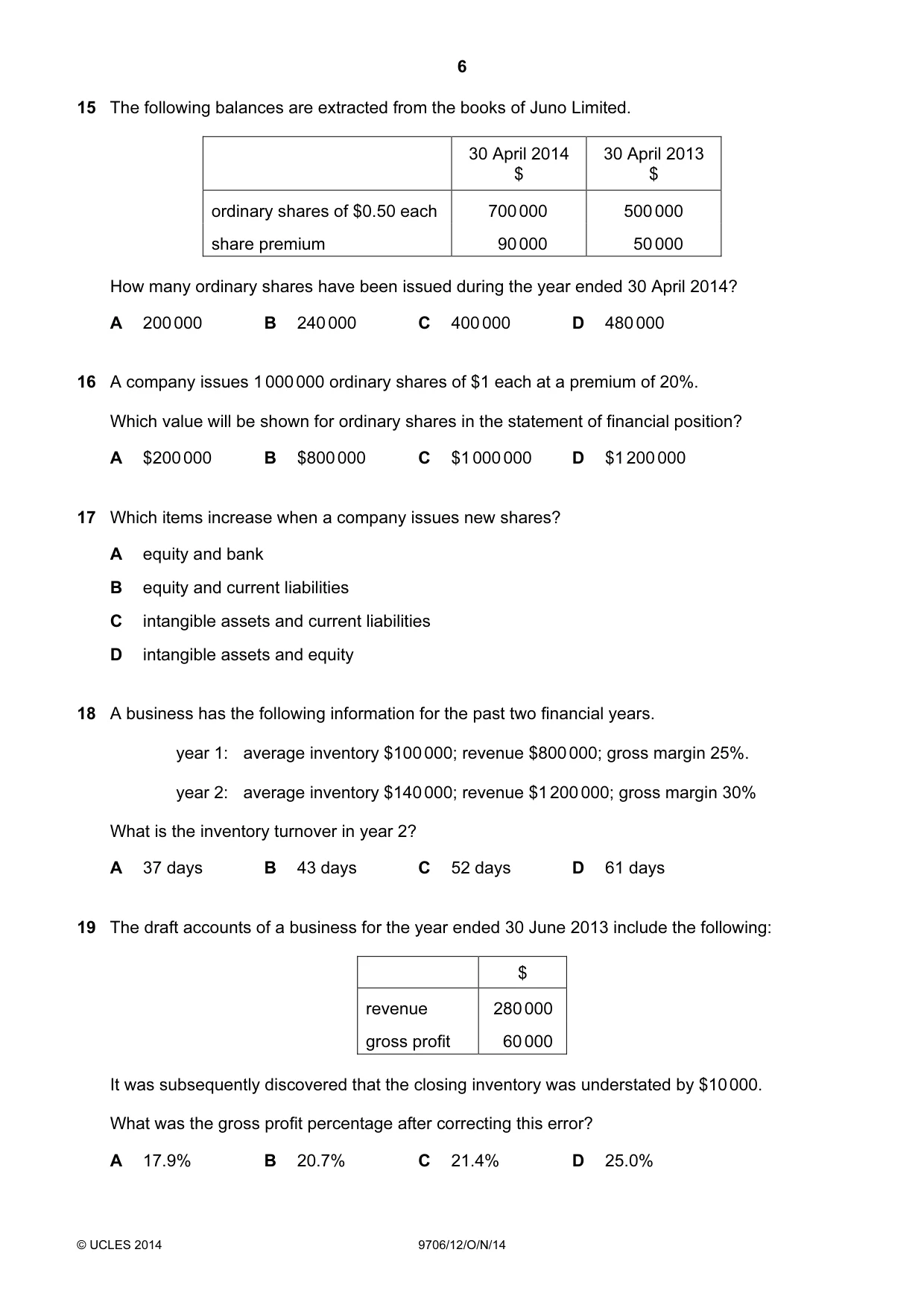
15 The following balances are extracted from the books of Juno Limited. 30 April 2014 30 April 2013 $ $ ordinary shares of $0.50 each 700 000 500 000 share premium 90 000 50 000 How many ordinary shares have been issued during the year ended 30 April 2014? A 200 000 B 240 000 C 400 000 D 480 000
Mark scheme: C
Q16 · A company issues 1 000 000 ordinary shares of $1 each at a premium of 20%
16 A company issues 1 000 000 ordinary shares of $1 each at a premium of 20%. Which value will be shown for ordinary shares in the statement of financial position? A $200 000 B $800 000 C $1 000 000 D $1 200 000
Mark scheme: C
Q17 · Which items increase when a company issues new shares?
17 Which items increase when a company issues new shares? A equity and bank B equity and current liabilities C intangible assets and current liabilities D intangible assets and equity
Mark scheme: A
Q18 · A business has the following information for the past two financial years
18 A business has the following information for the past two financial years. year 1: average inventory $100 000; revenue $800 000; gross margin 25%. year 2: average inventory $140 000; revenue $1 200 000; gross margin 30% What is the inventory turnover in year 2? A 37 days B 43 days C 52 days D 61 days
Mark scheme: D
More questions on Analysis and communication of accounting information
Q19 · The draft accounts of a business for the year ended 30 June 2013 include the following: $…
19 The draft accounts of a business for the year ended 30 June 2013 include the following: $ revenue 280 000 gross profit 60 000 It was subsequently discovered that the closing inventory was understated by $10 000. What was the gross profit percentage after correcting this error? A 17.9% B 20.7% C 21.4% D 25.0%
Mark scheme: D
More questions on Analysis and communication of accounting information
Q20 · The following financial information is available
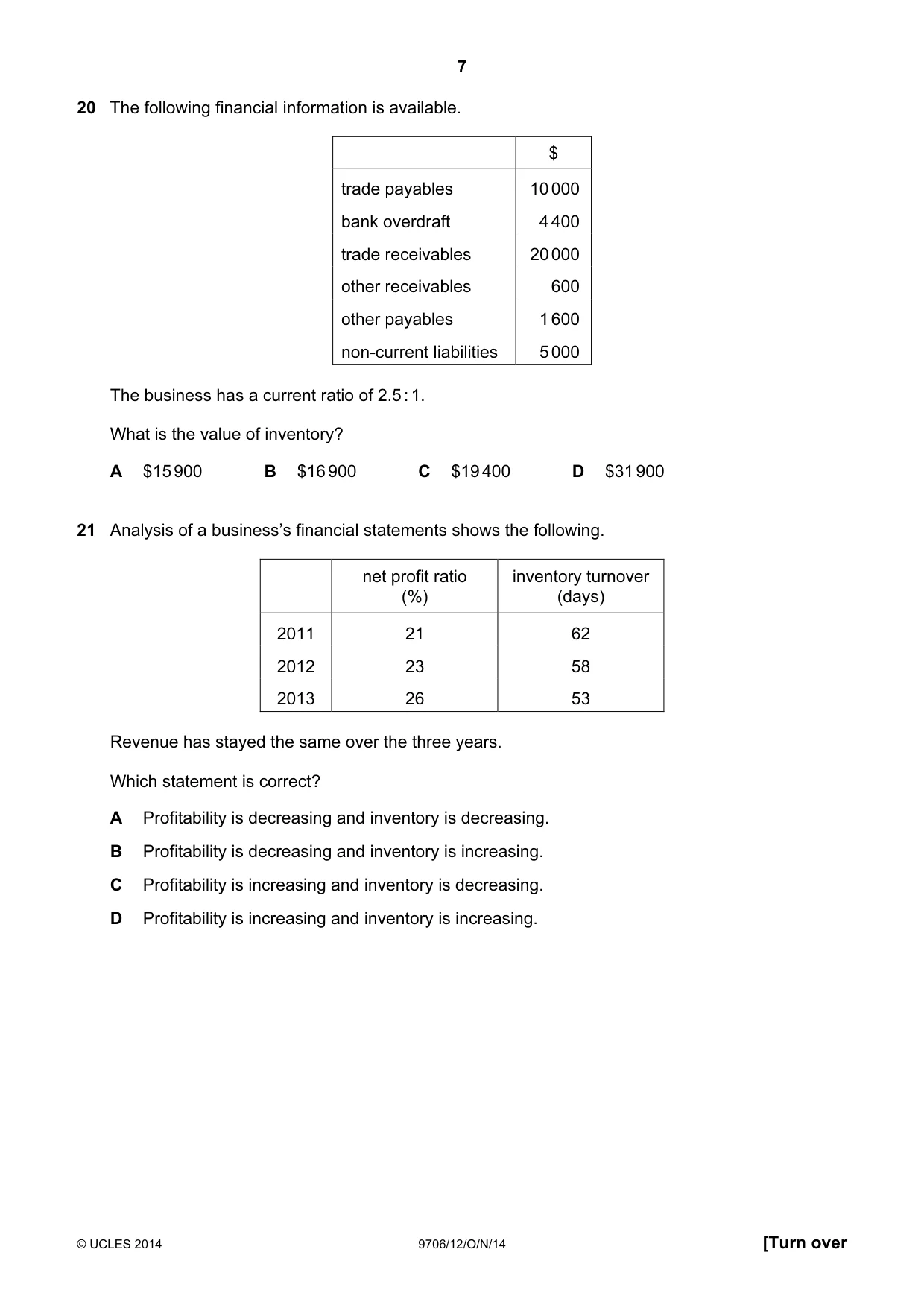
20 The following financial information is available. $ trade payables 10 000 bank overdraft 4 400 trade receivables 20 000 other receivables 600 other payables 1 600 non-current liabilities 5 000 The business has a current ratio of 2.5 : 1. What is the value of inventory? A $15 900 B $16 900 C $19 400 D $31 900
Mark scheme: C
More questions on Analysis and communication of accounting information
Q21 · Analysis of a business’s financial statements shows the following
21 Analysis of a business’s financial statements shows the following. net profit ratio inventory turnover (%) (days) 2011 21 62 2012 23 58 2013 26 53 Revenue has stayed the same over the three years. Which statement is correct? A Profitability is decreasing and inventory is decreasing. B Profitability is decreasing and inventory is increasing. C Profitability is increasing and inventory is decreasing. D Profitability is increasing and inventory is increasing.
Mark scheme: C
More questions on Analysis and communication of accounting information
Q22 · X Limited and Y Limited both started trading on 1 January 2001
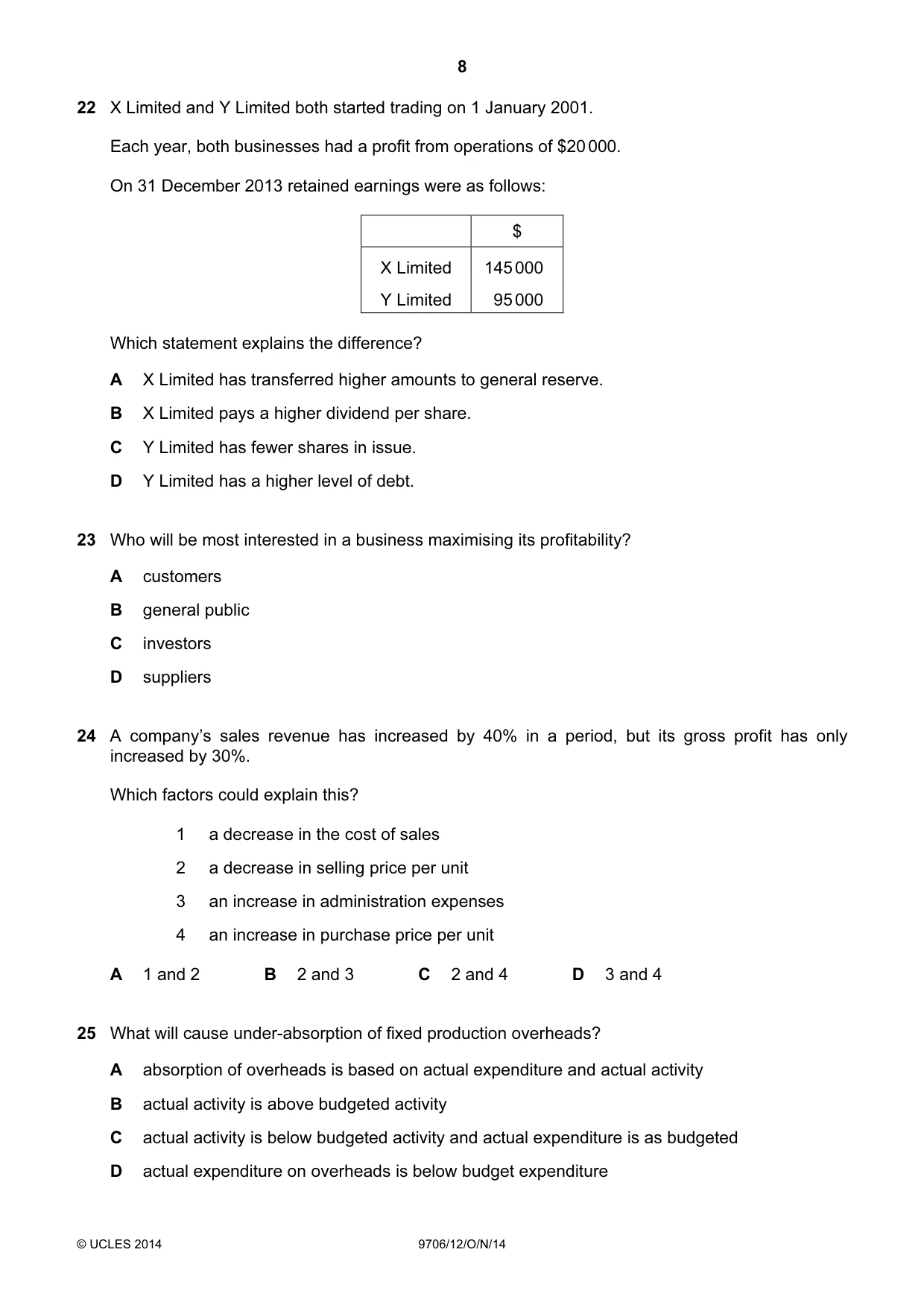
22 X Limited and Y Limited both started trading on 1 January 2001. Each year, both businesses had a profit from operations of $20 000. On 31 December 2013 retained earnings were as follows: $ X Limited 145 000 Y Limited 95 000 Which statement explains the difference? A X Limited has transferred higher amounts to general reserve. B X Limited pays a higher dividend per share. C Y Limited has fewer shares in issue. D Y Limited has a higher level of debt.
Mark scheme: D
More questions on Analysis and communication of accounting information
Q23 · Who will be most interested in a business maximising its profitability?
23 Who will be most interested in a business maximising its profitability? A customers B general public C investors D suppliers
Mark scheme: C
More questions on Analysis and communication of accounting information
Q24 · A company’s sales revenue has increased by 40% in a period, but its gross profit has only…
24 A company’s sales revenue has increased by 40% in a period, but its gross profit has only increased by 30%. Which factors could explain this? 1 a decrease in the cost of sales 2 a decrease in selling price per unit 3 an increase in administration expenses 4 an increase in purchase price per unit A 1 and 2 B 2 and 3 C 2 and 4 D 3 and 4
Mark scheme: C
More questions on Analysis and communication of accounting information
Q25 · What will cause under-absorption of fixed production overheads?
25 What will cause under-absorption of fixed production overheads? A absorption of overheads is based on actual expenditure and actual activity B actual activity is above budgeted activity C actual activity is below budgeted activity and actual expenditure is as budgeted D actual expenditure on overheads is below budget expenditure
Mark scheme: C
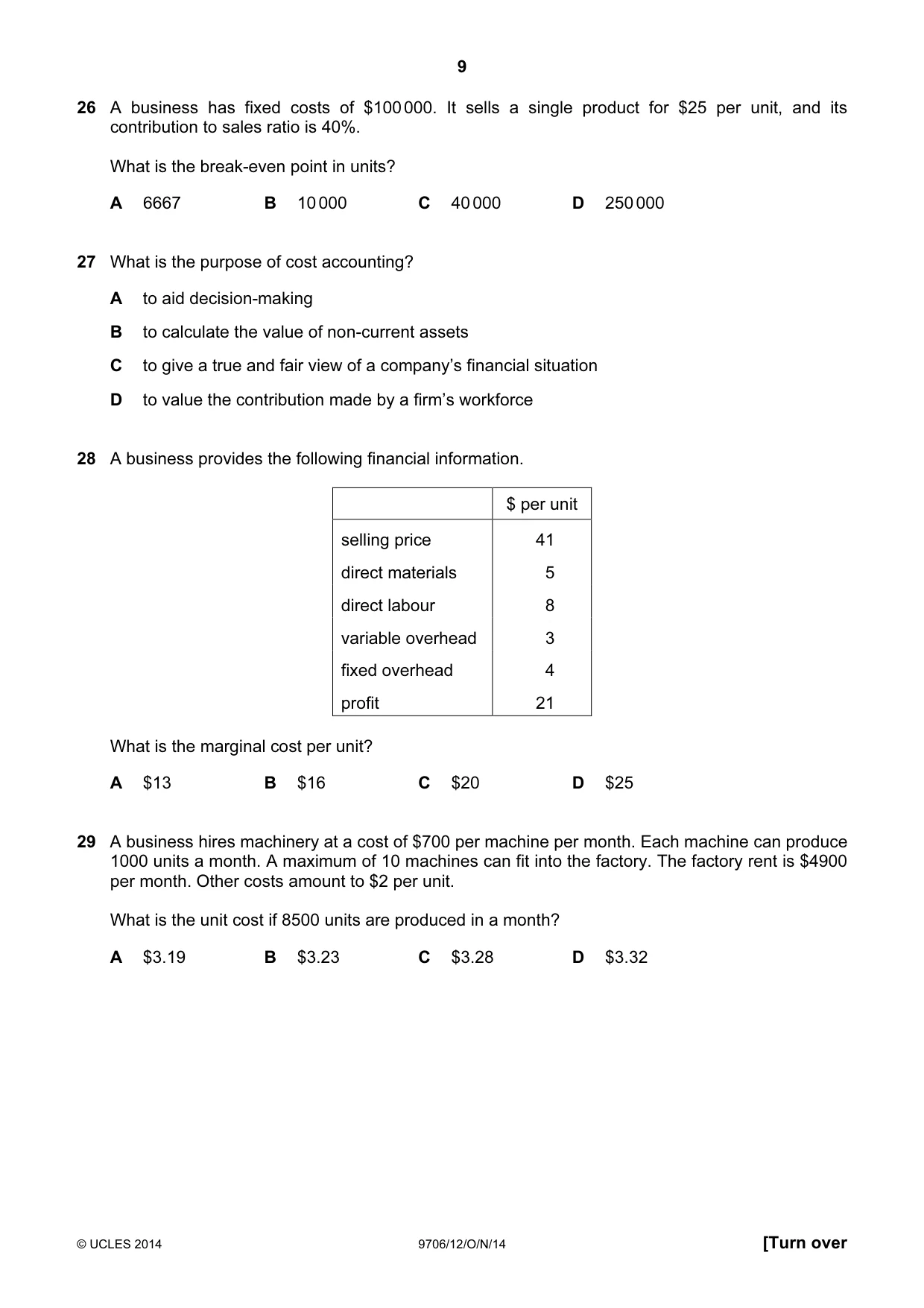
Q26 · A business has fixed costs of $100 000
26 A business has fixed costs of $100 000. It sells a single product for $25 per unit, and its contribution to sales ratio is 40%. What is the break-even point in units? A 6667 B 10 000 C 40 000 D 250 000
Mark scheme: B
Q27 · What is the purpose of cost accounting?
27 What is the purpose of cost accounting? A to aid decision-making B to calculate the value of non-current assets C to give a true and fair view of a company’s financial situation D to value the contribution made by a firm’s workforce
Mark scheme: A
Q28 · A business provides the following financial information
28 A business provides the following financial information. $ per unit selling price 41 direct materials 5 direct labour 8 variable overhead 3 fixed overhead 4 profit 21 What is the marginal cost per unit? A $13 B $16 C $20 D $25
Mark scheme: B
Q29 · A business hires machinery at a cost of $700 per machine per month
29 A business hires machinery at a cost of $700 per machine per month. Each machine can produce 1000 units a month. A maximum of 10 machines can fit into the factory. The factory rent is $4900 per month. Other costs amount to $2 per unit. What is the unit cost if 8500 units are produced in a month? A $3.19 B $3.23 C $3.28 D $3.32
Mark scheme: D
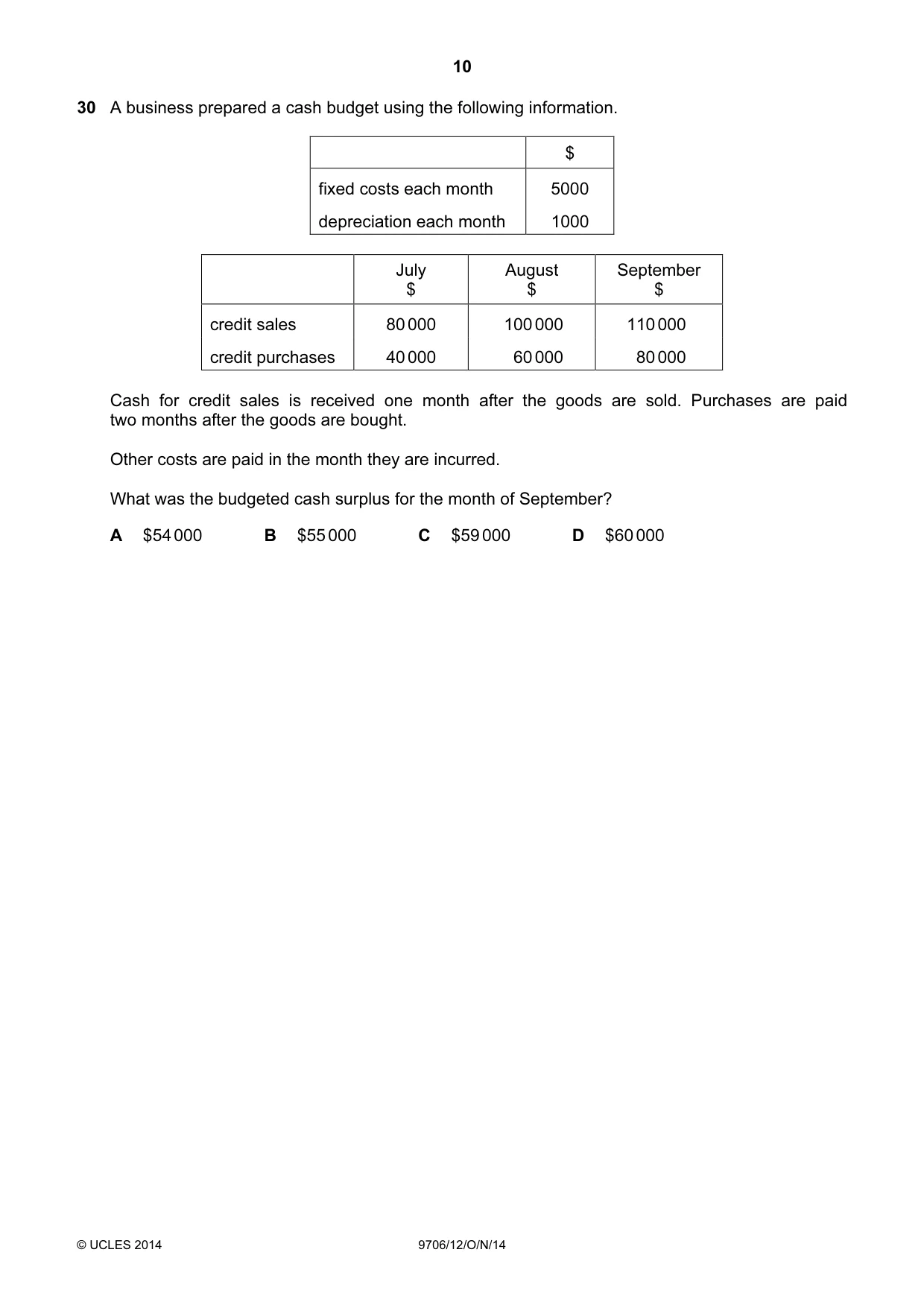
Q30 · A business prepared a cash budget using the following information
30 A business prepared a cash budget using the following information. $ fixed costs each month 5000 depreciation each month 1000 July August September $ $ $ credit sales 80 000 100 000 110 000 credit purchases 40 000 60 000 80 000 Cash for credit sales is received one month after the goods are sold. Purchases are paid two months after the goods are bought. Other costs are paid in the month they are incurred. What was the budgeted cash surplus for the month of September? A $54 000 B $55 000 C $59 000 D $60 000
Mark scheme: B
What was in this paper
The subtopics covered by these 30 questions, and how many questions each got. Open one in a new tab to see every Cambridge question on it.
What you needed in this session
Cambridge’s own grade thresholds for 2014 Oct/Nov, Paper 1 · Variant 2. A higher threshold means an easier paper — the bar moves with how the cohort did.