Cambridge A Level Accounting 9706 — 2020 Oct/Nov Paper 1 · Variant 1
9706/11/O/N/20 · 30 questions · 30 marks · ≈34 min
The question paper and its mark scheme, free to read here and free to download. This is Cambridge’s own paper, exactly as it was sat.
Question paper12 pages
Mark scheme3 pages
Answers below. Sit the paper first if you are practising.
Questions as text
Q1 · Which accounting concept is being applied when calculating depreciation?
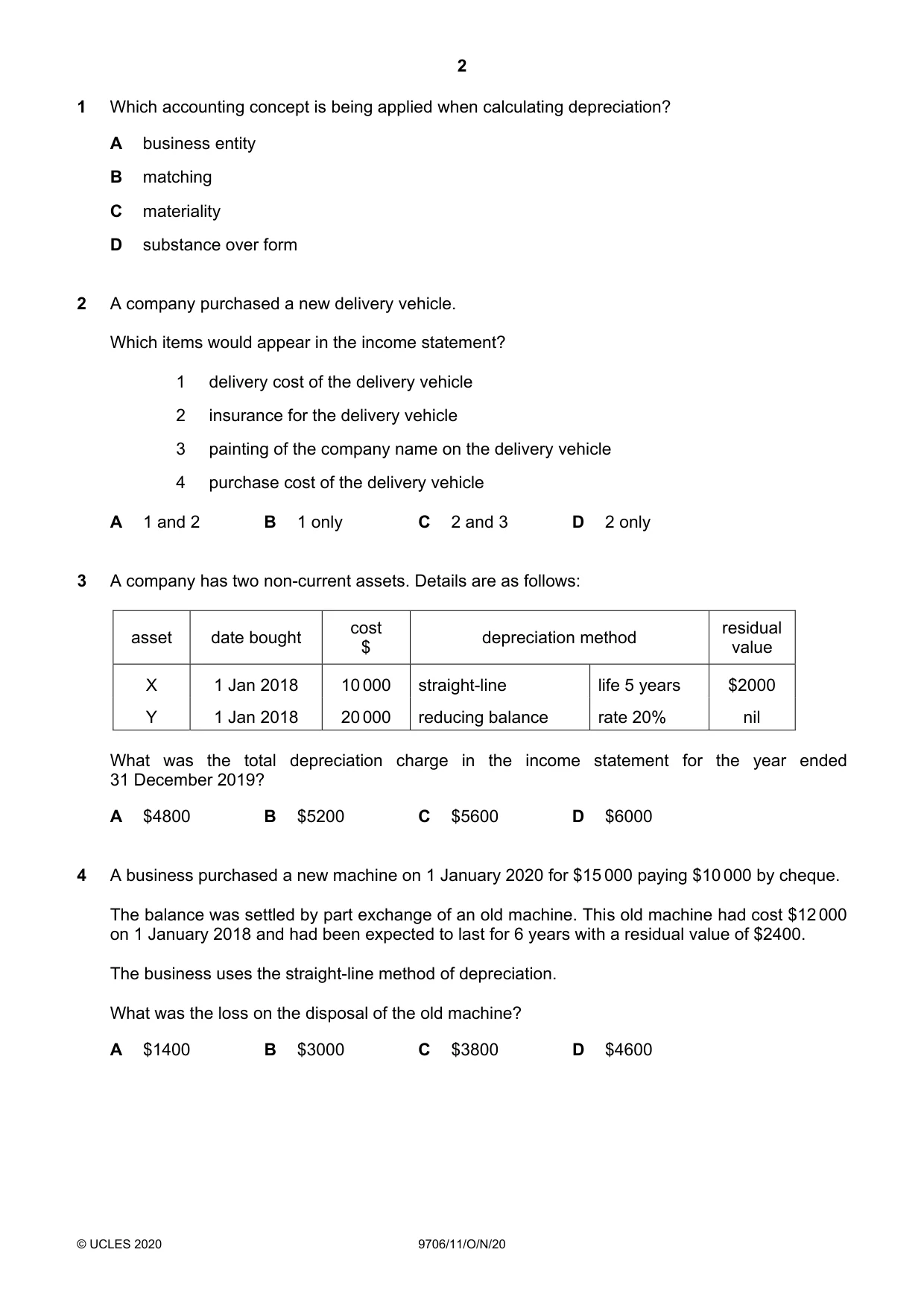
1 Which accounting concept is being applied when calculating depreciation? A business entity B matching C materiality D substance over form
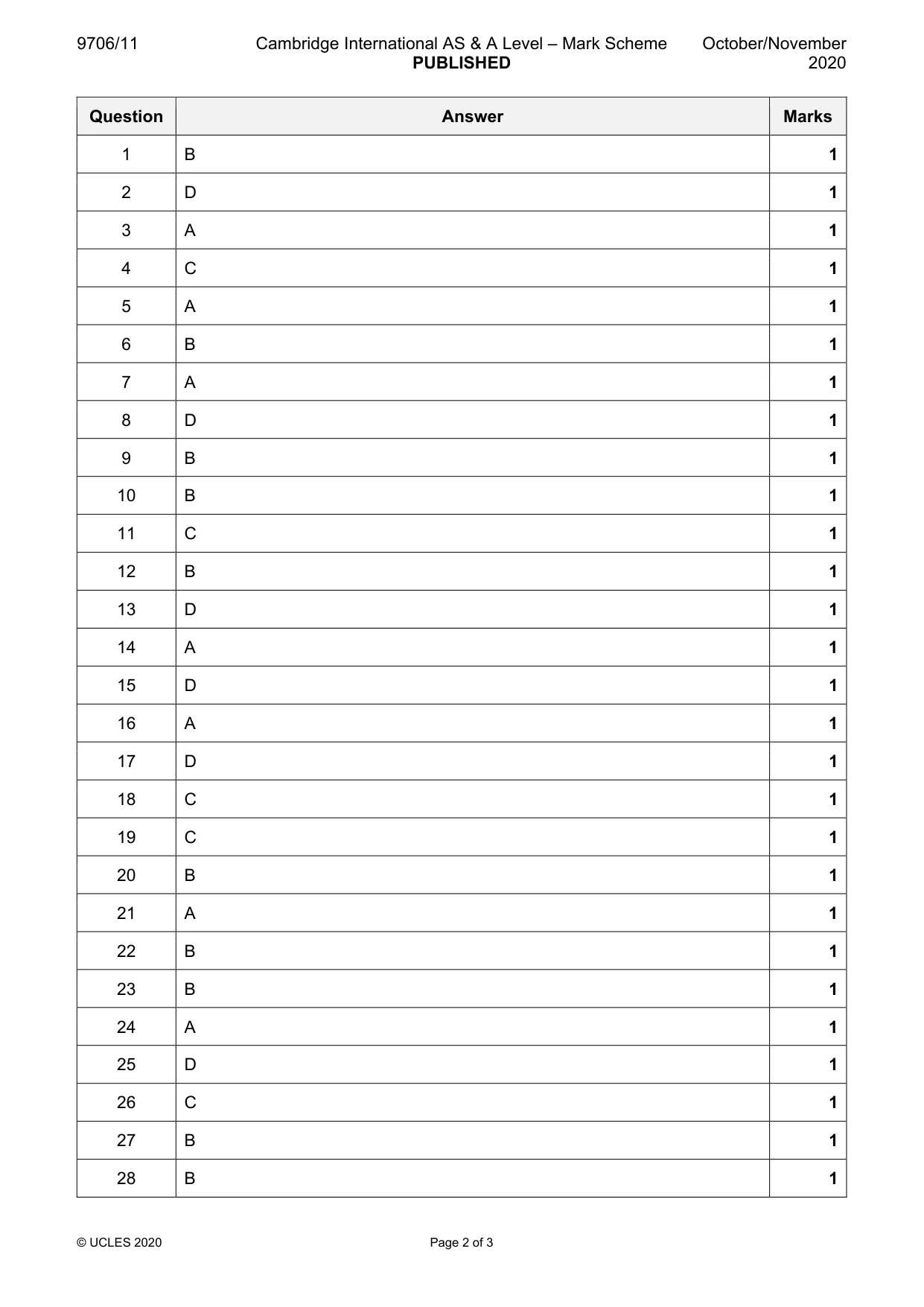
Mark scheme: B
Q2 · A company purchased a new delivery vehicle
2 A company purchased a new delivery vehicle. Which items would appear in the income statement? 1 delivery cost of the delivery vehicle 2 insurance for the delivery vehicle 3 painting of the company name on the delivery vehicle 4 purchase cost of the delivery vehicle A 1 and 2 B 1 only C 2 and 3 D 2 only
Mark scheme: D
Q3 · A company has two non-current assets
3 A company has two non-current assets. Details are as follows: cost residual asset date bought depreciation method $ value X 1 Jan 2018 10 000 straight-line life 5 years $2000 Y 1 Jan 2018 20 000 reducing balance rate 20% nil What was the total depreciation charge in the income statement for the year ended 31 December 2019? A $4800 B $5200 C $5600 D $6000
Mark scheme: A
Q4 · A business purchased a new machine on 1 January 2020 for $15 000 paying $10 000 by cheque
4 A business purchased a new machine on 1 January 2020 for $15 000 paying $10 000 by cheque. The balance was settled by part exchange of an old machine. This old machine had cost $12 000 on 1 January 2018 and had been expected to last for 6 years with a residual value of $2400. The business uses the straight-line method of depreciation. What was the loss on the disposal of the old machine? A $1400 B $3000 C $3800 D $4600
Mark scheme: C
Q5 · Which errors will result in a difference between the total of the individual customer…
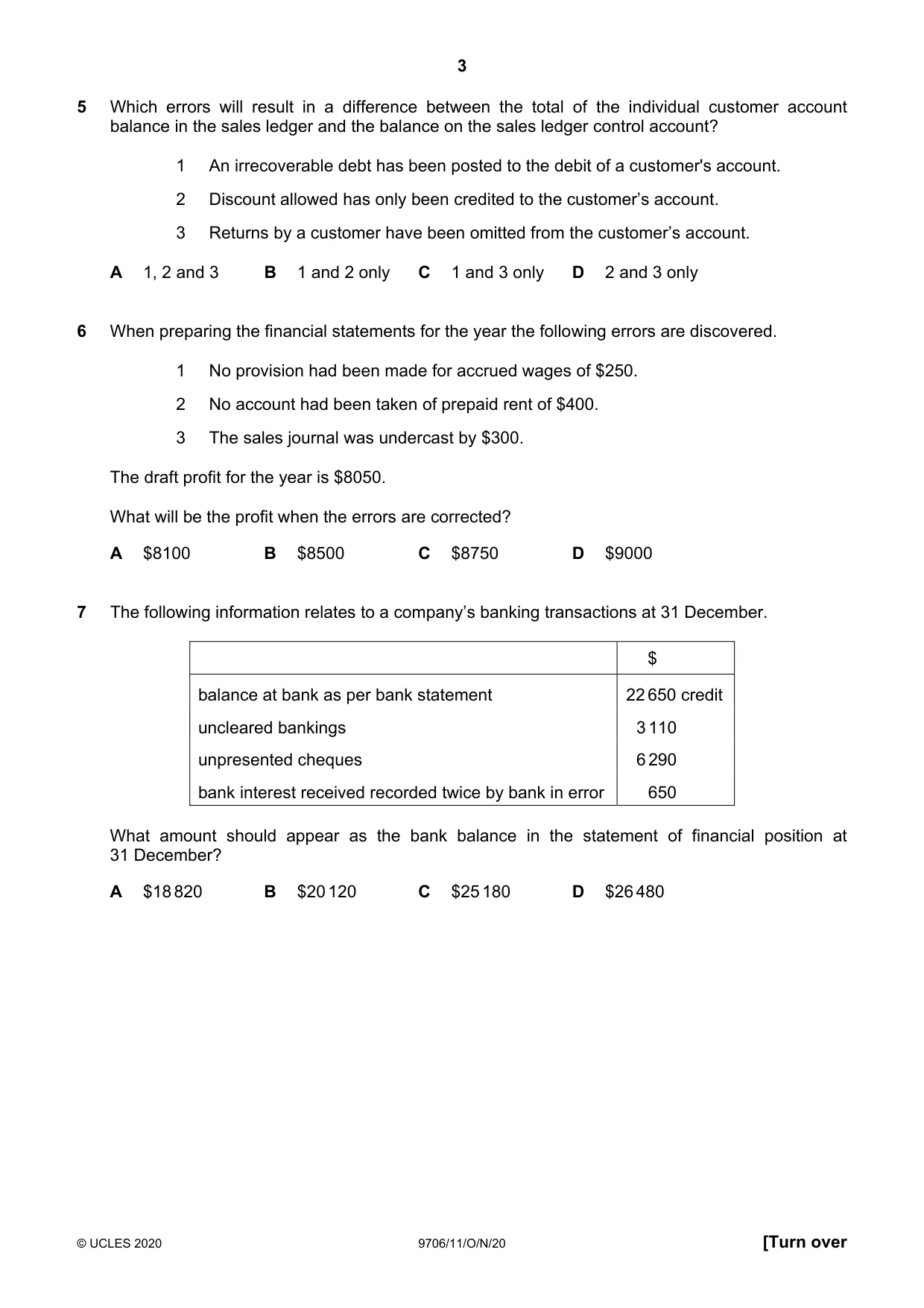
5 Which errors will result in a difference between the total of the individual customer account balance in the sales ledger and the balance on the sales ledger control account? 1 An irrecoverable debt has been posted to the debit of a customer's account. 2 Discount allowed has only been credited to the customer’s account. 3 Returns by a customer have been omitted from the customer’s account. A 1, 2 and 3 B 1 and 2 only C 1 and 3 only D 2 and 3 only
Mark scheme: A
Q6 · When preparing the financial statements for the year the following errors are discovered
6 When preparing the financial statements for the year the following errors are discovered. 1 No provision had been made for accrued wages of $250. 2 No account had been taken of prepaid rent of $400. 3 The sales journal was undercast by $300. The draft profit for the year is $8050. What will be the profit when the errors are corrected? A $8100 B $8500 C $8750 D $9000
Mark scheme: B
Q7 · The following information relates to a company’s banking transactions at 31 December
7 The following information relates to a company’s banking transactions at 31 December. $ balance at bank as per bank statement 22 650 credit uncleared bankings 3 110 unpresented cheques 6 290 bank interest received recorded twice by bank in error 650 What amount should appear as the bank balance in the statement of financial position at 31 December? A $18 820 B $20 120 C $25 180 D $26 480
Mark scheme: A
Q8 · John did not keep sales or purchases ledger control accounts
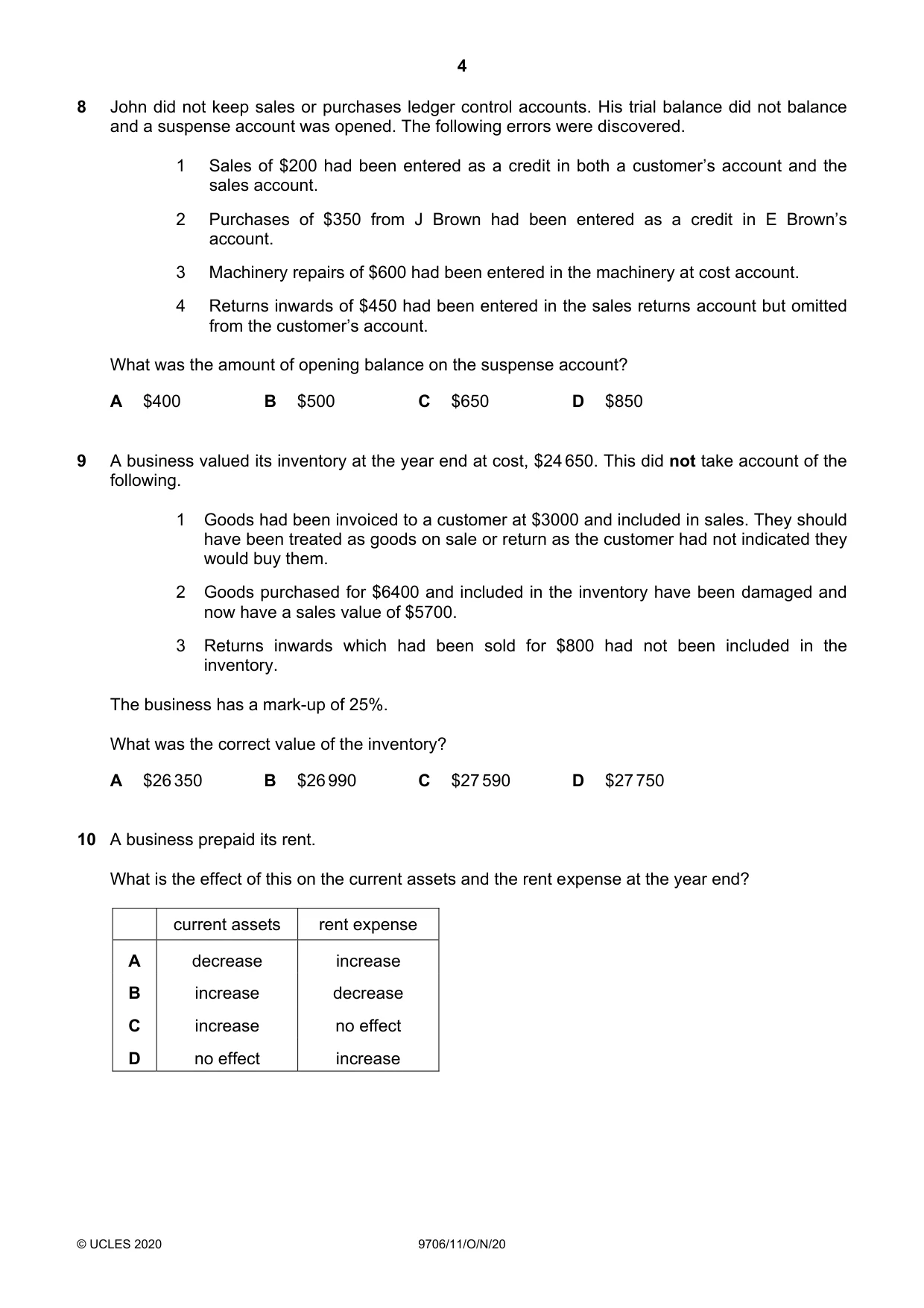
8 John did not keep sales or purchases ledger control accounts. His trial balance did not balance and a suspense account was opened. The following errors were discovered. 1 Sales of $200 had been entered as a credit in both a customer’s account and the sales account. 2 Purchases of $350 from J Brown had been entered as a credit in E Brown’s account. 3 Machinery repairs of $600 had been entered in the machinery at cost account. 4 Returns inwards of $450 had been entered in the sales returns account but omitted from the customer’s account. What was the amount of opening balance on the suspense account? A $400 B $500 C $650 D $850
Mark scheme: D
Q9 · A business valued its inventory at the year end at cost, $24 650
9 A business valued its inventory at the year end at cost, $24 650. This did not take account of the following. 1 Goods had been invoiced to a customer at $3000 and included in sales. They should have been treated as goods on sale or return as the customer had not indicated they would buy them. 2 Goods purchased for $6400 and included in the inventory have been damaged and now have a sales value of $5700. 3 Returns inwards which had been sold for $800 had not been included in the inventory. The business has a mark-up of 25%. What was the correct value of the inventory? A $26 350 B $26 990 C $27 590 D $27 750
Mark scheme: B
Q10 · A business prepaid its rent
10 A business prepaid its rent. What is the effect of this on the current assets and the rent expense at the year end? current assets rent expense A decrease increase B increase decrease C increase no effect D no effect increase
Mark scheme: B
Q11 · At 1 April 2019 a business had a provision for doubtful debts of $3400
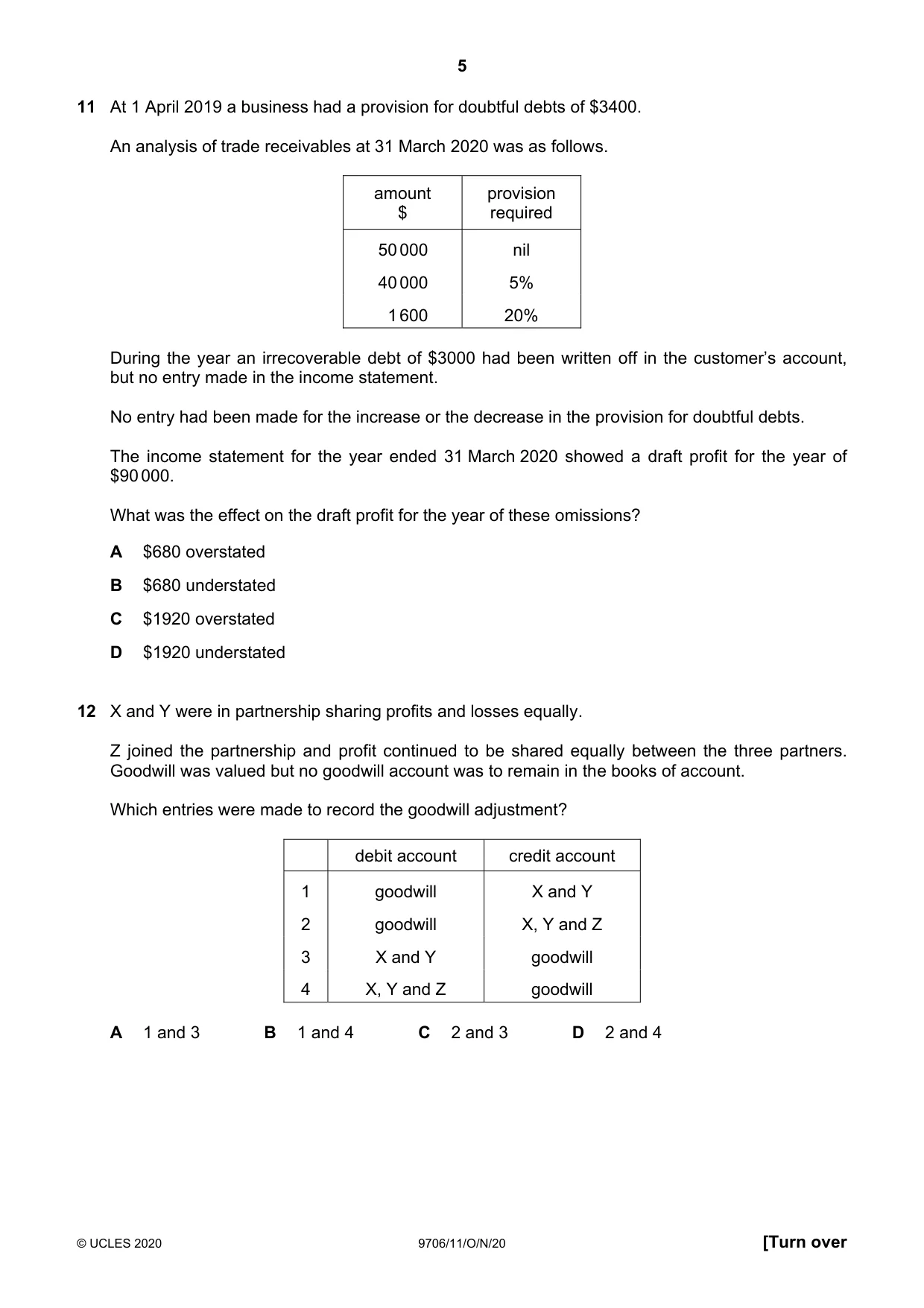
11 At 1 April 2019 a business had a provision for doubtful debts of $3400. An analysis of trade receivables at 31 March 2020 was as follows. amount provision $ required 50 000 nil 40 000 5% 1 600 20% During the year an irrecoverable debt of $3000 had been written off in the customer’s account, but no entry made in the income statement. No entry had been made for the increase or the decrease in the provision for doubtful debts. The income statement for the year ended 31 March 2020 showed a draft profit for the year of $90 000. What was the effect on the draft profit for the year of these omissions? A $680 overstated B $680 understated C $1920 overstated D $1920 understated
Mark scheme: C
Q12 · X and Y were in partnership sharing profits and losses equally
12 X and Y were in partnership sharing profits and losses equally. Z joined the partnership and profit continued to be shared equally between the three partners. Goodwill was valued but no goodwill account was to remain in the books of account. Which entries were made to record the goodwill adjustment? debit account credit account 1 goodwill X and Y 2 goodwill X, Y and Z 3 X and Y goodwill 4 X, Y and Z goodwill A 1 and 3 B 1 and 4 C 2 and 3 D 2 and 4
Mark scheme: B
Q13 · Which are not appropriations of partnership profit?
13 Which are not appropriations of partnership profit? 1 interest on capital 2 interest on drawings 3 interest on loan from partner 4 partner’s drawings A 1 and 3 B 1 and 4 C 2 and 3 D 3 and 4
Mark scheme: D
Q14 · L, M and N were in partnership sharing profits and losses in the ratio 3 : 2 : 1
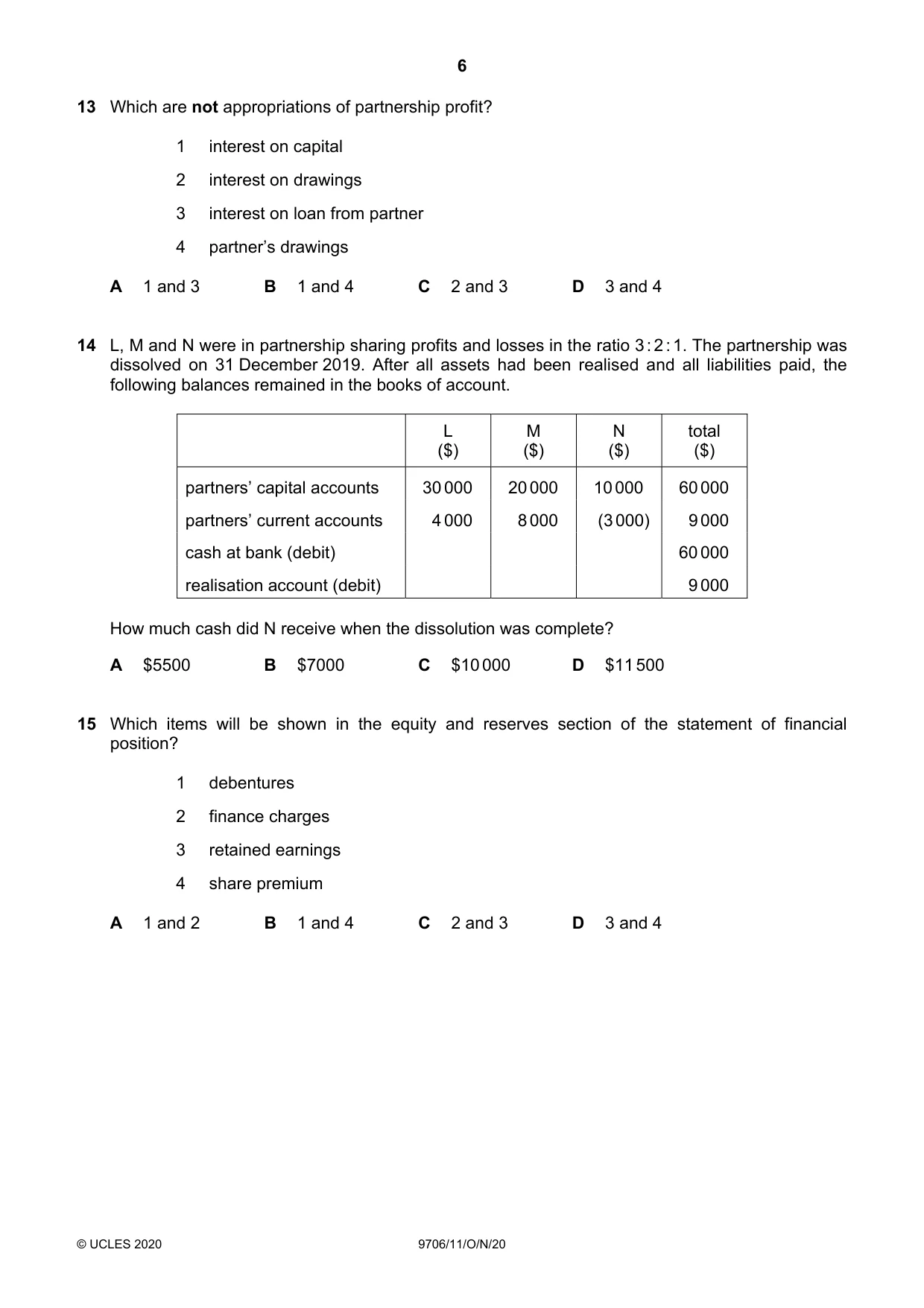
14 L, M and N were in partnership sharing profits and losses in the ratio 3 : 2 : 1. The partnership was dissolved on 31 December 2019. After all assets had been realised and all liabilities paid, the following balances remained in the books of account. L M N total ($) ($) ($) ($) partners’ capital accounts 30 000 20 000 10 000 60 000 partners’ current accounts 4 000 8 000 (3 000) 9 000 cash at bank (debit) 60 000 realisation account (debit) 9 000 How much cash did N receive when the dissolution was complete? A $5500 B $7000 C $10 000 D $11 500
Mark scheme: A
Q15 · Which items will be shown in the equity and reserves section of the statement of…
15 Which items will be shown in the equity and reserves section of the statement of financial position? 1 debentures 2 finance charges 3 retained earnings 4 share premium A 1 and 2 B 1 and 4 C 2 and 3 D 3 and 4
Mark scheme: D
Q16 · An investor owns 5% preference shares in H Limited
16 An investor owns 5% preference shares in H Limited. One year H Limited does not have enough profits to pay the preference dividend. The investor expects the profits to improve and thinks the directors will pay the outstanding dividend in the following year. Which type of preference shares does the investor own? A cumulative B non-cumulative C participating D redeemable
Mark scheme: A
Q17 · The following information was taken from the accounting records of a company at 1 January…
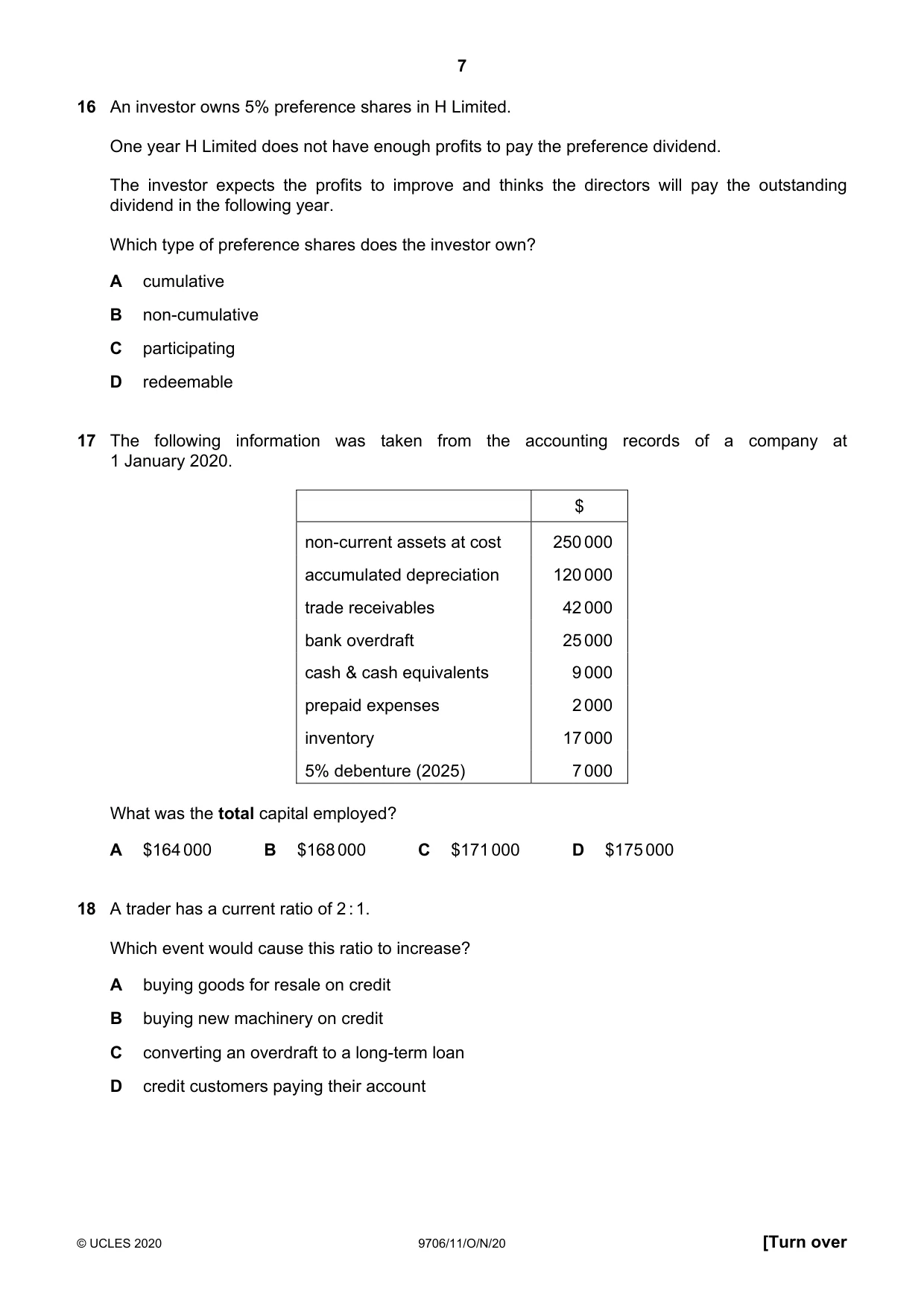
17 The following information was taken from the accounting records of a company at 1 January 2020. $ non-current assets at cost 250 000 accumulated depreciation 120 000 trade receivables 42 000 bank overdraft 25 000 cash & cash equivalents 9 000 prepaid expenses 2 000 inventory 17 000 5% debenture (2025) 7 000 What was the total capital employed? A $164 000 B $168 000 C $171 000 D $175 000
Mark scheme: D
Q18 · A trader has a current ratio of 2 : 1
18 A trader has a current ratio of 2 : 1. Which event would cause this ratio to increase? A buying goods for resale on credit B buying new machinery on credit C converting an overdraft to a long-term loan D credit customers paying their account
Mark scheme: C
More questions on Analysis and communication of accounting information
Q19 · A company buys and sells all of its inventory on a credit basis
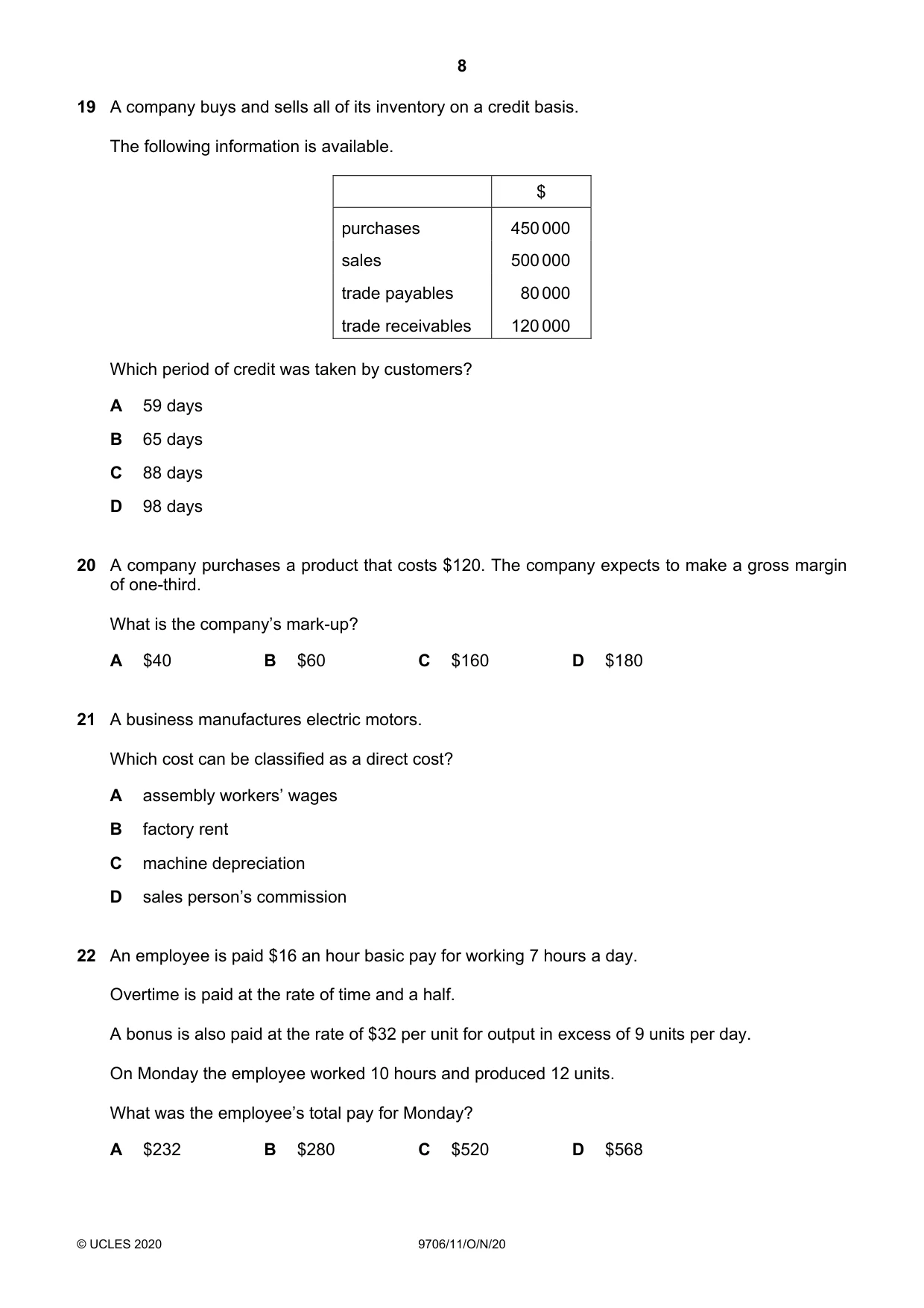
19 A company buys and sells all of its inventory on a credit basis. The following information is available. $ purchases 450 000 sales 500 000 trade payables 80 000 trade receivables 120 000 Which period of credit was taken by customers? A 59 days B 65 days C 88 days D 98 days
Mark scheme: C
More questions on Analysis and communication of accounting information
Q20 · A company purchases a product that costs $120
20 A company purchases a product that costs $120. The company expects to make a gross margin of one-third. What is the company’s mark-up? A $40 B $60 C $160 D $180
Mark scheme: B
More questions on Analysis and communication of accounting information
Q21 · A business manufactures electric motors
21 A business manufactures electric motors. Which cost can be classified as a direct cost? A assembly workers’ wages B factory rent C machine depreciation D sales person’s commission
Mark scheme: A
Q22 · An employee is paid $16 an hour basic pay for working 7 hours a day
22 An employee is paid $16 an hour basic pay for working 7 hours a day. Overtime is paid at the rate of time and a half. A bonus is also paid at the rate of $32 per unit for output in excess of 9 units per day. On Monday the employee worked 10 hours and produced 12 units. What was the employee’s total pay for Monday? A $232 B $280 C $520 D $568
Mark scheme: B
Q23 · Details of inventory movements for an item are shown
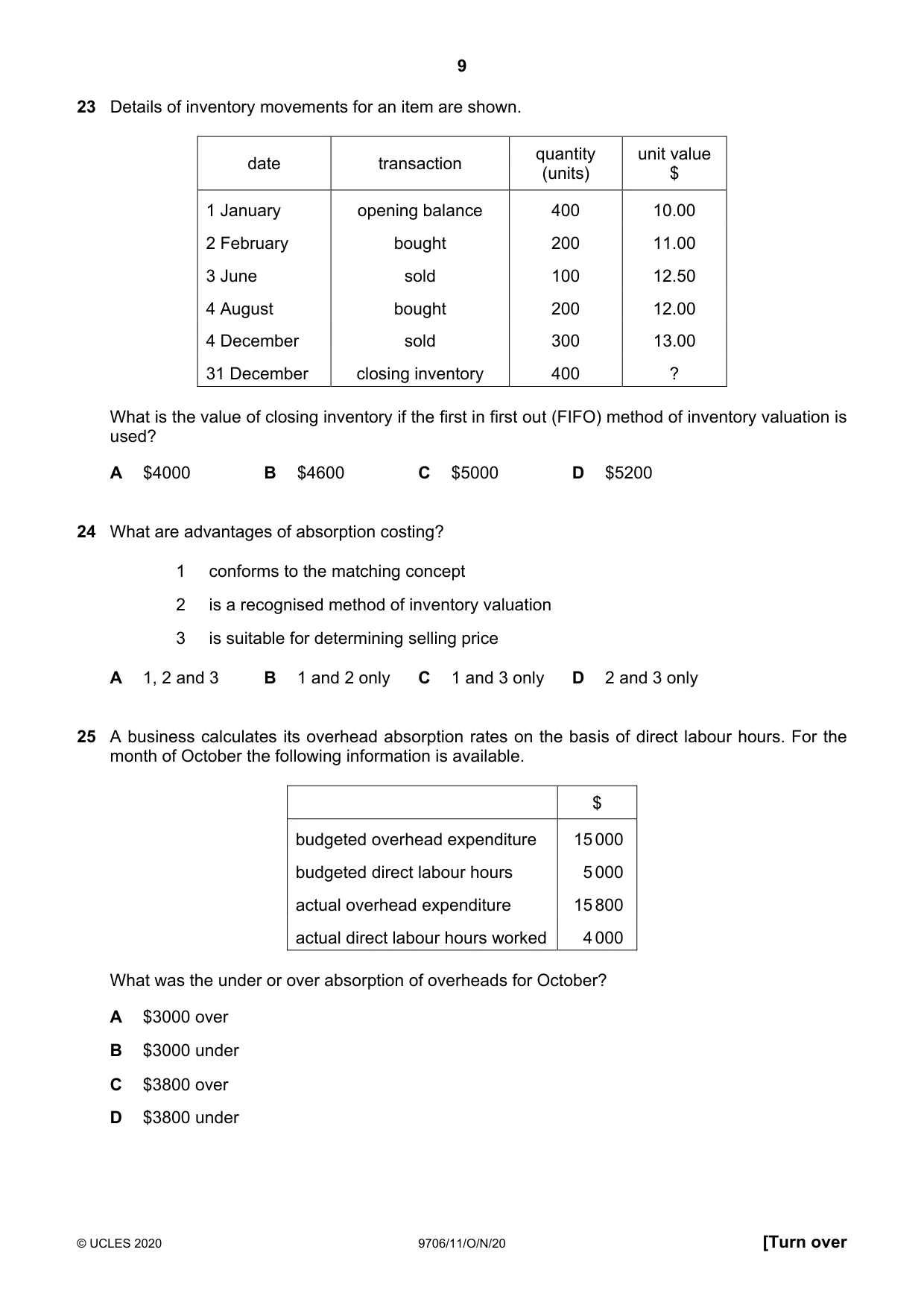
23 Details of inventory movements for an item are shown. quantity unit value date transaction (units) $ 1 January opening balance 400 10.00 2 February bought 200 11.00 3 June sold 100 12.50 4 August bought 200 12.00 4 December sold 300 13.00 31 December closing inventory 400 ? What is the value of closing inventory if the first in first out (FIFO) method of inventory valuation is used? A $4000 B $4600 C $5000 D $5200
Mark scheme: B
Q24 · What are advantages of absorption costing?
24 What are advantages of absorption costing? 1 conforms to the matching concept 2 is a recognised method of inventory valuation 3 is suitable for determining selling price A 1, 2 and 3 B 1 and 2 only C 1 and 3 only D 2 and 3 only
Mark scheme: A
Q25 · A business calculates its overhead absorption rates on the basis of direct labour hours
25 A business calculates its overhead absorption rates on the basis of direct labour hours. For the month of October the following information is available. $ budgeted overhead expenditure 15 000 budgeted direct labour hours 5 000 actual overhead expenditure 15 800 actual direct labour hours worked 4 000 What was the under or over absorption of overheads for October? A $3000 over B $3000 under C $3800 over D $3800 under
Mark scheme: D
Q26 · How is contribution calculated?
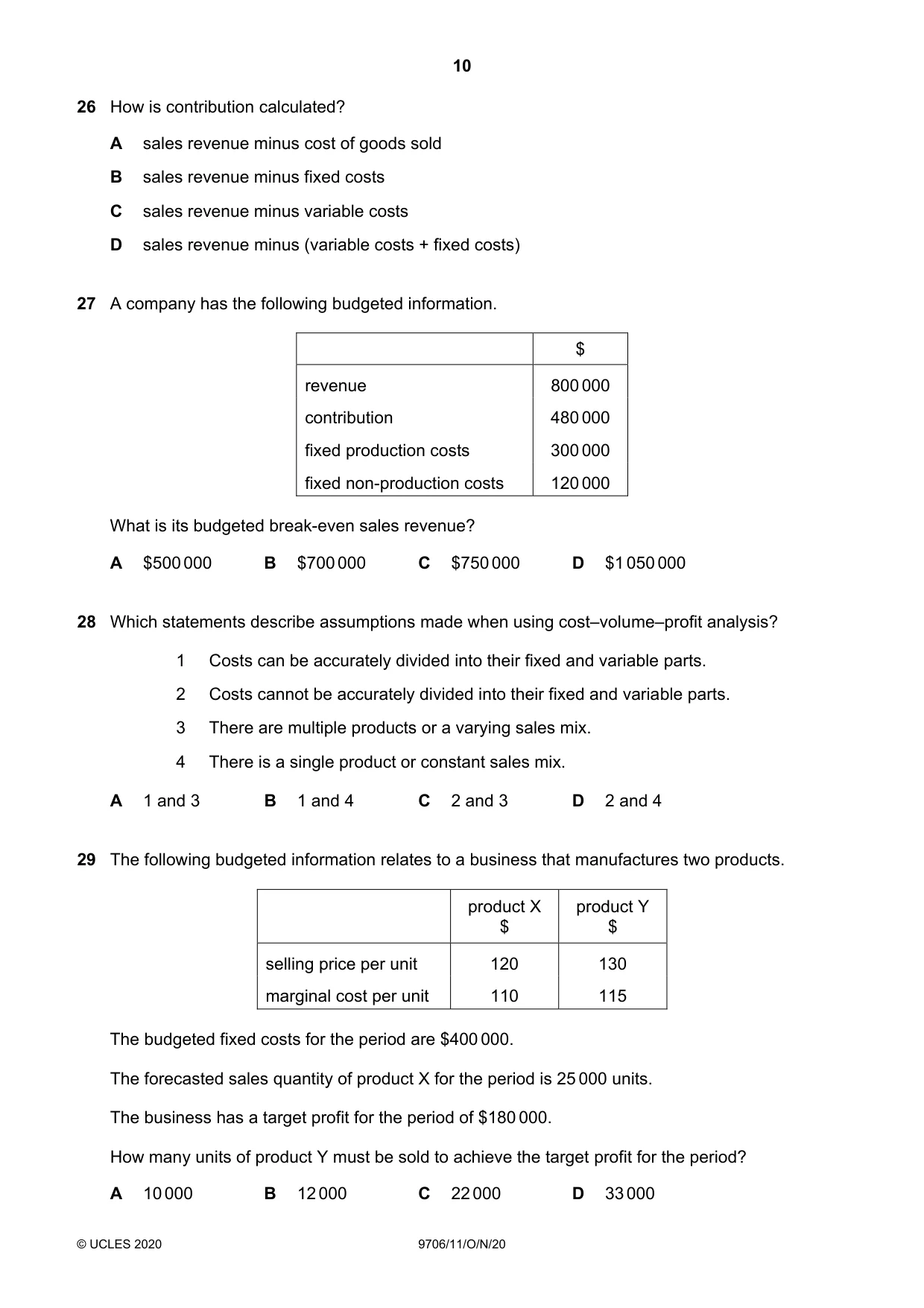
26 How is contribution calculated? A sales revenue minus cost of goods sold B sales revenue minus fixed costs C sales revenue minus variable costs D sales revenue minus (variable costs + fixed costs)
Mark scheme: C
Q27 · A company has the following budgeted information
27 A company has the following budgeted information. $ revenue 800 000 contribution 480 000 fixed production costs 300 000 fixed non-production costs 120 000 What is its budgeted break-even sales revenue? A $500 000 B $700 000 C $750 000 D $1 050 000
Mark scheme: B
Q28 · Which statements describe assumptions made when using cost–volume–profit analysis?
28 Which statements describe assumptions made when using cost–volume–profit analysis? 1 Costs can be accurately divided into their fixed and variable parts. 2 Costs cannot be accurately divided into their fixed and variable parts. 3 There are multiple products or a varying sales mix. 4 There is a single product or constant sales mix. A 1 and 3 B 1 and 4 C 2 and 3 D 2 and 4
Mark scheme: B
Q29 · The following budgeted information relates to a business that manufactures two products
29 The following budgeted information relates to a business that manufactures two products. product X product Y $ $ selling price per unit 120 130 marginal cost per unit 110 115 The budgeted fixed costs for the period are $400 000. The forecasted sales quantity of product X for the period is 25 000 units. The business has a target profit for the period of $180 000. How many units of product Y must be sold to achieve the target profit for the period? A 10 000 B 12 000 C 22 000 D 33 000
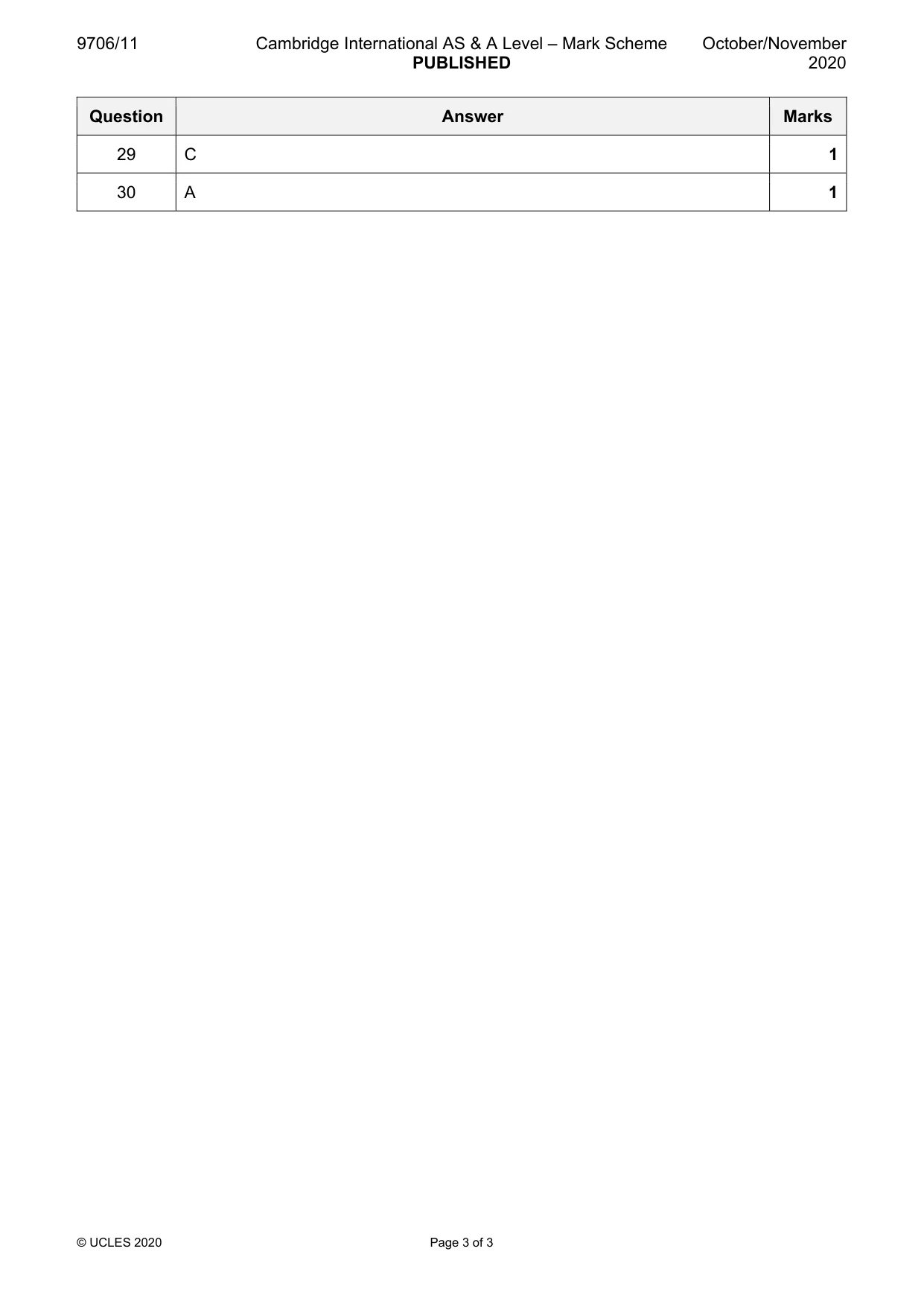
Mark scheme: C
Q30 · How can budgeting help a business achieve control of its performance?
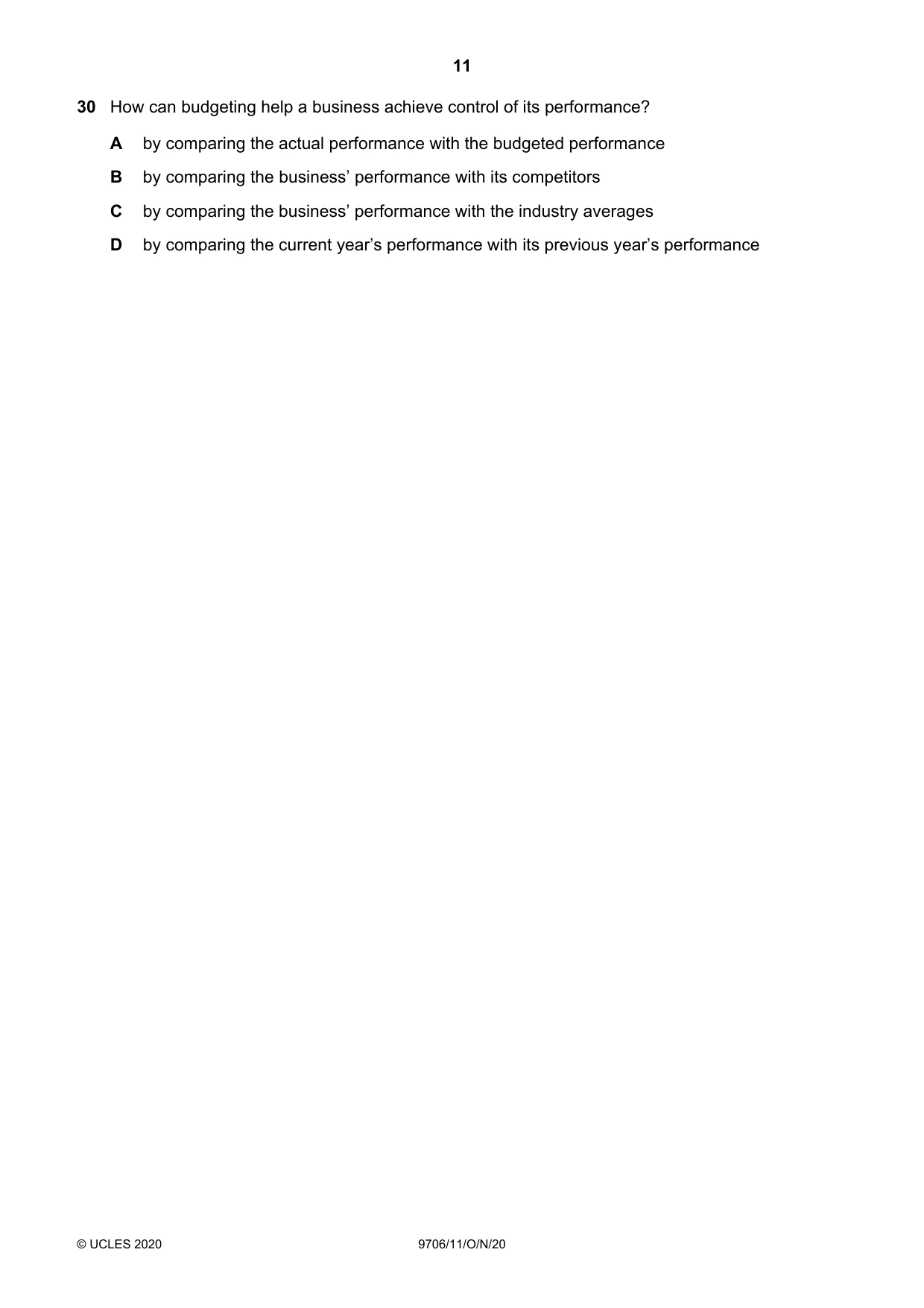
30 How can budgeting help a business achieve control of its performance? A by comparing the actual performance with the budgeted performance B by comparing the business’ performance with its competitors C by comparing the business’ performance with the industry averages D by comparing the current year’s performance with its previous year’s performance
Mark scheme: A
What was in this paper
The subtopics covered by these 30 questions, and how many questions each got. Open one in a new tab to see every Cambridge question on it.
6Preparation of financial statements5Reconciliation and verification4Analysis and communication of accounting information3Preparation of financial statements3Traditional costing methods3Accounting for non-current assets2The accounting system2Budgeting and budgetary control1Types of business entity1What you needed in this session
Cambridge’s own grade thresholds for 2020 Oct/Nov, Paper 1 · Variant 1. A higher threshold means an easier paper — the bar moves with how the cohort did.