Cambridge A Level Accounting 9706 — 2013 May/June Paper 1 · Variant 3
9706/13/M/J/13 · 30 questions · 30 marks · ≈34 min
The question paper and its mark scheme, free to read here and free to download. This is Cambridge’s own paper, exactly as it was sat.
Question paper12 pages
Mark scheme2 pages
Answers below. Sit the paper first if you are practising.
Questions as text
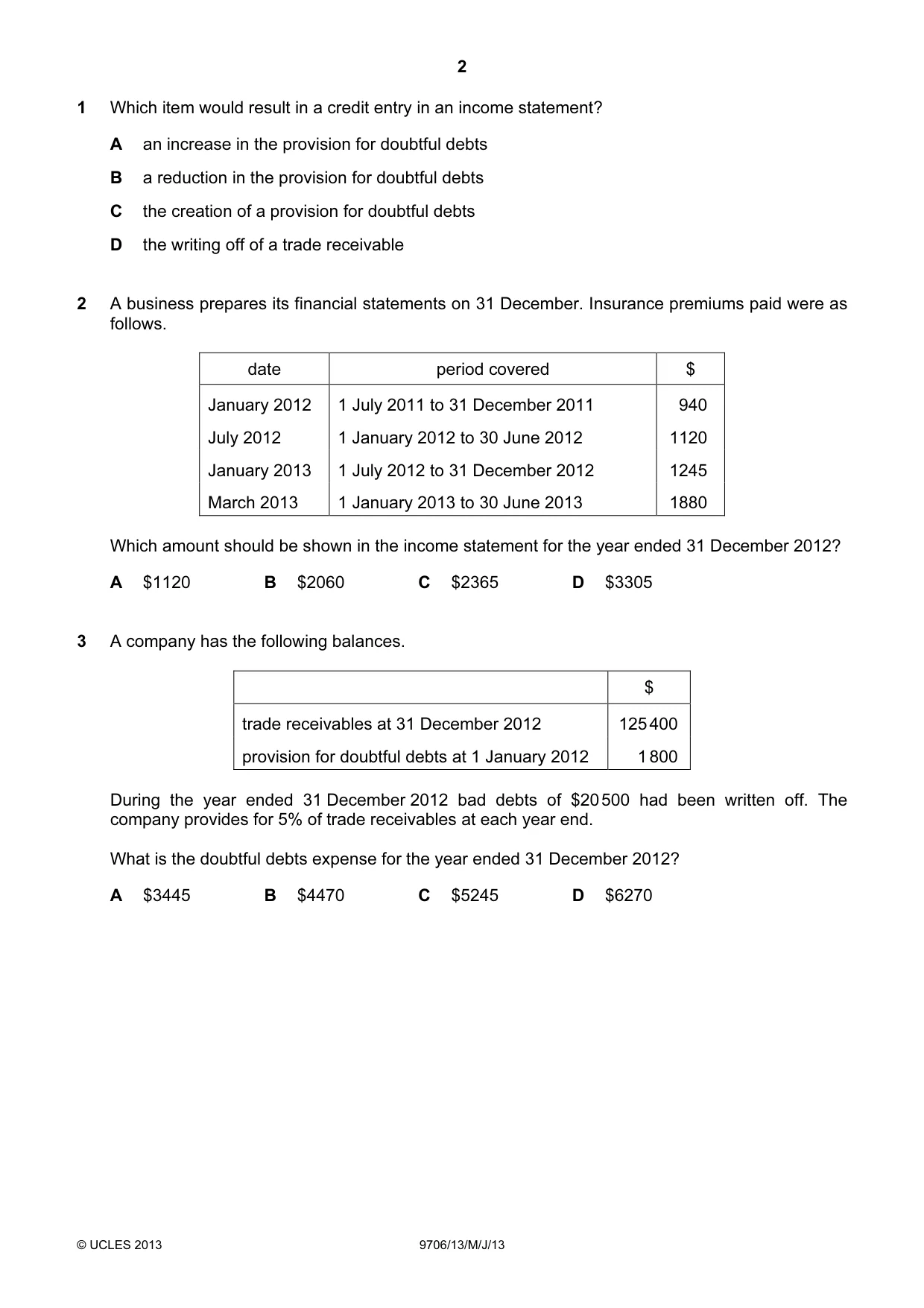
Q1 · Which item would result in a credit entry in an income statement?
1 Which item would result in a credit entry in an income statement? A an increase in the provision for doubtful debts B a reduction in the provision for doubtful debts C the creation of a provision for doubtful debts D the writing off of a trade receivable
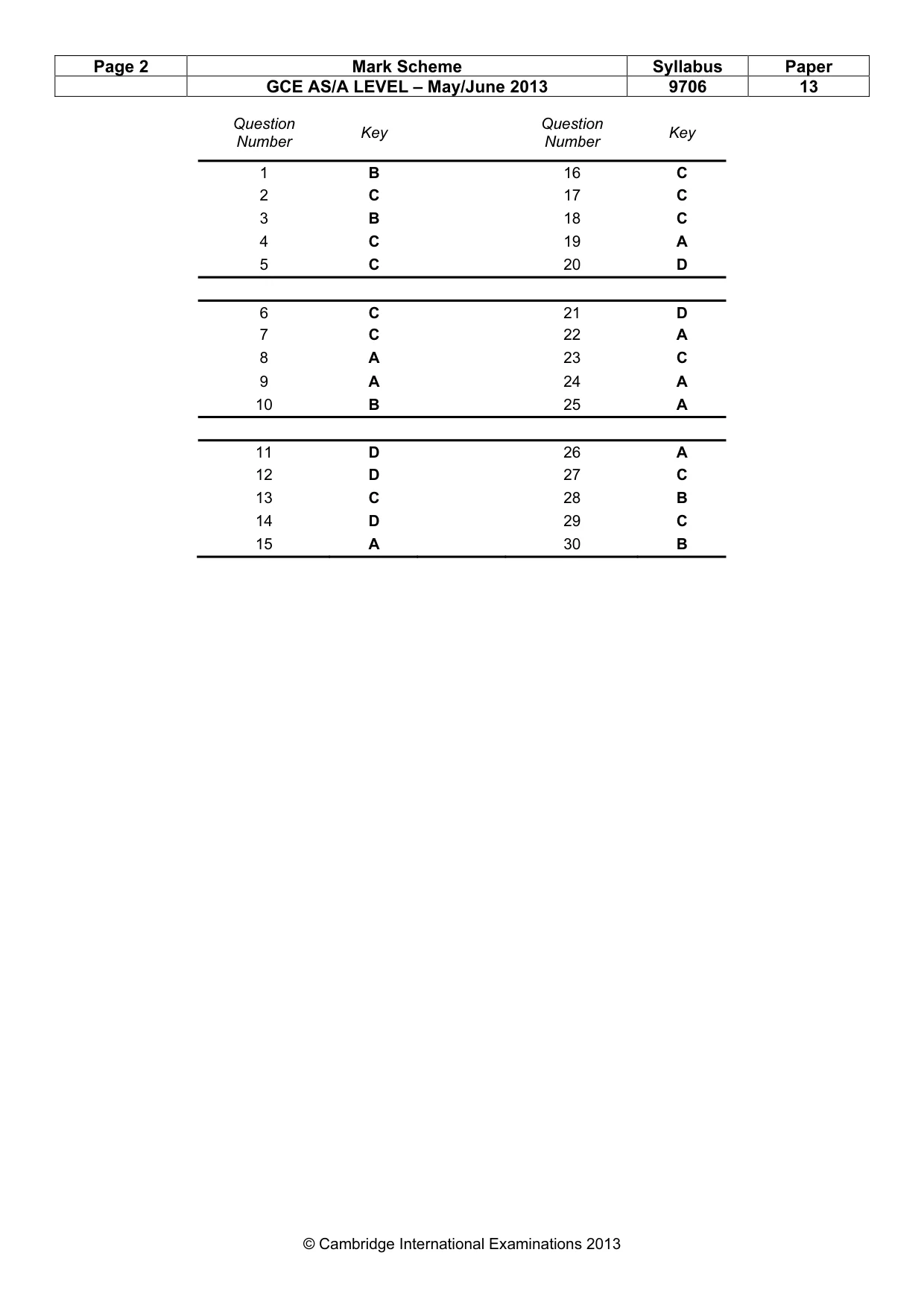
Mark scheme: B
Q2 · A business prepares its financial statements on 31 December
2 A business prepares its financial statements on 31 December. Insurance premiums paid were as follows. date period covered $ January 2012 1 July 2011 to 31 December 2011 940 July 2012 1 January 2012 to 30 June 2012 1120 January 2013 1 July 2012 to 31 December 2012 1245 March 2013 1 January 2013 to 30 June 2013 1880 Which amount should be shown in the income statement for the year ended 31 December 2012? A $1120 B $2060 C $2365 D $3305
Mark scheme: C
Q3 · A company has the following balances
3 A company has the following balances. $ trade receivables at 31 December 2012 125 400 provision for doubtful debts at 1 January 2012 1 800 During the year ended 31 December 2012 bad debts of $20 500 had been written off. The company provides for 5% of trade receivables at each year end. What is the doubtful debts expense for the year ended 31 December 2012? A $3445 B $4470 C $5245 D $6270
Mark scheme: B
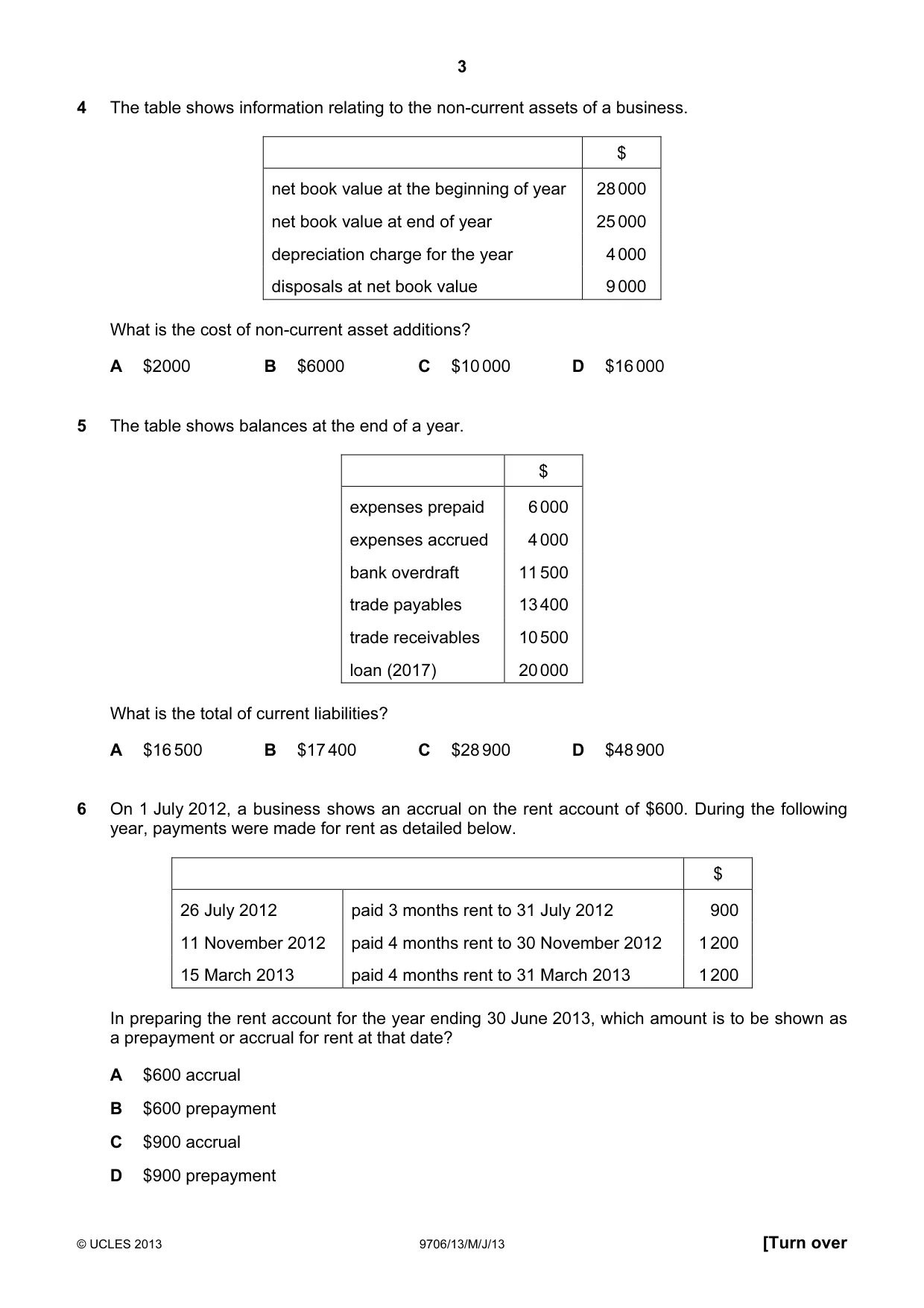
Q4 · The table shows information relating to the non-current assets of a business
4 The table shows information relating to the non-current assets of a business. $ net book value at the beginning of year 28 000 net book value at end of year 25 000 depreciation charge for the year 4 000 disposals at net book value 9 000 What is the cost of non-current asset additions? A $2000 B $6000 C $10 000 D $16 000
Mark scheme: C
Q5 · The table shows balances at the end of a year
5 The table shows balances at the end of a year. $ expenses prepaid 6 000 expenses accrued 4 000 bank overdraft 11 500 trade payables 13 400 trade receivables 10 500 loan (2017) 20 000 What is the total of current liabilities? A $16 500 B $17 400 C $28 900 D $48 900
Mark scheme: C
Q6 · On 1 July 2012, a business shows an accrual on the rent account of $600
6 On 1 July 2012, a business shows an accrual on the rent account of $600. During the following year, payments were made for rent as detailed below. $ 26 July 2012 paid 3 months rent to 31 July 2012 900 11 November 2012 paid 4 months rent to 30 November 2012 1 200 15 March 2013 paid 4 months rent to 31 March 2013 1 200 In preparing the rent account for the year ending 30 June 2013, which amount is to be shown as a prepayment or accrual for rent at that date? A $600 accrual B $600 prepayment C $900 accrual D $900 prepayment
Mark scheme: C
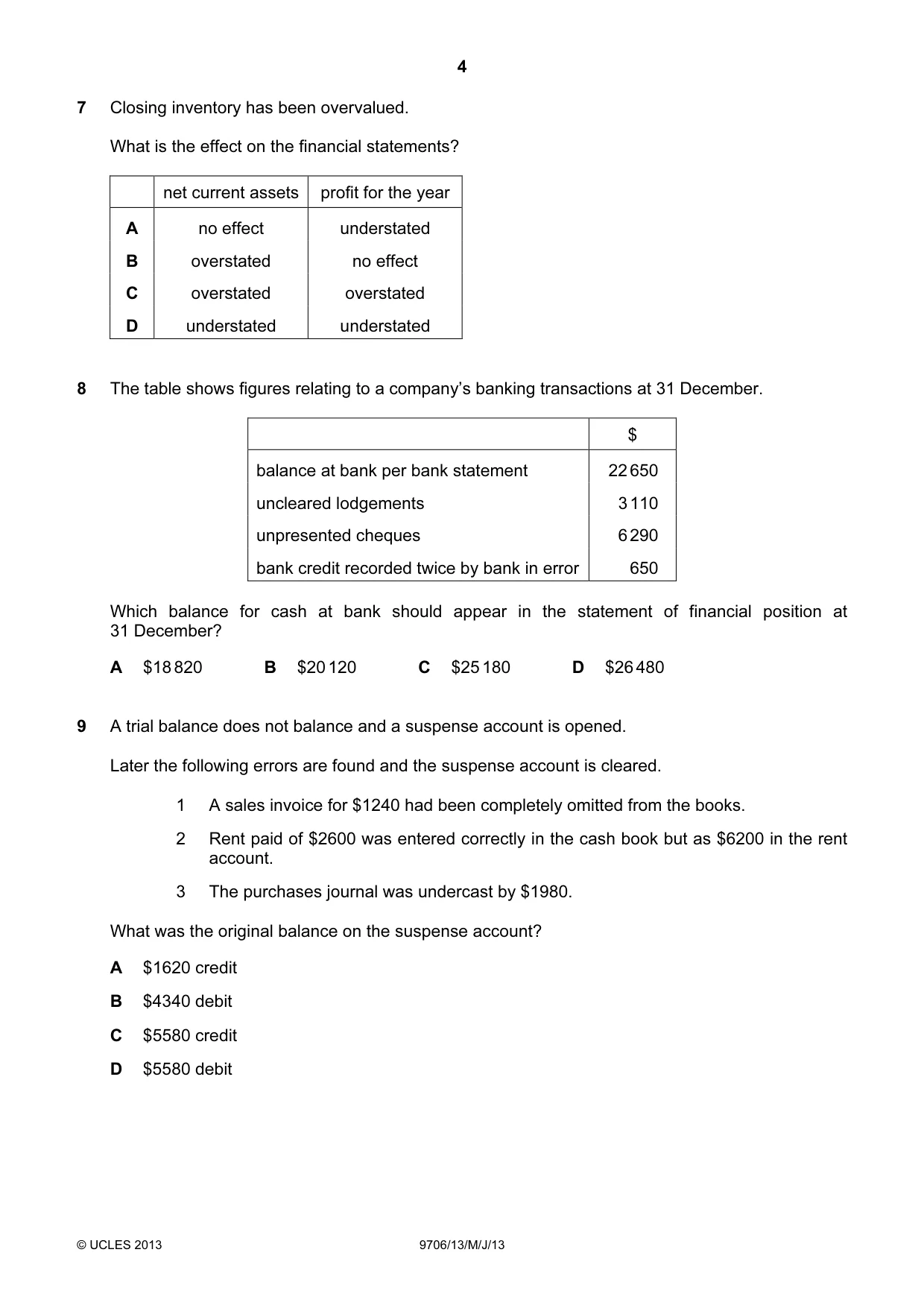
Q7 · Closing inventory has been overvalued
7 Closing inventory has been overvalued. What is the effect on the financial statements? net current assets profit for the year A no effect understated B overstated no effect C overstated overstated D understated understated
Mark scheme: C
Q8 · The table shows figures relating to a company’s banking transactions at 31 December
8 The table shows figures relating to a company’s banking transactions at 31 December. $ balance at bank per bank statement 22 650 uncleared lodgements 3 110 unpresented cheques 6 290 bank credit recorded twice by bank in error 650 Which balance for cash at bank should appear in the statement of financial position at 31 December? A $18 820 B $20 120 C $25 180 D $26 480
Mark scheme: A
Q9 · A trial balance does not balance and a suspense account is opened
9 A trial balance does not balance and a suspense account is opened. Later the following errors are found and the suspense account is cleared. 1 A sales invoice for $1240 had been completely omitted from the books. 2 Rent paid of $2600 was entered correctly in the cash book but as $6200 in the rent account. 3 The purchases journal was undercast by $1980. What was the original balance on the suspense account? A $1620 credit B $4340 debit C $5580 credit D $5580 debit
Mark scheme: A
Q10 · The table shows information relating to a business for the year ended 31 December 2012
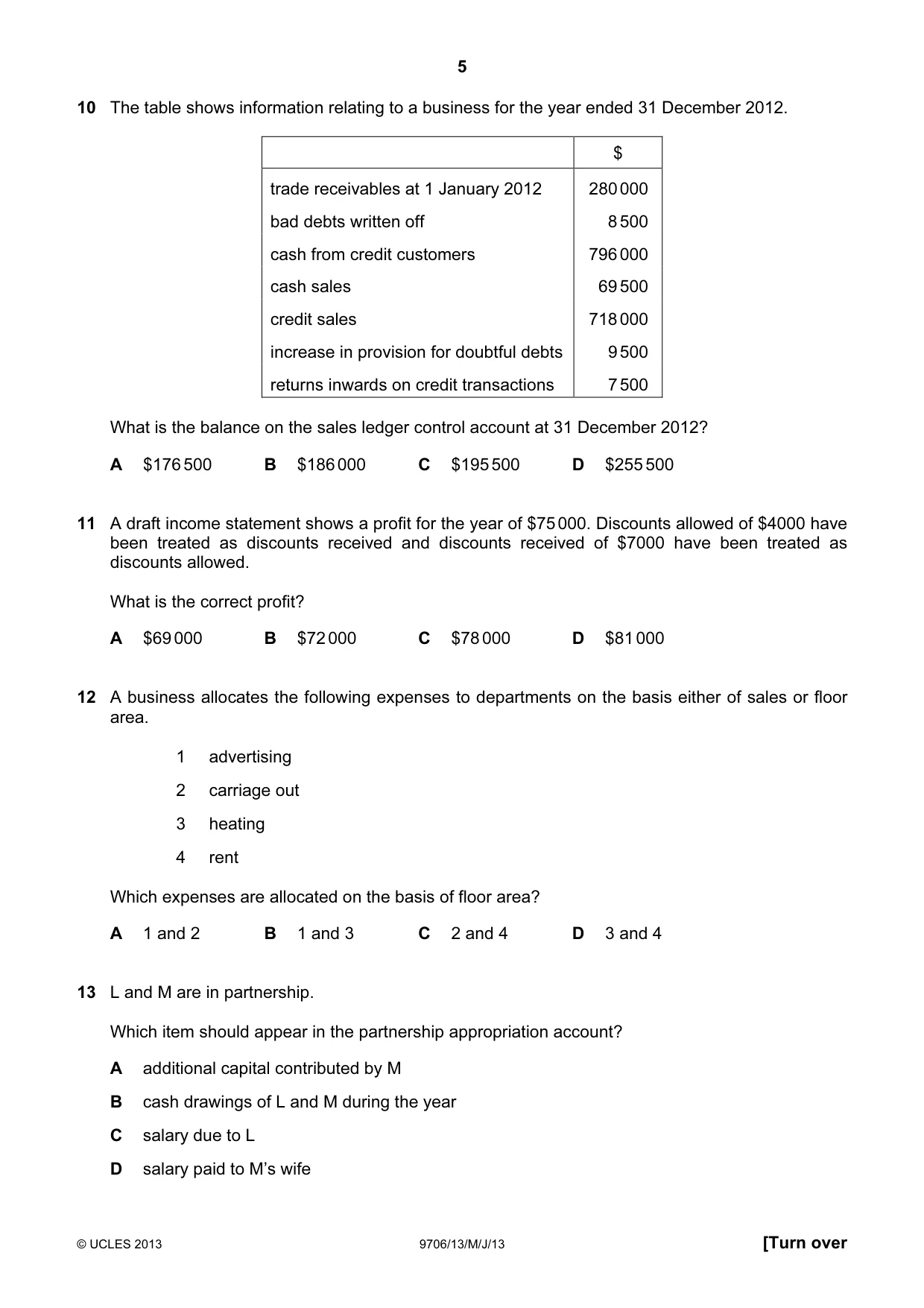
10 The table shows information relating to a business for the year ended 31 December 2012. $ trade receivables at 1 January 2012 280 000 bad debts written off 8 500 cash from credit customers 796 000 cash sales 69 500 credit sales 718 000 increase in provision for doubtful debts 9 500 returns inwards on credit transactions 7 500 What is the balance on the sales ledger control account at 31 December 2012? A $176 500 B $186 000 C $195 500 D $255 500
Mark scheme: B
Q11 · A draft income statement shows a profit for the year of $75 000
11 A draft income statement shows a profit for the year of $75 000. Discounts allowed of $4000 have been treated as discounts received and discounts received of $7000 have been treated as discounts allowed. What is the correct profit? A $69 000 B $72 000 C $78 000 D $81 000
Mark scheme: D
Q12 · A business allocates the following expenses to departments on the basis either of sales…
12 A business allocates the following expenses to departments on the basis either of sales or floor area. 1 advertising 2 carriage out 3 heating 4 rent Which expenses are allocated on the basis of floor area? A 1 and 2 B 1 and 3 C 2 and 4 D 3 and 4
Mark scheme: D
Q13 · L and M are in partnership
13 L and M are in partnership. Which item should appear in the partnership appropriation account? A additional capital contributed by M B cash drawings of L and M during the year C salary due to L D salary paid to M’s wife
Mark scheme: C
Q14 · A new business was established with opening capital of $15 000
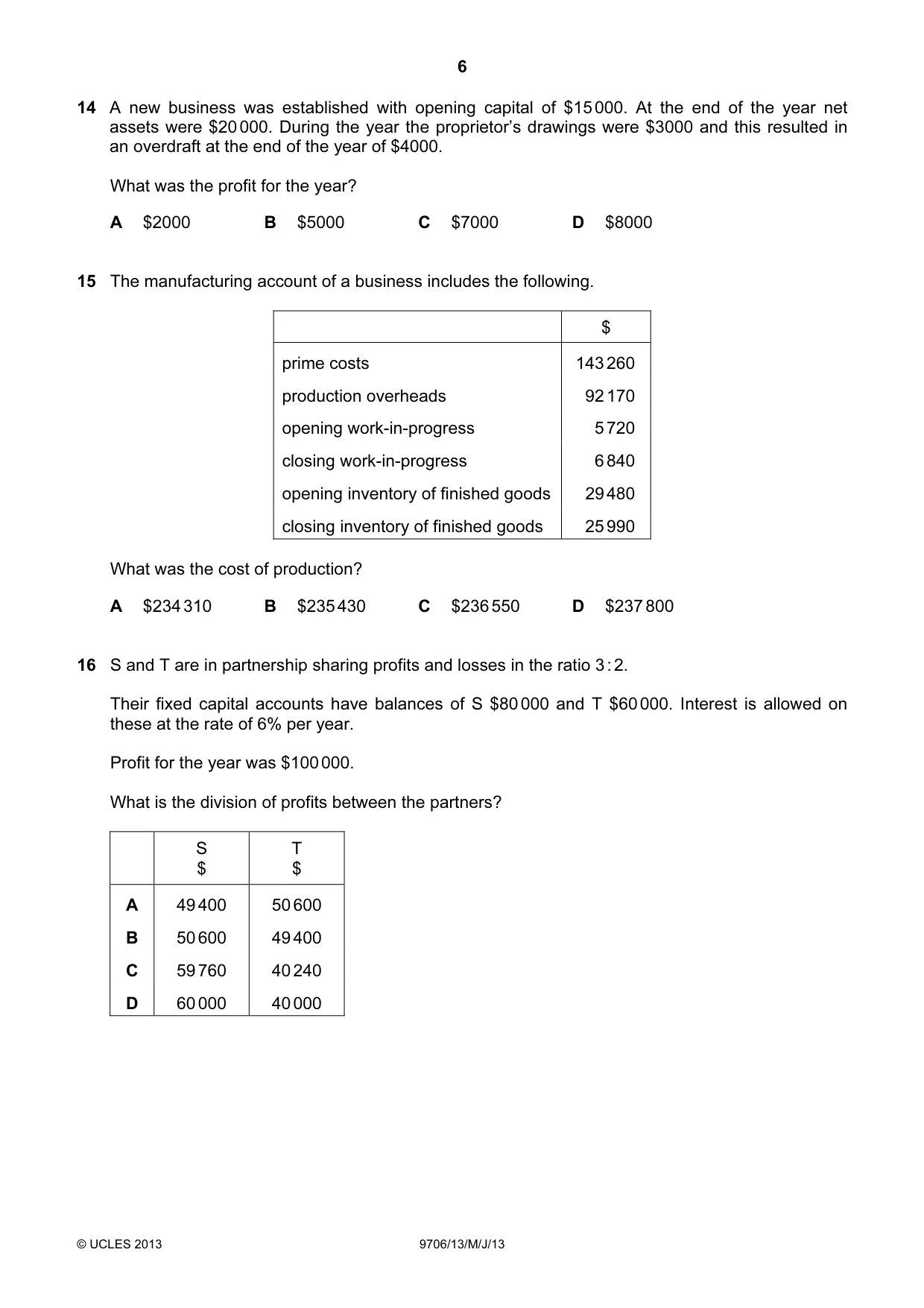
14 A new business was established with opening capital of $15 000. At the end of the year net assets were $20 000. During the year the proprietor’s drawings were $3000 and this resulted in an overdraft at the end of the year of $4000. What was the profit for the year? A $2000 B $5000 C $7000 D $8000
Mark scheme: D
Q15 · The manufacturing account of a business includes the following
15 The manufacturing account of a business includes the following. $ prime costs 143 260 production overheads 92 170 opening work-in-progress 5 720 closing work-in-progress 6 840 opening inventory of finished goods 29 480 closing inventory of finished goods 25 990 What was the cost of production? A $234 310 B $235 430 C $236 550 D $237 800
Mark scheme: A
Q16 · S and T are in partnership sharing profits and losses in the ratio 3 : 2
16 S and T are in partnership sharing profits and losses in the ratio 3 : 2. Their fixed capital accounts have balances of S $80 000 and T $60 000. Interest is allowed on these at the rate of 6% per year. Profit for the year was $100 000. What is the division of profits between the partners? S T $ $ A 49 400 50 600 B 50 600 49 400 C 59 760 40 240 D 60 000 40 000
Mark scheme: C
Q17 · Which account is adjusted for the valuation of goodwill?
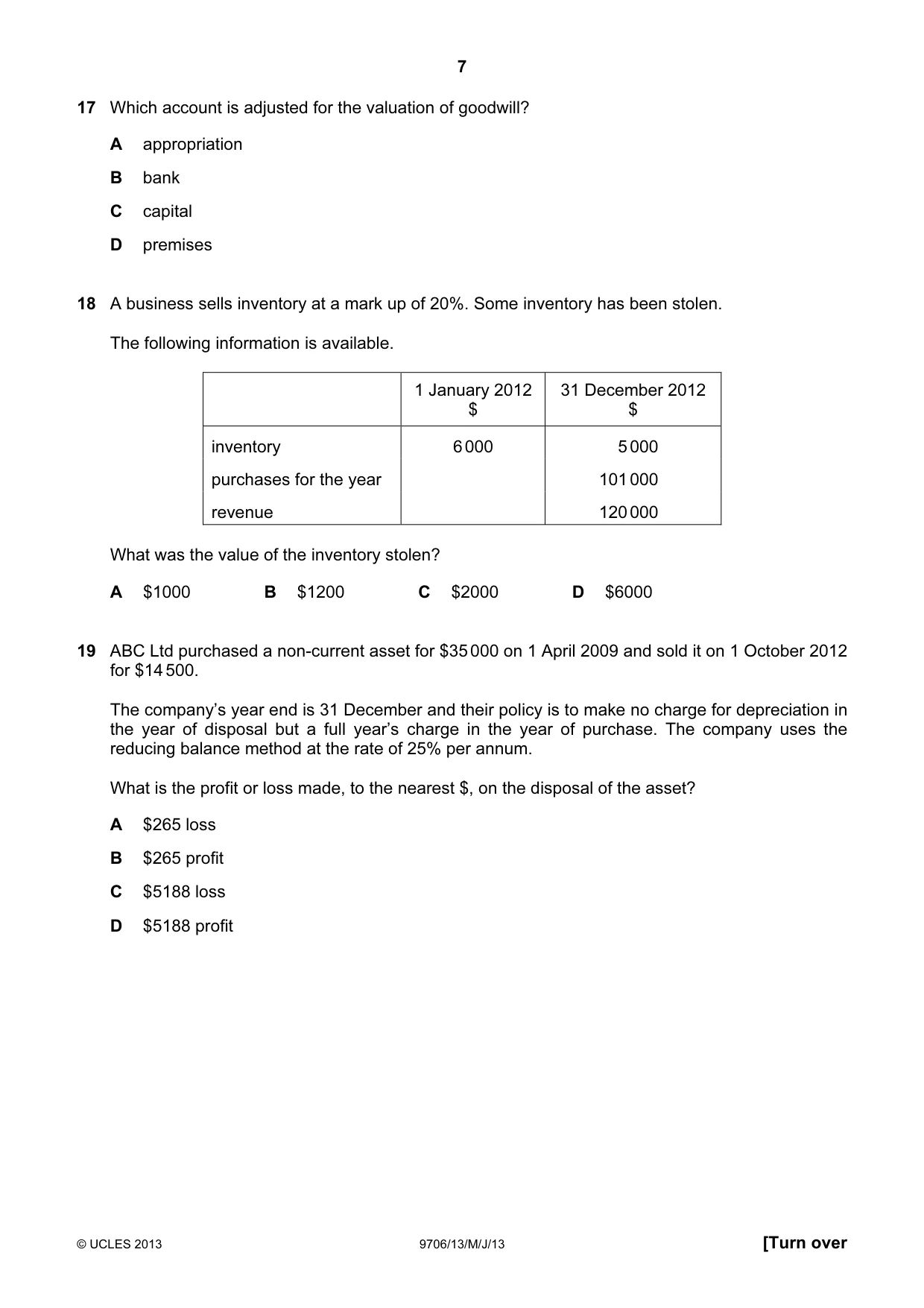
17 Which account is adjusted for the valuation of goodwill? A appropriation B bank C capital D premises
Mark scheme: C
Q18 · A business sells inventory at a mark up of 20%
18 A business sells inventory at a mark up of 20%. Some inventory has been stolen. The following information is available. 1 January 2012 31 December 2012 $ $ inventory 6 000 5 000 purchases for the year 101 000 revenue 120 000 What was the value of the inventory stolen? A $1000 B $1200 C $2000 D $6000
Mark scheme: C
Q19 · ABC Ltd purchased a non-current asset for $35 000 on 1 April 2009 and sold it on 1…
19 ABC Ltd purchased a non-current asset for $35 000 on 1 April 2009 and sold it on 1 October 2012 for $14 500. The company’s year end is 31 December and their policy is to make no charge for depreciation in the year of disposal but a full year’s charge in the year of purchase. The company uses the reducing balance method at the rate of 25% per annum. What is the profit or loss made, to the nearest $, on the disposal of the asset? A $265 loss B $265 profit C $5188 loss D $5188 profit
Mark scheme: A
Q20 · The following is an extract from the statement of financial position of a company
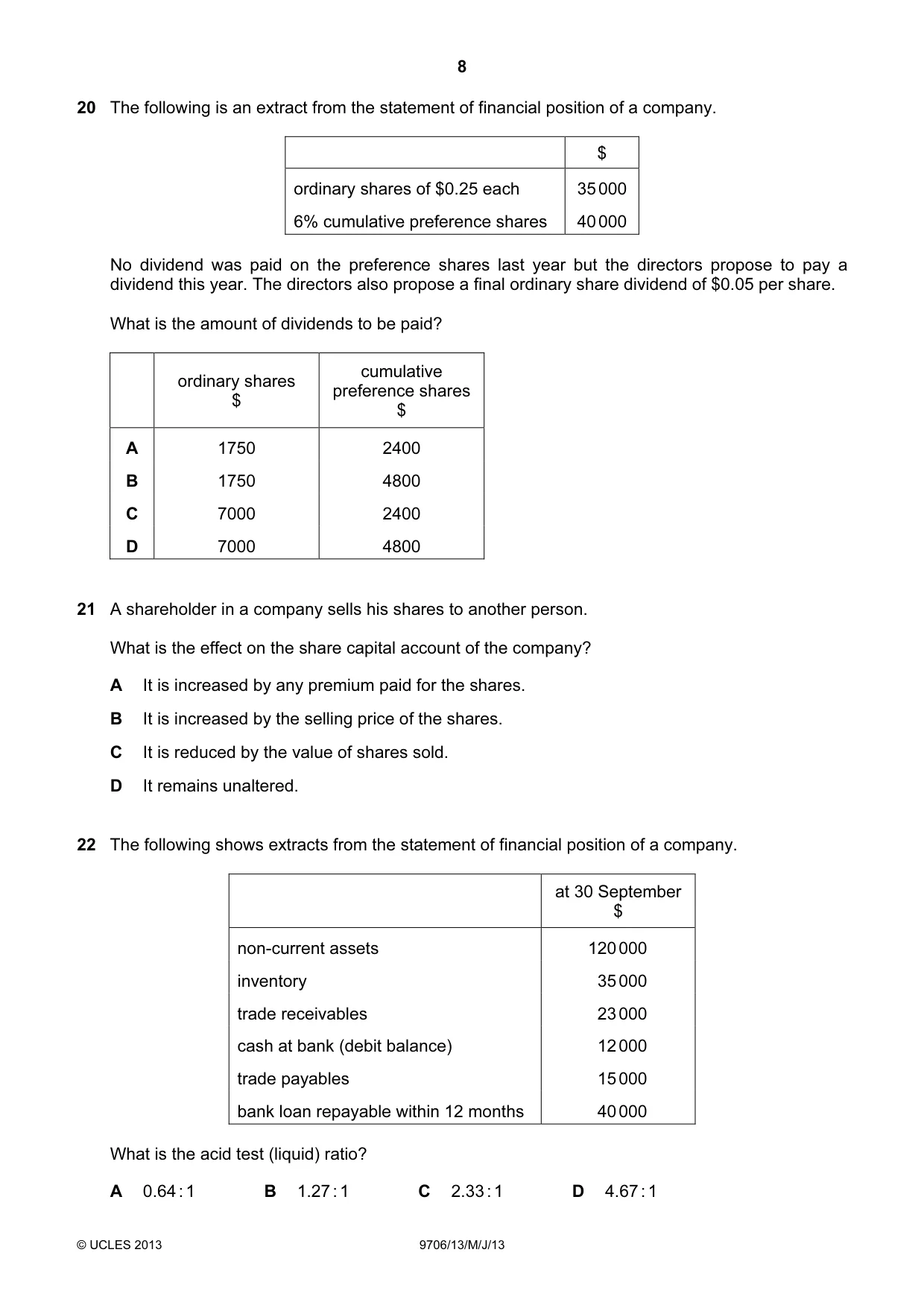
20 The following is an extract from the statement of financial position of a company. $ ordinary shares of $0.25 each 35 000 6% cumulative preference shares 40 000 No dividend was paid on the preference shares last year but the directors propose to pay a dividend this year. The directors also propose a final ordinary share dividend of $0.05 per share. What is the amount of dividends to be paid? cumulative ordinary shares preference shares $ $ A 1750 2400 B 1750 4800 C 7000 2400 D 7000 4800
Mark scheme: D
Q21 · A shareholder in a company sells his shares to another person
21 A shareholder in a company sells his shares to another person. What is the effect on the share capital account of the company? A It is increased by any premium paid for the shares. B It is increased by the selling price of the shares. C It is reduced by the value of shares sold. D It remains unaltered.
Mark scheme: D
Q22 · The following shows extracts from the statement of financial position of a company
22 The following shows extracts from the statement of financial position of a company. at 30 September $ non-current assets 120 000 inventory 35 000 trade receivables 23 000 cash at bank (debit balance) 12 000 trade payables 15 000 bank loan repayable within 12 months 40 000 What is the acid test (liquid) ratio? A 0.64 : 1 B 1.27 : 1 C 2.33 : 1 D 4.67 : 1
Mark scheme: A
More questions on Analysis and communication of accounting information
Q23 · A company’s non-current asset turnover ratio decreases this year compared to last year
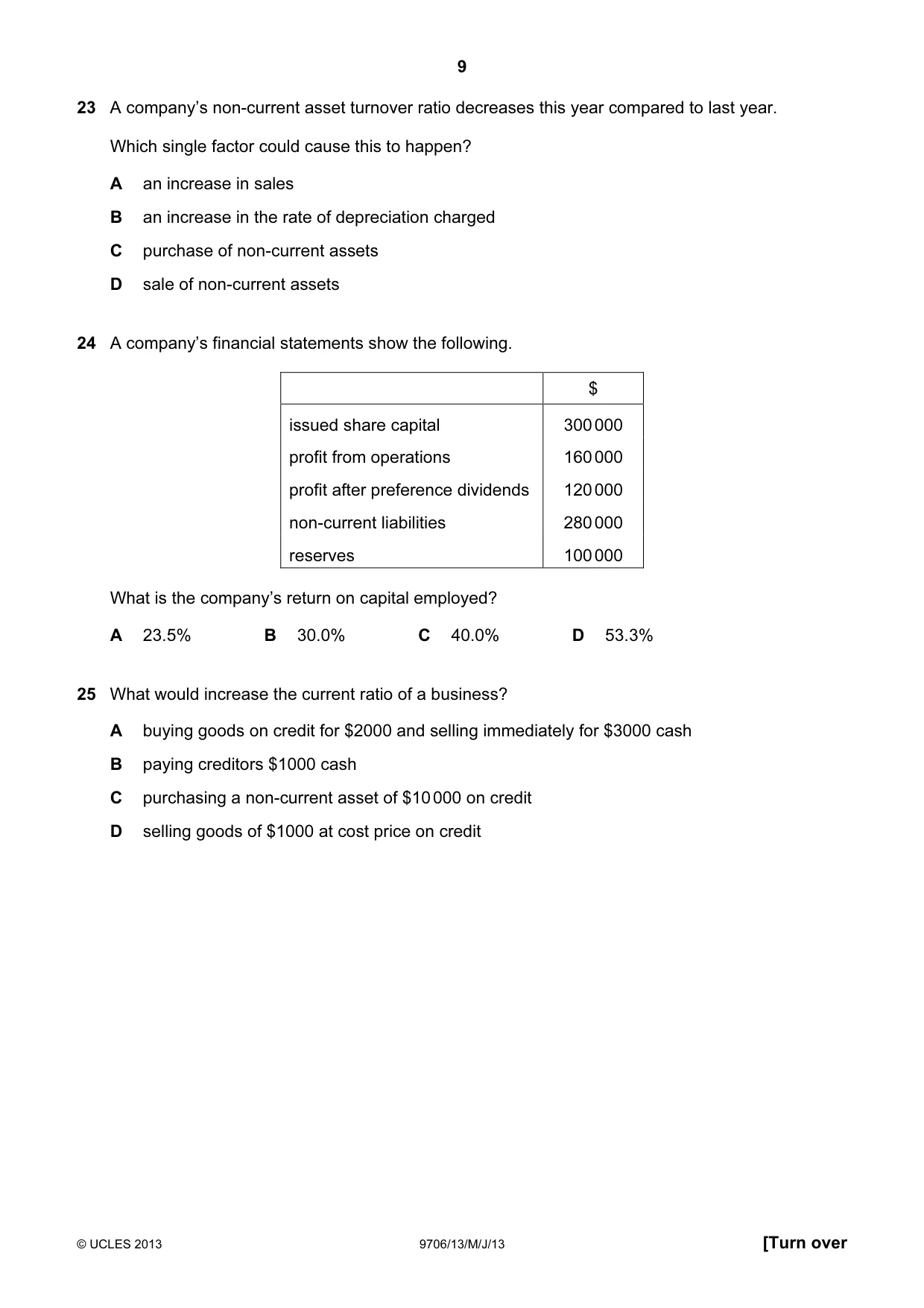
23 A company’s non-current asset turnover ratio decreases this year compared to last year. Which single factor could cause this to happen? A an increase in sales B an increase in the rate of depreciation charged C purchase of non-current assets D sale of non-current assets
Mark scheme: C
More questions on Analysis and communication of accounting information
Q24 · A company’s financial statements show the following
24 A company’s financial statements show the following. $ issued share capital 300 000 profit from operations 160 000 profit after preference dividends 120 000 non-current liabilities 280 000 reserves 100 000 What is the company’s return on capital employed? A 23.5% B 30.0% C 40.0% D 53.3%
Mark scheme: A
More questions on Analysis and communication of accounting information
Q25 · What would increase the current ratio of a business?
25 What would increase the current ratio of a business? A buying goods on credit for $2000 and selling immediately for $3000 cash B paying creditors $1000 cash C purchasing a non-current asset of $10 000 on credit D selling goods of $1000 at cost price on credit
Mark scheme: A
More questions on Analysis and communication of accounting information
Q26 · A business makes a single product
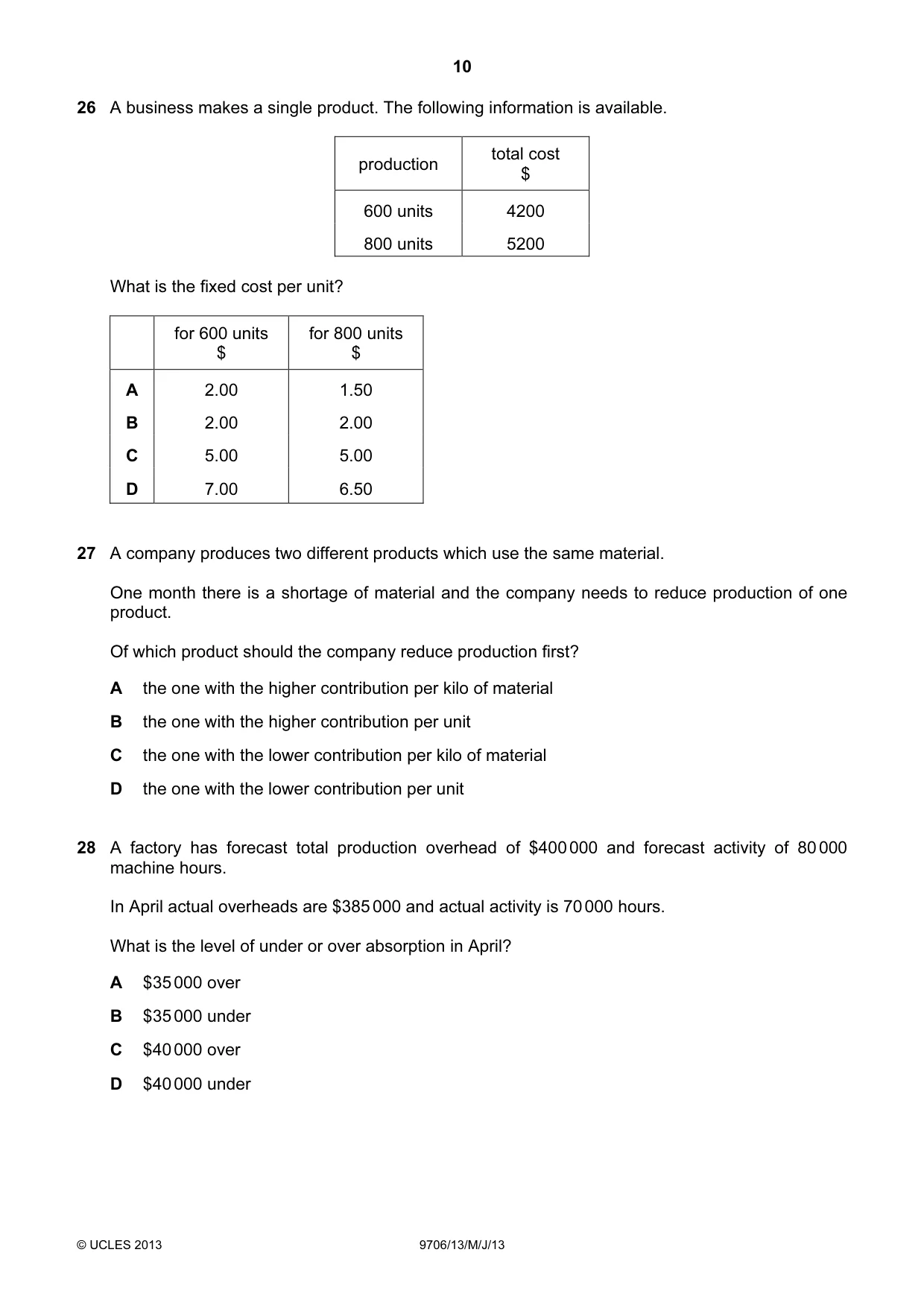
26 A business makes a single product. The following information is available. total cost production $ 600 units 4200 800 units 5200 What is the fixed cost per unit? for 600 units for 800 units $ $ A 2.00 1.50 B 2.00 2.00 C 5.00 5.00 D 7.00 6.50
Mark scheme: A
Q27 · A company produces two different products which use the same material
27 A company produces two different products which use the same material. One month there is a shortage of material and the company needs to reduce production of one product. Of which product should the company reduce production first? A the one with the higher contribution per kilo of material B the one with the higher contribution per unit C the one with the lower contribution per kilo of material D the one with the lower contribution per unit
Mark scheme: C
Q28 · A factory has forecast total production overhead of $400 000 and forecast activity of 80…
28 A factory has forecast total production overhead of $400 000 and forecast activity of 80 000 machine hours. In April actual overheads are $385 000 and actual activity is 70 000 hours. What is the level of under or over absorption in April? A $35 000 over B $35 000 under C $40 000 over D $40 000 under
Mark scheme: B
Q29 · Which type of organisation would use process costing?
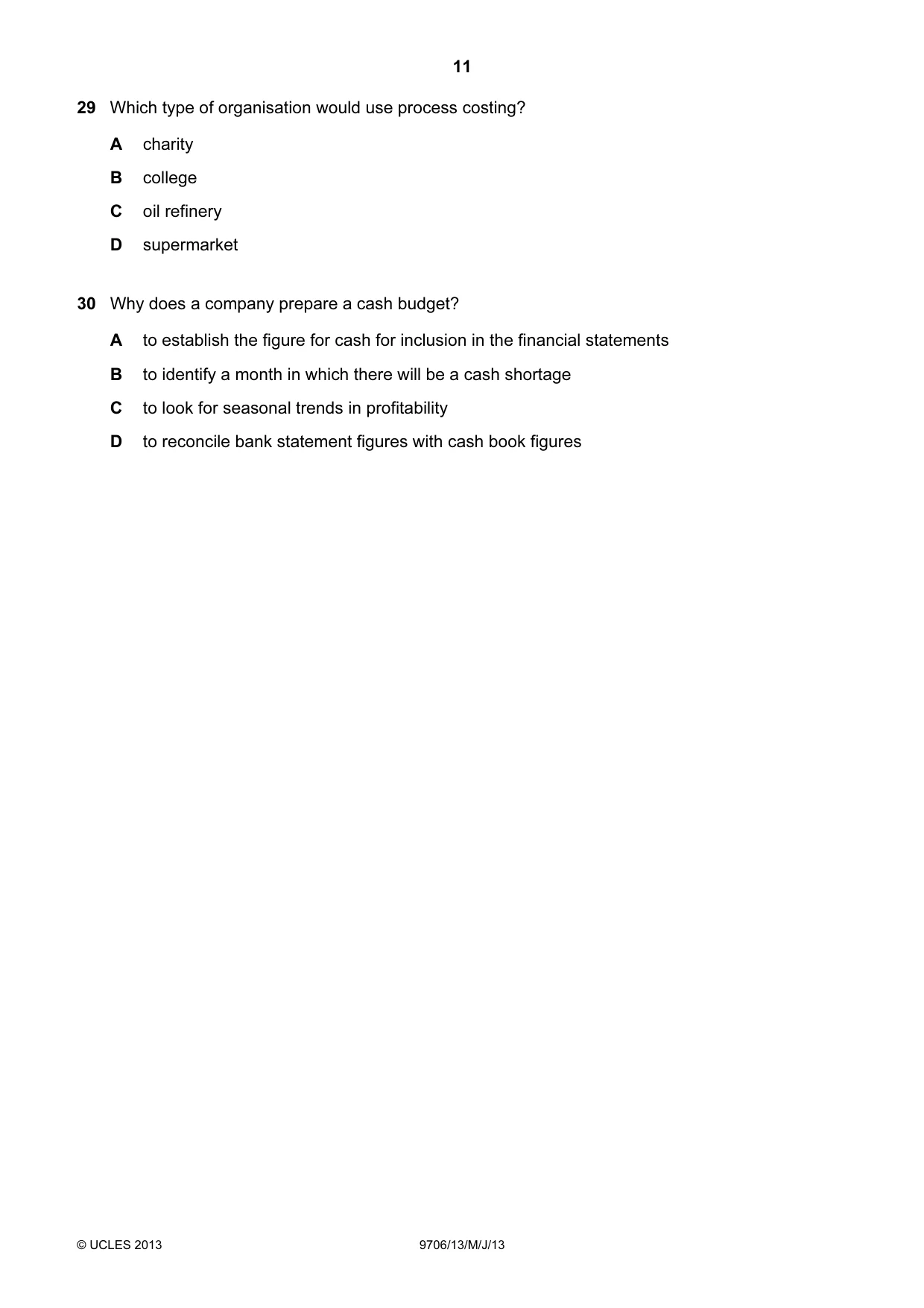
29 Which type of organisation would use process costing? A charity B college C oil refinery D supermarket
Mark scheme: C
Q30 · Why does a company prepare a cash budget?
30 Why does a company prepare a cash budget? A to establish the figure for cash for inclusion in the financial statements B to identify a month in which there will be a cash shortage C to look for seasonal trends in profitability D to reconcile bank statement figures with cash book figures
Mark scheme: B
What was in this paper
The subtopics covered by these 30 questions, and how many questions each got. Open one in a new tab to see every Cambridge question on it.
10Analysis and communication of accounting information4Reconciliation and verification4Traditional costing methods4Types of business entity3Accounting for non-current assets2Budgeting and budgetary control1Costs and cost behaviour1Preparation of financial statements1What you needed in this session
Cambridge’s own grade thresholds for 2013 May/June, Paper 1 · Variant 3. A higher threshold means an easier paper — the bar moves with how the cohort did.