Cambridge A Level Accounting 9706 — 2021 May/June Paper 1 · Variant 2
9706/12/M/J/21 · 30 questions · 30 marks · ≈34 min
The question paper and its mark scheme, free to read here and free to download. This is Cambridge’s own paper, exactly as it was sat.
Question paper12 pages
Mark scheme3 pages
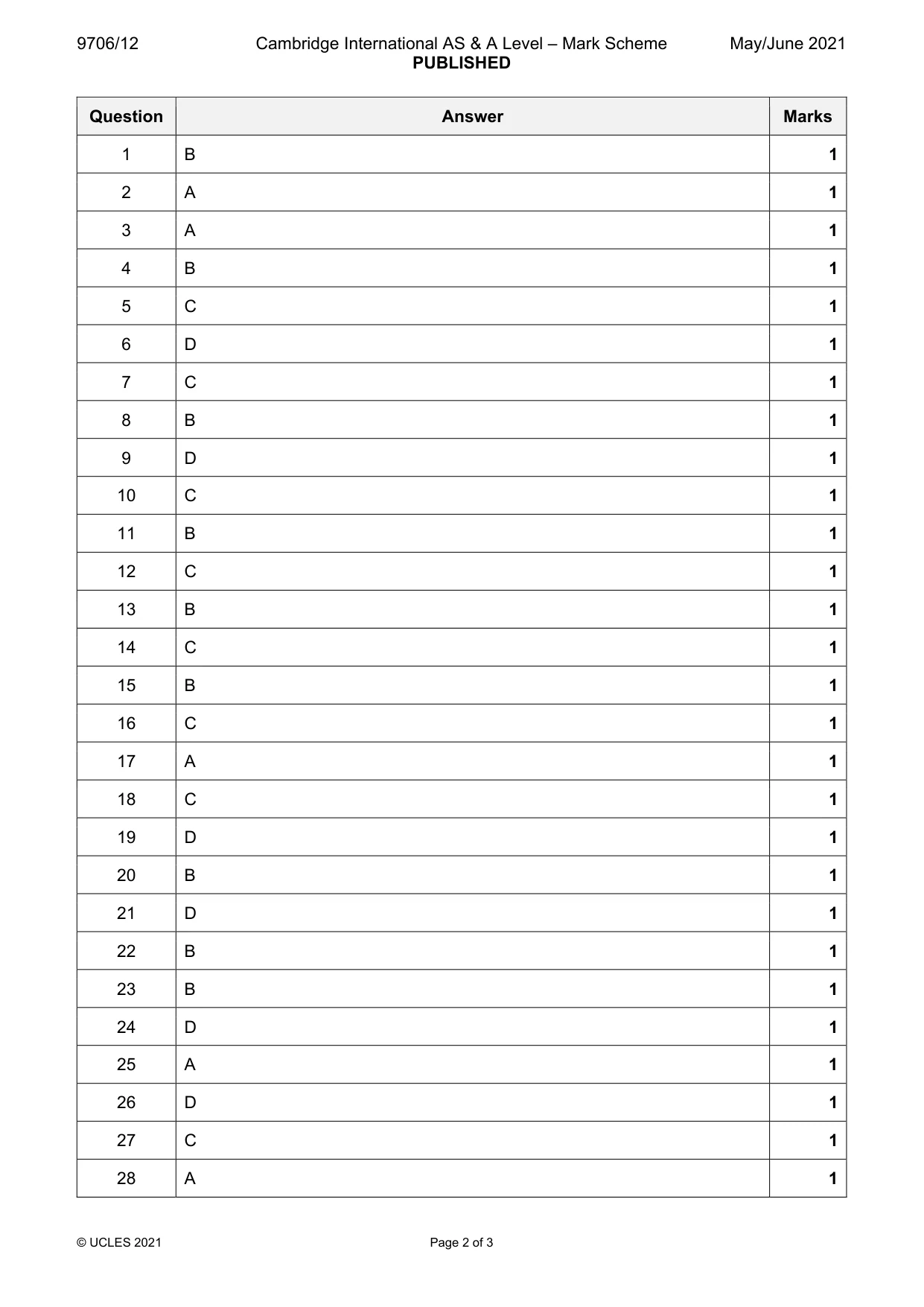
Answers below. Sit the paper first if you are practising.
Questions as text
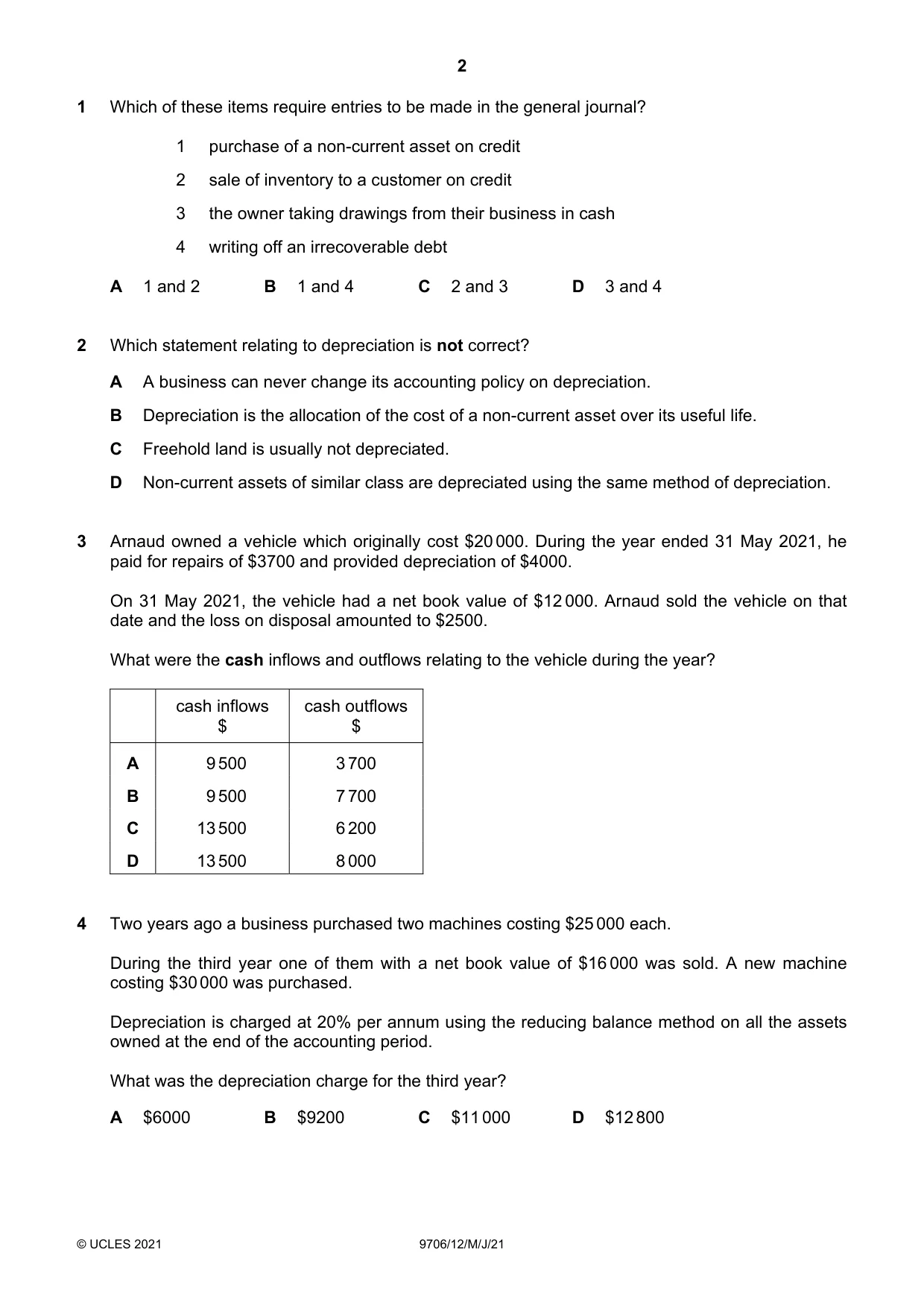
Q1 · Which of these items require entries to be made in the general journal?
1 Which of these items require entries to be made in the general journal? 1 purchase of a non-current asset on credit 2 sale of inventory to a customer on credit 3 the owner taking drawings from their business in cash 4 writing off an irrecoverable debt A 1 and 2 B 1 and 4 C 2 and 3 D 3 and 4
Mark scheme: B
Q2 · Which statement relating to depreciation is not correct?
2 Which statement relating to depreciation is not correct? A A business can never change its accounting policy on depreciation. B Depreciation is the allocation of the cost of a non-current asset over its useful life. C Freehold land is usually not depreciated. D Non-current assets of similar class are depreciated using the same method of depreciation.
Mark scheme: A
Q3 · Arnaud owned a vehicle which originally cost $20 000
3 Arnaud owned a vehicle which originally cost $20 000. During the year ended 31 May 2021, he paid for repairs of $3700 and provided depreciation of $4000. On 31 May 2021, the vehicle had a net book value of $12 000. Arnaud sold the vehicle on that date and the loss on disposal amounted to $2500. What were the cash inflows and outflows relating to the vehicle during the year? cash inflows cash outflows $ $ A 9 500 3 700 B 9 500 7 700 C 13 500 6 200 D 13 500 8 000
Mark scheme: A
Q4 · Two years ago a business purchased two machines costing $25 000 each
4 Two years ago a business purchased two machines costing $25 000 each. During the third year one of them with a net book value of $16 000 was sold. A new machine costing $30 000 was purchased. Depreciation is charged at 20% per annum using the reducing balance method on all the assets owned at the end of the accounting period. What was the depreciation charge for the third year? A $6000 B $9200 C $11 000 D $12 800
Mark scheme: B
Q5 · Which statements about an unpresented cheque are correct?
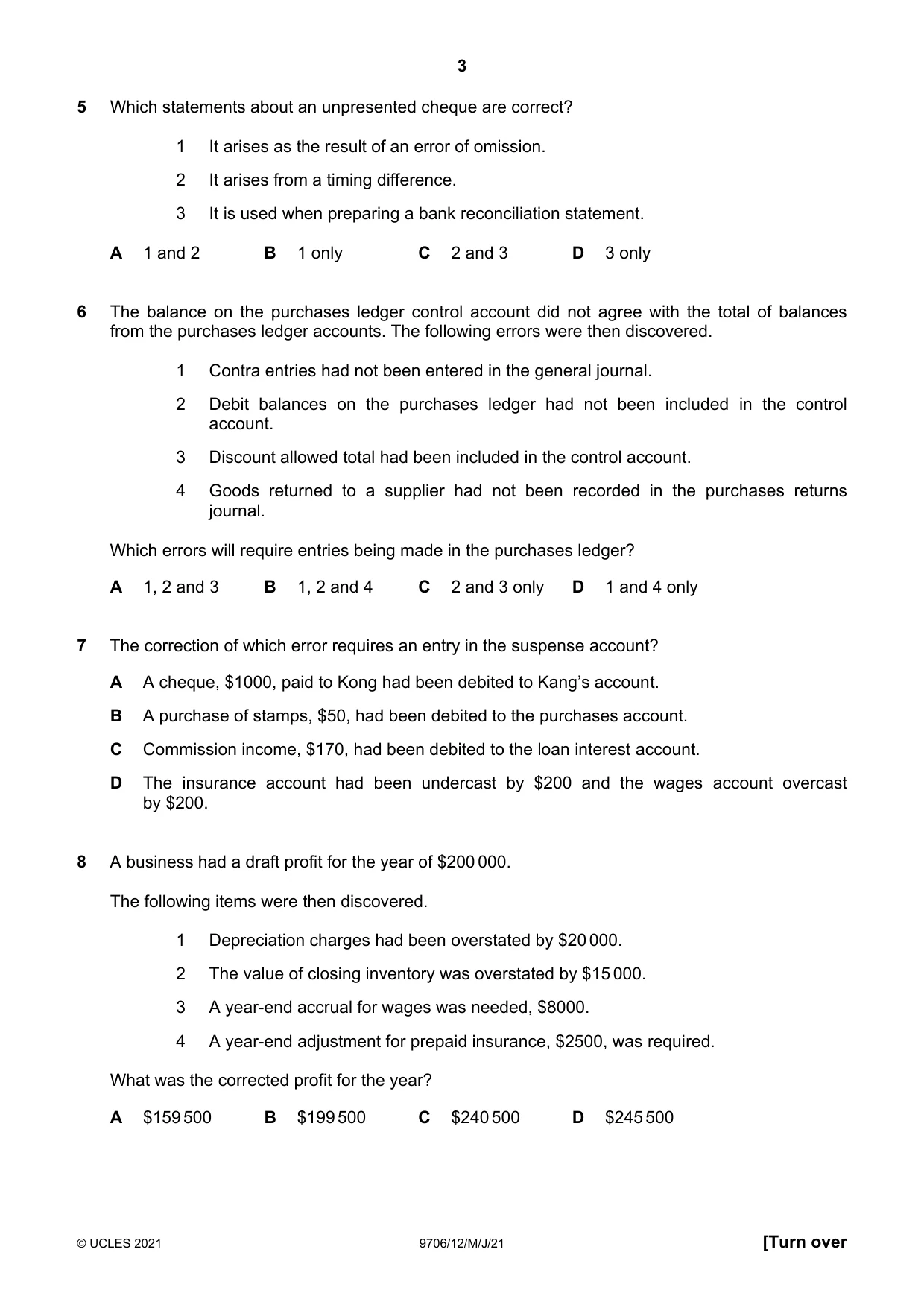
5 Which statements about an unpresented cheque are correct? 1 It arises as the result of an error of omission. 2 It arises from a timing difference. 3 It is used when preparing a bank reconciliation statement. A 1 and 2 B 1 only C 2 and 3 D 3 only
Mark scheme: C
Q6 · The balance on the purchases ledger control account did not agree with the total of…
6 The balance on the purchases ledger control account did not agree with the total of balances from the purchases ledger accounts. The following errors were then discovered. 1 Contra entries had not been entered in the general journal. 2 Debit balances on the purchases ledger had not been included in the control account. 3 Discount allowed total had been included in the control account. 4 Goods returned to a supplier had not been recorded in the purchases returns journal. Which errors will require entries being made in the purchases ledger? A 1, 2 and 3 B 1, 2 and 4 C 2 and 3 only D 1 and 4 only
Mark scheme: D
Q7 · The correction of which error requires an entry in the suspense account?
7 The correction of which error requires an entry in the suspense account? A A cheque, $1000, paid to Kong had been debited to Kang’s account. B A purchase of stamps, $50, had been debited to the purchases account. C Commission income, $170, had been debited to the loan interest account. D The insurance account had been undercast by $200 and the wages account overcast by $200.
Mark scheme: C
Q8 · A business had a draft profit for the year of $200 000
8 A business had a draft profit for the year of $200 000. The following items were then discovered. 1 Depreciation charges had been overstated by $20 000. 2 The value of closing inventory was overstated by $15 000. 3 A year-end accrual for wages was needed, $8000. 4 A year-end adjustment for prepaid insurance, $2500, was required. What was the corrected profit for the year? A $159 500 B $199 500 C $240 500 D $245 500
Mark scheme: B
Q9 · A trader purchased fixtures and fittings on credit from a supplier
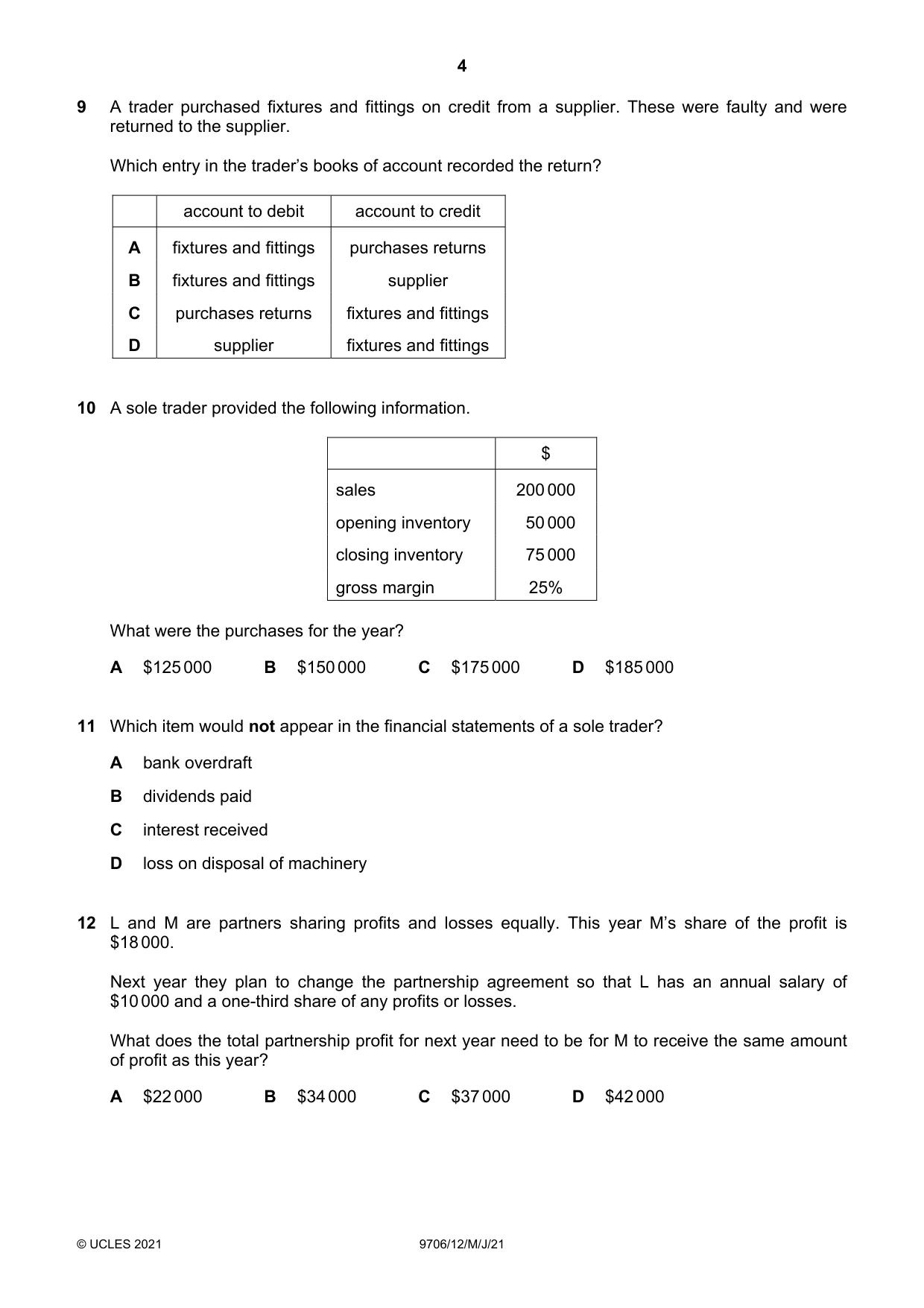
9 A trader purchased fixtures and fittings on credit from a supplier. These were faulty and were returned to the supplier. Which entry in the trader’s books of account recorded the return? account to debit account to credit A fixtures and fittings purchases returns B fixtures and fittings supplier C purchases returns fixtures and fittings D supplier fixtures and fittings
Mark scheme: D
Q10 · A sole trader provided the following information
10 A sole trader provided the following information. $ sales 200 000 opening inventory 50 000 closing inventory 75 000 gross margin 25% What were the purchases for the year? A $125 000 B $150 000 C $175 000 D $185 000
Mark scheme: C
Q11 · Which item would not appear in the financial statements of a sole trader?
11 Which item would not appear in the financial statements of a sole trader? A bank overdraft B dividends paid C interest received D loss on disposal of machinery
Mark scheme: B
Q12 · L and M are partners sharing profits and losses equally
12 L and M are partners sharing profits and losses equally. This year M’s share of the profit is $18 000. Next year they plan to change the partnership agreement so that L has an annual salary of $10 000 and a one-third share of any profits or losses. What does the total partnership profit for next year need to be for M to receive the same amount of profit as this year? A $22 000 B $34 000 C $37 000 D $42 000
Mark scheme: C
Q13 · V and E are in partnership, sharing profits and losses equally
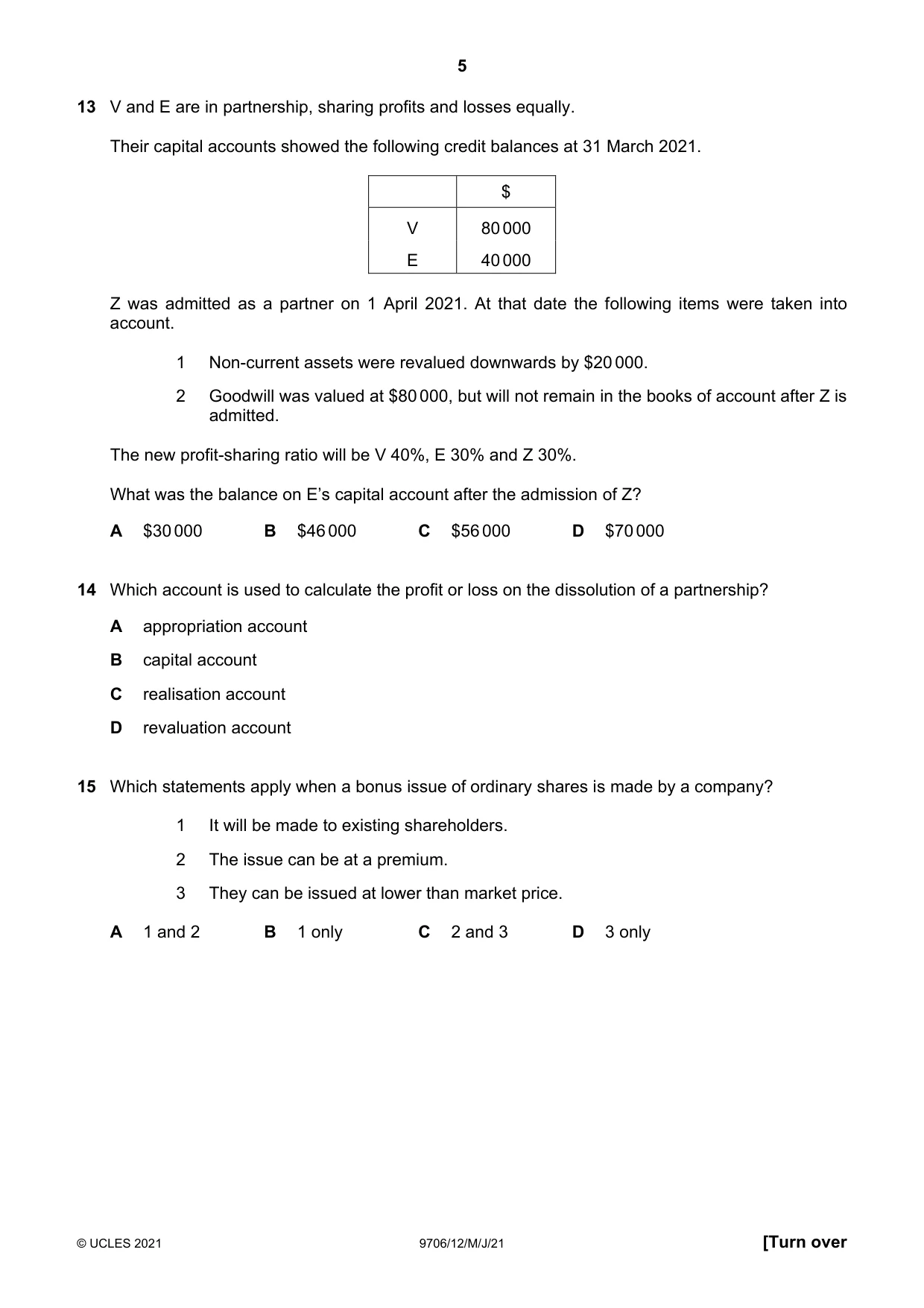
13 V and E are in partnership, sharing profits and losses equally. Their capital accounts showed the following credit balances at 31 March 2021. $ V 80 000 E 40 000 Z was admitted as a partner on 1 April 2021. At that date the following items were taken into account. 1 Non-current assets were revalued downwards by $20 000. 2 Goodwill was valued at $80 000, but will not remain in the books of account after Z is admitted. The new profit-sharing ratio will be V 40%, E 30% and Z 30%. What was the balance on E’s capital account after the admission of Z? A $30 000 B $46 000 C $56 000 D $70 000
Mark scheme: B
Q14 · Which account is used to calculate the profit or loss on the dissolution of a partnership?
14 Which account is used to calculate the profit or loss on the dissolution of a partnership? A appropriation account B capital account C realisation account D revaluation account
Mark scheme: C
Q15 · Which statements apply when a bonus issue of ordinary shares is made by a company?
15 Which statements apply when a bonus issue of ordinary shares is made by a company? 1 It will be made to existing shareholders. 2 The issue can be at a premium. 3 They can be issued at lower than market price. A 1 and 2 B 1 only C 2 and 3 D 3 only
Mark scheme: B
Q16 · At the start of the year a limited company’s equity was as follows
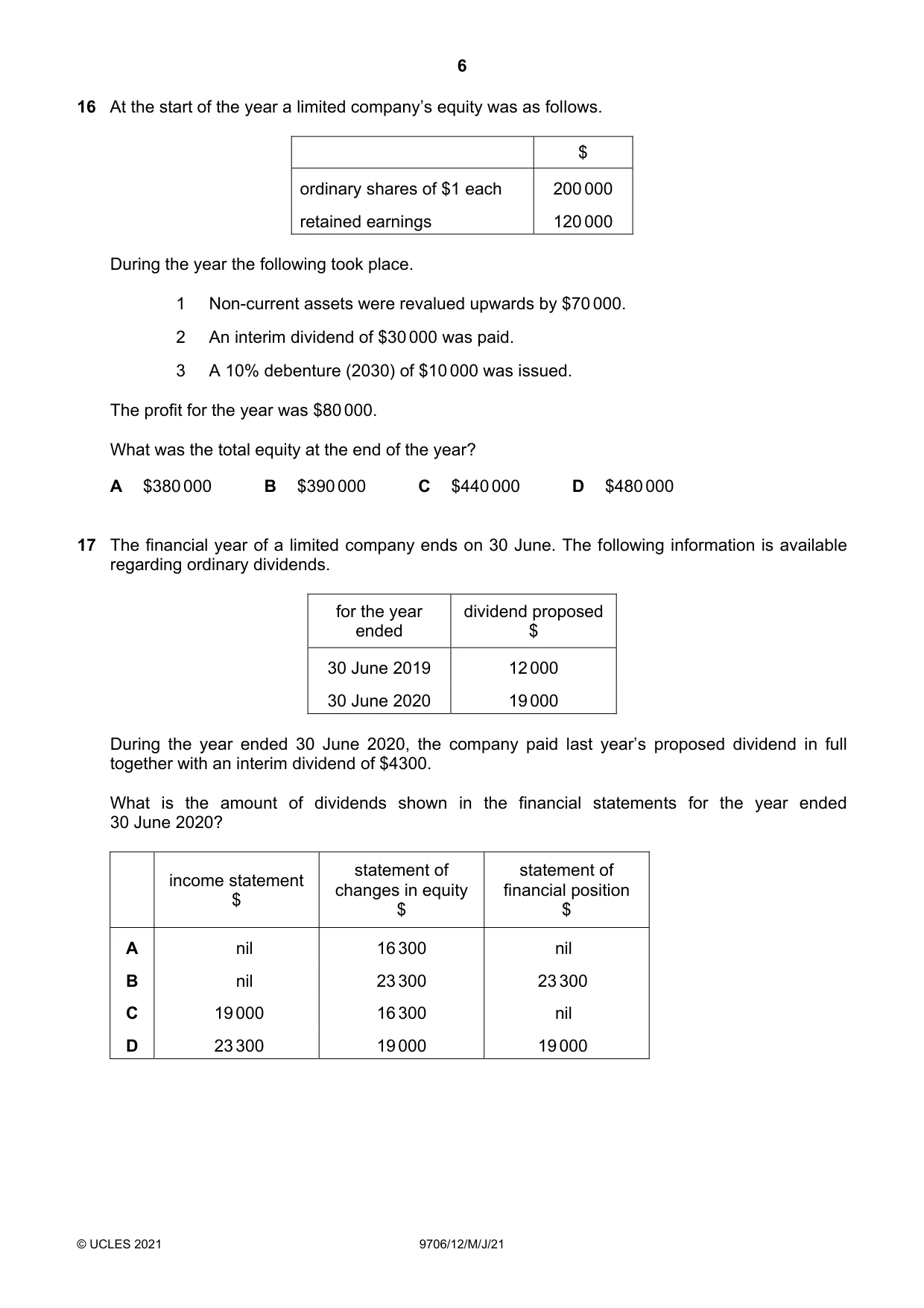
16 At the start of the year a limited company’s equity was as follows. $ ordinary shares of $1 each 200 000 retained earnings 120 000 During the year the following took place. 1 Non-current assets were revalued upwards by $70 000. 2 An interim dividend of $30 000 was paid. 3 A 10% debenture (2030) of $10 000 was issued. The profit for the year was $80 000. What was the total equity at the end of the year? A $380 000 B $390 000 C $440 000 D $480 000
Mark scheme: C
Q17 · The financial year of a limited company ends on 30 June
17 The financial year of a limited company ends on 30 June. The following information is available regarding ordinary dividends. for the year dividend proposed ended $ 30 June 2019 12 000 30 June 2020 19 000 During the year ended 30 June 2020, the company paid last year’s proposed dividend in full together with an interim dividend of $4300. What is the amount of dividends shown in the financial statements for the year ended 30 June 2020? statement of statement of income statement changes in equity financial position $ $ $ A nil 16 300 nil B nil 23 300 23 300 C 19 000 16 300 nil D 23 300 19 000 19 000
Mark scheme: A
Q18 · The trade receivables turnover ratio figures for two companies are shown
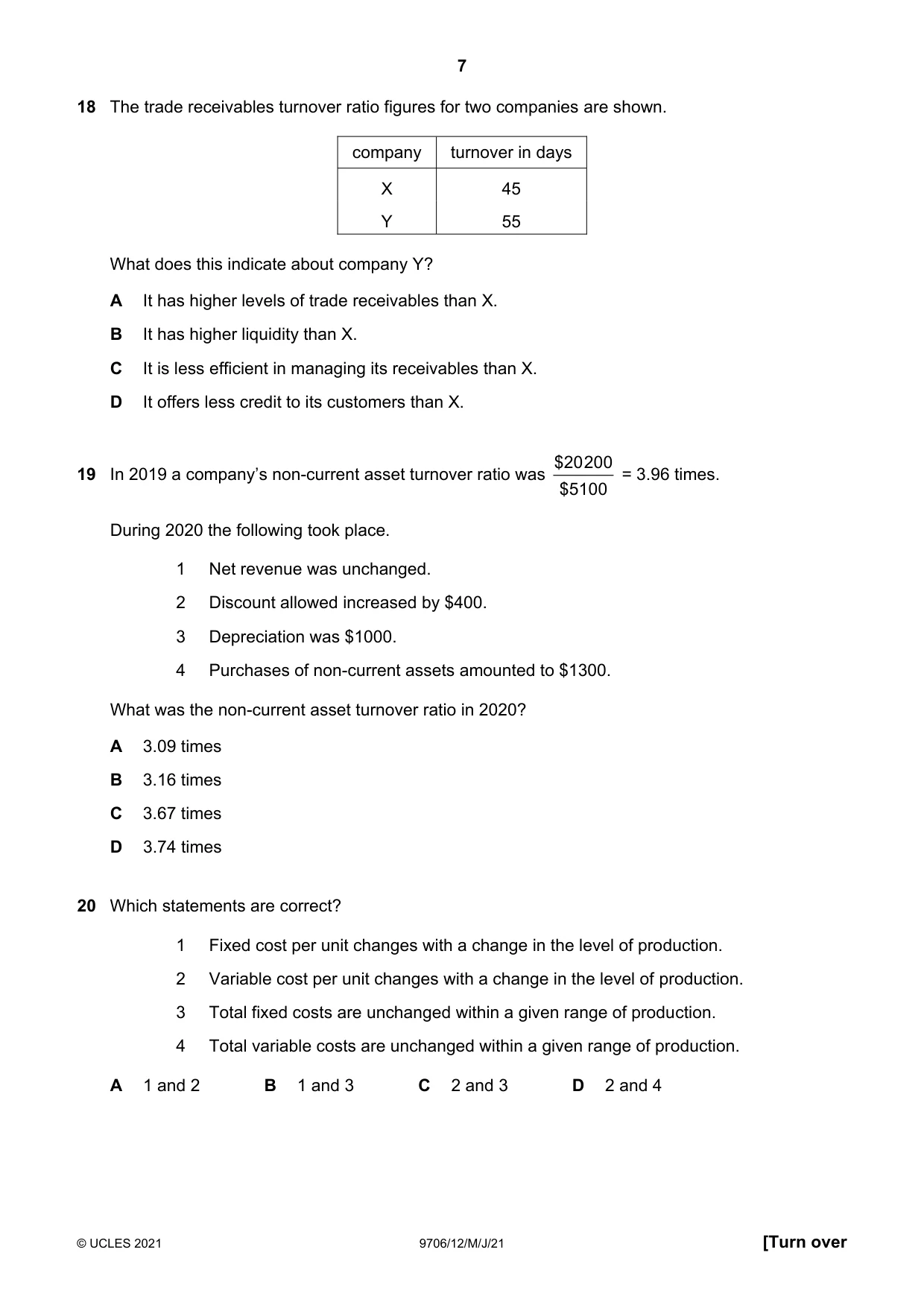
18 The trade receivables turnover ratio figures for two companies are shown. company turnover in days X 45 Y 55 What does this indicate about company Y? A It has higher levels of trade receivables than X. B It has higher liquidity than X. C It is less efficient in managing its receivables than X. D It offers less credit to its customers than X. $ 2 20 0 0
Mark scheme: C
More questions on Analysis and communication of accounting information
Q19 · In 2019 a company’s non-current asset turnover ratio was = 3.96 times
19 In 2019 a company’s non-current asset turnover ratio was = 3.96 times. $ 510 0 During 2020 the following took place. 1 Net revenue was unchanged. 2 Discount allowed increased by $400. 3 Depreciation was $1000. 4 Purchases of non-current assets amounted to $1300. What was the non-current asset turnover ratio in 2020? A 3.09 times B 3.16 times C 3.67 times D 3.74 times
Mark scheme: D
More questions on Analysis and communication of accounting information
Q20 · Which statements are correct?
20 Which statements are correct? 1 Fixed cost per unit changes with a change in the level of production. 2 Variable cost per unit changes with a change in the level of production. 3 Total fixed costs are unchanged within a given range of production. 4 Total variable costs are unchanged within a given range of production. A 1 and 2 B 1 and 3 C 2 and 3 D 2 and 4
Mark scheme: B
Q21 · An employee is paid $20 an hour basic pay for working seven hours a day
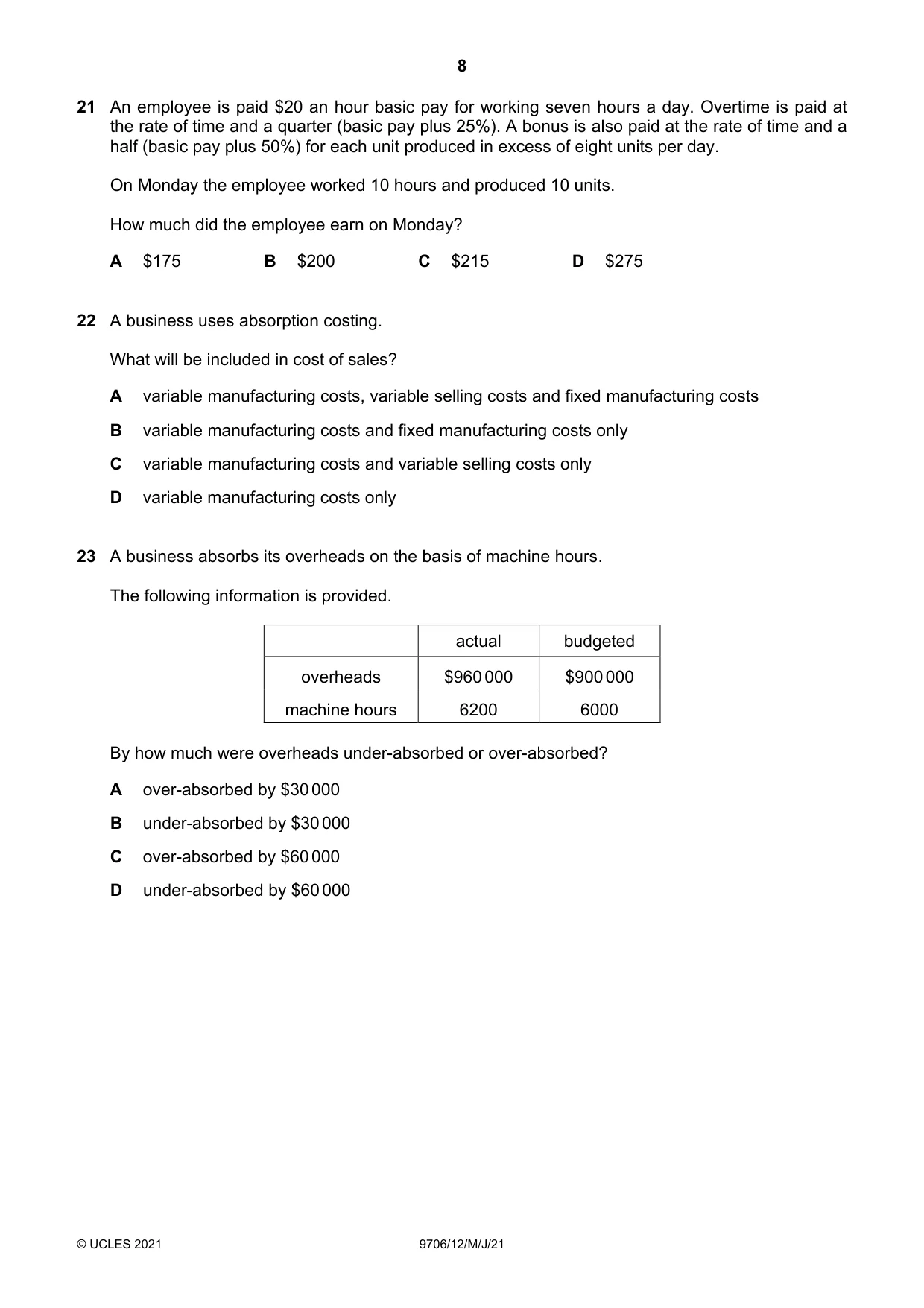
21 An employee is paid $20 an hour basic pay for working seven hours a day. Overtime is paid at the rate of time and a quarter (basic pay plus 25%). A bonus is also paid at the rate of time and a half (basic pay plus 50%) for each unit produced in excess of eight units per day. On Monday the employee worked 10 hours and produced 10 units. How much did the employee earn on Monday? A $175 B $200 C $215 D $275
Mark scheme: D
Q22 · A business uses absorption costing
22 A business uses absorption costing. What will be included in cost of sales? A variable manufacturing costs, variable selling costs and fixed manufacturing costs B variable manufacturing costs and fixed manufacturing costs only C variable manufacturing costs and variable selling costs only D variable manufacturing costs only
Mark scheme: B
Q23 · A business absorbs its overheads on the basis of machine hours
23 A business absorbs its overheads on the basis of machine hours. The following information is provided. actual budgeted overheads $960 000 $900 000 machine hours 6200 6000 By how much were overheads under-absorbed or over-absorbed? A over-absorbed by $30 000 B under-absorbed by $30 000 C over-absorbed by $60 000 D under-absorbed by $60 000
Mark scheme: B
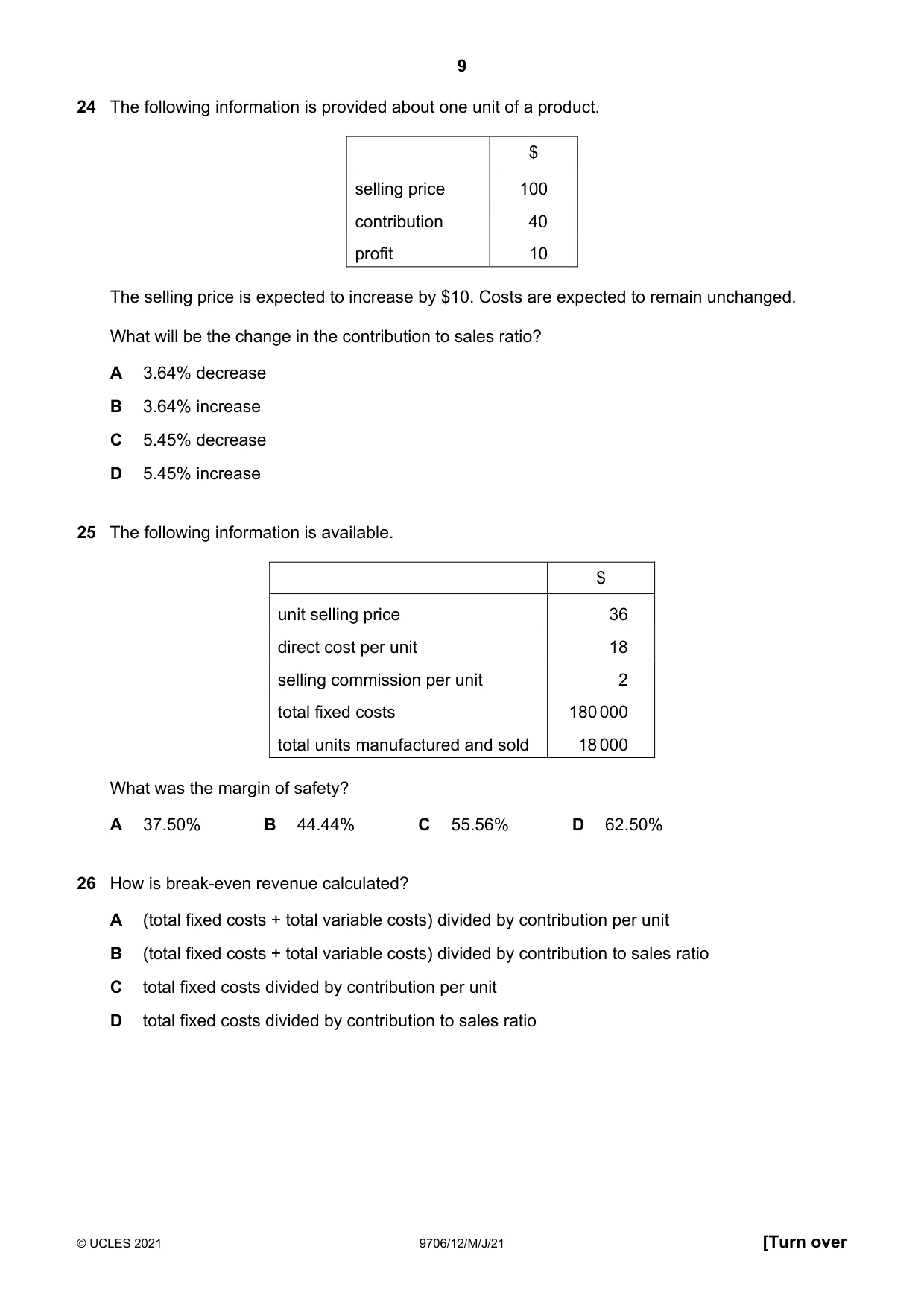
Q24 · The following information is provided about one unit of a product
24 The following information is provided about one unit of a product. $ selling price 100 contribution 40 profit 10 The selling price is expected to increase by $10. Costs are expected to remain unchanged. What will be the change in the contribution to sales ratio? A 3.64% decrease B 3.64% increase C 5.45% decrease D 5.45% increase
Mark scheme: D
Q25 · The following information is available
25 The following information is available. $ unit selling price 36 direct cost per unit 18 selling commission per unit 2 total fixed costs 180 000 total units manufactured and sold 18 000 What was the margin of safety? A 37.50% B 44.44% C 55.56% D 62.50%
Mark scheme: A
Q26 · How is break-even revenue calculated?
26 How is break-even revenue calculated? A (total fixed costs + total variable costs) divided by contribution per unit B (total fixed costs + total variable costs) divided by contribution to sales ratio C total fixed costs divided by contribution per unit D total fixed costs divided by contribution to sales ratio
Mark scheme: D
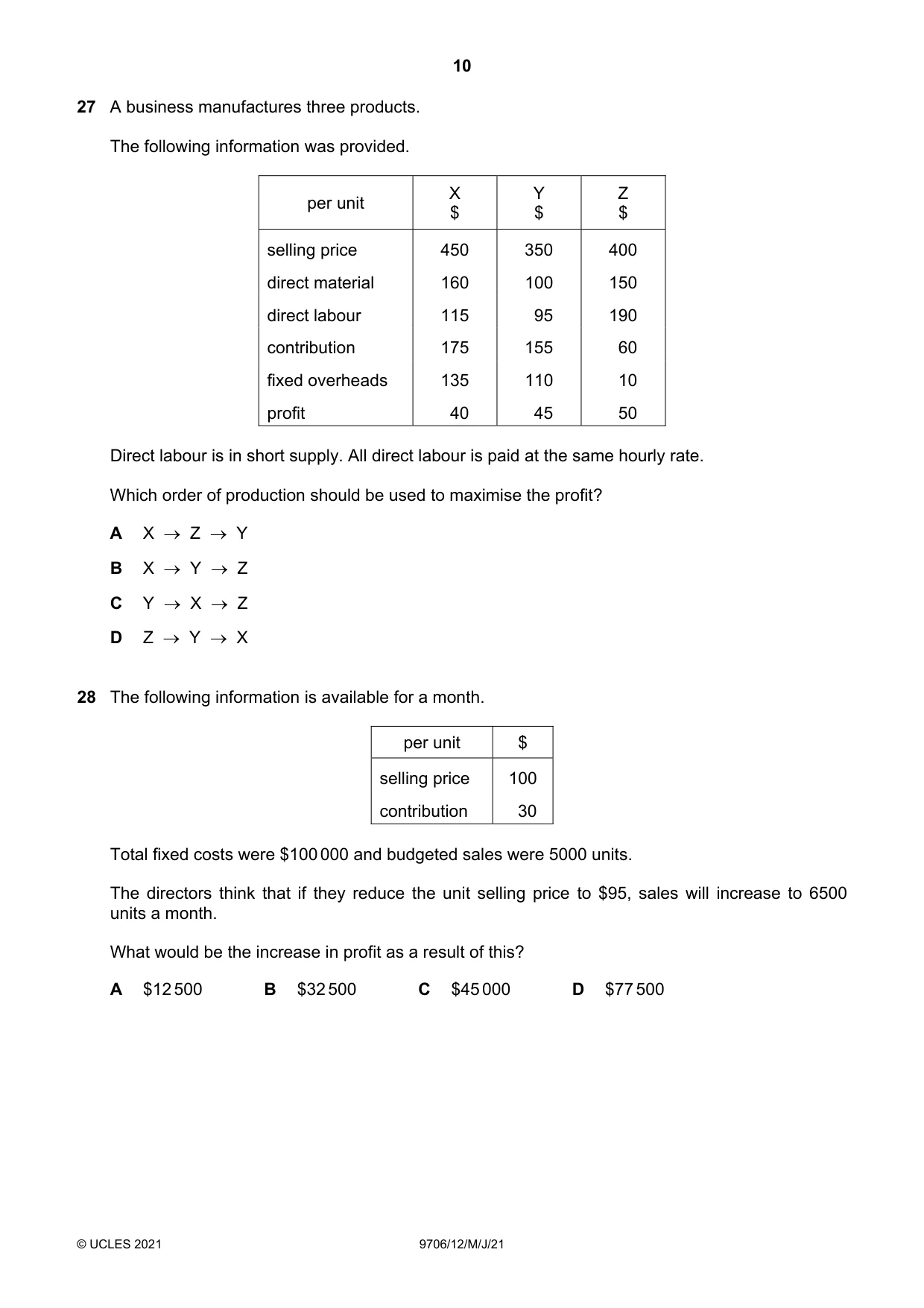
Q27 · A business manufactures three products
27 A business manufactures three products. The following information was provided. X Y Z per unit $ $ $ selling price 450 350 400 direct material 160 100 150 direct labour 115 95 190 contribution 175 155 60 fixed overheads 135 110 10 profit 40 45 50 Direct labour is in short supply. All direct labour is paid at the same hourly rate. Which order of production should be used to maximise the profit? A X Z Y B X Y Z C Y X Z D Z Y X
Mark scheme: C
Q28 · The following information is available for a month
28 The following information is available for a month. per unit $ selling price 100 contribution 30 Total fixed costs were $100 000 and budgeted sales were 5000 units. The directors think that if they reduce the unit selling price to $95, sales will increase to 6500 units a month. What would be the increase in profit as a result of this? A $12 500 B $32 500 C $45 000 D $77 500
Mark scheme: A
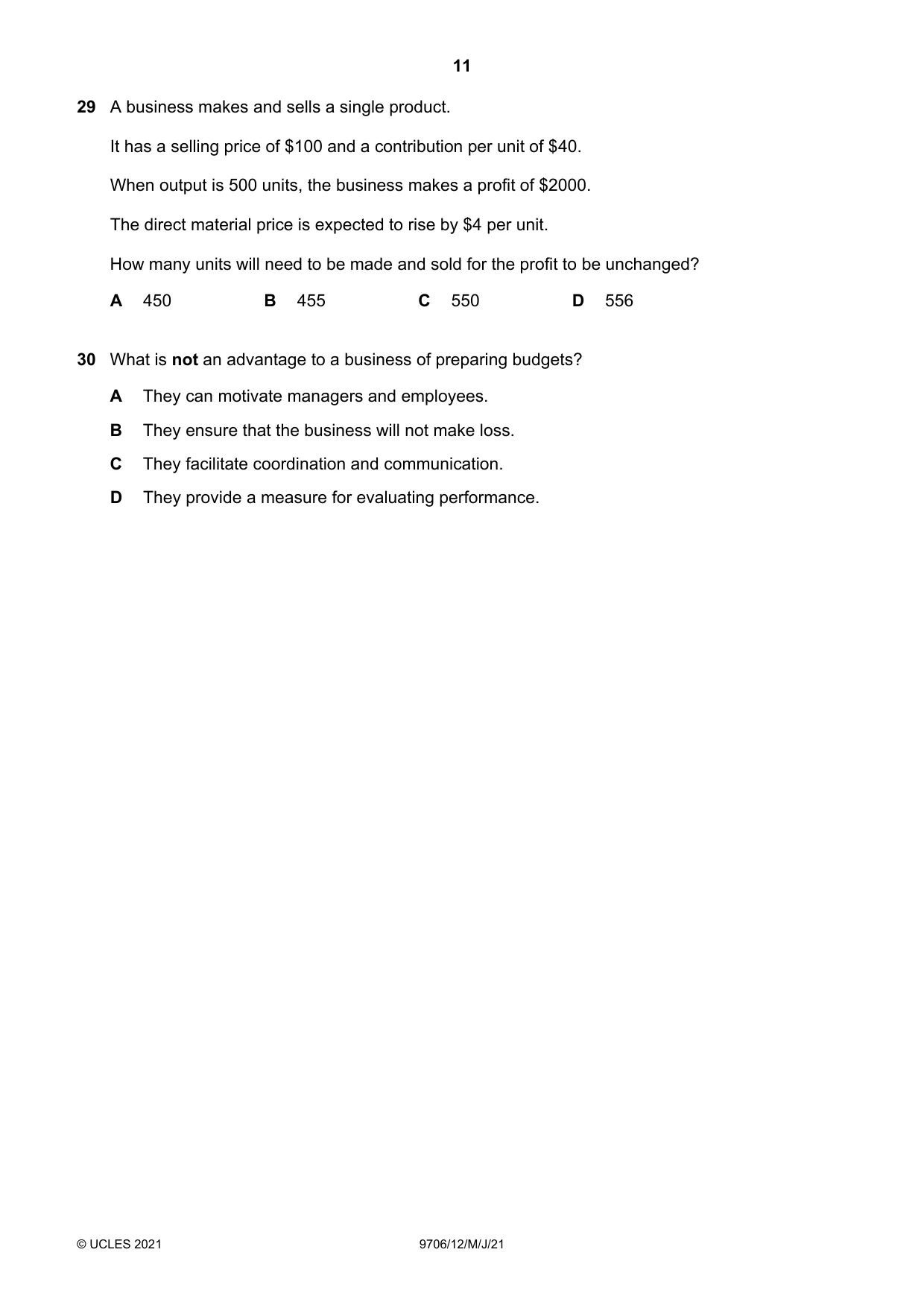
Q29 · A business makes and sells a single product
29 A business makes and sells a single product. It has a selling price of $100 and a contribution per unit of $40. When output is 500 units, the business makes a profit of $2000. The direct material price is expected to rise by $4 per unit. How many units will need to be made and sold for the profit to be unchanged? A 450 B 455 C 550 D 556
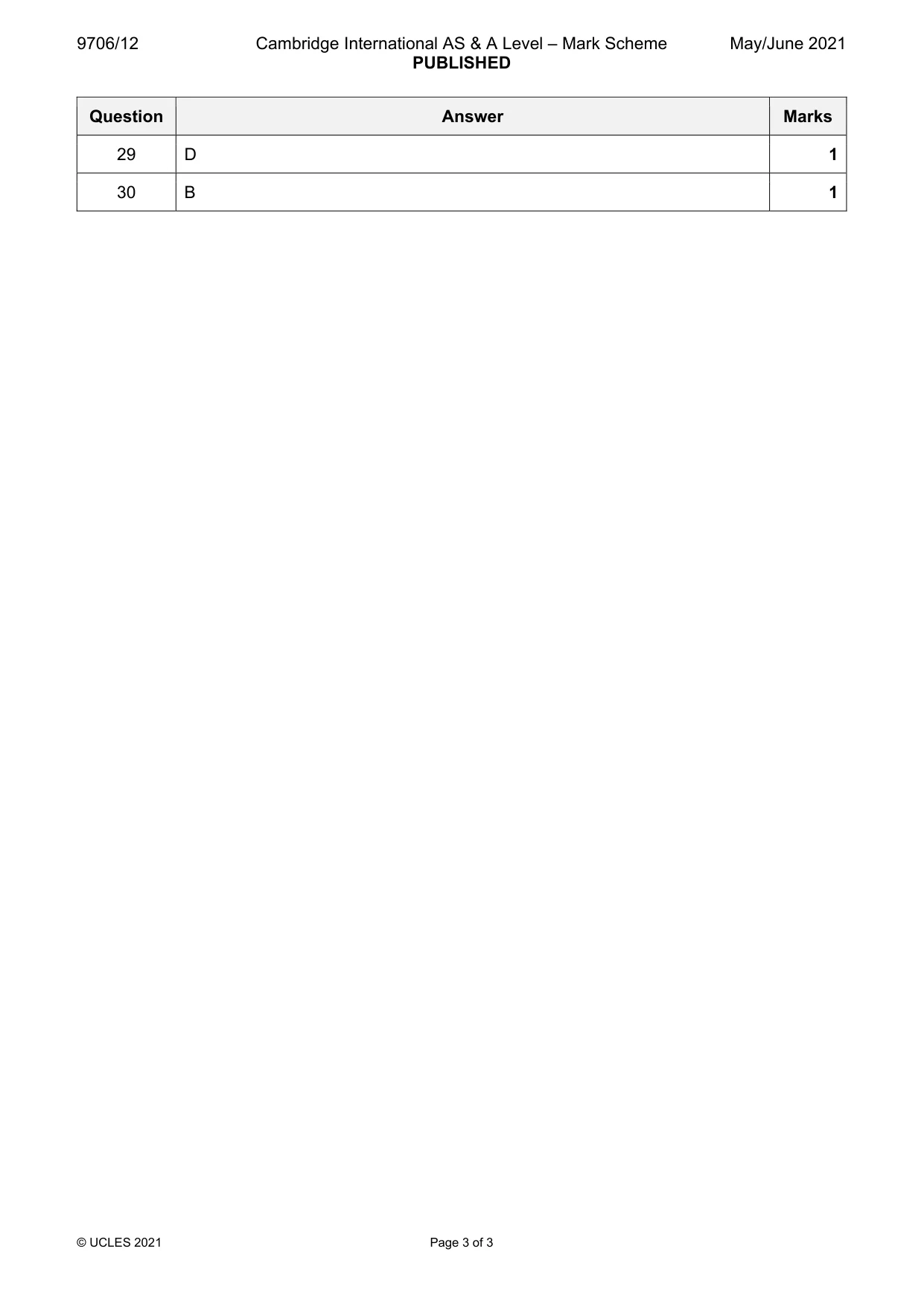
Mark scheme: D
Q30 · What is not an advantage to a business of preparing budgets?
30 What is not an advantage to a business of preparing budgets? A They can motivate managers and employees. B They ensure that the business will not make loss. C They facilitate coordination and communication. D They provide a measure for evaluating performance.
Mark scheme: B
What was in this paper
The subtopics covered by these 30 questions, and how many questions each got. Open one in a new tab to see every Cambridge question on it.
8Preparation of financial statements6Accounting for non-current assets3Preparation of financial statements3Reconciliation and verification3Costs and cost behaviour2The accounting system2Analysis and communication of accounting information1Analysis and communication of accounting information1Budgeting and budgetary control1What you needed in this session
Cambridge’s own grade thresholds for 2021 May/June, Paper 1 · Variant 2. A higher threshold means an easier paper — the bar moves with how the cohort did.