Cambridge A Level Accounting 9706 — 2019 May/June Paper 1 · Variant 1
9706/11/M/J/19 · 30 questions · 30 marks · ≈34 min
The question paper and its mark scheme, free to read here and free to download. This is Cambridge’s own paper, exactly as it was sat.
Question paper12 pages
Mark scheme3 pages
Answers below. Sit the paper first if you are practising.
Questions as text
Q1 · A business has a practice of not conducting a physical count of unused stationery at the…
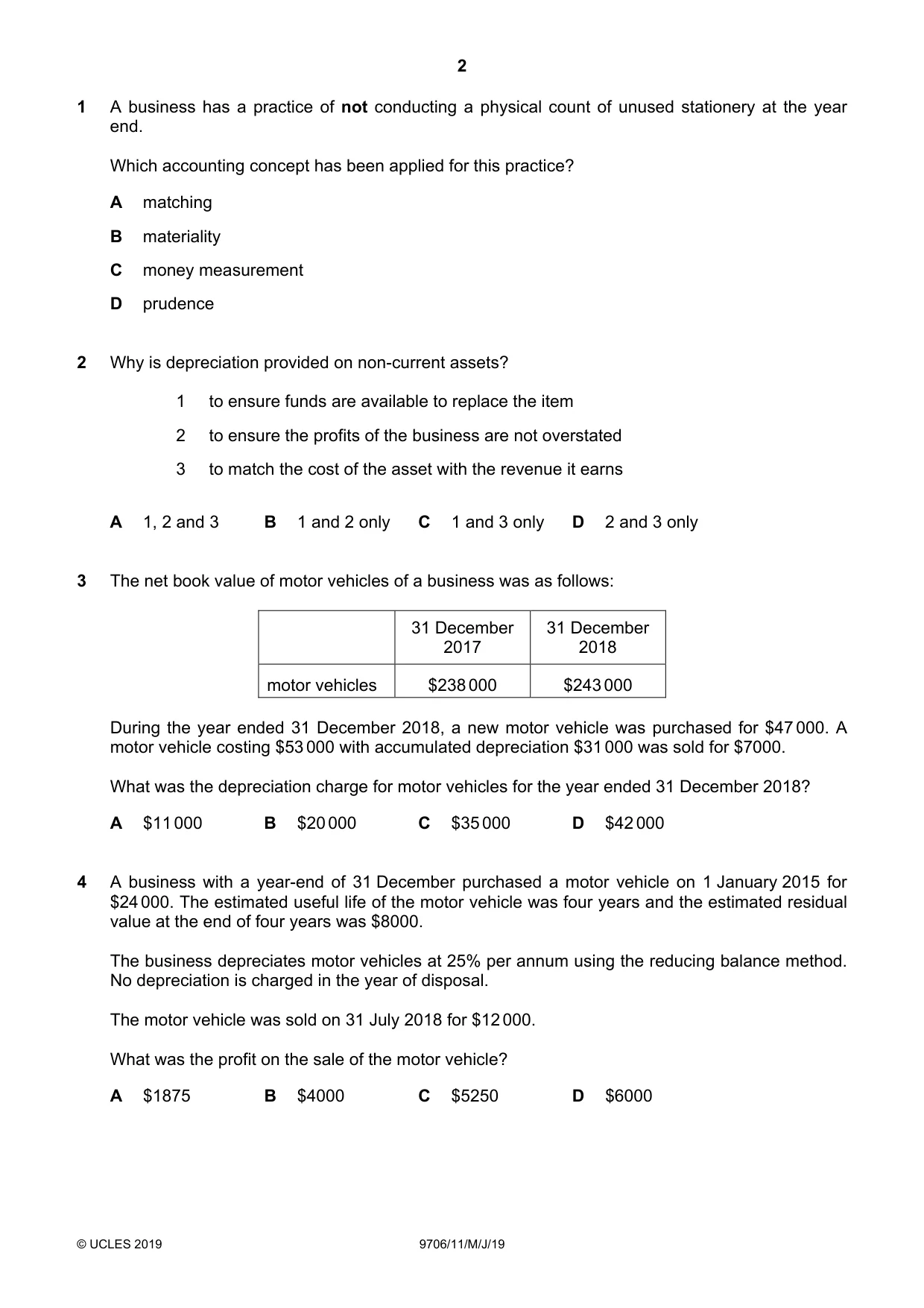
1 A business has a practice of not conducting a physical count of unused stationery at the year end. Which accounting concept has been applied for this practice? A matching B materiality C money measurement D prudence
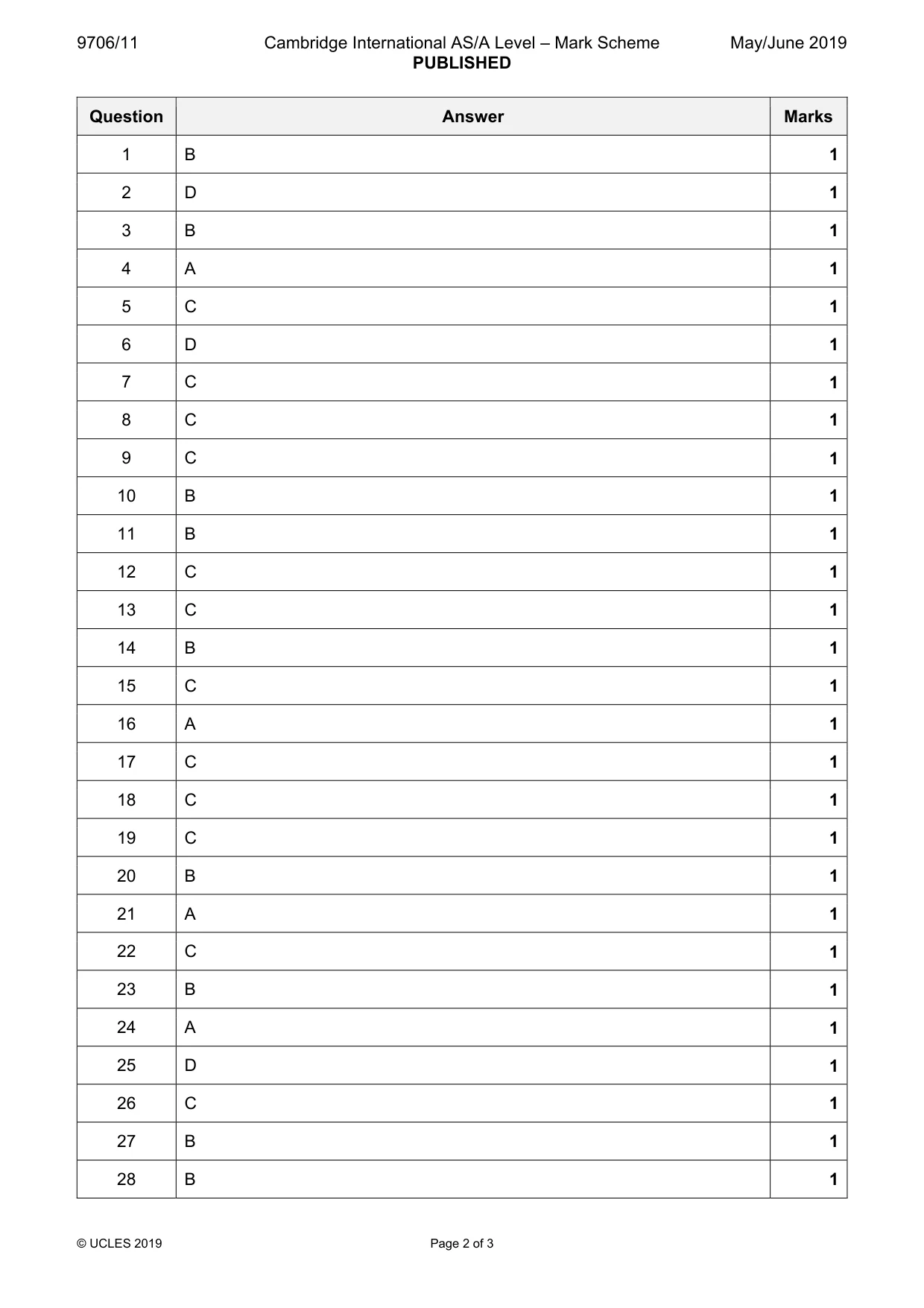
Mark scheme: B
Q2 · Why is depreciation provided on non-current assets?
2 Why is depreciation provided on non-current assets? 1 to ensure funds are available to replace the item 2 to ensure the profits of the business are not overstated 3 to match the cost of the asset with the revenue it earns A 1, 2 and 3 B 1 and 2 only C 1 and 3 only D 2 and 3 only
Mark scheme: D
Q3 · The net book value of motor vehicles of a business was as follows: 31 December 31…
3 The net book value of motor vehicles of a business was as follows: 31 December 31 December 2017 2018 motor vehicles $238 000 $243 000 During the year ended 31 December 2018, a new motor vehicle was purchased for $47 000. A motor vehicle costing $53 000 with accumulated depreciation $31 000 was sold for $7000. What was the depreciation charge for motor vehicles for the year ended 31 December 2018? A $11 000 B $20 000 C $35 000 D $42 000
Mark scheme: B
Q4 · A business with a year-end of 31 December purchased a motor vehicle on 1 January 2015 for…
4 A business with a year-end of 31 December purchased a motor vehicle on 1 January 2015 for $24 000. The estimated useful life of the motor vehicle was four years and the estimated residual value at the end of four years was $8000. The business depreciates motor vehicles at 25% per annum using the reducing balance method. No depreciation is charged in the year of disposal. The motor vehicle was sold on 31 July 2018 for $12 000. What was the profit on the sale of the motor vehicle? A $1875 B $4000 C $5250 D $6000
Mark scheme: A
Q5 · A bank statement shows a credit balance of $1500
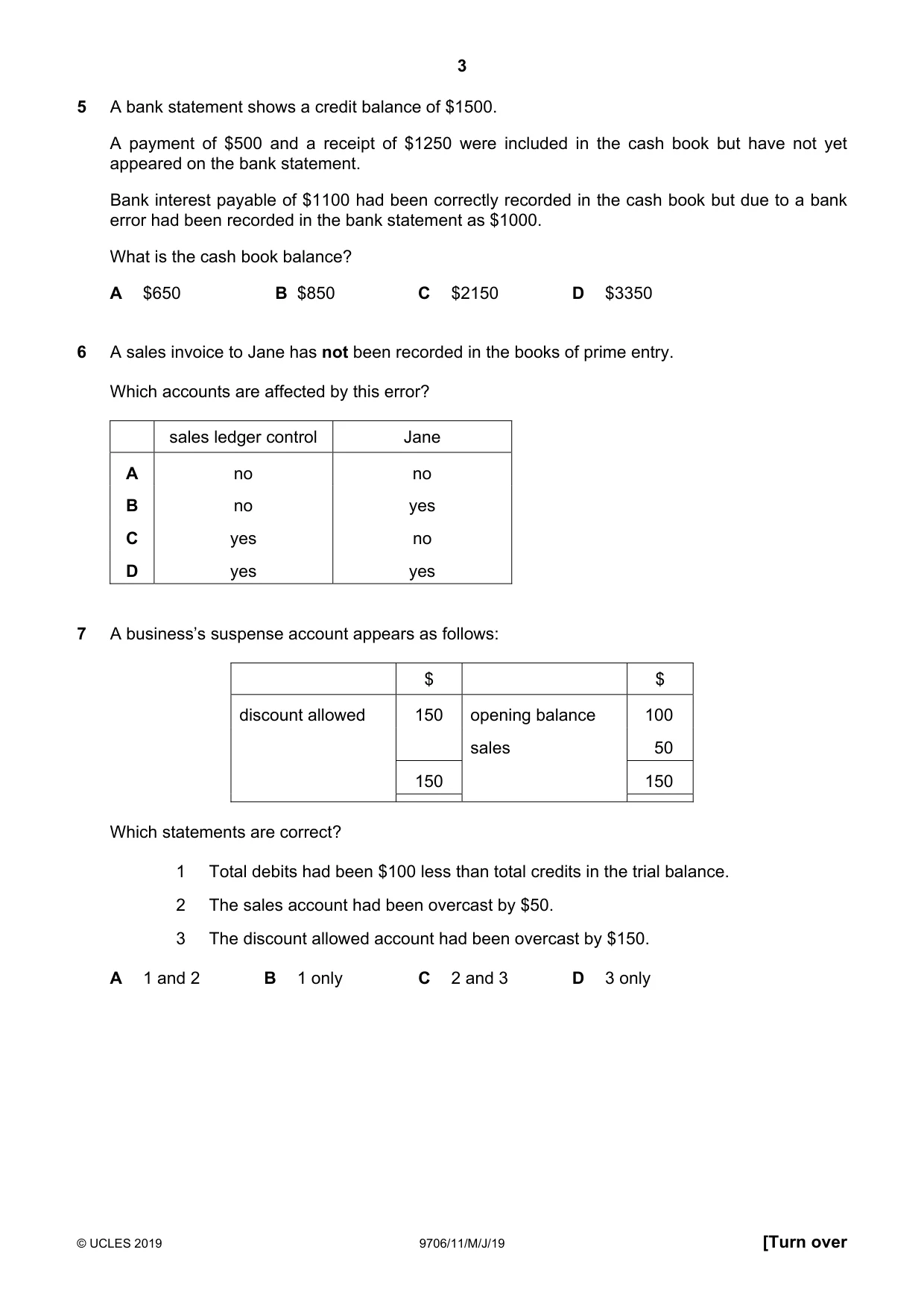
5 A bank statement shows a credit balance of $1500. A payment of $500 and a receipt of $1250 were included in the cash book but have not yet appeared on the bank statement. Bank interest payable of $1100 had been correctly recorded in the cash book but due to a bank error had been recorded in the bank statement as $1000. What is the cash book balance? A $650 B $850 C $2150 D $3350
Mark scheme: C
Q6 · A sales invoice to Jane has not been recorded in the books of prime entry
6 A sales invoice to Jane has not been recorded in the books of prime entry. Which accounts are affected by this error? sales ledger control Jane A no no B no yes C yes no D yes yes
Mark scheme: D
Q7 · A business’s suspense account appears as follows: $ $ discount allowed 150 opening…
7 A business’s suspense account appears as follows: $ $ discount allowed 150 opening balance 100 sales 50 150 150 Which statements are correct? 1 Total debits had been $100 less than total credits in the trial balance. 2 The sales account had been overcast by $50. 3 The discount allowed account had been overcast by $150. A 1 and 2 B 1 only C 2 and 3 D 3 only
Mark scheme: C
Q8 · The following information is available for a business
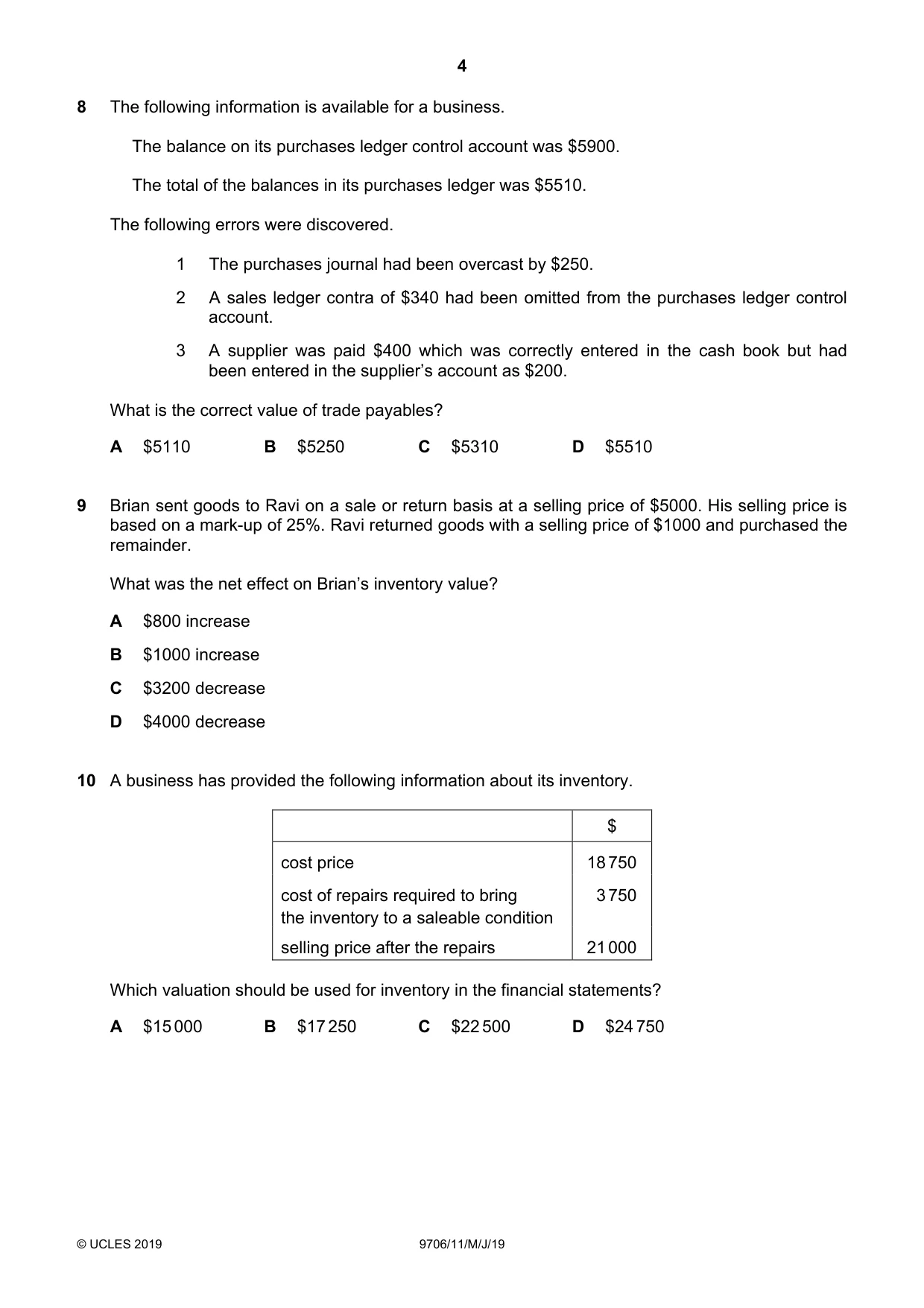
8 The following information is available for a business. The balance on its purchases ledger control account was $5900. The total of the balances in its purchases ledger was $5510. The following errors were discovered. 1 The purchases journal had been overcast by $250. 2 A sales ledger contra of $340 had been omitted from the purchases ledger control account. 3 A supplier was paid $400 which was correctly entered in the cash book but had been entered in the supplier’s account as $200. What is the correct value of trade payables? A $5110 B $5250 C $5310 D $5510
Mark scheme: C
Q9 · Brian sent goods to Ravi on a sale or return basis at a selling price of $5000
9 Brian sent goods to Ravi on a sale or return basis at a selling price of $5000. His selling price is based on a mark-up of 25%. Ravi returned goods with a selling price of $1000 and purchased the remainder. What was the net effect on Brian’s inventory value? A $800 increase B $1000 increase C $3200 decrease D $4000 decrease
Mark scheme: C
Q10 · A business has provided the following information about its inventory
10 A business has provided the following information about its inventory. $ cost price 18 750 cost of repairs required to bring 3 750 the inventory to a saleable condition selling price after the repairs 21 000 Which valuation should be used for inventory in the financial statements? A $15 000 B $17 250 C $22 500 D $24 750
Mark scheme: B
Q11 · A business provided the following information about telephone expenses for the year ended…
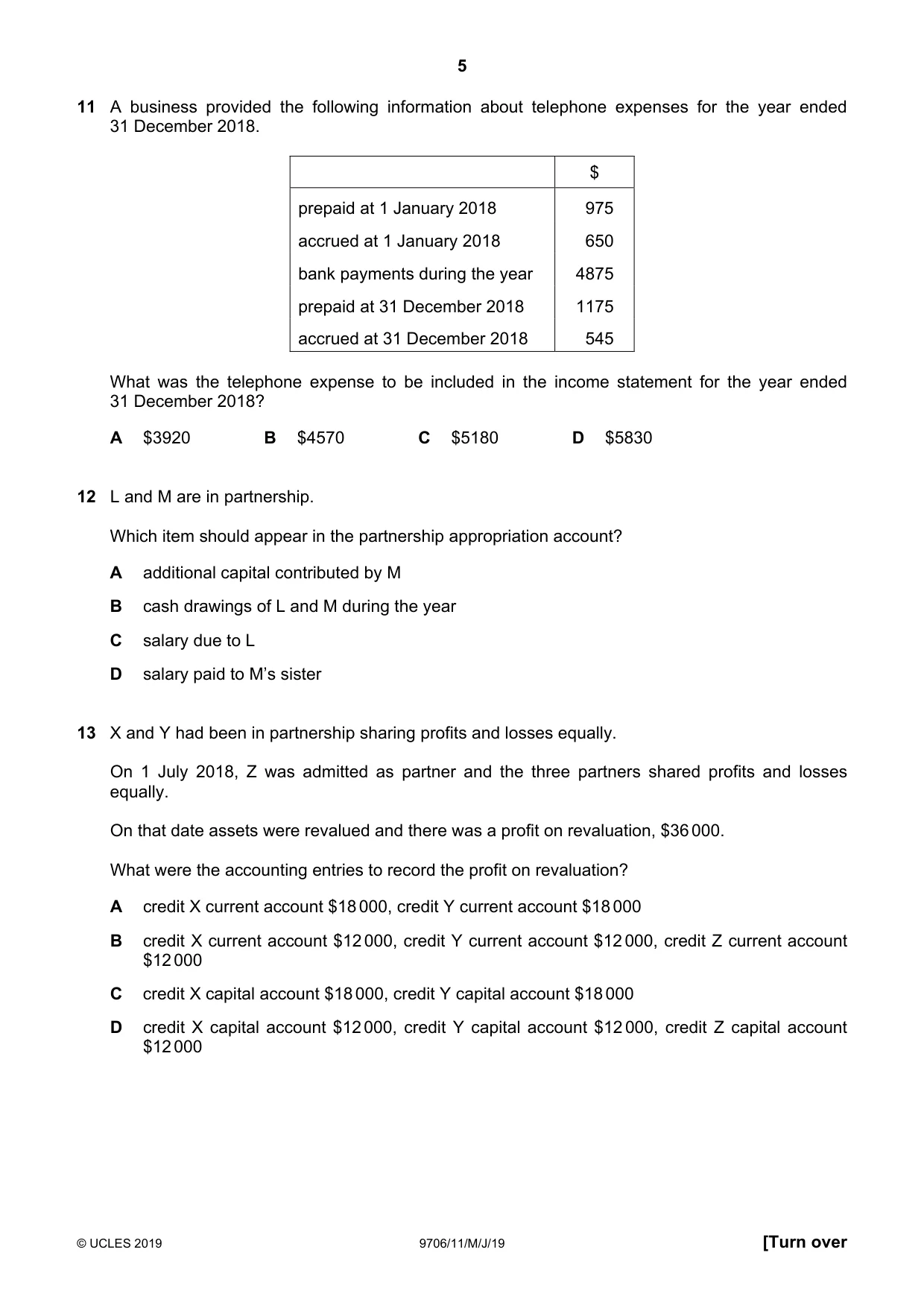
11 A business provided the following information about telephone expenses for the year ended 31 December 2018. $ prepaid at 1 January 2018 975 accrued at 1 January 2018 650 bank payments during the year 4875 prepaid at 31 December 2018 1175 accrued at 31 December 2018 545 What was the telephone expense to be included in the income statement for the year ended 31 December 2018? A $3920 B $4570 C $5180 D $5830
Mark scheme: B
Q12 · L and M are in partnership
12 L and M are in partnership. Which item should appear in the partnership appropriation account? A additional capital contributed by M B cash drawings of L and M during the year C salary due to L D salary paid to M’s sister
Mark scheme: C
Q13 · X and Y had been in partnership sharing profits and losses equally
13 X and Y had been in partnership sharing profits and losses equally. On 1 July 2018, Z was admitted as partner and the three partners shared profits and losses equally. On that date assets were revalued and there was a profit on revaluation, $36 000. What were the accounting entries to record the profit on revaluation? A credit X current account $18 000, credit Y current account $18 000 B credit X current account $12 000, credit Y current account $12 000, credit Z current account $12 000 C credit X capital account $18 000, credit Y capital account $18 000 D credit X capital account $12 000, credit Y capital account $12 000, credit Z capital account $12 000
Mark scheme: C
Q14 · P, Q and R are in partnership
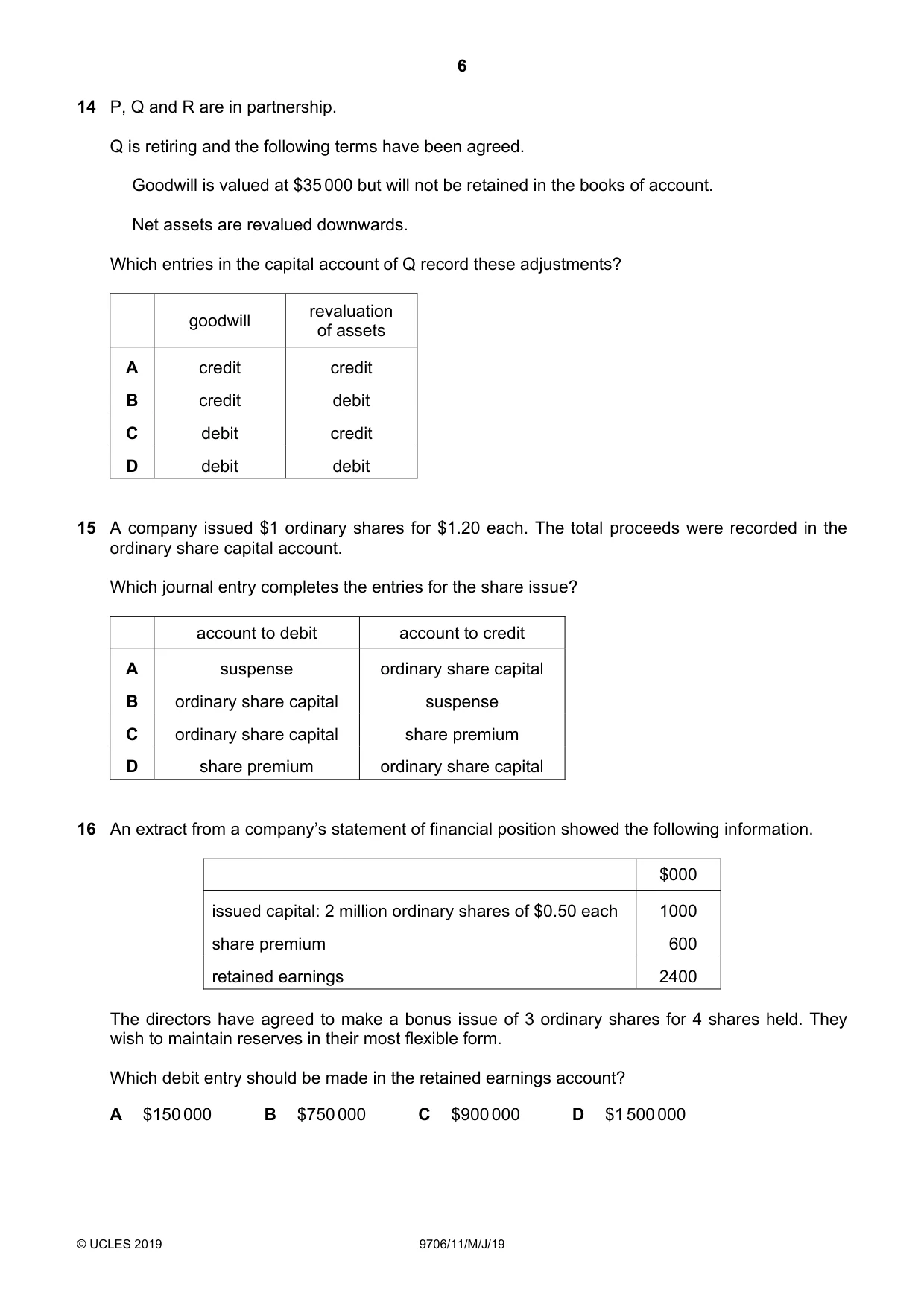
14 P, Q and R are in partnership. Q is retiring and the following terms have been agreed. Goodwill is valued at $35 000 but will not be retained in the books of account. Net assets are revalued downwards. Which entries in the capital account of Q record these adjustments? revaluation goodwill of assets A credit credit B credit debit C debit credit D debit debit
Mark scheme: B
Q15 · A company issued $1 ordinary shares for $1.20 each
15 A company issued $1 ordinary shares for $1.20 each. The total proceeds were recorded in the ordinary share capital account. Which journal entry completes the entries for the share issue? account to debit account to credit A suspense ordinary share capital B ordinary share capital suspense C ordinary share capital share premium D share premium ordinary share capital
Mark scheme: C
Q16 · An extract from a company’s statement of financial position showed the following…
16 An extract from a company’s statement of financial position showed the following information. $000 issued capital: 2 million ordinary shares of $0.50 each 1000 share premium 600 retained earnings 2400 The directors have agreed to make a bonus issue of 3 ordinary shares for 4 shares held. They wish to maintain reserves in their most flexible form. Which debit entry should be made in the retained earnings account? A $150 000 B $750 000 C $900 000 D $1 500 000
Mark scheme: A
Q17 · A company issues 500 000 $1 ordinary shares for $3 each and $250 000 debentures of 6%
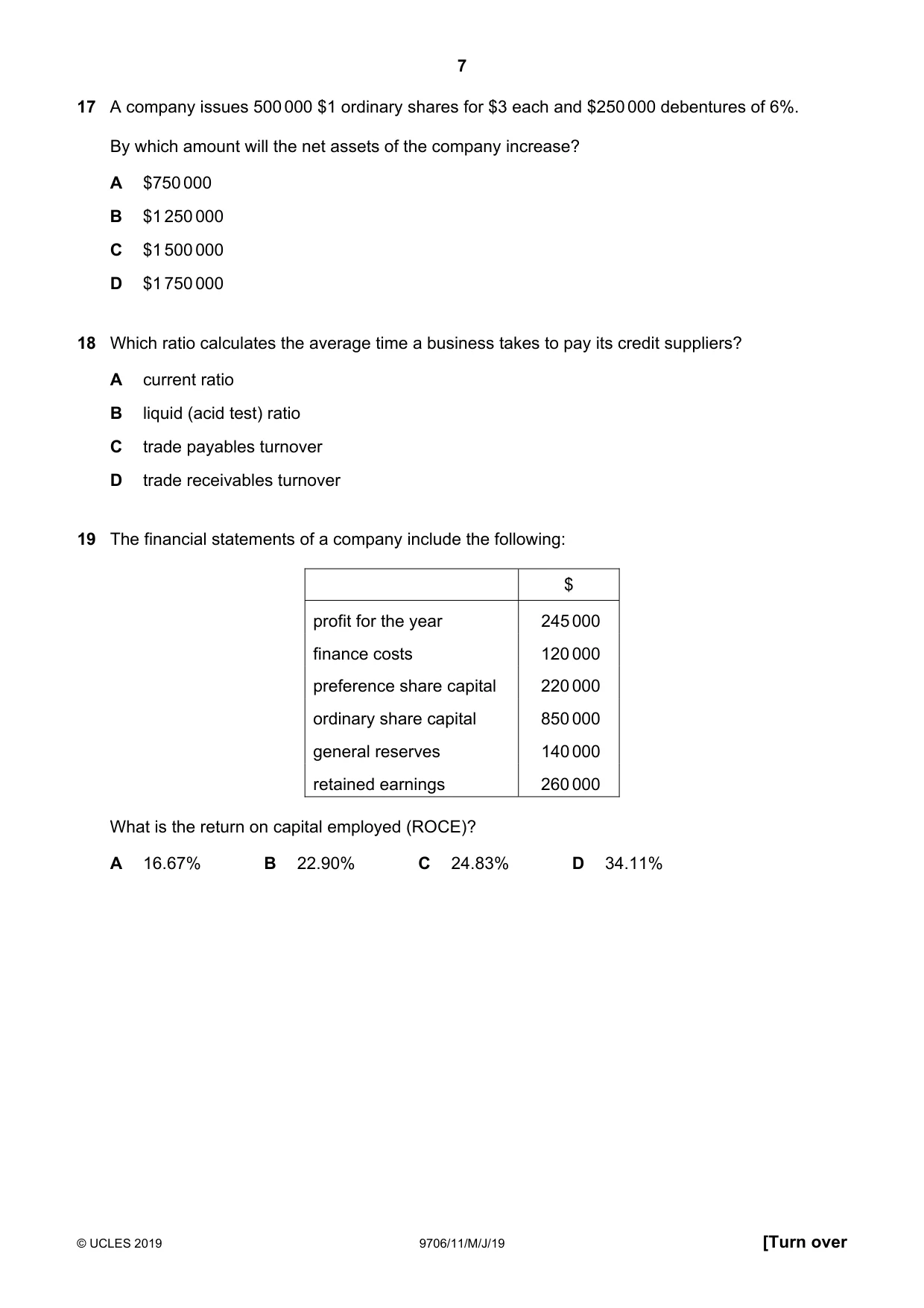
17 A company issues 500 000 $1 ordinary shares for $3 each and $250 000 debentures of 6%. By which amount will the net assets of the company increase? A $750 000 B $1 250 000 C $1 500 000 D $1 750 000
Mark scheme: C
Q18 · Which ratio calculates the average time a business takes to pay its credit suppliers?
18 Which ratio calculates the average time a business takes to pay its credit suppliers? A current ratio B liquid (acid test) ratio C trade payables turnover D trade receivables turnover
Mark scheme: C
More questions on Analysis and communication of accounting information
Q19 · The financial statements of a company include the following: $ profit for the year 245…
19 The financial statements of a company include the following: $ profit for the year 245 000 finance costs 120 000 preference share capital 220 000 ordinary share capital 850 000 general reserves 140 000 retained earnings 260 000 What is the return on capital employed (ROCE)? A 16.67% B 22.90% C 24.83% D 34.11%
Mark scheme: C
More questions on Analysis and communication of accounting information
Q20 · A business has prepared the following information for the year ended 30 April 2019
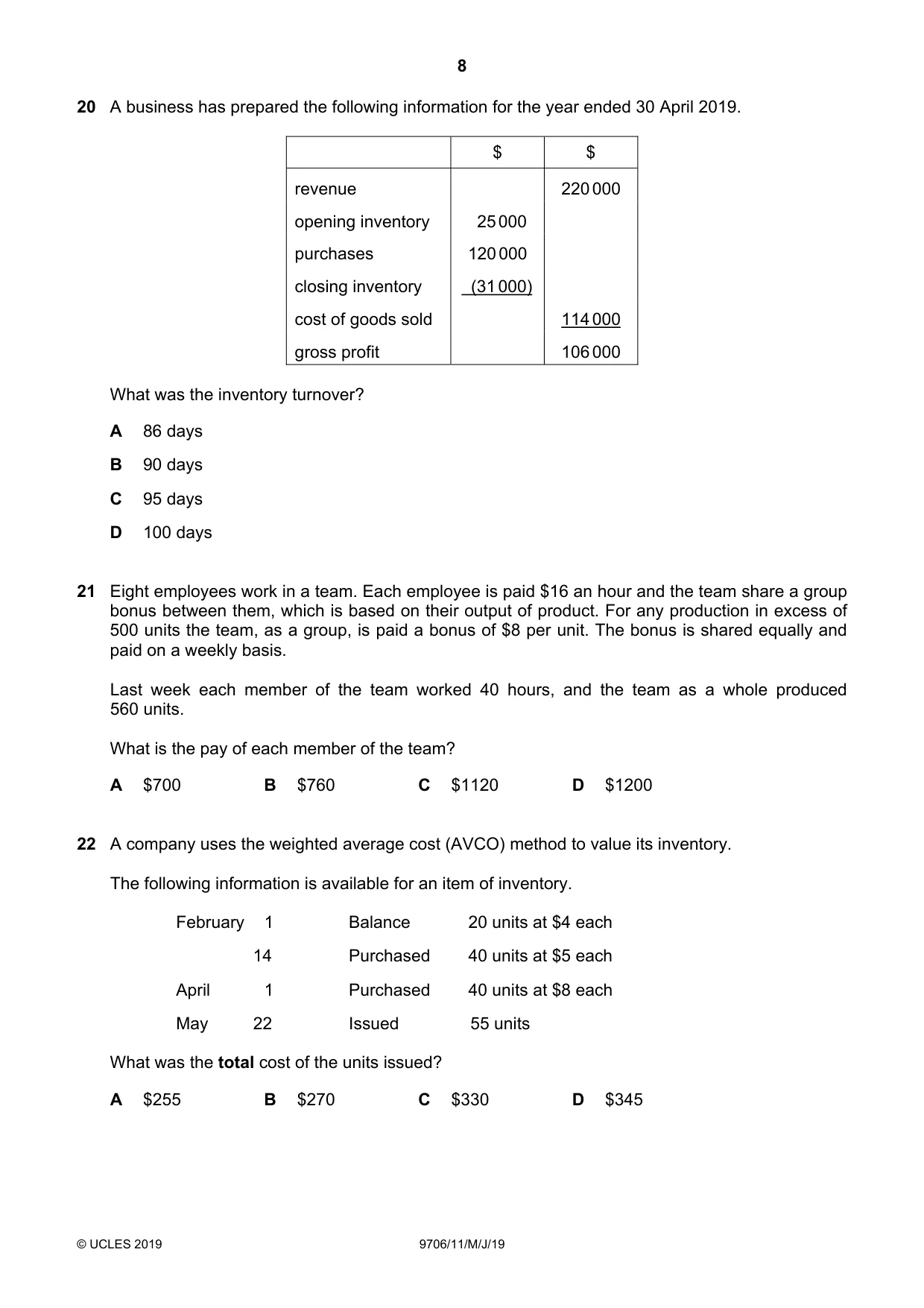
20 A business has prepared the following information for the year ended 30 April 2019. $ $ revenue 220 000 opening inventory 25 000 purchases 120 000 closing inventory (31 000) cost of goods sold 114 000 gross profit 106 000 What was the inventory turnover? A 86 days B 90 days C 95 days D 100 days
Mark scheme: B
More questions on Analysis and communication of accounting information
Q21 · Eight employees work in a team
21 Eight employees work in a team. Each employee is paid $16 an hour and the team share a group bonus between them, which is based on their output of product. For any production in excess of 500 units the team, as a group, is paid a bonus of $8 per unit. The bonus is shared equally and paid on a weekly basis. Last week each member of the team worked 40 hours, and the team as a whole produced 560 units. What is the pay of each member of the team? A $700 B $760 C $1120 D $1200
Mark scheme: A
Q22 · A company uses the weighted average cost (AVCO) method to value its inventory
22 A company uses the weighted average cost (AVCO) method to value its inventory. The following information is available for an item of inventory. February 1 Balance 20 units at $4 each 14 Purchased 40 units at $5 each April 1 Purchased 40 units at $8 each May 22 Issued 55 units What was the total cost of the units issued? A $255 B $270 C $330 D $345
Mark scheme: C
Q23 · A factory employs a large number of staff who pack different products for different…
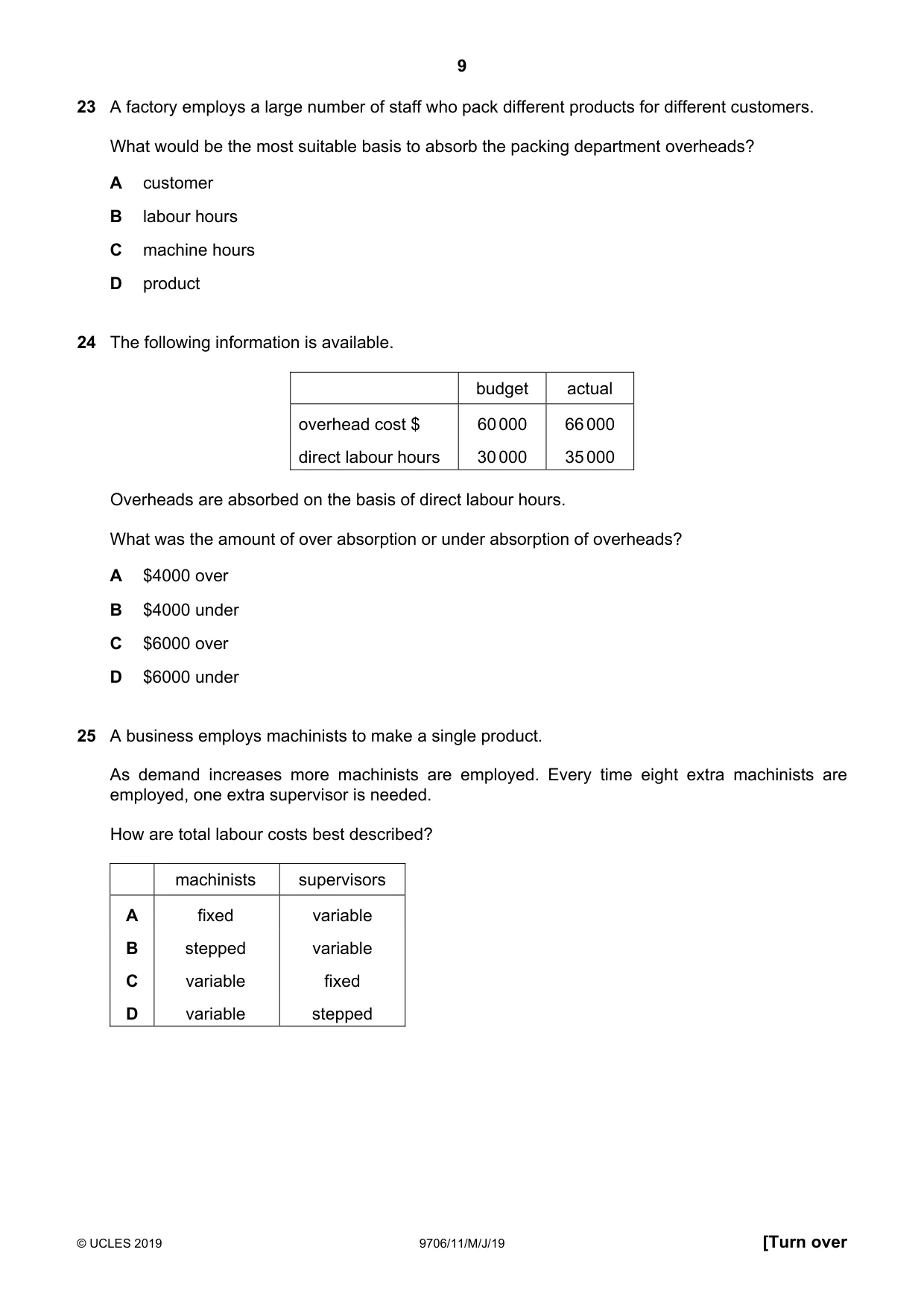
23 A factory employs a large number of staff who pack different products for different customers. What would be the most suitable basis to absorb the packing department overheads? A customer B labour hours C machine hours D product
Mark scheme: B
Q24 · The following information is available
24 The following information is available. budget actual overhead cost $ 60 000 66 000 direct labour hours 30 000 35 000 Overheads are absorbed on the basis of direct labour hours. What was the amount of over absorption or under absorption of overheads? A $4000 over B $4000 under C $6000 over D $6000 under
Mark scheme: A
Q25 · A business employs machinists to make a single product
25 A business employs machinists to make a single product. As demand increases more machinists are employed. Every time eight extra machinists are employed, one extra supervisor is needed. How are total labour costs best described? machinists supervisors A fixed variable B stepped variable C variable fixed D variable stepped
Mark scheme: D
Q26 · A company makes two products
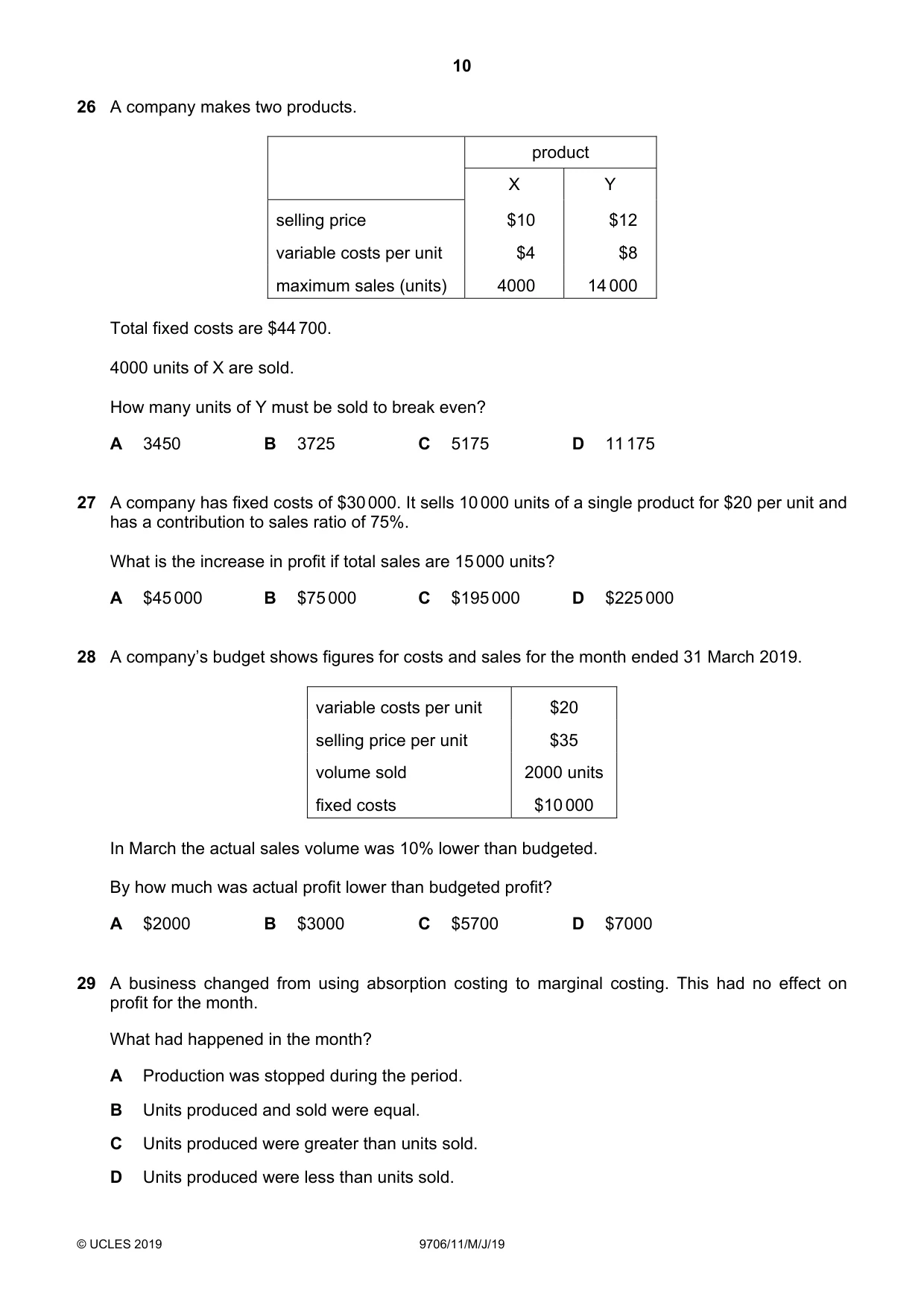
26 A company makes two products. product X Y selling price $10 $12 variable costs per unit $4 $8 maximum sales (units) 4000 14 000 Total fixed costs are $44 700. 4000 units of X are sold. How many units of Y must be sold to break even? A 3450 B 3725 C 5175 D 11 175
Mark scheme: C
Q27 · A company has fixed costs of $30 000
27 A company has fixed costs of $30 000. It sells 10 000 units of a single product for $20 per unit and has a contribution to sales ratio of 75%. What is the increase in profit if total sales are 15 000 units? A $45 000 B $75 000 C $195 000 D $225 000
Mark scheme: B
Q28 · A company’s budget shows figures for costs and sales for the month ended 31 March 2019
28 A company’s budget shows figures for costs and sales for the month ended 31 March 2019. variable costs per unit $20 selling price per unit $35 volume sold 2000 units fixed costs $10 000 In March the actual sales volume was 10% lower than budgeted. By how much was actual profit lower than budgeted profit? A $2000 B $3000 C $5700 D $7000
Mark scheme: B
Q29 · A business changed from using absorption costing to marginal costing
29 A business changed from using absorption costing to marginal costing. This had no effect on profit for the month. What had happened in the month? A Production was stopped during the period. B Units produced and sold were equal. C Units produced were greater than units sold. D Units produced were less than units sold.
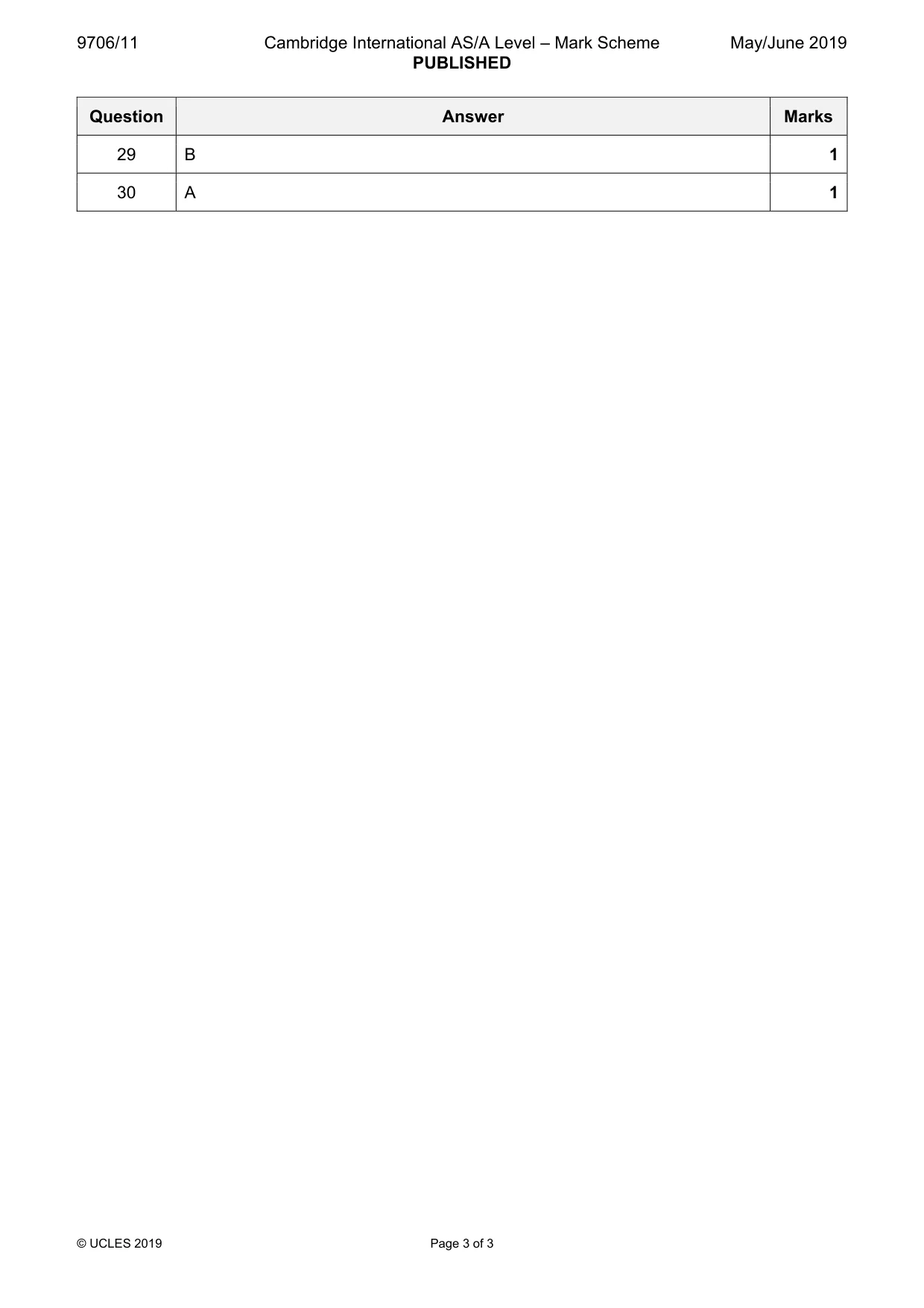
Mark scheme: B
Q30 · Why might a business prepare budgets?
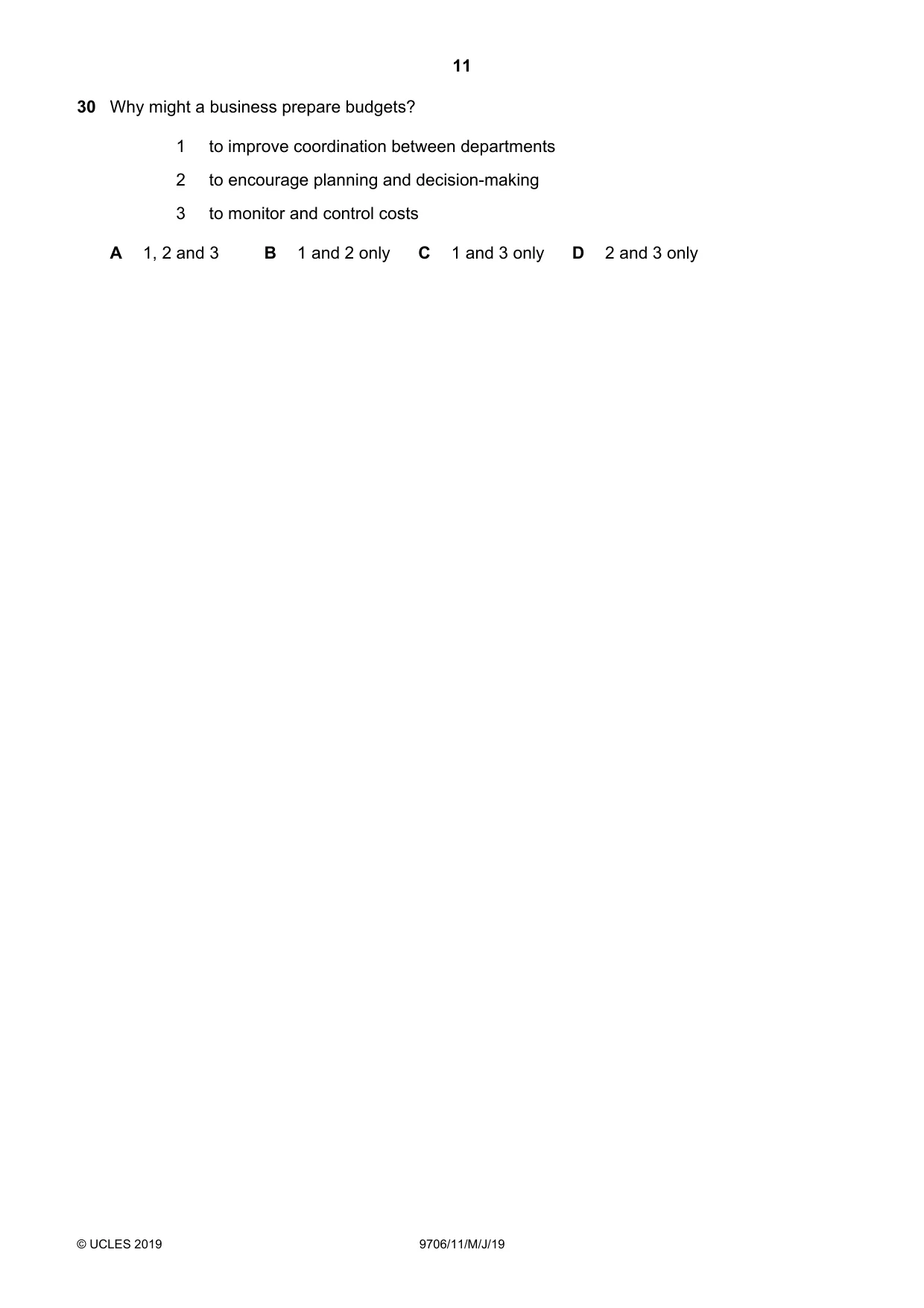
30 Why might a business prepare budgets? 1 to improve coordination between departments 2 to encourage planning and decision-making 3 to monitor and control costs A 1, 2 and 3 B 1 and 2 only C 1 and 3 only D 2 and 3 only
Mark scheme: A
What was in this paper
The subtopics covered by these 30 questions, and how many questions each got. Open one in a new tab to see every Cambridge question on it.
6Traditional costing methods5Reconciliation and verification4Accounting for non-current assets3Costs and cost behaviour3Preparation of financial statements3Analysis and communication of accounting information2Budgeting and budgetary control2Analysis and communication of accounting information1The accounting system1What you needed in this session
Cambridge’s own grade thresholds for 2019 May/June, Paper 1 · Variant 1. A higher threshold means an easier paper — the bar moves with how the cohort did.