Cambridge A Level Accounting 9706 — 2021 Oct/Nov Paper 1 · Variant 3
9706/13/O/N/21 · 30 questions · 30 marks · ≈34 min
The question paper and its mark scheme, free to read here and free to download. This is Cambridge’s own paper, exactly as it was sat.
Question paper12 pages
Mark scheme3 pages
Answers below. Sit the paper first if you are practising.
Questions as text
Q1 · A company does not include in the financial statements the value of skills gained by its…
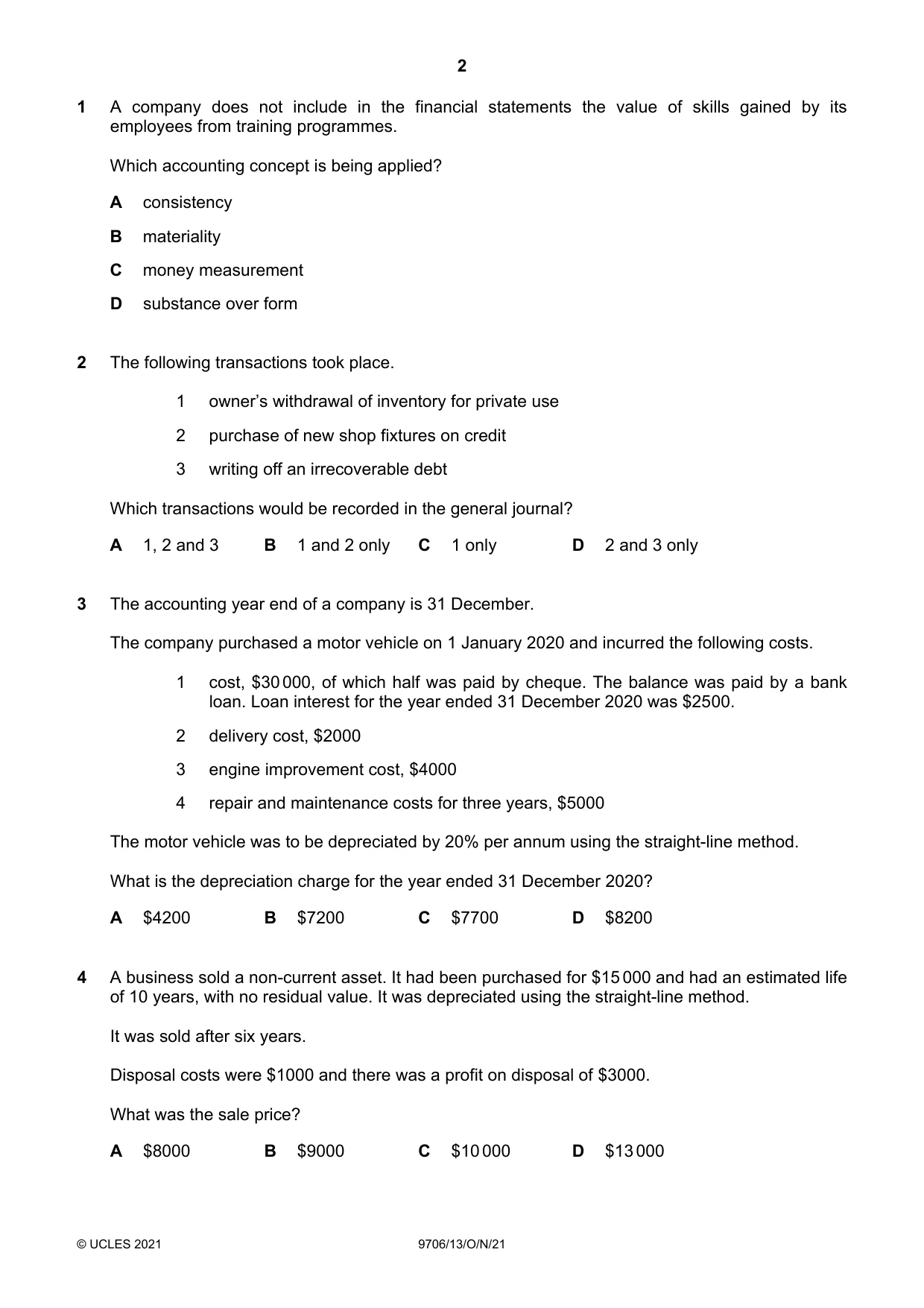
1 A company does not include in the financial statements the value of skills gained by its employees from training programmes. Which accounting concept is being applied? A consistency B materiality C money measurement D substance over form
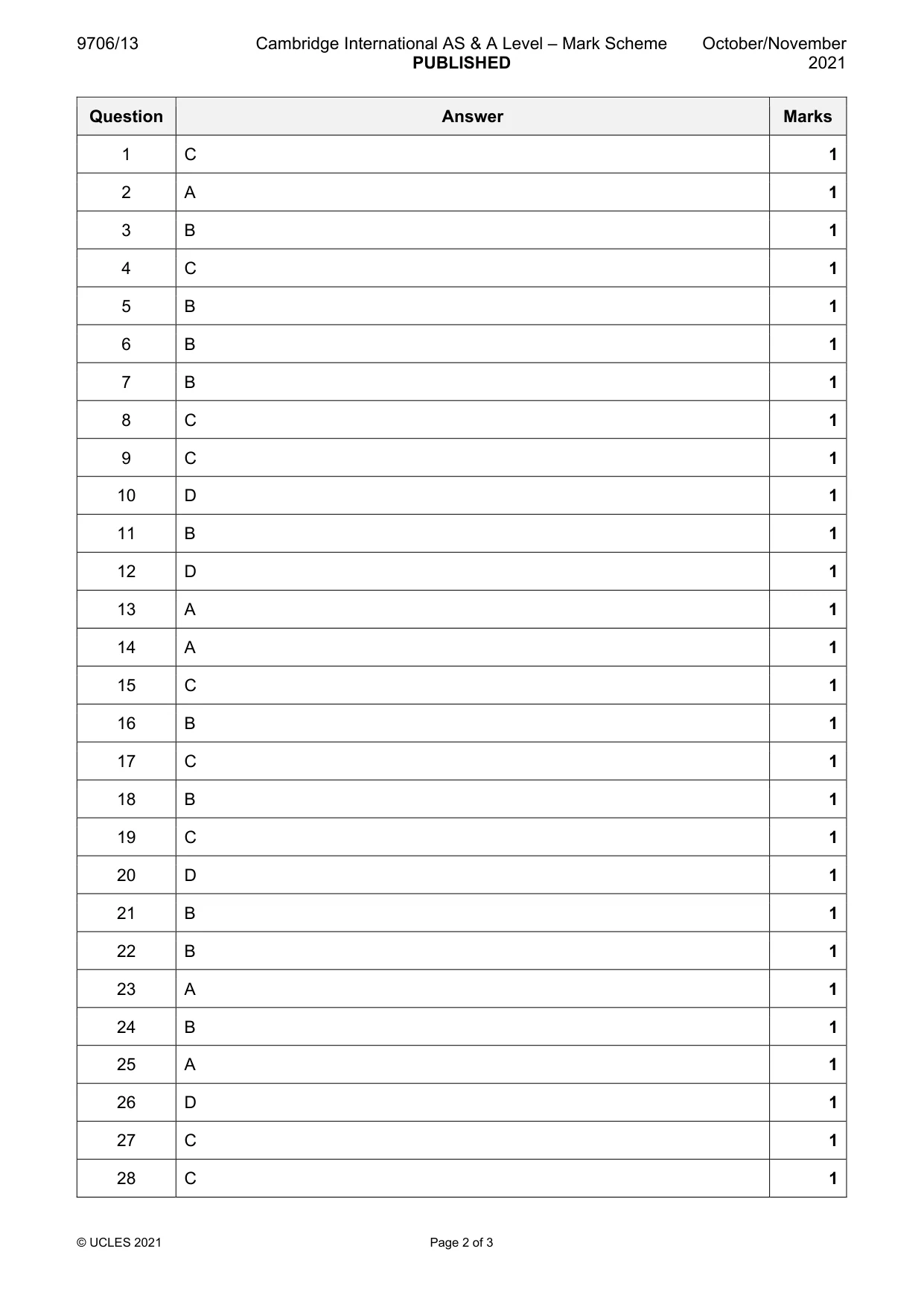
Mark scheme: C
Q2 · The following transactions took place
2 The following transactions took place. 1 owner’s withdrawal of inventory for private use 2 purchase of new shop fixtures on credit 3 writing off an irrecoverable debt Which transactions would be recorded in the general journal? A 1, 2 and 3 B 1 and 2 only C 1 only D 2 and 3 only
Mark scheme: A
Q3 · The accounting year end of a company is 31 December
3 The accounting year end of a company is 31 December. The company purchased a motor vehicle on 1 January 2020 and incurred the following costs. 1 cost, $30 000, of which half was paid by cheque. The balance was paid by a bank loan. Loan interest for the year ended 31 December 2020 was $2500. 2 delivery cost, $2000 3 engine improvement cost, $4000 4 repair and maintenance costs for three years, $5000 The motor vehicle was to be depreciated by 20% per annum using the straight-line method. What is the depreciation charge for the year ended 31 December 2020? A $4200 B $7200 C $7700 D $8200
Mark scheme: B
Q4 · A business sold a non-current asset
4 A business sold a non-current asset. It had been purchased for $15 000 and had an estimated life of 10 years, with no residual value. It was depreciated using the straight-line method. It was sold after six years. Disposal costs were $1000 and there was a profit on disposal of $3000. What was the sale price? A $8000 B $9000 C $10 000 D $13 000
Mark scheme: C
Q5 · Which statements about a depreciation charge for the year are correct?
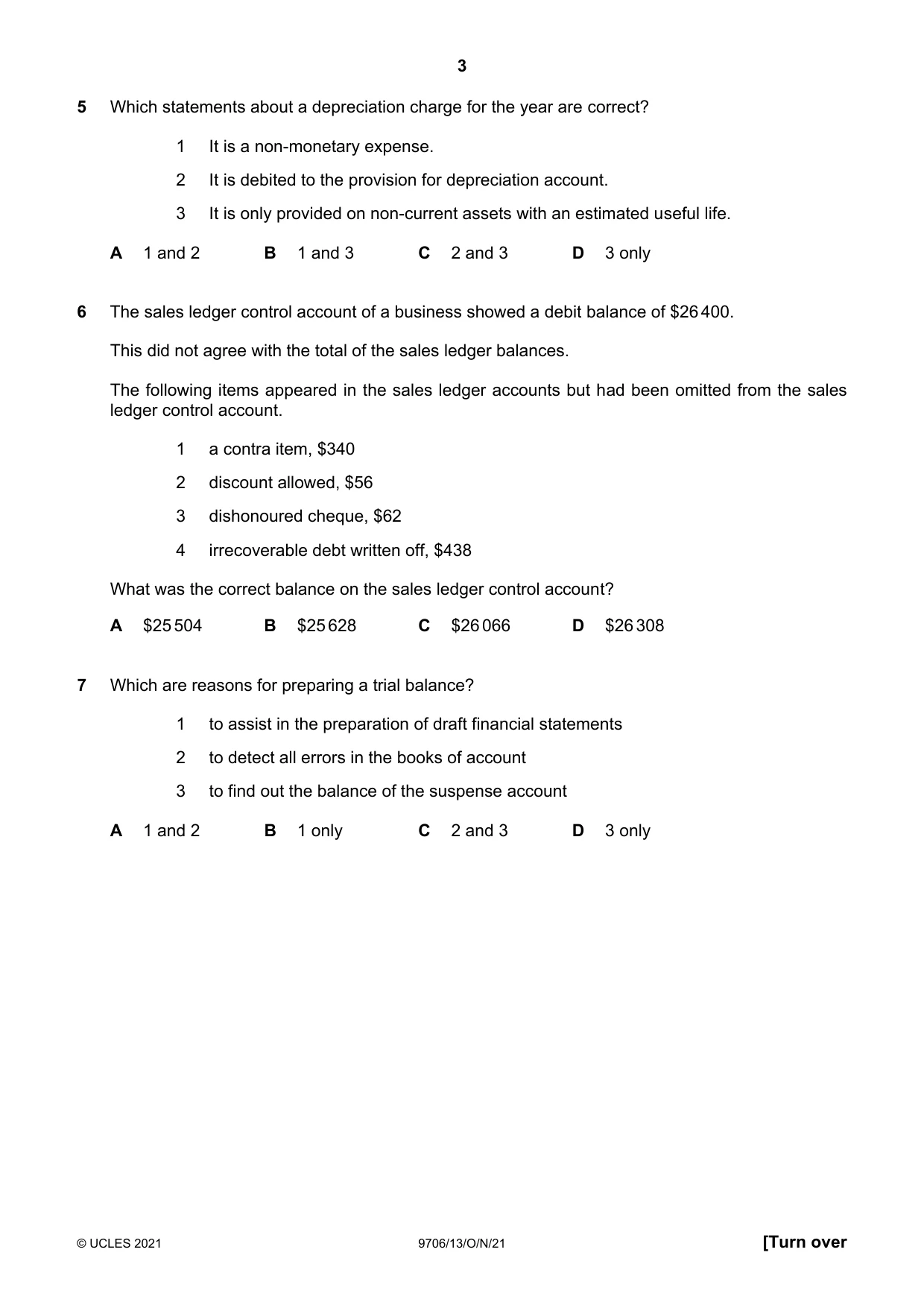
5 Which statements about a depreciation charge for the year are correct? 1 It is a non-monetary expense. 2 It is debited to the provision for depreciation account. 3 It is only provided on non-current assets with an estimated useful life. A 1 and 2 B 1 and 3 C 2 and 3 D 3 only
Mark scheme: B
Q6 · The sales ledger control account of a business showed a debit balance of $26 400
6 The sales ledger control account of a business showed a debit balance of $26 400. This did not agree with the total of the sales ledger balances. The following items appeared in the sales ledger accounts but had been omitted from the sales ledger control account. 1 a contra item, $340 2 discount allowed, $56 3 dishonoured cheque, $62 4 irrecoverable debt written off, $438 What was the correct balance on the sales ledger control account? A $25 504 B $25 628 C $26 066 D $26 308
Mark scheme: B
Q7 · Which are reasons for preparing a trial balance?
7 Which are reasons for preparing a trial balance? 1 to assist in the preparation of draft financial statements 2 to detect all errors in the books of account 3 to find out the balance of the suspense account A 1 and 2 B 1 only C 2 and 3 D 3 only
Mark scheme: B
Q8 · The following information is available for the telephone account for the year ended 31…
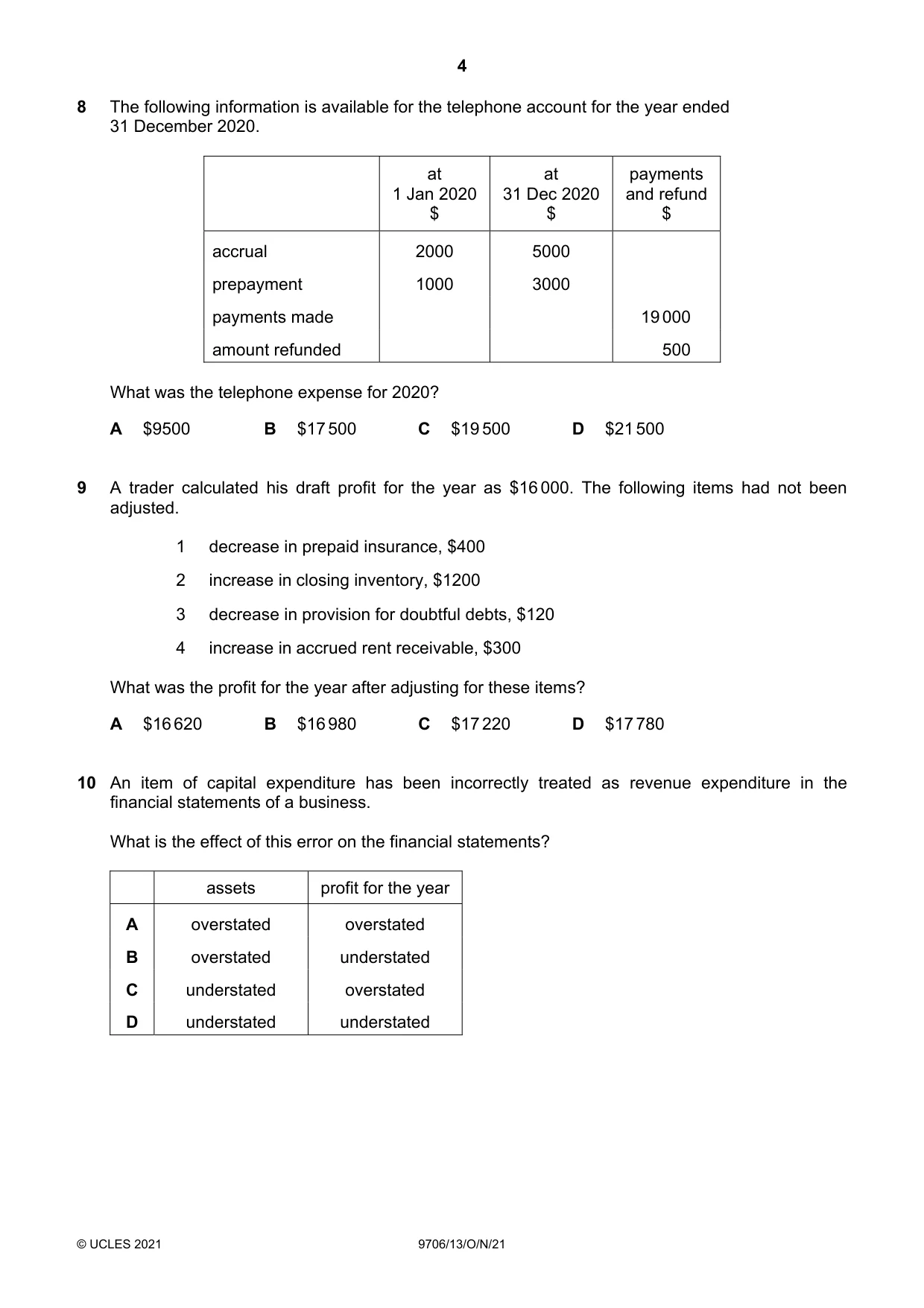
8 The following information is available for the telephone account for the year ended 31 December 2020. at at payments 1 Jan 2020 31 Dec 2020 and refund $ $ $ accrual 2000 5000 prepayment 1000 3000 payments made 19 000 amount refunded 500 What was the telephone expense for 2020? A $9500 B $17 500 C $19 500 D $21 500
Mark scheme: C
Q9 · A trader calculated his draft profit for the year as $16 000
9 A trader calculated his draft profit for the year as $16 000. The following items had not been adjusted. 1 decrease in prepaid insurance, $400 2 increase in closing inventory, $1200 3 decrease in provision for doubtful debts, $120 4 increase in accrued rent receivable, $300 What was the profit for the year after adjusting for these items? A $16 620 B $16 980 C $17 220 D $17 780
Mark scheme: C
Q10 · An item of capital expenditure has been incorrectly treated as revenue expenditure in the…
10 An item of capital expenditure has been incorrectly treated as revenue expenditure in the financial statements of a business. What is the effect of this error on the financial statements? assets profit for the year A overstated overstated B overstated understated C understated overstated D understated understated
Mark scheme: D
Q11 · The following information is available for a business
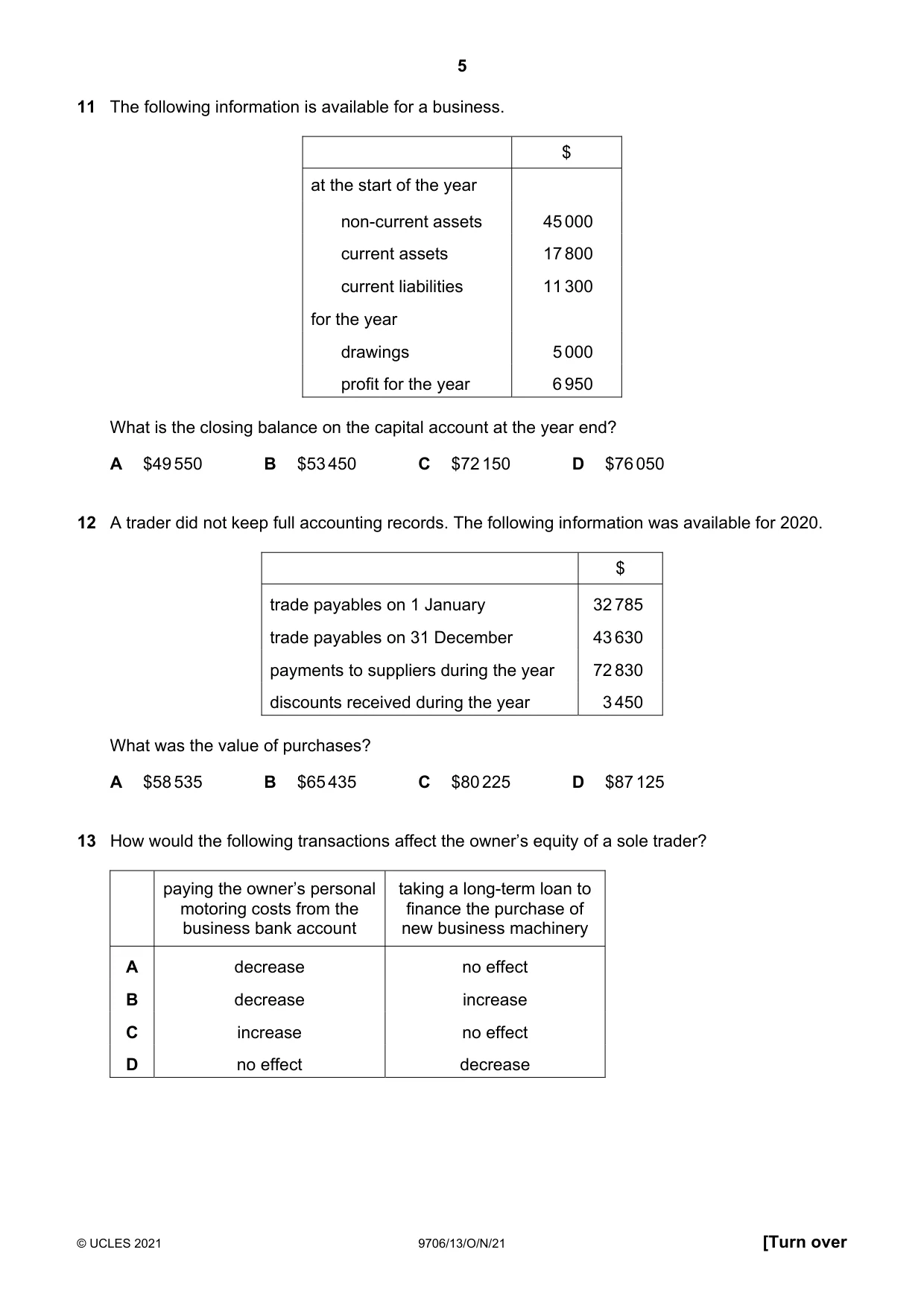
11 The following information is available for a business. $ at the start of the year non-current assets 45 000 current assets 17 800 current liabilities 11 300 for the year drawings 5 000 profit for the year 6 950 What is the closing balance on the capital account at the year end? A $49 550 B $53 450 C $72 150 D $76 050
Mark scheme: B
Q12 · A trader did not keep full accounting records
12 A trader did not keep full accounting records. The following information was available for 2020. $ trade payables on 1 January 32 785 trade payables on 31 December 43 630 payments to suppliers during the year 72 830 discounts received during the year 3 450 What was the value of purchases? A $58 535 B $65 435 C $80 225 D $87 125
Mark scheme: D
Q13 · How would the following transactions affect the owner’s equity of a sole trader?
13 How would the following transactions affect the owner’s equity of a sole trader? paying the owner’s personal taking a long-term loan to motoring costs from the finance the purchase of business bank account new business machinery A decrease no effect B decrease increase C increase no effect D no effect decrease
Mark scheme: A
Q14 · A partner is retiring from a partnership business
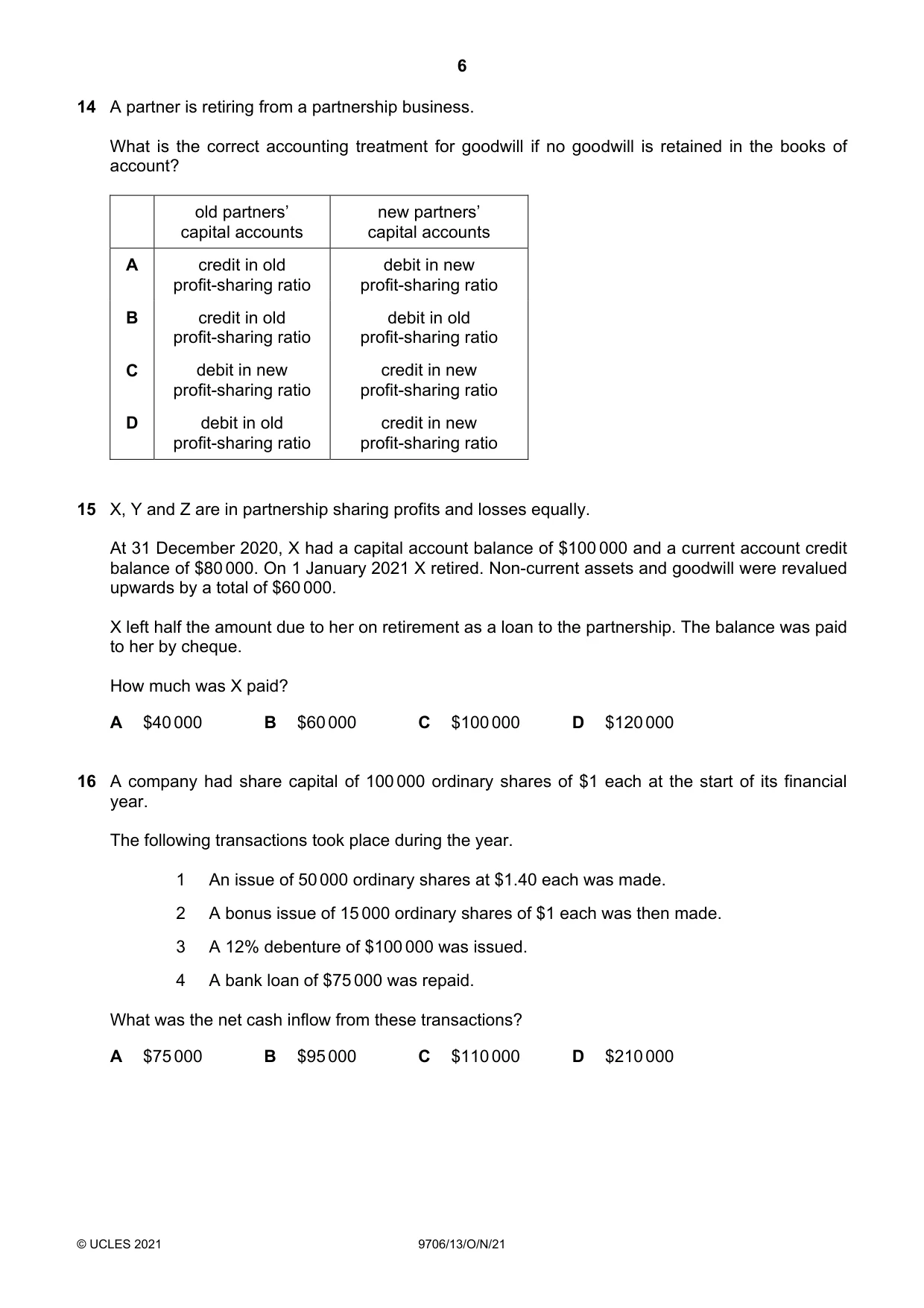
14 A partner is retiring from a partnership business. What is the correct accounting treatment for goodwill if no goodwill is retained in the books of account? old partners’ new partners’ capital accounts capital accounts A credit in old debit in new profit-sharing ratio profit-sharing ratio B credit in old debit in old profit-sharing ratio profit-sharing ratio C debit in new credit in new profit-sharing ratio profit-sharing ratio D debit in old credit in new profit-sharing ratio profit-sharing ratio
Mark scheme: A
Q15 · X, Y and Z are in partnership sharing profits and losses equally
15 X, Y and Z are in partnership sharing profits and losses equally. At 31 December 2020, X had a capital account balance of $100 000 and a current account credit balance of $80 000. On 1 January 2021 X retired. Non-current assets and goodwill were revalued upwards by a total of $60 000. X left half the amount due to her on retirement as a loan to the partnership. The balance was paid to her by cheque. How much was X paid? A $40 000 B $60 000 C $100 000 D $120 000
Mark scheme: C
Q16 · A company had share capital of 100 000 ordinary shares of $1 each at the start of its…
16 A company had share capital of 100 000 ordinary shares of $1 each at the start of its financial year. The following transactions took place during the year. 1 An issue of 50 000 ordinary shares at $1.40 each was made. 2 A bonus issue of 15 000 ordinary shares of $1 each was then made. 3 A 12% debenture of $100 000 was issued. 4 A bank loan of $75 000 was repaid. What was the net cash inflow from these transactions? A $75 000 B $95 000 C $110 000 D $210 000
Mark scheme: B
Q17 · A company paid an ordinary share dividend of $15 000 in the year
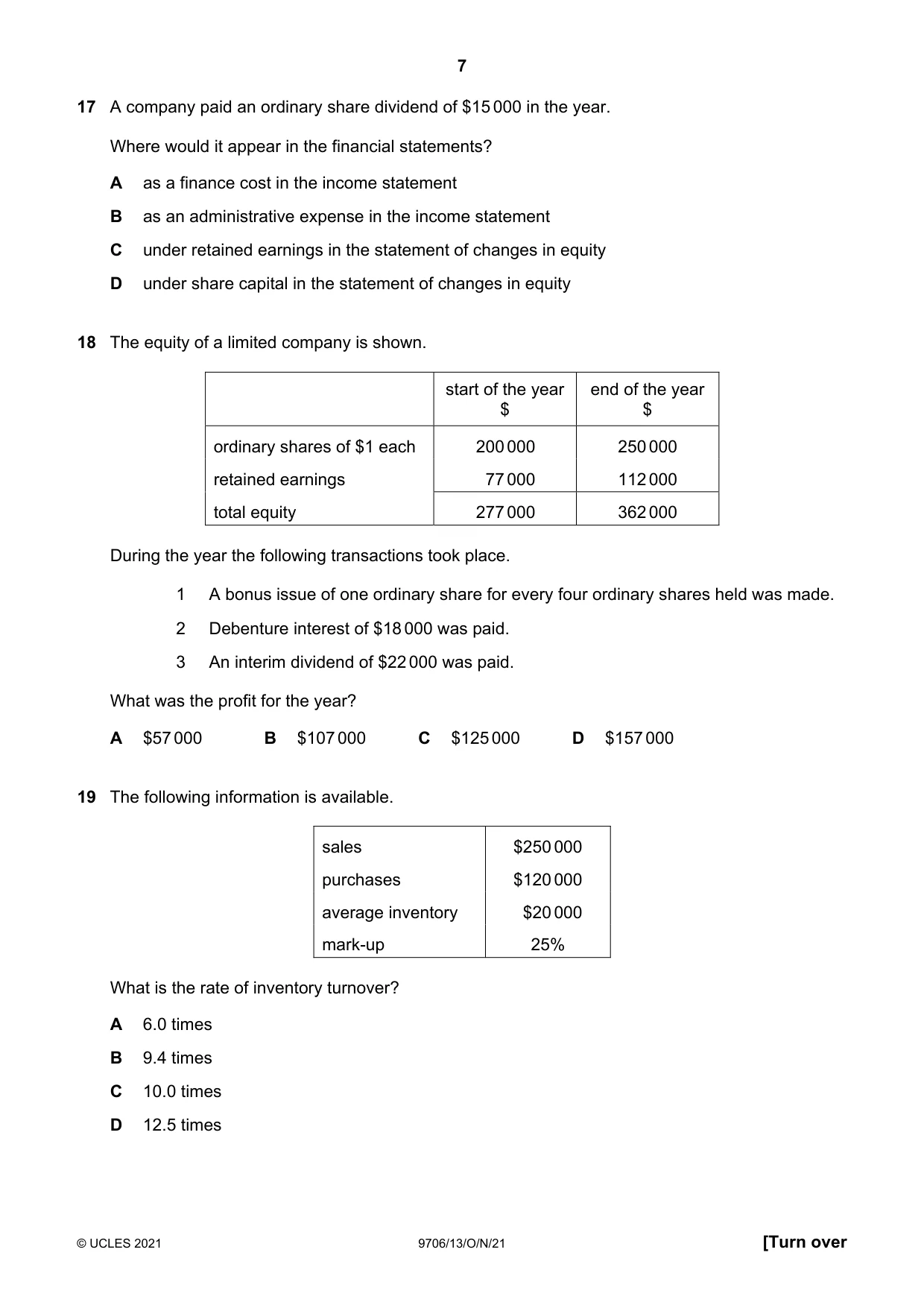
17 A company paid an ordinary share dividend of $15 000 in the year. Where would it appear in the financial statements? A as a finance cost in the income statement B as an administrative expense in the income statement C under retained earnings in the statement of changes in equity D under share capital in the statement of changes in equity
Mark scheme: C
Q18 · The equity of a limited company is shown
18 The equity of a limited company is shown. start of the year end of the year $ $ ordinary shares of $1 each 200 000 250 000 retained earnings 77 000 112 000 total equity 277 000 362 000 During the year the following transactions took place. 1 A bonus issue of one ordinary share for every four ordinary shares held was made. 2 Debenture interest of $18 000 was paid. 3 An interim dividend of $22 000 was paid. What was the profit for the year? A $57 000 B $107 000 C $125 000 D $157 000
Mark scheme: B
Q19 · The following information is available
19 The following information is available. sales $250 000 purchases $120 000 average inventory $20 000 mark-up 25% What is the rate of inventory turnover? A 6.0 times B 9.4 times C 10.0 times D 12.5 times
Mark scheme: C
More questions on Analysis and communication of accounting information
Q20 · The trade receivables turnover of a business has been calculated for two years
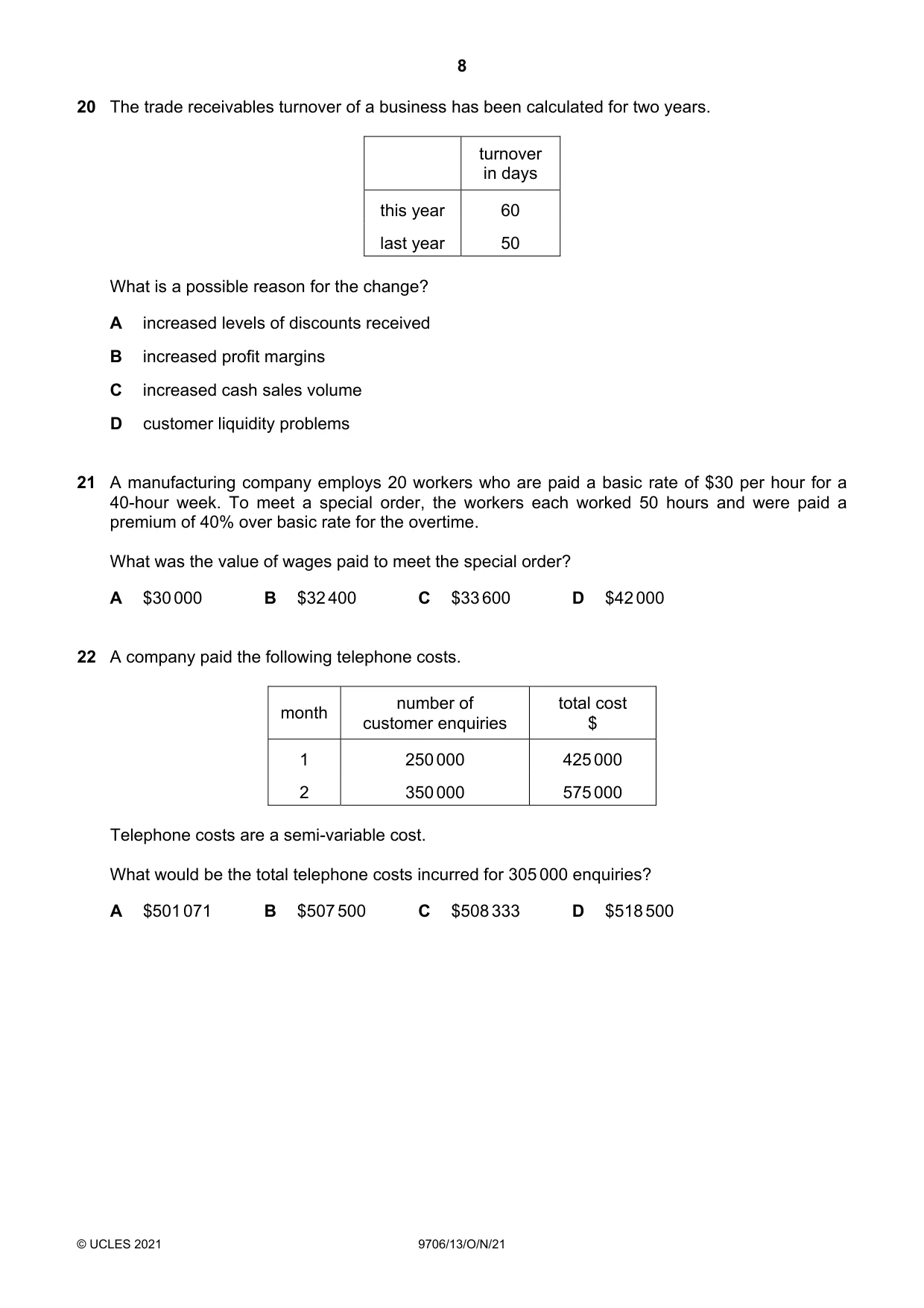
20 The trade receivables turnover of a business has been calculated for two years. turnover in days this year 60 last year 50 What is a possible reason for the change? A increased levels of discounts received B increased profit margins C increased cash sales volume D customer liquidity problems
Mark scheme: D
More questions on Analysis and communication of accounting information
Q21 · A manufacturing company employs 20 workers who are paid a basic rate of $30 per hour for…
21 A manufacturing company employs 20 workers who are paid a basic rate of $30 per hour for a 40-hour week. To meet a special order, the workers each worked 50 hours and were paid a premium of 40% over basic rate for the overtime. What was the value of wages paid to meet the special order? A $30 000 B $32 400 C $33 600 D $42 000
Mark scheme: B
Q22 · A company paid the following telephone costs
22 A company paid the following telephone costs. number of total cost month customer enquiries $ 1 250 000 425 000 2 350 000 575 000 Telephone costs are a semi-variable cost. What would be the total telephone costs incurred for 305 000 enquiries? A $501 071 B $507 500 C $508 333 D $518 500
Mark scheme: B
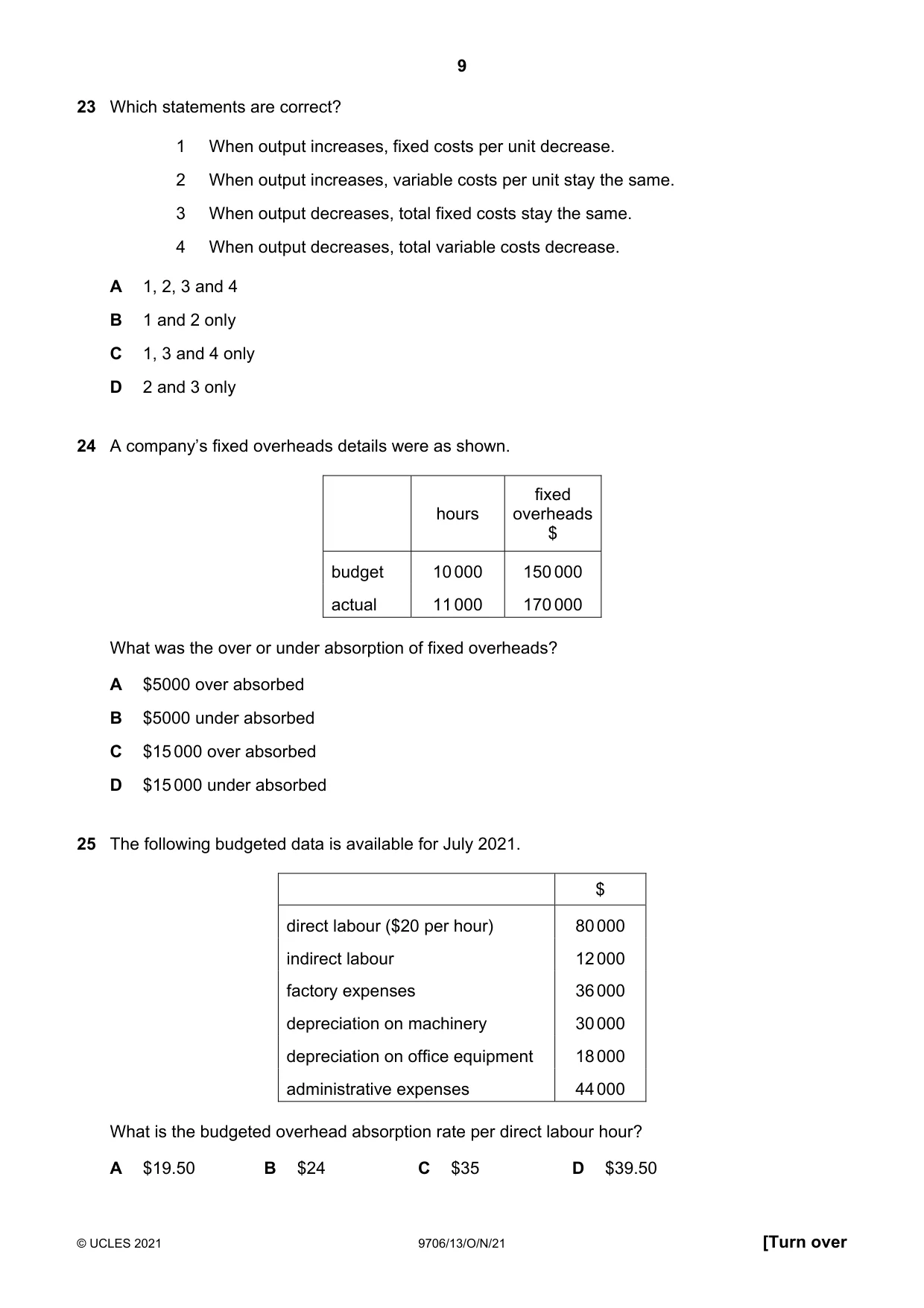
Q23 · Which statements are correct?
23 Which statements are correct? 1 When output increases, fixed costs per unit decrease. 2 When output increases, variable costs per unit stay the same. 3 When output decreases, total fixed costs stay the same. 4 When output decreases, total variable costs decrease. A 1, 2, 3 and 4 B 1 and 2 only C 1, 3 and 4 only D 2 and 3 only
Mark scheme: A
Q24 · A company’s fixed overheads details were as shown
24 A company’s fixed overheads details were as shown. fixed hours overheads $ budget 10 000 150 000 actual 11 000 170 000 What was the over or under absorption of fixed overheads? A $5000 over absorbed B $5000 under absorbed C $15 000 over absorbed D $15 000 under absorbed
Mark scheme: B
Q25 · The following budgeted data is available for July 2021
25 The following budgeted data is available for July 2021. $ direct labour ($20 per hour) 80 000 indirect labour 12 000 factory expenses 36 000 depreciation on machinery 30 000 depreciation on office equipment 18 000 administrative expenses 44 000 What is the budgeted overhead absorption rate per direct labour hour? A $19.50 B $24 C $35 D $39.50
Mark scheme: A
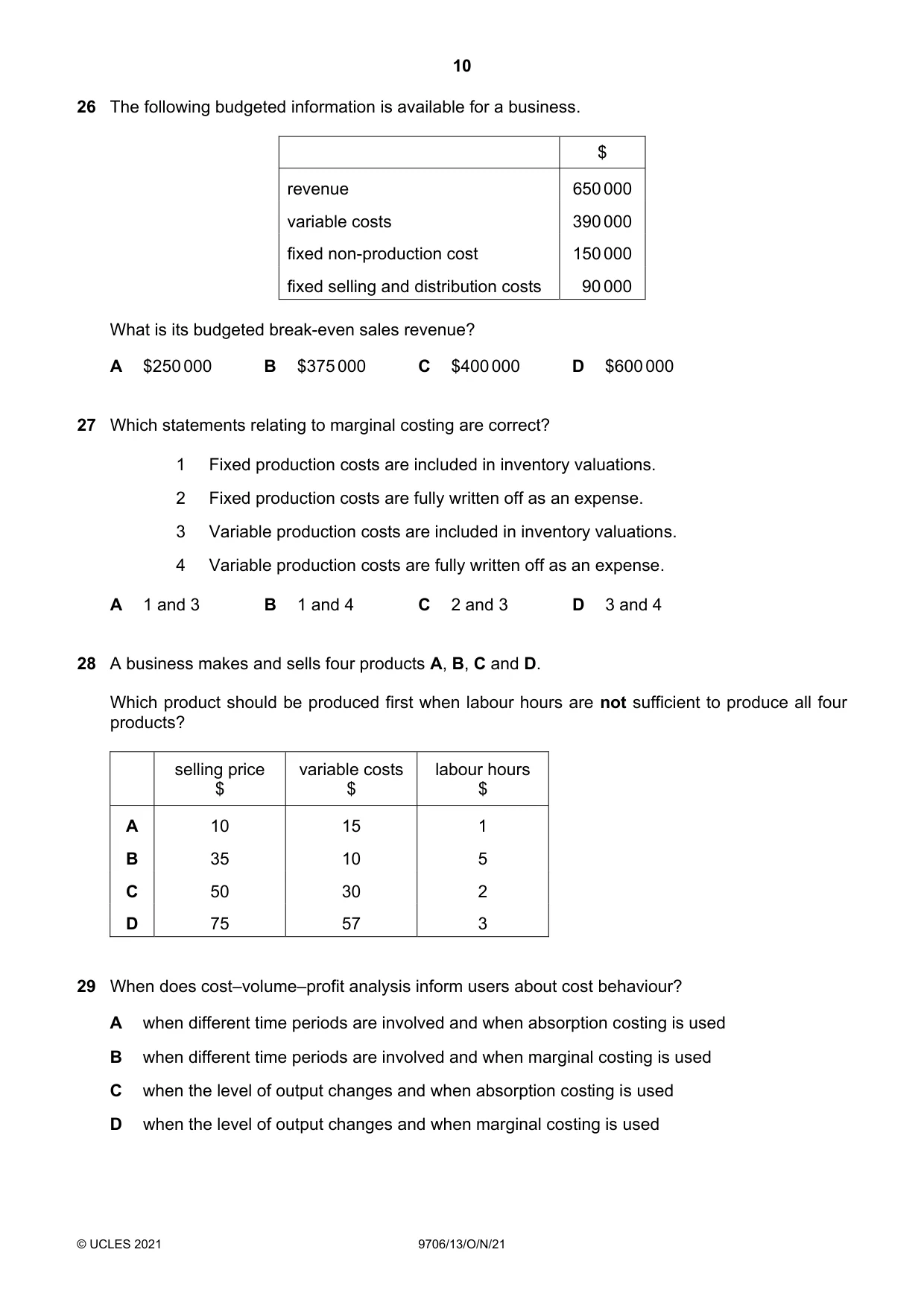
Q26 · The following budgeted information is available for a business
26 The following budgeted information is available for a business. $ revenue 650 000 variable costs 390 000 fixed non-production cost 150 000 fixed selling and distribution costs 90 000 What is its budgeted break-even sales revenue? A $250 000 B $375 000 C $400 000 D $600 000
Mark scheme: D
Q27 · Which statements relating to marginal costing are correct?
27 Which statements relating to marginal costing are correct? 1 Fixed production costs are included in inventory valuations. 2 Fixed production costs are fully written off as an expense. 3 Variable production costs are included in inventory valuations. 4 Variable production costs are fully written off as an expense. A 1 and 3 B 1 and 4 C 2 and 3 D 3 and 4
Mark scheme: C
Q28 · A business makes and sells four products A, B, C and D
28 A business makes and sells four products A, B, C and D. Which product should be produced first when labour hours are not sufficient to produce all four products? selling price variable costs labour hours $ $ $ A 10 15 1 B 35 10 5 C 50 30 2 D 75 57 3
Mark scheme: C
Q29 · When does cost–volume–profit analysis inform users about cost behaviour?
29 When does cost–volume–profit analysis inform users about cost behaviour? A when different time periods are involved and when absorption costing is used B when different time periods are involved and when marginal costing is used C when the level of output changes and when absorption costing is used D when the level of output changes and when marginal costing is used
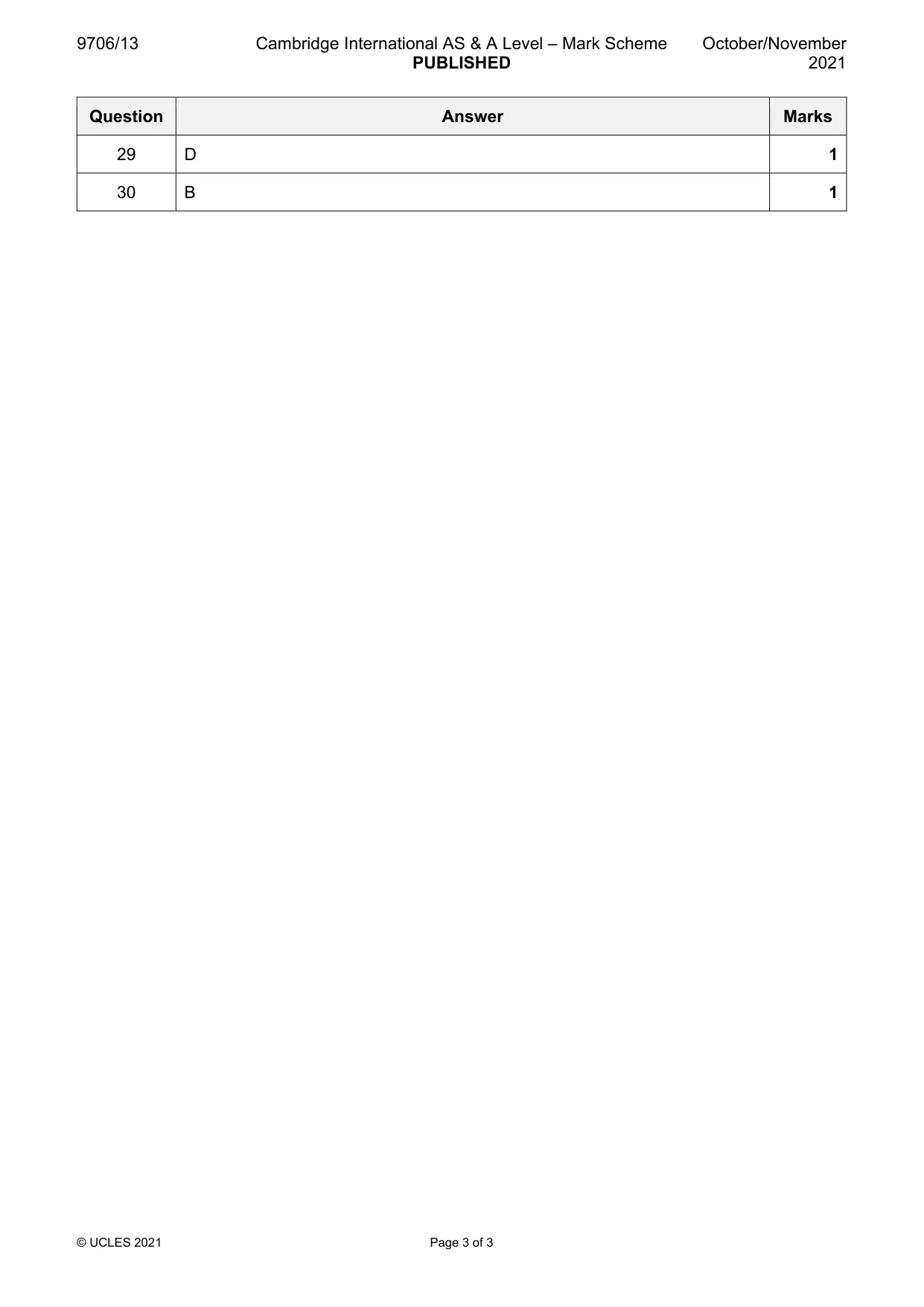
Mark scheme: D
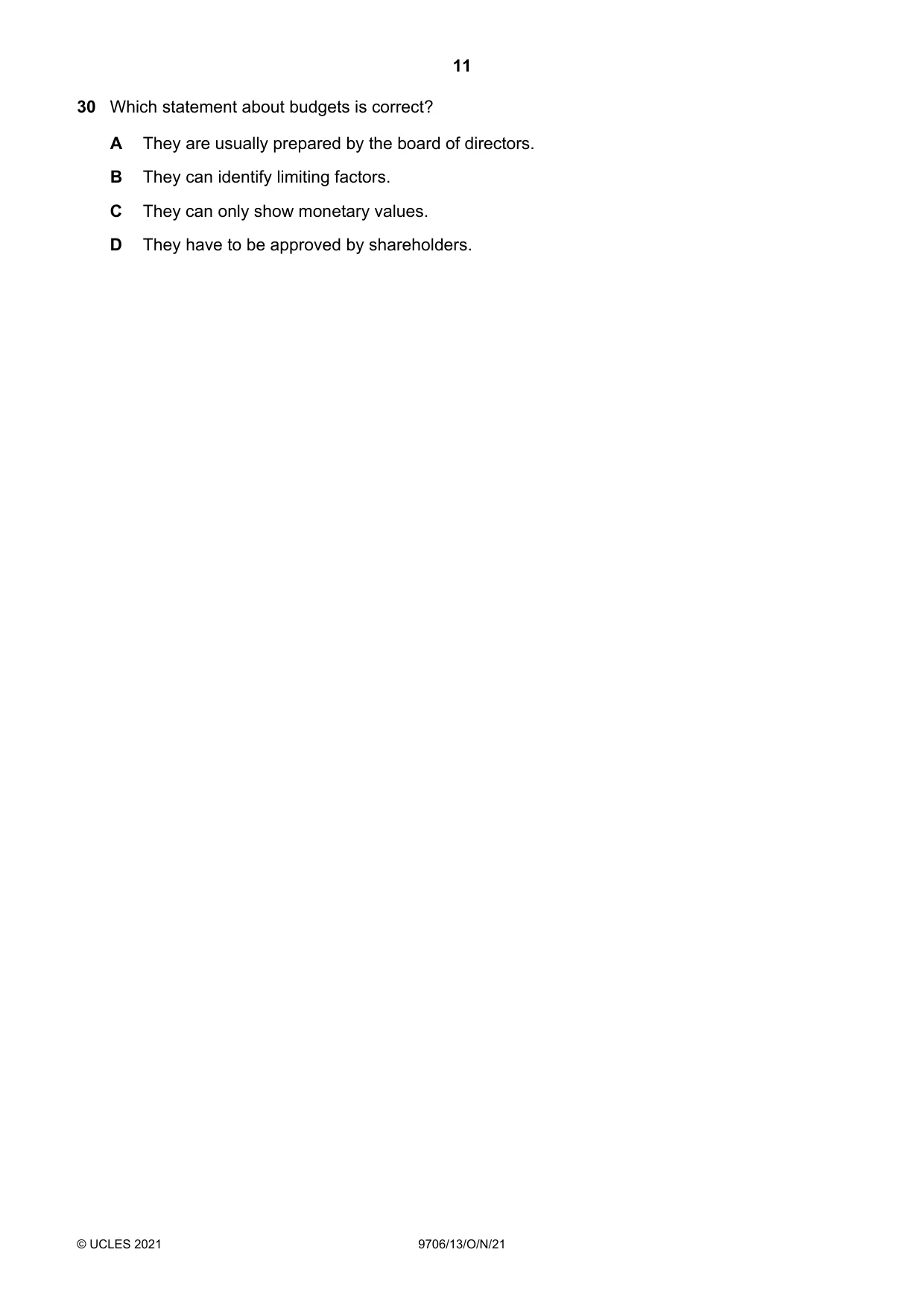
Q30 · Which statement about budgets is correct?
30 Which statement about budgets is correct? A They are usually prepared by the board of directors. B They can identify limiting factors. C They can only show monetary values. D They have to be approved by shareholders.
Mark scheme: B
What was in this paper
The subtopics covered by these 30 questions, and how many questions each got. Open one in a new tab to see every Cambridge question on it.
6Preparation of financial statements5The accounting system4Accounting for non-current assets3Costs and cost behaviour3Preparation of financial statements3Analysis and communication of accounting information2Reconciliation and verification2Budgeting and budgetary control1Types of business entity1What you needed in this session
Cambridge’s own grade thresholds for 2021 Oct/Nov, Paper 1 · Variant 3. A higher threshold means an easier paper — the bar moves with how the cohort did.