Cambridge A Level Accounting 9706 — 2013 May/June Paper 1 · Variant 2
9706/12/M/J/13 · 30 questions · 30 marks · ≈34 min
The question paper and its mark scheme, free to read here and free to download. This is Cambridge’s own paper, exactly as it was sat.
Question paper12 pages

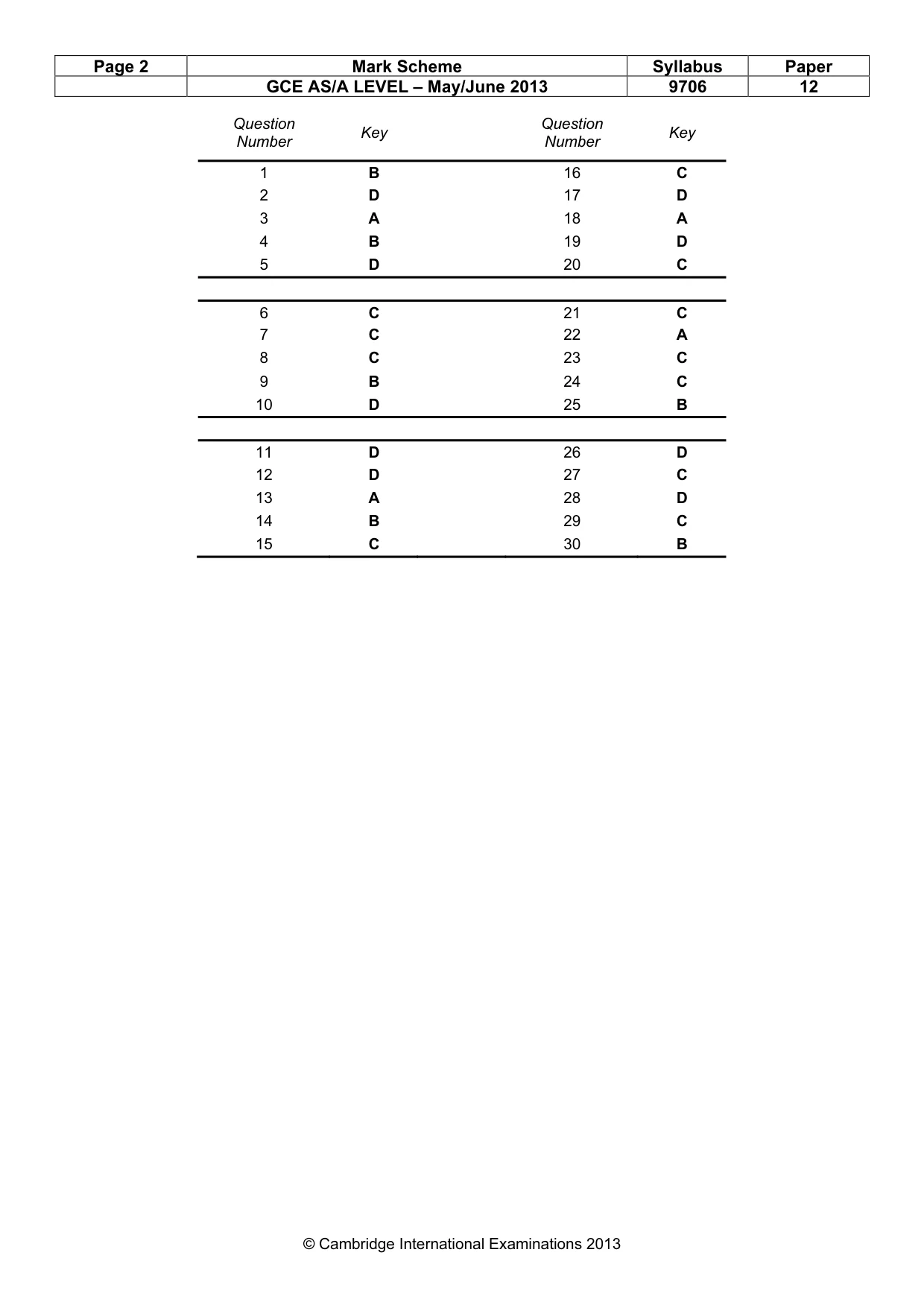
Mark scheme2 pages
Answers below. Sit the paper first if you are practising.
Questions as text
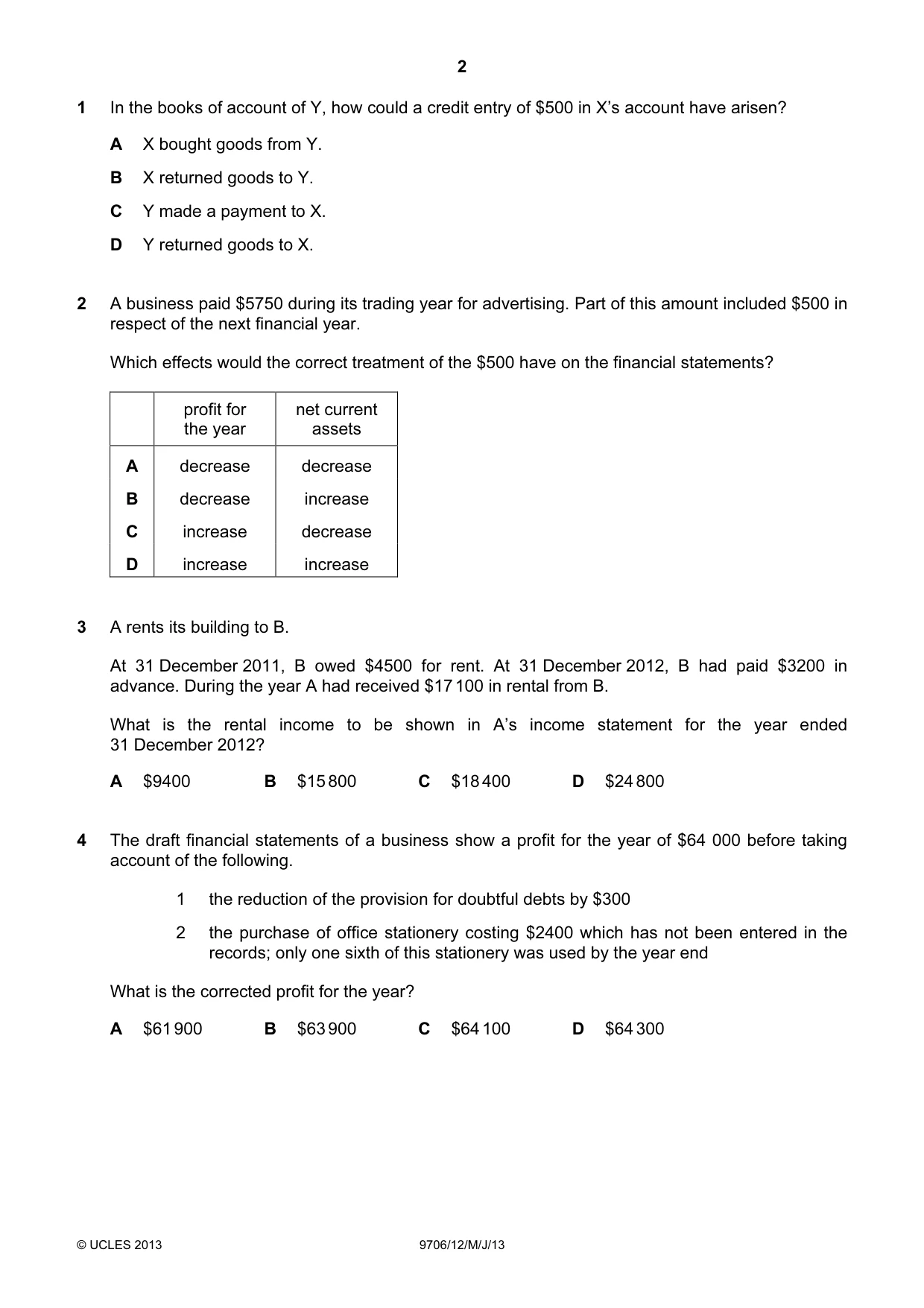
Q1 · In the books of account of Y, how could a credit entry of $500 in X’s account have arisen?
1 In the books of account of Y, how could a credit entry of $500 in X’s account have arisen? A X bought goods from Y. B X returned goods to Y. C Y made a payment to X. D Y returned goods to X.
Mark scheme: B
Q2 · A business paid $5750 during its trading year for advertising
2 A business paid $5750 during its trading year for advertising. Part of this amount included $500 in respect of the next financial year. Which effects would the correct treatment of the $500 have on the financial statements? profit for net current the year assets A decrease decrease B decrease increase C increase decrease D increase increase
Mark scheme: D
Q3 · A rents its building to B
3 A rents its building to B. At 31 December 2011, B owed $4500 for rent. At 31 December 2012, B had paid $3200 in advance. During the year A had received $17 100 in rental from B. What is the rental income to be shown in A’s income statement for the year ended 31 December 2012? A $9400 B $15 800 C $18 400 D $24 800
Mark scheme: A
Q4 · The draft financial statements of a business show a profit for the year of $64 000 before…
4 The draft financial statements of a business show a profit for the year of $64 000 before taking account of the following. 1 the reduction of the provision for doubtful debts by $300 2 the purchase of office stationery costing $2400 which has not been entered in the records; only one sixth of this stationery was used by the year end What is the corrected profit for the year? A $61 900 B $63 900 C $64 100 D $64 300
Mark scheme: B
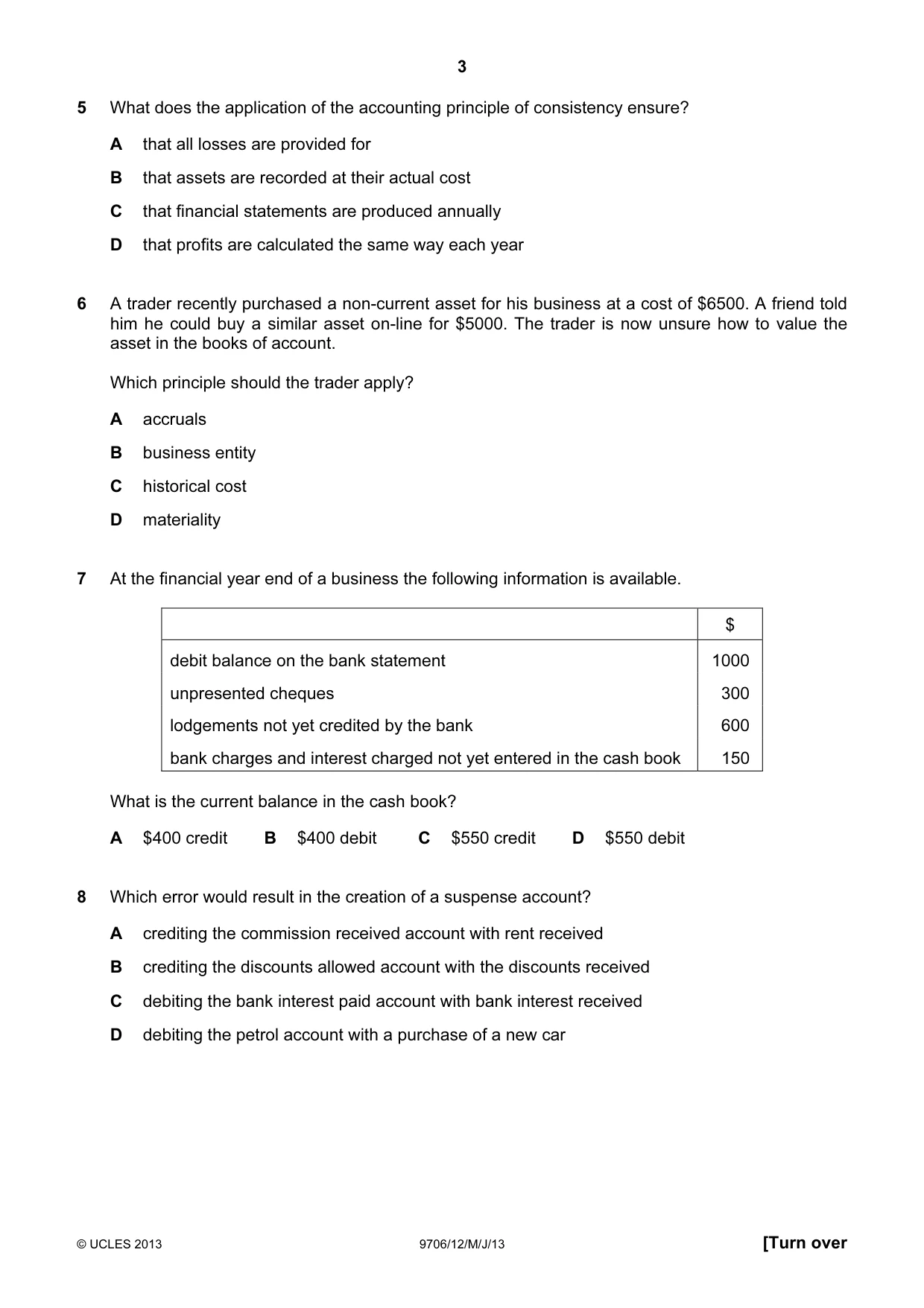
Q5 · What does the application of the accounting principle of consistency ensure?
5 What does the application of the accounting principle of consistency ensure? A that all losses are provided for B that assets are recorded at their actual cost C that financial statements are produced annually D that profits are calculated the same way each year
Mark scheme: D
Q6 · A trader recently purchased a non-current asset for his business at a cost of $6500
6 A trader recently purchased a non-current asset for his business at a cost of $6500. A friend told him he could buy a similar asset on-line for $5000. The trader is now unsure how to value the asset in the books of account. Which principle should the trader apply? A accruals B business entity C historical cost D materiality
Mark scheme: C
Q7 · At the financial year end of a business the following information is available
7 At the financial year end of a business the following information is available. $ debit balance on the bank statement 1000 unpresented cheques 300 lodgements not yet credited by the bank 600 bank charges and interest charged not yet entered in the cash book 150 What is the current balance in the cash book? A $400 credit B $400 debit C $550 credit D $550 debit
Mark scheme: C
Q8 · Which error would result in the creation of a suspense account?
8 Which error would result in the creation of a suspense account? A crediting the commission received account with rent received B crediting the discounts allowed account with the discounts received C debiting the bank interest paid account with bank interest received D debiting the petrol account with a purchase of a new car
Mark scheme: C
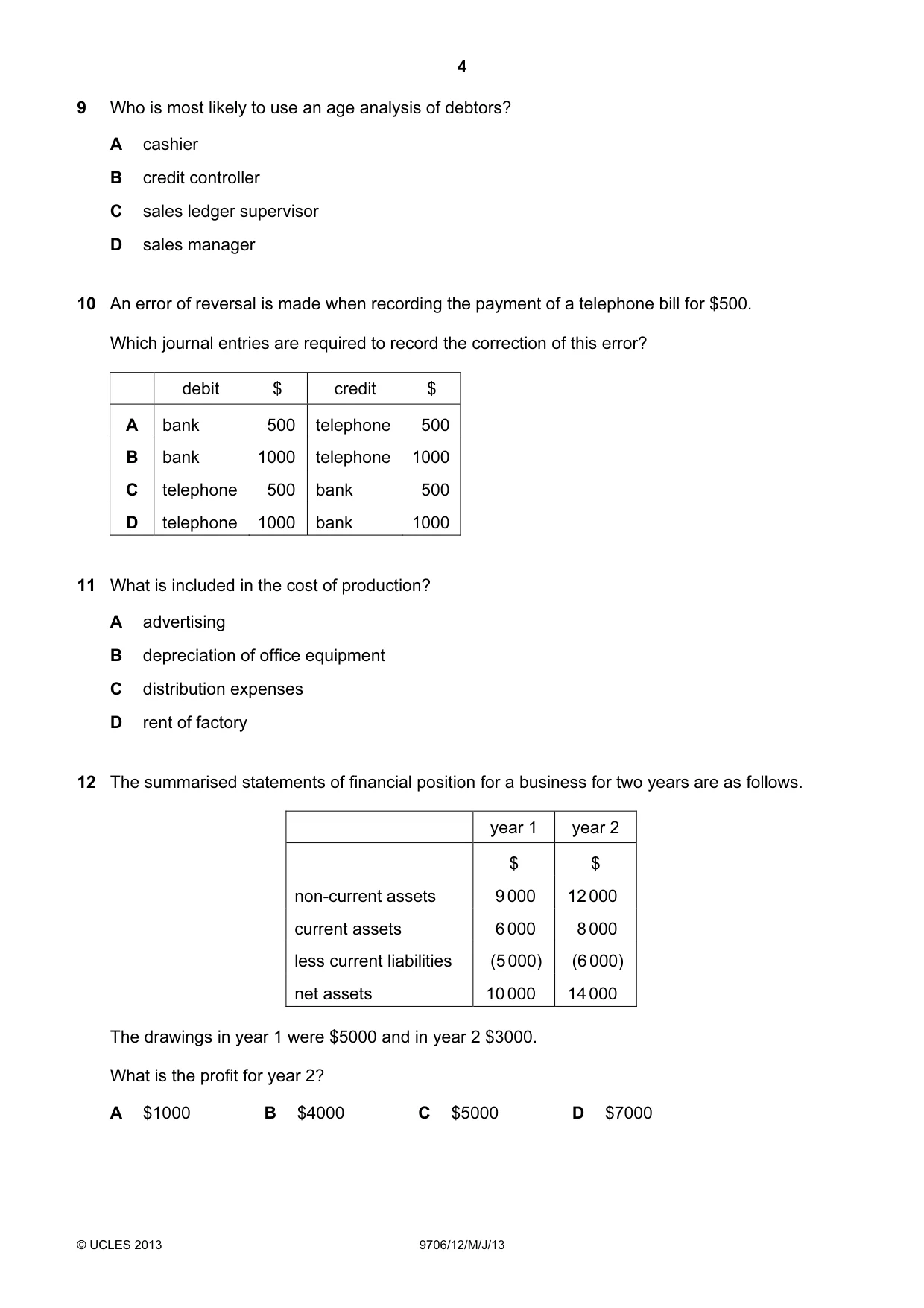
Q9 · Who is most likely to use an age analysis of debtors?
9 Who is most likely to use an age analysis of debtors? A cashier B credit controller C sales ledger supervisor D sales manager
Mark scheme: B
More questions on Analysis and communication of accounting information
Q10 · An error of reversal is made when recording the payment of a telephone bill for $500
10 An error of reversal is made when recording the payment of a telephone bill for $500. Which journal entries are required to record the correction of this error? debit $ credit $ A bank 500 telephone 500 B bank 1000 telephone 1000 C telephone 500 bank 500 D telephone 1000 bank 1000
Mark scheme: D
Q11 · What is included in the cost of production?
11 What is included in the cost of production? A advertising B depreciation of office equipment C distribution expenses D rent of factory
Mark scheme: D
Q12 · The summarised statements of financial position for a business for two years are as…
12 The summarised statements of financial position for a business for two years are as follows. year 1 year 2 $ $ non-current assets 9 000 12 000 current assets 6 000 8 000 less current liabilities (5 000) (6 000) net assets 10 000 14 000 The drawings in year 1 were $5000 and in year 2 $3000. What is the profit for year 2? A $1000 B $4000 C $5000 D $7000
Mark scheme: D
Q13 · The wages of staff employed in manufacturing goods have been debited in the income…
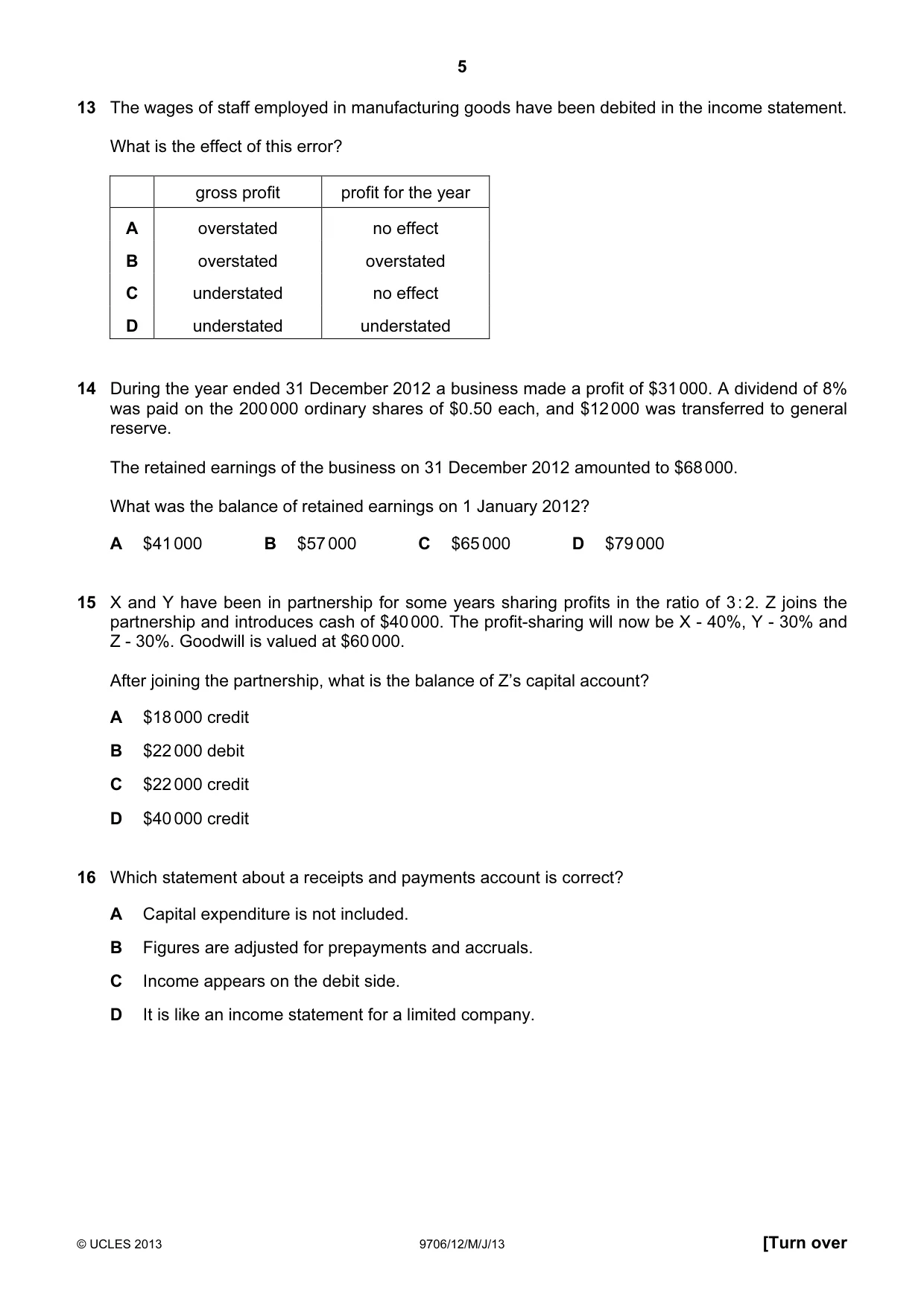
13 The wages of staff employed in manufacturing goods have been debited in the income statement. What is the effect of this error? gross profit profit for the year A overstated no effect B overstated overstated C understated no effect D understated understated
Mark scheme: A
Q14 · During the year ended 31 December 2012 a business made a profit of $31 000
14 During the year ended 31 December 2012 a business made a profit of $31 000. A dividend of 8% was paid on the 200 000 ordinary shares of $0.50 each, and $12 000 was transferred to general reserve. The retained earnings of the business on 31 December 2012 amounted to $68 000. What was the balance of retained earnings on 1 January 2012? A $41 000 B $57 000 C $65 000 D $79 000
Mark scheme: B
Q15 · X and Y have been in partnership for some years sharing profits in the ratio of 3 : 2
15 X and Y have been in partnership for some years sharing profits in the ratio of 3 : 2. Z joins the partnership and introduces cash of $40 000. The profit-sharing will now be X - 40%, Y - 30% and Z - 30%. Goodwill is valued at $60 000. After joining the partnership, what is the balance of Z’s capital account? A $18 000 credit B $22 000 debit C $22 000 credit D $40 000 credit
Mark scheme: C
Q16 · Which statement about a receipts and payments account is correct?
16 Which statement about a receipts and payments account is correct? A Capital expenditure is not included. B Figures are adjusted for prepayments and accruals. C Income appears on the debit side. D It is like an income statement for a limited company.
Mark scheme: C
Q17 · A business sells some inventory for $80 on credit
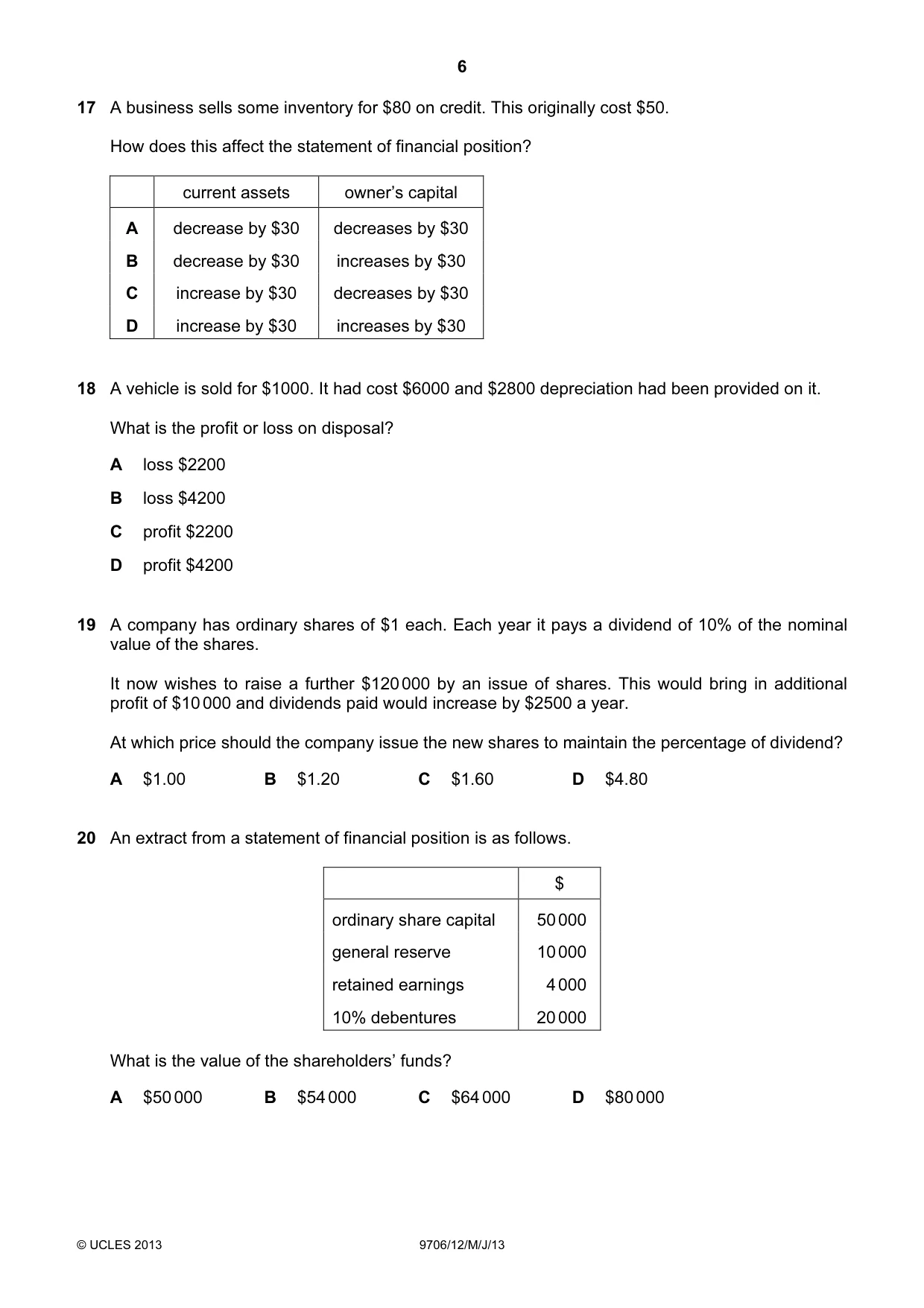
17 A business sells some inventory for $80 on credit. This originally cost $50. How does this affect the statement of financial position? current assets owner’s capital A decrease by $30 decreases by $30 B decrease by $30 increases by $30 C increase by $30 decreases by $30 D increase by $30 increases by $30
Mark scheme: D
Q18 · A vehicle is sold for $1000
18 A vehicle is sold for $1000. It had cost $6000 and $2800 depreciation had been provided on it. What is the profit or loss on disposal? A loss $2200 B loss $4200 C profit $2200 D profit $4200
Mark scheme: A
Q19 · A company has ordinary shares of $1 each
19 A company has ordinary shares of $1 each. Each year it pays a dividend of 10% of the nominal value of the shares. It now wishes to raise a further $120 000 by an issue of shares. This would bring in additional profit of $10 000 and dividends paid would increase by $2500 a year. At which price should the company issue the new shares to maintain the percentage of dividend? A $1.00 B $1.20 C $1.60 D $4.80
Mark scheme: D
More questions on Analysis and communication of accounting information
Q20 · An extract from a statement of financial position is as follows
20 An extract from a statement of financial position is as follows. $ ordinary share capital 50 000 general reserve 10 000 retained earnings 4 000 10% debentures 20 000 What is the value of the shareholders’ funds? A $50 000 B $54 000 C $64 000 D $80 000
Mark scheme: C
Q21 · A company had a trade receivables collection period of 80 days in 2011 and 100 days in…
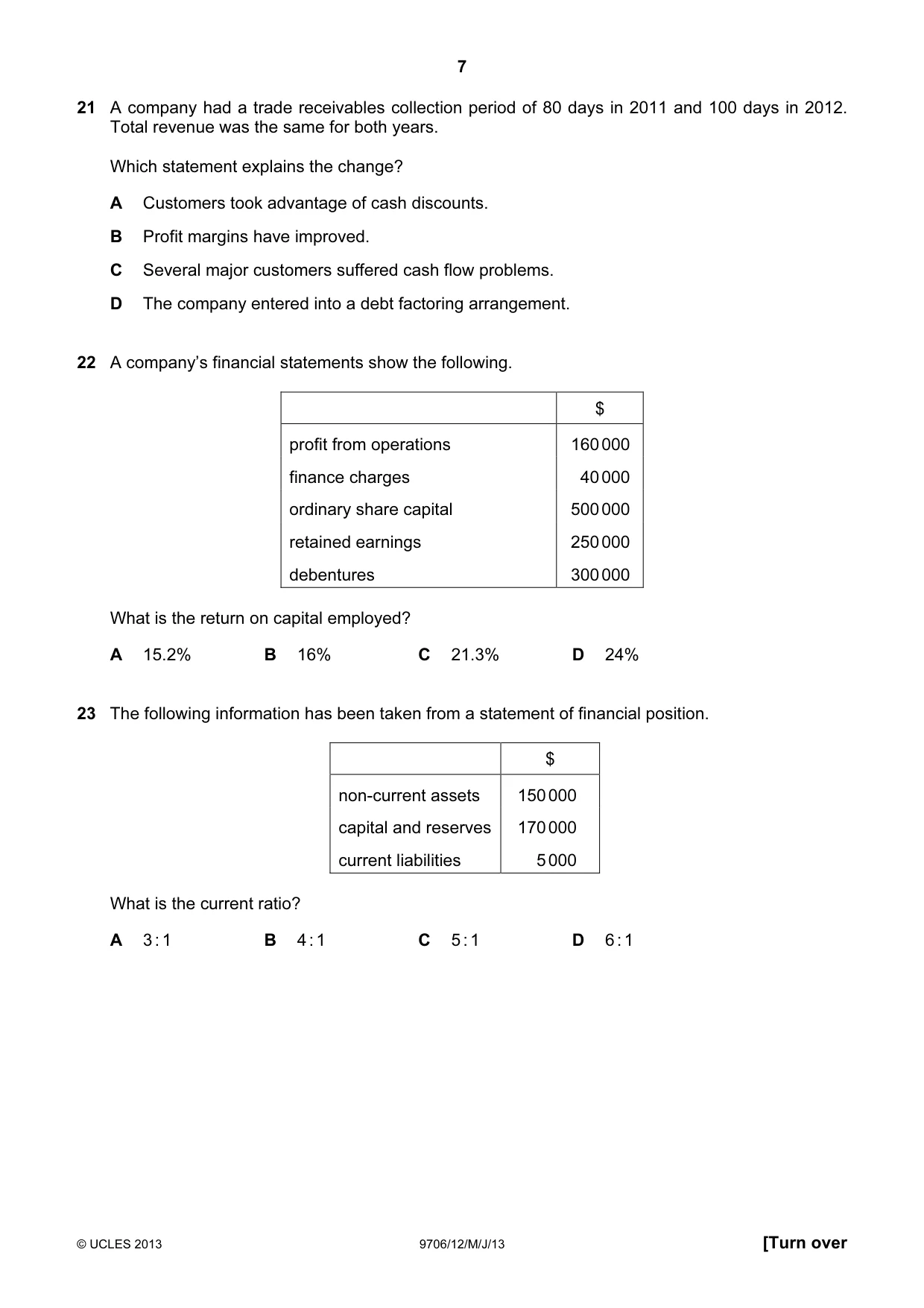
21 A company had a trade receivables collection period of 80 days in 2011 and 100 days in 2012. Total revenue was the same for both years. Which statement explains the change? A Customers took advantage of cash discounts. B Profit margins have improved. C Several major customers suffered cash flow problems. D The company entered into a debt factoring arrangement.
Mark scheme: C
More questions on Analysis and communication of accounting information
Q22 · A company’s financial statements show the following
22 A company’s financial statements show the following. $ profit from operations 160 000 finance charges 40 000 ordinary share capital 500 000 retained earnings 250 000 debentures 300 000 What is the return on capital employed? A 15.2% B 16% C 21.3% D 24%
Mark scheme: A
More questions on Analysis and communication of accounting information
Q23 · The following information has been taken from a statement of financial position
23 The following information has been taken from a statement of financial position. $ non-current assets 150 000 capital and reserves 170 000 current liabilities 5 000 What is the current ratio? A 3 : 1 B 4 : 1 C 5 : 1 D 6 : 1
Mark scheme: C
More questions on Analysis and communication of accounting information
Q24 · A company has ordered a new machine, to be delivered in six months
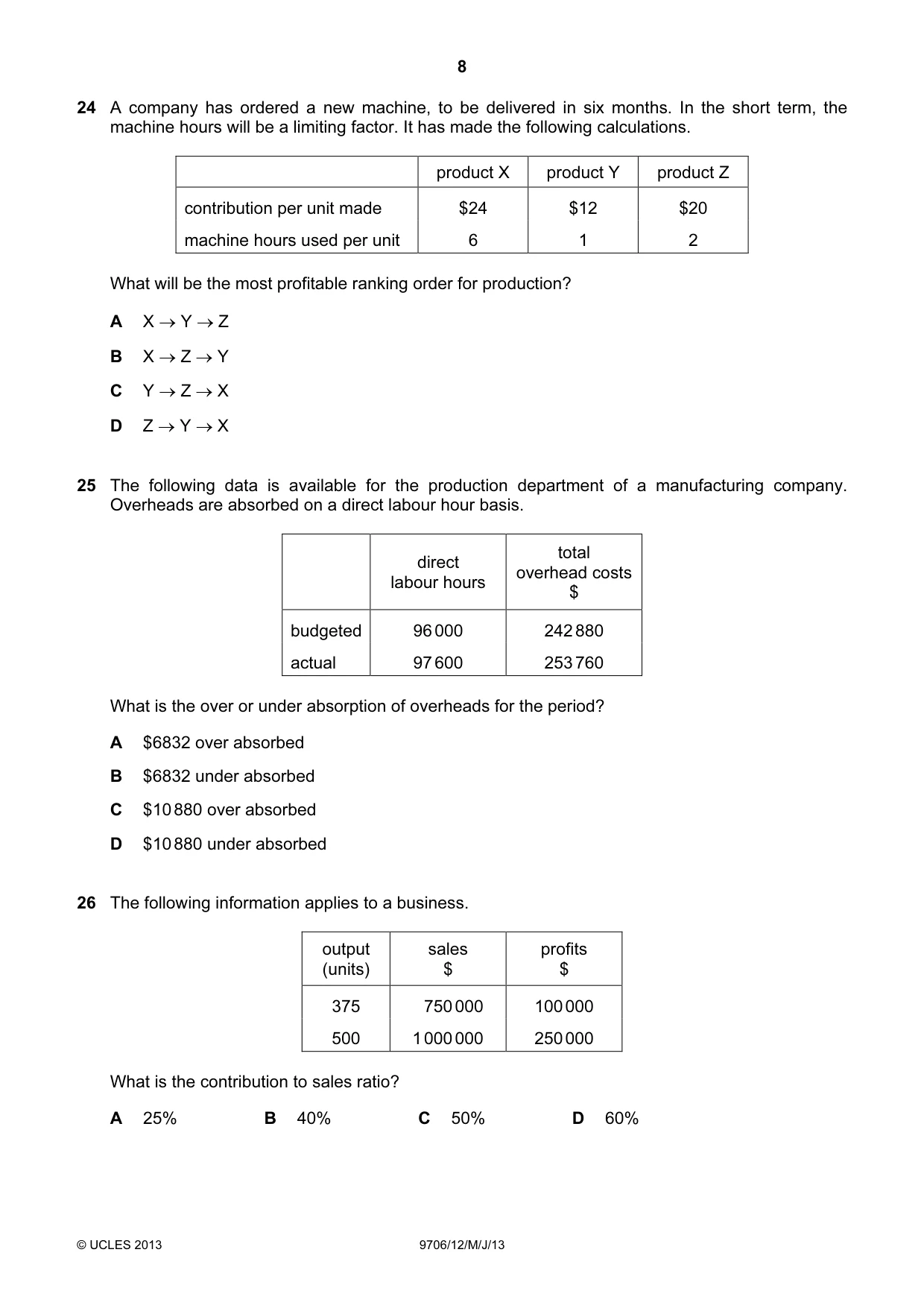
24 A company has ordered a new machine, to be delivered in six months. In the short term, the machine hours will be a limiting factor. It has made the following calculations. product X product Y product Z contribution per unit made $24 $12 $20 machine hours used per unit 6 1 2 What will be the most profitable ranking order for production? A X → Y → Z B X → Z → Y C Y → Z → X D Z → Y → X
Mark scheme: C
Q25 · The following data is available for the production department of a manufacturing company
25 The following data is available for the production department of a manufacturing company. Overheads are absorbed on a direct labour hour basis. total direct overhead costs labour hours $ budgeted 96 000 242 880 actual 97 600 253 760 What is the over or under absorption of overheads for the period? A $6832 over absorbed B $6832 under absorbed C $10 880 over absorbed D $10 880 under absorbed
Mark scheme: B
Q26 · The following information applies to a business
26 The following information applies to a business. output sales profits (units) $ $ 375 750 000 100 000 500 1 000 000 250 000 What is the contribution to sales ratio? A 25% B 40% C 50% D 60%
Mark scheme: D
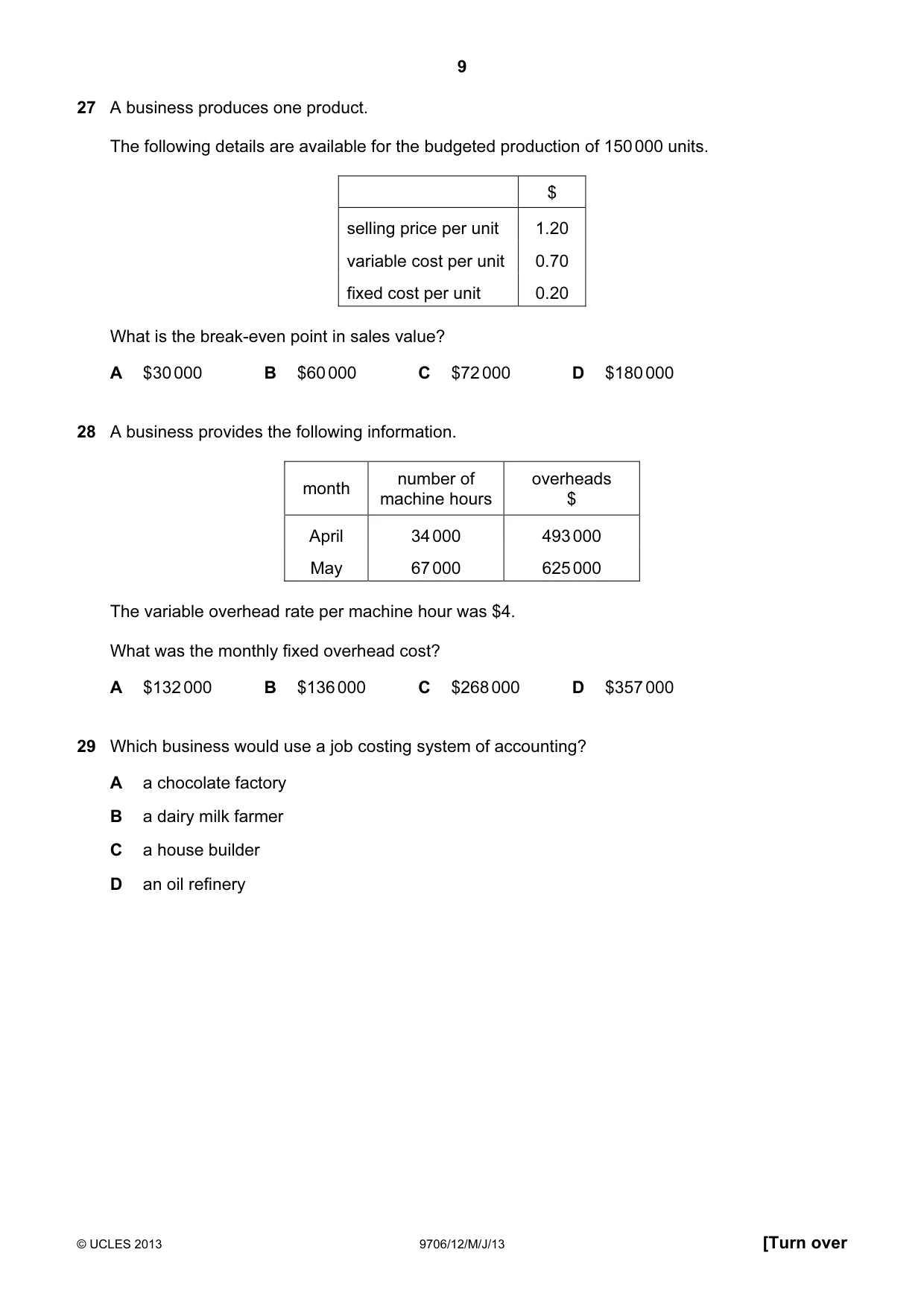
Q27 · A business produces one product
27 A business produces one product. The following details are available for the budgeted production of 150 000 units. $ selling price per unit 1.20 variable cost per unit 0.70 fixed cost per unit 0.20 What is the break-even point in sales value? A $30 000 B $60 000 C $72 000 D $180 000
Mark scheme: C
Q28 · A business provides the following information
28 A business provides the following information. number of overheads month machine hours $ April 34 000 493 000 May 67 000 625 000 The variable overhead rate per machine hour was $4. What was the monthly fixed overhead cost? A $132 000 B $136 000 C $268 000 D $357 000
Mark scheme: D
Q29 · Which business would use a job costing system of accounting?
29 Which business would use a job costing system of accounting? A a chocolate factory B a dairy milk farmer C a house builder D an oil refinery
Mark scheme: C
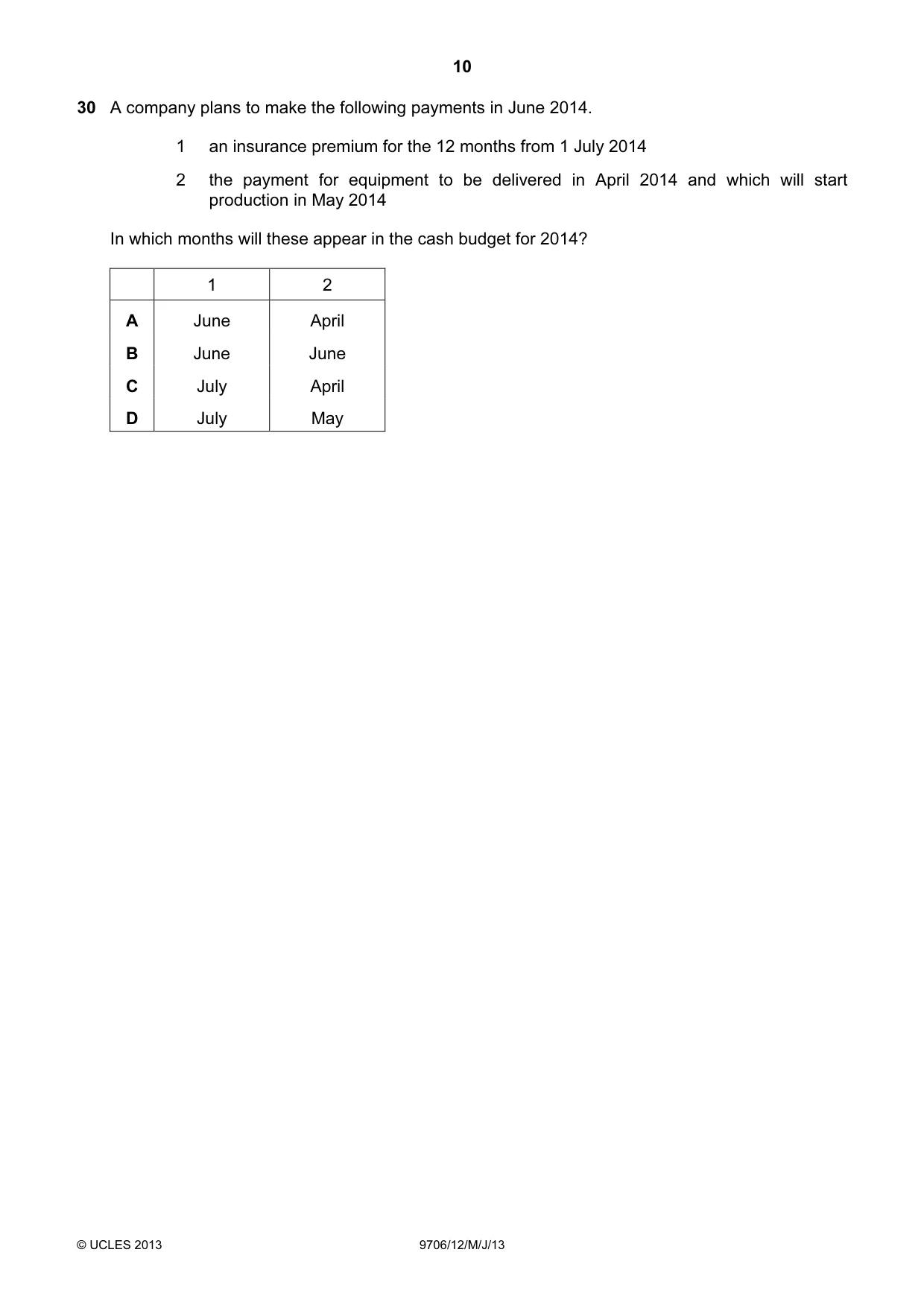
Q30 · A company plans to make the following payments in June 2014
30 A company plans to make the following payments in June 2014. 1 an insurance premium for the 12 months from 1 July 2014 2 the payment for equipment to be delivered in April 2014 and which will start production in May 2014 In which months will these appear in the cash budget for 2014? 1 2 A June April B June June C July April D July May
Mark scheme: B
What was in this paper
The subtopics covered by these 30 questions, and how many questions each got. Open one in a new tab to see every Cambridge question on it.
What you needed in this session
Cambridge’s own grade thresholds for 2013 May/June, Paper 1 · Variant 2. A higher threshold means an easier paper — the bar moves with how the cohort did.