Cambridge A Level Accounting 9706 — 2013 Oct/Nov Paper 1 · Variant 2
9706/12/O/N/13 · 30 questions · 30 marks · ≈34 min
The question paper and its mark scheme, free to read here and free to download. This is Cambridge’s own paper, exactly as it was sat.
Question paper12 pages
Mark scheme2 pages
Answers below. Sit the paper first if you are practising.
Questions as text
Q1 · The following information is taken from a trader’s statement of financial position
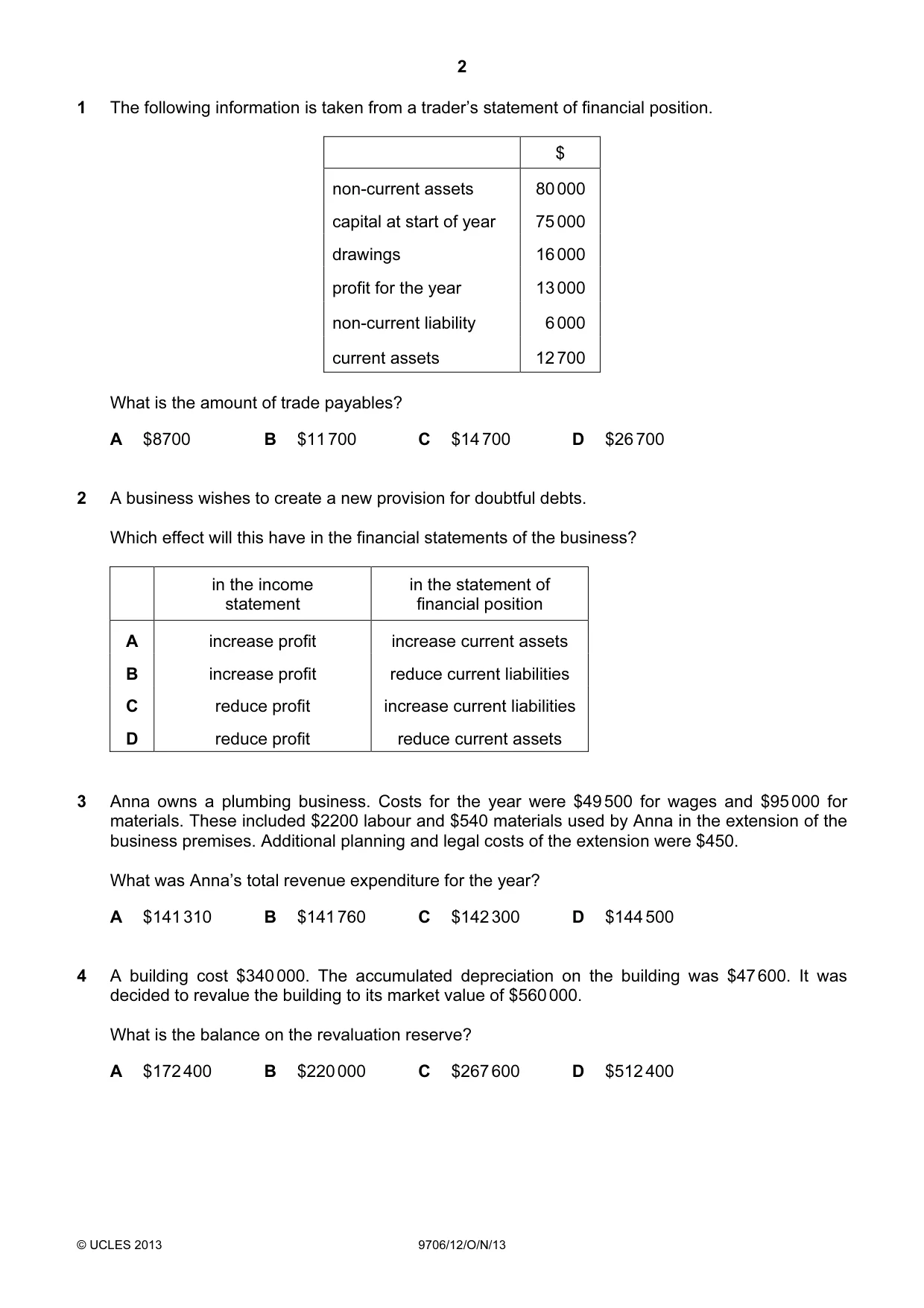
1 The following information is taken from a trader’s statement of financial position. $ non-current assets 80 000 capital at start of year 75 000 drawings 16 000 profit for the year 13 000 non-current liability 6 000 current assets 12 700 What is the amount of trade payables? A $8700 B $11 700 C $14 700 D $26 700
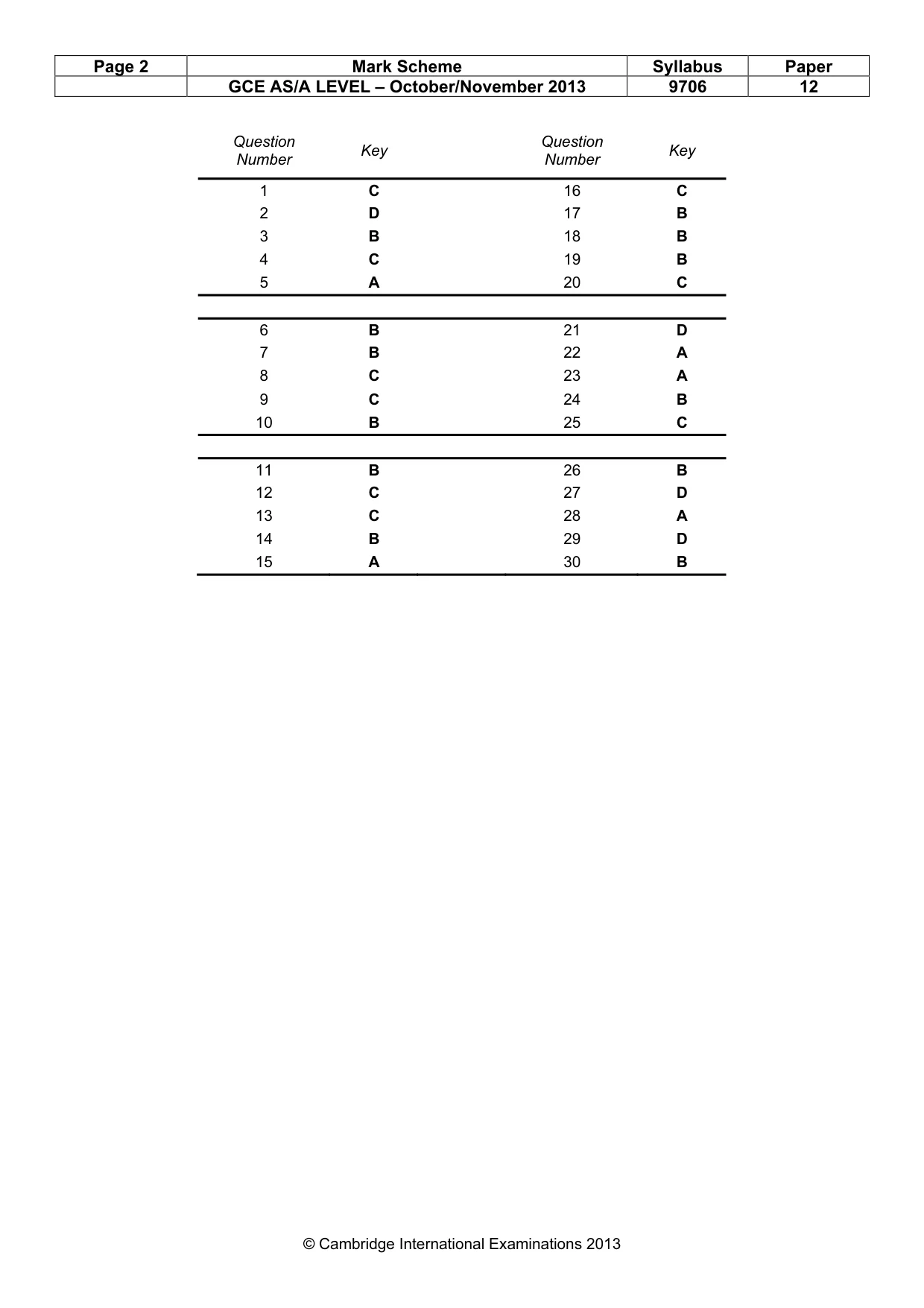
Mark scheme: C
Q2 · A business wishes to create a new provision for doubtful debts
2 A business wishes to create a new provision for doubtful debts. Which effect will this have in the financial statements of the business? in the income in the statement of statement financial position A increase profit increase current assets B increase profit reduce current liabilities C reduce profit increase current liabilities D reduce profit reduce current assets
Mark scheme: D
Q3 · Anna owns a plumbing business
3 Anna owns a plumbing business. Costs for the year were $49 500 for wages and $95 000 for materials. These included $2200 labour and $540 materials used by Anna in the extension of the business premises. Additional planning and legal costs of the extension were $450. What was Anna’s total revenue expenditure for the year? A $141 310 B $141 760 C $142 300 D $144 500
Mark scheme: B
Q4 · A building cost $340 000
4 A building cost $340 000. The accumulated depreciation on the building was $47 600. It was decided to revalue the building to its market value of $560 000. What is the balance on the revaluation reserve? A $172 400 B $220 000 C $267 600 D $512 400
Mark scheme: C
Q5 · The table shows extracts from the statements of financial position of a business
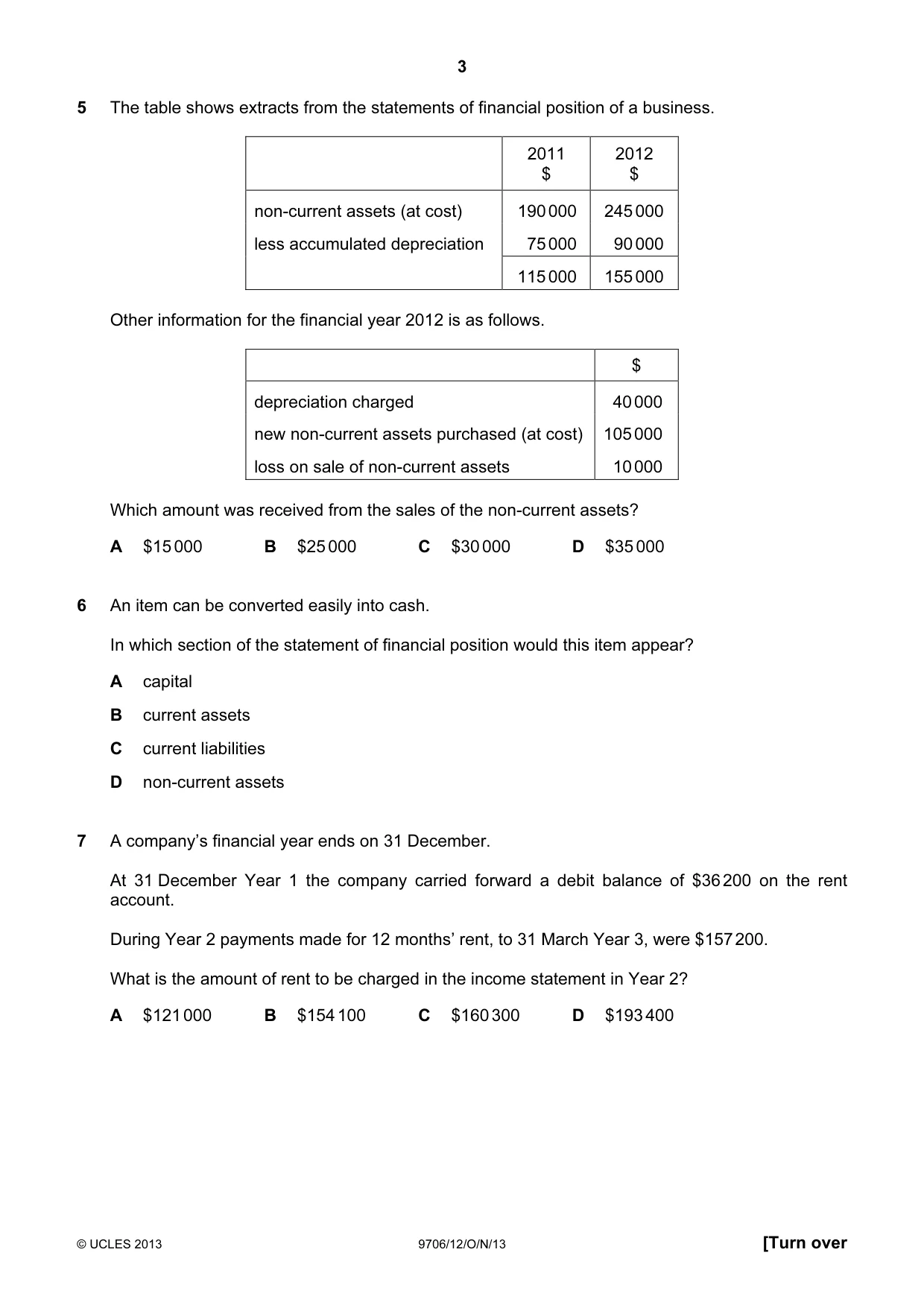
5 The table shows extracts from the statements of financial position of a business. 2011 2012 $ $ non-current assets (at cost) 190 000 245 000 less accumulated depreciation 75 000 90 000 115 000 155 000 Other information for the financial year 2012 is as follows. $ depreciation charged 40 000 new non-current assets purchased (at cost) 105 000 loss on sale of non-current assets 10 000 Which amount was received from the sales of the non-current assets? A $15 000 B $25 000 C $30 000 D $35 000
Mark scheme: A
Q6 · An item can be converted easily into cash
6 An item can be converted easily into cash. In which section of the statement of financial position would this item appear? A capital B current assets C current liabilities D non-current assets
Mark scheme: B
Q7 · A company’s financial year ends on 31 December
7 A company’s financial year ends on 31 December. At 31 December Year 1 the company carried forward a debit balance of $36 200 on the rent account. During Year 2 payments made for 12 months’ rent, to 31 March Year 3, were $157 200. What is the amount of rent to be charged in the income statement in Year 2? A $121 000 B $154 100 C $160 300 D $193 400
Mark scheme: B
Q8 · A trader buys inventory costing $6000
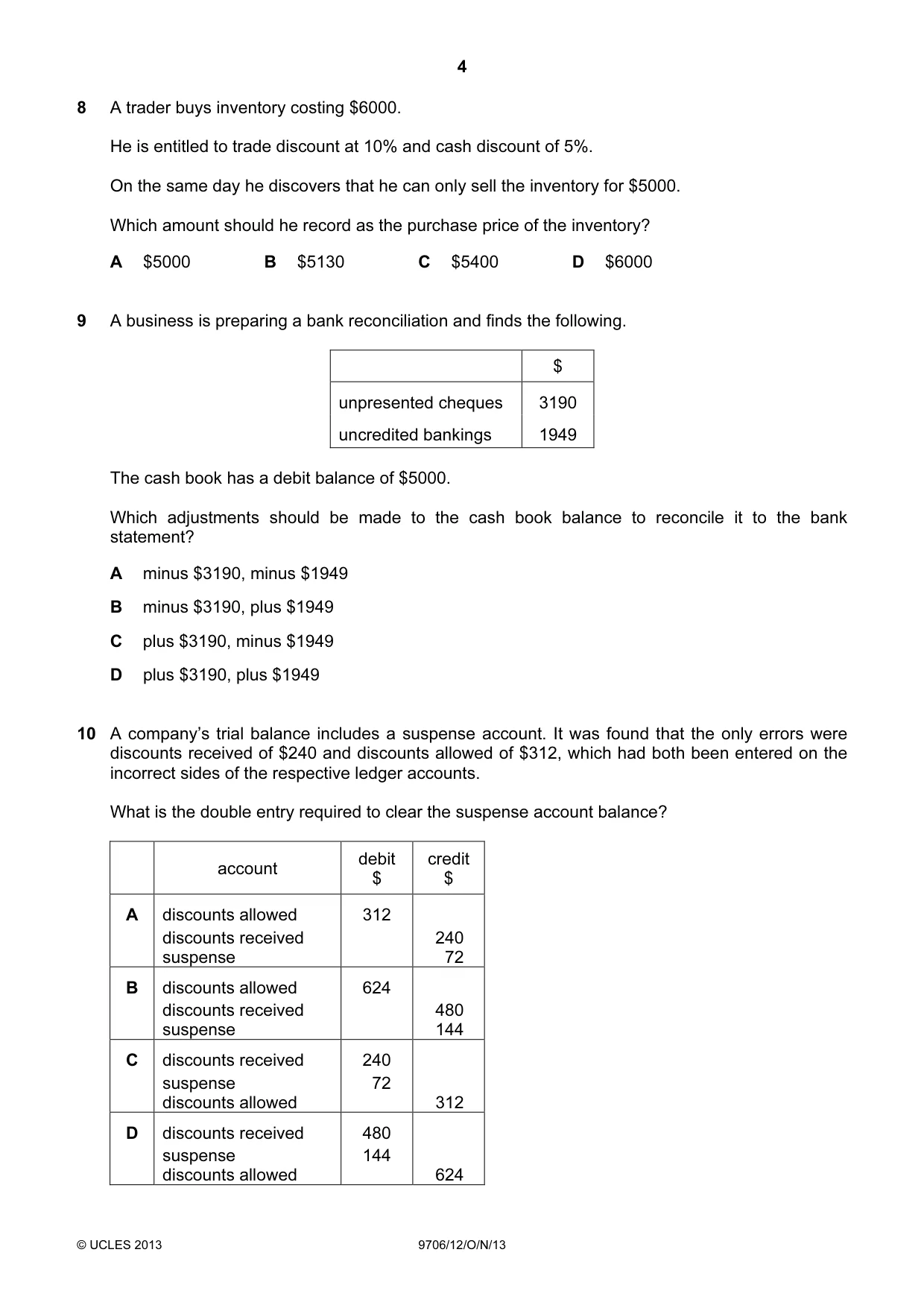
8 A trader buys inventory costing $6000. He is entitled to trade discount at 10% and cash discount of 5%. On the same day he discovers that he can only sell the inventory for $5000. Which amount should he record as the purchase price of the inventory? A $5000 B $5130 C $5400 D $6000
Mark scheme: C
Q9 · A business is preparing a bank reconciliation and finds the following
9 A business is preparing a bank reconciliation and finds the following. $ unpresented cheques 3190 uncredited bankings 1949 The cash book has a debit balance of $5000. Which adjustments should be made to the cash book balance to reconcile it to the bank statement? A minus $3190, minus $1949 B minus $3190, plus $1949 C plus $3190, minus $1949 D plus $3190, plus $1949
Mark scheme: C
Q10 · A company’s trial balance includes a suspense account
10 A company’s trial balance includes a suspense account. It was found that the only errors were discounts received of $240 and discounts allowed of $312, which had both been entered on the incorrect sides of the respective ledger accounts. What is the double entry required to clear the suspense account balance? debit credit account $ $ A discounts allowed 312 discounts received 240 suspense 72 B discounts allowed 624 discounts received 480 suspense 144 C discounts received 240 suspense 72 discounts allowed 312 D discounts received 480 suspense 144 discounts allowed 624
Mark scheme: B
Q11 · During the month a company lost a quantity of inventory in a burglary
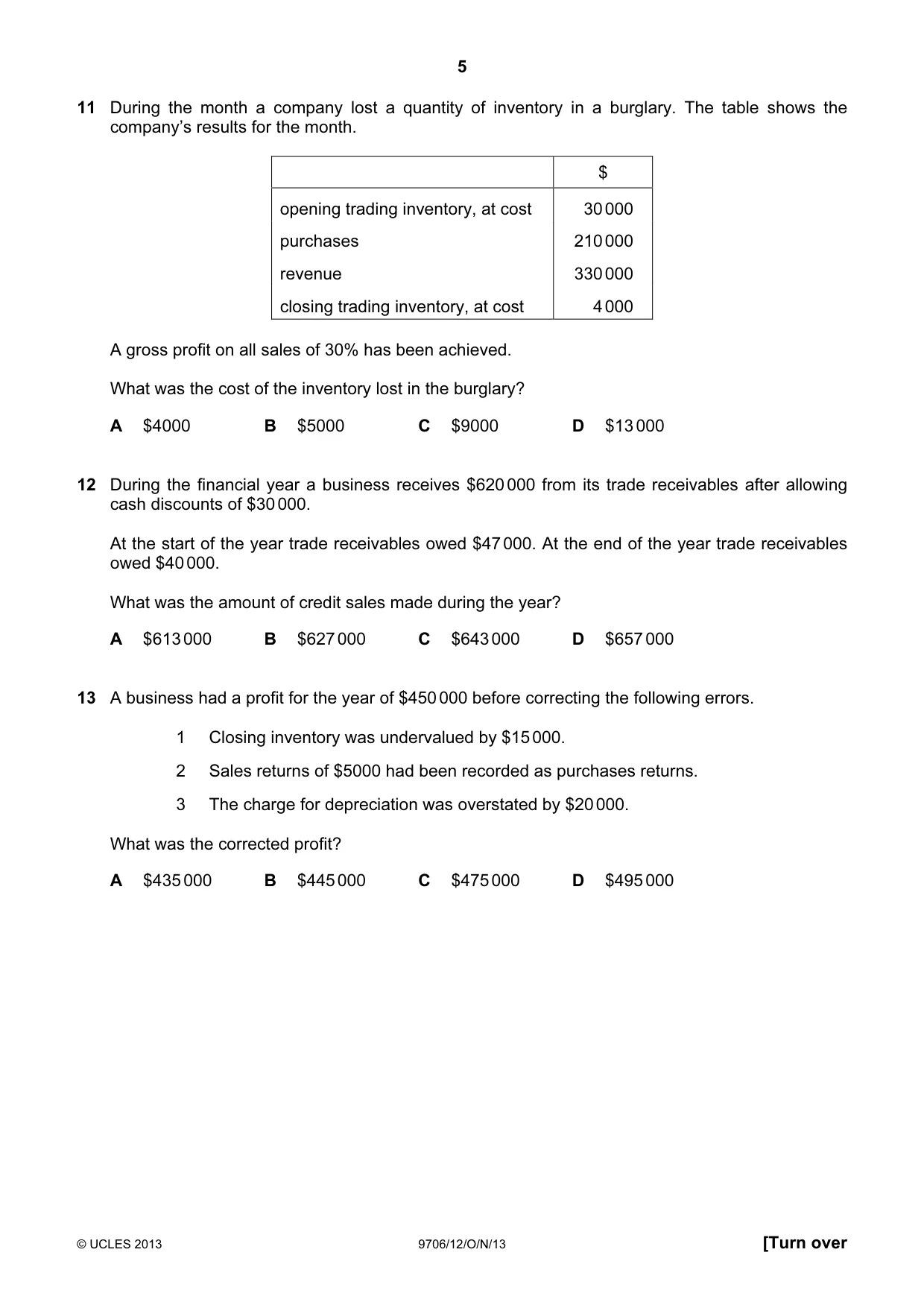
11 During the month a company lost a quantity of inventory in a burglary. The table shows the company’s results for the month. $ opening trading inventory, at cost 30 000 purchases 210 000 revenue 330 000 closing trading inventory, at cost 4 000 A gross profit on all sales of 30% has been achieved. What was the cost of the inventory lost in the burglary? A $4000 B $5000 C $9000 D $13 000
Mark scheme: B
Q12 · During the financial year a business receives $620 000 from its trade receivables after…
12 During the financial year a business receives $620 000 from its trade receivables after allowing cash discounts of $30 000. At the start of the year trade receivables owed $47 000. At the end of the year trade receivables owed $40 000. What was the amount of credit sales made during the year? A $613 000 B $627 000 C $643 000 D $657 000
Mark scheme: C
Q13 · A business had a profit for the year of $450 000 before correcting the following errors
13 A business had a profit for the year of $450 000 before correcting the following errors. 1 Closing inventory was undervalued by $15 000. 2 Sales returns of $5000 had been recorded as purchases returns. 3 The charge for depreciation was overstated by $20 000. What was the corrected profit? A $435 000 B $445 000 C $475 000 D $495 000
Mark scheme: C
Q14 · The following departmental accounts have been prepared for a limited company for the year…
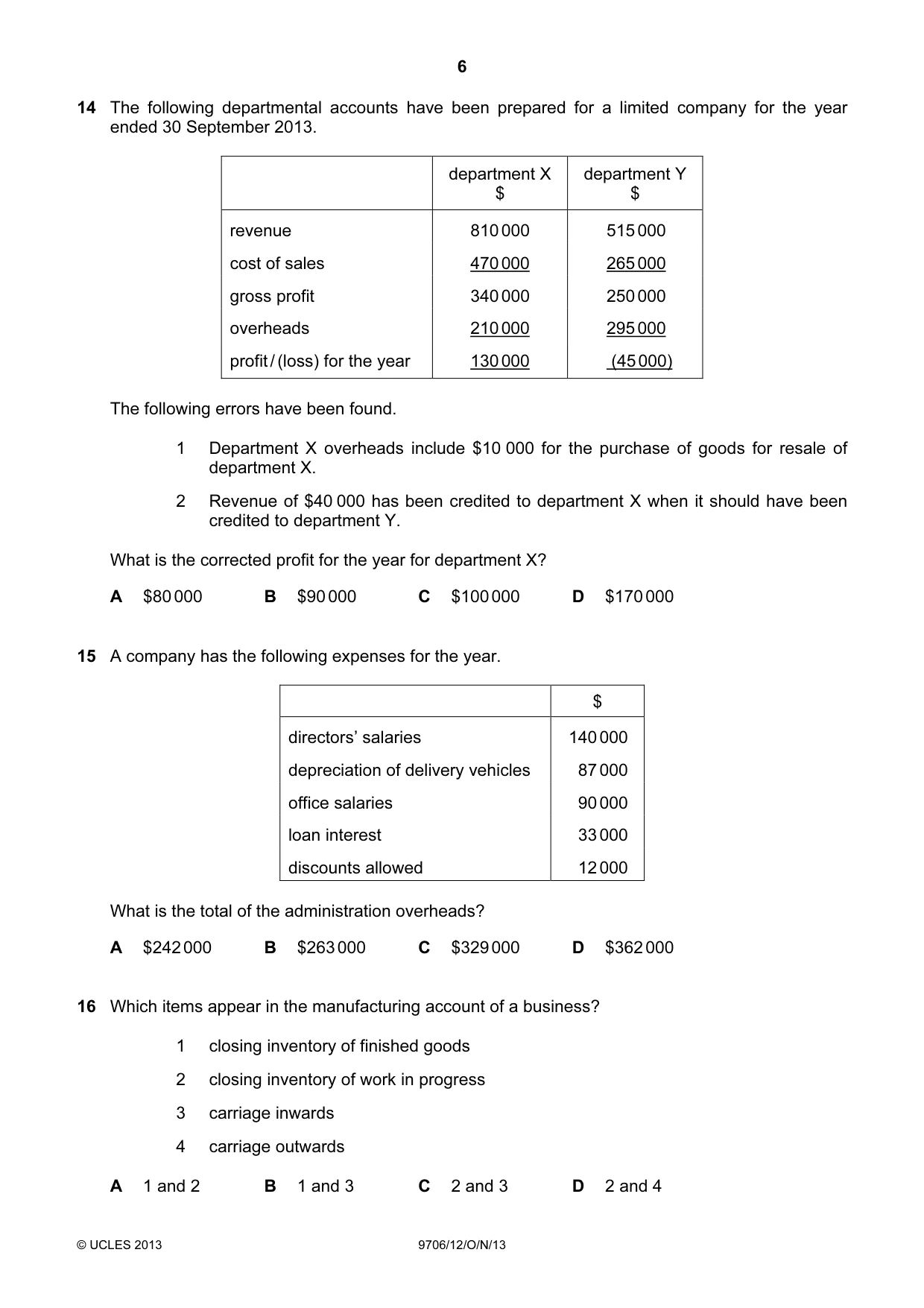
14 The following departmental accounts have been prepared for a limited company for the year ended 30 September 2013. department X department Y $ $ revenue 810 000 515 000 cost of sales 470 000 265 000 gross profit 340 000 250 000 overheads 210 000 295 000 profit / (loss) for the year 130 000 (45 000) The following errors have been found. 1 Department X overheads include $10 000 for the purchase of goods for resale of department X. 2 Revenue of $40 000 has been credited to department X when it should have been credited to department Y. What is the corrected profit for the year for department X? A $80 000 B $90 000 C $100 000 D $170 000
Mark scheme: B
Q15 · A company has the following expenses for the year
15 A company has the following expenses for the year. $ directors’ salaries 140 000 depreciation of delivery vehicles 87 000 office salaries 90 000 loan interest 33 000 discounts allowed 12 000 What is the total of the administration overheads? A $242 000 B $263 000 C $329 000 D $362 000
Mark scheme: A
Q16 · Which items appear in the manufacturing account of a business?
16 Which items appear in the manufacturing account of a business? 1 closing inventory of finished goods 2 closing inventory of work in progress 3 carriage inwards 4 carriage outwards A 1 and 2 B 1 and 3 C 2 and 3 D 2 and 4
Mark scheme: C
Q17 · X becomes a partner in a business receiving a 25% share in the profits
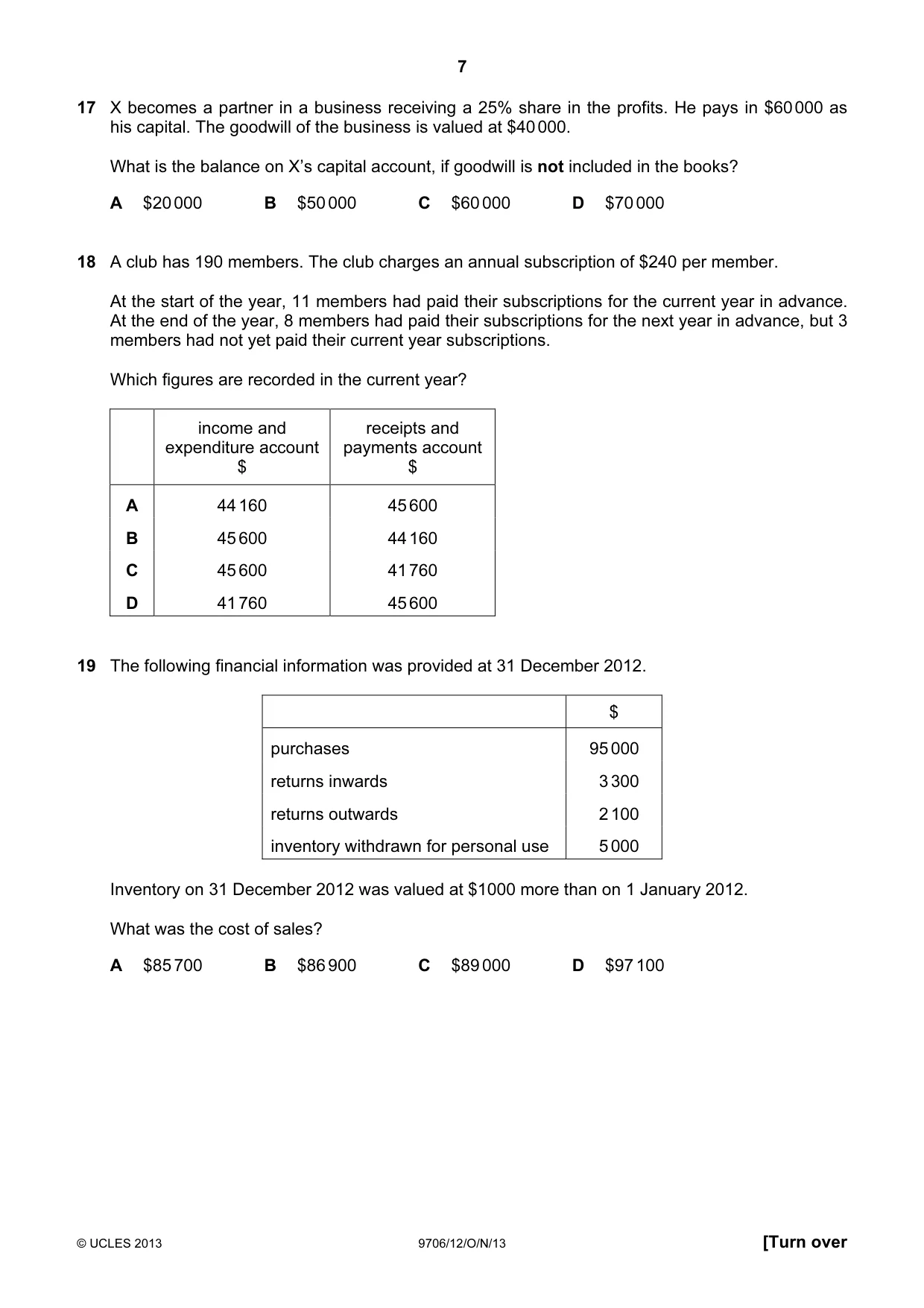
17 X becomes a partner in a business receiving a 25% share in the profits. He pays in $60 000 as his capital. The goodwill of the business is valued at $40 000. What is the balance on X’s capital account, if goodwill is not included in the books? A $20 000 B $50 000 C $60 000 D $70 000
Mark scheme: B
Q18 · A club has 190 members
18 A club has 190 members. The club charges an annual subscription of $240 per member. At the start of the year, 11 members had paid their subscriptions for the current year in advance. At the end of the year, 8 members had paid their subscriptions for the next year in advance, but 3 members had not yet paid their current year subscriptions. Which figures are recorded in the current year? income and receipts and expenditure account payments account $ $ A 44 160 45 600 B 45 600 44 160 C 45 600 41 760 D 41 760 45 600
Mark scheme: B
Q19 · The following financial information was provided at 31 December 2012
19 The following financial information was provided at 31 December 2012. $ purchases 95 000 returns inwards 3 300 returns outwards 2 100 inventory withdrawn for personal use 5 000 Inventory on 31 December 2012 was valued at $1000 more than on 1 January 2012. What was the cost of sales? A $85 700 B $86 900 C $89 000 D $97 100
Mark scheme: B
Q20 · A vehicle is sold for $1500
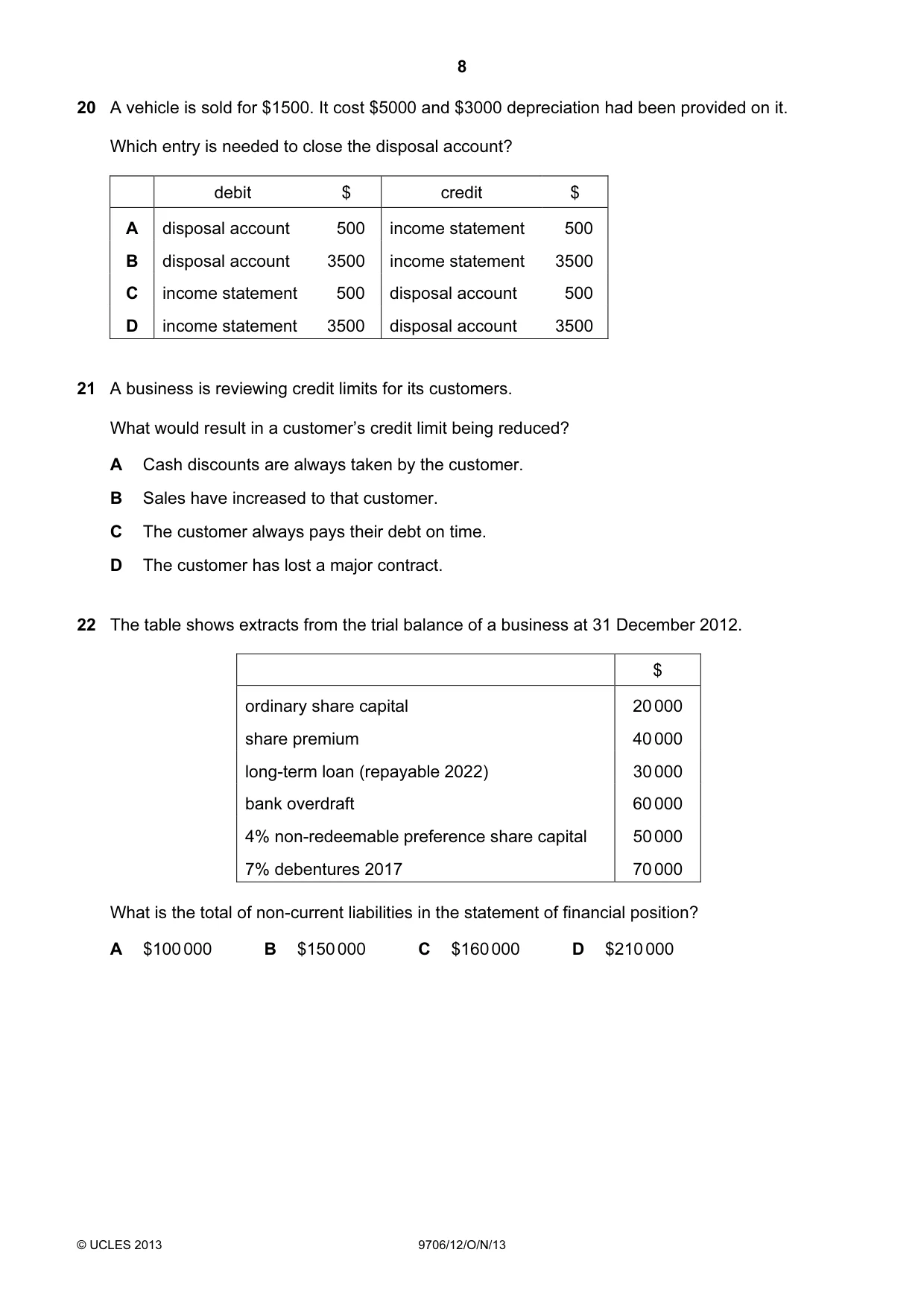
20 A vehicle is sold for $1500. It cost $5000 and $3000 depreciation had been provided on it. Which entry is needed to close the disposal account? debit $ credit $ A disposal account 500 income statement 500 B disposal account 3500 income statement 3500 C income statement 500 disposal account 500 D income statement 3500 disposal account 3500
Mark scheme: C
Q21 · A business is reviewing credit limits for its customers
21 A business is reviewing credit limits for its customers. What would result in a customer’s credit limit being reduced? A Cash discounts are always taken by the customer. B Sales have increased to that customer. C The customer always pays their debt on time. D The customer has lost a major contract.
Mark scheme: D
More questions on Analysis and communication of accounting information
Q22 · The table shows extracts from the trial balance of a business at 31 December 2012
22 The table shows extracts from the trial balance of a business at 31 December 2012. $ ordinary share capital 20 000 share premium 40 000 long-term loan (repayable 2022) 30 000 bank overdraft 60 000 4% non-redeemable preference share capital 50 000 7% debentures 2017 70 000 What is the total of non-current liabilities in the statement of financial position? A $100 000 B $150 000 C $160 000 D $210 000
Mark scheme: A
Q23 · The trade receivables turnover for a company was 100 days in 2011
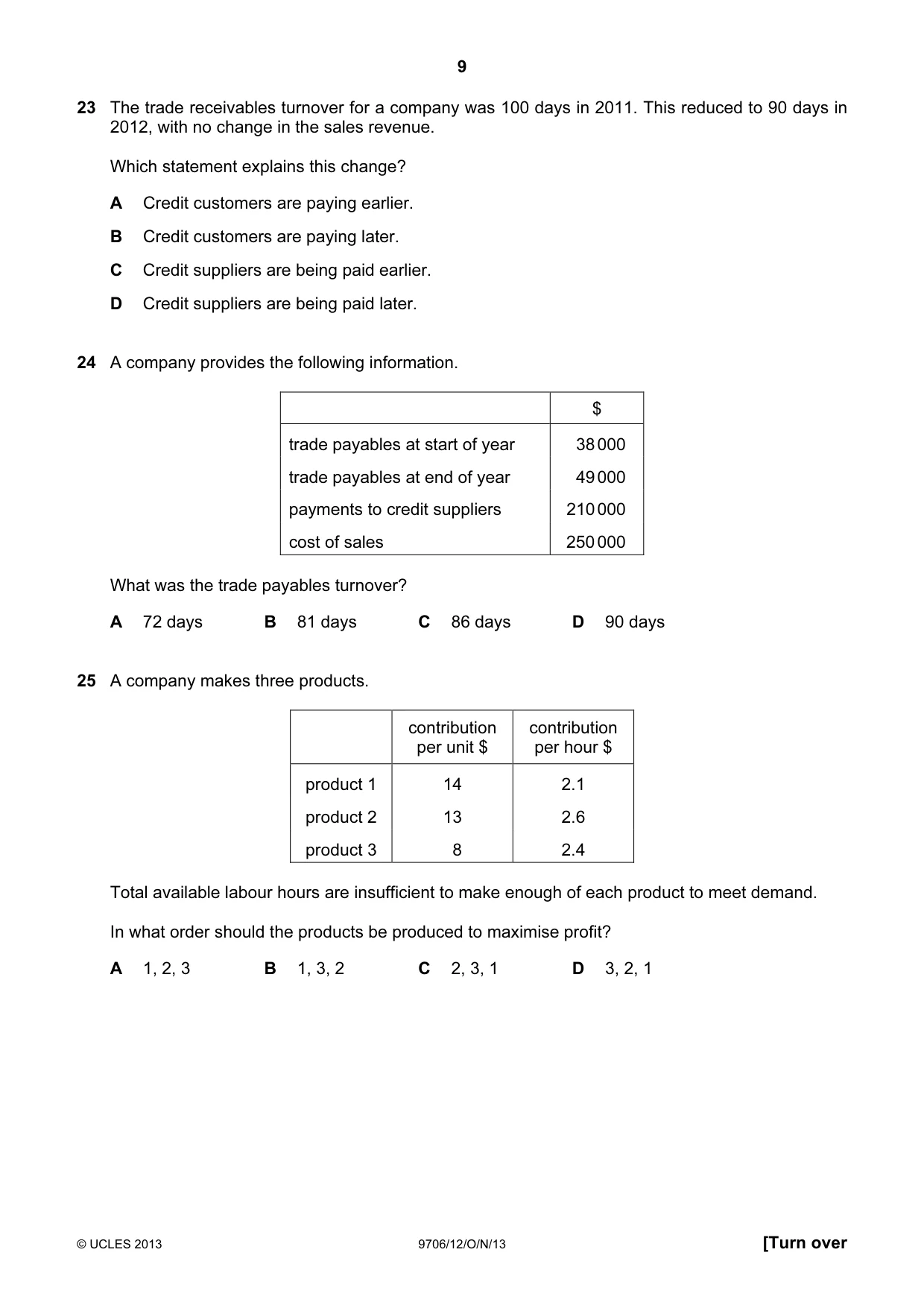
23 The trade receivables turnover for a company was 100 days in 2011. This reduced to 90 days in 2012, with no change in the sales revenue. Which statement explains this change? A Credit customers are paying earlier. B Credit customers are paying later. C Credit suppliers are being paid earlier. D Credit suppliers are being paid later.
Mark scheme: A
More questions on Analysis and communication of accounting information
Q24 · A company provides the following information
24 A company provides the following information. $ trade payables at start of year 38 000 trade payables at end of year 49 000 payments to credit suppliers 210 000 cost of sales 250 000 What was the trade payables turnover? A 72 days B 81 days C 86 days D 90 days
Mark scheme: B
More questions on Analysis and communication of accounting information
Q25 · A company makes three products
25 A company makes three products. contribution contribution per unit $ per hour $ product 1 14 2.1 product 2 13 2.6 product 3 8 2.4 Total available labour hours are insufficient to make enough of each product to meet demand. In what order should the products be produced to maximise profit? A 1, 2, 3 B 1, 3, 2 C 2, 3, 1 D 3, 2, 1
Mark scheme: C
Q26 · The cost of using a mobile phone is made up of a monthly rental charge and the cost of…
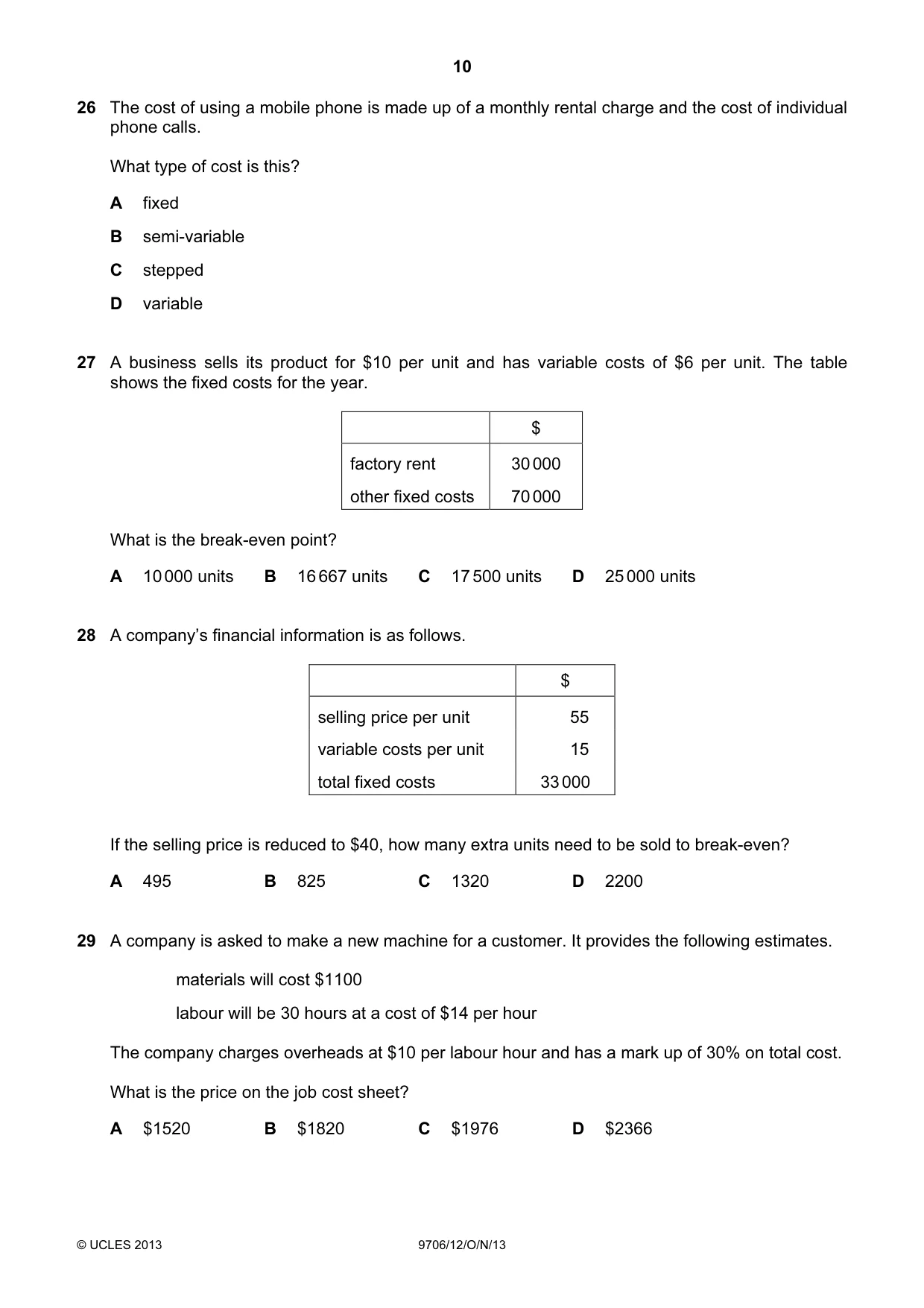
26 The cost of using a mobile phone is made up of a monthly rental charge and the cost of individual phone calls. What type of cost is this? A fixed B semi-variable C stepped D variable
Mark scheme: B
Q27 · A business sells its product for $10 per unit and has variable costs of $6 per unit
27 A business sells its product for $10 per unit and has variable costs of $6 per unit. The table shows the fixed costs for the year. $ factory rent 30 000 other fixed costs 70 000 What is the break-even point? A 10 000 units B 16 667 units C 17 500 units D 25 000 units
Mark scheme: D
Q28 · A company’s financial information is as follows
28 A company’s financial information is as follows. $ selling price per unit 55 variable costs per unit 15 total fixed costs 33 000 If the selling price is reduced to $40, how many extra units need to be sold to break-even? A 495 B 825 C 1320 D 2200
Mark scheme: A
Q29 · A company is asked to make a new machine for a customer
29 A company is asked to make a new machine for a customer. It provides the following estimates. materials will cost $1100 labour will be 30 hours at a cost of $14 per hour The company charges overheads at $10 per labour hour and has a mark up of 30% on total cost. What is the price on the job cost sheet? A $1520 B $1820 C $1976 D $2366
Mark scheme: D
Q30 · Ted plans to buy a motor vehicle for $12 000 on 1 May 2014
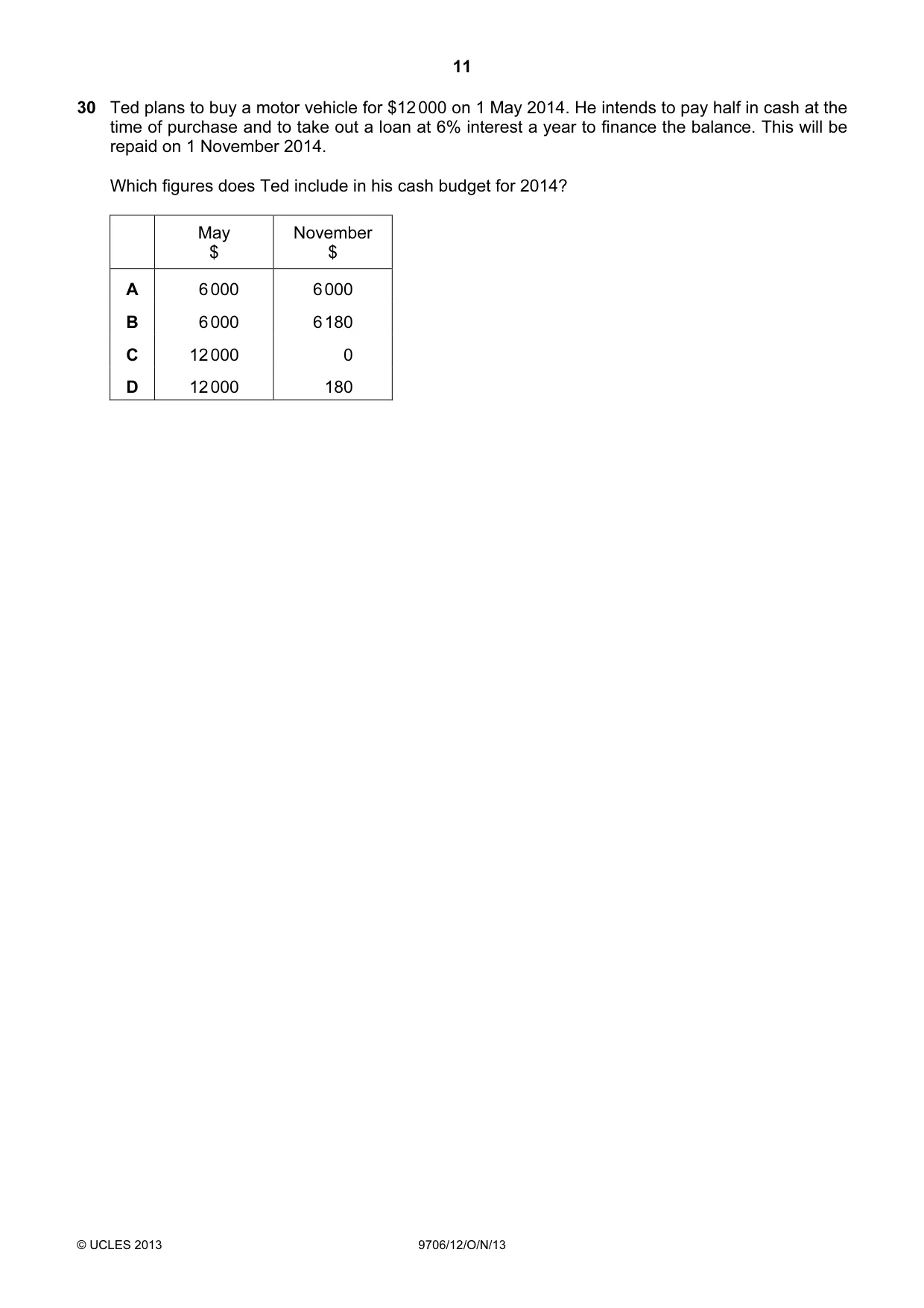
30 Ted plans to buy a motor vehicle for $12 000 on 1 May 2014. He intends to pay half in cash at the time of purchase and to take out a loan at 6% interest a year to finance the balance. This will be repaid on 1 November 2014. Which figures does Ted include in his cash budget for 2014? May November $ $ A 6 000 6 000 B 6 000 6 180 C 12 000 0 D 12 000 180
Mark scheme: B
What was in this paper
The subtopics covered by these 30 questions, and how many questions each got. Open one in a new tab to see every Cambridge question on it.
What you needed in this session
Cambridge’s own grade thresholds for 2013 Oct/Nov, Paper 1 · Variant 2. A higher threshold means an easier paper — the bar moves with how the cohort did.