Cambridge A Level Accounting 9706 — 2006 May/June Paper 1 · Variant 1
9706/11/M/J/06 · 30 questions · 30 marks · ≈34 min
The question paper and its mark scheme, free to read here and free to download. This is Cambridge’s own paper, exactly as it was sat.
Question paper12 pages

Mark scheme2 pages
Answers below. Sit the paper first if you are practising.
Questions as text
Q1 · Which item should be treated as capital expenditure?
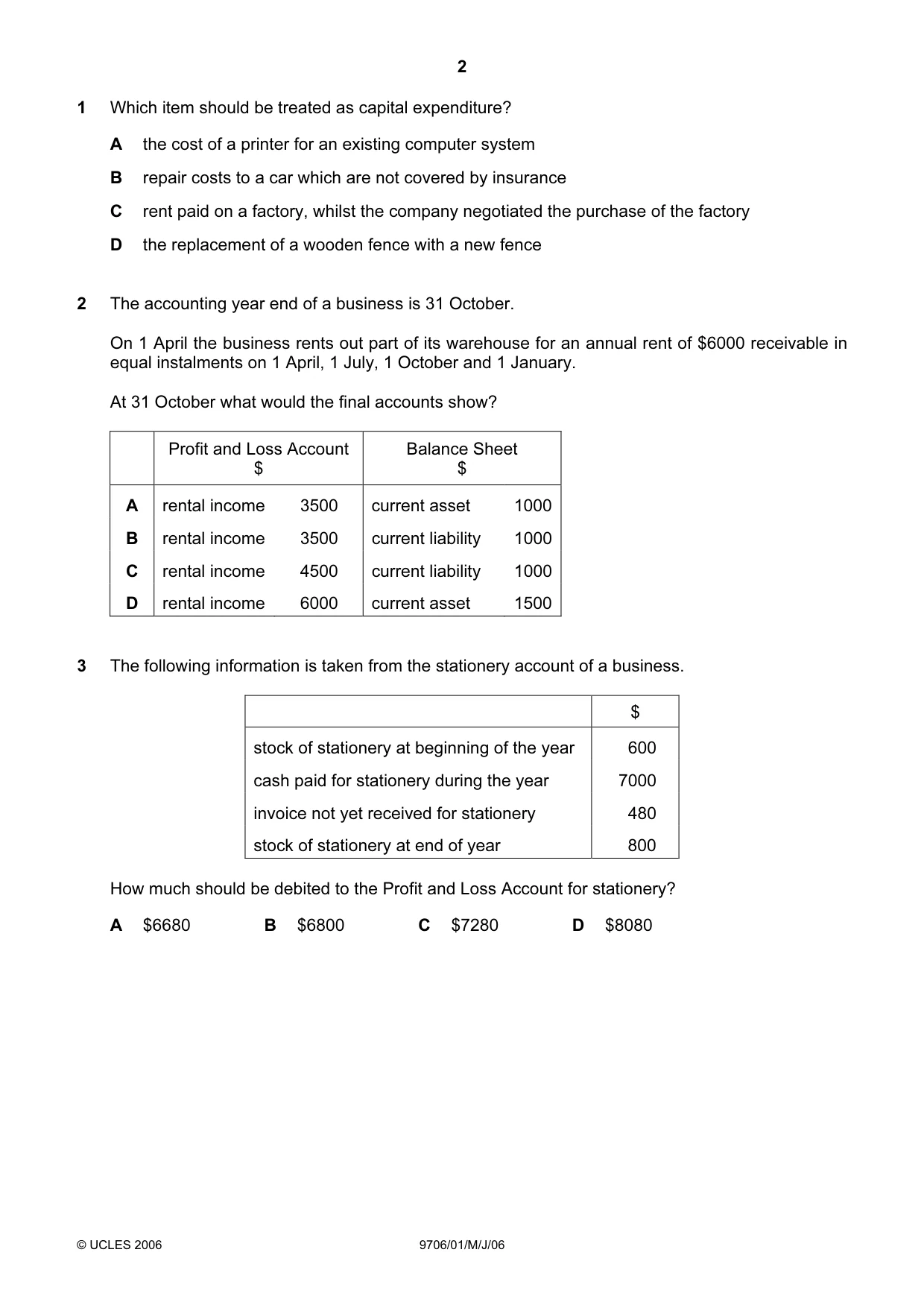
1 Which item should be treated as capital expenditure? A the cost of a printer for an existing computer system B repair costs to a car which are not covered by insurance C rent paid on a factory, whilst the company negotiated the purchase of the factory D the replacement of a wooden fence with a new fence
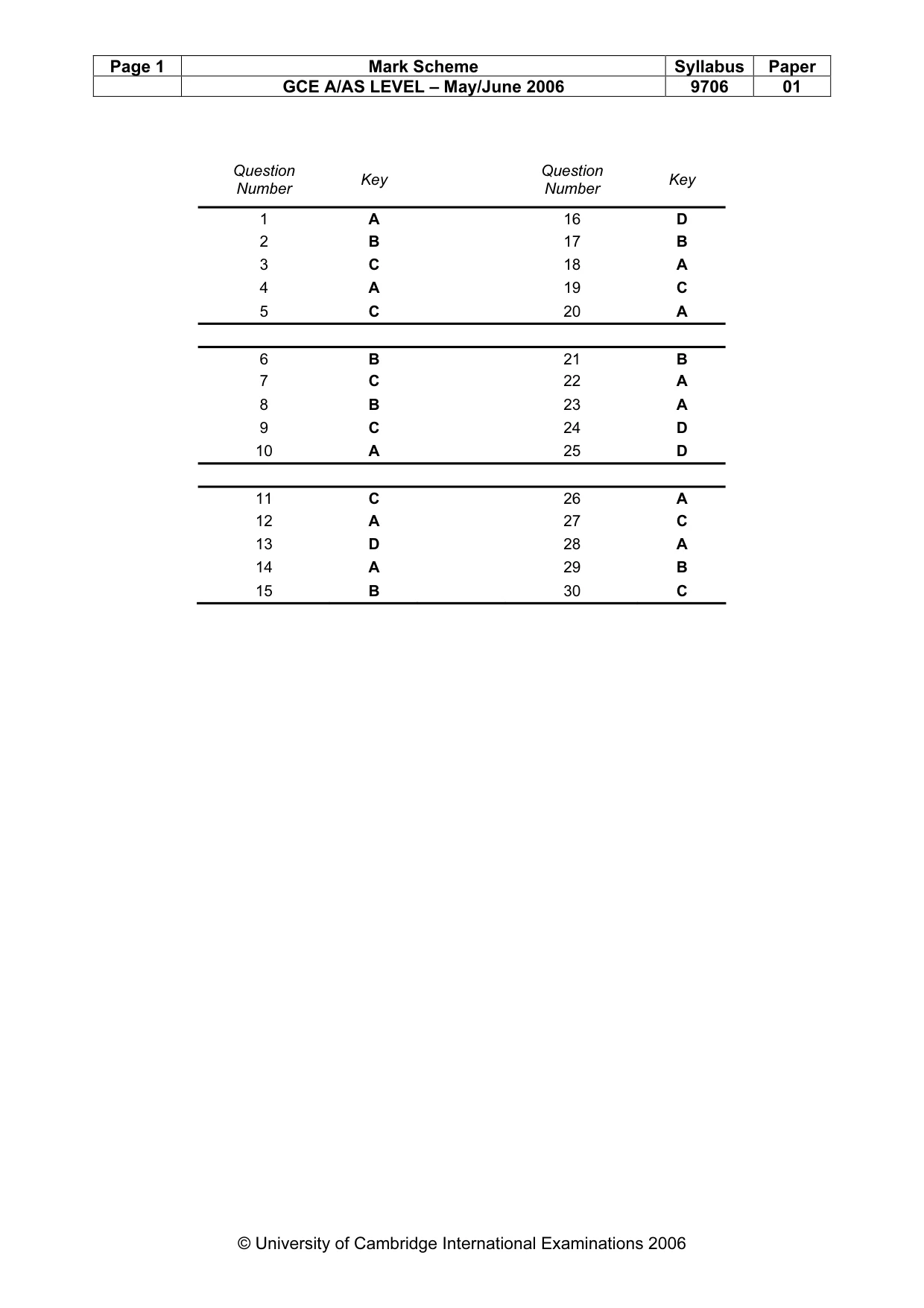
Mark scheme: A
Q2 · The accounting year end of a business is 31 October
2 The accounting year end of a business is 31 October. On 1 April the business rents out part of its warehouse for an annual rent of $6000 receivable in equal instalments on 1 April, 1 July, 1 October and 1 January. At 31 October what would the final accounts show? Profit and Loss Account Balance Sheet $ $ A rental income 3500 current asset 1000 B rental income 3500 current liability 1000 C rental income 4500 current liability 1000 D rental income 6000 current asset 1500
Mark scheme: B
Q3 · The following information is taken from the stationery account of a business
3 The following information is taken from the stationery account of a business. $ stock of stationery at beginning of the year 600 cash paid for stationery during the year 7000 invoice not yet received for stationery 480 stock of stationery at end of year 800 How much should be debited to the Profit and Loss Account for stationery? A $6680 B $6800 C $7280 D $8080
Mark scheme: C
Q4 · On 30 September 2005 a manufacturer’s current assets totalled $28 000
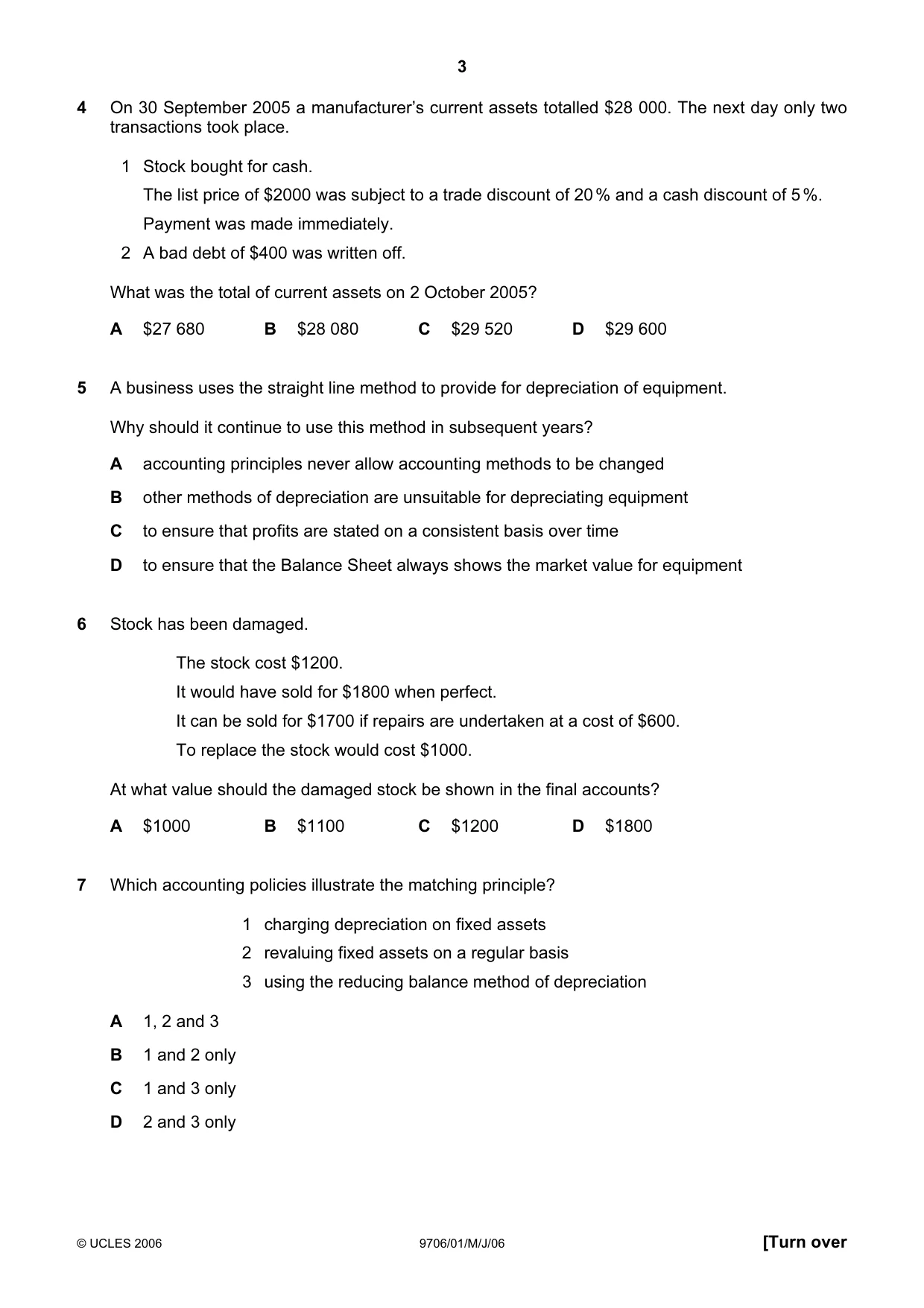
4 On 30 September 2005 a manufacturer’s current assets totalled $28 000. The next day only two transactions took place. 1 Stock bought for cash. The list price of $2000 was subject to a trade discount of 20 % and a cash discount of 5 %. Payment was made immediately. 2 A bad debt of $400 was written off. What was the total of current assets on 2 October 2005? A $27 680 B $28 080 C $29 520 D $29 600
Mark scheme: A
Q5 · A business uses the straight line method to provide for depreciation of equipment
5 A business uses the straight line method to provide for depreciation of equipment. Why should it continue to use this method in subsequent years? A accounting principles never allow accounting methods to be changed B other methods of depreciation are unsuitable for depreciating equipment C to ensure that profits are stated on a consistent basis over time D to ensure that the Balance Sheet always shows the market value for equipment
Mark scheme: C
Q6 · Stock has been damaged
6 Stock has been damaged. The stock cost $1200. It would have sold for $1800 when perfect. It can be sold for $1700 if repairs are undertaken at a cost of $600. To replace the stock would cost $1000. At what value should the damaged stock be shown in the final accounts? A $1000 B $1100 C $1200 D $1800
Mark scheme: B
Q7 · Which accounting policies illustrate the matching principle?
7 Which accounting policies illustrate the matching principle? 1 charging depreciation on fixed assets 2 revaluing fixed assets on a regular basis 3 using the reducing balance method of depreciation A 1, 2 and 3 B 1 and 2 only C 1 and 3 only D 2 and 3 only
Mark scheme: C
Q8 · The following information is extracted from the records of a business
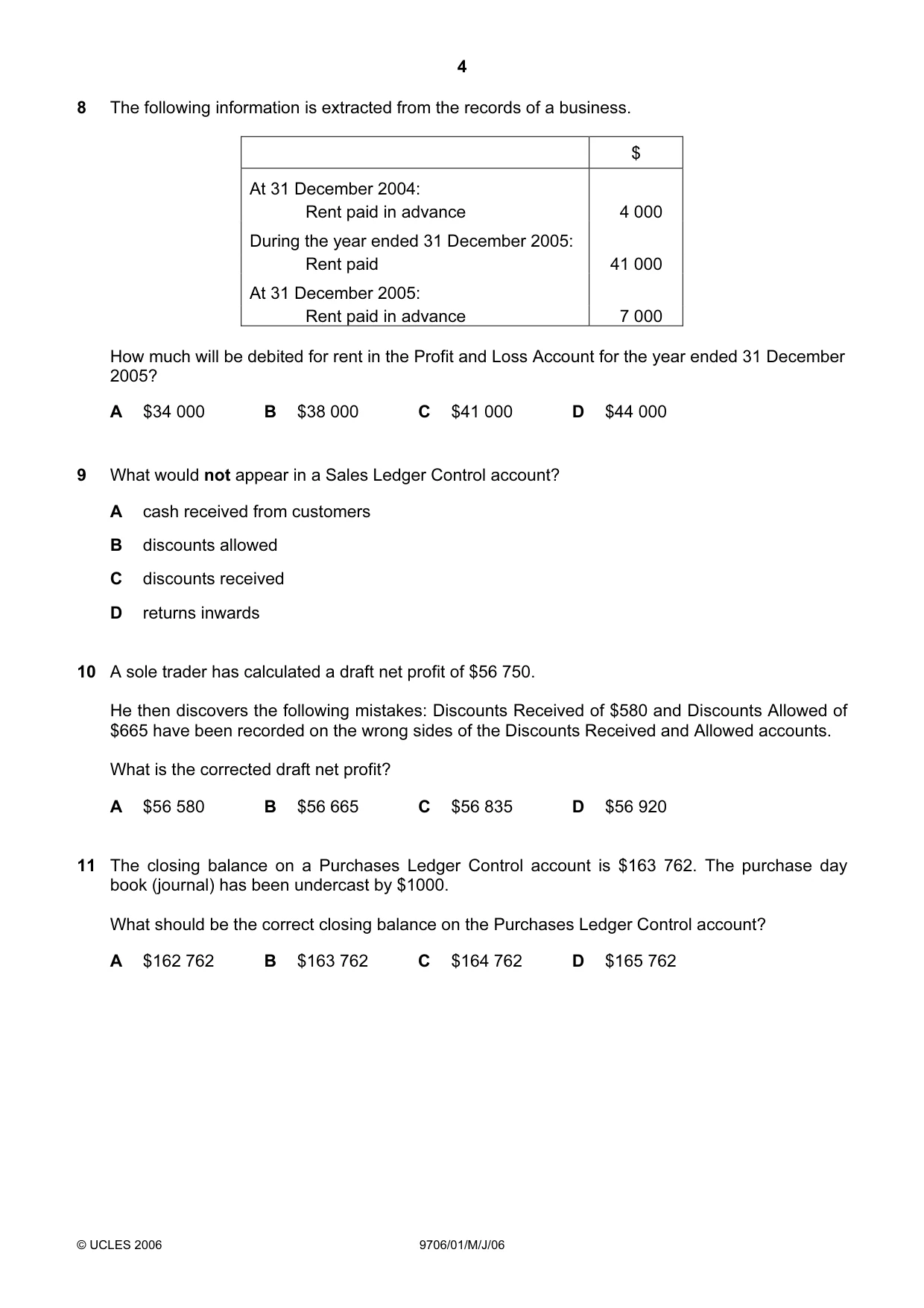
8 The following information is extracted from the records of a business. $ At 31 December 2004: Rent paid in advance 4 000 During the year ended 31 December 2005: Rent paid 41 000 At 31 December 2005: Rent paid in advance 7 000 How much will be debited for rent in the Profit and Loss Account for the year ended 31 December 2005? A $34 000 B $38 000 C $41 000 D $44 000
Mark scheme: B
Q9 · What would not appear in a Sales Ledger Control account?
9 What would not appear in a Sales Ledger Control account? A cash received from customers B discounts allowed C discounts received D returns inwards
Mark scheme: C
Q10 · A sole trader has calculated a draft net profit of $56 750
10 A sole trader has calculated a draft net profit of $56 750. He then discovers the following mistakes: Discounts Received of $580 and Discounts Allowed of $665 have been recorded on the wrong sides of the Discounts Received and Allowed accounts. What is the corrected draft net profit? A $56 580 B $56 665 C $56 835 D $56 920
Mark scheme: A
Q11 · The closing balance on a Purchases Ledger Control account is $163 762
11 The closing balance on a Purchases Ledger Control account is $163 762. The purchase day book (journal) has been undercast by $1000. What should be the correct closing balance on the Purchases Ledger Control account? A $162 762 B $163 762 C $164 762 D $165 762
Mark scheme: C
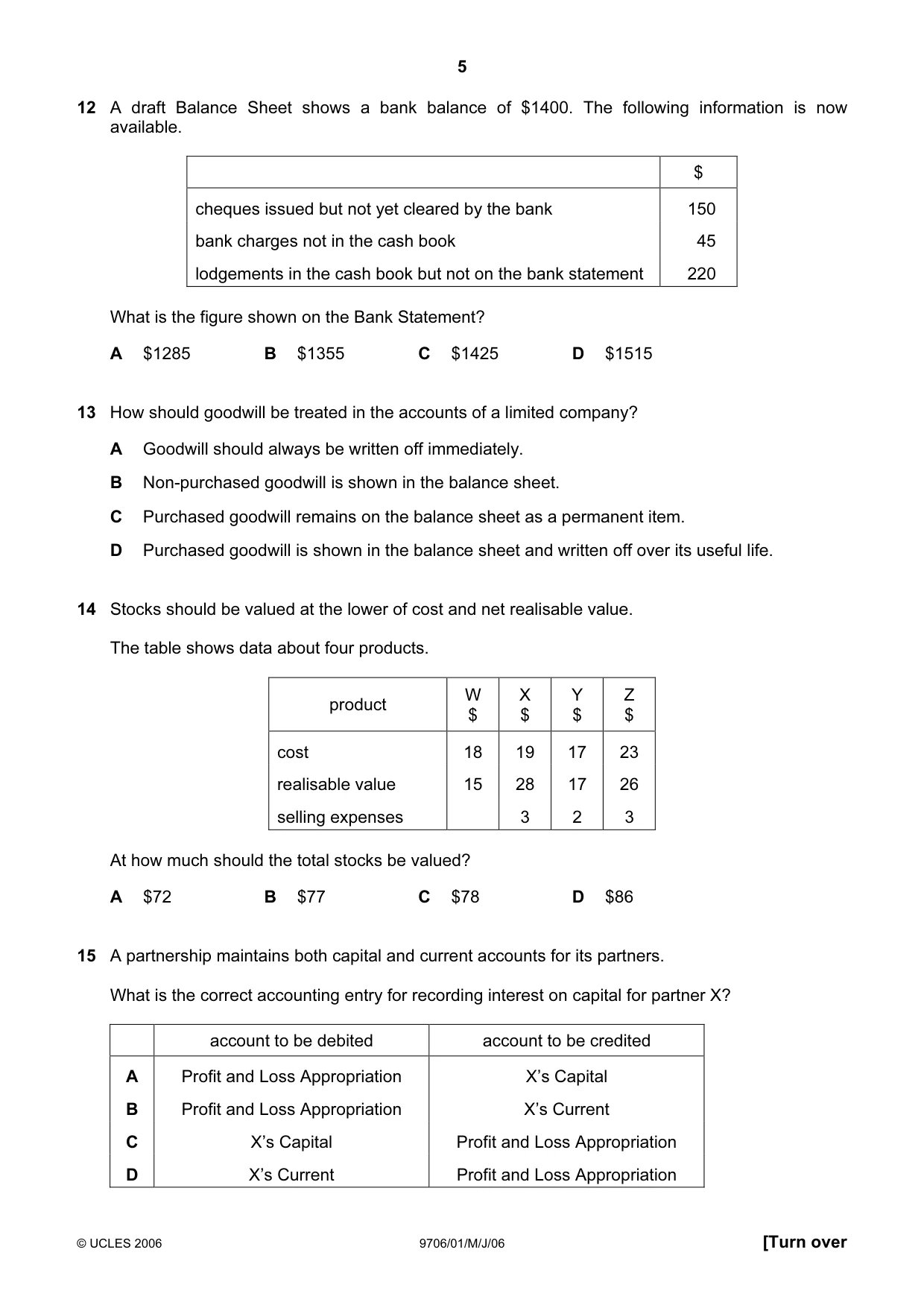
Q12 · A draft Balance Sheet shows a bank balance of $1400
12 A draft Balance Sheet shows a bank balance of $1400. The following information is now available. $ cheques issued but not yet cleared by the bank 150 bank charges not in the cash book 45 lodgements in the cash book but not on the bank statement 220 What is the figure shown on the Bank Statement? A $1285 B $1355 C $1425 D $1515
Mark scheme: A
Q13 · How should goodwill be treated in the accounts of a limited company?
13 How should goodwill be treated in the accounts of a limited company? A Goodwill should always be written off immediately. B Non-purchased goodwill is shown in the balance sheet. C Purchased goodwill remains on the balance sheet as a permanent item. D Purchased goodwill is shown in the balance sheet and written off over its useful life.
Mark scheme: D
Q14 · Stocks should be valued at the lower of cost and net realisable value
14 Stocks should be valued at the lower of cost and net realisable value. The table shows data about four products. W X Y Z product $ $ $ $ cost 18 19 17 23 realisable value 15 28 17 26 selling expenses 3 2 3 At how much should the total stocks be valued? A $72 B $77 C $78 D $86
Mark scheme: A
Q15 · A partnership maintains both capital and current accounts for its partners
15 A partnership maintains both capital and current accounts for its partners. What is the correct accounting entry for recording interest on capital for partner X? account to be debited account to be credited A Profit and Loss Appropriation X’s Capital B Profit and Loss Appropriation X’s Current C X’s Capital Profit and Loss Appropriation D X’s Current Profit and Loss Appropriation
Mark scheme: B
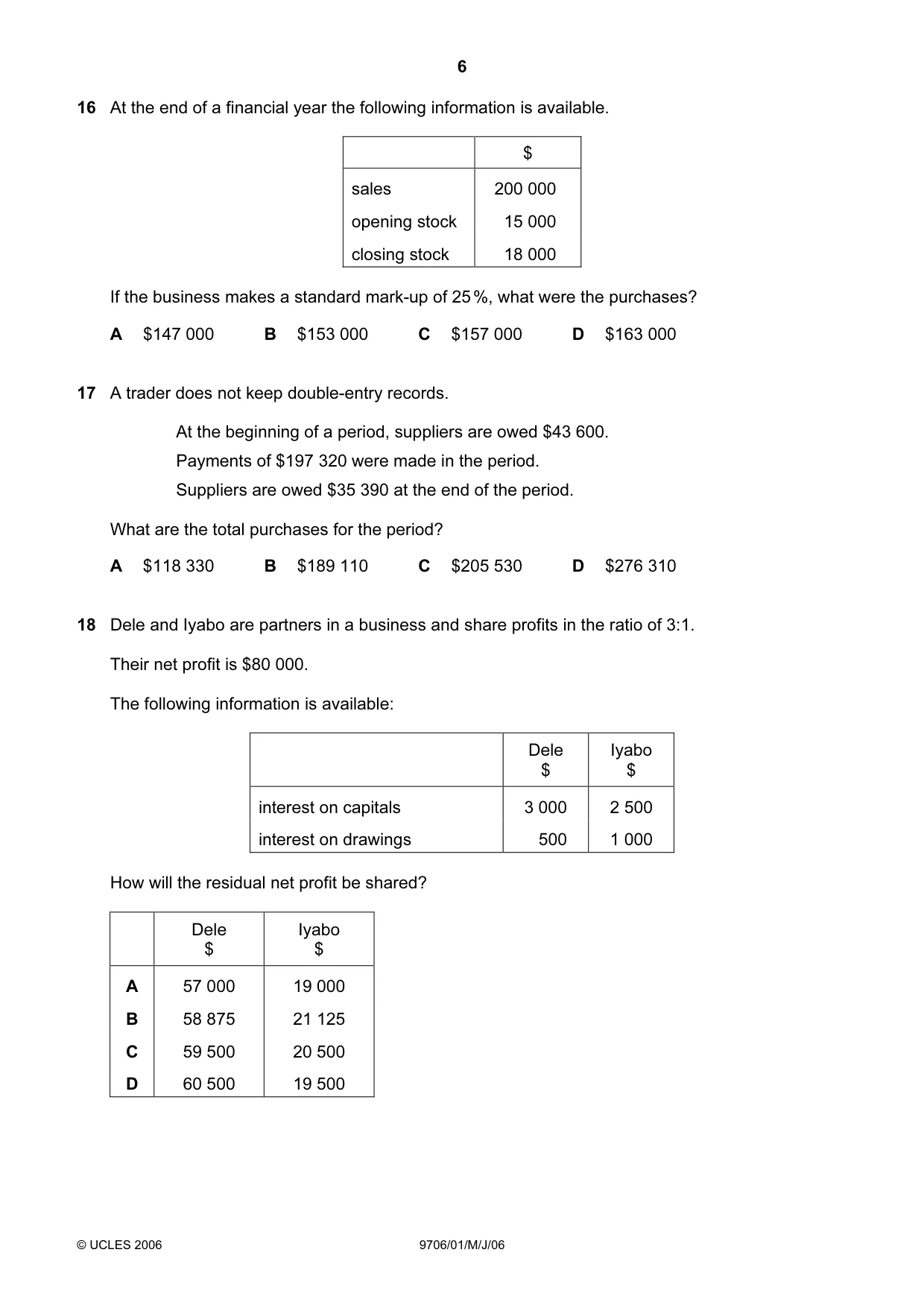
Q16 · At the end of a financial year the following information is available
16 At the end of a financial year the following information is available. $ sales 200 000 opening stock 15 000 closing stock 18 000 If the business makes a standard mark-up of 25 %, what were the purchases? A $147 000 B $153 000 C $157 000 D $163 000
Mark scheme: D
Q17 · A trader does not keep double-entry records
17 A trader does not keep double-entry records. At the beginning of a period, suppliers are owed $43 600. Payments of $197 320 were made in the period. Suppliers are owed $35 390 at the end of the period. What are the total purchases for the period? A $118 330 B $189 110 C $205 530 D $276 310
Mark scheme: B
Q18 · Dele and Iyabo are partners in a business and share profits in the ratio of 3:1
18 Dele and Iyabo are partners in a business and share profits in the ratio of 3:1. Their net profit is $80 000. The following information is available: Dele Iyabo $ $ interest on capitals 3 000 2 500 interest on drawings 500 1 000 How will the residual net profit be shared? Dele Iyabo $ $ A 57 000 19 000 B 58 875 21 125 C 59 500 20 500 D 60 500 19 500
Mark scheme: A
Q19 · What will increase the working capital and net assets and reserves of a company?
19 What will increase the working capital and net assets and reserves of a company? A a bonus issue of shares B a debenture issue C an issue of shares at a premium D an issue of shares at nominal value
Mark scheme: C
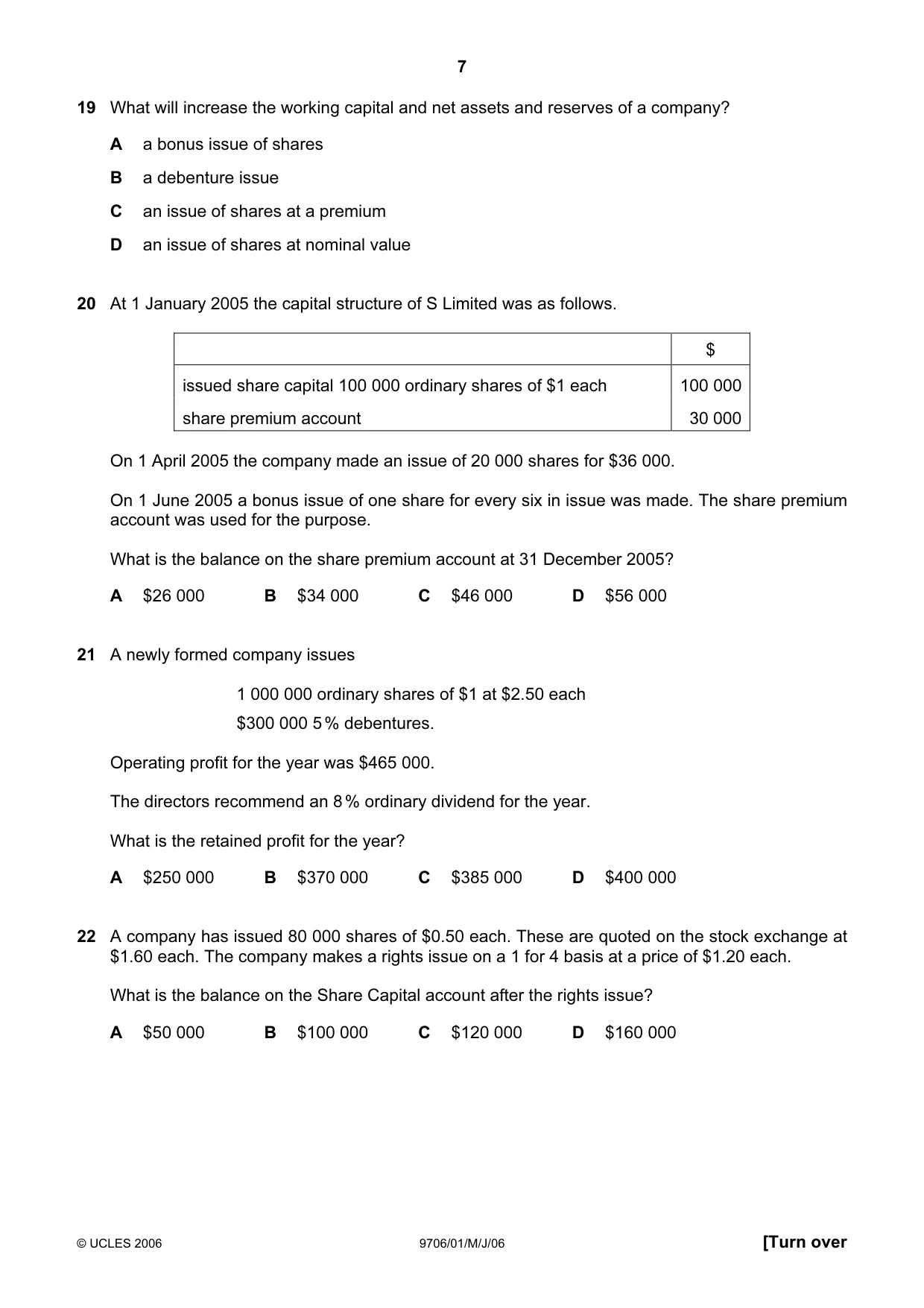
Q20 · At 1 January 2005 the capital structure of S Limited was as follows
20 At 1 January 2005 the capital structure of S Limited was as follows. $ issued share capital 100 000 ordinary shares of $1 each 100 000 share premium account 30 000 On 1 April 2005 the company made an issue of 20 000 shares for $36 000. On 1 June 2005 a bonus issue of one share for every six in issue was made. The share premium account was used for the purpose. What is the balance on the share premium account at 31 December 2005? A $26 000 B $34 000 C $46 000 D $56 000
Mark scheme: A
Q21 · A newly formed company issues 1 000 000 ordinary shares of $1 at $2.50 each $300 000 5 %…
21 A newly formed company issues 1 000 000 ordinary shares of $1 at $2.50 each $300 000 5 % debentures. Operating profit for the year was $465 000. The directors recommend an 8 % ordinary dividend for the year. What is the retained profit for the year? A $250 000 B $370 000 C $385 000 D $400 000
Mark scheme: B
Q22 · A company has issued 80 000 shares of $0.50 each
22 A company has issued 80 000 shares of $0.50 each. These are quoted on the stock exchange at $1.60 each. The company makes a rights issue on a 1 for 4 basis at a price of $1.20 each. What is the balance on the Share Capital account after the rights issue? A $50 000 B $100 000 C $120 000 D $160 000
Mark scheme: A
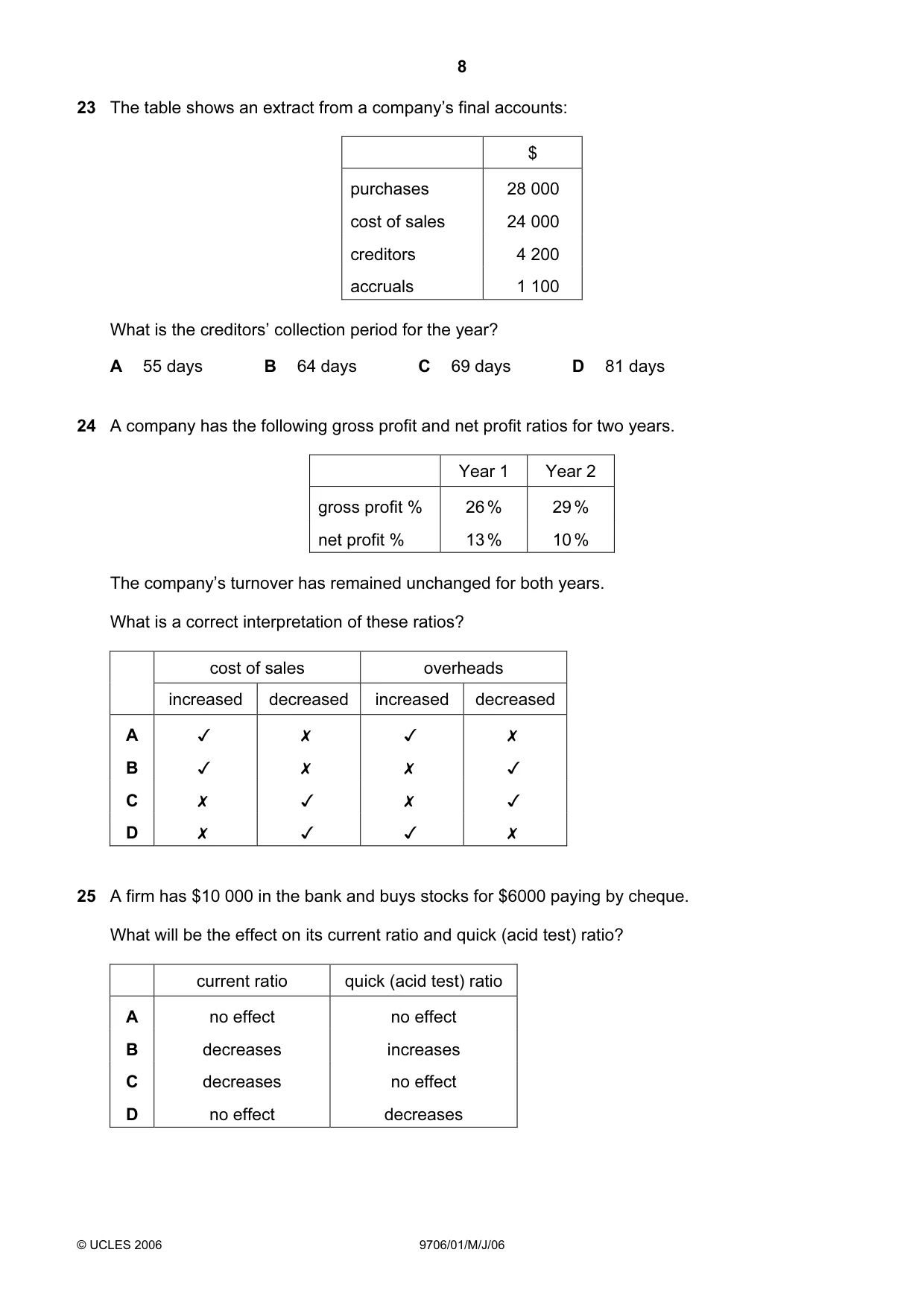
Q23 · The table shows an extract from a company’s final accounts: $ purchases 28 000 cost of…
23 The table shows an extract from a company’s final accounts: $ purchases 28 000 cost of sales 24 000 creditors 4 200 accruals 1 100 What is the creditors’ collection period for the year? A 55 days B 64 days C 69 days D 81 days
Mark scheme: A
More questions on Analysis and communication of accounting information
Q24 · Acompany has the following gross profit and net profit ratios for two years
24 Acompany has the following gross profit and net profit ratios for two years. Year 1 Year 2 gross profit % 26% 29% net profit % 13% 10% The company’s turnover has remained unchanged for both years. What is a correct interpretation of these ratios? cost of sales overheads increased | decreased increased | decreased 008 > x « & \ \ x \ x x ~ KOM
Mark scheme: D
More questions on Analysis and communication of accounting information
Q25 · A firm has $10 000 in the bank and buys stocks for $6000 paying by cheque
25 A firm has $10 000 in the bank and buys stocks for $6000 paying by cheque. What will be the effect on its current ratio and quick (acid test) ratio? current ratio quick (acid test) ratio A no effect no effect B decreases increases C decreases no effect D no effect decreases
Mark scheme: D
More questions on Analysis and communication of accounting information
Q26 · The following information is given for a business
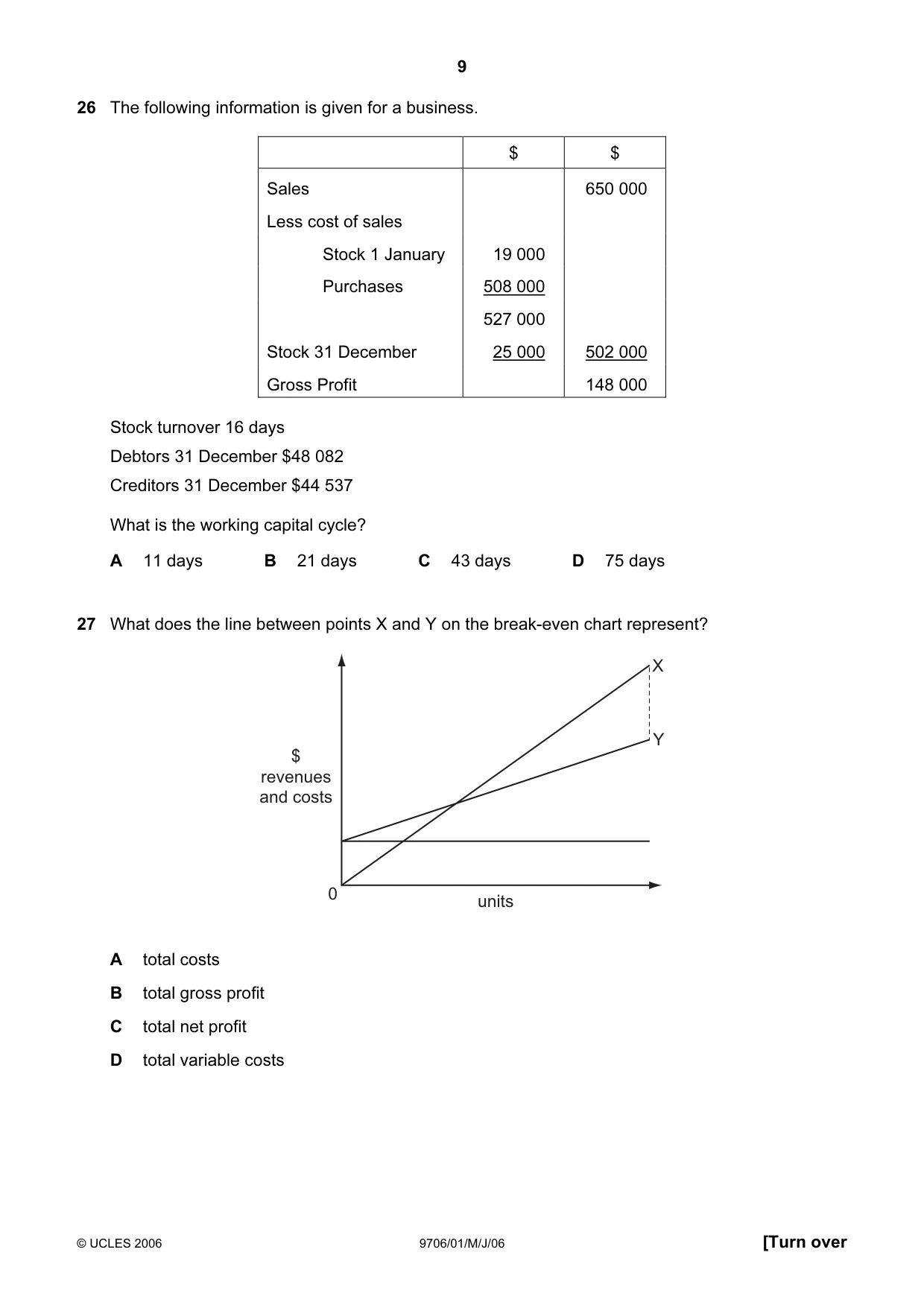
26 The following information is given for a business. $ $ Sales 650 000 Less cost of sales Stock 1 January 19 000 Purchases 508 000 527 000 Stock 31 December 25 000 502 000 Gross Profit 148 000 Stock turnover 16 days Debtors 31 December $48 082 Creditors 31 December $44 537 What is the working capital cycle? A 11 days B 21 days C 43 days D 75 days
Mark scheme: A
More questions on Analysis and communication of accounting information
Q27 · What does the line between points X and Y on the break-even chart represent?
27 What does the line between points X and Y on the break-even chart represent? X Y $ revenues and costs 0 units A total costs B total gross profit C total net profit D total variable costs
Mark scheme: C
Q28 · The following figures are given for a factory’s overheads and machine hours worked
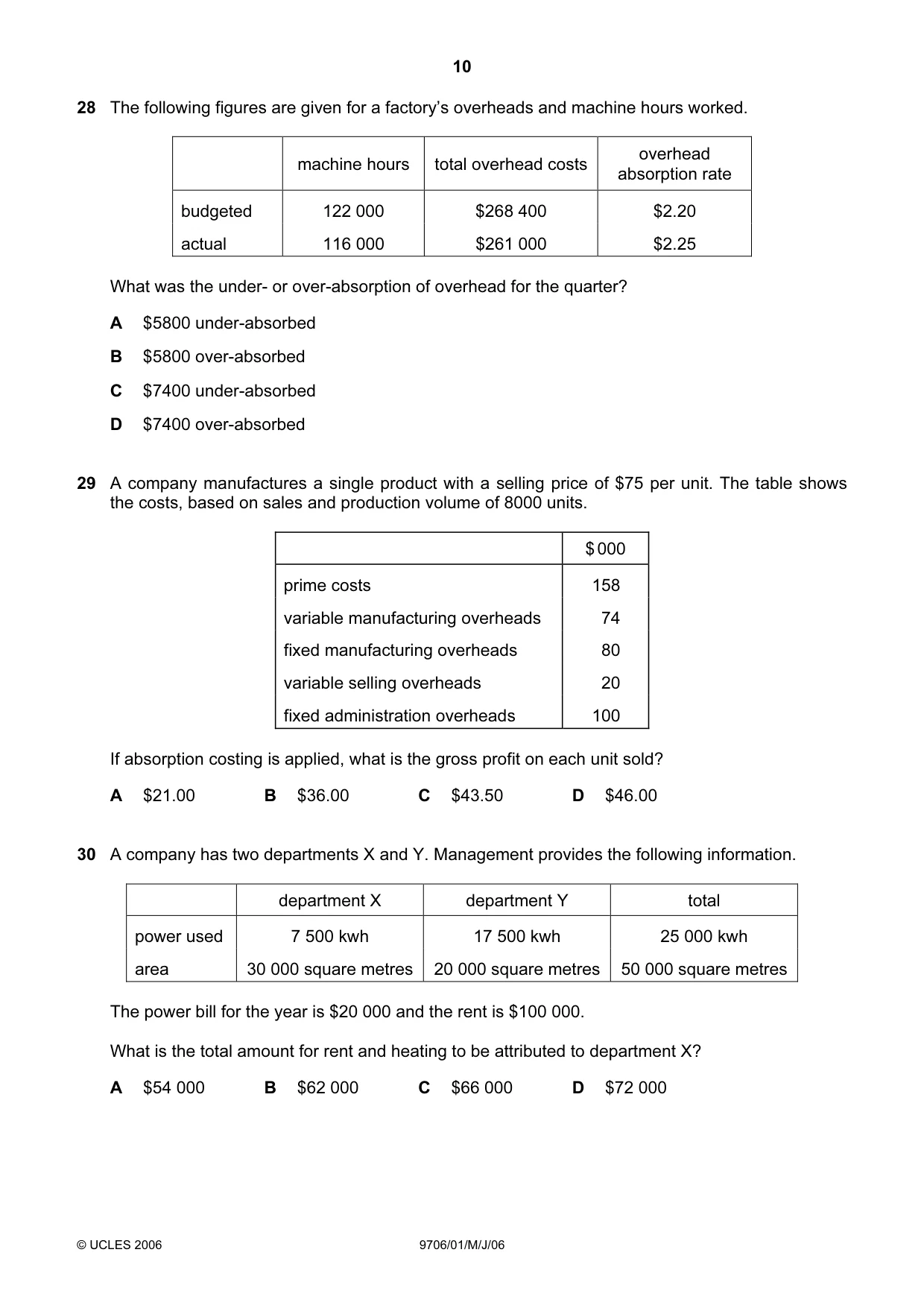
28 The following figures are given for a factory’s overheads and machine hours worked. overhead machine hours total overhead costs absorption rate budgeted 122 000 $268 400 $2.20 actual 116 000 $261 000 $2.25 What was the under- or over-absorption of overhead for the quarter? A $5800 under-absorbed B $5800 over-absorbed C $7400 under-absorbed D $7400 over-absorbed
Mark scheme: A
Q29 · A company manufactures a single product with a selling price of $75 per unit
29 A company manufactures a single product with a selling price of $75 per unit. The table shows the costs, based on sales and production volume of 8000 units. $ 000 prime costs 158 variable manufacturing overheads 74 fixed manufacturing overheads 80 variable selling overheads 20 fixed administration overheads 100 If absorption costing is applied, what is the gross profit on each unit sold? A $21.00 B $36.00 C $43.50 D $46.00
Mark scheme: B
Q30 · A company has two departments X and Y
30 A company has two departments X and Y. Management provides the following information. department X department Y total power used 7 500 kwh 17 500 kwh 25 000 kwh area 30 000 square metres 20 000 square metres 50 000 square metres The power bill for the year is $20 000 and the rent is $100 000. What is the total amount for rent and heating to be attributed to department X? A $54 000 B $62 000 C $66 000 D $72 000
Mark scheme: C
What was in this paper
The subtopics covered by these 30 questions, and how many questions each got. Open one in a new tab to see every Cambridge question on it.
What you needed in this session
Cambridge’s own grade thresholds for 2006 May/June, Paper 1 · Variant 1. A higher threshold means an easier paper — the bar moves with how the cohort did.