Cambridge A Level Accounting 9706 — 2018 Oct/Nov Paper 1 · Variant 2
9706/12/O/N/18 · 30 questions · 30 marks · ≈34 min
The question paper and its mark scheme, free to read here and free to download. This is Cambridge’s own paper, exactly as it was sat.
Question paper12 pages

Mark scheme3 pages
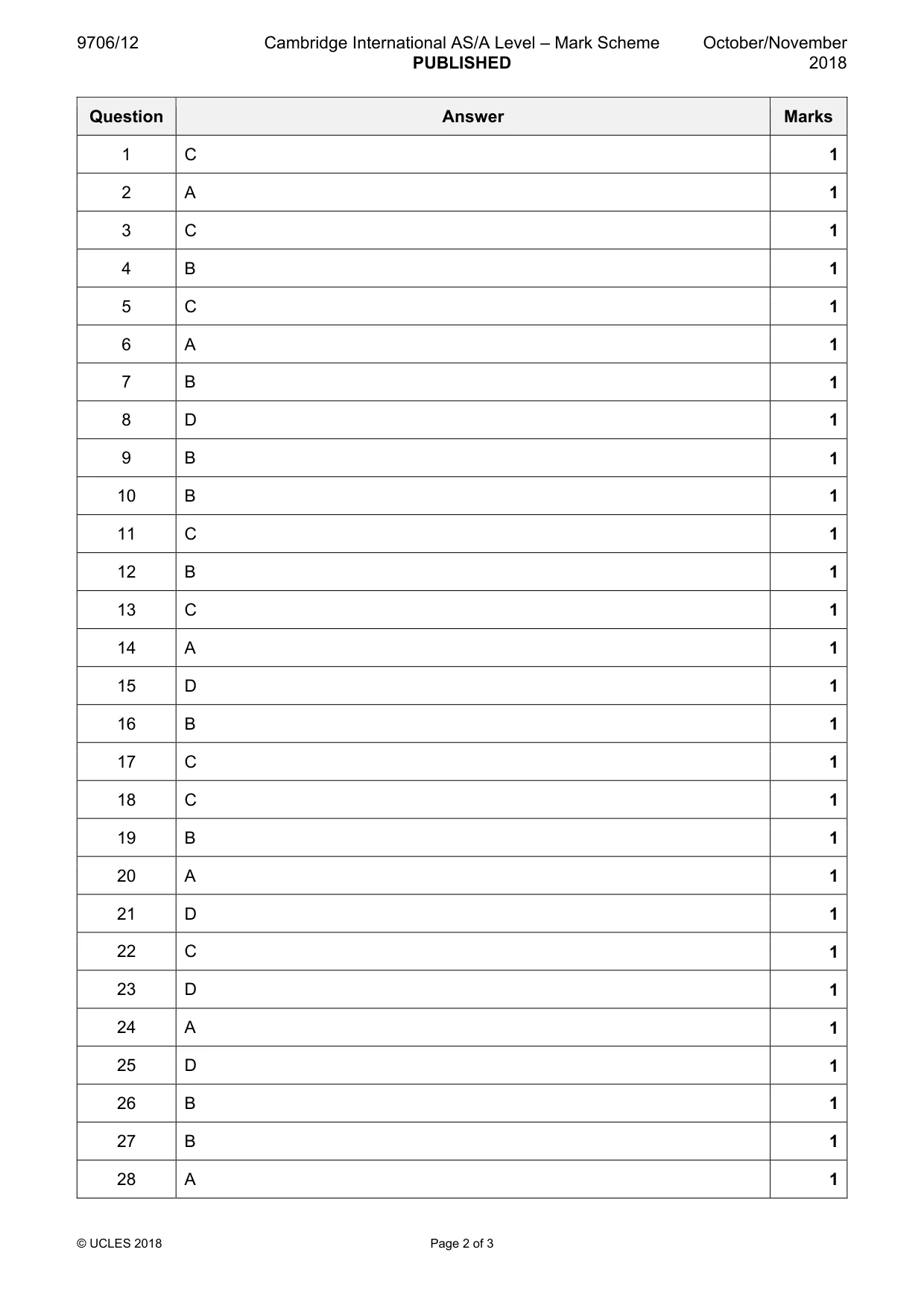
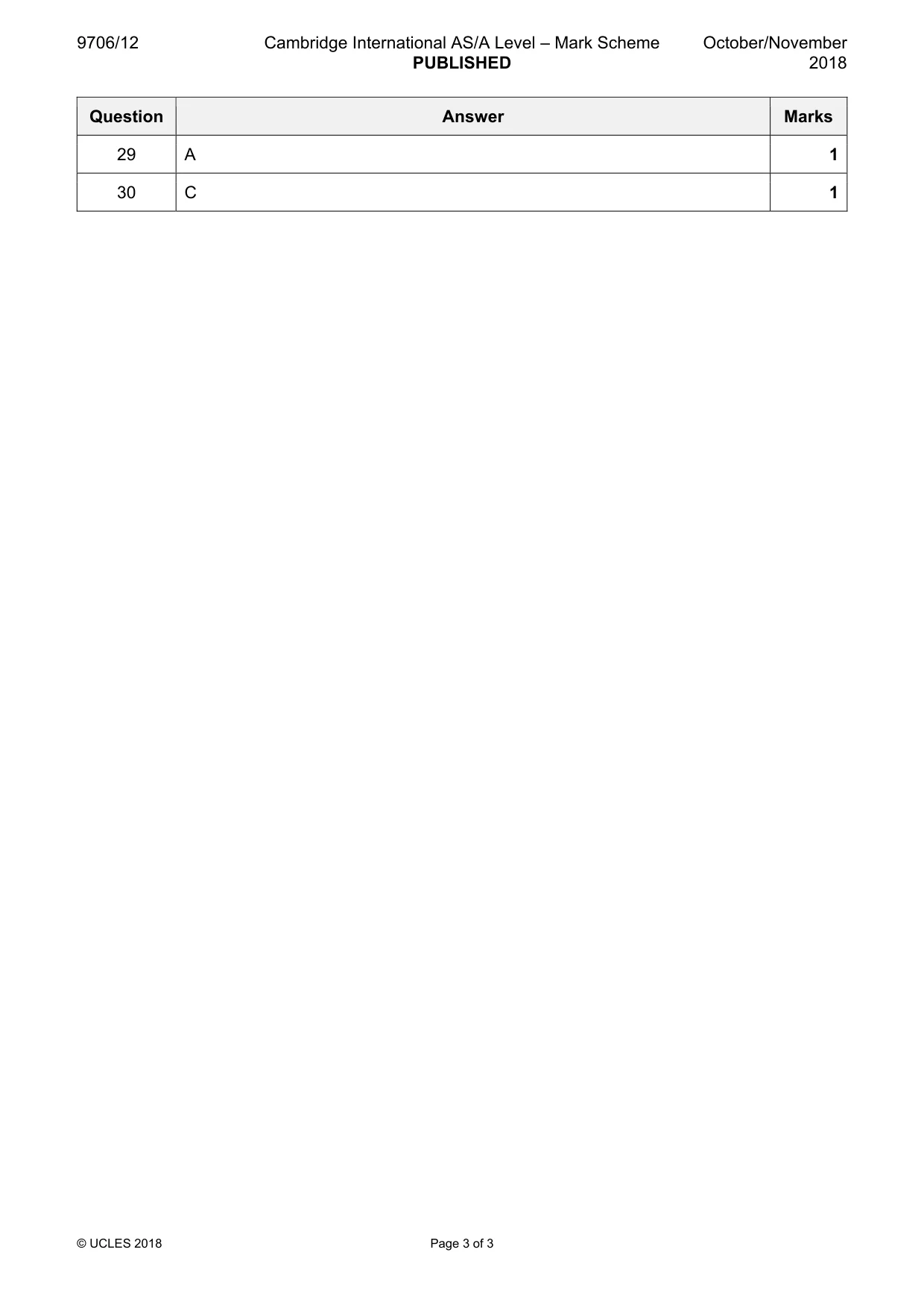
Answers below. Sit the paper first if you are practising.
Questions as text
Q1 · A company does not include in the financial statements the value of skills gained by its…
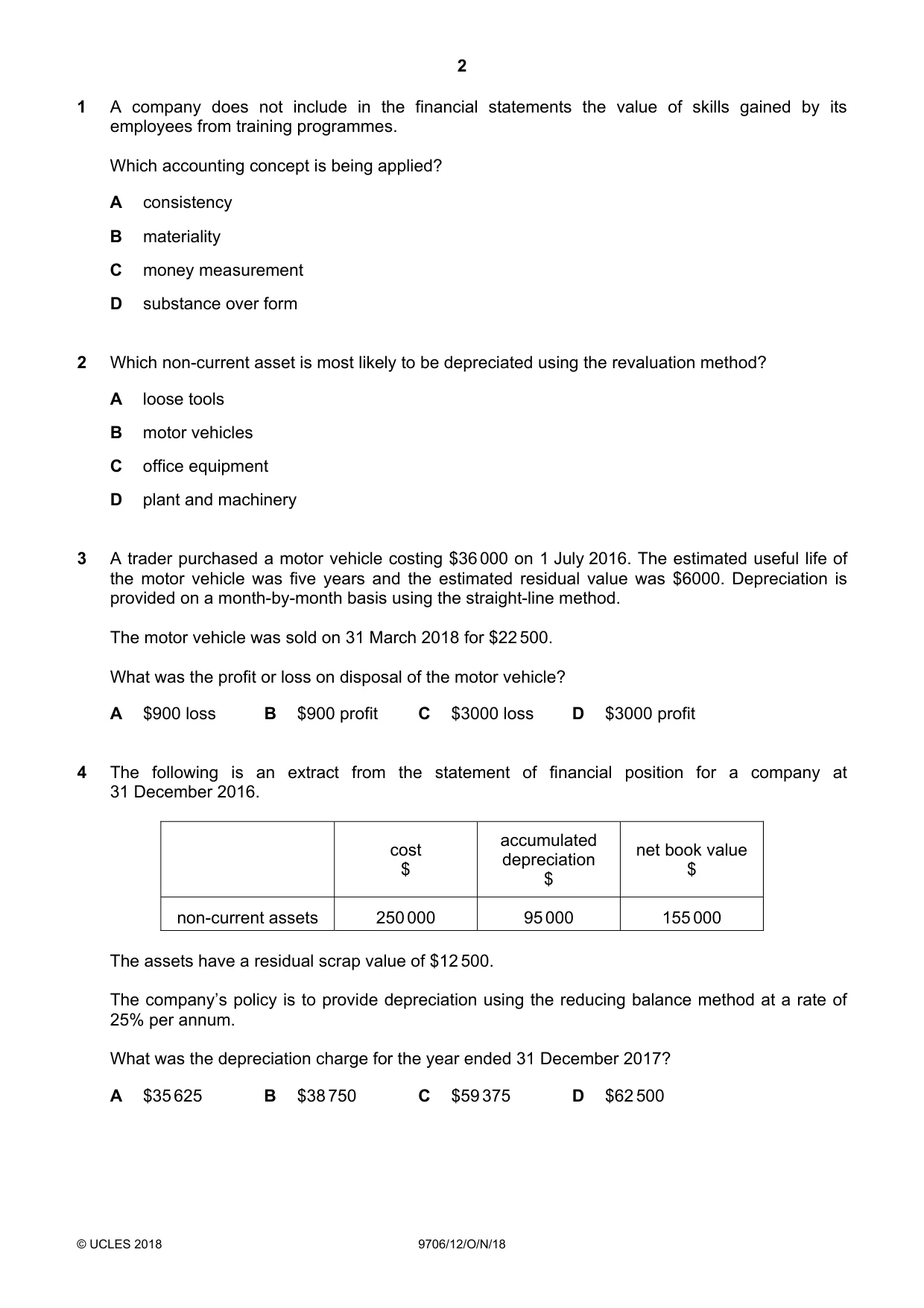
1 A company does not include in the financial statements the value of skills gained by its employees from training programmes. Which accounting concept is being applied? A consistency B materiality C money measurement D substance over form
Mark scheme: C
Q2 · Which non-current asset is most likely to be depreciated using the revaluation method?
2 Which non-current asset is most likely to be depreciated using the revaluation method? A loose tools B motor vehicles C office equipment D plant and machinery
Mark scheme: A
Q3 · A trader purchased a motor vehicle costing $36 000 on 1 July 2016
3 A trader purchased a motor vehicle costing $36 000 on 1 July 2016. The estimated useful life of the motor vehicle was five years and the estimated residual value was $6000. Depreciation is provided on a month-by-month basis using the straight-line method. The motor vehicle was sold on 31 March 2018 for $22 500. What was the profit or loss on disposal of the motor vehicle? A $900 loss B $900 profit C $3000 loss D $3000 profit
Mark scheme: C
Q4 · The following is an extract from the statement of financial position for a company at 31…
4 The following is an extract from the statement of financial position for a company at 31 December 2016. accumulated cost net book value depreciation $ $ $ non-current assets 250 000 95 000 155 000 The assets have a residual scrap value of $12 500. The company’s policy is to provide depreciation using the reducing balance method at a rate of 25% per annum. What was the depreciation charge for the year ended 31 December 2017? A $35 625 B $38 750 C $59 375 D $62 500
Mark scheme: B
Q5 · A business sells a non-current asset for cash
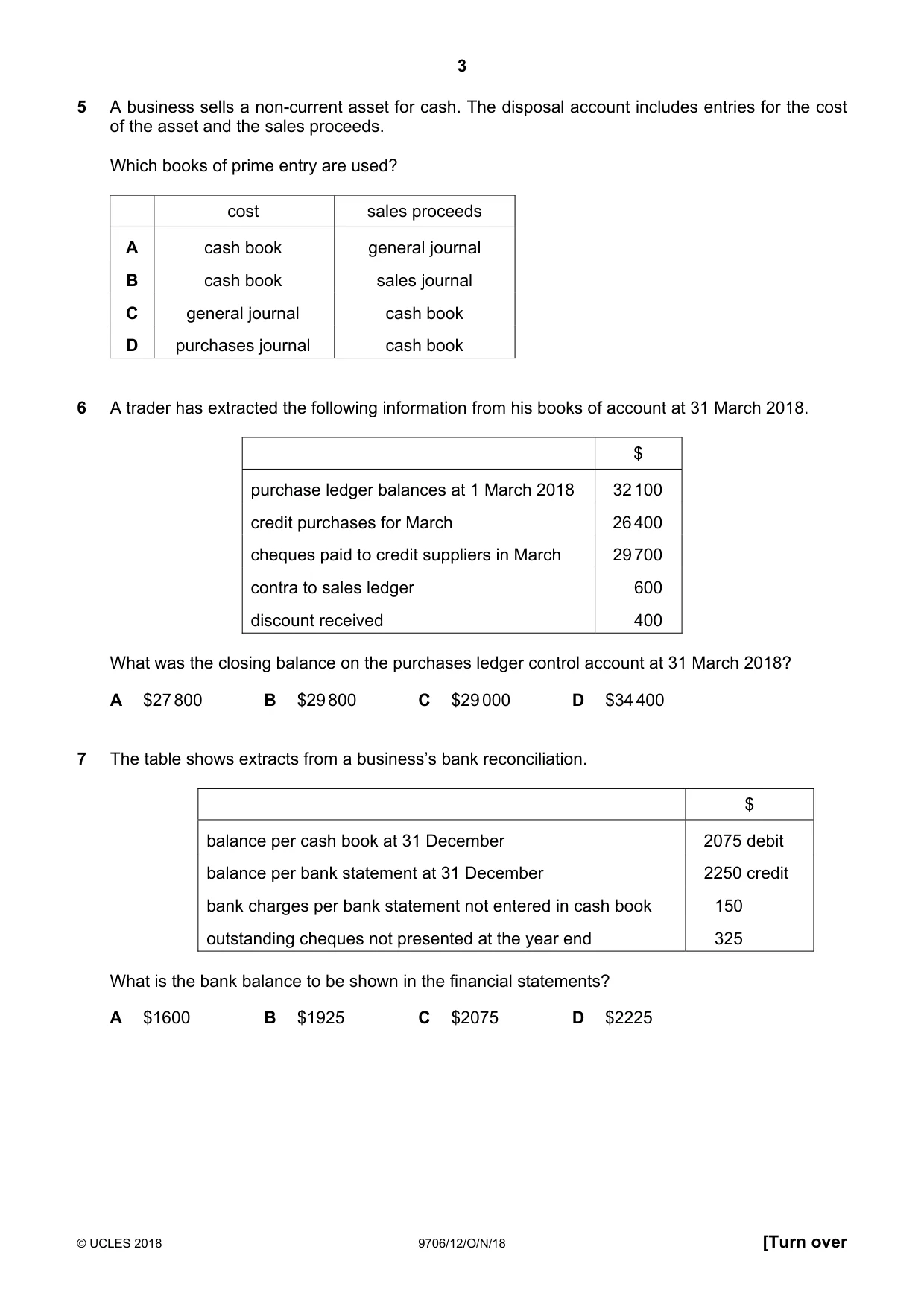
5 A business sells a non-current asset for cash. The disposal account includes entries for the cost of the asset and the sales proceeds. Which books of prime entry are used? cost sales proceeds A cash book general journal B cash book sales journal C general journal cash book D purchases journal cash book
Mark scheme: C
Q6 · A trader has extracted the following information from his books of account at 31 March…
6 A trader has extracted the following information from his books of account at 31 March 2018. $ purchase ledger balances at 1 March 2018 32 100 credit purchases for March 26 400 cheques paid to credit suppliers in March 29 700 contra to sales ledger 600 discount received 400 What was the closing balance on the purchases ledger control account at 31 March 2018? A $27 800 B $29 800 C $29 000 D $34 400
Mark scheme: A
Q7 · The table shows extracts from a business’s bank reconciliation
7 The table shows extracts from a business’s bank reconciliation. $ balance per cash book at 31 December 2075 debit balance per bank statement at 31 December 2250 credit bank charges per bank statement not entered in cash book 150 outstanding cheques not presented at the year end 325 What is the bank balance to be shown in the financial statements? A $1600 B $1925 C $2075 D $2225
Mark scheme: B
Q8 · Bank interest income, $1800, had been correctly entered in the bank account but recorded…
8 Bank interest income, $1800, had been correctly entered in the bank account but recorded as interest expense. Which entries in the ledger will correct the error? account to account to $ $ be debited be credited A interest expense 1800 suspense 1800 B interest income 1800 suspense 1800 interest expense 1800 C suspense 1800 interest income 1800 D suspense 3600 interest income 1800 interest expense 1800
Mark scheme: D
Q9 · A company has the following balances
9 A company has the following balances. $ trade receivables at 31 December 2017 125 400 provision for doubtful debts at 1 January 2017 1 800 During the year ended 31 December 2017 debts of $20 500 had been written off. The company provides for doubtful debts at a rate of 5% of trade receivables at each year end. Which expense for doubtful debts was included in the income statement for the year ended 31 December 2017? A $3445 B $4470 C $5245 D $6270
Mark scheme: B
Q10 · How are purchases calculated when proper accounting records have not been kept?
10 How are purchases calculated when proper accounting records have not been kept? A sales × (1 – margin) – closing inventory + opening inventory B sales × (1 – margin) + closing inventory – opening inventory C sales × (1 – mark-up) – closing inventory + opening inventory D sales × (1 – mark-up) + closing inventory – opening inventory
Mark scheme: B
Q11 · The draft financial statements for a business included an inventory valued at $550 000
11 The draft financial statements for a business included an inventory valued at $550 000. This valuation included damaged items which originally cost $50 000. These could be sold for $15 000 provided that $5000 is spent on repairs. What is the correct inventory valuation? A $490 000 B $500 000 C $510 000 D $515 000
Mark scheme: C
Q12 · A trader took out a 6% bank loan of $30 000 on 1 November 2017, to be repaid in full in…
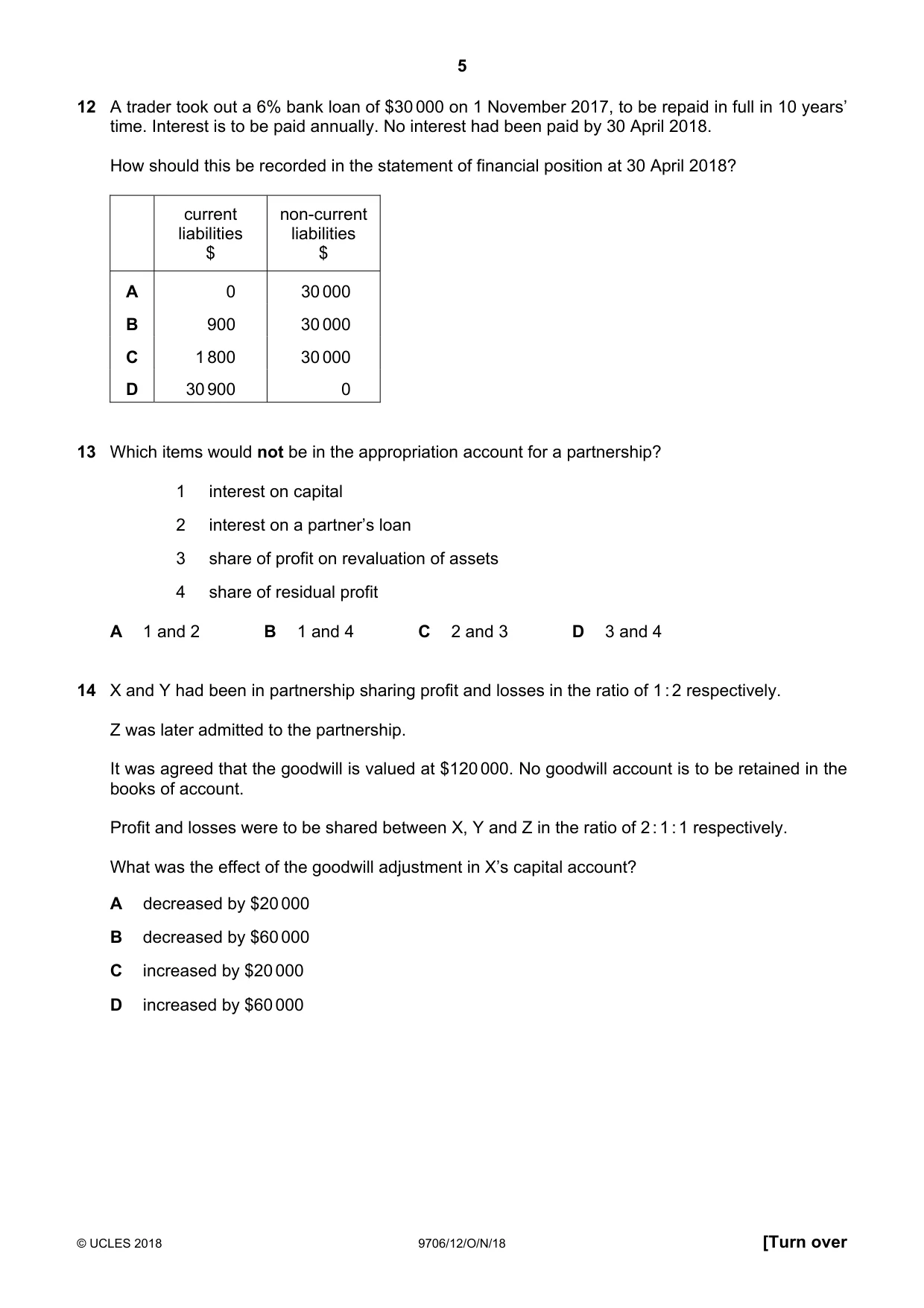
12 A trader took out a 6% bank loan of $30 000 on 1 November 2017, to be repaid in full in 10 years’ time. Interest is to be paid annually. No interest had been paid by 30 April 2018. How should this be recorded in the statement of financial position at 30 April 2018? current non-current liabilities liabilities $ $ A 0 30 000 B 900 30 000 C 1 800 30 000 D 30 900 0
Mark scheme: B
Q13 · Which items would not be in the appropriation account for a partnership?
13 Which items would not be in the appropriation account for a partnership? 1 interest on capital 2 interest on a partner’s loan 3 share of profit on revaluation of assets 4 share of residual profit A 1 and 2 B 1 and 4 C 2 and 3 D 3 and 4
Mark scheme: C
Q14 · X and Y had been in partnership sharing profit and losses in the ratio of 1 : 2…
14 X and Y had been in partnership sharing profit and losses in the ratio of 1 : 2 respectively. Z was later admitted to the partnership. It was agreed that the goodwill is valued at $120 000. No goodwill account is to be retained in the books of account. Profit and losses were to be shared between X, Y and Z in the ratio of 2 : 1 : 1 respectively. What was the effect of the goodwill adjustment in X’s capital account? A decreased by $20 000 B decreased by $60 000 C increased by $20 000 D increased by $60 000
Mark scheme: A
Q15 · J and K shared profits equally
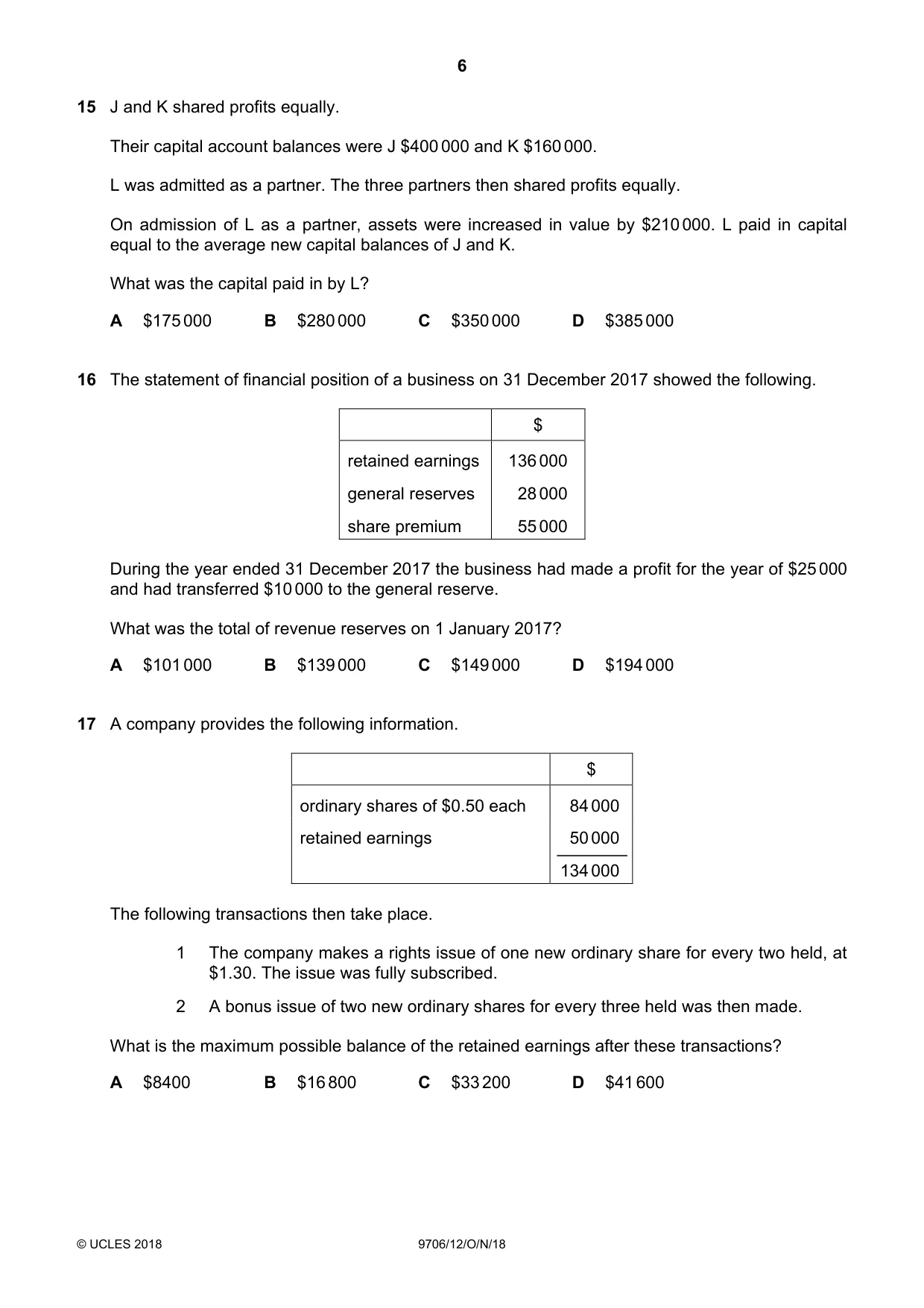
15 J and K shared profits equally. Their capital account balances were J $400 000 and K $160 000. L was admitted as a partner. The three partners then shared profits equally. On admission of L as a partner, assets were increased in value by $210 000. L paid in capital equal to the average new capital balances of J and K. What was the capital paid in by L? A $175 000 B $280 000 C $350 000 D $385 000
Mark scheme: D
Q16 · The statement of financial position of a business on 31 December 2017 showed the following
16 The statement of financial position of a business on 31 December 2017 showed the following. $ retained earnings 136 000 general reserves 28 000 share premium 55 000 During the year ended 31 December 2017 the business had made a profit for the year of $25 000 and had transferred $10 000 to the general reserve. What was the total of revenue reserves on 1 January 2017? A $101 000 B $139 000 C $149 000 D $194 000
Mark scheme: B
Q17 · A company provides the following information
17 A company provides the following information. $ ordinary shares of $0.50 each 84 000 retained earnings 50 000 134 000 The following transactions then take place. 1 The company makes a rights issue of one new ordinary share for every two held, at $1.30. The issue was fully subscribed. 2 A bonus issue of two new ordinary shares for every three held was then made. What is the maximum possible balance of the retained earnings after these transactions? A $8400 B $16 800 C $33 200 D $41 600
Mark scheme: C
Q18 · The financial data relates to two businesses
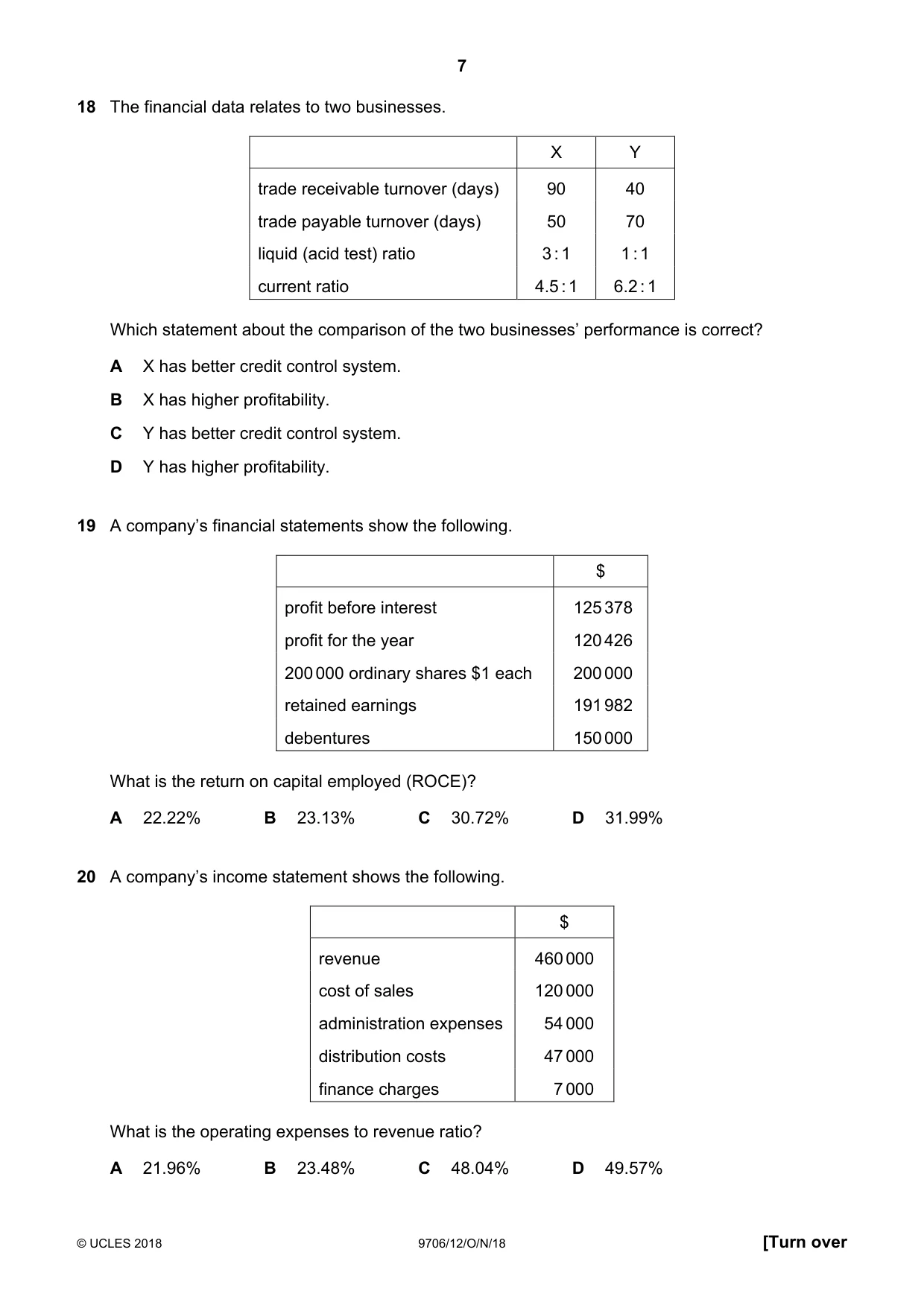
18 The financial data relates to two businesses. X Y trade receivable turnover (days) 90 40 trade payable turnover (days) 50 70 liquid (acid test) ratio 3 : 1 1 : 1 current ratio 4.5 : 1 6.2 : 1 Which statement about the comparison of the two businesses’ performance is correct? A X has better credit control system. B X has higher profitability. C Y has better credit control system. D Y has higher profitability.
Mark scheme: C
More questions on Analysis and communication of accounting information
Q19 · A company’s financial statements show the following
19 A company’s financial statements show the following. $ profit before interest 125 378 profit for the year 120 426 200 000 ordinary shares $1 each 200 000 retained earnings 191 982 debentures 150 000 What is the return on capital employed (ROCE)? A 22.22% B 23.13% C 30.72% D 31.99%
Mark scheme: B
More questions on Analysis and communication of accounting information
Q20 · A company’s income statement shows the following
20 A company’s income statement shows the following. $ revenue 460 000 cost of sales 120 000 administration expenses 54 000 distribution costs 47 000 finance charges 7 000 What is the operating expenses to revenue ratio? A 21.96% B 23.48% C 48.04% D 49.57%
Mark scheme: A
More questions on Analysis and communication of accounting information
Q21 · To make a single unit of output a business requires material costing $1000
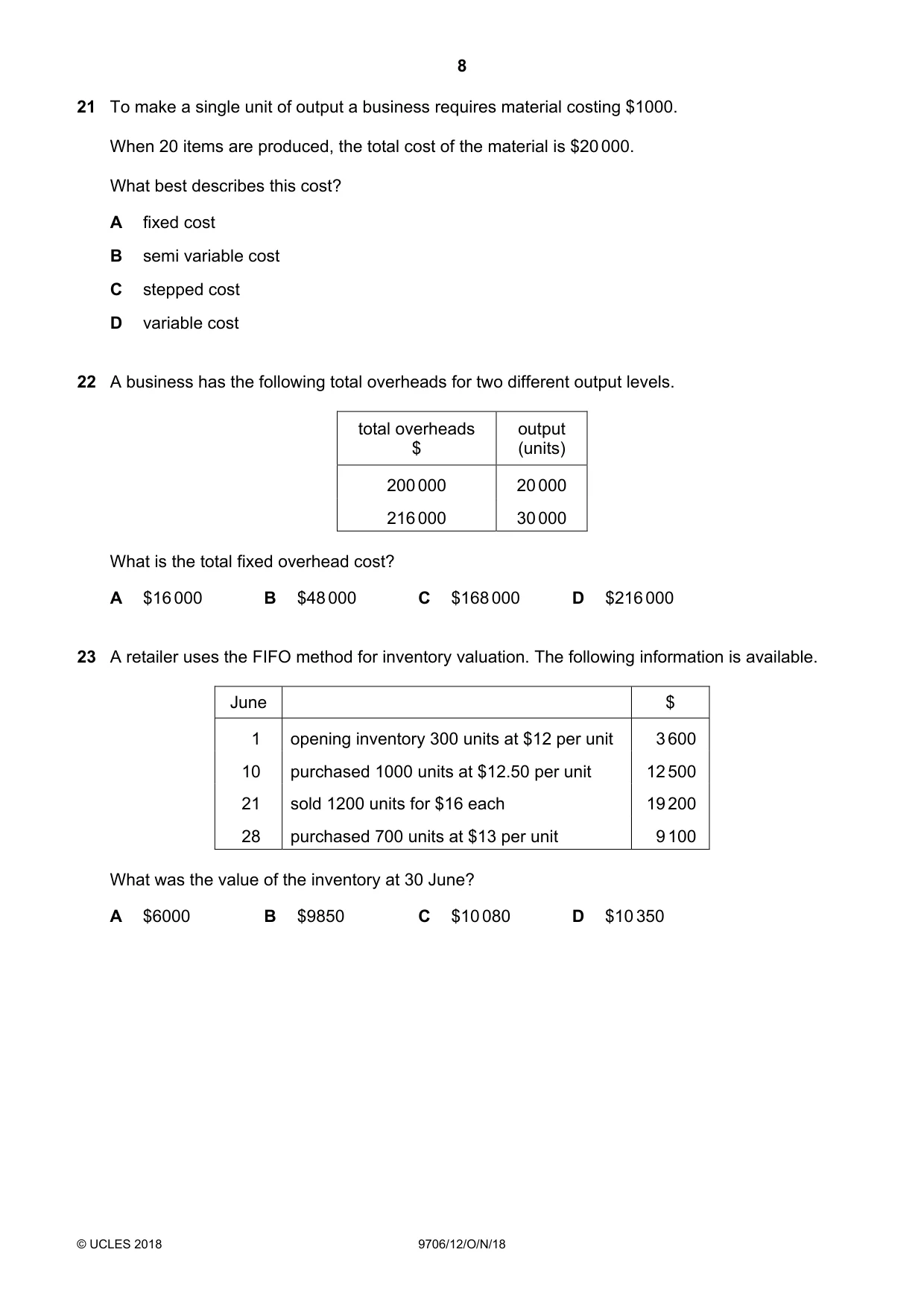
21 To make a single unit of output a business requires material costing $1000. When 20 items are produced, the total cost of the material is $20 000. What best describes this cost? A fixed cost B semi variable cost C stepped cost D variable cost
Mark scheme: D
Q22 · A business has the following total overheads for two different output levels
22 A business has the following total overheads for two different output levels. total overheads output $ (units) 200 000 20 000 216 000 30 000 What is the total fixed overhead cost? A $16 000 B $48 000 C $168 000 D $216 000
Mark scheme: C
Q23 · A retailer uses the FIFO method for inventory valuation
23 A retailer uses the FIFO method for inventory valuation. The following information is available. June $ 1 opening inventory 300 units at $12 per unit 3 600 10 purchased 1000 units at $12.50 per unit 12 500 21 sold 1200 units for $16 each 19 200 28 purchased 700 units at $13 per unit 9 100 What was the value of the inventory at 30 June? A $6000 B $9850 C $10 080 D $10 350
Mark scheme: D
Q24 · A business manufactures 175 units of a product each month
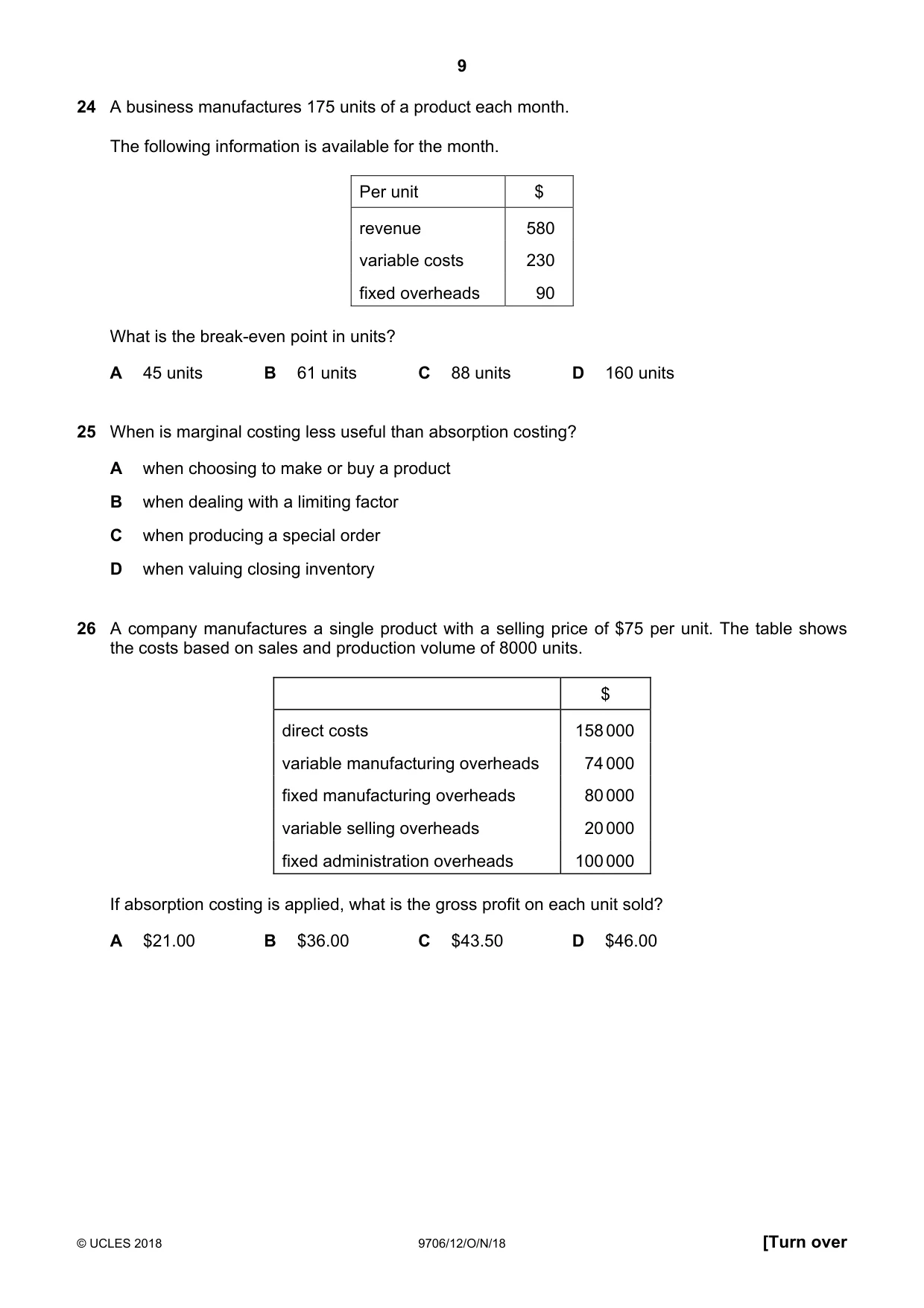
24 A business manufactures 175 units of a product each month. The following information is available for the month. Per unit $ revenue 580 variable costs 230 fixed overheads 90 What is the break-even point in units? A 45 units B 61 units C 88 units D 160 units
Mark scheme: A
Q25 · When is marginal costing less useful than absorption costing?
25 When is marginal costing less useful than absorption costing? A when choosing to make or buy a product B when dealing with a limiting factor C when producing a special order D when valuing closing inventory
Mark scheme: D
Q26 · A company manufactures a single product with a selling price of $75 per unit
26 A company manufactures a single product with a selling price of $75 per unit. The table shows the costs based on sales and production volume of 8000 units. $ direct costs 158 000 variable manufacturing overheads 74 000 fixed manufacturing overheads 80 000 variable selling overheads 20 000 fixed administration overheads 100 000 If absorption costing is applied, what is the gross profit on each unit sold? A $21.00 B $36.00 C $43.50 D $46.00
Mark scheme: B
Q27 · A company has the following revenue information for a month
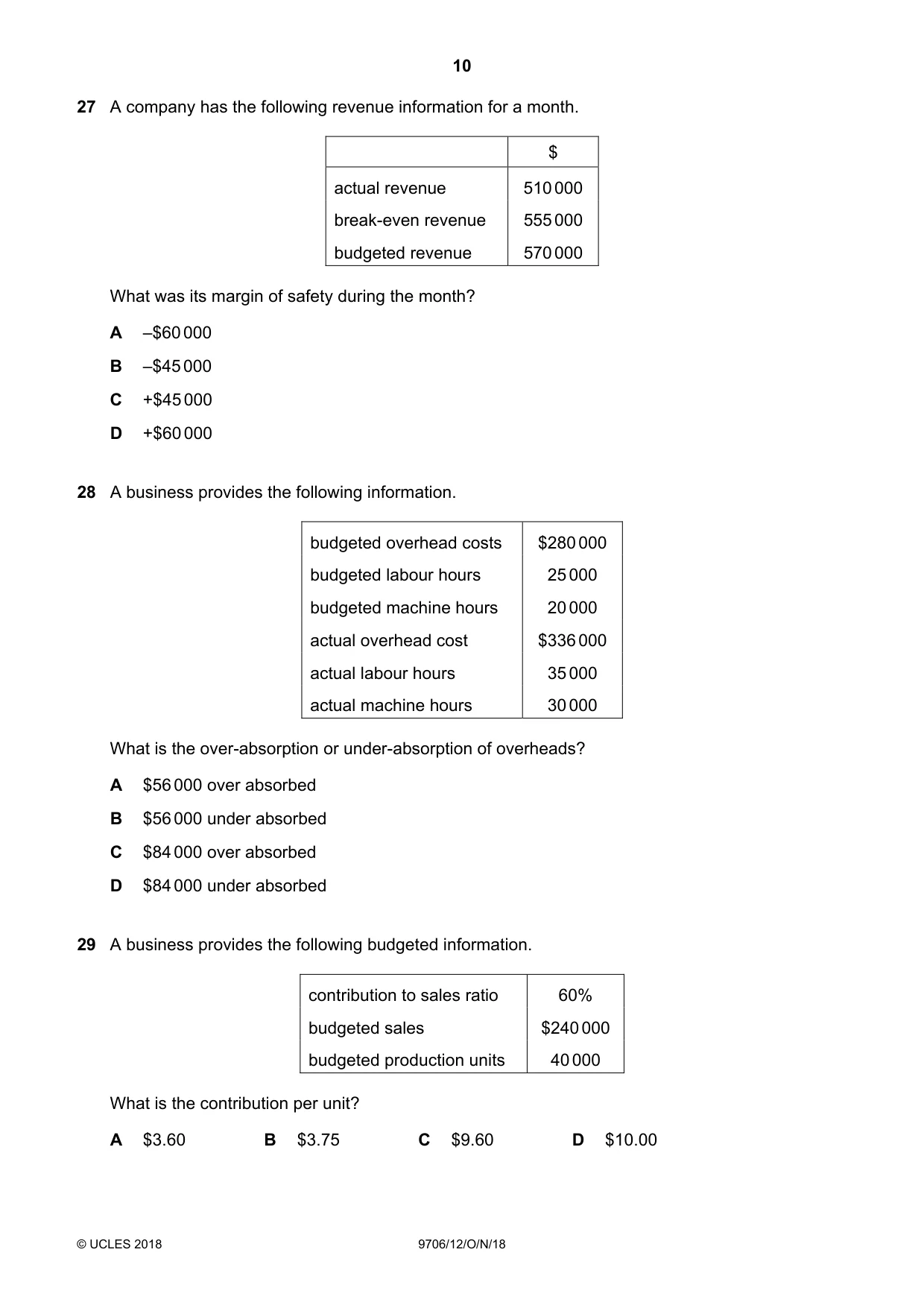
27 A company has the following revenue information for a month. $ actual revenue 510 000 break-even revenue 555 000 budgeted revenue 570 000 What was its margin of safety during the month? A –$60 000 B –$45 000 C +$45 000 D +$60 000
Mark scheme: B
Q28 · A business provides the following information
28 A business provides the following information. budgeted overhead costs $280 000 budgeted labour hours 25 000 budgeted machine hours 20 000 actual overhead cost $336 000 actual labour hours 35 000 actual machine hours 30 000 What is the over-absorption or under-absorption of overheads? A $56 000 over absorbed B $56 000 under absorbed C $84 000 over absorbed D $84 000 under absorbed
Mark scheme: A
Q29 · A business provides the following budgeted information
29 A business provides the following budgeted information. contribution to sales ratio 60% budgeted sales $240 000 budgeted production units 40 000 What is the contribution per unit? A $3.60 B $3.75 C $9.60 D $10.00
Mark scheme: A
Q30 · Which statement identifies an advantage to a business of financial planning?
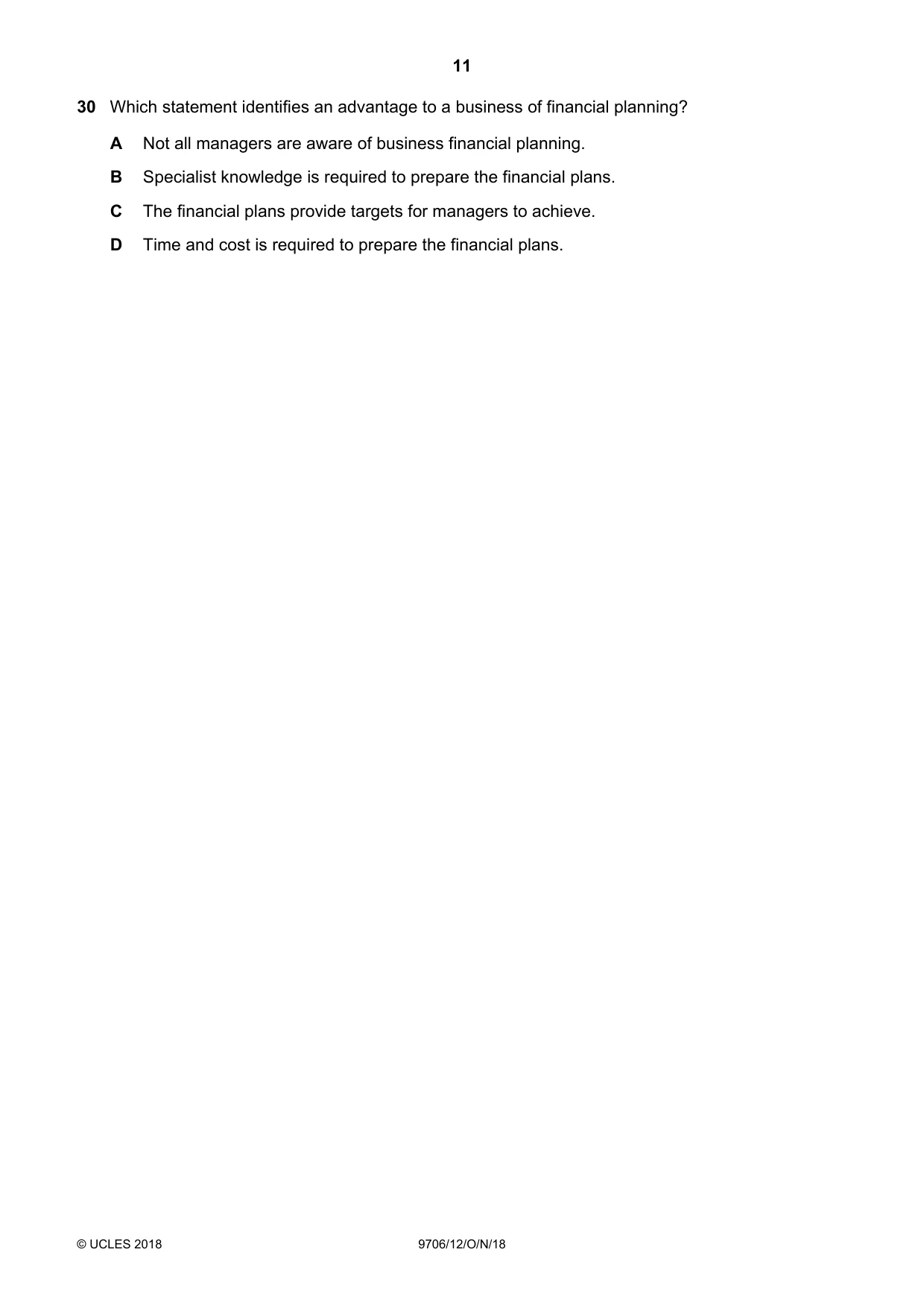
30 Which statement identifies an advantage to a business of financial planning? A Not all managers are aware of business financial planning. B Specialist knowledge is required to prepare the financial plans. C The financial plans provide targets for managers to achieve. D Time and cost is required to prepare the financial plans.
Mark scheme: C
What was in this paper
The subtopics covered by these 30 questions, and how many questions each got. Open one in a new tab to see every Cambridge question on it.
7Preparation of financial statements5Preparation of financial statements4Accounting for non-current assets3Reconciliation and verification3Analysis and communication of accounting information2Costs and cost behaviour2The accounting system2Analysis and communication of accounting information1Budgeting and budgetary control1What you needed in this session
Cambridge’s own grade thresholds for 2018 Oct/Nov, Paper 1 · Variant 2. A higher threshold means an easier paper — the bar moves with how the cohort did.