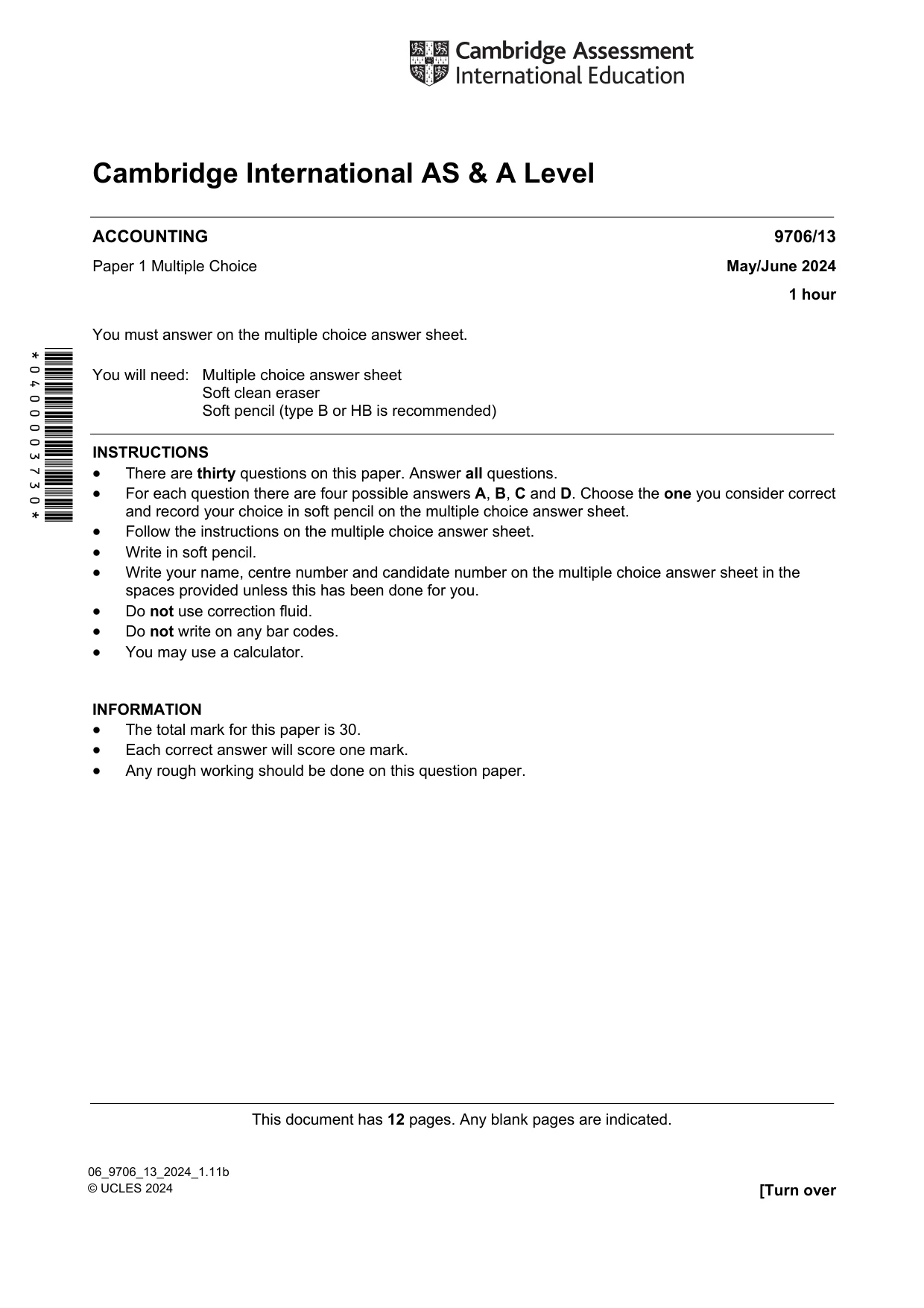
Cambridge A Level Accounting 9706 — 2024 May/June Paper 1 · Variant 3
9706/13/M/J/24 · 30 questions · 30 marks · ≈34 min
The question paper and its mark scheme, free to read here and free to download. This is Cambridge’s own paper, exactly as it was sat.
Question paper12 pages
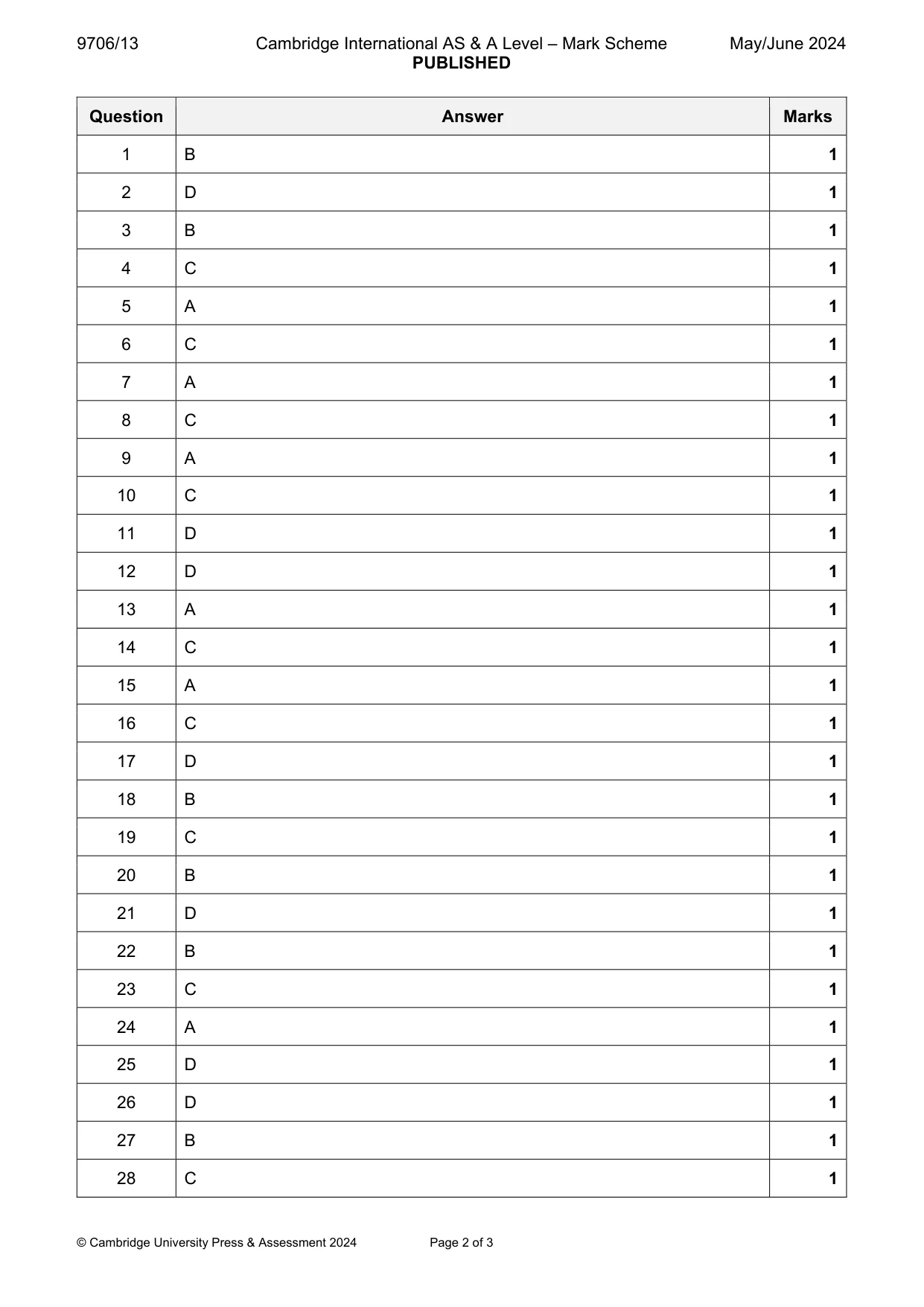
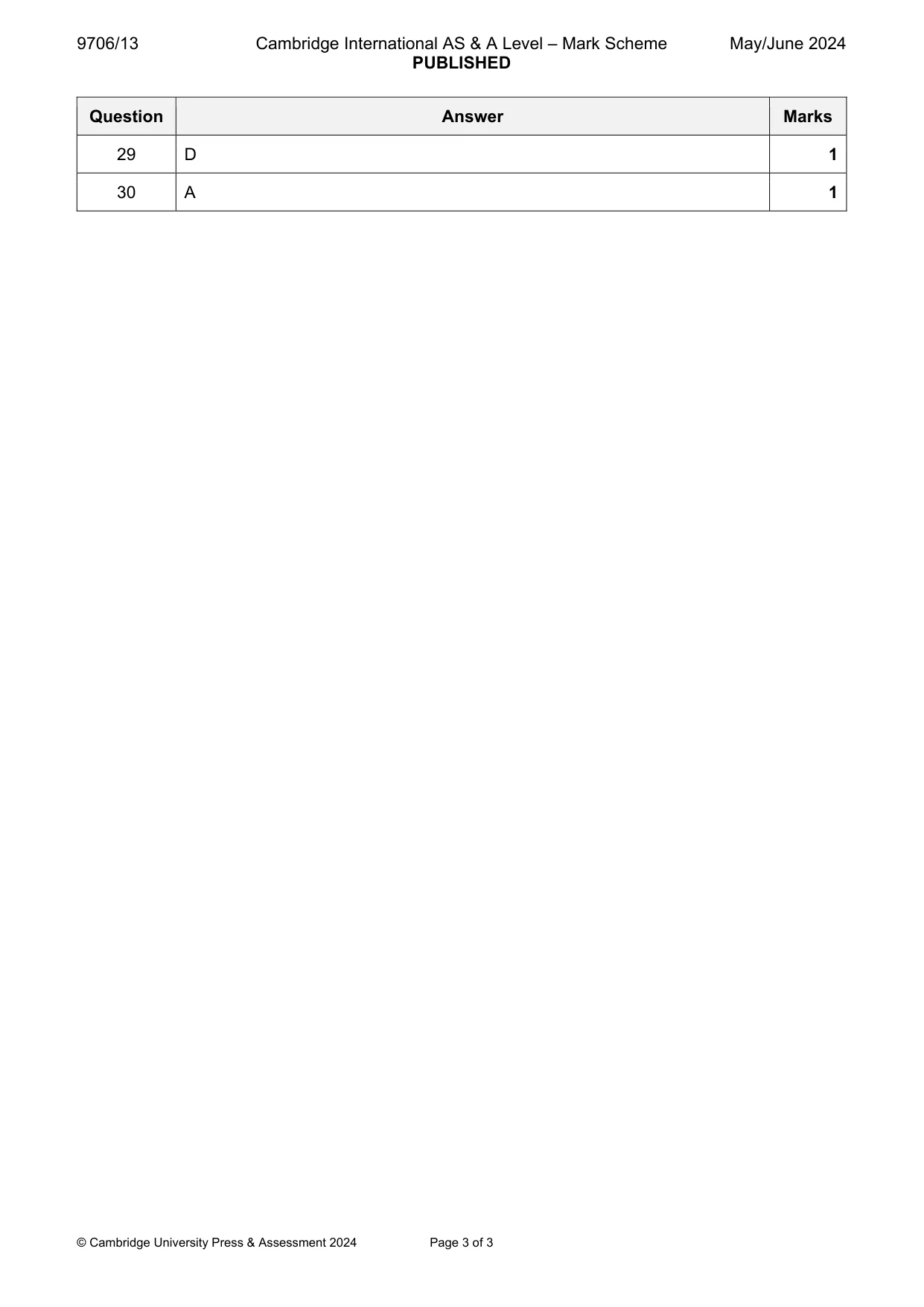
Mark scheme3 pages
Answers below. Sit the paper first if you are practising.
Questions as text
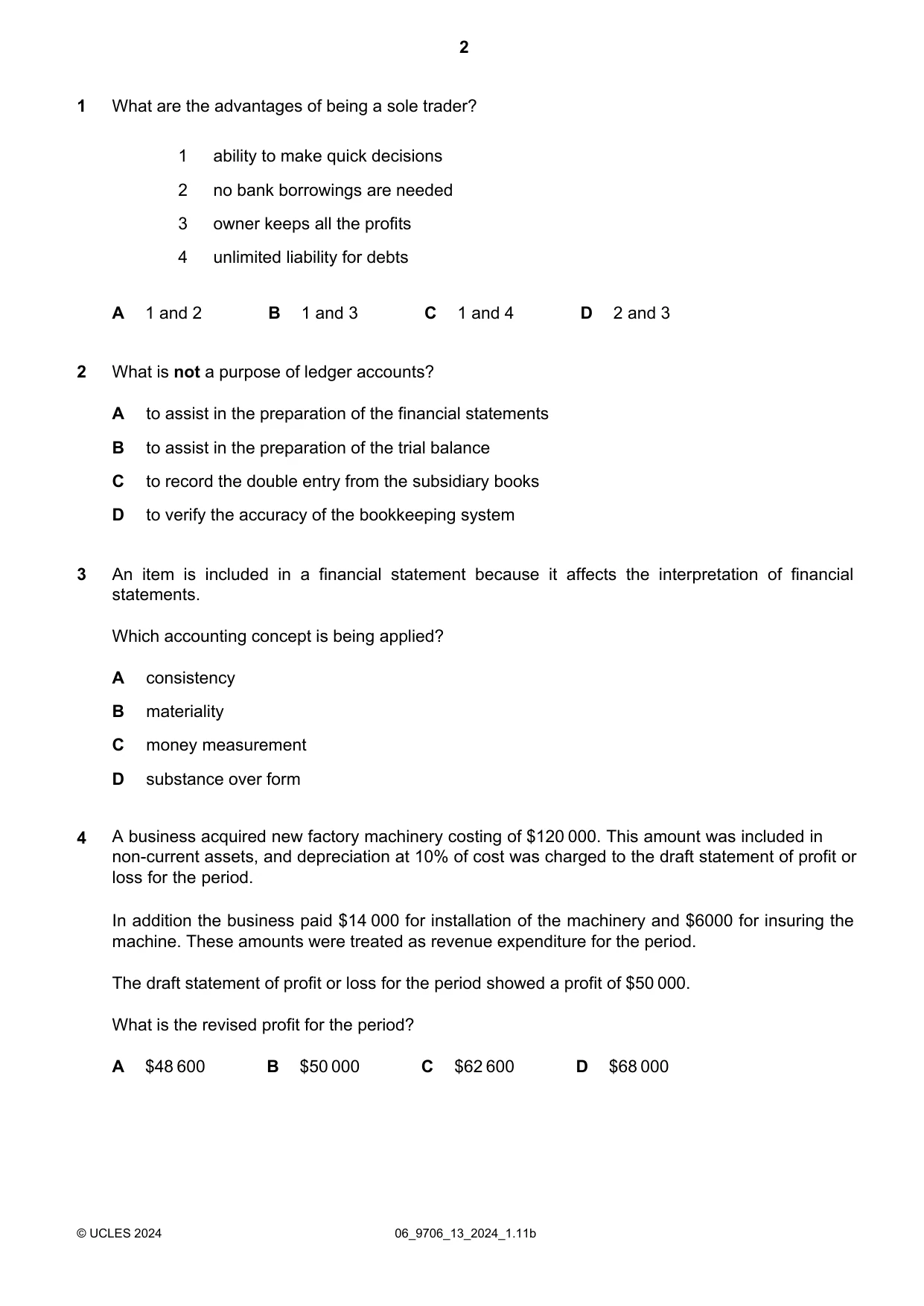
Q1 · What are the advantages of being a sole trader?
1 What are the advantages of being a sole trader? 1 ability to make quick decisions 2 no bank borrowings are needed 3 owner keeps all the profits 4 unlimited liability for debts A 1 and 2 B 1 and 3 C 1 and 4 D 2 and 3
Mark scheme: B
Q2 · What is not a purpose of ledger accounts?
2 What is not a purpose of ledger accounts? A to assist in the preparation of the financial statements B to assist in the preparation of the trial balance C to record the double entry from the subsidiary books D to verify the accuracy of the bookkeeping system
Mark scheme: D
Q3 · An item is included in a financial statement because it affects the interpretation of…
3 An item is included in a financial statement because it affects the interpretation of financial statements. Which accounting concept is being applied? A consistency B materiality C money measurement D substance over form A business acquired new factory machinery costing of $120 000. This amount was included in
Mark scheme: B
Q4 · Non-current assets, and depreciation at 10% of cost was charged to the draft statement of…
4 non-current assets, and depreciation at 10% of cost was charged to the draft statement of profit or loss for the period. In addition the business paid $14 000 for installation of the machinery and $6000 for insuring the machine. These amounts were treated as revenue expenditure for the period. The draft statement of profit or loss for the period showed a profit of $50 000. What is the revised profit for the period? A $48 600 B $50 000 C $62 600 D $68 000
Mark scheme: C
Q5 · Jake sold a non-current asset which was not fully depreciated
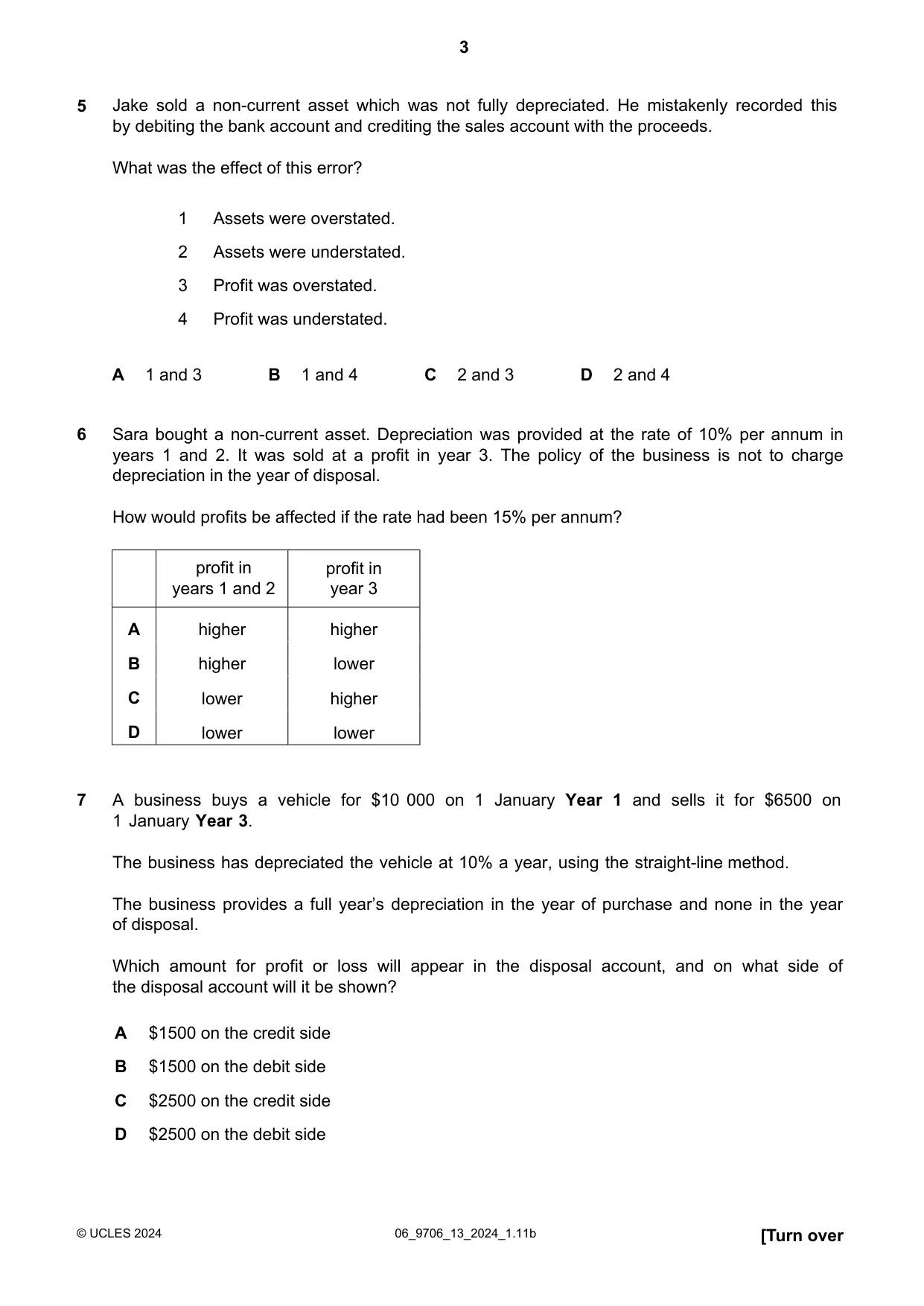
5 Jake sold a non-current asset which was not fully depreciated. He mistakenly recorded this by debiting the bank account and crediting the sales account with the proceeds. What was the effect of this error? 1 Assets were overstated. 2 Assets were understated. 3 Profit was overstated. 4 Profit was understated. A 1 and 3 B 1 and 4 C 2 and 3 D 2 and 4
Mark scheme: A
Q6 · Sara bought a non-current asset
6 Sara bought a non-current asset. Depreciation was provided at the rate of 10% per annum in years 1 and 2. It was sold at a profit in year 3. The policy of the business is not to charge depreciation in the year of disposal. How would profits be affected if the rate had been 15% per annum? profit in profit in years 1 and 2 year 3 A higher higher B higher lower C lower higher D lower lower
Mark scheme: C
Q7 · A business buys a vehicle for $10 000 on 1 January Year 1 and sells it for $6500 on 1…
7 A business buys a vehicle for $10 000 on 1 January Year 1 and sells it for $6500 on 1 January Year 3. The business has depreciated the vehicle at 10% a year, using the straight-line method. The business provides a full year’s depreciation in the year of purchase and none in the year of disposal. Which amount for profit or loss will appear in the disposal account, and on what side of the disposal account will it be shown? A $1500 on the credit side B $1500 on the debit side C $2500 on the credit side D $2500 on the debit side
Mark scheme: A
Q8 · Which errors would be identified by preparing a trial balance?
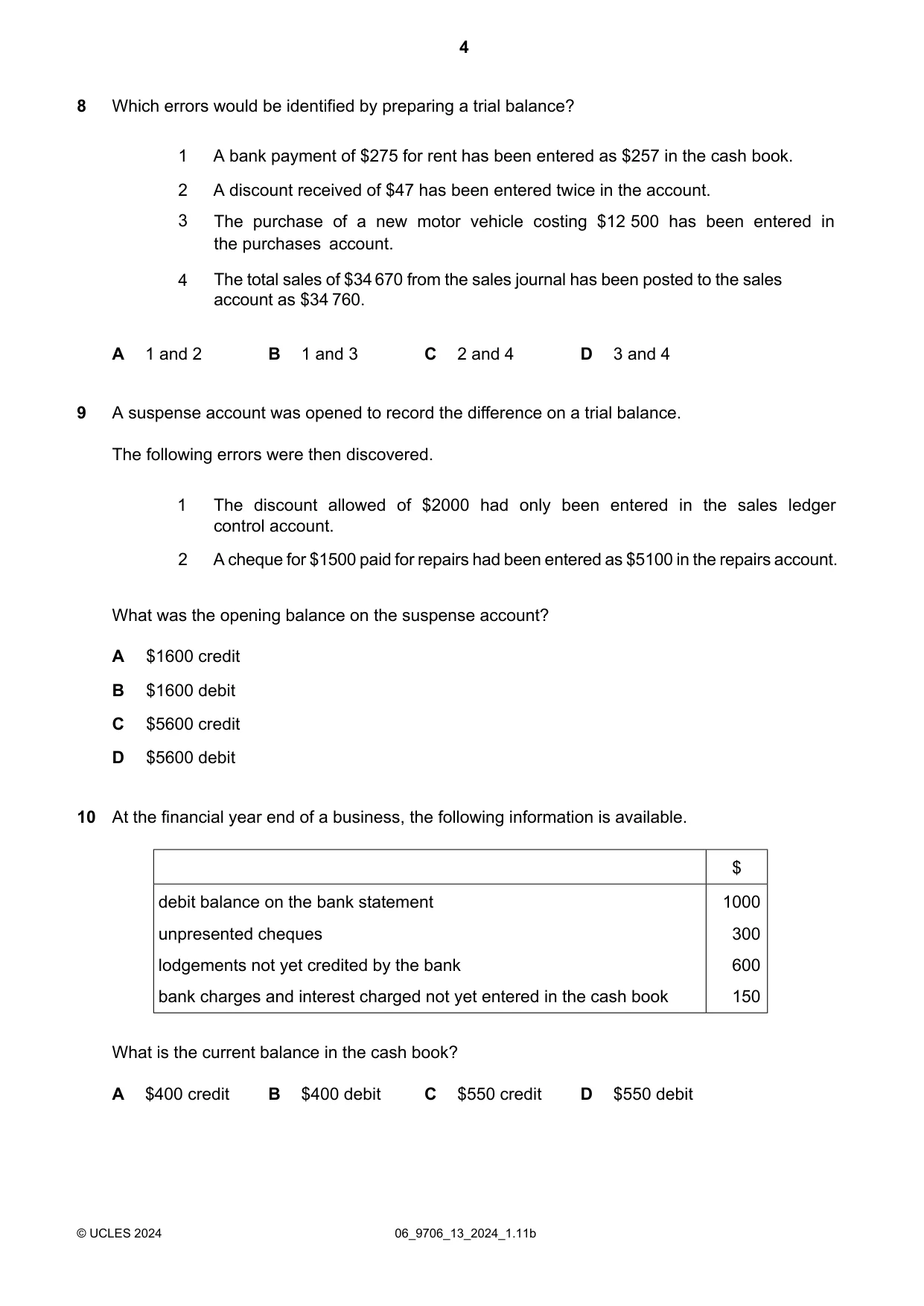
8 Which errors would be identified by preparing a trial balance? 1 A bank payment of $275 for rent has been entered as $257 in the cash book. 2 A discount received of $47 has been entered twice in the account. 3 The purchase of a new motor vehicle costing $12 500 has been entered in the purchases account. 4 The total sales of $34 670 from the sales journal has been posted to the sales account as $34 760. A 1 and 2 B 1 and 3 C 2 and 4 D 3 and 4
Mark scheme: C
Q9 · A suspense account was opened to record the difference on a trial balance
9 A suspense account was opened to record the difference on a trial balance. The following errors were then discovered. 1 The discount allowed of $2000 had only been entered in the sales ledger control account. 2 A cheque for $1500 paid for repairs had been entered as $5100 in the repairs account. What was the opening balance on the suspense account? A $1600 credit B $1600 debit C $5600 credit D $5600 debit
Mark scheme: A
Q10 · At the financial year end of a business, the following information is available
10 At the financial year end of a business, the following information is available. $ debit balance on the bank statement 1000 unpresented cheques 300 lodgements not yet credited by the bank 600 bank charges and interest charged not yet entered in the cash book 150 What is the current balance in the cash book? A $400 credit B $400 debit C $550 credit D $550 debit
Mark scheme: C
Q11 · What do the debit side closing balance carried down and the credit side opening balance…
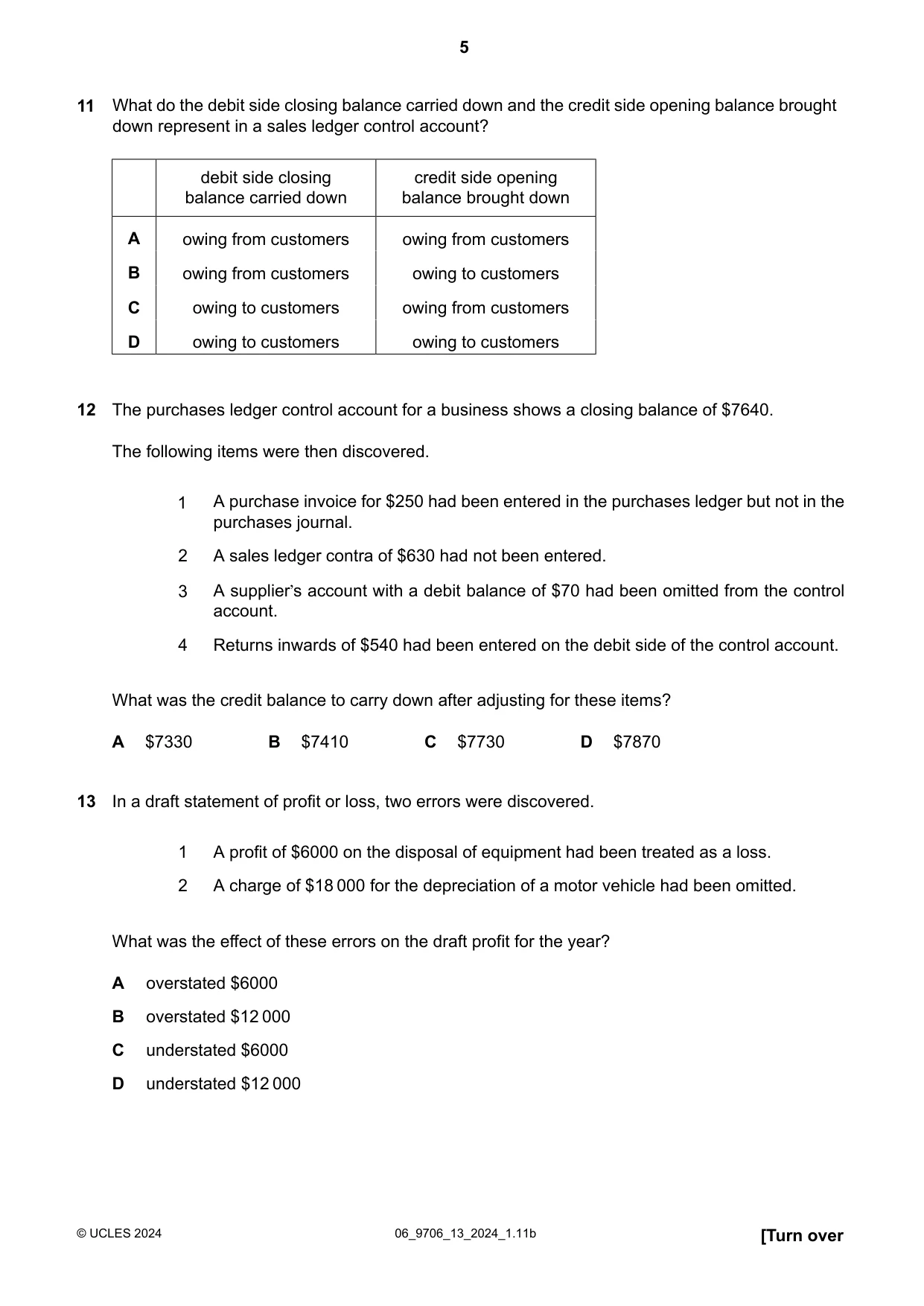
11 What do the debit side closing balance carried down and the credit side opening balance brought down represent in a sales ledger control account? debit side closing credit side opening balance carried down balance brought down A owing from customers owing from customers B owing from customers owing to customers C owing to customers owing from customers D owing to customers owing to customers
Mark scheme: D
Q12 · The purchases ledger control account for a business shows a closing balance of $7640
12 The purchases ledger control account for a business shows a closing balance of $7640. The following items were then discovered. 1 A purchase invoice for $250 had been entered in the purchases ledger but not in the purchases journal. 2 A sales ledger contra of $630 had not been entered. 3 A supplier’s account with a debit balance of $70 had been omitted from the control account. 4 Returns inwards of $540 had been entered on the debit side of the control account. What was the credit balance to carry down after adjusting for these items? A $7330 B $7410 C $7730 D $7870
Mark scheme: D
Q13 · In a draft statement of profit or loss, two errors were discovered
13 In a draft statement of profit or loss, two errors were discovered. 1 A profit of $6000 on the disposal of equipment had been treated as a loss. 2 A charge of $18 000 for the depreciation of a motor vehicle had been omitted. What was the effect of these errors on the draft profit for the year? A overstated $6000 B overstated $12 000 C understated $6000 D understated $12 000
Mark scheme: A
Q14 · At the beginning of the financial year on 1 July, a business shows an accrual on the rent…
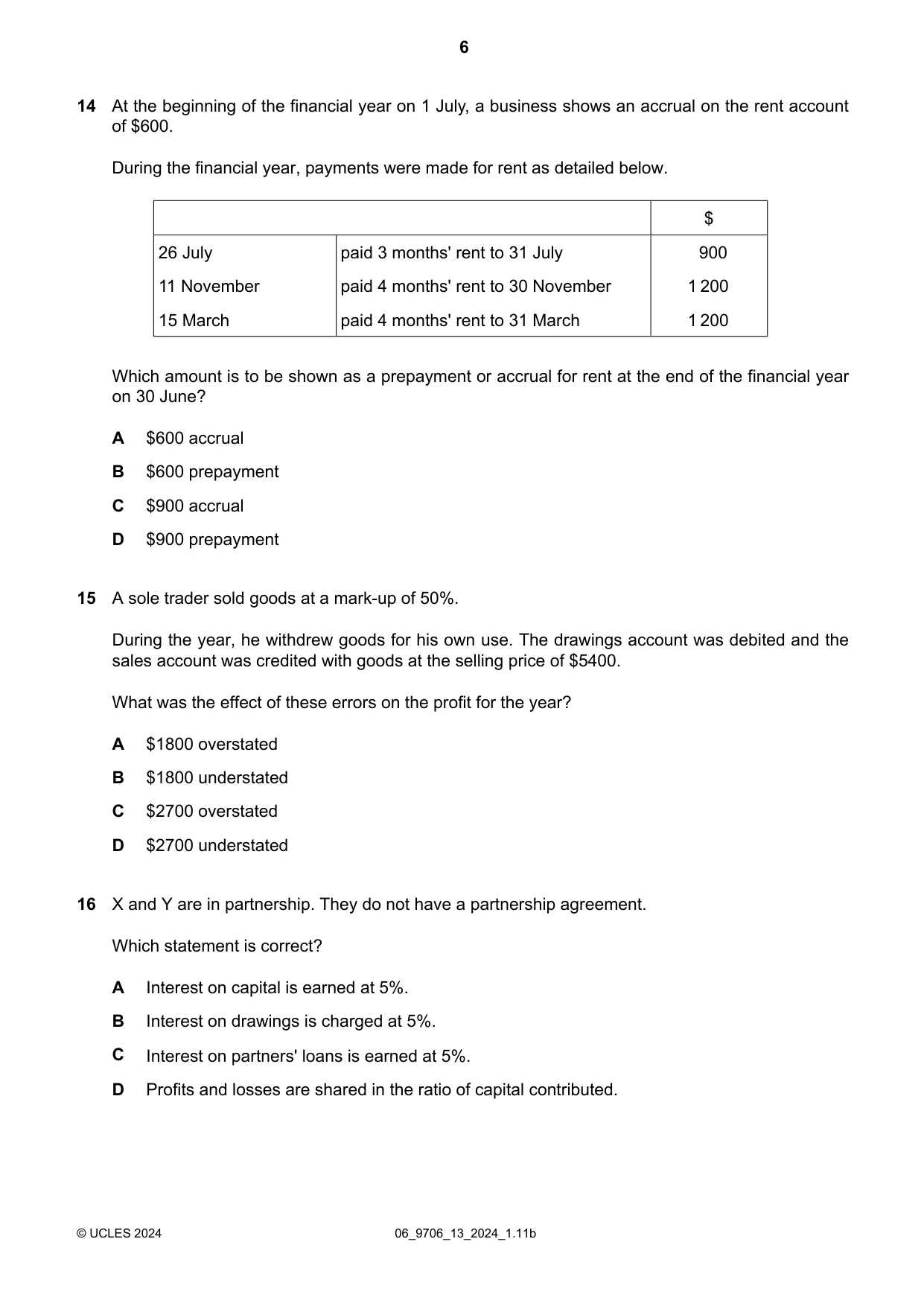
14 At the beginning of the financial year on 1 July, a business shows an accrual on the rent account of $600. During the financial year, payments were made for rent as detailed below. $ 26 July paid 3 months' rent to 31 July 900 11 November paid 4 months' rent to 30 November 1 200 15 March paid 4 months' rent to 31 March 1 200 Which amount is to be shown as a prepayment or accrual for rent at the end of the financial year on 30 June? A $600 accrual B $600 prepayment C $900 accrual D $900 prepayment
Mark scheme: C
Q15 · A sole trader sold goods at a mark-up of 50%
15 A sole trader sold goods at a mark-up of 50%. During the year, he withdrew goods for his own use. The drawings account was debited and the sales account was credited with goods at the selling price of $5400. What was the effect of these errors on the profit for the year? A $1800 overstated B $1800 understated C $2700 overstated D $2700 understated
Mark scheme: A
Q16 · X and Y are in partnership
16 X and Y are in partnership. They do not have a partnership agreement. Which statement is correct? A Interest on capital is earned at 5%. B Interest on drawings is charged at 5%. C Interest on partners' loans is earned at 5%. D Profits and losses are shared in the ratio of capital contributed.
Mark scheme: C
Q17 · Yasmin and Zara are in partnership, sharing profits and losses in the ratio 3 : 2…
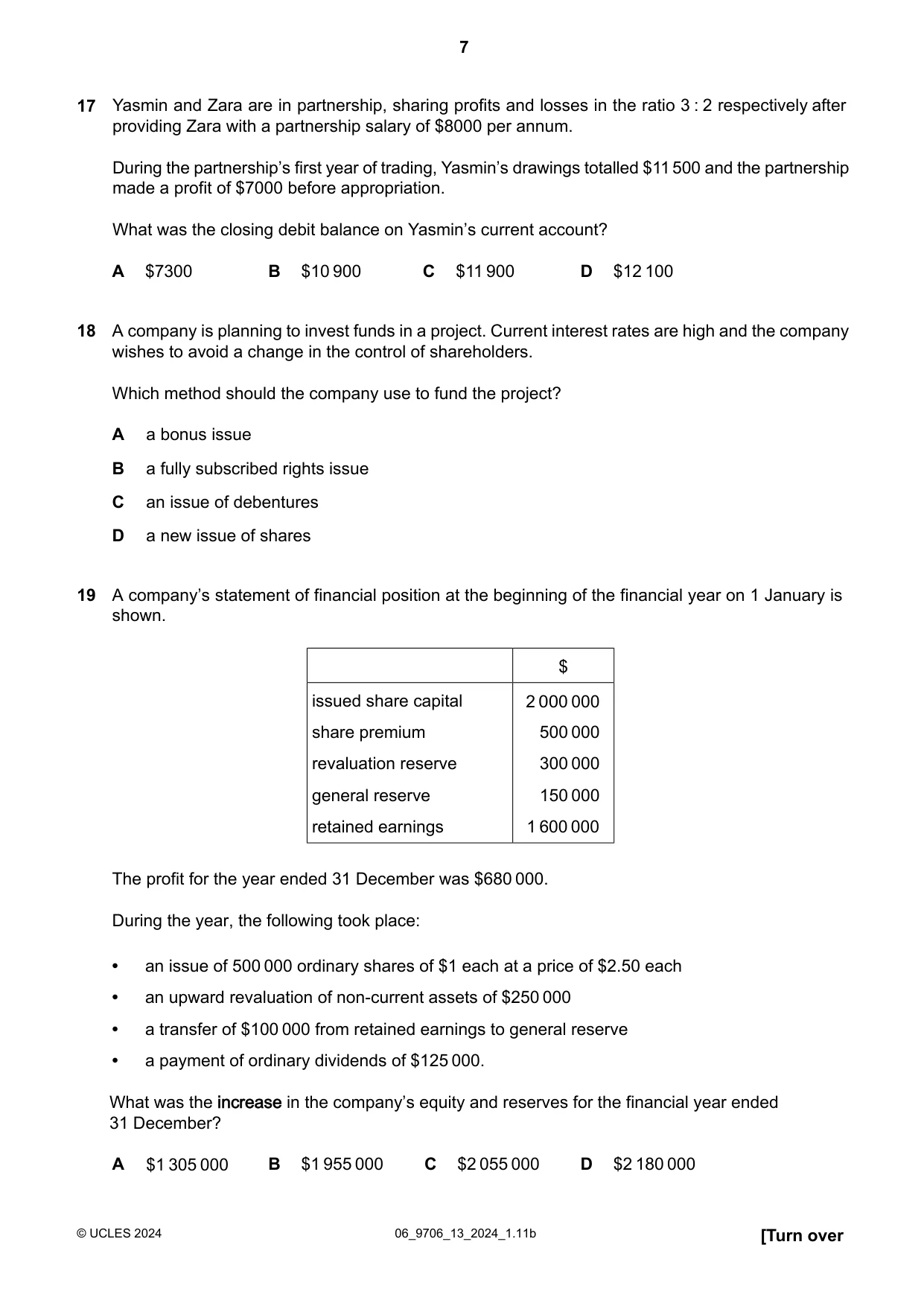
17 Yasmin and Zara are in partnership, sharing profits and losses in the ratio 3 : 2 respectively after providing Zara with a partnership salary of $8000 per annum. During the partnership’s first year of trading, Yasmin’s drawings totalled $11 500 and the partnership made a profit of $7000 before appropriation. What was the closing debit balance on Yasmin’s current account? A $7300 B $10 900 C $11 900 D $12 100
Mark scheme: D
Q18 · A company is planning to invest funds in a project
18 A company is planning to invest funds in a project. Current interest rates are high and the company wishes to avoid a change in the control of shareholders. Which method should the company use to fund the project? A a bonus issue B a fully subscribed rights issue C an issue of debentures D a new issue of shares
Mark scheme: B
Q19 · A company’s statement of financial position at the beginning of the financial year on 1…
19 A company’s statement of financial position at the beginning of the financial year on 1 January is shown. $ issued share capital 2 000 000 share premium 500 000 revaluation reserve 300 000 general reserve 150 000 retained earnings 1 600 000 The profit for the year ended 31 December was $680 000. During the year, the following took place: • an issue of 500 000 ordinary shares of $1 each at a price of $2.50 each • an upward revaluation of non-current assets of $250 000 • a transfer of $100 000 from retained earnings to general reserve • a payment of ordinary dividends of $125 000. What was the increase in the company’s equity and reserves for the financial year ended 31 December? A $1 305 000 B $1 955 000 C $2 055 000 D $2 180 000
Mark scheme: C
Q20 · Who are internal users of accounting information?
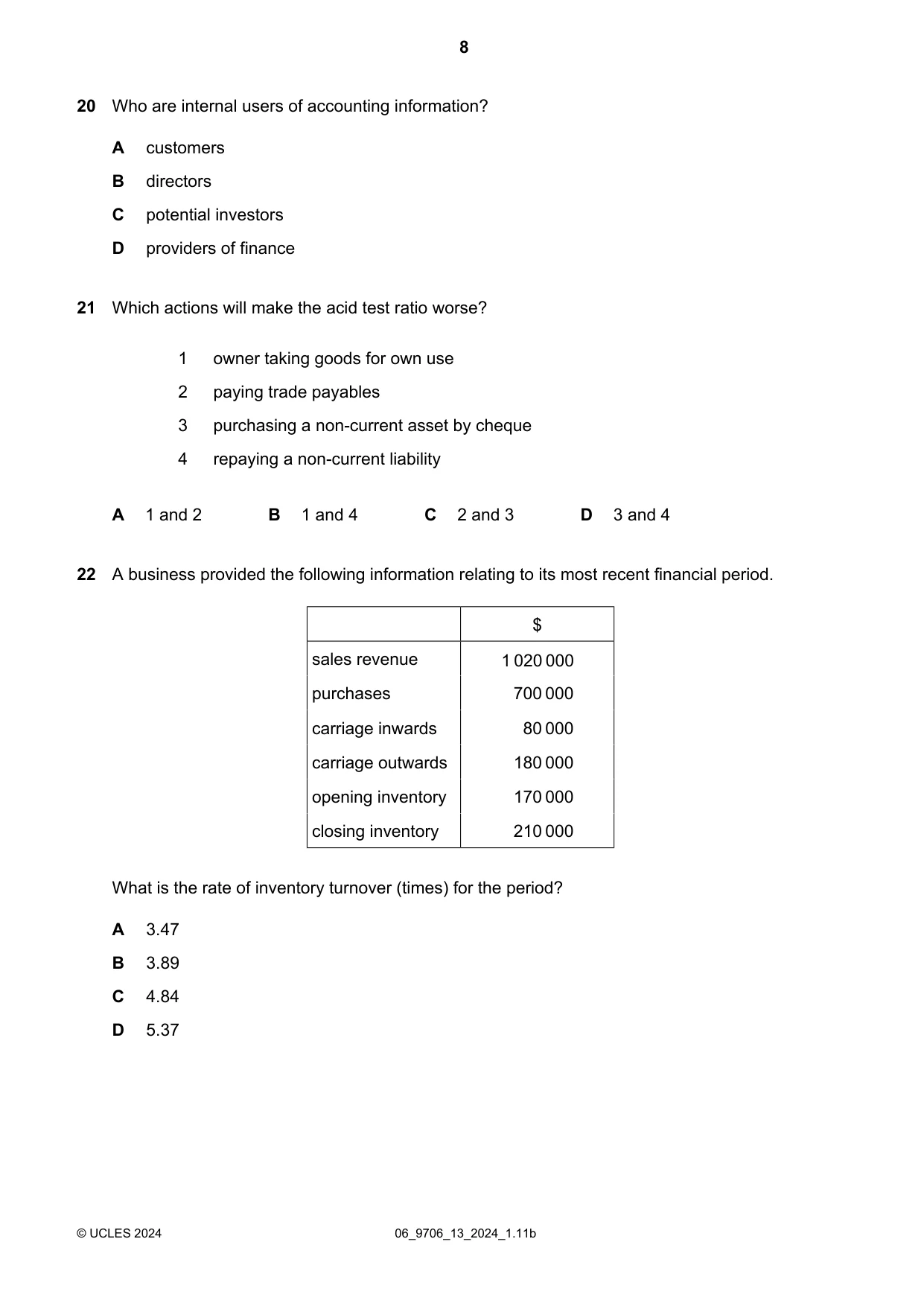
20 Who are internal users of accounting information? A customers B directors C potential investors D providers of finance
Mark scheme: B
More questions on Analysis and communication of accounting information
Q21 · Which actions will make the acid test ratio worse?
21 Which actions will make the acid test ratio worse? 1 owner taking goods for own use 2 paying trade payables 3 purchasing a non-current asset by cheque 4 repaying a non-current liability A 1 and 2 B 1 and 4 C 2 and 3 D 3 and 4
Mark scheme: D
More questions on Analysis and communication of accounting information
Q22 · A business provided the following information relating to its most recent financial period
22 A business provided the following information relating to its most recent financial period. $ sales revenue 1 020 000 purchases 700 000 carriage inwards 80 000 carriage outwards 180 000 opening inventory 170 000 closing inventory 210 000 What is the rate of inventory turnover (times) for the period? A 3.47 B 3.89 C 4.84 D 5.37
Mark scheme: B
More questions on Analysis and communication of accounting information
Q23 · Actual output for a business is higher than budgeted output
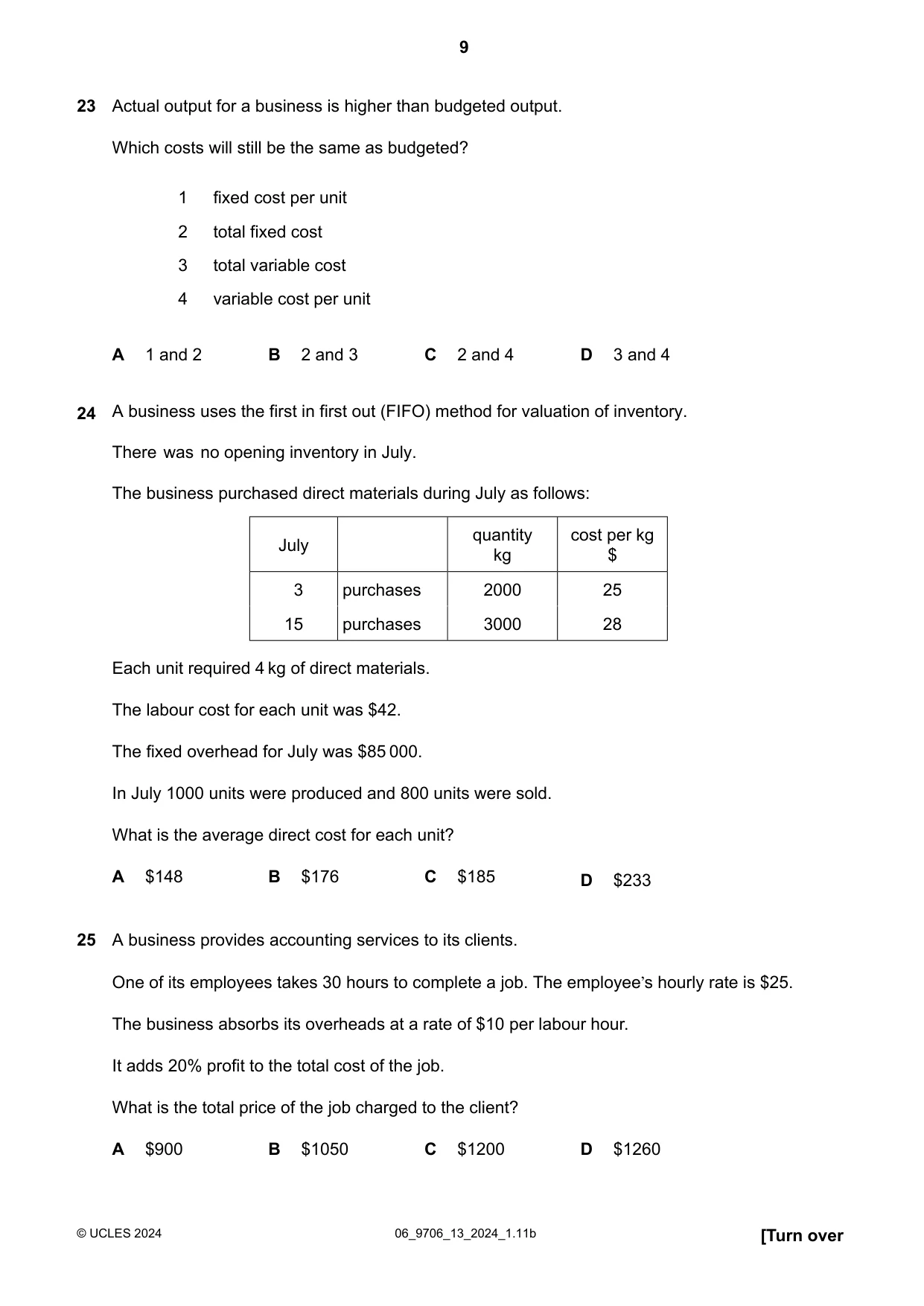
23 Actual output for a business is higher than budgeted output. Which costs will still be the same as budgeted? 1 fixed cost per unit 2 total fixed cost 3 total variable cost 4 variable cost per unit A 1 and 2 B 2 and 3 C 2 and 4 D 3 and 4 A business uses the first in first out (FIFO) method for valuation of inventory.
Mark scheme: C
Q24 · There was no opening inventory in July
24 There was no opening inventory in July. The business purchased direct materials during July as follows: quantity cost per kg July kg $ 3 purchases 2000 25 15 purchases 3000 28 Each unit required 4 kg of direct materials. The labour cost for each unit was $42. The fixed overhead for July was $85 000. In July 1000 units were produced and 800 units were sold. What is the average direct cost for each unit? A $148 B $176 C $185 D $233
Mark scheme: A
Q25 · A business provides accounting services to its clients
25 A business provides accounting services to its clients. One of its employees takes 30 hours to complete a job. The employee’s hourly rate is $25. The business absorbs its overheads at a rate of $10 per labour hour. It adds 20% profit to the total cost of the job. What is the total price of the job charged to the client? A $900 B $1050 C $1200 D $1260 A business operates a staff cafeteria at a cost of $12 000.
Mark scheme: D
Q26 · What is the most appropriate basis for apportioning this overhead cost?
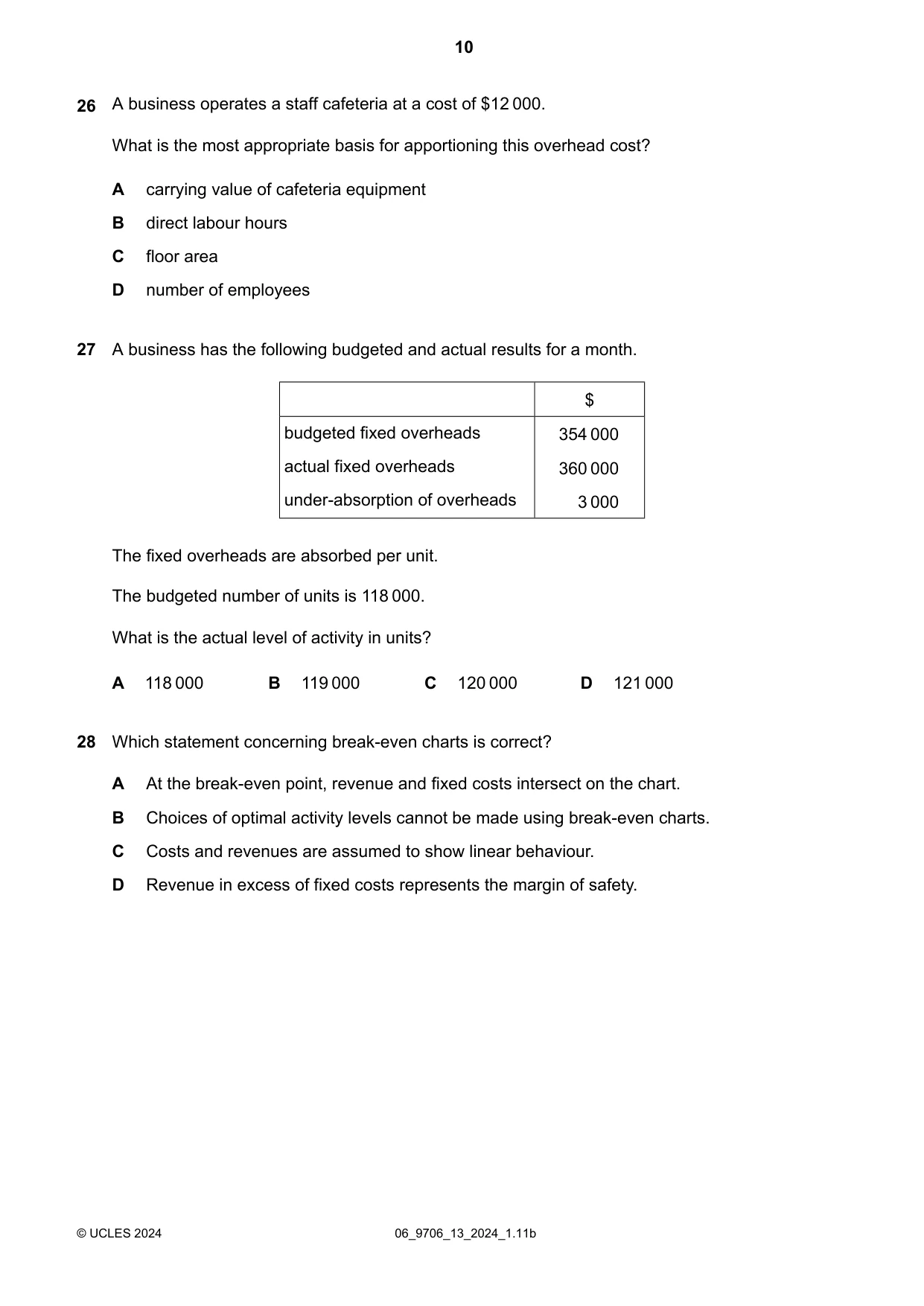
26 What is the most appropriate basis for apportioning this overhead cost? A carrying value of cafeteria equipment B direct labour hours C floor area D number of employees
Mark scheme: D
Q27 · A business has the following budgeted and actual results for a month
27 A business has the following budgeted and actual results for a month. $ budgeted fixed overheads 354 000 actual fixed overheads 360 000 under-absorption of overheads 3 000 The fixed overheads are absorbed per unit. The budgeted number of units is 118 000. What is the actual level of activity in units? A 118 000 B 119 000 C 120 000 D 121 000
Mark scheme: B
Q28 · Which statement concerning break-even charts is correct?
28 Which statement concerning break-even charts is correct? A At the break-even point, revenue and fixed costs intersect on the chart. B Choices of optimal activity levels cannot be made using break-even charts. C Costs and revenues are assumed to show linear behaviour. D Revenue in excess of fixed costs represents the margin of safety.
Mark scheme: C
Q29 · A business provides the following information
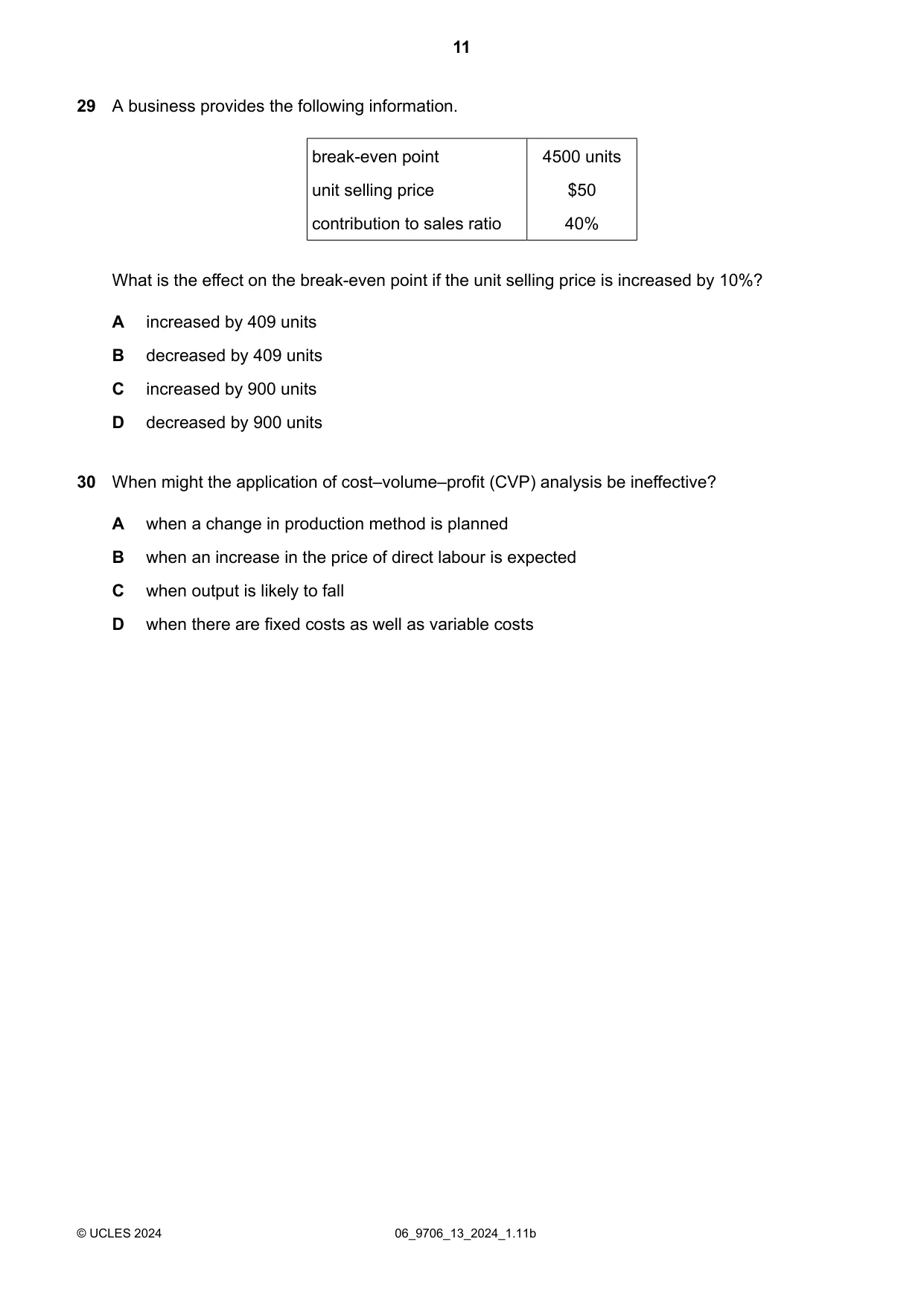
29 A business provides the following information. break-even point 4500 units unit selling price $50 contribution to sales ratio 40% What is the effect on the break-even point if the unit selling price is increased by 10%? A increased by 409 units B decreased by 409 units C increased by 900 units D decreased by 900 units
Mark scheme: D
Q30 · When might the application of cost–volume–profit (CVP) analysis be ineffective?
30 When might the application of cost–volume–profit (CVP) analysis be ineffective? A when a change in production method is planned B when an increase in the price of direct labour is expected C when output is likely to fall D when there are fixed costs as well as variable costs
Mark scheme: A
What was in this paper
The subtopics covered by these 30 questions, and how many questions each got. Open one in a new tab to see every Cambridge question on it.
What you needed in this session
Cambridge’s own grade thresholds for 2024 May/June, Paper 1 · Variant 3. A higher threshold means an easier paper — the bar moves with how the cohort did.