Cambridge A Level Accounting 9706 — 2024 Feb/March Paper 1 · Variant 2
9706/12/F/M/24 · 30 questions · 30 marks · ≈34 min
The question paper and its mark scheme, free to read here and free to download. This is Cambridge’s own paper, exactly as it was sat.
Question paper12 pages
Mark scheme3 pages
Answers below. Sit the paper first if you are practising.
Questions as text
Q1 · Which statement about sole traders is correct?
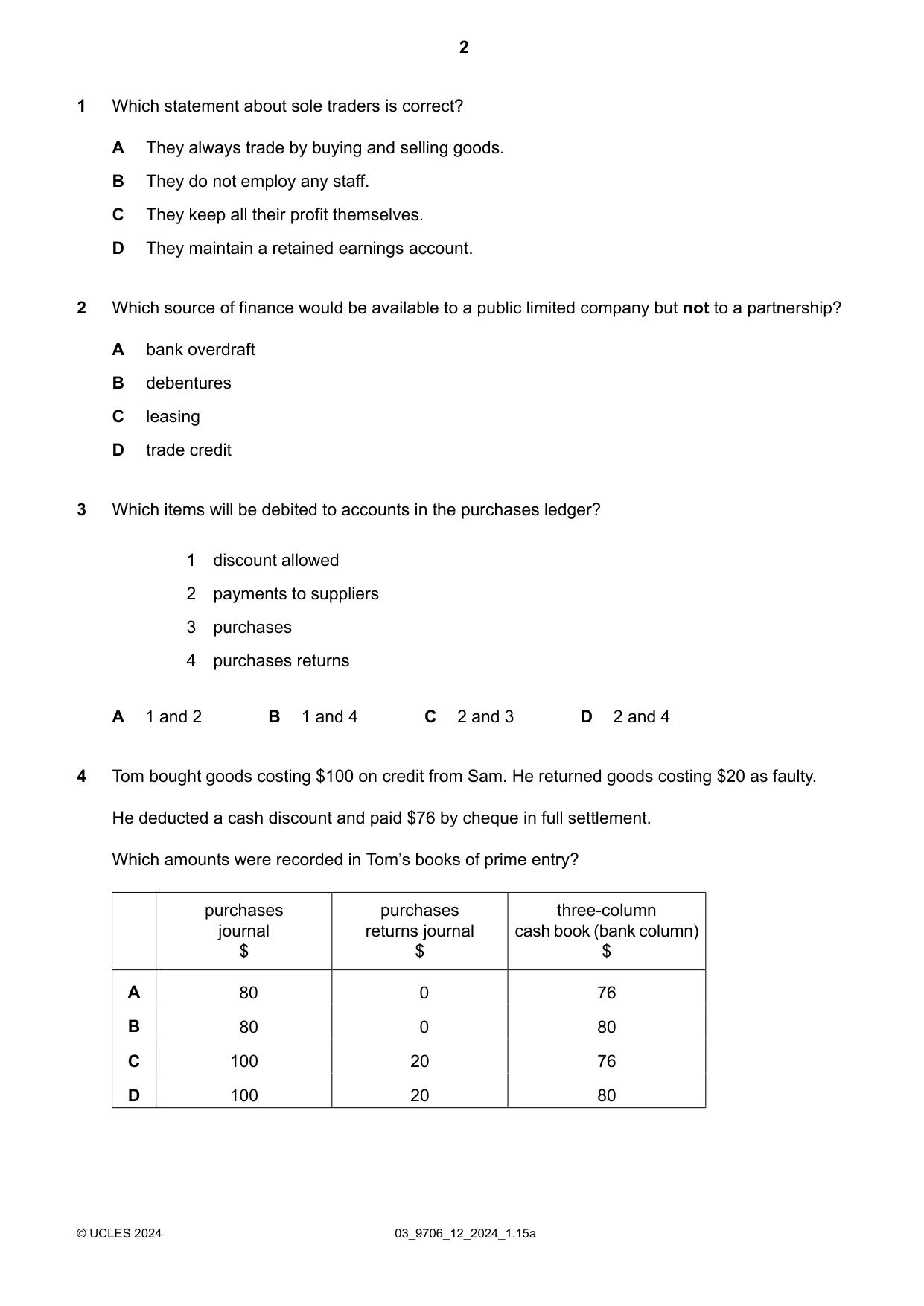
1 Which statement about sole traders is correct? A They always trade by buying and selling goods. B They do not employ any staff. C They keep all their profit themselves. D They maintain a retained earnings account.
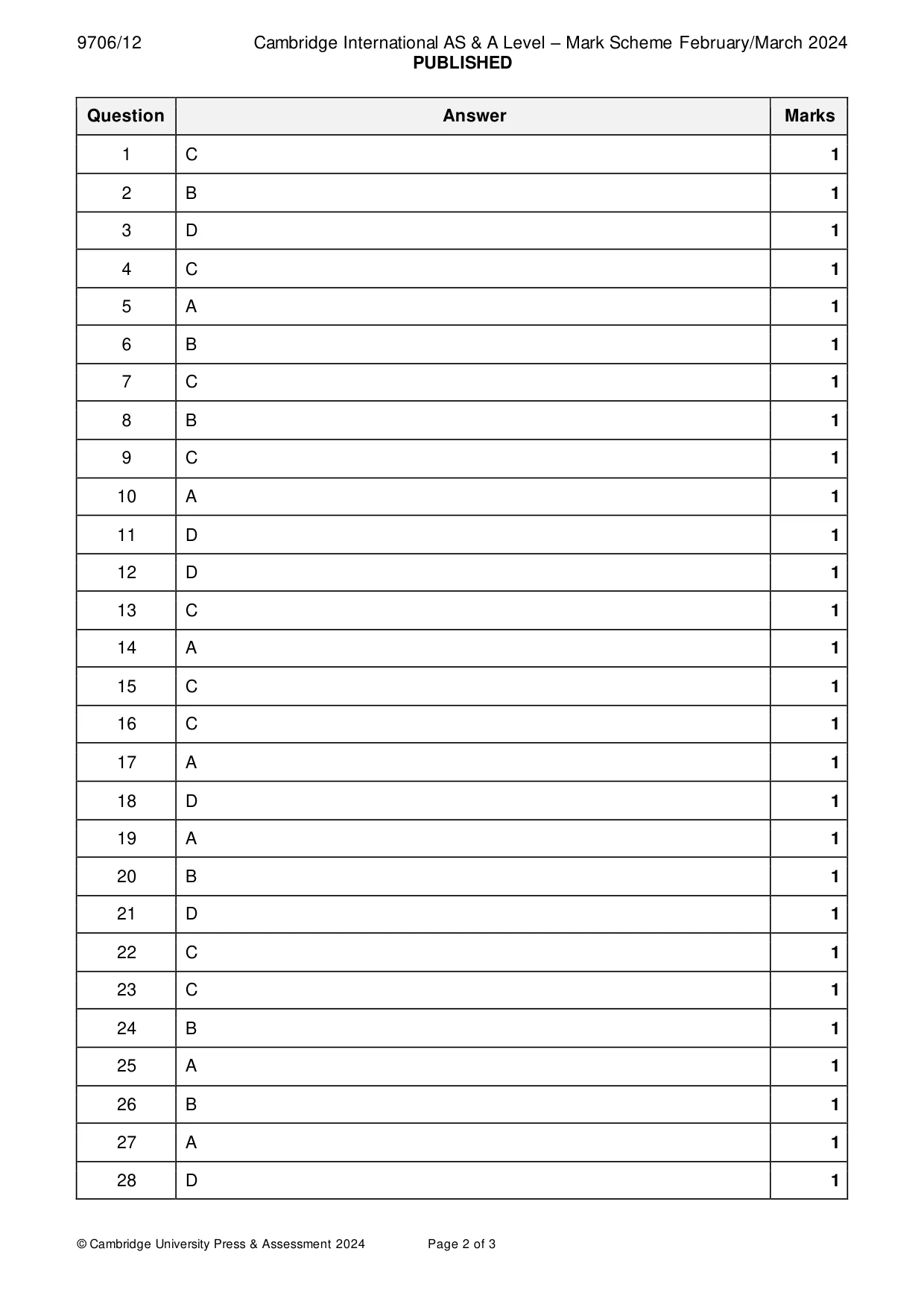
Mark scheme: C
Q2 · Which source of finance would be available to a public limited company but not to a…
2 Which source of finance would be available to a public limited company but not to a partnership? A bank overdraft B debentures C leasing D trade credit
Mark scheme: B
Q3 · Which items will be debited to accounts in the purchases ledger?
3 Which items will be debited to accounts in the purchases ledger? 1 discount allowed 2 payments to suppliers 3 purchases 4 purchases returns A 1 and 2 B 1 and 4 C 2 and 3 D 2 and 4
Mark scheme: D
Q4 · Tom bought goods costing $100 on credit from Sam
4 Tom bought goods costing $100 on credit from Sam. He returned goods costing $20 as faulty. He deducted a cash discount and paid $76 by cheque in full settlement. Which amounts were recorded in Tom’s books of prime entry? purchases purchases three-column journal returns journal cash book (bank column) $ $ $ A 80 0 76 B 80 0 80 C 100 20 76 D 100 20 80
Mark scheme: C
Q5 · What are the characteristics of non-current assets?
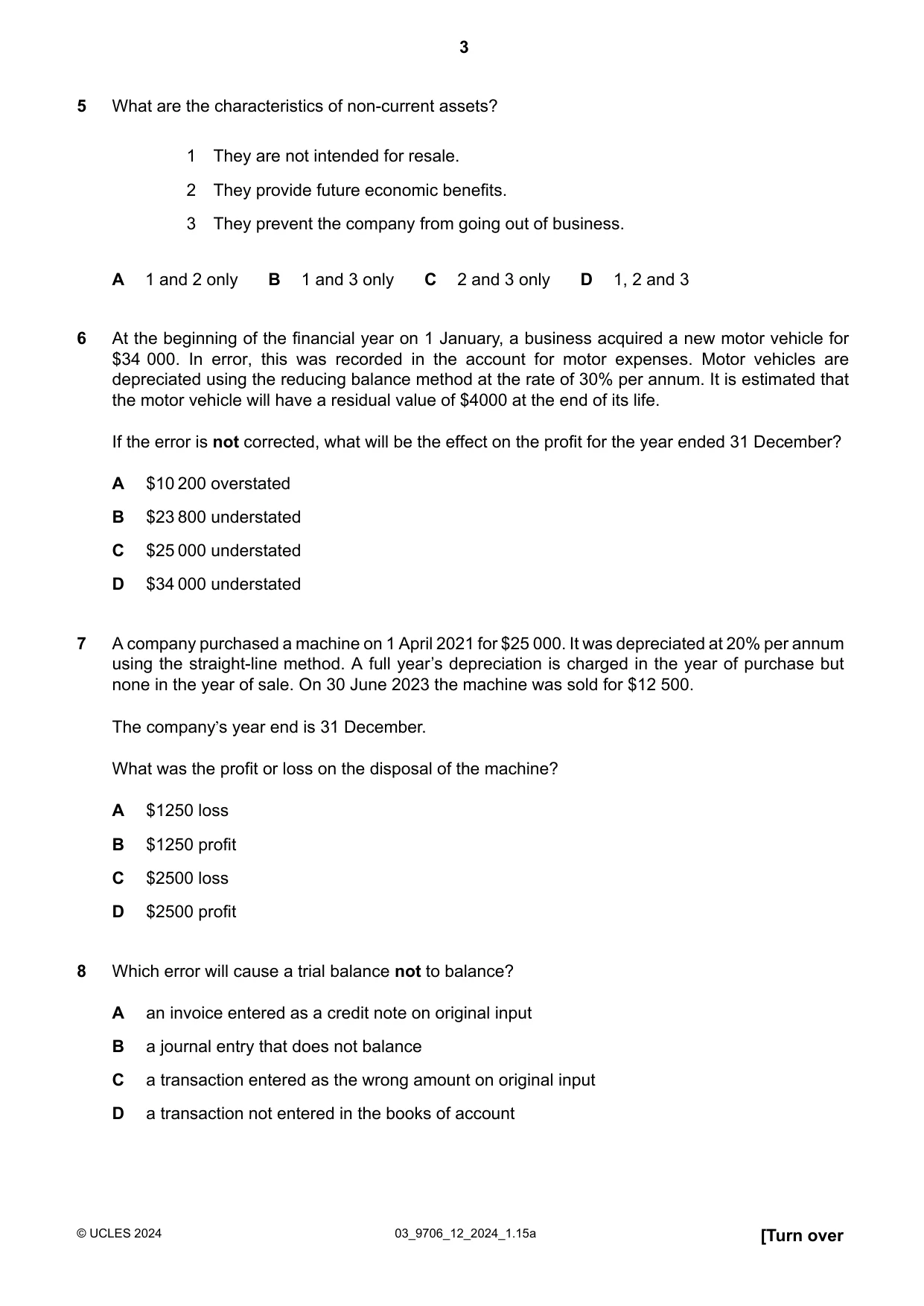
5 What are the characteristics of non-current assets? 1 They are not intended for resale. 2 They provide future economic benefits. 3 They prevent the company from going out of business. A 1 and 2 only B 1 and 3 only C 2 and 3 only D 1, 2 and 3
Mark scheme: A
Q6 · At the beginning of the financial year on 1 January, a business acquired a new motor…
6 At the beginning of the financial year on 1 January, a business acquired a new motor vehicle for $34 000. In error, this was recorded in the account for motor expenses. Motor vehicles are depreciated using the reducing balance method at the rate of 30% per annum. It is estimated that the motor vehicle will have a residual value of $4000 at the end of its life. If the error is not corrected, what will be the effect on the profit for the year ended 31 December? A $10 200 overstated B $23 800 understated C $25 000 understated D $34 000 understated
Mark scheme: B
Q7 · A company purchased a machine on 1 April 2021 for $25 000
7 A company purchased a machine on 1 April 2021 for $25 000. It was depreciated at 20% per annum using the straight-line method. A full year’s depreciation is charged in the year of purchase but none in the year of sale. On 30 June 2023 the machine was sold for $12 500. The company’s year end is 31 December. What was the profit or loss on the disposal of the machine? A $1250 loss B $1250 profit C $2500 loss D $2500 profit
Mark scheme: C
Q8 · Which error will cause a trial balance not to balance?
8 Which error will cause a trial balance not to balance? A an invoice entered as a credit note on original input B a journal entry that does not balance C a transaction entered as the wrong amount on original input D a transaction not entered in the books of account
Mark scheme: B
Q9 · A business prepared a trial balance that included a suspense account
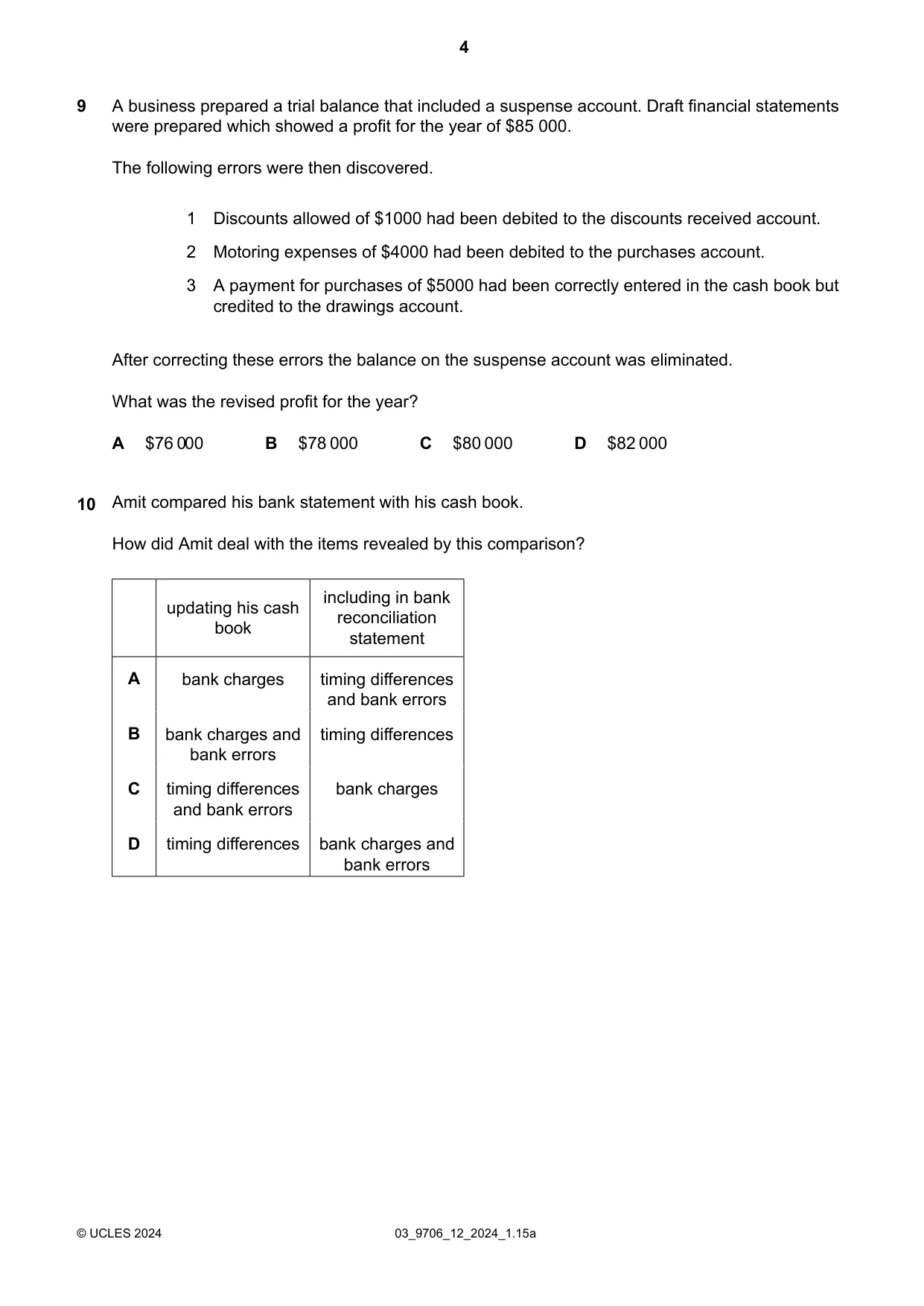
9 A business prepared a trial balance that included a suspense account. Draft financial statements were prepared which showed a profit for the year of $85 000. The following errors were then discovered. 1 Discounts allowed of $1000 had been debited to the discounts received account. 2 Motoring expenses of $4000 had been debited to the purchases account. 3 A payment for purchases of $5000 had been correctly entered in the cash book but credited to the drawings account. After correcting these errors the balance on the suspense account was eliminated. What was the revised profit for the year? A $76 000 B $78 000 C $80 000 D $82 000 Amit compared his bank statement with his cash book.
Mark scheme: C
Q10 · How did Amit deal with the items revealed by this comparison?
10 How did Amit deal with the items revealed by this comparison? including in bank updating his cash reconciliation book statement A bank charges timing differences and bank errors B bank charges and timing differences bank errors C timing differences bank charges and bank errors D timing differences bank charges and bank errors
Mark scheme: A
Q11 · The bank statement of a business shows a credit balance of $1570 at 31 December
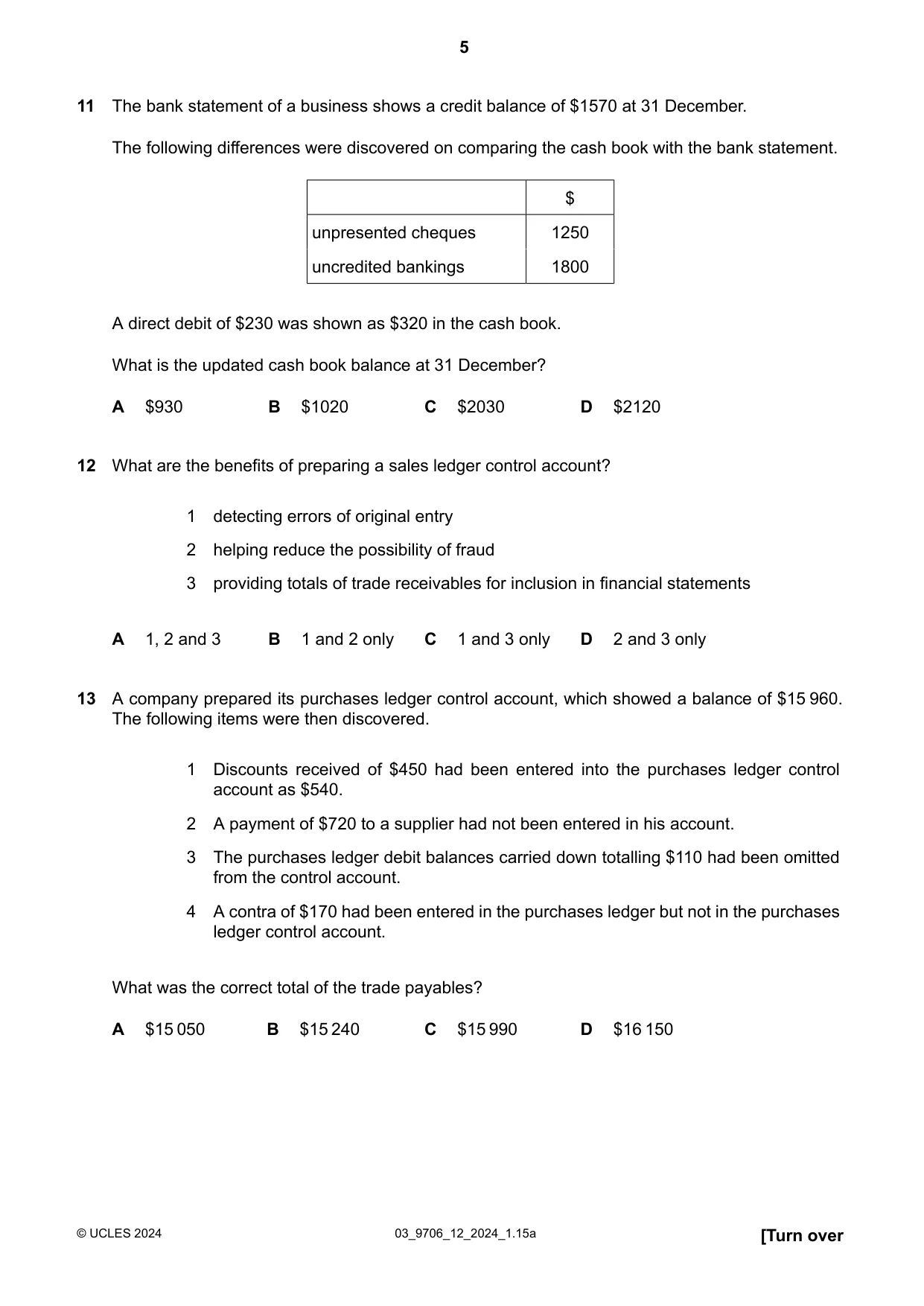
11 The bank statement of a business shows a credit balance of $1570 at 31 December. The following differences were discovered on comparing the cash book with the bank statement. $ unpresented cheques 1250 uncredited bankings 1800 A direct debit of $230 was shown as $320 in the cash book. What is the updated cash book balance at 31 December? A $930 B $1020 C $2030 D $2120
Mark scheme: D
Q12 · What are the benefits of preparing a sales ledger control account?
12 What are the benefits of preparing a sales ledger control account? 1 detecting errors of original entry 2 helping reduce the possibility of fraud 3 providing totals of trade receivables for inclusion in financial statements A 1, 2 and 3 B 1 and 2 only C 1 and 3 only D 2 and 3 only
Mark scheme: D
Q13 · A company prepared its purchases ledger control account, which showed a balance of $15 960
13 A company prepared its purchases ledger control account, which showed a balance of $15 960. The following items were then discovered. 1 Discounts received of $450 had been entered into the purchases ledger control account as $540. 2 A payment of $720 to a supplier had not been entered in his account. 3 The purchases ledger debit balances carried down totalling $110 had been omitted from the control account. 4 A contra of $170 had been entered in the purchases ledger but not in the purchases ledger control account. What was the correct total of the trade payables? A $15 050 B $15 240 C $15 990 D $16 150
Mark scheme: C
Q14 · Deepak provided the following information
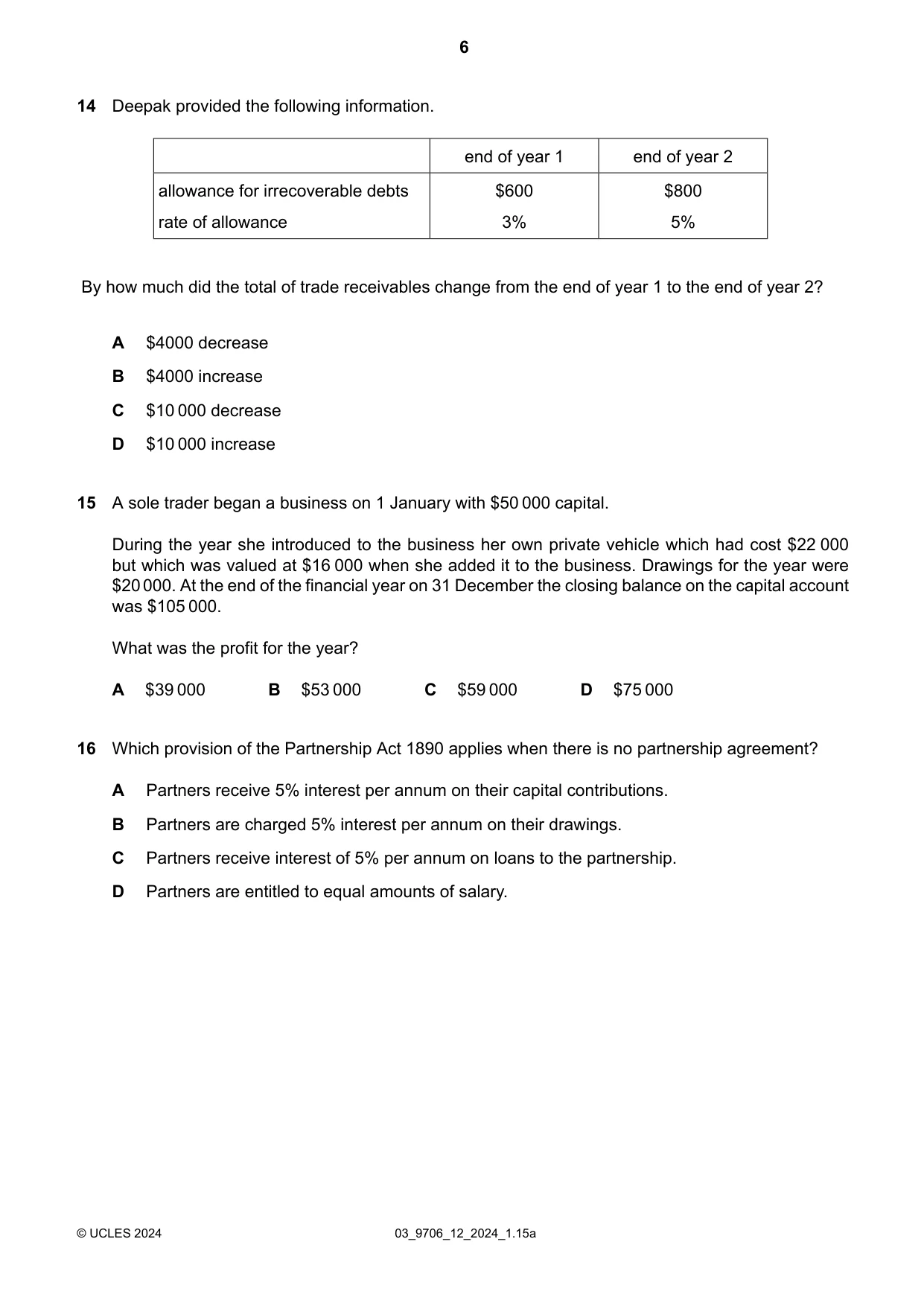
14 Deepak provided the following information. end of year 1 end of year 2 allowance for irrecoverable debts $600 $800 rate of allowance 3% 5% By how much did the total of trade receivables change from the end of year 1 to the end of year 2? A $4000 decrease B $4000 increase C $10 000 decrease D $10 000 increase
Mark scheme: A
Q15 · A sole trader began a business on 1 January with $50 000 capital
15 A sole trader began a business on 1 January with $50 000 capital. During the year she introduced to the business her own private vehicle which had cost $22 000 but which was valued at $16 000 when she added it to the business. Drawings for the year were $20 000. At the end of the financial year on 31 December the closing balance on the capital account was $105 000. What was the profit for the year? A $39 000 B $53 000 C $59 000 D $75 000
Mark scheme: C
Q16 · Which provision of the Partnership Act 1890 applies when there is no partnership…
16 Which provision of the Partnership Act 1890 applies when there is no partnership agreement? A Partners receive 5% interest per annum on their capital contributions. B Partners are charged 5% interest per annum on their drawings. C Partners receive interest of 5% per annum on loans to the partnership. D Partners are entitled to equal amounts of salary.
Mark scheme: C
Q17 · A partnership provided the following information for the year
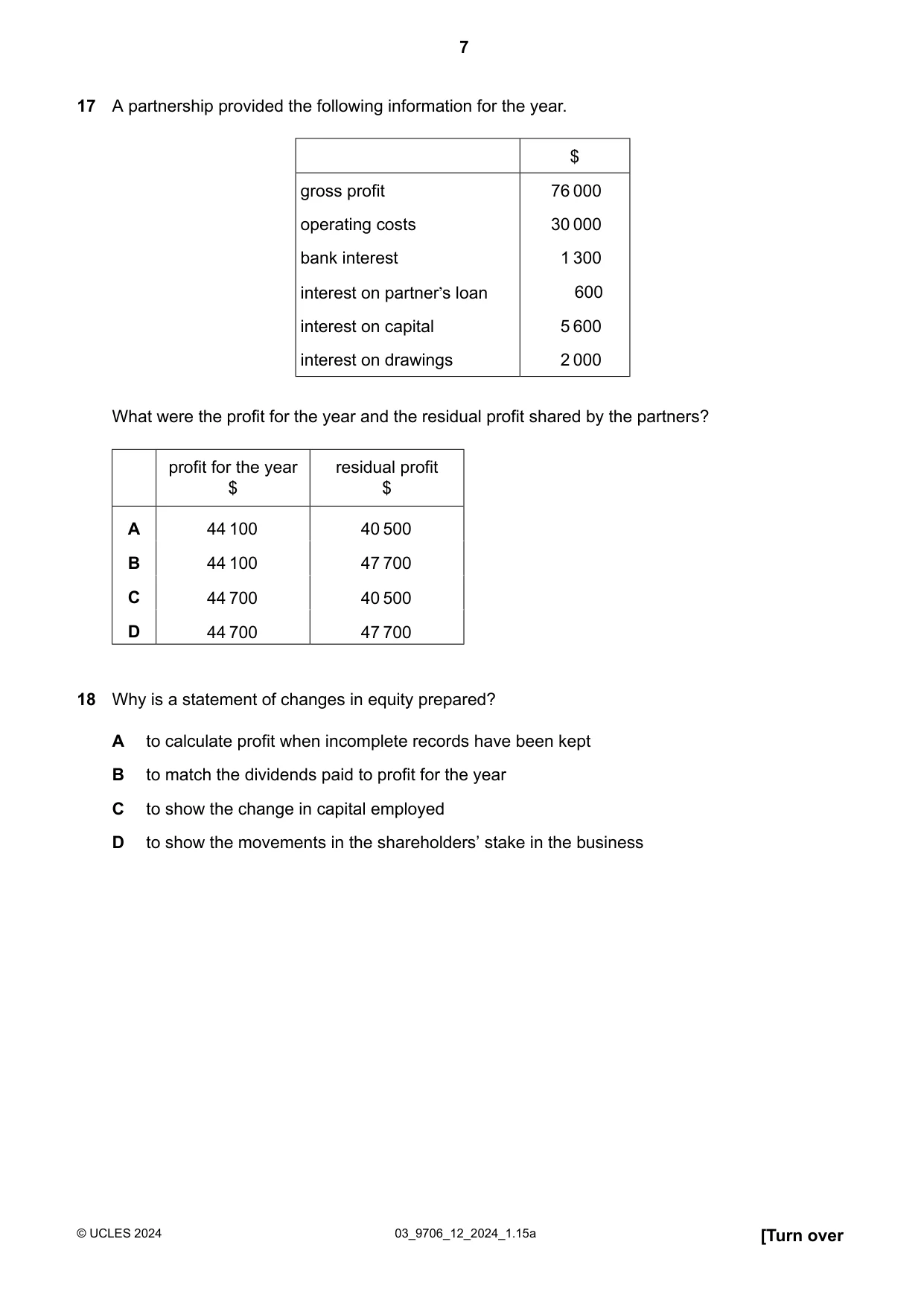
17 A partnership provided the following information for the year. $ gross profit 76 000 operating costs 30 000 bank interest 1 300 interest on partner’s loan 600 interest on capital 5 600 interest on drawings 2 000 What were the profit for the year and the residual profit shared by the partners? profit for the year residual profit $ $ A 44 100 40 500 B 44 100 47 700 C 44 700 40 500 D 44 700 47 700
Mark scheme: A
Q18 · Why is a statement of changes in equity prepared?
18 Why is a statement of changes in equity prepared? A to calculate profit when incomplete records have been kept B to match the dividends paid to profit for the year C to show the change in capital employed D to show the movements in the shareholders’ stake in the business
Mark scheme: D
Q19 · The trial balance of a company at 31 December at the end of year 1 included the following…
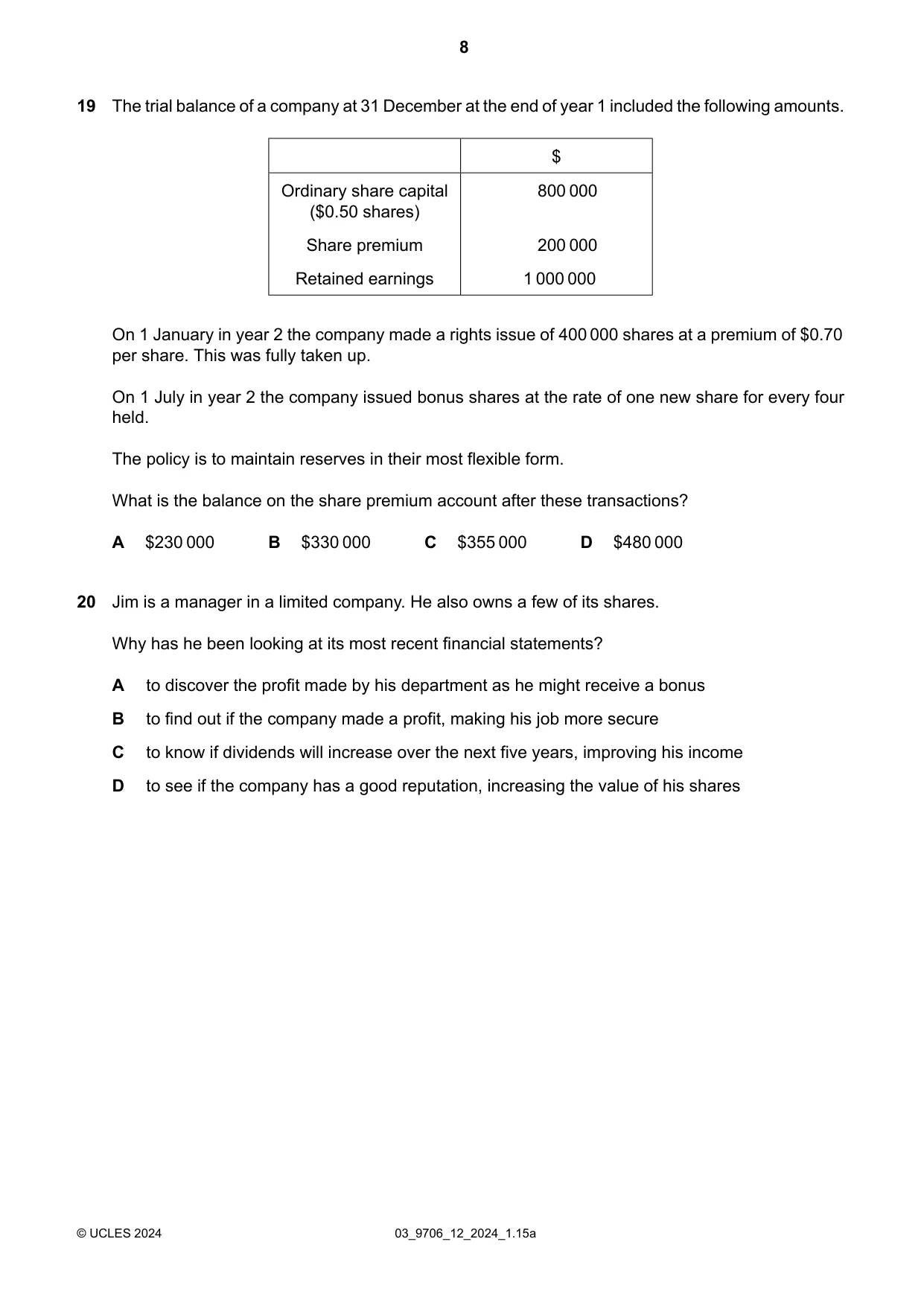
19 The trial balance of a company at 31 December at the end of year 1 included the following amounts. $ Ordinary share capital 800 000 ($0.50 shares) Share premium 200 000 Retained earnings 1 000 000 On 1 January in year 2 the company made a rights issue of 400 000 shares at a premium of $0.70 per share. This was fully taken up. On 1 July in year 2 the company issued bonus shares at the rate of one new share for every four held. The policy is to maintain reserves in their most flexible form. What is the balance on the share premium account after these transactions? A $230 000 B $330 000 C $355 000 D $480 000
Mark scheme: A
Q20 · Jim is a manager in a limited company
20 Jim is a manager in a limited company. He also owns a few of its shares. Why has he been looking at its most recent financial statements? A to discover the profit made by his department as he might receive a bonus B to find out if the company made a profit, making his job more secure C to know if dividends will increase over the next five years, improving his income D to see if the company has a good reputation, increasing the value of his shares
Mark scheme: B
More questions on Analysis and communication of accounting information
Q21 · H Limited’s cost of sales for the recent two years (Year 2 and Year 1) is as follows…
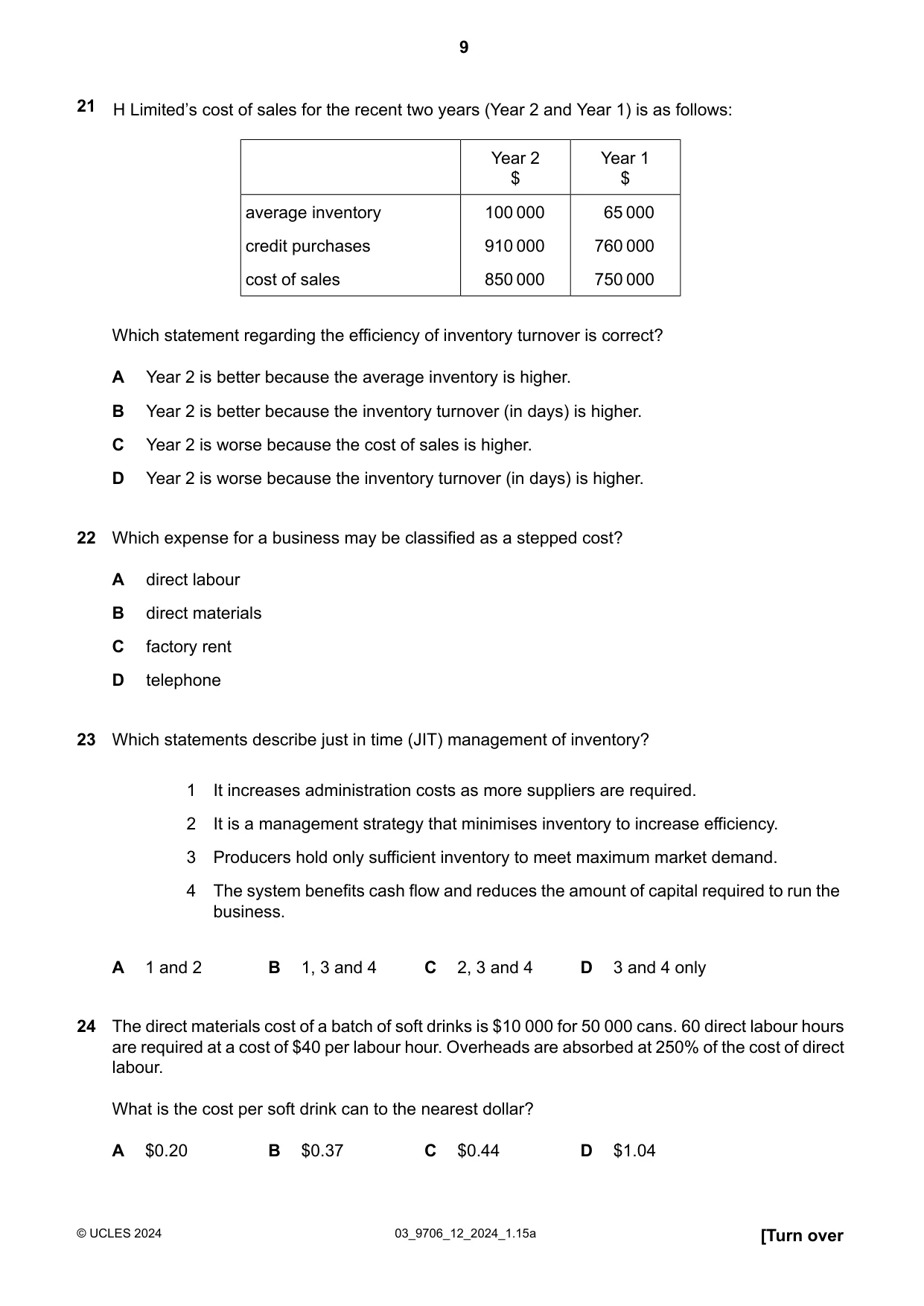
21 H Limited’s cost of sales for the recent two years (Year 2 and Year 1) is as follows: Year 2 Year 1 $ $ average inventory 100 000 65 000 credit purchases 910 000 760 000 cost of sales 850 000 750 000 Which statement regarding the efficiency of inventory turnover is correct? A Year 2 is better because the average inventory is higher. B Year 2 is better because the inventory turnover (in days) is higher. C Year 2 is worse because the cost of sales is higher. D Year 2 is worse because the inventory turnover (in days) is higher.
Mark scheme: D
More questions on Analysis and communication of accounting information
Q22 · Which expense for a business may be classified as a stepped cost?
22 Which expense for a business may be classified as a stepped cost? A direct labour B direct materials C factory rent D telephone
Mark scheme: C
Q23 · Which statements describe just in time (JIT) management of inventory?
23 Which statements describe just in time (JIT) management of inventory? 1 It increases administration costs as more suppliers are required. 2 It is a management strategy that minimises inventory to increase efficiency. 3 Producers hold only sufficient inventory to meet maximum market demand. 4 The system benefits cash flow and reduces the amount of capital required to run the business. A 1 and 2 B 1, 3 and 4 C 2, 3 and 4 D 3 and 4 only
Mark scheme: C
Q24 · The direct materials cost of a batch of soft drinks is $10 000 for 50 000 cans
24 The direct materials cost of a batch of soft drinks is $10 000 for 50 000 cans. 60 direct labour hours are required at a cost of $40 per labour hour. Overheads are absorbed at 250% of the cost of direct labour. What is the cost per soft drink can to the nearest dollar? A $0.20 B $0.37 C $0.44 D $1.04
Mark scheme: B
Q25 · What is an advantage of absorption costing?
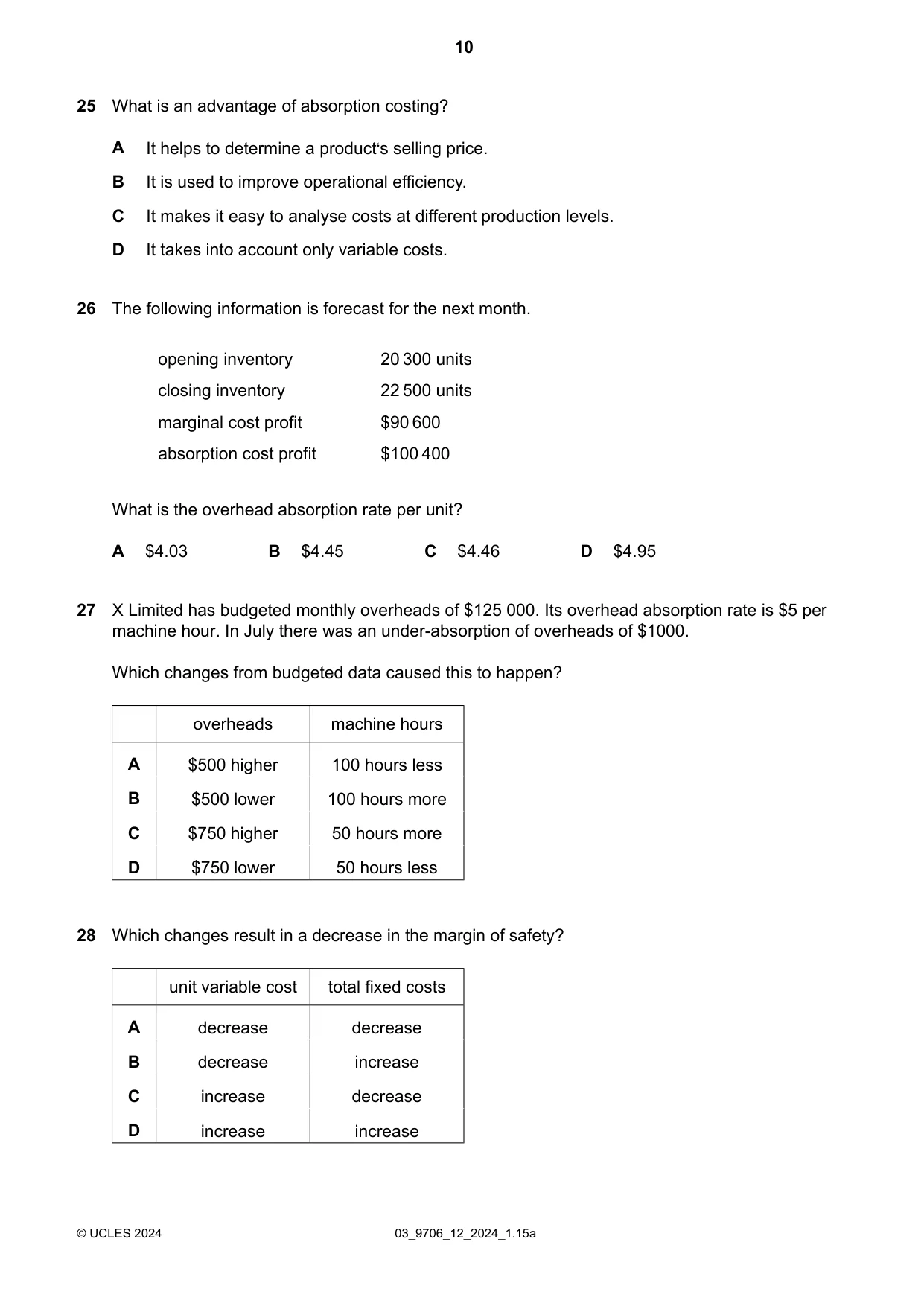
25 What is an advantage of absorption costing? A It helps to determine a product‘s selling price. B It is used to improve operational efficiency. C It makes it easy to analyse costs at different production levels. D It takes into account only variable costs.
Mark scheme: A
Q26 · The following information is forecast for the next month
26 The following information is forecast for the next month. opening inventory 20 300 units closing inventory 22 500 units marginal cost profit $90 600 absorption cost profit $100 400 What is the overhead absorption rate per unit? A $4.03 B $4.45 C $4.46 D $4.95
Mark scheme: B
Q27 · X Limited has budgeted monthly overheads of $125 000
27 X Limited has budgeted monthly overheads of $125 000. Its overhead absorption rate is $5 per machine hour. In July there was an under-absorption of overheads of $1000. Which changes from budgeted data caused this to happen? overheads machine hours A $500 higher 100 hours less B $500 lower 100 hours more C $750 higher 50 hours more D $750 lower 50 hours less
Mark scheme: A
Q28 · Which changes result in a decrease in the margin of safety?
28 Which changes result in a decrease in the margin of safety? unit variable cost total fixed costs A decrease decrease B decrease increase C increase decrease D increase increase
Mark scheme: D
Q29 · A company has the following budgeted information per unit
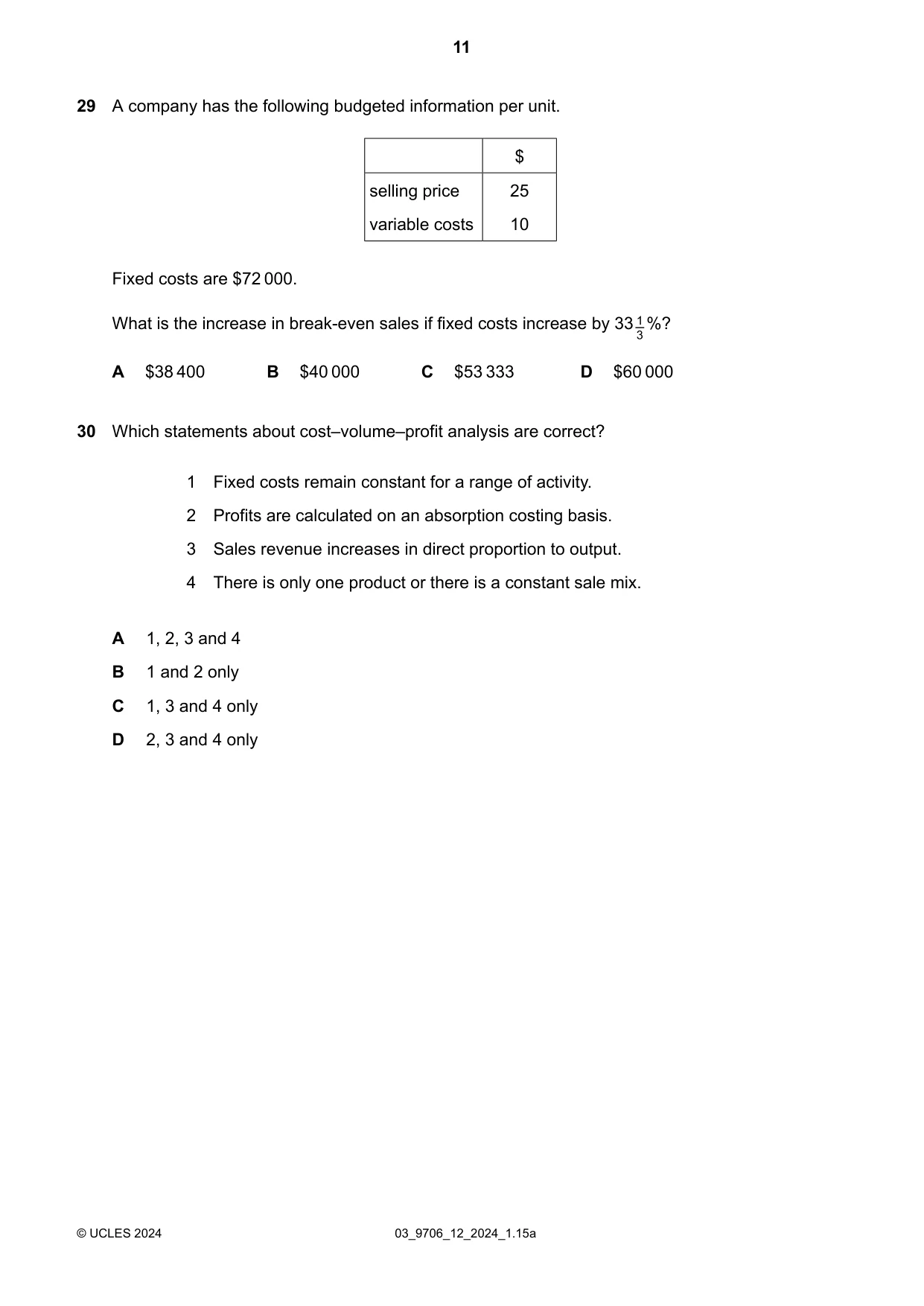
29 A company has the following budgeted information per unit. $ selling price 25 variable costs 10 Fixed costs are $72 000. What is the increase in break-even sales if fixed costs increase by 33 %? A $38 400 B $40 000 C $53 333 D $60 000
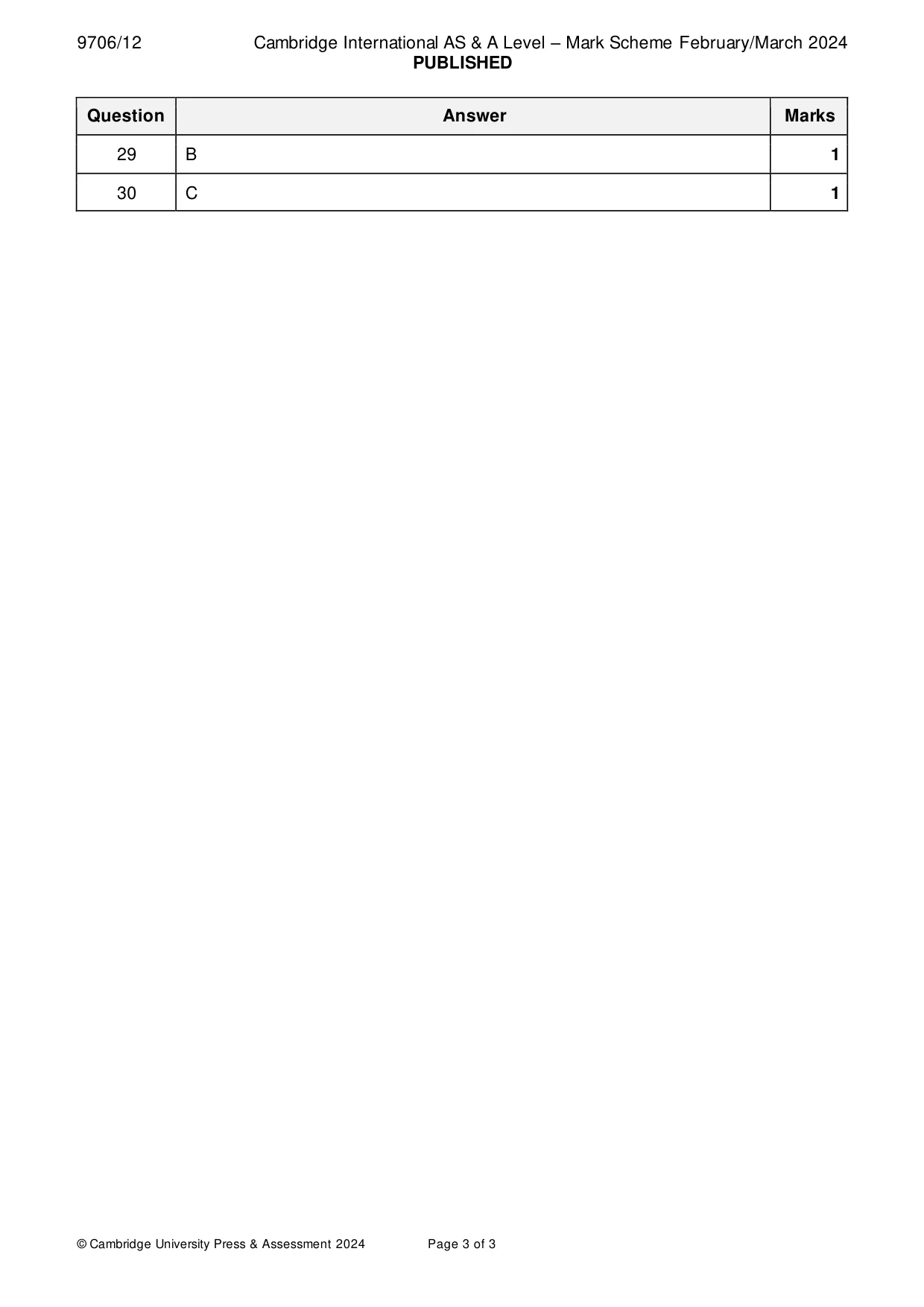
Mark scheme: B
Q30 · Which statements about cost–volume–profit analysis are correct?
30 Which statements about cost–volume–profit analysis are correct? 1 Fixed costs remain constant for a range of activity. 2 Profits are calculated on an absorption costing basis. 3 Sales revenue increases in direct proportion to output. 4 There is only one product or there is a constant sale mix. A 1, 2, 3 and 4 B 1 and 2 only C 1, 3 and 4 only D 2, 3 and 4 only
Mark scheme: C
What was in this paper
The subtopics covered by these 30 questions, and how many questions each got. Open one in a new tab to see every Cambridge question on it.
What you needed in this session
Cambridge’s own grade thresholds for 2024 Feb/March, Paper 1 · Variant 2. A higher threshold means an easier paper — the bar moves with how the cohort did.