Cambridge A Level Accounting 9706 — 2007 May/June Paper 1 · Variant 1
9706/11/M/J/07 · 30 questions · 30 marks · ≈34 min
The question paper and its mark scheme, free to read here and free to download. This is Cambridge’s own paper, exactly as it was sat.
Question paper12 pages

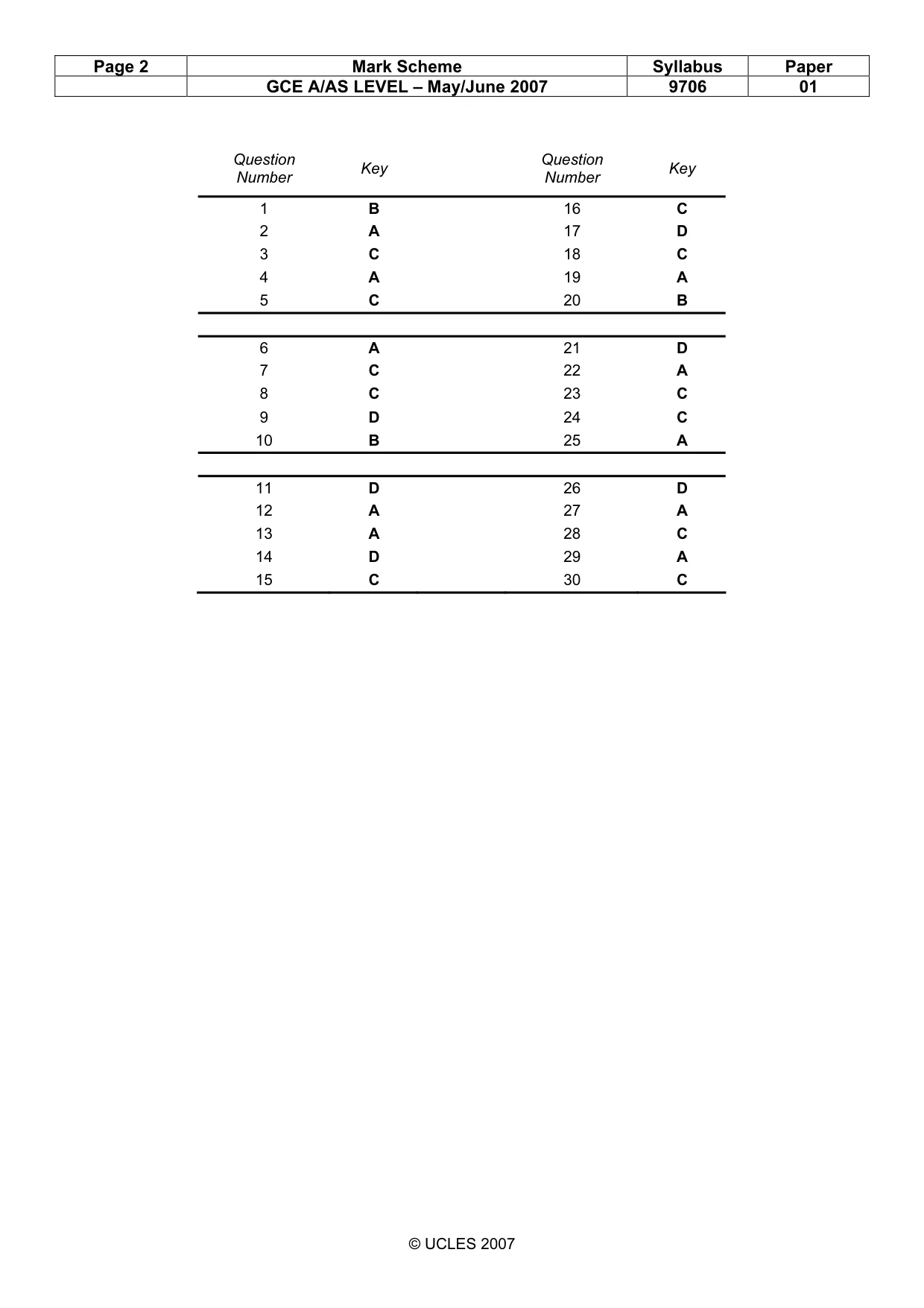
Mark scheme2 pages
Answers below. Sit the paper first if you are practising.
Questions as text
Q1 · Which item is revenue expenditure?
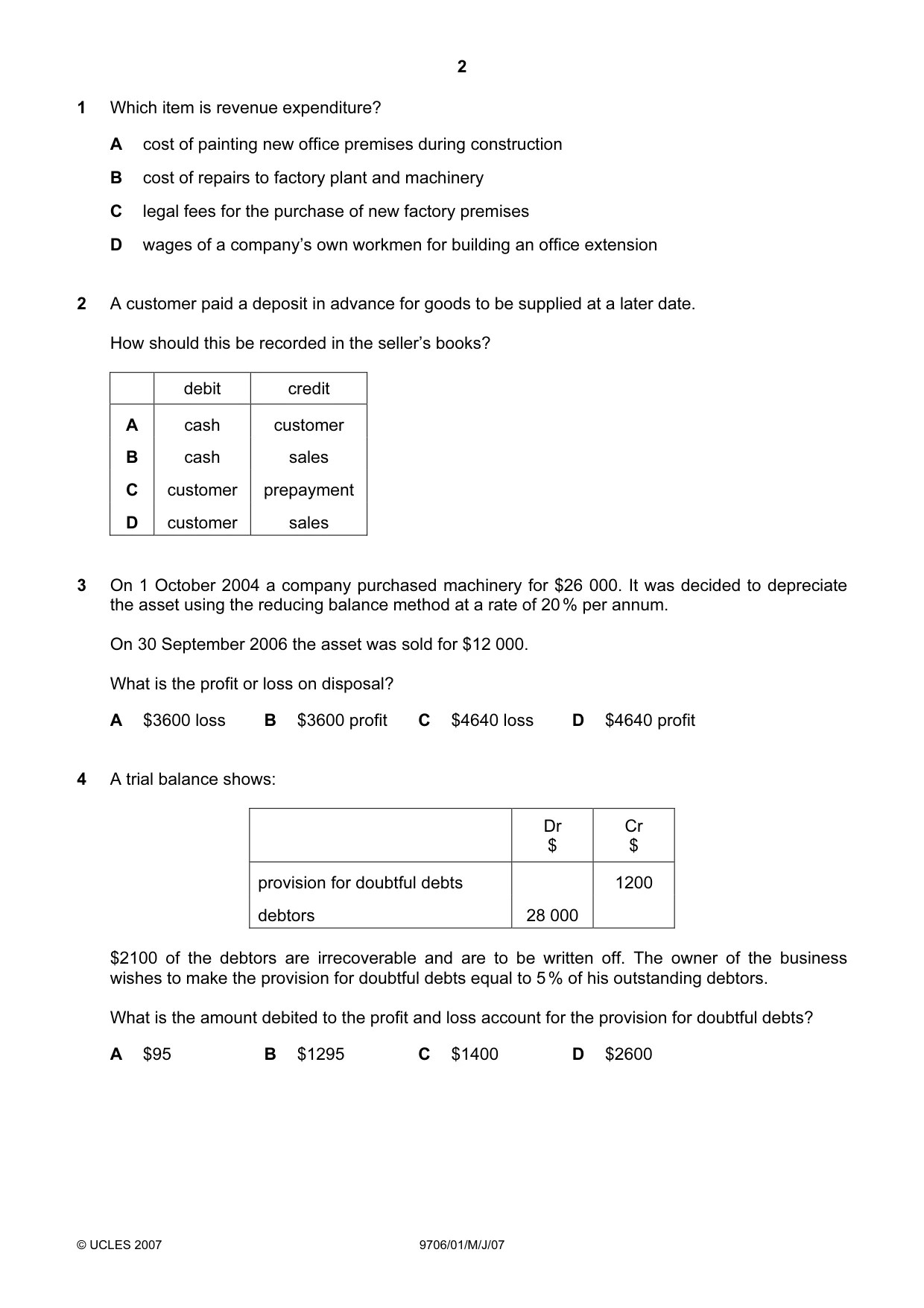
1 Which item is revenue expenditure? A cost of painting new office premises during construction B cost of repairs to factory plant and machinery C legal fees for the purchase of new factory premises D wages of a company’s own workmen for building an office extension
Mark scheme: B
Q2 · A customer paid a deposit in advance for goods to be supplied at a later date
2 A customer paid a deposit in advance for goods to be supplied at a later date. How should this be recorded in the seller’s books? debit credit A cash customer B cash sales C customer prepayment D customer sales
Mark scheme: A
Q3 · On 1 October 2004 a company purchased machinery for $26 000
3 On 1 October 2004 a company purchased machinery for $26 000. It was decided to depreciate the asset using the reducing balance method at a rate of 20 % per annum. On 30 September 2006 the asset was sold for $12 000. What is the profit or loss on disposal? A $3600 loss B $3600 profit C $4640 loss D $4640 profit
Mark scheme: C
Q4 · A trial balance shows: Dr Cr $ $ provision for doubtful debts 1200 debtors 28 000 $2100…
4 A trial balance shows: Dr Cr $ $ provision for doubtful debts 1200 debtors 28 000 $2100 of the debtors are irrecoverable and are to be written off. The owner of the business wishes to make the provision for doubtful debts equal to 5 % of his outstanding debtors. What is the amount debited to the profit and loss account for the provision for doubtful debts? A $95 B $1295 C $1400 D $2600
Mark scheme: A
Q5 · An item of stock originally cost $5000, but has deteriorated badly and is written down to…
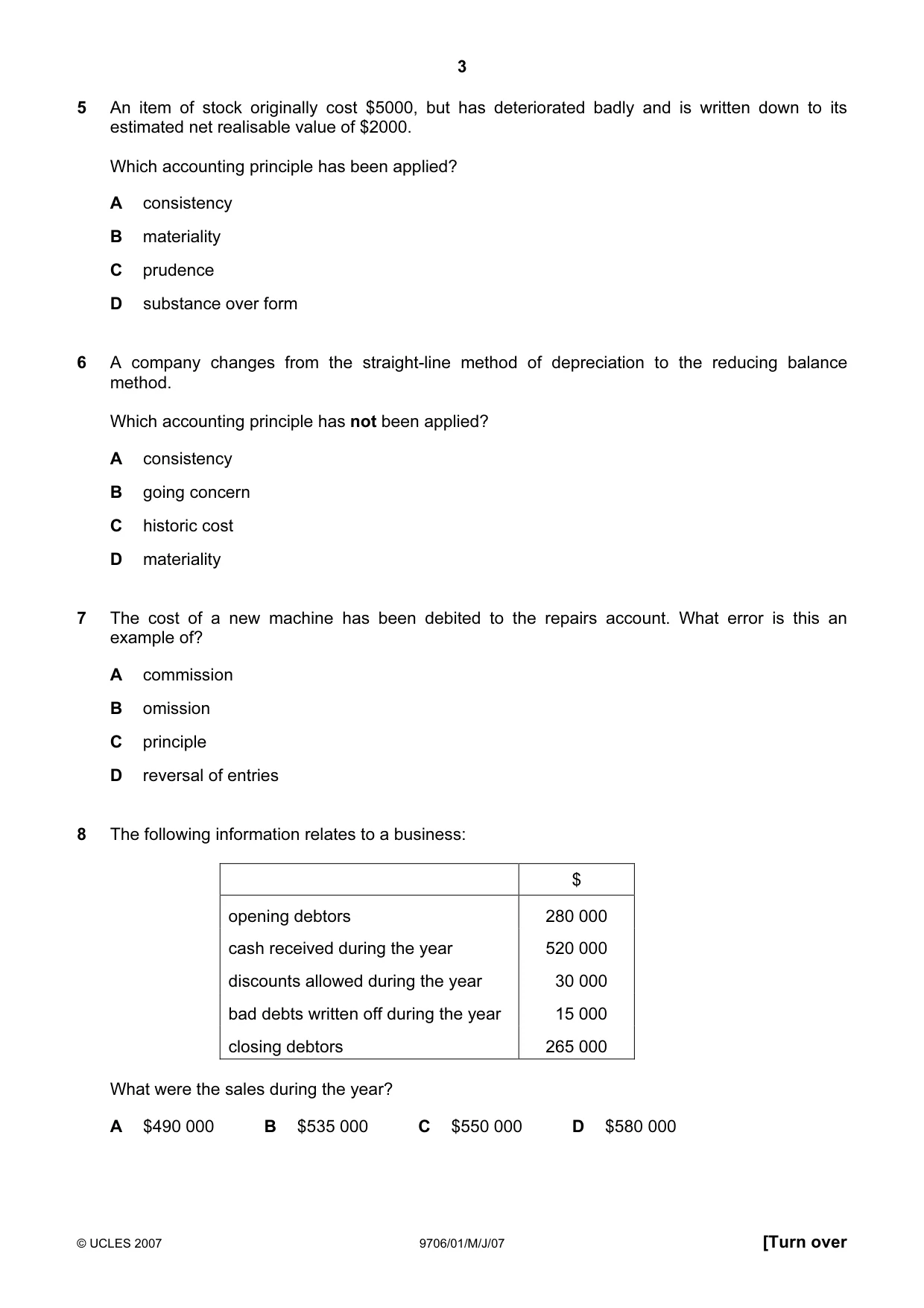
5 An item of stock originally cost $5000, but has deteriorated badly and is written down to its estimated net realisable value of $2000. Which accounting principle has been applied? A consistency B materiality C prudence D substance over form
Mark scheme: C
Q6 · A company changes from the straight-line method of depreciation to the reducing balance…
6 A company changes from the straight-line method of depreciation to the reducing balance method. Which accounting principle has not been applied? A consistency B going concern C historic cost D materiality
Mark scheme: A
Q7 · The cost of a new machine has been debited to the repairs account
7 The cost of a new machine has been debited to the repairs account. What error is this an example of? A commission B omission C principle D reversal of entries
Mark scheme: C
Q8 · The following information relates to a business: $ opening debtors 280 000 cash received…
8 The following information relates to a business: $ opening debtors 280 000 cash received during the year 520 000 discounts allowed during the year 30 000 bad debts written off during the year 15 000 closing debtors 265 000 What were the sales during the year? A $490 000 B $535 000 C $550 000 D $580 000
Mark scheme: C
Q9 · The total of the balances in the purchases ledger does not agree with the balance on the…
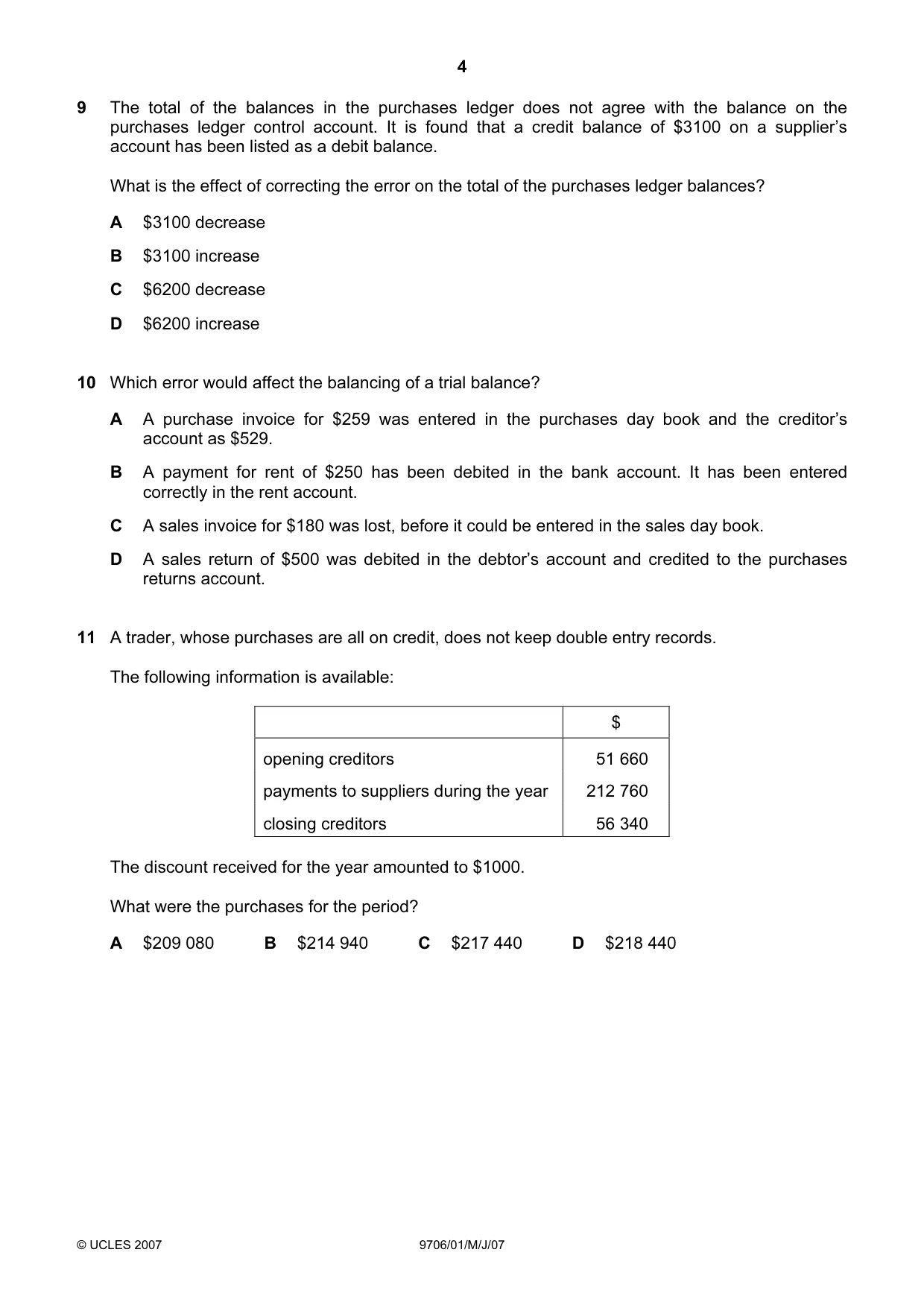
9 The total of the balances in the purchases ledger does not agree with the balance on the purchases ledger control account. It is found that a credit balance of $3100 on a supplier’s account has been listed as a debit balance. What is the effect of correcting the error on the total of the purchases ledger balances? A $3100 decrease B $3100 increase C $6200 decrease D $6200 increase
Mark scheme: D
Q10 · Which error would affect the balancing of a trial balance?
10 Which error would affect the balancing of a trial balance? A A purchase invoice for $259 was entered in the purchases day book and the creditor’s account as $529. B A payment for rent of $250 has been debited in the bank account. It has been entered correctly in the rent account. C A sales invoice for $180 was lost, before it could be entered in the sales day book. D A sales return of $500 was debited in the debtor’s account and credited to the purchases returns account.
Mark scheme: B
Q11 · A trader, whose purchases are all on credit, does not keep double entry records
11 A trader, whose purchases are all on credit, does not keep double entry records. The following information is available: $ opening creditors 51 660 payments to suppliers during the year 212 760 closing creditors 56 340 The discount received for the year amounted to $1000. What were the purchases for the period? A $209 080 B $214 940 C $217 440 D $218 440
Mark scheme: D
Q12 · A business has two items in stock which need to be repaired before sale
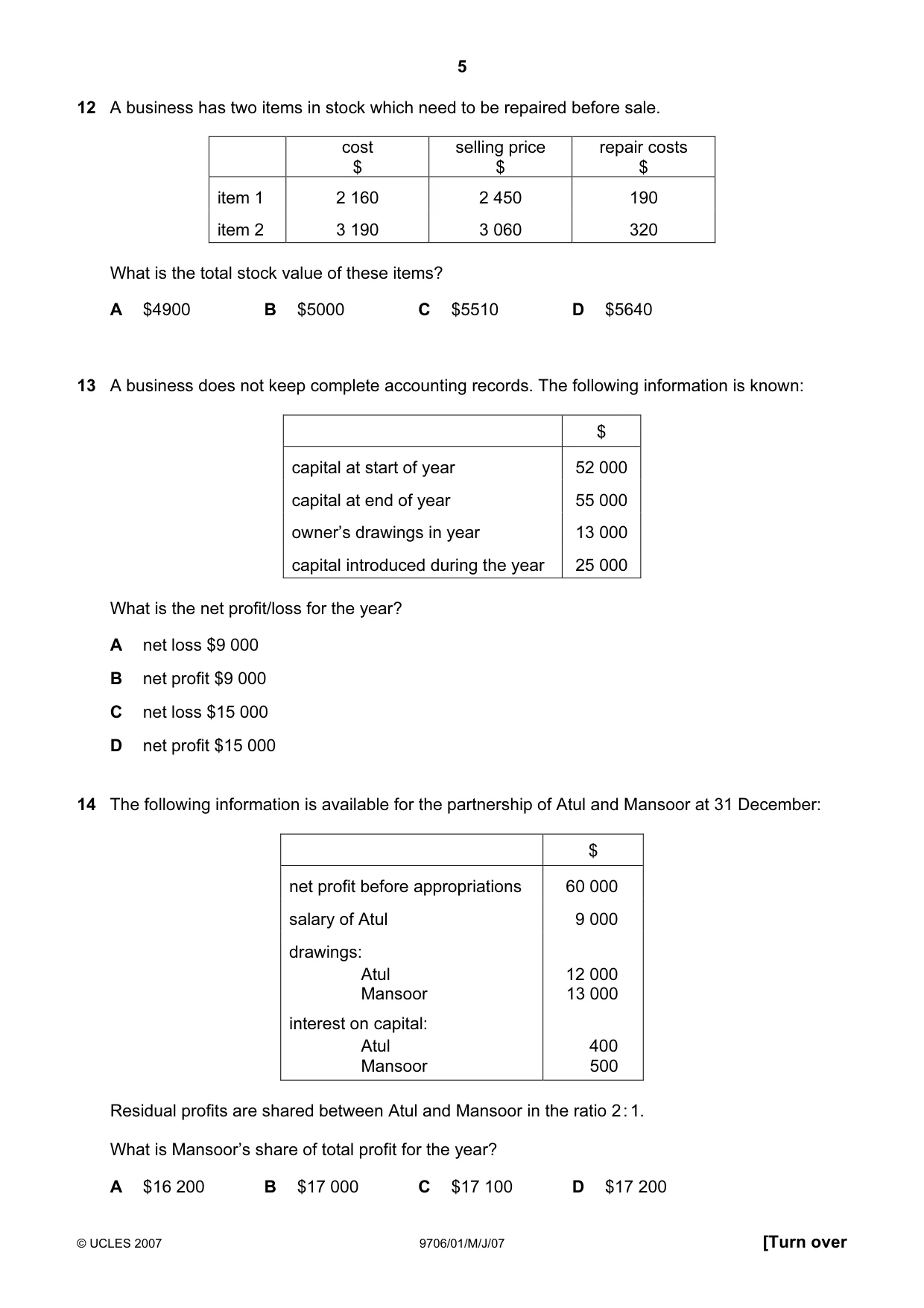
12 A business has two items in stock which need to be repaired before sale. cost selling price repair costs $ $ $ item 1 2 160 2 450 190 item 2 3 190 3 060 320 What is the total stock value of these items? A $4900 B $5000 C $5510 D $5640
Mark scheme: A
Q13 · A business does not keep complete accounting records
13 A business does not keep complete accounting records. The following information is known: $ capital at start of year 52 000 capital at end of year 55 000 owner’s drawings in year 13 000 capital introduced during the year 25 000 What is the net profit/loss for the year? A net loss $9 000 B net profit $9 000 C net loss $15 000 D net profit $15 000
Mark scheme: A
Q14 · The following information is available for the partnership of Atul and Mansoor at 31…
14 The following information is available for the partnership of Atul and Mansoor at 31 December: $ net profit before appropriations 60 000 salary of Atul 9 000 drawings: Atul 12 000 Mansoor 13 000 interest on capital: Atul 400 Mansoor 500 Residual profits are shared between Atul and Mansoor in the ratio 2 : 1. What is Mansoor’s share of total profit for the year? A $16 200 B $17 000 C $17 100 D $17 200
Mark scheme: D
Q15 · At the beginning of the financial year stock was valued at $15 000
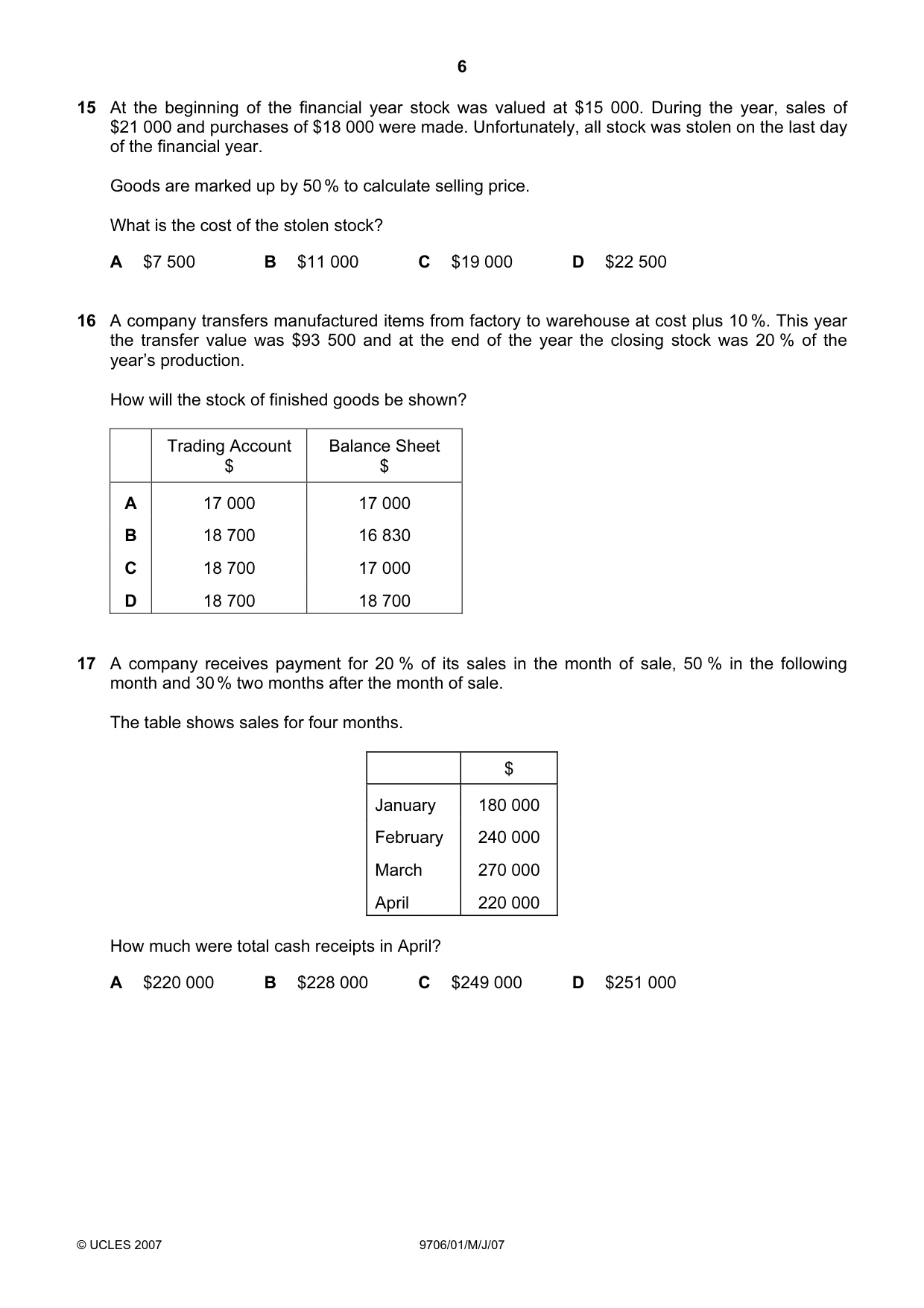
15 At the beginning of the financial year stock was valued at $15 000. During the year, sales of $21 000 and purchases of $18 000 were made. Unfortunately, all stock was stolen on the last day of the financial year. Goods are marked up by 50 % to calculate selling price. What is the cost of the stolen stock? A $7 500 B $11 000 C $19 000 D $22 500
Mark scheme: C
Q16 · A company transfers manufactured items from factory to warehouse at cost plus 10 %
16 A company transfers manufactured items from factory to warehouse at cost plus 10 %. This year the transfer value was $93 500 and at the end of the year the closing stock was 20 % of the year’s production. How will the stock of finished goods be shown? Trading Account Balance Sheet $ $ A 17 000 17 000 B 18 700 16 830 C 18 700 17 000 D 18 700 18 700
Mark scheme: C
Q17 · A company receives payment for 20 % of its sales in the month of sale, 50 % in the…
17 A company receives payment for 20 % of its sales in the month of sale, 50 % in the following month and 30 % two months after the month of sale. The table shows sales for four months. $ January 180 000 February 240 000 March 270 000 April 220 000 How much were total cash receipts in April? A $220 000 B $228 000 C $249 000 D $251 000
Mark scheme: D
Q18 · A company makes a bonus issue of shares
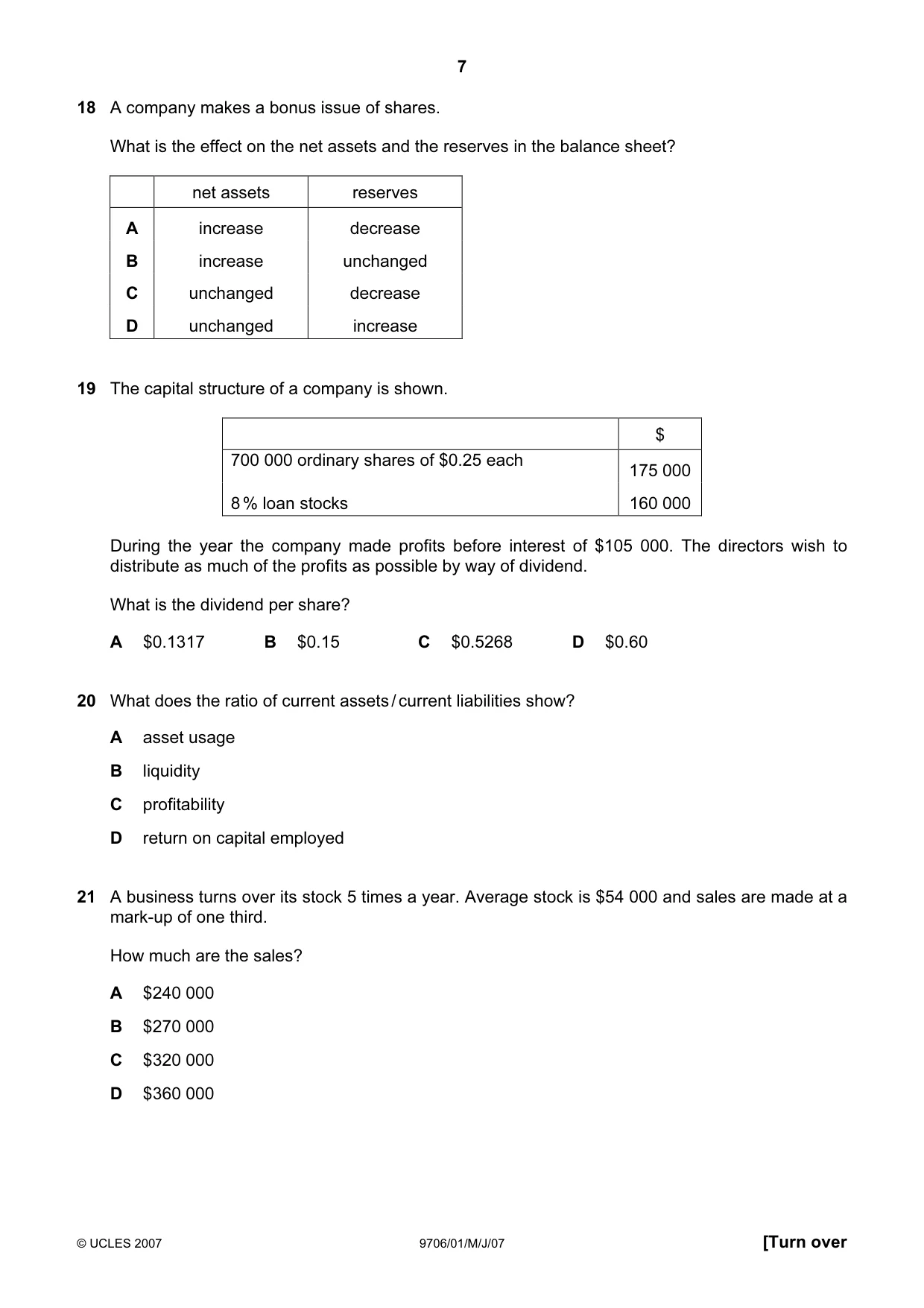
18 A company makes a bonus issue of shares. What is the effect on the net assets and the reserves in the balance sheet? net assets reserves A increase decrease B increase unchanged C unchanged decrease D unchanged increase
Mark scheme: C
Q19 · The capital structure of a company is shown
19 The capital structure of a company is shown. $ 700 000 ordinary shares of $0.25 each 175 000 8 % loan stocks 160 000 During the year the company made profits before interest of $105 000. The directors wish to distribute as much of the profits as possible by way of dividend. What is the dividend per share? A $0.1317 B $0.15 C $0.5268 D $0.60
Mark scheme: A
More questions on Analysis and communication of accounting information
Q20 · What does the ratio of current assets / current liabilities show?
20 What does the ratio of current assets / current liabilities show? A asset usage B liquidity C profitability D return on capital employed
Mark scheme: B
More questions on Analysis and communication of accounting information
Q21 · A business turns over its stock 5 times a year
21 A business turns over its stock 5 times a year. Average stock is $54 000 and sales are made at a mark-up of one third. How much are the sales? A $240 000 B $270 000 C $320 000 D $360 000
Mark scheme: D
More questions on Analysis and communication of accounting information
Q22 · A company has the following information in its balance sheet: $000 taxation due 40…
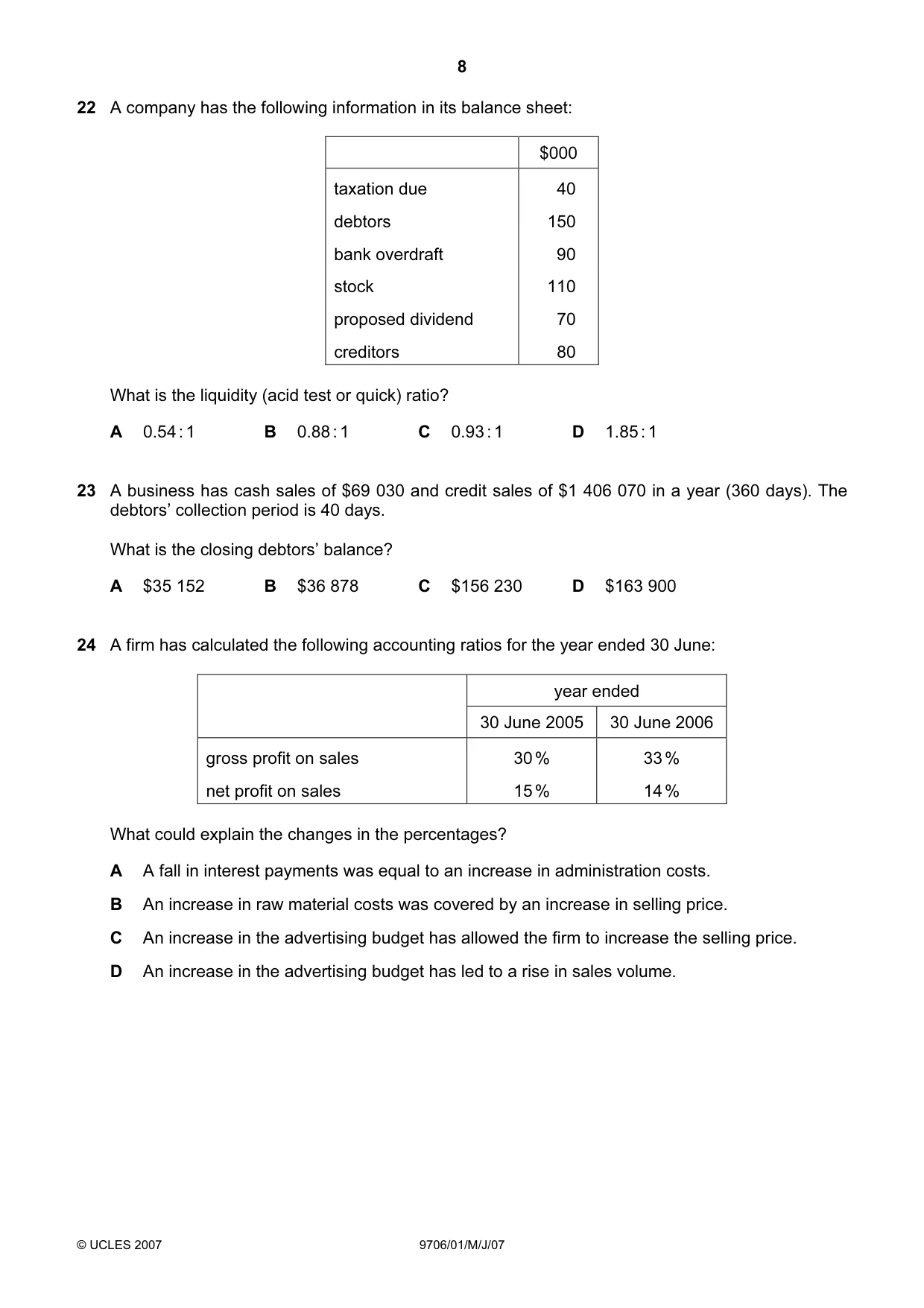
22 A company has the following information in its balance sheet: $000 taxation due 40 debtors 150 bank overdraft 90 stock 110 proposed dividend 70 creditors 80 What is the liquidity (acid test or quick) ratio? A 0.54 : 1 B 0.88 : 1 C 0.93 : 1 D 1.85 : 1
Mark scheme: A
More questions on Analysis and communication of accounting information
Q23 · A business has cash sales of $69 030 and credit sales of $1 406 070 in a year (360 days)
23 A business has cash sales of $69 030 and credit sales of $1 406 070 in a year (360 days). The debtors’ collection period is 40 days. What is the closing debtors’ balance? A $35 152 B $36 878 C $156 230 D $163 900
Mark scheme: C
More questions on Analysis and communication of accounting information
Q24 · A firm has calculated the following accounting ratios for the year ended 30 June: year…
24 A firm has calculated the following accounting ratios for the year ended 30 June: year ended 30 June 2005 30 June 2006 gross profit on sales 30 % 33 % net profit on sales 15 % 14 % What could explain the changes in the percentages? A A fall in interest payments was equal to an increase in administration costs. B An increase in raw material costs was covered by an increase in selling price. C An increase in the advertising budget has allowed the firm to increase the selling price. D An increase in the advertising budget has led to a rise in sales volume.
Mark scheme: C
More questions on Analysis and communication of accounting information
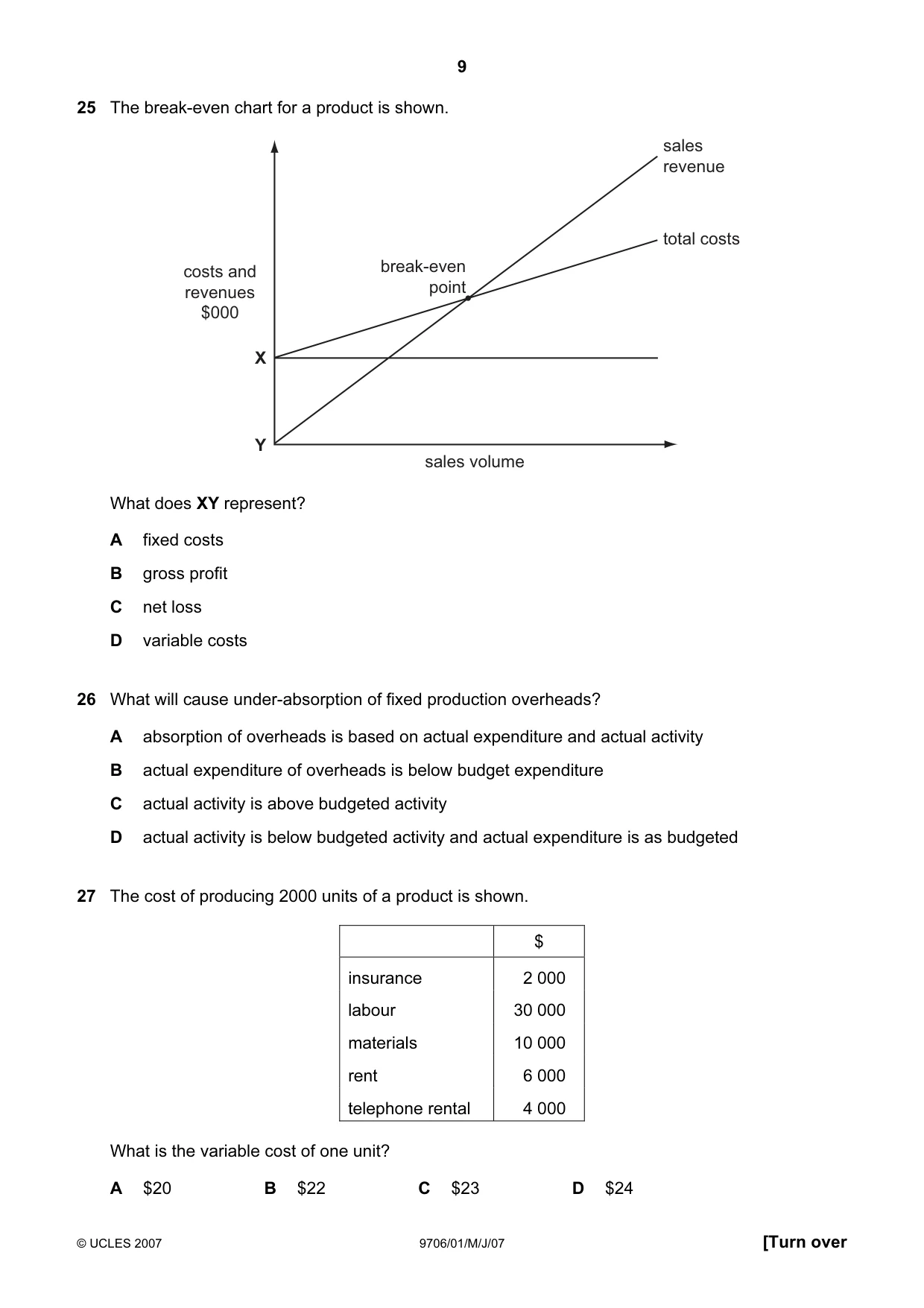
Q25 · The break-even chart for a product is shown
25 The break-even chart for a product is shown. sales revenue total costs costs and break-even revenues point $000 X Y sales volume What does XY represent? A fixed costs B gross profit C net loss D variable costs
Mark scheme: A
Q26 · What will cause under-absorption of fixed production overheads?
26 What will cause under-absorption of fixed production overheads? A absorption of overheads is based on actual expenditure and actual activity B actual expenditure of overheads is below budget expenditure C actual activity is above budgeted activity D actual activity is below budgeted activity and actual expenditure is as budgeted
Mark scheme: D
Q27 · The cost of producing 2000 units of a product is shown
27 The cost of producing 2000 units of a product is shown. $ insurance 2 000 labour 30 000 materials 10 000 rent 6 000 telephone rental 4 000 What is the variable cost of one unit? A $20 B $22 C $23 D $24
Mark scheme: A
Q28 · A company makes two products
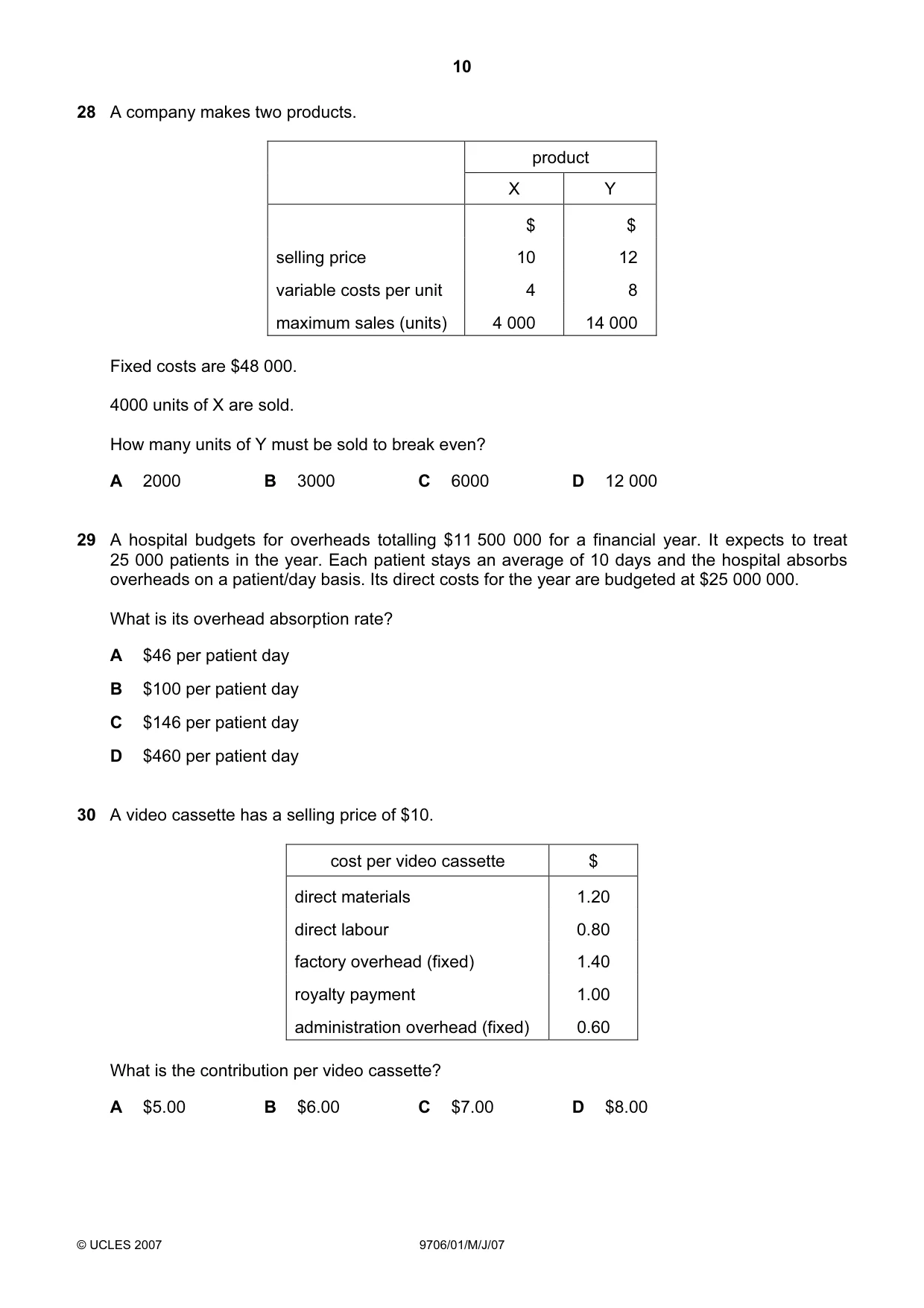
28 A company makes two products. product X Y $ $ selling price 10 12 variable costs per unit 4 8 maximum sales (units) 4 000 14 000 Fixed costs are $48 000. 4000 units of X are sold. How many units of Y must be sold to break even? A 2000 B 3000 C 6000 D 12 000
Mark scheme: C
Q29 · A hospital budgets for overheads totalling $11 500 000 for a financial year
29 A hospital budgets for overheads totalling $11 500 000 for a financial year. It expects to treat 25 000 patients in the year. Each patient stays an average of 10 days and the hospital absorbs overheads on a patient/day basis. Its direct costs for the year are budgeted at $25 000 000. What is its overhead absorption rate? A $46 per patient day B $100 per patient day C $146 per patient day D $460 per patient day
Mark scheme: A
Q30 · A video cassette has a selling price of $10
30 A video cassette has a selling price of $10. cost per video cassette $ direct materials 1.20 direct labour 0.80 factory overhead (fixed) 1.40 royalty payment 1.00 administration overhead (fixed) 0.60 What is the contribution per video cassette? A $5.00 B $6.00 C $7.00 D $8.00
Mark scheme: C
What was in this paper
The subtopics covered by these 30 questions, and how many questions each got. Open one in a new tab to see every Cambridge question on it.
What you needed in this session
Cambridge’s own grade thresholds for 2007 May/June, Paper 1 · Variant 1. A higher threshold means an easier paper — the bar moves with how the cohort did.