Cambridge A Level Accounting 9706 — 2019 Oct/Nov Paper 1 · Variant 3
9706/13/O/N/19 · 30 questions · 30 marks · ≈34 min
The question paper and its mark scheme, free to read here and free to download. This is Cambridge’s own paper, exactly as it was sat.
Question paper12 pages
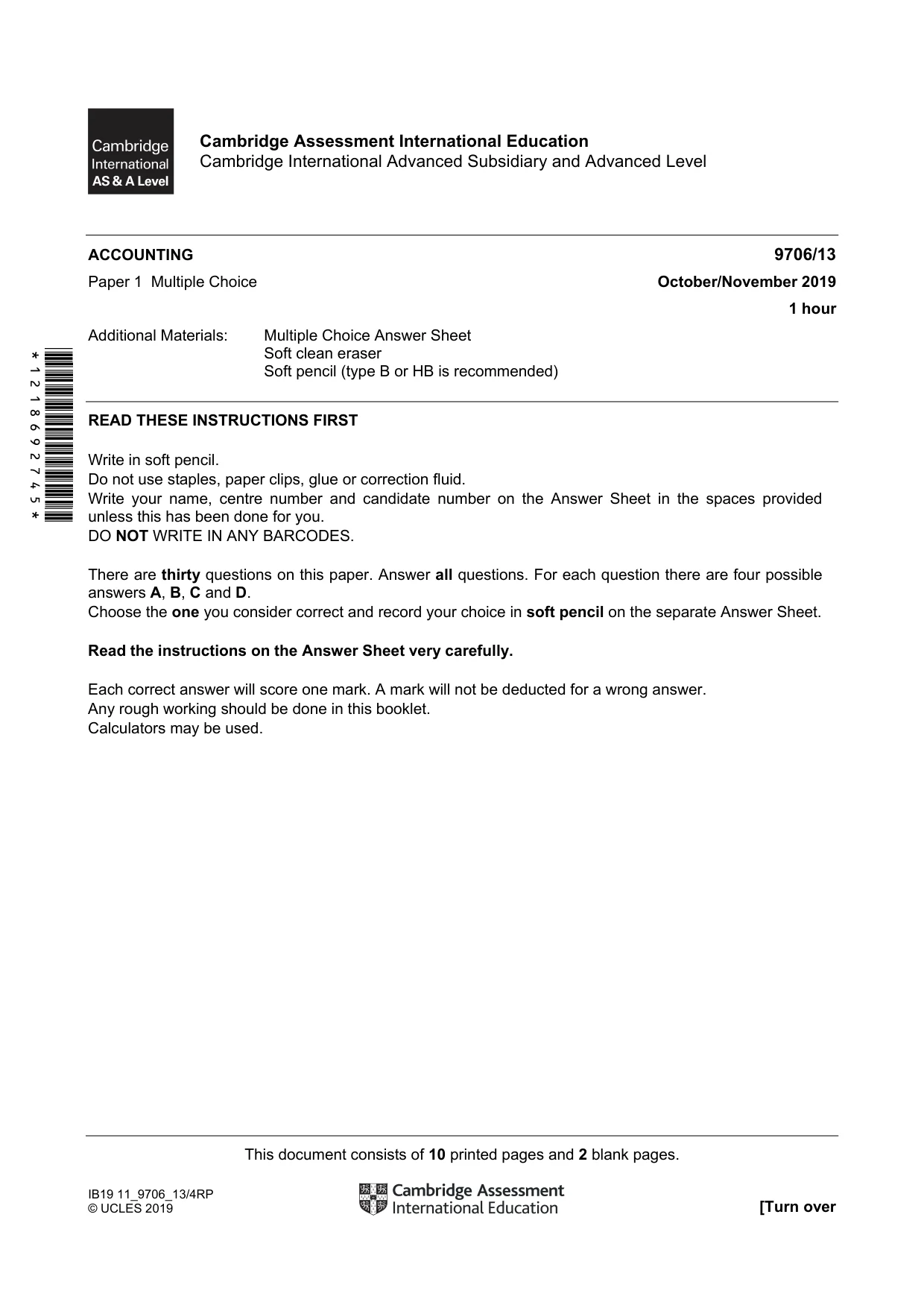

Mark scheme3 pages
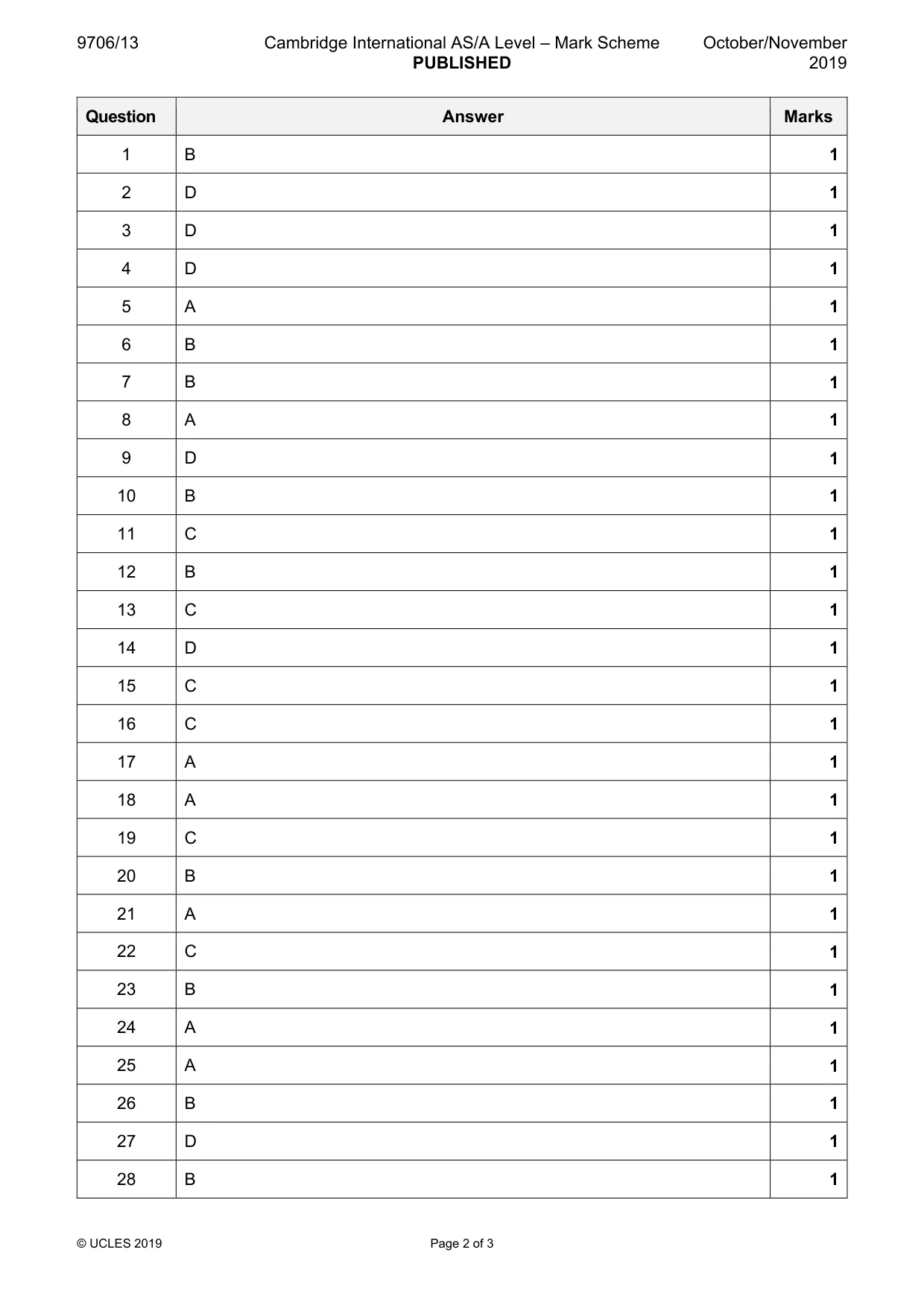
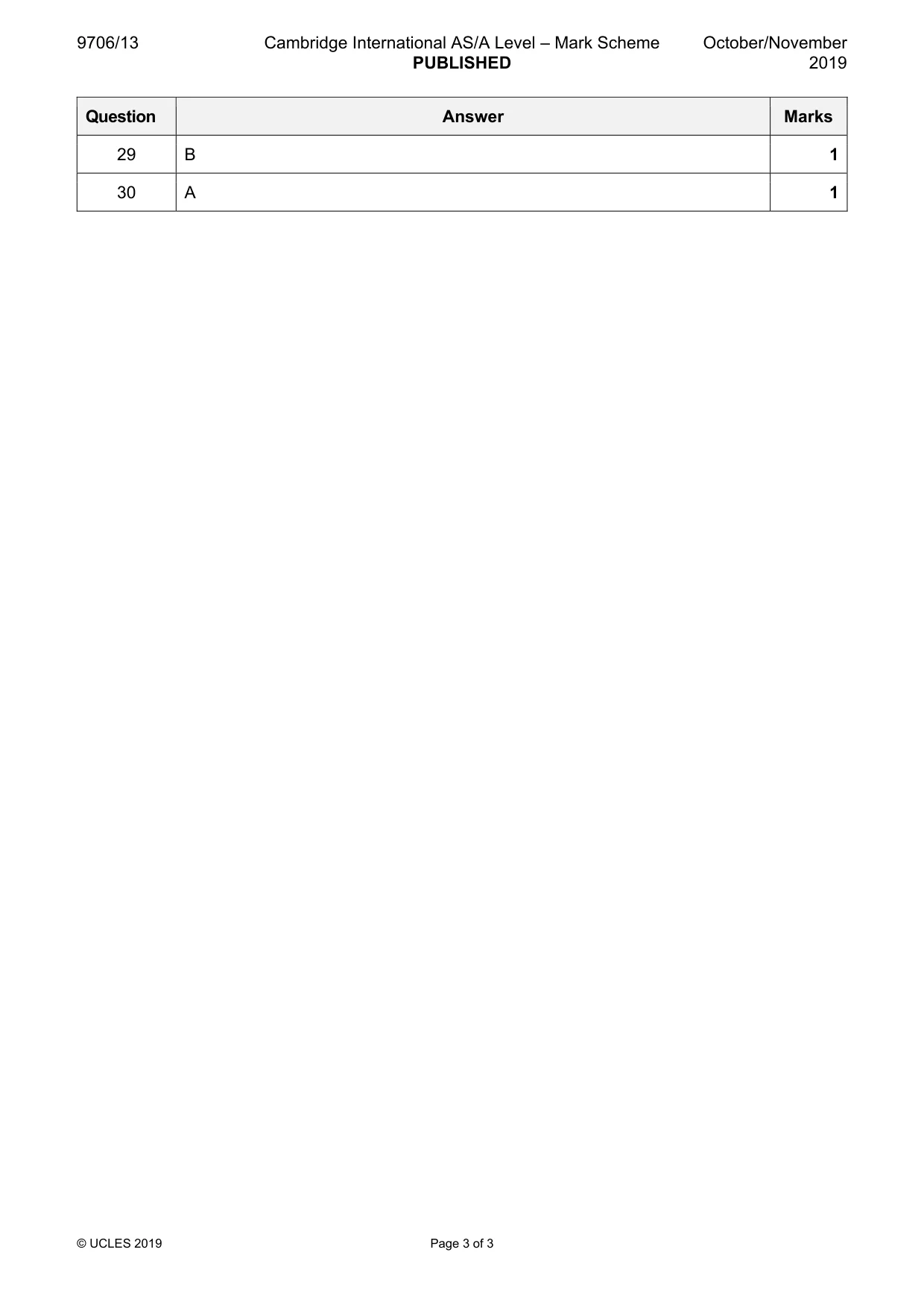
Answers below. Sit the paper first if you are practising.
Questions as text
Q1 · The employees of a company are skilled and efficient
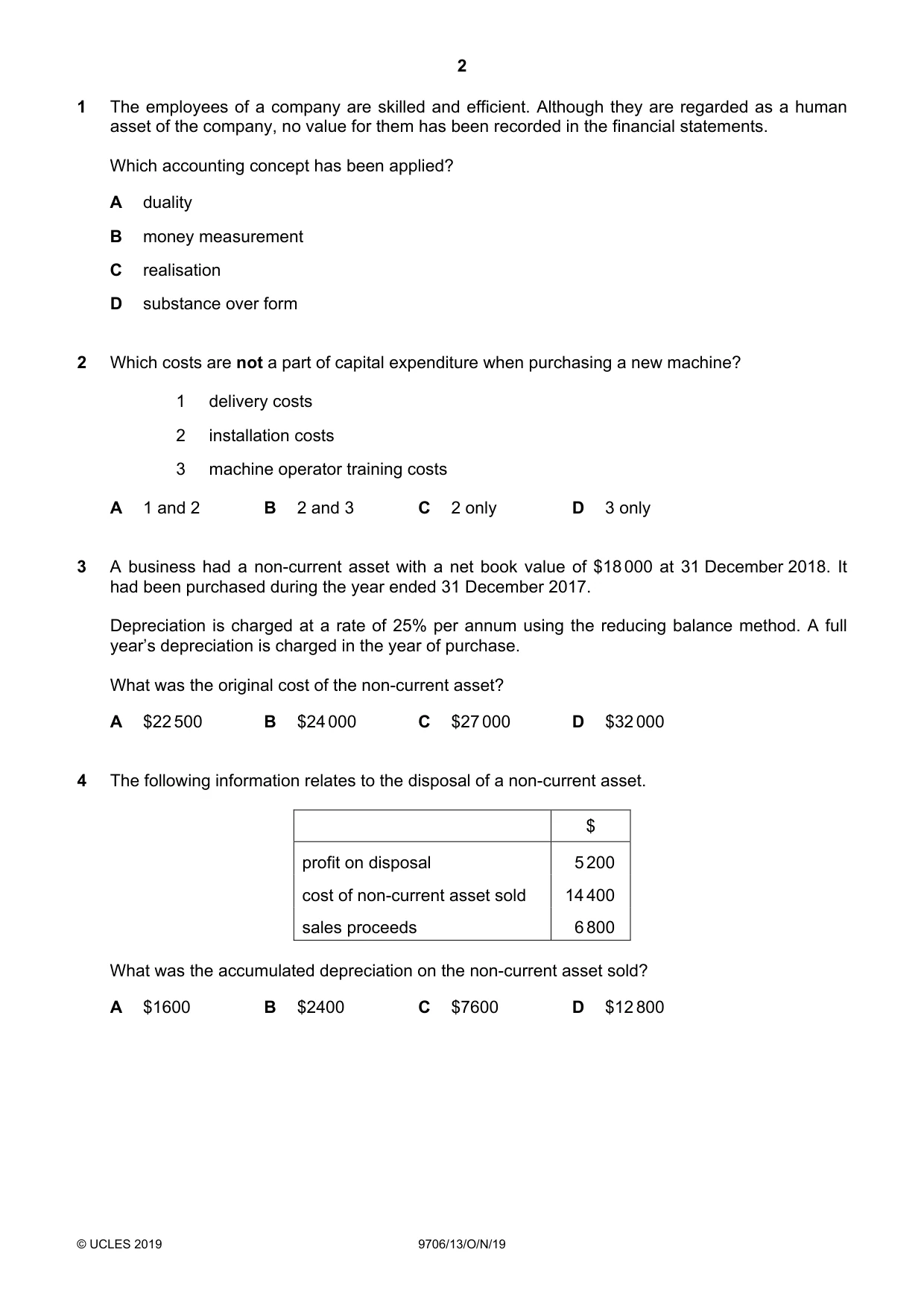
1 The employees of a company are skilled and efficient. Although they are regarded as a human asset of the company, no value for them has been recorded in the financial statements. Which accounting concept has been applied? A duality B money measurement C realisation D substance over form
Mark scheme: B
Q2 · Which costs are not a part of capital expenditure when purchasing a new machine?
2 Which costs are not a part of capital expenditure when purchasing a new machine? 1 delivery costs 2 installation costs 3 machine operator training costs A 1 and 2 B 2 and 3 C 2 only D 3 only
Mark scheme: D
Q3 · A business had a non-current asset with a net book value of $18 000 at 31 December 2018
3 A business had a non-current asset with a net book value of $18 000 at 31 December 2018. It had been purchased during the year ended 31 December 2017. Depreciation is charged at a rate of 25% per annum using the reducing balance method. A full year’s depreciation is charged in the year of purchase. What was the original cost of the non-current asset? A $22 500 B $24 000 C $27 000 D $32 000
Mark scheme: D
Q4 · The following information relates to the disposal of a non-current asset
4 The following information relates to the disposal of a non-current asset. $ profit on disposal 5 200 cost of non-current asset sold 14 400 sales proceeds 6 800 What was the accumulated depreciation on the non-current asset sold? A $1600 B $2400 C $7600 D $12 800
Mark scheme: D
Q5 · Which statement is not correct about the benefit to a business of maintaining control…
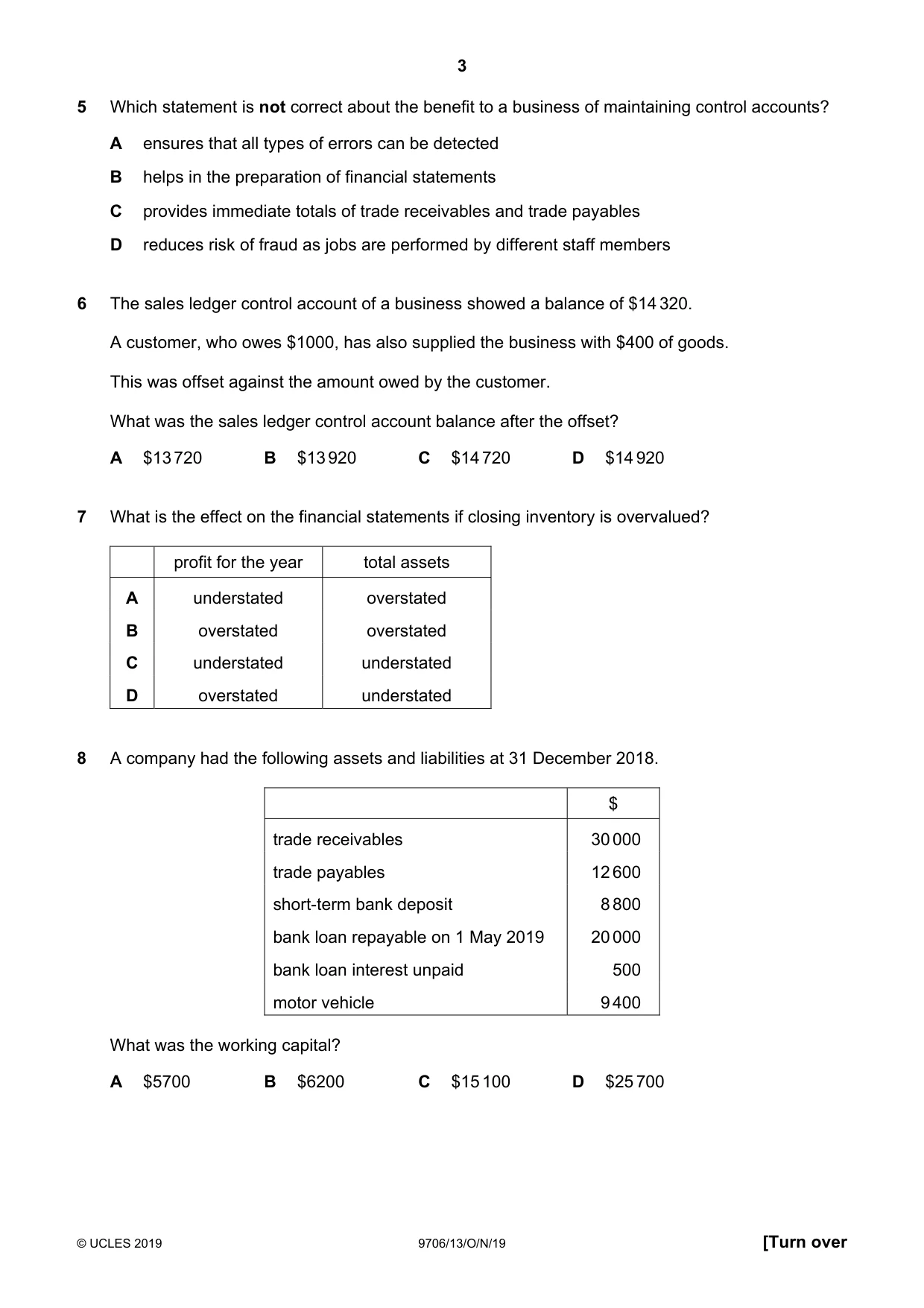
5 Which statement is not correct about the benefit to a business of maintaining control accounts? A ensures that all types of errors can be detected B helps in the preparation of financial statements C provides immediate totals of trade receivables and trade payables D reduces risk of fraud as jobs are performed by different staff members
Mark scheme: A
Q6 · The sales ledger control account of a business showed a balance of $14 320
6 The sales ledger control account of a business showed a balance of $14 320. A customer, who owes $1000, has also supplied the business with $400 of goods. This was offset against the amount owed by the customer. What was the sales ledger control account balance after the offset? A $13 720 B $13 920 C $14 720 D $14 920
Mark scheme: B
Q7 · What is the effect on the financial statements if closing inventory is overvalued?
7 What is the effect on the financial statements if closing inventory is overvalued? profit for the year total assets A understated overstated B overstated overstated C understated understated D overstated understated
Mark scheme: B
Q8 · A company had the following assets and liabilities at 31 December 2018
8 A company had the following assets and liabilities at 31 December 2018. $ trade receivables 30 000 trade payables 12 600 short-term bank deposit 8 800 bank loan repayable on 1 May 2019 20 000 bank loan interest unpaid 500 motor vehicle 9 400 What was the working capital? A $5700 B $6200 C $15 100 D $25 700
Mark scheme: A
Q9 · Why does a trader account for accrued income?
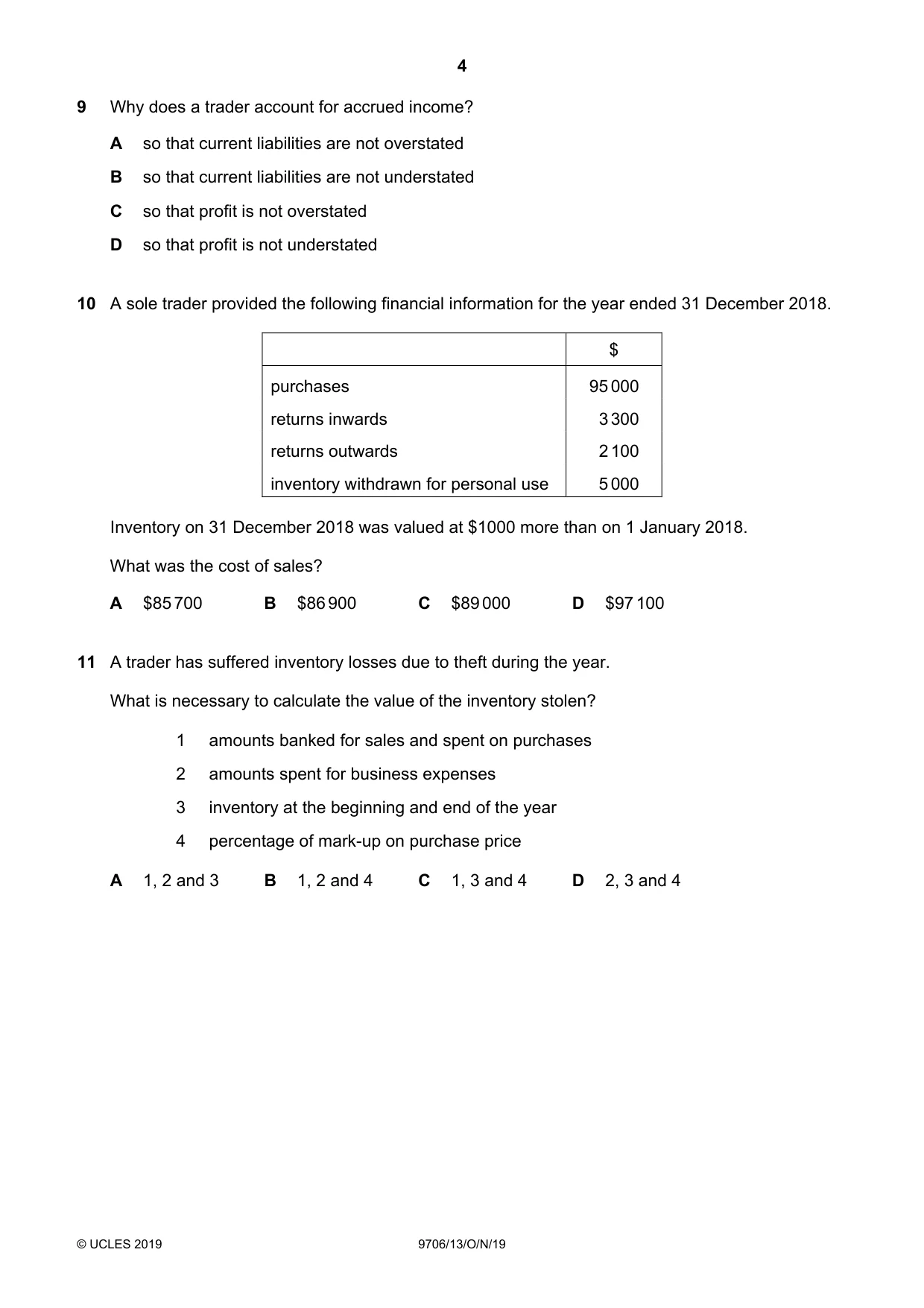
9 Why does a trader account for accrued income? A so that current liabilities are not overstated B so that current liabilities are not understated C so that profit is not overstated D so that profit is not understated
Mark scheme: D
Q10 · A sole trader provided the following financial information for the year ended 31 December…
10 A sole trader provided the following financial information for the year ended 31 December 2018. $ purchases 95 000 returns inwards 3 300 returns outwards 2 100 inventory withdrawn for personal use 5 000 Inventory on 31 December 2018 was valued at $1000 more than on 1 January 2018. What was the cost of sales? A $85 700 B $86 900 C $89 000 D $97 100
Mark scheme: B
Q11 · A trader has suffered inventory losses due to theft during the year
11 A trader has suffered inventory losses due to theft during the year. What is necessary to calculate the value of the inventory stolen? 1 amounts banked for sales and spent on purchases 2 amounts spent for business expenses 3 inventory at the beginning and end of the year 4 percentage of mark-up on purchase price A 1, 2 and 3 B 1, 2 and 4 C 1, 3 and 4 D 2, 3 and 4
Mark scheme: C
Q12 · A business has extracted the following information from its books of account at 31…
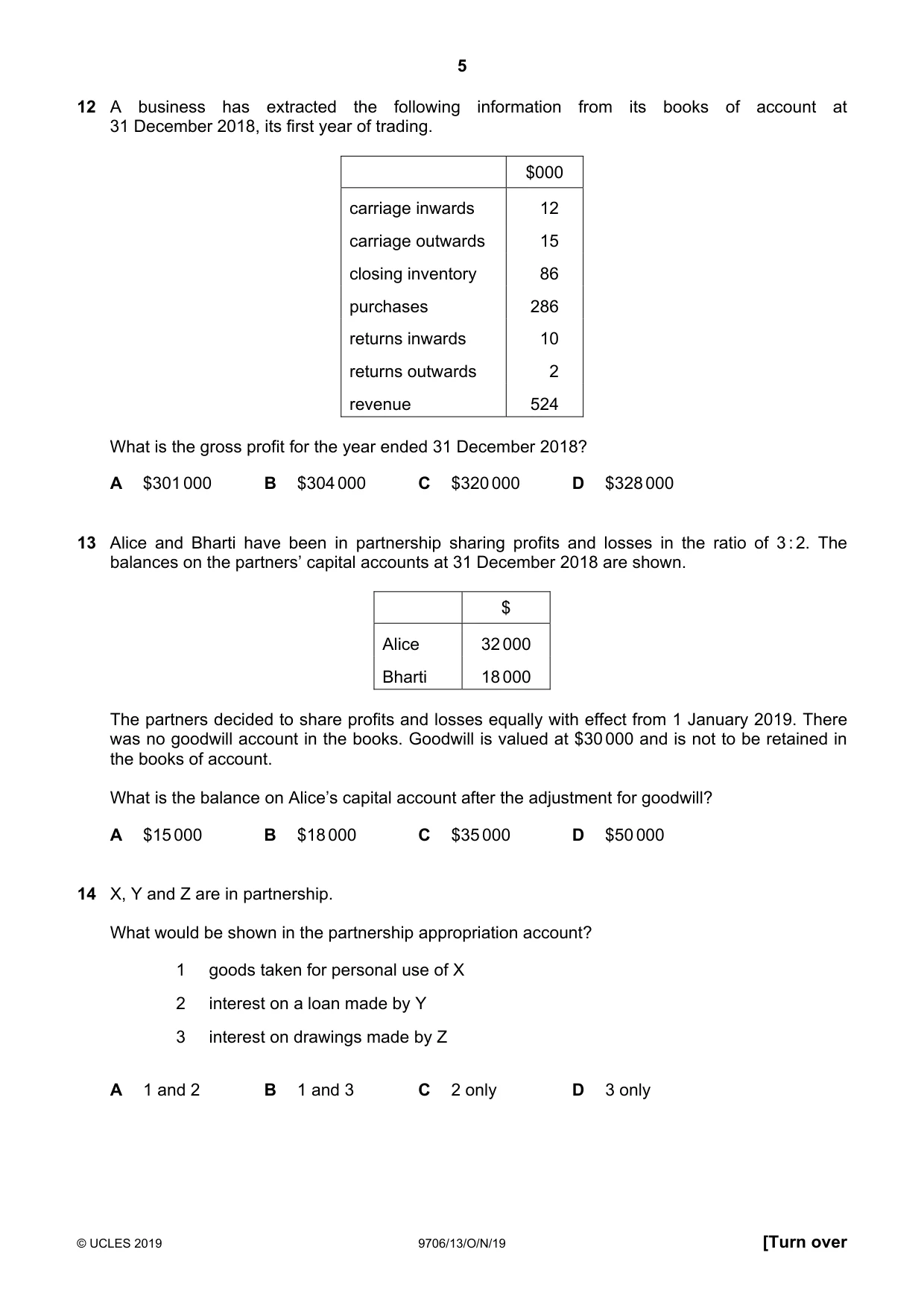
12 A business has extracted the following information from its books of account at 31 December 2018, its first year of trading. $000 carriage inwards 12 carriage outwards 15 closing inventory 86 purchases 286 returns inwards 10 returns outwards 2 revenue 524 What is the gross profit for the year ended 31 December 2018? A $301 000 B $304 000 C $320 000 D $328 000
Mark scheme: B
Q13 · Alice and Bharti have been in partnership sharing profits and losses in the ratio of 3 : 2
13 Alice and Bharti have been in partnership sharing profits and losses in the ratio of 3 : 2. The balances on the partners’ capital accounts at 31 December 2018 are shown. $ Alice 32 000 Bharti 18 000 The partners decided to share profits and losses equally with effect from 1 January 2019. There was no goodwill account in the books. Goodwill is valued at $30 000 and is not to be retained in the books of account. What is the balance on Alice’s capital account after the adjustment for goodwill? A $15 000 B $18 000 C $35 000 D $50 000
Mark scheme: C
Q14 · X, Y and Z are in partnership
14 X, Y and Z are in partnership. What would be shown in the partnership appropriation account? 1 goods taken for personal use of X 2 interest on a loan made by Y 3 interest on drawings made by Z A 1 and 2 B 1 and 3 C 2 only D 3 only
Mark scheme: D
Q15 · Which items are capital reserves?
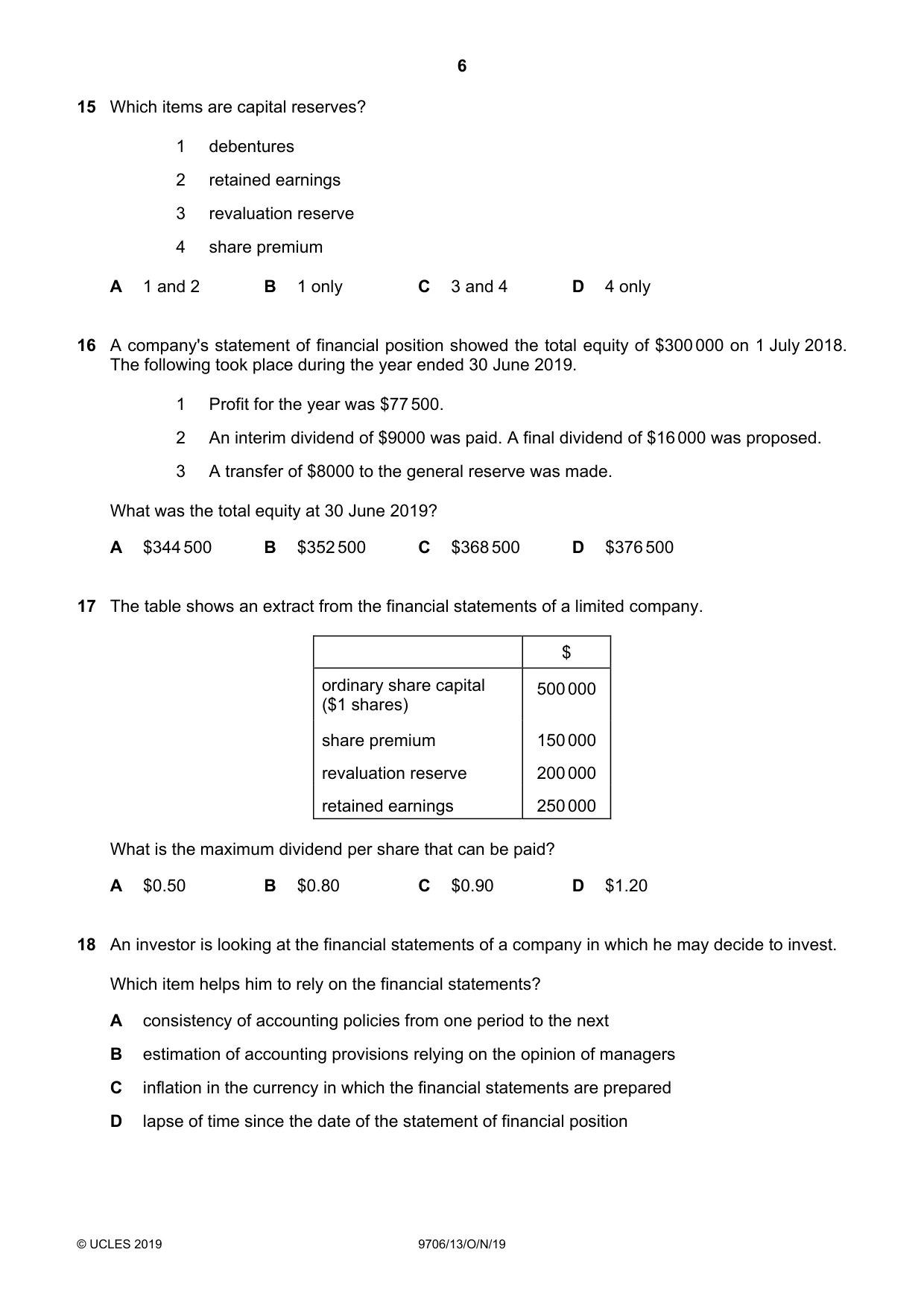
15 Which items are capital reserves? 1 debentures 2 retained earnings 3 revaluation reserve 4 share premium A 1 and 2 B 1 only C 3 and 4 D 4 only
Mark scheme: C
Q16 · A company's statement of financial position showed the total equity of $300 000 on 1 July…
16 A company's statement of financial position showed the total equity of $300 000 on 1 July 2018. The following took place during the year ended 30 June 2019. 1 Profit for the year was $77 500. 2 An interim dividend of $9000 was paid. A final dividend of $16 000 was proposed. 3 A transfer of $8000 to the general reserve was made. What was the total equity at 30 June 2019? A $344 500 B $352 500 C $368 500 D $376 500
Mark scheme: C
Q17 · The table shows an extract from the financial statements of a limited company
17 The table shows an extract from the financial statements of a limited company. $ ordinary share capital 500 000 ($1 shares) share premium 150 000 revaluation reserve 200 000 retained earnings 250 000 What is the maximum dividend per share that can be paid? A $0.50 B $0.80 C $0.90 D $1.20
Mark scheme: A
Q18 · An investor is looking at the financial statements of a company in which he may decide to…
18 An investor is looking at the financial statements of a company in which he may decide to invest. Which item helps him to rely on the financial statements? A consistency of accounting policies from one period to the next B estimation of accounting provisions relying on the opinion of managers C inflation in the currency in which the financial statements are prepared D lapse of time since the date of the statement of financial position
Mark scheme: A
Q19 · A company provides the following information for the year ended 31 May 2019
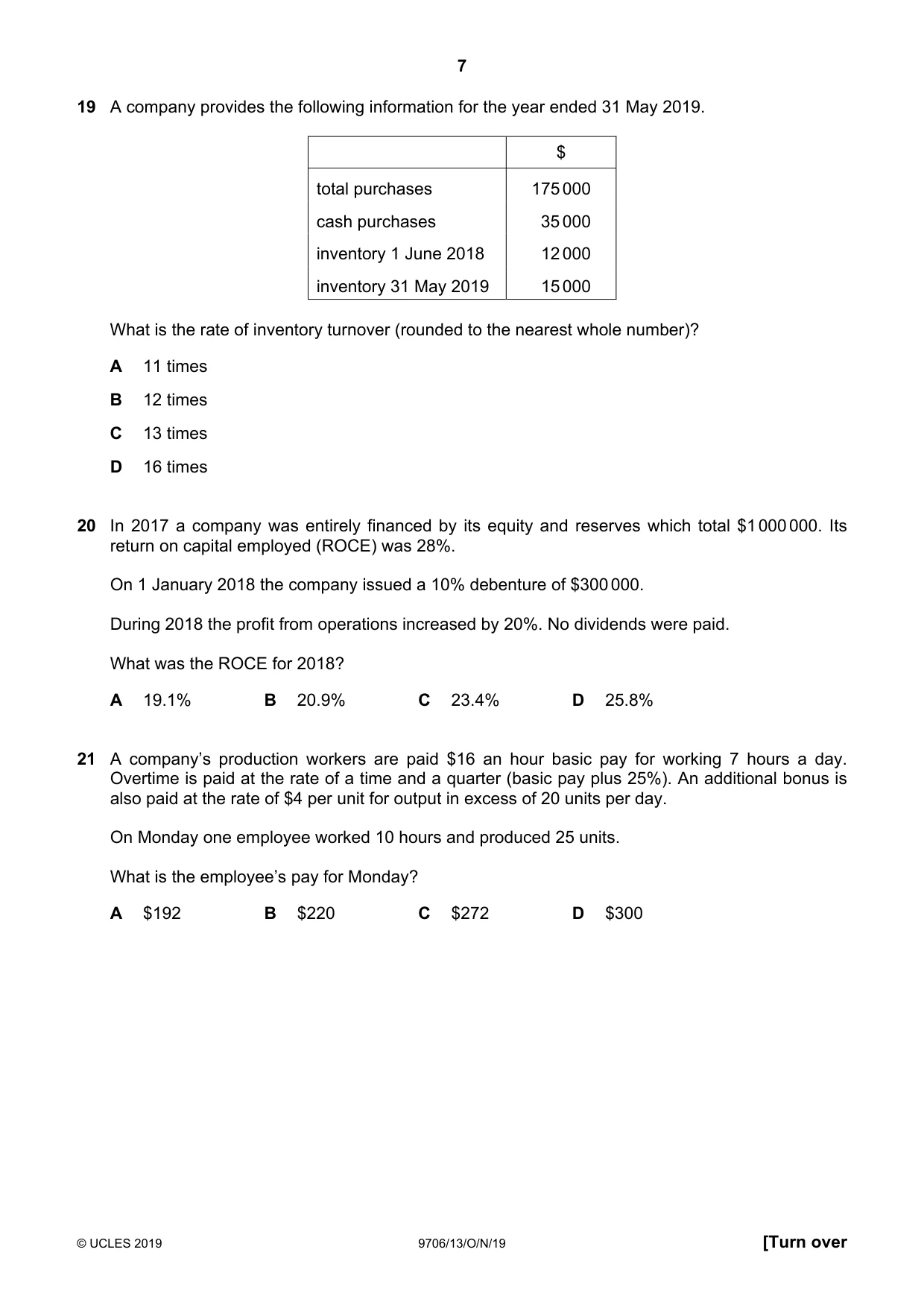
19 A company provides the following information for the year ended 31 May 2019. $ total purchases 175 000 cash purchases 35 000 inventory 1 June 2018 12 000 inventory 31 May 2019 15 000 What is the rate of inventory turnover (rounded to the nearest whole number)? A 11 times B 12 times C 13 times D 16 times
Mark scheme: C
More questions on Analysis and communication of accounting information
Q20 · In 2017 a company was entirely financed by its equity and reserves which total $1 000 000
20 In 2017 a company was entirely financed by its equity and reserves which total $1 000 000. Its return on capital employed (ROCE) was 28%. On 1 January 2018 the company issued a 10% debenture of $300 000. During 2018 the profit from operations increased by 20%. No dividends were paid. What was the ROCE for 2018? A 19.1% B 20.9% C 23.4% D 25.8%
Mark scheme: B
More questions on Analysis and communication of accounting information
Q21 · A company’s production workers are paid $16 an hour basic pay for working 7 hours a day
21 A company’s production workers are paid $16 an hour basic pay for working 7 hours a day. Overtime is paid at the rate of a time and a quarter (basic pay plus 25%). An additional bonus is also paid at the rate of $4 per unit for output in excess of 20 units per day. On Monday one employee worked 10 hours and produced 25 units. What is the employee’s pay for Monday? A $192 B $220 C $272 D $300
Mark scheme: A
Q22 · The inventory movements of a business in a three-month period are shown
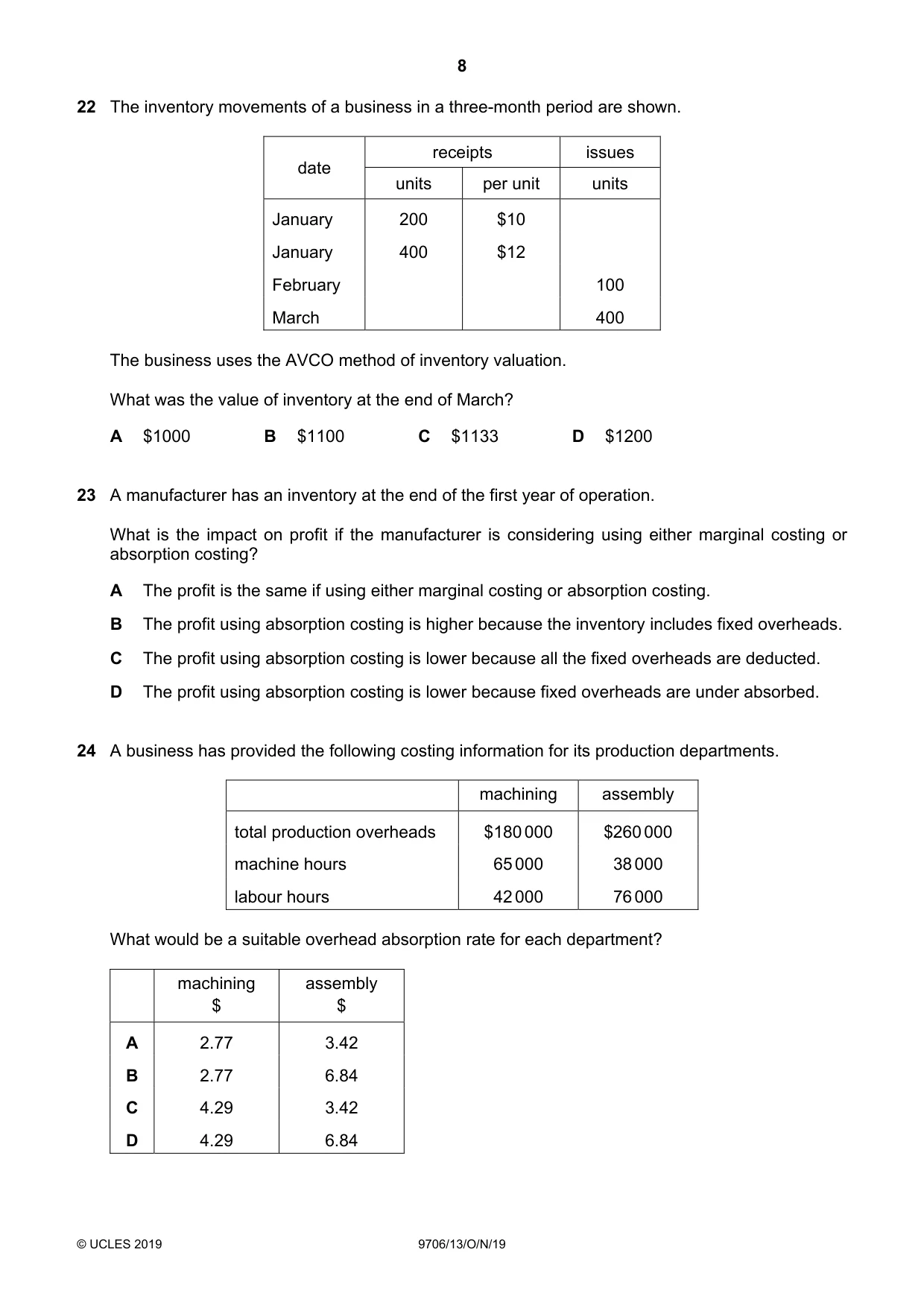
22 The inventory movements of a business in a three-month period are shown. receipts issues date units per unit units January 200 $10 January 400 $12 February 100 March 400 The business uses the AVCO method of inventory valuation. What was the value of inventory at the end of March? A $1000 B $1100 C $1133 D $1200
Mark scheme: C
Q23 · A manufacturer has an inventory at the end of the first year of operation
23 A manufacturer has an inventory at the end of the first year of operation. What is the impact on profit if the manufacturer is considering using either marginal costing or absorption costing? A The profit is the same if using either marginal costing or absorption costing. B The profit using absorption costing is higher because the inventory includes fixed overheads. C The profit using absorption costing is lower because all the fixed overheads are deducted. D The profit using absorption costing is lower because fixed overheads are under absorbed.
Mark scheme: B
Q24 · A business has provided the following costing information for its production departments
24 A business has provided the following costing information for its production departments. machining assembly total production overheads $180 000 $260 000 machine hours 65 000 38 000 labour hours 42 000 76 000 What would be a suitable overhead absorption rate for each department? machining assembly $ $ A 2.77 3.42 B 2.77 6.84 C 4.29 3.42 D 4.29 6.84
Mark scheme: A
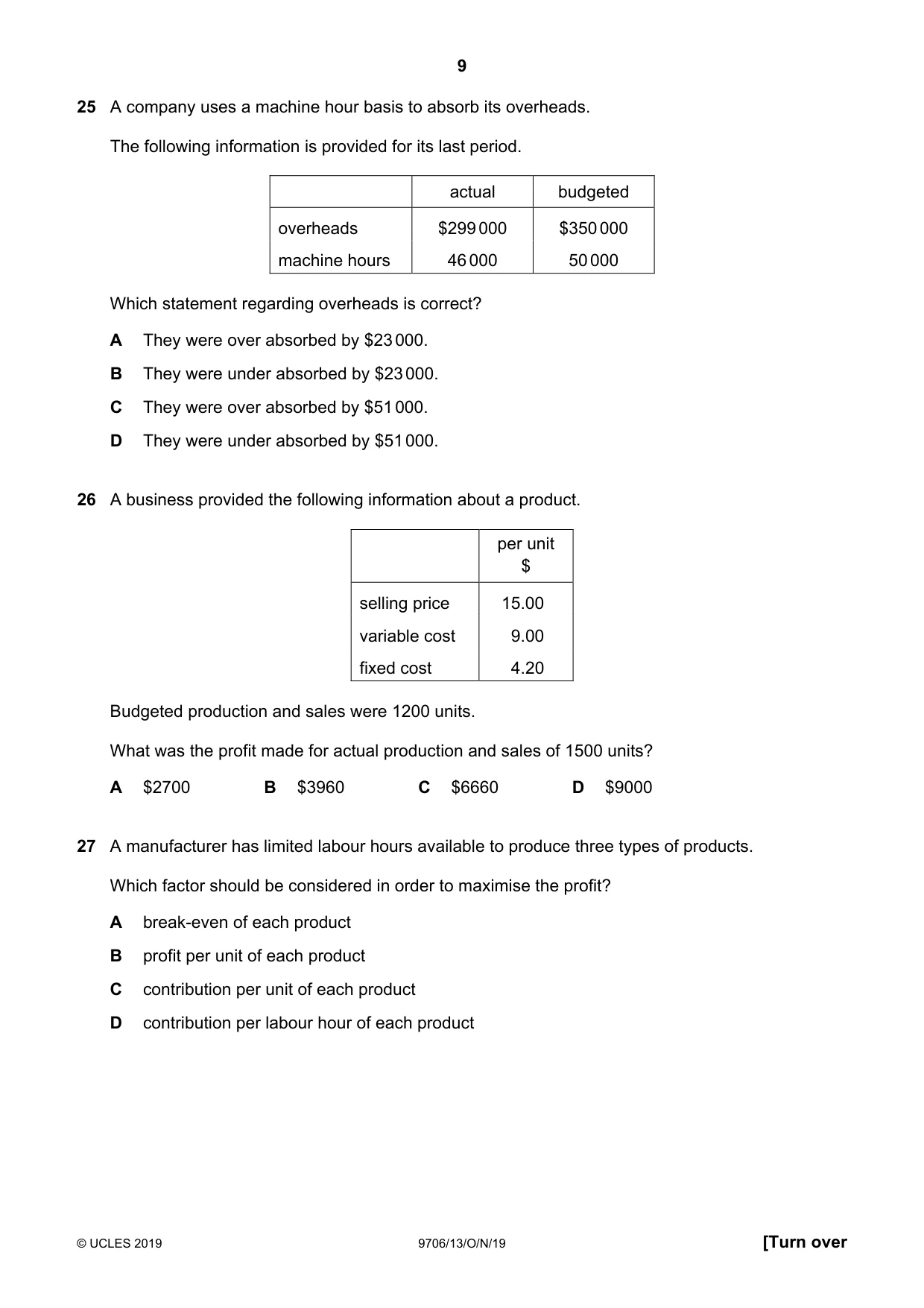
Q25 · A company uses a machine hour basis to absorb its overheads
25 A company uses a machine hour basis to absorb its overheads. The following information is provided for its last period. actual budgeted overheads $299 000 $350 000 machine hours 46 000 50 000 Which statement regarding overheads is correct? A They were over absorbed by $23 000. B They were under absorbed by $23 000. C They were over absorbed by $51 000. D They were under absorbed by $51 000.
Mark scheme: A
Q26 · A business provided the following information about a product
26 A business provided the following information about a product. per unit $ selling price 15.00 variable cost 9.00 fixed cost 4.20 Budgeted production and sales were 1200 units. What was the profit made for actual production and sales of 1500 units? A $2700 B $3960 C $6660 D $9000
Mark scheme: B
Q27 · A manufacturer has limited labour hours available to produce three types of products
27 A manufacturer has limited labour hours available to produce three types of products. Which factor should be considered in order to maximise the profit? A break-even of each product B profit per unit of each product C contribution per unit of each product D contribution per labour hour of each product
Mark scheme: D
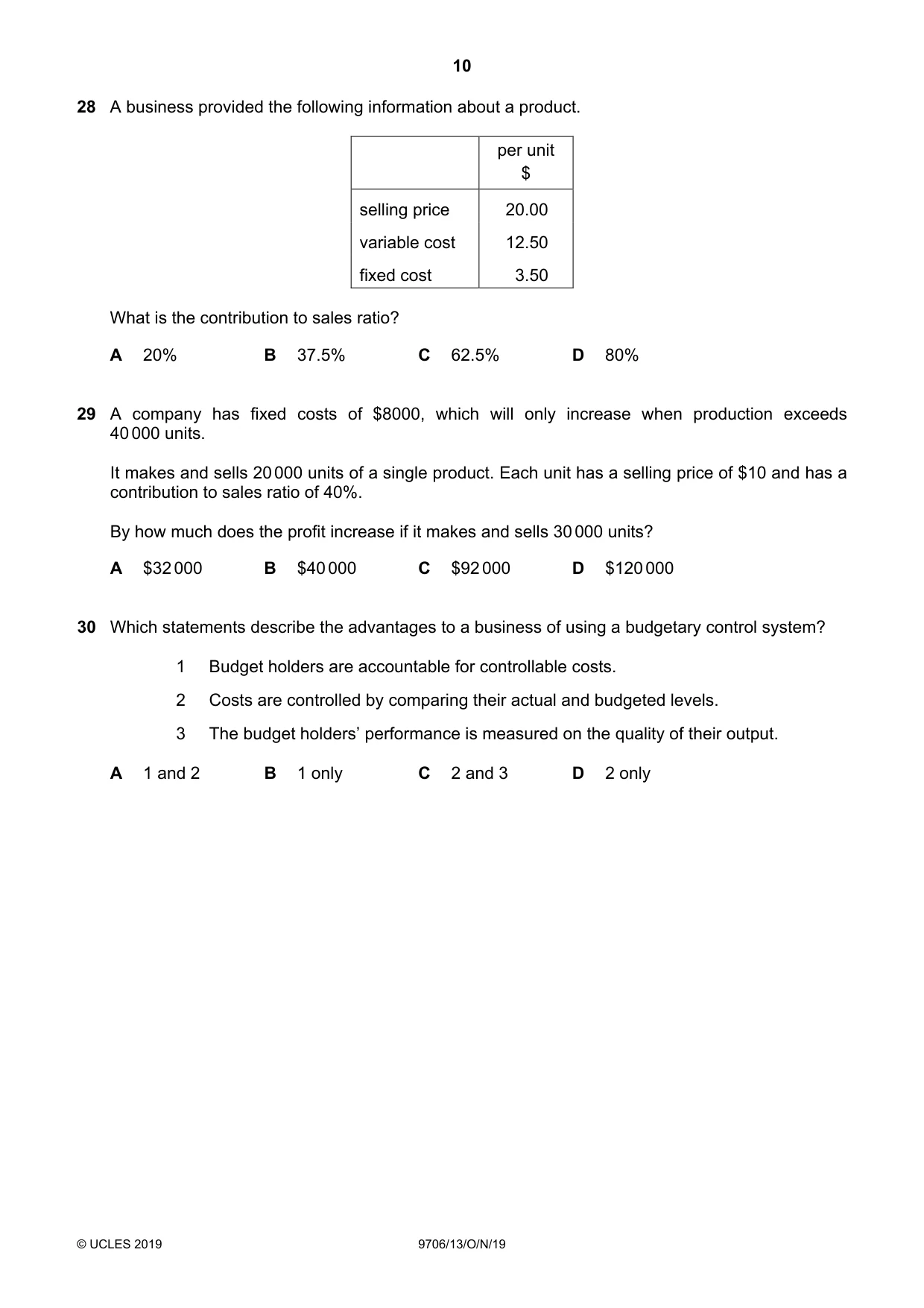
Q28 · A business provided the following information about a product
28 A business provided the following information about a product. per unit $ selling price 20.00 variable cost 12.50 fixed cost 3.50 What is the contribution to sales ratio? A 20% B 37.5% C 62.5% D 80%
Mark scheme: B
Q29 · A company has fixed costs of $8000, which will only increase when production exceeds 40…
29 A company has fixed costs of $8000, which will only increase when production exceeds 40 000 units. It makes and sells 20 000 units of a single product. Each unit has a selling price of $10 and has a contribution to sales ratio of 40%. By how much does the profit increase if it makes and sells 30 000 units? A $32 000 B $40 000 C $92 000 D $120 000
Mark scheme: B
Q30 · Which statements describe the advantages to a business of using a budgetary control…
30 Which statements describe the advantages to a business of using a budgetary control system? 1 Budget holders are accountable for controllable costs. 2 Costs are controlled by comparing their actual and budgeted levels. 3 The budget holders’ performance is measured on the quality of their output. A 1 and 2 B 1 only C 2 and 3 D 2 only
Mark scheme: A
What was in this paper
The subtopics covered by these 30 questions, and how many questions each got. Open one in a new tab to see every Cambridge question on it.
7Costs and cost behaviour5Traditional costing methods4Accounting for non-current assets3Preparation of financial statements3Reconciliation and verification3Analysis and communication of accounting information1Analysis and communication of accounting information1Budgeting and budgetary control1Regulatory and ethical considerations1The accounting system1What you needed in this session
Cambridge’s own grade thresholds for 2019 Oct/Nov, Paper 1 · Variant 3. A higher threshold means an easier paper — the bar moves with how the cohort did.