Cambridge A Level Accounting 9706 — 2019 May/June Paper 1 · Variant 2
9706/12/M/J/19 · 30 questions · 30 marks · ≈34 min
The question paper and its mark scheme, free to read here and free to download. This is Cambridge’s own paper, exactly as it was sat.
Question paper12 pages

Mark scheme3 pages
Answers below. Sit the paper first if you are practising.
Questions as text
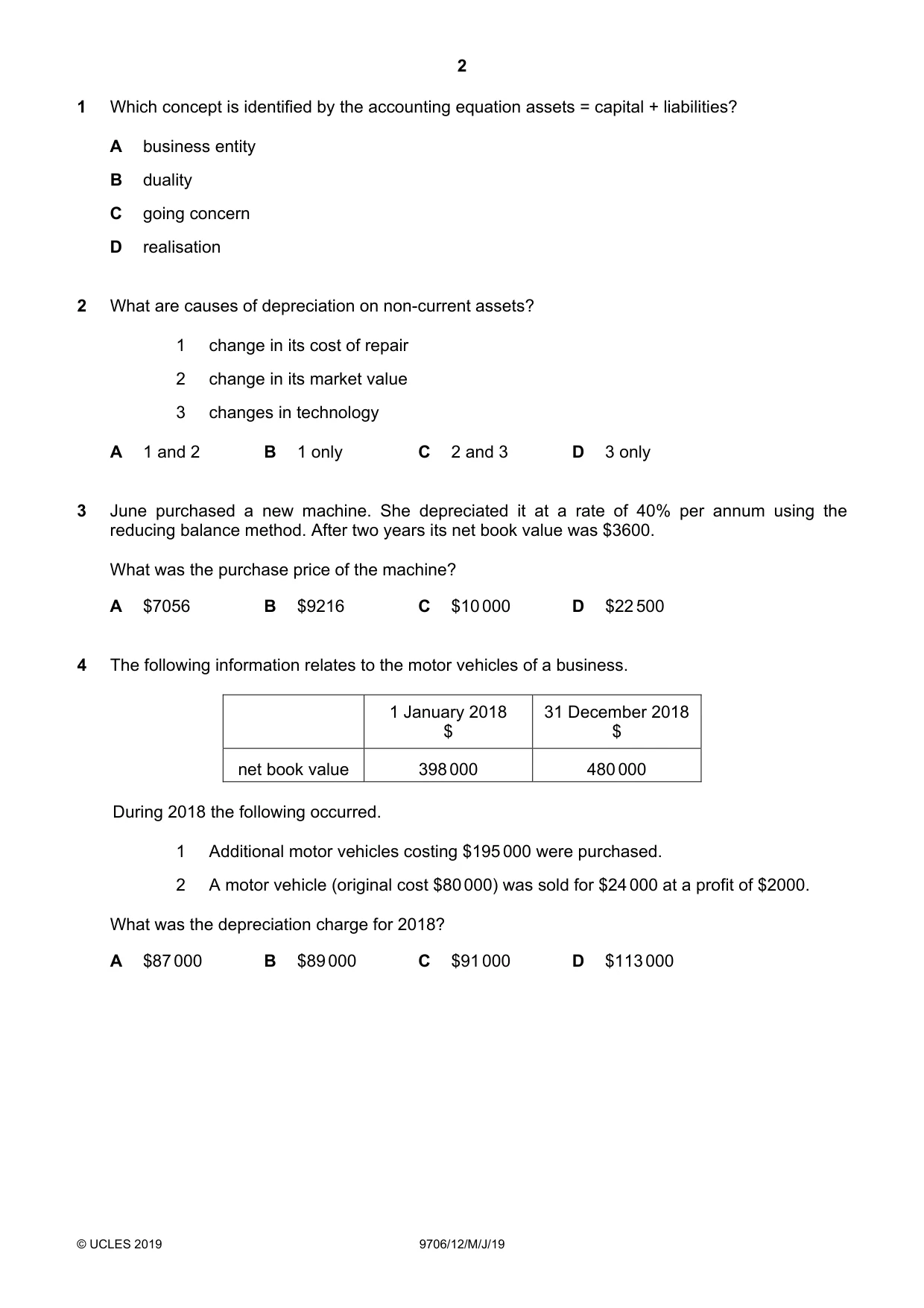
Q1 · Which concept is identified by the accounting equation assets = capital + liabilities?
1 Which concept is identified by the accounting equation assets = capital + liabilities? A business entity B duality C going concern D realisation
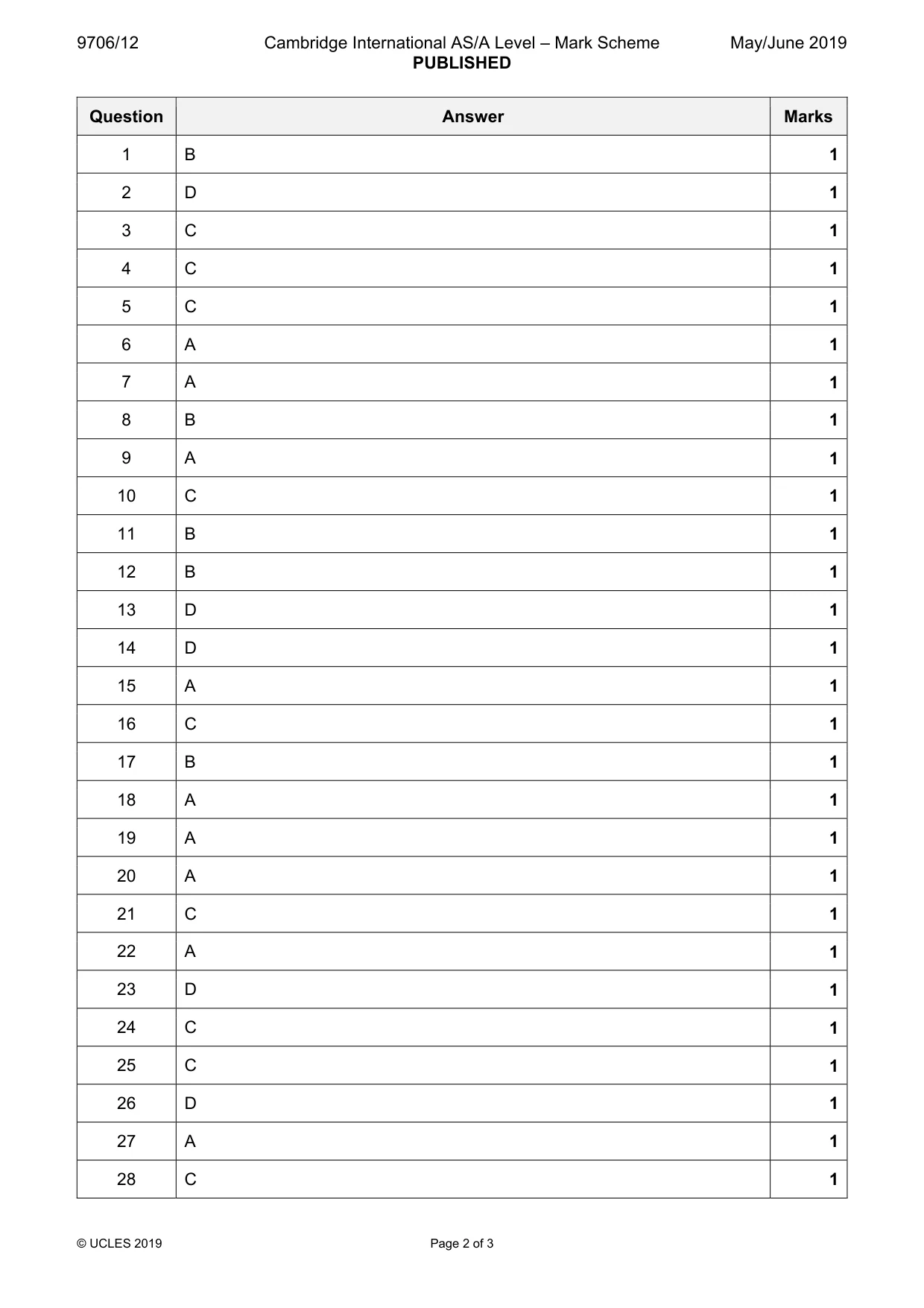
Mark scheme: B
Q2 · What are causes of depreciation on non-current assets?
2 What are causes of depreciation on non-current assets? 1 change in its cost of repair 2 change in its market value 3 changes in technology A 1 and 2 B 1 only C 2 and 3 D 3 only
Mark scheme: D
Q3 · June purchased a new machine
3 June purchased a new machine. She depreciated it at a rate of 40% per annum using the reducing balance method. After two years its net book value was $3600. What was the purchase price of the machine? A $7056 B $9216 C $10 000 D $22 500
Mark scheme: C
Q4 · The following information relates to the motor vehicles of a business
4 The following information relates to the motor vehicles of a business. 1 January 2018 31 December 2018 $ $ net book value 398 000 480 000 During 2018 the following occurred. 1 Additional motor vehicles costing $195 000 were purchased. 2 A motor vehicle (original cost $80 000) was sold for $24 000 at a profit of $2000. What was the depreciation charge for 2018? A $87 000 B $89 000 C $91 000 D $113 000
Mark scheme: C
Q5 · A book-keeper compared the business bank statement with the cash book
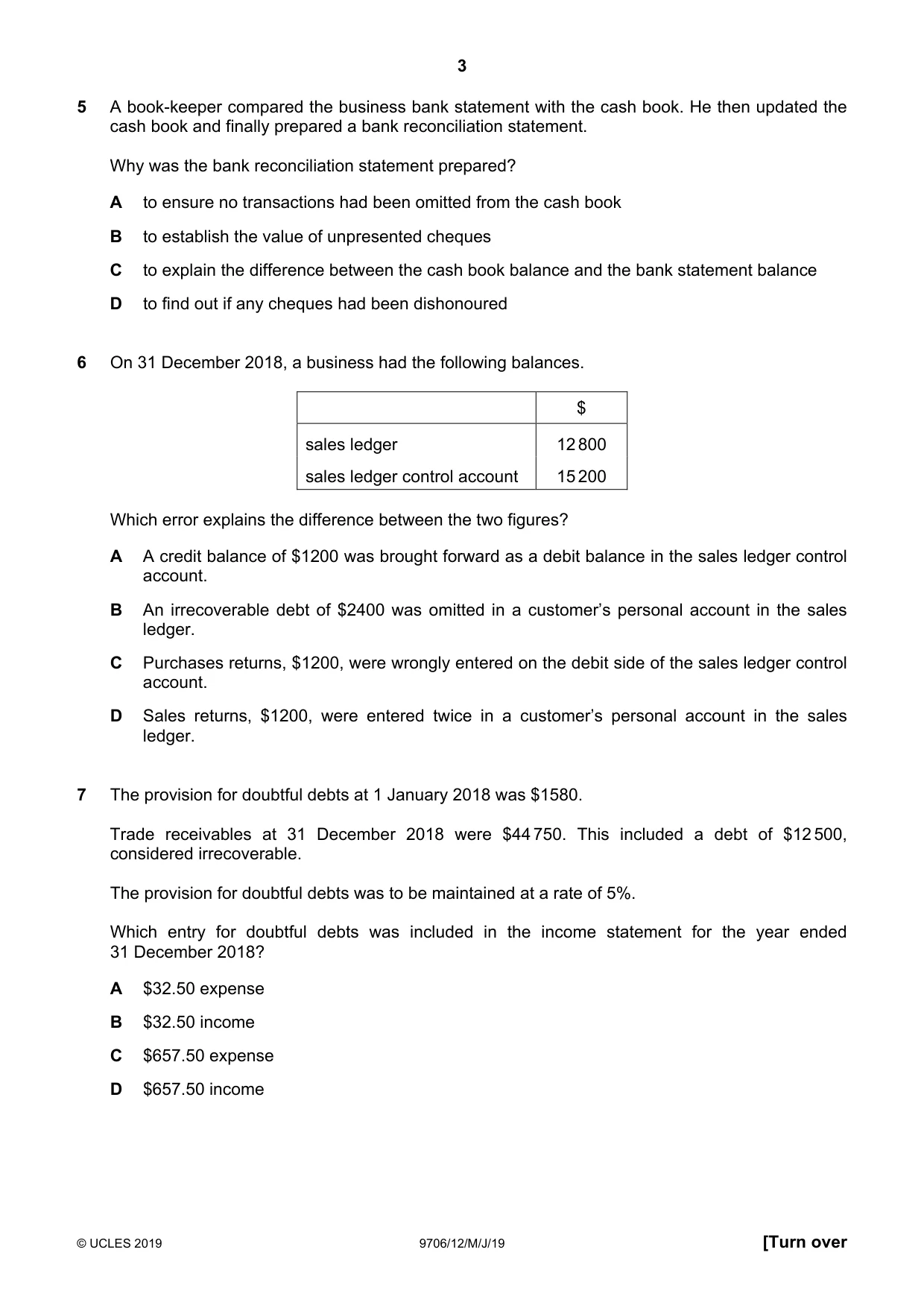
5 A book-keeper compared the business bank statement with the cash book. He then updated the cash book and finally prepared a bank reconciliation statement. Why was the bank reconciliation statement prepared? A to ensure no transactions had been omitted from the cash book B to establish the value of unpresented cheques C to explain the difference between the cash book balance and the bank statement balance D to find out if any cheques had been dishonoured
Mark scheme: C
Q6 · On 31 December 2018, a business had the following balances
6 On 31 December 2018, a business had the following balances. $ sales ledger 12 800 sales ledger control account 15 200 Which error explains the difference between the two figures? A A credit balance of $1200 was brought forward as a debit balance in the sales ledger control account. B An irrecoverable debt of $2400 was omitted in a customer’s personal account in the sales ledger. C Purchases returns, $1200, were wrongly entered on the debit side of the sales ledger control account. D Sales returns, $1200, were entered twice in a customer’s personal account in the sales ledger.
Mark scheme: A
Q7 · The provision for doubtful debts at 1 January 2018 was $1580
7 The provision for doubtful debts at 1 January 2018 was $1580. Trade receivables at 31 December 2018 were $44 750. This included a debt of $12 500, considered irrecoverable. The provision for doubtful debts was to be maintained at a rate of 5%. Which entry for doubtful debts was included in the income statement for the year ended 31 December 2018? A $32.50 expense B $32.50 income C $657.50 expense D $657.50 income
Mark scheme: A
Q8 · Which statements about valuing inventory are correct?
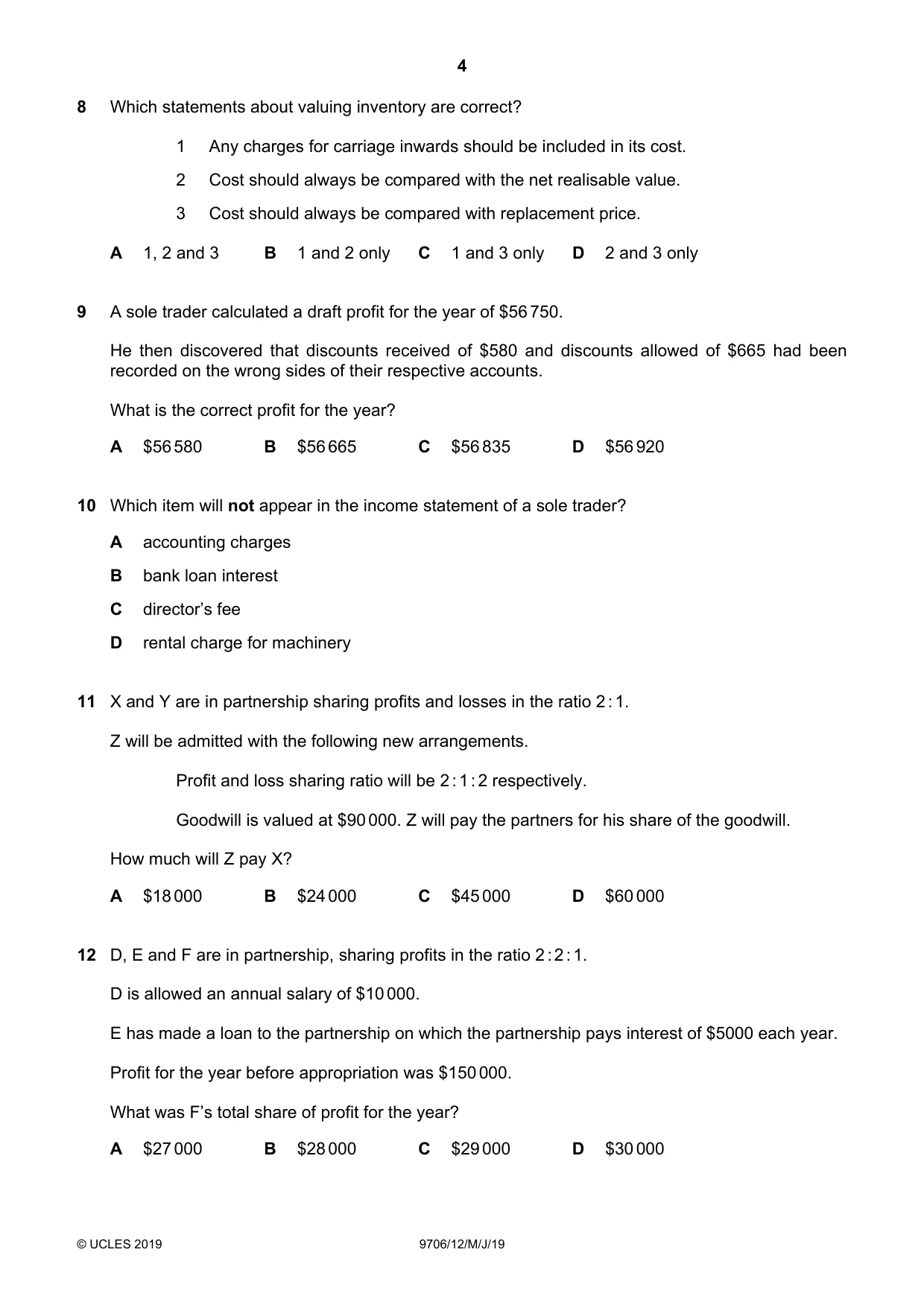
8 Which statements about valuing inventory are correct? 1 Any charges for carriage inwards should be included in its cost. 2 Cost should always be compared with the net realisable value. 3 Cost should always be compared with replacement price. A 1, 2 and 3 B 1 and 2 only C 1 and 3 only D 2 and 3 only
Mark scheme: B
Q9 · A sole trader calculated a draft profit for the year of $56 750
9 A sole trader calculated a draft profit for the year of $56 750. He then discovered that discounts received of $580 and discounts allowed of $665 had been recorded on the wrong sides of their respective accounts. What is the correct profit for the year? A $56 580 B $56 665 C $56 835 D $56 920
Mark scheme: A
Q10 · Which item will not appear in the income statement of a sole trader?
10 Which item will not appear in the income statement of a sole trader? A accounting charges B bank loan interest C director’s fee D rental charge for machinery
Mark scheme: C
Q11 · X and Y are in partnership sharing profits and losses in the ratio 2 : 1
11 X and Y are in partnership sharing profits and losses in the ratio 2 : 1. Z will be admitted with the following new arrangements. Profit and loss sharing ratio will be 2 : 1 : 2 respectively. Goodwill is valued at $90 000. Z will pay the partners for his share of the goodwill. How much will Z pay X? A $18 000 B $24 000 C $45 000 D $60 000
Mark scheme: B
Q12 · D, E and F are in partnership, sharing profits in the ratio 2 : 2 : 1
12 D, E and F are in partnership, sharing profits in the ratio 2 : 2 : 1. D is allowed an annual salary of $10 000. E has made a loan to the partnership on which the partnership pays interest of $5000 each year. Profit for the year before appropriation was $150 000. What was F’s total share of profit for the year? A $27 000 B $28 000 C $29 000 D $30 000
Mark scheme: B
Q13 · L and M had been in partnership sharing profits and losses equally
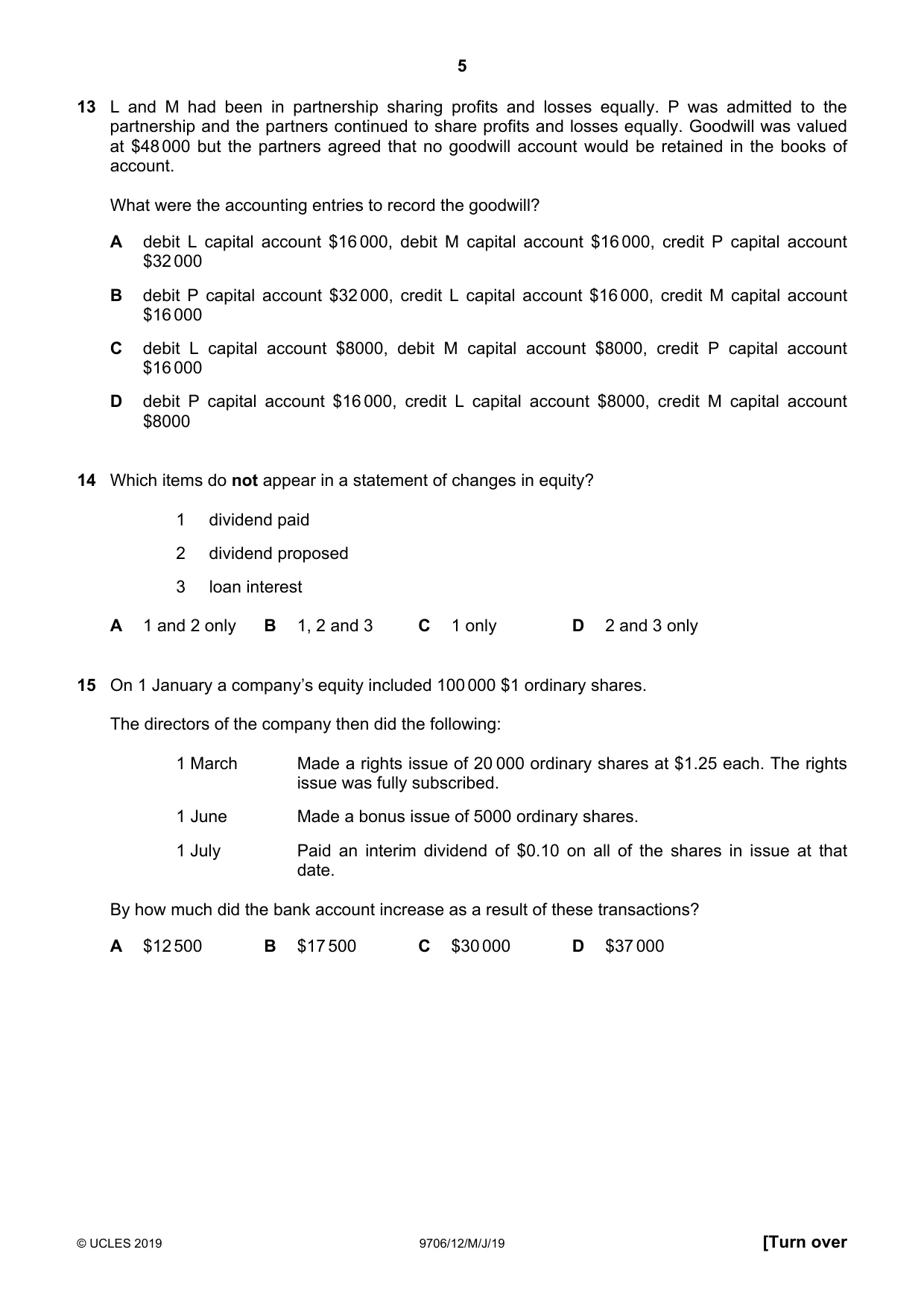
13 L and M had been in partnership sharing profits and losses equally. P was admitted to the partnership and the partners continued to share profits and losses equally. Goodwill was valued at $48 000 but the partners agreed that no goodwill account would be retained in the books of account. What were the accounting entries to record the goodwill? A debit L capital account $16 000, debit M capital account $16 000, credit P capital account $32 000 B debit P capital account $32 000, credit L capital account $16 000, credit M capital account $16 000 C debit L capital account $8000, debit M capital account $8000, credit P capital account $16 000 D debit P capital account $16 000, credit L capital account $8000, credit M capital account $8000
Mark scheme: D
Q14 · Which items do not appear in a statement of changes in equity?
14 Which items do not appear in a statement of changes in equity? 1 dividend paid 2 dividend proposed 3 loan interest A 1 and 2 only B 1, 2 and 3 C 1 only D 2 and 3 only
Mark scheme: D
Q15 · On 1 January a company’s equity included 100 000 $1 ordinary shares
15 On 1 January a company’s equity included 100 000 $1 ordinary shares. The directors of the company then did the following: 1 March Made a rights issue of 20 000 ordinary shares at $1.25 each. The rights issue was fully subscribed. 1 June Made a bonus issue of 5000 ordinary shares. 1 July Paid an interim dividend of $0.10 on all of the shares in issue at that date. By how much did the bank account increase as a result of these transactions? A $12 500 B $17 500 C $30 000 D $37 000
Mark scheme: A
Q16 · The following balances are extracted from the books of J Limited
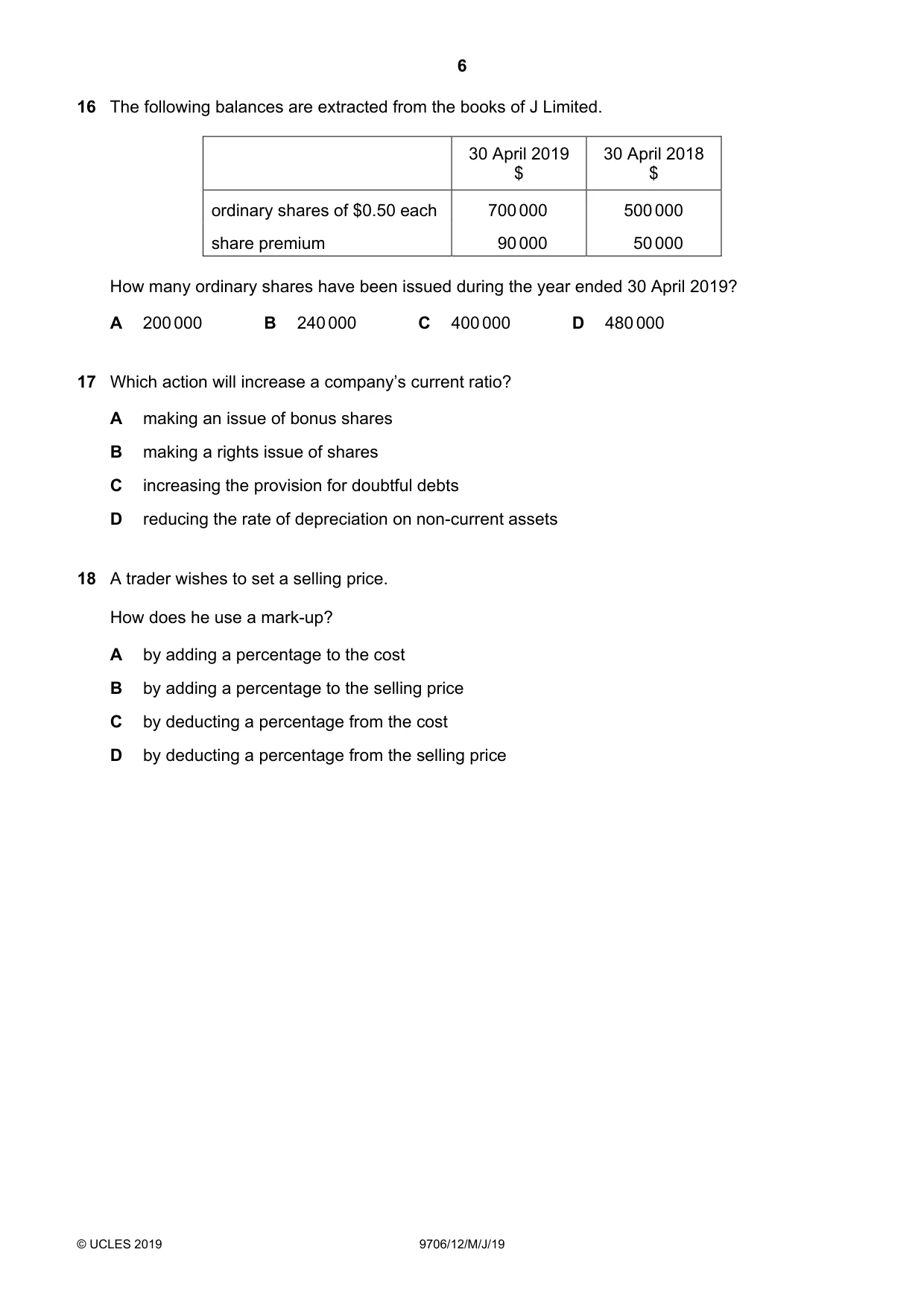
16 The following balances are extracted from the books of J Limited. 30 April 2019 30 April 2018 $ $ ordinary shares of $0.50 each 700 000 500 000 share premium 90 000 50 000 How many ordinary shares have been issued during the year ended 30 April 2019? A 200 000 B 240 000 C 400 000 D 480 000
Mark scheme: C
Q17 · Which action will increase a company’s current ratio?
17 Which action will increase a company’s current ratio? A making an issue of bonus shares B making a rights issue of shares C increasing the provision for doubtful debts D reducing the rate of depreciation on non-current assets
Mark scheme: B
More questions on Analysis and communication of accounting information
Q18 · A trader wishes to set a selling price
18 A trader wishes to set a selling price. How does he use a mark-up? A by adding a percentage to the cost B by adding a percentage to the selling price C by deducting a percentage from the cost D by deducting a percentage from the selling price
Mark scheme: A
More questions on Analysis and communication of accounting information
Q19 · The following information is available for the year ended 31 December 2018
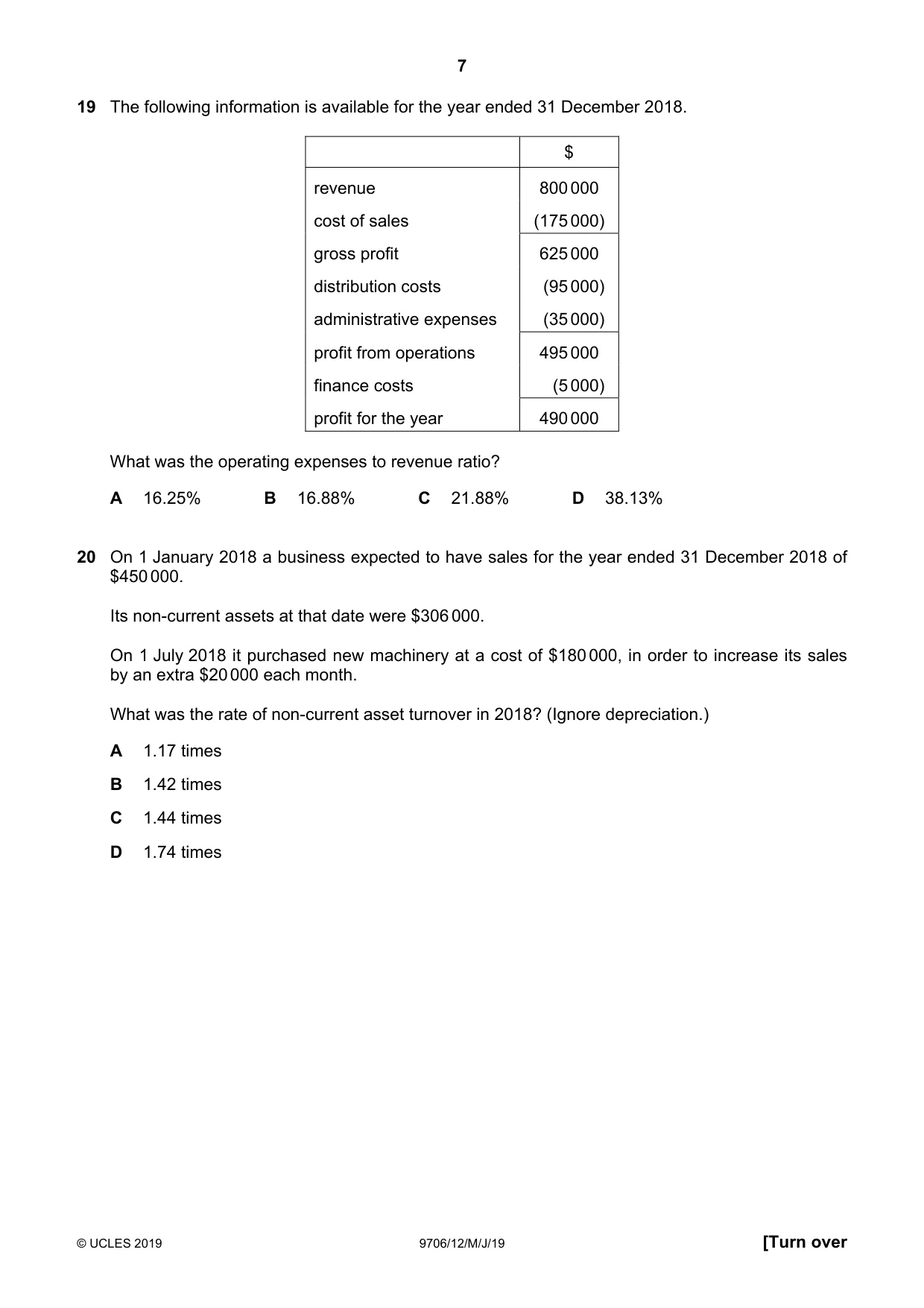
19 The following information is available for the year ended 31 December 2018. $ revenue 800 000 cost of sales (175 000) gross profit 625 000 distribution costs (95 000) administrative expenses (35 000) profit from operations 495 000 finance costs (5 000) profit for the year 490 000 What was the operating expenses to revenue ratio? A 16.25% B 16.88% C 21.88% D 38.13%
Mark scheme: A
More questions on Analysis and communication of accounting information
Q20 · On 1 January 2018 a business expected to have sales for the year ended 31 December 2018…
20 On 1 January 2018 a business expected to have sales for the year ended 31 December 2018 of $450 000. Its non-current assets at that date were $306 000. On 1 July 2018 it purchased new machinery at a cost of $180 000, in order to increase its sales by an extra $20 000 each month. What was the rate of non-current asset turnover in 2018? (Ignore depreciation.) A 1.17 times B 1.42 times C 1.44 times D 1.74 times
Mark scheme: A
More questions on Analysis and communication of accounting information
Q21 · A business uses the First In First Out (FIFO) method to value its inventory
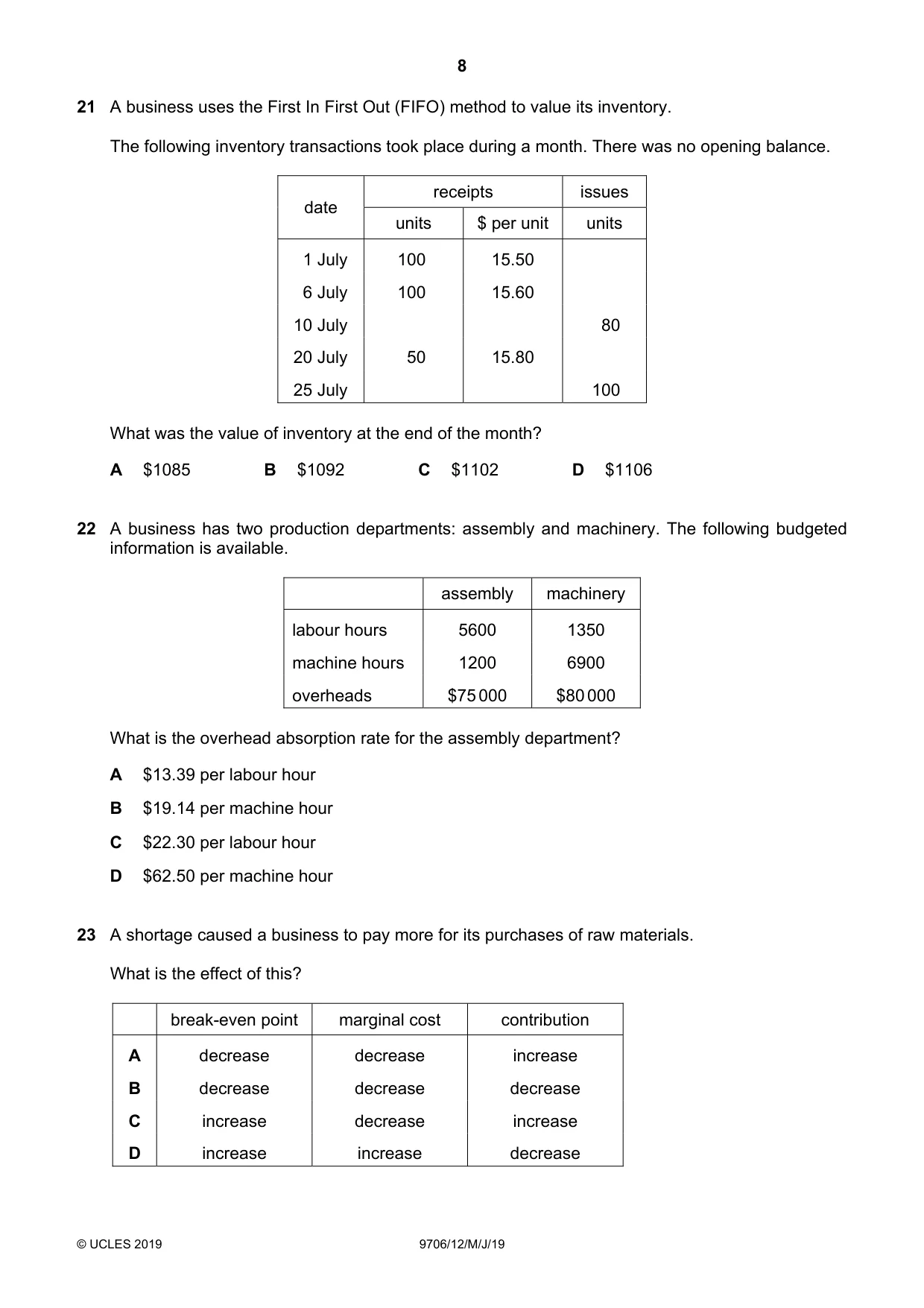
21 A business uses the First In First Out (FIFO) method to value its inventory. The following inventory transactions took place during a month. There was no opening balance. receipts issues date units $ per unit units 1 July 100 15.50 6 July 100 15.60 10 July 80 20 July 50 15.80 25 July 100 What was the value of inventory at the end of the month? A $1085 B $1092 C $1102 D $1106
Mark scheme: C
Q22 · A business has two production departments: assembly and machinery
22 A business has two production departments: assembly and machinery. The following budgeted information is available. assembly machinery labour hours 5600 1350 machine hours 1200 6900 overheads $75 000 $80 000 What is the overhead absorption rate for the assembly department? A $13.39 per labour hour B $19.14 per machine hour C $22.30 per labour hour D $62.50 per machine hour
Mark scheme: A
Q23 · A shortage caused a business to pay more for its purchases of raw materials
23 A shortage caused a business to pay more for its purchases of raw materials. What is the effect of this? break-even point marginal cost contribution A decrease decrease increase B decrease decrease decrease C increase decrease increase D increase increase decrease
Mark scheme: D
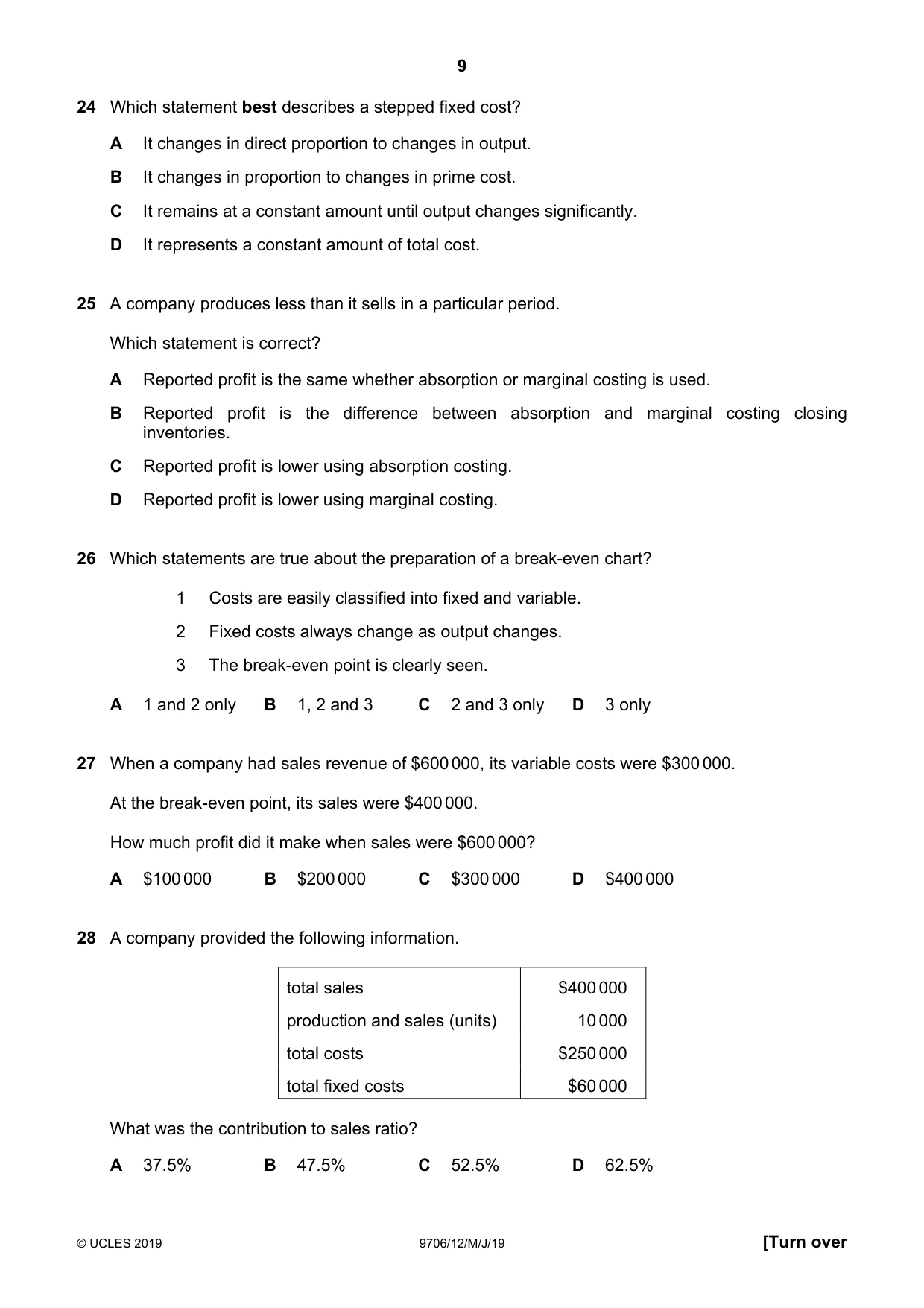
Q24 · Which statement best describes a stepped fixed cost?
24 Which statement best describes a stepped fixed cost? A It changes in direct proportion to changes in output. B It changes in proportion to changes in prime cost. C It remains at a constant amount until output changes significantly. D It represents a constant amount of total cost.
Mark scheme: C
Q25 · A company produces less than it sells in a particular period
25 A company produces less than it sells in a particular period. Which statement is correct? A Reported profit is the same whether absorption or marginal costing is used. B Reported profit is the difference between absorption and marginal costing closing inventories. C Reported profit is lower using absorption costing. D Reported profit is lower using marginal costing.
Mark scheme: C
Q26 · Which statements are true about the preparation of a break-even chart?
26 Which statements are true about the preparation of a break-even chart? 1 Costs are easily classified into fixed and variable. 2 Fixed costs always change as output changes. 3 The break-even point is clearly seen. A 1 and 2 only B 1, 2 and 3 C 2 and 3 only D 3 only
Mark scheme: D
Q27 · When a company had sales revenue of $600 000, its variable costs were $300 000
27 When a company had sales revenue of $600 000, its variable costs were $300 000. At the break-even point, its sales were $400 000. How much profit did it make when sales were $600 000? A $100 000 B $200 000 C $300 000 D $400 000
Mark scheme: A
Q28 · A company provided the following information
28 A company provided the following information. total sales $400 000 production and sales (units) 10 000 total costs $250 000 total fixed costs $60 000 What was the contribution to sales ratio? A 37.5% B 47.5% C 52.5% D 62.5%
Mark scheme: C
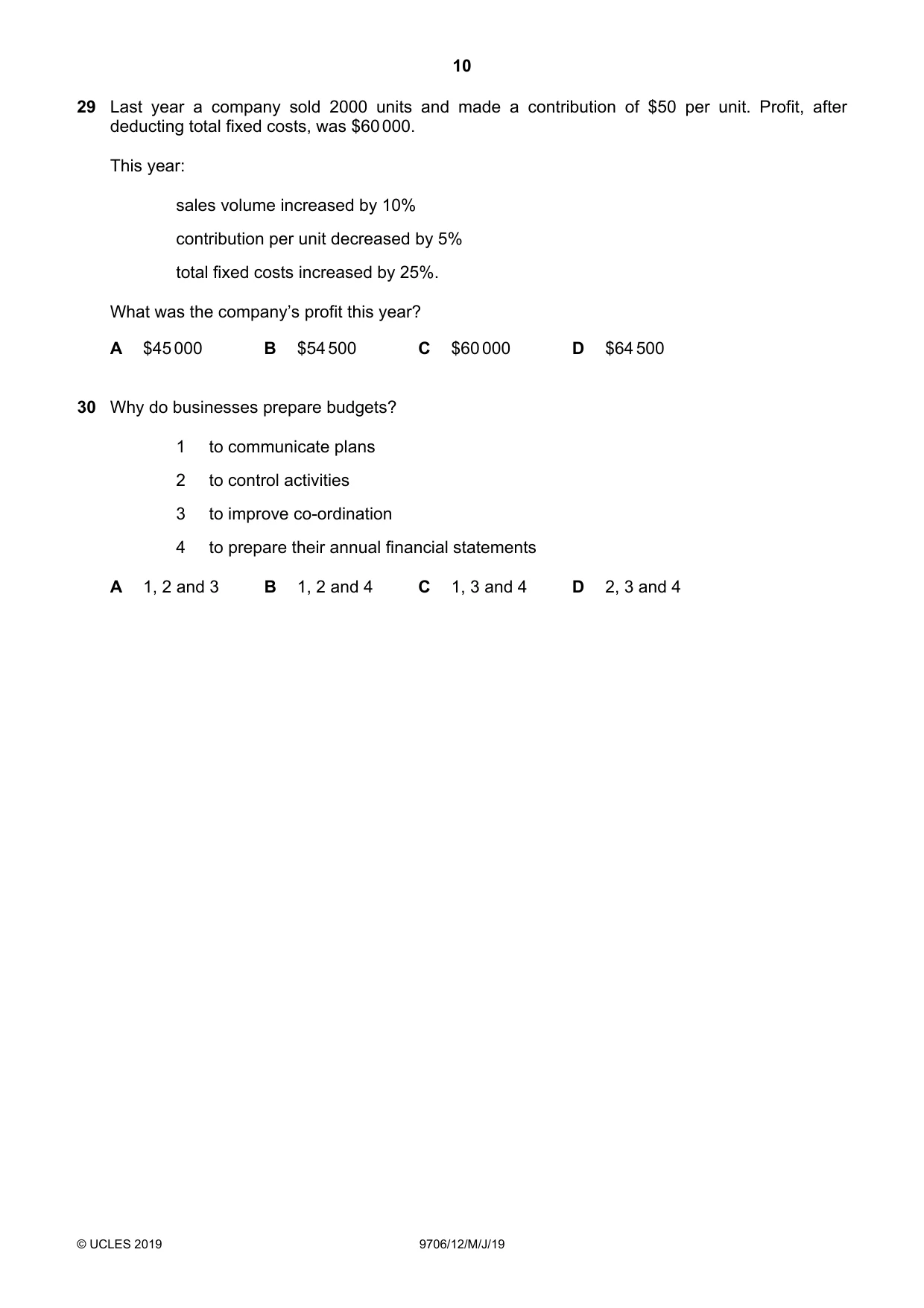
Q29 · Last year a company sold 2000 units and made a contribution of $50 per unit
29 Last year a company sold 2000 units and made a contribution of $50 per unit. Profit, after deducting total fixed costs, was $60 000. This year: sales volume increased by 10% contribution per unit decreased by 5% total fixed costs increased by 25%. What was the company’s profit this year? A $45 000 B $54 500 C $60 000 D $64 500
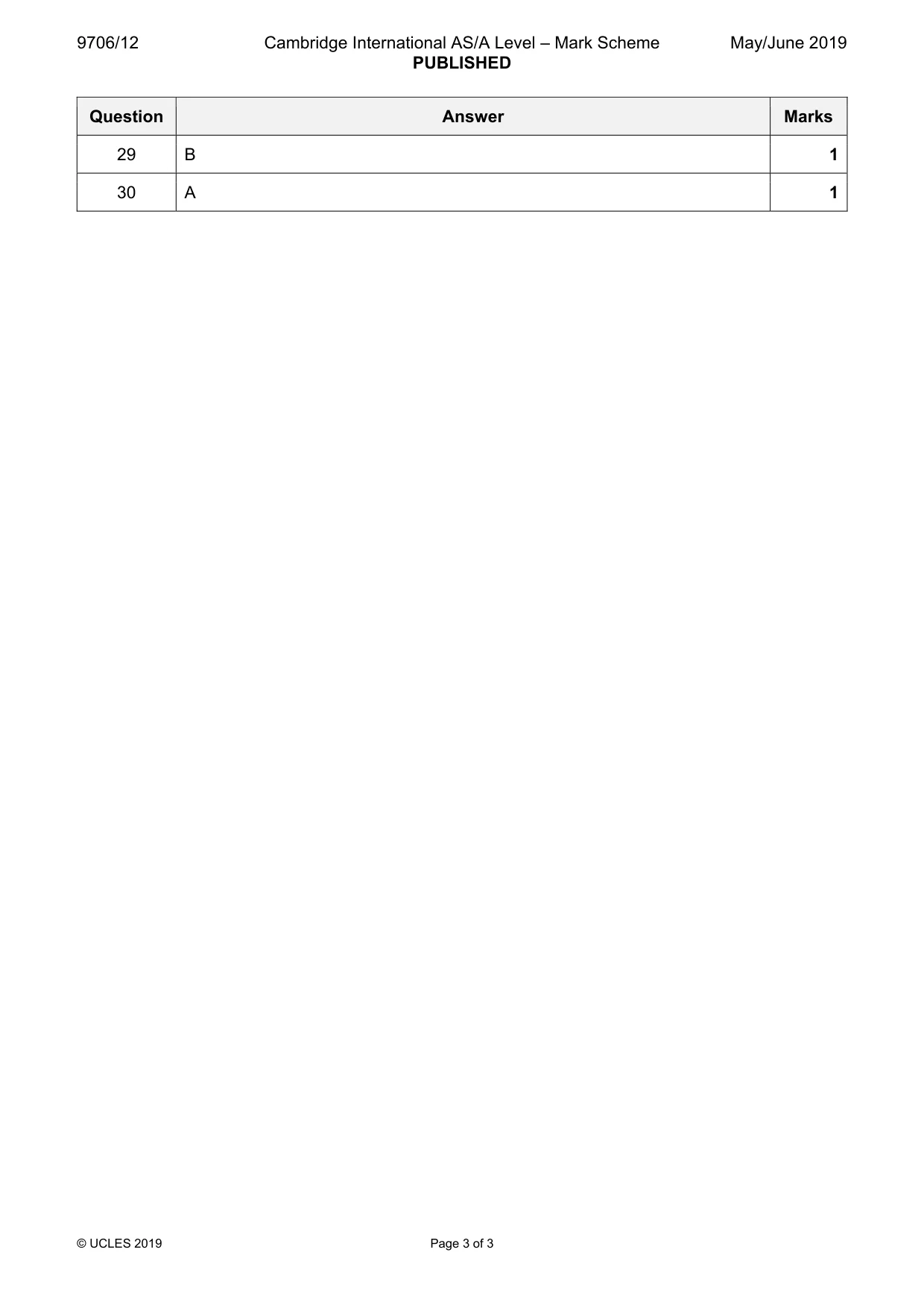
Mark scheme: B
Q30 · Why do businesses prepare budgets?
30 Why do businesses prepare budgets? 1 to communicate plans 2 to control activities 3 to improve co-ordination 4 to prepare their annual financial statements A 1, 2 and 3 B 1, 2 and 4 C 1, 3 and 4 D 2, 3 and 4
Mark scheme: A
What was in this paper
The subtopics covered by these 30 questions, and how many questions each got. Open one in a new tab to see every Cambridge question on it.
7Preparation of financial statements6Preparation of financial statements4Accounting for non-current assets3Analysis and communication of accounting information3Costs and cost behaviour2Reconciliation and verification2Analysis and communication of accounting information1Budgeting and budgetary control1The accounting system1What you needed in this session
Cambridge’s own grade thresholds for 2019 May/June, Paper 1 · Variant 2. A higher threshold means an easier paper — the bar moves with how the cohort did.