Cambridge A Level Accounting 9706 — 2019 Oct/Nov Paper 1 · Variant 1
9706/11/O/N/19 · 30 questions · 30 marks · ≈34 min
The question paper and its mark scheme, free to read here and free to download. This is Cambridge’s own paper, exactly as it was sat.
Question paper12 pages
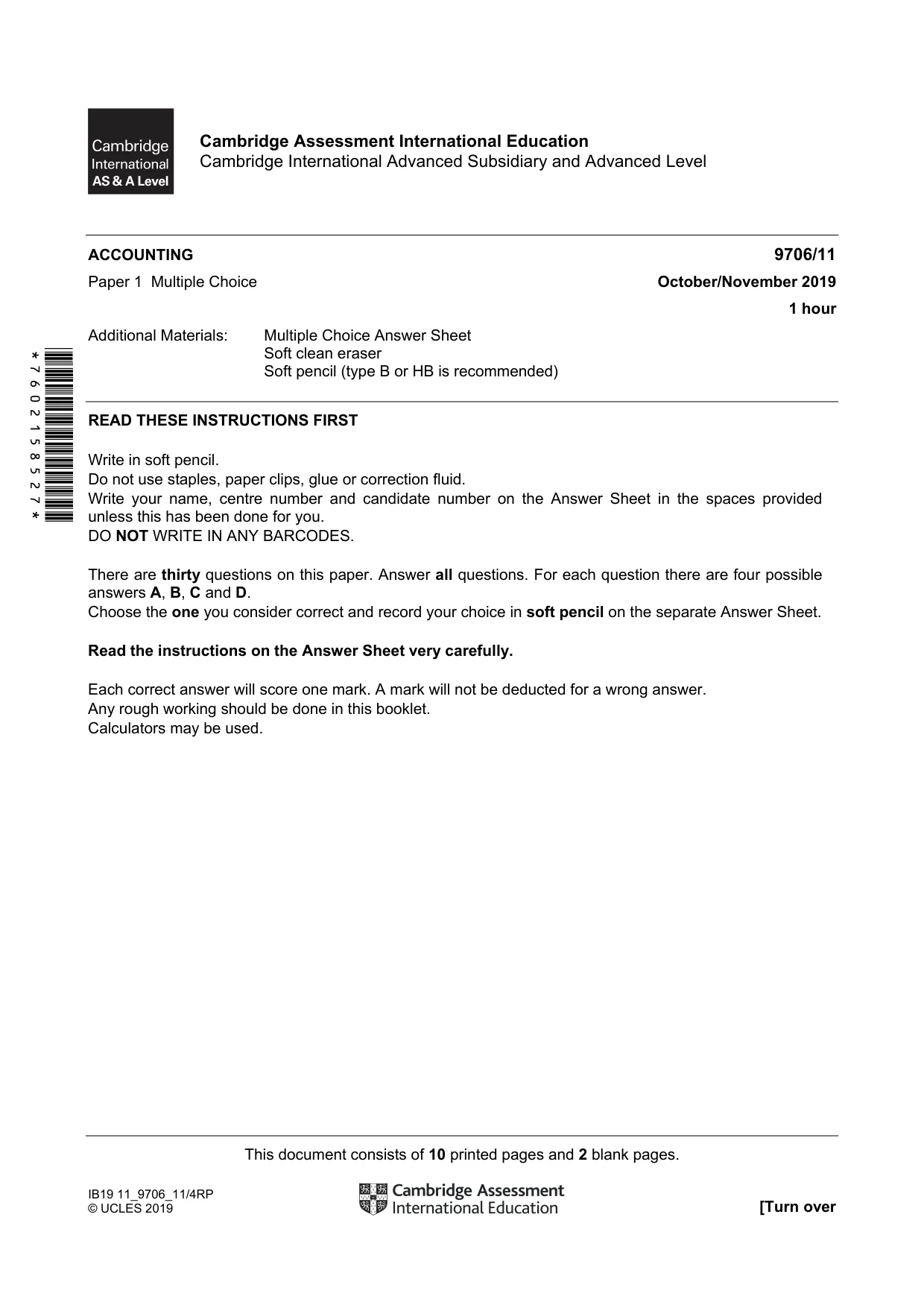

Mark scheme3 pages
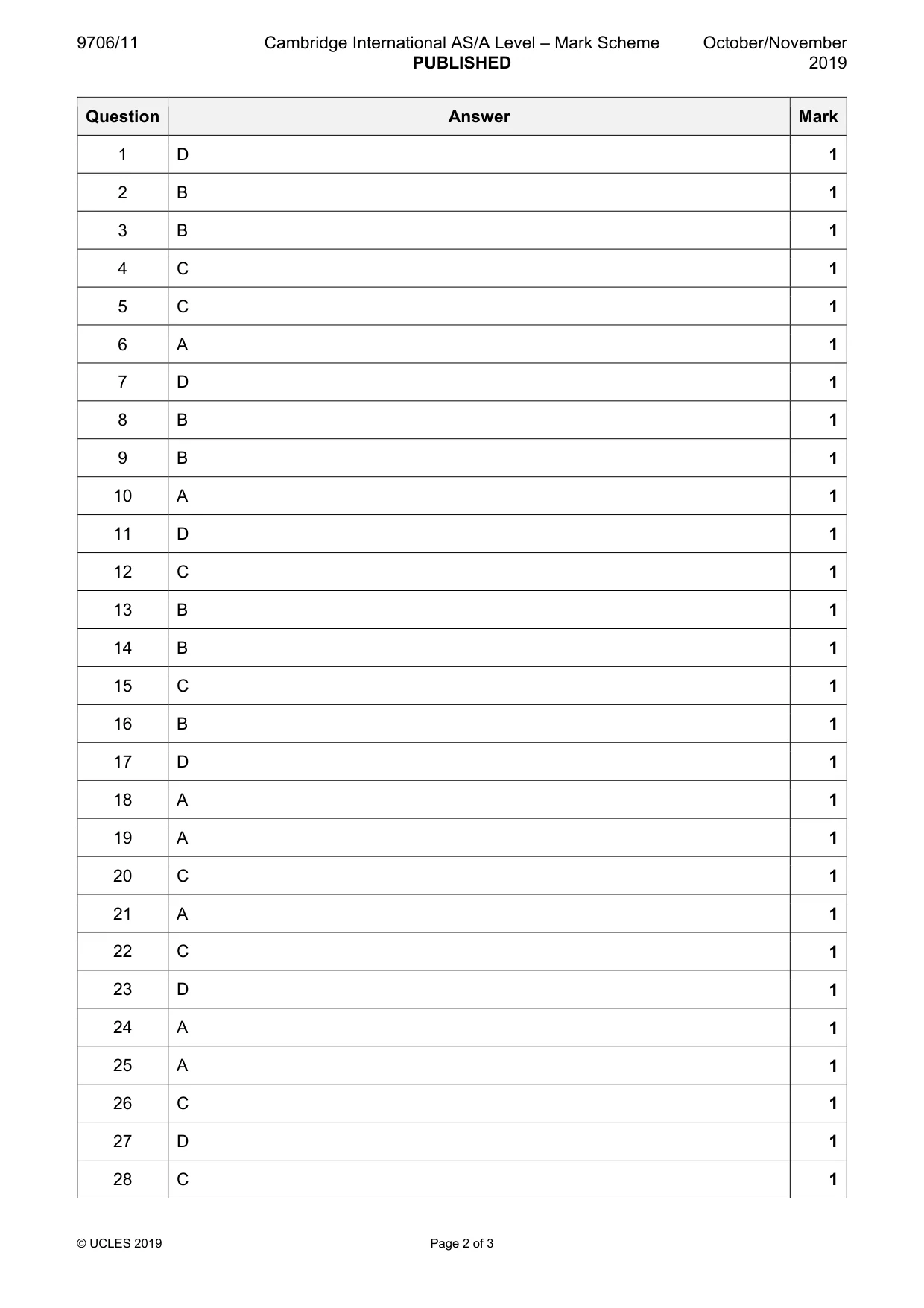
Answers below. Sit the paper first if you are practising.
Questions as text
Q1 · Which concept requires that revenue is only recorded in a business’s books of account…
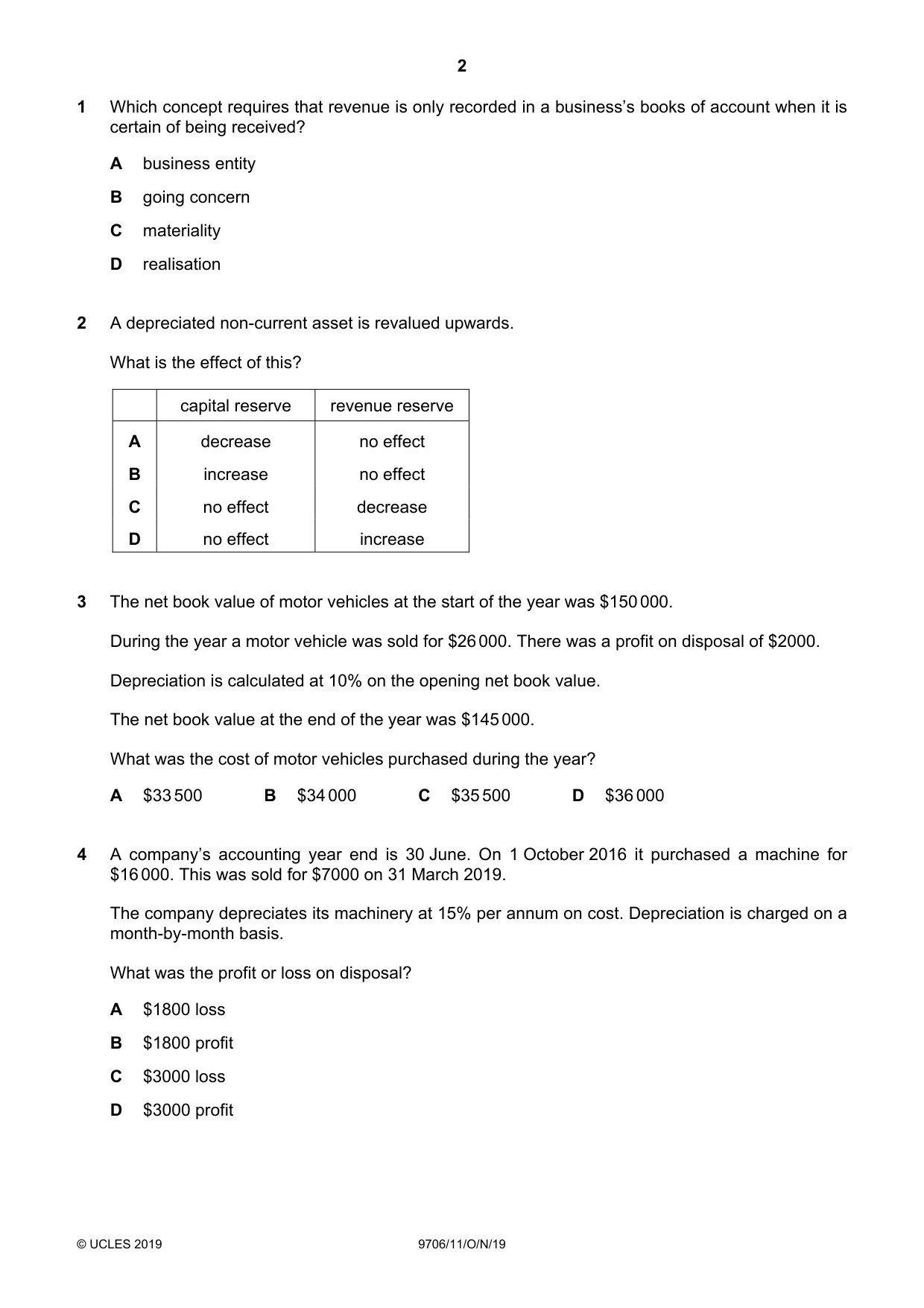
1 Which concept requires that revenue is only recorded in a business’s books of account when it is certain of being received? A business entity B going concern C materiality D realisation
Mark scheme: D
Q2 · A depreciated non-current asset is revalued upwards
2 A depreciated non-current asset is revalued upwards. What is the effect of this? capital reserve revenue reserve A decrease no effect B increase no effect C no effect decrease D no effect increase
Mark scheme: B
Q3 · The net book value of motor vehicles at the start of the year was $150 000
3 The net book value of motor vehicles at the start of the year was $150 000. During the year a motor vehicle was sold for $26 000. There was a profit on disposal of $2000. Depreciation is calculated at 10% on the opening net book value. The net book value at the end of the year was $145 000. What was the cost of motor vehicles purchased during the year? A $33 500 B $34 000 C $35 500 D $36 000
Mark scheme: B
Q4 · A company’s accounting year end is 30 June
4 A company’s accounting year end is 30 June. On 1 October 2016 it purchased a machine for $16 000. This was sold for $7000 on 31 March 2019. The company depreciates its machinery at 15% per annum on cost. Depreciation is charged on a month-by-month basis. What was the profit or loss on disposal? A $1800 loss B $1800 profit C $3000 loss D $3000 profit
Mark scheme: C
Q5 · A company prepared its purchases ledger control account which showed a balance of $15 960
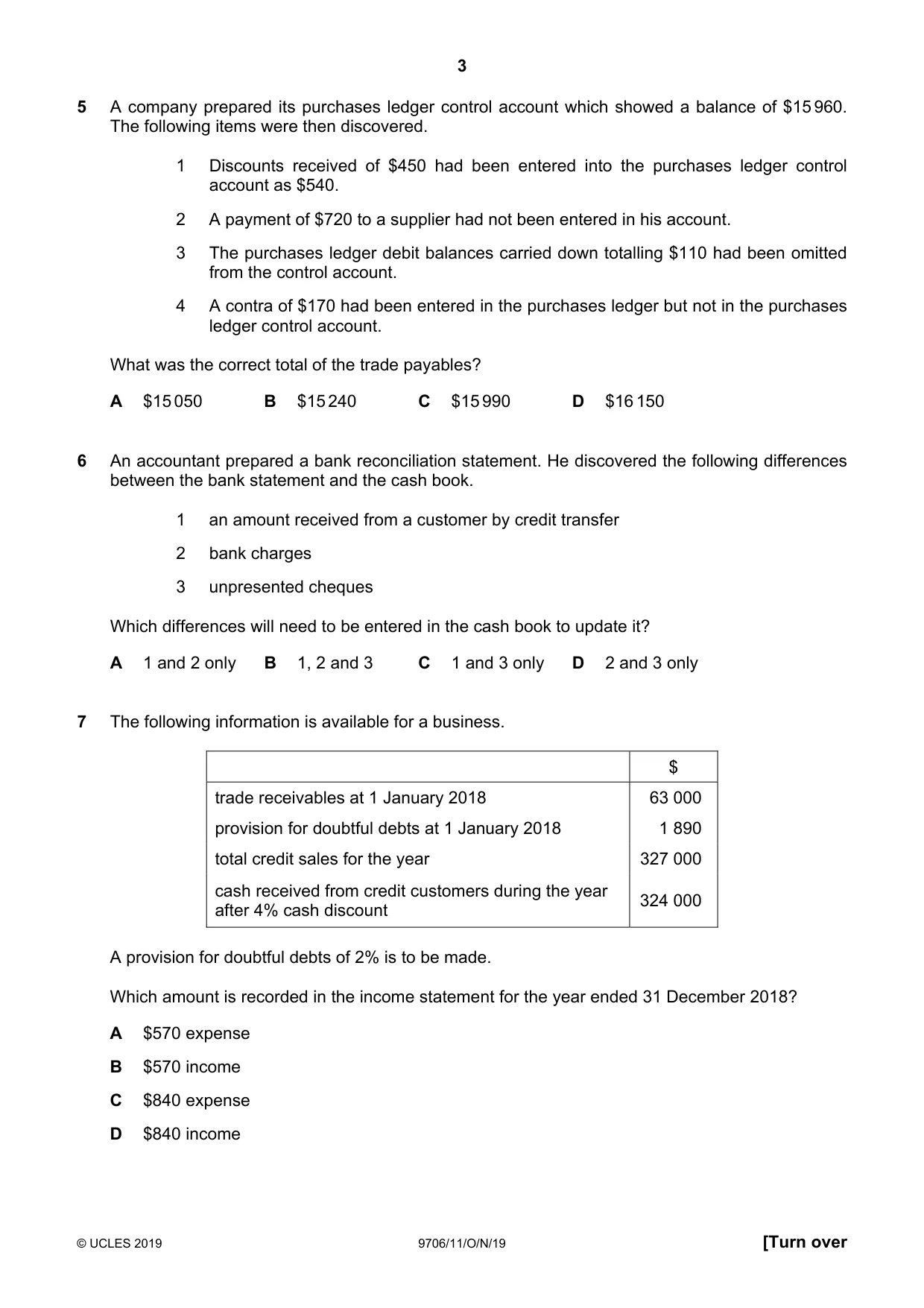
5 A company prepared its purchases ledger control account which showed a balance of $15 960. The following items were then discovered. 1 Discounts received of $450 had been entered into the purchases ledger control account as $540. 2 A payment of $720 to a supplier had not been entered in his account. 3 The purchases ledger debit balances carried down totalling $110 had been omitted from the control account. 4 A contra of $170 had been entered in the purchases ledger but not in the purchases ledger control account. What was the correct total of the trade payables? A $15 050 B $15 240 C $15 990 D $16 150
Mark scheme: C
Q6 · An accountant prepared a bank reconciliation statement
6 An accountant prepared a bank reconciliation statement. He discovered the following differences between the bank statement and the cash book. 1 an amount received from a customer by credit transfer 2 bank charges 3 unpresented cheques Which differences will need to be entered in the cash book to update it? A 1 and 2 only B 1, 2 and 3 C 1 and 3 only D 2 and 3 only
Mark scheme: A
Q7 · The following information is available for a business
7 The following information is available for a business. $ trade receivables at 1 January 2018 63 000 provision for doubtful debts at 1 January 2018 1 890 total credit sales for the year 327 000 cash received from credit customers during the year 324 000 after 4% cash discount A provision for doubtful debts of 2% is to be made. Which amount is recorded in the income statement for the year ended 31 December 2018? A $570 expense B $570 income C $840 expense D $840 income
Mark scheme: D
Q8 · Which items will not appear on an income statement?
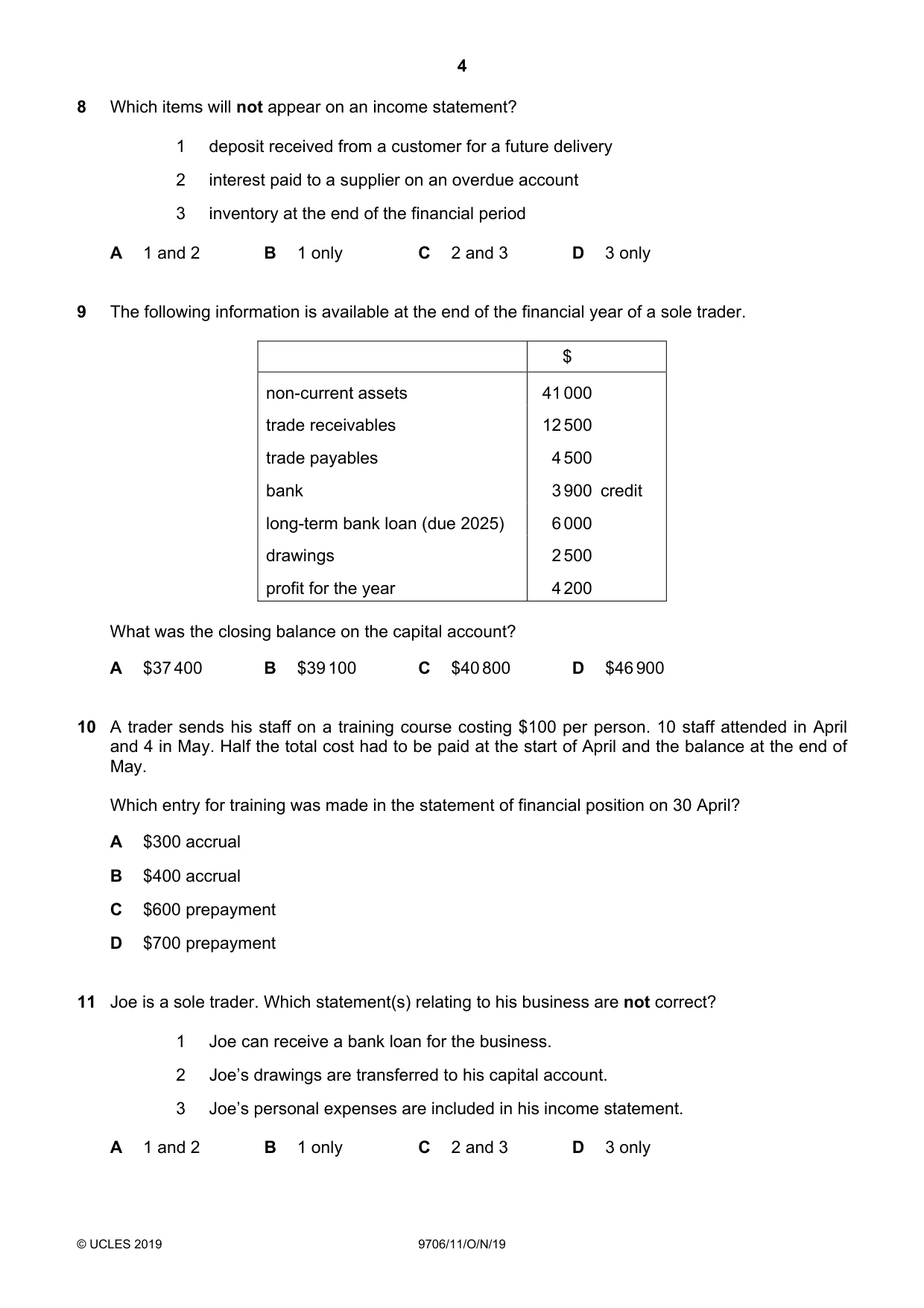
8 Which items will not appear on an income statement? 1 deposit received from a customer for a future delivery 2 interest paid to a supplier on an overdue account 3 inventory at the end of the financial period A 1 and 2 B 1 only C 2 and 3 D 3 only
Mark scheme: B
Q9 · The following information is available at the end of the financial year of a sole trader
9 The following information is available at the end of the financial year of a sole trader. $ non-current assets 41 000 trade receivables 12 500 trade payables 4 500 bank 3 900 credit long-term bank loan (due 2025) 6 000 drawings 2 500 profit for the year 4 200 What was the closing balance on the capital account? A $37 400 B $39 100 C $40 800 D $46 900
Mark scheme: B
Q10 · A trader sends his staff on a training course costing $100 per person
10 A trader sends his staff on a training course costing $100 per person. 10 staff attended in April and 4 in May. Half the total cost had to be paid at the start of April and the balance at the end of May. Which entry for training was made in the statement of financial position on 30 April? A $300 accrual B $400 accrual C $600 prepayment D $700 prepayment
Mark scheme: A
Q11 · Joe is a sole trader
11 Joe is a sole trader. Which statement(s) relating to his business are not correct? 1 Joe can receive a bank loan for the business. 2 Joe’s drawings are transferred to his capital account. 3 Joe’s personal expenses are included in his income statement. A 1 and 2 B 1 only C 2 and 3 D 3 only
Mark scheme: D
Q12 · The provisions of the Partnership Act apply if partners do not draw up a partnership…
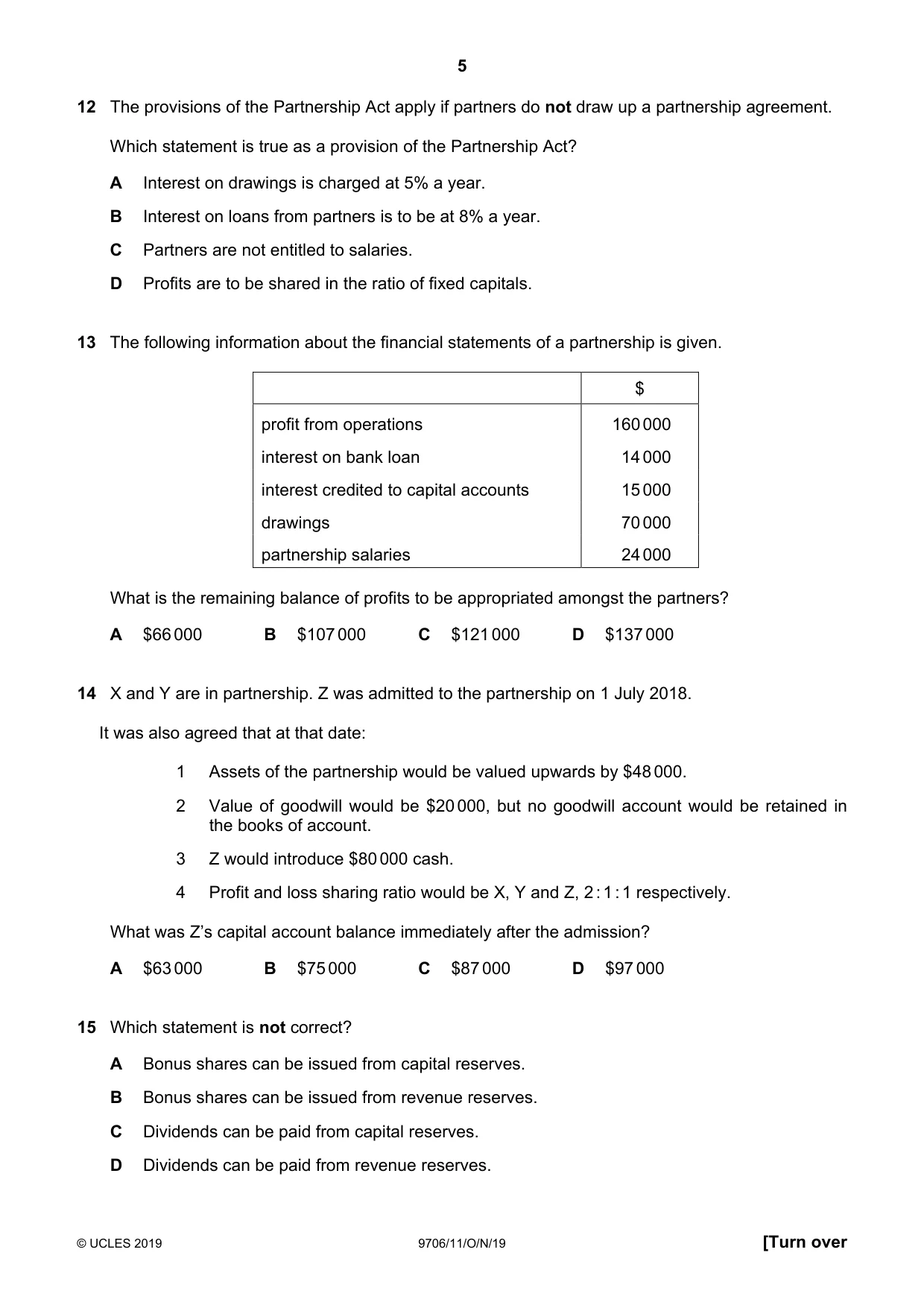
12 The provisions of the Partnership Act apply if partners do not draw up a partnership agreement. Which statement is true as a provision of the Partnership Act? A Interest on drawings is charged at 5% a year. B Interest on loans from partners is to be at 8% a year. C Partners are not entitled to salaries. D Profits are to be shared in the ratio of fixed capitals.
Mark scheme: C
Q13 · The following information about the financial statements of a partnership is given
13 The following information about the financial statements of a partnership is given. $ profit from operations 160 000 interest on bank loan 14 000 interest credited to capital accounts 15 000 drawings 70 000 partnership salaries 24 000 What is the remaining balance of profits to be appropriated amongst the partners? A $66 000 B $107 000 C $121 000 D $137 000
Mark scheme: B
Q14 · X and Y are in partnership
14 X and Y are in partnership. Z was admitted to the partnership on 1 July 2018. It was also agreed that at that date: 1 Assets of the partnership would be valued upwards by $48 000. 2 Value of goodwill would be $20 000, but no goodwill account would be retained in the books of account. 3 Z would introduce $80 000 cash. 4 Profit and loss sharing ratio would be X, Y and Z, 2 : 1 : 1 respectively. What was Z’s capital account balance immediately after the admission? A $63 000 B $75 000 C $87 000 D $97 000
Mark scheme: B
Q15 · Which statement is not correct?
15 Which statement is not correct? A Bonus shares can be issued from capital reserves. B Bonus shares can be issued from revenue reserves. C Dividends can be paid from capital reserves. D Dividends can be paid from revenue reserves.
Mark scheme: C
Q16 · During the year ended 31 December 2018 a business made a profit of $31 000
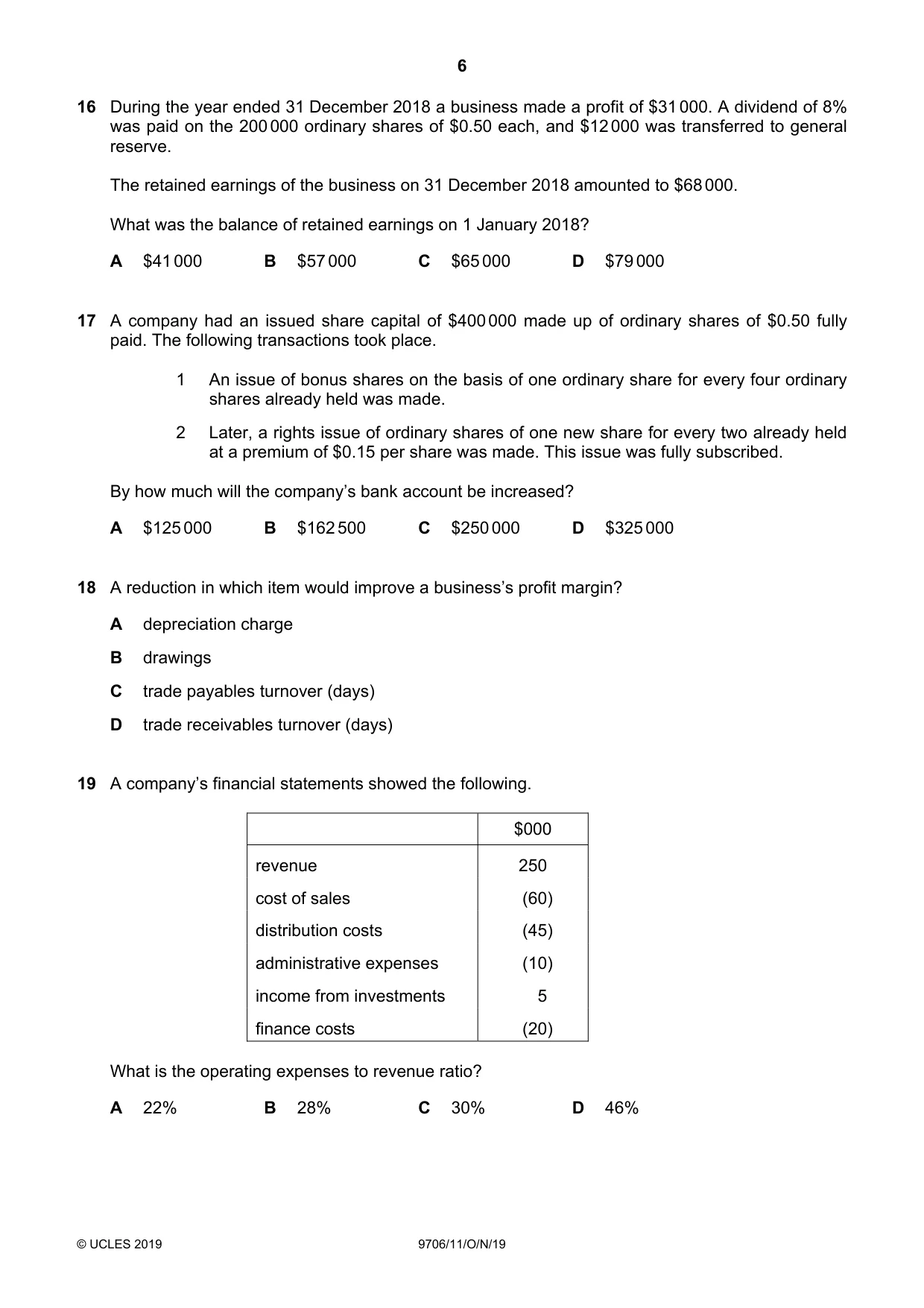
16 During the year ended 31 December 2018 a business made a profit of $31 000. A dividend of 8% was paid on the 200 000 ordinary shares of $0.50 each, and $12 000 was transferred to general reserve. The retained earnings of the business on 31 December 2018 amounted to $68 000. What was the balance of retained earnings on 1 January 2018? A $41 000 B $57 000 C $65 000 D $79 000
Mark scheme: B
Q17 · A company had an issued share capital of $400 000 made up of ordinary shares of $0.50…
17 A company had an issued share capital of $400 000 made up of ordinary shares of $0.50 fully paid. The following transactions took place. 1 An issue of bonus shares on the basis of one ordinary share for every four ordinary shares already held was made. 2 Later, a rights issue of ordinary shares of one new share for every two already held at a premium of $0.15 per share was made. This issue was fully subscribed. By how much will the company’s bank account be increased? A $125 000 B $162 500 C $250 000 D $325 000
Mark scheme: D
Q18 · A reduction in which item would improve a business’s profit margin?
18 A reduction in which item would improve a business’s profit margin? A depreciation charge B drawings C trade payables turnover (days) D trade receivables turnover (days)
Mark scheme: A
More questions on Analysis and communication of accounting information
Q19 · A company’s financial statements showed the following
19 A company’s financial statements showed the following. $000 revenue 250 cost of sales (60) distribution costs (45) administrative expenses (10) income from investments 5 finance costs (20) What is the operating expenses to revenue ratio? A 22% B 28% C 30% D 46%
Mark scheme: A
More questions on Analysis and communication of accounting information
Q20 · A company provides the following information
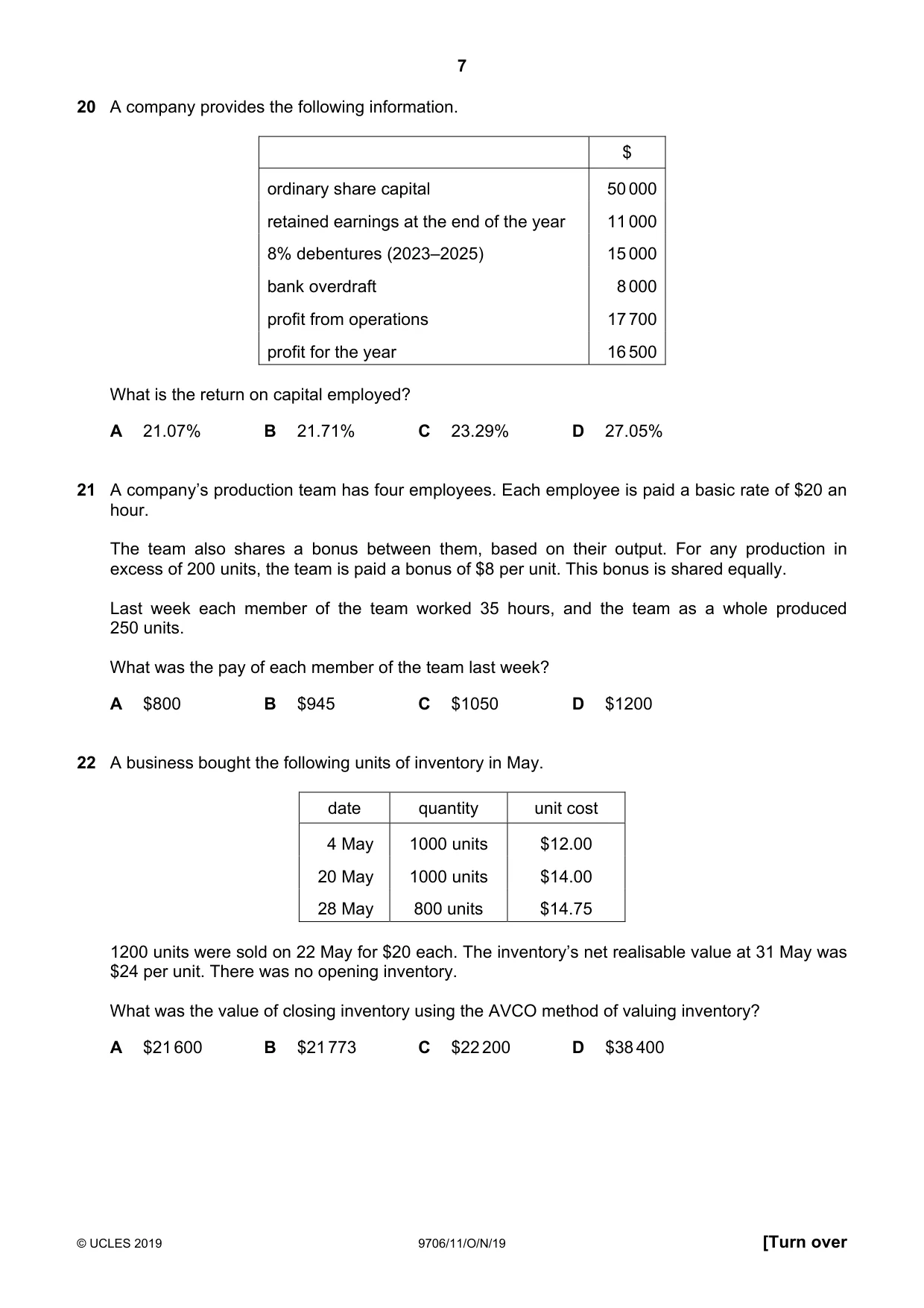
20 A company provides the following information. $ ordinary share capital 50 000 retained earnings at the end of the year 11 000 8% debentures (2023–2025) 15 000 bank overdraft 8 000 profit from operations 17 700 profit for the year 16 500 What is the return on capital employed? A 21.07% B 21.71% C 23.29% D 27.05%
Mark scheme: C
More questions on Analysis and communication of accounting information
Q21 · A company’s production team has four employees
21 A company’s production team has four employees. Each employee is paid a basic rate of $20 an hour. The team also shares a bonus between them, based on their output. For any production in excess of 200 units, the team is paid a bonus of $8 per unit. This bonus is shared equally. Last week each member of the team worked 35 hours, and the team as a whole produced 250 units. What was the pay of each member of the team last week? A $800 B $945 C $1050 D $1200
Mark scheme: A
Q22 · A business bought the following units of inventory in May
22 A business bought the following units of inventory in May. date quantity unit cost 4 May 1000 units $12.00 20 May 1000 units $14.00 28 May 800 units $14.75 1200 units were sold on 22 May for $20 each. The inventory’s net realisable value at 31 May was $24 per unit. There was no opening inventory. What was the value of closing inventory using the AVCO method of valuing inventory? A $21 600 B $21 773 C $22 200 D $38 400
Mark scheme: C
Q23 · A company’s reported profit for the year is the same whether it uses marginal costing or…
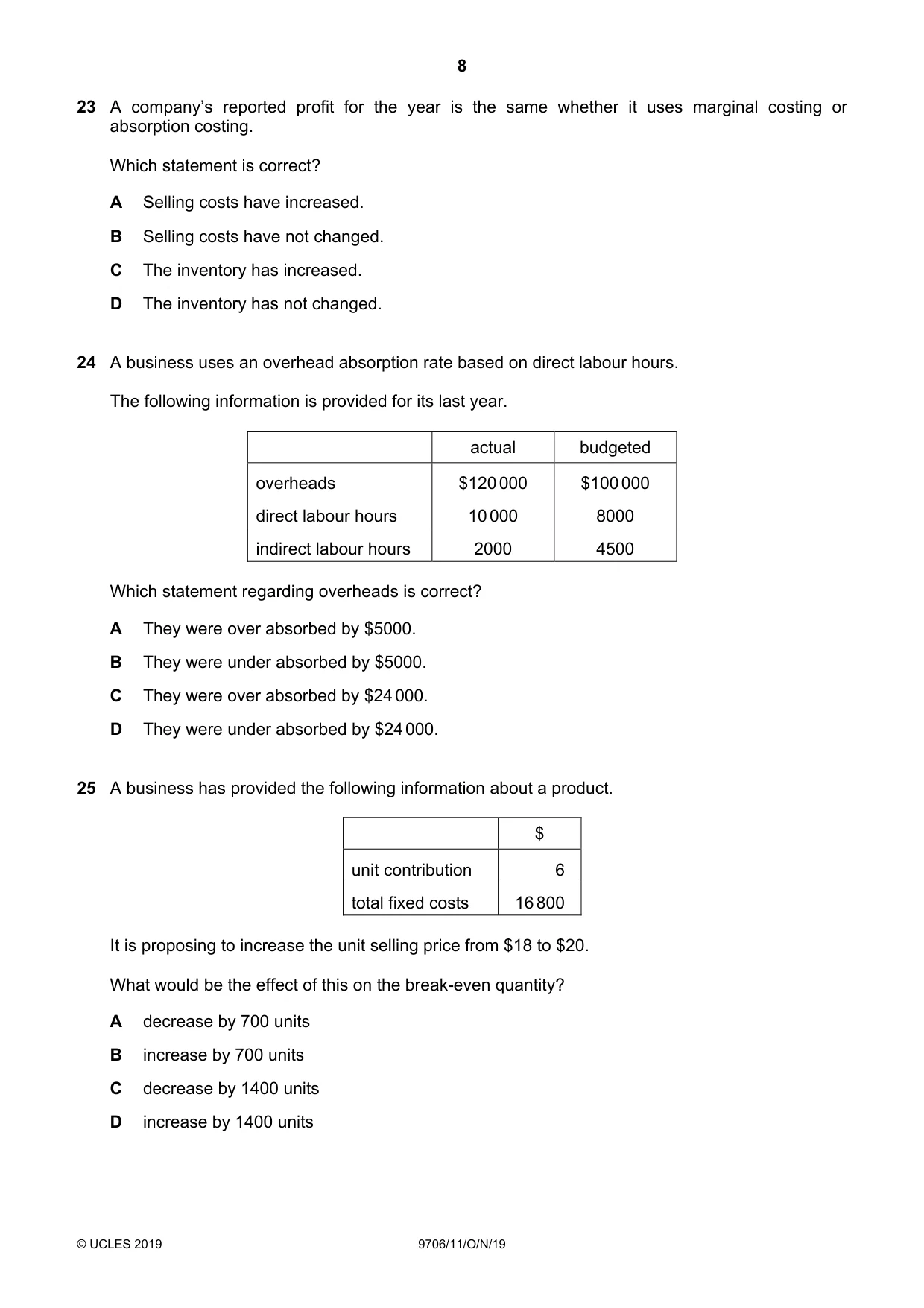
23 A company’s reported profit for the year is the same whether it uses marginal costing or absorption costing. Which statement is correct? A Selling costs have increased. B Selling costs have not changed. C The inventory has increased. D The inventory has not changed.
Mark scheme: D
Q24 · A business uses an overhead absorption rate based on direct labour hours
24 A business uses an overhead absorption rate based on direct labour hours. The following information is provided for its last year. actual budgeted overheads $120 000 $100 000 direct labour hours 10 000 8000 indirect labour hours 2000 4500 Which statement regarding overheads is correct? A They were over absorbed by $5000. B They were under absorbed by $5000. C They were over absorbed by $24 000. D They were under absorbed by $24 000.
Mark scheme: A
Q25 · A business has provided the following information about a product
25 A business has provided the following information about a product. $ unit contribution 6 total fixed costs 16 800 It is proposing to increase the unit selling price from $18 to $20. What would be the effect of this on the break-even quantity? A decrease by 700 units B increase by 700 units C decrease by 1400 units D increase by 1400 units
Mark scheme: A
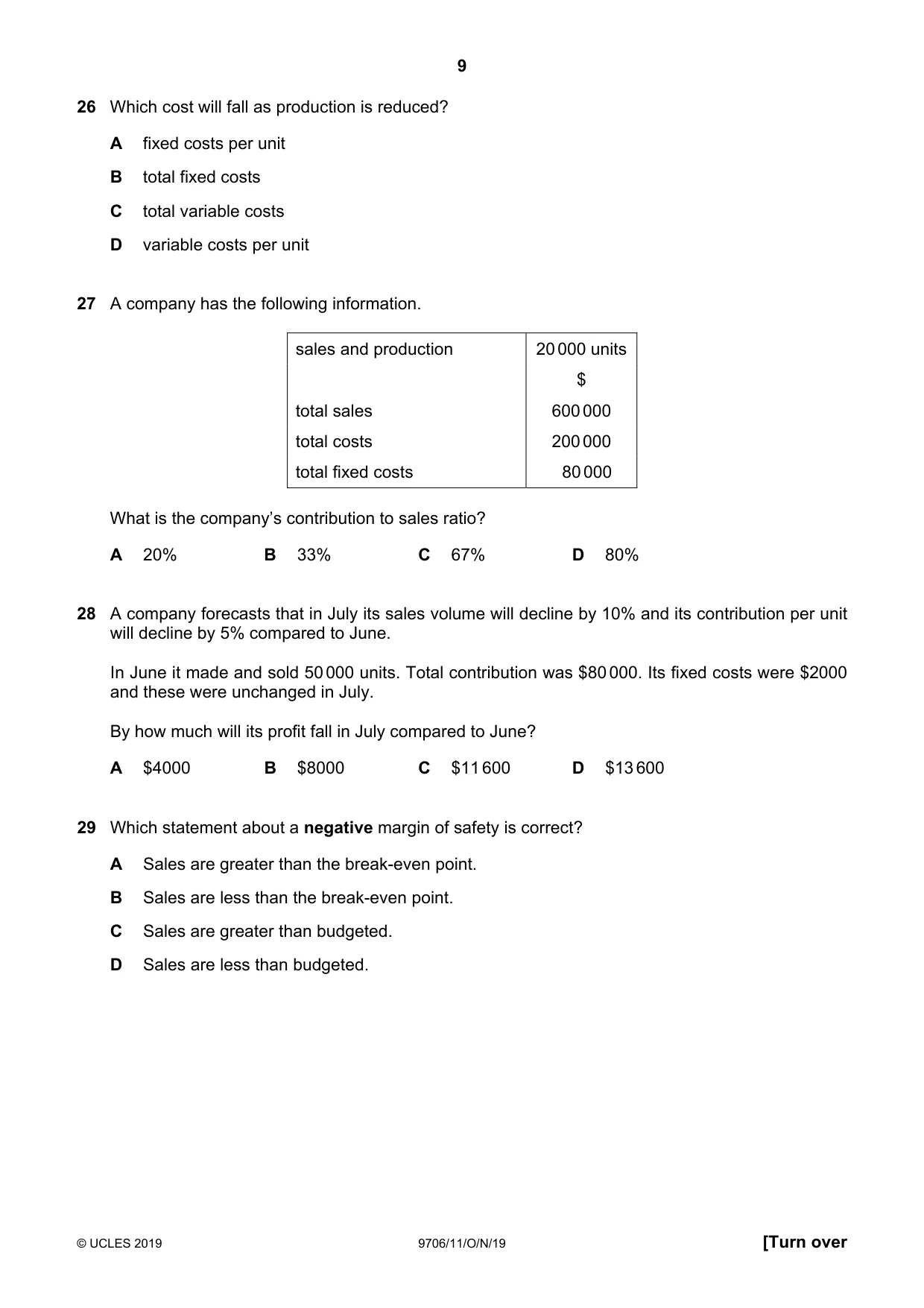
Q26 · Which cost will fall as production is reduced?
26 Which cost will fall as production is reduced? A fixed costs per unit B total fixed costs C total variable costs D variable costs per unit
Mark scheme: C
Q27 · A company has the following information
27 A company has the following information. sales and production 20 000 units $ total sales 600 000 total costs 200 000 total fixed costs 80 000 What is the company’s contribution to sales ratio? A 20% B 33% C 67% D 80%
Mark scheme: D
Q28 · A company forecasts that in July its sales volume will decline by 10% and its…
28 A company forecasts that in July its sales volume will decline by 10% and its contribution per unit will decline by 5% compared to June. In June it made and sold 50 000 units. Total contribution was $80 000. Its fixed costs were $2000 and these were unchanged in July. By how much will its profit fall in July compared to June? A $4000 B $8000 C $11 600 D $13 600
Mark scheme: C
Q29 · Which statement about a negative margin of safety is correct?
29 Which statement about a negative margin of safety is correct? A Sales are greater than the break-even point. B Sales are less than the break-even point. C Sales are greater than budgeted. D Sales are less than budgeted.
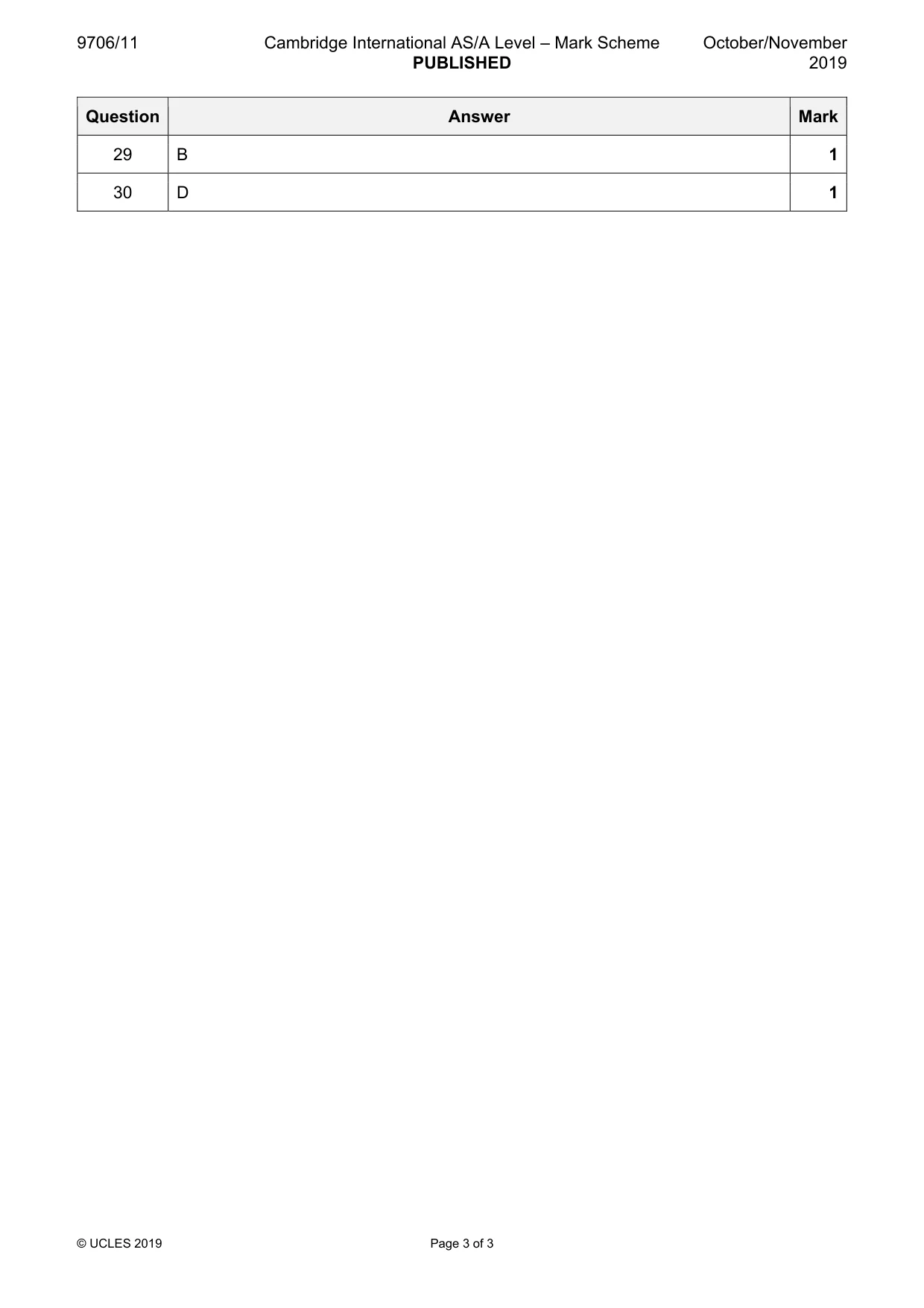
Mark scheme: B
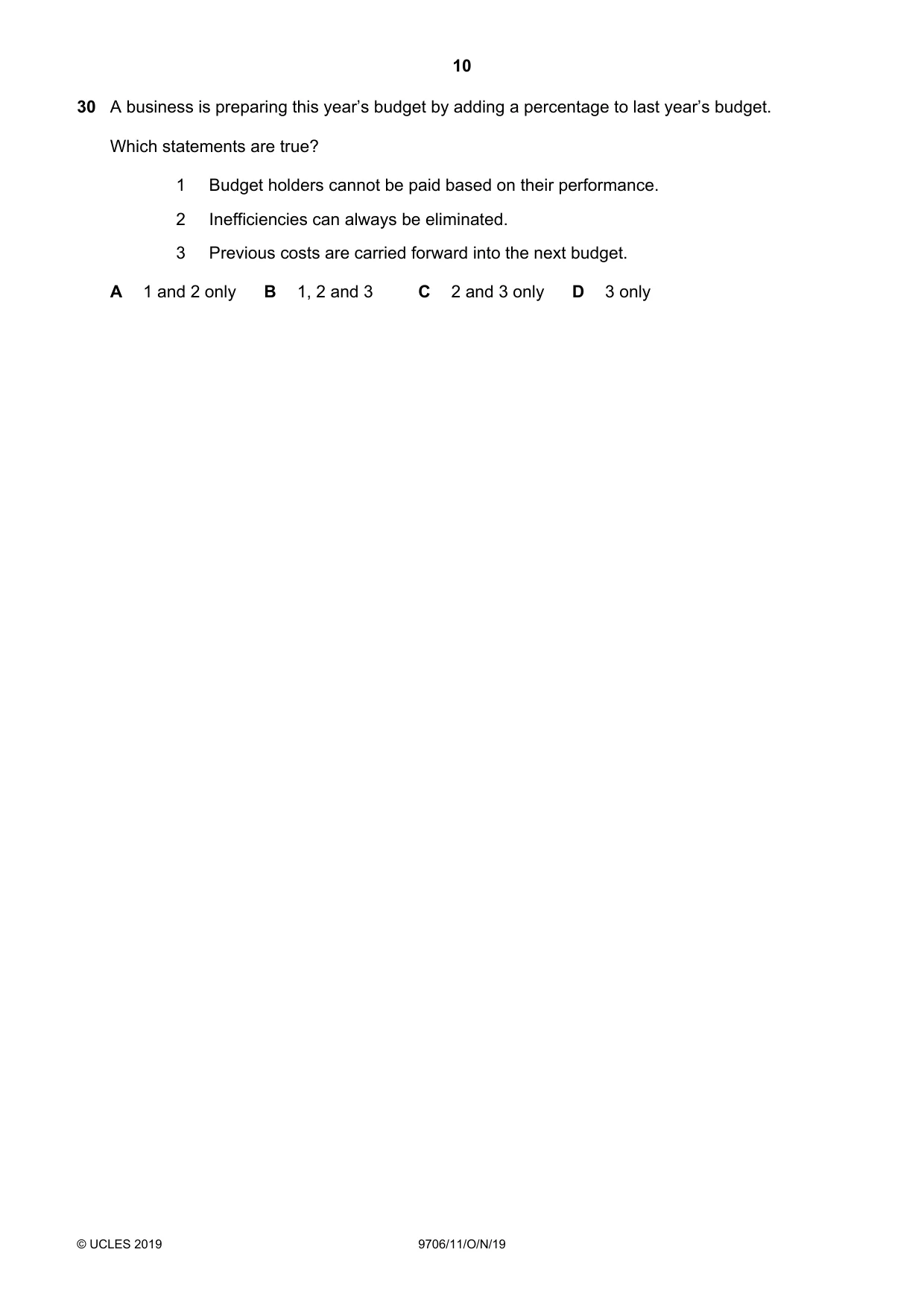
Q30 · A business is preparing this year’s budget by adding a percentage to last year’s budget
30 A business is preparing this year’s budget by adding a percentage to last year’s budget. Which statements are true? 1 Budget holders cannot be paid based on their performance. 2 Inefficiencies can always be eliminated. 3 Previous costs are carried forward into the next budget. A 1 and 2 only B 1, 2 and 3 C 2 and 3 only D 3 only
Mark scheme: D
What was in this paper
The subtopics covered by these 30 questions, and how many questions each got. Open one in a new tab to see every Cambridge question on it.
6Preparation of financial statements6Preparation of financial statements3Types of business entity3Accounting for non-current assets2Analysis and communication of accounting information2Reconciliation and verification2The accounting system2Traditional costing methods2Analysis and communication of accounting information1Budgeting and budgetary control1What you needed in this session
Cambridge’s own grade thresholds for 2019 Oct/Nov, Paper 1 · Variant 1. A higher threshold means an easier paper — the bar moves with how the cohort did.