Cambridge A Level Accounting 9706 — 2010 May/June Paper 1 · Variant 3
9706/13/M/J/10 · 30 questions · 30 marks · ≈34 min
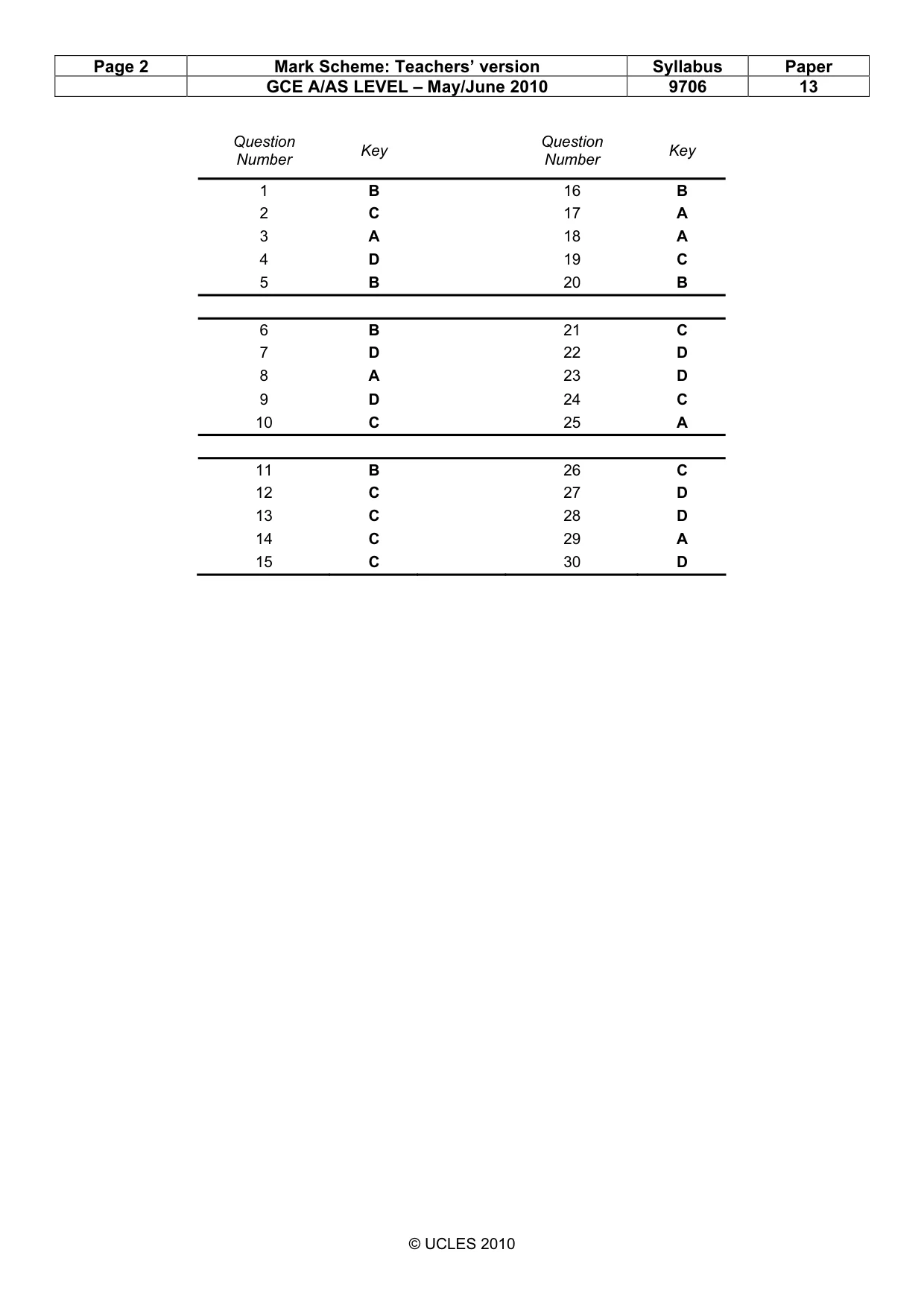
The question paper and its mark scheme, free to read here and free to download. This is Cambridge’s own paper, exactly as it was sat.
Question paper12 pages
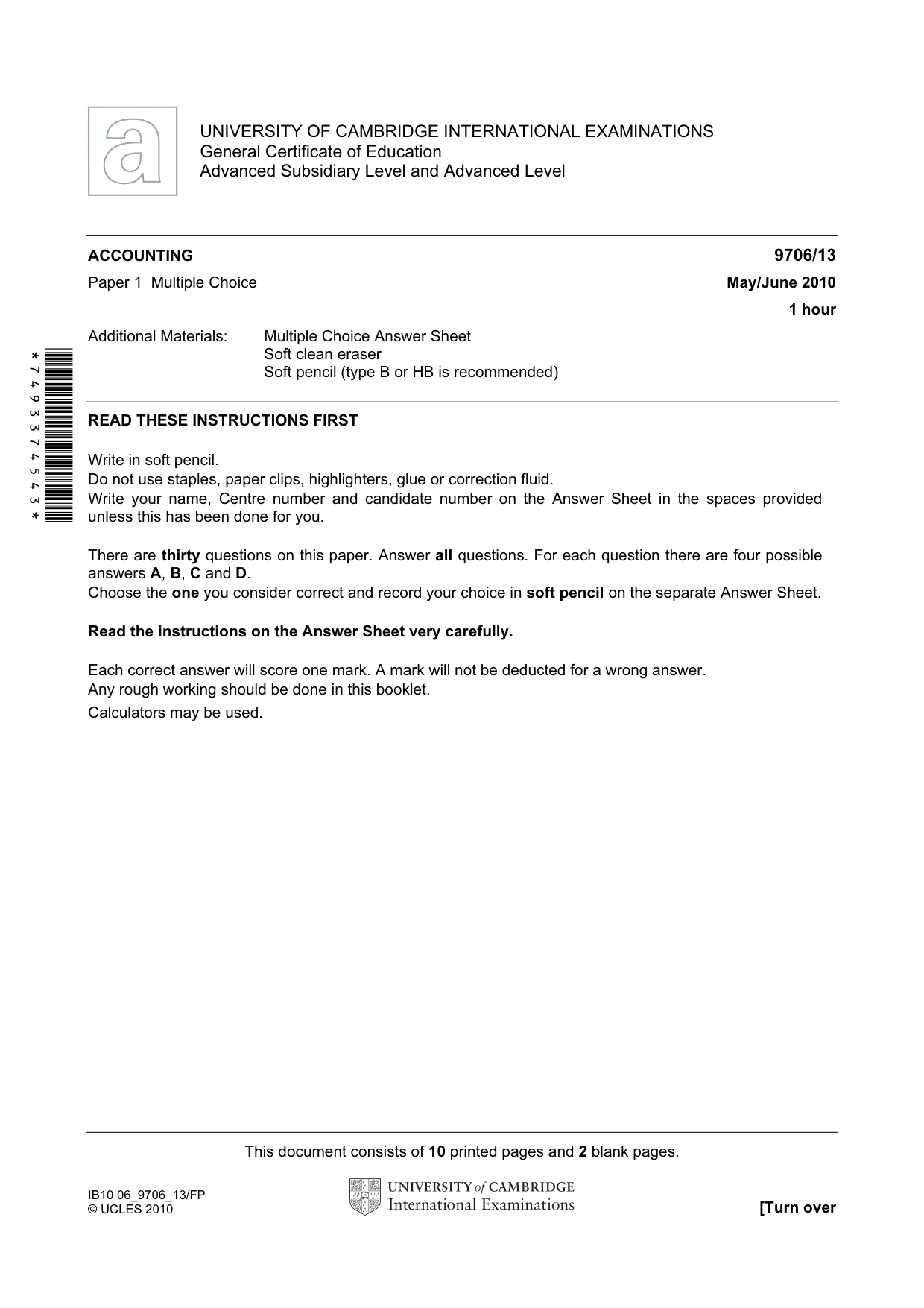

Mark scheme2 pages
Answers below. Sit the paper first if you are practising.
Questions as text
Q1 · A business has a bank overdraft of $4800
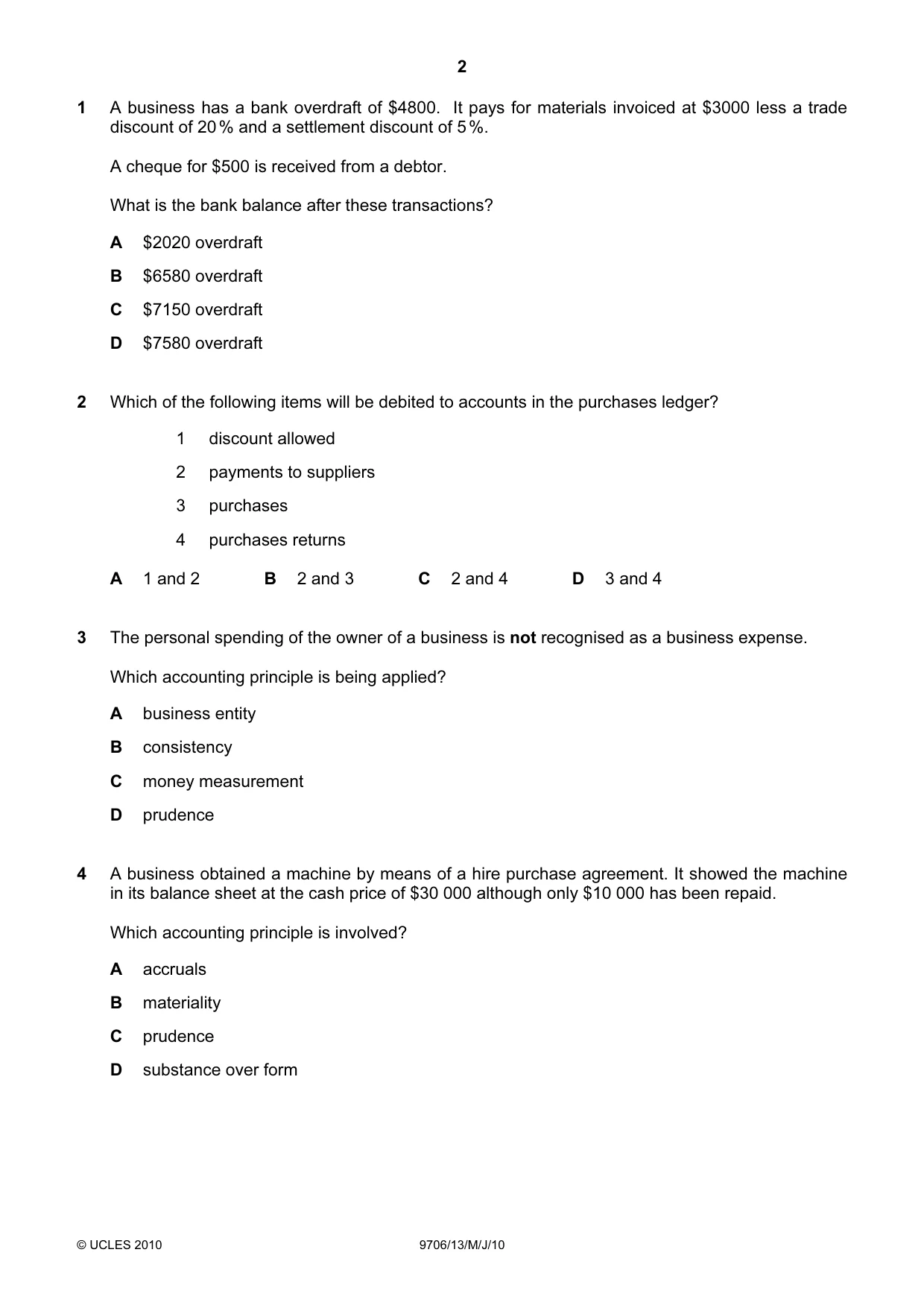
1 A business has a bank overdraft of $4800. It pays for materials invoiced at $3000 less a trade discount of 20 % and a settlement discount of 5 %. A cheque for $500 is received from a debtor. What is the bank balance after these transactions? A $2020 overdraft B $6580 overdraft C $7150 overdraft D $7580 overdraft
Mark scheme: B
Q2 · Which of the following items will be debited to accounts in the purchases ledger?
2 Which of the following items will be debited to accounts in the purchases ledger? 1 discount allowed 2 payments to suppliers 3 purchases 4 purchases returns A 1 and 2 B 2 and 3 C 2 and 4 D 3 and 4
Mark scheme: C
Q3 · The personal spending of the owner of a business is not recognised as a business expense
3 The personal spending of the owner of a business is not recognised as a business expense. Which accounting principle is being applied? A business entity B consistency C money measurement D prudence
Mark scheme: A
Q4 · A business obtained a machine by means of a hire purchase agreement
4 A business obtained a machine by means of a hire purchase agreement. It showed the machine in its balance sheet at the cash price of $30 000 although only $10 000 has been repaid. Which accounting principle is involved? A accruals B materiality C prudence D substance over form
Mark scheme: D
Q5 · The table shows information from the books of a business at 30 April 2010
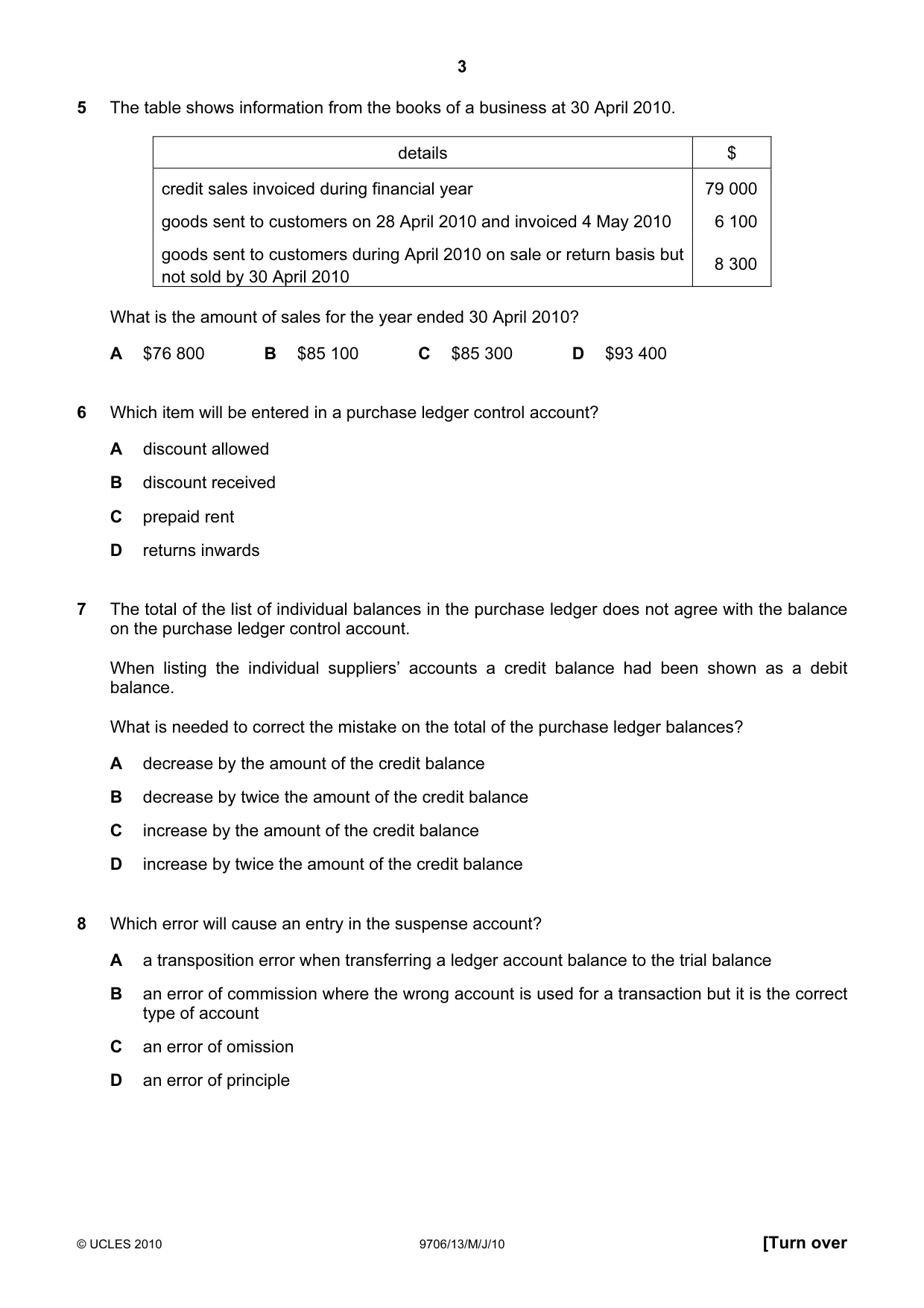
5 The table shows information from the books of a business at 30 April 2010. details $ credit sales invoiced during financial year 79 000 goods sent to customers on 28 April 2010 and invoiced 4 May 2010 6 100 goods sent to customers during April 2010 on sale or return basis but 8 300 not sold by 30 April 2010 What is the amount of sales for the year ended 30 April 2010? A $76 800 B $85 100 C $85 300 D $93 400
Mark scheme: B
Q6 · Which item will be entered in a purchase ledger control account?
6 Which item will be entered in a purchase ledger control account? A discount allowed B discount received C prepaid rent D returns inwards
Mark scheme: B
Q7 · The total of the list of individual balances in the purchase ledger does not agree with…
7 The total of the list of individual balances in the purchase ledger does not agree with the balance on the purchase ledger control account. When listing the individual suppliers’ accounts a credit balance had been shown as a debit balance. What is needed to correct the mistake on the total of the purchase ledger balances? A decrease by the amount of the credit balance B decrease by twice the amount of the credit balance C increase by the amount of the credit balance D increase by twice the amount of the credit balance
Mark scheme: D
Q8 · Which error will cause an entry in the suspense account?
8 Which error will cause an entry in the suspense account? A a transposition error when transferring a ledger account balance to the trial balance B an error of commission where the wrong account is used for a transaction but it is the correct type of account C an error of omission D an error of principle
Mark scheme: A
Q9 · A trial balance at 31 December shows: debit credit $ $ trade receivables (debtors)…
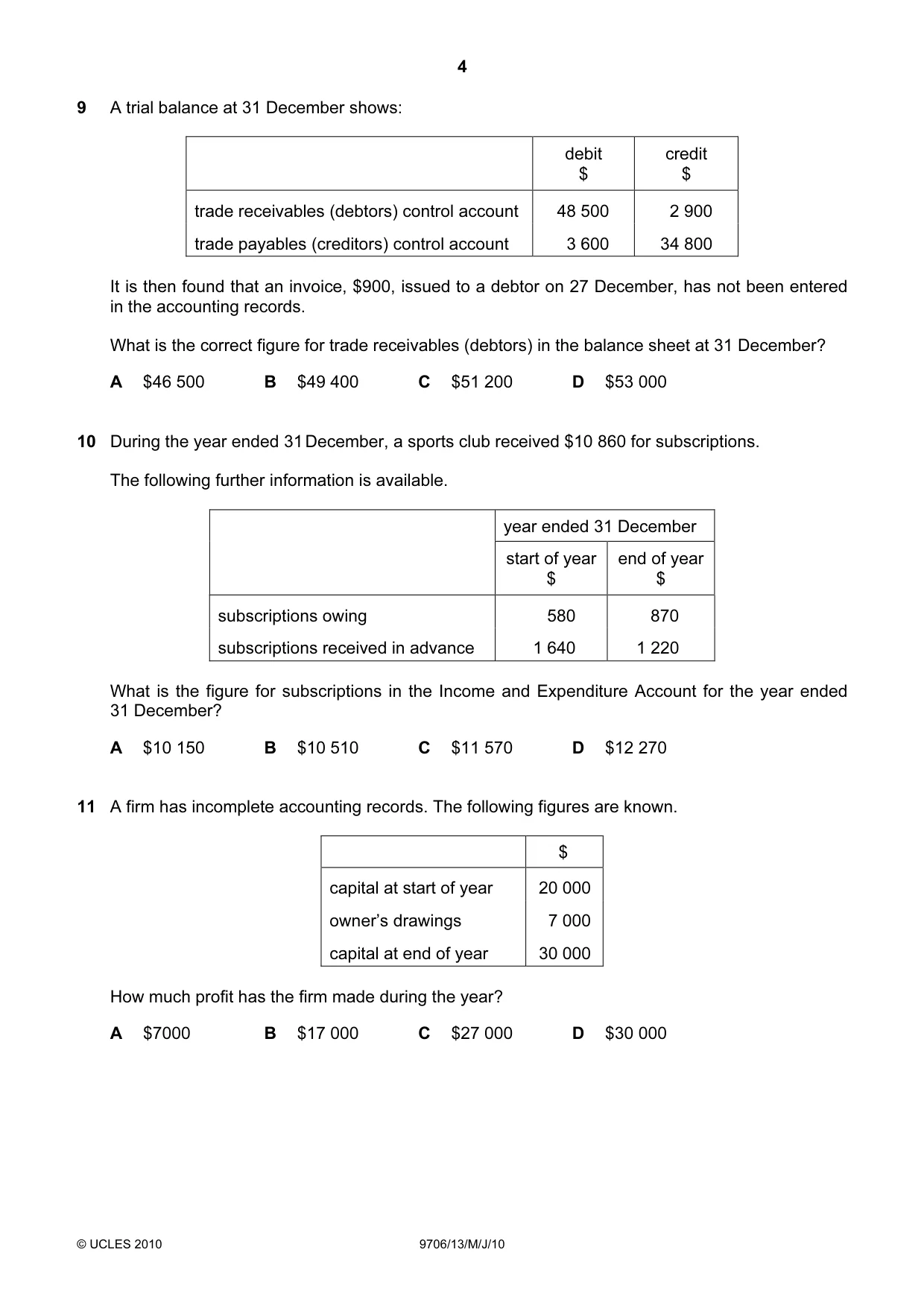
9 A trial balance at 31 December shows: debit credit $ $ trade receivables (debtors) control account 48 500 2 900 trade payables (creditors) control account 3 600 34 800 It is then found that an invoice, $900, issued to a debtor on 27 December, has not been entered in the accounting records. What is the correct figure for trade receivables (debtors) in the balance sheet at 31 December? A $46 500 B $49 400 C $51 200 D $53 000
Mark scheme: D
Q10 · During the year ended 31 December, a sports club received $10 860 for subscriptions
10 During the year ended 31 December, a sports club received $10 860 for subscriptions. The following further information is available. year ended 31 December start of year end of year $ $ subscriptions owing 580 870 subscriptions received in advance 1 640 1 220 What is the figure for subscriptions in the Income and Expenditure Account for the year ended 31 December? A $10 150 B $10 510 C $11 570 D $12 270
Mark scheme: C
Q11 · A firm has incomplete accounting records
11 A firm has incomplete accounting records. The following figures are known. $ capital at start of year 20 000 owner’s drawings 7 000 capital at end of year 30 000 How much profit has the firm made during the year? A $7000 B $17 000 C $27 000 D $30 000
Mark scheme: B
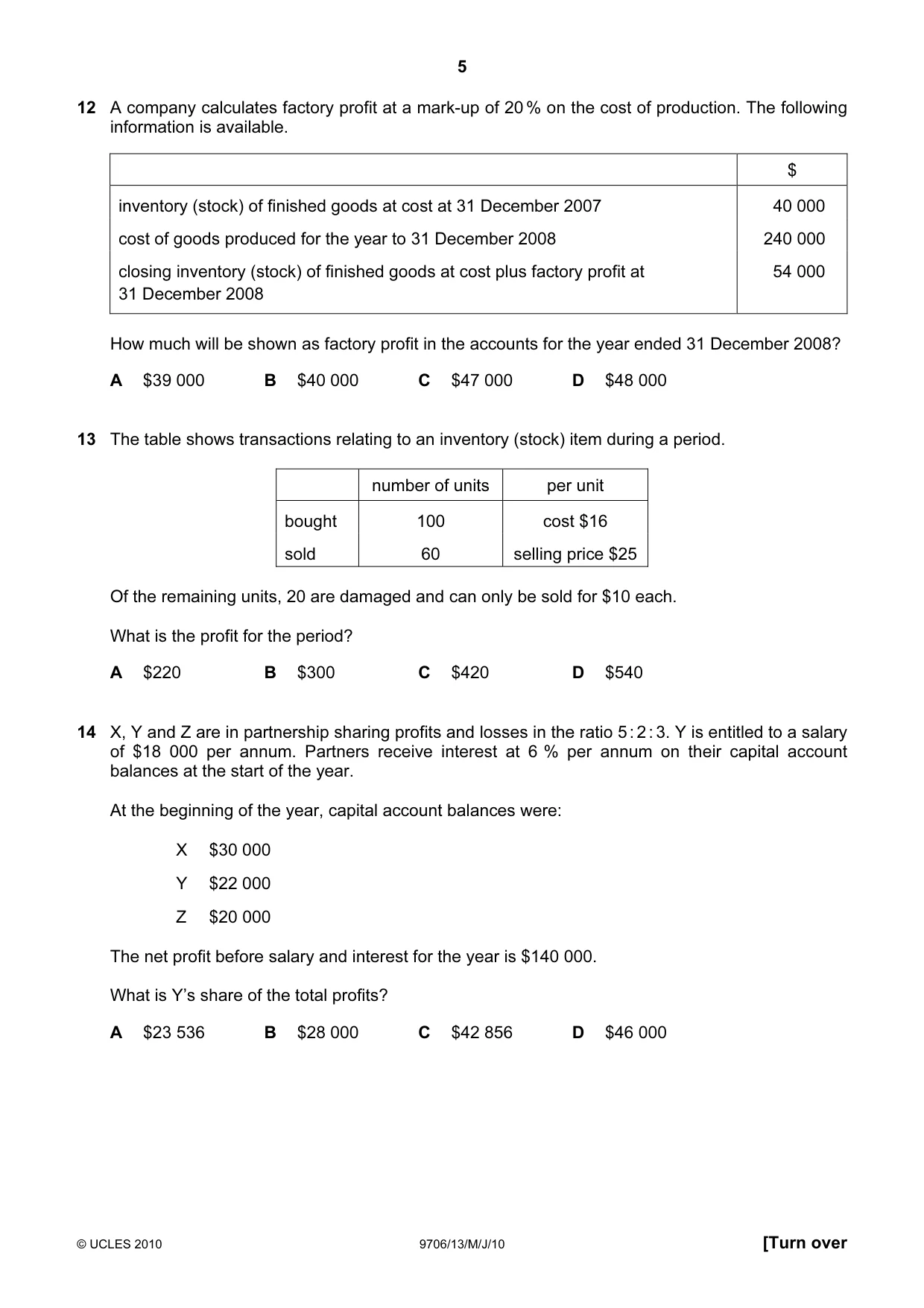
Q12 · A company calculates factory profit at a mark-up of 20 % on the cost of production
12 A company calculates factory profit at a mark-up of 20 % on the cost of production. The following information is available. $ inventory (stock) of finished goods at cost at 31 December 2007 40 000 cost of goods produced for the year to 31 December 2008 240 000 closing inventory (stock) of finished goods at cost plus factory profit at 54 000 31 December 2008 How much will be shown as factory profit in the accounts for the year ended 31 December 2008? A $39 000 B $40 000 C $47 000 D $48 000
Mark scheme: C
Q13 · The table shows transactions relating to an inventory (stock) item during a period
13 The table shows transactions relating to an inventory (stock) item during a period. number of units per unit bought 100 cost $16 sold 60 selling price $25 Of the remaining units, 20 are damaged and can only be sold for $10 each. What is the profit for the period? A $220 B $300 C $420 D $540
Mark scheme: C
Q14 · X, Y and Z are in partnership sharing profits and losses in the ratio 5 : 2 : 3
14 X, Y and Z are in partnership sharing profits and losses in the ratio 5 : 2 : 3. Y is entitled to a salary of $18 000 per annum. Partners receive interest at 6 % per annum on their capital account balances at the start of the year. At the beginning of the year, capital account balances were: X $30 000 Y $22 000 Z $20 000 The net profit before salary and interest for the year is $140 000. What is Y’s share of the total profits? A $23 536 B $28 000 C $42 856 D $46 000
Mark scheme: C
Q15 · L and M are in partnership
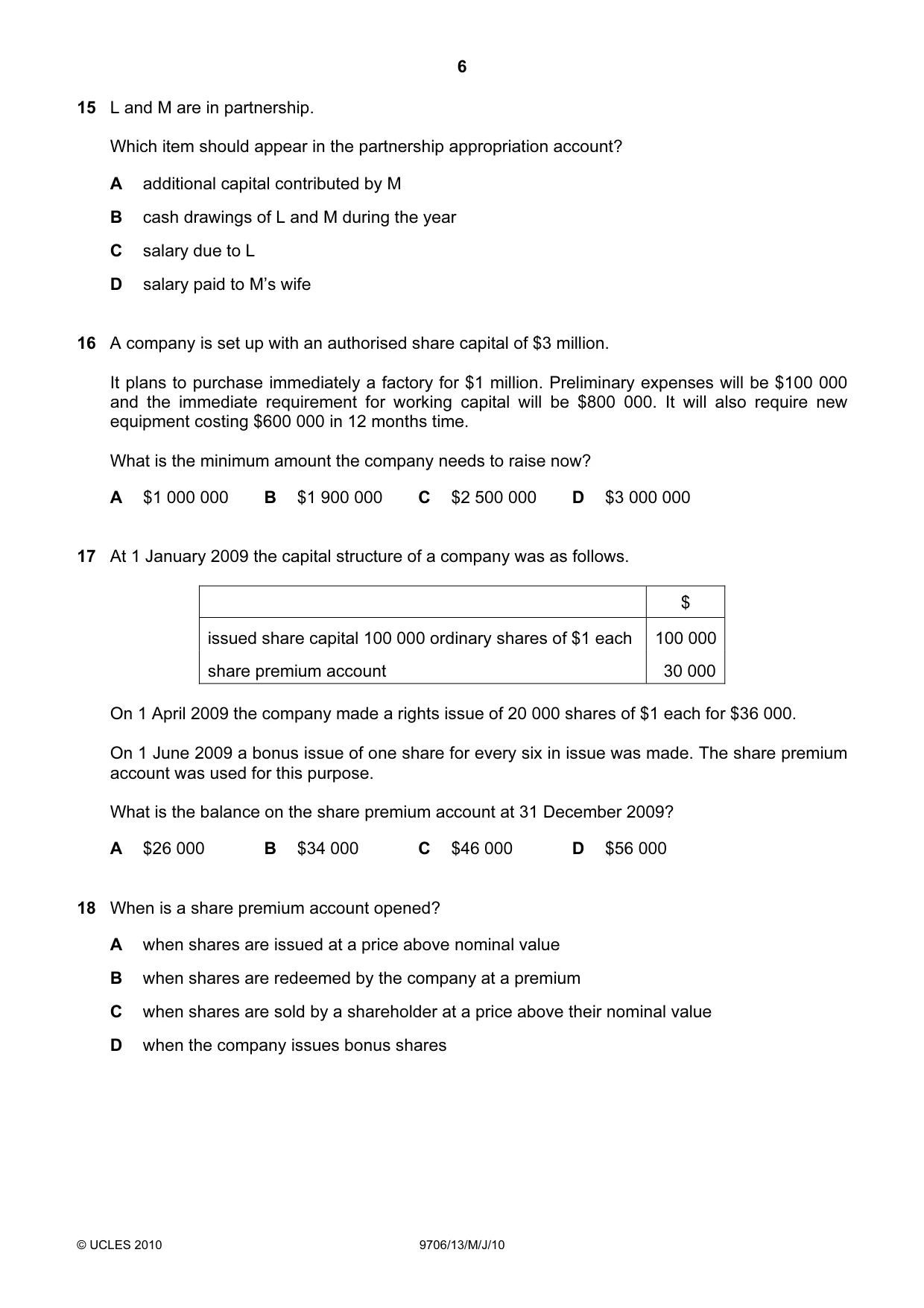
15 L and M are in partnership. Which item should appear in the partnership appropriation account? A additional capital contributed by M B cash drawings of L and M during the year C salary due to L D salary paid to M’s wife
Mark scheme: C
Q16 · A company is set up with an authorised share capital of $3 million
16 A company is set up with an authorised share capital of $3 million. It plans to purchase immediately a factory for $1 million. Preliminary expenses will be $100 000 and the immediate requirement for working capital will be $800 000. It will also require new equipment costing $600 000 in 12 months time. What is the minimum amount the company needs to raise now? A $1 000 000 B $1 900 000 C $2 500 000 D $3 000 000
Mark scheme: B
Q17 · At 1 January 2009 the capital structure of a company was as follows
17 At 1 January 2009 the capital structure of a company was as follows. $ issued share capital 100 000 ordinary shares of $1 each 100 000 share premium account 30 000 On 1 April 2009 the company made a rights issue of 20 000 shares of $1 each for $36 000. On 1 June 2009 a bonus issue of one share for every six in issue was made. The share premium account was used for this purpose. What is the balance on the share premium account at 31 December 2009? A $26 000 B $34 000 C $46 000 D $56 000
Mark scheme: A
Q18 · When is a share premium account opened?
18 When is a share premium account opened? A when shares are issued at a price above nominal value B when shares are redeemed by the company at a premium C when shares are sold by a shareholder at a price above their nominal value D when the company issues bonus shares
Mark scheme: A
Q19 · A company buys and re-sells goods
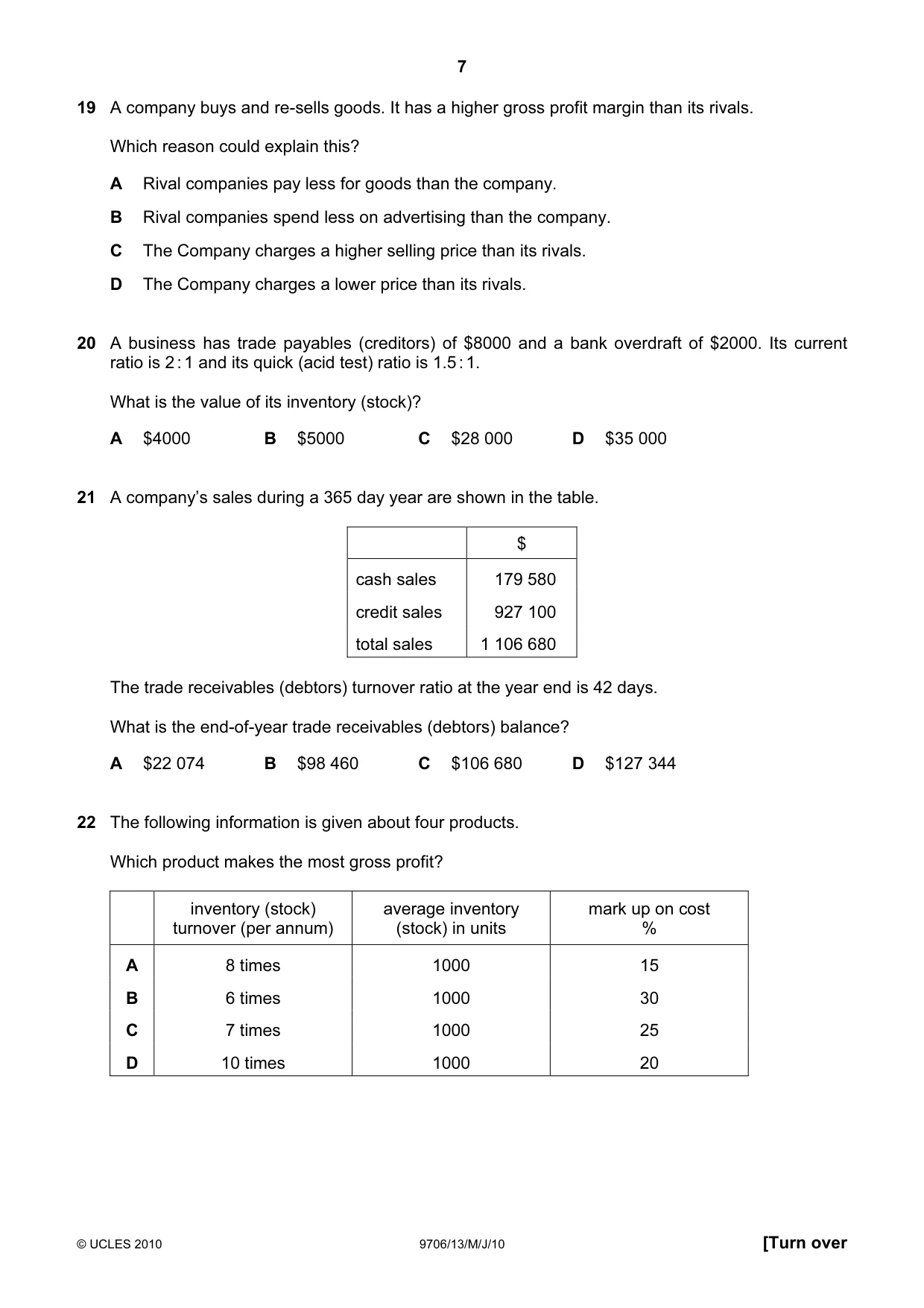
19 A company buys and re-sells goods. It has a higher gross profit margin than its rivals. Which reason could explain this? A Rival companies pay less for goods than the company. B Rival companies spend less on advertising than the company. C The Company charges a higher selling price than its rivals. D The Company charges a lower price than its rivals.
Mark scheme: C
More questions on Analysis and communication of accounting information
Q20 · A business has trade payables (creditors) of $8000 and a bank overdraft of $2000
20 A business has trade payables (creditors) of $8000 and a bank overdraft of $2000. Its current ratio is 2 : 1 and its quick (acid test) ratio is 1.5 : 1. What is the value of its inventory (stock)? A $4000 B $5000 C $28 000 D $35 000
Mark scheme: B
More questions on Analysis and communication of accounting information
Q21 · A company’s sales during a 365 day year are shown in the table
21 A company’s sales during a 365 day year are shown in the table. $ cash sales 179 580 credit sales 927 100 total sales 1 106 680 The trade receivables (debtors) turnover ratio at the year end is 42 days. What is the end-of-year trade receivables (debtors) balance? A $22 074 B $98 460 C $106 680 D $127 344
Mark scheme: C
More questions on Analysis and communication of accounting information
Q22 · The following information is given about four products
22 The following information is given about four products. Which product makes the most gross profit? inventory (stock) average inventory mark up on cost turnover (per annum) (stock) in units % A 8 times 1000 15 B 6 times 1000 30 C 7 times 1000 25 D 10 times 1000 20
Mark scheme: D
More questions on Analysis and communication of accounting information
Q23 · A soup manufacturer uses batch costing
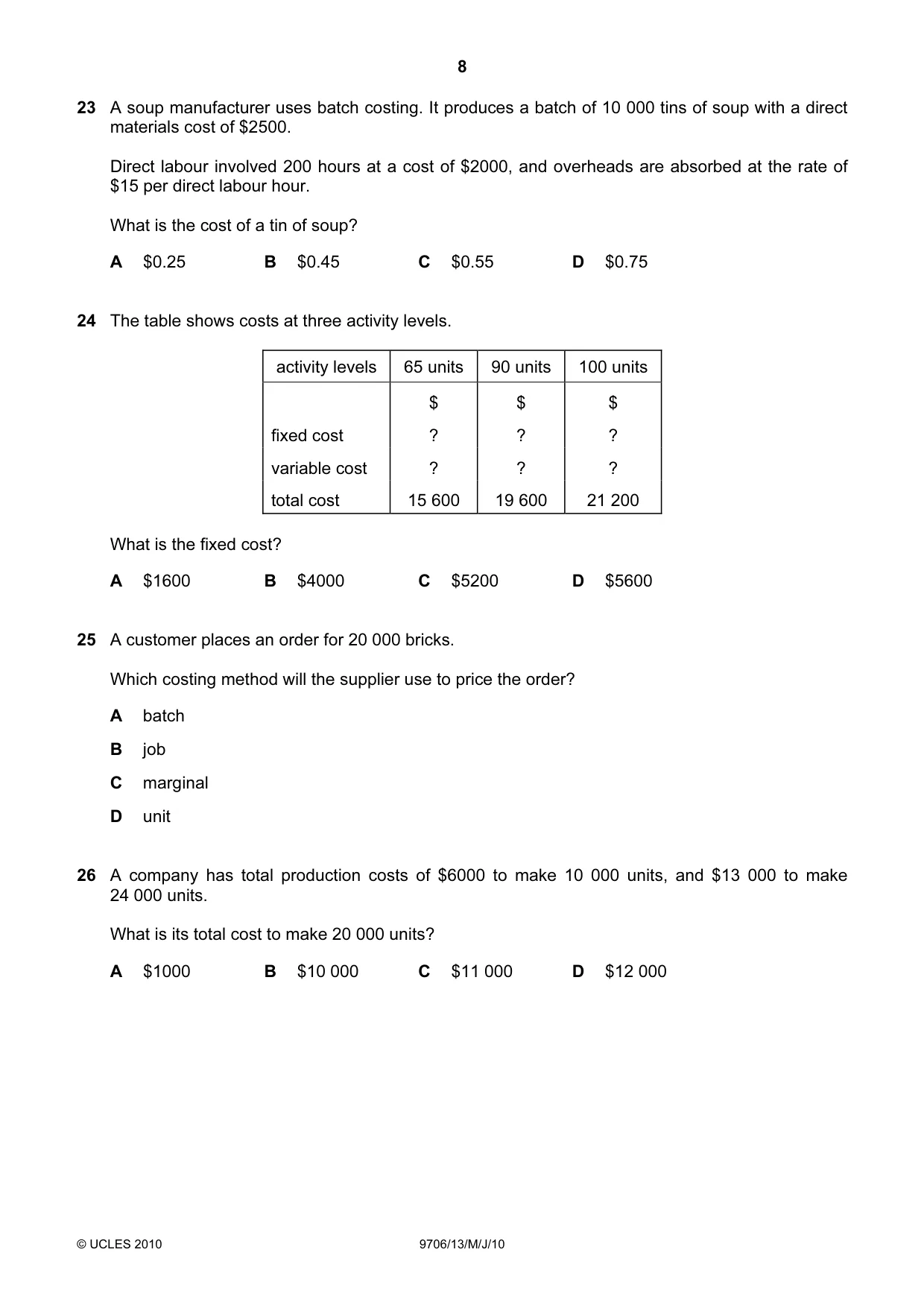
23 A soup manufacturer uses batch costing. It produces a batch of 10 000 tins of soup with a direct materials cost of $2500. Direct labour involved 200 hours at a cost of $2000, and overheads are absorbed at the rate of $15 per direct labour hour. What is the cost of a tin of soup? A $0.25 B $0.45 C $0.55 D $0.75
Mark scheme: D
Q24 · The table shows costs at three activity levels
24 The table shows costs at three activity levels. activity levels 65 units 90 units 100 units $ $ $ fixed cost ? ? ? variable cost ? ? ? total cost 15 600 19 600 21 200 What is the fixed cost? A $1600 B $4000 C $5200 D $5600
Mark scheme: C
Q25 · A customer places an order for 20 000 bricks
25 A customer places an order for 20 000 bricks. Which costing method will the supplier use to price the order? A batch B job C marginal D unit
Mark scheme: A
Q26 · A company has total production costs of $6000 to make 10 000 units, and $13 000 to make…
26 A company has total production costs of $6000 to make 10 000 units, and $13 000 to make 24 000 units. What is its total cost to make 20 000 units? A $1000 B $10 000 C $11 000 D $12 000
Mark scheme: C
Q27 · A business makes wedding dresses
27 A business makes wedding dresses. Each machinist is paid $30 a day and each supervisor $40 a day. Each supervisor can work with up to 10 machinists and each machinist can produce one wedding dress a day. If 95 wedding dresses a day are produced, what is the daily labour cost? A $2850 B $3210 C $3230 D $3250
Mark scheme: D
Q28 · The graphs show projected sales and cost information for products X and Y
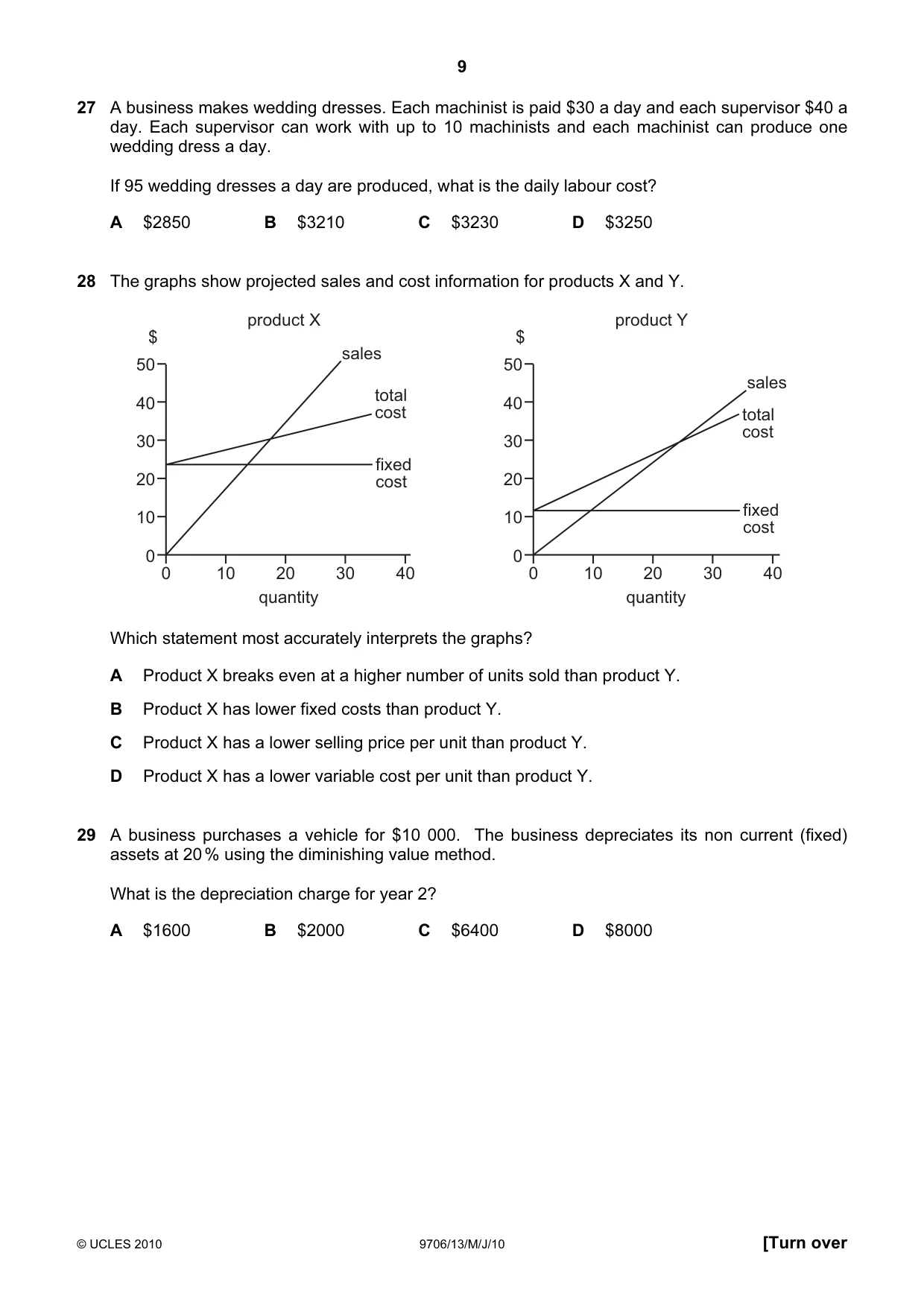
28 The graphs show projected sales and cost information for products X and Y. product X product Y $ $ sales 50 50 sales 40 total 40 cost total cost 30 30 fixed 20 cost 20 10 10 fixed cost 0 0 0 10 20 30 40 0 10 20 30 40 quantity quantity Which statement most accurately interprets the graphs? A Product X breaks even at a higher number of units sold than product Y. B Product X has lower fixed costs than product Y. C Product X has a lower selling price per unit than product Y. D Product X has a lower variable cost per unit than product Y.
Mark scheme: D
Q29 · A business purchases a vehicle for $10 000
29 A business purchases a vehicle for $10 000. The business depreciates its non current (fixed) assets at 20 % using the diminishing value method. What is the depreciation charge for year 2? A $1600 B $2000 C $6400 D $8000
Mark scheme: A
Q30 · An item of capital expenditure has been incorrectly treated as revenue expenditure in the…
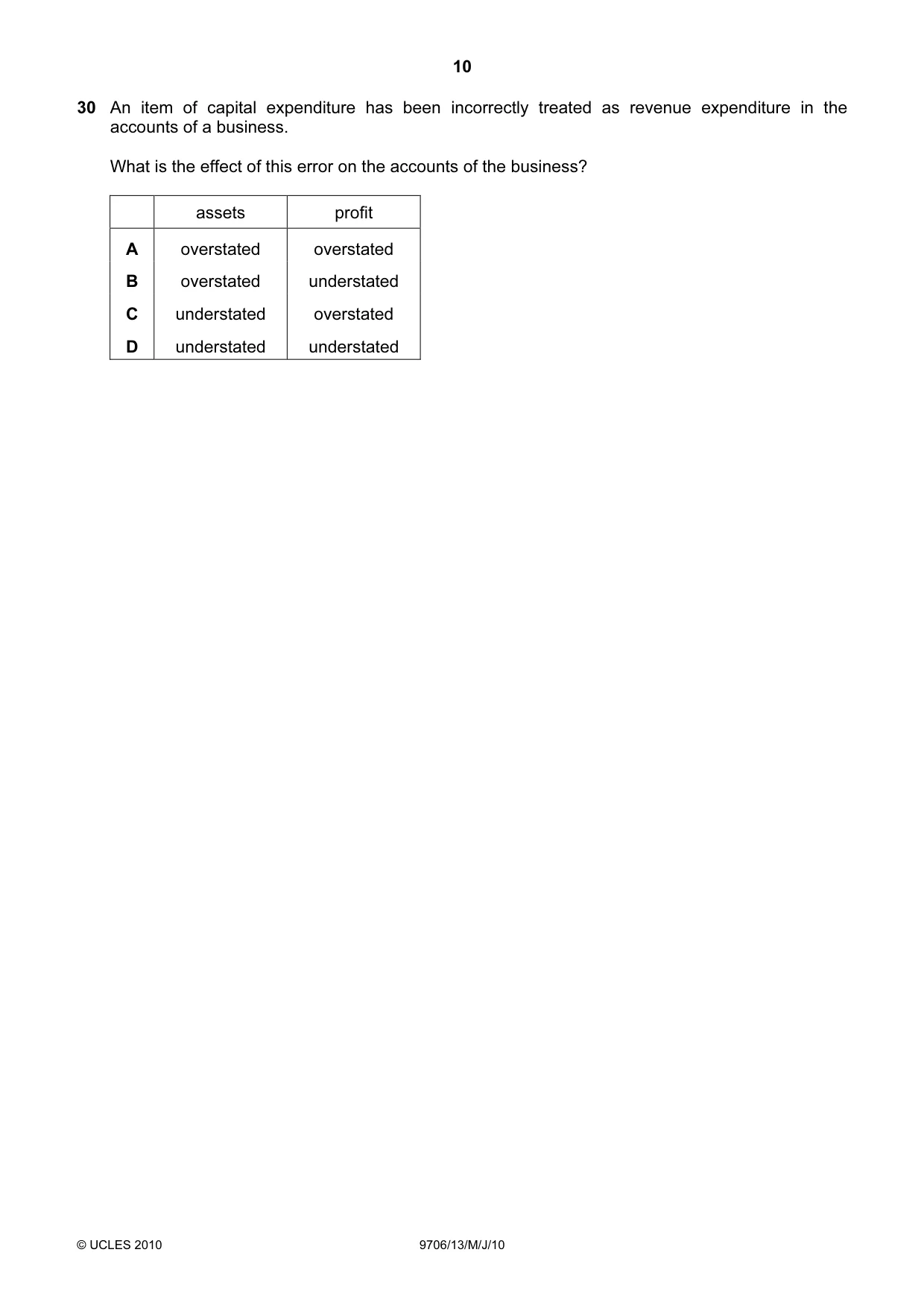
30 An item of capital expenditure has been incorrectly treated as revenue expenditure in the accounts of a business. What is the effect of this error on the accounts of the business? assets profit A overstated overstated B overstated understated C understated overstated D understated understated
Mark scheme: D
What was in this paper
The subtopics covered by these 30 questions, and how many questions each got. Open one in a new tab to see every Cambridge question on it.
What you needed in this session
Cambridge’s own grade thresholds for 2010 May/June, Paper 1 · Variant 3. A higher threshold means an easier paper — the bar moves with how the cohort did.