Cambridge A Level Accounting 9706 — 2018 May/June Paper 1 · Variant 3
9706/13/M/J/18 · 30 questions · 30 marks · ≈34 min
The question paper and its mark scheme, free to read here and free to download. This is Cambridge’s own paper, exactly as it was sat.
Question paper12 pages


Mark scheme3 pages
Answers below. Sit the paper first if you are practising.
Questions as text
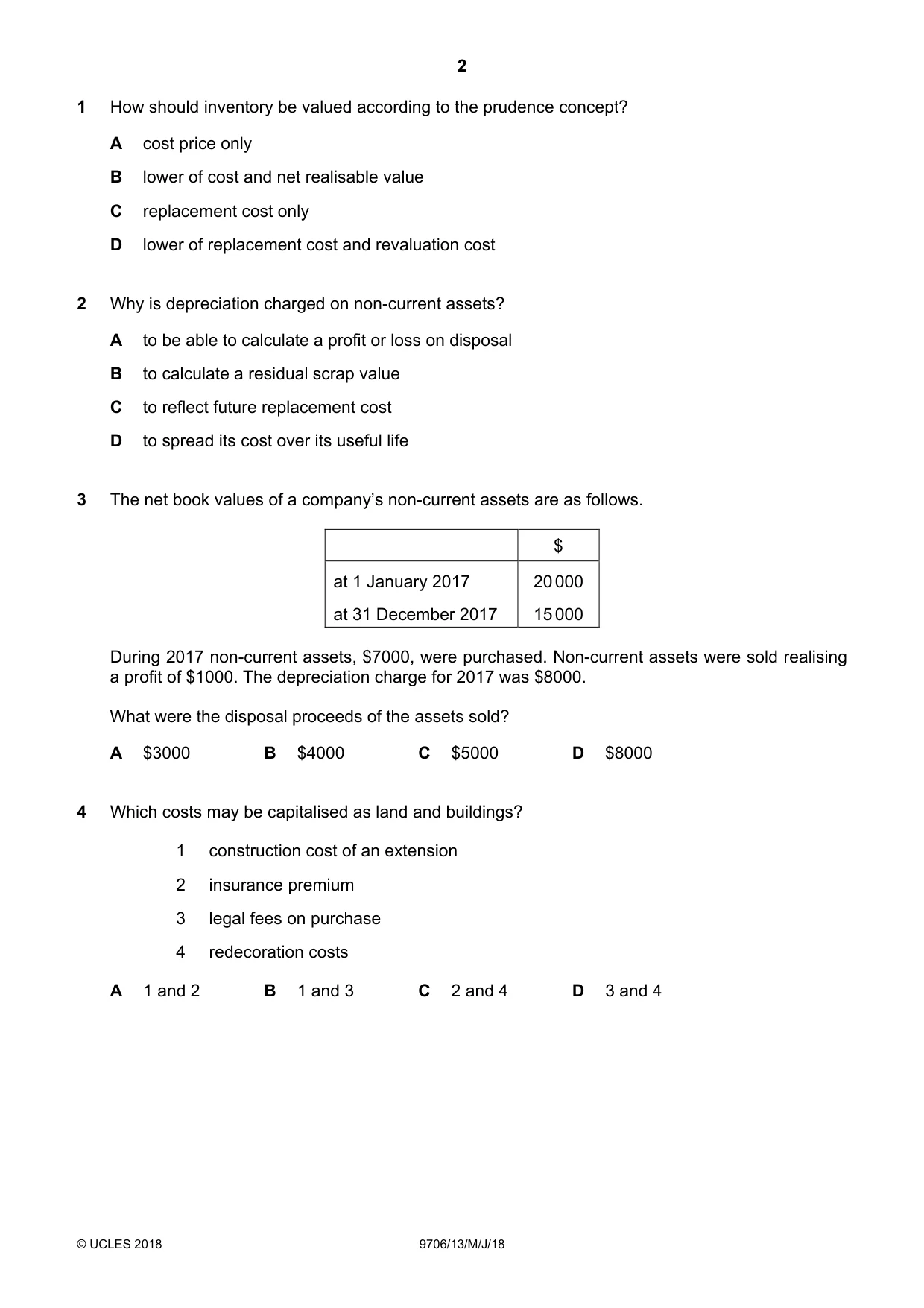
Q1 · How should inventory be valued according to the prudence concept?
1 How should inventory be valued according to the prudence concept? A cost price only B lower of cost and net realisable value C replacement cost only D lower of replacement cost and revaluation cost
Mark scheme: B
Q2 · Why is depreciation charged on non-current assets?
2 Why is depreciation charged on non-current assets? A to be able to calculate a profit or loss on disposal B to calculate a residual scrap value C to reflect future replacement cost D to spread its cost over its useful life
Mark scheme: D
Q3 · The net book values of a company’s non-current assets are as follows
3 The net book values of a company’s non-current assets are as follows. $ at 1 January 2017 20 000 at 31 December 2017 15 000 During 2017 non-current assets, $7000, were purchased. Non-current assets were sold realising a profit of $1000. The depreciation charge for 2017 was $8000. What were the disposal proceeds of the assets sold? A $3000 B $4000 C $5000 D $8000
Mark scheme: C
Q4 · Which costs may be capitalised as land and buildings?
4 Which costs may be capitalised as land and buildings? 1 construction cost of an extension 2 insurance premium 3 legal fees on purchase 4 redecoration costs A 1 and 2 B 1 and 3 C 2 and 4 D 3 and 4
Mark scheme: B
Q5 · Fred wishes to identify the unpresented cheques of his business
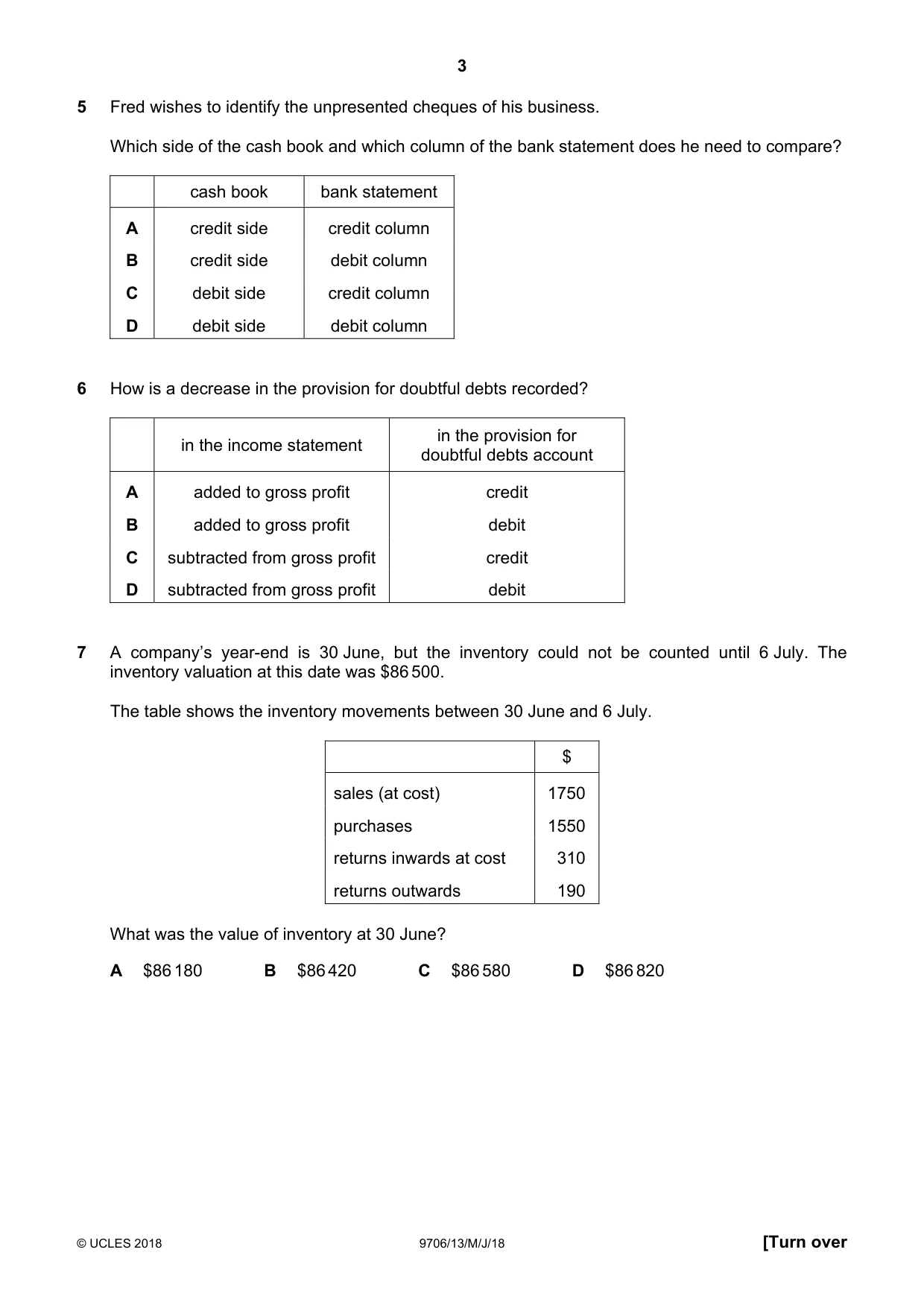
5 Fred wishes to identify the unpresented cheques of his business. Which side of the cash book and which column of the bank statement does he need to compare? cash book bank statement A credit side credit column B credit side debit column C debit side credit column D debit side debit column
Mark scheme: B
Q6 · How is a decrease in the provision for doubtful debts recorded?
6 How is a decrease in the provision for doubtful debts recorded? in the provision for in the income statement doubtful debts account A added to gross profit credit B added to gross profit debit C subtracted from gross profit credit D subtracted from gross profit debit
Mark scheme: B
Q7 · A company’s year-end is 30 June, but the inventory could not be counted until 6 July
7 A company’s year-end is 30 June, but the inventory could not be counted until 6 July. The inventory valuation at this date was $86 500. The table shows the inventory movements between 30 June and 6 July. $ sales (at cost) 1750 purchases 1550 returns inwards at cost 310 returns outwards 190 What was the value of inventory at 30 June? A $86 180 B $86 420 C $86 580 D $86 820
Mark scheme: C
Q8 · A purchases ledger control account shows the following
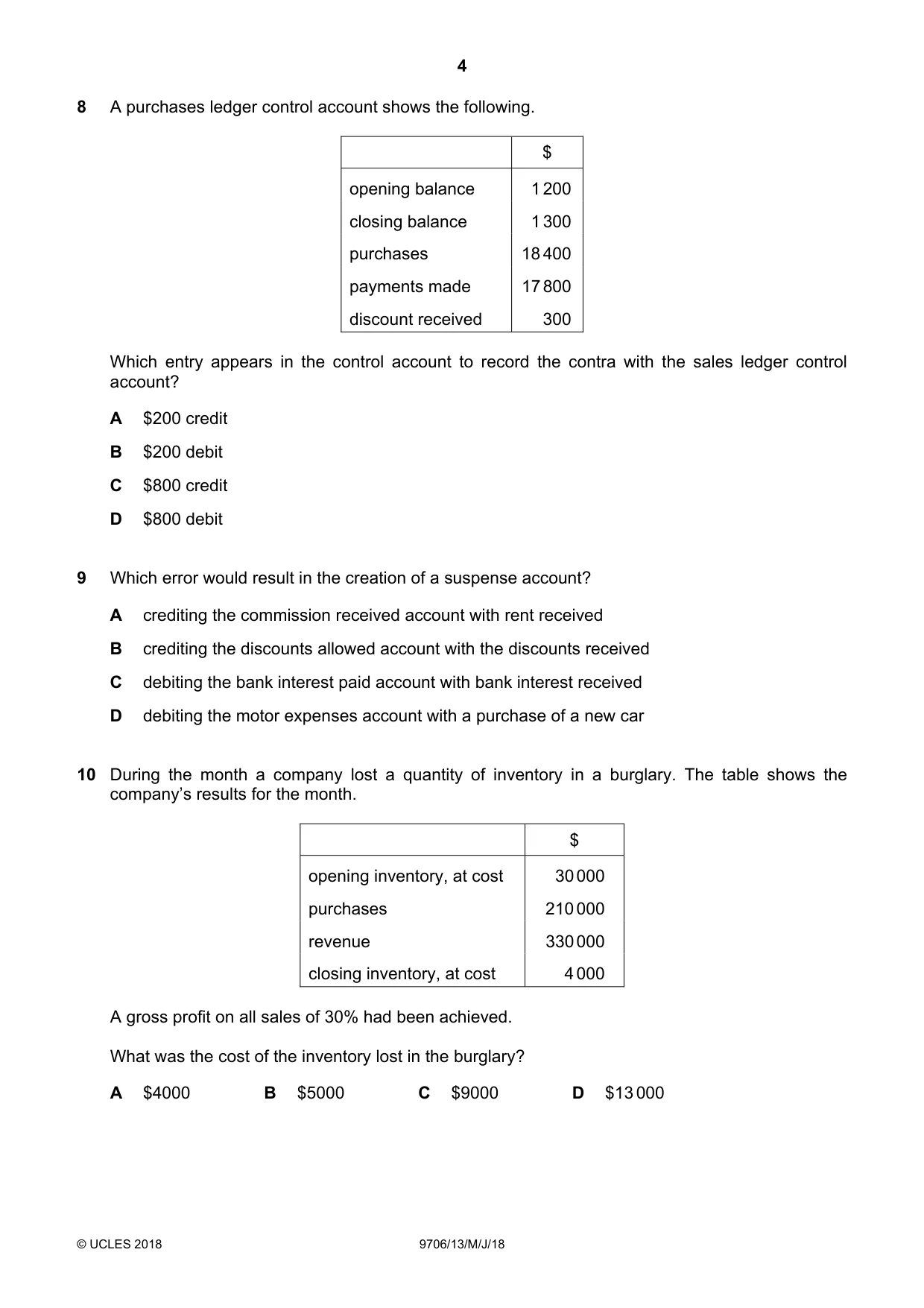
8 A purchases ledger control account shows the following. $ opening balance 1 200 closing balance 1 300 purchases 18 400 payments made 17 800 discount received 300 Which entry appears in the control account to record the contra with the sales ledger control account? A $200 credit B $200 debit C $800 credit D $800 debit
Mark scheme: B
Q9 · Which error would result in the creation of a suspense account?
9 Which error would result in the creation of a suspense account? A crediting the commission received account with rent received B crediting the discounts allowed account with the discounts received C debiting the bank interest paid account with bank interest received D debiting the motor expenses account with a purchase of a new car
Mark scheme: C
Q10 · During the month a company lost a quantity of inventory in a burglary
10 During the month a company lost a quantity of inventory in a burglary. The table shows the company’s results for the month. $ opening inventory, at cost 30 000 purchases 210 000 revenue 330 000 closing inventory, at cost 4 000 A gross profit on all sales of 30% had been achieved. What was the cost of the inventory lost in the burglary? A $4000 B $5000 C $9000 D $13 000
Mark scheme: B
Q11 · At the start of the year a business had trade payables of $13 000
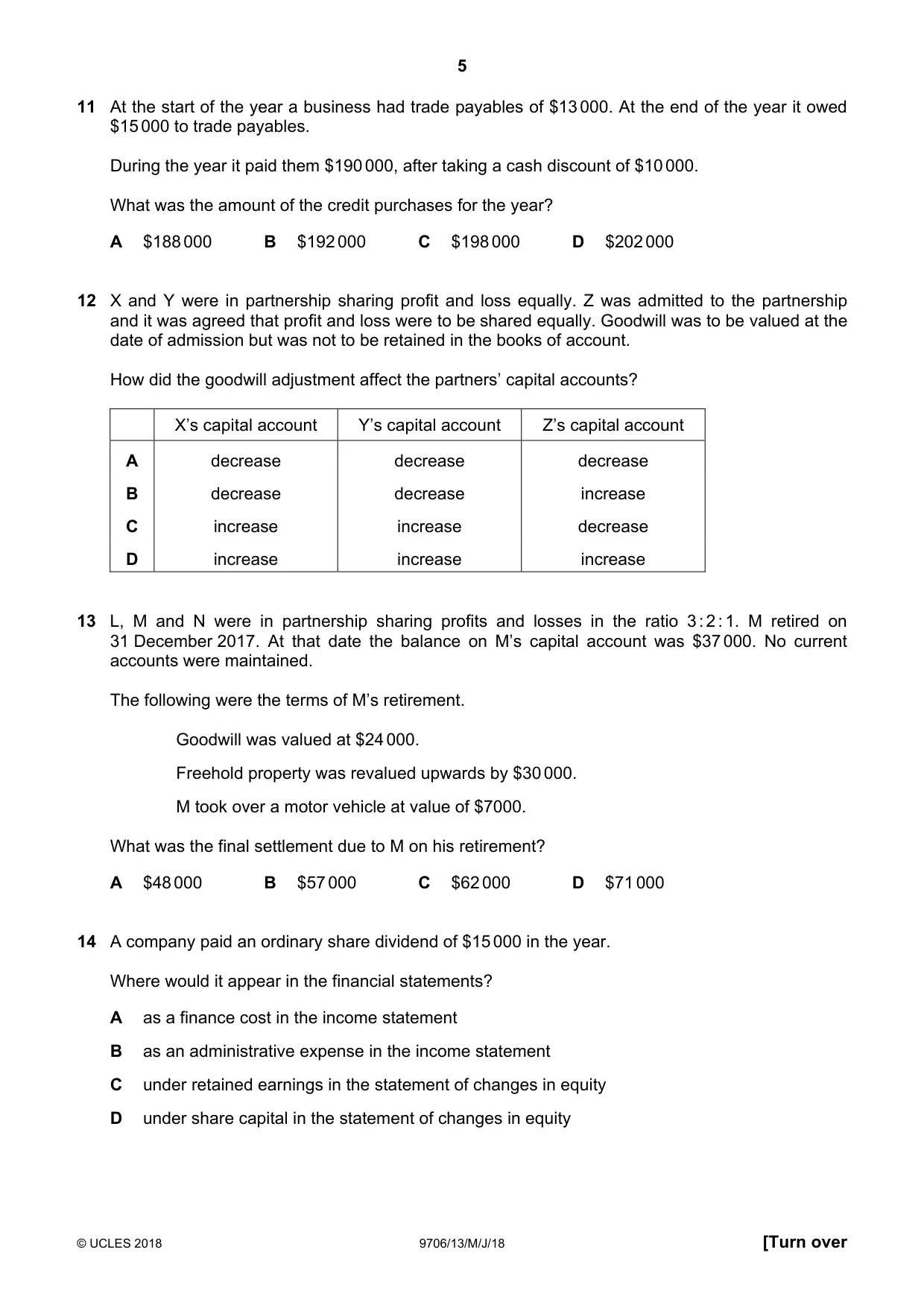
11 At the start of the year a business had trade payables of $13 000. At the end of the year it owed $15 000 to trade payables. During the year it paid them $190 000, after taking a cash discount of $10 000. What was the amount of the credit purchases for the year? A $188 000 B $192 000 C $198 000 D $202 000
Mark scheme: D
Q12 · X and Y were in partnership sharing profit and loss equally
12 X and Y were in partnership sharing profit and loss equally. Z was admitted to the partnership and it was agreed that profit and loss were to be shared equally. Goodwill was to be valued at the date of admission but was not to be retained in the books of account. How did the goodwill adjustment affect the partners’ capital accounts? X’s capital account Y’s capital account Z’s capital account A decrease decrease decrease B decrease decrease increase C increase increase decrease D increase increase increase
Mark scheme: C
Q13 · L, M and N were in partnership sharing profits and losses in the ratio 3 : 2 : 1
13 L, M and N were in partnership sharing profits and losses in the ratio 3 : 2 : 1. M retired on 31 December 2017. At that date the balance on M’s capital account was $37 000. No current accounts were maintained. The following were the terms of M’s retirement. Goodwill was valued at $24 000. Freehold property was revalued upwards by $30 000. M took over a motor vehicle at value of $7000. What was the final settlement due to M on his retirement? A $48 000 B $57 000 C $62 000 D $71 000
Mark scheme: A
Q14 · A company paid an ordinary share dividend of $15 000 in the year
14 A company paid an ordinary share dividend of $15 000 in the year. Where would it appear in the financial statements? A as a finance cost in the income statement B as an administrative expense in the income statement C under retained earnings in the statement of changes in equity D under share capital in the statement of changes in equity
Mark scheme: C
Q15 · The total equity of a company on 1 January 2017 was $400 000
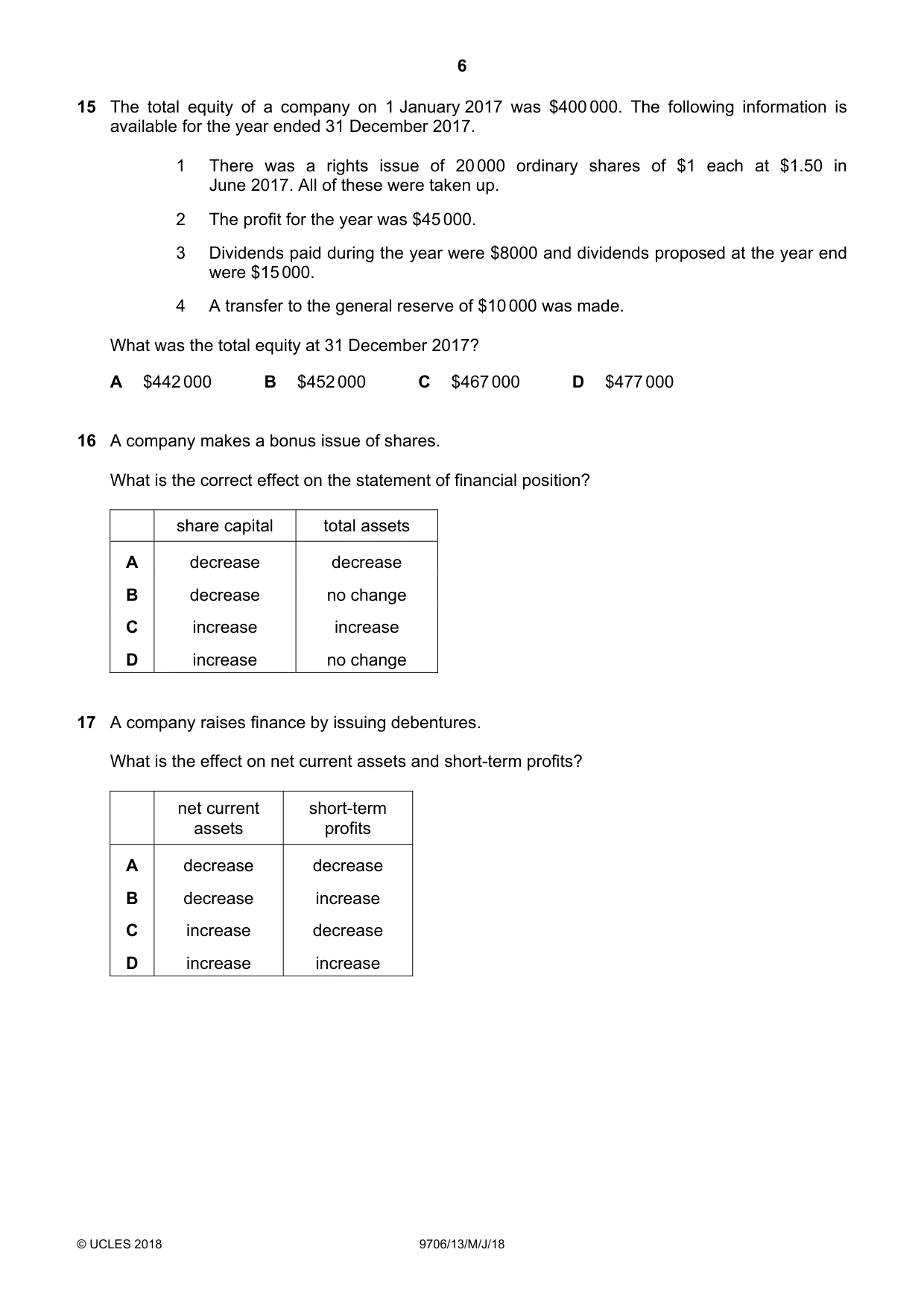
15 The total equity of a company on 1 January 2017 was $400 000. The following information is available for the year ended 31 December 2017. 1 There was a rights issue of 20 000 ordinary shares of $1 each at $1.50 in June 2017. All of these were taken up. 2 The profit for the year was $45 000. 3 Dividends paid during the year were $8000 and dividends proposed at the year end were $15 000. 4 A transfer to the general reserve of $10 000 was made. What was the total equity at 31 December 2017? A $442 000 B $452 000 C $467 000 D $477 000
Mark scheme: C
Q16 · A company makes a bonus issue of shares
16 A company makes a bonus issue of shares. What is the correct effect on the statement of financial position? share capital total assets A decrease decrease B decrease no change C increase increase D increase no change
Mark scheme: D
Q17 · A company raises finance by issuing debentures
17 A company raises finance by issuing debentures. What is the effect on net current assets and short-term profits? net current short-term assets profits A decrease decrease B decrease increase C increase decrease D increase increase
Mark scheme: C
More questions on Analysis and communication of accounting information
Q18 · Why would employees be interested in their employer’s financial statements?
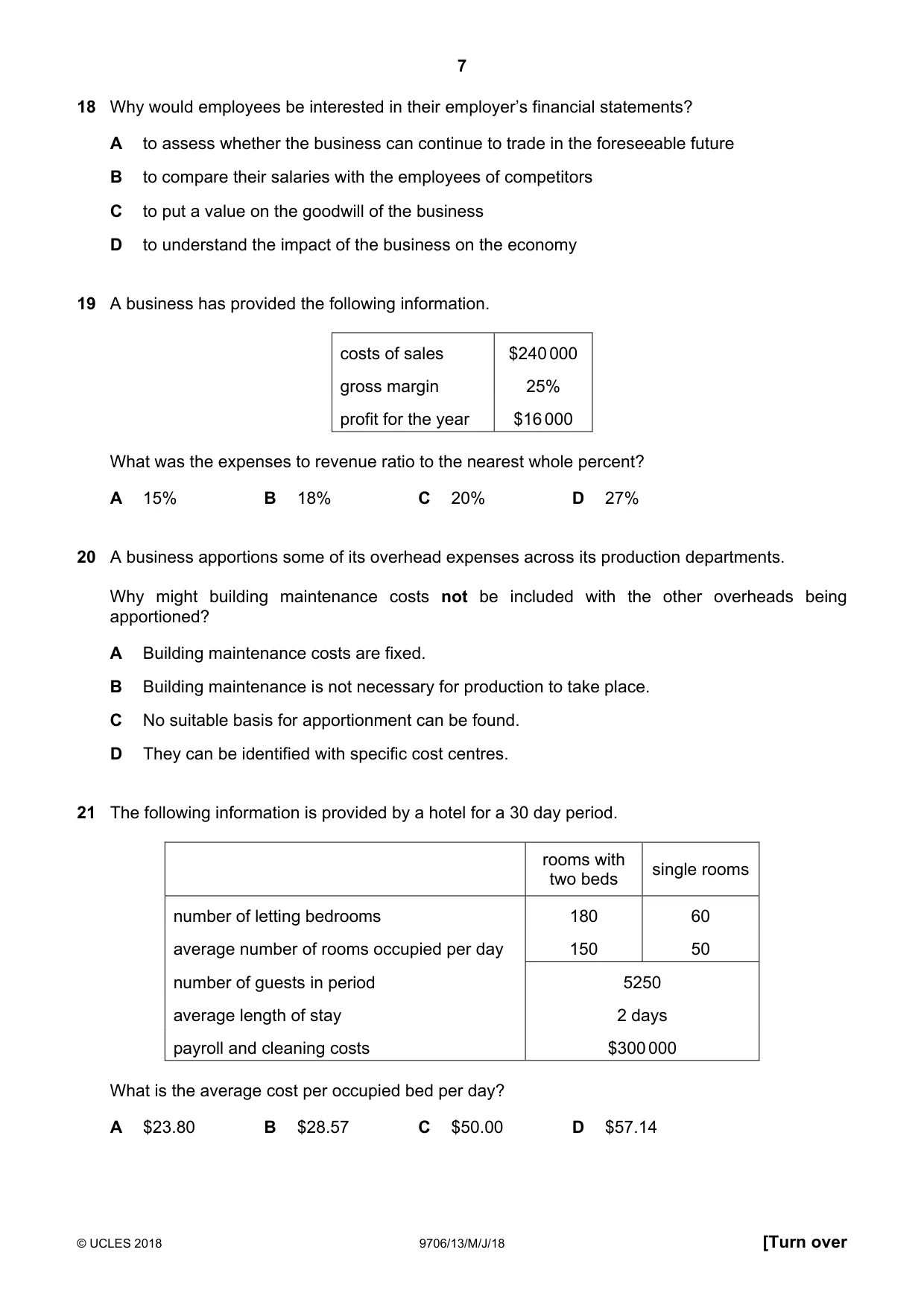
18 Why would employees be interested in their employer’s financial statements? A to assess whether the business can continue to trade in the foreseeable future B to compare their salaries with the employees of competitors C to put a value on the goodwill of the business D to understand the impact of the business on the economy
Mark scheme: A
More questions on Analysis and communication of accounting information
Q19 · A business has provided the following information
19 A business has provided the following information. costs of sales $240 000 gross margin 25% profit for the year $16 000 What was the expenses to revenue ratio to the nearest whole percent? A 15% B 18% C 20% D 27%
Mark scheme: C
More questions on Analysis and communication of accounting information
Q20 · A business apportions some of its overhead expenses across its production departments
20 A business apportions some of its overhead expenses across its production departments. Why might building maintenance costs not be included with the other overheads being apportioned? A Building maintenance costs are fixed. B Building maintenance is not necessary for production to take place. C No suitable basis for apportionment can be found. D They can be identified with specific cost centres.
Mark scheme: D
Q21 · The following information is provided by a hotel for a 30 day period
21 The following information is provided by a hotel for a 30 day period. rooms with single rooms two beds number of letting bedrooms 180 60 average number of rooms occupied per day 150 50 number of guests in period 5250 average length of stay 2 days payroll and cleaning costs $300 000 What is the average cost per occupied bed per day? A $23.80 B $28.57 C $50.00 D $57.14
Mark scheme: B
Q22 · The following information is available for a manufacturing business
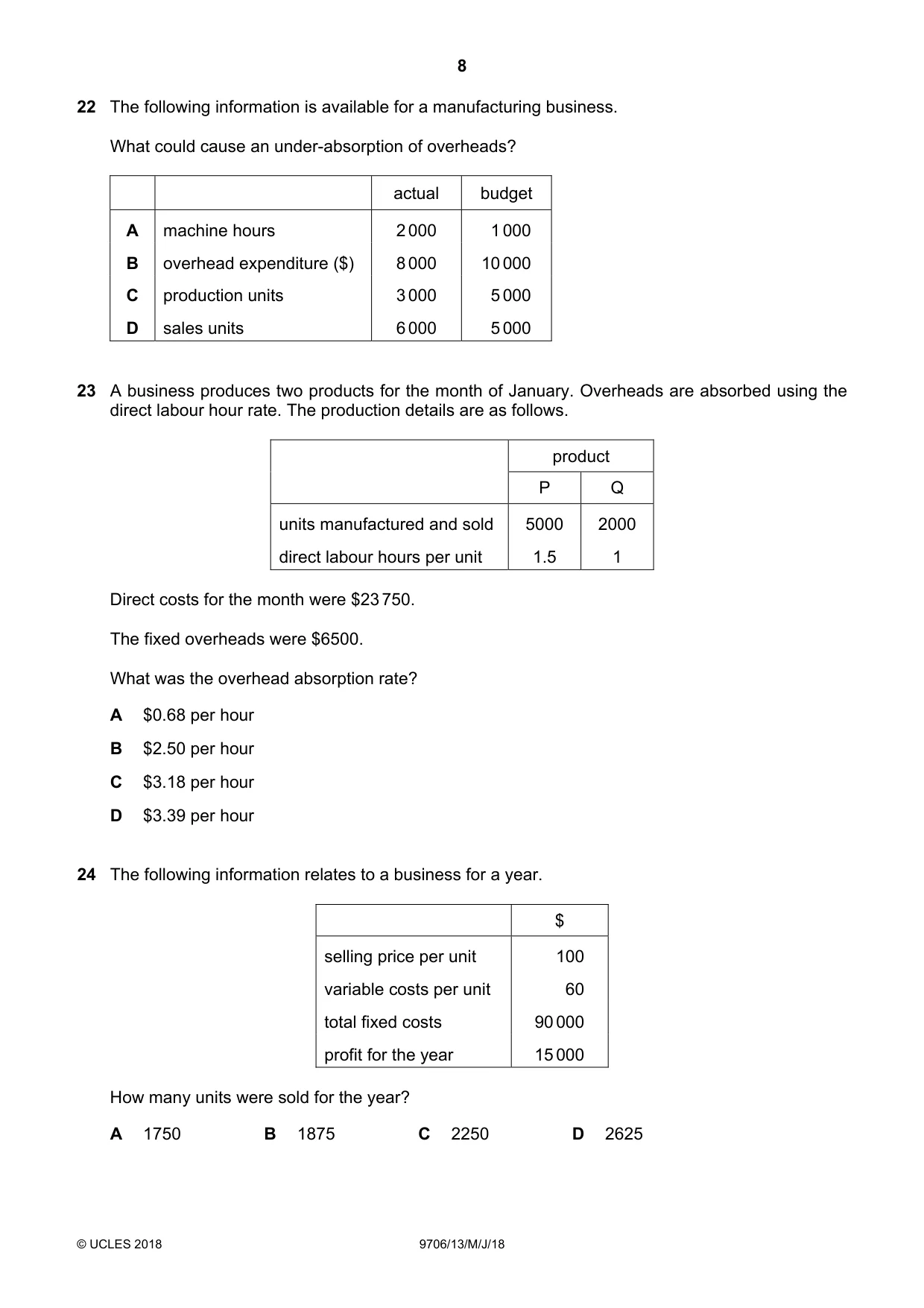
22 The following information is available for a manufacturing business. What could cause an under-absorption of overheads? actual budget A machine hours 2 000 1 000 B overhead expenditure ($) 8 000 10 000 C production units 3 000 5 000 D sales units 6 000 5 000
Mark scheme: C
Q23 · A business produces two products for the month of January
23 A business produces two products for the month of January. Overheads are absorbed using the direct labour hour rate. The production details are as follows. product P Q units manufactured and sold 5000 2000 direct labour hours per unit 1.5 1 Direct costs for the month were $23 750. The fixed overheads were $6500. What was the overhead absorption rate? A $0.68 per hour B $2.50 per hour C $3.18 per hour D $3.39 per hour
Mark scheme: A
Q24 · The following information relates to a business for a year
24 The following information relates to a business for a year. $ selling price per unit 100 variable costs per unit 60 total fixed costs 90 000 profit for the year 15 000 How many units were sold for the year? A 1750 B 1875 C 2250 D 2625
Mark scheme: D
Q25 · What will result in an increase in the margin of safety for a business?
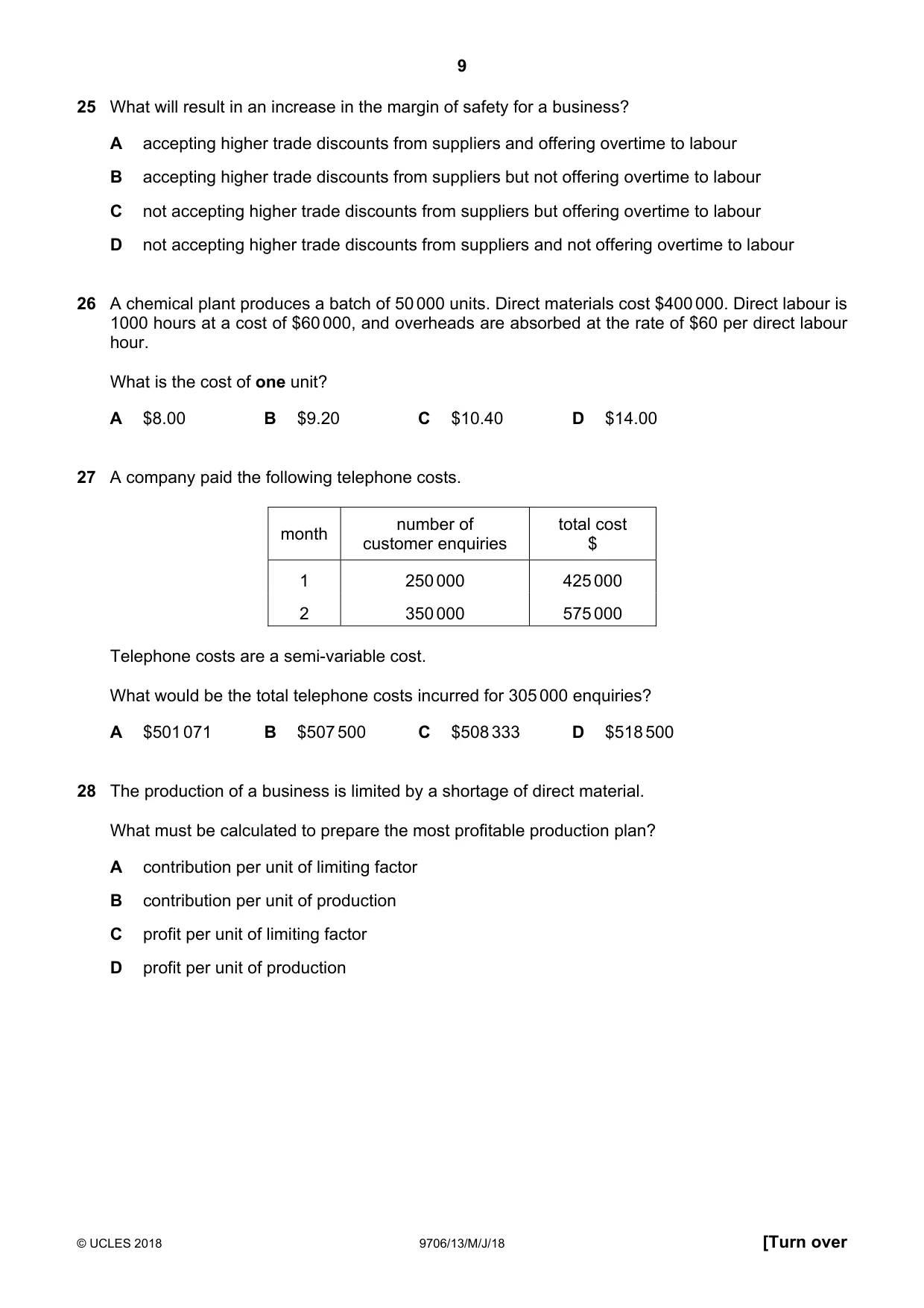
25 What will result in an increase in the margin of safety for a business? A accepting higher trade discounts from suppliers and offering overtime to labour B accepting higher trade discounts from suppliers but not offering overtime to labour C not accepting higher trade discounts from suppliers but offering overtime to labour D not accepting higher trade discounts from suppliers and not offering overtime to labour
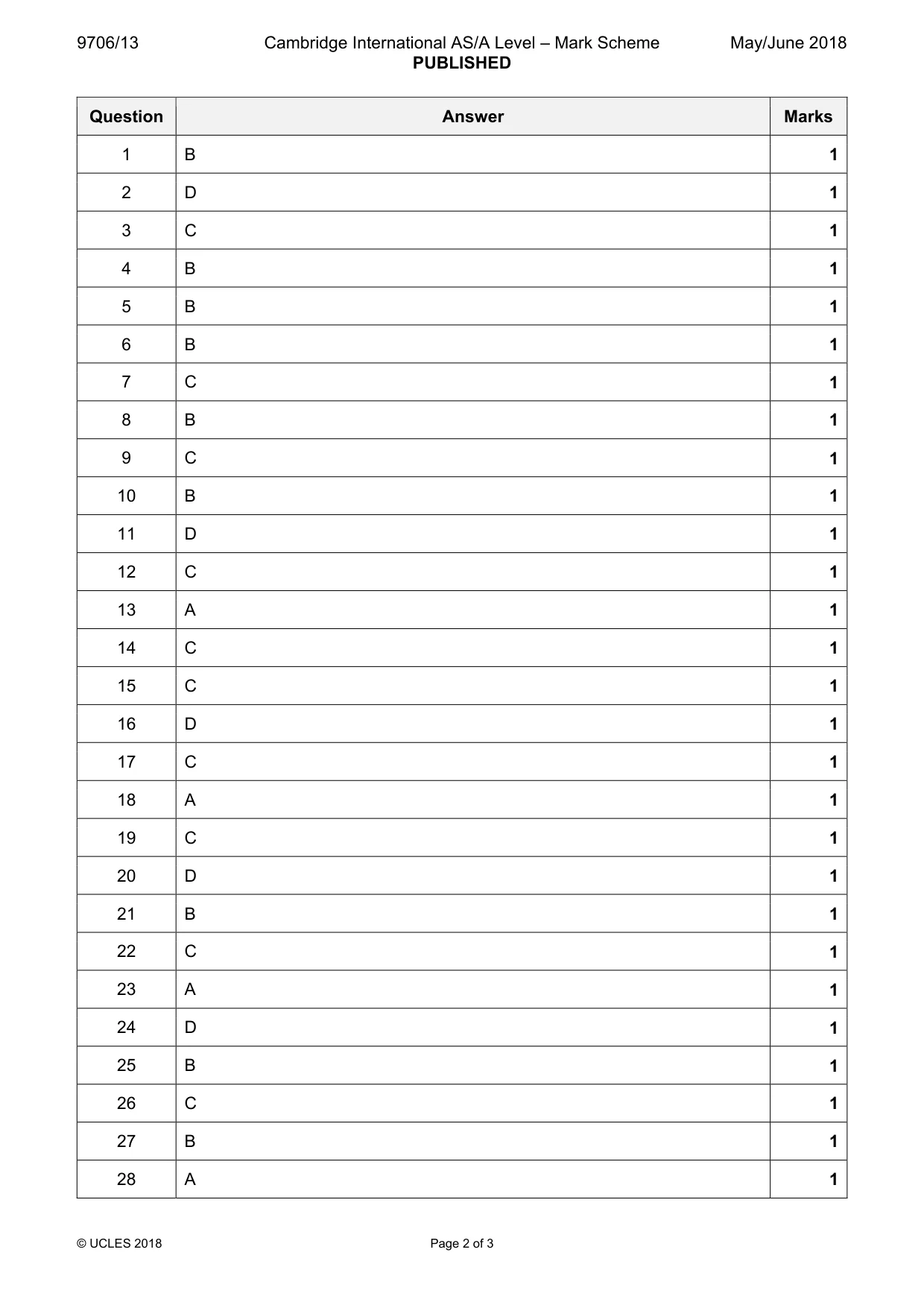
Mark scheme: B
Q26 · A chemical plant produces a batch of 50 000 units
26 A chemical plant produces a batch of 50 000 units. Direct materials cost $400 000. Direct labour is 1000 hours at a cost of $60 000, and overheads are absorbed at the rate of $60 per direct labour hour. What is the cost of one unit? A $8.00 B $9.20 C $10.40 D $14.00
Mark scheme: C
Q27 · A company paid the following telephone costs
27 A company paid the following telephone costs. number of total cost month customer enquiries $ 1 250 000 425 000 2 350 000 575 000 Telephone costs are a semi-variable cost. What would be the total telephone costs incurred for 305 000 enquiries? A $501 071 B $507 500 C $508 333 D $518 500
Mark scheme: B
Q28 · The production of a business is limited by a shortage of direct material
28 The production of a business is limited by a shortage of direct material. What must be calculated to prepare the most profitable production plan? A contribution per unit of limiting factor B contribution per unit of production C profit per unit of limiting factor D profit per unit of production
Mark scheme: A
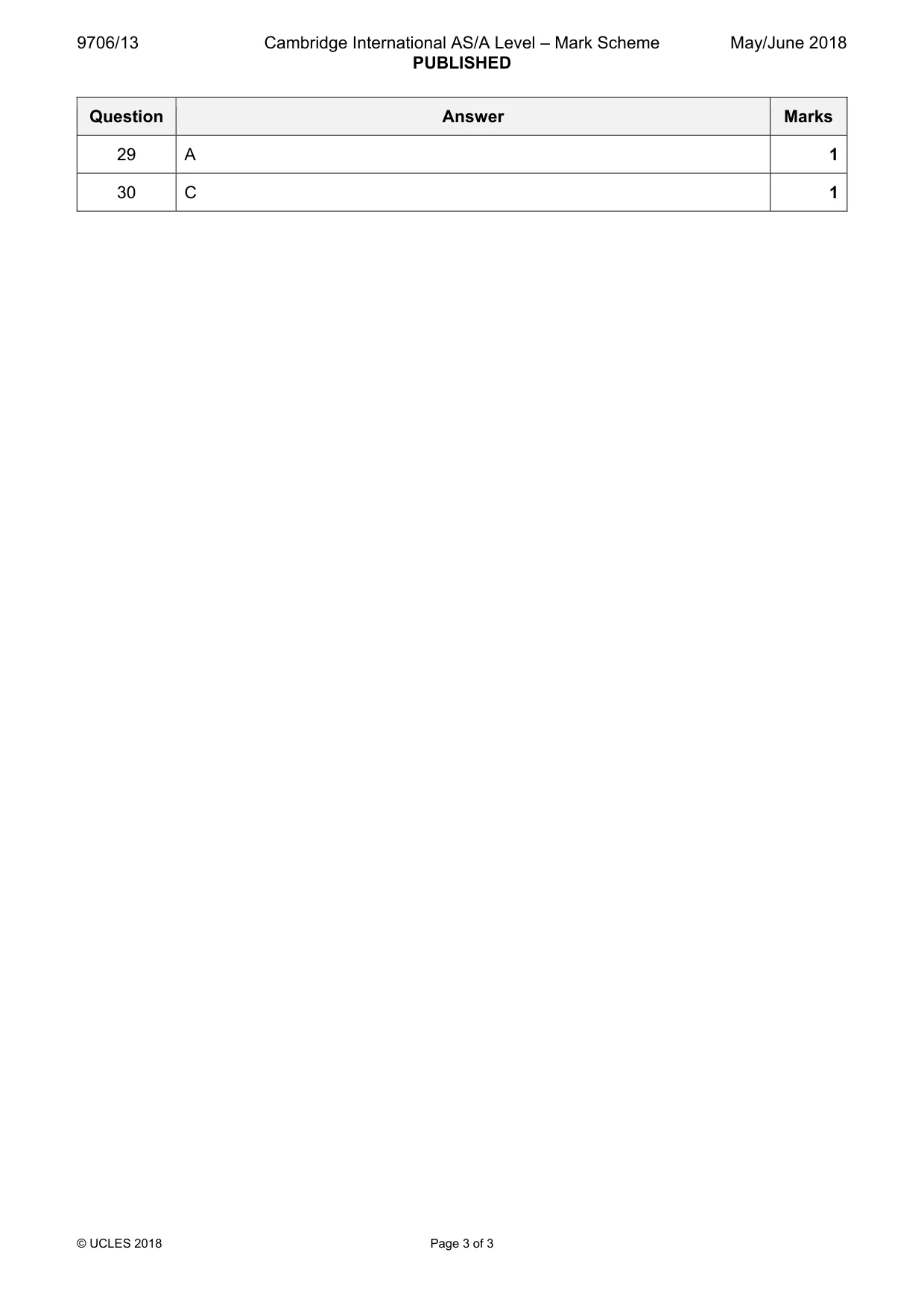
Q29 · A company uses a direct labour rate of $5.40 per hour to absorb production overhead
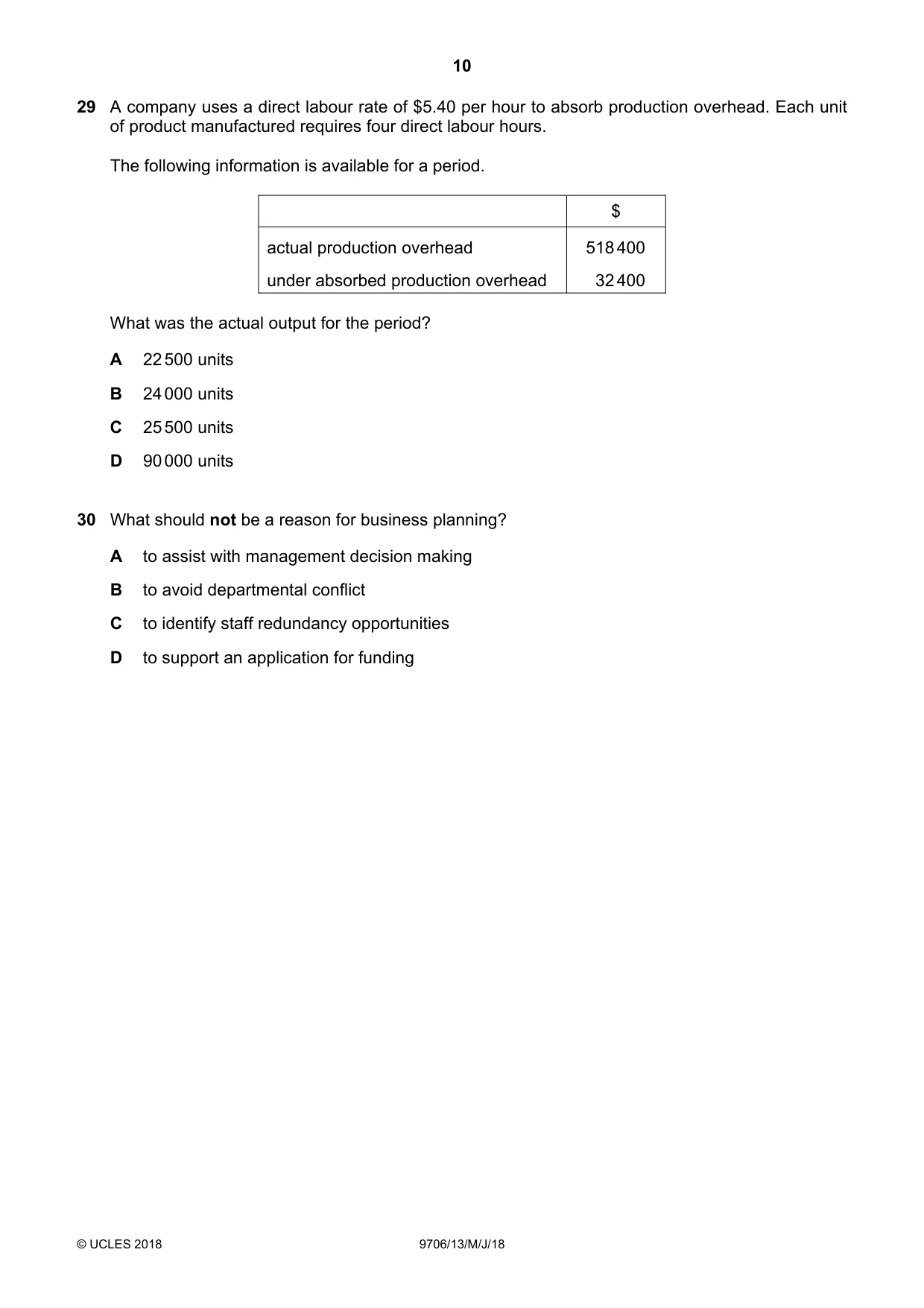
29 A company uses a direct labour rate of $5.40 per hour to absorb production overhead. Each unit of product manufactured requires four direct labour hours. The following information is available for a period. $ actual production overhead 518 400 under absorbed production overhead 32 400 What was the actual output for the period? A 22 500 units B 24 000 units C 25 500 units D 90 000 units
Mark scheme: A
Q30 · What should not be a reason for business planning?
30 What should not be a reason for business planning? A to assist with management decision making B to avoid departmental conflict C to identify staff redundancy opportunities D to support an application for funding
Mark scheme: C
What was in this paper
The subtopics covered by these 30 questions, and how many questions each got. Open one in a new tab to see every Cambridge question on it.
5Preparation of financial statements5Traditional costing methods5Reconciliation and verification4Accounting for non-current assets3Analysis and communication of accounting information3Preparation of financial statements2Types of business entity2Budgeting and budgetary control1What you needed in this session
Cambridge’s own grade thresholds for 2018 May/June, Paper 1 · Variant 3. A higher threshold means an easier paper — the bar moves with how the cohort did.