Cambridge A Level Accounting 9706 — 2020 May/June Paper 1 · Variant 2
9706/12/M/J/20 · 30 questions · 30 marks · ≈34 min
The question paper and its mark scheme, free to read here and free to download. This is Cambridge’s own paper, exactly as it was sat.
Question paper12 pages
Mark scheme3 pages
Answers below. Sit the paper first if you are practising.
Questions as text
Q1 · A business depreciates its non-current assets
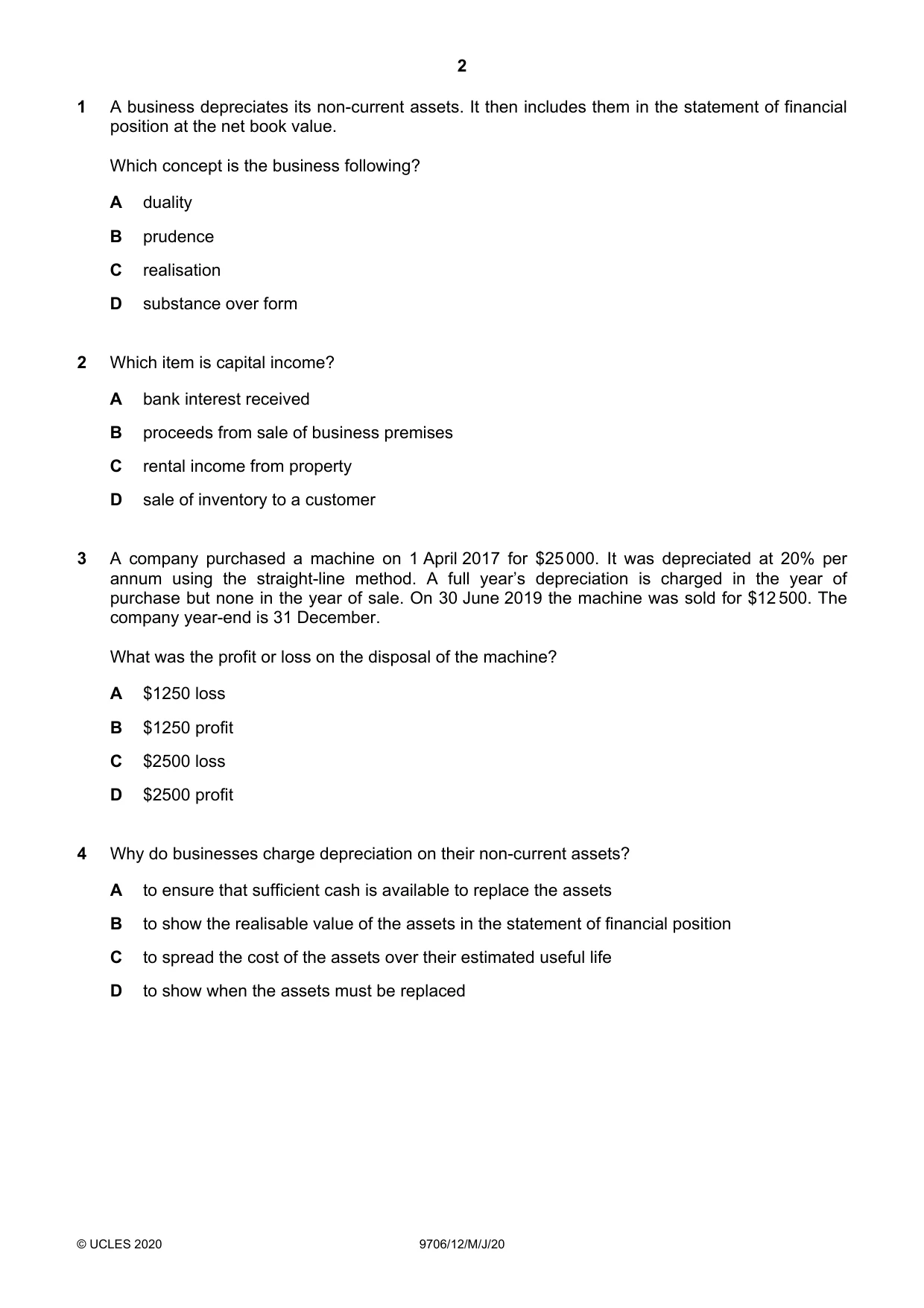
1 A business depreciates its non-current assets. It then includes them in the statement of financial position at the net book value. Which concept is the business following? A duality B prudence C realisation D substance over form
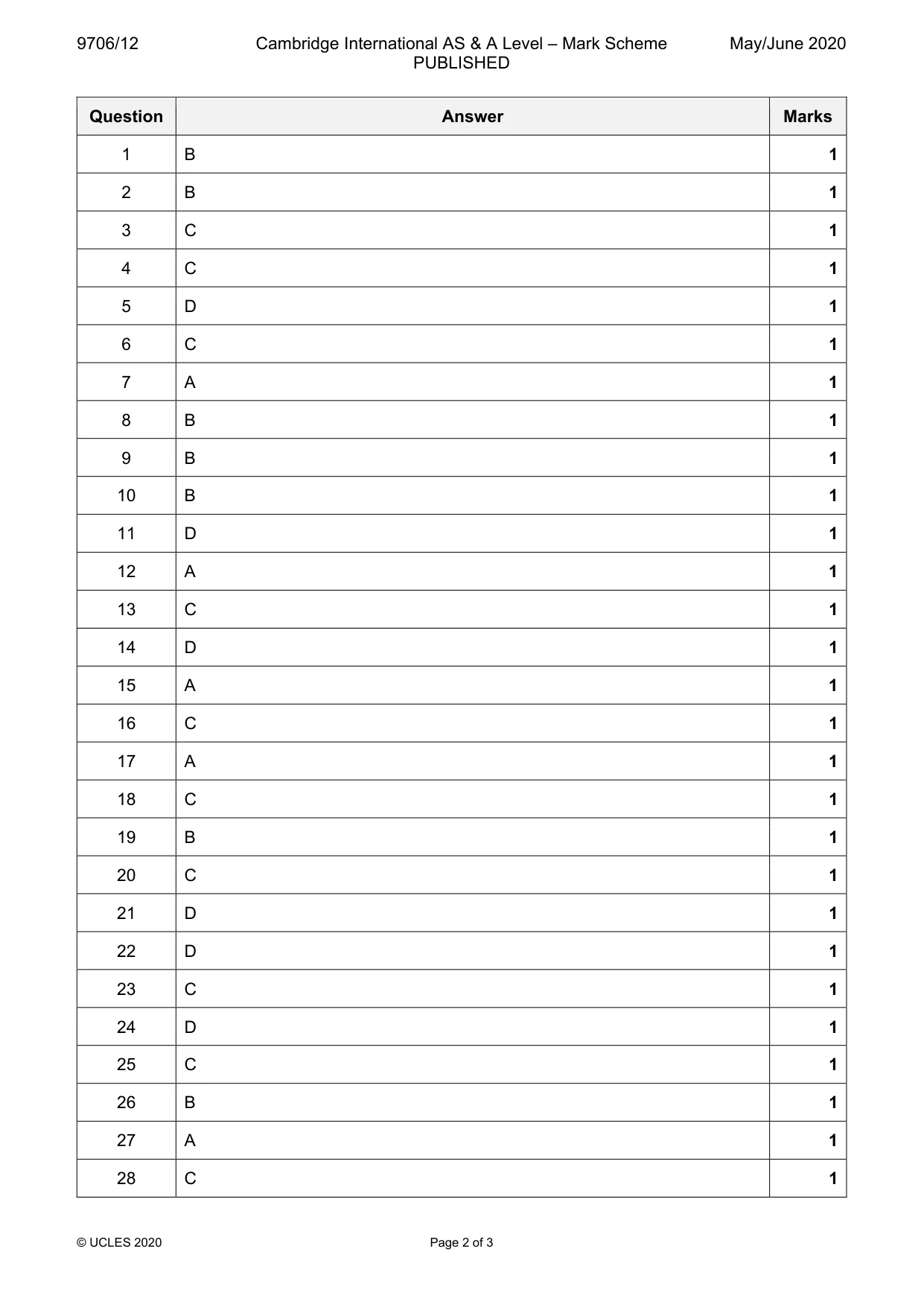
Mark scheme: B
Q2 · Which item is capital income?
2 Which item is capital income? A bank interest received B proceeds from sale of business premises C rental income from property D sale of inventory to a customer
Mark scheme: B
Q3 · A company purchased a machine on 1 April 2017 for $25 000
3 A company purchased a machine on 1 April 2017 for $25 000. It was depreciated at 20% per annum using the straight-line method. A full year’s depreciation is charged in the year of purchase but none in the year of sale. On 30 June 2019 the machine was sold for $12 500. The company year-end is 31 December. What was the profit or loss on the disposal of the machine? A $1250 loss B $1250 profit C $2500 loss D $2500 profit
Mark scheme: C
Q4 · Why do businesses charge depreciation on their non-current assets?
4 Why do businesses charge depreciation on their non-current assets? A to ensure that sufficient cash is available to replace the assets B to show the realisable value of the assets in the statement of financial position C to spread the cost of the assets over their estimated useful life D to show when the assets must be replaced
Mark scheme: C
Q5 · A trader’s trial balance did not agree at the end of the financial period and a suspense…
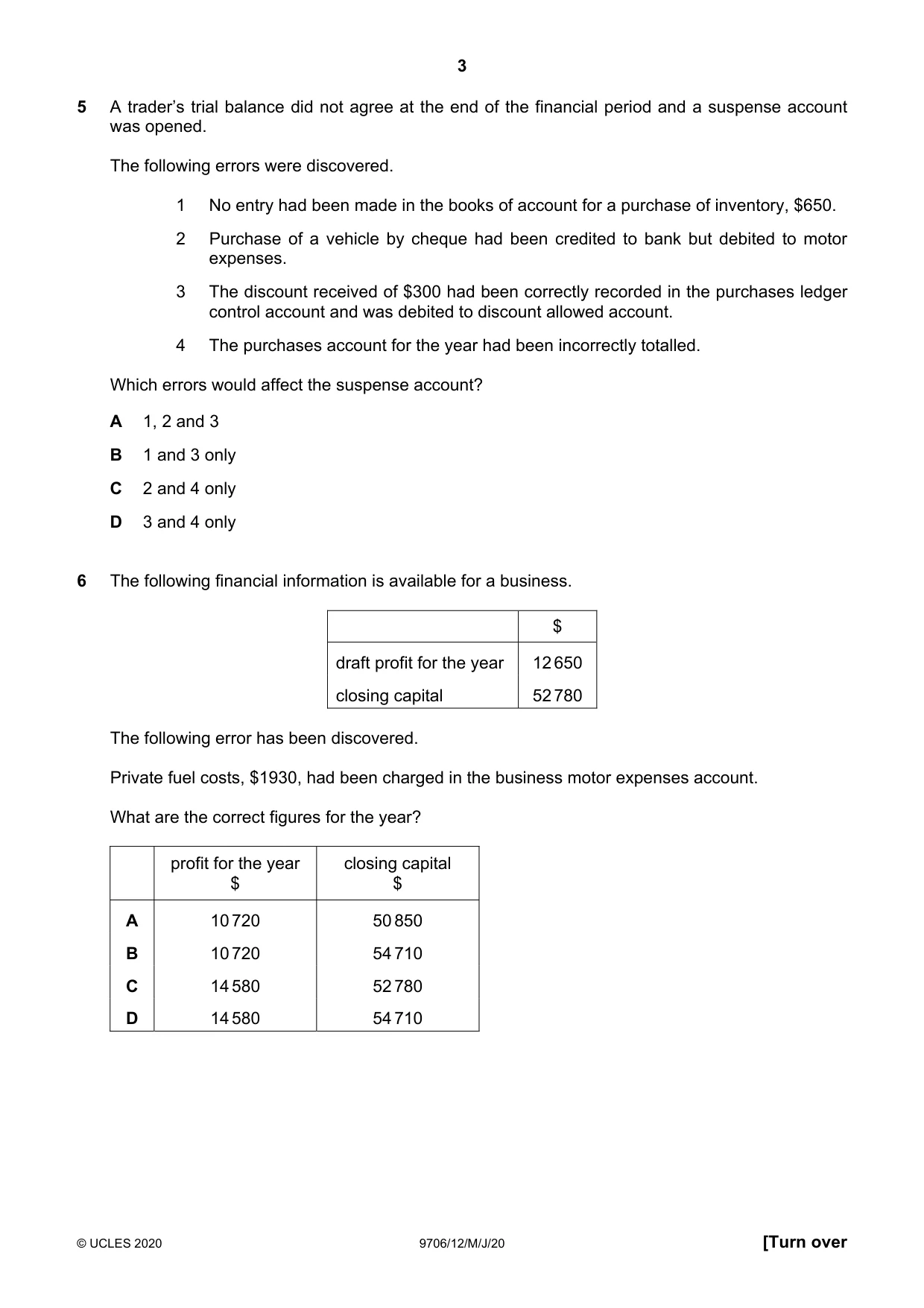
5 A trader’s trial balance did not agree at the end of the financial period and a suspense account was opened. The following errors were discovered. 1 No entry had been made in the books of account for a purchase of inventory, $650. 2 Purchase of a vehicle by cheque had been credited to bank but debited to motor expenses. 3 The discount received of $300 had been correctly recorded in the purchases ledger control account and was debited to discount allowed account. 4 The purchases account for the year had been incorrectly totalled. Which errors would affect the suspense account? A 1, 2 and 3 B 1 and 3 only C 2 and 4 only D 3 and 4 only
Mark scheme: D
Q6 · The following financial information is available for a business
6 The following financial information is available for a business. $ draft profit for the year 12 650 closing capital 52 780 The following error has been discovered. Private fuel costs, $1930, had been charged in the business motor expenses account. What are the correct figures for the year? profit for the year closing capital $ $ A 10 720 50 850 B 10 720 54 710 C 14 580 52 780 D 14 580 54 710
Mark scheme: C
Q7 · A sales ledger control account has a closing balance of $21 000
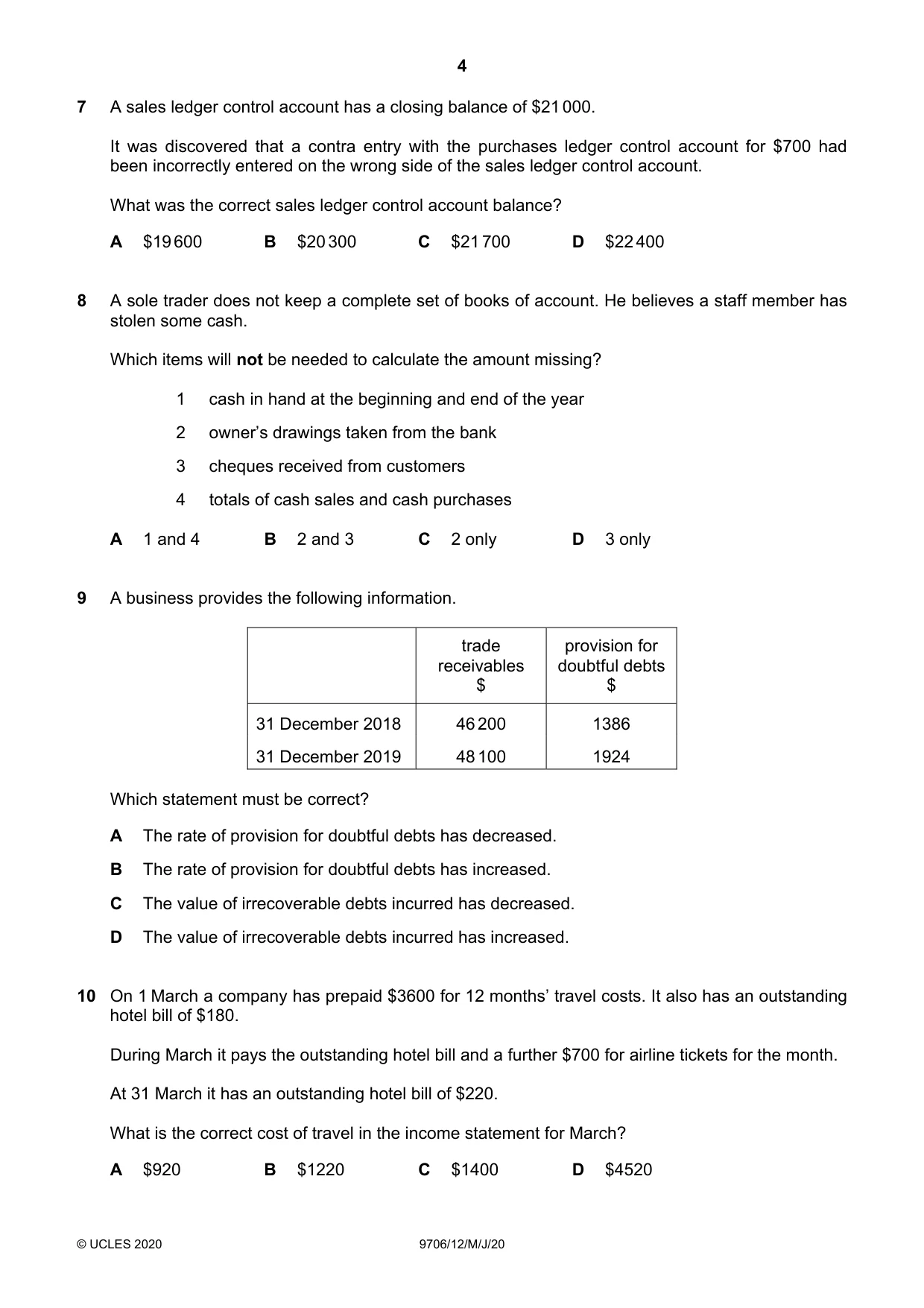
7 A sales ledger control account has a closing balance of $21 000. It was discovered that a contra entry with the purchases ledger control account for $700 had been incorrectly entered on the wrong side of the sales ledger control account. What was the correct sales ledger control account balance? A $19 600 B $20 300 C $21 700 D $22 400
Mark scheme: A
Q8 · A sole trader does not keep a complete set of books of account
8 A sole trader does not keep a complete set of books of account. He believes a staff member has stolen some cash. Which items will not be needed to calculate the amount missing? 1 cash in hand at the beginning and end of the year 2 owner’s drawings taken from the bank 3 cheques received from customers 4 totals of cash sales and cash purchases A 1 and 4 B 2 and 3 C 2 only D 3 only
Mark scheme: B
Q9 · A business provides the following information
9 A business provides the following information. trade provision for receivables doubtful debts $ $ 31 December 2018 46 200 1386 31 December 2019 48 100 1924 Which statement must be correct? A The rate of provision for doubtful debts has decreased. B The rate of provision for doubtful debts has increased. C The value of irrecoverable debts incurred has decreased. D The value of irrecoverable debts incurred has increased.
Mark scheme: B
Q10 · On 1 March a company has prepaid $3600 for 12 months’ travel costs
10 On 1 March a company has prepaid $3600 for 12 months’ travel costs. It also has an outstanding hotel bill of $180. During March it pays the outstanding hotel bill and a further $700 for airline tickets for the month. At 31 March it has an outstanding hotel bill of $220. What is the correct cost of travel in the income statement for March? A $920 B $1220 C $1400 D $4520
Mark scheme: B
Q11 · A business owner provided the following information at the end of his first year of…
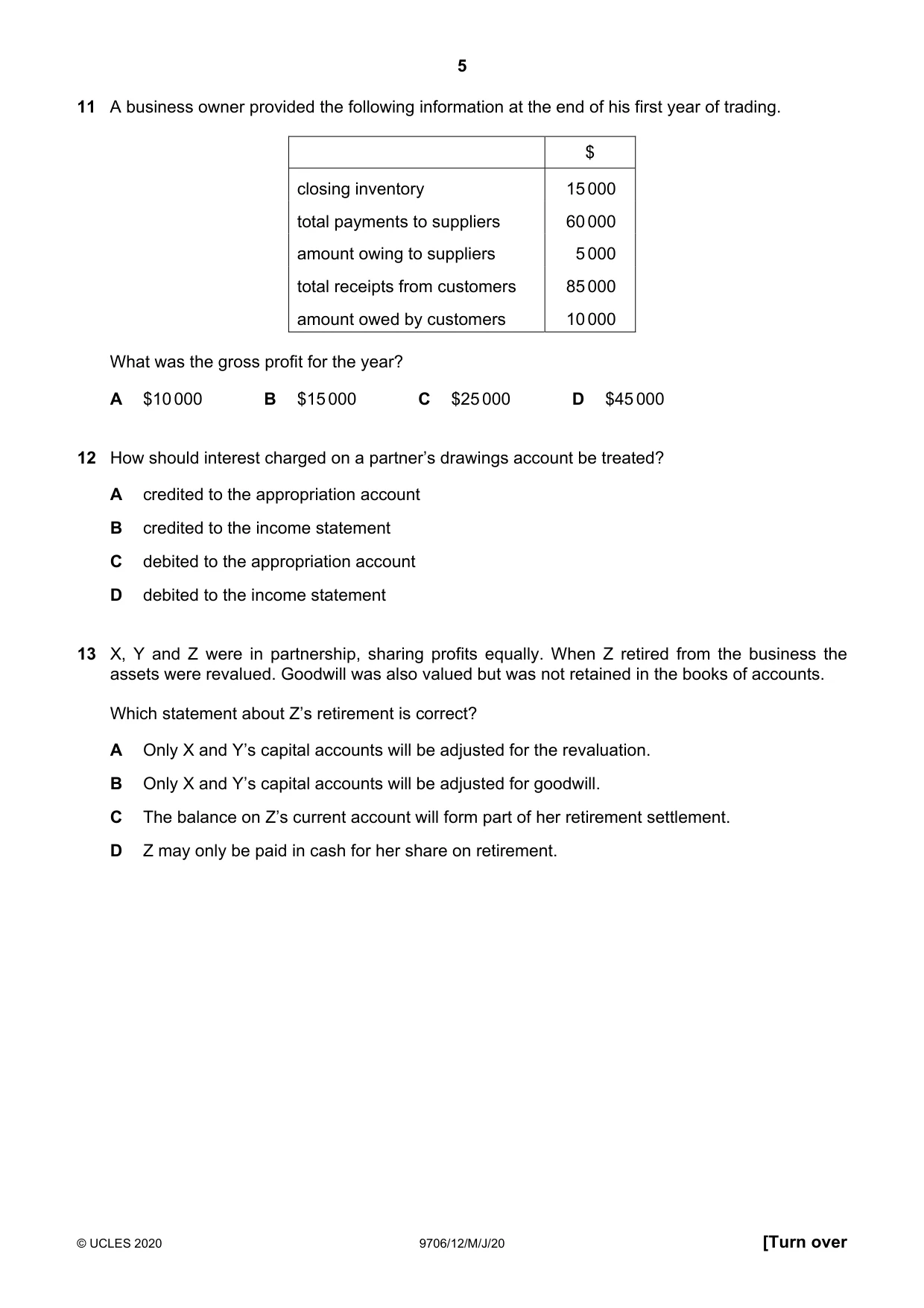
11 A business owner provided the following information at the end of his first year of trading. $ closing inventory 15 000 total payments to suppliers 60 000 amount owing to suppliers 5 000 total receipts from customers 85 000 amount owed by customers 10 000 What was the gross profit for the year? A $10 000 B $15 000 C $25 000 D $45 000
Mark scheme: D
Q12 · How should interest charged on a partner’s drawings account be treated?
12 How should interest charged on a partner’s drawings account be treated? A credited to the appropriation account B credited to the income statement C debited to the appropriation account D debited to the income statement
Mark scheme: A
Q13 · X, Y and Z were in partnership, sharing profits equally
13 X, Y and Z were in partnership, sharing profits equally. When Z retired from the business the assets were revalued. Goodwill was also valued but was not retained in the books of accounts. Which statement about Z’s retirement is correct? A Only X and Y’s capital accounts will be adjusted for the revaluation. B Only X and Y’s capital accounts will be adjusted for goodwill. C The balance on Z’s current account will form part of her retirement settlement. D Z may only be paid in cash for her share on retirement.
Mark scheme: C
Q14 · L and M are in partnership, sharing profits and losses in the ratio of 3 : 2
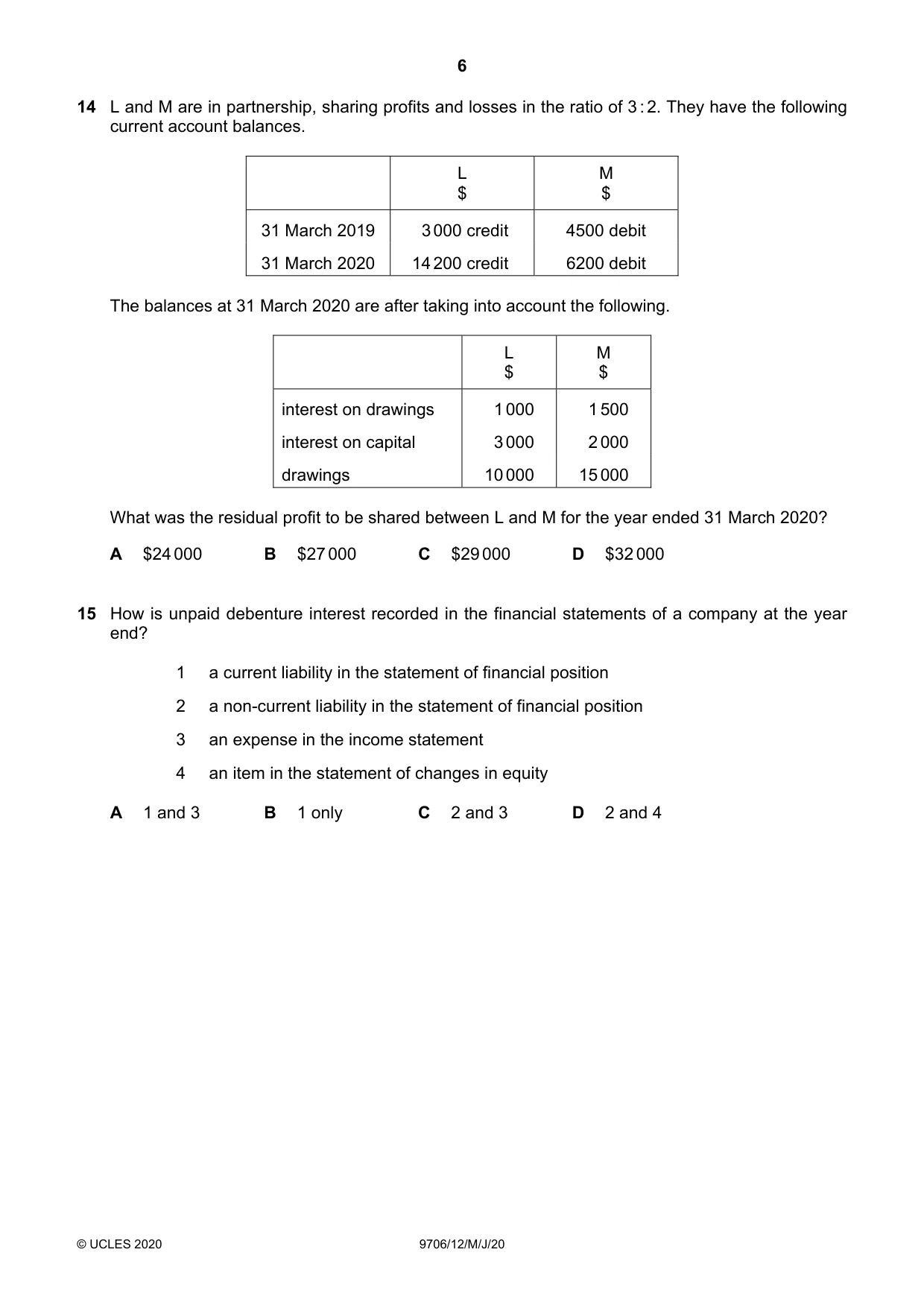
14 L and M are in partnership, sharing profits and losses in the ratio of 3 : 2. They have the following current account balances. L M $ $ 31 March 2019 3 000 credit 4500 debit 31 March 2020 14 200 credit 6200 debit The balances at 31 March 2020 are after taking into account the following. L M $ $ interest on drawings 1 000 1 500 interest on capital 3 000 2 000 drawings 10 000 15 000 What was the residual profit to be shared between L and M for the year ended 31 March 2020? A $24 000 B $27 000 C $29 000 D $32 000
Mark scheme: D
Q15 · How is unpaid debenture interest recorded in the financial statements of a company at the…
15 How is unpaid debenture interest recorded in the financial statements of a company at the year end? 1 a current liability in the statement of financial position 2 a non-current liability in the statement of financial position 3 an expense in the income statement 4 an item in the statement of changes in equity A 1 and 3 B 1 only C 2 and 3 D 2 and 4
Mark scheme: A
Q16 · On 1 December 2019 a company’s statement of financial position included the following
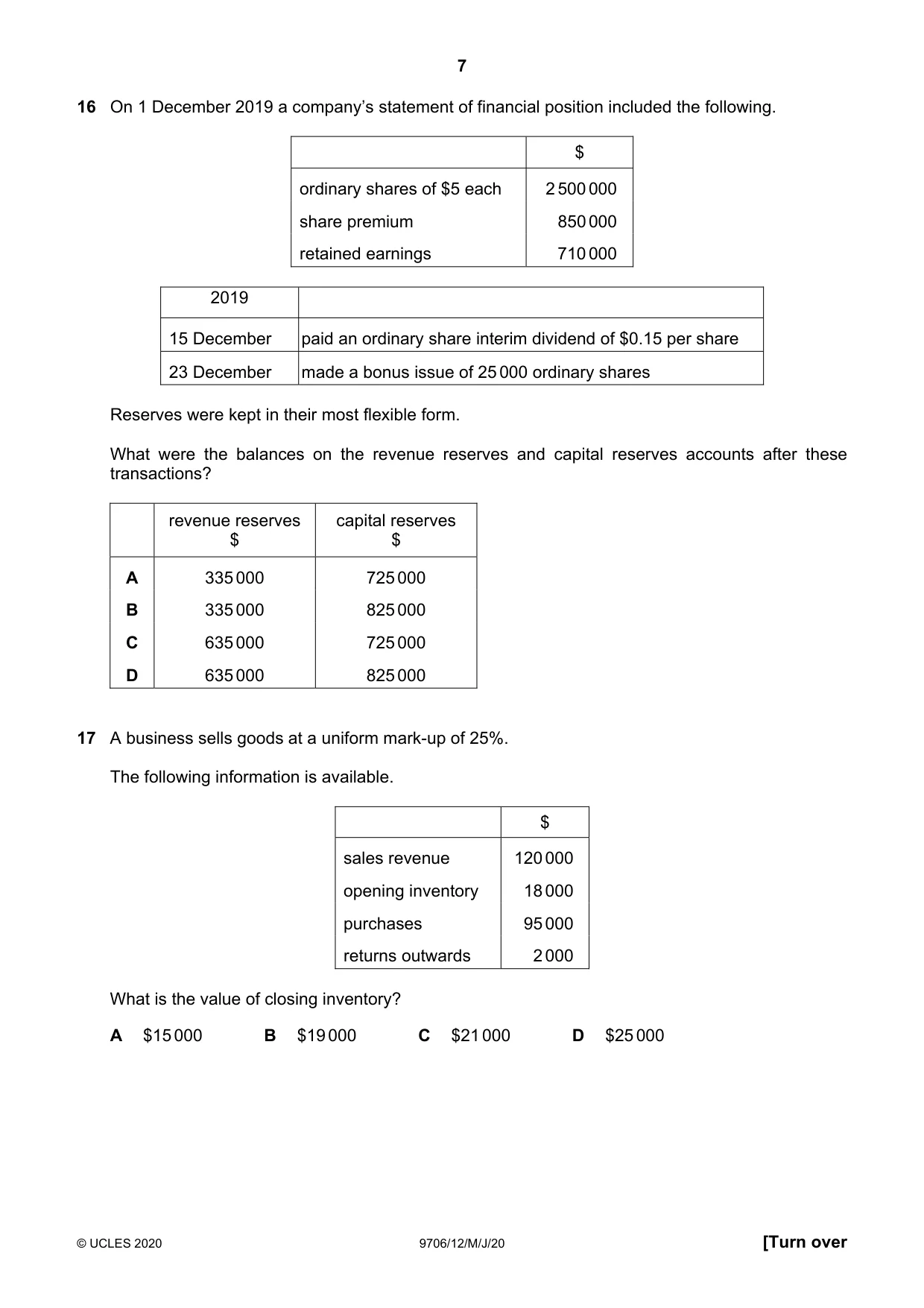
16 On 1 December 2019 a company’s statement of financial position included the following. $ ordinary shares of $5 each 2 500 000 share premium 850 000 retained earnings 710 000 2019 15 December paid an ordinary share interim dividend of $0.15 per share 23 December made a bonus issue of 25 000 ordinary shares Reserves were kept in their most flexible form. What were the balances on the revenue reserves and capital reserves accounts after these transactions? revenue reserves capital reserves $ $ A 335 000 725 000 B 335 000 825 000 C 635 000 725 000 D 635 000 825 000
Mark scheme: C
Q17 · A business sells goods at a uniform mark-up of 25%
17 A business sells goods at a uniform mark-up of 25%. The following information is available. $ sales revenue 120 000 opening inventory 18 000 purchases 95 000 returns outwards 2 000 What is the value of closing inventory? A $15 000 B $19 000 C $21 000 D $25 000
Mark scheme: A
Q18 · The rate of inventory turnover of a company has been calculated for two successive periods
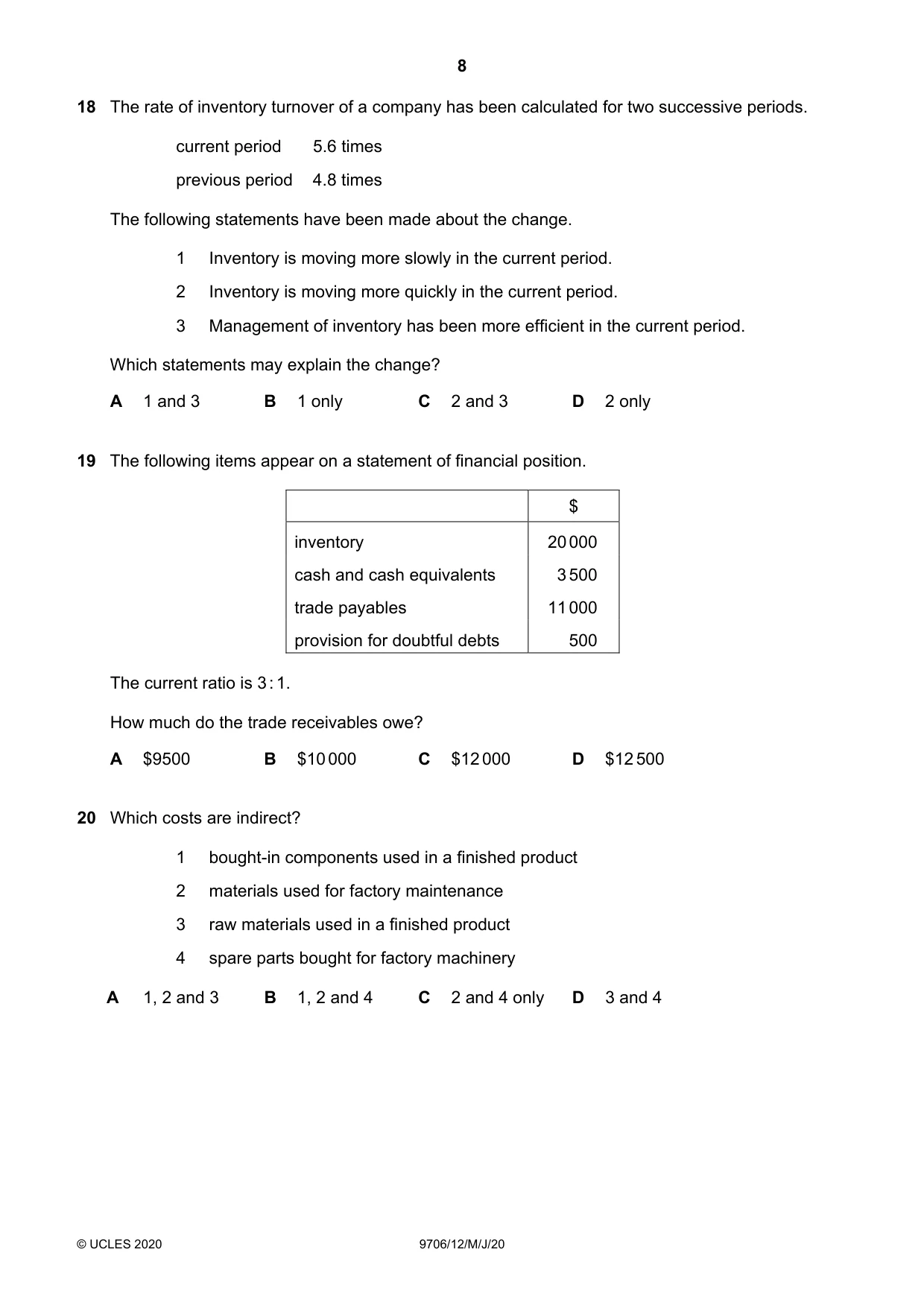
18 The rate of inventory turnover of a company has been calculated for two successive periods. current period 5.6 times previous period 4.8 times The following statements have been made about the change. 1 Inventory is moving more slowly in the current period. 2 Inventory is moving more quickly in the current period. 3 Management of inventory has been more efficient in the current period. Which statements may explain the change? A 1 and 3 B 1 only C 2 and 3 D 2 only
Mark scheme: C
More questions on Analysis and communication of accounting information
Q19 · The following items appear on a statement of financial position
19 The following items appear on a statement of financial position. $ inventory 20 000 cash and cash equivalents 3 500 trade payables 11 000 provision for doubtful debts 500 The current ratio is 3 : 1. How much do the trade receivables owe? A $9500 B $10 000 C $12 000 D $12 500
Mark scheme: B
More questions on Analysis and communication of accounting information
Q20 · Which costs are indirect?
20 Which costs are indirect? 1 bought-in components used in a finished product 2 materials used for factory maintenance 3 raw materials used in a finished product 4 spare parts bought for factory machinery A 1, 2 and 3 B 1, 2 and 4 C 2 and 4 only D 3 and 4
Mark scheme: C
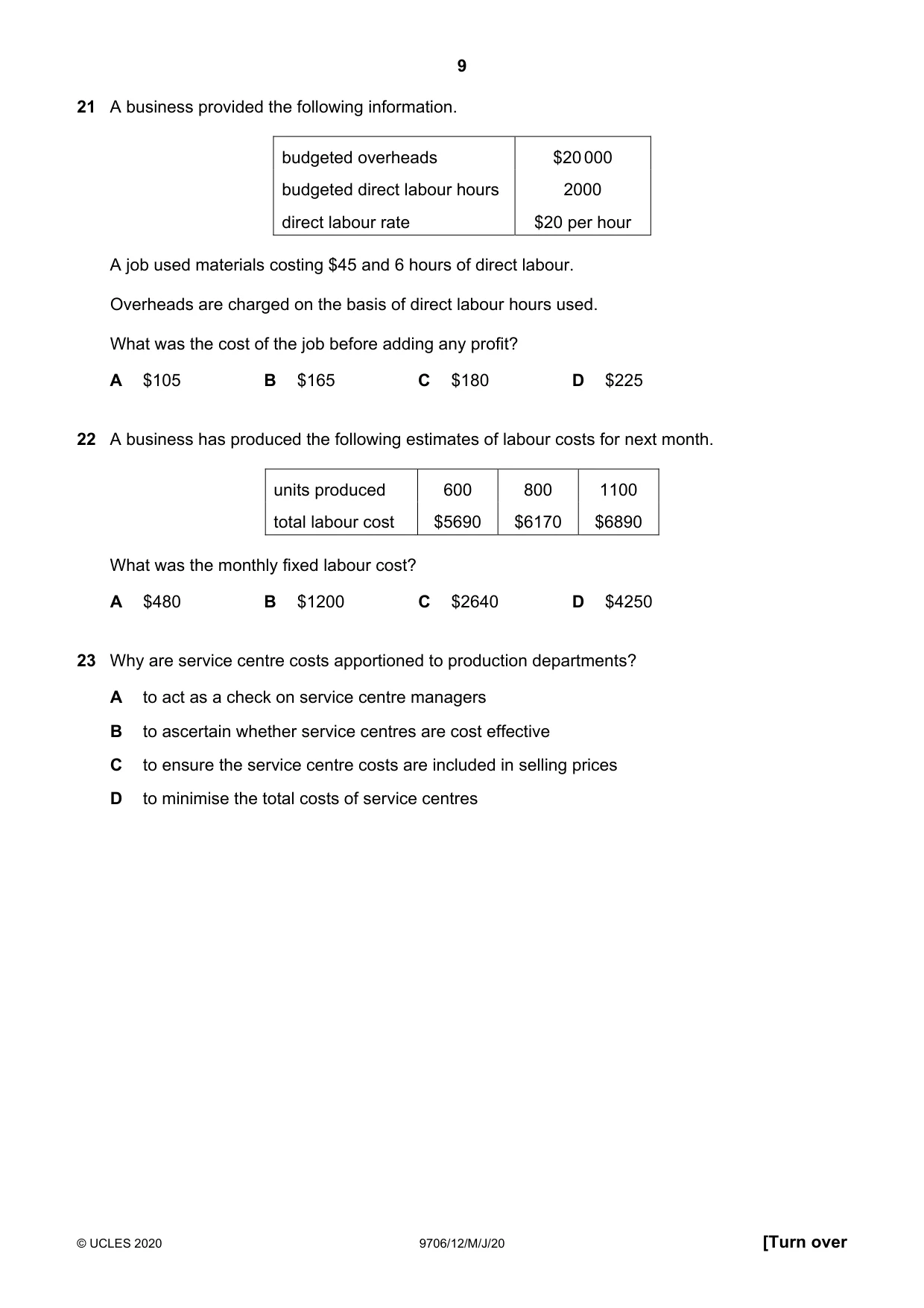
Q21 · A business provided the following information
21 A business provided the following information. budgeted overheads $20 000 budgeted direct labour hours 2000 direct labour rate $20 per hour A job used materials costing $45 and 6 hours of direct labour. Overheads are charged on the basis of direct labour hours used. What was the cost of the job before adding any profit? A $105 B $165 C $180 D $225
Mark scheme: D
Q22 · A business has produced the following estimates of labour costs for next month
22 A business has produced the following estimates of labour costs for next month. units produced 600 800 1100 total labour cost $5690 $6170 $6890 What was the monthly fixed labour cost? A $480 B $1200 C $2640 D $4250
Mark scheme: D
Q23 · Why are service centre costs apportioned to production departments?
23 Why are service centre costs apportioned to production departments? A to act as a check on service centre managers B to ascertain whether service centres are cost effective C to ensure the service centre costs are included in selling prices D to minimise the total costs of service centres
Mark scheme: C
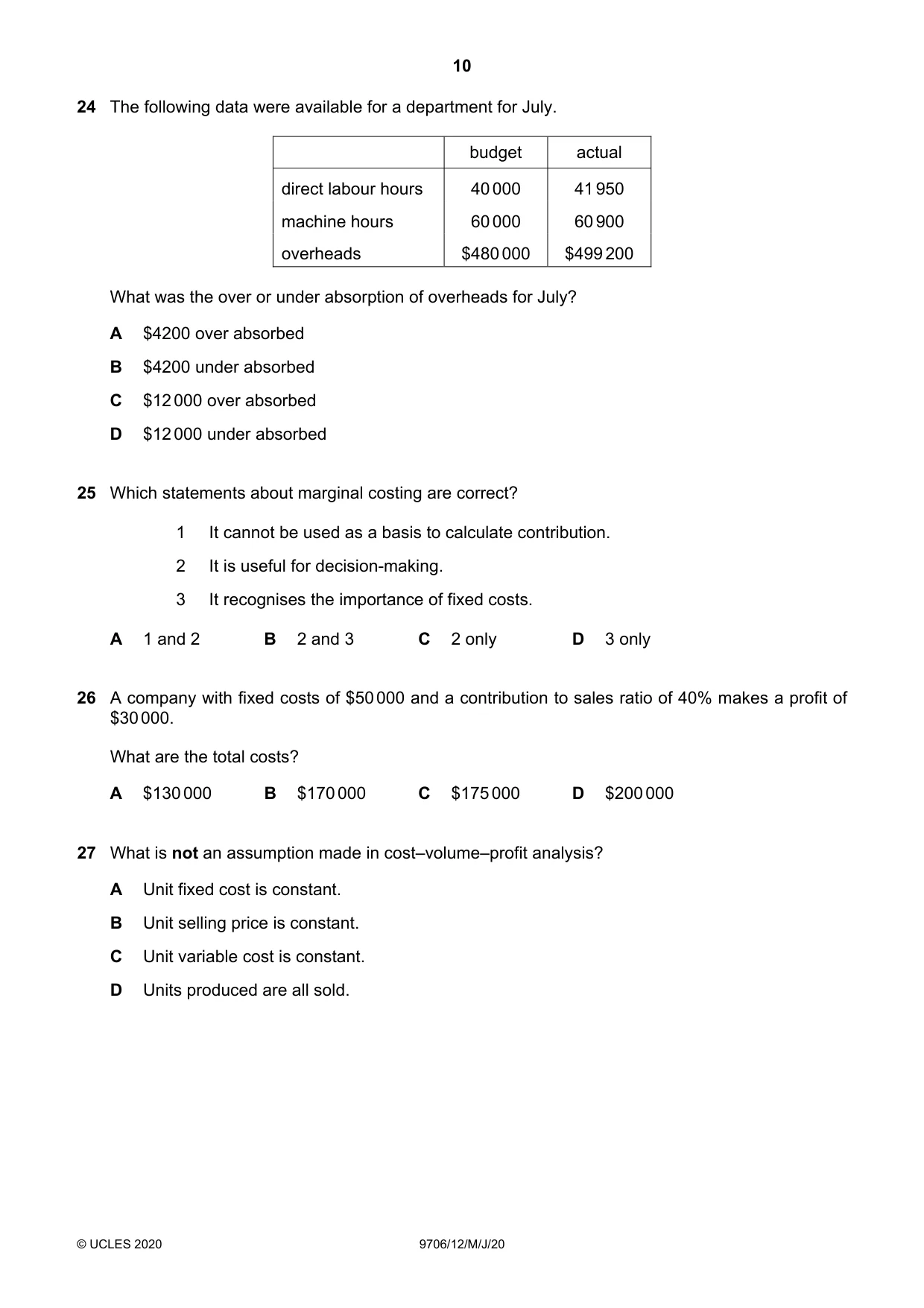
Q24 · The following data were available for a department for July
24 The following data were available for a department for July. budget actual direct labour hours 40 000 41 950 machine hours 60 000 60 900 overheads $480 000 $499 200 What was the over or under absorption of overheads for July? A $4200 over absorbed B $4200 under absorbed C $12 000 over absorbed D $12 000 under absorbed
Mark scheme: D
Q25 · Which statements about marginal costing are correct?
25 Which statements about marginal costing are correct? 1 It cannot be used as a basis to calculate contribution. 2 It is useful for decision-making. 3 It recognises the importance of fixed costs. A 1 and 2 B 2 and 3 C 2 only D 3 only
Mark scheme: C
Q26 · A company with fixed costs of $50 000 and a contribution to sales ratio of 40% makes a…
26 A company with fixed costs of $50 000 and a contribution to sales ratio of 40% makes a profit of $30 000. What are the total costs? A $130 000 B $170 000 C $175 000 D $200 000
Mark scheme: B
Q27 · What is not an assumption made in cost–volume–profit analysis?
27 What is not an assumption made in cost–volume–profit analysis? A Unit fixed cost is constant. B Unit selling price is constant. C Unit variable cost is constant. D Units produced are all sold.
Mark scheme: A
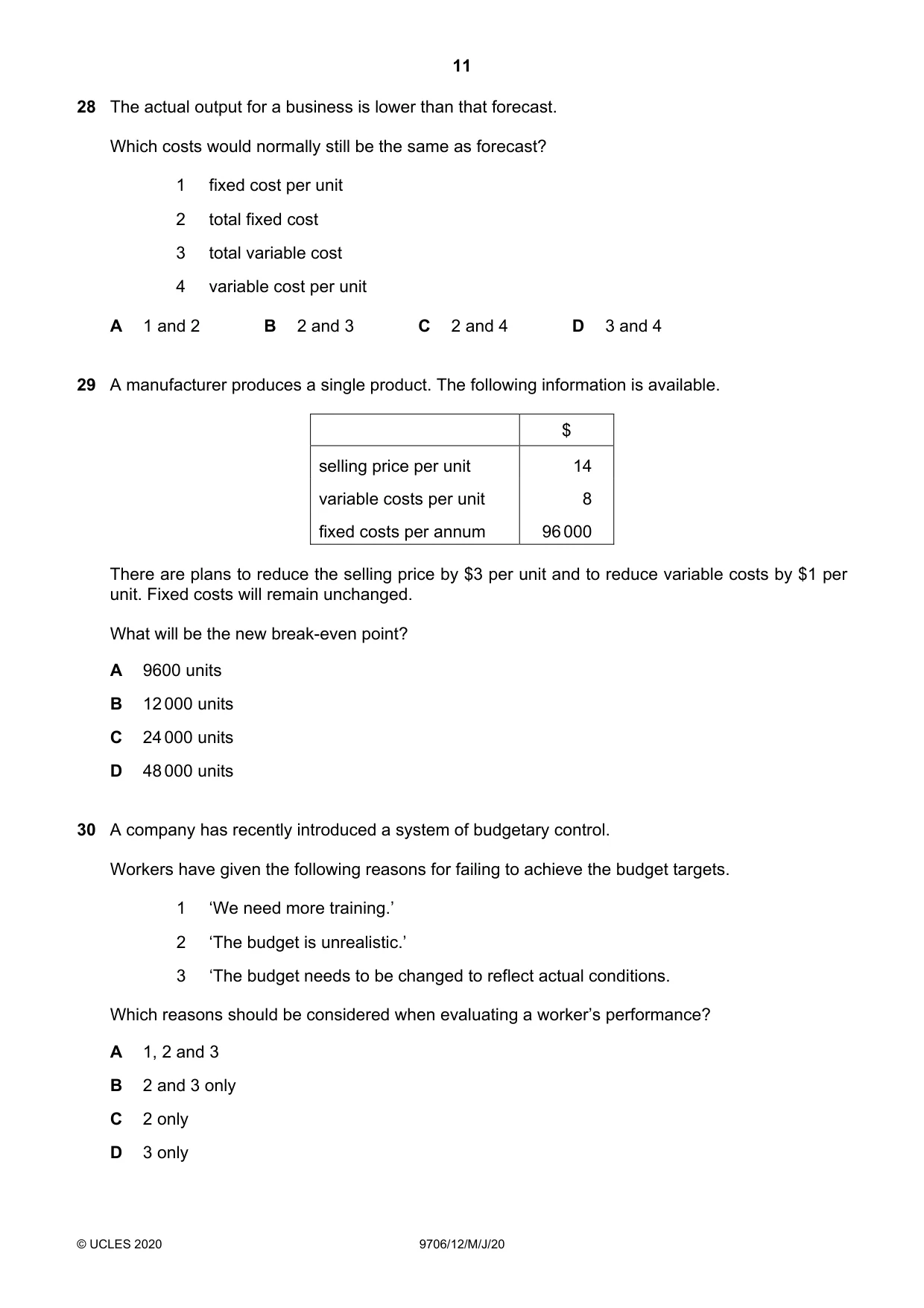
Q28 · The actual output for a business is lower than that forecast
28 The actual output for a business is lower than that forecast. Which costs would normally still be the same as forecast? 1 fixed cost per unit 2 total fixed cost 3 total variable cost 4 variable cost per unit A 1 and 2 B 2 and 3 C 2 and 4 D 3 and 4
Mark scheme: C
Q29 · A manufacturer produces a single product
29 A manufacturer produces a single product. The following information is available. $ selling price per unit 14 variable costs per unit 8 fixed costs per annum 96 000 There are plans to reduce the selling price by $3 per unit and to reduce variable costs by $1 per unit. Fixed costs will remain unchanged. What will be the new break-even point? A 9600 units B 12 000 units C 24 000 units D 48 000 units
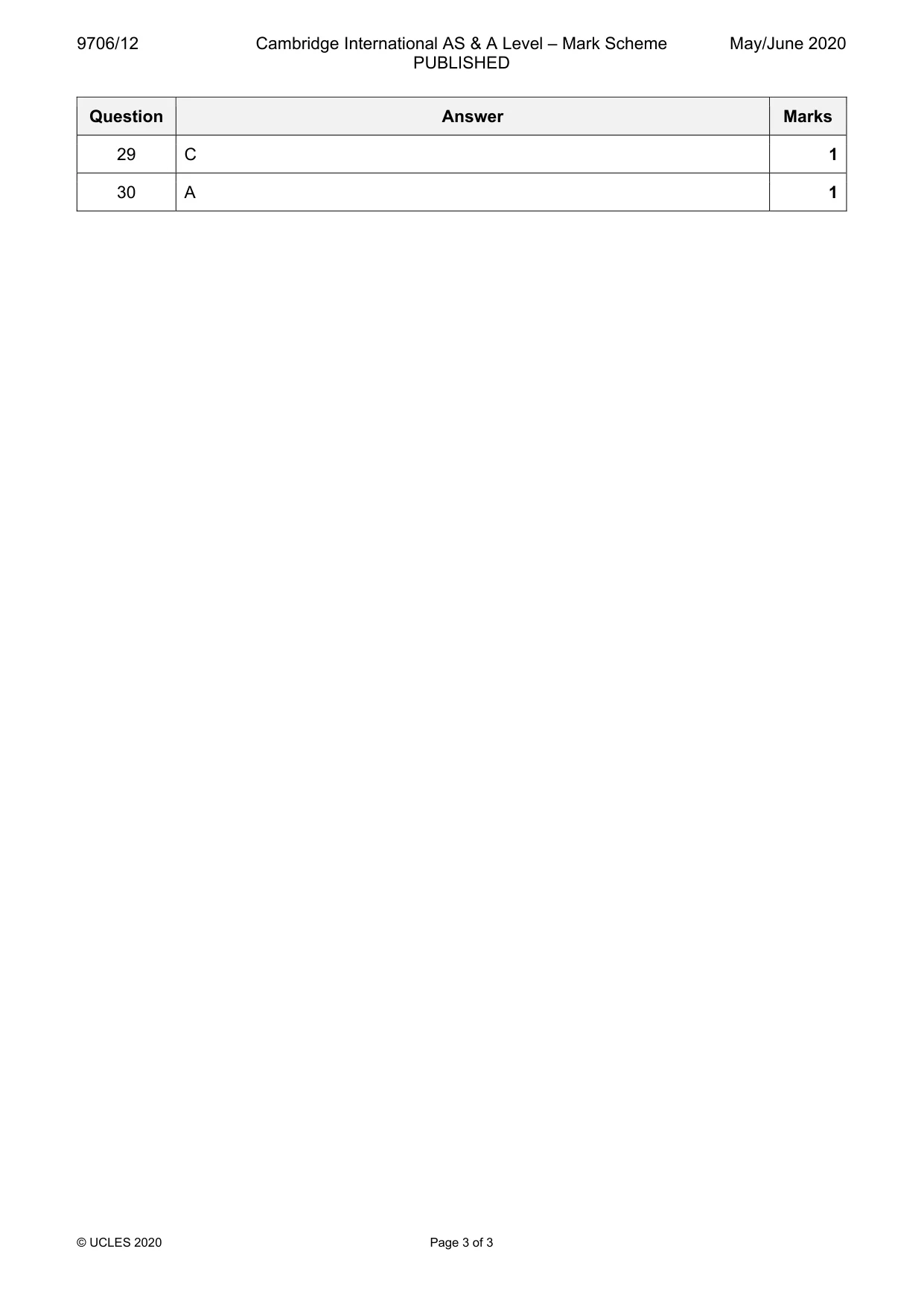
Mark scheme: C
Q30 · A company has recently introduced a system of budgetary control
30 A company has recently introduced a system of budgetary control. Workers have given the following reasons for failing to achieve the budget targets. 1 ‘We need more training.’ 2 ‘The budget is unrealistic.’ 3 ‘The budget needs to be changed to reflect actual conditions. Which reasons should be considered when evaluating a worker’s performance? A 1, 2 and 3 B 2 and 3 only C 2 only D 3 only
Mark scheme: A
What was in this paper
The subtopics covered by these 30 questions, and how many questions each got. Open one in a new tab to see every Cambridge question on it.
7Preparation of financial statements5Preparation of financial statements5Costs and cost behaviour3Reconciliation and verification3Accounting for non-current assets2Analysis and communication of accounting information2Budgeting and budgetary control1Regulatory and ethical considerations1Types of business entity1