Cambridge A Level Accounting 9706 — 2015 May/June Paper 1 · Variant 3
9706/13/M/J/15 · 30 questions · 30 marks · ≈34 min
The question paper and its mark scheme, free to read here and free to download. This is Cambridge’s own paper, exactly as it was sat.
Question paper12 pages
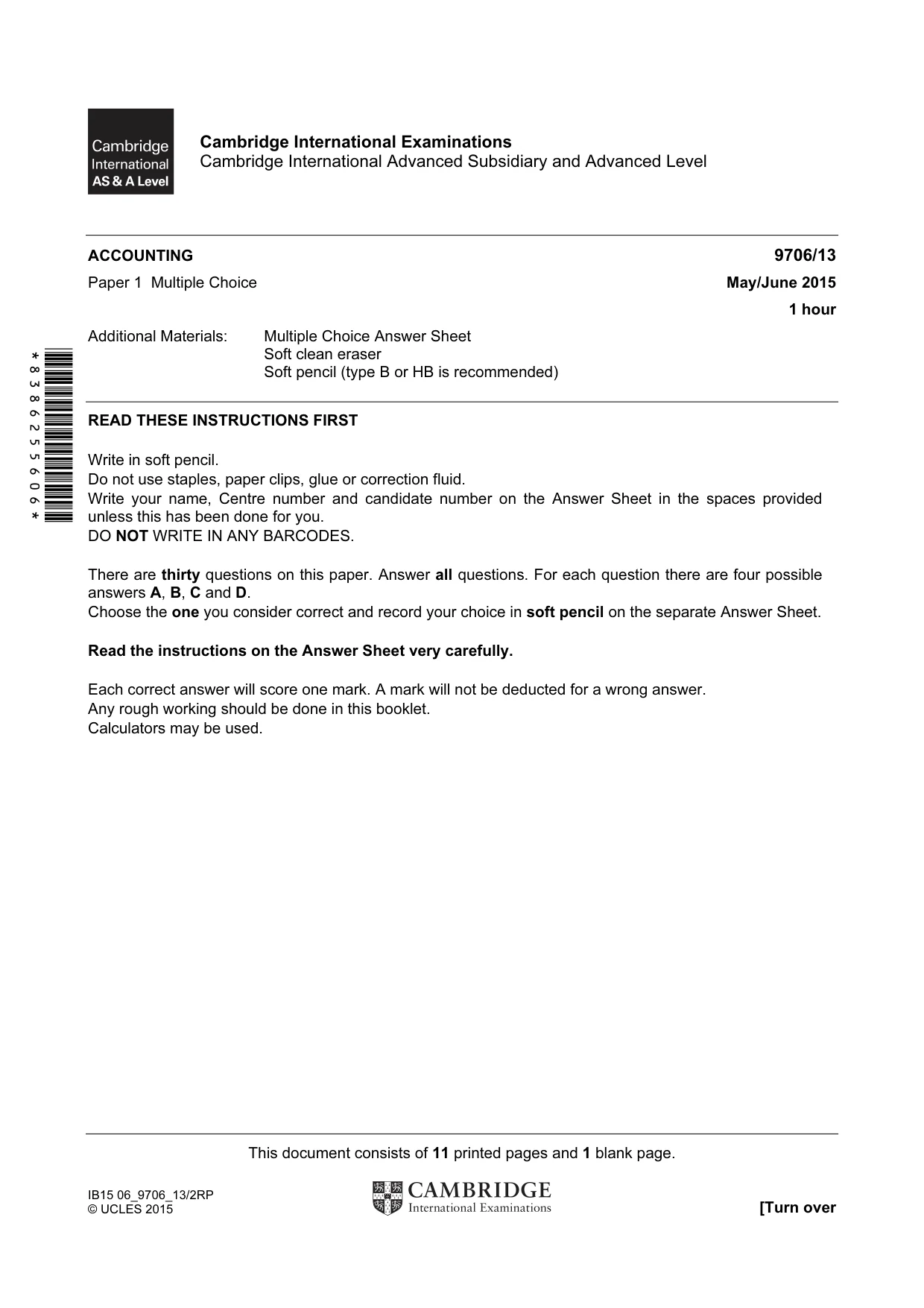
Mark scheme2 pages
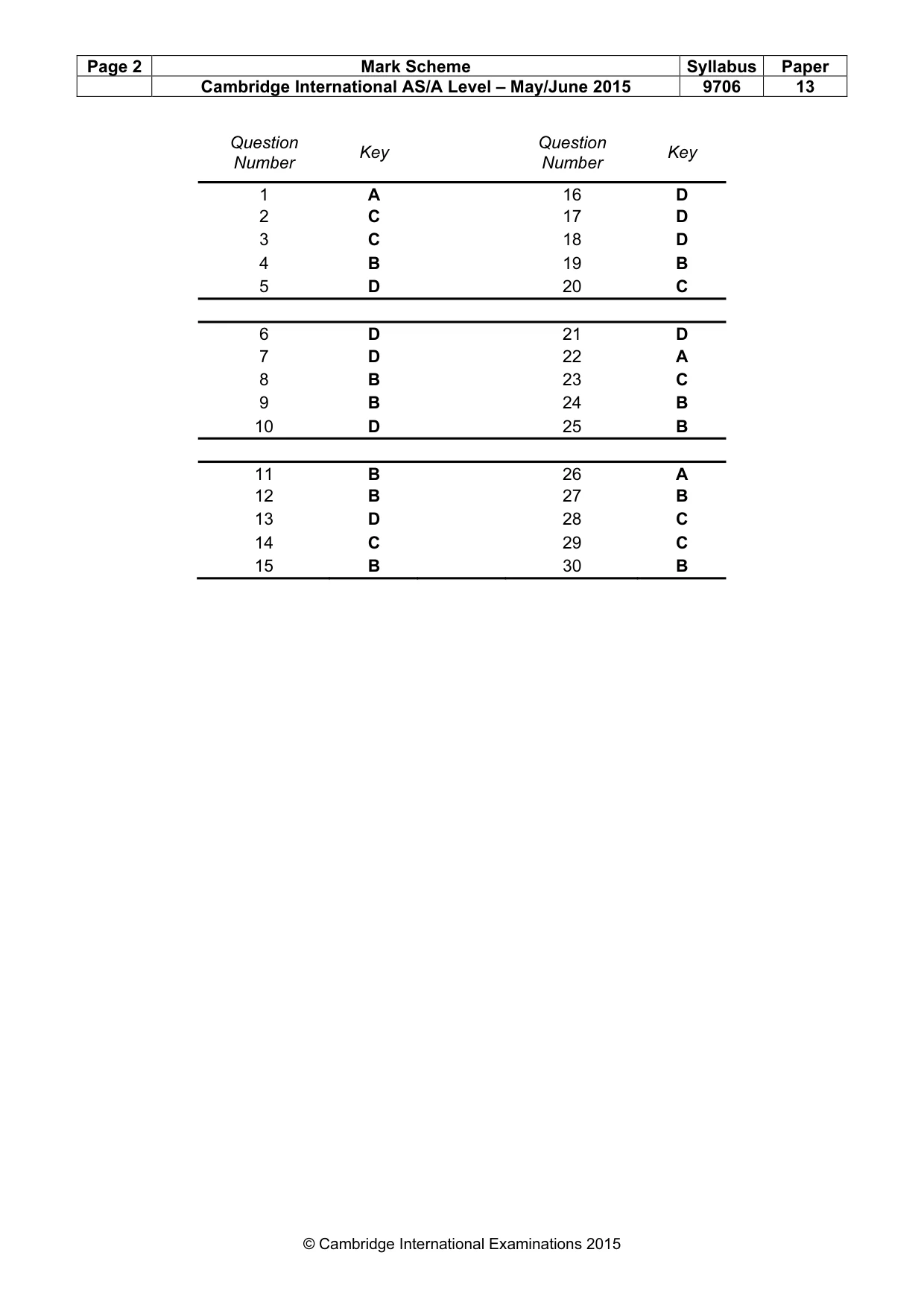
Answers below. Sit the paper first if you are practising.
Questions as text
Q1 · Which item should be treated as capital expenditure?
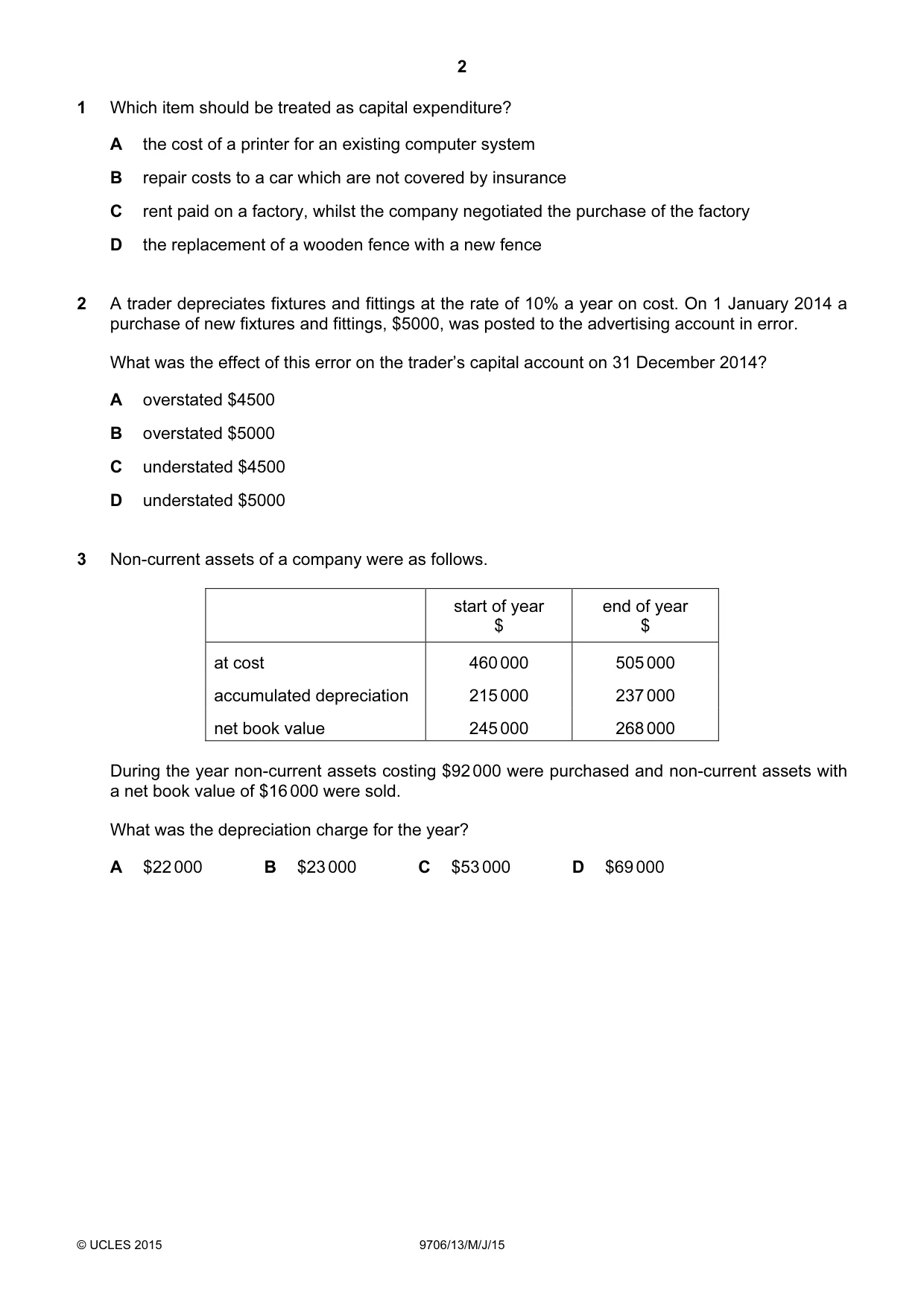
1 Which item should be treated as capital expenditure? A the cost of a printer for an existing computer system B repair costs to a car which are not covered by insurance C rent paid on a factory, whilst the company negotiated the purchase of the factory D the replacement of a wooden fence with a new fence
Mark scheme: A
Q2 · A trader depreciates fixtures and fittings at the rate of 10% a year on cost
2 A trader depreciates fixtures and fittings at the rate of 10% a year on cost. On 1 January 2014 a purchase of new fixtures and fittings, $5000, was posted to the advertising account in error. What was the effect of this error on the trader’s capital account on 31 December 2014? A overstated $4500 B overstated $5000 C understated $4500 D understated $5000
Mark scheme: C
Q3 · Non-current assets of a company were as follows
3 Non-current assets of a company were as follows. start of year end of year $ $ at cost 460 000 505 000 accumulated depreciation 215 000 237 000 net book value 245 000 268 000 During the year non-current assets costing $92 000 were purchased and non-current assets with a net book value of $16 000 were sold. What was the depreciation charge for the year? A $22 000 B $23 000 C $53 000 D $69 000
Mark scheme: C
Q4 · A business provides the following information
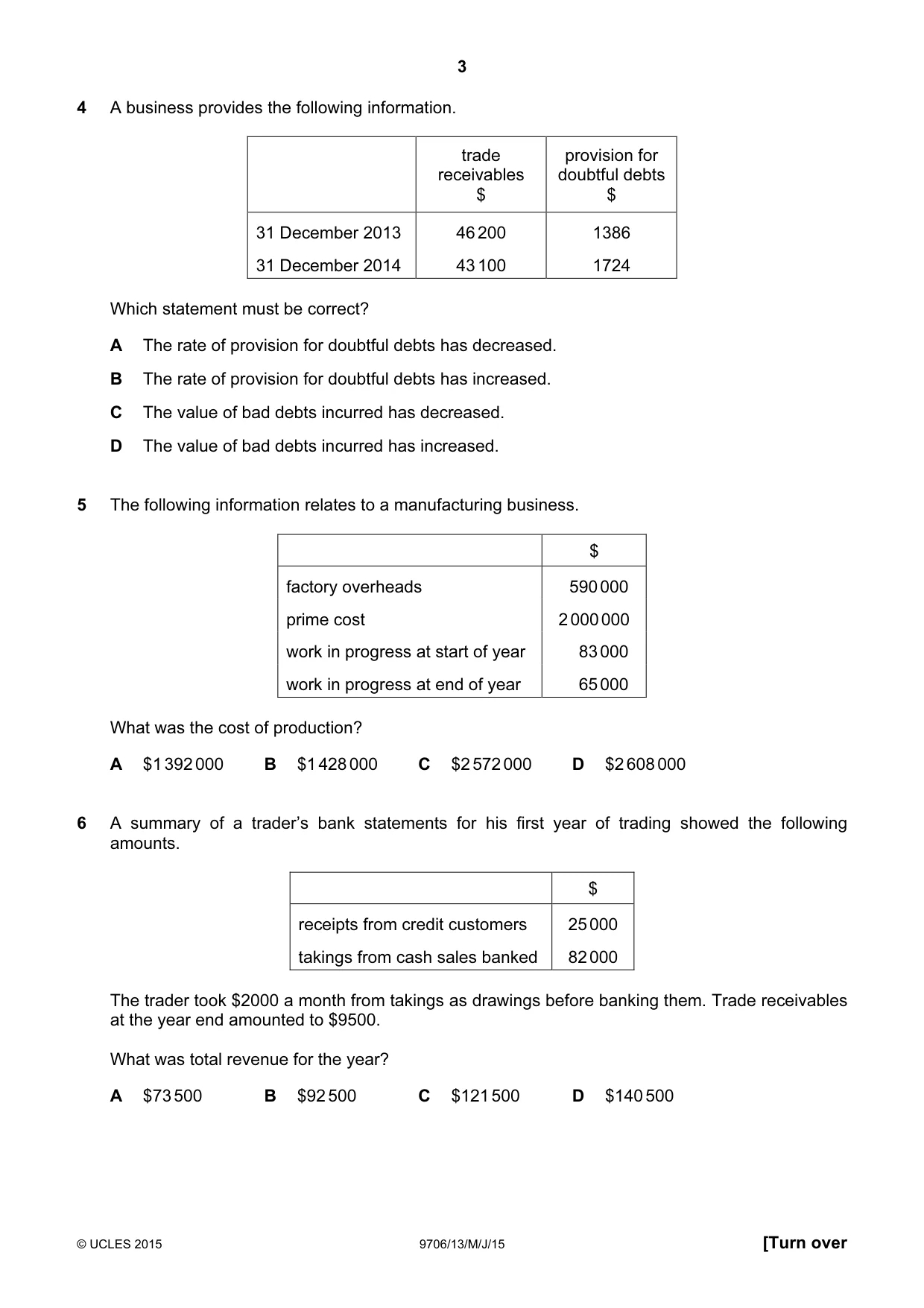
4 A business provides the following information. trade provision for receivables doubtful debts $ $ 31 December 2013 46 200 1386 31 December 2014 43 100 1724 Which statement must be correct? A The rate of provision for doubtful debts has decreased. B The rate of provision for doubtful debts has increased. C The value of bad debts incurred has decreased. D The value of bad debts incurred has increased.
Mark scheme: B
Q5 · The following information relates to a manufacturing business
5 The following information relates to a manufacturing business. $ factory overheads 590 000 prime cost 2 000 000 work in progress at start of year 83 000 work in progress at end of year 65 000 What was the cost of production? A $1 392 000 B $1 428 000 C $2 572 000 D $2 608 000
Mark scheme: D
Q6 · A summary of a trader’s bank statements for his first year of trading showed the…
6 A summary of a trader’s bank statements for his first year of trading showed the following amounts. $ receipts from credit customers 25 000 takings from cash sales banked 82 000 The trader took $2000 a month from takings as drawings before banking them. Trade receivables at the year end amounted to $9500. What was total revenue for the year? A $73 500 B $92 500 C $121 500 D $140 500
Mark scheme: D
Q7 · A business uses the AVCO method of inventory valuation
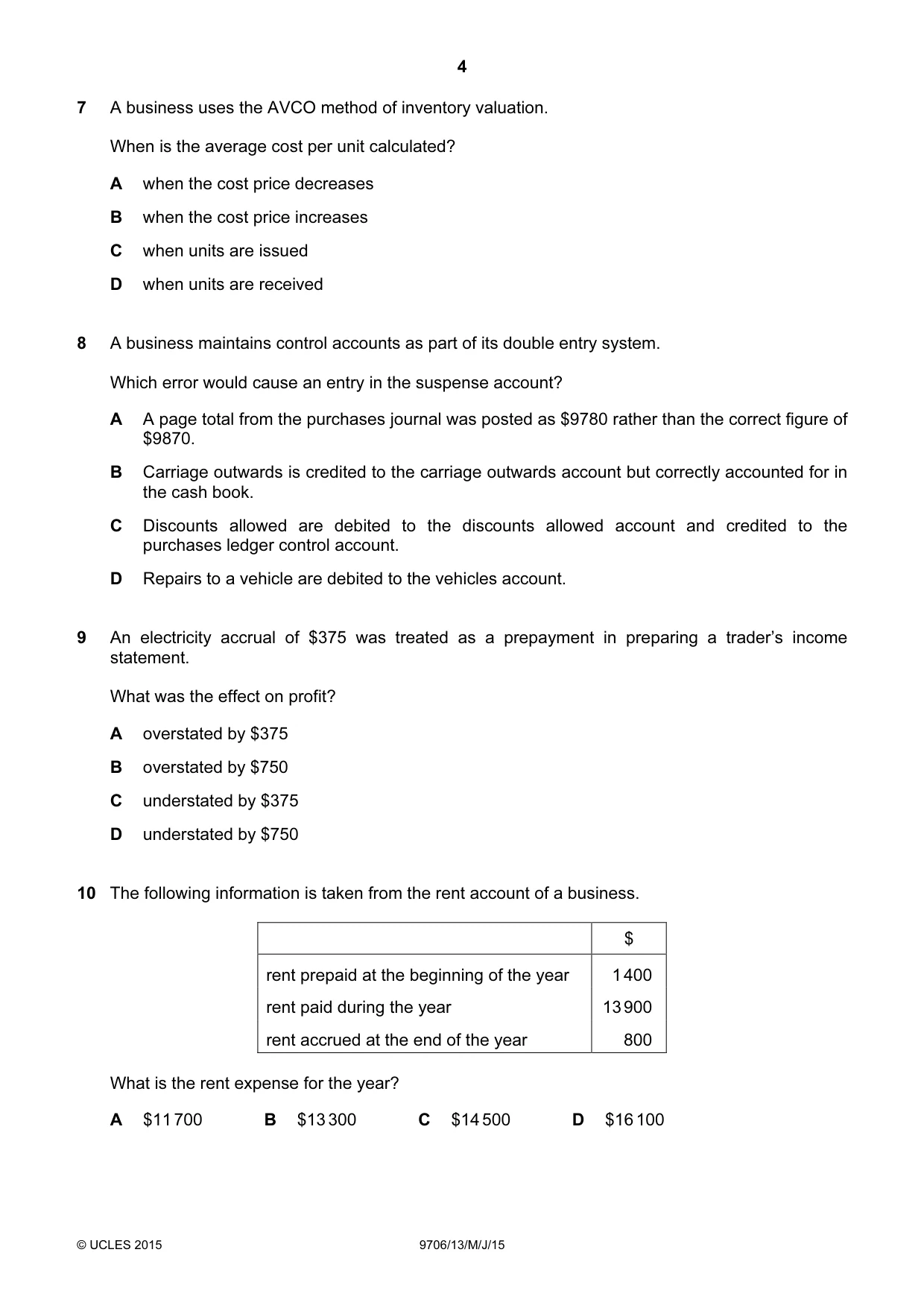
7 A business uses the AVCO method of inventory valuation. When is the average cost per unit calculated? A when the cost price decreases B when the cost price increases C when units are issued D when units are received
Mark scheme: D
Q8 · A business maintains control accounts as part of its double entry system
8 A business maintains control accounts as part of its double entry system. Which error would cause an entry in the suspense account? A A page total from the purchases journal was posted as $9780 rather than the correct figure of $9870. B Carriage outwards is credited to the carriage outwards account but correctly accounted for in the cash book. C Discounts allowed are debited to the discounts allowed account and credited to the purchases ledger control account. D Repairs to a vehicle are debited to the vehicles account.
Mark scheme: B
Q9 · An electricity accrual of $375 was treated as a prepayment in preparing a trader’s income…
9 An electricity accrual of $375 was treated as a prepayment in preparing a trader’s income statement. What was the effect on profit? A overstated by $375 B overstated by $750 C understated by $375 D understated by $750
Mark scheme: B
Q10 · The following information is taken from the rent account of a business
10 The following information is taken from the rent account of a business. $ rent prepaid at the beginning of the year 1 400 rent paid during the year 13 900 rent accrued at the end of the year 800 What is the rent expense for the year? A $11 700 B $13 300 C $14 500 D $16 100
Mark scheme: D
Q11 · A business has the following assets and liabilities at the start of the year
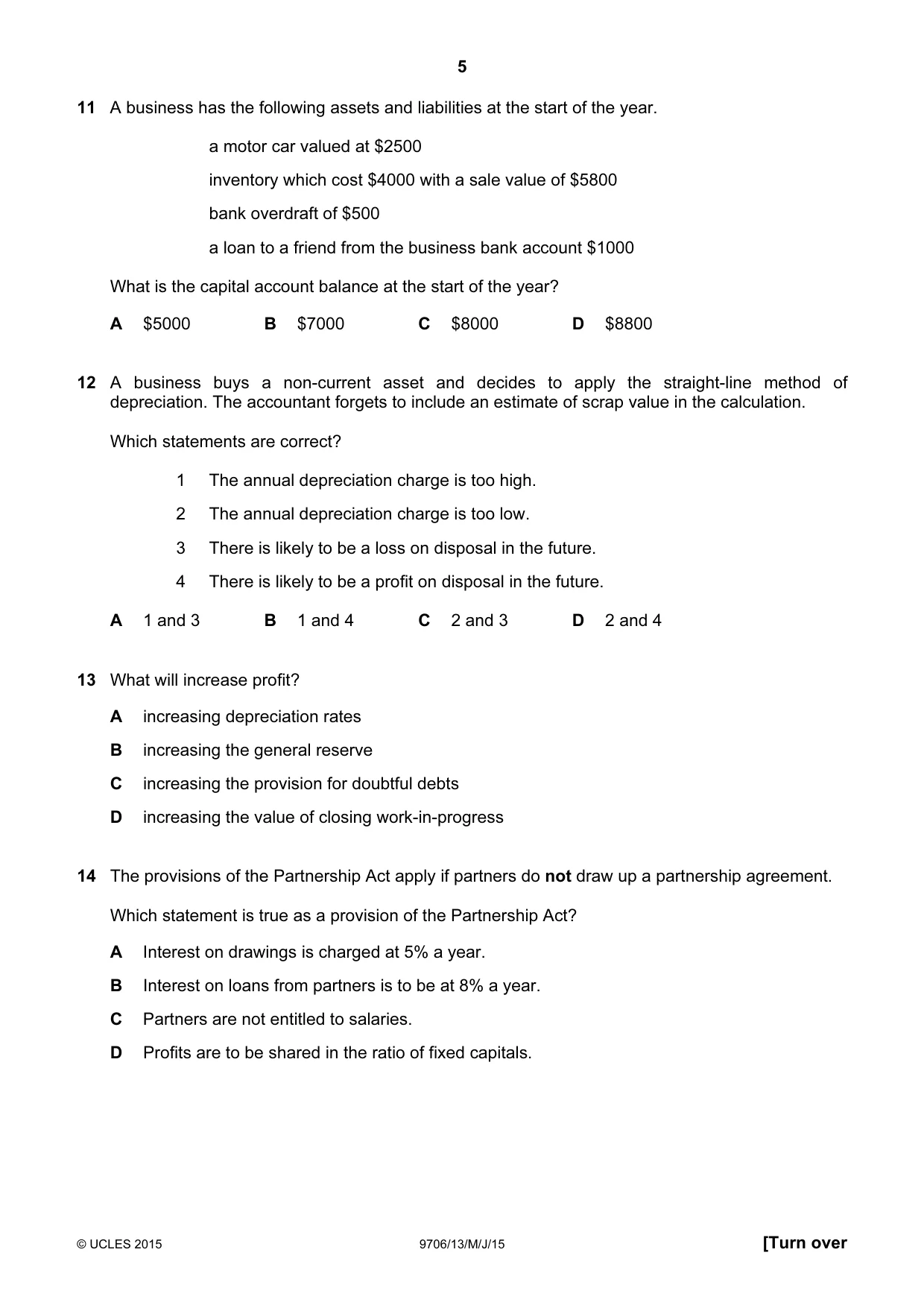
11 A business has the following assets and liabilities at the start of the year. a motor car valued at $2500 inventory which cost $4000 with a sale value of $5800 bank overdraft of $500 a loan to a friend from the business bank account $1000 What is the capital account balance at the start of the year? A $5000 B $7000 C $8000 D $8800
Mark scheme: B
Q12 · A business buys a non-current asset and decides to apply the straight-line method of…
12 A business buys a non-current asset and decides to apply the straight-line method of depreciation. The accountant forgets to include an estimate of scrap value in the calculation. Which statements are correct? 1 The annual depreciation charge is too high. 2 The annual depreciation charge is too low. 3 There is likely to be a loss on disposal in the future. 4 There is likely to be a profit on disposal in the future. A 1 and 3 B 1 and 4 C 2 and 3 D 2 and 4
Mark scheme: B
Q13 · What will increase profit?
13 What will increase profit? A increasing depreciation rates B increasing the general reserve C increasing the provision for doubtful debts D increasing the value of closing work-in-progress
Mark scheme: D
Q14 · The provisions of the Partnership Act apply if partners do not draw up a partnership…
14 The provisions of the Partnership Act apply if partners do not draw up a partnership agreement. Which statement is true as a provision of the Partnership Act? A Interest on drawings is charged at 5% a year. B Interest on loans from partners is to be at 8% a year. C Partners are not entitled to salaries. D Profits are to be shared in the ratio of fixed capitals.
Mark scheme: C
Q15 · Adil and Bashir are in partnership sharing profits and losses in the ratio 2 : 1
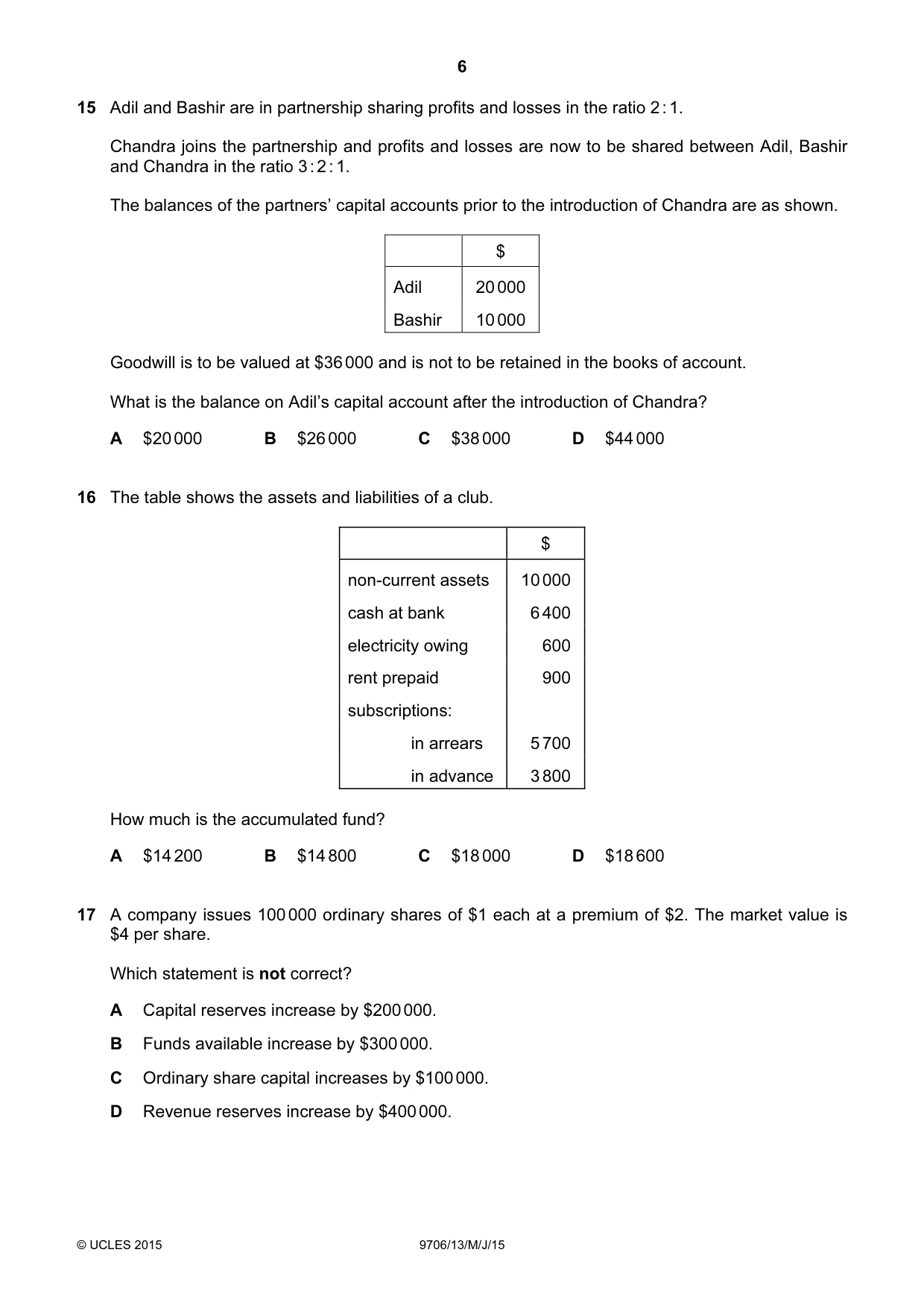
15 Adil and Bashir are in partnership sharing profits and losses in the ratio 2 : 1. Chandra joins the partnership and profits and losses are now to be shared between Adil, Bashir and Chandra in the ratio 3 : 2 : 1. The balances of the partners’ capital accounts prior to the introduction of Chandra are as shown. $ Adil 20 000 Bashir 10 000 Goodwill is to be valued at $36 000 and is not to be retained in the books of account. What is the balance on Adil’s capital account after the introduction of Chandra? A $20 000 B $26 000 C $38 000 D $44 000
Mark scheme: B
Q16 · The table shows the assets and liabilities of a club
16 The table shows the assets and liabilities of a club. $ non-current assets 10 000 cash at bank 6 400 electricity owing 600 rent prepaid 900 subscriptions: in arrears 5 700 in advance 3 800 How much is the accumulated fund? A $14 200 B $14 800 C $18 000 D $18 600
Mark scheme: D
Q17 · A company issues 100 000 ordinary shares of $1 each at a premium of $2
17 A company issues 100 000 ordinary shares of $1 each at a premium of $2. The market value is $4 per share. Which statement is not correct? A Capital reserves increase by $200 000. B Funds available increase by $300 000. C Ordinary share capital increases by $100 000. D Revenue reserves increase by $400 000.
Mark scheme: D
Q18 · A business provides the following information
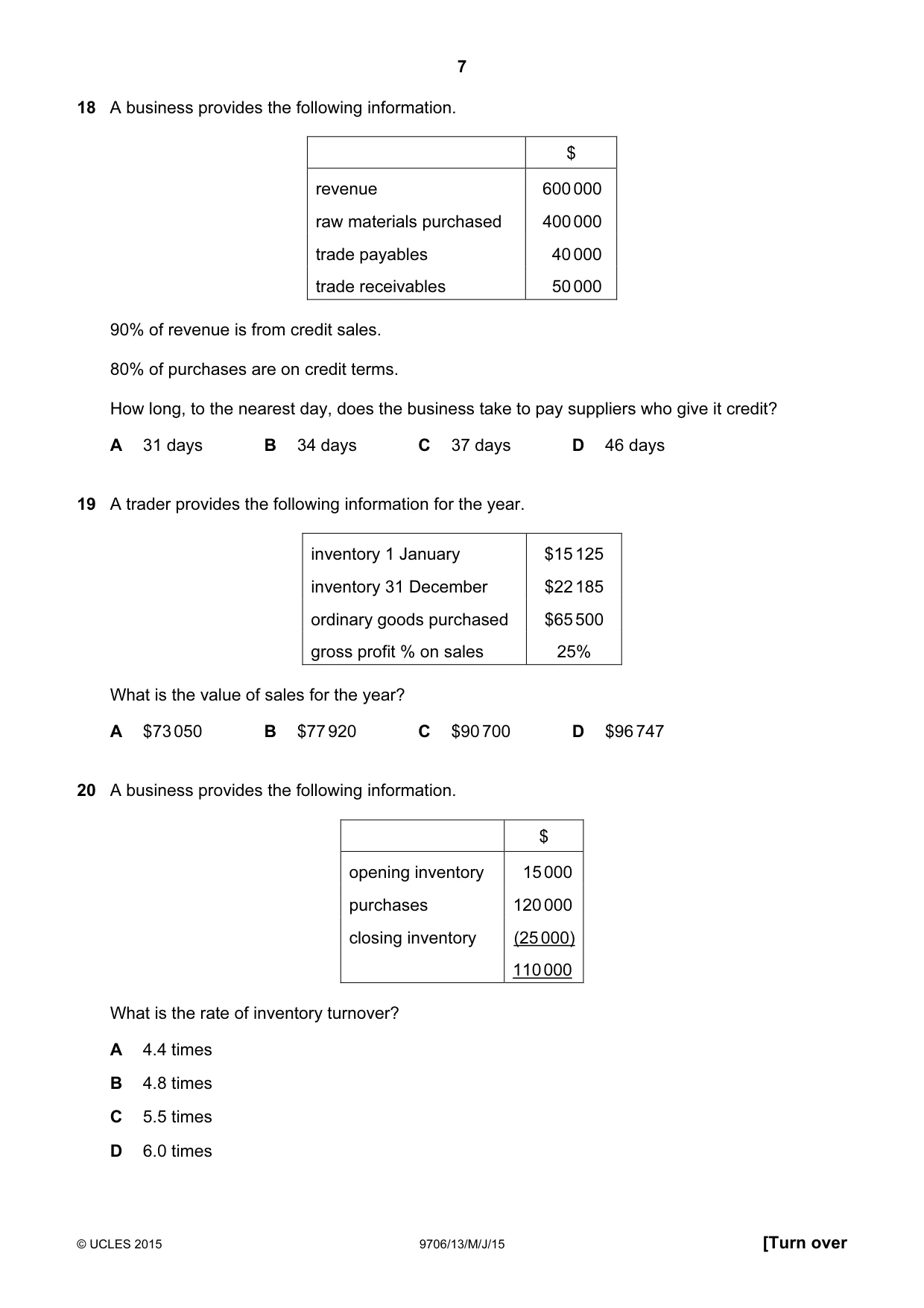
18 A business provides the following information. $ revenue 600 000 raw materials purchased 400 000 trade payables 40 000 trade receivables 50 000 90% of revenue is from credit sales. 80% of purchases are on credit terms. How long, to the nearest day, does the business take to pay suppliers who give it credit? A 31 days B 34 days C 37 days D 46 days
Mark scheme: D
More questions on Analysis and communication of accounting information
Q19 · A trader provides the following information for the year
19 A trader provides the following information for the year. inventory 1 January $15 125 inventory 31 December $22 185 ordinary goods purchased $65 500 gross profit % on sales 25% What is the value of sales for the year? A $73 050 B $77 920 C $90 700 D $96 747
Mark scheme: B
Q20 · A business provides the following information
20 A business provides the following information. $ opening inventory 15 000 purchases 120 000 closing inventory (25 000) 110 000 What is the rate of inventory turnover? A 4.4 times B 4.8 times C 5.5 times D 6.0 times
Mark scheme: C
More questions on Analysis and communication of accounting information
Q21 · A business provides the following information about its rate of inventory turnover
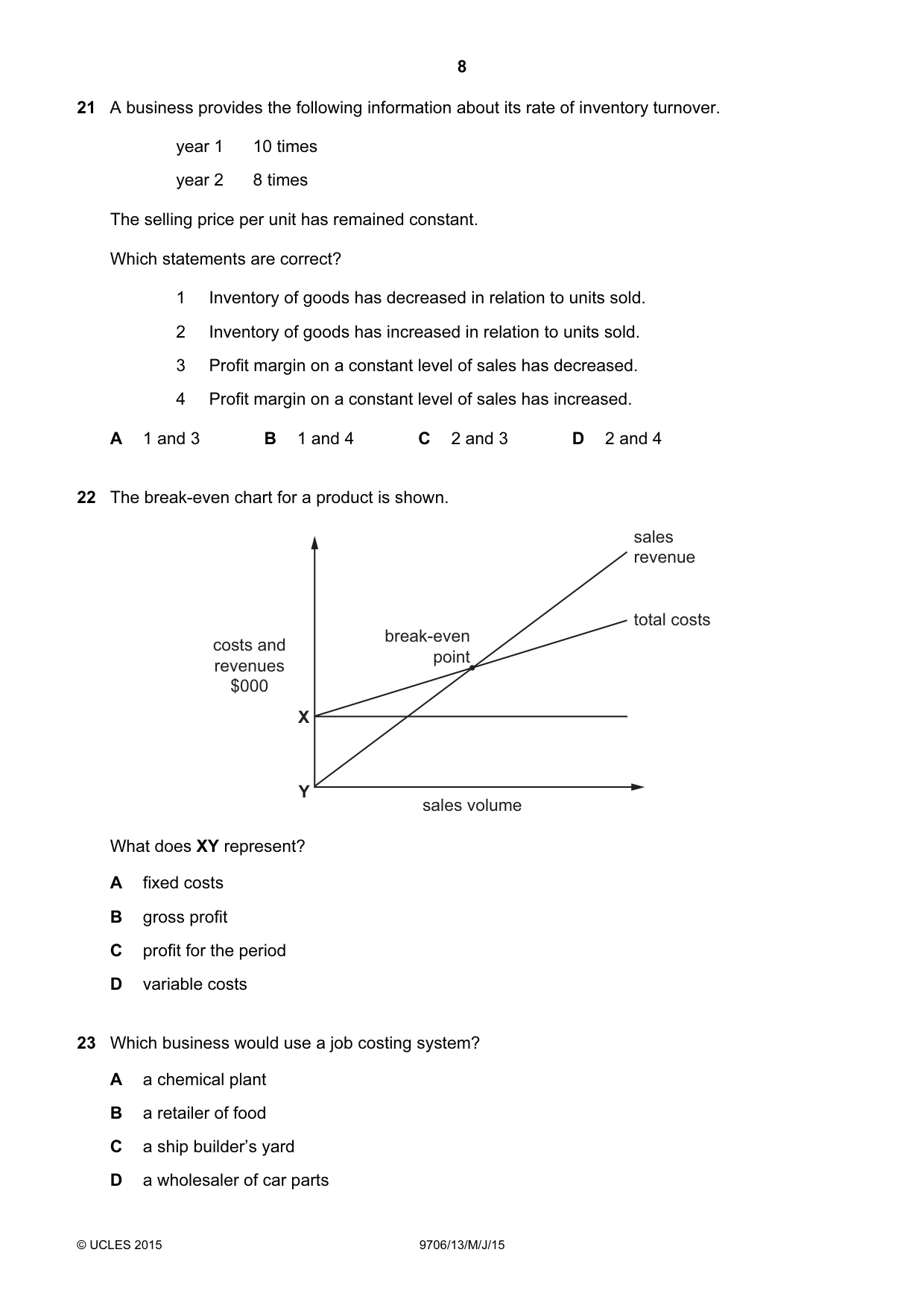
21 A business provides the following information about its rate of inventory turnover. year 1 10 times year 2 8 times The selling price per unit has remained constant. Which statements are correct? 1 Inventory of goods has decreased in relation to units sold. 2 Inventory of goods has increased in relation to units sold. 3 Profit margin on a constant level of sales has decreased. 4 Profit margin on a constant level of sales has increased. A 1 and 3 B 1 and 4 C 2 and 3 D 2 and 4
Mark scheme: D
More questions on Analysis and communication of accounting information
Q22 · The break-even chart for a product is shown
22 The break-even chart for a product is shown. sales revenue total costs break-even costs and point revenues $000 X Y sales volume What does XY represent? A fixed costs B gross profit C profit for the period D variable costs
Mark scheme: A
Q23 · Which business would use a job costing system?
23 Which business would use a job costing system? A a chemical plant B a retailer of food C a ship builder’s yard D a wholesaler of car parts
Mark scheme: C
Q24 · Which cost relating to a manufacturing business is apportioned between its cost centres?
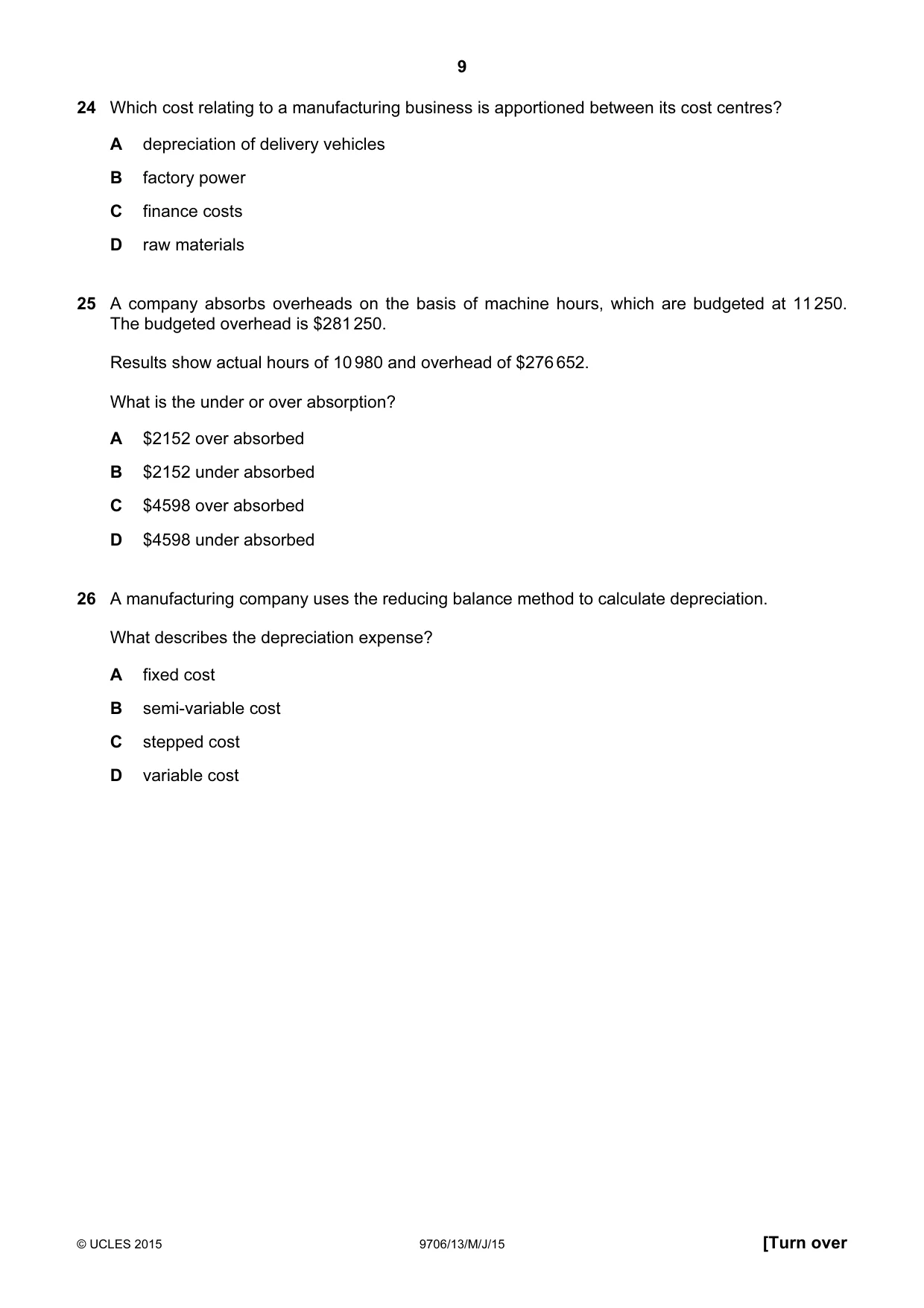
24 Which cost relating to a manufacturing business is apportioned between its cost centres? A depreciation of delivery vehicles B factory power C finance costs D raw materials
Mark scheme: B
Q25 · A company absorbs overheads on the basis of machine hours, which are budgeted at 11 250
25 A company absorbs overheads on the basis of machine hours, which are budgeted at 11 250. The budgeted overhead is $281 250. Results show actual hours of 10 980 and overhead of $276 652. What is the under or over absorption? A $2152 over absorbed B $2152 under absorbed C $4598 over absorbed D $4598 under absorbed
Mark scheme: B
Q26 · A manufacturing company uses the reducing balance method to calculate depreciation
26 A manufacturing company uses the reducing balance method to calculate depreciation. What describes the depreciation expense? A fixed cost B semi-variable cost C stepped cost D variable cost
Mark scheme: A
Q27 · A manufacturing company produces 10 000 units and sells 8000 units in a year
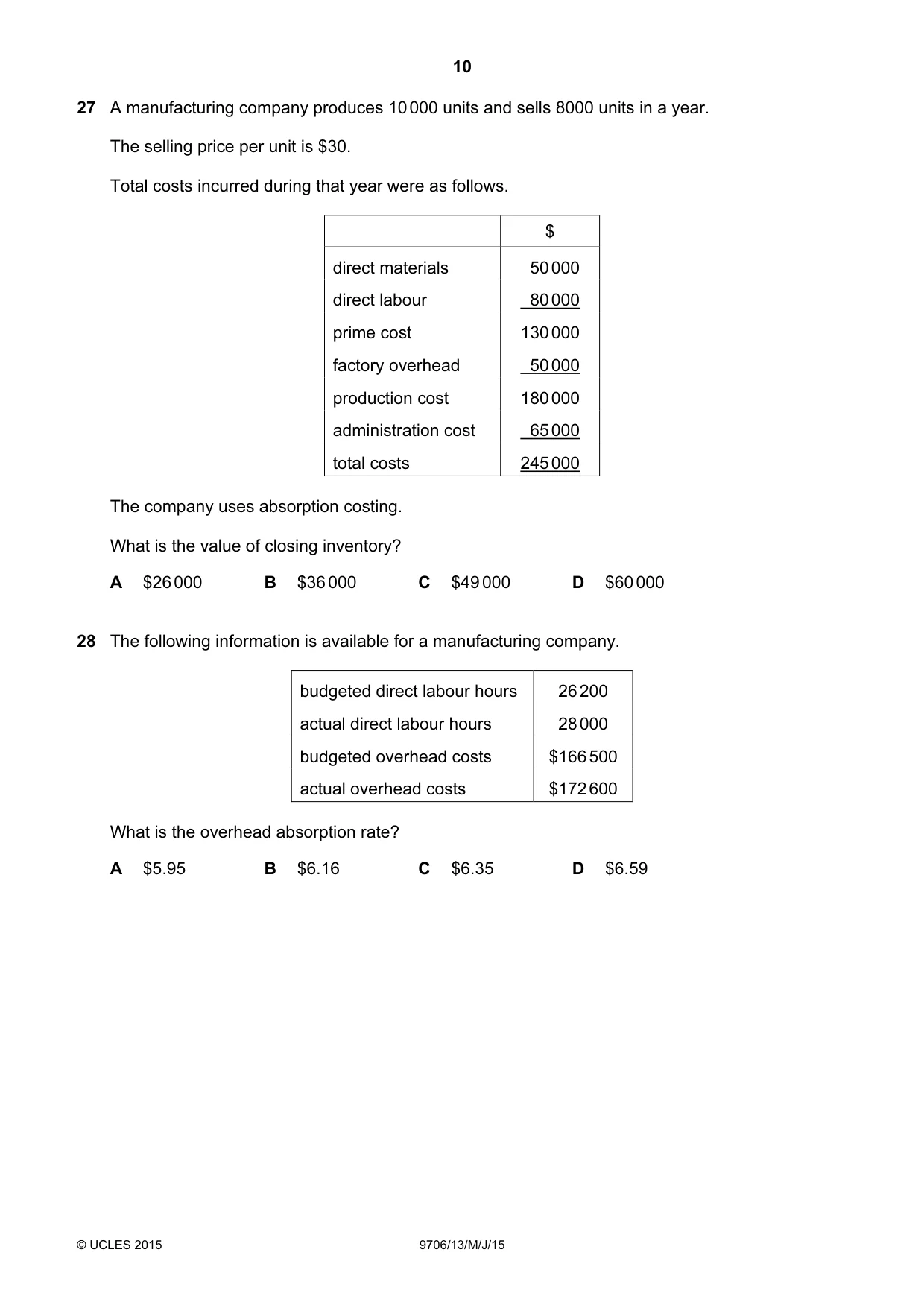
27 A manufacturing company produces 10 000 units and sells 8000 units in a year. The selling price per unit is $30. Total costs incurred during that year were as follows. $ direct materials 50 000 direct labour 80 000 prime cost 130 000 factory overhead 50 000 production cost 180 000 administration cost 65 000 total costs 245 000 The company uses absorption costing. What is the value of closing inventory? A $26 000 B $36 000 C $49 000 D $60 000
Mark scheme: B
Q28 · The following information is available for a manufacturing company
28 The following information is available for a manufacturing company. budgeted direct labour hours 26 200 actual direct labour hours 28 000 budgeted overhead costs $166 500 actual overhead costs $172 600 What is the overhead absorption rate? A $5.95 B $6.16 C $6.35 D $6.59
Mark scheme: C
Q29 · The following information is available
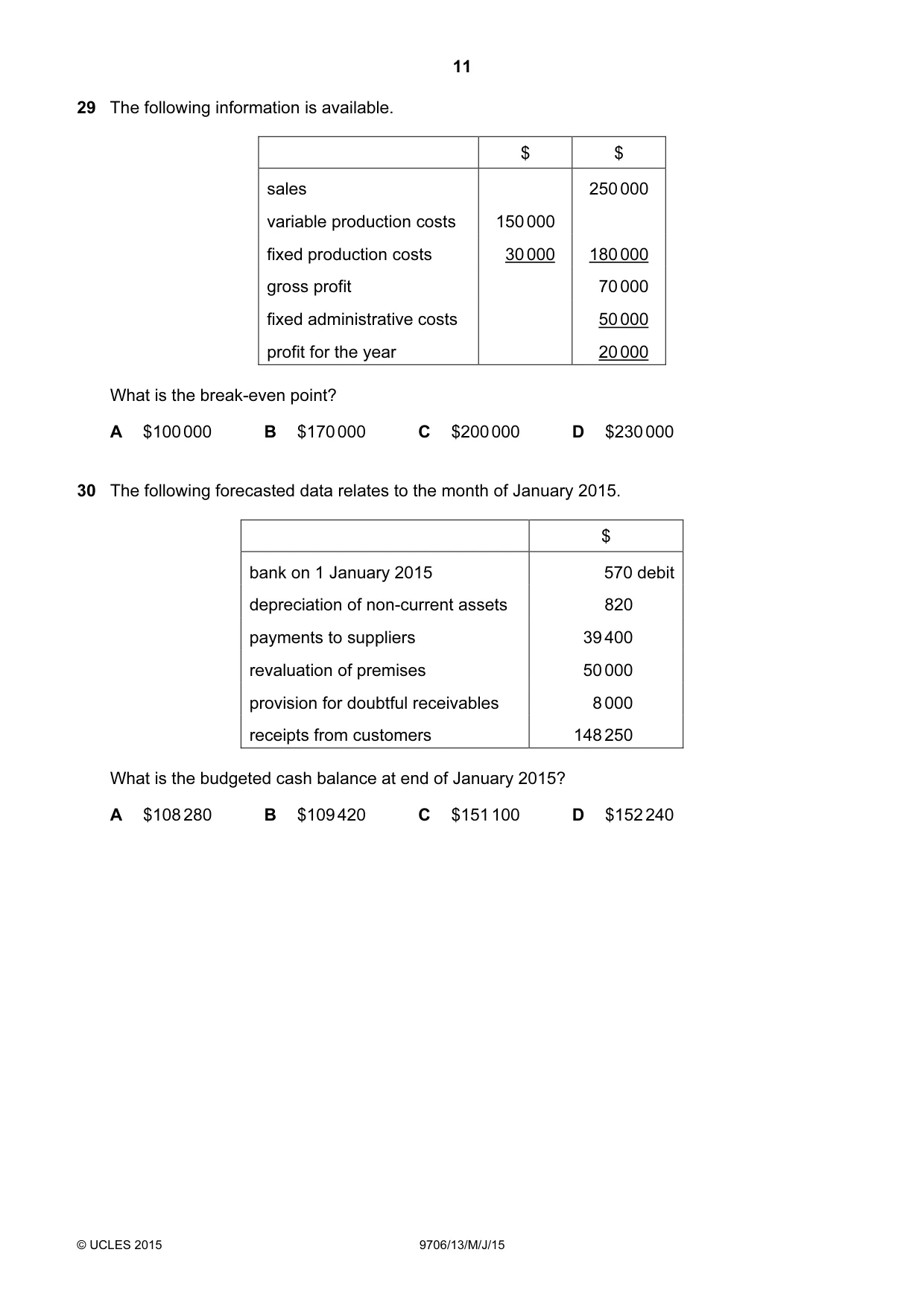
29 The following information is available. $ $ sales 250 000 variable production costs 150 000 fixed production costs 30 000 180 000 gross profit 70 000 fixed administrative costs 50 000 profit for the year 20 000 What is the break-even point? A $100 000 B $170 000 C $200 000 D $230 000
Mark scheme: C
Q30 · The following forecasted data relates to the month of January 2015
30 The following forecasted data relates to the month of January 2015. $ bank on 1 January 2015 570 debit depreciation of non-current assets 820 payments to suppliers 39 400 revaluation of premises 50 000 provision for doubtful receivables 8 000 receipts from customers 148 250 What is the budgeted cash balance at end of January 2015? A $108 280 B $109 420 C $151 100 D $152 240
Mark scheme: B
What was in this paper
The subtopics covered by these 30 questions, and how many questions each got. Open one in a new tab to see every Cambridge question on it.
What you needed in this session
Cambridge’s own grade thresholds for 2015 May/June, Paper 1 · Variant 3. A higher threshold means an easier paper — the bar moves with how the cohort did.