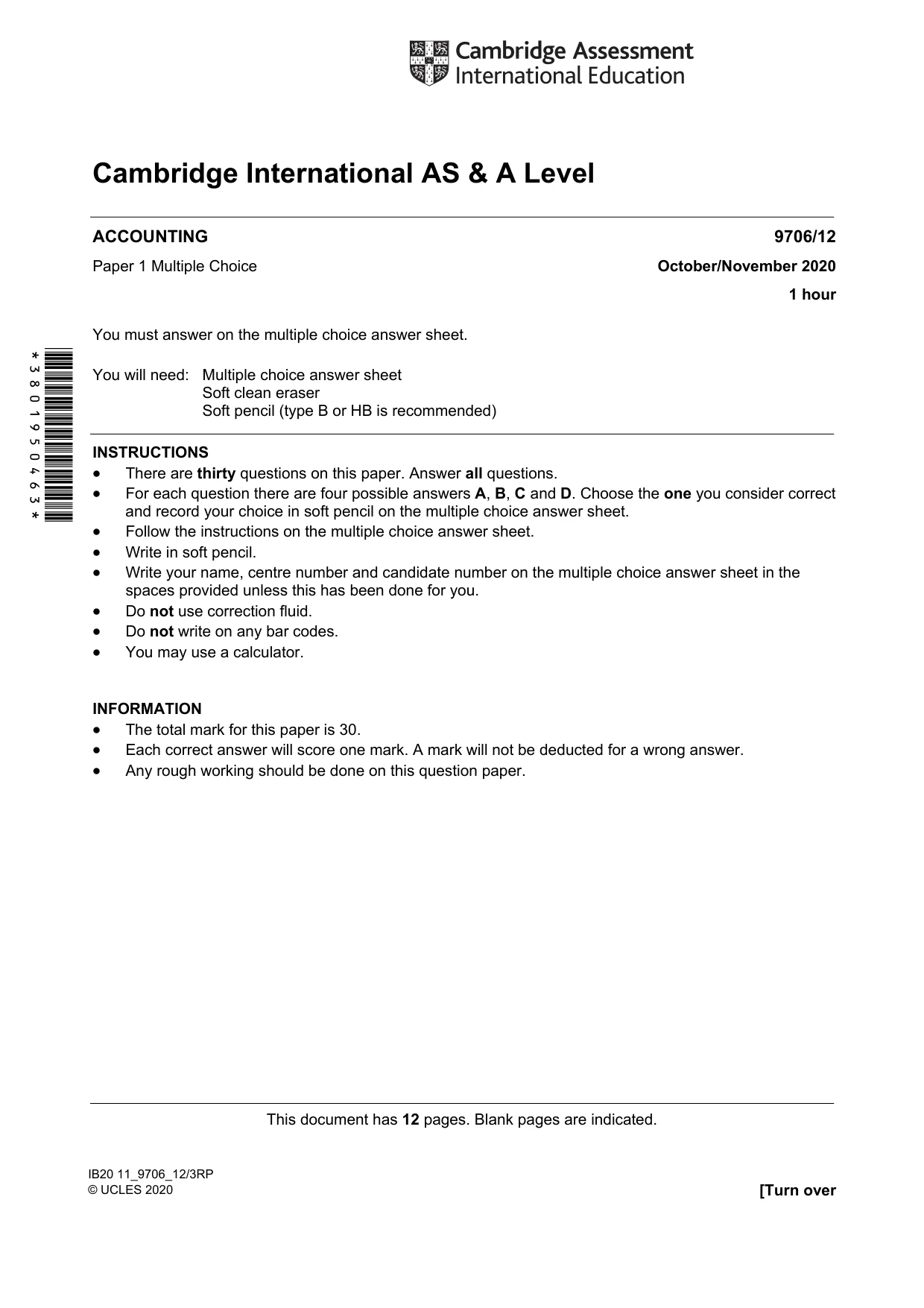
Cambridge A Level Accounting 9706 — 2020 Oct/Nov Paper 1 · Variant 2
9706/12/O/N/20 · 30 questions · 30 marks · ≈34 min
The question paper and its mark scheme, free to read here and free to download. This is Cambridge’s own paper, exactly as it was sat.
Question paper12 pages

Mark scheme3 pages
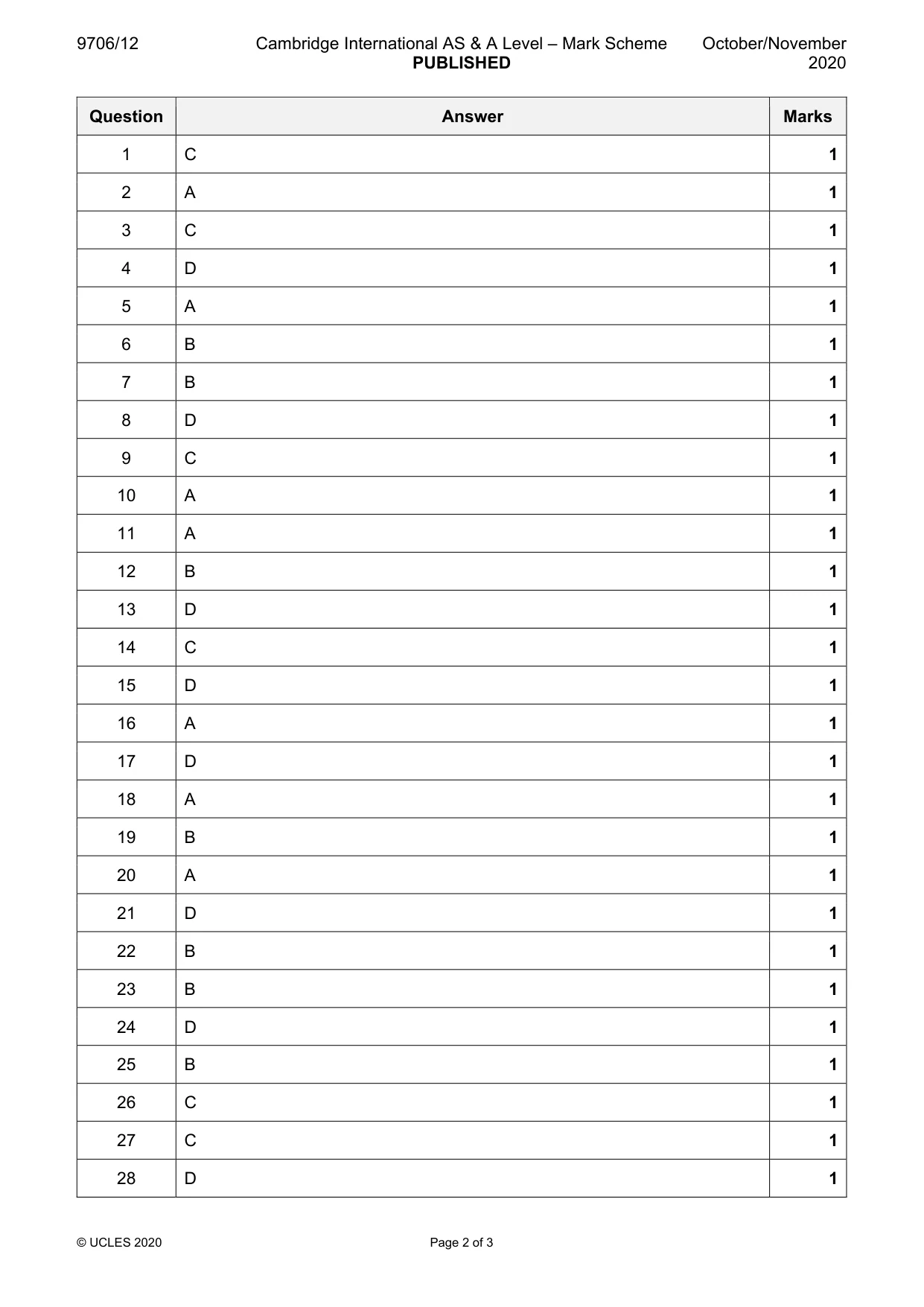
Answers below. Sit the paper first if you are practising.
Questions as text
Q1 · The inclusion of unpaid loan interest in financial statements is in accordance with which…
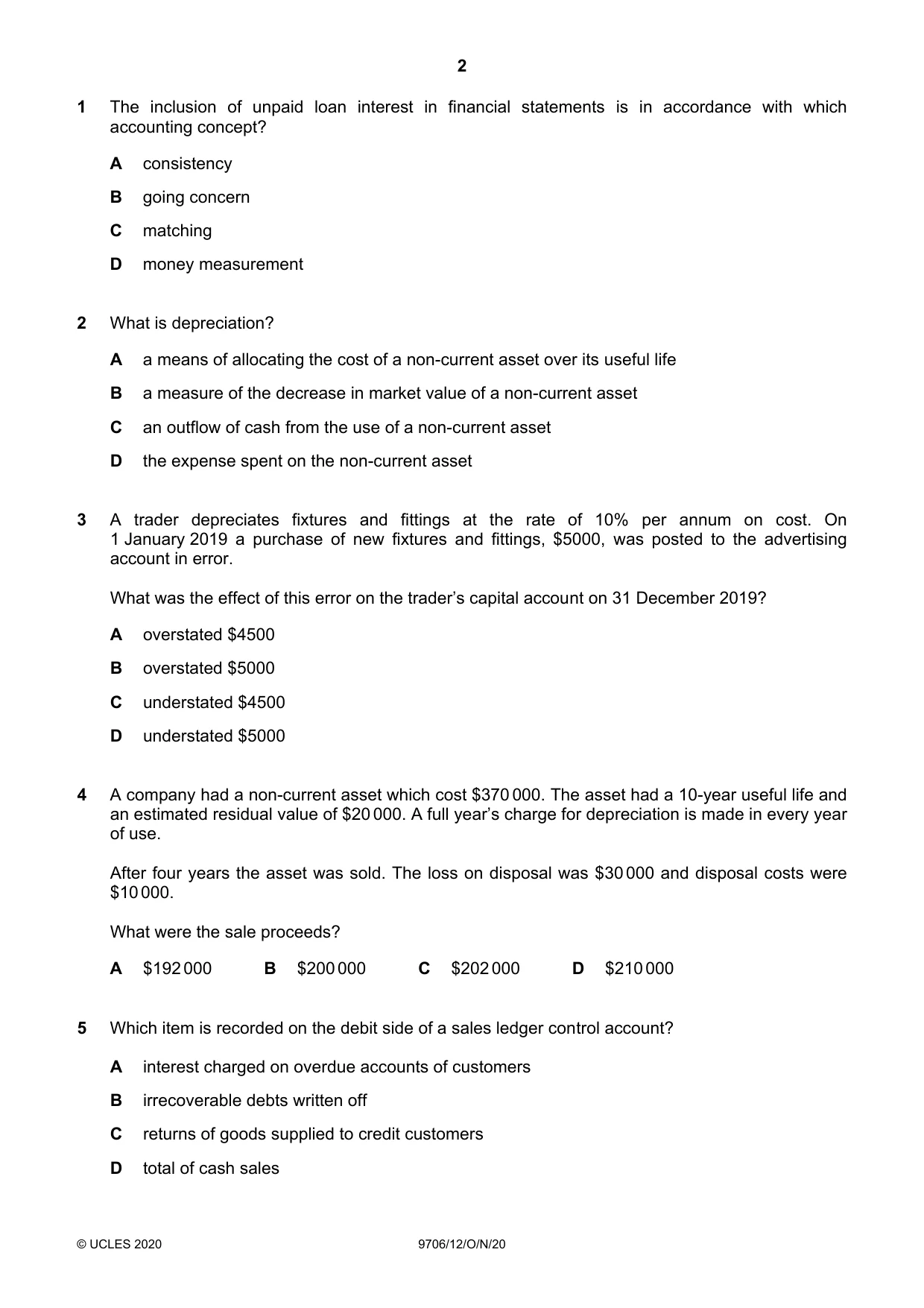
1 The inclusion of unpaid loan interest in financial statements is in accordance with which accounting concept? A consistency B going concern C matching D money measurement
Mark scheme: C
Question 2
2 What is depreciation? A a means of allocating the cost of a non-current asset over its useful life B a measure of the decrease in market value of a non-current asset C an outflow of cash from the use of a non-current asset D the expense spent on the non-current asset
Mark scheme: A
Q3 · A trader depreciates fixtures and fittings at the rate of 10% per annum on cost
3 A trader depreciates fixtures and fittings at the rate of 10% per annum on cost. On 1 January 2019 a purchase of new fixtures and fittings, $5000, was posted to the advertising account in error. What was the effect of this error on the trader’s capital account on 31 December 2019? A overstated $4500 B overstated $5000 C understated $4500 D understated $5000
Mark scheme: C
Q4 · A company had a non-current asset which cost $370 000
4 A company had a non-current asset which cost $370 000. The asset had a 10-year useful life and an estimated residual value of $20 000. A full year’s charge for depreciation is made in every year of use. After four years the asset was sold. The loss on disposal was $30 000 and disposal costs were $10 000. What were the sale proceeds? A $192 000 B $200 000 C $202 000 D $210 000
Mark scheme: D
Q5 · Which item is recorded on the debit side of a sales ledger control account?
5 Which item is recorded on the debit side of a sales ledger control account? A interest charged on overdue accounts of customers B irrecoverable debts written off C returns of goods supplied to credit customers D total of cash sales
Mark scheme: A
Q6 · A trader prepared a trial balance which did not balance
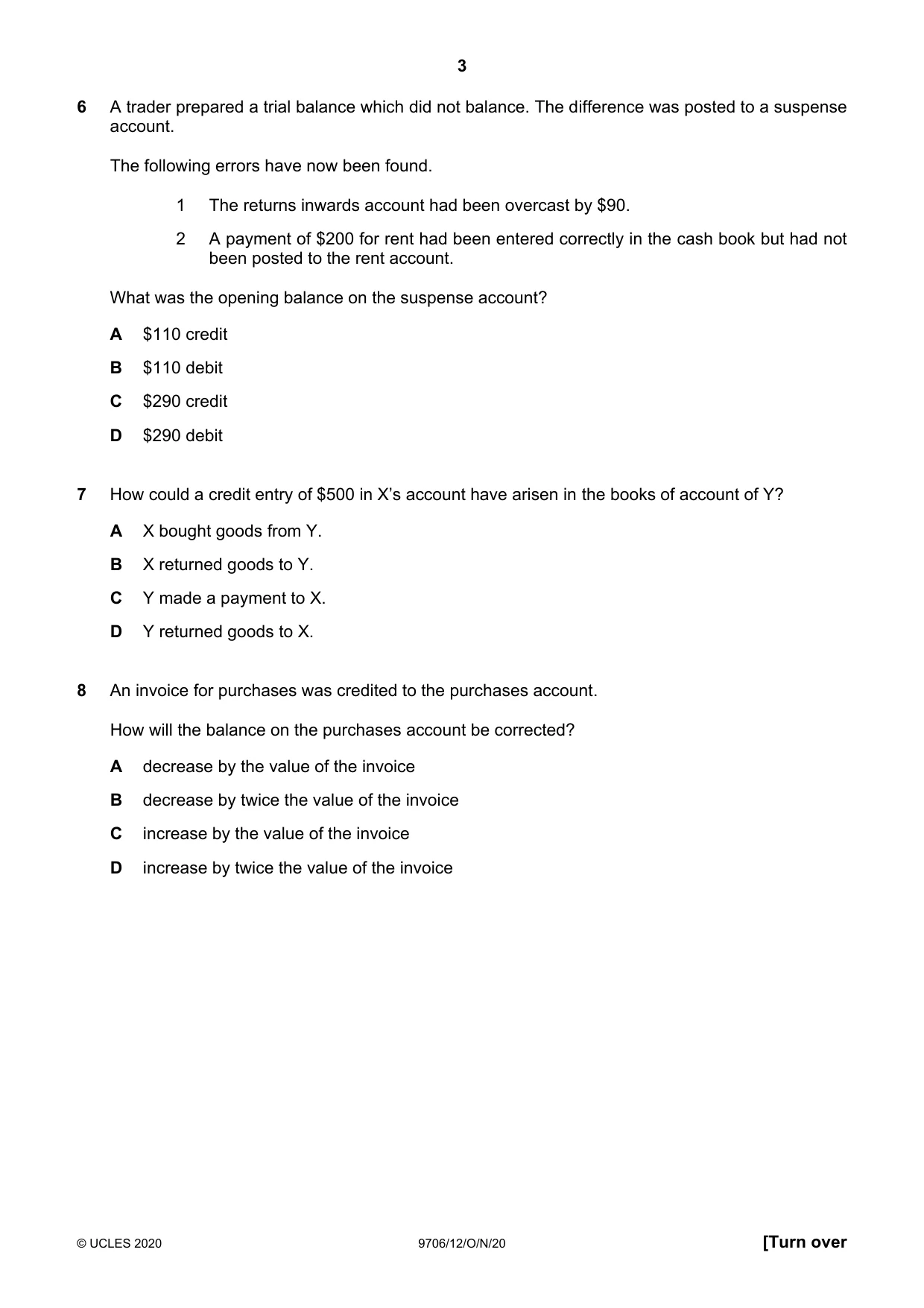
6 A trader prepared a trial balance which did not balance. The difference was posted to a suspense account. The following errors have now been found. 1 The returns inwards account had been overcast by $90. 2 A payment of $200 for rent had been entered correctly in the cash book but had not been posted to the rent account. What was the opening balance on the suspense account? A $110 credit B $110 debit C $290 credit D $290 debit
Mark scheme: B
Q7 · How could a credit entry of $500 in X’s account have arisen in the books of account of Y?
7 How could a credit entry of $500 in X’s account have arisen in the books of account of Y? A X bought goods from Y. B X returned goods to Y. C Y made a payment to X. D Y returned goods to X.
Mark scheme: B
Q8 · An invoice for purchases was credited to the purchases account
8 An invoice for purchases was credited to the purchases account. How will the balance on the purchases account be corrected? A decrease by the value of the invoice B decrease by twice the value of the invoice C increase by the value of the invoice D increase by twice the value of the invoice
Mark scheme: D
Q9 · Rent is paid by a business monthly in advance on the first day of each month
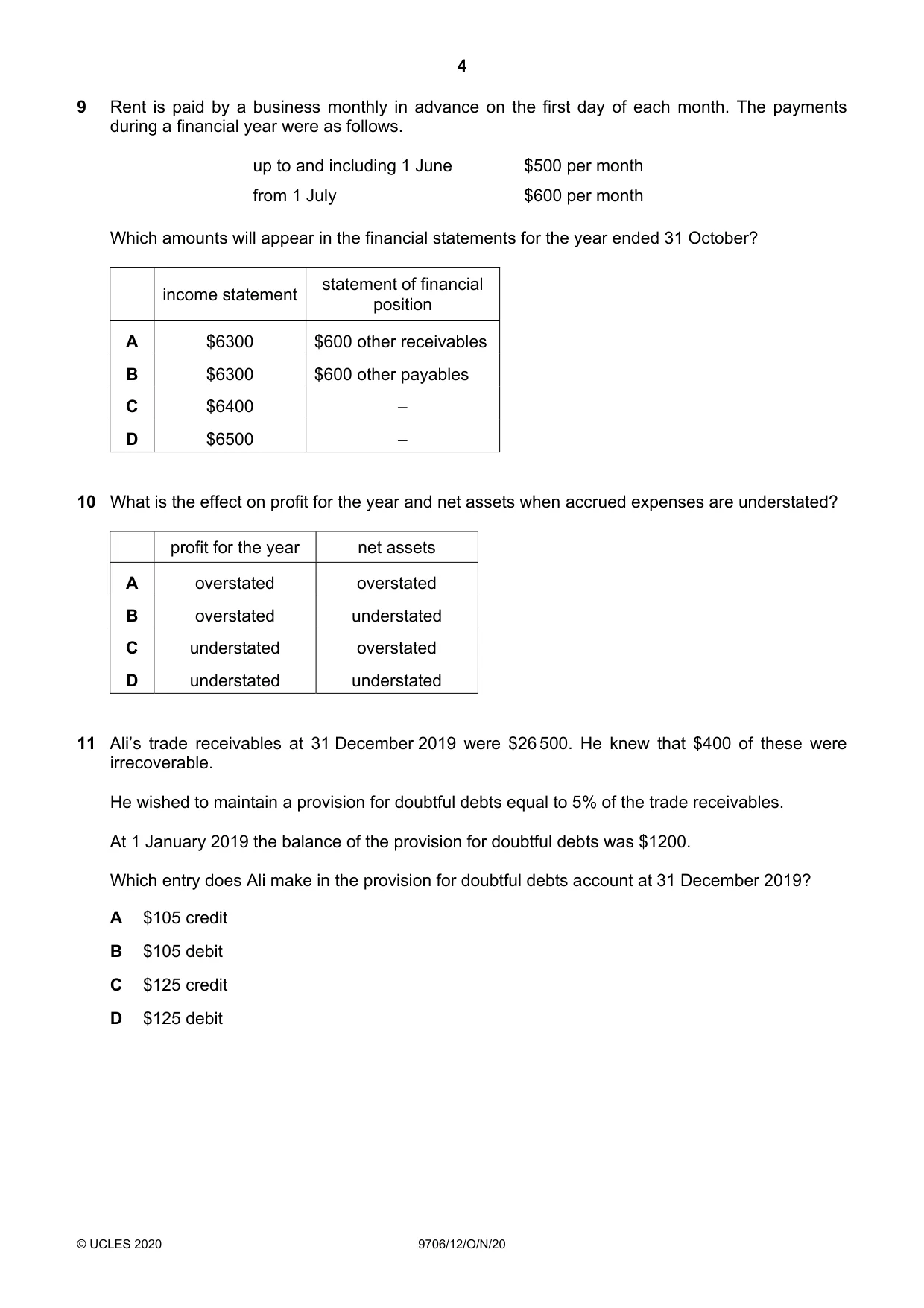
9 Rent is paid by a business monthly in advance on the first day of each month. The payments during a financial year were as follows. up to and including 1 June $500 per month from 1 July $600 per month Which amounts will appear in the financial statements for the year ended 31 October? statement of financial income statement position A $6300 $600 other receivables B $6300 $600 other payables C $6400 – D $6500 –
Mark scheme: C
Q10 · What is the effect on profit for the year and net assets when accrued expenses are…
10 What is the effect on profit for the year and net assets when accrued expenses are understated? profit for the year net assets A overstated overstated B overstated understated C understated overstated D understated understated
Mark scheme: A
Q11 · Ali’s trade receivables at 31 December 2019 were $26 500
11 Ali’s trade receivables at 31 December 2019 were $26 500. He knew that $400 of these were irrecoverable. He wished to maintain a provision for doubtful debts equal to 5% of the trade receivables. At 1 January 2019 the balance of the provision for doubtful debts was $1200. Which entry does Ali make in the provision for doubtful debts account at 31 December 2019? A $105 credit B $105 debit C $125 credit D $125 debit
Mark scheme: A
Q12 · Adil and Bashir were in partnership sharing profits and losses in the ratio 2 : 1
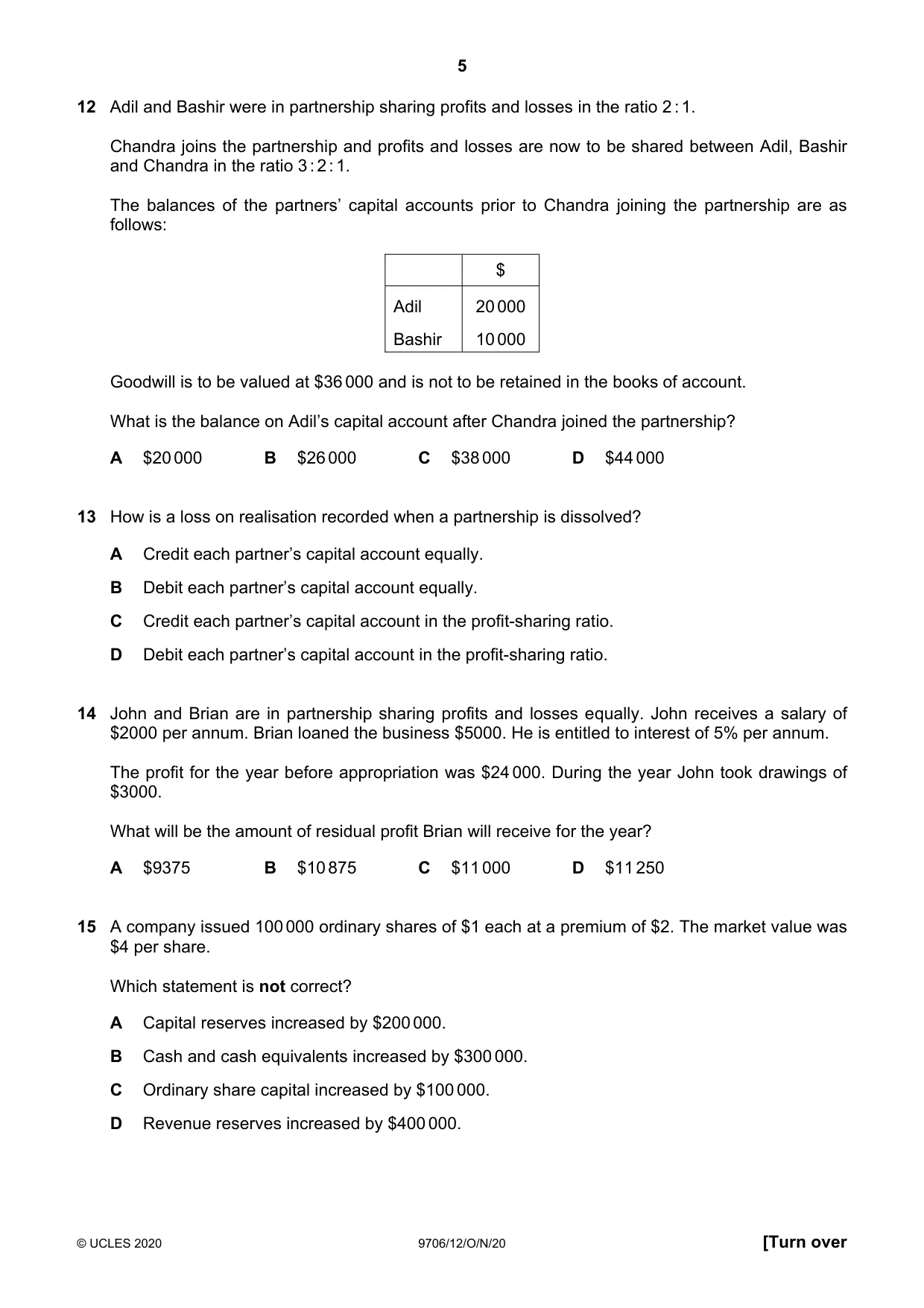
12 Adil and Bashir were in partnership sharing profits and losses in the ratio 2 : 1. Chandra joins the partnership and profits and losses are now to be shared between Adil, Bashir and Chandra in the ratio 3 : 2 : 1. The balances of the partners’ capital accounts prior to Chandra joining the partnership are as follows: $ Adil 20 000 Bashir 10 000 Goodwill is to be valued at $36 000 and is not to be retained in the books of account. What is the balance on Adil’s capital account after Chandra joined the partnership? A $20 000 B $26 000 C $38 000 D $44 000
Mark scheme: B
Q13 · How is a loss on realisation recorded when a partnership is dissolved?
13 How is a loss on realisation recorded when a partnership is dissolved? A Credit each partner’s capital account equally. B Debit each partner’s capital account equally. C Credit each partner’s capital account in the profit-sharing ratio. D Debit each partner’s capital account in the profit-sharing ratio.
Mark scheme: D
Q14 · John and Brian are in partnership sharing profits and losses equally
14 John and Brian are in partnership sharing profits and losses equally. John receives a salary of $2000 per annum. Brian loaned the business $5000. He is entitled to interest of 5% per annum. The profit for the year before appropriation was $24 000. During the year John took drawings of $3000. What will be the amount of residual profit Brian will receive for the year? A $9375 B $10 875 C $11 000 D $11 250
Mark scheme: C
Q15 · A company issued 100 000 ordinary shares of $1 each at a premium of $2
15 A company issued 100 000 ordinary shares of $1 each at a premium of $2. The market value was $4 per share. Which statement is not correct? A Capital reserves increased by $200 000. B Cash and cash equivalents increased by $300 000. C Ordinary share capital increased by $100 000. D Revenue reserves increased by $400 000.
Mark scheme: D
Q16 · Which item has no effect on the total equity of a limited company?
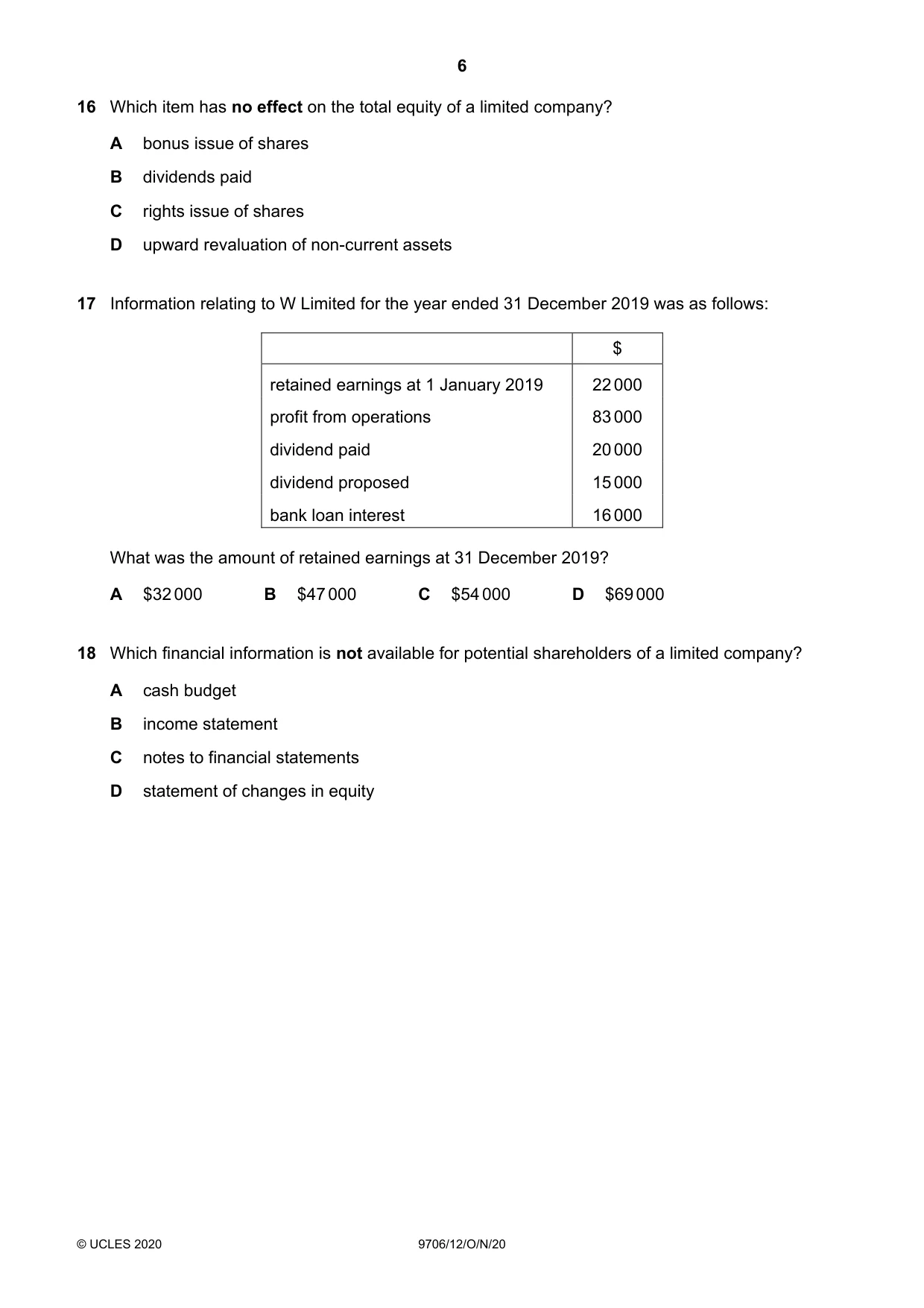
16 Which item has no effect on the total equity of a limited company? A bonus issue of shares B dividends paid C rights issue of shares D upward revaluation of non-current assets
Mark scheme: A
Q17 · Information relating to W Limited for the year ended 31 December 2019 was as follows: $…
17 Information relating to W Limited for the year ended 31 December 2019 was as follows: $ retained earnings at 1 January 2019 22 000 profit from operations 83 000 dividend paid 20 000 dividend proposed 15 000 bank loan interest 16 000 What was the amount of retained earnings at 31 December 2019? A $32 000 B $47 000 C $54 000 D $69 000
Mark scheme: D
Q18 · Which financial information is not available for potential shareholders of a limited…
18 Which financial information is not available for potential shareholders of a limited company? A cash budget B income statement C notes to financial statements D statement of changes in equity
Mark scheme: A
More questions on Analysis and communication of accounting information
Q19 · The following information is available
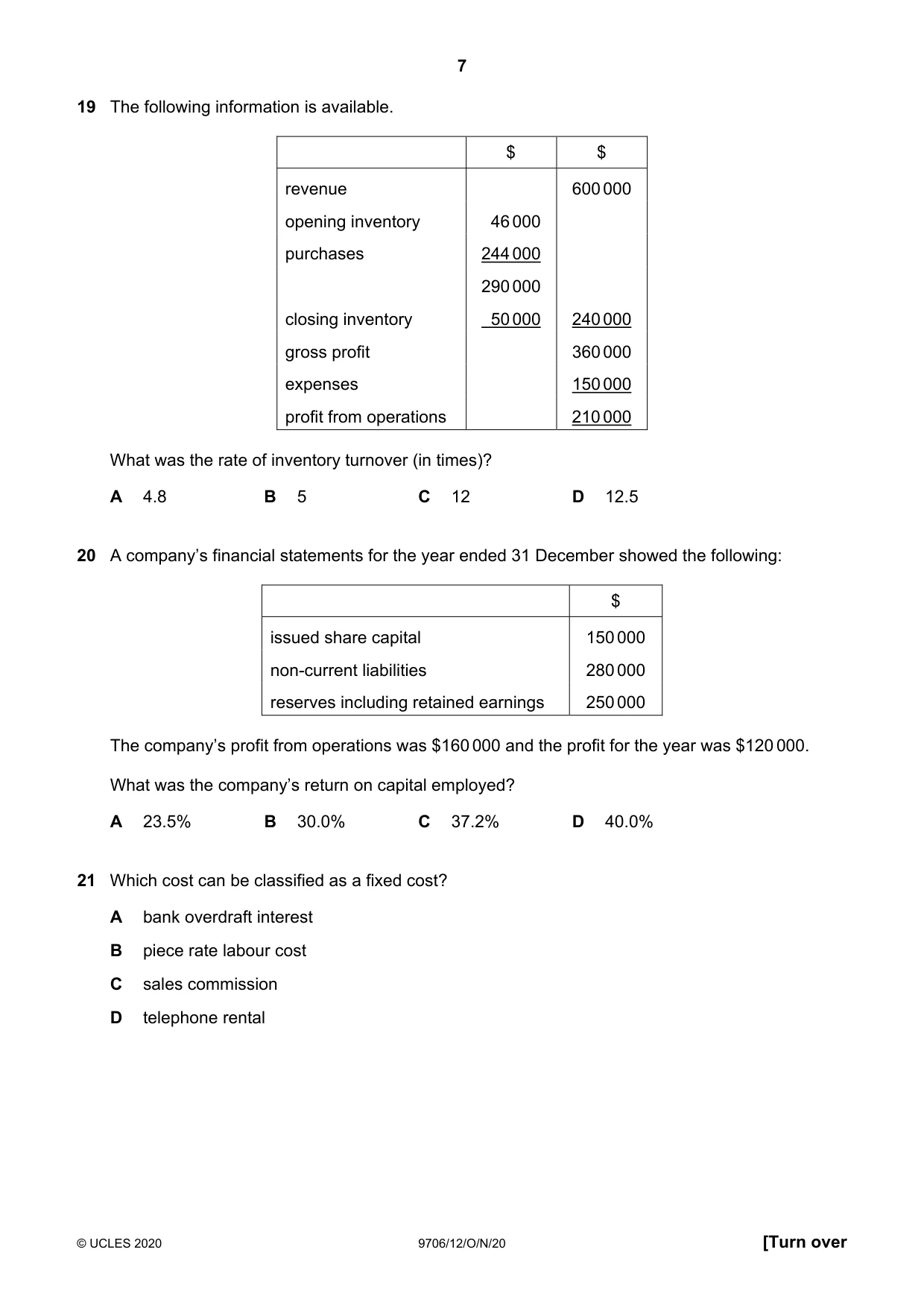
19 The following information is available. $ $ revenue 600 000 opening inventory 46 000 purchases 244 000 290 000 closing inventory 50 000 240 000 gross profit 360 000 expenses 150 000 profit from operations 210 000 What was the rate of inventory turnover (in times)? A 4.8 B 5 C 12 D 12.5
Mark scheme: B
More questions on Analysis and communication of accounting information
Q20 · A company’s financial statements for the year ended 31 December showed the following: $…
20 A company’s financial statements for the year ended 31 December showed the following: $ issued share capital 150 000 non-current liabilities 280 000 reserves including retained earnings 250 000 The company’s profit from operations was $160 000 and the profit for the year was $120 000. What was the company’s return on capital employed? A 23.5% B 30.0% C 37.2% D 40.0%
Mark scheme: A
More questions on Analysis and communication of accounting information
Q21 · Which cost can be classified as a fixed cost?
21 Which cost can be classified as a fixed cost? A bank overdraft interest B piece rate labour cost C sales commission D telephone rental
Mark scheme: D
Q22 · An employee works a 40-hour week at an hourly rate of $8
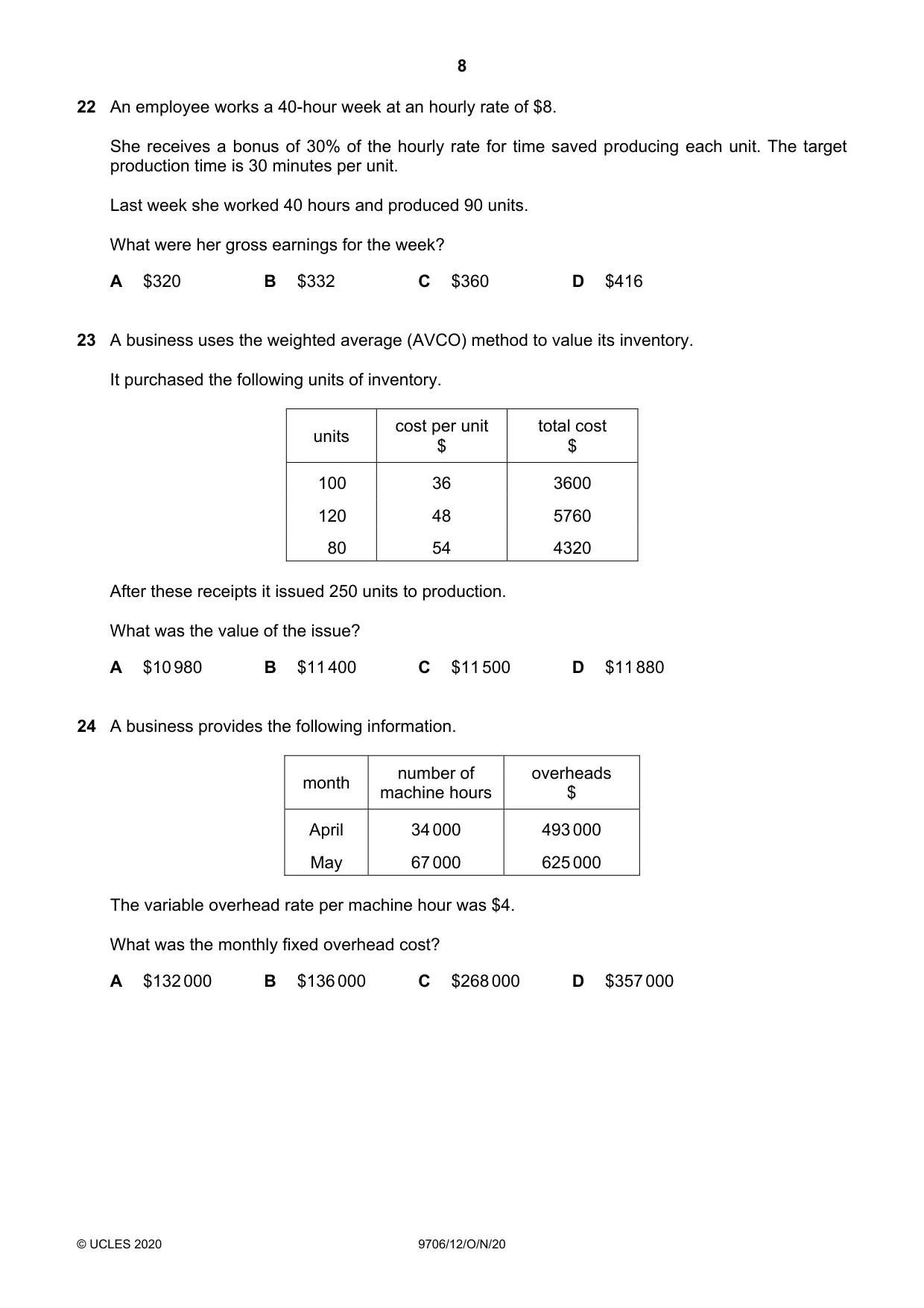
22 An employee works a 40-hour week at an hourly rate of $8. She receives a bonus of 30% of the hourly rate for time saved producing each unit. The target production time is 30 minutes per unit. Last week she worked 40 hours and produced 90 units. What were her gross earnings for the week? A $320 B $332 C $360 D $416
Mark scheme: B
Q23 · A business uses the weighted average (AVCO) method to value its inventory
23 A business uses the weighted average (AVCO) method to value its inventory. It purchased the following units of inventory. cost per unit total cost units $ $ 100 36 3600 120 48 5760 80 54 4320 After these receipts it issued 250 units to production. What was the value of the issue? A $10 980 B $11 400 C $11 500 D $11 880
Mark scheme: B
Q24 · A business provides the following information
24 A business provides the following information. number of overheads month machine hours $ April 34 000 493 000 May 67 000 625 000 The variable overhead rate per machine hour was $4. What was the monthly fixed overhead cost? A $132 000 B $136 000 C $268 000 D $357 000
Mark scheme: D
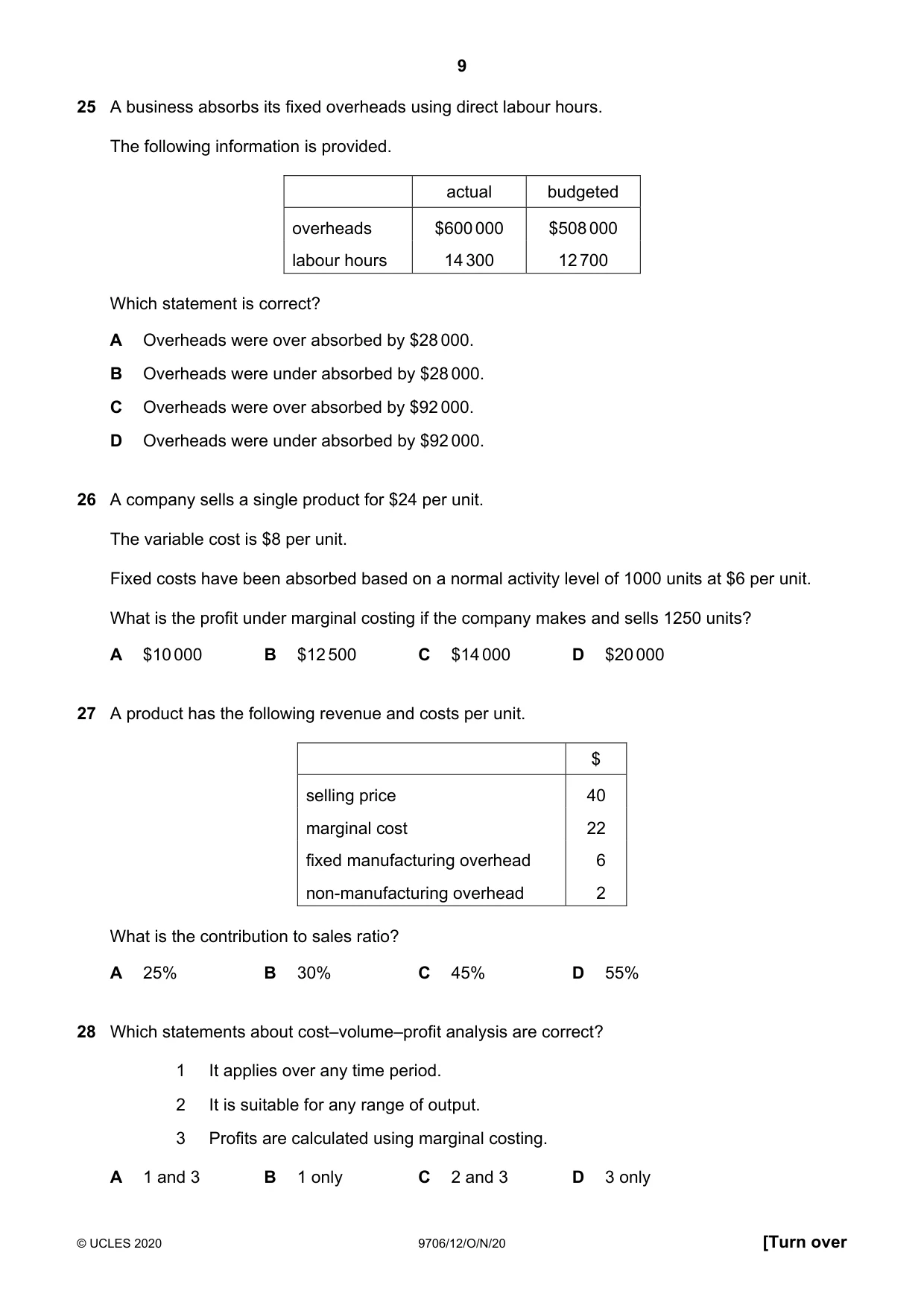
Q25 · A business absorbs its fixed overheads using direct labour hours
25 A business absorbs its fixed overheads using direct labour hours. The following information is provided. actual budgeted overheads $600 000 $508 000 labour hours 14 300 12 700 Which statement is correct? A Overheads were over absorbed by $28 000. B Overheads were under absorbed by $28 000. C Overheads were over absorbed by $92 000. D Overheads were under absorbed by $92 000.
Mark scheme: B
Q26 · A company sells a single product for $24 per unit
26 A company sells a single product for $24 per unit. The variable cost is $8 per unit. Fixed costs have been absorbed based on a normal activity level of 1000 units at $6 per unit. What is the profit under marginal costing if the company makes and sells 1250 units? A $10 000 B $12 500 C $14 000 D $20 000
Mark scheme: C
Q27 · A product has the following revenue and costs per unit
27 A product has the following revenue and costs per unit. $ selling price 40 marginal cost 22 fixed manufacturing overhead 6 non-manufacturing overhead 2 What is the contribution to sales ratio? A 25% B 30% C 45% D 55%
Mark scheme: C
Q28 · Which statements about cost–volume–profit analysis are correct?
28 Which statements about cost–volume–profit analysis are correct? 1 It applies over any time period. 2 It is suitable for any range of output. 3 Profits are calculated using marginal costing. A 1 and 3 B 1 only C 2 and 3 D 3 only
Mark scheme: D
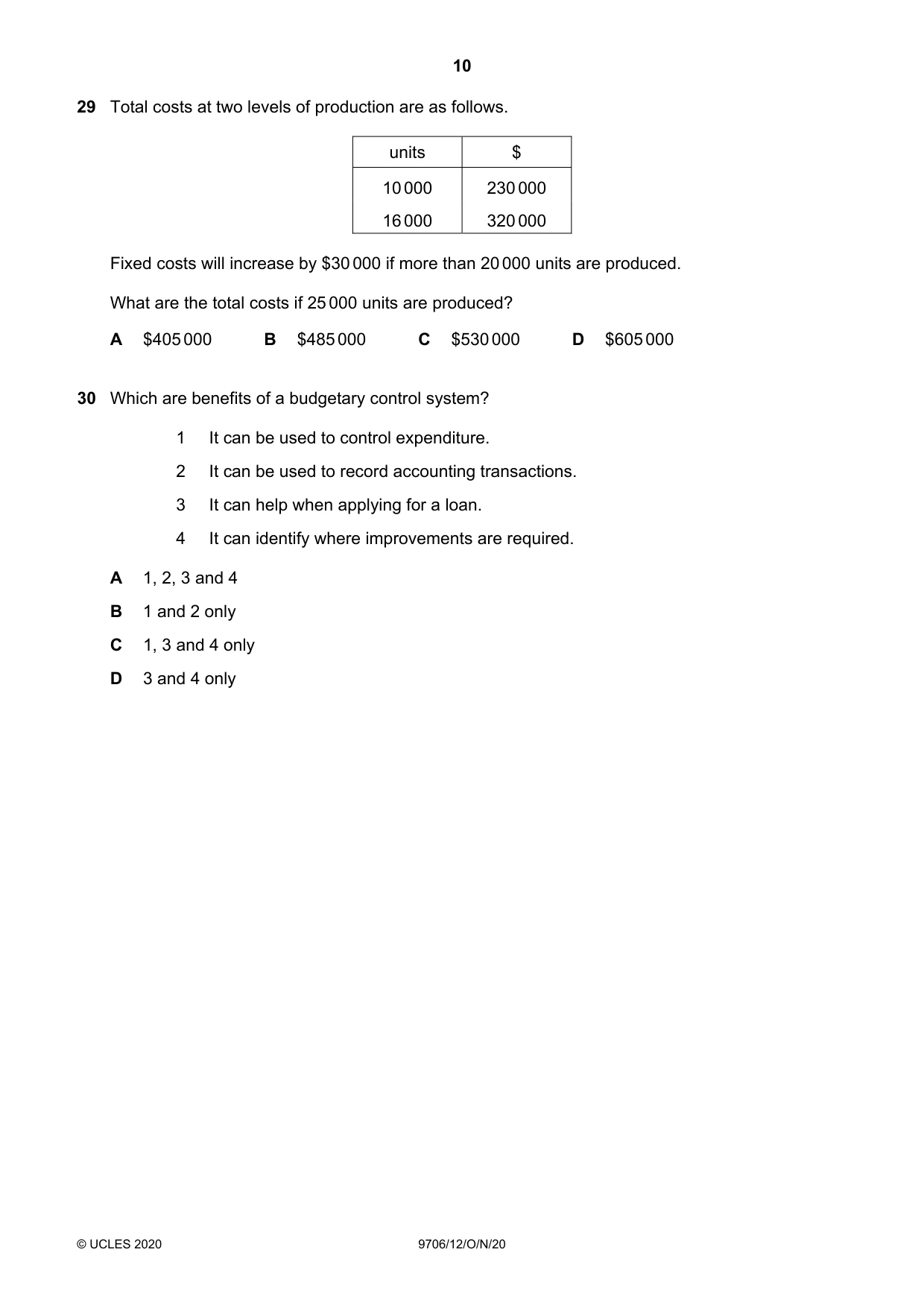
Q29 · Total costs at two levels of production are as follows
29 Total costs at two levels of production are as follows. units $ 10 000 230 000 16 000 320 000 Fixed costs will increase by $30 000 if more than 20 000 units are produced. What are the total costs if 25 000 units are produced? A $405 000 B $485 000 C $530 000 D $605 000
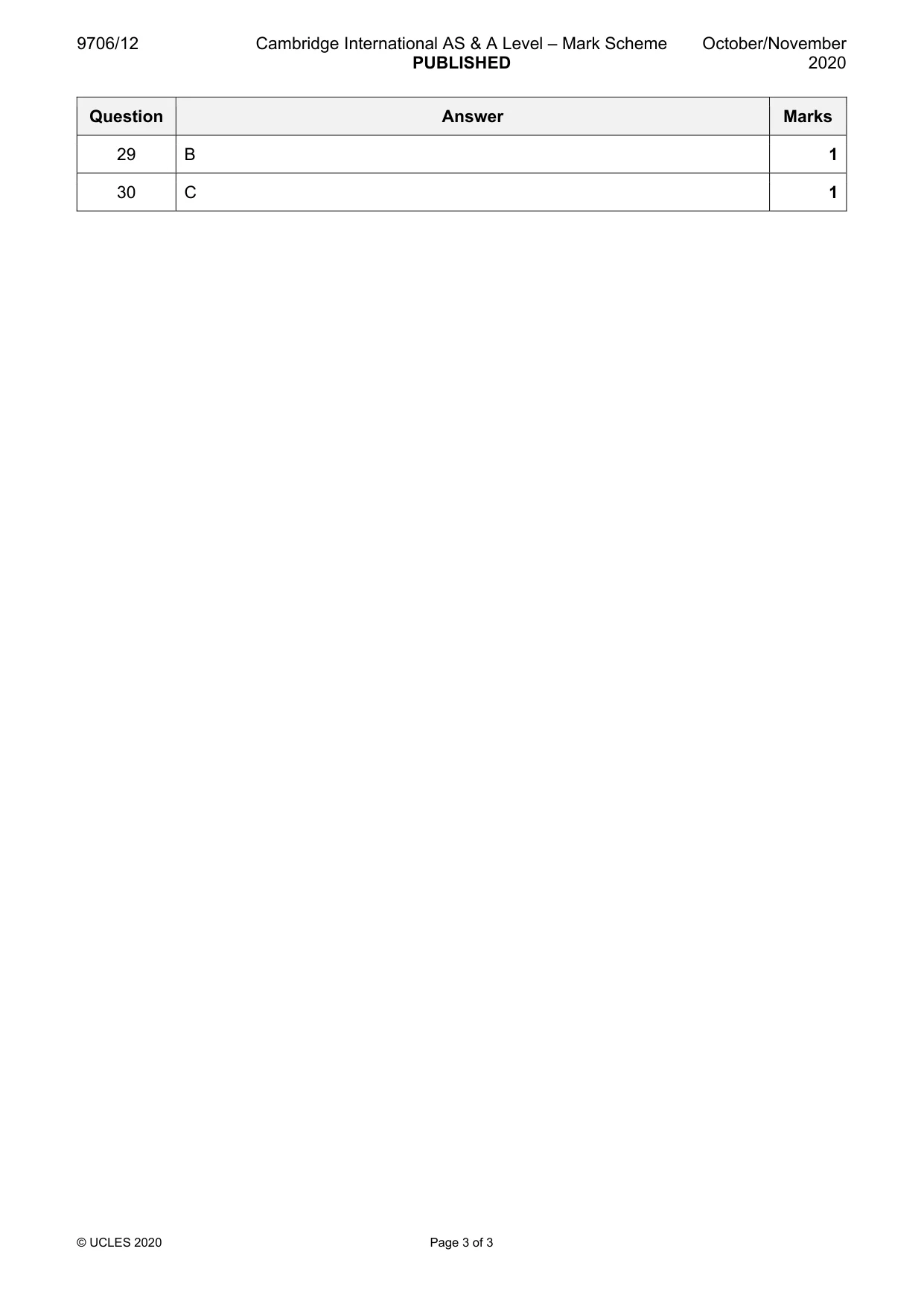
Mark scheme: B
Q30 · Which are benefits of a budgetary control system?
30 Which are benefits of a budgetary control system? 1 It can be used to control expenditure. 2 It can be used to record accounting transactions. 3 It can help when applying for a loan. 4 It can identify where improvements are required. A 1, 2, 3 and 4 B 1 and 2 only C 1, 3 and 4 only D 3 and 4 only
Mark scheme: C
What was in this paper
The subtopics covered by these 30 questions, and how many questions each got. Open one in a new tab to see every Cambridge question on it.
5Costs and cost behaviour4Reconciliation and verification4Preparation of financial statements3Preparation of financial statements3Types of business entity3Accounting for non-current assets2Analysis and communication of accounting information2The accounting system2Analysis and communication of accounting information1Budgeting and budgetary control1What you needed in this session
Cambridge’s own grade thresholds for 2020 Oct/Nov, Paper 1 · Variant 2. A higher threshold means an easier paper — the bar moves with how the cohort did.