Cambridge A Level Accounting 9706 — 2025 May/June Paper 1 · Variant 3
9706/13/M/J/25 · 30 questions · 30 marks · ≈34 min
The question paper and its mark scheme, free to read here and free to download. This is Cambridge’s own paper, exactly as it was sat.
Question paper12 pages
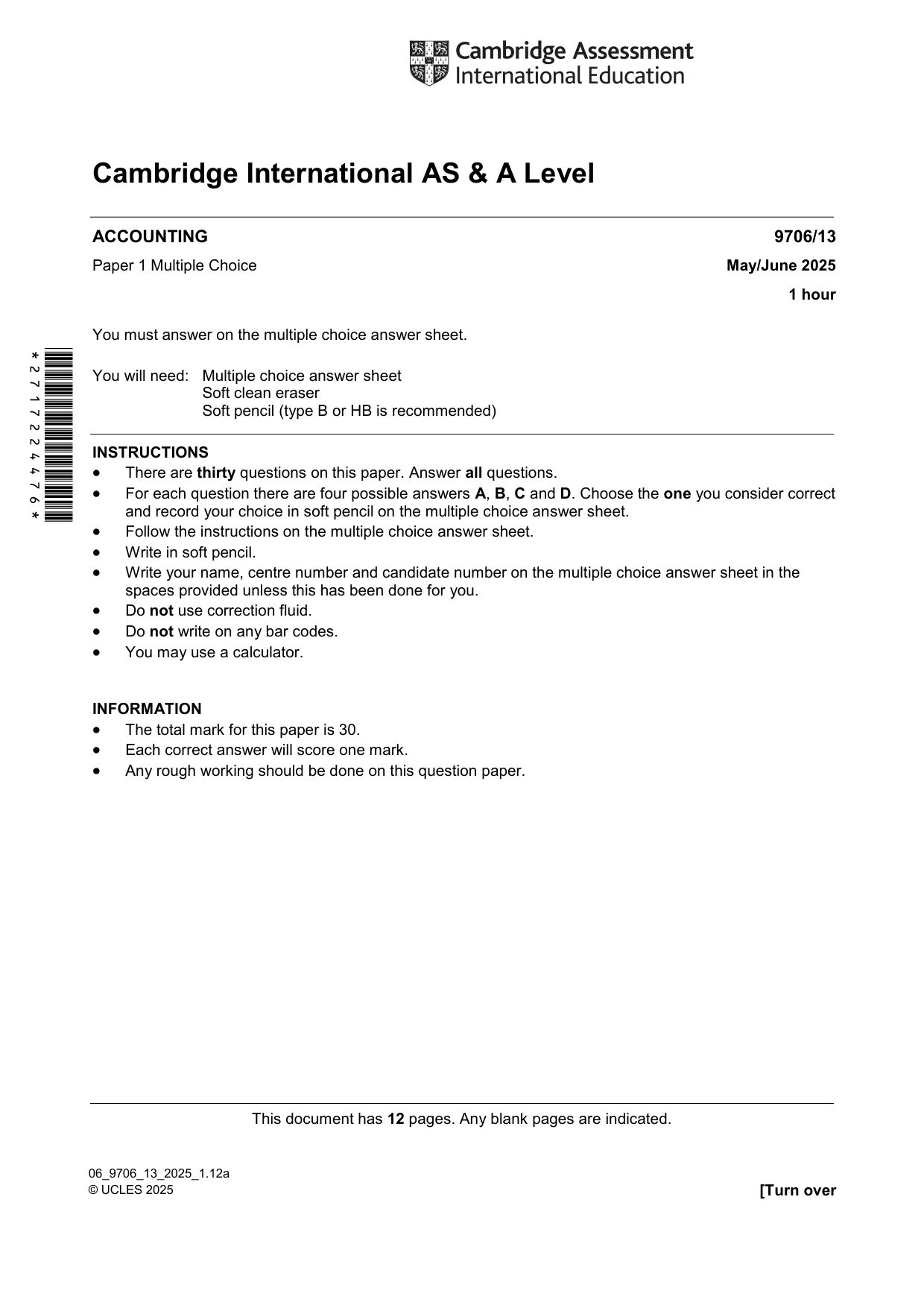
Mark scheme3 pages
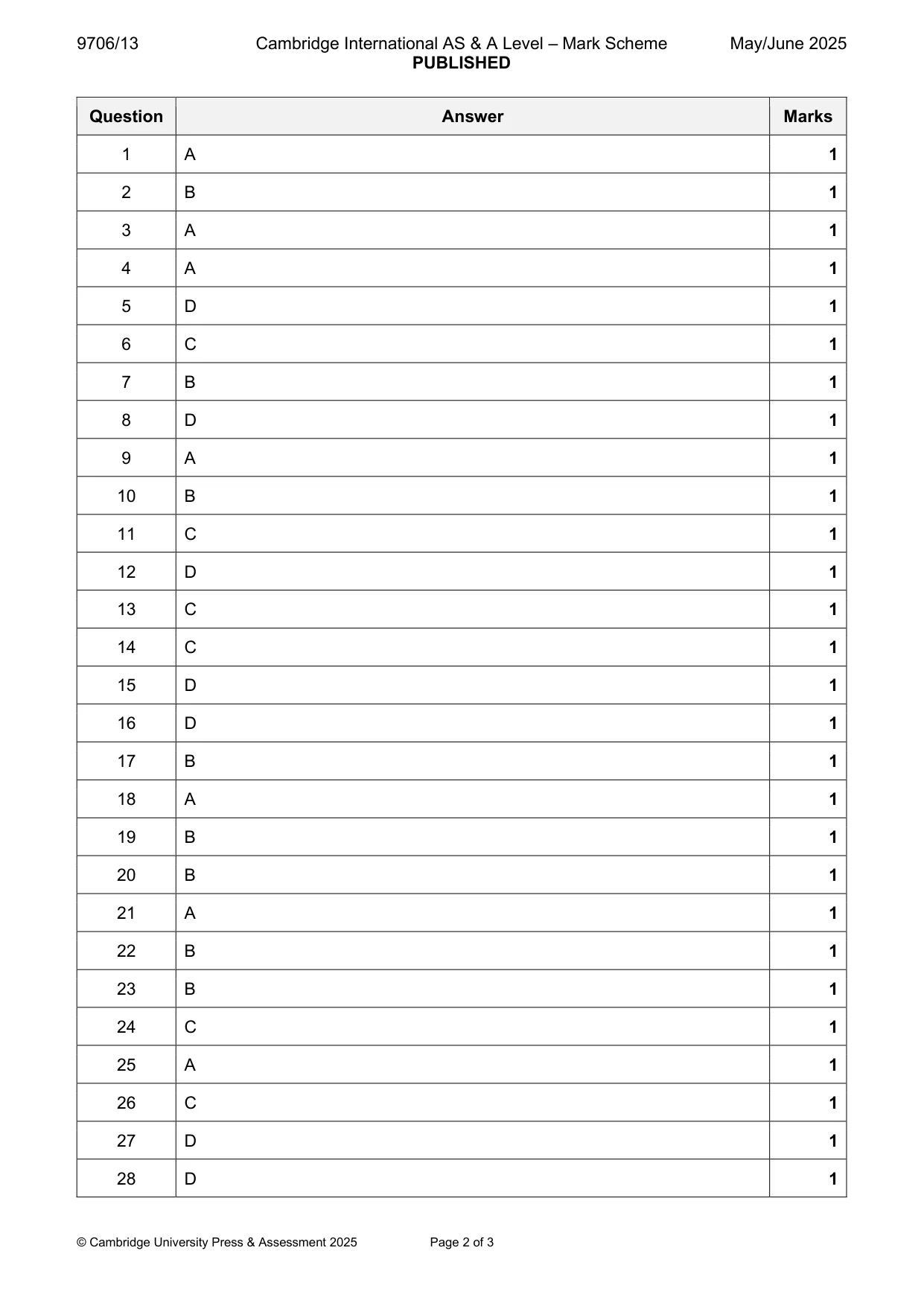
Answers below. Sit the paper first if you are practising.
Questions as text
Q1 · What are disadvantages of operating as a partnership compared to operating as a sole…
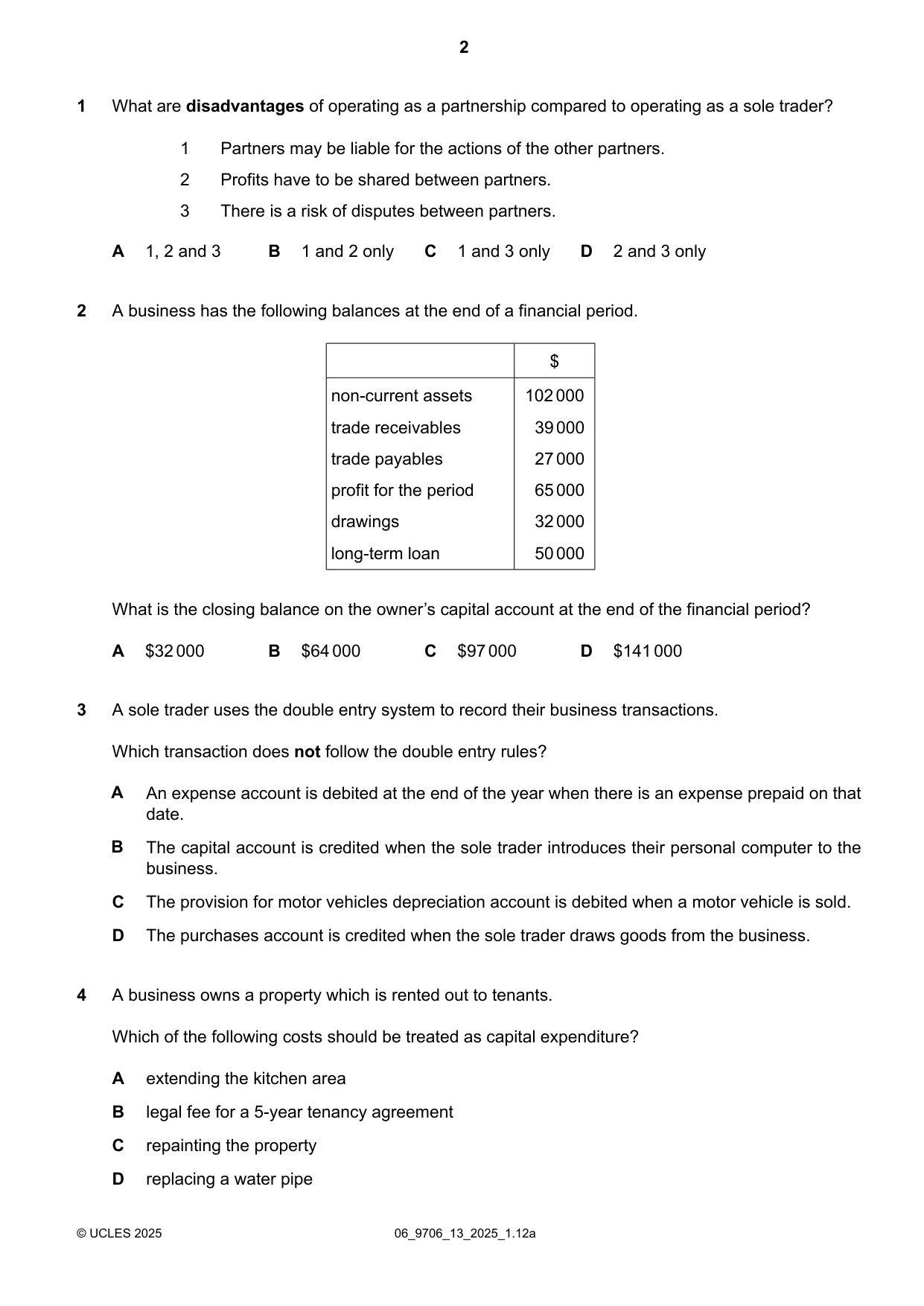
1 What are disadvantages of operating as a partnership compared to operating as a sole trader? 1 Partners may be liable for the actions of the other partners. 2 Profits have to be shared between partners. 3 There is a risk of disputes between partners. A 1, 2 and 3 B 1 and 2 only C 1 and 3 only D 2 and 3 only
Mark scheme: A
Q2 · A business has the following balances at the end of a financial period
2 A business has the following balances at the end of a financial period. $ non-current assets 102000 trade receivables 39000 trade payables 27000 profit for the period 65000 drawings 32000 long-term loan 50000 What is the closing balance on the owner’s capital account at the end of the financial period? A $32000 B $64000 C $97000 D $141000
Mark scheme: B
Q3 · A sole trader uses the double entry system to record their business transactions
3 A sole trader uses the double entry system to record their business transactions. Which transaction does not follow the double entry rules? A An expense account is debited at the end of the year when there is an expense prepaid on that date. B The capital account is credited when the sole trader introduces their personal computer to the business. C The provision for motor vehicles depreciation account is debited when a motor vehicle is sold. D The purchases account is credited when the sole trader draws goods from the business.
Mark scheme: A
Q4 · A business owns a property which is rented out to tenants
4 A business owns a property which is rented out to tenants. Which of the following costs should be treated as capital expenditure? A extending the kitchen area B legal fee for a 5-year tenancy agreement C repainting the property D replacing a water pipe
Mark scheme: A
Q5 · Which statements describe factors that may cause a non-current asset to depreciate?
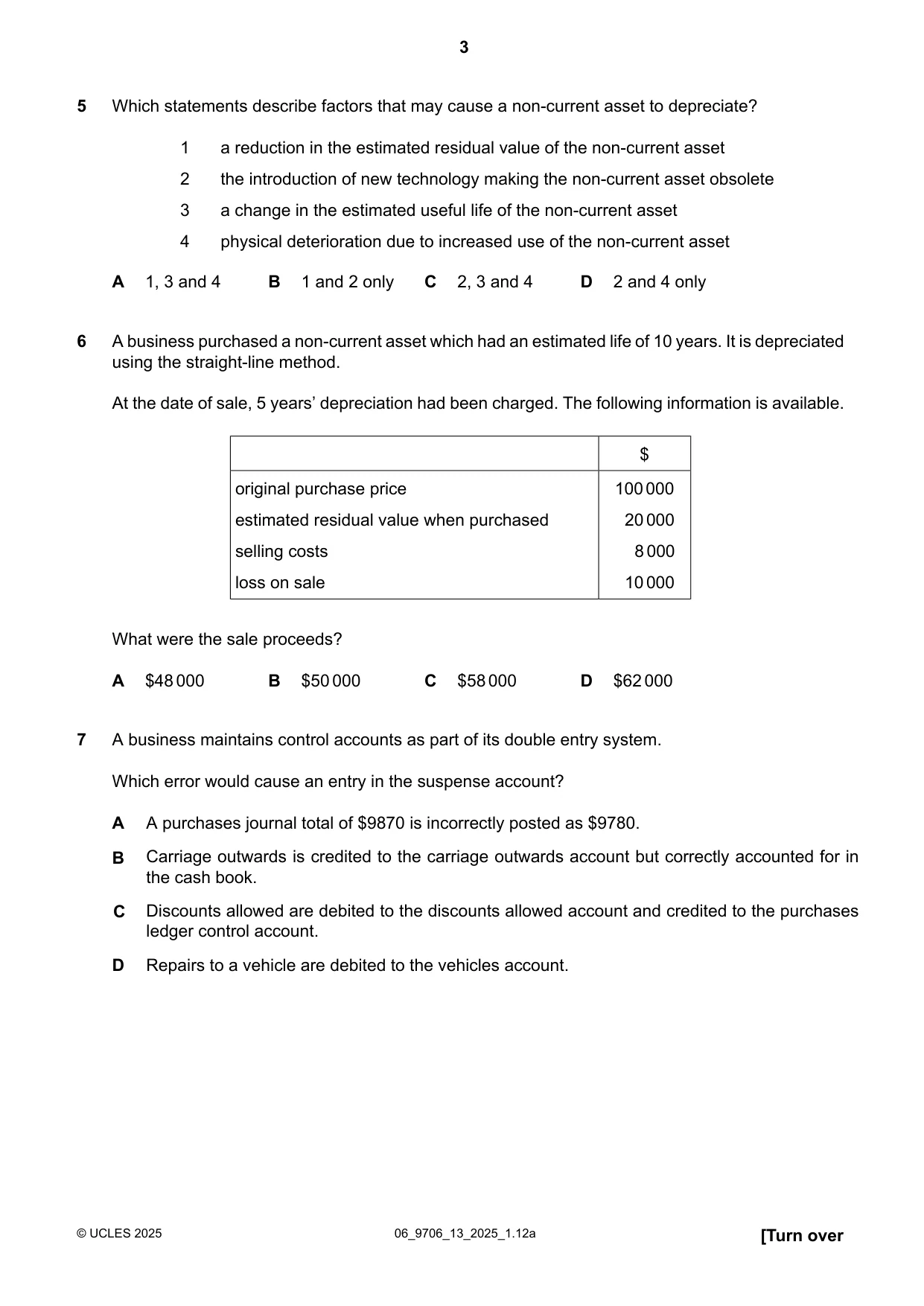
5 Which statements describe factors that may cause a non-current asset to depreciate? 1 a reduction in the estimated residual value of the non-current asset 2 the introduction of new technology making the non-current asset obsolete 3 a change in the estimated useful life of the non-current asset 4 physical deterioration due to increased use of the non-current asset A 1, 3 and 4 B 1 and 2 only C 2, 3 and 4 D 2 and 4 only
Mark scheme: D
Q6 · A business purchased a non-current asset which had an estimated life of 10 years
6 A business purchased a non-current asset which had an estimated life of 10 years. It is depreciated using the straight-line method. At the date of sale, 5 years’ depreciation had been charged. The following information is available. $ original purchase price 100000 estimated residual value when purchased 20000 selling costs 8000 loss on sale 10000 What were the sale proceeds? A $48000 B $50000 C $58000 D $62000
Mark scheme: C
Q7 · A business maintains control accounts as part of its double entry system
7 A business maintains control accounts as part of its double entry system. Which error would cause an entry in the suspense account? A A purchases journal total of $9870 is incorrectly posted as $9780. B Carriage outwards is credited to the carriage outwards account but correctly accounted for in the cash book. C Discounts allowed are debited to the discounts allowed account and credited to the purchases ledger control account. D Repairs to a vehicle are debited to the vehicles account.
Mark scheme: B
Q8 · Which item is not likely to be updated in the cash book when preparing the bank…
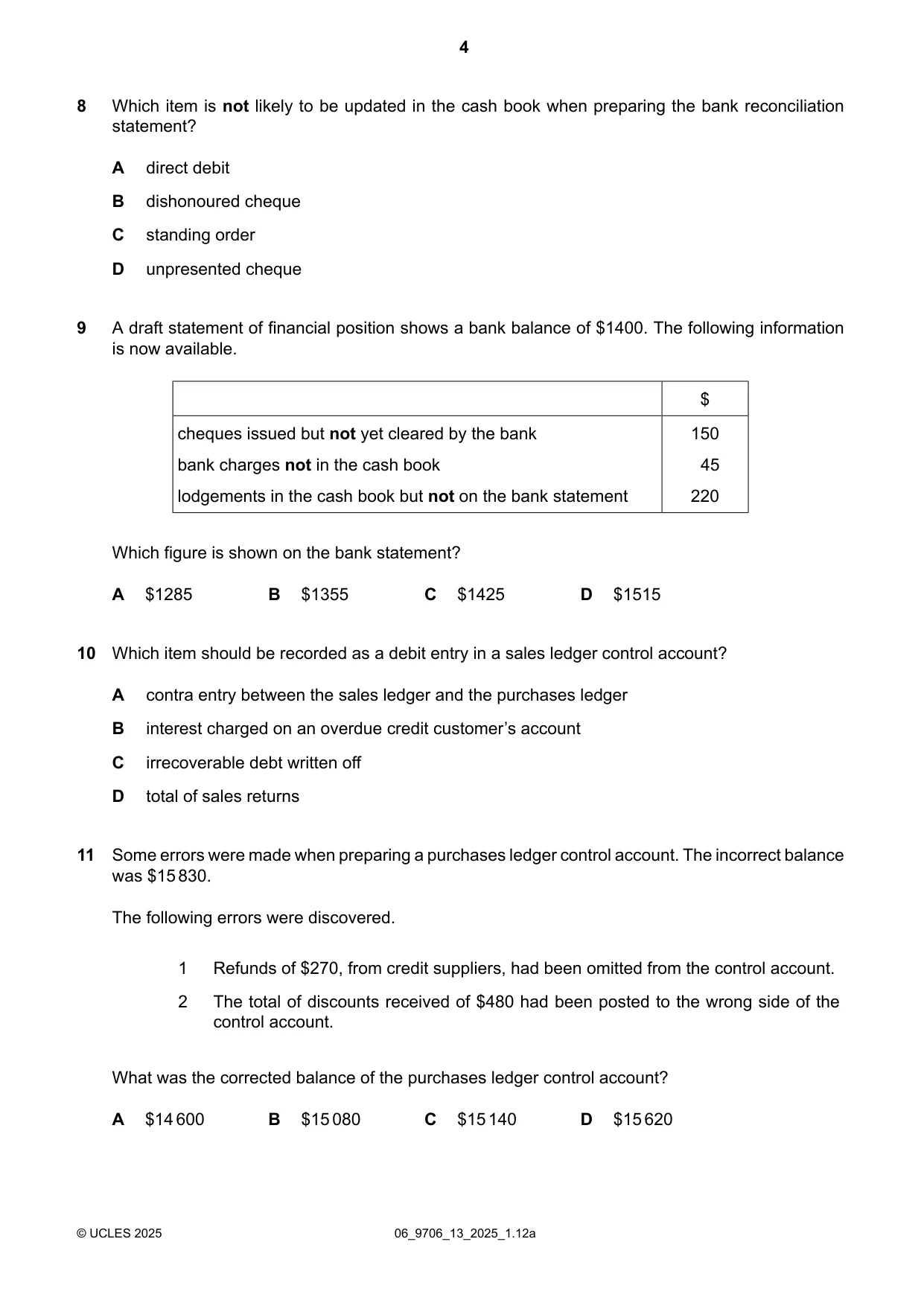
8 Which item is not likely to be updated in the cash book when preparing the bank reconciliation statement? A direct debit B dishonoured cheque C standing order D unpresented cheque
Mark scheme: D
Q9 · A draft statement of financial position shows a bank balance of $1400
9 A draft statement of financial position shows a bank balance of $1400. The following information is now available. $ cheques issued but not yet cleared by the bank 150 bank charges not in the cash book 45 lodgements in the cash book but not on the bank statement 220 Which figure is shown on the bank statement? A $1285 B $1355 C $1425 D $1515
Mark scheme: A
Q10 · Which item should be recorded as a debit entry in a sales ledger control account?
10 Which item should be recorded as a debit entry in a sales ledger control account? A contra entry between the sales ledger and the purchases ledger B interest charged on an overdue credit customer’s account C irrecoverable debt written off D total of sales returns
Mark scheme: B
Q11 · Some errors were made when preparing a purchases ledger control account
11 Some errors were made when preparing a purchases ledger control account. The incorrect balance was $15830. The following errors were discovered. 1 Refunds of $270, from credit suppliers, had been omitted from the control account. 2 The total of discounts received of $480 had been posted to the wrong side of the control account. What was the corrected balance of the purchases ledger control account? A $14600 B $15080 C $15140 D $15620
Mark scheme: C
Q12 · The draft profit for the year of a business was $84000
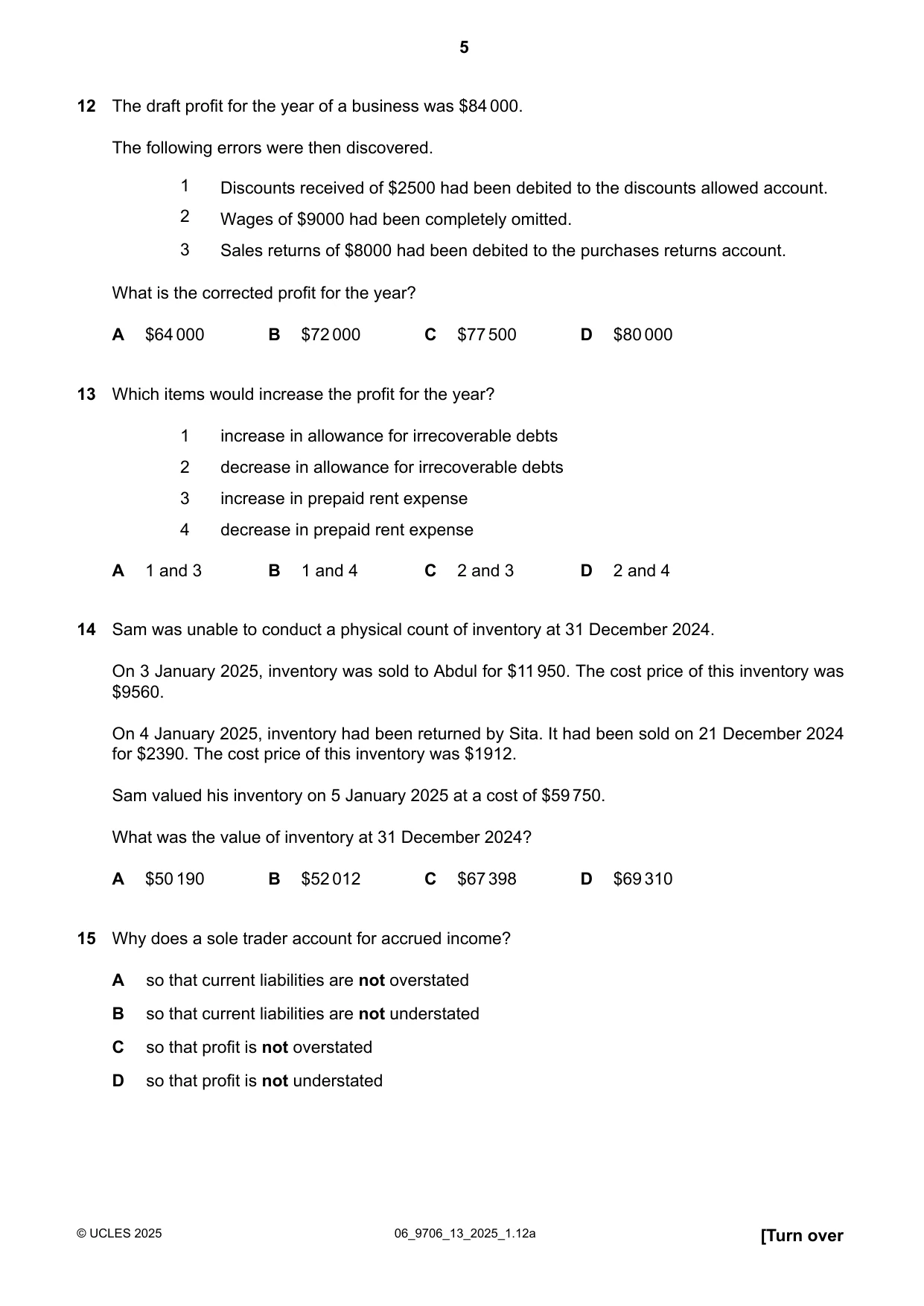
12 The draft profit for the year of a business was $84000. The following errors were then discovered. 1 Discounts received of $2500 had been debited to the discounts allowed account. 2 Wages of $9000 had been completely omitted. 3 Sales returns of $8000 had been debited to the purchases returns account. What is the corrected profit for the year? A $64000 B $72000 C $77500 D $80000
Mark scheme: D
Q13 · Which items would increase the profit for the year?
13 Which items would increase the profit for the year? 1 increase in allowance for irrecoverable debts 2 decrease in allowance for irrecoverable debts 3 increase in prepaid rent expense 4 decrease in prepaid rent expense A 1 and 3 B 1 and 4 C 2 and 3 D 2 and 4
Mark scheme: C
Q14 · Sam was unable to conduct a physical count of inventory at 31 December 2024
14 Sam was unable to conduct a physical count of inventory at 31 December 2024. On 3 January 2025, inventory was sold to Abdul for $11950. The cost price of this inventory was $9560. On 4 January 2025, inventory had been returned by Sita. It had been sold on 21 December 2024 for $2390. The cost price of this inventory was $1912. Sam valued his inventory on 5 January 2025 at a cost of $59750. What was the value of inventory at 31 December 2024? A $50190 B $52012 C $67398 D $69310
Mark scheme: C
Q15 · Why does a sole trader account for accrued income?
15 Why does a sole trader account for accrued income? A so that current liabilities are not overstated B so that current liabilities are not understated C so that profit is not overstated D so that profit is not understated
Mark scheme: D
Q16 · The following information is available for a sole trader’s business at the end of the…
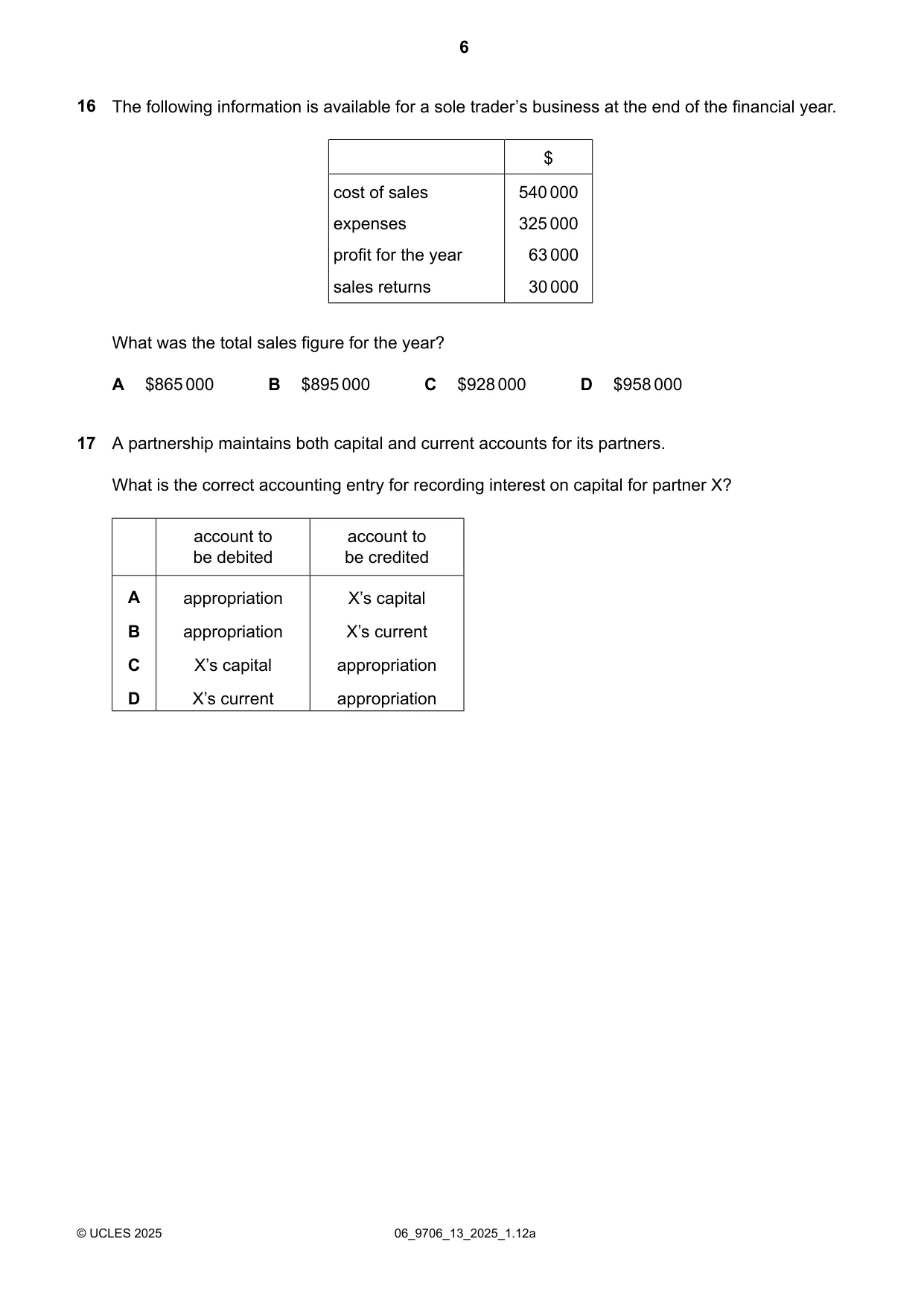
16 The following information is available for a sole trader’s business at the end of the financial year. $ cost of sales 540000 expenses 325000 profit for the year 63000 sales returns 30000 What was the total sales figure for the year? A $865000 B $895000 C $928000 D $958000
Mark scheme: D
Q17 · A partnership maintains both capital and current accounts for its partners
17 A partnership maintains both capital and current accounts for its partners. What is the correct accounting entry for recording interest on capital for partner X? account to account to be debited be credited A appropriation X’s capital B appropriation X’s current C X’s capital appropriation D X’s current appropriation
Mark scheme: B
Q18 · Arnold is in a partnership with Bradley
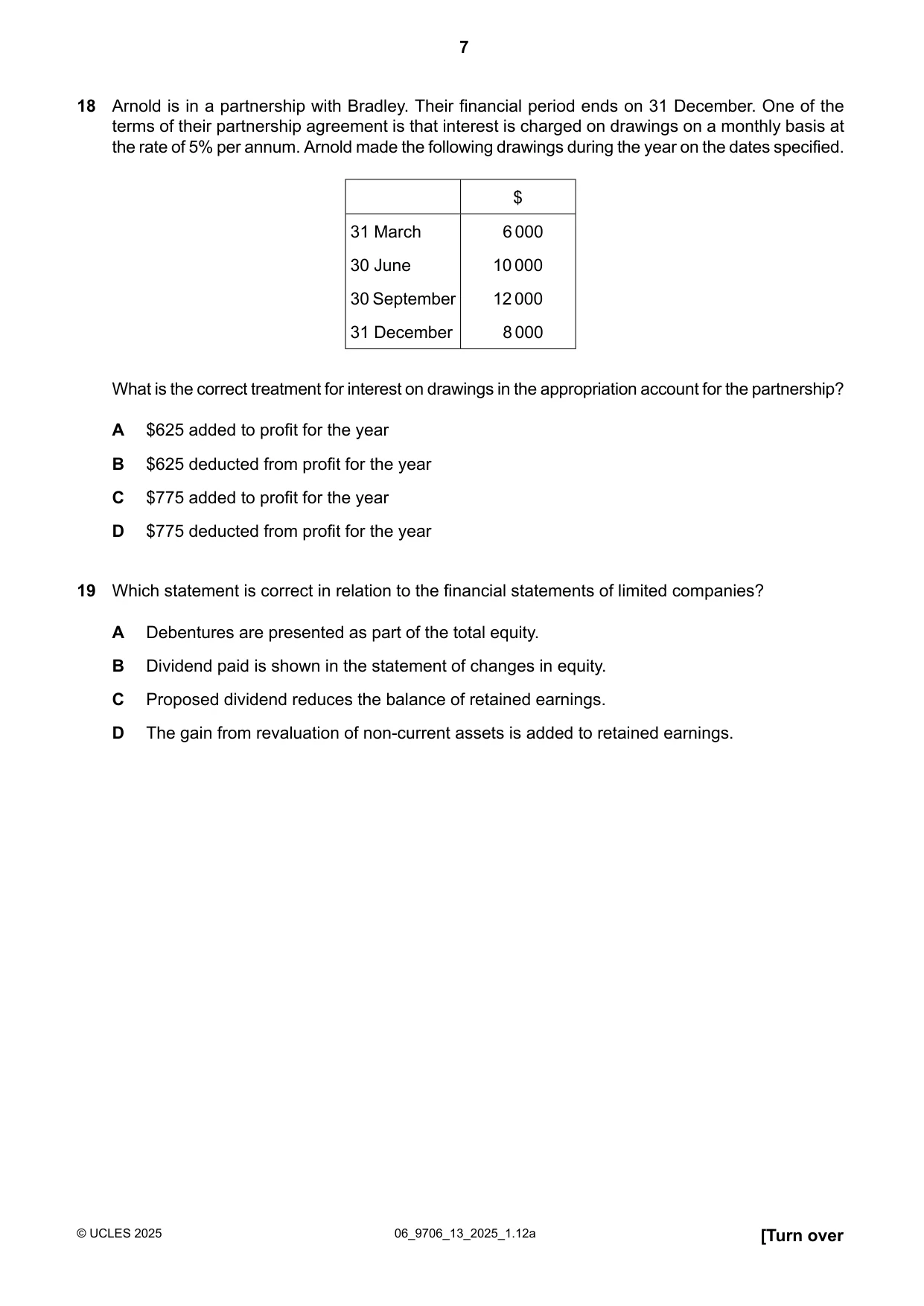
18 Arnold is in a partnership with Bradley. Their financial period ends on 31 December. One of the terms of their partnership agreement is that interest is charged on drawings on a monthly basis at the rate of 5% per annum. Arnold made the following drawings during the year on the dates specified. $ 31 March 6000 30 June 10000 30 September 12000 31 December 8000 What is the correct treatment for interest on drawings in the appropriation account for the partnership? A $625 added to profit for the year B $625 deducted from profit for the year C $775 added to profit for the year D $775 deducted from profit for the year
Mark scheme: A
Q19 · Which statement is correct in relation to the financial statements of limited companies?
19 Which statement is correct in relation to the financial statements of limited companies? A Debentures are presented as part of the total equity. B Dividend paid is shown in the statement of changes in equity. C Proposed dividend reduces the balance of retained earnings. D The gain from revaluation of non-current assets is added to retained earnings.
Mark scheme: B
Q20 · A company provides the following information about its equity
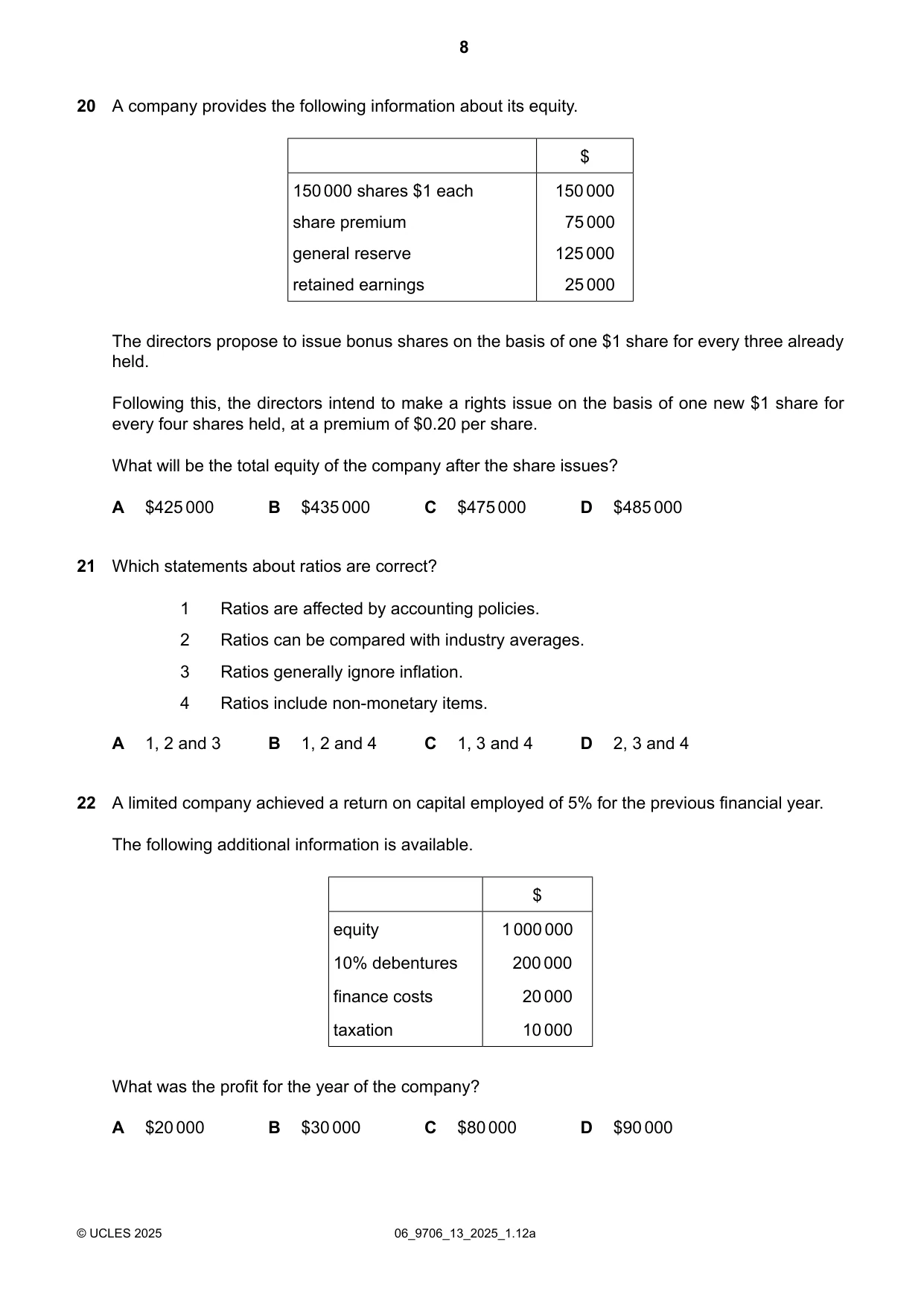
20 A company provides the following information about its equity. $ 150000 shares $1 each 150000 share premium 75000 general reserve 125000 retained earnings 25000 The directors propose to issue bonus shares on the basis of one $1 share for every three already held. Following this, the directors intend to make a rights issue on the basis of one new $1 share for every four shares held, at a premium of $0.20 per share. What will be the total equity of the company after the share issues? A $425000 B $435000 C $475000 D $485000
Mark scheme: B
Q21 · Which statements about ratios are correct?
21 Which statements about ratios are correct? 1 Ratios are affected by accounting policies. 2 Ratios can be compared with industry averages. 3 Ratios generally ignore inflation. 4 Ratios include non-monetary items. A 1, 2 and 3 B 1, 2 and 4 C 1, 3 and 4 D 2, 3 and 4
Mark scheme: A
More questions on Analysis and communication of accounting information
Q22 · A limited company achieved a return on capital employed of 5% for the previous financial…
22 A limited company achieved a return on capital employed of 5% for the previous financial year. The following additional information is available. $ equity 1000000 10% debentures 200000 finance costs 20000 taxation 10000 What was the profit for the year of the company? A $20000 B $30000 C $80000 D $90000
Mark scheme: B
More questions on Analysis and communication of accounting information
Q23 · A business rents machinery for use in its factory
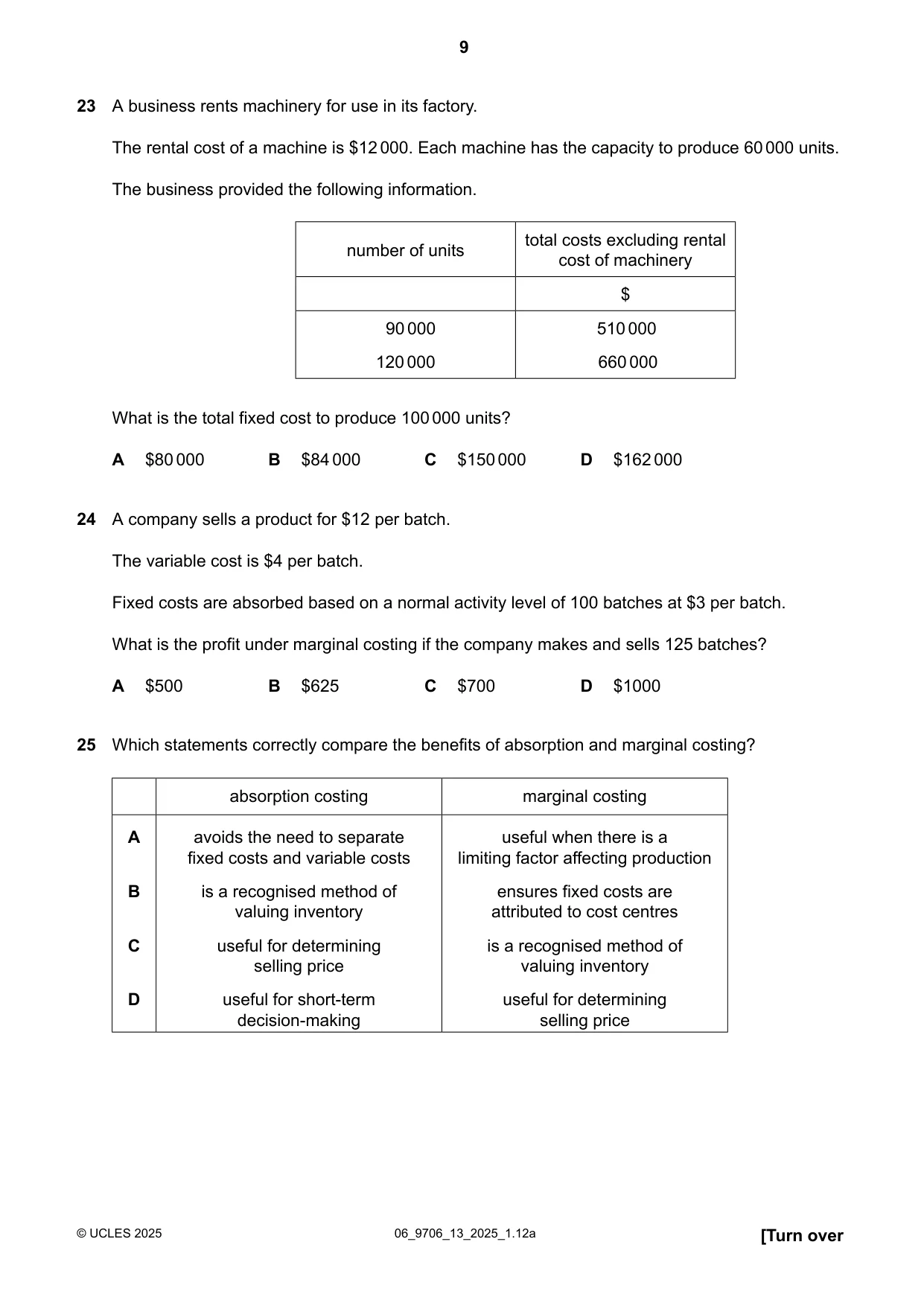
23 A business rents machinery for use in its factory. The rental cost of a machine is $12000. Each machine has the capacity to produce 60000 units. The business provided the following information. total costs excluding rental number of units cost of machinery $ 90000 510000 120000 660000 What is the total fixed cost to produce 100000 units? A $80000 B $84000 C $150000 D $162000
Mark scheme: B
Q24 · A company sells a product for $12 per batch
24 A company sells a product for $12 per batch. The variable cost is $4 per batch. Fixed costs are absorbed based on a normal activity level of 100 batches at $3 per batch. What is the profit under marginal costing if the company makes and sells 125 batches? A $500 B $625 C $700 D $1000
Mark scheme: C
Q25 · Which statements correctly compare the benefits of absorption and marginal costing?
25 Which statements correctly compare the benefits of absorption and marginal costing? absorption costing marginal costing A avoids the need to separate useful when there is a fixed costs and variable costs limiting factor affecting production B is a recognised method of ensures fixed costs are valuing inventory attributed to cost centres C useful for determining is a recognised method of selling price valuing inventory D useful for short-term useful for determining decision-making selling price
Mark scheme: A
Q26 · The following table shows details of production for a week
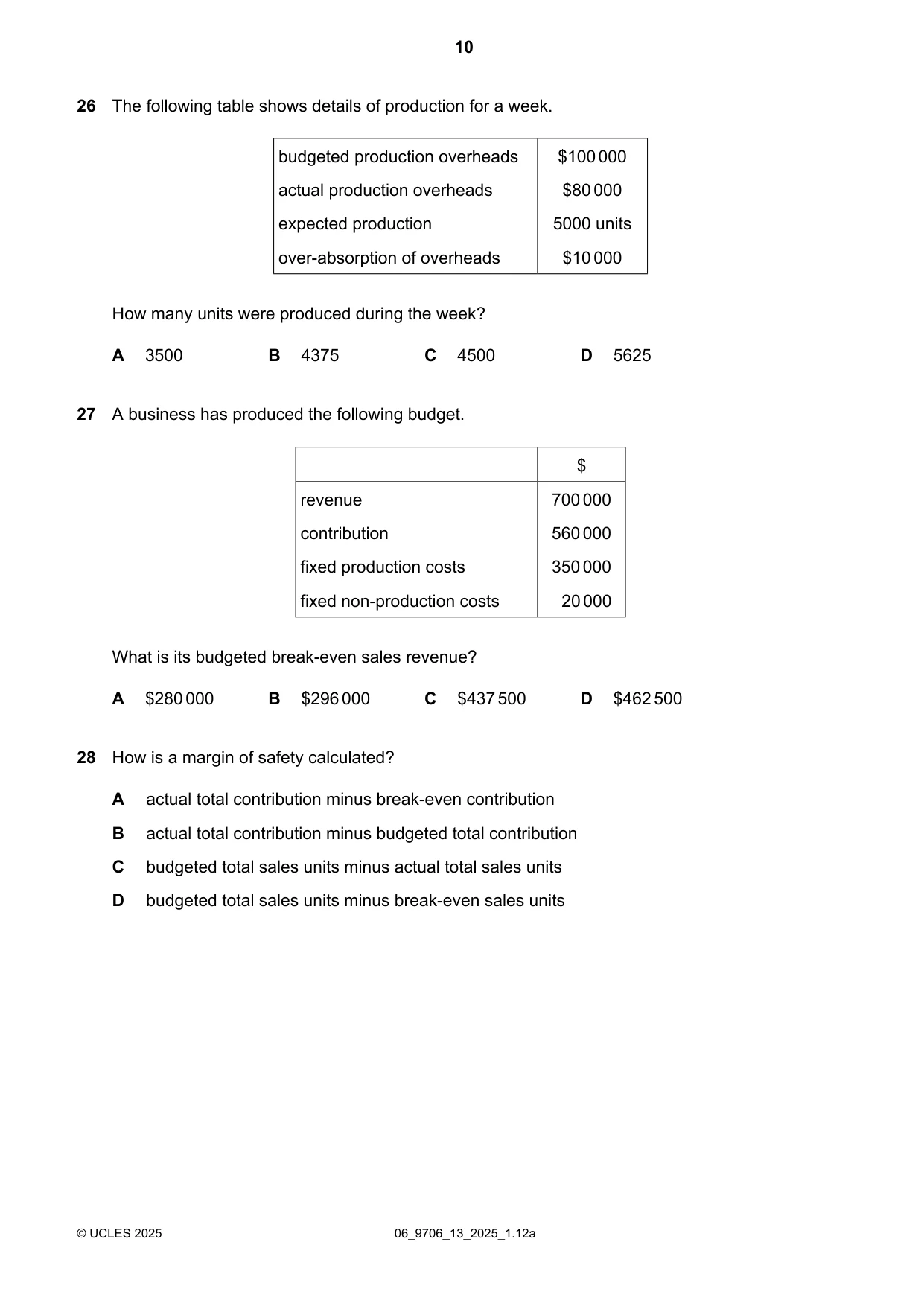
26 The following table shows details of production for a week. budgeted production overheads $100000 actual production overheads $80000 expected production 5000 units over-absorption of overheads $10000 How many units were produced during the week? A 3500 B 4375 C 4500 D 5625
Mark scheme: C
Q27 · A business has produced the following budget
27 A business has produced the following budget. $ revenue 700000 contribution 560000 fixed production costs 350000 fixed non-production costs 20000 What is its budgeted break-even sales revenue? A $280000 B $296000 C $437500 D $462500
Mark scheme: D
Q28 · How is a margin of safety calculated?
28 How is a margin of safety calculated? A actual total contribution minus break-even contribution B actual total contribution minus budgeted total contribution C budgeted total sales units minus actual total sales units D budgeted total sales units minus break-even sales units
Mark scheme: D
Q29 · A business had a contribution to sales ratio of 40%
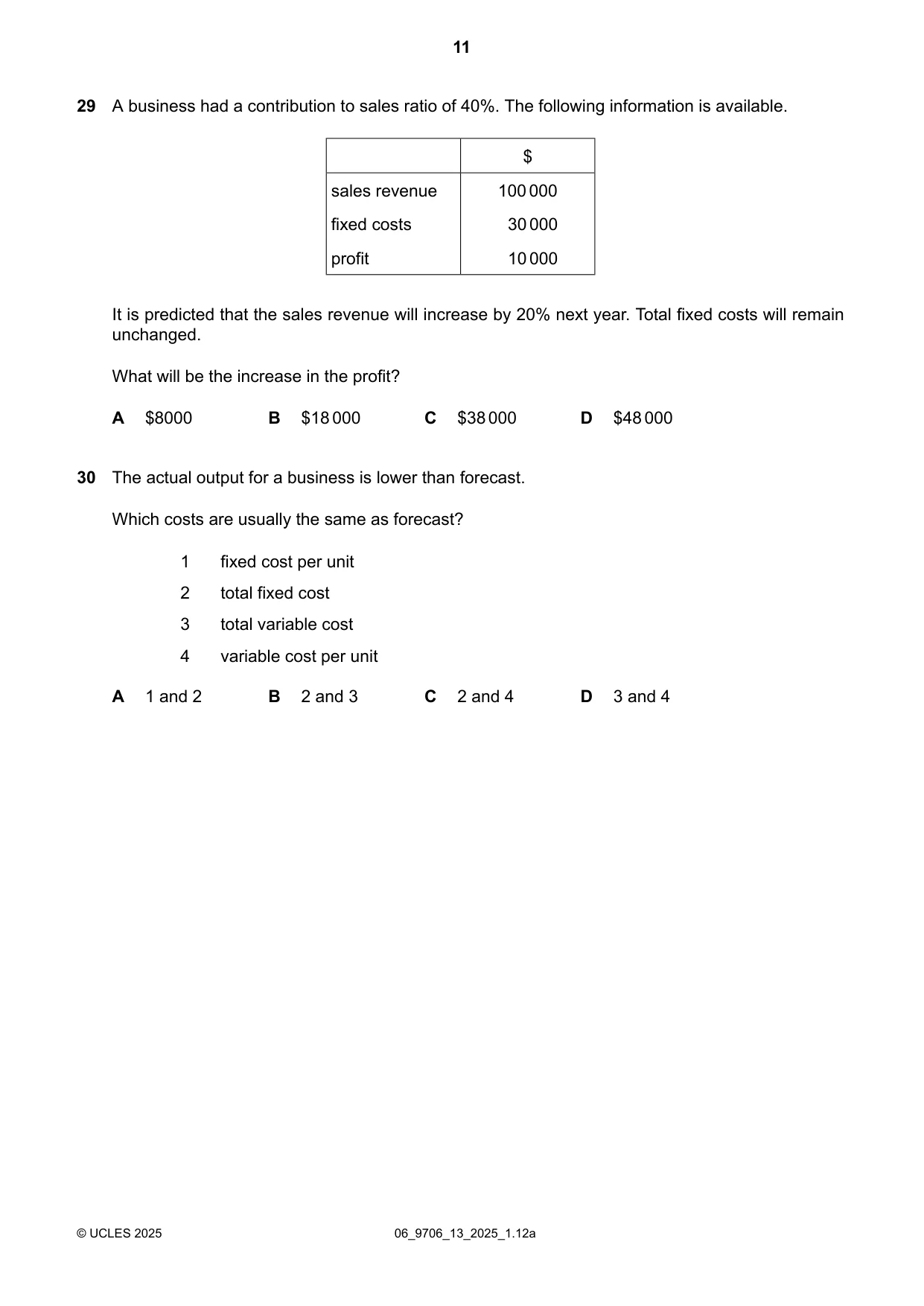
29 A business had a contribution to sales ratio of 40%. The following information is available. $ sales revenue 100000 fixed costs 30000 profit 10000 It is predicted that the sales revenue will increase by 20% next year. Total fixed costs will remain unchanged. What will be the increase in the profit? A $8000 B $18000 C $38000 D $48000
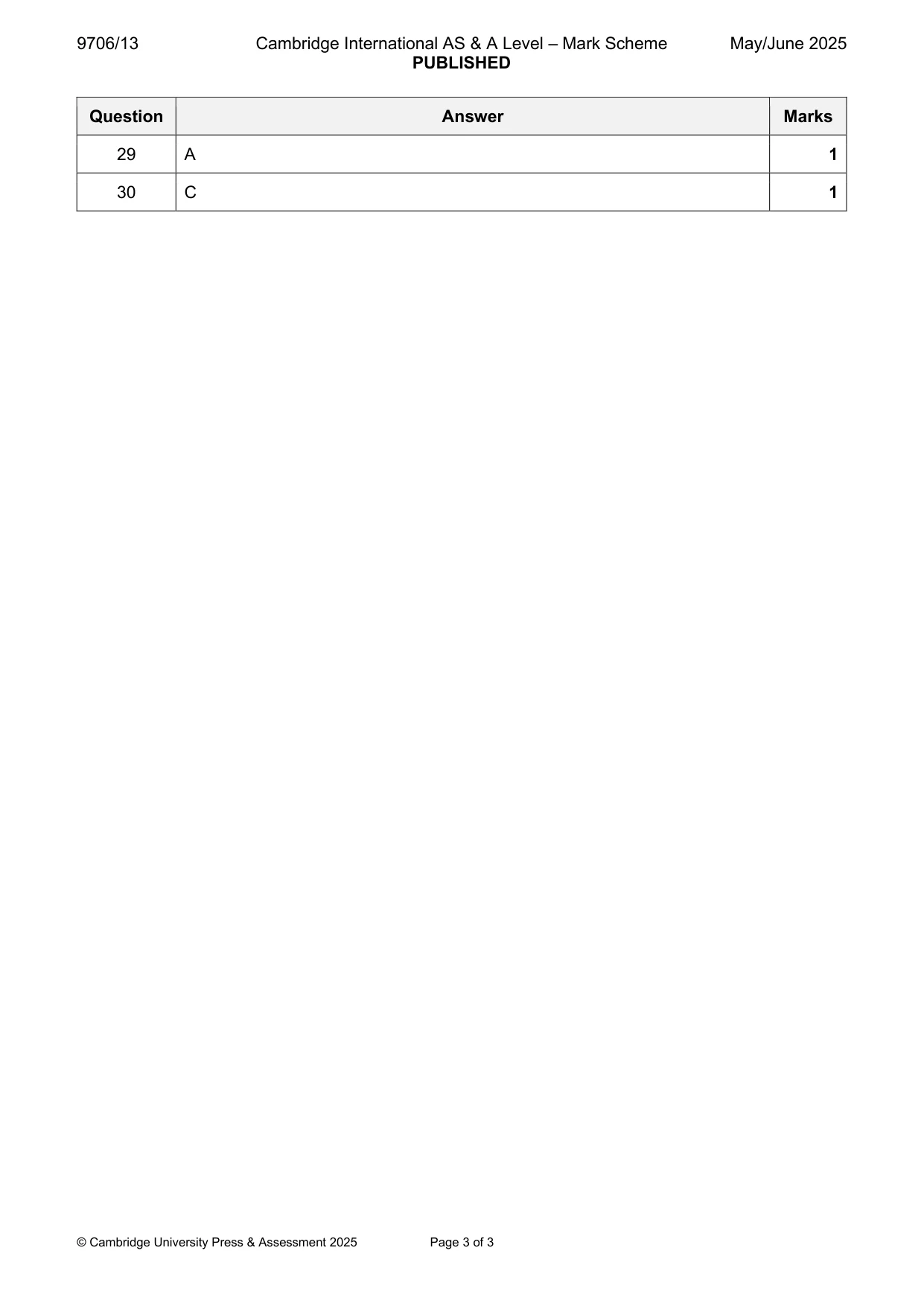
Mark scheme: A
Q30 · The actual output for a business is lower than forecast
30 The actual output for a business is lower than forecast. Which costs are usually the same as forecast? 1 fixed cost per unit 2 total fixed cost 3 total variable cost 4 variable cost per unit A 1 and 2 B 2 and 3 C 2 and 4 D 3 and 4
Mark scheme: C
What was in this paper
The subtopics covered by these 30 questions, and how many questions each got. Open one in a new tab to see every Cambridge question on it.
7Reconciliation and verification6Traditional costing methods6Accounting for non-current assets3Costs and cost behaviour2Preparation of financial statements2Analysis and communication of accounting information1Analysis and communication of accounting information1The accounting system1Types of business entity1What you needed in this session
Cambridge’s own grade thresholds for 2025 May/June, Paper 1 · Variant 3. A higher threshold means an easier paper — the bar moves with how the cohort did.