Cambridge A Level Accounting 9706 — 2019 Oct/Nov Paper 1 · Variant 2
9706/12/O/N/19 · 30 questions · 30 marks · ≈34 min
The question paper and its mark scheme, free to read here and free to download. This is Cambridge’s own paper, exactly as it was sat.
Question paper12 pages
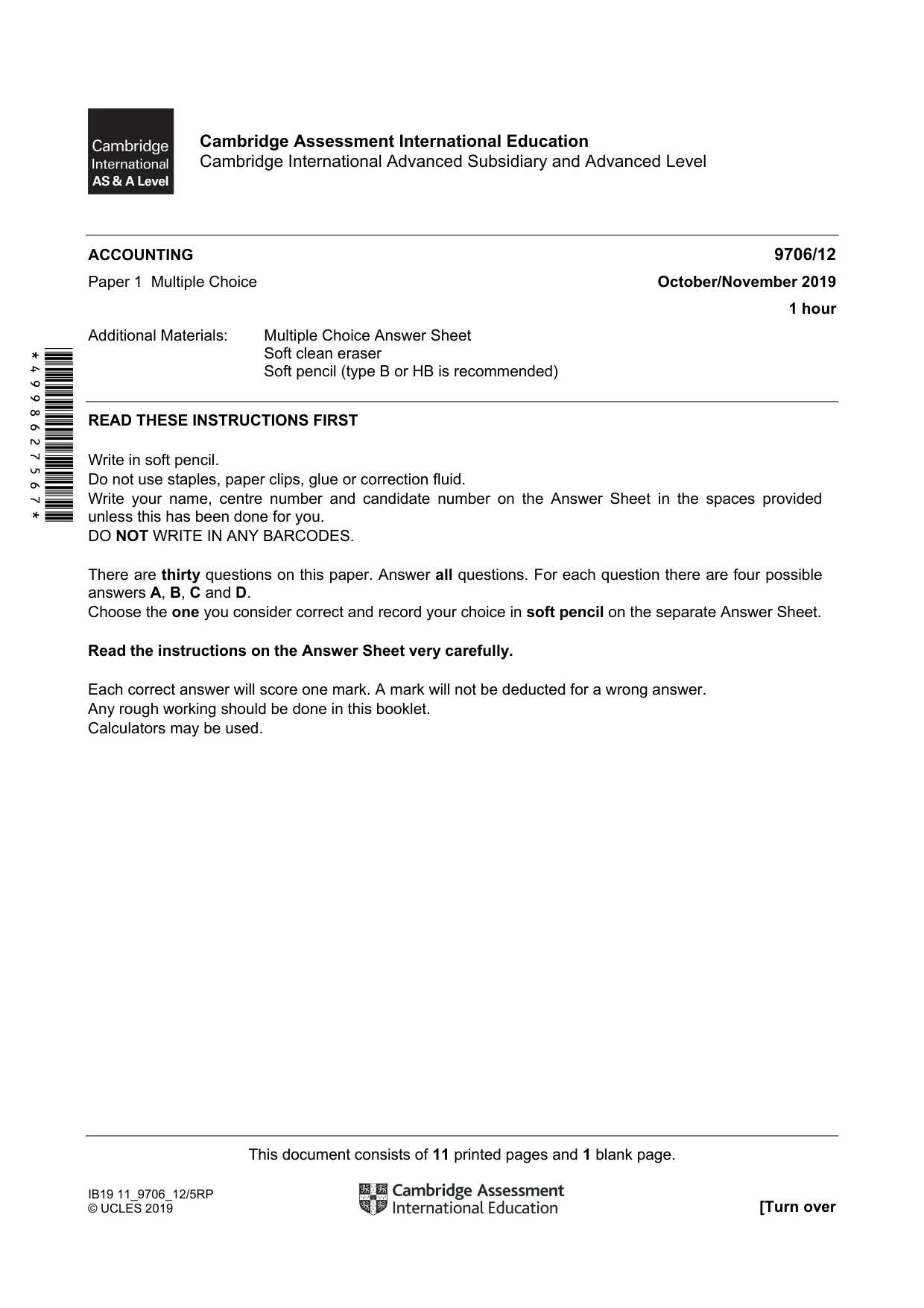
Mark scheme3 pages
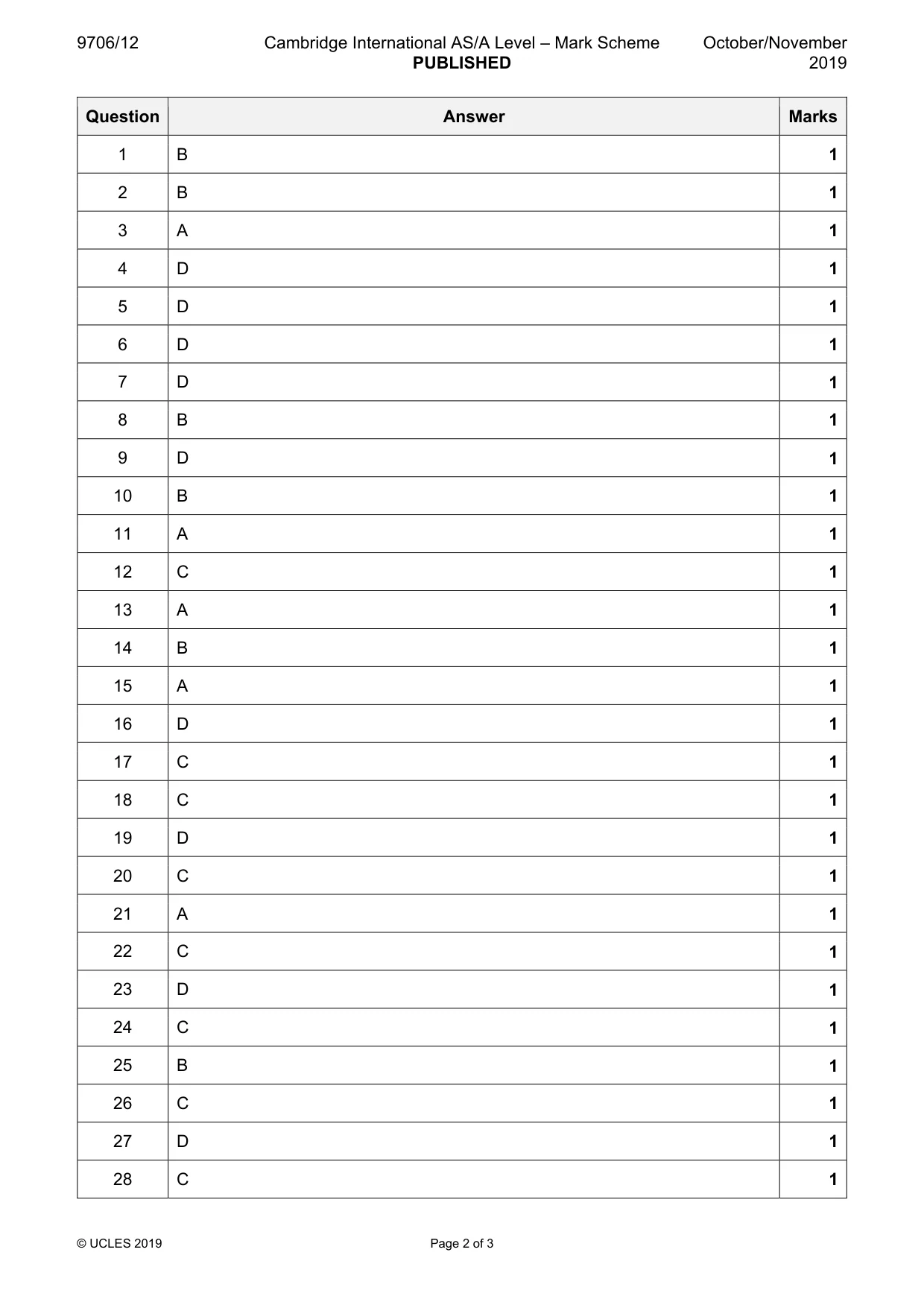
Answers below. Sit the paper first if you are practising.
Questions as text
Q1 · Which concept requires that profits should be based on recognising revenues and their…
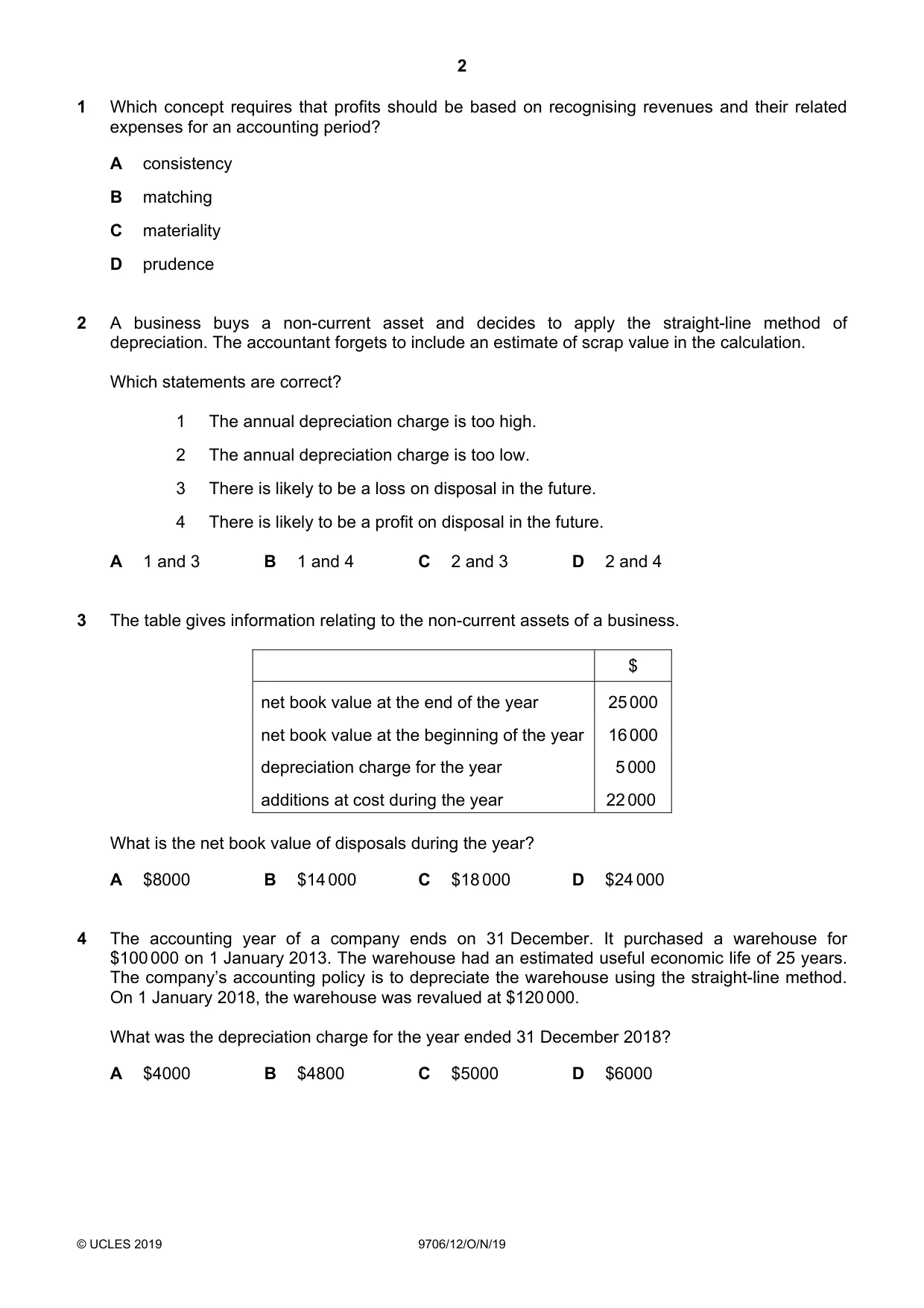
1 Which concept requires that profits should be based on recognising revenues and their related expenses for an accounting period? A consistency B matching C materiality D prudence
Mark scheme: B
Q2 · A business buys a non-current asset and decides to apply the straight-line method of…
2 A business buys a non-current asset and decides to apply the straight-line method of depreciation. The accountant forgets to include an estimate of scrap value in the calculation. Which statements are correct? 1 The annual depreciation charge is too high. 2 The annual depreciation charge is too low. 3 There is likely to be a loss on disposal in the future. 4 There is likely to be a profit on disposal in the future. A 1 and 3 B 1 and 4 C 2 and 3 D 2 and 4
Mark scheme: B
Q3 · The table gives information relating to the non-current assets of a business
3 The table gives information relating to the non-current assets of a business. $ net book value at the end of the year 25 000 net book value at the beginning of the year 16 000 depreciation charge for the year 5 000 additions at cost during the year 22 000 What is the net book value of disposals during the year? A $8000 B $14 000 C $18 000 D $24 000
Mark scheme: A
Q4 · The accounting year of a company ends on 31 December
4 The accounting year of a company ends on 31 December. It purchased a warehouse for $100 000 on 1 January 2013. The warehouse had an estimated useful economic life of 25 years. The company’s accounting policy is to depreciate the warehouse using the straight-line method. On 1 January 2018, the warehouse was revalued at $120 000. What was the depreciation charge for the year ended 31 December 2018? A $4000 B $4800 C $5000 D $6000
Mark scheme: D
Q5 · A company prepared a sales ledger control account
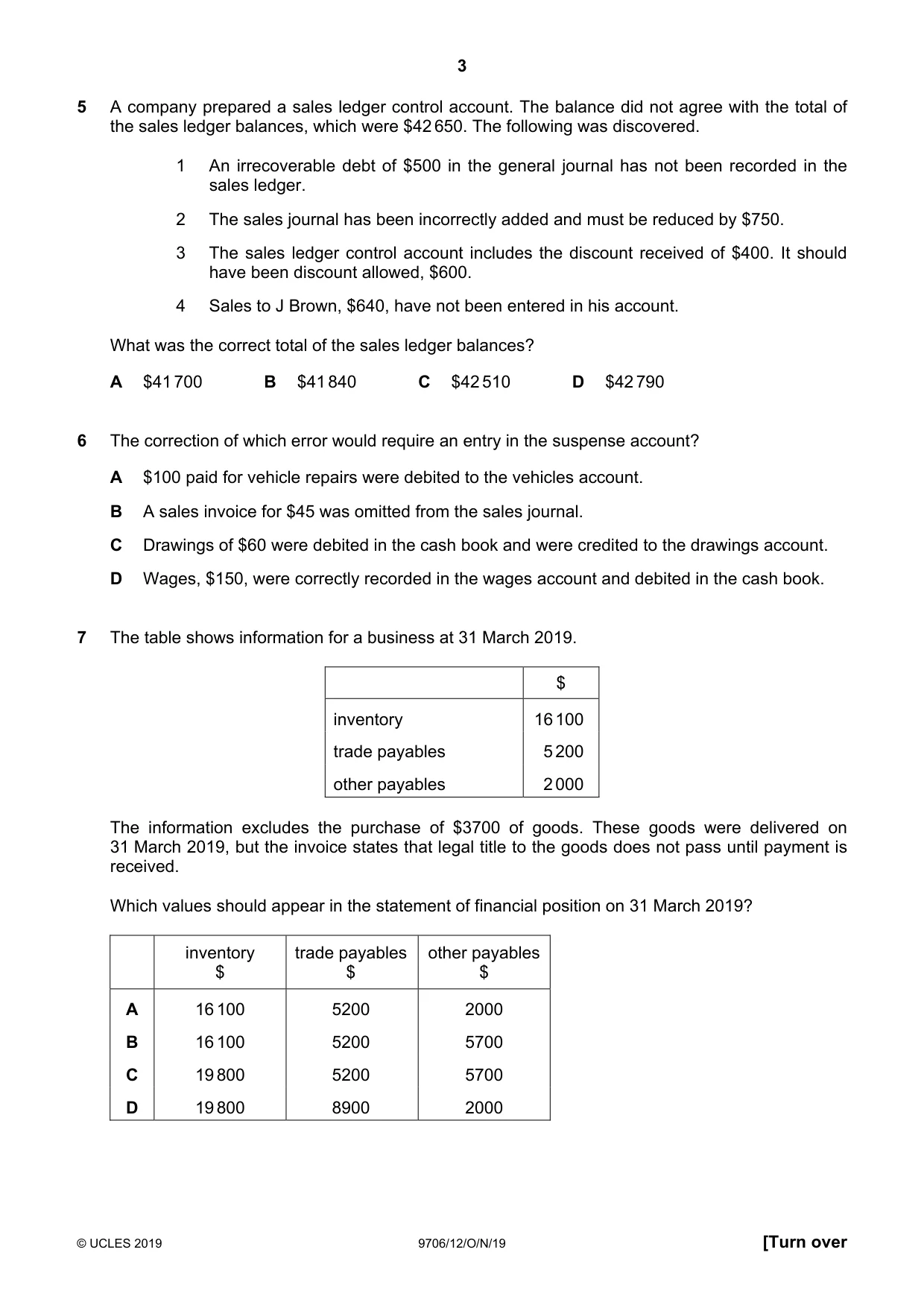
5 A company prepared a sales ledger control account. The balance did not agree with the total of the sales ledger balances, which were $42 650. The following was discovered. 1 An irrecoverable debt of $500 in the general journal has not been recorded in the sales ledger. 2 The sales journal has been incorrectly added and must be reduced by $750. 3 The sales ledger control account includes the discount received of $400. It should have been discount allowed, $600. 4 Sales to J Brown, $640, have not been entered in his account. What was the correct total of the sales ledger balances? A $41 700 B $41 840 C $42 510 D $42 790
Mark scheme: D
Q6 · The correction of which error would require an entry in the suspense account?
6 The correction of which error would require an entry in the suspense account? A $100 paid for vehicle repairs were debited to the vehicles account. B A sales invoice for $45 was omitted from the sales journal. C Drawings of $60 were debited in the cash book and were credited to the drawings account. D Wages, $150, were correctly recorded in the wages account and debited in the cash book.
Mark scheme: D
Q7 · The table shows information for a business at 31 March 2019
7 The table shows information for a business at 31 March 2019. $ inventory 16 100 trade payables 5 200 other payables 2 000 The information excludes the purchase of $3700 of goods. These goods were delivered on 31 March 2019, but the invoice states that legal title to the goods does not pass until payment is received. Which values should appear in the statement of financial position on 31 March 2019? inventory trade payables other payables $ $ $ A 16 100 5200 2000 B 16 100 5200 5700 C 19 800 5200 5700 D 19 800 8900 2000
Mark scheme: D
Q8 · A business has valued some of its closing inventories at cost
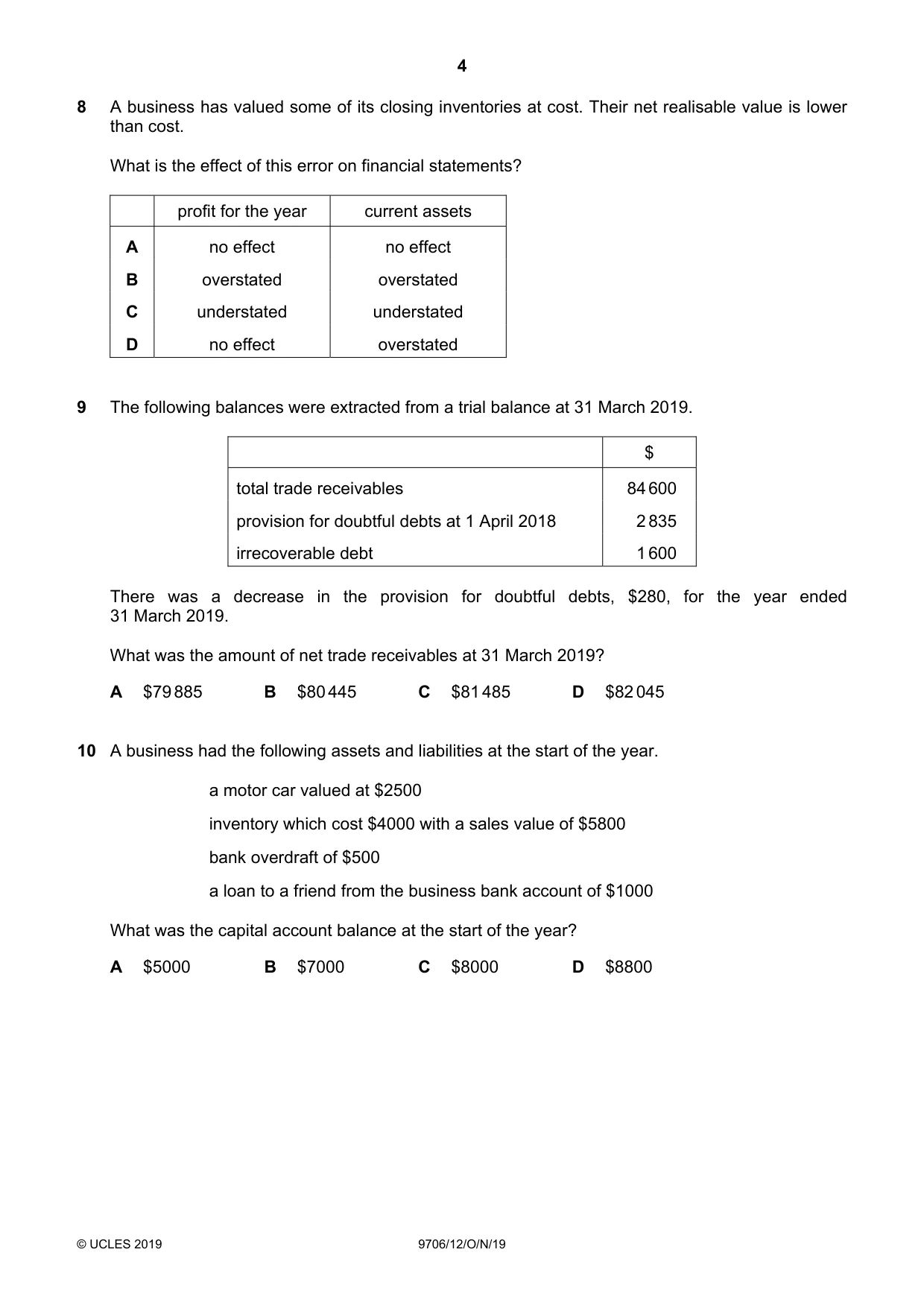
8 A business has valued some of its closing inventories at cost. Their net realisable value is lower than cost. What is the effect of this error on financial statements? profit for the year current assets A no effect no effect B overstated overstated C understated understated D no effect overstated
Mark scheme: B
Q9 · The following balances were extracted from a trial balance at 31 March 2019
9 The following balances were extracted from a trial balance at 31 March 2019. $ total trade receivables 84 600 provision for doubtful debts at 1 April 2018 2 835 irrecoverable debt 1 600 There was a decrease in the provision for doubtful debts, $280, for the year ended 31 March 2019. What was the amount of net trade receivables at 31 March 2019? A $79 885 B $80 445 C $81 485 D $82 045
Mark scheme: D
Q10 · A business had the following assets and liabilities at the start of the year
10 A business had the following assets and liabilities at the start of the year. a motor car valued at $2500 inventory which cost $4000 with a sales value of $5800 bank overdraft of $500 a loan to a friend from the business bank account of $1000 What was the capital account balance at the start of the year? A $5000 B $7000 C $8000 D $8800
Mark scheme: B
Q11 · A sole trader had the following transactions
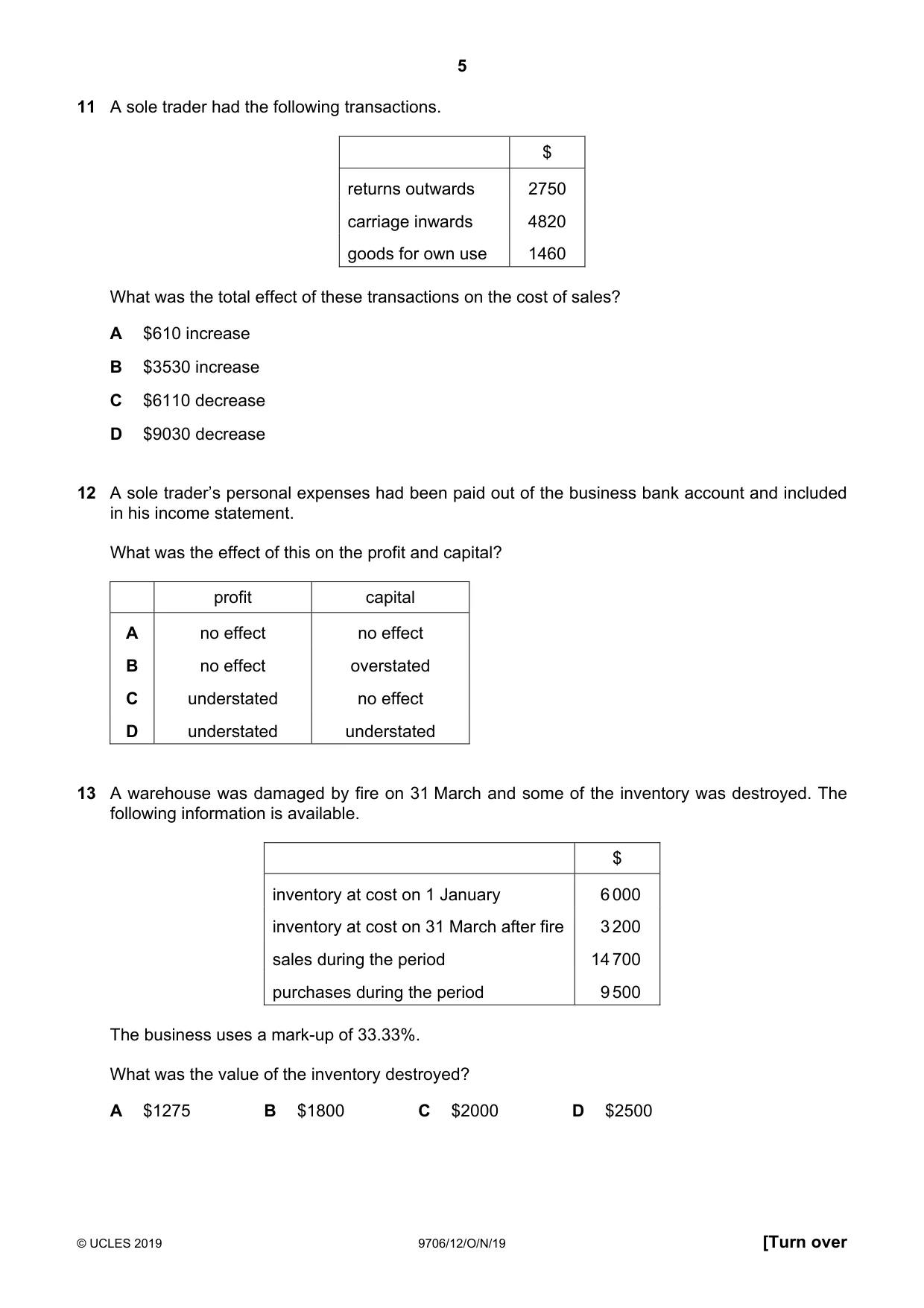
11 A sole trader had the following transactions. $ returns outwards 2750 carriage inwards 4820 goods for own use 1460 What was the total effect of these transactions on the cost of sales? A $610 increase B $3530 increase C $6110 decrease D $9030 decrease
Mark scheme: A
Q12 · A sole trader’s personal expenses had been paid out of the business bank account and…
12 A sole trader’s personal expenses had been paid out of the business bank account and included in his income statement. What was the effect of this on the profit and capital? profit capital A no effect no effect B no effect overstated C understated no effect D understated understated
Mark scheme: C
Q13 · A warehouse was damaged by fire on 31 March and some of the inventory was destroyed
13 A warehouse was damaged by fire on 31 March and some of the inventory was destroyed. The following information is available. $ inventory at cost on 1 January 6 000 inventory at cost on 31 March after fire 3 200 sales during the period 14 700 purchases during the period 9 500 The business uses a mark-up of 33.33%. What was the value of the inventory destroyed? A $1275 B $1800 C $2000 D $2500
Mark scheme: A
Q14 · P and Q are in partnership
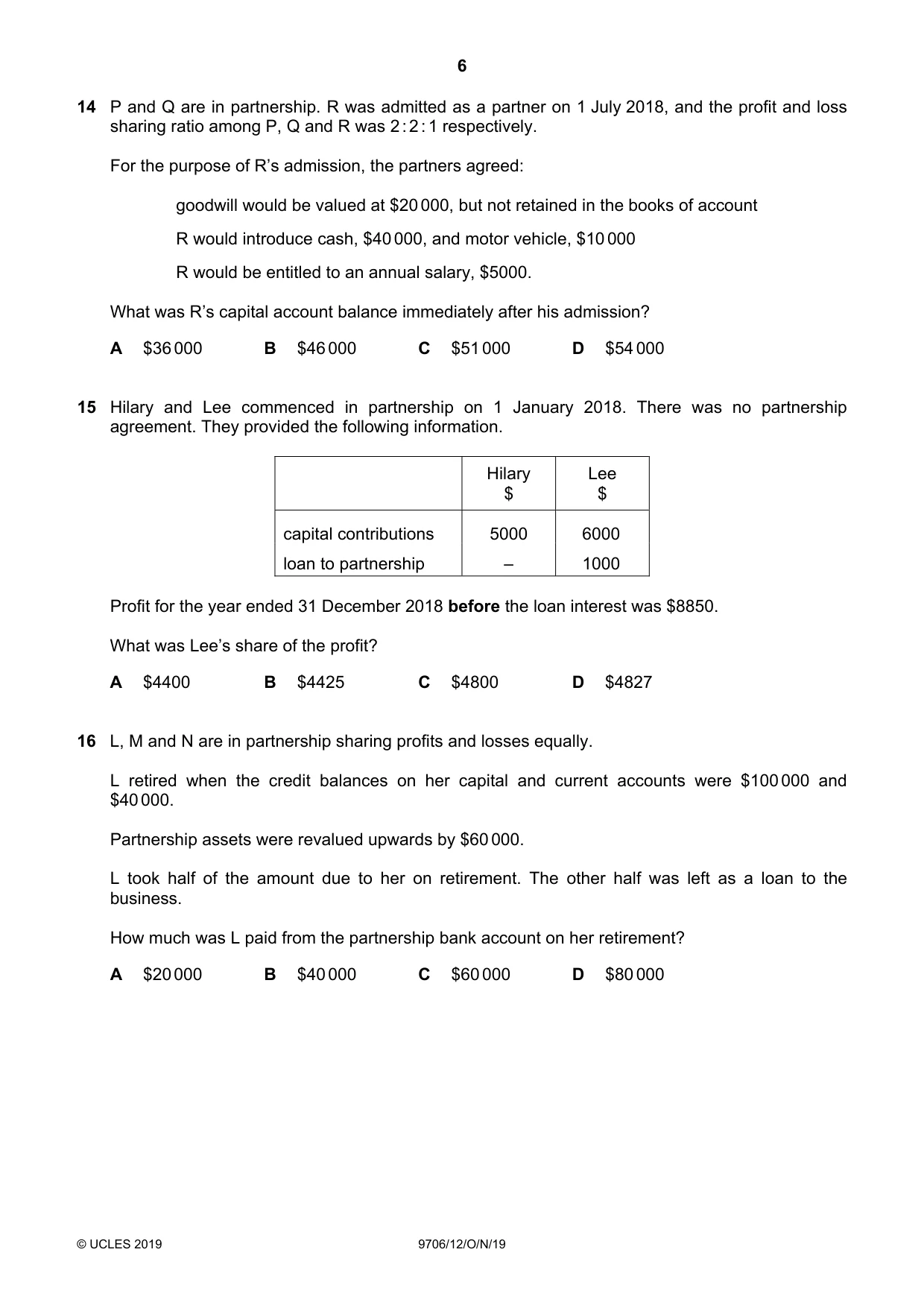
14 P and Q are in partnership. R was admitted as a partner on 1 July 2018, and the profit and loss sharing ratio among P, Q and R was 2 : 2 : 1 respectively. For the purpose of R’s admission, the partners agreed: goodwill would be valued at $20 000, but not retained in the books of account R would introduce cash, $40 000, and motor vehicle, $10 000 R would be entitled to an annual salary, $5000. What was R’s capital account balance immediately after his admission? A $36 000 B $46 000 C $51 000 D $54 000
Mark scheme: B
Q15 · Hilary and Lee commenced in partnership on 1 January 2018
15 Hilary and Lee commenced in partnership on 1 January 2018. There was no partnership agreement. They provided the following information. Hilary Lee $ $ capital contributions 5000 6000 loan to partnership – 1000 Profit for the year ended 31 December 2018 before the loan interest was $8850. What was Lee’s share of the profit? A $4400 B $4425 C $4800 D $4827
Mark scheme: A
Q16 · L, M and N are in partnership sharing profits and losses equally
16 L, M and N are in partnership sharing profits and losses equally. L retired when the credit balances on her capital and current accounts were $100 000 and $40 000. Partnership assets were revalued upwards by $60 000. L took half of the amount due to her on retirement. The other half was left as a loan to the business. How much was L paid from the partnership bank account on her retirement? A $20 000 B $40 000 C $60 000 D $80 000
Mark scheme: D
Q17 · The directors of a limited company recently made a rights issue of one ordinary share for…
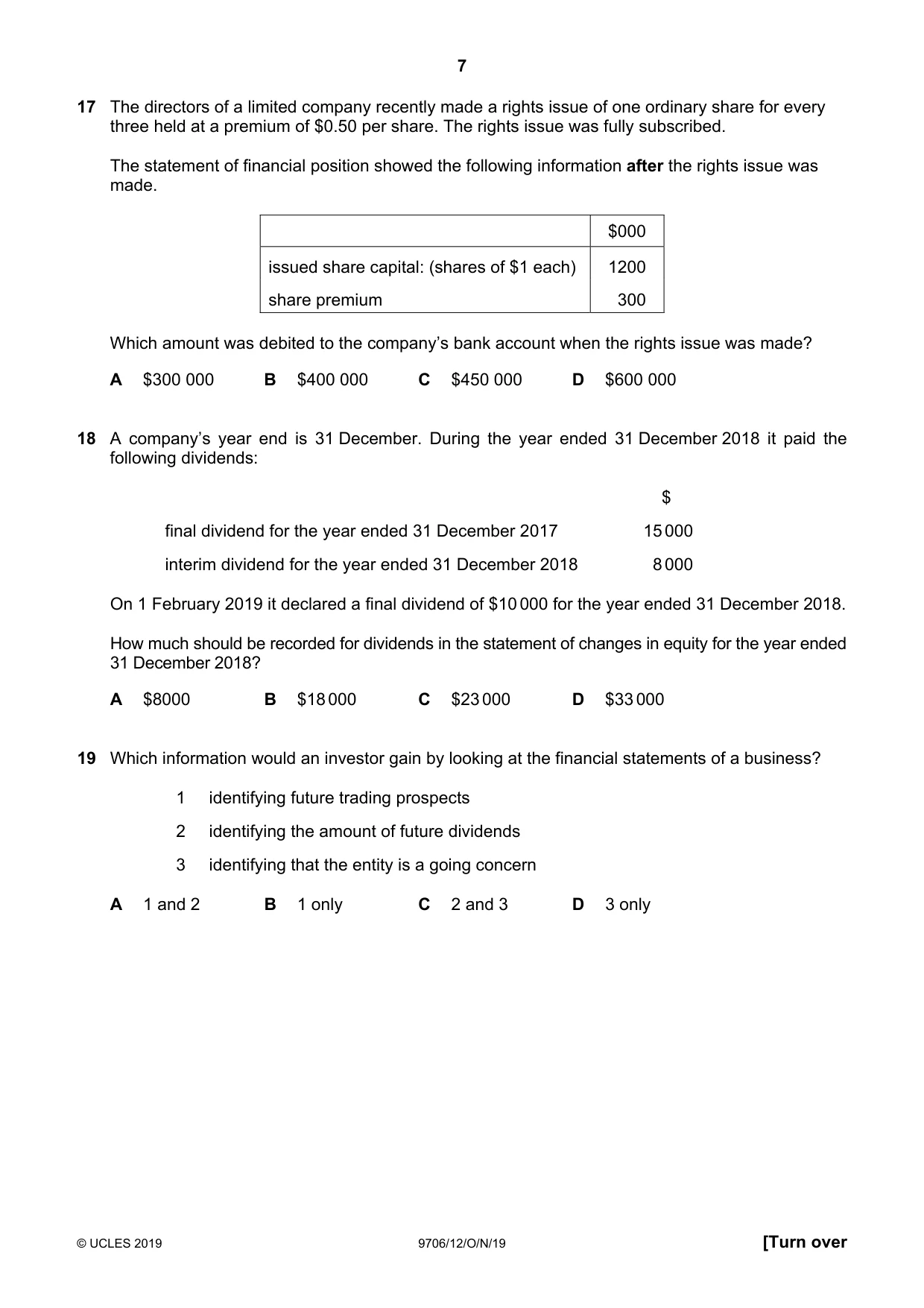
17 The directors of a limited company recently made a rights issue of one ordinary share for every three held at a premium of $0.50 per share. The rights issue was fully subscribed. The statement of financial position showed the following information after the rights issue was made. $000 issued share capital: (shares of $1 each) 1200 share premium 300 Which amount was debited to the company’s bank account when the rights issue was made? A $300 000 B $400 000 C $450 000 D $600 000
Mark scheme: C
Q18 · A company’s year end is 31 December
18 A company’s year end is 31 December. During the year ended 31 December 2018 it paid the following dividends: $ final dividend for the year ended 31 December 2017 15 000 interim dividend for the year ended 31 December 2018 8 000 On 1 February 2019 it declared a final dividend of $10 000 for the year ended 31 December 2018. How much should be recorded for dividends in the statement of changes in equity for the year ended 31 December 2018? A $8000 B $18 000 C $23 000 D $33 000
Mark scheme: C
Q19 · Which information would an investor gain by looking at the financial statements of a…
19 Which information would an investor gain by looking at the financial statements of a business? 1 identifying future trading prospects 2 identifying the amount of future dividends 3 identifying that the entity is a going concern A 1 and 2 B 1 only C 2 and 3 D 3 only
Mark scheme: D
More questions on Analysis and communication of accounting information
Q20 · The following information is available for a limited company
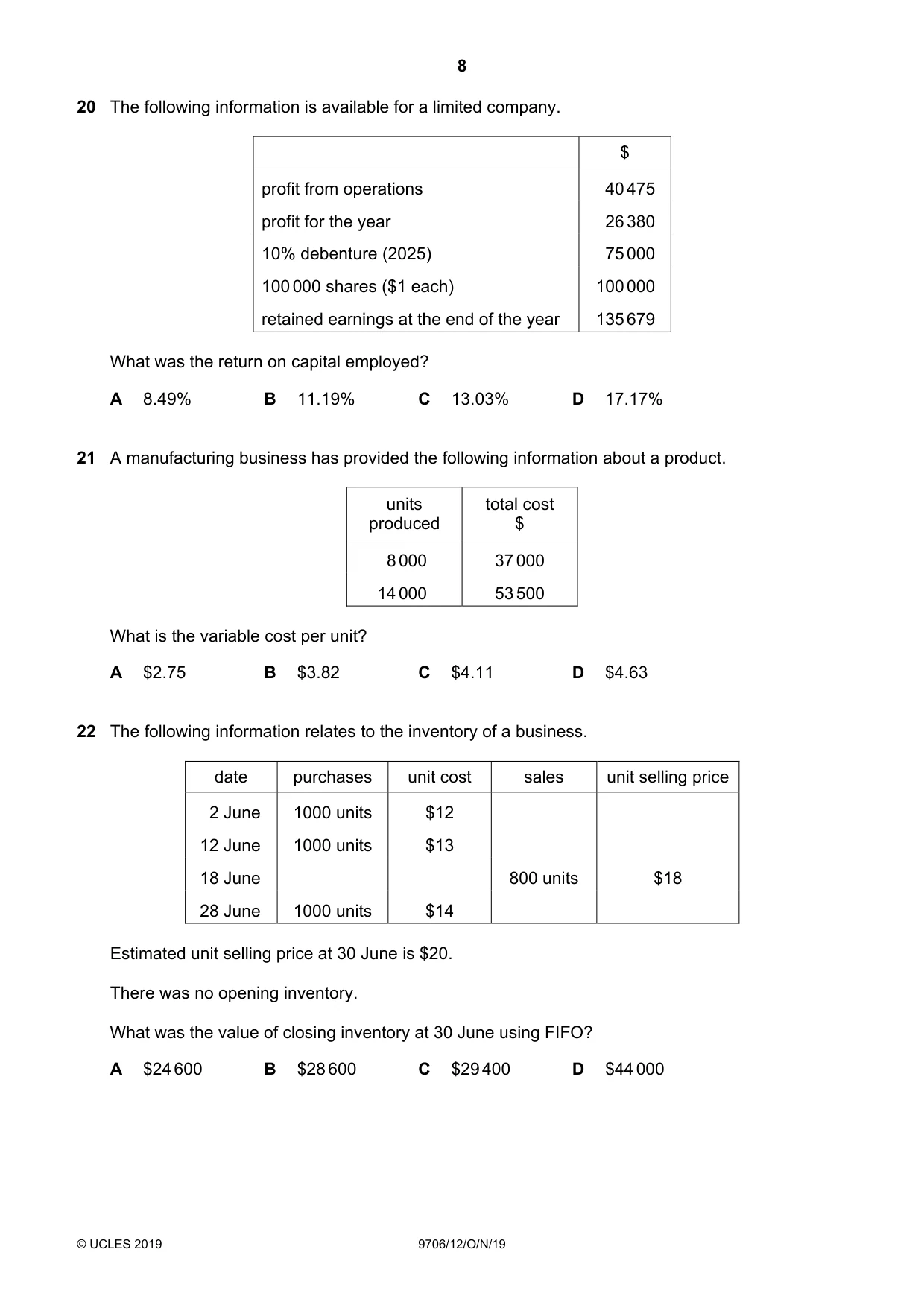
20 The following information is available for a limited company. $ profit from operations 40 475 profit for the year 26 380 10% debenture (2025) 75 000 100 000 shares ($1 each) 100 000 retained earnings at the end of the year 135 679 What was the return on capital employed? A 8.49% B 11.19% C 13.03% D 17.17%
Mark scheme: C
More questions on Analysis and communication of accounting information
Q21 · A manufacturing business has provided the following information about a product
21 A manufacturing business has provided the following information about a product. units total cost produced $ 8 000 37 000 14 000 53 500 What is the variable cost per unit? A $2.75 B $3.82 C $4.11 D $4.63
Mark scheme: A
Q22 · The following information relates to the inventory of a business
22 The following information relates to the inventory of a business. date purchases unit cost sales unit selling price 2 June 1000 units $12 12 June 1000 units $13 18 June 800 units $18 28 June 1000 units $14 Estimated unit selling price at 30 June is $20. There was no opening inventory. What was the value of closing inventory at 30 June using FIFO? A $24 600 B $28 600 C $29 400 D $44 000
Mark scheme: C
Q23 · Inventory cost prices are rising for a business
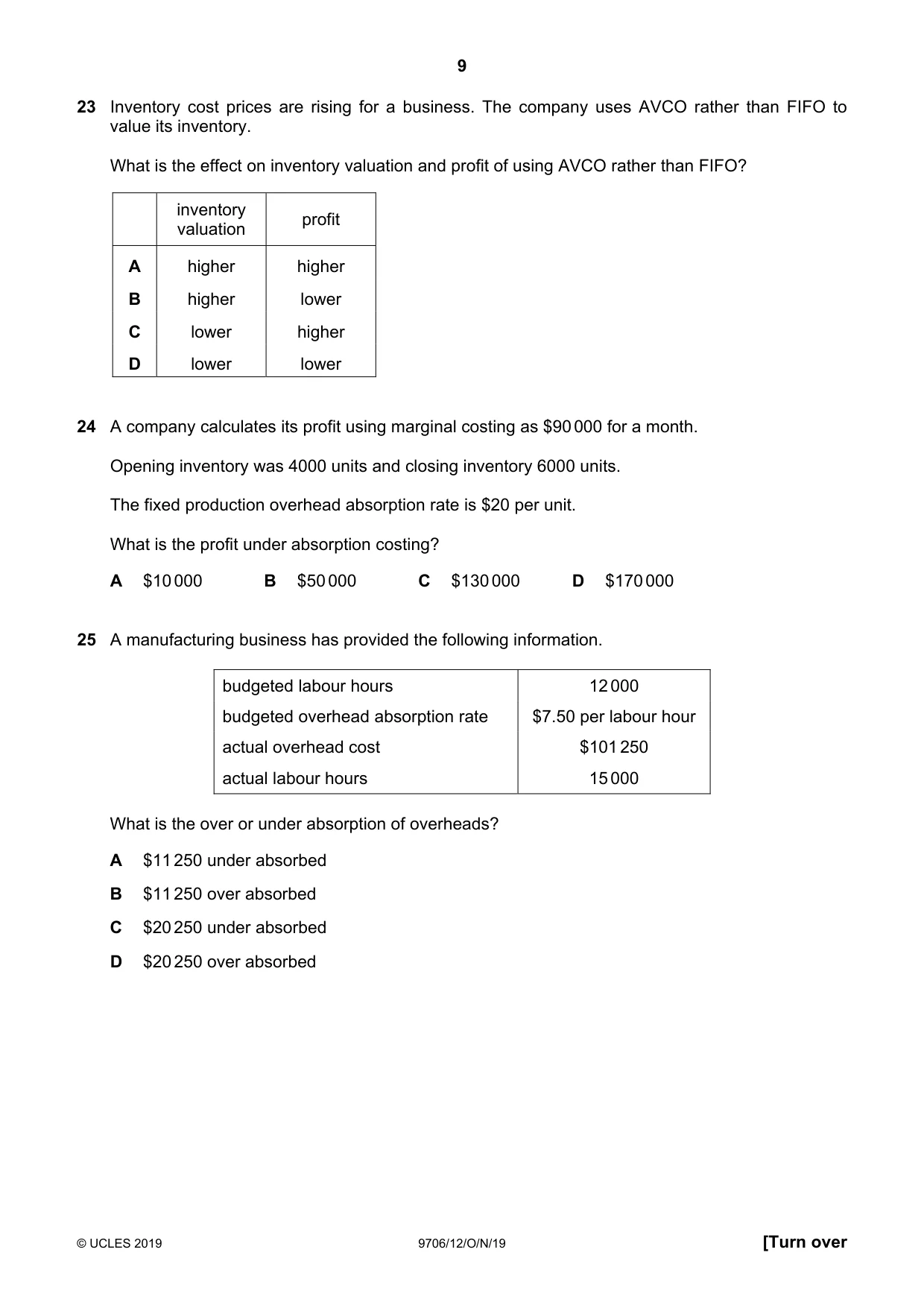
23 Inventory cost prices are rising for a business. The company uses AVCO rather than FIFO to value its inventory. What is the effect on inventory valuation and profit of using AVCO rather than FIFO? inventory profit valuation A higher higher B higher lower C lower higher D lower lower
Mark scheme: D
Q24 · A company calculates its profit using marginal costing as $90 000 for a month
24 A company calculates its profit using marginal costing as $90 000 for a month. Opening inventory was 4000 units and closing inventory 6000 units. The fixed production overhead absorption rate is $20 per unit. What is the profit under absorption costing? A $10 000 B $50 000 C $130 000 D $170 000
Mark scheme: C
Q25 · A manufacturing business has provided the following information
25 A manufacturing business has provided the following information. budgeted labour hours 12 000 budgeted overhead absorption rate $7.50 per labour hour actual overhead cost $101 250 actual labour hours 15 000 What is the over or under absorption of overheads? A $11 250 under absorbed B $11 250 over absorbed C $20 250 under absorbed D $20 250 over absorbed
Mark scheme: B
Q26 · A business has the following information relating to its single product
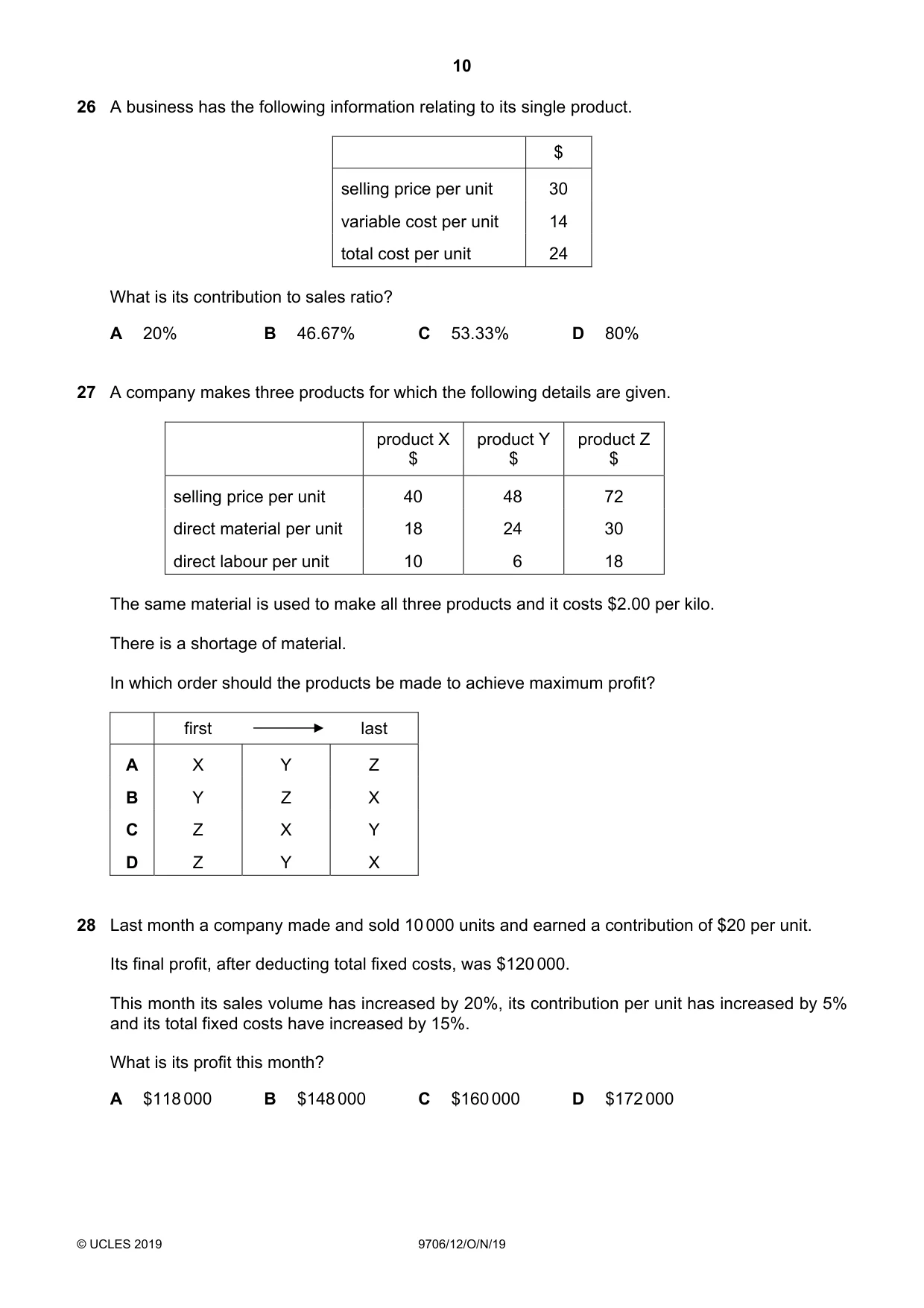
26 A business has the following information relating to its single product. $ selling price per unit 30 variable cost per unit 14 total cost per unit 24 What is its contribution to sales ratio? A 20% B 46.67% C 53.33% D 80%
Mark scheme: C
Q27 · A company makes three products for which the following details are given
27 A company makes three products for which the following details are given. product X product Y product Z $ $ $ selling price per unit 40 48 72 direct material per unit 18 24 30 direct labour per unit 10 6 18 The same material is used to make all three products and it costs $2.00 per kilo. There is a shortage of material. In which order should the products be made to achieve maximum profit? first last A X Y Z B Y Z X C Z X Y D Z Y X
Mark scheme: D
Q28 · Last month a company made and sold 10 000 units and earned a contribution of $20 per unit
28 Last month a company made and sold 10 000 units and earned a contribution of $20 per unit. Its final profit, after deducting total fixed costs, was $120 000. This month its sales volume has increased by 20%, its contribution per unit has increased by 5% and its total fixed costs have increased by 15%. What is its profit this month? A $118 000 B $148 000 C $160 000 D $172 000
Mark scheme: C
Q29 · Which statements about cost–volume–profit analysis are correct?
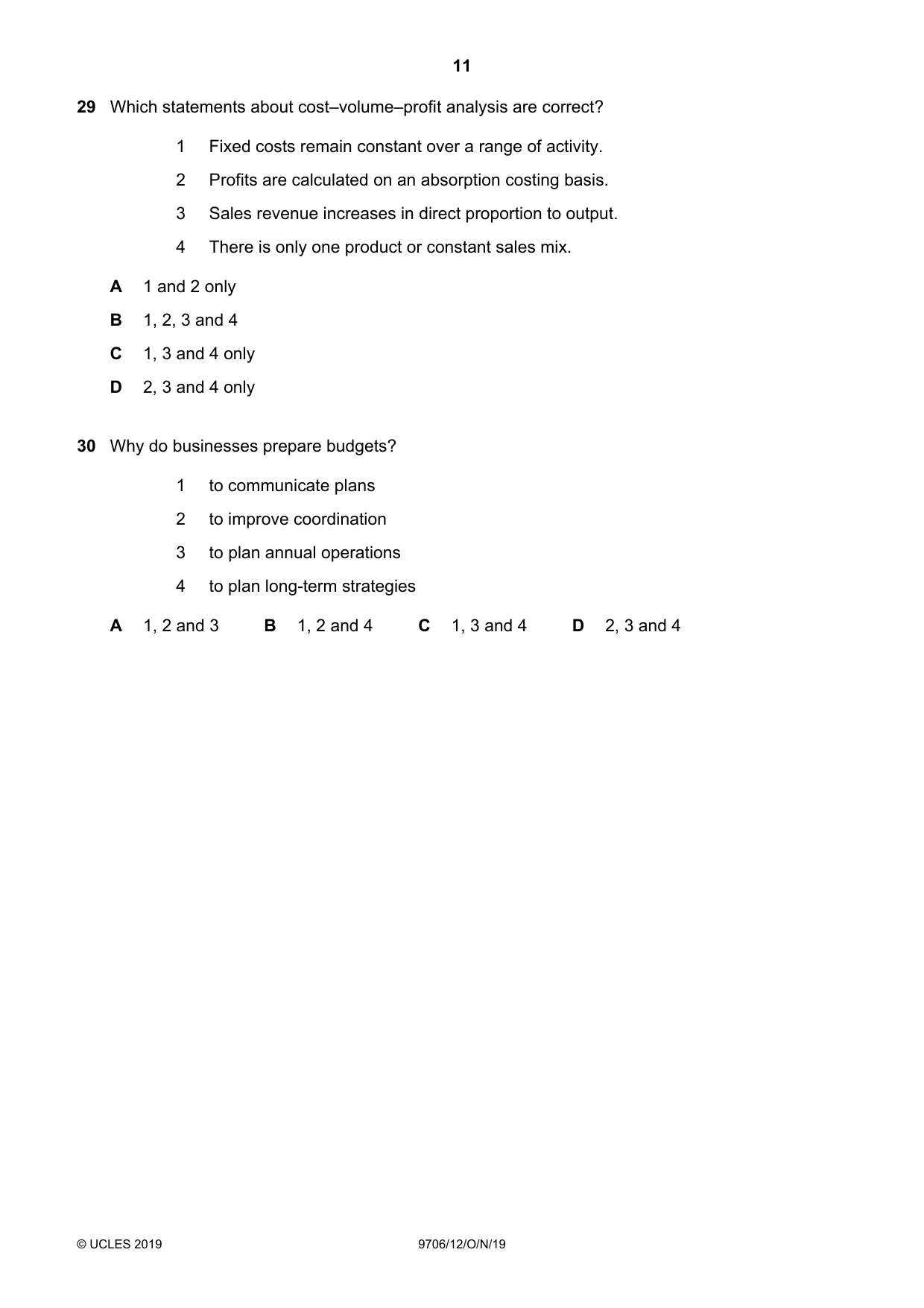
29 Which statements about cost–volume–profit analysis are correct? 1 Fixed costs remain constant over a range of activity. 2 Profits are calculated on an absorption costing basis. 3 Sales revenue increases in direct proportion to output. 4 There is only one product or constant sales mix. A 1 and 2 only B 1, 2, 3 and 4 C 1, 3 and 4 only D 2, 3 and 4 only
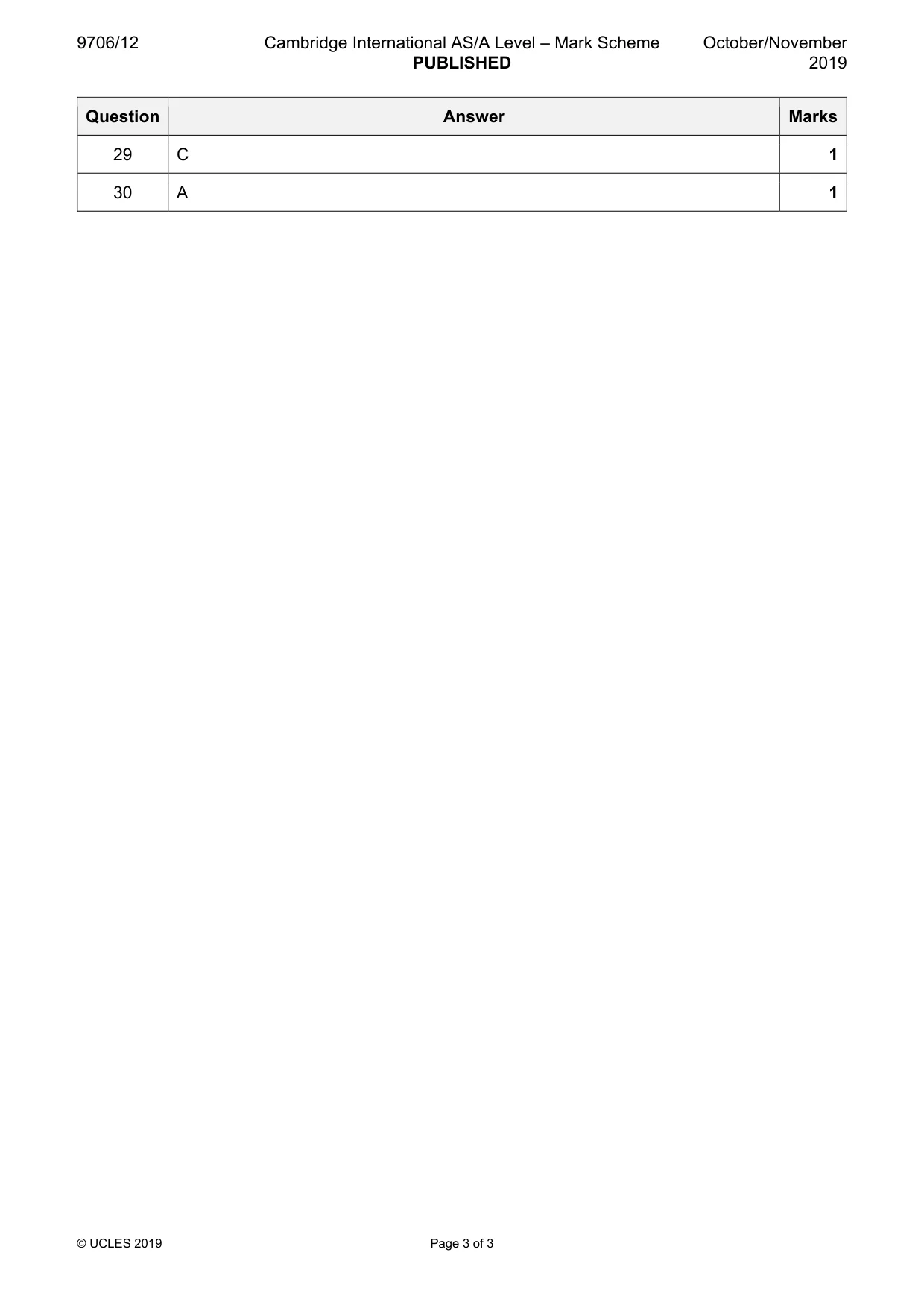
Mark scheme: C
Q30 · Why do businesses prepare budgets?
30 Why do businesses prepare budgets? 1 to communicate plans 2 to improve coordination 3 to plan annual operations 4 to plan long-term strategies A 1, 2 and 3 B 1, 2 and 4 C 1, 3 and 4 D 2, 3 and 4
Mark scheme: A
What was in this paper
The subtopics covered by these 30 questions, and how many questions each got. Open one in a new tab to see every Cambridge question on it.
10Costs and cost behaviour4Traditional costing methods4Accounting for non-current assets3Preparation of financial statements2Reconciliation and verification2Activity based costing (ABC)1Analysis and communication of accounting information1Analysis and communication of accounting information1Budgeting and budgetary control1The accounting system1What you needed in this session
Cambridge’s own grade thresholds for 2019 Oct/Nov, Paper 1 · Variant 2. A higher threshold means an easier paper — the bar moves with how the cohort did.