Cambridge A Level Accounting 9706 — 2023 May/June Paper 1 · Variant 3
9706/13/M/J/23 · 30 questions · 30 marks · ≈34 min
The question paper and its mark scheme, free to read here and free to download. This is Cambridge’s own paper, exactly as it was sat.
Question paper12 pages

Mark scheme3 pages
Answers below. Sit the paper first if you are practising.
Questions as text
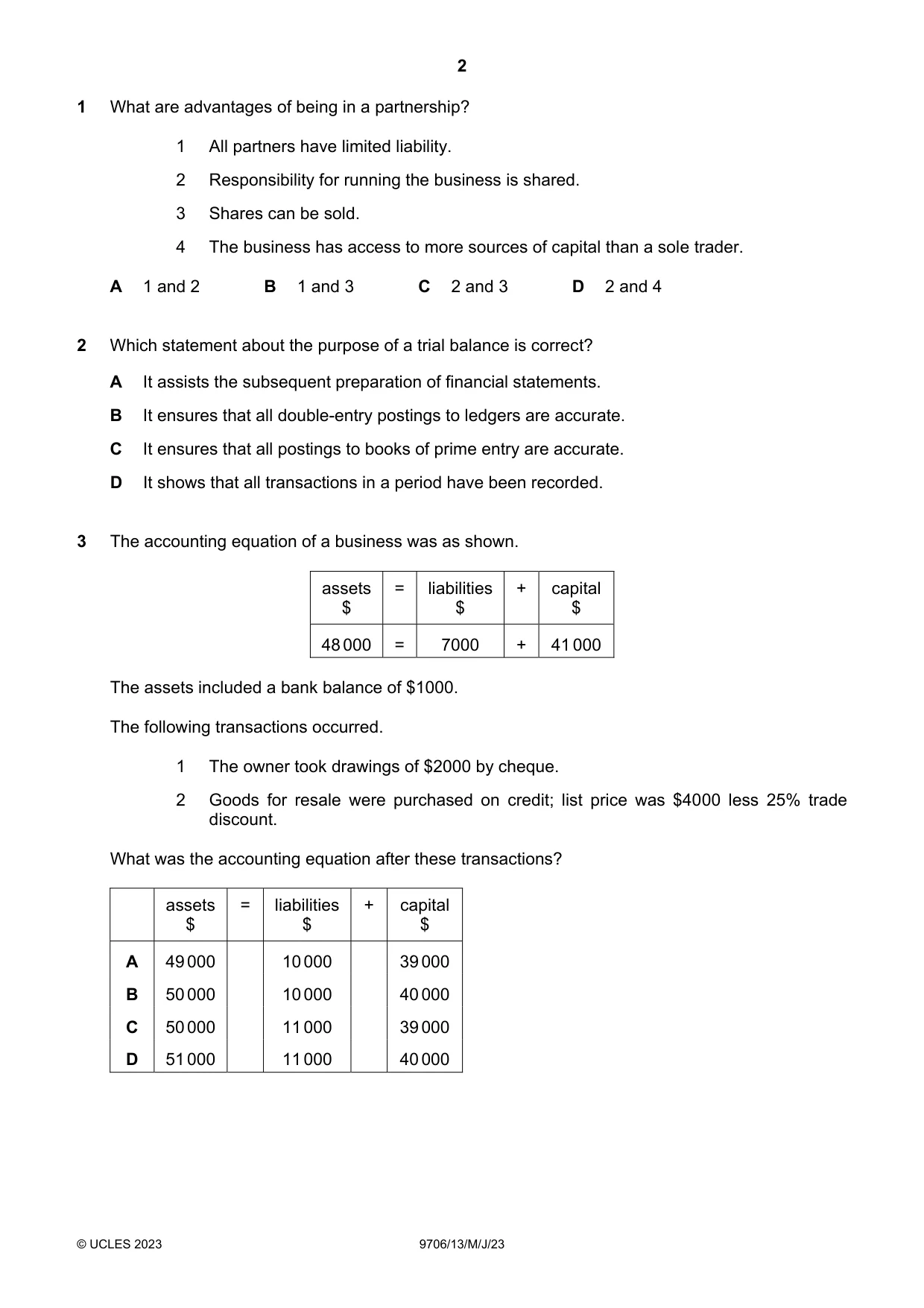
Q1 · What are advantages of being in a partnership?
1 What are advantages of being in a partnership? 1 All partners have limited liability. 2 Responsibility for running the business is shared. 3 Shares can be sold. 4 The business has access to more sources of capital than a sole trader. A 1 and 2 B 1 and 3 C 2 and 3 D 2 and 4
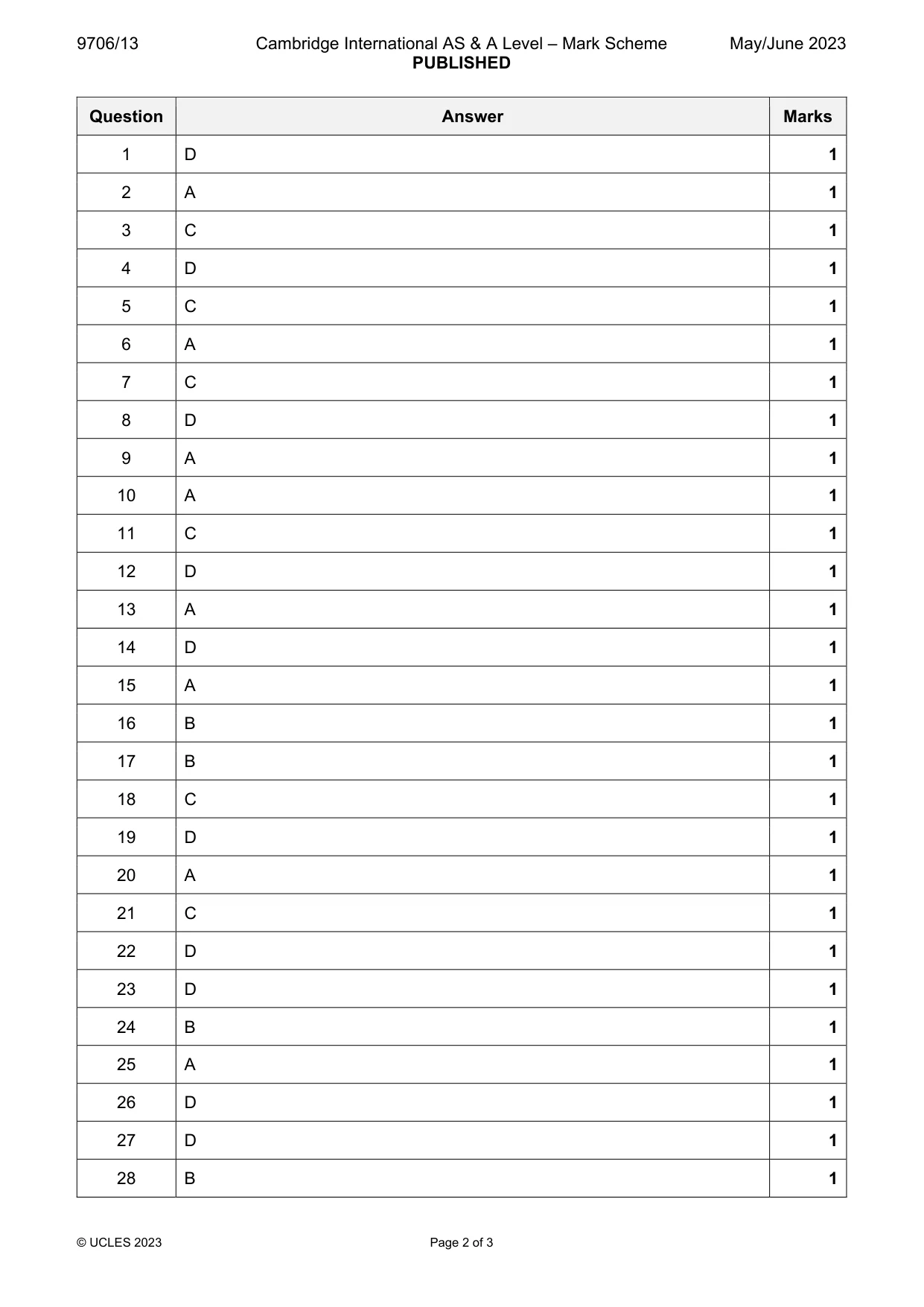
Mark scheme: D
Q2 · Which statement about the purpose of a trial balance is correct?
2 Which statement about the purpose of a trial balance is correct? A It assists the subsequent preparation of financial statements. B It ensures that all double-entry postings to ledgers are accurate. C It ensures that all postings to books of prime entry are accurate. D It shows that all transactions in a period have been recorded.
Mark scheme: A
Q3 · The accounting equation of a business was as shown
3 The accounting equation of a business was as shown. assets = liabilities + capital $ $ $ 48 000 = 7000 + 41 000 The assets included a bank balance of $1000. The following transactions occurred. 1 The owner took drawings of $2000 by cheque. 2 Goods for resale were purchased on credit; list price was $4000 less 25% trade discount. What was the accounting equation after these transactions? assets = liabilities + capital $ $ $ A 49 000 10 000 39 000 B 50 000 10 000 40 000 C 50 000 11 000 39 000 D 51 000 11 000 40 000
Mark scheme: C
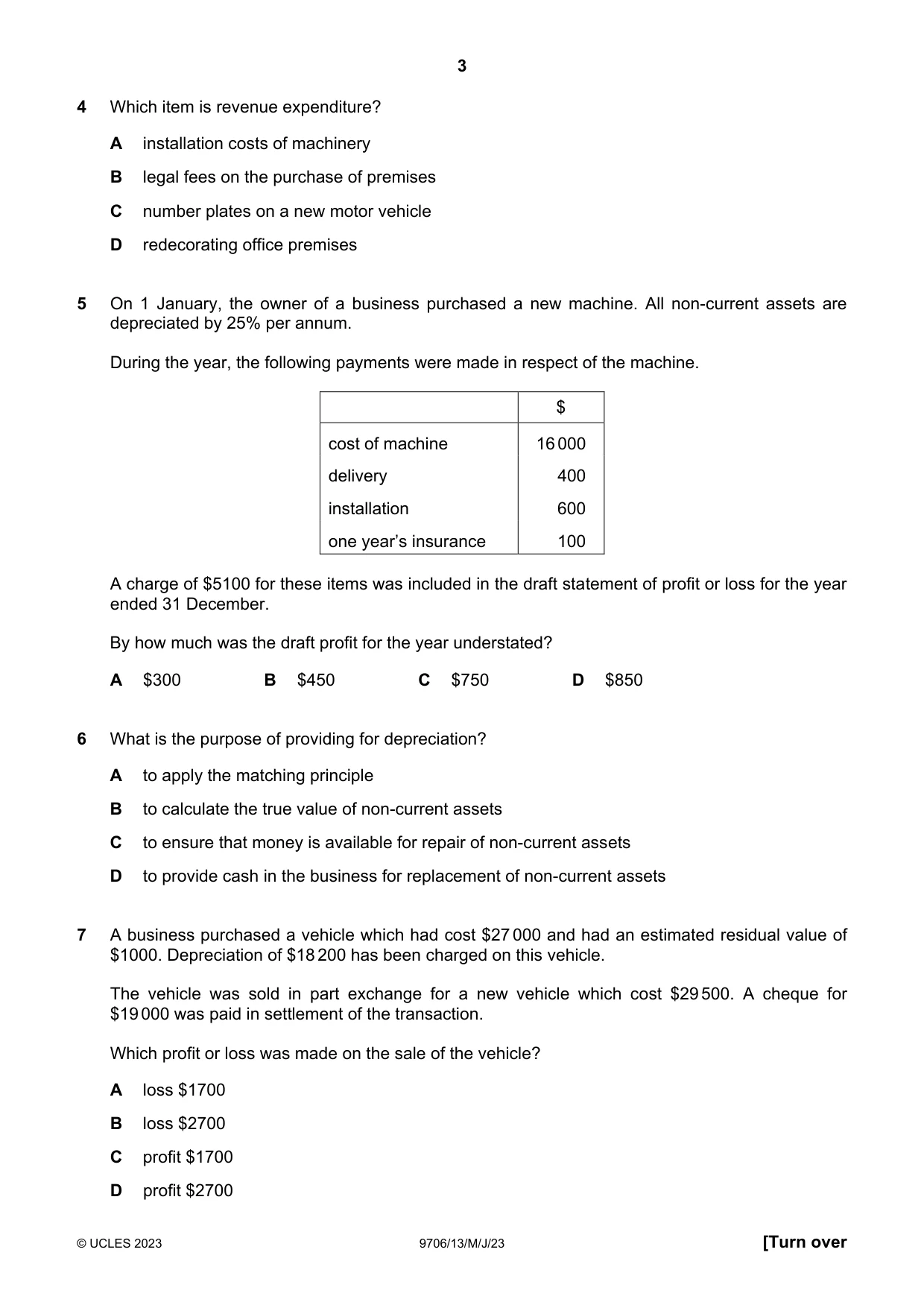
Q4 · Which item is revenue expenditure?
4 Which item is revenue expenditure? A installation costs of machinery B legal fees on the purchase of premises C number plates on a new motor vehicle D redecorating office premises
Mark scheme: D
Q5 · On 1 January, the owner of a business purchased a new machine
5 On 1 January, the owner of a business purchased a new machine. All non-current assets are depreciated by 25% per annum. During the year, the following payments were made in respect of the machine. $ cost of machine 16 000 delivery 400 installation 600 one year’s insurance 100 A charge of $5100 for these items was included in the draft statement of profit or loss for the year ended 31 December. By how much was the draft profit for the year understated? A $300 B $450 C $750 D $850
Mark scheme: C
Q6 · What is the purpose of providing for depreciation?
6 What is the purpose of providing for depreciation? A to apply the matching principle B to calculate the true value of non-current assets C to ensure that money is available for repair of non-current assets D to provide cash in the business for replacement of non-current assets
Mark scheme: A
Q7 · A business purchased a vehicle which had cost $27 000 and had an estimated residual value…
7 A business purchased a vehicle which had cost $27 000 and had an estimated residual value of $1000. Depreciation of $18 200 has been charged on this vehicle. The vehicle was sold in part exchange for a new vehicle which cost $29 500. A cheque for $19 000 was paid in settlement of the transaction. Which profit or loss was made on the sale of the vehicle? A loss $1700 B loss $2700 C profit $1700 D profit $2700
Mark scheme: C
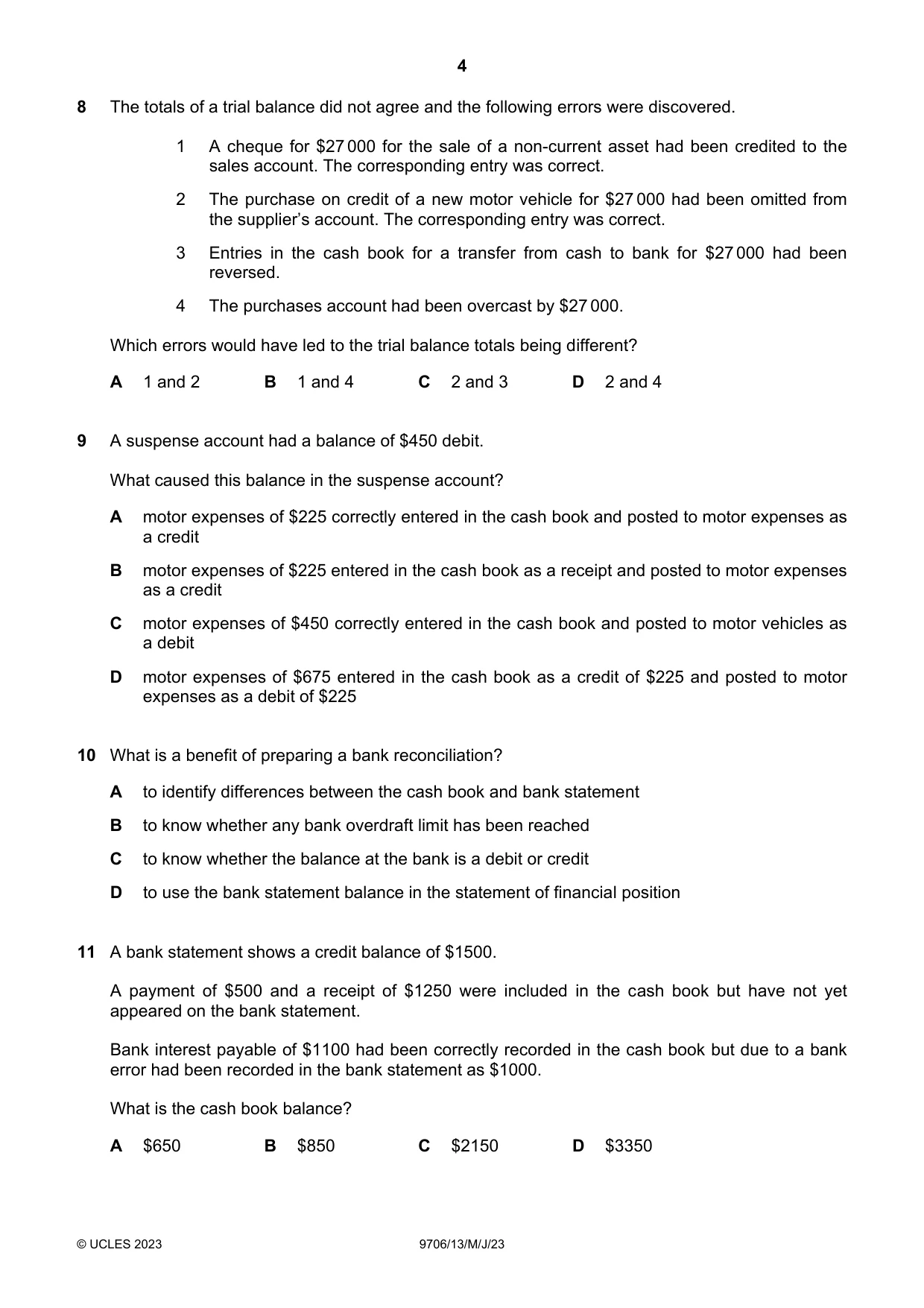
Q8 · The totals of a trial balance did not agree and the following errors were discovered
8 The totals of a trial balance did not agree and the following errors were discovered. 1 A cheque for $27 000 for the sale of a non-current asset had been credited to the sales account. The corresponding entry was correct. 2 The purchase on credit of a new motor vehicle for $27 000 had been omitted from the supplier’s account. The corresponding entry was correct. 3 Entries in the cash book for a transfer from cash to bank for $27 000 had been reversed. 4 The purchases account had been overcast by $27 000. Which errors would have led to the trial balance totals being different? A 1 and 2 B 1 and 4 C 2 and 3 D 2 and 4
Mark scheme: D
Q9 · A suspense account had a balance of $450 debit
9 A suspense account had a balance of $450 debit. What caused this balance in the suspense account? A motor expenses of $225 correctly entered in the cash book and posted to motor expenses as a credit B motor expenses of $225 entered in the cash book as a receipt and posted to motor expenses as a credit C motor expenses of $450 correctly entered in the cash book and posted to motor vehicles as a debit D motor expenses of $675 entered in the cash book as a credit of $225 and posted to motor expenses as a debit of $225
Mark scheme: A
Q10 · What is a benefit of preparing a bank reconciliation?
10 What is a benefit of preparing a bank reconciliation? A to identify differences between the cash book and bank statement B to know whether any bank overdraft limit has been reached C to know whether the balance at the bank is a debit or credit D to use the bank statement balance in the statement of financial position
Mark scheme: A
Q11 · A bank statement shows a credit balance of $1500
11 A bank statement shows a credit balance of $1500. A payment of $500 and a receipt of $1250 were included in the cash book but have not yet appeared on the bank statement. Bank interest payable of $1100 had been correctly recorded in the cash book but due to a bank error had been recorded in the bank statement as $1000. What is the cash book balance? A $650 B $850 C $2150 D $3350
Mark scheme: C
Q12 · A business is preparing a sales ledger control account
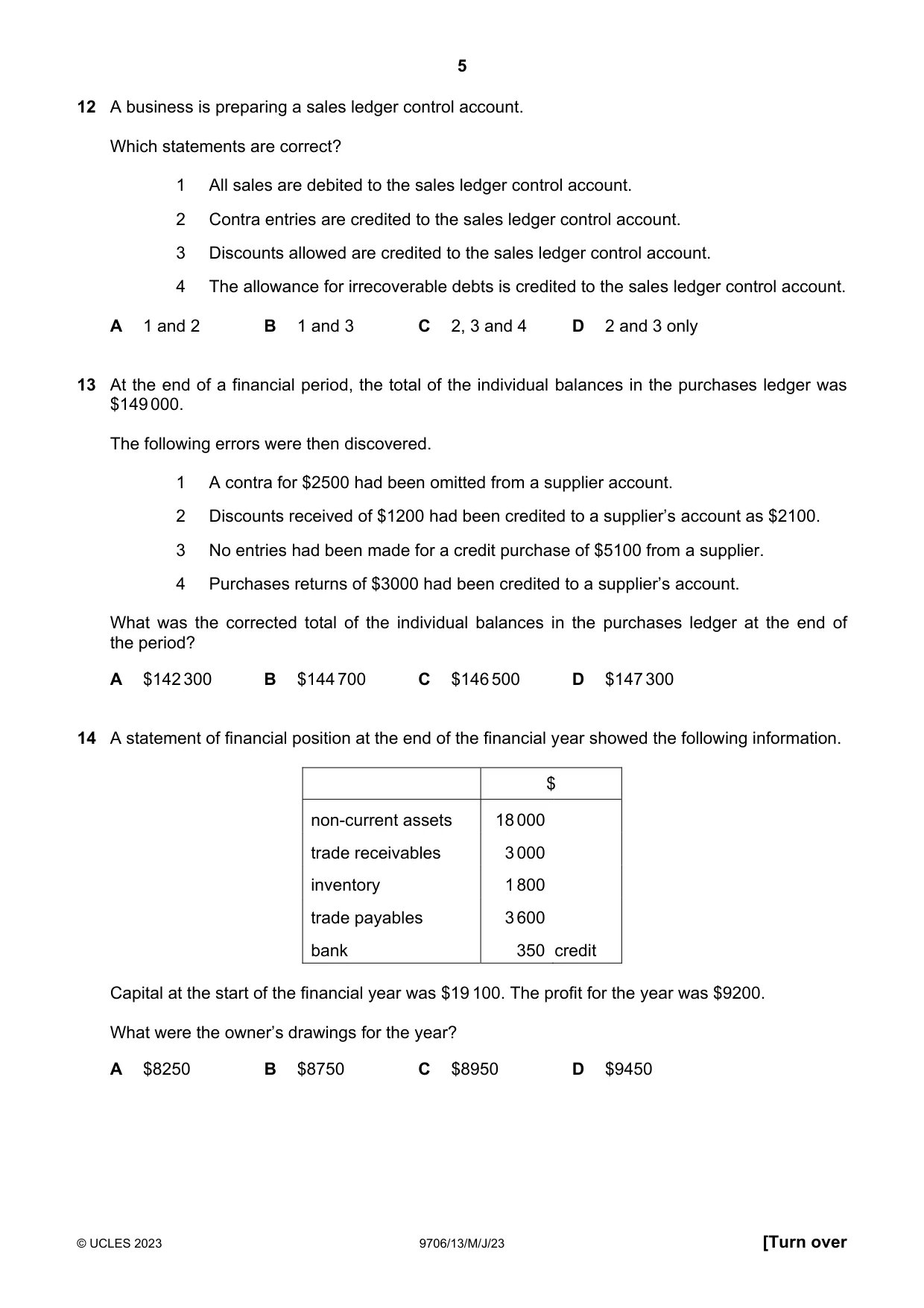
12 A business is preparing a sales ledger control account. Which statements are correct? 1 All sales are debited to the sales ledger control account. 2 Contra entries are credited to the sales ledger control account. 3 Discounts allowed are credited to the sales ledger control account. 4 The allowance for irrecoverable debts is credited to the sales ledger control account. A 1 and 2 B 1 and 3 C 2, 3 and 4 D 2 and 3 only
Mark scheme: D
Q13 · At the end of a financial period, the total of the individual balances in the purchases…
13 At the end of a financial period, the total of the individual balances in the purchases ledger was $149 000. The following errors were then discovered. 1 A contra for $2500 had been omitted from a supplier account. 2 Discounts received of $1200 had been credited to a supplier’s account as $2100. 3 No entries had been made for a credit purchase of $5100 from a supplier. 4 Purchases returns of $3000 had been credited to a supplier’s account. What was the corrected total of the individual balances in the purchases ledger at the end of the period? A $142 300 B $144 700 C $146 500 D $147 300
Mark scheme: A
Q14 · A statement of financial position at the end of the financial year showed the following…
14 A statement of financial position at the end of the financial year showed the following information. $ non-current assets 18 000 trade receivables 3 000 inventory 1 800 trade payables 3 600 bank 350 credit Capital at the start of the financial year was $19 100. The profit for the year was $9200. What were the owner’s drawings for the year? A $8250 B $8750 C $8950 D $9450
Mark scheme: D
Q15 · In the absence of a partnership agreement, the Partnership Act 1890 might apply
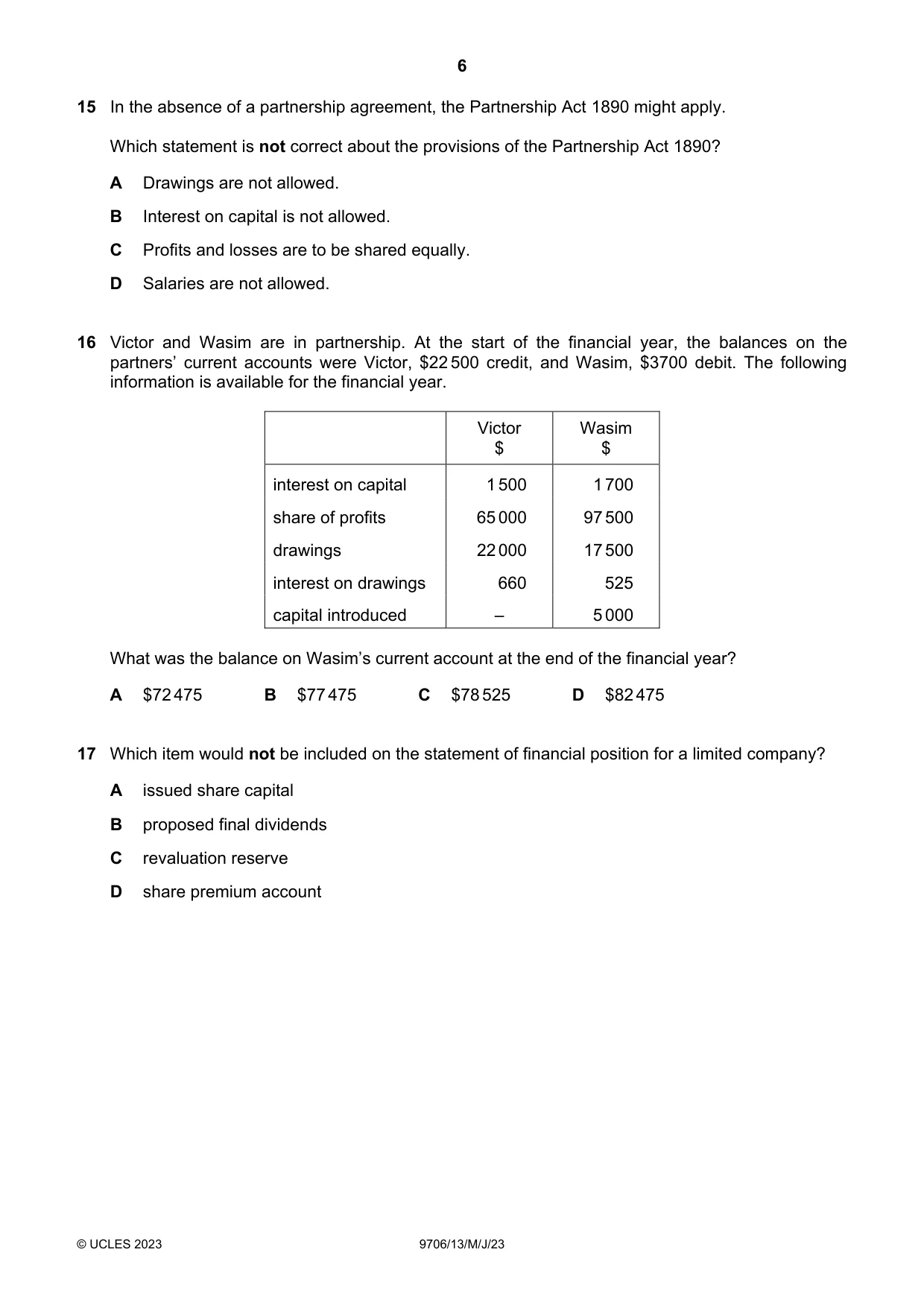
15 In the absence of a partnership agreement, the Partnership Act 1890 might apply. Which statement is not correct about the provisions of the Partnership Act 1890? A Drawings are not allowed. B Interest on capital is not allowed. C Profits and losses are to be shared equally. D Salaries are not allowed.
Mark scheme: A
Q16 · Victor and Wasim are in partnership
16 Victor and Wasim are in partnership. At the start of the financial year, the balances on the partners’ current accounts were Victor, $22 500 credit, and Wasim, $3700 debit. The following information is available for the financial year. Victor Wasim $ $ interest on capital 1 500 1 700 share of profits 65 000 97 500 drawings 22 000 17 500 interest on drawings 660 525 capital introduced – 5 000 What was the balance on Wasim’s current account at the end of the financial year? A $72 475 B $77 475 C $78 525 D $82 475
Mark scheme: B
Q17 · Which item would not be included on the statement of financial position for a limited…
17 Which item would not be included on the statement of financial position for a limited company? A issued share capital B proposed final dividends C revaluation reserve D share premium account
Mark scheme: B
Q18 · The equity section of the statement of financial position of a limited company at 1…
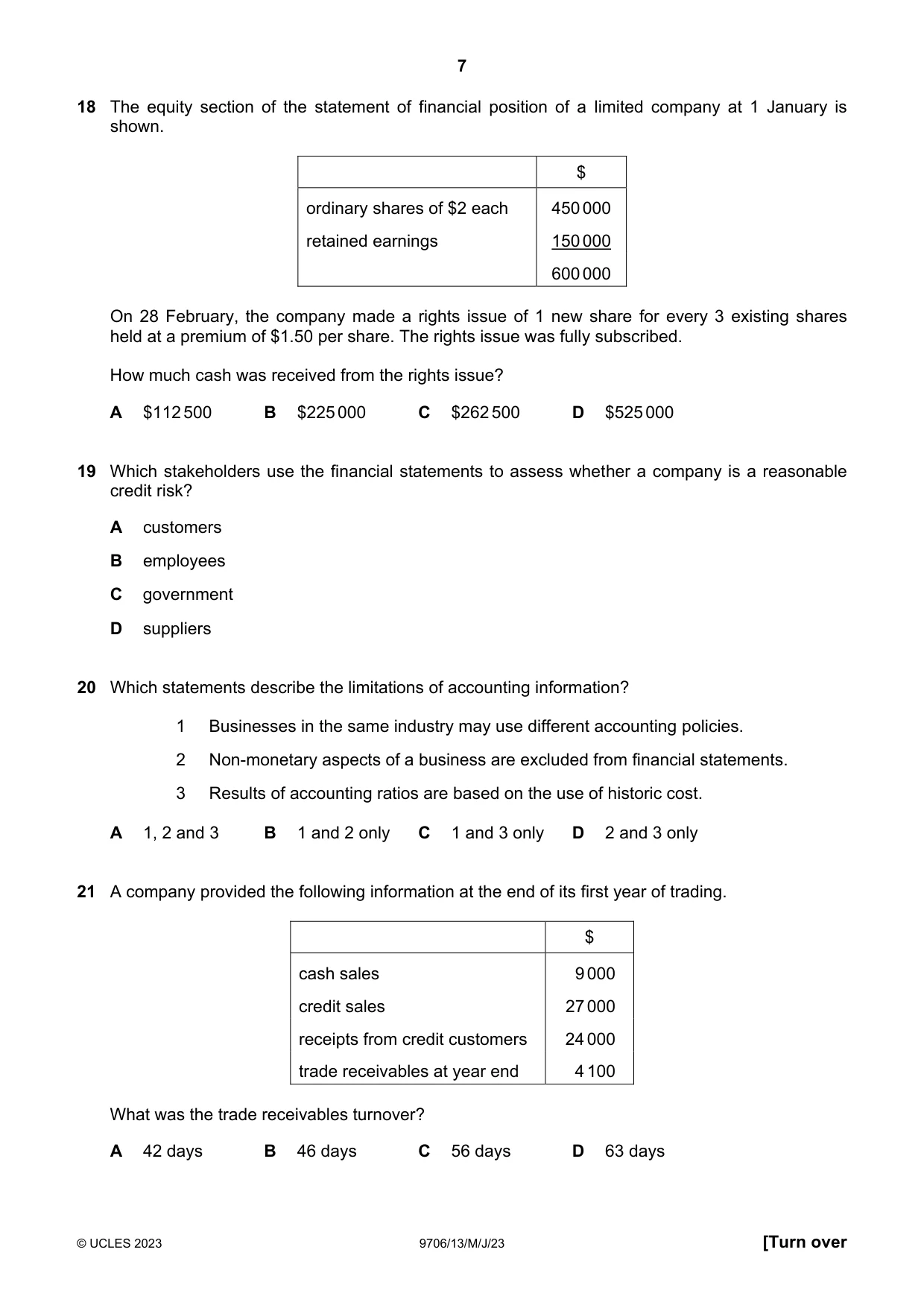
18 The equity section of the statement of financial position of a limited company at 1 January is shown. $ ordinary shares of $2 each 450 000 retained earnings 150 000 600 000 On 28 February, the company made a rights issue of 1 new share for every 3 existing shares held at a premium of $1.50 per share. The rights issue was fully subscribed. How much cash was received from the rights issue? A $112 500 B $225 000 C $262 500 D $525 000
Mark scheme: C
Q19 · Which stakeholders use the financial statements to assess whether a company is a…
19 Which stakeholders use the financial statements to assess whether a company is a reasonable credit risk? A customers B employees C government D suppliers
Mark scheme: D
More questions on Analysis and communication of accounting information
Q20 · Which statements describe the limitations of accounting information?
20 Which statements describe the limitations of accounting information? 1 Businesses in the same industry may use different accounting policies. 2 Non-monetary aspects of a business are excluded from financial statements. 3 Results of accounting ratios are based on the use of historic cost. A 1, 2 and 3 B 1 and 2 only C 1 and 3 only D 2 and 3 only
Mark scheme: A
More questions on Analysis and communication of accounting information
Q21 · A company provided the following information at the end of its first year of trading
21 A company provided the following information at the end of its first year of trading. $ cash sales 9 000 credit sales 27 000 receipts from credit customers 24 000 trade receivables at year end 4 100 What was the trade receivables turnover? A 42 days B 46 days C 56 days D 63 days
Mark scheme: C
More questions on Analysis and communication of accounting information
Q22 · A company’s profit from operations during a year was $128 000
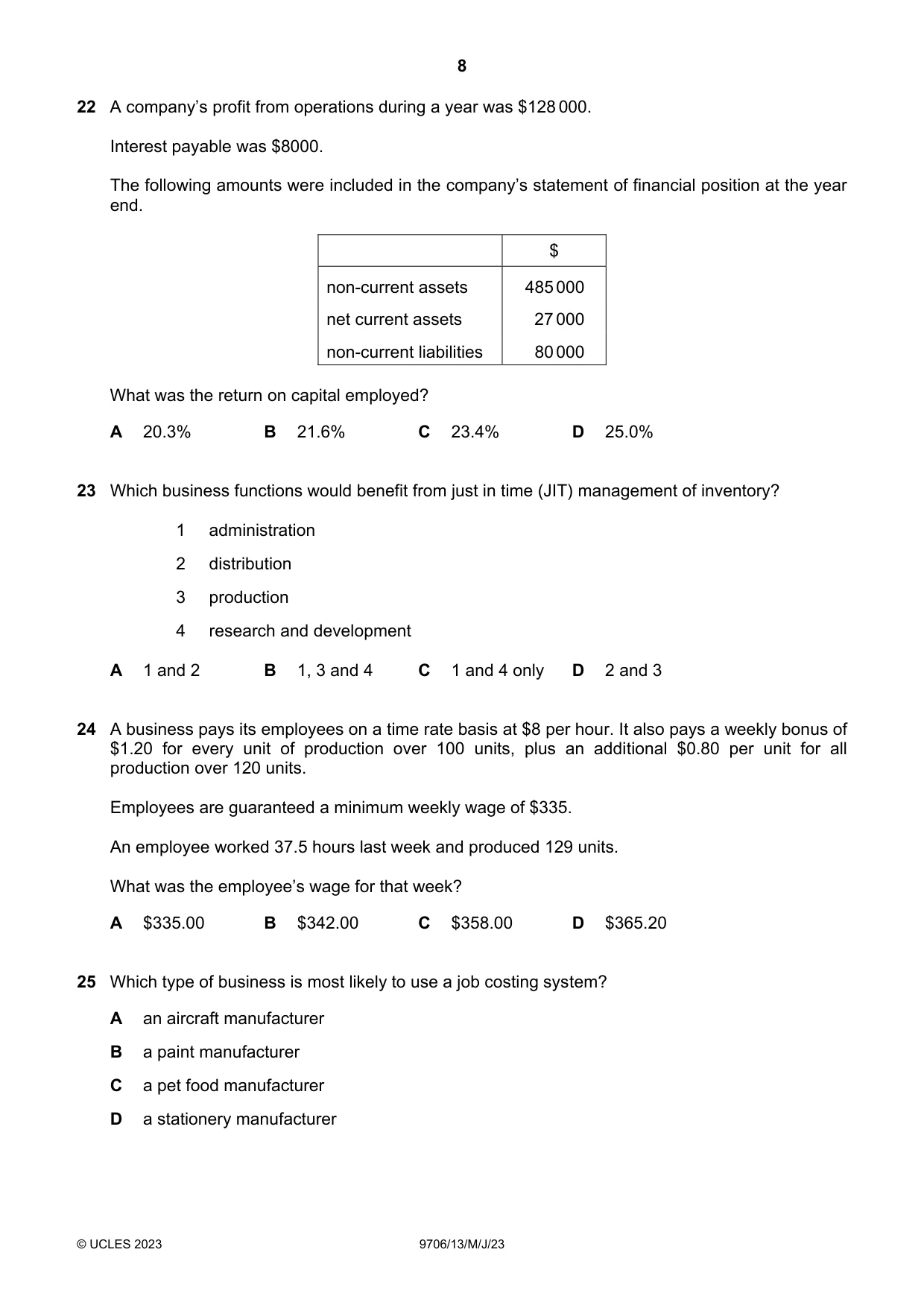
22 A company’s profit from operations during a year was $128 000. Interest payable was $8000. The following amounts were included in the company’s statement of financial position at the year end. $ non-current assets 485 000 net current assets 27 000 non-current liabilities 80 000 What was the return on capital employed? A 20.3% B 21.6% C 23.4% D 25.0%
Mark scheme: D
More questions on Analysis and communication of accounting information
Q23 · Which business functions would benefit from just in time (JIT) management of inventory?
23 Which business functions would benefit from just in time (JIT) management of inventory? 1 administration 2 distribution 3 production 4 research and development A 1 and 2 B 1, 3 and 4 C 1 and 4 only D 2 and 3
Mark scheme: D
Q24 · A business pays its employees on a time rate basis at $8 per hour
24 A business pays its employees on a time rate basis at $8 per hour. It also pays a weekly bonus of $1.20 for every unit of production over 100 units, plus an additional $0.80 per unit for all production over 120 units. Employees are guaranteed a minimum weekly wage of $335. An employee worked 37.5 hours last week and produced 129 units. What was the employee’s wage for that week? A $335.00 B $342.00 C $358.00 D $365.20
Mark scheme: B
Q25 · Which type of business is most likely to use a job costing system?
25 Which type of business is most likely to use a job costing system? A an aircraft manufacturer B a paint manufacturer C a pet food manufacturer D a stationery manufacturer
Mark scheme: A
Q26 · Which statement describes a cost centre rather than a cost unit?
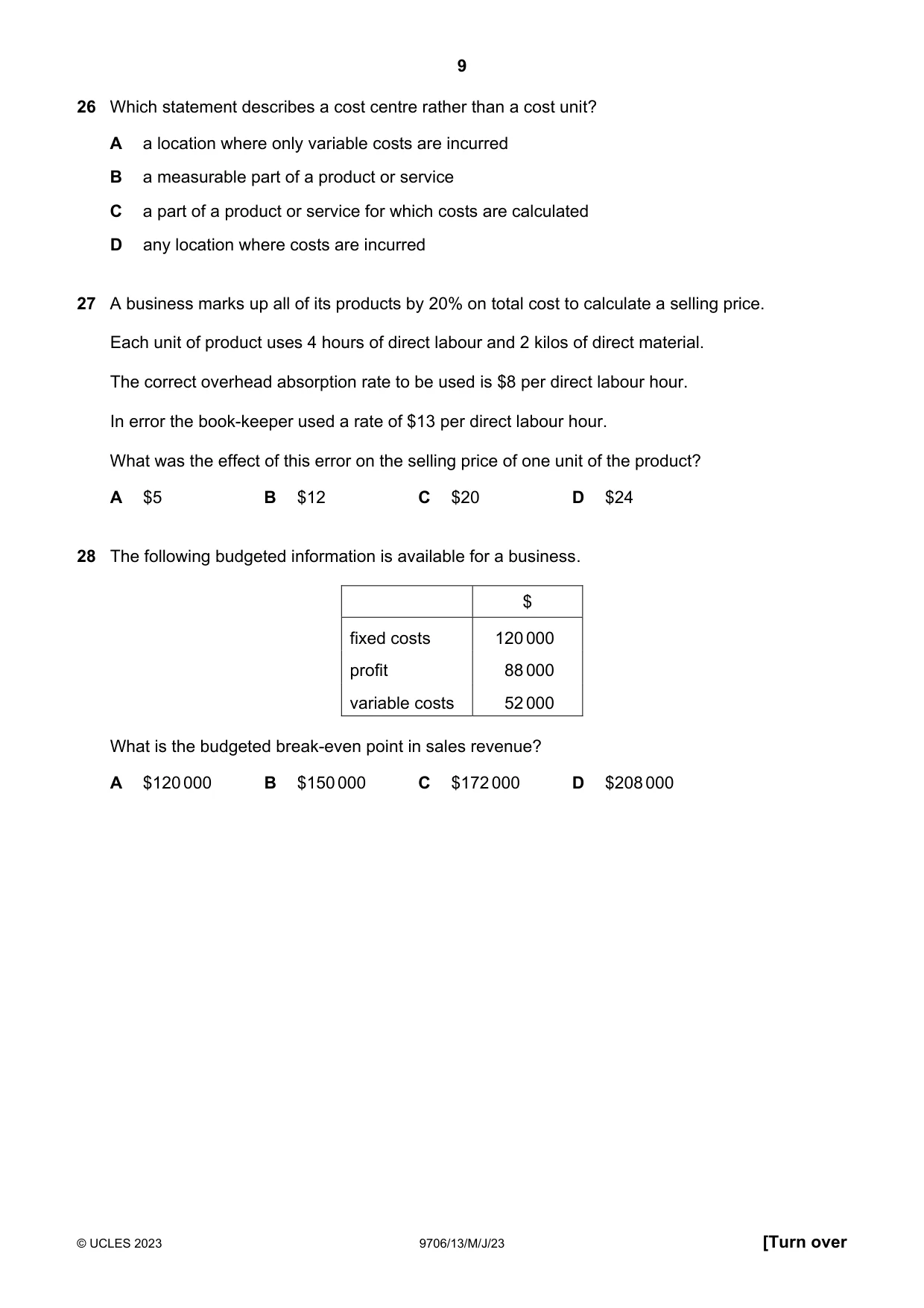
26 Which statement describes a cost centre rather than a cost unit? A a location where only variable costs are incurred B a measurable part of a product or service C a part of a product or service for which costs are calculated D any location where costs are incurred
Mark scheme: D
Q27 · A business marks up all of its products by 20% on total cost to calculate a selling price
27 A business marks up all of its products by 20% on total cost to calculate a selling price. Each unit of product uses 4 hours of direct labour and 2 kilos of direct material. The correct overhead absorption rate to be used is $8 per direct labour hour. In error the book-keeper used a rate of $13 per direct labour hour. What was the effect of this error on the selling price of one unit of the product? A $5 B $12 C $20 D $24
Mark scheme: D
Q28 · The following budgeted information is available for a business
28 The following budgeted information is available for a business. $ fixed costs 120 000 profit 88 000 variable costs 52 000 What is the budgeted break-even point in sales revenue? A $120 000 B $150 000 C $172 000 D $208 000
Mark scheme: B
Q29 · A business provided the following information about its total costs
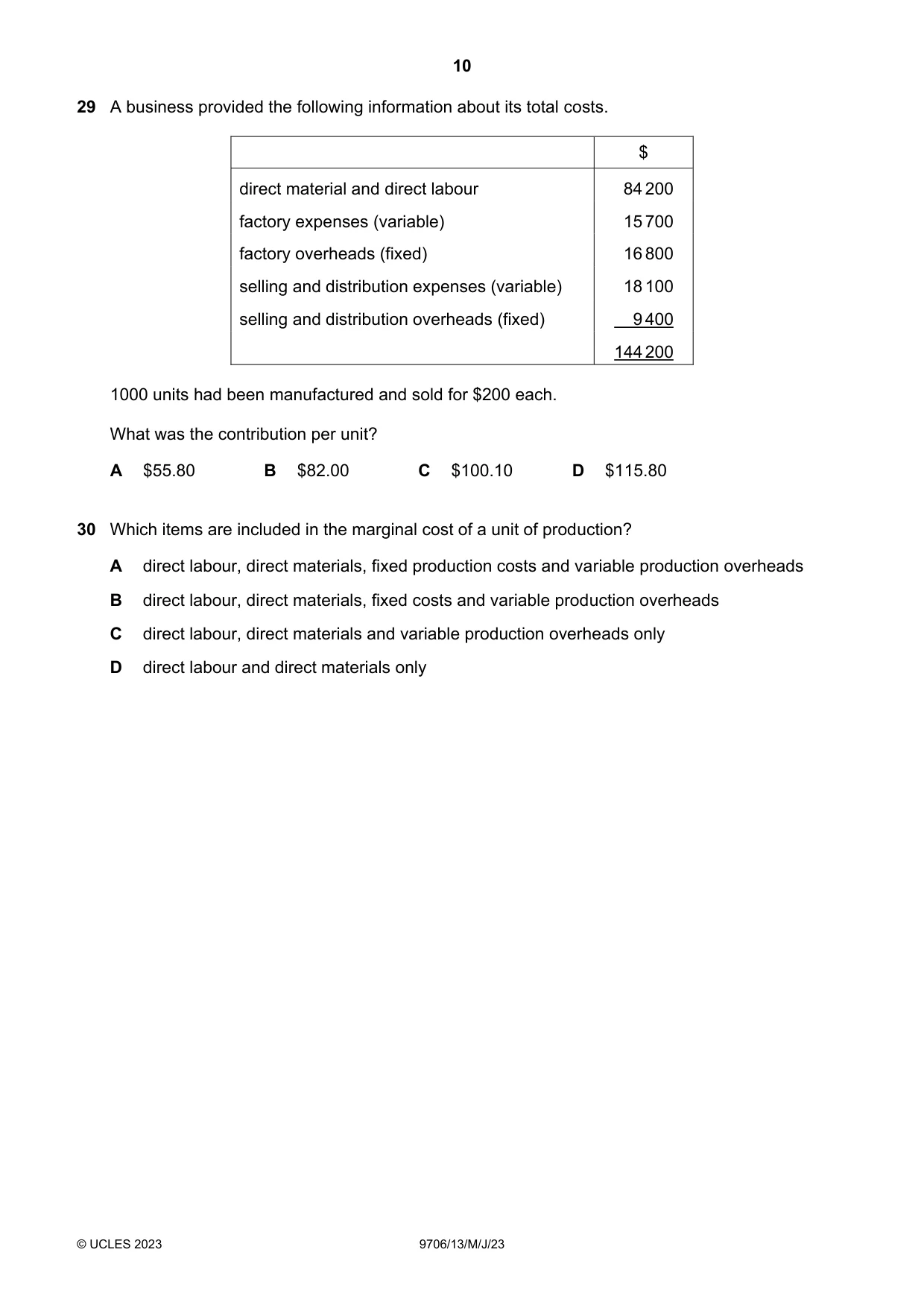
29 A business provided the following information about its total costs. $ direct material and direct labour 84 200 factory expenses (variable) 15 700 factory overheads (fixed) 16 800 selling and distribution expenses (variable) 18 100 selling and distribution overheads (fixed) 9 400 144 200 1000 units had been manufactured and sold for $200 each. What was the contribution per unit? A $55.80 B $82.00 C $100.10 D $115.80
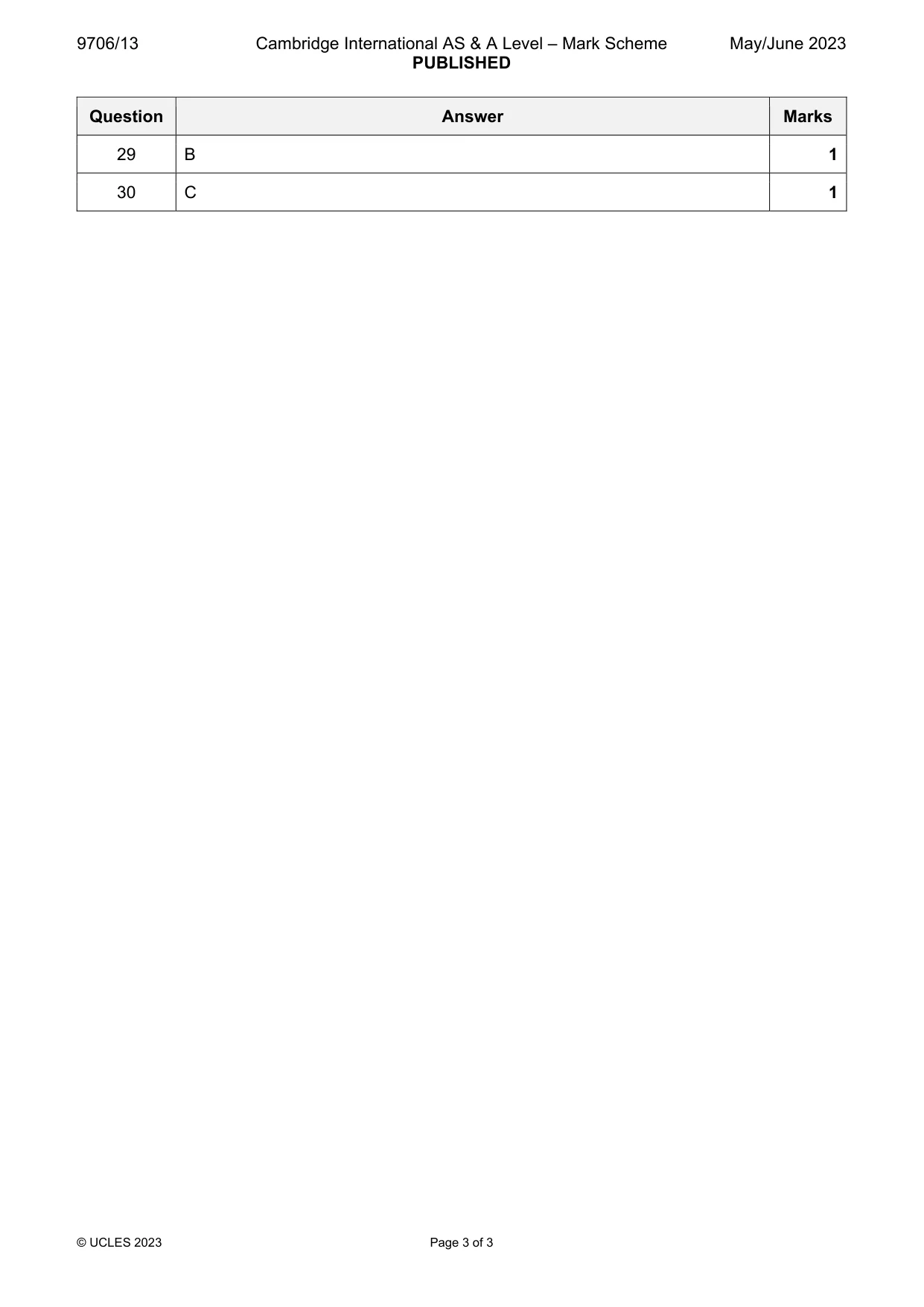
Mark scheme: B
Q30 · Which items are included in the marginal cost of a unit of production?
30 Which items are included in the marginal cost of a unit of production? A direct labour, direct materials, fixed production costs and variable production overheads B direct labour, direct materials, fixed costs and variable production overheads C direct labour, direct materials and variable production overheads only D direct labour and direct materials only
Mark scheme: C
What was in this paper
The subtopics covered by these 30 questions, and how many questions each got. Open one in a new tab to see every Cambridge question on it.
What you needed in this session
Cambridge’s own grade thresholds for 2023 May/June, Paper 1 · Variant 3. A higher threshold means an easier paper — the bar moves with how the cohort did.