Cambridge A Level Accounting 9706 — 2018 Feb/March Paper 1 · Variant 2
9706/12/F/M/18 · 30 questions · 30 marks · ≈34 min
The question paper and its mark scheme, free to read here and free to download. This is Cambridge’s own paper, exactly as it was sat.
Question paper12 pages
Mark scheme3 pages
Answers below. Sit the paper first if you are practising.
Questions as text
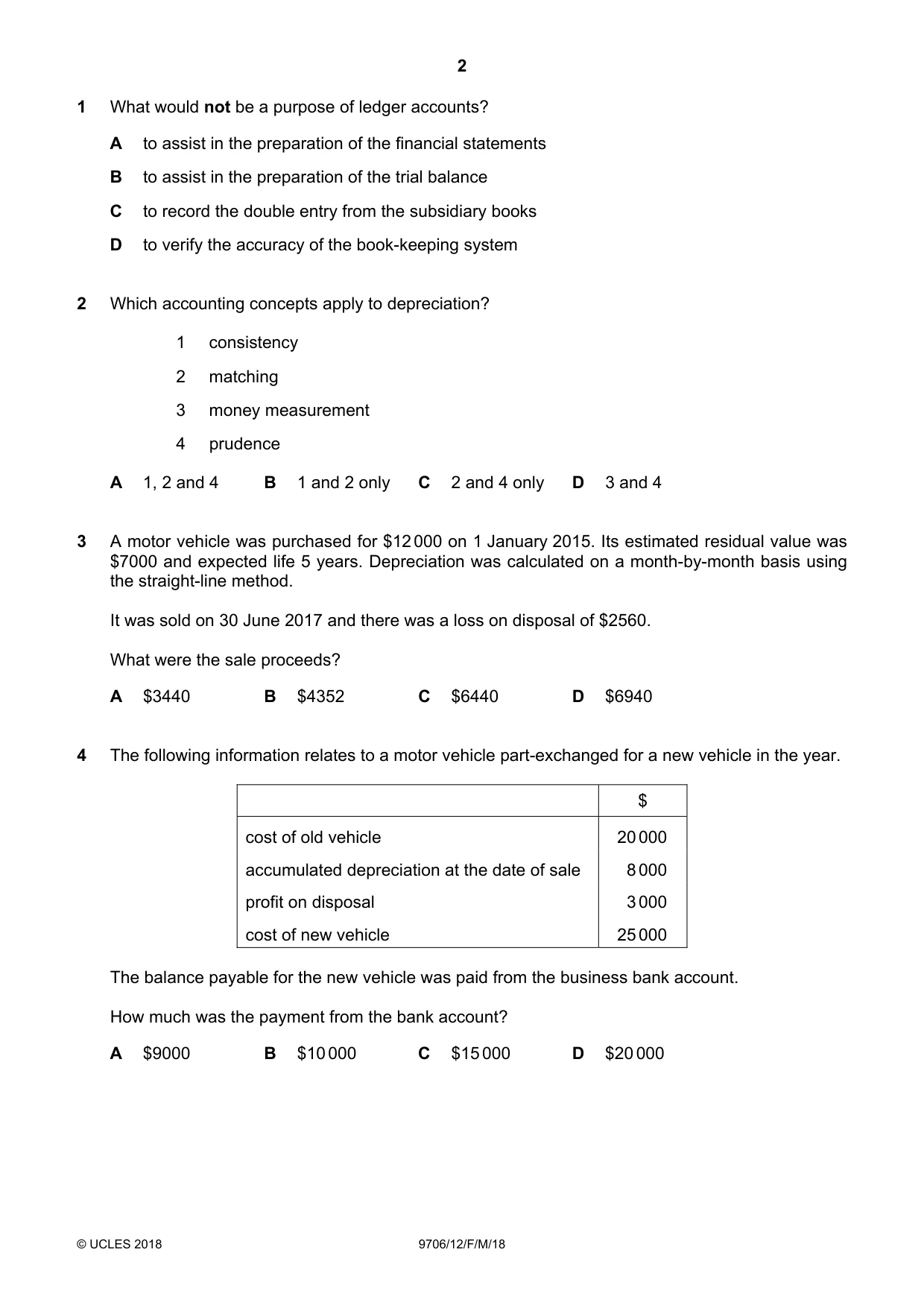
Q1 · What would not be a purpose of ledger accounts?
1 What would not be a purpose of ledger accounts? A to assist in the preparation of the financial statements B to assist in the preparation of the trial balance C to record the double entry from the subsidiary books D to verify the accuracy of the book-keeping system
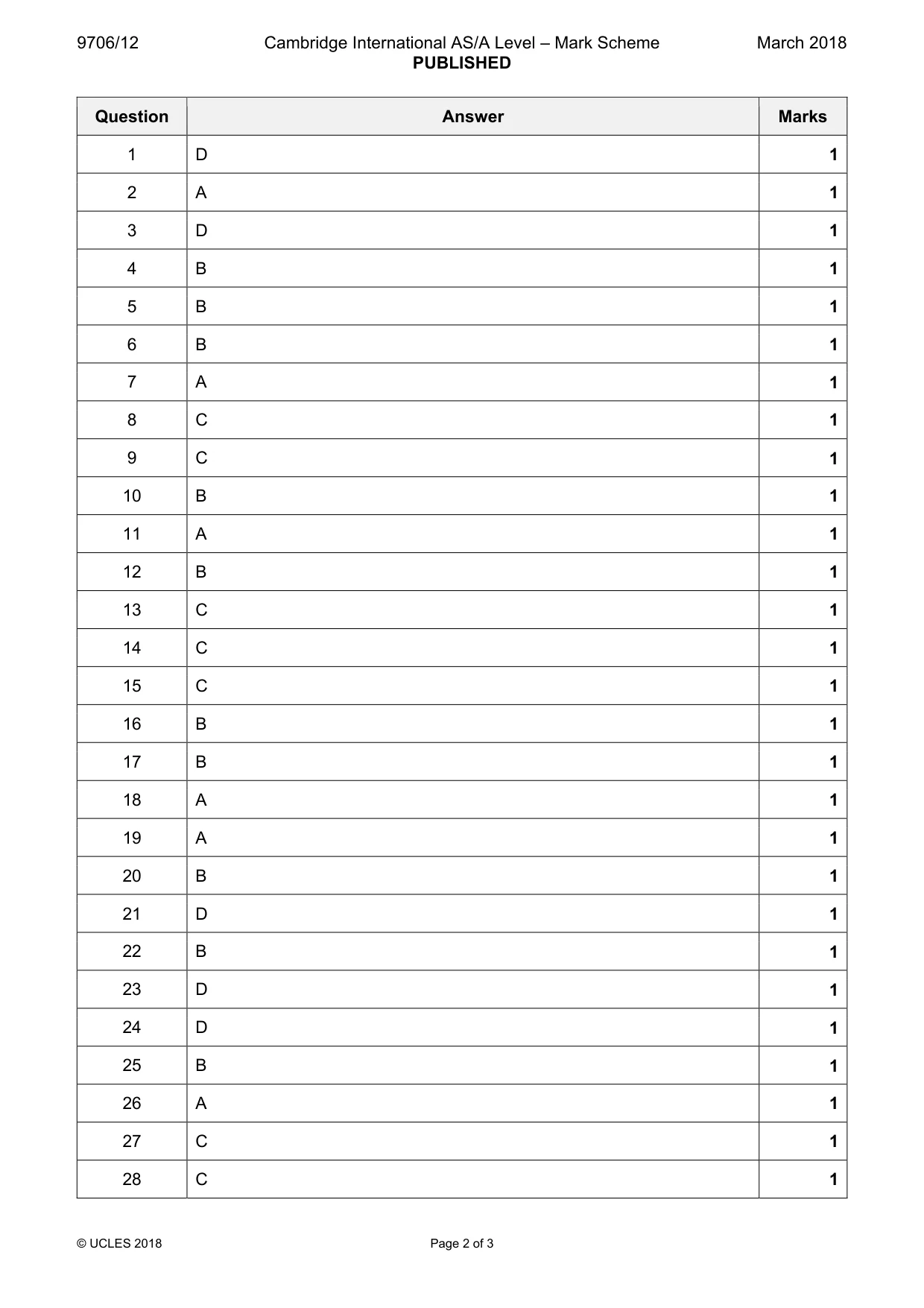
Mark scheme: D
Q2 · Which accounting concepts apply to depreciation?
2 Which accounting concepts apply to depreciation? 1 consistency 2 matching 3 money measurement 4 prudence A 1, 2 and 4 B 1 and 2 only C 2 and 4 only D 3 and 4
Mark scheme: A
Q3 · A motor vehicle was purchased for $12 000 on 1 January 2015
3 A motor vehicle was purchased for $12 000 on 1 January 2015. Its estimated residual value was $7000 and expected life 5 years. Depreciation was calculated on a month-by-month basis using the straight-line method. It was sold on 30 June 2017 and there was a loss on disposal of $2560. What were the sale proceeds? A $3440 B $4352 C $6440 D $6940
Mark scheme: D
Q4 · The following information relates to a motor vehicle part-exchanged for a new vehicle in…
4 The following information relates to a motor vehicle part-exchanged for a new vehicle in the year. $ cost of old vehicle 20 000 accumulated depreciation at the date of sale 8 000 profit on disposal 3 000 cost of new vehicle 25 000 The balance payable for the new vehicle was paid from the business bank account. How much was the payment from the bank account? A $9000 B $10 000 C $15 000 D $20 000
Mark scheme: B
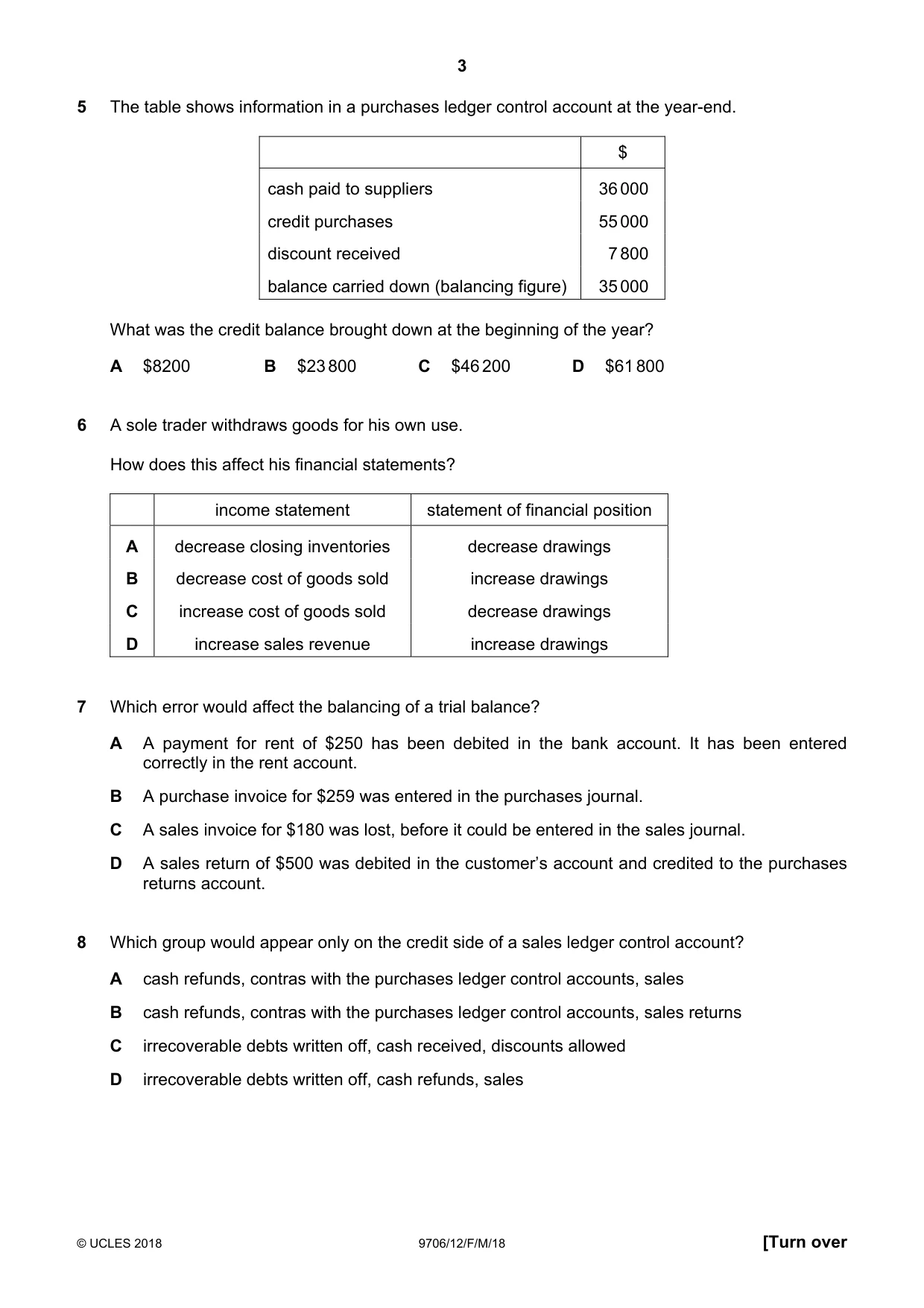
Q5 · The table shows information in a purchases ledger control account at the year-end
5 The table shows information in a purchases ledger control account at the year-end. $ cash paid to suppliers 36 000 credit purchases 55 000 discount received 7 800 balance carried down (balancing figure) 35 000 What was the credit balance brought down at the beginning of the year? A $8200 B $23 800 C $46 200 D $61 800
Mark scheme: B
Q6 · A sole trader withdraws goods for his own use
6 A sole trader withdraws goods for his own use. How does this affect his financial statements? income statement statement of financial position A decrease closing inventories decrease drawings B decrease cost of goods sold increase drawings C increase cost of goods sold decrease drawings D increase sales revenue increase drawings
Mark scheme: B
Q7 · Which error would affect the balancing of a trial balance?
7 Which error would affect the balancing of a trial balance? A A payment for rent of $250 has been debited in the bank account. It has been entered correctly in the rent account. B A purchase invoice for $259 was entered in the purchases journal. C A sales invoice for $180 was lost, before it could be entered in the sales journal. D A sales return of $500 was debited in the customer’s account and credited to the purchases returns account.
Mark scheme: A
Q8 · Which group would appear only on the credit side of a sales ledger control account?
8 Which group would appear only on the credit side of a sales ledger control account? A cash refunds, contras with the purchases ledger control accounts, sales B cash refunds, contras with the purchases ledger control accounts, sales returns C irrecoverable debts written off, cash received, discounts allowed D irrecoverable debts written off, cash refunds, sales
Mark scheme: C
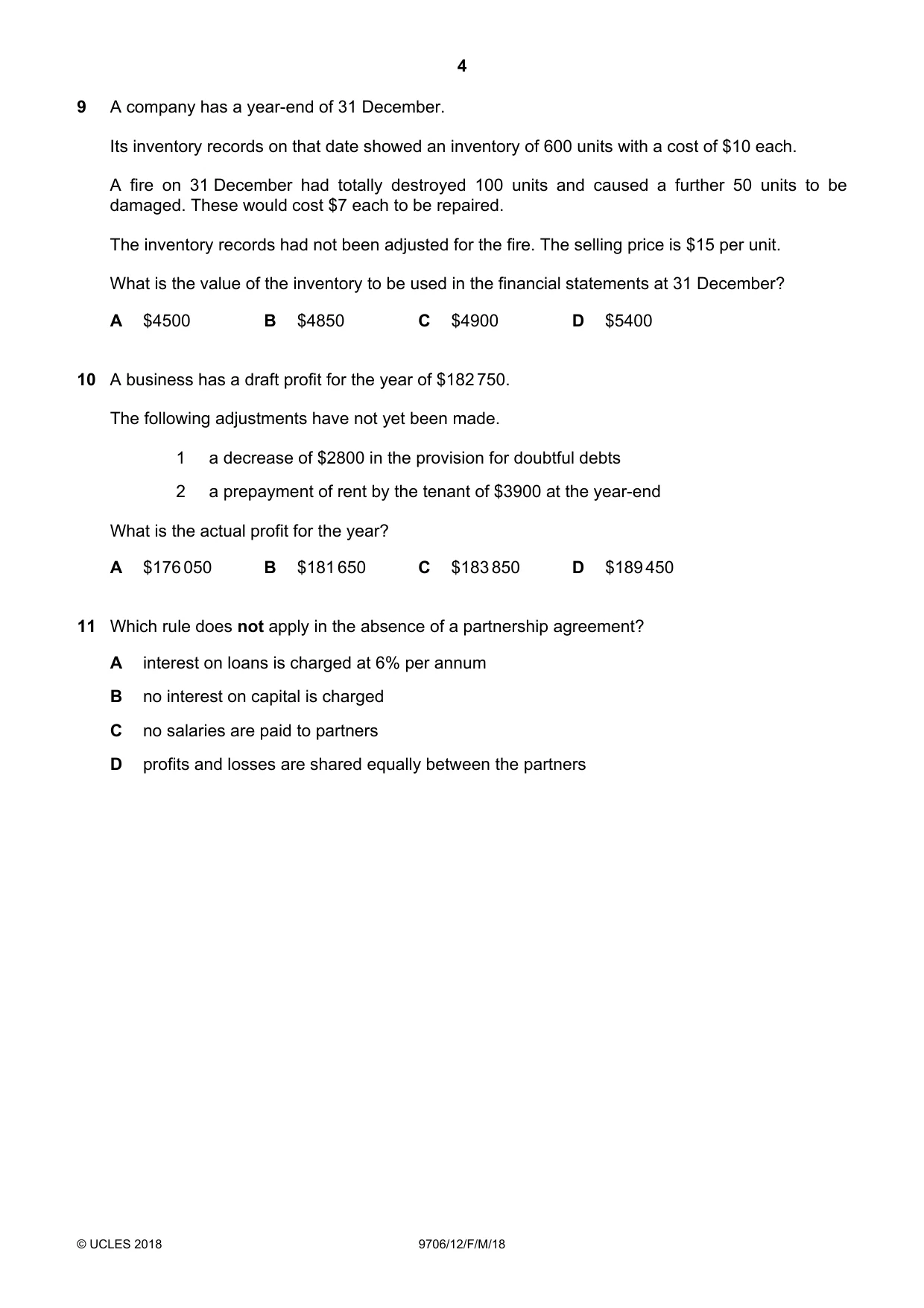
Q9 · A company has a year-end of 31 December
9 A company has a year-end of 31 December. Its inventory records on that date showed an inventory of 600 units with a cost of $10 each. A fire on 31 December had totally destroyed 100 units and caused a further 50 units to be damaged. These would cost $7 each to be repaired. The inventory records had not been adjusted for the fire. The selling price is $15 per unit. What is the value of the inventory to be used in the financial statements at 31 December? A $4500 B $4850 C $4900 D $5400
Mark scheme: C
Q10 · A business has a draft profit for the year of $182 750
10 A business has a draft profit for the year of $182 750. The following adjustments have not yet been made. 1 a decrease of $2800 in the provision for doubtful debts 2 a prepayment of rent by the tenant of $3900 at the year-end What is the actual profit for the year? A $176 050 B $181 650 C $183 850 D $189 450
Mark scheme: B
Q11 · Which rule does not apply in the absence of a partnership agreement?
11 Which rule does not apply in the absence of a partnership agreement? A interest on loans is charged at 6% per annum B no interest on capital is charged C no salaries are paid to partners D profits and losses are shared equally between the partners
Mark scheme: A
Q12 · The partnership of Ravi and Tania, who shared profits equally, was dissolved
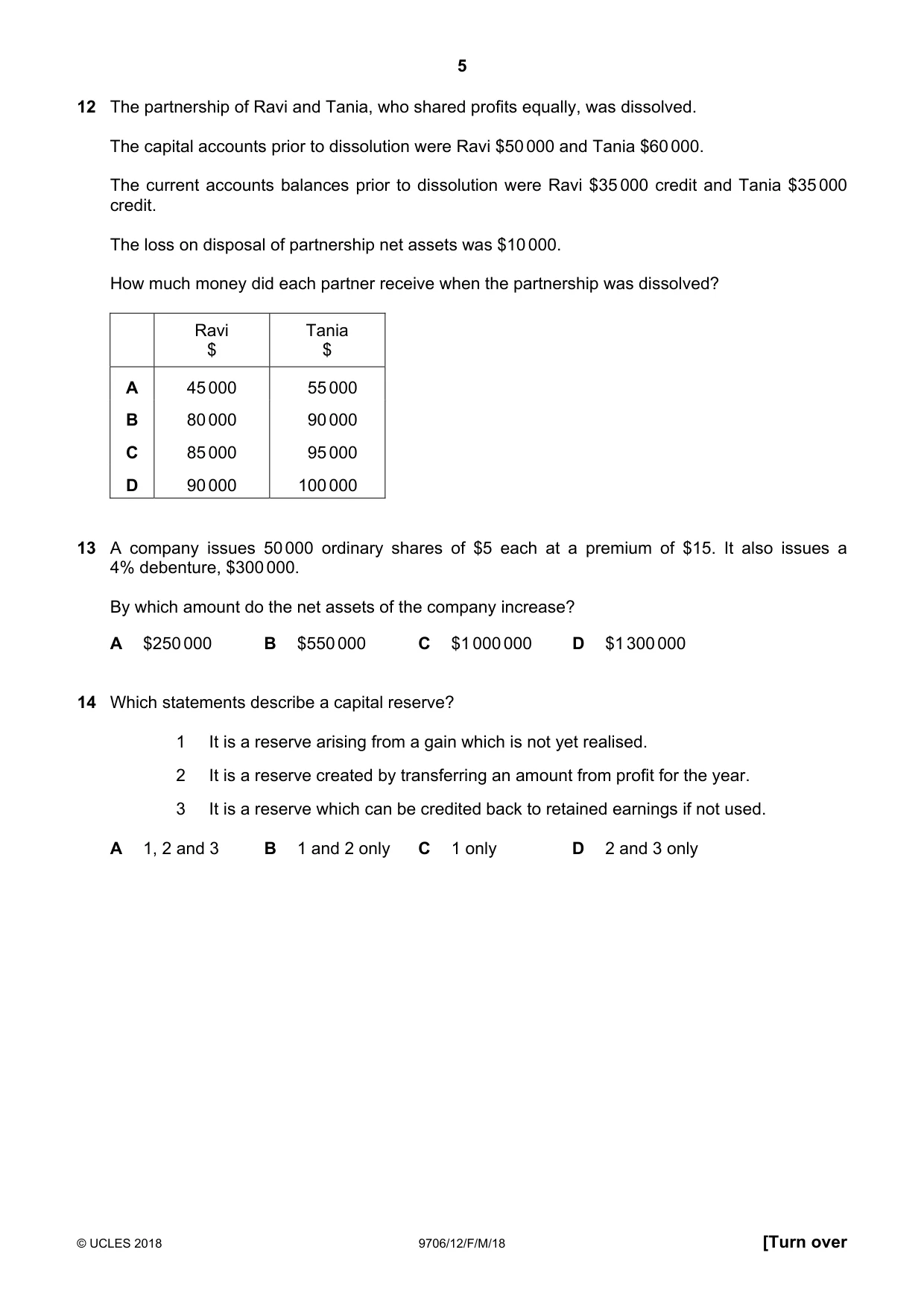
12 The partnership of Ravi and Tania, who shared profits equally, was dissolved. The capital accounts prior to dissolution were Ravi $50 000 and Tania $60 000. The current accounts balances prior to dissolution were Ravi $35 000 credit and Tania $35 000 credit. The loss on disposal of partnership net assets was $10 000. How much money did each partner receive when the partnership was dissolved? Ravi Tania $ $ A 45 000 55 000 B 80 000 90 000 C 85 000 95 000 D 90 000 100 000
Mark scheme: B
Q13 · A company issues 50 000 ordinary shares of $5 each at a premium of $15
13 A company issues 50 000 ordinary shares of $5 each at a premium of $15. It also issues a 4% debenture, $300 000. By which amount do the net assets of the company increase? A $250 000 B $550 000 C $1 000 000 D $1 300 000
Mark scheme: C
Q14 · Which statements describe a capital reserve?
14 Which statements describe a capital reserve? 1 It is a reserve arising from a gain which is not yet realised. 2 It is a reserve created by transferring an amount from profit for the year. 3 It is a reserve which can be credited back to retained earnings if not used. A 1, 2 and 3 B 1 and 2 only C 1 only D 2 and 3 only
Mark scheme: C
Q15 · The following is an extract from a statement of changes in equity
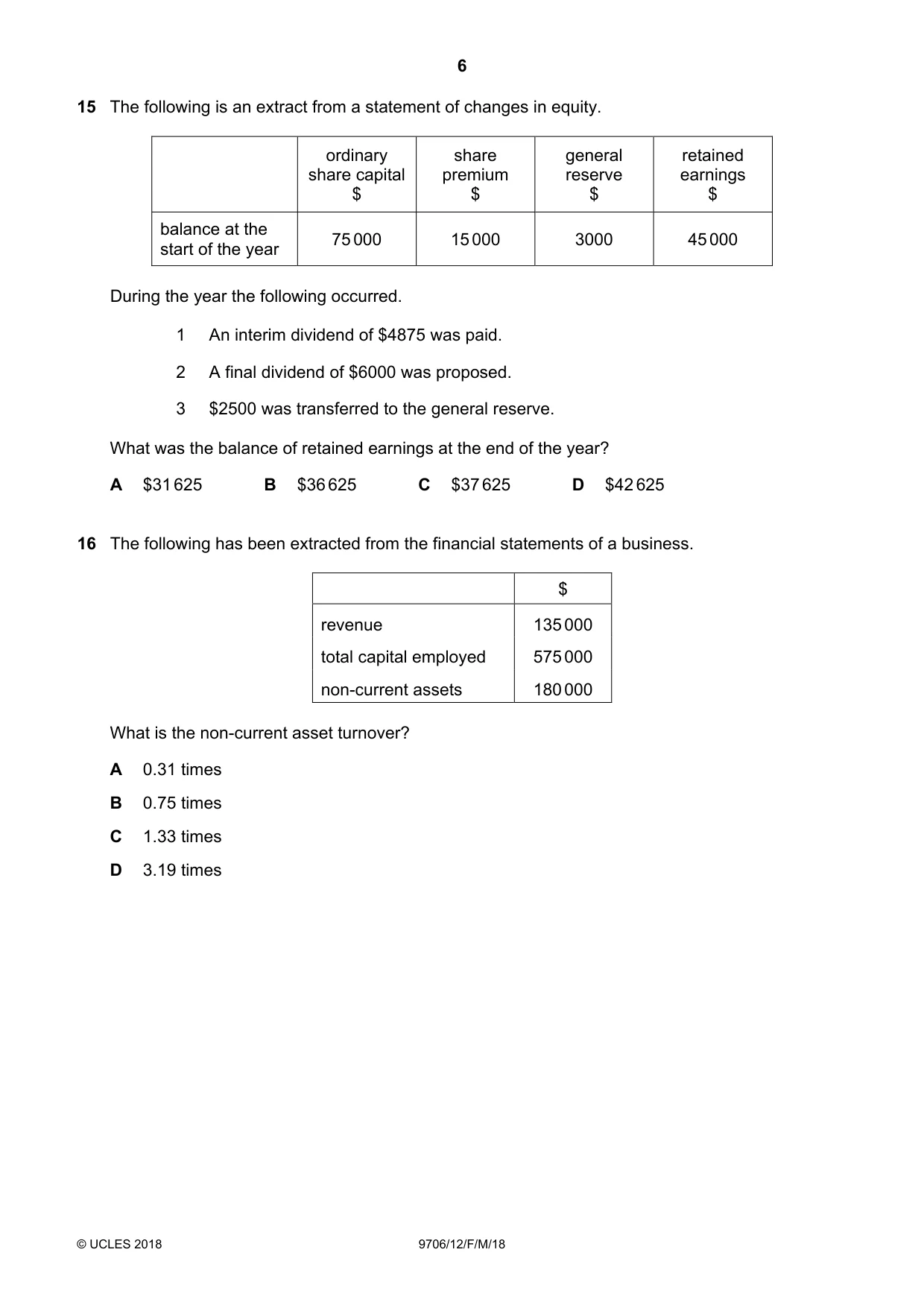
15 The following is an extract from a statement of changes in equity. ordinary share general retained share capital premium reserve earnings $ $ $ $ balance at the 75 000 15 000 3000 45 000 start of the year During the year the following occurred. 1 An interim dividend of $4875 was paid. 2 A final dividend of $6000 was proposed. 3 $2500 was transferred to the general reserve. What was the balance of retained earnings at the end of the year? A $31 625 B $36 625 C $37 625 D $42 625
Mark scheme: C
Q16 · The following has been extracted from the financial statements of a business
16 The following has been extracted from the financial statements of a business. $ revenue 135 000 total capital employed 575 000 non-current assets 180 000 What is the non-current asset turnover? A 0.31 times B 0.75 times C 1.33 times D 3.19 times
Mark scheme: B
More questions on Analysis and communication of accounting information
Q17 · The statement of financial position of X Limited at 31 December 2017 shows the following
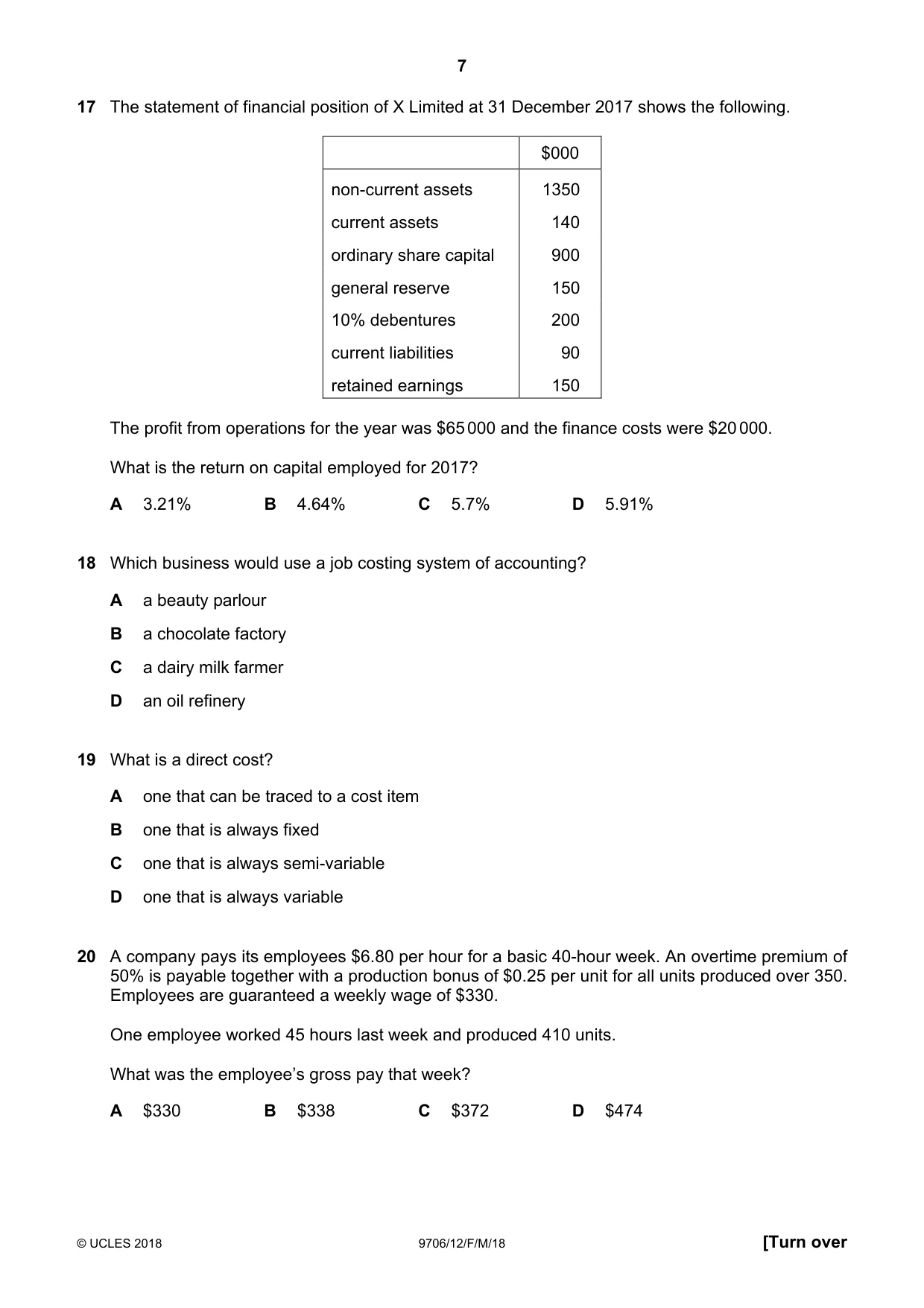
17 The statement of financial position of X Limited at 31 December 2017 shows the following. $000 non-current assets 1350 current assets 140 ordinary share capital 900 general reserve 150 10% debentures 200 current liabilities 90 retained earnings 150 The profit from operations for the year was $65 000 and the finance costs were $20 000. What is the return on capital employed for 2017? A 3.21% B 4.64% C 5.7% D 5.91%
Mark scheme: B
More questions on Analysis and communication of accounting information
Q18 · Which business would use a job costing system of accounting?
18 Which business would use a job costing system of accounting? A a beauty parlour B a chocolate factory C a dairy milk farmer D an oil refinery
Mark scheme: A
Q19 · What is a direct cost?
19 What is a direct cost? A one that can be traced to a cost item B one that is always fixed C one that is always semi-variable D one that is always variable
Mark scheme: A
Q20 · A company pays its employees $6.80 per hour for a basic 40-hour week
20 A company pays its employees $6.80 per hour for a basic 40-hour week. An overtime premium of 50% is payable together with a production bonus of $0.25 per unit for all units produced over 350. Employees are guaranteed a weekly wage of $330. One employee worked 45 hours last week and produced 410 units. What was the employee’s gross pay that week? A $330 B $338 C $372 D $474
Mark scheme: B
Q21 · Adam records his inventory using the AVCO (perpetual inventory) to calculate its value
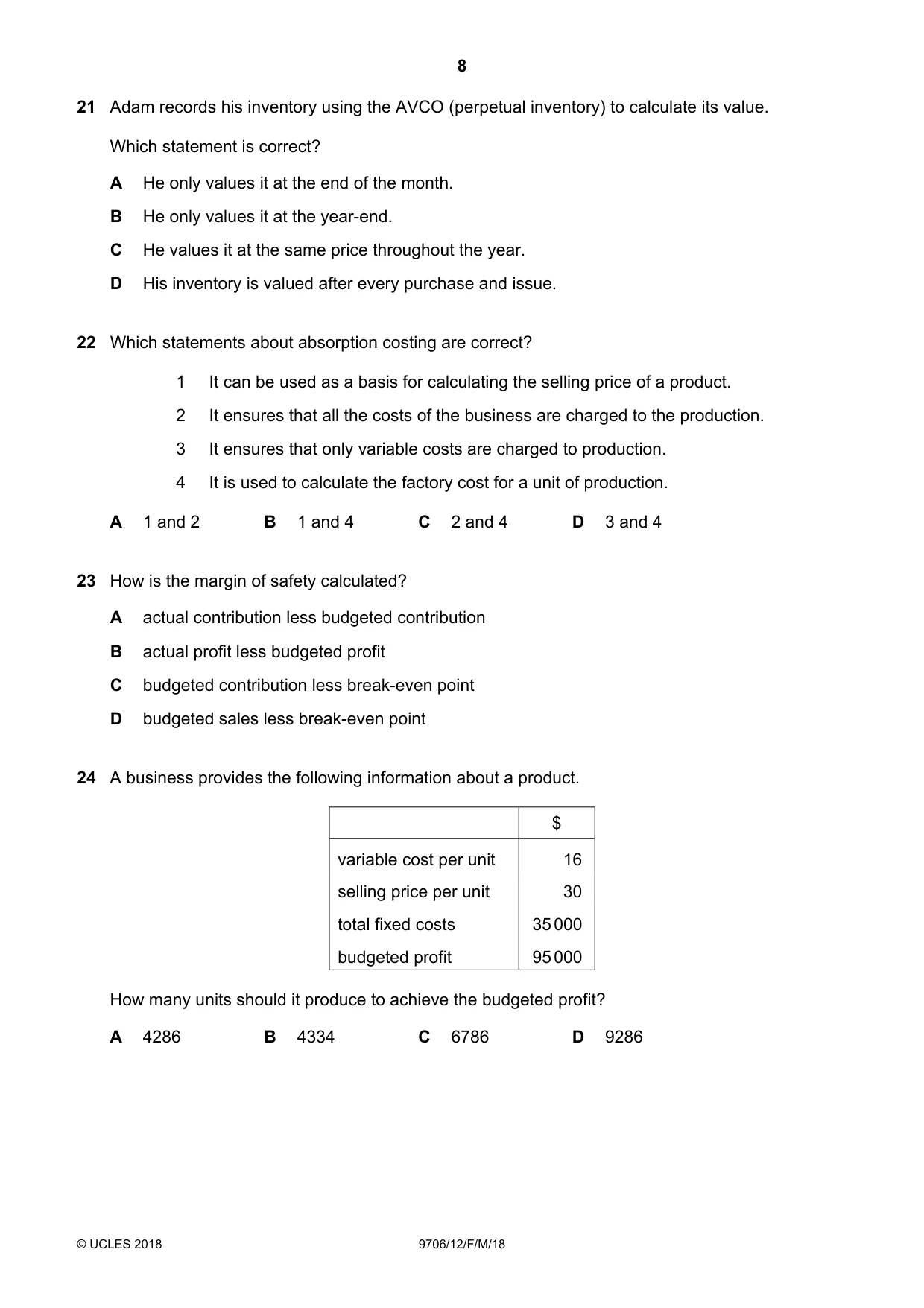
21 Adam records his inventory using the AVCO (perpetual inventory) to calculate its value. Which statement is correct? A He only values it at the end of the month. B He only values it at the year-end. C He values it at the same price throughout the year. D His inventory is valued after every purchase and issue.
Mark scheme: D
Q22 · Which statements about absorption costing are correct?
22 Which statements about absorption costing are correct? 1 It can be used as a basis for calculating the selling price of a product. 2 It ensures that all the costs of the business are charged to the production. 3 It ensures that only variable costs are charged to production. 4 It is used to calculate the factory cost for a unit of production. A 1 and 2 B 1 and 4 C 2 and 4 D 3 and 4
Mark scheme: B
Q23 · How is the margin of safety calculated?
23 How is the margin of safety calculated? A actual contribution less budgeted contribution B actual profit less budgeted profit C budgeted contribution less break-even point D budgeted sales less break-even point
Mark scheme: D
Q24 · A business provides the following information about a product
24 A business provides the following information about a product. $ variable cost per unit 16 selling price per unit 30 total fixed costs 35 000 budgeted profit 95 000 How many units should it produce to achieve the budgeted profit? A 4286 B 4334 C 6786 D 9286
Mark scheme: D
Q25 · A business provides the following financial information
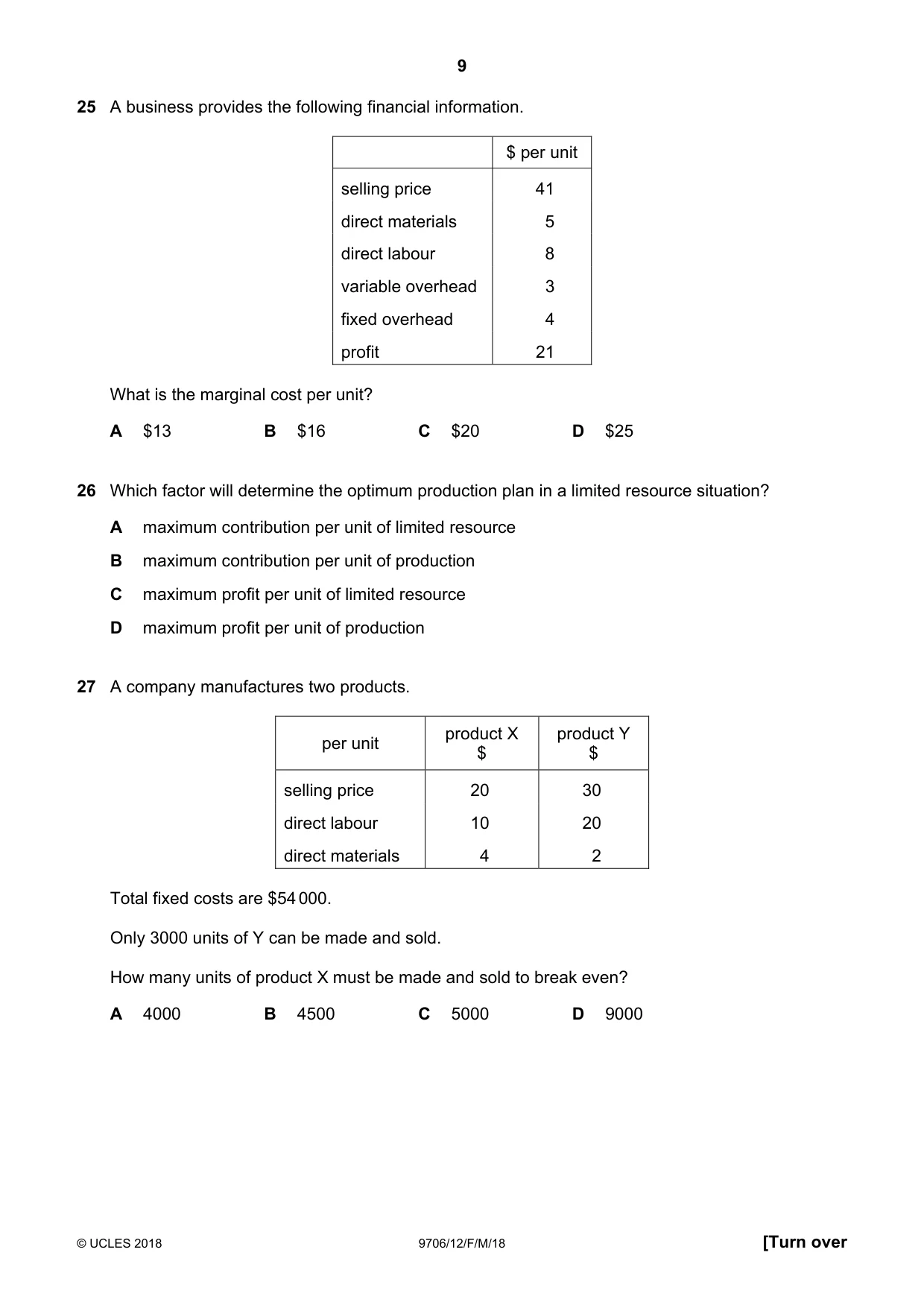
25 A business provides the following financial information. $ per unit selling price 41 direct materials 5 direct labour 8 variable overhead 3 fixed overhead 4 profit 21 What is the marginal cost per unit? A $13 B $16 C $20 D $25
Mark scheme: B
Q26 · Which factor will determine the optimum production plan in a limited resource situation?
26 Which factor will determine the optimum production plan in a limited resource situation? A maximum contribution per unit of limited resource B maximum contribution per unit of production C maximum profit per unit of limited resource D maximum profit per unit of production
Mark scheme: A
Q27 · A company manufactures two products
27 A company manufactures two products. product X product Y per unit $ $ selling price 20 30 direct labour 10 20 direct materials 4 2 Total fixed costs are $54 000. Only 3000 units of Y can be made and sold. How many units of product X must be made and sold to break even? A 4000 B 4500 C 5000 D 9000
Mark scheme: C
Q28 · A company uses absorption costing and makes and sells one product
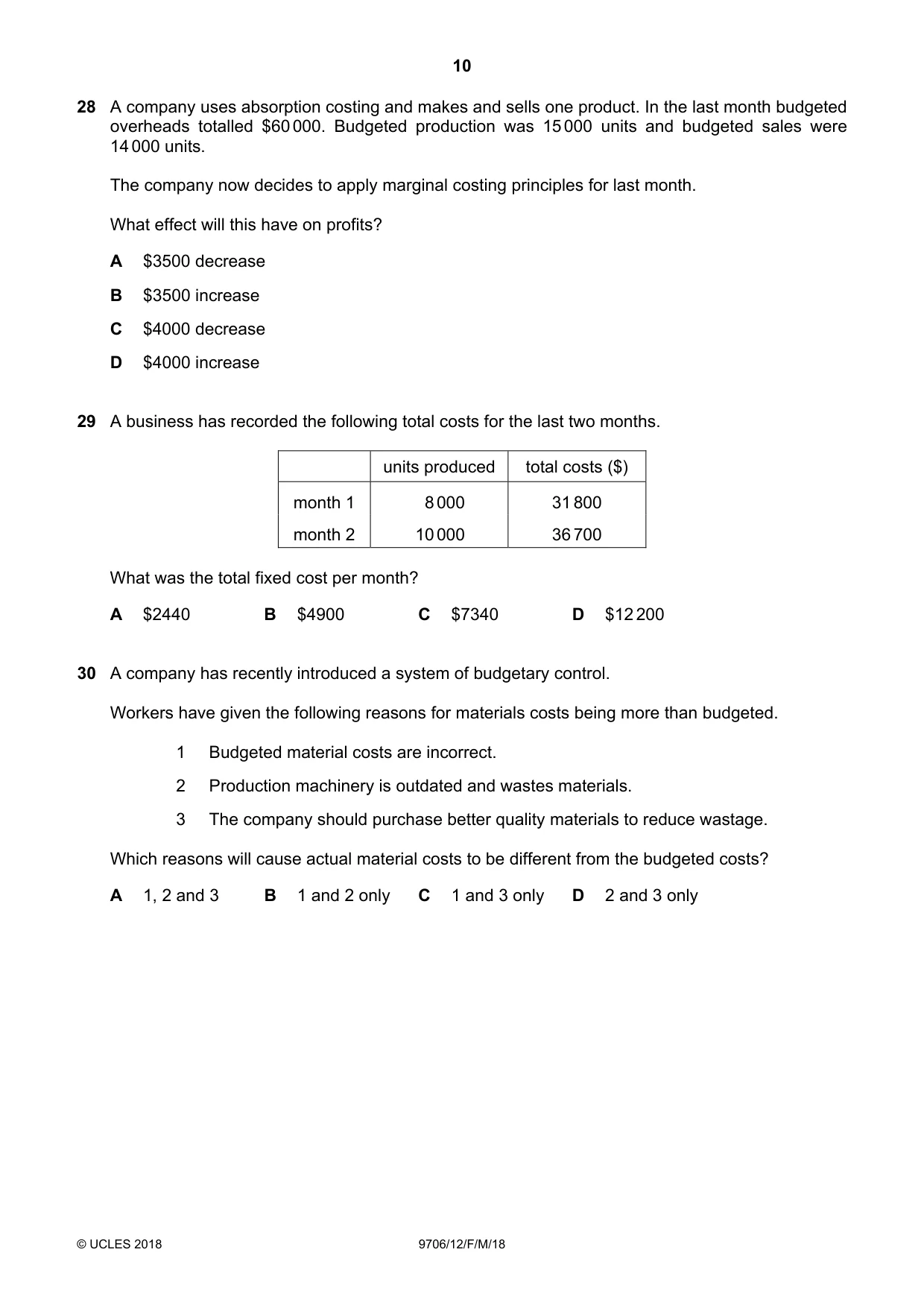
28 A company uses absorption costing and makes and sells one product. In the last month budgeted overheads totalled $60 000. Budgeted production was 15 000 units and budgeted sales were 14 000 units. The company now decides to apply marginal costing principles for last month. What effect will this have on profits? A $3500 decrease B $3500 increase C $4000 decrease D $4000 increase
Mark scheme: C
Q29 · A business has recorded the following total costs for the last two months
29 A business has recorded the following total costs for the last two months. units produced total costs ($) month 1 8 000 31 800 month 2 10 000 36 700 What was the total fixed cost per month? A $2440 B $4900 C $7340 D $12 200
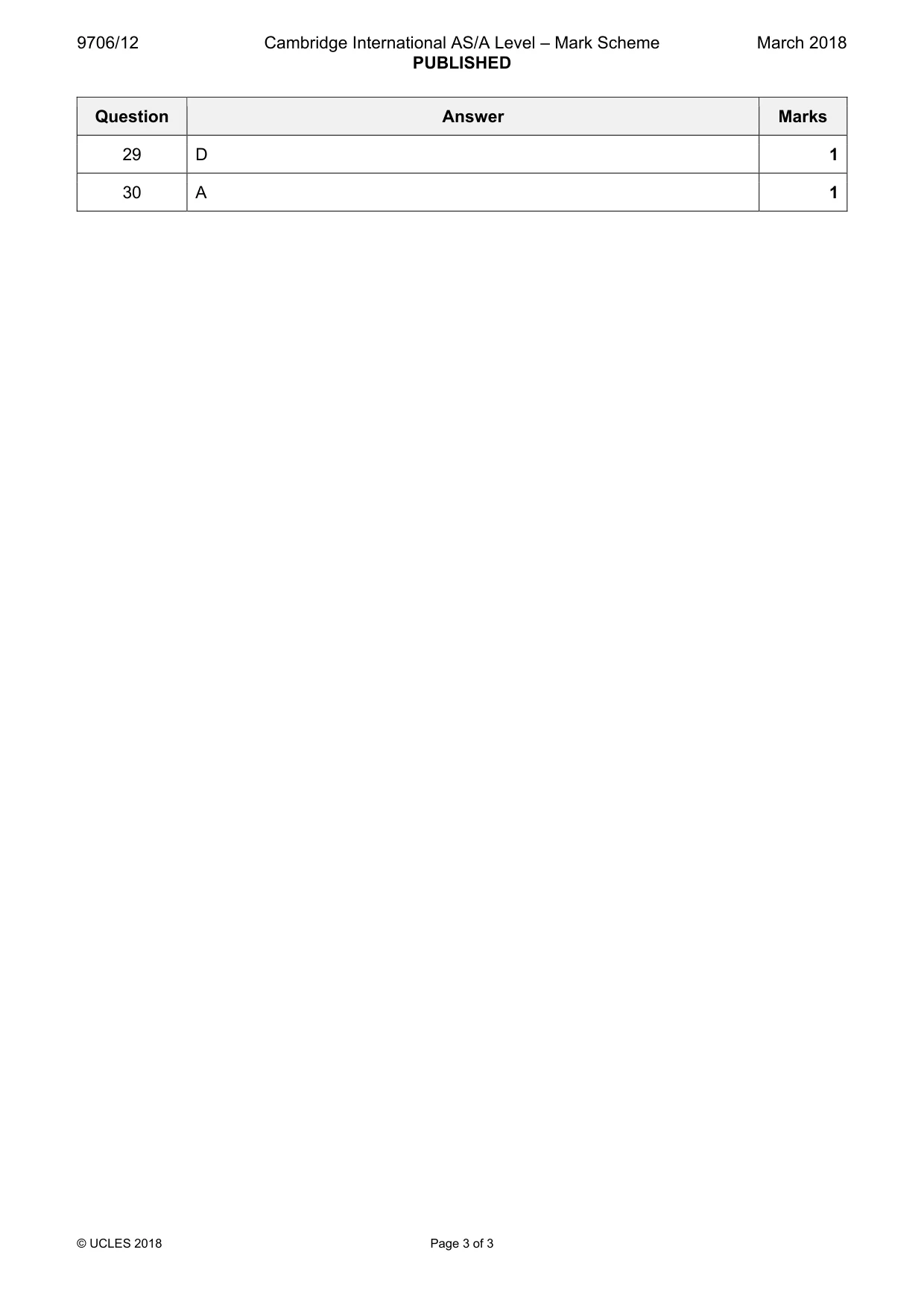
Mark scheme: D
Q30 · A company has recently introduced a system of budgetary control
30 A company has recently introduced a system of budgetary control. Workers have given the following reasons for materials costs being more than budgeted. 1 Budgeted material costs are incorrect. 2 Production machinery is outdated and wastes materials. 3 The company should purchase better quality materials to reduce wastage. Which reasons will cause actual material costs to be different from the budgeted costs? A 1, 2 and 3 B 1 and 2 only C 1 and 3 only D 2 and 3 only
Mark scheme: A
What was in this paper
The subtopics covered by these 30 questions, and how many questions each got. Open one in a new tab to see every Cambridge question on it.
6Costs and cost behaviour4Accounting for non-current assets3Preparation of financial statements3Preparation of financial statements3Reconciliation and verification3The accounting system2Types of business entity2Activity based costing (ABC)1Analysis and communication of accounting information1Analysis and communication of accounting information1Budgeting and budgetary control1What you needed in this session
Cambridge’s own grade thresholds for 2018 Feb/March, Paper 1 · Variant 2. A higher threshold means an easier paper — the bar moves with how the cohort did.