Cambridge A Level Accounting 9706 — 2012 May/June Paper 1 · Variant 3
9706/13/M/J/12 · 30 questions · 30 marks · ≈34 min
The question paper and its mark scheme, free to read here and free to download. This is Cambridge’s own paper, exactly as it was sat.
Question paper12 pages
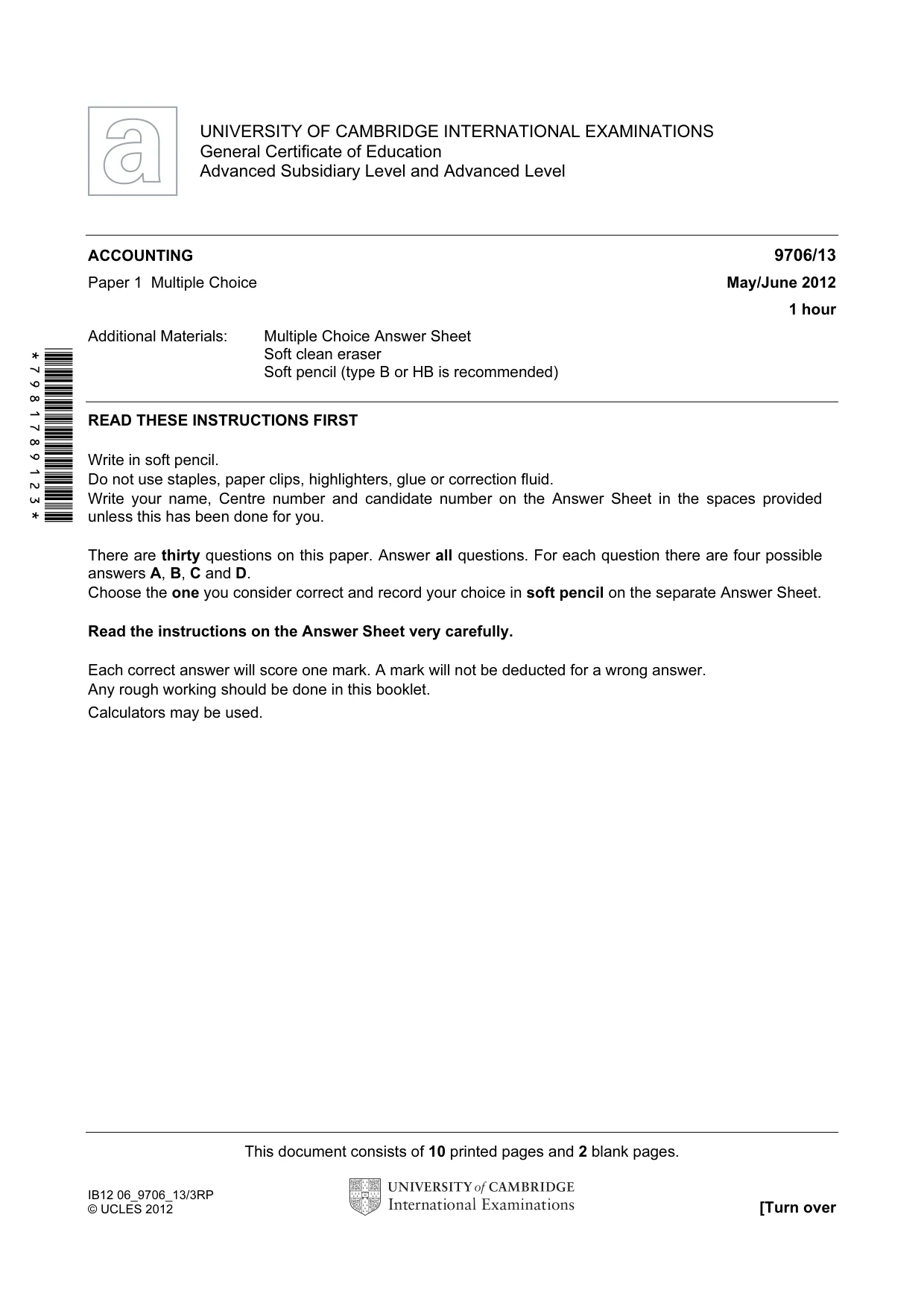

Mark scheme2 pages
Answers below. Sit the paper first if you are practising.
Questions as text
Q1 · The journal entry ‘Debit Subscription Income, Credit Creditors’ was made in the…
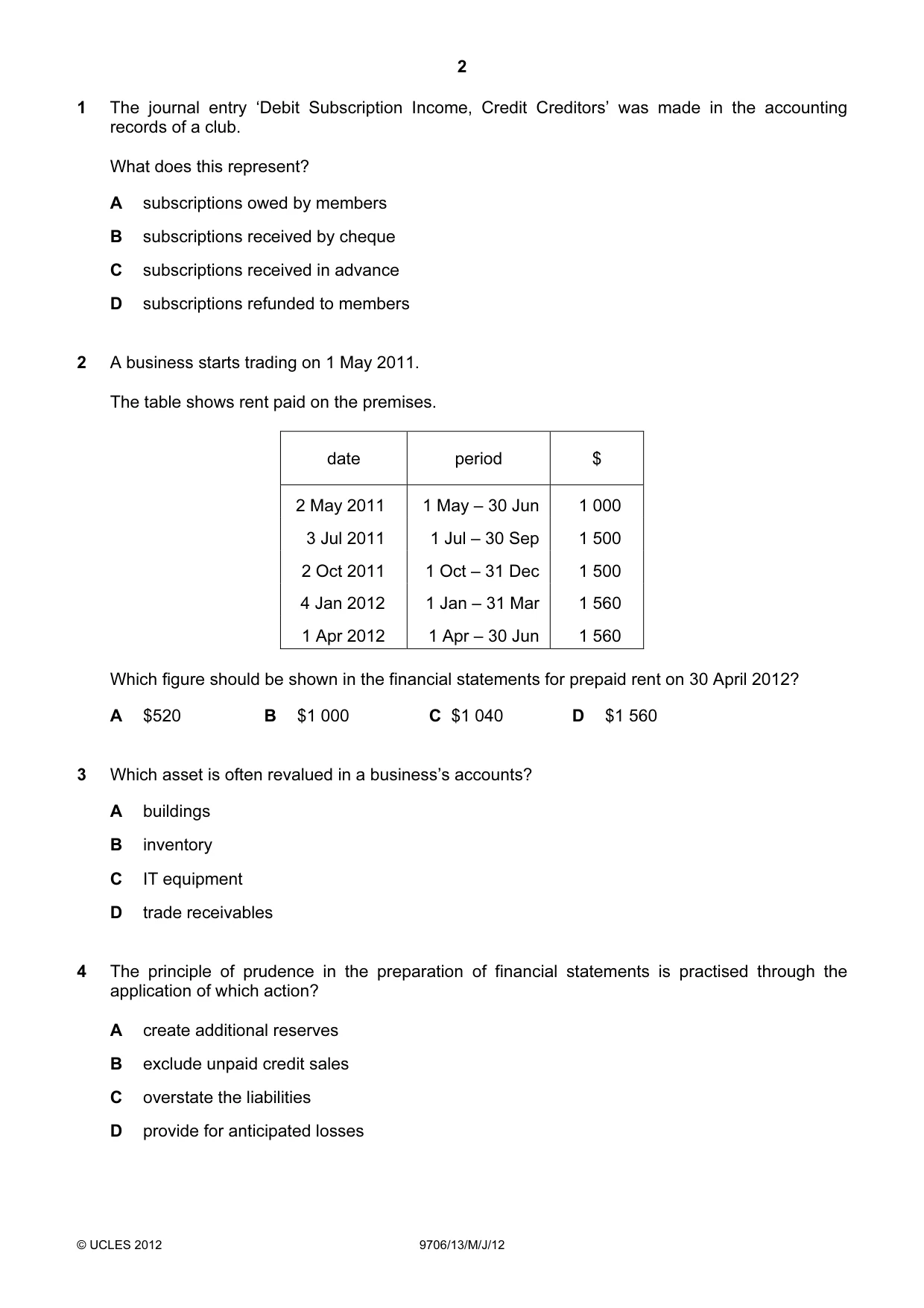
1 The journal entry ‘Debit Subscription Income, Credit Creditors’ was made in the accounting records of a club. What does this represent? A subscriptions owed by members B subscriptions received by cheque C subscriptions received in advance D subscriptions refunded to members
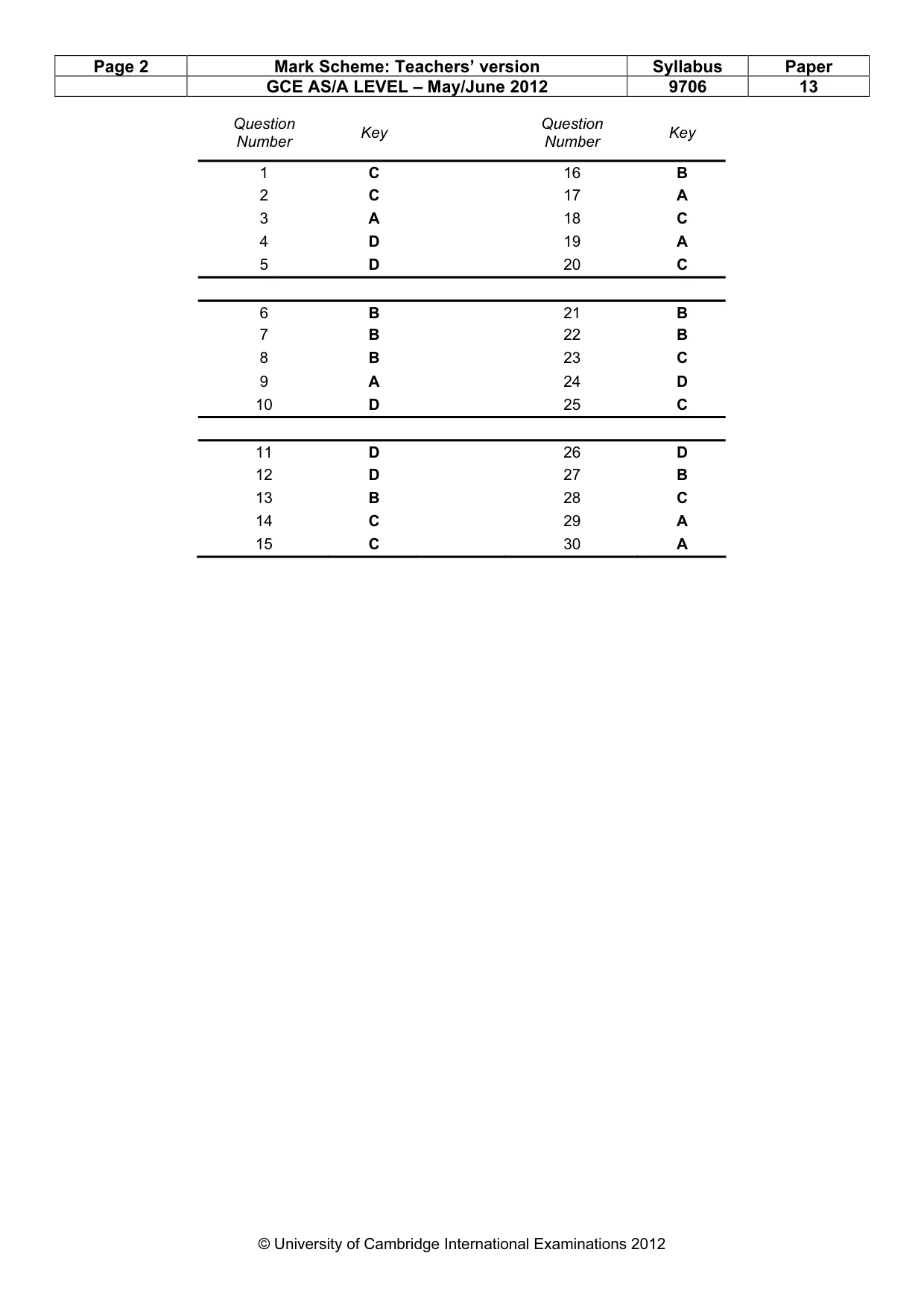
Mark scheme: C
Q2 · A business starts trading on 1 May 2011
2 A business starts trading on 1 May 2011. The table shows rent paid on the premises. date period $ 2 May 2011 1 May – 30 Jun 1 000 3 Jul 2011 1 Jul – 30 Sep 1 500 2 Oct 2011 1 Oct – 31 Dec 1 500 4 Jan 2012 1 Jan – 31 Mar 1 560 1 Apr 2012 1 Apr – 30 Jun 1 560 Which figure should be shown in the financial statements for prepaid rent on 30 April 2012? A $520 B $1 000 C $1 040 D $1 560
Mark scheme: C
Q3 · Which asset is often revalued in a business’s accounts?
3 Which asset is often revalued in a business’s accounts? A buildings B inventory C IT equipment D trade receivables
Mark scheme: A
Q4 · The principle of prudence in the preparation of financial statements is practised through…
4 The principle of prudence in the preparation of financial statements is practised through the application of which action? A create additional reserves B exclude unpaid credit sales C overstate the liabilities D provide for anticipated losses
Mark scheme: D
Q5 · What is evidence that a company’s financial statements are true and fair?
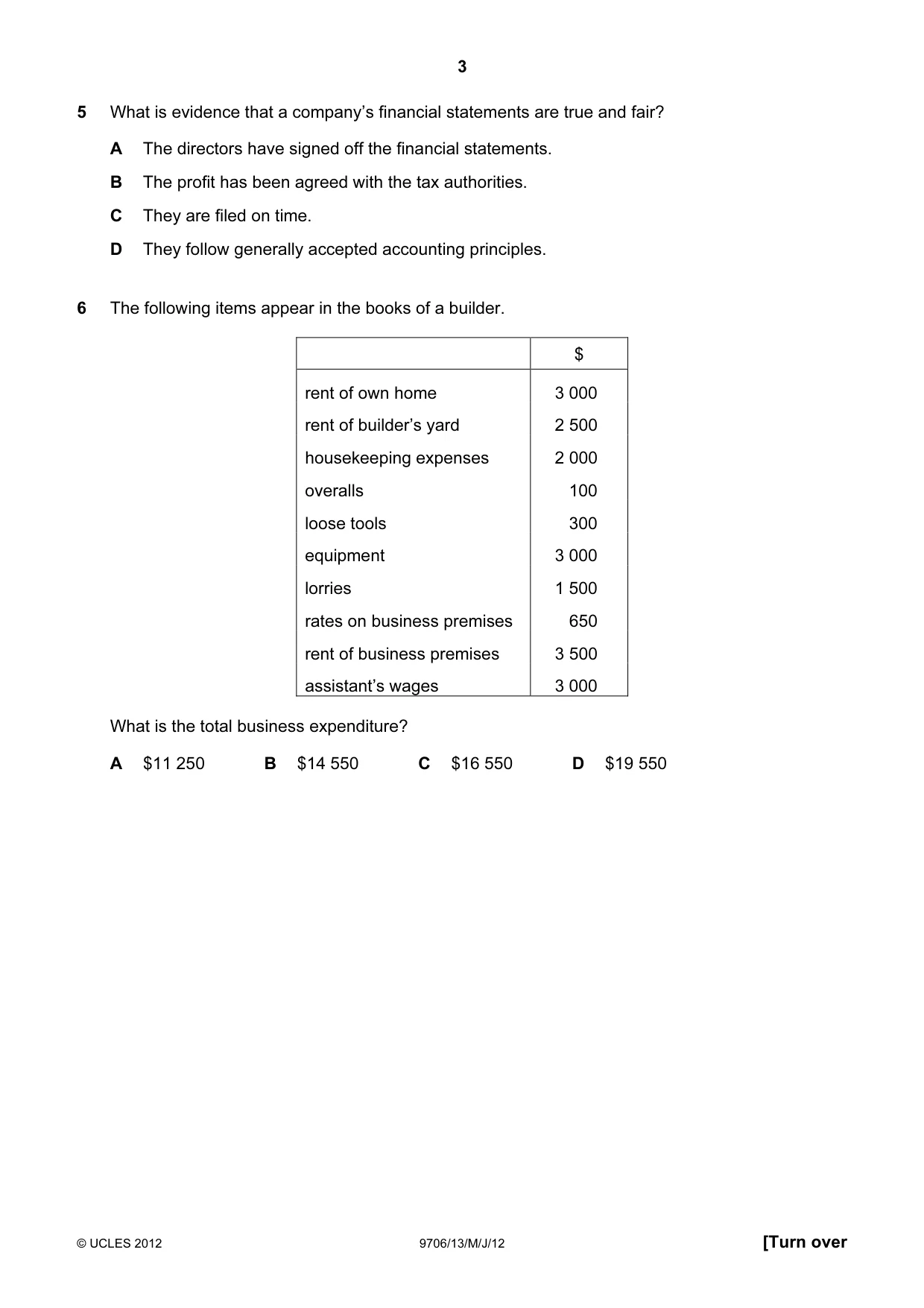
5 What is evidence that a company’s financial statements are true and fair? A The directors have signed off the financial statements. B The profit has been agreed with the tax authorities. C They are filed on time. D They follow generally accepted accounting principles.
Mark scheme: D
Q6 · The following items appear in the books of a builder
6 The following items appear in the books of a builder. $ rent of own home 3 000 rent of builder’s yard 2 500 housekeeping expenses 2 000 overalls 100 loose tools 300 equipment 3 000 lorries 1 500 rates on business premises 650 rent of business premises 3 500 assistant’s wages 3 000 What is the total business expenditure? A $11 250 B $14 550 C $16 550 D $19 550
Mark scheme: B
Q7 · At 31 March 2012, a business’s bank statement shows that its bank account is overdrawn by…
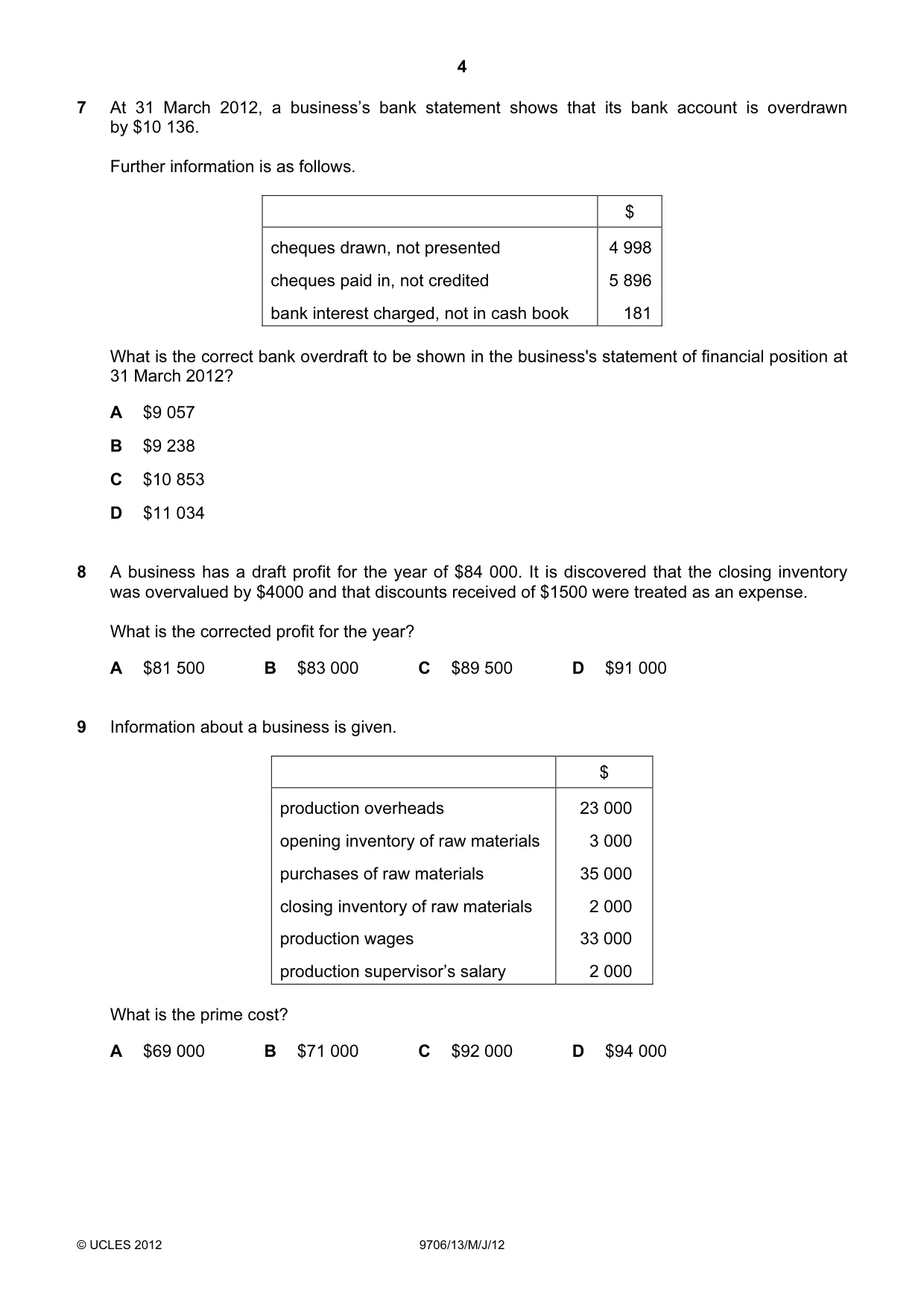
7 At 31 March 2012, a business’s bank statement shows that its bank account is overdrawn by $10 136. Further information is as follows. $ cheques drawn, not presented 4 998 cheques paid in, not credited 5 896 bank interest charged, not in cash book 181 What is the correct bank overdraft to be shown in the business's statement of financial position at 31 March 2012? A $9 057 B $9 238 C $10 853 D $11 034
Mark scheme: B
Q8 · A business has a draft profit for the year of $84 000
8 A business has a draft profit for the year of $84 000. It is discovered that the closing inventory was overvalued by $4000 and that discounts received of $1500 were treated as an expense. What is the corrected profit for the year? A $81 500 B $83 000 C $89 500 D $91 000
Mark scheme: B
Q9 · Information about a business is given
9 Information about a business is given. $ production overheads 23 000 opening inventory of raw materials 3 000 purchases of raw materials 35 000 closing inventory of raw materials 2 000 production wages 33 000 production supervisor’s salary 2 000 What is the prime cost? A $69 000 B $71 000 C $92 000 D $94 000
Mark scheme: A
Q10 · What appears as a credit entry in the appropriation account of a partnership?
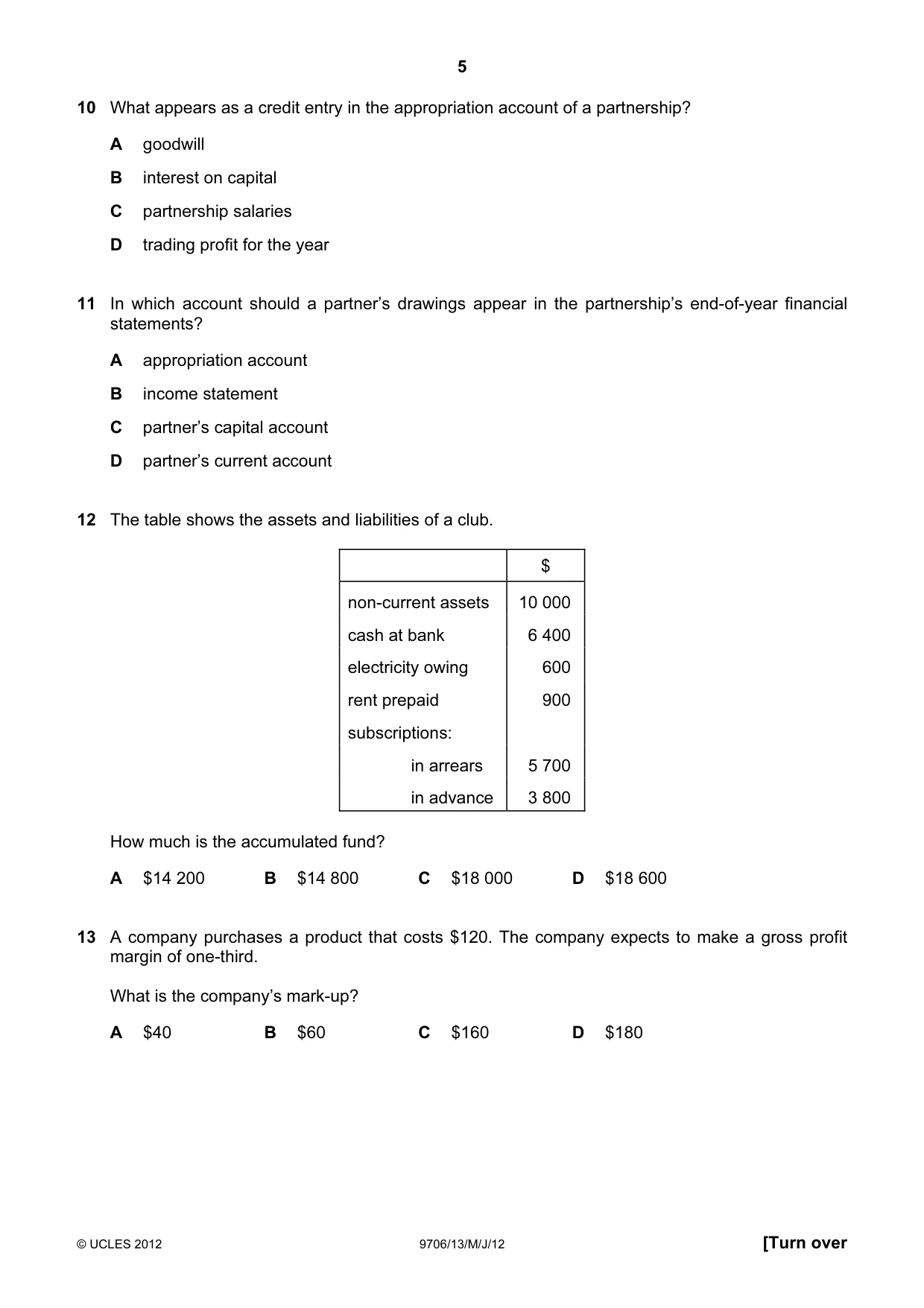
10 What appears as a credit entry in the appropriation account of a partnership? A goodwill B interest on capital C partnership salaries D trading profit for the year
Mark scheme: D
Q11 · In which account should a partner’s drawings appear in the partnership’s end-of-year…
11 In which account should a partner’s drawings appear in the partnership’s end-of-year financial statements? A appropriation account B income statement C partner’s capital account D partner’s current account
Mark scheme: D
Q12 · The table shows the assets and liabilities of a club
12 The table shows the assets and liabilities of a club. $ non-current assets 10 000 cash at bank 6 400 electricity owing 600 rent prepaid 900 subscriptions: in arrears 5 700 in advance 3 800 How much is the accumulated fund? A $14 200 B $14 800 C $18 000 D $18 600
Mark scheme: D
Q13 · A company purchases a product that costs $120
13 A company purchases a product that costs $120. The company expects to make a gross profit margin of one-third. What is the company’s mark-up? A $40 B $60 C $160 D $180
Mark scheme: B
More questions on Analysis and communication of accounting information
Q14 · The table shows transactions relating to a product during July
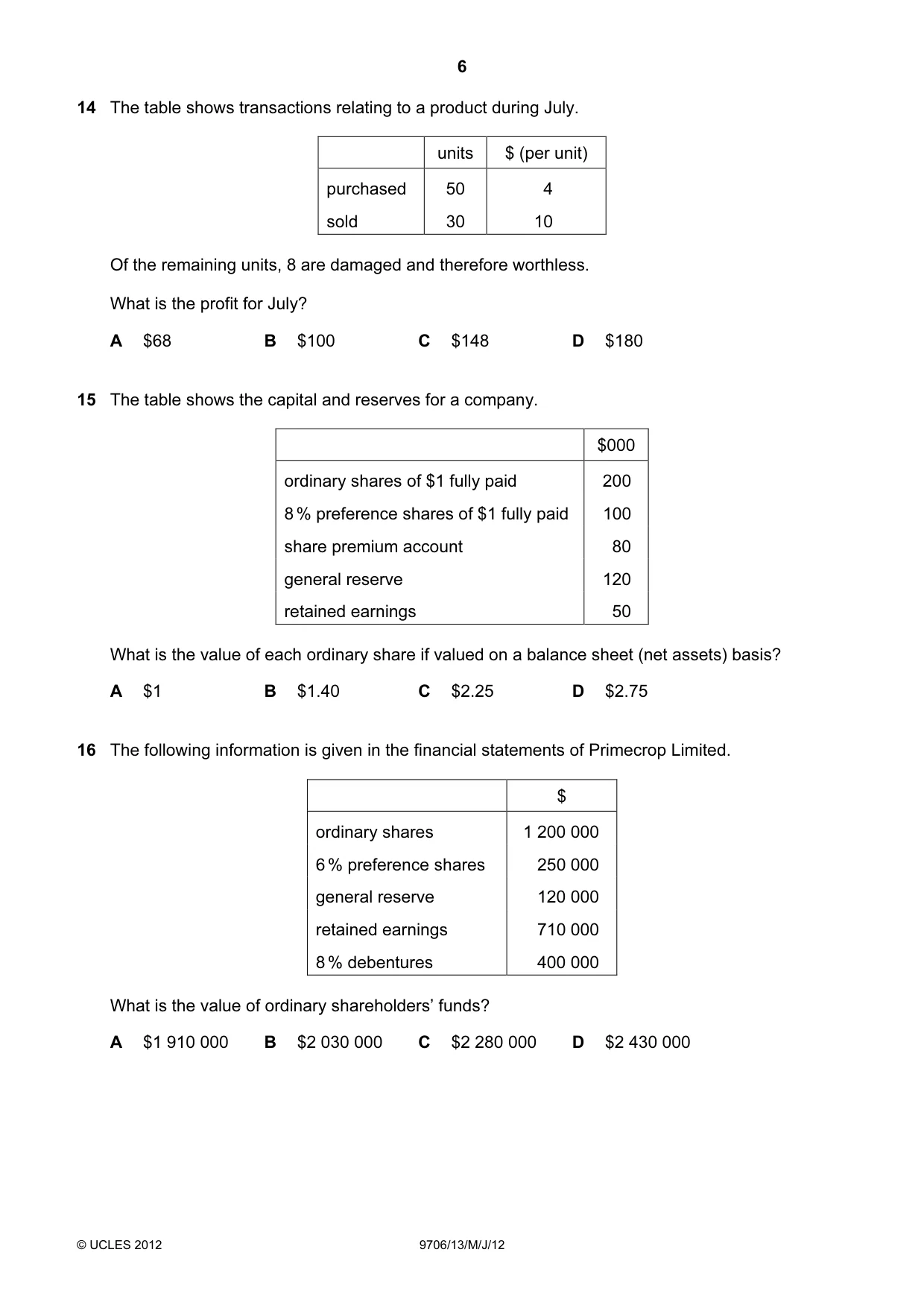
14 The table shows transactions relating to a product during July. units $ (per unit) purchased 50 4 sold 30 10 Of the remaining units, 8 are damaged and therefore worthless. What is the profit for July? A $68 B $100 C $148 D $180
Mark scheme: C
Q15 · The table shows the capital and reserves for a company
15 The table shows the capital and reserves for a company. $000 ordinary shares of $1 fully paid 200 8 % preference shares of $1 fully paid 100 share premium account 80 general reserve 120 retained earnings 50 What is the value of each ordinary share if valued on a balance sheet (net assets) basis? A $1 B $1.40 C $2.25 D $2.75
Mark scheme: C
More questions on Analysis and communication of accounting information
Q16 · The following information is given in the financial statements of Primecrop Limited
16 The following information is given in the financial statements of Primecrop Limited. $ ordinary shares 1 200 000 6 % preference shares 250 000 general reserve 120 000 retained earnings 710 000 8 % debentures 400 000 What is the value of ordinary shareholders’ funds? A $1 910 000 B $2 030 000 C $2 280 000 D $2 430 000
Mark scheme: B
More questions on Analysis and communication of accounting information
Q17 · A business has noticed a significant increase in its trade receivables collection period
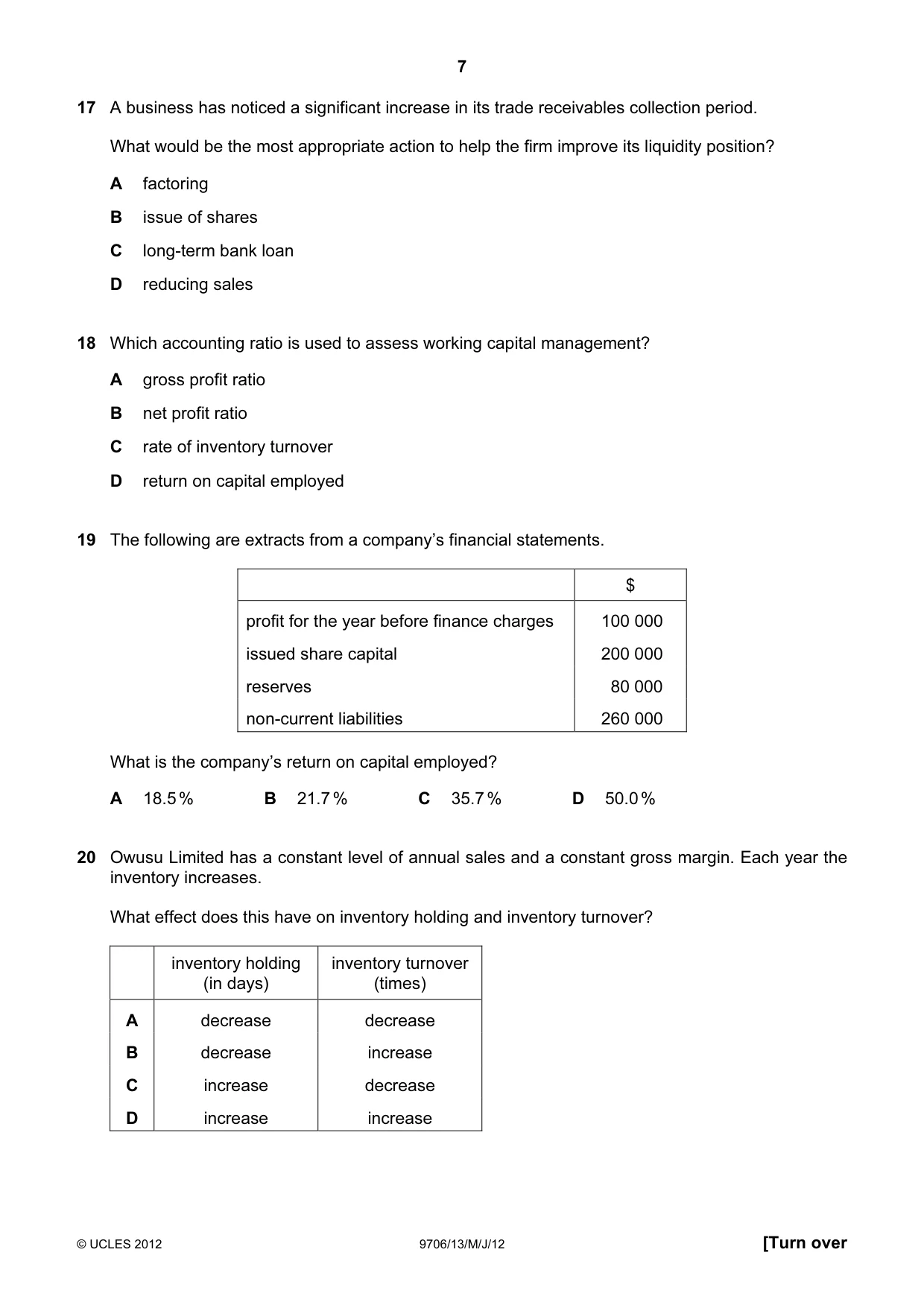
17 A business has noticed a significant increase in its trade receivables collection period. What would be the most appropriate action to help the firm improve its liquidity position? A factoring B issue of shares C long-term bank loan D reducing sales
Mark scheme: A
More questions on Analysis and communication of accounting information
Q18 · Which accounting ratio is used to assess working capital management?
18 Which accounting ratio is used to assess working capital management? A gross profit ratio B net profit ratio C rate of inventory turnover D return on capital employed
Mark scheme: C
More questions on Analysis and communication of accounting information
Q19 · The following are extracts from a company’s financial statements
19 The following are extracts from a company’s financial statements. $ profit for the year before finance charges 100 000 issued share capital 200 000 reserves 80 000 non-current liabilities 260 000 What is the company’s return on capital employed? A 18.5 % B 21.7 % C 35.7 % D 50.0 %
Mark scheme: A
More questions on Analysis and communication of accounting information
Q20 · Owusu Limited has a constant level of annual sales and a constant gross margin
20 Owusu Limited has a constant level of annual sales and a constant gross margin. Each year the inventory increases. What effect does this have on inventory holding and inventory turnover? inventory holding inventory turnover (in days) (times) A decrease decrease B decrease increase C increase decrease D increase increase
Mark scheme: C
More questions on Analysis and communication of accounting information
Q21 · Which item accounts for the difference between the current and liquid ratios?
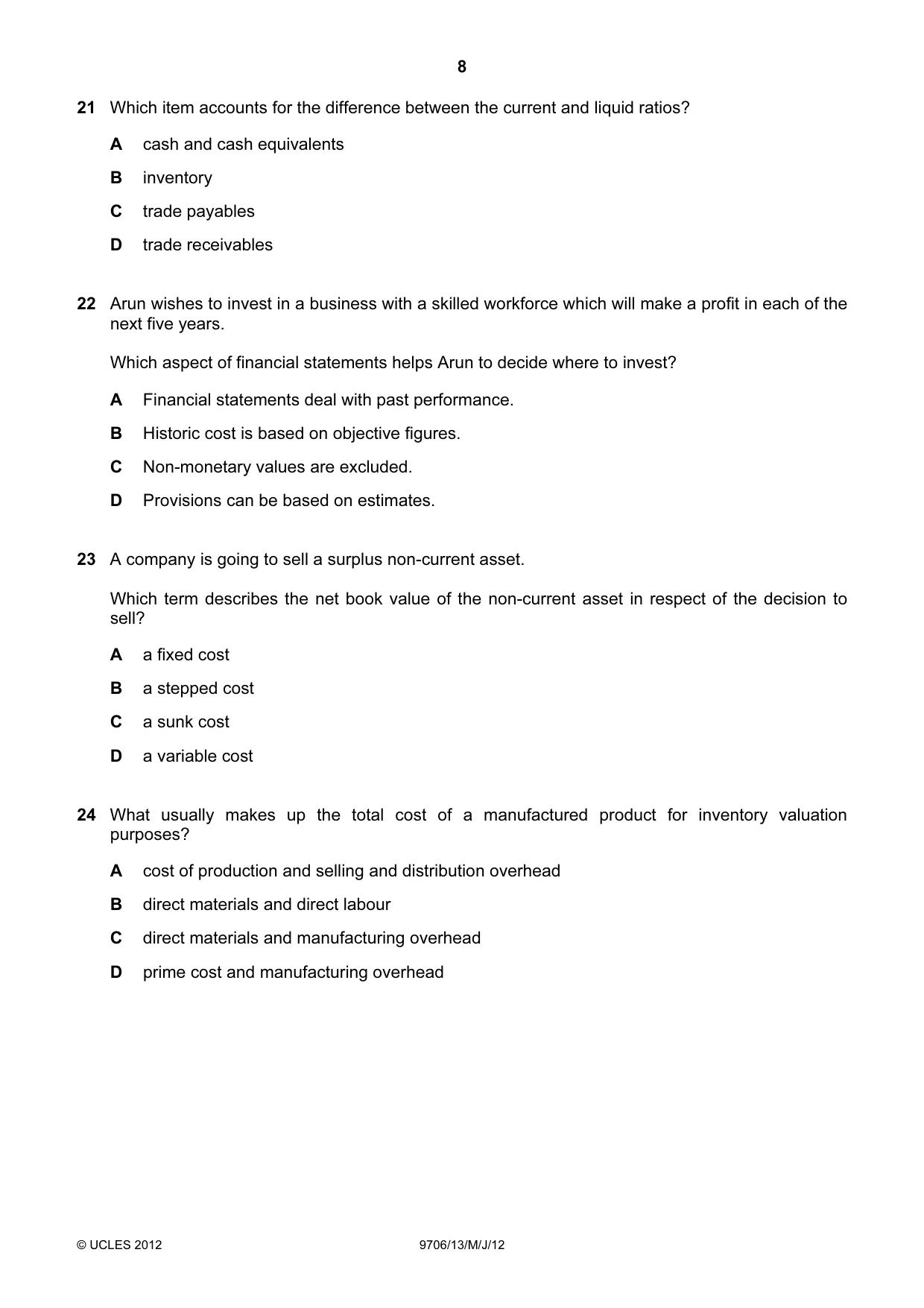
21 Which item accounts for the difference between the current and liquid ratios? A cash and cash equivalents B inventory C trade payables D trade receivables
Mark scheme: B
More questions on Analysis and communication of accounting information
Q22 · Arun wishes to invest in a business with a skilled workforce which will make a profit in…
22 Arun wishes to invest in a business with a skilled workforce which will make a profit in each of the next five years. Which aspect of financial statements helps Arun to decide where to invest? A Financial statements deal with past performance. B Historic cost is based on objective figures. C Non-monetary values are excluded. D Provisions can be based on estimates.
Mark scheme: B
Q23 · A company is going to sell a surplus non-current asset
23 A company is going to sell a surplus non-current asset. Which term describes the net book value of the non-current asset in respect of the decision to sell? A a fixed cost B a stepped cost C a sunk cost D a variable cost
Mark scheme: C
Q24 · What usually makes up the total cost of a manufactured product for inventory valuation…
24 What usually makes up the total cost of a manufactured product for inventory valuation purposes? A cost of production and selling and distribution overhead B direct materials and direct labour C direct materials and manufacturing overhead D prime cost and manufacturing overhead
Mark scheme: D
Q25 · The actual output for a business is lower than that forecast
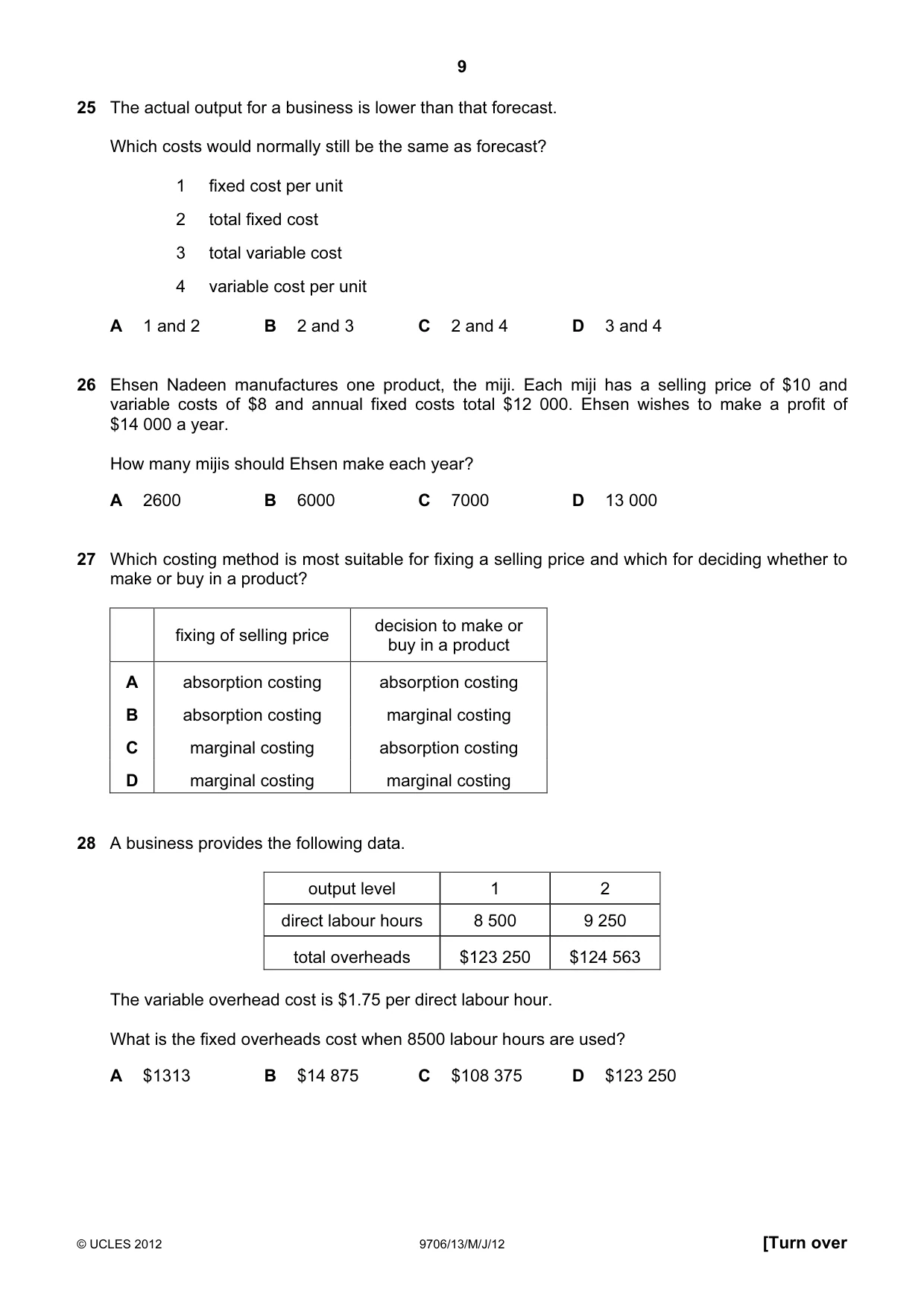
25 The actual output for a business is lower than that forecast. Which costs would normally still be the same as forecast? 1 fixed cost per unit 2 total fixed cost 3 total variable cost 4 variable cost per unit A 1 and 2 B 2 and 3 C 2 and 4 D 3 and 4
Mark scheme: C
Q26 · Ehsen Nadeen manufactures one product, the miji
26 Ehsen Nadeen manufactures one product, the miji. Each miji has a selling price of $10 and variable costs of $8 and annual fixed costs total $12 000. Ehsen wishes to make a profit of $14 000 a year. How many mijis should Ehsen make each year? A 2600 B 6000 C 7000 D 13 000
Mark scheme: D
Q27 · Which costing method is most suitable for fixing a selling price and which for deciding…
27 Which costing method is most suitable for fixing a selling price and which for deciding whether to make or buy in a product? decision to make or fixing of selling price buy in a product A absorption costing absorption costing B absorption costing marginal costing C marginal costing absorption costing D marginal costing marginal costing
Mark scheme: B
Q28 · A business provides the following data
28 A business provides the following data. output level 1 2 direct labour hours 8 500 9 250 total overheads $123 250 $124 563 The variable overhead cost is $1.75 per direct labour hour. What is the fixed overheads cost when 8500 labour hours are used? A $1313 B $14 875 C $108 375 D $123 250
Mark scheme: C
Q29 · A business uses absorption costing
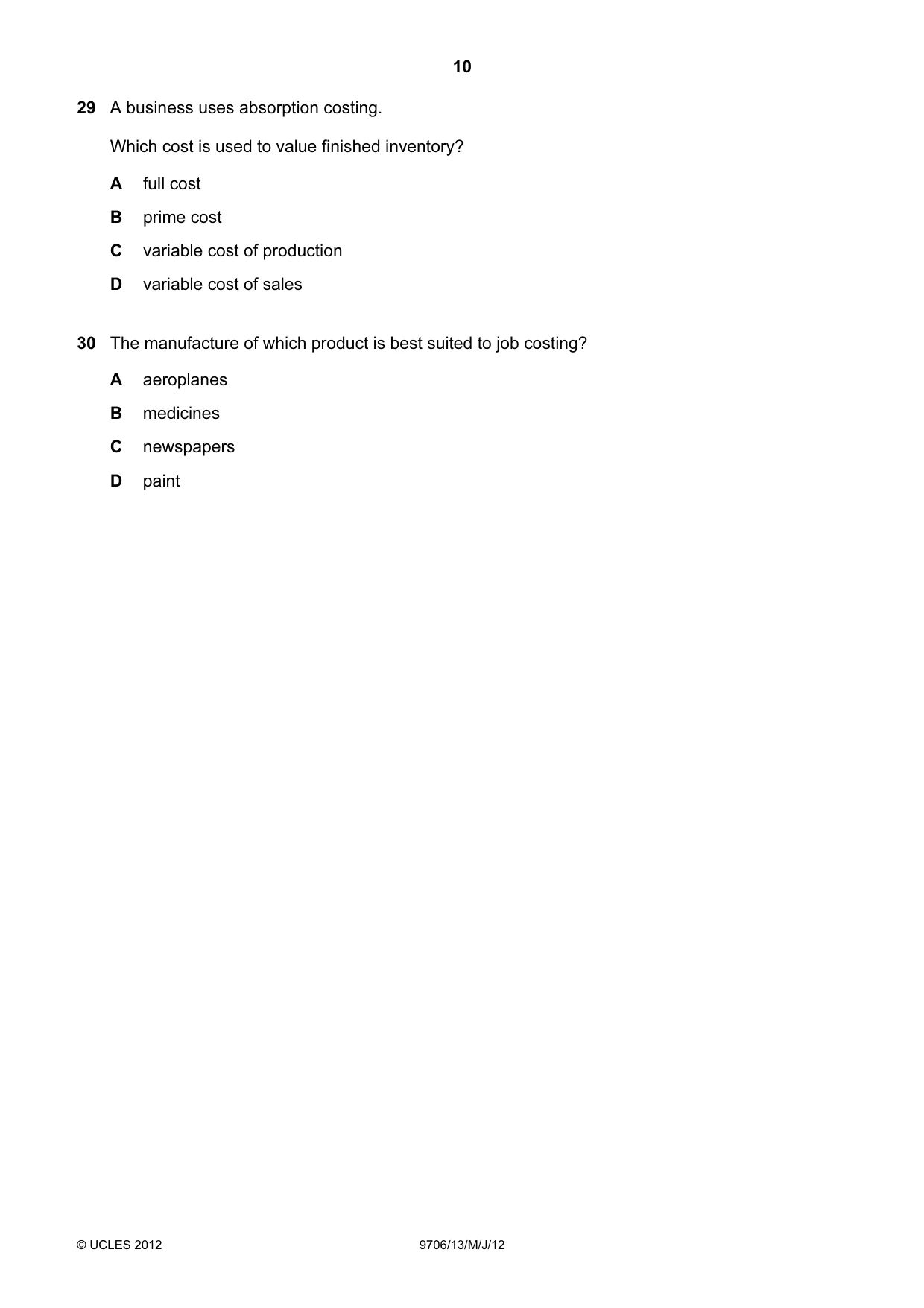
29 A business uses absorption costing. Which cost is used to value finished inventory? A full cost B prime cost C variable cost of production D variable cost of sales
Mark scheme: A
Q30 · The manufacture of which product is best suited to job costing?
30 The manufacture of which product is best suited to job costing? A aeroplanes B medicines C newspapers D paint
Mark scheme: A
What was in this paper
The subtopics covered by these 30 questions, and how many questions each got. Open one in a new tab to see every Cambridge question on it.
6Preparation of financial statements6Traditional costing methods6Costs and cost behaviour3Regulatory and ethical considerations3Analysis and communication of accounting information2Reconciliation and verification2Accounting for non-current assets1Types of business entity1What you needed in this session
Cambridge’s own grade thresholds for 2012 May/June, Paper 1 · Variant 3. A higher threshold means an easier paper — the bar moves with how the cohort did.