Cambridge A Level Accounting 9706 — 2014 Oct/Nov Paper 1 · Variant 3
9706/13/O/N/14 · 30 questions · 30 marks · ≈34 min
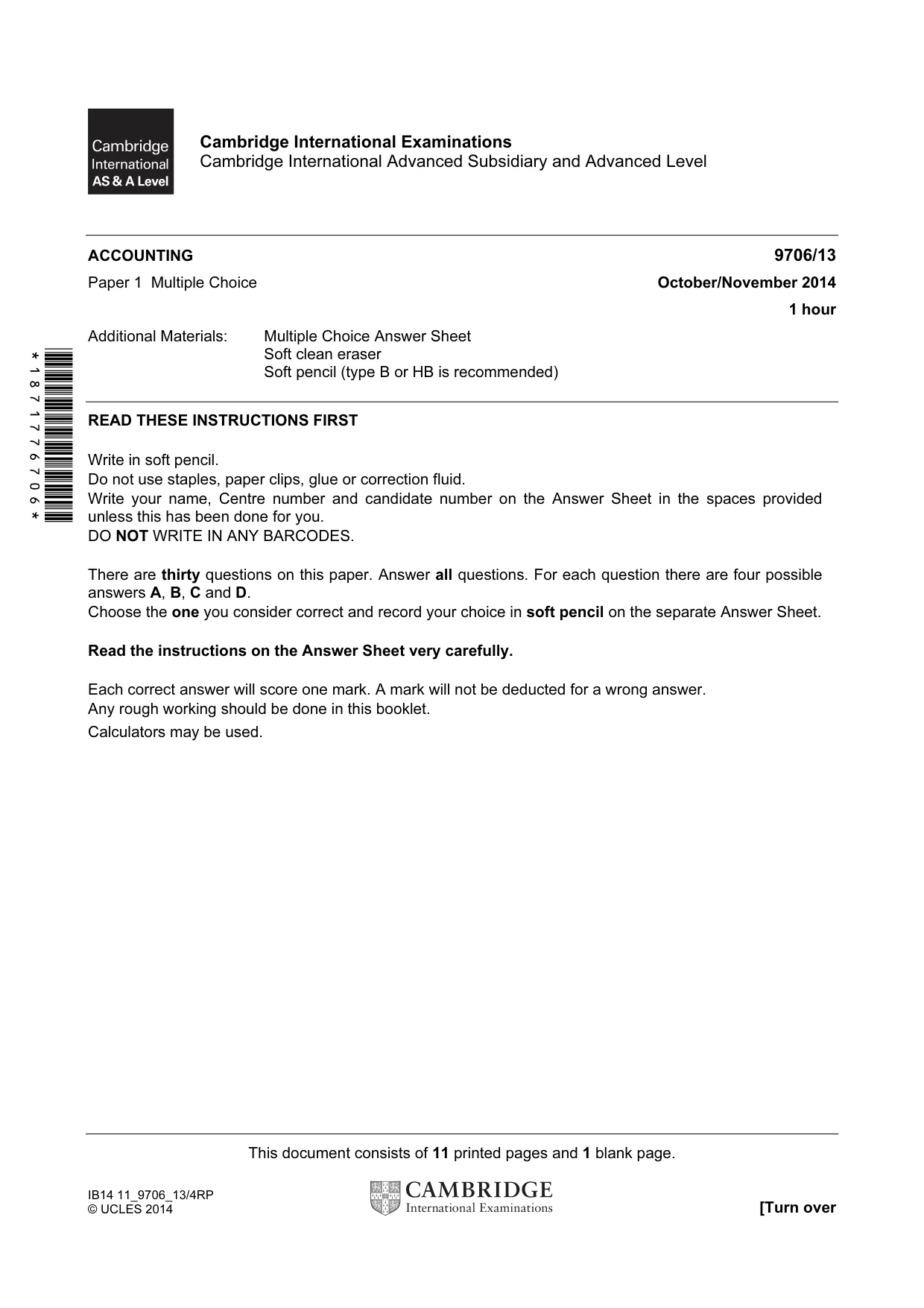
The question paper and its mark scheme, free to read here and free to download. This is Cambridge’s own paper, exactly as it was sat.
Question paper12 pages
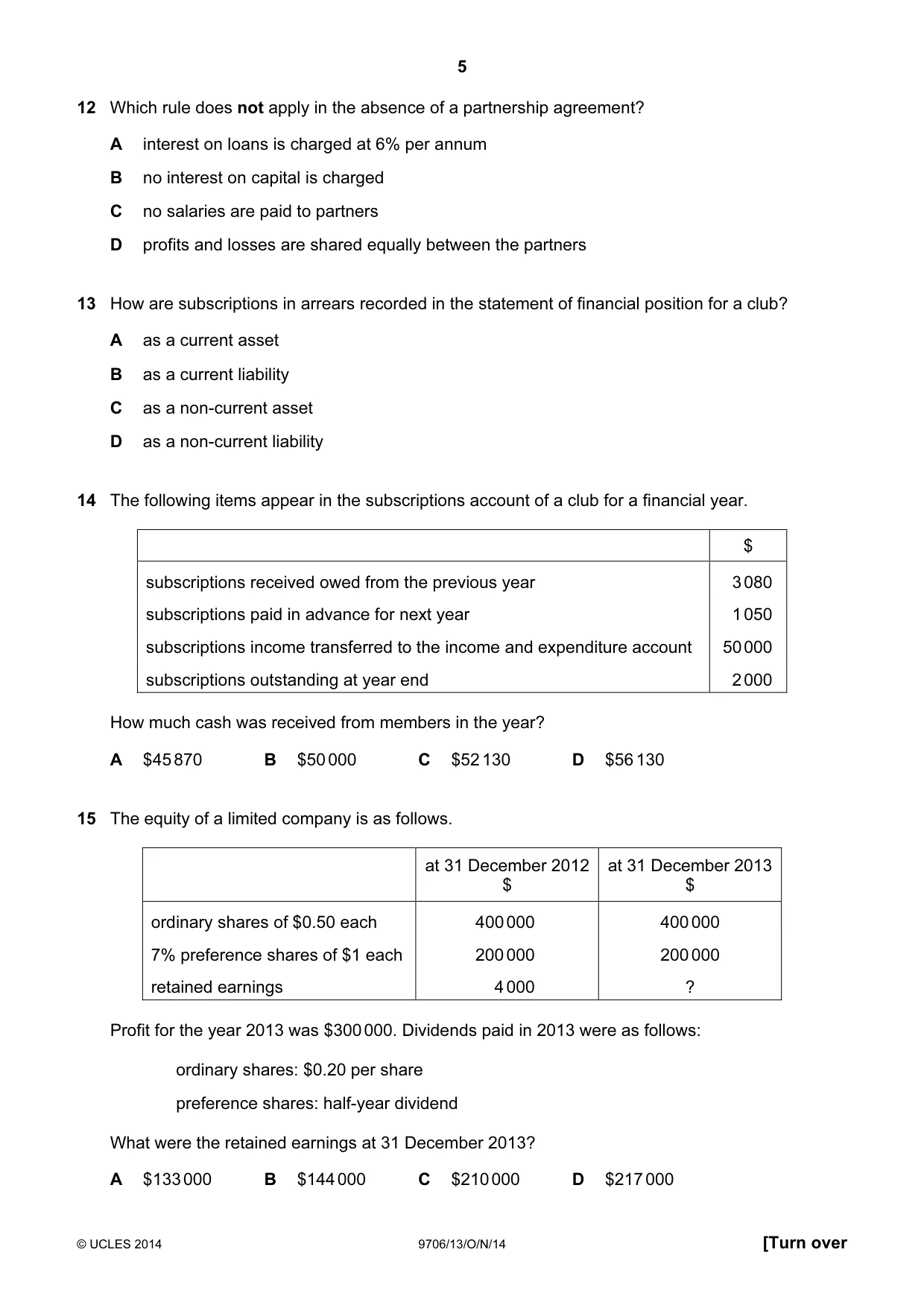
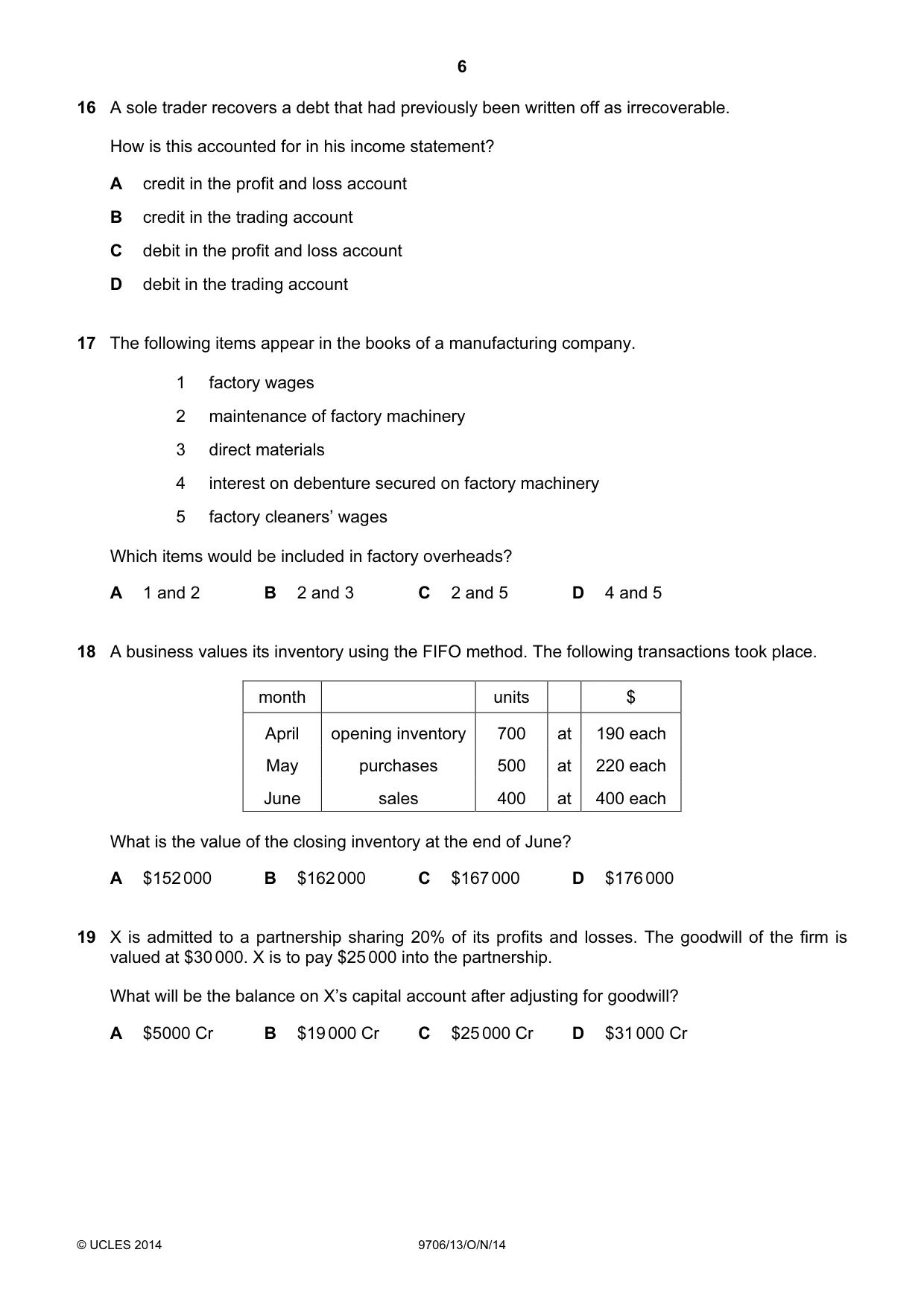
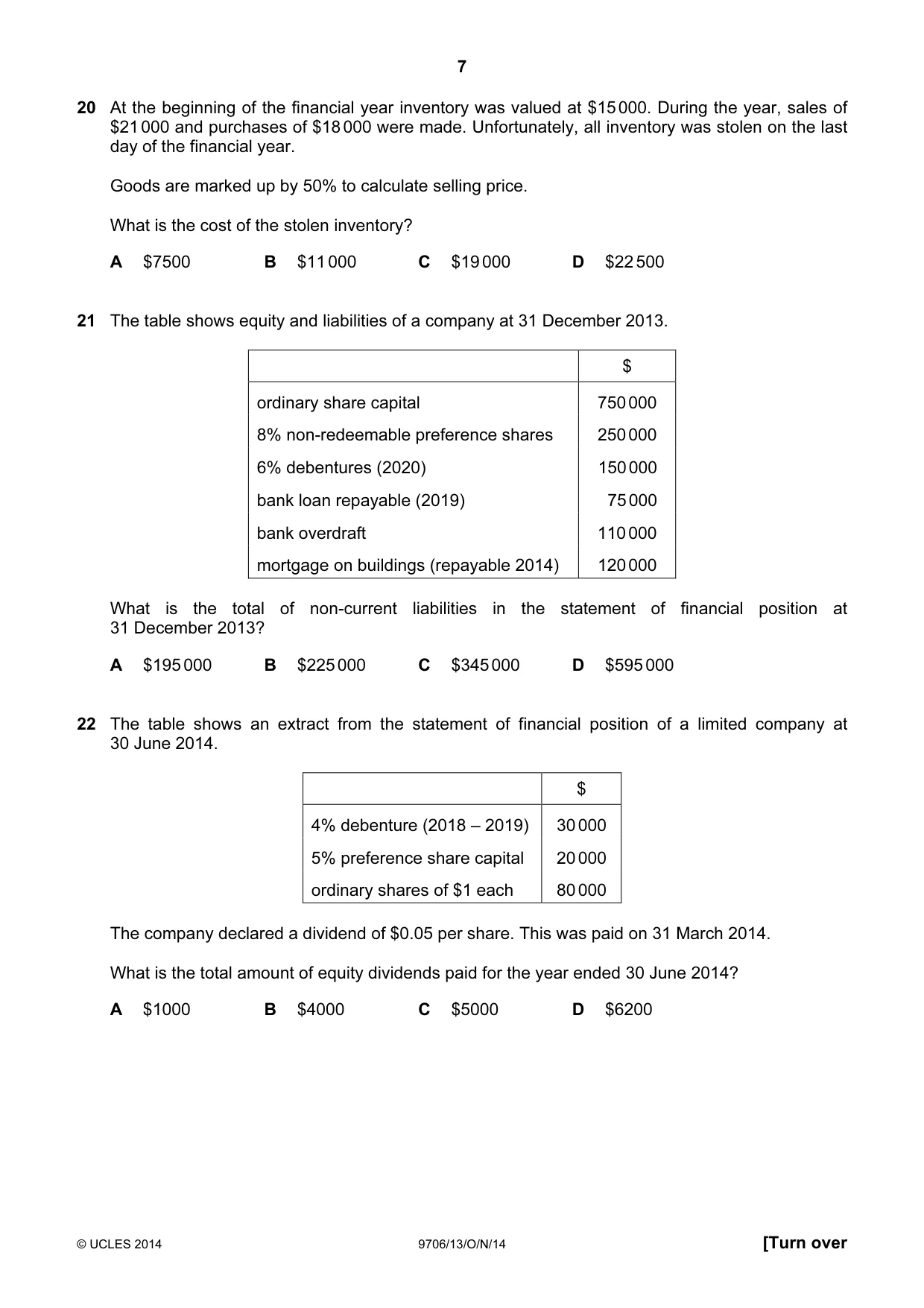
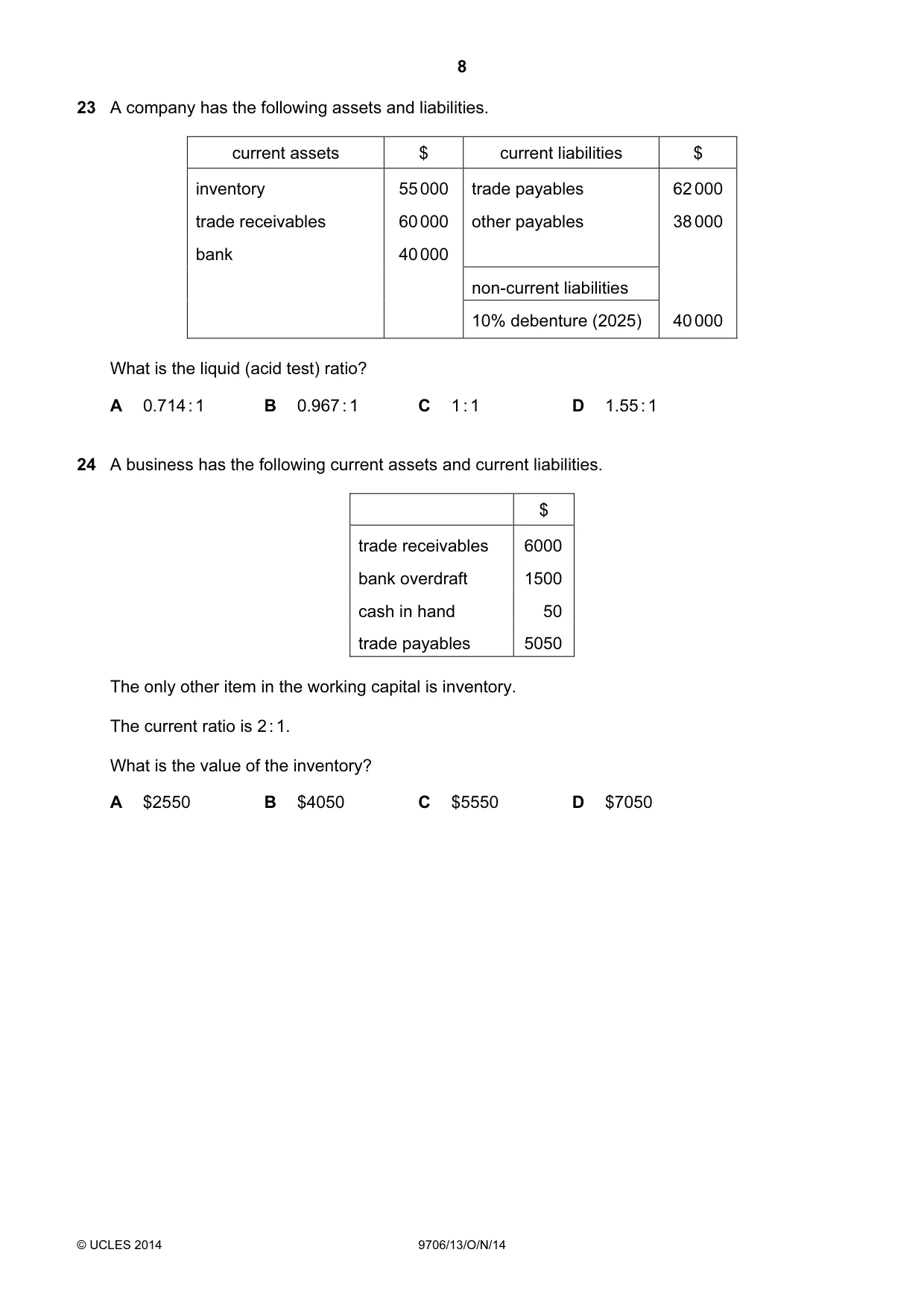
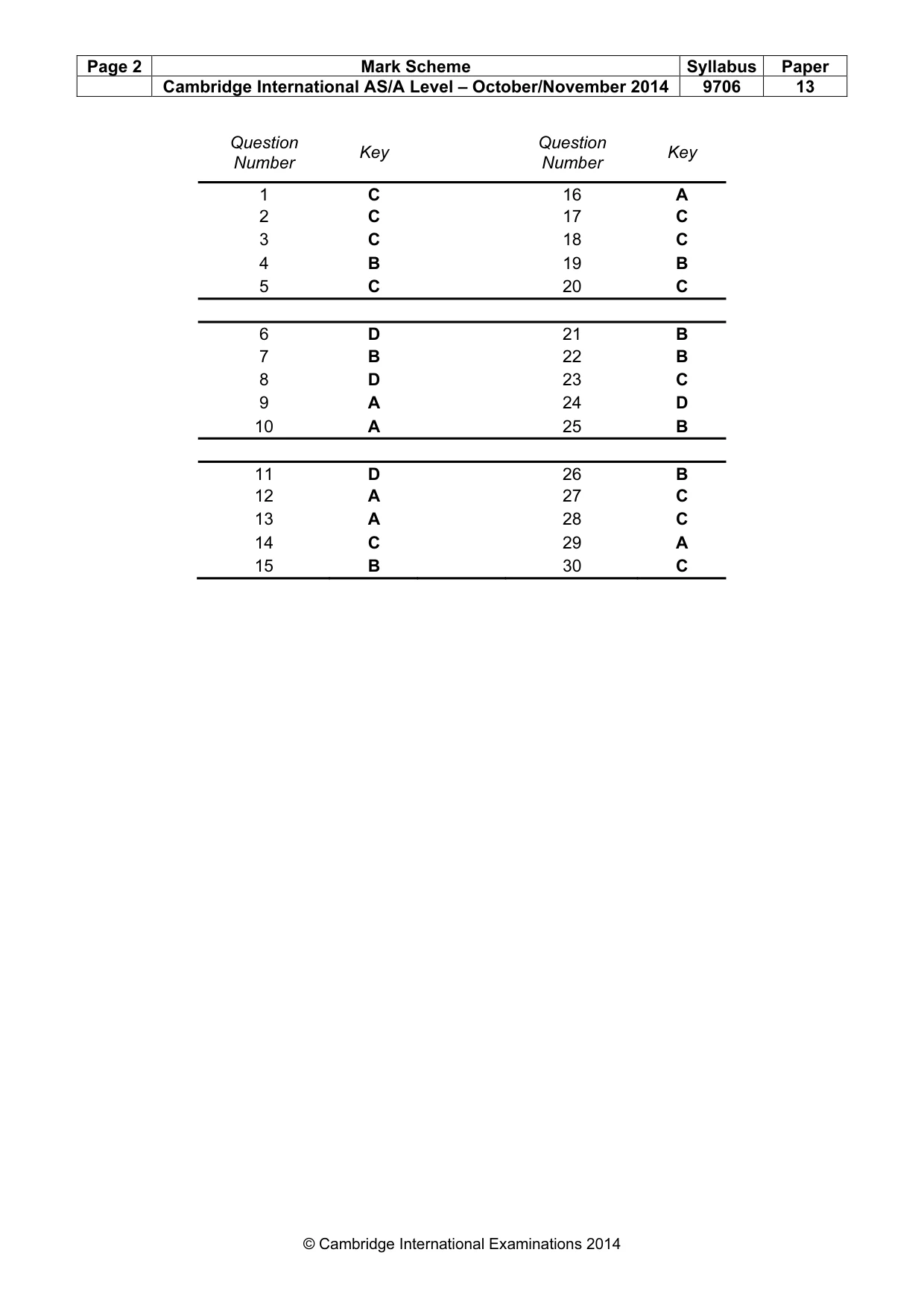
Mark scheme2 pages
Answers below. Sit the paper first if you are practising.
Questions as text
Q1 · A business provides the following information
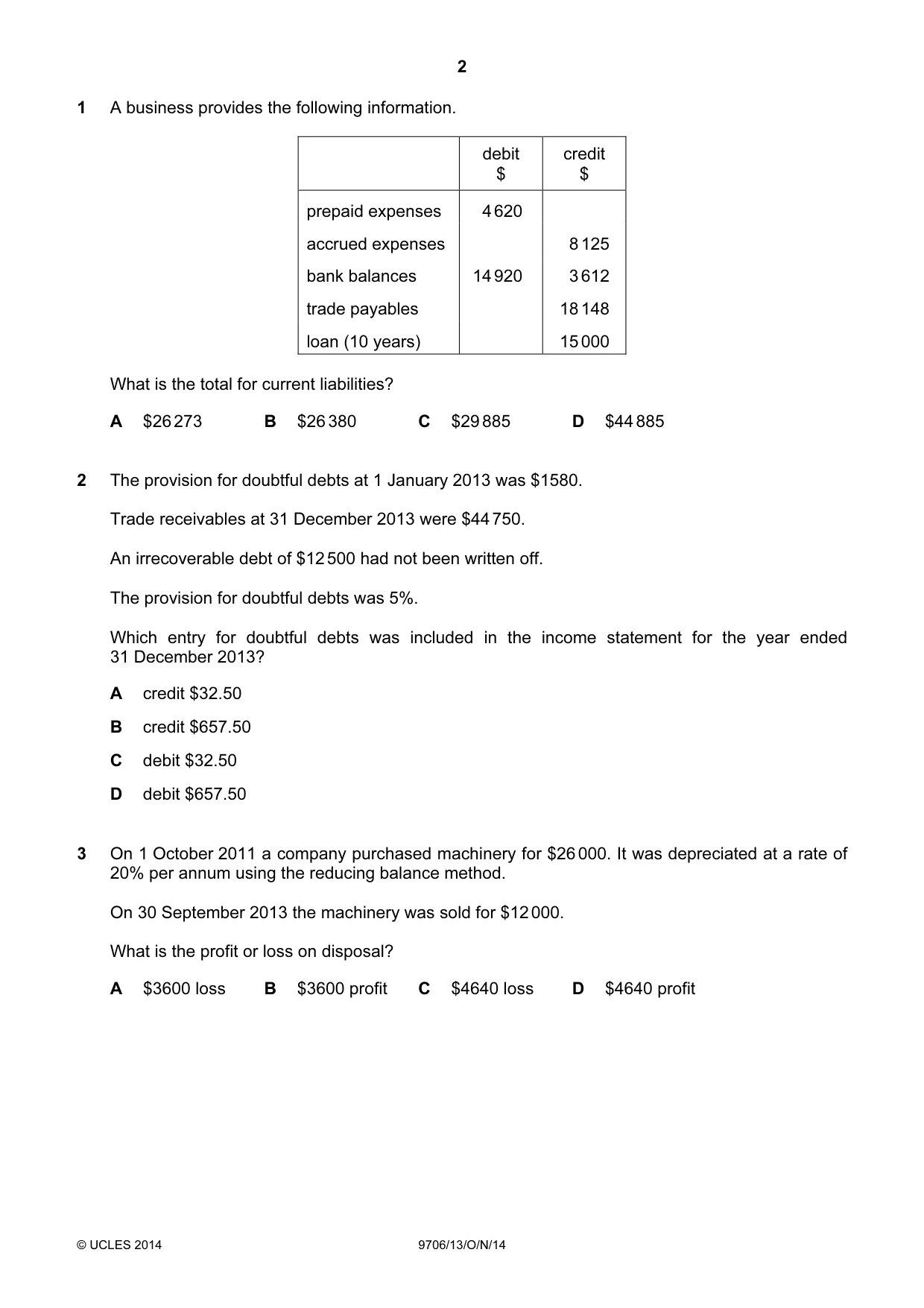
1 A business provides the following information. debit credit $ $ prepaid expenses 4 620 accrued expenses 8 125 bank balances 14 920 3 612 trade payables 18 148 loan (10 years) 15 000 What is the total for current liabilities? A $26 273 B $26 380 C $29 885 D $44 885
Mark scheme: C
Q2 · The provision for doubtful debts at 1 January 2013 was $1580
2 The provision for doubtful debts at 1 January 2013 was $1580. Trade receivables at 31 December 2013 were $44 750. An irrecoverable debt of $12 500 had not been written off. The provision for doubtful debts was 5%. Which entry for doubtful debts was included in the income statement for the year ended 31 December 2013? A credit $32.50 B credit $657.50 C debit $32.50 D debit $657.50
Mark scheme: C
Q3 · On 1 October 2011 a company purchased machinery for $26 000
3 On 1 October 2011 a company purchased machinery for $26 000. It was depreciated at a rate of 20% per annum using the reducing balance method. On 30 September 2013 the machinery was sold for $12 000. What is the profit or loss on disposal? A $3600 loss B $3600 profit C $4640 loss D $4640 profit
Mark scheme: C
Q4 · On 1 January a business has prepaid $800 for four months’ motor insurance
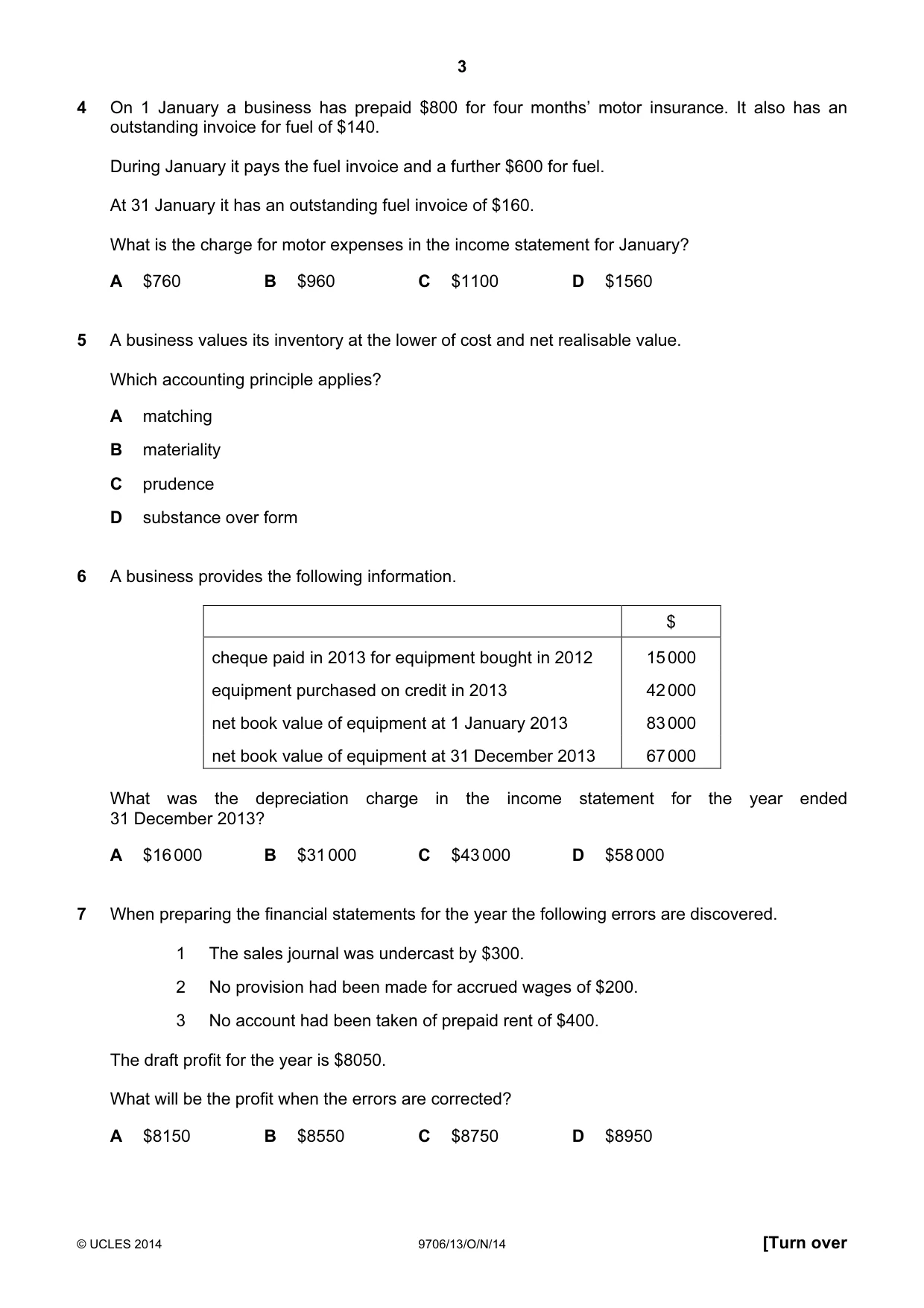
4 On 1 January a business has prepaid $800 for four months’ motor insurance. It also has an outstanding invoice for fuel of $140. During January it pays the fuel invoice and a further $600 for fuel. At 31 January it has an outstanding fuel invoice of $160. What is the charge for motor expenses in the income statement for January? A $760 B $960 C $1100 D $1560
Mark scheme: B
Q5 · A business values its inventory at the lower of cost and net realisable value
5 A business values its inventory at the lower of cost and net realisable value. Which accounting principle applies? A matching B materiality C prudence D substance over form
Mark scheme: C
Q6 · A business provides the following information
6 A business provides the following information. $ cheque paid in 2013 for equipment bought in 2012 15 000 equipment purchased on credit in 2013 42 000 net book value of equipment at 1 January 2013 83 000 net book value of equipment at 31 December 2013 67 000 What was the depreciation charge in the income statement for the year ended 31 December 2013? A $16 000 B $31 000 C $43 000 D $58 000
Mark scheme: D
Q7 · When preparing the financial statements for the year the following errors are discovered
7 When preparing the financial statements for the year the following errors are discovered. 1 The sales journal was undercast by $300. 2 No provision had been made for accrued wages of $200. 3 No account had been taken of prepaid rent of $400. The draft profit for the year is $8050. What will be the profit when the errors are corrected? A $8150 B $8550 C $8750 D $8950
Mark scheme: B
Q8 · The correction of which error would require a suspense account?
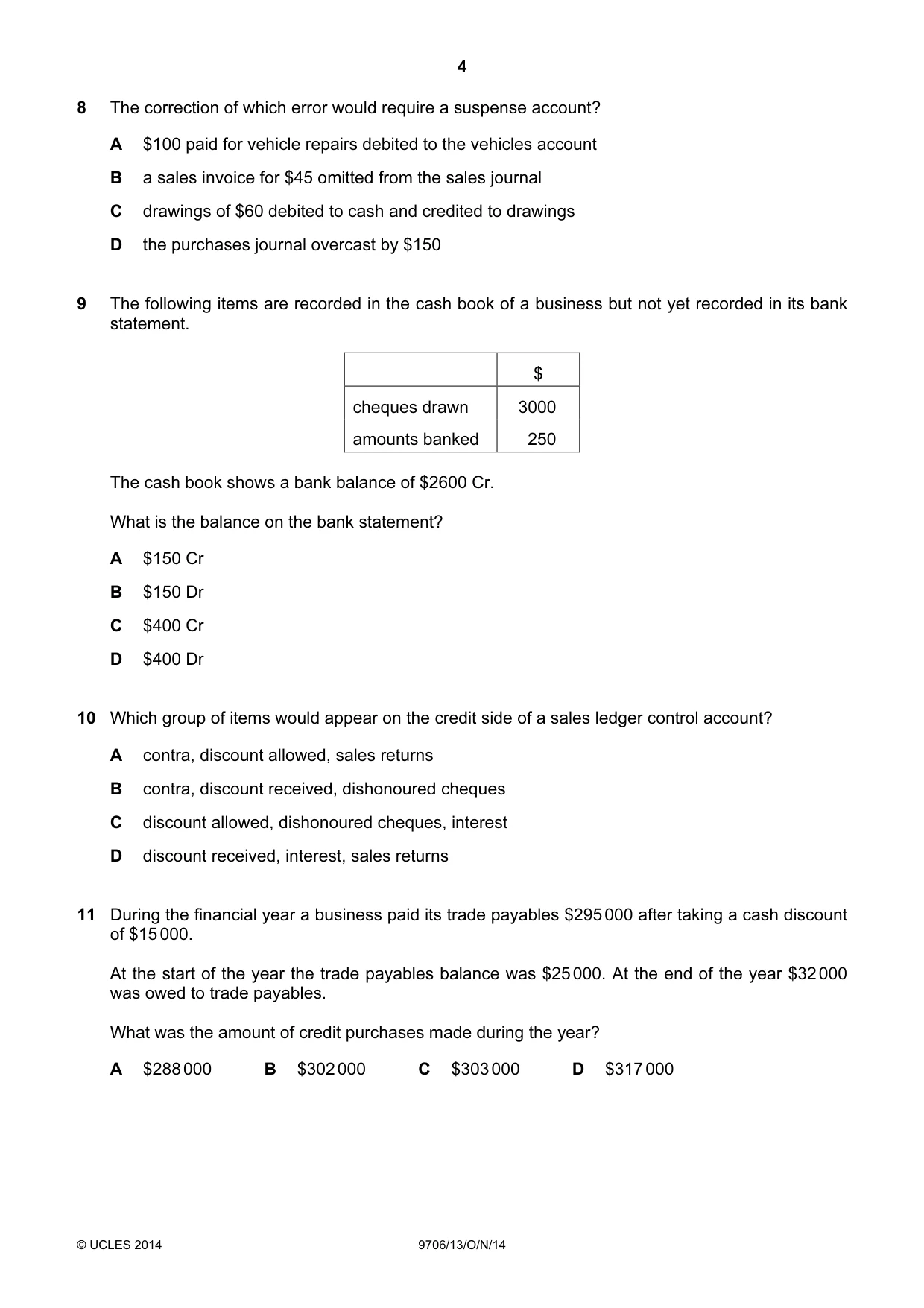
8 The correction of which error would require a suspense account? A $100 paid for vehicle repairs debited to the vehicles account B a sales invoice for $45 omitted from the sales journal C drawings of $60 debited to cash and credited to drawings D the purchases journal overcast by $150
Mark scheme: D
Q9 · The following items are recorded in the cash book of a business but not yet recorded in…
9 The following items are recorded in the cash book of a business but not yet recorded in its bank statement. $ cheques drawn 3000 amounts banked 250 The cash book shows a bank balance of $2600 Cr. What is the balance on the bank statement? A $150 Cr B $150 Dr C $400 Cr D $400 Dr
Mark scheme: A
Q10 · Which group of items would appear on the credit side of a sales ledger control account?
10 Which group of items would appear on the credit side of a sales ledger control account? A contra, discount allowed, sales returns B contra, discount received, dishonoured cheques C discount allowed, dishonoured cheques, interest D discount received, interest, sales returns
Mark scheme: A
Q11 · During the financial year a business paid its trade payables $295 000 after taking a cash…
11 During the financial year a business paid its trade payables $295 000 after taking a cash discount of $15 000. At the start of the year the trade payables balance was $25 000. At the end of the year $32 000 was owed to trade payables. What was the amount of credit purchases made during the year? A $288 000 B $302 000 C $303 000 D $317 000
Mark scheme: D
Q12 · Which rule does not apply in the absence of a partnership agreement?
12 Which rule does not apply in the absence of a partnership agreement? A interest on loans is charged at 6% per annum B no interest on capital is charged C no salaries are paid to partners D profits and losses are shared equally between the partners
Mark scheme: A
Q13 · How are subscriptions in arrears recorded in the statement of financial position for a…
13 How are subscriptions in arrears recorded in the statement of financial position for a club? A as a current asset B as a current liability C as a non-current asset D as a non-current liability
Mark scheme: A
Q14 · The following items appear in the subscriptions account of a club for a financial year
14 The following items appear in the subscriptions account of a club for a financial year. $ subscriptions received owed from the previous year 3 080 subscriptions paid in advance for next year 1 050 subscriptions income transferred to the income and expenditure account 50 000 subscriptions outstanding at year end 2 000 How much cash was received from members in the year? A $45 870 B $50 000 C $52 130 D $56 130
Mark scheme: C
Q15 · The equity of a limited company is as follows
15 The equity of a limited company is as follows. at 31 December 2012 at 31 December 2013 $ $ ordinary shares of $0.50 each 400 000 400 000 7% preference shares of $1 each 200 000 200 000 retained earnings 4 000 ? Profit for the year 2013 was $300 000. Dividends paid in 2013 were as follows: ordinary shares: $0.20 per share preference shares: half-year dividend What were the retained earnings at 31 December 2013? A $133 000 B $144 000 C $210 000 D $217 000
Mark scheme: B
Q16 · A sole trader recovers a debt that had previously been written off as irrecoverable
16 A sole trader recovers a debt that had previously been written off as irrecoverable. How is this accounted for in his income statement? A credit in the profit and loss account B credit in the trading account C debit in the profit and loss account D debit in the trading account
Mark scheme: A
Q17 · The following items appear in the books of a manufacturing company
17 The following items appear in the books of a manufacturing company. 1 factory wages 2 maintenance of factory machinery 3 direct materials 4 interest on debenture secured on factory machinery 5 factory cleaners’ wages Which items would be included in factory overheads? A 1 and 2 B 2 and 3 C 2 and 5 D 4 and 5
Mark scheme: C
Q18 · A business values its inventory using the FIFO method
18 A business values its inventory using the FIFO method. The following transactions took place. month units $ April opening inventory 700 at 190 each May purchases 500 at 220 each June sales 400 at 400 each What is the value of the closing inventory at the end of June? A $152 000 B $162 000 C $167 000 D $176 000
Mark scheme: C
Q19 · X is admitted to a partnership sharing 20% of its profits and losses
19 X is admitted to a partnership sharing 20% of its profits and losses. The goodwill of the firm is valued at $30 000. X is to pay $25 000 into the partnership. What will be the balance on X’s capital account after adjusting for goodwill? A $5000 Cr B $19 000 Cr C $25 000 Cr D $31 000 Cr
Mark scheme: B
Q20 · At the beginning of the financial year inventory was valued at $15 000
20 At the beginning of the financial year inventory was valued at $15 000. During the year, sales of $21 000 and purchases of $18 000 were made. Unfortunately, all inventory was stolen on the last day of the financial year. Goods are marked up by 50% to calculate selling price. What is the cost of the stolen inventory? A $7500 B $11 000 C $19 000 D $22 500
Mark scheme: C
Q21 · The table shows equity and liabilities of a company at 31 December 2013
21 The table shows equity and liabilities of a company at 31 December 2013. $ ordinary share capital 750 000 8% non-redeemable preference shares 250 000 6% debentures (2020) 150 000 bank loan repayable (2019) 75 000 bank overdraft 110 000 mortgage on buildings (repayable 2014) 120 000 What is the total of non-current liabilities in the statement of financial position at 31 December 2013? A $195 000 B $225 000 C $345 000 D $595 000
Mark scheme: B
Q22 · The table shows an extract from the statement of financial position of a limited company…
22 The table shows an extract from the statement of financial position of a limited company at 30 June 2014. $ 4% debenture (2018 – 2019) 30 000 5% preference share capital 20 000 ordinary shares of $1 each 80 000 The company declared a dividend of $0.05 per share. This was paid on 31 March 2014. What is the total amount of equity dividends paid for the year ended 30 June 2014? A $1000 B $4000 C $5000 D $6200
Mark scheme: B
Q23 · A company has the following assets and liabilities
23 A company has the following assets and liabilities. current assets $ current liabilities $ inventory 55 000 trade payables 62 000 trade receivables 60 000 other payables 38 000 bank 40 000 non-current liabilities 10% debenture (2025) 40 000 What is the liquid (acid test) ratio? A 0.714 : 1 B 0.967 : 1 C 1 : 1 D 1.55 : 1
Mark scheme: C
More questions on Analysis and communication of accounting information
Q24 · A business has the following current assets and current liabilities
24 A business has the following current assets and current liabilities. $ trade receivables 6000 bank overdraft 1500 cash in hand 50 trade payables 5050 The only other item in the working capital is inventory. The current ratio is 2 : 1. What is the value of the inventory? A $2550 B $4050 C $5550 D $7050
Mark scheme: D
More questions on Analysis and communication of accounting information
Q25 · The following information has been extracted from the financial statements of a sole…
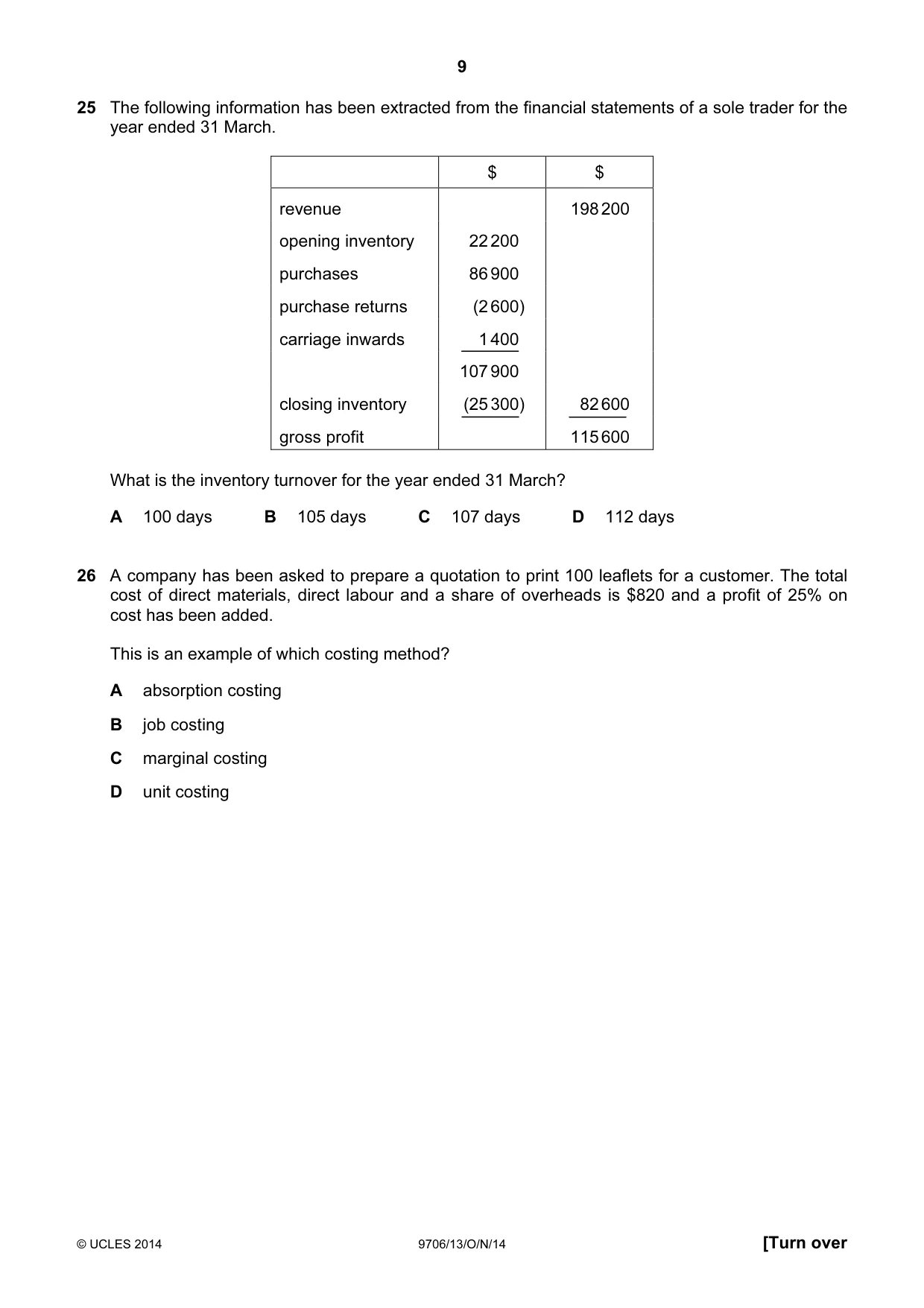
25 The following information has been extracted from the financial statements of a sole trader for the year ended 31 March. $ $ revenue 198 200 opening inventory 22 200 purchases 86 900 purchase returns (2 600) carriage inwards 1 400 107 900 closing inventory (25 300) 82 600 gross profit 115 600 What is the inventory turnover for the year ended 31 March? A 100 days B 105 days C 107 days D 112 days
Mark scheme: B
More questions on Analysis and communication of accounting information
Q26 · A company has been asked to prepare a quotation to print 100 leaflets for a customer
26 A company has been asked to prepare a quotation to print 100 leaflets for a customer. The total cost of direct materials, direct labour and a share of overheads is $820 and a profit of 25% on cost has been added. This is an example of which costing method? A absorption costing B job costing C marginal costing D unit costing
Mark scheme: B
Q27 · A company manufactures one product
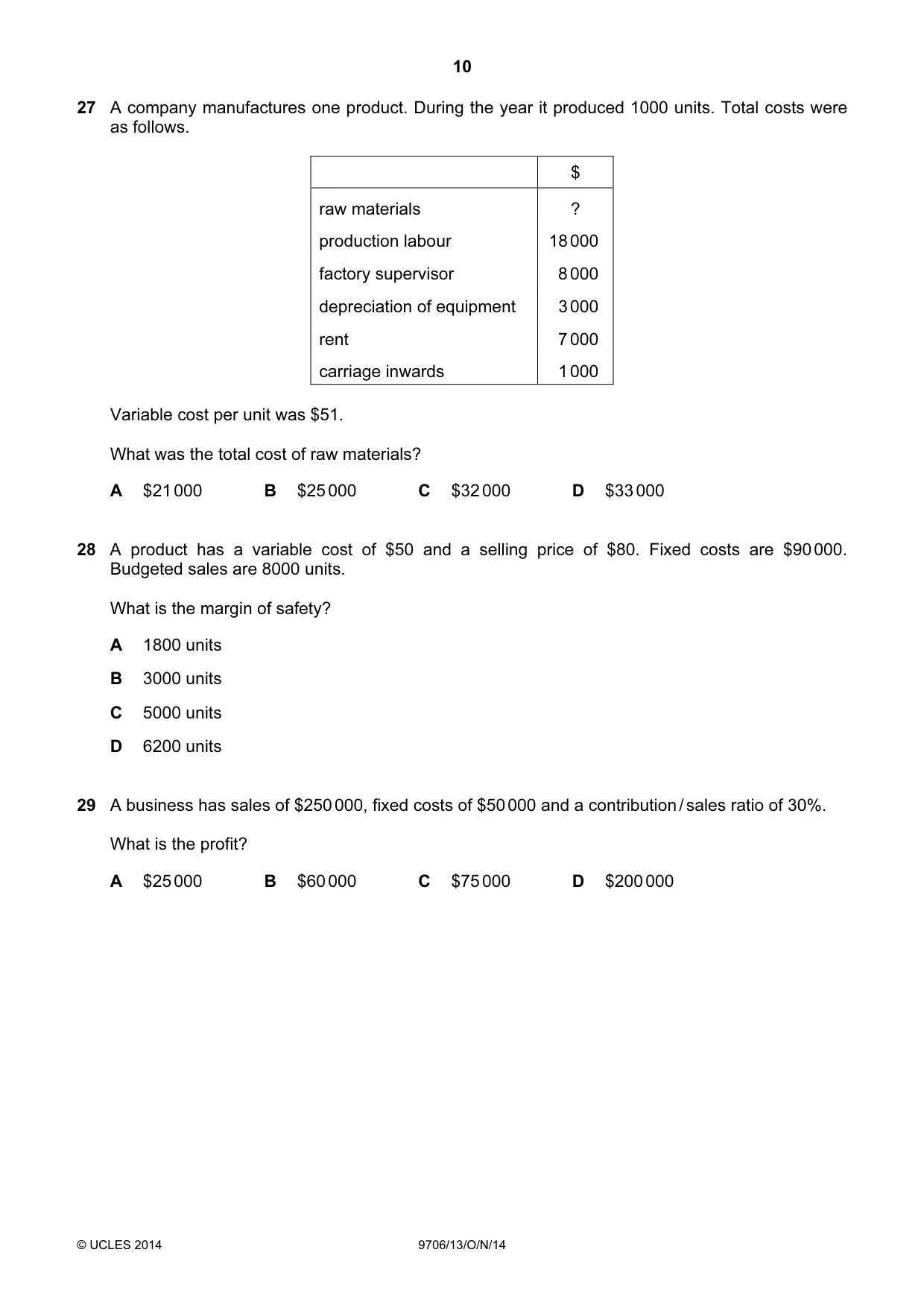
27 A company manufactures one product. During the year it produced 1000 units. Total costs were as follows. $ raw materials ? production labour 18 000 factory supervisor 8 000 depreciation of equipment 3 000 rent 7 000 carriage inwards 1 000 Variable cost per unit was $51. What was the total cost of raw materials? A $21 000 B $25 000 C $32 000 D $33 000
Mark scheme: C
Q28 · A product has a variable cost of $50 and a selling price of $80
28 A product has a variable cost of $50 and a selling price of $80. Fixed costs are $90 000. Budgeted sales are 8000 units. What is the margin of safety? A 1800 units B 3000 units C 5000 units D 6200 units
Mark scheme: C
Q29 · A business has sales of $250 000, fixed costs of $50 000 and a contribution / sales ratio…
29 A business has sales of $250 000, fixed costs of $50 000 and a contribution / sales ratio of 30%. What is the profit? A $25 000 B $60 000 C $75 000 D $200 000
Mark scheme: A
Q30 · The table shows a company’s estimated sales
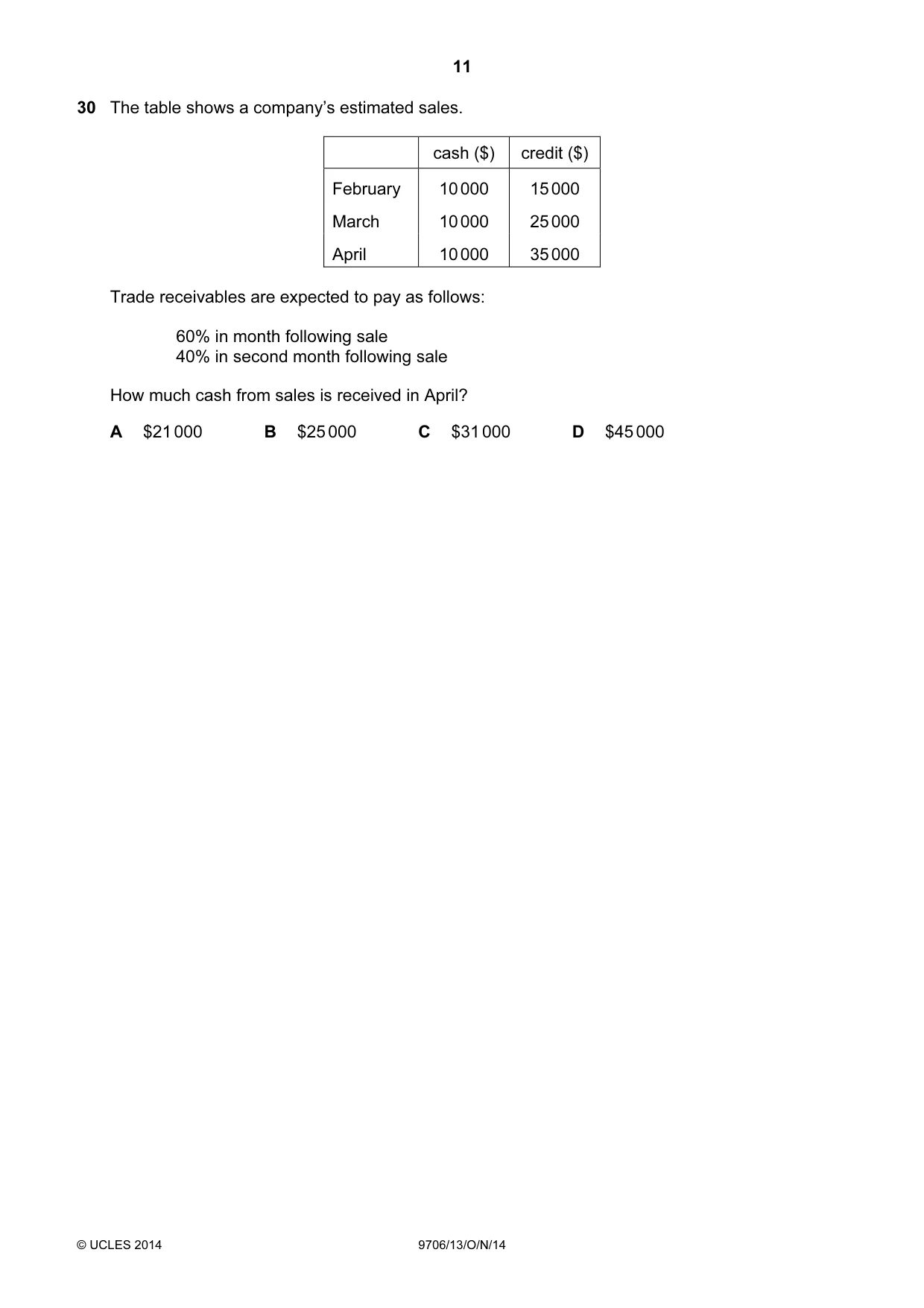
30 The table shows a company’s estimated sales. cash ($) credit ($) February 10 000 15 000 March 10 000 25 000 April 10 000 35 000 Trade receivables are expected to pay as follows: 60% in month following sale 40% in second month following sale How much cash from sales is received in April? A $21 000 B $25 000 C $31 000 D $45 000
Mark scheme: C
What was in this paper
The subtopics covered by these 30 questions, and how many questions each got. Open one in a new tab to see every Cambridge question on it.
What you needed in this session
Cambridge’s own grade thresholds for 2014 Oct/Nov, Paper 1 · Variant 3. A higher threshold means an easier paper — the bar moves with how the cohort did.