Cambridge A Level Accounting 9706 — 2014 May/June Paper 1 · Variant 1
9706/11/M/J/14 · 30 questions · 30 marks · ≈34 min
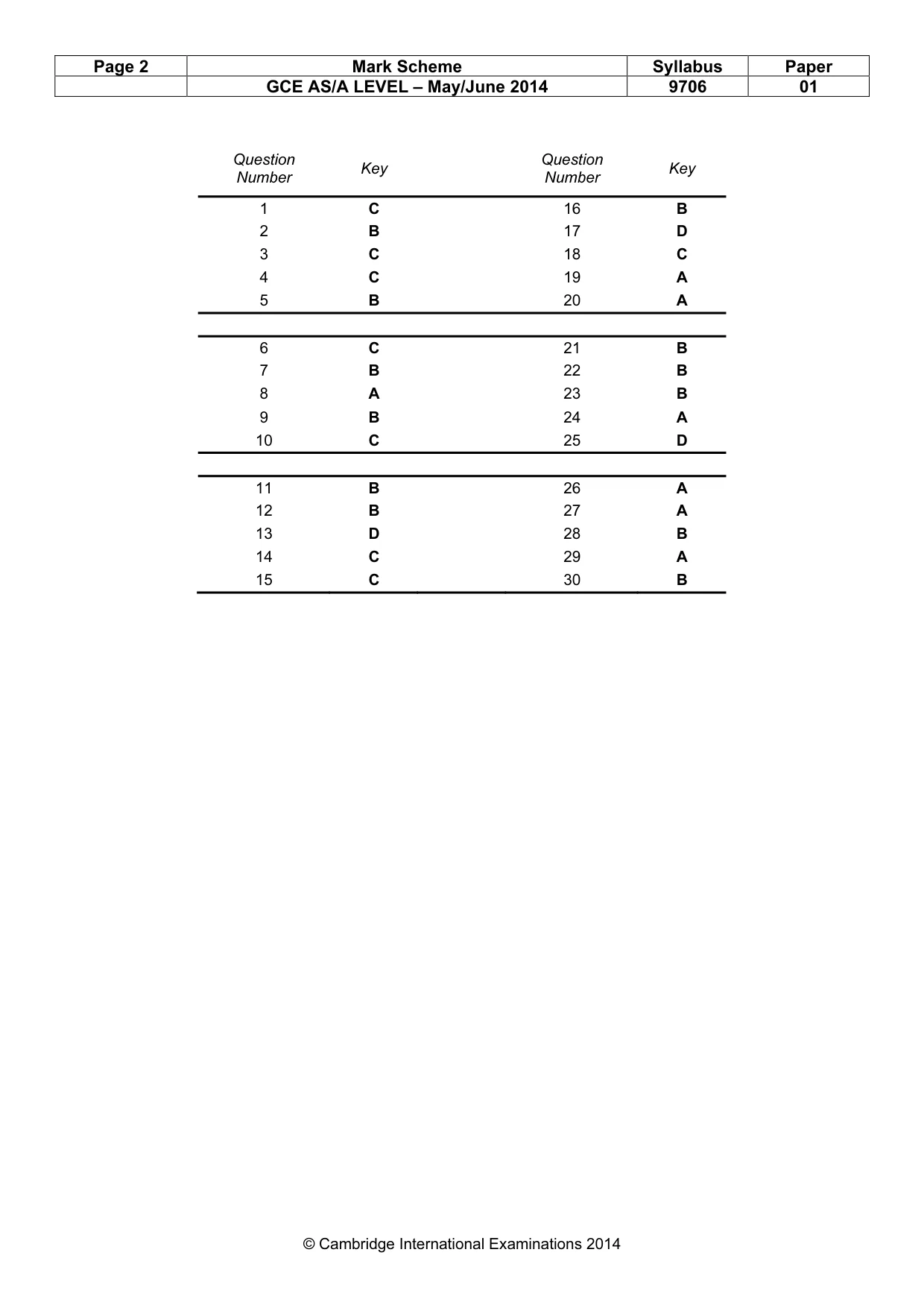
The question paper and its mark scheme, free to read here and free to download. This is Cambridge’s own paper, exactly as it was sat.
Question paper12 pages
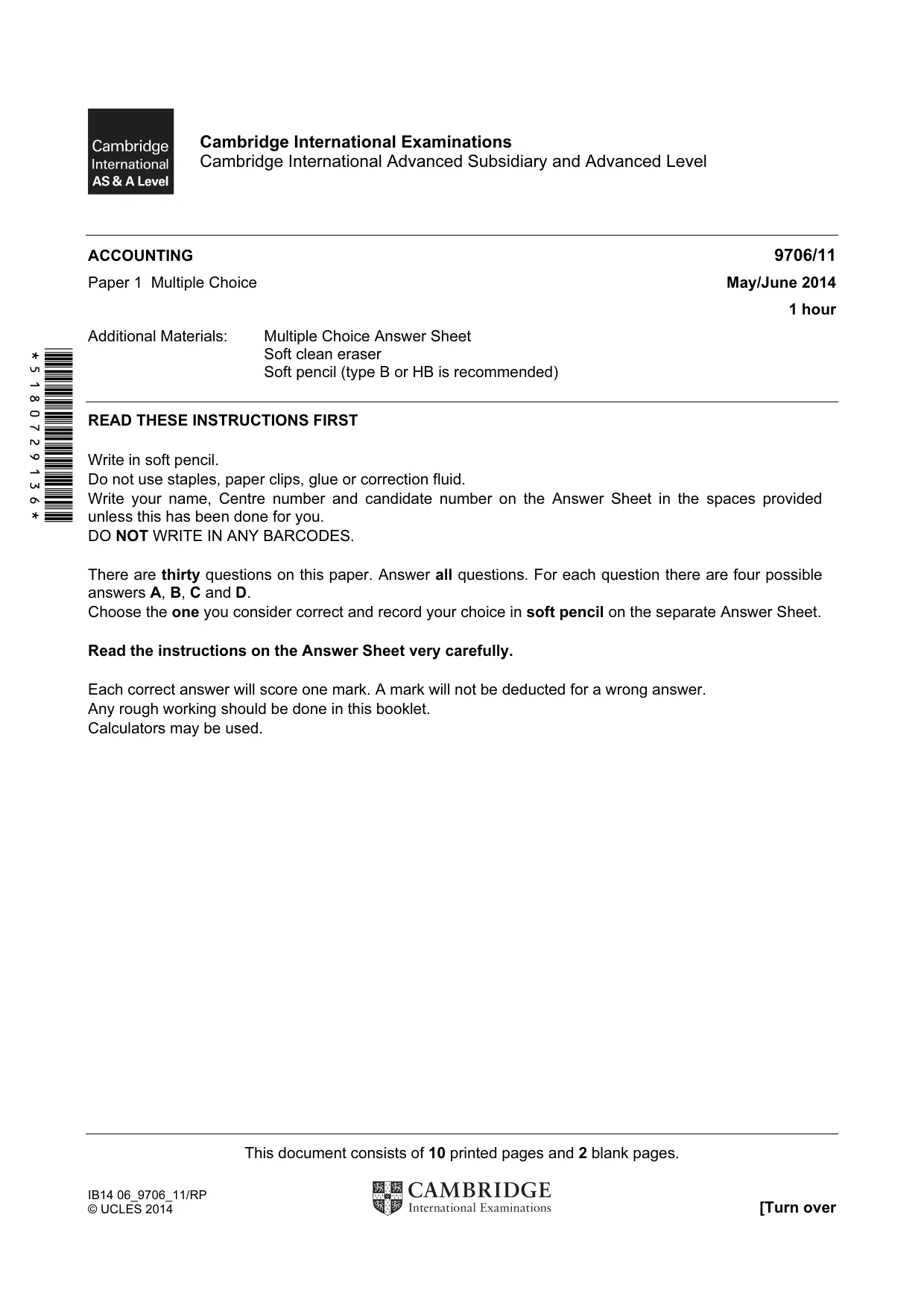

Mark scheme2 pages
Answers below. Sit the paper first if you are practising.
Questions as text
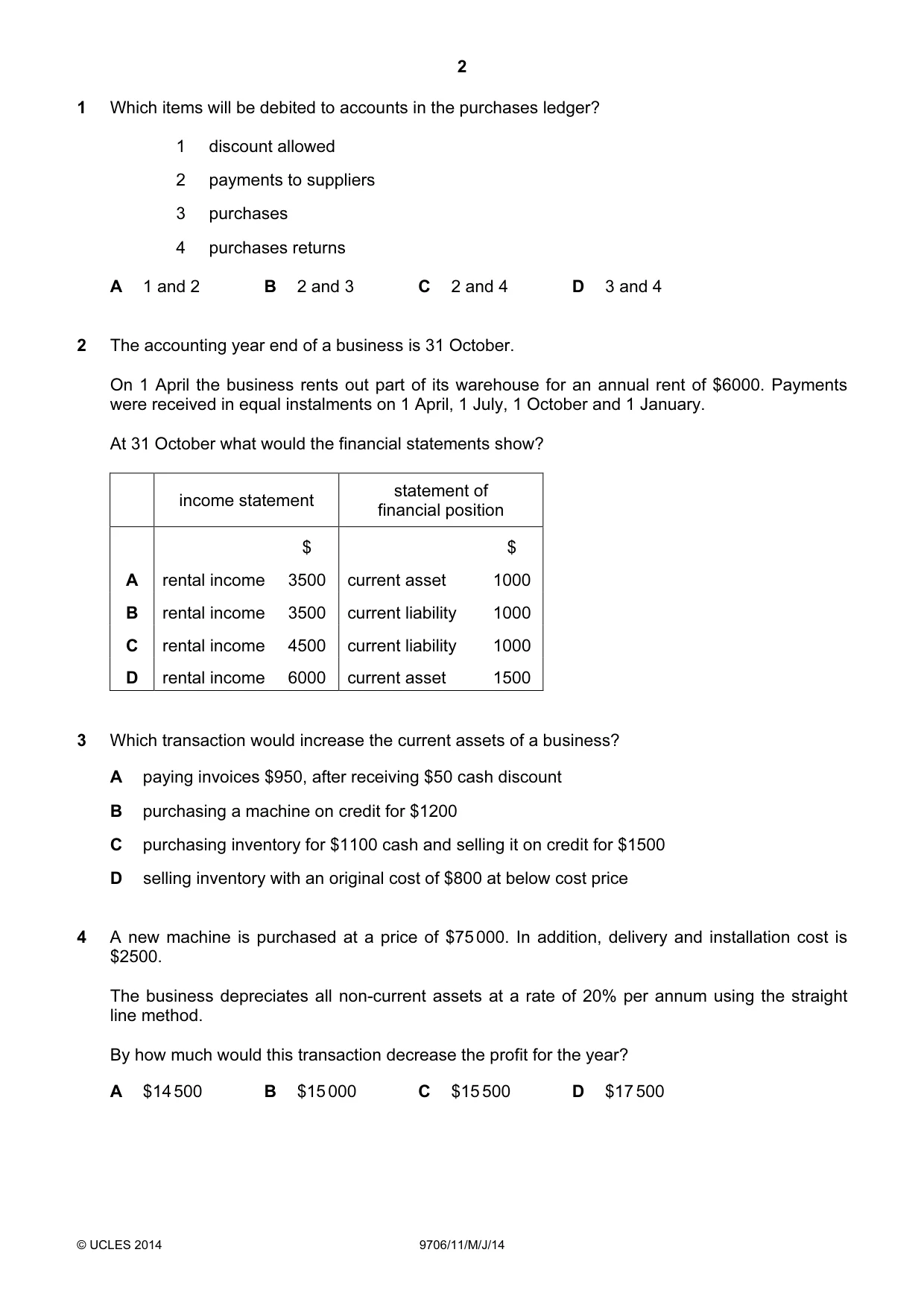
Q1 · Which items will be debited to accounts in the purchases ledger?
1 Which items will be debited to accounts in the purchases ledger? 1 discount allowed 2 payments to suppliers 3 purchases 4 purchases returns A 1 and 2 B 2 and 3 C 2 and 4 D 3 and 4
Mark scheme: C
Q2 · The accounting year end of a business is 31 October
2 The accounting year end of a business is 31 October. On 1 April the business rents out part of its warehouse for an annual rent of $6000. Payments were received in equal instalments on 1 April, 1 July, 1 October and 1 January. At 31 October what would the financial statements show? statement of income statement financial position $ $ A rental income 3500 current asset 1000 B rental income 3500 current liability 1000 C rental income 4500 current liability 1000 D rental income 6000 current asset 1500
Mark scheme: B
Q3 · Which transaction would increase the current assets of a business?
3 Which transaction would increase the current assets of a business? A paying invoices $950, after receiving $50 cash discount B purchasing a machine on credit for $1200 C purchasing inventory for $1100 cash and selling it on credit for $1500 D selling inventory with an original cost of $800 at below cost price
Mark scheme: C
Q4 · A new machine is purchased at a price of $75 000
4 A new machine is purchased at a price of $75 000. In addition, delivery and installation cost is $2500. The business depreciates all non-current assets at a rate of 20% per annum using the straight line method. By how much would this transaction decrease the profit for the year? A $14 500 B $15 000 C $15 500 D $17 500
Mark scheme: C
Q5 · Which costs may be capitalised as land and buildings?
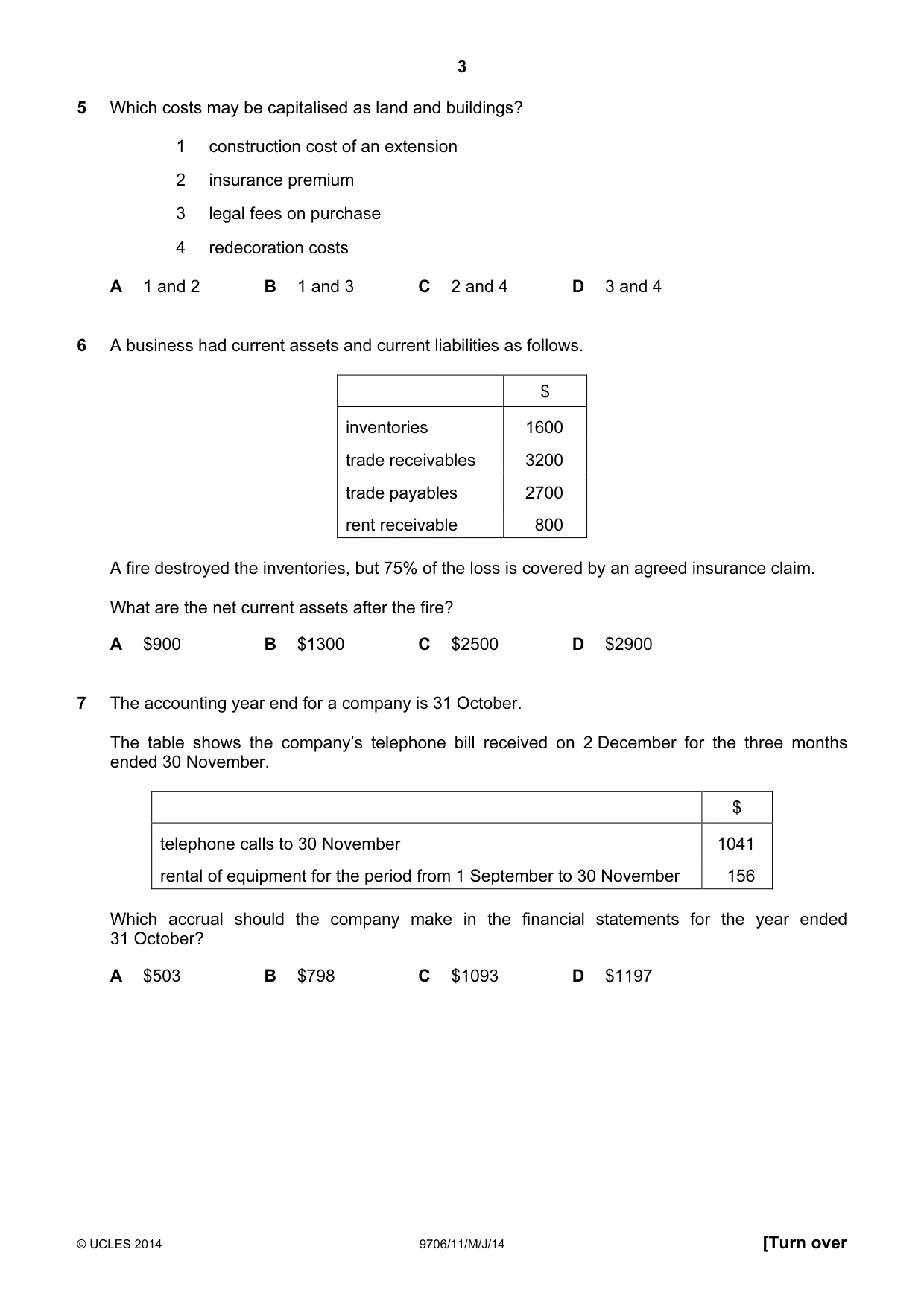
5 Which costs may be capitalised as land and buildings? 1 construction cost of an extension 2 insurance premium 3 legal fees on purchase 4 redecoration costs A 1 and 2 B 1 and 3 C 2 and 4 D 3 and 4
Mark scheme: B
Q6 · A business had current assets and current liabilities as follows
6 A business had current assets and current liabilities as follows. $ inventories 1600 trade receivables 3200 trade payables 2700 rent receivable 800 A fire destroyed the inventories, but 75% of the loss is covered by an agreed insurance claim. What are the net current assets after the fire? A $900 B $1300 C $2500 D $2900
Mark scheme: C
Q7 · The accounting year end for a company is 31 October
7 The accounting year end for a company is 31 October. The table shows the company’s telephone bill received on 2 December for the three months ended 30 November. $ telephone calls to 30 November 1041 rental of equipment for the period from 1 September to 30 November 156 Which accrual should the company make in the financial statements for the year ended 31 October? A $503 B $798 C $1093 D $1197
Mark scheme: B
Q8 · A company’s purchases ledger control account showed an opening balance of $24 640 credit
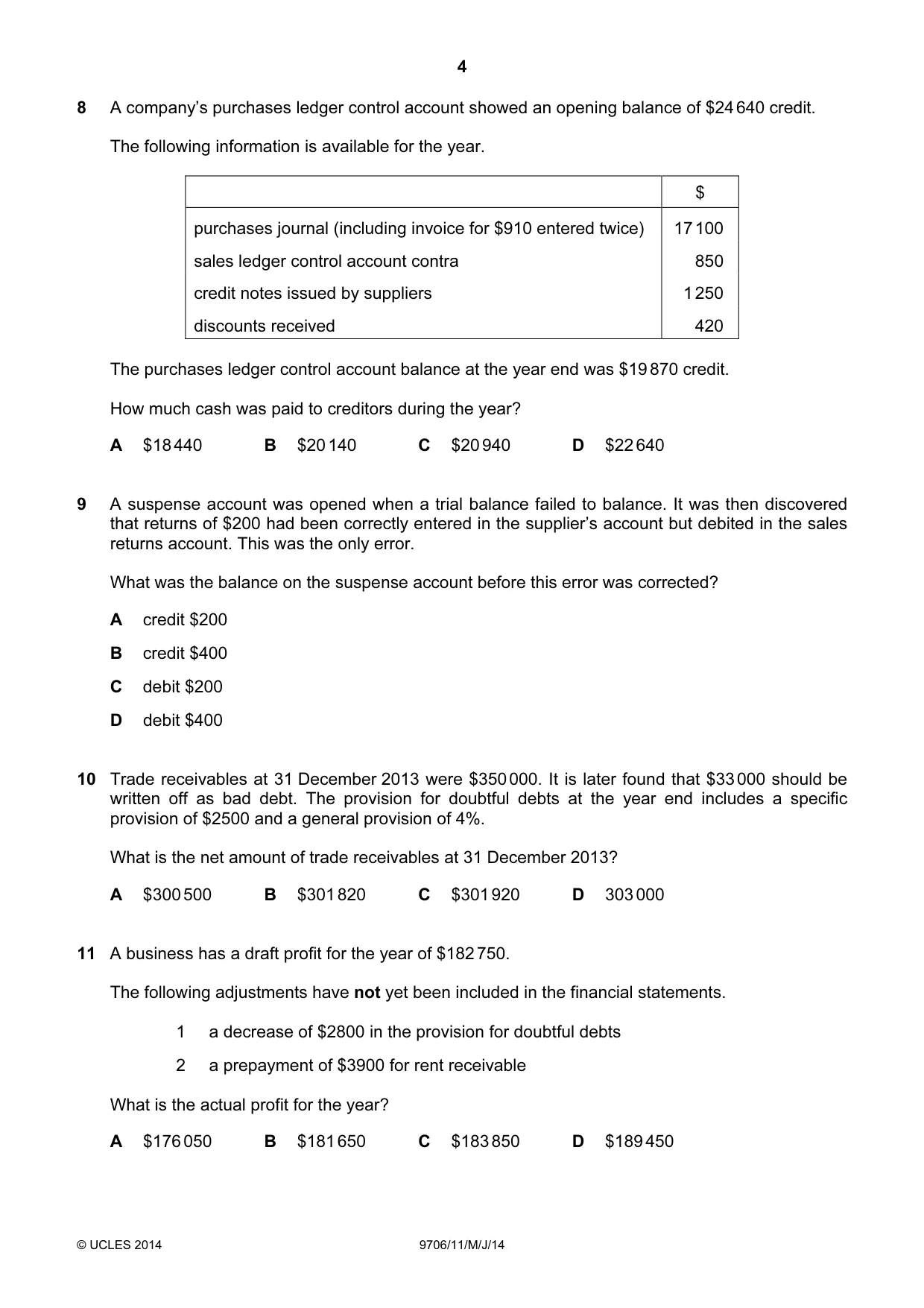
8 A company’s purchases ledger control account showed an opening balance of $24 640 credit. The following information is available for the year. $ purchases journal (including invoice for $910 entered twice) 17 100 sales ledger control account contra 850 credit notes issued by suppliers 1 250 discounts received 420 The purchases ledger control account balance at the year end was $19 870 credit. How much cash was paid to creditors during the year? A $18 440 B $20 140 C $20 940 D $22 640
Mark scheme: A
Q9 · A suspense account was opened when a trial balance failed to balance
9 A suspense account was opened when a trial balance failed to balance. It was then discovered that returns of $200 had been correctly entered in the supplier’s account but debited in the sales returns account. This was the only error. What was the balance on the suspense account before this error was corrected? A credit $200 B credit $400 C debit $200 D debit $400
Mark scheme: B
Q10 · Trade receivables at 31 December 2013 were $350 000
10 Trade receivables at 31 December 2013 were $350 000. It is later found that $33 000 should be written off as bad debt. The provision for doubtful debts at the year end includes a specific provision of $2500 and a general provision of 4%. What is the net amount of trade receivables at 31 December 2013? A $300 500 B $301 820 C $301 920 D 303 000
Mark scheme: C
Q11 · A business has a draft profit for the year of $182 750
11 A business has a draft profit for the year of $182 750. The following adjustments have not yet been included in the financial statements. 1 a decrease of $2800 in the provision for doubtful debts 2 a prepayment of $3900 for rent receivable What is the actual profit for the year? A $176 050 B $181 650 C $183 850 D $189 450
Mark scheme: B
Q12 · June purchased a new machine
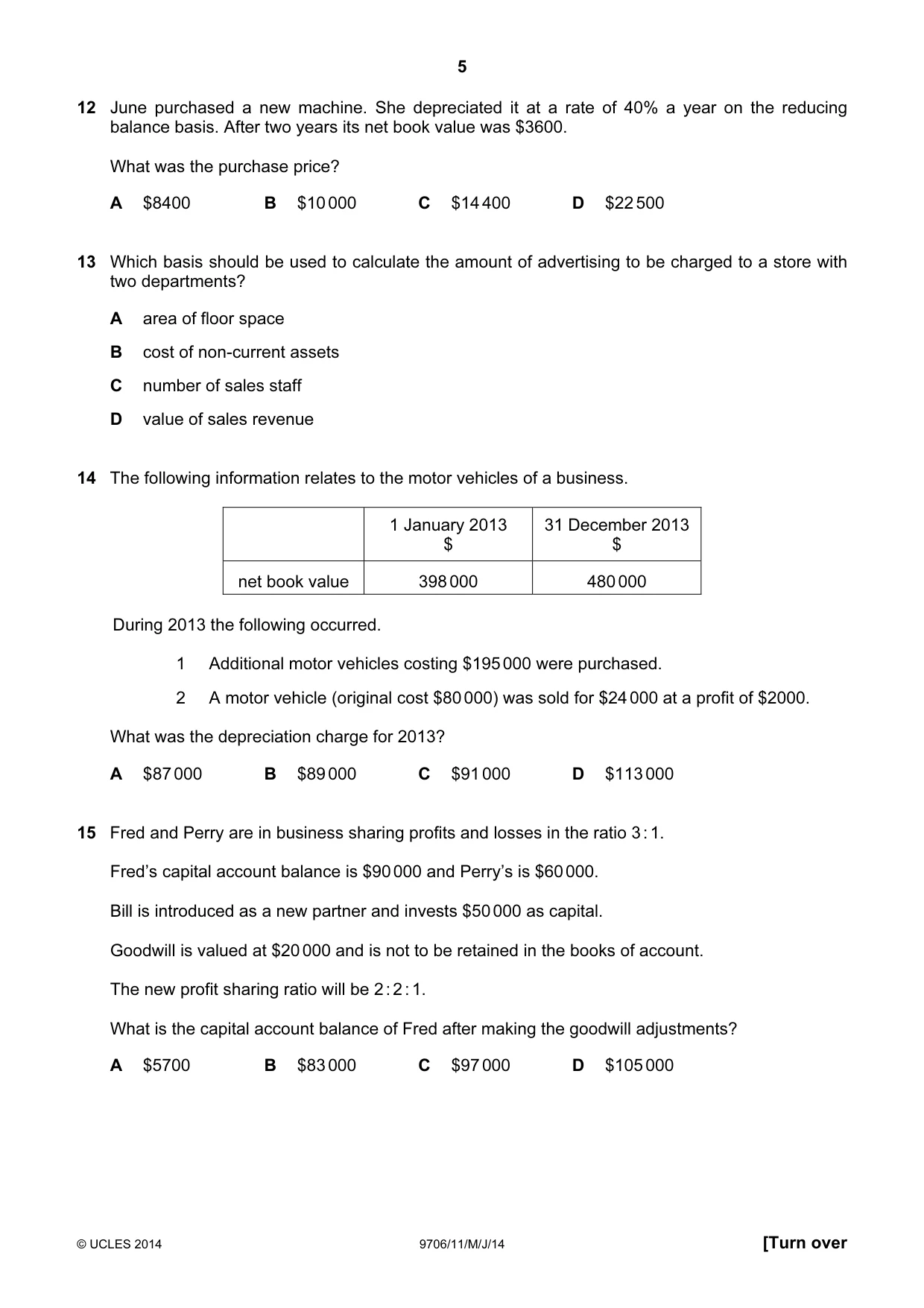
12 June purchased a new machine. She depreciated it at a rate of 40% a year on the reducing balance basis. After two years its net book value was $3600. What was the purchase price? A $8400 B $10 000 C $14 400 D $22 500
Mark scheme: B
Q13 · Which basis should be used to calculate the amount of advertising to be charged to a…
13 Which basis should be used to calculate the amount of advertising to be charged to a store with two departments? A area of floor space B cost of non-current assets C number of sales staff D value of sales revenue
Mark scheme: D
More questions on Analysis and communication of accounting information
Q14 · The following information relates to the motor vehicles of a business
14 The following information relates to the motor vehicles of a business. 1 January 2013 31 December 2013 $ $ net book value 398 000 480 000 During 2013 the following occurred. 1 Additional motor vehicles costing $195 000 were purchased. 2 A motor vehicle (original cost $80 000) was sold for $24 000 at a profit of $2000. What was the depreciation charge for 2013? A $87 000 B $89 000 C $91 000 D $113 000
Mark scheme: C
Q15 · Fred and Perry are in business sharing profits and losses in the ratio 3 : 1
15 Fred and Perry are in business sharing profits and losses in the ratio 3 : 1. Fred’s capital account balance is $90 000 and Perry’s is $60 000. Bill is introduced as a new partner and invests $50 000 as capital. Goodwill is valued at $20 000 and is not to be retained in the books of account. The new profit sharing ratio will be 2 : 2 : 1. What is the capital account balance of Fred after making the goodwill adjustments? A $5700 B $83 000 C $97 000 D $105 000
Mark scheme: C
Q16 · What is the treatment of life membership subscriptions?
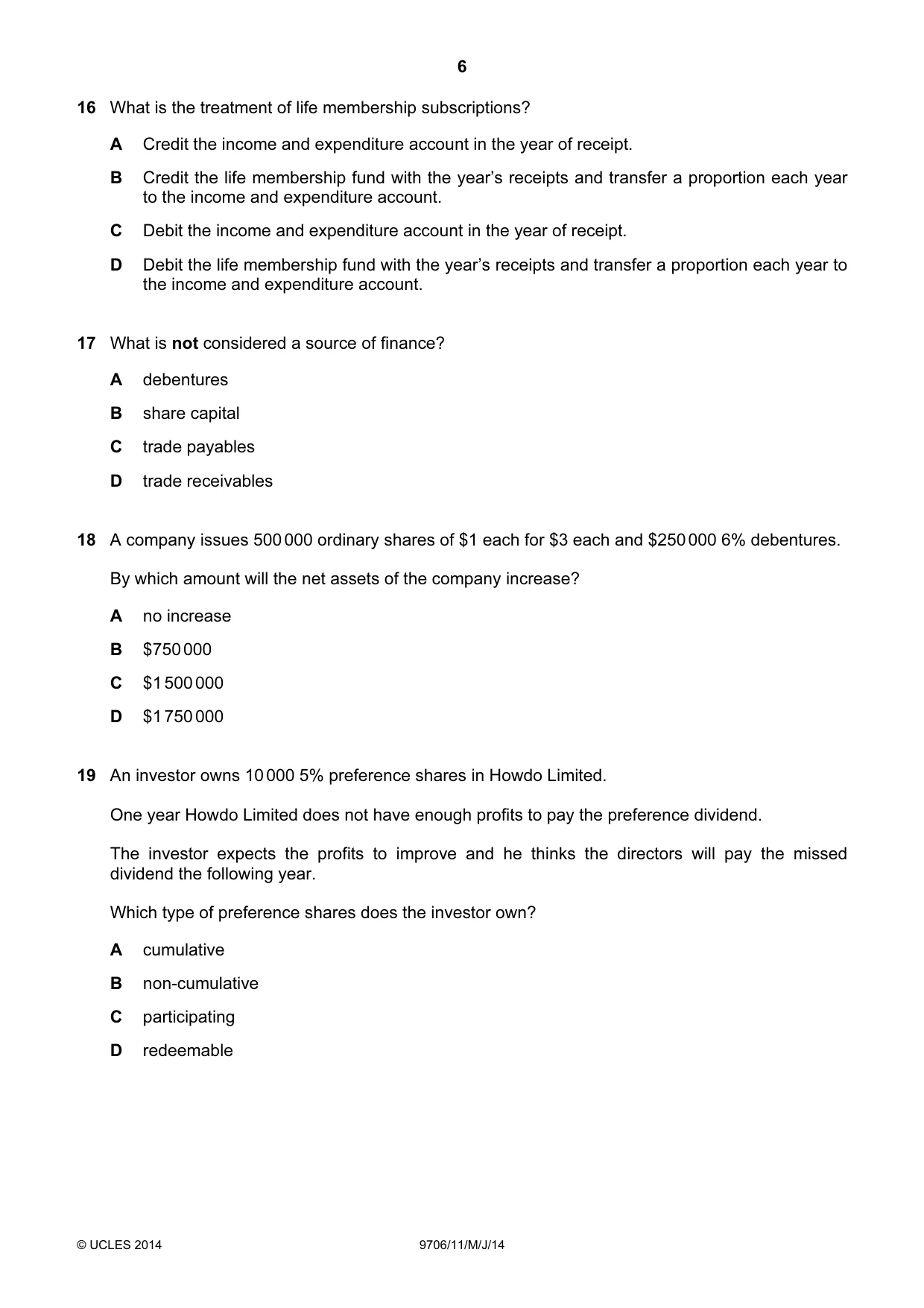
16 What is the treatment of life membership subscriptions? A Credit the income and expenditure account in the year of receipt. B Credit the life membership fund with the year’s receipts and transfer a proportion each year to the income and expenditure account. C Debit the income and expenditure account in the year of receipt. D Debit the life membership fund with the year’s receipts and transfer a proportion each year to the income and expenditure account.
Mark scheme: B
Q17 · What is not considered a source of finance?
17 What is not considered a source of finance? A debentures B share capital C trade payables D trade receivables
Mark scheme: D
More questions on Analysis and communication of accounting information
Q18 · A company issues 500 000 ordinary shares of $1 each for $3 each and $250 000 6% debentures
18 A company issues 500 000 ordinary shares of $1 each for $3 each and $250 000 6% debentures. By which amount will the net assets of the company increase? A no increase B $750 000 C $1 500 000 D $1 750 000
Mark scheme: C
Q19 · An investor owns 10 000 5% preference shares in Howdo Limited
19 An investor owns 10 000 5% preference shares in Howdo Limited. One year Howdo Limited does not have enough profits to pay the preference dividend. The investor expects the profits to improve and he thinks the directors will pay the missed dividend the following year. Which type of preference shares does the investor own? A cumulative B non-cumulative C participating D redeemable
Mark scheme: A
Q20 · The following financial information is available for a business
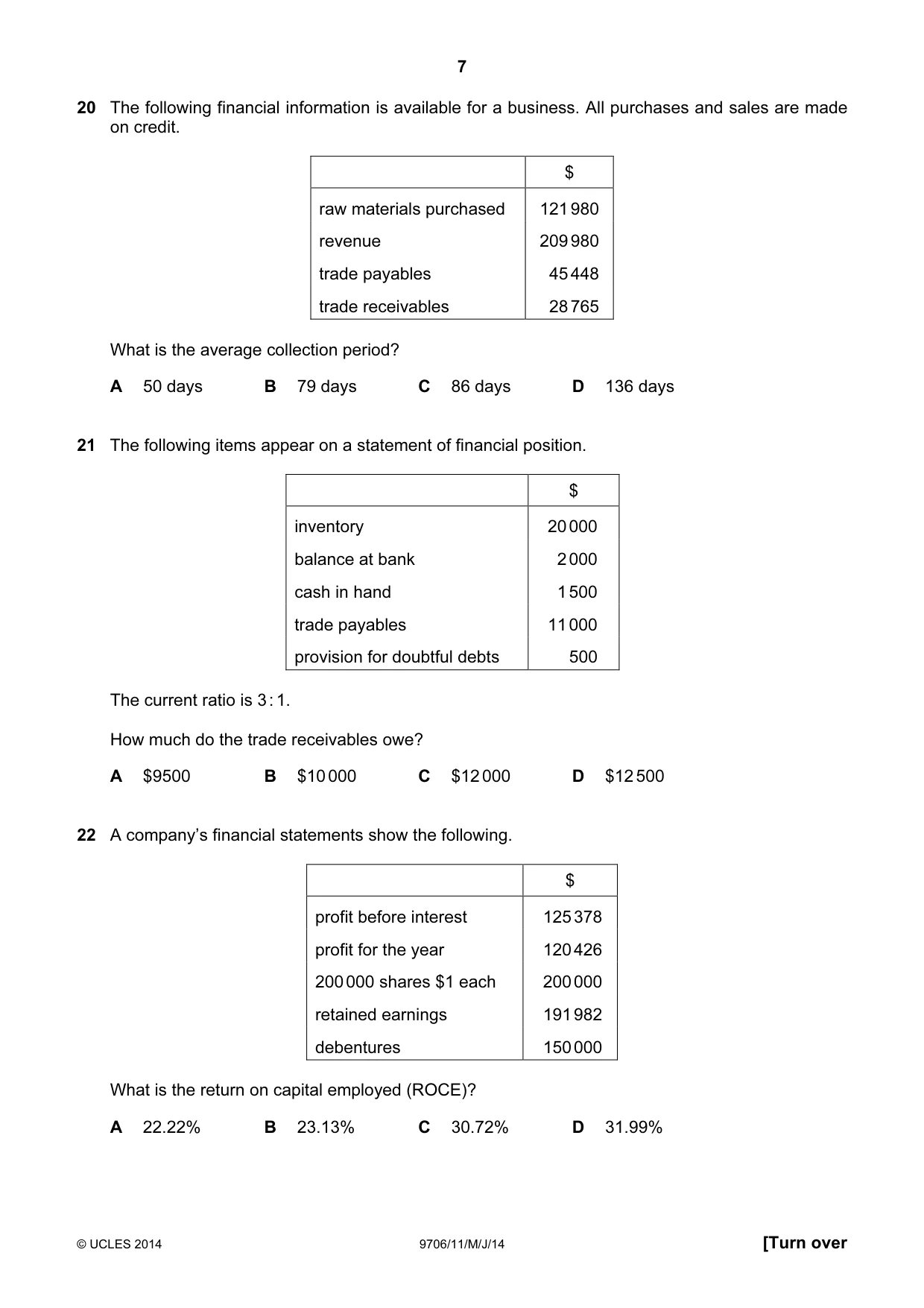
20 The following financial information is available for a business. All purchases and sales are made on credit. $ raw materials purchased 121 980 revenue 209 980 trade payables 45 448 trade receivables 28 765 What is the average collection period? A 50 days B 79 days C 86 days D 136 days
Mark scheme: A
More questions on Analysis and communication of accounting information
Q21 · The following items appear on a statement of financial position
21 The following items appear on a statement of financial position. $ inventory 20 000 balance at bank 2 000 cash in hand 1 500 trade payables 11 000 provision for doubtful debts 500 The current ratio is 3 : 1. How much do the trade receivables owe? A $9500 B $10 000 C $12 000 D $12 500
Mark scheme: B
More questions on Analysis and communication of accounting information
Q22 · A company’s financial statements show the following
22 A company’s financial statements show the following. $ profit before interest 125 378 profit for the year 120 426 200 000 shares $1 each 200 000 retained earnings 191 982 debentures 150 000 What is the return on capital employed (ROCE)? A 22.22% B 23.13% C 30.72% D 31.99%
Mark scheme: B
More questions on Analysis and communication of accounting information
Q23 · The gross profit ratio of a business has increased
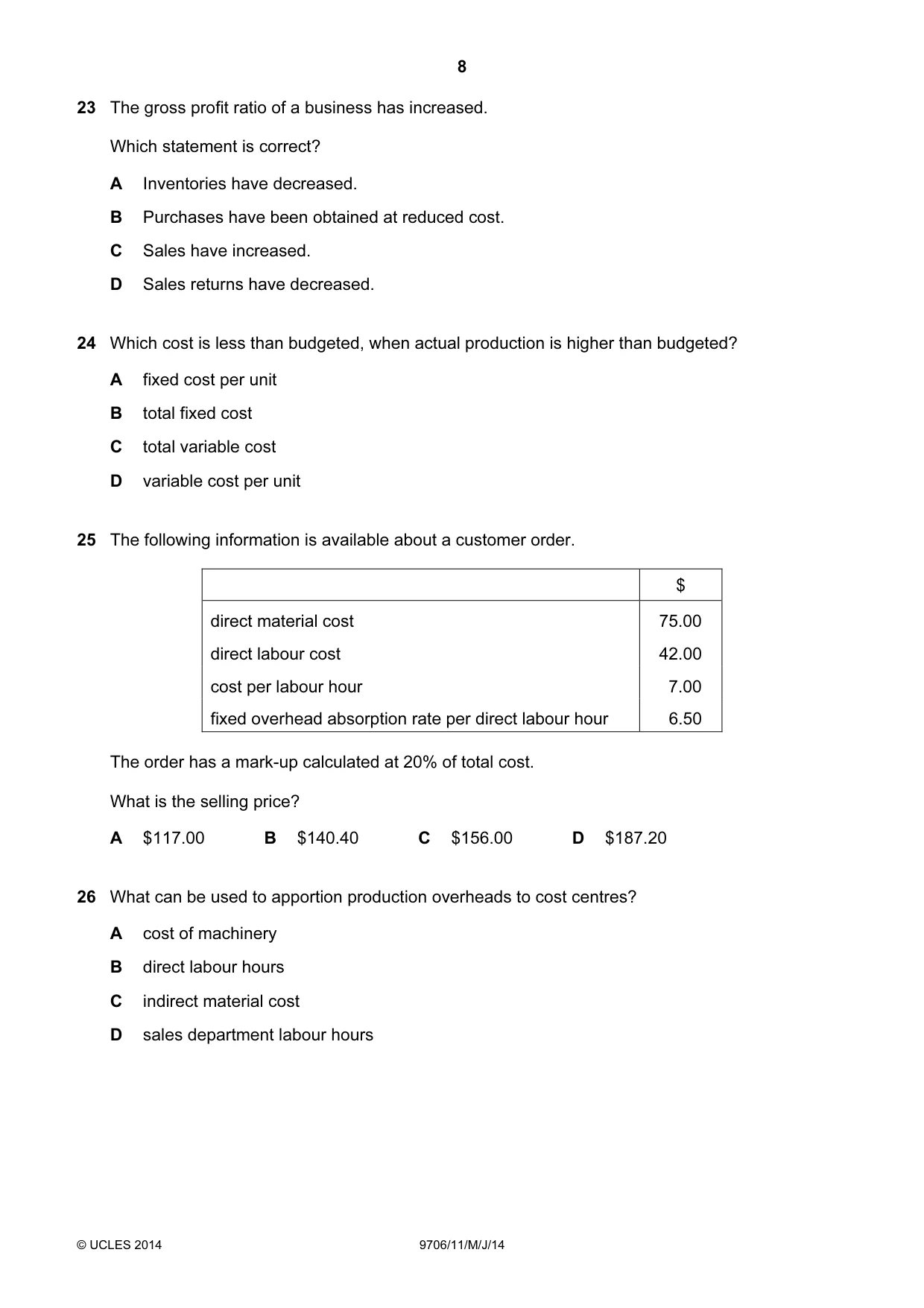
23 The gross profit ratio of a business has increased. Which statement is correct? A Inventories have decreased. B Purchases have been obtained at reduced cost. C Sales have increased. D Sales returns have decreased.
Mark scheme: B
More questions on Analysis and communication of accounting information
Q24 · Which cost is less than budgeted, when actual production is higher than budgeted?
24 Which cost is less than budgeted, when actual production is higher than budgeted? A fixed cost per unit B total fixed cost C total variable cost D variable cost per unit
Mark scheme: A
Q25 · The following information is available about a customer order
25 The following information is available about a customer order. $ direct material cost 75.00 direct labour cost 42.00 cost per labour hour 7.00 fixed overhead absorption rate per direct labour hour 6.50 The order has a mark-up calculated at 20% of total cost. What is the selling price? A $117.00 B $140.40 C $156.00 D $187.20
Mark scheme: D
Q26 · What can be used to apportion production overheads to cost centres?
26 What can be used to apportion production overheads to cost centres? A cost of machinery B direct labour hours C indirect material cost D sales department labour hours
Mark scheme: A
Q27 · The following information relates to two production departments of a manufacturing…
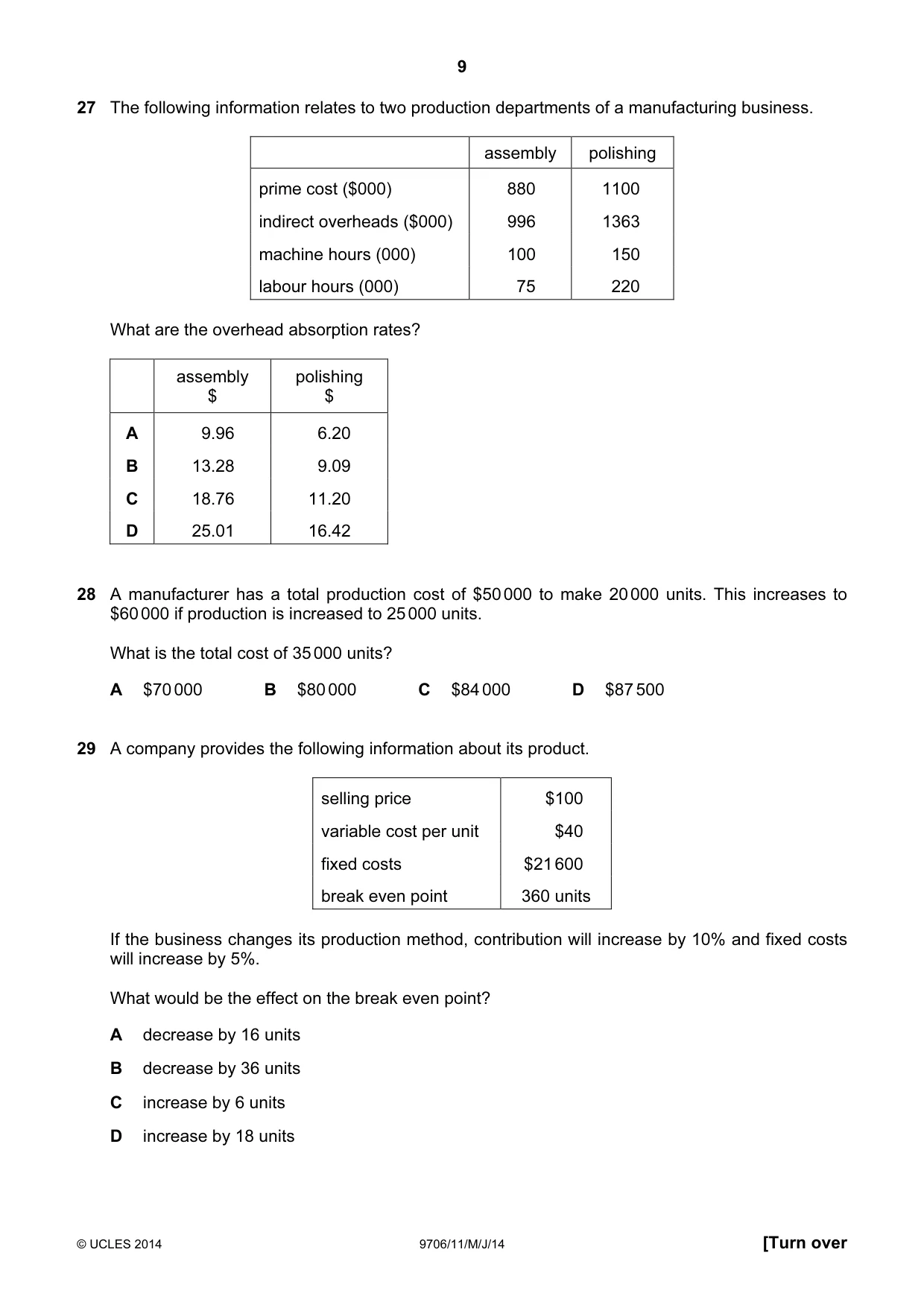
27 The following information relates to two production departments of a manufacturing business. assembly polishing prime cost ($000) 880 1100 indirect overheads ($000) 996 1363 machine hours (000) 100 150 labour hours (000) 75 220 What are the overhead absorption rates? assembly polishing $ $ A 9.96 6.20 B 13.28 9.09 C 18.76 11.20 D 25.01 16.42
Mark scheme: A
Q28 · A manufacturer has a total production cost of $50 000 to make 20 000 units
28 A manufacturer has a total production cost of $50 000 to make 20 000 units. This increases to $60 000 if production is increased to 25 000 units. What is the total cost of 35 000 units? A $70 000 B $80 000 C $84 000 D $87 500
Mark scheme: B
Q29 · A company provides the following information about its product
29 A company provides the following information about its product. selling price $100 variable cost per unit $40 fixed costs $21 600 break even point 360 units If the business changes its production method, contribution will increase by 10% and fixed costs will increase by 5%. What would be the effect on the break even point? A decrease by 16 units B decrease by 36 units C increase by 6 units D increase by 18 units
Mark scheme: A
Q30 · A business is preparing its budget for July 2014
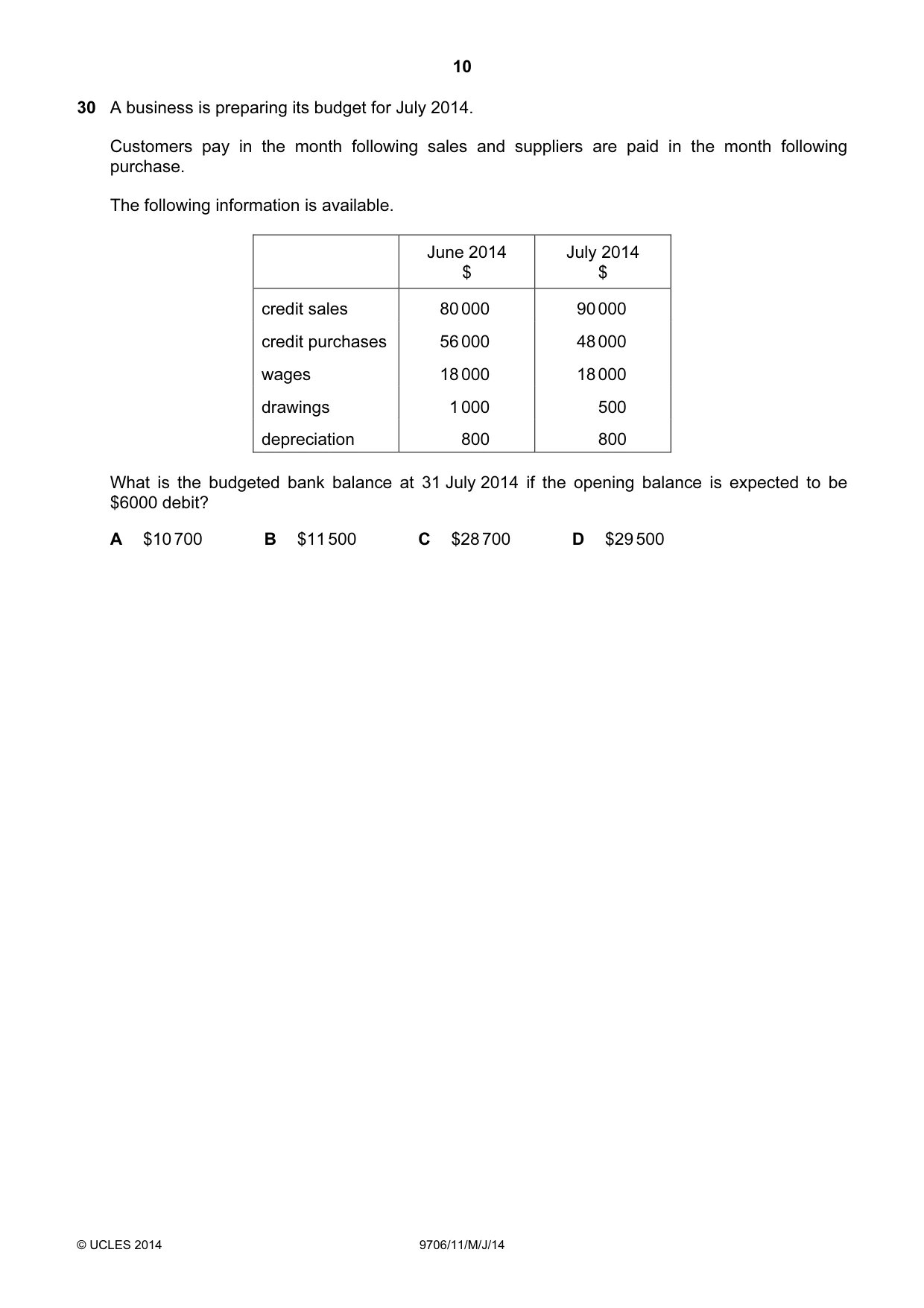
30 A business is preparing its budget for July 2014. Customers pay in the month following sales and suppliers are paid in the month following purchase. The following information is available. June 2014 July 2014 $ $ credit sales 80 000 90 000 credit purchases 56 000 48 000 wages 18 000 18 000 drawings 1 000 500 depreciation 800 800 What is the budgeted bank balance at 31 July 2014 if the opening balance is expected to be $6000 debit? A $10 700 B $11 500 C $28 700 D $29 500
Mark scheme: B
What was in this paper
The subtopics covered by these 30 questions, and how many questions each got. Open one in a new tab to see every Cambridge question on it.
What you needed in this session
Cambridge’s own grade thresholds for 2014 May/June, Paper 1 · Variant 1. A higher threshold means an easier paper — the bar moves with how the cohort did.