Cambridge A Level Accounting 9706 — 2018 Oct/Nov Paper 1 · Variant 1
9706/11/O/N/18 · 30 questions · 30 marks · ≈34 min
The question paper and its mark scheme, free to read here and free to download. This is Cambridge’s own paper, exactly as it was sat.
Question paper12 pages
Mark scheme3 pages
Answers below. Sit the paper first if you are practising.
Questions as text
Q1 · Which accounting concept is being applied when goods taken by an owner for own use are…
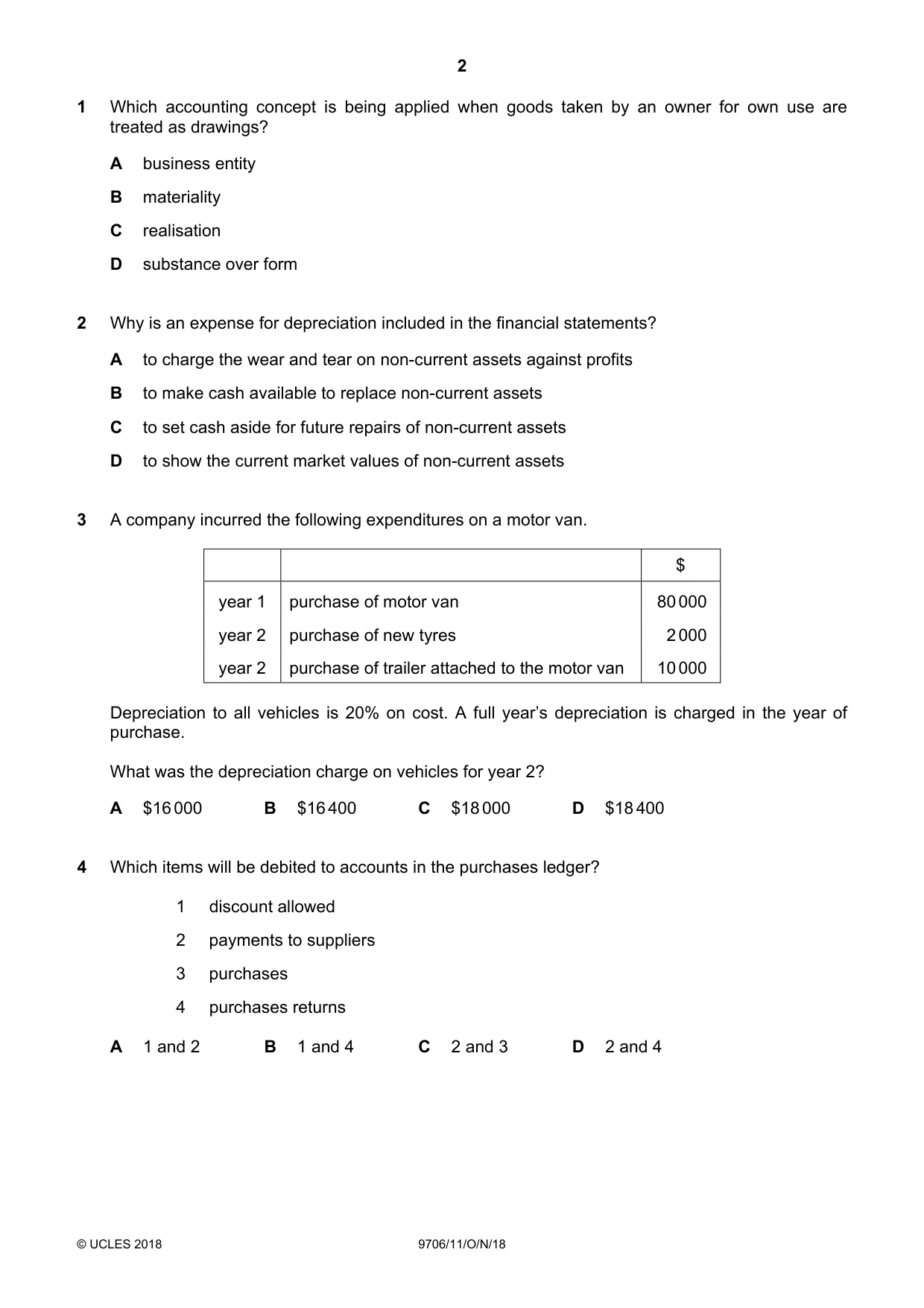
1 Which accounting concept is being applied when goods taken by an owner for own use are treated as drawings? A business entity B materiality C realisation D substance over form
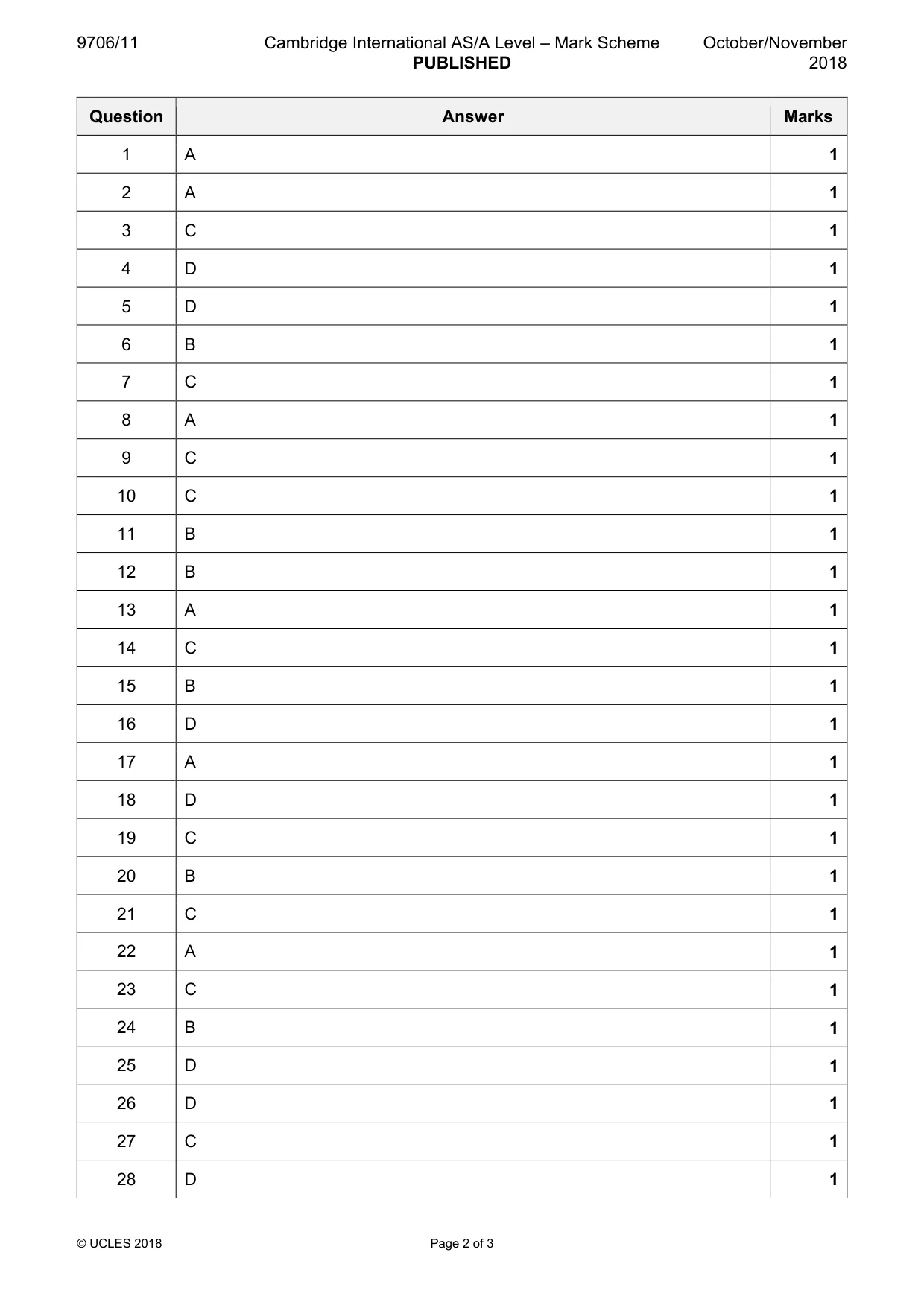
Mark scheme: A
Q2 · Why is an expense for depreciation included in the financial statements?
2 Why is an expense for depreciation included in the financial statements? A to charge the wear and tear on non-current assets against profits B to make cash available to replace non-current assets C to set cash aside for future repairs of non-current assets D to show the current market values of non-current assets
Mark scheme: A
Q3 · A company incurred the following expenditures on a motor van
3 A company incurred the following expenditures on a motor van. $ year 1 purchase of motor van 80 000 year 2 purchase of new tyres 2 000 year 2 purchase of trailer attached to the motor van 10 000 Depreciation to all vehicles is 20% on cost. A full year’s depreciation is charged in the year of purchase. What was the depreciation charge on vehicles for year 2? A $16 000 B $16 400 C $18 000 D $18 400
Mark scheme: C
Q4 · Which items will be debited to accounts in the purchases ledger?
4 Which items will be debited to accounts in the purchases ledger? 1 discount allowed 2 payments to suppliers 3 purchases 4 purchases returns A 1 and 2 B 1 and 4 C 2 and 3 D 2 and 4
Mark scheme: D
Q5 · A business keeps a separate sales ledger
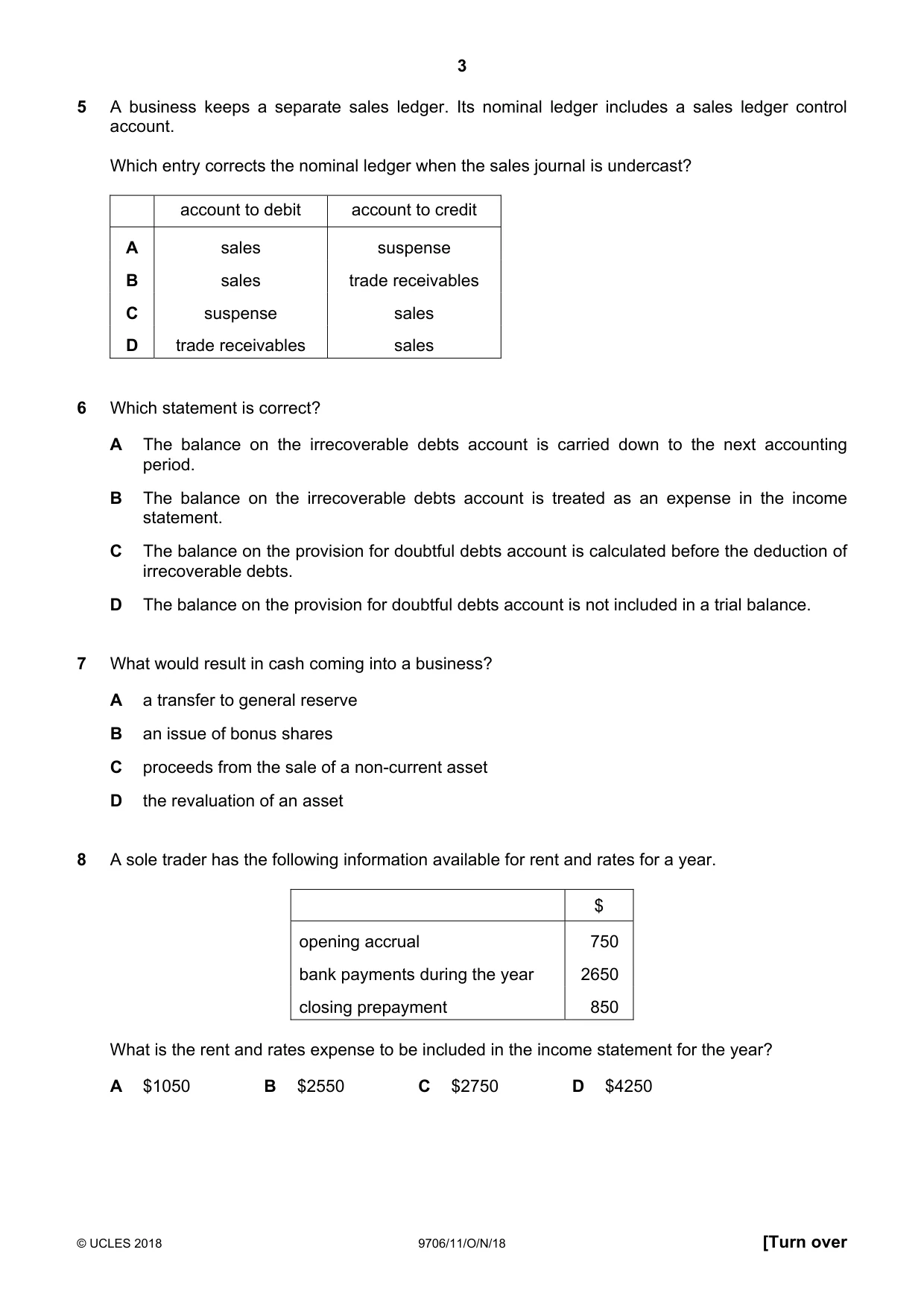
5 A business keeps a separate sales ledger. Its nominal ledger includes a sales ledger control account. Which entry corrects the nominal ledger when the sales journal is undercast? account to debit account to credit A sales suspense B sales trade receivables C suspense sales D trade receivables sales
Mark scheme: D
Q6 · Which statement is correct?
6 Which statement is correct? A The balance on the irrecoverable debts account is carried down to the next accounting period. B The balance on the irrecoverable debts account is treated as an expense in the income statement. C The balance on the provision for doubtful debts account is calculated before the deduction of irrecoverable debts. D The balance on the provision for doubtful debts account is not included in a trial balance.
Mark scheme: B
Q7 · What would result in cash coming into a business?
7 What would result in cash coming into a business? A a transfer to general reserve B an issue of bonus shares C proceeds from the sale of a non-current asset D the revaluation of an asset
Mark scheme: C
Q8 · A sole trader has the following information available for rent and rates for a year
8 A sole trader has the following information available for rent and rates for a year. $ opening accrual 750 bank payments during the year 2650 closing prepayment 850 What is the rent and rates expense to be included in the income statement for the year? A $1050 B $2550 C $2750 D $4250
Mark scheme: A
Q9 · A company sells goods at a mark-up of 25%
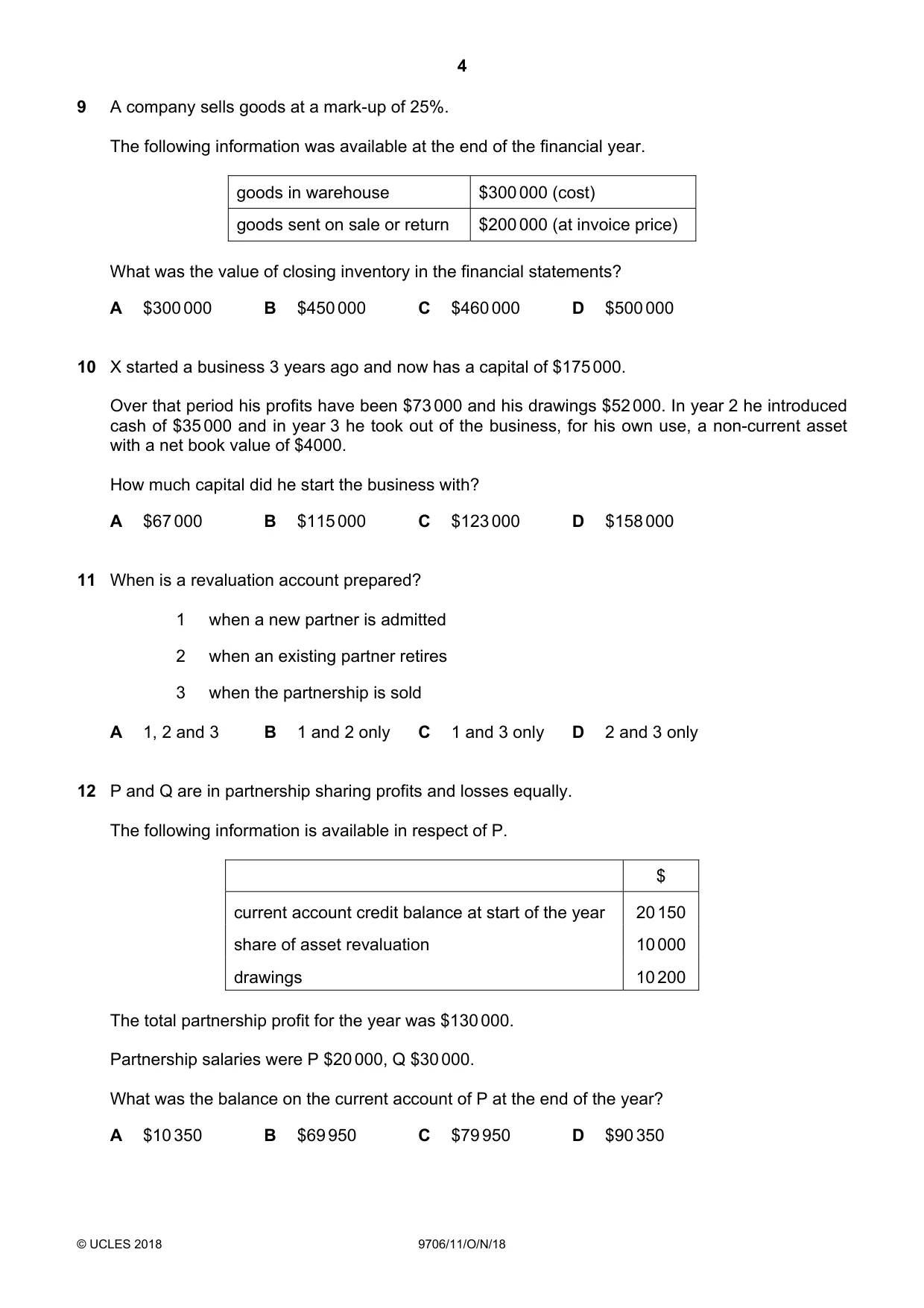
9 A company sells goods at a mark-up of 25%. The following information was available at the end of the financial year. goods in warehouse $300 000 (cost) goods sent on sale or return $200 000 (at invoice price) What was the value of closing inventory in the financial statements? A $300 000 B $450 000 C $460 000 D $500 000
Mark scheme: C
Q10 · X started a business 3 years ago and now has a capital of $175 000
10 X started a business 3 years ago and now has a capital of $175 000. Over that period his profits have been $73 000 and his drawings $52 000. In year 2 he introduced cash of $35 000 and in year 3 he took out of the business, for his own use, a non-current asset with a net book value of $4000. How much capital did he start the business with? A $67 000 B $115 000 C $123 000 D $158 000
Mark scheme: C
Q11 · When is a revaluation account prepared?
11 When is a revaluation account prepared? 1 when a new partner is admitted 2 when an existing partner retires 3 when the partnership is sold A 1, 2 and 3 B 1 and 2 only C 1 and 3 only D 2 and 3 only
Mark scheme: B
Q12 · P and Q are in partnership sharing profits and losses equally
12 P and Q are in partnership sharing profits and losses equally. The following information is available in respect of P. $ current account credit balance at start of the year 20 150 share of asset revaluation 10 000 drawings 10 200 The total partnership profit for the year was $130 000. Partnership salaries were P $20 000, Q $30 000. What was the balance on the current account of P at the end of the year? A $10 350 B $69 950 C $79 950 D $90 350
Mark scheme: B
Q13 · Dele and Iyabo are partners in a business and share profits in the ratio of 3 : 1
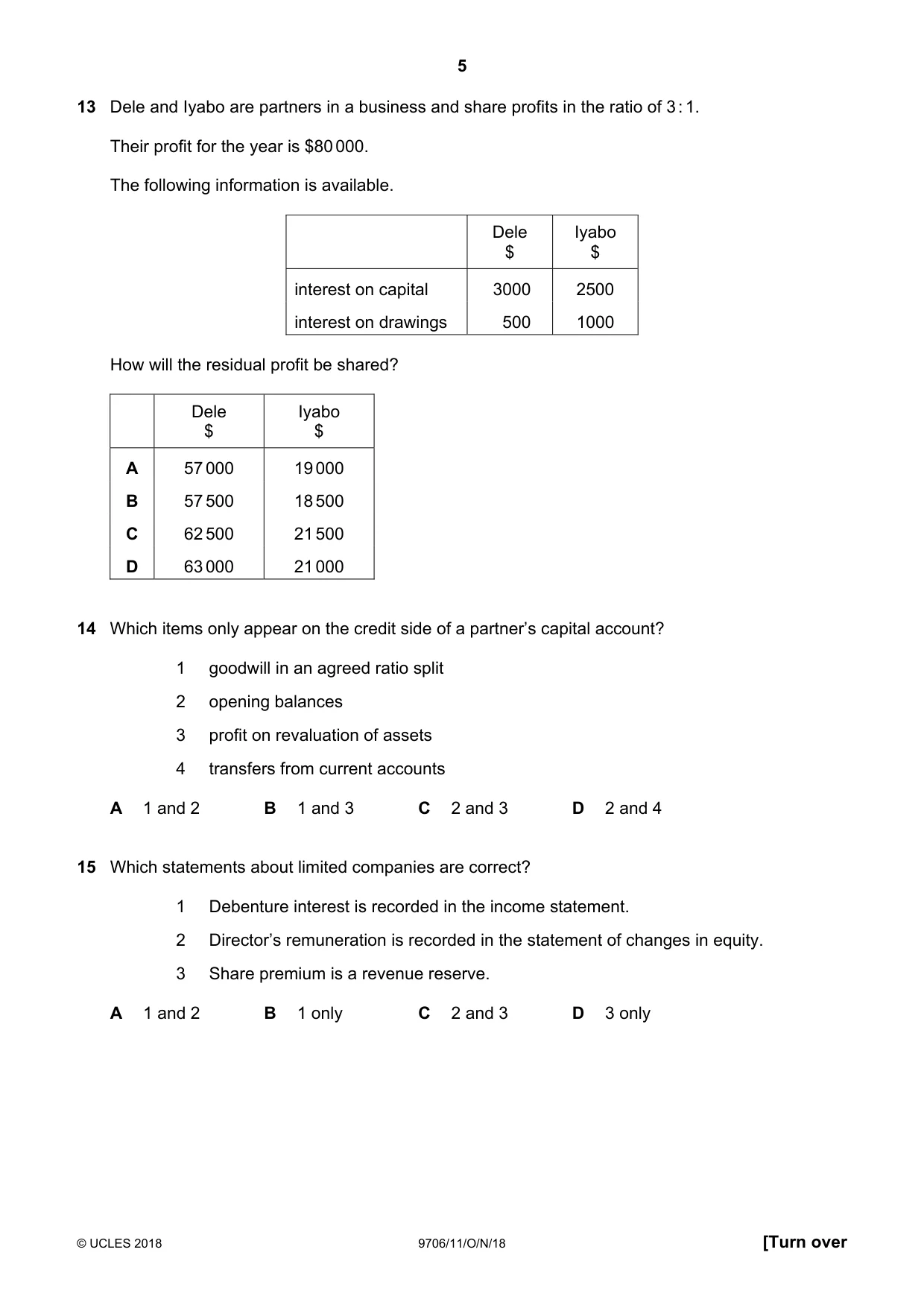
13 Dele and Iyabo are partners in a business and share profits in the ratio of 3 : 1. Their profit for the year is $80 000. The following information is available. Dele Iyabo $ $ interest on capital 3000 2500 interest on drawings 500 1000 How will the residual profit be shared? Dele Iyabo $ $ A 57 000 19 000 B 57 500 18 500 C 62 500 21 500 D 63 000 21 000
Mark scheme: A
Q14 · Which items only appear on the credit side of a partner’s capital account?
14 Which items only appear on the credit side of a partner’s capital account? 1 goodwill in an agreed ratio split 2 opening balances 3 profit on revaluation of assets 4 transfers from current accounts A 1 and 2 B 1 and 3 C 2 and 3 D 2 and 4
Mark scheme: C
Q15 · Which statements about limited companies are correct?
15 Which statements about limited companies are correct? 1 Debenture interest is recorded in the income statement. 2 Director’s remuneration is recorded in the statement of changes in equity. 3 Share premium is a revenue reserve. A 1 and 2 B 1 only C 2 and 3 D 3 only
Mark scheme: B
Q16 · A company has the following capital and reserves
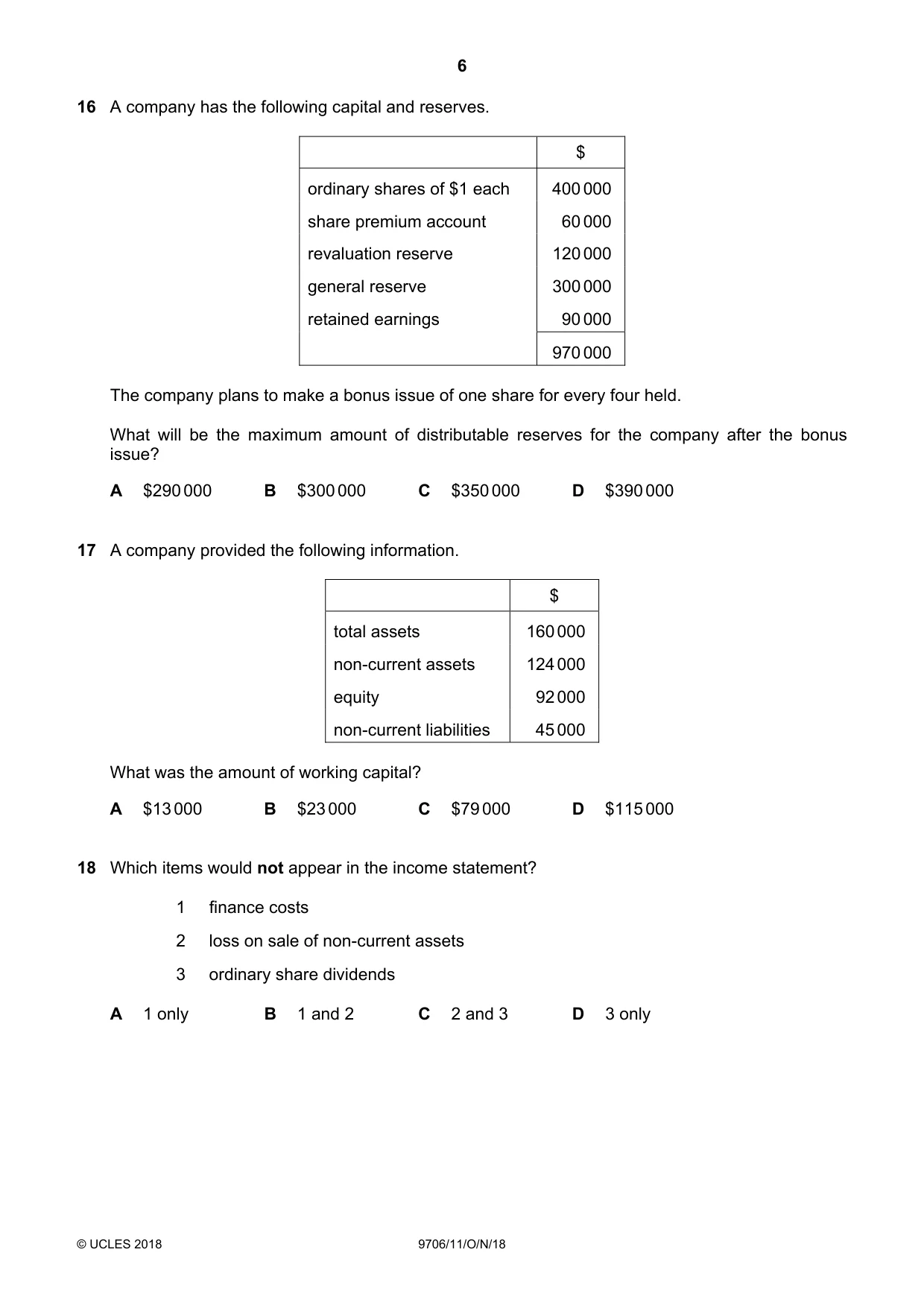
16 A company has the following capital and reserves. $ ordinary shares of $1 each 400 000 share premium account 60 000 revaluation reserve 120 000 general reserve 300 000 retained earnings 90 000 970 000 The company plans to make a bonus issue of one share for every four held. What will be the maximum amount of distributable reserves for the company after the bonus issue? A $290 000 B $300 000 C $350 000 D $390 000
Mark scheme: D
Q17 · A company provided the following information
17 A company provided the following information. $ total assets 160 000 non-current assets 124 000 equity 92 000 non-current liabilities 45 000 What was the amount of working capital? A $13 000 B $23 000 C $79 000 D $115 000
Mark scheme: A
More questions on Analysis and communication of accounting information
Q18 · Which items would not appear in the income statement?
18 Which items would not appear in the income statement? 1 finance costs 2 loss on sale of non-current assets 3 ordinary share dividends A 1 only B 1 and 2 C 2 and 3 D 3 only
Mark scheme: D
Q19 · A business provides the following extract from its income statement
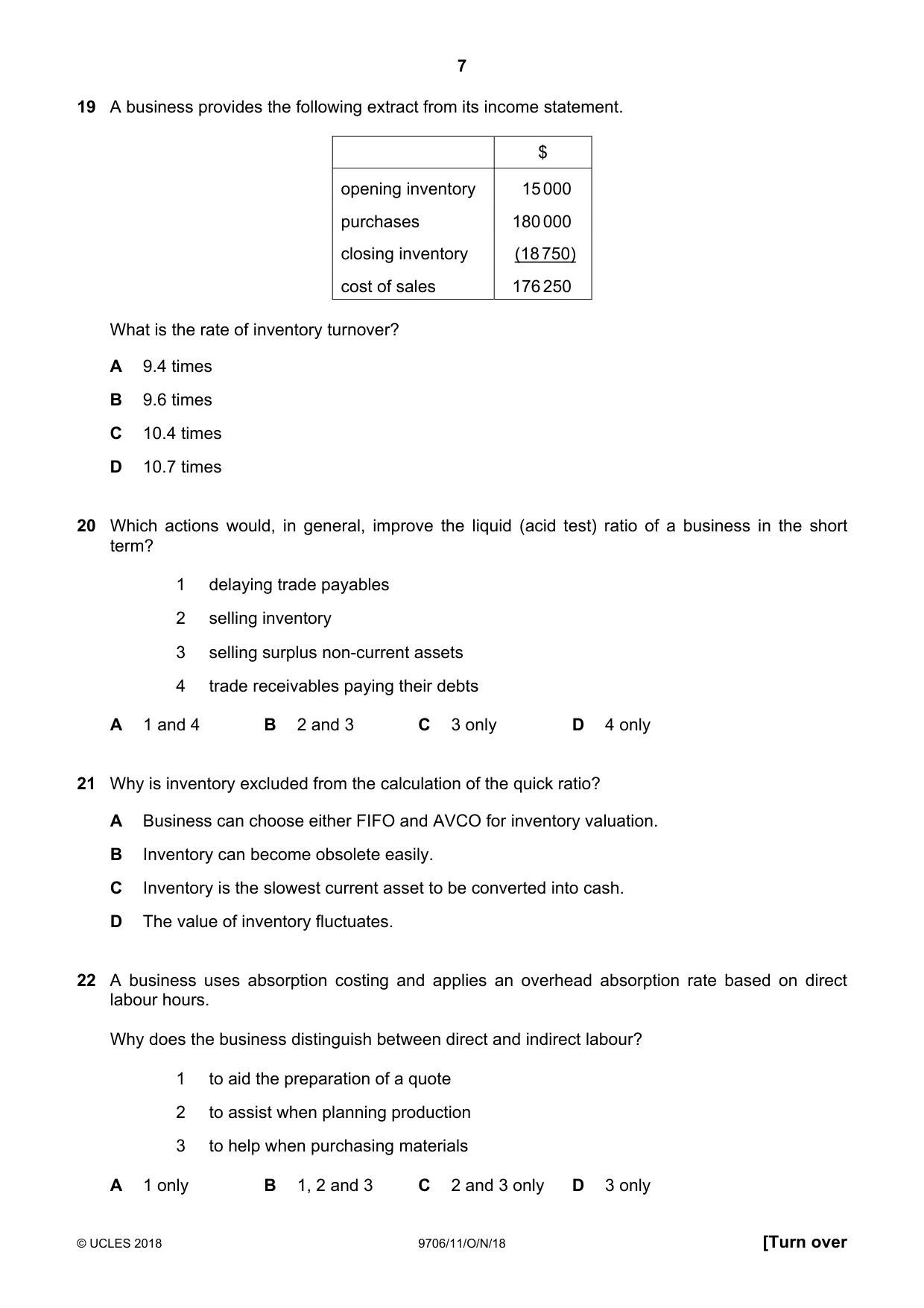
19 A business provides the following extract from its income statement. $ opening inventory 15 000 purchases 180 000 closing inventory (18 750) cost of sales 176 250 What is the rate of inventory turnover? A 9.4 times B 9.6 times C 10.4 times D 10.7 times
Mark scheme: C
More questions on Analysis and communication of accounting information
Q20 · Which actions would, in general, improve the liquid (acid test) ratio of a business in…
20 Which actions would, in general, improve the liquid (acid test) ratio of a business in the short term? 1 delaying trade payables 2 selling inventory 3 selling surplus non-current assets 4 trade receivables paying their debts A 1 and 4 B 2 and 3 C 3 only D 4 only
Mark scheme: B
More questions on Analysis and communication of accounting information
Q21 · Why is inventory excluded from the calculation of the quick ratio?
21 Why is inventory excluded from the calculation of the quick ratio? A Business can choose either FIFO and AVCO for inventory valuation. B Inventory can become obsolete easily. C Inventory is the slowest current asset to be converted into cash. D The value of inventory fluctuates.
Mark scheme: C
More questions on Analysis and communication of accounting information
Q22 · A business uses absorption costing and applies an overhead absorption rate based on…
22 A business uses absorption costing and applies an overhead absorption rate based on direct labour hours. Why does the business distinguish between direct and indirect labour? 1 to aid the preparation of a quote 2 to assist when planning production 3 to help when purchasing materials A 1 only B 1, 2 and 3 C 2 and 3 only D 3 only
Mark scheme: A
Q23 · A business values its inventory using the FIFO method
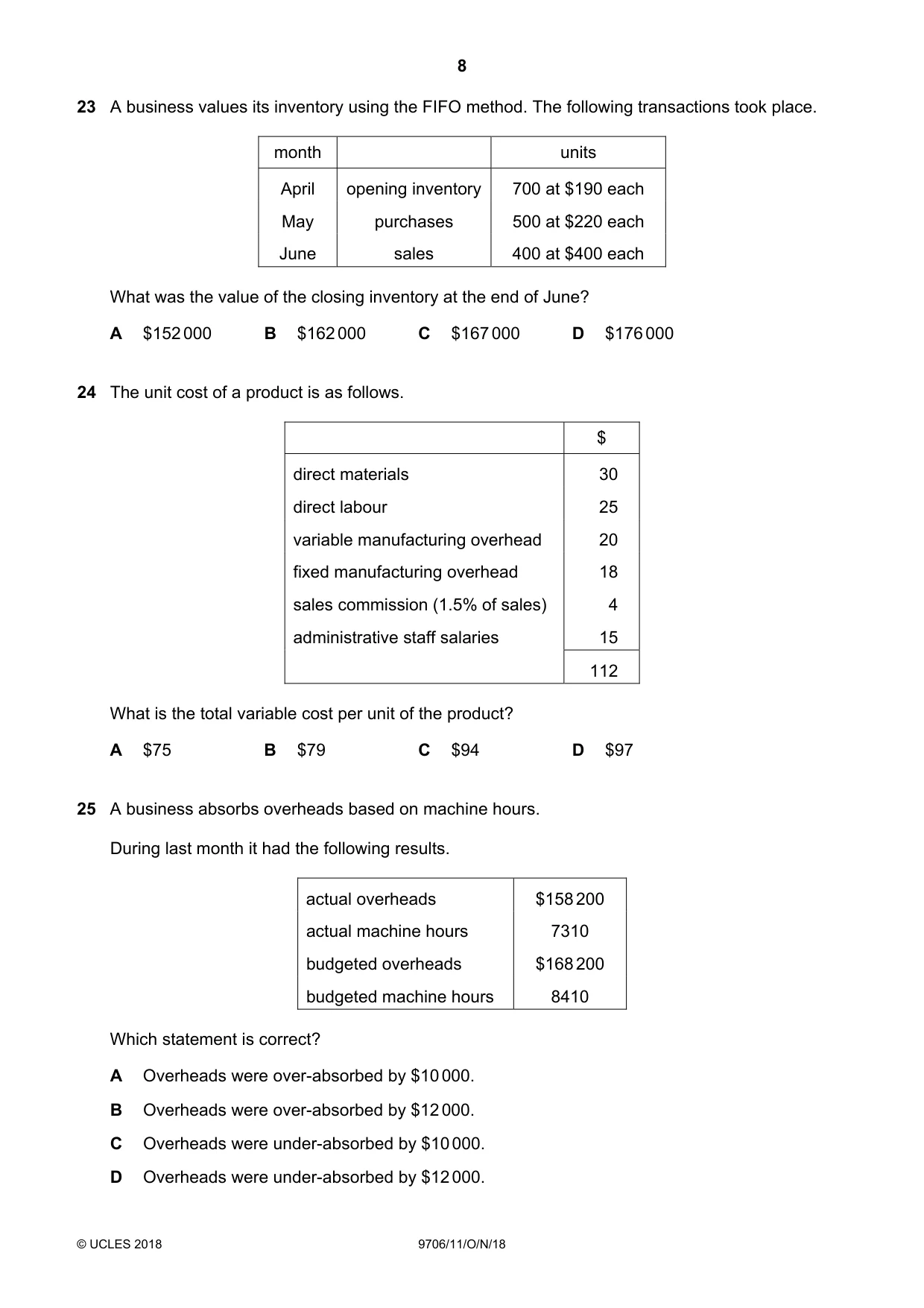
23 A business values its inventory using the FIFO method. The following transactions took place. month units April opening inventory 700 at $190 each May purchases 500 at $220 each June sales 400 at $400 each What was the value of the closing inventory at the end of June? A $152 000 B $162 000 C $167 000 D $176 000
Mark scheme: C
Q24 · The unit cost of a product is as follows
24 The unit cost of a product is as follows. $ direct materials 30 direct labour 25 variable manufacturing overhead 20 fixed manufacturing overhead 18 sales commission (1.5% of sales) 4 administrative staff salaries 15 112 What is the total variable cost per unit of the product? A $75 B $79 C $94 D $97
Mark scheme: B
Q25 · A business absorbs overheads based on machine hours
25 A business absorbs overheads based on machine hours. During last month it had the following results. actual overheads $158 200 actual machine hours 7310 budgeted overheads $168 200 budgeted machine hours 8410 Which statement is correct? A Overheads were over-absorbed by $10 000. B Overheads were over-absorbed by $12 000. C Overheads were under-absorbed by $10 000. D Overheads were under-absorbed by $12 000.
Mark scheme: D
Q26 · The diagram shows a break-even chart
26 The diagram shows a break-even chart. 100 sales revenue 90 total costs 80 70 60 $000 50 40 30 20 10 0 0 1000 2000 3000 4000 5000 number of units sold What is the margin of safety? A $10 000 B $15 000 C $40 000 D $60 000
Mark scheme: D
Q27 · The following information applies to a business
27 The following information applies to a business. output sales profits (units) $ $ 375 750 000 100 000 500 1 000 000 250 000 What is the contribution to sales ratio? A 25% B 50% C 60% D 83%
Mark scheme: C
Q28 · What does the diagram show about costs?
28 What does the diagram show about costs? sales revenue profit revenue and costs $000 fixed costs 1 2 3 4 5 years A Fixed costs are increasing. B Total costs as a percentage of sales are decreasing. C Variable costs per unit are decreasing. D Variable costs per unit are increasing.
Mark scheme: D
Q29 · A business makes and sells three products: X, Y and Z
29 A business makes and sells three products: X, Y and Z. There will be a maximum of 3000 hours of labour time available in January. The following information for the three products is available: X Y Z contribution per unit $50 $60 $70 maximum demand per month (units) 1000 500 800 labour time per unit 1 hour 1.5 hours 2 hours What will be the optimal sales mix of products in January? X Y Z A 825 500 800 B 1000 325 800 C 1000 500 625 D 1000 500 800
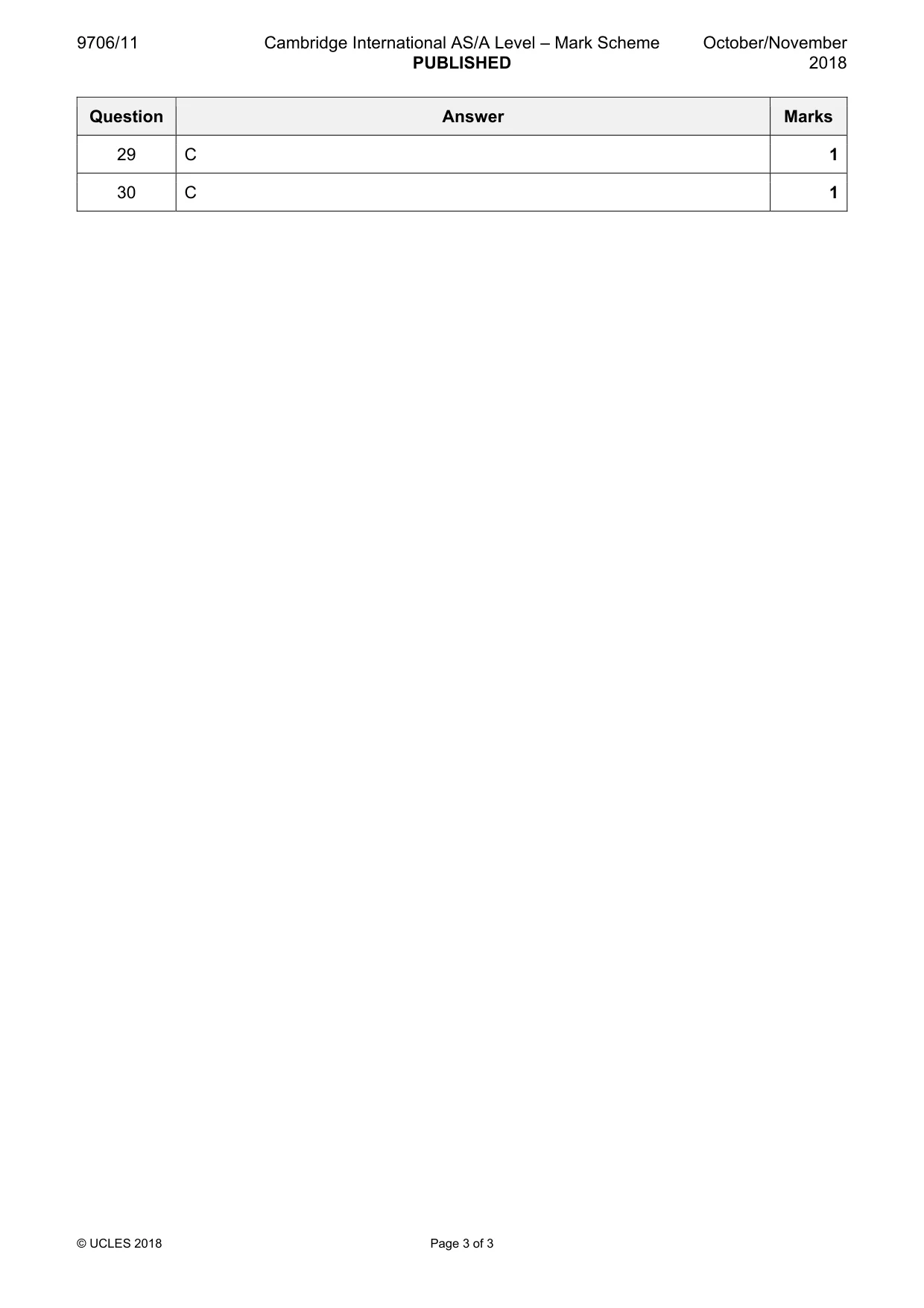
Mark scheme: C
Q30 · In which way can a budget be used to help the management of a company?
30 In which way can a budget be used to help the management of a company? A ascertain actual profit B compare the company’s budget with its competitors C implement strategic planning D increase the company’s public image
Mark scheme: C
What was in this paper
The subtopics covered by these 30 questions, and how many questions each got. Open one in a new tab to see every Cambridge question on it.
7Analysis and communication of accounting information4Traditional costing methods4Costs and cost behaviour3Preparation of financial statements3Reconciliation and verification3Types of business entity3Accounting for non-current assets2Budgeting and budgetary control1What you needed in this session
Cambridge’s own grade thresholds for 2018 Oct/Nov, Paper 1 · Variant 1. A higher threshold means an easier paper — the bar moves with how the cohort did.