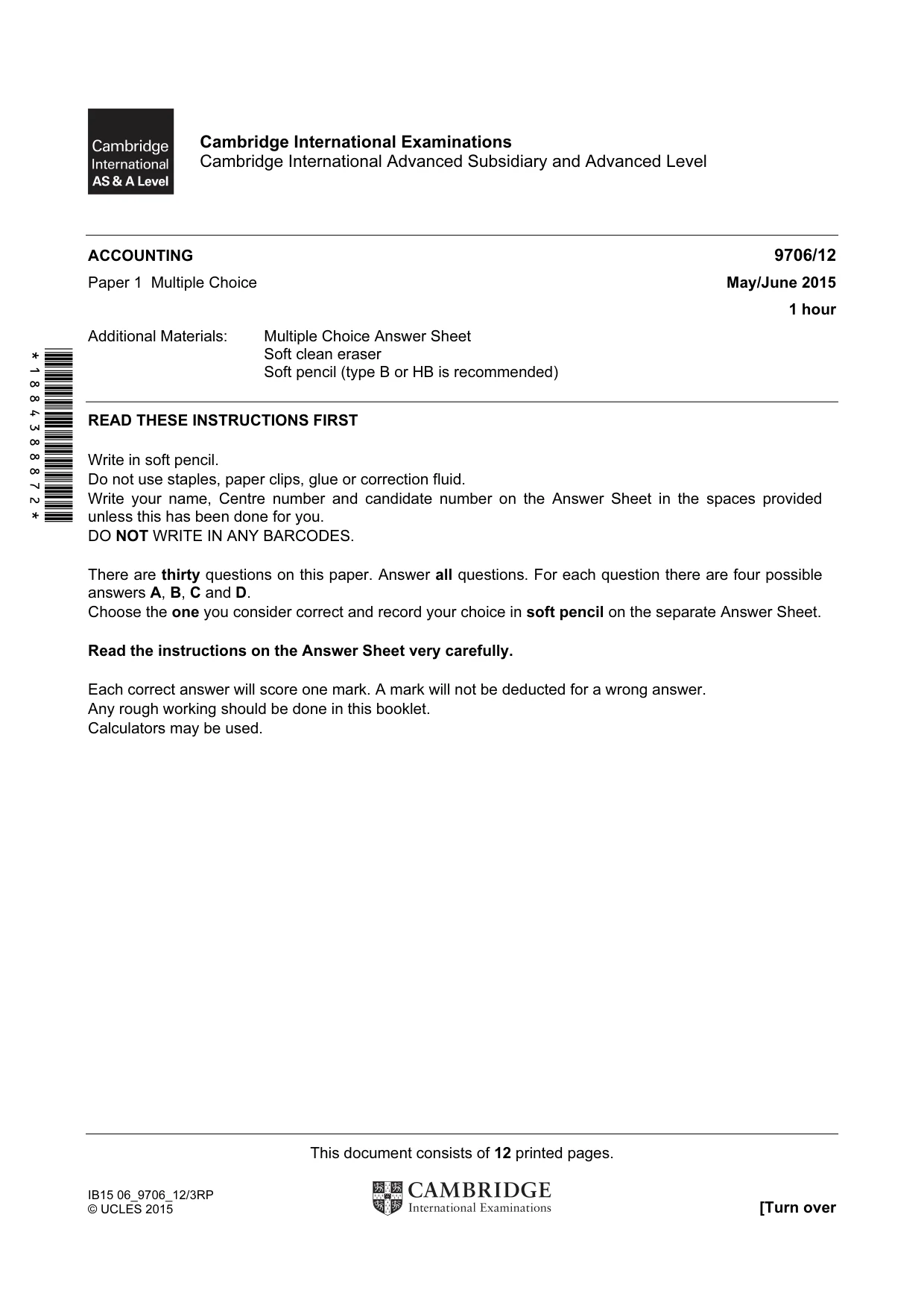
Cambridge A Level Accounting 9706 — 2015 May/June Paper 1 · Variant 2
9706/12/M/J/15 · 30 questions · 30 marks · ≈34 min
The question paper and its mark scheme, free to read here and free to download. This is Cambridge’s own paper, exactly as it was sat.
Question paper12 pages
Mark scheme2 pages
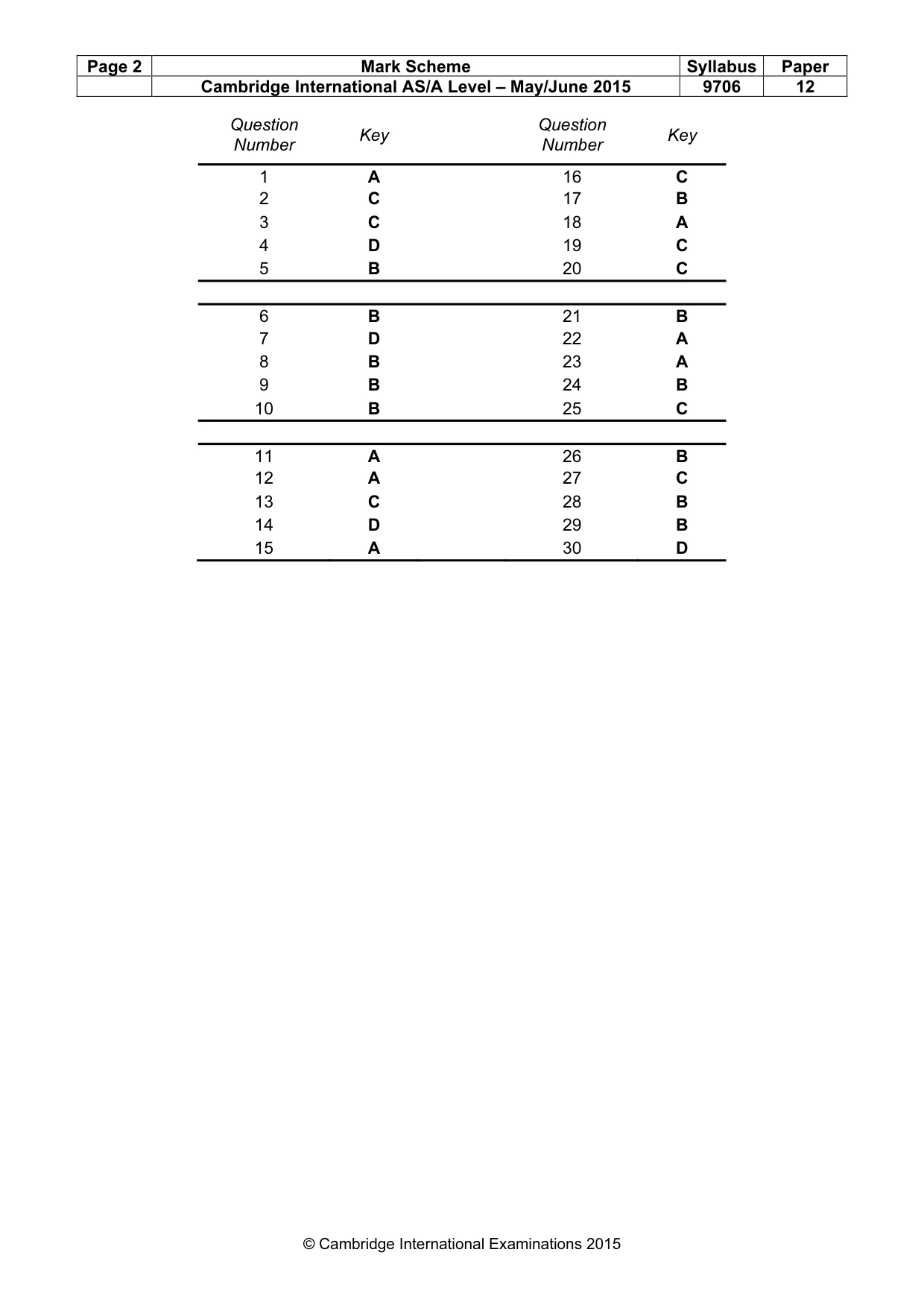
Answers below. Sit the paper first if you are practising.
Questions as text
Q1 · Which statement contains the correct accounting treatment for accrued income?
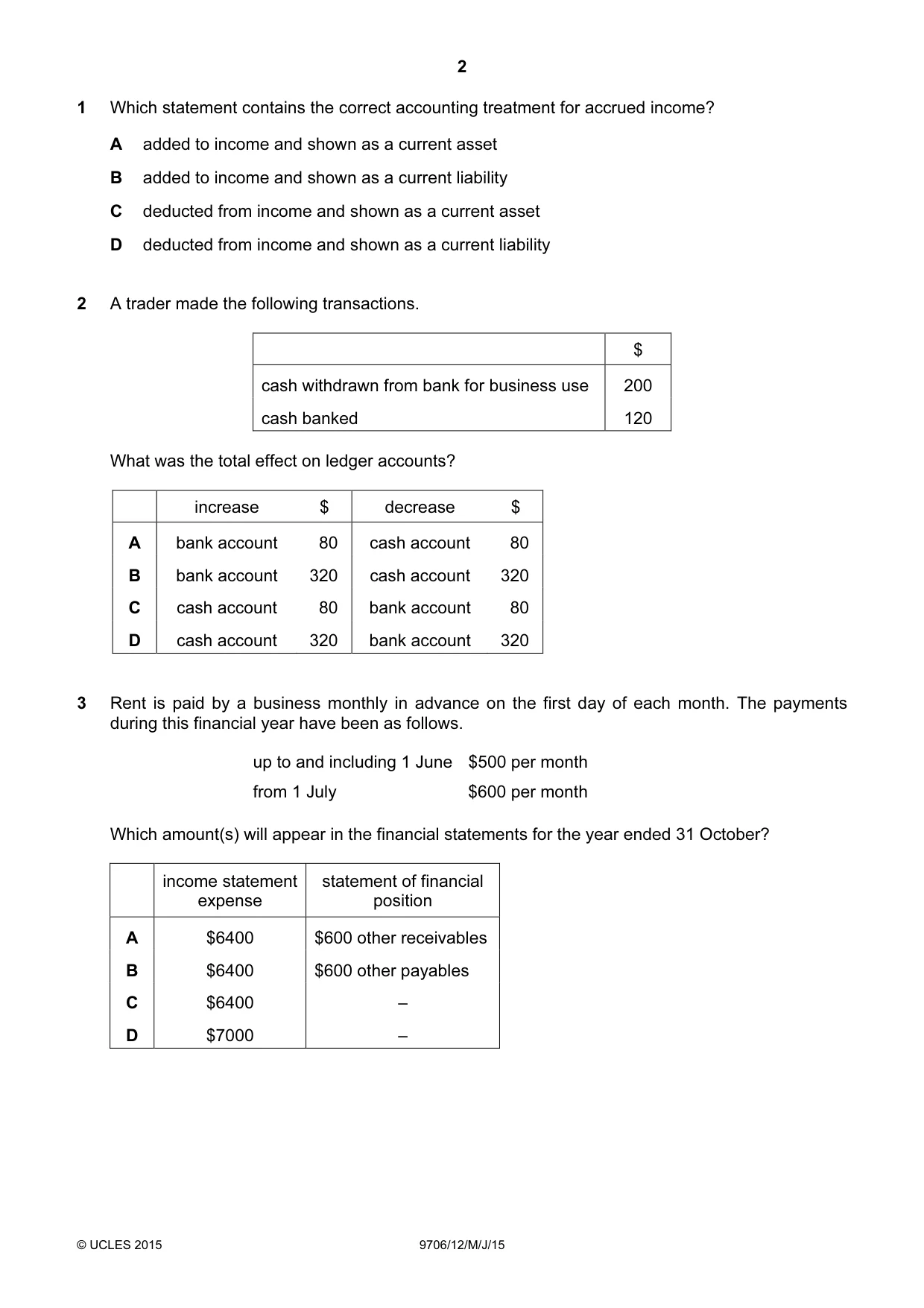
1 Which statement contains the correct accounting treatment for accrued income? A added to income and shown as a current asset B added to income and shown as a current liability C deducted from income and shown as a current asset D deducted from income and shown as a current liability
Mark scheme: A
Q2 · A trader made the following transactions
2 A trader made the following transactions. $ cash withdrawn from bank for business use 200 cash banked 120 What was the total effect on ledger accounts? increase $ decrease $ A bank account 80 cash account 80 B bank account 320 cash account 320 C cash account 80 bank account 80 D cash account 320 bank account 320
Mark scheme: C
Q3 · Rent is paid by a business monthly in advance on the first day of each month
3 Rent is paid by a business monthly in advance on the first day of each month. The payments during this financial year have been as follows. up to and including 1 June $500 per month from 1 July $600 per month Which amount(s) will appear in the financial statements for the year ended 31 October? income statement statement of financial expense position A $6400 $600 other receivables B $6400 $600 other payables C $6400 – D $7000 –
Mark scheme: C
Q4 · A business started on 1 January 2013
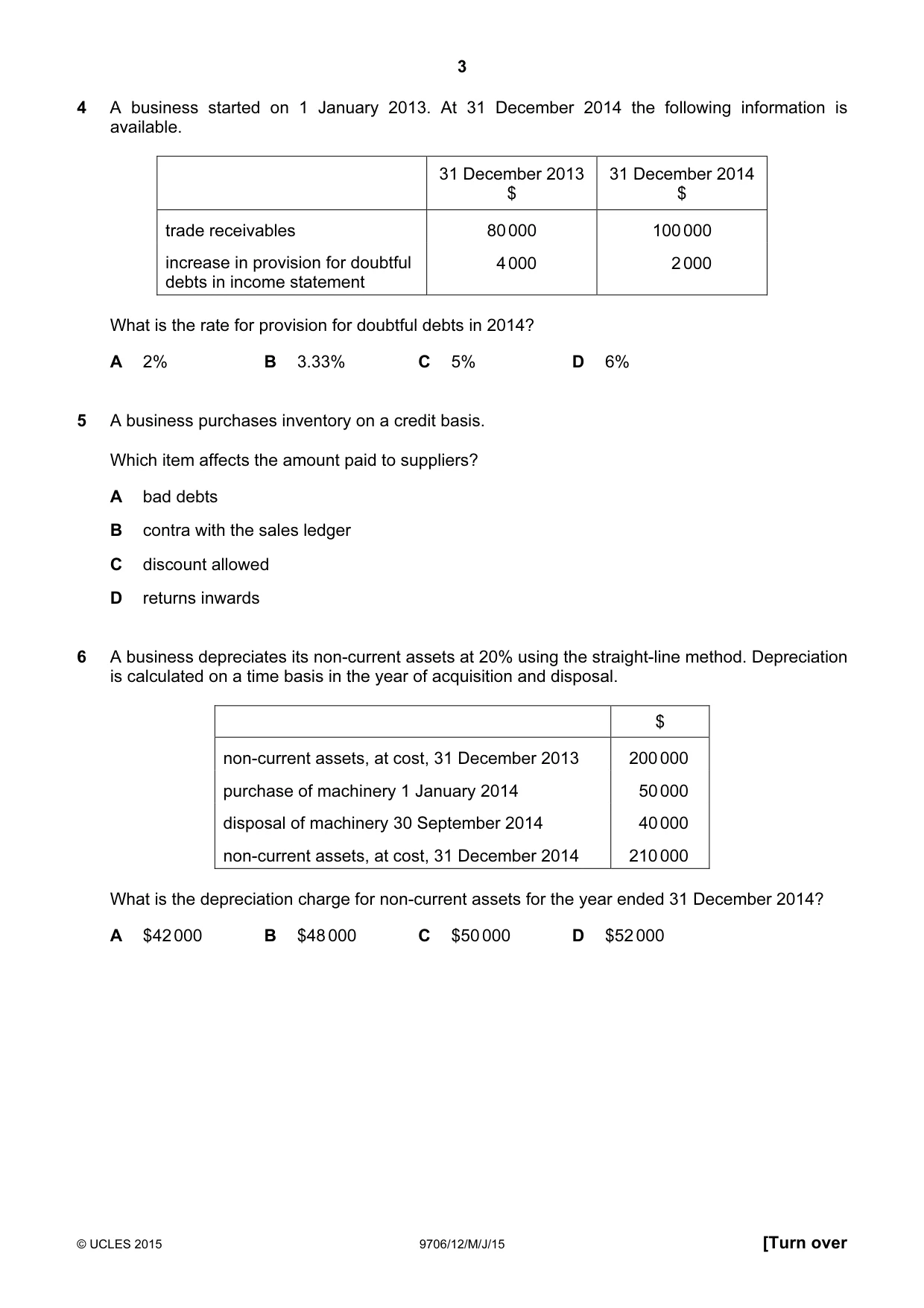
4 A business started on 1 January 2013. At 31 December 2014 the following information is available. 31 December 2013 31 December 2014 $ $ trade receivables 80 000 100 000 increase in provision for doubtful 4 000 2 000 debts in income statement What is the rate for provision for doubtful debts in 2014? A 2% B 3.33% C 5% D 6%
Mark scheme: D
Q5 · A business purchases inventory on a credit basis
5 A business purchases inventory on a credit basis. Which item affects the amount paid to suppliers? A bad debts B contra with the sales ledger C discount allowed D returns inwards
Mark scheme: B
Q6 · A business depreciates its non-current assets at 20% using the straight-line method
6 A business depreciates its non-current assets at 20% using the straight-line method. Depreciation is calculated on a time basis in the year of acquisition and disposal. $ non-current assets, at cost, 31 December 2013 200 000 purchase of machinery 1 January 2014 50 000 disposal of machinery 30 September 2014 40 000 non-current assets, at cost, 31 December 2014 210 000 What is the depreciation charge for non-current assets for the year ended 31 December 2014? A $42 000 B $48 000 C $50 000 D $52 000
Mark scheme: B
Q7 · The table shows information for a business at 31 March in Year 1
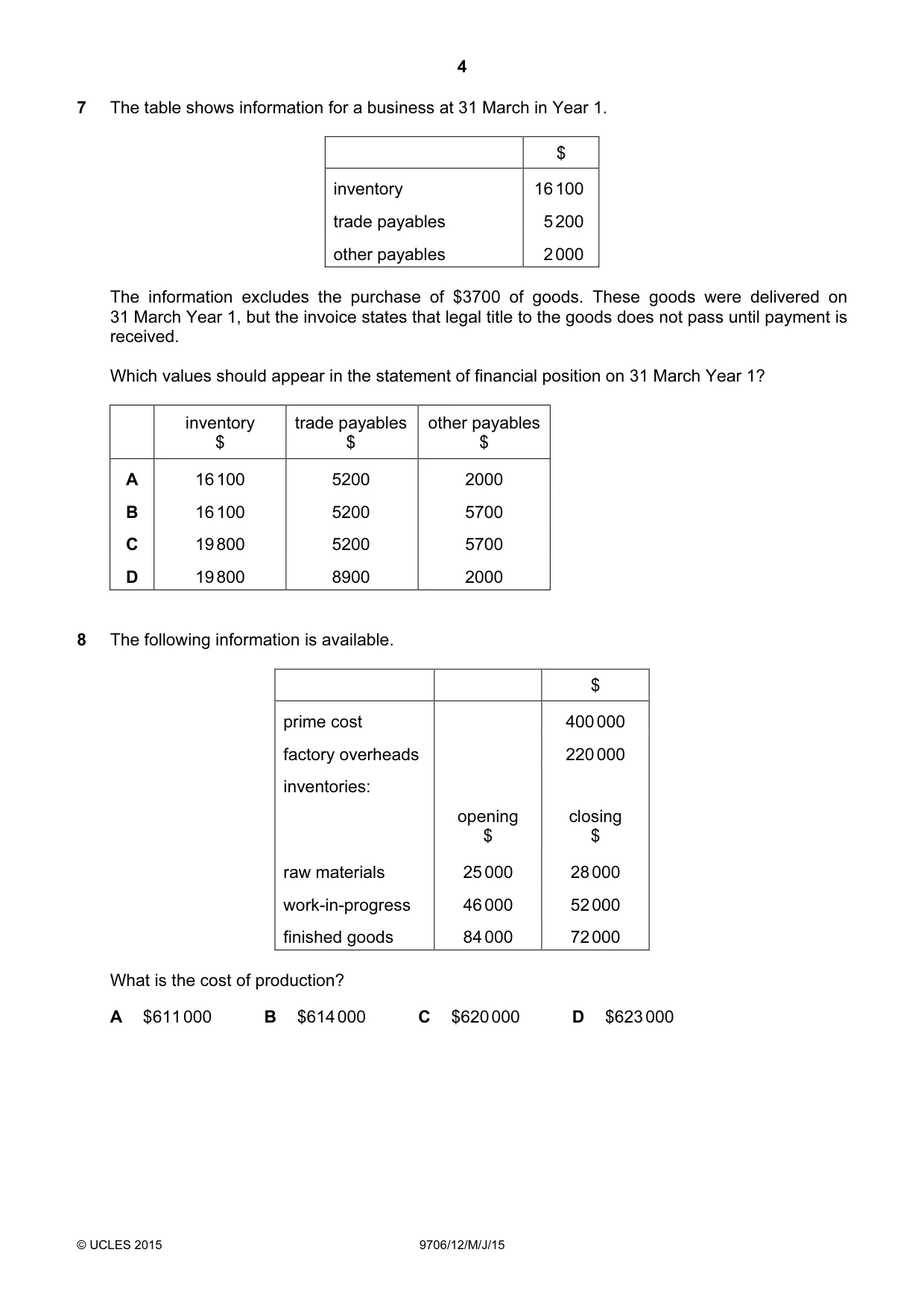
7 The table shows information for a business at 31 March in Year 1. $ inventory 16 100 trade payables 5 200 other payables 2 000 The information excludes the purchase of $3700 of goods. These goods were delivered on 31 March Year 1, but the invoice states that legal title to the goods does not pass until payment is received. Which values should appear in the statement of financial position on 31 March Year 1? inventory trade payables other payables $ $ $ A 16 100 5200 2000 B 16 100 5200 5700 C 19 800 5200 5700 D 19 800 8900 2000
Mark scheme: D
Q8 · The following information is available
8 The following information is available. $ prime cost 400 000 factory overheads 220 000 inventories: opening closing $ $ raw materials 25 000 28 000 work-in-progress 46 000 52 000 finished goods 84 000 72 000 What is the cost of production? A $611 000 B $614 000 C $620 000 D $623 000
Mark scheme: B
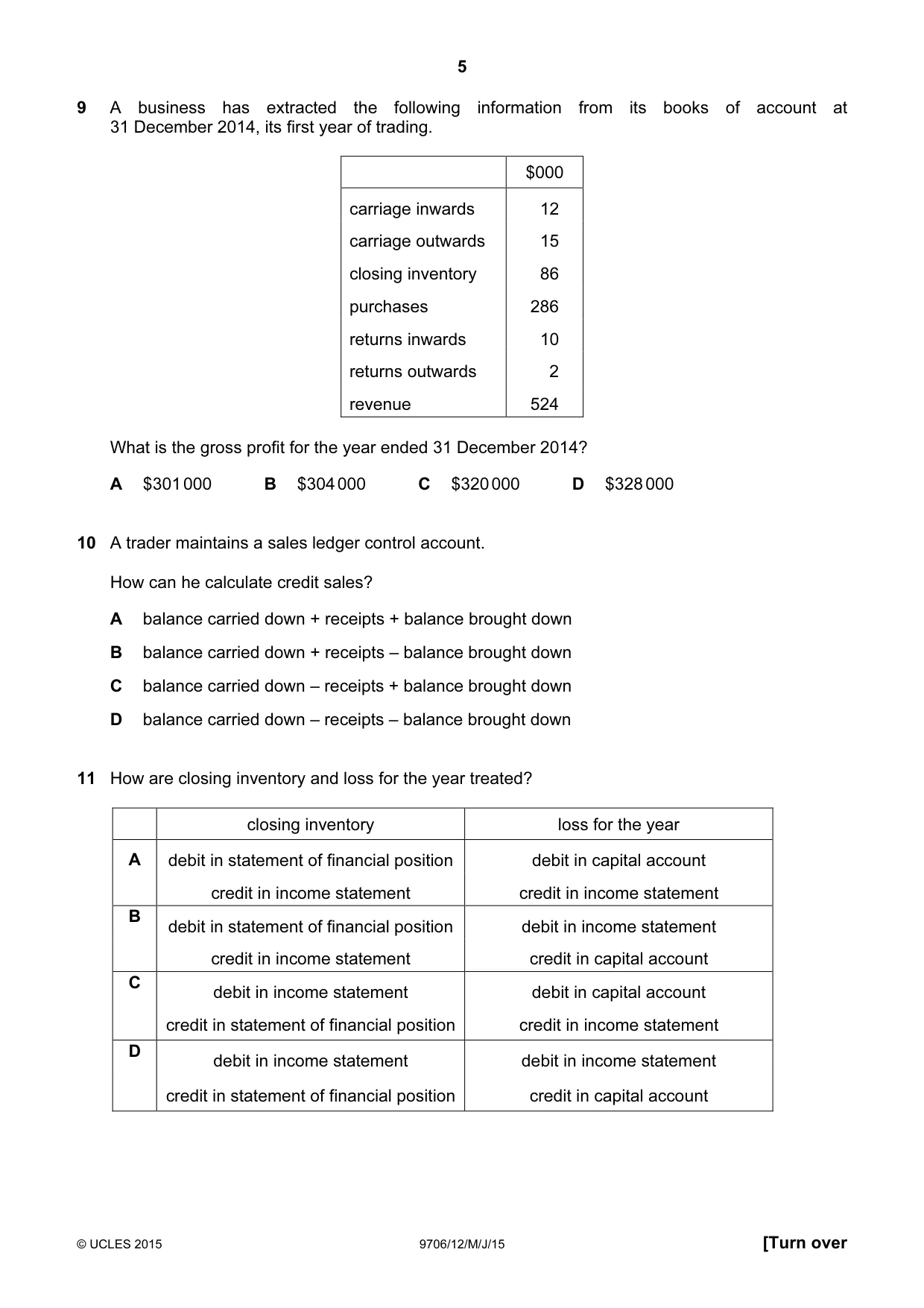
Q9 · A business has extracted the following information from its books of account at 31…
9 A business has extracted the following information from its books of account at 31 December 2014, its first year of trading. $000 carriage inwards 12 carriage outwards 15 closing inventory 86 purchases 286 returns inwards 10 returns outwards 2 revenue 524 What is the gross profit for the year ended 31 December 2014? A $301 000 B $304 000 C $320 000 D $328 000
Mark scheme: B
Q10 · A trader maintains a sales ledger control account
10 A trader maintains a sales ledger control account. How can he calculate credit sales? A balance carried down + receipts + balance brought down B balance carried down + receipts – balance brought down C balance carried down – receipts + balance brought down D balance carried down – receipts – balance brought down
Mark scheme: B
Q11 · How are closing inventory and loss for the year treated?
11 How are closing inventory and loss for the year treated? closing inventory loss for the year A debit in statement of financial position debit in capital account credit in income statement credit in income statement B debit in statement of financial position debit in income statement credit in income statement credit in capital account C debit in income statement debit in capital account credit in statement of financial position credit in income statement D debit in income statement debit in income statement credit in statement of financial position credit in capital account
Mark scheme: A
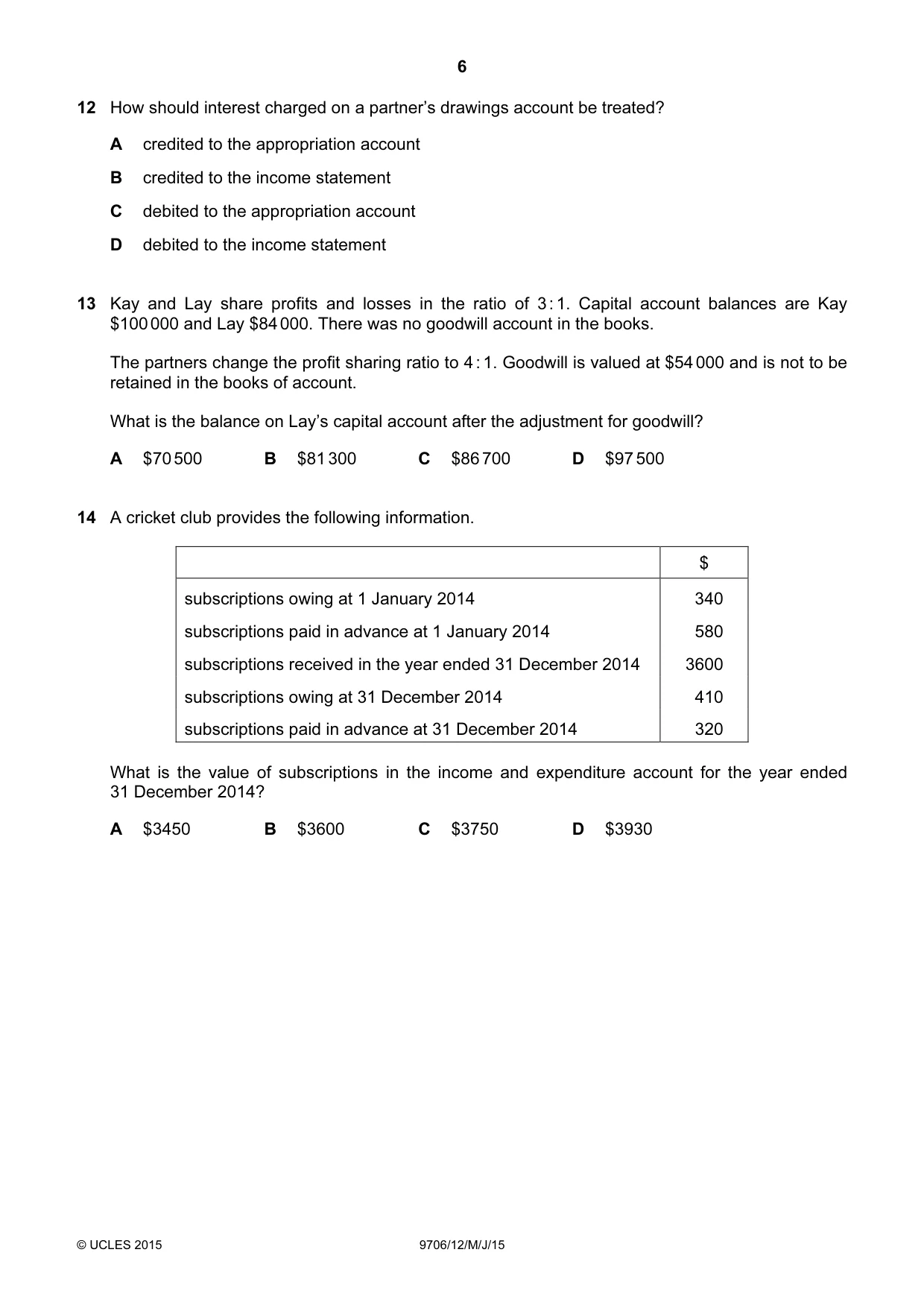
Q12 · How should interest charged on a partner’s drawings account be treated?
12 How should interest charged on a partner’s drawings account be treated? A credited to the appropriation account B credited to the income statement C debited to the appropriation account D debited to the income statement
Mark scheme: A
Q13 · Kay and Lay share profits and losses in the ratio of 3 : 1
13 Kay and Lay share profits and losses in the ratio of 3 : 1. Capital account balances are Kay $100 000 and Lay $84 000. There was no goodwill account in the books. The partners change the profit sharing ratio to 4 : 1. Goodwill is valued at $54 000 and is not to be retained in the books of account. What is the balance on Lay’s capital account after the adjustment for goodwill? A $70 500 B $81 300 C $86 700 D $97 500
Mark scheme: C
Q14 · A cricket club provides the following information
14 A cricket club provides the following information. $ subscriptions owing at 1 January 2014 340 subscriptions paid in advance at 1 January 2014 580 subscriptions received in the year ended 31 December 2014 3600 subscriptions owing at 31 December 2014 410 subscriptions paid in advance at 31 December 2014 320 What is the value of subscriptions in the income and expenditure account for the year ended 31 December 2014? A $3450 B $3600 C $3750 D $3930
Mark scheme: D
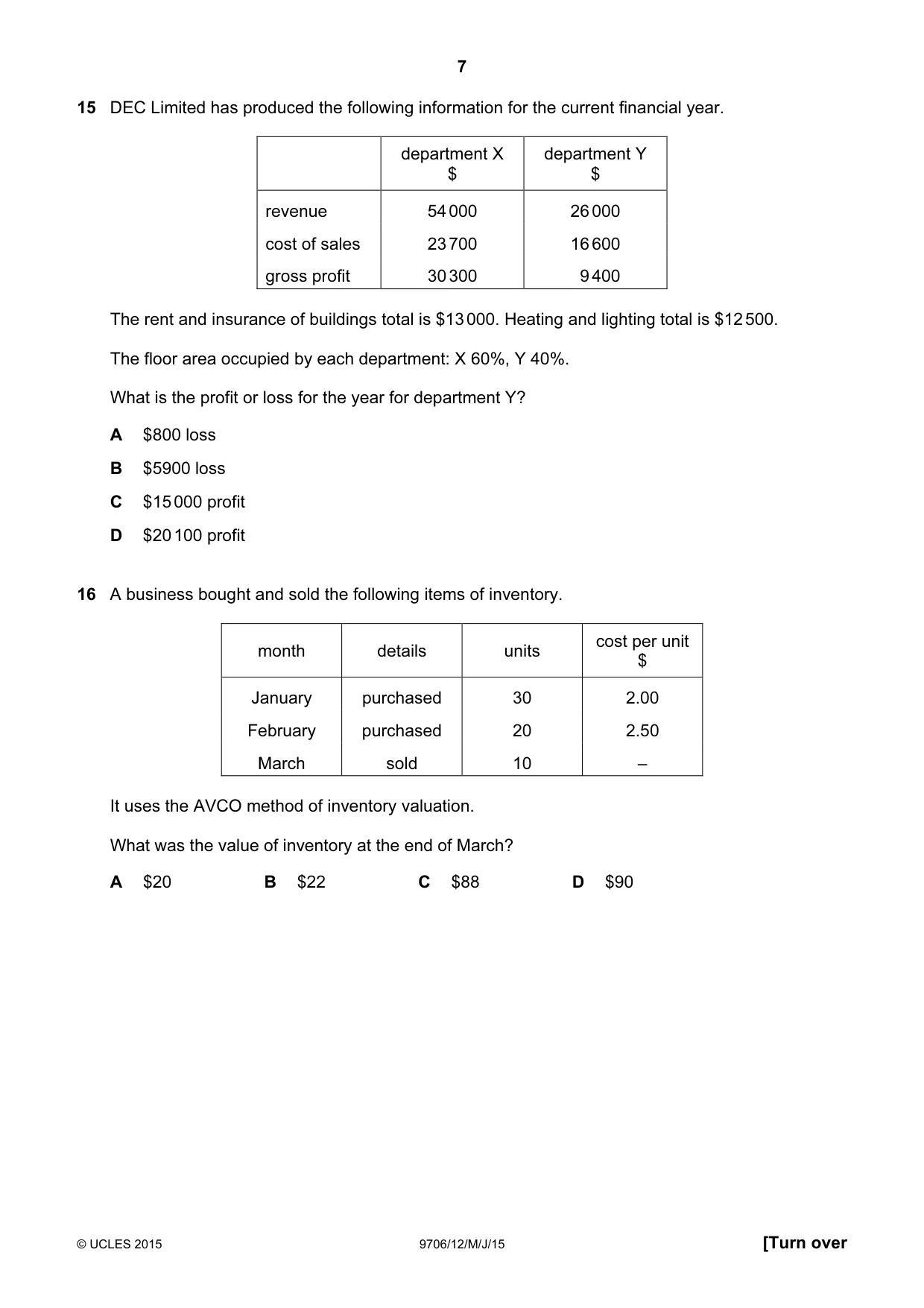
Q15 · DEC Limited has produced the following information for the current financial year
15 DEC Limited has produced the following information for the current financial year. department X department Y $ $ revenue 54 000 26 000 cost of sales 23 700 16 600 gross profit 30 300 9 400 The rent and insurance of buildings total is $13 000. Heating and lighting total is $12 500. The floor area occupied by each department: X 60%, Y 40%. What is the profit or loss for the year for department Y? A $800 loss B $5900 loss C $15 000 profit D $20 100 profit
Mark scheme: A
Q16 · A business bought and sold the following items of inventory
16 A business bought and sold the following items of inventory. cost per unit month details units $ January purchased 30 2.00 February purchased 20 2.50 March sold 10 – It uses the AVCO method of inventory valuation. What was the value of inventory at the end of March? A $20 B $22 C $88 D $90
Mark scheme: C
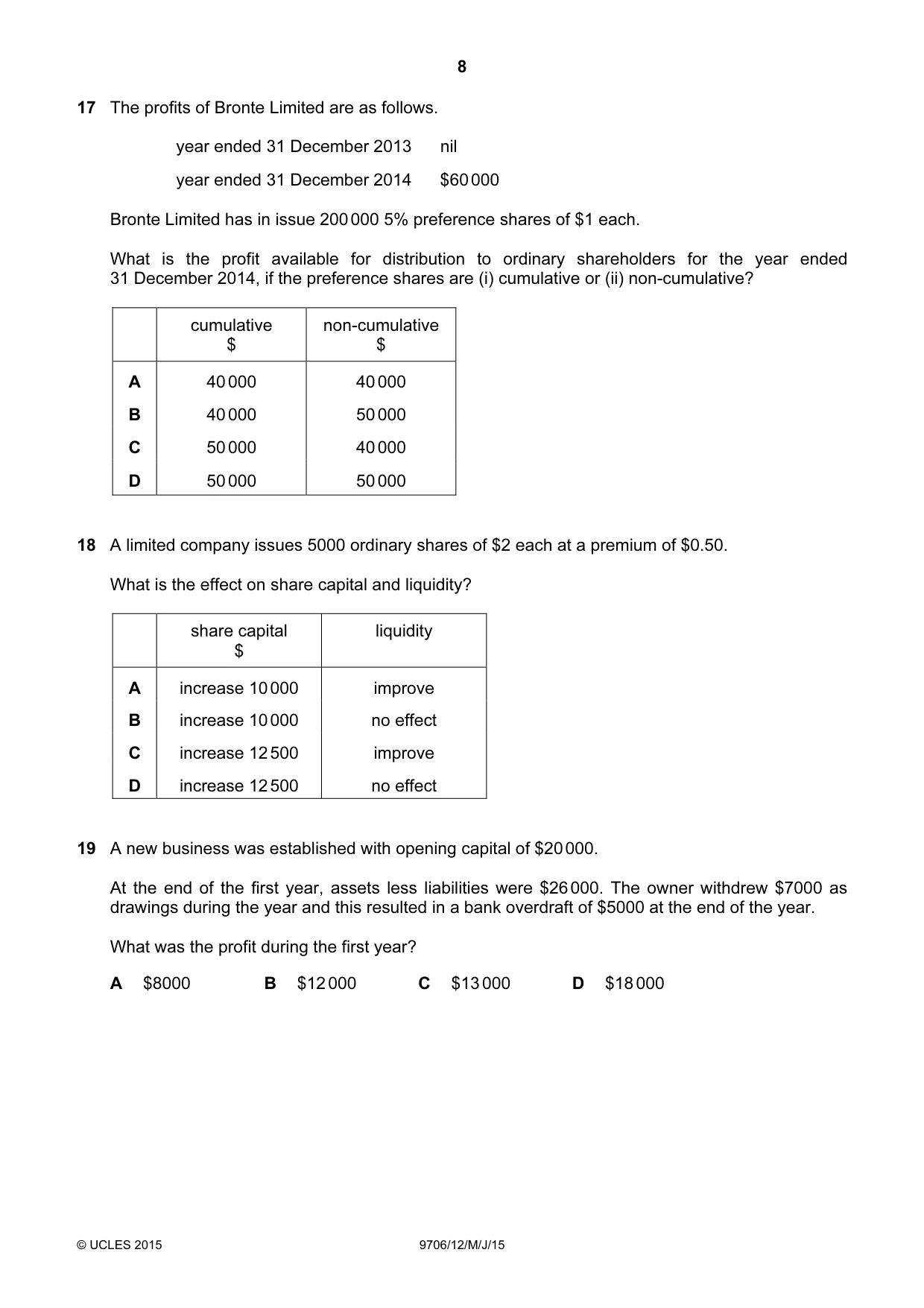
Q17 · The profits of Bronte Limited are as follows
17 The profits of Bronte Limited are as follows. year ended 31 December 2013 nil year ended 31 December 2014 $60 000 Bronte Limited has in issue 200 000 5% preference shares of $1 each. What is the profit available for distribution to ordinary shareholders for the year ended 31 December 2014, if the preference shares are (i) cumulative or (ii) non-cumulative? cumulative non-cumulative $ $ A 40 000 40 000 B 40 000 50 000 C 50 000 40 000 D 50 000 50 000
Mark scheme: B
Q18 · A limited company issues 5000 ordinary shares of $2 each at a premium of $0.50
18 A limited company issues 5000 ordinary shares of $2 each at a premium of $0.50. What is the effect on share capital and liquidity? share capital liquidity $ A increase 10 000 improve B increase 10 000 no effect C increase 12 500 improve D increase 12 500 no effect
Mark scheme: A
Q19 · A new business was established with opening capital of $20 000
19 A new business was established with opening capital of $20 000. At the end of the first year, assets less liabilities were $26 000. The owner withdrew $7000 as drawings during the year and this resulted in a bank overdraft of $5000 at the end of the year. What was the profit during the first year? A $8000 B $12 000 C $13 000 D $18 000
Mark scheme: C
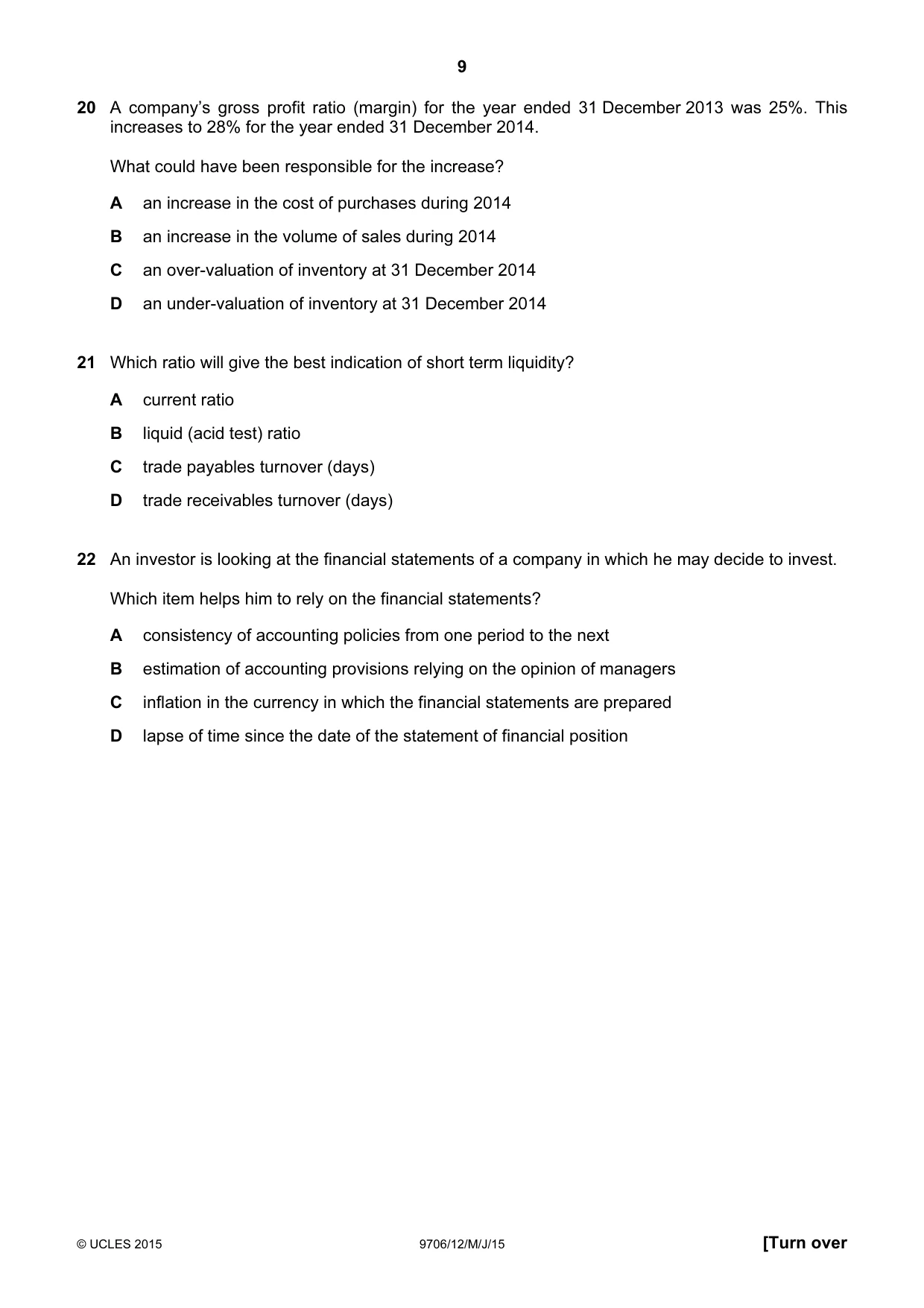
Q20 · A company’s gross profit ratio (margin) for the year ended 31 December 2013 was 25%
20 A company’s gross profit ratio (margin) for the year ended 31 December 2013 was 25%. This increases to 28% for the year ended 31 December 2014. What could have been responsible for the increase? A an increase in the cost of purchases during 2014 B an increase in the volume of sales during 2014 C an over-valuation of inventory at 31 December 2014 D an under-valuation of inventory at 31 December 2014
Mark scheme: C
More questions on Analysis and communication of accounting information
Q21 · Which ratio will give the best indication of short term liquidity?
21 Which ratio will give the best indication of short term liquidity? A current ratio B liquid (acid test) ratio C trade payables turnover (days) D trade receivables turnover (days)
Mark scheme: B
More questions on Analysis and communication of accounting information
Q22 · An investor is looking at the financial statements of a company in which he may decide to…
22 An investor is looking at the financial statements of a company in which he may decide to invest. Which item helps him to rely on the financial statements? A consistency of accounting policies from one period to the next B estimation of accounting provisions relying on the opinion of managers C inflation in the currency in which the financial statements are prepared D lapse of time since the date of the statement of financial position
Mark scheme: A
More questions on Analysis and communication of accounting information
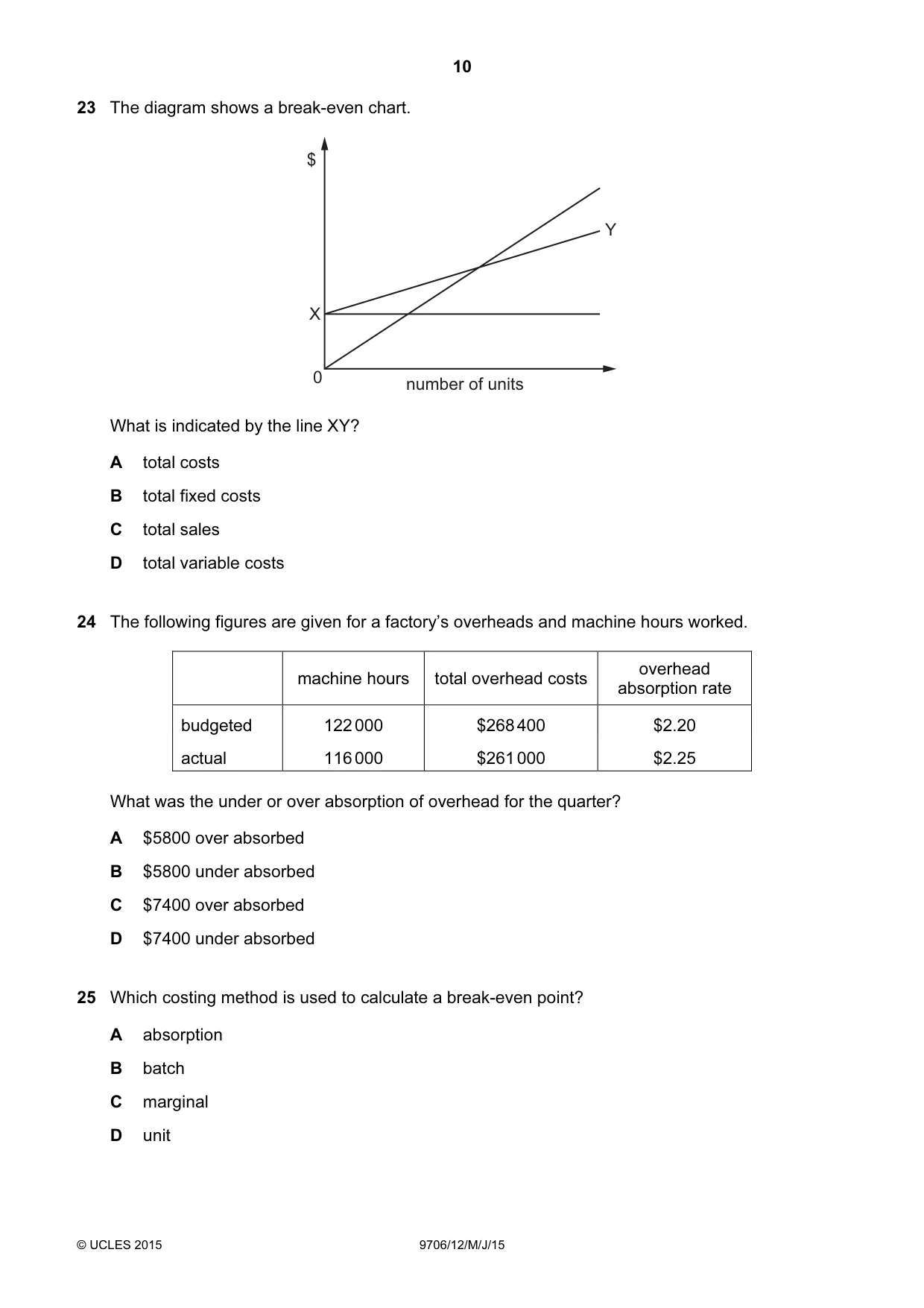
Q23 · The diagram shows a break-even chart
23 The diagram shows a break-even chart. $ Y X 0 number of units What is indicated by the line XY? A total costs B total fixed costs C total sales D total variable costs
Mark scheme: A
Q24 · The following figures are given for a factory’s overheads and machine hours worked
24 The following figures are given for a factory’s overheads and machine hours worked. overhead machine hours total overhead costs absorption rate budgeted 122 000 $268 400 $2.20 actual 116 000 $261 000 $2.25 What was the under or over absorption of overhead for the quarter? A $5800 over absorbed B $5800 under absorbed C $7400 over absorbed D $7400 under absorbed
Mark scheme: B
Q25 · Which costing method is used to calculate a break-even point?
25 Which costing method is used to calculate a break-even point? A absorption B batch C marginal D unit
Mark scheme: C
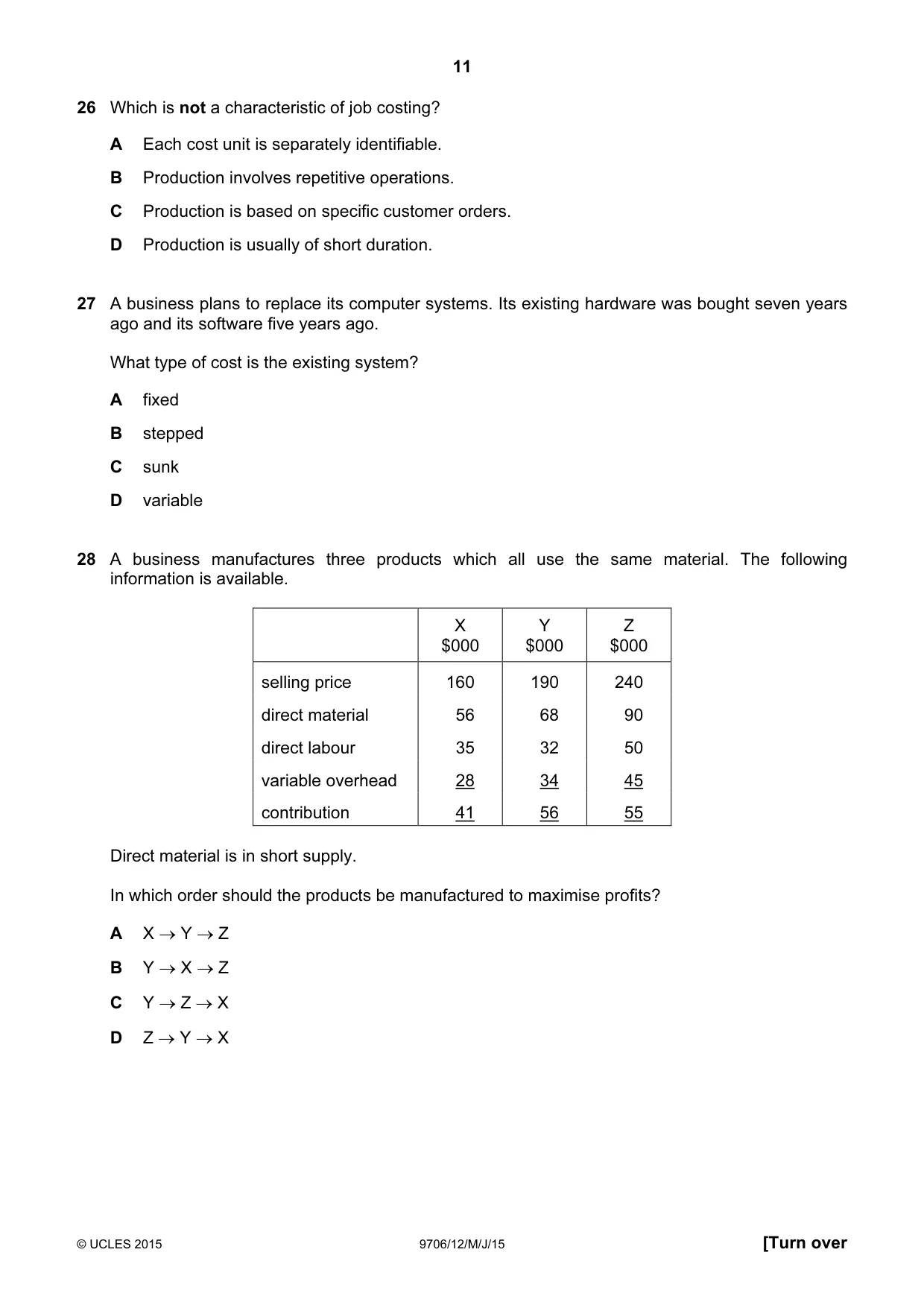
Q26 · Which is not a characteristic of job costing?
26 Which is not a characteristic of job costing? A Each cost unit is separately identifiable. B Production involves repetitive operations. C Production is based on specific customer orders. D Production is usually of short duration.
Mark scheme: B
Q27 · A business plans to replace its computer systems
27 A business plans to replace its computer systems. Its existing hardware was bought seven years ago and its software five years ago. What type of cost is the existing system? A fixed B stepped C sunk D variable
Mark scheme: C
Q28 · A business manufactures three products which all use the same material
28 A business manufactures three products which all use the same material. The following information is available. X Y Z $000 $000 $000 selling price 160 190 240 direct material 56 68 90 direct labour 35 32 50 variable overhead 28 34 45 contribution 41 56 55 Direct material is in short supply. In which order should the products be manufactured to maximise profits? A X → Y → Z B Y → X → Z C Y → Z → X D Z → Y → X
Mark scheme: B
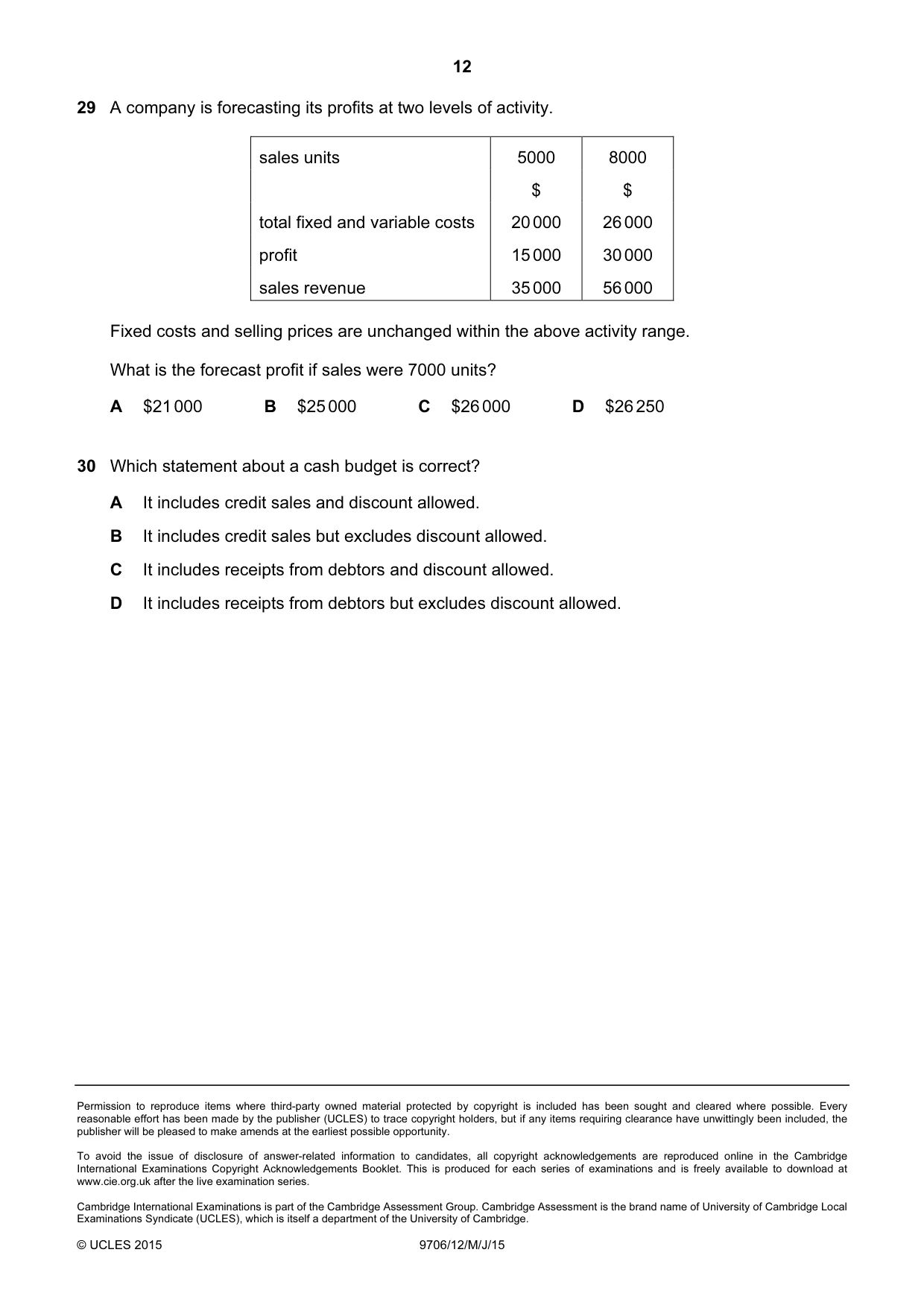
Q29 · A company is forecasting its profits at two levels of activity
29 A company is forecasting its profits at two levels of activity. sales units 5000 8000 $ $ total fixed and variable costs 20 000 26 000 profit 15 000 30 000 sales revenue 35 000 56 000 Fixed costs and selling prices are unchanged within the above activity range. What is the forecast profit if sales were 7000 units? A $21 000 B $25 000 C $26 000 D $26 250
Mark scheme: B
Q30 · Which statement about a cash budget is correct?
30 Which statement about a cash budget is correct? A It includes credit sales and discount allowed. B It includes credit sales but excludes discount allowed. C It includes receipts from debtors and discount allowed. D It includes receipts from debtors but excludes discount allowed.
Mark scheme: D
What was in this paper
The subtopics covered by these 30 questions, and how many questions each got. Open one in a new tab to see every Cambridge question on it.
What you needed in this session
Cambridge’s own grade thresholds for 2015 May/June, Paper 1 · Variant 2. A higher threshold means an easier paper — the bar moves with how the cohort did.