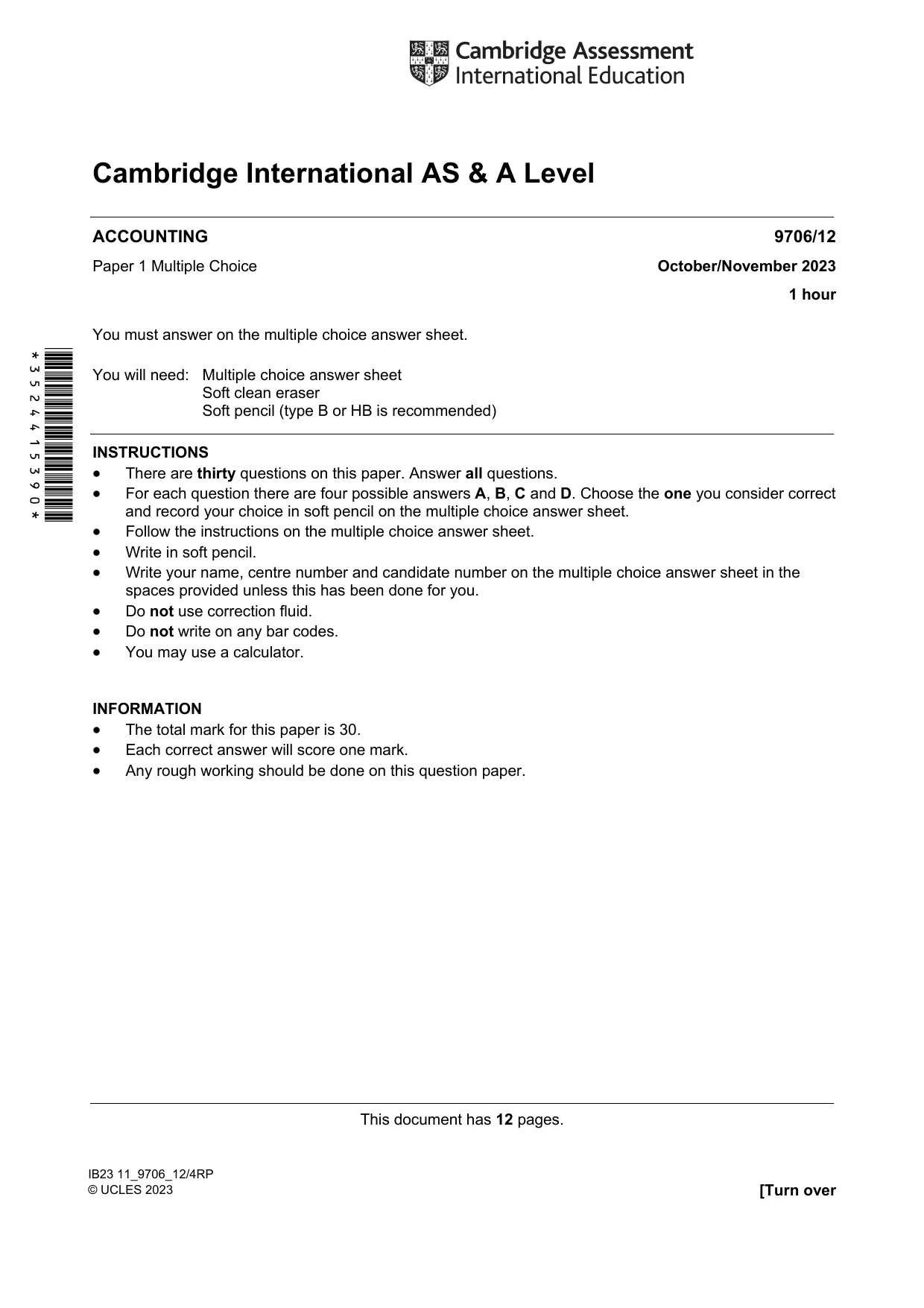
Cambridge A Level Accounting 9706 — 2023 Oct/Nov Paper 1 · Variant 2
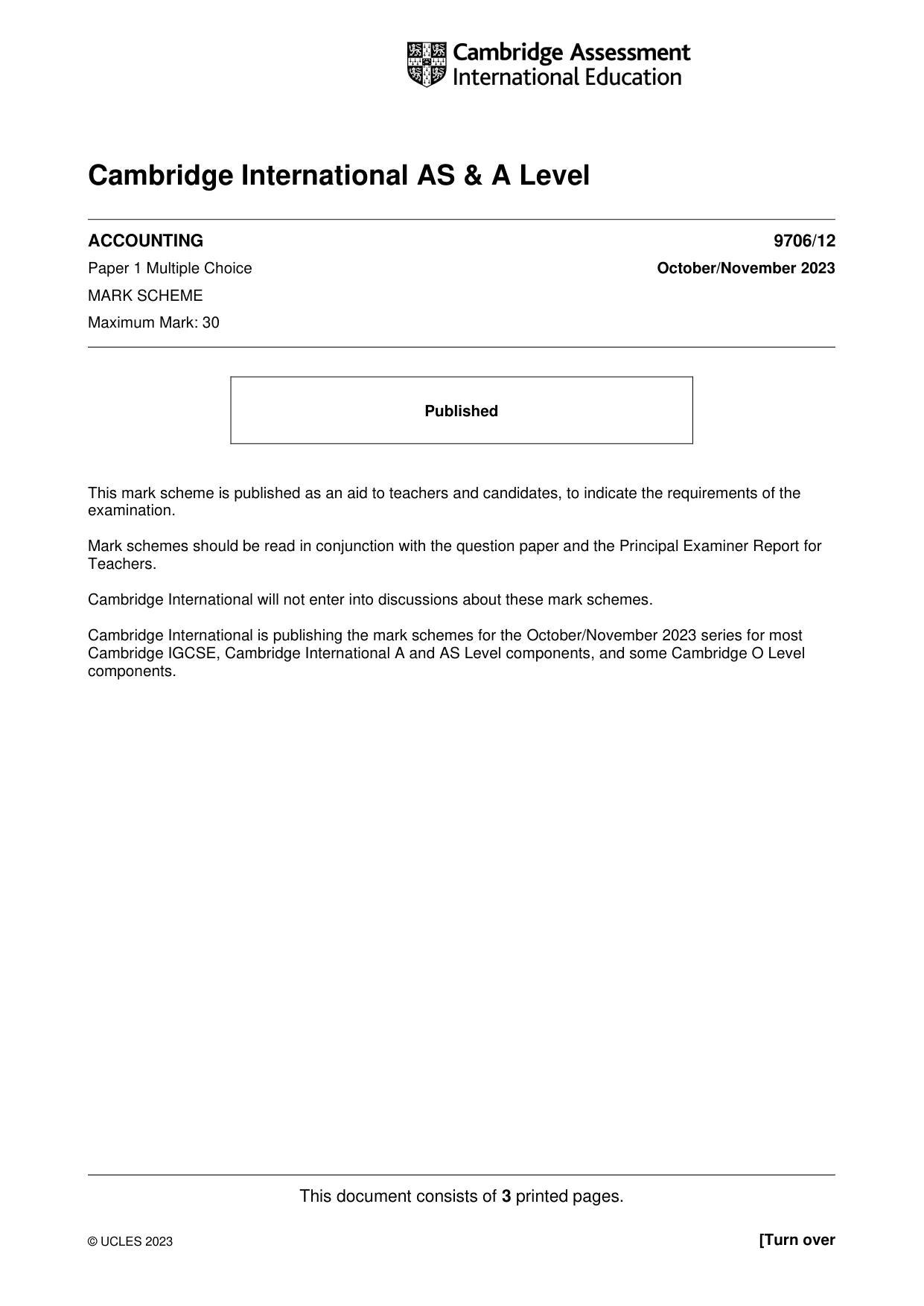
9706/12/O/N/23 · 30 questions · 30 marks · ≈34 min
The question paper and its mark scheme, free to read here and free to download. This is Cambridge’s own paper, exactly as it was sat.
Question paper12 pages
Mark scheme3 pages
Answers below. Sit the paper first if you are practising.
Questions as text
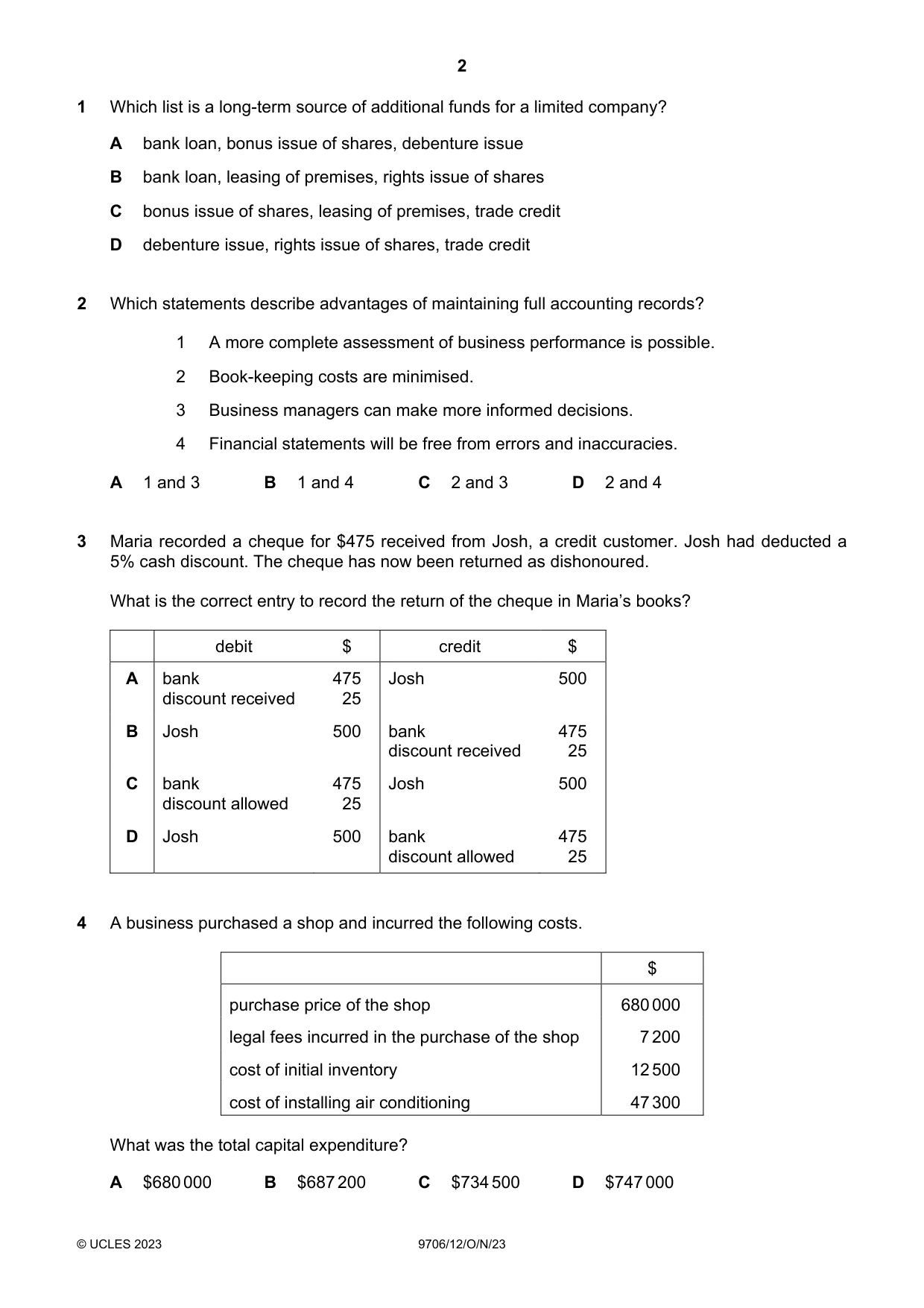
Q1 · Which list is a long-term source of additional funds for a limited company?
1 Which list is a long-term source of additional funds for a limited company? A bank loan, bonus issue of shares, debenture issue B bank loan, leasing of premises, rights issue of shares C bonus issue of shares, leasing of premises, trade credit D debenture issue, rights issue of shares, trade credit
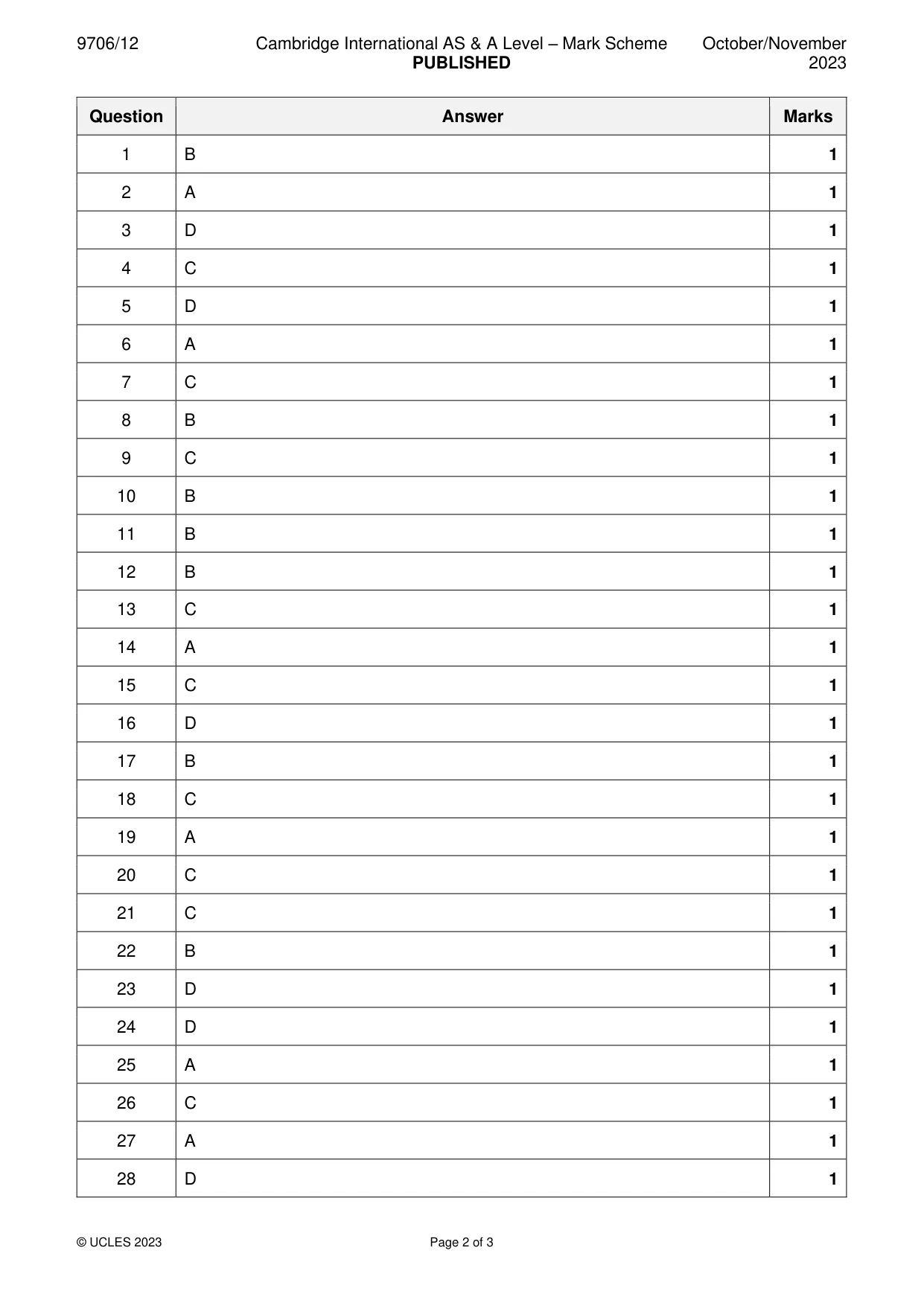
Mark scheme: B
Q2 · Which statements describe advantages of maintaining full accounting records?
2 Which statements describe advantages of maintaining full accounting records? 1 A more complete assessment of business performance is possible. 2 Book-keeping costs are minimised. 3 Business managers can make more informed decisions. 4 Financial statements will be free from errors and inaccuracies. A 1 and 3 B 1 and 4 C 2 and 3 D 2 and 4
Mark scheme: A
Q3 · Maria recorded a cheque for $475 received from Josh, a credit customer
3 Maria recorded a cheque for $475 received from Josh, a credit customer. Josh had deducted a 5% cash discount. The cheque has now been returned as dishonoured. What is the correct entry to record the return of the cheque in Maria’s books? debit $ credit $ A bank 475 Josh 500 discount received 25 B Josh 500 bank 475 discount received 25 C bank 475 Josh 500 discount allowed 25 D Josh 500 bank 475 discount allowed 25
Mark scheme: D
Q4 · A business purchased a shop and incurred the following costs
4 A business purchased a shop and incurred the following costs. $ purchase price of the shop 680 000 legal fees incurred in the purchase of the shop 7 200 cost of initial inventory 12 500 cost of installing air conditioning 47 300 What was the total capital expenditure? A $680 000 B $687 200 C $734 500 D $747 000
Mark scheme: C
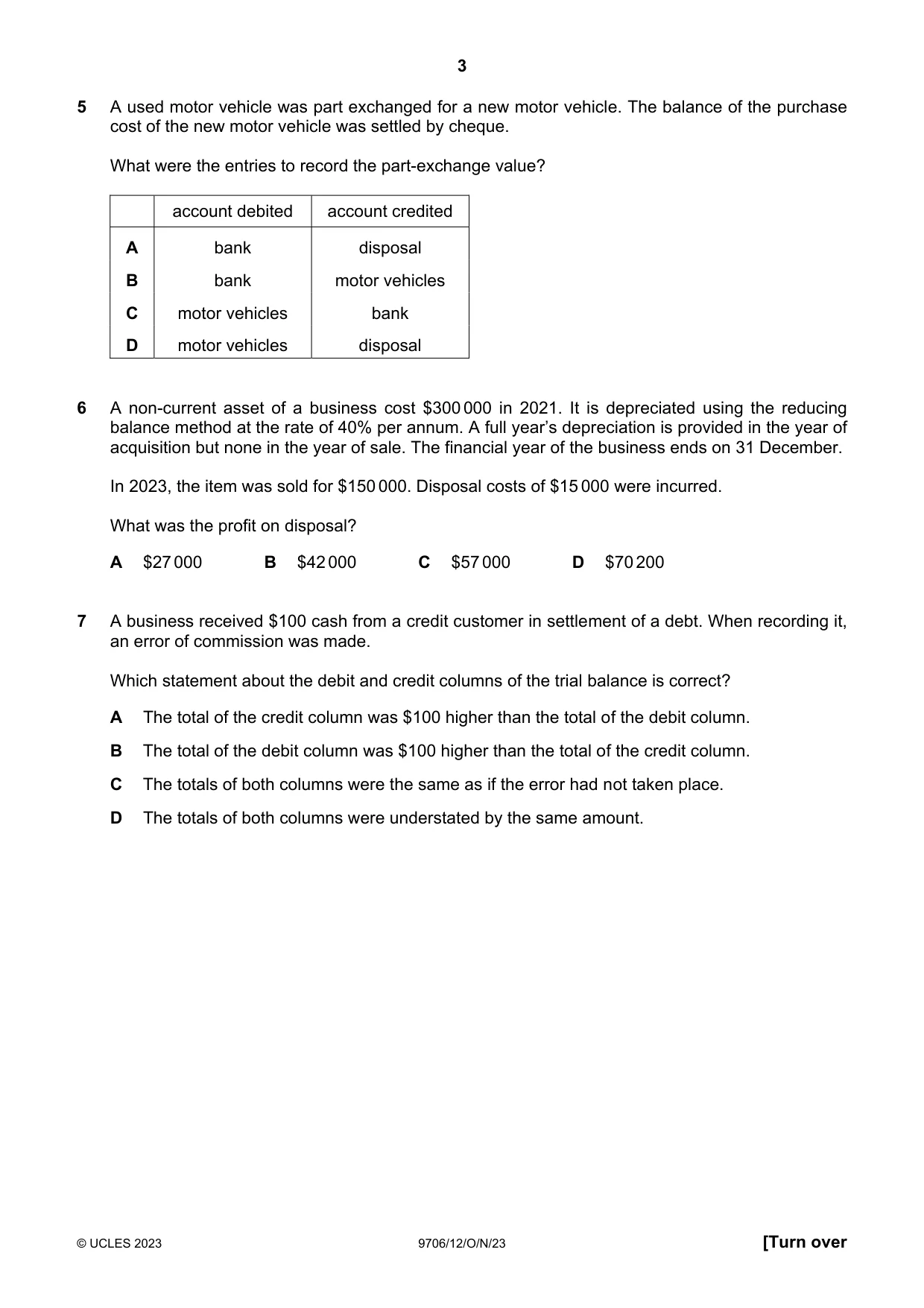
Q5 · A used motor vehicle was part exchanged for a new motor vehicle
5 A used motor vehicle was part exchanged for a new motor vehicle. The balance of the purchase cost of the new motor vehicle was settled by cheque. What were the entries to record the part-exchange value? account debited account credited A bank disposal B bank motor vehicles C motor vehicles bank D motor vehicles disposal
Mark scheme: D
Q6 · A non-current asset of a business cost $300 000 in 2021
6 A non-current asset of a business cost $300 000 in 2021. It is depreciated using the reducing balance method at the rate of 40% per annum. A full year’s depreciation is provided in the year of acquisition but none in the year of sale. The financial year of the business ends on 31 December. In 2023, the item was sold for $150 000. Disposal costs of $15 000 were incurred. What was the profit on disposal? A $27 000 B $42 000 C $57 000 D $70 200
Mark scheme: A
Q7 · A business received $100 cash from a credit customer in settlement of a debt
7 A business received $100 cash from a credit customer in settlement of a debt. When recording it, an error of commission was made. Which statement about the debit and credit columns of the trial balance is correct? A The total of the credit column was $100 higher than the total of the debit column. B The total of the debit column was $100 higher than the total of the credit column. C The totals of both columns were the same as if the error had not taken place. D The totals of both columns were understated by the same amount.
Mark scheme: C
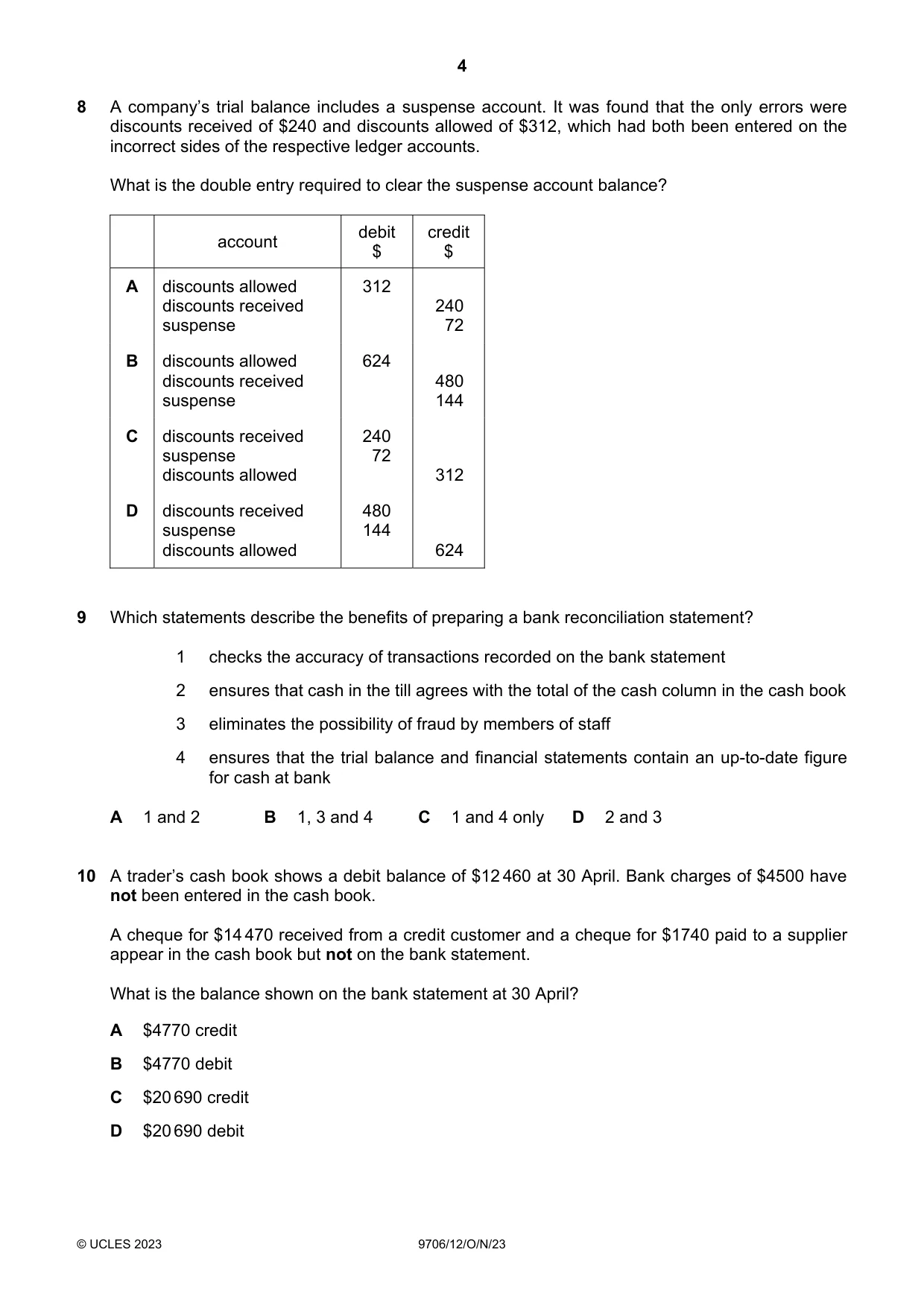
Q8 · A company’s trial balance includes a suspense account
8 A company’s trial balance includes a suspense account. It was found that the only errors were discounts received of $240 and discounts allowed of $312, which had both been entered on the incorrect sides of the respective ledger accounts. What is the double entry required to clear the suspense account balance? debit credit account $ $ A discounts allowed 312 discounts received 240 suspense 72 B discounts allowed 624 discounts received 480 suspense 144 C discounts received 240 suspense 72 discounts allowed 312 D discounts received 480 suspense 144 discounts allowed 624
Mark scheme: B
Q9 · Which statements describe the benefits of preparing a bank reconciliation statement?
9 Which statements describe the benefits of preparing a bank reconciliation statement? 1 checks the accuracy of transactions recorded on the bank statement 2 ensures that cash in the till agrees with the total of the cash column in the cash book 3 eliminates the possibility of fraud by members of staff 4 ensures that the trial balance and financial statements contain an up-to-date figure for cash at bank A 1 and 2 B 1, 3 and 4 C 1 and 4 only D 2 and 3
Mark scheme: C
Q10 · A trader’s cash book shows a debit balance of $12 460 at 30 April
10 A trader’s cash book shows a debit balance of $12 460 at 30 April. Bank charges of $4500 have not been entered in the cash book. A cheque for $14 470 received from a credit customer and a cheque for $1740 paid to a supplier appear in the cash book but not on the bank statement. What is the balance shown on the bank statement at 30 April? A $4770 credit B $4770 debit C $20 690 credit D $20 690 debit
Mark scheme: B
Q11 · A credit customer gave cash to a sales ledger clerk in part settlement of her debt
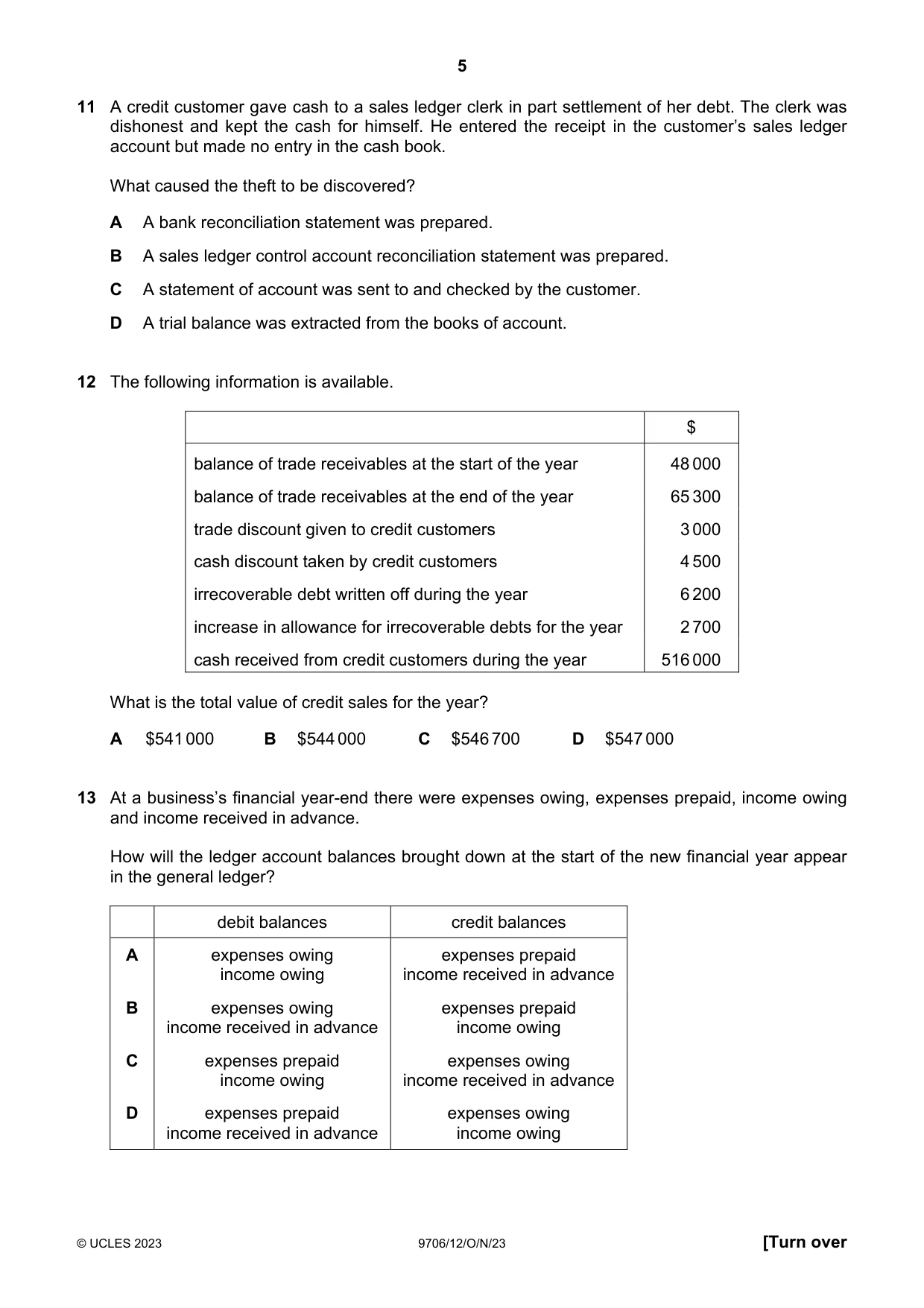
11 A credit customer gave cash to a sales ledger clerk in part settlement of her debt. The clerk was dishonest and kept the cash for himself. He entered the receipt in the customer’s sales ledger account but made no entry in the cash book. What caused the theft to be discovered? A A bank reconciliation statement was prepared. B A sales ledger control account reconciliation statement was prepared. C A statement of account was sent to and checked by the customer. D A trial balance was extracted from the books of account.
Mark scheme: B
Q12 · The following information is available
12 The following information is available. $ balance of trade receivables at the start of the year 48 000 balance of trade receivables at the end of the year 65 300 trade discount given to credit customers 3 000 cash discount taken by credit customers 4 500 irrecoverable debt written off during the year 6 200 increase in allowance for irrecoverable debts for the year 2 700 cash received from credit customers during the year 516 000 What is the total value of credit sales for the year? A $541 000 B $544 000 C $546 700 D $547 000
Mark scheme: B
Q13 · At a business’s financial year-end there were expenses owing, expenses prepaid, income…
13 At a business’s financial year-end there were expenses owing, expenses prepaid, income owing and income received in advance. How will the ledger account balances brought down at the start of the new financial year appear in the general ledger? debit balances credit balances A expenses owing expenses prepaid income owing income received in advance B expenses owing expenses prepaid income received in advance income owing C expenses prepaid expenses owing income owing income received in advance D expenses prepaid expenses owing income received in advance income owing
Mark scheme: C
Q14 · A business prepared its statement of profit or loss for the year ended 31 December
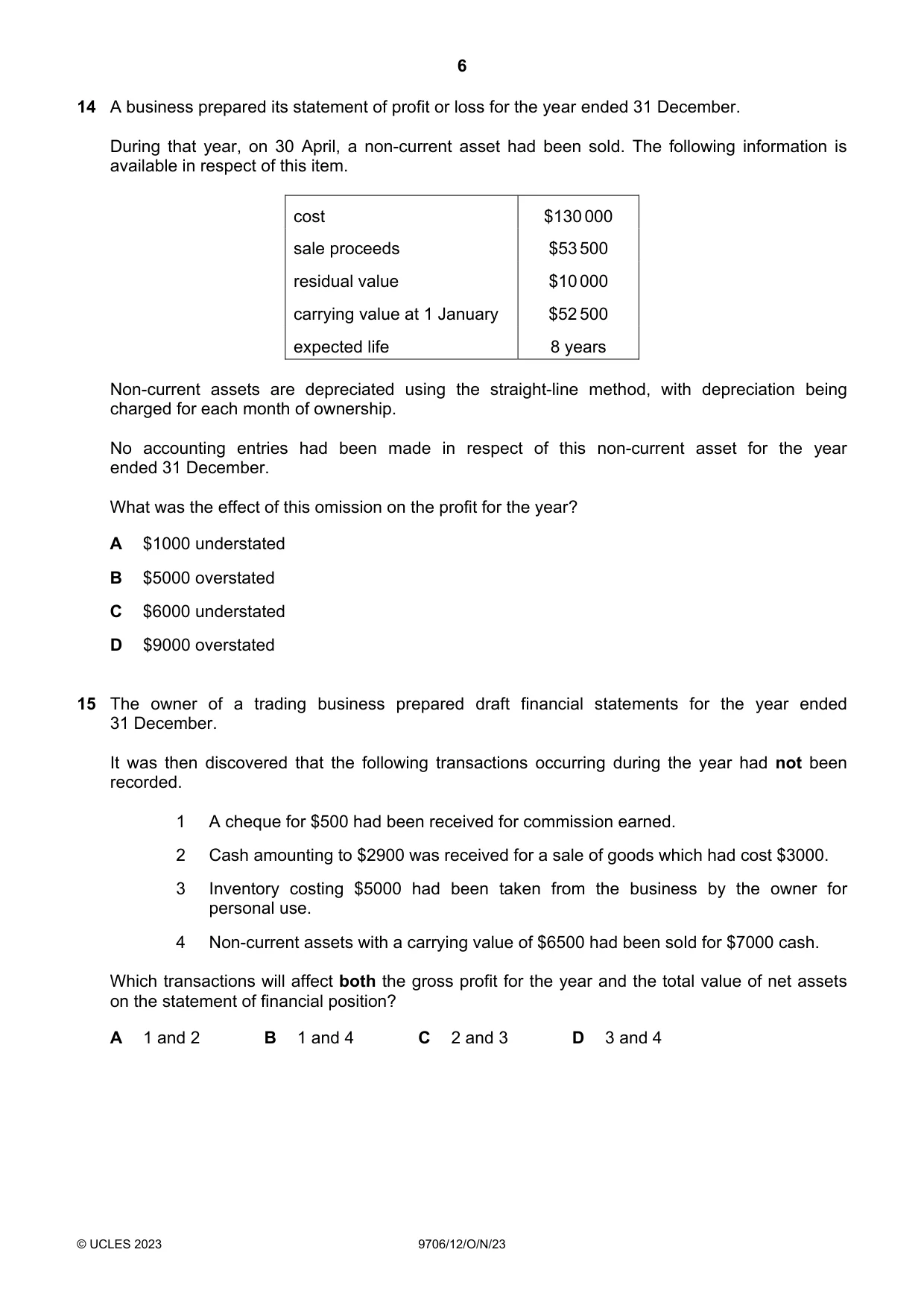
14 A business prepared its statement of profit or loss for the year ended 31 December. During that year, on 30 April, a non-current asset had been sold. The following information is available in respect of this item. cost $130 000 sale proceeds $53 500 residual value $10 000 carrying value at 1 January $52 500 expected life 8 years Non-current assets are depreciated using the straight-line method, with depreciation being charged for each month of ownership. No accounting entries had been made in respect of this non-current asset for the year ended 31 December. What was the effect of this omission on the profit for the year? A $1000 understated B $5000 overstated C $6000 understated D $9000 overstated
Mark scheme: A
Q15 · The owner of a trading business prepared draft financial statements for the year ended 31…
15 The owner of a trading business prepared draft financial statements for the year ended 31 December. It was then discovered that the following transactions occurring during the year had not been recorded. 1 A cheque for $500 had been received for commission earned. 2 Cash amounting to $2900 was received for a sale of goods which had cost $3000. 3 Inventory costing $5000 had been taken from the business by the owner for personal use. 4 Non-current assets with a carrying value of $6500 had been sold for $7000 cash. Which transactions will affect both the gross profit for the year and the total value of net assets on the statement of financial position? A 1 and 2 B 1 and 4 C 2 and 3 D 3 and 4
Mark scheme: C
Q16 · A business sells some inventory for $80 on credit
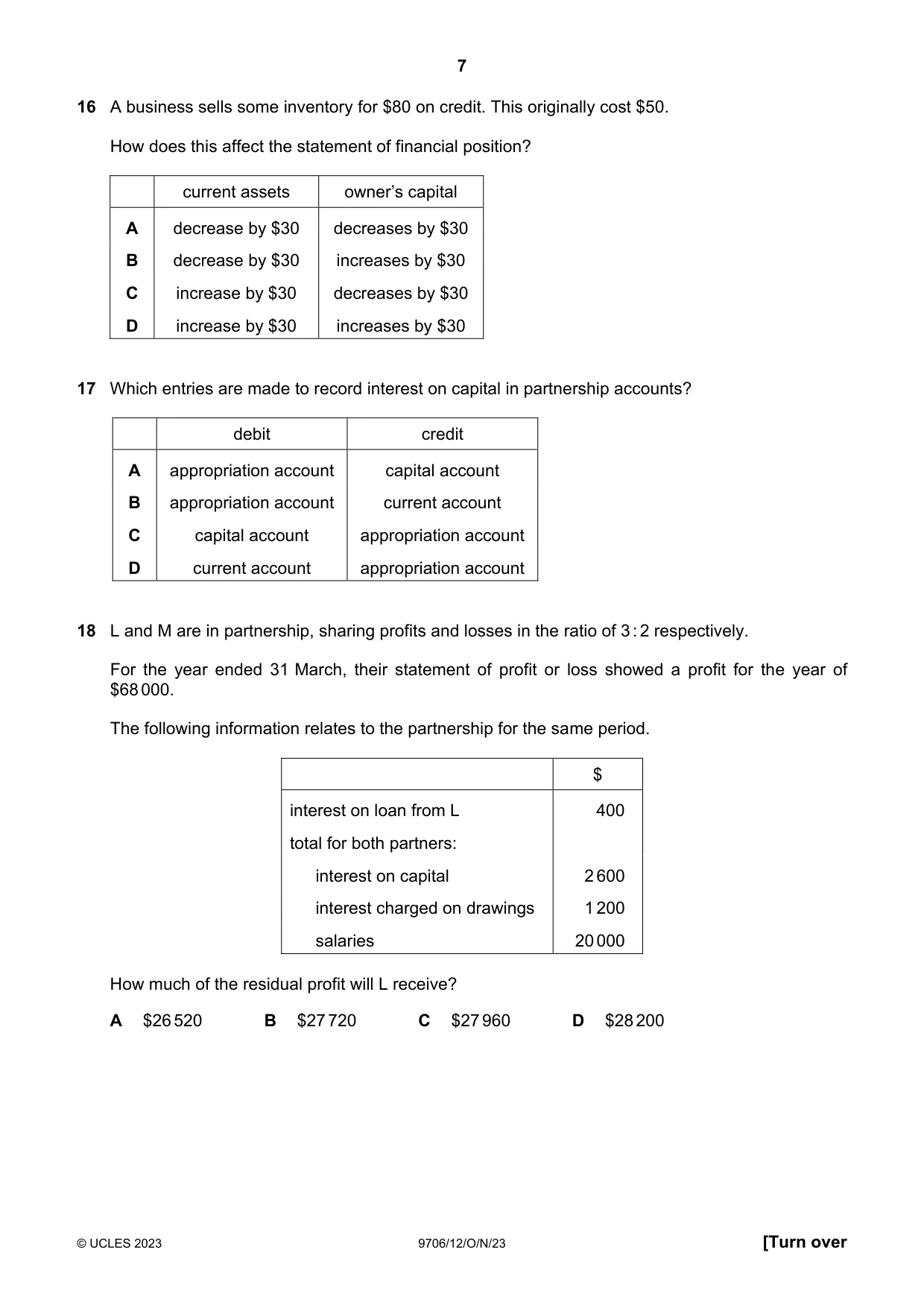
16 A business sells some inventory for $80 on credit. This originally cost $50. How does this affect the statement of financial position? current assets owner’s capital A decrease by $30 decreases by $30 B decrease by $30 increases by $30 C increase by $30 decreases by $30 D increase by $30 increases by $30
Mark scheme: D
Q17 · Which entries are made to record interest on capital in partnership accounts?
17 Which entries are made to record interest on capital in partnership accounts? debit credit A appropriation account capital account B appropriation account current account C capital account appropriation account D current account appropriation account
Mark scheme: B
Q18 · L and M are in partnership, sharing profits and losses in the ratio of 3 : 2 respectively
18 L and M are in partnership, sharing profits and losses in the ratio of 3 : 2 respectively. For the year ended 31 March, their statement of profit or loss showed a profit for the year of $68 000. The following information relates to the partnership for the same period. $ interest on loan from L 400 total for both partners: interest on capital 2 600 interest charged on drawings 1 200 salaries 20 000 How much of the residual profit will L receive? A $26 520 B $27 720 C $27 960 D $28 200
Mark scheme: C
Q19 · Which reserves are revenue reserves?
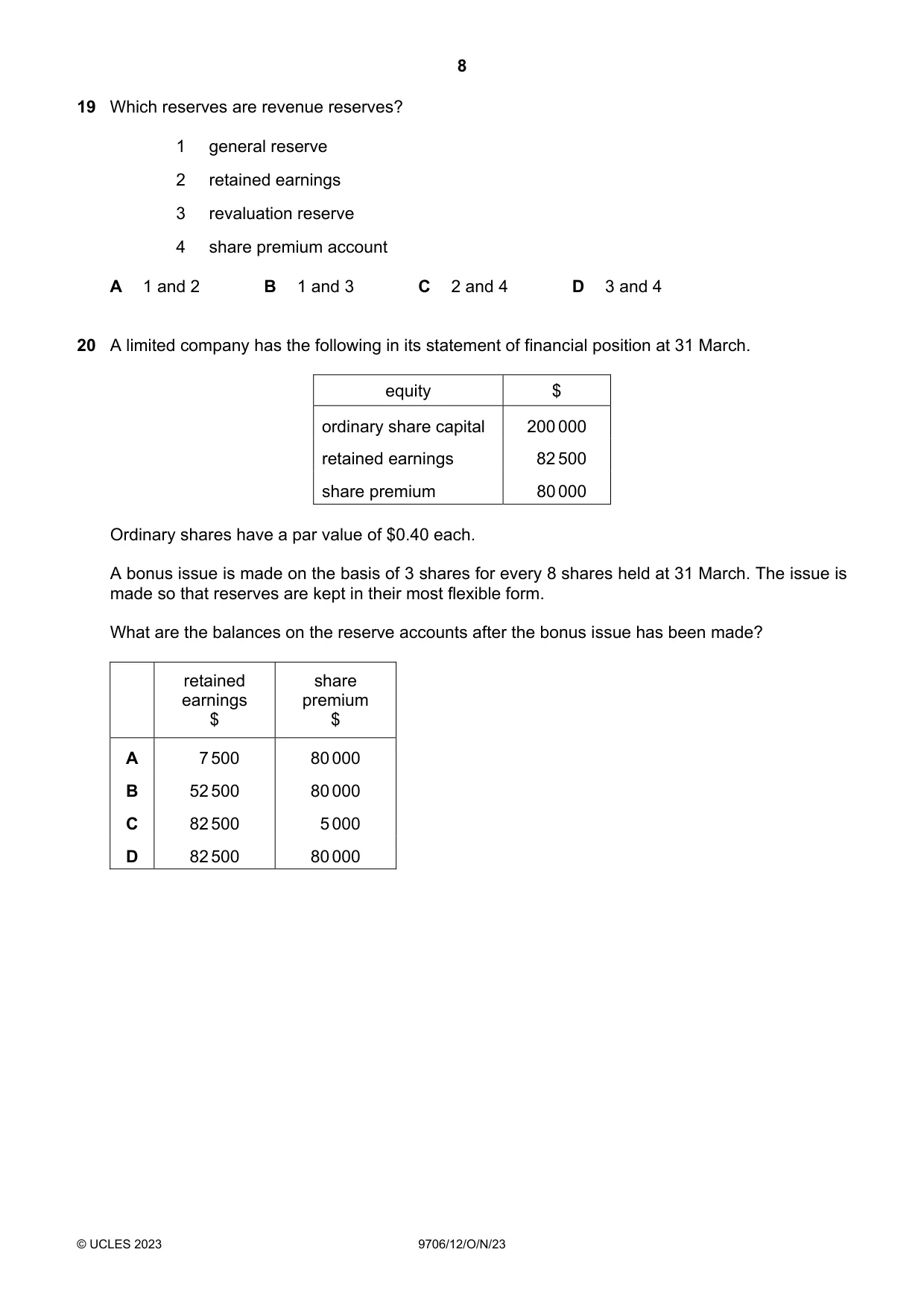
19 Which reserves are revenue reserves? 1 general reserve 2 retained earnings 3 revaluation reserve 4 share premium account A 1 and 2 B 1 and 3 C 2 and 4 D 3 and 4
Mark scheme: A
Q20 · A limited company has the following in its statement of financial position at 31 March
20 A limited company has the following in its statement of financial position at 31 March. equity $ ordinary share capital 200 000 retained earnings 82 500 share premium 80 000 Ordinary shares have a par value of $0.40 each. A bonus issue is made on the basis of 3 shares for every 8 shares held at 31 March. The issue is made so that reserves are kept in their most flexible form. What are the balances on the reserve accounts after the bonus issue has been made? retained share earnings premium $ $ A 7 500 80 000 B 52 500 80 000 C 82 500 5 000 D 82 500 80 000
Mark scheme: C
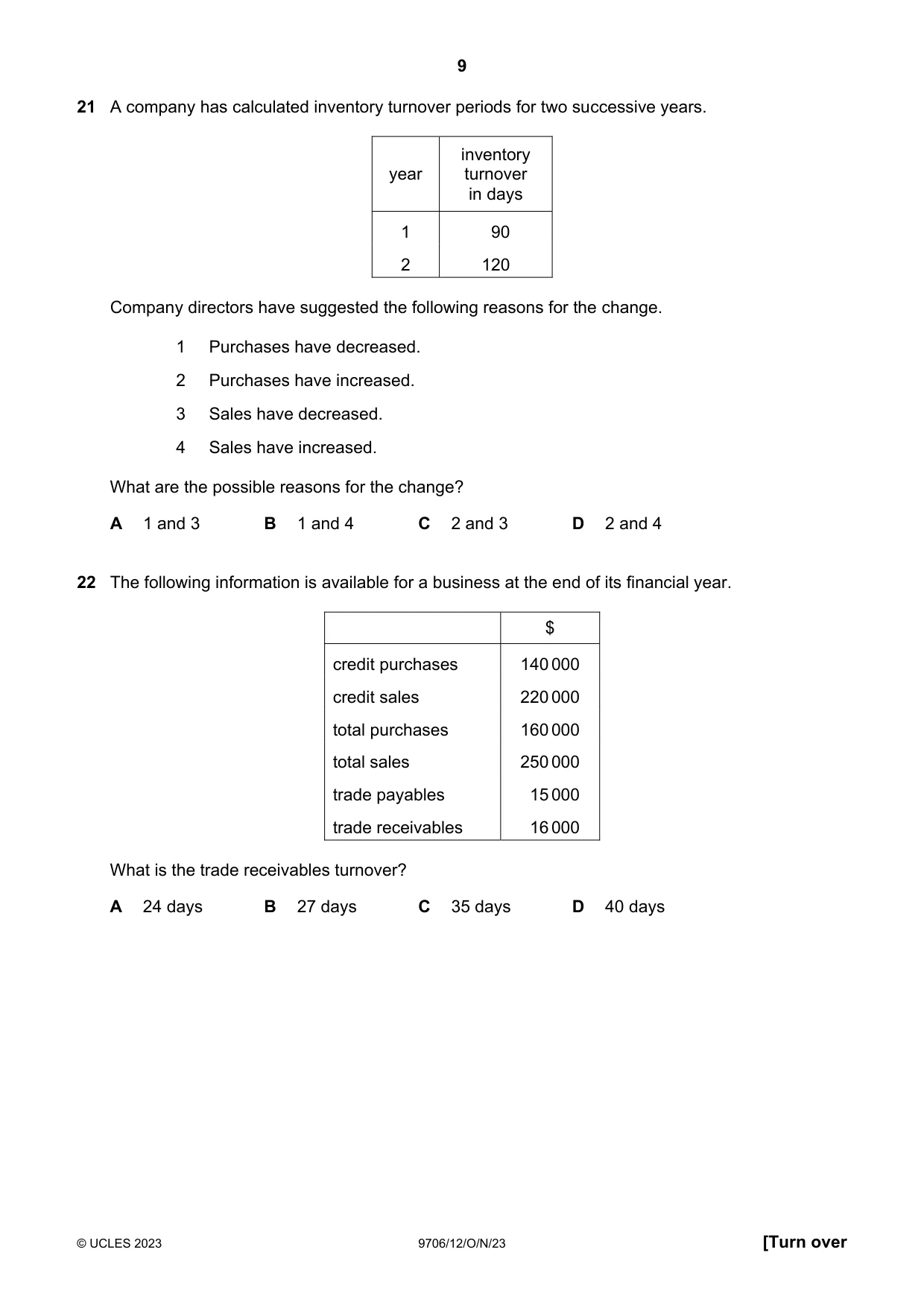
Q21 · A company has calculated inventory turnover periods for two successive years
21 A company has calculated inventory turnover periods for two successive years. inventory year turnover in days 1 90 2 120 Company directors have suggested the following reasons for the change. 1 Purchases have decreased. 2 Purchases have increased. 3 Sales have decreased. 4 Sales have increased. What are the possible reasons for the change? A 1 and 3 B 1 and 4 C 2 and 3 D 2 and 4
Mark scheme: C
More questions on Analysis and communication of accounting information
Q22 · The following information is available for a business at the end of its financial year
22 The following information is available for a business at the end of its financial year. $ credit purchases 140 000 credit sales 220 000 total purchases 160 000 total sales 250 000 trade payables 15 000 trade receivables 16 000 What is the trade receivables turnover? A 24 days B 27 days C 35 days D 40 days
Mark scheme: B
More questions on Analysis and communication of accounting information
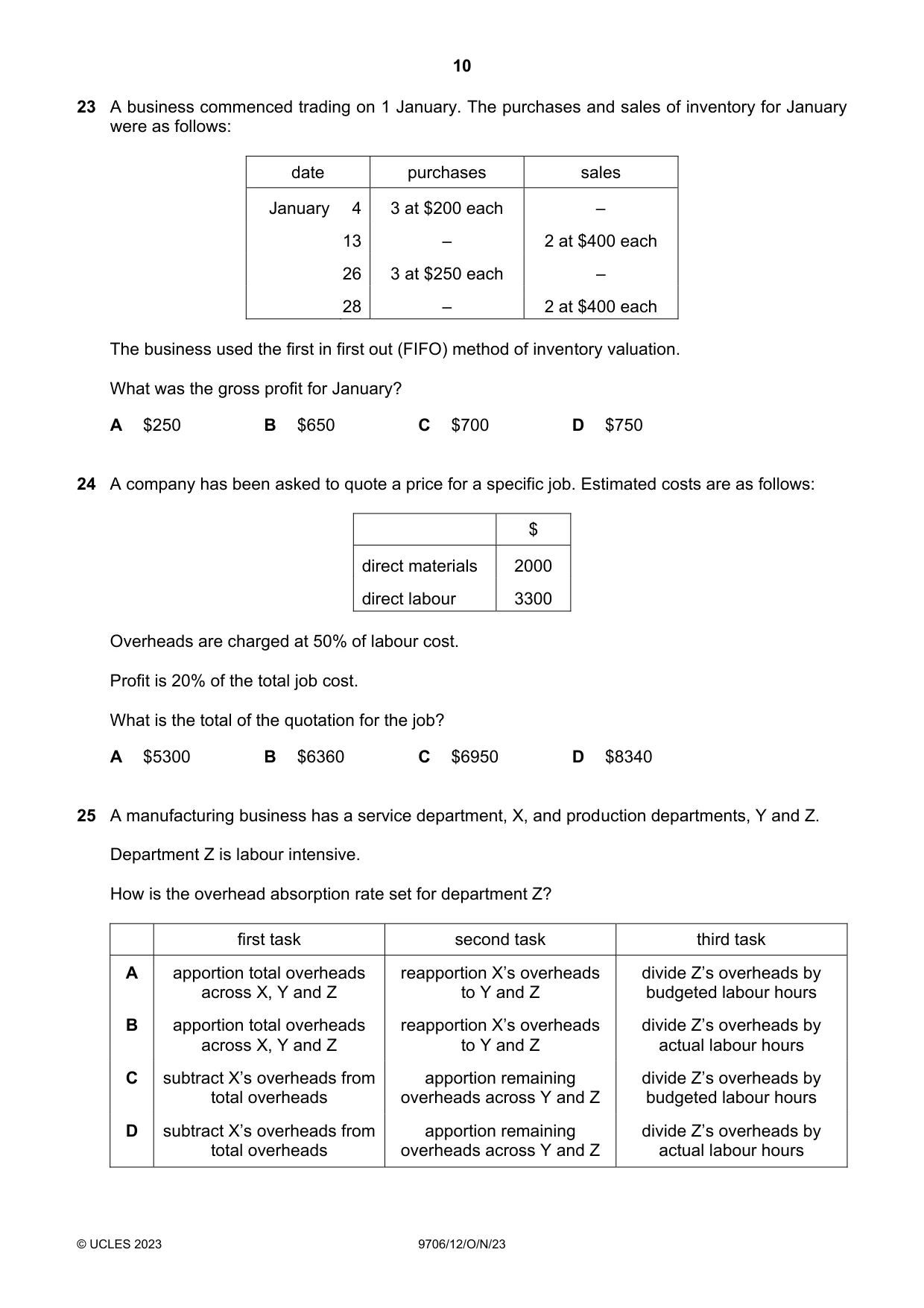
Q23 · A business commenced trading on 1 January
23 A business commenced trading on 1 January. The purchases and sales of inventory for January were as follows: date purchases sales January 4 3 at $200 each – 13 – 2 at $400 each 26 3 at $250 each – 28 – 2 at $400 each The business used the first in first out (FIFO) method of inventory valuation. What was the gross profit for January? A $250 B $650 C $700 D $750
Mark scheme: D
Q24 · A company has been asked to quote a price for a specific job
24 A company has been asked to quote a price for a specific job. Estimated costs are as follows: $ direct materials 2000 direct labour 3300 Overheads are charged at 50% of labour cost. Profit is 20% of the total job cost. What is the total of the quotation for the job? A $5300 B $6360 C $6950 D $8340
Mark scheme: D
Q25 · A manufacturing business has a service department, X, and production departments, Y and Z
25 A manufacturing business has a service department, X, and production departments, Y and Z. Department Z is labour intensive. How is the overhead absorption rate set for department Z? first task second task third task A apportion total overheads reapportion X’s overheads divide Z’s overheads by across X, Y and Z to Y and Z budgeted labour hours B apportion total overheads reapportion X’s overheads divide Z’s overheads by across X, Y and Z to Y and Z actual labour hours C subtract X’s overheads from apportion remaining divide Z’s overheads by total overheads overheads across Y and Z budgeted labour hours D subtract X’s overheads from apportion remaining divide Z’s overheads by total overheads overheads across Y and Z actual labour hours
Mark scheme: A
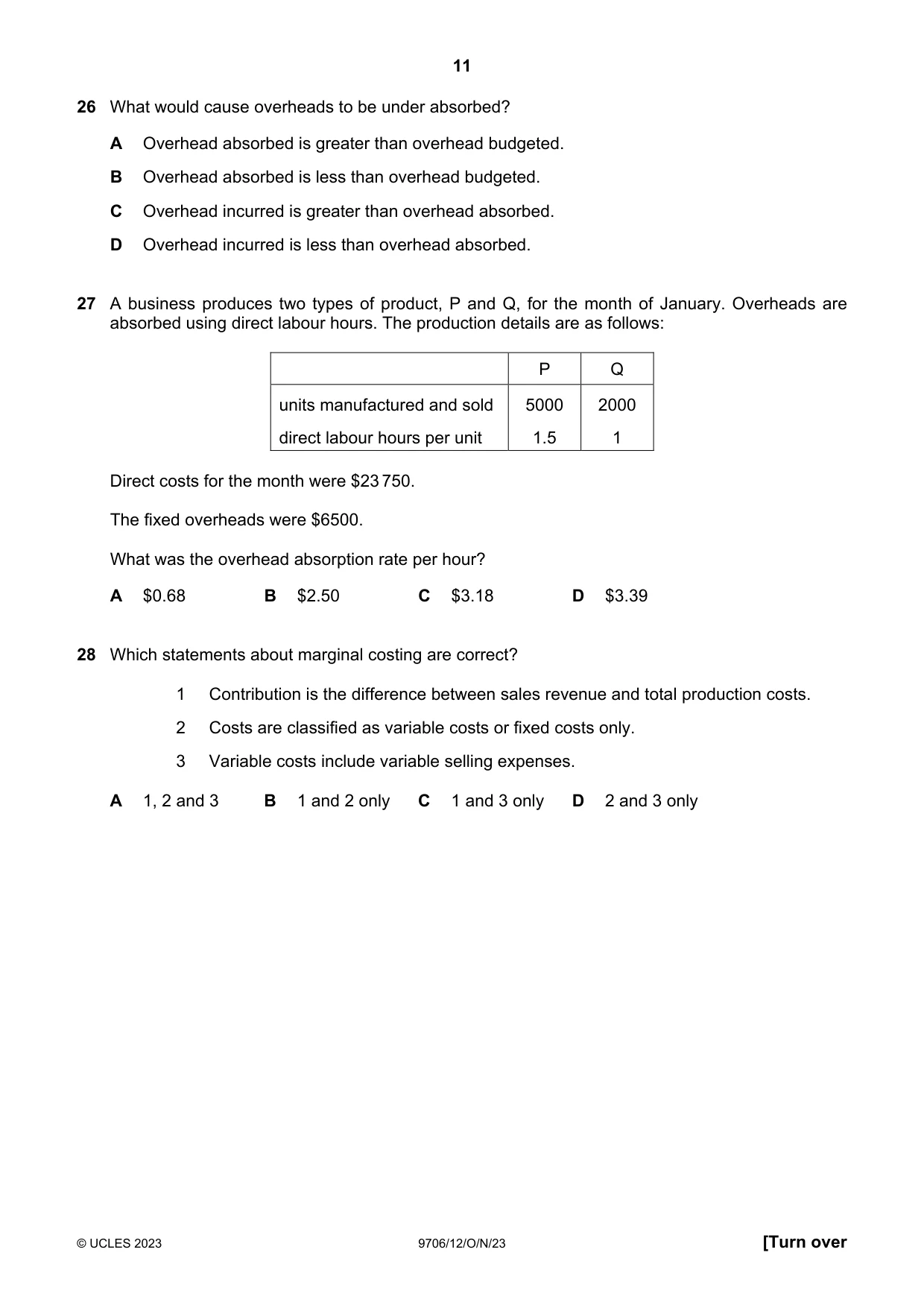
Q26 · What would cause overheads to be under absorbed?
26 What would cause overheads to be under absorbed? A Overhead absorbed is greater than overhead budgeted. B Overhead absorbed is less than overhead budgeted. C Overhead incurred is greater than overhead absorbed. D Overhead incurred is less than overhead absorbed.
Mark scheme: C
Q27 · A business produces two types of product, P and Q, for the month of January
27 A business produces two types of product, P and Q, for the month of January. Overheads are absorbed using direct labour hours. The production details are as follows: P Q units manufactured and sold 5000 2000 direct labour hours per unit 1.5 1 Direct costs for the month were $23 750. The fixed overheads were $6500. What was the overhead absorption rate per hour? A $0.68 B $2.50 C $3.18 D $3.39
Mark scheme: A
Q28 · Which statements about marginal costing are correct?
28 Which statements about marginal costing are correct? 1 Contribution is the difference between sales revenue and total production costs. 2 Costs are classified as variable costs or fixed costs only. 3 Variable costs include variable selling expenses. A 1, 2 and 3 B 1 and 2 only C 1 and 3 only D 2 and 3 only
Mark scheme: D
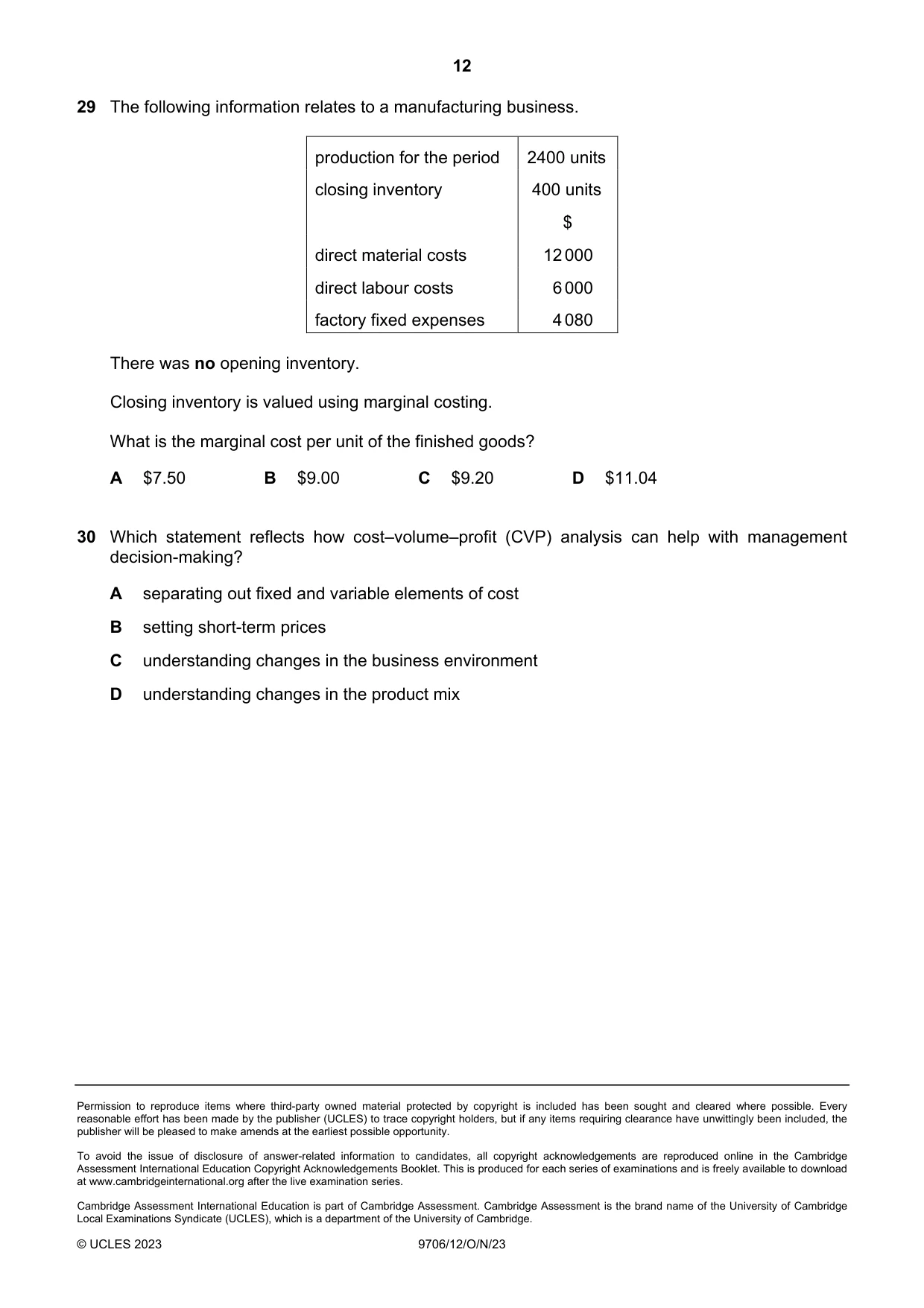
Q29 · The following information relates to a manufacturing business
29 The following information relates to a manufacturing business. production for the period 2400 units closing inventory 400 units $ direct material costs 12 000 direct labour costs 6 000 factory fixed expenses 4 080 There was no opening inventory. Closing inventory is valued using marginal costing. What is the marginal cost per unit of the finished goods? A $7.50 B $9.00 C $9.20 D $11.04
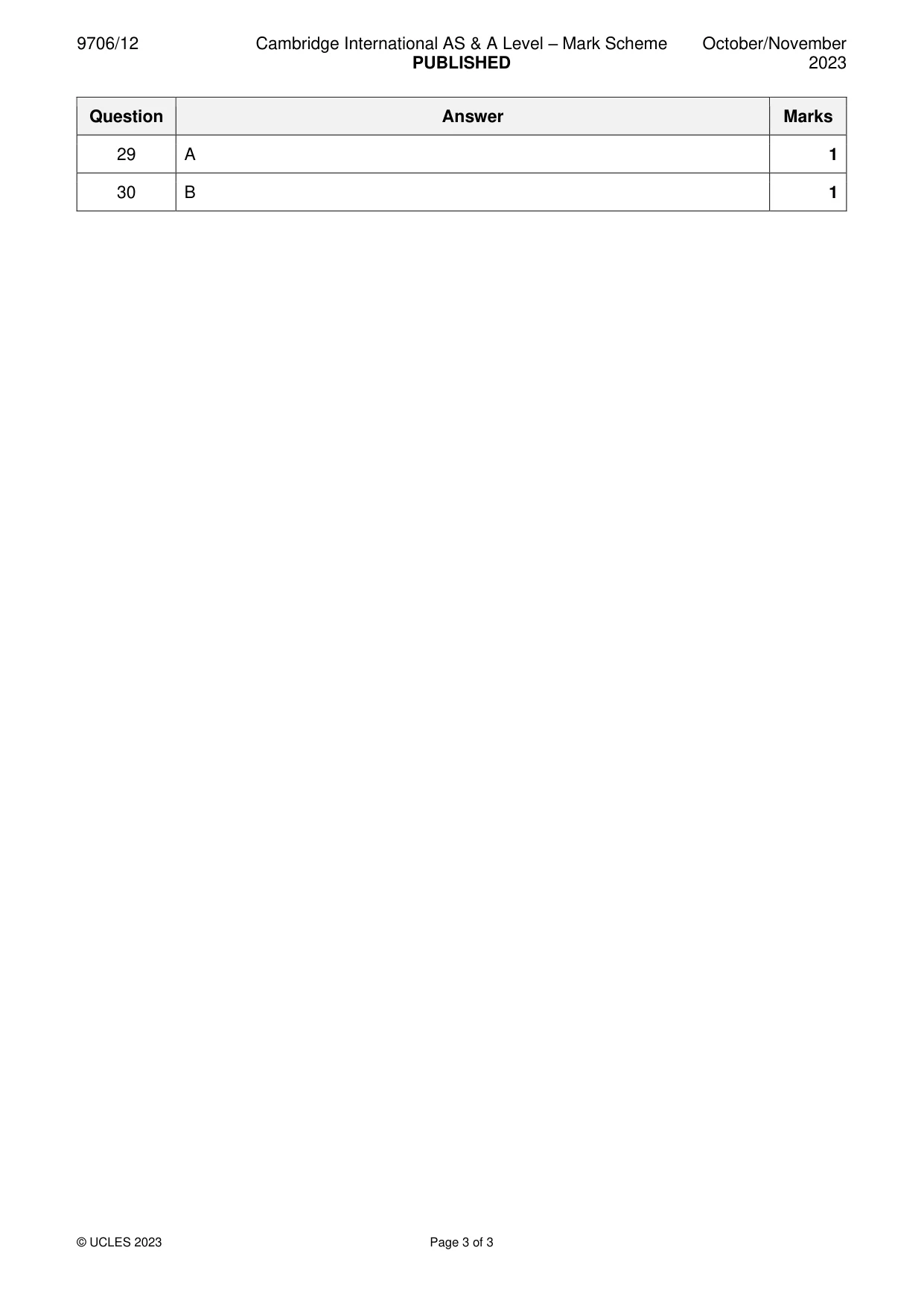
Mark scheme: A
Q30 · Which statement reflects how cost–volume–profit (CVP) analysis can help with management…
30 Which statement reflects how cost–volume–profit (CVP) analysis can help with management decision-making? A separating out fixed and variable elements of cost B setting short-term prices C understanding changes in the business environment D understanding changes in the product mix
Mark scheme: B
More questions on Analysis and communication of accounting information
What was in this paper
The subtopics covered by these 30 questions, and how many questions each got. Open one in a new tab to see every Cambridge question on it.
What you needed in this session
Cambridge’s own grade thresholds for 2023 Oct/Nov, Paper 1 · Variant 2. A higher threshold means an easier paper — the bar moves with how the cohort did.