Cambridge A Level Accounting 9706 — 2025 Oct/Nov Paper 1 · Variant 3
9706/13/O/N/25 · 30 questions · 30 marks · ≈34 min
The question paper and its mark scheme, free to read here and free to download. This is Cambridge’s own paper, exactly as it was sat.
Question paper12 pages
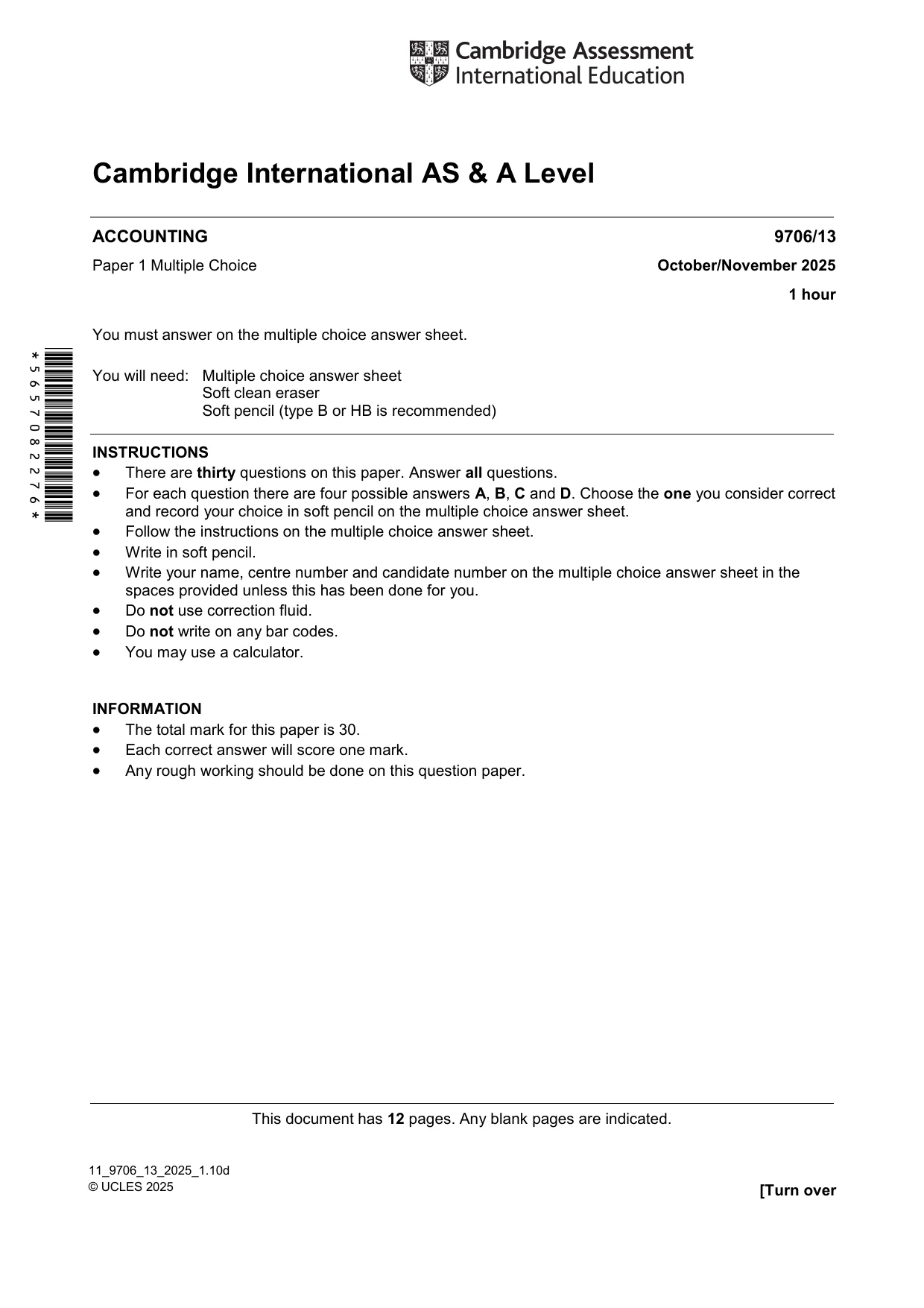
Mark scheme3 pages
Answers below. Sit the paper first if you are practising.
Questions as text
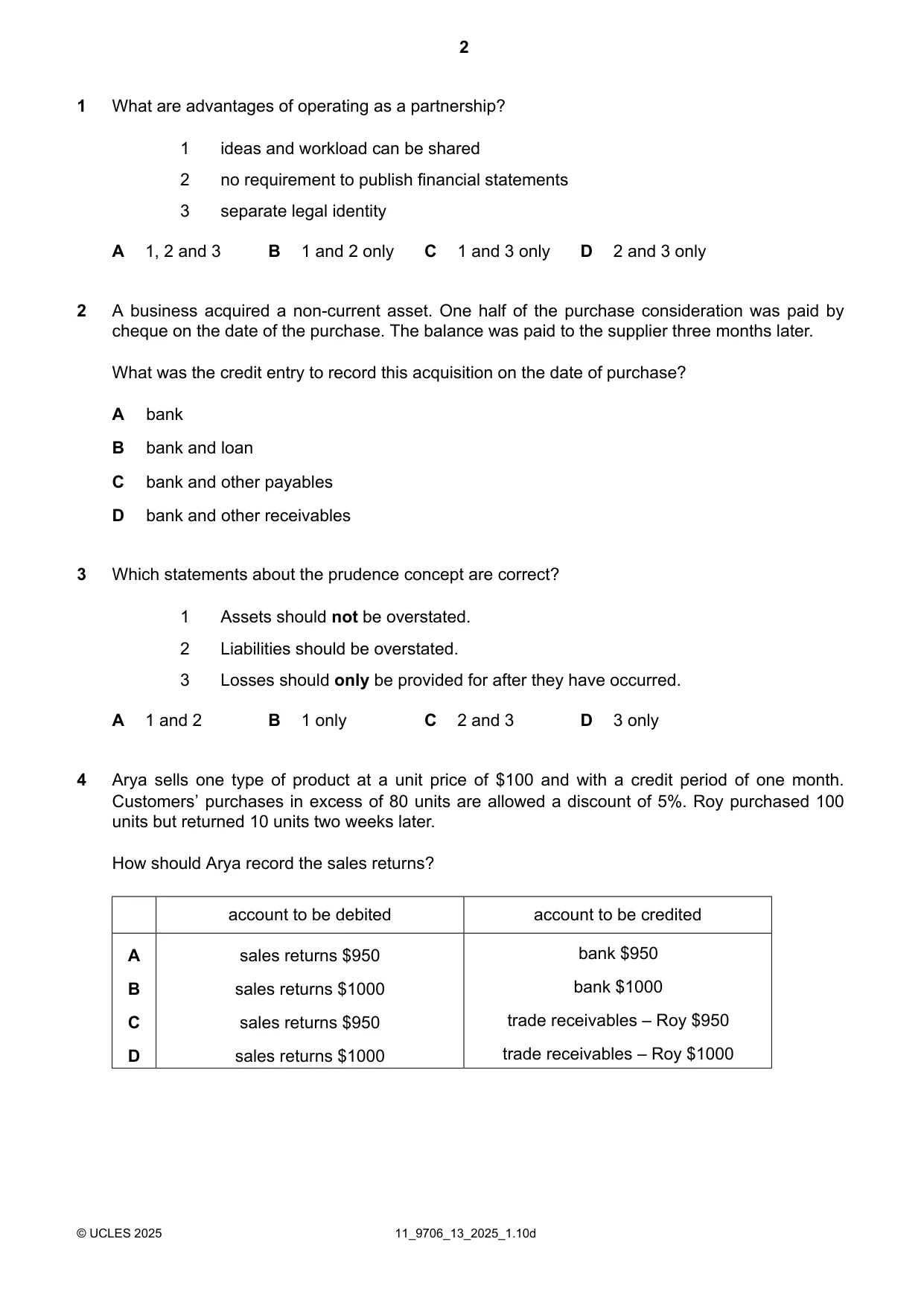
Q1 · What are advantages of operating as a partnership?
1 What are advantages of operating as a partnership? 1 ideas and workload can be shared 2 no requirement to publish financial statements 3 separate legal identity A 1, 2 and 3 B 1 and 2 only C 1 and 3 only D 2 and 3 only
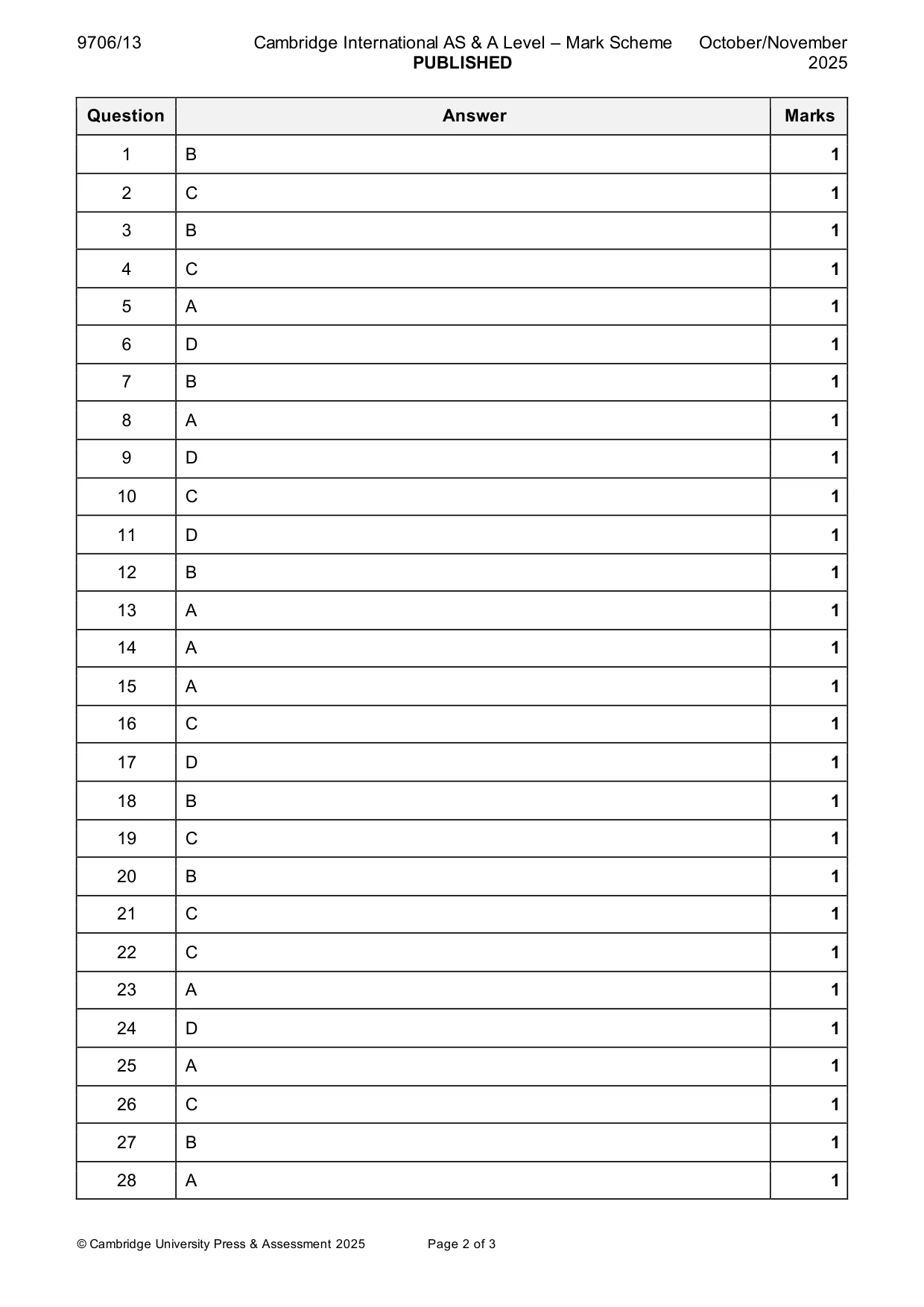
Mark scheme: B
Q2 · A business acquired a non-current asset
2 A business acquired a non-current asset. One half of the purchase consideration was paid by cheque on the date of the purchase. The balance was paid to the supplier three months later. What was the credit entry to record this acquisition on the date of purchase? A bank B bank and loan C bank and other payables D bank and other receivables
Mark scheme: C
Q3 · Which statements about the prudence concept are correct?
3 Which statements about the prudence concept are correct? 1 Assets should not be overstated. 2 Liabilities should be overstated. 3 Losses should only be provided for after they have occurred. A 1 and 2 B 1 only C 2 and 3 D 3 only
Mark scheme: B
Q4 · Arya sells one type of product at a unit price of $100 and with a credit period of one…
4 Arya sells one type of product at a unit price of $100 and with a credit period of one month. Customers’ purchases in excess of 80 units are allowed a discount of 5%. Roy purchased 100 units but returned 10 units two weeks later. How should Arya record the sales returns? account to be debited account to be credited A sales returns $950 bank $950 B sales returns $1000 bank $1000 C sales returns $950 trade receivables – Roy $950 D sales returns $1000 trade receivables – Roy $1000
Mark scheme: C
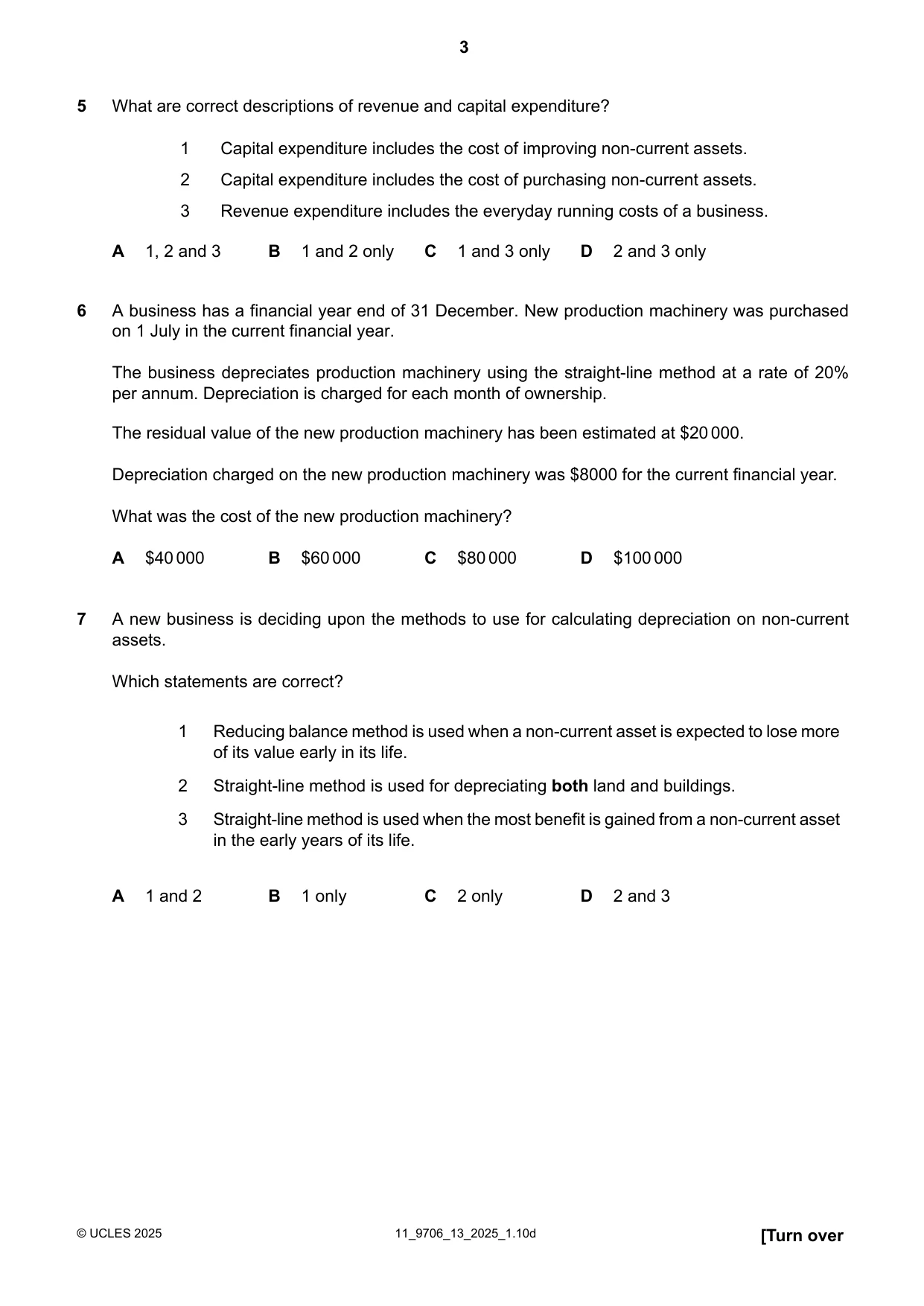
Q5 · What are correct descriptions of revenue and capital expenditure?
5 What are correct descriptions of revenue and capital expenditure? 1 Capital expenditure includes the cost of improving non-current assets. 2 Capital expenditure includes the cost of purchasing non-current assets. 3 Revenue expenditure includes the everyday running costs of a business. A 1, 2 and 3 B 1 and 2 only C 1 and 3 only D 2 and 3 only
Mark scheme: A
Q6 · A business has a financial year end of 31 December
6 A business has a financial year end of 31 December. New production machinery was purchased on 1 July in the current financial year. The business depreciates production machinery using the straight-line method at a rate of 20% per annum. Depreciation is charged for each month of ownership. The residual value of the new production machinery has been estimated at $20 000. Depreciation charged on the new production machinery was $8000 for the current financial year. What was the cost of the new production machinery? A $40 000 B $60 000 C $80 000 D $100 000
Mark scheme: D
Q7 · A new business is deciding upon the methods to use for calculating depreciation on…
7 A new business is deciding upon the methods to use for calculating depreciation on non-current assets. Which statements are correct? 1 Reducing balance method is used when a non-current asset is expected to lose more of its value early in its life. 2 Straight-line method is used for depreciating both land and buildings. 3 Straight-line method is used when the most benefit is gained from a non-current asset in the early years of its life. A 1 and 2 B 1 only C 2 only D 2 and 3
Mark scheme: B
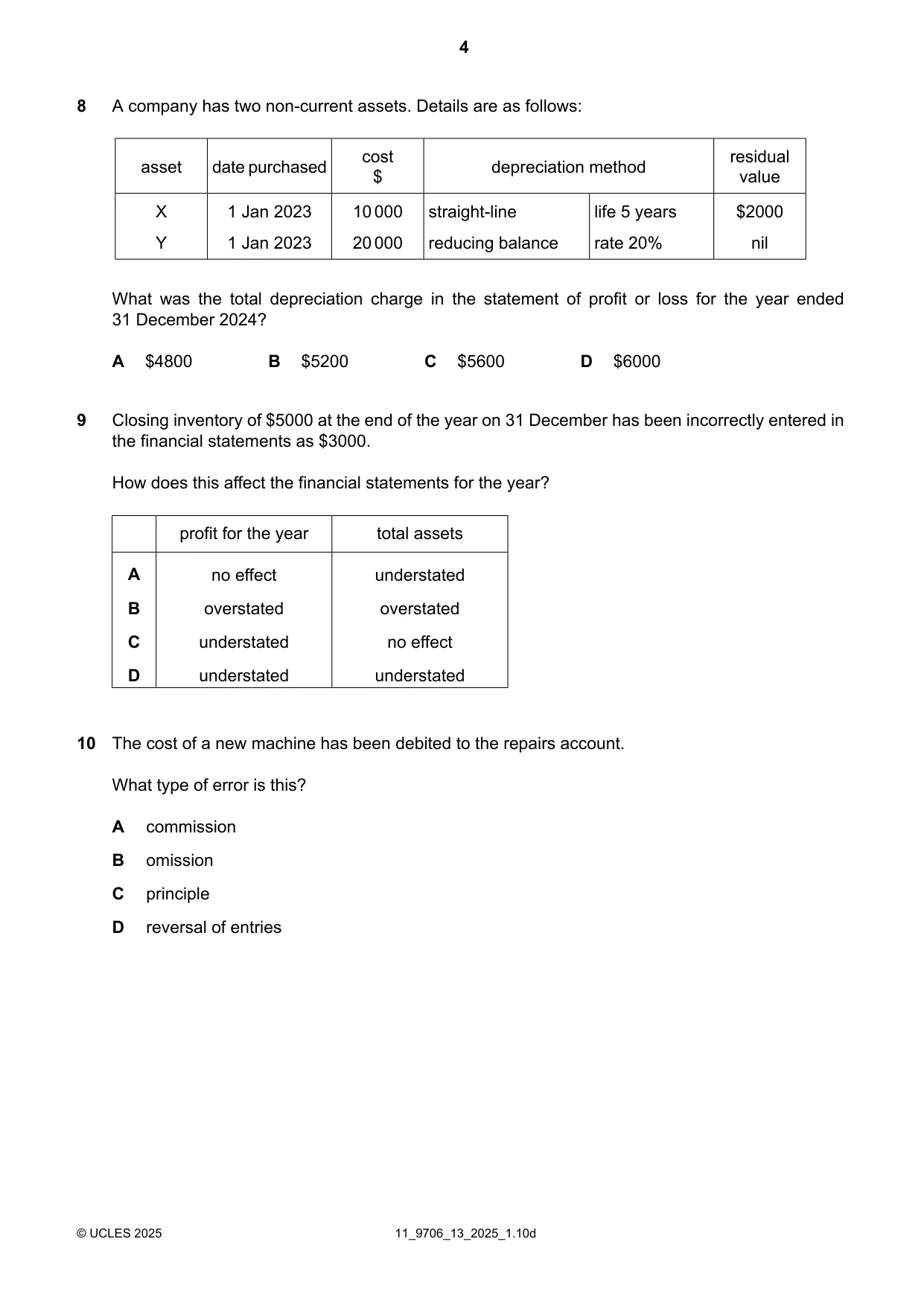
Q8 · A company has two non-current assets
8 A company has two non-current assets. Details are as follows: cost residual asset date purchased depreciation method $ value X 1 Jan 2023 10000 straight-line life 5 years $2000 Y 1 Jan 2023 20000 reducing balance rate 20% nil What was the total depreciation charge in the statement of profit or loss for the year ended 31 December 2024? A $4800 B $5200 C $5600 D $6000
Mark scheme: A
Q9 · Closing inventory of $5000 at the end of the year on 31 December has been incorrectly…
9 Closing inventory of $5000 at the end of the year on 31 December has been incorrectly entered in the financial statements as $3000. How does this affect the financial statements for the year? profit for the year total assets A no effect understated B overstated overstated C understated no effect D understated understated
Mark scheme: D
Q10 · The cost of a new machine has been debited to the repairs account
10 The cost of a new machine has been debited to the repairs account. What type of error is this? A commission B omission C principle D reversal of entries
Mark scheme: C
Q11 · A suspense account was opened to record the difference on a trial balance
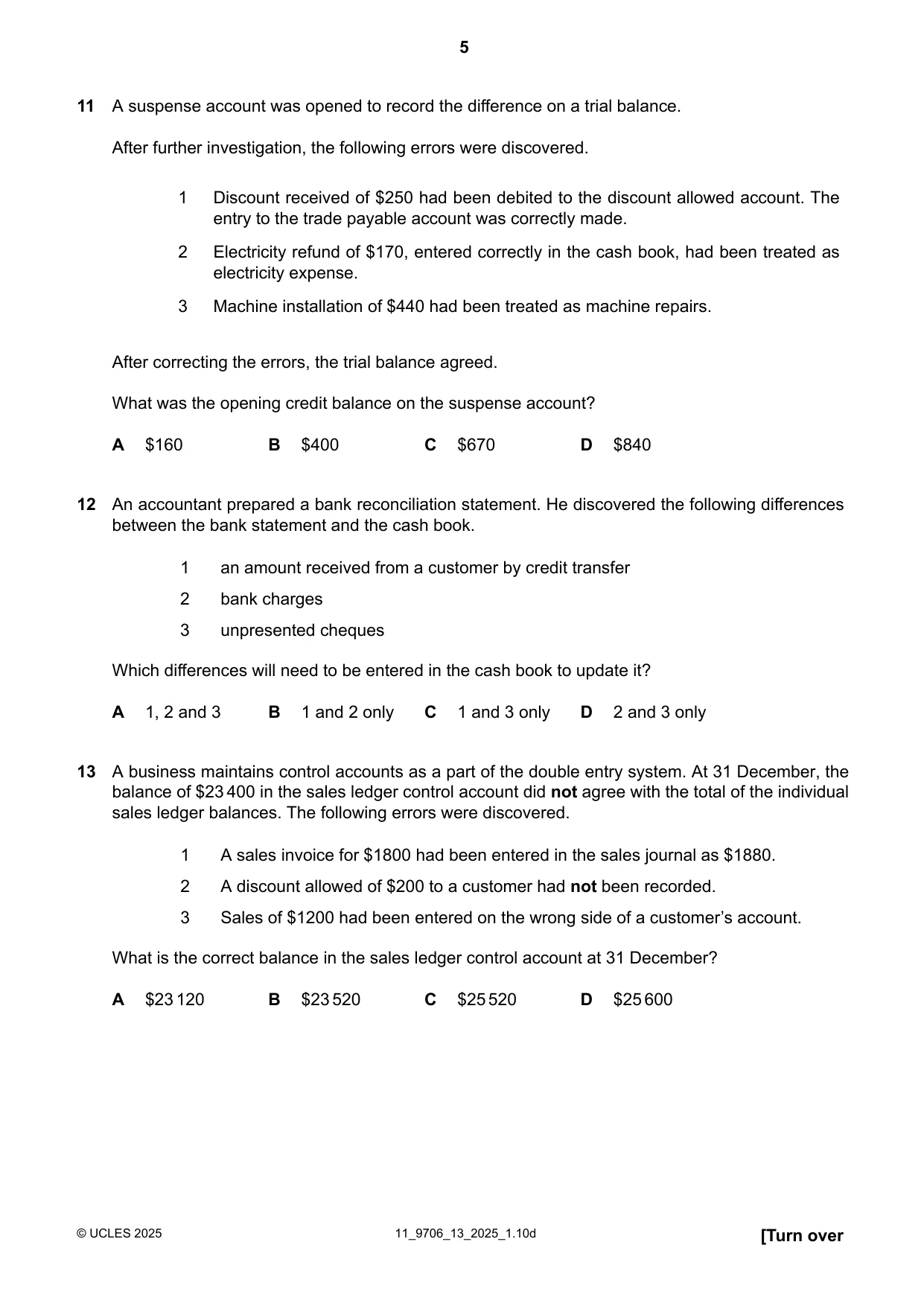
11 A suspense account was opened to record the difference on a trial balance. After further investigation, the following errors were discovered. 1 Discount received of $250 had been debited to the discount allowed account. The entry to the trade payable account was correctly made. 2 Electricity refund of $170, entered correctly in the cash book, had been treated as electricity expense. 3 Machine installation of $440 had been treated as machine repairs. After correcting the errors, the trial balance agreed. What was the opening credit balance on the suspense account? A $160 B $400 C $670 D $840
Mark scheme: D
Q12 · An accountant prepared a bank reconciliation statement
12 An accountant prepared a bank reconciliation statement. He discovered the following differences between the bank statement and the cash book. 1 an amount received from a customer by credit transfer 2 bank charges 3 unpresented cheques Which differences will need to be entered in the cash book to update it? A 1, 2 and 3 B 1 and 2 only C 1 and 3 only D 2 and 3 only
Mark scheme: B
Q13 · A business maintains control accounts as a part of the double entry system
13 A business maintains control accounts as a part of the double entry system. At 31 December, the balance of $23 400 in the sales ledger control account did not agree with the total of the individual sales ledger balances. The following errors were discovered. 1 A sales invoice for $1800 had been entered in the sales journal as $1880. 2 A discount allowed of $200 to a customer had not been recorded. 3 Sales of $1200 had been entered on the wrong side of a customer’s account. What is the correct balance in the sales ledger control account at 31 December? A $23120 B $23520 C $25520 D $25600
Mark scheme: A
Q14 · A statement of profit or loss shows a draft loss for the year of $9450
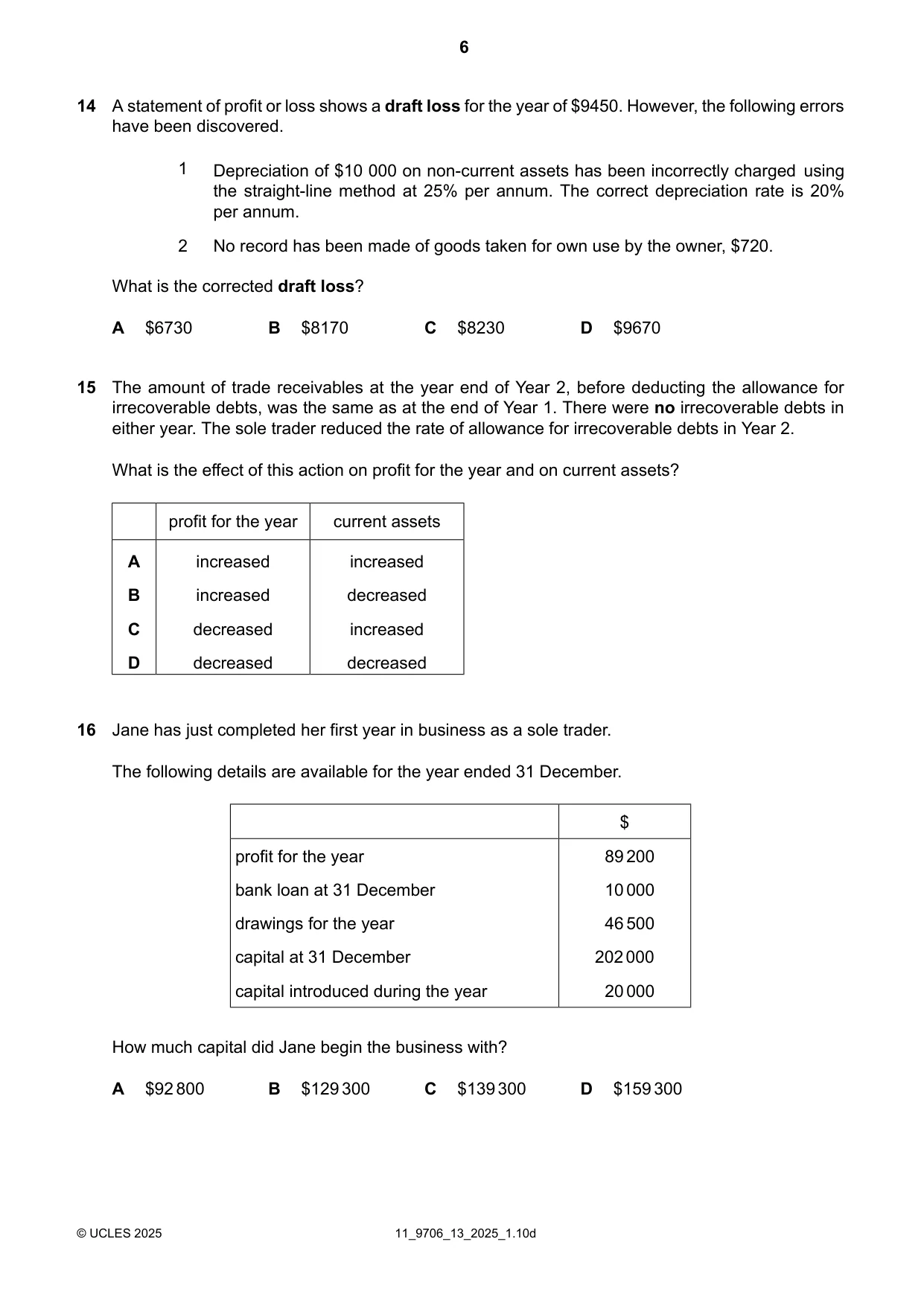
14 A statement of profit or loss shows a draft loss for the year of $9450. However, the following errors have been discovered. 1 Depreciation of $10 000 on non-current assets has been incorrectly charged using the straight-line method at 25% per annum. The correct depreciation rate is 20% per annum. 2 No record has been made of goods taken for own use by the owner, $720. What is the corrected draft loss? A $6730 B $8170 C $8230 D $9670
Mark scheme: A
Q15 · The amount of trade receivables at the year end of Year 2, before deducting the allowance…
15 The amount of trade receivables at the year end of Year 2, before deducting the allowance for irrecoverable debts, was the same as at the end of Year 1. There were no irrecoverable debts in either year. The sole trader reduced the rate of allowance for irrecoverable debts in Year 2. What is the effect of this action on profit for the year and on current assets? profit for the year current assets A increased increased B increased decreased C decreased increased D decreased decreased
Mark scheme: A
Q16 · Jane has just completed her first year in business as a sole trader
16 Jane has just completed her first year in business as a sole trader. The following details are available for the year ended 31 December. $ profit for the year 89200 bank loan at 31 December 10000 drawings for the year 46500 capital at 31 December 202000 capital introduced during the year 20000 How much capital did Jane begin the business with? A $92800 B $129300 C $139300 D $159300
Mark scheme: C
Q17 · How is a partnership appropriation account prepared?
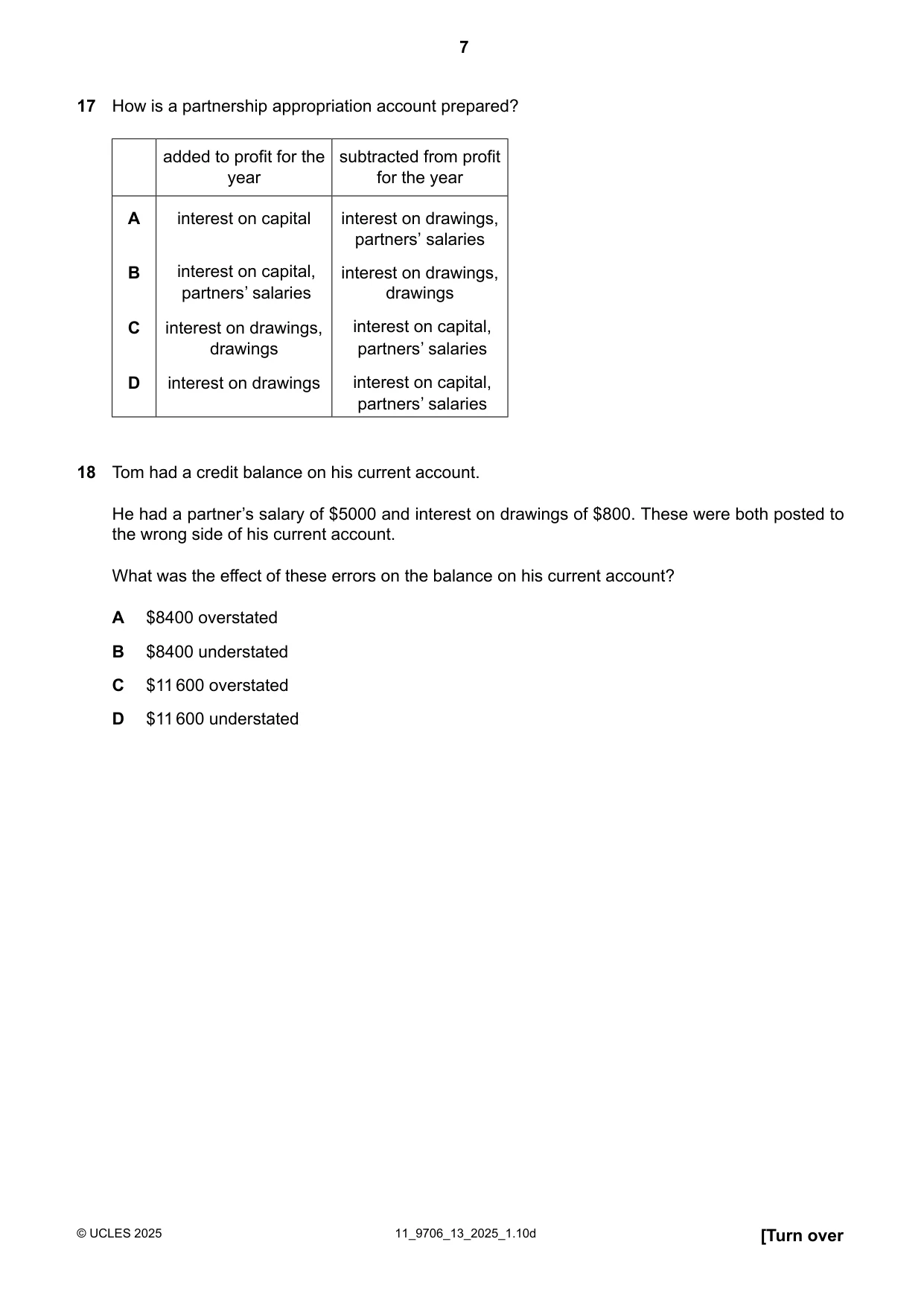
17 How is a partnership appropriation account prepared? added to profit for the subtracted from profit year for the year A interest on capital interest on drawings, partners’ salaries B interest on capital, interest on drawings, partners’ salaries drawings C interest on drawings, interest on capital, drawings partners’ salaries D interest on drawings interest on capital, partners’ salaries
Mark scheme: D
Q18 · Tom had a credit balance on his current account
18 Tom had a credit balance on his current account. He had a partner’s salary of $5000 and interest on drawings of $800. These were both posted to the wrong side of his current account. What was the effect of these errors on the balance on his current account? A $8400 overstated B $8400 understated C $11600 overstated D $11600 understated
Mark scheme: B
Q19 · A company provides the following information
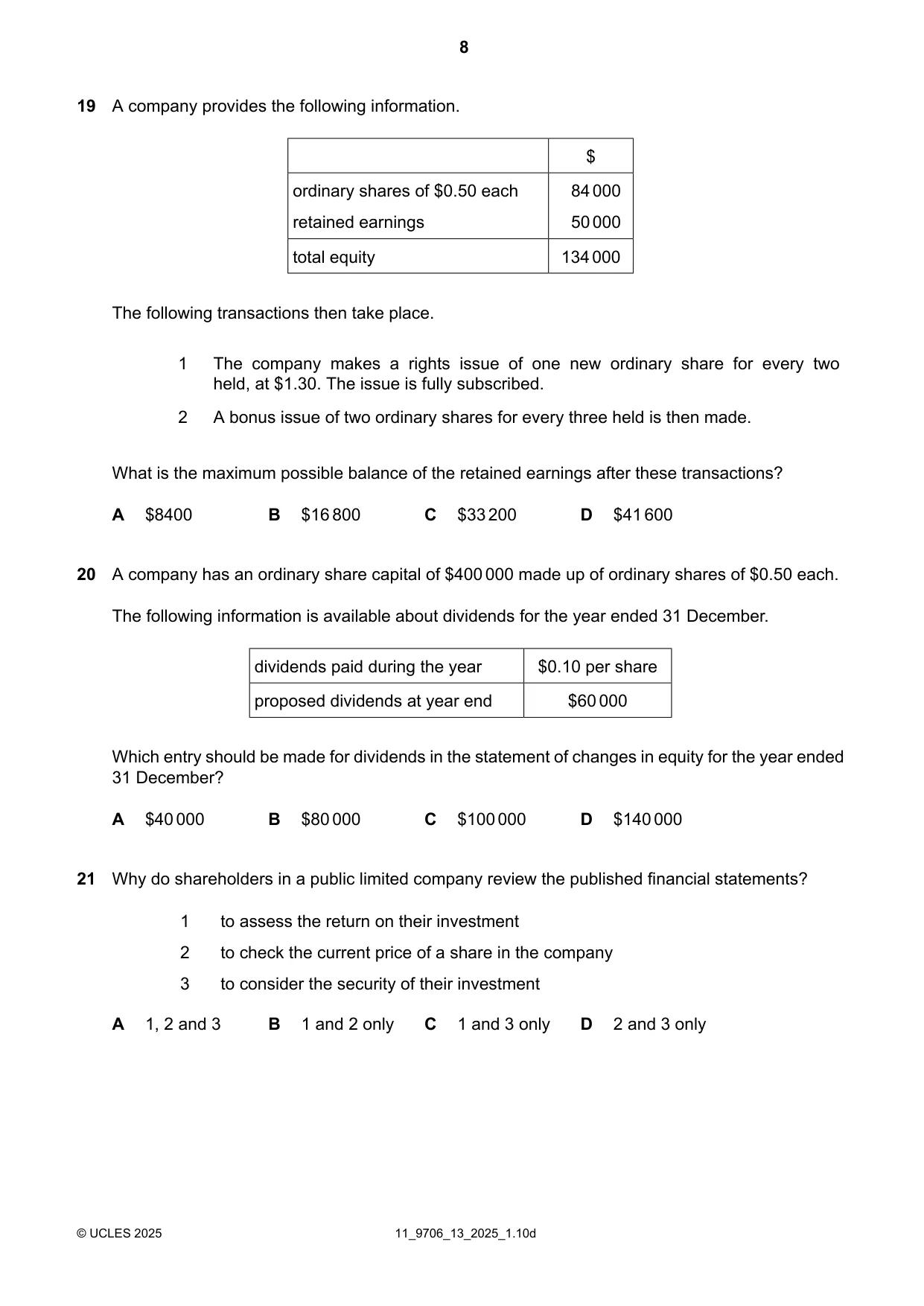
19 A company provides the following information. $ ordinary shares of $0.50 each 84000 retained earnings 50000 total equity 134000 The following transactions then take place. 1 The company makes a rights issue of one new ordinary share for every two held, at $1.30. The issue is fully subscribed. 2 A bonus issue of two ordinary shares for every three held is then made. What is the maximum possible balance of the retained earnings after these transactions? A $8400 B $16800 C $33200 D $41600
Mark scheme: C
Q20 · A company has an ordinary share capital of $400000 made up of ordinary shares of $0.50…
20 A company has an ordinary share capital of $400000 made up of ordinary shares of $0.50 each. The following information is available about dividends for the year ended 31 December. dividends paid during the year $0.10 per share proposed dividends at year end $60000 Which entry should be made for dividends in the statement of changes in equity for the year ended 31 December? A $40000 B $80000 C $100000 D $140000
Mark scheme: B
Q21 · Why do shareholders in a public limited company review the published financial statements?
21 Why do shareholders in a public limited company review the published financial statements? 1 to assess the return on their investment 2 to check the current price of a share in the company 3 to consider the security of their investment A 1, 2 and 3 B 1 and 2 only C 1 and 3 only D 2 and 3 only
Mark scheme: C
More questions on Analysis and communication of accounting information
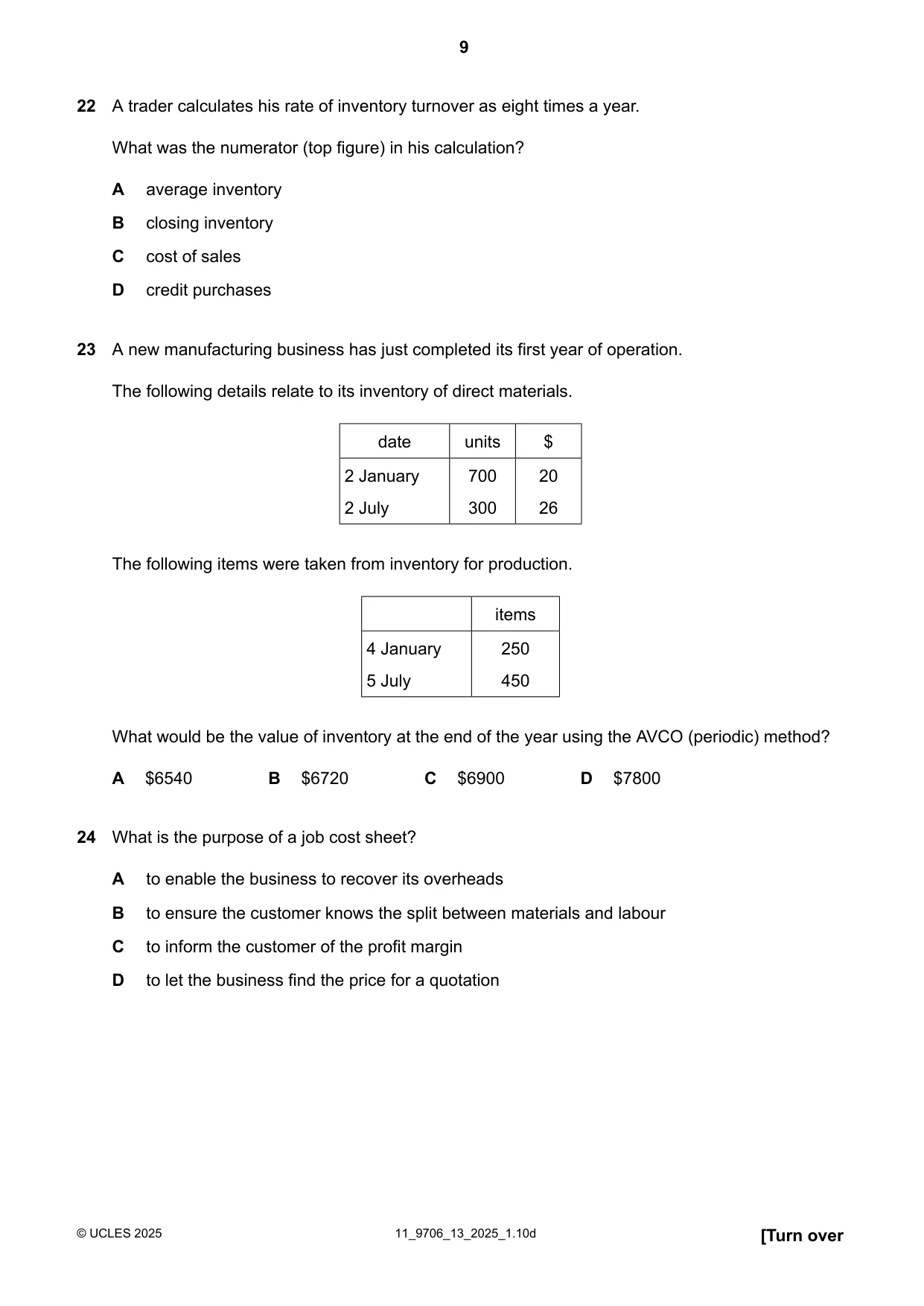
Q22 · A trader calculates his rate of inventory turnover as eight times a year
22 A trader calculates his rate of inventory turnover as eight times a year. What was the numerator (top figure) in his calculation? A average inventory B closing inventory C cost of sales D credit purchases
Mark scheme: C
More questions on Analysis and communication of accounting information
Q23 · A new manufacturing business has just completed its first year of operation
23 A new manufacturing business has just completed its first year of operation. The following details relate to its inventory of direct materials. date units $ 2 January 700 20 2 July 300 26 The following items were taken from inventory for production. items 4 January 250 5 July 450 What would be the value of inventory at the end of the year using the AVCO (periodic) method? A $6540 B $6720 C $6900 D $7800
Mark scheme: A
Q24 · What is the purpose of a job cost sheet?
24 What is the purpose of a job cost sheet? A to enable the business to recover its overheads B to ensure the customer knows the split between materials and labour C to inform the customer of the profit margin D to let the business find the price for a quotation
Mark scheme: D
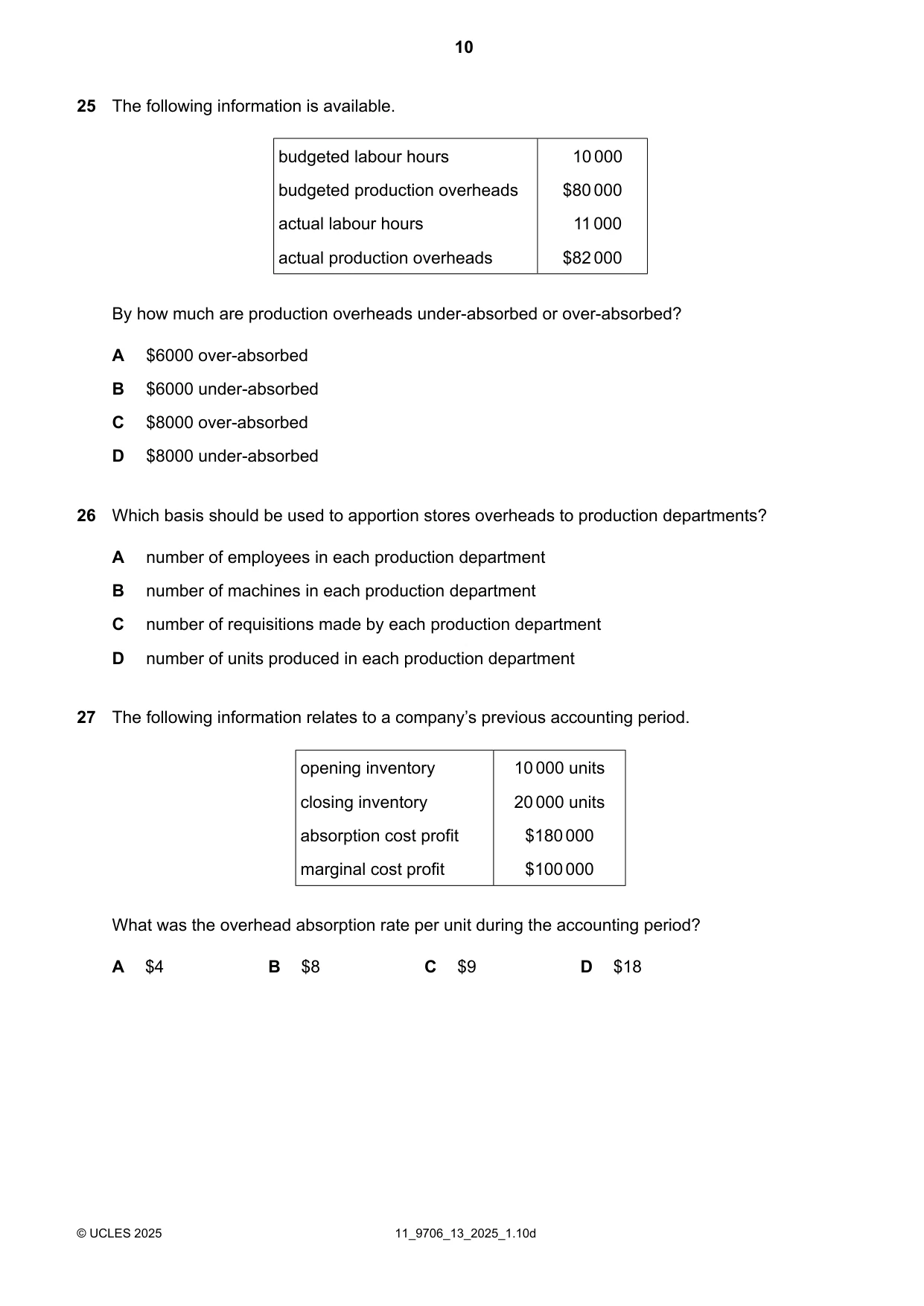
Q25 · The following information is available
25 The following information is available. budgeted labour hours 10000 budgeted production overheads $80000 actual labour hours 11000 actual production overheads $82000 By how much are production overheads under-absorbed or over-absorbed? A $6000 over-absorbed B $6000 under-absorbed C $8000 over-absorbed D $8000 under-absorbed
Mark scheme: A
Q26 · Which basis should be used to apportion stores overheads to production departments?
26 Which basis should be used to apportion stores overheads to production departments? A number of employees in each production department B number of machines in each production department C number of requisitions made by each production department D number of units produced in each production department
Mark scheme: C
Q27 · The following information relates to a company’s previous accounting period
27 The following information relates to a company’s previous accounting period. opening inventory 10000 units closing inventory 20000 units absorption cost profit $180000 marginal cost profit $100000 What was the overhead absorption rate per unit during the accounting period? A $4 B $8 C $9 D $18
Mark scheme: B
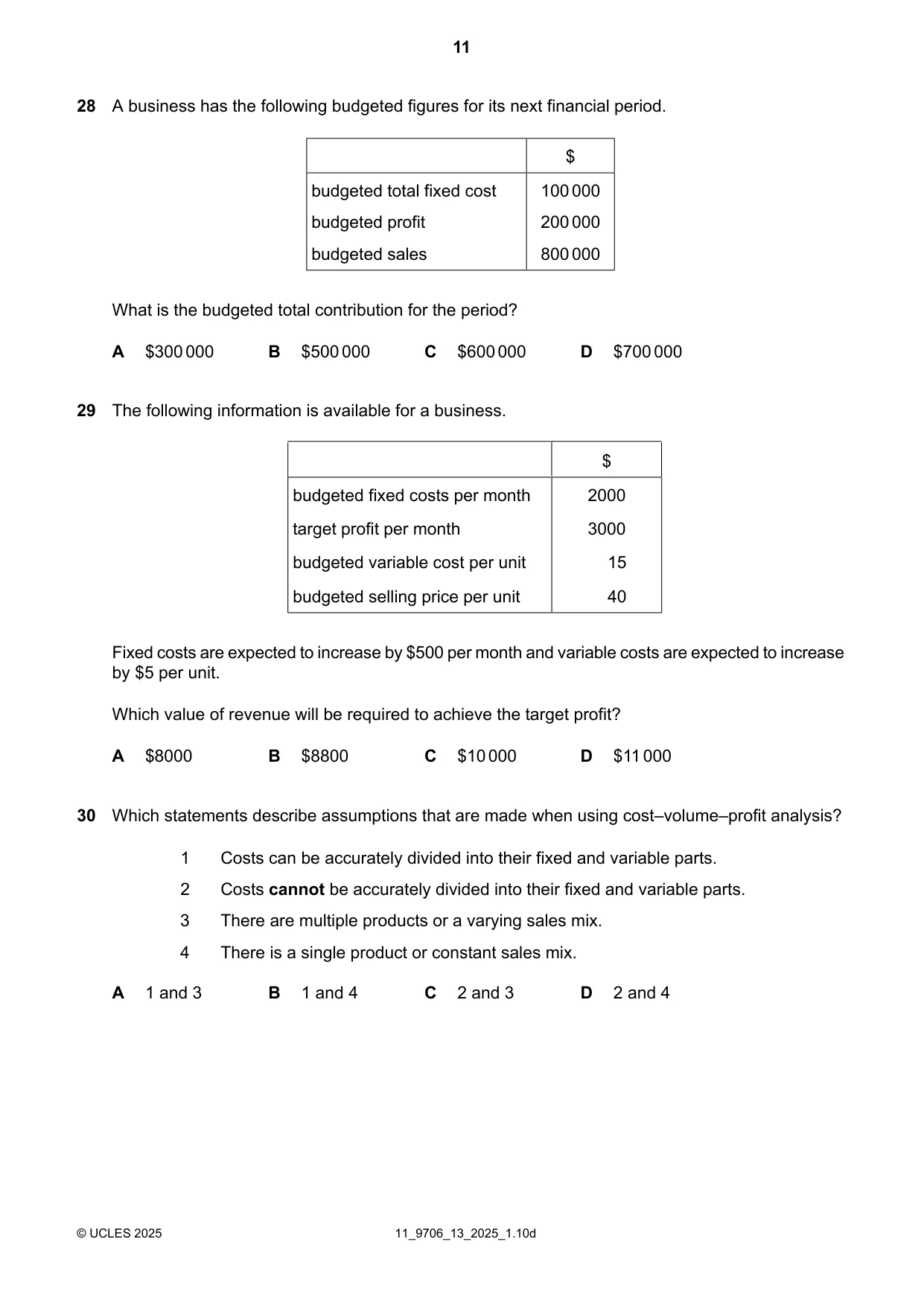
Q28 · A business has the following budgeted figures for its next financial period
28 A business has the following budgeted figures for its next financial period. $ budgeted total fixed cost 100000 budgeted profit 200000 budgeted sales 800000 What is the budgeted total contribution for the period? A $300000 B $500000 C $600000 D $700000
Mark scheme: A
Q29 · The following information is available for a business
29 The following information is available for a business. $ budgeted fixed costs per month 2000 target profit per month 3000 budgeted variable cost per unit 15 budgeted selling price per unit 40 Fixed costs are expected to increase by $500 per month and variable costs are expected to increase by $5 per unit. Which value of revenue will be required to achieve the target profit? A $8000 B $8800 C $10000 D $11000
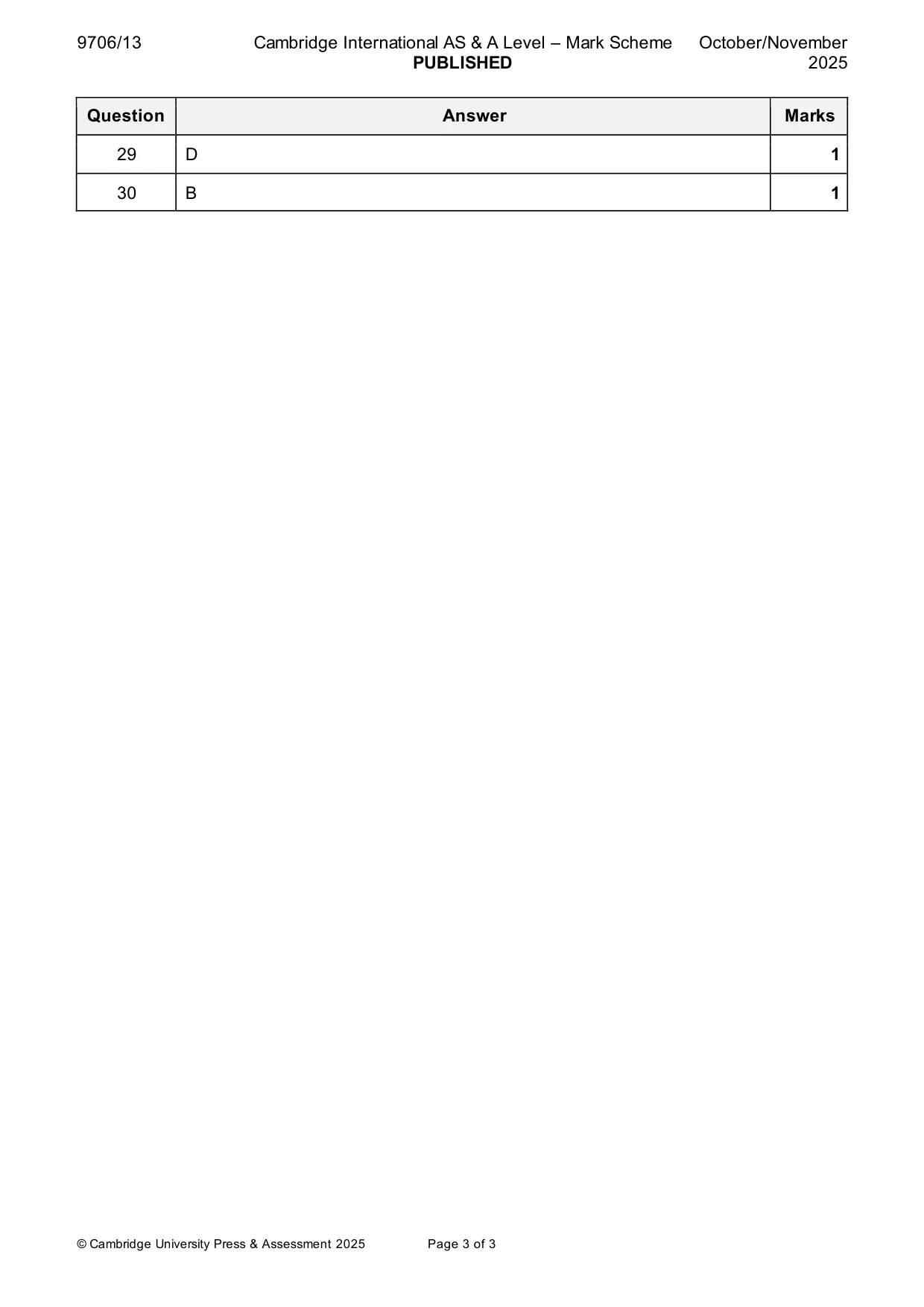
Mark scheme: D
Q30 · Which statements describe assumptions that are made when using cost–volume–profit…
30 Which statements describe assumptions that are made when using cost–volume–profit analysis? 1 Costs can be accurately divided into their fixed and variable parts. 2 Costs cannot be accurately divided into their fixed and variable parts. 3 There are multiple products or a varying sales mix. 4 There is a single product or constant sales mix. A 1 and 3 B 1 and 4 C 2 and 3 D 2 and 4
Mark scheme: B
What was in this paper
The subtopics covered by these 30 questions, and how many questions each got. Open one in a new tab to see every Cambridge question on it.
6Traditional costing methods5Accounting for non-current assets4Reconciliation and verification4Costs and cost behaviour3The accounting system3Preparation of financial statements2Analysis and communication of accounting information1Analysis and communication of accounting information1Types of business entity1What you needed in this session
Cambridge’s own grade thresholds for 2025 Oct/Nov, Paper 1 · Variant 3. A higher threshold means an easier paper — the bar moves with how the cohort did.