Cambridge A Level Accounting 9706 — 2013 Oct/Nov Paper 1 · Variant 3
9706/13/O/N/13 · 30 questions · 30 marks · ≈34 min
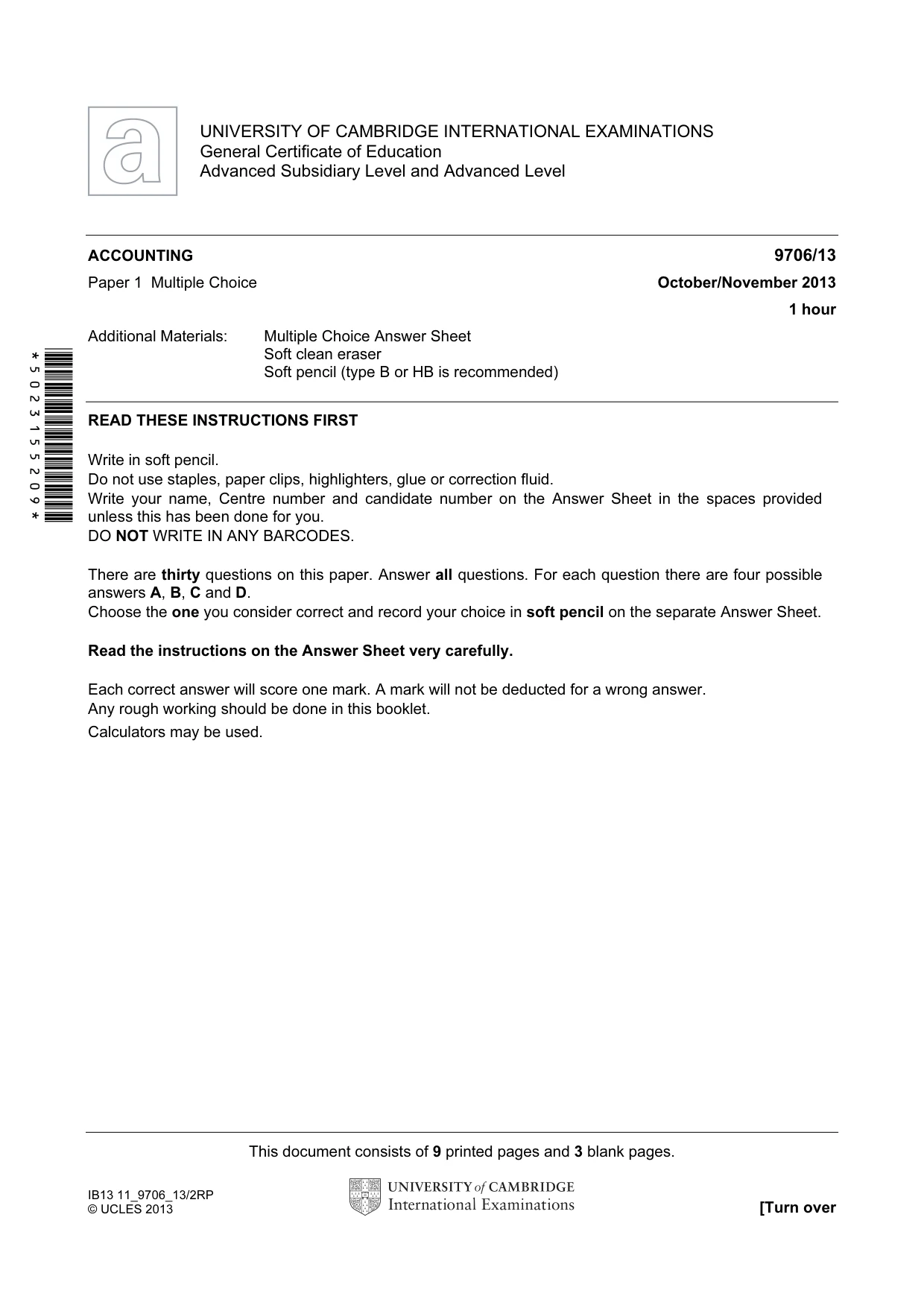
The question paper and its mark scheme, free to read here and free to download. This is Cambridge’s own paper, exactly as it was sat.
Question paper12 pages
Mark scheme2 pages
Answers below. Sit the paper first if you are practising.
Questions as text
Q1 · A customer paid a deposit in advance for goods to be supplied at a later date
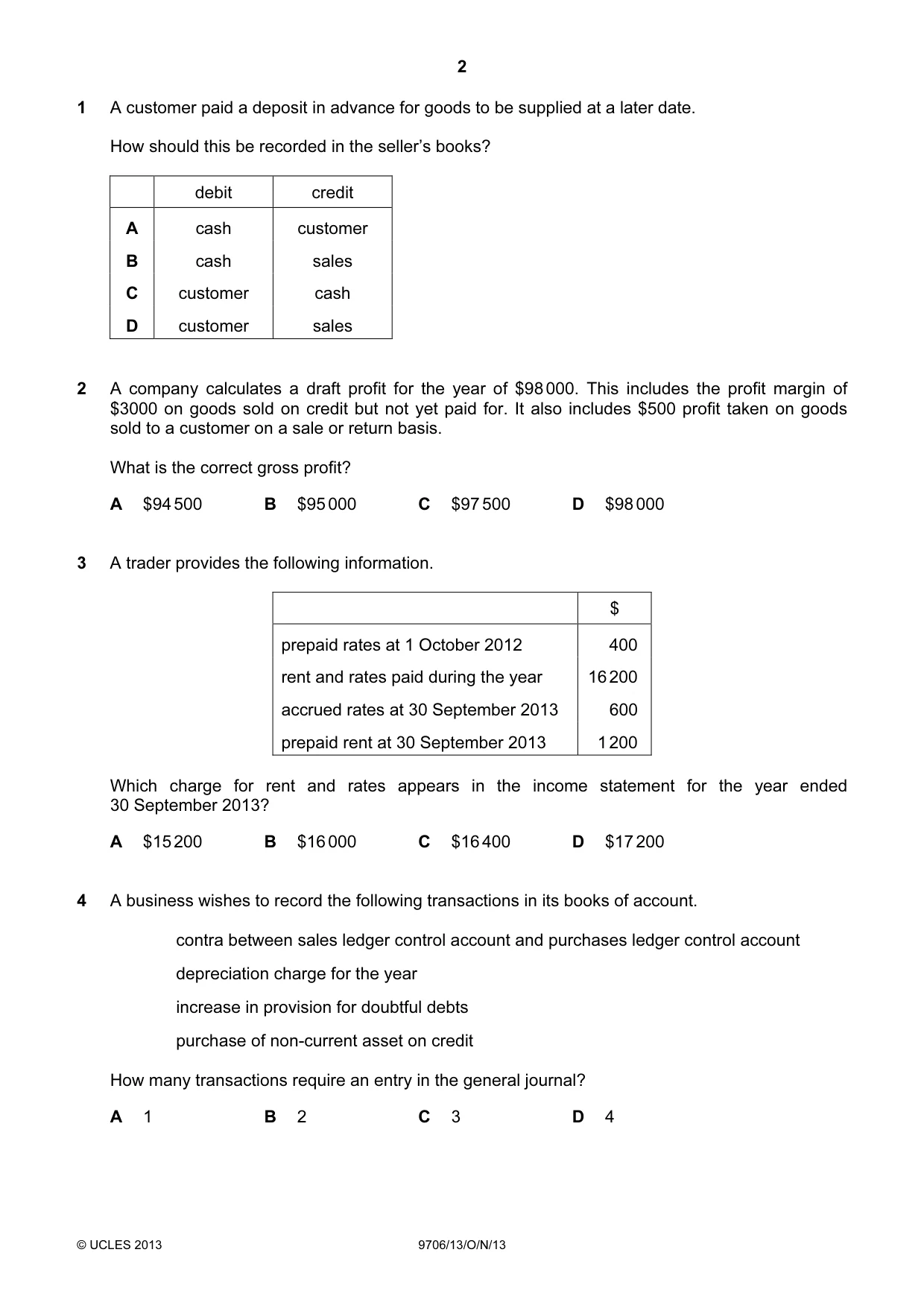
1 A customer paid a deposit in advance for goods to be supplied at a later date. How should this be recorded in the seller’s books? debit credit A cash customer B cash sales C customer cash D customer sales
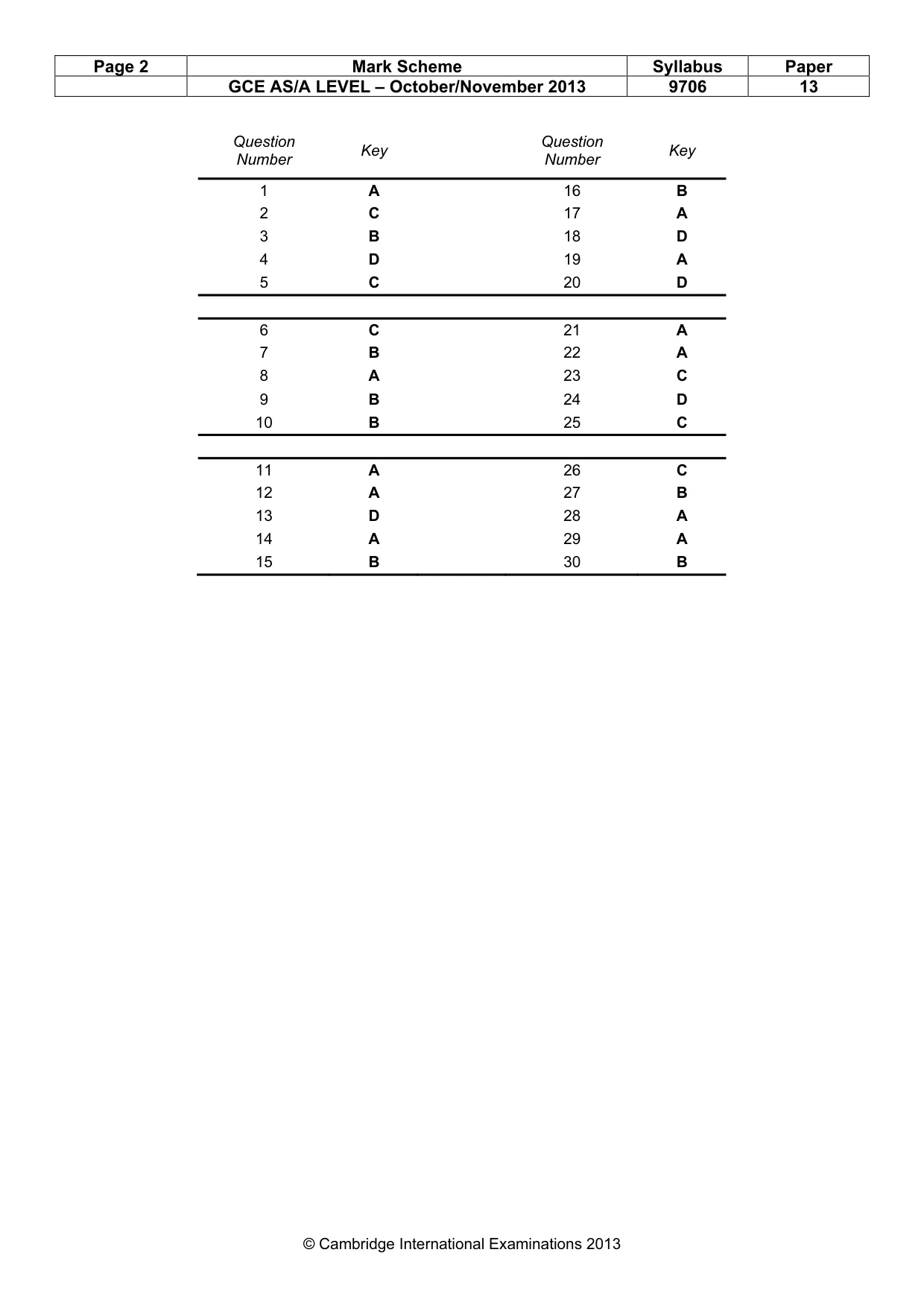
Mark scheme: A
Q2 · A company calculates a draft profit for the year of $98 000
2 A company calculates a draft profit for the year of $98 000. This includes the profit margin of $3000 on goods sold on credit but not yet paid for. It also includes $500 profit taken on goods sold to a customer on a sale or return basis. What is the correct gross profit? A $94 500 B $95 000 C $97 500 D $98 000
Mark scheme: C
Q3 · A trader provides the following information
3 A trader provides the following information. $ prepaid rates at 1 October 2012 400 rent and rates paid during the year 16 200 accrued rates at 30 September 2013 600 prepaid rent at 30 September 2013 1 200 Which charge for rent and rates appears in the income statement for the year ended 30 September 2013? A $15 200 B $16 000 C $16 400 D $17 200
Mark scheme: B
Q4 · A business wishes to record the following transactions in its books of account
4 A business wishes to record the following transactions in its books of account. contra between sales ledger control account and purchases ledger control account depreciation charge for the year increase in provision for doubtful debts purchase of non-current asset on credit How many transactions require an entry in the general journal? A 1 B 2 C 3 D 4
Mark scheme: D
Q5 · At the beginning of the year a company has a provision for doubtful debts of $1000
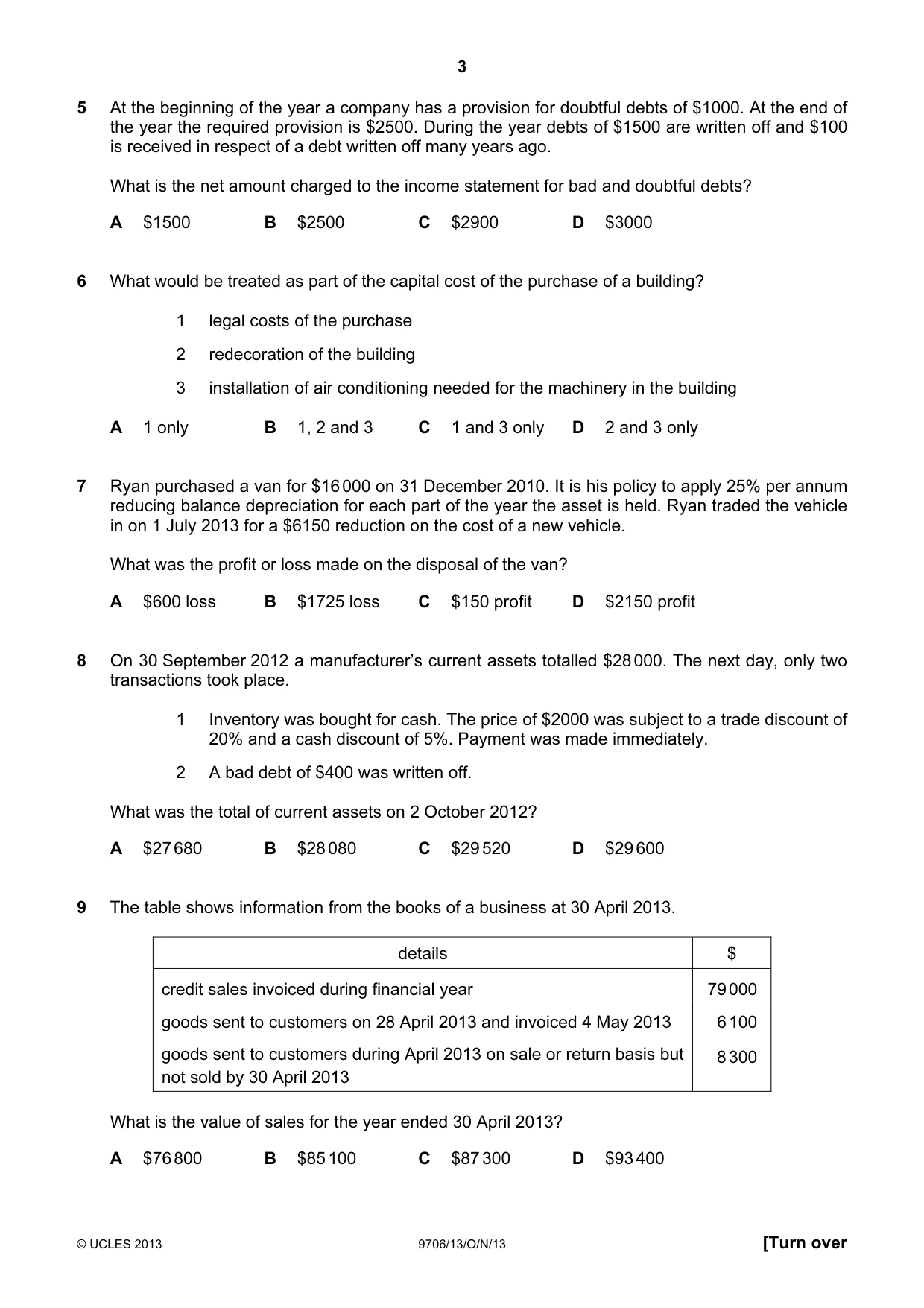
5 At the beginning of the year a company has a provision for doubtful debts of $1000. At the end of the year the required provision is $2500. During the year debts of $1500 are written off and $100 is received in respect of a debt written off many years ago. What is the net amount charged to the income statement for bad and doubtful debts? A $1500 B $2500 C $2900 D $3000
Mark scheme: C
Q6 · What would be treated as part of the capital cost of the purchase of a building?
6 What would be treated as part of the capital cost of the purchase of a building? 1 legal costs of the purchase 2 redecoration of the building 3 installation of air conditioning needed for the machinery in the building A 1 only B 1, 2 and 3 C 1 and 3 only D 2 and 3 only
Mark scheme: C
Q7 · Ryan purchased a van for $16 000 on 31 December 2010
7 Ryan purchased a van for $16 000 on 31 December 2010. It is his policy to apply 25% per annum reducing balance depreciation for each part of the year the asset is held. Ryan traded the vehicle in on 1 July 2013 for a $6150 reduction on the cost of a new vehicle. What was the profit or loss made on the disposal of the van? A $600 loss B $1725 loss C $150 profit D $2150 profit
Mark scheme: B
Q8 · On 30 September 2012 a manufacturer’s current assets totalled $28 000
8 On 30 September 2012 a manufacturer’s current assets totalled $28 000. The next day, only two transactions took place. 1 Inventory was bought for cash. The price of $2000 was subject to a trade discount of 20% and a cash discount of 5%. Payment was made immediately. 2 A bad debt of $400 was written off. What was the total of current assets on 2 October 2012? A $27 680 B $28 080 C $29 520 D $29 600
Mark scheme: A
Q9 · The table shows information from the books of a business at 30 April 2013
9 The table shows information from the books of a business at 30 April 2013. details $ credit sales invoiced during financial year 79 000 goods sent to customers on 28 April 2013 and invoiced 4 May 2013 6 100 goods sent to customers during April 2013 on sale or return basis but 8 300 not sold by 30 April 2013 What is the value of sales for the year ended 30 April 2013? A $76 800 B $85 100 C $87 300 D $93 400
Mark scheme: B
Q10 · The following information relates to a company’s non-current assets at 31 December
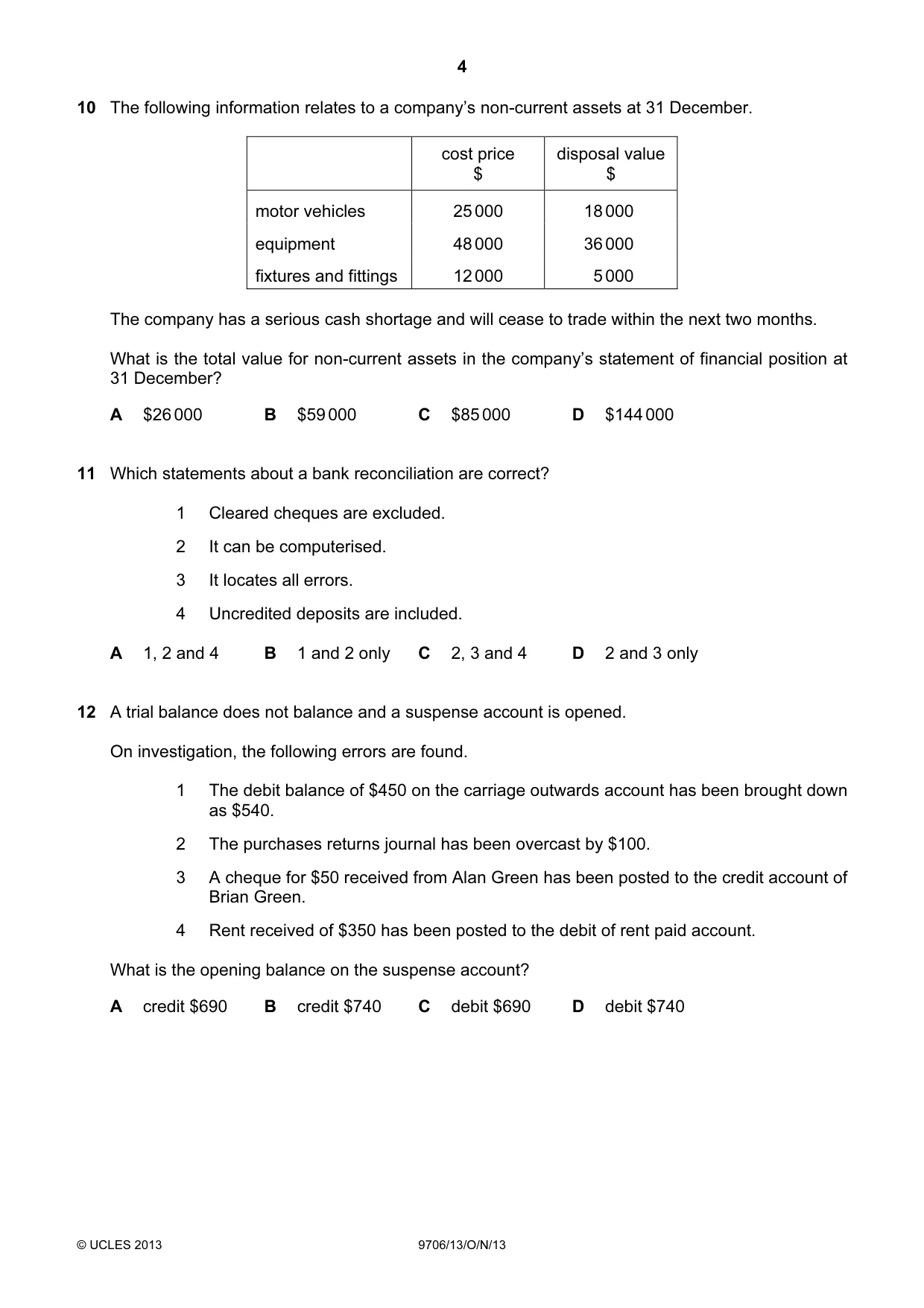
10 The following information relates to a company’s non-current assets at 31 December. cost price disposal value $ $ motor vehicles 25 000 18 000 equipment 48 000 36 000 fixtures and fittings 12 000 5 000 The company has a serious cash shortage and will cease to trade within the next two months. What is the total value for non-current assets in the company’s statement of financial position at 31 December? A $26 000 B $59 000 C $85 000 D $144 000
Mark scheme: B
Q11 · Which statements about a bank reconciliation are correct?
11 Which statements about a bank reconciliation are correct? 1 Cleared cheques are excluded. 2 It can be computerised. 3 It locates all errors. 4 Uncredited deposits are included. A 1, 2 and 4 B 1 and 2 only C 2, 3 and 4 D 2 and 3 only
Mark scheme: A
Q12 · A trial balance does not balance and a suspense account is opened
12 A trial balance does not balance and a suspense account is opened. On investigation, the following errors are found. 1 The debit balance of $450 on the carriage outwards account has been brought down as $540. 2 The purchases returns journal has been overcast by $100. 3 A cheque for $50 received from Alan Green has been posted to the credit account of Brian Green. 4 Rent received of $350 has been posted to the debit of rent paid account. What is the opening balance on the suspense account? A credit $690 B credit $740 C debit $690 D debit $740
Mark scheme: A
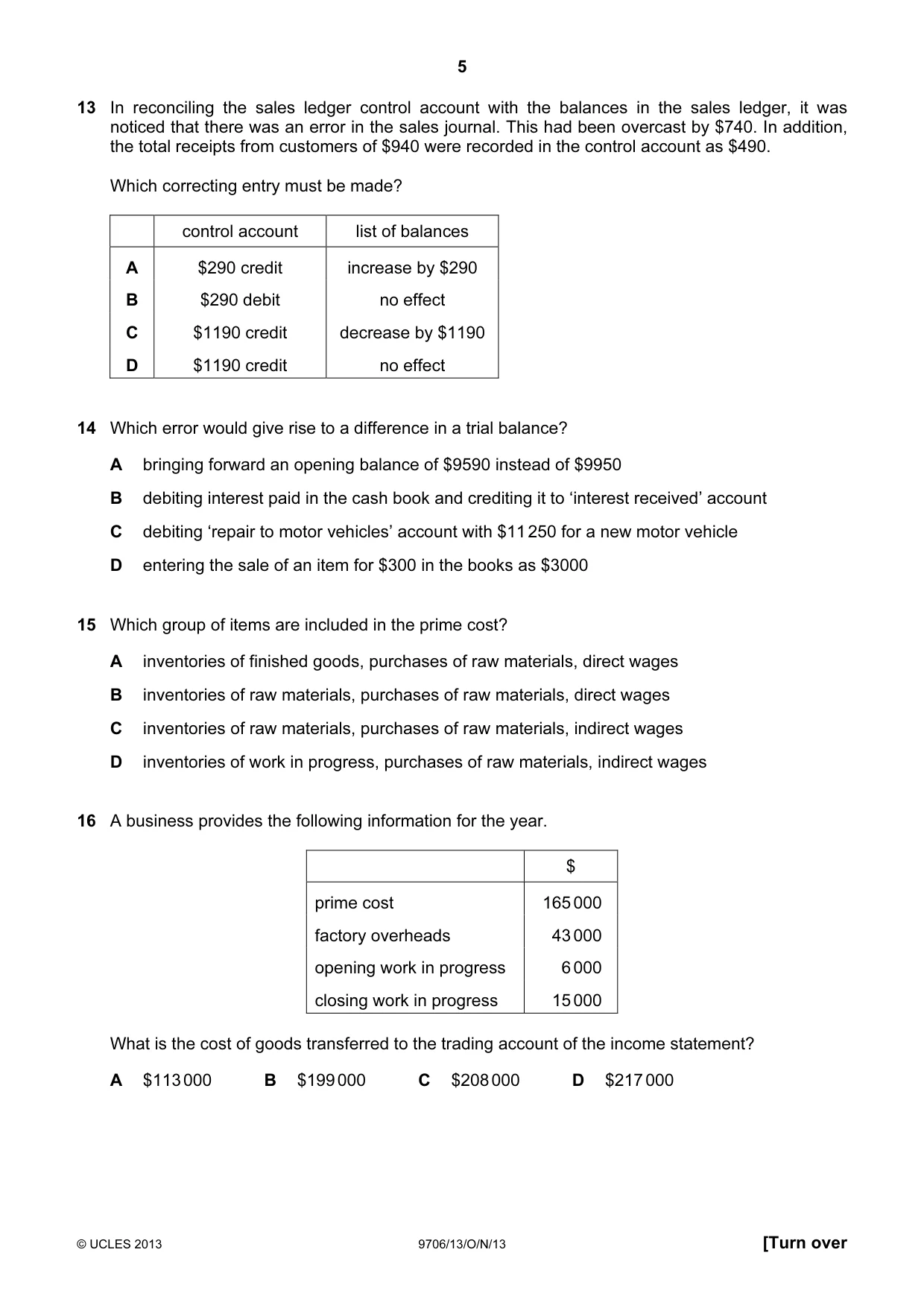
Q13 · In reconciling the sales ledger control account with the balances in the sales ledger, it…
13 In reconciling the sales ledger control account with the balances in the sales ledger, it was noticed that there was an error in the sales journal. This had been overcast by $740. In addition, the total receipts from customers of $940 were recorded in the control account as $490. Which correcting entry must be made? control account list of balances A $290 credit increase by $290 B $290 debit no effect C $1190 credit decrease by $1190 D $1190 credit no effect
Mark scheme: D
Q14 · Which error would give rise to a difference in a trial balance?
14 Which error would give rise to a difference in a trial balance? A bringing forward an opening balance of $9590 instead of $9950 B debiting interest paid in the cash book and crediting it to ‘interest received’ account C debiting ‘repair to motor vehicles’ account with $11 250 for a new motor vehicle D entering the sale of an item for $300 in the books as $3000
Mark scheme: A
Q15 · Which group of items are included in the prime cost?
15 Which group of items are included in the prime cost? A inventories of finished goods, purchases of raw materials, direct wages B inventories of raw materials, purchases of raw materials, direct wages C inventories of raw materials, purchases of raw materials, indirect wages D inventories of work in progress, purchases of raw materials, indirect wages
Mark scheme: B
Q16 · A business provides the following information for the year
16 A business provides the following information for the year. $ prime cost 165 000 factory overheads 43 000 opening work in progress 6 000 closing work in progress 15 000 What is the cost of goods transferred to the trading account of the income statement? A $113 000 B $199 000 C $208 000 D $217 000
Mark scheme: B
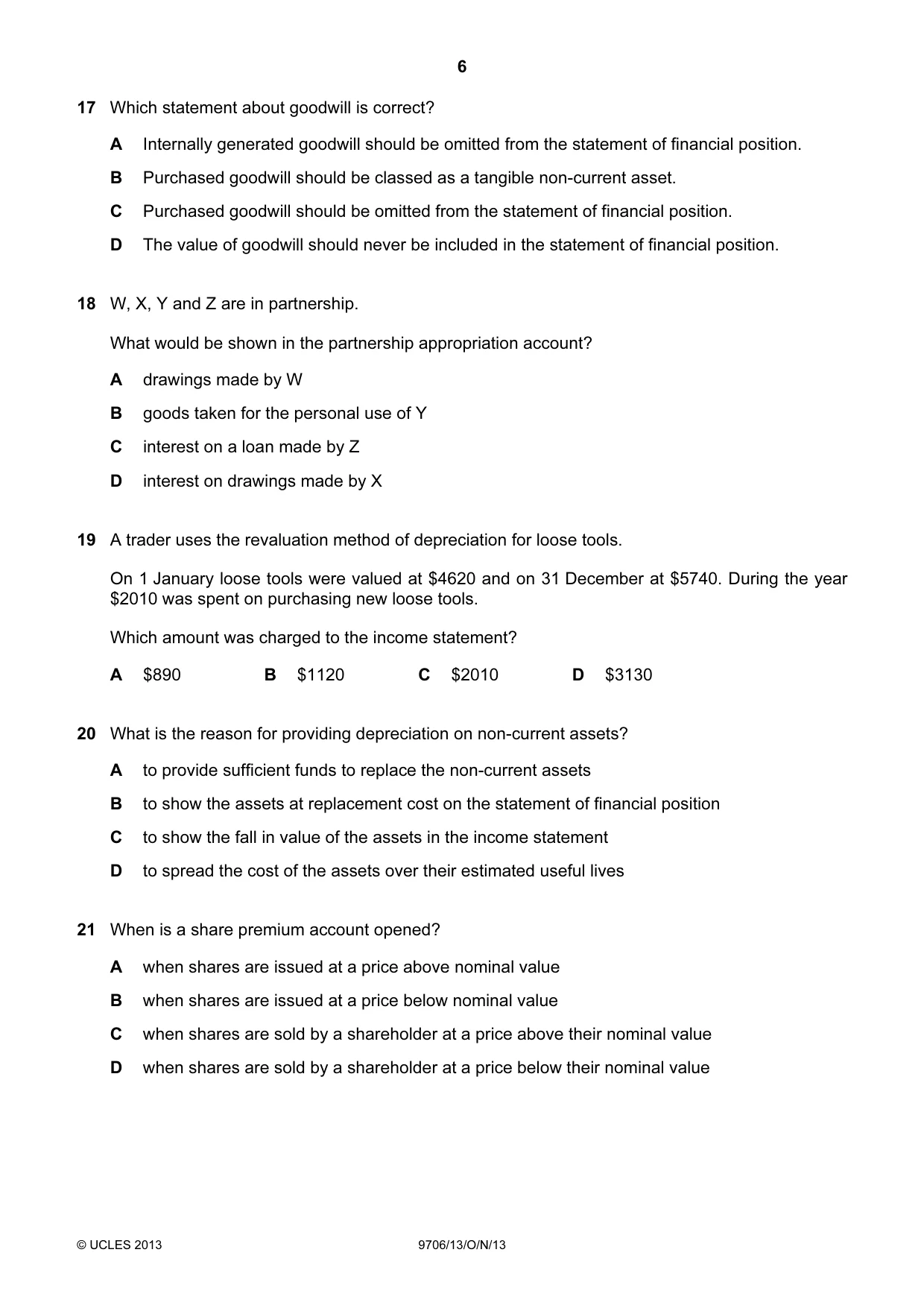
Q17 · Which statement about goodwill is correct?
17 Which statement about goodwill is correct? A Internally generated goodwill should be omitted from the statement of financial position. B Purchased goodwill should be classed as a tangible non-current asset. C Purchased goodwill should be omitted from the statement of financial position. D The value of goodwill should never be included in the statement of financial position.
Mark scheme: A
Q18 · W, X, Y and Z are in partnership
18 W, X, Y and Z are in partnership. What would be shown in the partnership appropriation account? A drawings made by W B goods taken for the personal use of Y C interest on a loan made by Z D interest on drawings made by X
Mark scheme: D
Q19 · A trader uses the revaluation method of depreciation for loose tools
19 A trader uses the revaluation method of depreciation for loose tools. On 1 January loose tools were valued at $4620 and on 31 December at $5740. During the year $2010 was spent on purchasing new loose tools. Which amount was charged to the income statement? A $890 B $1120 C $2010 D $3130
Mark scheme: A
Q20 · What is the reason for providing depreciation on non-current assets?
20 What is the reason for providing depreciation on non-current assets? A to provide sufficient funds to replace the non-current assets B to show the assets at replacement cost on the statement of financial position C to show the fall in value of the assets in the income statement D to spread the cost of the assets over their estimated useful lives
Mark scheme: D
Q21 · When is a share premium account opened?
21 When is a share premium account opened? A when shares are issued at a price above nominal value B when shares are issued at a price below nominal value C when shares are sold by a shareholder at a price above their nominal value D when shares are sold by a shareholder at a price below their nominal value
Mark scheme: A
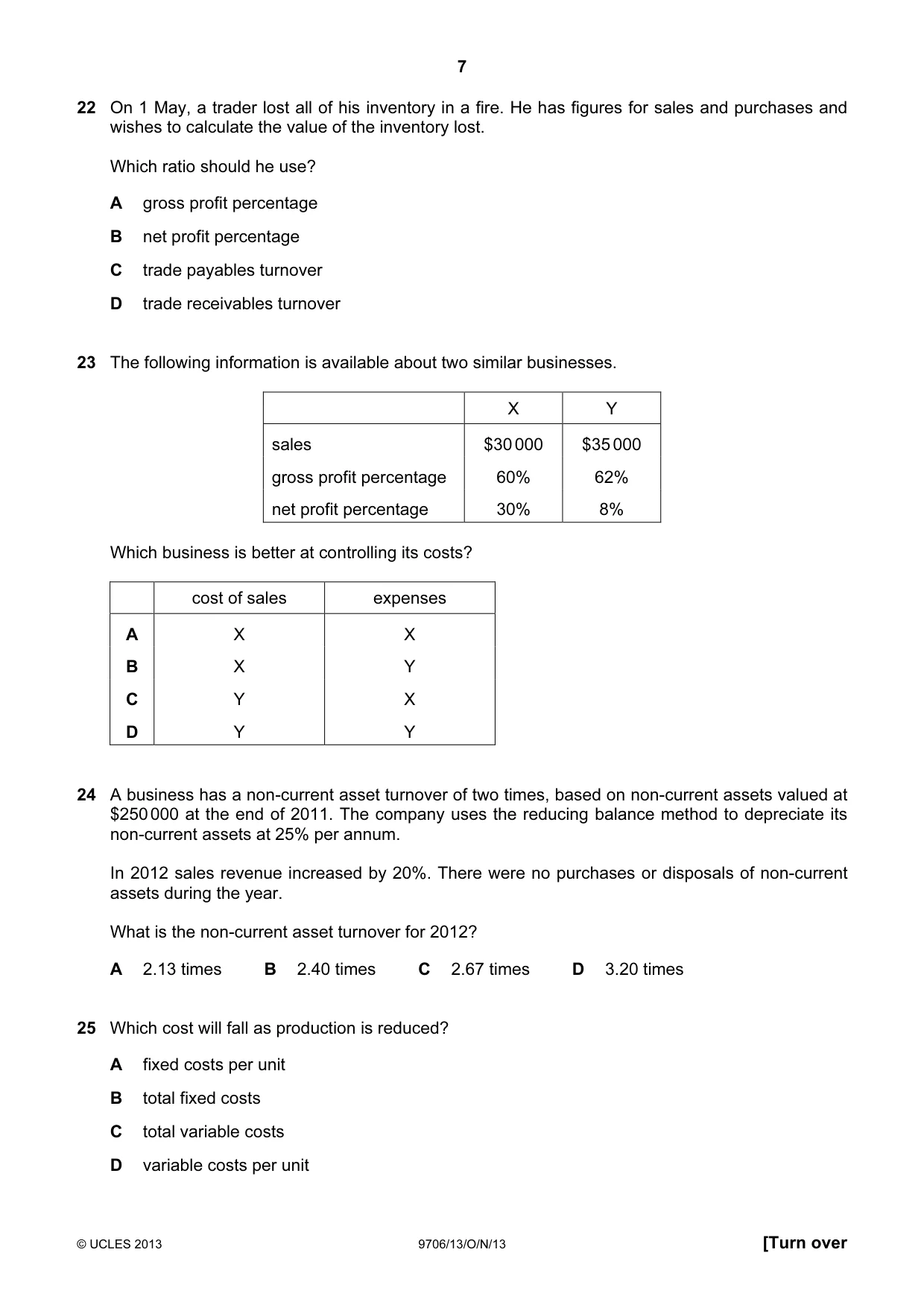
Q22 · On 1 May, a trader lost all of his inventory in a fire
22 On 1 May, a trader lost all of his inventory in a fire. He has figures for sales and purchases and wishes to calculate the value of the inventory lost. Which ratio should he use? A gross profit percentage B net profit percentage C trade payables turnover D trade receivables turnover
Mark scheme: A
More questions on Analysis and communication of accounting information
Q23 · The following information is available about two similar businesses
23 The following information is available about two similar businesses. X Y sales $30 000 $35 000 gross profit percentage 60% 62% net profit percentage 30% 8% Which business is better at controlling its costs? cost of sales expenses A X X B X Y C Y X D Y Y
Mark scheme: C
More questions on Analysis and communication of accounting information
Q24 · A business has a non-current asset turnover of two times, based on non-current assets…
24 A business has a non-current asset turnover of two times, based on non-current assets valued at $250 000 at the end of 2011. The company uses the reducing balance method to depreciate its non-current assets at 25% per annum. In 2012 sales revenue increased by 20%. There were no purchases or disposals of non-current assets during the year. What is the non-current asset turnover for 2012? A 2.13 times B 2.40 times C 2.67 times D 3.20 times
Mark scheme: D
More questions on Analysis and communication of accounting information
Q25 · Which cost will fall as production is reduced?
25 Which cost will fall as production is reduced? A fixed costs per unit B total fixed costs C total variable costs D variable costs per unit
Mark scheme: C
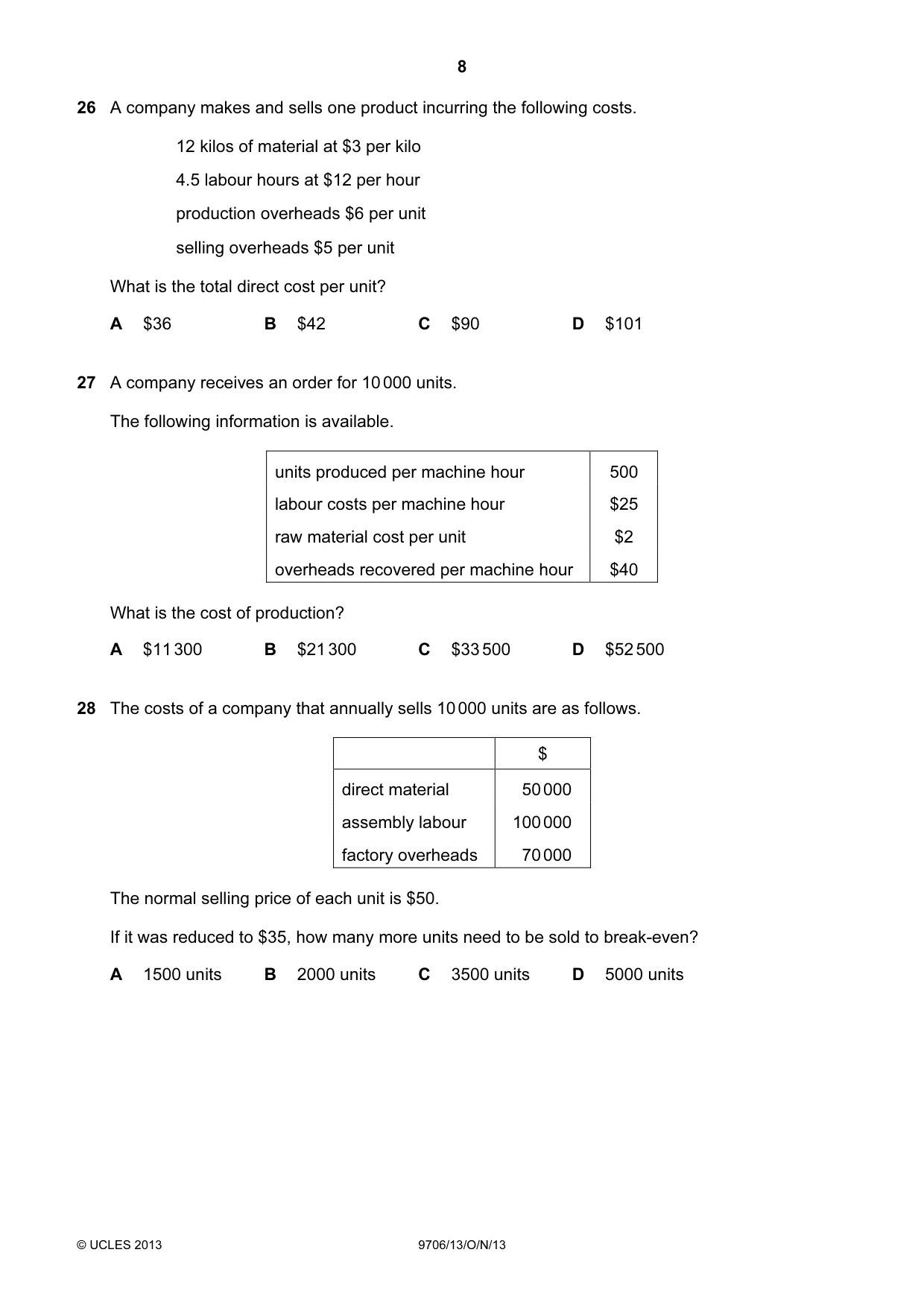
Q26 · A company makes and sells one product incurring the following costs
26 A company makes and sells one product incurring the following costs. 12 kilos of material at $3 per kilo 4.5 labour hours at $12 per hour production overheads $6 per unit selling overheads $5 per unit What is the total direct cost per unit? A $36 B $42 C $90 D $101
Mark scheme: C
Q27 · A company receives an order for 10 000 units
27 A company receives an order for 10 000 units. The following information is available. units produced per machine hour 500 labour costs per machine hour $25 raw material cost per unit $2 overheads recovered per machine hour $40 What is the cost of production? A $11 300 B $21 300 C $33 500 D $52 500
Mark scheme: B
Q28 · The costs of a company that annually sells 10 000 units are as follows
28 The costs of a company that annually sells 10 000 units are as follows. $ direct material 50 000 assembly labour 100 000 factory overheads 70 000 The normal selling price of each unit is $50. If it was reduced to $35, how many more units need to be sold to break-even? A 1500 units B 2000 units C 3500 units D 5000 units
Mark scheme: A
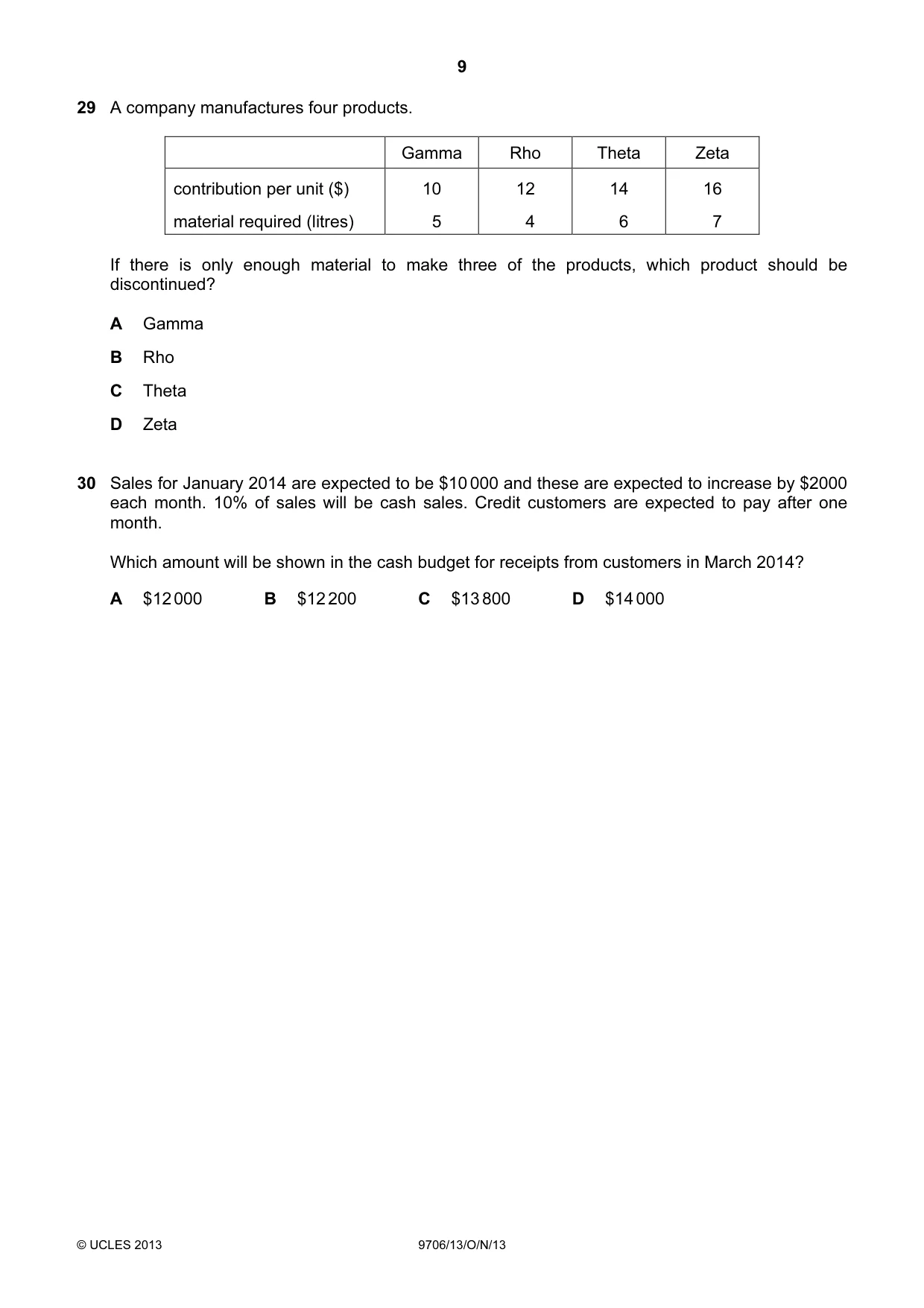
Q29 · A company manufactures four products
29 A company manufactures four products. Gamma Rho Theta Zeta contribution per unit ($) 10 12 14 16 material required (litres) 5 4 6 7 If there is only enough material to make three of the products, which product should be discontinued? A Gamma B Rho C Theta D Zeta
Mark scheme: A
Q30 · Sales for January 2014 are expected to be $10 000 and these are expected to increase by…
30 Sales for January 2014 are expected to be $10 000 and these are expected to increase by $2000 each month. 10% of sales will be cash sales. Credit customers are expected to pay after one month. Which amount will be shown in the cash budget for receipts from customers in March 2014? A $12 000 B $12 200 C $13 800 D $14 000
Mark scheme: B
What was in this paper
The subtopics covered by these 30 questions, and how many questions each got. Open one in a new tab to see every Cambridge question on it.
What you needed in this session
Cambridge’s own grade thresholds for 2013 Oct/Nov, Paper 1 · Variant 3. A higher threshold means an easier paper — the bar moves with how the cohort did.