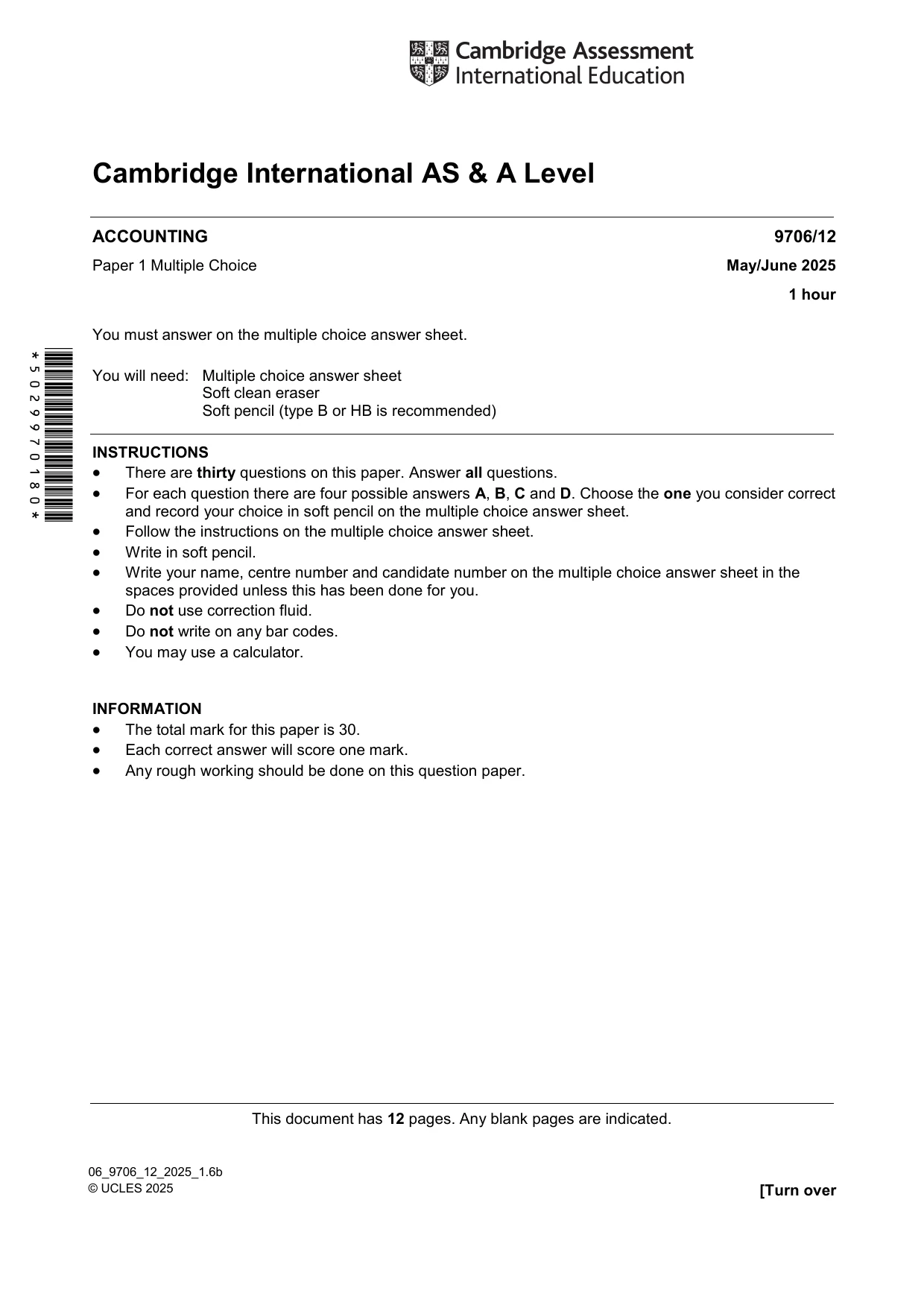
Cambridge A Level Accounting 9706 — 2025 May/June Paper 1 · Variant 2
9706/12/M/J/25 · 30 questions · 30 marks · ≈34 min
The question paper and its mark scheme, free to read here and free to download. This is Cambridge’s own paper, exactly as it was sat.
Question paper12 pages
Mark scheme3 pages
Answers below. Sit the paper first if you are practising.
Questions as text
Q1 · Ahmed and Betty are in partnership
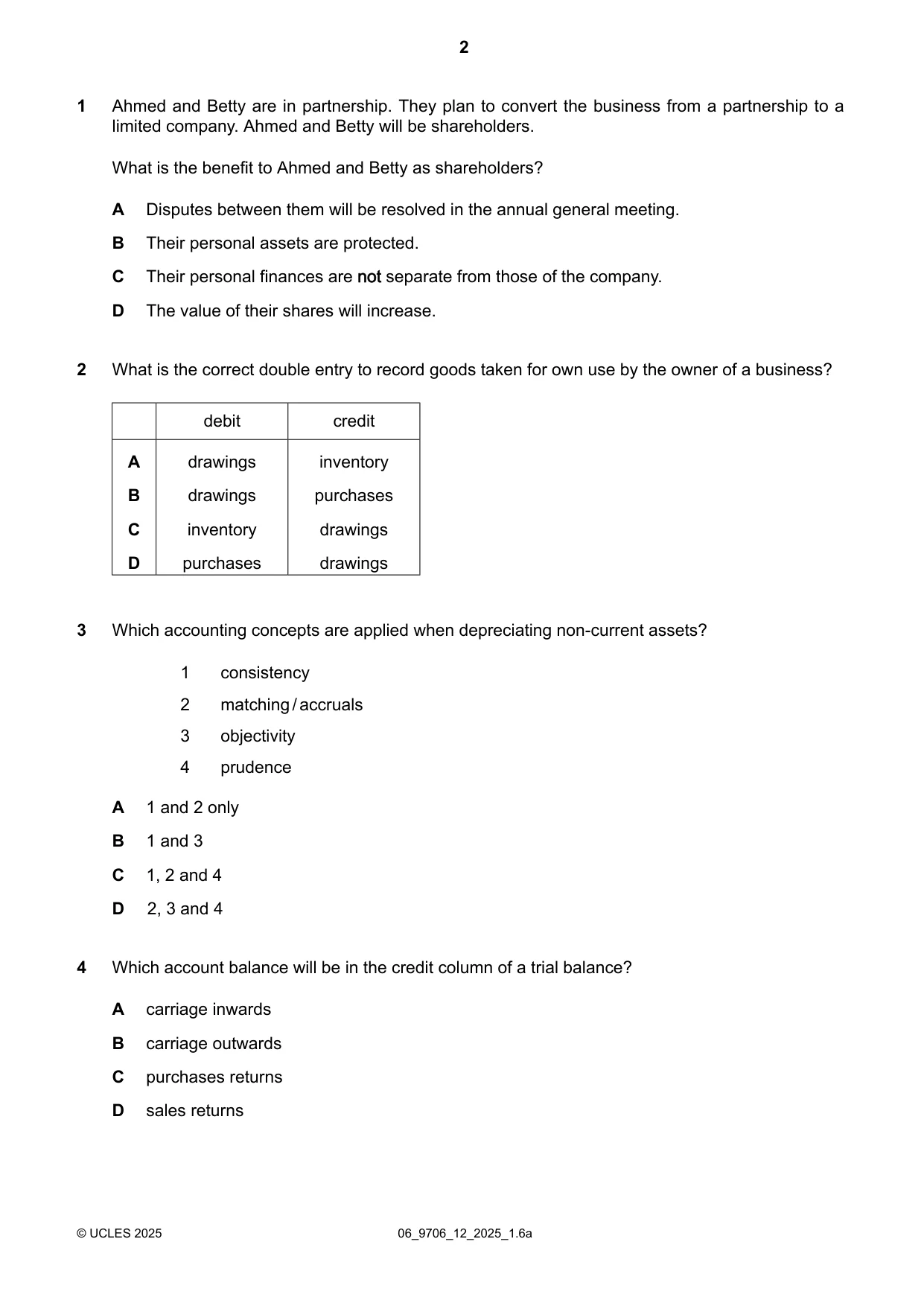
1 Ahmed and Betty are in partnership. They plan to convert the business from a partnership to a limited company. Ahmed and Betty will be shareholders. What is the benefit to Ahmed and Betty as shareholders? A Disputes between them will be resolved in the annual general meeting. B Their personal assets are protected. C Their personal finances are not separate from those of the company. D The value of their shares will increase.
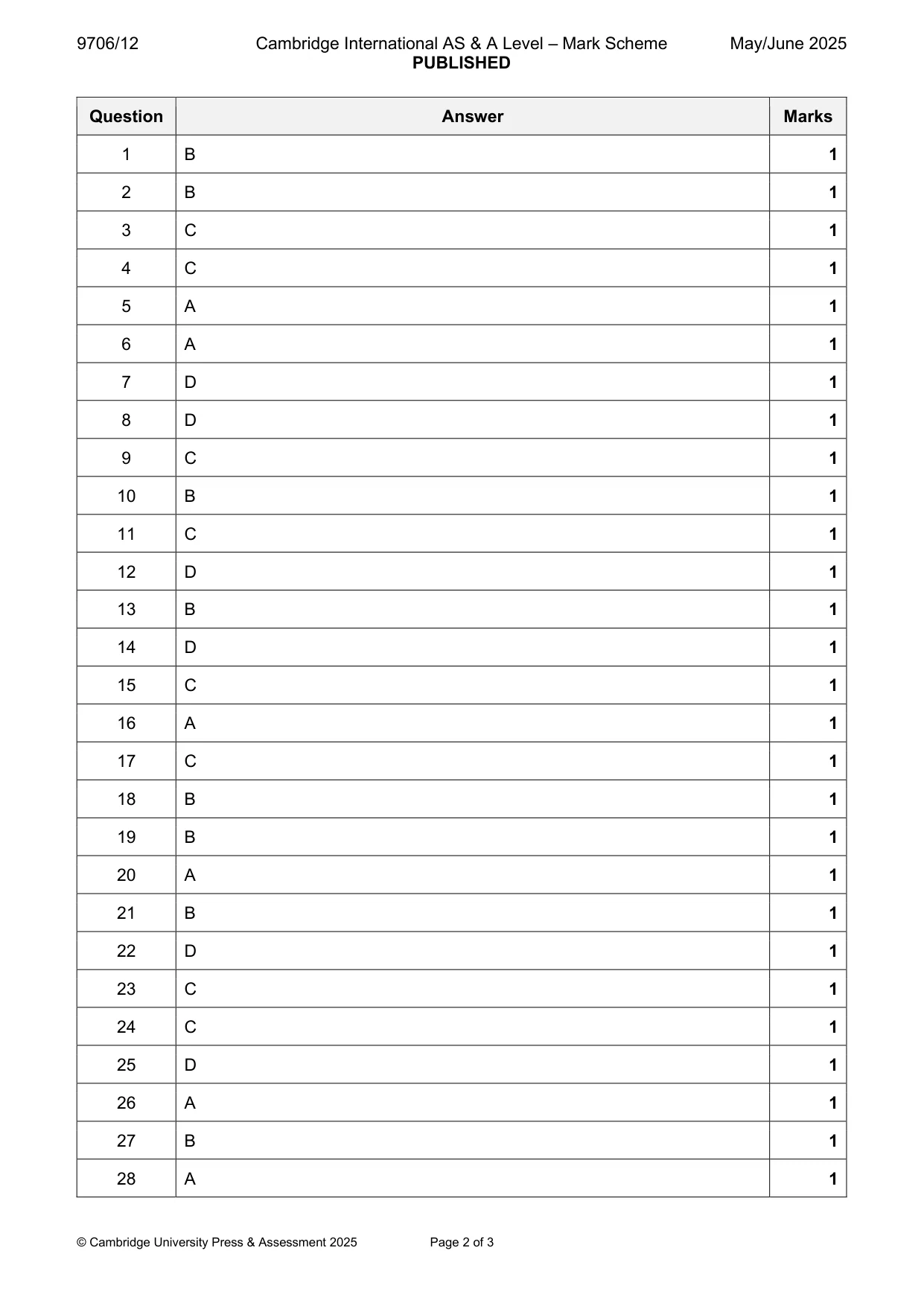
Mark scheme: B
Q2 · What is the correct double entry to record goods taken for own use by the owner of a…
2 What is the correct double entry to record goods taken for own use by the owner of a business? debit credit A drawings inventory B drawings purchases C inventory drawings D purchases drawings
Mark scheme: B
Q3 · Which accounting concepts are applied when depreciating non-current assets?
3 Which accounting concepts are applied when depreciating non-current assets? 1 consistency 2 matching/accruals 3 objectivity 4 prudence A 1 and 2 only B 1 and 3 C 1, 2 and 4 D 2, 3 and 4
Mark scheme: C
Q4 · Which account balance will be in the credit column of a trial balance?
4 Which account balance will be in the credit column of a trial balance? A carriage inwards B carriage outwards C purchases returns D sales returns
Mark scheme: C
Q5 · The financial statements were prepared using the following details
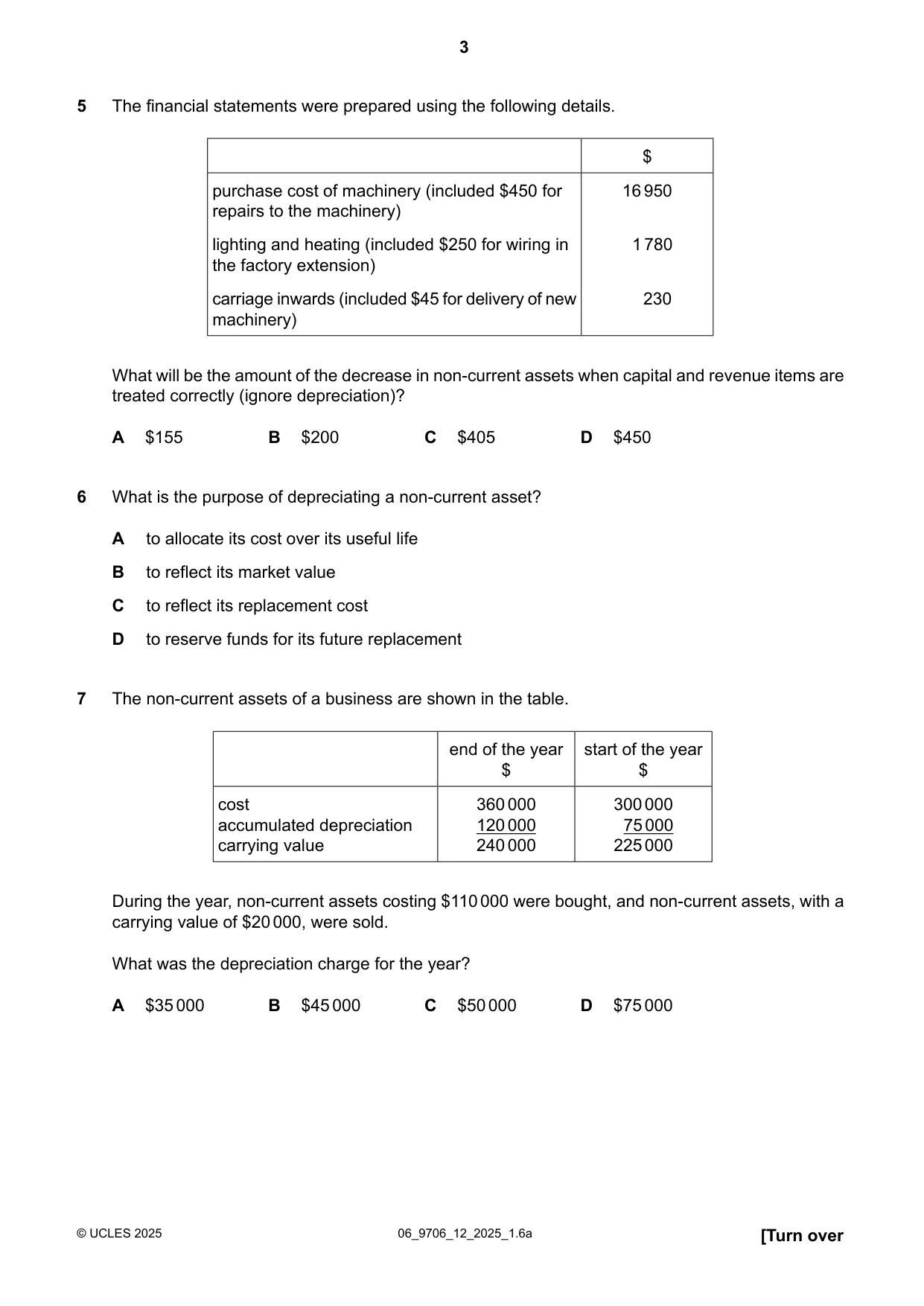
5 The financial statements were prepared using the following details. $ purchase cost of machinery (included $450 for 16950 repairs to the machinery) lighting and heating (included $250 for wiring in 1780 the factory extension) carriage inwards (included $45 for delivery of new 230 machinery) What will be the amount of the decrease in non-current assets when capital and revenue items are treated correctly (ignore depreciation)? A $155 B $200 C $405 D $450
Mark scheme: A
Q6 · What is the purpose of depreciating a non-current asset?
6 What is the purpose of depreciating a non-current asset? A to allocate its cost over its useful life B to reflect its market value C to reflect its replacement cost D to reserve funds for its future replacement
Mark scheme: A
Q7 · The non-current assets of a business are shown in the table
7 The non-current assets of a business are shown in the table. end of the year start of the year $ $ cost 360000 300000 accumulated depreciation 120 000 75 000 carrying value 240000 225000 During the year, non-current assets costing $110000 were bought, and non-current assets, with a carrying value of $20000, were sold. What was the depreciation charge for the year? A $35000 B $45000 C $50000 D $75000
Mark scheme: D
Q8 · After the profit for the year was calculated, the following errors were discovered
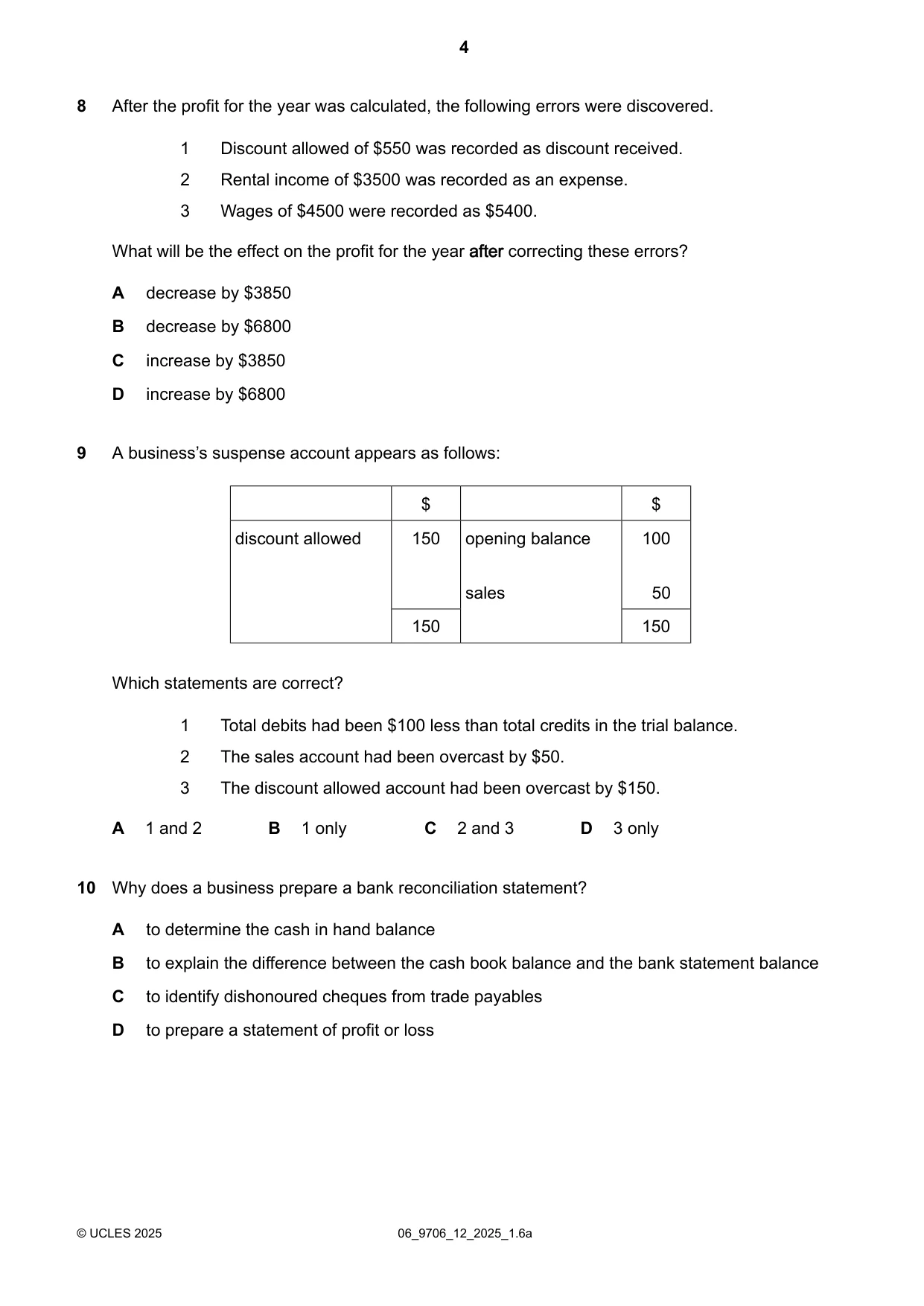
8 After the profit for the year was calculated, the following errors were discovered. 1 Discount allowed of $550 was recorded as discount received. 2 Rental income of $3500 was recorded as an expense. 3 Wages of $4500 were recorded as $5400. What will be the effect on the profit for the year after correcting these errors? A decrease by $3850 B decrease by $6800 C increase by $3850 D increase by $6800
Mark scheme: D
Q9 · A business’s suspense account appears as follows: $ $ discount allowed 150 opening…
9 A business’s suspense account appears as follows: $ $ discount allowed 150 opening balance 100 sales 50 150 150 Which statements are correct? 1 Total debits had been $100 less than total credits in the trial balance. 2 The sales account had been overcast by $50. 3 The discount allowed account had been overcast by $150. A 1 and 2 B 1 only C 2 and 3 D 3 only
Mark scheme: C
Q10 · Why does a business prepare a bank reconciliation statement?
10 Why does a business prepare a bank reconciliation statement? A to determine the cash in hand balance B to explain the difference between the cash book balance and the bank statement balance C to identify dishonoured cheques from trade payables D to prepare a statement of profit or loss
Mark scheme: B
Q11 · A debit balance of $2600 was shown for the bank in the cash book of a business at the end…
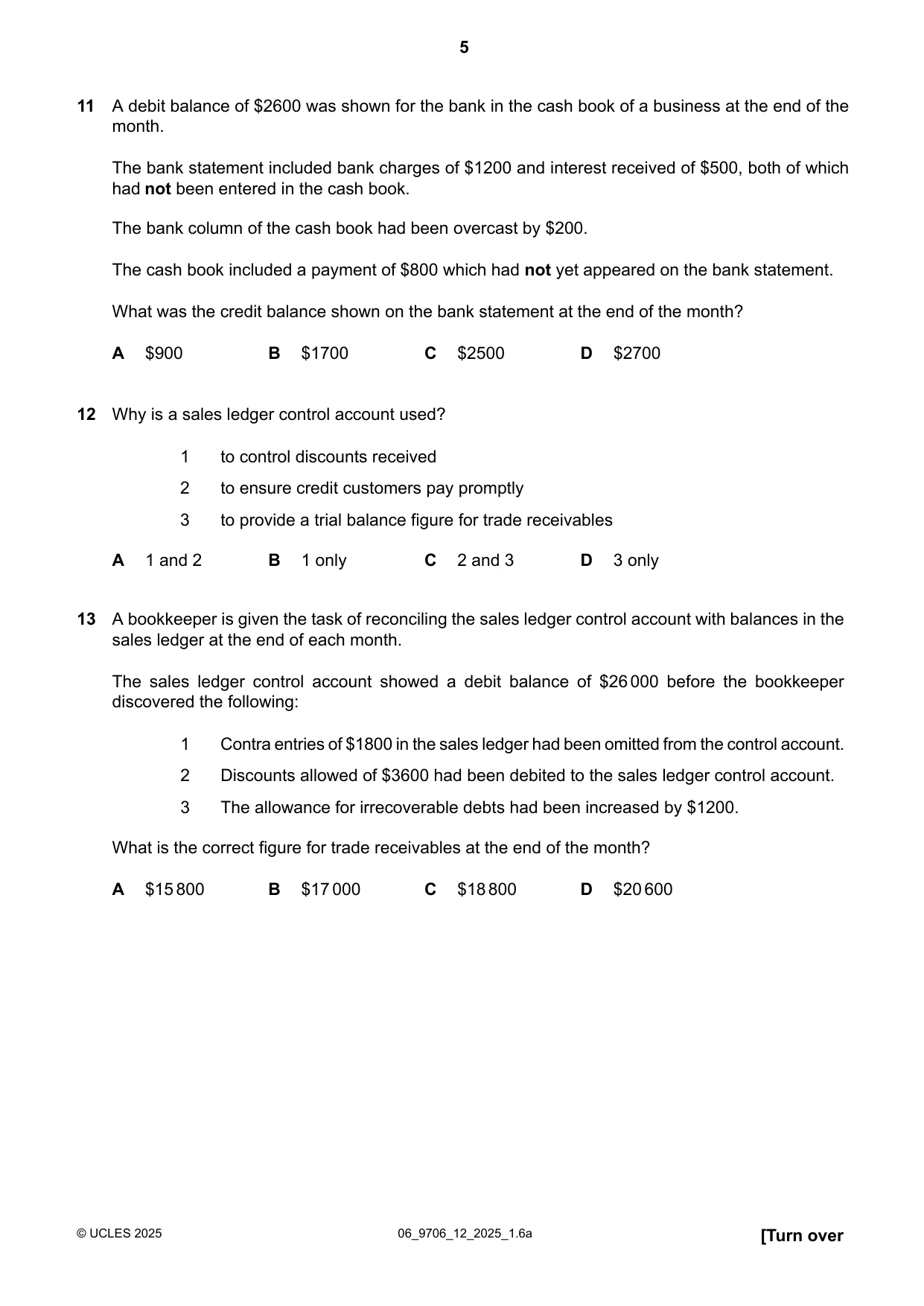
11 A debit balance of $2600 was shown for the bank in the cash book of a business at the end of the month. The bank statement included bank charges of $1200 and interest received of $500, both of which had not been entered in the cash book. The bank column of the cash book had been overcast by $200. The cash book included a payment of $800 which had not yet appeared on the bank statement. What was the credit balance shown on the bank statement at the end of the month? A $900 B $1700 C $2500 D $2700
Mark scheme: C
Q12 · Why is a sales ledger control account used?
12 Why is a sales ledger control account used? 1 to control discounts received 2 to ensure credit customers pay promptly 3 to provide a trial balance figure for trade receivables A 1 and 2 B 1 only C 2 and 3 D 3 only
Mark scheme: D
Q13 · A bookkeeper is given the task of reconciling the sales ledger control account with…
13 A bookkeeper is given the task of reconciling the sales ledger control account with balances in the sales ledger at the end of each month. The sales ledger control account showed a debit balance of $26000 before the bookkeeper discovered the following: 1 Contra entries of $1800 in the sales ledger had been omitted from the control account. 2 Discounts allowed of $3600 had been debited to the sales ledger control account. 3 The allowance for irrecoverable debts had been increased by $1200. What is the correct figure for trade receivables at the end of the month? A $15800 B $17000 C $18800 D $20600
Mark scheme: B
Q14 · A business paid $5750 during its trading year for advertising
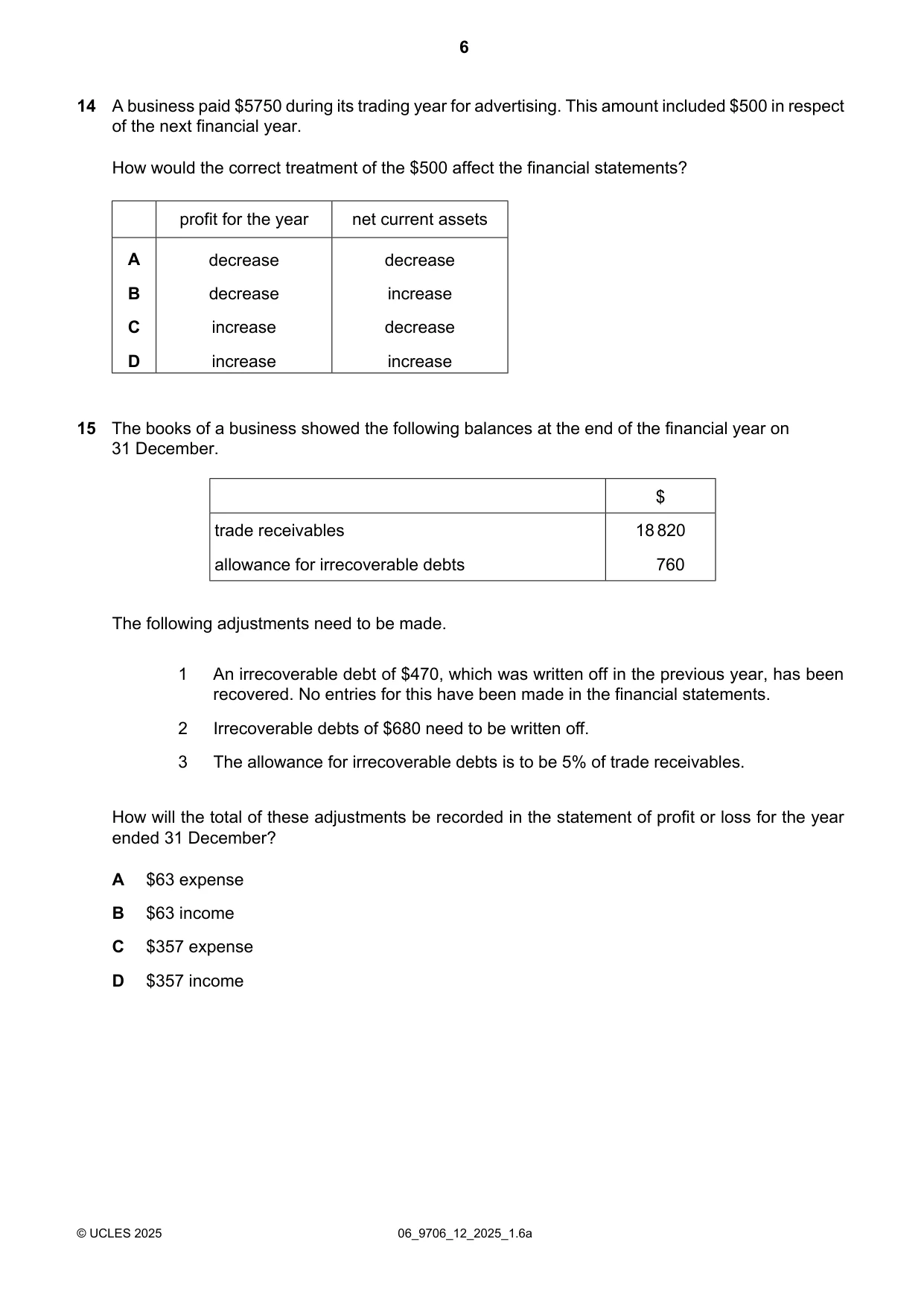
14 A business paid $5750 during its trading year for advertising. This amount included $500 in respect of the next financial year. How would the correct treatment of the $500 affect the financial statements? profit for the year net current assets A decrease decrease B decrease increase C increase decrease D increase increase
Mark scheme: D
Q15 · The books of a business showed the following balances at the end of the financial year on…
15 The books of a business showed the following balances at the end of the financial year on 31 December. $ trade receivables 18820 allowance for irrecoverable debts 760 The following adjustments need to be made. 1 An irrecoverable debt of $470, which was written off in the previous year, has been recovered. No entries for this have been made in the financial statements. 2 Irrecoverable debts of $680 need to be written off. 3 The allowance for irrecoverable debts is to be 5% of trade receivables. How will the total of these adjustments be recorded in the statement of profit or loss for the year ended 31 December? A $63 expense B $63 income C $357 expense D $357 income
Mark scheme: C
Q16 · After preparing the financial statements of a sole trader, the following items were…
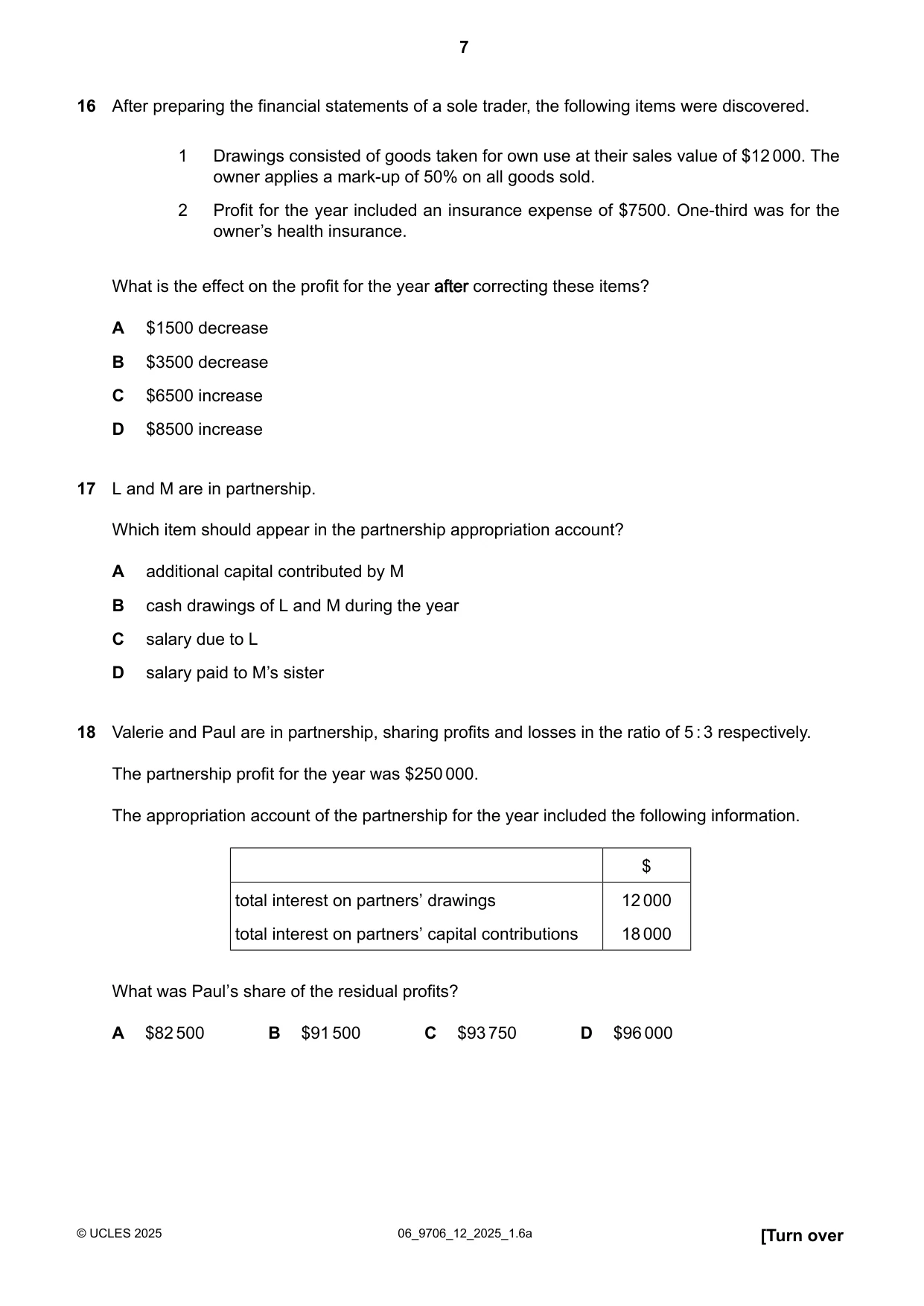
16 After preparing the financial statements of a sole trader, the following items were discovered. 1 Drawings consisted of goods taken for own use at their sales value of $12000. The owner applies a mark-up of 50% on all goods sold. 2 Profit for the year included an insurance expense of $7500. One-third was for the owner’s health insurance. What is the effect on the profit for the year after correcting these items? A $1500 decrease B $3500 decrease C $6500 increase D $8500 increase
Mark scheme: A
Q17 · L and M are in partnership
17 L and M are in partnership. Which item should appear in the partnership appropriation account? A additional capital contributed by M B cash drawings of L and M during the year C salary due to L D salary paid to M’s sister
Mark scheme: C
Q18 · Valerie and Paul are in partnership, sharing profits and losses in the ratio of 5:3…
18 Valerie and Paul are in partnership, sharing profits and losses in the ratio of 5:3 respectively. The partnership profit for the year was $250000. The appropriation account of the partnership for the year included the following information. $ total interest on partners’ drawings 12000 total interest on partners’ capital contributions 18000 What was Paul’s share of the residual profits? A $82500 B $91500 C $93750 D $96000
Mark scheme: B
Q19 · Which items will be shown in a company’s statement of changes in equity?
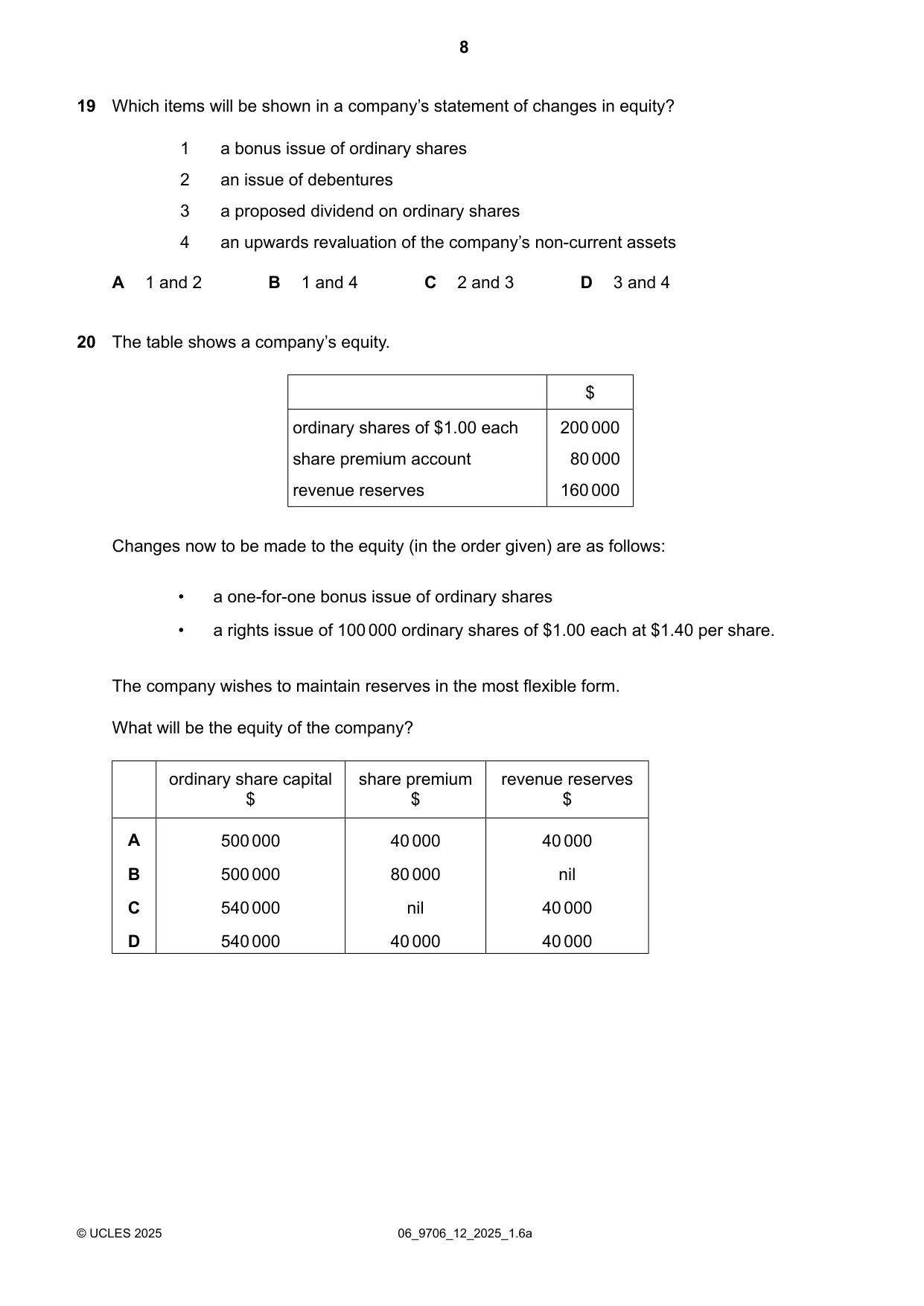
19 Which items will be shown in a company’s statement of changes in equity? 1 a bonus issue of ordinary shares 2 an issue of debentures 3 a proposed dividend on ordinary shares 4 an upwards revaluation of the company’s non-current assets A 1 and 2 B 1 and 4 C 2 and 3 D 3 and 4
Mark scheme: B
Q20 · The table shows a company’s equity
20 The table shows a company’s equity. $ ordinary shares of $1.00 each 200000 share premium account 80000 revenue reserves 160000 Changes now to be made to the equity (in the order given) are as follows: • a one-for-one bonus issue of ordinary shares • a rights issue of 100000 ordinary shares of $1.00 each at $1.40 per share. The company wishes to maintain reserves in the most flexible form. What will be the equity of the company? ordinary share capital share premium revenue reserves $ $ $ A 500000 40000 40000 B 500000 80000 nil C 540000 nil 40000 D 540000 40000 40000
Mark scheme: A
Q21 · A company had the following balances at 31 December
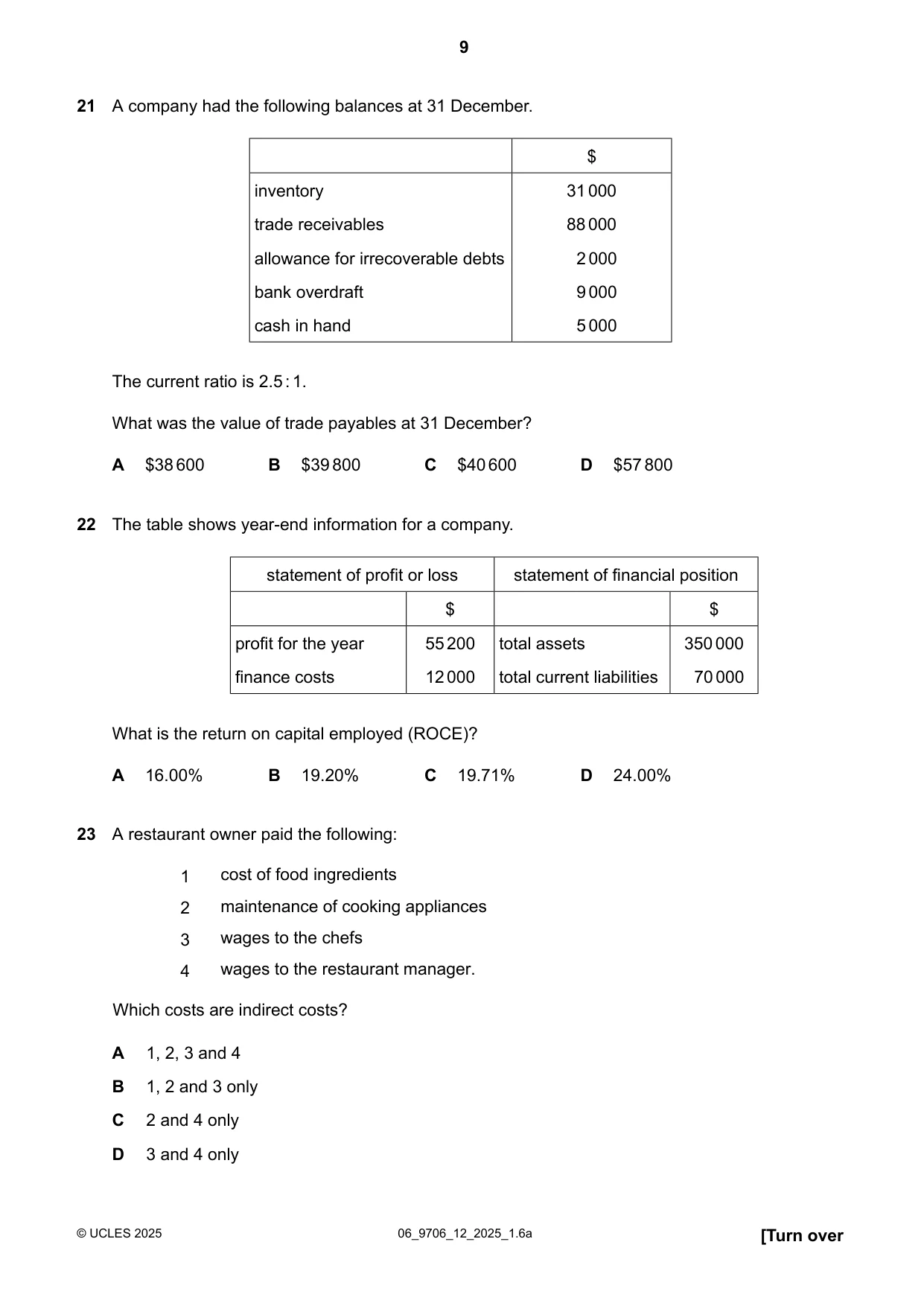
21 A company had the following balances at 31 December. $ inventory 31000 trade receivables 88000 allowance for irrecoverable debts 2000 bank overdraft 9000 cash in hand 5000 The current ratio is 2.5:1. What was the value of trade payables at 31 December? A $38600 B $39800 C $40600 D $57800
Mark scheme: B
More questions on Analysis and communication of accounting information
Q22 · The table shows year-end information for a company
22 The table shows year-end information for a company. statement of profit or loss statement of financial position $ $ profit for the year 55200 total assets 350000 finance costs 12000 total current liabilities 70000 What is the return on capital employed (ROCE)? A 16.00% B 19.20% C 19.71% D 24.00%
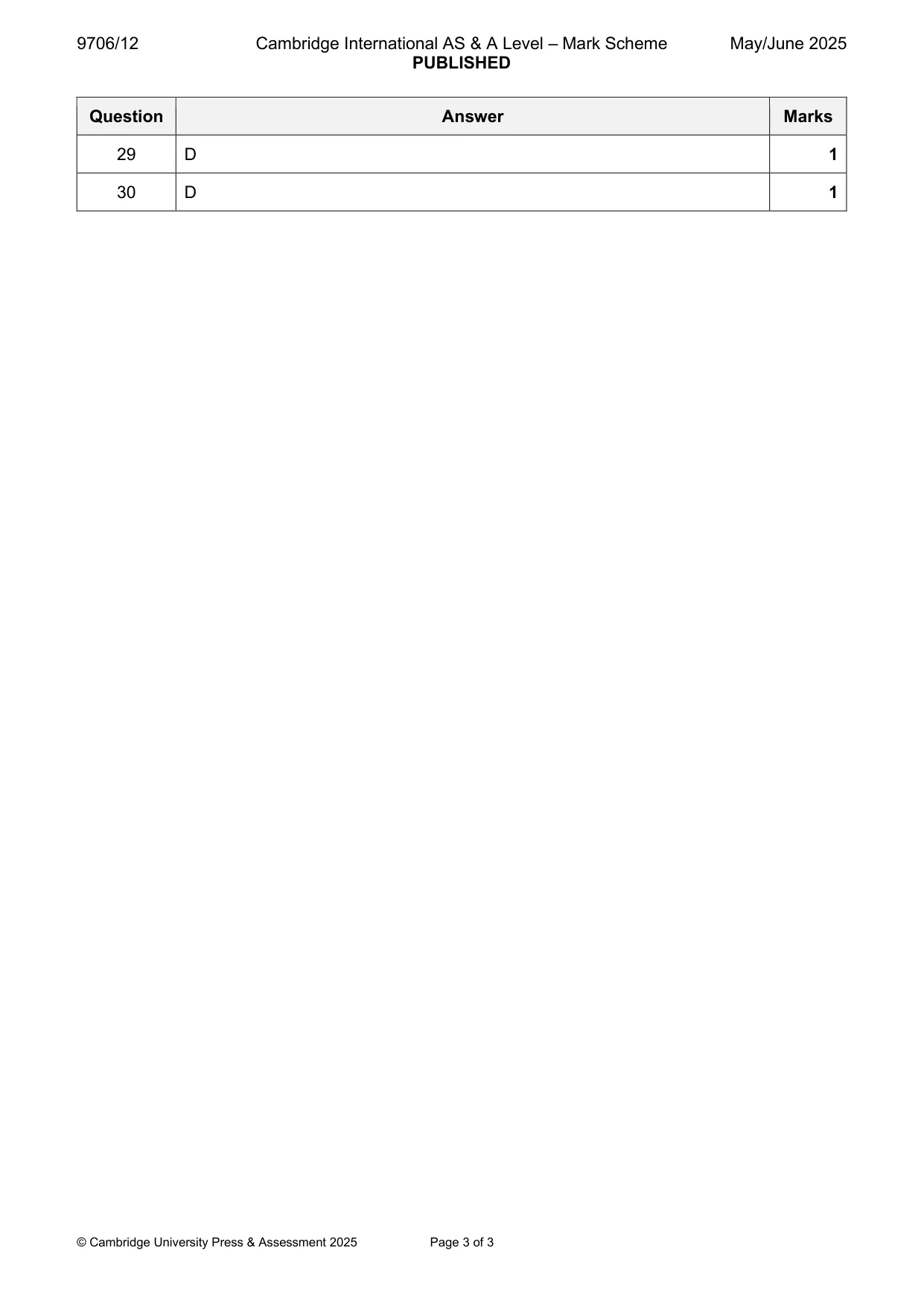
Mark scheme: D
More questions on Analysis and communication of accounting information
Q23 · A restaurant owner paid the following: 1 cost of food ingredients 2 maintenance of…
23 A restaurant owner paid the following: 1 cost of food ingredients 2 maintenance of cooking appliances 3 wages to the chefs 4 wages to the restaurant manager. Which costs are indirect costs? A 1, 2, 3 and 4 B 1, 2 and 3 only C 2 and 4 only D 3 and 4 only
Mark scheme: C
Q24 · Total costs for each of two months had been recorded
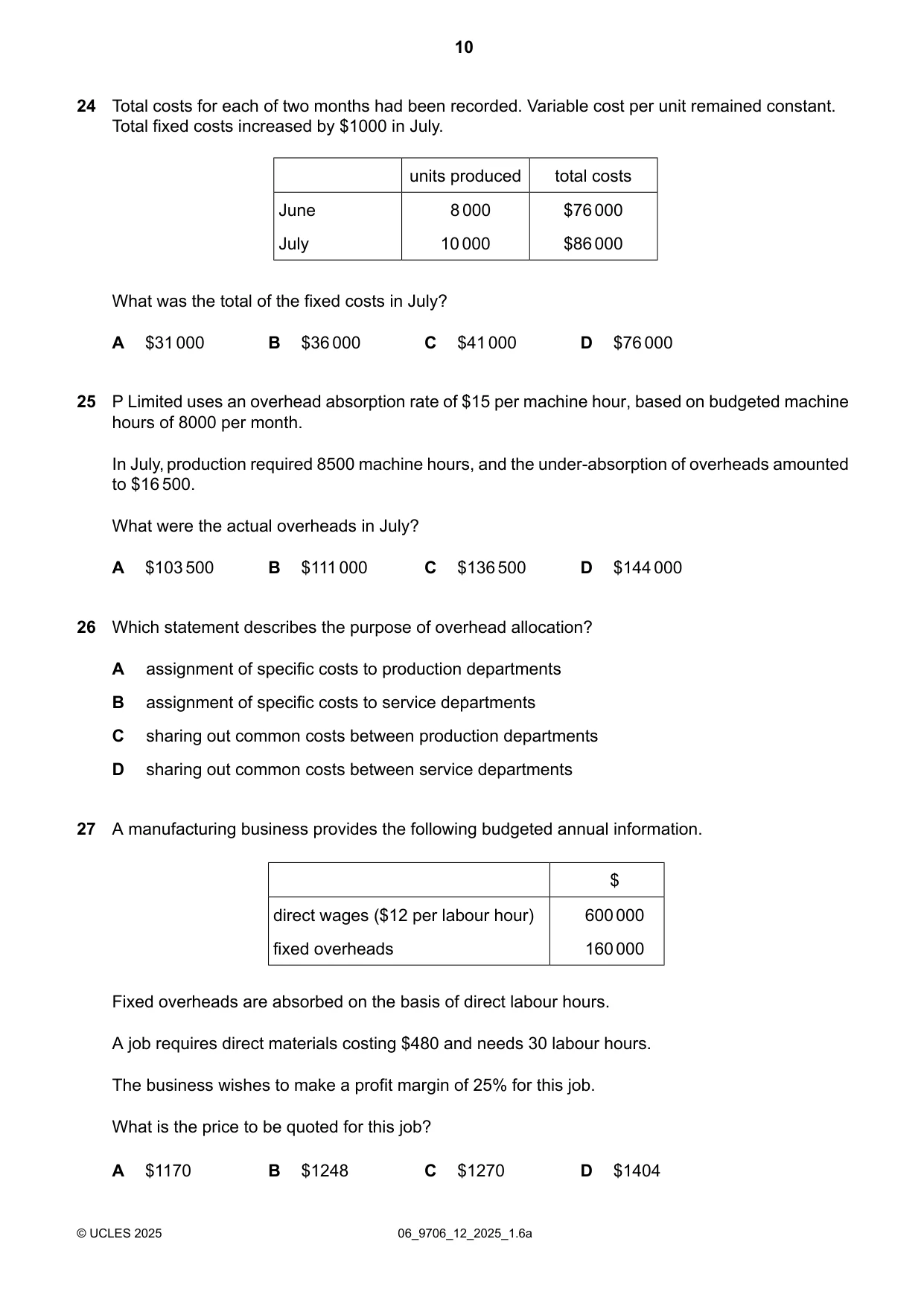
24 Total costs for each of two months had been recorded. Variable cost per unit remained constant. Total fixed costs increased by $1000 in July. units produced total costs June 8000 $76000 July 10000 $86000 What was the total of the fixed costs in July? A $31000 B $36000 C $41000 D $76000
Mark scheme: C
Q25 · P Limited uses an overhead absorption rate of $15 per machine hour, based on budgeted…
25 P Limited uses an overhead absorption rate of $15 per machine hour, based on budgeted machine hours of 8000 per month. In July, production required 8500 machine hours, and the under-absorption of overheads amounted to $16 500. What were the actual overheads in July? A $103500 B $111000 C $136500 D $144000
Mark scheme: D
Q26 · Which statement describes the purpose of overhead allocation?
26 Which statement describes the purpose of overhead allocation? A assignment of specific costs to production departments B assignment of specific costs to service departments C sharing out common costs between production departments D sharing out common costs between service departments
Mark scheme: A
Q27 · A manufacturing business provides the following budgeted annual information
27 A manufacturing business provides the following budgeted annual information. $ direct wages ($12 per labour hour) 600000 fixed overheads 160000 Fixed overheads are absorbed on the basis of direct labour hours. A job requires direct materials costing $480 and needs 30 labour hours. The business wishes to make a profit margin of 25% for this job. What is the price to be quoted for this job? A $1170 B $1248 C $1270 D $1404
Mark scheme: B
Q28 · Which factor would cause the variable cost line on a break-even chart not to be a…
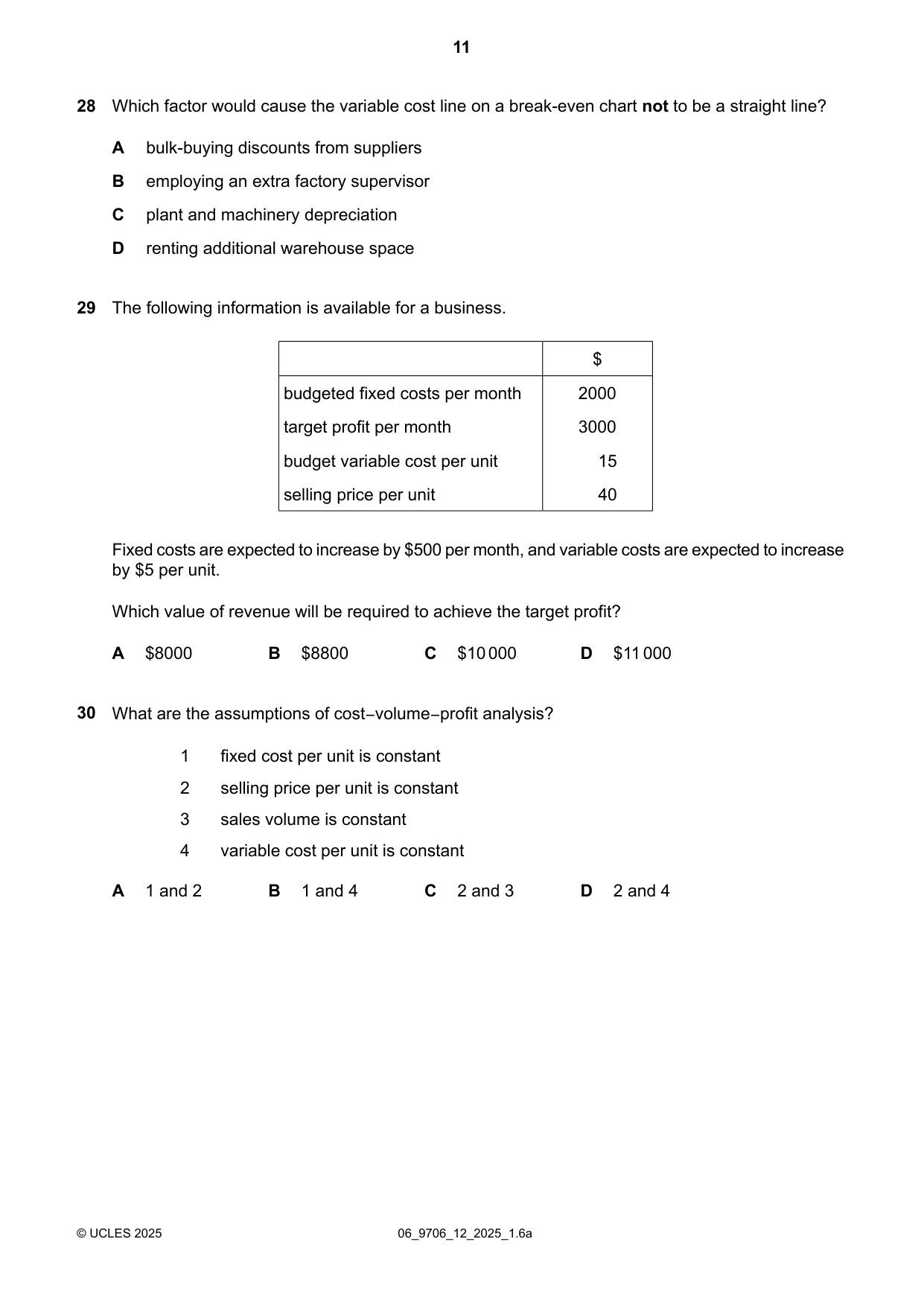
28 Which factor would cause the variable cost line on a break-even chart not to be a straight line? A bulk-buying discounts from suppliers B employing an extra factory supervisor C plant and machinery depreciation D renting additional warehouse space
Mark scheme: A
Q29 · The following information is available for a business
29 The following information is available for a business. $ budgeted fixed costs per month 2000 target profit per month 3000 budget variable cost per unit 15 selling price per unit 40 Fixed costs are expected to increase by $500 per month, and variable costs are expected to increase by $5 per unit. Which value of revenue will be required to achieve the target profit? A $8000 B $8800 C $10000 D $11000
Mark scheme: D
Q30 · What are the assumptions of cost−volume−profit analysis?
30 What are the assumptions of cost−volume−profit analysis? 1 fixed cost per unit is constant 2 selling price per unit is constant 3 sales volume is constant 4 variable cost per unit is constant A 1 and 2 B 1 and 4 C 2 and 3 D 2 and 4
Mark scheme: D
What was in this paper
The subtopics covered by these 30 questions, and how many questions each got. Open one in a new tab to see every Cambridge question on it.
6Costs and cost behaviour5Preparation of financial statements5Accounting for non-current assets4Traditional costing methods3Preparation of financial statements2The accounting system2Analysis and communication of accounting information1Analysis and communication of accounting information1Types of business entity1What you needed in this session
Cambridge’s own grade thresholds for 2025 May/June, Paper 1 · Variant 2. A higher threshold means an easier paper — the bar moves with how the cohort did.