Cambridge A Level Accounting 9706 — 2012 Oct/Nov Paper 1 · Variant 2
9706/12/O/N/12 · 30 questions · 30 marks · ≈34 min
The question paper and its mark scheme, free to read here and free to download. This is Cambridge’s own paper, exactly as it was sat.
Question paper12 pages
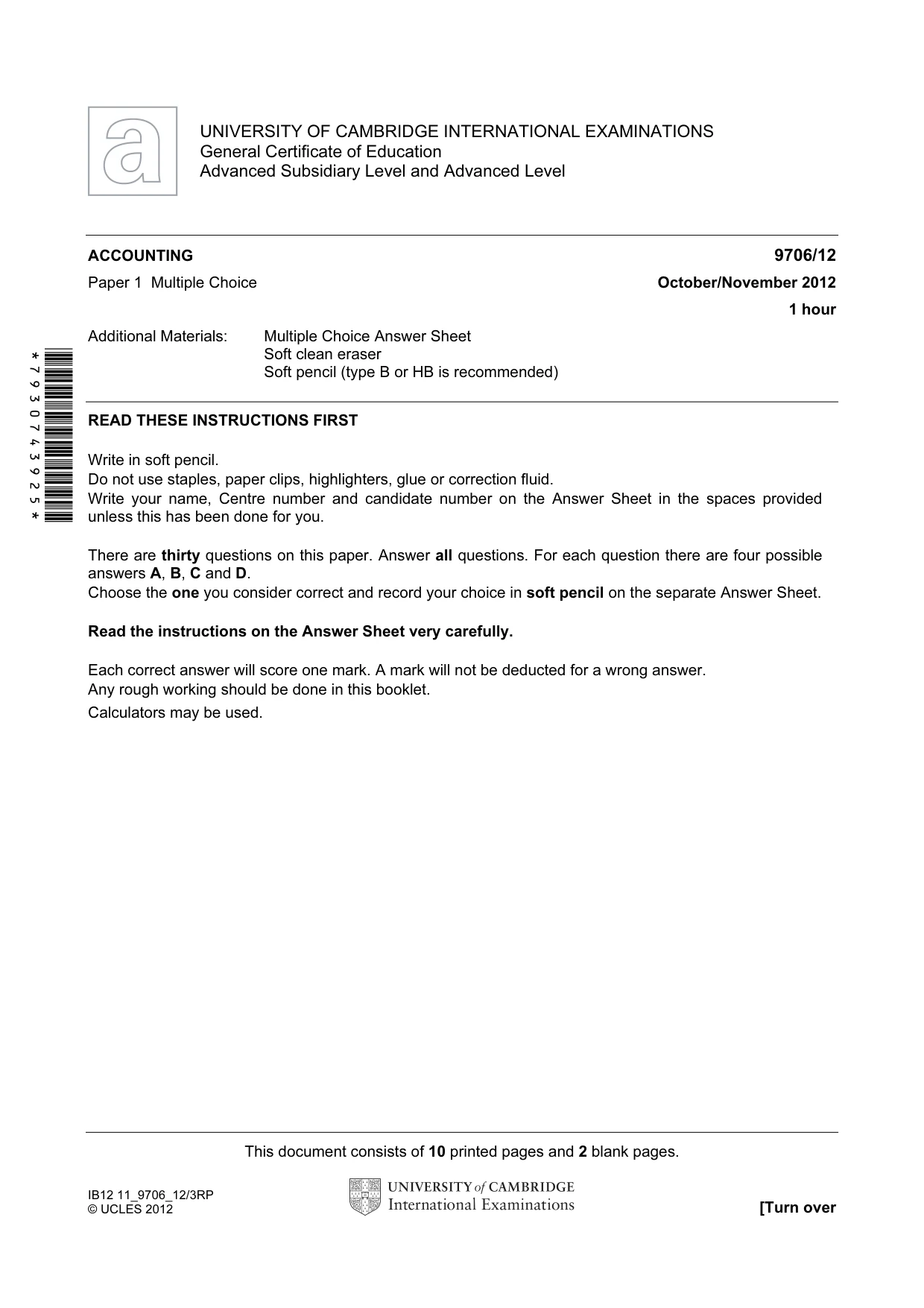

Mark scheme2 pages
Answers below. Sit the paper first if you are practising.
Questions as text
Q1 · Rent for premises is paid monthly in advance on the first day of each month
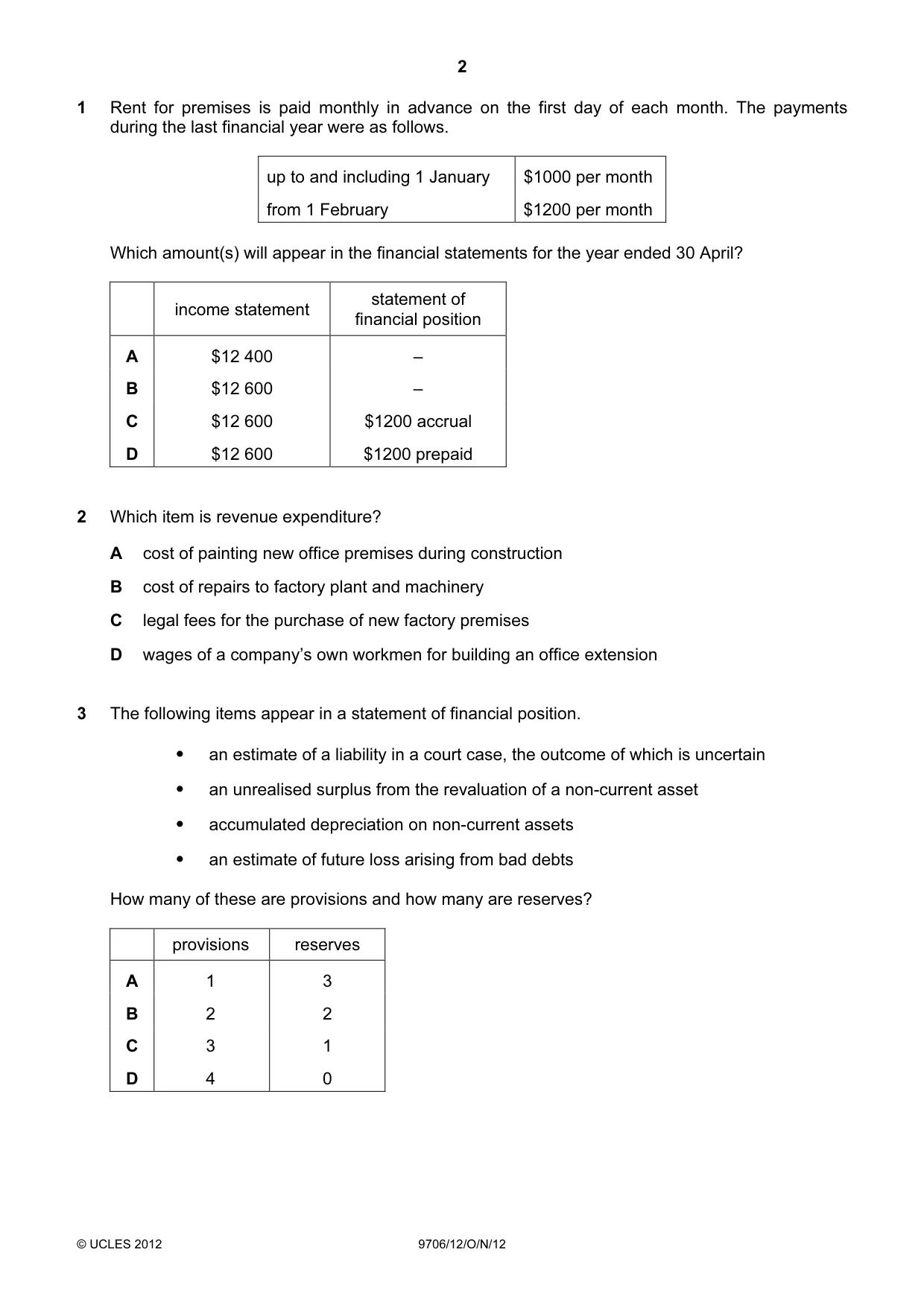
1 Rent for premises is paid monthly in advance on the first day of each month. The payments during the last financial year were as follows. up to and including 1 January $1000 per month from 1 February $1200 per month Which amount(s) will appear in the financial statements for the year ended 30 April? statement of income statement financial position A $12 400 – B $12 600 – C $12 600 $1200 accrual D $12 600 $1200 prepaid
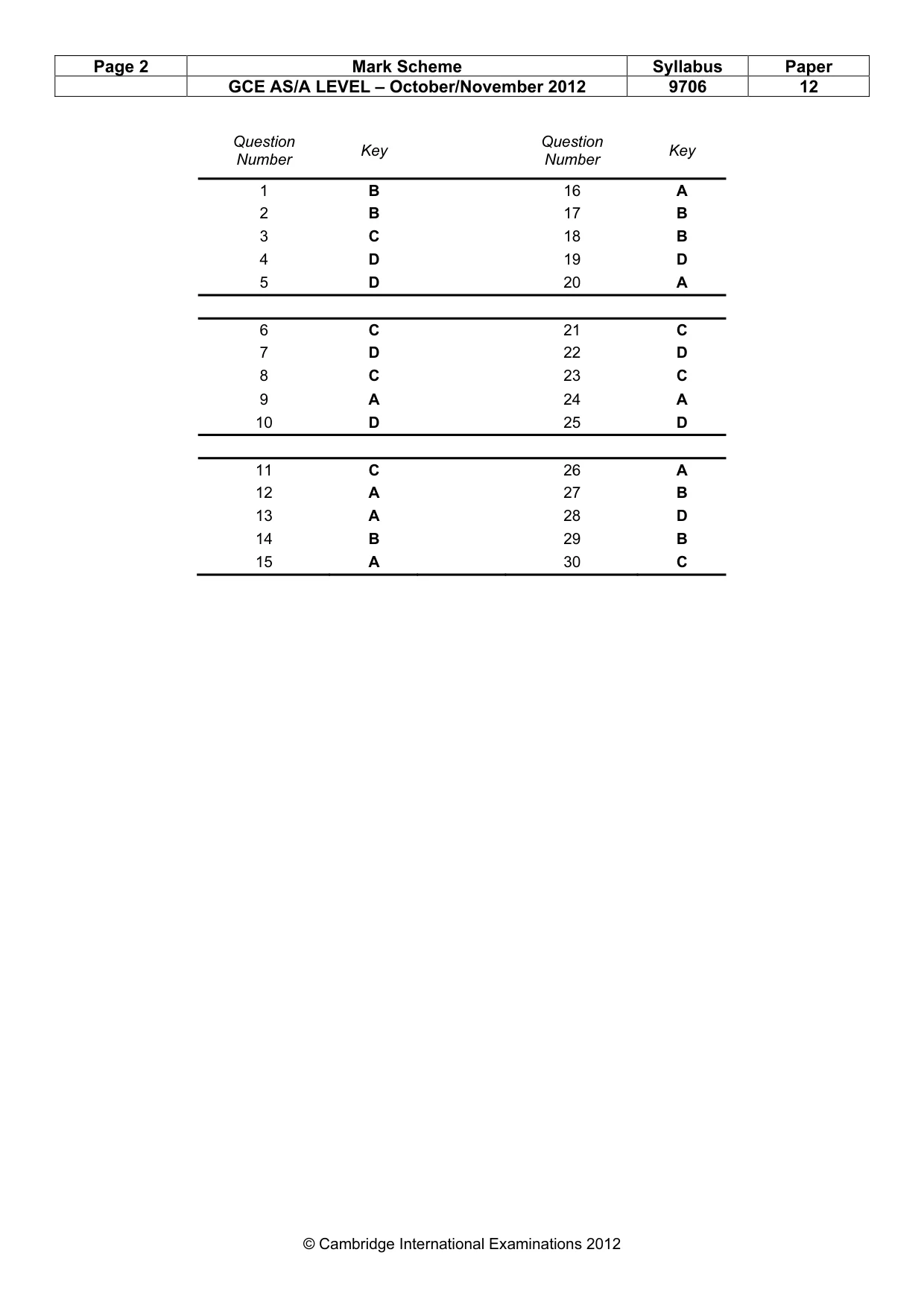
Mark scheme: B
Q2 · Which item is revenue expenditure?
2 Which item is revenue expenditure? A cost of painting new office premises during construction B cost of repairs to factory plant and machinery C legal fees for the purchase of new factory premises D wages of a company’s own workmen for building an office extension
Mark scheme: B
Q3 · The following items appear in a statement of financial position
3 The following items appear in a statement of financial position. • an estimate of a liability in a court case, the outcome of which is uncertain • an unrealised surplus from the revaluation of a non-current asset • accumulated depreciation on non-current assets • an estimate of future loss arising from bad debts How many of these are provisions and how many are reserves? provisions reserves A 1 3 B 2 2 C 3 1 D 4 0
Mark scheme: C
Q4 · A trial balance shows the following information
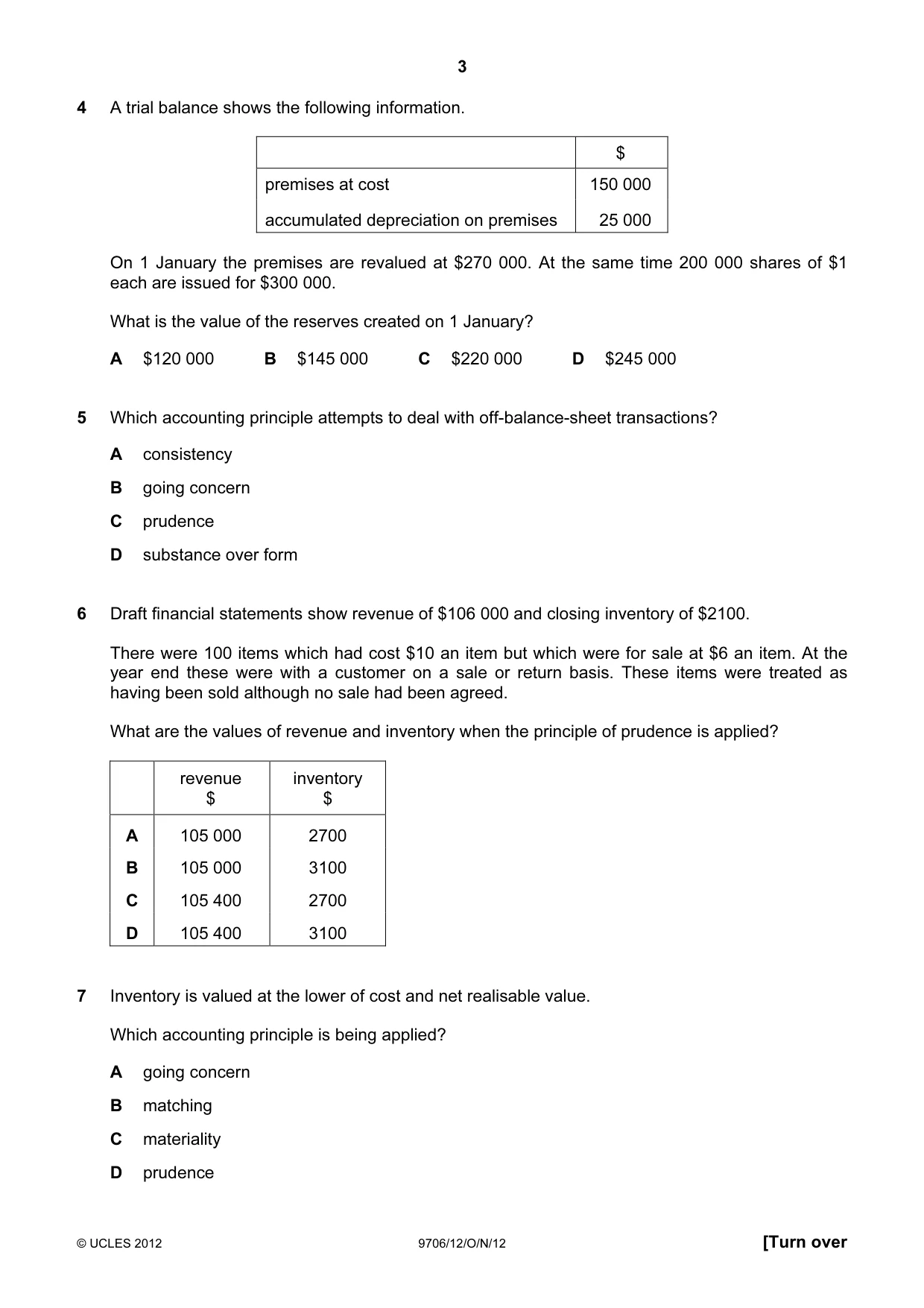
4 A trial balance shows the following information. $ premises at cost 150 000 accumulated depreciation on premises 25 000 On 1 January the premises are revalued at $270 000. At the same time 200 000 shares of $1 each are issued for $300 000. What is the value of the reserves created on 1 January? A $120 000 B $145 000 C $220 000 D $245 000
Mark scheme: D
Q5 · Which accounting principle attempts to deal with off-balance-sheet transactions?
5 Which accounting principle attempts to deal with off-balance-sheet transactions? A consistency B going concern C prudence D substance over form
Mark scheme: D
Q6 · Draft financial statements show revenue of $106 000 and closing inventory of $2100
6 Draft financial statements show revenue of $106 000 and closing inventory of $2100. There were 100 items which had cost $10 an item but which were for sale at $6 an item. At the year end these were with a customer on a sale or return basis. These items were treated as having been sold although no sale had been agreed. What are the values of revenue and inventory when the principle of prudence is applied? revenue inventory $ $ A 105 000 2700 B 105 000 3100 C 105 400 2700 D 105 400 3100
Mark scheme: C
Q7 · Inventory is valued at the lower of cost and net realisable value
7 Inventory is valued at the lower of cost and net realisable value. Which accounting principle is being applied? A going concern B matching C materiality D prudence
Mark scheme: D
Q8 · A trial balance includes a suspense account
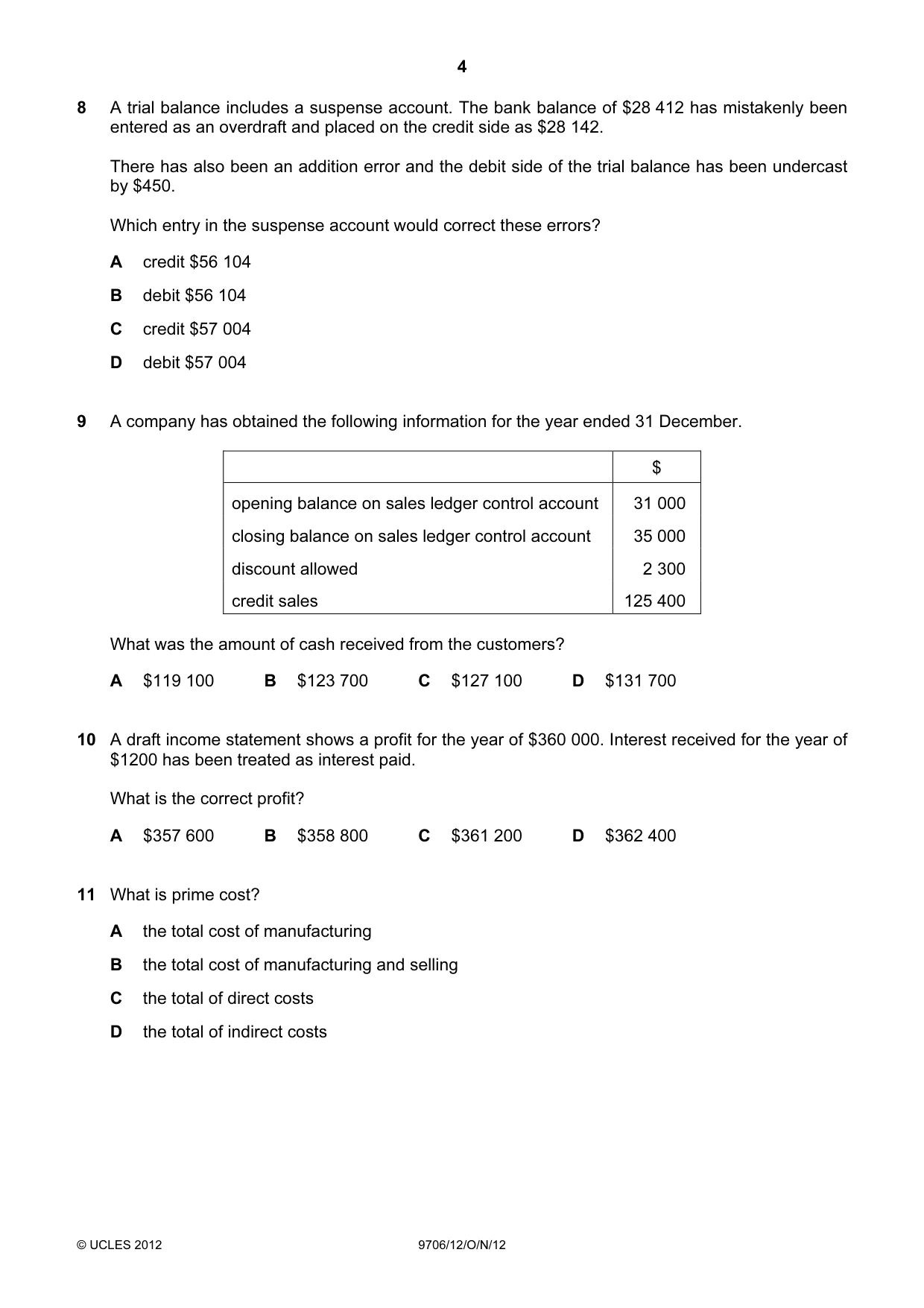
8 A trial balance includes a suspense account. The bank balance of $28 412 has mistakenly been entered as an overdraft and placed on the credit side as $28 142. There has also been an addition error and the debit side of the trial balance has been undercast by $450. Which entry in the suspense account would correct these errors? A credit $56 104 B debit $56 104 C credit $57 004 D debit $57 004
Mark scheme: C
Q9 · A company has obtained the following information for the year ended 31 December
9 A company has obtained the following information for the year ended 31 December. $ opening balance on sales ledger control account 31 000 closing balance on sales ledger control account 35 000 discount allowed 2 300 credit sales 125 400 What was the amount of cash received from the customers? A $119 100 B $123 700 C $127 100 D $131 700
Mark scheme: A
Q10 · A draft income statement shows a profit for the year of $360 000
10 A draft income statement shows a profit for the year of $360 000. Interest received for the year of $1200 has been treated as interest paid. What is the correct profit? A $357 600 B $358 800 C $361 200 D $362 400
Mark scheme: D
Q11 · What is prime cost?
11 What is prime cost? A the total cost of manufacturing B the total cost of manufacturing and selling C the total of direct costs D the total of indirect costs
Mark scheme: C
Q12 · A company operates three departments and apportions heat and light on the most…
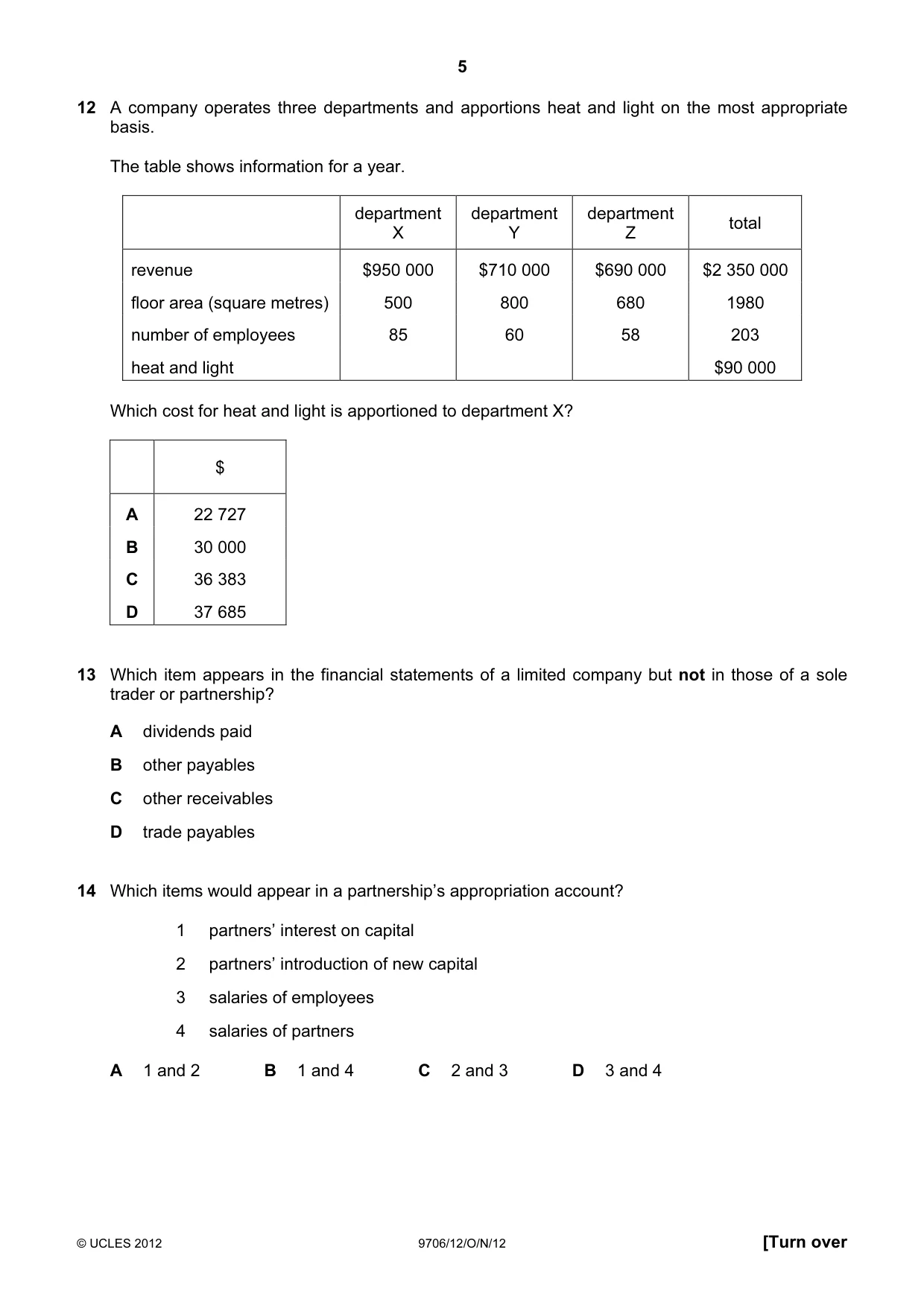
12 A company operates three departments and apportions heat and light on the most appropriate basis. The table shows information for a year. department department department total X Y Z revenue $950 000 $710 000 $690 000 $2 350 000 floor area (square metres) 500 800 680 1980 number of employees 85 60 58 203 heat and light $90 000 Which cost for heat and light is apportioned to department X? $ A 22 727 B 30 000 C 36 383 D 37 685
Mark scheme: A
Q13 · Which item appears in the financial statements of a limited company but not in those of a…
13 Which item appears in the financial statements of a limited company but not in those of a sole trader or partnership? A dividends paid B other payables C other receivables D trade payables
Mark scheme: A
Q14 · Which items would appear in a partnership’s appropriation account?
14 Which items would appear in a partnership’s appropriation account? 1 partners’ interest on capital 2 partners’ introduction of new capital 3 salaries of employees 4 salaries of partners A 1 and 2 B 1 and 4 C 2 and 3 D 3 and 4
Mark scheme: B
Q15 · The following information relates to the annual membership subscriptions of a cricket…
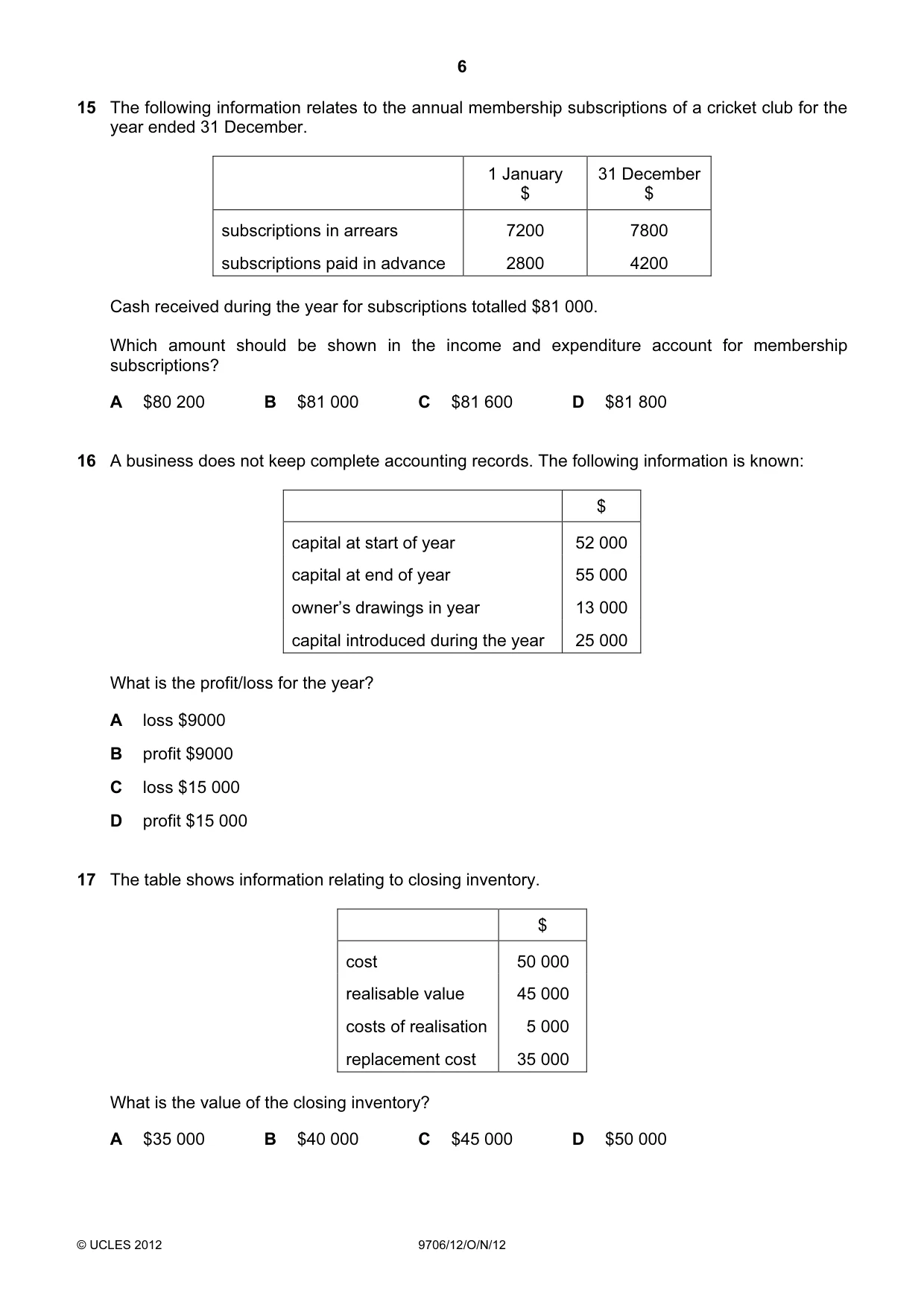
15 The following information relates to the annual membership subscriptions of a cricket club for the year ended 31 December. 1 January 31 December $ $ subscriptions in arrears 7200 7800 subscriptions paid in advance 2800 4200 Cash received during the year for subscriptions totalled $81 000. Which amount should be shown in the income and expenditure account for membership subscriptions? A $80 200 B $81 000 C $81 600 D $81 800
Mark scheme: A
Q16 · A business does not keep complete accounting records
16 A business does not keep complete accounting records. The following information is known: $ capital at start of year 52 000 capital at end of year 55 000 owner’s drawings in year 13 000 capital introduced during the year 25 000 What is the profit/loss for the year? A loss $9000 B profit $9000 C loss $15 000 D profit $15 000
Mark scheme: A
Q17 · The table shows information relating to closing inventory
17 The table shows information relating to closing inventory. $ cost 50 000 realisable value 45 000 costs of realisation 5 000 replacement cost 35 000 What is the value of the closing inventory? A $35 000 B $40 000 C $45 000 D $50 000
Mark scheme: B
Q18 · A company uses the straight-line method of depreciation for all its non-current assets
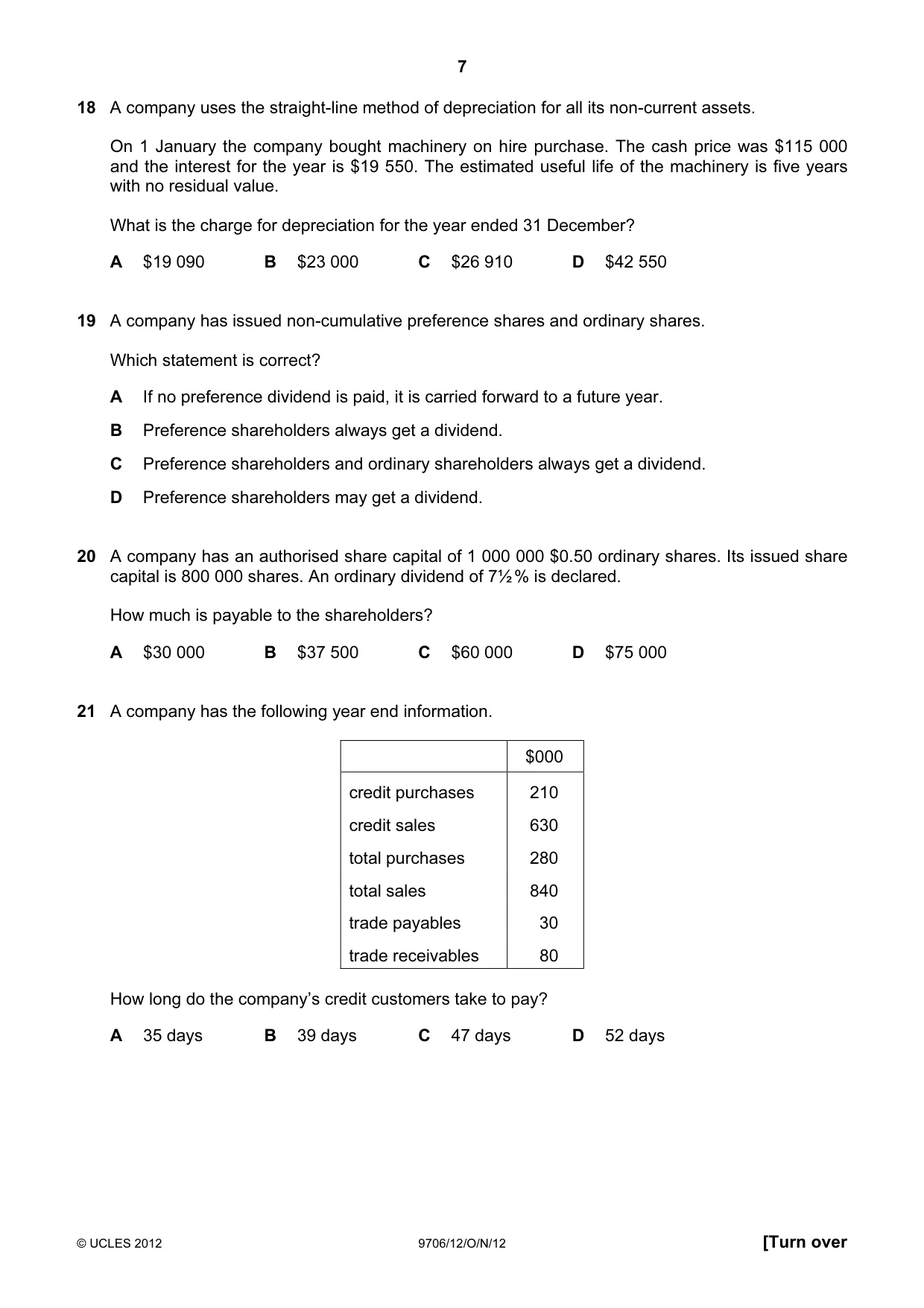
18 A company uses the straight-line method of depreciation for all its non-current assets. On 1 January the company bought machinery on hire purchase. The cash price was $115 000 and the interest for the year is $19 550. The estimated useful life of the machinery is five years with no residual value. What is the charge for depreciation for the year ended 31 December? A $19 090 B $23 000 C $26 910 D $42 550
Mark scheme: B
Q19 · A company has issued non-cumulative preference shares and ordinary shares
19 A company has issued non-cumulative preference shares and ordinary shares. Which statement is correct? A If no preference dividend is paid, it is carried forward to a future year. B Preference shareholders always get a dividend. C Preference shareholders and ordinary shareholders always get a dividend. D Preference shareholders may get a dividend.
Mark scheme: D
Q20 · A company has an authorised share capital of 1 000 000 $0.50 ordinary shares
20 A company has an authorised share capital of 1 000 000 $0.50 ordinary shares. Its issued share capital is 800 000 shares. An ordinary dividend of 7½ % is declared. How much is payable to the shareholders? A $30 000 B $37 500 C $60 000 D $75 000
Mark scheme: A
Q21 · A company has the following year end information
21 A company has the following year end information. $000 credit purchases 210 credit sales 630 total purchases 280 total sales 840 trade payables 30 trade receivables 80 How long do the company’s credit customers take to pay? A 35 days B 39 days C 47 days D 52 days
Mark scheme: C
More questions on Analysis and communication of accounting information
Q22 · A company has a current ratio of 2:1
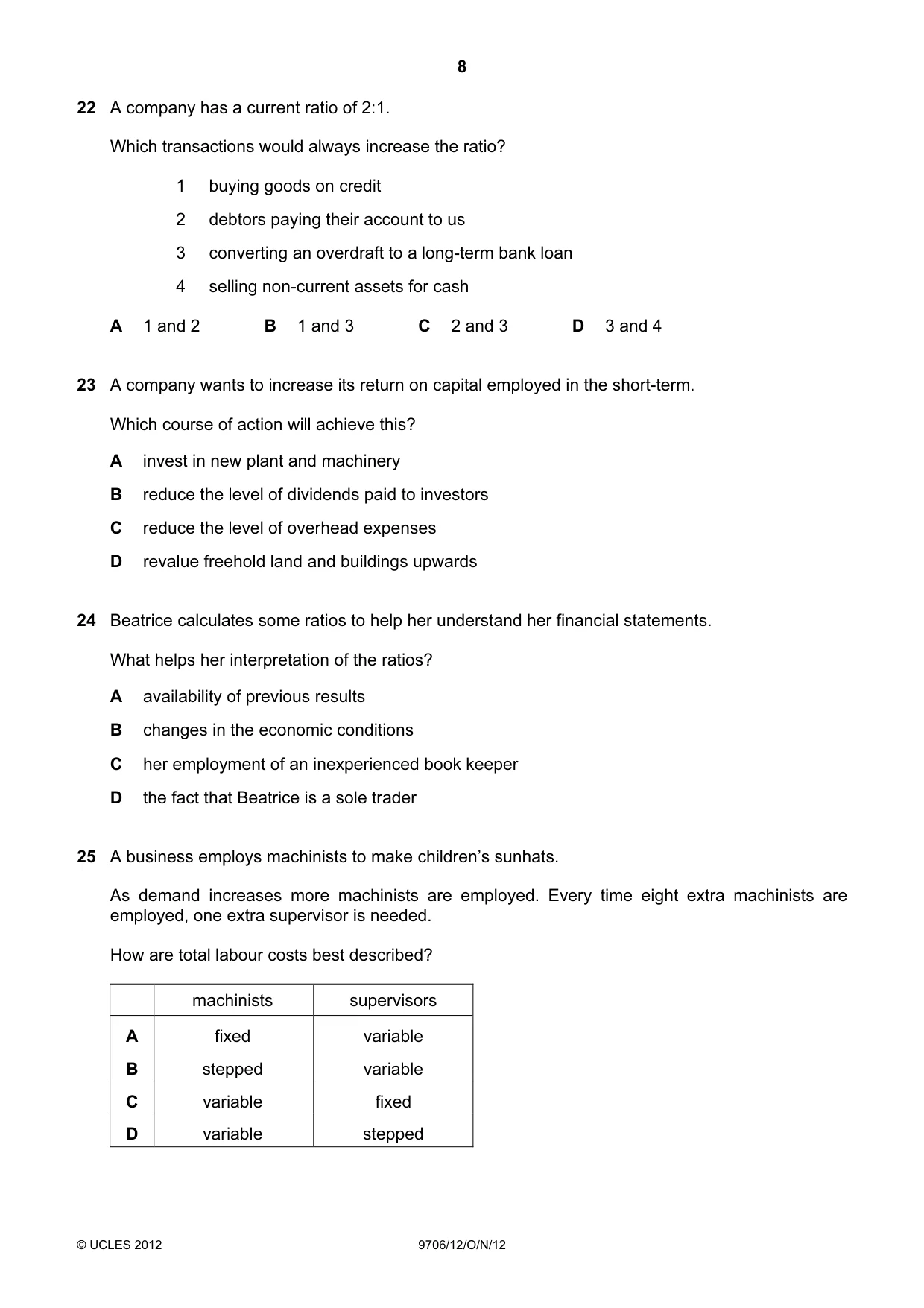
22 A company has a current ratio of 2:1. Which transactions would always increase the ratio? 1 buying goods on credit 2 debtors paying their account to us 3 converting an overdraft to a long-term bank loan 4 selling non-current assets for cash A 1 and 2 B 1 and 3 C 2 and 3 D 3 and 4
Mark scheme: D
More questions on Analysis and communication of accounting information
Q23 · A company wants to increase its return on capital employed in the short-term
23 A company wants to increase its return on capital employed in the short-term. Which course of action will achieve this? A invest in new plant and machinery B reduce the level of dividends paid to investors C reduce the level of overhead expenses D revalue freehold land and buildings upwards
Mark scheme: C
More questions on Analysis and communication of accounting information
Q24 · Beatrice calculates some ratios to help her understand her financial statements
24 Beatrice calculates some ratios to help her understand her financial statements. What helps her interpretation of the ratios? A availability of previous results B changes in the economic conditions C her employment of an inexperienced book keeper D the fact that Beatrice is a sole trader
Mark scheme: A
More questions on Analysis and communication of accounting information
Q25 · A business employs machinists to make children’s sunhats
25 A business employs machinists to make children’s sunhats. As demand increases more machinists are employed. Every time eight extra machinists are employed, one extra supervisor is needed. How are total labour costs best described? machinists supervisors A fixed variable B stepped variable C variable fixed D variable stepped
Mark scheme: D
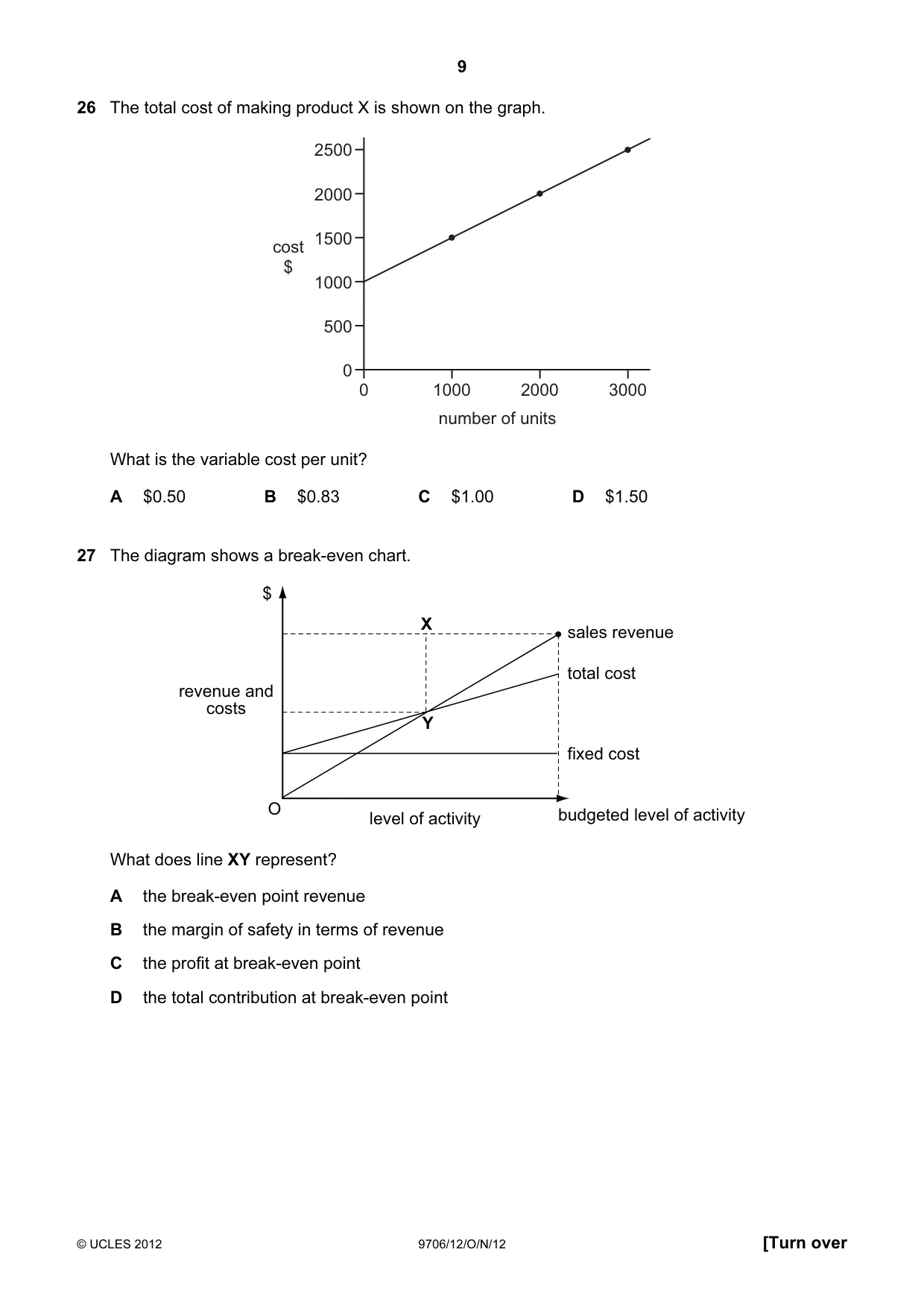
Q26 · The total cost of making product X is shown on the graph
26 The total cost of making product X is shown on the graph. 2500 2000 1500 cost $ 1000 500 0 0 1000 2000 3000 number of units What is the variable cost per unit? A $0.50 B $0.83 C $1.00 D $1.50
Mark scheme: A
Q27 · The diagram shows a break-even chart
27 The diagram shows a break-even chart. $ X sales revenue total cost revenue and costs Y fixed cost O budgeted level of activity level of activity What does line XY represent? A the break-even point revenue B the margin of safety in terms of revenue C the profit at break-even point D the total contribution at break-even point
Mark scheme: B
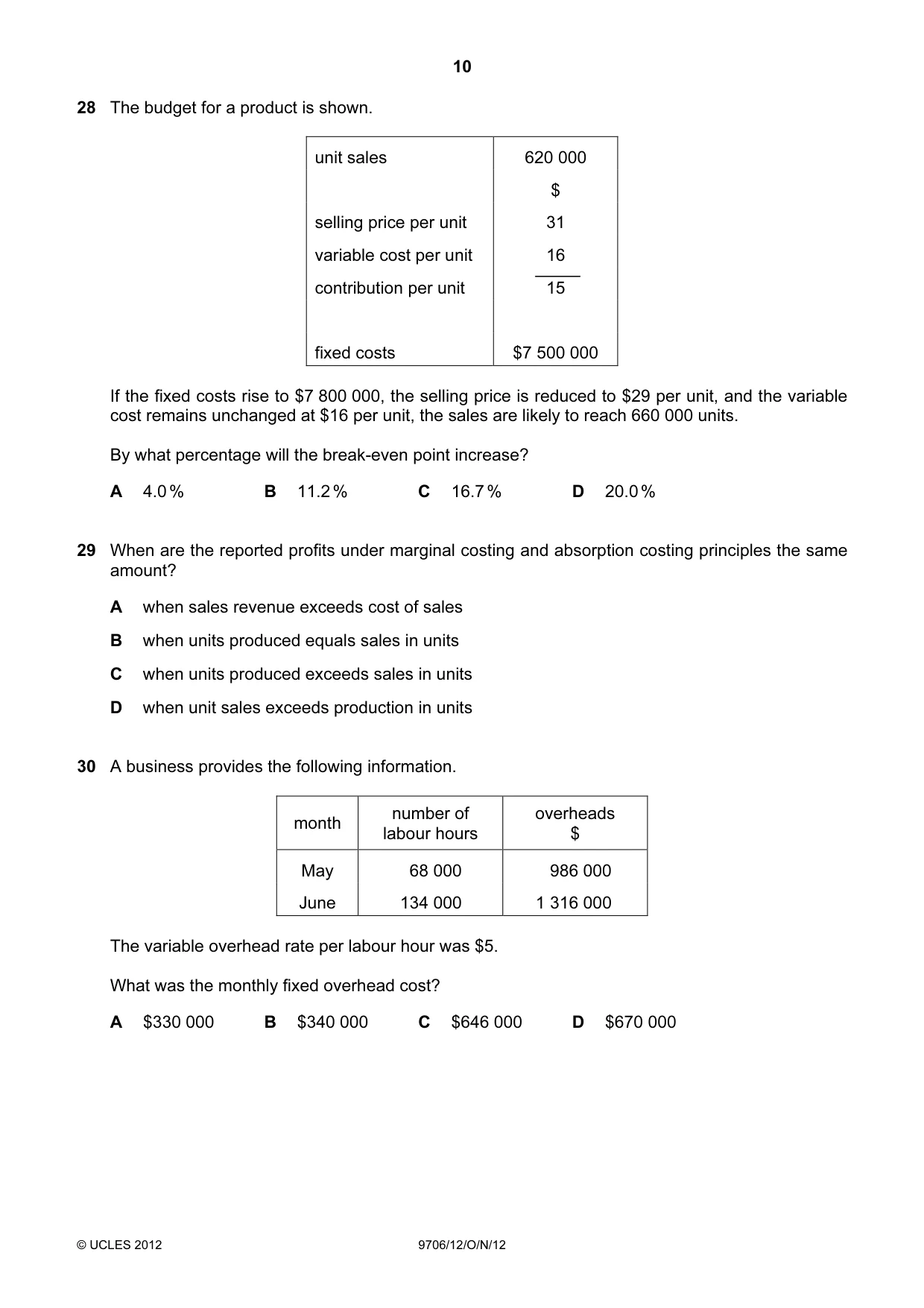
Q28 · The budget for a product is shown
28 The budget for a product is shown. unit sales 620 000 $ selling price per unit 31 variable cost per unit 16 contribution per unit 15 fixed costs $7 500 000 If the fixed costs rise to $7 800 000, the selling price is reduced to $29 per unit, and the variable cost remains unchanged at $16 per unit, the sales are likely to reach 660 000 units. By what percentage will the break-even point increase? A 4.0 % B 11.2 % C 16.7 % D 20.0 %
Mark scheme: D
Q29 · When are the reported profits under marginal costing and absorption costing principles…
29 When are the reported profits under marginal costing and absorption costing principles the same amount? A when sales revenue exceeds cost of sales B when units produced equals sales in units C when units produced exceeds sales in units D when unit sales exceeds production in units
Mark scheme: B
Q30 · A business provides the following information
30 A business provides the following information. number of overheads month labour hours $ May 68 000 986 000 June 134 000 1 316 000 The variable overhead rate per labour hour was $5. What was the monthly fixed overhead cost? A $330 000 B $340 000 C $646 000 D $670 000
Mark scheme: C
What was in this paper
The subtopics covered by these 30 questions, and how many questions each got. Open one in a new tab to see every Cambridge question on it.
What you needed in this session
Cambridge’s own grade thresholds for 2012 Oct/Nov, Paper 1 · Variant 2. A higher threshold means an easier paper — the bar moves with how the cohort did.