Cambridge A Level Accounting 9706 — 2024 May/June Paper 1 · Variant 1
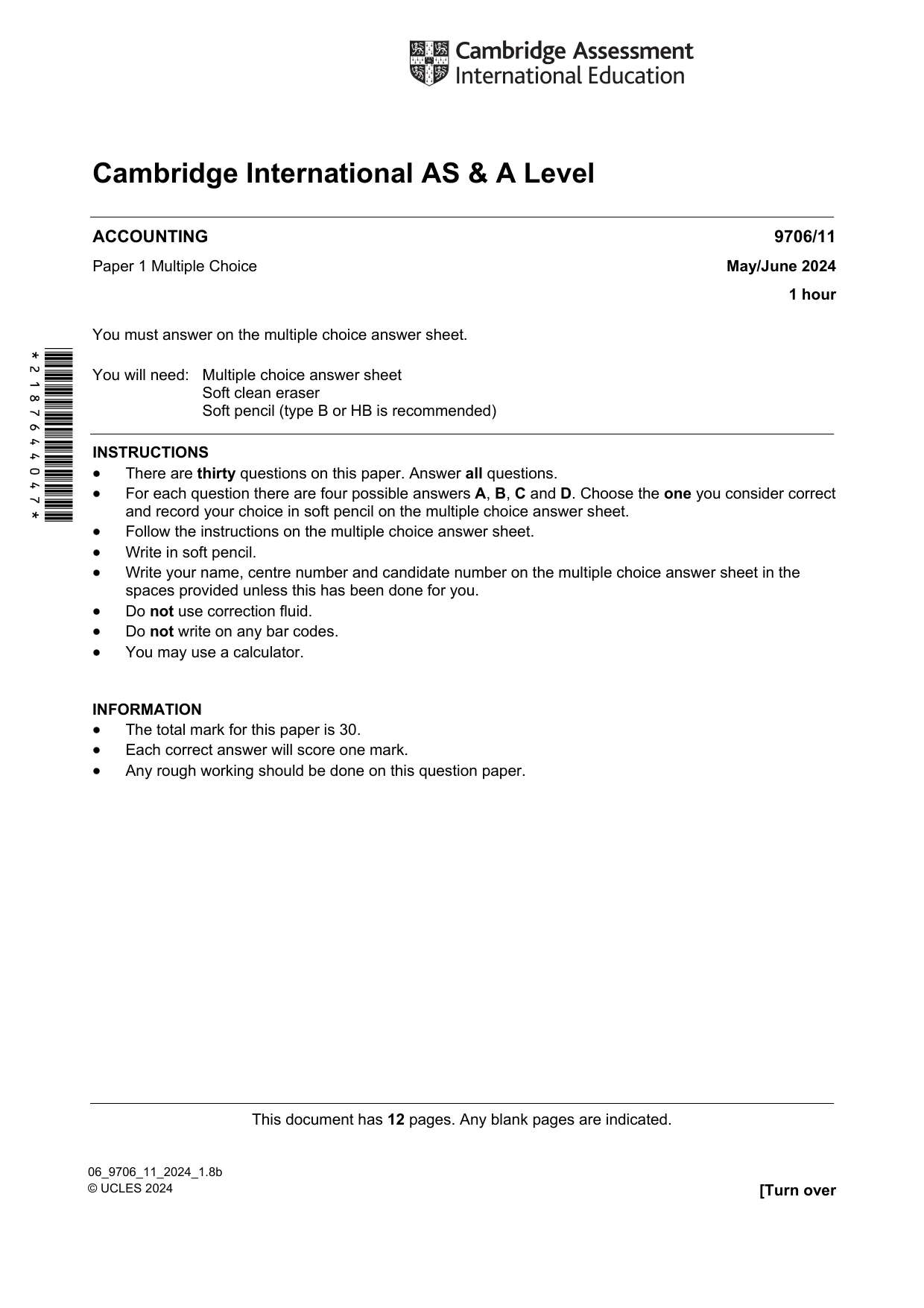
9706/11/M/J/24 · 30 questions · 30 marks · ≈34 min
The question paper and its mark scheme, free to read here and free to download. This is Cambridge’s own paper, exactly as it was sat.
Question paper12 pages
Mark scheme3 pages
Answers below. Sit the paper first if you are practising.
Questions as text
Q1 · Jamie is setting up a business
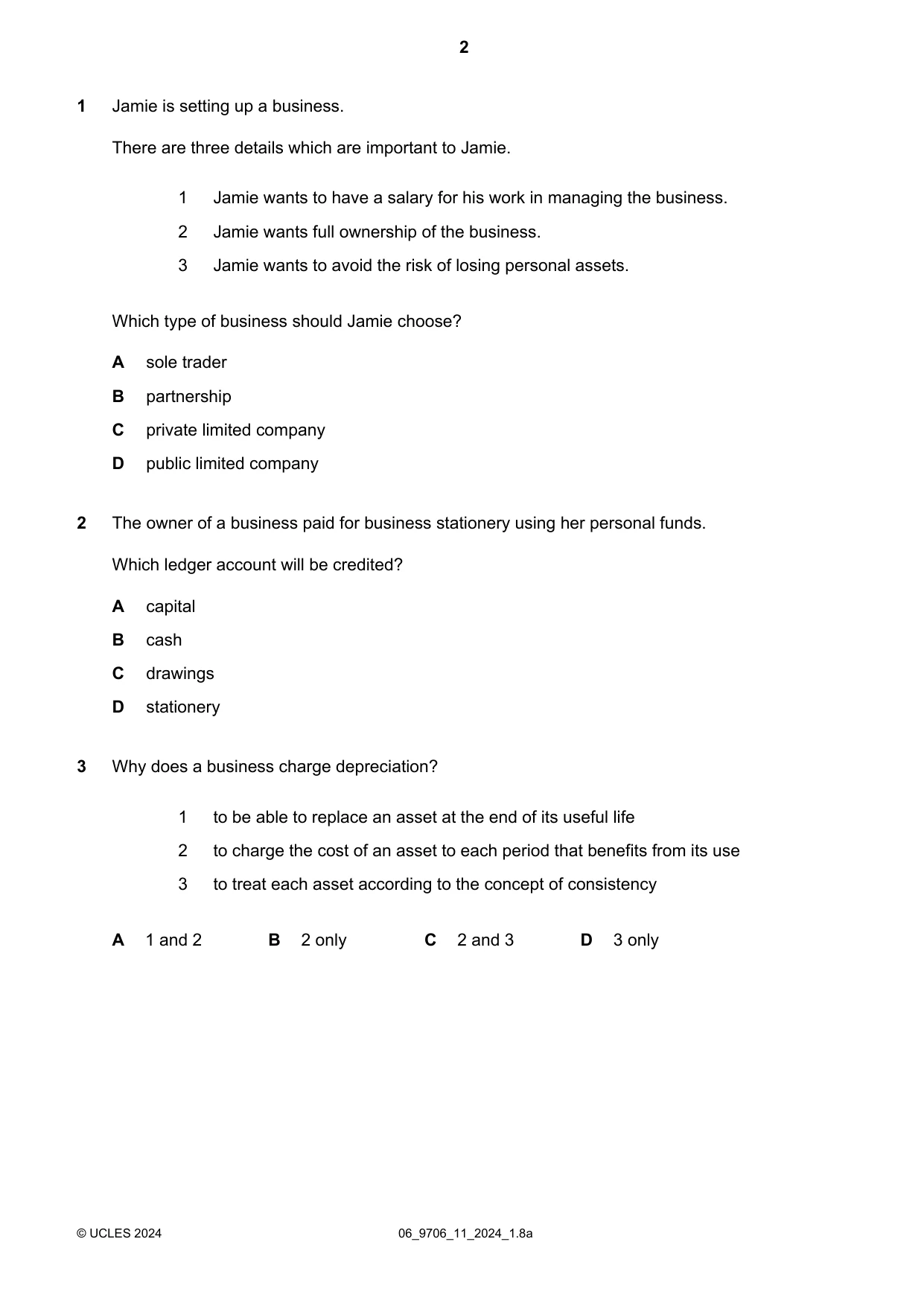
1 Jamie is setting up a business. There are three details which are important to Jamie. 1 Jamie wants to have a salary for his work in managing the business. 2 Jamie wants full ownership of the business. 3 Jamie wants to avoid the risk of losing personal assets. Which type of business should Jamie choose? A sole trader B partnership C private limited company D public limited company
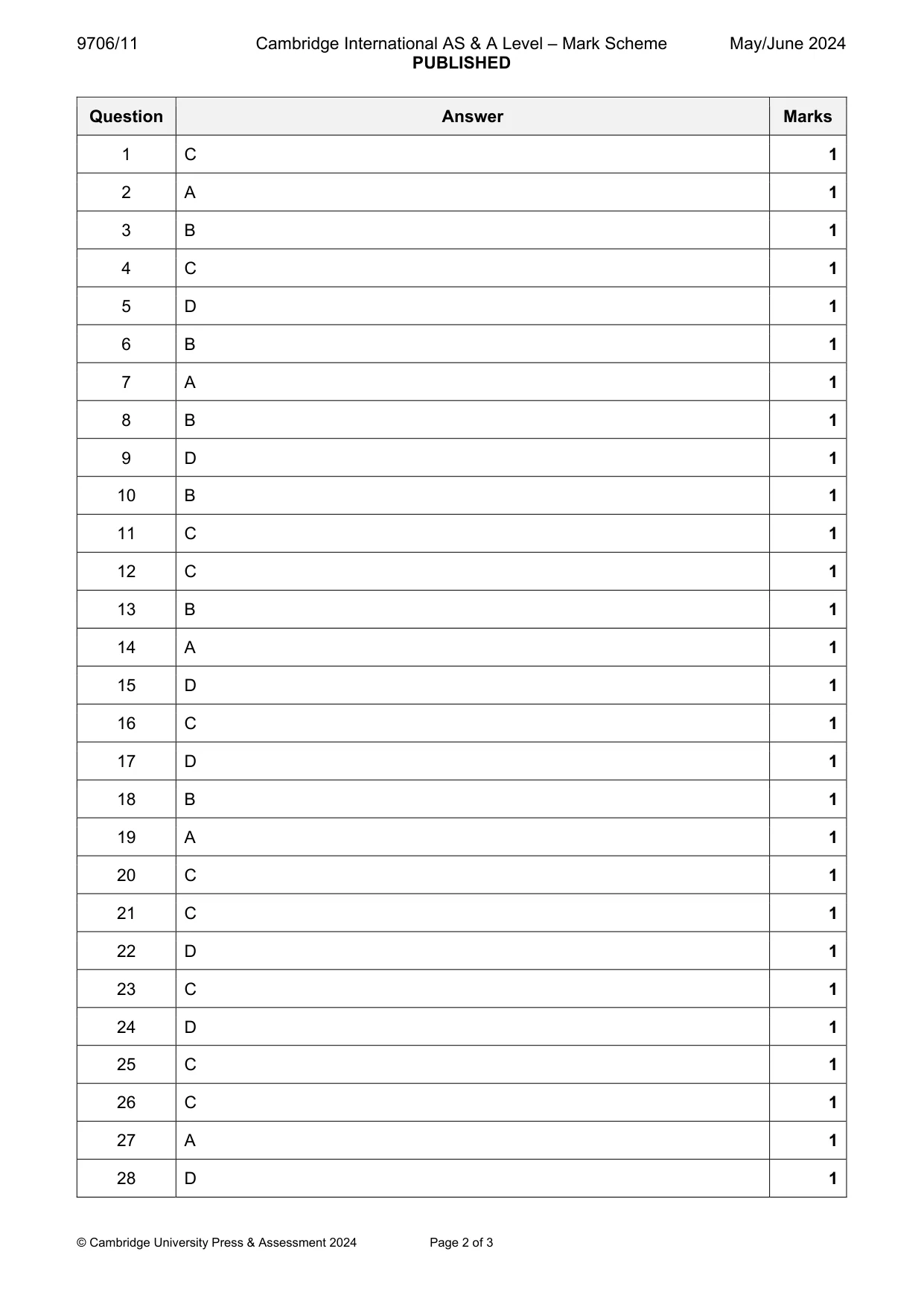
Mark scheme: C
Q2 · The owner of a business paid for business stationery using her personal funds
2 The owner of a business paid for business stationery using her personal funds. Which ledger account will be credited? A capital B cash C drawings D stationery
Mark scheme: A
Q3 · Why does a business charge depreciation?
3 Why does a business charge depreciation? 1 to be able to replace an asset at the end of its useful life 2 to charge the cost of an asset to each period that benefits from its use 3 to treat each asset according to the concept of consistency A 1 and 2 B 2 only C 2 and 3 D 3 only
Mark scheme: B
Q4 · The following information relates to the non-current assets of a business that was formed…
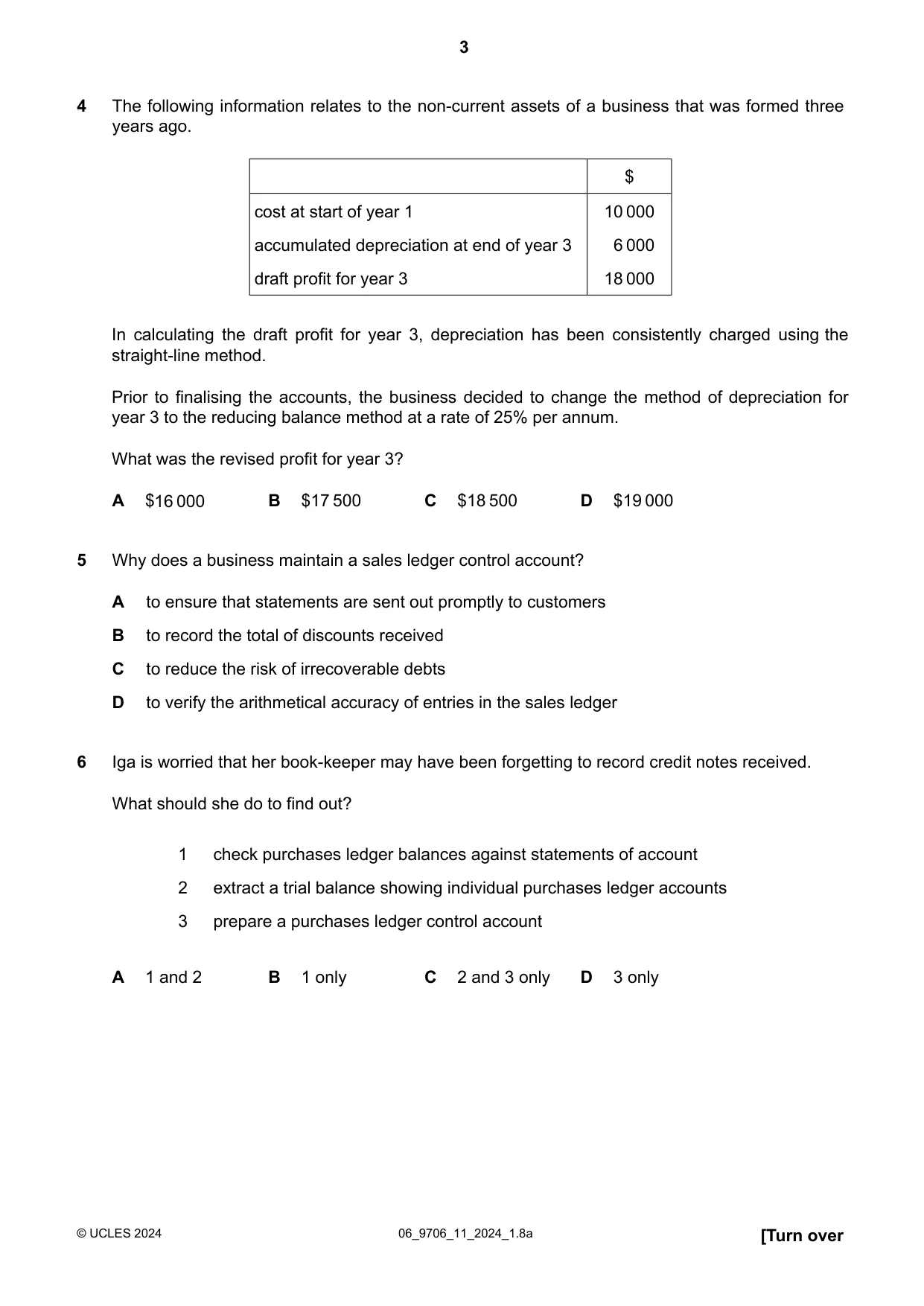
4 The following information relates to the non-current assets of a business that was formed three years ago. $ cost at start of year 1 10 000 accumulated depreciation at end of year 3 6 000 draft profit for year 3 18 000 In calculating the draft profit for year 3, depreciation has been consistently charged using the straight-line method. Prior to finalising the accounts, the business decided to change the method of depreciation for year 3 to the reducing balance method at a rate of 25% per annum. What was the revised profit for year 3? A $16 000 B $17 500 C $18 500 D $19 000
Mark scheme: C
Q5 · Why does a business maintain a sales ledger control account?
5 Why does a business maintain a sales ledger control account? A to ensure that statements are sent out promptly to customers B to record the total of discounts received C to reduce the risk of irrecoverable debts D to verify the arithmetical accuracy of entries in the sales ledger
Mark scheme: D
Q6 · Iga is worried that her book-keeper may have been forgetting to record credit notes…
6 Iga is worried that her book-keeper may have been forgetting to record credit notes received. What should she do to find out? 1 check purchases ledger balances against statements of account 2 extract a trial balance showing individual purchases ledger accounts 3 prepare a purchases ledger control account A 1 and 2 B 1 only C 2 and 3 only D 3 only A trial balance does not balance and a suspense account is opened.
Mark scheme: B
Q7 · On investigation, the following errors are found
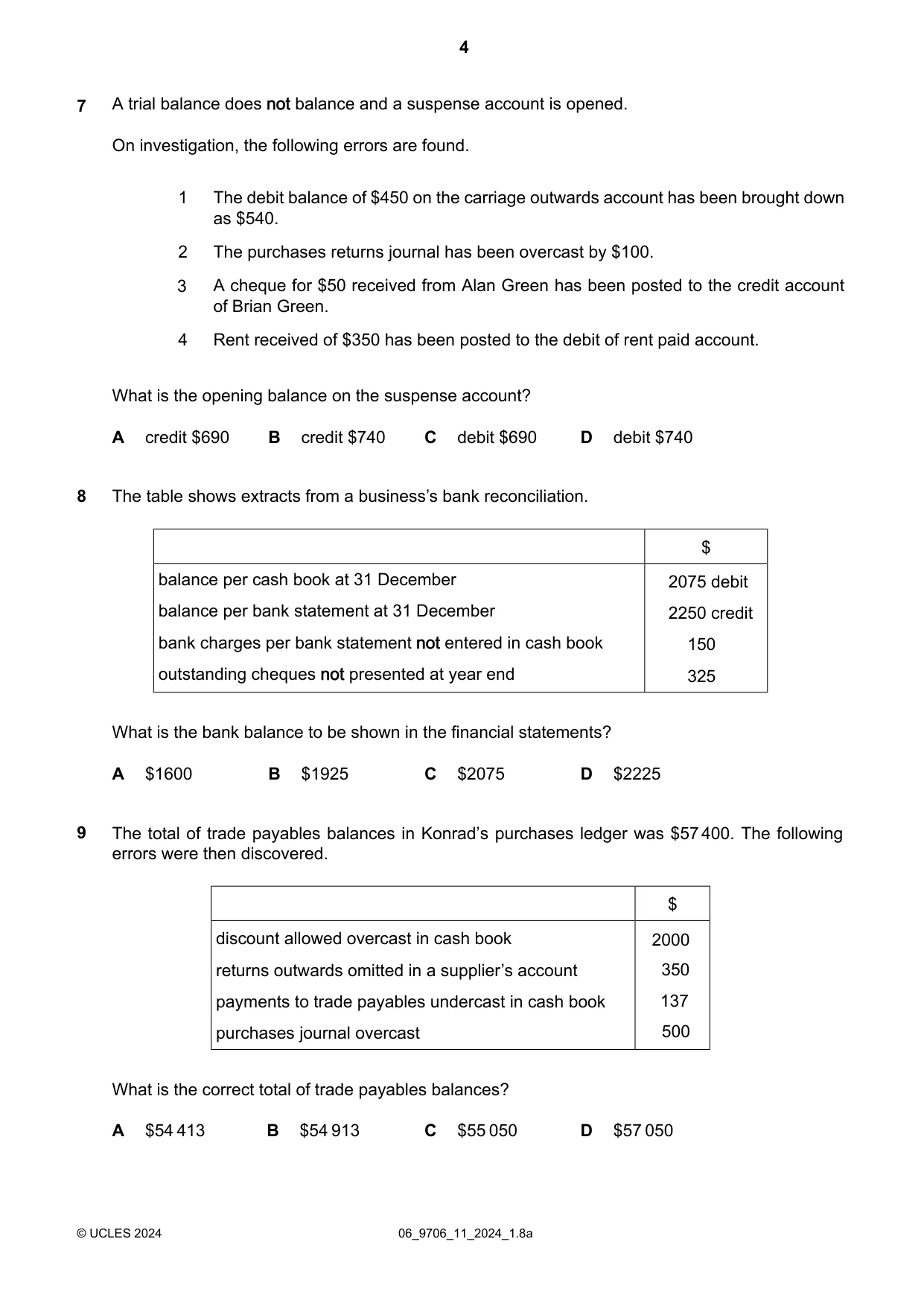
7 On investigation, the following errors are found. 1 The debit balance of $450 on the carriage outwards account has been brought down as $540. 2 The purchases returns journal has been overcast by $100. 3 A cheque for $50 received from Alan Green has been posted to the credit account of Brian Green. 4 Rent received of $350 has been posted to the debit of rent paid account. What is the opening balance on the suspense account? A credit $690 B credit $740 C debit $690 D debit $740
Mark scheme: A
Q8 · The table shows extracts from a business’s bank reconciliation
8 The table shows extracts from a business’s bank reconciliation. $ balance per cash book at 31 December 2075 debit balance per bank statement at 31 December 2250 credit bank charges per bank statement not entered in cash book 150 outstanding cheques not presented at year end 325 What is the bank balance to be shown in the financial statements? A $1600 B $1925 C $2075 D $2225
Mark scheme: B
Q9 · The total of trade payables balances in Konrad’s purchases ledger was $57 400
9 The total of trade payables balances in Konrad’s purchases ledger was $57 400. The following errors were then discovered. $ discount allowed overcast in cash book 2000 returns outwards omitted in a supplier’s account 350 payments to trade payables undercast in cash book 137 purchases journal overcast 500 What is the correct total of trade payables balances? A $54 413 B $54 913 C $55 050 D $57 050
Mark scheme: D
Q10 · Which statement is not correct?
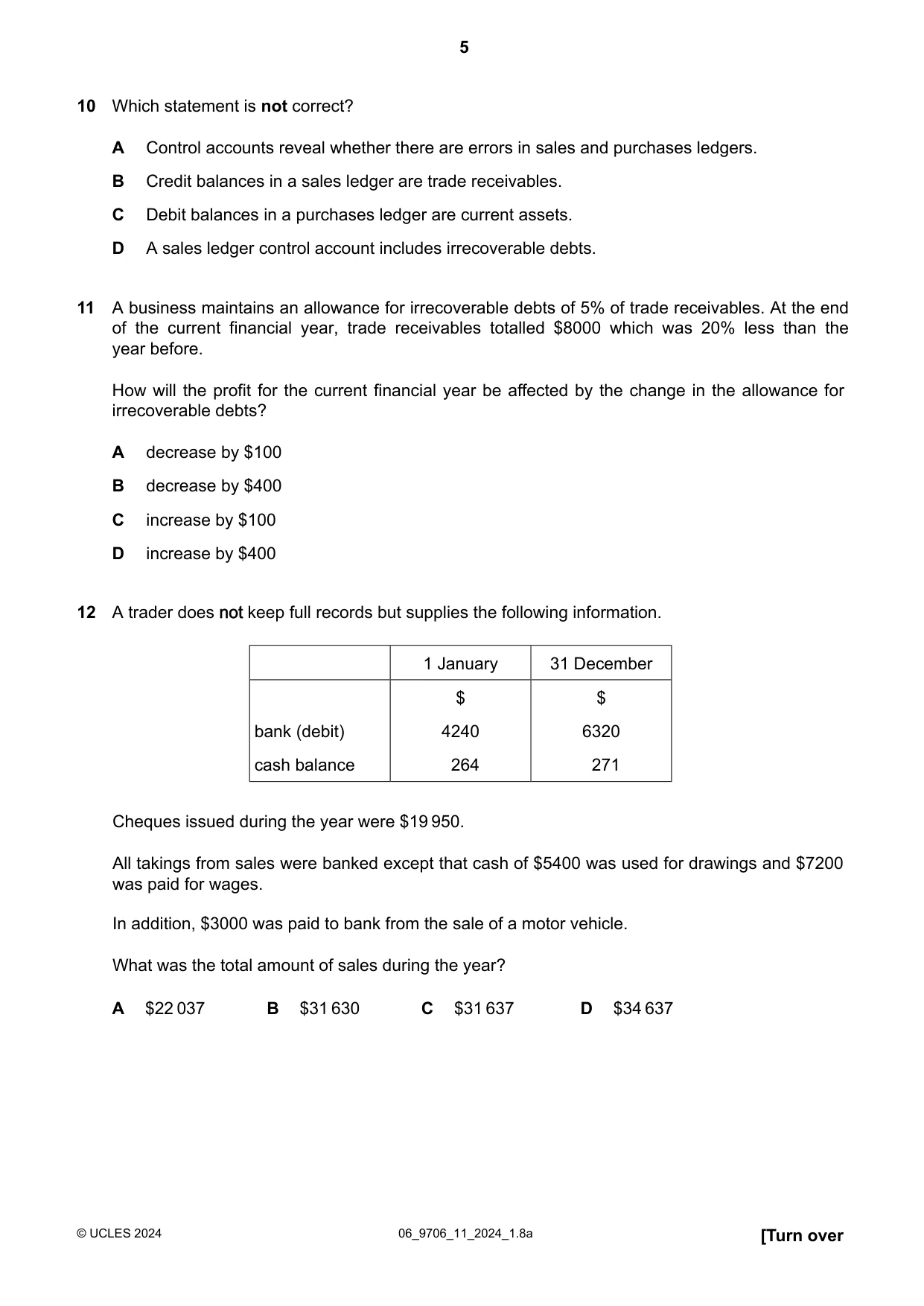
10 Which statement is not correct? A Control accounts reveal whether there are errors in sales and purchases ledgers. B Credit balances in a sales ledger are trade receivables. C Debit balances in a purchases ledger are current assets. D A sales ledger control account includes irrecoverable debts.
Mark scheme: B
Q11 · A business maintains an allowance for irrecoverable debts of 5% of trade receivables
11 A business maintains an allowance for irrecoverable debts of 5% of trade receivables. At the end of the current financial year, trade receivables totalled $8000 which was 20% less than the year before. How will the profit for the current financial year be affected by the change in the allowance for irrecoverable debts? A decrease by $100 B decrease by $400 C increase by $100 D increase by $400
Mark scheme: C
Q12 · A trader does not keep full records but supplies the following information
12 A trader does not keep full records but supplies the following information. 1 January 31 December $ $ bank (debit) 4240 6320 cash balance 264 271 Cheques issued during the year were $19 950. All takings from sales were banked except that cash of $5400 was used for drawings and $7200 was paid for wages. In addition, $3000 was paid to bank from the sale of a motor vehicle. What was the total amount of sales during the year? A $22 037 B $31 630 C $31 637 D $34 637
Mark scheme: C
Q13 · Which statement(s) are true of drawings?
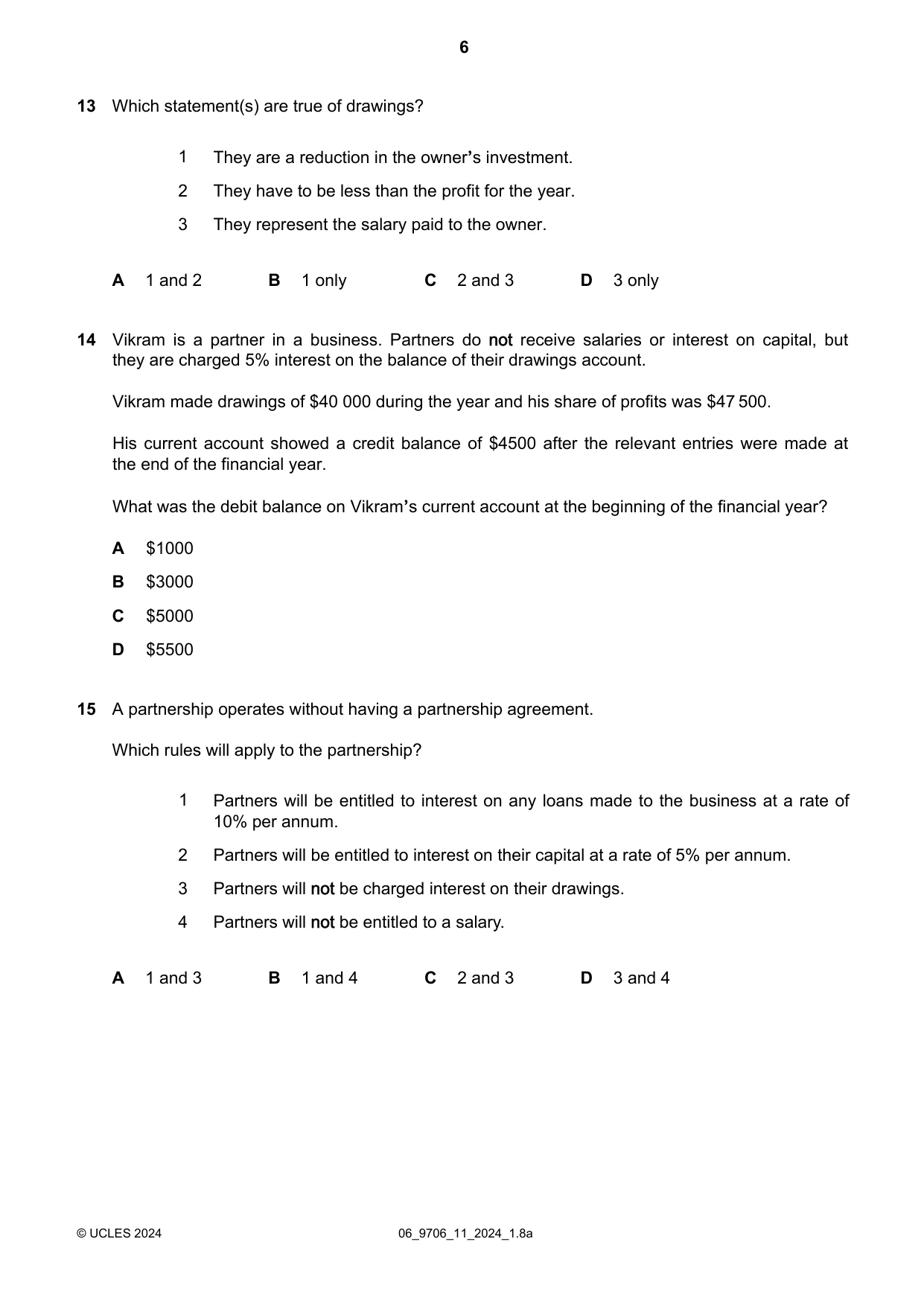
13 Which statement(s) are true of drawings? 1 They are a reduction in the owner’s investment. 2 They have to be less than the profit for the year. 3 They represent the salary paid to the owner. A 1 and 2 B 1 only C 2 and 3 D 3 only
Mark scheme: B
Q14 · Vikram is a partner in a business
14 Vikram is a partner in a business. Partners do not receive salaries or interest on capital, but they are charged 5% interest on the balance of their drawings account. Vikram made drawings of $40 000 during the year and his share of profits was $47 500. His current account showed a credit balance of $4500 after the relevant entries were made at the end of the financial year. What was the debit balance on Vikram’s current account at the beginning of the financial year? A $1000 B $3000 C $5000 D $5500
Mark scheme: A
Q15 · A partnership operates without having a partnership agreement
15 A partnership operates without having a partnership agreement. Which rules will apply to the partnership? 1 Partners will be entitled to interest on any loans made to the business at a rate of 10% per annum. 2 Partners will be entitled to interest on their capital at a rate of 5% per annum. 3 Partners will not be charged interest on their drawings. 4 Partners will not be entitled to a salary. A 1 and 3 B 1 and 4 C 2 and 3 D 3 and 4 L and M are in partnership, sharing profits and losses in the ratio of 3 : 2 respectively.
Mark scheme: D
Q16 · The following information was available at year end
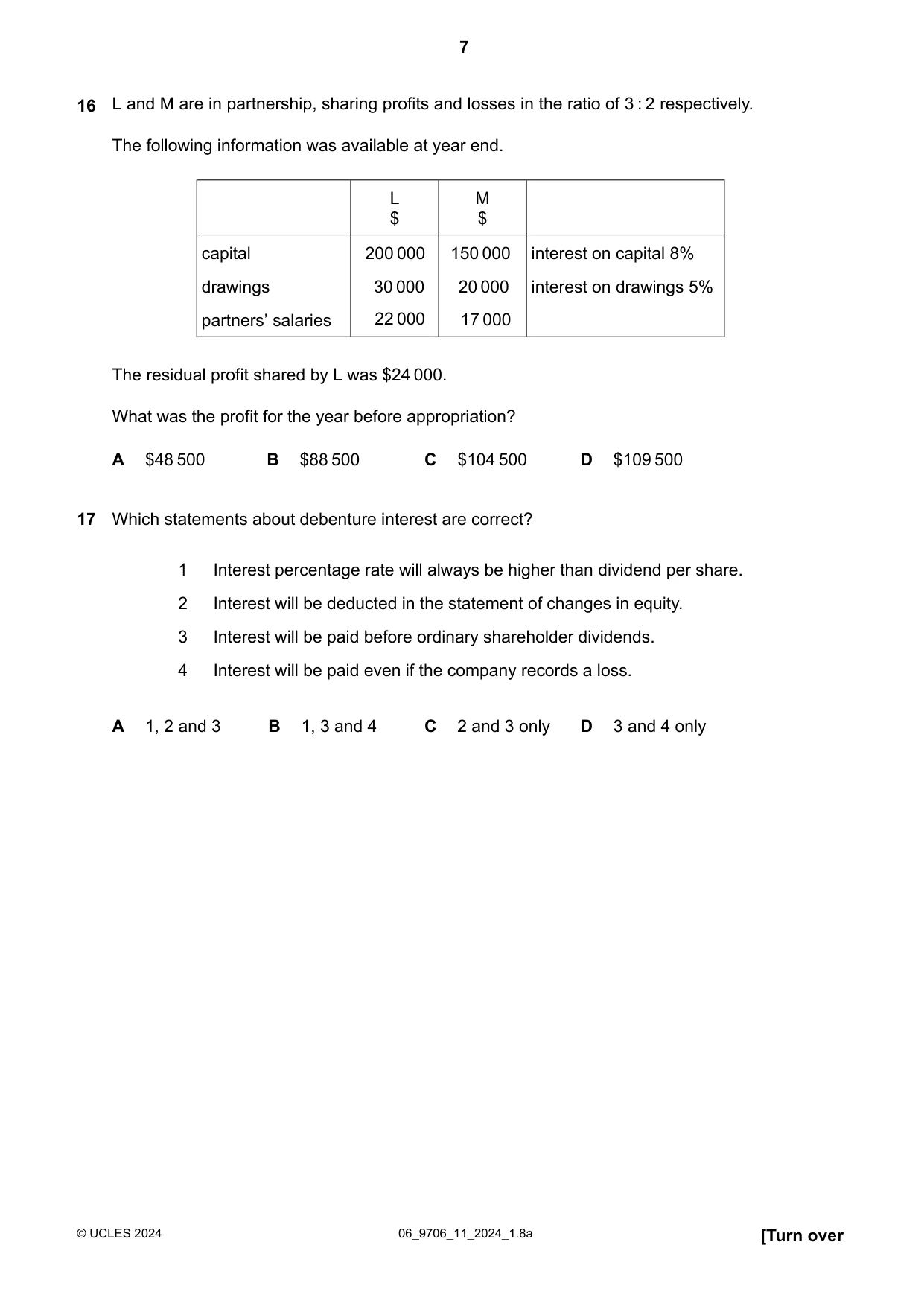
16 The following information was available at year end. L M $ $ capital 200 000 150 000 interest on capital 8% drawings 30 000 20 000 interest on drawings 5% partners’ salaries 22 000 17 000 The residual profit shared by L was $24 000. What was the profit for the year before appropriation? A $48 500 B $88 500 C $104 500 D $109 500
Mark scheme: C
Q17 · Which statements about debenture interest are correct?
17 Which statements about debenture interest are correct? 1 Interest percentage rate will always be higher than dividend per share. 2 Interest will be deducted in the statement of changes in equity. 3 Interest will be paid before ordinary shareholder dividends. 4 Interest will be paid even if the company records a loss. A 1, 2 and 3 B 1, 3 and 4 C 2 and 3 only D 3 and 4 only
Mark scheme: D
Q18 · A company has the following reserves
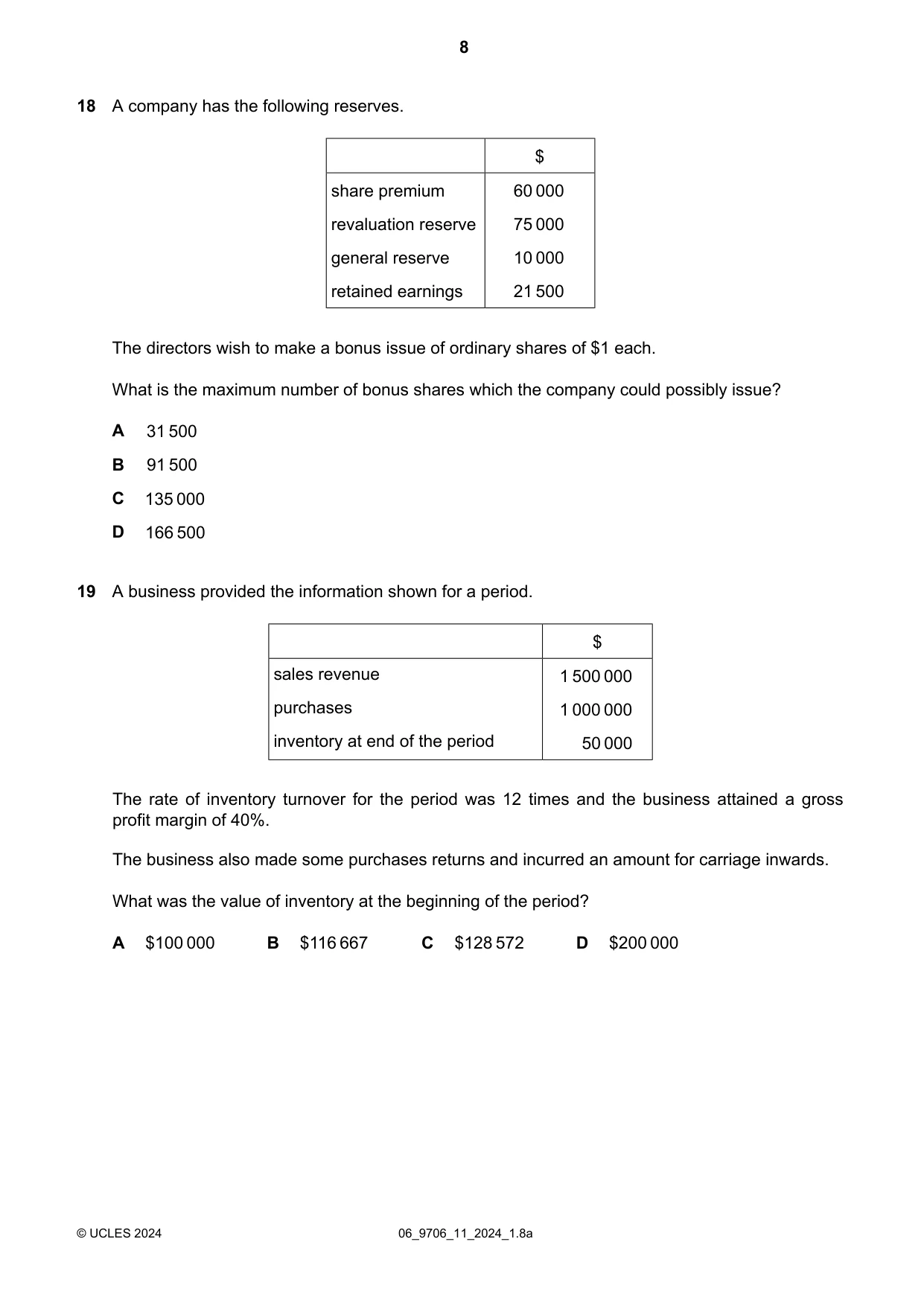
18 A company has the following reserves. $ share premium 60 000 revaluation reserve 75 000 general reserve 10 000 retained earnings 21 500 The directors wish to make a bonus issue of ordinary shares of $1 each. What is the maximum number of bonus shares which the company could possibly issue? A 31 500 B 91 500 C 135 000 D 166 500
Mark scheme: B
Q19 · A business provided the information shown for a period
19 A business provided the information shown for a period. $ sales revenue 1 500 000 purchases 1 000 000 inventory at end of the period 50 000 The rate of inventory turnover for the period was 12 times and the business attained a gross profit margin of 40%. The business also made some purchases returns and incurred an amount for carriage inwards. What was the value of inventory at the beginning of the period? A $100 000 B $116 667 C $128 572 D $200 000
Mark scheme: A
More questions on Analysis and communication of accounting information
Q20 · When comparing with the previous year, a trader finds that his gross profit margin has…
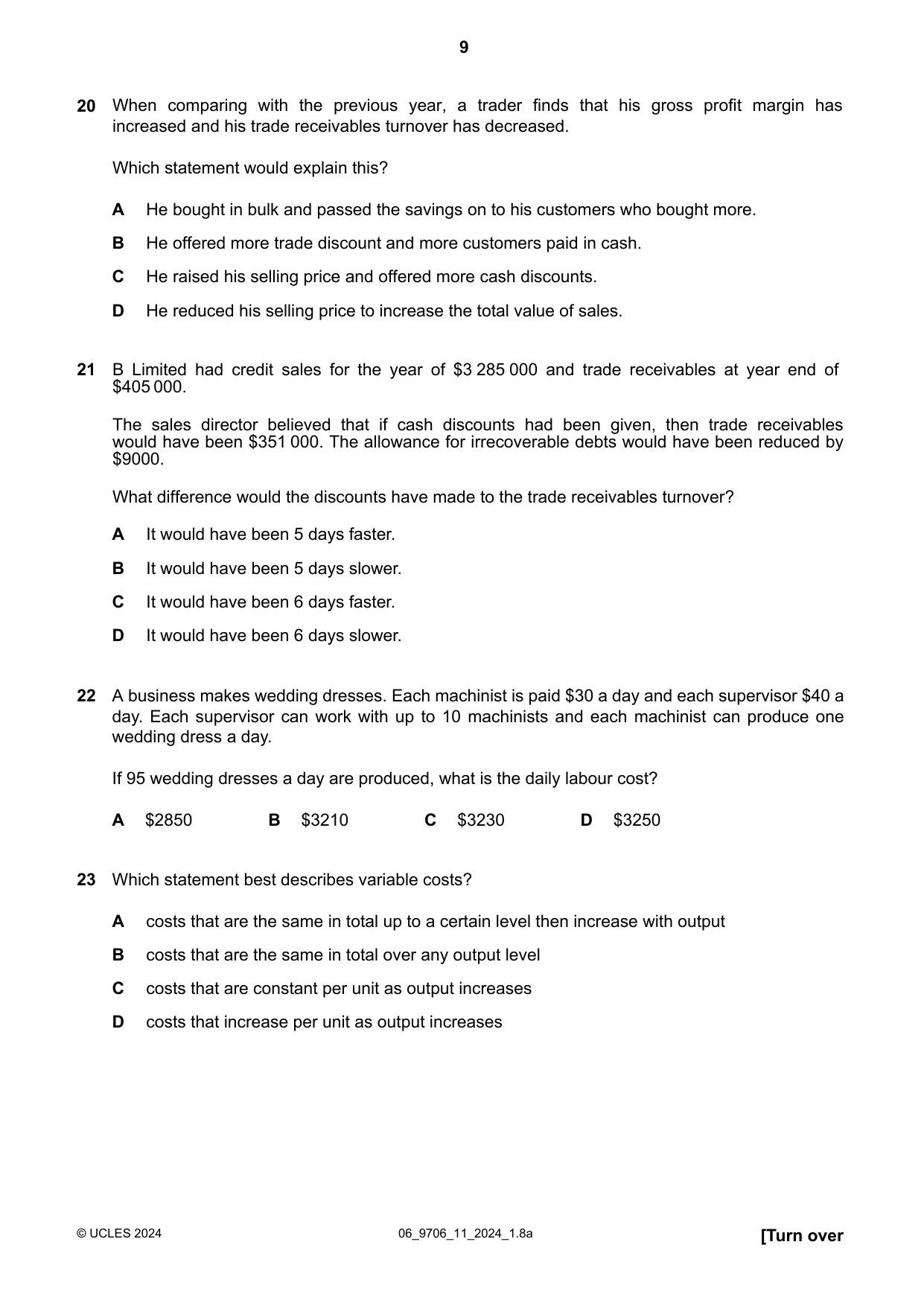
20 When comparing with the previous year, a trader finds that his gross profit margin has increased and his trade receivables turnover has decreased. Which statement would explain this? A He bought in bulk and passed the savings on to his customers who bought more. B He offered more trade discount and more customers paid in cash. C He raised his selling price and offered more cash discounts. D He reduced his selling price to increase the total value of sales.
Mark scheme: C
More questions on Analysis and communication of accounting information
Q21 · B Limited had credit sales for the year of $3 285 000 and trade receivables at year end…
21 B Limited had credit sales for the year of $3 285 000 and trade receivables at year end of $405 000. The sales director believed that if cash discounts had been given, then trade receivables would have been $351 000. The allowance for irrecoverable debts would have been reduced by $9000. What difference would the discounts have made to the trade receivables turnover? A It would have been 5 days faster. B It would have been 5 days slower. C It would have been 6 days faster. D It would have been 6 days slower.
Mark scheme: C
More questions on Analysis and communication of accounting information
Q22 · A business makes wedding dresses
22 A business makes wedding dresses. Each machinist is paid $30 a day and each supervisor $40 a day. Each supervisor can work with up to 10 machinists and each machinist can produce one wedding dress a day. If 95 wedding dresses a day are produced, what is the daily labour cost? A $2850 B $3210 C $3230 D $3250
Mark scheme: D
Q23 · Which statement best describes variable costs?
23 Which statement best describes variable costs? A costs that are the same in total up to a certain level then increase with output B costs that are the same in total over any output level C costs that are constant per unit as output increases D costs that increase per unit as output increases
Mark scheme: C
Q24 · P Limited makes wooden chairs at a unit cost of $70 each
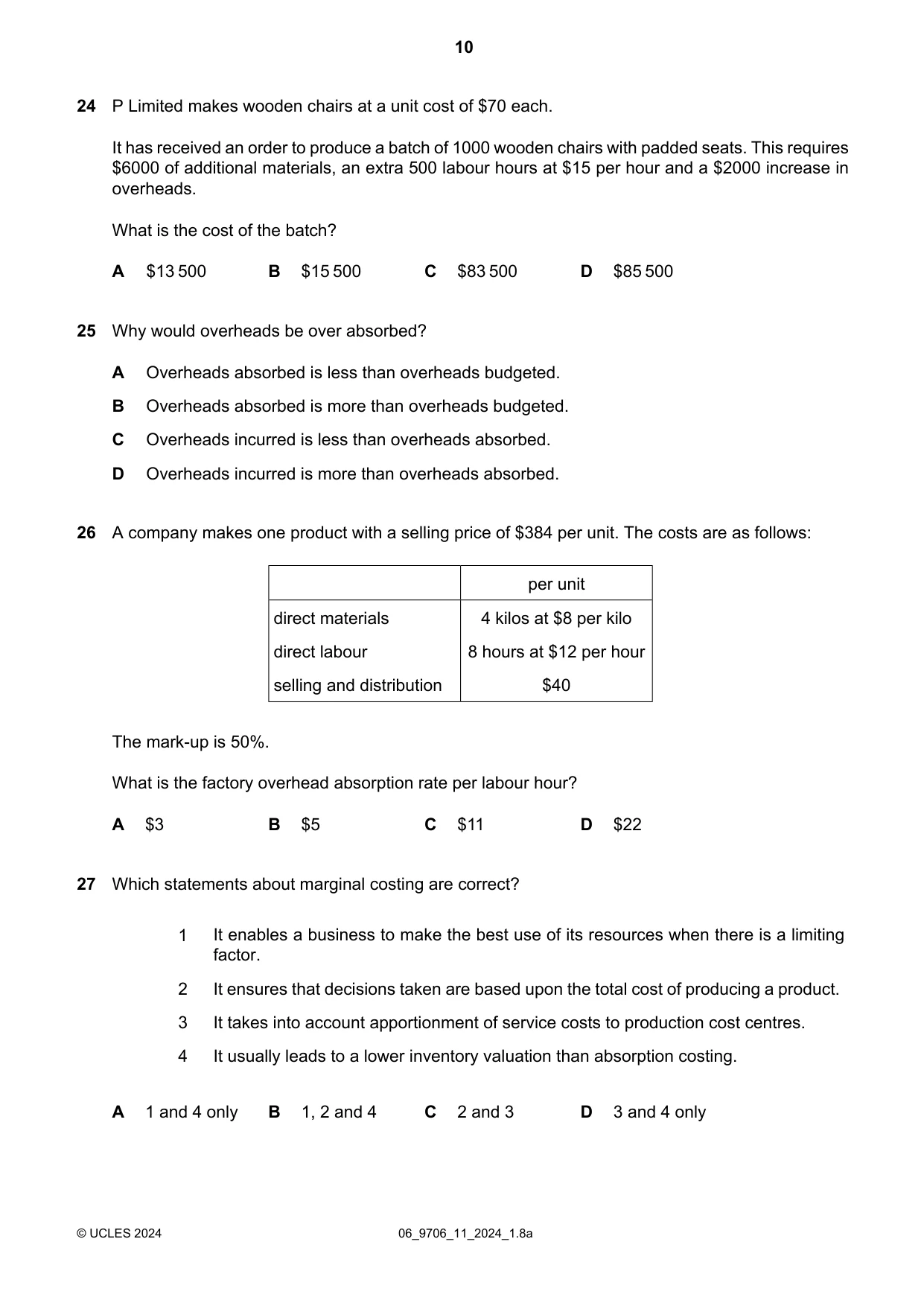
24 P Limited makes wooden chairs at a unit cost of $70 each. It has received an order to produce a batch of 1000 wooden chairs with padded seats. This requires $6000 of additional materials, an extra 500 labour hours at $15 per hour and a $2000 increase in overheads. What is the cost of the batch? A $13 500 B $15 500 C $83 500 D $85 500
Mark scheme: D
Q25 · Why would overheads be over absorbed?
25 Why would overheads be over absorbed? A Overheads absorbed is less than overheads budgeted. B Overheads absorbed is more than overheads budgeted. C Overheads incurred is less than overheads absorbed. D Overheads incurred is more than overheads absorbed.
Mark scheme: C
Q26 · A company makes one product with a selling price of $384 per unit
26 A company makes one product with a selling price of $384 per unit. The costs are as follows: per unit direct materials 4 kilos at $8 per kilo direct labour 8 hours at $12 per hour selling and distribution $40 The mark-up is 50%. What is the factory overhead absorption rate per labour hour? A $3 B $5 C $11 D $22
Mark scheme: C
Q27 · Which statements about marginal costing are correct?
27 Which statements about marginal costing are correct? 1 It enables a business to make the best use of its resources when there is a limiting factor. 2 It ensures that decisions taken are based upon the total cost of producing a product. 3 It takes into account apportionment of service costs to production cost centres. 4 It usually leads to a lower inventory valuation than absorption costing. A 1 and 4 only B 1, 2 and 4 C 2 and 3 D 3 and 4 only
Mark scheme: A
Q28 · A company makes and sells a single type of product
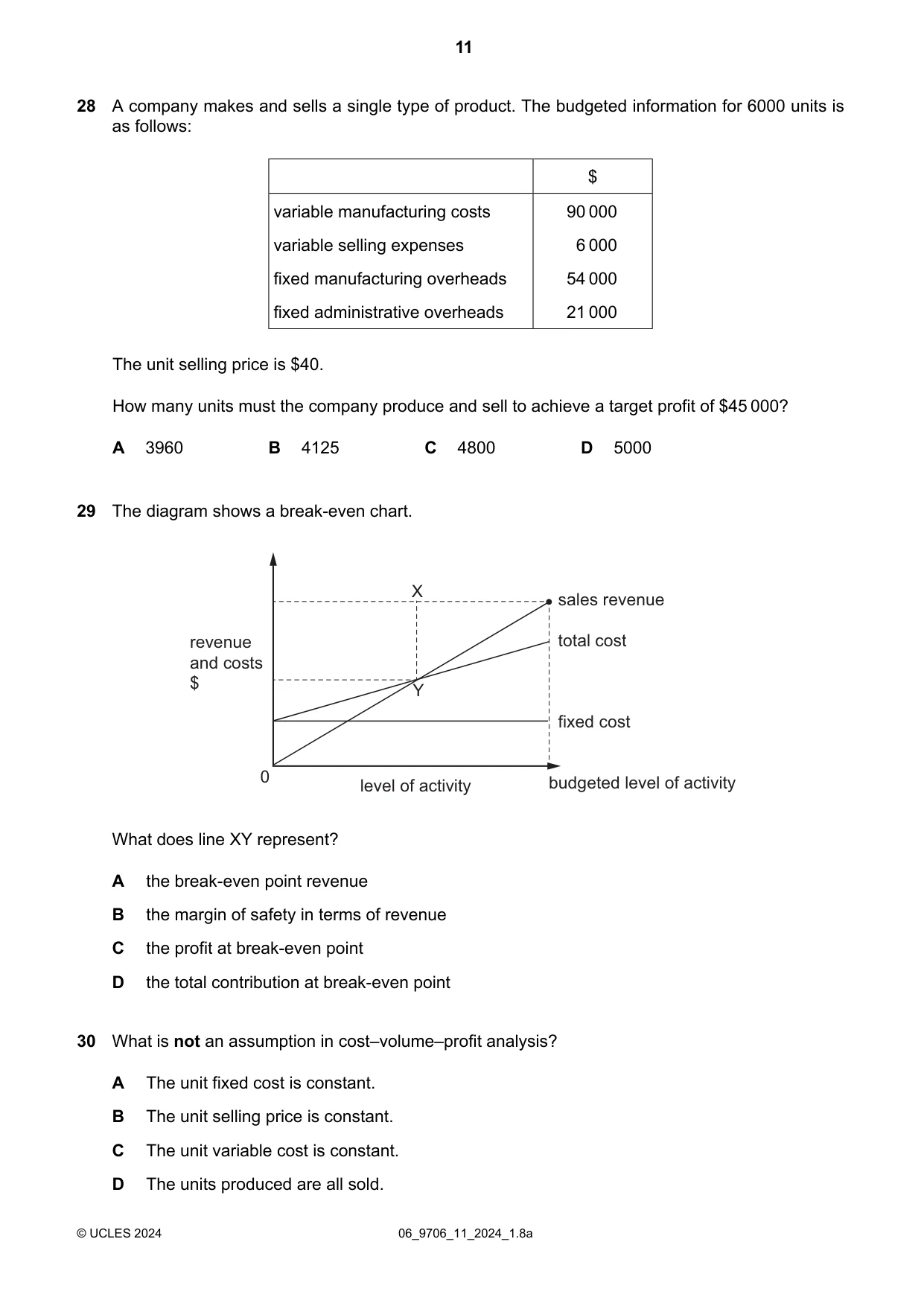
28 A company makes and sells a single type of product. The budgeted information for 6000 units is as follows: $ variable manufacturing costs 90 000 variable selling expenses 6 000 fixed manufacturing overheads 54 000 fixed administrative overheads 21 000 The unit selling price is $40. How many units must the company produce and sell to achieve a target profit of $45 000? A 3960 B 4125 C 4800 D 5000
Mark scheme: D
Q29 · The diagram shows a break-even chart
29 The diagram shows a break-even chart. X sales revenue revenue total cost and costs $ Y fixed cost 0 budgeted level of activity level of activity What does line XY represent? A the break-even point revenue B the margin of safety in terms of revenue C the profit at break-even point D the total contribution at break-even point
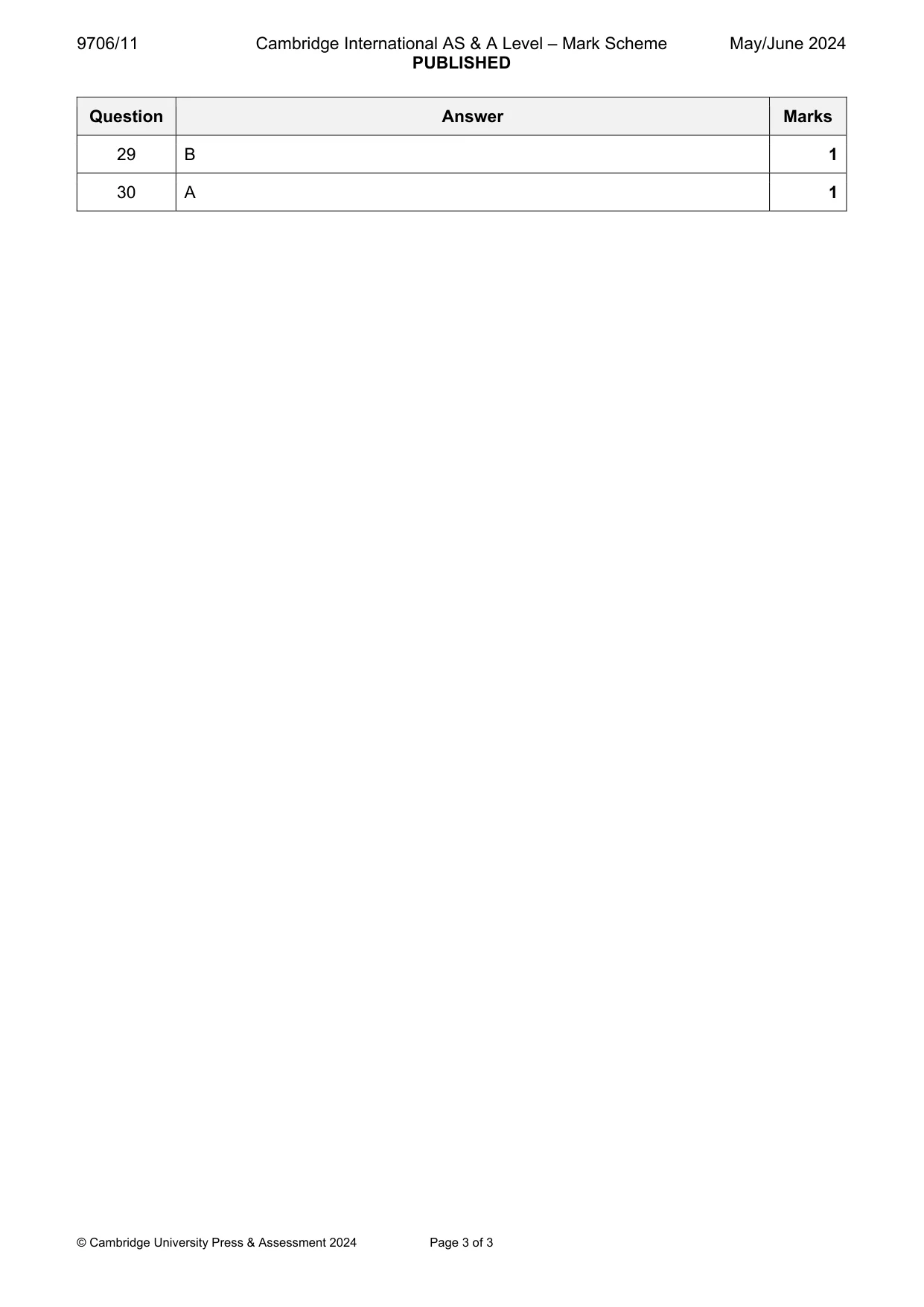
Mark scheme: B
Q30 · What is not an assumption in cost–volume–profit analysis?
30 What is not an assumption in cost–volume–profit analysis? A The unit fixed cost is constant. B The unit selling price is constant. C The unit variable cost is constant. D The units produced are all sold.
Mark scheme: A
What was in this paper
The subtopics covered by these 30 questions, and how many questions each got. Open one in a new tab to see every Cambridge question on it.
What you needed in this session
Cambridge’s own grade thresholds for 2024 May/June, Paper 1 · Variant 1. A higher threshold means an easier paper — the bar moves with how the cohort did.